
Norcross City Zoning Code
ARTICLE V
- TREE CONSERVATION, BUFFERS, AND LANDSCAPING
Sec. 205-1.- Purpose.
The purpose of this article is to preserve and enhance the city's natural environment and to ensure that the city will continue to enjoy the benefits provided by its urban forest in compliance with the policies of the city comprehensive plan. It does this through the following provisions of this article in order to:
(1)
Maintain and expand the tree canopy on public and private lands in the city by prohibiting the destruction or removal of trees except in accordance with the standards set forth in this article;
(2)
Maintain trees in the city in a healthy condition through professionally accepted arboricultural practices;
(3)
Establish and revise as necessary the standards for the planting and maintenance of trees so as to improve the economic base of the city by improving property values, to enhance the visual quality of the city and its neighborhoods and to improve public health by lessening air pollution and the incidence of flooding;
(4)
Minimize hazards and damage to streets and sidewalks and lessen public rights-of-way maintenance costs;
(5)
Establish standards for the replacement of trees removed or destroyed by the site development and/or building process;
(6)
Establish standards for buffer areas necessary for visual privacy for the conduct of residential lifestyles in an undisturbed environment and to provide protection to preserve property values in residential districts.
(Ord. No. 08-2019, § I, 6-3-2019)
Sec. 205-2. - Applicability/exemptions.
The provisions of this chapter shall apply to any land disturbing activity on real property within the corporate limits of the city and to any removal or destruction of a tree with a diameter breast height (DBH) of six inches or greater regardless of whether it is associated with land disturbing activity. Please note that the topping of a tree or trees is not an approved pruning method is not permitted by any entity or owner unless the topping of a tree is a specifically acceptable pruning method for select trees such as Crape Myrtle. Determination of acceptable pruning method is subject to the determination of the City Arborist.
(1)
Activities performed by a federal, state, county, municipal or other governmental agency during the course of their daily work shall be exempt from this article. However, best management practices for tree care shall be incorporated into the activities.
(2)
Activities performed by public utility companies conducting operations on public and utility rights-of-way and easements.
(3)
When the Community Development Director or their designee finds that any tree presents a danger or hazard to the health, safety and welfare of the public, such tree may be removed immediately by the owner or the owner's agent upon written authorization by the Community Development Director or their designee.
(4)
Removal of dead, diseased, hazardous, or infested trees, after verification by a qualified forestry professional acceptable to the Community Development Director or their designee.
(5)
During a period of any emergency, such as a tornado, ice storm, flood or any other act of nature, the requirements of this chapter may be waived by the Community Development Director or their designee.
(6)
The removal of trees within burial plots.
(Ord. No. 08-2019, § I, 6-3-2019; Ord. No. 04-2022, § I, 7-5-2022)
Sec. 205-3. - Zoning buffers.
(a)
A zoning buffer is required along perimeter lot lines between dissimilar zoning districts, as specified in table 205-03 below. These buffer depths may be reduced by 50 percent if they include an eight-foot-high screening wall.
Table 205-03—Minimum required buffer width/depth between zoning districts (in feet).
Notes:
1. Developments approved through legislative review and tied to an approved concept plan will follow the buffers laid on that plan.
2. The Public zoning district (P) is exempt from these buffer requirements
3. Minimum zoning buffer depths may be reduced by 50 percent if they include an eight-foot-high screening wall.
(b)
All buffer areas and screening shall be constructed and maintained in accordance with the following requirements:
(1)
Trees and shrubs to be planted shall be selected from the table of pre-approved buffer species.
(2)
The Director may approve the use of species not listed.
(3)
No one species may comprise more than one-third of the total buffer.
(4)
Two-thirds of the species must be overstory species and shall be evenly distributed throughout the buffer.
(5)
The buffer must be in place prior to approval of a final plat for residential projects or certificate of occupancy for non-residential projects.
(6)
Trees or shrubs that die in the first year must be replaced by the Developer.
Table of Pre-Approved Buffer Species
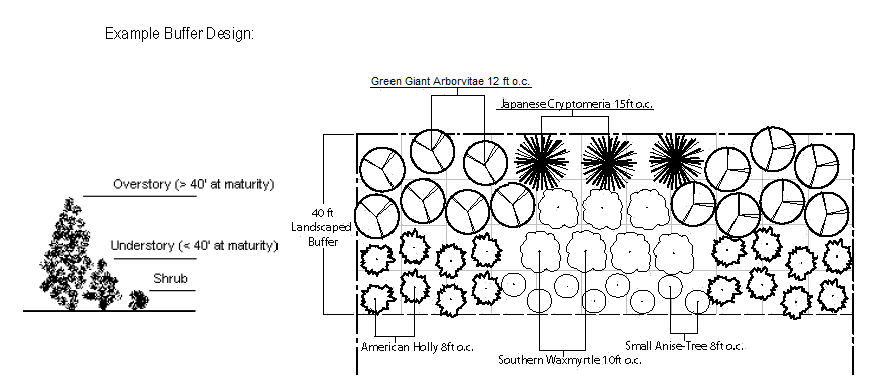
Example Buffer Design:
(c)
All buffers shall be designated on the appropriate permit application and indicated on the required site plan or final subdivision plat.
(d)
Structures including driveways, parking facilities, or retaining walls will be located a minimum of five feet from any buffer.
(e)
The Community Development Director or their designee may require additional screening outside or inside buffer areas, to obscure objectionable features such as dumpsters, rear entrances, utility and maintenance structures, loading facilities, and other objectionable features.
(f)
The screening requirements of this section may be waived or modified, as appropriate, by the Community Development Director or their designee, if and only if any one or more of these criteria apply:
(1)
It is clearly demonstrated to the Community Development Director or their designee that existing topography and/or vegetation achieve the purpose and intent of this section.
(2)
It is clearly demonstrated to the Community Development Director or their designee that because of existing topography, a fence, wall and/or other screening device will not screen activities conducted at ground level from view as required.
(3)
Required screening would obscure sight distances necessary for safe ingress and egress from subject properties.
(4)
All required buffers shall be designated on the appropriate permit application and shown as a permanent buffer on the required site plan or final subdivision plat, as appropriate.
(g)
All buffers strips are required to be provided or created at the time of construction of any new development.
(h)
Maintenance of buffers.
(1)
Prior to issuance of a certificate of occupancy for a structure, the developer or record title holder shall guarantee to the city to replace any required landscaping materials which die within one year after approval or acceptance thereof by the city, and shall warrant all work in the buffer area for a period of one year after approval or acceptance thereof by the city, whichever is later. The Community Development Director or their designee may at his/her option require that a bond or other suitable security be posted to ensure compliance with this provision.
(2)
The required buffer shall be maintained by the record title holder at the time of development, for so long as he holds title, and thereafter by any subsequent record title holders, so as to provide an opaque visual screen to a height of six feet on a continuous, year-round basis.
(3)
In the event a screen, wall, fence, planted dividing strip or any other type of buffer that is required by the UDO will be subjected to periodic inspections by the Community Development Department to determine that such required walls, fences, etc., are being properly maintained. After a lot is rezoned and a buffer is required, the lot shall not be used unless and until the required buffer is in place and is the required height and width. Failure to maintain such required walls, fences, etc., to an acceptable standard may be deemed a violation of this UDO.
(Ord. No. 08-2019, § I, 6-3-2019)
Sec. 205-4. - Landscaping requirements and tree preservation.
(a)
Applicability.
(1)
New construction. Any new building or site improvement must comply with the landscaping and screening requirements of the UDO.
(2)
Maintenance and repair. An existing building or site may be repaired, maintained or modernized without providing additional landscaping or screening, provided there is no increase in gross floor area or improved site area.
(3)
Additions.
a.
When an existing building is increased in gross floor area or improved site area by up to 25 percent cumulatively, landscaping and screening is required for the additional floor or site area only.
b.
When an existing building is increased in gross floor area or improved site area by more than 25 percent cumulatively, both the existing building and the additional floor or site area must conform to the landscaping and screening requirements of this UDO.
(4)
Change in use. A change in use does not trigger the application of these requirements except when there is a specific use standard requiring landscaping or screening for the new use.
(b)
Landscape plan required.
(1)
Landscape design and planning must be integrated with the overall design concept for any project; therefore, the UDO Administrator will as part of site plan approval evaluate landscaping schemes as presented in a landscape plan. The reviewer will evaluate these schemed in terms of their relationship to the existing natural landscape, developed or proposed landscapes on adjacent properties and public rights-of-way, and the building or buildings existing or proposed on the subject property and adjacent sites.
(2)
Before any building permit is issued, any site improvements must be found by the UDO Administrator to be in compliance with any required landscape plan, if applicable.
(c)
Street trees. A minimum of one overstory tree for every 40 linear feet of road frontage is required on both sides of any new street, except alleys. The minimum caliper shall be two inches.
(d)
Parking lot landscaping.
(1)
Applicability. Parking lot landscaping is required on all on-site surface parking lots with more than 20 spaces created after the effective date of this UDO. Multiple platted lots contained on a single site plan and any separate parking areas connected with drive aisles are considered a single parking area.
(2)
Perimeter screening. Parking lots that are not next to a public street must be provide perimeter screening a minimum of five feet in width with a single hedgerow.
(3)
Landscape strips. All surface parking areas (of any size) abutting a public street (not including an alley) must be screened using one of the following options.
a.
Landscape strip with shrubs. A minimum ten-foot wide landscape strip planted with a minimum of ten shrubs per 35 linear feet of street frontage, excluding driveway openings. Shrubs shall be provided to screen paved areas and parking lots from the right-of-way. Shrubs shall be two feet tall at time of planting. They must be planted two rows deep, and provide a screen within three years of planting.
b.
Landscape strip with screening wall.
1.
A two-and-one-half-foot high screening wall in a minimum four-foot planting strip.
2.
Screening walls must be closed and be constructed of high quality materials including one or a combination of the following: decorative blocks; brick; stone; cast-stone; split-faced block; stucco over standard concrete masonry blocks; glass block; or other material approved by the Architectural Review Board or Historic Preservation Commission, as applicable.
c.
Landscape strip with berm.
1.
An earth berm a minimum of two and one-half feet higher than the finished elevation of the parking area, planted with five shrubs for every 35 linear feet of street frontage, excluding driveway openings.
2.
The berm must contain a rounded crown suitable for planting, and a stabilized side slope of no greater than three to one.
d.
Landscape strip with grade change. A six-foot landscaped strip with a minimum three-foot grade drop from the public street to the parking area, planted with five shrubs for every 35 linear feet of street frontage, excluding driveway openings.
e.
Location. A required landscape strip must be located at the outer perimeter of the parking area and must be provided along the entire parking area abutting the street, excluding breaks for pedestrians, bicycles and driveways.
f.
Plant material. Required shrubs must be a minimum of two and one-half feet in height at time of planting. 70 percent of the required amount of shrubs must be evergreen.
(4)
Interior islands.
a.
A landscaped interior island must be provided every eight parking spaces. Interior islands must be distributed evenly throughout the parking area. Interior islands may be consolidated, or intervals may be expanded to preserve existing trees.
b.
An interior island abutting a single row of parking spaces must be a minimum of nine feet in width and 200 square feet in area. Each island must include one shade tree.
c.
An interior island abutting a double row of parking spaces must be a minimum of nine feet in width and 400 square feet in area. Each island must include two shade trees.
d.
All required shade trees must be chosen from the approved tree list. The approved tree list is available from the Community Development Department.
e.
All required shade trees must have a minimum caliper of two inches and be at least ten feet tall at time of planting.
f.
Each parking space must be no greater than 40 feet from the trunk of a tree.
(5)
Median islands.
a.
A landscape median island must be provided between every six single parking rows. Intervals may be expanded to preserve existing trees.
b.
A landscape median island must be a minimum of six feet wide.
(6)
Pedestrian corridor.
a.
Every fourth row of parking shall have a minimum 15-foot wide continuous pedestrian corridor consisting of landscaping and a minimum five-foot wide walkway dividing the parking row and connecting sidewalks on the street and along the front entrance of the principal building.
b.
The walkway shall be either patterned or colored material other than asphalt and may be at grade and a minimum of 5 feet wide. The remainder of the pedestrian corridor should be a landscaped area planted with ornamental trees every 40 feet on center at a minimum.
c.
The walkway is allowed to meander through the corridor, but in no case shall the walkway be less than five feet wide or closer than 3 feet to a parking space.
d.
If the development has less than four rows of parking or an uneven amount of parking rows then the location of the required walkway shall be subject to the approval by the Community Development Director.
(e)
General requirements.
(1)
Limit on one genus. No more than 30 percent of all trees planted shall be of any one genus.
(2)
Deciduous requirement. At least two genera of trees must be deciduous.
(3)
Limit on understory trees. Not more than 30 percent of the total number of trees planted shall be understory trees.
(4)
Vision clearance at intersections. In all zoning districts, no fence, wall, structure, shrubbery or other obstruction to vision between the heights of three feet and 15 feet, except utility poles, light or street sign standards or tree trunks shall be permitted within 20 feet of the intersection of the right-of-way lines of streets, roads, highways or railroads.
(f)
Streetscape standards.
(1)
Streetscapes shall be installed along public rights-of-way as specified in the streetscape table below, except as provided in (2) immediately below for an alternative multi-use trail. Streetscapes shall include a sidewalk landscape strip adjacent to the roadway, a sidewalk, and a landscape strip at the back of the sidewalk on private property.
(2)
A multi-use trail may be required instead of a sidewalk landscape strip and sidewalk where identified as a multi-use trail in any plan that has been adopted by the city.
(3)
Sidewalks shall be constructed with an additional two-foot by eight-foot concrete pad, located outside of the right-of-way, designed to accommodate existing or future pedestrian amenities such as benches, planters, and trash containers, at the following locations:
a.
At intersections of roadways with an arterial, major collector or minor collector identified on the long range road classification map as identified in the city's comprehensive plan.
b.
At locations along roadways designated for a transit stop or future transit stop by the County Department of Transportation.
c.
At locations along roadways designated for a school bus stop by the County Board of Education.
d.
Such pedestrian amenity sidewalk pads shall not be required closer than 300 feet from another such pad on the same side of the roadway.
(4)
All amenities required and listed above shall be decorative, commercial-quality fixtures. Sidewalk design and placement of any of these amenities shall be reviewed and approved by the appropriate review and approval authority. Locations of pedestrian amenity sidewalk pads shall be coordinated to avoid locations of curb inlets, guardrails, and bridges.
(5)
All new utility lines shall be buried.
(6)
Streets lights in conformance with this UDO shall be provided.
Streetscape Table
(Ord. No. 08-2019, § I, 6-3-2019; Ord. No. 12-2020, § I, 12-7-2020; Ord. No. 05-2021, § I, 5-3-2021)
Sec. 205-5. - Tree conservation.
(a)
Tree density requirements.
(1)
Use of tree units. The landscaping requirements of this article regarding the preservation or planting of trees is expressed in terms of "tree units" rather than the number of trees or tree canopy. This approach provides the applicant with wide latitude of choice as to the number and sizes of trees to be planted, and their distribution following aesthetic landscaping practices, while achieving a common standard on all properties.
(2)
Establishment of tree unit values. The diameter of a tree's trunk establishes the "tree unit" value of an existing tree, as shown on table 205-5(1), or for a newly planted tree as shown on table 205-5(2).
a.
The values assigned to trees of the same size are different for existing and new trees, as indicated in the table. One "unit" is not the same as one "tree."
b.
Actual tree diameters or calipers are to be rounded to the nearest whole number for the calculation of tree unit values (e.g., four and one half inches in diameter = five inches).
Table 205-5(1): Tree Units for Existing Trees
Notes
1. Minimum DBH to receive credit in tree units for an existing tree is four inches.
Table 205-5(2): Tree Units for New (Replacement) Trees
Notes
1. Minimum caliper to receive credit in tree units for a new tree is two inches.
(3)
Tree unit values for specimen trees or tree stands.
a.
Specimen trees and specimen tree stands; defined.
1.
Specimen tree: any tree which qualifies for special consideration for preservation due to size, type and condition, as follows.
a)
Any tree in fair or better condition which equals or exceeds the following diameter breast height (dbh) sizes:
1)
28-inch dbh—overstory hardwoods such as oaks, hickories, yellow poplars, sweetgums, etc.
2)
12-inch dbh—understory small trees such as dogwoods, redbuds, sourwoods, etc.
3)
30-inch dbh—pine trees (all species).
b)
A tree in fair or better condition must meet the following minimum standards:
1)
A life expectancy of greater than 15 years.
2)
A structurally sound trunk, not hollow and having no extensive decay, and less than 20 percent radial trunk dieback.
3)
No more than one major and several minor dead limbs (hardwoods only).
4)
No major insect or pathological problem.
c)
A lesser sized tree can be considered a specimen tree if it is a rare or unusual species, of exceptional or unique quality, or of historical significance, subject to approval of the Community Development Director or their designee.
d)
A lesser size tree can be considered a specimen tree if it is specifically used by a builder, developer, or design professional as a focal point in a landscape project, subject to approval of the Community Development Director or their designee.
2.
Specimen tree stand: A contiguous grouping of trees which has been determined to be of high value in the opinion of the Community Development Director or their designee. Determination is based upon the following criteria:
a)
A relatively mature, even-aged stand.
b)
A stand with purity of species composition or of a rare or unusual nature.
c)
A stand of historical significance.
d)
A stand with exceptional aesthetic quality.
b.
The tree unit values shown in table 205-5(1) may be increased by 100 percent for an existing tree that meets the definition of a "specimen tree" or for a "specimen tree stand" as defined herein, provided that extraordinary measures as needed are taken to protect the tree and assure its survival. Such measures may include but are not limited to the provision of tree wells, retaining walls, aeration, or supplementary irrigation, as applicable to the site of the tree and as approved by the Director. Any specimen tree determined to be part of a tree save plan for any development which is damaged or ultimately needs to be removed due to the development process will result in a penalty assessed at $1,000.00 per tree density unit of specimen(s) removed. Said funds from this section to be deposited to the city's tree bank.
c.
Specimen tree removal specifications. A specimen tree is any tree, in fair or better condition, which qualifies for special consideration for preservation due to size, species, or condition, and which meets the DBH specifications outlined above. Calculate the specimen tree removal fee at $500.00 for each tree density unit of the specimen tree(s) removed. For example, one 28-inch DBH Oak = 6.2 units x $500.00/unit = a fee of $3,100.00. The tree removal permit shall not be issued, nor shall the specimen(s) be removed, until funds are received by the city. Tree removal without or prior to a lawfully issued tree removal permit will result in a penalty assessed at $1,000.00 per tree density unit of specimen(s) removed. Said funds from this section to be deposited to the city's tree bank.
(b)
Tree density standards.
(1)
Tree retention. On each property for which a tree preservation and/or replacement plan is required, existing trees shall be retained and new trees shall be planted such that the property shall attain or exceed a tree density standard as follows:
a.
Residential—16 tree density units per acre for developments in the preliminary, final or exemption plat process. For residential lots with established homes, see table below.
Residential tree density unit requirements for lots with established homes
b.
Office/commercial/mixed-use—16 tree density units per acre.
c.
Industrial—16 tree density units per acre.
(2)
Distribution. Trees, both existing and new, shall be reasonably distributed throughout the site, with emphasis on tree groupings to achieve aesthetic results following professional landscaping standards. Trees, including street trees, may be retained or planted for credit within a public street right-of-way.
(3)
Trees in stream buffer. Trees located in a stream buffer may not be counted toward fulfilling the tree density standard.
(4)
Easement exclusion. Properties possessing natural gas, petroleum or electric power transmission easements, or major sanitary sewer main (greater than eight inches in diameter) or water main (greater than 16 inches in diameter) distribution easements, may exclude the land area contained in the easement from the total acreage of the property in fulfilling the tree density standard provided that no improvements (e.g. parking lots, tennis courts, driveways, greenways, storm water detention facilities, etc.) are proposed within the easement. If any improvements are proposed within the easement, then the land area so used within the easement for the improvements, plus an additional ten feet of land area surrounding the improvements, shall be included in the total acreage of the property to fulfill the tree density standard.
(5)
Lake and pond exclusion. Properties with a lake or pond may exclude the land area contained in the lake or pond from the total acreage of the property in fulfilling the tree density standard.
(6)
Invasive and nuisance species exclusion. Invasive species and nuisance species are exempt from the tree removal permit fee but are subject to a $25 assessment fee by the community development designee. Invasive and nuisance species include Tree-of-Heaven, Mimosa, Chinaberry, Princesstree, Chinese Tallow Tree, Bradford Pear, and Leyland Cypress.
(c)
Tree density standard calculation. The tree density standard shall be calculated by summing the credits and dividing the sum by the total acreage of the project included within the limits of the permit application.
(d)
Community tree species list.
(1)
The tree preservation board shall maintain a list of tree species approved for conservation and planting within the city as well as those not recommended. The list shall be known as the city's community tree species list, hereinafter referred to as the tree species list. The tree species list includes the mature size category of each species, notations on which species may be planted beneath utility lines, and other species characteristics.
(2)
The list is maintained by the tree preservation board and may change without notice to incorporate results of research and experience with individual species and is available from the Community Development Department.
(e)
Permeable surfaces under tree driplines. The minimum permeable surface area requirements under tree driplines are as follows.
(1)
For conserved trees in residential zones no more than 20 percent of the dripline can be encroached upon by impermeable surfaces provided the remaining area is mulched.
(2)
For planted trees in all zones the amount of permeable surface area required shall be based upon the mature tree size category on the community tree species list as follows:
a.
Large trees: 640 square feet.
b.
Medium trees: 360 square feet.
c.
Small trees: 160 square feet.
(3)
For planted trees the dripline shall be mulched.
(f)
Tree protection.
(1)
Conserved trees. All conserved trees shall be actively protected during the development process and passively protected throughout the life of the development. The entire tree, including the crown, trunk, and roots, and the critical root zone, shall be protected.
(2)
Minimum tree protection measures. Active tree protection shall consist of, at a minimum, establishing a tree protection zone around each tree or grouping of trees by the installation of fencing at the outer edge of the dripline or critical root zone, whichever is greater. Minimum tree protection measures for boundary trees, existing on adjacent properties, whose critical root zones extend onto the project site is mandatory.
a.
No more than 25 percent of a boundary tree's mature crown or one third of a young tree's canopy shall be removed in one season.
b.
Pruning of conserved trees should only be done by an ISA (International Society of Arboriculture) certified arborist.
c.
Tree protection fencing and tree protection area signs shall be installed after the issuance of a disturbance permit and prior to any land disturbance activity or building activity.
1.
Tree protection fencing shall be four feet high, made of orange high-visibility polypropylene, and erected with sturdy wooden or metal posts around the tree protection zone. A heritage tree, or a significant species tree, as determined by the Director, may require increased protection. Methods and extent of increased protection will be as directed by the Director.
2.
Signs shall be fabricated out of a sturdy material, shall be waterproof, and contain the following legible text in English and Spanish: "TREE PROTECTION AREA, ENTRY PROHIBITED." The signs shall be a minimum of 8.5×11 inches, shall be placed on a sturdy post a minimum of 30 inches off the ground, and shall be spaced a maximum of 50 feet apart.
3.
Tree protection fencing and signage shall remain in good condition throughout the development and construction processes, and shall only be removed after the final plat approval or a certificate of occupancy has been issued.
d.
Encroachment into the tree protection area shall result in the loss of tree density unit credit for preserved trees.
e.
The critical root zone within the tree protection area shall be mulched with a minimum of three inches and not more than five inches of organic mulch such as pine straw, wood chips, tree leaves, or compost, for a minimum of three years, or prior to issuance of the final certificate of occupancy for the project, whichever occurs last.
f.
The Community Development Director or their designee may require the installation of additional tree protection measures to ensure survivability of conserved trees.
(3)
Prohibited activities. Within the tree protection areas, without proper authorization or permit the following activities shall be prohibited:
a.
Vehicle traffic or parking;
b.
Materials or equipment storage;
c.
Soil disturbance;
d.
Soil excavation;
e.
Removal of topsoil;
f.
Trenching;
g.
Soil fill;
h.
Change in soil pH;
i.
Change in soil drainage;
j.
Equipment washouts or disposal (including concrete);
k.
Fires;
l.
Chemical or trash disposal;
m.
Other activities harmful to the trees as determined by the Community Development Director or their designee;
n.
Encroachment into tree save area; and
o.
Destruction or removal of trees.
(4)
Planted trees. All planted trees shall be actively protected during the development process and passively protected throughout the life of the development. The entire tree, including the crown, trunk, and roots, and the critical root zone, shall be protected.
(5)
Existing trees in construction zones. All trees that are outside the formal tree protection zone(s) as outlined in the tree protection and replacement plan and are equal to or greater than 12 inches DBH, and are in areas where construction will occur inside the crown of the tree shall be required to have an enhanced protection program. In order to maximize the ability of the selected trees to survive construction the proposed program will include the following steps.
a.
The tree will be surveyed and located with the species and DBH noted and approximate crown diameter shown.
b.
Prior to the beginning of construction activities, the trees shall be inspected by a city approved arborist to determine their overall condition and ability to withstand construction activity around them.
c.
Should the city approved arborist determine that with a proper protection plan the tree would survive the construction activity the arborist shall prepare a care plan for the tree. The plan may involve elements such as crown pruning, fertilization, irrigation, root pruning or other activities.
d.
The contractor will be required to implement the arborist's protection plan and to maintain the necessary activities to protect the tree until such time as the site construction is completed and accepted for maintenance by the property owner. The city approved arborist shall submit bi-weekly reports to the contractor and the Department of Community Development during the construction process.
e.
The owner of the property shall receive a 20-percent bonus credit for canopy coverage for all trees that are under the enhanced protection program.
f.
No land disturbing activity or construction activity, including, but not limited to, grading, digging, soil disturbance or other activity within the critical root zone of any boundary tree, is permitted that will deprive the boundary tree of continued viability as determined by a certified arborist.
g.
The following parameters shall be followed when determining boundary tree viability interference:
1.
CRZ/TPZ 19 percent or less impact and protected by tree protection, no arboricultural prescription required.
2.
CRZ/TPZ 20 percent—33 percent impact but protected by tree protection (no structural root plate impact) provide arboricultural prescription with a plan for review by the city.
3.
CRZ/TPZ 20 percent—33 percent impact and structural root plate has impact/not protected.
h.
The builder/developer/construction site property owner must submit a boundary tree agreement signed by the tree owner/co-owner and notarized giving permission for the tree that has construction impact to be treated or removed (see Community Development Department for the city boundary tree agreement). The minimum time length of the boundary tree agreement shall be three years. The receipt for the paid arboricultural prescription and signed agreement will need to be submitted with the plans for review.
1.
The builder/developer/construction site owner must make at least three attempts to contact the owner of the boundary tree to enact a boundary tree agreement. The first two attempts may be in person or via telephone. The third attempt must be in the form of a written letter sent certified, return receipt requested to the property owner's address of record in the county tax database. If there is no response to any of the attempts, the builder/developer/construction site owner shall provide evidence to the city of the attempts at contact in addition to the arboriculture prescription for the affected tree.
2.
If no boundary tree agreement is reached, the affected tree shall not be removed but shall be protected during development based on this chapter and in accordance with the arboriculture prescription.
3.
A boundary tree bond or escrow account may be required based on the arboricultural prescription depending on the impact to a boundary tree covered under a boundary tree agreement.
4.
A boundary tree bond or escrow account shall be required where a boundary tree agreement cannot be reached.
5.
A boundary tree bond or escrow shall be 125 percent of the cost of removal and replacement of the tree(s) affected and will be held for three years by the city. The property owner of the affected tree(s) may apply to the city for the escrow funds to remove and replace the tree(s) during the three-year escrow period. If the boundary tree(s) is/are deemed healthy at the end of the three-year period by an arborist, the developer may apply to the city for a refund of the original amount of escrow.
6.
The site/landscape plans cannot be approved without signed boundary tree agreement(s) or proof of attempts to contact the boundary tree owner in an attempt to reach a boundary tree agreement in addition to an arboriculture prescription where needed.
(g)
Seasonal planting. Final plat approval or a certificate of occupancy may be issued prior to the establishment of trees planned to meet the tree canopy cover requirements, if the Community Development Director or their designee determines that the season is inappropriate for planting. In such cases the trees shall be planted by the last day of February following the date of issuance of the certificate of occupancy or final plat approval. If they have not been planted by the last day of February following the issuance of the certificate of occupancy or final plat approval, the permit holder shall be considered to be in violation of the provisions of this article.
(Ord. No. 08-2019, § I, 6-3-2019; Ord. No. 14-2019, 11-4-2019; Ord. No. 09-2021, § III, 9-7-2021; Ord. No. 04-2022, § I, 7-5-2022)
Sec. 205-6. - Tree bank.
The intent of the requirements of this section is to ensure that a minimum number of trees are replaced and/ or preserved on newly developed or redeveloped sites. The tree bank is an alternative option and may be used only in the event the site tree density or recompense tree requirement cannot be met on-site due to hardship. Hardship must be documented by the developer and presented to the Director before the tree bank may be used. The tree bank provides two options, which are described in full below.
(1)
Option one, planting trees off-site. Install an equal amount of required tree density units in the form of an approved number of trees on an alternate site. In this case the following criteria shall be observed:
a.
The tree preservation board has identified alternate "option one" sites. The Community Development Department has contacted the owners of these sites and these owners have expressed an interest in receiving trees from the tree bank. Persons wishing to use option one should consult with the UDO Administrator to see if their required tree density units can be located on one of these alternate sites. The developer may present the UDO Administrator with alternate sites. Planting on individual residential lots is prohibited.
b.
The developer shall submit a tree preservation and/or tree replacement plan showing a location for the planted trees on the proposed site. The developer shall also provide calculations on the plan for tree density or recompense trees from the developed site. The site plan shall state the size, genus, species, and quantity of trees to be planted. Each tree must be two inches caliper at a minimum. For trees in which double recompense is required each tree must be three inches caliper at a minimum. Recompense calculations must be shown on plan.
c.
If the proposed site is not one of the alternate sites, discussed above, an authorization from the title holder of the site indicating that the owner agrees to the planting of trees by the developer upon the site shall also be submitted along with the tree preservation and/or tree replacement plan.
d.
Trees are to be maintained and guaranteed for one full year after planting by the developer. Any trees that die during the one-year time period must be replaced by the developer. Standards for transplanting shall be in keeping with those established by the International Society of Arboriculture, as included in the "Tree and Shrub Transplanting Manual," latest edition.
(2)
Option two, monetary compensation for trees. A developer may choose to provide the city with monetary compensation for trees. If this alternative for the development is chosen, then the following criteria shall be observed:
a.
Provide tree density calculations on the tree preservation and/or tree replacement plan. Show the total amount of tree density units that cannot be met on-site.
b.
Multiply the tree density units that cannot be met on-site by the monetary compensation value. The product of those two numbers shall be provided on the tree preservation and/or tree replacement plan. Contact city approved certified arborist or landscape architect for the current monetary compensation value.
c.
Provide a certified check made payable to the city in the amount of the product as listed in item (2) above and as provided on the tree preservation and/or tree replacement plan. Submit the certified check to a UDO Administrator along with a copy of the approved tree preservation and/or tree replacement plan.
d.
The monies collected for the tree bank option two may be used by the city for the planting of trees at parks, greenways, fire stations, libraries, and other similar community facilities. Alternate planting locations may be approved by the Director.
(3)
Standards for administering these alternative compliance methods. The Director must review and approve all requests for alternative compliance. In no instance shall the alternative compliance options be used to comply with any other ordinance requirement than the tree density or specimen tree requirement. The site development permit shall be issued after the Director has approved the request for either compliance option and received the necessary documentation and funds.
(4)
Exclusions. Trees used to meet requirements for parking lots, landscape strips, street frontage buffers, or buffer replanting must be planted on site and are excluded from the tree bank procedures. Trees that are required to meet minimum tree density units and/or recompense requirements can be contributed toward the tree bank in accordance with option one or option two above.
(Ord. No. 08-2019, § I, 6-3-2019)
Sec. 205-7. - Redevelopment sites.
(a)
For redeveloped sites the Department of Planning and Development strongly recommends the developer, authorized registered professionals, design professionals and staff schedule a pre-submittal meeting with the department to discuss the potential of the site and any issues that may be present on the site.
(b)
Redeveloped sites shall comply with the buffer and specimen tree requirements as set forth in this UDO and provide compliance with parking lot, landscape strip and tree density unit requirements.
(c)
Where the scope of a project results in disturbance, removal, and replacement of 25.1 percent or greater of the site area, a tree preservation and/or tree replacement plan is required. The plan shall show landscape strip planting, parking lot trees, tree density units, buffers and shall comply with the requirements of this UDO.
(d)
Where the scope of a project results in disturbance, removal, and replacement of 25 percent or less of the site area, a tree preservation and/or tree replacement plan is required. The plan shall include the existing and proposed landscape conditions that verify compliance with this UDO.
(1)
At a minimum the plan must show the following existing and proposed elements with intent to comply:
a.
Buffers.
b.
Landscape strips.
c.
Parking lot trees.
d.
Tree density units.
e.
Tree save areas.
(2)
Director shall review the proposed tree preservation and/or tree replacement plan.
(e)
Disturbance on a redevelopment site shall include a building replacement where the footprint of the building counts toward the site disturbance.
(Ord. No. 08-2019, § I, 6-3-2019)
Sec. 205-8. - Tree conservation, buffers, and landscaping compliance.
(a)
Tree removal. An application for a tree removal permit when land disturbing activity is not involved shall follow the requirements of section 104-7(m), tree removal permit.
(b)
Site inspections.
(1)
Authority. The Community Development Director or their designee has the authority to perform site inspections and enforce the provisions of this chapter.
(2)
Visits to site for discussions regarding regulations. Prior to the issuance of a tree removal permit or right-of-way encroachment permit, a visit shall be made to the proposed site by the Community Development Director or their designee and the applicant for the purpose of discussing the provisions of this chapter.
a.
After a permit is issued and tree protection measures have been installed, and prior to any land disturbance, another site inspection shall be made by the Community Development Director or their designee.
b.
Another site inspection shall occur prior to the issuance of final plat approval or a certificate of occupancy. All provisions of this chapter shall be met before final plat approval or a certificate of occupancy can be issued.
c.
Other site inspections may take place without notice at any time prior to or after the issuance of a certificate of occupancy or final plat approval to ensure continuing compliance with the provisions of this chapter.
(3)
Access by authorized representatives. No person, corporation or association shall refuse entry or access to any authorized representative or agent of the Community Development Director or their designee who requests entry for the purposes of inspection and who presents appropriate credentials, nor shall any person obstruct, hamper, or interfere with any such representative while in the process of carrying out his official duties.
(c)
Tree maintenance. The owner shall be responsible for maintaining the health of all conserved and new trees. The owner shall replace any new tree that dies within three years, or prior to issuance of the final certificate of occupancy for the project, whichever occurs last.
(d)
Penalties.
(1)
Failure to obtain permit. If any person commences any land disturbing activity, tree destruction, tree cutting, tree removal or building activity requiring a tree removal permit without first obtaining said permit, the person shall be deemed to be in violation of the provisions of this chapter.
(2)
Violations. The owner of any property wherein a violation exists, and any builder, contractor, or agent who may have assisted in the commission of any such violation, may be chargeable with separate offenses for each such violation. Any person violating any of the provisions of this chapter other than as hereinabove provided shall, upon conviction, be punished as prescribed in this subsection (d). Each day during which such violation occurs or continues shall constitute and be punishable as a separate offense.
(3)
Stop work orders. A stop work order may be issued by the Community Development Director or their designee for violation of any provision of this chapter. All stop work orders shall be effective immediately upon issuance and shall remain in effect until the necessary corrective action or mitigation has occurred and permission has been granted by the city to resume work. No certificate of occupancy or final plat approval shall be issued while a stop work order is in effect or until an assessed fine has been paid and permission has been granted by the city in writing for a certificate of occupancy or final plat approval.
(4)
Responsibility. The Community Development Director, or their designee is responsible for determining whether a violation has occurred. Violations may include, but are not limited to: failure to obtain a tree removal permit, deviation from the approved plan; failure to properly install tree protection structures; failure to maintain tree protection structures in effective condition; evidence of harmful activities occurring within the tree protection zone; improper planting; failure to conserve or establish the required tree canopy cover; unauthorized delay in tree planting; damage to a conserved or established tree's crown, trunk, roots, or critical root zone; and damage to a city tree's crown, trunk, roots, or critical root zone.
(5)
Monetary penalties. Any person who violates any provision of this chapter, any permit condition, or who negligently or intentionally fails or refuses to comply with any order, notice of code violation or formal charge of violation which the Community Development Director or their designee issues as provided in this chapter shall be liable for a penalty of up to $1,000.00 per day for each violation of the provisions of this chapter. Each day that such failure or refusal continues shall constitute a separate violation.
(Ord. No. 08-2019, § I, 6-3-2019; Ord. No. 14-2019, 11-4-2019)

