
Norcross City Zoning Code
ARTICLE IV
SIGN REGULATIONS
Sec. 204-1.- Purpose and findings.
The Mayor and Council find that signs provide an important medium through which individuals may convey a variety of messages. However, left completely unregulated, signs can become a threat to public safety as a traffic hazard and detriment to property values and the city's overall public welfare as an aesthetic nuisance. The purpose of this article is to balance the need to protect the public safety and welfare, the need for a well-maintained and attractive community, and the need for adequate identification, communication, and advertising. These regulations are further intended to:
(1)
Allow businesses, institutions, and people to exercise their right to free speech by displaying messages on a sign, and to allow audiences to receive such information;
(2)
Enhance the economy and the business and industry of the city by promoting the reasonable, orderly, and effective display of signs and thereby encourage increased communication with the public;
(3)
Ensure that signs are designed, constructed, installed and maintained according to minimum standards to safeguard life, health, property, and public welfare;
(4)
Reflect and support the desired ambience and development patterns of the various zoning districts and promote an attractive built environment;
(5)
Allow for adequate and effective signs whose dimensional characteristics further the interests of public safety and the needs of the motorist, where signs are viewed from a public right-of-way;
(6)
Promote the stated purposes of the city ordinance, as amended, which are expressly incorporated herein; and
(7)
Promote the stated purposes of the standard building code, as adopted and modified by the city, which are expressly incorporated herein.
(Ord. No. 08-2019, § I, 6-3-2019)
Sec. 204-2. - Scope.
The regulations of this article dictate the types, location and physical standards of signs that are permissible for specified uses, subject to the sign permit procedures of the city. The regulations of this article shall be in addition to any required provisions of the state code and the applicable building code administered by the city related to the construction and maintenance of signs.
The regulations of this article shall:
(1)
Govern and control the erection, enlargement, expansion, alteration, operation, maintenance and relocation of any sign that is visible from any public right-of-way or public or private common open space.
(2)
Govern the removal of signs determined to be physically unsafe or which create a safety hazard to the public.
(Ord. No. 08-2019, § I, 6-3-2019)
Sec. 204-3. - Sign definitions.
(a)
Freestanding signs. Signs not attached to a building, including the following:
(1)
Accessory ground sign. A small, less than six square feet in area, permanently affixed sign which is wholly independent of a building for support, and which is accessory and subordinate to a primary ground sign.
(2)
Pole sign. A permanent freestanding sign supported by one or more uprights, poles, or braces placed in or upon the ground surface and not attached to any building.
(3)
Ground sign. A permanent freestanding sign, other than a pole sign not attached to a building, which is placed upon or supported by the ground independently of any other structure. Such sign may also be known as a monument sign. A sign that is placed on two posts, where there is no more than one foot of distance between the base of the sign at grade and the bottom of the sign shall be considered a ground sign for the purposes of this article.
(4)
Subdivision entrance sign. A ground sign placed at the entrance of a platted subdivision. The subdivision can be for any type of development, including residential, commercial, or industrial.
(b)
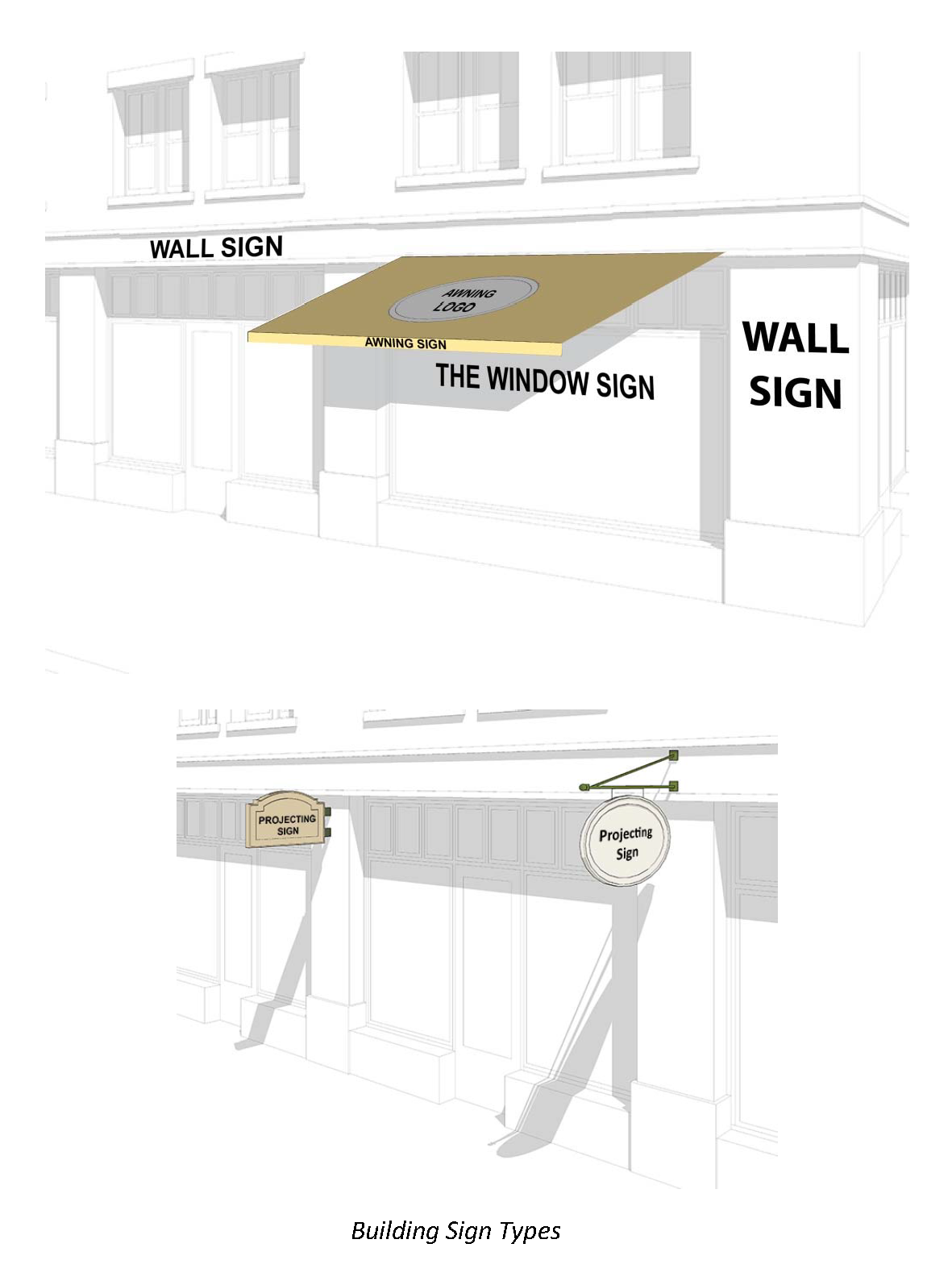
Building signs. Signs attached to a building, including the following:
(1)
Accessory building sign. A small, less than six square feet in area, permanently affixed sign to a building for support, and which is accessory and subordinate to a primary building sign.
(2)
Awning sign. A building sign that is mounted or painted on or attached to an awning or canopy and does not project vertically above or horizontally beyond the physical dimensions of such awning or canopy.
(3)
Projecting sign. A building sign whose nearest point projects no more than 18 inches from, and is supported by, a wall of a building.
(4)
Wall sign. A building sign that is attached directly to a building wall and which does not extend more than 18 inches from nor above the roof line or beyond the limits of the outside wall, with the exposed face of the sign in a plane parallel to the building wall.
(5)
Window sign. A building sign affixed to, in contact with, or inside a window; installed for purposes of viewing from outside the premises. This does not include merchandise located in a window.
(c)
Temporary signs. A sign which is neither permanently anchored to the ground nor permanently affixed to a structure, nor mounted on a chassis, and intended for a limited period of display, including the following:
(1)
Banner sign. A temporary sign constructed of canvas, plastic, fabric or similar lightweight, non-rigid material that can be mounted to a structure with cord, rope, cable, or a similar method.
(2)
Flag, pennant or other moving or animated sign. Any temporary sign or part of such sign that changes physical position by any movement or rotation that gives the visual impression of such movement or rotation.
(3)
Yard sign. Any temporary sign placed on the ground or attached to a supporting structure, posts, or poles, that is not attached to any building.
(d)
Miscellaneous sign terms.
(1)
Accessory sign. A small sign, less than six square feet in sign area, permanently affixed either to a building for support, or freestanding, and which is accessory and subordinate to other signs on the lot.
(2)
Awning. A structure made of cloth, metal, or other material affixed to a building in such a manner that the structure may be raised or retracted to a flat position against the building, but not including a canopy or marquee.
(3)
Canopy. A structure other than an awning made of cloth, metal or other material that may be totally or partially attached to a building for the purpose of providing shelter to patrons or automobiles, or as a decorative feature on a building wall. A canopy is not a completely enclosed structure and does not rise, nor is it capable of retraction.
(4)
Changeable copy sign. A sign designed so that the characters, letters or illustrations can be changed or rearranged without altering the face or the surface of the sign; also known as a reader board, if the copy is manually changed, or electronic message board, if remotely changed by computer.
(5)
Clear sight triangle. The triangular area formed by a diagonal line connecting two points located on intersecting lines of a right-of-way, easement of access, or pavement edge of an access drive, each point being 20 feet from the intersecting lines.
(6)
Clearance (of a sign). The smallest average vertical distance between the grade of where the sign is attached and the lowest point of any sign, including framework and embellishments, extending over that grade (compare "height").
(7)
Electronic message board (EMB). A form of changeable copy sign that is electrically activated and whose variable message or graphic presentation capability can be electronically programmed by computer from a remote location. EMBs typically use light emitting diodes (LEDs) as a lighting source.
(8)
Façade. That portion of an enclosed building facing the principal dedicated street or that wall of a building through which there is primary access for customers. Where more than one business occupies the same building, the facade for each business shall be that portion of the building occupied by the business which faces the street, or which provides the primary access.
(9)
Face change. The removal or replacement of an existing surface display panel where the remaining structural frame is not changed. The changing of as message on a changeable copy sign is not considered a face change.
(10)
Flashing sign. A sign that uses an intermittent, moving or flashing light source to attract attention.
(11)
Frontage, building. Total lineal feet of enclosed building length along the facade that fronts the principal dedicated street, or the facade that contains the main entrance to the building.
(12)
Frontage, secondary. The street which the developer selects to be the secondary access to the development.
(13)
Frontage, street or lot. Total lineal feet of right-of-way or easement of access along the front yard of a lot.
(14)
Height (of a sign). The vertical distance measured from the highest point of the sign, including decorative embellishments, to the average surface grade where the sign is attached (compare: "clearance").
(15)
Illuminated sign. A sign either internally or externally illuminated.
(16)
Maintenance. The cleaning, painting, repair, or replacement of defective parts of a sign in a manner that does not alter the basic copy, design or structure of the sign.
(17)
Marquee. Any fixed hood (other than a canopy or awning), which is supported solely by the building to which it is attached, consisting of metal or other incombustible material and which included a sign or other message. The location of marquees shall be restricted to the main entrance to a building.
(18)
Nonconforming sign. Any sign which was lawfully erected in compliance with applicable regulations in force at the time and maintained prior to the effective date of this zoning resolution, and which fails to conform to all applicable standards and restrictions of this resolution.
(19)
Oversized sign. A ground sign which exceeds 30 feet in sign height or 300 square feet of sign surface area.
(20)
Portable sign. A sign not permanently anchored or secured to either a building or the ground, but designed to be anchored or secured to a trailer, vehicle (where the primary purpose is to convey a message) or frame capable of being moved from place to place.
(21)
Reader board. Form of changeable copy sign designed so that the characters, letters or illustrations can be manually changed or rearranged without altering the face or the surface of the sign.
(22)
Roof sign. A sign that is mounted or painted on the roof of a building, or that is wholly dependent upon a building for support and that project above the highest point of a building with a flat roof, the eave line of a building with gambrel, gable, mansard, or hip roof.
(23)
Sign. Any object, device, or structure, or part thereof, situated outdoors or indoors and intended to be visible from a public street right-of-way or public or private common area which is used to convey a message, advertise, identify, display, direct, or attract attention to an object, person, institution, organization, business, product, service, event or location by any means, including words, letters, figures, designs, symbols, fixtures, colors, illumination, or projected images. Signs do not include the flag or emblem of any nation, organization or nations, state, city, or any fraternal, religious or civic organizations; or works of art.
(24)
Sign animation. The use of movement or some element thereof, to depict action or create a special effect or scene.
(25)
Sign structure or support. Any structure that supports or can support a sign, including decorative cover.
(26)
Snipe sign. A sign for which a permit has not been obtained which is attached to a public utility pole, light pole, service pole or supports for another sign or placed within the right-of-way.
(27)
Surface display area. All solid surface areas of a sign, including air space surrounded by a solid surface of a sign. Sign area means the smallest square, rectangle, triangle, circle, or combination thereof, which encompasses the entire sign, inclusive of any border and trim but excluding the base, apron, supports, and other structural members.
(28)
Vehicle sign. Signs on vehicles or trailers visible from the public right-of-way where the primary purpose of the vehicle or boat is to display a sign.
(29)
Visible. Capable of being seen, whether or not legible, without visual aid by a person of normal acuity from a public right-of-way, or public or private common open space.
(30)
Zoning district use category. A categorization of zoning districts by the land uses allowed in each for the purposes of this sign article. The categories are as follows:
a.
Single-family residential—R-100, R-75, R-60, RTH including developments built under the provisions of the CSO overlay.
b.
Multi-family residential—RD, PRD.
c.
Office—OI.
d.
Commercial—C1, C2, CAR.
e.
Industrial—M1, M2.
f.
Mixed-use—CX, HX, NX, BH.
g.
Public—P.
(Ord. No. 08-2019, § I, 6-3-2019; Ord. No. 14-2019, 11-4-2019)
Sec. 204-4. - Signs requiring a permit.
(a)
Unless expressly exempted in section 204-5, no sign shall be erected, enlarged, expanded, altered, relocated or reconstructed on private or public property unless a sign permit, showing compliance of the sign with the provisions of this article, shall have first been issued by the Community Development Director.
(b)
Existing signs which conform to the provisions of this article that would be required to obtain a permit under the regulations of this article must register with the city within 90 days of the effective date of this article. The information provided for registration will be the same information required in a permit application under section 204-7. No permit fee will be required for the registration of existing signs.
(c)
Each nonconforming sign shall be registered within 90 days of the enactment date of this article from by the owner, and if it is determined that such registered nonconforming sign was legally erected under the prior requirements, then a sign permit shall be issued to the sign owner. If the owner of a nonconforming sign fails to register such sign within 90 days from the enactment of this article, it shall be deemed a violation of this article, subject to citation in the recorder's court of the city.
(Ord. No. 08-2019, § I, 6-3-2019; Ord. No. 14-2019, 11-4-2019)
Sec. 204-5. - Signs exempt from having a permit.
The following signs and sign-related activities shall be exempt from the provisions of this article and shall not require a sign permit. All signs in this section, unless otherwise stated below, shall be setback a minimum of ten feet from the right-of-way, easement of access, or edge of pavement, whichever is the greater setback, and five feet from all other property lines.
(1)
Routine maintenance. Routine sign maintenance includes cleaning, re-painting, replacing lighting elements, ballasts, and electrical components, and changing of lettering or parts of signs designed to be regularly changed.
(2)
Face changes. Signs shall be allowed sign face changes that are non-structural only. Further modifications may be subject to the provisions of section 204-11, nonconforming or noncomplying signs.
(3)
Copy changes. The change of a message on any changeable copy sign or any variable message sign may occur without a permit.
(4)
Small non-illuminated temporary freestanding signs (excluding banners, which are regulated under section 204-12). For each residential or nonresidential lot, the quantity of these signs shall be limited to either one sign that is 16 square feet in area or any number of signs whose total combined area totals 16 square feet, such as four signs of four-square feet in area each. These signs shall not be located within the public street right-of-way and shall be no closer than ten feet to the back of the curb of a public roadway.
(5)
Traffic or government signs. Any signs installed by the city, county, state, federal government or an authorized transit agency.
(6)
ADA required signs. Any signs installed to meet the requirements of the Americans with Disabilities (ADA) Act.
(7)
Signs meeting the requirements of section 204-18.
(8)
For sale signs. The quantity of these signs shall be limited to either one sign that is 16 square feet in area or any number of signs whose total combined area totals 16 square feet, such as four signs of four-square feet in area each. These signs shall not be located within the public street right-of-way and shall be no closer than ten feet to the back of the curb of a public roadway.
(Ord. No. 08-2019, § I, 6-3-2019; Ord. No. 09-2025, § 1, 12-5-2025)
Sec. 204-6. - Signs specifically prohibited.
The following signs, in addition to all other signs not expressly permitted by this article, are prohibited in all zoning districts and shall not be erected, or maintained:
(1)
Signs that are structurally unsound, unsafe, or hazardous to traffic or pedestrians.
(2)
Permanent signs built of non-durable materials, such as corrugated plastic, paper, etc.
(3)
Roof signs.
(4)
Signs that move or give the appearance of moving, including sky dancers, pennants, streamers, or banners in excess of 32 square feet.
(5)
Streamers, inflatable objects, and gas filled devices, other than permitted temporary signs.
(6)
Flashing signs and signs containing any flashing or running lights, strobe lights, or lights creating an illusion of movement.
(7)
Signs which imitate or may be easily confused with official traffic and government signs.
(8)
Portable signs, except as permitted in section 204-17, vehicle signs.
(9)
Multi-faced "V"-shaped signs with angles exceeding 60 degrees in diameter.
(10)
Snipe signs.
(11)
Signs mechanically rotating at greater than six revolutions per minute.
(12)
Any sign placed or erected on property without the permission of the property owner.
(13)
Signs which are obscene as defined by O.C.G.A § 16-12-80.
(14)
Signs which emit or utilize in any manner any sound capable of being detected on any traveled road or highway by a person with normal hearing abilities.
(15)
Signs which interfere with road or highway visibility or obstruct or otherwise interfere with the safe and orderly movement of traffic or which otherwise pose a hazard to traffic due to structural deficiencies in the structure of such signs.
(16)
Signs which obstruct any fire escape, any means of egress or ventilation or shall prevent free passage from one part of a roof to any other part, as well as signs attached to any fire escape.
(17)
Signs which do not conform to applicable building or electrical codes.
(18)
Exterior exposed electrical signs including neon or LED used to attract attention such as outlining a building or building feature.
(19)
Dilapidated or neglected signs.
(Ord. No. 08-2019, § I, 6-3-2019)
Sec. 204-7. - Application information.
Applications for sign permits required by this article shall be filed by the sign owner or the owner's agent upon official forms with the Community Development Department.
(1)
The application shall describe and provide the information requested on the sign permit application and as stipulated by this article including, but not limited to, the following information:
a.
The street address of the property upon which the sign is to be located and a plat map of the property which bears an indication of the proposed location of the sign. In the absence of a street address, a method of location acceptable to the Community Development Department shall be used.
b.
The width of the face of the building, suite, or length of road frontage at the proposed location, as applicable.
c.
The name and address of the owner of the real property upon which the subject sign is to be located.
d.
An owner affidavit demonstrating owner consent, or the owner's agent consent, granting permission for the placement or maintenance of the sign.
e.
Name, address, email address, phone number, proof of insurance, and business license number of the sign contractor.
f.
The type of sign to be erected, the area of the sign, the height of the sign, the shape of the sign, and an explanation of how the sign is to be mounted or erected.
g.
Identification of any existing signage on the property, and dimensioned size.
h.
In the case of an oversized sign application, the distances as set forth in section 204-15, oversized signs, must be provided.
i.
The size of the parcel on which the sign is to be placed.
j.
A dimensioned drawing of the proposed signage, including: height, width, construction materials, source of illumination, colors, and placement on the structure or position on the lot. Such drawing shall be of sufficient detail and accuracy to permit an informed review.
(2)
A separate building permit is required for monument signs over four feet in height and oversized signs.
(Ord. No. 08-2019, § I, 6-3-2019)
Sec. 204-8. - Sign permit application—Time for consideration.
(a)
The city shall process all sign permit applications within 30 business days of the city's actual receipt of a completed sign permit application and a sign permit fee.
(b)
The sign permit fee shall be established by the Mayor and Council.
(c)
The Community Development Director or designee shall give notice to the applicant of a decision of the city by electronic means, by hand delivery, or by mailing a notice by certified mail with return receipt requested. Delivery will be mailed to the email address or mail address on the sign permit application on or before the 30th business day after the city's receipt of the completed application.
(1)
If mailed, the notice shall be deemed to have been given upon the date of mailing in conformity with this section.
(2)
If the city fails to act within the 30-day prescribed period, the permit shall be deemed to have been granted.
(Ord. No. 08-2019, § I, 6-3-2019)
Sec. 204-9. - Application—Denial and revocation.
(a)
Procedure. The city shall deny sign permits to applicants that submit applications for signs that do not comply with the provisions of this article, incomplete applications, and applications containing any false material statements.
(1)
Violation of any provision of this article and any other applicable federal or state law or city ordinance shall be grounds for revoking a permit granted by the city for the erection of a sign.
(2)
If it is determined that a sign permit was issued pursuant to an incomplete application or an application containing a false material statement, or that a permit has been erroneously issued in violation of this article, the Community Development Department Director shall revoke the permit.
(3)
If the Community Development Department Director denies or revokes a permit, the reasons for the denial or revocation of the permit shall be stated in writing.
(4)
Any application denied and later resubmitted shall be deemed to have been submitted on the date of resubmission, instead of the date of the original submission.
(5)
A modified application to rectify dimension or design considerations shall be considered a continuation of the original sign application, unless the applicant has constructed or installed the sign which was denied.
(6)
No permit shall be denied or revoked, except for due cause. The term "due cause" means the violation of the provision of this article, state or federal law, or the submission of an incomplete application or an application containing false material statements.
(7)
If a sign application is denied, a new sign application may be filed addressing the reasons for the denial, and such application will require a new sign application review fee.
(b)
Appeals. In the event an applicant, property owner, or designated representative whose permit has been denied or revoked is dissatisfied with the decision of the Community Development Director, the applicant has the right to request a public hearing before the Zoning Board of Appeals.
(1)
The applicant shall be given ten days to file a request for an appeal to the Zoning Board of Appeals after receipt of the denial or revocation notice from the city.
(2)
When a timely appeal has been filed, the city shall advertise the appeal giving notice of the time and place of such hearing in the official organ of the city at least 15 days prior to the Zoning Board of Appeals next scheduled hearing.
(3)
The date may be rescheduled by agreement of the city.
(4)
At the hearing any party may appear in person or by agent or attorney.
(5)
In the event an applicant, property owner or designated representative whose permit has been denied or revoked is dissatisfied with the decision of the Zoning Board of Appeals, the applicant, property owner or designated representative may appeal the decision of the Zoning Board of Appeals by filing a petition for writ of certiorari to the superior court of the county in the manner provided by law.
(Ord. No. 08-2019, § I, 6-3-2019)
Sec. 204-10. - Sign permit—Expiration.
A sign permit shall become null and void if the sign for which the permit was issued has not been completed, erected and installed within six months after the date of issuance of the permit.
(1)
No refunds will be made for permit fees paid for permits that expired due to the failure to erect a completed permitted sign within the prescribed period.
(2)
If at a later time an individual desires to erect a sign at the same location, a new application must be processed and another fee paid in accordance with the fee schedule applicable at that time.
(Ord. No. 08-2019, § I, 6-3-2019)
Sec. 204-11. - Nonconforming or noncomplying signs.
Signs existing on or before the effective date of this article that do not conform to the standards in this article are considered nonconforming and shall be subject to the provisions of this section.
(1)
Grandfathered signs. In all use districts, signs which on the effective date of this article become nonconforming, with respect to the requirements set forth in this article, may continue in existence so long as the nonconforming sign is not enlarged, altered, modified, improved or rebuilt beyond that existing as of the effective date of this article.
(2)
Existing signs which were legally erected which have become nonconforming and do not meet the setback requirements of this article due to a road widening project may be moved to meet the setback requirements of this article but shall not be increased in size, shape or changed in any manner except as to meet the requirements of this article; provided that:
a.
This subsection shall not allow the relocation of any sign for which the value has been paid to the owner by any government or government agency in conjunction with a road widening project.
b.
No sign shall be relocated pursuant to this subsection before the sign owner provides the Director with a signed copy of the purchase contract or condemnation documents showing transfer of the owner's land for road widening.
(3)
In all use districts, signs which are prohibited shall be removed by the owner. Upon failure to comply with requirements of this division, the Community Development Director may cause the removal of such signs at the expense of the owners. These prohibited signs include:
a.
Illegally erected or maintained with respect to prior ordinances.
b.
Made of paper, cloth, or nondurable materials.
c.
Located in the public right-of-way.
(4)
A nonconforming sign shall not be replaced by another nonconforming sign.
(5)
Minor repairs and maintenance of nonconforming signs such as electrical repairs or lettering repairs shall be allowed. However, no structural repairs or changes in the size or shape of the sign shall be permitted except to make the sign comply with the requirements of this article. Signs damaged by fire or acts of God may be restored to their original condition.
(6)
Existing signs visible from interstate highways that were legally erected which would become nonconforming as a result of these regulations will be allowed to remain until purchased by the state department of transportation or the city, provided that the sign owner meets the requirements of state laws, rules and regulations governing such signs.
(7)
Existing signs on the property of newly annexed territory that were legally erected under the county ordinance which would become nonconforming under this section upon annexation by the city will be allowed to remain. Such signs shall be registered with the city within 90 days of being annexed by the city.
(8)
No sign variances are allowed.
(Ord. No. 08-2019, § I, 6-3-2019)
Sec. 204-12. - Temporary signs.
(a)
The following types of signs or devices shall be allowed by issue of a temporary sign permit:
(1)
Flags or banners beyond the limits allowed in section 204-13 (flag section).
a.
Banners are limited to 32 square feet in size area and may be double sided. This includes institutional uses in residentially zoned properties such as places of worship and schools.
b.
The location and means of mounting must be clearly depicted on the temporary sign permit application.
(2)
Signs associated with a temporary outdoor activity or temporary outdoor retail sales and display events, as regulated in chapter 8, article IX, of this Code.
(b)
Temporary signage is limited to a period not exceeding 15 consecutive days.
(c)
The time limitation on temporary signage associated with a permitted temporary outdoor activity shall be waived to allow temporary signage to run concurrently only with the permitted term and duration of the specific temporary outdoor activity as stipulated in subsection 8-318(g)(1) of this Code, subject to Community Development Director approval.
(d)
A fee as established by the City Council and posted by the Community Development Department shall be charged for each temporary sign.
(e)
The city shall be exempted from temporary sign regulation and fees including, but not limited to: size, placement and duration of display when displaying signs.
(Ord. No. 08-2019, § I, 6-3-2019; Ord. No. 09-2025, § 1, 12-5-2025)
Sec. 204-13. - Flags.
(a)
All flags shall be displayed on purpose-built, professionally fabricated flagpoles, which may be vertical or mast-arm flagpoles.
(1)
In nonresidential districts, flagpoles shall not exceed the allowed height provided for a structure or building in the applicable zoning district or 50 feet, whichever is lower.
(2)
The flagpoles in residential districts shall not exceed 25 feet in height or the height of the primary structure on the lot, whichever is less.
(b)
Flag dimensions.
(1)
The maximum dimensions of any flag shall be proportional to the flagpole height.
(2)
The hoist side of the flag shall not exceed 20 percent of the vertical height of the flagpole.
(3)
In addition, flags are subject to the following limitations:
(c)
Each lot or parcel shall be allowed a maximum of three flagpoles.
(d)
A maximum of two flags shall be allowed per flagpole.
(e)
A vertical flagpole must be set back from all property boundaries a distance which is at least equal to the height of the flagpole.
(f)
Flags and flagpoles shall be maintained in good repair, and to the extent applicable shall be in compliance with the building code. Flagpoles with broken halyards shall not be used and flags which are torn or frayed shall not be displayed.
(g)
On officially designated county, state, or federal holidays, there shall be no maximum flag size or number or other limitations on display.
(h)
This section shall not be construed to restrict the right to display eligible flags as banners or noncommercial signage, as provided elsewhere in this article.
(Ord. No. 08-2019, § I, 6-3-2019)
Sec. 204-14. - General standards.
Unless expressly exempted by section 204-5, signs exempt from having a permit, all signs within the city shall conform to the following general standards.
(1)
Illumination.
a.
Location and design of light source. No sign shall give off light which glares, blinds or has any other such adverse effect on traffic or adjacent properties. The light from an illuminated sign shall be established in such a way that no direct light is cast upon adjacent properties and roadways.
b.
Level of illumination. In no event shall the illumination of any sign exceed 50 foot-candles at the sign face.
(2)
Height.
a.
Height of freestanding signs. The height of a sign shall be equal to the vertical distance from the average grade at the base of the sign, or from the crown of the roadway of the nearest street within 100 feet of any portion of the sign, to the highest point of any portion of the sign, whichever results in the greater sign height. Any earthen berms and elevated foundations supporting signs, signposts or other sign supports shall be included in the height of the sign. No variances on sign height are allowed.
b.
Height and placement of building signs.
1.
Building signs shall be located within the limits of the outside wall of the building.
2.
Marquee, awning, or projecting signs shall be designed to have a minimum clearance height of eight and one-half feet above grade.
(3)
Minimum setback.
a.
The closest part of any sign shall be setback a minimum of ten feet from edge of pavement.
b.
The side yard setback for a sign in a non-residential district adjoining a single family residential district shall be setback a minimum of 25 feet from the adjoining residential district.
c.
With the exception of accessory freestanding signs at driveways, all signs must be located outside of any clear sight triangle.
(4)
Sign maintenance. The owner of a sign shall be responsible to maintain such sign, including its illumination sources, in full compliance with this article and all applicable laws, in a safe, secure, clean and orderly condition and in working order at all times.
(5)
Sign replacement. Applicant shall be required to restore the wall/façade material to aesthetic conformance with its original color and texture on the surface area beneath a wall/façade mounted sign after it is removed, modified or replaced by a new sign.
a.
Improvements must be completed within 30 days of the removal of the existing sign prior to installation of the new signage.
b.
Property owner shall be responsible for retrofit of façade surface to original condition in the case of abandoned commercial signs which have been discontinued for a period of more than 90 days and are required to be removed.
(6)
Architectural features. Signs shall be designed to be compatible with the general style, color and architectural elements of the building to which they serve.
(7)
Ground sign base.
a.
All ground signs shall be monument in style and have a sign base that matches the width of the copy area and support.
b.
All ground signs are to be constructed with a base constructed of stone, brick, or other architecturally compatible solid and durable base material.
c.
The sign shall be securely connected to the base.
d.
The sign base shall be of a color that is compatible with the principal structure on the lot which the sign is located.
(8)
Changeable copy boards. A changeable copy board may be incorporated into any sign, but shall constitute no more than 50 percent of the area of the sign. See subsection 204-21(c) for restrictions that apply to this provision on the location of electronic message boards in the city historic district.
(9)
Window signs.
a.
Window signs are considered "building signs" and are permitted but shall not cover more than 20 percent of the window.
b.
Window signs are considered separate from the square footage allocation for wall signs.
c.
Hand-written window signage is prohibited.
(10)
Accessory signs.
a.
Planned commercial centers, mixed use developments, multifamily developments, and any standalone commercial use with drive through services may have additional accessory signage subject to approval of a uniform sign plan.
b.
The total sign area of accessory ground signs on a lot are not included in the calculations of total sign area for freestanding signs on a lot, but they may not exceed that total.
c.
Accessory building signs are included in the calculations of total sign area for building signs.
d.
Accessory ground signs cannot be taller than three feet.
(11)
Convenience stores and service stations with pump islands. Convenience stores and service stations with pump islands may have additional accessory signage outside the approval of a uniform sign plan, if they meet the following limitations:
a.
No more than two signs per canopy face with a maximum of eight square feet per sign.
b.
Spreader bars (signs located under canopy over pumps islands) shall be limited to no more than two signs per pump, not to exceed four square feet per sign.
c.
Accessory car wash, if a separate drive-through car wash building is on site, two additional wall signs may be allowed not to exceed 16 square feet each.
(12)
Allocation of sign area and number of signs by land use.
a.
The following table specifies the maximum limits of sign area for each zoning district use category in the absence of an approved uniform sign plan, see section 204-20. Note the provisions for accessory signs in subsections 204-14(i) and (j).
NOTES
A. If the property owner selects a subdivision entrance sign, no other individual permanent freestanding signs shall be permitted on the lot. One monument entrance sign is permitted per street entrance.
B. Temporary signage square footage requirement indicates the total permitted square footage on the lot, both temporary yard signs and temporary building signs.
C. No variances for maximum sign size are allowed.
b.
The following table specifies the number of signs greater than 16 square feet in size permitted for each zoning district use category per lot:
(Ord. No. 08-2019, § I, 6-3-2019)
Sec. 204-15. - Oversized signs.
Oversized signs located within 660 feet of streets that are part of the interstate or primary highway systems shall be regulated pursuant to O.C.G.A. §§ 32-6-70—32-6-97 and Georgia Department of Transportation (GDOT) Rules and Policies Chapter 672-1, 672-6, 672-7 and 672-14 and the following requirements.
(1)
Location. Any property located within 660 feet of Interstate Highway 85 may contain one oversized sign if the sign is set back at least 75 feet from all buildings, structures, and property lines.
(2)
Sign area. The sign area of any oversized sign shall not exceed 600 square feet. The height of the sign area of any oversized sign shall not exceed 12 feet, and the length of the sign area of any oversized sign shall not exceed 50 feet, with or without trim.
(3)
Illumination. All illuminated oversized signs shall use base LED, mounted fluorescent or mercury vapor lights and shall be activated by photoelectric cells. Additional lighting, including but not limited to neon, animation and running lights, is prohibited.
(4)
Height.
a.
Oversized signs shall not exceed 30 feet in height. Two oversized signs in the same location, back-to-back or in a "V" formation shall be the same height above the interstate surface.
b.
All oversized signs on property adjacent to the Interstate Highway 85 shall be a minimum of 14 feet above the adjacent interstate pavement measuring from the lowest portion of the sign face.
(5)
Extrusions prohibited. Extrusions beyond the face of any oversized sign, excluding aprons, are prohibited.
(6)
Location and number of signs.
a.
Oversized signs are only allowed in the M-1 or M-2 zoning districts.
b.
Only one oversized sign shall be allowed per lot.
c.
No oversized sign shall be placed on any lot which contains any other freestanding sign.
d.
Oversized signs shall be no less than 1,000 feet apart measuring from the two closest points and only one sign face shall be allowed to face the same direction per location. This allows back-to-back or "V" formation signs, but prohibits two signs (side-by-side or over and under) facing the same direction.
(Ord. No. 08-2019, § I, 6-3-2019)
Sec. 204-16. - Sign measurement.
(a)
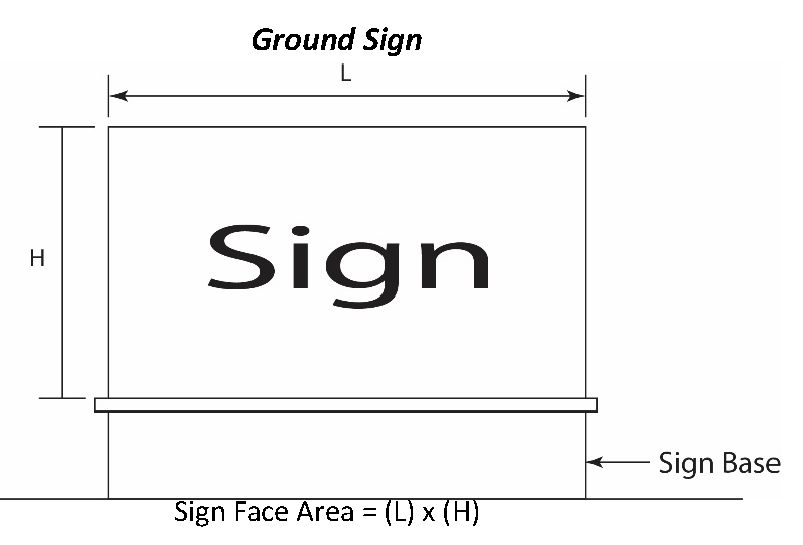
Area of a freestanding sign.
(1)
The area of a freestanding sign shall be determined by computing the visible surface display area including all solid surface areas, including air space surrounded by surface display area, and architectural or design features.
(2)
The width of a sign face shall be in line with the width of the base of a freestanding ground sign.
(3)
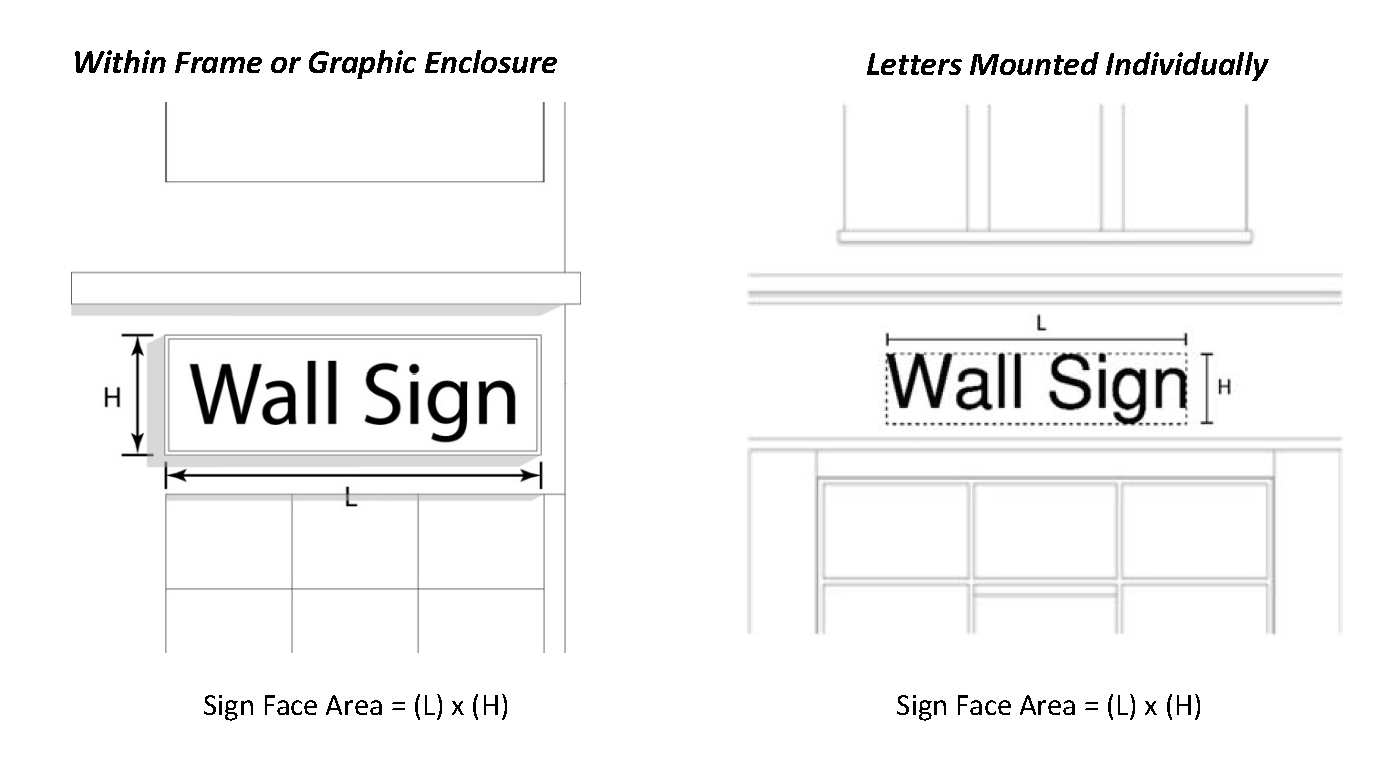
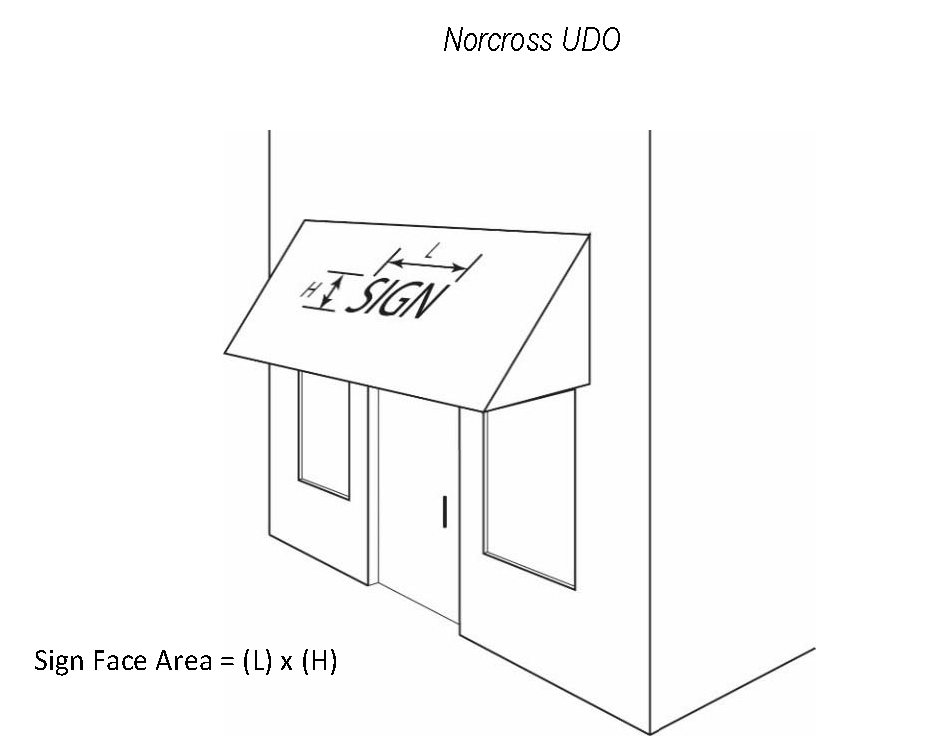
Area of building signs.
a.
The area of a building sign shall be determined by computing the visible surface display area, including all text and graphics, which are completely enclosed by a frame or graphic design.
b.
In the case of individually mounted letters, where there is not a defined sign background, the area of the sign shall be the area that is measured by taking the largest horizontal width multiplied by the largest vertical height of the sign as identified in the graphics below.

(Ord. No. 08-2019, § I, 6-3-2019)
Sec. 204-17. - Vehicle signage.
Vehicle signs viewed from a public road or public or private common areas with the primary purpose of providing signage not otherwise allowed by this article are not permitted in the front yard of a principal building. Vehicle signs include those attached to or placed on a vehicle or trailer. Vehicles or trailers shall not be parked continuously in one location to be used primarily as additional signage. This does not apply to a vehicle parked at a driver's residence and used as the primary means of transportation to and from his or her place of employment or vehicles commonly used for delivery or work purposes of the associated business, and parked temporarily for immediate loading and unloading.
(Ord. No. 08-2019, § I, 6-3-2019)
Sec. 204-18. - Signs permitted in single-family residential districts.
(a)
Other than residential subdivision signs allowed under section 204-19, parcels located in residential zoning districts, shall not contain signs having an aggregate sign area greater than 16 square feet.
(b)
No individual sign shall exceed six square feet in sign area in a residential zoning district.
(c)
No sign in a residential district shall have a height of greater than four feet above the grade level of the center line of the adjacent street to which the parcel on which the sign is located.
(d)
Signs meeting the standards of this section are exempt from permitting requirements.
(Ord. No. 08-2019, § I, 6-3-2019)
Sec. 204-19. - Residential subdivision signs.
(a)
Platted residential subdivisions consisting of more than two parcels may erect one monument sign at each entrance to the subdivision. Such sign shall not exceed a height of four feet above the grade level of the center line of the adjacent street and shall not have a sign area greater than 25 square feet. Such entrance signs shall not count toward the maximum allowable signage on a residential parcel.
(b)
Homeowners association recreation facility sign. In a platted residential subdivision, each lot that contains a building or recreation facility used for the common enjoyment of the members of a homeowners association is permitted one permanent ground sign per public road frontage with a maximum sign area of 64 square feet and a maximum copy area of 32 square feet.
(Ord. No. 08-2019, § I, 6-3-2019)
Sec. 204-20. - Uniform sign plan.
(a)
A uniform sign plan is required for any planned commercial, mixed-use or multifamily, development, before any signs may be erected on the property.
(b)
The uniform sign plan shall govern the placement and design of all signs within the planned development as to their location, materials, size, letter style, and color.
(c)
A uniform sign plan shall be submitted and approved as follows:
(1)
The uniform sign plan shall consist of such drawings and specifications as may be required to clearly illustrate the location, materials, size, letter style, and color of all and every sign to be placed as freestanding and building signs within the development.
(2)
The uniform sign plan is to be submitted to the Director. The uniform sign plan shall be approved upon a finding by the Director that:
a.
The plan provides that signs of a similar type and function within the development shall have a consistency of size, lettering style, color scheme, and construction materials so as to present a unified design concept while respecting the differences between tenant types and occupancies.
b.
The signs proposed in the uniform sign plan shall comply with the requirements of this article, such as number, location, and size restrictions.
(d)
All tenants of the planned commercial development, whether an owner, lessee, subtenant, purchaser, or other occupant, shall comply with the approved uniform sign plan.
(Ord. No. 08-2019, § I, 6-3-2019)
Sec. 204-21. - Signs in the Norcross Historic District.
In order to provide historical continuity in the geographic area within the city which appears on the U.S. National and Local Registers of Historic Places and which is known as the Norcross Historic District, all signs located within the District shall be governed by the following provisions:
(1)
Historic character. A historical district sign, including lighting, should be in keeping with the turn-of-the-century architecture generally represented in the historic district.
(2)
Review references. In reviewing signs within the historic district, the Community Development Department may require adherence to approved design studies or historic inventories of the historic district.
(3)
Prohibited signs in the historic district. Subject to the grandfather clause provision set forth in subsection 204-11(a), the following signs shall not be allowed within the historic district:
a.
Roof-mounted signs.
b.
Oversized signs.
c.
Neon signs and other internally lighted signs, with the exception of an internal window sign not to exceed 20 percent of the total glazed area of windows and doors.
d.
Electronic message boards, or other signs exhibiting motion and electronic text changes.
(Ord. No. 08-2019, § I, 6-3-2019)
Sec. 204-22. - Electronic message boards.
(a)
Location. Electronic message boards are permitted only in non-residential zoning districts, with the exception of subsection 204-22(b), or under the requirements of an approved uniform sign plan.
(b)
Within residentially zoned areas, electronic message boards may be used by elementary and secondary public and private schools; churches and other nonprofit and governmental buildings provided the signs meet the following criteria:
(1)
Must be set back 150 feet from a residential dwelling unit, unless the residential use is fully screened from the sign unit in which case the distance may be reduced at the discretion of the director of planning and development.
(2)
The signs must be programmed to be turned off between 10:00 p.m. and 6:00 a.m.
(c)
Sign types to utilize electronic message boards. Electronic messaging may be an element of a monument, freestanding, or window sign.
(d)
Duration of display.
(1)
Any electronic message displayed shall remain unchanged for a minimum of 15 minutes.
(2)
The following display types are prohibited:
a.
Animation is prohibited;
b.
Flashing, blinking, fade in, fade out or scrolling text is prohibited; and
c.
Video images are prohibited.
(e)
Intensity of light.
(1)
The electronic message board shall come equipped with an automatic dimming photocell, which automatically adjusts the display's brightness based on ambient light conditions.
(2)
The brightness level shall not increase by more than 0.3 foot candles (or 3.23 lumens per square meter or lux), over ambient lighting levels, as measured using a foot candle meter at a pre-set distance.
(3)
The procedure and distances for measurement of brightness shall be as established by the International Sign Association's "Recommend Night-time Brightness Levels for On-Premise Electronic Message Centers."
(f)
Default control.
(1)
Electronic message boards shall be equipped to freeze the display in one position if a malfunction occurs.
(2)
Electronic message boards must also be equipped with a means to immediately discontinue the display if it malfunctions.
(3)
The electronic message board's owner must immediately stop the display when notified by the Community Development Director that the sign is not complying with the standards of this article.
(Ord. No. 08-2019, § I, 6-3-2019)

