Normal City Zoning Code
DIVISION 15.17
DESIGN REVIEW IN B-2 CENTRAL BUSINESS DISTRICT
(Entire Division 17 Added 3/18/02 by Ord. No. 4784)(Entire Division 17 Amended 7/15/02 by Ord. No. 4806)(Entire Division 17 Amended 10/21/02 by Ord. No. 4825)(Entire Division Amended 7/18/05 by Ord. No. 5018)
15.17-1 PURPOSE AND INTENT
It is the general purpose and intent of this division to foster the use and development of land in an orderly manner by both private and public interests with special consideration given to the appearance of the community as a result of such development. It is recognized that the appearance of property has a direct bearing on the economic value of such property and also the economic value of adjacent and surrounding property. The appearance of a single property affects not only surrounding property, but the cumulative affect is to enhance or diminish the beauty of the entire Town and consequently the values of property within the Town. It is further recognized that the appearance of property not only has economic effects, but also affects the general welfare, health and safety of Town citizens. An aesthetically pleasing environment is a clean, healthy, and safe environment.
The B-2 Central Business District is distinguished by the charm of its buildings, its quaint specialty shops and its pedestrian scale. The Central Business District developed at the leisurely pace of a small Town around the turn of the century. The subsequent visual diversity of the buildings in the Central Business District is attributable to development occurring slowly over the period of many years. The community recognizes the significance of the Central Business District as an important cultural and commercial resource. The Central Business District contains common building elements such as load-bearing brick walls, second story bay windows, decorative brickwork, and cast iron thresholds.
This division provides a procedure by which development of property within the Central Business District may be reviewed and modified in order to enhance the aesthetic beauty of the Central Business District and maintain the desirable qualities of the District through clear architectural and appearance standards and consequently the economic value of property and the general welfare of the citizens.
15.17-2 APPLICATION
This division shall apply to all exterior building renovation, new construction or other exterior alterations to property in the B-2 Central Business District whether or not a permit is required by the Town, including painting. No exterior work may be initiated except upon approval of a development plan in conformance with the procedures and standards set forth in this division.
15.17-3 COORDINATION WITH OTHER CODES
In the event the substantive provisions of this division conflict with any other codes or regulations governing construction or development in the B-2 Central Business District, the provisions of this division shall control. In no event shall this division undermine the purposes set forth in any Town health and safety codes.
15.17-4 SEVERABILITY
It is hereby declared to be the intention of the Town Council of the Town of Normal that the several provisions of this division are separable in accordance with the following:
- If any court of competent jurisdiction shall adjudge any provision of this division to be invalid, such judgment shall not affect any other provisions of this Code not specifically included in such judgment order.
- If any court of competent jurisdiction shall adjudge any provision of this division to be invalid as to a particular property, building or other structure, such judgment shall not affect the application of said provision to any other property, building or structure not specifically included in such judgment order.
15.17-5 SPECIFIC PURPOSES
In addition to the general purposes and intent expressed above, this division is further intended to give effect to the following specific purposes:
- To provide for the orderly and functional arrangement of land uses and buildings.
- To establish standards for the orderly development or redevelopment within the Central Business Zoning District.
- To permit public involvement in the planning of private land uses which have the potential for significant impact on the use and enjoyment of surrounding property or on the public resources and facilities of the community.
- To conserve and protect the taxable value of land and buildings in the Central Business District.
- To protect the air, water, and land resources within Normal from the hazards of pollution and misuse.
- To protect land and buildings from natural hazards including flooding, erosion, and fire.
- To preserve and protect the visual diversity of buildings in the Central Business District and its pedestrian scale.
- To preserve, protect and encourage the development of buildings, groups of buildings and development sites of distinguished architectural character and appearance.
- To promote the Uptown Development Plan adopted by the Town of Normal and coordinate said Plan with site development and building construction in the Central Business District.
- To make recommendations on permanent public improvements prior to implementation of such improvements.
15.17-6 DESIGN REVIEW COMMISSION
- The Uptown Design Review Commission of the Town of Normal created pursuant to Chapter 10 of the Town of Normal Municipal Code shall have authority to apply this division in a manner that will foster and promote high quality, attractive development and rehabilitation within the B-2 Central Business District.
- Meetings, Hearings, Rules and Procedures.
- Meetings.
- Regular Meetings. All Regular Meetings of the Uptown Design Review Commission shall be held at 4 p.m. on the second Monday of each month at such place as the Commission may determine.
- Special Meetings. Special Meetings may be called by the Chairperson or a majority of the commission members upon at least 48-hours notice or by announcement of the time and place of the special meeting at a Regular, Special, or Adjourned Meeting.
- Meetings Open to the Public. All Regular, Special, Adjourned, Study or Workshop Meetings of the Uptown Design Review Commission shall be open to the public.
- Quorum. A majority of the Uptown Design Review Commission members shall constitute a quorum for purposes of transacting business.
- Rules and Procedures. Except as otherwise provided in this division, all Meeting of the Uptown Design Review Commission shall be conducted pursuant to Robert Rules of Order Newly Revised 1990 Edition published by Scott Forsman and Company; copies of which have been and remain on file in the Office of the Town Clerk.
- Administrative Public Hearings.
- All administrative public hearings shall be regularly scheduled or properly called meetings of the Uptown Design Review Commission.
- Legal Notices. Legal notice of an Administrative Public Hearing shall be given not less than 15 nor more than 30 days before said Hearing by publishing a notice thereof in a newspaper of general circulation within the Town.
- Administrative Public Hearing Procedure.
- Appearances. Any person may appear and testify at an Administrative Public Hearing either in person or by a duly authorized agent or attorney.
- Oath. The Chairman, or in his absence, the Acting Chairman, may administer oaths.
- Compelling the Appearance of Witnesses. The Chairman, or in his absence, the Acting Chairman, may compel the attendance of witnesses by mailing to such persons a notice compelling attendance not less than 5 days before the public hearing. Failure of a person to appear in response to such a notice shall constitute a violation of this chapter.
- Record Keeping. The commission shall keep minutes of its proceedings showing the vote of each member, upon each question or if absent or failing to vote indicates such fact.
- Verbatim Transcripts. In the event any person desires a verbatim transcript of the administrative public hearing, a written request therefore shall be filed with the Chairperson of the Uptown Design Review Commission not less than 3 weeks before the hearing date. Costs of taking such a transcript shall be paid by the person requesting the presence of the reporter at the administrative public hearing. Any person desiring a written transcript of the proceedings shall pay applicable transcription or copying costs.
- Notification of Decisions. Copies of decisions and recommendations of the commission shall be served by mailing a copy thereof to all persons requesting the same.
- Meetings.
15.17-7 (Reserved)
15.17-8 GENERAL PROHIBITION
No exterior building painting, renovation, new construction or other exterior alterations to property in the B-2 Central Business District, whether or not a permit is requested, shall be started until the property owner and/or developer obtains a Certificate of Compliance or a Conditional Certificate of Compliance from the Uptown Design Review Commission.
15.17-9 PROCEDURE
- Submission. Any person desiring to renovate or repair the exterior of any building, construct a new building or structure or make any other exterior alterations or improvements to property in the B-2 Central Business District shall submit all information required by this Section in the form specified. Failure of an owner or developer to provide this information in the form required shall be sufficient grounds for the Uptown Design Review Commission to refuse to accept the filing or reject the application at any stage in the review and approval process and, in addition, shall constitute a violation of this Code.
- The owner or developer of property, subject to this division, shall file with the Town Clerk a completed Application for Certificate of Compliance, 1 copy of a Site Plan that includes site layout, landscape, and building elevations for each facade, and a filing fee in the amount of $150. Applications for expedited review require no fee. The Site Plan shall contain:
- Survey maps and drawings indicating existing conditions prepared by a Registered Illinois Land Surveyor or Registered Professional Engineer showing the boundary lines, the location and perimeter of any area designated as a special flood hazard area as defined in chapter 28 of the Municipal Code. Specific identification, location and dimensions, if applicable, of the following located within or within 50 feet of the area included in the construction plan; rights-of-way, lots of record, streets, roadways, drainageways whether improved or unimproved, walkways, sidewalks, public easements, private easements, railroad rights-of-way, section lines, corporate limit lines, public parks, schools and other public lands, buildings and structures to remain on the property, and buildings and structures to be removed.
- Surveys, maps, plans, and drawings of proposed development. A Registered Land Surveyor or Registered Professional Engineer or Registered Professional Architect shall prepare graphic presentations of the following: rights-of-way, interior and exterior streets, interior and exterior roadways, street and roadway names, alleys, walkways, sidewalks, public easements, private easements, lots, outlots, setback lines, public parks or areas to be designated as common public space, other areas proposed for dedication or reservation to the public, railroad crossings and rights-of-way, bridges, size, location, type of construction and proposed use of all proposed buildings and structures, location and composition of all landscaping material and screening material, general landscaping plan, general parking plan and direction of traffic flow, location and dimension of curb cuts, sign plan, lighting plan, preliminary drainage plan, detailed elevation drawings of all sides of the proposed construction or renovation, and a list of building materials and color samples for both the building exterior and for all signs.
- Construction Plan. The construction plan shall be prepared by a professional engineer and/or architect and shall contain the name and seal of such professional engineer and/or architect. The construction plan shall be drawn to scale (1/4” = 1’0” or 1/8” = 1’0”) and contain at a minimum the following:
- Legal description of all property included in the construction plan.
- Name, address, and phone number of the owner or owners of record of all property described in the construction plan.
- Name, address, and phone number of the developer of the property described in the construction plan.
- Name, address, and phone number of the registered professional engineer and/or architect preparing any part of the construction plan or supporting material.
- Name, address, and phone number of attorneys representing the owners and/or developers.
- The parcel identification number for the property described in the construction plan.
- The Uptown Design Review Commission chairperson or his or her designee shall have authority to waive submittal of any of the previously listed elements for projects only involving the renovation of existing structures.
- Scheduling and Notification of Review. Upon receipt of a completed application for Certificate of Compliance, payment of the appropriate filing fee and submission of the complete plans, the Town Clerk shall schedule and give notice of an administrative public hearing with the Uptown Design Review Commission. Notice shall consist of public notice as provided in this division.
- Distribution of Plans. The Town Clerk shall route one or more copies of the application and plans to members of the Uptown Design Review Commission.
- Administrative Public Hearing. Upon receipt of the application and Plans the Uptown Design Review Commission shall conduct an administrative public hearing on the proposed development plan. The Uptown Design Review Commission shall take testimony from the applicant, from Normal Town staff and from any other interested person appearing at the administrative public hearing. In reviewing the proposed development plan, the commission shall apply the design guidelines set forth in this division. If the commission finds that the applicant has complied with all of the design guidelines, the commission shall issue a Certificate of Compliance. If the commission finds that the applicant has not complied with all of the design guidelines, the commission may take one of the following actions:
- Issue a Conditional Certificate of Compliance in which the applicant agrees to implement all additional design elements and to remove all rejected design elements as required by the commission;
- Issue a Conditional Certificate of Compliance in which the applicant must, prior to beginning the project, obtain waivers from the Town Council through the waiver procedures established in this division; or
- Deny the application entirely.
- Decisions of the Uptown Design Review Commission. Within 5 days of the close of review by the Uptown Design Review Commission, the commission shall notify the applicant in writing of its decision regarding the proposed development plan.
- Appeal or Request for Waiver. Any applicant, the Town staff or any person owning property within 400 feet of the property subject to the Certificate of Compliance application, may appeal a decision of the Uptown Design Review Commission to the Normal Town Council or request waivers in accordance with a Conditional Certificate of Compliance from the Normal Town Council. Such appeal or request for waiver shall be filed in the Office of the Town Clerk within 5 days of the written decision of the Uptown Design Review Commission and shall be accompanied by payment of a filing fee in the amount of $100.
- Review by the Normal Town Council. The Town Council in reviewing an appeal or request for waiver may consider the material presented at the Uptown Design Review Commission as well as any additional material presented before the Normal Town Council.
- Decision by the Normal Town Council. Unless extended by agreement the Town Council shall render a decision on the appeal of the decision of the Uptown Design Review Commission or on the granting of a Conditional Certificate of Compliance requiring waivers no later than at its next regularly scheduled meeting following presentation by the appellant to the Council. The Town Council in reviewing the appeal or request for waiver shall be guided by the design standards contained in this division; however, the Council may depart from these standards when the Council deems such a departure to be in the public interest or to further the purposes of the design standards. The Town Council may approve the plan as presented, approve the plan conditioned upon modification, approve the plan and grant waivers, reject the plan entirely or remand the plan to the Uptown Design Review Committee for further review. Unless agreed to by the applicant, no applicant shall be remanded to the Uptown Design Review Committee by the Town Council more than once.
- Appeal of Council Decision. Any person aggrieved by the decision of the Town Council may appeal such decision as provided by law.
- Minor Changes. Minor changes in the location, siting, height, and design of structures or landscaping may be authorized by the Uptown Design Review Commission Chairperson; however, no such change may involve a change in the character of the project or a substantial alteration to the design or landscaping.
15.17-10 EXPEDITED REVIEW PROCESS
- Qualifying Projects. Notwithstanding the procedures set forth above, an applicant may seek expedited review for the following:
- Construction or other exterior alteration less than $5,000 in value. (Amended 12/18/17 by Ord. No. 5725)
- Repair or rehabilitation work in which like materials will be used, unless such materials are prohibited in this division.
- Emergency situations in order to protect persons and/or property from significant injury or damage.
- Application and Notice. Upon receipt of an expedited review application, the Town Clerk shall immediately forward such application to the Chairperson of the Uptown Design Review Commission. The Chairperson and the City Manager, or his designee, shall meet as soon as possible to review the application. Notice of such meeting shall be given immediately to the applicant either in person, by telephone or ordinary mail.
- Expedited Review. When conducting an expedited review the two-member panel of the Uptown Design Review Commission shall be governed by the design guidelines in this division and shall determine whether or not the proposed construction permanently and significantly alters the exterior appearance of a structure. If in the opinion of the two-member panel, the exterior appearance of the structure is significantly and permanently altered, the panel shall refer the applicant to the full Uptown Design Review Commission and the process for full review shall apply. As used herein significantly and permanently altered means a repair that results in a change in 50% or more of the exterior of a structure or a change in less than 50% of the exterior of a structure but such change results in a design appearance which should be avoided as provided in the design review standards and either change is expected to last more than 90 days.
- Expedited Decision. If the expedited review panel determines that the proposed construction activity does not significantly and permanently alter the exterior of the structure, and the proposed alteration does not violate the design standards set forth in this division, the Chairperson shall note his approval on the application and issue any appropriate expedited Certificate of Compliance. If the expedited review panel determines that the proposed alteration violates any design standard set forth in this division, the application for Certificate of Appropriateness must go before the entire Uptown Design Review Commission for review. The commission will then prepare a recommendation for the Town Council in the event that the applicant seeks a waiver from the Council.
15.17-11 STANDARDS FOR DESIGN
The purpose of these standards is to establish a checklist of those items that affect the physical aspect of the Central Business District. Pertinent to design are the site layout, building and structure components, lighting, signs, street hardware, public space, stormwater management facilities, scale of design, color and other objects observable from public ways.
These standards are not intended to restrict imagination, innovation or variety, but rather to assist in focusing on design principles that allow creativity with a satisfactory visual appearance while promoting the purpose and intent of this division. Waivers may be obtained for design elements that do not comply with the ordinance. See sec. 15.17-9(I) for waiver provisions.
In addition, these standards are not comprehensive but provide guidance on specific design elements. Any design elements not addressed in this division must still be approved by the Commission for the purpose of only approving designs that complement the historic character of the B-2 District and further the goals of the uptown renewal effort.
- For all new construction, the following guidelines apply:
- Building Components and Design.
- Architectural Style. No particular architectural style is mandated. Buildings designed under the guidelines of a particular architectural style should be consistent with that style.
- Entryways. Entryways must be recessed to a depth that does not allow a door to swing onto the sidewalk and have a strong design consistent with the architecture of the rest of the building. Elements of strong entryway design include canopies, awnings, porticos, arcades, raised cornice parapets over the door, peaked roof forms, arches, large windows, or architectural details such as tile work and mouldings that are integrated into the building structure and design.
- Windows.
- Coverage and Operability. Windows must cover no less than 50% nor more than 75% of the storefront area; windows must cover no less than 30% nor more than 50% on the upper facade. All windows on the second and higher floors must appear operable.
- Orientation and Placement. Windows must be vertical, with no less than a 2:1 ratio of height to width. Window separation into vertical orientation must be accomplished with a prominent architectural element. See also sec. 15.17-11(A)(1)(c)(4). Storefront windows must start between 2 and 3 feet above the sidewalk.
- Window Signs. No more than 25% of the storefront windows may be covered by signs. This restriction does not apply to signs permanently painted on or etched into the window to serve as the business’ primary sign.
- Framing. All windows must include an architectural element that frames the window. See also sec. 15.17-11(A)(1)(c)(2).
- Shutters. All window shutters must have the dimensions of operable shutters and hardware that makes the shutters appear to be operable even if the shutters are permanently fixed in an open position.
- Cornice and Fascia.
- At Roofline. All buildings must have a well-defined cornice or fascia that creates a strong roofline and visually caps the building, giving the building a finished appearance and unifying the building with existing structures in the B-2 District. This requirement is particularly important when the upper facade has little architectural distinction.
- At Storefront. All buildings must have a storefront cornice occurring between 9 and 14 feet above the sidewalk in order to complement the average height of storefront cornices on existing buildings.
- Roof Styles. The shape of the roof is not limited, however, all buildings must have a parapet that conceals the roof plane.
- Mechanical Equipment or Other Utility Hardware. On buildings not located on a corner, all mechanical equipment or other utility hardware must be located on the roof or in the rear yard and must be screened from view with materials harmonious with the building. Such equipment or hardware on a corner building must be located on the roof and screened from view or located at ground level and screened to the extent possible with materials and colors harmonious with the buildings. Such equipment or hardware shall not be located closer than 6 feet from any residential windows. (Amended 12/18/17 by Ord. No. 5725)
- Side and Rear Building Faces. All exterior surfaces visible from the street or the alley must present an attractive appearance and must include architectural components found on the building facade in order to tie the building together. Rear entrances are encouraged.
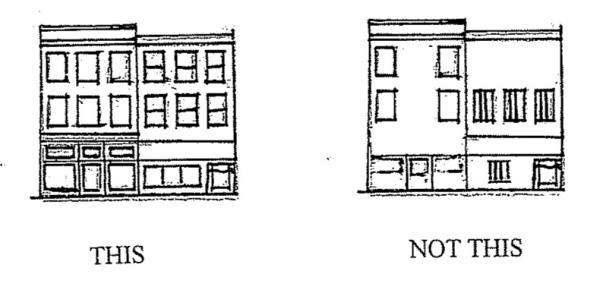
- Anti-Monotony. New construction must avoid excessive monotony in design by having no more than 15 feet of blank wall length without an interruption by at least two of the following: change in plane, change in texture or masonry pattern, windows, trellises with vines, or an equivalent.
- Color. Exterior colors in the B-2 District are limited to low to medium saturated chroma, as explained in the Munsell System of Color Notation for primary building colors. Highly saturated colors may be used for accent or trim.
- Permitted Building Materials. The materials on the following list are permitted on the building exteriors visible from the street or alley: architectural metal panels, stone, marble, face brick, decorative wood trim (e.g. Bargeboard or Gingerbread), and copper. The Uptown Design Review Commission may permit other nonlisted materials of similar quality and appearance. (Amended 12/18/17 by Ord. No. 5725)
- Prohibited Building Materials. The materials on the following list are generally prohibited on the building exterior visible from the street or alley: cement board panels, cement board siding, rustic materials, such as wood shake shingles and barn wood, corrugated metal, corrugated fiberglass, aluminum siding, imitation rock work, mirror or metalized reflective glass, plywood, masonite, structure and chip board siding, exterior insulated finish system (EIFS), vinyl siding, metal siding other than copper, cinder block, split-face block or pre-cast panels. The Uptown Design Review Commission may also reject other exterior materials that do not complement the historic character of the B-2 District or that do not further the spirit of the uptown renewal effort. (Amended 12/18/17 by Ord. No. 5725)
- Awnings and Canopies. Awnings and canopies are permitted with the following restrictions:
- All awnings must be made of cloth fabric or a cloth composite that has the appearance of cloth. Awning materials may not have a shiny synthetic appearance, which would conflict with the historic appearance of the B-2 District. Canopies must be made of materials that complement the overall historic character of the B-2 District.
- Interior lighting within awnings or canopies is restricted to downlighting with no more than five footcandles at grade permitted. (Amended 12/18/17 by Ord. No. 5725)
- Awnings and canopies must be mounted no higher than 12 inches below the storefront cornice. All awnings and canopies must have a minimum vertical clearance of 7 feet 6 inches above the sidewalk.
- Awnings and canopies must be attached directly to the building without requiring poles or sidewalk support.
- On buildings wider than 25 feet, awnings and canopies must be segmented to articulate each display window and to provide a better sense of proportion to the facade.
- Awnings and canopies may not cover more than 25% of storefront windows.
- Exterior Lighting. In order to promote the goals of improved aesthetics, greater energy efficiency, and safety, the following lighting standards apply to all nonexempt outdoor lighting:
- All light fixtures must be harmonious with the overall building design.
- Mounting of light fixtures is limited to the first floor.
- Lights may not move or flash.
- Prohibited lighting includes fluorescent, high-pressure sodium, laser, floodlights, mercury vapor and searchlights. The prohibition against fluorescent does not apply when the fluorescent luminaire has a color rendition similar to tungsten.
- All bulbs and fixtures must be non-glare and cutoff. Fixtures must be positioned in a way that the cutoff effect is maximized. Tilt arms are prohibited.
- Recessed entryways must be illuminated but may not exceed an average of 5 footcandles at grade.
- Building lighting, including wallpacks and arcade lighting, may not exceed a light level of 5 footcandles at grade.
- Parking lot lighting must comply with sec. 15.14-7(H) of the Code.
- Exempt outdoor lighting includes terraces, signs, and outdoor gathering spaces.
- Signs. All signs must be designed by a sign professional. A non-professional may be used if such person can demonstrate adequate qualifications and samples of previous work. Signs should related in placement and size to the other elements of the building. Individual shop signs in a single storefront should relate to each other in design, size, color, and placement on the building and lettering style.
- Sign Types.
- Permitted sign types are limited to low-rise signs, wall signs, banner signs, projecting signs, window signs, and awning/canopy signs.
- Inflatable signs are prohibited.
- Temporary signs shall be regulated by division 15.13 of the Town Sign Code, however, the maximum size of such temporary signs shall be 1 square foot per lineal foot of storefront.
- Location.
- Signs may not cover any architectural details or cornices.
- Wall signs and projecting signs are generally limited to the storefront; however, up to 25% of the sign may project onto the upper facade as long as no other rules are violated, such as covering a window.
- Projecting signs may not project more than 60 inches from the building or to the back side of the curb, whichever is a lesser distance.
- Projecting signs must be at least 8 feet above the sidewalk.
- New buildings must provide a sign frieze in order to define a strong boundary between the storefront and upper facade.
- Each lot may have no more than one monument sign.
- Banner signs may be located on all stories. Banners may project no more than 60 inches from the face of the building, and their size is limited by the overall sign square footage for the property. Banner materials are not restricted. (Amended 12/18/17 by Ord. No. 5725)
- Rectangular, wall-mounted box signs with internal lighting and flat faces are not permitted.
- Permanent signage may not cover more than 25% of the storefront windows.
- Size. Every property may display signage in an amount not to exceed one square foot of signage per lineal foot of building frontage adjacent to a street, including rear building facades adjacent to an alley, with additional restrictions stated as follows: (Amended 12/18/17 by Ord. No. 5725)
- Sign size must be in proportion to the storefront and building as a whole. For wall signs, a ratio of one square foot of sign area per each linear foot of storefront determines the maximum signable area; however, all buildings shall have a minimum signable area of 25 square feet.
- Non-permanent window signs may not obscure more than 25% of the storefront window area. A window sign that serves as the business’ primary business sign does not factor into this calculation; however, such a window sign may not itself obscure more than 25% of the storefront window area. See sec. 15.17-11(A)(1)(c) for more window provisions.
- Projecting signs may be no larger than 12 square feet.
- Monument signs may be no more than 6 feet tall. A ratio of one square foot of sign area per lineal foot of storefront determines the maximum signable area; however, no monument sign may exceed 50 square feet of signable area. Every monument sign may have at least 25 square foot of signable area, regardless of the amount of lineal feet of storefront.
- Lighting. The only interior lighting permitted for signs is internal lighting of individual letters and internal lighting on a sign in which the light only shines through the lettering and/or logo. Signs may not flash or move, with the exception of signs on buildings listed on the National Registry of Historic Buildings. (Amended 12/18/17 by Ord. No. 5725)
- Materials. The following materials are encouraged for signs: wood, paint on wall, paint/goldleaf on glass, masonry relief, etched glass, structural pigmented glass, decals, fabric awnings, banners, leaded or stained glass transoms, tile, terrazzo, porcelain enamel, sheet metal, adhesive vinyl. All sign material must be of exterior quality and must be durable.
- Mounting. Sign mounting must protect the integrity of the facade materials and facade design.
- Sign Types.
- Scale of Design. All new construction must be at least two stories in height, with the first floor between 12 and 15 feet in height and upper stories between 9 and 12 feet in height. Buildings may be no more than 2 stories taller than any adjacent buildings, and may in no case be more than 4 stories tall; however, this standard does not apply to buildings adjacent to the traffic roundabout, which may be 6 stories in height.
- Front Setback. New construction must have a facade built to the front property line when adjacent to North Street or East Beaufort Street.
- Corner Buildings. Both street-facing sides of corner buildings will be treated like the storefront facade, therefore, all storefront facade requirements apply to both street-facing sides.
- Roundabout Design Guidelines. For new construction adjacent to Uptown Circle, the Roundabout Design Guidelines apply. Notwithstanding the foregoing, to the extent the Roundabout Design Guidelines require a ground-level arcade adjacent to Uptown Circle, North Street, and Constitution Boulevard, that requirement may be satisfied by an attached awning or canopy that meets the supplementary guidelines below.
- As an alternative to an arcade, all buildings may include a pedestrian awning or canopy. The intent is to provide a continuous covered pedestrian walkway.
- Proportions. Except as otherwise provided in this subsection (b), general massing and location of the awnings or canopies for any given building on the circle must be similar to those provided for arcades in the Roundabout Design Guidelines. An awning or canopy must:
- Be attached directly to the building without requiring poles or sidewalk support;
- Have a minimum vertical clearance of 10 feet;
- Have a minimum depth, measured from the building face, of 8 feet 4 inches when straight or 10 feet 8 inches when curved; and
- Have a maximum depth, measured from the building face, that does not extend beyond the sidewalk edge farthest from the building.
- Building Components and Design.
- Building Design for Exterior Renovation of Existing Structures. All of the guidelines from sec. 15.17-11(A) apply to the exterior alterations made to existing structures unless waived by the Town Council. The Town of Normal recommends that the renovation of existing structures recreate the original facade. Recommendations include the following:
- Windows. Restore and reglaze original window openings into original shapes and sizes. Windows may not be permanently filled or decreased in size.
- Surface Materials. Remove nonoriginal surface materials from the original wall surface, when the original wall surface still exists.
- Piers. Restore piers to original status when such piers have been eliminated or reduced in size.
- Parking Lot Perimeter Landscaping.
- Applicability. The parking lot perimeter landscaping requirements shall apply to all new private and public off-street parking lots or expansion of existing lots of more than 25% of existing spaces.
- Minimum Dimensional Standards. All parking lots shall be screened from public streets and sidewalks, with at least a 5-foot wide landscaped area and wheel stops that prevent any car overhang into the landscaped area. However, such screening must not create a safety hazard for users of the parking lots. Where a solid fence/wall is utilized, plant materials must be on the street-side of the fence/wall.
- Fencing/Wall Specifications. All fencing or walls utilized shall meet the following specifications:
- Only ornamental metal fencing, wood fencing, or masonry walls shall be allowed. Chain link fencing and non-commercial grade solid wood stockade fencing are prohibited.
- Fencing shall be a minimum of three feet high and shall not exceed 4 feet in height. Masonry walls shall be a minimum of 30 inches in height and shall not exceed 4 feet in height.
- Minimum Plant Quantity. Where perimeter areas are to be landscaped, the following minimum plant materials shall be provided:
- One tree for every 25 lineal feet of perimeter area. Trees may be spaced evenly or grouped.
- A diverse combination of shrubs, ornamental grasses, and flowers throughout the landscaped area.
- Plant Species. The selection of plant materials shall be based on the Town of Normal’s climate and site conditions with a goal of promoting xeriscaping principles. Plant material shall be selected for interest in its structure, texture, and color and for its ultimate growth. Plants that are indigenous to the area and others that will be hardy, harmonious to the design, and of good appearance shall be used. Plant diversity is required for the health of the overall landscaped area.
- Plant Quality and Landscape Design. All plants shall be A-Grade or No. 1 Grade and free of defects. All plants shall be normal health, height, leaf density, and spread as defined by the American Standard for Nursery Stock, ANSI Z60.1 latest available edition, or the American Association of Nurserymen. Plants shall have full, even, well-developed branching and a dense, fibrous, and vigorous root system. All landscape plans shall be designed by a landscape professional.
- Plant Sizes and Specifications. The following minimum sizes shall be required:
- Canopy Shade Tree: 2.5-inch caliper measured 6 inches above ground, balled, and burlapped, or equivalent.
- Ornamental Tree: 2-inch caliper, balled, and burlapped or equivalent or 7 feet for a multi-stemmed tree.
- Evergreen Tree: 6 feet high, balled, and burlapped or equivalent.
- Shrubs: 24-inch balled and burlapped or 3-gallon minimum container size.
- Installation. All landscaping shall be installed according to sound horticultural practices in a manner designed to encourage quick establishment and healthy growth. All landscaping in each phase shall either be installed or the installation shall be secured with a letter of credit, escrow, performance bond for 125% of the value of the landscaping or other surety satisfactory to the Town prior to the issuance of a development approval or building permit.
- Site Landscaping. Sec. 15.14-7(D)(3) of the Community Design Standards will apply to the lineal street frontage of any greenspace provided, excluding the greenspace provided to screen the parking area. The minimum installation sizes set forth in sec. 15.14-7(E)(3) shall also apply.
15.17-12 MAINTENANCE STANDARDS
Maintenance standards in this division apply to all properties in the B-2 District. All exterior facade materials must be maintained in sound and attractive condition. Any rotten, broken, or otherwise deteriorated materials shall be repaired or replaced in kind. Peeling and/or chalking painted surfaces shall be repainted or otherwise refinished. Permanent boarding or filling in of windows on any side of the building is prohibited. All surfaces shall be kept free of debris, such as tape and staples. All other Town code maintenance provisions also apply.
15.17-13 (Reserved)
15.17-14 ENVIRONMENTALLY SENSITIVE DESIGN
The Town mandates that all new construction with more than 7,500 square feet at the ground level in the B-2 District at least achieve enough LEED points to attain LEED “Certified” status. This requirement does not apply to stand-alone parking decks nor to portions of a building that are a parking deck. As used herein, LEED means the most current version of the Leadership in Energy and Environmental Design rating systems published by the United States Green Building Council. A copy of the most current versions of such publication shall be kept on file in the Office of the Town Clerk. (Amended 5/18/09 by Ord. No. 5258)
15.17-15 PENALTIES
Property owners who fail to comply with the procedures set forth in this division may be fined in an amount not to exceed $1,000 per each day of noncompliance. Failure to comply includes, among other actions, failing to obtain a Certificate of Compliance and failing to comply with conditions set forth in a Conditional Certificate of Compliance. The Town may file for injunctive relief where the Town Council determines it to be in the public interest.
15.17 APPENDIX A
Figure 1: Window Types and Orientations
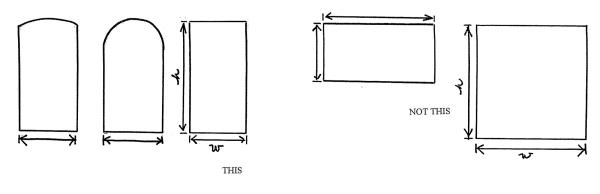
Figure 2: Shutters
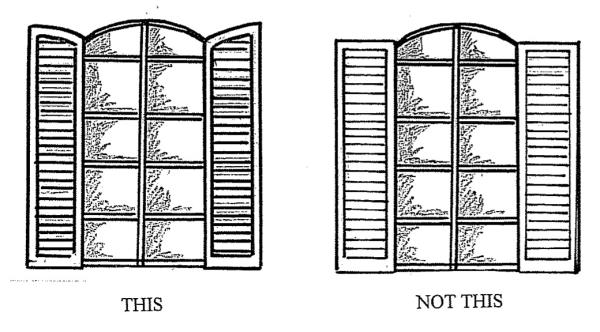
Figure 3: Antimonotony
15.17 APPENDIX B
Figure 1: Scale of Design
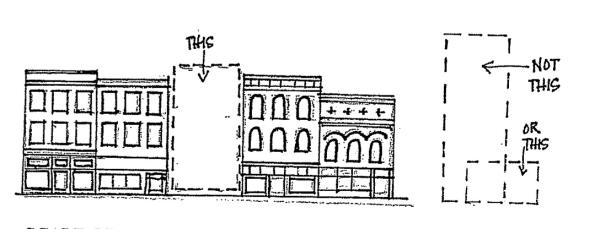
Figure 2: Parapet and Roof Plane
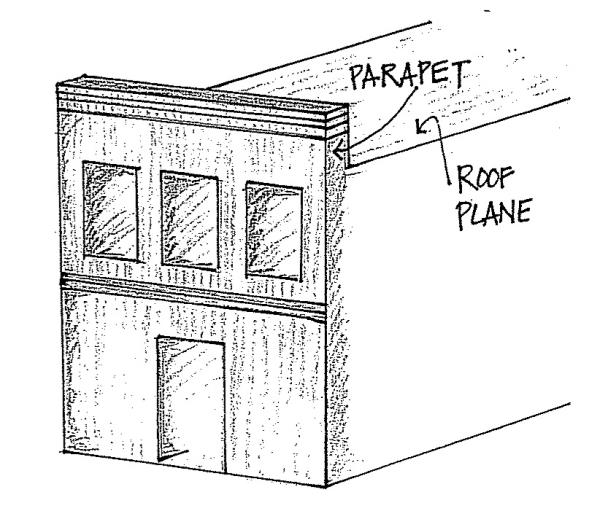
Figure 3: Typical Architectural and Building Components
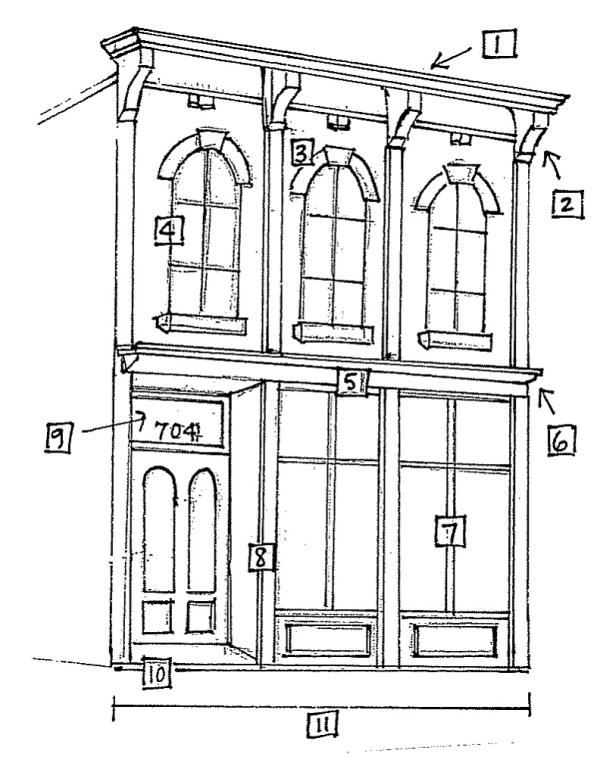
1. Upper Cornice
2. Bracket
3. Window Hood/Eyebrow
4. Double Hung Window
5. Sign Zone/Frieze
6. Storefront Cornice
7. Display Window
8. Masonry Pier
9. Transom
10. Recessed Entry
11. Block Face
15.17 APPENDIX C
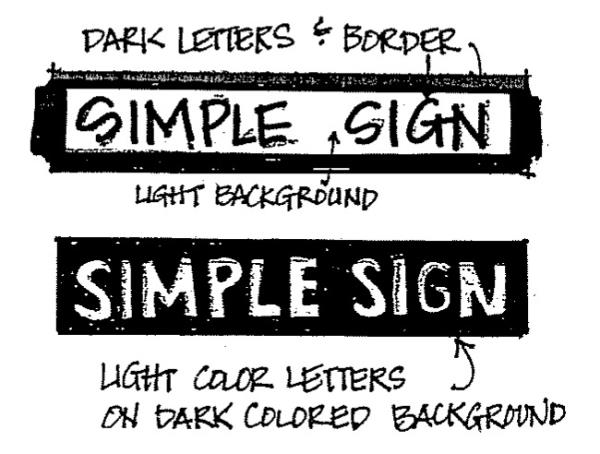
Figure 1: Signs
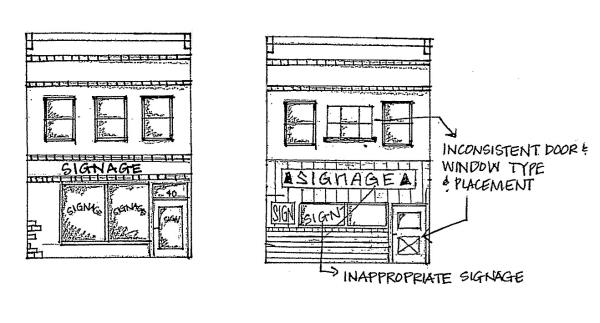
Figure 2: Awnings and Canopies
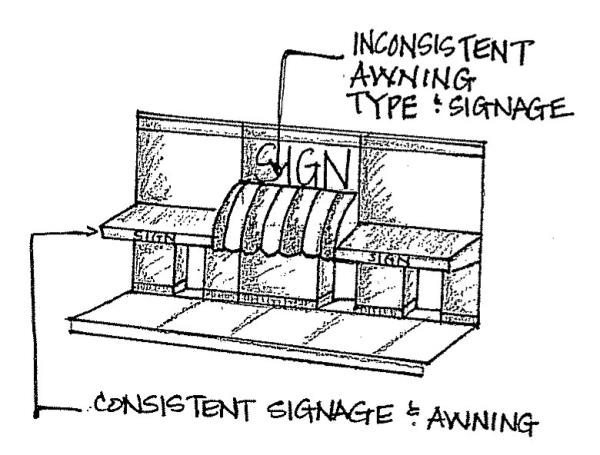
Figure 3: Appropriate Projecting Sign Types
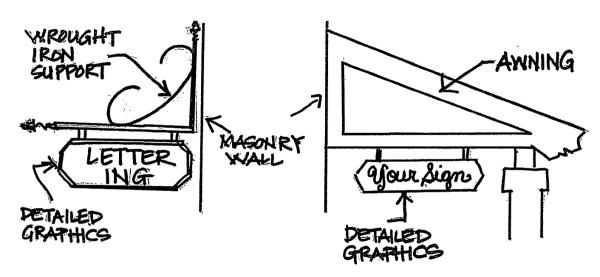
Figure 4: Easy to Read Signs