
North Lauderdale City Zoning Code
ARTICLE V
- GENERAL SUPPLEMENTARY REGULATIONS
Sec. 106-181.- No reduction of required area.
No plot, yard, setback, clearance, parking area or other space shall be reduced in area or dimension so as to make such area or dimension less than the minimum required by this chapter if such plot, yard, setback, clearance, parking area or other space is already less than the minimum required by this chapter for a new building or use; such area or dimension shall not be further reduced. No part of a required yard, setback, clearance parking area or other space provided about or for any building, structure or use for the purpose of complying with the provisions of this chapter, shall be included as part of a yard, setback, clearance, parking area or other space required under this chapter for another building, structure or use, unless specifically permitted by the terms of this chapter.
(Ord. No. 83-2-497, art. 4, § 5, 2-24-83)
Sec. 106-182. - Required building separation.
Where two or more separate buildings for dwelling purposes are erected or placed on the same plot, minimum front, side and rear yards shall be provided as required by this chapter. The spacing, arrangement and distance between buildings on the plot shall provide a separation between any two such buildings not less than the distance equal to the highest point of the roof at the end of the structure when the structures are end to end or at a minimum, 25 feet, whichever is greater. The building separation for structures when the front or rear of a building faces another front or rear or the end of another building shall be equal to the height of the highest point of either building or at a minimum, 50 feet, whichever is greater. The longer side of the structure shall be deemed the front or rear. In those circumstances where all sides are equal or near equal in length then all sides shall be considered a front side. In those cases where the locational relationship of two buildings is offset, a line on an angle of 45 degrees from the perpendicular projections of the end of the building shall determine whether the distance measurement is to be from the end side or the front/rear side of a structure. See Figure 4.1. for further clarification. In the case where the buildings are not rectilinear the zoning administrator shall determine the point at which the 45 degree line shall be affixed to establish the building separation requirements.
(Ord. No. 91-11-800, § 3(Exh. A(art. 4, § 6)), 11-14-91)
Figure 4.1.
Building Separation Requirements
Application: Multiple Structures on One Site Residential and Nonresidential Districts
(Ord. No. 91-11-800, § 3(Exh. A), 11-14-91)
Sec. 106-183. - Yard encroachments.
(a)
Every part of every required yard shall be open and unobstructed from the ground to the sky except as provided or as otherwise permitted in this chapter.
(b)
Sills or belt courses may project not over 12 inches into a required yard. Cornices, eaves, and gutters may project a maximum of 2½ feet into a required yard. Window mounted terrarium or greenhouse units may project a maximum of 18 inches from the structure within which they are placed.
(c)
Chimneys, fireplaces or pilasters may project a maximum of two feet into a required yard.
(d)
An awning may be placed over doors and windows which project a maximum of four feet into any required yard, provided a minimum of seven feet of vertical clearance is maintained free and unobstructed from the finished grade to the lowest part or component of the awning. Any support shall be cantilevered or mounted to the structure and in no case, unless excluded elsewhere in this chapter, shall any awning be vertically supported. Vertical supports may be used when the entirety of such supports are within the building area of any plot.
(e)
Gasoline pump stations and canopies for pump islands may project into a required setback but in no case shall be located within ten feet of a property line. The vertical supports for such canopies must be placed within the building area.
(f)
Concrete slabs and wooden decks may encroach into the required rear and side yard setbacks provided they are no higher than six inches above the average finished grade for that portion within the setback area and that the area covered does not exceed the pervious (drainable) ground area requirements for required yards. Wooden decks for purposes herein shall be considered as impervious areas. In no case shall such decks and slabs be closer than two feet to any plot line. Impervious slabs and decks shall be sloped to direct stormwater runoff inward from the plot lines in order to maintain the stormwaters within the limits of the plot.
(g)
Front yard porches, whether concrete or wood, may extend into the required front yard a maximum of six feet and shall not exceed 72 square feet in area. Such porches shall not, on the average as measured from the finished grade, be higher than six inches from the ground elevation. These porches may be roofed or covered however in no case shall the roof or covering or the supports for the roof or covering extend beyond or be located more than six feet into the required front yard setback nor shall the roof or covering be wider than eight feet in width at its widest point. Only one such roof or covering shall be permitted on the front or street side of a structure and shall only be placed over the main entrance. The roof or covering shall be constructed in such a fashion that the exposed portions match the color of the house and the roofing material shall be of a similar kind, color, and manner of application to match the existing roof. The construction of such roof or covering shall be open on all sides and only intended to provide shade or shelter from inclement weather. Trellis type assemblies may be used on either or both sides of a front yard porch. No screening or screening material shall be used to enclose any portion of a front yard porch when such porch encroaches as defined herein. The roof or covering shall be permanently affixed to the principal structure and meet all requirements of the applicable building code.
(h)
Any ground to sky obstruction created by the planting and growth of trees and other plant materials shall be exempt from yard encroachment prohibitions.
(i)
For the purposes of this section, any fences, walls and hedges shall not be considered as yard encroachments or obstructions to the open and unobstructed requirement of this section.
(j)
Trellis type structures having a horizontal component may extend into the required side and rear yards provided the structure does not exceed eight feet in height as measured from the finished grade or contain no more than 24 square feet of overall area on the horizontal component. One trellis type structure may be permitted in the required front yard provided it is no larger than eight square feet of horizontal area and two sides having an area no larger than 16 square feet. This is intended to allow an entry trellis feature that is two feet wide, eight feet high and four feet across the front walkways in people's front yards.
(k)
Trellis type structures, when assembled sequentially in sections longer than eight feet, shall be deemed a fence and as such shall adhere to the provisions governing fences contained elsewhere in this chapter. Any trellis type structure when used in conjunction with another trellis type structure, fence, or wall and separated by a distance less than the height of the higher of the two shall be deemed a fence or wall and shall adhere to the provisions governing fences contained elsewhere in this chapter.
(l)
Trellis type structures when exceeding six feet in height from the finished grade may only be permitted in required side and rear yards provided the horizontal component overhead, if one is proposed, does not exceed four feet in length and eight square feet. If the trellis type structure does not have a horizontal component overhead the maximum horizontal width of any component shall not exceed four feet in length and eight feet in height. The intent of all these qualifications is to allow trellises but not as a fence or wall substitute or as a structure that becomes prominent in someone's yard.
(m)
Stairways and or stairwells may project not more than three feet into a required yard.
(n)
Ground based air conditioning units may encroach into any side and rear yard setbacks but in no case shall such units be closer than four feet to any plot line. Window or wall mounted air conditioning units may extend up to 24 inches from the structure into any required setback.
(o)
No encroachment of any kind may be permitted to extend into any identified and duly recorded easement with the exception of fences and walls when constructed in accordance with the requirements of this chapter as stated elsewhere.
(Ord. No. 91-11-800, § 3(Exh. A(art. 4, § 7)), 11-14-91)
Sec. 106-184. - Fences, walls and hedges.
(a)
As used in the context of fence, wall and hedge regulations throughout the comprehensive zoning regulations of the city, the following words shall have the meanings indicated unless from the context in which they are used another meaning is clearly indicated:
(1)
Fence means a structure or partition erected for the purpose of having the effect of enclosing a piece of land dividing the land into distinct portions or providing ornamental relief and which impedes or restricts normal ingress or egress. A noncontinuous fence or series of fence sections which when placed impedes movement shall also be considered a fence.
(2)
Front yard means a yard extending across the full width of the lot between the front, street side, plot line and the nearest line of the main use or main building on the lot. On a corner lot, of which at least two adjacent sides abut for their full length upon a street, the front yard is considered to be the yard which provides the necessary front yard depth and contains the main entrance to the main building or main use. On double frontage residential lots, that front yard which is located on the rear side of the main use structure, side of the structure which is not used to determine street address or mailing address, shall be considered a rear yard.
(3)
Gate means a movable portion of the fence or wall which allows for access in and egress from the area for which the fence or wall is intended to secure. The gate may be unsecured which allows for free movement or the gate may be secured which would then require that some effort be made to release or move a mechanism which would then enable the gate to move freely.
(4)
Hedge means any row of plants of a shrubbing or bushing nature which provides a substantially solid barrier which impedes access or serves as a visual screen.
(5)
Rowhouses, townhouses, villas, patio homes, semi attached or semidetached housing means one of a series of single-family residences having one or more stories connected to each other by party walls and forming a continuous group constructed with the intention that each house shall be independently owned or occupied with separate utility connections.
(6)
Swimming pool means a body of water 18 or more inches in depth in an artificial or semi artificial receptacle or other container, whether located indoors or outdoors, used or intended to be used for public, semipublic or private swimming by adults and/or children, whether or not any charge or fee is imposed upon such adults or children, operated and maintained by any person or any organization of any kind, whether an owner, lessee, operator, licensee or concessionaire. For purposes of this definition, a whirlpool, hot tub or water spa shall not be considered a swimming pool.
(7)
Temporary construction fence means a chain link fence, which may not exceed a height of six feet from the grade upon which it is installed, used to enclose any area where active construction is in progress only for the duration of the construction.
(8)
Wall means a generally vertical and solid structure erected and supported on the ground and/or on another structure throughout the entire length of the wall, erected for the purpose of having the effect of providing security, enclosure, dividing land into distinct portions or providing ornamental relief, and which impedes ingress and egress. A non-continuous wall or series of wall sections which when placed impedes movement shall also be considered a wall.
(b)
Except and unless otherwise specifically provided or regulated in this Code, no fence, wall or hedge shall be erected or maintained along a lot line, or within the lot defined by it, on residentially zoned property to a height exceeding six feet on a side yard or rear yard, or along side or rear yard boundaries, and to a height exceeding 2 ½ feet in a front yard for fences and walls and four feet for hedges unless other provisions apply:
(1)
Except that when the side or rear yard abuts a public right-of-way hedges may be permitted to grow to a height not to exceed ten feet from the finished grade provided the hedge material is maintained in a neat and orderly fashion and that it does not grow over the property line thereby allowing it to extend into the right-of-way;
(2)
If it is determined by the development review committee, planning and zoning board, or governing body that a higher wall, fence or hedge between activities would further promote the general health, safety and welfare of the city, a recommendation by the development review committee and/or the planning and zoning board may be made to the governing body to approve such a wall or fence to a height not to exceed eight feet and a hedge to a height not to exceed ten feet. Such provisions are only intended to provide additional buffering and are only to be approved for those areas which have different zoning district designations; and
(3)
The fence, wall or hedge shall be allowably constructed or maintained up to the property line on residentially zoned property. In those instances where the fence to be constructed will be placed inside the property line, and there is an existing fence on the adjacent property, a sufficient distance and or access must be provided between the two fences in order to permit maintenance of the property located between the two fences without having to access the adjacent property.
(c)
Unless otherwise specifically provided in this Code, the following restrictions shall apply to all fences, walls and hedges in residential districts:
(1)
On a corner lot no fences, walls or hedges shall be erected or maintained at a street-bordering corner to a height exceeding 30 inches above the crown of the most adjacent roadway in the area forming an imaginary triangle bounded on two sides by the two lot lines intersecting to form such corner, with the third side of such triangle being formed by the imaginary line between the imaginary points located along each of such intersecting lot lines a distance of 25 feet from the point of intersection. If a parcel has a circular shape at the corner where two paved thoroughfares intersect, then the two lot lines of the sides of the property which border the bordering streets shall be imaginarily extended to form the point of intersection of said two lot lines for the purposes of measurement.
(2)
No fences or walls shall be erected or maintained to a height exceeding 30 inches above the crown of the adjacent roadway within any required front yard. Hedges may not exceed four feet in height from the crown of the adjacent roadway except in those situations as delineated in subsection (1) of this subsection wherein the 30-inch height shall prevail.
(3)
No fences, walls, or hedges shall be erected or maintained within ten feet of the pavement edge of streets or alleys.
(4)
It is recommended that any hedge material be planted a minimum of two feet from the property line to allow room for growth and access for maintenance.
(d)
There shall be no barbed wire fencing material permitted in or adjacent to residential districts. No electrified or boobytrapped fences, walls or hedges shall be permitted anywhere within the city. Walls, fences or hedges may not be laced with any type objects placed for the intended purpose of or having a substantial likelihood of causing bodily injury should contact occur. Hedging material having a natural growth of thorns or barbs shall be exempt from these provisions.
(e)
With the exception of decorative wrought iron and metal materials fabricated to appear to be of a wooden material, no metal fencing shall be permitted as fencing material within a front yard. In addition, all front yard fencing material shall maintain a minimum of 40 percent openness throughout the length of the fence. As an example, for every ten inches of linear fencing there must be four inches of openness. This openness must be maintained from the ground to the top of the fence. Support railings would be exempt from the openness calculations provided no more than two support railings are used. No solid fencing shall be permitted within any front yard. Fencing types and styles which impede visual penetration, known as privacy fences, shall not be permitted within any front yard.
(f)
Unless otherwise indicated in this section, all height measurements for determination of compliance with this section shall be made from the average finished grade of the lot. No fence or wall may be placed on any portion of a earthen mound or berm unless the height of the fence or wall is adjusted to not be higher than six feet from the average finished grade of the lot.
(g)
All swimming pools constructed and maintained within the city shall be completely enclosed by a fence, wall, permanent screen enclosure or combination thereof, which fence, wall or enclosure shall be a height of six feet above the finished grade upon which such wall or fence is erected; except that a pool may be constructed in a yard provided the following conditions are met:
(1)
Main use buildings or accessory buildings meeting height requirement for fences and walls, as described in this subsection, may be used to form part of the required enclosure.
(2)
If, in constructing such wall or fence, as provided, the finished grade at the location where the proposed fence is to be located contains an earthen mound or berm and it would result in the fence or wall exceeding the six-foot height limitation then the earthen mound or berm will have to be reduced or removed so as to bring the subject fence in compliance with all other height limitation requirements of this section. To erect a shortened fence on the top of a mound circumvents the intent of prohibiting unauthorized access.
(3)
The fence, wall or screen enclosure, or combination of the same, enclosing a swimming pool shall be so erected as to enclose the swimming pool in its entirety and shall be so constructed as to prohibit unrestricted and unauthorized access to the enclosed area and shall not have openings, holes or gaps in the fence, wall or screen, or combination thereof, in excess of four inches in any dimension. All doors and gates shall be of the self-closing and self-latching type so that they shall automatically be in a closed and fastened position at all times when not in actual use. Sliding doors in conjunction with the main use or main building are exempted from the spring-lock requirement when such main use or building forms a part of the screened enclosure, fence and/or wall enclosing the pool.
(h)
Fences are not located within required setback areas or in violation of the fence placement requirements or restrictions set forth elsewhere in this section. Open fences may be constructed to a height not in excess of ten feet when such fence surrounds a tennis court. An open fence means any fence that does not restrict visibility or wind flow. An example of such would be a chainlink type material fence. The lower six feet of such fence may be of solid fence or wall-type construction.
(i)
A city building permit shall be required for the construction of any fence or wall regulated by this section. The provisions of this section shall be prospective in application and all fences, walls, and hedges in existence within the city on September 27, 1979, which do not conform to the requirements as contained in this section are hereby exempted and may be continued as they exist. All additions and/or modifications to fences, walls, and hedges exempted from the requirements of this section shall strictly conform to all requirements hereof. However, as to fences and walls enclosing swimming pools, when a swimming pool is constructed subsequent to November 14, 1991, the fences and/or walls enclosing the same shall be required to strictly conform to the provisions of this section.
(j)
Any fence or wall shall not be considered a fence or wall and shall not be required to obtain a permit provided the following is met:
(1)
The fence or wall is less than two feet in height as measured from the finished grade; and
(2)
The fence or wall is used to define and/or protect a landscaped area, garden bed or an area which is undergoing restoration.
(k)
All fences shall be constructed of such materials so as not to be unsightly and shall be firmly anchored and affixed to the land so as not to cause a hazard to surrounding property. All fences within the city shall be properly maintained so as not to become unsafe or unsightly. All exterior surfaces subject to deterioration shall be properly maintained and protected from the elements by paint or other approved protective coating applied in a workmanlike manner.
(l)
The finished side of a wooden fence shall face the abutting residential property. For purposes herein the finished side of a wooden fence shall be that side which contains the surface planking and conceals, for the most part, the structural members of the fence. In those cases where a wooden fence cannot be erected with the finished side out due to an existing opaque or solid fence, or barrier of some sort on the adjacent property or the adjacent property is not directly used for residential activities such as a parking lot, drive or alley or the adjacent property is not directly used for residential activities such as a parking lot, drive or alley the zoning administrator may waive the requirement for the finished side out. Such waiver may only be granted when requested in writing and after a field verification by the zoning administrator or his designate confirms that such obstruction or non-direct residential activity exists. When both sides of a fence are identical both shall be considered as finished sides.
(m)
The city, other governmental agencies, and public utility companies shall be exempt from the fencing requirements contained in this section when the purpose of the fence is to protect public facilities from unauthorized access. The requirement to secure a permit shall not be exempted.
(n)
A fence or wall may be constructed within an identified and duly recorded easement provided the property owner has:
(1)
Obtained a release from all the public agencies or utility entities having rights to the easement; or
(2)
Submitted a notarized letter to the city attesting to the fact and acknowledging that should access or improvements to the infrastructure systems be necessary the property owner will assume all responsibilities for costs incurred in obtaining that access and for the restoration of the area after the repairs are made. Such letter shall hold harmless the city, its officials and agents, as well as all other officials and agents of other governmental agencies and public utilities having a right of access to such easement.
(o)
Owners of residentially zoned property adjacent to the following road rights-of-way, who submit an application for a permit to install a fence, shall be required to install a uniform vertical board-on-board or stockade wood fence, six feet in height, along the property boundary adjacent to:
(1)
The east side of Rock Island Road from McNab Road north to Tam O'Shanter Boulevard;
(2)
The west side of Rock Island Road from Tam O' Shanter Boulevard north to the south side of the canal located adjacent to the property legally described as "Lauderdale North Park Commercial Parcel B";
(3)
The east and west sides of 81st Avenue from Southgate Boulevard south to Bailey Road, except those areas where the concrete wall is installed;
(4)
The north side of Southgate Boulevard; and,
(5)
All corner lots with fences perpendicular to the road rights-of-way listed above.
The fence shall be painted in the following color: Benjamin Moore (Moorcraft Super Spec Low Lustre Latex Exterior House Paint) # 134 or identical color from another company. Color paint chips will be available from the city. In the event the cost to repair or replace an existing fence along the property line adjacent to the above mentioned road rights-of-way is equal to or greater than 50 percent of the cost to install a new fence along the property line adjacent to the above-mentioned road rights-of-way, the owner shall install a new uniform fence in conformance with this subsection.
(p)
The community development department, shall provide for the administrative review and approval of fences installed as part of a multistory or multistructure complex which is under the same ownership or management, including those complexes located along the rights-of-way specified in subsection 106-184(o) and for all temporary construction fences. The administrative review shall include a review of the type of fence, including the material of construction, and the color and height of the fence. The administrative review shall provide the owner or management company with alternative building materials and/or color for the fence.
(q)
Any request to the community development department to replace concrete slats with other than concrete slats shall be consistent with and meet the minimum requirements of the Florida Building Code criteria and also shall have received a local product control notice of acceptance subsequent to permitting, review and acceptance of same by the community development department.
(r)
The color of such fencing and fencing materials in multistory, multistructure facilities under the same ownership or management shall be determined by the community development department upon proper application. The color of the fencing and fencing materials may be other than the color of white so long as such color is complimentary to the multistory, multistructure facility, and is uniform and consistent with prudent aesthetic standards otherwise set forth in this comprehensive zoning ordinance.
(s)
Temporary construction fences are required for all outdoor construction projects. Temporary construction fences may only be permitted for the duration of the active construction period of the site development. All temporary construction fences must comply with the applicable provisions of Florida Building Code, as amended. The community development department may require additional conditions of approval to address safety concerns. Upon permit approval by the community development department, the temporary construction fence may be erected no sooner than the time of application for the primary building permit and must be removed within two weeks of completion of construction. Completion of construction shall be evidenced by the issuance of a certificate of occupancy or expiration of the building permit. An opaque, flexible, screen made of mesh, or other material approved by the community development department, may be attached and must be maintained in good visual condition throughout the construction period. A construction sign may be attached or printed on the opaque screen. All other sections of the city code pertaining to fencing must be met.
(Ord. No. 91-11-800, § 3(Exh. A(art. 4, § 8)), 11-14-91; Ord. No. 93-8-855, § 2, 8-26-93; Ord. No. 02-09-1058, § 2, 9-13-02; Ord. No. 06-01-1145, § 2, 1-10-06; Ord. No. 07-06-1191, § 4, 5-29-07; Ord. No. 18-01-1365, § 2, 1-30-18)
Sec. 106-185. - Accessory uses and structures.
(a)
In all districts, accessory buildings such as garages, servants' quarters, utility or storage sheds, cabanas or similar structures, and any other roofed structure except those exempted elsewhere, where permitted as accessory to the main structure, shall comply with the setback and other restrictions for the district in which they are located. Structures utilizing screen roofs, nonwater-shedding roofs, for swimming pool enclosures or patio rooms shall be exempt from the setback requirements provided the screened structure is placed to the rear of the principle structure.
(b)
No accessory building shall exceed 12 feet in height in any residential district; no accessory building shall be erected previous to the erection of the principal building; and to insure emergency personnel access no accessory building may be located closer than five feet to the principle structure unless permanently attached to the principle structure. If an accessory structure is attached to the principle structure a minimum distance of five feet shall be required between the structure and any property line.
(c)
In residential districts, the location of accessory swimming pools shall be subject to the following regulations:
(1)
For the purposes of this section, the term "swimming pool" shall mean a body of water 18 or more inches in depth in an artificial or semiartificial receptacle or other container, whether located indoors or outdoors, used or intended to be used for public, semipublic or private swimming by adults and/or children, whether or not any charge or fee is imposed upon such adults or children, operated and maintained by any person or any organization of any kind whether an owner, lessee, operator, licensee, or concessionaire. For purposes herein, a whirlpool, hot tub or water spa shall not be considered a swimming pool.
(2)
Unenclosed pools or pools enclosed only with open mesh screening may be placed in a required side or rear yard setback but shall not be placed in a required front yard setback.
(3)
Any part of a pool which is covered by a solid roof or enclosed by solid masonry or similar type walls over five feet in height shall be subject to the same limitations as the location of a building and shall not be placed in any required yard. Such wall location in this situation shall be in accordance with the setback provisions of the zoning district.
(4)
Unenclosed pools or open mesh screen pool enclosures shall maintain a minimum of five feet from any side or rear plot line, provided that no pool or pool enclosure shall be placed within a utility or drainage easement.
(5)
For the purposes of subsections (3) and (4) of this subsection, in regulating location, the minimum distance requirement from a plot line shall be measured from the exterior of any enclosure, the masonry wall around pool, or from the inner edge or water line of the pool if not enclosed.
(d)
All utility/storage sheds and/or accessory buildings and uses within the city shall be placed on a reinforced concrete slab a minimum of four inches in thickness with an eight-inch by ten-inch depressed monolithic footer with one no. 5 reinforcing bar continuous on all sides unless other alternative means for anchoring such a structure are acceptable under the auspices of the Florida Building Code, Broward Edition. This requirement is in accordance with the Florida Building Code, Broward Edition. Should the building code be amended which effects this requirement the revised building code standard shall be the applicable code requirement. In addition, the following shall apply:
(1)
All structures described in this subsection which are of a metal construction or are portable shall be provided with metro tie-downs or their equivalent, sufficient for protection from winds of hurricane force.
(2)
In no case shall any owner of any single-family or duplex residential property be permitted to construct, build, assemble, or otherwise cause the construction, building, or assemblage of a utility shed or sheds which exceed more than 150 square feet of gross floor area. The area shall be measured by the exterior dimensions of the utility shed.
(3)
Utility sheds having 80 square feet or less of enclosed floor area as measured by the exterior walls may be placed within the required side and rear setback requirements provided the following criteria is met and maintained:
a.
The shed does not exceed eight feet in height as measured from the finished grade and no one side is longer than 12 feet in length.
b.
A minimum distance of three feet is maintained from the property line to the closest point of the shed whether it be the foundation, walls, eaves, or any part of the roof. This distance is to enable access for the maintenance of the property, the walls, and roof of the shed.
c.
The three-foot distance shall remain free and clear of obstructions and shall not be used for the open storage of household possessions or construction materials. Such possessions, as an example, would include, but not limited to bicycles, ladders, lawn equipment, and construction materials, such as plywood, lumber, etc.
(4)
In those situations wherein the rear yard line is contiguous to lands that are under the ownership of a public body or agency, the placement of a utility shed shall not be subject to any prescribed minimum setback distance from the rear yard line. However, this provision shall not exempt any side yard setbacks requirements when a side yard line is contiguous to land or lands under the ownership of a public body or agency.
(5)
In those situations wherein the principle structure was constructed utilizing a party wall, common wall, or zero lot line technique the side yard setback requirement for the placement of a utility shed may be exempt when the shed is placed near but not on the same line as the party wall, common wall or zero lot line technique.
(Ord. No. 91-11-800, § 3(Exh. A(art. 4, § 9)), 11-14-91; Ord. No. 07-06-1191, § 4, 5-29-07)
Sec. 106-186. - Exceptions to height limits.
(a)
The following are permitted as qualified:
(1)
Penthouses, scenery lofts, stairs, equipment towers or rooms, cupolas, steeples, and domes, of which the maximum gross square footage does not exceed 25 percent of the gross square footage of the roof area.
(2)
Flagpoles, airplane beacons, chimneys, stacks, water tanks, and roof structures used only for mechanical purposes may exceed the permissible height limit in any district, to a maximum of 25 percent of the maximum allowable height.
(3)
Parapet walls may extend not more than 30 inches above the allowable height of a building.
(4)
Private radio and television transmission and receiving masts, towers, and antennae when placed on a single lot of record for a single-family home or duplex shall not be wider than eight feet in width and may exceed the height limitation requirement of the respective zoning district by 15 feet.
(5)
Private radio and television transmission and receiving masts, towers, and antennae when placed on a parcel of land other than a single lot of record for a single-family home or duplex shall not be higher than a distance equal to half the width of the property when measured at the widest point of the property. In no case may such a structure exceed 60 feet in height. No part or components of the structure when assembled may be no wider than eight feet in width.
(b)
It is the goal of the city to create aesthetically pleasing neighborhoods that are well maintained and agreeable to the eye. In order to promote the aesthetic appeal of all homes, the city seeks to create minimal restrictions regarding the placement of satellite dish antennas and related equipment that will not unreasonably delay or prevent installation, maintenance or use; will not unreasonably increase the cost of installation, maintenance or use; and, will not preclude reception of an acceptable quality signal. Any component of a satellite dish when erected to serve a single-family or duplex residential structure shall not be higher than ten feet or higher than 25 feet as measured from the finished grade for residential structures containing two or more floors. In case of a split level single-family house or duplex structure where sections of the structure are single, two, or multiple story, the roofline height that lies in a direct line between the proposed dish location and the principle street shall be used to determine the maximum height limitations. The following aesthetic regulations shall also apply to satellite dishes:
(1)
The height of the satellite dish shall be determined by the height of the support base or pole which extends above the finished grade to which half the diameter of the satellite dish is added. This total height shall not exceed ten feet above the roofline height for a one story structure or 25 feet for a residential structure containing two or more floors as measured from the finished grade to the highest point of the roof of the residential structure. Any extensions or components which are added to raise the base shall also be included in determining the height.
(2)
A satellite dish may be wall or roof mounted for nonresidential uses only, provided:
a.
The dish is located to the rear of the nonresidential structure.
b.
The dish does not extend beyond the height limitations for that district or more than 12 feet above the roofline, whichever is less.
c.
Any application for a permit to erect a roof mounted satellite dish must be submitted with plans which are signed and sealed by a registered engineer qualified to prepare structural plans. The community development department may accept structural plans for the erection of such dishes when prepared by the satellite dish manufacturer provided they are also signed and sealed by a qualified registered professional.
(3)
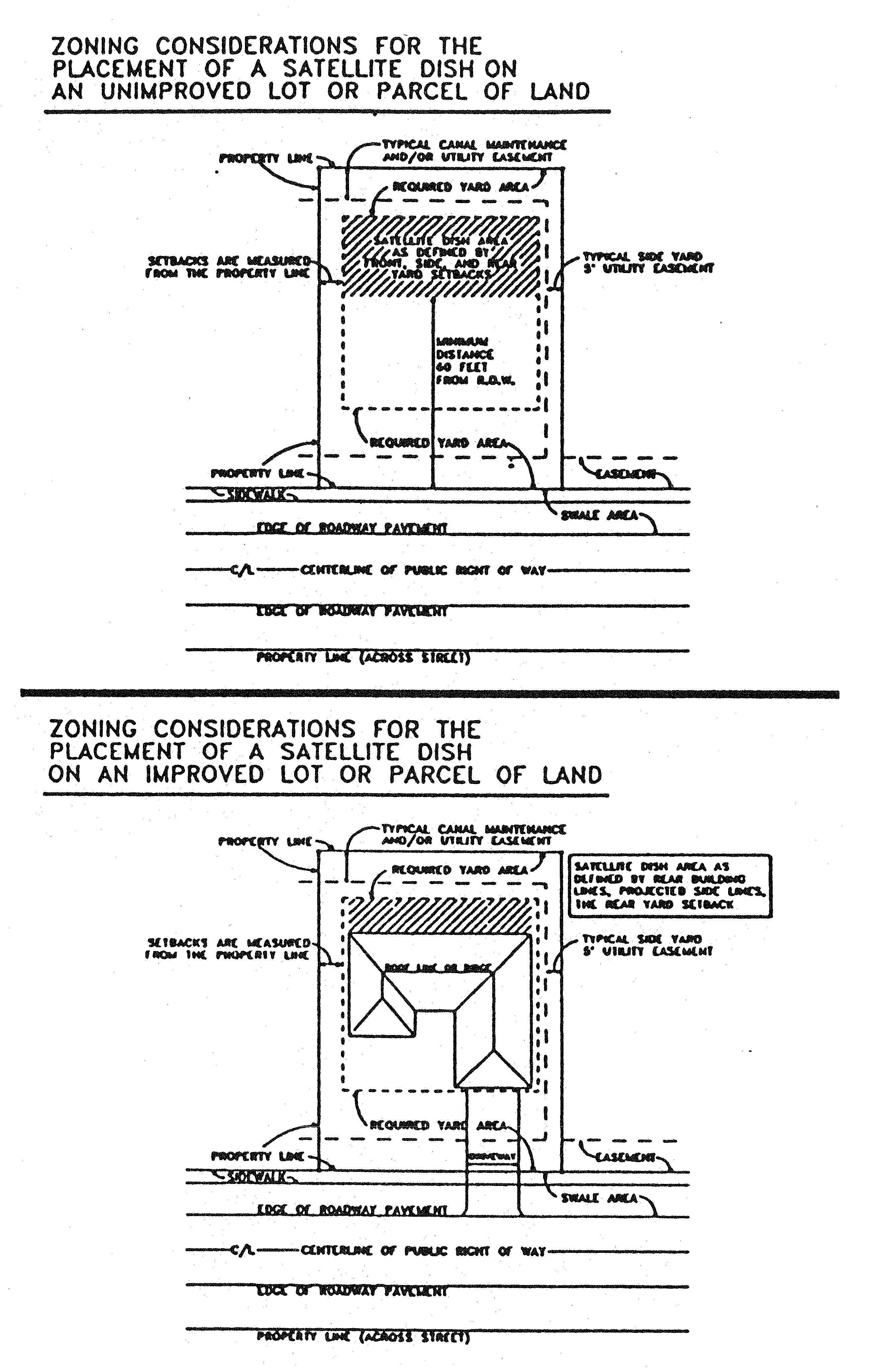
The location of any ground mounted satellite dish within any residentially zoned area shall be entirely within that area to the rear of the residential structure and shall not be permitted within the rear and side yard setbacks. For purposes of this section a satellite dish shall be considered a structure and must adhere to the setback requirements for the respective zoning district. See Figure 4.10.
(4)
Satellite dishes shall not be permitted to the front or side of any residential structure.
(5)
If, in the case where no residential structure exists, two adjacent lots under common ownership of which only one is improved with a structure, the dish shall be located no closer than 60 feet to the public right-of-way on which the lot fronts and in the case of corner lots 50 feet from any side yard public right-of-way. In addition the following criteria shall be met:
a.
The dish or any component thereof, actual or potential, shall not be located within any side or rear yard setbacks. These setbacks may not be encroached upon by any fixed or movable parts of the satellite dish.
b.
The dish shall be screened on all four sides with an enclosure of solid walls or fencing not to exceed six feet in height.
c.
The maximum height of the highest component of the dish shall be 12 feet in height as measured from the finished floor elevation of the ground level of the residential structure. Height of support base or pole shall be measured from the finished grade plus half the diameter of the dish.
d.
A copy of the deed which verifies unity of title for the two parcels shall be submitted to the city at time of permit application.
(6)
Roof and wall mounted satellite dishes in residential areas are prohibited. Support guys may be attached to roofs and walls but the base structure or primary support components may not be placed upon, supported or anchored by the roof or wall.
(7)
The maximum diameter of a satellite dish shall be ten feet in any residential zoned district and 12 feet in any nonresidential district. If a 12-foot diameter satellite dish is placed in any nonresidential district the location of any satellite dish shall be no closer than 50 feet to any residential zoned district.
(c)
Commercial broadcast and receiving towers and/or antennas, whether a profit or nonprofit entity, used for communication purposes are permitted provided the following criteria and standards are met and maintained:
(1)
Such towers shall not exceed 150 feet in height unless a special exception use permit is obtained.
(2)
Such towers shall only be permitted in industrial zoned areas.
(3)
When proposed to be placed adjacent to residential zoned areas the towers shall maintain a minimum distance from the residential zoned district that is twice the height of the tower.
(4)
Such towers shall maintain a minimum distance of 2,000 feet from one another as measured in a direct line.
(5)
The owner/operator shall provide substantiation that the proposed tower does not create an obstruction as determined by the Federal Aviation Administration (FAA).
Any commercial broadcast and receiving tower and/or antenna which is proposed to exceed the height limits established herein shall be required to obtain a special exception use permit in accordance with the provisions of article IV of this chapter.
(d)
Communications towers used for municipal, county, state, or federal operations or communications towers placed on public property, and/or municipally-owned property, shall be exempt from the requirements of this section.
The definition of "communications towers" shall be as otherwise defined and described in this section 106-186 and shall otherwise have a common meaning applicable to such structures commonly in use in Broward County, Florida.
(Ord. No. 91-11-800, § 3(Exh. A(art. 4, § 10)), 11-14-91; Ord. No. 96-2-900, § 2, 2-26-96; Ord. No. 99-12-988, § 2, 12-7-99)
Figure 4.10.
Satellite Dishes
(Ord. No. 91-11-800, § 3(Exh. A), 11-14-91)
Sec. 106-186.1. - Telecommunications towers and antennas.
(a)
Intent. The regulations and requirements of this article are intended to:
(1)
Promote the health, safety and general welfare of the citizens by regulating the siting of telecommunications towers;
(2)
Provide for the appropriate location and development of telecommunications towers and antennas within the city;
(3)
Minimize adverse visual effects of telecommunications towers and antennas through careful design, siting, landscape screening and innovative camouflage techniques;
(4)
Avoid potential damage to adjacent properties from tower failure through engineering and careful siting of tower structures;
(5)
Protect residential areas and land uses from potential adverse impacts of telecommunications towers and antennas by maximizing uses of any new or existing telecommunications towers through shared use, i.e., co-location, to reduce the number of towers needed.
(b)
General rules of interpretation.
(1)
Terms: Certain terms used in this subdivision have been defined in this section. In the absence of definitions, the standard dictionary meaning shall be utilized. In any event, the director of community development shall have the right to interpret the terms contained in this subdivision. In construing the meaning of the subdivision, the following rules shall apply:
a.
Words used in the present tense also include the future tense.
b.
Words used in the singular number also include the plural and vice-versa.
c.
The word "shall" is mandatory. The word "may" is permissible.
d.
The word "developer" shall refer also to "project" and the area in which a project takes place.
e.
The words "used" or "occupied" shall be construed to include arranged, designed, constructed, altered, converted, rented, leased or intended to be used, intended to be occupied.
f.
The word "lot" shall also refer to plat, parcel, tract and premises.
g.
The word "building" shall refer also to structure, mobile home, dwelling and residence.
h.
The words "area" and "district" may indicate and include the meaning "zone".
i.
Except where specified, the provisions of this article shall be construed to mean the minimum standards, requirements and regulations adopted in pursuit of the purposes of this subdivision.
(2)
Definitions: The following words, terms and phrases, when used in this subdivision, shall have the meanings ascribed to them in this section, except where the context clearly indicates a different meaning:
Accessory use: A use incidental to, subordinate to, and subservient to the main use of the property. As defined in this section, an accessory use is a secondary use.
Antenna: A transmitting and/or receiving device and/or relay used for personal wireless services, that radiates or captures electromagnetic waves, including directional antennas, such as panel or microwave dish antennas, and omni-directional antennas, such as whips, excluding radar antennas, amateur radio antennas and satellite earth stations.
Extraordinary conditions: Subsequent to a hurricane, flood or other natural hazard or subsequent to a defective finding on a previous inspection.
Guyed tower: A telecommunication tower that is supported, in whole or in part, by guy wires and ground anchors.
Microwave:Dish antenna: A dish-like antenna used to link personal wireless service sites together by wireless transmission of voice or data.
Monopole tower: A telecommunication tower consisting of a single pole or spire self supported by a permanent foundation, constructed without guy wires and grand anchors.
Panel antenna: An array of antennas designed to concentrate a radio signal in a particular area.
Roofline: The overall ridge line of the structure which does not include cupolas, elevator towers, clock towers or other features that are permitted to exceed the maximum height of the building.
Self-support lattice tower: A telecommunication tower that is constructed without guy wires and ground anchors.
Stealth facility: Any telecommunications facility which is designed to blend into the surrounding environment. Examples of stealth facilities include architecturally screened roof-mounted antennas, antennas integrated into architectural elements, and telecommunication and/or personal wireless services towers designed to look like light poles, power poles or trees.
Telecommunication tower: A guyed, monopole or self-support/lattice tower, constructed as a freestanding structure, containing one or more antennas, used in the provision of personal wireless services, excluding radar towers, amateur radio support structures licensed by the FCC, private home use of satellite dishes and television antennas and satellite earth stations installed in accordance with the applicable codes.
Whip antenna: A cylindrical antenna that transmits signals in 360 degrees.
(3)
Administrative appeal. Any appeal from the provisions of this section shall be to the city council consistent with the elements contained in section 106-159 of the Code of Ordinances entitled "Standard Guidelines and Review Criteria."
a.
Monopole and stealth telecommunication towers shall be permitted as an accessory use in the following zoning districts:
1.
R.O.S. Recreation/open space.
2.
(CF) Community facility.
3.
(U) Utilities.
4.
On property owned by the city, the city shall authorize the application and use of city property after the applicant executes a lease agreement acceptable to the city. The city shall have no obligation to execute such lease even if the applicant can meet the criteria set forth herein.
5.
B-2, B-3 and M-1.
6.
All residential districts but subject to the adoption of a separate ordinance by this city council which shall, by its terms, set forth standards and criteria for approval, the opportunity for public input and the obtainment of neighborhood survey data, all as may be reasonably required by the city council in its consideration of a request under this section.
b.
Tower as part of existing utility poles shall be permitted as an accessory use in the following zoning overlay district:
1.
(SU) Special utility. Towers shall be constructed as part of the existing utility poles or as replacements for the existing utility poles. No freestanding towers constructed exclusively for personal wireless services shall be permitted.
c.
Freestanding telecommunications towers shall be permitted, as a special utility, in the industrial and industrial portion of a Light Industrial (M-1) zoning district provided the towers are an accessory use and subject to the procedure and requirements of the land development regulation of the city. This provision does not preclude the use of vacant property in the industrial zoning district; however, a stealth facility or monopole must be utilized and processed as a special land use.
d.
Exceptions. The location of a new telecommunications tower in any non-residential zoning district other than those districts specified in this section must be approved as a special utility and be proposed as a stealth facility or monopole.
e.
Minimum standards. Except where a special land use is granted, every telecommunications tower must meet the following minimum standards:
1.
Prior to the issuance of a building, electrical, or an engineering permit by the community development department, a site plan shall be presented for approval to the development review committee. Each application for a proposed telecommunications tower shall include all requirements for site plan approval as required by the city's land development regulations. The directors of community development and public works/utilities may waive all or some of these provisions for stealth towers which are designed to emulate existing structures already on the site, including but not limited to light, power, or telephone poles. Approval of the directors of community development and public works/utilities to ensure consistency with the definition of stealth facility is required. Each application shall contain a rendering or photograph of the tower including, but not limited to, colors and screening devices. The city council shall retain full power and authority to approve all site plans submitted in accordance with this section, and subject to all of the terms, conditions and provisions set forth herein.
2.
A statement shall be submitted, prepared by a professional registered engineer licensed to practice in the State of Florida, which through rational engineering analysis certified the tower's compliance with applicable standards as set forth in the Florida Building Code, latest Broward County Edition, and any associated regulations; and describes the tower's capacity, including an example of the number and type of antennas it can accommodate. No tower shall be permitted to exceed its loading capacity. For all towers attached to existing structures, the statement shall include certification that the structure can support the load superimposed from the tower. All towers shall have the capacity to permit multiple users; at a minimum monopole towers shall accommodate two users and self-support/lattice or guyed towers shall, at a minimum accommodate three users.
3.
Height/setbacks and related location requirements.
i.
The height of a telecommunications tower shall not exceed 150 feet. Tower height shall be measured from the crown of the road of the nearest public street.
ii.
Monopole, lattice or guyed telecommunication towers shall not be permitted within 200 feet of any residential district or residential portion of a PUD unless the property is designated as a part of the special utility overlay district.
iii.
Monopole, lattice or guyed telecommunications towers shall not be located within 750 feet of any existing monopole, lattice or guyed telecommunications tower.
iv.
All buildings and other structures to be located on the same property as a telecommunications tower shall conform with the setbacks established for the underlying zoning district.
v.
Any requests which deviate from the aforementioned regulations shall be subject to a Special Utility Overlay Process (SU).
4.
Aircraft hazard. Prior to the issuance of a building permit by the building division, department of community development, the applicant shall provide evidence that the telecommunication towers or antennas are in compliance with Federal Aviation Administration (FAA) regulations. Where an antenna will not exceed the highest point of the existing structure upon which it is to be mounted, such evidence shall not be required.
5.
Approval required from other governmental agencies. Each application for a telecommunications tower may be required to include written approval or a statement of no objection from other federal or state agencies that may regulate telecommunications tower sitting, design, and construction.
6.
FCC emissions standards. All proposed telecommunication towers shall comply with current radio frequency emissions standards of the Federal Communications Commission.
7.
Buffering.
i.
An eight-foot fence or wall constructed in accordance with the city's land development code, as measured from the finished grade of the site, shall be required around the base of any lattice tower and may be required around any accessory buildings or structures.
ii.
Landscaping, consistent with the requirements of the land development code, shall be installed around the entire perimeter of any fence or wall. Additional landscaping may be required around the perimeter of any fence or wall and around any or all anchors or supports if deemed necessary to buffer adjacent properties. The city may require landscaping in excess of the requirements of the City Code in order to enhance compatibility with adjacent residential and non-residential land uses. Landscaping shall be installed on the outside of the perimeter fence or wall.
iii.
Landscaping consistent with perimeter and on-site requirements of the Land Development Code, shall be installed around any accessory buildings or structures.
iv.
Equipment on monopoles shall also be screened by landscaping or screening panel. No fence is required for an installation of this type as long as it is above ground at least ten feet high and not accessible by climbing.
8.
High voltage and "No Trespassing" warning signs.
i.
If high voltage is necessary for the operation of the telecommunications tower or any accessory structures, "HIGH VOLTAGE—DANGER" warning signs shall be permanently attached to the fence or wall and shall be spaced no more than 40 feet apart.
ii.
"NO TRESPASSING" warning signs shall be permanently attached to the fence or wall and shall be spaced no more than 40 feet apart.
iii.
The letters for the "HIGH VOLTAGE—DANGER" and "NO TRESPASSING" warning signs shall be at least six inches in height. The two warning signs may be combined into one sign. The warning signs shall be installed at least five feet above the finished grade of the fence.
iv.
The warning signs may be attached to freestanding poles if the content of the signs may be obstructed by landscaping.
9.
Equipment storage. Mobile or immobile equipment not used in direct support of a tower facility shall not be stored or parked on the site of the telecommunication tower, unless repairs to the tower are being made.
10.
Removal of abandoned or unused facilities. A provider who has determined to discontinue its operations or part of its operations in the city must either:
i.
Remove its own facilities.
ii.
Provide information satisfactory to the director that the provider's obligations for its equipment in the right-of-way or public easement or private property under this division have been lawfully assumed by another provider; or
iii.
Submit to the director a proposal and instruments for transferring ownership of its equipment to the city. If a provider proceeds under this clause, the city may, at its option:
A.
Assume ownership of the equipment with a $10.00 nominal consideration; or
B.
Require the provider, at its own expense, to remove it, or
C.
Require the provider to post a bond in an amount sufficient to reimburse the city for reasonably anticipated costs to be incurred in removing the equipment.
Equipment of a provider who fails to comply with the preceding paragraph and which, for six months, remains unused shall be deemed to be abandoned. Abandoned equipment is deemed to be a nuisance. The city may exercise any remedies or rights it has at law or in equity, including, but not limited to (i) abating the nuisance, (ii) taking possession of the equipment and restoring it to a usable condition, or (iii) requiring removal of the equipment by the provider or by the provider's surety under the bond required by the Code of Ordinances relating to maintenance bonds. Telecommunications towers being utilized for other purposes, including but not limited to light standards and power poles, may be exempt from this provision.
11.
Signs and advertising. The use of any portion of a tower for signs or advertising, including company name, banners, streamers, etc. shall be strictly prohibited.
12.
Accessory buildings or structures. All accessory buildings or structures shall meet all building design standards as listed in this code, and in accordance with the provisions of the Florida Building Code, latest Broward County edition. All accessory buildings or structures shall require a building permit issued by the building division, department of community development.
13.
Colors. Except where superseded by the requirements of other county, state or federal regulatory agencies possessing jurisdiction over telecommunications towers, telecommunications towers shall be painted or constructed in neutral and/or stealth colors, designed to blend into the surrounding environment such as non-contrasting gray.
14.
Non-interference. Each application to allow construction of a telecommunications tower shall include a certified statement that the construction and placement of the tower, will not unnecessarily interfere with public safety communications and the usual and customary transmission or reception of radio, and television, service enjoyed by adjacent residential and non-residential properties. A statement shall be prepared by a registered engineer identifying any interference that may result from the proposed construction and placement.
f.
Inspection report/review fee.
1.
Telecommunication tower owners shall submit a report to the city's departments of community development and public works/utilities, certifying structural and electrical integrity on the following schedule:
i.
Monopole towers - once every five years;
ii.
Self-support/lattice towers once every two years; and
iii.
Guyed towers - once every two years.
2.
Inspections shall be conducted by an engineer licensed to practice in the State of Florida. The results of such inspections shall be provided to the building division, department of community development and public works/utilities. Based upon the results of an inspection, the building official may require the removal of a telecommunications tower.
3.
The building division, department of community development and public works/utilities, may conduct periodic inspections, with the cost of such inspection paid by the tower owner, of telecommunications towers to ensure structural and electrical integrity. The owner of the telecommunications tower may be required by city to have more frequent inspections should there be reason to believe that the structural and electrical integrity of the tower is jeopardized. The city reserves the right to require additional inspections if there is evidence that the tower has a safety problem or is exposed to extraordinary conditions.
g.
Telecommunications towers are prohibited when a proposed or existing principal use or uses within 200 feet of proposed tower includes the storage, distribution, or sale of volatile, flammable, explosive or hazardous wastes such as LP gas, propane, gasoline, natural gas, and corrosive or dangerous chemicals unless used for backup power purposes.
h.
Existing towers.
1.
Notwithstanding the above provisions of this section, telecommunications antennas may be placed on existing towers with sufficient loading capacity after approval by the directors of the departments of community development and public works/utilities. The capacity shall be certified by an engineer licensed to practice in the State of Florida
2.
Notwithstanding the above provisions of this section, towers in existence as of January 1, 1997, may be replaced with a tower of equal or less visual impact after approval by the city manager or his designee. However, if the proposed new tower would not be consistent with the minimum standards under this section, replacement must be approved by the city council.
i.
Fees and charges.
1.
Public land or right-of-way lease agreements shall be established by separate instrument.
(c)
Antennas not located on telecommunications towers.
(1)
Antennas shall be permitted as follows:
a.
Stealth rooftop or building mounted antennas not exceeding 20 feet above roofline and not exceeding ten feet above maximum height of applicable zoning district shall be permitted as an accessory use in the following zoning districts:
1.
(B-2) Business District
2.
(B-3) Business District
3.
(M-1) Light Industrial District
4.
(RM-10) Residential Multiple-Family
5.
(RM-16) Residential Multiple-Family
6.
(CF) Community Facility
7.
(ROS) Recreation/Open Space
8.
(PUD) Planned Unit Development
9.
(SU) Special Utility Overlay District
(2)
Minimum standards. Building or roof top antennas shall be subject to the following minimum standards:
a.
Building rooftop stealth antennas shall be subject to the following minimum standards:
1.
No commercial advertising shall be allowed on an antenna;
2.
No signals, lights, or illumination shall be permitted on an antenna, unless required by the Federal Communications Commission or the Federal Aviation Administration;
3.
Any related unmanned equipment building shall not contain more than 750 square feet of gross floor area or be more than 12 feet in height; and
4.
If the equipment building is located on the roof of the building, the area of the equipment building shall not occupy more than 25 percent of the roof area.
5.
Approval of the director of community development to ensure consistency with the definition of stealth facility is required. Each application shall contain a rendering or photograph of the antenna including, but not limited to, colors and screening devices.
b.
Building rooftop non-stealth antennas shall be subject to the following minimum standards:
1.
Antennas shall only be permitted on buildings which are at least 50 feet tall. Antennas may be placed on buildings less than 50 feet tall in the P or CF district if public safety needs warrant the antenna;
2.
Antennas may not exceed more than ten feet above highest point of a roof. Stealth antennas attached to but not above rooftop structures shall be exempt from this provision. Antennas may exceed 20 feet above the roof in the ROS and CF district if municipal purposes warrant additional height;
3.
Antennas, and related equipment buildings, shall be located or screened to minimize the visual impact of the antenna upon adjacent proper shall be of a material or color which matches the exterior of the building or structure upon which it is situated.
4.
No commercial advertising shall be allowed on an antenna.
5.
No signals, lights, or illumination shall be permitted on an antenna, unless required by the Federal Communications Commissions or the Federal Aviation Administration;
6.
Any related unmanned equipment building shall not contain more than 750 square feet of gross floor area or be more than 12 feet in height; and
7.
If the equipment building is located on the roof of the building, the area of the equipment building shall not occupy more than 25 percent of the roof area.
(3)
Antenna types. To minimize adverse visual impacts, stealth antenna types shall be preferred. If a non-stealth antenna is proposed, the application shall be required to demonstrate, in a technical manner acceptable to both the directors of community development and public works/utilities, why the stealth antenna (i.e. an antennae incorporated into the architecture of the building or fully screened from view from site proximate to the antenna) cannot be used for the particular application. This does not preclude a combination of the various types of antennas.
(4)
Antenna Dimensions. Antenna dimensions shall be reviewed by the directors of community development and public works/utilities as required by existing technology. A statement shall be submitted, prepared by a professional registered engineer licensed to practice in the State of Florida, to certify the need for the required dimensions.
(5)
Aircraft hazard. Prior to the issuance of a building permit by the directors of both the directors of community development and public works/utilities, the applicant shall provide evidence that the telecommunications towers or antennas are in compliance with Federal Aviation Administration (FAA) regulations. Where an antenna will not exceed the highest point of the existing structure upon which it is to be mounted, such evidence shall not be required.
(6)
Exceptions. The location of a new antenna in any zoning district other than those districts specified in this section shall be prohibited unless approved as a special utility overlay or as specified below:
a.
Antenna and or microwave dishes may be located on franchised utility poles or poles owned by the city pursuant to the following regulations:
1.
The utility poles shall be located within public easements or public rights-of-way.
2.
Fees related to utility pole installation.
i.
A franchise fee shall be paid;
ii.
An engineering permit fee shall be paid through the building permit process if the pole is replaced to accommodate telecommunications equipment.
3.
The antenna and or dish shall be of a size and placement that is structurally compatible with engineering design of the pole pursuant to the Florida Building Code and attested to by a registered engineer.
4.
The antenna or dish shall not extend more than ten feet above the existing pole height. If the pole is replaced to withstand the addition of telecommunications equipment, then the same restriction shall apply except that the utility pole may be 20 feet higher than the adjacent pole heights.
5.
Placement of an antenna and/or a dish on a utility pole shall only be on poles owned or operated by a city franchisee or the city.
6.
No commercial advertising shall be allowed on the antenna or dish.
7.
The height restriction for utility poles within a special utility overlay district shall be limited to 150 feet.
(7)
Fees.
a.
Fees for antennae installation whether on public or private property will be determined by separate ordinance.
b.
Public land or right-of-way lease agreements will be established by separate instrument.
(d)
Shared use of communications antennas.
(1)
Notwithstanding any other provisions of this article, to minimize adverse visual impacts associated with the proliferation and clustering of telecommunications towers, co-location of facilities on existing or new towers shall be encouraged by:
a.
Issuing permits to qualified shared facilities at locations where it appears there may be more demand for towers than the property can reasonably accommodate; or
b.
Giving preference to qualified shared facilities over other facilities in authorizing use at particular locations.
(2)
For a facility to become a "qualified shared facility," the facility owner must show that:
a.
The facility is appropriately designed for sharing; and
b.
The facility owner is prepared to offer adequate space on the facility to others on fair and reasonable, nondiscriminatory terms.
(3)
To satisfy the requirements of (2)(a) of this section, the facility owner must submit a written evaluation of the structural capacity of the tower.
(4)
The requirements of (2)(b) of this section will be deemed to have been met when an affidavit attesting to the execution, by the tower owner/operator, of an agreement to authorize the collection of antenna or other similar telecommunications devise. A condition of any permit for a qualified shared facility shall be that the permit shall be terminated, and the facility removed or turned over to the city, if the city finds that the facility owner is not complying with its obligations under this section and associated agreements with the city. The owner shall have 60 days to remedy the deficiency.
(5)
Co-location of communication antennas by more than one provider on existing or new telecommunication towers shall take precedence over the construction of new single-use telecommunication towers. Accordingly, each application for a telecommunications shall include the following:
a.
A written evaluation of the feasibility of sharing telecommunications tower, if an appropriate telecommunication tower or towers is/are available. The evaluation shall analyze one or more of the following factors:
1.
Structural capacity of the tower or towers;
2.
Radio frequency interference;
3.
Geographical service area requirements;
4.
Mechanical or electrical incompatibility;
5.
Inability or ability to locate equipment on the tower or towers;
6.
Availability of towers for co-location;
7.
Any restriction or limitations of the Federal Communications Commission that would preclude the shared use of the tower;
8.
Additional information requested by the city.
(6)
A telecommunication tower that is determined to be inappropriate for sharing shall be assumed to be inappropriate for sharing the same types of facilities in the future. Such towers will not need to be evaluated in the future regarding sharing with the same type of facility for which it has been determined to be inappropriate. The development services department shall retain a list of such towers, and will provide a copy of the list to all potential applicants. The city may require additional sharing feasibility evaluations if warranted by changes in technology.
(7)
For any telecommunications tower approved for shared use, the owner of the tower shall provide notice of the location of the telecommunication tower and the tower's load capacity to all other providers.
(8)
Fees and taxes.
a.
Public land or right-of-way lease agreements will be established by separate instrument.
(e)
Applications. The city shall act promptly on any application submitted in accordance with the provisions of this chapter. The reasons for rejecting any application filed under these provisions shall be explained and set forth in writing. The rejection of an application under this article does not prevent a person from filing an application for a special utility overlay in accordance with applicable law.
(Ord. No. 97-5-923, § 2, 5-27-97; Ord. No. 07-06-1191, § 4, 5-29-07)
Sec. 106-187. - Use of residentially zoned property for access.
No residentially zoned land shall be used for driveway or vehicular access purposes to any nonresidentially zoned land or any land used for nonresidential purposes.
(Ord. No. 83-2-497, art. 4, § 11, 2-24-83)
Sec. 106-188. - Public utilities.
Utilities necessary to the public health and convenience such as gas, electric and telephone lines, equipment and mains may be located in any district subject to landscaping and building requirements of the district and other landscaping and building requirements as deemed necessary by the planning and zoning board and the governing body to protect the public health, safety and welfare.
(Ord. No. 83-2-497, art. 4, § 12, 2-24-83)
Sec. 106-189. - Nuisances.
(a)
Nothing shall be permitted or maintained in any district which shall in any way be offensive or obnoxious to a person of ordinary sensibilities by reason of the emission of odors, gases, dust, smoke, vibration or noise, including the crowing of cocks, barking of dogs or any noises or odors emanating from any animal, fish, or fowl; nor shall anything be constructed or maintained in any district which would in any way constitute an eyesore or nuisance to adjacent property owners or residents or to the community.
(b)
Any owner of a residential dwelling unit who erects, establishes, continues or maintains, owns or leases any such property which tends to annoy the community, or injure the health of the community, or become manifestly injurious to the morals or manners of the citizens and residents of the city as defined by F.S. ch. 823, and the cases promulgated thereunder, shall be deemed to be in violation of this section. In addition:
(1)
The city hereby adopts the definition of public nuisance as prescribed by F.S. ch. 823, which shall include the description of a public nuisance as one which violates public rights, subverts public order, decency or morals, or causes inconvenience or damage to the public generally. In the context of this comprehensive zoning ordinance in a residential dwelling unit setting, to determine the existence of a violation under this section, the code enforcement officer shall consider the occurrence of a nuisance based upon the following nonexclusive conditions:
a.
The number of persons occupying a dwelling unit;
b.
The existence of debris or accumulation of trash and garbage in and about the dwelling unit;
c.
The unlawful parking of motor vehicles in and about the dwelling unit;
d.
The amount and frequency of loud and excessive noise or noises affecting the sensibilities of the local community; and
e.
Any combination of such factors.
(2)
Any owner or occupant of residential property shall use the residential property in a way that shall not be a nuisance to other owners and occupants in the same community. Activities, actions or inaction which annoys or disturbs one in the free use, possession or enjoyment of his property or which renders his ordinary use or occupation physically uncomfortable may become a nuisance and may be restrained in accordance with the provisions of this section.
(3)
Violations of this section shall be enforced before the code enforcement board which shall have jurisdiction over such violations in accordance with F.S. ch. 162, or the direct citation process provided by F.S. ch. 162, or chapter 2, article VII of this Code.
(4)
Violations of this section may be based upon the observance of same by a police officer, code enforcement officer, or through sworn statements based upon observations of persons of the local community whom this section has been adopted to protect.
(5)
The code enforcement board shall possess all rights and powers as provided by F.S. ch. 162, and chapter 2, article VII of this Code, which shall include the powers of abatement of such nuisances as prescribed by F.S. ch. 60.
(Ord. No. 91-11-800, § 3(Exh. A(art. 4, § 13)), 11-14-91)
Sec. 106-190. - Waterways.
(a)
Permits. No waterway, except those waterways controlled and maintained by South Florida Water Management District, shall be created unless approval has been granted by the city and the North Lauderdale Water Control District. No approval shall be granted unless the city engineer and the North Lauderdale Water Control District find such proposed waterway to be in conformity with all of the requirements of this chapter and in conformity with all city ordinances and regulations.
(b)
Application for permit approval. Application for approval shall be made to the city engineer by letter, or upon such form as shall be prescribed, stating the reason for alteration or construction of the waterway. This letter shall be accompanied by four sets of sealed plans prepared by an engineer, registered and licensed to practice as such by the state, showing the location, proposed cross sections, structures in or across the waterway, and other details as may be required by the city engineer.
(c)
Inspection. The public works or engineering department shall inspect waterways and all structures in or across any waterway during their construction period. Sealed as-built drawings shall be submitted to the city engineer upon completion of all work in or across the waterway with as-built cross sections of the waterway every 100 feet, or as often as may be necessary to determine the change in cross section profile.
(Ord. No. 83-2-497, art. 4, § 14, 2-24-83)
Sec. 106-191. - Docks and wharves.
(a)
Dockage space and facilities for mooring pleasure boats, yachts and noncommercial watercraft shall be permitted in any residential district on any waterway as an accessory use to the residential occupancy of a plot.
(b)
No dock shall project more than five feet into any waterway beyond the water line or established bulkhead line, or extend closer than ten feet to the plot line of any other residentially zoned property.
(Ord. No. 83-2-497, art. 4, § 15, 2-24-83)
Sec. 106-192. - Open space; garbage and refuse.
(a)
In all business, commercial and industrial districts the storage of equipment, materials and supplies shall be within a building or within an area enclosed by a wall or fence, which will effectively screen such storage from public view. In all multifamily and nonresidential zoning districts garbage or refuse shall be stored in containers and be stored only within a building or within an architectural enclosure sufficient in height and design to screen such containers from the public view and must conform in all respects to chapter 54 of this Code.
(b)
No land which is zoned for residential use shall be used for the storage of building materials or construction equipment except when incidental to the construction operation for which a valid, active building permit has been issued.
(Ord. No. 83-2-497, art. 4, § 16, 2-24-83)
Sec. 106-193. - Temporary buildings.
No temporary building shall be permitted within the city except that a substandard temporary building or construction trailer, not for occupancy, to be used for model, display, demonstration and office purposes only, in conjunction with the construction of a residential or nonresidential project, may be constructed. Any such temporary building shall be torn down and removed upon completion and closing out of the project or, in the alternative, may be brought into compliance with the building code and all other applicable regulations and requirements.
(Ord. No. 83-2-497, art. 4, § 18, 2-24-83)
Sec. 106-194. - Animals.
No animals, livestock or poultry of any kind shall be raised, bred or kept on any lot unless in conformance with chapter 10 of this Code.
(Ord. No. 91-11-800, § 3(Exh. A(art. 4, § 19)), 11-14-91)
Sec. 106-195. - Unregistered and inoperable vehicles.
A vehicle which is not in operable condition or not having a current state license plate shall not be parked, placed or stored on private or public property, other than in an approved junk and/or salvage yard, or fully enclosed building. For additional regulations, see chapter 26, article III. Notwithstanding the foregoing, a vehicle without a current state license plate may be stored on private property provided it displays a valid temporary parking permit issued by the city in accordance with section 106-205. Any person who parks, places, or stores a vehicle in violation of this section shall be subject to a fine of $25.00 per occurrence. Each day that the violation is observed shall be a new "occurrence."
(Ord. No. 00-4-994, § 9, 4-25-00; Ord. No. 02-01-1047, § 3, 1-28-02)
Sec. 106-196. - Special regulations for transformer substations.
(a)
The plot shall be provided with a yard not less than 30 feet in depth or width adjacent to all street lines and plot lines of other residentially zoned property and a yard of at least 25 feet in depth adjacent to a rear plot line. In addition:
(1)
The yards required under this section shall be fully landscaped as specified below and shall be used for any fence, wall, building or structure, except that a fence not over six feet in height may be erected at least 30 feet from any street line.
(2)
Minimum driveways or walkways necessary for access may cross required yards.
(b)
Required landscaping shall consist of the following:
(1)
A hedge or decorative masonry screen a minimum of six feet high shall enclose all exposed equipment areas. Hedges shall be a minimum of two feet high at the time of planting except for transformer substations located in developed residential areas which hedges shall be a minimum of four feet high at the time of planting.
(2)
Trees shall be planted in the open space surrounding the exposed equipment area according to the following formulas:
a.
One tree per 1,000 square feet of open space for all yard area less than one hundred 100 feet in depth or width.
b.
One tree per 1,500 square feet of open space for all yard areas greater than 100 feet in depth or width.
c.
Minimum size of the trees shall be eight feet high with three-foot spread. Palms shall count as one-half a tree and shall be grouped in clusters.
(3)
The remaining open area shall be planted with grass, ground cover, shrubs or trees.
(4)
A sprinkler system shall be provided for all planting areas.
(5)
Plant material shall be Florida Grade No. 1 or better, and planted according to good horticultural practice. All landscaped areas shall be maintained in a healthy, growing condition, properly watered and trimmed.
(6)
All landscaping shall conform to all other applicable landscape and other regulations.
(Ord. No. 83-2-497, art. 4, § 21, 2-24-83)
Sec. 106-197. - Proper maintenance required.
(a)
All yards, walkways, driveways, parking areas and landscape areas shall be properly maintained and kept free of refuse and debris. The exteriors of all buildings shall be maintained in such a manner as to not be unsightly or present a hazardous condition.
(b)
No yard or driveway area may be used for any automotive, vehicle, engine, or boat repairs. All such repairs conducted within any residentially zoned district must be done completely within a garage or an enclosed structure. Any vehicle repairs conducted within residentially zoned areas may only be done to vehicles registered to a resident of the premises, except as provided for hereinafter:
(1)
Minor vehicle repair shall be permitted as an exception to this section on approved parking areas on residentially zoned property for periods not to exceed six hours per occurrence. Minor repair of any motor vehicle of less than 8,000 pounds gross weight, such repairs to include, but not be limited to, the following:
a.
Tune-ups.
b.
Lights.
c.
Add fluids.
d.
Starters.
e.
Alternators.
f.
Replacement of belts.
g.
Routine adjustments.
h.
Tire changes.
i.
Brake repairs.
(2)
Major motor vehicle repairs shall be prohibited and shall include, but are not limited to the following:
a.
Internal engine repair.
b.
Rear end repairs.
c.
Transmission repairs.
d.
Exhaust system repairs.
e.
Body work.
f.
Frame-straightening.
g.
The draining and/or changing fluids.
Any person who parks, places, or stores a vehicle in order to conduct repairs that are in violation of this section shall be subject to a fine of $25.00 per occurrence. Each day that the violation is observed shall be a new "occurrence."
(Ord. No. 83-2-497, art. 4, § 22, 2-24-83; Ord. No. 91-11-800, § 3(Exh. A), 11-14-91; Ord. No. 92-6-822, § 2, 6-25-92; Ord. No. 02-01-1047, § 3, 1-28-02)
Sec. 106-198. - Responsibility of abutting property owner to maintain swale areas.
(a)
Except as provided for hereinafter, it shall be the responsibility of the owner of property abutting a swale area to maintain such swale area. The swale area shall be kept free of all debris and shall be landscaped and maintained in accordance with chapter 102, article II of this Code.
(b)
No person shall drive, operate or park a motor vehicle in the swale area or upon any unpaved right-of-way adjacent to a paved street within the city abutting the property of another without the permission of the owner, lessee or occupant of the property abutting the said swale area. Any person who parks, places, or stores a vehicle in violation of this section shall be subject to a fine of $25.00 per occurrence. Each day that the violation is observed shall be a new "occurrence." The owner of such vehicle shall be responsible and liable for payment of any parking citation violation to the extent imposed by F.S. § 316.1967.
(c)
Nothing contained in this section shall prohibit the operation of a city vehicle or emergency vehicle actually on an emergency service call upon the swale area anywhere within the city.
(d)
Nothing contained in this section shall prohibit any individual from driving or parking upon the swale area abutting the property owned, leased or occupied by that individual within the city.
(Ord. No. 91-11-800, § 3(Exh. A(art. 4, § 23)), 11-14-91; Ord. No. 93-8—854, 2, 8-26-93; Ord. No. 00-4-994, § 10, 4-25-00; Ord. No. 21-06-1429, § 3, 4-13-21)
Sec. 106-199. - Violations; penalty for improper maintenance or nuisances.
If the city shall determine that a plot, building, fence, pool or structure has fallen into disrepair or is improperly maintained so as to become unsafe or unsightly, or if the city shall determine that a nuisance has been created, it shall give the owner a notice in writing by personal service or by certified or registered mail, at the last mailing address of the owner, as set forth on the latest county ad valorem tax roll, setting forth the violation. The owner shall have ten days from the date of delivery of the notice in which to correct the violation. If the violation is not corrected within the ten-day period specified in the notice, the owner, upon conviction by the code enforcement board, shall be fined a minimum of $10.00 for each day thereafter until the violation is corrected. Each day in which a violation remains uncorrected as above set out shall constitute a separate offense. This remedy is in addition to all other remedies provided by law and by this chapter.
(Ord. No. 83-2-497, art. 4, § 24, 2-24-83; Ord. No. 93-8-854, 2, 8-26-93)
Sec. 106-200. - Outdoor cooking.
Outdoor cooking, barbecuing, food preparation and any associated activities shall be confined to the rear yard of any property within a residentially zoned district. The storage of outdoor grills, ovens, rotisserie and other associated food preparation items shall not be permitted within any required front yard except as otherwise permitted by the governing body for special events.
(Ord. No. 91-11-800, § 3(Exh. A(art. 4, § 25)), 11-14-91)
Sec. 106-201. - Adult enterprises.
(a)
It is the purpose of this section to set forth those regulations which pertain to the establishment, location, maintenance and conduct of business respecting adult attractions and enterprises, and to preserve the health, morals and general welfare of the community and to provide specific regulations whereby minors are insulated from certain businesses, institutions and human conduct; to provide for the stabilization of neighborhoods, both residential and commercial; to promote more efficient police practice and regulations, and to otherwise promote and protect the best qualities of urban living.
(b)
Distance limitations are as follows:
(1)
No uses regulated by this section may be established within 1,000 feet of any church, school or public park.
(2)
Not more than two of the uses regulated by this section may be located within 1,000 feet of each other.
(3)
No uses regulated by this section may be established within 1,000 feet of any business establishment where alcoholic beverages are sold, given away or otherwise obtained for consumption on the premises.
(4)
No uses regulated by this section may be established within 1,000 feet of any area zoned for residential use.
(5)
No uses regulated by this section may be established within 1,000 feet of any hotel, motel or rooming house.
(Ord. No. 83-2-497, art. 21, §§ 1, 2, 2-24-83)
Sec. 106-202. - Vehicle covers.
Vehicles parked or stored in the open in accordance with the provisions of this chapter may only be covered by covers specifically designed and manufactured for such use. Covers shall be fitted and maintained in good condition, free from rips, tears, paint or other conditions that would create a blighting effect on the neighborhood. The license plate or city temporary permit shall be displayed on the exterior of the cover and shall be clearly visible. Upon request by a duly authorized city official, the vehicle and/or property owner shall provide proof of current registration or city temporary permit and operability of the vehicle shall be provided. Covers do not constitute a fully enclosed structure for purposes of code compliance for vehicles not permitted to be stored or parked in the open. Any vehicle with a cover parked or stored in the open shall be parked or stored only on approved surfaces as provided in chapter 106. Any person who parks, places, or stores a vehicle in violation of this section shall be subject to a fine of $25.00 per occurrence. Each day that the violation is observed shall be a new "occurrence."
(Ord. No. 00-4-994, § 11, 4-25-00; Ord. No. 02-01-1047, § 3, 1-28-02)
Sec. 106-203. - Parking in swale areas.
(a)
Only non commercial passenger vehicles may be parked in swale areas, other approved public right-of-way areas, and overnight at city parks.
(b)
All motor vehicles parked in swale areas within the city shall park facing the same direction as the flow of traffic and shall not park on a sidewalk, bikeway or improved area for the purposes of assisting pedestrian movement within the public right-of-way. Nothing contained in this section shall prohibit the installation of rounded concrete markers parallel to driveways and roadways in order to prohibit the passage of motor vehicles over portions of the right-of-way which are not paved.
(c)
Parking is prohibited in the swale areas of the following roadways:
71st Avenue;
81st Avenue;
Tam O'Shanter Boulevard;
Southgate Boulevard;
McNab Road;
State Road 7;
Boulevard of Champions from State Road 7 westward to Boulevard of Champions; and,
Bailey Road.
(d)
The parking spots in the swale area north of SW 5 th Street/Forest Boulevard between SW 76 th Terrace and SW 75 th Way may be used for authorized school purposes only.
(e)
No person shall park a vehicle at any time when a no parking sign is posted. The city manager, or the city manager's designee, may cause no parking signs to be installed upon any city [owned] property. Signs installed and enforced under this section may prohibit parking during certain times of day.
(f)
Parking lots and parking areas designated for city parks may only be used by park patrons actively using the park during the operational hours of each park.
(g)
Violations of this section shall be punishable as set forth in section 106-235.
(Ord. No. 00-4-994, § 12, 4-25-00; Ord. No. 20-10-1410, § 2, 10-27-20)
Sec. 106-204. - Parking of large and heavy vehicles.
The parking in a required or supplemental parking space of any vehicle, which, due to its size, shape, contents or location creates an obstruction to safe vehicular or pedestrian circulation or other public safety hazard, or which cannot be contained within a single designated parking space is prohibited.
(Ord. No. 00-4-994, § 13, 4-25-00)
Sec. 106-205. - Temporary parking or storage of unregistered vehicles.
A resident of the city and the owner of an operable vehicle without a current state registration may apply for a temporary permit which will permit storage of the vehicle on private property outside of a garage or other enclosed structure for a period of time of up to one year. For purposes of this section, "owner" shall mean the person appearing on the title for the vehicle as "owner"; provided, however, that in the event there is a purchaser designated on the title, then the person designated as the purchaser shall be the "owner."
(1)
The owner shall file with the city, through the community development department, a written request on forms prepared by the city, accompanied by other documentation requested by the city, including without limitation a notarized affidavit that the vehicle will not be driven on public right-of-way during the permit period and payment of the permit fee established for this permit.
(2)
If the community development department's authorized representative determines that the application is complete and the request complies with the criteria set forth in this section, a temporary permit may be issued for a specific period of up to one year.
(3)
All permits issued on the basis of this section shall be subject to the following:
a.
The vehicle for which the permit is issued shall be operable.
b.
No more than one vehicle per household shall be eligible for the temporary permit within the same permit period.
c.
The vehicle for which the permit is issued shall be parked on private property on an approved hard surface supplementary parking space in compliance with section 106-222.
d.
The permitted vehicle shall only be parked at the owner's address as set forth in the permit application.
e.
The permit shall be visibly displayed on the vehicle at all times.
f.
Any unexpired permit shall be surrendered to the city upon removal of the vehicle from the premises or receipt of a valid state registration for the permitted vehicle.
g.
The parking space for the operable, unregistered vehicle must be supplemental to the required number of spaces for the residential property, and the unregistered vehicle must be parked on an approved surface within the property lines and not in the swale or on the street.
(4)
The fee for application for a temporary permit regardless of the date of the request shall be $25.00, unless such application is submitted subsequent to a warning from a code enforcement officer, in which case the application fee shall be $50.00 due to the increased administrative costs incurred by the city and associated with enforcing the provisions of this section.
(5)
All temporary permits, regardless of the issuance date, shall expire on September 30 of each year, and shall be renewed for the next following year no later than October 1.
(6)
A temporary permit shall be automatically voided if the permitted unregistered vehicle is driven on a public right-of-way.
(7)
Violations of any provisions of this section shall be grounds for the revocation of the temporary permit.
(Ord. No. 00-4-994, § 14, 4-25-00; Ord. No. 16-06-1331, § 2(Exh. A), 6-14-16)
Sec. 106-206. - Charitable clothing bins.
(a)
Purpose. The purpose of this chapter shall be to provide rules, regulations and standards for the limited placement and use of donation clothing bins in the City of North Lauderdale in order to promote the public health, safety, convenience and welfare of the city. City owned recycling bins are not subject to the limitations set forth herein.
(b)
Requirements for use of clothing bins. Donation clothing bins shall be permitted on a limited basis and only in compliance with all of the provisions of this section, including the following requirements:
(1)
The person/entity operating the donation clothing bin has obtained a valid permit from the city; and
(2)
A donation clothing bin shall only be owned and operated by a charitable organization for its charitable purpose.
(3)
The information as required in subsection (d) is clearly and conspicuously displayed on the exterior of the donation clothing bin.
(4)
The clothing donated shall be provided to others as part of a bona fide charitable endeavor and no consideration shall be received in return by the person/entity collecting the clothing,
(5)
The contents of the bin shall be clothing only and shall be regularly emptied at least every two weeks and not permitted to overflow to the point where the contents are visible from the outside; the ground area immediately adjacent to the bin (within three feet of the bin on all sides) shall be kept free of donated clothing or other debris.
(6)
The bin shall be kept free of signs, advertising (except as specifically permitted herein), graffiti and other markings and shall be maintained in a structurally sound, clean, and sanitary condition.
(7)
All other conditions of this chapter are satisfied and there is continuing compliance with the provisions of this chapter.
(8)
Donation clothing bins located inside of a commercial building or location of a not-for-profit entity must meet the requirements of section 106-206 of this code.
(c)
Donation bins. Donation bins for purposes other than the collection of clothing as outlined herein are prohibited. This includes small item donation bins unrelated to the business.
(d)
Permit application requirements. An application shall be filed with the city for each proposed donation clothing bin and location. The application for a permit shall include:
(1)
An affidavit stating the following:
a.
The precise location where the bin would be situated including a description of the business or enterprise being conducted on the property;
b.
The manner, in which the applicant anticipates any clothing collected via the bin would be used, dispersed, and the method by which the donations would be allocated;
c.
The name and telephone number of the bona fide office of the organization which has custody of the donation clothing bin and the name of the person authorized by said organization to assure compliance with this chapter and the phone number, physical address and email address where such person can be reached during normal business hours. For the purposes of this chapter, an answering machine or service unrelated to the person or entity does not constitute a bona fide office;
d.
The name(s) and phone numbers) of the person(s) responsible for placing, emptying, and removing the bin.
(2)
Written consent from the property owner to place the bin on their property and whether there are any other bins on the property. The written consent shall acknowledge that the city shall hold both the property owner and the charitable organization liable for violation of this chapter: and
(3)
The articles of incorporation of the not for profit corporation, and the names of the officers of the corporation and the name, phone number, email address and physical address of the responsible person to be contacted with respect to compliance with this chapter. There shall also be a statement that that person agrees to accept service, on behalf of the corporation, for any violations of this chapter by certified mail at the physical address listed.
(4)
The annual permit fee (new or renewal permit) per bin as outlined in Appendix F-Fees, section 9, charitable clothing donation bins shall be paid at time of application. Revised fees shall be established by resolution of the city commission. This fee shall be paid annually for each donation clothing bin established under the provisions of this chapter. The annual permit fee shall be effective from October 1 through September 30 of the following year.
(e)
Permit renewal application requirements. Renewal applications shall include the following:
An affidavit that all information and statements in the original application continues to be true and a description of any facts which would make any information or statement in the original application no longer true.
(f)
Placement of donation clothing bins—Restrictions. The following criteria shall be applied in granting a permit and in determining if a donation clothing bin is placed in conformity with this chapter:
(l)
The city must determine that the placement of the bin would not constitute a safety hazard. Such hazards include, but are not limited to, the placement of a clothing donation bin within 100 yards of any place which stores or sells large amounts of fuel or other flammable liquids or gases; or the placement of a bin where it interferes with vehicular or pedestrian circulation.
(2)
Bins shall be secured or removed in such a manner so as to minimize the danger of such units causing damage to persons or property from high winds or severe weather conditions.
(3)
It shall be the responsibility of the owner of the property upon which the bin is located and the entity which obtains the permit, to remove or properly secure the bin in the event of any hurricane warning in effect for the City of North Lauderdale. If such action is not taken, the City of North Lauderdale reserves the right to remove the bin.
(4)
Bins shall not be located in rights-of-way, landscape areas and on terminal islands within required parking areas.
(5)
No bin shall be permitted in a residentially zoned district or within 150 feet of a residential zoning district unless the building is devoted solely to a not-for-profit organization or club.
(6)
No bin shall be located on a vacant lot.
(7)
Donation clothing bins shall only be permitted in the following commercial settings:
a.
It is located on the property of a retail or professional building of at least 30,000 square feet in interior space and which is not part of a shopping center, in such case only one bin shall be permitted, or
b.
It is located on the property of a shopping center of at least 100,000 square feet in interior building size. One bin shall be allowed for each 100,000 square feet of building size, or
c.
It is located on the premises of a not-for-profit entity; provided that only one bin shall be permitted on said property.
(g)
Bin structure.
(1)
The bin(s) shall be of the type that are enclosed by use of a one-way receiving door so that the contents of the bin(s) may not be accessed by anyone other than those responsible for the retrieval of the contents,
(2)
Each bin shall not cover a ground surface area in excess of five feet by five feet, nor be more than six feet in height. The primary color of the bin(s) shall be white.
(3)
There shall be no advertisement of any kind on the bin except for the identity of the charitable organization and the purpose of the donation effort.
(h)
Display of permits. The following information shall be clearly and conspicuously displayed on the exterior of the donation clothing bin:
(1)
The permit number and its date of expiration, along with a statement that a copy of the permit application is on file with the community development department:
(2)
The name and address of (a) the registered person who owns the bin: and (b) any other entity which may share or profit from any clothing or other donations collected via the bin:
(3)
The telephone number of the owner's bona fide office, and, if applicable, the telephone number of any other entity which shared or profited from any clothing or other donations collected via the bin. For the purposes of this subsection, an answering machine or service unrelated to the person does not constitute a bona fide office:
(4)
A statement which includes all information stated herein for a new permit and subsection (e) for renewal permits): and
(5)
The registered owner of the clothing donation bin shall report to the community development department any change of entity or entities that may share or profit from any clothing collected from the clothing donation bin no later than 30 days from any change. Failure to provide the community development department with such report within the 30-day period shall result in revocation of the permit.
(i)
Property owner responsibility. The owner of the property upon which the bin is located shall share joint and several responsibilities for compliance with all conditions set forth in this chapter with the entity which owns or is in custody of the bin. The failure of the person in custody to comply with the provisions of this section shall not be a defense by the property owner should there be a violation.
(Ord. No. 14-10-1301, § 2, 10-28-14; Ord. No. 16-01-1324, §§ 1, 2, 1-12-16)
Sec. 106-207. - Portable storage units.
The following regulations are applicable to portable storage units:
(a)
Definition. For purposes of this section, the following definition shall apply:
(1)
Portable storage unit. Any container designed for the storage of personal property which is typically rented to owners or occupants of property for their temporary use and which is delivered and removed by truck.
(b)
Portable storage units may be located in single-family and two-family zoning districts. Portable storage units may be allowed in other multi-family districts only upon the applicant demonstrating, to the satisfaction of city staff, that the specific location/complex has sufficient space to place a portable storage unit and continue to provide adequate parking, public safety access and comply with all health, safety and welfare concerns. Portable storage units are expressly prohibited in all other zoning districts.
(c)
Prior to commencing business in the city, the portable storage company must obtain an annual permit from the city outlining the obligations and requirements prior to conducting business in the city. In addition, the portable storage company must provide a cash bond or letter of credit to ensure the timely removal of the portable storage units and compliance with this section.
(d)
The total square footage for portable storage units on any site shall not exceed 130 square feet in area.
(e)
Portable storage units shall not exceed ten feet in height.
(f)
Portable storage units in single-family and two-family zoning districts shall be placed only in the driveway and be set back a minimum of ten feet from the front property line and a minimum of two feet from the side property line. If a portable storage unit is placed in the driveway of a site, adequate off-street parking, as required by section 106-223 must still be available.
(g)
Only one portable storage unit shall be permitted at a single site in a single-family or two-family zoning district. No more than two portable storage units shall be allowed at a single site or community located in a multi-family zoning district at one time and each portable storage unit must be for a different unit at the site or community.
(h)
No portable storage unit shall remain at a site in excess of 15 consecutive days. A portable storage unit is permitted at a single location twice per calendar year. Notwithstanding the time limitations stated above, all portable storage units shall be removed immediately upon the issuance of a hurricane or flood warning by a recognized governmental agency. The removal of the storage units during a hurricane warning is the responsibility of the provider/owner of the unit.
(i)
Prior to placing a portable storage unit on any site, the owner/operator of the unit or the property owner must apply for a site permit. The exterior of the storage unit shall have a weatherproof clear pouch which must display the site permit. The portable storage units must be of a color approved by the city.
(j)
Other than the permit pouch, there shall be no signs allowed on any portable storage unit other than the name, address and telephone number of the unit owner, permanently affixed to the unit.
(k)
The owner, operator and/or renter of the portable storage unit shall be responsible to ensure that the portable storage unit is in good condition, free from evidence of deterioration, weathering, discoloration, rust, ripping, tearing or other holes or breaks. When not in use, the portable storage unit shall be kept locked. The owner and operator of any site on which a portable storage unit is placed shall also be responsible that no hazardous substances are stored or kept within the portable storage units.
(l)
The portable storage unit shall not be used to store goods that are, or appear to be. destined for wholesale or retail purposes.
(m)
Only personal property owned by the site owner or occupant shall be stored in a portable storage unit. Upon a reasonable request, the city shall have the right of entry and access to the portable storage unit to verify compliance with this section.
(n)
No owner or occupant of a site shall be issued a permit if any outstanding city liens are unpaid or code enforcement proceedings are pending pertaining to the site, the owner or the occupant.
(o)
It shall be unlawful for any person to place or permit the placement of a portable storage unit on property which he or she owns, rents, occupies or controls without first obtaining a site permit and approval from the zoning division.
(p)
Penalties. Any person found in violation of this section shall be subject to a fine of up to $250.00 per day for the first occurrence, and $500.00 per day for each additional occurrence, and/or in accordance with section 2-268 of this code.
(Ord. No. 14-12-1306, § 2, 12-9-14)
Sec. 106-208. - Medical marijuana treatment center dispensing facilities prohibited.
(a)
Purpose. It is the purpose of this section to prohibit medical marijuana treatment centers created under Art. X, § 29 of the Florida Constitution from establishing medical marijuana treatment center dispensing facilities within the municipal limits of the City of North Lauderdale:
(b)
Findings. Based on authority granted to municipalities in F.S. § 381.986(11), the city commission finds that a ban on the establishment of medical marijuana treatment center dispensaries within the City of North Lauderdale is in the best interest of the city;
(c)
Prohibition. Medical marijuana treatment center dispensing facilities are prohibited within the boundaries of the City of North Lauderdale:
(Ord. No. 18-09-1380, § 3, 9-27-18)

