
North Lauderdale City Zoning Code
ARTICLE VI
OFF-STREET PARKING AND LOADING AND PARKING RESTRICTIONS2
Cross reference— Parking areas for private development, § 58-1.
State Law reference— Parking regulations required, F.S. § 163.3202(2)(g).
Sec. 106-221.- Off-street parking required.
(a)
Every building, use or structure, instituted or erected after November 14, 1991, shall be provided with off-street parking facilities in accordance with the provisions of this article for the use of occupants, employees, visitors or patrons to such building, use or structure.
(b)
The required off-street parking facilities shall be maintained and continued as an accessory use as long as the main use is continued.
(c)
Where a building existed on November 14, 1991, such building may be modernized, altered or repaired, without providing additional off-street parking facilities, provided there is no increase in floor area or capacity.
(d)
Where a building or use which existed on November 14, 1991, is enlarged in floor area, volume, capacity or space occupied, the off-street parking facilities as specified in this article shall be provided for the additional floor area, volume, capacity or space so created or occupied.
(e)
Where a building or use is changed in use or occupancy, additional off-street parking facilities shall be provided to the extent that the new use or occupancy exceeds the off-street parking which would have been required for the previous use or occupancy had the regulations of this article been applicable thereto. For the purpose of this section, a change of use or occupancy shall mean a change from one category of use or occupancy to another such category under this article.
(f)
It shall be unlawful for any owner or operator of a building, structure or use affected by this article to discontinue, change, or dispense with, or to cause the discontinuance or reduction of the required parking facilities apart from the discontinuance, sale or transfer of such structure or use, without establishing alternative vehicle parking facilities which meet the requirements of this article. It shall be unlawful for any person to utilize such building, structure or use without providing the off-street parking facilities to meet the requirements of and be in compliance with this article.
(Ord. No. 91-11-800, § 3(Exh. A(art. 6, § 1)), 11-14-91)
Sec. 106-222. - Location, character, size.
(a)
The off-street parking facilities required by this article shall be located on the same plot or parcel of land they are intended to serve; provided, however, when practical difficulties relative to the size, shape or location of the plot or parcel prohibit the establishment of the required parking facilities, the governing body may grant a variance authorizing the location of the required parking facilities within 500 feet of the premises they are to serve. If such a variance is granted and utilized, the owner of such parking area shall enter into a written agreement with the city whereby the land providing the parking area shall never be sold or disposed of except in conjunction with the sale of the building or structure the parking area serves so long as these parking facilities are required, or as long as permitted by law, whichever first occurs, and such agreement shall be recorded, at the expense of the owner of the parking area, and shall run with the land to bind the heirs, successors and assigns of such owner. Such written agreement may be void by the governing body if other provisions are made for off-street parking facilities pursuant to this article.
(b)
Each parking space required and/or provided shall not be less than nine feet in width and 18 feet in length except that parallel parking spaces shall be ten feet in width and 22 in length. In general parking areas serving nonresidential activities the owner/developer may incorporate the use of compact parking spaces not to exceed 25 percent of the total number of required spaces provided the following is met:
(1)
The compact parking space shall be at a minimum 8½ feet in width and 16 feet in length.
(2)
The wheel stop or bumper block shall be clearly marked and maintained to identify the space designated for compact vehicle only.
(3)
The owner/developer may increase the number of compact spaces to a total of 40 percent of the total general parking spaces if the area no longer used for parking is developed into landscape areas or islands. For example: if the owner utilizes the additional 20 percent for compact spaces there must be an additional 26 square feet of impervious landscape area established.
Note: The 26 square feet is established by the square footage difference between a nine-foot by 18-foot parking space and a 8.5-foot by 16-foot parking space.
(c)
Each parking space shall be accessible from a street or alley or from an adequate aisle or driveway leading to a street or alley. The width and design of the parking aisle shall conform to section 106-233.
(d)
In no instance shall vehicles be allowed to back into a public right-of-way or otherwise enter or leave the parking area except at approved entrance and exit points, except that a single-family home or duplex on a single lot of record may provide a driveway that directly exits onto a public right-of-way provided the right-of-way width is 60 feet or less.
(e)
The required off-street parking facilities shall be identified as to purpose and as to location when not clearly evident from a street or alley. Off-street parking facilities including access aisles and driveways, regardless of when the building, use or structure they serve was instituted or erected, shall be surfaced with an asphalt surface, a concrete surface, or pavers designed for parking that are installed pursuant to and in accordance with manufacturer's specifications, and maintained in a smooth, well graded condition except as provided in subsection (f) of this section. Additionally, buildings, uses or structures instituted or erected on or before the date before adoption of this article shall be permitted to use gravel parking surfaces for off-street parking facilities that exceed the minimum required parking requirements of this Code, provided that such gravel surface is approved in advance, in writing, by the community development director and meets minimum design criteria established by the community development director and approved by the city commission by resolution. Gravel shall not be permitted to be used in place of an asphalt surface, a concrete surface, or pavers designed for parking that are installed pursuant to and in accordance with manufacturer's specifications for meeting the minimum parking requirements of the Code. Moreover, gravel shall not be permitted to be used on the public rights-of-way, nor to encroach in any manner on adjacent lawn, landscaping, sidewalks, driveways or other abutting surfaces. Parking stalls which abut landscaped areas, sidewalks, structures or property lines shall be designed with bumper guards, wheel stops, or contiguous curbing which shall be located a minimum of two and one-half feet from any landscaped area, sidewalk, structure or property line. The parking of all motorized vehicles shall be on either an asphalt or concrete surface. Parking a motorized vehicle on a lawn, a grassy, or a non-hard surface within any zoning district, regardless of the parking duration or whether the parking is considered temporary or permanent is prohibited, except as provided for in section 66-30. Any person who parks, places, or stores a vehicle in violation of this section shall be subject to a fine of $25.00 per occurrence. Each day that a violation is observed shall be a new "occurrence."
(f)
The use of grass parking surfaces shall be permitted at the discretion of the governing body where parking is on an irregular, intermittent, or parttime basis. Such grass parking surfaces shall conform to city specifications, including requirements for base material, drainage, and species of grass. In addition:
(1)
Where regular use of the parking surface warrants, it may be required by the planning and zoning board and the governing body that aisles, accessways and drives be surfaced with a hard-surface material. All requirements for landscaping vehicular use areas shall be met.
(2)
In instances where there is also a limited number of spatial requirements of regular parking use associated with a structure, such as parking for a staff, maintenance crew, security force, etc., an amount of hard-surfaced parking capable of accommodating such regular use shall be required. All landscaping requirements for vehicular use areas shall be met in such parking areas.
(3)
Such grass parking surfaces are primarily intended to be allowed for parking associated with places of public assembly, theaters, private clubs, fraternity buildings, churches, stadiums, racetracks, fairgrounds, schools, mortuaries and similar uses.
(g)
The owners, and their agent, if any, shall be jointly and severally responsible for the maintenance of all vehicle use areas, whether standard hard-surface or grass. Grass parking areas shall be maintained so as to present a neat appearance and to ensure a viable and healthy grass surface. Upon deterioration of a grass or hard-surface parking surface the city may require full restoration of the parking facility including ingress and egress points to city standards.
(h)
All off-street parking facilities required by this article shall be drained so as not to cause any nuisances on adjacent or public property, any lighting thereon shall be arranged and designed as to prevent any glare or excessive light on adjacent property and in accordance with section 58-2. Such facilities shall be arranged for convenient access and safety of pedestrians and vehicles.
(i)
The main building line or setback line of all structures shall be a minimum of ten feet from the closest point of all parking spaces and areas.
(j)
As part of the required parking spaces in RM-10, RM-16, B-1, B-2, B-3, B-4, M-1, CR, CF, and OS districts, there shall be provided designated handicapped parking spaces in accordance with the standards for required size, number, and location as adopted by the state department of community affairs and published in the Florida Board of Building Codes and Standards, as amended.
(k)
In no instance shall the parking of motor vehicles be permitted within the rear yard of residentially zoned property unless within approved parking areas as provided in section 106-227 and section 106-234. For purposes herein, the rear yard shall consist of that area included within the area bounded by the side and rear property lines and the back or rear portion of the residence.
(l)
All driveways servicing single-family homes shall meet the following criteria when constructed as new or when repairing or altering or expanding existing:
(1)
No driveway servicing a single-family residence shall accumulatively exceed 27 feet in width as an average.
(2)
No driveway apron, that portion in the right-of-way, for a single family residence may exceed 27 feet in width.
(3)
If applicable, parking stalls which abut landscaped areas, sidewalks, structures or property lines shall be designed with bumper guards, wheel stops, or contiguous curbing which shall be located a minimum of two and one-half feet from any landscaped area, sidewalk, structure and property line.
(4)
No single family lot is allowed two rectangular driveways except where:
a.
The driveways are accessible from separate street frontage.
b.
The sight triangle remains unobstructed
c.
Both driveways must still total no more than 27 ft. in width.
(5)
Circular driveways are permitted provided that:
a.
The additional secondary driveway area does not exceed ten feet in width;
b.
The existing or principal driveway does not exceed 20 feet, six inches, in width; and
c.
The existing or proposed apron area of the driveway does not exceed 12 feet in width.
d.
The lot street frontage is no less than 60 feet.
(6)
A semi-circular driveway may be constructed as an attachment to a rectangular driveway.
(7)
Driveway must be separated from any existing walkway by a 2 ½ feet wide strip of grass.
(8)
No vehicle shall be parked to block or create a barrier on the sidewalk preventing accessibility for pedestrian use.
(9)
Driveways shall only be constructed of concrete, asphalt and pavers complying with the Florida Building Code standards. Concrete shall be 2,500 psi Portland cement concrete and shall be a minimum of six-inch thickness. A six-by-six-by-ten wire mesh shall be placed in the center of the six-inch thick slab. All loose or deleterious material shall be removed and the ground surface rolled prior to placement of any approved driveway surface material.
(10)
The application of more than one material in a driveway is prohibited.
(11)
Sidewalks must meet standards per section 58-6 "Sidewalk Standards".
(Ord. No. 91-11-800, § 3(Exh. A(art. 6, § 2)), 11-14-91; Ord. No. 00-4-994, § 15, 4-25-00; Ord. No. 02-01-1047, § 3, 1-28-02; Ord. No. 02-01-1048, § 3, 1-28-02; Ord. No. 16-07-1337, § 2(Exh. A), 7-12-16)
Sec. 106-223. - Amount of off-street parking.
(a)
Minimum requirements. The off-street parking required by this article shall be provided and maintained on the basis of the following minimum requirements:
(1)
Dwelling, single-family. Two parking spaces required for dwelling units with up to two bedrooms. For dwelling units with more than two bedrooms constructed after December 31, 1999, one additional parking space shall be required for each additional bedroom. For the purpose of compliance with the requirements of this sec-tion, spaces may be tandem and a one-car garage may be counted as one parking space; a two-car garage may be counted as two parking spaces and so on.
(2)
Dwelling, two-family. Two parking spaces required per dwelling unit.
(3)
Multiple-family, townhouse, or villas:
Spaces per dwelling unit
a.
Efficiency .....2.00
b.
One bedroom .....2.00
c.
Two bedrooms .....2.00
d.
Three or more bedroom, per bedroom .....One space
In addition to the unit requirements for multiple-family, townhouse or villas there shall also be an increase by ten percent for guest parking in such complexes. As an example: If the unit requirements are 200 spaces there shall be an additional 20 spaces provided for guest parking.
(4)
Rooming houses, lodging houses, boardinghouses. One parking space for each rental sleeping room, plus one parking space for the owner or operator.
(5)
Hotel, including clubs. Three parking spaces for each four sleeping rooms, or three spaces for each four bathrooms, whichever is greater. If, in addition to sleeping rooms there are other uses operated in connection with and/or as part of the hotel, additional off-street parking spaces shall be provided for such uses as would be required by this section if such uses were separate from the hotel to the extent of 50 percent of the off-street parking specified in this article for retail stores, offices, service establishments, bars, restaurants, dining rooms, nightclubs, cabarets, ballrooms, banquet halls, meeting rooms and auditoriums.
(6)
Motels, tourist homes, guest cabins, villas, house courts. One parking space for each guest room, cabin or rental unit, plus two parking spaces for the owner or manager, plus parking for additional uses as required in subsection (5) of this section.
(7)
Hospitals. One parking space for each two beds for patients, plus one parking space for each 200 square feet of administrative space.
(8)
Sanitariums, nursing homes, congregate care facilities, convalescent homes for aged and infirm. One parking space for each two beds for patients or inmates, plus one parking space for each 200 square feet of office and administrative space.
(9)
Theaters and other places of assembly having fixed seats. One parking space for each three seats, except that where a theater is part of a shopping center with greater than 50,000 square feet of gross floor area, one parking space for each five seats shall be required.
(10)
Places of public assembly without fixed seats, including assembly halls, exhibition halls, convention halls, dance halls, skating rinks, sports areas, community centers, libraries and museums. One parking space for each five seats or one parking space for each 35 square feet of net floor area occupied by guests, customers, patrons, members or other occupants, whichever is higher.
(11)
Private clubs, clubhouse, lodges, fraternal buildings, union halls. One parking space for each 200 square feet of gross floor area.
(12)
Churches. One parking space for each 35 square feet of auditorium or chapel area, plus one parking space for each 200 square feet of classroom and meeting area.
(13)
Bowling alleys. Five parking spaces for each alley, plus additional spaces as required for other uses on the same premises.
(14)
Mortuaries. One parking space for each three seats in public rooms, plus one for each 200 square feet of office area.
(15)
Medical, dental, chiropractic, veterinary offices and clinics, and beauty parlors. One parking space for each 200 square feet of gross floor area.
(16)
Business, professional, governmental offices. One parking space for each 250 square feet of gross floor area.
(17)
Restaurants, fast-food restaurants, bars, beer gardens, nightclubs. One parking space for each 40 square feet of floor area in rooms for customer service except that where a restaurant, fast-food restaurants, bar, beer garden or nightclub is part of or associated with a shopping center with greater than 50,000 square feet of gross floor area; then one parking space for each 60 square feet of floor area in rooms for customer service shall be required. Fast-food restaurants shall provide a minimum of 20 parking spaces, plus sufficient area for eight stacking spaces serviced by the take-out window. If the restaurant, fast-food restaurant, bar, beer garden, or nightclub is located on a separate lot of record the 40-square foot provision shall apply unless a cross easement parking agreement is recorded in perpetuity which allows for the use of the adjacent parking areas.
(18)
Elementary schools and nursery schools, public, private or parochial. One parking space for each classroom, plus one-half of the additional parking spaces for rooms used for public assembly as otherwise required by this section.
(19)
Junior and senior high schools and colleges, public, private or parochial. One parking space for each classroom, plus one parking space for each five students, or one-half of the additional parking spaces for rooms used for public assembly as otherwise required by this section, whichever is greater.
(20)
Retail stores, personal service shops, household repairs or equipment shops, interior decoration shops. One parking space for each 250 square feet of gross floor area.
(21)
Manufacturing, industrial uses, research and testing, laboratories, bottling establishments, printing and engraving shops, motor vehicle salesrooms, and laundries. One parking space for each 300 square feet of gross floor area of the building.
(22)
Storage warehouse, mini-storage, and storage buildings. One parking space for each 2,000 square feet of gross floor area.
(23)
Terminal facilities. An amount determined by the development review committee, planning and zoning board and the governing body to serve the public as customers, patrons and visitors.
(24)
Asylums, orphanages. One parking space for each five beds plus one parking space for each 200 square feet of office and administration space.
(25)
Museums and libraries. One parking space for each 200 square feet of gross floor area.
(26)
Golf driving range, archery range, and other type target ranges. One and one-half per target position, plus two parking spaces required for employee parking plus additional spaces as required for other accessory uses.
Miniature golf course. Two parking spaces for each golf green, plus four parking spaces required for employee parking, plus additional parking spaces as required for each other accessory use.
(27)
Tennis courts, racquetball, and handball courts and clubs, or other sport courts, except for any athletic courts which are accessory to any permitted multiple-family development and memberships consists only of resident of multiple-family development. Two parking spaces per each court. Additional parking spaces as required for other uses accessory to this use.
(28)
Golf course. Four parking spaces per each golf green plus one space for each 250 feet of gross floor area of clubhouse plus additional spaces as required for other accessory uses.
(29)
New or used automobile sales, boat sales or other outdoor sales. One parking space for each 200 square feet of office and principal showroom space, plus one space for each additional 1,000 square feet of outdoor display area.
(30)
Commercial riding stable, boarding stable, livery stable and dude ranch. One parking space per every two stalls, plus one parking space per owner or operator.
(31)
Child care center, day nursery, kindergarten. One parking space per each 400 square feet of gross floor area.
(32)
Health and body clubs. One parking space per each 250 square feet of gross floor area occupied by guests, customers, patrons or members.
(33)
Pain management clinics. All pain management clinics shall provide a minimum of one parking space per every 150 gross square feet of the clinic space including the customer waiting area, the lobby, and seating area. If the business includes a pharmacy, the pharmacy space shall provide a minimum of [one] parking space per 200 gross square feet of the remainder of the building.
(b)
Uses not specifically mentioned. The requirements for off-street parking for any uses not specifically mentioned in this section shall be the same as provided in this section for the use most similar, as determined by the zoning administrator, to the one sought, it being the intent to require all uses to provide off-street parking.
(c)
Fractional measurements. When units or measurements determining a number of required off-street parking spaces result in requirement of fractional space, any such fractional space shall require a full off-street parking space.
(d)
Mixed uses. In the case of mixed uses on a single lot of record, the total requirements for off-street parking shall be the sum of the requirements of the various uses computed separately, and off-street parking space for one use shall not be considered as providing the required off-street parking for any other use; except in those instances where the mixed uses do not occur or are concurrently active. The development review committee shall recommend to the planning and zoning board and the governing body for approval on a case by case basis to permit the use of one parking facility to serve two or more uses. The governing body shall have the final approval regarding such recommendation.
(e)
Measurement. For the purpose of this article, floor area shall mean the gross floor area inside of the exterior wall; in hospitals, bassinets shall not count as beds; in stadiums, sports arenas, churches and other places of assembly in which occupants utilize benches, pews or other similar seating facilities, each 20 lineal inches of such seating facilities shall be counted as one seat for the purpose of computing off-street parking requirements.
(Ord. No. 91-11-800, § 3(Exh. A(art. 6, § 3)), 11-14-91; Ord. No. 00-4-994, § 17, 4-25-00; Ord. No. 02-01-1049, § 2, 1-28-02; Ord. No. 12-03-1265, § 4, 3-28-12)
Sec. 106-224. - Combined off-street parking.
Nothing in this article shall be construed to prevent collective provision for or joint use of off-street parking facilities for two or more buildings or uses by two or more owners or operations, provided that the total of such parking spaces when combined or used together shall not be less than the sum of the requirements of the several individual uses computed separately in accordance with this article; unless exempted in accordance with the provisions of sections 106-223(d) and/or 106-226.
(Ord. No. 91-11-800, § 3(Exh. A(art. 6, § 4)), 11-14-91)
Sec. 106-225. - Nonconforming uses.
In the case of a building occupied by a use which is not permitted as a new use in the district in which such a building is located, no major repairs, substantial alterations or extensions of use shall be permitted unless and until the off-street parking requirements of this article for the use of the type involved are applied to such existing use and are fully provided for.
(Ord. No. 91-11-800, § 3(Exh. A(art. 6, § 5)), 11-14-91)
Sec. 106-226. - Use of required off-street parking by another building.
No part of an off-street parking area required for any building or use by this article shall be included as a part of an off-street parking area similarly required for another building or use, unless the type of use indicates that the periods of usage will not overlap or be concurrent with each other as determined by the governing body.
(Ord. No. 91-11-800, § 3(Exh. A(art. 6, § 6)), 11-14-91)
Sec. 106-227. - Parking of commercial vehicles.
(a)
Commercial districts. Off-street parking facilities supplied by the owner or operator to meet the off-street parking requirements of this code shall not be used by commercial vehicles owned, operated or used in the business of such owner or operator during regular hours of business. Additional parking spaces shall be provided to accommodate commercial vehicles during regular hours of business. Vehicles must be parked in a manner to occupy no more than one parking space per vehicle and must not interfere with the flow of vehicular or pedestrian traffic. Commercial vehicles that park for long periods of time within a particular plaza must have a current local business tax receipt to operate within that plaza unless they are there temporarily for deliveries, loading or unloading. Commercial vehicles must be operable and in good condition aesthetically. After 9:00 p.m. or at the close of business, whichever is later, until the opening of business on the following business day, the commercial vehicles must be parked at the rear of the building. If no rear parking is available for the business, the commercial vehicles shall be parked as far away as possible from any street right-of-way.
(b)
Residential districts. Except as otherwise provided in this section, no commercial vehicle as defined in section 106-3 shall be temporarily or permanently parked in the city on a public right-of-way adjacent to or on private property residentially zoned, except when such vehicle is being used in the actual and active pursuance of an activity for which it is intended.
(1)
Notwithstanding the above provisions of this subsection (b), a resident with a valid home use occupational or business license may park one commercial vehicle associated with the licensed business on private property at the licensed address. Such vehicle must be registered with the city as provided herein and be parked on an asphaltic or concrete surface at all times.
(2)
Notwithstanding the above provisions of this subsection (b), a resident of the city may park one commercial vehicle associated with his or her employment on private property at his or her residence, so long as the vehicle is registered with the city as provided herein. No more than one commercial vehicle may be registered at a single location, and the commercial vehicle must be parked on an asphaltic or concrete surface at all times.
(3)
In order to register a commercial vehicle for parking within a residential district pursuant to this section, the resident applicant and registered owner of the vehicle, if the registered owner differs from the resident, shall file with the city, through the community development department, a written registration form provided by the city, and pay the applicable fee of $50.00. The city shall provide a registration decal to the applicant, which shall be affixed to the registered commercial vehicle at all times. In the event that the applicant changes vehicles and/or employers, or addresses, a new registration shall be required. The registration shall remain valid until replaced or surrendered.
(4)
Notwithstanding subsections (1) and (2) above, no commercial vehicle which exceeds, including trailers or other attachments, a gross net weight of 8,000 pounds, length of 19 feet, or height or width of eight feet, exclusive of non-permanent attachments, or has any visible equipment may be parked in residential zones except as provided subsections a. and b. below.
a.
All commercial vehicles must be stored in the rear or side yard provided such yard is accessible from the public street without traversing adjacent private property and provided adequate area exists to accommodate the commercial vehicle without encroaching upon the minimum property line setbacks established in section 106-183 of the Code. Commercial vehicles stored in the side or rear must be parked on an approved paved parking surface. All commercial vehicles parked in the side or rear yards must be screened from all adjacent residential property and streets by a six-foot high fence or hedge. Any commercial vehicle parked in the side or rear must have a driveway leading up to the approved parking surface area.
b.
A commercial vehicle may be stored in the driveway if neither the side nor rear yard is accessible or large enough to meet the criteria in subsection a. above. Commercial vehicles stored in the front must be parked on an approved paved parking surface which is a supplemental space. Any commercial vehicle with visible equipment may not be stored in the front yard. A minimum of two passenger vehicle spaces must still be available in the front of the residence in addition to the space used by the commercial vehicle.
(5)
Violations of this subsection shall be punishable as provided for hereinafter in section 106-235.
(Ord. No. 91-11-800, § 3(Exh. A(art. 6, § 7)), 11-14-91; Ord. No. 00-4-994, § 17, 4-25-00; Ord. No. 02-01-1048, § 3, 1-28-02; Ord. No. 14-10-1300, § 1, 10-28-14)
Sec. 106-228. - Parking of vehicles having net empty weight of greater than 8,000 pounds prohibited.
(a)
Except as otherwise provided in this section, no motor vehicle or trailer, except a boat trailer having a net empty weight of greater than 8,000 pounds, a length greater than 19 feet, or a height or width greater than eight feet shall be temporarily or permanently parked in the city on a public right-of-way adjacent to or on private property residentially zoned, except when such vehicle is being used in the actual and active pursuance of an activity for which it is intended. If during the course of the active use of the motor vehicle, as permitted by this subsection, it is necessary to leave the motor vehicle unattended for a period not to exceed one hour, such passive use shall be permitted; however, this shall not be deemed authority to temporarily park otherwise prohibited vehicles in the city for any purpose other than their intended use.
(b)
The prohibitions as set forth in subsection (a) of this section shall not apply to emergency vehicles, provided the same are not located on a public right-of-way adjacent to property residentially zoned, such public right-of-way to include swale areas, sidewalks and/or city-owned parking areas.
(c)
Not more than one commercial vehicle, recreational-type vehicle or boat per dwelling unit shall be parked or stored on residential property outside of a completely enclosed garage at the same time.
(d)
Violations of this section shall be punishable as provided for in the Code of Ordinances.
(e)
Any owner of a motor vehicle or recreational-type vehicle who knowingly permits such motor vehicle or recreational-type vehicle to be temporarily or permanently parked in the city in violation of this section and/or any owner, renter or lessee of land residential zoned who knowingly permits a motor vehicle or recreational type vehicle to be permanently or temporarily parked on such property in violation of this section shall also be deemed as violating this section and may be cited for such violation and shall be fined as provided in section 1-7, except that the ticket or citation of violation shall be personally delivered to such party or served upon such party by regular U.S. mail using certified delivery, return receipt requested.
(Ord. No. 91-11-800, § 3(Exh. A(art. 6, § 8)), 11-14-91; Ord. No. 92-6-821, § 2, 6-25-92; Ord. No. 00-4-994, § 18, 4-25-00; Ord. No. 02-01-1048, § 3, 1-28-02)
Sec. 106-229. - Off-street loading.
(a)
On the same plot with every structure or use erected or created, there shall be provided and maintained adequate space for loading and unloading of materials, goods and things, and for deliveries and shipping, so that vehicles for these services may use this space without encroaching on or interfering with the public use of street and alleys by pedestrians and vehicles.
(b)
Where any structure is enlarged or any use is extended so that the size of the resulting occupancy comes within the scope of this section, the full amount of off-street loading space shall be supplied and maintained for the structure or use in its enlarged or extended size. Where the use of a structure or land or any part thereof is changed to a use requiring off-street loading space under this section, the full amount of off-street loading space shall be supplied and maintained to comply with this chapter.
(c)
For the purposes of this section an off-street loading space shall be an area at the grade level at least ten feet by 40 feet long with 14-foot vertical clearance. Each off-street loading space shall be directly accessible from a street or alley without crossing or entering any other required off-street loading space, and arranged for convenient and safe ingress and egress by motor truck and/or trailer combination. Such loading space shall also be accessible from the interior of any building it is intended to serve.
(d)
Off-street loading spaces shall be provided and maintained in accordance with the following schedule:
(1)
For each retail store, storage warehouse, wholesale establishment, industrial plant, factory, freight terminal, market, restaurant, mortuary, laundry, dry cleaning establishment or similar use which has an aggregate gross floor area of:
a.
Over 10,000 square feet but not over 50,000 square feet: One space.
b.
Over 50,000 square feet but not over 100,000 square feet: Two spaces.
c.
For each additional 100,000 square feet or portion thereof: One space.
(2)
For each auditorium, convention hall, exhibition hall, museum, hotel, office building, sports arena, stadium, hospital, sanitarium, welfare institution or similar use which has an aggregate gross floor area of:
a.
Over 20,000 square feet but not over 100,000 square feet: One space.
b.
For each additional 100,000 square feet or fraction thereof: One space.
(3)
For any use not specifically mentioned in this section, the requirements for off-street loading for a use which is so mentioned and to which the unmentioned use is similar shall apply.
(e)
Off-street loading facilities supplied to meet the needs of one use shall not be considered as meeting off-street loading needs of any other use.
(f)
No area or facilities supplied to meet the required off-street parking facilities for a use shall be utilized for or be deemed to meet the requirements of this article for off-street loading facilities.
(g)
Nothing in this section shall prevent the collective, joint or combined provision of off-street loading facilities for two or more buildings or use, provided that such off-street loading facilities are equal in size and capacity to the combined requirements of the several buildings or uses and are so located and arranged as to be usable thereby.
(h)
Plans for buildings or uses requiring off-street loading facilities under the provisions of this section shall clearly indicate the location, dimensions, clearances and access of all such required off-street loading facilities.
(Ord. No. 91-11-800, § 3(Exh. A(art. 6, § 9)), 11-14-91)
Sec. 106-230. - Fire lane requirement.
Fire lanes shall be provided as required by the development review committee at the time of site plan approval and as required by chapter 22 of this Code. There shall be no parking within a designated fire lane.
(Ord. No. 91-11-800, § 3(Exh. A(art. 6, § 10)), 11-14-91)
Sec. 106-231. - Parking of buses.
The parking of buses, vehicles having a seating capacity of 20 or more, in residentially zoned areas of the city shall be prohibited: except when the buses are owned and/or operated expressly for the benefit of the tenants of a complex containing more than 50 units. Buses parked in permitted zoned areas of the city shall be stored in the rear of such areas so as to conceal the view of the buses from roadway or front right-of-way.
(Ord. No. 91-11-800, § 3(Exh. A(art. 6, § 11)), 11-14-91)
Sec. 106-232. - Prohibition of the parking and storage of transportation systems carrying hazardous materials as cargo and truck parking in commercially zoned areas.
(a)
The parking and storage of transportation systems containing hazardous materials as cargo, as such hazardous materials are defined in the county hazardous material booklet, and as that document is presently constituted or as it may be later amended, the same being incorporated in this section by reference within the municipal boundaries of the city shall be prohibited.
(b)
The parking and storage of trucks, as that term is defined by state law and this chapter, in commercially zoned areas that are not associated with the established business located on the property shall be prohibited.
(c)
Any person who parks, places, or stores a vehicle in violation of this section shall be subject to a fine of $25.00 per occurrence. Each day that the violation is observed shall be a new "occurrence."
(Ord. No. 91-11-800, § 3(Exh. A(art. 6, § 12)), 11-14-91; Ord. No. 02-01-1047, § 3, 1-28-02)
Sec. 106-233. - Parking layouts.
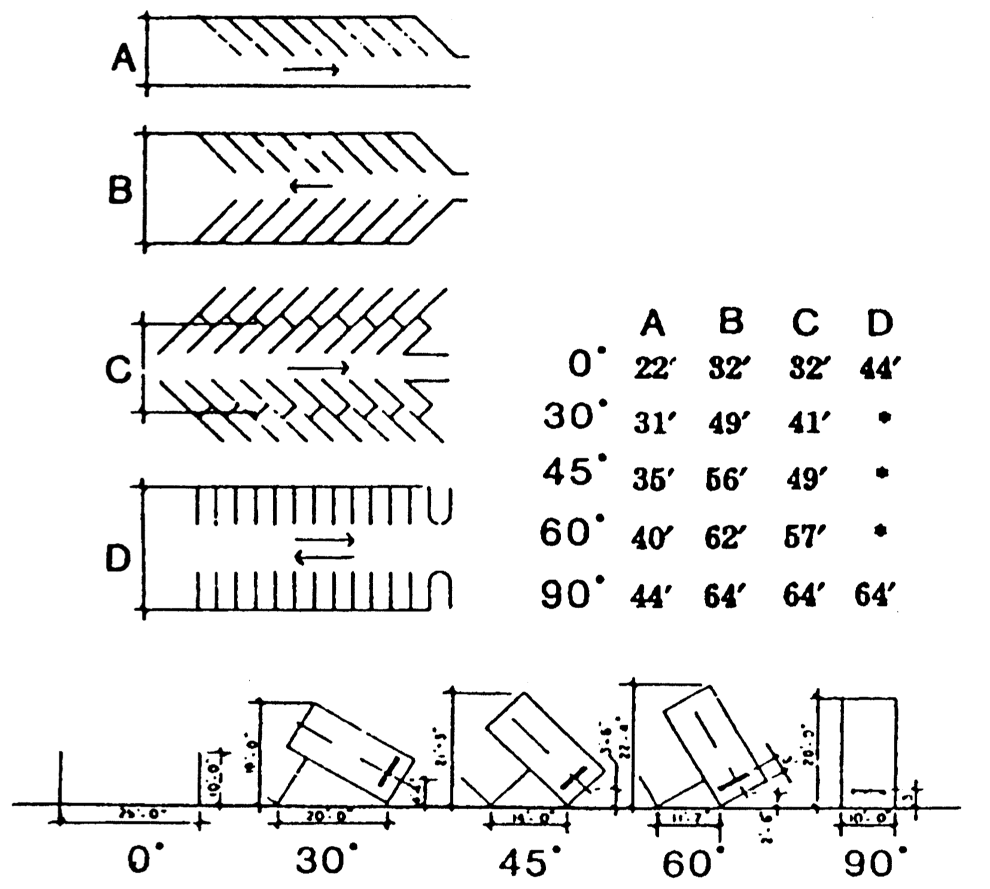
PARKING LAYOUTS
(Ord. No. 83-2-491, app. B, 2-24-83)
Sec. 106-234. - Parking or storage of recreational vehicles and boats.
(a)
No recreational vehicle, or boat as defined in section 106-3 which exceeds 8½ feet in width, per F.S. § 316.515 shall be permitted to be parked or stored in residential areas except in a fully enclosed garage, except as provided in subsection (b) and (c) below.
(b)
One recreational vehicle(s) and one boat may be stored at any one residence outside of the garage.
(c)
No recreational vehicle, boat and/or boat trailer shall be parked or stored on or adjacent to private residential property except as specified in this section.
(1)
All recreational vehicles, or boats must be parked or stored in the rear or side yard provided such yard is accessible from the public street without traversing adjacent private property and provided adequate area exists to accommodate the boat and trailer without encroaching upon the minimum property line setbacks established in section 106-183 of the Code. Motorized boats or recreational vehicles stored in the side or rear must be parked on an approved paved parking surface. All boats or recreational vehicles parked in side or rear yards must be screened from all adjacent residential property and streets by a six-foot high wooden fence or hedge. However if a fitted cover is used a fence or hedge is no longer required for screening.
(2)
A boat may be stored or parked in the front yard if neither the side nor rear yard is accessible or large enough to meet the criteria in subsection (1) above. Boats stored in the front must be parked on an approved paved parking surface which is a supplemental parking space. A minimum of two passenger vehicle spaces must still be available in the front in addition to the space used by the boat or trailer. All boats which are stored in the front yard must be covered with a fitted cover conforming to the provisions of section 106-202.
(3)
All boats parked or stored in the front yard and all motorized boats exceeding 12 feet in length parked or stored in the side or rear yard must be stored on a boat trailer.
(4)
Recreational vehicles may not be stored in the front yard.
(d)
In no event shall recreational-type vehicles, boats or trailers be parked on a public right-of-way, such public right-of-way to include swale areas and sidewalks.
(e)
All recreational-type vehicles, boats and boat trailers parked outside of a fully enclosed garage must display a current state license plate or registration as applicable.
(f)
Notwithstanding the foregoing, no recreational-type vehicle, as defined by Florida Statutes, Chapter 320 as the same may now exist or as may be later amended, or boat on a trailer which does not meet the criteria in subsection (c), may be parked in accordance with the terms contained herein, during the hours of 12:00 a.m. through and including the hour of 6:00 a.m. every day, on any day of the week, except the following:
(1)
Recreational-type vehicles and those boats on trailers which do not meet the criteria set forth in this section for parking shall be allowed to temporarily and periodically park in residential areas of the city for the express purpose of loading and unloading such vehicles for trips and other excursions for a period of up to 24 hours, so long as the property owner and/or tenant notifies the city through the community development department during normal business hours of the intent to temporarily park such vehicle. Sufficient prior notification shall include notice in writing directed to the director of community development or his designee or by telephone confirmation with the director of the community development department or his designee.
(2)
The foregoing exception, which shall permit only the temporary and periodic parking of recreational-type vehicles and those boats on trailers which do not meet the criteria set forth in this section for parking, shall not exceed 12 occurrences during any one calendar year for any parcel of land, for any owner and/or tenant or both.
(3)
The foregoing exception may be extended for in excess of 12 occurrences subject to the following:
a.
An applicant shall file with the city, through the director of the community development department, or his designee, a written request on forms prepared by the city, which shall state with particularity the basis upon which an applicant seeks to extend the number of times he shall be permitted the temporary and periodic parking of a recreational vehicle and those boats on trailers which do not meet the criteria set forth in this section for parking. The director of the community development department, or his designee shall, upon good cause shown, provide for additional occurrences upon which the applicant shall be permitted to temporarily and periodically park a recreational type vehicle or boat on a trailer which do not meet the criteria set forth in this section for parking.
(4)
If the director of the community development department denies any applicant the authority and/or permission to temporarily or periodically park recreational type vehicles in excess of the 12 occurrences provided for by this section, an applicant shall file a request with the city clerk and the governing body, at its next regular meeting, or a special council meeting called for that purpose, shall review the decision of the director of the community development department in accordance with the applicable provisions of Florida Statutes Chapter 120.
(g)
Violations of this section shall be punishable as provided in the Code of Ordinances.
(Ord. No. 00-4-994, § 19, 4-25-00; Ord. No. 02-01-1048, § 3, 1-28-02)
Sec. 106-235. - Violations of any vehicle parking restrictions; towing and impoundment.
(a)
Any passenger or commercial vehicle having a net empty weight of greater than 8,000 pounds, a length of 19 feet, or height or width of eight feet or does not comply with the provisions of sections 106-227 or 106-228 or any recreational vehicle or boat which exceeds 8½ feet in width or does not comply with the provisions of section 106-234 which is temporarily or permanently parked in the city in violation of the provisions of sections 106-227, 106-228 or 106-234 shall be ticketed or cited by an authorized officer of the community development department, such ticket or citation to be affixed to the windshield of the offending motor vehicle or to an appurtenance readily visible on a recreational-type vehicle. Any individual found guilty of violating this section shall be subject to punishment as provided by law. If an offending motor vehicle or recreational-type vehicle remains unmoved in violation of this section for a period in excess of 12 hours, each additional 12 hours of continuous violation shall be deemed a distinct and separate violation of this section and may be cited and ticketed as such.
(b)
Any owner of a motor vehicle or recreational-type vehicle, boat or boat trailer who knowingly permits such motor vehicle or recreational-type vehicle or boat to be temporarily or permanently parked in the city in violation of sections 106-227, 106-228 or 106-234 and/or any owner, renter or lessee of land residentially zoned who knowingly permits a motor vehicle or recreational type vehicle, boat or boat trailer to be permanently or temporarily parked on such property in violation of sections 106-227, 106-228 or 106-234 shall also be deemed as violating the appropriate section and may be cited for such violation and shall be cited for such violation and shall be subject to punishment as provided by law, except that the ticket or citation of violation shall be personally delivered to such party or served upon such party by regular U.S. mail using certified delivery, return receipt requested.
(c)
Any person who parks, places, or stores a vehicle in violation of this section, section 66-28, and/or section 106-203, shall be subject to a fine of $25.00 per occurrence. Each day that the violation is observed shall be a new "occurrence." The owner of such vehicle shall be responsible and liable for payment of any parking citation violation to the extent imposed by F.S. § 316.1967.
(d)
In addition to any other penalty provided by law or set forth herein, any vehicle found to be in violation of city's Code of Ordinances and any city no-parking sign, may be towed and impounded at the direction of the city not less than 48 hours after the vehicle has first been cited for a parking violation pursuant to this section. Said vehicle shall remain impounded until the related citation, towing and/or storage fees issued pursuant to this section are paid directly to the towing company together with 25 percent of the maximum towing rate for such vehicle as set forth by Broward County's Maximum Nonconsent Towing Rates Summary Table, as amended, as a reasonable city administrative fee which shall be paid directly to the city to reimburse the city for the administrative expenses incurred in the impounding process. The city may tow or impound a vehicle without the prior consent of the owner, so long as the city has posted and maintained "tow-away zone" signage in accordance with F.S. ch. 715.07(2)(a)(5), for not less than 24 prior to the towing or removal of any vehicle. City shall also comply with the requirements set forth herein below:
(1)
City's community development department shall reasonably attempt to locate the owner or operator of the illegally parked vehicle within the immediate vicinity of the vehicle before causing the vehicle to be towed or removed.
(2)
Once the vehicle is removed, city's community development department , as soon as practicable, shall make a reasonable attempt to ascertain the identity of the owner of the vehicle. Within 24 hours of removal, the city shall attempt to contact the owner of the vehicle to notify him of the removal and location of the vehicle.
(3)
If the city is unable to contact the owner or operator of the vehicle or if the vehicle remains unclaimed for 48 hours and the mailing address of the registered owner of vehicle is discoverable, written notice of the towing and location of the vehicle shall be mailed to the registered owner of the vehicle.
(4)
Upon payment of the costs of towing and storage, and the related citation, a vehicle removed and impounded pursuant to this section will be released to the owner or operator.
(5)
An owner may secure the release of the vehicle without first paying the costs of towing and storage, and the related citation by posting a bond as provided by law.
(6)
Should the owner or operator of an illegally parked vehicle contesting a parking citation or tow charges prevail in an administrative appeal conducted pursuant to section 66-41, the costs of removal and storage of the vehicle shall be borne by the city. If such an owner or operator has paid the towing and storage costs to obtain the release of the vehicle prior to prevailing in the administrative appeal or judicial proceeding, the city shall reimburse the owner or operator the full amount of such charges.
(7)
Any vehicle that is not claimed within 30 days of impoundment will be deemed abandoned and may be sold or destroyed on behalf of city, and the resale or salvage value, if any, shall be retained by the city and applied against the cost of removal and destruction thereof. Before sale or destruction, any owner or lienholder of the abandoned personal property shall be permitted to regain possession thereof upon proof of ownership or lien rights entitling the lienholder to possession, upon payment of storage charges and all expenses incurred by the enforcement officer and/or the city.
(Ord. No. 00-4-994, § 20, 4-25-00; Ord. No. 02-01-1047, § 3, 1-28-02; Ord. No. 02-01-1048, § 3, 1-28-02; Ord. No. 20-10-1410, § 3, 10-27-20)

