
North Muskegon City Zoning Code
ARTICLE IV
NONCONFORMITIES
Section 4.01 - Intent.
Upon the adoption of this Ordinance or future amendments, there may exist lots, structures, and uses of land and structures which were lawful prior to the adoption of the Zoning Ordinance, or amendment to the Ordinance, but which are not in conformance with the provisions of this Ordinance, or any amendments. It is the intent of this Ordinance to permit these nonconforming lots, structures and uses to continue, but not to encourage their continued existence. Because nonconforming lots, structures and uses, so long as they exist, prevent the full achievement of the goals and objectives of the City of North Muskegon Master Plan, the spirit of this Ordinance is to reduce, rather than increase, any nonconformance.
Accordingly, the purpose of this Section is to establish regulations that govern the completion, restoration, reconstruction, extension and/or substitution of nonconformities, and to specify the circumstances and conditions under which nonconformities shall be permitted to continue.
Section 4.02 - Illegal and Legal Nonconformities.
A.
Illegal Nonconformities. Any lot, use of land, building, or structure which has been established in violation of the provisions of a previous Zoning Ordinance having jurisdiction at the time the use of land or structure was established, and any lot, use of land, building, or structure which has been lawfully established under a previous Zoning Ordinance and subsequently violates the terms of the permit under which it was established, shall continue to be in violation of this Ordinance and shall have no rights granted to legal nonconformities in this Article.
B.
Legal Nonconformities. An existing lot, use of land, building, or structure which does not fully comply with the provisions of this Ordinance, as amended, and either was lawfully established under a previous Zoning Ordinance, created or commenced during a period of time when no valid Zoning Ordinance was in effect, or was lawfully established under the jurisdiction of this Ordinance (before amendment), and remains in compliance with the terms of a permit issued at that time, shall be permitted to continue, provided that such lot, use of land, building, or structure is in compliance with the requirements of this Article.
Section 4.03 - General Provisions for Legal Nonconformities.
A.
Tenancy. A change of tenancy, ownership, or management of any existing nonconforming lots, uses of land, buildings, or structures, shall be permitted. Such changes shall not affect the nonconforming status of a nonconforming lot, use of land, building, or structure.
B.
Change of Status. If a nonconformity existing prior to the effective date of this Ordinance becomes conforming because of the adoption of any subsequent amendment thereto, then it shall no longer have nonconforming status.
C.
Removal of nonconforming uses and structures. The City may acquire by purchase, condemnation, or otherwise, private property if it finds that its continuance constitutes a nuisance or is detrimental to the health, safety, and welfare of the City and its residents.
Section 4.04 - Nonconforming Uses of Land.
A.
Effective Date. If a lawful use of land exists on the effective date of this Ordinance, or the effective date of an amendment to this Ordinance, that is no longer permissible under the terms of this Ordinance, the use may continue so long as it remains otherwise lawful. No nonconforming use shall be moved to another portion of a building or lot, enlarged or increased, nor extended to occupy a greater area of land than was occupied at the effective date of this Ordinance, except as provided below.
B.
Amendments. When any amendment to this Ordinance changes a Permitted Use to a Special Land Use in whole or in part, any use legally established before that amendment shall be considered a legal Special Land Use on and after the effective date of the amendment.
C.
Change to Another Nonconforming Use. A nonconforming use may be changed to another nonconforming use provided the Planning Commission makes all of the following determinations:
1.
The new proposed nonconforming use is not enlarged or increased, nor extended to occupy a greater area of land than the previous nonconforming use, except as may otherwise be permitted by the Planning Commission.
2.
If the Planning Commission permits an expansion of the area related to the proposed new nonconforming use, the nonconforming use must comply with all applicable parking, landscaping, and other site development regulations.
D.
Enlargement. A nonconforming use within an existing building shall not be substantially enlarged or increased, nor extended to occupy a greater area of land or area within the building than was occupied at the effective date of the adoption or amendment of this Ordinance, unless it is approved by the Planning Commission after reviewing the following criteria:
1.
Roads and streets leading to and from the nonconforming use are adequate, and no additional traffic flow problems will be created by said expansion.
2.
There will be no increase in noise, odor, fumes, lights, glare, waste, sewer discharge, or other similar detrimental effects created by the proposed expansion.
3.
The proposed expansion of the nonconforming use is compatible with the surrounding areas and properties.
4.
Whether the proposed expansion could be made less detrimental to surrounding properties and areas by the use of appropriate buffering and screening.
E.
Planning Commission Purview. In consideration of the substitution or expansion of a nonconforming use, the Planning Commission may impose reasonable conditions that are necessary to ensure that the proposed substitution, enlargement, increase, or greater area will not prove detrimental to adjacent properties, the neighborhood, or the community.
F.
Abandonment.
1.
If a nonconforming use of land ceases for any reason for a period of more than six (6) consecutive months, any subsequent use shall conform to the requirements of this Ordinance.
2.
Prior to declaring a nonconforming use abandoned, the Planning Commission shall send notice to the current property owner and hold a public hearing, consistent with the requirements of Section 11.09. A nonconforming use shall be determined to be abandoned if the City is in receipt of a written declaration by the property owner that the use will not be continued, or that two (2) or more of the following conditions exist that demonstrate intent on the part of the property owner to abandon the nonconforming use:
a.
One (1) or more utility meters, such as water, gas and electricity to the property, have been removed;
b.
The property, buildings and/or grounds are unsafe or unsanitary, as described in Chapter 10, Buildings and Building Regulations, or Chapter 22, Environment;
c.
Cessation of business operations during the abandonment period;
d.
Removal of signs or other indications of the existence of the nonconforming use;
e.
Removal of equipment or fixtures necessary for the operation of the nonconforming use;
f.
Failure to maintain current licenses, certificates, permits, registrations, or other appropriate documentation; or
g.
Other actions, which in the opinion of the Zoning Administrator, constitute an intention by the property owner or lessee to abandon the nonconforming use.
Section 4.05 - Nonconforming Structures.
A.
Effective Date. Where a lawful structure exists at the effective date of this Ordinance that could not be built under the terms of this Ordinance due to its height, size, setback, lot coverage, or other dimensional standard, such structure may be continued so long as it remains otherwise lawful.
B.
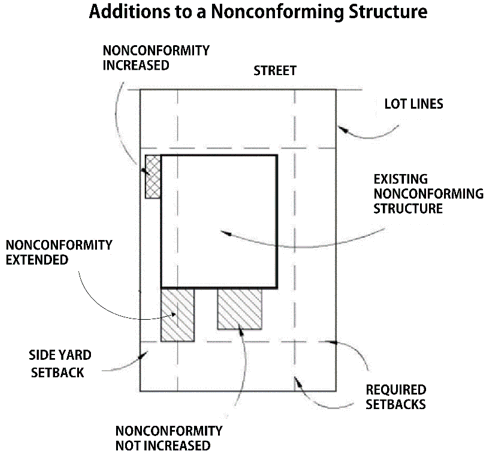
Enlargement. Structures that are nonconforming by reason of height, yards, area, or parking provisions may be extended, altered, or modernized provided that no additional encroachment(s) are realized.
C.
Movement. Should such a structure be moved to another lot, it shall conform to the regulations of the district to which it is relocated.
D.
Restoration. In the event any nonconforming building or structure is damaged by fire, wind, an act of God, or lack of maintenance, it may be rebuilt or restored provided the cost of restoration does not exceed fifty (50) percent of the replacement value of the building or structure as determined by the City. If the cost of restoration exceeds fifty (50) percent of the replacement value of the building or structure as determined by the City, the building or structure shall only be rebuilt in conformance with all provisions of this Ordinance.
1.
In determining the replacement value, the City shall not include the costs of demolition of the building or structure.
2.
Restoration must be started within a period of twelve (12) months after the time such damage occurred. A single twelve (12) month extension to begin restoration may be granted by the Planning Commission for just cause.
3.
Repairs or maintenance considered necessary by the Building Inspector to keep nonconforming structures safe and sound are permitted.
4.
The Planning Commission may permit the rebuilding or restoration of a nonconforming building or structure where the cost of restoration exceeds sixty (60) percent of the replacement value as determined by the City as a Special Land Use subject to the standards of Section 11.04. as well as the following:
a.
Such rebuilding or restoration will not substantially extend the probable duration of such non-conforming use, had such damage not occurred; or
b.
Circumstances are such that the land previously occupied by such non-conforming use cannot be reasonably used for a use or structure conforming to the regulations of the district.
c.
The Building Inspector may confirm use of property complies with provisions stated in this Ordinance through an inspection following building restoration or reconstruction.
E.
Alterations. If a nonconforming building or structure is altered such that it is made conforming, it shall not be altered in any way to make it again nonconforming.
Section 4.06 - Nonconforming Lots.
A.
Use of Lot.
1.
A nonconforming lot may be used for the purposes permitted in the Zone District in which it is located, provided that if the lot area or lot width is less than the minimum requirements of this Ordinance, the lot shall not be divided or reduced in dimensions or area so as to increase the degree of nonconformance with the minimum requirements of this Ordinance.
2.
Where an existing lot has an area of not less than ninety (90) percent of its Zone District requirements, the lot may be used for purposes permitted in that Zone District, provided that all side, front, corner front, and rear yard requirements are met.
3.
Where an existing lot has an area that is less than ninety (90) percent of its district requirements, the lot may be used for purposes permitted in that Zone District, and the required side and rear yards may be reduced by the same percentage that the lot's district requires. However, in no case shall a side yard be less than five (5) feet, no rear yard less than thirty-five (35) feet (unless the specific district requirements permit a lesser side or rear yard), and all off-street parking requirements must be met.
B.
Abutting Lots of Record Under Single Ownership.
1.
In any Zone District, where two (2) or more abutting lots of record under common ownership do not, when considered individually, meet the requirements for minimum lot area, minimum lot width, or both, of the Zone District in which the lots are located, these lots shall be combined and considered as one (1) lot for the purposes of this Ordinance.
2.
If already less than the minimum requirements of this Ordinance, a lot or adjacent lots in common ownership or a required yard, parking area or other open space shall not be divided or reduced in dimensions or area to increase its noncompliance with the minimum requirements of this Ordinance. Lots or yards created after the effective date of this Ordinance shall comply with the requirements of this Ordinance.
Section 4.07 - Nonconforming Site Elements.
A.
Gradual Compliance. Improvements and minor modifications to nonconforming sites and building elements that pre-date this Ordinance may be brought into gradual compliance with landscaping, paving, transparency, and building material requirements under the Administrative Review process or by the Planning Commission during the Site Plan Review or Special Land Use processes without requiring full compliance subject to with the provisions of this Ordinance subject to the following:
1.
Efforts must be made to meet the intent of the ordinance's provisions and goals of the Master Plan while balancing considerations such as topography, natural features, or other site constraints.
2.
Site element and/or building element improvements shall be comparable to the scale and the construction cost of the building improvement.
B.
Full Compliance. Site and building elements shall be brought into full compliance with this Ordinance as follows:
1.
Building Exteriors. Where improvements or modifications to the exterior of the building elements exceed more than fifty (50) percent of the exterior wall area, building elements shall be brought into full compliance with this Ordinance. Improvements or modifications involving less than fifty (50) percent of the exterior wall area, are not required to meet the full façade variation, transparency, and building material requirements of the Zone District.
2.
Parking and Landscaping. Where a parking or landscape area is expanded or reconstructed (existing pavement and/or landscape materials and ground cover removed and replaced) by twenty-five (25) percent or more of the original nonconforming area, parking and landscaping shall be brought into full compliance with the requirements of this Ordinance.
3.
Lighting. Where the size of the nonconforming site covered by existing lighting is expanded by an area that is fifty (50) percent or more of the original nonconforming area; and/or seventy (70) percent or more of the existing light poles and/or fixtures are replaced by new poles, bases, or fixtures lighting shall be brought into full compliance with requirements of this Ordinance.
4.
Drive-through. Where a drive-through is present and the drive-through use is being enlarged, site landscaping and buffers shall meet the requirements of this Ordinance.
C.
Cumulative Impact. Full compliance is required where the cumulative percentage of improvements exceeds the percentages provided above, over a ten (10) year period.

