
North Myrtle Beach City Zoning Code
ARTICLE VII
1.- ENVIRONMENTAL STEWARDSHIP
Sec. 23-129.5.- Developments of regional significance, design principles and standards.
(I)
Purpose—The intent and purpose of the design principles and standards for developments of regional significance greater than or equal to seventy-five thousand (75,000) square feet is to minimize the environmental, aesthetic, and transportation impacts caused by the bulk, scale, and size of such establishments. These principles and standards allow for an evaluation of such structures and promotion of a design that is visually appealing, and environmentally and economically sustainable.
(II)
Applicability—The design principles and standards are applicable for single or multiple building/s greater than or equal to seventy-five thousand (75,000) square feet, where the developer wishes to exceed the maximum allowable number of parking spaces permitted in section 23-43 of this chapter. For the purposes of this chapter, a development of regional significance shall be defined as singular or multiple building/s master planned retail and/or office development occupying in seventy-five thousand (75,000) square feet or greater.
(III)
Modifications to the mandatory standards—The zoning administrator is empowered to grant modifications to the mandatory standards when alternative site planning and building designs are equal to, or better than, the design objectives as stated in the standard.
1.
Facades and exterior walls:
PRINCIPLE: Facades shall be articulated to reduce the massive scale and the uniform, impersonal appearance of large buildings and provide visual interest that will promote a positive community identity, character, and scale.
STANDARD:
A.
Exterior building materials shall be finished with high quality materials, including but not limited to:
(i)
Brick, stucco.
(ii)
Glass.
(iii)
Synthetic clapboard siding (vinyl, metal or wood).
(iv)
Split face decorative block.
(v)
Wood.
(vi)
Sandstone, stone, other native stone or cementious siding.
(vii)
Tinted, textured, concrete masonry units.
EXCEPTION: A buildings rear wall not facing a street may remain unfinished.
B.
Facade colors shall be low reflectance, subtle, neutral or earth tone colors.
C.
Building trim and accent areas may feature brighter colors, including primary colors.
D.
Building facades must include a repeating pattern with no less than three (3) of the elements listed below. At least one (1) of these elements shall repeat horizontally. All elements shall repeat at intervals of no more than thirty (30) feet, either horizontally or vertically.
(i)
Color change.
(ii)
Texture change.
(iii)
Material module change.
(iv)
Expression of architectural or structural bay through a change in plane no less than twelve (12) inches in width, such as an offset, reveal, or projecting rib.
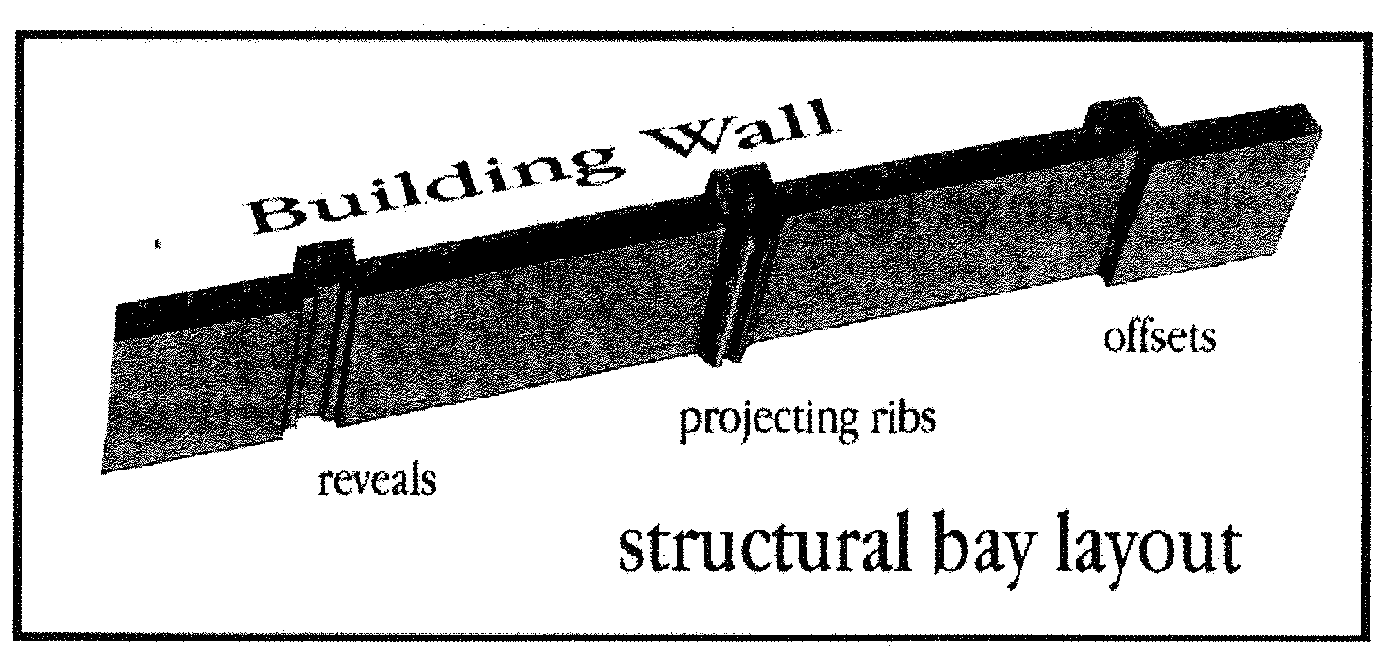
Building facade features, drawing courtesy of Fort Collins, CO.
E.
Facades shall incorporate wall plane projections or recesses having a depth of at least three (3) percent of the length of the facade and extending at least twenty (20) percent of the length of the facade 3 . [18]
F.
No length of any facade shall exceed one-hundred (100) linear feet without including at least two (2) of the following: pilasters, columns, canopies/porticos, colonnades, windows, trellis with vines, or an equivalent element that subdivides the wall into human scale proportions.
G.
Building walls facing the front yard or street side yard shall have window(s) and door(s). Such facades shall have display windows a minimum of six (6) feet in height along no less than thirty (30) percent of their horizontal length.
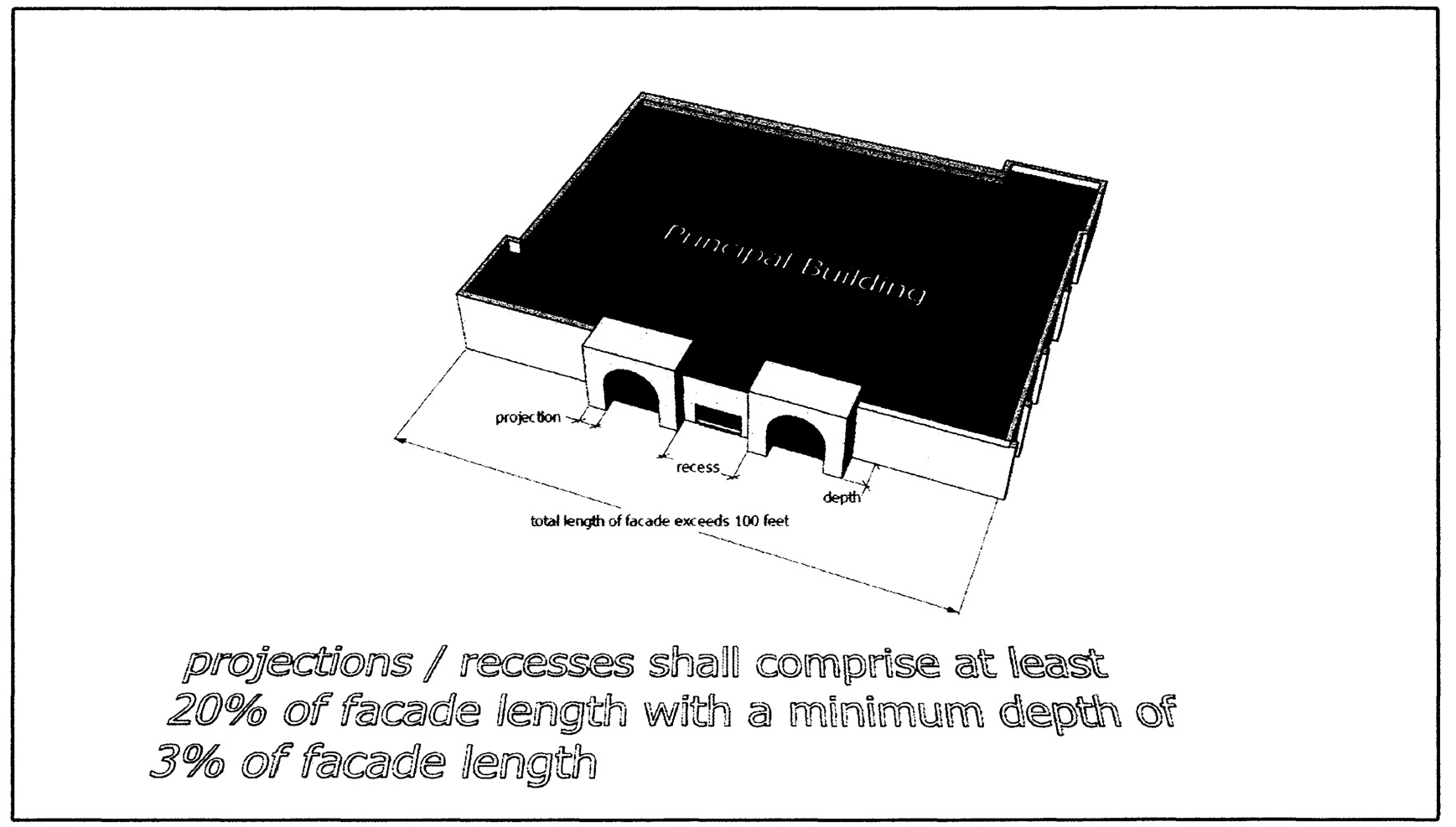
Fig. 1: Principal Building showing facade projections.
H.
Side or rear walls that face walkways may include false windows and door openings defined by frames, sills and lintels, or similarly proportioned modulations of the wall instead of actual doors and windows if those are not feasible because of the nature of the use of the building; however, safety via actual windows establishing visibility of the walkway will also be weighed. Such facades shall have windows (real or false) a minimum of three (3) feet in height along no less than thirty (30) percent of their horizontal length (see Fig. 2).
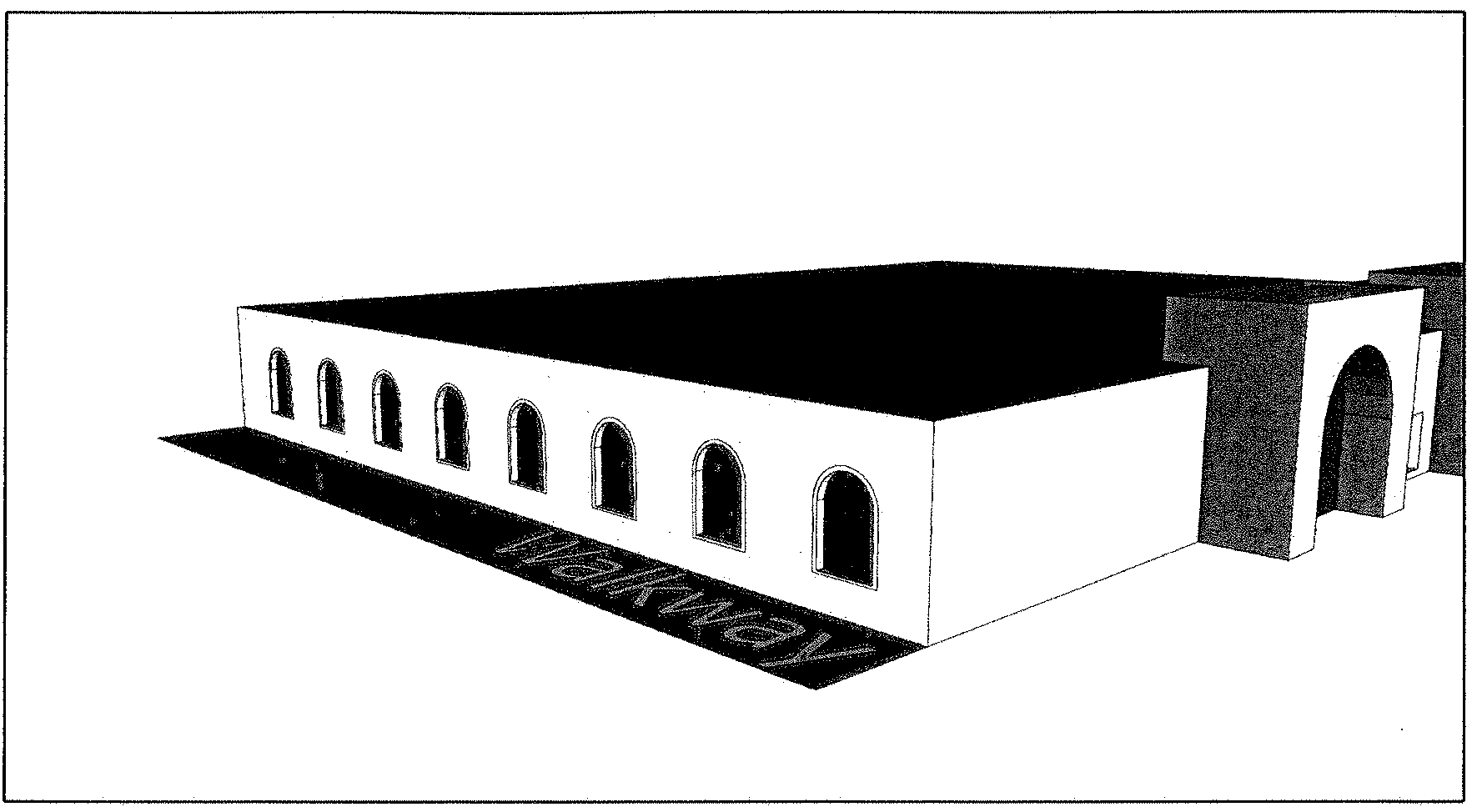
Fig. 1: Principal Building showing side walls facing walkway.
I.
Single and/or adjoining buildings or uses exceeding twenty-five thousand (25,000) gross square feet shall provide a covered pedestrian arcade at least eight (8) feet in width extending for the length of the main entrance facade. Buildings separated by alleyway or service drives shall be considered adjoining for purposes herein (see Fig. 3).
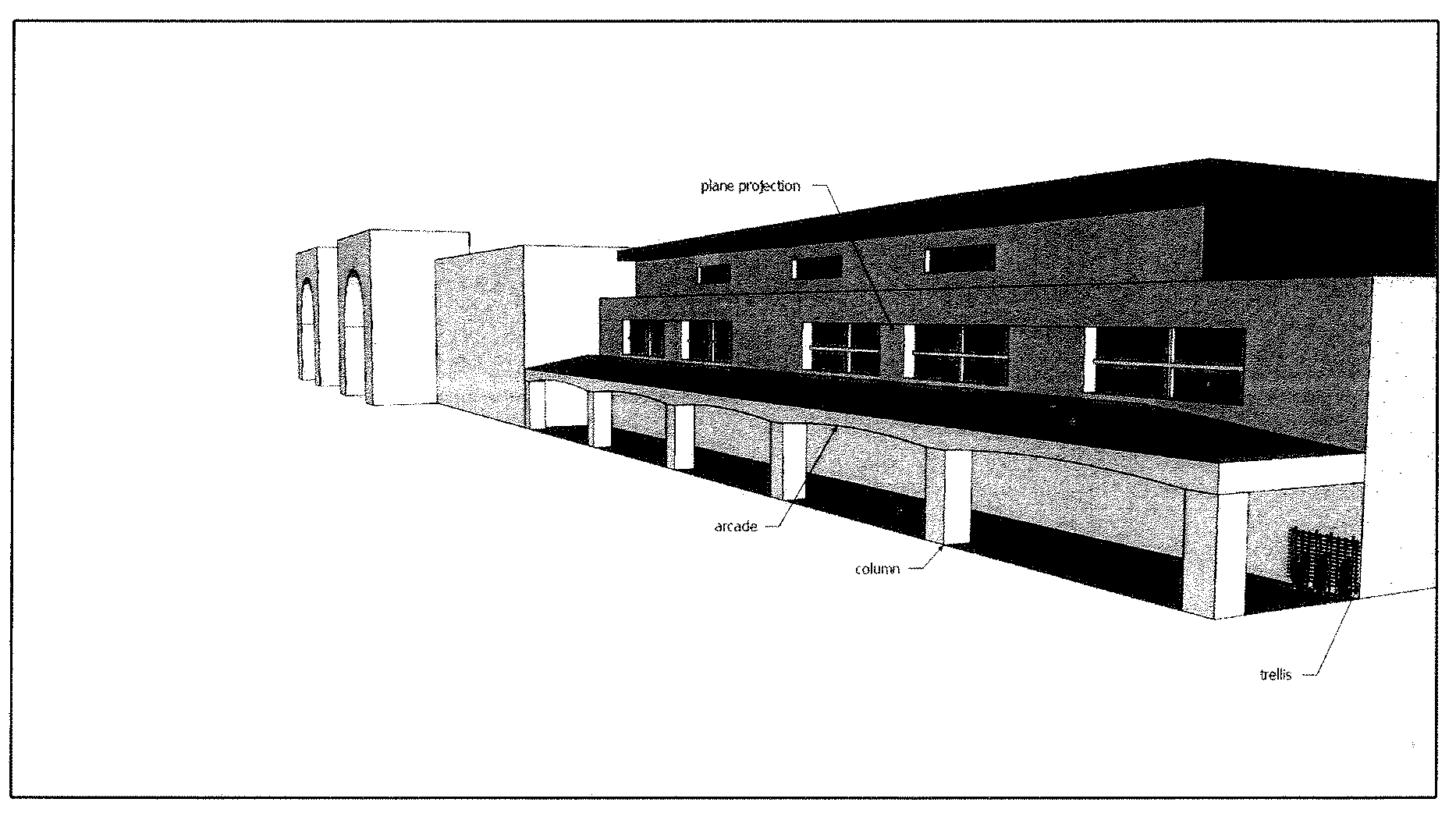
Fig. 3: Principal Building and Adjoining Building showing facade projections.
2.
Roofs.
PRINCIPLE: Variations in rooflines should be used to add interest to and reduce the massive scale of large buildings. Roof features should complement the character of adjoining neighborhoods.
STANDARD: Rooftop equipment shall be shielded from the public view via architectural treatment.
A.
Rooflines shall be varied with a change in height every one hundred (100) linear feet in the building length. Parapets, mansard roofs, gable roofs, hip roofs, or dormers shall be used to conceal flat roofs.
3.
Entryways.
PRINCIPLE: Entryway design elements and variations should give orientation and aesthetically pleasing character to the building. Large retail establishments should feature at least two (2) sides of customer entrances depending on the context, and especially if the orientation and massing reflects traditional, form-based site design; where building(s) abut street right-of-way and parking is to the side or rear. The two (2) suggested sides for entrances should be those planned to have the highest level of pedestrian activity, and one (1) of the sides should be that which most directly faces a street with pedestrian access. The other of the two (2) sides may face a second street with pedestrian access, and/or a main parking lot area. The standard identifies desirable entryway design features.
STANDARD:
A.
Each building on a site shall have clearly defined, highly visible customer entrances from the abutting street featuring no less than three (3) of the following:
(i)
Awnings, canopies or porticos.
(ii)
Overhangs, recesses, arcades or projections.
(iii)
Raised corniced parapets over the door, peaked roof forms or arches.
(iv)
Outdoor patios.
(v)
Display windows.
(vi)
Integrated architectural detail.
(vii)
Integral planters or wing walls that incorporate landscaped areas and/or places for sitting.
4.
Outparcels and auxiliary uses.
PRINCIPLE: The presence of smaller retail stores and office buildings gives a center a "friendlier" appearance by creating variety, breaking up large expanses, and expanding the range of the site's activities.
STANDARD: Where development contains separately owned stores which occupy less than twenty-five thousand (25,000) square feet of gross floor area;
A.
The architecture of the outparcel buildings shall complement the architectural design of the non-outparcel buildings in types of colors, roof treatments, and architectural details.
B.
Outparcels shall conform to the master architectural, signage, lighting and landscaping plan prepared by the developer of the primary retail and/or office establishments.
C.
Sidewalks and pedestrian connections shall be installed between outparcels and the primary building/s, and between each outparcel, to enhance internal circulation and create a streetscape experience for pedestrians.
5.
Landscaping, screening and vegetation.
PRINCIPLE: The City of North Myrtle Beach has recognized a need for proper vegetation and the use of native species wherever possible to promote a healthier environment. Existing trees should be incorporated into the design of large establishments to assure ecological and aesthetic benefits. Parking lot landscaping is an important element in reducing the heat island effect, controlling water runoff, and improving the aesthetics of a site.
STANDARD: The following landscaping and screening provisions apply:
A.
Acceptable plant and tree species, maintenance standards, and sizes to meet the above requirements can be found in article V, landscaping requirements of the zoning ordinance.
B.
Perimeter landscaping:
(i)
Where the development abuts a residential use or district, a minimum six-foot high finished masonry wall, inset not more than three (3) feet from any property line, and six-foot high vegetative screening shall be required. The buffer width shall also be increased one hundred (100) percent along the shared property line.
(ii)
In all other instances the development shall meet the perimeter landscape requirements of article V, landscaping requirements, of the zoning ordinance. Where a development abuts a public or private right-of-way, the landscape buffer shall be no less than ten (10) feet.
(iii)
Existing specimen and protected trees within the perimeter landscaped area shall be retained to the extent possible (see article V.5. tree preservation regulations).
(iv)
Permitted uses within the required landscaping areas shall include driveway access, transit oriented uses including bus stops and shelters, pedestrian and bike paths, lighting fixtures, signs, benches, and other streetscape furniture.
C.
Foundation landscaping:
(i)
A five-foot foundation landscape strip shall be required along the facade and exposed sides of all buildings within a development. Foundation landscaping shall incorporate stormwater runoff from disconnected roof drains as part of the irrigation plan.
D.
All required planting areas shall be artificially irrigated as per section 23-63, irrigation, of the zoning ordinance unless incorporated into the stormwater management plan wherein irrigation is provided via stormwater retention per subsection 6., parking areas, of this section.
E.
Maintenance shall consist of mowing, removal of litter, and replacement of dead plant materials, necessary pruning, and maintenance of screens in conformance with the surrounding area. Natural watercourses within a buffer shall be maintained as free flowing and free of debris. Stream channels shall be maintained. It shall be unlawful to deviate from an approved landscape plan unless otherwise permitted by the zoning administrator. Failure to comply with the above maintenance requirement shall constitute a violation of the zoning ordinance and be subject to the fines and penalties specified therein.
F.
Drainage and utility encroachment into the perimeter landscaping. New stormwater facilities, including conveyances, shall not be located on the exterior of any required perimeter landscaping. If an existing conveyance or stormwater facility exists along the property line or in the area which would normally constitute the landscaping location, then the required landscape width must be met internal to said facility or conveyance. Any encroachment into the perimeter landscape area shall be on the interior of the landscaped area and may not encroach more than ten (10) percent into the total required width. An encroachment includes any required easement width necessary to access and/or maintain the facility.
6.
Parking areas:
PRINCIPLE: Parking areas should provide safe, convenient, and efficient vehicular access. They should also be incorporated into the overall stormwater management design by including low impact development (LID) features intended to mimic the natural hydrological cycle. Additionally, parking areas serve not only vehicles but pedestrians as well, and should be designed to meet their needs.
STANDARD: To reduce the visual mass, simultaneously meeting the needs of vehicular and pedestrian traffic, and incorporate LID standards, parking areas shall meet the following:
A.
Parking spaces above the minimum number required as per section 23-43 shall consist of alternative pervious paving material including, but not limited to, porous/pervious brick pavers, grass pavers, porous asphalt or porous concrete, or any other technique approved by the city engineer evenly distributed throughout all parking modules. Driveways and circulation aisles shall be constructed with hard surface impervious materials, unless the city engineer approves an alternate design.
B.
All parking shall be located no more than one hundred (100) feet from a pedestrian facility/sidewalk.
C.
Parking areas shall be designed so that no one parking module contains more than one hundred (100) spaces. Individual modules shall have no more than four (4) points of vehicular ingress/egress.
D.
The design of the parking module shall be surrounded by a minimum fifteen-foot wide landscaping strip. Within these two outside landscaping strips, two five-foot wide pedestrian walkways shall also be provided. The landscaped portion of the strip shall be incorporated into the stormwater master plan for the site and be designed according to LID standards including, but not limited to, bioretention and infiltration. In addition, a minimum five-foot wide middle landscaping strip shall also be provided and designed according to LID standards (see Figs. 4 and 5). All LID design must meet the city's stormwater management regulations found under chapter 13, stormwater management and erosion control, of the Code of Ordinances.
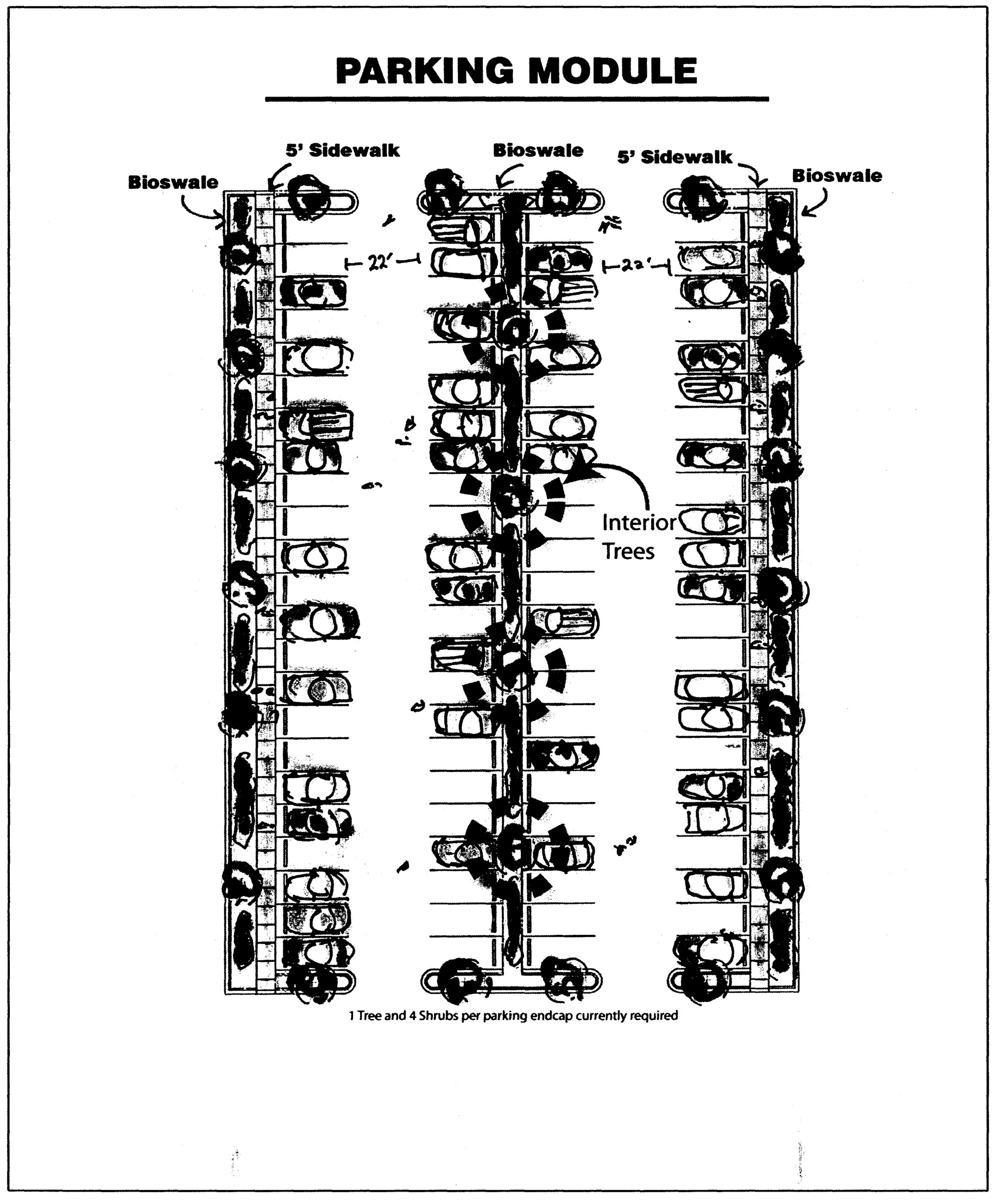
Fig. 4: Parking Module.
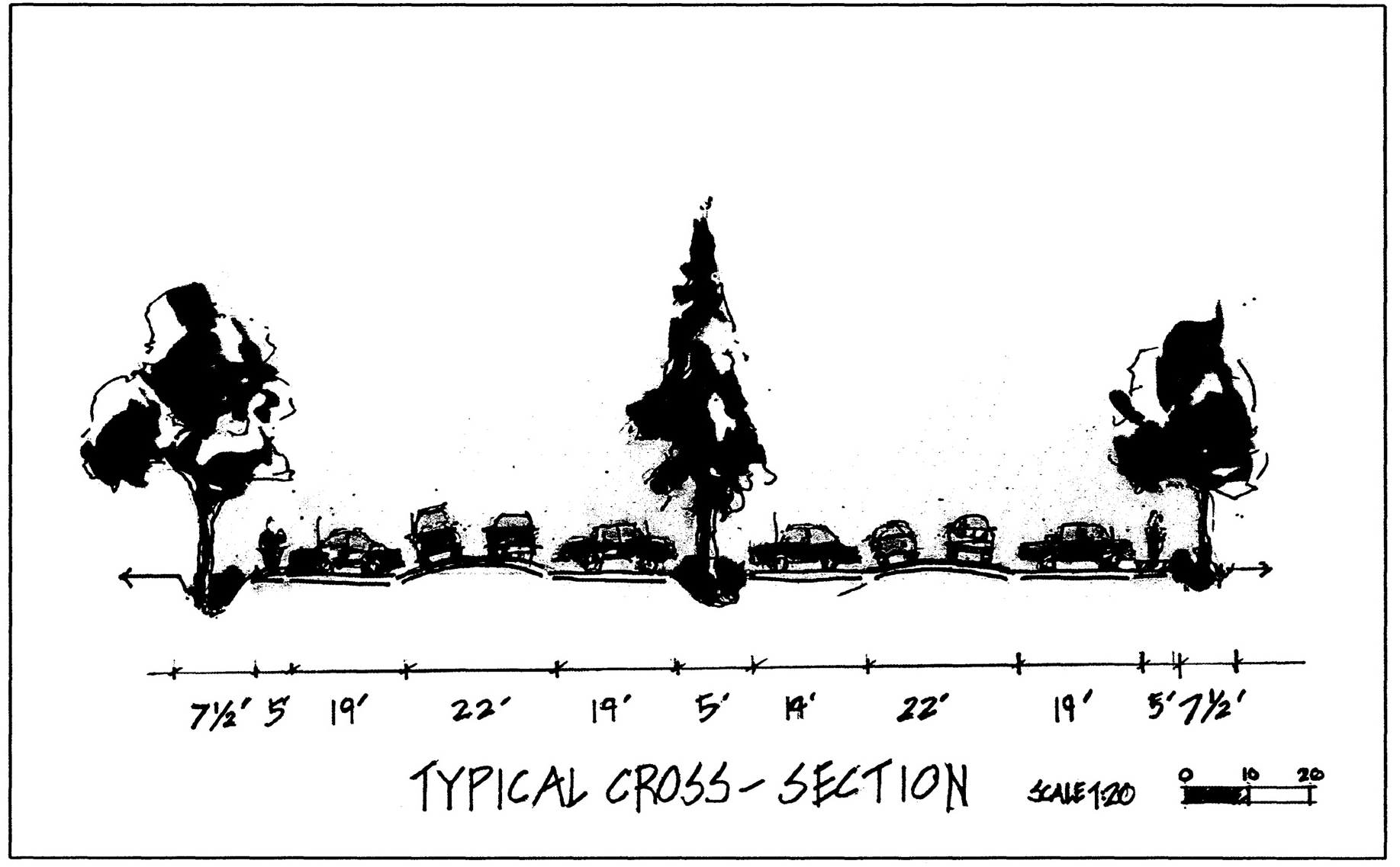
Fig. 5: Parking module cross-section.
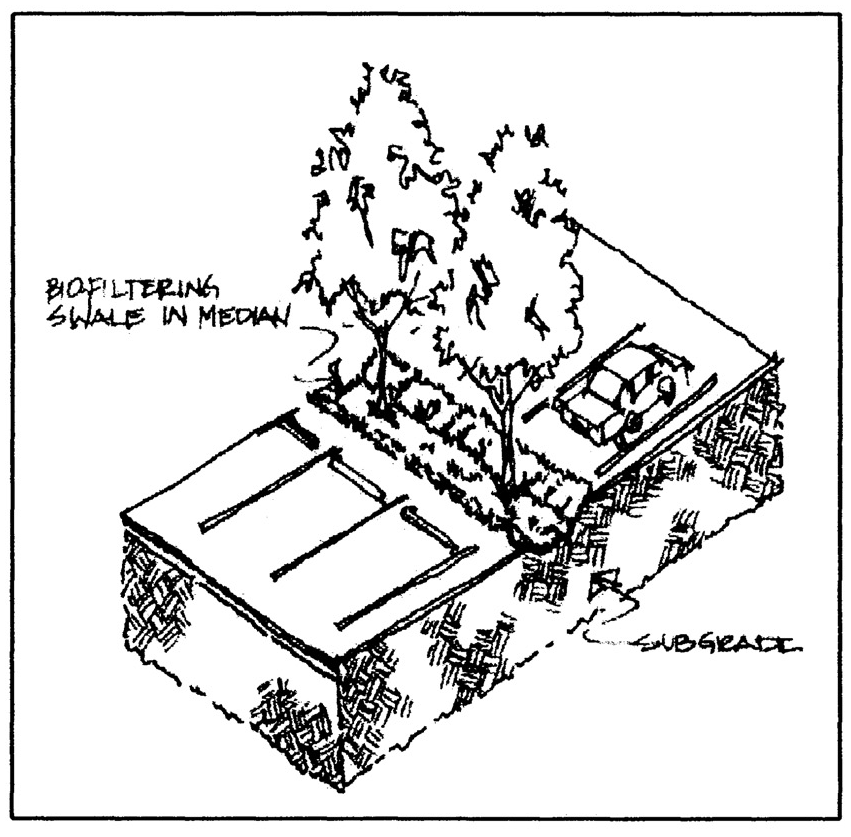
The graphic helps represent the intended outcome of incorporating LID into landscaping strips and traffic islands to control stormwater runoff and create more green spaces, in this case vegetative swales. Images courtesy of Metro, Green Streets, Innovative Solutions for Stormwater and Stream Crossings, 2002.
E.
Each parking module shall contain at least four (4) internal canopy trees provided within traffic islands. The dimensions of the traffic islands shall be sufficient to support the health of the canopy trees at maturity. The remaining area of the traffic islands and landscaping strips shall be planted with vegetation that complements the design. Acceptable plant and tree species, maintenance standards, and sizes to meet the above requirements are found in article V, landscaping requirements, section 23-66 plant material, of the zoning ordinance.
7.
Outdoor storage, trash collection, loading areas, and utility locations:
PRINCIPLE: Poorly designed loading areas and outdoor storage areas exert visual and noise impacts on surrounding neighborhoods. These areas, when visible from adjoining properties and/or public streets, shall be screened, recessed or enclosed. While screens and recesses can effectively mitigate these impacts, the selection of inappropriate screening materials can exacerbate the problem.
STANDARD:
A.
Loading and unloading of commercial vehicles or of any other vehicles used for commercial purposes is only permitted between the hours of 7:00 a.m. and 10:00 p.m. when property assigned a residential zoning classification or used for residential purposes is within two hundred (200) feet of the loading area. Within such areas, such activities are prohibited at all other times.
B.
Areas for outdoor storage, truck parking, shipping and storage containers, trash collection or compaction, loading, cart storage areas (excluding parking lot corrals), or other such uses shall not be visible from abutting streets. Outdoor storage areas should not be located in front of the principal building and, when possible, shall be located to the side of the building not facing a public street.
C.
Outdoor storage areas shall comply with the most restrictive screening requirements set forth within the city's zoning ordinance. Materials stored outdoors, excluding vehicles, trailers, or mobile machinery or equipment shall be stacked no higher than one foot below the top of required screening device.
D.
Loading docks, truck parking, outdoor storage, utility meters, HVAC equipment, trash collection, trash compaction, and other service functions shall be incorporated into the overall design of the building and the landscaping so that the visual and acoustic impacts of these functions are fully contained and out of view from adjacent properties and public streets, and no attention is attracted to the functions by the use of screening materials that are different from, or inferior to, the principal materials of the building and landscape.
E.
Non-enclosed areas for the storage and sale of seasonal inventory shall be permanently defined and screened with walls and/or fences. Non-enclosed areas for the storage and sale of seasonal inventory shall not be located within parking areas.
8.
Pedestrian flows:
PRINCIPLE: Pedestrian accessibility opens auto-oriented developments to the neighborhood, reducing traffic impacts and enabling the development to project a friendlier, more inviting image. This section sets forth standards for sidewalks and internal pedestrian circulation systems that can provide user-friendly pedestrian access as well as pedestrian safety, shelter, and convenience within the development.
STANDARD:
A.
Pedestrian facilities shall be included in any landscaping plan submitted for review.
B.
Sidewalks at least five (5) feet in width shall be provided along all sides of a lot that abuts a public or private right-of-way.
C.
Continuous internal pedestrian walkways, no less than five (5) feet in width, shall be provided from the public sidewalk or right-of-way to the principal customer entrance of all buildings on the site. At a minimum, walkways shall connect focal points of pedestrian activity such as, but not limited to, central features and community spaces transit stops, parking areas, street crossings, building and store entry points, and shall feature adjoining landscaped areas that include trees, shrubs, benches, flower beds, ground covers, or other such materials for no less than fifty (50) percent of their length.
D.
Sidewalks, no less than five (5) feet in width, shall be provided along the full length of the building along any facade featuring a customer entrance, and along any facade abutting public parking areas. Such sidewalk shall be located at least five (5) feet from the facade of the building to provide planters or planting beds for foundation landscaping, except where features such as arcades or entryways are part of the facade. In instances where arcades are incorporated into the wall, foundation landscaping shall be located outside of the covered area.
E.
All internal pedestrian crosswalks shall be distinguished from driving surfaces through the use of durable, low maintenance surface materials such as pavers, bricks, or scored concrete/stamped asphalt to enhance pedestrian safety and comfort, as well as the aesthetic. However, care must be taken to utilize these materials in a manner that does not violate the standards of the Americans with Disabilities Act.
9.
Central features and community spaces:
PRINCIPLE: Buildings should offer attractive and inviting pedestrian scale features, spaces and amenities. Entrances and parking lots should be configured to be functional and inviting with walkways conveniently tied to logical destinations. Bus stops and drop-off/pick-up points should be considered integral parts of the configuration. Special design features such as towers, arcades, porticos, pedestrian light fixtures, bollards, planter walls, and other architectural elements that define circulation ways and outdoor spaces should anchor pedestrian ways. Examples of outdoor spaces are plazas, patios, courtyards, and window-shopping areas. The features and spaces should enhance the building and the center as integral parts of the community fabric.
STANDARD: Each retail and office development shall contribute to the enhancement of the public space. At least two of the following shall be provided:
A.
Any establishment to be located along or adjacent to a naturally occurring water feature shall provide a portion of their community space requirement along said water frontage. Streams, creeks, wetlands and other natural corridors located within the development site shall be preserved and shall count toward the community spaces requirement.
B.
Patio seating area and/or pedestrian plaza with benches.
C.
Transportation center.
D.
Window shopping walkway.
E.
Outdoor playground area.
F.
Kiosk area.
G.
Water feature, i.e. fountain.
H.
Clock tower.
I.
Park area incorporating elements above.
10.
Lighting: Refer to sections 23-41(4)(f), 23-42(12), and 23-129 of the zoning ordinance.
11.
Sign regulations:
PRINCIPLE: Commercial signs should be aesthetically cohesive with the overall building design and facade features and should be visually integrated within the main entrance road corridor. Branding incorporated as an architectural feature of a sign is encouraged.
STANDARD: The following signs are permitted within the development:
A.
Freestanding signs: Freestanding monument signs are permitted with the following provisions:
(i)
Types of signs—Freestanding signs shall be limited to multi-tenant and/or single tenant monument signs.
(ii)
Maximum number of signs—The number of freestanding signs shall be permitted as follows.
(a)
Basic allowance:
I.
The minimum separation for all signs shall be at least two hundred (200) linear feet.
II.
One (1) identification sign may be erected which shall not exceed two hundred (200) square feet of copy area. Such identification sign shall specify only the name of the development. Alternatively, such sign may display the names of tenants as well as the name of the development if;
1.
The portion of a sign on which tenant names are displayed does not exceed seventy (70) percent of the total sign area; and
2.
The portion of a sign on which tenant names are displayed is of a uniform design background color.
III.
One (1) sign with a copy area of seventy-five (75) square feet shall be permitted per outparcel with right-of-way frontage regardless of singular or multiple tenants.
IV.
Branded architectural elements that do not contain any advertising copy of recognized corporate logos shall not be considered signage.
V.
A minimum depth of thirty-six (36) inches of landscaping shall be incorporated around the base of all signs to include low growing shrubs and ground cover and/or flowering annuals to promote color. The landscaping may also be credited to the required landscaping of this chapter.
(b)
Additional allowance:
I.
Developments with one thousand (1,000) feet of frontage or more on a single public right-of-way with more than one (1) ingress/egress shall be permitted one (1) additional sign, which shall not exceed one hundred (100) square feet in total copy area.
II.
Iconic signage. One (1) additional iconic sign is permitted per building face. An iconic sign is a sign whose form suggests its meaning. Such a sign is unique and creates an image and/or defines a place. An iconic sign may be sculptural in style and demonstrate extraordinary aesthetic quality, creativity or innovation. Branding, for purposes herein, shall not qualify alone as iconic.
(c)
Location: Sign(s) shall be located no closer than ten (10) feet from a public right-of-way, side or rear property lines, and outside all sight triangles.
(d)
Height: Sign(s) for parcels with public right-of-way frontage shall be a maximum of twelve (12) feet in height measured from the finished grade to the top of the sign face. Center identification signs shall be permitted a maximum height of twenty-five (25) feet except for those identified in the additional allowance section of this ordinance.
(e)
The maximum size of the background structure of a sign shall not exceed one hundred ten (110) percent of the total square footage of copy area. Branded architectural elements shall not count as background structure.
(f)
Support base: The monument sign base shall be encased or provide external support and meet the following standards:
I.
An enclosed base possessing a minimum width of two-thirds (⅔) the width of the sign.
II.
If any support, upright, bracing or framework is utilized or proposed to support a monument sign, said support, upright, bracing or framework shall be encased in an ornamental shell of stone, brick, stucco, ornamental metal or similar and/or compatible materials with the architecture of the building or other site features.
B.
Facade signs (building wall, awning, marquee, canopy):
(i)
Building signs—Building signs are permitted with the following provisions:
(a)
Types of signs—Building signs shall be limited to wall, canopy, awning, marquee, and projecting signs.
(b)
Building signs shall only advertise one (1) person, firm, company, corporation or major enterprise occupying the premises.
(c)
The sign shall be clearly integrated with the architecture of the building and shall be consistent in design and materials with the architecture of the proposed building.
(d)
Single tenant development.
I.
Maximum number of signs: One (1) building sign is permitted. Said sign shall be located along the front facade, defined as that which incorporates the main customer entrance area.
II.
Maximum size:
1.
One (1) square foot for every linear foot of building frontage.
2.
0.5 additional square feet for every linear foot of building frontage for buildings located beyond one-hundred (100) feet from the right-of-way.
3.
The size of an individual sign shall not exceed one-hundred fifty (150) square feet.
(e)
Multi-tenant development:
I.
Maximum number of signs: One (1) building sign is permitted per tenant frontage.
II.
Maximum size:
1.
2.0 square feet for every linear foot of store frontage.
2.
The size of an individual sign shall not exceed one hundred fifty (150) square feet.
3.
Placement: The building signs permitted may be placed on the wall or awnings.
4.
Wall signs shall display only one (1) surface and shall not be mounted more than six (6) inches from any wall.
5.
The length of the sign may occupy up to fifty (50) percent of the linear feet of the storefront the business occupies.
C.
Illumination:
(i)
The sign shall be constructed with either an opaque background and translucent letters and symbols; or, a translucent darker colored background with a lighter contrasting color for the letters and symbols.
(ii)
The darker background color shall have a luminous transmittance, which does not exceed fifteen (15) percent. The lighter lettering or symbols shall have a luminous transmittance, which does not exceed thirty-five (35) percent.
(iii)
No internal lighting shall include exposed luminescent elements.
(iv)
Externally illuminated signs shall meet the following standards:
(a)
The lighting of signs must be from the top of the sign and directed downward;
(b)
The lighting of signs that have a height of ten (10) feet or less may be illuminated from the top of the sign or from the ground.
(c)
Indirect light sources must be shielded from the view of persons viewing the sign and be further shielded and directed so that the light shines only on the sign and that illumination beyond the copy area is minimized.
(Ord. No. 11-30, § 14, 11-21-11)
For letters F., G., and H., Refer to Fig. 1.

