
North Myrtle Beach City Zoning Code
ARTICLE IV
OFF-STREET PARKING AND LOADING
Sec. 23-41.- Parking regulations.
(1)
Intent/purpose:
(a)
It is the intent of this section in conjunction with applicable definitions in section 23-17, the provisions of sections 23-42, 23-43 and any other applicable provisions of the Code of Ordinances to establish comprehensive criteria applicable to all public and private parking facilities within the City of North Myrtle Beach.
(2)
Compact automobile parking requirements:
(a)
A parking lot servicing a structure or building may have a maximum of ten (10) percent compact automobile parking spaces of which fifty (50) percent or greater shall be on-site, the remaining portion (if any) may be located off-site.
(b)
When three (3) or more spaces are located together, two (2) compact automobile signs will be required. The first sign shall be located at the left-hand corner of the first space, the second sign shall be located in the right-hand corner of the last space. When single spaces are utilized, one (1) sign will be required at each space. The location of the sign will be the same as outlined for handicapped parking signage.
(c)
Each space will have a dimension of fifteen (15) feet by eight (8) feet.
(d)
All of the abovementioned parking dimensions and signage are outlined in subsection 23-42(2) and subsection 23-42(10).
(3)
Handicapped parking site requirements:
(a)
A parking lot servicing each entrance/exit pathway shall have a number of on-site level spaces located in closest proximity to the structure of the building, which must be identified by aboveground signs as being reserved for physically handicapped persons. Each parking space so reserved shall be not less than thirteen (13) feet wide.
(b)
Each parking space shall display one (1) handicapped parking sign (international symbol of access) and the parking surface shall be identified with a blue background and the appropriate handicapped parking symbol and pavement striping.
(c)
Accessibility to buildings shall be provided for right-of-way and parking areas by means of a pathway leading to at least one (1) entrance generally used by the public. Such pathway shall have been cleared of all obstructions related to construction activity prior to the opening of the building to the general public. Where curbs existing along such pathways, as between a parking lot surface and a sidewalk surface, inclined curb approaches or curbcuts shall have a gradient of not more than one (1) inch to twelve (12) inches and width of not less than four (4) feet shall be provided for access by wheelchairs. Curb ramps should be properly marked with a handicapped parking sign with the word "ACCESS" printed below. Curb ramps shall be properly marked with a handicap parking sign with the word "access" printed below and shall have a detectable warning as described in [sub]section 23-42(7)(b).
(d)
All of the abovementioned handicapped parking space dimensions, signage and curb ramp requirements are outlined in subsection 23-42(3) and subsections 23-42(7) through 23-42(9).
(e)
Required handicapped parking space(s) shall be compiled (computed) according to the following chart:
One (1) in every eight (8) handicap parking spaces but not less than one (1) shall be served by a van accessible parking space according to [sub]section 23-42(3)(b).
(4)
Other requirements:
(a)
Wheelstops—Detailed in subsection 23-42(5)
(b)
Paving surfaces—Detailed in subsection 23-42(4).
(c)
One-way/two-way traffic flow dimensions and signage—Detailed in subsection 23-42(11).
(d)
Stacking spaces for specific land uses. For purposes of calculation, a stacking space shall be nine (9) feet wide by nineteen (19) feet long.
Banks—Four (4) spaces for each window lane (including drive-through automatic teller machines).
Restaurants—Eight (8) spaces for each takeout window measured from the first contact point.
Other uses—Four (4) spaces for each service window.
(e)
Except as otherwise provided for in this article, no parking space shall have direct access to a street, and no vehicle shall extend into a public right-of-way. Each parking space shall be unobstructed and shall be so arranged that any vehicle may be moved into and out of such space without moving another vehicle.
(f)
Lighting— of parking areas shall be provided and other freestanding light poles placed on the property shall be of a type and placement so as not to pose a visual disturbance to adjacent property owners pursuant to the following:
1.
No light pole shall exceed thirty (30) feet in height.
2.
Light fixtures that exceed two thousand (2,000) lumens shall be shielded with internal panels on the side of the fixture adjacent to any residential property capable of blocking a minimum of one hundred twenty (120) degrees of light in any one direction.
3.
The maximum light level adjacent to any residential property line shall not exceed five-tenths (0.5) foot-candles.
4.
The maximum light level adjacent to any street right-of-way shall not exceed two (2.0) foot-candles.
5.
All service connections for any freestanding light pole shall be underground.
(5)
Noncontiguous, off-street parking:
(a)
The owner of a parcel of land may provide the required automobile storage and parking spaces on lands on which the use is situated and on levels which are not contiguous to the lands on which the use is situated, provided that all of the conditions set forth herein are satisfied.
(b)
All residential uses in all zoning districts (except overlay zones) and commercial uses in the RC (Resort Commercial) district shall have a minimum of seventy-five (75) percent of all required parking spaces located on lands on which the use is situated and a maximum of twenty-five (25) percent of such spaces may be located off-site where the farthest parking space is located no farther than three hundred (300) feet from the principal site, with the exception of hotels/motels in the RC (Resort Commercial), and PDD's (Planned Development Districts). All other commercial uses shall have a minimum of fifty (50) percent of all required parking spaces located on lands on which the use is situated and a maximum of fifty (50) percent of such spaces may be located off-site provided:
Hotels/motels in the RC (Resort Commercial) and PDD (Planned Development District) shall be permitted twenty (20) percent of all required parking spaces located on the parcel(s) of land upon which the use is situated and up to eighty (80) percent of such spaces may be located off-site, provided the farthest parking space is located no more than three hundred (300) feet from the principal site.
Where primary district on site parking requirements and the oceanfront parking overlay zone are both applicable, the more permissive standard shall apply. (Re: subsection 23-31(4), OFO (Oceanfront Overlay Zone).
(c)
Town centers within PDD's (Planned Development Districts) may provide up to one hundred (100) percent of required parking off-site within the boundaries of the town center.
(d)
The owner shall impose restrictions on such noncontiguous parking lands by a recorded declaration which shall require written consent of the city to release such lands from restriction. Such recorded declaration shall run with the land and shall provide that so long as the use exists, the lands shall be utilized exclusively as a parking area serving the use except as follows:
1.
Retail use shall be permitted on the first floor of parking decks in association with hotel/motel developments in the RC (resort commercial) district only.
2.
Hotel/motel, multifamily and resort accommodation developments in the RC (resort commercial) districts and hotel/motel and multifamily in the R-4 (resort residential) districts may allow required noncontiguous parking lands to be developed with a use the same as the principal use for which the parking is provided subject to all applicable development standards.
(e)
No noncontiguous parking lands shall be located in any zone other than one (1) for which the use is permitted.
(f)
Paved sidewalks, as per City of North Myrtle Beach specifications, from the noncontiguous lot to the principal development shall be provided at the owner's expense.
(g)
The noncontiguous parking lands shall be clearly marked by appropriate signage indicating that such lands are devoted to parking area serving the use and such signage shall be maintained in good state of repair.
(h)
The noncontiguous parking lands shall be physically improved, landscaped, and surfaced in the same manner as the parking area located on the lands on which the use is situated. All surface water must be retained on-site, or drained into public storm water drainage ways in accordance with accepted engineering practices as approved by the city engineer.
(i)
Each parking space shall be unobstructed and shall be so arranged that any vehicle may be moved into and out of each space without moving any other vehicle.
(j)
Lighting shall be provided on the noncontiguous parking lands and shall be of a type and placement so as not to pose a visual disturbance to adjacent property owners. Lighting plans shall be submitted for review and approval which show the size, type, and placement of all such units.
(k)
No certificates of occupancy shall be issued for any units until the required number of parking spaces, with ingress and egress, are fully constructed for the number of units for which certificates of occupancy are requested. In the event any of the required parking spaces for units for which certificates of occupancy are requested are provided on noncontiguous parking lands, such lands shall be fully constructed and restricted by deed in accordance with all of the standards of this chapter before the certificates of occupancy shall be issued.
(l)
Off-site parking areas shall be cleared and graded within ninety (90) days of issuance of a building permit. The off-site parking area shall then be reserved for employee parking until the project receives a certificate of occupancy or is released at the discretion of the chief building inspector.
(m)
All parking on noncontiguous lots shall be in accordance with section 23-42, parking design criteria.
(6)
Contiguous on-street parking: In town centers within PDD's (Planned Development Districts) on-street parking shall be permitted to count toward the total number of parking spaces required when the street is an integral component of the design of the town center.
For individual sites not in a PDD, nonresidential uses may be permitted to count on-street parking spaces immediately contiguous to the site toward the total spaces required, if the zoning administrator and city engineer confirms one (1) of the following:
(1)
The on-street parking exists at the time of site plan review; or
(2)
On-street parking has been scheduled as part of street improvements by SCDOT or the city; (a certificate of occupancy for the use proposing to count the parking shall not be issued until such parking is completed); or
(3)
The proposed site design provides an opportunity for adding on-street parking, with approval of the city engineer.
Additionally:
(1)
Existing on-street parking stalls shall be delineated in a manner deemed acceptable by the city engineer,
(2)
Proposed new on-street parking stalls shall be illustrated on a site plan and approved by the city engineer, and
(3)
On-street parking stalls shall not be guaranteed for use solely by the adjacent property owner and/or their patrons. Attempts to sign, control, or limit the usage of any on-street parking space shall be prohibited, and
(4)
Any new on-street parking to be installed as a result of an applicant request shall be at the property owners' expense.
(Ord. No. 09-21, § 3, 6-1-09; Ord. No. 09-36, § 7, 11-16-09; Ord. No. 15-17, § 1, 5-18-15)
Sec. 23-42. - Parking design criteria.
(1)
Parking space and aisle dimensions:
(a)
One-way traffic flow:
1.
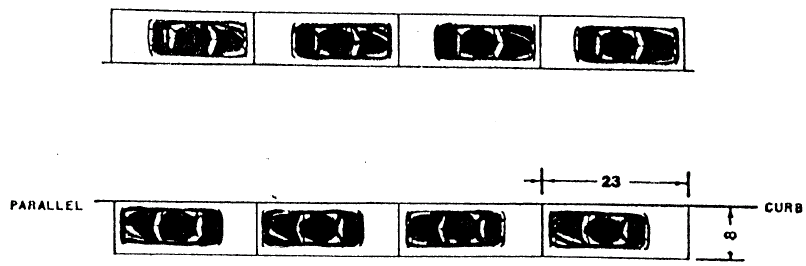
Parallel: [5]
Aisle width: Twelve (12) feet.
Stall width: Eight (8) feet by twenty-three (23) feet.
Parallel parking dimension: Eight (8) feet.

2.
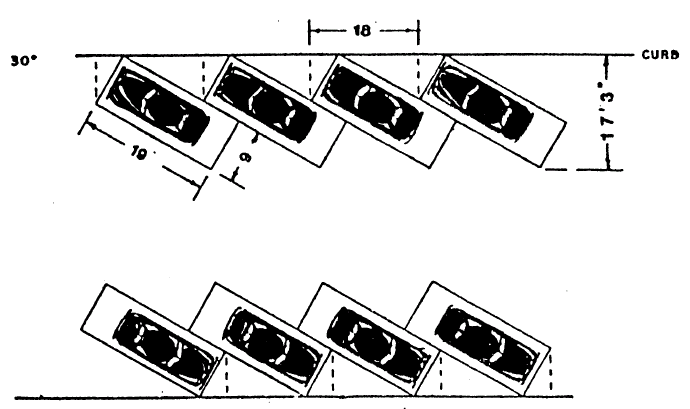
Thirty-degree angle: [6]
Aisle width: Twelve (12) feet.
Stall width: Nine (9) feet by nineteen (19) feet.
Angular parking dimension: Seventeen (17) feet, three (3) inches.
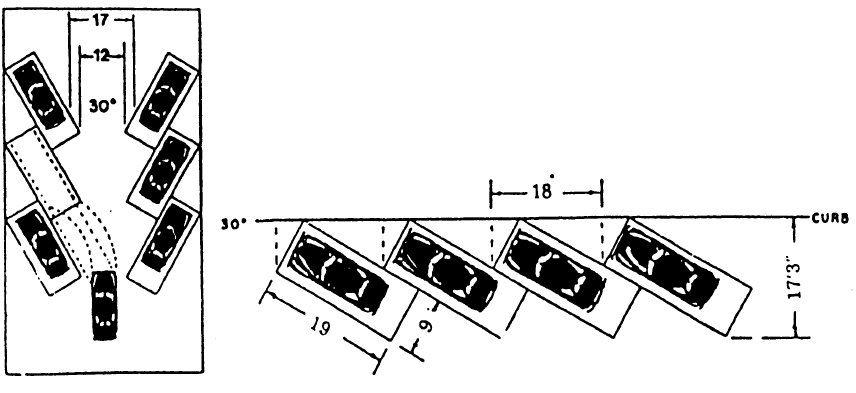
3.
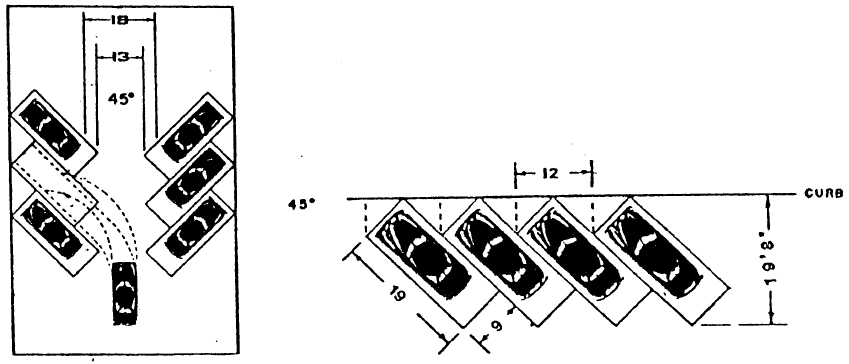
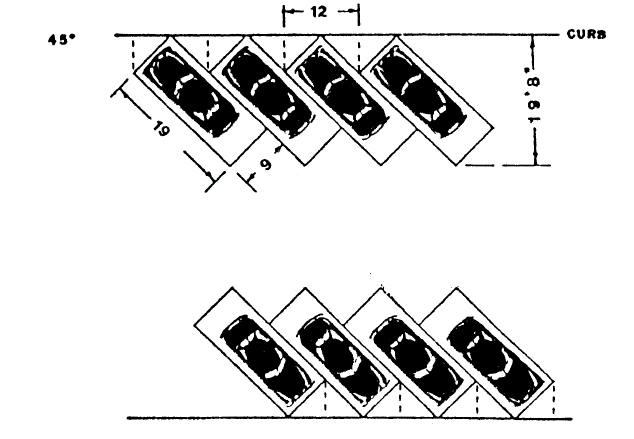
Forty-five-degree angle: [7]
Aisle width: Thirteen (13) feet.
Stall width: Nine (9) feet by nineteen (19) feet.
Angular parking dimension: Nineteen (19) feet, eight (8) inches.
4.
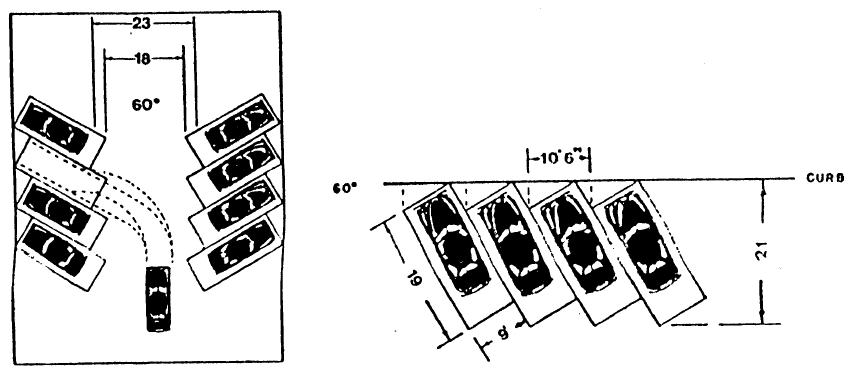
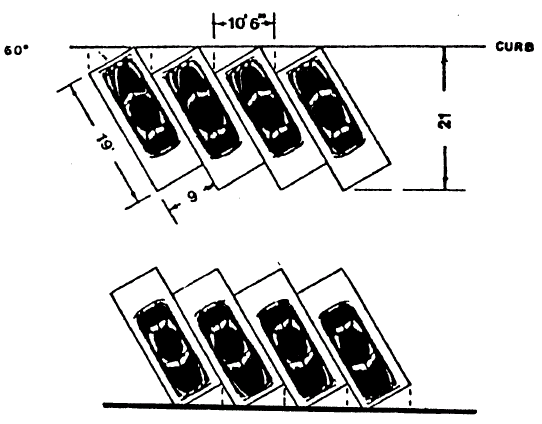
Sixty-degree angle:*
Aisle width: Eighteen (18) feet.
Stall width: Nine (9) feet by nineteen (19) feet.
Angular parking dimension: Twenty-one (21) feet.
5.
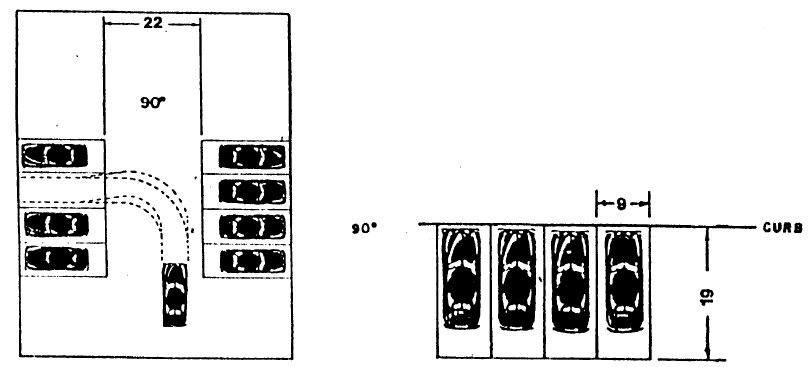
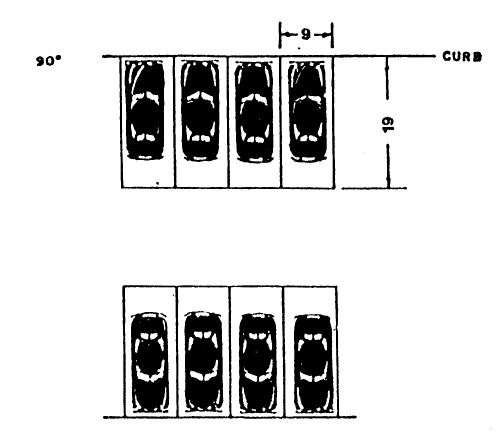
Ninety-degree angle: [8]
Aisle width: Twenty-two (22) feet.
Stall width: Nine (9) feet by nineteen (19) feet.
Angular parking dimension: Nineteen (19) feet.
(b)
Two-way traffic flow:
1.
Parallel:*
Aisle width: Twenty-two (22) feet.
Stall width: Eight (8) feet by twenty-three (23) feet.
Parallel parking dimension: Eight (8) feet.
2.
Thirty-degree angle: [9]
Aisle width: Twenty-two (22) feet.
Stall width: Nine (9) feet by nineteen (19) feet.
Angular parking dimension (two (2) spaces): Thirty-four (34) feet, six (6) inches.
3.
Forty-five-degree angle:*
Aisle width: Twenty-two (22) feet.
Stall width: Nine (9) feet by nineteen (19) feet.
Angular parking dimension (two (2) spaces): Thirty-nine (39) feet, four (4) inches.
4.
Sixty-degree angle: [10]
Aisle width: Twenty-two (22) feet.
Stall width: Nine (9) feet by nineteen (19) feet.
Angular parking dimension (two (2) spaces): Forty-two (42) feet.
5.
Ninety-degree angle:*
Aisle width: Twenty-two (22) feet.
Stall width: Nine (9) feet by nineteen (19) feet.
Angular parking dimension (two (2) spaces): Thirty-eight (38) feet.
(2)
Compact automobile parking space and aisle dimensions:
(a)
One-way traffic flow:
1.
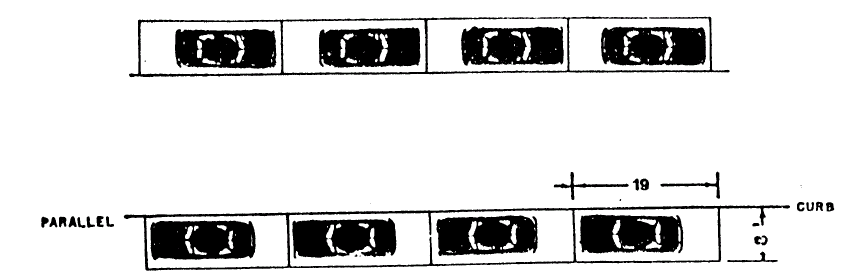
Parallel: [11]
Aisle width: Twelve (12) feet.
Stall width: Eight (8) feet by nineteen (19) feet.
Parallel parking dimension: Eight (8) feet.

2.
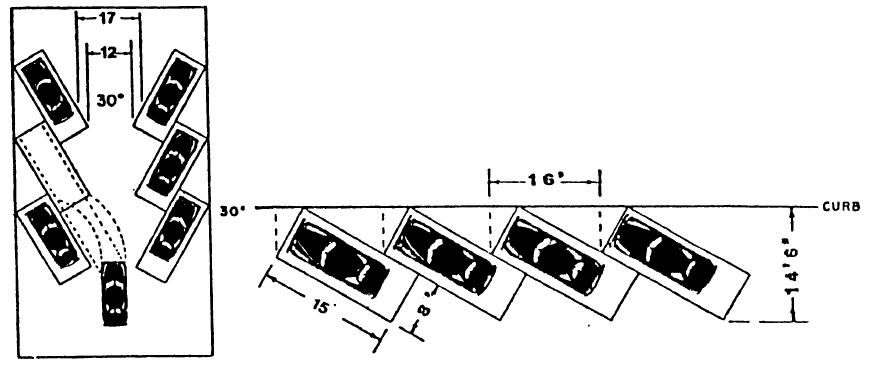
Thirty-degree angle:*
Aisle width: Twelve (12) feet.
Stall width: Eight (8) feet by fifteen (15) feet.
Angular parking dimension: Fourteen (14) feet, six (6) inches.
3.
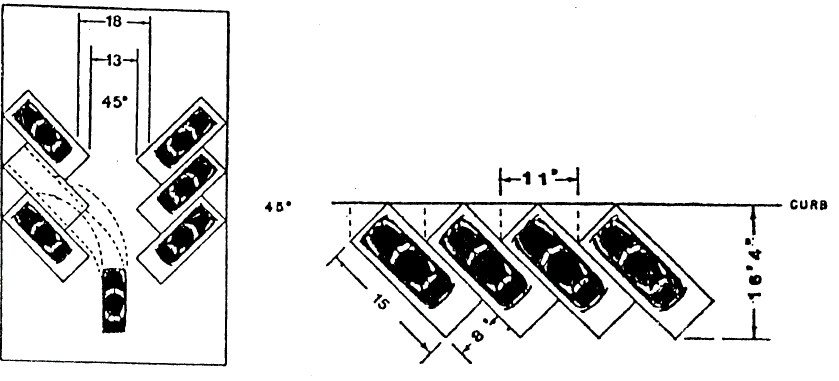
Forty-five-degree angle: [12]
Aisle width: Thirteen (13) feet.
Stall width: Eight (8) feet by fifteen (15) feet.
Angular parking dimension: Sixteen (16) feet, four (4) inches.
4.
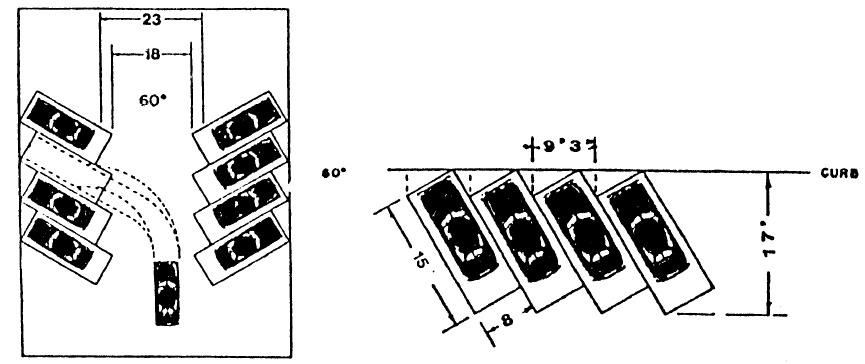
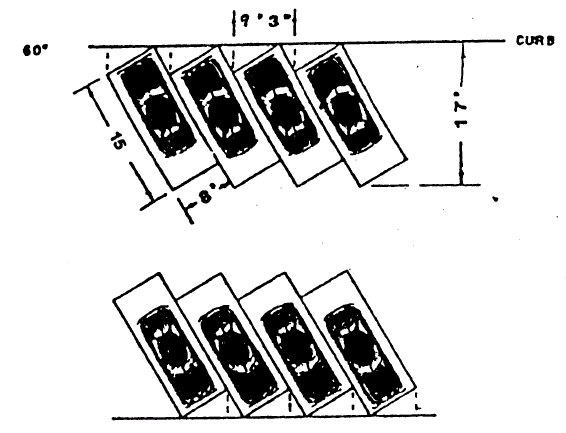
Sixty-degree angle:*
Aisle width: Eighteen (18) feet.
Stall width: Eight (8) feet by fifteen (15) feet.
Angular parking dimension: Seventeen (17) feet.
5.
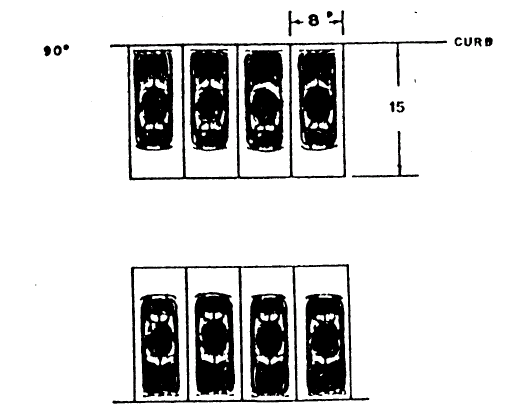
Ninety-degree angle: [13]
Aisle width: Twenty-two (22) feet.
Stall width: Eight (8) feet by fifteen (15) feet.
Angular parking dimension: Fifteen (15) feet.
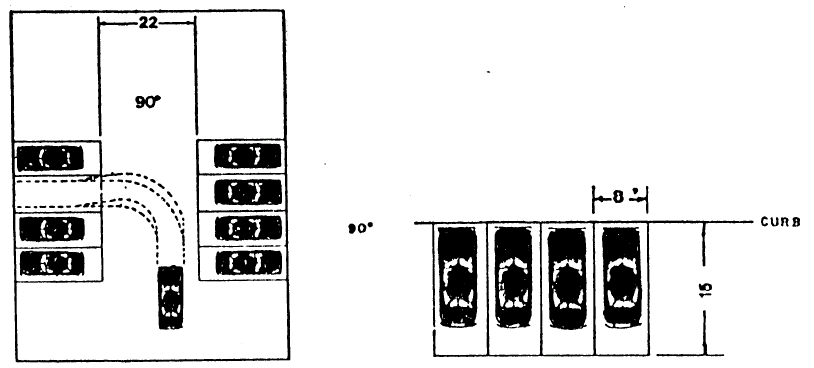
(b)
Two-way traffic flow:
1.
Parallel:*
Aisle width: Twenty-two (22) feet.
Stall width: Eight (8) feet by nineteen (19) feet.
Parallel parking dimension: Eight (8) feet.
2.
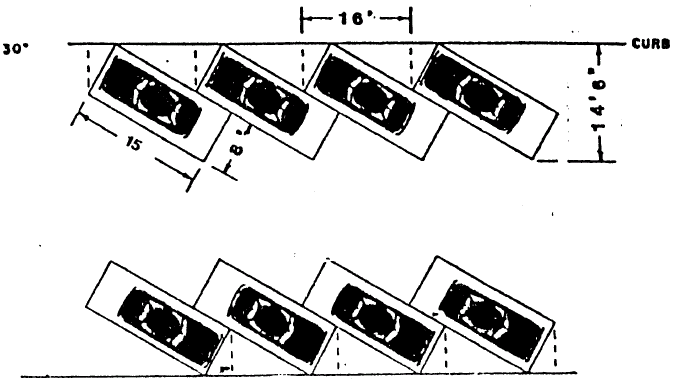
Thirty-degree angle: [14]
Aisle width: Twenty-two (22) feet.
Stall width: Eight (8) feet by fifteen (15) feet.
Angular parking dimension (two (2) spaces): Twenty-nine (29) feet.
3.
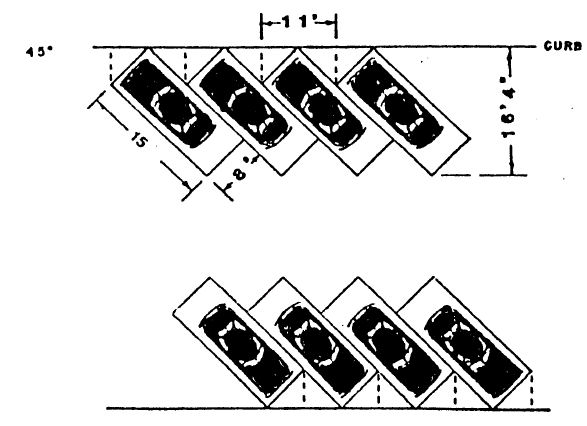
Forty-five-degree angle:*
Aisle width: Twenty-two (22) feet.
Stall width: Eight (8) feet by fifteen (15) feet.
Angular parking dimension (two (2) spaces): Thirty-two (32) feet, eight (8) inches.
4.
Sixty-degree angle: [15]
Aisle width: Twenty-two (22) feet.
Stall width: Eight (8) feet by fifteen (15) feet.
Angular parking dimension (two (2) spaces): Thirty-four (34) feet.
5.
Ninety-degree angle:*
Aisle width: Twenty-two (22) feet.
Stall width: Eight (8) feet by fifteen (15) feet.
Angular parking dimension (two (2) spaces): Thirty (30) feet.
(3)
Handicapped parking space and aisle dimensions:
(a)
Dimensions:
Illustration
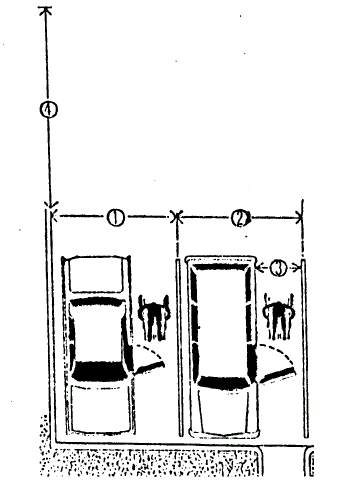
1.
Stall widths: Thirteen (13) feet wide, or
2.
Nine (9) feet adjacent to a
3.
Four-foot on-site walkway.
4.
Aisle width: Twenty-two (22) feet.
(b)
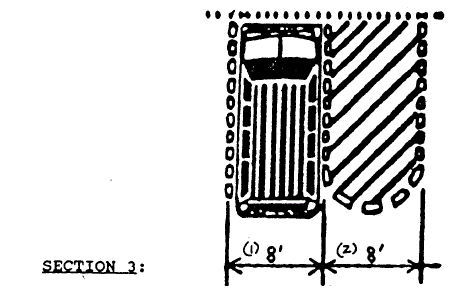
Van accessible space
Illustration
1.
Stall width: Eight (8) feet wide
2.
Access aisle width: Eight (8) feet
(4)
Paving surface:
(a)
The paving surface on all on-site and off-site parking lot(s), except where otherwise stated in article IV of this ordinance, shall be dust free, all weather material, (i.e., concrete, asphalt). The paving surface shall have the necessary striping delineating the parking stalls and handicapped requirements.
(b)
Single-use parking lots within one thousand (1,000) feet of the public beach intended to provide parking (regardless of whether for a fee or not) for beach visitors shall not be required to be improved with concrete, asphalt or landscaping; however, the following shall apply:
1.
The site must be located entirely within a zoning district that allows commercial parking lots as a principal use, i.e. R-4, BC, HC and RC.
2.
The site must be surfaced with a material or combination of materials that effectively controls dust, as approved by the city engineer, and the dimensional requirements for stalls and aisles shall remain in effect.
3.
Such lots shall be entirely located within one thousand (1,000) linear feet of the public beach.
4.
Stalls shall be delineated in a manner approved by the city engineer.
5.
The zoning administrator shall require supplemental landscaping or buffering in cases where it is determined that headlight spillage may negatively impact adjoining residential properties.
6.
A small pay booth (eighty (80) square feet in floor area or less) may be permitted, provided the construction and anchoring is approved by the chief building official.
7.
Any person tending the lot for security and/or fee collection shall have proven access to a restroom within five hundred (500) feet of the property. Any newly provided freestanding restroom shall be connected to the public sewer and water system.
(c)
One (1) single-family structure with five (5) or fewer bedrooms on one (1) lot is excluded. Single-family structures with six (6) or more bedrooms and where more than one (1) single-family structure of any size is sharing a driveway with one (1) or more single-family structures, the parking lot will be required to be paved per the standards of this article.
A site-specific development plan adhering to the latest departmental policy statement shall be submitted for review and approval by the city's Technical Review Committee prior to approving the use.
(d)
Parking lots intended as a commercial, principal use of land shall meet all the improvement standards herein. However, parking lots intended as non-commercial surplus or overflow parking solely for another use shall not be required to be improved with concrete, asphalt or landscaping; however, to qualify for the exemption, the parking stalls must be located on a parcel of land that is separate from the principal use it supports, and shall not contain stalls otherwise required to satisfy the minimum parking requirement of that use. Additionally, the following shall apply:
1.
The site must be located entirely within a zoning district that allows parking lots as a principal use, i.e. R-4, BC, HC or RC.
2.
The site must be surfaced with a material or combination of materials that effectively controls dust, as approved by the city engineer, and the dimensional requirements for stalls and aisles shall remain in effect.
3.
At a minimum, stalls shall be delineated by anchoring approved wheel stops, or equivalent, into the ground. Anchored landscape timbers may be used to further delineate stalls if desired.
4.
The zoning administrator shall require supplemental landscaping or buffering in cases where it is determined that headlight spillage may negatively impact adjoining residential properties.
5.
The stalls shall not cause the principal use they support to exceed the maximum parking allowances set forth in this ordinance.
6.
All driveway aprons within the public right-of-way and extending forty (40) feet into the parking lot drive aisle shall be improved with concrete or asphalt according to the standards of the Public Works Department.
7.
Analysis of storm drainage runoff from parking lot sites shall be submitted to the city for review and approval. Parking lot grading shall not adversely impact drainage on adjacent properties.
A site-specific development plan adhering to the latest departmental policy statement shall be submitted for review and approval by the city's technical review committee prior to approving the use.
(5)
Wheelstop dimensions:
(a)
Each parking space (with exception of parallel parking and single-use parking lots within one thousand (1,000) feet of the public beach) which is adjacent to a neighboring property line or public right-of-way must have wheelstops. This includes front, rear and side locations. The wheelstops should be made of all-weather material (i.e., concrete) and should be permanently attached to the parking surface.
(b)
All handicapped parking spaces shall have wheelstops.
(c)
Dimensions: Wheelstop(s) shall be located thirty (30) inches on center from the line of the parking space. The stop shall be at least four (4) inches in height and have the capability of stopping both tires of a vehicle.
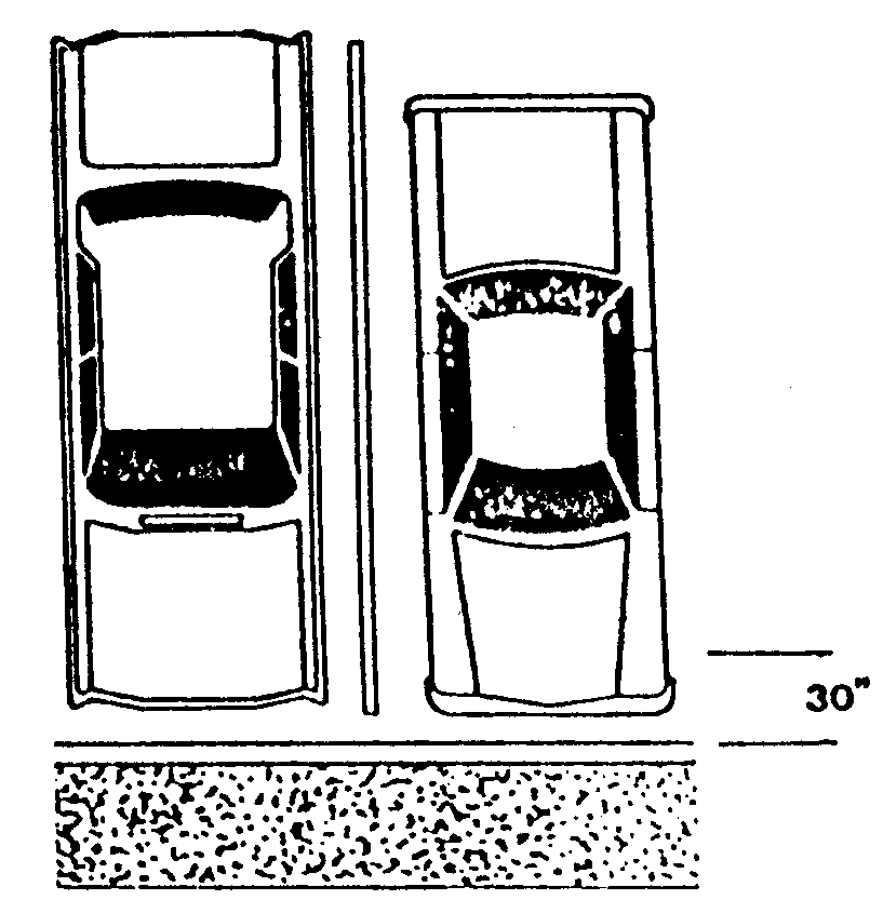
Wheelstop Dimensions
(6)
Entrance and exit curbcuts:
(a)
Dimensions:
Illustration
1.
Fifteen (15) feet minimum.
2.
Radius fifteen (15) feet minimum.
3.
Aisle dimension as required by parking space dimension.
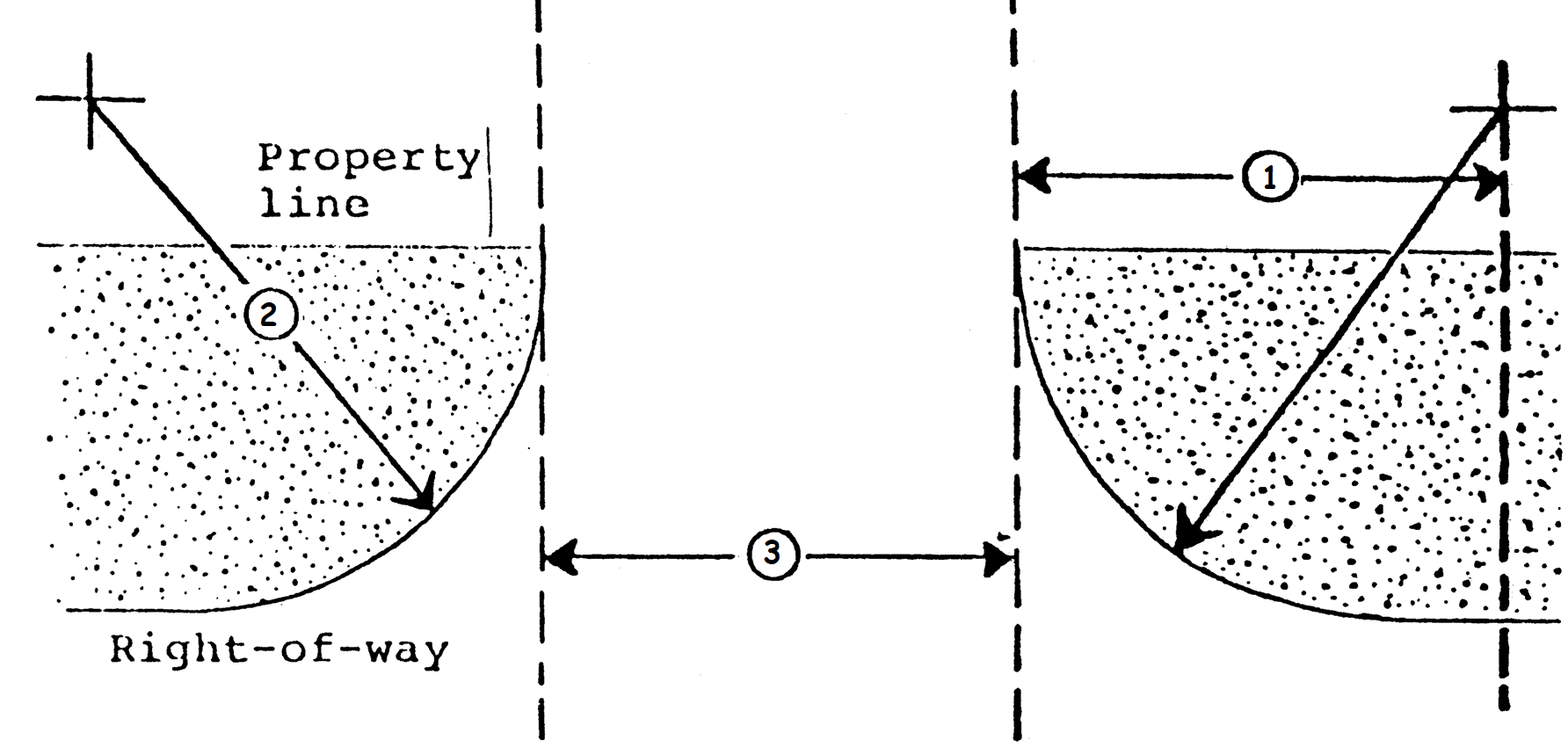
Entrance and Exit Curbcut Dimensions
(7)
Handicapped curbramps:
(a)
Dimensions:
Illustration
1.
Ramp width: Forty-eight (48) inches minimum.
2.
Ramp length: Seventy-two (72) inches for a six-inch curb rise.
3.
Flared side: Eighteen-inch minimum.
4.
Slope: One (1) inch in twelve (12) inches maximum.
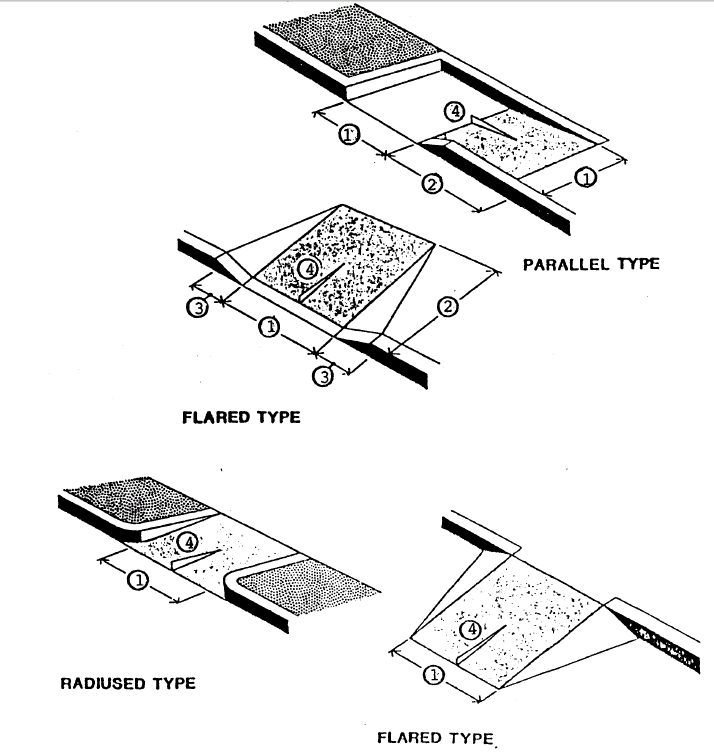
(b)
Detectable warnings shall consist of raised truncated domes with a diameter of nominal 0.9 in. (23 mm), a height of nominal 0.2 in. (5 mm) and a center-to-center spacing nominal 2.35 in. (60 mm) and shall contrast visually with adjoining surfaces, either light-on-dark, or dark-on-light.
Dimensions
1.
0.9 inch
2.
0.2 inch
3.
2.35 inches
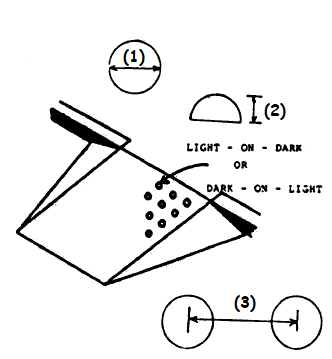
(8)
Handicapped curbramp signage:
(a)
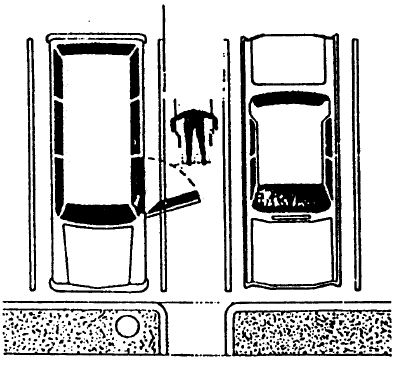
Sign dimension: Same as the handicapped parking signage with the addition of the word "ACCESS" printed below in three-inch lettering including a directional arrow.
(b)
Color: Same as the handicapped parking sign.
(c)
Location: Handicapped access sign shall be located between six (6) to twelve (12) inches from either the curb or flared edge. Refer to illustration. In areas where a handicapped parking sign is adjacent to the point of handicapped entrance and exit to a building or structure, the handicapped "ACCESS" signage may be placed on the same post.
(9)
Accessible parking signage:
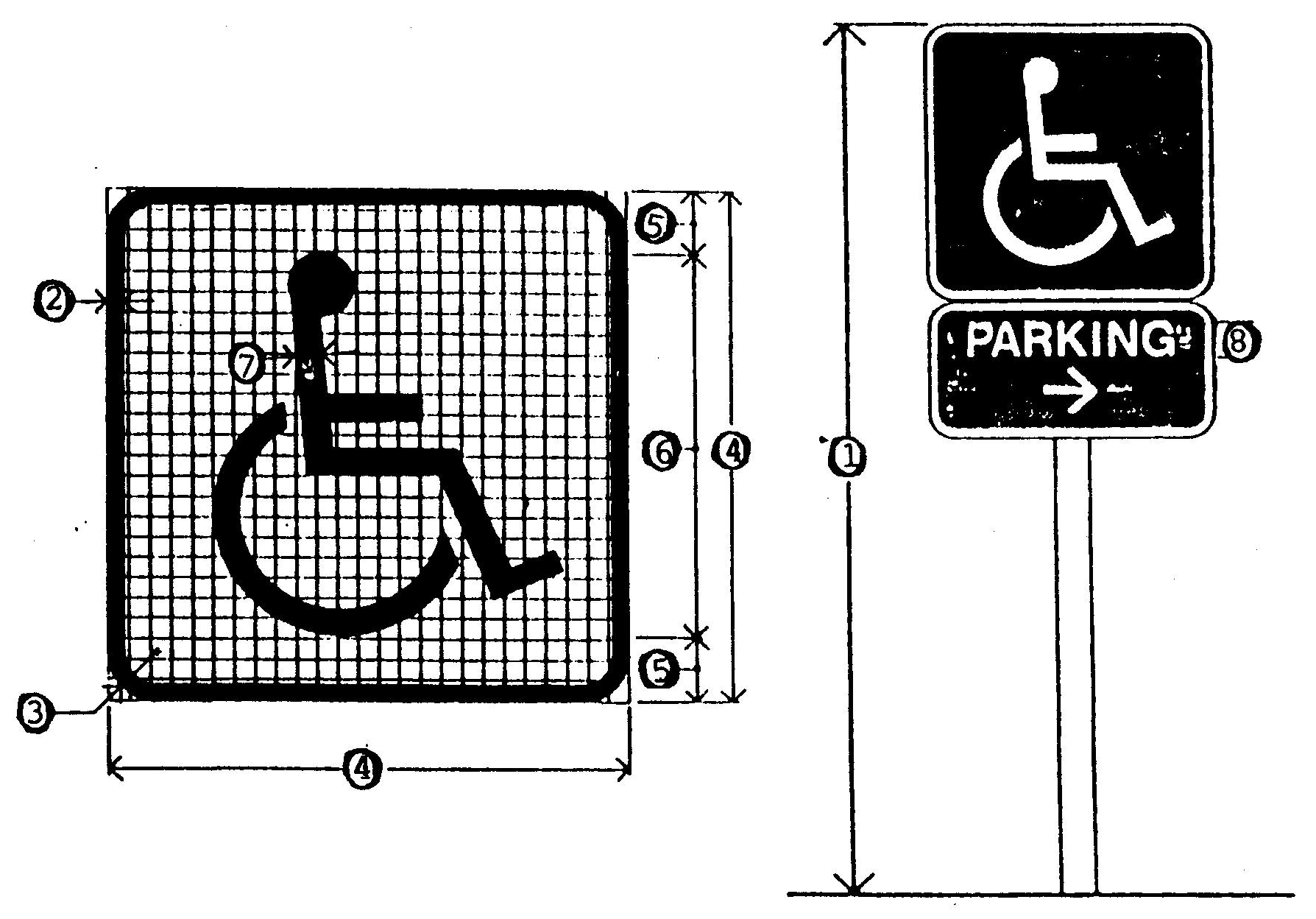
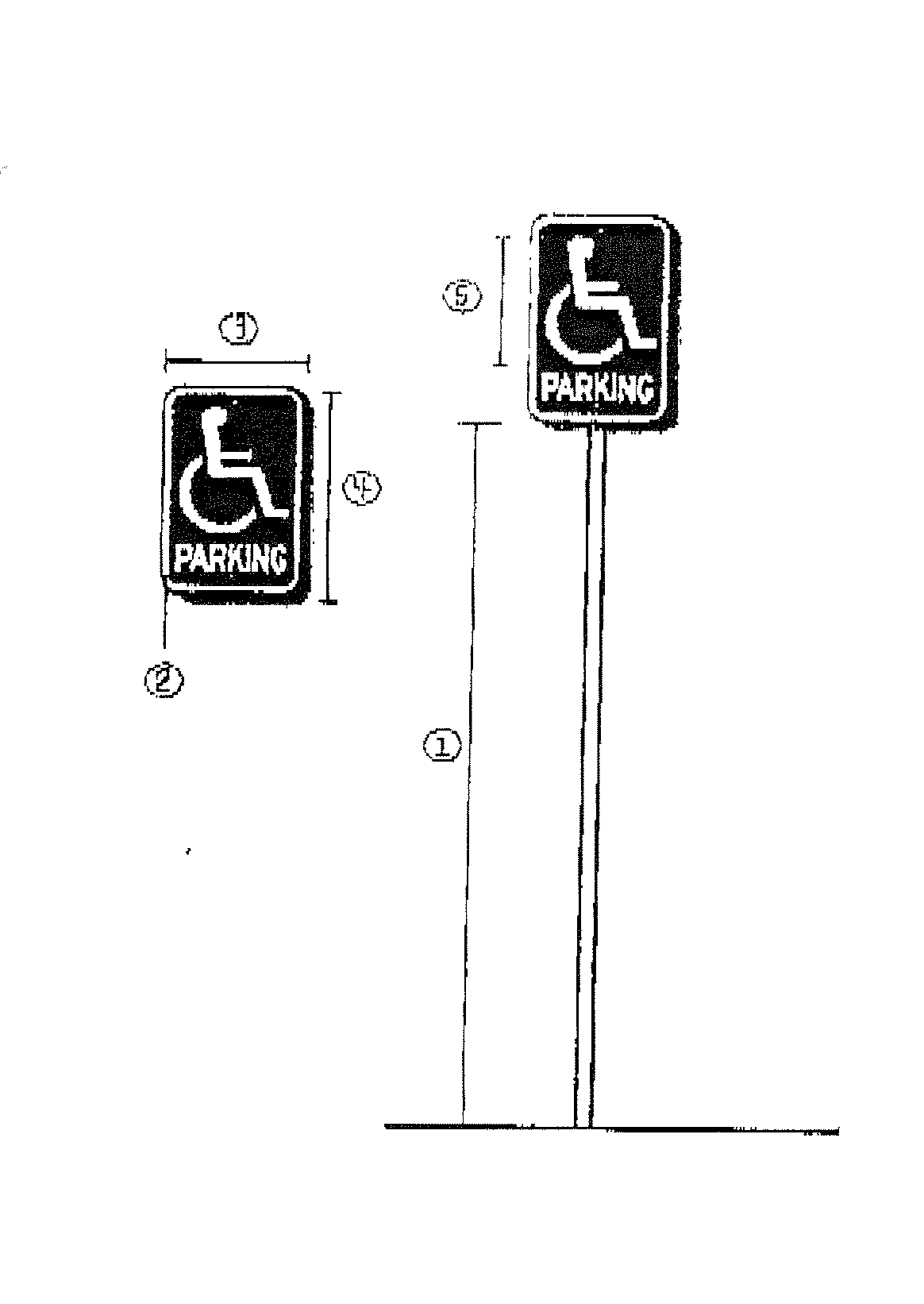
(a)
Sign dimensions:
Illustration example (refer to the ICC/ANSI A117.1 1998 Version, Section 502.6)
1.
5'0"
2.
¼"
3.
12"
4.
18"
5.
6"
(b)
Color: White (reflective) on blue background, or without border, blue on white background.
(c)
Location: Accessible parking signs shall be located four (4) feet on center from the wheelstop. Accessible parking signs shall be located vertically in such a manner as not to be obscured by a vehicle parked in the space.
(10)
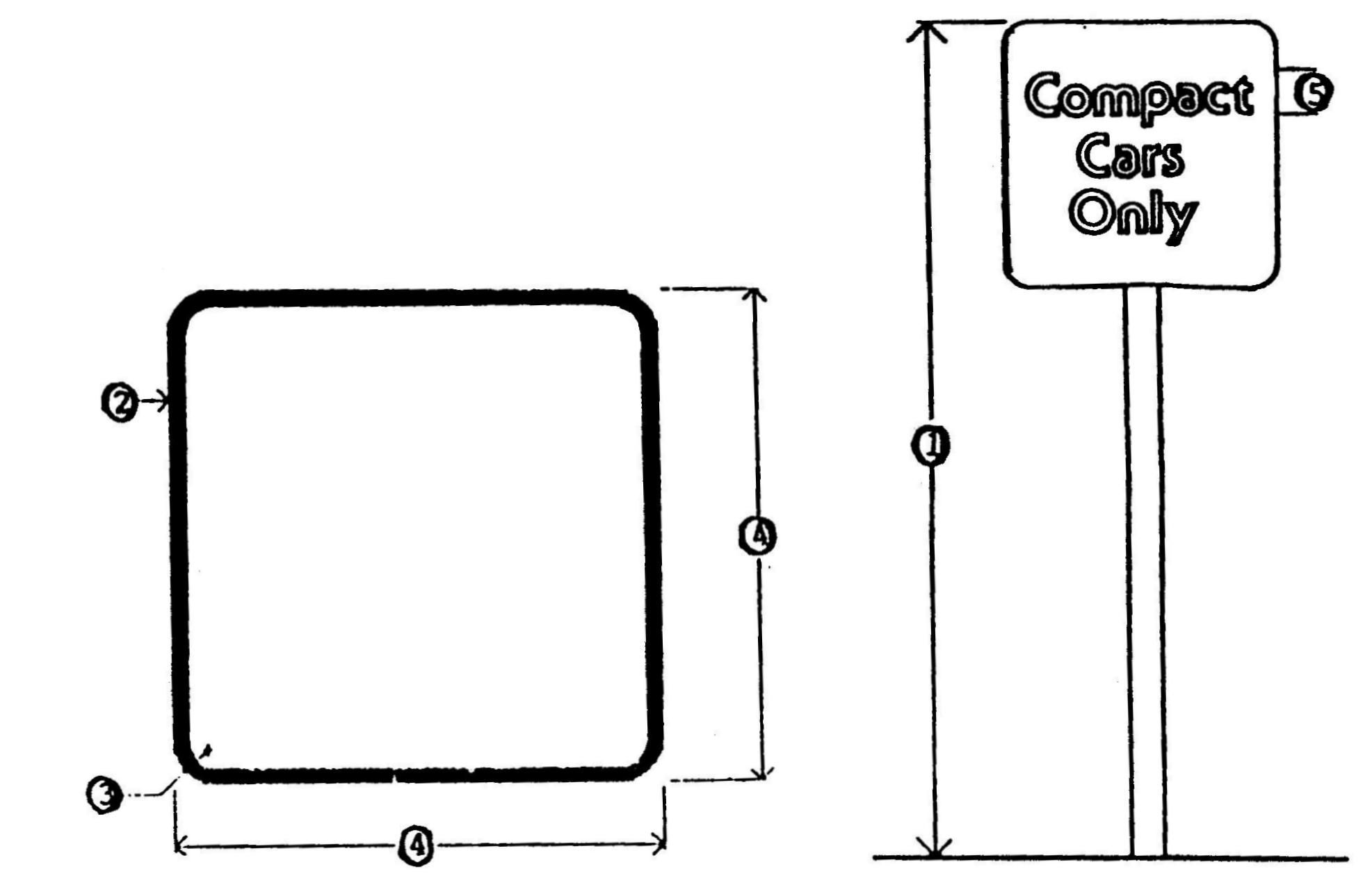
Compact automobile parking signage:
(a)
Sign dimensions:
Illustration
1.
4′0″
2.
¼″
3.
¾″
4.
8″
5.
2″ centered
(b)
Color: White (reflective) on brown background.
(c)
Location: Compact automobile signs shall be located at the lefthand corner of the first space and righthand corner of the last space. Each sign shall read "Compact Cars Only," with a directional arrow delineating the space(s).
(11)
One-way/two-way traffic flow dimensions and signage:
(a)
All parking areas which require one-way or two-way traffic flow as a means of circulation of which no vehicles enter or exit a parking stall shall be the following dimensions:
One-way traffic: Minimum width of twelve (12) feet.
Two-way traffic: Minimum width of twenty-two (22) feet.
Two-way traffic when serving twelve (12) or fewer spaces located behind the front building line minimum width of ten (10) feet.
(b)
In the event one-way traffic flow is utilized, one (1) sign delineating "One Way" at the point of entrance and one (1) sign delineating "Do Not Enter" at the point of exit shall be erected. These signs shall be placed in areas which do not obstruct pedestrian or vehicular flow, and are in compliance with the existing zoning ordinances. However, all the above-mentioned signs shall be visible to all individuals.
(12)
Parking area lighting:
(a)
Lighting of parking areas shall be provided and shall be of a type and placement so as not to pose visual disturbance to adjacent property owners.
(Ord. No. 88-35, 11-1-88; Ord. No. 03-04, § 1, 2-3-03; Ord. No. 07-09, § 4, 2-19-07; Ord. No. 09-17, § 3, 3-2-09; Ord. No. 09-21, § 4, 6-1-09; Ord. No. 13-21, § 1, 8-5-13; Ord. No. 16-08, § 1, 4-4-16; Ord. No. 16-18, §§ 1, 2, 6-6-16)
Note— Whenever two (2) types of parking are provided on either side of driveway aisle, the largest aisle width shall govern.
--- (6) ---
Note— Whenever two (2) types of parking are provided on either side of driveway aisle, the largest aisle width shall govern.
--- (7) ---
Note— Whenever two (2) types of parking are provided on either side of driveway aisle, the largest aisle width shall govern.
--- (8) ---
Note— Whenever two (2) types of parking are provided on either side of a driveway aisle, the largest aisle width shall govern.
--- (9) ---
Note— Whenever two (2) types of parking are provided on either side of a driveway aisle, the largest aisle width shall govern.
--- (10) ---
Note— Whenever two (2) types of parking are provided on either side of a driveway aisle, the largest aisle width shall govern.
--- (11) ---
Note— Whenever two (2) types of parking are provided on either side of a driveway aisle, the largest aisle width shall govern.
--- (12) ---
Note— Whenever two (2) types of parking are provided on either side of a driveway aisle, the largest aisle width shall govern.
--- (13) ---
Note— Whenever two (2) types of parking are provided on either side of a driveway aisle, the largest aisle width shall govern.
--- (14) ---
Note— Whenever two (2) types of parking are provided on either side of a driveway aisle, the largest aisle width shall govern.
--- (15) ---
Note— Whenever two (2) types of parking are provided on either side of a driveway aisle, the largest aisle width shall govern.
Sec. 23-43. - Off-street parking requirements per land use.
(1)
No use shall be established or enlarged, or changed, except in conformance with the parking requirements of this section.
(2)
Additional parking stalls exceeding the minimum number required herein shall be constructed as pervious parking, using pavers, porous asphalt or porous concrete, or any other technique approved by the zoning administrator and city engineer. However, driveways and circulation aisles shall be constructed with hard surface impervious materials, unless the city engineer approves an alternate design.
(3)
Up to three (3) parking stalls may be waived by the zoning administrator for each approved driveway connection, or stub-out for future driveway connection between adjoining parking lots provided on the site.
(4)
Table of parking requirements:
1 The minimum number of parking spaces required for a use not specifically mentioned in this section shall be as required for the most similar use listed herein as determined by the zoning administrator.
2 Shared parking may be used on a voluntary basis in lieu of the land use/parking requirements chart according to the section 23-44, shared parking regulations.
(Ord. No. 88-35, 11-1-88; Ord. No. 89-44, § 1, 9-5-89; Ord. No. 90-32, § 1, 8-28-90; Ord. No. 92-46, § 1, 10-5-92; Ord. No. 92-50, § 1, 10-19-92; Ord. No. 92-51, § 1, 10-19-92; Ord. No. 94-04, § 1, 2-21-94; Ord. No. 95-12, § 1, 3-20-95; Ord. No. 96-23, § 3, 6-3-96; Ord. No. 96-32, § 1, 8-19-96; Ord. No. 01-12, § 3, 2-19-01; Ord. No. 01-51, § 4, 11-19-01; Ord. No. 03-04, § 2, 2-3-03; Ord. No. 03-13, § 5, 4-21-03; Ord. No. 04-40, § 1, 9-20-04; Ord. No. 09-02, § 1, 1-5-09; Ord. No. 09-17, § 4, 3-2-09; Ord. No. 09-21, § 5, 6-1-09; Ord. No. 09-38, § 1, 11-2-09; Ord. No. 10-16, § 1, 10-4-10; Ord. No. 12-13, § 2, 7-2-12; Ord. No. 16-18, § 3, 6-6-16; Ord. No. 25-17, § 1, 4-7-25)
Sec. 23-44. - Shared parking.
(1)
Purpose:
(a)
The purposes of the ordinance are to:
1.
Allow a reduction in the total number of parking spaces required for certain properties in cases where a mix of land uses on the same parcel of land have varying peak periods of parking demand;
2.
Reduce the overall amount of impervious surfaces, specifically the amount of land devoted to surface parking;
3.
Stimulate economic development to encourage mixed-use;
4.
Encourage flexibility and adaptive use or reuse of parcels;
5.
Support the North Myrtle Beach Comprehensive Plan, which calls for:
i.
Reducing the amount of impervious surface in floodprone areas; reduce trip generation through land use controls such as zoning for lower density and mixed-use zoning that reduces trip generation; and enhance the use of alternative travel modes, including transit, pedestrian and bicycle.
(2)
Applicability:
(a)
Shared parking may be approved on parcels containing more than one (1) land use, provided at least one (1) or more of the uses generates different peak parking demands from the other uses. Shared parking arrangements are voluntary, and approved by obtaining a shared parking permit from the city. They may be approved in any commercial zoning district where off-street parking is required.
(3)
General provisions:
(a)
Shared parking is permitted between different categories of uses in conformance with the classification system described in Table 1 below.
(b)
Share parking permits shall apply to sites whose parking is provided on the same parcel of land as the uses described in the application.
(4)
Calculation:
(a)
Where shared parking arrangements are proposed, a table of peak parking demand and associated formula shall be used to determine the number of parking spaces to be provided.
i.
Each use shall be categorized by weekday and evening/weekend peak periods according to Table 1 below. Where proposed land uses do not fit neatly into the categories described, the zoning administrator shall make a determination as to which category the use most closely resembles in terms of parking demand:
Table 1
Peak Parking Demand
Source: The Victoria Transport Policy Institute.
The formula for determining the amount of parking spaces required in a shared parking arrangement shall be computed as follows:
1.
Calculate the normal parking requirement for all uses in the weekday peak category of land uses. Do the same for all uses in the evening/weekend peak category.
2.
The larger of the two (2) categorical sums shall be considered the "base" parking requirement for the site.
3.
Add twenty-five (25) percent of the smaller of the two (2) categorical sums to the base parking requirement. The total represents the number of required parking spaces for the shared parking arrangement.
Example: Consider a forty-five thousand (45,000) square foot building; consisting of twenty thousand (20,000) square feet of office, fifteen thousand (15,000) square feet of retail and ten thousand (10,000) square feet of restaurant space.
The normal parking requirement for this configuration would be:
Office: One (1) space per three hundred (300) square feet = Sixty-seven (67) stalls
Retail: One (1) space per three hundred (300) square feet = Sixty-seven (67) stalls
Restaurant: One (1) space per one hundred (100) square feet = One hundred (100) stalls
Total requirement is two hundred thirty-four (234) stalls
Under the shared parking allowance:
Weekday peak uses—Office: Sixty-seven (67) stalls normally required.
Evening/weekend peak uses—Retail and restaurant: One hundred sixty-seven (167) stalls normally required.
The higher of the two (2) categories is retail and restaurant (one hundred sixty-seven (167) stalls). This becomes the base parking requirement (BPR).
Add twenty-five (25) percent of the smaller parking requirement to the base, as follows:
Sixty-seven (67) stalls × 0.25 = Seventeen (17) stalls. Add seventeen (17) to the BPR to get a total shared parking requirement of one hundred eighty-four (184) stalls. This represents a fifty (50) stall reduction from the normal parking requirement.
(5)
Shared parking permit:
(a)
The zoning administrator shall require an applicant interested in shared parking to apply for a shared parking permit. The permit shall include the following:
i.
Name of applicant;
ii.
Date of application;
iii.
Square footages and categories of uses (if known) for all individual uses located or proposed to be located on the subject property;
iv.
Number of parking stalls normally required according to the North Myrtle Beach Zoning Ordinance, Article IV, Off-Street Parking and Loading.
(b)
As part of the permit application process, a shared parking plan shall also be submitted. A shared parking plan must be drawn at the same scale as the site plan and shall include the following:
i.
A site plan showing the total square feet of weekday peak, and evening/weekend peak uses, as per the categories described in Table 1 above.
ii.
Areas on-site where additional parking may be created in the event of changes in uses that may alter the total shared parking requirement. These areas of extra parking shall be noted and illustrated on the plan, but do not have to be installed until such time as extra parking may be determined to be necessary to accommodate changes in use categories on the site. Such areas should be left as pervious open space in the meantime.
iii.
In the event that insufficient space is available on the site to be reserved for future parking, the zoning administrator shall deny changes of use on the parcel that would have the effect of increasing the number of stalls required to satisfy the proposed new mix of uses, if providing such additional parking is unfeasible. The applicant for a shared parking permit assumes all risk that future land use changes may be disapproved due to insufficient parking.
(c)
The shared parking plan and a copy of the signed permit shall be recorded at the Horry County Register of Deeds within fifteen (15) days of the zoning administrator's approval. The applicant shall provide the zoning administrator with written documentation (receipts, stamped copies, etc.) proving that the shared parking permit and plan were recorded. Such material shall be submitted within ten (10) days of recording. Failure to provide this documentation shall render the permit null and void.
(Ord. No. 09-02, § 2, 1-5-09)

