
North Myrtle Beach City Zoning Code
ARTICLE I
- IN GENERAL
Sec. 23-1.- Title and objectives.
This chapter shall be known and may be cited as the "Zoning Ordinance of the City of North Myrtle Beach, South Carolina."
As authorized in Title 6, Chapter 29 of the Code of Laws of South Carolina, the general purposes of this chapter are to guide development in accordance with existing and future needs and to promote the public health, safety, morals, convenience, order, appearance, prosperity, and general welfare of the community with reasonable consideration for the following specific purposes, where applicable:
(1)
To provide for adequate light, air, and open space;
(2)
To prevent the overcrowding of land, to avoid undue concentration of population, and to lessen congestion in the streets;
(3)
To facilitate the creation of a convenient, attractive, and harmonious community;
(4)
To protect and preserve scenic, historic, or ecologically sensitive areas;
(5)
To regulate the density and distribution of populations and the uses of buildings, structures and land for trade, industry, residence, recreation, agriculture, forestry, conservation, airports and approaches thereto, water supply, sanitation, protection against floods, public activities, and other purposes;
(6)
To facilitate the adequate provision or availability of transportation, police and fire protection, water, sewage, schools, parks, and other recreational facilities, affordable housing, disaster evacuation, and other public services and requirements specified in the ordinance;
(7)
To secure safety from fire, flood, and other dangers; and
(8)
To further the public welfare in any other specified regard.
As presented in the comprehensive plan, the city's economy is dependent on the retail and service industries supported by tourism. As such, it is a further objective of the city to encourage the future growth in tourism in an orderly fashion without compromising the character of residential areas or the natural environmental assets so important to tourist attraction.
(Ord. No. 88-35, 11-1-88; Ord. No. 95-10, §§ 3, 4, 3-20-95)
Sec. 23-2. - Definitions.
Generally. For the purpose of this chapter, certain words and terms are herein defined. Words used in the present tense shall include the future; words in the singular number include the plural number, and words in the plural number include the singular number; the word "lot" includes the word "plot"; the word "building" includes the word "structure"; the word "shall" is mandatory and not directory. Any words not herein defined shall carry their customary dictionary definition.
Accessory building: A subordinate building, the use of which is incidental to and customary in connection with the principal building or use, and which is located on the same lot with such principal building or use.
Accessory use: A subordinate use which is incidental to and customary in connection with the principal building or use and which is located on the same lot with such principal building or use.
Alley: A public or private way, at the rear or side of property, permanently reserved as a means of providing secondary or service vehicular access to abutting property, less in size than a street, and which is not designed for general vehicular traffic.
Boatyard: A facility for the construction or major repair of watercraft, including overhaul of hull, engines and other major components.
Body piercing: Any method of piercing of the human skin of one (1) person by another person with the intention of inserting any object including, but not limited to jewelry. For the purposes of this zoning ordinance, the term body piercing shall also include any process of marking or disfiguring the skin or other tissue of any person by branding or scarification but shall not include the piercing of the fatty lobe of the ear by an ear-piercing gun designed solely for the purpose, or physician-authorized surgical procedures. This definition of body piercing includes that process commonly referred to as implantation.
Building: Any structure having a roof supported by columns or walls for the shelter or enclosure of persons or property.
Building height: The highest vertical distance measured from the finished grade at ground level at the building line to the midpoint between the eve and the highest point of the roof.
For the purpose of calculating side setbacks in R-2A, R-4, HC and RC, the height of the roof section (if not devoted to living or storage space) shall not be considered in determining the height of the structure.
Building, principal: A building in which is conducted the main or principal use of the lot on which the building is located.
Caliper: The diameter of a tree measured three (3) feet above the base of the tree. The two (2) largest diameters of multiple trunk trees shall be added to obtain the caliper.
Camp, youth day or educational: A camp providing facilities for groups with nonpermanent accommodations, not to include recreational vehicles or mobile homes, used for related youth recreational or educational purposes. This can also include adult educational and training activities.
Club: Buildings and facilities owned or operated by a corporation, association, person or persons for a social, educational or recreational purpose, but not primarily for profit and not primarily to render a service which is customarily carried on as a business.
Commercial center: Two (2) or more retail stores, service establishments, professional offices, and/or mixed-use, or any other businesses serving a community or neighborhood, not necessarily owned by one (1) party nor by a single land ownership, which occupy a common and/or adjacent building(s) on premises and also utilize common parking area(s).
Commercial craft: Any boat that is used for excursions such as dinner cruises, sightseeing cruises (excluding smaller sightseeing boats with no more than forty (40) seats and a maximum authorized capacity of forty (40) passengers), overnight cruises and similar trips, commercial fishing and shrimping (excluding smaller charter fishing), industrial uses such as tug boats, tankers, barges, and military craft. Gaming/gambling boats are commercial craft, which are further defined elsewhere.
Compact automobile space: Designated parking space which allows parking for only compact automobiles. The overall dimensions of the same space are fifteen (15) feet by eight (8) feet.
Conditional use: A zoning ordinance provision that imposes conditions, special provisions, or limitations on a use that are in addition to those applicable to other uses permitted by right in the same zoning district. S.C. State Law requires that the list of conditions must be set forth in the text of the Zoning Ordinance, and then; when all are met, the "conditional use" may be permitted by the zoning administrator without review of the board of appeals.
Condominium: A condominium is an ownership arrangement, not a land use. It is individual ownership of a unit in a multi-unit structure.
Condotel: A condominium set up like a hotel in which each room is individually owned and in which some or all rooms are available to transients for rent.
Convenience store: A one-story, retail store containing less than three thousand (3,000) square feet of gross floor area that is designed and stocked to sell primarily food, beverages, and other household supplies to customers who purchase only a relatively few items. It is designed to attract and depends upon a large volume of stop-and-go traffic.
Court: An open space which may or may not have direct street access and around which is arranged a single building or group of related buildings.
Day care facilities, including:
(1)
Family day care home: A family day care home is one in which care is given in a family only during the day for one (1) but not more than seven (7) children, including the day care parents' own children.
(2)
Child care center: A child care center shall mean or include any home, center, agency or place, however styled, where children not related to the operator are received for custodial care, apart from their parents whether for compensation, reward, or otherwise, during part or all of the day or night and upon any number of successive days or nights.
Density: The number of dwelling units per acre of "developable land" within the boundaries of a residential project.
Developable land: The term developable land or land which is suitable for development is defined to mean all lands within a project's boundaries, including lands or parcels designated for support of the development; that is, all areas for lots, parking areas, drives, roads, drainage and utility easements or rights-of-way, sign easements, entrance structure easements, and lands designated for private recreation. Off-site parking, marsh and wetlands shall not be included as developable land for purposes of calculating density, except that marsh and wetlands held in fee simple may be applied to the open space requirements of this chapter.
Developments of regional significance: Retail and/or office uses in which the gross floor area of combined buildings within a development equals or exceeds seventy-five thousand (75,000) square feet.
Dwelling: A structure or portion thereof which is used exclusively for human habitation.
Dwelling, attached: A dwelling unit attached to two (2) or more dwelling units by common vertical walls.
Dwelling, boarding house: A detached residential structure similar in style to a single-family structure where lodging is provided for periods in excess of two (2) weeks, for compensation or other consideration, for three (3) or more individual boarders. This definition excludes the use of boarding houses in single-family, duplex, multifamily, and other residential uses separately defined. Houses parties, groups of golfers, shaggers, bikers, and other tourist-related groups with a commonality and prearranged purpose are not included in this definition.
Dwelling, detached: A dwelling which is not attached to any other dwelling by any means.
Dwelling, duplex: A structure on a single lot containing two (2) dwelling units, each of which is totally separated from the other by an unpierced wall extending from ground to roof or an unpierced ceiling and floor extending from exterior wall to exterior wall, except for a common stairwell exterior to both dwelling units.
Dwelling, garden apartment: A multifamily dwelling up to three (3) stories in height.
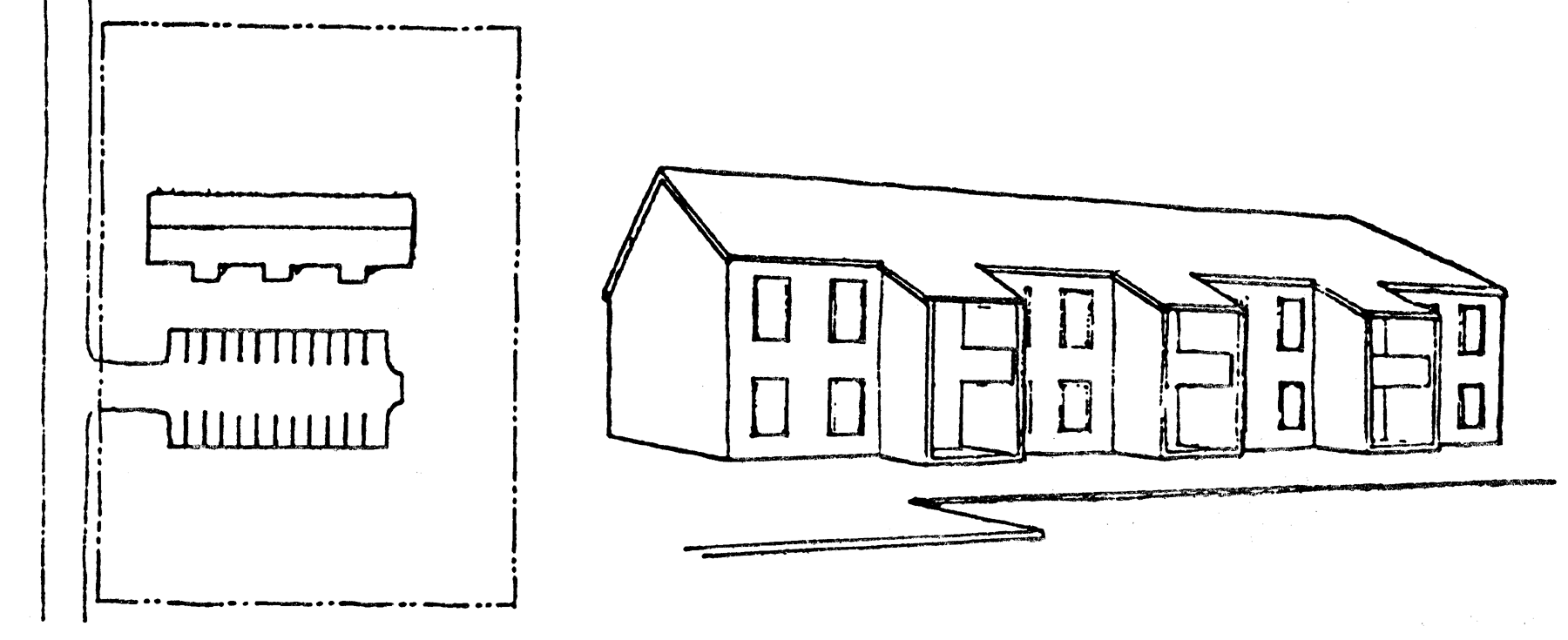
Dwelling, Garden Apartment
Dwelling, mobile/manufactured home: A structure transportable in one (1) or more sections, which in the traveling mode, is eight (8) body feet or more in width, or forty (40) body feet or more in length or when erected on site is three hundred twenty (320) or more square feet, and which is built on a permanent chassis and designed to be used as a dwelling with or without a permanent foundation when connected to the required utilities, and includes the plumbing, heating, air conditioning, and electrical systems contained therein. The term mobile/manufactured home shall not include the term modular building or structure as herein separately defined, or the term recreational vehicle or camping trailer.
Dwelling, multifamily: A structure containing more than two (2) dwelling units, not including triplexes or quadraplexes, separately defined by this chapter.
Dwelling, patio home: A single-family dwelling on a separate lot with open space setbacks usually on three (3) sides. The term is usually synonymous with zero lot line dwellings.
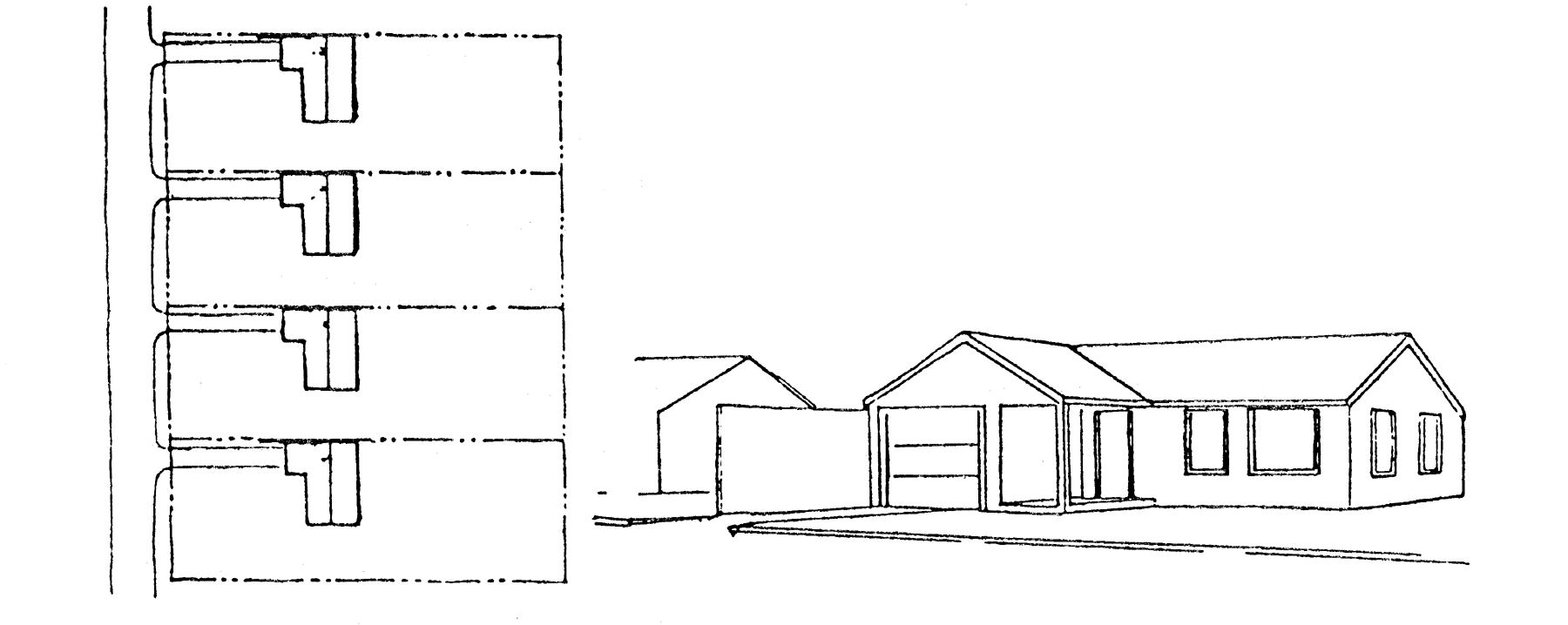
Dwelling, Patio Home
Dwelling, quadruplex: A multiplex containing four (4) attached dwellings in one (1) structure. Each unit has two (2) open space exposures and shares one (1) or two (2) walls with adjoining unit or units.
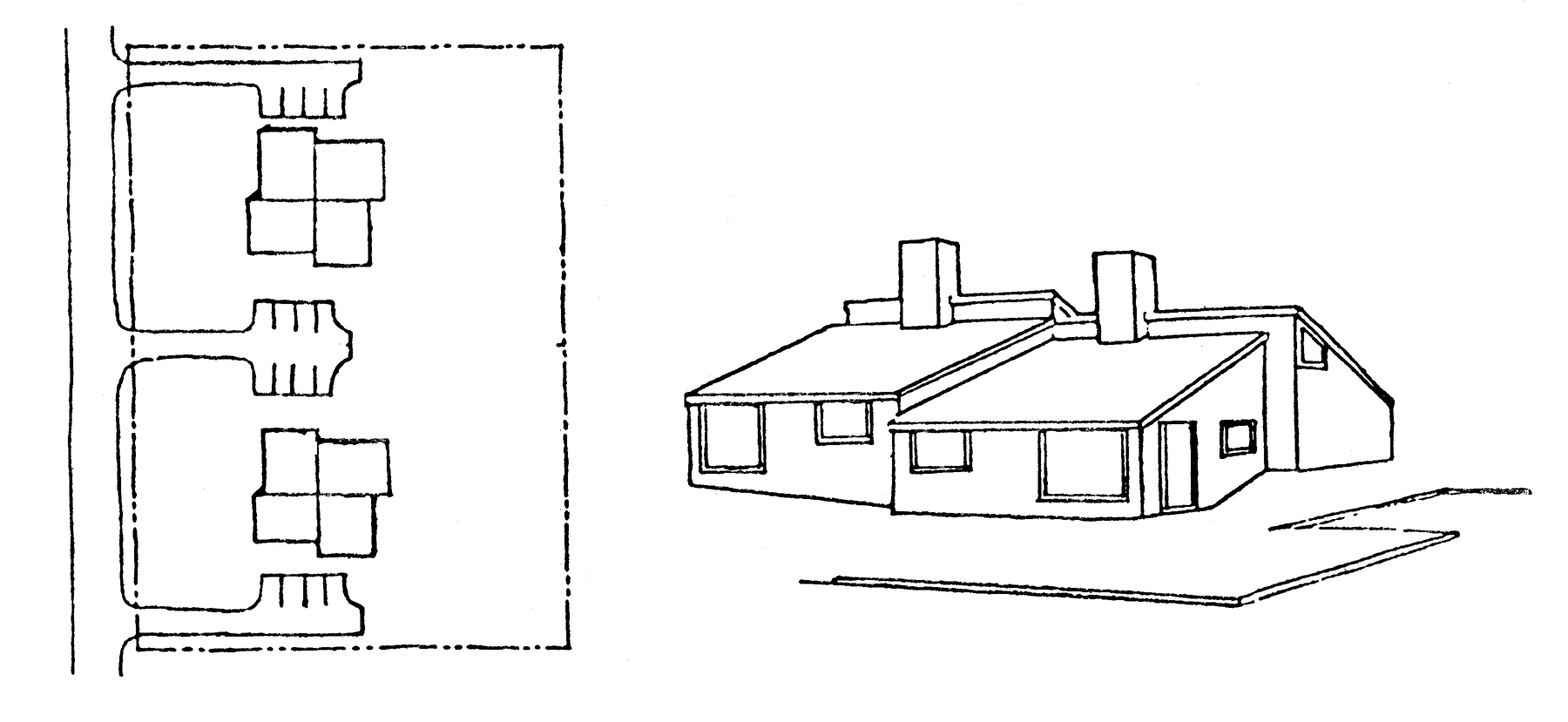
Dwelling, Quadruplex
Dwelling, semidetached: A dwelling attached to one (1) other dwelling by a common vertical wall, and each dwelling located on a separate lot.
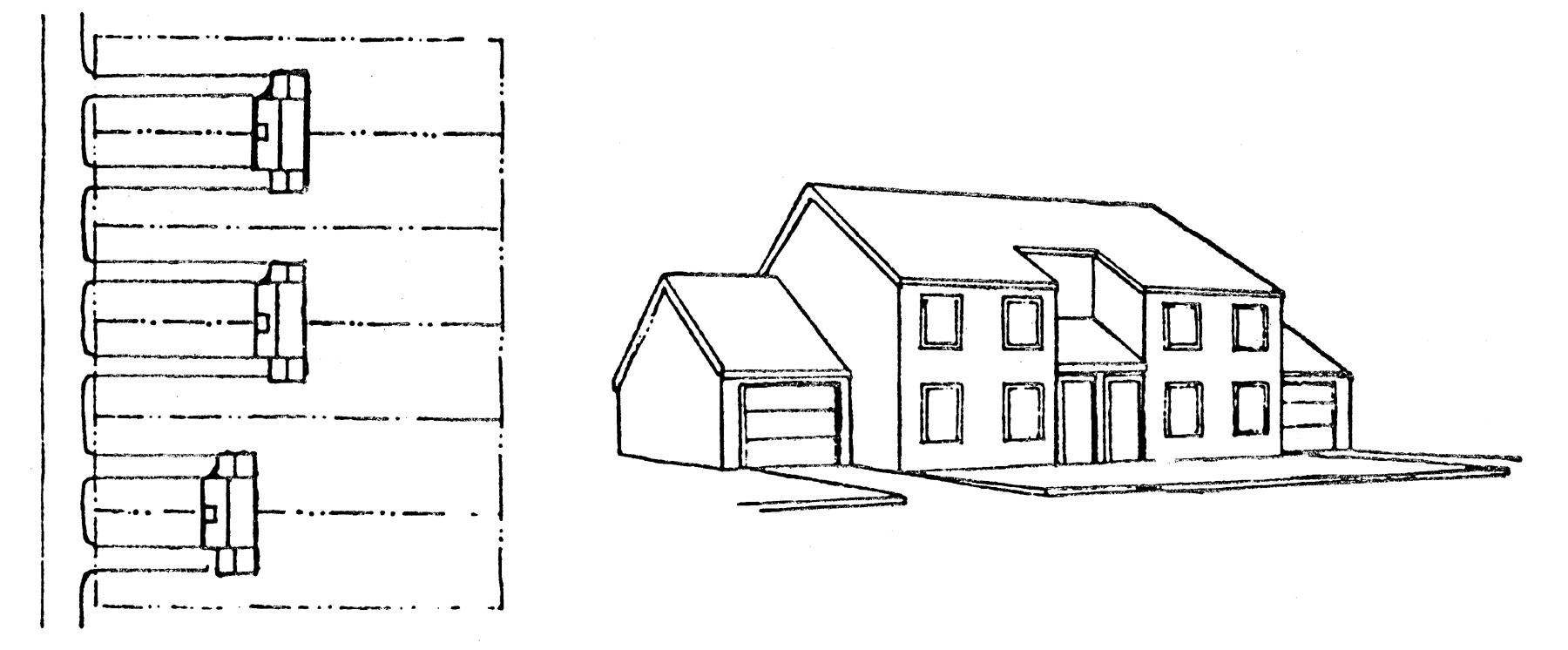
Dwelling, Semidetached
Dwelling, single-family: A building containing one (1) dwelling unit.
Dwelling, single-family detached: A dwelling which is designed for and occupied by not more than one (1) family and surrounded by open space or yards and which is not attached to any other dwelling by any means.
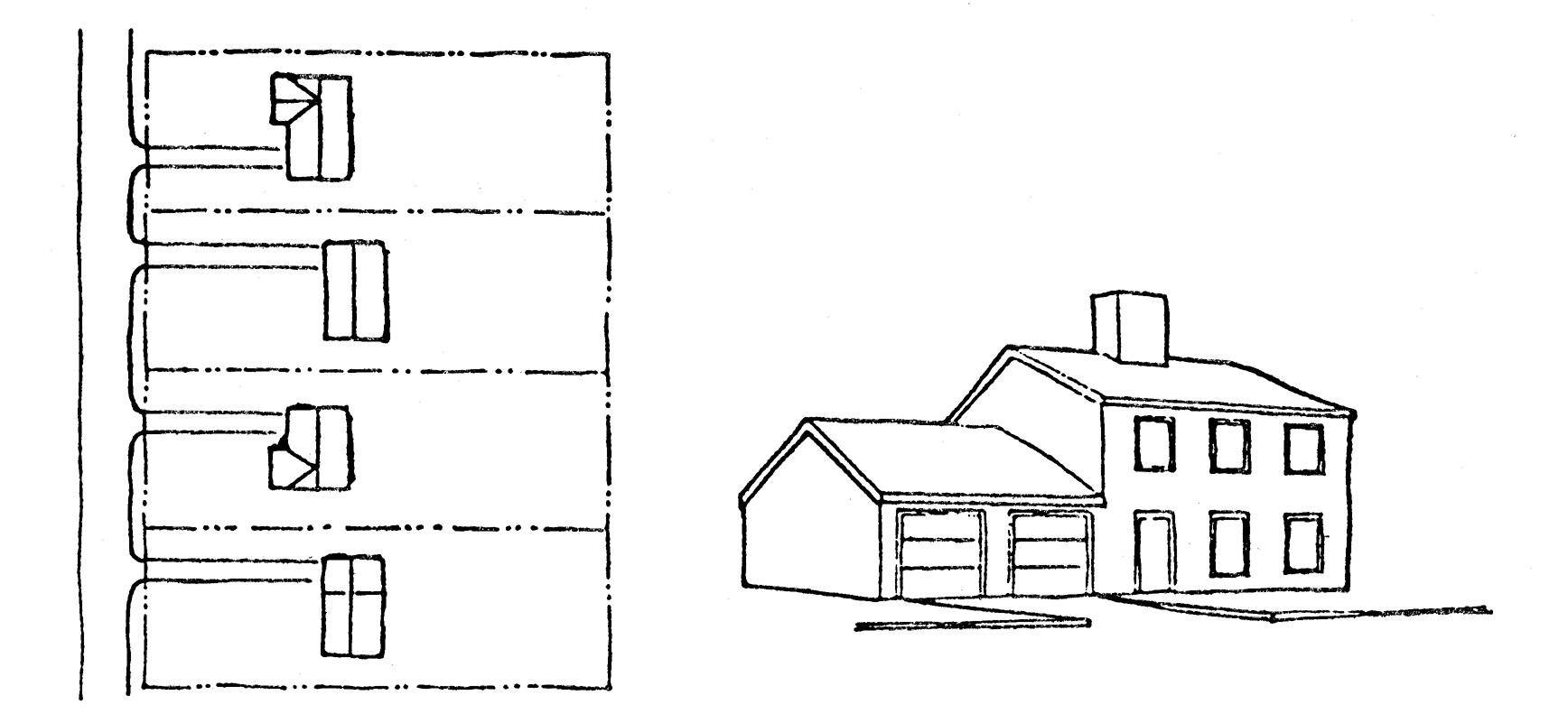
Dwelling, Single-Family Detached
Dwelling, townhouse: A single-family dwelling in a row of at least three (3) such units in which each unit has its own front and rear access to the outside, no unit is located over another unit, each unit is separated from any other unit by one (1) or more common fire-resistant walls, and each unit is serviced by separate utilities.
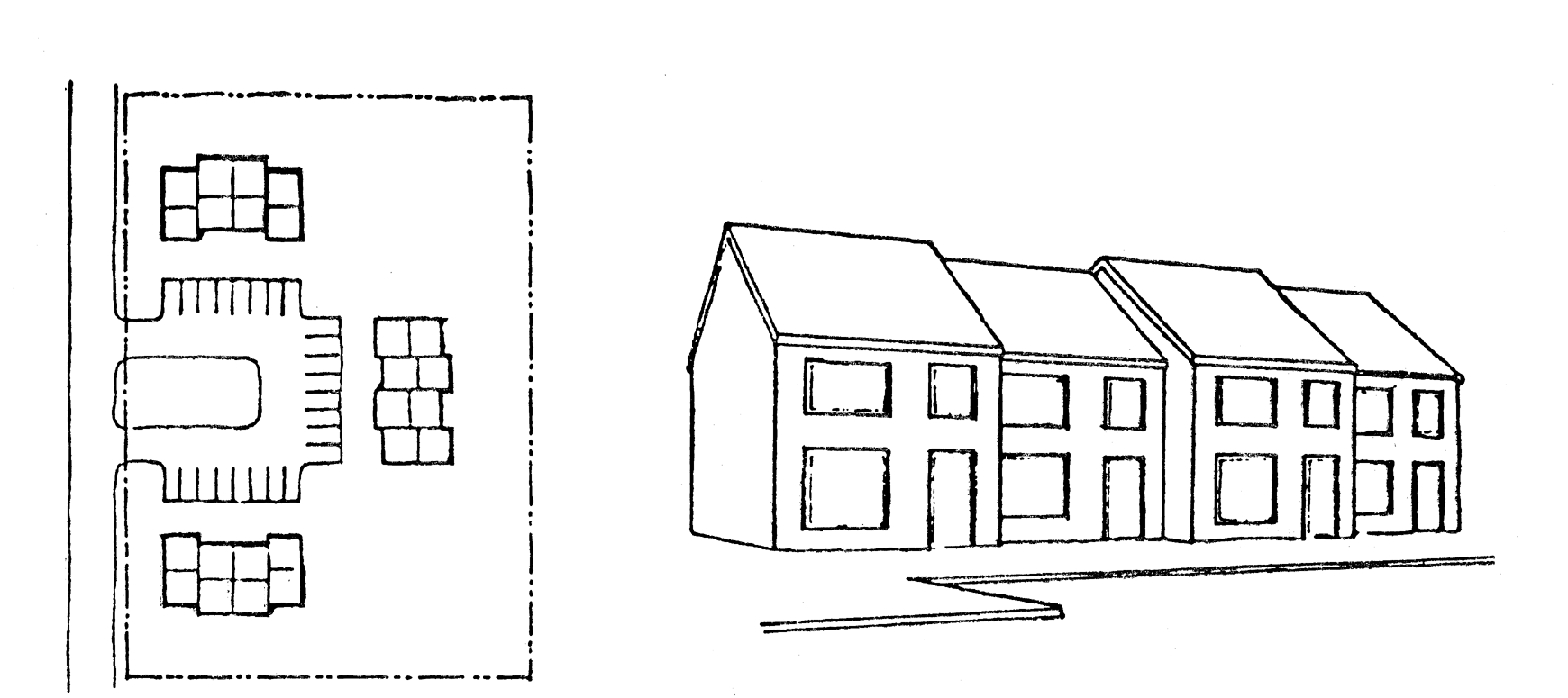
Dwelling, Townhouse
Dwelling, triplex: A multiplex dwelling containing three (3) dwelling units, each of which has direct access to the outside or to a common hall.
Dwelling unit: One (1) or more rooms designed, occupied, or intended for occupancy as separate living quarters, with cooking, sleeping and sanitary facilities provided within the dwelling unit for the exclusive use of a single-family maintaining a household.
Family: One (1) or more persons occupying premises and living together as a single housekeeping unit.
Flood hazard area: Any area of the city so designated on FEMA Flood Hazard Boundary Maps.
Floor area: The square feet of floor space within the surrounding exterior walls of a building or portion thereof, exclusive of vent shafts and courts. It does not include porticos, garages, or space in a basement or cellar when the basement or cellar space is used for storage or incidental uses.
Floor area ratio: The total floor area of a building excluding porches, decks and attic space but including garages and other enclosed storage areas divided by the square footage of the lot.
Frontage: The side of a lot abutting on a street, the front lot line.
Gaming/gambling boats: Any boat or other floating structure or craft on which any game of chance is played. This includes all electronic video game machines that are available to play or simulate the play of games utilizing a video display and microprocessors in which the player may receive free games or credits that can be redeemed for cash and all dice, card, roulette, and lottery type games in which money is staked or a wager made.
Gazebo: A freestanding, wood-constructed, roofed structure, open on all sides, no larger than one hundred forty-four (144) square feet, intended as a shady rest area, but shall not be utilized for any commercial activity. An unenclosed shower and lighting are permissible as accessories.
Gross trailer area: Gross trailer area is the total living area of a recreation vehicle measured to the maximum horizontal projection of exterior walls when in the setup mode.
Home occupation: Any occupation within a dwelling and clearly incidental thereto, carried on by a member of the family residing on the premises, provided that no person not a resident of the premises is employed, no stock in trade is kept or commodities sold, no mechanical equipment is used except such that is normally used for family, domestic or household purposes, and there is no exterior indication that the building is being used for any purpose other than a dwelling. When within the above requirements, a home occupation includes but is not limited to the following: (a) art studio; (b) dressmaking; (c) salesman, real estate agent, insurance agent, or other similar occupation; (d) teaching, with musical instruction limited to one (1) or two (2) pupils at a time.
Hotel: A building in which lodging or boarding and lodging are provided and offered to the public for compensation and in which ingress and egress to and from all rooms is made through an inside lobby or office supervised by a person in charge at all times. As such, it is open to the public in contradistinction to a multifamily structure which is herein separately defined.
Inground swimming pool: A permanent pool structure installed into excavated earth, constructed to function as an inground structure rather than a self-supporting, above-ground vessel. An inground pool is designed and built to retain surrounding soil and is intended to sit primarily below finished grade. Pool walls may extend above finished grade, but not more than thirty (30) inches, inclusive of coping. Partially or fully buried above-ground pools are not considered inground swimming pools.
Impervious surface: A surface that prevents or significantly impedes the infiltration of stormwater into the ground. This includes but is not limited to roofs, buildings, concrete, asphalt, pool decks, patios, compacted gravel, and pavers not meeting the definition of a pervious surface. Surfaces shall be considered impervious unless demonstrated otherwise in accordance with the performance criteria set forth in section 23-129.4.
Impervious surface ratio: The impervious surface ratio is a measure of the intensity of land use. It is determined by dividing the total area of all impervious surfaces within the site by the total site area. For the purposes of this calculation for single-family and duplex residences not subject to site-specific development plan review, the surface area of swimming pool basins shall be excluded.
Institution: A nonprofit establishment for public use.
Interior court: An open space other than required yards or setbacks which does not have direct street access and around which is arranged on three (3) sides a group of related buildings.
Junk yard: A junk yard is defined as a place where two (2) or more wrecked or disabled vehicles, without current license tags, and/or otherwise inoperable are placed or stored in an open area, including parts thereof, scrap building material, scrap contractor's equipment, tanks, cases, cans, barrels, boxes, drums, piping, bottles, glass, old iron, machinery, rags, paper, excelsior, mattresses, beds, or bedding, or any kind of scrap or waste material.
Landscaped area: An area that is permanently devoted to and maintained for the growing of shrubbery, grass and other plant material.
Lot: A parcel of land which fronts on and has access to a street and which is occupied or intended to be occupied by a building or buildings with customary accessories and open space.
Lot, corner: A lot abutting upon two (2) or more streets at their intersection.
Lot, depth: The mean horizontal distance between the front and rear lot lines.
Lot, double frontage: A lot having a frontage on two (2) nonintersecting roads, as distinguished from a corner lot.
Lot, interior: A lot other than a corner lot.
Lot, width: The width of a lot at the front building line.
Lot of record: A lot or parcel of land the plat or deed of which has been legally recorded.
Marina: There are four (4) types of marinas, defined as follows:
(1)
Marina, noncommercial multiple docking facility: A basin or marine terminal that provides space, docks, moorings for five (5) or more boats on a private or noncommercial basis. This includes multiple docking facilities such as for condominiums or other residential uses or subdivisions, and includes nonprofit "yacht clubs." It does not include service generally associated with commercial marinas, such as fuel, overnight docking, ship's store, etc. Dry storage and/or dry stack facilities are prohibited.
(2)
Marina, commercial: A basin or marine terminal that provides space, docks, moorings, and related facilities and services for five (5) or more pleasure boats. This includes the sale and minor in-water repair of recreational marine craft and the sale of fuel, food, beverages, supplies, hardware and other accessory uses. The overhaul of hulls and the painting, finishing and building of boats are prohibited. Commercial craft are prohibited from docking, mooring or being repaired. Dry storage and/or dry stack is permitted as a special exception if approved by the zoning board of appeals.
(3)
Marina, boatyard: A basin or marine terminal that provides space, docks, moorings, and related facilities and services for five (5) or more boats, including pleasure and commercial craft. This includes the sale, repair, painting, finishing, and building of boats, dry storage, and/or dry stack, fueling operations, and other uses permitted by commercial marina definition.
(4)
Marina, dry stack: A facility for storing and keeping boats out of water. This is principally a land operation, where boats are dry stored or "stacked" in a common structure until such time as they are transferred to the water for use.
Massage parlor: An establishment or business which provides the services of massage and body manipulation, including exercises, heat and light treatments of the body, and all forms and methods of physiotherapy, unless operated by a medical practitioner or professional physical therapist licensed by the state.
Mini-warehouse: A structure comprised of individually rented units for the purpose of storage, separated by permanent walls with individual exterior doors. Each unit generally not exceeding three hundred (300) square feet in floor area.
Mini-warehouse, climate controlled: A building where individually rented units for the purpose of storage are contained within the wall of the building, and no unit opens directly to the exterior of the building, but rather to an interior hall with security, controlled through an interior office area. Climate control shall be by central heat and air only.
Mini-warehouse facility: A warehouse facility complex designed with numerous component storage units, each for lease to clients for storage.
Mixed use building/site: A single building that contains a residential dwelling unit or units and commercial uses or a site that has multiple uses in multiple, separate buildings located upon it.
Mobile/manufactured home park: A parcel of land under single ownership, with required improvements and utilities for the long-term parking and occupancy of mobile/manufactured homes where mobile/manufactured home sites are available for rent or lease and which may include services and common facilities for the residents.
Mobile/manufactured home site: A parcel of land (space) within a mobile/manufactured home park for the placement of a mobile/manufactured home and its accessory buildings and structures and containing approved sewer and water connections.
Mobile/manufactured home subdivision: A subdivision designed and intended for residential use, where residence is primarily in mobile/manufactured homes.
Modular building or structure: A structure or building including the necessary electrical, plumbing, heating, ventilating, and other service systems, manufactured off-site and transported to the point of use for installation or erection, with or without other specified components, as a finished building, and not designed for ready removal to another site. The term is applicable to all buildings or structures, including residential, commercial, industrial, institutional, etc. When meeting the requirements of the Modular Building's Construction Act (23-43 of the South Carolina Code of Laws), said building or structure may be located in any of the city's several zoning districts.
Motel: A building or buildings in which lodging for transient or permanent guests, with or without meals, is provided and offered through an on-site or virtual office to the public for compensation.
Neighborhood convenience store: A convenience store limited to three thousand (3,000) square feet of gross floor space including storage and providing convenience items and services to the general public but excluding sale of motor fuels. Such establishments are limited to the following uses: drug and food stores, flower shops, beverage stores, confectioneries, delicatessens, and bakeries whose products are sold exclusively at retail and on premises.
Overlay zone: A zone imposed over a primary zoning district which imposes a set of requirements or relaxes a set of requirements imposed by the underlying primary zoning district when there is a special public interest in a particular geographical area that does not coincide with the underlying district boundaries.
Park and sports complex. A tract of publicly owned land one hundred (100) acres or more in size, with athletic fields, active and/or passive recreation facilities and regional attractions such as, but not limited to, zip lines and water parks and associated facilities and activities, dog parks, biking/hiking trails, water activities, and entertainment/gathering venues. Such facilities may also have accessory on-site sales and consumption of food, legal beverages, gifts, clothing, ticket sales, fee-based recreational activities, equipment rental and similar activities.
Pervious surface: A surface designed and installed to allow for stormwater infiltration. To qualify, the installed system must achieve a minimum infiltration rate of two (2) inches per hour. Applicants must submit manufacturer specifications and construction details demonstrating the installation method required to meet this standard. Permits for pervious surface systems are subject to inspection to verify proper installation of base materials and other components in accordance with the approved specifications. Property owners are also responsible for maintaining the surface to ensure continued infiltration performance over time.
Primary zoning district: Geographic sections of the city delineated on the official zoning map and designated in the zoning ordinance text in which requirements for the use of land and building and development standards are prescribed.
Protected tree: Any tree regulated by the tree protection regulation article of this chapter excluding pine trees.
Public buildings: Any nonrecreational state, county, or municipal building used for public purposes.
Public park and recreation facilities: Any park, playground, or other recreation facility, and/or open space officially designated as a public park or recreation facility including community centers, passive and active outdoor uses and indoor uses, and all structures associated with such uses. Supportive commercial activities such as food and merchandise vending, sports, leisure and tourism activities and the like are permissible within parks with city approval, whether through direct management, sponsorship, or franchising.
Recreational vehicle: A vehicular type unit primarily designed to provide seasonal or temporary living quarters which has its own motive power or is towed by another vehicle and may be connected to utilities necessary for operation of installed fixtures and appliances and with a gross trailer area not exceeding four hundred (400) square feet when in the setup mode. The basic entities are: travel trailer, folding camping trailer, park trailer, truck camper, motor home and multi-use vehicle.
Resort accommodations: A building in which lodging or boarding and lodging are provided and offered to the public for compensation in which ingress and egress to and from all rooms can be made through an inside lobby or office supervised by a person in charge at all times and which may have individual units owner occupied as dwelling units within the same building.
Retail, "big box": A single retail establishment that exceeds fifty thousand (50,000) square feet in gross sales floor area either as a single use on a property or within a commercial center.
Retail, convenience: Convenience retail establishments are those providing convenience items and services to the general public, such as drug, beverage, grocery stores, hardware, etc.
Retail, primary: Primary retail establishments are those selling commodities in small quantities to the consumer, usually low bulk comparison items which are normally found in large regional shopping centers, including department stores and stores selling general merchandise, variety merchandise, shoes, millinery, clothing, jewelry, etc.
Retail, secondary: Secondary retail establishments are those selling primarily one-stop items usually high bulk and very often more expensive items than those found in the primary retail establishments, including stores selling appliances, radios, televisions, floor coverings, furniture, etc.
Short term rental: Any residential unit offered for lease for a period of ninety (90) days or less.
Sleeping area: As it relates to short term rentals, a sleeping area is any room (including bedrooms) that is not one of the following: A kitchen, a hallway not exceeding seven (7) feet in width, a mechanical room designed primarily for containing HVAC equipment or hot water heaters or electrical panels or similar, a bathroom, a closet not exceeding seventy (70) square feet in size, or an elevator or stairwell.
Story: That portion of a building included between the surface of any floor and the surface of the floor next above it; or if there is no floor above it, then the space between such floor and the ceiling next above it. If the finished floor level directly above a basement or cellar is more than six (6) feet above grade, such basement or cellar shall be considered a story.
Structure: Anything constructed, erected or established, including but without limiting the generality of the following: swimming pools, buildings, signs, trailers, fences, screened enclosures, patio walls, backstops and sun decks or similar activities.
Structural alteration: Any change except those required by law or ordinance, which would prolong the life of the supporting members of a building or structure, such as bearing walls, columns, beams or girders, not including openings in bearing walls as permitted by other ordinances.
Tavern: For the purpose of regulating adult uses and amusements, a tavern is any establishment which sells or is authorized to sell alcoholic beverages to patrons by the individual drink for consumption on the premises. A tavern or bar is an establishment used primarily for the serving of alcohol for on-premises consumption to the general public, and where food is served only as accessory to the primary use.
Town center: A large contiguous (including streets) commercial area which contains at least twenty (20) acres and a minimal commercial area of at least fifty thousand (50,000) square feet within a Planned Development District (PDD) and not covering more than fifty (50) percent of the total land area of the entire PDD.
Video gaming establishment: Any building (under one (1) roof) in which more than five (5) video gaming machines or stations are located.
Video gaming machine: An electronic video game machine that, upon insertion of cash, is available to play or simulate the play of games as authorized by the South Carolina Tax Commission utilizing a video display and microprocessors in which the player may receive free games or credits that can be redeemed for cash.
Yard: A required open space other than a court occupied and unobstructed by a structure or portion of a structure from twelve (12) inches above the general ground level of the graded lot upward; however, fences, walls, poles, posts, permitted signs, and other customary yard accessories, ornaments and furniture may be permitted in any yard subject to height limitations and requirements limiting obstruction of visibility.
(1)
Yard, front: A yard extending between side lot lines across the front of a lot adjoining a street or the twelve and one-half feet (12.5) easement on twenty-five feet (25) private rights-of-way. In one (1) required front yard, no fence or wall shall be permitted which materially impedes vision across that yard above the height of thirty (30) inches, and no hedge nor vegetation shall be permitted which materially impedes vision across such yard between the heights of thirty (30) inches and ten (10) feet.
(2)
Yard, side: A yard extending along the side lot line from the front yard to the rear yard.
(3)
Yard, rear: A yard extending between side lot lines across the rear of the lot.
(Ord. No. 88-35, 11-1-88; Ord. No. 90-3, §§ 1, 2, 2-20-90; Ord. No. 90-35, § 1, 8-28-90; Ord. No. 91-8, §§ 2, 3, 2-4-91; Ord. No. 93-36, §§ 1, 2, 10-4-93; Ord. No. 94-1, § 1, 1-3-94; Ord. No. 95-4, § 1, 2-6-95; Ord. No. 95-49, § 1, 10-16-95; Ord. No. 96-02, § 1, 2-5-96; Ord. No. 97-31, § 1, 8-18-97; Ord. No. 98-37, § 1, 12-7-98; Ord. No. 99-46, § 1, 11-15-99; Ord. No. 00-15, § 1, 3-6-00; Ord. No. 00-45, § 1, 10-16-00; Ord. No. 01-12, § 1, 2-19-01; Ord. No. 01-51, §§ 1, 2, 11-19-01; Ord. No. 02-03, § 2, 2-4-02; Ord. No. 03-13, § 1, 4-21-03; Ord. No. 03-34, § 1, 8-18-03; Ord. No. 06-46, § 1, 7-17-06; Ord. No. 07-09, § 1, 2-19-07; Ord. No. 07-21, § 1, 6-18-07; Ord. No. 09-17, § 1, 3-2-09; Ord. No. 09-21, § 1, 6-1-09; Ord. No. 09-36, § 1, 11-16-09; Ord. No. 11-28, § 1, 10-17-11; Ord. No. 11-30, § 1, 11-21-11; Ord. No. 12-16, § 1, 9-17-12; Ord. No. 15-18, § 1, 5-18-15; Ord. No. 17-12, § 1, 6-5-17; Ord. No. 18-19, § 1, 10-15-18; Ord. No. 22-20, §§ 1, 2, 5-2-22; Ord. No. 25-33 , § 1, 7-21-25; Ord. No. 25-45, § 1, 10-6-25; Ord. No. 26-04, § 1, 2-16-26; Ord. No. 26-09, § 1, 3-2-26)
Sec. 23-3. - Fees.
(1)
The city council shall establish a schedule of fees, charges and expenses, and a collection procedure for building permits, certificates of zoning compliance, appeals, and other matters pertaining to this chapter. The schedule of fees shall be posted in the office of the administrative official and may be altered or amended only by the city council.
(2)
Until all applicable fees, charges and expenses have been paid in full, no action shall be taken on any application or appeal.
(Ord. No. 88-35, 11-1-88)
Sec. 23-4. - Amendments.
(1)
Amendment authorization and procedure: This zoning ordinance, including the zoning map(s), may be amended from time to time by the city council, but no amendment shall become effective unless it shall have been proposed by or shall have first been submitted to the planning commission for review and recommendation. The planning commission shall have thirty (30) days within which to submit its report. If the commission fails to submit a report within the thirty-day period, it shall be deemed to have approved the requested amendment. Any communication purporting to be an application for a change shall be regarded as mere notice to seek relief until it is made in the form required. Upon receipt of any communication, the interested parties shall be supplied with the proper form for presenting their application by the zoning administrator.
(2)
Initiation of amendment: Proposed changes or amendments may be initiated as follows:
(a)
An amendment to the zoning map may be initiated by city council; planning commission; board of zoning appeals; city administration; or property owners for their own property.
(b)
An amendment to the zoning ordinance text may be initiated by city council; planning commission; board of zoning appeals; or city administration.
Before any action shall be taken on an amendment request initiated by a property owner, the party or parties proposing or recommending said amendment shall, with the application for such change, deposit the required fee with the zoning administrator at the time the application is filed to cover publication and other miscellaneous cost for said change; under no condition shall said fee or any part thereof be refunded for failure of said amendment to be adopted.
(3)
Planning commission report: The planning commission shall prepare a report and make recommendations on any proposed amendment, stating its findings and its evaluation of the request. In making its report, the commission shall consider the following factors:
(a)
The relationship of the request to the comprehensive plan.
(b)
Whether the request violates or supports the plan.
(c)
Whether the uses permitted by the proposed change would be appropriate in the area concerned.
(d)
Whether adequate public school facilities, roads and other public services exist or can be provided to serve the needs of the development likely to take place as a result of such change, and the consequence of such change.
(e)
Whether the proposed change is in accord with any existing or proposed plans for providing public water supply and sanitary sewer to the area.
(4)
Declaration of policy: As a matter of policy, no request to change the text of the ordinance or the map shall be acted upon favorably except:
(a)
Where necessary to implement the comprehensive plan, or
(b)
To correct an original mistake or manifest error in the regulations or map, or
(c)
To recognize substantial change or changing conditions or circumstances in a particular locality, or
(d)
To recognize changes in technology, the style of living, or manner of doing business.
(5)
Public hearing and notice thereof: Before action by city council on an amendment to this ordinance, the planning commission shall hold a public hearing thereon, at least fifteen (15) days' notice of the time and place which shall be published in a newspaper of general circulation in North Myrtle Beach. When a proposed amendment affects the district classification of property, conspicuous notice shall be posted on or adjacent to the property affected; with at least one (1) such notice being visible from each public thoroughfare that abuts the property.
(6)
Action by city council: In any request for change, city council shall consider the recommendation of the planning commission on each proposed zoning amendment. However, city council is not bound by the recommendation in making a final decision.
(7)
Resubmission of denied application: In no instance shall a petition or application for the same zoning amendment affecting the same parcel or lot, or any part thereof, be resubmitted for a period of twelve (12) months following denial of such request by the city council.
(Ord. No. 88-35, 11-1-88; Ord. No. 95-10, §§ 4—7, 3-20-95; Ord. No. 97-21, § 1, 6-2-97)
Sec. 23-5. - Minimum requirements.
In their interpretation and application, the provisions of this chapter shall be held to be minimum requirements, adopted for the promotion of the public health, safety, morals or general welfare. Whenever the requirements of this chapter are at variance with the requirements of any other lawfully adopted rules, regulations, ordinances, deed restrictions or covenants, the most restrictive or that imposing the higher standards shall govern.
(Ord. No. 88-35, 11-1-88)
Sec. 23-6. - Complaints regarding violation.
Whenever a violation of this chapter occurs, or is alleged to have occurred, any person may file a written complaint. Such complaint, stating fully the causes and basis thereof, shall be filed with the administrative official. The administrative official shall record properly such complaint, immediately investigate, and take action thereon as provided by this chapter.
(Ord. No. 88-35, 11-1-88)
Sec. 23-7. - Penalties for violation.
Violation of the provisions of this chapter or failure to comply with any of its requirements (including violations of conditions and safeguards established in connection with grants of variances or special exceptions) shall constitute a misdemeanor. Any person who violates this chapter or fails to comply with any of its requirements shall upon conviction thereof be fined as provided in section 1-6. Each day such violation continues shall be considered a separate offense. The owner or tenant of any building, structure, premises or part thereof, and any architect, builder, contractor, agent or other person who commits, participates in, assists in or maintains such violation may each be found guilty of a separate offense and suffer the penalties herein provided. Nothing herein contained shall prevent the city from taking such other lawful action as is necessary to prevent or remedy a violation.
(Ord. No. 88-35, 11-1-88; Ord. No. 93-27, § 11, 8-2-93)
Sec. 23-8. - Legal status provisions.
(1)
Conflict with other laws: Whenever the regulations of this chapter require a greater width or size of yards, or require a greater percentage of a lot to be left unoccupied, or impose other more restrictive standards than are required in or under any other statutes, the requirements of this chapter shall govern. Whenever the provisions of any other statute require more restrictive standards than are required by this chapter, the provisions of such statute shall govern.
(2)
Separability: Should any section or provisions of this chapter be declared invalid or unconstitutional by any court of competent jurisdiction, such declaration shall not affect the validity of the chapter as a whole or any part thereof which is not specifically declared to be invalid or unconstitutional.
(3)
Repeal of conflicting ordinances: All ordinances and parts of ordinances in conflict herewith are repealed to the extent necessary to give this chapter full force and effect.
(4)
Effective date: This chapter shall take effect and be in force February 1, 1989.
(Ord. No. 88-35, 11-1-88)

