
North Myrtle Beach City Zoning Code
ARTICLE VII
GENERAL AND SUPPLEMENTAL REGULATIONS
The regulations set forth in this article clarify, supplement or modify the district regulations in Article II of this chapter.
Sec. 23-100.- Conformity with regulations required.
No building, structure or land shall hereafter be used, and no building, structure or part thereof shall be erected, reconstructed, converted, enlarged, moved or structurally altered unless in conformity with the regulations as set forth in this chapter.
(Ord. No. 88-35, 11-1-88)
Sec. 23-101. - Uses not permitted are prohibited.
For the purpose of this chapter, permitted uses are listed for the various districts. Unless the contrary is clear from the context of the lists or other regulations of this chapter, uses not specifically listed or referenced are prohibited.
(Ord. No. 88-35, 11-1-88)
Sec. 23-102. - Encroachment; reduction of lot area.
The minimum yards, parking space, open spaces and lot area required by this chapter for each and every building existing at the time of the passage of these regulations or for any building hereafter erected, shall not be encroached upon or considered as required yard or open space for any other building, except as hereinafter provided, nor shall any lot area or lot dimensions be reduced below the requirements of these regulations.
(Ord. No. 88-35, 11-1-88)
Sec. 23-103. - Measurement of front yard setback abutting rights-of-way.
Yards which abut public or private streets shall be measured from the abutting street right-of-way line or property line. However, yards which abut twenty-five (25) feet private street rights-of-way shall be measured from the adjacent twelve and one-half (12.5) foot easement.
(Ord. No. 88-35, 11-1-88; Ord. No. 17-12, § 2, 6-5-17)
Sec. 23-104. - Modifications of yard regulations.
(1)
General: Whenever more than one (1) main building is to be located on a lot, the required yards shall be maintained around the group of buildings and buildings shall be separated by a horizontal distance of fifteen (15) feet or a distance equal to one-half (½) the height of the highest adjacent building whichever is greater, unless otherwise specified.
(2)
Front Yards:
(a)
Where a lot fronts on two (2) nonintersecting streets, or two (2) intersecting streets forming an angle of sixty (60) degrees or less, front yards shall be provided on both streets.
(b)
Where the principal building(s) or structure(s) are oriented to face inward, away from a major street on which it fronts, said building or structure shall nonetheless observe the required front yard setback for the district in which it is located, and any accessory use(s) prohibited from required front yards within such districts also shall be prohibited within the required front yard setback for the reoriented use facing inward away from the major street.
(3)
Side yards: Where a side yard abuts a street (corner lot), no accessory building on said corner lot shall extend beyond the front yard line of the lot to the rear of such corner lot. If, however, the rear lot faces the opposite street, and in fact constitutes another corner lot, then the side yard setbacks for the district shall prevail.
(Ord. No. 88-35, 11-1-88)
Sec. 23-105. - Structures projecting into required yards.
The following structures within the limits set forth may project into required yards:
(1)
Buttress or chimney, not more than twelve (12) inches; projecting roof overhang, not more than twenty-four (24) inches into front yard or rear yard.
(2)
Unenclosed steps not extending more than three (3) feet into a front or rear yard provided other applicable building codes are complied with.
(3)
Accessible ramps, home elevators, and residential lifts not more than fifty percent (50%) of the required depth of the front or rear yard provided other applicable building codes are complied with.
(4)
Retaining wall of any necessary height, but not closer than eighteen (18) inches to a street line.
(5)
A protective hood or door overhang over a doorway may extend not more than three (3) feet into the required minimum front and rear yards.
a.
In one- and two-family dwellings, HVAC units, swimming pool equipment certified by the manufacturer to not exceed seventy (70) decibels of sound at a five (5) foot distance during operating conditions, non-portable electric generators, and not more than two (2) above-ground propane tanks less than one hundred twenty-five (125) gallons each may encroach into side yard and rear yard setback areas.
b.
When such equipment is located within a required yard setback, it shall be screened from view from adjacent properties or streets by a fence, wall, or comparable screening structure. Screening shall extend to at least tweleve (12) inches above the top of the equipment being screened and may begin no more than six (6) inches above finished grade. Screening materials need not be solid but shall provide effective visual opacity. Screening shall comply with all applicable manufacturer clearance, ventilation, and safety requirements. This requirement shall not apply to equipment elevated above base flood elevation within a special flood hazard area and installed more than three (3) feet above finished grade.
c.
No minimum separation is required between such equipment on the same property. However, there must be at least a five (5) foot separation between these encroachments and any adjacent property's encroachments, ensuring a clear path to maneuver around equipment on different properties.
d.
In all other cases HVAC units, swimming pool equipment, non-portable electric generators, and propane tanks must meet the setbacks of the zoning district.
(Ord. No. 88-35, 11-1-88; Ord. No. 98-11, § 3, 4-20-98; Ord. No. 02-14, § 3, 4-15-02; Ord. No. 14-23, § 1, 7-7-14; Ord. No. 23-52, § 1, 9-18-23; Ord. No. 25-05, § 1, 2-17-25; Ord. No. 25-43, § 1, 10-6-25; Ord. No. 26-12, § 1, 3-16-26)
Sec. 23-106. - Measurement of and exceptions to height.
The height of a building shall be measured from the mean elevation of the finished grade at the front of a building or structure to the mid-point between the eve and the highest point of the roof: Except that single-family and duplex buildings in designated flood hazard areas, as established by the city's flood damage control ordinance shall be measured from the established "certified floor elevation," to the mid-point between the eve and the highest point of the roof. Height limitations shall not apply to chimneys, church spires, water tanks parapet walls not exceeding six (6) feet, or necessary mechanical features not occupying more than fifteen (15) percent of the roof area. Within the HC District, height limitations shall not apply to non-habitable architectural features such as cupolas, turrets and corner towers, when the aggregate of all features exceeding the maximum building height are occupying no more than twenty (20) percent of the roof area, no more than forty (40) percent of the perimeter area. The building articulation provided by these features exceeding the height allowance shall respond to corner conditions, public open spaces, visual axes, or building entries.
(Ord. No. 88-35, 11-1-88; Ord. No. 06-32, § 1, 6-5-06; Ord. No. 06-46, § 2, 7-17-06; Ord. No. 16-43, § 1, 11-21-16; Ord. No. 22-47, § 1, 10-17-22)
Sec. 23-107. - Accessory buildings and uses.
(1)
Accessory detached garages for single-family residential subject to the following conditions:
(a)
The setbacks for the district regulations in which the use is located are met.
(b)
The building is no larger than six hundred twenty-five (625) square feet or thirty (30) percent of the gross square footage of the principal residence, whichever is greater not to exceed nine hundred (900) square feet.
(2)
Customary accessory uses to certain principal land uses. In each case, the heated square footage for any structure(s) containing the customary accessory use shall not exceed twenty-five (25) percent of the primary use structures heated square footage.
(a)
Church. Customary accessory uses to a church may include any combination of the following:
i.
child and adult daycare operations;
ii.
meeting space for community service or non-profit groups;
iii.
gymnasium or other recreation facilities and activities;
iv.
classroom space for educational programs;
v.
kitchen for preparation of food consumed on or off the premises;
vi.
gift shops;
vii.
pastoral counseling.
(b)
Golf course. Customary accessory uses to a golf course may include any combination of the following:
i.
pro shop offering for sale or rent of golf clubs, golf balls, apparel, and similar gear typically used by golfers during play;
ii.
clubhouse for the offering of meeting spaces, events, and social gatherings;
iii.
restaurants, snack bars, or similar uses owned and operated by the owners of the clubhouse, but excluding fast-food franchises;
iv.
tennis courts, swimming pools, health spas, and other similar uses as determined by the zoning administrator;
v.
golf instruction, schooling, and lessons for improvement of play;
vi.
office space for organizations, whether for-profit or non-profit, whose primary mission is to promote the game of golf locally or regionally.
(c)
Hotels. For accessory uses, reference the hotel regulations contained within the zoning districts R-4, Resort Residential, RC Resort Commercial, HC Highway Commercial, and GC General Commercial.
(3)
Accessory buildings and uses may be located in required yards, under the following conditions:
(4)
Lighting on accessory uses and accessory amenity areas.
1.
No light pole shall exceed twenty (20) feet.
2.
No floodlights are permitted.
3.
Light fixtures shall be aimed down at least forty-five (45) degrees with the front of the fixture shielded so that no portion of the light bulb extends below the bottom edge of the shield.
4.
The maximum light level shall not be greater than twenty-four (24) maintained foot-candles. The maximum light level adjacent to any residential property line shall not exceed five-tenths (0.5) foot-candles.
5.
The maximum light level adjacent to any street right-of-way shall not exceed two (2) foot-candles.
(Ord. No. 88-35, 11-1-88; Ord. No. 89-37, § 1, 8-15-89; Ord. No. 90-31, § 1, 8-28-90; Ord. No. 92-5, § 1, 1-6-92; Ord. No. 95-33, §§ 1—3, 5-15-95; Ord. No. 96-39, § 2, 10-21-96; Ord. No. 96-46, § 3, 11-18-96; Ord. No. 04-49, § 2, 10-4-04; Ord. No. 07-37, § 1, 8-20-07; Ord. No. 07-46, § 1, 12-3-07; Ord. No. 10-11, § 1, 7-19-10; Ord. No. 12-03, § 1, 2-6-12; Ord. No. 14-03, § 2, 3-17-14; Ord. No. 14-08, § 1, 4-21-14; Ord. No. 23-53, § 1, 9-18-23)
Sec. 23-108. - Visual clearance at street intersection.
On any corner lot, no structure or fence, shrubbery or other planting, or obstruction to vision more than two and one-half (2½) feet higher than the curb shall be erected or maintained which poses an obstruction to visual clearance at street intersections.
(Ord. No. 88-35, 11-1-88)
Sec. 23-109. - Common open space.
(1)
Definition: Open space is land and/or water bodies used for recreation, amenity or buffer; it shall be freely accessible to all residents of a development, where required by this chapter. Open space shall not be occupied by dwellings, buildings, parking areas, streets, or public rights-of-way; nor shall it include the yards of residential dwelling units required to meet the minimum lot area or lots required to meet minimum parking area requirements.
(2)
Where required: Where specifically required by this chapter, an open space plan shall be submitted as a part of the application for a building permit. The plan shall:
(a)
Designate areas to be reserved as open space. The specific design of open space areas shall be sensitive to the physical and design characteristics of the site.
(b)
Designate the type of open space which will be provided.
(c)
Specify the manner in which the open space shall be perpetuated, maintained and administered.
(3)
Types of open space: The types of open space which may be provided to satisfy the requirements of this chapter, together with the maintenance required for each type, are as follows:
(a)
Natural areas are areas of undisturbed vegetation or areas replanted with vegetation after construction. Woodlands and wetlands are specific types of natural areas.
Maintenance is limited to removal of litter, dead tree and plant materials, and brush. Natural watercourses are to be maintained as freeflowing and devoid of debris. Stream channels shall be maintained so as not to alter floodplain levels.
(b)
Recreational areas are designed for specific, active recreational uses such as totlots, tennis courts, swimming pools, ballfields, and similar uses. Recreational areas shall be accessible to all residents of the development. Maintenance is limited to insuring that there exist no hazards, nuisances, or unhealthy conditions.
(c)
Greenways are linear greenbelts linking residential areas with other open space areas. These greenways may contain bicycle paths, footpaths, and bridle paths. Connecting greenways between residences and recreational areas are encouraged. Maintenance is limited to a minimum removal and avoidance of hazards, nuisances, or unhealthy conditions.
(d)
Landscaped areas and lawns, with or without trees, shall be mowed regularly to insure neatness, and landscaped areas shall be trimmed, cleaned, and weeded regularly.
(4)
Preservation of open space: Land designated as common open space may not be separately sold, subdivided or developed. Open space areas shall be maintained so that their use and enjoyment as open space are not diminished or destroyed. Open space areas may be owned, preserved and maintained as required by this section by any of the following mechanisms or combinations thereof:
(a)
Dedication to and acceptance by the city.
(b)
Common ownership of the open space by a homeowner's association which assumes full responsibility for its maintenance.
(c)
Deed restricted, private ownership which shall prevent development and/or subsequent subdivision of the open space land and provide the maintenance responsibility.
The owners and their agent, if any, shall be jointly and severally responsible for the continued proper maintenance of common open space, and shall maintain such areas in an orderly, safe, and neat condition, free from refuse and debris at all times. The owners or their agent shall be notified by the City of North Myrtle Beach Zoning Department of any areas which are not properly maintained and shall, within fifteen (15) calendar days from the time of notification, restore the common open space to a safe, neat, and orderly condition.
(Ord. No. 88-35, 11-1-88)
Sec. 23-110. - Certain public service uses exempt.
Uses: Due to the nature of certain public/private service uses and the need to locate such uses in certain areas of the city irrespective of prevailing district regulations, the following list of uses may be established in any zoning district, provided such uses meet all the dimensional requirements of the district, except height and minimum lot size, within which they will be located:
(1)
Post office.
(2)
Police and fire stations.
(3)
Sewerage treatment facilities.
(4)
Water treatment and storage facilities.
(5)
Telephone exchange and repeater stations.
(6)
Radio and TV station masts.
(7)
Electrical transformers.
(8)
Spoilage easements and basins for deposition of dredged materials from area waterbodies.
(9)
Public off-street parking lots with or without public bathrooms and/or bathing facilities.
(10)
Telecommunication towers up to one hundred eighty (180) feet in height when located on city-owned or city-leased land. The city has sole discretion to approve these towers; this height measurement includes antennas, base pad, and other appurtenances, measured from the natural grade of the site. Towers shall be set back a minimum of three hundred (300) feet from any existing single-family residential structure.
(Ord. No. 88-35, 11-1-88; Ord. No. 96-08, § 1, 2-19-96; Ord. No. 00-51, § 1, 11-20-00; Ord. No. 09-23, § 1, 7-6-09; Ord. No. 09-41, § 1, 1-4-10; Ord. No. 14-31, § 1, 8-18-14; Ord. No. 17-21, § 1, 10-2-17; Ord. No. 19-02, § 1, 1-7-19; Ord. No. 21-21, § 2, 5-17-21; Ord. No. 22-19, § 1, 5-2-22; Ord. No. 25-24, § 1, 5-19-25)
Sec. 23-111. - Temporary uses.
The following temporary uses may be approved by the zoning administrator:
(1)
Mobile home and manufactured structures may be permitted as temporary uses in any zoning district except the R-1, R-1A and R-2 Districts, during construction of buildings or projects, provided that said use shall be removed within fifteen (15) days after completion of the project.
(2)
Open lot sale of Christmas trees may be permitted for a period not to exceed forty-five (45) days.
(3)
Fluttering ribbons and banners and similar devices will be allowed for grand openings and special occasions not to last longer than one (1) week. All permits for temporary uses may be renewed no more than once each six (6) months.
(4)
Real estate sales office for a period of one (1) year, provided such is associated with on site sales within the project. The sales office can be in a manufactured structure until a certificate of occupancy is issued, at which time the sales office shall be within a completed model unit and the manufactured structure is removed.
(5)
Tents for a period not to exceed a total of twenty-eight (28) days per calendar year, choosing one of the following options:
(a)
A seven (7) day use period;
(b)
A fourteen (14) day use period.
1.
There shall be the following minimum gaps between use periods:
(a)
The minimum gap between seven (7) day periods shall be ten (10) days.
(b)
The minimum gap between any seven (7) day period and any fourteen (14) day period shall be thirty (30) days, regardless of chronological order.
(c)
The minimum gap between fourteen (14) day periods shall be thirty (30) days.
Tents can be no larger than twenty (20) percent of the parking area nearest a public street.
(6)
Construction offices in manufactured structures in any zoning district during construction of a project. Such structures shall be removed within fifteen (15) days after completion of the project.
(7)
Tents in large (twenty-five (25) acres and greater) PDD's (Planned Development Districts) once a site plan, type of use within the tent and specified period of use are approved through the PDD amendment process.
(Ord. No. 88-35, 11-1-88; Ord. No. 99-05, §§ 1, 2, 4-5-99; Ord. No. 02-37, §§ 1, 2, 9-16-02; Ord. No. 03-06, § 1, 3-17-03; Ord. No. 04-61, § 1, 11-15-04; Ord. No. 05-50, § 1, 11-7-05; Ord. No. 09-36, § 11, 11-16-09; Ord. No. 18-10, § 1, 5-7-18)
Sec. 23-112. - Structures to have access.
With the exception of a building/structure that exists solely to serve a public utility, every building hereafter erected or moved shall be on a lot fronting on a public street, or an approved private street, and all structures shall be so located as to provide safe and convenient access for servicing, fire protection, and required off-street parking. Lot frontage shall be no less than fifty (50) percent of the required lot width, measured at the building line.
(Ord. No. 88-35, 11-1-88; Ord. No. 14-16, § 1, 6-16-14)
Sec. 23-113. - Parking, storage or use of major recreational equipment.
For purposes of these regulations, "major recreational equipment" is defined as including boats and boat trailers, pickup campers or coaches (designed to be mounted on automobile vehicles), motorized dwellings, tent trailers, and the like, and cases or boxes used for transporting recreational equipment, whether occupied by such equipment or not. No major recreational equipment shall be parked or stored on any lot in a residential district except in a carport or enclosed building or behind the nearest portion of a building to a street; however, such equipment may be parked anywhere on residential premises not to exceed twenty-four (24) hours during loading and unloading. No such equipment shall be used for living, sleeping or housekeeping purposes when parked or stored on a residential lot, or in any location not approved for such use.
(Ord. No. 88-35, 11-1-88)
Sec. 23-114. - Parking and storage of certain vehicles.
Automotive vehicles or trailers of any kind or type without current license plates shall not be parked or stored on any residentially zoned property other than in completely enclosed buildings, excluding nonconforming commercial and/or industrial uses.
(Ord. No. 88-35, 11-1-88)
Sec. 23-115. - Annexation.
All territory which may hereafter be annexed to the City of North Myrtle Beach shall be submitted first to the North Myrtle Beach Planning Commission for zoning designation. Representatives of the annexed territory may request a zoning classification at the time of annexation, but it must be reviewed by the commission, which shall submit its recommendation as to the type of zoning to be attached to said territory. The city council shall act on the zoning recommendation at the same it rules on the annexation.
(a)
For properties annexed into the city with preexisting setbacks designated through recorded plat or deed, the zoning administrator may allow the smaller, less-restrictive, setbacks to apply.
(Ord. No. 88-35, 11-1-88; Ord. No. 17-20, § 2, 9-18-17)
Sec. 23-116. - Private streets/access alleys.
(1)
Private streets or access alleys are allowed in all residential districts provided the standards set forth within the Land Development Regulations are followed. Private streets are also allowed in all Planned Development Districts (PDDs) provided the terms of development approval allow such streets to be private.
(Ord. No. 88-35, 11-1-88; Ord. No. 06-28, § 3, 5-15-06; Ord. No. 06-31, § 3, 6-5-06; Ord. No. 06-60, § 2, 11-20-06; Ord. No. 07-08, § 2, 2-19-07; Ord. No. 09-06, § 3, 2-2-09; Ord. No. 17-12, § 3, 6-5-17; Ord. No. 18-07, § 3, 4-2-18)
Sec. 23-117. - Number of principal buildings on a lot.
Except for the following types of buildings and developments, no more than one (1) principal building may be located upon a tract or lot:
(1)
Institutional buildings.
(2)
Public and semipublic buildings.
(3)
Multifamily dwellings.
(4)
Buildings in a commercial center.
(5)
Industrial buildings.
(6)
Homes for the aged.
(7)
Planned Development District (PDD).
(8)
Mobile home and RV parks.
(9)
Hotels, motels and resort accommodations.
(10)
Townhouse buildings on land owned "in common."
(11)
Single-family in common projects.
(12)
Mixed-use buildings.
(13)
Duplexes.
(14)
Multiplex buildings on land owned "in common."
(Ord. No. 88-35, 11-1-88; Ord. No. 90-14, § 1, 5-1-90; Ord. No. 95-4, § 5, 2-6-95; Ord. No. 03-56, § 3, 11-3-03; Ord. No. 06-28, § 4, 5-15-06; Ord. No. 06-31, § 4, 6-5-06; Ord. No. 09-36, § 12, 11-16-09; Ord. No. 15-18, § 3, 5-18-15; Ord. No. 19-03, § 1, 1-7-19; Ord. No. 21-15, § 1, 5-3-21)
Sec. 23-118. - Poolside activities.
(1)
Permitted poolside activities: The following poolside activities may be permitted as accessory uses to hotels, motels, inns and lodges within the RC and R-4 Districts:
(a)
Sale of suntanning products and other articles related to guest recreation activities.
(b)
Sale and preparation of beverages and/or food, including alcoholic beverages.
(2)
Conditional provisions: Such activities shall:
(a)
Be provided primarily for the guests of the hotel.
(b)
Have no outside storage, except within any permitted enclosable space.
(c)
The amount of enclosed space shall not exceed one-hundred (100) square feet, or the maximum allowable per FEMA flood hazard regulations, whichever is less. All enclosable space shall be under roof.
(d)
The total amount of area that may be under roof shall not exceed one thousand two hundred (1,200) square feet, including any enclosable space listed in (c) above. Example: If there is one thousand two hundred (1,200) square feet of area under roof, not more than one hundred (100) square feet of that area may be enclosed, with the remaining one thousand one hundred (1,100) square feet left unenclosed.
(e)
Any roof structures shall meet required district setbacks and shall be counted toward any impervious surface limits of the district, if applicable.
(f)
The maximum number of seats permitted under a roofed structure shall not exceed one (1) seat for each two (2) guest rooms in the hotel.
(g)
Additional parking shall not be required for such activities because they are clearly incidental and accessory to the hotel.
(h)
When not roofed or otherwise enclosed as per the above regulations, such activities shall meet the following:
1.
Be sold from no more than one (1) portable bar per swimming pool each no greater than one hundred twenty (120) square feet with a bar surface no higher than four (4) feet, provided:
2.
Such portable bars shall not have more than one (1) solid wall above the bar surface.
3.
All other sides above the bar surface shall not be structurally enclosed, but may have shutters to protect the contents of the bar when it is not in use.
4.
The overall height of the bar shall not exceed twelve (12) feet.
(Ord. No. 88-35, 11-1-88; Ord. No. 14-22, § 1, 7-7-14)
Sec. 23-119. - Zero lot line, single-family detached developments.
It is the intent of this section to provide for the construction of group developments of single-family dwellings on lots of substandard size in conjunction with private streets and utilities and open space owned in common and maintained by the owners of lots lying within the group or by an association of residents thereof. This section permits variation in lot size and orientation providing savings in infrastructure installations and land resources with limited increases in overall density of population.
Such developments shall be permitted in R-2, R-2A, R-4, and NC Districts provided:
(1)
Development regulations:
(a)
There shall be allotted for each group of such dwellings a minimum gross project site area of sixteen thousand (16,000) square feet, and there shall be allotted to each lot within the project site area a minimum of three thousand (3,000) square feet.
(b)
The project site area shall have a front yard setback requirement of twenty-five (25) feet; a side yard setback requirement of ten (10) feet; and a rear yard setback requirement of twenty (20) feet. Each individual dwelling within the project site area shall have a front and rear yard setback of ten (10) feet and a side yard setback of five (5) feet. Each individual dwelling may be permitted to have one (1) zero lot line provided that the yard setback eliminated thereby be used to increase the opposite yard setback, and provided that a minimum separation of ten (10) feet is maintained from any other individual dwelling, and provided that the setback requirements for the group as a whole are not diminished.
(c)
No individual dwelling shall be situated at its furthest point on a straight line distance greater than one hundred (100) feet from a point in a public street or an approved private street at which a firefighting vehicle may be stationed and properly placed into operation.
(d)
The project site on which the group of dwellings is situated shall be contiguous to a public dedicated and accepted street; but the lot on which a particular individual dwelling within the site shall not be required to be contiguous to a public, dedicated and accepted street. The front yard of the project site shall be consistent with the contiguous public street, and the front yard of the individual lots within the site shall be contiguous to the same public street or a private street within the site.
(e)
Accessory structures shall be allowed subject to the provisions of section 23-107. However, accessory structures shall be prohibited within the designated project site setbacks.
(2)
Streets and utilities:
(a)
Each individual dwelling within the project site shall be independently serviced by utilities. All utility service lines shall be placed underground.
(b)
Garbage collection containers shall be located at points determined by the director of the sanitation department. Such containers shall be sized to service a minimum of four (4) individual units, and shall be screened by an opaque enclosure exceeding the height of the container by twelve (12) inches, landscaped and opening on one (1) side. Such containers shall not be located within the project site yard setbacks and shall be located so as to be inconspicuous from view from public rights-of-way and adjacent properties.
(3)
Common open space:
(a)
For projects containing five (5) or more dwellings, a minimum of twenty-five (25) percent of the total project site shall be devoted to common open space. This minimum requirement shall be in addition to individual lots, streets, parking areas, utilities, and land for project site yard setbacks. Project site yard setbacks may be utilized as common open space, provided such common open space is in addition to the minimum twenty-five (25) percent requirement and further provided that recreational areas as defined in section 23-109(3)(b) are not located within the project site yard setbacks.
(b)
For projects containing four (4) or less dwelling units, a minimum of twelve and one-half (12.5) percent of the total project site shall be devoted to common open space or a comparable increase in minimum lot areas. If the common open space requirement is devoted to common open space (rather than lot area), such common open space shall be in addition to individual lots, streets, utilities and project site yard setbacks.
(c)
Unless otherwise specified in this section, common open space requirements shall be in accordance with section 23-109.
(4)
Ownership and maintenance of common areas: Common areas are inclusive of all improved and unimproved real property (including common open space) not in private ownership and lying within the project site held in common by owners of lots or an association thereof.
(a)
Title to all streets, parks, recreation facilities, planted or forested areas, utilities, and other improved or unimproved real property not in private ownership and lying within the project site shall be held as undivided interests by the owners of lots lying within the project site or by an association of the residents thereof, each of whom, jointly or severally, shall be charged with the proper care and maintenance of such property.
(b)
In order to assure the continuance of common areas, the developer/owner of the project shall impose restrictions for the preservation of common areas by a recorded declaration which shall require written consent of the city to release such lands from restriction.
(c)
In order to assure maintenance of common areas, the owners' entity identified in subsection (a) as having the right of ownership and control over common areas shall be responsible for the continuing upkeep and proper maintenance of same. In particular, the owners shall keep common areas in a safe, neat, and orderly condition, free from refuse and debris, at all times. The owners shall keep private streets in a safe and well-maintained condition including repaving and pavement repair as required by the city engineer for the purposes of continued safe access for city and emergency vehicles.
The owners or their agent shall be notified by the city of any areas which are not properly maintained and shall within thirty (30) calendar days from the time of notification, restore the common areas to a safe and orderly condition.
(5)
Review: All developments under this section shall be submitted for review in accordance with Chapter 20 of the City Code, Subdivision Regulations.
The recorded plat of a subdivision that includes a private street shall clearly state that such street is a private street. Further, the initial purchaser of a newly created lot served by a private street shall be furnished by the seller with a disclosure statement outlining the maintenance responsibilities for the street.
(Ord. No. 88-35, 11-1-88; Ord. No. 89-38, § 1, 8-15-89; Ord. No. 06-28, § 5, 5-15-06; Ord. No. 06-31, § 5, 6-5-06; Ord. No. 18-07, § 4, 4-2-18)
Sec. 23-119.1. - Detached single-family and duplex in common developments.
It is the intent of this section to provide an alternative development type where multiple dwellings are located on commonly owned property and ownership of the land is held in common by all owners of the dwellings. Such developments shall be permitted in the R-2, R-2A and R-3 districts subject to their respective development standards pertaining to single-family and duplex construction and the following pertaining specifically to in common development:
1.
Minimum site size—Five (5) acres.
2.
Minimum building setback from exterior project property lines—Twenty (20) feet.
3.
Minimum building setback from the right-of-way—Fourteen (14) feet from public right-of-way, six and one-half (6.5) feet from edge of private street easement.
4.
Minimum distance between homes back to back—Twenty (20) feet.
5.
Density—One (1) single-family unit for each five thousand (5,000) square feet of buildable land and one (1) duplex building for each seven thousand (7,000) square feet of buildable land, excluding streets and jurisdictional wetlands, but not excluding amenity areas, manmade ponds and open space.
6.
Street right-of-way shall meet all standards of the city's Complete Street Designs Guidelines of Appendix A of the city's land development regulations.
7.
Driveways shall meet all engineering standards as per the city engineer, fire apparatus access road requirements as defined in the latest edition of the South Carolina Fire Code shall be met.
8.
Minimum separation between single-family buildings—Ten (10) feet. Minimum separation between duplex buildings—Fifteen (15) feet.
9.
Direct access to all structures from the street or driveway.
10.
All structures must front the approved street or driveway.
11.
Ownership and maintenance of common areas shall be regulated by section 23-119(4).
12.
A minimum of twenty-five (25) percent of the total project site shall be devoted to common open space as defined in section 23-109.
(Ord. No. 06-28, § 2, 5-15-06; Ord. No. 06-31, § 2, 6-5-06; Ord. No. 07-08, § 1, 2-19-07; Ord. No. 17-12, § 4, 6-5-17; Ord. No. 18-07, § 5, 4-2-18; Ord. No. 19-03, § 2, 1-7-19; Ord. No. 21-15, § 2, 5-3-21)
Sec. 23-120. - Siting standards for marinas.
(Ord. No. 88-35, 11-1-88)
Sec. 23-121. - Pay telephones.
Pay telephones visible from a public street shall only be located in areas where there is existing accessible parking in close proximity. No additional parking spaces are required for this accessory use.
(Ord. No. 91-22, § 1, 6-3-91)
Sec. 23-122. - Two or more adjoining lots of record.
When two (2) or more adjoining lots of record are to be used for development, the lots must be combined, replatted and recorded as one (1) lot prior to the issuance of a building permit.
(Ord. No. 93-43, § 1, 11-1-93)
Sec. 23-123. - Body piercing.
Body piercing as defined in section 23-2 shall be allowed as an accessory use only in those zoning districts where body piercing is permitted as a principal use.
(Ord. No. 98-37, § 3, 12-7-98)
Sec. 23-124. - Fishing piers.
It shall be unlawful to issue a permit to construct a new fishing pier for any location on the oceanfront within two thousand five hundred (2,500) feet of an existing pier with an active certificate of zoning compliance or a proposed new pier location for which a permit for pier construction has been issued and a franchise agreement has been approved. Each fishing pier shall have minimum side yard setbacks equivalent to the following:
(1)
Fifty (50) feet from the farthest distant portion of any privately owned property equating to forty (40) percent of the width of said property, beginning at the mean high tide line and extending at least fifty (50) yards out into the ocean. This shall apply whether the private property directly adjoins the subject parcel, or if there is an intervening strip of publicly owned, leased or controlled land between them. There shall be no minimum side setback requirement for any other portion of the pier or its ancillary accessory structures. For example, if an adjoining private property is seventy (70) feet in width, the farthest distant forty (40) percent of that lot equates to a strip twenty-eight (28) feet in width. Therefore, the side yard setback of the pier, beginning at the mean high tide line, must be at least fifty (50) feet distant from the farthest twenty-eight (28) foot portion of the adjoining private lot.
(2)
There shall be no minimum side yard setback for piers from private properties that do not have frontage on Ocean Boulevard.
(Ord. No. 99-35, § 1, 9-20-99; ; Ord. No. 23-124, § 1, 9-20-99; Ord. No. 99-36, § 1, 10-4-99; Ord. No. 10-16, § 2, 10-4-10)
Sec. 23-125. - Masonry walls along and in close proximity to property lines.
Masonry walls along and in close proximity to property lines shall be finished and maintained on all sides, and the exterior side finish shall be compatible with adjacent properties.
(Ord. No. 00-01, § 1, 1-3-00)
Sec. 23-126. - Unlawful to shuttle any person for purposes of boarding commercial craft.
For the purposes of boarding commercial craft, it shall be unlawful to shuttle any person from the shore on any boat or other floating device to another boat or other floating structure or craft.
(Ord. No. 01-51, § 5, 11-19-01)
Sec. 23-127. - Pedestrian skywalks.
Pedestrian skywalks over public rights-of-way shall be prohibited in all zoning districts.
(Ord. No. 02-14, § 4, 4-15-02)
Sec. 23-128. - Display of outdoor merchandise.
Except for landscaping material and normal yard ornamentation, the display of outdoor merchandise shall not be located in any required perimeter landscape area or ten (10) feet from the front property line on properties abutting Highway 17, Main Street and Sea Mountain Highway and five (5) feet from any other property line on all commercial properties. For outdoor storage regulations concerning developments of regional significance, see section 129.5(7).
(Ord. No. 03-12, § 1, 4-21-03; Ord. No. 11-30, § 12, 11-21-11)
Editor's note— Ord. No. 03-12, § 1, adopted April 21, 2003, added new provisions to the Code as § 23-126. As other provisions relative to a different subject matter previously had been included in the Code as § 23-126, the provisions of Ord. No. 03-12 have been redesignated as § 23-128 at the editor's discretion.
Sec. 23-129. - Lighting on buildings.
Lighting fixtures shall be located and aimed so that direct illumination is focused solely on the building facade, landscaping and other site features and shall not be placed as to infringe on adjoining properties and streets.
1.
All wall pack fixtures shall be shielded.
2.
Floodlights shall be directed away from streets and residential areas. The fixture shall be aimed down at least forty-five (45) degrees with the front of the fixture shielded so that no portion of the light bulb extends below the bottom edge of the shield.
3.
The maximum light level adjacent to any residential property line shall not exceed five-tenths (0.5) foot-candles.
4.
The maximum light level adjacent to any street right-of-way shall not exceed two (2.0) foot-candles.
(Ord. No. 04-49, § 3, 10-4-04)
Sec. 23-129.1. - Storage containers and storage trailers.
Storage containers and storage trailers shall be prohibited in all residential districts and residential areas of PUD (Planned Unit Development) districts.
Except as otherwise authorized by this chapter, storage containers and trailers shall be limited to one (1) such unit per property. Except for containers and trailers dispensing yard and garden related material at retailers that sell such material, all storage containers and trailers shall be prohibited in parking lots and required landscape areas, and shall be screened from adjacent property lines with landscaping or fencing and landscaping. A permit shall be required for placing a storage container or trailer on the property, and the container or trailer shall be located so as to meet the minimum setback requirements for the district in which it is located. Small trailers on wheels used by businesses and small trailers on wheels used for hauling motorcycles, jet skis, bicycles and similar items and trailers being used for temporary delivery or loading at an established loading dock for no longer than forty-eight (48) hours shall be exempt from this regulation.
(Ord. No. 04-48, § 1, 10-4-04; Ord. No. 04-60, § 1, 11-15-04)
Sec. 23-129.2. - Outside displays of goods and merchandise.
(1)
Outside displays shall be limited to an area in front of the building along the primary street frontage, not exceeding twenty (20) percent of that frontage in length and ten (10) feet in depth from the building face, excluding any permanent overhang or porch. Displays located under a permanent building overhang or porch are exempt from these size limits but must maintain a clear, unobstructed pedestrian path to all entrances and exits. All outdoor goods or merchandise shall be arranged to avoid obstructing walkways, doorways, parking areas, or required landscape areas.
(2)
No outdoor display or storage of goods or merchandise whatsoever may occur in association with an indoor flea market, as regulated in article II, section 23-26(2) of this chapter.
(3)
For outdoor storage regulations concerning developments of regional significance, see section 23-129.5(7).
(4)
Exemptions. The following uses are exempt from the requirements of this chapter as specified above but remain subject to compliance with all other provisions of this title: Automobiles, boats, golf carts, bicycles, recreational vehicles and other transportation vehicles where such is for sale as a principal use, oil and other automobile products located within the pump area at full service gasoline stations, live nursery products, pre-packaged lawn, garden and landscape items such as topsoil, fertilizer, mulch, stone and gravel (excluding tools and equipment) displayed outside, outdoor furniture, landscape and work trailers, grills, crab traps, storage sheds, prepackaged firewood, newspaper dispensers, vending machines and Christmas trees from November 1 to December 31.
(Ord. No. 04-57, § 1, 11-15-04; Ord. No. 10-18, § 2, 10-4-10; Ord. No. 11-30, § 13, 11-21-11; Ord. No. 25-39 , § 1, 9-15-25)
Sec. 23-129.3. - Property and building maintenance and appearance.
A.
Purpose. City council finds that poorly-maintained structures contribute to blight-like conditions, degrees values of surrounding properties, and can encourage the harboring of pests and other nuisance conditions. Further, city council deems it to be in the best interests of the city to establish and enforce reasonable minimum standards for the maintenance and appearance of structures.
B.
Applicability. The provisions of this article shall apply to all structures, whether permanent, portable, accessory, or mobile, including residential and commercial throughout the city. The owner or the owner's designated agent shall be responsible for the maintenance of buildings and structures. The zoning administrator shall have the authority for enforcement of compliance.
C.
Standard of maintenance.
(1)
Exterior siding and roofing shall be properly maintained and provide the building with a weather-resistant exterior wall envelope.
(2)
Window frames and glass shall be reasonably weather tight and shall have panes without cracks or holes and the sash shall fit properly. Missing or broken panes shall be promptly repaired. Windows and any other structural openings in the building shall not be boarded up for a period exceeding thirty (30) calendar days in any given calendar year.
(3)
Doors providing entrance and exit for any structure shall fit properly and have locking devices capable of being operated from the inside and outside of the building. Barrel bolts and hasps with padlocks are not adequate for primary doors.
(4)
All screens on windows and doors shall be maintained in good condition. This subsection shall not be construed as requiring to furnish, or install screens on any windows or doors.
(5)
Fences, swimming pools, and accessory buildings shall be maintained in a reasonably good condition, free of excess amounts of missing, broken, dilapidated or nonfunctional elements, or safety hazards.
(6)
Platforms, landings, decks and steps shall be provided, where appropriate, to serve exits and shall be maintained in safe condition.
(7)
Exterior awnings and/or shutters shall be maintained in a reasonably good condition, free of excess amounts of missing, broken, dilapidated, or nonfunctional elements.
D.
Enforcement.
(1)
Responsibility for the administration of this section of the ordinance shall be with the zoning administrator.
(2)
The zoning administrator shall provide, via certified mail or hand-delivery to the property owner, a detailed account of the nature and extent of the deficiencies of any structure in significant violation of [subsection] 6-154(A). The property owner shall have not more than ninety (90) days from receipt of the letter to correct all such deficiencies. In the event the certified letter is not accepted, the 90-day period shall commence on the date of the U.S. Postal Service's last failed attempt at delivery. Failure to remedy the deficient conditions shall be deemed a violation of this ordinance.
(3)
Notice to repair. Upon the failure, neglect or refusal of any such owner to correct the deficiencies identified by the zoning administrator, the city manager or his/her designee may, by order in writing, direct that such condition be abated. The order may be served upon the property owner personally or may be delivered by certified mail.
E.
Appeals. Appeals of the decision of the zoning administrator's regarding this section may be made on forms prescribed by the planning and development department, using the process delineated in Article X, Board of Zoning Appeals, of this ordinance.
F.
Violations. Violations of this ordinance shall be deemed a violation of the city Code of Ordinances of the City of North Myrtle Beach, and as such shall be punishable as provided in section 1-6 of the North Myrtle Beach Code of Ordinances. Each day of noncompliance may be deemed a separate offense.
(Ord. No. 09-25, § 1, 8-3-09; Ord. No. 21-02, § 2, 3-1-21)
Sec. 23-129.3.1. - Lot frontage on cul-de-sac in residential districts.
In residential districts when at least fifty (50) percent of the lot frontage is on a cul-de-sac or eyebrow, then minimum lot width may be reduced by thirty-three (33) percent.
(Ord. No. 17-25, § 4, 10-16-17)
Note— Ord. No. 17-25, § 4, adopted October 16, 2017 amended art. VII with the addition of provisions set out for Sec. 23-100. However, at the direction of the city, said provisions have been redesignated as section 23-129.3.1.
Sec. 23-129.3.2. - Minimum driveway length for residential uses.
To minimize vehicles overhanging sidewalks or pedestrian paths, the following shall apply for residential units with driveways:
1.
The minimum driveway length shall be at least twenty-four (24) feet, measured from the face of the garage door, a structural wall of the building, or any other obstruction to the back of the sidewalk. If no sidewalk is present, the measurement shall extend to the property line or, in the absence of a property line, to the back of the curb. If no curb is present, the measurement shall extend to the edge of the pavement.
2.
For U-shaped driveways with two (2) points of access to a street, the minimum driveway length shall be at least thirty-eight (38) feet. The driveway must be arranged to ensure that no portion of a parked vehicle obstructs any part of a sidewalk or pedestrian path.
3.
For elevated homes with parking beneath the structure, the area under the structure may count toward the required twenty-four (24) foot minimum driveway length, but only up to the first obstructing element.
4.
The minimum driveway length requirement does not apply to side-loaded garages on interior (non-corner) lots. The driveway must be arranged to ensure that no portion of a parked vehicle obstructs any part of a sidewalk or pedestrian path.
5.
Refer to section 19-26 for requirements regarding driveway width.
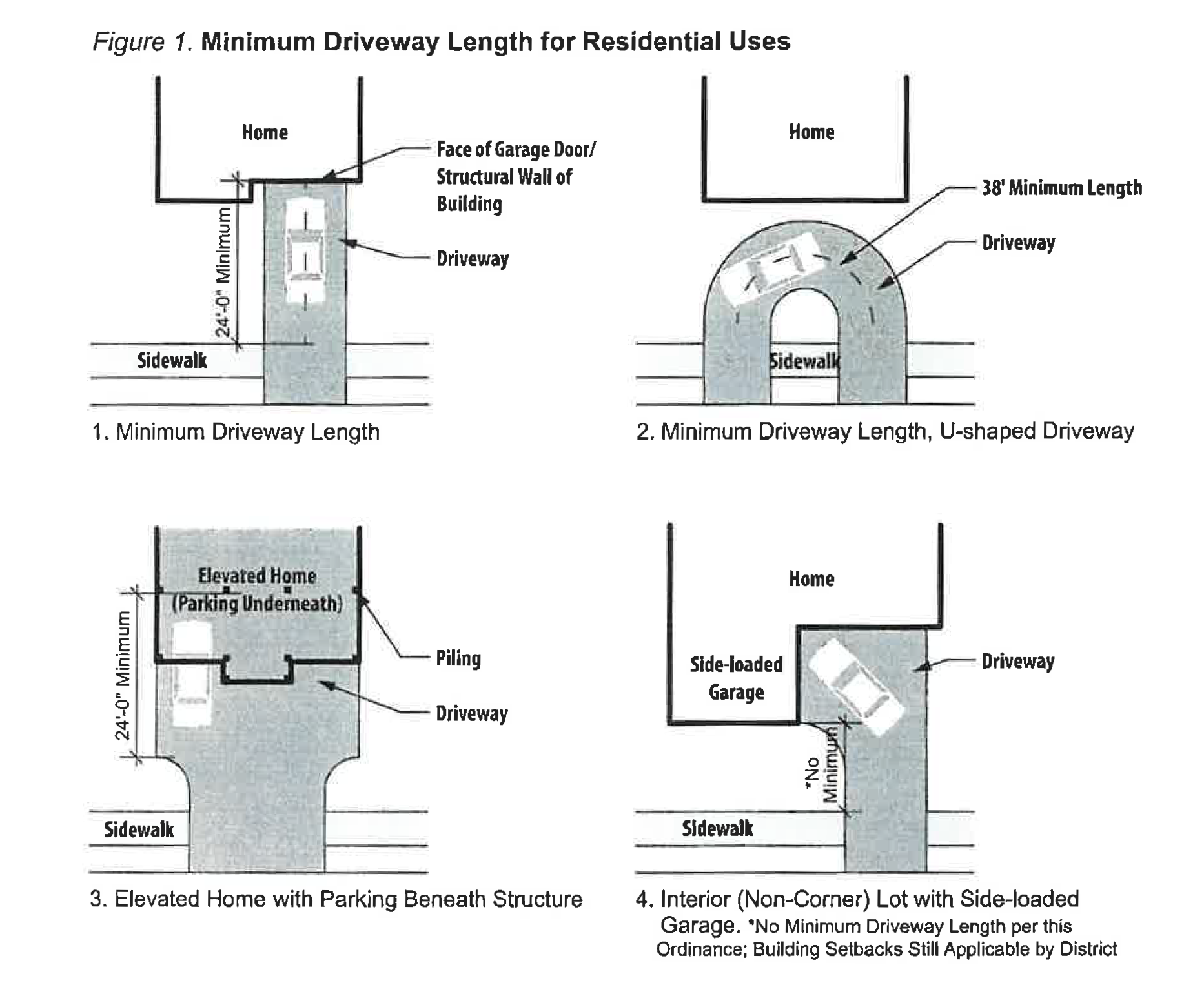
(Ord. No. 25-20, § 1, 5-5-25)
Sec. 23-129.4. - Standards for pervious surfaces and impervious surfaces for single-family and duplex residences not subject to site-specific development plan review.
(1)
Purpose: This section is intended to ensure consistent and performance-based evaluation of surfaces for the purposes of calculating compliance with impervious surface limits established in individual zoning districts.
(2)
Standards for pervious materials: To be considered pervious and excluded from impervious surface calculations, a material or system must:
a.
Be installed in a manner that allows water infiltration through the surface and into the ground;
b.
Demonstrate a minimum infiltration rate of two (2) inches per hour, based on manufacturer testing or accepted industry standards;
c.
Be installed according to manufacturer specifications, including required base materials and installation methods to achieve pervious performance;
d.
Permits for pervious surfaces are subject to inspection to confirm installation per approved specifications;
e.
Property owners are responsible for maintaining the system to ensure continued infiltration over time;
f.
This standard applies regardless of native soil conditions. Site-specific soil testing is not required.
g.
If these criteria are not met, the surface will be considered impervious, regardless of material type or labeling.
(3)
Exemption for pool basins: Although swimming pool basins are impervious, they are excluded from the calculation of impervious surface coverage. This exemption applies only to the pool basin, not to surrounding pool decks, patios, or hardscape. This provision acknowledges the widespread use of pools as valued amenities in residential and resort areas and is intended to avoid undue burden while maintaining effective stormwater controls.
(Ord. No. 10-03, § 1, 4-5-10; Ord. No. 25-45, § 2, 10-6-25)

