
Northport City Zoning Code
ARTICLE 3
- GENERAL REGULATIONS
Sec. 3.01.- Introduction.
The purpose of these regulations is to allow maximum utilization of land while protecting against detrimental impacts on the environment, neighboring properties, and the public interest. This protection is provided by separating the City into various zoning districts and permitting specified land uses within each, provided that a use meets all the additional criteria specified in this Ordinance.
(Ord. No. 2249, 1(Exh. A), 12-16-24)
Sec. 3.02. - Use Regulations.
3.02.01.
Uses are permitted within each district as specified in Articles 4, 5 and 6 in accordance with the following:
A.
Except as otherwise provided by law or in this Ordinance, no land may be used nor structure erected, enlarged, reconstructed, moved, or structurally altered except for a use permitted by right or approved by the Council as a Conditional Use (Section 12.05) or by the Board as a Special Exception (Section 14.04).
B.
Certain uses identified in Articles 4, 5 and 6 are subject to "Use-Specific Regulations" in Article 7.
C.
Uses indicated as "permitted by right" are permitted provided that all applicable requirements of State law and this Ordinance have been met.
D.
Whether an unlisted use falls within a defined use category is determined in accordance with Section 13.02, Interpretations. Otherwise, uses not listed in Articles 4, 5 and 6 as "permitted by right," Conditional Uses or Special Exceptions are prohibited.
3.02.02.
Although a use may be permitted by right or through approval of a Conditional Use or Special Exception in a particular district, no use is permissible on a parcel unless it can be located thereon in full compliance with all applicable regulations of this Ordinance.
3.02.03.
In addition to the use regulations contained in this Ordinance, uses are subject to all performance criteria and other regulations governing yards, lot size, lot width, building area, easements, provisions of off-street parking and loading, and to such other provisions specified in this Ordinance and the laws of the State of Alabama and the regulations of the County Health Department regarding water supply and waste disposal. For premises not served by public water and/or sewage facilities, permits may not be issued until approval is obtained from the County Health Department.
3.02.04.
Standards Applicable to Certain Uses. In addition to compliance with other regulations imposed by this Ordinance, the following standards are required of the uses enumerated below:
A.
Except as otherwise provided for group homes, no more than one family, as defined in Section 2.04, Definitions, may occupy a dwelling unit.
B.
If any portion of a dwelling is marketed or occupied as a separate dwelling unit, then such portion is deemed to be a second dwelling unit regardless of whether it has internal access to other portions of the dwelling.
C.
Existing accessory dwellings in the RS, RCI, and HN Districts are permitted uses and may be improved within the existing structure, but the number and size of dwelling units in the structure may not be increased. New accessory dwellings are permitted only as provided in the district regulations. When existing accessory dwellings are improved, off-street, paved parking spaces must be provided and any required landscaping installed.
D.
Limitations on Animals. See Chapter 14 of the City of Northport, Alabama Code of Ordinances.
E.
Vehicle or Equipment-Oriented Uses. Any outside display of vehicles, equipment, or other merchandise for sale, lease, or storage shall be on a paved surface. No display of merchandise shall be allowed on the right-of-way or in any required buffer or setback.
(Ord. No. 2249, (Att.), 12-16-24; Ord. No. 2268, § 1(Exh. A), 5-19-25)
Sec. 3.03. - Area and Dimensional Requirements.
3.03.01.
Lots and Yards.
A.
Each structure, hereafter erected or altered, excluding only interior changes to an existing structure, must conform to the minimum lot area, width and yard setbacks of the applicable district.
B.
No yard, open space or lot required for a building or structure may, during its life, be occupied by or counted as open space for another structure.
C.
No lot may be reduced in area so that yards and other open spaces total less than the minimum area required under this Ordinance except that when a lot is reduced in dimension or total area by 20% or less by the dedication and acceptance of a portion of such lot by the City, the area of the lot prior to the dedication is used in measuring area requirements. However, the dimensions of the lot after the dedication are used in measuring setback requirements.
D.
Common open spaces that are contained within their own lot are not subject to the minimum lot area requirements.
E.
Except as provided for Single-frontage Corner Lots, the minimum front setback applies to all frontages of lots with frontage on more than one street.
F.
The following structures may project into or be constructed in any minimum required yard as follows:
1.
Awnings, canopies, roof overhangs and balconies may project up to three feet but not closer than five feet to any property line. However, wherever buildings are permitted to be built closer than five feet to a side lot line, including, but not limited to, townhouses and zero lot line dwellings, roof overhangs may extend closer to and may project beyond side lot lines, provided a maintenance easement is secured.
2.
Terraces, steps, uncovered decks and porches, walls and similar features that extend no more than 30 inches above grade level may project into a required yard but no closer than five feet to any property line.
3.
Clotheslines, driveways and their curbs, fences, walls, and hedges may be constructed in minimum yard areas, provided that their installation does not violate any other provision of this Ordinance.
G.
Lot Width. Lot width is measured along a straight line between the side lot lines at the front yard setback line. Where the lot fronts on a curved right-of-way, lot width is measured along an arc at the front yard setback line and parallel to the front lot line.
H.
The minimum front setback may be reduced where existing buildings on the same block frontage and in the same district are set back less than the front setback of the applicable district, as follows:
1.
On blocks up to 500 feet in length, the setback requirement is reduced to the average setback of all buildings along the frontage or the average setback of buildings within 100 feet on each side of the subject lot, whichever is less.
2.
On blocks longer than 500 feet, the setback requirement is reduced to the average setback of buildings within 200 feet on each side of the subject lot.
3.
For corner lots, the setback requirement is reduced to the average setback of all existing buildings along the same block frontage.
4.
In no case may a building be constructed closer than five to a right-of-way line unless approved by the City Engineer.
I.
On single-family residential lots, no driveway or other paved surface may be wider than 24 feet, measured at any point, forward of the front building line.
3.03.02.
Flag Lots. The Director identifies the front, side and rear lot lines of a flag lot for determining yard requirements, allowable locations of accessory structures, and other purposes.
A.
The front setback, unless otherwise determined by the Director, is measured from that lot line along the flag portion of the lot most parallel to and nearest the adjoining street.
B.
The land area within the access strip does not count toward the required minimum lot size.
C.
Flag lots may only be used for single-family residential use, and no more than one dwelling unit may be authorized on any one flag lot. Other uses may be permitted by conditional use if otherwise allowable within that zoning district.
3.03.03.
Height of Structures. Each structure, hereafter erected or altered, may not exceed the maximum height for structures in the applicable district. However, maximum height regulations do not apply to barns, silos and other farm structures; steeples, spires, domes, chimneys, flagpoles, public utility poles, radio and television towers and aerials, cooling towers, water tanks, and industrial structures required for a permitted manufacturing process and other such structures not designed for human occupancy may exceed this height, provided they comply with all other applicable codes and ordinances.
3.03.04.
Nothing contained in this Section may be construed to allow encroachment of any feature into a required buffer.
(Ord. No. 2249, (Att.), 12-16-24; Ord. No. 2268, § 1(Exh. A), 5-19-25)
Sec. 3.04. - Structures.
3.04.01.
Only buildings conforming to the Building Code and manufactured homes conforming to the HUD Code may be used for permanent residential occupancy. Recreational vehicles, tiny homes on wheels and similar portable structures may be permitted only for temporary residential occupancy in recreational vehicle parks and campgrounds.
3.04.02.
Permanent structures and accessory structures may not be located within public utility or drainage easements.
3.04.03.
No structure may be moved from one development site to another unless such structure complies, at the new location, with all applicable provisions of this Ordinance.
3.04.04.
Accessory Uses and Structures.
A.
Authorization.
1.
Any question of whether a particular use is permitted as an accessory use is determined by the Director.
2.
No accessory use or structure may be established or constructed unless a building permit, evidencing the compliance of such use or structure with all applicable provision of this Ordinance and all other City regulations, has first been issued in accordance with Section 12.06, Building Permit, Certificate of Occupancy.
3.
No accessory structure or use may be constructed or established on any lot prior to substantial completion of the principal structure. This does not apply to agriculture-related structures in the AG District.
B.
Size, Lot Coverage and Placement.
1.
The principal use or structure, together with any accessory use or structure, may not jointly exceed applicable, ISR nor exterior storage limitations.
2.
On residential lots, accessory structures may not exceed the height of the principal residential building nor 25 feet in height, whichever is less, except as provided for antennas in Section 3.04.04(F). If taller than 15 feet, they must be set back one additional foot from side and rear lot lines for each two feet in height above 15 feet.
3.
On residential lots, the total floor area of all accessory structures may not exceed 50% of the floor area of the principal structure. This includes open carports, gazebos and greenhouses, but not swimming pools. This does not apply to lots of three acres or larger in the AG District.
4.
Accessory structures may not be located within any required front yard or within a required buffer. However, freestanding gazebos, arbors, trellises and similar open structures other than antennae that are no larger than 50 square feet in area are permitted in required front yards provided they are set back at least ten feet from the nearest front lot line.
5.
Except as provided for open structures in Paragraph 4 above, accessory structures serving residential uses must be set back at least ten feet behind the front building line and at least 5 feet from any side or rear lot line.
6.
Accessory structures serving nonresidential uses must comply with the yard setbacks required of principal structures in the applicable district.
7.
Accessory structures may not be closer than ten feet to a principal structure nor five feet to any other accessory structure. If attached to another structure by means of fully enclosed habitable area, the two structures are considered one.
C.
Number of Structures in Rear Yard. Within the rear yard of residential lots, the maximum number of accessory structures, other than swimming pools, is permitted as follows:
a.
Established rear yard of 1,500 square feet or less: one accessory structure
b.
Established rear yard of 1,501—4,000 square feet: two accessory structures
c.
Established rear yard of 4,001—10,000 square feet: three accessory structures
d.
Established rear yard of more than 10,000 square feet: four accessory structures.
D.
Design.
1.
Accessory structures must be constructed of materials compatible with those of the principal structure. At least one exterior material used in the design of the accessory structure must be the same type and similar color as that used on the principal structure. Trim material alone does not satisfy this requirement. Open accessory structures are only permitted for pavilions and similar uses.
2.
In residential districts one metal or prefabricated accessory structure not exceeding 200 square feet in area is permitted in the rear yard regardless of the compatibility of its exterior materials with that of the dwelling.
E.
Residential Swimming Pools and Recreational Facilities. The following standards apply to swimming pools, tennis courts and all other similarly improved recreational fields and courts, whether on an individual residential lot or in a common area of a residential subdivision or multifamily development.
1.
Recreational fields and courts and swimming pools are subject to the side and rear setback requirements applicable to other accessory structures and may not extend forward of the front building line of the principal building. For measurement purposes, swimming pools and recreational facilities include all surrounding decking or paving and vertical supports for screen enclosures.
2.
Stationary swimming pools with a depth of one foot or more in any portion of the pool must be enclosed by a fence of at least four feet in height, which must be in place prior to the filling of the pool. Pools must meet all applicable requirements of the most currently adopted City Property Maintenance Code.
3.
Swimming pools must be set back at least five feet from any covered or uncovered patio or deck that is unenclosed on all sides except where attached to the dwelling. Otherwise, swimming pools must be set back at least ten feet from the dwelling.
4.
No swimming pool or recreational facility on a residential lot or residential common area may be operated as a business.
5.
Lighting for pools and recreational facilities must be located and installed so that no direct light is visible from adjoining properties.
F.
Antennas. For Telecommunication Towers, refer to Section 7.06, Broadcast/TV/Radio and Telecommunication Towers.
1.
Antennas may not be the principal use of any property.
2.
Residential TV antennas may not exceed 30 feet in height. All other antennae may not extend above 60 feet in height, unless otherwise specified by this Ordinance.
3.
Antennas may not be located forward of the front building line or within a required front yard.
4.
Antennas not mounted on or affixed to a principal structure, including amateur radio antennas, must be set back from all property lines a distance equal to its height.
5.
No more than two attached antennas and one freestanding antenna are permitted on any lot or development site.
3.04.05.
Manufactured Housing.
A.
Purpose. The purpose of this section is to provide standards and procedures specifically relevant to the location and development of manufactured housing and manufactured home communities.
B.
Compatibility Standards: Manufactured homes must be compatible to site-built and other housing in the immediate general area within the same zoning district. Approval in accordance with Section 14.04, Special Exceptions, is required and may only be granted when the manufactured home is substantially similar in size, siding material, roof material, foundation and general aesthetic appearance to: (1) site-built or other forms of housing permitted in the same general area under this Ordinance; (2) existing development; or (3) proposed development in the same zoning district. Items subject to compatibility comparison will include the following:
1.
Exterior Finish. Any material may be used for exterior finish that is generally used in areas near the location where the manufactured home is sited.
2.
Size and Appearance. The general appearance and square footage of the home must be consistent and compatible with housing in adjacent locations to ensure compatibility.
3.
Site-Orientation. Manufactured homes must be placed on lots in a manner compatible with and reasonably similar in orientation to other residential structures in the area.
4.
Utilities. The home must be connected to water and sewage systems (including well and septic tank, if applicable) approved by the Alabama Department of Public Health or the Alabama Department of Environmental Management.
5.
Underpinning. The type of material and method used for underpinning must be consistent with and compatible to site-built homes in adjacent locations.
C.
Standards for All Manufactured Homes.
1.
All manufactured homes that do not conform to this Section 3.04.05 on its effective date are treated as nonconforming uses. All manufactured homes placed after the effective date must comply with this Section 3.04.05 and any other applicable requirements of this Ordinance.
2.
It is unlawful for any person to place, replace or relocate a manufactured home within the City without first being granted a permit.
3.
Prior to installation, each manufactured home must bear a seal certifying compliance with the HUD Code. Any existing manufactured or mobile home not bearing such a seal is deemed and treated as a nonconforming structure and use in accordance with Article 11, Nonconformities.
4.
All manufactured homes must be set up, installed and anchored in compliance with the requirements of the Alabama Manufactured Housing Commission.
5.
All manufactured homes must be skirted with a weather-resistant material. Skirting must be adequately vented.
6.
Once a manufactured home has been placed and prior to occupation, all tow bars and axles must be removed and either removed from the property or stored on the lot where they will not be visible.
7.
Prior to occupation, a landing, porch or deck must be installed on all entrances. At least one of said landings, porches or decks must be at least five feet in depth (measured outward from the exterior of the home), at least eight feet in length and must contain a railing along all exterior sides. Stairs must be at least three feet wide and must have exterior railing. All required stairs, landings, porches and decks must be constructed of treated or cedar wood or masonry or some combination of both. Required railing may be constructed of wood or metal material.
D.
Temporary Use of Manufactured Homes.
1.
The Board, in accordance with Section 14.04, Special Exceptions, may grant permission to use a manufactured home upon the premises on which a building or home is being constructed during the time of construction and may qualify, limit or terminate such permission at any time.
2.
Such permits are issued for a specified time period to allow for the construction of the permanent building. If construction is not started by the allotted start date or if the construction does not continue on a reasonable basis, as determined by the Council, the permit will be revoked unless an extension is granted by the Board upon request of the applicant.
E.
Manufactured Homes as Infill Dwellings. Manufactured Homes may be permitted in accordance with Section 14.04, Special Exceptions, on a vacant lot within the AG and RS districts, subject to the following compatibility standards:
1.
The proposed manufactured home will not be located on a vacant lot that is within a designated local, state or federal historic district, or a vacant lot that is between two or more structures that have been listed on or are eligible for addition to the National Register of Historic Places.
2.
The combined value of the proposed manufactured home and subject property must be at least 90% of the average appraised value of all adjoining, developed single-family properties.
(Ord. No. 2249, (Att.), 12-16-24; Ord. No. 2268, § 1(Exh. A), 5-19-25; Ord. No. 2287, § 1(Exh. A), 12-1-25)
Sec. 3.05. - Resource Protection Standards.
3.05.01.
Generally.
A.
All development must be preceded by the identification of any environmental or natural feature described below and must meet the specified standards for environmental protection.
B.
Site alterations, grading, filling and clearing or planting vegetation prior to approval of the plans for development is a violation of this Ordinance.
C.
As used in this section "open space" is as defined in Section 2.04, Definitions, and as described in Section 3.08, Common Open Spaces and Amenities.
3.05.02.
Perennial Streams. 50 feet from the top of a perennial stream bank, on both sides, must remain undisturbed unless otherwise permitted by the City Engineer.
3.05.03.
Steep Slopes.
A.
Developments should be designed to minimize impact on areas with steep slopes. When a site contains existing slopes of 3:1 or greater, disturbance of such areas should be minimized to the extent practicable. When they are disturbed, the slope must be flatted to be no steeper than 3:1 and resulting slopes must be consistent with the recommendations of a geotechnical report prepared by an engineer. The report should, at a minimum, evaluate the need for benching, as well as construction and permanent erosion control best management practices.
B.
When identifying steep slope areas, contour intervals of two feet or better must be used to determine changes in elevation. Unless otherwise approved by the Director, a length of not more than 100 feet must be used to calculate the approximate slope of the area under consideration.
C.
When a proposed development will not meet the standards of Paragraph A above, a development plan must be submitted for review by the City Engineer and approving authority. Approval of the development plan is determined with consideration of its consistency with the intent of this Ordinance.
3.05.04.
Areas Subject to Flooding. Development in any flood hazard area identified by FEMA is subject to the Flood Damage Prevention Ordinance #1368, as amended.
3.05.05.
Lakes and Ponds.
A.
All such areas that serve a stormwater or flood retention purpose must be reserved as permanent open space and must be maintained by the developer, property owner or other legally bound and authorized agent. No development or diverting of these bodies of water may be permitted without a development plan approved by the City Engineer. Alteration of lakes and ponds is permitted only if surface area and flood retention volumes remain unchanged or are enlarged.
B.
Lake Shorelines. The shorelines of lakes, consisting of the area within 100 feet from the shorelines, may contain no more than 15% impervious surfaces. At least 75% of all such areas must be permanent open space.
C.
Pond Shorelines. The shorelines of ponds, consisting of the area within 50 feet from the shorelines, may contain no more than 15% impervious surfaces. At least 75% of all such areas must be permanent open space.
3.05.06.
Drainageways. Re-grading, stripping of vegetation, or filling in drainageways is permitted only after review and written approval by the City Engineer, provided that the resultant drainageway has less velocity than existed previously or reduces stream bank erosion through the provision of erosion control measures.
(Ord. No. 2249, 1(Exh. A), 12-16-24)
Sec. 3.06. - Reclamation of Undeveloped Land.
3.06.01.
If construction of a development has not been completed within one year of the date of approval of the construction plan; said development is reviewed by the Director to determine if reasonable progress toward completion of the development is being made. Evidence of reasonable progress may include, but is not limited to, installation of streets, utility lines and stormwater management facilities; laying of structural foundations; or completion of any phase of a development approved under a phasing plan pursuant to Section 12.04, Site Plan Review. However, the clearing and grading of land, in the absence of other improvements, does not constitute evidence of reasonable progress.
3.06.02.
Upon a determination that reasonable progress is not being made, the approving authority may require the owner of the development site to restore the land to the same condition that existed prior to the initiation of the development and place a time limit on completion of said restoration.
3.06.03.
If such restoration is not feasible, the City Engineer and the Director, in consultation with the owner, will determine an acceptable condition or degree of reclamation. At a minimum, the site must be sodded or planted in grass and appropriate measures taken to prevent or eliminate soil erosion. In all cases, restoration activities must be consistent with appropriate best management practices as recommended by the Alabama Forestry Commission, the ADEM and the NRCS.
(Ord. No. 2249, 1(Exh. A), 12-16-24)
Sec. 3.07. - Fences and Walls.
3.07.01.
A fence permit must be obtained prior to construction or installation of any fence or wall, except in the following cases:
A.
Maintenance and repairs that do not change the original dimensions of the fence or wall
B.
Replacement or alteration of less than 50% of the fence or wall materials, provided the location of the fence or wall does not change.
3.07.02.
Relationship to Streets.
A.
No fence or wall may project into the unobstructed space required at a street intersection, as determined by the City Engineer.
B.
No part of a fence or wall may be within a public right-of-way or easement adjoining such right-of-way. Fences and walls must be set back at least 15 feet from the nearest edge of pavement of a street.
C.
If visible from a public street, the finished side of the fence must face the street, and any chain link fencing must be black, vinyl-coated.
3.07.03.
Height and Materials.
A.
In nonresidential zones, no wall or fence may exceed ten feet in height.
B.
Chain link and similar wire fencing is prohibited in O-I, C-2, C-3, C-6 and REC Districts except that black, vinyl-coated chain link fencing may be used for recreational fields and to secure detention and retention basins.
C.
Chain link and similar wire fencing are prohibited in all Downtown Districts (see Section 6.05, Downtown Districts).
D.
Special Corridor Overlay District:
1.
Chain link and similar wire fencing material may not be used forward of the front building line.
2.
Fences in front yards may not exceed four feet in height.
E.
In residential zones:
1.
No wall or fence may exceed eight feet in height and no fence located in a front yard along which a dwelling has its entrance may exceed four feet in height. If taller than four feet, fences must be set back from the nearest front lot line a distance equal to or greater than the side setback in the applicable district. See Figure 3-1.
2.
Chain link and similar wire fencing may not be used forward of the front building line.
F.
In a front yard, walls and fences must be architecturally compatible with the style, materials, and colors of the principal building.
G.
Solid walls and fences may not be installed in the front yard along which a dwelling has its entrance.
H.
In residential, commercial, Office-Institutional and mixed-use zones, fences located forward of the front building line may not be solid or opaque, unless required for screening or buffering, nor may they exceed 4 feet in height. All portions of such fences above three feet from grade level must be at least 25% open.
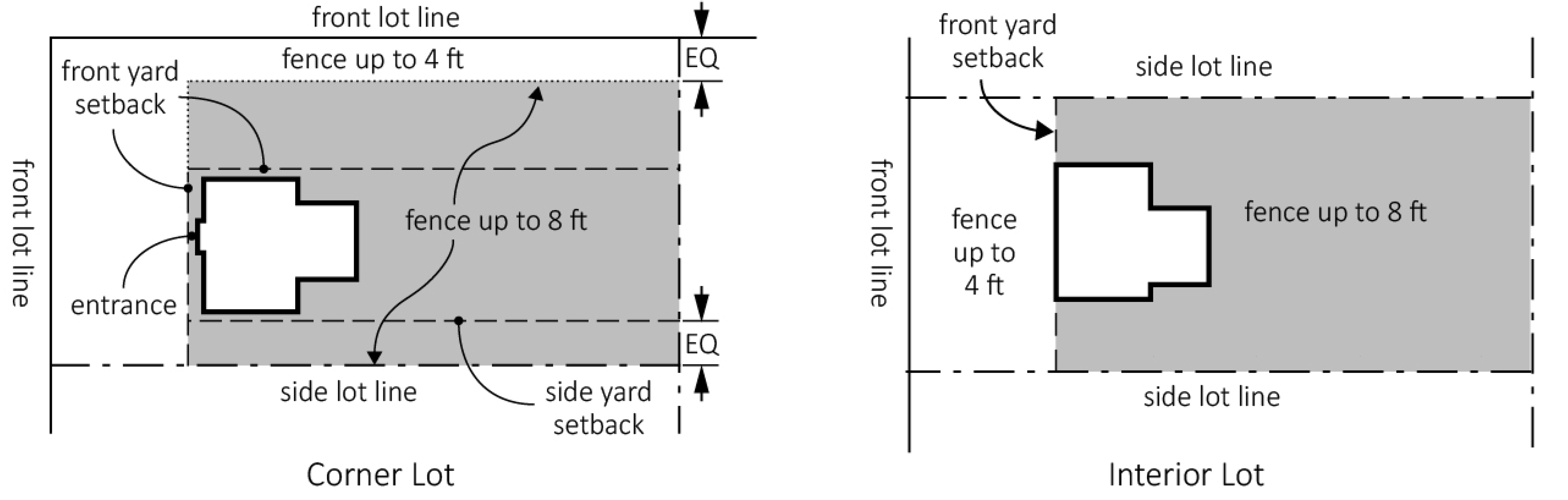
Figure 3-1 Residential Fence Heights
(Ord. No. 2249, 1(Exh. A), 12-16-24; Ord. No. 2301, § 1(Exh. A), 5-18-26)
Sec. 3.08. - Common Open Spaces and Amenities.
3.08.01.
Common open space, parking areas and amenities must be maintained as such and may not be separately sold, subdivided, or developed, and no structures may be built on such land, except as provided in this Section. All such properties must be owned and maintained by the developer, owner of the development site, condominium or property owners association (hereinafter "association"), or other private entity approved by the City Attorney.
3.08.02.
Common open spaces, parking areas and amenities may be owned, preserved, and maintained by any of the following mechanisms or combinations thereof:
A.
Common ownership of the open space or amenity by an association, which assumes full responsibility for its maintenance.
B.
Deed-restricted private ownership that prevents development and subsequent subdivision of the open space or amenity and provides maintenance responsibility. This arrangement must be noted on the site plan or subdivision plat, as applicable. Full and proper written legal documentation of said ownership and maintenance responsibilities must be submitted to the Director and approved by the City Attorney prior to commencement of development activities.
3.08.03.
Common open spaces and amenities must be maintained so that their use and enjoyment as such is not diminished or destroyed.
Within a subdivision, required open spaces must be subdivided from other parcels. On the subdivision plat, parcels containing common open spaces, parking areas and amenities must be given a sequential lot number, their intended use labeled, and entity having ownership and maintenance responsibility indicated.
3.08.04.
Where common open spaces, parking areas or amenities provided within a development site, which is the subject of a site plan, and is under different ownership than the rest of the site, it must nevertheless remain part of the development site pursuant to Section 12.04.11, Development Site to Be Unified. Unless the site plan is modified or terminated in accordance with Section 12.04.08, Modification or Termination, such common open spaces, parking areas and amenities must be used only as provided in this Ordinance. The site plan must note the entity having ownership and maintenance responsibility.
(Ord. No. 2249, 1(Exh. A), 12-16-24)
Sec. 3.09. - Clear View of Intersections.
On any portion of a lot that lies within the triangular area of an intersection as specified in the City Engineering Design and Construction Manual, nothing may be erected, planted, placed, or allowed to grow in such a manner that impedes vision between a height of two and one-half feet and ten feet above grade at the intersection of the streets.
(Ord. No. 2249, 1(Exh. A), 12-16-24)
Sec. 3.10. - Traffic Management.
3.10.01.
Transportation Impact Report. In the following cases and where otherwise deemed necessary by the City Engineer, a transportation impact report must be prepared and submitted with the Site Plan or Preliminary Plat, as applicable and must include that information specified in the Engineering Design and Construction Manual:
A.
Any development with proposed access along any collector or arterial road.
B.
Any proposed development of 30 or more dwelling units.
C.
Any use that will generate more than either 100 trips per acre per day or 250 trips per day. Trip generation rates for proposed uses is determined by consulting the latest edition of Trip Generation published by the Institute of Transportation Engineers, and/or the City Engineer.
3.10.02.
Traffic control devices. Whenever it is determined that there is a need for, as the result of additional traffic generated by a proposed development, a traffic signal, traffic signs, additional right-of-way or acceleration/deceleration lanes, the developer must make such planned improvements a part of the development plan and propose a schedule to the Planning Commission, hereinafter "the Commission," or other approving authority for making such improvements. Anticipated improvements required by future development and the developer's share in those improvements are listed in the following paragraphs.
A.
Traffic signs, including stop, yield, caution, and street signs must be placed by the developer at their expense. Special signs such as "watch for traffic entering," "blind hill" and "pedestrian crossing" may also be required. All traffic signs must be specified, installed, and maintained in accordance with the MUTCD.
B.
Traffic signals must be placed at the direction of the agency having jurisdiction. This includes signalization and improvement of railroad crossings. Because of the timing of the actual installation of signals by authorized agencies, the developer must post a bond guaranteeing the estimated cost of traffic signal improvements.
C.
Acceleration and deceleration lanes or other improvements, if determined necessary based on the findings of a required transportation impact report, must be provided by the developer at the direction of the City Engineer. Such improvements must be designed and constructed to the standards of the agency having jurisdiction. The cost of such improvements will be borne entirely by the developer.
3.10.03.
Cross Access Requirements. The City Engineer may require cross access and permanent access easements for adjoining lots with frontage on collector or arterial roads to provide access between such lots in the interest of access management, public safety and facilitating vehicular traffic.
3.10.04.
Median Cuts. Any alteration of existing or planned roadway medians requires approval of the City Engineer and/or ALDOT; and only where such alteration is in the interest of public safety. Where such alterations are allowed, the entire cost must be borne by the applicant. The improvement of other medians or similar traffic control devices in proximity to the proposed development may be required in consideration for any allowed median alteration.
3.10.05.
Additional right-of-way required by a specific governmental plan for the improvement of an existing or proposed roadway must be dedicated to the City. Said right-of-way may be required at the time of subdivision or site plan review.
3.10.06.
Access.
A.
Except as otherwise provided herein and in Section 7.10, Cottage Developments, development sites must have legal access to a publicly owned and maintained street or road. Physical access alone does not qualify any development site for such permits. Legal access must consist of the required length of street or road frontage, a flag lot approved by the Commission in accordance with the requirements of this Ordinance and the Subdivision Regulations, or access easements under this Section. For developments other than single family residential, legal access includes street frontage shown in an approved preliminary plat; however, no certificate of occupancy for any structure may be issued without recordation of the corresponding final plat.
B.
Access Easements. Access by easement must be expressly approved by the Commission, in the case of subdivisions, or by approval of a Special Exception by the Board in all other cases. In all such cases, the following conditions apply:
1.
Direct access to a street or provision of minimum street frontage is not practicable.
2.
The property owner seeking a permit must possess a valid legal instrument, recorded in the Office of the Judge of Probate, indicating ownership of an access strip or easement at least 15 feet in width connecting the subject property with a public road.
3.
No such access may serve more than one building site.
4.
No development may be authorized on any such building site other than one single-family dwelling and permitted accessory structures. However, other uses may be considered through Special Exception by the Board when an easement is provided and has been approved by the City Engineer and City Attorney.
5.
Prior to issuance of a certificate of occupancy, the access must be graded and/or covered with a suitable surface so as to be passable to emergency vehicles.
6.
The permit applicant must sign a statement indicating that the City of Northport has no obligation to repair nor maintain the access in a usable condition, and that the City is not liable for injuries to persons or damage to property resulting from the lack of direct access to a public road.
(Ord. No. 2249, 1(Exh. A), 12-16-24)
Sec. 3.11. - Lighting.
3.11.01.
Light or glare from any operation and all lighting for parking areas or for the external illumination of buildings or grounds must be directed, shielded, and located to focus lighting onto the use and away from adjacent property and pedestrian and vehicular areas (See Figure 3-2). Fixtures with light sources of 100 watts or less do not require shielding.
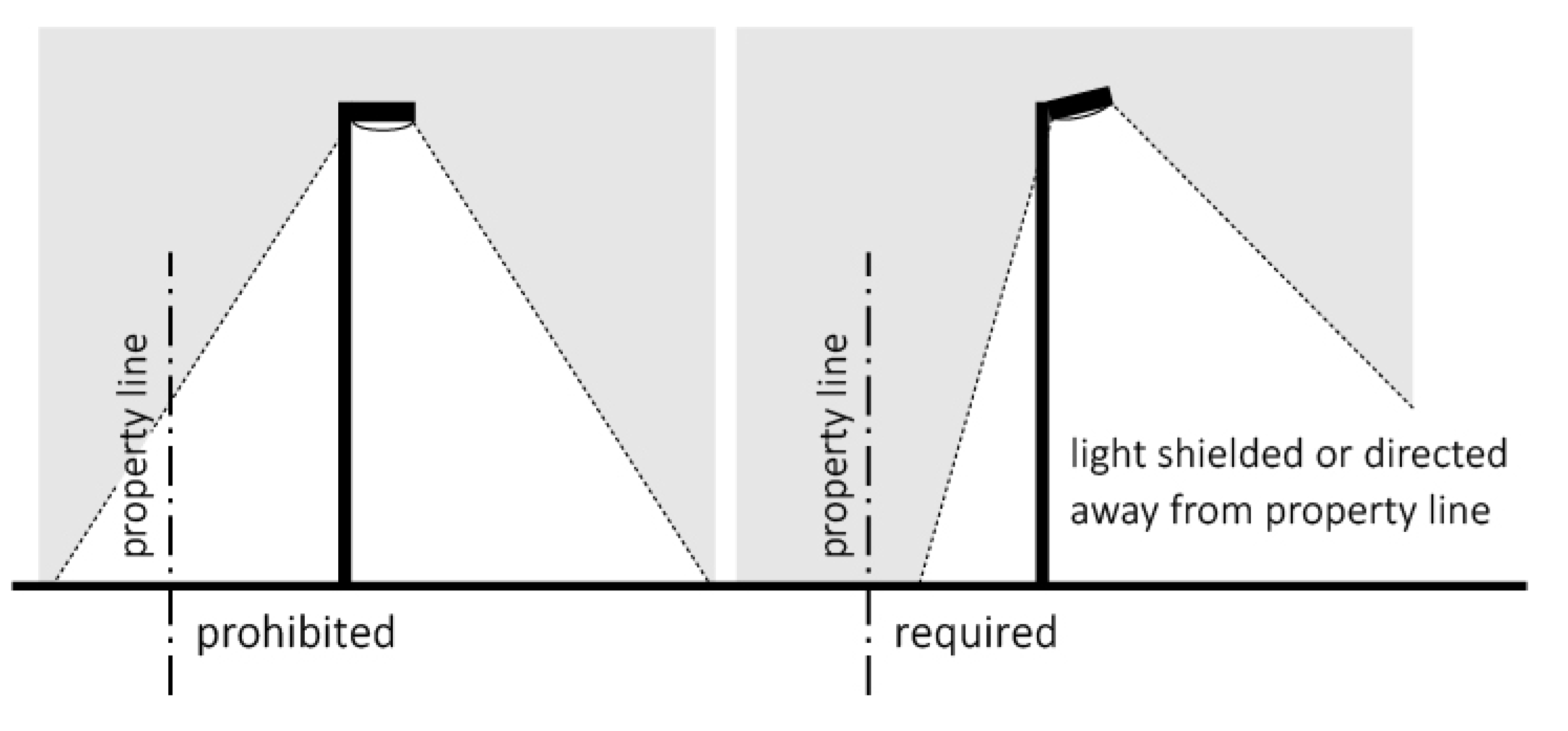
Figure 3-2 Control of Light Glare
3.11.02.
The intensity of light may not exceed 0.3 footcandles beyond any adjoining residential property line nor three footcandles otherwise. However, nonresidential uses may share fixtures along property lines or allow light to trespass onto adjoining properties with written approval of the subject property owners.
3.11.03.
The following lighting standards apply to parking lots of ten or more spaces serving residential, institutional and commercial uses:
A.
Minimum horizontal illuminance of 0.2 footcandles, measured on the parking surface
B.
Minimum vertical illuminance of 0.1 footcandles, measured at five feet above the parking surface at the point of lowest horizontal illuminance, excluding facing outward along the site boundary
C.
Uniformity ratio of 20:1, the highest horizontal illuminance point divided by the lowest horizontal illuminance point or area
3.11.04.
All lighting fixtures incorporated into non-enclosed structures (e.g., gas pump canopies, car washes, etc.) must be fully recessed into the underside of such structures.
3.11.05.
A lighting plan must be provided with all development plans and must show, at a minimum, placement and height of all lighting structures and illumination levels taking into account landscaping and other possible obstructions. The lighting designer must certify that the lighting plan meets the above requirements.
(Ord. No. 2249, 1(Exh. A), 12-16-24)

