
Northport City Zoning Code
ARTICLE 7
- DETAILED USE REGULATIONS
Sec. 7.01.- Purpose.
7.01.01.
The purpose of this Article is to specify the detailed regulations that apply to specific land uses. Certain uses have unique characteristics that require the imposition of development standards beyond those minimum standards applicable throughout a zoning district.
7.01.02.
These standards must be met in addition to all other standards of this Ordinance, unless specifically exempted. See Section 12.04, Site Plan Review, for additional information.
(Ord. No. 2249, 1(Exh. A), 12-16-24)
Sec. 7.02. - Accessory Dwellings.
Accessory Dwellings may only be permitted as an accessory use to a permitted single-family detached dwelling in accordance with the following:
7.02.01.
Permit Required. An Accessory Dwelling Permit is required for all accessory dwellings. Accessory dwellings may be maintained in perpetuity but only in compliance with these regulations. Any accessory dwelling permit will automatically expire whenever required off-street parking is no longer provided on the premises.
7.02.02.
Area and Dimensional Requirements.
A.
Accessory dwellings are permitted only on lots of at least 10,000 square feet. If the principal dwelling is not connected to sanitary sewer service, minimum lot requirements of the health department or similar authority apply to each dwelling.
B.
Accessory dwellings must be set back from lot lines as required for the principal dwelling.
C.
The habitable floor area of an accessory dwelling must be at least 200 square feet but not more than 50% of the gross floor area of the principal dwelling or 1,000 square feet, whichever is more restrictive.
7.02.03.
Additional Requirements.
A.
No more than one accessory dwelling is permitted on the lot of a single-family detached dwelling.
B.
Separate water, sewer and gas utility meters are not permitted.
C.
One parking space, in addition to that required for the principal dwelling, must be provided.
D.
Accessory dwellings must comply with the Building Code and be installed on a permanent foundation.
E.
Accessory dwellings may not have separate vehicular access along the same street frontage as the principal dwelling.
F.
An accessory dwelling may not be sold separately from the principal dwelling unless there is sufficient lot area to subdivide the property into lots meeting the area and dimensional requirements of the district.
7.02.04.
If an existing residential garage is converted to an accessory dwelling, off-street parking requirements for the principal dwelling and accessory dwelling must be met concurrently with the conversion.
(Ord. No. 2249, 1(Exh. A), 12-16-24)
Sec. 7.03. - Alternative Financial Services.
Alternative financial services are subject to the spacing and other requirements of City of Northport Ordinance No. 1814, as amended and Ordinance No. 1975, as amended.
(Ord. No. 2249, 1(Exh. A), 12-16-24)
Sec. 7.04. - Ambulance Service.
Ambulance services must front on an arterial roadway.
(Ord. No. 2249, 1(Exh. A), 12-16-24)
Sec. 7.05. - Bed and Breakfast Establishments.
The following standards apply to Bed and Breakfast establishments in residential districts only:
7.05.01.
Bed and Breakfasts are permitted only in detached, single-family dwellings and must be operated by the owner and resident of the dwelling.
7.05.02.
Bed and breakfasts may provide lodging for not more than 14 consecutive days and may contain no more than four guest rooms.
7.05.03.
No meals other than breakfast may be provided by the proprietor.
7.05.04.
Guest rooms may not contain cooking facilities and do not constitute separate dwelling units.
7.05.05.
One parking space must be provided for each guest room, in addition to the spaces required for the dwelling. Recreational vehicle parking is prohibited except on lots one acre or larger in size. If permitted, recreational vehicle parking must be located away from view from public rights-of-way and from neighboring properties to the maximum extent practicable. Recreational vehicles may not be used for overnight lodging.
(Ord. No. 2249, 1(Exh. A), 12-16-24)
Sec. 7.06. - Broadcast/TV/Radio and Telecommunication Towers.
7.06.01.
Except where otherwise stated herein, the following standards apply to all types of broadcast and communication towers.
A.
Site Plan Required. All requirements for site plan approval, as set out in Article 12, must be met at the time of application for site of new towers.
B.
Safety and Structural Design of Towers. All broadcast towers must comply with requirements as set out in the latest edition of the EIA-222 code "Structural Standards for Steel Antenna Towers and Antenna Supporting Structures," as amended, published by the Electronic Industries Association and all other applicable structural safety standards, building and technical codes having jurisdiction, so as not to endanger the health and safety of residents, employees or travelers in the event of structural failure of the tower due to extreme weather conditions or other acts of God.
C.
Security. A security fence or wall must be installed around the perimeter of the compound, with a minimum height of eight feet as measured to the top of the fence (or barbed wire, if applicable). Such fence is to be located on the perimeter of the compound unless otherwise approved as part of the site plan. Guy anchors may be fenced separately from the main compound. Climbing pegs must be removed from the lower 20 feet of all broadcast towers.
D.
Lighting Restrictions.
1.
No lighting is permitted on any tower except as required by the Federal Aviation Administration (FAA) or Federal Communications Commission (FCC). In cases where the FAA or FCC does require a tower to be lighted, any such lighting must be the minimum necessary to comply with federal regulations. Written documentation of any FAA or FCC directives to light a tower differently than provided herein must be submitted with the site plan application.
2.
Any security lighting used at the facility must be of low intensity, may not be directed or reflected away from the site, and must not illuminate any portion of the site higher than ten feet.
E.
Maintenance. The owner of a broadcast tower is responsible for maintaining the structural integrity, safety, appearance, screening, buffers, security and other installations required by this Section, and by any other applicable codes, ordinances, regulations, statutes or conditions of approval imposed by the City of Northport or its authorized representatives, in perpetuity for as long as said tower remains on a site.
F.
Landscaping. Broadcast towers constructed in conjunction with a principal structure (e.g., radio/TV station) must comply with all buffer and landscape requirements in Article 9, Landscaping.
G.
Abandoned Facilities.
1.
Any broadcast facility that ceases to be used for its original communications purpose must be removed at the owner's expense. The owner of the facility must provide the Director with a copy of the notice to the FCC of the intent to cease operations and has 120 days from the date of such ceasing to remove the obsolete tower and all accessory structures and to restore the site to its natural condition.
2.
In the case of multiple providers sharing use of a single tower, notice will still be required from each provider as to their cessation of operations, and such provider must remove its facilities within the 120-day period prescribed above. At such time as all providers sharing use of a tower cease operation of their facilities located thereon, the owner of the tower must complete the removal and restoration process as set forth herein.
H.
Area and Dimensional Requirements.
1.
Minimum Setbacks: Each tower must be set back from all property lines a distance equal to 50% of its height. When site is a leased portion of a larger parcel, setbacks are measured from the property lines, not the leased site. Maintenance and equipment buildings must meet the setback requirements as specified for the applicable district.
2.
All structures, facilities and accessories associated with the proposed tower must be wholly within the required security fence. Guy anchors may be fenced separately from the main compound.
3.
Buffer Requirements: See Section 9.05, Buffers.
I.
Height and Location Restrictions.
1.
No tower may exceed a height of 300 feet.
2.
No broadcast tower site boundary may be located closer than 200 feet to any residence.
3.
No tower may be located less than a distance equal to its height, as measured from the base of the tower, from any RS District boundary.
4.
Any new towers must be a monopole or self-supporting design.
5.
Where such facility is constructed in conjunction with a principal structure, it must be sited behind the front building line of said structure. This requirement does not apply in the AG District.
7.06.02.
Telecommunications Towers. In addition to the standards set out in Section 7.06.01 above; the following standards apply to telecommunication towers.
A.
Application and Justification. All requirements for site plan approval, as set out in Section 12.04, Site Plan Review, must be met at the time of application for siting of new telecommunications towers. In addition, the following information must be provided when applying for approval of a telecommunication tower:
1.
A current USGS quadrangle map (1:24,000), or equivalent, showing the proposed site location and at least a two-mile radius around the site;
2.
A scaled elevation diagram of the facility, showing the type, height, finish, lighting, site improvements and other such details as necessary to convey an image of the facility at the proposed location;
3.
A study prepared by a radio frequency specialist that includes a mapped coverage analysis of the proposed facility and its relationship to the next nearest adjacent cell and an inventory and evaluation of existing towers, alternative sites and available structural facilities (e.g., buildings, billboards, water towers, or other structures that could be used for support in lieu of a new tower) considered within a two-mile radius of the proposed location.
4.
An inventory of all the provider's existing telecommunications towers and communications antenna sites in Tuscaloosa County, including those located in municipalities within Tuscaloosa County. This inventory must include:
a.
The location, parcel identification number, and ownership of the telecommunications tower
b.
Name of co-locators
c.
Height of tower
d.
Type of tower or nature of other structure where antenna is located
e.
Name of Wireless Communication Service Provider co-location coordinator
f.
Copy of Wireless Communication Service Provider's FCC license In the event such inventory has already been provided, each successive application must include an update such that said inventory will be completely current and accurate.
5.
Written documentation justifying the need for a new telecommunications tower site to be located on the proposed site. This documentation must address, at a minimum, how the proposed tower is justified in relation to the following points:
a.
A list, description and map of the potential co-location, nonresidential use or alternative location sites that are located within the geographic service area of the proposed site;
b.
Documentation that requests for co-location have been made at least 30 days prior to the filing of application for site plan approval
c.
A detailed explanation of why each such site was not technologically, legally or economically feasible, or why such efforts were otherwise unsuccessful;
d.
An analysis of how and why the proposed site is essential to meet service demands for the geographic service area and the countywide network;
6.
Certification that the proposed telecommunications tower is structurally and technically designed and capable, and will be so constructed, to meet the co-location requirements set forth in this Section. Immediately upon completion of construction, as-built certifications of same must be submitted.
B.
Co-location Requirements.
1.
Maximum Utilization of Existing Sites. No new telecommunications tower may be constructed if space is structurally, technically, and economically available for the proposed telecommunications antenna and related facilities on an existing tower; or on an alternative site (e.g. a structure), where such alternative location would cover the required service area without creating undue signal interference.
2.
All towers constructed subsequent to the adoption of this Section, and their associated compounds, must be designed and built to accommodate additional wireless communication service providers based on the height of the tower as follows:
a.
Towers 80 to 159 feet in height must accommodate a minimum of two providers.
b.
Towers 160 to 209 feet in height must accommodate a minimum of three providers.
c.
Towers of 210 to 300 feet in height must accommodate a minimum of four providers.
3.
Carriers wishing to co-locate on an existing tower may receive administrative approval of their request.
C.
Pre-Existing Towers.
1.
Any communications antenna locating on a pre-existing, properly permitted telecommunications tower subsequent to adoption of this Section is exempt from the restrictions of Article 9, Landscaping, when the provisions below are met:
a.
If structural strengthening is necessary to accommodate co-location, the tower type will remain the same as previously permitted.
b.
There will be no increase in the total height or type of lighting of the facility, including the tower, antennas and all other associated facilities.
c.
All setback and buffer requirements applicable to the existing tower, at the time its permit was issued will continue to apply to such tower.
2.
The Department permits such facilities through administrative review and approval.
7.06.03.
Exemptions.
A.
The following wireless communications facilities are exempt from the requirements of this Section:
1.
Amateur radio antennas and receive-only antennas not more than 60 feet in height, and satellite earth station antennas two meters or less in diameter, are exempt as provided for in the Federal Telecommunications Act of 1996 when no supportive tower is to be constructed.
2.
Accessory facilities used exclusively for dispatch communications by public emergency agencies or government agencies.
3.
Accessory facilities used exclusively for dispatch communications by private entities, or for internal communications by public utilities, provided such facilities do not exceed a total of 60 feet in height whether mounted to a structure or ground mounted.
B.
Any waiver from the regulations in this Section for facilities exceeding the foregoing dimensions may only be approved as Special Exceptions from the Board.
(Ord. No. 2249, 1(Exh. A), 12-16-24)
Sec. 7.07. - Bulk Storage of Chemicals or Fuels.
7.07.01.
Minimum lot size is 100,000 square feet.
7.07.02.
Storage tanks or structures must be at least 100 feet from all property lines.
(Ord. No. 2249, 1(Exh. A), 12-16-24)
Sec. 7.08. - Car Wash.
7.08.01.
Noise levels may not exceed 80 dB at any lot line adjoining a residential use or district.
7.08.02.
A Class B buffer (see Section 9.05, Buffers) must be provided between vacuuming facilities and any adjoining residential use or district. If not adjoining a residential use or district, vacuums must be located on site to provide the greatest separation from any nearby residential uses.
7.08.03.
A Class A buffer must be provided between vacuuming facilities and any adjoining commercial or institutional use.
(Ord. No. 2249, 1(Exh. A), 12-16-24)
Sec. 7.09. - Commercial Incinerator.
A.
Minimum lot size is 100,000 square feet.
B.
Structures must be at least 100 feet from all property lines.
(Ord. No. 2249, 1(Exh. A), 12-16-24)
Sec. 7.10. - Cottage Developments.
7.10.01.
General Standards.
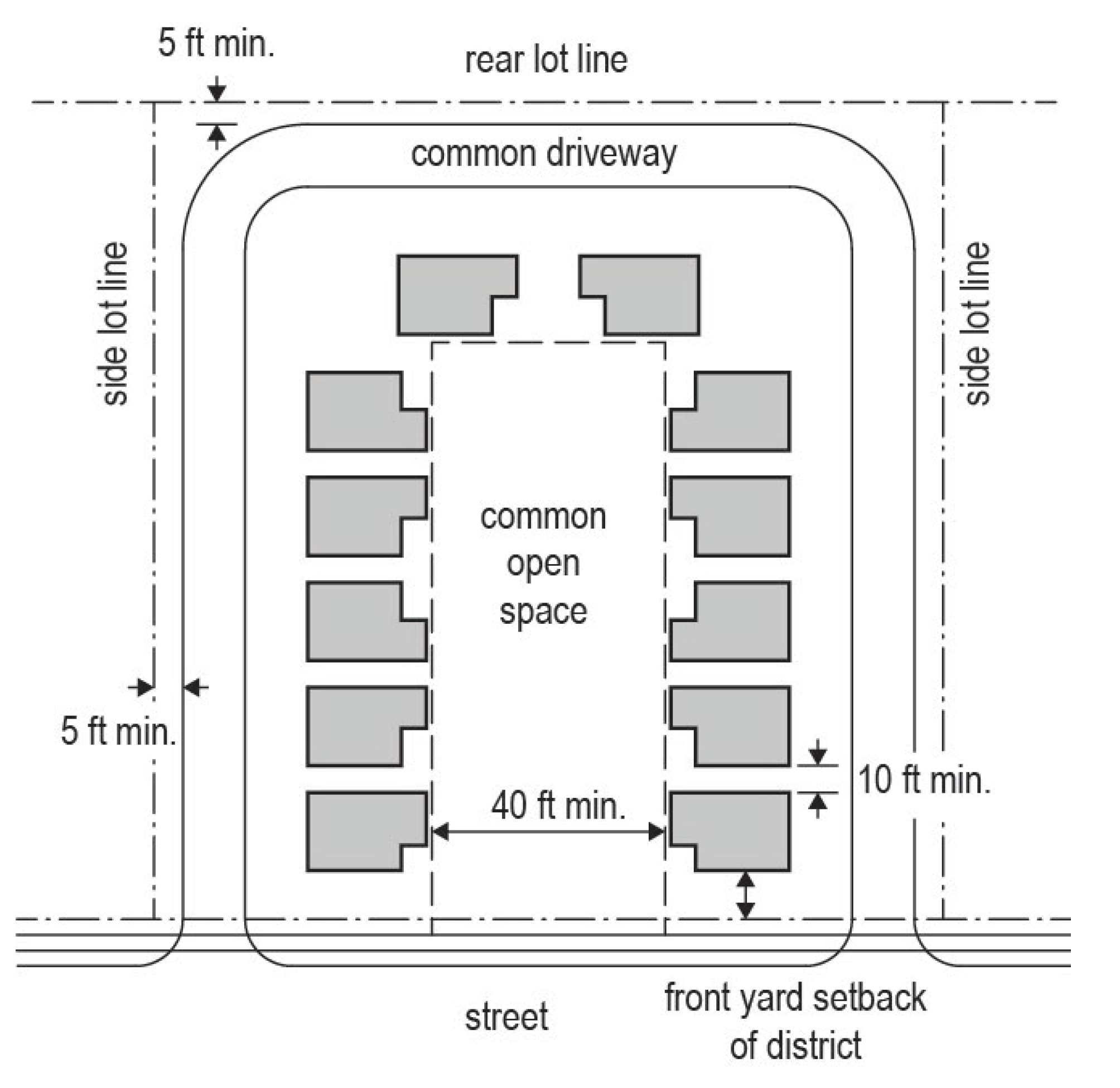
Figure 7-2 Cottage Development
A.
Cottage Developments are permitted only on sites served by public water and sewer services.
B.
Each dwelling must be on its own lot. However, this does not apply when cottages are developed in condominium format and does not apply in districts in which multifamily dwellings are permitted.
C.
The number of allowable dwellings is determined by dividing the total tract size by the minimum lot size in the applicable district. Any fraction is rounded down to the nearest whole number. In no case may the number of units be less than four nor more than twelve.
D.
Not all lots are required to have street frontage, subject to the following:
1.
Each lot must front on and have a main entry facing the Common Open Space, except those lots, nearest the fronting street, may front on the street or Common Open Space.
2.
The rear of dwellings may face toward a public alley. The rear of dwellings may not face toward a street, except in the case of a double-frontage tract, the rear of cottage lots may be oriented toward the street of higher classification.
3.
Lots must be readily accessible for fire suppression purposes as determined by the Fire Chief or their designee during subdivision plat review.
7.10.02.
Area and Dimensional Requirements.
A.
The minimum lot size, lot width and side setback prescribed for detached single-family dwellings in the applicable district do not apply, except in determining the number of allowable dwellings (Section 7.10.01(C)). Spacing between cottage dwellings must be at least ten feet, which may include zero-lot line arrangements.
B.
Minimum Common Open Space: 250 square feet per unit and not less than 40 feet in width at any point.
C.
Maximum Floor Area per Dwelling: no more than 1,600 square feet per floor.
D.
Maximum Height: three stories.
E.
Minimum Building Setbacks.
1.
Dwellings must be set back at least 20 feet from the exterior lot lines of the overall development and must observe the front setback for the district along all street frontages.
2.
No setback is required between a dwelling and the common open space; however, no portion of a building may encroach into or over the common open space.
7.10.03.
Ownership and Management of Open Space. See Section 3.08, Common Open Spaces and Amenities.
7.10.04.
Parking. Parking must be provided as required for detached single-family dwellings and may be clustered together or provided individually at the rear of each home. Clustered parking areas must be screened from the common open space and from streets and adjacent residential uses.
(Ord. No. 2249, 1(Exh. A), 12-16-24)
Sec. 7.11. - Driving Ranges.
7.11.01.
The site plan, required pursuant to Section 12.04, Site Plan Review, must show the layout of the property and indicate the location of all driving ranges, putting greens, fences, and structures.
7.11.02.
Accessory uses are limited to a clubhouse, refreshment stands, maintenance shed, a miniature golf course, and a pro shop.
(Ord. No. 2249, 1(Exh. A), 12-16-24)
Sec. 7.12. - Duplexes.
7.12.01.
In no case may any duplex lot or development site be subdivided to create separate lots for dwelling units within a duplex structure. While ownership of the dwelling units may be separated on a condominium basis, the land on which the structure is built must remain undivided common property.
7.12.02.
Duplex lots may not take access from an arterial road. Duplex lots may be accessed via alleyways to the rear of the lots or from common parking areas.
7.12.03.
Duplexes are subject to the standards in Table 7-1.
Table 7-1 Duplex Subdivision Standards
(Ord. No. 2249, 1(Exh. A), 12-16-24)
Sec. 7.13. - Entertainment-Adult and Adult Novelty Stores.
7.13.01.
Entertainment-Adult.
A.
Such businesses are recognized, particularly when several are concentrated in a given area, to have deleterious effects upon adjacent areas, detract from property values and can have adverse effects on the general welfare. Therefore, no such uses are hereafter permitted within 1,500 feet of each other, as measured between the nearest property lines. Nor may an Entertainment-Adult use or Adult Novelty Store be located closer than 500 feet to the nearest boundary of any residential district or the nearest property lines of the following uses to be protected: child day care center or learning center; place of assembly or worship; or any public or private school offering pre-kindergarten through high school education programs. The expansion of a residential district or location of a protected use in conflict with these separation requirements will not cause an existing, permitted Entertainment-Adult use or Adult Novelty Store to become nonconforming.
B.
No alcohol of any kind may be offered for sale, sold, served or consumed on the premises of an Entertainment-Adult establishment. Entertainment-Adult establishments may not be located closer than 200 feet to the nearest Bar or any business offering alcohol sales for off-premises consumption.
7.13.02.
Adult Novelty Stores. Separation is required between Adult Novelty Stores and between Adult Novelty Stores and protected uses as is required of Entertainment-Adult businesses in this Section.
(Ord. No. 2249, 1(Exh. A), 12-16-24)
Sec. 7.14. - Family and Group Day Care Homes.
7.14.01.
The following provisions are intended to regulate the operation of family day care homes and group day care homes so that the average neighbor, under normal circumstances, will not be aware of their existence.
7.14.02.
All day care homes must receive a business license before commencement of such use:
A.
The day care home must be licensed to and operated by a resident of the dwelling in which it is located. The day care home must, at all times, possess an appropriate license issued by the State of Alabama. A copy of such license must be furnished to the Director upon request. Revocation or expiration of the state license automatically voids any business license issued by the City.
7.14.03.
Standards.
A.
The day care activity must be clearly incidental to the use of the structure as a residence.
B.
Family day care homes are limited to a maximum of six non-resident children at any one time. Group day care homes are limited to a maximum of 12 non-resident children at any one time.
C.
The appearance of the dwelling and premises may not be altered, nor the day care activity conducted, in any manner which would cause the premises to differ from its residential character or from the character of the neighborhood.
D.
The day care home must be operated in the existing dwelling. No new or existing accessory structure may be built or used for the purpose of the day care activity.
E.
The operation of a day care home on a residential premises does not afford additional signage beyond that otherwise permitted for dwellings in the applicable district.
F.
No more than four persons may be engaged in the operation of the day care home, including no more than two persons not residing in the dwelling.
G.
Off-street parking space must be provided for each non-resident employee in addition to that required for the dwelling.
H.
The operation of a day care home may not create any nuisance such as excessive traffic, on-street parking, or noise to any greater extent than that normally experienced in the residential neighborhood or be present or noticeable beyond the property boundaries of the day care premises.
(Ord. No. 2249, 1(Exh. A), 12-16-24)
Sec. 7.15. - Farm Equipment Sales and Repair.
7.15.01.
All structures and equipment storage areas must be located at least 200 feet from the nearest residential structure under different ownership.
7.15.02.
All repairs must be performed within a fully enclosed structure.
(Ord. No. 2249, 1(Exh. A), 12-16-24)
Sec. 7.16. - Flea Markets.
7.16.01.
Flea markets are permitted only on property fronting on an arterial road.
7.16.02.
At least one enclosed building of 300 square feet or more in size must be constructed on the property.
7.16.03.
The minimum site for flea markets is five acres with a minimum width of 200 feet and a minimum depth of 300 feet.
7.16.04.
No merchandise may be sold or displayed less than 100 feet from adjoining residential property.
7.16.05.
Parking areas must have a smooth, stabilized and dustless surface, provided that no more than 50% of the required parking spaces may be grass or other suitable material in overflow and remote locations. Unpaved spaces and driving aisles must be organized for efficient traffic flow, using tire stops approved by the City Engineer. Parking spaces within 150 feet of any structure on the development site must be paved with asphalt, concrete or other rigid paving material.
7.16.06.
A Class A buffer must be provided along all property lines adjoining nonresidential uses. A Class B buffer must be provided along all property lines adjoining residential uses. See Section 9.05, Buffers.
7.16.07.
Frontage and perimeter landscaping must be provided as required in Section 9.03, Vehicular Area Landscaping Standards.
(Ord. No. 2249, 1(Exh. A), 12-16-24)
Sec. 7.17. - Food Processing and Packaging.
7.17.01.
Minimum lot size is 100,000 square feet.
7.17.02.
Buffers must be provided from all non-industrial uses as required in Section 9.05, Buffers.
(Ord. No. 2249, 1(Exh. A), 12-16-24)
Sec. 7.17.5. - Garden Center or Nursery.
7.17.5.01.
Open-sided structures may be approved by the Zoning Board as a Special Exception (§ 14.04).
(Ord. No. 2296, § 1(Exh. A), 3-23-26)
Editor's note— Ord. No. 2296, § 1(Exh. A), adopted March 23, 2026, set out provisions intended for use as § 7.18. To avoid unnecessary renumbering of subsequent sections, these provisions have been included above as § 7.17.5 at the editor's discretion.
Sec. 7.18. - Gas Stations and Minor Automobile Repair.
7.18.01.
Gas Stations and Minor Automobile Repair businesses may be located on arterial and collector streets only. If located on an arterial street, such businesses must have at least 150 feet of frontage along the arterial street.
7.18.02.
Pits, hoists, and all lubricating, washing, and repair equipment and workspace must be enclosed within a building. All parts, oils, fuels, and tools must be stored within an enclosed structure.
7.18.03.
Liquid petroleum fuels must be stored in underground tanks.
7.18.04.
Vehicular canopy structures must comply with applicable building setbacks. The maximum height of all such structures must be noted on the site plan. The area under such canopies counts toward the allowable Impervious Surface Ratio.
7.18.05.
Pump islands and underground fuel storage tanks must be set back at least 20 feet from all property line.
7.18.06.
Vehicles kept overnight for repair purposes must be stored within an enclosed structure or an area that is screened from views off-site.
7.18.07.
Vehicle parking and storage are prohibited within 50 feet of any railroad track as measured from the nearest rail and within all roadways, ditches, and public rights-of-way.
(Ord. No. 2249, 1(Exh. A), 12-16-24; Ord. No. 2301, § 1(Exh. A), 5-18-26)
Sec. 7.19. - Group Homes.
7.19.01.
The following limitations apply in the RCI District and all residential districts:
A.
No more than ten unrelated persons plus any caregivers may reside in a Group Home.
B.
There may be no exterior entrances to bedrooms.
7.19.02.
Documentation of the following criteria must be provided to the Department before a business license may be issued:
A.
A parking plan showing sufficient off-street parking to accommodate residents and caregivers
B.
A certified letter from the property owner, if not the applicant, approving the operation of a group home on the property must be provided.
(Ord. No. 2249, 1(Exh. A), 12-16-24)
Sec. 7.20. - Heavy Equipment Sales, Rental and Repair.
7.20.01.
All repair work must be performed within a completely enclosed structure.
7.20.02.
Equipment or vehicles under repair or not operational must be screened from public view or stored indoors at all times.
7.20.03.
Vehicle parking and storage are prohibited within 60 feet of any railroad track as measured from the nearest rail and within all roadways, ditches, and public rights-of-way.
(Ord. No. 2249, 1(Exh. A), 12-16-24; Ord. No. 2301, § 1(Exh. A), 5-18-26)
Sec. 7.21. - Home Occupations.
7.21.01
Purpose. It is the purpose of this Section to provide residents with opportunities in the use of their residences in profitable activities while preserving the character of the City's residential areas. Therefore, these regulations are intended to ensure that such activities remain limited in scope so as not to interfere with the principal use of any residential neighborhood or development.
7.21.02.
General Regulations. All home occupations must meet the following criteria:
A.
The home occupation must be clearly secondary and incidental to the use of the dwelling unit as a residence. No more than 25% of the total floor area of the dwelling and accessory structures may be used for the home occupation, to a maximum of 500 square feet.
B.
The Director may require a floor plan of the residence, indicating the specific location and extent of the business activity.
C.
The exterior appearance of the dwelling and premises may not be altered, nor the occupation within the dwelling conducted, in any manner that would cause the premises to differ from its residential character nor from the character of the neighborhood. Outdoor display associated with a home occupation is prohibited.
D.
The home occupation must be operated in the existing dwelling, which may not be enlarged to accommodate the business activity.
E.
No new accessory structure may be built for the purpose of operating the home occupation.
F.
There may be no visible evidence that the dwelling is being used to operate a home occupation. The conduct of a home occupation does not afford additional signage for dwellings as permitted in accordance with Section 10.08, Temporary Signs.
G.
No more than two company or commercial vehicles may be parked at the premises at any time, including, but not limited to, cars, vans, trucks, and utility trailers. Off-street parking must be provided on the premises, as required by Section 8.01, Off-Street Parking Requirements. Parking of commercial vehicles is subject to the regulations of the City Code and may not be forward of the front building line.
H.
A maximum of one person not residing in the dwelling may engage in the operation of the home occupation.
I.
No merchandise may be distributed to customers on the premises, nor may any goods be exchanged for the purposes of alterations or repairs on the premises.
J.
The operation of a home occupation may not create any nuisance such as excessive traffic, on-street parking, noise, vibration, glare, odors, fumes, smoke, dust, heat, fire hazards, electrical interference or fluctuation inline voltage, or hazards to any greater extent than that normally experienced in the residential neighborhood, or be present or noticeable beyond the property boundaries of the home occupation premises.
K.
The on-site repair of vehicles is prohibited as a home occupation.
L.
No home occupation shall commence operation until an application has been submitted to and approved by the city.
7.21.03.
Application Procedures.
A.
Each applicant for a home occupation approval must submit an application, together with any required fees and attachments, to the Director. The Director must, within five days, approve or deny the application, or inform the applicant that more information is needed to reach a decision.
B.
Each applicant for home occupation approval must submit a deed to the subject property. If the applicant does not own the property, a signed and notarized letter of authorization from the owner must be provided with the application.
C.
No more than one home occupation may be approved in any one dwelling unit. Home occupations which involve no employees other than those living in the dwelling and no on-premises customers, clients or patrons are exempt from this provision. For the purposes of this Section, a fraternity, sorority, or boarding house constitutes a single dwelling unit.
D.
If an applicant fails to provide sufficient information to determine compliance with this Section, the application will be denied.
7.21.04.
Other Provisions.
A.
Child and adult day care and nighttime care services are not considered home occupations under this Section but are regulated under Section 7.14, Family and Group Day Care Homes. These businesses, if previously approved as home occupations, may continue operating as such until the expiration of the current business license.
B.
The Director must be permitted, upon reasonable request, to enter and inspect the premises of an approved home occupation at any time to verify compliance with these regulations.
C.
Any existing home occupation not in compliance with these regulations may continue operating as a nonconforming home occupation under the following conditions:
1.
The home occupation was approved prior to the effective date of these regulations;
2.
The home occupation complies with all regulations in effect at the time of its approval;
3.
The business activity has continued since the effective date of these regulations without ceasing for a period in excess of 30 days;
4.
The home occupation holds a valid business license issued by the City;
5.
The home occupation has operated in a lawful manner at all times prior to adoption of these regulations;
6.
Signs not in compliance with Section 10.08, Temporary Signs, must be removed immediately;
7.
Limitation on company vehicles and outside display and storage of materials must be complied with upon the effective date of this Section;
8.
Home Occupation licenses are not transferrable from one property owner to another. Upon sale of property the existing nonconforming home occupation must cease operation. New owners wishing to conduct the same or a different home occupation must obtain a new home occupation license and must come into compliance with all home occupation regulations in place at that time.
(Ord. No. 2249, 1(Exh. A), 12-16-24; Ord. No. 2296, § 1(Exh. A), 3-23-26)
Sec. 7.22. - Junkyards.
7.22.01.
Storage of Materials.
A.
Material that is not salvageable may not accumulate, except in bins or containers, and must be disposed of in an approved sanitary landfill. Facilities may not accumulate materials for more than 30 days, unless otherwise allowed through Conditional Use approval.
B.
Material that is not salvageable may not be buried or used as fill.
C.
Junkyard operators are responsible for compliance with all applicable Federal and State regulations pertaining to the handling, storage, and disposal of waste fluids. Disposal of waste fluids is prohibited on-site.
D.
Ice boxes, refrigerators, deep-freeze lockers, clothes washers, clothes dryers, and similar air-tight units having an interior storage capacity of 1.5 cubic feet or more may not be kept in any open storage area unless the door has been removed.
7.22.02.
Screening.
A.
All outdoor storage facilities must be screened as required in Section 9.06, Screening, by a continuous, opaque fence or wall without openings of any type, except as needed for vehicular access. The vehicular access may not exceed 25 feet in width. The access gate must be of a solid, opaque material.
B.
The screening wall or fence must comply with Section 9.07, Design Standards for Required Fences, and must be of the same type of material throughout.
(Ord. No. 2249, 1(Exh. A), 12-16-24)
Sec. 7.23. - Major Automobile Repair.
7.23.01.
Vehicles undergoing repair, painting or bodywork must remain inside an enclosed structure at all times. Vehicles, which are not actively undergoing repair, painting or bodywork, must be stored in an enclosed structure or within an area screened from public view in accordance with Section 9.06, Screening.
7.23.02.
Unlicensed, untitled vehicles are not permitted on the site at any time. No body or chassis may be stored on the site at any time.
7.23.03.
All parts, including body parts, oils, fuels, and tools must be stored within a completely enclosed structure.
7.23.04.
Vehicle parking and storage are prohibited within 50 feet of any railroad track as measured from the nearest rail and within all roadways, ditches, and public rights-of-way.
(Ord. No. 2249, 1(Exh. A), 12-16-24; Ord. No. 2301, § 1(Exh. A), 5-18-26)
Sec. 7.24. - Major Institutional Uses.
All major institutional uses must front on a collector or arterial roadway.
(Ord. No. 2249, 1(Exh. A), 12-16-24)
Sec. 7.25. - Major Outdoor Recreational Uses.
A.
No major outdoor recreational use may be located within 100 feet of existing residential development.
B.
Minimum lot size is 40,000 square feet or as required in the applicable district.
(Ord. No. 2249, 1(Exh. A), 12-16-24)
Sec. 7.26. - Manufacture of Building Materials.
7.26.01.
Minimum lot size is two acres.
7.26.02.
All outdoor work and storage areas must be screened as required in Section 9.06, Screening, by a continuous, opaque fence or wall, which must comply with Section 9.07, Design Standards for Required Fences.
(Ord. No. 2249, 1(Exh. A), 12-16-24)
Sec. 7.27. - Manufacture of Explosives.
7.27.01.
Minimum lot size is 150,000 square feet.
7.27.02.
Structures must be at least 150 feet from all property lines.
(Ord. No. 2249, 1(Exh. A), 12-16-24)
Sec. 7.28. - Manufactured Home Parks.
7.28.01.
Manufactured Home Parks are subject to site plan approval under Section 12.04, Site Plan Review. No structures or facilities may be installed or constructed until a site plan has been approved by the City. All improvements, regardless of timing or project phasing, must be substantially consistent with the approved site plan. Where an existing manufactured home park has no site plan, such a plan must be prepared and submitted to the City prior to the addition, improvement, rearrangement or replacement of park facilities or manufactured homes. All manufactured home stalls must be shown on the site plan.
7.28.02.
In no case may a manufactured home park be separated into lots in fee simple ownership. All facilities, including roads, must be privately owned and may not occupy parcels of land which are deeded separately from the common facilities within any manufactured home park.
7.28.03.
Allowable accessory uses:
A.
Clubhouse, laundry, swimming pool, and other shared facilities for the common use of the residents of the manufactured home park.
B.
No more than one dwelling unit of conventional construction, at least 600 square feet in size, for the use of a resident manager.
C.
Storage area for boats, recreational vehicles, and other types of vehicles that exceed 30 feet in length. The storage area must be for the use of park residents only and must be fenced and landscaped. Storage of such vehicles is prohibited on individual manufactured home stalls and on streets and drives within the manufactured home park. Recreational vehicles may not be used for residential purposes.
D.
Storage sheds and other freestanding accessory structures are prohibited in required open space areas. Accessory structures must be at least ten feet from any other structure.
7.28.04.
Manufactured home parks are subject to the standards in Table 7-2.
Table 7-2 Manufactured Home Park Standards
1 For purposes of site plan review, it shall be assumed that impervious surfaces cover 60% of each designated manufactured home stand unless the site plan specifies a lesser amount.
7.28.05.
Landscaping and Yards.
A.
All manufactured home parks must be separated from other land uses by a buffer in accordance with Section 9.05, Buffers.
B.
Manufactured homes and structures must be set back at least 20 feet from the pavement edge of any streets and drives within the manufactured home park.
C.
Manufactured homes must be separated from freestanding structures serving as common facilities by at least 30 feet. No carport or other attached structure may be installed on a manufactured home less than 20 feet from another manufactured home or attached structure. This distance is measured between the closest points of the units or structures.
7.28.06.
Access and Internal Circulation.
A.
Internal park streets and drives must be paved and must be owned and maintained by the developer or owner of the park property.
B.
Two paved off-street parking spaces must be provided for each manufactured home stall. Required parking may be provided on each home stall or in common parking areas.
C.
No individual manufactured home stand may have direct access to a public right-of-way.
7.28.07.
Occupancy. No manufactured home may be installed, stored, or otherwise located within a manufactured home park, nor may utility service be authorized, until the park has received a Certificate of Occupancy.
7.28.08.
Storm Shelter.
A.
Storm shelters must be provided on-site, as provided herein:
1.
A new manufactured home park.
2.
An existing park is expanded to include more manufactured homes.
3.
An existing manufactured home park replaces, cumulatively within a five-year period, 10 homes or 50% of the homes, whichever is more restrictive.
B.
Storm shelter must have a minimum floor area of seven square feet for each home stand and be located no more than 1,320 linear feet from the furthest home stand in the park.
C.
Shelters must be designed and constructed in conformance with State of Alabama Emergency Management Agency standards and installed as approved by the Building Official. Shelters must meet all applicable requirements of the Americans with Disabilities Act and, if located within a floodplain, must meet all FEMA requirements.
D.
The park operator is responsible for making the storm shelter accessible and usable in times of need. Storm shelters may not be used for storage purposes if such storage reduces the minimum floor area required herein.
(Ord. No. 2249, 1(Exh. A), 12-16-24)
Sec. 7.29. - Mines and Quarries.
7.29.01.
Minimum parcel size is 100 acres.
7.29.02.
A 300-foot buffer zone must be established around the perimeter of the property, in which the natural or existing vegetation must be maintained or improved. No digging, dredging, blasting, storage of tailings, or other mining-related activities is allowed within the 300-foot buffer. Where no natural vegetation exists, plantings and other buffer improvements must be provided in accordance with Section 9.05, Buffers.
7.29.03.
No structures, vehicles, equipment, or parking areas may be located within 100 feet of a property line.
(Ord. No. 2249, 1(Exh. A), 12-16-24)
Sec. 7.30. - Mini-Warehouses and Self-Storage.
7.30.01.
Requirements Applicable to Mini-Warehouse and Climate Controlled Self-Storage.
A.
No storage bay or unit may be used as a place of business or any use other than storage. No storage bay or unit may contain plumbing nor more than one electrical outlet.
7.30.02.
Requirements Applicable to Mini-Warehouses Only.
A.
No business license may be approved for that portion of the property containing the mini-warehouse other than for the mini-warehouse use. Where an applicant proposes additional uses on the same development site, the mini-warehouse use must be physically separated from all other uses. Conditional use approval of the mini-warehouse, if applicable, will be assigned to a specific portion of the site, established by an internal boundary shown on the site plan.
B.
The mini-warehouse facility must be surrounded by a fence at least six feet in height and that restricts access to the site. An opaque wall or fence, subject to Section 9.07, Design Standards for Required Fences, may be required as part of Conditional Use approval, if applicable.
7.30.03.
Requirements Applicable to Climate-Controlled Self-Storage Only.
A.
Other than that portion of the ground floor of the building used for office and other support functions of the self-storage use, the remainder of the ground floor must be used for retail, dining, entertainment, recreation, or some combination of these uses not associated with the storage business. This requirement is waived within the M-1 and M-2 districts.
B.
Ground floor must have a floor to ceiling height of at least ten feet.
(Ord. No. 2249, (Att.), 12-16-24; Ord. No. 2268, § 1(Exh. A), 5-19-25; Ord. No. 2296, § 1(Exh. A), 3-23-26)
Sec. 7.31. - Multifamily Development.
7.31.01.
General Standards.
A.
Multifamily developments are subject to site plan approval pursuant to Section 12.04, Site Plan Review.
B.
Separate ownership of dwelling units is permitted on a condominium basis only; however, in no case may the development site be platted or otherwise divided for the purpose of assigning specific lots or parcels to particular dwelling units.
C.
No existing single-family dwelling or lot in a single-family residential subdivision may be used for multifamily development unless expressly approved under Section 12.05, Conditional Uses.
7.31.02.
Site Development Standards. Multifamily developments are subject to the standards in Table 7-3 and the following:
A.
The arrangement of buildings, open spaces, parking areas and drives must be suitable to existing topography to avoid extensive grading.
B.
Buildings must be spaced no less than the sum of their lengths divided by three ((A+B)/3), or 90 feet whichever is less (see Figure 7-1). In no case may buildings be placed closer together than 20 feet. Building spacing is measured perpendicularly from the longer of the two building walls at the closest point between them.
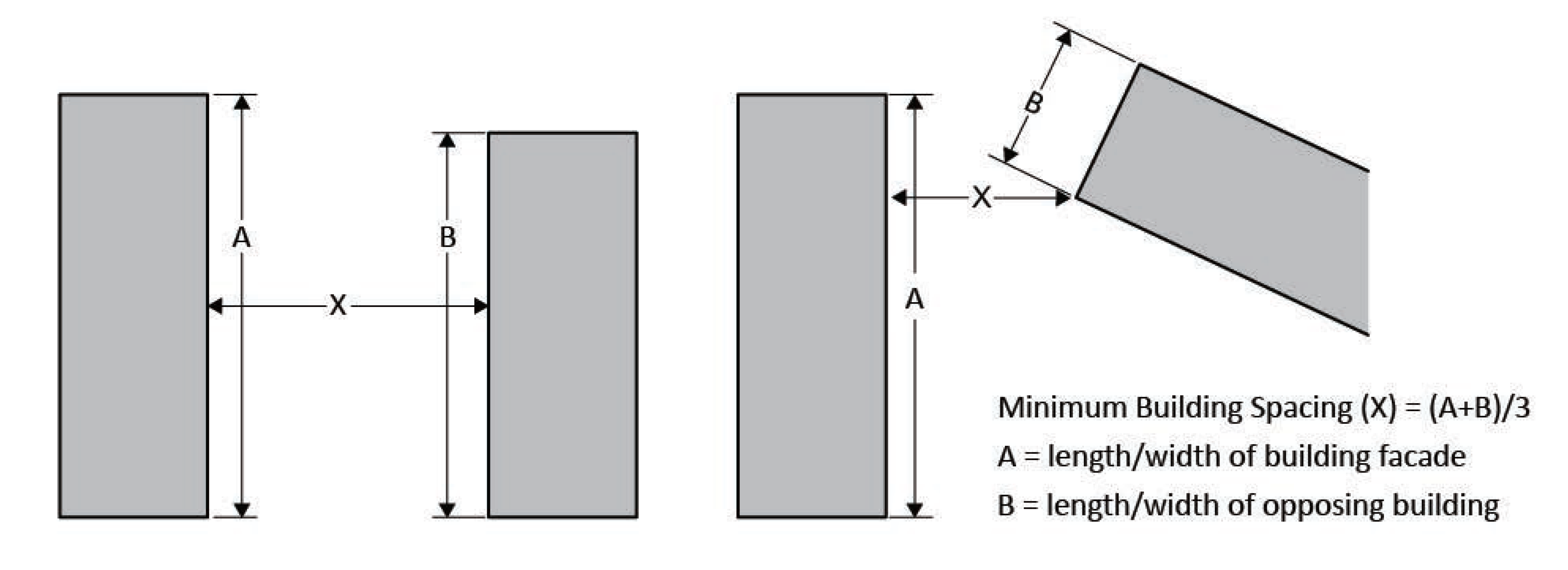
Figure 7-1: Minimum Building Spacing
Table 7-3 Multifamily Development Standards
C.
Multifamily buildings may not be surrounded on all sides by parking and driveways. On at least one side of each multifamily building, there must be an open space of at least 40 feet in depth, another building or the property boundary.
D.
Parking and Driveways.
1.
Common and individual garages, if provided, must be oriented so that the garage doors do not face public street views.
2.
Boats and recreational vehicles may not encroach into required parking and may not be kept forward of the front building line.
3.
The number and location of access points to a public street must comply with the Building Code.
E.
Open Space. For the purposes of this section, "improved open space" means open space created or modified for resident use, including, but not limited to, parks, playgrounds, swimming pools, ball fields, plazas, and landscaped common areas.
1.
At least 20% of the site must be permanently reserved as open space. All common open spaces and recreational areas must be well maintained in a safe and orderly condition.
2.
At least 50% of the required open space must be improved and maintained as open space for the use of residents and guests. Improved open spaces should be consolidated into one or a few central locations to assure accessibility and usability and must be oriented to receive adequate sunlight.
3.
Required setback and buffer areas do not count toward open space requirements. Spaces must be large enough to support leisure and recreational activity; no dimension may be less than 15 feet. Gazebos, pavilions and similar open structures for the use of residents are permitted in improved open spaces.
4.
Improved open space must be graded and sodded, at a minimum, to accommodate use by residents, and must be adequately drained to prevent ponding.
F.
Stormwater Management. Stormwater retention or detention facilities should be integrated into the design of parking areas and open spaces as landscape amenities. Stormwater facilities located within an open space may be counted as improved open space if designed so that it need not be fenced and is appropriately landscaped as an amenity.
G.
Waste Collection, Service and Loading Areas. Each development must be provided with service areas for waste collection. Each such area must be located away from public views but accessible to residents and to vehicles for collection purposes. Each such area must be paved with concrete.
H.
Fire Protection. Every multifamily building must be accessible to fire trucks and equipment as approved by the Fire Chief or their designee.
I.
Pedestrian Access Standards.
1.
Walkways must connect the pedestrian circulation system to adjacent public streets.
2.
If not already provided, a publicly accessible sidewalk at least five feet wide must be provided along all public street frontages and within the right-of-way.
3.
Walkways must connect the main entrances of all buildings. For buildings fronting on a public street, a public sidewalk may be counted toward this standard. Walkways must be provided that connect building entrances to parking areas and common areas and facilities.
4.
Walkways must be provided to connect to any public trails or similar bicycle-pedestrian facilities adjoining the site.
(Ord. No. 2249, 1(Exh. A), 12-16-24)
Sec. 7.32. - Office-Warehouses.
7.32.01.
That portion of an office-warehouse development used for warehousing may not exceed 75% of the gross floor area of all structures on the premises.
7.32.02.
No single building may contain more than five tenant spaces.
7.32.03.
No equipment other than standard two-axle vehicles may be parked long term in required parking or in front of the tenant spaces.
7.32.04.
All equipment and materials must be housed inside the structure or located to the rear of the building and screened as required in Section 9.06, Screening, including an opaque fence or wall at least eight feet in height.
(Ord. No. 2249, 1(Exh. A), 12-16-24)
Sec. 7.33. - Outdoor and Drive-In Theatres.
Accessory uses are limited to a refreshment stand or booth, a souvenir stand or booth, and a children's playground, which are for the exclusive use of patrons of the drive-in theater.
(Ord. No. 2249, 1(Exh. A), 12-16-24)
Sec. 7.34. - Places of Worship.
The addition of any new buildings to an existing place of worship in RS zones requires the installation of all required buffers and landscaping, as well as compliance with all other applicable regulations.
(Ord. No. 2249, 1(Exh. A), 12-16-24)
Sec. 7.35. - Recreational Vehicle Parks.
7.35.01.
Recreational vehicle parks may not be platted or otherwise divided by fee simple ownership.
7.35.02.
Allowable Accessory Uses.
A.
Clubhouse, bathhouse, camp store, laundry, swimming pool, and other shared facilities for the common use of park guests.
B.
No more than one dwelling unit of conventional construction, at least 600 square feet in size, for the use of a resident manager.
Table 7-4 Recreational Vehicle Park Development Standards
7.35.03.
RV Parks and RV spaces must comply with the standards in Table 7-4 and the following:
A.
For purposes of site plan review, it is assumed that impervious surfaces cover 60% of each designated RV site unless the site plan specifies a lesser amount.
B.
One or more open space areas must be provided, must meet the requirements of Section 3.08, Common Open Spaces and Amenities, and must be easily accessible from all RV spaces.
C.
The minimum distance between recreational vehicles is 10 feet. The minimum distance between a recreational vehicle and any structure is 20 feet. The minimum distance between recreational vehicles, for the purpose of this section, is measured from and between the outermost structural parts or attached accessory features.
7.35.04.
Other Regulations.
A.
Site Plan. Any applicant for the required permits to establish, construct, alter or extend a recreational vehicle park must submit a site plan in accordance with Section 12.04, Site Plan Review. All RV spaces must be shown on the site plan.
B.
Buffers. See Section 9.05, Buffers.
C.
Access and Internal Streets. RV spaces must be served by internal streets and may not have direct access to public streets.
D.
Off-Street Parking and Maneuvering Space. The internal circulation system of a RV park must be designed so that parking, loading and maneuvering of vehicles does not necessitate the use of any public street, sidewalk, or right-of-way, or any private grounds not part of the designated parking, loading or maneuvering area. Sufficient maneuvering space must be provided at each space to accommodate a towing vehicle.
E.
Duration of Stay. Vehicle sites may be rented by the day or week only. From August 15 to December 15, no RV may remain in a park longer than 100 consecutive days. From December 16 to August 14, no RV may remain in a park longer than 60 consecutive days.
F.
Ground Cover. All vehicle sites and vehicular use areas must be paved. All other exposed ground surfaces must be grassed or otherwise planted to prevent soil erosion. See also Section 9.02.04, Plant Material Standards.
G.
Ownership. All facilities, including streets, must be privately owned, and may not occupy parcels of land which are deeded separately from the rest of the park. Any maintenance or repair of internal streets and any other common facilities within any recreational vehicle park is the responsibility of the owner, not the City.
H.
The addition or attachment of any accessory structures such as awnings, porches, carports, or individual storage facilities not specifically designed and included as a standard part of the original RV is expressly prohibited.
I.
The removal of wheels and the installation of skirting materials around the base of recreational vehicles is prohibited. Recreational vehicles may not be permanently affixed to the ground or any structure.
(Ord. No. 2249, 1(Exh. A), 12-16-24)
Sec. 7.36. - Recycling Centers.
7.36.01.
Materials collected for recycling purposes are limited to inert solids such as plastic, glass, paper and metal. No liquids or objects containing liquids may be stored on the site. Toxic chemicals and hazardous materials of any kind are prohibited.
7.36.02.
All materials collected for recycling purposes must be stored within a completely enclosed structure.
(Ord. No. 2249, 1(Exh. A), 12-16-24)
Sec. 7.37. - Repair Services.
Equipment that is under repair or not operational must be stored indoors or screened from public view at all times.
(Ord. No. 2249, 1(Exh. A), 12-16-24)
Sec. 7.38. - Sales and Minor Storage of Gaseous Fuels.
Where permitted as an accessory use, no more than 500 gallons of gaseous fuels may be stored on the site at any time.
(Ord. No. 2249, 1(Exh. A), 12-16-24)
Sec. 7.39. - Shopping Centers, Major and Minor.
7.39.01.
In addition to the following requirements, gas stations are subject to Section 7.18, Gas Stations and Minor Automobile Repair.
7.39.02.
Shopping centers must have frontage on an arterial roadway.
7.39.03.
A combination of two or more of the following materials must be used on the façades of all structures: wood, brick, stone, or stucco.
7.39.04.
Buildings must have articulated roof lines and varying façade elevations.
7.39.05.
A master signage plan for the overall proposed development must be approved in conjunction with the required site plan.
(Ord. No. 2249, 1(Exh. A), 12-16-24)
Sec. 7.40. - Short-Term Rentals.
The following regulations apply to short term rental of dwellings in residential districts only. For purposes of this section, "Short-Term Rental (STR)" means the rental of a dwelling unit for less than 30 days per rental period.
7.40.01.
Licensing and taxation. Short-term rentals are subject to all applicable licensing and taxation requirements of the City.
7.40.02.
Standards.
A.
The dwelling or portion thereof approved for short-term rental use may only be rented for lodging use. It may not be rented for weddings, concerts or similar events or used for such events during any short-term rental period.
B.
Occupancy. The dwelling or portion thereof approved for short-term rental use may not be rented to more than one guest party simultaneously. Occupancy is limited to the most restrictive of the following:
1.
No more than two persons per bedroom plus two persons.
2.
No more than four persons per parking space.
The number of bedrooms and parking spaces are determined by the Director. The Director may inspect the dwelling to verify information submitted with the business license application. The owner must, by written agreement with the renter, limit overnight occupancy of the STR to the maximum occupancy approved with the business license.
C.
The short-term rental must comply with all applicable City regulations.
D.
There must be adequate off-street parking to accommodate all guest parking needs. No recreational vehicles, buses or trailers may be stored on the street or forward of the front building line.
E.
A copy of the business license, emergency contact information and house rules that comply with this section must be posted in a conspicuous place in the dwelling.
F.
Upon notification that a renter or a renter's guest has violated any provisions of this Section or any noise, garbage, or other applicable provision of the City Code, the owner or emergency contact must promptly notify the renter of the violation and take such action as is necessary to prevent a recurrence.
(Ord. No. 2249, 1(Exh. A), 12-16-24)
Sec. 7.41. - Slaughterhouse.
7.41.01.
The minimum lot size is five acres.
7.41.02.
Structures must be at least 150 feet from all property lines.
7.41.03.
No outdoor pens, cages or runs are permitted.
7.41.04.
No structure may be located within 500 feet of any residential property or residential district.
(Ord. No. 2249, 1(Exh. A), 12-16-24)
Sec. 7.42. - Storage of Sand, Gravel or Blocks.
7.42.01.
Stored materials may not exceed in height their distance from the property line. In no case may stored materials exceed 15 feet in height above grade level.
7.42.02.
Stored materials must be screened in accordance with Section 9.06, Screening. An opaque fence must be used as part of the screening, which is no less than ten feet in height and which complies with Section 9.07, Design Standards for Required Fences. Said fence may be constructed along side and rear property lines but must be set back no less than 25 feet from street rights-of-way.
(Ord. No. 2249, 1(Exh. A), 12-16-24)
Sec. 7.43. - Tattoo Shops.
Tattoo shops are subject to the spacing and other requirements in City of Northport Ordinance 1814, as amended and Ordinance 1975, as amended.
(Ord. No. 2249, 1(Exh. A), 12-16-24)
Sec. 7.44. - Temporary Uses.
Temporary uses are permitted only as expressly provided in this Section. No temporary use may be established unless a permit evidencing the compliance of such use with the provisions of this Section and other applicable provisions of this Ordinance has first been issued.
7.44.01.
General Regulations. Temporary uses are subject to the following, unless otherwise provided for in this Section:
A.
Notarized, written authorization from property owner with deed to property must be provided with the application.
B.
Documentation from the Tuscaloosa County Health Department must be provided that adequate arrangements for temporary sanitary facilities have been made.
C.
No permanent or temporary lighting may be installed without an electrical permit and inspection.
D.
All uses must be confined to the dates and hours of operation specified in the permit.
E.
The site must be cleared of all debris at the end of the special event and cleared of all temporary structures within seven days after the closing event.
F.
Public parking for the exclusive use of the facility must be provided, and a stabilized drive to the parking area must be maintained. It is the responsibility of the applicant to guide traffic to these areas and to prevent patrons from unlawful parking.
G.
Traffic control arrangements required by the Northport Police Department in the vicinity at major intersections are the responsibility of the applicant.
H.
Property owners are responsible for restitution and repair of any damage resulting to any public right-of-way or property as a result of the event.
I.
Serving of alcoholic beverages requires a permit from the Council.
J.
Outdoor lighting must comply with Section 3.11, Lighting.
7.44.02.
Use Limitations.
A.
The principal use or structure, together with any other temporary uses or structures, may not jointly exceed the ISR or any standard of the application district.
B.
No signs in connection with a temporary use are permitted except as specified in Article 10, Signs.
7.44.03.
Particular Temporary Uses Permitted. The following are temporary uses, which are subject to the specified regulations and standards, in addition to the other requirements specified in this Ordinance.
A.
Carnival or Circus.
1.
Permitted only in C-3 and C-6 Districts.
2.
Maximum length of permit is 15 days.
3.
No structure or equipment is permitted within 500 feet of any residential property line.
B.
Christmas Tree Sales.
1.
Permitted only in Commercial and Agricultural districts.
2.
Maximum length of permit for display and open-lot sales is 45 days.
C.
On-Site Contractor's Office and Construction Equipment Sheds.
1.
Permitted in any district where the use is incidental to a construction project. Such structures may not contain sleeping or cooking accommodations.
2.
Maximum length of permit is one year.
3.
Offices and sheds must be removed upon completion of construction project.
4.
Signs are permitted only in accordance with Article 10, Signs.
D.
Events of Public Interest.
1.
Permitted only in Commercial, Office-Institutional and Agricultural Districts, and the following Downtown Districts: UMX, LMX, RCI, HDC, SMX, LI and C Districts.
2.
Events may include, but are not limited to, outdoor concerts, auctions and athletic events and associated concessions and activities.
E.
Portable Buildings for Temporary Business Uses.
1.
Permitted only in C-3 and C-6 Districts and only while a permanent structure is actively being constructed.
2.
Maximum length of permit is six months. Subsequent 90-day extensions may be granted by request to the Director.
F.
Real Estate Sales Office.
1.
Permitted in any district for any new subdivision. The office may not contain sleeping or cooking accommodations, unless approved within a model home, which may be used as a temporary sales office for the duration of the temporary use permit.
2.
Maximum length of permit is one year.
3.
Other than when located in a model home, such offices must be removed upon completion of the development of the subdivision.
G.
Religious Tent Meeting.
1.
Permitted only in O-I, C-2, C-3, C-6 and AG Districts.
2.
Maximum length of permit is 15 days.
H.
Sale of Farm Produce.
1.
Permitted in C-2, C-3, C-6, AG, and the following Downtown Districts: UMX, LMX, HDC, and SMX. Prohibited in M-1, M-2 and residential districts.
2.
Maximum length of temporary use permit is one year. Temporary use permits are not required for farms in the AG District.
3.
Sales areas, including the produce stands, must be set back a minimum of 20 feet from the nearest right-of-way of any street or highway.
4.
No permanent structures are permitted without an approved site plan meeting all the requirements in Section 12.04, Site Plan Review.
I.
Temporary Shelter. When fire or natural disaster has rendered a single-family residence unfit for human habitation, the temporary use of a manufactured home located on the single-family lot during rehabilitation of the original residence or construction of a new residence is permitted subject to the following additional regulations:
1.
Appropriate permits must be issued prior to location of temporary shelter on the site. An expedited approval process may be established through a disaster declaration by the Council.
2.
Water and sanitary facilities must be provided.
3.
Maximum length of permit is six months, but the Building Official may extend the permit for a period not to exceed 60 days in the event of circumstances beyond the control of the owner. Requests for the extension must be made in writing at least 15 days prior to expiration of the original permit. In no case may the length of the original permit plus all extensions exceed one year unless otherwise established through a disaster declaration by the Council.
4.
The manufactured home must be removed from the property within 14 days of issuance of the Certificate of Occupancy for the new or rehabilitated residence.
J.
Tent Sale/Outdoor Sales Activity.
1.
The outdoor storage or display of merchandise is exempted from these requirements under either of the following conditions:
a.
Merchandise occupies an outdoor display area, which is permanent in nature and designated as such on an approved site plan;
b.
Merchandise is located in a temporary display area which does not occupy required parking spaces, driveway aisles, or required buffers, and customers must enter the building to make a purchase.
2.
Tent sales and similar activities are permitted only in Commercial Districts on property developed with a principal commercial use with proper pedestrian and vehicular access. They are prohibited on vacant property.
3.
Where the temporary sales activity constitutes a conditional use in the applicable district, it must be approved in accordance with Section 12.05, Conditional Uses.
4.
The applicant must submit a site plan specifying the location of all tents, temporary structures, equipment, and merchandise on display.
5.
All electrical connections must be inspected and approved by the Building Inspections Department.
6.
The Director and City Engineer may establish additional requirements as necessary to minimize hazards and promote efficient traffic circulation on the site.
7.
The maximum duration is 15 days. A maximum of four permits per calendar year may be authorized, and at least 30 days must elapse between the expiration of one permit and the approval of another.
K.
Yard and Garage Sales.
1.
Sales may last no longer than two consecutive days.
2.
Sales may not be held on the same premises more than four times per year. There must be an intervening time period of at least 30 days between sales on the same premises.
3.
Yard and garage sales may only be conducted on a property upon which one of the sale event participants is an owner or resident.
4.
Only household goods may be offered for sale. Goods purchased for the sole purpose of resale may not be offered for sale. No consignment goods may be offered for sale.
5.
All temporary signs must be removed immediately upon completion of the sale.
(Ord. No. 2249, 1(Exh. A), 12-16-24)
Sec. 7.45. - Townhouses.
7.45.01.
Townhouses are subject to the standards in Table 7-5 and the following:
A.
Townhouses must have individual entrances, not used by other units, in the front and rear. They must be placed on their own lots unless developed in condominium form.
B.
Townhouse structures must contain at least three and not more than six contiguous dwelling units.
C.
Such units may have multiple stories or combinations of one- and two-story sections; however, in no case may one unit be above or behind another.
D.
Side and rear yards may be enclosed by a masonry wall not exceeding six feet in height.
E.
Townhouse lots may be accessed via alleyways to the rear of the lots or from common parking areas. Parking on individual townhouse lots may not have direct access from any public street.
F.
Townhouses should be designed so that the rear elevations of each building do not face a public street.
Table 7-5 Townhouse Standards
1 or width of any easement along the side lot lines, whichever is greater.
(Ord. No. 2249, (Att.), 12-16-24; Ord. No. 2268, § 1(Exh. A), 5-19-25)
Sec. 7.46. - Twin Houses.
7.46.01.
Twin houses are subject to the standards in Table 7-6 and the following:
A.
Each twin house must have individual entrances, not used by other units, in the front and rear.
B.
Twin house dwellings may have multiple stories or combinations of one-and two-story sections; however, in no case may one dwelling be above or behind another.
C.
side and rear yards may be enclosed by a masonry wall not exceeding six feet in height.
D.
Twin house lots may be accessed via alleyways to the rear of the lots or from common parking areas. Parking on individual Twin house lots may not have direct access from any public street.
Table 7-6 Twin House Standards
(Ord. No. 2249, 1(Exh. A), 12-16-24)
Sec. 7.47. - Vending Facilities.
7.47.01.
The following standards apply to accessory vending and freestanding vending facilities:
A.
Vending machines and structures may not encroach into any required setback.
B.
Vending machines and structures may not exceed ten feet in height.
C.
Perimeter and frontage landscaping must be provided in accordance with Section 9.03, Vehicular Area Landscaping Standards.
D.
Drive-up access may not be located between the adjoining street and the vending machine or structure.
7.47.02.
Freestanding signs are not permitted on lots with only vending machines and no principal building.
(Ord. No. 2249, 1(Exh. A), 12-16-24)
Sec. 7.48. - Veterinary Offices and Pet Grooming.
No outdoor pens, runs or cages are permitted except with Conditional Use approval in the M-1 and AG Districts. Outdoor exercise areas are allowed and must be designated as such on the site plan. Outdoor exercise areas are prohibited within the downtown districts.
(Ord. No. 2249, (Att.), 12-16-24; Ord. No. 2268, § 1(Exh. A), 5-19-25)
Sec. 7.49. - Zero Lot Line Dwellings.
7.49.01.
Zero Lot Line Dwellings are subject to the standards in Table 7-7 and the following:
A.
No windows, doors, air conditioning units or other openings or projections of any kind are permitted where the structure meets the side lot line. However, a window may face the zero-side yard provided it does not project our swing outward over the lot line and otherwise complies with the Building Code.
B.
An easement of five feet in width must be created on the property adjoining the zero-side yard to permit maintenance and repair of the structure along its zero-side yard. No fence, patio, deck, or structure of any kind may be placed within a maintenance easement.
C.
Zero lot line dwellings may not take access from an arterial road.
Table 7-7 Zero Lot Line Dwelling Standards
1 or width of any easement along the side lot line, whichever is greater.
(Ord. No. 2249, 1(Exh. A), 12-16-24)

