
Northport City Zoning Code
ARTICLE 6
- SPECIAL PURPOSE DISTRICTS
Sec. 6.01.- AG Agricultural District.
6.01.01.
This district is intended to provide areas for agricultural uses, low-density, rural living and compatible uses, protected from encroachment of urban development.
Table 6-1: Permitted Uses, AG District
6.01.02.
Use Regulations. Uses are permitted in accordance with Table 6-1 and the following:
A.
Farm product processing.
1.
Farm product processing must be located on properties of five acres or more and which front on an arterial road.
2.
The total floor area of all nonresidential structures is limited to 10,000 square feet. All machinery must be kept within a fully enclosed structure.
3.
The keeping and raising of livestock, rabbits and fowl are subject to the applicable regulations in the City Code, Chapter 14 Animals. Outdoor pens and cages for animals must be set back at least 150 feet from all property lines.
4.
Processing facilities may not operate between 11:00 p.m. and 7:00 a.m.
B.
Retail sales of gardening supplies.
1.
Property must front on an arterial road.
2.
Buffers must be provided along all property lines as required.
C.
Farm produce sales are limited to the sales of produce grown on the same property.
D.
Forestry.
1.
Forestry uses may not be conducted on property within the area bounded by U.S. Highway 82 to the north, Black Warrior River to the south, and the Northport city limits to the east and west.
2.
Forestry operations may only be conducted on properties of 25 acres or more.
3.
No trees may be harvested within 50 feet of the perimeter of the site.
4.
Harvesting activities must conform to the best management practices of the Alabama Forestry Commission.
6.01.03.
Area and Dimensional Requirements. See Table 6-2 and the following.
1.
Accessory structures on lots of three acres or more must be set back at least 100 feet from front lot lines.
Table 6-2: Area and Dimensional Requirements, AG District
1 No minimum lot size is required for public utility facilities. For communication towers, refer to Section 7.06 Broadcast/TV/Radio and Telecommunication Towers.
(Ord. No. 2249, 1(Exh. A), 12-16-24)
Sec. 6.02. - REC Recreational District.
6.02.01.
This district is intended to provide areas for entertainment and recreational uses.
6.02.02.
Use Regulations. See Table 6-3 and the following:
A.
Enclosed and unenclosed retail, medical facilities, restaurants, and places of assembly are permitted by right when accessory to a permitted use.
6.02.03.
Area and Dimensional Requirements. See Table 6-4.
Table 6-3: Permitted Uses, REC District
Table 6-4: Area and Dimensional Requirements, REC District
1 Hotels are permitted a maximum height of 75 feet.
2 Additional height may be considered through conditional use request, see Section 12.05.
(Ord. No. 2249, 1(Exh. A), 12-16-24; Ord. No. 2296, § 1(Exh. A), 3-23-26)
Sec. 6.03. - SD Special District.
6.03.01.
Purpose. Special districts are hereby authorized to provide optional methods of land development, which encourage imaginative solutions to environmental design problems. Development with Special Districts must be characterized by unified building and site development programs providing for coordinated open space and architectural treatment. Special Districts are intended to:
A.
Achieve a high quality of development, environmental sensitivity and energy efficiency, and adequate provision of public services;
B.
Provide greater freedom and flexibility in:
1.
The form and design of development;
2.
Choice in housing type, lot size and neighborhood design
3.
Residential developments with integrated mixed-use centers, in which businesses, institutions and amenities are accessible on foot and bike from surrounding housing;
4.
How development will be located and designed to respect the natural features of the land and protect the environment;
C.
Allow more efficient use of land, with coordinated and appropriately sized networks of streets and utilities;
D.
Provide pedestrian connections within the same development, and to the public right-of way;
E.
Encourage the provision of centrally-located open space amenities within the development;
F.
Promote development forms and patterns that respect the character of established surrounding neighborhoods and other types of land uses;
G.
Promote development form that respects and takes advantage of a site's natural and manmade features, such as rivers, lakes, wetlands, floodplains, trees, and historic resources.
H.
Preserve trees, slopes, wetlands, flood prone areas and natural drainage patterns and limit disruption of natural features;
I.
Promote efficient development patterns that result in economically designed infrastructure.
6.03.02.
Applicability.
1.
The establishment of a Special District will be for the express purpose of improving, development and uses of the tract in accordance with its approved plan of development. All properties in an approved planned development are bound by the standards in its Special District Plan, even if subsequently sold, until the Special District Plan is voided by the City. In the case of multiple ownership, the approved Special District Plan is binding on all owners. No use of the property, nor construction, modification or alteration of any use or structure is permitted in conflict with the approved Special District Plan.
2.
No amendment of this Section affects a planned development approved prior to such amendment. Planned developments with an approved Special District Plan may continue in accordance with the Zoning Ordinance in effect at the time of such prior approval. For properties zoned SD but for which there is no approved Special District Plan, a plan must be approved in accordance with this Section before any development permit or subdivision may be approved. Should the Special District Plan approval expire or be voided, any newly submitted Special District Plan must conform to the regulations in effect at the time of the new submittal. Notwithstanding the requirements above, single-family residential units are permitted by right for individual lots zoned SD and for master-planned subdivisions where more than 50% of the total residential units or acreage have received a certificate of occupancy. Such residential uses are not required to obtain Special District Plan Approval.
3.
Since the Special District Plan is an essential element of the rezoning itself, the Zoning Board of Adjustments should not grant variances or special exceptions that would have the effect of amending an approved Special District Plan, as such action would constitute rezoning.
4.
All provisions of the Zoning Ordinance and Subdivision Regulations apply except where specifically addressed in this Section or within the approved Special District Plan. Unless specific variations are noted in the Special District Plan and Narrative and approved by the Council, the most restrictive requirements for parking, loading, yards, signage, landscaping and dimensional regulations applicable to the development under this Ordinance apply.
6.03.03.
General Requirements.
A.
Minimum Area. Each planned development must contain at least ten acres of contiguous land. A smaller land area may be permitted provided evidence that:
1.
The project is consistent with the developmental goals of the Comprehensive Plan for the particular location;
2.
The minimum acreage requirement is impractical due to ownership, existing development patterns and similar constraints;
3.
The design concept fully integrates the development into the surrounding neighborhood or business area;
4.
The arrangement of uses, buildings, streets, parking, open spaces and amenities could not be reproduced on the site under conventional zoning regulations.
B.
Community Benefits. The applicant must demonstrate that, in exchange for the flexibility conferred by SD designation, the development will feature the following benefits:
1.
All buildings will feature quality, durable materials.
2.
Driveways, garages and parking areas will not dominate public views along streets. Parking garages along residential blocks will be varied, set back behind the front building line, oriented away from street view, accessed from alleys, or a combination of these methods.
3.
Residential developments will feature a range of housing types and sizes appropriate to different stages in life.
4.
Usable open spaces will be provided in accessible locations throughout the development. A greater amount of common open space will be provided in more intensively developed portions of the development.
5.
Paths will be provided to enable the safe movement of residents, on foot or bike, throughout the development and to adjoining neighborhoods and community destinations.
C.
Where a planned development requires subdivision for single-family dwellings lots to be held under individual ownership, a plat of the development must be approved and recorded in accordance with the Subdivision Regulations.
D.
The proposed development must be designed to produce an environment of stable and desirable character not out of harmony with its surrounding neighborhood.
E.
Common Property. Provisions must be made for the ownership and perpetual maintenance of common open spaces and facilities in accordance with Section 3.08, Common Open Spaces and Amenities.
6.03.04.
Development Standards. The following standards may be modified by the Council, including upon request by the applicant, with approval of the SD rezoning. Each modification from the standards must be specified in the Special District Plan.
A.
Subdistrict, Permitted Uses. Planned developments are composed of residential subdistricts, mixed-use subdistricts or a combination of these. Industrial uses are prohibited. Uses or use categories must be stated in the Special District Plan. Any use or use category are permitted as approved by Council with the adoption of the plan. Other substantially similar uses that meet the intent of the Special District Plan may be approved by the Director. Any other proposed uses would require an amendment to the Special District Plan.
B.
Density, building height and setbacks must conform to the standards in Table 6-5. Lot width, area and setbacks for uses and structures not specified in Table 6-5 are proposed by the applicant and established through the plan approved with rezoning by the Council. The area and dimensional requirements for uses in Article 7, Detailed Use Regulations, apply unless other standards are expressly approved with the Special District Plan approved by Council.
Table 6-5 Development Standards for SD Subdistricts
C.
All buildings must be set back from the boundary of the planned development as required for side and rear setbacks in the adjoining district.
D.
Open Space Standards. Common open space must be provided in each subdistrict as shown in Table 6-5 and in accordance with Section 4.05, Open Space Requirements for High Density Residential Developments. No designated common open space may be subdivided in the future, nor may it be reduced in area or used for any other purpose unless approved through Council amendment of the Special District Plan. The following are excluded from calculation of required common open space:
1.
Open spaces that may only be accessed by way of individual residential lots;
2.
Land encumbered by any substantial structure, enclosure or parking facility;
3.
Remnant strips of land less than 40 feet in width, except those provided for pedestrian or bicycle trails; and
4.
Land to be used as or be in any required drainage area or easement unless such area is designed and maintained for recreational use.
5.
Land that is not developed as lots because of steep terrain or other topographic limitations, unless trails or other amenities are included to activate the land for recreational use.
E.
Signage. Signage in planned developments is subject to Article 10, Signs, unless specific modifications are approved by the Council. Billboards are prohibited.
F.
Exterior Materials. Unless an alternative set of materials standards is specifically approved by the Council, the standards in this subsection and in Table 6-6 apply. Materials standards must be included within covenants for all applicable property within the planned development.
1.
Where brick is used on residential buildings, it may not exceed 75% of the area of each façade.
2.
Area of window and door openings are not included in calculation of exterior material requirements.
3.
Above the building foundation, concrete block must be split-face, split-rib or scored. Cement block foundations along front façades must be screened with shrubs or other landscaping.
4.
Metal or vinyl may only be used for trim.
5.
Architectural metal panels may only be used on nonresidential buildings and must be used in combination with other materials. R-panel or "rib" metal siding is prohibited on any portion of a building visible from a public right-of-way.
G.
No exterior wall plane visible from a public street may exceed 30 feet without articulation, such as, but not limited to: wall recesses or projections, material changes, pilasters, columns, posts, roofline or cornice line changes, porches, fenestration.
Table 6-6 Materials Standards
6.03.05.
Procedure. Special Districts are established in accordance with the procedure set out in Section 13.03, Amendments, and the following:
A.
Any petition for the establishment of a Special District must be submitted to the Director for preliminary review, in accordance with the following criteria:
1.
That the proposed development is consistent with the Comprehensive Plan and the intent and purpose of this Ordinance to promote public health, safety, and welfare.
2.
That the final plan for the proposed development meets the requirements of this Ordinance and the requirements of all other regulating bodies.
3.
That an approved method of sewage disposal is available to the tract under consideration.
B.
The application must be accompanied by a Special District Plan showing the uses, residential densities, proposed streets, open spaces and amenities, and approximate locations and sizes of residential and nonresidential buildings, and other information necessary to adequately determine that the proposed development meets the purpose of this Ordinance and SD Zoning. See Appendix A-3 for submittal requirements. Where referred to herein, the Special District Plan includes all plans, maps, illustrations and written materials required to be submitted.
C.
Commission, Council Action.
1.
The Commission reviews the proposed development for conformity with the Comprehensive Plan and the intent of this Section 6.03 employing recognized principles of design and land use planning. The Commission will make a recommendation for approval, approval with changes, or denial to the Council; or, with consent of the applicant, table its recommendation to allow time for further review or for the applicant to make requested changes.
2.
After the Commission has held a public hearing and made its recommendation, no substantive changes may be made to the Special District Plan to be presented to the Council other than those made to comply with Commission recommendations. Additional information may be submitted provided such does not represent an alteration of the proposed plan.
3.
Upon receipt of the Commission's recommendation, the Council will conduct a public hearing on the rezoning request. Zoning approval by the Council establishes the zoning standards for the development, including, but not limited to, the maximum density, maximum number of dwelling units, quantities of common open space and amenities, and uses in each subdistrict and phase, as shown in the Special District Plan.
4.
The applicant has 180 days from zoning approval to submit the site plan or preliminary plat, whichever is applicable, for review and approval. Upon the applicant's request, the Director may extend this time period by 60 days. If not submitted within this period, the City may take action to void the SD zoning and rezone, as appropriate.
5.
The planned development must conform to the density and uses approved with the SD rezoning and must incorporate any modifications required as conditions by the Council. How such conditions are to be addressed must be clearly indicated in the proposed site plan or preliminary plat, whichever is applicable.
6.
If, within two years from the effective date of Council approval of the SD zoning, construction has not commenced, the Council may take action to void the SD zoning and rezone the tract, as appropriate.
D.
Changes and Amendments. Approval of changes must be in accordance with Table 6-7. Any deviation from the Special District Plan in conflict with these limits constitutes a violation of this Ordinance. Any change not specifically listed in Table 6-7 constitutes a significant change and must be submitted using the same procedure as a new Special District Plan. Preliminary plats and site plans are evaluated by the Director for consistency with the approved Special District Plan. Minor changes in layout that are consistent with the intent of the approved plan, as determined by the Director, do not require amendment of the Special District Plan. Any request to amend a Special District Plan must be accompanied by a narrative explaining all changes from the previously approved plan.
Table 6-7 Special District Plan Changes and Amendments
(Ord. No. 2249, (Att.), 12-16-24; Ord. No. 2268, § 1(Exh. A), 5-19-25; Ord. No. 2296, § 1(Exh. A), 3-23-26)
Sec. 6.04. - Special Corridor Overlay District.
6.04.01.
Purpose. Recognizing the special nature of certain thoroughfares and the impacts of the appearance of these roadways and their importance to the local economy, this Section sets forth regulations to ensure that development in these critical areas is visually pleasing and economically viable. This Section applies to all land in the corridor, regardless of the underlying zoning district designation. In the event of a conflict between the requirements herein and those of the underlying zoning classification, the more restrictive requirement applies.
6.04.02.
Applicability. These regulations apply to development and redevelopment on all lots, parcels and tracts with frontage on the following corridors:
A.
McFarland Blvd (U.S. Highway 82).
B.
Lurleen Wallace Boulevard.
C.
US Highway 69.
D.
US Highway 43.
E.
Rose Boulevard.
F.
Watermelon Road.
G.
Rice Mine Road.
H.
Martin Luther King, Jr. Boulevard.
6.04.03.
Submission Requirements. All design elements required by this Section, including building cladding materials, must be illustrated or described within the application materials. Any submission made without such requirements is deemed incomplete and will not be reviewed.
6.04.04.
Building Materials. Façades of principal and accessory buildings visible to pedestrian and vehicular traffic are subject to the following materials standards:
1.
Exterior materials must include wood, fiber cement siding, masonry, glass curtain wall, or a combination of these. Other cladding materials, subject to the standards herein, may be used but may not exceed 40% of the total area of the façade.
2.
Only the following types of concrete block may be used above the building foundation: split-face, split-rib and scored.
3.
Vinyl siding is prohibited; however, vinyl may be used for soffits, window frames, doors, downspouts and similar applications.
4.
Metal siding is prohibited.
5.
All structural supports (e.g., columns) for vehicular canopies must be clad in one or more of the same materials as the building façade.
6.
The façades of principal buildings must include at least 25% fenestration, unless otherwise approved by Special Exception.
6.04.05.
Sign Design. The location of freestanding signs must be illustrated on the site plan. Sign materials must be coordinated with the exterior cladding of the principal structure. Size and height of sign must conform to the standards set out in Article 10, Signs.
6.04.06.
Setbacks and Landscaping.
A.
A landscape strip at least 15 feet in width must be installed along the entirety of thoroughfares listed in Section 6.04.02. This landscape strip must contain one canopy trees, two understory trees, and eight shrubs per 50 feet of corridor frontage, in accordance with Table 9-3, Approved Plant List. Variation from these requirements may be considered in accordance with Section 9.10.03, Alternative Compliance.
B.
All structures must be set back at least 20 feet from the right-of-way line of the corridors listed in Section 6.04.02.
C.
All garages, car washes or other service bays must be set back at least 40 feet from the front property line and all garage, car wash, and service bay openings must be oriented at not less than right angles to the primary public street frontage, or must be screened, as determined by the Director, to limit view from the public street. Other orientations of buildings and service bays may be considered in accordance with Section 14.04, Special Exceptions.
6.04.07.
Awnings and Canopies. Rigid or fixed awnings and canopies must be maintained and kept free from dirt, mildew and tears. Worn, faded or torn awnings and canopies must be replaced. Awnings may not be longer than 40 feet. See Figure 6-1.
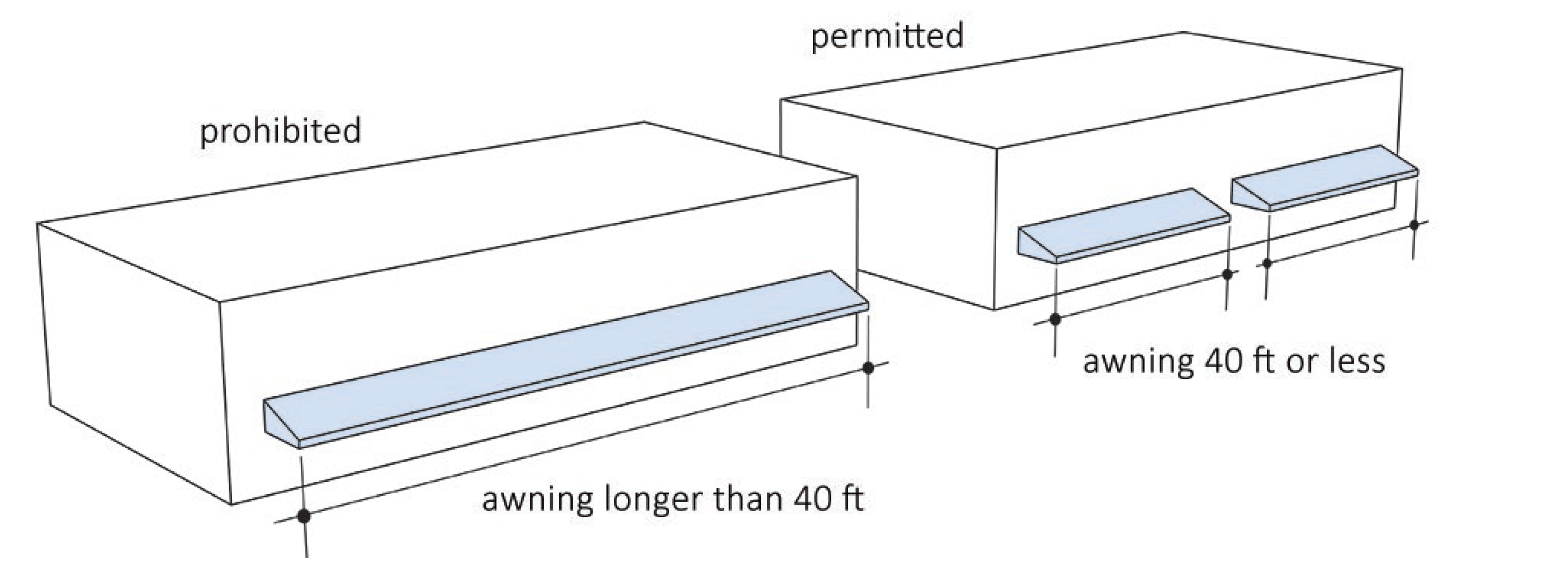
Figure 6-1 Awning length
6.04.08.
Residential Development. To provide protection and privacy to residential developments backing up to special corridors, one of the following screening methods must be provided:
A.
An earth berm meeting the following standards (see Figure 6-2):
1.
Berms must have a minimum height of four feet and a maximum height of eight feet above the toe of the berm.
2.
Berms must have a base width of at least ten feet and a top width at least one-half the berm height.
3.
Berms, regardless of size, must be stabilized with a ground cover or other vegetation suitable to the slope used. See also Section 9.02.04, Plant Material Standards.
4.
Berms may not exceed a slope of four-to-one.
5.
Berms may not obstruct sight distances at intersections.
6.
Berms may not damage the roots or trunks of existing healthy vegetation designated to be preserved.
B.
A planting screen must be provided consisting of a minimum of two staggered rows of evergreen shrubs (refer to Table 9-3, Approved Plant List) such as, but not limited to, Ligustrum, Burford Holly, Elaeagnus, Boxwood, or Juniper with a minimum height of three feet installed and a maximum spacing suitable to the particular plant used but forming an effective visual screen. Shrubs may not obstruct sight distance at intersections.
C.
Alternative forms of screening may be considered by the approving authority subject to detailed drawings supporting said alternative being provided at the time of submission.
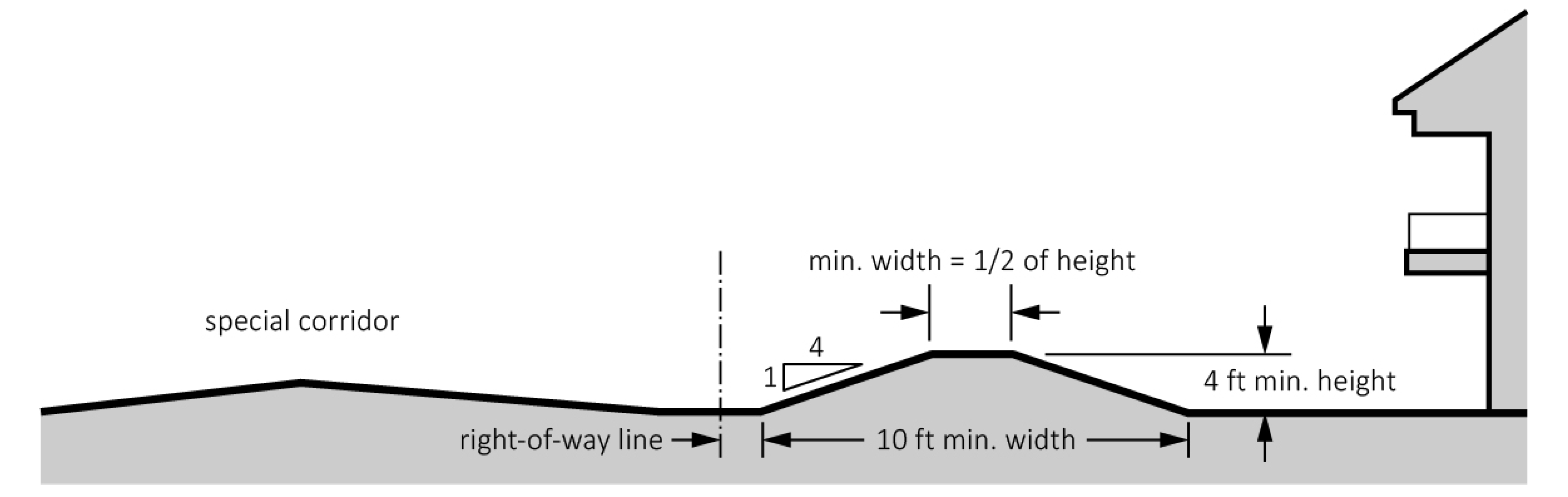
Figure 6-2 Berm separating residential development from major roadway
(Ord. No. 2249, 1(Exh. A), 12-16-24)
Sec. 6.05. - Downtown Districts.
6.05.01.
General Provisions.
A.
Purpose. It is the intent of the Downtown District regulations to help implement the 2008 Downtown and Riverfront Plan, as amended.
B.
Districts.
1.
Urban Mixed-Use (UMX) District.
2.
Limited Mixed-Use (LMX) District.
3.
Historic Downtown Core (HDC) District.
4.
Residential/Commercial/Institutional (RCI) District.
5.
Suburban Mixed-Use (SMX) District.
6.
Historic Neighborhood (HN) District.
7.
Conservation (CON) District.
6.05.02.
Streetscape Improvements. For any developments in which improvements within the street right-of-way are required, such improvements must be in accordance with the Engineering Design and Construction Manual. When a property abutting Main Avenue, First Street, or Bridge Avenue is developed or redeveloped in a manner that requires site plan approval per Section 12.04, Site Plan Review, right-of-way improvements must be constructed in a way that is consistent with the Downtown Streetscape Typical Section in the Engineering Design and Construction Manual. For small street frontages, where it is determined by the City Engineer that full construction of the streetscape typical section is not practical, sidewalk, storm drains and other improvements must be constructed to be compatible with future construction of the streetscape typical section.
6.05.03.
General Provisions.
A.
Uses.
1.
Uses are permitted as shown in Table 6-8 subject to any limitations specified in the district regulations. Refer to the district regulations for uses permitted in the Conservation District. Uses listed in other permitted use tables in this Ordinance that are not listed in Table 6-8 are considered prohibited.
2.
Caretaker Dwellings. Where permitted as a Conditional Use, the Council may require that the dwelling not be located at ground level between the nonresidential use, to which it is accessory, and the street frontage.
B.
Area and Dimensional Requirements. Development in all districts is subject to the requirements in Table 6-9 and any additional requirements or modifications in the district regulations.
Table 6-8 Permitted Uses, Downtown Districts
Table 6-9 Area and Dimensional Requirements, Downtown Districts
1 Minimum percentage of the lot width, within the area defined by the minimum and maximum front yard setbacks, that must be enclosed by the principal building.
2 Measured between finished floor elevations of ground floor and second floor. Where a minimum height is listed, ground floor residential is prohibited.
3 Between Main Avenue and the railroad, buildings may not exceed 75% of the height of the railroad tracks, as measured from the average elevation along the property line adjacent to the railroad right-of-way.
4 Hotels are permitted a maximum height of 75 feet.
5 Additional height may be considered through conditional use request, see Section 12.05.
6 Applies to detached single-family dwellings only.
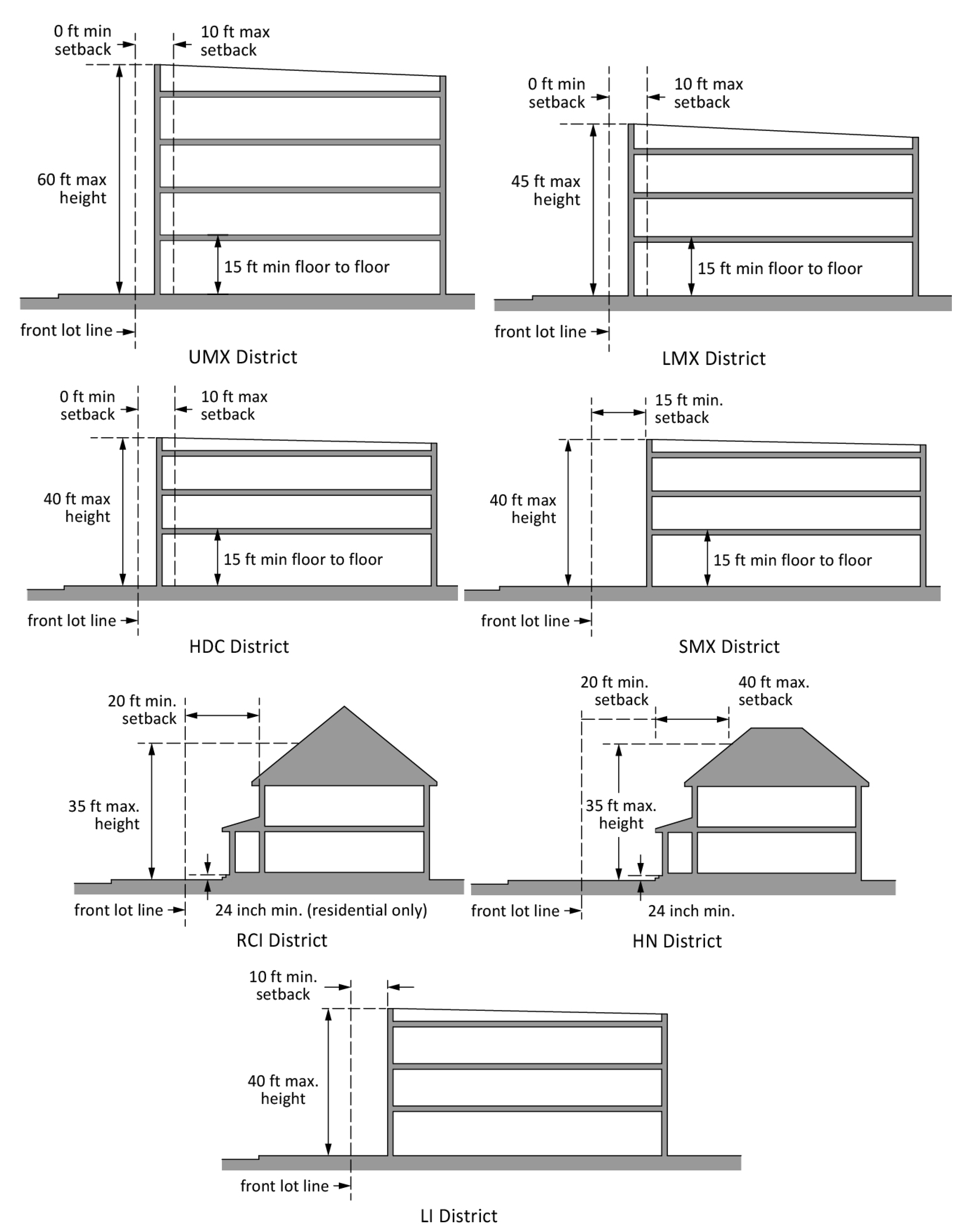
Figure 6-3 Dimensional Requirements, Downtown Districts
Table 6-10 Façade Cladding Material Standards, Downtown Districts
C.
Building Design. The following apply to buildings, including parking structures fronting on and visible from a street:
1.
Façade articulation: Where required, street façades must be broken into a series of vertical bays no wider than specified in the applicable district using any of the following elements: recesses or projections of at least six inches in depth, material changes, columns or posts (including as part of a porch and/or balcony), roofline or cornice line changes, porches, and front steps or stoops (see Figure 6-4.). More than one form of articulation may be necessary to comply with applicable requirements. Use of only one of the following forms of articulation is not sufficient to meet these requirements: material changes, changes in the roofline or cornice line, and front steps or stoops.
2.
Façade Cladding Materials are subject to Table 6-10 and the following:
a.
Primary materials must constitute, individually or collectively, at least 75% of the exposed surface area. Permitted secondary materials may not exceed, individually or collectively, 25% of the exposed surface area of the façade.
b.
Changes in primary materials may not occur within two feet of outside corners (see Figure 6-5). Changes in primary materials must occur along a horizontal line with the heavier material used below the lighter material, e.g., siding above masonry.
c.
Wood cladding is limited to lap siding and other forms of horizontal boarding, board-and-batten and other forms of vertical boarding, and wood shingles. Horizontal boards may not have an exposed width greater than eight inches.
d.
Exterior Insulation Finishing System (EIFS) is limited to no more than 60% of exposed surface area on buildings taller than 40 feet. On buildings 40 ft and under, EIFS is limited to 20%. Only a water management EIFS system may be used.
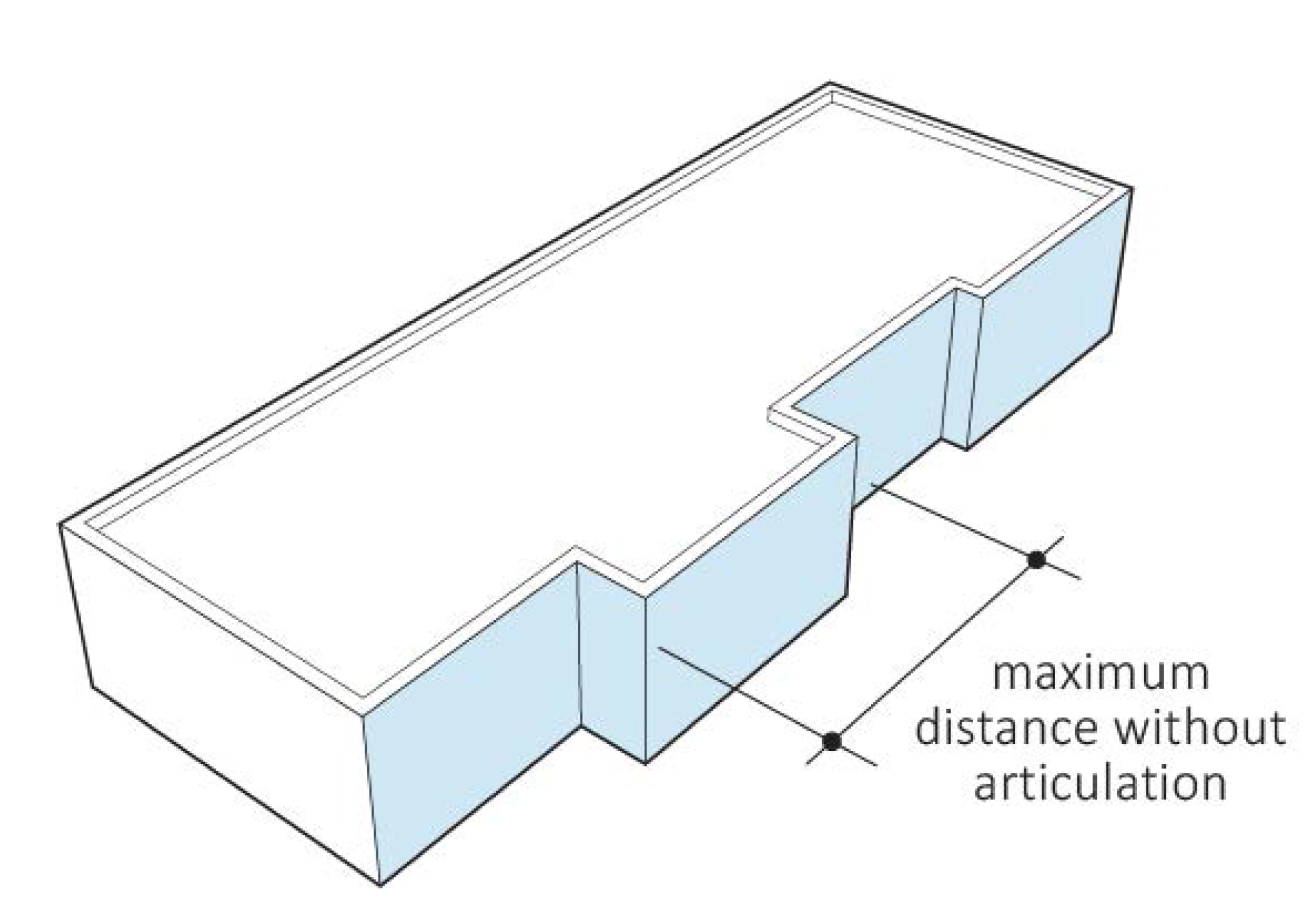
Figure 6-4 Façade Articulation
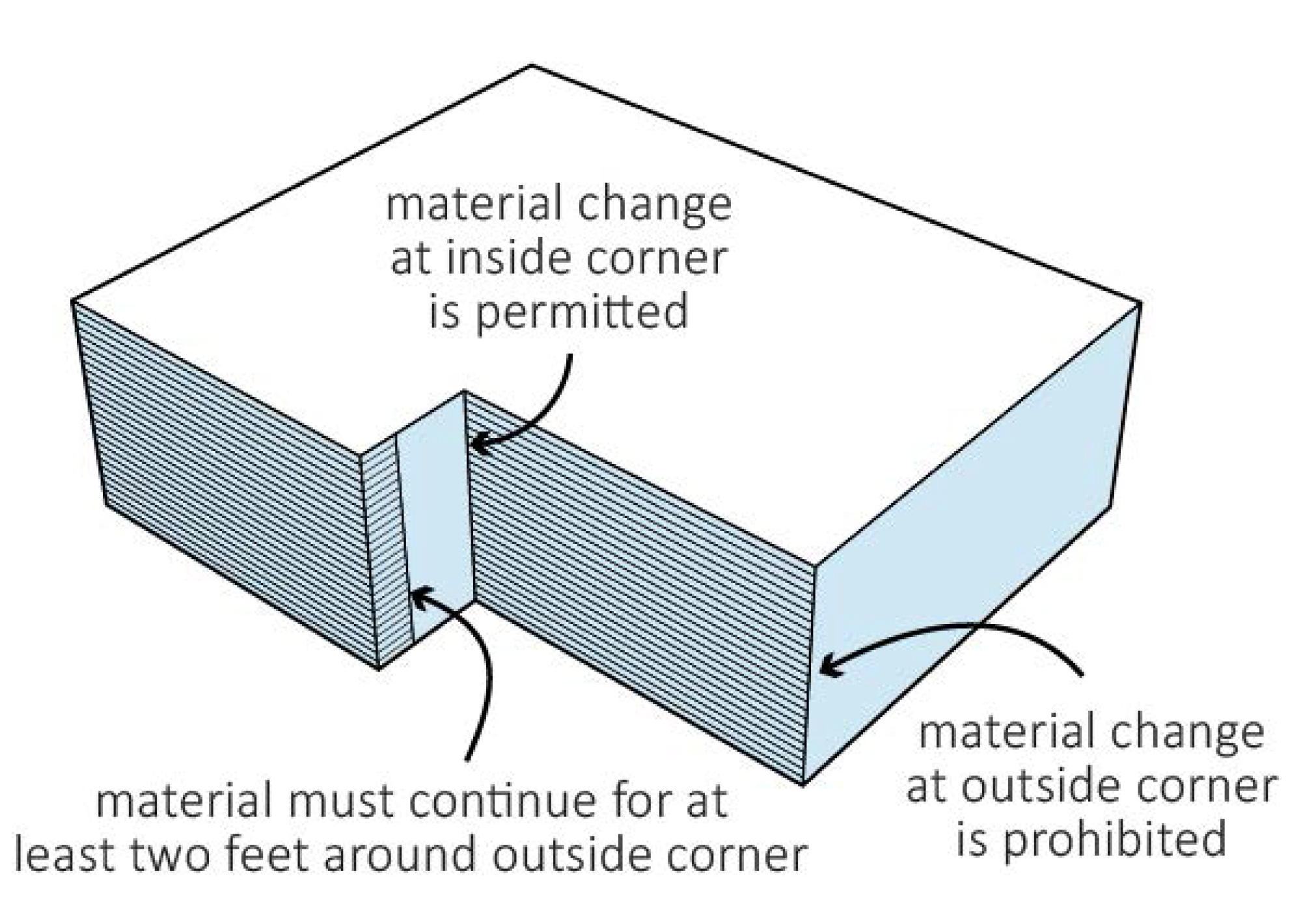
Figure 6-5 Material Change at Corners
3.
Pipe vents, air conditioning units, and similar roof top penetrations and equipment, other than chimneys, must be located or screened to conceal from public view. Flat roofs must have a parapet wall sufficient to visually screen such penetrations and equipment from view along any public street.
D.
Access, Parking and Driveways.
1.
As used in this Section, a "primary street" is that street along a lot with multiple street frontages, which is designed for or experiencing the higher level of traffic relative to the "secondary street."
2.
Where practicable, vehicular access between adjoining nonresidential properties must be provided as an alternative to direct access via the associated street.
3.
Parking Lot Landscaping. The following requirements apply to parking lots of attached and multifamily dwellings, nonresidential uses and any combination of these. Variation from these requirements may be considered in accordance with Section 9.10.03, Alternative Compliance.
a.
Frontage Landscaping: The minimum landscaping strip normally required by Section 9.03, Vehicular Area Landscaping, is reduced to five feet in width, except along any Special Corridors, which are subject to Section 6.04.06, Setbacks and Landscaping. While it should visually obscure pavement and vehicles and provide shade, for security purposes, it should not completely preclude views into the parking lot. Such landscaping must include a combination of understory and canopy trees with an average maximum spacing of 30 feet; a low fence or wall or shrubs with a minimum height of three feet at the time of planting. Fences and walls must comply with Section 9.07, Design Standards for Required Fences. Shrubs must be evergreen.
b.
Interior Landscaping: One or more trees must be provided at the end of all parking rows. For each parking row, there may be no more than ten consecutive parking spaces between landscape islands or peninsulas.
c.
Trees used for landscaping must have a minimum caliper of 2.5 inches at the time of planting.
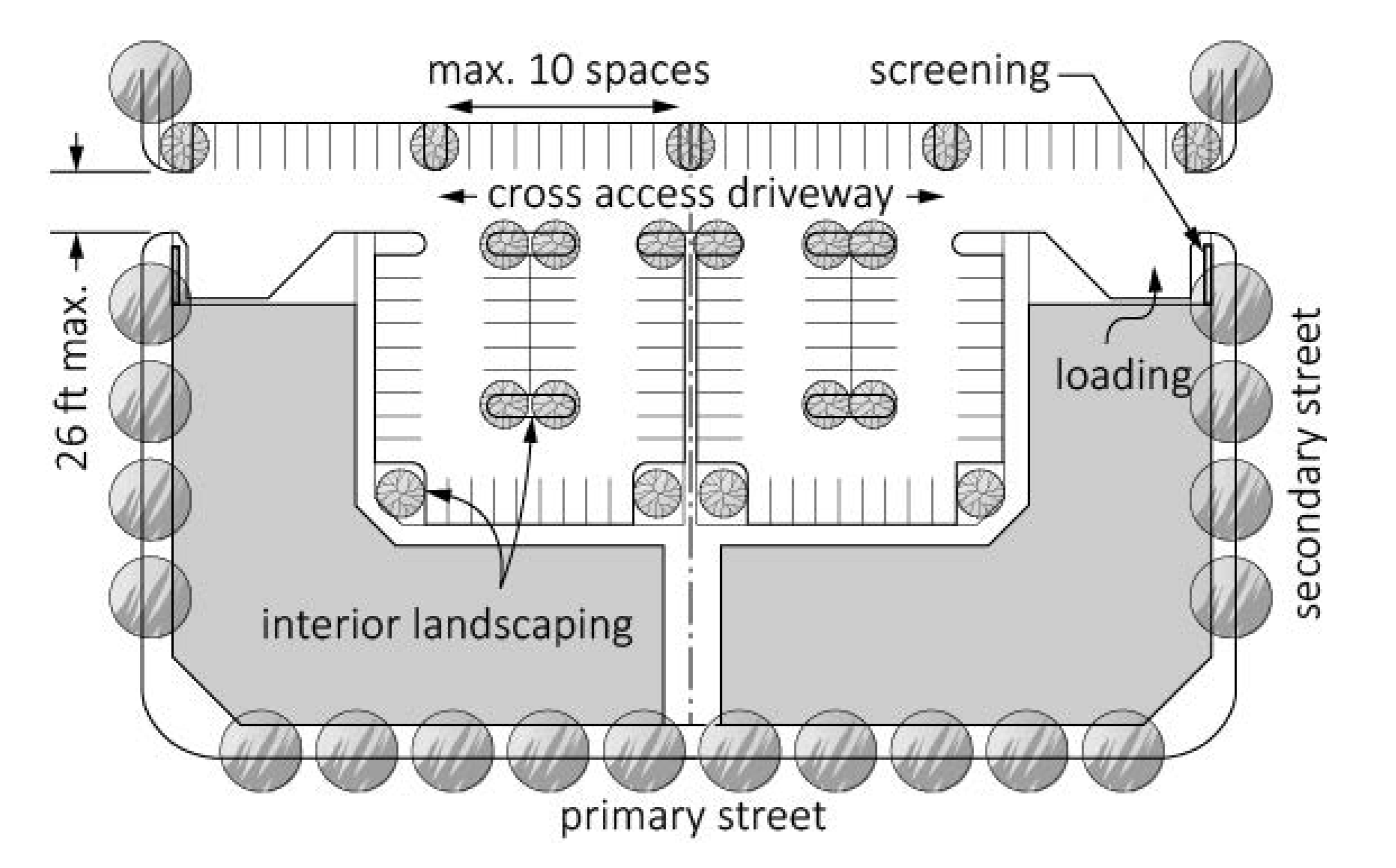
Figure 6-7 Parking Lot Landscaping
E.
Other Site Standards.
1.
Loading and refuse storage areas must be located behind buildings and screened from public view along streets.
2.
Lighting. Exterior lighting is subject to Section 3.11, Lighting. See district regulations for allowable height.
3.
Stormwater retention and detention basins are not permitted. Alternate methods or stormwater management must be used.
6.05.04.
UMX, LMX, RCI and HDC Districts.
A.
General Standards. The following standards apply to the UMX, LMX, RCI and HDC Districts unless expressly indicated otherwise in the district regulations.
1.
Building Design.
a.
Minimum Foundation Heights. The finished floor elevation of ground floor dwellings fronting on a street, where permitted, must be at least 24 inches from finished grade at the front building line.
b.
Façade Design and Materials. Exterior building materials are subject to the material standards in Table 6-10. The following standards apply to buildings in the UMX, LMX and HDC Districts, including parking structures that front on a public street:
1)
Glazing: At least 50% of the ground floor portion of the street façade must be comprised of doors, windows or a combination thereof. The ground floor portion of a façade is the area between finished floor level and the same floor's ceiling. The maximum sill height for ground floor windows is three feet. Minimum head height is eight feet. At least 25% of the upper portions of the street façade must be comprised of windows. No reflective or heavily tinted glass may be used on street façades.
2)
Awnings, Canopies and Balconies. Awnings, canopies and balconies are encouraged but not mandatory.
a)
Awnings must be canvas.
b)
Canopies must be wood or a composite material. Canopies must be perpendicular to the façade and flat OR must feature a shed roof or a hipped shed roof with standing seam metal and a slope no greater than 4:12. V-crimp roofing imitating standing seam metal is permitted.
c)
Balconies must be wood, metal or a combination thereof and six feet or more in depth. Balcony roofs are subject to the standards for canopies.
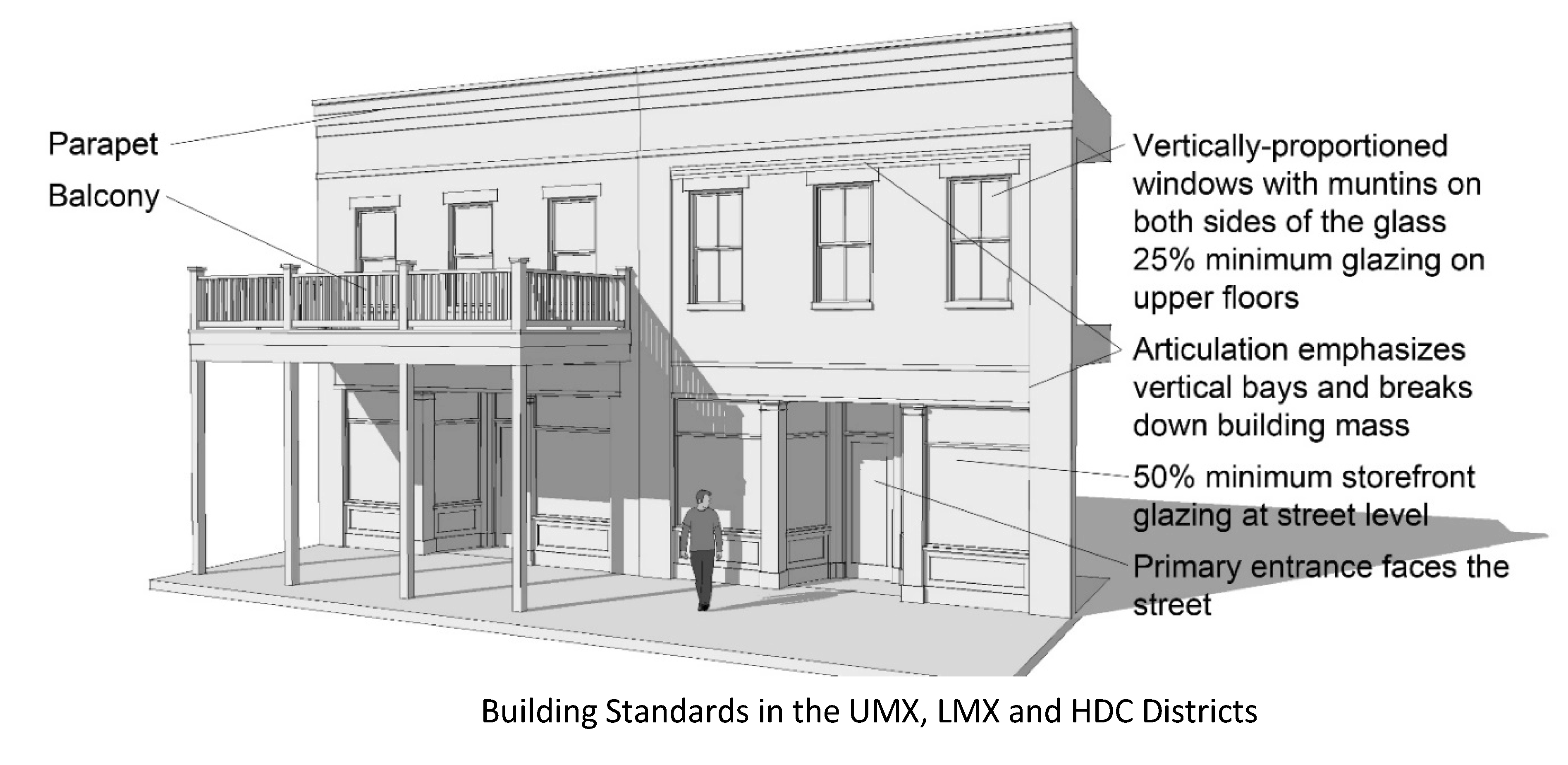
Figure 6-8 Building Standards in the UMX, LMX and HDC Districts
c.
Door and Window Design: The primary entrance to each building must face the adjoining street. All windows, with the exception of storefront windows, must have a vertical orientation. However, individual vertically-oriented windows may be grouped to collectively have a horizontal orientation. Doors and windows with muntins must feature real muntins or simulated divided lites on both sides of the glass, rather than "snap-in" and similar imitations. Shutters, if provided, must be sized to fit the window and appear to be operable.
2.
Vehicular Access. Access to parking areas must be from rear alleys where possible to avoid the proliferation of driveways along streets. When driveways are deemed necessary, access must be from secondary streets rather than primary streets, when possible. Driveways must be located along the edge of the lot. Shared driveways must be provided along shared property boundaries where practicable. Multiple adjacent driveways must be avoided. No more than one driveway is allowed per property unless the parking lot's size and traffic projections warrant a second driveway as determined by the City Engineer.
a.
Cross access must be located within the rear half of the lot and may be in the form of an alley or an internal driveway connecting the parking areas.
b.
No driveway may have more than two lanes at their point of intersection with the street.
3.
In the UMX, LMX and HDC Districts, outdoor dining may be located between the building and front lot line when a low wall is provided to define the street wall and the setback is no greater than 50 ft from the public right-of-way line. Such walls must be architecturally compatible with the principal building and must be between two and three feet in height. Iron fencing may be incorporated provided it does not exceed a combined height of four feet.
4.
Drive-through facilities are permitted in accordance with Table 6-8. Development sites should be configured so that, to the greatest extent feasible, the service window does not face the primary street.
5.
Parking Amounts.
a.
See Article 8 for parking standards. Within UMX and LMX districts, 75% of the amount of parking otherwise required for nonresidential uses, other than lodging, must be provided. 100% of parking required for residential and lodging uses must be provided. Except for public, freestanding and shared parking facilities, no more than 125% of the amount of parking otherwise required by Article 8 is allowed. Within the HDC District and the RCI District, minimum parking requirements apply to lodging and residential uses but are waived for other uses.
b.
The Director, upon a recommendation of the City Engineer, may reduce parking requirements for properties within 600 feet of a public parking facility but only to the extent that parking will be available in such facility during the highest parking demand period of the subject use. Parking requirements for residential uses may not be reduced.
c.
Designated on-street parking directly adjoining a property is credited toward parking requirements. Only those spaces within the property frontage are counted.
6.
Parking Location.
a.
Parking lots may not be located between a building and a street or between a building and the riverfront unless they are located to not be visible from the street or the riverfront (e.g., below grade).
b.
Parking lots may not front on Main Avenue, First Street, Fifth Street, nor Bridge Avenue south of Rice Mine Road. In the case of corner lots on Main and Fifth, parking may front onto Fifth but not onto Main Avenue.
c.
Where parking lots front onto secondary streets, they must be landscaped as required in Section 6.05.03(D)(3), Parking Lot Landscaping.
d.
Parking location requirements do not apply to properties fronting Rice Mine Road.
7.
Lighting. Freestanding lights used to illuminate streets, parking and pedestrian areas may not exceed 16 feet in height.
B.
Historic Downtown Core (HDC) District.
1.
Purpose. It is the intent of this district to preserve and reinforce the physical character and architectural integrity of the historic downtown. This district should accommodate a mixture of land uses and maintain a physical environment that is urban in form, pedestrian-friendly, and human scaled.
2.
Land Uses. See Table 6-8 and the following:
a.
Institutional uses may not have a building footprint larger than 5,000 square feet.
b.
Parking structures may not front onto Main Avenue.
c.
Townhouse buildings and buildings containing upper-story dwellings must contain at least four dwelling units per building.
3.
Building Scale and Placement. See Table 6-9. Exceptions from the maximum front setback standards are permitted as follows:
a.
Buildings featuring ground floor residential may exceed the maximum front setback other than along Main Avenue provided no parking is located between the building and front lot line. Such exceptions must feature a front courtyard in which at least one third of the building's frontage adheres to ten-foot maximum setback requirement, and the courtyard depth does not exceed 50 feet from the public right-of-way line.
b.
Institutional buildings may be set back greater than the maximum setback provided the building fronts onto a lawn, courtyard, park, plaza or similar open space and provided off-street parking does not extend forward of the front building line.
4.
Building Design. Refer to the building design standards in Section 6.05.03(C) and Section 6.05.04(A). See Table 6-10 for façade material standards.
a.
Façade Design. No front façade plane may exceed 25 feet in width without articulation (see Section 6.05.03(C)).
b.
Parking Structures.
1)
Sloping interior floors of parking structures should not be visible and may not be expressed on street façades. Along other streets, cars parked at street level must be screened from view.
2)
Access points to parking structures must be from secondary streets or alleys to the degree practicable. Pedestrian access must be clearly visible from and connected to adjoining sidewalks. Stairs and elevators should be expressed on the applicable elevation.
C.
Urban Mixed-Use (UMX) District.
1.
Purpose. It is the intent of this district to provide a mixed-use area that is urban in form, pedestrian friendly; human-scaled and provides visual and physical access to the river.
2.
Land Uses. See Table 6-8 and the following:
a.
Institutional uses fronting on Main Avenue and First Street may not exceed a 5,000 square feet building footprint.
b.
Parking structures must be located behind a building or fronted with ground floor retail or services.
c.
Multifamily and townhouse buildings must include at least four dwelling units per building.
3.
Building Scale and Placement. See Table 6-9 and the following:
a.
Between Main Avenue and the railroad, no building may extend higher than 75% of the height of the railroad tracks, as measured from the average elevation along the property line adjoining the railroad right-of-way.
b.
Exceptions from the maximum front setback standards are permitted as follows:
1)
Buildings featuring ground floor residential may front onto a street other than Main Avenue provided no parking is located between the building and front lot line. Such exceptions must feature a front courtyard in which at least one third of the building's frontage adheres to ten-foot maximum setback requirement, and the courtyard depth does not exceed 50 feet from the public right-of-way line.
2)
Institutional buildings may be set back greater than the maximum setback provided the building fronts onto a lawn, courtyard, park, plaza or similar open space and provided off-street parking does not extend forward of the front building line.
4.
Building Design. Refer to the building design standards in Section 6.05.03(C) and Section 6.05.04(A). See Table 6-10 for façade material standards.
a.
Articulation: No front façade plane may exceed 30 feet in width without articulation (see Section 6.05.03(C)).
b.
Parking Structures:
1)
Parking structures fronting onto any street must be designed to have the general appearance of a building along its street frontage with respect to materials and façade massing. Sloping interior floors of parking structures may not be expressed on street façades. Along Main Avenue and First Street, parking structures must be set behind other buildings so as not to be visible from the right-of-way except at the point of vehicular access. Along other streets, cars parked at street level must be screened from view.
2)
Parking structures fronting on Bridge Avenue must have commercial space along the full Bridge Avenue frontage except for vehicular and pedestrian access points.
3)
Vehicular access must be from secondary streets or alleys to the degree practicable.
4)
Pedestrian access must be clearly visible from and connected to adjoining sidewalks. Stairs and elevators should be expressed on the applicable elevation.
D.
Limited Mixed-Use (LMX) District.
1.
Purpose. It is the intent of this district to provide a mixed-use area that is urban in form, pedestrian friendly; human-scaled and provides a transition from the more intensive UMX District along Bridge Avenue.
2.
Land Uses. See Table 6-8.
3.
Building Scale and Placement. See Table 6-9 and the following:
a.
Exceptions from the maximum front setback standards are permitted as follows:
1)
Buildings featuring ground floor residential may front onto a street provided no parking is located between the building and front lot line. Such exceptions must feature a front courtyard in which at least one third of the building's frontage adheres to ten-foot maximum setback requirement and the courtyard depth does not exceed 50 feet from the public right-of-way line.
2)
Institutional buildings may be set back greater than the maximum setback provided the building fronts onto a lawn, courtyard, park, plaza or similar open space and provided off-street parking does not extend forward of the front building line.
4.
Building Design. Refer to the building design standards in Section 6.05.03(C) and Section 6.05.04(A). See Table 6-10 for façade material standards.
a.
Articulation: No front façade plane may exceed 30 feet in width without articulation (see Section 6.05.03(C)).
b.
Parking Structures:
1)
Parking structures fronting onto any street must be designed to have the general appearance of a building along its street frontage with respect to materials and façade massing. Sloping interior floors of parking structures should not be visible and may not be expressed on street façades. Cars parked at street level must be screened from view.
2)
Vehicular access must be from secondary streets or alleys to the degree practicable.
3)
Pedestrian access must be clearly visible from and connected to adjoining sidewalks. Stairs and elevators should be expressed on the applicable elevation.
E.
Residential Commercial Institutional (RCI) District.
1.
Purpose. It is the intent of this district to preserve and reinforce its residential and institutional character, while allowing for a mixture of residential, institutional, and low-impact commercial uses within a pedestrian-friendly, historic environment.
2.
Land Uses. See Table 6-8 and the following:
a.
Townhouses may not exceed four dwelling units per building.
b.
Institutional uses may not have a building footprint larger than 10,000 square feet.
c.
Parking structures are permitted for institutional uses only. Such structures may not front on a street and must be located behind their associated building.
d.
Drive-through windows are prohibited for any use.
3.
Building Scale and Placement. See Table 6-9.
4.
Building Design. Refer to the building design standards in Section 6.05.03(C) and Section 6.05.04(A). See Table 6-10 for façade material standards.
a.
Roofs. Residential buildings must have pitched roofs.
b.
Façade Design.
1)
Glazing: Glass anywhere on the street façade may not be reflective or heavily tinted.
2)
Porches: All residential building types must have a front porch. The porch must extend across at least 50% of the façade and must have a minimum depth of six feet. All porch posts, columns, handrails and balustrades must be wood or a composite material.
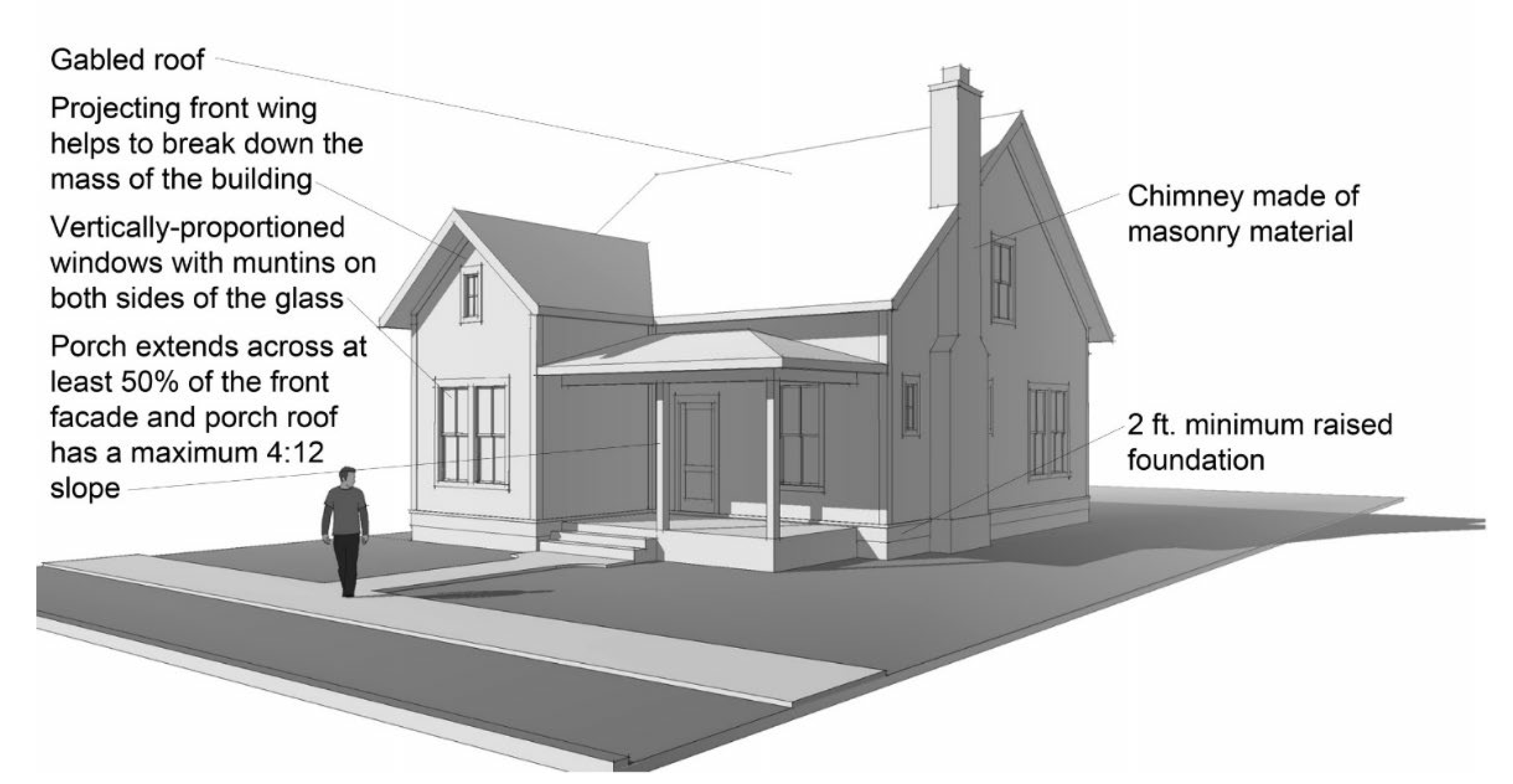
Figure 6-9 RCI and HN District Building Standards
6.05.05.
Suburban Mixed-Use (SMX) District.
A.
Purpose. It is the intent of this district to provide a mixed-use area that is suburban in form, functions efficiently, and has a high level of aesthetic quality.
B.
Land Uses. See Table 6-8.
C.
Building Scale and Placement. See Table 6-9.
D.
Building Design. Refer to the building design standards in Section 6.05.03(C). See Table 6-10 for façade material standards.
1.
No front façade plane may exceed a width equal to its height without articulation (see Section 6.05.03(C)).
2.
The primary entrance of each building must face the adjoining street. Shutters, if provided, must be sized to fit the window.
E.
Site Design Standards. Refer to Sections 6.05.03(D), (E) for additional requirements.
1.
Vehicular Access. To preserve the capacity of existing streets and promote vehicular and pedestrian safety, the number and spacing between driveways along streets must be limited. Access to parking areas must be from alleys whenever practicable. Driveways must be along secondary streets rather than primary streets, whenever possible. Driveways must be located along the edge of the lot. Shared access driveways must be provided along property boundaries when practicable. Multiple adjacent driveways must be avoided. No more than one driveway is allowed per property unless the parking lot's size and traffic projections warrant a second driveway as determined by the City Engineer.
2.
Driveways may not exceed 13 feet in width per lane at the front lot line. No driveways may have more than three lanes at their point of intersection with the street.
3.
Drive-through facilities may not be located between the principal building and a primary street.
4.
Parking Amounts. See Article 8 for required parking. No more than 125% of the amount of parking otherwise required is allowed.
5.
Lighting. Freestanding lights illuminating streets, parking and pedestrian areas may not exceed 20 feet in height.
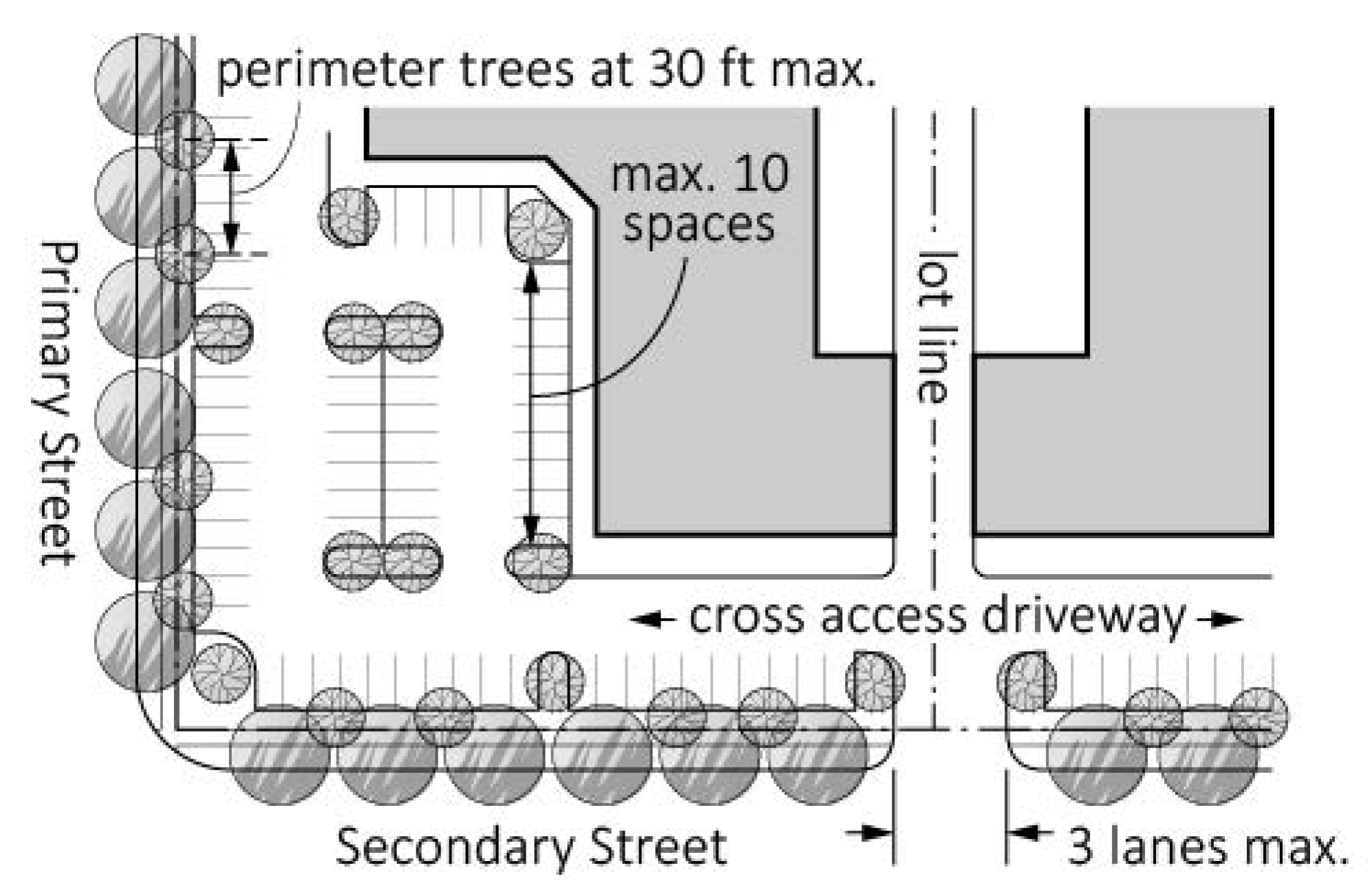
Figure 6-10 Suburban Mixed-Use District Site Standards
6.05.06.
Historic Neighborhood (HN) District.
A.
Purpose. It is the intent of this district to protect the historic integrity and physical character of a historic neighborhood, keeping it urban in form, pedestrian-friendly, human scaled, and residential in land use.
B.
Lot Design.
1.
Lots must have a perpendicular orientation to the street with a minimum width-to-depth ratio of 1:1.5, but not more than 1:3.
2.
Lots must have a minimum width of 50 feet.
C.
Building Scale and Placement. See Table 6-9 and the following:
1.
Buildings may not exceed a width of 60 feet measured parallel to the street frontage.
2.
On block faces where the majority of existing buildings have the main axis parallel to the street, new buildings must have the same alignment. Where the majority of existing buildings have their main axis perpendicular to the street, new buildings must have the same alignment.
3.
The front façade of each building must face the adjoining street. In the case of corner lots, the primary façade must face the primary street unless the existing development pattern dictates otherwise. Except for permitted corner entrances, the primary entrance to the building must be along its street façade. Street façades must contain porch steps, stoops, other architectural treatments or a combination of these.
4.
Accessory buildings must be set back at least three feet from rear and side lot lines. Garages opening onto an alley must be set back at least five feet.
D.
Building Design Standards. Refer to the building design standards in Section 6.05.03(C). See Table 6-10 for façade material standards.
1.
When duplexes are developed on corner lots, they must be designed so that one unit has its entrance along one street and the other unit has its entrance along the other street.
2.
Minimum foundation heights: The finished floor elevation must be at least 24 inches from finished grade at the front building line.
3.
Articulation: No front façade plane may exceed a width of 30 ft without articulation (see Section 6.05.03(C)).
4.
Door and Window Design.
a.
All windows must have a vertical orientation, except that individual vertically-oriented windows may be grouped to have a horizontal orientation.
b.
Doors and windows with muntins must have real muntins or simulated divided lites on both sides of the glass, rather than "snap-in" and similar imitations. Shutters, if provided, shall be sized to fit the window and appear to be operable.
5.
Roof Form.
a.
Roofs may be flat or pitched. Pitched roofs must have a slope between 6:12 and 12:12. However, steeper roofs are permitted for Tudor Revival style buildings if a case can be made for historic precedents of this style within this district.
b.
Prohibited roof types include mansard, gambrel, and flat roofs.
6.
Porches.
a.
All buildings must have a front porch except for building styles or types historically found in the district that traditionally lacked a porch.
b.
The porch must extend across at least 50% of the façade and have a minimum depth of six feet. All porch posts, columns, handrails and balustrades must be wood or composite material. Porch roofs must be shed or hipped shed in form with a roofing material that matches the building or standing seam metal, and a slope no greater than 4:12. V-crimp roofing imitating standing seam metal is permitted.
c.
For buildings constructed prior to 1950, front porches may not be removed or enclosed with glass, walls or other solid materials. Screens are allowed.
7.
Building Additions. Additions to existing buildings must be subservient in appearance to their original structure. They should be smaller in scale than their original structure, and they should appear as a distinct component of the building rather than extending the building's original planes or lines.
a.
Additions must be set back at least three feet from the front building line of the original structure.
b.
Additions may not exceed the height of the original building.
c.
Additions must utilize wood cladding, or a material with an identical appearance, that is consistent in form with that of the original structure. For example, an addition to a clapboard structure must use clapboard with the same board width.
d.
Roofs of additions must be the same general form, pitch and materials as the original roof.
e.
Foundations of additions must have the same general elevation level, design and materials as the original structure.
E.
Site Design Standards.
1.
Access must be from rear alleys when present. When permitted, driveways, must be on secondary streets rather than primary streets, when possible. Driveways must be located along the edge of the lot. Shared driveways must be provided along property boundaries when practicable. Multiple adjacent driveways must be avoided. No more than one driveway is allowed per property unless the parking lot's size and traffic projections warrant a second driveway as determined by the City Engineer.
2.
Driveways for detached single-family dwellings are only permitted where the majority of existing dwellings on the block face have driveways.
3.
When provided, cross access must be located within the rear half of the lot and may be in the form of an alley or shared driveway connecting the parking areas.
4.
Driveway Widths.
a.
Townhouses and Multifamily. No driveway may be wider than two lanes at the front lot line.
b.
Detached Single-Family. Driveway widths may not exceed 12 feet between the street and the rear building line of the dwelling.
5.
Parking.
a.
Parking Amounts: See Article 8 for required parking. For townhouses and multifamily, no more than 125% of the amount of parking otherwise required is allowed.
b.
Parking Location. Parking lots may not be located between the building and adjoining street. Parking lots may not front onto streets, with the exception of corner lots, in which case parking may front onto the secondary street. Where parking areas front onto secondary streets, they must be landscaped per the parking design standards below.
c.
Garage design for detached single-family dwellings:
1)
If visible from the primary street, garage doors may not exceed nine feet in width and must be separated by at least two feet. No more than two garage doors are permitted.
2)
A covered walkway may connect a detached garage to the dwelling.
3)
Exterior materials, finishes and roof slope must match the primary structure.
4)
Detached garages may not exceed 20 feet in height as measured from the garage floor to the top of the eave.
6.
Lighting. Freestanding lights illuminating streets, parking and pedestrian areas may not exceed 16 feet in height.
7.
Fencing and Walls. If provided, fencing and walls between the front building line and the front lot line, are subject to the following standards:
a.
Permitted fence and wall types:
1)
Fences: Wood picket, wood horizontal board, and metal with vertical pickets
2)
Walls: Brick, stone, and other masonry clad in smooth stucco or plaster
3)
Combined fence and wall: masonry wall and piers with metal vertical pickets
b.
Permitted fence and wall heights:
1)
Fences may not exceed a height of 42 inches.
2)
Walls may not exceed a height of 32 inches.
3)
Combined fence and wall may not exceed a height of 42 inches
6.05.07.
Conservation (CON) District.
A.
Purpose. It is the intent of this district to protect the scenic beauty, environmental integrity, and recreational value, of the core city's most environmentally sensitive areas. Physical improvements should be limited to those necessary for the public's enjoyment of the lands, and they should be done in a manner that minimizes any negative impacts to the environment.
B.
Land Uses.
1.
Permitted Uses. passive recreation (hiking, picnicking, fishing, etc.). Marinas and boat and barge docks are permitted only along the riverfront.
2.
Conditional Uses: dining, retail and services associated with a marina or boat or barge dock may be permitted through Conditional Use approval only along the riverfront.
C.
Building Design. Refer to the building design standards in Section 6.05.03(C). See Table 6-10 for façade material standards.
1.
Articulation. No front façade plane may exceed a width of 30 feet without articulation (see Section 6.05.03(C)).
2.
Reflective glass and glass tinted over 50% may not be used on the front façade.
3.
Doors and windows. Only real muntins or simulated divided lites on both sides of the glass may be used. "Snap-in" and similar imitation muntins. Shutters, if provided, must be sized to fit the window and appear to be operable.
D.
Site Design Standards.
1.
No more than one driveway is allowed per property.
2.
No driveways may have more than two lanes at the front lot line.
3.
Parking is not required within these districts. Parking, when provided, may not exceed 100% of the amount of parking normally required for the subject use in Article 8, Parking and Loading.
4.
Parking areas visible from the river must provide perimeter landscaping as required in Section 6.05.03(D)(3), Parking Lot Landscaping, along the parking area's river side. However, walls and fencing may not be part of the required landscaping materials. The perimeter landscaping must create a complete and year-round screening.
5.
Lighting. Freestanding lights illuminating vehicular and pedestrian areas may not exceed 16 feet in height.
(Ord. No. 2249, (Att.), 12-16-24; Ord. No. 2268, § 1(Exh. A), 5-19-25; Ord. No. 2301, § 1(Exh. A), 5-18-26)

