
Northport City Zoning Code
ARTICLE 9
- LANDSCAPING
Sec. 9.01.- General Provisions.
9.01.01.
This article recognizes the importance of trees and landscaping throughout the city and their relationship with the economic, ecological and cultural processes that give Northport its tradition and identity. Through preservation, replacement, and maintenance of the urban forest, this ordinance will provide a better quality of life for the citizens of Northport.
9.01.02.
Urban landscaping aids in preventing soil erosion, siltation of streams and reservoirs and flood damage. Trees are essential in providing shade and natural cooling, preventing air and noise pollution, as well as preserving community character.
9.01.03.
The purpose of this Article is to:
A.
Protect the public health, safety and welfare by mitigating incompatibility between adjacent uses through the establishment of buffers between non-compatible land uses;
B.
Improve the quality of life for Northport citizens through the reduction of noise, glare, heat and air pollution;
C.
Preserve, protect and maintain the healthy existing vegetation and encourage, where possible, the incorporation of native plant materials and ecosystems into landscape design and discourage the proliferation of invasive plant species;
D.
Establish and maintain sustainable amounts of tree canopy on public and private lands in the City;
E.
Improve community character by encouraging aesthetically pleasing sustainable design practices, while allowing innovative, diverse and cost conscious approaches for design, installation and maintenance of landscaping;
F.
Promote the conservation of local waterways and aquifers by encouraging the planting of native species, or site specific species;
G.
Provide means for natural aquifer recharge and prevent excess runoff through the provision of landscaping and buffers;
H.
Facilitate compliance with Local, State and Federal legislation relative to water and air quality, including, but not limited to, the Clean Air Act (Title 42, Chapter 85 of the U.S. Code) and the Clean Water Act (Title 33, Chapter 26 of the U.S. Code).
9.01.04.
Scope, Applicability.
A.
The provisions of this Article apply to all land development projects and development activities, including the development of subdivisions, but not individual single-family dwellings or duplexes.
B.
The provisions of this Article apply to all new construction, redevelopment, or change of use for any multifamily residential, commercial, institutional, or industrial use and any property for which any land development permit is required. The requirements are applicable at all times once land has become subject to these provisions.
C.
Redevelopment.
1.
Redevelopment of an existing built site, which involves the complete removal of existing structures, must meet all applicable requirements of this Article.
2.
When an existing building is increased in habitable floor area, the existing vehicular area must be made to comply with all applicable requirements of this Article.
3.
In the event that the site has size or topographic constraints, the Director may authorize the use of the standards in Section 9.10.03, Alternative Compliance.
D.
Downtown Districts. Within the Downtown Districts, all perimeter and interior landscaping must meet those requirements set out in Section 6.05, Downtown Districts.
E.
Special Exception and Conditional Uses. As part of any Special Exception or Conditional Use Approval, landscaping requirements, in addition to those specified in this Article may be required by the approving authority.
9.01.05.
Legal Aspects, Other Regulations.
A.
All local, state and federal laws and regulations must be considered when interpreting provisions of, or technical specifications published pursuant to, this Article. In each instance, the more restrictive requirement governs unless sound engineering judgment can determine and prove that the more restrictive requirement would be otherwise unnecessary. Laws and regulations that are phrased more explicitly govern over those phrased more generally.
B.
Nothing in this Article authorizes a person to engage in development or land disturbance in a manner inconsistent with zoning or subdivision regulations or other applicable codes or ordinances. All development and land disturbance activity must conform to current zoning, subdivision and all other applicable regulations and ordinances.
C.
A landscape plan does not authorize any person to engage in any activity that would violate any other applicable code, ordinance, regulation or state or federal laws nor substitute for obtaining any licenses or permits otherwise required.
(Ord. No. 2249, 1(Exh. A), 12-16-24)
Sec. 9.02. - General Requirements.
9.02.01.
Planting areas in public rights-of-way or on adjoining property do not count toward required landscaping.
9.02.02.
Site protection and general planting requirements
A.
Topsoil. To the extent needed and practicable, topsoil moved during the course of construction must be preserved and stockpiled for re-use on the site.
B.
Existing Trees. Preservation of each existing healthy tree of an approved species (See Table 9-3), within required landscape areas, may count toward fulfillment of these requirements.
1.
Upon approval of the Director an existing area of native vegetation meeting the definition of woodland, may be deemed to satisfy planting of a specific area or buffer required by this Ordinance regardless of the mix of plant materials otherwise required.
2.
Each existing tree that is credited towards meeting the requirements of this Article may reduce the number of required parking spaces in accordance with Section 9.08, Off-Street Parking and Tree Preservation.
C.
Wherever a required buffer overlaps or coincides with perimeter or other required landscaping, the buffer requirements take precedence.
D.
Slope Plantings. Landscaping of all cuts, fills, and terraces must be matted or protected until plant cover is adequate to control erosion.
9.02.03.
Utility Easements. Plantings within utility company easements must comply with the following:
A.
Minimum distances measured horizontally from mature trees to overhead utility lines must be:
1.
Canopy Trees: 30 feet.
2.
Understory Trees: 15 feet.
B.
The location and species of trees proposed for location in utility easements must be approved before installation.
C.
Any part of a tree growing within 15 feet of an overhead utility line requires maintenance by a certified line trimmer approved by any affected utility companies.
D.
This Article may not be construed to impair:
1.
The right of eminent domain granted by State laws to utilities, whether public or private, or
2.
A utilities' right to design, locate, erect, construct, re-construct, alter, protect or maintain utility poles, towers, lines, conduits, pipes or mains reasonably required as part of the utility service or
3.
A utilities' right to exercise authority conferred by statute, franchise, certificate of convenience and necessity, license or easement. Maintenance, repair, and extension of any public and private utility lines or related infrastructure are expressly allowed. The preceding will apply to work done by the utility's employees, agents and contractors doing work for the utility.
E.
Trees and shrubs may only be planted within underground utility easements with approval of the Director and the affected utility.
9.02.04.
Plant Material Standards.
A.
All plant materials must meet minimum standards of caliper, fullness of form, height, root ball and vigor as prescribed by the American Association of Nurserymen standards published in the current edition of American Standards for Nursery Stock.
B.
Canopy Trees must have an average mature crown spread of at least 25 feet. At planting, Canopy Trees must be a minimum of eight feet in height and have a caliper of at least two inches.
C.
Understory Trees must have an average mature crown spread of at least 15 feet. At planting, Understory Trees must be a minimum of five feet in height and have a caliper of at least one and one-half inches.
D.
No more than 30% of plant material may consist of crepe myrtle.
E.
Shrubs must be a minimum size of three-gallon containers and must be of a species that will obtain a height of 24 inches within two years.
F.
Required landscaping areas are to be sodded, seeded, mulched or planted with shrubs or ground cover so as to leave no bare ground after landscape materials have been installed and permitted to grow for two years. Where mulch is used, the area must be kept free of weeds. Neither hay nor seed may be used as ground cover within 50 feet of any curb line or the perimeter of any vehicular use area.
9.02.05.
Stormwater Management. Perimeter planting strips must incorporate Low Impact Development (LID) techniques consistent with the requirements of the Alabama Department of Environmental Management (ADEM) Low Impact Development Handbook. Such LID elements include rain gardens, bioswales or other approved stormwater mitigation techniques to promote infiltration and reduce stormwater runoff and non-point source pollution. Rain gardens must include at least one tree. Alternative designs that accomplish the intent of this ordinance may be permitted subject to approval of the Director and the City Engineer.
9.02.06.
Ground Cover. Gravel may be used in required landscape areas but may not otherwise be used as ground cover.
9.02.07.
For new single-family detached subdivisions, 1 canopy tree is required on each lot.
(Ord. No. 2249, (Att.), 12-16-24; Ord. No. 2268, § 1(Exh. A), 5-19-25)
Sec. 9.03. - Vehicular Area Landscaping Standards.
9.03.01.
Applicability.
A.
These regulations apply to vehicular areas in nonresidential, multifamily and mixed-use developments used for off-street parking and loading; vehicular storage, display, maneuvering and washing; and the dispensing of motor fuels as specified in Table 9-1. These regulations do not apply to parking areas on single-family residential lots but do apply to common parking areas in single-family residential developments.
B.
If an existing vehicular area is increased in size, the new vehicular area must comply with this Section.
9.03.02.
Plant Materials. Species from Table 9-3, which are appropriate to the locations in which they will be planted, must be used for required vehicular area landscaping.
Table 9-1 Applicability of Vehicular Area Landscaping Requirements
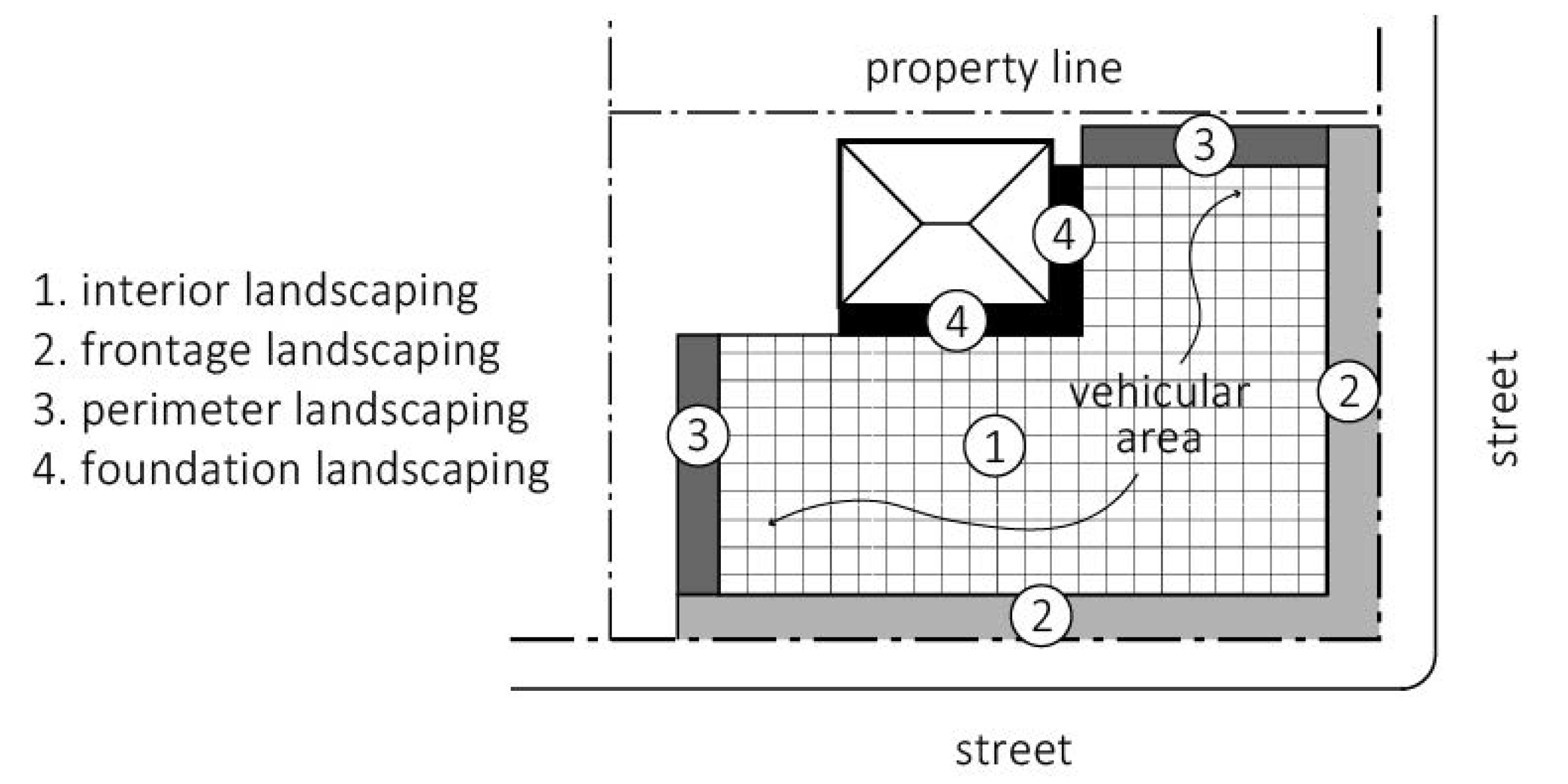
Figure 9-1 Vehicular Landscaping Areas
9.03.03.
Frontage Landscaping.
A.
Except as required in Section 6.04, Special Corridor Overlay District, frontage landscaping must be, at a minimum, ten feet in depth along all adjoining public rights-of-way. Frontage landscaping must include a minimum of one canopy tree, one understory tree and six shrubs per 50 linear feet of the frontage, or fraction thereof. Trees and shrubs must be well distributed, though not necessarily evenly spaced. The Director may reduce frontage shrub requirements for developments in which a portion of the site, from the frontage to the opposite lot line, will not be developed for buildings, vehicular areas or other uses.
B.
Frontage landscaping strips must be at least ten feet deep along local streets and collector streets and at least 20 feet deep along arterial streets. Additional depth may be necessary to comply with planting requirements, such as when required trees are staggered or when berms are used.
C.
For developments with frontage of 250 feet or more, a berm may be used as part of frontage landscaping. The berm may not have a slope of greater than one foot of rise per three feet of run and must not be less than four feet in height at its apex. Normally required shrubs are optional in areas where a berm at least four feet in height is used.
D.
Frontage landscaping must observe sight distance requirements at the intersections of streets, alleys and driveways in accordance with Engineering Design and Construction Manual.
9.03.04.
Perimeter Landscaping.
A.
Perimeter landscaping must be provided within the property lines between vehicular areas and adjoining properties.
B.
Perimeter landscaping areas must be at least ten feet in depth, excluding walkways, measured perpendicularly from the adjoining property to the back of curb, and must contain one canopy tree, three understory trees, and four shrubs per 100 linear feet of property, or fraction thereof.
C.
Driveway connections to adjoining properties are encouraged and are subtracted from calculation of perimeter landscaping requirements.
D.
Perimeter landscaping requirements may be reduced, in accordance with Section 9.10.03, Alternative Compliance, along the applicable portions of a lot line if perimeter landscaping or a landscaped buffer has been installed adjacent to such lot line on the adjoining property. Such reductions may only be approved if the normally required perimeter landscaping, due to its proximity to the existing landscaping or buffer on the adjoining property, would be redundant.
9.03.05.
Interior Landscaping.
A.
Each island or peninsula, to count toward interior landscape requirements, must be at least 180 square feet in area; however, the maximum contribution of any individual island or peninsula to interior landscaping requirement is 500 square feet.
B.
Island and peninsulas must be at least eight feet in their least dimension exclusive of curbs.
C.
Islands and peninsulas must be as uniformly distributed as practicable, to subdivide large expanses of parking areas, to regulate traffic flow, to protect pedestrians, and to permit access by emergency vehicles. When practicable, islands and peninsulas must be placed at the end of parking rows or between circulation drives and parking rows, to channel traffic safely around the parking areas and to demarcate parking rows.
D.
The interior landscaped area must contain at least an average of one tree and four shrubs per 100 square feet of landscaped area. Each island and peninsula must contain at least one understory tree.
E.
There may be no more than ten contiguous parking spaces in one row without a landscape island or peninsula.
F.
Excavation.
1.
All interior planting areas must be excavated to remove all parking lot base material and back filled with quality topsoil, except those areas where existing vegetation is to be preserved. Excavation must be to at least 24 inches and freely allow penetration of hand-held probe to at least 24 inches. Topsoil must be high in organic matter and allow water to percolate.
2.
Inspection of planting areas will be conducted during the construction process. Failure to comply with these requirements can result in a stop work order.
(Ord. No. 2249, 1(Exh. A), 12-16-24)
Sec. 9.04. - Foundation Landscaping.
9.04.01.
Applicability. All nonresidential, mixed-use and multifamily buildings must provide foundation landscaping along façades containing public or common entrances if adjoining a vehicular area.
9.04.02.
Landscape beds must be placed between the front of the principal structure and the adjoining parking area and must have a minimum depth of seven feet.
A.
Beds must contain both understory trees and shrubs. Plant material must be well distributed throughout the bed, though not necessarily evenly spaced.
B.
A minimum of one shrub must be planted per four feet of façade length with a minimum height at planting of 23 inches. Shrubs of varying height at maturity must be used.
C.
A minimum of one understory tree must be planted per 30 feet of façade length. Trees may be installed in planters.
(Ord. No. 2249, 1(Exh. A), 12-16-24)
Sec. 9.05. - Buffers.
9.05.01.
Purpose. Landscape buffers are required to screen incompatible land uses to protect property values and to afford protection from the glare of lights, blowing paper, dust and debris, visual encroachment and noise. See Figure 9-2.
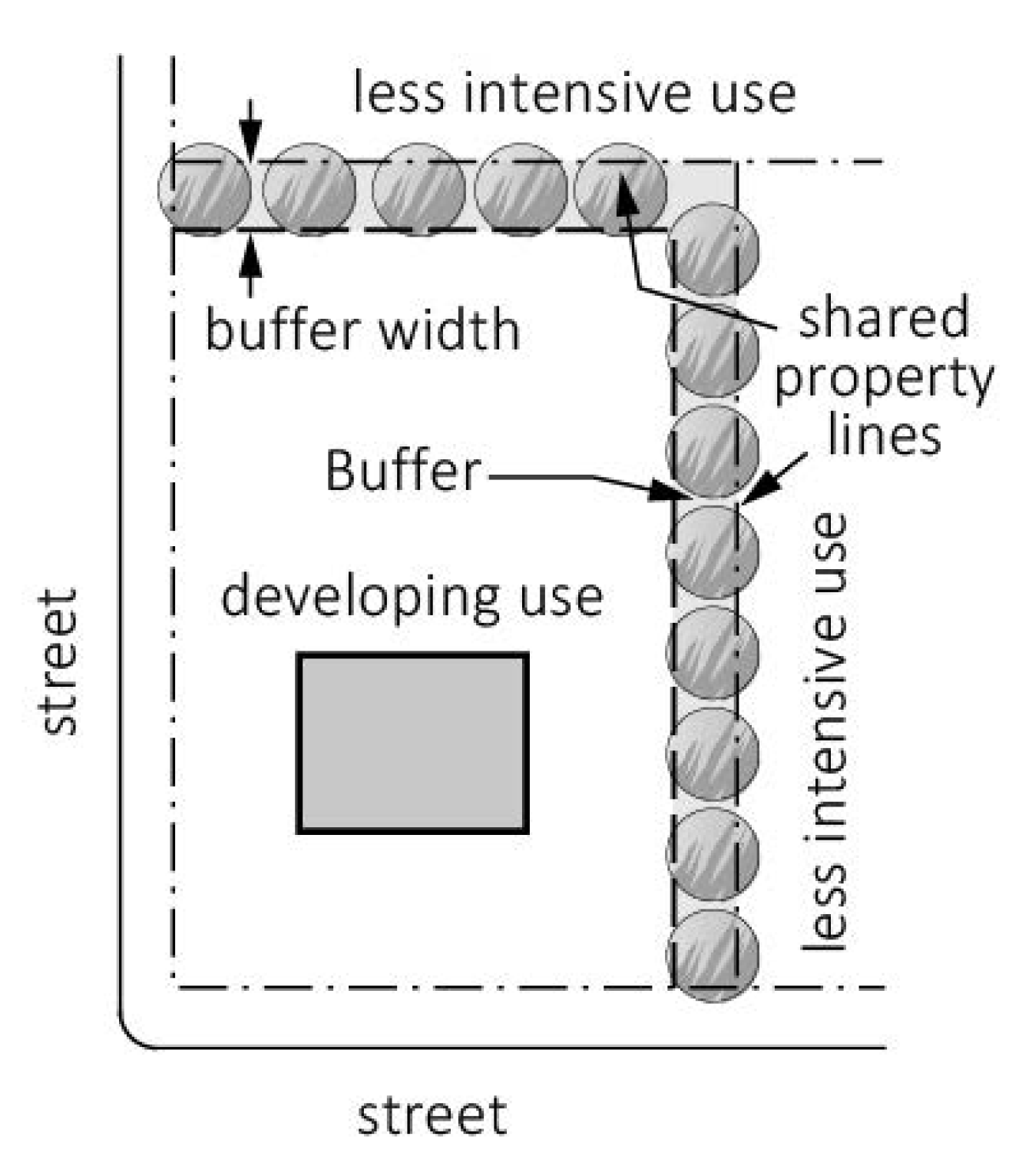
Figure 9-2 Buffers
9.05.02.
Applicability.
A.
Buffers must be provided as specified in Table 9-2 and as described in this Section. Buffers are the responsibility of the developing land use. Buffer requirements are based on the developing land use and the existing, adjoining use. Required side and rear yards, when corresponding with the buffer area, may overlap and be counted toward buffer width requirements.
B.
Whenever the proposed use adjoins vacant land, buffer requirements are based on the zoning of the adjoining property or the use projected by the Comprehensive Plan, whichever requires a lesser buffer.
9.05.03.
Modifications. Buffer requirements may be modified by the approving authority as follows:
A.
When the proposed use will adjoin an existing, nonconforming use on a property that is designated for another use in the Comprehensive Plan and is zoned accordingly, the buffer requirement may be modified to be consistent with the use of the neighboring property projected by the Comprehensive Plan.
B.
If the land use relationship between two adjoining lots changes so that a lesser buffer would be required, the previously provided buffer may be reduced.
C.
Where topography provides a more effective buffer than the above-described buffer, or where topography renders the above described buffer ineffective, the Director may:
1.
Reduce the width of the required buffer by no more than 50%,
2.
Reduce or waive the required undisturbed or planted buffer,
3.
Allow reforestation with native vegetation in lieu of all or a portion of the required planted buffer,
4.
Require any combination of the above stated measures.
9.05.04.
Buffers may not be used for parking, recreational use or any other purpose, except as follows:
A.
The approving authority may permit a walkway through a buffer.
B.
Public utilities and storm drainage facilities may be constructed in a buffer if the buffer otherwise complies with this Section.
9.05.05.
Design Standards.
A.
Prior to occupancy of the premises, buffer plantings must be of a size and spacing to provide an opaque visual barrier from the ground to at least three feet above grade throughout the length of the buffer. Plantings must be spaced as closely as possible while accommodating healthy growth.
B.
Shrubs and trees used to meet buffer requirements must be evergreen but may be supplemented with deciduous plants.
C.
Within one year after installation, the buffer must provide an opaque visual barrier from the ground to at least six feet above grade throughout its length. When a fence is provided that is at least six feet tall and meets the requirements of this Section, shrubs need not be taller than four feet above grade and the buffer width may be reduced as provided in Table 9-2.
D.
Buffer areas must be maintained in clean and neat condition and kept free from weeds, litter and refuse.
9.05.06.
Buffers constitute an integral part of a development site, and may not be subdivided, sold, dedicated, or otherwise conveyed separately from the development site of which they are a part. The City will not approve any development plan in which any portion of a required buffer lies on land, which is not part of the development site.
Table 9-2 Buffer Requirements by Use
1 Trees may need to be staggered, depending on species and spacing, to support healthy growth.
" - " means no buffer is required.
(Ord. No. 2249, 1(Exh. A), 12-16-24; Ord. No. 2296, § 1(Exh. A), 3-23-26)
Sec. 9.06. - Screening.
9.06.01.
Purpose. Screening provides visual separation of certain site elements from public areas and adjoining properties.
9.06.02.
Applicability.
A.
For all multifamily, nonresidential and mixed-use developments, the following must be screened from public view and view from adjoining properties:
1.
Waste collection, recycling and refuse handling areas
2.
Service areas and work yards associated with a building or development, including lot areas within which repair of vehicles of any type occurs.
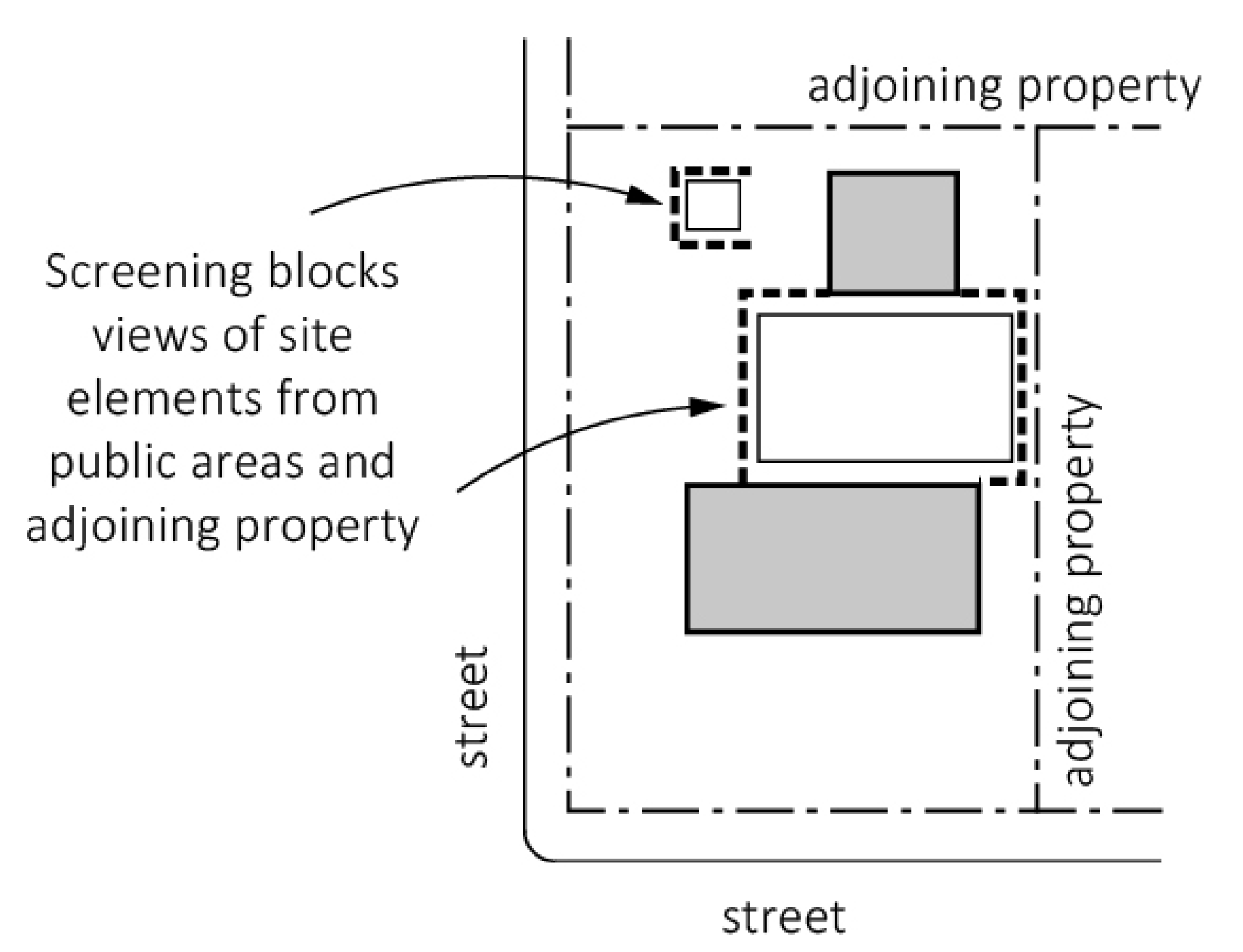
Figure 9-3 Screening
3.
Utility meters, air conditioners and other mechanical units, all of which may not be located forward of the front building line.
4.
Outdoor storage of materials, stock, and equipment, not including retail display. Storage areas of vehicles that are visibly damaged or under repair must be similarly screened.
5.
Outdoor animal exercise areas for veterinary clinics, animal shelters, and kennels.
B.
Exceptions.
1.
In agricultural zones, screening is not required for areas where animals are kept outdoors, including outdoor runs, pens, cages and exercise areas of veterinary offices, animal shelters and kennels.
2.
In industrial zones, screening of the above site elements from views from adjoining, industrially-zoned property is not required though they must nonetheless be screened from public view.
3.
The Director may reduce or waive screening requirements between similar site elements on adjoining properties though they must be screened from public view.
9.06.03.
Design Requirements. Screening must comply with the following and as required by the approving authority:
A.
Location of the site element should be the first consideration in providing required screening. The approving authority may reduce requirements when the location of the element obscures it from public view and from adjoining properties.
B.
The method of screening, including height and materials, must sufficiently screen the site element from view. Screening may be provided through evergreen plantings, an opaque enclosure meeting the requirements of Section 9.07, Design Standards for Required Fences, or a combination of these. The minimum height needed is preferred.
C.
Multiple elements may be screened together.
D.
Elements that produce objectionable noise or odors may be required to be so located as to minimize any nuisance to the public and adjoining properties.
E.
Shrubs, if used as the primary screening material, must be evergreen and spaced so that, at maturity, they create a solid, opaque screen. If used in combination with an opaque fence, shrubs may be deciduous and are not required to create a solid hedge.
9.06.04.
Requirements for Specific Uses.
A.
Refuse and recycling receptacles.
1.
Refuse and recycling receptacles may not be located forward of the front building line nor within required landscape areas. This applies to all front building lines on lots with more than one street frontage.
2.
Receptacles must be placed on a pad approved by the City Engineer that allows for pick-up and maintenance as needed.
3.
Receptacles must be screened on all sides, including an opaque, latching gate. The gate must be kept closed at all times except when the receptacle is being serviced. The enclosure must be at least as tall as the container and must be of wood, masonry or a combination of these or otherwise consistent with the architectural materials of the primary structure.
4.
Receptacles are not permitted within Residential Single-Family (RS) zoning districts.
5.
These regulations shall not apply to receptacles provided by the City of Northport.
B.
Outdoor storage must be screened to a height of two feet taller than the material or equipment to be screened.
C.
Service areas, work yards, and similar uses should be located to minimize their visibility to the public and to any adjoining properties to which such functions would be objectionable. Where location on site is insufficient to screen the element, required screening must be at least six feet in height.
9.06.05.
Nonconforming provisions. In addition to the requirements of Section 9.01.04(C), Redevelopment, any existing site element that does not meet screening requirements, must be screened in accordance with this Section whenever there is a change in use with which the site element is associated.
(Ord. No. 2249, 1(Exh. A), 12-16-24; Ord. No. 2296, § 1(Exh. A), 3-23-26)
Sec. 9.07. - Design Standards for Required Fences.
Fences used to meet landscaping requirements are subject to the following:
A.
Fences must be metal, vinyl, masonry, cedar or treated wood, cement-fiber or a combination thereof. Untreated wood (other than cedar), chain-link, plastic or wire fencing and non-architectural grade cement block walls cannot be used to meet landscaping requirements. Any metal used as part of a screening fence or wall must be galvanized. No screen may be constructed of metal that will rust.
B.
The finished side of the fence must face adjoining property or public views.
C.
Shrubs and trees required for buffers, screening or landscaping must be planted on the exterior side of the fence.
D.
If a fence extends more than 100 feet in one direction, it must have columns or similar articulating elements, which project outward from the fence surface and which must be spaced no more than 50 feet on center.
(Ord. No. 2249, 1(Exh. A), 12-16-24)
Sec. 9.08. - Off-Street Parking and Tree Preservation Credits.
To encourage the preservation of existing trees and reduce the amount of impervious surface, the following off-street parking reduction may be utilized.
9.08.01.
Parking requirements may be reduced by one space for each existing tree that is preserved and that meets perimeter planting requirements. In no case may the combination of all reductions in commercial parking exceed the following:
A.
10% for parking lots containing 1-74 spaces,
B.
15 % for parking lots containing 75-125 spaces, or
C.
20% for parking lots containing 126 or more spaces.
9.08.02.
General Requirements.
A.
Each existing tree to be preserved must be approved by the Director to receive credit.
B.
Preserved trees are subject to the same maintenance and replacement requirements as newly planted trees.
9.08.03.
Protection of Preserved Trees during Construction. Existing trees may only be credited where the following management standards are met:
A.
During construction, the critical root zone of the trees to be preserved must be fenced and protected from compaction, trenching, harmful grade changes and any other injury and be shown on an approved landscape plan.
B.
Pavement, building foundations and other impervious surfaces may not encroach into the critical root zone, unless preservation practices are followed to ensure exchange of oxygen, water and nutrients to the root system. Said preservation practices must be specified in written and/or graphic form to the Director for approval.
C.
Sidewalks or other forms of hard surfaces that do not require soil compaction and are not intended for vehicular use may be located within the critical root zone only if preservation practices are followed to ensure exchange of oxygen and water to the root system.
(Ord. No. 2249, 1(Exh. A), 12-16-24)
Sec. 9.09. - Ownership and Maintenance.
9.09.01.
The owner of the property is responsible for maintaining all required landscaping in good condition. Required maintenance includes the prompt replacement of all dead or damaged landscaping material, to ensure continued compliance with the requirements of this ordinance. All buffer materials must be maintained so that the purpose and effect of the buffers is not diminished. No modifications may be made that would decrease conformity with the requirements of this ordinance.
9.09.02.
The following minimum maintenance activities are required:
A.
Replacement of plant materials destroyed by any cause. In the case of any canopy tree removed or otherwise destroyed by the willful act of the property owner, tenant or contractor, a tree of the same or larger caliper must be used as a replacement. Where replacement at the same or larger caliper is not feasible, the Director may provide alternative replacement criteria.
B.
Repair or replacement of fences and walls that deteriorate or are damaged by any cause.
C.
Restoration of berms that are altered by erosion, construction, or other causes.
D.
Irrigation of landscape materials is strongly recommended, particularly for larger development sites. Landscaping lost due to lack of rainfall or irrigation must be replaced.
(Ord. No. 2249, (Att.), 12-16-24; Ord. No. 2268, § 1(Exh. A), 5-19-25)
Sec. 9.10. - Administration.
9.10.01.
Landscape Plan. A landscape plan along with all other required submission materials must be approved for all developments for which landscaping is required before any building or other land development permits may be issued.
A.
If setbacks are requested to be reduced through a special exception, alternative landscape designs that accomplish the intent of this Article must be approved by the Director.
B.
Approval. The appropriate licensed professional must certify that the landscape plan submitted meets the requirements of this Article.
C.
Format and Materials. The landscaping plan and details must be drawn to the same standard scale as the Site Plan or a scale which shows all landscaping accurately.
D.
Complete landscape plans submitted for review and approval must include those materials identified in the Appendix A-1.
9.10.02.
Compliance.
A.
The architect, landscape architect, engineer, surveyor of record, horticulture professional, or landscape contractor must certify, to the Director, that the landscaping has been installed to meet the minimum requirements of this Article. The site will be inspected before a final certificate of occupancy will be issued.
B.
No certificate of occupancy may be issued for any new development that has not met the requirements of this Article or an approved landscaping plan. Additions or renovations to existing parking areas must also receive a certificate of occupancy prior to usage. When circumstances preclude immediate planting, the Director may approve a certificate of occupancy after:
1.
All curbing, irrigation systems and other non-planting components of the landscaping plan have been completed; and
2.
A completion bond or certified check in an amount equal to 125% of the total cost, including labor, of the remaining landscaping installation has been posted. Such surety must be made payable to the City of Northport and submitted to the Director or City Engineer. The Director or Engineer will set the time limit for completion and approval of any guaranteed landscaping. In no case may the time period exceed six months after the date the certificate of occupancy is issued.
9.10.03.
Alternative Compliance.
A.
Intent. The landscape requirements of this Ordinance are intended to encourage development practices supportive of the character of the City and its ecological processes. Alternative methods of compliance may be approved when unique conditions associated with individual sites make strict compliance with these regulations impracticable or impossible. Conditions may arise where achievement of the purposes of the landscape requirements in this Ordinance can only be obtained through alternative compliance. If such conditions are present, the Director may adjust the requirements in accordance with this Subsection. Alternative compliance is not intended to be allowed on the basis of economic hardship.
B.
Request. Requests for alternative compliance must be made in writing at the time of application and may be granted when one or more of the following conditions are met:
1.
Improved environmental quality would result from alternative compliance.
2.
Topography, soil, vegetation, drainage or other site conditions are such that full compliance is impractical.
3.
Spatial Limitations, unusually-shaped pieces of land, or conflict with other zoning requirements may justify alternative compliance.
4.
Public safety considerations make alternative compliance appropriate.
5.
Public Improvement (e.g., streets, water, sewer, etc.) projects make alternative compliance appropriate.
6.
The site is part of a development for which a master plan has been submitted which makes adequate provision for landscaping.
7.
Literal application of landscaping regulations, in the particular situation, would not achieve the intended purposes of the requirements. The above conditions must be substantiated as part of the written request.
C.
The Director may authorize one or more of the following methods of alternative compliance:
1.
Reduction in the amount, or variation in types, of required landscaping
2.
Reduction of buffer widths
3.
Modification of required structures (e.g. fences, walls, berms, etc.)
4.
Modification in configuration or amount of required parking to accommodate landscaped islands In all instances, at the discretion of the Director, such requests for alternative compliance may be referred to the Board in accordance with Section 14.03, Variances.
9.10.04.
Penalty for Violation. Failure to comply with the requirements of this Article is a violation of the Ordinance and subject to penalties as set out in Section 13.04, Penalties. Violators will be given written notice of the violation and permitted 15 days to correct the violation before a citation is issued. Thereafter, each day the violation continues is considered a separate offense punishable by the maximum fine established by the Council.
Table 9-3 Approved Plant List
Trees and shrubs contained in the following list are preapproved for use and meet the requirements of this article. Any tree which is not on this list may be submitted for approval to the Director prior to the approval of a Land Development Permit. Trees and shrubs which exhibit poor health characteristics, are not native to the climate range in Northport or are considered invasive will not be approved for installation.
(Ord. No. 2249, 1(Exh. A), 12-16-24)

