
Oakland Park City Zoning Code
ARTICLE III
DISTRICT REGULATIONS
Sec. 24-29.- R-1: Single-Family Residential District.
(A)
Purpose. R-1 zoning is established for single-family dwelling units and related accessory uses at a density not to exceed five (5) units per gross acres except where (C)(1)(b) below applies
(B)
Uses permitted. No building or structure or part thereof shall be erected, altered or used, or land or water used, in whole or in part, for other than the following specified use:
(1)
One-family dwelling.
(2)
Family community residence. Except as required by Chapter 419 of state law, a family community residence with four (4) to ten (10) residents.
(a)
Shall only be permitted when:
(i)
It is located at least 660 linear feet from the closest existing community residence or recovery community. Distance is measured from the nearest lot line of the entire parcel of the proposed community residence to the nearest lot line of the entire parcel of the closest existing community residence or recovery community, and
(ii)
The operator or applicant has been granted all available licensing or certification by the State of Florida to operate the proposed community residence, or is operating under the Oxford House Charter.
(b)
A family community residence that has been denied an Oxford House Charter, license, or certification by the State of Florida or had its Oxford House Charter, license, or certification suspended, or is denied recertification or renewal of its license or charter, is not allowed in the City of Oakland Park and must cease operation and vacate the premises within sixty (60) days of the date on which its license or certification was denied or suspended or its recertification was denied.
(3)
Family day care home as defined in article XVIII.
(B.1)
Conditional uses. No building or structure or part thereof shall be erected, altered or used, or land or water used, in whole or in part, for other than as a conditional use with approval subject to the provisions of article XII:
(1)
Family community residence. Except as required by Chapter 419 of state law, only with the following characteristics:
(a)
A family community residence that is located less than 660 linear feet from the closest existing community residence or recovery community. Distance is measured from the nearest lot line of the entire parcel of the proposed community residence to the nearest lot line of the entire parcel of the closest existing community residence or recovery community; and/or
(b)
Would be occupied by more than ten residents; and
(c)
The operator or applicant has been granted all available licensing or certification by the State of Florida to operate the proposed community residence, or is operating under the Oxford House Charter; and
(d)
A family community residence or transitional community residence that has been denied an Oxford House Charter, license or certification by the State of Florida or had its Oxford House Charter, license or certification suspended, or is denied recertification or renewal of its license or charter, is not allowed in the City of Oakland Park and must cease operation and vacate the premises within sixty (60) days of the date on which its license or certification was denied or suspended or its recertification was denied.
(2)
Family community residence of a type for which the State of Florida does not require a license or certification or does not offer a license or certification.
(3)
Transitional community residence only with the following characteristics
(a)
The operator or applicant has been granted all available licensing or certification by the State of Florida to operate the proposed community residence, or is operating under the Oxford House Charter; and
(b)
A transitional community residence or that has been denied an Oxford House Charter, license or certification by the State of Florida or had its Oxford House Charter, license or certification suspended, or is denied recertification or renewal of its license or charter, is not allowed in the City of Oakland Park and must cease operation and vacate the premises within sixty (60) days of the date on which its license or certification was denied or suspended or its recertification was denied.
(C)
Building site area.
(1)
Residential use:
(a)
Sixty (60) feet in width and six thousand (6,000) square feet in area.
(b)
On a single lot of record subdivided and recorded prior to the sixth day of August, 1958 or that had been modified in size or shape only as the result of a public infrastructure project, with an area or width less than the above described minimum, a single-family dwelling may be erected subject to the following:
i.
The owner of the lot or parcel does not have or share, and has not had or shared within one year, any ownership interest in any abutting lot or parcel that would, if combined with the lot in question, create a building site that meets the standards of subsection (a). This provision does not apply to lots in the community redevelopment area, and
ii.
The proposed structure shall comply with all applicable regulations of this Code;
(D)
Reserved.
(E)
Yard setbacks, site coverage, and building height limits. See section 24-52, master setback and bulk table. Not more than forty (40) percent of the required front yard shall be impervious, except for circular driveways which shall not exceed sixty (60) percent.
(F)
Minimum floor area. The minimum floor area of each dwelling unit shall be:
(1)
One-family dwelling: One thousand one hundred (1,100) square feet.
(2)
Nonconforming lot: A lot which meets the conditions of (C)(1)(b) and (i) above and has a lot width of less than sixty (60) feet and/or a lot area of less than six thousand (6,000) square feet may be utilized for a one-family dwelling with a minimum of nine hundred (900) square feet of floor area.
(G)
Parking. Pervious pavers are permitted. See sections 24-80 through 24-83 for parking regulations.
(H)
Supplemental regulations. See article V for supplemental regulations.
(Ord. No. O-90-21, § 10, 10-17-90; Ord. No. O-97-14, § 2, 11-19-97; Ord. No. O-98-9, § 2, 7-1-98; Ord. No. O-2002-021, § 2, 9-4-02; Ord. No. O-2002-024, § 2, 9-18-02; Ord. No. O-2006-007, § 2, 5-3-06; Ord. No. O-2008-008, § 2, 2-6-08; Ord. No. O-2008-035, § 2, 11-19-08; Ord. No. O-2020-004, § 2, 2-19-20; Ord. No. O-2020-008, § 2, 6-17-20)
Note— Formerly numbered as § 24-30.
Sec. 24-30. - TD: Town home district.
(A)
Purpose. Town Home District zoning is intended for low-medium density development of town homes at a density of up to ten (10) dwelling units per gross acre.
(B)
Uses permitted.
(1)
Town homes.
(2)
Family community residence. Except as required by Chapter 419 of state law, a family community residence with four (4) to ten (10) residents
(a)
Shall only be permitted when:
(i)
It is located at least six hundred sixty (660) linear feet from the closest existing community residence or recovery community. Distance is measured from the nearest lot line of the entire parcel of the proposed community residence to the nearest lot line of the entire parcel of the closest existing community residence or recovery community, and
(ii)
The operator or applicant has been granted all available licensing or certification by the State of Florida to operate the proposed community residence or is operating under the Oxford House Charter.
(b)
A family community residence that has been denied an Oxford House Charter, license or certification by the State of Florida or had its Oxford House Charter, license or certification suspended, or is denied recertification or renewal of its license or charter, is not allowed in the City of Oakland Park and must cease operation and vacate the premises within sixty (60) days of the date on which its license or certification was denied or suspended or its recertification was denied.
(3)
Child care facility/center as defined in article XVIII and F.S. 402.302. Child care facilities/centers must be separated by a radius of at least eight hundred (800) feet.
(4)
Senior day care center for a maximum of five (5) persons over the age of sixty-two (62) and separated from similar facilities by a radius of eight hundred (800) feet.
(5)
A single-family home is permitted on any lot on public record as of the effective date of this ordinance [Ord. No. O-2006-007, effective May 3, 2006] and subject to requirements of the R-1 District.
(B.1)
Conditional uses. No building or structure or part thereof shall be erected, altered or used, or land or water used, in whole or in part, for other than as a conditional use with approval subject to the provisions of article XII:
(1)
Any conditional use allowed in an R-1 District.
(C)
Town Home District architectural and performance standards. The following standards shall apply to all new town home developments:
(1)
Every front façade with a primary entrance to a dwelling unit shall face the public street to the maximum extent possible.
(2)
Every town home shall incorporate a covered front porch with a minimum depth of four (4) feet and a minimum area of fifty (50) square feet. Covered front porches shall be allowed to encroach five feet into the front setback or street side yard.
(3)
Every front façade with a primary entrance to a dwelling unit shall include a connecting walkway to the public right-of-way.
(4)
The front and street side façade shall incorporate design elements such as shutters, awnings, window grids, window mullions and quoins, gable end ornamentation (including decorative vents, material changes and eave brackets).
(5)
All sides of all buildings shall include design characteristics and materials consistent with those on the front façade where visible from a public right-of-way or single-family zoning district.
(6)
Windows on front, street side and rear elevations shall be generally centered on the building mass and aligned both vertically and horizontally.
(7)
All front façades shall have a minimum 25% percent window area on the front elevation wall face, excluding the garage face and front door.
(8)
Street side façades shall have a minimum 15% window area.
(9)
All front doors shall be articulated and composed of ornamentations such as recessed or grooved panels and divided light windows.
(10)
Garages shall be rear-loaded if possible; if not, garages shall be recessed a minimum of two (2) feet behind the forward-most wall plane.
(11)
Reserved.
(12)
Varying setback projections: The front facades of each townhouse unit shall feature varying depths or projections through use of such features as bay windows, dormers, balconies, porches, alcoves, or recesses. Such features are permitted to encroach up to three (3) feet into the required front setback or street side yard, and such features shall be at least two (2) feet deep. A minimum of 2 features per townhouse unit is required.
(13)
All window and door openings shall be impact resistant rated pursuant to the applicable building code.
(14)
Alternative compliance. An applicant may request an alternative approach to meeting the intent of these standards in circumstances where an alternative approach would provide a result which is equal or superior to that which would be achieved by strict adherence to this section.
(a)
Procedure. A request for alternative compliance shall be submitted in writing with the application for development approval and should clearly identify the standard for which an alternative approach is requested as well as a demonstration as to how the alternative approach is superior and furthers the intent of the ordinance.
(b)
Review criteria. The development review committee shall consider the written request for alternative compliance and must find the request accomplishes the intent of this section equally or better than strict adherence to this section, and would not result in adverse impact to adjacent properties.
(c)
Appeals. If an applicant is aggrieved by the decision of the development review committee:
1.
The request for development approval will be placed on the next available planning and zoning board agenda for review and recommendation to the city commission;
2.
The city commission will consider the request for alternative compliance and the application for development approval at their next available commission meeting.
(D)
Reserved.
(E)
Density.
(1)
A Maximum of 10 dwelling units per gross acre.
(2)
Reserved.
(3)
A two-unit town home shall be permitted to be constructed on any existing lot of record subject to compliance with all applicable requirements of this section and subject to the allocation reserve units pursuant to section 24-72 subject to the following.
(a)
The lot has remained in separate and individual ownership from adjoining tracts of land continuously since August 2, 1972.
(b)
The lot of record is not less than 40 feet in width.
(F)
Yard setbacks, site coverage, and building height limits. See section 24-52, master setback and bulk table.
(G)
Minimum floor area. The minimum floor area of each dwelling unit shall be one thousand two hundred (1,200) square feet, exclusive of garage and storage space.
(H)
Parking. Pervious pavers are permitted. See sections 24-80 through 24-83 for parking regulations.
(Ord. No. O-2006-007, § 2, 5-3-06; Ord. No. O-2008-035, § 2, 11-19-08; Ord. No. O-2020-004, § 2, 2-19-20; Ord. No. O-2020-008, § 2, 6-17-20)
Sec. 24-31. - R-2: Two-Family Residential District.
(A)
Purpose. R-2 zoning is established to allow for low-medium density residential dwelling units of various housing types at a density not to exceed ten (10) units per gross acre.
(B)
Uses permitted. No building or structure or part thereof shall be erected, altered or used, or land or water used, in whole or in part, for other than the following specified use:
(1)
Any use permitted in an R-1 District.
(2)
Two-family dwellings.
(B.1)
Conditional uses. No building or structure or part thereof shall be erected, altered or used, or land or water used, in whole or in part, for other than as a conditional use with approval subject to the provisions of article XII:
(1)
Any conditional use allowed in an R-1 District.
(C)
Building site area.
(1)
One-family dwelling: Minimum six thousand (6,000) square feet and sixty (60) feet in width. However, on a single lot of record subdivided and recorded prior to the sixth day of August, 1958, or that had been modified in size or shape only as the result of a public infrastructure project, with an area or width less than the above described minimum, a single-family dwelling may be erected subject to the following:
i.
The lot or parcel's owner does not have or share, and has not had or shared within one (1) year, any ownership interest in any abutting lot or parcel that would, if combined with the lot in question, create a building site with a minimum of six thousand (6,000) square feet and sixty (60) feet in width. This provision does not apply to lots in the community redevelopment area and
ii.
The proposed structure shall comply with all applicable regulations of this Code.
(2)
Two-family dwelling: Minimum of eight thousand (8,000) square feet and sixty (60) feet in width.
(D)
Reserved.
(E)
Yard setbacks, site coverage, and building height limits. See section 24-52, master setback and bulk table.
(F)
Reserved.
(G)
Minimum floor area. The minimum floor area of each dwelling unit shall be:
(1)
One-family dwelling: One thousand one hundred (1,100) square feet.
(2)
Two-family dwelling: Seven hundred (700) square feet.
(H)
Parking. Pervious pavers are permitted. See sections 24-80 through 24-83 for parking regulations.
(I)
Supplemental regulations. See article V for supplemental regulations.
(Ord. No. O-90-21, § 10, 10-17-90; Ord. No. O-97-14, § 3, 11-19-97; Ord. No. O-98-9, § 3, 7-1-98; Ord. No. O-2002-024, § 3, 9-18-02; Ord. No. O-2008-035, § 2, 11-19-08; Ord. No. O-2020-004, § 2, 2-19-20; Ord. No. O-2020-008, § 2, 6-17-20)
Sec. 24-32. - RM-16: Multifamily Residential District.
(A)
Purpose. RM-16 zoning is established for low density multifamily dwelling units at a density not to exceed 16 dwelling units per gross acre.
(B)
Uses permitted.
(1)
Any use permitted in an R-1 and R-2 District.
(2)
Townhouses and rowhouses.
(3)
Multifamily dwelling.
(4)
Boarding house or bed and breakfast with not more than four (4) rental rooms.
(5)
Parking structure to serve the development.
(6)
Transitional community residence. Except as required by Chapter 419 of state law, a transitional community residence with four (4) to ten (10) residents
(a)
Shall only be permitted when:
(i)
It is located at least 660 linear feet from the closest existing community residence or recovery community. Distance is measured from the nearest lot line of the entire parcel of the proposed community residence to the nearest lot line of the entire parcel of the closest existing community residence or recovery community, and
(ii)
The operator or applicant has been granted all available licensing or certification by the State of Florida to operate the proposed community residence, or is operating under the Oxford House Charter.
(b)
A transitional community residence that has been denied an Oxford House Charter, license or certification by the State of Florida or had its Oxford House Charter, license or certification suspended, or is denied recertification or renewal of its license or charter, is not allowed in the City of Oakland Park and must cease operation and vacate the premises within sixty (60) days of the date on which its license or certification was denied or suspended or its recertification was denied.
(7)
Recovery communities. A recovery community
(a)
Shall only be permitted when
(i)
It is located at least one thousand two hundred (1,200) linear feet from the closest existing recovery community or community residence. Distance is measured from the nearest lot line of the entire parcel of the proposed recovery community to the nearest lot line of the entire parcel of the closest existing community residence or recovery community, and
(ii)
The operator or applicant has been granted all available licensing or certification by the State of Florida to operate the proposed community residence or is operating under the Oxford House Charter; and
(iii)
A recovery community that has been denied an Oxford House Charter, license or certification by the State of Florida or had its Oxford House Charter, license or certification suspended, or is denied recertification or renewal of its license or charter, is not allowed in the City of Oakland Park and must cease operation and vacate the premises within sixty (60) days of the date on which its license or certification was denied or suspended or its recertification was denied.
(8)
Rooming house with not more than four (4) rental rooms.
(9)
Child care facility/center as defined in article XVIII and F.S. 402.302. Child care facilities/centers must be separated by a radius of at 800 feet.
(B.1)
Conditional uses. No building or structure or part thereof shall be erected, altered or used, or land or water used, in whole or in part, for other than as a conditional use with approval subject to the provisions of article XII:
(1)
Any conditional use allowed in an R-1 District.
(2)
Except as required by Chapter 419 of state law, a transitional community residence only with the following characteristics:
(a)
A transitional community residence located less than 660 linear feet from the closest existing community residence or recovery community. Distance is measured from the nearest lot line of the entire parcel of the proposed community residence to the nearest lot line of the entire parcel of the closest existing community residence or recovery community; and/or
(b)
A transitional community residence that would be occupied by more than ten (10) residents; and
(c)
The operator or applicant has been granted all available licensing or certification by the State of Florida to operate the proposed community residence, or is operating under the Oxford House charter; and
(d)
A community residence that has been denied an Oxford House Charter, license or certification by the State of Florida or had its Oxford House Charter, license or certification suspended, or is denied recertification or renewal of its license or charter, is not allowed in the City of Oakland Park and must cease operation and vacate the premises within sixty (60) days of the date on which its license or certification was denied or suspended or its recertification was denied;
(3)
A transitional community residence of a type for which the State of Florida does not offer or require a license or certification.
(4)
Recovery communities. A recovery community only with the following characteristics
(a)
A recovery community that would be located within one thousand two hundred (1,200) feet of an existing community residence or recovery community and would operate in accord with the criteria specified in section 24-71(D); and
(b)
The operator or applicant has been granted all available licensing or certification by the State of Florida to operate the proposed community residence or is operating under the Oxford House Charter; and
(c)
A recovery community that has been denied an Oxford House Charter, license or certification by the State of Florida or had its Oxford House Charter, license or certification suspended, or is denied recertification or renewal of its license or charter, is not allowed in the City of Oakland Park and must cease operation and vacate the premises within sixty (60) days of the date on which its license or certification was denied or suspended or its recertification was denied.
(5)
Community care facility.
(C)
Building site area.
(1)
Single-family residential use: Minimum six thousand (6,000) square feet and sixty (60) feet in width. However, on a single lot of record subdivided and recorded prior to the sixth day of August 1958 or that had been modified in size or shape only as the result of a public infrastructure project, with an area or width less than the above described minimum, a single-family dwelling may be erected subject to the following:
i.
The lot or parcel's owner does not have or share, and has not had or shared within one (1) year, any ownership interest in any abutting lot or parcel that would, if combined with the lot in question, create a building site with a minimum of six thousand (6,000) square feet and sixty (60) feet in width. This provision does not apply to lots in the community redevelopment area; and
ii.
The proposed structure shall comply with all applicable regulations of this Code.
(2)
Other residential uses: See (E) below.
(3)
Nonresidential uses: Minimum ten thousand (10,000) square feet and one hundred (100) feet in width.
(D)
Reserved.
(E)
Density. Maximum of sixteen (16) dwelling units per gross acre.
(F)
Yard setbacks, site coverage, and building height limits. See section 24-52, master setback and bulk table.
(G)
Reserved.
(H)
Minimum floor area. The minimum floor area of each dwelling unit in the following shall be:
(1)
One-family dwelling: 1,100 square feet.
(2)
Two-family dwelling: 550 square feet.
(3)
Multifamily dwelling: 550 square feet.
(4)
Sleeping room for rental purposes, not including bathrooms, toilets, closets, or similar appurtenances, in a boarding house or rooming house: 120 square feet.
(I)
Parking. Pervious pavers are permitted. See sections 24-80 through 24-83 for parking regulations.
(J)
Supplemental regulations. See article V for supplemental regulations.
(Ord. No. O-90-21, § 10, 10-17-90; Ord. No. O-97-14, § 4, 11-19-97; Ord. No. O-2008-035, § 2, 11-19-08; Ord. No. O-2020-004, § 2, 2-19-20; Ord. No. O-2020-008, § 2, 6-17-20)
Sec. 24-33. - RM-25: Multifamily Residential District.
(A)
Purpose. The RM-25 Zoning District is established for medium density multifamily dwelling units at a density not to exceed 25 dwelling units per acre.
(B)
Uses permitted. No building or structure or part thereof shall be erected, altered or used, or land or water used, in whole or in part, for other than the following specified use:
(1)
Any use permitted in an RM-16 District.
(B.1)
Conditional uses. No building or structure or part thereof shall be erected, altered or used, or land or water used, in whole or in part, for other than as a conditional use with approval subject to the provisions of article XII:
(1)
Any conditional use allowed in an RM-16 District.
(C)
Building site area.
(1)
Single-family residential use: Ten thousand (10,000) square feet and eighty (80) feet in width. However, on a single lot of record subdivided and recorded prior to the sixth day of August 1958 or that had been modified in size or shape only as the result of a public infrastructure project, with an area or width less than the above described minimum, a single-family dwelling may be erected subject to the following:
i.
The lot or parcel's owner does not have or share, and has not had or shared within one (1) year, any ownership interest in any abutting lot or parcel that would, if combined with the lot in question, create a building site with a minimum of ten thousand (10,000) square feet and eighty (80) feet in width. This provision does not apply to lots in the community redevelopment area and
ii.
The proposed structure shall comply with all applicable regulations of this Code.
(2)
Other residential uses: See (E) below.
(3)
Nonresidential use: Ten thousand (10,000) square feet and one hundred (100) feet in width.
(D)
Reserved.
(E)
Density. There shall be no more than 25 dwelling units per gross acre.
(F)
Yard setbacks, site coverage, and building height limits. See section 24-52, master setback and bulk table.
(G)
Reserved.
(H)
Minimum floor area.
(1)
One-family dwelling: 1,100 square feet.
(2)
Two-family dwelling: 550 square feet.
(3)
Multifamily dwelling: 550 square feet.
(I)
Parking. Pervious pavers are permitted. See sections 24-80 through 24-83 for parking regulations.
(J)
See article V for supplemental regulations.
(Ord. No. O-90-21, § 10, 10-17-90; Ord. No. O-2008-035, § 2, 11-19-08; Ord. No. O-2020-004, § 2, 2-19-20; Ord. No. O-2020-008, § 2, 6-17-20)
Sec. 24-34. - R-O: Residence Office District.
(A)
Purpose. The R-O District is established to provide an office-residential use as a transition between a commercial and a residential area. Such office building should have a residential appearance. Residential uses shall not exceed five (5) units per gross acre. A site plan shall be required in conformance with article XII.
(B)
Uses permitted. No building or structure or part thereof shall be erected, altered or used, or land or water used, in whole or in part, for other than the following specified use:
(1)
Any use permitted in an R-1 District.
(2)
Professional, business and financial offices.
(3)
Offices and headquarters of trade, business, social, religious, economic or other similar organizations but not to include a sale, display or storage of merchandise.
(4)
Accessory uses and structures.
(5)
All uses shall be conducted entirely within a completely enclosed building.
(B.1)
Conditional uses. No building or structure or part thereof shall be erected, altered or used, or land or water used, in whole or in part, for other than as a conditional use with approval subject to the provisions of article XII:
(1)
Any conditional use allowed in an R-1 District.
(C)
Building site area.
(1)
Single-family dwelling: Six thousand (6,000) square feet and sixty (60) feet in width. However, on a single lot of record subdivided and recorded prior to the sixth day of August 1958 or that had been modified in size or shape only as the result of a public infrastructure project, with an area or width less than the above described minimum, a single-family dwelling may be erected subject to the following:
i.
The lot or parcel's owner does not have or share, and has not had or shared within one (1) year, any ownership interest in any abutting lot or parcel that would, if combined with the lot in question, create a building site with a minimum of six thousand (6,000) square feet and sixty (60) feet in width. This provision does not apply to lots in the community redevelopment area; and
ii.
The proposed structure shall comply with all applicable regulations of this Code.
(2)
For office use: Five thousand (5,000) square feet and sixty (60) feet in width.
(D)
Reserved.
(E)
Yard setbacks, site coverage, and building height limits. See section 24-52, master setback and bulk table.
(F)
Reserved.
(G)
Minimum floor area. One thousand two hundred (1,200) square feet for a one-family dwelling, exclusive of porches, carports and attached garages.
(H)
Parking. Pervious pavers are permitted. See sections 24-80 through 24-83 for parking regulations, however one space is required for each two hundred (200) square feet of office space.
(I)
Other regulations. See also articles V (Supplemental Regulations), VI (Parking), VIII (Landscaping) and XI (Signs).
(Ord. No. O-90-21, § 10, 10-17-90; Ord. No. O-2008-035, § 2, 11-19-08; Ord. No. O-2020-004, § 2, 2-19-20; Ord. No. O-2020-008, § 2, 6-17-20)
Sec. 24-35. - BP: Business Parking District.
(A)
Purpose. To strike a balance between the need for parking to serve commercial development and the need of the residents of adjacent residential neighborhoods to enjoy peace and quiet free from traffic noise and hazard. A site plan shall be required in conformance with article XII.
(B)
Uses permitted. Open parking lots for automobiles of the patrons, owners or employees of the adjacent commercial buildings as specified on the site plan.
(C)
Uses prohibited. Parking for establishments which:
(1)
Sell alcoholic beverages.
(2)
Sell food.
(3)
Have a room for public assembly holding more than 100 people.
(D)
Hours of operation. Vehicles may be parked only from 7:00 a.m. to 10:00 p.m.; tow-away signs shall so indicate.
(E)
Site plan and landscaping requirements. A site plan shall be approved in accordance with article XII and shall demonstrate adequate access, circulation, channelization, landscaping and buffers. In addition to the landscaping provisions of article VIII, the following shall be required:
(1)
A landscaped setback of ten (10) feet from any public right-of-way.
(2)
A six-foot wall at the property line abutting any residential property with a landscaped setback of 15 feet inside the wall.
(3)
A five-foot landscaped setback abutting any nonresidential property.
(F)
Deed restriction. A restrictive covenant shall accompany the development permit application whereby the owner of the parcel provides that in no event shall the property to be zoned as business parking be sold, leased or utilized separate and apart from the businesses to be served unless said parking area is rezoned and developed for residential purposes provided, however, that the business parking area does not contain parking spaces designated as required parking for specified business.
(Ord. No. O-90-21, § 10, 10-17-90; Ord. No. O-2008-035, § 2, 11-19-08)
Sec. 24-36. - NB: Neighborhood Business District.
(A)
Purpose. The Neighborhood Business (NB) District, is intended primarily to meet the local neighborhood shopping and personal service needs of a limited surrounding residential area. Retail stores and offices permitted are intended to include primarily convenience goods which are usually a daily necessity for a residential neighborhood. A site plan is required in accordance with article XII.
(B)
Uses permitted.
(1)
Uses as specified for this district in the master business list.
(2)
Maximum of 3,500 square feet of gross floor area per business use unless approval is obtained for a conditional use in accordance with article XII.
(3)
All activities of permitted uses, including sale, display, preparation and storage shall be conducted entirely within a completely enclosed building.
(C)
Building site area. Minimum lot size: 100 feet in width and 125 feet in depth except for those lots platted prior to December 29, 1984.
(D)
Building site coverage and green space. 25% of the site shall be in landscaped or pervious area.
(E)
Residential density. 16 dwelling units per acre in accordance with sections 24-41(D)(2), Master Business List and 24-72, Reserve Units.
(F)
Setbacks and bufferyards. Except for driveways, sidewalks and rear yards, all setbacks shall be landscaped or pervious.
(1)
Front:
(a)
25 feet if 300 feet or more in depth. Ten (10) feet if less than 300 feet in depth.
(b)
Where a residential district is located across the street, a 25 foot setback shall be required regardless of depth.
(c)
Fences and walls: ten (10) feet; hedges or trees: seven (7) feet.
(2)
Side: 15 feet where an NB District directly abuts a residential district.
(3)
Corner:
(a)
Ten (10) feet abutting on the side street, alley or waterway.
(b)
No fence, wall, hedge, tree, structure or parking space shall be erected or allowed to obstruct vision within 30-foot clear sight triangle at the corner of the property.
(4)
Rear: 15 feet where an NB District is separated by an alley or waterway from a residential district or where an NB District abuts a residential district.
(G)
Building height limit. Two (2) stories with a maximum of 25 feet.
(H)
Maximum floor area ratio (FAR): 1.0 FAR.
(I)
Minimum floor area. None.
(J)
Other regulations. See also articles V (Supplemental Regulations), VI (Parking), VIII (Landscaping) and XI (Signs).
(Ord. No. O-90-21, § 10, 10-17-90; Ord. No. O-2008-035, § 2, 11-19-08)
Sec. 24-37. - B-1: Community Business District.
(A)
Purpose. The B-1: Community Business District is intended primarily to meet the shopping and limited service needs of several neighborhoods. Retail stores are intended to include convenience, fashion and durable goods. The B-1 District may be located along traffic arteries or in concentrated shopping centers. A site plan is required in accordance with article XII.
(B)
Uses permitted.
(1)
Uses as specified for this district in the master business list.
(2)
Limitation of permitted uses: All activities of permitted uses, including sale, display, preparation and storage shall be conducted entirely within a completely enclosed building, except for:
(a)
Automobile parking lots.
(b)
Auto rental or leasing.
(c)
Boat retail sales subject to approval as a conditional use.
(d)
Drive-in banks.
(e)
Gasoline service stations, subject to approval as a conditional use and the provisions of section 24-74.
(f)
Golf driving range.
(g)
Plant nursery enclosed by an obscuring fence.
(h)
Outdoor restaurants, as an accessory use to an enclosed restaurant, see subsection (4) below.
(i)
Drive-in restaurants subject to approval as a conditional use, see subsection (4) below.
(3)
All products produced by a permitted use shall be sold at retail on the premises.
(4)
Restaurants.
(a)
Outdoor seating area, as an accessory use to an enclosed restaurant shall not exceed 49% of the total gross floor area of the interior customer service area.
(b)
Drive-in restaurants are subject to approval as a conditional use and the area of outdoor seating shall be limited to 25% of the gross floor area of the building.
(C)
Building site area. 100 feet in width and 125 feet in depth except for those lots platted prior to December 29, 1984.
(D)
Building site coverage and green space. 25% of the site shall be landscaped or pervious.
(E)
Residential density. 25 dwelling units per acre in accordance with sections 24-41(D)(2), Master Business List and 24-72, Reserve Units.
(F)
Maximum floor area ratio (FAR): 1.0 FAR.
(G)
Setbacks and bufferyards. Except for driveways, sidewalks and rear yards, all setbacks shall be landscaped and pervious.
(1)
Front:
(a)
25 feet if 300 feet or more in depth, ten (10) feet if less than 300 feet in depth.
(b)
25 feet when a residential district is across the street with the first ten (10) feet landscaped unless the parcel is 300 feet in depth in which case the entire setback shall be landscaped.
(c)
Fences and walls: ten (10) feet; hedges or trees: seven (7) feet.
(2)
Side: 15 feet where B-1 District directly abuts a residential district.
(3)
Corner:
(a)
Ten (10) feet abutting on the side street, alley or waterway.
(b)
25 feet when a residential district is across the street with the first ten (10) feet landscaped.
(c)
No fence, wall, hedge, tree, structure or parking space shall be erected or allowed to obstruct vision within 30-foot clear sight triangle at the corner of the property.
(4)
Rear: 15 feet where a B-1 District is separated by an alley or waterway from a residential district or where a B-1 District abuts a residential district.
(H)
Building height limit.
(1)
100 feet.
(2)
Any building over 50 feet:
(a)
The front yard setback must be at least one-half (½) of building height; side and rear setbacks must be at least one-third (⅓) of building height; in no case less than (G) above.
(b)
Where the building site is adjacent to a residential district, the setback shall be at least the height of the building.
(I)
Other regulations. See also articles V (Supplemental Regulations), VI (Parking), VIII (Landscaping) and XI (Signs).
(Ord. No. O-90-21, § 10, 10-17-90; Ord. No. O-91-3, § 2, 4-3-91; Ord. No. O-2008-035, § 2, 11-19-08; Ord. No. 2011-026, § 2, 12-7-11)
Sec. 24-38. - B-2: General Business District.
(A)
Purpose. The B-2: General Business District is intended to apply to certain arterial streets where business establishments may be located to serve large sections of the city and adjacent areas. Such businesses need a conspicuous and accessible location convenient for motorists. Uses are particularly oriented toward meeting the full service needs of city residents, including repair of small articles, but not of a "heavy" commercial nature. A site plan is required in accordance with article XII.
(B)
Uses permitted.
(1)
Uses as specified for this district in the master business list.
(2)
Limitation of permitted uses: All activities of permitted uses, including sale, display, preparation and storage shall be conducted entirely within a completely enclosed building except for:
(a)
Automobile parking lots.
(b)
Boat retail sales subject to approval as a conditional use.
(c)
Drive-in banks.
(d)
Gasoline service stations, subject to approval as a conditional use and the provisions of section 24-74.
(e)
Golf driving range.
(f)
Plant nursery enclosed by a vision-obscuring fence.
(g)
Outdoor restaurants as an accessory use to an enclosed restaurant or drive-in restaurant, see subsection (3) below.
(3)
Restaurants.
(a)
Outdoor seating area, as an accessory use to an enclosed restaurant shall not exceed 49% of the total gross floor area of the interior customer service area.
(b)
Drive-in restaurant outdoor seating shall be limited to 25% of the gross floor area of the building.
(C)
Building site area. 100 feet in width and 125 feet in depth except for those lots platted prior to December 29, 1984.
(D)
Building site coverage and green space. 25% of the site shall be landscaped or pervious.
(E)
Residential density. 16 dwelling units per acre in accordance with sections 24-41(D)(2), Master Business List and 24-72, Reserve Units.
(F)
Maximum floor area ratio (FAR): 1.0 FAR.
(G)
Setbacks and bufferyards. Except for driveways, sidewalks and rear yards, all setbacks shall be landscaped or pervious.
(1)
Front:
(a)
25 feet if 300 feet or more in depth, ten (10) feet if less than 300 feet in depth.
(b)
25 feet when a residential district is across the street with the first ten (10) feet landscaped unless the parcel is 300 feet in depth in which case the entire setback shall be landscaped.
(c)
Fences and walls: ten (10) feet; hedges or trees: seven (7) feet.
(2)
Side: 15 feet where B-2 District directly abuts a residential district.
(3)
Corner:
(a)
Ten (10) feet abutting on the side street, alley or waterway.
(b)
25 feet when a residential district is across the street with the first ten (10) feet landscaped.
(c)
No fence, wall, hedge, tree, structure or parking space shall be erected or allowed to obstruct vision within 30-foot clear sight triangle at the corner of the property.
(4)
Rear: 15 feet where a B-2 District is separated by an alley or waterway from a residential district or where a B-2 District abuts a residential district.
(H)
Building height limit.
(1)
100 feet.
(2)
Any building over 50 feet:
(a)
The front yard setback must be at least one-half (½) of building height; side and rear setbacks must be at least one-third (⅓) of building height; in no case less than (G) above.
(b)
Where the building site is adjacent to a residential district, the setback shall be at least the height of the building.
(I)
Other regulations. See also articles V (Supplemental Regulations), VI (Parking), VIII (Landscaping) and XI (Signs).
(Ord. No. O-90-21, § 10, 10-17-90; Ord. No. O-21-3, § 3, 4-3-91; Ord. No. O-2008-035, § 2, 11-19-08)
Sec. 24-39. - B-3: Commercial-Industrial District.
(A)
Purpose. The B-3: Commercial-Industrial District is intended primarily for certain repair and other services, wholesale, storage, light manufacturing, packaging and shipping, although retail and office uses are also permitted. The district serves large sections of the city and adjacent areas rather than nearby residential areas and does not cater to pedestrian trade. B-3 areas should generally be located near arterial roadways. A site plan is required in accordance with article XII.
(B)
Uses permitted.
(1)
Uses as specified for this district in the master business list.
(2)
Limitation of permitted uses: No operation shall be allowed which emits such quantities of dust, dirt, noise, smoke, odors, fumes, vibrations, radioactive waves or substances or abnormal explosion hazards which present a threat to the public health, welfare and safety of the residents of the surrounding area. Overhead doors shall be located so as to achieve this standard.
(C)
Building site area. 100 feet in width and 125 feet in depth except for those lots platted prior to December 29, 1984.
(D)
Building site coverage and green space. 20% of the site shall be landscaped or pervious.
(E)
Residential density. 16 dwelling units per acre in accordance with sections 24-41(D)(2), Master Business List and 24-72, Reserve Units.
(F)
Maximum floor area ratio (FAR): 1.0 FAR.
(G)
Setbacks and bufferyards. Except for driveways, sidewalks and rear yards, all setbacks shall be landscaped or pervious.
(1)
Front:
(a)
25 feet if 300 feet or more in depth, ten (10) feet if less than 300 feet in depth.
(b)
25 feet when a residential district is across the street with the first ten (10) feet landscaped unless the parcel is 300 feet in depth in which case the entire setback shall be landscaped.
(c)
Fences and walls: Ten (10) feet; hedges or trees: seven (7) feet.
(2)
Side: 15 feet where B-3 District directly abuts a residential district.
(3)
Corner:
(a)
Ten (10) feet abutting on the side street, alley or waterway.
(b)
25 feet when a residential district is across the street with the first ten (10) feet landscaped.
(c)
No fence, wall, hedge, tree, structure or parking space shall be erected or allowed to obstruct vision within 30-foot clear sight triangle at the corner of the property.
(4)
Rear: 15 feet where a B-3 District is separated by an alley or waterway from a residential district or where a B-3 District abuts a residential district.
(H)
Building height limit.
(1)
100 feet.
(2)
Any building over 50 feet:
(a)
The front yard setback must be at least one-half (½) of building height; side and rear setbacks must be at least one-third (⅓) of building height; in no case less than (G) above.
(b)
Where the building site is adjacent to a residential district, the setback shall be at least the height of the building.
(I)
Other regulations. See also articles V (Supplemental Regulations), VI (Parking), VIII (Landscaping) and XI (Signs).
(Ord. No. O-90-21, § 10, 10-17-90; Ord. No. O-2008-035, § 2, 11-19-08)
Sec. 24-40. - I-1: Light Industrial District.
(A)
Purpose. The I-1: Light Industrial District is intended primarily for the manufacture, fabrication and processing of small articles and nonobjectionable products not involving the use of any materials, processes or machinery likely to cause undesirable effects upon nearby or adjacent residential or business property as determined by the city commission. The district should generally be located near arterial roadways and cater particularly to job-intensive industries which ship goods and products out of the local area. Retail sales, offices, and other commercial uses, other than "heavy" commercial uses, are not permitted, except as being clearly accessory, as provided in the Oakland Park Comprehensive Plan Future Land Use Element. A site plan is required in accordance with article XII.
(B)
Uses permitted.
(1)
Uses as specified for this district in master business list.
(2)
Limitation of permitted uses: No operation shall be allowed which emits such quantities of dust, dirt, noise, smoke, odors, fumes, vibrations, radioactive waves or substances, or abnormal explosion hazards which present a threat to the public health, welfare and safety of the residents of the surrounding area. See also section 24-41(D)(11), Master Business List.
(3)
Retail and office uses: Their floor area shall be limited to no more than 20% of the floor area and office uses shall be directly associated with the industrial operation.
(4)
Office uses.
(C)
Building site area. 100 feet in width and 125 feet in depth except for those lots platted prior to December 29, 1984.
(D)
Building site coverage and green space. 20% of the site shall be landscaped or pervious.
(E)
Maximum floor area ratio (FAR): 1.5 FAR.
(F)
Setbacks and bufferyards. Except for driveways, sidewalks and rear yards, all setbacks shall be landscaped or pervious.
(1)
Front:
(a)
25 feet if 300 feet or more in depth, ten (10) feet if less than 300 feet in depth.
(b)
25 feet when a residential district is across the street with the first ten (10) feet landscaped unless the parcel is 300 feet in depth in which case the entire setback shall be landscaped.
(c)
Fences and walls: Ten (10) feet; hedges or trees: seven (7) feet.
(2)
Side: 15 feet where I-1 District directly abuts a residential district.
(3)
Corner:
(a)
Ten (10) feet abutting on the side street, alley or waterway.
(b)
25 feet when a residential district is across the street with the first ten (10) feet landscaped.
(c)
No fence, wall, hedge, tree, structure or parking space shall be erected or allowed to obstruct vision within 30-foot clear sight triangle at the corner of the property.
(4)
Rear: 15 feet where an I-1 District is separated by an alley or waterway from a residential district or where an I-1 District abuts a residential district.
(G)
Building height limit. Four (4) stories or 50 feet, whichever is less except that Self Storage Facilities may be constructed according to the building height limit in the B-3 zoning district, section 24-39(H).
(H)
Other regulations. See also articles V (Supplemental Regulations), VI (Parking), VIII (Landscaping) and XI (Signs).
(Ord. No. O-90-21, § 10, 10-17-90; Ord. No. O-2006-008, § 2, 5-3-06; Ord. No. O-2008-035, § 2, 11-19-08)
Sec. 24-41. - Master business list.
(A)
Purpose. It is the intent of this section to provide, in tabular form, a listing (herein referred to as the "master business list") of the uses that shall be permitted or prohibited in the various business districts.
(B)
Key to table.
(1)
Where a "P" appears on the same line as a listed use, said use shall be permitted in the district as indicated by the column heading in which the "P" appears.
(2)
Where a "C" appears on the same line as a listed use, said use shall be a conditional use in the district as indicated by the column heading in which the "C " appears.
(3)
Where an "A" appears on the same line as a listed use, said use shall be permitted as an accessory only to a permitted principal use in the district as indicated by the column heading in which the "A" appears.
(4)
Where no letter "P", "C", or "A" appears on the same line as a listed use, said use shall be prohibited in the district as indicated by the column heading, in the same manner.
(5)
Where a listed use is not permitted in any of the business districts, an "X" appears in the column headed "prohibited."
(6)
Where a listed use is followed by parentheses and the symbol "*," the district where the symbol "*" is found is limited by the restrictions of the parenthesis in the business listing.
(7)
Where the letter "P", "C", or "A" is followed by a number or two numbers separated by a comma the listed use shall be subject to the limitations and restrictions set forth in the corresponding supplemental regulations in Section D of this section.
(8)
Any use not listed on the master business list, as amended from time to time, shall be considered an "unlisted use." Such applications shall be reviewed and considered according to the conditional use provisions set forth herein.
(9)
Any principal or accessory twenty-four (24) hour business shall be reviewed and considered according to the conditional use provisions set forth herein.
Master Business List Key Summary:
(C)
Master business list. The following is the master business list, indicating the permitted and prohibited uses and those uses subject to the supplemental regulations and definitions of this section. The following uses are principal uses unless otherwise stated. In some cases, a use may be permitted in the district, but would constitute a change of use pursuant to the parking and landscaping sections of this Code. There shall be no variances on the uses listed in the Master Business List in this subsection.
(D)
Supplemental regulations to master business list. The following numbers are keyed in the list:
(1)
Enclosed: Must be completely enclosed in a soundproof, air-conditioned building.
(2)
Residential: The following regulations shall apply where a plot in a nonresidential district is utilized for a permitted residential use (see also district regulations):
(a)
B-1, B-2 and B-3: Multifamily dwellings and/or dwelling unit(s) in mixed-use buildings only and maximum height of fifty (50) feet.
(b)
No residential use shall be located on the first or ground floor, other than a residential lobby or accessory use such as garage or storage area.
(c)
Minimum of five hundred fifty (550) square feet of floor area per dwelling unit unless otherwise regulated in the district regulations or Planned Development District regulations for a particular zoning district.
(d)
No building permit shall be issued for any uses involving residential uses, until such time as approval of site plan is obtained in accordance with article XII and approval of "reserve units" by city commission in accordance with section 24-72.
(3)
Dry cleaning establishment: For direct service to customers, subject to the following limitations and requirements:
(a)
Not more than two (2) cleaning units shall be used in any establishment, neither of which shall have a rated capacity in excess of forty (40) pounds.
(b)
The entire cleaning and drying process shall be carried on within completely enclosed solvent-reclaiming units.
(c)
All solvents used in the cleaning process and vapors there from shall be nonexplosive and nonflammable.
(4)
Reserved.
(5)
Nursery: Sales are restricted to retail, and such items as insecticides, manure and fertilizer must be packaged to be easily handled and free from objectionable odors.
(6)
Electric vehicle charging unit (EVCU) shall comply with the following requirements:
(a)
EV charging unit parking spaces shall be posted with signage that identifies: the space as reserved only for the charging of electric vehicles, amperage and voltage levels; any enforceable time limits or tow away provisions; and contact information for reporting nonoperating equipment or other problems.
(b)
EV charging unit equipment may be located in front of the principal structure, and shall be located so as not to interfere with vehicle, bicycle, or pedestrian access and circulation, or with required landscaping.
(c)
EV charging units may be placed in a principal use's required parking.
(d)
Considering the dynamic changes and innovation of this technology, the engineering and community development director may authorize variations from these regulations, so long as they are consistent with the spirit and intent of these regulations and the Oakland Park Municipal Code.
(7)
Conditional uses: It is the purpose of this section to make the provision for those uses which are essential or desirable but which, because of their particular characteristics or area requirements, should be given individual considerations with respect to location and their relation to adjacent property in accordance with article XII.
In addition to the uses listed in the district regulations conditional uses, such public utility uses and structures as transformer station, telephone exchange, pumping station or other essential component of a utility system may be permitted in any district as a conditional use.
(8)
It is the intent to permit offices which are compatible with the surrounding residential neighborhood. Parking areas are for the exclusive use of passenger vehicles, and no parking of commercial vehicles will be allowed except for temporary loading and unloading. Overhead doors shall not be utilized as access to storage areas.
(9)
Bars: See Chapter 3 of the Code of Ordinances for requirements, including but not limited to, section 3-14 relative to distance from schools and places of worship; sections 3-23 and 3-28 relative to hours of operation; and section 3-29 for conditional use and approval requirements.
(10)
Reserved.
(11)
Industrial and commercial compatibility to residential: The listed use shall not be permitted, unless the aerial distance from the opening edge of any bay door, front door, or outdoor sales area to the nearest point of a residential area district or use measures a minimum of 200 feet.
(12)
Auto body and fender repair; Auto repair major and minor.
(a)
No public street, parking space or sidewalk shall be used for the storage or parking of motor vehicles in connection with the activities of these establishments.
(b)
All motor vehicles being handled, stored (i.e. parked overnight), or repaired by the establishments shall be maintained in a condition that they may be moved under their own power at any time except vehicles under repair in buildings or stored behind a six-foot high CBS or masonry wall.
(c)
No repair of motor vehicles or parts thereof shall be made except within garages or other buildings.
(13)
Propane or liquefied petroleum gas sales and storage. Propane or liquefied petroleum gas is any material having a vapor pressure not exceeding that allowed for commercial propane that is composed predominantly of the following hydrocarbons, either by themselves or as mixtures: propane, propylene, butane (normal butane or isobutene), and butylenes.
(a)
Storage tanks with a storage capacity equal to or greater than two hundred fifty (250) gallons must be installed underground.
(b)
All storage tanks either underground or aboveground shall meet the district setbacks of the zoning district and shall not be permitted forward of the plane of any street facing building wall.
(c)
All storage tanks shall be located so they minimize, to the extent reasonably practicable, location conflicts with vehicles using driveways and parking areas while remaining accessible for fueling and fire department operations.
(d)
All storage tanks shall be installed, operated and maintained in accordance with all applicable requirements of the city's adopted state minimum building codes, the adopted minimum fire standards and uniform fire standards, and any other city requirements.
(14)
Distance separation. The listed use shall not be permitted unless the straight-line distance of the closest projection of the building or outdoor sales area to the closest projection of the property and grounds of any public or private elementary, middle, or secondary schools, and/or child daycare measures a minimum of five hundred (500) feet.
(15)
Distance separation. The listed use shall not be permitted unless the straight-line distance of the closest projection of the building or outdoor sales area to the closest projection of another building or outdoor sales area with the same use measures a minimum of one thousand five hundred (1,500) feet. For head shops, there is an additional separation of seven hundred fifty feet (750) feet from the closest projection of the property and grounds of any public or private elementary, middle, or secondary schools, places of worship, child daycare, and hospitals.
(16)
Distance separation. The listed use shall not be permitted unless the straight-line distance of the closest projection of the building or outdoor sales area to the closest projection of another building or outdoor sales area with the same use measures a minimum of one thousand five hundred (1,500) feet. Additional distance separation requirements between liquor sales for offsite consumption and places of worship and schools are listed in section 3-14.
(17)
Auto rental and leasing. The following shall be required for an auto rental and leasing establishment:
i.
Site lighting. All fixtures used for display lighting shall be fully shielded or be designed or provided with sharp cut-off capability, in order to minimize up light, spill light and glare. Site lighting shall be designed not to exceed 0.5 footcandles at the property line of any portion of the property adjacent to a residential area.
ii.
On-site parking shall comply with the provisions of subsection 24-80(c)(1) for vehicle sales lots.
iii.
An outdoor public address system is prohibited.
iv.
Auto wash. Washing and cleaning of vehicles is permitted provided the area is adequately screened from an abutting residential area or the public right-of-way by an opaque barrier. A water treatment or water reclamation system that is compliant with all applicable federal, state or local laws or ordinances is required.
v.
There shall be no more than twenty (20) rental or lease vehicles stored on the site. This requirement shall only apply in the B-1 zoning category.
vi.
Auto sales are prohibited.
(18)
If a restaurant bar is included as defined in chapter 3, section 3-1 Code of Ordinances, then a public hearing and use approval is required by the city commission at a regular public meeting. Also a site plan (including a floor plan) shall be reviewed in accordance with article XII.
(19)
A shopping center is only permitted as part of a mixed-use building with residential uses occupying the floors above the shopping center. Residential uses shall occupy a minimum of fifty (50) percent of the floor area of the building.
(20)
Except as required by Chapter 419 of state law, a community residence shall meet the following requirements:
(a)
B-1, B-2 and B-3: in multifamily dwellings only and maximum height of fifty (50) feet.
(b)
No residential use including a community residence shall be located on the first or ground floor, other than a residential lobby or accessory use such as garage or storage area.
(c)
No building permit shall be issued for any uses involving residential uses, until such time as approval of site plan is obtained in accordance with article XII and approval of flexibility and/or redevelopment units by city commission in accordance with section 24-72.
(d)
Shall be allowed only when:
(i)
It is located at least 660 linear feet from the closest existing community residence or recovery community. Distance is measured from the nearest lot line of the entire parcel of the proposed community residence to the nearest lot line of the entire parcel of the closest existing community residence or recovery community, and
(ii)
The operator or applicant has been granted all available licensing or certification by the State of Florida to operate the proposed community residence, or is operating under the Oxford House Charter; and
(iii)
A community residence that has been denied an Oxford House Charter, license or certification by the State of Florida or had its Oxford House Charter, license or certification suspended, or is denied recertification or renewal of its license or charter, is not allowed in the City of Oakland Park and must cease operation and vacate the premises within sixty (60) days of the date on which its license or certification was denied or suspended or its recertification was denied.
(e)
Shall be allowed if conditional use approval is granted, subject to the provisions of article XII, when:
(i)
A community residence that is located less than six hundred sixty (660) linear feet from the closest existing community residence or recovery community. Distance is measured from the nearest lot line of the entire parcel of the proposed community residence to the nearest lot line of the entire parcel of the closest existing community residence or recovery community; and/or
(ii)
Would be occupied by more than ten (10) residents; and
(iii)
The operator or applicant has been granted all available licensing or certification by the State of Florida to operate the proposed community residence, or is operating under the Oxford House charter; and
(iv)
A community residence that has been denied an Oxford House Charter, license or certification by the State of Florida or had its Oxford House Charter, license or certification suspended, or is denied recertification or renewal of its license or charter, is not allowed in the City of Oakland Park and must cease operation and vacate the premises within sixty (60) days of the date on which its license or certification was denied or suspended or its recertification was denied; or
(v)
The community residence of a type for which the State of Florida does not require a license or certification or does not offer a license or certification.
(21)
A recovery community.
(a)
B-1, B-2 and B-3: in multifamily dwellings only and maximum height of fifty (50) feet.
(b)
No residential use including a recovery community shall be located on the first or ground floor, other than a residential lobby or accessory use such as garage or storage area.
(c)
No building permit shall be issued for any uses involving residential uses, until such time as approval of site plan is obtained in accordance with article XII and approval of flexibility and/or redevelopment units by city commission in accordance with section 24-72.
(d)
Shall be allowed only when:
(i)
It is located at least one thousand two hundred (1,200) linear feet from the closest existing recovery community or community residence. Distance is measured from the nearest lot line of the entire parcel of the proposed recovery community to the nearest lot line of the entire parcel of the closest existing community residence or recovery community, and
(ii)
The operator or applicant has been granted all available licensing or certification by the State of Florida to operate the proposed community residence or is operating under the Oxford House Charter; and
(iii)
A recovery community that has been denied an Oxford House Charter, license or certification by the State of Florida or had its Oxford House Charter, license or certification suspended, or is denied recertification or renewal of its license or charter, is not allowed in the City of Oakland Park and must cease operation and vacate the premises within sixty (60) days of the date on which its license or certification was denied or suspended or its recertification was denied.
(e)
Shall be allowed if conditional use approval is granted, subject to the provisions of article XII, when:
(i)
A recovery community that would be located within one thousand two hundred (1,200) feet of an existing community residence or recovery community and would operate in accord with the criteria specified in section 24-71(D); and
(ii)
The operator or applicant has been granted all available licensing or certification by the State of Florida to operate the proposed community residence or is operating under the Oxford House Charter; and
(iii)
A recovery community that has been denied an Oxford House Charter, license or certification by the State of Florida or had its Oxford House Charter, license or certification suspended, or is denied recertification or renewal of its license or charter, is not allowed in the City of Oakland Park and must cease operation and vacate the premises within sixty (60) days of the date on which its license or certification was denied or suspended or its recertification was denied.
(22)
Used automobile dealerships shall have an indoor area with a minimum of one thousand two hundred (1,200) square feet accessible by motor vehicle that shall include a separate, walled office with a minimum of one hundred (100) square feet. For automobile sales establishments that are not 'within building only,' the minimum lot area exclusively available to the automobile sales operation shall be fifteen thousand (15,000) square feet with a minimum width of one hundred (100) feet. Parking required by this chapter shall not be used for vehicles in inventory. The use of chain link fencing is prohibited in any location visible from a public right-of-way. No cars in inventory are to be parked or stored on public right-of-way or on a property not controlled by the business operator. The use of barbed wire is prohibited. The use of flags, banners, or any other plastic, vinyl or fabric signage or any signage prohibited by section 24-144 of this chapter is prohibited even for temporary purposes including animated signs, which include signs using video screens, digital pixels, LED, or other methods to change imagery or information as well as any sign that changes imagery by any method other than a person present at the sign using physical movement.
(23)
Distance separation. The listed use shall not be permitted unless the straight-line distance of the closest property line of the location of a vehicle fueling station to the closest property line of another location of an existing or proposed vehicle fueling station measures a minimum of one thousand (1,000) feet. The following regulations apply to vehicle fueling stations rendered nonconforming by this provision:
a.
Notwithstanding the foregoing, vehicle fueling stations rendered nonconforming by this regulation may be permitted to continue operation, maintenance, and repair of facilities as permitted under article XV of this Code even if the maintenance or repair affects greater than fifty (50) percent of the value of the improvements.
b.
An existing vehicle fueling station rendered nonconforming pursuant to this distance regulation may be expanded within the existing lot pursuant to section 24-165—conditional uses, subject to all applicable regulations of the Land Development Code.
c.
Should the nonconforming vehicle fueling station be abandoned, an application to have it reestablished may be submitted pursuant to section 24-165—conditional uses.
d.
In the event that any non-conforming structure or use is intentionally demolished, destroyed, removed or the use is demolished, destroyed or removed by any means to the extent of fifty (50) percent of the cost of replacement of such structure or use, said structure or use shall not be rebuilt, restored, re-established or reoccupied, except in conformance with the applicable regulations of this code.
e.
In the event that a nonconforming vehicle fueling station is damaged or destroyed during a natural disaster, fire, storm, or other non-deliberate event, the vehicle fueling station may be rebuilt in its previous location without the need for conditional use approval.
(24)
Outdoor display of merchandise. Outdoor display of merchandise is permitted during events such as sidewalk sales and brief displays of goods for sale during seasonal situations or other brief events. The continuous outdoor display of goods for sale is prohibited. A maximum of thirty (30) non-continuous days of display every six (6) months is permitted pursuant to the established special event permit process or other process as determined by the director of community and economic development. Merchandise display shall be limited to on-site private walkways and courtyards and no more than ten (10) percent of required parking. Signs and merchandise shall not interfere in any fashion with interior circulation aisles, fire lanes, load zones and pedestrian circulations.
(25)
Outdoor storage in general. Outdoor storage is an accessory use that may only be established in conjunction with a permitted or approved conditional use that occupies a permanent building on the same lot as the outdoor storage use. All outdoor storage is subject to conditional use approval pursuant to section 24-165 of this code regardless of whether this subsection is referenced in other sections of this Code.
(26)
Drive through windows. A drive through window is an accessory use permitted only pursuant to section 24-165—conditional uses. Drive through windows are prohibited for establishments selling alcoholic beverages as its principal use.
Master Business List Definitions
(E)
Definitions. These definitions shall apply to the business categories in the master business list. They are in alphabetical order:
Animal rescue organization. A humane society or other duly incorporated nonprofit organization registered with the Florida Department of State and operated as a bona fide charitable organization under Section 501(c)3 of the Internal Revenue Code, which organization is devoted to the rescue, care and/or adoption of stray, abandoned or surrendered animals and which does not breed animals. This type of facility is classified as a kennel for zoning regulatory purposes.
Animal shelter. A public animal shelter or duly incorporated nonprofit organization registered with the Florida Department of State and operated as a bona fide charitable organization under Section 501(c) 3 of the Internal Revenue Code devoted to the rescue, care and/or adoption of stray, abandoned or surrendered animals, and which does not breed animals. This type of facility is classified as a kennel for zoning regulatory purposes.
Antique store. Establishment selling items belonging to, made in or typical of an earlier period. Items of at least fifty (50) years old and which, due to their age, hold a great value.
Auto body and top. Body and fender repair including but not limited to frame repair, auto glass, body panel repairs, paint.
Auto detailing. Washing, waxing, polishing, interior vacuuming, cleaning, application of various protectants.
Auto repair major. Engine, drive train, transmission, etc. Work other than those listed as minor, but shall not include auto body fender, paint and top service.
Auto repair minor. Battery, fluids, hoses, belts, tune-up, muffler and tailpipes, wheel balancing, alignment, brakes, fuel pumps, shocks.
Business services. An establishment providing other businesses with various services including maintenance, repair and service, testing, and rental. The category includes abstract companies or agency; advertising agent or agency; banks; bondsmen; building and loan associations; business consultants; collection or claim agencies; computer/data services; interior decoration shop; locksmith; messenger office; printing and quick print; entertainment, sports promoters; business schools; telemarketing.
Brewpub. An establishment licensed by the Florida Division of Alcoholic Beverages and Tobacco to manufacture ales, beers, meads, hard ciders, or similar beverages for on premises consumption in conjunction with full course meals individually prepared on the premises. See also Chapter 3, Alcoholic Beverages for additional regulations pertaining to definitions, separations from certain land uses, on-premises and off-premises consumption.
Commissary. A commissary is a public food service establishment licensed by the Division of Hotels and Restaurants or permitted by the Department of Agriculture and Consumer Services that is utilized by a Mobile Food Dispensing Vehicle (MFDV) operator for the purpose of providing support services that are not available on an MFDV that is not self-sufficient. Support services include:
•
Obtaining potable water;
•
Disposing of wastewater and solid waste;
•
Cleaning and sanitizing utensils and equipment;
•
Storing food, single-service items and other supplies; and preparing food.
Consignment shop. A retail establishment solely engaged in the selling of new, like new or antique non-donated merchandise (items). The merchandise is sold and tracked by the establishment on behalf of the owner of the merchandise and upon sale of the merchandise, the purchase price is divided between the establishment owner and the owner of the merchandise. No outdoor storage or display of items or merchandise allowed.
Convenience store with or without a vehicle fueling station: A retail store, regardless of number of employees, without an accessory pharmacy, that primarily sells a variety of foods and beverages as well as tobacco products consisting primarily of cigarettes in individual packs; the majority of beverage inventory consisting of sodas, soft drinks, and/or beer; the majority of food sold is in processed, ready-to-eat, pre-packaged format with no after-purchase cooking involved. A store that sells specialty food or beverage types such as candy stores, pickle stores, wine stores, or other specialized foods is not a convenience store. Compliance with all applicable requirements of Article VIII of Chapter 7 of the Code of Ordinances is required.
Dollar store. A store selling household goods that has two or more of the following characteristics: use of pricing information in its name such as "dollar," "ninety-nine," "cents," or "five;" selling personal care products labeled and originally marketed for sale in a different country than the United States; selling damaged or overstock products; or the majority of inventory is offered for sale for a price of less than ten dollars ($10.00) (2022 CPI) in or equivalent CPI in current year.
Dry-cleaning, laundry, carpet cleaning, or dyeing facility. A facility engaged in cleaning fabrics, textiles, wearing apparel, or other articles by immersion (and agitation) in water or volatile solvents, or in dyeing fabrics and other materials.
Dry-cleaning or laundry drop-off establishment. A commercial establishment maintained for the drop off and pick up of clothes for off-site laundering or dry cleaning, operation of dry cleaning equipment on the premises is subject to additional regulations in this section.
Electric vehicle charging unit (EVCU). An EVCU levels 1, 2 or 3 charging unit is a single vehicle parking space that is served by an electrical component assembly or cluster of component assemblies (battery charging station) designed and intended to transfer electric energy, by conductive or inductive means, from the electric grid or other off-board electrical source to a battery or other energy storage device within an electric vehicle. A level 1 charging unit is a slow charging unit that typically operates on a 15- or 20-amp breaker on a 120-volt alternating current (AC) circuit. A level 2 charging unit is a medium charging unit that typically operates on a 40- to 100-amp breaker on a 208- or 240-volt alternating current (AC) circuit. A level 3 charging unit is an industrial grade charging unit that operates on a high-voltage circuit to allow for fast or rapid charging.
Head shop. Any retail establishment that presents, displays, or offers for sale paraphernalia, items, equipment, or products commonly used, intended to be used, or commonly known to be used, for the ingestion, inhalation, preparation, or injection of illegal substances, tobacco, or nicotine, including any device which has been fabricated, constructed, altered, adjusted, or marked especially for use in the smoking or ingestion of tobacco, nicotine, and any "controlled substance," "controlled substance analogue," "synthetic controlled substance," or any other substance that violates local, state, or federal law, and is adapted to that purpose by virtue of a distinctive feature or combination of features associated with drug paraphernalia, notwithstanding that it might also be possible to use the device for some other purpose. This definition shall also include smoke shops or vaping establishments selling a propylene glycol, vegetable glycerin, or other smokable based liquid, mixed with nicotine or food grade flavoring and commonly known as "e-cigarettes" or "vaping." Tobacco and nicotine cessation products and cigarettes, cigars, and smokeless tobacco products commonly referred to as chewing tobacco or dip are excluded from this definition.
Hospital. A health care institution defined as a hospital pursuant to Florida Statutes § 395.002(12) as amended from time to time. This definition does not include pain management clinic.
Kitchen incubator. A kitchen incubator, also known as a culinary incubator, is an establishment licensed by the Florida Department of Business and Professional Regulation. It is an incubator dedicated to early-stage catering, retail and wholesale food businesses. Kitchen incubators may assist small food businesses with all aspects of growth, including business classes, kitchen access, and mentorship, within a commercial-grade kitchen.
Like new items. Items such as clothing, jewelry, and art which are of high quality and are in a new or like new condition. Articles to show very little (if any) wear, deterioration or damage.
Massage establishment. A Massage Establishment as defined in Code section 24-73(B)(15) as amended from time to time. It shall be unlawful for any person in a massage establishment to engage in specified sexual activities, or to massage a specified anatomical area of any other person, or for such other person to request or permit such placing, touching, fondling or massaging.
Massage and health spa, state licensed. Massage and health spa, state licensed means a site or premises, or portion thereof, wherein a licensed massage therapist practices massage, and which meets the requirements of F.S. § 480.043, as may be amended from time to time, and Chapter 64B7-26, F.A.C. et seq., as may be amended from time to time, and Chapter 24, Oakland Park Land Development Code, Section 24-41(C) and (D), as may be amended from time to time. This definition shall not be construed to include a hospital, nursing home, medical clinic, or the office of a physician, surgeon, physical therapist, chiropractor or osteopath duly licensed by this state.
Medical cannabis treatment center or dispensing facility. A state certified and licensed facility establishment where medical cannabis, low-THC cannabis, as well as cannabis delivery devices, is dispensed at retail that is operated by a dispensing organization.
Office. An establishment providing executive, management, and professional services to the public, including the following: advertising, newspaper and media services, business offices of private companies, business offices of utility companies, public or nonprofit agencies, trade associations, and employment offices; doctors, dentists, podiatrists, and related professions; professional or consulting offices for accounting, architecture, computer technology, design, engineering, landscape architecture, law, urban planning, and similar professions; property and financial management, real estate, insurance agency or company; secretarial, court reporting, stenography, and telecommunication services, detective agencies, and travel agencies. This definition does not include offices for the treatment of animals on the premises; day labor, labor pool services, or pain management clinics.
Payday loans. A non-chartered financial institution that offers deferred deposit transaction services, check cashing services or loans for payment of a percentage fee. The term "non-chartered financial institution" shall include, but is not limited to deferred deposit transaction (payday loan) business that makes loans upon assignment of wages received, check cashing businesses that charge a percentage fee for cashing a check or negotiable instrument, or motor vehicle title lenders who offer short-term loan secured by the title to motor vehicles. This definition does not include non-profit financial institutions or retail sellers engaged primarily in the business of selling consumer goods to retail buyers, that cash checks or issue money orders as a service to its customers that is incidental to its main purpose or business.
Personal services. A business primarily engaged in the provision of frequent or recurrent services involving the care of a person or his or her personal goods or apparel. Typical uses include beauty and barber shops; costumers, dance academies, day spas; florist; hat or shoe cleaning and repair services; microblading (but not permanent tattoo), modeling schools, nail studios; seamstress shops; tailor shops; toning and tanning salons.
Pharmacy. A retail establishment, offering on-site dispensing of prescription drugs, nonprescription drugs or both, excluding retail sales establishments as defined under the retail sales definition in this section. A retail pharmacy may also offer accessory services such as photo processing, eyeglass care, etc. All pharmacies shall be staffed by a state licensed pharmacist. Pharmacies include a community pharmacy, an institutional pharmacy, a nuclear pharmacy or a special pharmacy as defined by F.S. ch. 465, § 465.003 as amended from time to time.
1.
The term "community pharmacy" includes every location where medicinal drugs are compounded, dispensed, stored, or sold or where prescriptions are filled or dispensed on an outpatient basis.
2.
The term "institutional pharmacy" includes every location in a hospital, clinic, nursing home, dispensary, sanitarium, extended care facility, or other facility, hereinafter referred to as "health care institutions," where medicinal drugs are compounded, dispensed, stored, or sold.
3.
The term "nuclear pharmacy" includes every location where radioactive drugs and chemicals within the classification of medicinal drugs are compounded, dispensed, stored, or sold. The term "nuclear pharmacy" does not include hospitals licensed under F.S. ch. 395 or the nuclear medicine facilities of such hospitals.
4.
The term "special pharmacy" includes every location where medicinal drugs are compounded, dispensed, stored, or sold if such locations are not otherwise defined in this subsection.
Reconditioned items. Items such as office equipment, computers, appliances, TVs, stereos, power tools which have been preowned and show minor wear but have been repaired and reconditioned to the point of being one-hundred-percent functional. Items in this category retain a large percentage of replacement value.
Restaurant. An establishment having as its primary activity the service of meals to the public to be consumed in dining areas within the establishment. A restaurant may also contain accessory drive-thru lanes and outside seating areas only if conditional use is granted pursuant to section 24-165—conditional uses.
Restaurant, drive-thru. A restaurant primarily devoted to the service of meals via vehicular drive-through lanes for consumption off-premises. The restaurant may also contain outside walk-up service windows and accessory outside table area.
Restaurant drive up. A restaurant whose primary activity is the service of meals to vehicles in parking spaces and may also contain drive-through lanes and outside walk-up service windows.
Retail sales. Are those establishments engaged in retail sales and rental of products. For the purpose of this chapter the term retail, retail sale or similar terms, shall mean a sale to the ultimate consumer (i.e., a sale for any purpose other than resale), and including but not limited to all transactions for which there is collected or due by the seller a sales tax pursuant to F.S. ch. 212, as it may be amended and generally consisting of the following, antique shops; art galleries, schools, and supplies; auto parts; bakeshops; bicycle shop and repair; bookstore; camera; candy store; carpets, rugs, floor coverings; china, crockery, glassware, earthenware; cigars; clothing except secondhand; confectionary and ice cream; cosmetics and incidental compoundings; curio stores; dairy products; delicatessens; department and dry good stores; electrical appliances and incidental repairs; fish store; food take-out; fruit; furniture; gift shop; grocery store; hardware store; hobby shop; ice cream; jewelry; leather goods; lighting fixtures; luggage; marine supplies; meat market; music and radio stores; newsstands; optical stores; paint and wall paper; pharmacies as an accessory to a retail sales establishment that do not exceed 30 percent of the gross floor area of the retail sales establishment; radios and televisions sales and incidental repairs; shoes; souvenirs; sporting goods; sundry store; ticket office; tile and wall coverings; wearing apparel.
Small articles. Items with dimensions no greater than four (4) feet in length, width, and/or height. Small articles can include, but are not limited to, common household and personal items, small appliances, hand tools, and lawn and garden equipment.
Twenty-four (24) hour business. Any establishment or use that is or will, at any time during a calendar year, be open for business or operate at any time between the hours of twelve (12) midnight and 5:00 a.m. This definition shall not include government operations and facilities, hospitals and medical care facilities, self-storage uses, offices, veterinarian and animal care, first permitted uses in the B-3 and I-1 zoning districts, transportation services, day care, construction activities, or utility companies, community residences which are considered residential uses under this Code, or recovery communities.
Urban farm. Growing, washing, packaging and storage of fruits, vegetables and other plant products for wholesale or retail sales. Composting is limited to the materials generated on site only, and must adhere to building setback requirements. Incidental sales of such compost material is expressly allowed as an accessory use to the principal use of an urban farm within the B-3 and I-1 zoning districts. This definition does not include animals and fowl as defined in Chapter 4 of the Municipal Code.
Urban farm—Indoor operation. All allowed activities must be conducted within completely enclosed air-conditioned buildings. Typical operations include greenhouses, vertical farming, hydroponic systems and aquaponics systems.
Urban farm—Outdoor operation. Allowed activities are conducted in unenclosed areas or partially enclosed structures. May include indoor operations in conjunction with outdoor operations. Typical operations include growing beds, growing fields, hydroponics, orchards and groves.
Used articles. Common household and personal items such as clothing, shoes, costume or inexpensive jewelry, furniture, small appliances, bric-a-brac, hand tools and lawn and garden equipment which show evidence of wear, disrepair and deterioration. Due to their preowned status and condition these items are offered for sale at prices substantially less than replacement cost or value.
(Ord. No. O-90-21, § 10, 10-17-90; Ord. No. O-91-3, § 4, 4-3-91; Ord. No. O-92-5, § 2, 3-18-92; Ord. No. O-92-6, §§ 2, 3, 3-18-92; Ord. No. O-95-2, §§ 2—4, 1-18-95; Ord. No. O-95-18, § 2, 12-20-95; Ord. No. O-96-17, § 4, 10-16-96; Ord. No. O-97-14, § 5, 11-19-97; Ord. No. O-98-22, § 2, 10-21-98; Ord. No. O-2002-005, § 2, 3-20-02; Ord. No. O-2004-003, §§ 2, 3, 2-18-04; Ord. No. O-2004-021, § 2, 7-7-04; Ord. No. O-2006-008, § 3, 5-3-06; Ord. No. O-2007-027, § 2, 9-19-07; Ord. No. O-2008-002, § 2, 4-2-08; Ord. No. O-2008-010, § 2, 5-7-08; Ord. No. O-2009-018, § 2, 7-15-09; Ord. No. O-2010-003(Revised), § 3, 2-3-10; Ord. No. 2010-025, §§ 2, 3, 9-15-10, eff. 10-1-10; Ord. No. 2011-026, §§ 3, 4, 12-7-11; Ord. No. O-2016-004, § 1—4, 3-2-16; Ord. No. O-2017-008, § 3, 5-3-17; Ord. No. O-2017-015, § 2, 10-18-17; Ord. No. O-2019-003, § 2, 1-23-19; Ord. No. O-2019-005, §§ 2, 3, 1-23-19; Ord. No. O-2019-014, §§ 2, 3, 6-19-19; Ord. No. O-2020-004, § 2, 2-19-20; Ord. No. O-2022-017, §§ 2, 3, 6-15-22; Ord. No. O-2023-004, § 2, 8-2-23)
Sec. 24-42. - MH: Mobile Home Park District.
(A)
Purpose. The purpose is to accommodate parks where mobile home sites can be rented but meeting modern site planning standards as demonstrated by approval of site plan in accordance with article XII.
(B)
Uses permitted.
(1)
Mobile home parks for rental of sites for occupancy by mobile homes wherein the mobile home park is owned and operated as a unit.
(2)
Accessory uses and structures necessary to manage or serve the park, not including the conduct of any business.
(3)
Storage or parking of mobile homes on sites preparatory to occupancy or between periods of occupancy.
(C)
Mobile home park and unit site area.
(1)
One-half (½) acre plot with a width of one hundred (100) feet.
(2)
Site area of three thousand two hundred (3,200) square feet and (40) forty feet in average width.
(D)
Density. Maximum of sixteen (16) dwelling units per gross acre.
(E)
Yard setbacks for park plot.
(1)
Front yard: Twenty-five (25) feet.
(2)
Side yards: Ten (10) feet.
(3)
Street side yard: Twenty-five (25) feet.
(4)
Rear yard: Fifteen (15) feet.
(5)
Separation: Each unit (including porches, awnings or other additions) shall be at least five (5) feet from each unit site boundary.
(F)
Building height limits. No management or service building shall exceed two (2) stories or thirty (30) feet.
(G)
Access to mobile home site. A paved and lighted drive of twenty (20) feet or more in width shall serve each mobile home.
(H)
Additions.
(1)
Structures of a permanent nature added or attached to a mobile home, such as porches, screened enclosures, storage closets and carports shall conform to all applicable provisions of the Florida Building Code. The total combined area of all such additions or attachments shall not exceed the gross area of the mobile home itself. Carports are not included in the above limitations of area, if the width of site is adequate for separation requirements.
(2)
All portable or demountable awnings, roofs or appurtenances which do not meet the requirements of subsection (1) above shall be dismantled and stored either within the mobile home or in some permanent building during the following circumstances:
(a)
Within one (1) hour after all hurricane alerts by the U.S. Weather Bureau.
(b)
If the mobile home or travel trailer is not to be occupied for a period of thirty (30) days or more.
(I)
Health and sanitation.
(1)
A mobile home park shall meet the same health and sanitation requirements as a residential subdivision.
(2)
Garbage service: Provisions shall be made for the semiweekly removal of all garbage, trash and refuse from the mobile home park.
(Ord. No. O-90-21, § 10, 10-17-90; Ord. No. O-2003-001, § 15, 2-19-03; Ord. No. O-2008-035, § 2, 11-19-08)
Sec. 24-43. - RV: Recreational Vehicle District.
(A)
Purpose. The RV Zoning District is established for the temporary parking of travel trailers, motor homes and other recreational vehicles for temporary occupancy by a family for recreation with site plan approval in accordance with article XII.
(B)
Uses permitted.
(1)
Recreational vehicle campground providing rental sites for recreational vehicles. Sites shall be rented by the day, week or month only. The owner or manager of the recreational vehicle campground shall not allow the renting of sites to the same occupants for any period of time in excess of one hundred eighty (180) days in any one (1) calendar year. It is the purpose of this subsection to prohibit the use of recreational vehicle campground sites to be used as permanent dwelling units.
(2)
Attachments or additions to recreational vehicles constructed of cloth, metal or plastic on a frame.
(3)
One (1) residence for a park manager and his immediate family.
(4)
Campground recreational facilities including a room or center, courts for games, swimming pools, playgrounds, docks, piers and boat launching ramps.
(5)
Campground offices, maintenance facilities, sanitary, laundry and storage facilities.
(6)
A retail store and personal service shops if (a) the park can accommodate more than 50 recreational vehicles, and (b) such uses are not to be visible from the public street so as to assure service only to park users.
(C)
Site area.
(1)
Recreational vehicle campground parcel: Eight (8) acres with 150 feet of frontage on a public street.
(2)
Recreational vehicle rental site: One thousand two hundred (1,200) square feet and a width of 20 feet.
(D)
Building site coverage and green space.
(1)
Every plot used for a recreational vehicle campground shall provide at least five (5) percent of the gross building site for common use recreational areas or service facilities.
(2)
50% of the total building site shall be landscaped or pervious with the following required:
(a)
All recreational vehicle sites shall be planted with grass or other approved ground cover.
(b)
There shall be one (1) tree for each 50 linear feet or fraction thereof of the building site which is adjacent to any public street and a minimum of one (1) tree per recreational vehicle site.
(c)
A wall, hedge, or other durable landscape barrier at least five (5) feet in height shall extend the entire length of all setbacks which are adjacent to a street or residentially zoned land, except to accommodate access drives.
(d)
One shrub or vine for each ten (10) feet of wall is to be planted between the barrier and the abutting right-of-way.
(E)
Density. 20 units per gross acre.
(F)
Campground yard setbacks and unit separation.
(1)
Campground plot front yard: 25 feet.
(2)
Side yard: 10 feet when adjacent to residentially zoned land.
(3)
Street side yard: 25 feet on both streets.
(4)
Rear yard: 15 feet when adjacent to residentially zoned land.
(5)
Unit separation: No part of any recreational vehicle or any addition or appurtenance thereto, shall be placed within five (5) feet of the unit site line.
(G)
Building height limits. Two (2) stories with a maximum of 30 feet.
(H)
Access to site.
(1)
Each rental site shall be served by a paved and lighted drive of the following width:
Feet
One-way, no parking .....10
One-way with parallel parking [on] one (1) side or two-way with no parking .....20
Two-way with parking on one (1) side .....30
Two-way with parking on both sides .....38
Parking lanes may utilize grass paver or stabilized shoulder material.
(2)
Each rental site shall be provided with a paved parking space extending from the driveway. Such parking space shall be a minimum width of nine (9) feet and a minimum length of 30 feet.
(I)
Health, sanitation and utilities.
(1)
The park shall meet the same health and sanitation requirements as a residential subdivision.
(2)
Refuse: Provisions shall be made for the semi-weekly removal of all garbage, trash and refuse from the recreational vehicle campground.
(3)
Electrical service: Each shall provide at least one (1) electrical receptacle with 110/115 volt alternating electrical current. All electrical wiring shall be underground.
(Ord. No. O-90-21, § 10, 10-17-90; Ord. No. O-2008-035, § 2, 11-19-08)
Sec. 24-44. - CF: Community Facilities District.
(A)
Purpose. There is hereby established a CF: Community Facilities District, which is intended to apply to government-owned and certain privately-owned community service uses designated community facilities on the City of Oakland Park Future Land Use Map, and certain other areas in the city which are in the best interests of the public to be utilized for community facilities. A site plan shall be required in accordance with article XII.
(B)
Uses permitted. The following uses are permitted in this district:
(1)
Places of worship with accessory uses including parsonages, religious education buildings, day care centers, schools or cemeteries or mausoleums.
(C)
Conditional uses. The following uses are conditional uses with approval subject to the provisions of article XII:
(1)
Auditoriums or convention halls;
(2)
Cemeteries or mausoleums;
(3)
Civic or community centers which are government-owned and operated;
(4)
Community care facilities as defined in article XVIII;
(5)
Cultural buildings;
(6)
Day care centers;
(7)
Governmental administration, services, courts and maintenance facilities;
(8)
Recovery communities. A recovery community
(a)
Only with the following characteristics
(i)
The operator or applicant has been granted all available licensing or certification by the State of Florida to operate the proposed community residence or is operating under the Oxford House Charter; and
(ii)
A recovery community that has been denied an Oxford House Charter, license or certification by the State of Florida or had its Oxford House Charter, license or certification suspended, or is denied recertification or renewal of its license or charter, is not allowed in the City of Oakland Park and must cease operation and vacate the premises within sixty (60) days of the date on which its license or certification was denied or suspended or its recertification was denied.
(9)
Hospitals or medical clinics, including staff housing;
(10)
Libraries;
(11)
Parks or recreation facilities;
(12)
Police or fire protection facilities;
(13)
Schools or vocational institutions, public or not for profit;
(14)
Shelters or halfway houses as defined in article XVIII;
(15)
Stadiums;
(16)
Accessory uses as defined in article XVIII.
(D)
Building site area. No minimum; site plan review shall determine site adequacy except that every residential site shall be not less than 10,000 square feet.
(E)
Building site coverage and green space. 30% of the total building site shall be landscaped or pervious with not more than 50% of this in water.
(F)
Density. 25 dwelling units per gross acre, except there shall be no maximum density for units with congregate cooking facilities.
(G)
Maximum Floor Area Ratio (FAR): .5 FAR.
(H)
Yard setbacks.
(1)
Front yard, residential: 25 feet.
(2)
Front yard, nonresidential: 10 feet except as noted in (a) below:
(a)
25 feet when separated by a street from a residential district.
(3)
Side yard, residential use: 7.5 feet.
(4)
Side yard, nonresidential use: None, except 15 feet where a CF District abuts a residential district.
(5)
Street side yard: 15 feet.
(6)
Waterway side yard: 15 feet.
(7)
Rear yard, residential use: 15 feet.
(8)
Rear yard, nonresidential use: None, except 15 feet where a CF District is separated by an alley or canal from a residential district or when a CF District abuts a residential district.
(I)
Building height limits. Four (4) stories with a maximum of 50 feet; add five (5) feet of setback to minimum for each story over two (2).
(J)
Residential/nonresidential mixed use. Where a mixed use of residential and nonresidential community facilities occurs in the same building or structure, and more than 50% of the gross floor area of the building or structure is nonresidential, the nonresidential regulations for building site area, building site coverage and green space, density, yard setbacks, building height limits, minimum floor area, parking and landscaping, signs, and fences, walls and hedges, shall apply to that building or structure.
(Ord. No. O-90-21, § 10, 10-17-90; Ord. No. O-97-14, § 6, 11-19-97; Ord. No. O-2008-035, § 2, 11-19-08; Ord. No. O-2020-004, § 2, 2-19-20)
Sec. 24-45. - OS: Open Space District.
(A)
Purpose. To accommodate and preserve the public open space and recreational uses need to serve the residents of the area.
(B)
Uses permitted.
(1)
Permitted as a right if owned and operated by a governmental body and site plan is approved in accordance with article XII.
(a)
Passive recreational uses, including, but not limited to: nature centers and trails, scenic areas, wildlife sanctuaries and feeding stations, aquatic preserves and picnic areas.
(b)
Golf courses which are intended to remain permanent open space.
(c)
Camping ground and facilities.
(d)
Cemeteries.
(e)
Active recreational uses, including, but not limited to: tennis courts, playgrounds, swimming pools, athletic fields and courts, beaches and bikeways.
(f)
Boat ramps and docks.
(g)
Outdoor cultural, educational and civic facilities, including, but not limited to: animal exhibits, habitats, bandshells and outdoor classrooms.
(h)
Concessions only when accessory to the above uses. Examples of such concessions are refreshment stands, pro shops, souvenir shops and rental facilities.
(i)
Civic and cultural buildings may be permitted if they are ancillary to the primary recreation use of the site and occupy no more than thirty (30) percent of the net lot area of the site.
(j)
Community facilities and utility uses, up to five (5) acres, provided that the:
a.
Community facility and/or utility uses are publicly owned and intended to serve a public purpose to promote health, safety and welfare;
b.
The City of Oakland Park meets the minimum open space requirement of three (3) acres per one thousand (1,000) existing and projected permanent residents;
c.
The proposed community facility or utility use is limited to no more than five (5) acres and the City of Oakland Park demonstrates that sufficient and functional open space serving the area residents will be retained;
d.
The community facility and/or utility use shall occupy no more than thirty (30) percent of the net lot area of any park or open space site where it is located.
(2)
The same uses are permitted in private ownership and operation if approved as a conditional use in accordance with article XII.
(C)
Site design standards. Where applicable, the site coverage, setback and building height standards in the CF: Community Facilities District shall govern.
(D)
Maximum floor area ratio (FAR): .10 FAR.
(Ord. No. O-90-21, § 10, 10-17-90; Ord. No. O-2008-035, § 2, 11-19-08; Ord. No. O-2021-004, § 2, 3-17-21)
Sec. 24-46. - CON: Conservation District.
(A)
Purpose. To assure preservation of unique natural reservations, including public lands which are conservation areas operated by contractual agreement with or managed by federal, state, regional, local government or nonprofit agency.
(B)
Permitted uses.
(1)
Passive outdoor recreational uses such as wildlife sanctuaries and feeding stations, nature centers and trails, outdoor research stations and walkways.
(2)
Uses which do not impair the natural environment or disturb the natural ecosystem of the area and which are not in conflict with any applicable contractual agreement or management policies of the federal, state, regional, county, municipal or nonprofit agency which manages the natural reservation.
(C)
Site design standards. Any structures shall meet the coverage, setback and height standards of the CF: Community Facilities District.
(D)
Floor area ratio (FAR): .10 FAR.
(Ord. No. O-90-21, § 10, 10-17-90; Ord. No. O-2008-035, § 2, 11-19-08)
Sec. 24-47. - PU: Public Utility District.
(A)
Purpose. To accommodate those public utility uses necessary to serve the community.
(B)
Permitted uses.
(1)
Utilities such as water and wastewater treatment plants, pumping stations, electrical substations and solid waste transfer stations, and uses ancillary thereto.
(2)
The following uses may also be permitted in the areas designated utilities as long as the location of these uses does not preclude or adversely affect the future use of the surrounding areas for utility facilities:
(a)
Recreation and open space uses.
(b)
Communication facilities.
(c)
Government offices.
(C)
Site design standards. At the time of rezoning, the city commission shall specify any necessary setback, coverage and height standards that may be necessary to protect adjacent districts or uses. All existing developments on property zoned PU as of November 19, 1997 shall comply with the current predominate adjacent zoning district regulations.
(D)
Floor area ratio (FAR): .50 FAR.
(Ord. No. O-90-21, § 10, 10-17-90; Ord. No. O-97-14, § 7, 11-19-97; Ord. No. O-2008-035, § 2, 11-19-08)
Sec. 24-48. - TR: Transportation District.
(A)
Purpose. To provide for limited access expressways.
(B)
Permitted uses. Limited access arterial highway rights-of-way.
(Ord. No. O-90-21, § 10, 10-17-90)
Sec. 24-49. - CP: Commercial Parking District.
(A)
Purpose. A Commercial Parking District is created to provide a buffer between uses or to create a balance between the need for parking to serve commercial development and the need of the residents of adjacent residential neighborhoods to enjoy peace and quiet free from traffic noise and hazard. Applications for rezoning to CP or modifications to an existing CP site shall require a site plan in conformance with article XII.
(B)
Uses permitted. Surface parking lots for automobiles of the patrons, owners or employees of adjacent commercial building as specified on the site plan.
(C)
Hours of operation. Unless otherwise posted vehicles may be parked only from 7:00 a.m. to 3:00 a.m. on surface lots.
(D)
Site plan and landscaping requirements for surface lots. A site plan shall be reviewed in accordance with article XII and shall demonstrate adequate access, circulation, channelization, landscaping and buffers. In addition to the landscaping requirements of article VIII, the following shall be required with each site plan submitted in accordance with the section:
(1)
A landscaped setback of ten (10) feet from any public rights-of-way.
(2)
A six-foot wall at the property line abutting any residential property with a landscaped setback of 15 feet inside the wall.
(3)
A five-foot landscaped setback from any property line abutting nonresidential property.
(E)
Minimum site area. 100 feet in width and 125 feet in depth except for those lots platted prior to December 29, 1984.
(F)
Site coverage and green space. 25% of the site shall be landscaped and pervious.
(G)
Deed restriction. Applications to rezone property to CP shall include a restrictive covenant to be prepared in recordable form and whereby the owner of the parcel provides that in no event shall the property to be zoned as commercial parking be sold, leased or utilized separate and apart from the businesses to be served unless said parking area is rezoned and developed for other purposes. Provided, however, that the parking spaces in the CP District designated as required parking for specified business shall be adequately replaced in another location in accordance with other provisions of this Code.
(Ord. No. O-92-17, § 2, 8-19-92; Ord. No. O-2008-035, § 2, 11-19-08)
Sec. 24-50. - Federal Highway Mixed Use Business and Entertainment Overlay District.
(A)
Intent. It is the intent of the city commission to create a Mixed Use Business and Entertainment Overlay District for the purpose of encouraging mixed use redevelopment opportunities for existing business owners in the area identified as the Federal Highway Mixed Use Business and Entertainment Overlay District. The city commission does intend the Federal Highway Mixed Use Business and Entertainment Overlay District will provide a means of achieving mixed-use flexibility not currently allowable in the B-1 zoning classification of the City of Oakland Park's Land Development Code of Ordinances. It is the express intent of the city commission that the Federal Highway Mixed Use Business and Entertainment Overlay District shall enhance the properties located within it, offering a number of redevelopment opportunities along the corridors of Federal Highway and Oakland Park Boulevard.
(B)
It is the intent of the city commission that the creation of the Federal Highway Mixed Use Business and Entertainment Overlay District accomplish the following objectives:
(1)
Introduce a mix of uses to include residential, retail, entertainment, and office.
(2)
Encourage diversifications of uses, structures and open spaces not in conflict with surrounding properties and land uses.
(3)
Allow for a conditional 4:00 a.m. license for entertainment, eating and drinking related businesses if specific incentive criteria are satisfied.
(C)
The geographical boundary of the Federal Highway Mixed Use and Business Overlay District shall consist of all land, and roads between the centerline of NE 20th Avenue, the north right-of-way line of Oakland Park Boulevard, the west right-of-way line of boundary of Federal Highway, and the centerline of NE 38th Street.
(D)
District sub-areas.
(1)
There shall be two (2) sub-areas in the Federal Highway Mixed Use Business and Entertainment Overlay District whose locations are depicted on the map in this section. The sub-areas are as follows:
(a)
Federal Highway Mixed Use Business and Entertainment Overlay District—North District
1.
North District Boundary—All land, roads, and structures between Federal Highway and NE 20th Avenue from NE 38th Street to the centerline of NE 33rd Court.
2.
Federal Highway Mixed Use Business and Entertainment Overlay District—South District.
1.
South District Boundary— All land, roads, and structures between Federal Highway and NE 20th Avenue from centerline of NE 33rd Court to Oakland Park Boulevard.
Figure 1. Overlay District Map
1. North District 2. South District
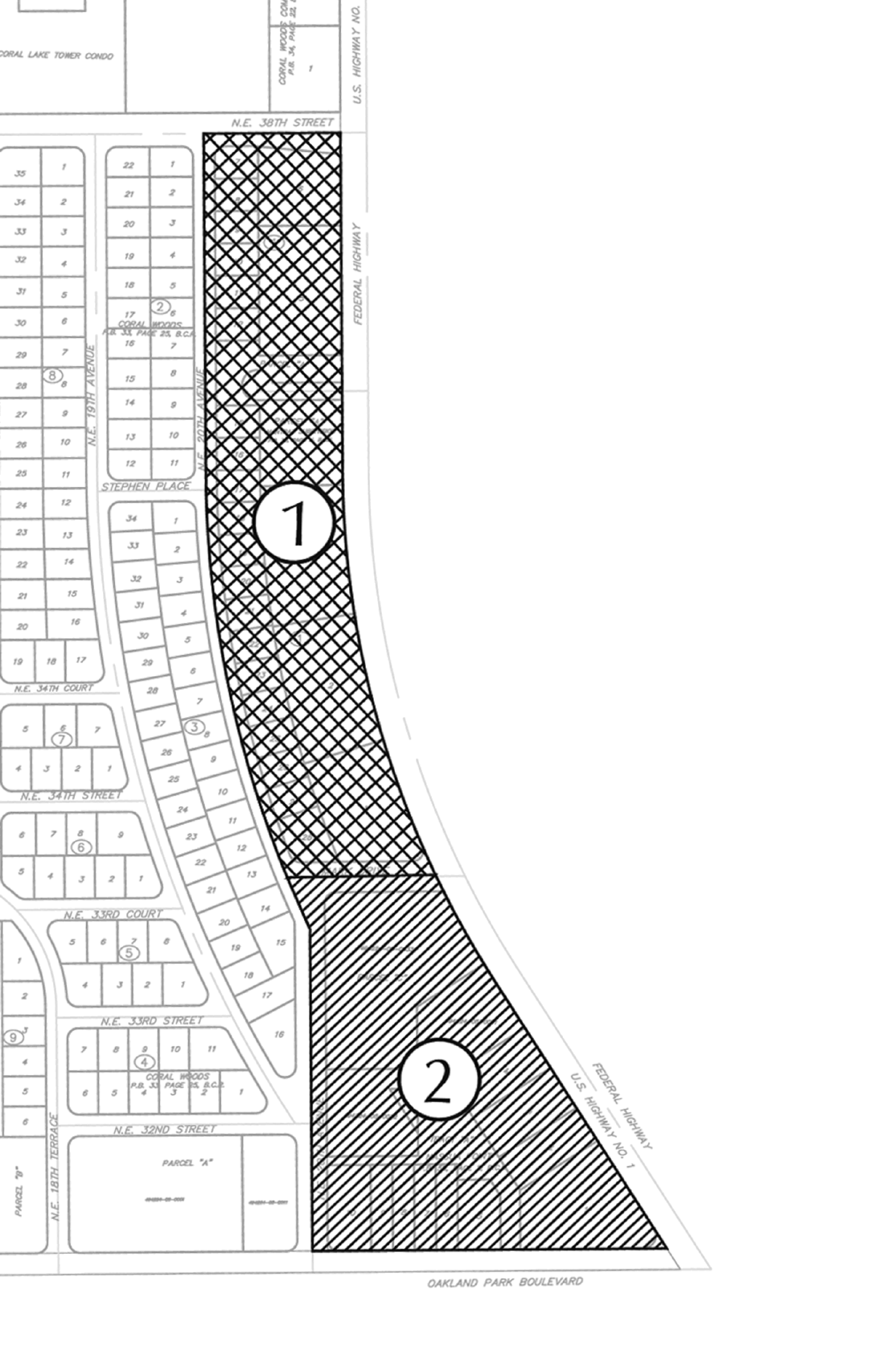
Overlay District Map
(E)
Permitted uses.
(1)
Federal Highway Mixed Use Business and Entertainment Overlay District permitted use list. See the Master Business List in chapter 24, article III, section 24-41.
(F)
Mix of uses.
(1)
Buildings fronting Federal Highway and Oakland Park Boulevard are permitted and encouraged to have a vertical mix of uses consisting of active retail/commercial office and residential. Residential uses are prohibited on the ground floor.
(2)
Townhome buildings and structured parking shall be permitted adjacent to NE 20th Avenue, with specific setback requirements. Structured parking ingress and egress will only be permitted on Federal Highway, NE 38th Street or NE 33rd Court. No parking structure ingress or egress will be allowed on NE 20th Avenue. Outdoor dining is permitted and encouraged as an accessory use to an enclosed restaurant. The total service area permitted for outdoor dining shall be no greater than an area equal to twenty-five (25) percent of the total service area for dining purposes.
(G)
Building orientation and design.
(1)
Mixed use or commercial buildings shall be oriented toward Federal Highway and/or Oakland Park Boulevard, and away from any existing residential neighborhoods (i.e. along NE 38th Street and NE 20th Avenue).
(2)
Townhomes along NE 20th Avenue shall be oriented towards NE 20th Avenue.
(3)
Townhome driveway access from NE 20th Avenue shall be limited. Internal alleyway or structured parking is encouraged. (See circulation, parking and access in section 24-50 (L)).
(4)
The architecture of the townhomes shall "meet" NE 20th Avenue with front doors, front porches, addresses numbers, walkways and landscape. In addition, maximum height of fences shall be four (4) feet in height and shall be no more than twenty-five (25) percent opaque.
(5)
Parking structures shall provide architectural fenestration, which shall consist of, but not be limited to window details, mantles, cornice details and should resemble residential architecture with landscape screening and buffering. Parking structure exhaust fans shall not be visible from NE 20th Avenue.
(H)
Pervious area. Thirty (30) percent of the site must be in open space. Open space, for the purposes of this section, shall include all areas on the site not covered by structures. A minimum of fifty (50) percent of the required open space shall be landscaping.
(I)
Density.
(1)
Commercial activities within the Federal Highway Mixed Use Business and Entertainment Overlay District shall be limited to the first floor of all mixed use buildings. Office uses may be located above the first floor. No residential units, with the exception of townhomes, are permitted on the ground floor.
(2)
Residential density. Residential shall not exceed twenty-five (25) dwelling units per acre (DU/AC). Additional density may be achieved by compliance with the density incentives. See section 24-50(R).
(J)
Setbacks and bufferyards.
(1)
North district setbacks.
(a)
Federal Highway: A minimum of fifty (50) feet shall be maintained along Federal Highway.
(b)
NE 38th Street: A minimum of twenty-five (25) feet shall be maintained along NE 38th Street.
(c)
NE 20th Avenue:
1.
A minimum of thirty-five (35) feet with landscape screening, buffering and architectural fenestration shall be maintained along NE 20th Avenue to buffer existing residents from mixed use activities, including parking garages when townhomes are not introduced along NE 20th Avenue.
2.
When townhomes are introduced onto NE 20th Avenue, a minimum building setback of fifteen (15) feet from property line to building face of townhome is required when units have garages and vehicular access only from the rear. (See building orientation and design section 24-50(G)). When a minimum fifteen-foot setback is incorporated, townhome units shall maintain "pedestrian entrances" such as front doors, address numbers and front porches. Maximum height of fences is four (4) feet and shall not be more than twenty-five (25) percent opaque along NE 20th Avenue.
3.
When townhomes are introduced onto NE 20th Avenue, a building setback of a minimum of twenty-five (25) feet from property line to building face of townhome is required when driveways access NE 20th Avenue. (See building orientation and design, section 24-50 (G)).
(d)
NE 33rd Court. A minimum of twenty (20') feet shall be maintained along NE 33rd Court
(e)
Setbacks abutting private property. A minimum of twenty (20) feet shall be maintained along property lines abutting adjacent parcels.
(2)
South District setbacks.
(a)
Federal Highway. A minimum of fifty (50) feet shall be maintained.
(b)
Oakland Park Boulevard. A minimum of fifty (50) feet shall be maintained.
(c)
NE 20th Avenue.
1.
A minimum of thirty-five (35) feet with landscape screening, buffering and architectural fenestration shall be maintained along NE 20th Avenue to buffer existing residents from mixed use activities, including parking garages when townhomes units are not introduced along NE 20th Avenue.
2.
When townhomes are introduced onto NE 20th Avenue, a minimum building setback of fifteen (15) feet from property line to building face of townhome is required when units have garages and vehicular access from the rear. (See building orientation and design, section 24-50(G)). When a minimum fifteen-foot setback is incorporated, townhomes units shall maintain "pedestrian entrances", such as front doors, address numbers and front porches. Maximum height of fences is four (4) feet and shall not be more than twenty-five (25) percent opaque along NE 20th Avenue.
3.
When townhomes are introduced onto NE 20th Avenue, a building setback of a minimum of twenty-five (25) feet from property line to building face of townhome is required when driveways are included on NE 20th Avenue. (See building orientation and design, section 24-50 G)).
(d)
NE 33rd Court. A minimum of twenty (20) feet shall be maintained along NE 33rd Court.
(e)
Setbacks abutting private property. A minimum of twenty (20) feet shall be maintained along property lines abutting adjacent parcels.
(3)
Bufferyards. In the event townhomes are not constructed along NE 20th Avenue, a layered landscape buffer, with a three-foot high berm, is required within the setback along NE 20th Avenue and NE 38th Street. This bufferyard landscape is to buffer and screen the district from the adjacent neighborhood.
(K)
Height limit and vertical plan moderation.
(1)
All mixed use buildings with residential uses shall not exceed thirty-six (36) feet in height.
(2)
Additional height may be achieved through the green building density and height incentives, see section 24-50(R).
(3)
Building height and roof structures. Overall height of a building or structure shall be measured from the minimum floor elevation as per sections 24-131 and 24-134(B) of the City of Oakland Park Land Development Code, to top of beam of the uppermost story. Roof structures are not included in the overall height of the building; however, they shall not exceed twenty-five (25) feet in height for fifty (50) percent of the roof area, allowing for elevator equipment, stairwells, and roof structure applications which screen roof equipment.
(4)
Mechanical equipment. No mechanical equipment shall be visible from or adjacent to a residential zoning district. Mechanical equipment shall be fully screened.
(5)
Vertical plane moderation.
(a)
Building exceeding thirty-six (36) feet in height shall be required to provide a horizontal moderation in the vertical surface plane between floors three and four, along NE 20th Avenue and Federal Highway. The vertical plane moderation shall be twenty (20) feet in depth.
(b)
NE 20th Avenue.
1.
When townhomes are attached to a building that exceeds thirty-six (36) feet in height, then the twenty-foot vertical plane moderation shall occur between floors three and four measured from the rear of the townhome. No building exceeding thirty-six (36) feet in height, including balconies and/or roof structures shall project over the townhome unit.
2.
When townhomes are not introduced along NE 20th Avenue, a vertical plane moderation between floors three and four shall be maintained. The step back from floor three to floor four shall be measured horizontally, forty-five (45) feet.
(L)
Circulation, parking and access.
(1)
Parking. All existing development and redeveloped areas within the Federal Highway Mixed Use Business and Entertainment Overlay District shall comply with all parking requirements in Article VI; Parking, Loading and Access. In addition to the city's parking Code, the following parking provisions shall apply:
(a)
No on-street parking facilities are permitted on Federal Highway, Oakland Park Boulevard, NE 20th Avenue, NE 38TH Street and NE 33rd Court.
(b)
Private, back out parking into the public right-of-way (ROW), is prohibited, with the exception of limited townhome driveways on NE 20th Avenue at a maximum width of twenty-two (22) feet. (See building orientation section, 24-50(G)).
(c)
Driveways located along NE 20th Avenue shall only occur at a minimum of every ninety (90) feet measured from centerline to centerline of each driveway. Therefore vehicular access from townhomes must alternate between front and rear access.
(d)
Tandem parking in townhomes units is allowed.
(e)
Adjacent at grade parking lots shall provide for pedestrian and vehicular cross access to existing and future parking lots and structured parking facilities.
(2)
Structured parking.
(a)
Structured parking facilities are allowed and encouraged within the district and may include permitted commercial uses on main transportation corridors (Federal Highway and Oakland Park Boulevard). All parking structures shall be treated with architecturally aesthetic façades, including architectural fenestration, false window treatments, etc. Street level openings to parking structures shall occur only on NE 38th Street, NE 33rd Court, and Federal Highway. Parking structure openings are not permitted on Oakland Park Boulevard and NE 20th Avenue.
(b)
Structured parking facility exhaust systems shall not be visible from any existing residential area and shall be screened from view.
(3)
Shared parking. The intent of shared parking is to permit a reduction in the total number of required parking spaces when a parcel is occupied by two (2) or more uses which typically do not experience peak parking demands at the same time. A parking study may be submitted for review by DRC staff for consideration and recommendation to the city commission for a parking reduction.
(M)
Site landscape. Article VIII, Landscape and Fences, shall apply.
(N)
Site furnishings.
(1)
Seating. Outdoor seating within the Federal Highway Mixed Use Business and Entertainment Overlay District shall be designed to discourage overnight sleeping. Seating shall be provided at bus stops and future transit stations.
(2)
Tree grates. Tree grates shall be provided for perimeter trees planted in paved areas along Oakland Park Boulevard and Federal Highway.
(3)
Trash receptacles. Receptacles are to be sited only where they will be accessible and used. They shall be placed along major pedestrian corridors, but shall not impede pedestrian traffic. They shall also be located at portals, pedestrian nodes, intersections, and seating area. Trash receptacles shall be waterproof and shall contain a lid. Each receptacle shall have a sturdy removable liner for easy maintenance and be sized to accept standard trash bags. All transit stops or bus stops shall have at least one trash receptacle.
(O)
Signs and graphics. The signage and graphics element of the City of Oakland Park Downtown Mixed Use District Design Guidelines are hereby adopted by reference as if set forth fully herein.
(P)
Fees.
(1)
Cost recovery fee. To offset the cost of planning the Federal Highway Mixed Use Business and Entertainment Overlay District, a cost recovery fee shall be paid before issuance of a building permit for any development or redevelopment within the Federal Highway Mixed Use Business and Entertainment Overlay District. A fee established by resolution adopted by the city commission shall be paid for in the area designated the Federal Highway Mixed Use Business and Entertainment Overlay District.
(2)
Student station fee. This fee is required by the Broward County School Board, collected by Broward County pursuant to Chapter 5, Article IX, Broward County Code of Ordinances and is based on the published State of Florida Student Station Cost Factors.
(3)
Local transportation fee. The construction of transportation improvements within the public right-of-way will be necessary to mitigate traffic patterns and volumes associated with development permitted within the overlay district. Therefore, the city shall collect a local transportation fee for every dwelling unit and every one thousand (1,000) gross square feet of commercial and office space developed or redeveloped within the Federal Highway Mixed Use Business and Entertainment Overlay District. The fee shall be paid in full prior to the issuance of a building permit. Each applicant for development approval shall be required to submit a traffic analysis which will be reviewed by the neighborhood traffic committee and will identify project-related improvements for traffic calming associated with each development project. The local transportation fee may be reviewed and adjusted on an annual basis by the city commission. The local transportation fees shall be as established by resolution adopted by the city commission.
(4)
City-wide park impact fee. See section 24-175(G).
(5)
Development review fee.
(a)
The city intends to collect a development review fee for review of applications for development within the Federal Highway Mixed Use Business and Entertainment Overlay District. This fee shall be utilized to offset administrative and legal costs incurred by the city in reviewing and processing any plans submitted to the city for purposes of developing within the district. A fee established by resolution adopted by the city commission shall be charged.
(b)
Each fee set forth herein shall be placed in a separate account and shall be expended only for the purpose of its collection.
(Q)
Development review procedure. The development review process shall be as set forth in section 24-272 of the Code of Ordinances. Staff appointed by the city manager, functioning as the development review committee (DRC) shall be responsible for project review.
(R)
Density and height incentives.
(1)
If townhomes are introduced along NE 20th Avenue, approval for an additional ten (10) dwelling units per acre (DU/AC) may be sought.
(2)
Green building density incentive program:
(a)
Density may be increased by a total of fifteen (15) dwelling units per acre (DU/AC) through the green building density incentive program. In order to be considered eligible to achieve a density bonus, buildings are required incorporate a number of green building elements in order to be eligible for the additional density. The green building principles are in accordance with the United States Green Building Council (USGBC) www.usgbc.org; Green Building Council's Leadership in Energy and Environmental Design (LEED-NC) document, Version 2.2, dated October 2005, and as hereby incorporated by reference and as may be amended in the future. Additional density and height may be allowed only after a series of prerequisites are met in two (2) tiers.
(b)
As part of the site plan approval process the applicant shall do the following in order to be considered for the green building density and height incentive program:
1.
The applicant must successfully register the project with the United States Green Building Council (USGBC) and have necessary documentation.
2.
Applicant shall have a minimum of one (1) LEED accredited professional on the design team. Applicant shall provide a copy of the LEED accreditation certificate and describe the role of the LEED accredited professional on the design team.
3.
Provide a written narrative and detailed drawings and plans illustrating the applicant's intent to meet the seven (7) prerequisites as described in LEED-NC version 2.2 dated October 2005, or the most recent version as published by the USGBC.
4.
Provide a written narrative and detailed drawings and plans illustrating the applicant's intent to meet Tier 1 and/or Tier 2 as described in the USGBC's Green Building Rating System for New Construction and Major Renovations, (LEED-NC), version 2.2 dated October 2005.
5.
Provide a bond, or other security acceptable to the city, for the additional density through the green building density and height incentive program. The bond requirement shall be calculated based on the additional square footage of building area as described in the green building density and height program and the following:
a.
For commercial space, the bond shall be calculated on the square footage of the additional space multiplied by one hundred fifty dollars ($150.00) per square foot. The bond shall equal ten (10) percent of the one hundred fifty dollars ($150.00) per square foot multiplied by the total incentive square feet. The method of calculating the bond for additional density through green building density and height incentive program may be reviewed and adjusted on an annual basis by the city commission.
b.
For residential space, the bond shall be calculated on the square feet of the additional space multiplied by two hundred dollars ($200.00) per square foot. The bond shall equal ten (10) percent of the two hundred dollars ($200.00) per square foot multiplied by the total incentive square feet. The method of calculating the bond for additional density through green building density and height incentive program may be reviewed and adjusted on an annual basis by the city commission.
c.
The bond amount shall be approved by the city at the time of site development plan approval and submitted prior to the issuance of any final certificate of occupancy for the project.
(c)
The city shall release the bond after project completion and certificate of occupancy (CO) has been issued by the city, the applicant has certified the project with the United States Green Building Council (USGBC) and provides the certification letter to the city. If the project fails to meet criteria required for certification by the United States Green Building Council (USGBC), the applicant will forfeit one hundred (100) percent of the bond. If the project applies for Tier 2, and falls short of the Tier 2 requirements, but still is certified with the United States Green Building Council (USGBC), then the applicant shall forfeit fifty (50) percent of the bond.
(d)
Funds that become available to the city from the forfeiture of bonds associated with the green building height and density program shall be utilized for improvements such as landscape, open space improvements, traffic calming, pollution mitigation, drainage and sanitary sewer improvements or similar improvements as deemed appropriate by the city commission within or immediately adjacent to the district.
(e)
If the applicant is applying for green building height and density incentives, as part of the construction permitting process the applicant shall provide the necessary drawings, written narratives and or exhibits fully illustrating the intent to incorporate the green building principles described in the seven (7) prerequisites as well as Tier 1 and or Tier 2 as described in the USGBC's Green Building Rating System for New Construction and Major Renovations (LEED-NC) version 2.2, dated October 2005.
(3)
Green building density prerequisites. In order to be eligible for the green building density and height incentive program, the seven (7) prerequisites shall be satisfied, as described in the USGBC LEED-NC Version 2.2, dated October 2005 and as determined by the city.
(4)
Density bonus: Tier 1, green building incentive density and height.
(a)
Tier 1 will allow an additional ten (10) DU/AC in the North District and ten (10) DU/AC in the South District.
(b)
In order to be granted additional density and height, at least twenty-six (26) points shall be achieved, as outlined in the UCGBC's LEED-NC Version 2,2 or USGBC's most recent Green Building Rating System for New Construction and Major renovations (LEED-NC).
(5)
Density bonus: Tier 2, green building incentive density and height.
(a)
Tier 2 will allow an additional 5 DU/AC in the North District and 5 DU/AC in the South District.
(b)
In order to be eligible for Tier 2, at least twenty-eight (28) points shall be met from Tier 1. If more points were met and granted in Tier 1, they may count towards the total of Tier 2. In order to be granted the additional density in Tier 2, at least an additional eight (8) points shall be achieved in Tier 2, or a total of thirty-six (36) points.
(6)
Specific height requirements: If green building incentive programs are met:
(a)
North District. In the instance where Green Building Density and Height incentives have been met, mixed use buildings with residential uses shall not exceed one hundred (100) feet in height. Buildings over thirty-six (36) feet must include a vertical plane moderation (see vertical plane moderation section 24-50 (K)(4)).
(b)
South District. In the instance where green building density and height incentives have been met, mixed use buildings with residential uses shall not exceed one hundred and twenty (120) feet in height. Buildings over thirty-six (36) feet must include a vertical plane moderation (see Vertical plane moderation, section 24-50 (K)(5)).
(8)
Green building density and height incentives. All development, including but not limited to, buildings that are requesting additional height and density through the green building are subject to the criteria stated in the 24-50 Federal Highway Mixed Use Business and Entertainment Overlay District. The city commission shall approve all development in the Federal Highway Mixed Use Business and Entertainment Overlay District that is requesting additional density and height in accordance with the United States Green Building (USGBC) LEED-NC for New Construction or Major Renovations Version 2.2, dated October 2005 and Tier 1 and Tier 2 as described herein section 24-50 Federal Highway Mixed Use Business and Entertainment Overlay District. The USGBC LEED-NC version 2.2, dated October 2005 include criteria for green building.
(9)
The USGBC LEED-NC is hereby adopted by reference and as may be amended in the future.
(S)
4:00 a.m. operational license.
(1)
Entertainment establishments, restaurants including sexually oriented businesses (See permitted uses table, section 24-41) entertainment uses wishing to apply for a 4:00 a.m. operational license within the Federal Highway Mixed Use Business and Entertainment Overlay District shall comply with the following:
(a)
Section 24-37 of the City of Oakland Park District Regulations, the B-1 District:
1.
Building site coverage and green space.
2.
Setbacks and bufferyards.
(b)
Article VI. Parking, Loading and Access.
1.
Section 24-80. Off-street parking.
2.
Section 24-81. Off-street loading.
3.
Section 24-83. Access.
(c)
Article VIII. Landscaping and Fences.
(d)
Existing code compliance issues: City community development staff shall submit a report to a property owner requesting a 4:00 a.m. operational license in order to document code compliance requirements.
(2)
In addition to the above-existing code requirements, the following criteria must also be met for consideration of a 4:00 a.m. operational license:
(a)
Buildings.
1.
No reflective windows shall be placed on any exterior windows. windows shall have opaque coverings or shades.
2.
Be in full compliance with noise chapter, sections 8-46 through 8-53 of the City of Oakland Park Code of Ordinances.
(b)
Signage and advertising.
1.
No signage shall be closer than fifteen (15) feet of public right-of-way.
2.
Signage shall meet existing City of Oakland Park Signage Ordinance, sections 24-143 through 24-153.
3.
No painted signs shall be permitted on building face.
4.
No signage held by individuals, or flag men, along Federal Highway, or any other traffic corridor within a one (1) mile radius of the district, twenty-four (24) hours, seven (7) days a week shall be allowed.
5.
No advertising search lights at any time shall be allowed.
(c)
Maintenance of traffic. Business shall remove exiting vehicular ingress and egress from NE 20th Avenue. Ingress and egress points shall be closed with a solid gate. Ingress and egress points shall be accessible for emergency vehicles and city sanitation trucks.
(d)
Buffering along NE 20th Avenue.
1.
A continuous landscape buffer with a three-foot high berm and six-foot high wall shall be installed ten (10) feet east of the property line, on private property. The landscape buffer shall be a ten-foot wide layered planting area that screens the wall located adjacent to NE 20th Avenue. A variety of plant species and a variety of heights and textures shall be planted to properly buffer the site from the neighboring properties. Sixty-five (65) percent of the following plant material shall be incorporated into the landscaped buffer plan:
a.
Shade trees, a minimum of twenty (20) percent of the overall plant materials shall be either:
i.
Live Oak, Quercus virginiana.
ii.
Gumbo Limbo, Bursera simaruba.
iii.
Pitch Apple, Clusia rosea.
iv.
Seagrape, Coccoloba uvifera.
v.
Geiger Tree, Cordia sebestena.
vi.
Glaucous Cassia, Cassia surattensis.
vii.
Loquat Tree, Eriobotrya japonica.
viii.
Jacaranda, Jacaranda acutifolia.
ix.
Wax Privet, Ligustrum japonica.
b.
Palms, a minimum of twenty (20) percent of plant material shall be either:
i.
Fishtail Palm, Caryota mitis.
ii.
Coconut Palm, Cocos nucifera.
iii.
Alexander Palm, Ptychosperma elegans.
iv.
Sabal Palm, Sabel palmetto.
v.
Paurotis Palm, Acoelorraphe Wrightii.
c.
Shrubs, a minimum of forty (40) percent of plant material shall be either:
i.
Cassia, Cassia beariana.
ii.
Cocoplum, Chrysobalanus icaco.
iii.
Yaupon, Ilex vomitoria.
iv.
Indian Hawthorn, raphiolepis "majestic beauty."
v.
Gardenia, Gardenia jasminoides.
vi.
Red Ixora, Ixora coccinea (or varieties).
vii
Star Jasmine, Jasminum multiflorum.
viii.
Plumbago, Plumbago auriculata.
ix.
Cardboard Palm, Zamia furfuracea.
x.
Shell Ginger Lily, Alpinia zerumbet.
xi.
Crinum Lily, Crinum asiaticum.
xii.
Split Leaf Philodendron, Philodendron selloum.
xiii.
Tripsacum dactyloides, Fakahatchee Grass.
d.
Other twenty (20) percent to be groundcover varieties, including grass/sod.
e.
All landscaped areas shall be fully irrigated and maintained by the property owners.
(e)
Parking. Introduce landscape islands within surface parking lots with large shade trees, shrubs and groundcover. Islands shall comply with section 24-105(C)(3), landscaping.
(f)
Loading facilities. Dumpsters, trash areas shall be completely screened around the area with either a fence, or a wall and dense plantings.
(g)
Maintenance. The buffer wall and landscape buffer shall be maintained at all times. Any dead or damaged plant material shall be replaced. If maintenance of landscape area is not to Code, the 4:00 a.m. license may be revoked.
(T)
4:00 a.m. operational license application process.
(1)
A 4:00 a.m. license shall be available only to the business establishments at the following locations, all of which were open to the public and holding a state-issued alcoholic beverage license at any time between January 1, 2004 and March 1, 2006:
(a)
3599 North Federal Highway.
(b)
3485 North Federal Highway.
(c)
3471 North Federal Highway.
(d)
3411 North Federal Highway.
(e)
3339 North Federal Highway.
(f)
3101 North Federal Highway.
(2)
To be eligible for a 4:00 a.m. operational license, the applicant must be operating with all applicable licenses and in compliance with all applicable federal, state, and local laws and be open to the public in the capacity of a restaurant or bar or one of the two (2) sexually oriented businesses operating at any time as of January 1, 2004 to March 1, 2006. In order to request a 4:00 a.m. operational License, the applicant shall submit the following to the City of Oakland Park Community Development Department for consideration:
(a)
A fee in the amount of half of the development review fee charged to review a site development plan in this district.
(b)
Notarized letter from the property owner and parties in possession requesting city staff to complete a code compliance review and report.
(c)
Signed and sealed survey of existing conditions, including boundary information.
(d)
After receipt of the code compliance report prepared by the city, the applicant shall submit plans and documents to the staff appointed by the city manager functioning as a review committee, known as the Development review committee (DRC), illustrating the proposed required improvements, as set forth by the code compliance report, to site and structures per the above stated requirements. Plans and documents shall include:
1.
Parking.
2.
Landscape and Buffers.
3.
Perimeter treatments.
4.
Signage Improvement.
5.
Access.
6.
Building improvements.
7.
Summary report responding to City staff code compliant report.
8.
Existing DRC requirements, as defined by the Land Development Regulations.
(e)
The proposed plans and documents are forwarded to the city manager for review and approval or denial. The city manager shall review the proposed plans and documents within fourteen (14) calendar days. At the conclusion of this review period, the city manager may either approve, deny, or forward to city commission for review and approval or denial. If no action is taken by the city manager within the fourteen-day period, the proposed 4:00 a.m. license application is deemed approved, upon completion of proposed improvements.
(f)
The DRC shall review the application and the plans and documents submitted in support thereof. The application shall meet the following criteria:
a.
Compliance with the provisions of the Federal Highway Mixed Use Business and Entertainment Overlay District Ordinance;
b.
That the license extension of 4:00 a.m. shall be in harmony with the purpose and intent of this district as set forth in the ordinance adopted by the city commission creating the district;
c.
That the license extension shall not be injurious or detrimental to the surrounding area;
d.
When reviewing an application for the 4:00 a.m. license, the DRC may attach conditions and safeguards as it may determine are necessary for the protection of the surrounding area and to preserve the spirit and intent of the ordinance adopted by the city commission creating the district.
(g)
If the 4:00 a.m. license is approved, said license shall become effective after all proposed improvements have been permitted per City of Oakland Park Code of Ordinances, construction completed by the business owner and parties in possession and successfully be inspected and approved by the city.
(h)
In order for the applicant to appeal the city manager's decision to the city commission, the applicant shall submit a notice to appeal within thirty (30) calendar days upon receipt of the city manager's determination. The city commission shall review, approve or deny the applicant's appeal within thirty (30) calendar days.
(i)
During the review process the DRC may take into consideration existing site constraints and may recommend to the city manager adjustments to the requirements enumerated in subsection (S) above to the extent that the adjustment does not diminish the intent of the affected requirements and provided that approval of the adjustments will result in a superior project. All comments prepared by the DRC shall be forwarded to the city manager for review.
(3)
Reserved.
(4)
If an entertainment establishment is granted the right for the 4:00 a.m. license, the city reserves the right to discontinue the 4:00 a.m. operational license if:
(a)
The above stated requirements are removed;
(b)
The site is not properly maintained;
(c)
Additional requirements as stated in section 24-50(S);
(d)
Landscape buffer is not properly maintained, as described in subsection 24-50(S);
(e)
Buffer wall is not free and clear of graffiti.
(5)
The City may revoke a 4:00 a.m. operational license through the special master process, as identified in section 23-234 of the Oakland Park Regulations.
(U)
Duration of license:
(1)
The 4:00 a.m. license shall be granted for an initial four-year period, with two (2) renewals, with an increment of three (3) years, or a maximum of ten (10) years.
(2)
The 4:00 a.m. license shall be granted from 12:01 a.m. to 4:00 a.m. on Wednesdays, Thursdays, Fridays, and Saturdays. A license shall be granted for 12:01 a.m. to 3:00 a.m. on Sunday morning. A license shall be granted from 12:01 a.m. to 2:00 a.m. for Monday and Tuesday. When an applicant wishes to apply for a renewal of the license, the approval of the renewal shall be subject to the requirements of this ordinance, as described above.
(Ord. No. O-2006-002, § 2, 3-1-06; Ord. No. O-2007-024, §§ 2, 3, 9-19-07; Ord. No. O-2008-028, §§ 2, 3, 8-6-08; Ord. No. O-2009-004, § 2, 2-18-09; Ord. No. O-2017-008, § 2, 5-3-17; Ord. No. O-2021-016, § 2, 9-22-21)
Sec. 24-51. - Annexed area residential districts.
Also see enclosed zoning map.
(Ord. No. O-2009-002, § 2, 2-4-09; Ord. No. O-2009-008, § 2, 4-1-09)
Editor's note— The zoning map referred to in § 24-51 is not set out herein but is available in the office of the city clerk.
Sec. 24-51.1 - R-1A: One-family Detached Dwelling District.
(A)
Purpose. R-1A zoning is established for detached single-family dwelling units only in the areas that were formally annexed into the City of Oakland Park from unincorporated Broward County in 2005 and related accessory uses at a density not to exceed four (4) units per gross acre.
(B)
Uses permitted. No building or structure or part thereof shall be erected, altered or used, or land or water used, in whole or in part, for other than the following specified use:
(1)
Any use permitted in an R-1 District.
(B.1)
Conditional uses. No building or structure or part thereof shall be erected, altered or used, or land or water used, in whole or in part, for other than as a conditional use with approval subject to the provisions of article XII:
(1)
Any conditional use allowed in an R-1 District.
(C)
Building site area.
(1)
Residential use:
(a)
Minimum of (60) feet in width and seven thousand five hundred (7,500) square feet in area. The plot line which provides access to the plot must be a minimum of nineteen (19) feet.
(b)
On a single lot of record subdivided and recorded prior to the 19 th day of December, 1961, or that had been modified in size or shape only as the result of a public infrastructure project, with an area or width less than the above described minimum, a single-family dwelling may be erected subject to the following:
i.
The lot or parcel's owner does not have or share, and has not had or shared within one (1) year, any ownership interest in any abutting lot or parcel that would, if combined with the lot in question, create a building site that meets the standards of subsection (a). This provision does not apply to lots in the community redevelopment area; and
ii.
The proposed structure shall comply with all applicable regulations of this Code.
(D)
Reserved.
(E)
Yard setbacks, site coverage, and building height limits. See section 24-52, master setback and bulk table.
(F)
Reserved.
(G)
Minimum floor area. The minimum floor area of each dwelling unit in the following shall be:
(1)
One-family dwelling: One eight hundred (800) square feet.
(H)
Parking. Pervious pavers are permitted. See sections 24-80 through 24-83 for parking regulations.
(I)
Supplemental regulations. See article V for supplemental regulations.
(Ord. No. O-2009-002, § 2, 2-4-09; Ord. No. O-2009-008, § 2, 4-1-09; Ord. No. O-2020-004, § 2, 2-19-20; Ord. No. O-2020-008, § 2, 6-17-20)
Sec. 24-51.2. - R-1B: One-Family Detached Dwelling District.
(A)
Purpose. R-1B zoning is established for detached single-family dwelling units only in the areas that were formally annexed into the City of Oakland Park from Unincorporated Broward County in 2005 and related accessory uses at a density not to exceed five (5) units per gross acre.
(B)
Uses permitted. No building or structure or part thereof shall be erected, altered or used, or land or water used, in whole or in part, for other than the following specified use:
(1)
Any use permitted in an R-1 District.
(B.1)
Conditional uses. No building or structure or part thereof shall be erected, altered or used, or land or water used, in whole or in part, for other than as a conditional use with approval subject to the provisions of article XII:
(1)
Any conditional use allowed in an R-1 District.
(C)
Building site area.
(1)
Residential use:
(a)
Minimum of sixty (60) feet in width and six thousand (6,000) square feet in area. The plot line which provides access to the plot must be a minimum of nineteen (19) feet.
(b)
On a single lot of record subdivided and recorded prior to the 19 th day of December, 1961, or that had been modified in size or shape only as the result of a public infrastructure project, with an area or width less than the above described minimum, a single-family dwelling may be erected subject to the following:
i.
The lot or parcel's owner does not have or, and has not had or shared within one (1) year, any ownership interest in any abutting lot or parcel that would, if combined with the lot in question, create a building site that meets the standards of subsection (a). This provision does not apply to lots in the community redevelopment area; and
ii.
The proposed structure shall comply with all applicable regulations of this Code.
(D)
Reserved.
(E)
Yard setbacks, site coverage, and building height limits. See section 24-52, master setback and bulk table.
(F)
Reserved.
(G)
Minimum floor area. The minimum floor area of each dwelling unit in the following shall be:
(1)
One-family dwelling: Eight hundred (800) square feet.
(H)
Parking. Pervious pavers are permitted. See sections 24-80 through 24-83 for parking regulations.
(I)
Supplemental regulations. See article V for supplemental regulations.
(Ord. No. O-2009-002, § 2, 2-4-09; Ord. No. O-2009-008, 2, 4-1-09; Ord. No. O-2020-004, § 2, 2-19-20; Ord. No. O-2020-008, § 2, 6-17-20)
Sec. 24-51.3. - R-1C: One-Family Detached Dwelling District.
(A)
Purpose. R-1C zoning is established for detached single-family dwelling units only in the areas that were annexed into the City of Oakland Park from unincorporated Broward County in 2005 and related accessory uses at a density not to exceed six (6) units per gross acre.
(B)
Uses permitted. No building or structure or part thereof shall be erected, altered or used, or land or water used, in whole or in part, for other than the following specified use:
(1)
Any use permitted in an R-1 District.
(B.1)
Conditional uses. No building or structure or part thereof shall be erected, altered or used, or land or water used, in whole or in part, for other than as a conditional use with approval subject to the provisions of article XII:
(1)
Any conditional use allowed in an R-1 District.
(C)
Building site area.
(1)
Residential use:
(a)
Minimum of fifty (50) feet in width and five thousand (5,000) square feet in area. The plot line which provides access to the plot must be a minimum of nineteen (19) feet.
(b)
On a single lot of record subdivided and recorded prior to the sixth day of August, 1958, or that had been modified in size or shape only as the result of a public infrastructure project, with an area or width less than the above described minimum, a single-family dwelling may be erected subject to the following:
i.
The lot or parcel's owner does not have or share, and has not had or shared within one (1) year, any ownership interest in any abutting lot or parcel that would, if combined with the lot in question, create a building site that meets the standards of subsection (a). This provision does not apply to lots in the community redevelopment area and
ii.
The proposed structure shall comply with all applicable regulations of this Code;
(D)
Reserved.
(E)
Yard setbacks, site coverage, and building height limits. See section 24-52, master setback and bulk table.
(F)
Reserved.
(G)
Minimum floor area. The minimum floor area of each dwelling unit in the following shall be:
(1)
One-family dwelling: Eight hundred (800) square feet.
(H)
Parking. Pervious pavers are permitted. See sections 24-80 through 24-83 for parking regulations.
(I)
Supplemental regulations. See article V for supplemental regulations.
(Ord. No. O-2009-002, § 2, 2-4-09; Ord. No. O-2009-008, § 2, 4-1-09; Ord. No. O-2020-004, § 2, 2-19-20; Ord. No. O-2020-008, § 2, 6-17-20)
Sec. 24-51.4. - RD-10: Duplex and Attached One-Family Dwelling District.
(A)
Purpose. RD-10 zoning is established for duplex and attached single-family dwelling units only in the areas that were annexed into the City of Oakland Park from unincorporated Broward County in 2005 and related accessory uses at a density not to exceed nine (9) units per gross acre for one-family detached and ten (10) for all others.
(B)
Uses permitted.
(1)
Any use permitted in an R-1 District.
(2)
Two-family dwelling.
(3)
Townhouse or villa.
(4)
Adult day care permitted as an accessory use to a family community residence as provided for in an R-1 District.
(B.1)
Conditional uses. No building or structure or part thereof shall be erected, altered or used, or land or water used, in whole or in part, for other than as a conditional use with approval subject to the provisions of article XII:
(1)
Any conditional use allowed in an R-1 District.
(C)
Building site area.
(1)
Residential use:
(a)
Minimum of sixty (60) feet in width and three thousand three hundred (3,300) square feet in area. The plot line which provides access to the plot must be a minimum of nineteen (19) feet.
(b)
On a single lot of record subdivided and recorded prior to the sixth day of August, 1958, or that had been modified in size or shape only as the result of a public infrastructure project, with an area or width less than the above described minimum, a single-family dwelling may be erected subject to the following:
i.
The lot or parcel's owner does not have or share, and has not had or shared within one (1) year, any ownership interest in any abutting lot or parcel that would, if combined with the lot in question, create a building site that meets the standards of subsection (a). This provision does not apply to lots in the community redevelopment area; and
ii.
The proposed structure shall comply with all applicable regulations of this Code.
(D)
Reserved.
(E)
Yard setbacks, site coverage, and building height limits. See section 24-52, master setback and bulk table.
(F)
Reserved.
(G)
Minimum floor area. The minimum floor area of each dwelling unit in the following shall be:
(1)
Per dwelling unit: Eight hundred (800) square feet.
(H)
Parking. Pervious pavers are permitted. See sections 24-80 through 24-83 for parking regulations.
(I)
Supplemental regulations. See article V for supplemental regulations.
(Ord. No. O-2009-002, § 2, 2-4-09; Ord. No. O-2009-008, § 2, 4-1-09; Ord. No. O-2020-004, § 2, 2-19-20; Ord. No. O-2020-008, § 2, 6-17-20)
Sec. 24-51.5. - RM-5: Multiple Family Dwelling District.
(A)
Purpose. RM-5 zoning is established for multi-family dwelling units in the Sartori Lake Plat area that was annexed into the City of Oakland Park from unincorporated Broward County in 2005 and related accessory uses at a density not to exceed five (5) units per gross acre for one-family detached and five (5) for all others.
(B)
Uses permitted.
(1)
Any use permitted in an R-1 District.
(2)
Two-family dwelling.
(3)
Multi-family residential (3 or more dwelling units).
(4)
Adult day care permitted as an accessory use to a family community residence as provided for in an R-1 District.
(B.1)
Conditional uses. No building or structure or part thereof shall be erected, altered or used, or land or water used, in whole or in part, for other than as a conditional use with approval subject to the provisions of Article XII:
(1)
Any conditional use allowed in an R-1 District.
(C)
Building site area.
(1)
Residential use:
(a)
Minimum of 60 feet in width and 6,000 square feet in area. The plot line which provides access to the plot must be a minimum of 19 feet.
(b)
On a single lot of record subdivided and recorded prior to the sixth day of August, 1958, or that had been modified in size or shape only as the result of a public infrastructure project, with an area or width less than the above described minimum, a single-family dwelling may be erected subject to the following:
i.
The lot or parcel's owner does not have or share, and has not had or shared within one (1) year, any ownership interest in any abutting lot or parcel that would, if combined with the lot in question, create a building site that meets the standards of subsection (a). This provision does not apply to lots in the community redevelopment area; and
ii.
The proposed structure shall comply with all applicable regulations of this Code.
(D)
Reserved.
(E)
Yard setbacks and building height limits. See section 24-52, master setback and bulk table.
(1)
Exception: In the case of a principal existing structure being non-conforming due to a setback requirement an addition and/or enclosure to the structure is permitted as long as the proposed improvement does not exceed existing building lines.
(F)
Reserved.
(G)
Minimum floor area. The minimum floor area of each dwelling unit in the following shall be:
(1)
Per dwelling unit: Eight hundred (800) square feet for one-family, six hundred (600) square feet for multiple-family and four hundred (400) square feet for efficiency apartment.
(H)
Parking. Pervious pavers are permitted. See sections 24-80 through 24-83 for parking regulations.
(I)
Supplemental regulations. See article V for supplemental regulations.
(Ord. No. O-2009-002, § 2, 2-4-09; Ord. No. O-2009-008, § 2, 4-1-09; Ord. No. O-2020-004, § 2, 2-19-20; Ord. No. O-2020-008, § 2, 6-17-20)
Sec. 24-52. - Master setback and bulk table.
(A)
Purpose. It is the intent of this section to provide, in tabular form, a listing (herein referred to as the "master setback and bulk table") of the yard setbacks, building height, and other physical construction restrictions for building sites for specific zoning districts.
(B)
Key to table.
(1)
The applicable zoning district is abbreviated on the top row.
(2)
The first column provides a reference letter for the applicable restriction that can be used with the diagrams below.
(3)
The second column contains the restriction with instructions to apply the numerical standard for each building site.
(4)
The standards in this table apply to new buildings and accessory structures and new additions for which a building permit has been applied for after June 17, 2020. Any building or structure issued a building permit or already existing before this date may be continued subject to the conditions and requirements of section 24-206.
(C)
[Table.] The following is the master setback and bulk table.
* If the average height of all buildings along the same block frontage as the site has a higher average height than listed in this table, that average height shall be permitted to be the maximum building height for the new structure.
** If the wall of the adjacent building on the abutting lot to the side of the project site is taller than fifteen (15) feet, the project site's building wall height can be at the same setback up to the same height as that adjacent building's wall for that side of the lot and also for the other side of that lot only if it is a corner lot or located at the non-cul-de-sac dead end of its street.
*** If the average height of the front walls of the two (2) closest principal buildings on each side of the project site that are on the same side of the street and on the same block frontage as the site (or for lots at the end of their block frontage, the two (2) continuous closest principal buildings on the side of the project site that are on the same side of the street and on the same block frontage as the site) is higher than fifteen (15) feet, that average height shall be permitted to be the maximum front wall height for the new structure at the front yard setback point.
**** For setbacks or stepback required for portions of structures taller than fifteen (15) feet, conditional use approval in accordance with section 24-165 would need to be granted for any deviation from this requirement.
(D)
Descriptive diagrams. The following show the applicable restrictions from the master setback and bulk table in plan (overhead) view and in elevation view. Letters on the diagrams correspond with rows in the table.
(1)
Plan view diagram of setback and bulk requirements. The letter for each measurement corresponds with the applicable row in the table in subsection (C) above:
(a)
Plan view of a mid-block lot:
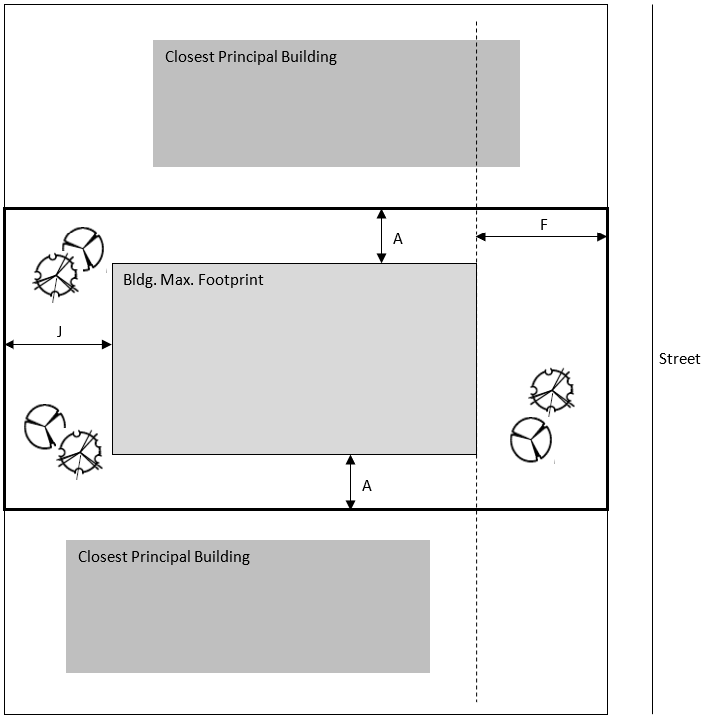
(b)
Plan view of a corner lot:
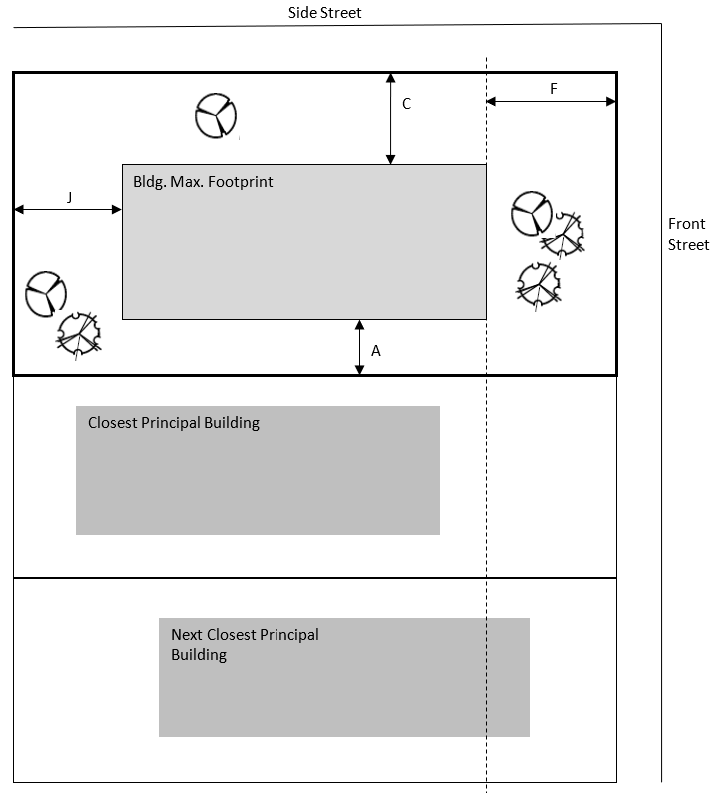
(c)
Front view of required setbacks (from lot line) and/or stepbacks (for upper building portions):
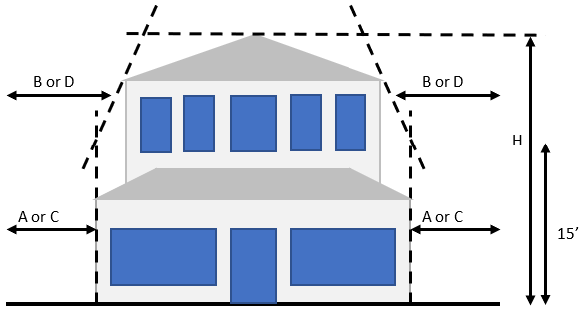
(d)
Side view of required setbacks (from lot line) and/or stepbacks (for upper building portions):
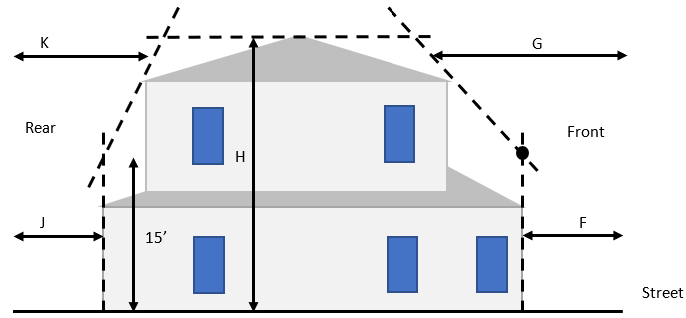
(Ord. No. O-2020-008, § 2, 6-17-20)

