
Oakland Park City Zoning Code
ARTICLE VI
PARKING, LOADING AND ACCESS
Sec. 24-80.- Off-street parking.
(A)
General parking requirements.
(1)
Every building, use or structure instituted or erected shall be provided with off-street parking facilities in accordance with the provisions of this article for use of occupancy, employees, visitors or patrons.
(2)
Such off-street parking facilities shall be maintained and continued as an accessory use as long as the main use is continued.
(3)
An existing building may be modernized, altered or repaired without providing additional off-street parking facilities, provided there is no increase in floor area or capacity and there is no change of occupancy.
(4)
When an existing building is enlarged in floor area, volume, capacity, or space occupied, additional off-street parking facilities as specified herein shall be provided for the additional floor area, volume, capacity or space to be added.
(5)
Where an existing building is changed in use or occupancy, off-street parking facilities shall be provided as required by this article. For the purpose of this article, a change of use or occupancy shall mean a change from one category of off-street parking requirements to another such category as specified in this article.
(6)
It shall be unlawful for an owner or operator of any building, structure or use affected by this article to discontinue, change or dispense with, or to cause the discontinuance or reduction of the required parking facilities apart from the discontinuance, sale, or transfer of such structure or use, without establishing alternative vehicle parking facilities which meet the requirements of this article. It shall be unlawful for any person, firm or corporation to utilize such building, structure or use without providing the off-street parking facilities to meet the requirements of and be in compliance with this article.
(7)
No person shall park or place construction or maintenance equipment, machinery or materials, or allow same to be parked or placed upon public property, streets, right-of-way or upon private property in districts zoned R-1, R-2, R-16, and R-25. Any truck three-quarter (¾) ton or more shall be garaged on-site.
(8)
Anywhere tandem parking is permitted or provided for in chapter 24, said parking shall count as only one parking space for the purposes of satisfying the parking requirements established anywhere in the Code of Ordinances for the City of Oakland Park. Tandem parking shall be defined as the vertical (lengthwise) parking of any vehicle behind any other vehicle.
(B)
Location, character, size and cross parking agreements.
(1)
Location: The off-street parking facilities required by this article shall be located on the same plot or parcel of land they are intended to serve provided:
(a)
When practical difficulties, as determined by the zoning division, prevent the establishment of such facilities upon the same plot, the city manager may grant a permit authorizing the location of the required parking facilities within seven hundred (700) feet of the premises they are to serve, but shall not be located upon land zoned for residential use.
(b)
In the event of such a permit granted and utilized, then the owner of said parking area shall enter into written agreement with the city whereby the land providing the parking area shall never be sold or disposed of except in conjunction with the sale of the building the parking area serves so long as these parking facilities are required, and said agreement shall be recorded at the expense of the owner and shall run with the land to bind the heirs, successors and assigns of said owner.
(c)
Said written agreement may be voided by the city commission if other provisions are made for off-street parking facilities pursuant to this article.
(2)
Design: Each parking lot space required and provided pursuant to the provisions of this article shall:
(a)
Be directly accessible from a street or alley or from an adequate aisle or driveway leading to a street or alley.
(b)
Have access aisles and driveways of sufficient size to permit convenient maneuvering of cars, and each space shall be accessible without driving over or through any other parking space except as elsewhere provided.
(c)
Be identified as to purpose and as to location when not clearly evident from a street or alley.
(d)
Be so graded and drained as to dispose of all surface water accumulation within the parking area and not cause any nuisances on adjacent or public property.
(e)
Have any lighting thereon designed and installed so as to reflect the light away from any contiguous property and to prevent any glare or excessive light on adjacent property.
(f)
Be arranged for convenient access and safety of pedestrians and vehicles with no backing of vehicles from parking spaces onto public streets, except as permitted in subsection 24-64(H).
(g)
Be designated by lines upon the parking area surface.
(h)
Not be used for any storage whatsoever or for any purpose other than the parking of cars or licensed vehicles of occupants, employees, visitors or patrons.
(i)
Be designed in accordance with the parking design standards contained in Figure 1 (immediately following this section).
(j)
Provide spaces for the handicapped in accordance with the Florida Building Code and section IV, page 74 of the ADA Parking Compliance Manual.
(k)
Be provided with a tire stop or curb, the front of which shall be set two (2) feet from the end of the parking space. The overhang area may either be paved or landscaped, provided however that any such landscaping shall not be counted toward meeting other landscaping requirements of article VIII, except minimum green space (pervious area) requirements. All curbing shall be type D.
(l)
Be located at least twenty-five (25) feet from any arterial or urban collector right-of-way line, where maneuvering is required in an aisle or driveway providing direct access to the arterial or urban corridor. Such distance shall be at least ten (10) feet where access is provided to a local street.
(m)
Be located in a row of no more than ten (10) parking spaces unless full and continuous circulation is provided. If a row of ten (10) or fewer parking spaces abuts an aisle or driveway, such aisle or driveway may be deadend provided an adequate turnaround area is provided, as approved by the city. Turnarounds (hammerheads or aprons) must be at least twenty-four (24) feet wide by three (3) feet deep. Appropriate thermoplastic markings and signs shall be provided so designating.
(n)
For building sites three (3) acres or more in area or three hundred (300) feet or more in depth located on an arterial or urban collector street, parking aisles shall not intersect any access driveway within fifty (50) feet of the right-of-way line of such trafficway or major thoroughfare. For all other building sites, regardless of location, such distance shall be at least twenty-five (25) feet.
(o)
For building sites which contain drive-thru facilities such as fast food restaurants, banks, car washes, attendant parking, gatehouses, etc., adequate vehicle reservoir capacity shall be provided for both inbound and outbound vehicles. The drive-thru facility shall be located no closer than one hundred (100) feet from the inbound access point or thirty (30) feet from the outbound access point, as measured from the facility to the right-of-way line along the driveway.
(3)
Paving: Off-street parking facilities, including access aisles and driveways, shall be provided with a pavement having an asphaltic or portland cement binder or decorative pavers or turf block over a stabilized base.
(a)
Parking spaces for places of worship may be surfaced with grass as long as twenty (20) percent of the required parking spaces are paved for administrative staff. Parking spaces surfaced with grass are to be stabilized and do not count towards the pervious area requirements of the property unless the city engineer finds that the proposed method allows immediate percolation of water into the soil.
(b)
Surplus parking for public or private schools may be surfaced with grass.
(c)
All aisles, access driveways, driveways, pavement markings, parking spaces, and signage are to be maintained in like new condition. Paved surfaces shall not contain potholes or large cracks, and grass surfaces shall be maintained in a healthy condition.
(4)
Parking plan: A plan shall be submitted with every application for a building permit for any use or structure required to provide off-street parking under this article which plan shall clearly and accurately designate the required parking spaces, access aisles, and driveways and the relation to the uses or structures these off-street parking facilities are intended to serve.
(5)
Adjustments: All plans shall be subject to the approval by the engineering and community development department of the city before any building permit is issued; however, if a situation arises whereby these requirements cannot be met due to extenuating circumstances, the development review committee (or a subcommittee thereof) is authorized to grant an adjustment to the strict application of this subsection.
(C)
Amount of off-street parking.
(1)
As specified by the following table:
(1) The property owner shall provide adequate assurances that building or tenant space shall be used solely for warehouse or storage use, or where merchandise, products or materials are stored until later disposed of or distributed; such assurance shall be in the form of a declaration of restrictive covenants or a similar recordable document. The covenant shall provide that the city shall be entitled to collect any and all costs and attorney fees if the city must take action that is necessary to enforce them. Upon approval by the engineering and community development director and the city attorney, the covenant shall be recorded on the property in the Public Records of Broward County by the property owner, and a certified copy of the recorded document shall be provided to the city.
(2) An applicant to establish a community residence or recovery community may apply to the development review committee to be granted a reasonable accommodation to reduce the required number of off-street parking spaces when fewer spaces are actually needed. The applicant shall prove by a preponderance of evidence that it needs to provide a different number of parking spaces or a different location for parking spaces than is required.
(D)
Computation of required parking spaces.
(1)
Fractional measurements: When units or measurements determining the number of required off-street parking spaces result in requirements of a fractional space, any such fraction shall only require a full off-street parking space when the fraction is equal to or greater than exactly fifty (50) percent, unless otherwise provided for in this article.
(2)
Mixed uses: In the case of mixed uses, the total requirements for off-street parking shall be the sum of the requirements of the various uses computed separately, and off-street parking space for one (1) use shall not be considered as providing the required off-street parking for any other use.
(3)
Measurement: For the purposes of this article, floor area shall mean the gross floor area. In hospitals, bassinets shall not count as beds.
(a)
For the purpose of calculating parking spaces, gross floor area shall not include: covered or enclosed parking areas; exterior unenclosed private balconies; floor space used for mechanical equipment for the building; and elevator shafts and stairwells at each floor.
(b)
Customer service area. Customer service area is the area of an establishment available for food or beverage service or consumption, or both, calculated by measuring all areas covered by customer tables and bar surfaces and any floor area within five (5) feet of the edge of said tables and bar surfaces, measured in all directions where customer mobility is permitted. Customer service area shall include any outdoor or patio floor area used or designed for food or beverage service or consumption, or both, measured as specified above. Areas between tables or bars which overlap in measurement with another table shall only be counted once.
(c)
Outdoor casual seating without service. Businesses, institutions, or uses that serve food or beverages solely inside and do not provide service outside may have outdoor casual seating, such as benches or tables and chairs, without providing any additional parking as required for customer service areas if all accessibility standards are met.
(d)
Outdoor seating de minimus standard. Businesses, institutions, or uses that serve food or beverages may be approved to serve food for outdoor seating by a maximum of two (2) tables (with up to eight (8) seats total) in an area no more than one hundred (100) square feet without providing any additional parking as required for customer service areas if all accessibility standards are met.
(4)
Retail shopping center: For the purposes of this article, in the event a more intense use, such as but not limited to a restaurant, Places of Worship, Places of Public Assembly or movie theater is proposed to occupy more than thirty-three (33) percent of the total gross floor area of the shopping center:
(a)
The parking requirement shall be calculated based on a total of the minimum number of spaces required for such individual use together with the requirement for shopping centers for the remaining area of the center; or
(b)
City commission approval of a cross parking agreement shall be required in accordance with (B) of this section above.
(E)
Combined off-street parking. Nothing in this article shall be construed to prevent collective provision for, or joint use of, off-street parking facilities for two (2) or more buildings or uses by two (2) or more owners or operators, provided that the total of such parking spaces, when combined or used together shall not be less than the sum of the requirements of the several individual uses computed in accordance with this article.
(F)
Nonconforming uses. In the case of a building occupied by a use which is not permitted as a new use in the district in which such building is located, alterations which exceed fifty (50) percent of the current market value shall not be permitted until the off-street parking requirements of this article for a new use of this type are fully provided. Also, see section 24-207.
(G)
Use of required off-street parking by another building and nonconcurrent parking agreements.
(1)
No part of an off-street parking area required for any building or use by this article shall be included as a part of an off-street parking area similarly required for another building or use unless the type of use indicates that the periods of usage will not overlap or be concurrent with each other.
(2)
Where two (2) adjoining buildings or uses apply with a plan for parking which otherwise satisfies the requirements of this article, they may be permitted to use the same space as long as the type of use indicates that the usage will not overlap or be concurrent. Included with the application shall be a use agreement or lease between the two (2) parties in recordable form which the city shall record at the expense of the applicants.
(H)
Backout parking. Backout parking facilities are permitted in R-1 and R-2 Zoning Districts and RM-16 and RM-25 Zoning Districts where utilized for single-family and duplex structures; and in R-16, R-25, NB, B-1, B-2, and I-1 Zoning Districts where more than sixty-five (65) percent of the lineal footage of the block length consists of businesses or multiple dwellings existing with backout parking facilities. Backout parking facilities are prohibited in all other zoning districts.
However, regardless of the zoning district, backout parking facilities are prohibited on the following streets unless backout parking for a public project has been approved by the controlling authority and the city commission of the City of Oakland Park:
N.E./N.W. Oakland Park Boulevard;
N.E. 34th Court (2nd—16th Avenues);
N.E./N.W. 38th Street;
N.W. 39th Street (21st to 31st Avenues);
N.E./N.W. 44th Street/Prospect Field Road;
N.W. 44th Street (21st—31st Avenues);
N.E. 45th Street/Floranada Road;
N.E. 50th Street/Commercial Boulevard;
N.E. 56th Street;
N.E. 62nd Street/Cypress Creek Road;
U.S. No. 1/North Federal Highway;
N.E. 16th Avenue;
North Dixie Highway;
N.E. 5th Avenue;
N.E. 6th Avenue;
North Andrews Avenue;
N.W. 9th Avenue/Powerline Road;
N.W. 10th Terrace;
N.W. 21st Avenue/Decker Road;
N.W. 31st Avenue/Wingate Road.
FIGURE 1
PARKING DESIGN STANDARDS
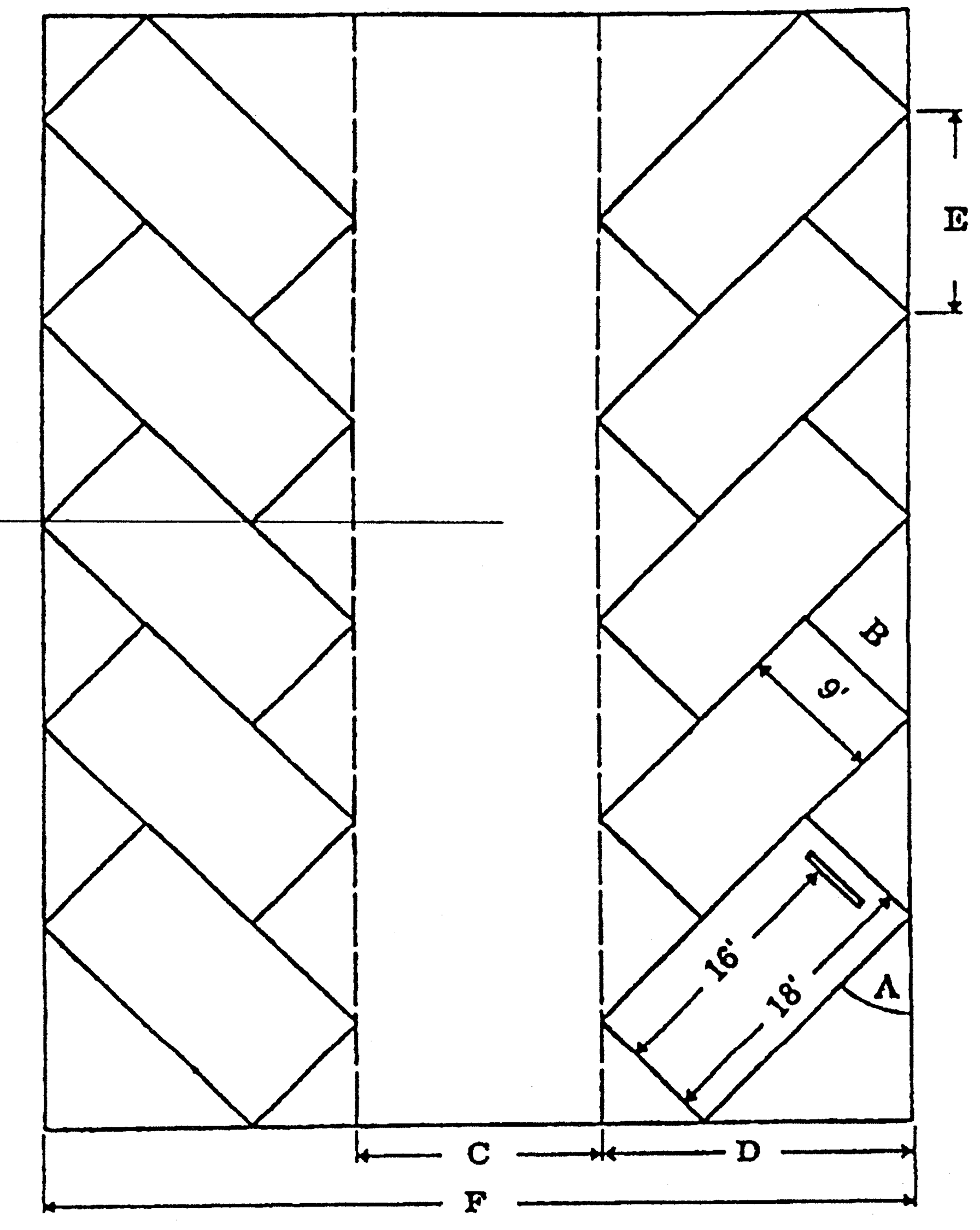
PARKING DESIGN STANDARDS
(I)
Single family residential and duplex properties:
(1)
Swale parking: Parking in a swale shall be limited to the occupants or invitee of the occupant of the abutting property.
(2)
Driveway setbacks: Any new driveway shall be setback a minimum of two and one-half (2½) feet from any side property line for any lot sixty (60) feet wide or wider.
(3)
Grass parking: Parking shall not be permitted in grass areas unless a temporary special residential event such as a birthday party, funeral, family reunion and/or another family social gathering is being held by the subject property owner for a period not to exceed eight (8) hours provided this is not between the hours of 2:00 a.m. and 7:00 a.m.
(J)
Parking study. In recognition that a site or use may have unique characteristics not contemplated by the Code, an applicant may submit a formal "Parking Study" requesting that an alternative parking ratio be approved by the development review committee or sub-committee thereof.
(1)
The parking study shall provide verifiable documentation of the appropriateness of the ratio(s), indicate tenant use(s), square footage, requirement per the Code, ratio used, hours of operation, and the requested reduced number of spaces.
(2)
In addition to the parking study, a restrictive covenant stating the findings of the parking study and provides that the city may collect any and all costs to enforce them should litigation be necessary shall be provided by the applicant.
(3)
Should the parking study and restrictive covenant be approved, then the applicant shall record it in the Official Records of Broward County on the property and provide the engineering and community development department a certified copy of the document.
(Ord. No. O-90-21, § 10, 10-17-90; Ord. No. O-91-3, § 5, 4-3-91; Ord. No. O-98-13, § 2, 7-15-98; Ord. No. O-2003-001, § 15, 2-19-03; Ord. No. O-2004-002, §§ 2, 3, 1-21-04; Ord. No. O-2004-003, § 4, 2-18-04; Ord. No. O-2007-027, § 3, 9-19-07; Ord. No. O-2010-006, § 2, 2-3-10; Ord. No. 2010-025, § 4, 9-15-10; Ord. No. O-2012-012, § 2, 8-1-12; Ord. No. O-2017-007, § 2, 5-3-17; Ord. No. O-2020-004, § 2, 2-19-20; Ord. No. O-2020-008, § 2, 6-17-20)
Sec. 24-81. - Off-street loading.
(A)
General regulations.
(1)
Except in residential districts, all newly constructed buildings shall provide off-street loading areas so that the use of the public streets as loading zones will not be required.
(2)
Off-street loading space shall be so laid out, regulated, and controlled as to prevent use of the street or highway for maneuvering to load.
(3)
Entrances and exits to loading areas on private property shall be so designed as to insure a minimum of interference with traffic.
(4)
An off-street loading space shall be a specifically designated area or zone at least ten (10) feet wide by twenty-five (25) feet long with fourteen (14) feet vertical clearance which is not a part of a parking lot or driveway otherwise required.
(5)
Except in residential districts, off-street loading spaces shall be provided and maintained in accordance with the following schedule:
(B)
Required spaces.
(1)
All commercial and industrial uses, other than office buildings:
(2)
Office buildings:
(Ord. No. O-90-21, § 10, 10-17-90; Ord. No. O-2012-012, § 3, 8-1-12)
Sec. 24-82. - Helistops.
(A)
Conditional use. Helistops shall be allowed as a conditional use in B-1, B-2, B-3 and I-1 Districts subject to provisions of article XII.
(B)
Design standards.
(1)
Minimum ground site: One hundred fifty (150) feet by one hundred fifty (150) feet.
(2)
Minimum rooftop site: Fifty (50) feet by fifty (50) feet.
(3)
Minimum distance from residential district: Three hundred (300) feet.
(C)
Requirements to insure safe operation.
(1)
The city commission may impose such additional requirements as may be deemed necessary to insure public health, safety and welfare of the neighboring residences and the safe landing and take-off of helicopters utilizing such helistops.
(2)
In the event of violations of any of the requirements imposed thereon, or any violations of this section, may result in revocation of the conditional use subsequent to a fifteen-day written notice given to the owner of the helistop and a public hearing by the city commission.
(3)
Specifications: Design and operation of helistop shall be conducted in accordance with F.A.A. Helistop Design Guide and the rules and regulations of the Florida State Department of Transportation as supplemented by any additional reasonable requirements deemed necessary by the city commission for the protection of the public health, safety and welfare of the residents near the helistop.
(D)
Exceptions.
(1)
Helistops used for any hospitals shall be exempted from the zoning and locational standards of this section provided that such exceptions be approved by the city commission based upon the following requirements:
(a)
The site plan for the helistop to be located at the hospital.
(b)
Adherence to all other provisions of this section, FAA and state regulations.
(2)
The city manager may authorize the landing of a helicopter for a specified date, time and place for special civic events or for purposes of public service. Such authorization shall state the purpose of the landing and takeoff and a date, time and place for such authorized takeoff or landing. To properly regulate the takeoff or landings of helicopters for such special civic events or public service, the city manager may impose reasonable safety restrictions regarding such takeoffs and landings.
(Ord. No. O-90-21, § 10, 10-17-90)
Sec. 24-83. - Access.
(A)
Major streets. Any proposed development located on arterial and urban collector streets as designated in the Oakland Park Comprehensive Plan must comply with the following requirements to ensure that the additional traffic generated by the proposed development can be accommodated by the regional transportation network at an acceptable level of service. These regulations shall apply in all zoning districts, however, on state or county roads the requirements of the Florida Department of Transportation or Broward County Transportation Department, respectively, must also be satisfied.
(1)
Curb cut design standards:
(a)
Number: One (1) curb cut shall be permitted to a building site for ingress and egress purposes. Additional curb cuts may be permitted, provided the minimum spacing between driveways is one hundred fifty (150) feet for two-way driveways (or between a two-way and a one-way) and seventy-five (75) feet for one-way driveways, measured centerline to centerline. If right turn lanes or bus bays are required, however, driveway spacing shall be adjusted accordingly. Commercial and industrial development located adjacent to a residential area shall have its access restricted to the front and/or corner of the property, and shall be prohibited from access to any rear residential street.
(b)
Distance: The minimum distance between any curb cut and any existing curb cut for adjacent development shall be one hundred fifty (150) feet, measured centerline to centerline. If the building site does not have adequate frontage to satisfy this requirement, the curb cuts shall be located as far apart as possible, unless cross access may be obtained from the adjoining property.
(c)
Intersection: No curb cut shall be located closer than one hundred (100) feet from the nearest corner of an intersection, measured from the centerline of the driveway to the corner of the property. If right turn lanes or bus bays are required, however, the curb cut location shall be adjusted accordingly. Corner building sites which do not have adequate frontage to satisfy this requirement shall nevertheless be permitted one (1) curb cut located as far from the corner as possible, unless cross access may be obtained from the adjoining property.
(d)
Signalization: If the closest intersection is or is likely to be signalized, then traffic movements to and from any driveway within one hundred twenty-five (125) feet of an intersection with a collector street and two hundred fifty (250) feet of an intersection with an arterial street, measured from the centerline of the driveway to the corner of the property, shall be limited to right turns only and an appropriate traffic separator, channelizer, and/or buttons installed to physically prohibit left turn movements.
(e)
Width: Curb cuts shall be designed to safely and adequately accommodate the internal driveway, shall be at least thirty (30) feet wide for two-way traffic or fifteen (15) feet wide for one-way traffic, shall provide thirty-five (35) feet turning radii, and shall be of the street type with curb and gutter section.
(f)
One-way: Where one-way driveways are provided, they shall be designed with the inbound drive upstream from the downstream drive. Such driveways shall also be appropriately channelized with curb and gutter to physically prohibit their use for two-way traffic, and proper signs and thermoplastic pavement markings provided.
(g)
Sight triangle: See landscape and streetscape design standards as referenced in sections 24-105 and 24-106 for sight triangle requirements.
(h)
Handicapped: Curb cuts for the handicapped shall be provided at any place where a sidewalk meets the edge of pavement of a street or driveway.
(i)
Parking: See also section 24-80 for requirements regarding parking design and the relationship to curb cuts.
(j)
Existing curb cuts: All curb cuts not utilized to access site or not meeting code shall be properly removed and access area restored to same condition as the adjacent right-of-way abutting the property.
(k)
Wall and hedge setbacks: No fence, wall, structure or parking space shall otherwise be located closer than ten (10) feet from the right-of-way line, and no hedge or tree shall be located closer than seven (7) feet from the right-of-way line. Transparent fences and hedges in public parks are exempt from the setbacks in this subsection subject to the following criteria:
i.
Fences shall be aesthetically consistent with the standard of the Oakland Park community and shall constitute, but not limited to, metal picket, PVC or ornamental;
ii.
All chain link fencing shall be prohibited except for public parks that have athletic activities that utilize such fencing;
iii.
All fences shall not exceed six (6) feet in height except for public parks that have athletic activities that utilize higher fencing;
iv.
The fence and hedge setback exemption only applies to Jaco Pastorius Park and other public parks that have athletic activities that utilize fencing or hedges subject to the above criteria.
(2)
Right turn lanes: A right turn lane with a minimum of one hundred fifty (150) feet storage and one hundred (100) feet transition shall be constructed at each driveway entrance and intersection to adequately accommodate project traffic if either of the following warrants are found:
(a)
The roadway or intersection does not meet the level of service standards in article XIII: If adequate right-of-way is not available, or cannot be made available through dedication for the construction of a right turn lane, then a traffic engineer study must be conducted showing how additional traffic can be adequately and safely accommodated.
(b)
The roadway or intersection meets the level of service in article XIII but the speed limit is forty (40) mph or greater: If adequate right-of-way is not available or cannot be made available through dedication for the construction of a right turn lane, then a traffic engineering study must be conducted showing how additional traffic can be adequately and safely accommodated.
(3)
Median openings and left turn lanes:
(a)
Median openings adjacent to a development shall be spaced a minimum of six hundred sixty (660) feet apart, measured centerline to centerline, and shall be provided with left turn lanes with a minimum of two hundred (200) feet storage and one hundred (100) feet transition.
(b)
Any existing median openings adjacent to a development which do not meet the standards above shall be appropriately improved or closed.
(c)
A left turn lane shall be constructed at each driveway or adjacent intersection for ingress and/or egress purposes where the roadway is operating over the minimum acceptable level of service, the speed limit is forty (40) mph or higher, or the development will generate twenty-five (25) or more left turns during the peak hour, provided the other standards contained herein can be met.
(d)
If engineering difficulties exist which make adherence to these requirements physically impractical or impossible, then such requirements may be modified or waived by the city engineer upon presentation of a traffic engineering study showing how additional traffic can be adequately and safely accommodated.
(4)
Bus bays: A bus bay shall be provided approximately every one-quarter (¼) mile adjacent to any development with two hundred (200) feet or more frontage located along an existing or planned Broward County Mass Transit Division bus route, and shall be constructed in accordance with Broward County standards. Provided, however, that if there is a conflict with a required right turn lane, then the bus bay shall not be required.
(5)
Signs and pavement markings:
(a)
A stop sign shall be provided at each point of egress to an arterial or urban collector.
(b)
Any other traffic control signs deemed necessary by the engineering or planning departments for the public safety or convenience shall also be provided.
(c)
Any necessary pavement markings deemed necessary for traffic control by the engineering or planning divisions shall be provided. All such pavement markings shall be thermoplastic.
(B)
Local streets. For the purposes of this section, a "local street" is defined as any street not designated as an arterial or urban collector in the Oakland Park Comprehensive Plan. Any proposed driveway located within three hundred thirty (330) feet of an arterial or urban collector shall comply with the provisions of (5) above rather than the provisions below. These regulations shall apply in all zoning districts.
(1)
Location: One (1) curb cut shall be permitted to a building site for ingress and egress purposes. Additional curb cuts may be permitted provided the minimum spacing between driveways is fifty (50) feet, measured centerline to centerline, for developments under three (3) acres, or one hundred fifty (150) feet for developments three (3) acres or more in size. Commercial and industrial development located adjacent to a residential area shall have its access restricted to the front and/or corner of the property, and shall be prohibited from access to any rear residential street.
(2)
Intersections: No curb cut shall be located closer than forty (40) feet from the nearest corner of an intersection, measured from the centerline of the driveway to the corner of the property. Corner building sites which do not have adequate frontage to satisfy this requirement shall nevertheless be permitted one (1) curb cut located as far from the corner as possible.
(3)
Driveways: Curb cuts shall be designed to safely and adequately accommodate the internal driveway.
(4)
Backout parking: The above requirements shall not apply where backout parking is permitted in accordance with section 24-81, except that no backout space shall be located closer than twenty-five (25) feet from the corner of two (2) intersecting streets.
(5)
Sight triangle: See landscape and streetscape design standards as referenced in sections 24-105 and 24-106 for sight triangle requirements.
(6)
Wall and hedge setbacks: No fence, wall, structure or parking space shall otherwise be located closer than ten (10) feet from the right-of-way line and no hedge or tree shall be located closer than seven (7) feet from the right-of-way line. Transparent fences and hedges in public parks are exempt from the setbacks in this subsection subject to the following criteria:
i.
Fences shall be aesthetically consistent with the standard of the Oakland Park community and shall constitute, but not limited to, metal picket, PVC or ornamental;
ii.
All chain link fencing shall be prohibited except for public parks that have athletic activities that utilize such fencing;
iii.
All fences shall not exceed six (6) feet in height except for public parks that have athletic activities that utilize higher fencing;
iv.
The fence and hedge setback exemption only applies to Jaco Pastorius Park and other public parks that have athletic activities that utilize fencing or hedges subject to the above criteria.
(7)
Handicapped: Curb cuts for the handicapped shall be provided at any place where a sidewalk meets the edge of pavement of a street or driveway.
(8)
Signs and pavement markings:
(a)
A stop sign shall be provided at each point of egress to any city or urban collector.
(b)
Any other traffic control signs deemed necessary by the engineering or planning departments for the public safety or convenience shall also be provided.
(c)
Any necessary pavement markings deemed necessary for traffic control by the engineering or planning divisions shall be provided. All such pavement markings shall be thermoplastic.
(Ord. No. O-90-21, § 10, 10-17-90; Ord. No. O-98-13, § 3, 7-15-98; Ord. No. O-2012-016, §§ 2, 3, 9-5-12; Ord. No. O-2020-008, § 2, 6-17-20)

