
Orlando City Zoning Code
PART 5
- ACCESSORY USES AND STRUCTURES
Sec. 58.900.- Building Permit Required.
No accessory use or structure shall be developed without a Building Permit having been issued in accordance with the requirements of Chapter 65, Part 2C.
Shall Follow Principal Use. No accessory use or structure may be developed until after the start of construction of the principal use on the building site and no accessory use or structure may be used unless the principal use or structure has been developed, with the following exceptions: 1. after review and approval as a Conditional Use in accordance with Chapter 65, Part 2D, or 2. after approval by the Building Official and City Engineer of multi-family or non-residential projects for which the construction process is more efficient if an accessory use or structure is built first.
(Ord. of 9-16-1991, Doc. #25094; Ord. No. 2015-68, § 1, 1-25-2016, Doc. #1601251203; Ord. No. 2023-34, § 1, 1-22-2024, Doc. #2401221201)
Sec. 58.901. - Accessory Structure Location and Zoning Standards.
(a)
Same Building Site. Except as otherwise specifically permitted by this Chapter, accessory uses and structures shall be located on the same building site as the associated principal use.
(b)
Relationship to Street Setbacks. Except as otherwise specifically permitted by this Chapter, no accessory use or structure shall be located in any of the following areas:
1.
1—5 Family Dwellings: In the required front and street side yard setbacks; and in the front half of the lot or between any portion of the principal facade of the principal building and the street (whichever is less).
2.
All Other Building Sites: In the required front and street side yard setbacks.
(c)
Minimum Setbacks from Rear Lot Line for Accessory Structures.
*For structures with multiple heights, the height of the taller portion of the building shall determine the setback requirement. For structures with habitable space on the top, such as a rooftop deck, the structure shall meet the setback for a structure greater than 12 feet tall.
(d)
Side Yard Setbacks. The setbacks from the side lot line and street side lot line in the rear yard shall be the same as the respective lot line setbacks for the principal structure; provided that mechanical equipment shall comply with the setback requirements provided in Part 5B(18) of this Part.
(e)
Setbacks When Attached by a Breezeway.
1.
An accessory structure that meets the accessory structure setbacks may be connected to the principal structure by a breezeway when all of the following conditions are met:
a.
The breezeway is open-air, with no screened in or enclosed space; and
b.
The breezeway is located on the ground floor, not an upper floor; and
c.
The breezeway is a maximum of 12 feet high and 6 feet wide.
2.
An accessory structure must meet the principal building setbacks if any of the following conditions apply:
a.
The breezeway is screened in, enclosed, or air-conditioned; or
b.
The breezeway is located on an upper floor; or
c.
The breezeway is taller than 12 feet or wider than 6 feet.
3.
No variances to the breezeway standards in this subsection (e) are permitted.
(f)
Requirements within Wetland and Water Body Setbacks. Accessory buildings (except docks constructed consistent with Chapter 58 Part 58(17)) that are located within the 50 foot principal building setback from wetlands and water bodies shown in Chapter 58.1 Figure 1, Footnote 10, shall have a maximum height of 12 feet and shall be located a minimum of 15 feet from the normal high water elevation or wetland boundary.
(g)
Distance Between Buildings. Distance separation shall be measured from building wall to building wall. Eaves may extend past the building wall provided that the distance between eaves (as measured parallel to the ground) is at least 3 feet.
1.
A detached accessory building up to 12 feet in height shall be located at least five feet from any other building.
2.
A detached accessory building greater than 12 feet in height shall be located at least ten feet from any other building.
(h)
Maximum Size. No accessory structure shall occupy more than 35% of the area between the rear property line and the principal structure provided that swimming pools, hot tubs and hydrospas shall not be subject to this restriction.
(i)
Backyard Chicken Coop Accessory Structures.
1.
Chicken coops must be located in the rear yard (behind the home). No coop will be allowed in any front or side yard.
2.
The coop, pen, or chicken tractor must be a minimum of 20 feet from any neighboring residential homes, at least 5 feet from the principal structure on the subject property, and at least 5 feet from any property line. The coop, pen, or chicken tractor may be placed 0 feet from the property line if placed adjacent to a masonry wall on property in a non-residential zoning district. A 0 foot setback is allowed between a coop and another accessory structure on the subject property.
3.
Chicken coops must be less than 50 square feet and may have an attached run. The coop must also be tied down for wind resistance.
4.
An applicant for a permit must demonstrate compliance with the criteria in the Code in order to obtain a permit. The application for a permit must be submitted to the planning official. Applicants must submit photos of the proposed site of the coop/run areas, a survey/site plan of the subject property showing the location, and proof of successful completion of a University of Florida Agricultural Extension Service class or an equivalent class approved by the planning official.
5.
A planning official determination is required for a permit. The planning official is authorized to implement reasonable rules and regulations regarding backyard chickens. The planning official must not approve locations with outstanding code violations.
(Ord. of 9-16-1991, Doc. #25094; Ord. of 5-20-1996, Doc. #29361; Ord. of 6-4-2001, § 13, Doc. #33841; Ord. of 3-28-2005, § 1, Doc. #050328903; Ord. of 8-6-2007, § 7, Doc. #0708061002; Ord. of 3-9-2009, § 1, Doc. #0903091103; Ord. No. 2015-68, § 1, 1-25-2016, Doc. #1601251203; Ord. No. 2016-79, § 3, 10-10-2016, #1610101202; Ord. No. 2018-44, § 5, 9-4-2018, Doc. #1809041202; Ord. No. 2024-50, § 1, 10-21-2024, Doc. #2410211206)
Editor's note— Ord. No. 2015-68, § 1, adopted Jan. 25, 2016, Doc. #1601251203, changed the title of § 58.901 from "Location" to read as set out herein.
5B(10). - REFUSE AND RECYCLING DISPOSAL CONTAINERS[20]
Editor's note— Ord. No. 2019-8, § 1, adopted March 11, 2019, Doc. #1903111201, amended the title of 5B(10) to read as set out herein. Former 5B(10) was entitled Refuse Disposal Containers.
5B(11). - SWIMMING POOLS, HOT TUBS, SPAS, AND SCREEN ENCLOSURES[21]
Editor's note—Ord. No. 2022-55, § 1, adopted September 12, 2022, Doc. #2209121210, amended the title of Part 5B(11) to read as herein set out. The former Part 5B(11) title pertained to swimming pools, hot tubs and hydrospas.
Sec. 58.989.- General Requirements.
Owner-occupied home sharing is an allowable accessory use to the following lawfully existing residential uses:
(a)
Attached dwelling;
(b)
Mobile home dwelling;
(c)
Multifamily dwelling;
(d)
Multiplex dwelling;
(e)
One family dwelling;
(f)
Residential-office mixed development; and
(g)
Two family dwelling.
The owner-occupied home sharing use must be incidental and subordinate in purpose, area and extent to the principal use, and located on the same property as the principal residential use.
Owner-occupied home sharing is permitted for hosted visits only, where the property owner or tenant lives on-site and is present on the property for the hosted visit, and provided there is a single booking at a time Leasing out an entire dwelling unit for short term, transient use is not allowed, unless the use is allowed as a Commercial Dwelling Unit under this Code, or within a hotel/motel use, or a two family dwelling unit as provided below.
For two family dwelling units, owner-occupied home sharing is permitted for an entire dwelling unit if the property owner occupies the other dwelling unit and the living area of the unit for owner-occupied home sharing is equal to or less than the living area of the other dwelling unit. The two dwelling units must be under the same ownership.
No more than four unrelated persons are allowed in a single booking, or a maximum of two persons per room, whichever is less.
(Ord. No. 2018-3, § 1, 2-12-2018, Doc. #1802121201)
Sec. 58.990. - Procedural Requirements.
(a)
Registration. Any person offering property within the City of Orlando for owner-occupied home sharing must register that property with the City by completing an application form as provided by the planning official and paying an annual fee in an amount to be set from time to time by resolution of the City Council. The planning official is authorized to promulgate reasonable rules and regulations regarding the application and registration of owner-occupied home sharing. A complete application must include or be accompanied by:
1.
Verification that the applicant is the property owner or has notarized permission from the property owner in a form acceptable to the planning official.
2.
Two proofs of residency to show that the applicant resides on the property being registered.
3.
The total number of bedrooms on the property and how many will be devoted to hosted visits.
4.
Any other information required by the planning official.
(b)
Registration approval. Applications for owner-occupied home sharing must be reviewed and approved, approved with conditions, or denied, by planning official determination. In reviewing an application, the planning official shall apply the standards of review provided for review of conditional use permits as provided at Section 65.285 of this Code If the planning official approves the registration, he or she may impose appropriate conditions and safeguards in conformity with the intent and provisions of this Code. Conditions of development must be reasonably calculated to mitigate identifiable land use impacts of the owner-occupied home sharing use.
(c)
On-line posting. Any property that receives approval from the City must include the approval with any on-line listing offering the property for home sharing.
(d)
Taxes. All sales and tourist development taxes for the home sharing use must be appropriately remitted.
(e)
Advertising. The advertising or advertisement for the leasing, renting, or letting, for whatever length of time and without regard for frequency of turnover, of a room, rooms, or any other part or parts of a residential use is admissible in any enforcement proceeding and raises a rebuttable presumption that the residential property is being used as a home sharing use.
(f)
Revocation. A violation of any standards or requirements contained herein, or of any development conditions, or any other law or code applicable to the property will result in the revocation of registration approval for home sharing.
(Ord. No. 2021-45, § 1, 7-19-2021, Doc. #2107191203)
Sec. 58.910. - General Requirements.
Accessory service uses catering primarily to the residents, clients or employees of the principal use with which they are associated, shall be permitted in accordance with the following requirements.
(Ord. of 9-16-1991, Doc. #25094)
Sec. 58.911. - Location.
The accessory service use shall be located inside the building occupied by the principal use. Access may be from either the interior or exterior of the building which is occupied by the accessory service use.
(Ord. of 9-16-1991, Doc. #25094)
Sec. 58.912. - Maximum Floor Area.
The total floor area occupied by all accessory service uses shall not exceed 10% of the floor area of a development site; nor, shall such uses occupy more than 25% of the floor area of any single building.
(Ord. of 9-16-1991, Doc. #25094)
Sec. 58.913. - Specific Accessory Service Uses.
Automobile Rental Agencies. No vehicles shall be stored on the building site. Where vehicles are stored on-site, the automobile rental agency shall be considered as a principal use, and shall conform to all applicable requirements.
Banks/Savings Institutions. Banks and savings institutions are a principal use and shall not be permitted as an accessory service use.
Drive-In Facilities. Drive-in facilities shall not be permitted in connection with any accessory service use.
Plasmapheresis Facilities. Plasmapheresis facilities shall be a permitted accessory service use only within hospitals, clinics and whole blood facilities; and otherwise shall be prohibited.
Eating and Drinking Establishments. Eating and drinking establishments shall be permitted as accessory service uses in the IP (Industrial Park) district only if the establishment is located internally within the building site and is not located on a major thoroughfare. These establishments shall be considered under the Conditional Use provisions of this Code.
Micro-breweries, micro-wineries, craft distilleries, and brewpubs. Manufacturing operations that produce alcoholic beverages for on-site consumption and off-site sales, and related uses, may be allowed as an accessory service use via zoning official determination for the following:
1)
Up to 50% of the floor area in a non-residential zoning district for a micro-brewery, micro-winery, craft distillery or brewpub (or any combination thereof); or
2)
Up to 50% of the floor area may be allowed as a restaurant, tasting room, or retail operation (or any combination thereof) in an industrial zoning district.
Any micro-brewery, micro-winery, craft distillery, or brewpub approved as an accessory service use by the zoning official shall comply with the following requirements:
3)
Maximum Production. The maximum production per calendar year is as follows:
a.
Micro-breweries-up to 15,000 barrels;
b.
Brewpubs-as allowed by applicable licenses from the Florida Department of Business and Professional Regulation, Division of Alcoholic Beverages and Tobacco, not to exceed 15,000 barrels;
c.
Micro-wineries-up to 100,000 gallons; and
d.
Craft distilleries-up to 15,000 gallons.
4)
Hours of Operation. Micro-breweries, Micro-wineries, Craft Distilleries or Brewpubs located:
a.
Outside the Downtown Entertainment Area as defined by section 42.07(6), Orlando City Code, or outside the commercial districts defined in section 64.321, Orlando City Code, must be closed to the public between midnight and 6AM.
b.
Within the Downtown Entertainment Area as defined by section 42.07 (6), Orlando City Code, or within the commercial districts defined in section 64.321, Orlando City Code are subject to the operating hours in section 33.03, Orlando City Code.
5)
Parking and Loading. Parking and loading must be provided according to Part 3, Chapter 61, Orlando City Code, (e.g. the eating/drinking portion of the establishment provides 5.0 spaces/1,000 square feet and the manufacturing and processing operations provide 1.5 spaces/1,000 square feet).
6)
Classification of Use. For purposes of Figure 3, Chapter 58, Orlando City Code, micro-breweries, micro-wineries, craft distilleries, and brewpubs will be classified based on the use that constitutes the majority of the floor area, (e.g. a brewpub that has a restaurant use and a craft brewing operation in a commercial zoning district where the use devotes the greatest amount of space to a restaurant will be classified as a restaurant).
Notwithstanding any other provision of this Code, the following uses are hereby prohibited as accessory service uses:
Adult Entertainment Establishments, Body Scrub Facilities, Commercial Physical Contact Establishments, Escort Services, Fortune Telling/Psychic Service Establishments, Health Spas, Massage Establishments, Modeling Centers, Pawn Shops, Tattoo Parlors/Body Art Shops, Temporary Labor Facilities, and Pain Management Clinics.
(Ord. of 9-16-1991, Doc. #25094; Ord. of 1-24-2005, § 13, Doc. #050124909; Ord. No. 2013-53, § 2, 11-25-2013, Doc. #1311251203; Ord. No. 2016-52, § 1, 7-25-2016, Doc. #1607251203)
Sec. 58.914. - Outdoor Display or Storage.
Outdoor display or storage of merchandise shall not be permitted as a part of any accessory service use.
(Ord. of 9-16-1991, Doc. #25094)
Sec. 58.915. - Variance Prohibited.
No zoning variance will be permitted in connection with any accessory service use.
(Ord. of 9-16-1991, Doc. #25094)
Sec. 58.916. - General Requirements.
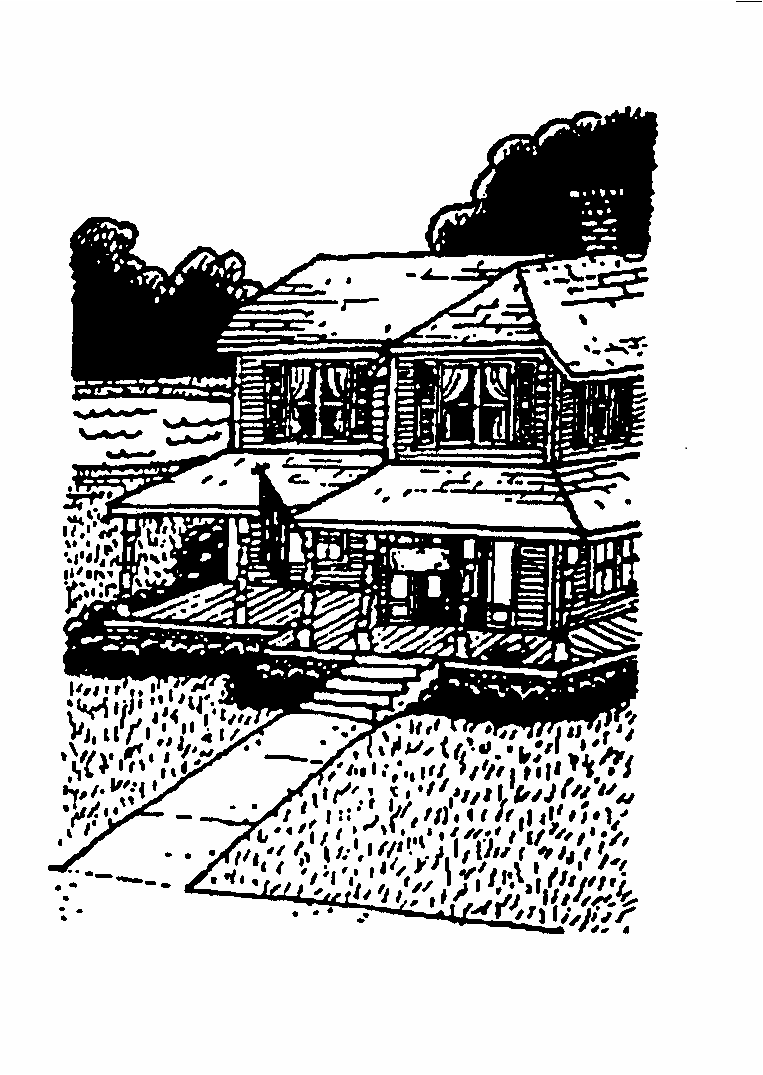
Bed and Breakfast Facilities shall be an allowable accessory use in R-2B, R-3A, R-3B, R-3C, R-3D, and MXD residential districts and in O, MU, and AC districts only, subject to the procedural requirements of Section 58.919 below. In addition to the general requirements above for accessory uses, all Bed and Breakfast Facilities shall conform to the following requirements.
(Ord. of 9-16-1991, Doc. #25094; Ord. of 4-20-1992, Doc. #25633; Ord. of 2-21-1994, Doc. #27278)
Sec. 58.917. - Performance and Design Requirements.
Location and Number of Lodging Units. No more than two rooms or lodging units shall be permitted on any residential district building site. In non-residential districts no more than eight (8) rooms or lodging units may be permitted on any building site. These rooms or lodging units may be located within the principal building or in an accessory building. For purposes of this section, a facility containing nine (9) or more lodging units in a non-residential district, shall be considered a hotel/motel and may be allowed pursuant to Fig. 2 of Chapter 58.
Area. In residential zoning districts no Bed and Breakfast Facility shall occupy more than 25% of the gross habitable floor area of the dwelling, and in no event more than a total of 500 sq. ft. In the non-residential zoning districts the Bed and Breakfast Facility may occupy all of the gross floor area except for that inhabited by the owner/occupier. In residential zoning districts no structural alteration to the dwelling shall be counted as gross floor area for the purposes of this requirement until two years after the completion thereof, as shown by the records of the Planning and Development Department.
Density. For purposes of determining allowable density on any building site which includes a Bed and Breakfast Facility, each room or lodging unit shall be counted as one-half (½) dwelling unit and the owner-occupier's unit shall be counted as one dwelling unit.
External Appearance. Within residential zoning districts no alterations shall be made to the external appearance of any principal or accessory structures or the building site which change the residential character thereof. Within MXD and O-1 zoning districts, new construction and alterations shall be in accordance with the "Appearance Review Requirements For Office Uses In Residential and O-1 Office Districts" of Chapter 62.
Signs. Within residential zoning districts no sign shall be permitted other than a non-illuminated nameplate attached to the main entrance of the principal building. This nameplate shall not exceed two square feet in area. In non-residential zoning districts, signage shall conform to the sign requirements of the applicable zoning district.
Separation. Within the R-2B, R-3A, R-3B, R-3C and R-3D zoning district no Bed and Breakfast facility shall be located within one thousand two hundred feet (1,200 ft.) of a parcel on which is located any other Bed and Breakfast facility or any group housing or group care facility. Such distance shall be measured from the property lines.
(Ord. of 9-16-1991, Doc. #25094; Ord. of 7-26-1993, Doc. #26769; Ord. of 2-21-1994, Doc. #27278; Ord. of 5-20-1996, Doc. #29361)
Sec. 58.918. - Owner-Occupancy Required.
No Bed and Breakfast Facility shall be permitted except where the owner or proprietor of the Bed and Breakfast Facility resides on the building site.
(Ord. of 9-16-1991, Doc. #25094; Ord. of 5-20-1996, Doc. #29361; Ord. No. 2018-3, § 1, 2-12-2018, § 1, Doc. #1802121201)
Sec. 58.919. - Procedural Requirements.
Bed and Breakfast Facilities shall be allowable in the R-2B, R-3A, R-3B, R-3C, R-3D, MXD-1 and MXD-2 Districts only after review and approval as a Conditional Use in accordance with the requirements of Chapter 65, Part 2D. In the O-1, O-2, O-3, MU and AC zoning districts, Bed and Breakfast Facilities shall be a permitted use in conjunction with an owner-occupied dwelling unit.
(Ord. of 9-16-1991, Doc. #25094; Ord. of 2-21-1994, Doc. #27278)
Sec. 58.920. - General Requirements.
All caretakers quarters shall conform to the following requirements.
(Ord. of 9-16-1991, Doc. #25094)
Sec. 58.921. - Uses for Which Permitted.
Caretakers quarters shall be an allowable accessory use only for non-residential uses. Such caretakers quarters shall be deemed to be a dwelling unit subject to all applicable requirements of this Chapter, except minimum density requirements.
(Ord. of 9-16-1991, Doc. #25094; Ord. of 7-26-1993, Doc. #26769)
Sec. 58.922. - Location.
The caretakers quarters may be a part of the principal building or may be in a separate accessory building or may be a mobile home. It shall be so located as to minimize its visibility from streets and abutting properties.
(Ord. of 9-16-1991, Doc. #25094)
Sec. 58.923. - Occupancy.
The resident of the caretakers quarters shall be the owner/tenant or an employee of the owner/tenant of the premises, receiving monetary or comparable payment for caretaker services.
(Ord. of 9-16-1991, Doc. #25094; Ord. of 5-20-1996, Doc. #29361)
Sec. 58.924. - Parking.
Off-street parking for the caretakers quarters shall be provided in accordance with the requirements of Chapter 61, Part 3 for one family dwellings.
(Ord. of 9-16-1991, Doc. #25094)
Sec. 58.925. - Procedural Requirements.
In residential districts, caretakers quarters may be approved only after review as a Conditional Use in accordance with Chapter 65, Part 2D. In non-residential districts, caretakers quarters shall be a permitted accessory use.
(Ord. of 9-16-1991, Doc. #25094)
Sec. 58.926. - General Requirement.
Prohibited Commercial Vehicles. The parking of commercial vehicles is prohibited on the public streets or on or within privately owned driveways or property within all residential or office districts as established by this Chapter, except for loading or unloading purposes or when parked within a completely enclosed private garage.
Recreational Vehicles. Only recreational vehicles meeting the following standards and conditions shall be permitted to be parked within residential or office districts:
(a)
Recreational vehicles parked within a completely enclosed private garage where the recreational vehicle is not parked in the required on-site parking space.
(b)
Recreational vehicles parked in side or rear yards provided:
-
the recreational vehicle is ten and one-half (10½) feet or less in height and twenty-five (25) feet or less in length, measured at the longest and highest points of the vehicle;
-
the recreational vehicle is parked on a paved parking surface accessible from the street by an approved driveway;
-
the recreational vehicle is screened from adjacent properties by a solid wall or solid fence at least six (6) feet in height;
-
the recreational vehicle is set back at least five (5) feet from the side and rear property line;
-
the recreational vehicle is not parked in the required on-site parking space;
-
the recreational vehicle is set back at least five (5) feet from any adjacent building or structure.
(c)
Recreational vehicles parked solely for the purpose of loading and unloading; however, parking for loading and unloading purposes shall be limited to thirty-six (36) hours.
(d)
Recreational vehicles not meeting the requirements of (a) and (b) above but approved in accordance with variance procedures and requirements set out in Chapter 65, Part 2J, of this Code.
(e)
Recreational vehicles less than eighty (80) inches in width parked on any public street, if permitted by other applicable provisions of the City Code.
(f)
Recreational vehicles parked in a common recreational vehicle parking area at a multi-family dwelling in any R-3B, R-3C or R-3D zoning district where such parking area is approved by the Zoning Official, is not located adjacent to a single-family zoning district, and is screened from adjacent properties and the public right-of-way by a solid wall or fence at least six (6) feet in height. (Effective December 1, 1995.)
Nonconforming Recreational Vehicles. Recreational vehicles which are parked within residential or office districts as of the effective date of this Ordinance pursuant to a building permit, variance or other similar City action which specifically approved the recreational vehicle parking shall be deemed to be nonconforming uses and shall be permitted to remain in accordance with Chapter 58, Part 7D. (Effective December 1, 1995.)
(Ord. of 9-16-1991, Doc. #25094; Ord. of 7-26-1993, Doc. #26769; Ord. of 1-24-2005, § 14, Doc. #050124909)
Sec. 58.927. - Maximum Weight for Commercial Vehicles Parked in Enclosed Private Garage.
In addition to the restrictions above, no commercial vehicle having a gross vehicle load rating exceeding 20,000 pounds may be placed in any location in residential districts, including in a completely enclosed private garage, except for loading or unloading purposes.
(Ord. of 9-16-1991, Doc. #25094)
Sec. 58.928. - Street Corner Visibility.
All fences and walls shall conform to the street corner visibility requirements of Chapter 60, Part 1C. No fence or wall shall obstruct the view from any vehicle upon a public or private street or obstruct the view of persons on sidewalks or bike paths from any vehicle.
(Ord. of 9-16-1991, Doc. #25094)
Sec. 58.929. - Height.
Office and Residential Districts. Walls and fences erected on all building sites shall be in accordance with the following criteria:
(a)
Required Front Yards and Street Side Yards on Reverse Corner Lots: Shall not exceed 4 feet in height except where the property is contiguous to a commercial or industrial use in which case higher fencing shall be permitted along the common property line in accordance with the bufferyard requirements of Chapter 60.
(b)
Required Street Side Yards Except Reverse Corner Lots: Shall not exceed 6 ft. in height, except where the property is contiguous to a commercial or industrial use in which case higher fencing shall be permitted along the common property line in accordance with the bufferyard requirements of Chapter 60.
(c)
Multifamily developments having a building site area of at least 5 acres and street frontage of at least 200 ft. shall be permitted fences and walls 6 ft. in height in required front and street side yards.
(d)
Required Side and Rear Yards: Shall not exceed 6 feet in height—except where the property is contiguous to a commercial or industrial use in which case higher fencing shall be permitted along the common property line in accordance with the bufferyard requirements of Chapter 60.
(e)
All fences located adjacent to water bodies shall not extend into such water body beyond the normal high water elevation as determined in Chapter 63, Part 2I, Sections 63.281 to 63.283.
Commercial and Industrial Districts. Walls and fences erected on all building sites shall be in accordance with the following criteria, provided that barbed wire may also be placed on top of such fences or walls in accordance with the requirements of Section 58.930 (below):
(a)
Required Front and Street Side Yards: Shall not exceed 6 feet in height.
(b)
Required Side and Rear Yards: Shall not exceed 8 feet in height.
(c)
All fences located adjacent to water bodies shall not extend into such water body beyond the normal high water elevation as determined in Chapter 63, Part 2I, Sections 63.281 to 63.283.
Crime Prevention Fencing. The height requirements of this Section for commercial and industrial fences may be exceeded by two feet where an approved Crime Prevention Through Environment Design (CPTED) fence is installed. An approved CPTED fence shall be a wrought iron or wrought iron-type fence. No barbed wire may be used with a CPTED fence.
Pillars and Posts. Pillars and posts may extend up to 12 inches above the height limitations of this Section, provided such pillars and posts are no less than 10 feet apart.
Measurement of Height. All heights shall be measured from the established normal building site grade.
(Ord. of 9-16-1991, Doc. #25094; Ord. of 4-20-1992, Doc. #25633; Ord. of 7-26-1993, Doc. #26769; Ord. of 5-20-1996, Doc. #29361; Ord. No. 2010-33, § 2, 8-30-2010, Doc. #1008301102)
Sec. 58.930. - Security fences.
A "security fence" is a fence or wall with a special defensive feature designed primarily to protect property from theft, vandalism, trespass, or other criminal activity. Barbed-wire and electrified fences are security fences for purposes of this part. A chain-link fence, by itself, is not a "security fence" for the purposes of this section, but is a "security fence" when combined with barbed wire or other special defensive features. "Special defensive features" include any less-than-lethal security feature such as, without limitation, broken glass, spikes, nails, barbs, or similar material designed to inflict pain or injury to any person or animal.
Security fences in general. Security fences are prohibited in all underlying zoning districts except as otherwise provided in this section. Security fences incorporating broken glass or razor-wire are prohibited throughout the City except for jails and prisons. Security fences of all types are permitted in the air operations area of an airport.
Industrial and Certain High Intensity Airport Support District Uses. Security fences are permitted in all industrial zoning districts and for industrial uses within the High Intensity Airport Support District. They are also permitted in planned development districts with an industrial underlying zoning district and for industrial uses within planned development districts with an underlying High Intensity Airport Support District.
Public Use District and Certain Medium Intensity Airport Support District Uses. Security fences may be permitted by special exception in the Public Use District and for industrial uses in the Medium Intensity Airport Support District. For purposes of this part, applications for a special exception shall be reviewed and approved, approved with conditions, or denied, by zoning official letter of determination. In reviewing an application for special exception, the zoning official shall apply the standards of review provided for review of conditional use permits as provided at section 65.285 of this code. If the zoning official approves the request for a special exception, he or she may impose one or more of the conditions of development provided by section 65.284 of this code. Conditions of development must be reasonably calculated to mitigate identifiable land use impacts of the security fence. Violations of development conditions constitute a violation of this section.
Nonconforming industrial uses. Security fences are permitted for legally existing but nonconforming industrial uses. The purpose of this part is to allow security fences for industrial uses that were established legally but have become a nonconforming use by virtue of a subsequent zoning map or zoning text amendment.
Special regulations for electrified fences. Notwithstanding anything in this code to the contrary, electrified fences are subject to the following special regulations:
(a)
Electrified fences are prohibited within 50 feet of a school, a residential zoning district, or a planned development district with underlying residential zoning unless approved by special exception. For purposes of this part, applications for a special exception shall be reviewed and approved, approved with conditions, or denied, by zoning official letter of determination. The official letter of determination is then subject to review and recommendation by the Municipal Planning Board and final action by Council. In reviewing an application for special exception, the zoning official, the Municipal Planning Board, and Council shall apply the standards of review provided for review of conditional use permits as provided at section 65.285 of this code. If the request for a special exception is approved, the Council may impose one or more of the conditions of development provided by section 65.284 of this code. Conditions of development must be reasonably calculated to mitigate identifiable land use impacts of the security fence. Violations of development conditions constitute a violation of this section.
(b)
Electrified fences are prohibited between 51 feet and 150 feet of a school, a residential zoning district, or a planned development district with underlying residential zoning unless approved by special exception. For purposes of this part, applications for a special exception shall be reviewed and approved, approved with conditions, or denied, by zoning official letter of determination. In reviewing an application for special exception, the zoning official shall apply the standards of review provided for review of conditional use permits as provided at section 65.285 of this code. If the zoning official approves the request for a special exception, he or she may impose one or more of the conditions of development provided by section 65.284 of this code. Conditions of development must be reasonably calculated to mitigate identifiable land use impacts of the security fence. Violations of development conditions constitute a violation of this section.
(c)
Electrified fences are prohibited within 50 feet of the right-of-way of Narcoossee Road and Orange Blossom Trail unless approved by special exception. For purposes of this part, applications for a special exception shall be reviewed and approved, approved with conditions, or denied, by zoning official letter of determination. In reviewing an application for special exception, the zoning official shall apply the standards of review provided for review of conditional use permits as provided at section 65.285 of this code. If the zoning official approves the request for a special exception, he or she may impose one or more of the conditions of development provided by section 65.284 of this code. Conditions of development must be reasonably calculated to mitigate identifiable land use impacts of the security fence. Violations of development conditions constitute a violation of this section.
(d)
Electrified fences are prohibited in the Parramore Heritage zoning overlay district without regard for the underlying zoning district.
(e)
For sites with a front or street-side yard adjacent to a roadway segment identified in the City's Major Thoroughfare Plan, electrified fences are prohibited between the facade (and a line running perpendicular from the end of the facade to the property line) of the principal structure and the respective adjacent Major Thoroughfare unless approved by special exception. For purposes of this part, applications for a special exception shall be reviewed and approved, approved with conditions, or denied, by zoning official letter of determination. The official letter of determination is then subject to review and recommendation by the Municipal Planning Board and final action by Council. In reviewing an application for special exception, the zoning official, the Municipal Planning Board, and Council shall apply the standards of review provided for review of conditional use permits as provided at section 65.285 of this code. If the request for a special exception is approved, the Council may impose one or more of the conditions of development provided by section 65.284 of this code. Conditions of development must be reasonably calculated to mitigate identifiable land use impacts of the security fence. Violations of development conditions constitute a violation of this section.
(f)
Nothing in this part shall be interpreted as exempting an electrified fence from any other applicable local, state, or federal regulation.
(g)
The primary power source of the electric charge delivered to the electrified fence must be a 12-volt battery.
(h)
All electrified fences must be completely surrounded by a non-electrified fence. The surrounding non-electrified fence must be 2 feet shorter than the electrified fence and must be made of a material that effectively prevents passersby from inadvertently coming into contact with the electrified fence. The surrounding non-electrified fence must be separated from the electrified fence by at least 3 inches, except at gates where the separation may be less than 3 inches, and except where the minimum 3-inch separation is inadequate to prevent the surrounding non-electrified fence from sagging, bowing, or bending into contact with the electrified fence. In this case, where the surrounding non-electrified fence is a chain-linked fence or other similar construction, and where such a fence is capable, based on the characteristics of its construction, of sagging, bowing, or bending into contact with the electrified fence, the permitting official may require separation of greater than 3 inches to the extent necessary to prevent inadvertent contact between the surrounding fence and the electrified fence. Property owners with an electrified fence must maintain the surrounding fence and the electrified fence in a manner that prevents sagging, bowing, or bending of the surrounding fence that could result in contact with the electrified fence. The purpose of this part is to protect innocent passersby and children from inadvertently coming into contact with the electrified fence.
(i)
Electrified fences may not exceed 8 feet in height, but the zoning official may approve a modification of this standard in accordance with Part 2F, Chapter 65, of this code.
(j)
Electrified fences must be posted with warning signs. The warning signs must be at least 8.5" by 11" in size and posted at least every 60 lineal feet along the perimeter of the fence. The signs must be posted between 3 feet and 6 feet above the ground and face outward and inward from the site. Each sign must display, in clear, legible typeface, the words "DANGER ELECTRIFIED FENCE" or "WARNING ELECTRIC FENCE," or a functionally similar warning approved by the zoning official. Signs must be printed in English and Spanish.
(k)
Electrified fence systems must provide and maintain an onsite emergency de-activation device accessible to public first responders. The system must be approved by the fire chief and the police chief.
(l)
Barbed-wire is prohibited on electrified fences and on non-electrified fences surrounding electrified fences.
(m)
Electrified fences are prohibited at schools.
(Ord. of 9-16-1991, Doc. #25094; Ord. No. 2015-12, § 1, 4-6-2015, Doc. #1504061201)
Editor's note— Ord. No. 2015-12, § 1, adopted Apr. 6, 2015, Doc. #1504061201, changed the title of § 58.930 from "Barbed Wire and Similar Material" to read as set out.
Sec. 58.931. - Maintenance.
Walls and fences erected or placed in all districts shall be maintained in good repair and sound structural condition.
(Ord. of 9-16-1991, Doc. #25094)
Sec. 58.932. - Performance Standards for Wood Fences—"Reserved."
Editor's note— Former § 58.932 pertained to performance standards for wood fences. See Ord. of 9-16-1991, Doc. #25094; Ord. of 4-20-1992, Doc. #25633.
Sec. 58.933. - Temporary Construction Fences.
A temporary fence not exceeding 8 feet in height may be erected during construction in any district. Such fence shall be removed prior to any Certificate of Occupancy or Certificate of Completion being approved.
(Ord. of 9-16-1991, Doc. #25094)
Sec. 58.934. - General Requirements.
Garage or yard sales shall be a permitted temporary accessory use on any residential building site in accordance with the following requirements.
(Ord. of 9-16-1991, Doc. #25094)
Sec. 58.935. - Frequency.
No garage or yard sale shall be conducted at a frequency of more than 2 sales per calendar year, nor shall any individual garage or yard sale exceed a maximum of 4 days in a one week period. No property shall exceed a maximum of 8 sale days per calendar year. Any such activity exceeding these requirements shall be deemed to be an open air market as defined in Chapter 66, and shall be permitted only in accordance with the requirements for open air markets.
(Ord. of 9-16-1991, Doc. #25094; Ord. of 7-26-1993, Doc. #26769)
Sec. 58.936. - No Permit Required.
No building permit or other permit shall be required to conduct a garage or yard sale.
(Ord. of 9-16-1991, Doc. #25094)
Sec. 58.937. - General Requirements.
Home occupations are an allowable accessory use in residential dwelling units. All home occupations shall conform to the following requirements.
(Ord. of 9-16-1991, Doc. #25094; Ord. No. 2022-14, § 1, 3-14-2022, Doc. #2203141201)
Sec. 58.938. - Performance and Design Requirements.
Location. All home occupations shall be located within the principal building which is the bona fide residence of the principal practitioner, an accessory garage or other accessory structure.
Area. No home occupation may occupy more than 25% of the gross habitable floor area of any one story of the dwelling unit, and in no event a total of more than 500 square feet. Any home occupation over 25% will be considered a principal use. Where more than one home occupation is approved under this Part, all of the home occupations together shall not exceed these standards.
Traffic and Parking. No home occupation shall generate vehicular traffic in excess of two vehicles concurrently nor more than ten vehicles per day.
A)
No commercial or utility trailers or heavy equipment including industrial equipment or machinery may be operated or parked at the home occupation site for a period of more than 36 continuous hours.
B)
Parking and storage of commercial vehicles must comply with Section 58.926 of LDC.
C)
Vehicles and trailers used in connection with the business must be parked in legal parking spaces and not within the right-of-way, on or over a public sidewalk or on unimproved surfaces at the residence. Heavy equipment used in connection with the business must be parked and stored so it is not visible from the street or neighboring property. Heavy equipment means commercial, industrial, or agricultural vehicles, equipment, or machinery.
Employees. The employees of the business who work at the dwelling unit must also reside there, except that up to a total of two employees or independent contractors who do not reside at the dwelling unit may work at the business. The business may have additional remote employees who do not work at the dwelling unit.
Merchandise Storage and Display. No merchandise shall be displayed or sold on the premises except articles made on the premises. No outside display of merchandise or outside storage of equipment or materials shall be permitted.
Signage. Signage must conform to the regulations for signage in residential districts.
Retail Transactions. Retail transactions associated with the home occupation may be conducted only in the principal structure and not within any accessory structure.
External Appearance. No alterations shall be made to the external appearance of any principal or accessory structures or of the building site which change the residential character thereof.
Electrical or Mechanical Equipment. The use of electrical or mechanical equipment which would change the fire rating of the dwelling unit or cause fluctuations in line voltage outside the dwelling unit shall be prohibited, and no electromagnetic interference shall be emitted which affects radio, television or other electromagnetic equipment off the building site.
Zero-Impact Performance Standards. No home occupation may create noise, vibration, heat, smoke, glare, fumes, or noxious odors in excess of those normally expected at a similar dwelling unit where no business is conducted. No home occupation may use, store, or dispose of any corrosive, combustible, or other hazardous or flammable materials or liquids in excess of those normally expected at a similar dwelling unit where no business is conducted.
Property Owners Approval. Wherever the occupant undertaking a home occupation is not the owner of the premises, the property owner and/or agent must give notarized written approval for the home occupation.
Enforcement. The property owner, agent and occupant shall be jointly and individually responsible in all enforcement matters.
Accessibility. Accessibility shall be designed in accordance with the Florida Building Code, as applicable.
(Ord. of 9-16-1991, Doc. #25094; Ord. No. 2022-14, § 1, 3-14-2022, Doc. #2203141201)
Sec. 58.939. - Procedural Requirements.
Application Required. All home occupations shall be required to make application and obtain a business tax receipt and certificate of use prior to the start of such use.
Submittals. In addition to any other submittals required, the applicant shall also submit the following:
(a)
Location of dwelling unit where the home occupation will be conducted;
(b)
Total floor area of the dwelling unit;
(c)
Area of room or rooms to be utilized in the conduct of the home occupation;
(d)
A sketch with dimensions showing the floor plan and the area to be utilized for the conduct of the home occupation;
(e)
A written description of the exact nature of the home occupation;
(f)
Notarized letter of approval for the home occupation from the property owner and/or property manager;
(g)
The Zoning Official may require a site plan indicating the location of all improvements.
Other Requirements. Issuance of a business tax receipt and certificate of use for a home occupation does not waive or supersede any county, state, or federal regulations pertaining to the home occupation. Any applicant for a home occupation must obtain requisite approvals or fulfill the obligations imposed by a county, state or federal agency.
(Ord. of 9-16-1991, Doc. #25094; Ord. of 4-20-1992, Doc. #25633; Ord. of 5-20-1996, Doc. #29361; Ord. No. 2018-45, § 5, 8-20-2018, Doc. #1808201202; Ord. No. 2022-14, § 1, 3-14-2022, Doc. #2203141201)
Note— Formerly § 58.941.
Sec. 58.942. - General Requirements.
Dwellings constructed within a residential subdivision under active development may be used as display models during active development of the subdivision. Use of such dwellings as display models shall be temporary, and shall be permitted only while dwellings of the same type and style are being constructed within the subdivision. Model dwelling unit signs shall be construed to be real estate signs in residential districts and shall conform with appropriate sign regulations.
(Ord. of 9-16-1991, Doc. #25094)
Sec. 58.943. - Location.
Model dwellings shall be located on the same development site as the dwelling units which are under active development.
(Ord. of 9-16-1991, Doc. #25094)
Sec. 58.944. - Number of Model Dwellings.
No more than 10% of all dwelling units or 10 units, whichever is smaller, in the development or approved construction stage may be permitted as model dwellings.
(Ord. of 9-16-1991, Doc. #25094)
Sec. 58.945. - General Requirements.
Outdoor display of merchandise which is an accessory use to any commercial use may be permitted in accordance with the following requirements. These requirements shall not apply to any Open Air Market as defined in Chapter 66. Additional requirements apply to outside Retail Antique Displays as detailed in Section 58.950.
(Ord. of 9-16-1991, Doc. #25094; Ord. of 4-20-1992, Doc. #25633; Ord. of 1-24-2005, § 16, Doc. #050124909)
Sec. 58.946. - Use Restrictions.
The merchandise being displayed must be items otherwise permitted to be sold in the zoning district in which the property is located. Only merchandise which must be displayed out of doors due to its size, nature or construction (such as swimming pools, landscaping materials, vehicles, etc.) may be displayed outdoors. Outdoor display of any and all other merchandise shall be prohibited, except as otherwise permitted for retail antique stores under Section 58.950.
(Ord. of 9-16-1991, Doc. #25094; Ord. of 4-20-1992, Doc. #25633)
Sec. 58.947. - Locational Requirements.
Merchandise displayed outdoors shall not encroach into any parking spaces or vehicular use areas required by this Chapter, nor into any landscaping area or bufferyard required by this Chapter, nor into any public right-of-way.
(Ord. of 9-16-1991, Doc. #25094)
Sec. 58.948. - Location Requirements—Right-of-Way.
No outdoor display of merchandise shall be allowed within the right-of-way of a public street without the approval of the City Engineer and City Traffic Operations Engineer in writing.
(Ord. of 9-16-1991, Doc. #25094)
Sec. 58.949. - Location Requirements—Access and Parking.
No outdoor display of merchandise shall be allowed without approved access and parking per Land Development Code so as not to require illegal and unsafe stopping, standing or parking within the public right-of-way.
(Ord. of 9-16-1991, Doc. #25094; Ord. of 5-20-1996, Doc. #29361)
Sec. 58.950. - Permits for Retail Antique Displays.
Permits shall be required for the display of retail antiques out of doors. Applications for permits shall be submitted to the Zoning Official and shall include a site plan. Unless otherwise waived by the Zoning Official, the site plan shall include: the size and shape of the property; the size and location of all structures, vehicular use areas, sidewalks, streets and landscaping; and the size and location of the proposed display. Applications shall also include the address and name of landowner and address and name of vendor.
Applications for such permits shall be reviewed by the Planning Director or his designee for compliance with all applicable codes. In addition the Zoning Official shall determine that:
(a)
The proposed display does not hinder access, ingress or egress or obstruct required parking or intrude on public right-of-way;
(b)
The proposed display will be located so as to be compatible with the existing and surrounding buildings;
(c)
The proposed display results in the least possible detrimental impact to the site;
(d)
The proposed display does not reduce the safety, light or general convenience of surrounding developments;
(e)
Required landscaping will not be threatened or damaged and is protected in accordance with the requirements of the Land Development Code;
(f)
The flow of pedestrian traffic will not be halted or materially impaired; and
(g)
The proposed display will not materially affect line of sight for vehicular or pedestrian traffic adjacent or near to the display.
Any outdoor display of merchandise for retail antique stores shall be limited to the actual hours the establishment is open for business. However, in no event shall merchandise be displayed other than between the hours of 8:00 a.m. and 8:00 p.m. (Eastern Time). Loading and unloading of merchandise shall not occur so as to leave merchandise outside for more than three hours when such merchandise has not been placed according to permit and site plan specifications.
The Zoning Official or his designee in considering any application for outdoor display of merchandise for retail antique store establishments may establish conditions relative to the number of items, location, hours for display, maximum number of days (if any), and any other conditions necessary to insure an outdoor display which is in compliance with all applicable codes, which is in keeping with the particular establishment and which is compatible with surrounding properties.
The Zoning Official shall revoke any permit issued under this section if the Zoning Official finds, based on competent substantial evidence, that any conditions of the permit are violated. The permit holder shall have the right to appeal such revocation to the Board of Zoning Adjustment. There shall be no outdoor display during the period of any appeal.
(Ord. of 9-16-1991, Doc. #25094)
Sec. 58.951. - General Requirements.
All developed properties other than single family residences shall select a refuse service type from the following types of service offered, and shall provide appropriate service locations for refuse and recycling collection that shall conform to the following requirements.
(Ord. of 9-16-1991, Doc. #25094; Ord. No. 2019-8, § 1, 3-11-2019, Doc. #1903111201)
Sec. 58.952. - Refuse Service Types.
Siting, access and screening requirements for one or more type of service described in this section shall be provided by the property owner for each service location, and shall be inspected and authorized by the Solid Waste Management Bureau or its designee. The service types are:
F.E.L. (Front End Loaded) Refuse Container Service: Shall be provided by the City when the anticipated refuse volume, service access, siting and screening requirements are met by the property owner and when this type of service is selected by the property owner as the desired type. The City shall continue to service existing F.E.L. containers constructed according to approved plans, however such containers shall come into compliance with location and screening requirements as part of any substantial enlargement or substantial improvement.
Roll-Off Compactor Service: Shall be provided by any of the currently authorized City Franchisees when the anticipated refuse volume, service access, siting and electrical requirements are properly provided by the property owner and when this type of service is selected by the property owner as the desired type.
Commercial Hand Pickup/Garbage Cart Service: Shall be provided by the City upon the recommendation of the City Solid Waste Management when anticipated refuse volume and efficiency of service so indicates.
Recycling Service: All recycling containers (F.E.L., Commercial Hand Pickup/Cart, or Roll-Off) shall conform to the same requirements as corresponding type refuse containers.
(Ord. of 9-16-1991, Doc. #25094; Ord. of 4-20-1992, Doc. #25633; Ord. of 5-20-1996, Doc. #29361; Ord. No. 2019-8, § 1, 3-11-2019, Doc. #1903111201)
Sec. 58.953. - Refuse and Recycling Container Location Requirements.
No refuse or recycling containers shall be located within any required front or street side yard setback. No such containers shall be located in any required parking space or vehicular use area, or in any required bufferyard or landscaping area.
Service Access. Fifty (50) feet of clear backup space as measured perpendicular from the screen area shall be provided from the face of the refuse and recycling containers' screening, unless otherwise approved by the Solid Waste Bureau Chief or his or her designee who shall find that the reduction is necessary to provide property rights enjoyed by others in the same zoning district, and will not be detrimental to public health, safety, and welfare. No encroachment into this area by parking spaces, non-driveway sidewalks, or landscape areas shall be allowed.
Siting Obstructions. No F.E.L. refuse or recycling containers shall be sited within 6 feet of any building/structure, nor sited below obstructing wires nor sited adjacent to any other obstruction to the container dumping process.
Container Pads. Refuse container pad(s) shall be provided for all containers and shall be constructed either of, as a minimum 3,000 p.s.i. concrete six (6) inches thick with 6″ × 6″—10 × 10 wire mesh, four (4) inches thick with number three (#3) steel reinforcing bars on twelve (12) inch centers in each direction, or as approved by the Solid Waste Bureau Chief or his or her designee who shall find that the reduction is necessary to provide property rights enjoyed by others in the same zoning district, and will not be detrimental to public health, safety, and welfare. A six (6) foot long approach slab of identical width, thickness, and composition to the container pad shall also be constructed adjacent and of equal slope to said pad(s). Refuse and Recycling container pads shall be a minimum of 24 ft. wide by 10 ft. deep with clear inside dimensions.
(Ord. of 9-16-1991, Doc. #25094; Ord. of 5-20-1996, Doc. #29361; Ord. of 1-24-2005, § 17, Doc. #050124909; Ord. No. 2019-8, § 1, 3-11-2019, Doc. #1903111201)
Sec. 58.954. - Roll-Off Compactor Container Location Requirements.
No roll-off compactor container pad(s) shall be located within any required front or street side yard setback. No such container shall be located in any required parking space or vehicular use area, or in any required bufferyard or landscaping area.
Container Pads. Roll-off compactor container pad(s) shall be provided for all roll-off compactor containers, and shall be constructed of minimum 3000 P.S.I. concrete, steel reinforced, 6 inches thick, and shall comply with the following minimal dimension requirements.
Service Access. A paved service vehicle access apron, constructed to a minimum 60,000 lb. /capacity requirement and extending a minimum of 45 feet in front of each roll-off compactor container is required. Service height clearance of 25 feet is required in the container service access area.
Electrical Requirements. The industry recommendations for roll-off compactor electrical requirements are: 3 phase, 460/-480 volt, 60 amp. electrical service to each compactor location. Other electrical requirements may be approved and certified serviceable by an authorized City Franchisee for certain specialized compaction equipment.
Roll-Off Compactor Container Requirements; Exception. Exceptions to the dimensional pad and service access requirements of this section may be approved by the Refuse Collection Bureau when each such exception has been certified serviceable by an authorized City Franchisee.
(Ord. of 9-16-1991, Doc. #25094; Ord. of 5-20-1996, Doc. #29361; Ord. of 1-24-2005, § 18, Doc. #050124909; Ord. No. 2019-8, § 1, 3-11-2019, Doc. #1903111201)
Sec. 58.955. - Refuse and Recycling Container Screening Requirements.
Refuse and Recycling containers and roll-off compactors shall be opaquely screened from view from public streets and adjacent properties, to a height of at least 6 feet, or 6 inches higher than the height of the container (whichever is higher). This screening may be achieved by walls, landscaping or buffer yards, or by virtue of the location of the container on the building site.
The Zoning Official may issue a Modification of Standards to adjust any development standard when implementing recycling facilities into pre-existing development.
(Ord. of 9-16-1991, Doc. #25094; Ord. of 5-20-1996, Doc. #29361; Ord. No. 2019-8, § 1, 3-11-2019, Doc. #1903111201)
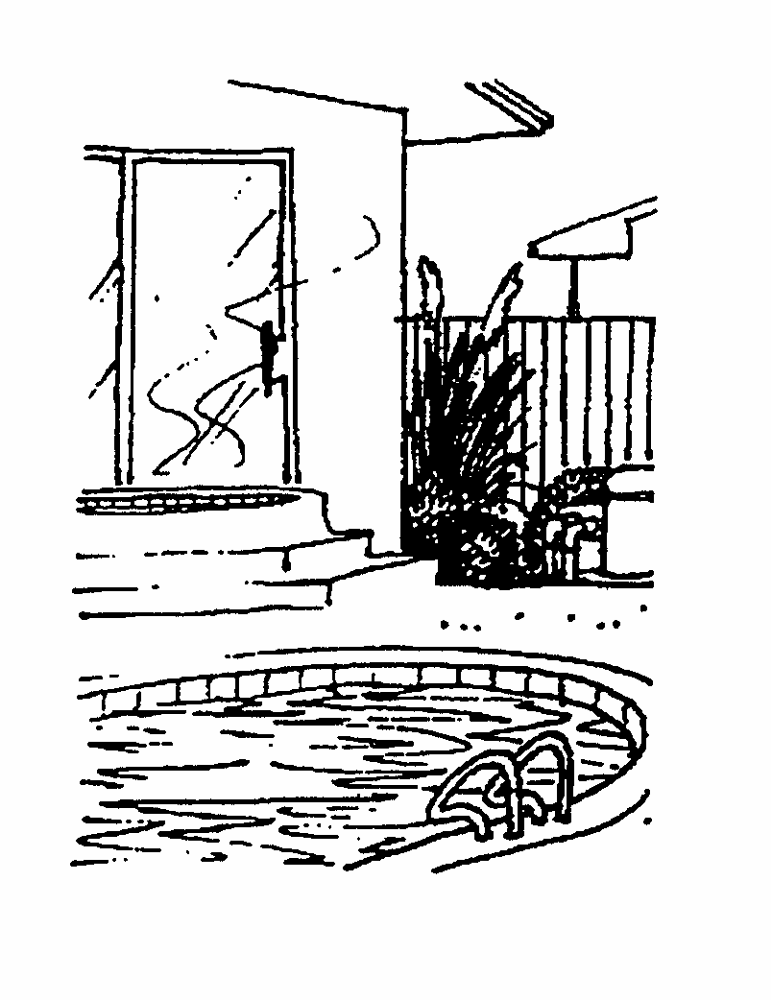
5B(11). SWIMMING POOLS, HOT TUBS AND HYDROSPAS
Sec. 58.956. - General Requirements.
No swimming pool, hot tub, spa or the like shall be located, designed, operated or maintained so as to interfere unduly with the enjoyment of property rights by owners or occupants of property adjoining it.
(Ord. of 9-16-1991, Doc. #25094; Ord. No. 2022-55, § 1, 9-12-2022, Doc. #2209121210)
Sec. 58.957. - Lighting.
Lights used to illuminate any swimming pool, hot tub, spa or the like shall be arranged and shaded so as to reflect light away from adjoining premises.
(Ord. of 9-16-1991, Doc. #25094; Ord. No. 2022-55, § 1, 9-12-2022, Doc. #2209121210)
Sec. 58.958. - Locational Requirements.
Allowable locations of swimming pools, hot tubs, spas, or any other similar structures:
(a)
Measurement. Setbacks are measured from the edge of the water, or from any portion of the structure above ground such as a wall or built-in fountain, to the property line.
(b)
Minimum Setbacks.
1.
5 feet from the side, rear and alley property lines.
2.
15 feet from the street side property line.
3.
10 feet behind the front facade of the principal structure.
4.
15 feet from the normal high water line of a natural surface water body or retained wetland.
5.
Horizontal setback from any overhead utility lines and transmission tower anchors shall be not less than 10 feet.
(c)
Pool Patios and Decks. Any patios or decks associated with a pool, hot tub or spa must meet the additional standards in Sec. 58.970.
(d)
Pool Mechanical Equipment. Any mechanical equipment associated with a pool, hot tub or spa must meet the standards in Ch. 58 Part 5(B)(18).
(e)
In Zero-Lot-Line Developments, only hot tubs and spas are allowed within the building envelope shown on the Subdivision Plat. A minimum setback of 2 feet from the side yard or zero-lot-line is required.
(Ord. of 9-16-1991, Doc. #25094; Ord. No. 2021-45, § 1, 7-19-2021, Doc. #2107191203; Ord. No. 2022-55, § 1, 9-12-2022, Doc. #2209121210)
Sec. 58.959. - Fencing of Swimming Pools.
Any swimming pool of any type whatsoever, including but not limited to portable swimming pools, constructed in such a manner as to permit a water depth of two (2) feet or more and an area of 36 sq. ft. or more shall be completely enclosed by chain link type fence, a wall or other equivalent barrier, approved by the Building Official, of a minimum height of 48 inches.
(Ord. of 9-16-1991, Doc. #25094; Ord. of 5-20-1996, Doc. #29361)
Sec. 58.960. - City Sanitary Requirements Applicable.
Any swimming pool having a capacity of over 350 gallons shall be subject to the sanitary requirements of the City for swimming pools, regardless of the type construction or portability thereof.
(Ord. of 9-16-1991, Doc. #25094)
Sec. 58.961. - Exterior Access to Swimming Pools.
Exterior access to any swimming pool must be through a self-closing and self-latching gate with latches placed at least four (4) feet above the underlying ground and operable from the interior of the swimming pool area only. All gates opening through such enclosure shall be kept securely closed and latched at all times.
(Ord. of 9-16-1991, Doc. #25094)
Sec. 58.962. - Patio Drainage.
If a patio is provided adjacent to or surrounding a swimming pool, hot tub, spa or the like, it shall be designed so as to be self-draining away from the pool.
(Ord. of 9-16-1991, Doc. #25094; Ord. No. 2022-55, § 1, 9-12-2022, Doc. #2209121210)
Sec. 58.963. - Screen Enclosures.
Location and height requirements for screen enclosures, with or without a pool, hot tub or spa, are as follows:
(a)
Any portion of a screen enclosure that contains a solid roof is subject to all setbacks for principal structures. Otherwise, screen enclosures shall meet the following minimum setbacks:
1.
5 feet from side, rear and alley property lines.
2.
15 feet from street side property lines.
3.
10 feet behind the front facade of the principal structure.
(b)
For enclosures 12 feet in height or less, the enclosure must be set back a minimum 15 feet from the normal high water line of a natural surface water body or retained wetland. For enclosures greater than 12 feet in height, the enclosure must be set back a minimum of 50 feet from the normal high water line of a natural surface water body or retained wetland.
(c)
Enclosures are not permitted to encroach on any easement unless otherwise authorized.
(Ord. of 9-16-1991, Doc. #25094; Ord. No. 2022-55, § 1, 9-12-2022, Doc. #2209121210)
Sec. 58.964. - General Requirements.
No tennis court shall be located, designed, operated, or maintained so as to interfere unduly with the enjoyment of property rights by owners or occupants of property adjoining it.
(Ord. of 9-16-1991, Doc. #25094)
Sec. 58.965. - Lighting.
Lights used to illuminate any tennis court shall be arranged and shaded so as to reflect light away from adjoining premises.
(Ord. of 9-16-1991, Doc. #25094)
Sec. 58.966. - Locational Requirements.
The locational requirements for all lighted tennis courts shall be the same as for the principal structure. Allowable locations of unlighted tennis courts shall be as follows:
(a)
Minimum side restriction line shall be five (5) feet from side property line except on a corner building site where the minimum distance from the street right-of-way shall be the same as for the principal building.
(b)
Minimum rear restriction line shall not be less than five (5) feet from the property line.
(c)
Minimum horizontal setback from any overhead utility lines and transmission tower anchors shall be not less than ten (10) feet.
(Ord. of 9-16-1991, Doc. #25094)
Sec. 58.967. - Fencing of Tennis Courts.
The fence height shall not exceed 8 feet when the tennis court is located within the required side and/or rear yard setbacks. All fences shall conform to the street corner visibility requirements.
(Ord. of 9-16-1991, Doc. #25094)
Sec. 58.968. - Vending Machines, Phone Booths and Similar Accessory Uses.
In all residential zoning districts, vending machines, phone booths and similar accessory structures shall be located so as not to be visible from the right-of-way adjacent to the property upon which they are located.
(Ord. of 9-16-1991, Doc. #25094)
Sec. 58.969. - Water Features and Fountains.
Fountains, goldfish ponds, and other decorative water features not for active human use may be located in the required front and street side yards.
(Ord. of 9-16-1991, Doc. #25094)
Sec. 58.970. - Patios and Decks.
(a)
Wooden Patios and Decks. Patios and decks constructed of wooden planks with separation between said planks shall not cover more than fifty (50) percent of the required rear yard and shall not be considered impervious surface. Side yard and rear yard setbacks shall be 5 feet and street side yard shall be as listed for the zoning district. If the deck is above 3 feet in height, it shall have the same setbacks as accessory structures set forth in Sec. 58.901 herein.
(b)
At-Grade Patios and Decks. Patios and decks, regardless of material, that are constructed at-grade must have a minimum setback of 2 feet from the side and rear property lines and 10 feet from the street side property line. If located in the front yard, the patio or deck must follow the same setbacks as the principal structure for the front and street side yard setback.
(c)
Front and Street Side Yard. All patios and decks must comply with the front and street side yard setbacks, however, decks located in the Traditional City Overlay District may follow the first-story porch requirements of Sec. 62.600(f) herein.
(d)
Mean/Normal High Water Line. All patios and decks must be set back at least 15 feet from the mean high water mark for all water bodies. If the deck is above 3 feet in height, it must have the same setbacks as accessory structures set forth in Sec. 58.901 herein.
(e)
Easements. Patios and decks shall not be located in a utility or drainage easement.
(Ord. of 9-16-1991, Doc. #25094; Ord. No. 2021-45, § 1, 7-19-2021, Doc. #2107191203)
Sec. 58.971. - Automated Individual Car Wash.
Automated Individual Car Wash facilities shall be permitted as an accessory use only in single family zoning districts (R-1, R-1N, R-1A, R-1AA) subject to the following minimum design, location, conditions and requirements:
(a)
The Automated Individual Car Wash facility and all associated tank, pump motors, hoses, and equipment shall be located within a completely enclosed garage-type structure.
(b)
The Automated Individual Car Wash facility shall be an accessory use for only the personal use of the property owner and/or property owner family as described in Chapter 66, Definitions, of this Code.
(c)
No Automated Individual Car Wash facility may be used for profit, fees, or by an association or club.
(d)
The Automated Individual Car Wash facility shall be located on the property consistent with the Urban Design Concepts of the zoning district in which it is located and, if in an accessory structure, the requirements of Chapter 58, Part 5A, of this Code.
(e)
No outdoor, free-standing units or installation in carports shall be permitted.
(f)
The installation of the Automated Individual Car Wash facility shall not be in the required parking space.
(g)
The Automated Individual Car Wash facility shall require approval of the Zoning Official prior to issuance of any permits.
(h)
A verification of the peak noise levels during the different stages of the operation of the unit shall be conducted during final inspection of the building enclosing the wash facility. The operation of the unit shall meet the Residential Uses Class A Standards as listed in Chapter 42.01 of the City Code prior to receiving final approval.
(i)
The Engineering Department shall conduct a final inspection of the water drainage system and the hook-up for the required grease trap. Payment of a sewer benefit fee calculated in accordance with the City's sewer service policy shall be required.
(Ord. of 9-16-1991, Doc. #25094; Ord. of 11-28-1994, Doc. #28064; Ord. of 5-20-1996, Doc. #29361)
Sec. 58.976. - Building Permit Application and Procedures.
(A)
No dock construction or repair shall occur unless permitted by the City.
(B)
All permit applications shall include the following:
1.
The original signature of the property owner of the upland parcel to which the dock shall be attached;
2.
The original signature of the applicant, if the applicant is not the property owner;
3.
Satisfactory evidence of title to the upland parcel to which the dock shall be attached;
4.
Satisfactory evidence that all necessary riparian rights for the construction, access and use of the dock are vested to the upland parcel to which the dock shall be attached;
5.
A copy of a current survey of the parcel, including projected property lines;
6.
Four (4) sets of a site plan depicting the following:
a.
The name and dimensions of the waterbody upon which the dock is to be located;
b.
The High Water Elevation (HWE);
c.
The location and dimensions of the dock;
d.
The floor and roof elevations of the dock;
e.
The location of all lifts, hoists, mooring pilings and mooring areas on the dock;
f.
The length of the dock between the HWE and its point most waterward of the HWE;
g.
The distance between the existing shoreline at the point where the dock exists or will be constructed and a permanent upland marker;
h.
The distance between the dock and all adjacent property lines;
i.
Location of any existing docks attached to upland property abutting the upland property to which the proposed dock is to be attached;
j.
The water depth at the terminus of the dock and at all proposed mooring locations;
k.
The location of any conservation easement areas and wetlands within twenty feet of any portion of the dock;
l.
The scale to which the sketch was prepared; and
m.
An arrow indicating north.
7.
Any plan to mitigate adverse impacts to conservation areas or wetlands caused by dock construction or repair;
8.
Description of sediment and erosion control measures to be used during construction or repair of the dock; and
9.
Statement of the intended purpose of the dock as a public, semi-private, or private use.
(Ord. of 1-24-2005, § 20, Doc. #050124909; Ord. of 3-9-2009, § 1, Doc. #0903091102)
Sec. 58.977. - General Regulation of Dock Construction and Repair.
(A)
No permit for dock construction or repair shall be issued by the City unless there exists a conforming principal structure upon the upland parcel to which the dock is attached.
(B)
Only one dock shall be permitted per upland parcel. Notwithstanding the foregoing, if an upland parcel has access to two separate waterbodies which are not connected by a navigable waterbody, such upland parcel may have one dock in each waterbody.
(C)
No dock shall extend further into a waterbody than where a reasonable water depth for a single vessel mooring is achieved, and in no event shall such depth exceed five (5) feet during normal hydrological conditions unless existing natural conditions of the waterbody necessitate a greater water depth to allow safe mooring conditions.
(D)
All dock construction and repair shall be conducted in a manner which minimizes adverse impacts to wetlands and the waterbody.
(E)
There shall be no dredging or filling associated with the construction or repair of a dock unless conducted in accordance with a valid dredge and fill permit issued by the City Engineer in accordance with Chapter 65, Part 6, Subpart 6A of this Code.
(F)
No dock shall be constructed or repaired in a manner which adversely affects the rights of other persons to use or access the waterbody.
(G)
No dock shall be constructed or repaired within any public or City easement unless written authorization for such action is issued by the City.
(H)
No dock shall be used for residential purposes.
(I)
The terminal platform square footage, exclusive of any uncovered mooring areas, shall not exceed the following thresholds:
1.
Ten (10) times the linear shoreline frontage for the first 75 feet of shoreline;
2.
Five (5) times the linear shoreline frontage for each foot in excess of 75 feet of shoreline;
3.
A total of 1,000 square feet, except as otherwise permitted by this Subpart.
(J)
No access walkway shall exceed five (5) feet in width.
(K)
Access walkways which traverse a wetland shall be elevated a minimum of three (3) feet above the ground surface or to the level deemed necessary by the Building Official in order to minimize or avoid adverse impacts to wetlands.
(L)
No dock floor elevation shall be less than one (1) foot above the HWE.
(M)
No dock roof shall be higher than twelve (12) feet above the floor elevation.
(N)
No dock shall include fish-cleaning stations, wet bars, living quarters, or other similar facilities.
(O)
No portion of any dock may be completely or partially enclosed except for screen enclosures and permitted storage lockers.
(P)
All docks and mooring areas shall have a minimum side setback from the actual or projected property line equivalent to the side yard setback required of a principal structure within that zoning district.
(Q)
In the event that the projected property lines of a parcel converge due to the irregular shape of the upland parcel and such convergence precludes satisfaction of the setback requirements stated in sub-section (P) above, the dock may be built to a setback of five (5) feet from the projected property line.
(R)
Storage lockers of less than 100 cumulative cubic feet may be allowed on private docks.
(S)
No storage locker shall be used to store boat maintenance or repair equipment or materials, fuel, fueling equipment, hazardous materials or hazardous wastes.
(T)
Boat mooring may occur at the terminus of any dock. If a dock has a minimum setback of 20 feet from all adjacent actual or projected property lines, mooring may also occur on either side of the dock. If there is not a minimum setback of 20 feet from all adjacent actual or projected property lines, mooring may occur on the side of the dock which has the greatest distance between the dock and the adjacent or projected side yard property line.
(Ord. of 1-24-2005, § 20, Doc. #050124909; Ord. of 3-9-2009, § 2, Doc. #0903091102)
Sec. 58.978. - Additional Regulation of Semi-Private Docks.
(A)
Semi-private docks, such as those owned by a neighborhood association, shall have a side yard setback from the actual or projected property line at least twice the size of the required side yard setback of the principal structure within that zoning district.
(B)
All storage facilities for semi-private docks shall be located on the upland parcel.
(C)
Semi-private docks shall be attached only to upland parcels with an existing principal use other than a single family residential unit.
(Ord. of 1-24-2005, § 20, Doc. #050124909; Ord. of 3-9-2009, § 3, Doc. #0903091102)
Sec. 58.979. - Additional Regulation of Public Docks.
(A)
Public docks shall have a minimum side setback of twenty-five feet from the projected property line.
(B)
All storage facilities for public docks shall be located on the upland parcel.
(C)
Public docks shall be attached only to upland parcels with an existing principal use other than a single-family residential unit.
(Ord. of 1-24-2005, § 20, Doc. #050124909; Ord. of 3-9-2009, § 4, Doc. #0903091102)
Sec. 58.980. - Conditional Uses of Docks.
Subject to Conditional Use approval, semi-private and public docks may be permitted to have multiple terminal platforms and/or may be permitted to have terminal platforms larger than 1,000 square feet.
(Ord. of 1-24-2005, § 20, Doc. #050124909; Ord. of 3-9-2009, § 5, Doc. #0903091102)
Sec. 58.981. - Effect of Permit.
No permit issued pursuant to this Subpart shall substitute for any permitting requirements of any State or federal agency, nor any other local permitting requirements.
(Ord. of 1-24-2005, § 20, Doc. #050124909; Ord. of 3-9-2009, § 6, Doc. #0903091102)
Sec. 58.982. - Generally.
Mechanical and exterior accessory equipment shall comply with the following standards and conditions:
(a)
Screening Required. All mechanical and exterior accessory equipment shall be screened from the view of a person standing on the property line on the far side of an adjacent public or private right-of-way, common areas, lakes and abutting property. Such screening shall utilize opaque fencing, screenwalls, and/or shrubs and other vegetation, that is the same height, or higher than the installed mechanical equipment height, maintained at a minimum one (1) foot distance from said mechanical equipment. Screening provided by a building located at a distance of one (1) foot or less from the mechanical equipment shall also be sufficient to satisfy this requirement. (See Figure 1).
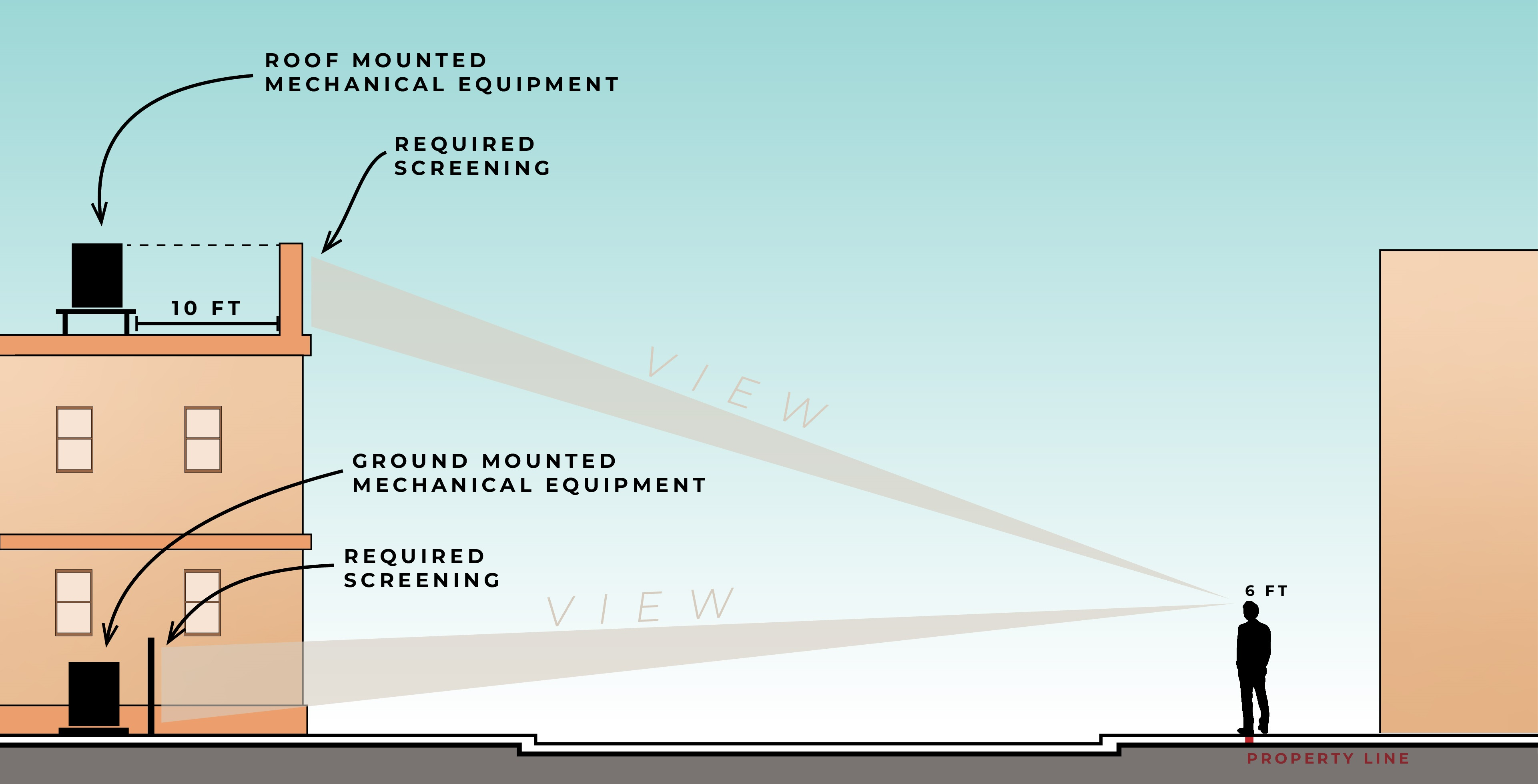
(b)
Cantilevered Units. No air conditioning unit or associated equipment may be mounted to an external wall. All compressors must comply with standard requirements pertaining to placement and screening of mechanical and exterior accessory equipment and must be mounted on the ground. In residential development, window air conditioner units, defined as a single unit with all of the parts and components contained inside one box or casing, are not considered cantilevered units.
(c)
Roof Equipment. Permanently located mechanical equipment mounted on the roof of any building shall be positioned and organized towards the center of the roof as feasible, at a minimum distance of 10 feet from the building edges when possible, and screened from view at ground level as viewed from any public or private right-of-way or from any abutting property. Buildings are required to provide architectural treatments to screen all mechanical equipment, including elevator shafts which house mechanical equipment, by means of parapets, louvers, vegetation or architectural treatments, that is at a minimum the same height, or higher than the installed mechanical equipment height. If screening is visible from the right-of-way, it should be incorporated into the overall design of the building. Screening materials shall be the same or compatible with the materials and colors used for the principal building. Compliance with this subsection shall be determined by the Appearance Review Officer.
(d)
Propane tanks. The location of propane tanks shall be regulated by the National Fire Protection Agency (NFPA), and the location and screening standards of this Chapter. In the event that any conflict between this Chapter and NFPA regulations, NFPA shall prevail. Alternative separation distances must be approved by the Fire Department.
(Ord. of 3-9-2009, § 2, Doc. #0903091103; Ord. No. 2022-66, § 1, 1-9-2023, Doc. #2301091201)
Sec. 58.983. - Mechanical and Exterior Accessory Equipment Used in Nonresidential and Multifamily Residential Development.
Mechanical and exterior accessory equipment for non-residential development and multifamily dwelling units shall comply with the following additional standards and conditions:
(a)
Mechanical and exterior accessory equipment shall be subject to the setback requirement for principal structures within the zoning districts; and
(b)
Mechanical and exterior accessory equipment shall not be located between any portion of the principal structure and any street, except when required by a utility provider. Vegetation and/or solid screening is being provided on 3 sides as viewed from the right-of-way.
(Ord. of 3-9-2009, § 2, Doc. #0903091103; Ord. No. 2022-66, § 1, 1-9-2023, Doc. #2301091201)
Sec. 58.984. - Mechanical and Exterior Accessory Equipment Used in Residential Development.
Mechanical and exterior accessory equipment for residential units shall:
(a)
Not be located between the facade of the structure served by the mechanical equipment and any street, unless placed below grade and at minimum 15 feet from any front and/or street side property lines;
(b)
Be located no less than ten (10) feet behind the plane of the principal facade of the principal structure, unless placed below grade and at minimum 15 feet from any front and/or street side property lines;
(c)
Be located no less than 15 feet from the rear lot line;
(d)
Be located no less than five (5) feet from a side lot line; and
(e)
Be located no less than 20 feet from the normal high water elevation of any waterbody or any wetland.
(Ord. of 3-9-2009, § 2, Doc. #0903091103; Ord. No. 2018-44, § 5, 9-4-2018, Doc. #1809041202; Ord. No. 2022-66, § 1, 1-9-2023, Doc. #2301091201)
Sec. 58.985. - Alternative Standards for Certain Mechanical and Exterior Accessory Equipment.
The following alternative standards shall apply to certain mechanical and exterior accessory equipment:
(a)
Air conditioning systems, generators, and above ground propane tanks up to 124 gallons, which service single-family, duplex or townhome units may be located no less than one (1) foot from the side lot line and no less than five (5) foot from the rear lot line. The equipment shall only encroach into the side yard setback on one side of the principal structure.
(b)
In single-family units, duplex, townhome units and certified affordable housing multifamily developments, air conditioning compressors may be located on a rear, functional and accessible balcony, that is at minimum four (4) feet wide, provided that the equipment is screened and not visible from the right-of-way or abutting property.
(c)
Below grade propane tanks up to 2,000 gallons, and above grade propane tanks with capacity between 125 and 500 gallons must be placed at least ten (10) feet from a structure and from the property lines. Above grade propane tanks between 501 and 2,000 gallons must be placed at least 25 feet from a structure and from the property lines.
(d)
All propane tanks that are 2,001 gallons or above must be placed at least 50 feet from a structure and from the property lines.
(Ord. of 3-9-2009, § 2, Doc. #0903091103; Ord. No. 2018-44, § 5, 9-4-2018, Doc. #1809041202; Ord. No. 2022-66, § 1, 1-9-2023, Doc. #2301091201)
Sec. 58.986. - Mechanical Equipment for Pools, Hot Tubs, Hydrospas or the like.
Mechanical equipment for pools, hot tubs, hydrospas or the like must be located as follows:
(a)
Pool and spa equipment must have a minimum setback of 2 feet from the side and rear property lines
(b)
Pool and spa equipment shall not be located within a ten (10) foot horizontal setback from any overhead utility lines and transmission tower anchors.
(c)
Pool and spa equipment shall not be located within a drainage swale or any similar easements.
(d)
Pool and spa equipment shall not be located between any principal facade and a street.
(e)
The co-location of pool and spa equipment with other similar mechanical equipment on site is encouraged.
(Ord. of 3-9-2009, § 2, Doc. #0903091103; Ord. No. 2021-45, § 1, 7-19-2021, Doc. #2107191203)
Sec. 58.987. - Modifications.
Modification of the regulations set forth in this subpart shall be through the Variance or the Modification of Standards processes as set forth in Chapter 65 Modification of the regulations of mechanical equipment serving residential uses is not be allowed through the Non-Substantial Modifications process set forth in Sec. 65.303.
(Ord. of 3-9-2009, § 2, Doc. #0903091103; Ord. No. 2021-45, § 1, 7-19-2021, Doc. #2107191203)
Sec. 58.988. - Applicability.
This Subpart does not apply to mechanical equipment permitted prior to adoption of this Subpart. Nor does this Subpart apply to the replacement of existing permitted mechanical equipment when such replacement retains the same footprint, or such footprint is only altered as necessary to allow a more energy efficient or lower emission unit of mechanical equipment.
Only the regulations of this Subpart set forth in Sec. 58.982(a) apply to the replacement or improvement of nonpermitted mechanical equipment existing prior to adoption of this Subpart. However, such equipment may only be placed in side yards where the principal structure meets or exceeds the required side yard setback(s) in the applicable zoning district, and providing at least five (5) feet unobstructed of mechanical equipment on one side of the principal structure.
(Ord. No. 2018-3, § 1, 2-12-2018, Doc. #1802121201; Ord. No. 2021-45, § 1, 7-19-2021, Doc. #2107191203)
Sec. 58.991. - Walk-Up Windows.
a.
General Requirements. Walk-up windows for pickup or point of sale transactions shall be considered an accessory use for light retail or eating and drinking (in association with food and/or beverage pickup). All walk-up windows require Zoning Official Determination.
b.
Location. Walk-up windows must be located at least 100 feet from a residential zoning district and at least 10 feet from the public right-of-way. The distance shall be measured by the shortest, most direct bearing distance from the property line of the closest property within the residential zoning district or public right-of-way to the walk-up window location. Walk-up windows which do not meet the standards above are subject to a Conditional Use Permit application consistent with Chapter 65, Part 2D.
c.
Conditions of Approval. The Zoning Official may impose reasonable conditions of approval such as hours of operation and buffering. The purpose of the conditions is to prevent negative impacts to nearby residential property, and avoid spillover of patrons into the public right-of-way or adjacent properties.
(d)
Design. The walk-up window must be constructed with similar materials as the principal structure it is in. The walk-up window must be situated to allow for pedestrian access and queuing outside of any vehicle paths and must meet all accessibility requirements. The walk-up window must not be accessible by a person in a vehicle. Any take-out window that has vehicular access shall not be considered a walk-up window and shall be regulated as a Drive-through facility.
(e)
Orientation. Walk-up windows must be visible from the street and oriented away from the residential zoning district.
(f)
Noise. Walk-up windows shall not have a speaker box as commonly associated with Drive-through facilities. Within 100 ft. of residential, no outdoor speakers are allowed.
g.
Parking. The subject site hosting the walk-up window must meet the parking requirements for the light retail use or eating and drinking use associated with the requested walk-up window.
(Ord. No. 2021-38, § 1, 6-28-2021, Doc. #2106281205; Ord. No. 2024-18, § 4, 5-13-2024, Doc. #2405131203)
Editor's note— At the request of the City, per an email of August 3, 2021, Section 58.990 has been renumbered as 58.991.

