
Oviedo City Zoning Code
ARTICLE XVIII
BASIC DEFINITIONS AND INTERPRETATIONS
General: Unless otherwise specifically provided, or unless clearly required by the context, the words and phrases defined in this section shall have the meaning indicated when used in this LDC.
Abandoned Application
An application shall be deemed abandoned when no activity occurs for twelve (12) consecutive
months. The Land Use Administrator shall issue a notice of abandoned application to
the applicant. Any submittal after the issuance of a notice of abandoned application
shall constitute a new application.
Abated Application
An application shall be deemed abated when no activity occurs for six (6) consecutive
months. The Land Use Administrator shall issue a notice of abated application to the
applicant. Any submittal after the issuance of a notice of abated application shall
require the payment of an abated application fee and must comply with any amendments
to this LDC, the Engineering Standards Manual, or Florida Fire Prevention Code adopted
after the last review of the application.
Accessory Use
The use of a structure of a nature customarily incidental and subordinate to the principal
use. No accessory structure will be allowed unless the principal use is in place or
permitted.
Accessory Structure
A structure on the same lot with, and of a nature incidental and subordinate to, the
principal structure, such as the following:
(a)
Detached structure that does not exceed twelve (12) feet in height and one hundred twenty (120) square feet of floor space. (Detached accessory structures in excess of one hundred twenty (120) square feet must meet the setback requirements in Section 2-6.3.) See Section 2-6.4 for accessory building setbacks. Mobile homes or trailers may not be used as storage buildings.
(b)
Swimming pools.
(c)
Screen pool enclosure.
(d)
Air conditioners, satellite dishes, solar panels, or other accessory structures.
(e)
Antennas.
(f)
Boat docks.
(g)
Private boat ramps.
Addition
Any construction that adds or enlarges the size of an existing building. Additions
also include any extension or increase in floor area, or height of building or structure.
Examples of an addition are: porch, carport, new room, room configuration, etc.
Adjacent Areas
The transition zone between wetlands and upland communities where the following development
activities may be regulated:
(a)
Bulkheading (impounding, interrupting or diverting surface water).
(b)
Drainage ditches.
(c)
Dredging.
(d)
Filling.
(e)
Hazardous material (storage, use or disposal of any hazardous material).
(f)
Solid waste disposal.
(g)
Stormwater retention/detention basins.
The adjacent area is that area with a direct groundwater or surface water influence on the wetland where development activities listed above may have an adverse impact on wetlands. In the absence of sufficient information to determine the adjacent area, the area will be defined as all property within three hundred (300) feet of the wetland boundary.
Adult Entertainment
Any establishment defined within Ordinance 893 of the City of Oviedo as it may be
from time to time amended.
Adult Family-Care Home
A full-time, family-type living arrangement, in a private home, under which a person
who owns or rents the home provides room, board, and personal care, on a 24-hour basis,
for no more than five (5) disabled adults or frail elders who are not relatives (F.S.
§ 429.65).
Adverse Impact to a Wetland
The diminishing of wetland functions caused by a development activity.
Affected Property Owner
Any person who resides, owns property, or owns a business within two hundred (200)
feet of a property under consideration for development approval by the City.
Alcoholic Beverages
All beverages containing alcohol of more than one (1) percent by weight.
Alley
Right-of-way providing a secondary means of access and service to abutting property.
Alternative Energy
Alternative energy refers to energy that uses non-fossil fuel sources, such as, but
not limited to, solar energy, wind energy, and geothermal energy.
Antiquated Subdivision
A subdivision that was recorded before the date of the original enactment of the City's
Subdivision Regulations by Ordinance No. 210 on March 1, 1971 and the lot(s) within
which are not suitable for development as originally platted.
Applicant
A person or entity which submits an application for development approval to the City,
and the person or entity's successors and assigns.
Architectural Articulation
Articulation refers to the manner in which architectural elements are used to define
the shape and volume of a building. An articulated building can clearly reveal the
precise nature of its parts and its relationship to one another and to the whole.
Architectural Elements
Architectural elements are the details and component parts that, together, form the
unique characteristics of houses, buildings and structures. Elements like line, shape,
color and texture are combined to make formal compositions in an architectural design,
creating pattern, rhythm, symmetry, balance, contrast, proportion, theme, and unity.
Artificial Obstruction
Any obstruction, other than a natural obstruction, that is capable of reducing the
flood-carrying capacity of a stream or may accumulate debris and thereby reduce the
flood-carrying capacity of a stream. A natural obstruction includes any rock, tree,
gravel or analogous natural matter that is an obstruction and has been located within
the floodway by a non-human cause.
Artisan Food Production
Establishments that can manufacture artisan food on a small scale such as, but not
limited to, breads, cheeses, charcuterie, pasta, and sweets, not to exceed seventy-five
(75) percent of the business square footage. These establishments shall include a
tasting room and retail space to sell the local production for consumption on the
premises and off premises, along with retail items and food.
Assisted Living Facility
Any building or buildings, section or distinct part of a building, boarding home,
home for the aged, or other facility, whether operated for profit or not, which are
licensed pursuant to F.S. Ch. 400, Part III Home Health Agencies, and which undertakes
through its ownership or management, to provide housing, meals, and one (1) or more
personal services for a period exceeding twenty-four (24) hours to one (1) or more
adults who are ambulatory and not relatives of the owner or administrator.
Attached Dwellings
Dwelling units which share a common wall or walls and have ground-floor entrances
to every unit, including but not limited to townhomes, duplexes, and triplexes. For
the sole purpose of density calculations, townhomes will be considered a multi-family
residential development.
Automatic Irrigation Controller
A timer, capable of operating solenoid valves, to set days and lengths of time for
proper application of water, in each irrigation zone.
Bar or Cocktail Lounge
Any business or establishment devoted primarily to the retailing and on-premises consumption
of malt, vinous, distilled, or other alcoholic beverages. Micro-breweries, micro-distilleries
and micro-wineries are not considered bars or cocktail lounges.
Base Flood Elevation
The elevation of a flood which has a one (1) percent chance of being equaled or exceeded
in any given year. Base flood elevation is also known as the one hundred-year flood
elevation.
Bed and Breakfast Facility
An owner-occupied house, or portion thereof, where short-term lodging and meals are
provided for compensation.
Best Management Practices (BMPs)
A practice or combination of practices based on research, field-testing, and expert
review, determined to be the most effective and practicable on-location means, including
economic and technological considerations, for improving water quality, conserving
water supplies, preventing pollution, and protecting natural resources.
Bicycle Lane
A portion of a roadway which may be designated by striping, signing, and pavement
markings for the preferential or exclusive use of bicyclists.
Bicycle Path
A bicycle facility which is physically separated from motorized vehicular traffic
by an open space or barrier and which is either within the highway right-of-way or
within an independent right-of-way. Conflicts with motorized traffic are minimized.
Bicycle Parking Facility
A portion of either the vehicle accommodation area or another area designed exclusively
for parking bicycles, where the user can lock the frame and both wheels to a stationary
object using a lock provided by the user.
Boarding House
(See Rooming House.)
Boat Dock
Any structure to which a vessel can be moored and that affords access to a vessel
on or over submerged lands (all those lands lying waterward of the mean high water
level) from the adjacent upland property. The term boat dock is synonymous with dock,
pier, access pier, terminal platform, mooring pilings, and boathouse, constructed
alone or in any combination.
Boat House
A shed or other covered or uncovered structure located at the edge of a river, lake,
pond or other water body used for housing boats and other water vessels or watercrafts.
The boathouse may be a component of a boat dock.
Boat Ramp
Any structure, clearing, or artificially stabilized area that extends to or waterward
of the normal high water elevation for the purpose of launching and/or retrieving
motorized watercraft.
Boat Terminal (Terminal Platform)
A covered or uncovered deck, building, or structure designed to serve or accommodate
passengers and provide an area where passengers can board and alight the boat or vessel.
Building
A structure designed to be used as a place of occupancy, storage or shelter and includes
any substantial structure which by nature of its size, scale, dimensions, bulk or
use tends to constitute a visual obstruction or generate activity similar to that
usually associated with a building. Without limiting the generality of the foregoing,
gas pumps and overhead canopies or roofs shall be deemed to fall within this description.
Buildable Area
The portion of a lot remaining after required yards have been provided.
Building Frontage
The length of a building along a street.
Building Frontage, Active
Building frontage where there is an active visual engagement between those in the
street and those on the ground floors of buildings. This quality is assisted where
the front façade of buildings, including the main entrance, faces and open towards
the street.
Building Height
The vertical distance between the average finished grade in front of the building
and the top of the ceiling plate on the top floor of the building.
Building, Principal
A building in which is conducted the main or principal use of the lot on which said
building is located.
Camouflage (or Stealth) Communication Tower or Antennae
A communication tower or antennae designed to merge and blend into and conform to
appearance with existing surroundings. An example of a camouflage communication tower
would be a tower that is constructed in the form and shape of a tree in order to appear
to be part of a forested area or a tower constructed to appear to be or to actually
be a component of a bell tower or to be constructed to be or appear to be a component
of a church steeple in order for the tower to be or appear to be part of these more
aesthetically pleasing structures. An example of a camouflage antenna would be an
antenna with a color or appearance similar to a wall of a building or structure on
which it is to be affixed, or an antenna located inside or on top of an existing structure
such as an existing church steeple or an existing light pole.
Canoe Launch
Any structure, clearing, or artificially stabilized area that extends to or waterward
of the normal high water elevation for the purpose of launching and/or retrieving
canoes, rafts, or other non-motorized watercraft.
Change in Use
A change in use from one (1) principal use category to another that increases the
density/intensity to such an extent that the impacts of development are increased.
Chemical Supplier
(Definition for wellfield protection purposes only) means the agents, distributors,
and dealers who store or warehouse:
(a)
Hazardous/toxic waste products;
(b)
Acutely hazardous waste with a hazard code of "H" as defined in Title 40, CFR, Chapter I, Subchapter I, Part 261, Section 261.3; or
(c)
Those substances on the List of Highly Hazardous Chemicals, Toxics and Reactives as set forth at 29, CFR, 1910.119, Appendix A.
Circulation Area
That portion of the vehicle accommodation area used for access to parking or loading
areas or other facilities on the lot. Essentially, driveways and other maneuvering
areas (other than parking aisles) comprise the circulation area.
Cistern
Cistern refers to a container (underground or not) that is used for collecting and
storing rainwater.
Commercial Subdivisions
Comprised primarily of commercial lots within areas zoned commercial or office. Streets
within commercial subdivisions are typically classified as commercial.
Common Area
Land within or related to a development, not individually owned or dedicated for public
use, which is designed and intended for the common use or enjoyment of the owners,
occupants, and their guests of the development.
Communication Antennae
One (1) that is designed to transmit or receive communications as authorized by the
Federal Communications Commission.
Communication Tower
A building or ground mounted tower which is greater than thirty-five (35) feet in
height, as measured from the finished grade of the parcel, does not exceed three hundred
(300) feet in height (including antenna), and is principally intended to support communication
(transmission or receiving) equipment for radio, TV, microwave, cellular and similar
communication purposes. The term communications tower shall not include amateur radio
operators' equipment licensed by Federal Communications Commission (FCC). Communication
towers are generally described as either monopole (free standing), guyed (anchored
with guy wires) or self supporting (square, triangular or pyramidal in plain view
and constructed of steel lattice, tubular steel, reinforced concrete or wood).
Community Residential Home
A dwelling unit licensed to serve residents who are clients of the Department of Elderly
Affairs, the Agency for Persons with Disabilities, the Department of Juvenile Justice,
or the Department of Children and Families or licensed by the Agency for Health Care
Administration which provides a living environment for seven (7) to fourteen (14)
unrelated residents who operate as the functional equivalent of a family, including
such supervision and care by supportive staff as may be necessary to meet the physical,
emotional, and social needs of the residents (F.S. § 419.001). Community Residential
Homes of six (6) or fewer residents shall be deemed a single-family unit and a noncommercial,
residential use.
Commemorative Plaques
A commemorative plaque is a plate of metal, ceramic, stone, wood, or other material
that is typically attached to a wall, stone, post, or other vertical surface and that
bears text and/or an image to commemorate or identify one (1) or more persons, an
event, a former use of the place, or some other thing as a place worthy of visit.
Commemorative plaques may include commemorative signs/plates, historic signs, historic
markers, trail markers or signs that provide information on the history of the trail
or native flora and fauna in the area or along the trail, and public art identification
plaques.
Comprehensive Plan
A currently effective plan of the City of Oviedo adopted and regularly amended in
accordance with F.S. Ch. 163 and Rule 9J-5, F.A.C.
Continue in Good Faith
As used in the LDC, shall mean that the final development order has not expired and
that no period of more than six (6) months passes without permit activity. Permit
activity shall include application and/or approval of subsequent final development
orders or other permits required for project completion.
Controlled Access Facility
As defined by Florida Statutes, a street or highway to which the right of access is
highly regulated by the governmental entity having jurisdiction over the facility
in order to maximize the operational efficiency and safety of the high-volume through
traffic utilizing the facility. Owners or occupants of abutting lands and other persons
have a right of access to and from such facility at such points only and in such manner
as may be determined by the governmental entity. All state roads and/or divided highways
shall be controlled access facilities for the facilities for the purposes of the LDC.
Convenience Store (Type I)
A retail store that is designed and stocked to sell primarily food, beverages, and
other household supplies to customers who purchase only a relatively few items (in
contrast to a "supermarket"). It is designed to attract a large volume of stop-and-go
traffic. "Jiff", "7-11", and "Cumberland Farms" chains are examples of convenience
stores.
Convenience Store (Type II)
A retail store with gasoline sales that is designed and stocked to sell primarily
food, beverages and other household supplies to customers who purchase relatively
few items. It is designed to attract a high volume of stop-and-go traffic.
Cul-de-sac
A local street having one end open to vehicular traffic and the other end permanently
closed with a vehicular turn-around.
Day Care Center
Any child care arrangement that provides day care on a regular basis for five (5)
or more children under the age of six (6) years. Certification by the Florida Department
of Health and Rehabilitative Services is required.
DBH: Diameter at breast height.
The average diameter of the trunk of a tree measured at four and one-half (4½) feet
above natural grade.
Density
The number of dwelling units per net buildable acre. Net buildable acres is defined
as the number of upland acres within the boundary of a development excluding acreage
devoted to water of the state, wetlands, and lakes. Thus, the maximum number of dwelling
units that a development can accommodate shall be calculated by multiplying the net
buildable acreage by the residential density.
Department
The City of Oviedo Development Services Department or other department or agency as
designated by the City Manager.
Developer
Any person or legal entity who is responsible for any undertaking that requires a
development order.
Development
The carrying out of any building activity or operation, the making of any material
change in the use or appearance of any structure or land, or the subdividing of land.
(a)
The following activities, operations or uses shall be taken for the purposes of this definition to involve development; provided, however, that a reference to any specific activity, operation or use is not intended to mean that the activity, operation or use, when part of other activities, operations or uses is not intended to limit the generality of the first sentence of this definition:
(i)
A reconstruction, alteration of the size, or material change in the external appearance of a structure on land.
(ii)
A change in the intensity of use of land such as, by way of example and not limitation, an increase in the number of dwelling units in a structure or on land or material increase in the number businesses, manufacturing establishments, offices, or dwelling units in a structure or on land.
(iii)
Alteration of a shore or bank of a body of water.
(iv)
Commencement of excavation in nature of a borrow pit or similar activity on a parcel of land.
(v)
Demolition of a structure.
(vi)
Clearing of land as an adjunct of construction.
vii)
Deposit of refuse, solid or liquid waste, or fill on a parcel of land.
(viii)
All other activities, operations, or uses customarily associated with the above activities, operations, or uses unless otherwise specified in the LDC.
(b)
The following activities, operations or uses shall not be taken for the purpose of this definition to involve development:
(i)
Work by a highway or road agency or railroad company for the maintenance or improvement of a road or railroad track, if the work is carried out on land within the boundaries of the right-of-way.
(ii)
Work by any utility and other persons engaged in the distribution or transmission of gas, electricity, wastewater, reclaimed water or potable water, for the purpose of inspecting, repairing, renewing, constructing on established rights-of-way any sewers, mains, pipes, cables, utility tunnels, power lines, towers, poles, tracks, or the like.
(iii)
The lawful use of any land for the purpose of growing plants, crops, trees, and other agricultural or forestry products; raising livestock; or for other agricultural purposes.
(iv)
The improvement of land or the construction of a structure for a City public facility or project; provided, however, that this provision shall not be interpreted as the City asserting exemption from any Federal, State, or regional, or County permitting requirement as may be applicable to a particular project.
Development Agreement
An enforceable agreement between the City and a developer including agreements adopted
pursuant to F.S. Ch. 163.3220, and an agreement or development order issued pursuant
to Ch. 380, F.S.
Development, Low Impact
Low Impact Development (LID) refers to systems and practices that use or mimic natural
processes that result in the infiltration, evapotranspiration or use of stormwater
in order to protect water quality and associated aquatic habitat. At both the site
and regional scale, LID practice aims to preserve, restore and create green space
using soils, vegetation, and rainwater harvest techniques. LID is an approach to land
development (or re-development) that works with nature to manage stormwater as close
to its source as possible.
Development Order
An order granting, denying, or granting with conditions an application for approval
of a development project or activity.
Development Permit
A development permit is a document issued by the City which authorizes the actual
commencement of land alteration or building construction.
Development Site
The property under consideration for a development application of which may contain
one (1) or more lots and/or buildings.
Drainage Connection
Any structure, pipe, culvert, device, paved or unpaved area, swale, ditch, canal,
or other feature whether natural or created which is used or functions as a link or
otherwise conveys stormwater runoff or other surface water discharge.
Dripline
The ground area surrounding the trunk of a tree that is described by the vertical
plane enclosing the outermost branches of the tree. For asymmetrical specimens, or
those with unusually small crown spread, the dripline area shall in no case be less
than that area described by a radial dimension of one (1) foot for each one (1) inch
of trunk radius.
Drive-In Restaurant or Refreshment Stand
Any place or premises used for sale, dispensing, or serving of food, refreshments,
or beverages in automobiles, including those establishments where customers may serve
themselves and may eat or drink the food, refreshments, or beverages on the premises.
Drive-in restaurants and refreshment stands shall not mean or include pick-up windows
as defined by this Code, and said definitions shall be mutually exclusive.
Driveway
That portion of the vehicle accommodation area that consists of a travel lane bounded
on either side by an area that is not part of the vehicle accommodation area.
Drought Tolerant Landscaping
Plants, once established, that survive on natural rainfall with occasional irrigation
during dry periods.
Dwelling:
(a)
Single-Family. A detached residential dwelling unit other than a mobile home, designed for and occupied by one (1) family only which includes a kitchen and permanent facilities for living, sleeping, and sanitation.
(b)
Duplex. A detached residential building containing two (2) dwelling units, designed for occupancy by not more than two (2) families, containing either a common wall or ceiling/floor.
(c)
Townhouse. A residential building designed for or occupied by three (3) or more dwellings that share common vertical walls. The same as townhome.
(d)
Multiple-Family. Multiple dwelling units which are located in a single building, in which the entrances to individual units may be above the first floor, including but not limited to garden apartments, residential towers, and multiple upper-story residences which are located in mixed-use buildings.
Dwelling Unit
A building consisting of one (1) room, or rooms connected together constituting a
separate, independent housekeeping establishment. Said enclosure shall contain independent
sleeping, kitchen and bathroom facilities designed for and used, or held ready for
use, as a permanent residence by one (1) family.
Easement
Any strip or parcel of land dedicated for public or other private utilities, drainage,
sanitation or other specified uses having limitations. The title shall remain in the
name of the property owner, subject to the right of use designated in the reservation
of the servitude.
Econlockhatchee River Basin Affected Area
The area over which this section shall be applicable shall be that portion of the
Econlockhatchee River Basin within the boundaries of Oviedo, Florida. For the purposes
of this section, the "Econlockhatchee River Basin" shall mean and be referred to as
those lands within Oviedo which are described in Exhibit "A". The determination as
to whether a development project is within the Econlockhatchee River Basin shall be
made pursuant to the Land Development Code. All property that is within the Econlockhatchee
River Basin, but is not within the "Econlockhatchee River Corridor Protection Zone",
but shall not be subject to the provisions of this overlay zoning classification relating
to properties located within the Econlockhatchee River Corridor Protection Zone which
provisions shall only apply to properties located within said zone. The Land Development
Code shall not be construed to prohibit the transfer of density credits to properties
located outside the Econlockhatchee River Basin when such properties are physically
contiguous to property located in the Basin, are in common ownership with property
located within the Basin and together formed a single parcel of record as of the effective
date of this section.
Econlockhatchee River Basin Rare Upland Habitats
Those vegetative communities identified by the City as scrub, Longleaf Pine - Xeric
Oak, Sand Pine Scrub, Xeric Oak and Live Oak Hammock. Those vegetative communities
are defined in the Florida Land Use Cover and Forms Classification System which is
published by the Florida Department of Transportation and is attached hereto as Exhibit
"B" which is incorporated herein by this reference thereto as if fully set forth herein
verbatim.
Econlockhatchee River Corridor Protection Zone
The "Econlockhatchee River Corridor Protection Zone" is hereby established which includes
the following areas:
(a)
The main channels of the Big Econlockhatchee River and its tributaries as graphically depicted on or listed in Exhibit "A";
(b)
All property located within the first one thousand one hundred (1,100) feet landward as measured from the stream's edge of the main channels of the Big Econlockhatchee River and Little Econlockhatchee River;
(c)
All property located within the first five hundred fifty (550) feet landward as measured from the stream's edge of the tributaries of the Big Econlockhatchee River;
(d)
Notwithstanding the above physical descriptions of the Econlockhatchee River Corridor Protection Zone, the Zone shall extend to and contain at least fifty (50) feet of uplands property which is landward of the landward edge of the wetlands abutting the main channels of the Big Econlockhatchee River and its tributaries;
(e)
Provided, however, that only property located within the Econlockhatchee River Basin shall be deemed to be located within the Econlockhatchee River Corridor Protection Zone.
Econlockhatchee River Stream's Edge
The waterward extent of the forested wetlands abutting the Big Econlockhatchee River
or its tributaries. In the absence of forested wetlands abutting the Big Econlockhatchee
River or its tributaries, the stream's edge means the mean annual surface water elevation
of the stream; provided, however, that if hydrologic records upon which the City can
rely upon are not available, the landward extent of the herbaceous emergent wetland
vegetation growing in the Big Econlockhatchee River or its tributaries shall be considered
to be the stream's edge.
Emitter
A device that applies irrigation water. This term is primarily used to refer to the
low flow rate devices used in micro-irrigation systems.
Facade, Primary
The side of a building that faces a public right-of-way or has the primary entrance.
Facade, Secondary
The side of a building that is not a primary facade and either is visible from a public
right-of-way or has a secondary or tertiary entrance.
Family
One (1) or more persons related by blood, marriage, or adoption, exclusive of family
servants, occupying a single dwelling unit, and living as a single household unit
as distinguished from a group occupying a boarding house, lodging house, hotel or
motel, or fraternity or sorority. A number of persons, not exceeding three (3), occupying
a dwelling and living as a single household unit, though not related by blood, marriage
or adoption, shall be deemed to constitute a family.
Fenestration
Doors, windows, and other openings in a building exterior facade for the intended
purpose of letting light and air into a building's interior.
Financial Feasibility
In accordance with F.S. § 163.3164(32), means that sufficient revenues are currently
available or will be available from committed funding sources for the first three
(3) years, or will be available from committed or planned funding sources for years
four (4) and five (5), of a five-year capital improvement schedule for financing capital
improvements, such as ad valorem taxes, bonds, state and federal funds, tax revenues,
impact fees, and developer contributions, which are adequate to fund the projected
costs of the capital improvements identified in the comprehensive plan necessary to
ensure that adopted level-of-service standards are achieved and maintained within
the period covered by the five-year schedule of capital improvements. The requirement
that level-of-service standards be achieved and maintained shall not apply if the
proportionate-share process set forth in F.S. § 163.3180(12) and (16) is used.
Flag
The following definition shall apply in all zoning districts (classifications), including,
but not limited to the provisions of Section 6.4 of the LDC relating to the New Downtown Development and Redevelopment Districts,
and with regard to all land development regulations of the City of Oviedo:
"A horizontally displayed piece of cloth, fabric or other flexible and unframed material, usually rectangular, of distinctive color and design, normally used as a symbol, standard, signal, or emblem. Flags of a nation, state or city; an organization of nations, states or cities; fraternal, religious or civic organizations; corporate entities; or persons or entities to make a statement of expression that are displayed in a number that is authorized by this LDC are not considered as a sign or attention-getting device as defined in this LDC. Flags must be flown and displayed on a flagpole.
Flagpole
A freestanding structure or a structure attached to a building/structure or to the
roof of a building/structure if approved by the City during a site development order
or building permit approval process and used for the purpose of displaying flags.
Flagpoles must be maintained to ensure structural integrity and are prohibited and
unlawful if in a nuisance or dilapidated condition.
Flashing
Production of brief flashes of light, in less than four-second intervals, and includes
the term stroboscopic.
Floodplain
Any land area susceptible to being inundated by water from the one hundred-year flood.
As used in this LDC, the term refers to lands lying within the flood hazard areas
delineated on Federal Emergency Management Agency, Federal Insurance Administration
(FEMA/FIA) Flood Insurance Rate Maps and Floodway and Flood Boundary Maps. Flood plain
areas are also designated in the Comprehensive Plan. If the FEMA/FIA maps are over
five (5) years old and significant development has occurred in the watershed area,
actual field conditions will be surveyed by the Applicant. Findings of the survey
shall be provided to the FEMA for use in updating their maps. The "floodplain" designation
shall be removed for floodplain areas that have been altered in accordance with this
LDC or other sections of the Land Development Code so that the elevation no longer
falls within the floodplain.
Floodway
The channel of a river or another watercourse and the adjacent land areas that must
be traversed in order to discharge the one hundred-year flood.
Floor Area, Gross
The total number of square feet of floor area in a building determined by horizontal
measurements between the exterior faces of walls.
Floor Area Ratio (FAR)
The total area of all floors of a building intended for occupancy or storage divided
by the total site area. Floor area ratio applies to non-residential uses. Parking
Garages are not included in the calculation of the Floor Area Ratio.
Fraternity or Sorority House
A dwelling or combination of dwellings on a single lot occupied and maintained exclusively
for college, university or professional school students who are affiliated with a
social, honorary or professional organization recognized by the college, university
or professional school.
Front Foot, Property
Each foot, or portion thereof, measured along the public right-of-way where the subject
property abuts said right-of-way.
Front Foot, Building
Each foot, or portion thereof, of a building measured along the side of the building
which faces the primary frontage. Where buildings form an "L" or "U", all main entry
sides are measured.
Garage, Mechanical
A building or portion thereof, other than a private garage or service station, designed
or used for repairing.
Garage, Private
An accessory building or an accessory portion of the principal building designed or
used for inside parking of motor vehicles owned by the occupants of the building to
which it is accessory.
Glare
The sensation produced by luminance within the visual field that is sufficiently greater
than the luminance to which the eyes are adapted to cause annoyance, discomfort or
loss in visual performance or visibility. The two (2) types of glare are as follows:
(a)
Disability Glare. Glare that reduces the ability to see or identify objects.
(b)
Discomfort Glare. Glare that produces ocular discomfort, but does not reduce the ability to see.
Guest Cottage (or "Mother-in-Law Suite")
A detached building or an attached suite located on the same premises of the main
residential building, intended for intermittent or temporary occupancy by a nonpaying
guest or permanent occupancy by a non-paying family member. The main residential building
must have a Certificate of Occupancy before a guest cottage may be approved.
Habitable Space
A space in a structure for living, sleeping, eating or cooking. Bathrooms, toilet
compartments, closets, halls, screen enclosures, storage or utility space, and similar
areas are not considered habitable space.
Hazardous, Non-Bulk Consumer Commodities
Consumer commodities that are packaged and distributed in a form intended for, or
suitable for sale through retail sales. To determine if a particular hazardous material
qualifies as a consumer commodity, refer to the section number in 49, CFR, Section
172.101 Hazardous Materials Table for that material.
Healthy Community Design
Healthy community design links the traditional concepts of planning (such as land
use, transportation, community facilities, parks, and open space) with health themes
(such as physical activity, public safety, healthy food access, mental health, air
and water quality, and social equity issues).
Home Occupation
Any business or non-residential activity that is conducted or petitioned to be conducted,
in whole or in part, from property that is zoned for residential use.
Household Hazardous Waste
Hazardous waste generated by individuals on the premises of a residence for individuals
(a household) and composed primarily of materials found in the wastes generated by
consumers in their homes.
Hotel
(See Motel.)
Household Unit, Single
In determining whether or not a group of unrelated individuals is a" single household
unit " as referenced in the definition of "family", the following criteria must be
present:
(a)
The occupants must share the entire dwelling unit. A unit in which the various occupants act as separate roomers can not be deemed to be occupied by a "single household unit."
(b)
The family must have stability with respect to the purpose of single-family residential zoning districts. Evidence of such stability may include the following:
(i)
The presence of minor dependent children regularly residing in the family.
(ii)
Proof of the sharing of expenses for food, rent or ownership costs, utilities and other family expenses and sharing in the preparation, storage and consumption of food.
(iii)
Whether or not different members of the family have the same address for the purpose of:
1.
Voter registration.
2.
Driver's license.
3.
Motor vehicle registration.
4.
Summer or other residences.
5.
Filing of taxes.
6.
Delivery of mail.
(iv)
Common ownership of furniture and appliances among the members of the household.
(v)
Enrollment of dependent children in local schools.
(vi)
Employment of household members in the local area.
(vii)
A showing that the group has been living together as a unit for a year or more, whether in the current dwelling unit or other dwelling units.
(viii)
Residence is licensed and approved by the Florida State HRS as an adult congregate living facility, community residential home, or foster care facility.
(ix)
With exception to [h], the household functions on a nonprofit basis.
(x)
Any other factor reasonably related to whether or not the group or persons is the functional equivalent of a family.
Improvements
Street pavement, curbs, and gutters, sidewalks, water mains, sanitary sewers, storm
sewers or drains, street names, signs, landscaping, permanent reference monuments,
permanent control points and any other construction required by the City.
Indirect Lighting
Artificial lighting located external to the sign face.
Industrial Park
A tract of land that has been planned, developed, and operated as an integrated facility
for a number of separate industrial uses with supporting ancillary uses, and open
space all designed, planned, constructed, and maintained on a coordinated basis.
Industrial Subdivisions
Comprised primarily of industrial lots within areas zoned industrial. Streets within
industrial subdivisions are typically classified as commercial.
Intensity
The degree to which land is used measured by a ratio applied to the development acreage
that provides the maximum total square footage a developer is allowed to build. Intensity
is used for non-residential uses.
Irrigation System
Application of water by artificial means, that is, means other than natural precipitation.
A permanent watering system designed to transport and distribute water to plants as
a supplement to natural rainfall.
Irrigation Zone
A control valve circuit containing emitters, sprays and/or rotors with consistent
application rates.
Joint Use Connection
A single connection point that serves as a connection to more than one (1) property
or development, including those in different ownerships or in which access rights
are provided in the legal descriptions.
Kennel
A place where dogs and other small animals and house pets are kept, sheltered, boarded,
bred, or groomed for compensation.
Land Use Administrator
The City Manager or designee.
Landscaped Area
The entire parcel: less the building footprint, driveways, hardscapes such as decks
and patios, and non-porous areas. Water features are included in the calculation of
the landscaped area. This landscaped area includes Xeriscape as defined in F.S. §
373.185(1)(b).
Landscape Plant Zone:
An area with a grouping of plants with similar water and agricultural (sunlight, soil,
etc.) needs. Plant groupings based on water use are low, medium and high.
Livestock
All animals of the equine, bovine, or swine class including, but not limited to goats,
sheep, mules, horses, hogs, cattle and other grazing animals.
Loading Space, Off-Street
Space logically and conveniently located for bulk pickups and deliveries, scaled to
delivery vehicles expected to be used, and accessible to such vehicles when required
off-street parking spaces are filled. Required off-street loading space is not to
be included as off-street parking space in computation of required off-street parking.
Lot
For purposes of the LDC, a lot is a parcel of land of at least sufficient size to
meet minimum zoning requirements for use, coverage, and area, and to provide such
yards and other open spaces as are herein required. Such lot shall have frontage on
an improved public street, or on an approved private street, and may consist of:
(a)
A single lot of record;
(b)
A portion of a lot of record;
(c)
A combination of complete lots of record, of complete lots of record and portions of lots of record, or of portions of lots of record;
(d)
A parcel of land described by metes and bounds; provided that in no case of division or combination shall any residual lot or parcel be created which does not meet the requirements of this ordinance.
Lot Boundary Line
Lot boundaries other than those that abut streets.
Lot Frontage
The front of a lot shall be construed to be the portion nearest the street. For the
purposes of determining yard requirements on corner lots and through lots, all sides
of a lot adjacent to a street shall be considered frontage, and yards shall be provided
as indicated under "yard" in this section.
Lot Measurements
(a)
Depth of a lot shall be considered to be the distance between the midpoints of straight lines connecting the foremost points of the side lot lines in front and the rearmost points of the side lot lines in the rear.
(b)
Width of a lot shall be considered to be the distance between the side lot lines measured at the front building line and parallel to the front lot line.
Lot of Record
A lot which is part of a subdivision recorded in the office of the county recorder,
or a lot or parcel described by metes and bounds, the description of which has been
so recorded.
Lot Types
The following types of lots are defined to clarify terminology used later in the LDC:
(a)
Corner Lot. A lot at the intersection of two (2) or more streets or along a single street that forms its own corner and provides frontage along two (2) sides of the same lot. A lot abutting on a curved street or streets shall be considered a corner lot if straight lines drawn from the foremost points of the side lot lines to the foremost point of the lot meet at an interior angle of less than one hundred thirty-five (135) degrees.
(b)
Interior Lot. A lot other than a corner lot with only one (1) frontage on a street.
(c)
Through Lot. A lot other than a corner lot with frontage on more than one (1) street. Through lots abutting two (2) streets may be referred to as double frontage lots.
(d)
Reversed Frontage. A lot on which the frontage is at right angles or approximately right angles (interior angle less than one hundred thirty-five (135) degrees) to the general pattern in the area. A reversed frontage lot may also be a corner lot, an interior lot, or a through lot.
Massing
The overall bulk, size, physical volume or magnitude of a structure or project.
Micro-brewery/Micro-distillery/Micro-winery
Establishments that can respectively brew beer, and/or distill spirituous beverages,
and/or produces wine on a small scale not to exceed seventy-five (75) percent of the
business square footage and with limited production as regulated by the state. These
establishments shall include a tasting room and retail space to sell the local production
for consumption on the premises and off premises, along with retail items and food.
Micro-Irrigation
The frequent application of small quantities of water directly on or below the soil
surface. An irrigation system with a maximum flow rate per emitter of thirty (30)
gallons per hour or less.
Mitigation
Mitigation refers to actions with the goal of lessening or minimizing the impacts
of deviations from any Land Development Code required standard in a development.
Mobile Home
A dwelling unit that: (i) is not constructed in accordance with the standards set
forth in the Standard Building Code, and (ii) is composed of one (1) or more components,
each of which was substantially assembled in a manufacturing plant and designed to
be transported to the home site on its own chassis, and (iii) exceeds forty (40) feet
in length and eight (8) feet in width. A travel trailer is not a mobile home.
(a)
Mobile Home Class A. A mobile home constructed after July 1, 1976, that meets or exceeds the construction standards promulgated by the U.S. Department of Housing and Urban Development that were in effect at the time of construction and that satisfies each of the following additional criteria:
(i)
The home has a length not exceeding four (4) times its width;
(ii)
The pitch of the home's roof has a minimum vertical rise of one (1) foot for each five (5) feet of horizontal run, and the roof is finished with a type of shingle that is commonly used in standard residential construction;
(iii)
The exterior siding consists of wood, hardboard, or aluminum (vinyl covered or painted, but in no case exceeding the reflectivity of gloss white paint) comparable in composition, appearance, and durability to the exterior siding commonly used in standard residential construction;
(iv)
A continuous, permanent masonry, foundation, unpierced except for required ventilation and access, is installed under the home; and
(v)
The tongue, axles, transporting lights, and removable towing apparatus are removed after placement on the lot and before occupancy.
(b)
Mobile Home, Class B. A mobile home constructed after July 1, 1976, that meets or exceeds the construction standards promulgated by the U.S. Department of Housing and Urban Development that were in effect at the time of construction but that does not satisfy the criteria necessary to qualify the house as a Class A mobile home.
(c)
Mobile Home, Class C. Any mobile home that does not meet the definitional criteria of a Class A or Class B mobile home.
(d)
Mobile Home Park. A residential use in which more than one (1) mobile home is located on a single lot.
Modular or Manufactured Home
A dwelling unit constructed in accordance with the standards set forth in the Standard
Building Code and composed of components substantially assembled in a manufacturing
plant and transported to the building site for final assembly on a permanent foundation.
Among other possibilities, a modular home may consist of two (2) sections transported
to the site in a manner similar to a mobile home (except that the modular home meets
the Standard Building Code) or a series of panels or room sections transported on
a truck erected or joined together on the site.
Motel
A building or a group of buildings containing sleeping accommodations or efficiency
units in which transient guests are lodged on a short-term basis. (For the purposes
of this ordinance, hotel and motel shall have the same meaning.)
Mother-in-Law Suite
(See Guest Cottage)
Mulch
Non living organic or synthetic materials customarily used in landscape design to
retard erosion and maintain moisture.
Multiple Frontage Property
A lot or parcel that is contiguous to more than one (1) public right-of-way, being
either a corner lot or a through lot.
Multi-Use Complex
Any development of two (2) or more occupancies that are under common land ownership
or that share common property frontage.
Non-Conforming
(a)
Lot. A lot existing at the effective date of this Code (and not created for the purposes of evading the restrictions of this Code) that does not meet the minimum area requirement of the district in which the lot is located.
(b)
Structure. Existing improvements which do not meet required parking and loading regulations, height regulations, area regulations, etc. for the district in which they are located.
(c)
Use. Any building or land lawfully occupied by a use at the time of adoption of this Code that does not conform with the use regulations of the district in which it is situated.
(d)
Sign. A sign lawfully existing in the City before the adoption of this sign code that does not conform to the requirements of this sign code. A sign not lawfully existing prior to the adoption of this sign code shall not be considered a non- conforming sign.
Office, Business
An office for activities such as real estate, advertising, insurance, travel agency,
ticket sales, abstract and title companies, insurance, etc. Retail or wholesale goods
are not shown to or delivered from the premises to a customer. A beauty or barber
shop is not a business office.
Office, Professional
An office for the use of architects, engineers, attorneys, accountants, physicians,
lawyers, dentists, etc. Professional offices generally offer consultant services.
Office of Convenience
An office use where the owner conducts no business other than by internet, phone or
mail; where no persons are employed except for members of the family residing on the
premises; and where the office space/home area is used only for the purpose of sending
and receiving communications and deliveries, maintaining records, and other similar
functions.
Office Park
A tract of land that has been planned, developed and operated as an integrated facility
for a number of separate office buildings with supporting ancillary uses and open
space all designed, planned, constructed, and maintained on a coordinated basis.
Off-Street Parking
A lot or parcel of land or structure designed, constructed, or utilized for the temporary
storage or parking of motor vehicles. Required off-street parking shall be so designed,
maintained, and regulated that no parking or maneuvering incidental to parking shall
be on any public street, walk, or alley.
Open Space
Any portion of a parcel, or area of land or water, which is open and unobstructed
from the ground to the sky, including areas maintained in a natural and undisturbed
character and areas which are permeable in nature. Open space shall not include areas
covered with buildings, sidewalks, pools, decks or patios, parking areas, drives or
other paved areas.
PCP (Permanent Control Point)
A secondary, horizontal-control monument, in accordance with F.S. Ch. 177.
PRM
Permanent Reference Monument provided in accordance with F.S. Ch. 177.
Parking Area Aisles
That portion of the vehicle accommodation area consisting of lanes providing access
to parking spaces.
Parking Space
A portion of the vehicle accommodation area or bicycle parking facility set for the
parking of one (1) vehicle or one (1) bicycle.
Personal Service
An establishment that primarily provides services generally involving the care of
a person or his or her apparel, such as barber shops, beauty salons, seamstress shops,
shoe repair shops, dry cleaning and laundry pickup facilities, coin-operated laundries,
and tuxedo or costume rentals.
Pervious Paving Materials
A porous asphaltic, concrete or other surface and a high void aggregate base which
allows for rapid infiltration and temporary storage of rain on, or runoff delivered
to, paved surfaces.
Pet Care Services
Services identified in the North American Industry Classification System (NAICS) for
pet care services, including, but not limited to, pet grooming services, include non-medical
activities and services which improve the appearance and hygiene of dogs, cats and
other small animals or household pets. Pet care services do not include kennels, kenneling
or over-night boarding of pets.
Pick-Up Windows
A window within a principal use used for the sale and dispensing of food, refreshments,
and/or beverages to persons, who have placed an order for food, refreshments, or beverages
from a location other than the establishment or premises where the food is prepared.
Pick-up windows shall not mean or include drive-in restaurants and refreshment stands
as defined by this Code, and said definitions shall be mutually exclusive.
Plant Bed
A grouping of trees, shrubs, ground covers, perennials, or annuals growing together
in a defined area devoid of turf/turfgrass, normally using mulch around the plants.
Plat
A map or delineated representation of the subdivision of lands; a complete exact representation
of the subdivision and other information in compliance with all applicable statutes
and regulations.
Potable Water
Water which is satisfactory for drinking, culinary, and domestic purposes and which
meets the quality standards of the Florida Department of Environmental Regulation.
Premises
The lot or lots, plots, portions or parcels of land considered as a unit for a single
development or activity.
Primary Frontage
The public right-of-way which is identified as the address of the premises.
Proportionate Fair Share
The method by which the impacts of development on transportation facilities can be
mitigated by the cooperative efforts of the public and private sectors. The intent
of the proportionate fair-share contributions, as provided in Article IX, is to provide
applicants for development an opportunity to proceed under certain conditions, notwithstanding
the failure of transportation concurrency, by contributing their share of the cost
of improving the impacted transportation facility. Proportionate fair share is a pay-and-go
method that does not require immediate resolution of the level of service (LOS) deficiency,
but transportation projects mitigating the LOS deficiencies on these facilities must
still be programmed for improvement in the five-year Capital Improvement Element of
the Comprehensive Plan or long term concurrency management system.
Protected Wellfield
Those wellfields with a permitted capacity of one hundred thousand (100,000) GPD or
more.
Recreation
(a)
Active Recreation. Recreational uses, areas, and activities oriented toward potential competition and involving special equipment. Playgrounds, sports fields and courts, swimming pools, golf courses are examples of active recreation uses.
(b)
Passive Recreation. Recreational uses, areas or activities oriented to noncompetitive activities that either require no special equipment or are natural areas. Bird watching, bicycle riding, and nature walks are examples of passive recreational activities.
Record Drawing
A set of approved plans and specifications which identify, at a minimum, substantial
deviations referenced in the certification of completion of construction that have
occurred since the permit was issued.
Refuse/Recycling Collection Container
Any detachable receptacle for the collection of refuse/recyclables that is two (2)
cubic yards or larger and is designated or intended for mechanical pick-up.
Residential Subdivisions
Comprised primarily of residential lots within areas zoned residential. Streets within
residential subdivisions are typically classified as either local or collector.
Right-of-Way
Land dedicated, deeded, used, or to be used for a street, alley, walkway, boulevard,
access or other purpose by the public, certain designated parties, or governing body.
"Right-of-way" shall exclude easements that are not a separate tract of land.
Roomer
An occupant who has use of a dwelling unit without actual or exclusive possession
or ownership of that residence.
Rooming House
A residential use consisting of at least one (1) dwelling unit together with one (1)
or more rooms that are rented or intended to be rented to more than one (1) family,
but which rooms, individually or collectively, do not constitute separate dwelling
units. A boarding house or rooming house is designed to be occupied by longer term
residents (month to month) as opposed to overnight or weekly guests.
Runoff
Water from precipitation or irrigation that flows over the ground surface and is not
absorbed into the ground, instead flowing into streams or other surface waters or
land depressions.
Screen Enclosure
A building or part thereof, in whole or in part self-supporting, and having walls
of insect screening with or without removable vinyl or acrylic wind break panels and
a roof of insect screening, plastic, aluminum or similar lightweight material.
Scrolling
Sliding text or images across a monitor or display in a manner which does not change
the layout of the text or pictures, but incrementally moves (pans or tilts) the user's
view across what is apparently a larger image that is not wholly seen. Scrolling does
not allow "jumps" (discontinuous movement) in the display.
Septic Tank
An individual sewage disposal system approved by the County Health Department and
serving only one (1) lot.
Service Station
Any building structure or land used for the dispensing, sale or offering for sale
at retail any automobile fuels, oils, or accessories. General automotive servicing,
as distinguished from automotive repair, may also be performed.
Setback
The minimum required distance between a structure and the lot lines of the lot on
which it is located.
Short-Term Residential Rentals
Rental of residential units for a time period no more than six (6) months.
Sidewalk
That portion of a street between the curbline, or the lateral line, of a roadway and
the adjacent property lines, intended for use by pedestrians.
Sight Distance Triangle
The triangular area required on any intersection corner to permit a vehicle operator
an unobstructed view of the crossing roadway for a minimum sight distance in either
direction.
Sign
Any surface, fabric, device or display which bears lettered, pictorial or sculptured
matter including, but not limited to, forms shaped to resemble any human, animal or
product, designed to convey information to the public and which is not artwork or
architectural detail. An object, device, display or structure, or part thereof, situated
outdoors , which is used to identify, display, or direct or attract attention to an
object, person, institution, organization, business, product, service, event or location
by any means including, but not limited to, words, letters, figures, design symbols,
fixtures, colors, illumination or projected image. For the purposes of this LDC, the
term "sign" shall include all structural members. A sign shall be construed to be
a display surface or device containing organized and related elements composed to
form a single unit. In cases where matter is displayed in a random or unconnected
manner without organized relationship of the components, each such component shall
be considered to be a single sign. In the case of a permanent sign made of any fabric
or other non-rigid material, the sign shall conform to each specification for such
signs found elsewhere in this ordinance, the Land Development Code and the Florida
Building Code. Any person or animal stationed at or proximate to a business site or
on the public right-of-way for the purpose of attracting attention to a business by
actions, props, signage or attire shall be deemed to be an off site sign.
Sign, A-Frame
A sign that is not permanently affixed to the ground, to be used by resting on the
ground and is intended to be easily moved.
Sign, Abandoned or Discontinued Sign or Sign Structure
A sign or sign structure is considered abandoned or discontinued when its owner fails
to operate or maintain the sign for a period of six (6) months or longer. The following
conditions shall be considered as the failure to operate or maintain a sign:
(1)
A sign displaying or advertising a product or service which is no longer available, or displaying or advertising a business which is no longer licensed;
(2)
Any previously permitted portable or temporary sign whose permitted time has expired; or
(3)
A sign which is blank or empty.
This definition of abandoned sign includes signs advertising a business that:
(1)
Is no longer licensed;
(2)
No longer holding a certificate of occupancy;
(3)
Is no longer doing business;
(4)
No longer has a utility service deposit or account;
(5)
Has failed to stay current on payment of its local business tax, or
(6)
Is no longer doing business at the location of the sign (for on-site signs); or any other sign for any purpose for which the purpose has lapsed.
If the sign is a conforming sign in compliance with building codes and all other applicable city codes and ordinances, only the sign face will be considered abandoned. The casual, temporary or illegal use of any sign shall not be sufficient to establish the existence of a sign or to create any rights in the continuance of such sign.
Sign, Aerial
Any sign which is displayed in a manner in which it naturally or artificially floats
or appears to float in the air.
Sign, Animated
A sign which includes action, motion, or color changes, or the optical illusion of
action, motion, or color changes including, but not limited to, signs using electronic
ink, signs set in motion by movement of the atmosphere, or made up of a series of
sections that turn, including any type of screen using animated or scrolling displays,
such as an LED (light emitting diode) screen or any other type of video display, even
if the message is stationary.
Sign, Area of
The total surface of a sign including the background and frame, but not structural
supporting elements outside of its frame. Where a sign is composed of skeleton letters,
characters, or symbols applied to a background which is not a structural part of the
sign, the area of the sign shall be the smallest rectangle, triangle, or circle which
will include the display. Where a sign is built with two (2) faces back to back, the
area of the sign shall be the larger of the areas of the two (2) faces computed as
herein before specified.
Sign, Art or Artwork
A sign which contains a two- or three-dimensional representation of a creative idea
that is expressed in a form and manner as to provide aesthetic enjoyment for the viewer
rather than to specifically convey the name of the business or a commercial message
about the products or services offered on the property upon which the artwork is displayed.
All outdoor artwork shall conform to the maximum height and size restrictions in any
particular zone in which it is located. All outdoor artwork shall also conform to
any applicable building and safety standards. Hardscaping can be [a] type of art.
Sign, Attached
A sign attached to, on, or supported by any part of a building (e.g., walls, awning,
windows, or canopy), which encloses or covers useable space.
Sign, Attention-Getting Devices
Include, but are not limited to, any pennant, streamers, propeller, spinner, valance,
banner, statue, vehicle, search light, balloon or other inflatable, commercial mascots,
humans holding or wearing signs, or similar device or ornamentation designed for or
having the effect of and utilized for attracting attention, commercial promotion or
advertising and not otherwise prohibited by this LDC. Flags that are allowed by right
in this LDC shall not be deemed to constitute attention-getting devices; provided,
however, that flags that are proposed to be flown in a number in excess of the number
allowed by right on a parcel or not otherwise allowed by right under this LDC.
Sign, Awning
A sign attached or applied to an awning with the term awning meaning any rigid or
movable (retractable) roof-like structure, cantilevered, or otherwise entirely supported
from a building.
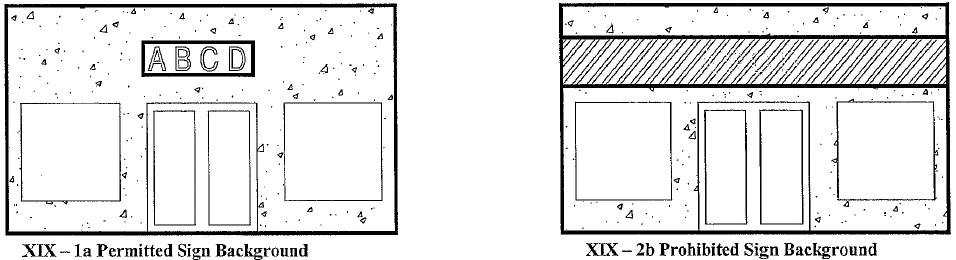
Sign, Background
Area behind the lettering on a freestanding or wall sign. The sign background is that
portion of the sign surface or building facade which is reasonably coterminous with
the area of the sign. Color, texture and/or materials used on the sign background,
if different from the color, texture and/or materials used on the building exterior
shall be limited to the sign area and shall not extend across all or part of the building
or canopy. See illustration XIX-1.
Illustration XIX-1
Sign, Balloon
A flexible bag designed to be inflated with air or with a gas, such as helium, that
may be lighter than the surrounding air, which may rise and float in the atmosphere
whether natural or artificially. A cold air inflatable falls within this definition.
This is generally a prohibited type of sign.
Sign, Banner
A sign, often made of wind- and weather-resistant cloth or other lightweight material,
that is not permanently attached to a solid backing of wood, plastic, metal, masonry,
or similar rigid material, and possessing characters, letters, illustrations or ornamentations.
A flag is not a banner.
Sign, Bench
A sign appearing on a bench. This definition also includes bus bench advertising signs
associated with a public transportation system.
Sign, Billboard
A sign structure or sign utilized for advertising an establishment, an activity, a
product, service or entertainment, which is sold, produced, manufactured, available
or furnished at a place other than on the property on which said sign structure or
sign is located.
Sign, Bus Shelter Advertising
An advertising sign appearing on a bus shelter.
Sign, Bus Stop Informational
A freestanding or attached non-commercial sign located at a bus stop and providing
information as to the route, hours or times of service.
Sign, Campaign
A sign which concerns an election.
Sign, Canopy
A sign that is a part of or printed, stamped, stitched or otherwise applied onto a
canopy located over a door, entrance, window or outdoor service area with a canopy
being any fixed roof-like structure, not movable like an awning, and which is cantilevered
in whole or in part self-supporting.
Sign, Changeable Copy
A sign that is designed so that characters, letters or illustrations can be changed
or rearranged without altering the face or the surface of the sign. A changeable electronic
variable message sign is included in this term.
Sign, Changeable Electronic Variable Message ("CEVM")
A sign which uses electronic means to display changeable or intermittent images such
as by turning on or off various lighting elements including, but not limited to, any
illuminated sign on which such illumination is not kept stationary or constant in
intensity and color at all times when such sign is in use. The term includes display
technology such as a light emitting diode (LED) or digital displays which can vary
in color or intensity, or any system which is functionally equivalent. Messages often
scroll in this type of sign. CEVM signs may contain a running light.
Sign, Commercial Mascot
A person, animal, or object used as the symbol of an organization such as a sports
team or business which can be humans or animals used as advertising devices for commercial
establishments, typically by the holding or wearing of insignia, masks or costumes
associated with the commercial establishment.
Sign, Commercial Message
Wording, a logo or other representation or image located on a sign that directly or
indirectly names, advertises or calls attention to a product, service, sale or sales
event or other commercial activity. The color scheme desired to express the commercial
message shall be subject to regulation by the City.
Sign, Construction
A sign identifying the ongoing construction activity during the time that a building
permit is active and prior to the completion of the work for which the permit was
issued and announcing and identifying the name of principal contractors, sub-contractor,
architects, or lending institutions engaged to perform construction activity on the
site. It is the obligation of contractors to appropriately place construction signs
at appropriate location during the course and time period when construction activities
are occurring on property.
Sign, Directional
A sign located on premises with exits, entrances, driveways or off street parking.
Sign, Directory
A sign which lists the names and locations of occupants or the use of a building.
This type of sign is limited to multi-tenant buildings and complexes.
Sign, Double-Faced
A sign with two (2) faces which describe an internal angle between face planes extended
of no more than thirty (30) degrees.
Sign Face
The plane area which is defined as sign area.
Sign, Fascia
A sign located on the fascia of a roof or canopy, or affixed to the front plane of
a mansard roof that is a maximum of thirty (30) degrees from vertical, including signs
that extend the plane of the structural fascia such that the vertical dimension of
the sign is no more than one-third (
1/3
) the distance from the average grade elevation to the bottom of the fascia, and no
lateral supports are used. A fascia sign shall not exceed the height of the roof of
the structure on which the sign is located.
Sign, Fixed Aerial Advertising
Any aerial advertising medium that is tethered to the ground.
Sign, Flashing
A sign that permits light to be turned on or off intermittently.
Sign, Free Speech
A sign implementing and protecting by action a person's First Amendment right to free
speech in order to express any lawful non-commercial message. In this context, free
speech shall not contain any commercial message that directs attention to a business
operated for profit, or to a commodity or service for sale.
Sign, Freestanding
A sign supported by uprights or braces placed upon, or in, or supported by the ground,
a fence, or non-structural wall.
Sign, Garage or Yard Sale
A sign pertaining to the sale of personal property in, at or upon any residentially-zoned
property located in the City. Garage or yard sales shall include, but not be limited
to, garage sale, yard sales, lawn sale, front yard sale, backyard sale, attic sale,
rummage sale, patio sale, moving sale and similar uses involving the retail sales
of used or secondhand goods or merchandise in connection with a lawfully existing
dwelling unit on property within any zoning district, and shall include the advertising
of the holding of any such sale, or other offering to make any sale, whether made
under any name such as garage sale, yard sales, lawn sale, front yard sale, backyard
sale, attic sale, rummage sale, patio sale, moving sale, or any similar designation.
Sign, Hanging
A sign projecting underneath or on the underside of any structural overhang or passageway
and perpendicular to the front building facade.
Sign, Height of
The distance between the top of a sign and the average grade elevation below the top
of the sign.
Sign, Holiday and Seasonal Decorations
Decorations that pertain to legal or other recognized holidays or to a season of the
year. Such decorations shall not include copy. Such decorations shall be a sign only
if copy is present on the decorations.
Sign, Holographic Display
A sign consisting of an advertising display that creates a three-dimensional image
through projection, OLED (organic light emitting diode), or any similar technology.
Sign, Identification
A sign used to indicate to the public the firm name, the character of the business
carried on or the major enterprise or products offered on the premises where located.
Sign, Illuminated
A sign which is illuminated, in whole or part, by artificial light, either from an
interior or exterior source, including outline, reflective or phosphorescent light
(including, but not limited to, plasma or laser), whether or not the source of light
is directly affixed as part of the sign, and shall also include signs with reflectors
that depend upon sunlight or automobile headlights for an image.
Sign, Indirectly Illuminated
A sign the facing of which reflects light from a source intentionally directed upon
the sign.
Sign, Internally Illuminated
A sign which has as a source of light, a source which is entirely enclosed within
the sign, which source is not visible to the eye.
Sign, LED (Light Emitting Diode)
A sign or portion thereof that uses light emitting diode technology or other similar
semiconductor technology to produce an illuminated image, picture or message of any
kind whether the image, picture or message is moving or stationary. This type of sign
includes any sign that uses LED technology of any kind whether conventional (using
discrete LEDs), surface mounted (otherwise known as individually mounted LEDs), transmissive,
organic light emitting diodes (OLED), light emitting polymer (LEP), organic electro
luminescence (OEL) or any similar technology.
Sign, Machinery and Equipment
A sign that is integral to the machinery or equipment and that identifies the manufacturer
of the machinery or equipment that is placed on the machinery or equipment at the
factory at the time of manufacture.
Sign, Marquee
A sign with a permanent wall- or roof-like structure projecting beyond a building
or extending along and projecting beyond the wall of the building, generally designed
and constructed to provide protection from the weather with a marquee being a permanent
roofed structure attached to and supported by the building and that projects into
the public right-of-way.
Sign, Mobile Advertising
A motor vehicle of any type or nature as defined by state law, or wheeled conveyance
which carries, conveys, pulls, or transports any sign or billboard (including, but
not limited to, any bicycle, motorized scooter, electric personal assistive mobility
device, or moped with all terms being defined in state law) for the primary purpose
of advertising. This term does not include identifying information on a motor vehicle
such as, by way of example, contact information on a taxi-cab, business identifying
information on a business truck or van, fleet information on a bus or any type of
information of a similar use or character. This term does not include advertising
that is painted on a motor vehicle such as, by way of example, a bus fleet with advertising
painted on the bus, but not separate and apart from the painting of the bus. It is
prohibited and unlawful for motor vehicles or vessels which are identified as "for
sale" to be parked in public rights-of-way or in buffer areas along arterial or collector
streets.
Sign, Monument
A freestanding sign which has the vertical structural supports concealed in an enclosed
base, and which is assembled with a ratio of width of sign-to-width of base of no
more than three-to-one (3-to-1).
Sign, Non-Conforming
A sign which does not conform to the regulations contained in this LDC.
Sign, Off-Site
A sign which identifies an activity that is not conducted on the premises or which
identifies products or services which are not available on the premises where such
sign is located.
Sign, On-Site
A sign that (1) identifies an activity conducted or products or services available
on the premises where the sign is located, (2) displays a non-commercial message,
or (3) displays any combination of the first two (2).
Sign, Parasite
A sign for which no permit has been issued, and which is attached to another sign.
Sign, Pennant
A series of small flag-like or streamer-like pieces of cloth, plastic or paper, or
similar material attached in a row to any staff, cord, building, or at only one (1)
or two (2) edges, the remainder hanging loosely.
Sign, Permanent
A sign which, when installed, is intended for permanent use. For the purposes of this
LDC any sign with an intended use in excess of twelve (12) months from the date of
installation shall be deemed a permanent sign unless otherwise indicated elsewhere
in this LDC or in a development order or development permit.
Sign, Pole
A sign with a ratio of width of sign-to-width of support which is equal to, or greater
than, three-to-one (3-to-1).
Sign, Portable
A sign that has no permanent attachment to a building or to the ground by means of
a footing, including, but not limited to, an A-frame sign, sign with wheels, pull
attachments, or hot air or gas filled balloons.
Sign, Projecting
A sign supported by a wall of a building projecting from that wall and designed with
a face or faces reading perpendicular to that wall.
Sign, Real Estate
A temporary sign on a premises offered for sale or rent.
Sign, Roof
A sign painted on or affixed to the roof of a building and primarily supported by
that roof structure, except fascia signs as defined in this LDC.
Sign, Safety
See Warning Sign.
Sign, Shopping Center
Any commercial building or development occupied by two (2) or more tenants on one
(1) premises. This term shall also include commercial developments approved for any
planned unit development zoning district.
Sign, Snipe
An unpermitted sign tacked, nailed, posted, pasted, glued or otherwise attached to
trees (living or dead), poles including, but not limited to telephone and utility
poles, stakes, fences or to other objects, with the message appearing thereon not
applicable to the present use of the premises or structure upon which located.
Sign, Statutory
A sign required by any statute of the City or the government of Seminole County, the
State of Florida or the United States which, absent a controlling federal or state
law, shall not exceed two (2) square feet in size.
Sign, Streamer
A long, narrow strip of material used as a decoration or symbol.
Sign Structure
The uprights, supports, braces and framework supporting a sign.
Sign, Subdivision Primary Entrance
A subdivision entrance located at the periphery of the subdivision giving access to
a public right of way.
Sign, Temporary
A sign used for a temporary period of time.
Sign, Three-dimensional
A sign that has a depth or relief on their surface greater than six (6) inches.
Sign, Time and Temperature
A sign that accurately displays the current local time and temperature, or either
time or temperature, usually through arrays of small electric lights. No commercial
advertising or other message is allowed on this type of sign.
Sign, Traffic Control Device
A sign located within the right-of-way that is used as a traffic control device and
that is described and identified in the Manual on Uniform Traffic Control Devices
(MUTCD) as promulgated by the Florida Department of Transportation in accordance with
the provisions of F.S. § 316.0745 and other controlling law. A traffic control device
sign includes, but is not limited to, those signs that are classified and defined
by their function as regulatory signs (that give notice of traffic laws or regulations),
warning signs (that give notice of a situation that might not readily be apparent)
and guide signs (that show route designations, directions, distances, services, points
of interest, and other geographical, recreational, or cultural information).
Sign, Umbrella
A sign printed on umbrellas used for legal outdoor eating and drinking establishments,
push-carts, sidewalk cafes and which is made of a lightweight fabric or similar material.
Sign, Vehicle
A sign or signs where the total sign area covers more than ten (10) square feet of
the vehicle including, but not limited to, a sign that is attached to or painted on
a vehicle that is parked on or adjacent to any property, the principal purpose of
which is to attract attention to a product sold or business located on the property.
This term shall include signs placed upon vessels for the same purpose.
Sign, Wall
A sign painted on or affixed to the structural wall of a building, with a sign face
approximately parallel to the wall perpendicular to the ground and projecting no more
than twelve (12) inches from the wall. The general term "wall sign" shall also include
fascia signs.
Sign Wall Wrap
A sign composed of fabric, plastic, vinyl, mylar or a similar material that drapes
or hangs over the side of a building, wall or window. This term includes a building
wrap sign.
Sign, Warning
A sign which provides warning of a dangerous condition or situation that might not
be readily apparent to the public or a condition or situation that poses a threat
of serious injury (e.g., gas line, high voltage, condemned building, etc.) or that
provides warning of a violation of law (e.g., no trespassing, no hunting allowed,
etc.). A safety sign falls within the definition of this term.
Sign, Wind
A sign which uses objects or material fastened in such a manner as to move upon being
subjected to pressure by wind, and shall include, pennants, ribbons, spinners, streamers
or captive balloons, however, the term "wind sign" shall not include flags. For purposes
of this LDC, a cold air inflatable sign shall be considered to be a wind sign.
Site Plan
An illustration of the details of development of areas such as commercial, industrial,
recreational, multifamily residential and other uses not being platted.
Special Event
A single non-recurring (no more than once per year) or seasonal event to which the
public is invited to watch, listen or participate including, but not limited to, the
following:
(a)
Races or contests.
(b)
Carnivals, block parties and similar activities.
(c)
Outdoor shows, concerts and exhibitions.
(d)
Races, block parties, craft fairs, parades, soap box derbies, rallies, or other similar events.
(e)
Any public event requiring street closure or street right-of-way, and which requires signage in order to avoid interference with the normal flow of pedestrian or vehicular traffic.
Special Exception Use Order
An order issued by the City Council after recommendation of PZA, which allows certain
uses within a zoning district that are not generally permissible throughout the district,
but which if controlled as to number, area, location, or relation to the neighborhood,
could promote the public health, safety, and welfare.
Spillover
The casting, reflecting or transmission of light or glare beyond the boundaries of
the property.
Sports Fields
Those areas used solely for the purpose of playing sporting events (eq. - soccer fields,
softball or baseball fields). Only the surfaces used to engage in these activities
fall under the category of "sports fields."
Street
Any public thoroughfare, street, avenue, boulevard or space more than twenty (20)
feet (six thousand ninety-six (6,096) mm) wide which has been dedicated or deeded
for vehicular use by the public and which can be used for access by fire department
vehicles.
Arterial: A street which provides the highest degree of mobility and largest proportion of total travel. Arterial roadways have higher design standards than other roads. They often have multiple lanes and some degree of access control.
Collector: A street which provides a mix of mobility and land access functions, linking major land uses to each other and/or to arterial roadways. On-street parking in only allowed in cases where there is additional right-of-way (ROW) and a safety problem will not be created. Access is managed to minimize the number of driveways.
Commercial: A street located within a commercial or industrial subdivision that provides access to the commercial or industrial property within that subdivision as its primary function. On-street parking is generally not allowed. Access is managed to minimize the number of driveways.
Dead End: A street that terminates in a vehicular turnaround.
Local: A street with land access as its primary function. In general, on-street parking is allowed and access is unlimited, subject to driveway spacing restrictions.
Structure
(1) Anything constructed or erected with a fixed location on the ground or attached
to something having a fixed location. Among other things, structures include buildings,
boat docks, boat ramps, mobile homes, walls, fences, etc. (2) With regards to floodways,
any construction that diminishes the functional floodway capacity as determined by
FEMA.
Structure, temporary
Any structure serving a temporary use, such as a field or sales office, contractor's
office, etc.
Subdivision
The division of a parcel of land, whether improved or unimproved into two (2) or more
lots or parcels of land for the purpose of sale or building development (whether immediate
or future) and including all divisions of land involving the dedication of a new street
or a change in existing streets. The City may grant a waiver to the platting requirements
for subdivisions with three (3) lots or less.
Substantial Improvement
Any repair, reconstruction, or improvement of a building, (for any building constructed
prior to the effective date of this LDC) the cost of which either equals or exceeds
fifty (50) percent of the market value of the structure either (1) before the improvement
or repair is started or (2) if the structure has been damaged and is being restored,
before the damage occurred.
Sunroom
A one-story structure added to an existing dwelling with an open or glazed area in
excess of forty (40) percent of the gross area of the sunroom structure's exterior
walls and roof. For the purposes of this LDC, the term sunroom as used herein shall
include conservatories, sunspaces, solariums, and porch or patio covers or enclosures.
Temporary Connection
A permitted connection for a specific property that is conditioned to be open for
a specific purpose and traffic volume for a specific period of time with the right-of-way
to be restored by the applicant to its original condition upon connection closure.
Temporary Sign
A sign used for a temporary period of time.
Townhome
A residential building designed to house vertically attached dwelling units. They
can be either fee-simple or condos.
Travel Trailer
A structure that is intended to be transported over streets and highways and is designed
as a temporary dwelling for travel and recreational purposes. A travel trailer is
not a mobile home.
Tree
Any living, self-supporting, perennial plant which has at least one and one-half (1.5)
inch D.B.H. and normally grows to a minimum overall height of fifteen (15) feet.
Turf/Turfgrass
A surface layer of earth containing a dense growth of grass and its roots.
Use
The activity or function that actually takes place or is intended to take place on
a lot.
Useable Open Space
An area that:
(a)
Is not encumbered with any substantial structure,
(b)
Is not devoted to use as a roadway, parking area, or sidewalk,
(c)
Is left (as of the date development began) in its natural or undisturbed state if wooded, except for the cutting of trails for walking or jogging, or, if not wooded at the time of development, is landscaped for ball fields, picnic areas, or similar facilities, or is properly vegetated and landscaped with the objective of creating a wooded area or other area that is consistent with the objective set forth in the Subdivision (4).
(d)
Is capable of being used and enjoyed for purposes of informal and unstructured recreation and relaxation, and
(e)
Is legally and practicably accessible to the residents of the development out of which the required open space is taken, or to the public if dedication of the open space is required.
(f)
Consists of land no more than twenty-five (25) percent of which lies within a floodplain or floodway.
Utility Facility
Any above-ground structures or facilities (other than buildings, unless such buildings
are used as storage incidental to the operation of such structures or facilities)
owned by a governmental entity, a nonprofit organization, a corporation, or any entity
defined as a public utility for any purpose and used in connection with the production,
generation, transmission, delivery, collection or storage of water, sewage, electricity,
gas, oil, or electronic signals (except for communication towers).
Utility Pole
A tall cylinder, often embedded with climbing spikes above normal reach, usually topped
by a cross beam, used by a public utility to transmit wire, cable or conduit through
the air, for the transportation of electricity, cable television, telephone, lighting
on private or public property or similar services.
Vehicle Accommodation Area
That portion of a lot that is used by vehicles for access, circulation, parking and
loading and unloading. It comprises the total of circulation areas, and parking areas
(spaces and aisles)
Water Features
Features of a site that hold water including but not limited to natural features (lakes,
wetlands, rivers, creeks, etc.), or artificial features (retention ponds, fountains,
and canals.)
Water Use Zone
A distinct grouping of plants with similar water needs and climatic requirements.
The water use zones are as follows:
(a)
Low Water Use Zone Zones including plants which survive on natural rainfall without supplemental water.
(b)
Medium Water Use Zone Zones including plants which survive on natural rainfall with supplemental water during seasonal dry periods.
(c)
High Water Use Zone Zones including plants which are associated with moist soils and require supplemental water in addition to natural rainfall to survive.
Wellhead Protection Zone
All land within a one thousand-foot radius of an existing or designated protected
wellhead.
Wellhead Zone of Exclusion
All land within a two hundred-foot radius of an existing or designated protected wellhead.
Wetlands
Hydrologically sensitive areas which are identified by being inundated or saturated
by surface or ground water with a frequency and duration sufficient to support, and
that under normal circumstances do support, a prevalence of vegetation typically adapted
for life in saturated soil conditions.
Wetland Boundary
That line or point where: (1) vegetative species shift from dominantly wetland to
dominantly upland species; (2) highly organic and muck soils change to sandy upland
soils; and (3) flooding or inundation condition indicators are no longer present.
Wetland Compatible Development Activities
Those activities which do not cause a diminishing of wetland functions.
Wetland Development Activity
Those activities for which compatibility rankings and performance standards have been
developed:
(a)
Boardwalks, docks and gazebos.
(b)
Bulkheading (impounding, interrupting or diverting surface water).
(c)
Clearing of vegetation (in conjunction with the construction of permitted structures).
(d)
Cultivating naturally occurring agricultural and horticultural products.
(e)
Discharge of domestic, agricultural, or industrial wastes (pursuant to DER permit or the discharge of stormwater runoff waters from adjacent land).
(f)
Drainage ditches.
(g)
Dredging (other than mosquito control or "drainage ditches").
(h)
Filling.
(i)
Harvesting of timber and wood products.
(j)
Hazardous material (storage, use, or disposal of any hazardous material).
(k)
Landscaping and establishing planting.
(l)
Restoration or expansion or modification of existing structures and improved areas.
(m)
Septic tanks (installation of septic tanks).
(n)
Solid waste disposal.
(o)
Stormwater retention/detention basins.
(p)
Structure (construction of permitted structures).
(q)
Utility installation.
Wetland Direct Hydrologic Connection
Connection to a wetland where a flow of surface water occurs on an average of thirty
(30) or more consecutive days per year. In the absence of reliable hydrologic records,
a continuum of wetlands may be used to establish a direct hydrologic connection.
Wetland Enhancement
The restoration of altered wetlands and the physical expansion of the size of wetlands.
Wetland Functions
The water quality enhancement, water quality management, climatic stability, wild
life and human use abilities of wetlands.
Wetland Mitigation/Compensation
Development activities which will result in greater wetland or environmental benefit
than with the strict application of performance standards.
Wetland Performance Standards
Standards for actions taken to prevent or minimize adverse impacts on wetlands as
a result of development activities.
Wetland Significance
The degree to which wetlands functions are performed by a wetland.
Wholesale Sales
On-premises sale of goods primarily to customers engaged in the business of reselling
the goods.
Window Sign
A permanent sign affixed to, suspended behind, or painted on either face of a window
or glass door that leads to the exterior of the building.
Xeriscape
TM
or Florida Friendly Landscape
Quality landscapes that conserve water and protect the environment and are adaptable
to local conditions and which are drought tolerant. The principles of Xeriscape
TM
include planning and design, appropriate choice of plants, soil analysis which may
include the use of solid waste compost, efficient irrigation, practical use of turf,
appropriate use of mulches, and proper maintenance (as provided for in F.S. § 166.048(1)(b)
and F.S. § 373.185(1)(b)).
Yard
An open space on the same lot with a building, said space being unoccupied and unobstructed
from the ground upward, with the exception of trees and other vegetation. Fences,
walls, children's play equipment and other customary yard accessories may be permitted
in rear and side yards and some front yards subject to height, visibility limitations
and other requirements of this Code.
(a)
Front Yard. A yard extending between side lot lines, parallel across the front of a lot adjoining a street. In cases of through lots and corner lots, front yards shall be provided on all frontages. The minimum front building setback distance shall be maintained at every point along the street.
(b)
Rear Yard. A yard extending across the rear of the lot between the side lot lines. In the case of through lots, there will be no rear yard. The depth of the rear yard shall be measured at right angles to a straight line joining the rearmost points of the side lot lines. The rearmost point of the side lot line in the case of rounded or irregular property corners shall be assumed to be the point at which the side and rear lines would have met without such rounding or irregularity.
(c)
Side Yard. A yard extending from the rear line of the required front yard to the front line of the rear yard, or in the absence of any clearly defined rear lot line, to the point on the lot farthest from the intersection of the lot line involved with the public street. In the case of through lots, side yards will extend from the rear lines of the required front yards. In the case of corner lots, there may be only one (1) side yard, and that yard will be the yard(s) remaining after providing two (2) front yards and designating a rear yard.
(d)
Minimum Yard. In addition to other yard requirements, a minimum yard equal in depth to the established district building setback shall be provided parallel to all property lines. Accessory uses may be allowed within the minimum yard area in accordance with the Land Development Code.
(Ord. No. 1389, § 2, 11-20-06; Ord. No. 1428, § 2(Exh. D), 1-22-08; Ord. No. 1527, § 3, 12-5-11; Ord. No. 1541, § 2, 5-21-12 ; Ord. No. 1584 , § 2, 6-2-14; Ord. No. 1595 , § 2(b)(1)—(3); Ord. No. 1612 , § 5, 2-2-15; Ord. No. 1647 , § 10, 2-20-17; Ord. No. 1677 , § 8, 11-5-18)

