
Oviedo City Zoning Code
ARTICLE VI
DOWNTOWN MIXED USE DISTRICTS
Section 6.1.- General.
The Future Land Use Map of the City's Comprehensive Plan designates the downtown area as the Downtown Mixed Use District.
(A)
Purpose The purpose of this designation is to establish specific development standards and regulations to accomplish the following:
(1)
Revitalize the Historic Town Center.
(2)
Preserve and strengthen the crossroads/Old Oviedo character of the historic town center.
(3)
Improve traffic circulation and parking conditions in the historic town center.
(4)
Provide gathering places.
(5)
Link old and new residential areas of the City.
(6)
Unify the old and new sections of the City with a newly defined geographic center.
(7)
Include neo-traditional neighborhood design concepts such as, integrated land uses; on-street parking; narrow streets; pedestrian orientation/amenities; tree canopy; and "small town scale and character.
(8)
Develop a mixed use town center core along the Division Street Extension.
(B)
Redevelopment Site Development Order
(1)
It is recognized that the City Council desires to encourage economic development through redevelopment of existing commercial or office buildings or conversions from residential to office or commercial use.
(a)
The Land Use Administrator is authorized to approve a Redevelopment Site Development Order within all Downtown Mixed Use Districts meeting the following criteria:
i.
The building size is less than five thousand (5,000) square feet or smaller; and
ii.
Use has less than five hundred (500) average daily trips; and
iii.
The building is not part of a larger development proposal, or poses special development issues that require the additional review, as determined by the Land Use Administrator.
(b)
If a Site Development Order does not meet the above criteria, it shall be in accordance with Article III.
(c)
The Land Use Administrator may review the application for a Redevelopment Site Development Order and may approve a reduction in the normal requirements of the Land Development Code limited to the following:
i.
Buffer yard width up to twenty (20) percent of the minimum LDC requirement;
ii.
Parking standards up to twenty (20) percent of the minimum LDC requirement;
iii.
Architectural Standards up to twenty (20) percent of the minimum LDC requirement.
(Ord. No. 1626 , § 6, 8-17-15)
Section 6.2. - Downtown Development Districts.
(A)
Historic Downtown Districts The intent of these districts is to preserve the "Old Downtown" area that has been the focal point of the City since its founding. Professional office, retail, service commercial uses, mixed-use, and multi-family residential are the primary uses.
(1)
Historic Downtown District Core (MUD-HDC). The area defined by a distance of approximately eight hundred (800) feet from the intersection of Central Avenue and Broadway Street and all properties fronting on Broadway Street constitute the core of the Historic Downtown District. Buildings fronting the street with sidewalks that create a downtown feeling exist in the core area of the district and the objective is to perpetuate and strengthen this character. Single-family uses are not appropriate in the core of the Historic Downtown District.
(2)
Historic Downtown District Perimeter (MUD-HDP). This is the area of the Historic Downtown District adjacent to the Core District. Primary uses include professional office, retail, residential, institutional, and mixed use. Single-family dwellings exist on the perimeter of this district and will continue to be allowed in this peripheral area.
(B)
Central Avenue District (MUD-CA) Central Avenue from the Historic Downtown District to the City Hall Retail District is an existing corridor that has, and will continue to have a mix of uses housed in residential scale buildings. The scale is primarily that of single-family residential homes even though the uses may be residential, office or service commercial. Retail uses, other than specialty shops of less than three thousand (3,000) square feet, are excluded from this district. Development will occur consistent with the design standards for the district.
(C)
Downtown Residential Districts (MUD-SF, MUD-MF) Two (2) residential districts are provided in the Downtown Mixed Use District, MUD-SF for single-family residential and MUD-MF for multi-family residential.
(D)
Division Street District (MUD-DS) The Division Street District is located between the Historic Downtown District and the New Downtown District. The character of this will be similar to that of the Historic Downtown District, with structures close to the street and a strong pedestrian orientation. The uses within the Division Street District will be residential, professional office, and commercial development will occur consistent with the design standards for the district.
(E)
City Hall Retail District (MUD-CHR) Retail commercial uses along with service retail and professional office uses are permitted in this district. Multi-family uses are also permitted; single-family residential uses are not permitted. Development will occur consistent with the design standards for the district.
(F)
Permissible Uses and Special Exceptions
(1)
Table of Permissible Land Uses. The permissible use of land in the Downtown Development Districts shall be in accordance with Table 6.1 and the residential density and non-residential intensity standards set forth in the Comprehensive Plan for the Downtown Mixed Use Districts.
(a)
Uses shall be considered permissible uses or special exception uses. A permissible use is indicated by the letter "P" and a special exception use is indicated by the letter "S."
(b)
No primary use shall be permitted in a district unless the letter "P" or "S" appears for that use in the appropriate cell.
(c)
When a use is indicated as a permissible use in a particular zoning district, it is permissible in that district subject to the demonstration of compliance with this LDC.
(d)
When a use is indicated as a special exception use in a particular district, it is permissible in that district subject to the demonstration of compliance with the LDC and in particular, the requirements of Article III.
(2)
Relationship with Other Sections of the Code. Table 6.1 should be read in close conjunction with the definitions set forth in Article XVIII and the other interpretive provisions set forth in this article.
(3)
Permissible Uses. The presumption established by this section is that most legitimate uses of land are permissible within at least one (1) zoning district in the City. The list of permissible uses, therefore, cannot be all inclusive. Any dispute or request regarding interpretation shall be resolved by the Land Use Administrator.
(4)
Accessory Uses.
(a)
A permitted accessory use (1) constitutes only any incidental part of the total activity that takes place and (2) is commonly associated with the principal use and integrally related to it. For example, a swimming pool/tennis court complex is associated with and integrally related to a residential subdivision or multi-family development and would be regarded as accessory to such principal uses, even though such facilities, if developed apart from a residential development would require a special exception use order.
(b)
Food trucks may be permitted as an incidental use to micro-breweries/micro-wineries/micro-distilleries; however, the location of such food trucks shall be clearly depicted on the site plan, shall not utilize or impede the minimum parking spaces required for the principal use, shall comply with minimum landscape buffer yard width requirements and provide safe access to pedestrians and patrons.
TABLE 6.1: TABLE OF PERMISSIBLE LAND USES — DOWNTOWN
DEVELOPMENT DISTRICTS
1 Also permitted in District MH-1.
2 See Article V, Section 5.6.
3 Prohibited in shopping centers. This prohibition shall not apply to pet services.
4 See Article XV, Section 15.9.
5 Notwithstanding any provision of this ordinance or the Land Development Code, pharmacies existing at the time of the ordinance effective date shall be considered permissible uses as a matter of right at their present location.
6 Limited to six (6) or fewer residents and cannot be located closer than one thousand (1,000) feet of another existing home of six (6) or fewer home or one thousand two hundred (1,200) feet of an existing community residential home.
P — Use is permissible subject to compliance with this LDC.
S — Use is permissible with special exception permit issued by the City Council.
Blank Cell — Use is prohibited.
(Ord. No. 1612 , § 3, 2-2-15; Ord. No. 1626 , § 6, 8-17-15; Ord. No. 1655 , § 4, 9-7-17; Ord. No. 1677 , § 5, 11-5-18)
Section 6.3. - Development Standards for Downtown Development Districts.
(A)
Purpose and Intent
(1)
These standards explain the design requirements for all new construction, renovation, exterior alteration or change of land use that occurs on any parcel of land within the Downtown Development Districts described in Section 6.2.
(2)
It is the intent of the City of Oviedo that these standards be incorporated as each opportunity arises. These standards are minimum standards that all applicants should strive to exceed. In no way do these standards exempt an applicant from the requirements of other applicable codes of the City or the applicable codes of other governmental agencies.
(3)
In the event that the requirements of these standards for the MUD Downtown Development area are in conflict with the standards or requirements of other sections of the LDC, the Downtown Development Standards in this article shall apply.
(4)
The strict adherence to a set of standards must always be accompanied by sensitivity to good design. Design standards cannot replace the elements of good design quality that come from the individuality of each particular circumstance. Applications are encouraged which adhere to the Downtown Development Standards that are individually creative and influenced by their surroundings.
(5)
The Downtown Development Districts have different development characteristics and therefore have different development standards. As a result, there are different design standards for the Historic Downtown District (Core and Perimeter), the Central Avenue District, the Downtown Residential Districts, the Division Street District and the City Hall Retail District.
(B)
Technical Requirements
(1)
Building Setbacks. The requirements for setbacks for buildings are found Table 6.2, Building Setbacks.
(2)
Uses in the Setback Areas. The setback areas may be used for passive recreation uses, landscaping, utility easements, sidewalks and driveway entrances. The setback areas may include areas devoted to stormwater management. However, these areas may not exceed fifty (50) percent of the width of the setback area. Stormwater management areas located within the setback area must be designed as part of the landscape/grading for the setback area in a freeform, aesthetically pleasing and a naturalistic manner. Stormwater management areas must have sides gradually sloped, consistent with Article X. Fencing of stormwater management areas is prohibited. Parking is permitted within side and rear setback areas but not within buffer yards. Parking is not permitted in the front building setback area except as provided in Article VIII.
TABLE 6.2: BUILDING SETBACKS
Notes:
* Setbacks for townhome, multi-family, and mixed use developments in these zoning districts shall follow the setbacks established for each of those uses in Article VIII, Architectural and Urban Design Standards.
(3)
Driveways, Curb Cuts and Accessways. Driveways, curb cuts and accessways shall be provided consistent with Article XI, Streets and Sidewalks, except as otherwise required in this section.
(a)
Individual driveways in the Core Area of the Historic Downtown District are prohibited. Individual driveways outside the Core Area of the Historic Downtown District will be permitted consistent with safe traffic operations.
(b)
Individual driveways along Division Street in the Division Street District will be limited to single-family residential lots with minimum street frontages of three hundred thirty (330) feet. No non-residential or multi-family residential driveways will be permitted. Common driveways, or local street intersections are planned to occur on Division Street at intervals of approximately three hundred thirty (330) feet.
(c)
Individual driveways in the Central Avenue, Downtown Residential and City Hall Retail Districts of the MUD Downtown Development area will be permitted consistent with safe traffic operation.
(d)
Individual driveway widths on Central Avenue and Division Street and in the Downtown Residential Districts for single-family residential lots, multi-family developments, professional offices and service commercial uses are intended to be residential in character and shall be no wider than twelve (12) feet.
(e)
Individual driveway widths in the Historic Downtown and City Hall Retail Districts for non-residential and multi-family developments shall be no wider than twenty (20) feet.
(f)
All non-residential and multi-family residential driveways and vehicular circulation areas shall be curbed with either a six (6) inch non-mountable curb or a concrete ribbon curb.
(4)
Sidewalks. Sidewalks shall be provided consistent with Article XI, except as otherwise required in this section.
(a)
All non-residential and multi-family residential development shall provide a direct sidewalk connection from the main entrance of the primary building(s), no less than four (4) feet in width, to a sidewalk in the right-of-way. Except for Division Street, sidewalks shall be five (5) feet in width along local streets or six (6) feet in width along collector and arterial streets. Sidewalks along Division Street shall be twelve (12) feet in width.
(b)
If no sidewalk exists in the right-of-way or an existing sidewalk is in the right-of-way but it is less than five (5) feet in width along local streets or six (6) feet in width along collector and arterial or twelve (12) feet along Division Street, then the applicant shall install a sidewalk the prescribed width in the right-of-way from property line to property line at the time of development.
(5)
Parking. Parking shall be provided consistent with the requirements of Article XIII, except as otherwise required in this section.
(a)
Parking lots serving non-residential and attached residential housing shall be located behind an extension of the front elevation of the primary site building. On buildings that front more than one (1) street the parking shall be located behind an extension of the elevation that includes the main entrance into the non-residential use.
(b)
All parking lot areas serving non-residential development shall be curbed with a six (6) inch non-mountable concrete or similar material curb. Parking lot stripping shall be white except for handicap spaces which shall be as required by controlling law.
(6)
Loading. Loading and unloading areas shall be provided consistent with Article XIII, except as required in this section.
(a)
Commercial property in the Core Area of the Historic Downtown District is not required to have loading and unloading areas on-site, but must have reasonable access to a loading dock or loading zone.
(b)
Outside the Core Area of the Historic Downtown District, loading docks and zones shall be designed or landscaped so as not to be visible from adjacent streets.
(c)
Loading docks and zones for commercial and office uses be designed to meet the needs of the use but shall have a minimum size of eighteen (18) feet by twelve (12) feet when utilizing a curb or wheel stop.
(7)
Open Space. Open Space shall be provided consistent with Article XVII except as otherwise required in this section.
(a)
Within each development parcel in the Downtown Development Districts, open space shall be provided as follows:
TABLE 6.3: OPEN SPACE REQUIREMENTS
Notes:
* Open space for townhome and mixed use developments in these zoning districts shall follow the open space requirements for each of those uses in Article VIII.
(b)
The setback areas required as part of these standards may be included in the open space calculation for individual development parcels.
(8)
Aesthetic Design of Stormwater Management Areas. The design of the stormwater management area shall be consistent with Article X, except as otherwise required by this section.
(a)
If stormwater management areas are designed aesthetically to be part of the overall landscape plan, up to fifty (50) percent of the dry portion of the stormwater management area may be used to satisfy the open space requirements, as long as, the stormwater management area contribution to the open space requirements do not exceed ten (10) percent of the total site requirement.
(b)
Stormwater management areas shall be designed with slopes shallow enough that fencing is not required. In no case shall side slopes of retention areas be steeper than four (4) horizontal to one (1) vertical. Refer to Article X.
(9)
Recreation Facilities. Recreation facilities shall be provided consistent with Article XVII, except as otherwise required in this section. If a project abuts a public recreation or park area, construction of the active recreation requirement may be accomplished in conjunction with the public facility if approved by the City Council. This does not reduce the open space requirement.
(10)
Grading. All site grading shall be accomplished consistent with appropriate requirements of the City and other governmental agencies and shall be compatible with the existing topography in the vicinity of the site. Excessive cut and fill, as determined by the City Engineer applying sound and generally accepted engineering practices and principles, shall be avoided. If berms are utilized, they shall be linear in form. Horizontal side slopes shall be no greater than three (3) horizontal to one (1) vertical. The end slope of berms shall be no greater than six (6) horizontal to one (1) vertical. The crown of a berm shall extend for a minimum of one hundred (100) feet. The crown is defined as that area within one (1) foot of the high point of the berm.
(11)
Utilities. Utilities shall be provided consistent with Article XVI except as otherwise required by this section.
(a)
Utilities are recognized as a functional requirement of all site development; however, effort will be required to reduce their overall visual impact on the site and the adjacent streets. Site plans submitted for review shall show the location of back-flow preventers, transformer locations, pull box locations and other above ground utility items.
(b)
Back-flow preventers, transformers and other required utility items visible from a public area, including public streets, shall be located in accordance with the requirements of Article IV.
(12)
Trash Receptacles and Refuse/Recycling Collection Containers. Trash receptacles and, refuse/recycling collection containers shall be provided consistent with Article XVI, except otherwise required in this section.
(a)
Trash receptacles, refuse/recycling collection containers and loading areas shall be located toward the rear of the building or site, not visible from the adjacent street.
(b)
Trash receptacles and refuse/recycling collection containers shall be screened in accordance with the requirements of Section 16.12, and include an opaque wall of similar material as the main building. The enclosure must be at least one (1) foot taller than the receptacle or dumpster and a minimum of six (6) feet in height. All enclosures must have doors. These sites shall be easily accessible for easy removal of refuge.
(13)
Satellite Dishes and Antennas. Satellite dishes and antennas shall not be visible from surrounding streets. If located on the roof of a structure, they shall be screened with a parapet wall of similar material as the building facade. In residential areas they shall be located a minimum of twenty-five (25) feet from adjacent residentially zoned property. Installation of satellite dishes and/or antennas shall require the granting of a special exception use order for any location within the City.
(C)
Architectural Standards Townhome, Multi-family, Mixed-Use, and Commercial and Office uses shall be designed and constructed per the minimum standards provided in Article VIII.
(D)
Landscape Requirements Landscaping shall be provided consistent with the requirements of Article XII, and Article VIII, except as otherwise required in this section.
(1)
Landscaping in the Setback Areas. The setback areas shall be landscaped with a combination of trees and shrubs selected from the preferred plant list.
(2)
Street Trees Required. Canopy street trees are required to be installed, where possible, in accordance with the requirements of Article XII.
(3)
Accent/Flowering Trees Required. A minimum of five (5) accent/flowering trees or palms per one hundred (100) linear feet of property frontage shall be planted by the developers of new construction or renovation projects adjacent to Broadway Street, Central Avenue, Commercial Avenue, Division Street, CR 426 and Mitchell Hammock Road in the MUD Downtown Development area. The linear frontage shall be rounded up to the nearest one hundred-foot increment.
(4)
Landscaping in Parking Lots. Parking bays shall contain no more than twenty (20) contiguous spaces in any parking lot prior to a landscape island. Landscape islands shall be a minimum of eight (8) feet in width, back-of-curb to back-of-curb, extending the full length of the adjacent spaces. Within bays containing back-to-back spaces no more than four (4) spaces can occur without the inclusion of a tree island, a minimum of six (6) feet wide, back-of-curb to back-of-curb.
(5)
Preferred Plant List. For consistency in the landscape design, all required street trees and accent/flowering trees shall be selected from the preferred plant list provided in Article XII.
(E)
Signage Signs shall be provided consistent with Article XIV.
(F)
Lighting Lighting shall be provided consistent with Article XVI, Utilities, except as otherwise required in this section.
(1)
Spillage. Lighting should be limited to the area designed to receive light. Lighting spillage to adjoining properties should be avoided.
(Ord. No. 1626 , § 6, 8-17-15; Ord. No. 1647 , § 3, 2-20-17)
Section 6.4. - New Downtown Development and Redevelopment Districts.
(A)
General Provisions
(1)
Short Title. This Code shall be known as and may be referred to and cited as the Oviedo New Downtown Development and Redevelopment Code ("NDDRC").
(2)
Jurisdiction. The NDDRC governs the development and use of land and structures within the New Downtown Village Core and New Downtown Districts, as such districts are set forth on the Official Zoning Map and Exhibit "A" to this NDDRC.
(3)
Construction of and Relationship to LDC. In the event of a conflict between the provisions of the NDDRC and other provisions of the LDC, of which the NDDRC is a part, the provisions of the NDDRC shall control, the intent hereof being that the NDDRC shall prevail in the land use regulatory activities of the City relating to the New Downtown Village Core and New Downtown Zoning Districts. Any substantive matter which is not addressed in the NDDRC, but is addressed in this LDC shall be enforced in the New Downtown Village Core and New Downtown Zoning Districts unless clearly contrary to the City of Oviedo Comprehensive Plan.
(B)
Communities for a Lifetime This NDDRC promotes the City's Communities of a Lifetime objectives, as expressed in Resolution 810-04, by:
(1)
Providing for the development of a variety of housing and lifestyle opportunities for the Citizens of Oviedo;
(2)
Providing for the location of elder-care facilities in areas which are within walking distance of a central activity center which provides residential, entertainment, shopping, employment, recreation, and dining opportunities for people of all ages.
(C)
Definitions The definitions provided in this subsection shall apply throughout the NDDRC. Other than as set forth in this subsection, the definitions of the LDC shall apply.
(1)
Administrator means the Land Use Administrator.
(2)
Adult Family-Care Home means a full-time, family-type living arrangement, in a private home, under which a person who owns or rents the home provides room, board, and personal care, on a 24-hour basis, for no more than five (5) disabled adults or frail elders who are not relatives (F.S. § 429.65).
(3)
Assisted Living Facility means any building or buildings, section or distinct part of a building, boarding home, home for the aged, or other facility, whether operated for profit or not, which are licensed pursuant to F.S. Ch. 400, Part III Home Health Agencies, and which undertakes through its ownership or management, to provide housing, meals, and one (1) or more personal services for a period exceeding twenty-four (24) hours to one (1) or more adults who are ambulatory and not relatives of the owner or administrator.
(4)
Attached Dwellings means dwelling units which share a common wall or walls and have ground-floor entrances to every unit including, but not limited to, townhomes, duplexes, and triplexes. For the sole purpose of density calculations, townhomes will be considered a multi-family residential development.
(5)
Blank Wall means a wall of a building which is without architectural details and which is uninterrupted by either architectural details that provide visual relief from the mass of the wall, or deviations from the vertical plane which cast material shadows on the wall.
6)
Building Height means the vertical distance between the average finished grade in front of the building and the top of the ceiling plate on the top floor of a building.
(7)
Canopy Tree means a dicot or conifer tree, generally with one (1) main trunk, which naturally develops an elevated crown and normally grows to a mature height of forty (40) feet or greater and a minimum shade crown of thirty (30) feet in diameter.
(8)
Center Lake means the open water feature in the New Downtown Village Core District which is generally located as set forth in the City of Oviedo Downtown Master Plan.
(9)
City of Oviedo Downtown Master Plan means the City of Oviedo Downtown Master Plan, as approved by the City Council on October 21, 2002, and subsequently amended on July 21, 2003, as may be further amended from time to time.
(10)
Civic and Cultural Uses include public uses, parks, libraries, museums and community centers, and such other similar uses the City Council may permit by special exception. Civic and cultural uses do not include places of worship and schools.
(11)
Civic Aspects of the Proposed Development means those aspects of a proposed development which affect community character or the provision of public services, in that they are visible from adjacent properties and public rights-of-way; used by the public as places of outdoor assembly; used as conservation areas; used to provide municipal services; or affect the function of public rights-of-way. Civic aspects of the proposed development include public spaces such as parks and plazas; points of access; parking areas; landscaping which is visible from adjacent properties or public rights-of-way; sidewalks, bicycle paths, and joint use paths; environmental preserves; architecture; site design; stormwater retention, detention, or treatment areas; and public infrastructure and buildings.
(12)
Coffee shop with drive-through is a particular type of restaurant subject to locational requirements that sells coffee drinks, sandwiches and small plates and may serve beer and wine by the glass on the premises but not in the drive-through.
(13)
Community Residential Home means a dwelling unit licensed to serve residents who are clients of the Department of Elderly Affairs, the Agency for Persons with Disabilities, the Department of Juvenile Justice, or the Department of Children and Families or licensed by the Agency for Health Care Administration which provides a living environment for seven (7) to fourteen (14) unrelated residents who operate as the functional equivalent of a family, including such supervision and care by supportive staff as may be necessary to meet the physical, emotional, and social needs of the residents (F.S. § 419.001). Community Residential Homes of six (6) or fewer residents shall be deemed a single-family unit and a noncommercial, residential use.
(14)
Department means the City of Oviedo Planning Department.
(15)
Detached Dwellings are single-family dwelling units which are not attached to other buildings.
(16)
Elevation means the measurement of height above sea level.
(17)
Entertainment Uses include theaters, playhouses, concert halls, social clubs, banquet facilities, amphitheaters and attendant uses, nightclubs, bars, dance halls, video arcades, and like uses in which the principal function of the use is to provide entertainment to its patrons. Entertainment uses do not include recreational uses or problematic uses.
(18)
Facade means the front of a building or any of its sides that face a public right-of-way. The facade includes all elements of the elevation of the building below the roofline.
(19)
Floor Area is the sum of all areas on all floors of all buildings, except structured parking, which are included within the outside faces of their exterior walls. Floor area includes floor penetration areas for circulation and shaft areas that connect one (1) floor to another.
(20)
Floor Area Ratio is defined as follows:
(a)
Generally. Except as provided in Subsections (b) and (c) below, floor area ratio is equal to the total floor area on a lot divided by the lot area.
(b)
Clustered Development. Floor area ratio for clustered development is equal to the total floor area on a parcel proposed for development divided by the total land area of the parcel proposed for development.
(c)
Mixed-Use. When the NDDRC limits the floor area ratio of certain uses within a mixed-use development, but not others, the numerator of the floor area ratio is equal to the total floor area attributable to the uses which are the subject of the limitation. The denominator of the ratio is as provided in Subsections (a) or (b) above.
(21)
Front Building Line means a line which runs parallel to the front lot line and touches the exterior wall of the building at the point where it is closest to the front lot line.
(22)
Frontage means each the distance along the public right-of-way where the subject property abuts said right-of-way.
(23)
Gross Leasable Area means the area of a retail use that is assigned to stores, excluding exits, corridors, and open space.
(24)
Independent Care Living Facility means retirement communities, congregate living or senior apartments, and are designed specifically for independent senior adults who are able to live on their own, but desire the security and conveniences of community living. Some communities offer an enriched lifestyle with organized social and recreational programs as a part of everyday activities (congregate living or retirement communities), while others provide housing with only a minimal amount of amenities or services (senior apartments). Communities can be either "age inclusive" or "age exclusive." Age inclusive communities attract retirees, but do not have age-requirements whereas age exclusive communities do have senior age-requirements (usually age fifty-five (55) and older).
(25)
"Live Work" units mean buildings which provide integrated residential and either retail or office space, in which direct access between the residential and nonresidential areas is provided inside the building.
(26)
Reserved.
(27)
Reserved.
(28)
Mixed-Use means that more than one (1) classification of permitted use (e.g., residential, commercial, office) is located within a parcel proposed for development.
(29)
Multi-Family Dwellings are multiple dwelling units which are located in a single building, in which the entrances to individual units may be above the first floor including, but not limited to, garden apartments, residential towers and multiple upper-story residences which are located in mixed-use buildings.
(30)
Reserved.
(31)
Office means a use where a business, profession, service or government activity is conducted which does not involve retail activities on-site including, but not limited to, banks (without drive-through facilities) and medical clinics, and not including veterinary offices, hospitals, and problematic uses.
(32)
Open Space is the area of a lot that:
(a)
Is left in its natural condition;
(b)
Has a permeable vegetative landscape treatment; or
(c)
Is open water.
(33)
Open Space Ratio is the ratio of the area of open space to the total area of a parcel proposed for development.
(34)
Overnight Accommodations means a building or portion thereof which is designed and used primarily to provide sleeping accommodations for transient guests either for a daily or weekly rental charge or by interval ownership, and such subordinate office, meeting, restaurant facilities as are integral to its primary function. Overnight accommodations include hotels, motels, and bed and breakfasts.
(35)
Oviedo Circle is the street which encircles Center Lake, which is generally located where set forth which is generally located where set forth on Exhibit "B."
(36)
Oviedo Court is the east-west street which connects the easterly curve of Oviedo Circle to the realigned Division Street extension, which is generally located where set forth on Exhibit "B."
(37)
Oviedo Way is the north-south street which connects the southerly curve of Oviedo Circle to Mitchell Hammock Road, which is generally located where set forth on Exhibit "B."
(38)
Palm Tree means a monocot tree that normally attains a height of twenty (20) feet or more.
(39)
Parcel Proposed for Development means a parcel of land that is the subject of an application for a development approval, and any additional contiguous parcels that are part of a unified plan of development, including phased development.
(40)
Problematic Uses means commercial retail and service uses, including but not limited to, day labor, tattoo parlors, body piercing, pawn shops, check cashing centers and blood plasma centers which are typically characterized by poorly maintained facilities, loitering and other indices of neighborhood deterioration or urban blight.
(41)
Quadrant means a particular quadrant of the New Downtown Village Core District. Quadrants are established by the intersection of Oviedo Court and Oviedo Way. The quadrants in this NDDRC are the northeast, northwest, southeast and southwest quadrants. The location of the quadrants is more particularly set forth on Exhibit "B."
(42)
Recreation, Indoor means a recreational use that is entirely indoors, such as dance instruction, martial arts instruction, exercise/fitness clubs, yoga instruction, video arcades, arts and crafts studios, pool/billiard halls, indoor playgrounds. Indoor recreation does not include adult entertainment and other adult uses, or problematic uses.
(43)
Restaurant means a use providing for the preparation or sale of prepared food for consumption by customers primarily on the premises including the subordinate sale of alcoholic beverages for consumption on premises, but excluding facilities with prepared food service within grocery stores. Restaurants include outdoor cafes. Restaurant uses do not include problematic uses.
(44)
Restaurant (Drive-In) means a restaurant where food service is provided to customers in motor vehicles for consumption on the premises, whether such food is delivered to the vehicles by the customers or by personnel employed by the operator.
(45)
Restaurant (Drive-Through) means a restaurant which has direct window service allowing customers in motor vehicles to pick up food for off-premise consumption.
(46)
Retail Use means a building, property or activity, the principle use or purpose of which is the sale or lease of goods, products, materials, or services directly to the consumer, including specialty shops; banks; greenhouses; retail nurseries; beauty shops; hardware stores; pharmacies, apothecaries and drugstores; repair shops which do not involve heavy machinery or hazardous materials; grocery stores; personal services; art galleries, artisans; post offices; farmers markets; the sale of food or alcohol beverages for off-premises consumption; and dry cleaners. Retail does not include problematic uses, adult entertainment and other adult uses, funeral homes or funeral chapels, on-premises consumption of alcoholic beverages, convenience stores, service stations or uses which include outside storage.
(47)
Setbacks, unless some other method of measurement is specifically provided, are the shortest horizontal distance between the building or structure which is the subject of the setback and the lot line from which the setback is measured.
(48)
Through Lot means a lot which has frontage on two (2) streets, each at opposite ends of the lot. Lots which have rear frontage on an alley are not through lots.
(49)
Underlying District Regulations are the regulations associated with the district in which a parcel of land is located.
(50)
Understory Tree means a dicot tree that may have multiple trunks, which normally grows to a mature height of thirty (30) feet or less.
(51)
Vehicular Use Areas mean those areas of a parcel proposed for development which are accessible to and commonly used by automobiles, including parking lots, driveways, service and loading areas, but not including structured parking.
(D)
Interpretation
(1)
Words importing the masculine gender include the feminine and neuter.
(2)
Words used in the singular include the plural and words used in the plural include the singular.
(3)
Undefined words shall have the meaning ascribed by the LDC, or if not therein, the current Webster's Dictionary, or if not therein, the meaning ascribed by an appropriate technical publication.
(E)
Establishment and Boundaries of Districts
(1)
New Downtown Districts Established: The following New Downtown Development and Redevelopment Districts are established:
(a)
New Downtown Village Core District.
(b)
New Downtown District.
(2)
Official Zoning District Map Amendment: The official zoning district map is amended to reflect the New Downtown Village Core District and New Downtown District as set forth on Exhibit "A." All properties located within either the New Downtown Village Core District or the New Downtown District are hereby assigned such zoning classifications.
(F)
New Downtown Village Core District
(1)
Purpose. The purpose of the New Downtown Village Core District is to provide for the establishment of a mixed-use village center to serve as a distinct village center neighborhood and a place of social, cultural and economic activity. The New Downtown Village Core District is divided into four (4) quadrants (Northeast, Southeast, Northwest, and Southwest) in order to implement the Downtown Master Plan. The quadrants are based on the intersection of the alignments of Oviedo Court and Oviedo Way, and are more particularly described as set forth on Exhibit "B."
(2)
Maximum Density and Intensity of Use. The maximum densities and intensities of use permitted in the New Downtown Village Core District shall be a floor area ratio of 1.0 West of Division Street and 0.35 East of Division Street. Within the maximum permitted intensity, maximum residential density shall be:
(a)
Fifty (50) units per acre in the northeast, southeast, and southwest quadrants of the district, and
(b)
Thirty (30) units per acre in the northwest quadrant of the district.
(3)
Permissible, Prohibited, and Accessory Uses. Permissible and prohibited uses in the New Downtown Village Core District are set out in Table 6.4, Permissible and Prohibited Uses in the New Downtown Village Core District and the residential density and non-residential intensity standards set forth in the Comprehensive Plan.
(a)
Permissible Uses. Permissible uses are subject to the minimum development standards set out in Subsection 6.4(F)(4) and all applicable standards of Subsection 6.4(G) through (V). Development review of specifically permissible uses in the New Downtown Village Core District shall be by the issuance of a site development order by the Land Use Administrator.
(b)
Prohibited Uses. Prohibited uses shall not be developed in the New Downtown Village Core District and are not permissible under any circumstance. Prohibited uses shall not be considered a Special Exception Use Order, an accessory use or ancillary use, nor shall these uses be allowed by virtue of deviation.
TABLE 6.4: PERMISSIBLE AND PROHIBITED USES IN THE
NEW DOWNTOWN VILLAGE CORE DISTRICT
1 Mixed-Use shall include only those specific uses set forth in the column providing for specific permissible uses; provided, however, that drive-through and drive-in restaurants are not permissible as part of a mixed use development.
2 A Coffee Shop with drive-through facility shall only be allowed within ninety-six point thirty-eight (96.38) feet east of City Plaza Way and within two hundred and three point sixty-four (203.64) feet north of Mitchell Hammock Road outside of City owned property and as shown in Exhibit D.
(c)
Accessory Uses. The following uses are permitted as accessory uses:
(i)
To detached dwellings: Home occupations.
(ii)
To multiple residential units which are part of a commonly managed rental product or a mandatory homeowners' association or condominium association: Private recreational facilities and clubhouses.
(iii)
To office uses: Exercise facilities.
(iv)
To micro-breweries/micro-wineries/micro-distilleries: Food trucks provided that the location of such food trucks shall be clearly depicted on the site plan, shall not utilize or impede the minimum parking spaces required for the principal use, shall comply with minimum landscape buffer yard width requirements and provide safe access to pedestrians and patrons.
(4)
Minimum Development Standards.
(a)
Maximum Building Height. The maximum building height for buildings in the New Downtown Village Core District shall be in accordance with Exhibit "C," Maximum Buildable Heights by Zone. Roof structures on buildings in the New Downtown Village Core District shall not exceed twenty (20) feet in height. Architectural towers and similar design features not used for occupance or storage may exceed the foregoing height limitations.
(b)
Setbacks.
(i)
Front Setback.
1.
Buildings which front on Oviedo Court, Oviedo Way, Oviedo Circle, and other locations where sidewalks of at least twelve (12) feet in width are provided in the right-of-way: Zero (0) feet.
2.
Buildings which front on Division Street: Zero (0) feet.
3.
Buildings which are located in the northwest quadrant of the New Downtown Village Core District where sidewalks are provided in the right-of-way: Five (5) feet.
4.
All other locations: Fifteen (15) feet, unless a smaller setback provides enough space for a twelve-foot wide sidewalk and required streetscape.
(ii)
Side Setback.
1.
Buildings which front on Oviedo Court, Oviedo Way, and Oviedo Circle: Zero (0) feet.
2.
All other locations: Fifteen (15) feet.
iii)
Rear setback. Zero (0) feet.
(c)
Standard Off-Street Parking Requirements. Except as provided in Subsection 6.4(F)(4)(d), off-street parking shall be provided in accordance with Table 6.5: Off-Street Parking Requirements for Single Uses in New Downtown Village Core District.
TABLE 6.5: OFF-STREET PARKING REQUIREMENTS FOR SINGLE USES
IN NEW DOWNTOWN VILLAGE CORE DISTRICT
1 Amphitheater parking requirements shall be determined by the Land Use Administrator at the time of site plan approval and shall be based on the parking demand anticipated to be generated by the amphitheater and attendant uses, based on sound and generally accepted planning principles.
2 Additional Parking Standards are located in Article VIII.
(d)
Shared Parking for Mixed-Use Development. When any land or building is used for two (2) or more categories of uses, as listed in Table 6.6 or an area-wide parking program is approved pursuant to Section 6.4(F)(4)(e), the minimum total number of required parking spaces shall be determined by the following procedures:
(i)
Calculate the shared parking reduction as follows:
1.
First, categorize the uses according to the seven (7) categories listed in the use column of Table 6.6.
2.
Second, add together the minimum required parking for each individual use category, using the ratios set out in Table 6.5.
3.
Third, subtract from the each individual sum the number of spaces which are reserved for use by specified individuals or classes of individuals within the use category.
4.
Fourth, create a shared parking matrix by multiplying the results of the third step by the percentages listed in Table 6.6 for each use category and time period.
5.
Fifth, add together the cells of each of the six (6) vertical columns in the shared parking matrix.
6.
The minimum parking requirement is the highest sum resulting from the foregoing addition, plus the total number of spaces which are reserved for use by specific individuals or classes of individuals.
(ii)
City-provided off-street parking is counted in shared parking calculations for private development within three hundred (300) feet, until the capacity of the City-provided parking is reached.
TABLE 6.6: SHARED PARKING IN THE NEW DOWNTOWN VILLAGE CORE DISTRICT
*Not 24 hour.
(iii)
The maximum reduction of required parking using shared parking calculations shall be twenty-five (25) percent, unless a greater reduction is approved.
(iv)
On-street parking spaces shall be credited toward off-street parking requirements of the abutting parcel.
(e)
Area-Wide Parking Program Alternative. Parcels within the New Downtown Village Core District may be considered collectively with parcels within the New Downtown Village Core District and outside the New Downtown Village Core district with regard to required parking as follows:
(i)
The owners of those parcels that wish to be considered collectively with regard to parking shall enter into parking agreements that demonstrate how the parking requirements are satisfied. Such parking agreements shall satisfy the following requirements:
1.
Parking which is the subject of the agreement may be provided either within the New Downtown Village Core District or outside the New Downtown Village Core District if such parking meets the requirements set forth herein;
2.
The perimeter of any "off-site" parking lot that is the subject of a parking agreement shall be within six hundred (600) feet of any building which has a right to use the parking under the agreement;
3.
The use of the parking shall not require pedestrians to cross Division Street;
4.
The agreement shall be in a recordable form acceptable to the City Attorney; and
5.
The agreement shall be recorded by the property owners in the public records of Seminole County, with a copy of the document indicating such recording provided to the City.
(ii)
The minimum required number of parking spaces for an areawide parking program shall be calculated using shared parking methodology set out in Section 6.4(F)(4)(d).
(f)
Required Recreation and Open Space Ratio.
(i)
Implementation of Downtown Master Plan. The open space and recreation requirements of Table 6.7 is Implemented shall apply in the New Downtown Village Core District if the Downtown Master Plan is implemented. For purposes of the NDDRC, the Downtown Master Plan will be considered implemented if at the time of proposed development the City of Oviedo either has taken title to, or is contractually obligated to take title to, the parcel designated for amphitheater uses by the City of Oviedo Downtown Master Plan.
TABLE 6.7: OPEN SPACE AND RECREATION REQUIREMENTS
IF DOWNTOWN MASTER PLAN IS IMPLEMENTED
(ii)
Failure to Implement Downtown Master Plan. If the conditions in Subsection 6.4(F)(4)(f)(i) are not satisfied, all development within the New Downtown Village Core District shall provide a minimum of fifteen (15) percent open space, which may be provided:
1.
On a parcel-by-parcel basis; or
2.
By a district-wide plan for open space which provides legal assurances in the form of a plat, recorded covenant, or easement, that the open space requirement of this Section 6.4(F)(4)(f)(ii) will not be violated.
(g)
Architectural Standards. All development in the New Downtown Village Core District shall comply with the architectural standards of Article VIII, Architectural and Urban Design Standards.
(h)
Maximum Floor Area for Individual Retail or Entertainment Use. The maximum floor area for any individual retail or entertainment building in a parcel proposed for development shall be forty-five thousand (45,000) square feet.
(i)
Architectural Design Order. Issuance of an Architectural Design Order shall be required for development in the New Downtown Village Core District pursuant to Article III.
(G)
New Downtown District
(1)
Purpose. The purpose of the New Downtown District is to provide a link between the New Downtown Village Core District and the Old Town Oviedo District (as defined in the City of Oviedo Downtown Master Plan) which contains a mix of uses which supports both the new and the old downtown areas, including a mix of housing types, office and medical office uses, and retail.
(2)
Maximum Density and Intensity of Use. The maximum density and intensity of uses which are permitted in the New Downtown District are set out in Table 6.8.
TABLE 6.8: MAXIMUM DENSITY AND INTENSITY OF USE
IN NEW DOWNTOWN DISTRICT
*See Exhibit A.
(3)
Permissible, Design-Performance, Prohibited, and Accessory Uses. Permissible and prohibited uses in the New Downtown District are set out in Table 6.9, Permissible, Design-Performance, and Prohibited Uses and the residential density and non-residential intensity standards set forth in the Comprehensive Plan.
(a)
Permissible Uses. Permissible uses are subject to the minimum development standards set out in Subsection 6.4(G)(4) and all applicable standards of Subsections 6.4(G) through (V). Development review of specifically permissible uses in the New Downtown District shall be by issuance of a site development order by the Land Use Administrator.
(b)
Design-Performance Uses. Design-performance uses are subject to the minimum development standards set out in Subsection 6.4(G)(4), the applicable design-performance standards set out in Subsection 6.4(G)(5), and all applicable standards of Subsections 6.4(G) through (V). Development review of specifically design-performance uses in the New Downtown District shall be by issuance of a site development order by the Land Use Administrator. Issuance of an Architectural Design Order shall be required for development in the New Downtown Village Core District pursuant to Article III.
(c)
Prohibited Uses. Prohibited uses shall not be developed in the New Downtown District and are not permissible under any circumstance.
TABLE 6.9: PERMISSIBLE, DESIGN-PERFORMANCE, AND PROHIBITED USES
IN THE NEW DOWNTOWN DISTRICT
*Subject to locational requirements.
**When locational requirements for permitted use are not satisfied.
***Subject to locational requirements; mixed-uses shall include only permissible uses or design-performance uses.
(d)
Accessory Uses The following uses are permitted as accessory uses:
(i)
To detached dwellings:
(a)
Home occupations.
(b)
Swimming pools.
(c)
Detached garages and surface parking.
(d)
One (1) ancillary dwelling unit per lot (accessory to detached dwellings only).
(ii)
To multiple residential units which are part of a commonly managed rental product or a mandatory homeowners' association or condominium association: Private recreation facilities and clubhouses.
(iii)
To office uses: Exercise facilities.
(iv)
To micro-breweries/micro-wineries/micro-distilleries: Food trucks provided that the location of such food trucks shall be clearly depicted on the site plan, shall not utilize or impede the minimum parking spaces required for the principal use, shall comply with minimum landscape buffer yard width requirements, and provide safe access to pedestrians and patrons.
(v)
Accessory uses shall comply with design standards provided in Article VIII.
(4)
Minimum Development Standards.
(a)
Locational Requirements for Certain Permitted Uses. Except for those design-performance uses that are approved pursuant to the standards of Subsection 6.4(G)(5), all uses indicated in Table 6.9 which have locational requirements shall be located as follows:
(i)
Retail and entertainment development shall only be located on parcels which front on Oviedo Boulevard or Central Avenue.
(ii)
Office and restaurant development shall only be located on parcels which front on Oviedo Boulevard or Central Avenue.
(iii)
Assisted care living facilities, adult congregate care living facilities, continuing care facilities, and independent care living facilities shall only be located in Subdistrict B.
(iv)
Mixed-use development shall only be located on parcels on which the uses which are in the project are permitted or are approved design-performance uses and which either front on Oviedo Boulevard or Central Avenue.
(b)
Maximum Building Height.
(i)
Subdistrict A. The maximum building height for buildings in the New Downtown District shall be in accordance with Exhibit "C," Maximum Buildable Heights by Zone. Roof Structures on buildings in the New Downtown District shall not exceed twenty (20) feet in height. Architectural towers and similar design features not used for occupancy or storage may exceed the foregoing height limitations.
(ii)
Subdistrict B.
1.
All multi-family and non-residential buildings in the New Downtown District shall not exceed thirty-five (35) feet in height.
2.
Attached dwellings shall not exceed three (3) stories in height.
3.
Detached dwellings shall not exceed two (2) stories in height.
(c)
Setbacks.
(i)
Front Setback.
1.
On parcels proposed for development which have frontage on Division Street, the front setback shall be zero (0) feet.
2.
On parcels proposed for development which do not have frontage on Division Street, the front setback shall be measured from the edge of pavement of adjacent public streets as follows:
a.
Access to the parcel is from the front: Twenty-five (25) feet.
b.
Access to the parcel is provided from a rear alley: Fifteen (15) feet.
(ii)
Side Setback.
1.
Attached dwellings: Zero (0) feet, except that gaps between buildings shall be provided at maximum intervals of one hundred sixty (160) feet. Such gaps shall include landscaped public walkways.
2.
Detached dwellings: Five (5) feet.
3.
All other uses: Five (5) feet.
(iii)
Rear Setback.
1.
Fifteen (15) feet for principal structures.
2.
Five (5) feet for accessory structures.
(d)
Standard Off-Street Parking Requirements. Except as provided in Section 6.4(G)(4)(e), off-street parking shall be provided in accordance with Table 6.10 and Article VIII.
TABLE 6.10: OFF-STREET PARKING REQUIREMENTS FOR
SINGLE USES IN THE NEW DOWNTOWN DISTRICT
(e)
Shared Parking for Mixed-Use Development. When any land or building is used for two (2) or more categories of uses, as listed in Table 6.11, or an area-wide parking program is approved pursuant to Subsection 6.4(G)(4)(f), the minimum total number of required parking spaces shall be determined by the following procedures:
(i)
Calculate the shared parking reduction as follows:
1.
First, categorize the uses according to the seven (7) categories listed in the use column of Table 6.10: Off-Street Parking Requirements for Single Uses in the New Downtown District.
2.
Second, add together the minimum required parking for each individual use category, using the ratios set out in Table 6.11: Shared Parking in the New Downtown District.
3.
Third, subtract from the each individual sum the number of spaces which are reserved for use by specified individuals or classes of individuals within the use category.
4.
Fourth, create a shared parking matrix by multiplying the results of the third step by the percentages listed in Table 6.11: Shared Parking in the new Downtown District for each use category and time period.
5.
Fifth, add together the cells of each of the six (6) vertical columns in the shared parking matrix.
6.
The minimum parking requirement is the highest sum resulting from the foregoing addition, plus the total number of spaces which are reserved for use by specific individuals or classes of individuals.
TABLE 6.11: SHARED PARKING IN THE NEW DOWNTOWN DISTRICT
*Not 24 hour.
(ii)
The maximum reduction of required parking using shared parking calculations shall be twenty-five (25) percent, unless a greater reduction is approved.
(iii)
On-street parking spaces shall be credited toward off-street parking requirements of the abutting parcel.
(f)
Area-Wide Parking Program Alternative. Parcels within the New Downtown District may be considered collectively with parcels within the New Downtown District and outside the New Downtown District with regard to required parking as follows:
(i)
The owners of those parcels that wish to be considered collectively with regard to parking shall enter into parking agreements that demonstrate how the parking requirements are satisfied. Such parking agreements shall satisfy the following requirements:
1.
Parking which is the subject of the agreement may be provided either within the New Downtown District or outside the New Downtown District if such parking meets the requirements set forth herein;
2.
The perimeter of any "off-site" parking lot that is the subject of a parking agreement shall be within six hundred (600) feet of any building which has a right to use the parking under the agreement;
3.
The use of the agreement shall not require pedestrians to cross Central Avenue, Division Street, Mitchell Hammock Road, or Broadway;
4.
The agreement shall be in a recordable form acceptable to the City Attorney; and
5.
The agreement shall be recorded by the property owners in the public records of Seminole County, with a copy of the document indicating such recording provided to the City.
(ii)
The minimum required number of parking spaces for an areawide parking program shall be calculated using shared parking methodology set out in Section 6.4(G)(4)(e).
(g)
Required Recreation and Open Space Ratio. The open space and recreation requirements of the New Downtown District are set out in Table 6.12.
TABLE 6.12: OPEN SPACE AND RECREATION REQUIREMENTS
IN THE NEW DOWNTOWN DISTRICT
(h)
Minimum Design Standards. Office and Commercial uses within the New Downtown District shall be designed, constructed, and maintained according to Article VIII, except as provided in Subsection (i) below.
(i)
Maximum Floor Area for Individual Retail or Entertainment Use. The maximum floor area for any individual retail or entertainment establishment in a Parcel Proposed for Development shall be forty-five thousand (45,000) square feet.
(5)
Design Performance Standards. The design-performance standards of this section apply to the design-performance uses which are set out in Table 6.9.
(a)
Office Uses. Office uses shall be permitted on parcels proposed for development which do not front on Oviedo Boulevard or Central Avenue if it is demonstrated that the parcel proposed for development is within two hundred (200) feet of Oviedo Boulevard or Central Avenue.
(b)
Assisted Care Living Facilities. Assisted care living facilities shall be permitted on parcels proposed for development which do not front on Oviedo Boulevard if it is demonstrated that the parcel proposed for development is within two hundred (200) feet of Oviedo Boulevard.
(c)
Adult Congregate Care Facilities. Adult congregate care facilities shall be permitted on parcels proposed for development which do not front on Oviedo Boulevard if it is demonstrated that the parcel proposed for development is within two hundred (200) feet of Oviedo Boulevard.
(d)
Community Care Facilities. Community Care Facilities shall be permitted on parcels proposed for development which do not front on Oviedo Boulevard if it is demonstrated that the parcel proposed for development is within two hundred (200) feet of Oviedo Boulevard.
(e)
Nursing Homes. Nursing homes shall be permitted if it is demonstrated that they are part of a complex of interrelated facilities for adult care (either assisted care living facilities or adult congregate care facilities) which are co-located on the parcel proposed for development, and in which the majority of beds in the complex are for use by ambulatory residents.
(H)
Change in Use
(1)
Purpose. The purpose of this section is to provide standards for determining when a change in the use of land or buildings results in an impact of such significance that the land or buildings, whether previously nonconforming or made nonconforming due to a change to a permitted or design-performance use must be brought into compliance with all applicable provisions of the NDDRC.
(2)
Applicability. All changes in the use of property from one land use to another shall be reviewed by the Land Use Administrator pursuant to this subsection. If a change in use is considered development pursuant to the standards of Subsection 6.4(H)(3), then the applicant shall bring the parcel proposed for development into compliance with all applicable standards of this NDDRC. If a change in use is not considered development pursuant to the standards of Subsection 6.4(H)(3), then the applicant shall not be required to bring the property into compliance with all applicable standards of this NDDRC, except as provided in Subsection 6.4(H)(3)(c) or Article VII, Non-Conforming Situations, Section 7.5, Change of Use in Property Where a Non-Conforming Situation Exists, of this Land Development Code.
(3)
Determination of Development.
(a)
A change in the use of an existing building will be considered development for the purpose of the NDDRC if:
(i)
The change in use involves:
1.
Construction or demolition of buildings; or
2.
Material alteration to the structure of a building which is visible from outside of the building;
(ii)
The change in use involves an increase in trip generation; or
(iii)
The change in use involves an increase in parking demand of greater than twenty-five (25) percent.
(b)
Changes in use from one non-conforming use to another non-conforming use are subject to the requirements of Article VII, Non-Conforming Situations, Section 7.5, Change of Use in Property Where a Non-Conforming Situation Exists, of this LDC.
(c)
Nothing in this section relieves a property owner from any duty to comply with health and safety regulations including, but not limited to, requirements of the Florida Building Code, which may apply to the proposed use.
(I)
Clustered Development
(1)
Purpose. The purpose of this Subsection is to provide flexibility in the use of land in order to promote development of real estate products which are responsive to market demand, and preservation of scenic vistas, natural resources, open space, trees and vegetation, floodplains, floodways, and/or environmentally sensitive areas, and to provide for the efficient use of land, transportation systems, and public utilities.
(2)
Applicability. This Subsection allows the transfer of density and intensity from one (1) portion of a parcel proposed for development to another, and does not relieve the applicant from any other provisions of this NDDRC.
(3)
Standards for Clustered Development. The density or intensity which is permitted on any parcel proposed for development may be concentrated in a particular location or locations of the parcel, provided:
(a)
All of the requirements of the underlying district regulations regarding density and intensity of use are satisfied for the parcel proposed for development; and
(b)
The areas from which density or intensity are transferred are the subject of a recorded declaration of covenants and restrictions, in a form acceptable to the City Attorney, which will ensure that the density and intensity limitations on the parcel proposed for development are maintained.
(J)
Conservation and Stewardship of Environmental Resources
(1)
Exemption from Tree Preservation. Parcels proposed for development in either the New Downtown District or the New Downtown Village Core District are exempt from the application of Section 15.2 of this LDC.
(2)
Exemptions from Standards for Waterfront Land Clearing and Development.
(a)
Center Lake is exempt from the waterfront land clearing, setback, and development provisions of Article XV.
(b)
Notwithstanding anything to the contrary in Article XV, trees and vegetation which surround Center Lake may be removed and cleared without a permit from the City if the City of Oviedo has taken title to, or is contractually obligated to take title to, the amphitheater parcel described in the City's Downtown Master Plan
(K)
Home Occupations
(1)
Permitted Home Occupations. Permitted home occupations may be conducted in all residential and mixed-use districts. Occupations are permitted home occupations if they meet all of the following standards:
(a)
The home occupation is compatible with residential use of the home, in that:
(i)
It is clearly subordinate to the residential use of the home; and
(ii)
It does not necessitate a change in the structural form of the home.
(b)
The home occupation does not adversely affect the residential character of the neighborhood, in that:
(i)
It is conducted completely within the home, unless it is clearly of a nature which, when conducted outside the home, does not create an obvious commercial character (e.g., gardening and swimming instruction in rear yards);
(ii)
It does not involve parking of a marked vehicle or other equipment on the property or contiguous to the street right-of-way which identifies, advertises or otherwise attracts attention to the occupation;
(iii)
It does not involve equipment or process which creates noise, vibration, glare, fumes, odors, dust or smoke which is detectable to the normal senses at the lot line (if the occupation is conducted in a detached dwelling), or beyond the exterior or any common walls (if the occupation is conducted in an attached dwelling);
(iv)
It does not involve equipment which creates off-premises line voltage fluctuations or visual or audible interference with off-premises radio or television receivers;
(v)
It does not include display of products, operations, signs or nameplates which are visible from outside the dwelling;
(vi)
It does not have a commercial telephone directory listing, and no newspaper, radio or television service is used to advertise the location of the home occupation to the general public; and
(vii)
No more than five (5) minor children are present any one (1) time to receive any combination of day care, tutoring, or instruction services.
(c)
The home occupation does not adversely affect the functional character of the neighborhood, in that:
(i)
Sale of or trading in merchandise in the home is by appointment only, and does not generate parking demands that exceed the parking which is provided on-site.
(ii)
Only family members residing within the home are engaged in the home occupation at the home.
(iii)
Traffic generated by the home occupation is no greater in volume than would normally be expected at a similar residence where no home occupation is conducted.
(d)
The home occupation does not adversely affect the safety of the neighborhood, in that it does not involve the storage of pesticides or explosive, flammable, or hazardous materials in the home that would make the total quantity of these materials in the home higher than what is normally incidental to residential use.
(2)
Prohibited Home Occupations. The following businesses are prohibited as home occupations:
(a)
Minor or major auto repair, painting of vehicles, trailers, or boats.
(b)
Funeral chapel or home.
(c)
Retail sales to walk-in or drive-in traffic without an appointment.
(d)
Medical or dental clinic.
(e)
Beauty or barber shops.
(f)
Photography studio which involves chemical processing.
(g)
Massage parlor.
(h)
Welding or machine shops.
(i)
Repair shops which may create a nuisance due to noise, vibration, glare, fumes, odors or electrical interference (including television repair).
(j)
Boarding house, bed and breakfast, or tourist homes.
(k)
Palm reading, fortune telling.
(l)
Restaurant.
(m)
Ceramics which involve a kiln of twelve (12) cubic feet or more.
(n)
Private clubs.
(o)
Stables or kennels.
(L)
Landscaping
(1)
General Landscape Requirements.
(a)
Preferred Plant List. Those plant species which are listed in Table 6.13, Preferred Plant List shall be the preferred species used to meet the landscape requirements of the NDDRC and the Land Development Code.
(b)
Plant species not listed on the preferred plant list may be approved for use by the Land Use Administrator during the site development order review process.
TABLE 6.13: PREFERRED PLANT LIST
(c)
Prohibited Plant List. Those plant species which are listed in Table 6.14: Prohibited Plant List are prohibited. Plant species which are prohibited from time to time by the Florida Department of Environmental Protection (FDEP) and the Florida Department of Agriculture and Consumer Services (FDACS) are also prohibited.
TABLE 6.14: PROHIBITED PLANT LIST
P = Prohibited by FDEP
N = Noxious weed listed by FL Dept of Agriculture & Consumer Services
U = Noxious weed listed by US Department of Agriculture.
(2)
Minimum Standards for Landscape Material. The minimum standards for landscape material which is used to achieve compliance with the landscape standards of this Subsection (L) shall be as follows:
(a)
Plant Quality. All nursery grown or transplanted plant material shall satisfy the minimum quality criteria required to conform to the standards for a Grade No. 1 or better as published in Grades and Standards for Florida Nursery Plants, latest edition.
(b)
Minimum Canopy Tree, Understory Tree, and Shrub Standards.
(i)
Minimum New Canopy Tree Standards. All new canopy trees shall have a minimum trunk caliper measurement of two and one-half (2½) inches measured at six (6) inches above grade at the time of installation. The minimum size of a canopy tree at planting is twelve (12) feet in height with a four (4) foot overall canopy spread.
(ii)
Minimum Understory Tree Standards. All new understory trees shall have a minimum trunk caliper measurement of two and one-half (2½) inches measured at six (6) inches above grade at the time of installation, except for multi-stemmed species which shall have a minimum container size of thirty (30) gallons. The minimum size requirement for a new understory tree is ten (10) feet in height with an overall canopy spread of four (4) feet.
(iii)
Minimum Shrub Standards.
1.
A shrub used to meet a perimeter, screening or buffer yard requirement shall be an "upright type" growing plant with a minimum planted height of two (2) feet and a spread of twenty-four (24) inches. Shrubs shall be planted at a maximum spacing of three (3) feet on center to create a hedge row.
2.
Shrubs shall be maintained at the minimum installation height or greater.
3.
Plant material used to satisfy a perimeter, screening or buffer yard requirement shall be a cold tolerant evergreen species.
(iv)
Minimum Preserved Canopy and Understory Tree Standards. Preserved, existing canopy and understory trees shall be credited towards landscaping requirements if:
1.
They are of a species which is listed in Table 6.13. Preferred Plant List;
2.
They have a minimum DBH measurement of two and one-half (2½) inches, however multiple trunk species shall be equivalent to a species with a container size of thirty (30) gallons; and
3.
They are in healthy condition and free from pest infestations.
(c)
Minimum Groundcover, Vine, Turf, and Mulch Standards.
(i)
Ground Cover and Vine Standards.
1.
Ground covers shall be planted with a minimum of at least fifty (50) percent coverage and shall achieve one hundred (100) percent coverage within twelve (12) months of installation.
2.
Vines shall be a minimum of thirty-six (36) inches in supported height when used in conjunction with fences and walls.
(ii)
Turf Standards.
1.
Turf areas are to be free of weeds, evenly graded without holes or dips, and covered one hundred (100) percent with living viable grass.
2.
Sod is shall be used unless healthy sod is unavailable, in which case seed may be used provided it is maintained during grow-in and the required one hundred (100) percent coverage is achieved at the time of issuance of the certificate of occupancy (CO).
(iii)
Mulch Standards.
1.
Mulch shall be an organic material that is clean and free from weeds, sticks, and superfluous materials.
2.
Mulch shall be installed in all plant beds to a depth of three (3) inches, providing complete coverage of the soil.
(3)
Canopy Tree Setbacks. Canopy trees shall be separated from buildings, overhead utility lines, paving, and sidewalks as follows:
(a)
The main trunks of canopy trees shall be set back ten (10) feet from overhead utility lines and buildings.
(b)
The center of the main trunks of new canopy trees shall be set back three (3) feet from the nearest edge of an existing or proposed paving; and if located closer than ten (10) feet to the nearest edge of the sidewalk, shall be planted with a root barrier control method that is approved by the City Arborist.
(4)
Minimum Canopy Tree Requirement for Residential Uses.
(a)
Requirement. Canopy trees are required on lots which contain detached dwellings or attached dwellings at a ratio of ten (10) canopy trees per acre, rounded up to the nearest whole number of trees.
(b)
Alternative Standard. For the purposes of compliance with Section 6.4(L)(4)(a) three (3) palm trees shall count as one (1) canopy tree.
(5)
Street Tree Requirements.
(a)
New Downtown Village Core District.
(i)
Canopy street trees shall be installed or preserved.
1.
In medians, spaced thirty (30) feet on center; and
2.
In parkways of streets which are adjacent to or inside of those areas indicated in the Downtown Master Plan as "Single-Family" and "Townhome," spaced a minimum of forty (40) feet on center.
(ii)
Canopy street trees shall not be installed or preserved in parkways unless the setback requirements of Subsection 6.4(L)(3) are satisfied.
(iii)
Understory trees or palms shall be installed or preserved in parkways at a minimum rate of three (3) trees per one hundred (100) linear feet and spaced no closer than ten (10) feet on center. Understory trees or palms may be clustered for selected design effect with a minimum three (3) plants per cluster if approved by the Land Use Administrator during the site development order review process.
(b)
New Downtown District.
(i)
For every forty (40) linear feet of right-of-way adjacent to a parcel proposed for development, a minimum of one (1) canopy tree shall be installed or preserved within the right-of-way.
(ii)
The trees shall generally be evenly spaced, although some variation may be allowed at the discretion of staff based on existing and proposed vegetation, topography, soils, drainage, driveways and other site features.
(iii)
If the street segment already includes canopy street trees, the trees shall have similar structural characteristics as the predominant existing canopy street trees, such that a uniform appearance along the street segment will be achieved at maturity.
(iv)
If there is insufficient room to install or preserve canopy trees in the right-of-way pursuant to Subsection 6.4(L)(5)(b) due to either insufficient right-of-way width or the presence of existing overhead utility lines, palm trees or understory trees shall be installed or preserved at regular intervals not less than forty (40) feet on center.
(v)
Street trees shall be located between the roadway and the pedestrian sidewalk or bicycle path.
(6)
Buffer Requirements.
(a)
Use of Buffers.
(i)
Buffer areas may be used for passive recreation, and may contain points of ingress and egress, furniture, planted vegetation, and/or existing vegetation.
(ii)
A maximum of twenty-five (25) percent of a required buffer may be used for stormwater retention/detention, provided the required composition of the buffer is maintained.
(b)
Relationship to Other Sections of the NDDRC.
(i)
Required buffers shall be counted toward satisfying setback and open space requirements.
(ii)
Setbacks shall be the greater of the underlying district regulations or the width of the required buffer.
(c)
Location of Required Buffers.
(i)
Required buffers shall be provided at the perimeter of the use to which they apply, except at points of ingress or egress.
(ii)
Along a street right-of-way, required buffers shall be provided adjacent to the right-of-way, except at points of ingress and egress.
(iii)
Required buffers shall not be located in any portion of a public right-of-way or private access easement.
(d)
Required Buffers for Off-Street Surface Parking. Off-street surface parking, except that which is appurtenant to detached dwellings or attached dwellings, shall be buffered from public rights-of-way (except alleys) and adjacent property which is not part of the parcel proposed for development as follows:
(i)
A minimum buffer width of ten (10) feet;
(ii)
Placement of canopy trees at a minimum rate of one (1) tree per thirty (30) linear feet of buffer length, exclusive of permitted driveways;
(iii)
Installation and maintenance of a screening hedge of three (3) feet in height above grade along the entire buffer length along the side which abuts the parking lot, except for periodic interruptions for driveways and ingress and egress of pedestrians; and
(iv)
Installation of shrubs, flower beds, or ground covers other than grass in at least twenty-five (25) percent, but not more than sixty (60) percent of the area which is not occupied by trees, hedges, driveways, or points of ingress and egress.
(e)
Required and Alternative Buffers for Structured Parking.
(i)
Required Buffers. Ground level portions of structured parking facilities which are not "wrapped" with buildings or used for ingress and egress shall be buffered from public rights-of-way and adjacent property which is not part of the parcel proposed for development as follows:
1.
A minimum buffer width of twenty (20) feet;
2.
Placement of canopy trees at a minimum rate of one (1) tree per thirty-five (35) linear feet of buffer length, exclusive of permitted driveways; and
3.
Installation and maintenance of a screening hedge of three (3) feet in height above grade along the entire buffer length in which shrubs shall be planted at a maximum spacing of three (3) feet on center; and
4.
Installation of shrubs, flower beds, or ground covers other than grass in at least fifteen (15) percent, but not more than sixty (60) percent of the area which is not occupied by trees, hedges, driveways, or points of ingress and egress.
(ii)
Alternative Buffers. Deviations to the perimeter buffer requirements of this subsection may be granted by the Land Use Administrator during the site development order review process in order to integrate parking areas into related land uses and provide a more attractive and functional urban streetscape than could be provided through the strict application of this section, given the proposed configuration of the project.
(f)
Required Buffer from Mitchell Hammock Road. All uses which abut Mitchell Hammock Road shall be buffered from Mitchell Hammock Road as follows:
(i)
A minimum buffer width of ten (10) feet, within which buffer parkways and sidewalks may be provided;
(ii)
Placement of canopy trees at a minimum rate of one (1) tree per thirty (30) linear feet of buffer length, exclusive of permitted driveways;
(iii)
Placement of understory trees at a minimum rate of one (1) tree per thirty (30) linear feet of buffer length, exclusive of permitted driveways;
(iv)
Installation and maintenance of a screening hedge of three (3) feet in height above grade along the entire buffer length in which shrubs shall be planted at a maximum spacing of three (3) feet on center; and
(v)
Installation of shrubs, flower beds, or ground covers other than grass in at least fifteen (15) percent, but not more than thirty-five (35) percent of the area which is not occupied by trees, hedges, sidewalks, shared use paths, driveways, or points of pedestrian ingress and egress; with such shrubs, flower beds, or ground covers generally located in a manner which draws attention to the entry points to the New Downtown Village Core District.
(7)
Vehicular Use Area ("VUA") Landscaping.
(a)
Applicability. In addition to required buffers, vehicular use areas shall be landscaped according to the minimum criteria of this section.
(b)
Terminal Islands.
(i)
Each row of parking spaces shall end in a terminal landscaped island that measures a minimum of ten (10) feet in width from back of curb to back of curb, and spans the length of parking spaces.
(ii)
Terminal islands shall be completely planted with shrubs or ground covers, excluding turf, that have a maximum mature height of three (3) feet to ensure driver visibility.
(iii)
At least one (1) canopy tree shall be provided and two (2) canopy trees are encouraged for each pair of terminal islands that end a double row of parking.
(iv)
One (1) canopy tree shall be provided for each terminal island that ends a single row of parking spaces.
(c)
Interior Islands.
(i)
An interior island shall be provided for each ten (10) parking spaces.
(ii)
An interior island shall measure a minimum of eight (8) feet in width from back of curb to back of curb and span the length of the adjacent parking space.
(iii)
At least one (1) canopy tree shall be provided within each interior island.
(iv)
The required area of interior islands may be added to terminal islands or combined with other interior islands to form larger planting areas. If interior island area is combined into larger islands than the minimum required by this SubSection 6.4(L)(7)(c), then in addition to any other applicable landscape requirements, one (1) canopy tree shall be installed or preserved for each four hundred fifty (450) square feet of required interior island. Interior islands shall be completely planted with shrubs or ground covers, excluding turf, that have a maximum height of three (3) feet for driver visibility.
(d)
Divider Medians.
(i)
If a surface parking lot contains more than fifty (50) spaces, a continuous landscaped divider median shall be provided between every other row of abutting rows of parking spaces.
(ii)
The divider median shall be a minimum of ten (10) feet in width from back of curb to back of curb.
(iii)
Placement of canopy trees at a minimum rate of one (1) tree per one hundred (100) linear feet of divider median length.
(iv)
Divider medians shall be completely planted with shrubs, ground cover or turf, except that brick or paver block walkways shall be provided if needed to meet Americans With Disabilities Act ("ADA") requirements or provide safe pedestrian access.
(v)
The required square footage of divider medians can be combined with other required VUA landscaped areas in lieu of providing a divider median (e.g. a minimum of twenty-five (25) square feet per diamond or square planter with one (1) canopy tree spaced every third parking space).
(e)
Wheel Stops and Curbing. Wheel stops or curbing shall be provided to protect required VUA landscaping.
(f)
Visibility Triangles.
(i)
A visibility triangle is required at the point where an entrance or exit vehicular access intersects with a public right-of-way and at the intersection of two (2) or more public rights-of-way.
(ii)
Landscaping in the visibility triangle shall be maintained so as not to block the view of the driver. The area within the visibility triangle shall be free of vegetative obstruction between three (3) feet and seven (7) feet above grade.
(iii)
The visibility triangle for the intersection of a vehicular access and a public right-of-way is defined by two (2), twenty-foot legs at ninety (90) degrees from the point of intersection of the edge of pavement or curb and the right-of-way line on each side of the access. The triangle is completed by connecting the two (2) legs.
(iv)
The visibility triangle for the intersection of two or more public rights-of-way is defined by two (2), thirty-foot legs at ninety (90) degrees from the point of intersection along both right-of-way lines on each side of the intersection. The triangle is completed by connecting the two (2) legs.
(M)
Noise Exceptions The requirements of Section 8.2 of the LDC, and any other noise regulations adopted by the City, shall not apply to Entertainment uses within the New Downtown Village Core District (specifically including amphitheaters).
(N)
Parking and Loading
(1)
Individual Assessment of Parking Requirements.
(a)
In the event a proposed use is not listed in the Table of Parking Requirements, or is proposed to be operated in a manner which would create parking demands which are materially different than those set out in the applicable table, required parking shall be determined by the Land Use Administrator according to technically competent parking studies of similar uses in the City or in other places in Florida of a similar size and development pattern which are demonstrated to be of similar or greater reliability than the applicable table with regard to the proposed use.
(b)
If the individual assessment is requested due to the unique nature of a proposed use which is listed in an applicable parking table, then the Land Use Administrator shall permit a reduction in required parking only if.
(i)
Re-use of the existing or proposed buildings on the parcel proposed for development for a permitted use will not be precluded as a result of the reduction in required parking; and
(ii)
The applicant provides a restrictive covenant in recordable form acceptable to the City which ensures that if the special conditions which served as the basis for a reduction in parking requirements change, the applicant will provide parking in accordance with the requirements of the underlying district regulations.
(2)
Reduction of Parking Area to Preserve Protected Trees. The number of required off-street parking spaces may be reduced by up to twenty-five (25) percent upon demonstration that the reduction in off-street parking spaces is necessary to preserve protected significant native canopy trees, heritage native canopy trees, or champion trees which are located on the parcel proposed for development.
(3)
Parking Configuration and Dimensions.
(a)
Parking for the Disabled. Parking spaces for disabled persons shall be provided and configured as required by F.S. § 553.5041, as amended from time to time.
(b)
Required Parking Dimensions.
(i)
Standard parking spaces shall contain a rectangular area at least twenty (20) feet long and ten (10) feet wide,
(ii)
Compact parking spaces shall contain a rectangular area at least eighteen (18) feet long and nine (9) feet wide.
(iii)
Parking spaces for the disabled shall contain a rectangular area at least twenty (20) feet long and twelve (12) feet wide.
(4)
Required Loading and Unloading Areas.
(a)
New Downtown Village Core District Exemption. In lieu of the requirements of this section, loading and unloading within the New Downtown Village Core district may be provided over-the-curb, provided that such loading and unloading occurs only during the hours of 6:00 a.m. to 10:00 a.m. Trucks under twenty-four (24) feet in length are exempt from this requirement.
(b)
Off-Street Loading Requirements. Whenever the normal operation of any use requires that goods, merchandise, or equipment be routinely delivered to or shipped from the parcel proposed for development, off-street loading and unloading areas shall be provided as follows:
(i)
Number of Spaces. Off-street loading spaces shall be provided as set out in Table 6.15: Off-Street Loading Requirements.
TABLE 6.15: OFF-STREET LOADING REQUIREMENTS
(ii)
Design of "A" Spaces. Off-street loading spaces indicated as "A" spaces in Table 6.15:
1.
Measure not less than twelve (12) feet in width and thirty-five (35) feet in length, exclusive of aisle and maneuvering space;
2.
Have vertical clearance of at least fourteen and one-half (14½) feet;
3.
Be located and designed such that:
a.
They accommodate all vehicles on-site, without obstructing aisles, parking spaces, or public rights-of-way;
b.
They are not visible from adjacent streets; and
c.
They do not interfere with the use and quiet enjoyment of adjacent property which is located in a residential District.
(iii)
Design of "B" Spaces. Off-street loading spaces indicated as "B" spaces in Table 6.15 shall:
1.
Measure not less than ten (10) feet in width by twenty-seven (27) feet in length, exclusive of aisle and maneuvering space;
2.
Have a vertical clearance of at least fourteen and one-half (14½) feet; and
3.
Be located and designed such that they accommodate all vehicles on-site, with minimal obstruction of aisles, parking spaces, or public rights-of-way.
(iv)
Loading Areas Distinct and Separate from Parking Areas. When "A" spaces are required, no area shall be used to satisfy both off-street parking and loading area requirements.
(c)
Reduction of Required Loading Area. A reduction of required loading area shall be granted if it is demonstrated that:
(i)
The nature of the proposed use is such that it does not require regular deliveries during business hours, and there is sufficient parking area to avoid parking or standing of delivery vehicles in public rights-of-way; or
(ii)
Sufficient loading area is provided on an abutting parcel of land:
1.
Which provides convenient access for loading activities on the parcel proposed for development; and
2.
Which is subject to an executed agreement in recordable form ensuring the continued availability of the loading area for the duration that it is needed by the parcel proposed for development in order to satisfy the requirements of this Subsection 6.4(N)(4)(c).
(O)
Signs
(1)
Applicability. Except as provided in this subsection, a permit is required for the construction, alteration, or relocation of all signs.
(2)
Permissible Signs. The signs listed in Table 6.16: Permissible Signs, are permitted, subject to the standards set out in Table 6.16: Permissible Signs and this Section 6.4(O)(2).
TABLE 6.16: PERMISSIBLE SIGNS
TABLE NOTES:
(1)
Only nonresidential uses may display this type of sign.
(2)
Must be located on the first floor.
(3)
Color, texture and/or materials which are visible behind sign lettering and images, if different from the color, texture and/or materials used on the building exterior, shall be limited to the maximum permitted sign area.
(4)
Residential primary entrance signs and projecting signs do not apply to individual single-family residential lots.
(a)
Required Setbacks and Spacing Free standing and residential primary entrance signs shall be set back as follows:
(i)
Street Setback. No sign which is located on a parcel proposed for development shall be located less than five (5) feet from any property line which abuts a street right-of-way.
(ii)
Side and Rear Setback. Signs shall be set back from side and rear property lines as follows:
1.
In the New Downtown Village Core District: Five (5) feet.
2.
In the New Downtown District: Fifteen (15) feet.
(b)
Physical Design Standards
(i)
Free standing and residential primary entrance signs shall be designed to relate to the architecture of the principal building in that they:
1.
Are constructed of building materials which are defining elements of the aesthetic character of the principal building;
2.
Are designed in a manner which is consistent with the architectural style of the principal building;
3.
Include one (1) or more architectural elements or details or geometric elements which are also used as character-enhancing elements of the building; and
4.
Use the same colors as the principal building, or colors which are harmonious with or complementary to the colors of the principal building, except that sign copy may be black.
(ii)
The length of the base of any free standing and residential primary entrance sign shall be no less than sixty (60) percent of the length of the sign face.
(iii)
Wall signs and facade signs shall be designed to relate to the principal building and other wall signs or facade signs on the principal building as follows:
1.
No part of the sign shall protrude above a roof line, or extend in a vertical plane which blocks any part of a window, building trim, cornice, or other major or minor architectural feature;
2.
The sign is designed in a manner which is consistent with the architectural style of the principal building;
3.
The sign is located and scaled so that:
a.
The building facade maintains a balanced appearance, due to the sign's spatial relationship to rooflines, entryways, or other building articulation; and
b.
Sign elements and sign copy do not appear to "crash" into major or minor architectural features or articulations in the facade of the building because they are disproportionately large in relation to the area which they occupy when compared to other architectural elements of the building.
c.
The total number of colors for sign lettering on all wall signs and facade signs on a parcel proposed for development shall not exceed two (2);
d.
All facade signs on a building shall be constructed of the same materials, and shall be consistent with each other in terms of appearance.
e.
The sign faces of wall signs and facade signs shall be in proportion to:
1.
An element of the facade of the building (such as an entryway, area of uninterrupted vertical plane, individual storefront, or windowed area); or
2.
A shape which is a dominant feature of the facade of the building.
(iv)
No sign shall:
1.
Have protrusions which extend more than one (1) foot in a perpendicular direction from the vertical plane of a sign face.
2.
Contain ornamental features which are of a design or scale which materially distracts attention away from the sign copy.
3.
Have a depth of more than three (3) feet, measured perpendicularly from a sign face.
4.
Signs shall comply with design standards in Article VIII.
(c)
Sign Landscaping Standards All free standing and residential primary entrance signs shall be installed in a landscaped area of not less than twenty-four (24) square feet.
(d)
Sign Illumination Standards Illuminated signs and neon lighting shall be designed such that:
(i)
Point sources of light are shaded, shielded, or directed away from adjoining properties and street rights-of-way.
(ii)
There are no blinking, flashing, or fluttering lights or other illumination devices which have a changing light intensity, brightness, color, or direction.
(iii)
No colored lights are used at any location or in any manner that will reasonably be confused with or construed as traffic-control devices.
(iv)
The direct or reflected light from primary light sources does not create a traffic hazard to operators of motor vehicles on public thoroughfares.
(v)
The light which illuminates a sign is shaded, shielded, or directed so that no structure, including sign supports or awnings, are illuminated by such lighting.
(vi)
Neon signs and lighting are configured such that:
1.
Ballasts, wiring, and other electronics which are necessary to operate the sign are not visible;
2.
Neon tubes are configured so that the appearance of the sign during daylight hours is not be dominated by unlit neon tubes; and
3.
Brackets which support the neon tubes are not obvious during daylight hours.
(3)
Temporary Signs; Permit Required The following temporary signs shall be allowed on issuance of a permit:
(a)
New Business, New Ownership, or Name Change One (1) temporary sign shall be permitted for up to forty-five (45) consecutive days , in lieu of a permanent sign which is permitted by Subsection 6.4(O) but which is not yet erected . Such sign shall either:
(i)
Have a sign area which does not exceed fifteen (15) square feet; or
(ii)
Be a temporary covering, such as a toaster cover, sign boot, or sign sock, which covers an existing permitted attached or freestanding sign or sign face.
(b)
Grand Opening A new occupancy, including those with permanent signage, may utilize a temporary sign one (1) time for a maximum of forty-five (45) consecutive days in conjunction with a grand opening. A grand opening sign may be permitted only once after the new occupancy has paid all local business taxes and the sign shall be displayed only within the period of sixty (60) days immediately following the payment if the initial local business tax. Such sign shall either:
(i)
Have a sign area which does not exceed fifteen (15) square feet; or
(ii)
Be a temporary covering, such as a toaster cover, sign boot, or sign sock, which covers an existing permitted attached or freestanding sign or sign face.
(c)
Construction Signs
(i)
One (1) construction sign per development site is permittable and shall comply with the following standards: maximum area of thirty-two (32) square feet; maximum height of eight (8) feet, minimum front setback of ten (10) feet and minimum side setback of twenty-five (25) feet.
(ii)
Construction signs may not be erected more than sixty (60) days prior to beginning of construction or site work if the construction activity is otherwise lawful and permitted under the LDC.
(iii)
Construction signs shall be removed prior to issuance of a certificate of completion for a shell building or a certificate of occupancy and proof of removal shall be provided to the City at the time that an application is submitted to the City for the certificate of completion for a shell building or a certificate of occupancy.
(iv)
Construction signs with a sign area of six (6) square feet or less shall not require the issuance of a sign permit by the City if the construction activity is otherwise lawful and permitted under the LDC.
(d)
Other Temporary Signs Each bona fide tenant of a premises may install one (1) temporary sign on site for a maximum of seventeen (17) consecutive days one (1) time per calendar quarter. Other temporary signs are allowed with a permit in all districts, as follows:
(i)
In the New Downtown District, temporary signs are permitted, provided:
1.
The temporary sign area on the parcel shall not exceed twelve (12) square feet;
2.
No part of a sign or sign structure is greater than four (4) feet in height; minimum front setback of two (2) feet and minimum side setback of five (5) feet;
3.
The sign shall be removed within one (1) business day after the event to which they are related has occurred;
4.
The sign is not prohibited by Subsection 6.4(O)(6).
(ii)
In the New Downtown Village Core District, temporary signs are permitted, provided that:
1.
No temporary sign area is larger than six (6) square feet;
2.
Reserved.
3.
No part of a sign or sign structure is greater than four (4) feet in height; minimum front setback of two (2) feet and minimum side setback of five (5) feet.
4.
The sign shall be removed within one (1) business day after the event to which they are related has occurred;
5.
The sign is not prohibited by Subsection 6.4(O)(6).
(iii)
Residential events' signs will also comply with all other specific requirements according to Article XIV.
(e)
Temporary Special Events Signs Temporary special events signs are permitted in accordance with the requirements of Article XIV Subsection 14.8(C) if the proposed signs are related to a special event or a public purpose of a temporary nature for which a special event permit has been granted.
(f)
Homeowners' Association Notice Signs A homeowners' association may install or place within a common area or an area in which an entrance sign is located, without the issuance of a permit, signs for the purposes of providing notices as required under the provisions of F.S. Ch. 720 and otherwise informing residents of the subdivision with regard to the operations, programs or projects of the homeowners' association and shall comply with the following standards: maximum area of six (6) square feet; maximum height of three (3) feet and minimum setbacks of one (1) foot.
(g)
A-Frame Signs One (1) "A-frame" sign, per tenant, is permittable and exempt from permitting requirement provided that such signs are only placed or displayed during business operating hours; are only located on premises within two (2) feet of the front wall or window of the business; do not obstruct sidewalks, walkways, pathways, driveways or parking spaces per ADA requirements; and comply with the following standards: maximum area of six (6) square feet and maximum height of three (3) feet.
(h)
Real Estate Signs One (1) non-illuminated sign is permittable per premises and shall comply with the following standards:
1.
Non-residential/Mixed-Use: Maximum area: sixteen (16) square feet; maximum height of eight (8) feet; minimum front setback of two (2) feet and minimum side setback of five (5) feet.
2.
Residential: Maximum area: six (6) square feet; maximum height of four (4) feet; minimum front setback of two (2) feet and minimum side setback of five (5) feet.
3.
Signs six (6) square feet or less shall not require the issuance of a sign permit by the City provided that they are otherwise lawful and permitted under the LDC.
(i)
Campaign/Free Speech Signs Campaign/free speech signs are permittable and shall comply with the following standards:
1.
Non-residential/Mixed Use: Maximum area: sixteen (16) square feet; maximum height of four (4) feet; minimum front setback of two (2) feet and minimum side setback of five (5) feet.
2.
Residential: Maximum area: six (6) square feet; maximum height of four (4) feet; minimum front setback of two (2) feet and minimum side setback of five (5) feet.
3.
All other applicable provisions according to Article XIV Subsection 14.8(I).
(4)
Temporary Signs; Permit Approval Process
(a)
Temporary signs shall be approved by the Land Use Administrator or designee if the signs meet the standards established in Subsection 6.4(O)(4).
(b)
The approval or disapproval shall not be based on the content of the message contained (i.e., the viewpoint expressed) on such signs.
(5)
Prohibited Signs and Sign Elements
(a)
Prohibited Signs by District Any sign type that is not specifically described or enumerated as permitted within a specific district is prohibited in that district.
(b)
Prohibited Signs The following signs are prohibited:
(i)
Off-premises signs, including:
1.
Handbills, posters, advertisements, or notices that are attached in any way upon lampposts, trees, telephone poles, utility poles, bridges, and sidewalks.
2.
Signs which are located on City-owned property, public easements or public rights-of-way.
3.
Temporary signs (except those associated with a permitted special event).
4.
Billboards.
(ii)
Pole signs.
(iii)
Roof signs.
(iv)
Parasite signs.
(v)
Abandoned signs.
(vi)
Balloons, cold air inflatables, streamers, and pennants which are used as signs or to attract attention to signs.
(vii)
Bench signs.
(viii)
Pavement markings, except traffic-control markings, parking stripes, and street addresses.
(ix)
Signs in or upon any river, lake, or other body of water.
(x)
Signs which are attached to or placed on a tree.
(xi)
Signs used for commercial speech which are carried, waved or otherwise displayed by persons either on public rights-of-way or in a manner visible from public rights-of-way.
(xii)
Portable trailer signs.
(xiii)
Signs which are painted on or attached to the sides of vehicles that are not used for the transportation in the ordinary course of the business which is advertised.
(xiv)
Signs that obstruct, conceal, hide, or otherwise obscure from view any official traffic or government sign, signal, or device.
(xv)
Signs that present a potential traffic or pedestrian hazard, including signs which obstruct visibility.
(xvi)
Multi-prism signs.
(6)
Exempt Signs The following are not considered signs for the purpose of this Subsection 6.4(O):
(a)
Signs which are required by the City or other governmental entity for address identification, provided that the total sign area of these signs is:
(i)
No more than two (2) square feet for each parcel of land used for residential purposes; and
(ii)
No more than three (3) square feet for each parcel of land used for nonresidential purposes.
(b)
Art work and/or architectural detail.
(c)
Holiday decorations.
(d)
Flags, as follows:
(i)
One (1) flag per detached dwelling unit,
(ii)
Three (3) flags per parcel of land used for multifamily residential purposes; and
(iii)
Three (3) flags per parcel of land used for non-residential purposes.
(e)
Signs which are integral and incidental to equipment or machinery and required for its practical or safe operation, and which cover not more than twenty (20) percent of the exterior surface of such equipment or machinery.
(P)
Streets and Sidewalks
(1)
Street Design Standards.
(a)
Right-of-Way Widths/Cross-Sectional Dimensions. Rights-of-way shall be provided with at least the minimum dimensions set out in Table 6.17. Additional right-of-way shall be required in those areas for which the most current Manual of Uniform Minimum Standards for Design, Construction and Maintenance for Streets and Highways (commonly known as the "Florida Greenbook"), or the Engineering Standards Manual, requires an increase in the width of pavement.
TABLE 6.17: STANDARD RIGHT-OF-WAY REQUIREMENTS
(2)
Access. All new lots shall front on a paved street. Access to the paved street shall be subject to the following standards:
(a)
Access to New Downtown Village Core Streets. Access to New Downtown Village Core streets shall be limited to minimize vehicular-pedestrian conflicts and to promote continuous building facades along the street. Access shall be limited to one (1) access for each side of each New Downtown Village Core street segment, unless the applicant demonstrates that the design and configuration of a different number of access points:
(i)
Will provide access to parcels for which no other reasonable access exists;
(ii)
Will not create material vehicular-pedestrian conflicts; and
(iii)
Does not break up a critical mass of adjacent storefronts.
(b)
Shared Access. If direct access to lots is not possible due to spacing requirements, the provision of shared access is required to provide access to all lots which would otherwise be limited by the provision of access to the parcel proposed for development. Shared access may be accomplished by dedication or cross-access easement.
(3)
Sidewalks and Bicycle Lanes.
(a)
Sidewalks.
(i)
New Downtown Village Core District.
1.
Continuous sidewalks shall be installed in the New Downtown Village Core District as follows:
a.
In the right-of-way for Oviedo Court, Oviedo Way, and the outer portion of the right-of-way for Oviedo Circle, sidewalks shall be at least fifteen (15) feet in width.
b.
Sidewalks along the East-West street which is indicated in the Downtown Master Plan that connects Oviedo Circle to Central Avenue shall be at least eight (8) feet in width.
c.
All other sidewalks in the New Downtown Village Core District shall be six (6) feet in width.
2.
Sidewalks in the right-of-way for Oviedo Court, Oviedo Way, and Oviedo Circle shall be constructed of pavers, bricks, colored patterned concrete, or other material which is similar in quality and appearance. Uninterrupted concrete slab and asphalt sidewalks are prohibited.
(ii)
New Downtown District. Continuous sidewalks shall be installed in the New Downtown District as follows:
1.
Along street segments which are used for residential purposes, sidewalks shall be at least five (5) feet in width.
2.
Along street segments which are used for nonresidential or mixed-use purposes, sidewalks shall be at least six (6) feet in width.
3.
Along arterials and collectors, sidewalks shall be at least six (6) feet in width.
(b)
Bicycle Lanes. Bicycle lanes shall be provided on both sides of arterial and collector streets in accordance with the specifications provided in the Florida Greenbook, unless it is demonstrated that an existing or approved shared use path provides substantially similar function and access.
(Q)
Fences
(1)
Prohibited Fences.
(a)
Chain link fences are prohibited in the New Downtown Village Core District.
(b)
In the New Downtown District, chain link fences are prohibited, except when used to enclose public or private tennis courts, golf courses, ball fields and driving ranges, and when designed and landscaped as follows:
(i)
The fences shall not have exposed points, wires or prongs on the top of the fence;
(ii)
The fences shall not have slats;
(iii)
The fences shall be landscaped with:
1.
A continuous hedge located on the external side of the fence along the entire length of the fence, or
2.
A non-deciduous robust growing vine at frequent enough intervals along the fence on either side of the fence to provide substantially the same screening effect as a hedge within one (1) year.
(R)
Temporary Facilities to Support Construction or Sales
(1)
Standards for Temporary Facilities.
(a)
Construction Trailers. Temporary trailers used to coordinate and direct permitted construction ("construction trailers") shall be allowed upon issuance of a development permit.
(i)
No more than two (2) standard, single-wide trailers shall be permitted per ten (10) acres of parcel proposed for development.
(ii)
No construction trailer shall be used for residential purposes unless the residential use is necessary to address a demonstrated security issue on the parcel proposed for development.
(iii)
Construction trailers shall be removed upon completion of the project or expiration of the development approval, whichever occurs first.
(iv)
Construction trailers shall be located on-site in a location set by the Land Use Administrator which is:
1.
Outside of rights-of-way;
2.
Whenever feasible, set back from property lines according to the requirements of the underlying district regulations; and
3.
In a location which is screened from adjoining property and public rights-of-way to the maximum extent possible given the topography and landscaping of the site, the permitted footprints of the buildings, and the location of construction staging areas.
(b)
Sales Trailers.
(i)
Trailers which are used as sales offices on a parcel proposed for development ("sales trailers") shall be permitted if it is demonstrated that.
1.
The parcel proposed for development is the subject of one (1) or more active construction or building permits;
2.
The sales trailer is set back according to the requirements of the underlying District regulations; and
3.
Eighty (80) percent of the area within ten (10) feet of the sales trailer is comprehensively landscaped with small trees (which may be potted), hedges, shrubs and ground covers.
(ii)
Sales trailers shall be removed upon the sooner of:
1.
If the parcel proposed for development is approved for fewer than fifty (50) dwelling units: one (1) year after installation;
2.
If the parcel proposed for development is approved for fifty (50) or more dwelling units: eighteen (18) months after installation; or
3.
Issuance of a certificate of occupancy.
(iii)
The permit may be extended for one (1) or more six (6) month periods if it is demonstrated that:
1.
The project is not sold-out;
2.
The sales trailer and associated required landscaping are well-maintained; and
3.
Construction is proceeding pursuant to active permits.
(S)
Utilities
(1)
Installation of Fiber Optic Cable. Fiber optic cable inner-duct shall be installed underground in all street rights-of-way with curbside distribution boxes, which allow convenient connections to all abutting property which may be developed for residential or commercial buildings.
(2)
Above-Ground Utilities and Utility Appurtenances.
(a)
Utilities and utility appurtenances required to be located above ground for safety or operational reasons shall be screened from ground-level views by:
(i)
Landscaping which is integrated into a landscaping plan such that the buffering landscaping does not stand alone in a manner which makes its buffering function obvious; or
(ii)
A building or structure which is consistent with the architecture, colors, and materials of the buildings which are closest to it.
(b)
Lift station controls, and generation and/or odor controls shall be located in completely enclosed buildings which are consistent with the architecture, materials, and colors of the buildings which are closest to them.
(T)
Mechanical Equipment
(1)
Mechanical Equipment Associated with Buildings.
(a)
Mechanical equipment shall be placed on the roof, on the side, or in the rear of buildings.
(b)
Communications antennas and masts are permitted on the tops of buildings, provided that they are no more than twenty (20) feet higher than the maximum building height of the portion of the building on which they are located, and:
(i)
They are integrated into the architecture of the building; or
(ii)
They are not visible from any ground-level views; or
(iii)
Utilize current camouflage techniques.
(c)
Rooftop mechanical equipment (including communications antennas and masts, air conditioning equipment, and vents) shall be completely screened from all ground-level views by a parapet wall or other architectural feature which is:
(i)
Architecturally integrated into the building; and
(ii)
At least one (1) foot taller than the mechanical equipment which it screens.
(d)
Ground-level mechanical equipment shall be completely screened from view from adjacent buildings, public rights-of-way, and vehicular use areas by:
(i)
Walls or enclosed structures which are:
1.
Architecturally integrated into the building or complementary to the building in terms of materials, colors, and style; and
2.
At least six (6) feet in height, or one (1) foot taller than the equipment which is subject to this section, whichever is taller; or
(ii)
Landscaping which is of sufficient height, depth and density to completely obscure the mechanical equipment.
(e)
Mechanical equipment shall comply with additional standards in Article VIII.
(U)
Lighting
(1)
Design Objectives. Exterior lighting shall provide adequate illumination to safely guide vehicles and pedestrians into, out of, and within a site, and deter vandalism. Exterior lighting sources shall render colors faithfully so that pedestrians and vehicle operators are able to distinguish colors and differentiate objects within their field of vision. Exterior lighting sources shall be arranged so as to eliminate glare on-site and spillover onto adjacent properties, public streets and highways.
(2)
Exemption from Spillover Standard. Lighting for parks from 6:00 a.m. until 12:00 a.m. and public street lighting in the public right-of-way at all times shall be exempt from the spillover standard.
(3)
Prohibitions. The following are prohibited:
(a)
Lighting within any lot that unnecessarily illuminates any other lot and substantially interferes with the use or enjoyment of such other lot;
(b)
Lighting within any lot that is used as a form of advertising in a manner that is not compatible to the neighborhood or draws considerably more attention to the lot at night than in the day;
(c)
Lighting within any lot that is garish or detrimental to the environment; and
(d)
Neon, multicolored, flashing or intermittent lighting, except for required traffic control devices or as permitted by Subsection 6.4(O), Signs.
(4)
Design, Color, and Illuminance.
(a)
Pole Height. Pole height shall not exceed:
(i)
Thirty-five (35) feet, including the base, for fixtures which provide lighting to vehicular traffic on arterials, collectors, or outdoor recreational facilities; and
(ii)
Sixteen (16) feet, including the base, in all other locations.
(b)
Fixture Type.
(i)
Light poles shall be of a uniform design that is consistent with the architecture of the New Downtown Village Core and New Downtown Districts. Light poles shall include ornamentation which provides visual interest.
(ii)
All exterior lighting installations shall use concealed source fixtures. These shall be cut off type fixtures in which the lenses do not project below the opaque section of the fixture. Fixture styles shall be consistent throughout the site and selected for their aesthetic value as well as their functional value.
(iii)
Other types of fixtures shall be approved by the Land Use Administrator if it is demonstrated that:
1.
The fixture will not create glare;
2.
The fixture will not cause light spillover onto adjacent properties which are either in residential use or are not part of the parcel proposed for development;
3.
The fixture is of a type which is more complimentary to the architecture of the site than fixtures which are in strict compliance with Subsection 6.4(U)(4)(b)(i); and
4.
The use of the fixture will enhance the aesthetic character of the project compared to fixtures which are in strict compliance with Subsection 6.4(U)(4)(b)(i).
(c)
Color. The color of light shall be consistent throughout the site and selected for its aesthetic as well as its functional value.
(d)
Illumination of Sidewalks, Common Areas, and Vehicular Use Areas. Minimum illumination of sidewalks, outdoor common areas, and vehicular use areas shall be as provided in this Subsection 6.4(U)(4)(d).
(i)
Exterior lighting within mixed-use and nonresidential areas shall provide the following minimum levels of horizontal illuminance:
1.
Parking and pedestrian areas: 2.4 footcandles on average, with a minimum illuminance of 0.6 footcandles.
2.
Areas which are predominately for vehicular use: 1.0 footcandles on average, with a minimum illuminance of 0.33 footcandles.
(ii)
Exterior lighting within multifamily residential areas shall provide the following minimum levels of illuminance:
1.
Parking and pedestrian areas: 0.8 footcandles on average, with a minimum illuminance of 0.2.
2.
Areas which are predominately for vehicular use: 0.5 footcandles on average, with a minimum illuminance of 0.13.
(iii)
The uniformity ratio of illuminance (measured as the ratio between the maximum level of illumination and the lowest level of illumination for a given area) shall be no greater than 4 to 1
(5)
Lighting shall comply with additional standards in Article VIII.
(V)
Design-Performance Standards
(1)
Purpose. The purpose of the design-performance standards of this Subsection 6.4(V) is to provide flexibility in the application of the uniform minimum development standards of this NDDRC in order to promote better urban design, preserve existing trees and vegetation, promote redevelopment, rehabilitation, and adaptive re-use of existing development, and respond to unusual site conditions.
(2)
Applicability. The design-performance standards of this Subsection 6.4(V) provide an alternative to the uniform minimum development standards of this NDDRC. Applications for development approval which request review pursuant to these standards shall be reviewed by the Land Use Administrator.
(3)
Design-Performance Standards for Increasing Building Height. Applications for increases in permitted building height on a parcel proposed for development shall be approved if it is demonstrated that:
(a)
The portion of the building which is taller than the maximum permitted height is set back from lot lines of parcels under different ownership by the distance required by the underlying district regulations, plus an additional two (2) feet for every one (1) foot of additional height, and either:
(i)
Set back from public rights-of-way by the distance required by the underlying District regulations, plus an additional two (2) feet for every one (1) foot of additional height; or
(ii)
If the building is located at the intersection of two (2) public streets which have rights-of-way that are at least eighty (80) feet in width, set back from public rights-of-way by the distance required by the underlying district regulations; and
(b)
The additional height allows a design that enhances civic aspects of the proposed development; and
(c)
The increased height does not exceed one and one-quarter (1¼) times the maximum height permitted by the underlying district regulations or fifty (50) feet, whichever is taller.
(4)
Design-Performance Sign Program.
(a)
Purpose.
(i)
The purpose of the design-performance sign program is to provide private property owners and businesses with flexibility to develop innovative, creative and effective signage and to improve the aesthetics of the City.
(ii)
The minimum sign standards established in Subsection 6.4(O) ensure that signage will not have an adverse impact on the aesthetics, community character and quality of life of the City. The City recognizes, however, that in many circumstances, there are innovative and creative alternatives to minimum standard signage which are desirable and attractive and will enhance community character and individual property values.
(iii)
The purpose of the design-performance sign program is to provide an alternative to minimum standard signage, subject to flexibility criteria which ensure that alternative signage will not have an adverse impact on the aesthetics, community character and quality of life of the City.
(b)
Flexibility Limitations. Design-performance sign programs are subject to the following limitations:
(i)
Permitted Signage. Signage which is proposed as part of a design-performance sign program may deviate from the minimum sign standards as follows:
1.
The number of permitted signs per business or parcel proposed for development may be increased.
2.
The maximum sign area may be increased.
3.
The maximum height of a sign may be increased, but shall not exceed eight (8) feet in the New Downtown Village Core District or the New Downtown District.
(ii)
Prohibited Signage. Prohibited signs shall not be included in a design-performance sign program.
(c)
Design-Performance Sign Program Requirements. No design-performance sign program shall be approved unless it is demonstrated that:
(i)
The design-performance sign program includes standards for all signage which will be developed on the parcel proposed for development;
(ii)
The signs have a common architectural theme, in that:
1.
The signs are designed as a part of the architectural theme of the principal buildings proposed or developed on the parcel proposed for development and their materials and colors reflect an integrated architectural vocabulary for the parcel proposed for development; and
2.
The collective design, character, location and/or materials of all freestanding and attached signs on the parcel proposed for development are demonstrably more attractive than signs which are otherwise permitted on the parcel proposed for development under the minimum standards of Subsection 6.4(O)(2);
(iii)
The height of all freestanding signs relates to the design of the signs and their relationship to the building or buildings on the parcel proposed for development;
(iv)
All sign lighting is automatically controlled so that the lighting is turned off at midnight or when the business is closed, whichever is later;
(v)
The proposed signage will improve the community character of the area in which the parcel proposed for development is located; and
(vi)
The proposed signage will not have an adverse impact on the value of property in the immediate vicinity of the parcel proposed for development.
(d)
Design-Performance Sign Program Flexibility Criteria. Within the limitations established by Subsection 6.4(O)(2)(b), the height, area, number, design, colors, materials, illumination and location of signs permitted through the comprehensive sign program shall be determined by the Land Use Administrator based on a comprehensive evaluation of the following criteria:
(i)
The area of the parcel proposed for development;
(ii)
The relationship between the building setback and the location of proposed signs;
(iii)
The frontage, access and visibility of the parcel proposed for development;
(iv)
The intended traffic circulation pattern;
(v)
The hierarchy of proposed signage;
(vi)
The scale and use of the proposed development;
(vii)
Whether the proposed signage is consistent with the character which was contemplated by the Downtown Master Plan with respect to the parcel proposed for development;
(viii)
Whether the proposed design-performance sign program will result in the elimination of existing unattractive signage;
(ix)
Whether the proposed signage complements decorative elements in the public realm such as street furniture and decorative lighting standards.
(5)
Design-Performance Standards for Street Design.
(a)
Applicability.
(i)
Modifications to the requirements of Subsection 6.4(O) with regard to a parcel proposed for development may be approved pursuant to the standards of this Subsection 6.4(V)(5).
(ii)
Modifications to requirements of the Engineering Standards Manual or the Florida Department of Transportation's Manual of Uniform Minimum Standards for Design, Construction, and Maintenance for Streets and Highways (also known as the Florida Greenbook), as amended, shall be processed according to their respective procedures.
(b)
Reduction in Lane Width. Traffic lanes that are less than twelve (12) feet in width, but not less than ten (10) feet in width, shall be approved if it is demonstrated that the proposed width of the traffic lanes complies with the minimum applicable mandatory requirements of the Florida Greenbook or an approved modification thereto, and either:
(i)
The speed limit of the road is fifteen (15) miles per hour or less and the road is unlikely to be frequently used by large trucks or mass transit;
(ii)
The road is an extension of an existing road in the Old Town Oviedo District which has lanes that are less than twelve (12) feet in width; or
(iii)
The reduction in lane width is to accomplish traffic calming in an area in which there is a demonstrated need.
(c)
Intersection Configuration and Spacing.
(i)
Intersections of more than two (2) streets shall be approved if it is demonstrated that:
1.
The intersection is necessary to provide access to property which otherwise would not have reasonable access;
2.
Due to the configuration or physical characteristics of the parcel proposed for development, no feasible alternative exists to the intersection of more than two (2) streets;
3.
The intersection is designed as either a roundabout or a signalized intersection;
4.
As compared to an intersection of two (2) streets, the intersection will not result in material traffic delays on arterial or collector roads; and
5.
Sufficient right-of-way is dedicated to allow for expansion of the intersection in order to accommodate ten-year projected growth.
(ii)
Intersections which are spaced closer together than permitted by this NDDRC or this LDC shall be approved if it is demonstrated that:
1.
The intersection is created by extension of an existing roadway along its existing alignment;
2.
The intersection provides a benefit to City-wide mobility that exceeds the costs of delay which may be associated with the modified intersection spacing; and
3.
The position of the proposed intersection in relation to the existing and planned street network will not create a material safety hazard for vehicles or pedestrians.
(d)
Access. Modification of the access requirements with regard to a parcel proposed for development shall be approved if it is demonstrated that:
(i)
The impact of the proposed access is negligible, in that:
1.
Existing and projected traffic volumes on the street segment from which the access is proposed to be taken are such that the proposed access will not cause interruptions in the flow of traffic;
2.
The proposed access will not materially diminish the character of the street segment by interrupting a rhythm of openings to the street, removing significant landscaping features, or creating significant expanses of uninterrupted pavement; and
3.
The proposed access has no demonstrable negative impact on the safety of vehicular, pedestrian, or bicycle traffic; or
(ii)
Due to the physical characteristics of the street segment from which the access is proposed to be taken, the proposed access creates demonstrable benefits to mobility and safety when compared to access which is designed and located in strict conformance to the standards of this LDC; or
(iii)
The proposed access is necessary to prevent an undue hardship for which there is not a corresponding level of public benefit, in that:
1.
The proposed access is the only feasible, reasonable access to the parcel proposed for development;
2.
There is no opportunity for shared access which is in compliance with the standards of this NDDRC;
3.
The proposed access will not materially diminish the character of the street segment by interrupting a rhythm of openings to the street, removing significant landscaping features, or creating significant expanses of uninterrupted pavement; and
4.
The proposed access has no demonstrable negative impact on the safety of vehicular, pedestrian, or bicycle traffic.
(6)
Design-Performance Standards for Shared Use Paths. Shared use paths shall be approved in lieu of sidewalks and bicycle lanes it is demonstrated that:
(a)
The shared use path will provide connections between adjacent land uses for which such connections are desirable, which, compared to a sidewalk or bicycle path in the street right-of-way:
(i)
Are generally shorter in length;
(ii)
Have less potential for vehicular-pedestrian conflicts;
(iii)
Provide comparable or better security for pedestrians;
(iv)
Are landscaped and furnished in a manner which provides comparable or better shade and shelter from the elements.
(b)
The shared use path is integrated into the City's pedestrian and bicycle circulation system in a manner which does not create:
(i)
Abrupt changes in character along a street segment; and
(ii)
Points of likely conflict between vehicles and pedestrians or bicycles.
(c)
The shared use path is at least twelve (12) feet in width.
(d)
The shared use path complies with the access requirements of the Americans with Disabilities Act.
(e)
The shared use path is either:
(i)
Dedicated to the City; or
(ii)
If the shared use does not replace facilities which would have been intended for use by the general public, deeded to a property owners' association (homeowners', condominium, mobile home owners', or master association)
Exhibit A Jurisdiction of Downtown Development and Redevelopment Code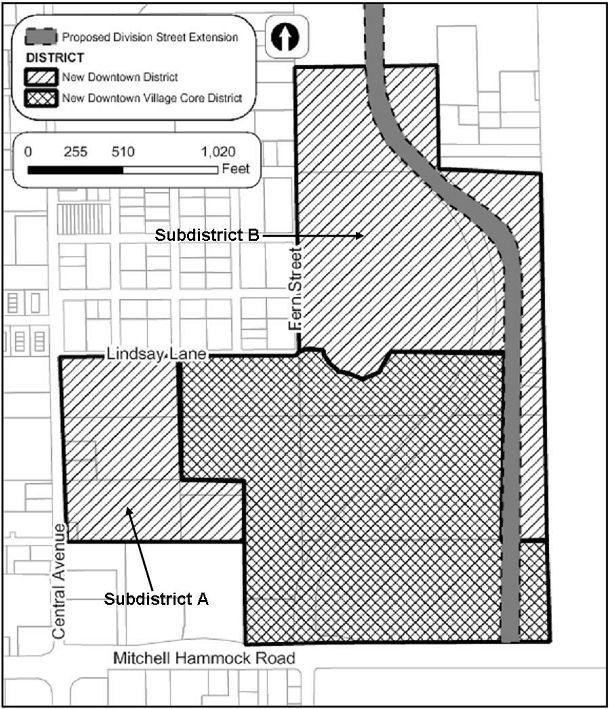
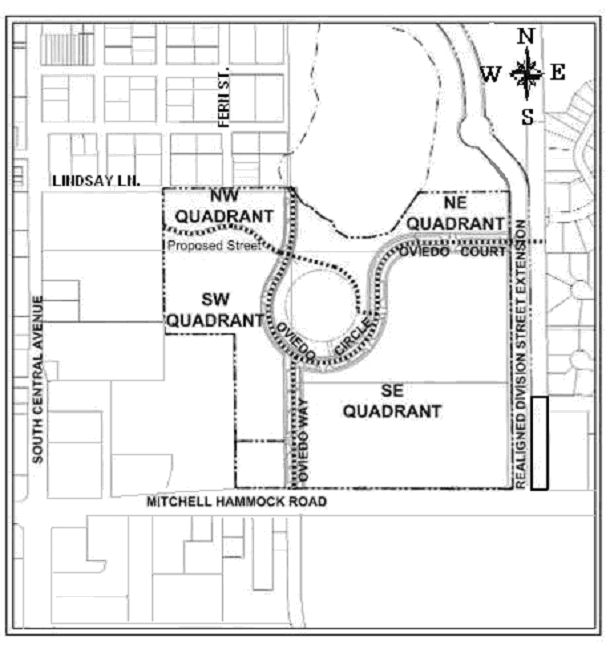

Exhibit B Approximate Location of Roadways and Description of Quadrants
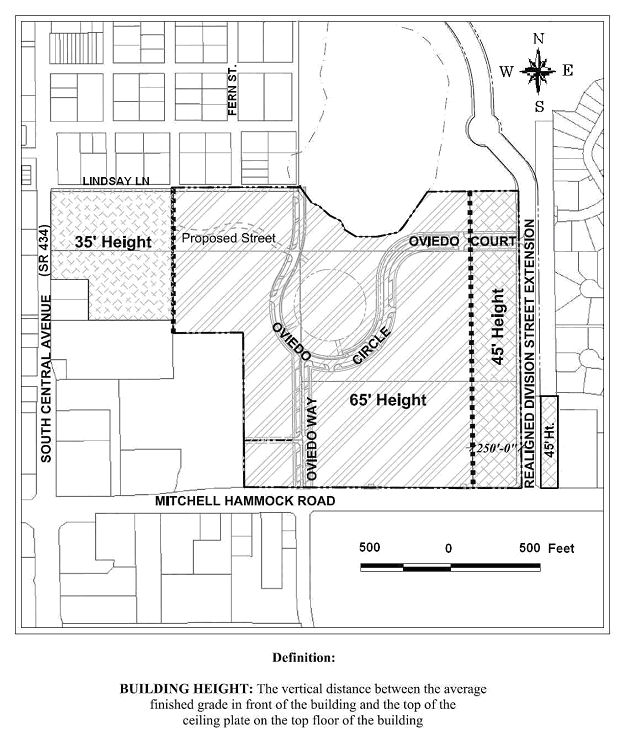
Exhibit C Maximum Buildable Heights by Zone
( Ord. No. 1556, § 2, 12-3-12 ; Ord. No. 1572, § 2, 11-4-13 ; Ord. No. 1612 , § 4, 2-2-15; Ord. No. 1625 , § 2, 9-21-15; Ord. No. 1626 , § 6, 8-17-15; Ord. No. 1647 , § 3, 2-20-17; Ord. No. 1655 , § 4, 9-7-17; Ord. No. 1677 , § 5, 11-5-18)

