
Oxford City Zoning Code
ARTICLE 5
0. - SITE DESIGN STANDARDS
In order to fully implement the goals of the City of Oxford supplementary development standards are required to insure that new development, renovation, and reconstruction are designed, sized, and sited to achieve functionally efficient, economically productive, pedestrian friendly, aesthetically pleasing environments. These standards are intended to contribute to the stability, vitality and long term livability of the city. The purpose of this article is to achieve those goals for the citizens of the City of Oxford.
Sec. 5.1. - Applicability and exemptions.
5.1.1.
Except as otherwise provided below, the standards in this article shall apply to all land located in the city with the exception of the following development activities:
5.1.1.1.
Routine maintenance related to plumbing, mechanical, or electrical systems of buildings and sites.
5.1.1.2.
All plumbing, mechanical and electrical equipment when such work is entirely within the interior of a building.
5.1.1.3.
Construction or alteration necessary for the compliance with a lawful order of the city, fire department, police department, or public works department related to the immediate public health or safety.
5.1.1.4.
Any interior alterations, repairs, or renovation which do not change the principal use of the structure.
5.1.1.5.
Demolition or wrecking, repair, construction, reconstruction, alteration, rehabilitation, moving, demolition, or change in use for either land or buildings within any historic district as approved by the historic preservation commission.
5.1.1.6.
Building permits for buildings less than 100 square feet.
5.1.1.7.
New parking lots with 3 or fewer spaces.
5.1.1.8.
Expansion of existing uses not exceeding 30 percent of the gross floor or lot area of the existing development.
5.1.1.9.
Building permits for the restoration of a building when restoration is required as a result of damage and/or destruction by fire or natural causes provided said permit is applied for within 12 months of the occurrence of fire or natural causes.
5.1.1.10.
Property identified, permitted, and under development at the time of adoption of the ordinance from which this article is derived.
5.1.2.
Any development or parking lot in existence before adoption of the ordinance must comply with the requirements of this article in the following circumstances:
5.1.2.1.
Any change requiring an increase in the number of parking spaces. However, when parking lots are expanded, parking lot buffers take priority over landscape islands and when circumstances do not permit both.
5.1.2.2.
Any addition, exterior renovations or remodeling which increases the square footage of a structure by more than 50 percent.
5.1.2.3.
Reserved
5.1.2.4.
For purposes of calculating parking requirements in a common interest development (CID) the development shall be considered as a whole rather than individual properties.
(Ord. No. 2023-11A, § I, 7-5-2023)
Sec. 5.2. - Historic compatibility.
For property in designated historic districts, compliance with additional standards in the historic preservation ordinance (chapter 54) is required.
Sec. 5.3. - Parking lot requirements.
5.3.1.
Applicability. These standards are applicable for the following development conditions:
5.3.1.1.
All parking lots of ten or more spaces.
5.3.1.2.
Parking lots under expansion and creating a total of ten or more spaces.
5.3.2.
Parking lot and driveway entrances.
5.3.2.1.
Drive entrance widths:
a.
One-way: Minimum 12 feet minimum and maximum 14 feet wide.
b.
Two-way: Maximum 24 feet wide.
c.
Three-way: Maximum 36 feet.
5.3.2.2.
Vehicular and pedestrian cross-access shall be provided to adjacent properties.
5.3.2.3.
Entrances and exits should be clearly defined with appropriate signage.
5.3.2.4.
Unlimited access across the frontage of a property is not permitted.
5.3.2.5.
Unless soil or topography conditions do not permit, landscaped areas shall be designed to divide and break up the expanse of paving. Each open area that is 24 square feet or larger shall be landscaped following the standards of 5.3.3.6.
5.3.3.
Interior design of parking lots.
5.3.3.1.
Surfaces. Required parking must be solidly surfaced with asphalt or similar material. Alternative permeable solid surfaces may be allowed on areas of limited use at the discretion of the director of planning and city engineer.
5.3.3.2.
Setback. Parking lots shall be setback from property lines eight feet.
5.3.3.3.
Parking spaces.
a.
Dimensions and number. Required parking spaces shall conform to those set out in article 4.
b.
Marking. Parking spaces shall be delineated by white striping unless otherwise required by ADA. Reflective striping is encouraged.
5.3.3.4.
Pedestrian circulation.
a.
Sidewalks. Sidewalks are required along all public and private streets as required in section 4.8.6.
b.
Internal pedestrian circulation shall be provided to create interconnected walkways safely conveying pedestrians from adjacent streets and parking destination.
c.
Crosswalks shall be designated by white pavement striping or materials of a different color and texture from the surrounding surface but conforming to the overall color scheme of the development.
5.3.3.5.
Loading areas. Loading docks, overhead doors, and truck parking shall be positioned, or screened in such a way as to not be visible from the public street. (See section 5.5.4, Screening.)
5.3.3.6.
Standards for parking islands.
a.
Types of islands.
i.
Median islands. An island with a minimum width of eight feet inside the curb shall be placed at a minimum every other parking bay or no more than 150 feet apart and along a primary internal and external access drives. They shall be planted with a large canopy tree every 50 linear feet or a small canopy tree every 35 linear feet.
ii.
End of aisle islands. The end of every parking aisle shall have a landscaped island and 15 parking spaces is the maximum number that can occur before a landscaped island is proposed.
iii.
Mid bay islands. One island, not less than nine feet wide and 18 feet long, measured from back of curb, shall be installed for each 100 lineal feet of parking area and shall cap ends of rows and landscaped according to landscape standards (see section 5.7).
b.
Landscaping of parking islands.
i.
Parking island trees. Required parking lot islands shall contain a minimum of one large, shade or canopy tree per island. Tree placement shall be designed so that, at the maturity of ten years, the minimum tree canopy coverage of all parking spaces will be 40 percent. Trees may be selected from a list approved by the Oxford Tree Board (see appendix) and shall have a caliper of two inches or greater. Each tree planting area shall have a three-foot depth of quality, root growing soil.
ii.
Landscaped areas shall be at least 75 percent covered with grass or another surface approved by the director or their designee. Planting shall be established prior to building occupancy.
c.
Specific standards for parking lots based on number of spaces
i.
Parking areas with less than 20 spaces must provide a minimum landscaping totaling 15 percent (15%) of the total parking area. It must be and be landscaped with shrubs at one per every 15 square feet of landscaped area; and one canopy tree for every 5 parking spaces, with a minimum of two trees planted.
ii.
For parking lots with more than ten spaces, there shall be a minimum of one tree per five parking spaces. A minimum of 65 percent of the required parking lot trees shall be provided within the interior of the parking lot.
iii.
In parking lots of 20 or more spaces, a parking island of 100 square feet or larger must be provided every ten parking spaces. Additional permeable area may be required by the city if necessary to ensure adequate growth of trees.
5.3.3.7.
Alternative compliance.
a.
Requirements of the parking lot landscaping may be altered if professionally designed and approved low impact development (LID) stormwater management elements are approved at the discretion of the site review committee. Seventy-five percent of the total LID stormwater management element area must be covered with appropriate vegetation and canopy trees tolerant of post-construction conditions. Canopy trees shall be planted at a maximum of 40 feet on-center.
b.
Permanent sculptures or other public art or vertical architectural structures that are nonintrusive but interrupt the horizontal sight lines of a parking lot, may be credited for no more than 20 percent of the total landscape requirements at the discretion of the site review committee.
5.3.4.
Parking lot perimeter design. A landscaped buffer at least five feet wide shall be installed around the perimeter of all parking lots that abut the public right-of-way; except as provided in the applicable front setback requirements.
5.3.4.1.
In this buffer, one large tree is required every 50 linear feet or fraction thereof, or one small tree every 35 linear feet or fraction thereof.
5.3.4.2.
All newly planted trees shall be planted in a permeable area of at least 25 square feet for small trees and at least 60 square feet for large trees. Additional permeable area may be required by the city if necessary to ensure adequate growth of trees.
5.3.4.3.
Low wall with vegetation can be used to screen a parking lot from the street.
(Ord. No. 2023-11A, § I, 7-5-2023)
Sec. 5.4. - Site lighting and building illumination.
5.4.1.
Lighting and illumination generally.
5.4.1.1.
Applicability. The provisions of this section shall apply to any and all exterior artificial light sources not otherwise having specific regulations specified within this Code.
5.4.1.2.
Exemptions. The following are exempted from the requirements of this section:
a.
Lighting fixtures and standards required by federal, state, county or city agencies, including street lights within public rights-of-way.
b.
Outdoor lighting fixtures used or required by law enforcement, fire and emergency services, transportation or similar governmental agencies to perform emergency or construction repair work, or to perform nighttime road construction on major thoroughfares.
5.4.2.
Site lighting standards.
5.4.2.1.
Brightness. Streets, driveways, parking lots, walks and service areas shall be adequately illuminated as evenly as possible, not exceeding an average of .3 foot-candles diminishing to 0 at a boundary and demonstrated by a site lighting plan illustrating compliance.
5.4.2.2.
A photometric survey prepared by a licensed design professional may be required by the director of planning to assist in discerning the planned lighting.
5.4.2.3.
Site lighting shall not extend beyond site boundaries. Luminaries shall be shielded, shaded, or directed to prevent light from being cast on adjacent property.
5.4.2.4.
Exterior lighting fixtures must be placed so that they do not interfere with the operation of vehicles.
5.4.2.5.
No exterior light shall have any blinking, flashing, or fluttering light, or other illuminating device which has a changing light intensity or brightness of color.
5.4.2.6.
Lighting fixtures shall be compatible in style with the architecture of their associated buildings.
5.4.2.7.
Height of fixtures. Light fixtures (pole) should be proportional to the height and building mass of the structure but in no event shall exceed 25 feet. Freestanding light fixtures shall not exceed 14 feet when adjacent to a residential property.
5.4.2.8.
Glare. There shall be no direct or reflected glare from floodlights, high temperature processing, combustion, welding, or otherwise, so as to be visible at the property line or right-of-way.
5.4.2.9.
Safety hazard. Any artificial light source which creates glare observable within the normal range of vision from any public walk or thoroughfare under normal weather conditions is considered a safety hazard and is prohibited.
5.4.2.10.
Nuisance. Any artificial light source which creates glare observable within the normal range of vision, under normal weather conditions, from any property other than the property where the light source is located is considered a nuisance and is prohibited.
5.4.3.
Building lighting standards. Exterior lighting of buildings, properties, developments, signs or other features, and for any use, including, but not limited to, residential, commercial and industrial uses, shall meet all of the following requirements:
5.4.3.1.
All exterior light fixtures shall be fully shielded and installed so that no direct light spills over onto adjacent properties or rights-of-way.
5.4.3.2.
Because of their unique requirement for nighttime visibility and their limited hours of operation, stadiums, ball fields, playing fields and tennis courts are exempted from the general standards of this section. Lighting for these outdoor recreational uses shall be shielded to minimize light and glare trespass onto adjacent and nearby properties and public streets. They must, however, have a cut-off time established as a condition of approval.
5.4.3.3.
No flashing, spinning, sweeping or strobing lights shall be permitted.
5.4.3.4.
No installation or erection of any lighting which may be confused with warning signals, emergency signals or traffic signals shall be permitted.
5.4.4.
Mounting poles and fixtures.
5.4.4.1.
Poles in commercial and multi-family developments, mounted upon a building or independently, shall not exceed 20 feet in height.
5.4.4.2.
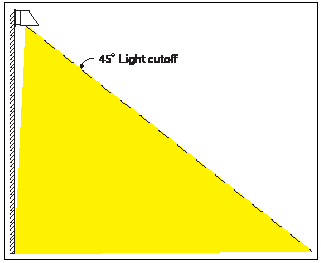
Pole mounted light fixtures shall be full cut-off that direct emitted light at 90 degrees or less. Where necessary, cut-off design fixtures or shields shall be installed to manage fugitive light throw.
5.4.4.3.
Lighting fixtures within industrial developments shall not exceed 25 feet in height, except in those instances where the subject property adjoins any residentially zoned property, where poles may not extend above the building roof line.
5.4.4.4.
Building mounted light fixtures shall be full cut-off to direct light at 45 degrees or less except for low intensity decorative lighting not exceeding 45 watts per bulb or incandescent equivalent.
Sec. 5.5. - Other design standards.
5.5.1.
Flags and flagpoles. See general district regulations [section] 3.2.
5.5.2.
Fences and exterior yards walls.
5.5.2.1.
Fences and walls shall be of design and materials compatible with surrounding development, and shall meet the fence use standards of section 3.2.7. Fences and walls shall be constructed such that the "finished" part of the fence or wall is located toward and facing the exterior of the property.
5.5.2.2.
Barbed wire, woven wire or electrical fencing may be used in agricultural or industrial applications only.
5.5.2.3.
Fences or walls topped with or containing metal spikes, broken glass, razor wire or similar material are prohibited.
5.5.2.4.
Uncoated chain link and other wire material fences shall not be permitted in a front setback except for athletic or play surfaces.
5.5.2.5.
Where chain link fencing is allowed in a front setback it shall be green or black vinyl coated.
5.5.2.6.
In a front yard the maximum height of fences and walls shall be four feet above grade, and shall allow for visibility. When located behind the front building line, the maximum height for a fence located in the side or rear yard shall be eight feet. Unless authorized by the director of planning or required by the building official or director of public works, the overall height for a fence on top of a retaining wall shall not exceed eight feet.
5.5.3.
Retaining walls.
5.5.3.1.
Retaining walls shall meet the retaining wall use standards of section 3.2.16.
5.5.3.2.
Retaining walls less than three feet tall may be constructed of treated timbers, split-faced concrete block, retained earth wall, flat-faced concrete block, or poured-in-place concrete with either a flat or decorative face.
5.5.3.3.
Retaining walls three feet or more in height shall only be constructed of split-faced concrete block or poured-in-place concrete with a decorative face and designed by an engineer or architect.
5.5.4.
Screening.
5.5.4.1.
Screening of nuisance activity such as auto repair vehicle storage areas, equipment or material storage areas, loading docks and similar functions shall provide screening to conceal such activities from public view.
5.5.4.2.
Utility apparatus and all HVAC equipment shall be screened by architectural elements consistent with the design of the principal structure. Parapets shall extend above the highest level of any roof mounted equipment. Alternatively, screen walls may be considered by special exception.
5.5.4.3.
Outside storage and waste disposal areas.
a.
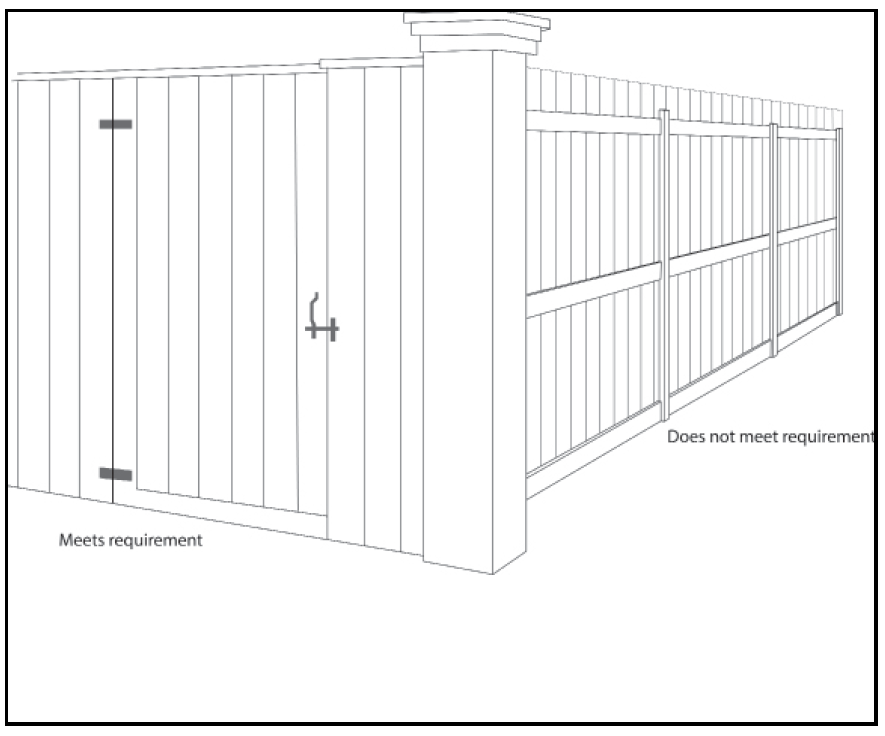
Combinations of berms, landscaping, walls, and buildings, shall be used to screen outside storage areas. Wooden or chain-link fences as a screening device for garbage collection areas is prohibited. Garbage collection areas shall be enclosed on all four sides by opaque material consistent in design and color of materials with that of the principal structure.
b.
Trash containers and waste oil and grease containers must be visually screened on all sides including gates. Combinations of berms, landscaping, walls, fences and buildings shall be used to screen containers and enclosures. Screening shall be at least two feet taller than the container.
c.
Outside storage areas and waste containers shall be located to the side or rear of principal structures, constructed with wash down facilities.
5.5.4.4.
Loading and utility service areas.
a.
All loading and utility service areas not screened by an intervening building shall be screened from view from any public street right-of-way for their entire length except for necessary access.
b.
Screening shall be provided by either:
i.
A closed fence or wall which is at least six feet high and is compatible with materials and color of the principal building; along with additional natural evergreens, shrubs or trees so that no more than two-thirds of the surface area of the closed fence or wall is visible from the street within three years of erection of the structure
ii.
With natural evergreen shrubs or trees which can be expected to reach six feet or a greater height within three years of planting.
(Ord. No. 2018-26, § I, 12-18-2018; Ord. No. 2022-5, § I, 5-17-2022; Ord. No. 2023-11A, § I, 7-5-2023)
Sec. 5.6. - Building form and materials.
5.6.1.
Form.
5.6.1.1.
When adjoining a residential zone, structures shall be compatible with the character of primarily residential zoning district. Compatibility shall be determined by comparing the consistency of existing and proposed design elements, colors, materials, height, bulk and landscaping.
5.6.1.2.
Building facades shall be oriented parallel to the streets they face. Main entrances shall be visible as a means of creating continuous streetscapes.
5.6.1.3.
A portion of the facade of any building over three stories in height shall step back or recess an additional 1.2 feet for every one foot of height above three stories. Exemption from this requirement may be requested by special exception.
5.6.1.4.
Multiple buildings on a site should be clustered to create plaza or pedestrian mall areas. Where this cannot be achieved, buildings shall be connected by means of pedestrian walkways defined by separate paving textures and accented by landscape areas.
5.6.1.5.
False or stage-set facades are prohibited. Materials and colors used on the street façade shall continue to the sides and rear of the building.
5.6.1.6.
The maximum, unbroken façade plane along any street frontage is limited to 60 feet and must be interrupted by visually discernable projections, recesses, portals, courtyards, plazas, or other architectural design elements. Façade breaks shall have a minimum depth of six inches.
5.6.1.7.
Form of multiple-family building design. Building designs that create variety and do not look monotonous if replicated throughout the development are required. Such designs must include all of the following elements:
a.
Building elevations, garages, carports, and all accessory structures shall have the same level of design, aesthetic quality, and architectural detailing.
b.
Porches, varied rooflines, and varied façade depths shall be provided to create variety and individuality of each building.
c.
Windows and projecting wall surfaces shall be used to break up larger wall surfaces, establish visual interest and provide visibility of the street and other public spaces encouraging social interaction.
d.
Protective entry courts, common vestibules, covered breezeways, or enclosed stair halls shall be used to reduce the number of visible doors unless designed in a row house or townhouse manner oriented toward the street.
e.
Garages, when provided, shall be designed to be integrated with the building design or sited so as to avoid long monotonous rows of garage doors and building walls. Garages shall be oriented so that they do not visually dominate the building façade or the streetscape.
5.6.1.8.
Inappropriate façade/appropriate façade.
a.
No flat-faced cement block or metal surfaces shall be visible from the exterior of any building as a primary surface material or mansard.
b.
Parapet facades may be used when unified construction with a primary surface of a wall and of the same material and color. The parapet shall be designed so reverse side of its elements are not visible to public view. False mansards are prohibited.
c.
Parapet facades must be used on flat roof structures where roof mounted building equipment is used. Parapets shall extend above the highest level of any roof mounted building equipment on all sides.
d.
Excessively tall foundation or basement walls and their visual impact must be avoided by blending them into their setting through the use of appropriate colors, building materials, or vegetation.
5.6.1.9.
Materials. Building materials must suit the architectural style of a building and be consistent or complementary throughout. Exterior surface materials shall be selected from among the following: Brick, tile, cementitious stucco, stone, vertical board and batten, wood or cementitious siding and approved architectural concrete masonry unit, or other materials if authorized by the planning director. A maximum of two percent of exterior surface may be clad with EFIS.
5.6.1.10.
Roof design shall be appropriate to the architectural style of a building. Where exposed to public view, roof material shall be selected from enameled standing seam metal, concrete or clay tiles, copper metal, or wood textured (architectural grade) or composition asphalt shingles. The use of plastic, fiberglass, other metal, or glass visible to public view is prohibited.
5.6.2.
Design detail.
5.6.2.1.
Wall surfaces shall be composed of at least 75 percent a single material and color.
5.6.2.2.
Walls that can be seen from an arterial or major collector street shall be treated as a building front façade.
5.6.2.3.
No less than 50 percent of the horizontal distance of any building front shall be designed with arcades, windows, entrances, awnings, or similar features.
5.6.2.4.
Retail front facades (front and sides open to public view) shall be glazed with clear glass no less than 30 percent of the first story. Other uses may provide the authentic appearance of such transparency.
(Ord. No. 2018-11, 7-17-2018)
Sec. 5.7. - Landscape standards.
5.7.1.
The purpose of these standards are to:
a.
Provide landscaping requirements to protect the public from the effects of erosion, flooding and obstruction of vehicular and pedestrian traffic;
b.
Aid in stabilizing the environment's ecological balance by contributing to the processes of energy and soil conservation, air purification, oxygen regeneration, waster water neutralization, ground water discharge, and stormwater runoff retardation, while aiding in noise, glare and heat abatement by preserving the existing tree canopy;
c.
Ensure that the local stock of native trees and vegetation is maintained and replenished as necessary; and
d.
provide visual buffering and to enhance the beautification of the city.
5.7.1.1.
Parking lots shall be landscaped as required in the standards of section 5.3.
5.7.1.2.
Stormwater management facility areas are to be landscaped as required in section 5.7.8.
5.7.1.3.
For new developments and parking lots, a common development which includes more than one lot shall be treated as one lot for the purposes of satisfying these landscape regulations. Split ownership, planning in phases, construction in stages, and/or multiple building permits for a project shall not prevent it from being a common development as referred to in the definitions.
5.7.2.
Landscape plan required. A landscape plan is required at time of site plan review for all site plans, subdivisions, and master planned developments. The landscape plan shall be prepared by a qualified professional landscape architect or landscape designer, or certified arborist and shall contain the information specified in the Section A-6 of the Appendix.
5.7.2.1.
Parking lots shall be landscaped as required in the standards of Section 5.3.
5.7.2.2.
Stormwater management facility areas are to be landscaped as required in Section 5.7.9.
5.7.2.3.
For new developments and parking lots, a common development which includes more than one lot shall be treated as one lot for the purposes of satisfying these landscape regulations. Split ownership, planning in phases, construction in stages, and/or multiple building permits for a project shall not prevent it from being a common development as referred to in the definitions.
5.7.2.4.
The building permit department may allow a temporary certificate of occupancy valid for a period of 30 days with extensions not to exceed an accumulation of 180 days if all of the following conditions exist:
a.
Except for the completion of landscaping installation, occupancy would normally be allowed.
b.
Completion of the required landscaping before a permanent certificate of occupancy is issued would result in hardship to the applicant as applied to this case, if so determined by the director of planning.
c.
At the time the conditional temporary certificate of occupancy is requested, the developer/owner shall make financial arrangements (by certificate of deposit, or letter of credit) satisfactory to the city in the amount of $3.00 per square foot of required landscaping not yet in place to ensure that it shall be installed.
d.
Any owner/developer wishing to make such financial arrangements must also grant the city access to the land to install or complete the required landscaping in the event the landscaping installation has not been completed at the end of the required extension period. Such financial arrangements shall be released when the required landscaping is completed.
5.7.3.
Compliance with approved landscaping plan.
5.7.3.1.
No building permit shall be issued unless the submitted landscape plan complies with the provisions of this ordinance. Standards for installation and maintenance of landscaping are located in the Appendix.
5.7.3.2.
A certificate of occupancy shall not be permitted until required landscaping is complete and/or provision has been made to provide financial surety for completion of the required landscaping.
5.7.3.3.
Phased development projects must have all required mitigation (See Article 6 - Tree Protection) completed in the phase that has been approved before the issuance of a certificate of occupancy.
5.7.3.4.
The building permit department may allow a temporary certificate of occupancy valid for a period of 30 days with extensions not to exceed an accumulation of 180 days if all of the following conditions exist:
a.
Except for the completion of landscaping installation, occupancy would normally be allowed.
b.
Completion of the required landscaping before a permanent certificate of occupancy is issued would result in hardship to the applicant as applied to this case, if so determined by the Director of Planning.
c.
At the time the conditional temporary certificate of occupancy is requested, the developer/owner shall make financial arrangements (by certificate of deposit, or letter of credit) satisfactory to the city in the amount of $3.00 per square foot of required landscaping not yet in place to ensure that it shall be installed.
d.
Any owner/developer wishing to make such financial arrangements must also grant the city access to the land to install or complete the required landscaping in the event the landscaping installation has not been completed at the end of the required extension period. Such financial arrangements shall be released when the required landscaping is completed.
5.7.3.5.
Permeable pavers may replace up to 25 percent of the landscaping requirement for the pervious surface of the lot, approvable at the discretion of the planning director.
5.7.3.6.
If landscape mulch made of organic materials (such as wood) is to be used, it must be placed at least two feet from the edge of a building. Landscape rock or other similar material may be placed next to the building.
5.7.3.7.
Frontage trees must be planted along all public streets at the rate of one large tree every 50 feet, or one small tree every 35 feet.
5.7.3.8.
A foundation planting plan must be included in the landscaping plan for any development proposal.
5.7.4.
Site landscaping requirements.
5.7.4.1.
A minimum of 15% of the pervious surface of the lot shall be landscaped with trees and shrubs.
5.7.4.2.
Additional landscaped area may be in the form of green areas, foundation plantings around buildings and structures, or additional front setback landscaping.
5.7.4.3.
Any adjacent public right-of-way if planted and maintained by the developer shall be included as a credit toward required landscaped area. Plantings in a public right-of-way must be carefully considered due to potential for conflicts with underground utilities and will require approval of the City Engineer. Trees planted in a public right-of-way with underground utilities must be from the list of approved trees for planting within a right-of-way, maintained by the Public Works Department.
5.7.4.4.
At a minimum, all additional landscaped areas shall be completely covered with live turf or ground cover, or seasonal seeding.
5.7.4.5.
Permeable pavers may replace up to 25% of the landscaping requirement for the pervious surface of the lot, approvable at the discretion of the Planning Director.
5.7.4.6.
If landscape mulch made of organic materials (such as wood) is to be used, it must be placed at least two (2) feet from the edge of a building. Landscape rock or other similar material may be placed next to the building.
5.7.4.7.
Frontage trees must be planted along all public streets at the rate of 1 large tree every 50 feet, or 1 small tree every 35 feet.
5.7.4.8.
A foundation planting plan must be included in the landscaping plan for any development proposal.
5.7.5.
Credit for existing material.
5.7.5.1.
Landscape areas shall incorporate existing natural vegetation to the extent feasible. If the natural vegetation is inadequate to meet the required landscaping standards, additional plant material shall be required.
5.7.5.2.
Existing native habitat or vegetation located within planting areas that are preserved and meeting the requirements of this section may be counted toward the requirements.
5.7.5.3.
Credit toward landscaping requirements may be granted at the discretion of the Planning Director
5.7.5.4.
No landscaping shall be placed in an area of right-of-way where a capital improvement project has been funded for such location, unless and until such project has been completed.
5.7.5.5.
No landscaping or other structure shall be placed within the sight triangle of an intersection.
5.7.6.
Landscaping in Right of way. See requirements in Article VI. Trees, Section. 98-140.
5.7.7.
Edges and buffers.
5.7.7.1.
Edges. A landscaped edge shall be provided along the perimeter of all lots that are adjacent to streets and entrances.
a.
The street perimeter landscaped edge shall be a minimum width of eight feet.
b.
Within the street perimeter landscaped edge, ornamental grasses, mulch, landscape rock, or similar material shall be maintained within a minimum width of five feet from signs and five feet from ingress/egress curb cuts.
c.
One tree must be planted in the street perimeter landscape edge for each 40 linear feet of landscaped edge, at a minimum 3-inch caliper. The number of required trees shall be calculated solely on the linear frontage of the required landscaped edge, and rounded to the nearest whole number. Trees may be grouped together or evenly spaced.
5.7.7.2.
Buffers. An area with sufficient planting and/or structural screening (as defined in Article 10) shall be provided between certain uses and districts as noted below.
a.
A 50 foot buffer (to include the applicable setback requirement) is required between industrial or manufacturing uses, or any commercial use on a site of more than one acre; that adjoins any property zoned primarily for residential uses; and between any development and any walking/biking trail, or any blue line stream (as designated by the U.S.G.S.); unless a permit for modifying, filling, piping, for re-routing has been obtained from FEMA and the Corp of Engineers. The buffer must include landscaping and/or fences, so that there will be an unbroken screen to limit visibility between the zones.
b.
A 15-foot to 25-foot buffer (to include the applicable setback requirement) is required between commercial uses properties on sites of less than one acre and any property zoned primarily for residential uses. The buffer must include landscaping and/or fences, so that there will be an unbroken screen to limit visibility between the zones uses. Where walls are proposed, a narrower buffer may be used.
c.
A buffer area of the required minimum width shall be located parallel to the abutting property line.
d.
All buffers must include some level of landscaping and/or fences. Trees and vegetation used to enhance the buffer shall be planted sufficiently to provide year-round visual screening at maturity.
e.
All easements including utilities, may be included in the buffer area or be used or otherwise employed to meet the lot requirements of the zone, if it is calculated as par of the required landscaped area.
5.7.7.3.
Walls and/or fencing. Walls and fencing (including retaining walls) may be utilized within the buffer area. Where utilized, a six-foot masonry wall or opaque chain link fence or a fence of approved wood of natural decay resistance shall be placed along the property line or along the inside perimeter of the buffer so as to provide 100 percent (100%) year-round visual screening at time of the issuance of the certificate of occupancy.
5.7.8.
Site preparation.
5.7.8.1.
Grading. Areas of natural vegetation along property lines should be preserved wherever possible and incorporated into the site's overall landscape design.
5.7.8.2.
Slope. Transitions of grades between adjacent property ownerships should be as smooth as practical and in no event shall exceed a slope of greater than 3:1 rise to run.
5.7.9.
Stormwater detention standards.
5.7.9.1.
Surface stormwater detention (e.g. dry pond or retention pond) shall be located to the side or back of a development. If site conditions warrant the placement of the stormwater detention system in the front of the development, then it shall be used as a landscape feature. Landscaping shall be appropriately designed and meet landscape standards of this section.
5.7.9.2.
The use of properly designed, low impact development (LID) or green techniques for stormwater management are encouraged, wherever practical. LID best management practices (BMP) design elements from the Mississippi Department of Environmental Quality's Stormwater Runoff Management Manual, Volume 2, Chapter 4 are acceptable.
5.7.9.3.
All surface stormwater detention system exterior slope faces shall be 4:1 or flatter. Also, surface stormwater detention systems shall have at a minimum, a four (4) foot wide landscape area along the top perimeter with maintenance access as required. These areas are to be landscaped with shrubs at a minimum ratio of one (1) per very 15 square feet of landscape area.
5.7.9.4.
Select tree species may be allowed to be planted in shallow (four (4) or less total depth) dry, detention ponds. The specie type and density shall be approved at the discretion of the Director of Planning and the City Engineer.
5.7.9.5.
Penalties. See Section 9.11.
(Ord. No. 2018-11, 7-17-2018; Ord. No. 2021-1, § 1, 2-2-2021; Ord. No. 2023-11A, § I, 7-5-2023)
Sec. 5.8. - Neighborhood conservation district standards.
5.8.1.
Applicability. The conservation plan approved as part of the zoning change creating a neighborhood conservation district shall include design standards for new construction or placement of any building, structure, foundation, sign, public art or outdoor apparatus or equipment (including visible utility boxes or mechanical equipment; trucks; lawn or landscaping equipment, but not including lawn mowers or hand tools; playground equipment; or sports equipment), and any additions, alterations, relocation or rehabilitation to the street facades of existing buildings, structures, foundations, sign, public art, or outdoor apparatus or equipment. No building permit shall be issued for new construction or an alteration or addition to the street facade of an existing building or structure within a designated neighborhood conservation district without the submission and approval of design plans and the issuance of a certificate of zoning compliance by the director of planning.
5.8.2.
Exceptions.
5.8.2.1.
The conservation plan and requisite design standards do not apply to those ordinary repair and maintenance actions, i.e., using the same material and design.
5.8.2.2.
Old Town Oxford Neighborhood Conservation District excludes the area of the Historic Urban Core Zoning District.
5.8.3.
Submittal elements.
5.8.3.1.
Required. The design standards for the neighborhood conservation district shall include the minimum following elements governing the physical characteristics and features of all property (public or private) within the proposed district:
a.
Building height, number of stories.
b.
Building size, massing (frontage, entrance location/features).
c.
Lot size, coverage.
d.
Front and side yard setbacks.
e.
Off-street parking and loading requirements.
f.
Roof line and pitch.
g.
Paving, hardscape covering.
h.
Building orientation.
i.
Garage entrance location.
j.
Driveways and sidewalks.
k.
Optional: The design standards may include, but shall not be limited to, the following elements:
i.
General site planning (primary, ancillary structures).
ii.
Density.
iii.
Floor area ratio.
iv.
Signage.
v.
Architectural style and details.
vi.
Building materials.
vii.
Front window, dormer size and location.
viii.
Landscaping.
ix.
Fences and walls.
x.
Entrance lighting.
xi.
Satellite dishes, utility boxes.
xii.
Street furniture.
5.8.4.
Design standards.
5.8.4.1.
Building height. In residential areas a maximum of two occupied stories, with a maximum height of 38 feet. In commercial areas a maximum of three occupied stories with a maximum height of 45 feet.
5.8.4.2.
Building orientation. In all areas on lots with frontage on existing streets, buildings shall be oriented to the existing streets. This orientation applies only to buildings on the front perimeter of the lot.
5.8.4.3.
Lot coverage.
a.
In residential areas lot coverage shall include building footprint, driveways, parking pads, and sidewalks. The remainder of the site shall be landscaped as required in article 5. Lot coverage shall not exceed:
i.
Forty percent for properties zoned SMF or NR.
ii.
Fifty percent for lots with detached dwellings in an SMF or NR district.
iii.
Fifty percent for residential properties and 60 percent for nonresidential properties zoned ER or SR.
b.
Lot coverage shall not exceed 60 percent for all properties zoned for commercial uses. Lot coverage shall include building footprint, driveways, parking areas, and sidewalks. The remainder of the site shall be landscaped as required in article 5.
5.8.4.4.
Yard standards.
a.
In residential areas:
i.
Front yards: A method for determined the appropriate front setback shall be determined by the director of planning using the unique characteristics of the street, and reflecting the established pattern of setbacks in the neighborhood.
ii.
Side yard: A minimum side yard of ten feet is required.
iii.
Rear yard: A minimum rear yard of 20 feet is required.
b.
In commercial areas the setbacks shall follow the standards of the zoning district.
5.8.4.5.
Roof line and pitch.
a.
In residential areas the roof line design shall be a traditional residential style with consistent use of pitches between 6/12 and 12/12 flexible to at the discretion of the director of planning in areas where homes were primarily built after 1950.
b.
In commercial areas the roof design shall follow the building form standards in article 5 and the standards of the zoning district.
5.8.4.6.
Parking.
a.
In residential areas on-site parking shall be required for any new construction and for remodeling and additions that exceed 50 percent of the current value of the building. One on-site parking space shall be required for the first two bedrooms, two spaces for three bedrooms, and three spaces for four or more bedrooms. It is preferable for all parking to be located in the side and rear yards. A parking area located within the required front yard shall not exceed the width of a single driveway and a maximum of 360 square feet of paved or graveled area.
b.
In commercial areas parking shall meet the parking standards for the use in article 3 and the landscaping requirements of article 5. If parking is contained underneath a multi-story structure, such parking area shall not be accessible from the front of the structure if it faces a public street.
5.8.4.7.
Flag lots and access. In all areas flag lots shall not be created and all new lots shall have frontage and access to an approved public or private street. Flag lots created before the district was created are not nonconforming.
5.8.4.8.
Development standards.
a.
In all areas lots in a zero lot line development shall be a minimum of 5,000 square feet.
b.
A development of only townhouses development shall be on properties with a minimum of ten acres.
c.
A development of only single-family attached development shall be on properties with a minimum of ten acres.
5.8.4.9.
Retaining walls. In all areas retaining walls shall not exceed six feet in height except that when located in the front building setback height shall not exceed four feet in height. Height shall be measured from finished ground to top of wall. Distance between regaining walls shall be a minimum of 20 feet. On a series of consecutive walls, slope of finished ground between walls shall be a maximum of 3:1 (horizontal distance to vertical distance). No retaining wall shall be so close to an adjacent property as to impair development capacity of the neighboring property.
5.8.4.10.
NC-dwelling, multi-family. In residential areas of the Old Town Oxford NCO District, multifamily units are not allowed; only detached and attached dwelling units (up to four dwelling units per structure). When located in a NR or SMF zoning district, dwelling units in such structures may not be larger than three bedrooms. Also, only 50 percent of the dwelling units in any such residential development structure may have three bedrooms; the remaining units must be efficiency, one, or two bedroom units.

