
Pagosa Springs City Zoning Code
ARTICLE 2
- ADMINISTRATION
2.1.- PURPOSE AND ORGANIZATION OF ARTICLE
This Article describes the procedures for review of all applications for land use and development activity in Pagosa Springs.
2.1.1.Section 2.2., Summary Table of Procedures, includes a summary table listing the land use and development procedures in this Land Use Code.
2.1.2.Section 2.3., Common Development Review Procedures, describes standard procedures that are applicable to most types of procedures.
2.1.3.Section 2.4., Specific Procedures and Approval Criteria, should be read and administered in conjunction with Section 2.3., and includes additional provisions unique to each type of procedure, such as public hearing requirements and approval criteria.
2.1.4.Section 2.5., Review and Decision-Making Bodies, describes the duties and membership of the boards, commissions, and other bodies that have review and decision-making responsibilities under this Land Use Code.
2.2. - SUMMARY TABLE OF PROCEDURES
Table 2.2-1 summarizes the land use and development procedures in this Land Use Code and identifies the bodies that have review and decision-making responsibilities for each procedure. See Section 2.4. for details on each procedure, including exceptions to these general rules.
(Ord. No. 754, § 1, 5-20-2010; Ord. No. 916, § 1a, 6-20-2019; Ord. No. 941, § 1, 10-6-2020)
2.3. - COMMON DEVELOPMENT REVIEW PROCEDURES
The common development review procedures in this Section provide a foundation for the specific review and approval procedures in Section 2.4. See Section 2.4 to determine which of these common procedures apply to an individual application for development review.
2.3.1. STEP 1: APPLICANT ATTENDS PRE-APPLICATION CONFERENCE
A.
Purpose. The purpose of a pre-application conference is to provide an opportunity for an informal evaluation of the applicant's proposal and to familiarize the applicant and the Town staff with the applicable provisions of this Land Use Code, the Comprehensive Plan, infrastructure requirements, and any other issues that may affect the applicant's proposal.
B.
Applicability.
1.
Required for new applications. A pre-application conference is required prior to the following types of applications:
a.
Comprehensive Plan Amendment (Section 2.4.1.)
b.
Rezone, General (Section 2.4.2.C.)
c.
Rezone, Planned Development Overlay District (Section 2.4.2.D.)
d.
Major Subdivision, Sketch Plan (Section 2.4.3.C.3.)
e.
Vacation of Right-of-Way and Other Public Easements (Section 2.4.3.D.)
f.
Conditional Use Permit (Section 2.4.4.)
g.
Design Review Sketch, Administrative (Section 2.4.6.D.)
h.
Design Review, Major (Section 2.4.6.G.)
i.
Design Review Sketch, Major (Section 2.4.6.F.)
j.
Redevelopment Permit (Section 2.4.7.)
k.
Variance (Section 2.4.11.)
These types of applications shall not be accepted until after the pre-application conference is completed. The conference should take place prior to any substantial investment, such as land acquisition for a proposed development, site and engineering design, or the preparation of other data.
2.
Optional for all other applications. A pre-application conference is optional, upon the request of either the applicant or the Director, prior to submission of any other application under this Land Use Code not listed above.
C.
Initiation of pre-application conference. The potential applicant shall request in writing a pre-application conference with the Director and pay the required fees, if any. With the request for a pre-application conference, the applicant shall provide to the Director a description of the character, location, and magnitude of the proposed development and any other available supporting materials, such as maps, drawings, or models. It is the applicant's responsibility to provide sufficiently detailed plans and descriptions of the proposal for staff to make informal recommendations regarding the proposed project.
D.
Pre-application conference content. The Director shall schedule a pre-application conference after receipt of a written request and the required fees, if applicable. At the conference, the applicant, the Director or designee, and any other persons the Director deems appropriate to attend shall discuss the proposed development and the applicable requirements of this Land Use Code, based upon the information provided by the applicant.
E.
Record of pre-application conference. The applicant shall be responsible for recording a summary of topics discussed at the pre-application conference. The record shall be submitted as part of the development application.
F.
Informal evaluation not binding. The informal evaluation of the Director and staff provided at the conference are not binding upon the applicant or the Town, but are intended to serve as a guide to the applicant in making the application and advising the applicant in advance of the formal application of issues that may be presented to the appropriate decision-making body.
G.
Application required within six (6) months. After a pre-application conference has been completed, the associated application must be filed within six (6) months, or sooner if required by the Director due to changing conditions. If an application is not filed within such timeframe, a new pre-application conference shall be required prior to filing an application.
2.3.2. STEP 2: APPLICANT HOLDS NEIGHBORHOOD MEETING
A.
Purpose. The purpose of a neighborhood meeting is to provide an informal opportunity to inform the residents and landowners of the surrounding neighborhood(s) of the details of a proposed development and application, how the developer intends to meet the applicable standards of this Land Use Code, and to receive public comment and encourage dialogue at an early time in the review process. No decision regarding the application will be made at the neighborhood meeting.
B.
Applicability. A neighborhood meeting is recommended, but not mandatory, for any development proposal that will be subject to Planning Commission review. The meeting should be held no earlier than six (6) months before the submittal of the application.
C.
Notice of neighborhood meeting. An applicant holding a neighborhood meeting is encouraged to provide mailed and posted notice of the meeting in the same manner that would be required for public hearings on the application pursuant to Step 6 of the common development review procedures (Section 2.3.6.).
D.
Attendance at neighborhood meeting. The applicant is responsible for scheduling the meeting, coordinating the meeting, and for retaining an independent facilitator if needed. Attendance at the neighborhood meeting by Town staff is not required.
E.
Summary of neighborhood meeting. If a neighborhood meeting is held, the applicant shall prepare and submit a written summary of the meeting with the associated application. The written summary shall be included in the complete application submittal.
2.3.3. STEP 3: APPLICANT SUBMITS APPLICATION
A.
Form of application. Applications required under this Article shall be submitted in a form and in such number as required by the Director and described in the Administrative Manual.
B.
Development code administrative manual. The Director shall compile the requirements for application contents, forms, fees, and the submission and review schedule (including recommended time frames for review) in an Administrative Manual, which shall be made available to the public. The Director may amend and update the Administrative Manual from time to time, subject to approval of the Planning Commission.
C.
Consolidated development applications and review. Multiple development applications for the same development proposal may be consolidated for submittal and review, depending on the complexity of the proposal, as required by the Director. Such consolidated applications shall be reviewed, considered, and decided upon by the highest level decision-maker that would have decided the development proposal under this Article had they been submitted, processed, and considered as separate development applications.
D.
Authority to file applications.
1.
Unless otherwise specified in this Land Use Code, applications for review and approval may be initiated by:
a.
The owner of the property that is the subject of the application;
b.
The owner's authorized agent; or
c.
Any review or decision-making entity.
2.
When an authorized agent files an application under this Land Use Code on behalf of a property owner, the agent shall provide the Town with written, notarized documentation that the owner has authorized the filing.
3.
When a review or decision-making body initiates action under this Land Use Code, it does so without prejudice toward the outcome.
E.
Development review fees.
1.
Recovery of costs. Development review fees are hereby established for the purpose of recovering the costs incurred by the Town in processing, reviewing, and recording development applications submitted pursuant to this Land Use Code. An applicant shall reimburse the Town for all costs incurred in review of an application, including review fees from consultants acting as staff and fees from review agencies. The development review fees imposed pursuant to this Section shall be paid at the time of submittal of any development application and are non-refundable. All final approvals shall be contingent on the applicant reimbursing the Town any additional required fees within thirty (30) days of a decision.
2.
Development review fee schedule. The amount of the Town's development review fees shall be established by the Town Council and shall be based on the actual expenses incurred by, or on behalf of, the Town. The schedule of fees shall be reviewed annually and shall be adjusted, if necessary, by the Town Council by adoption of a resolution.
3.
Exemption from development application and review fees. The Town Council may, by resolution, grant an exemption of one hundred percent (100%) of the fees for units of a project meeting the definition of workforce housing or for an entire housing project if the average of the entirety of all units is at or below one hundred percent (100%) of AMI. Developer shall request such exemption prior to filing an application for a development permit. If fee exemption is granted, the developer shall enter into a development deed restriction agreement with the Town that ensures a minimum period of time for continued affordability, with such period of time being a minimum of seven (7) years or longer as determined by Town Council based on the totality of incentives, waivers and exemptions the project will receive. The Town Council may, by resolution, impose a moratorium on the exemption from fees at any time.
4.
Exemption from development review fees for projects involving a public-private or intergovernmental partnership. So long as an application for exemption is filed prior to when development review fees would otherwise be due, the Town Council may, by resolution, grant an exemption from all or any part of the development review fees for projects involving either a public-private partnership with the town or an intergovernmental partnership that provide a benefit to residents and visitors to the Town. The Town Manager may grant an exemption from all or any part of the development review fees for projects located on real property owned or leased by the Town or accessory dwelling units.
F.
Waivers. The Director may waive certain submittal requirements in order to reduce the burden on the applicant and to tailor the requirements to the information necessary to review a particular application. The Director may waive such requirements where he or she finds that the projected size, complexity, anticipated impacts, or other factors associated with the proposed development clearly, in his or her opinion, support such waiver.
G.
Additional information. Additional application-specific information, beyond that specified in the Administrative Manual, may be required by the Director, Planning Commission, and/or Town Council, as necessary and appropriate to evaluate fully whether an application complies with the requirements of this Land Use Code.
H.
Inactive files. If an applicant fails to submit required information or request a hearing date for a period of more than six (6) months, his or her file shall become void and the re-submittal of a new application and fees shall be required. The Director may grant no more than two (2) extensions of time to this provision, of no more than six (6) months each, upon a written request by the applicant.
2.3.4. STEP 4: DIRECTOR DETERMINES APPLICATION COMPLETENESS
A.
The Director shall only initiate the review and processing of complete applications. The Director shall make a determination of application completeness within fifteen (15) days of application filing. If the application is determined to be complete, the application shall then be processed according to the procedures set forth in this Land Use Code. If an application is determined to be incomplete, the Director shall provide notice to the applicant along with an explanation of the application's deficiencies. No further processing of an incomplete application shall occur until the deficiencies are corrected in a future re-submittal.
B.
An application will be considered complete if it is submitted in the required form, includes all mandatory information, including all supporting materials specified in the Administrative Manual, and is accompanied by the applicable fee. Information shown must clearly indicate compliance with applicable development standards, or in the case of a request for a variance or modification to certain standards, the degree to which the application will be non-compliant.
C.
Any supplemental technical reports and special studies that are submitted following the original application must be received at least thirty (30) days prior to the first hearing to be held on the application. The Town may postpone and reschedule a hearing or approval deadline if such reports and studies are submitted less than thirty (30) days prior to a hearing. Copies of such additional materials shall be delivered to all reviewers who received the original application packet.
2.3.5. STEP 5: DIRECTOR REVIEWS APPLICATION AND PREPARES STAFF REPORT
Within a reasonable time after determining that a development application is complete, the Director shall refer the development application to the appropriate review agencies, review the development application, and prepare a Staff Report. The staff report shall be made available for inspection and copying by the applicant and the public prior to any scheduled public hearing(s) on the application. The staff report shall indicate whether, in the opinion of the Director, the development application complies with all applicable standards of this Land Use Code.
2.3.6. STEP 6: NOTICE OF PUBLIC HEARING(S)
A.
Content of notices. Notice of all public hearings required under this Land Use Code shall, unless otherwise specified in this Land Use Code: (1) identify the date, time, and place of the public hearing, (2) if applicable, describe the property involved in the application by street address or by legal description; by prior subdivision reference, or by section, township, and range of the property with reference to the full legal description contained in the application; (3) describe the nature, scope, and purpose of the proposed action; (4) indicate that interested parties may appear at the hearing and speak on the matter; and (5) indicate where additional information on the matter may be obtained.
B.
Summary of notice requirements. Table 2.3-1 lists the notice requirements for all procedures in this Article.
C.
Published notice. When Table 2.3-1 requires that notice be published, the Town Planning Department shall publish notice of a public hearing in a newspaper of general circulation in the area at least one (1) time at least twelve (12) days prior to the scheduled hearing date.
D.
Written notice. When Table 2.3-1 requires that written notice be provided, such notice shall be mailed by the Town no less than fifteen (15) days before the public hearing, by first class United States mail, postage prepaid, to the applicant, appellant, or landowners subject to a land use application, the record owners of land immediately adjacent to the subject land, neighboring property owners whose properties are within five hundred (500) feet of the lot that is the subject of the application or appeal (based on information found in the Archuleta County tax records), and any other person who makes a written request for such notice.
Figure 2.3-1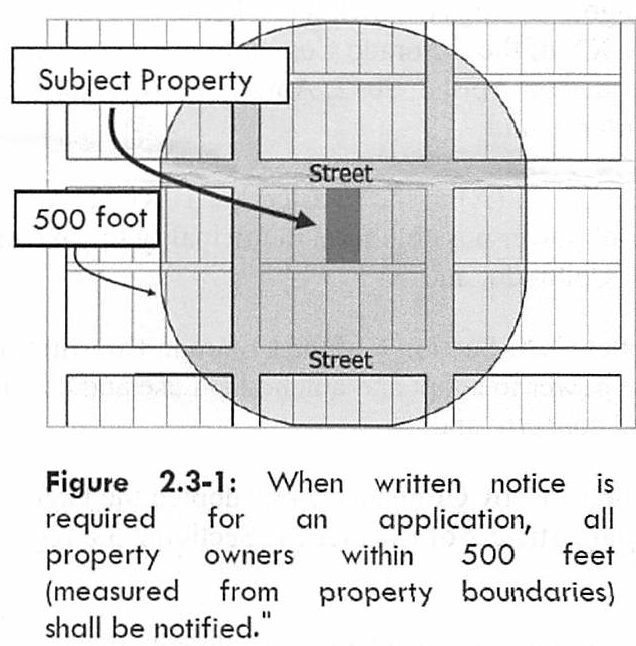
E.
Posted notice. When Table 2.3-1 requires that posted notice be provided, the applicant shall post at least one (1) sign on the lot, parcel, or tract of land, and such sign shall remain on the property for a period of at least fifteen (15) days prior to the public hearing. The sign shall be posted in a prominent place, clearly visible from the most heavily traveled adjacent street or public way. The Director may require that additional signs be posted depending on the access and configuration of the property.
F.
Notice to mineral estate owners and lessees. When Table 2.3-1 requires that notice be provided to mineral estate owners and lessees, the applicant shall provide notice of the application by certified mail, return receipt requested, to all mineral estate owners and lessees on the subject property in accordance with C.R.S. Section 24-65.5-103. Such notice shall be provided not less than thirty (30) days prior to the initial public hearing, or not less than thirty (30) days prior to the final decision if the application does not require a public hearing. It shall be the applicant's responsibility to conduct the necessary research to determine mineral estate owners and lessees on the subject property.
G.
Constructive notice. Minor defects in any notice shall not impair the notice or invalidate proceedings pursuant to the notice if a bona fide attempt has been made to comply with applicable notice requirements. Minor defects in notice shall be limited to errors in a legal description or typographical or grammatical errors that do not impede communication of the notice to affected parties. In all cases, however, the requirements for the timing of the notice and for specifying the time, date, and place of a hearing shall be correctly conveyed. Failure of a party to receive written notice shall not invalidate subsequent action. If questions arise at the hearing regarding the adequacy of notice, the decision-making body shall make a formal finding as to whether there was substantial compliance with the notice requirements of this Land Use Code.
2.3.7. STEP 7: TOWN HOLDS PUBLIC HEARING(S)
One (1) or more public hearings, if required under this Land Use Code, shall be conducted.
2.3.8. STEP 8: TOWN ISSUES DECISION AND FINDINGS
A.
Decision. After consideration of the development application, the staff report, comments received from other reviewers (if applicable), and the evidence from the public hearing (if applicable), the decision-maker shall approve, approve with conditions, or deny the application based on the applicable approval criteria. Written notification of the decision shall be provided by the Director to the applicant within seven (7) days after the decision.
B.
Approval criteria. To approve a development application, the decision-maker shall find that the development application has satisfied and followed the applicable requirements of this Article and all of the approval criteria required for the applicable development application.
C.
Conditions of approval. Unless otherwise specified in this Land Use Code, the decision-maker may impose such conditions on the approval of the application as may be necessary to reduce or minimize any potential adverse impact upon other property in the area, or to carry out the general purpose and intent of the Comprehensive Plan, other adopted Town plans, and this Land Use Code. In such cases, any conditions attached to approvals shall be directly related to the impacts of the proposed use or development and shall be roughly proportional in both nature and extent to the anticipated impacts of the proposed use or development. No conditions of approval shall be less restrictive than the requirements of this Land Use Code, except where the Land Use Code allows deviations from the express requirements of the Land Use Code.
D.
Findings. All decisions shall include at the least the following elements:
1.
A clear written statement of approval, approval with conditions, or denial, whichever is appropriate; and
2.
A clear statement of the basis upon which the decision was made, including specific written findings of fact with reference to the relevant standards of this Land Use Code.
E.
Effect of inaction on applications. When a review or decision-making body fails to take action on an application within the time required, such inaction shall be deemed a denial of the application, unless the decision-making body agrees to an extension of the time frame.
F.
Record of proceedings.
1.
Recording of public hearing. The decision-maker conducting the public hearing shall record the public hearing by any appropriate means. A copy of the public hearing record may be acquired by any person upon application to the Director, and payment of a fee to cover the cost of duplication of the record.
2.
The record. The record shall consist of the following, all of which shall be kept by the Town for a length of time prescribed in the Town's adopted records retention schedule:
a.
All exhibits, including, without limitation, all writings, drawings, maps, charts, graphs, photographs, and other tangible items received or viewed by the decision maker at the proceedings;
b.
All minutes of the proceedings; and
c.
If available, a transcript and/or videotape recording of the proceedings before the decision maker.
G.
Recording of decisions. Once approved, and after the appeal period has expired, the decision shall be filed with the Town Clerk.
2.3.9. STEP 9: AMENDMENTS TO PERMITS OR OTHER FORMS OF APPROVAL
A.
Minor amendments. Unless otherwise specified in this Article, minor amendments to any permit or other form of approval issued by the Director, the Planning Commission, or the Design Review Board under this Article may be approved, approved with conditions, or denied administratively by the Director and may be authorized without additional public hearings. Such minor amendments may be authorized by the Director as long as the development approval, as so amended, continues to comply with the standards of this Land Use Code, at least to the extent of its original compliance (so as to preclude any greater deviation from the standards of this Land Use Code by reason of such amendments). Minor amendments shall consist of any of the following:
1.
Any change to any permit or other form of approval that was originally subject only to administrative review and was approved by the Director, provided such change would not have disqualified the original application from administrative review had it been requested at that time; and provided that the minor amendment does not result in an increase of more than ten (10) percent in the amount of square footage of a land use or structure and does not result in a change in the types of uses in the project.
2.
Any change to any permit or other form of approval that was originally subject to final review by and was approved by the Planning Commission or Design Review Board, provided that:
a.
The minor amendment does not result in an increase in the approved number of dwelling units;
b.
The minor amendment does not result in an increase in the amount of square footage of a non-residential land use or structure;
c.
The minor amendment does not result in a change in the housing mix or use mix ratio; and
d.
The minor amendment does not result in a change in the character of the development.
3.
In either 1. or 2. above, the Director may refer the amendment to the Planning Commission or Design Review Board, whichever was responsible for the original approval.
B.
Major amendments. Amendments to any permit or other form of approval that are not determined by the Director to be minor amendments under Section 2.3.9.A shall be deemed major amendments. Major amendments shall be reviewed and processed in the same manner as required for the original application for which the amendment is sought.
2.3.10. STEP 10: LAPSE OF APPROVAL
If applicable, the lapse of approval time frames established in Section 2.4. may be extended only when all of the following conditions exist:
A.
The provisions of this Land Use Code must expressly allow the extension;
B.
An extension request must be filed prior to the applicable lapse-of-approval deadline;
C.
The extension request must be in writing and include justification; and
D.
Unless otherwise noted, authority to grant extensions of time shall rest with the decision-making body that granted the original approval being extended.
2.3.11. STEP 11: SUBSEQUENT APPLICATIONS
Following denial of an application, the decision-making authority shall not decide on the same or substantially the same application within one (1) year of the date of denial. The waiting period required by this Section may be waived in an individual case, for good cause shown, by the decision-making authority upon a written request by the applicant. When the decision-making authority is the Director or Town Manager, an administrative decision may be made on the request. When the decision-making authority is the Town Council, Planning Commission, Board of Adjustment, Design Review Board, or Historic Preservation Board, an affirmative vote of the majority of the members to waive the waiting period is required.
(Ord. No. 754, § 1, 5-20-2010; Ord. No. 878, § 3, 3-22-2018; Ord. No. 886, § 1, 6-5-2018; Ord. No. 911, §§ 3, 4, 6-4-2019; Ord. No. 916, § 1b, 6-20-2019; Ord. No. 944, § 1, 12-4-2020; Ord. No. 1006, § 2, 7-18-2024)
2.4. - SPECIFIC PROCEDURES AND APPROVAL CRITERIA
2.4.1. COMPREHENSIVE PLAN AMENDMENTS
A.
Purpose. The purpose of this Section is to provide standards and requirements for amending the text and or maps of the Pagosa Springs Comprehensive Plan. The amendment process is established in order to provide flexibility in response to changing circumstances, to reflect changes in public policy, and to advance the general welfare of the Town.
B.
Applicability. An application for a comprehensive plan amendment may be initiated by the Town Council, the Planning Commission, the Director, or requested by an owner of land in the Town.
C.
Procedure. Figure 2.4-1 shows the steps of the common development review procedures that apply in the review of applications for comprehensive plan amendments. The common procedures are described in Section 2.3. Specific additions and modifications to the common review procedures are identified below.
1.
Step 5: Director review and staff report. The Director and the Town Council shall, as appropriate, consult with, advise, and provide an opportunity for official comment by the county; school districts; associations of governments; public land management agencies, other appropriate government jurisdictions; public utility companies; civic, educational, professional and other organizations; property owners; and citizens generally to secure maximum coordination of plans and to indicate properly located sites for all public purposes in the Comprehensive Plan.
2.
Step 6: Notice of public hearings. In addition to publishing notice pursuant to Section 2.3.6., at least sixty (60) days before the Comprehensive Plan or an element or major amendment of a Comprehensive Plan is noticed pursuant to this Section, the Director shall transmit the proposal to the Planning Commission and the Town Council and shall submit a copy for review and further comment to:
a.
The Archuleta County planning agency; and
b.
The Department of Local Affairs or any other state agency that is subsequently designated as the general planning agency for the State of Colorado.
Figure 2.4-1: Procedure for Comprehensive Plan Amendments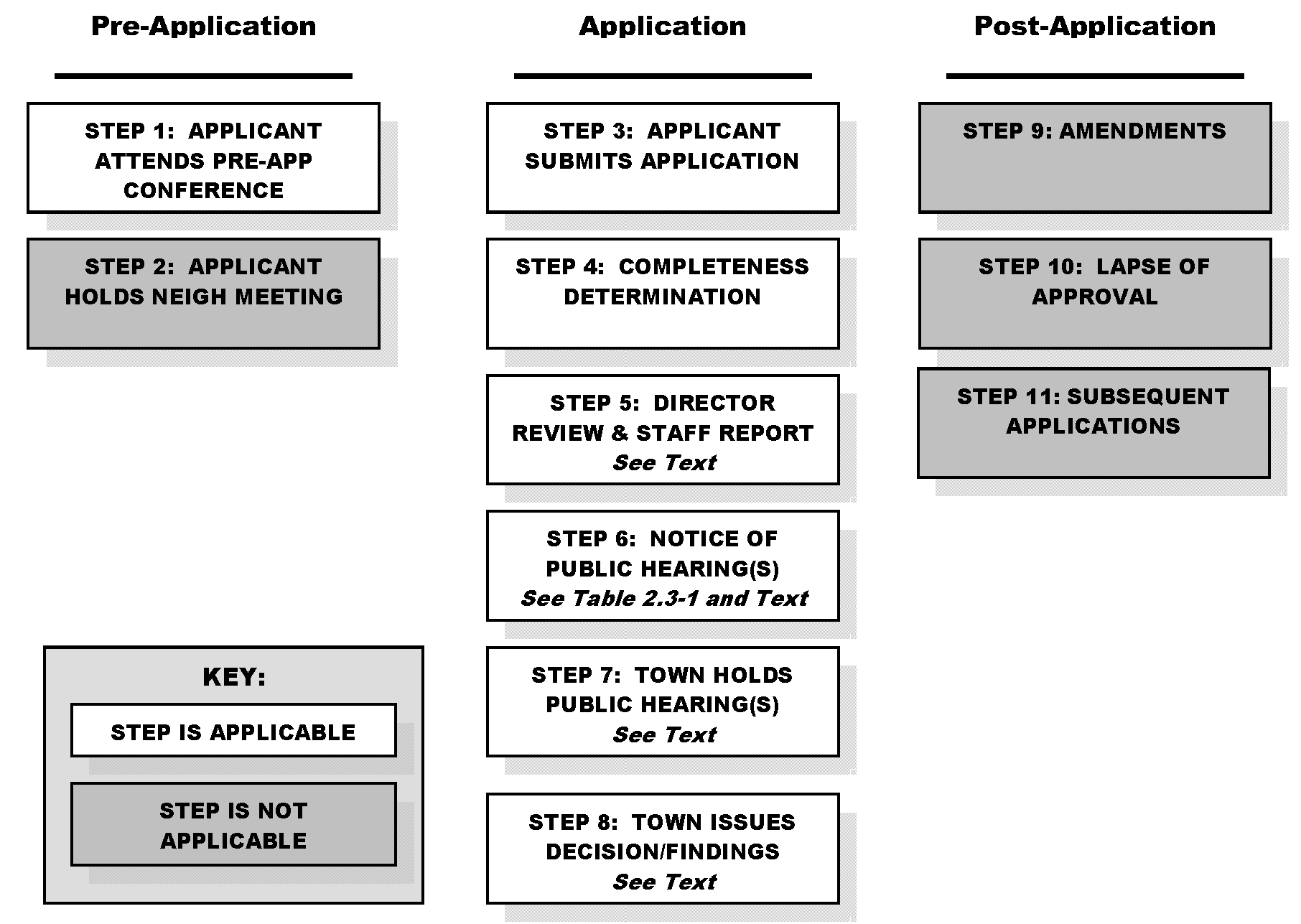
3.
Step 7: Town holds public hearing(s).
a.
Planning commission hearing, review, and recommendation. Following a public hearing, and after reviewing the report and recommendation of the Director, the Planning Commission shall make a recommendation to the Town Council to approve or deny the comprehensive plan amendment based on the approval criteria in Step 8 below.
b.
Town Council hearing, review, and decision. Following a public hearing, and after reviewing the reports and recommendations of the Director and the Planning Commission, the Town Council shall vote to approve, approve with amendments, or deny the comprehensive plan amendment based on the approval criteria in Step 8 below. The Town Council also may refer the proposed amendment back to the Planning Commission for further consideration. Comprehensive plan amendments shall be approved as resolutions.
4.
Step 8: Town issues decision/findings.
a.
Approval criteria. Recommendations and decisions on Comprehensive Plan amendments may be approved if the Town Council finds that:
(i)
The existing Comprehensive Plan and/or any related element thereof is in need of the proposed amendment;
(ii)
The proposed amendment is compatible with the surrounding area, and the goals and policies of the Plan;
(iii)
The proposed amendment will have no major negative impacts on transportation, services, and facilities;
(iv)
The proposed amendment will have minimal effect on service provision, including adequacy or availability of facilities and services, and is compatible with existing and planned service provision;
(v)
The proposed amendment is consistent with the town's ability to annex the property;
(vi)
The proposed amendment is consistent with the logical expansion of services;
(vii)
Strict adherence to the Plan would result in a situation neither intended nor in keeping with other key elements and policies of the Plan; and
(viii)
The proposed plan amendment will promote the public welfare and will be consistent with the goals and policies of the Pagosa Springs Comprehensive Plan and the elements thereof.
2.4.2. AMENDMENTS TO THE OFFICIAL ZONING MAP
A.
Purpose. The boundaries of any zone district may be changed, or the zone classification of any parcel of land may be changed, pursuant to this Section. The purpose is not to relieve particular hardships, nor to confer special privileges or rights on any person, but only to make adjustments to the Official Zoning Map that are necessary in light of changed conditions or changes in public policy, or that are necessary to advance the general welfare of the Town.
B.
Applicability. Amendments to the Official Zoning Map may be approved by the Town Council, following review and recommendation by the Planning Commission. Revisions shall be accomplished through the procedure in subsection C. below (or subsection D. below for rezonings to the Planned Development Overlay District).
C.
Procedure for general rezonings. This subsection includes the procedure for the review of all rezoning applications, except those to the Planned Development Overlay District. Figure 2.4-2 shows the steps of the common development review procedures that apply. The common procedures are described in Section 2.3. Specific additions and modifications to the common review procedures are identified below.
Figure 2.4-2: Procedure for Rezonings Generally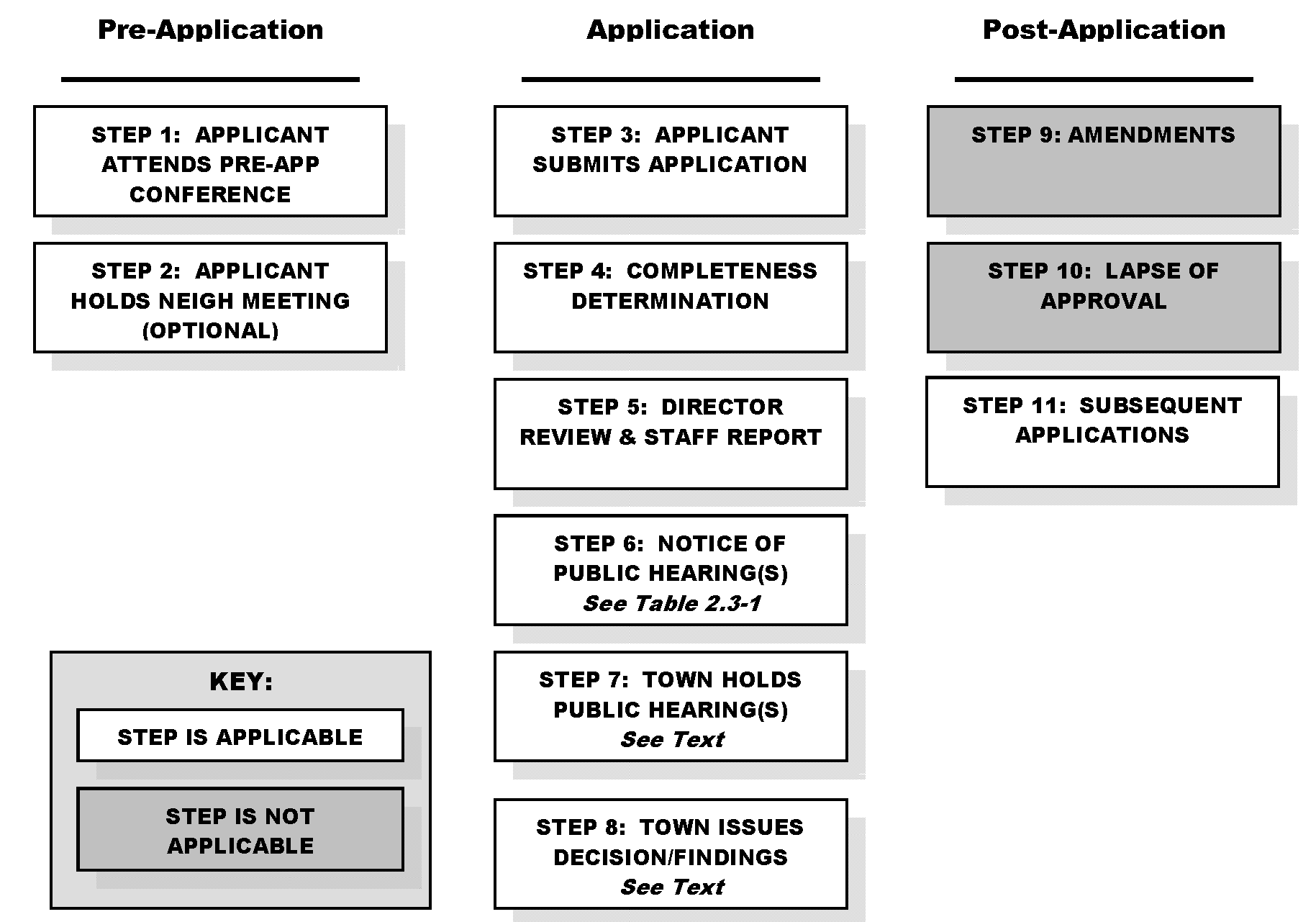
1.
Step 7: Town holds public hearing(s).
a.
Planning Commission hearing, review, and recommendation. Following a public hearing, the Planning Commission shall review the staff report, consider the comments and evidence presented at the hearing and the recommendation of the Director and make a recommendation to the Town Council to approve, conditionally approve, or deny the rezoning application, based on the criteria in Step 8 below.
b.
Town Council hearing, review, and decision. Following a public hearing, the Town Council shall consider the comments and evidence presented at the hearing and the staff report and recommendations from the Planning Commission and the Director, and approve, conditionally approve, or deny the application based on the criteria in Step 8 below.
2.
Step 8: Town issues decision/findings.
a.
Approval criteria. The Town Council may approve rezonings, and the Planning Commission may recommend approval, if the rezoning meets all of the following criteria:
(1)
The rezoning will promote the public health, safety, and general welfare;
(2)
The rezoning is consistent with the Comprehensive Plan and the purposes of this Land Use Code;
(3)
The rezoning is consistent with the stated purpose of the proposed zoning district(s);
(4)
Facilities and services (including roads and transportation, water, gas, electricity, police and fire protection, and sewage and waste disposal, as applicable) will be available to serve the subject property while maintaining adequate levels of service to existing development;
(5)
The rezoning is not likely to result in significant adverse impacts upon the natural environment, including air, water, noise, stormwater management, wildlife, and vegetation, or such impacts will be substantially mitigated; and
(6)
The rezoning is not likely to result in significant adverse impacts upon other property in the vicinity of the subject tract.
These criteria for zoning map amendments shall not apply to amendments that occur as part of a comprehensive revision to the Official Zoning Map accomplished by legislative action of the Town Council.
b.
Protests. Any owner of property affected by a proposed amendment to the Official Zoning Map may protest the amendment pursuant to the statutory requirements of C.R.S. Section 31-23-305.
c.
Post-approval actions.
(i)
Upon approval by the Town Council of a rezoning, the Town Clerk shall cause an appropriate revision of the Official Zoning Map to be prepared.
(ii)
Within fifteen (15) days of receipt of the zoning amendment map, the Director shall review the documents for compliance with the Town Council's approval, obtain the Town Officials' signatures, and submit the approved zoning amendment map and the ordinance amending the Official Zoning Map, to the Archuleta County Clerk and Recorder's Office for recording.
Figure 2.4-3: Procedure for Rezonings to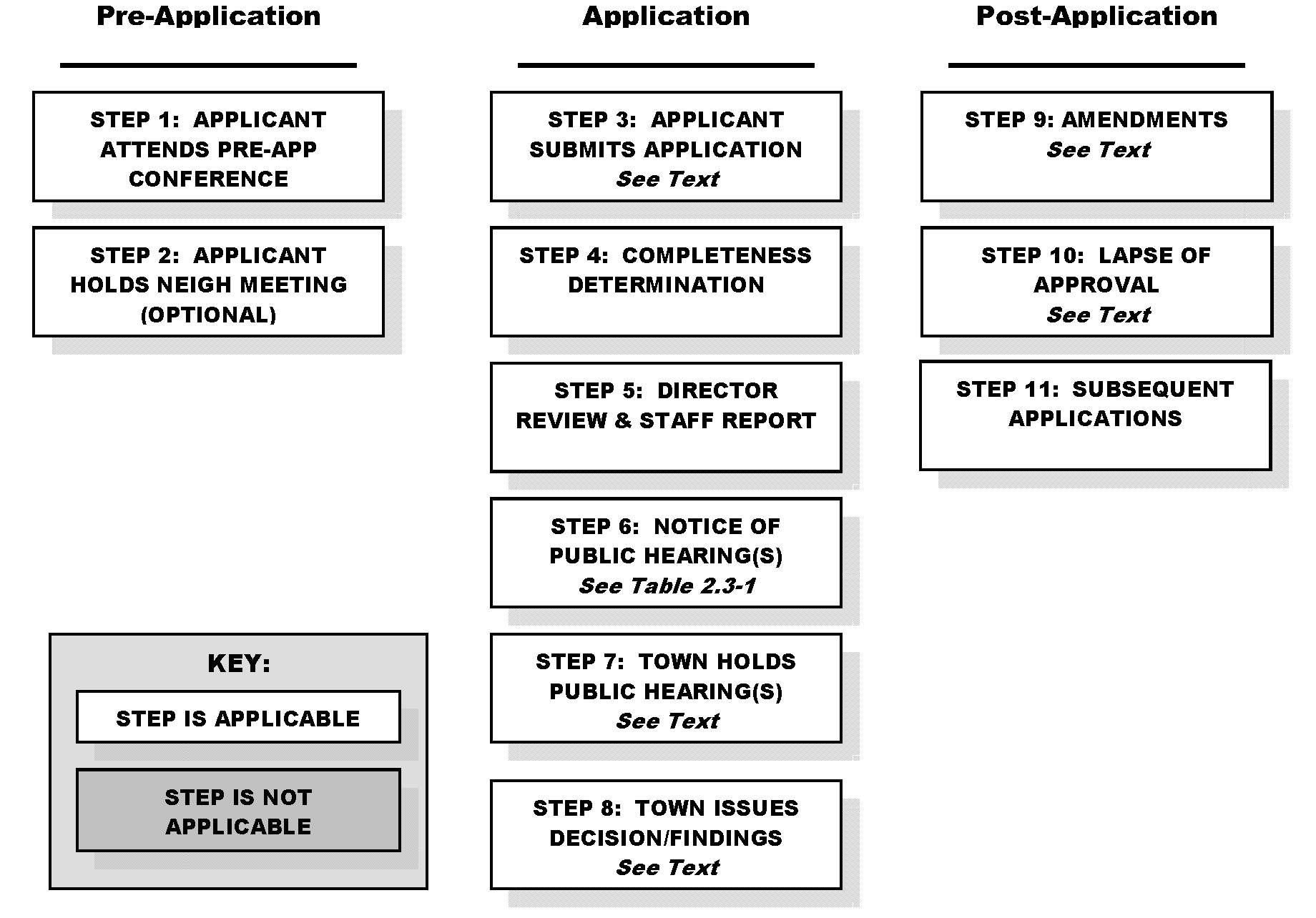
D.
Procedure for rezonings to the Planned Development overlay district. This subsection includes the procedure for the review of applications for rezoning to the Planned Development (PD) overlay district. Approval of a concept plan at the time of rezoning is required prior to development in a PD overlay district. Figure 2.4-3 shows the steps of the common development review procedures that apply. The common procedures are described in Section 2.3. Specific additions and modifications to the common review procedures are identified below.
1.
Step 3: Applicant submits application. The application for rezoning to the PD overlay district shall include a concept plan prepared to the specifications in the administrative manual. The Director shall require sufficient detail in the concept plan to provide an opportunity for the approving bodies to make informed decisions and evaluate compliance with the applicable approval criteria.
2.
Step 7: Town holds public hearing(s).
a.
Planning Commission hearing, review, and recommendation. Following a public hearing, the Planning Commission shall consider the comments and evidence presented at the hearing and the staff report and recommendation of the Director and make a recommendation to the Town Council to approve, conditionally approve, or deny the rezoning application, based on the criteria in Step 8 below.
b.
Town Council public hearing, review, and decision. Following a public hearing, the Town Council shall consider the comments and evidence presented at the hearing and the staff report and recommendations from the Planning Commission and the Director, and approve, conditionally approve, or deny the application, based on the criteria in Step 8 below.
3.
Step 8: Town issues decision/findings.
a.
Approval criteria. The Town Council may approve rezonings to the PD overlay district and the associated concept plans, and the Planning Commission may recommend approval, if the rezoning meets all of the criteria for general rezonings in Section 2.4.2.C.2. and also the following additional criteria:
(i)
The PD addresses a unique situation, confers a substantial benefit to the Town, or incorporates creative site design such that it achieves the purposes of this Land Use Code and represents an improvement in quality over what could have been accomplished through strict application of the otherwise applicable district or development standards. Such improvements in quality may include, but are not limited to: improvements in open space provision and access; environmental protection; tree/vegetation preservation; efficient provision of streets, roads, and other utilities and services; or increased choice of living and housing environments; and
(ii)
The PD rezoning and concept plan is consistent with the PD purpose statement in Section 3.5.1.
b.
Conditions of approval. The following shall be standard conditions of the approval of all PD applications:
(i)
The development standards set forth within the applicant's submitted concept plan shall be deemed to be incorporated within the action of the Town Council in its approval of the application for PD except as modified therein. All future development within the boundaries of the PD overlay district shall comply with the terms of the approved concept plan.
(ii)
The requirements of the general zoning district(s) in which the property is located shall remain applicable within the PD overlay district except as modified within the approved concept plan and as may be further modified by the Town Council in its approval of the application for PD.
c.
Protests. Any owner of property affected by a proposed amendment to the official zoning map may protest the amendment pursuant to the statutory requirements of C.R.S. Section 31-23-305.
d.
Placement on official zoning map. All PDs approved in accordance with the provisions of this Section shall be referenced on the official zoning map, and a list of such PDs and the associated concept plans shall be maintained as part of this Land Use Code.
4.
Step 9: Amendments.
a.
A request to change any condition of approval, residential unit density, floor area ratio (FAR), or other land use and property development regulations set forth in a PD concept plan shall in all cases require the filing of new application for a PD.
b.
If the Director determines that the requested changes are, in his or her discretion, minor and do not include substantial alterations to the PD concept plan or conditions of approval, and are consistent with the intent of the original PD approval, the Director may approve the changes or may refer the proposed changes to the Planning Commission. The Planning Commission may either approve or conditionally approve the requested changes or determine that the proposed changes shall be treated as a new application for a PD.
5.
Step 10: Lapse of approval. Within one (1) year from the approval of the rezoning to the PD overlay district, the property owner shall have commenced development by filing a complete application for subdivision approval and/or site plan approval on the property. If such application has not been filed within one (1) year, the Director shall initiate a public hearing process for the purpose of considering whether to rezone the property back to its prior zoning classification, or in light of other conditions, to another zoning classification, and revocation of all permits issued and action taken.
6.
Coordination with subdivision approval.
a.
Subdivision review required under Section 2.4.3., if applicable, may be carried out concurrently with the review of PD concept plans under this Section. However, in such instances, the preliminary subdivision plat may only be approved following the approval of the PD rezoning and concept plan.
b.
If any provisions of this Section or the PD standards in the concept plan conflict with the subdivision procedures or standards of this Land Use Code, the more restrictive requirements as determined by the Director shall be met, unless specifically altered through the variance or minor modification process.
7.
Planned unit development districts adopted prior to this Land Use Code shall continue. The planned unit developments (PUDs) approved prior to the effective date of this Land Use Code shall be carried forth in full force and effect and are the conditions, restrictions, regulations, and requirements that apply to the respective planned unit development districts shown on the zoning map at the date of adoption. Amendments to an existing PUD adopted prior to the date of this Land Use Code shall be processed the same as a PD amendment pursuant to Step 9 above.
2.4.3. SUBDIVISION
A.
General provisions.
1.
Purpose. The purpose of the subdivision review procedures is to ensure compliance with the standards and requirements in Article 7, Subdivision Design and Improvements, and encourage quality development consistent with the goals, policies, and objectives in the Comprehensive Plan.
2.
General applicability. The procedures of this Section, and the standards in Article 7, Subdivision Design and Improvements, shall apply to all subdivisions or re-subdivisions that result in the portioning, dividing, combining, or altering of any lot, parcel, or tract of land, including subdivisions or re-subdivisions created by an exercise of the power of eminent domain by an agency of the State or Town, unless specifically excluded by state law.
3.
Subdivision approval is prerequisite to other approvals.
a.
No building permit or certificate of occupancy may be issued for any building, structure, or improvement located within a subdivision, and no plat for a subdivision may be recorded, until:
(i)
A plan for the subdivision has been approved and all required dedications of land have been made, and all required improvements have been installed in accordance with the procedures and requirements of this Section; or
(ii)
A plan for the subdivision of land has been approved and a subdivision Development Agreement has been executed that provides for future improvements pursuant to standards adopted by the Town.
b.
The Town shall not accept or maintain any street and shall not extend or connect any street lighting or other service to any subdivision of land until and unless a plat for the subdivision has been approved and recorded in accordance with the requirements set forth in this Section.
4.
Restriction on sale or transfer of subdivided land without approved plat. No person shall subdivide, transfer, sell, agree to sell, or negotiate to transfer or sell any land by reference to a metes and bounds description or subdivision plat before such description or plat has been approved pursuant to this Land Use Code and recorded in the Office of the Archuleta County Clerk and Recorder.
5.
Acceptance of dedications. All plans, plats, and plat amendments of land laid out in subdivision or building lots, and that include streets, highways, sidewalks, alleys, open space, or other areas intended to be dedicated to a public use, shall be submitted to the Town Council for review and subsequent approval, conditional approval, or denial, unless this Land Use Code authorizes approval through the Minor Subdivision/Plat Amendment process. No plat shall be recorded in any public office that does not bear, by endorsement or otherwise, the approval of the Town Council. Execution of the approved final plat in accordance with this Section shall constitute the Town's acceptance of any public dedication.
6.
Existing lots of record. No provision of this Section or Article 7 applies to any lot in a subdivision legally created and filed of record before the effective date of this Land Use Code, unless the lot is further subdivided.
B.
Minor subdivision/plat amendment.
1.
Applicability.
a.
Eligibility. The minor subdivision procedure is allowed for the following:
(i)
Subdivisions creating three (3) or fewer lots, provided that parcels are eligible for minor subdivision only once, and further subdivisions of the original or newly created parcels shall be processed as major subdivisions;
(ii)
Subdivisions that create individual town home lots or individual duplex or single-family attached lots in a multi-family or planned development that has already been approved by the Town;
(iii)
Consolidation of two (2) or more lots into a single lot in a previously recorded subdivision plan; and
(iv)
Boundary/lot line adjustments or other minor amendments to an approved final plat.
Figure 2.4-4: Procedure for Minor Subdivisions/Plat Amendments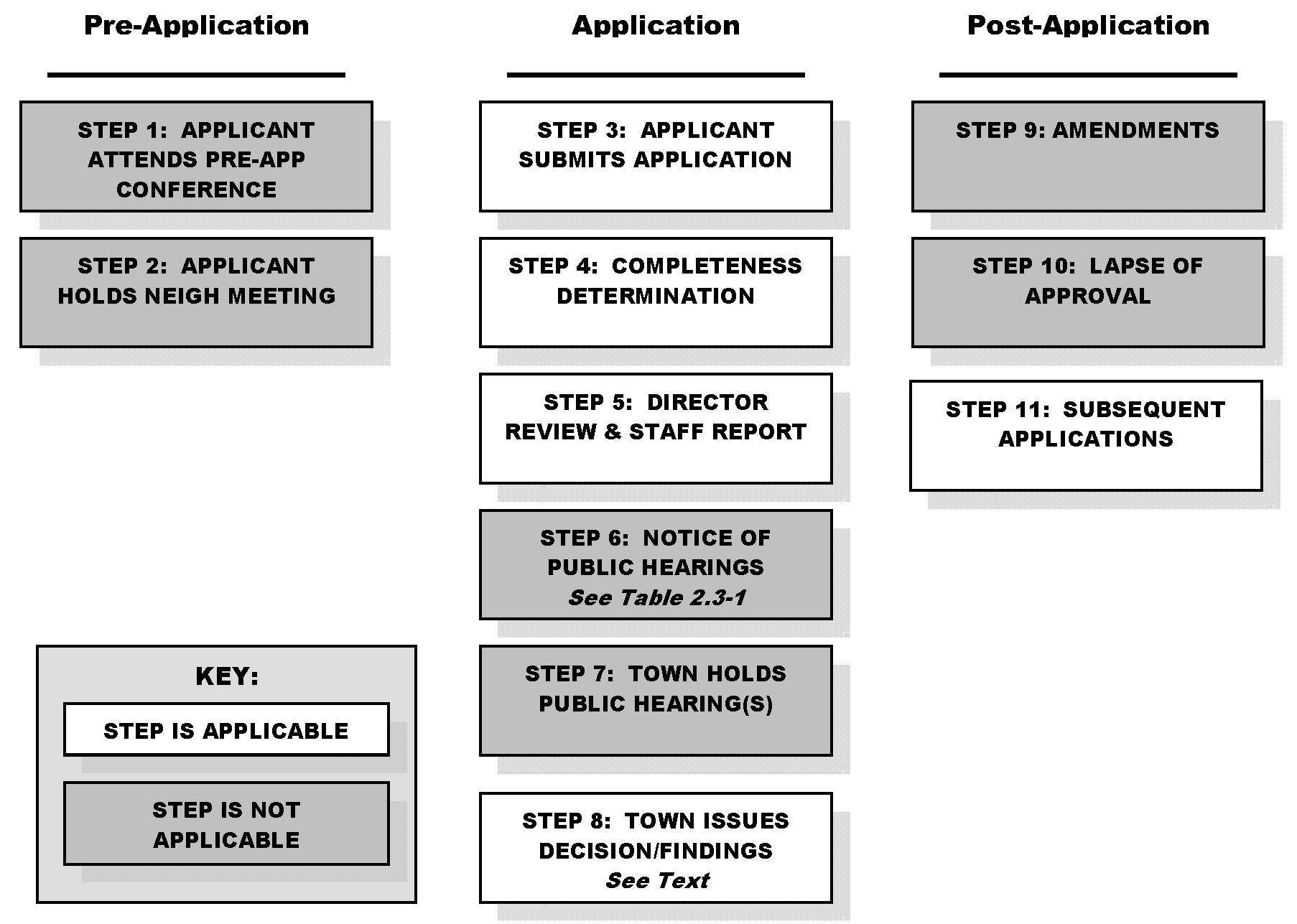
b.
Limitations.
(i)
There shall be no public right-of-way dedication or public improvements allowed with a minor subdivision; provided, however, that the Director may determine that such an application may still be processed as a minor subdivision if adequate security is provided to ensure that the dedication will be received and/or the public improvements installed.
(ii)
The minor subdivision may not involve any modifications or variances to the subdivision design standards in Article 7, Subdivision Design and Improvements.
(iii)
If a proposed minor subdivision would result in conditions that do not comply with Article 7, Subdivision Design and Improvement Standards, or any other provision of the Code, or other conditions of the final plat approval imposed by the Town Council, or results in changes affecting parties other than the applicant, the application shall require review and approval through the major subdivision process.
(iv)
Any revision to a previously approved final plat that increases the number of lots or parcels or creates new lots or parcels, including reversion to acreage or vacation of plats, shall be processed as a new subdivision.
2.
Procedure. Figure 2.4-4 shows the steps of the common development review procedures that apply in the review of applications for minor subdivisions. The common procedures are described in Section 2.3. Specific additions and modifications to the common review procedures are identified below.
a.
Step 8: Town issues decision/findings.
(i)
Director's review and decision. The Director shall review each proposed minor subdivision application relative to the applicable approval criteria listed below and shall act to approve, approve with conditions, or deny the proposed minor subdivision/plat amendment.
(ii)
Approval criteria—Minor subdivisions other than boundary/lot line adjustments or other plat amendments. The Director shall approve the minor subdivision application if it meets the following criteria:
(1)
The minor subdivision is consistent with the Comprehensive Plan and other adopted Town plans;
(2)
The minor subdivision is consistent with and implements the intent of the specific zoning district in which it is located;
(3)
As applicable, the minor subdivision is consistent with the terms and conditions of any previously approved development plan;
(4)
The minor subdivision complies with all applicable use, development, and design standards set forth in this Land Use Code; and
(5)
Adequate and sufficient public safety, transportation, utility facilities and services, recreation facilities, parks, and schools are available to serve the subject property, while maintaining sufficient levels of service to existing development.
(iii)
Approval criteria—Boundary/lot line adjustments or other plat amendments. The Director shall approve the plat amendment application if it meets the following criteria:
(1)
The adjustment does not increase the number of lots or parcels or create new lots or parcels;
(2)
The adjustment does not affect a recorded easement without the prior approval of the easement holder;
(3)
Street locations will not be changed;
(4)
The adjustment will not create any nonconformities or increase the degree of nonconformity of any existing structure or use;
(5)
The adjustment shall comply with all other applicable requirements of this Land Use Code and all other applicable regulations and requirements.
(iv)
Recording. Following the approval of a minor subdivision or plat amendment, the minor subdivision shall be signed by the town's authorized representative. The Town Clerk shall then record the minor subdivision in the office of the County Clerk and Recorder. Minor subdivisions shall be recorded within thirty (30) days of approval by the Director.
C.
Major subdivision.
1.
Applicability. The major subdivision procedure is required for a proposed division of land when any one (1) or more of the following conditions exist:
a.
Dedication of public right-of-way, other public tracts, or public improvements (unless the Director determines it shall be processed as a minor subdivision in accordance with Section 2.4.3.B.1);
b.
The resultant subdivision will produce four (4) or more lots; or
c.
The subdivision is not otherwise eligible for the minor subdivision process.
2.
Overview of procedure. The major subdivision process consists of three (3) steps:
a.
Sketch plan, which requires approval by the Planning Commission (subsection 3. below).
b.
Preliminary plat, which requires a recommendation by the Planning Commission and approval by the Town Council (subsection 4. below).
c.
Final plat, which requires approval by the Director, unless substantial changes are proposed from the preliminary plat, in which case the final plat application requires a recommendation by the Planning Commission and approval by the Town Council (subsection 6. below).
3.
Sketch plan.
a.
Purpose. A sketch plan represents a general land use plan and layout for the area proposed to be included within a subdivision. It allows for an evaluation of a proposed subdivision before detailed planning and engineering works has been undertaken and before substantial expenses have been incurred. Material submitted for a sketch plan shall not constitute a complete application for a preliminary plat.
Figure 2.4-5: Procedure for Major Subdivisions—Sketch Plan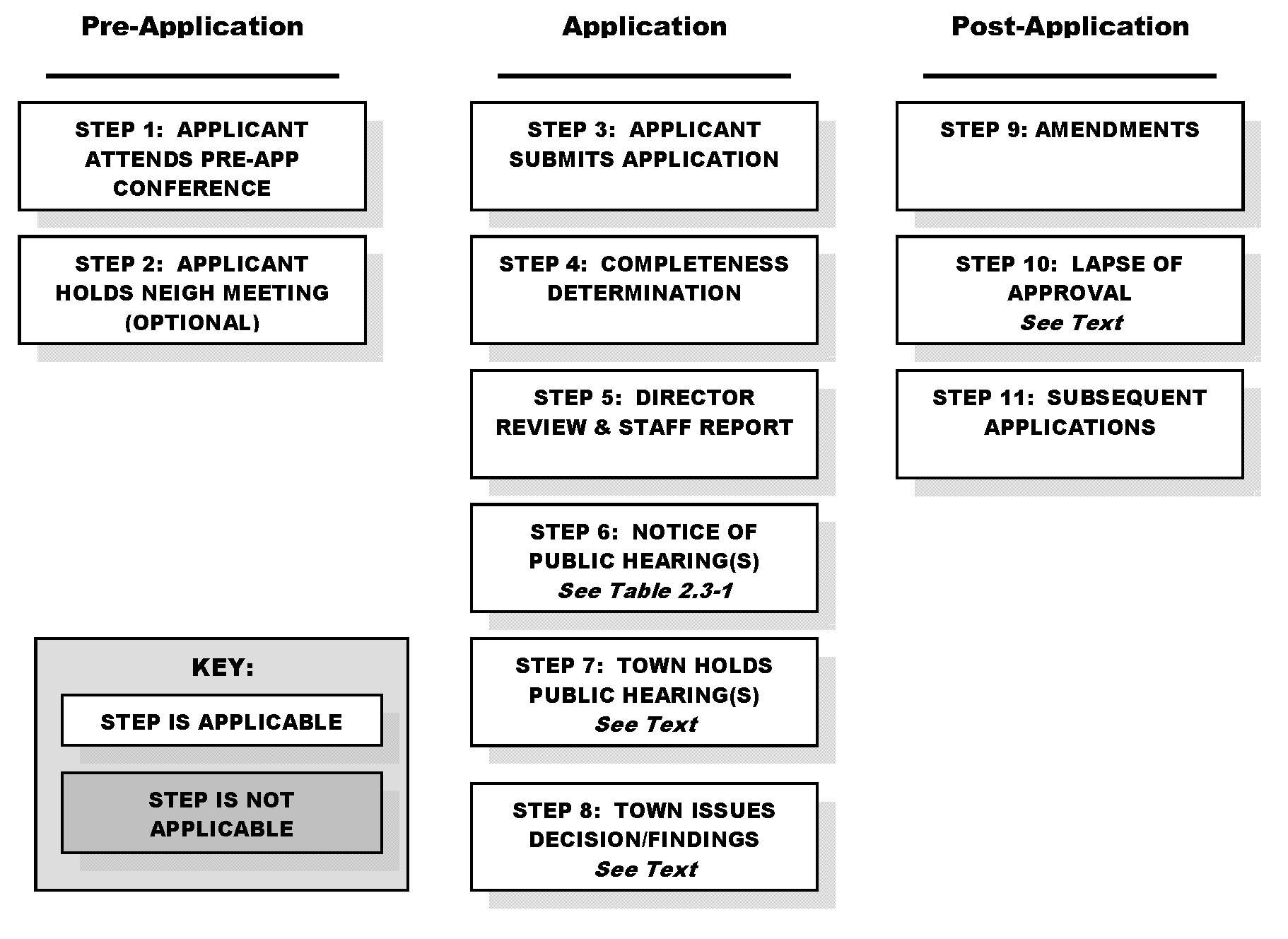
b.
Procedure. Figure 2.4-5 shows the steps of the common development review procedures that apply in the review of applications for major subdivision sketch plans. The common procedures are described in Section 2.3. Specific additions and modifications to the common review procedures are identified below.
(i)
Step 7: Town holds public hearing(s). Following a public hearing, the Planning Commission shall consider the comments and evidence presented at the hearing and the staff report and recommendations from the Director, and approve, conditionally approve, or deny the sketch plan, based on the criteria in Step 8 below.
(ii)
Step 8: Town issues decision/findings.
(1)
Approval criteria. The Planning Commission shall evaluate the applicant's sketch plan application to determine whether:
(a)
The proposed subdivision complies with all applicable use, density, development, and design standards set forth in Articles 4, 5, 6, and 7 of this Land Use Code that have not otherwise been modified or waived pursuant to this Chapter and that would affect or influence the layout of lots, blocks, and streets. Applicants shall avoid creating lots or patterns of lots in the subdivision that will make compliance with such development and design standards difficult or infeasible.
(b)
The general layout of lots, roads, driveways, utilities, drainage facilities, and other services within the proposed subdivision is designed in a way that minimizes the amount of land disturbance, maximizes the amount of open space in the development, preserves existing trees/vegetation and riparian areas, protects critical wildlife habitat, and otherwise accomplishes the purposes and intent of this Land Use Code.
(c)
The applicant has provided evidence that provision has been made for a public water supply system or, if other methods of water supply are proposed, adequate evidence that the water supply is sufficient in terms of quantity, quality, and dependability for the type of subdivision proposed.
(d)
The applicant has provided evidence that provision has been made for a public sewage disposal system or, if other methods of sewage disposal are proposed, adequate evidence that such system shall comply with state and local laws and regulations.
(e)
The applicant has provided evidence to show that all areas of the proposed subdivision that may involve soil or topographical conditions presenting hazards or requiring special precautions have been identified by the subdivider and that the proposed use of these areas are compatible with such conditions.
(f)
The application provides a clear assumption of responsibility for maintaining all roads, open spaces, and other public and common facilities in the subdivision.
(g)
As applicable, the proposed phasing for development of the subdivision is rational in terms of available infrastructure capacity and financing.
(h)
The subdivision is consistent with the Comprehensive Plan and other adopted Town policies and plans, including any adopted transportation plan or streets/roadway plan.
(iii)
Step 10: Lapse of approval. Approval or conditional approval of a sketch plan shall be effective for one (1) year unless otherwise expressly approved by the Planning Commission.
4.
Preliminary plat.
a.
Purpose. The purpose of the preliminary plat is to provide the Town with an overall master plan for the proposed development.
b.
Procedure. Figure 2.4-6 shows the steps of the common development review procedures that apply in the review of preliminary plats. The common procedures are described in Section 2.3. Specific additions and modifications to the common review procedures are identified below.
(i)
Step 3: Applicant submits application. The application must be submitted no more than one (1) year after approval of the sketch plan unless otherwise approved by the Planning Commission.
(ii)
Step 7: Town holds public hearing(s).
(1)
Planning commission hearing, review, and recommendation. Following a public hearing, the Planning Commission shall consider the comments and evidence presented at the hearing and the staff report and recommendation of the Director and recommend that the Town Council approve, conditionally approve, or deny the preliminary plat, based on the criteria in Step 8 below.
(2)
Town council public hearing, review, and decision. Following a public hearing, the Town Council shall consider the comments and evidence presented at the hearing and the staff report and recommendations from the Planning Commission and the Director, and approve, conditionally approve, or deny the preliminary plat, based on the criteria in Step 8 below.
(iii)
Step 8: Town issues decision/findings.
(1)
Approval criteria. The Planning Commission and Town Council shall evaluate the applicant's request based on whether the application is consistent with the approved sketch plan, conforms to the sketch plan approval criteria of this Land Use Code, and incorporates the Planning Commission's recommendations and conditions of approval on the sketch plan.
Figure 2.4-6: Procedure for Major Subdivision - Preliminary Plats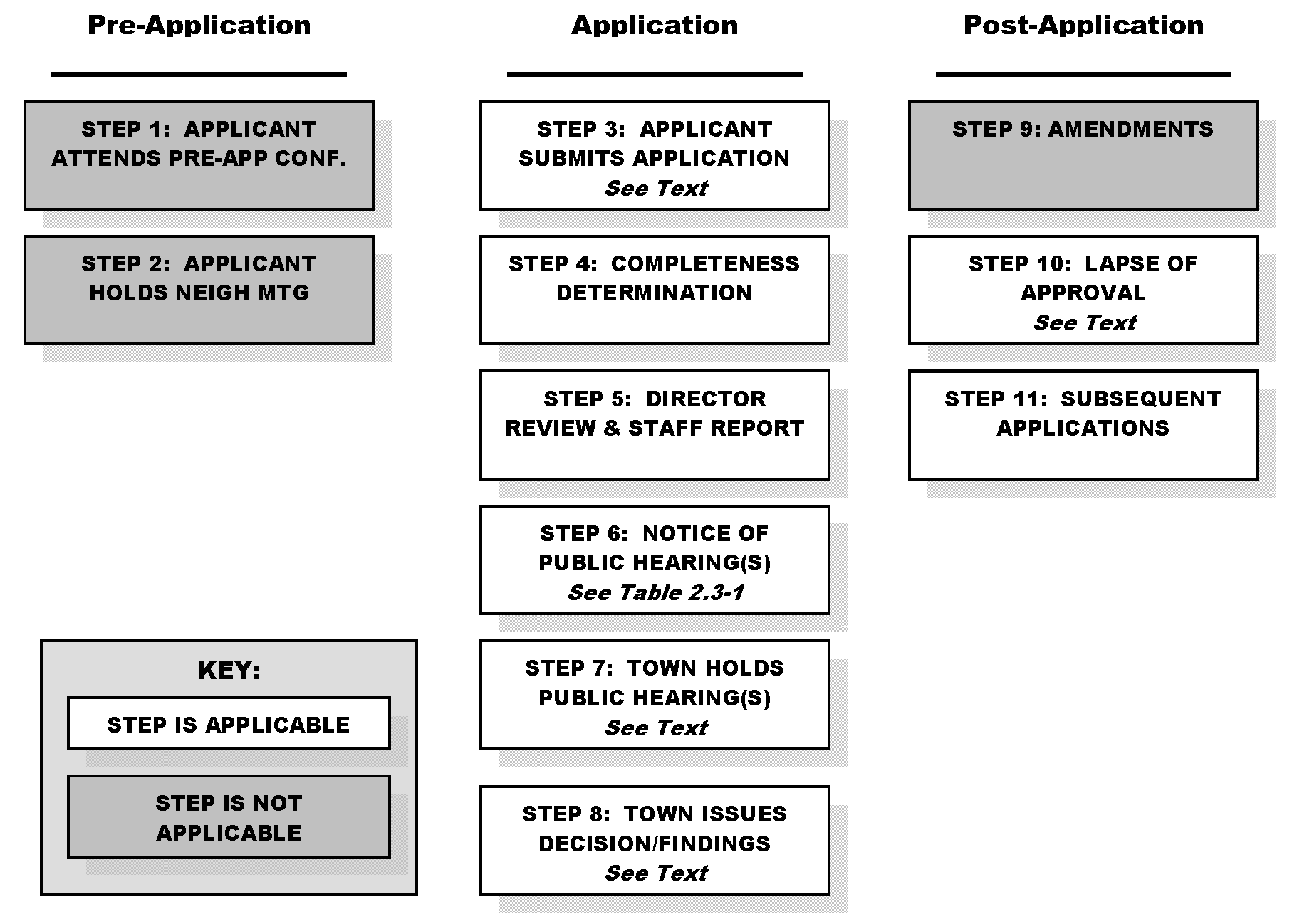
(iv)
Step 10: Lapse of approval.
(1)
Approval or conditional approval of a preliminary plat shall be effective for one (1) year unless expressly approved by the Town Council prior to expiration. The applicant shall submit an application for "extension of preliminary subdivision plan" prior to the previous preliminary plan approval expiration date. Such extension application shall be considered by the Town Council.
(2)
An approved preliminary plat shall lapse and be of no further force and effect if a complete final plat application for the subdivision or a phase of the subdivision has not been submitted within one (1) year after the preliminary plat approval date or within an alternate time-frame specified by the Town Council. In the case of partial final plat submission, the approval of the remaining portion of the preliminary plat shall automatically gain an extension of one (1) year, up to a maximum number of years specified by the Council at the time of approval of the initial phase.
5.
Reserved.
6.
Final plat.
a.
Purpose. The purpose of the final plat is to complete the subdivision of land consistent with the Town's adopted technical development standards.
b.
Procedure. Figure 2.4-7 shows the steps of the common development review procedures that apply in the review of final plats. The common procedures are described in Section 2.3. Specific additions and modifications to the common review procedures are identified below.
(i)
Step 3: Applicant submits application. The application must be submitted no more than one (1) year after approval of the preliminary plat, unless otherwise approved by the Town Council.
(ii)
Step 8: Town issues decision/findings.
(1)
Director's review and decision. The Director shall review each proposed final plat application based on the applicable approval criteria listed below. All construction plans for subdivision-related public improvements shall be referred to the Town Engineer for review and approval. Based on the results of those reviews, the Director shall act to approve, approve with conditions, or deny the proposed final plat.
(2)
Final plats not in substantial compliance with approved preliminary plats. If the final plat is found not to be in substantial compliance with the approved preliminary plat, or is submitted more than one (1) year after approval of the preliminary plat, in the Director's sole discretion, the Director may deny the application or may refer the application to the Planning Commission. The applicant may appeal the denial of a final plat to the Planning Commission in accordance with Section 2.4.13
Figure 2.4-7: Procedure for Major Subdivision - Final Plats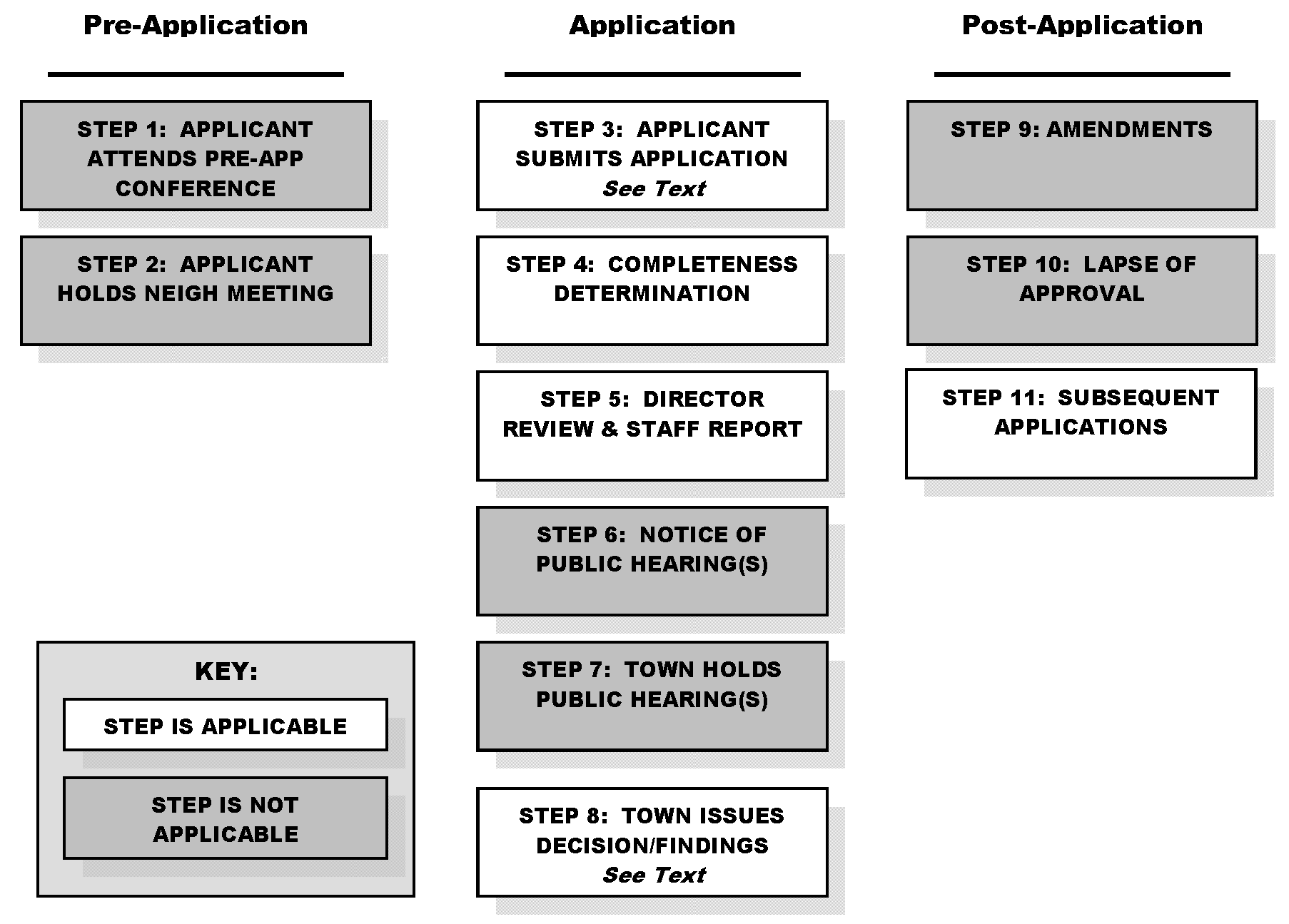
(3)
Approval criteria. The Director shall approve final plats that comply with all of the following criteria:
(a)
The final plat conforms to the approved preliminary plat and incorporates all recommended changes, modifications, and conditions attached to the approval of the preliminary plat;
(b)
The development will substantially comply with all sections of the Code; and
(c)
All applicable technical standards adopted by the Town have been met.
(4)
Post-approval actions. Upon approval of the final plat, the applicant shall submit the following documentation to the Director:
(a)
Documentation that areas designated as open space shall be protected by a deed restriction or other appropriate method to ensure that they cannot be subdivided or developed in the future and will remain as open space in perpetuity; and
(b)
Other payments, certificates, affidavits, enforcements, or deductions, as required by the Planning Commission or Town Council.
(5)
Recording of plats. If approved, the Director shall request one (1) original Mylar of any final plat ready for signatures as required by the Town to sign and then record. Execution of the approved final plat in accordance with this Section shall constitute the Town's acceptance of any public dedication. The Mylar of the final plat shall be recorded by the Town Clerk in the Office of the Archuleta County Clerk and Recorder. A signed copy with the reception number shall be retained by the Town. The recording fee shall be paid by the applicant.
D.
Vacation of right-of-way and other public easements.
1.
Applicability. This Section shall apply to all requests to vacate all rights, interests, or title of the Town in and to any right-of-way (street, road, alley, or other public way), access easement, or other easement located within the Town. Title to vacated roadways shall vest in accordance with C.R.S. § 43-2-302, as may be amended from time to time.
2.
Procedure. Figure 2.4-8 shows the steps of the common development review procedures that apply in the review of applications for vacations. The common procedures are described in Section 2.3. Specific additions and modifications to the common review procedures are identified below.
a.
Step 7: Town holds public hearing(s).
(i)
Planning commission hearing, review, and recommendation. Following a public hearing, the Planning Commission shall consider the comments and evidence presented at the hearing and the staff report and recommendation of the Director and recommend that the Town Council approve, conditionally approve, or deny the vacation, based on the criteria in Step 8 below.
Figure 2.4-8: Procedure for Vacation of Right-of-Way or Easement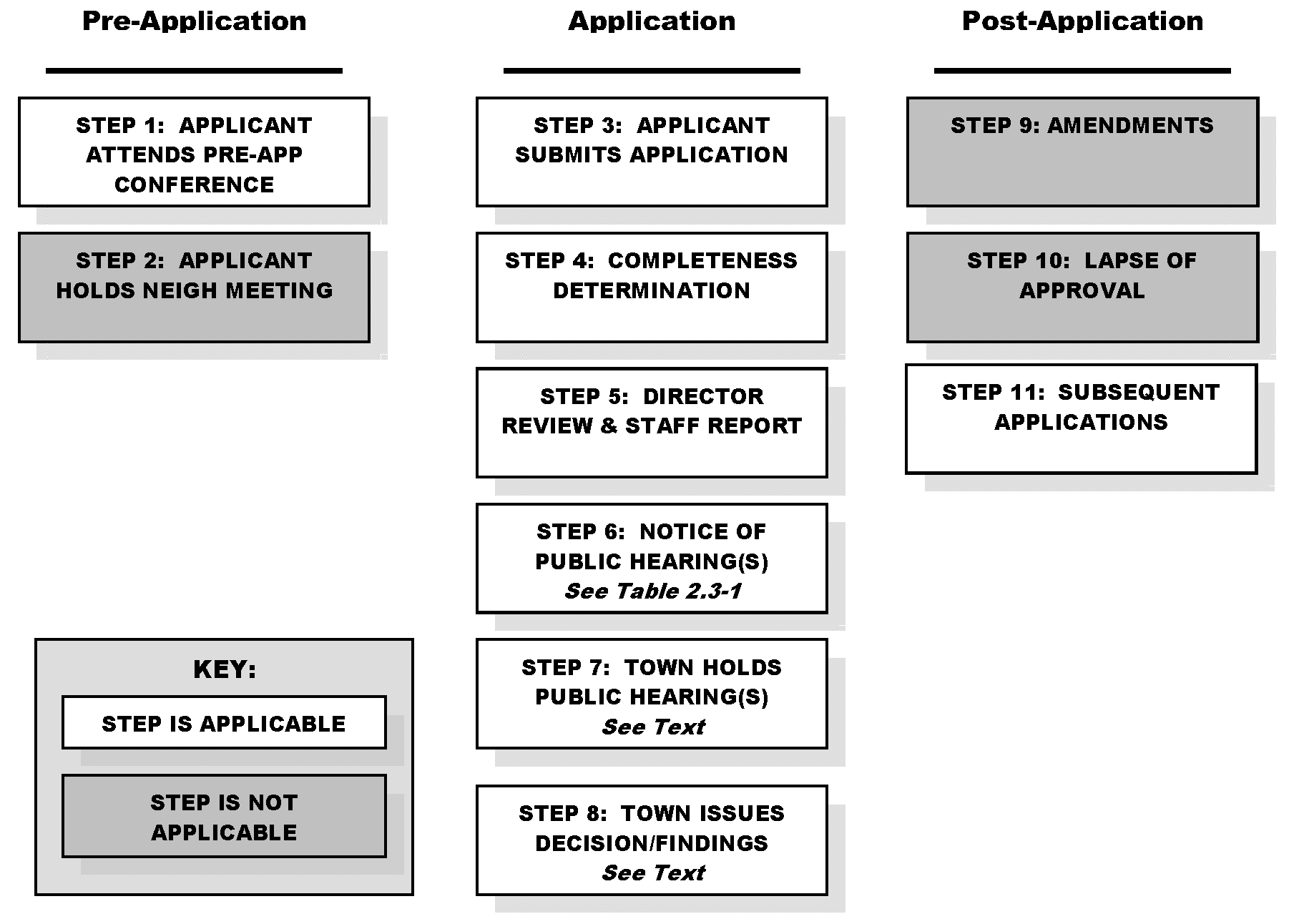
(ii)
Town council public hearing, review, and decision. Following a public hearing, the Town Council shall consider the comments and evidence presented at the hearing and the staff report and recommendations from the Planning Commission and the Director, and approve, conditionally approve, or deny the vacation, based on the criteria in Step 8 below. The Town Council shall have the right, in its discretion, to vacate only a portion of the total area requested for vacation. Rights-of-way or easements may be reserved for the continued use of existing sewer, gas, water, or similar pipelines and appurtenances, for ditches and canals and similar appurtenances, and for electric, telephone, and similar lines and appurtenances.
b.
Step 8: Town issues decision/findings.
(i)
Approval and recording. The Town Council shall approve the vacation by ordinance. The ordinance shall be recorded in the Office of the Archuleta County Clerk and Recorder. If approved, the Director shall request one (1) original mylar of any final plat ready for signatures as required by the Town to sign and then record. The mylar of the final plat shall be recorded by the Town Clerk in the Office of the Archuleta County Clerk and Recorder. A signed copy with the reception number shall be retained by the Town. The recording fee shall be paid by the developer.
(ii)
Approval criteria. The Town Council may approve a right-of-way or public easement vacation if it finds that all of the following have been met:
(1)
The vacation is consistent with the Comprehensive Plan and other adopted Town policies and plans, including any adopted transportation plan or streets/roadway plan;
(2)
The land to be vacated is no longer necessary for the public use and convenience;
(3)
The vacation of a roadway that exists by right of usage shall occur only if the land adjoining said roadways is left with an established public road or private access easement connecting said land with another established public road;
(4)
The vacation will not leave any land-locked parcels; and
(5)
The vacation will not adversely impact the health, safety and/or welfare of the general community, or reduce the quality of public facilities or services provided to any parcel of land, including but not limited to police/fire protection, access, and utility service.
(iii)
Conditions of approval. The approval of a right-of-way or public easement vacation shall be conditioned upon:
(1)
The holders of any and all easements granted by the original platting of the subdivision conveying to the petitioner all interest in those easements.
(2)
Such vacation shall not eliminate rights-of-way or easements serving or potentially serving adjoining properties, unless alternate means of access or another easement crossing the property can serve adjoining properties.
(3)
If the vacation is a roadway constituting the boundary line of the Town, the Archuleta County Board of Commissioners has taken action to vacate the roadway.
E.
Condominium subdivision and conversion.
1.
Purpose. The purpose of this Section is to ensure that condominium subdivisions and conversions will comply with the adopted building code and applicable provisions of this Land Use Code.
2.
Procedure.
a.
The procedure and standards for review and approval of a condominium subdivision or conversion shall be the same as that specified for subdivisions within this Section 2.4.3. The applicable review procedures (minor or major subdivision) shall be determined by the number of condominium units created.
b.
Conversion of an existing building located on a previously subdivided parcel to condominium ownership without a change in type of use, expansion of use, or increase in intensity of use shall be reviewed as a minor subdivision regardless of the number of units or size of the parcel proposed for conversion.
c.
Subsequent changes in approved use(s) for an existing condominium subdivision require re-approval through the minor subdivision process in Section 2.4.3.B.
d.
Notwithstanding anything in this Section to the contrary, no requirement for public improvements, dedication of land to public use, or other subdivision requirement shall be imposed as a condition of approval for a condominium subdivision or common interest community that would not be imposed upon a physically-identical development under a different form of ownership. This provision shall not be construed to prevent the Town from imposing the review requirements of this Section upon any change of use, expansion of use, increase in intensity of use, or other change in a condominium or common interest community unrelated to its form of ownership.
3.
Standards for condominium conversion.
a.
Prior to recording a subdivision plat that would convert an existing development to condominium units, the owner of such property shall meet with the Town Building Official regarding the proposed conversion and shall demonstrate that the project complies with the adopted building code and the following provisions have been met:
(i)
The structure subject to the proposed condominium conversion shall meet current off-street parking requirements for the underlying zone district found in Table 6.9-1. Each residential condominium unit shall be considered a separate dwelling unit for purposes of determining parking compliance.
(ii)
A minimum one-hour fire wall may be required between units as a condition of Town approval of any condominium plat involving a condominium conversion.
b.
Owners of properties proposed for condominium conversion shall notify all residential tenants in writing of the conversion at least ninety (90) days prior to termination of any residential tenancy in accordance with § 38-33-112, C.R.S., as amended. Copies of the notice shall be filed with the Town Clerk as proof of notification.
4.
Criteria for review of condominium subdivisions and conversions.
a.
Condominium subdivisions and conversions shall comply with the review standards applied to subdivisions as specified in Section 2.4.3.
b.
In addition, condominium subdivisions and conversions shall comply with the following supplemental review standard: The traffic impacts of the proposed condominium subdivision shall be evaluated and any impacts to the neighborhood must be mitigated. A traffic mitigation plan must be submitted and approved by the Director prior to approval of the condominium subdivision.
5.
Condominium plat processing. The Town is primarily concerned with land use, pertaining to the suitable design of the development evidenced by the preliminary condominium plat. Additional drawings, declarations, and documentation not subject to Town review are necessary to comply with State condominium laws. At the developer's request, the final condominium plat may be held for recording until other associated documents are also ready for recording or until the applicant can record an "as-built" plat, but no longer than one (1) year.
2.4.4. CONDITIONAL USE PERMITS
A.
Purpose. This Section provides a discretionary approval process for conditional uses, which have unique or widely varying operating characteristics or unusual site development features. The procedure encourages public review and evaluation of a use's operating characteristics and site development features and is intended to ensure that proposed conditional uses will not have a significant adverse impact on surrounding uses or on the community-at-large. Specific conditional uses allowed in each zone district are listed in Table 4.1-1, Table of Allowed Uses.
B.
Relationship to design review requirements.
1.
Coordination with design review. If design review is necessary for the proposed conditional use, then the development plan and the conditional use applications shall be processed concurrently. In such cases, the Planning Commission shall be the final decision-making entity for both the development plan and the conditional use. The Planning Commission shall render separate decisions on the applications based on the applicable approval criteria in this Section 2.4.4. (for the conditional use) and Section 2.4.6. (for the development plan).
2.
Lapse of conditional use approval upon design review expiration. If design review is necessary for the proposed conditional use, the approval of the conditional use shall be conditioned on the design review approval. Accordingly, the approval of any conditional use shall lapse and become null and void upon the expiration of the approved development plan, unless otherwise restricted by the Town.
C.
Procedure. Figure 2.4-9 shows the steps of the common development review procedures that apply in the review of applications for conditional use permits. The common procedures are described in Section 2.3. Specific additions and modifications to the common review procedures are identified below.
Figure 2.4-9: Procedure for Conditional Use Permits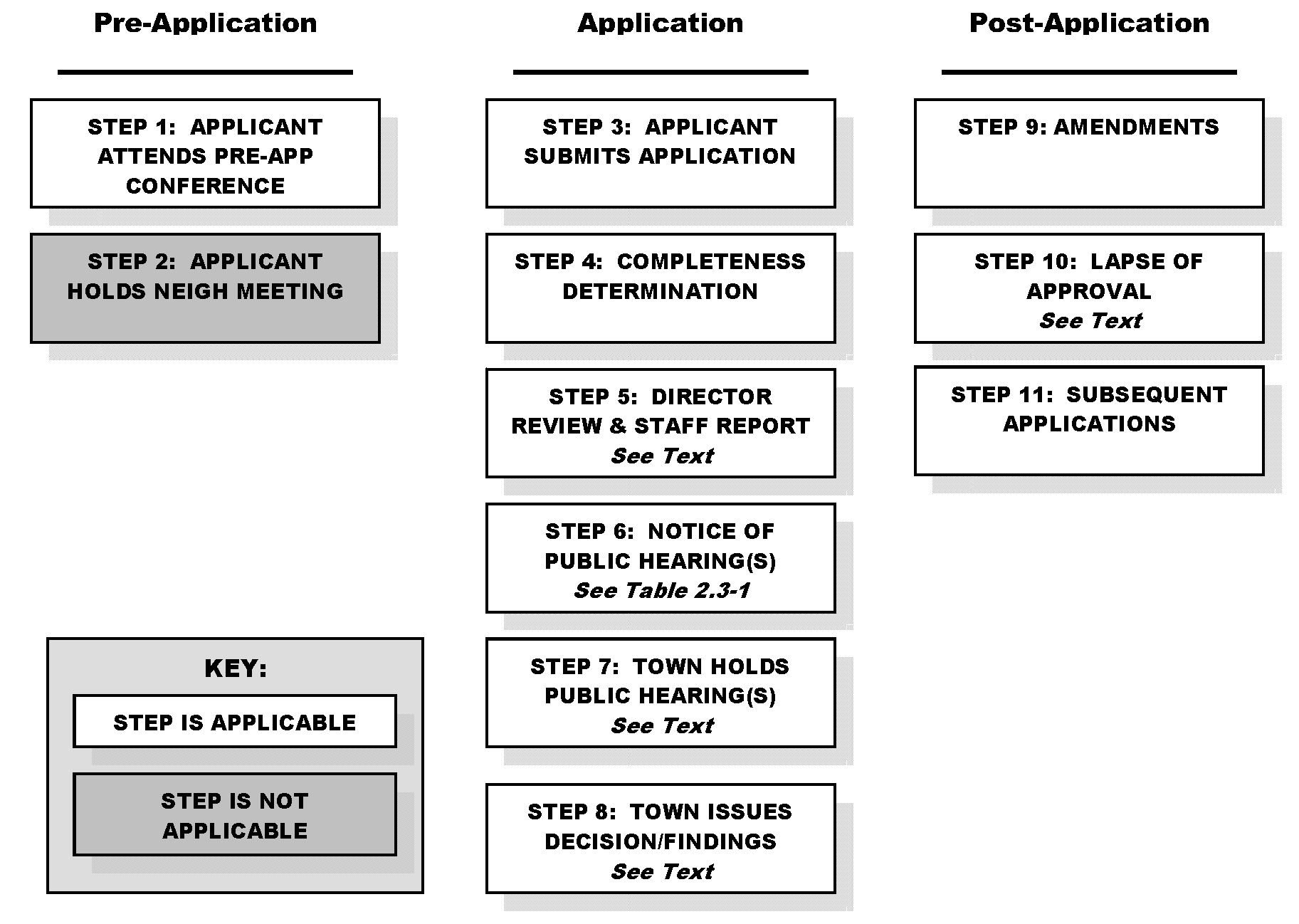
1.
Step 5: Director review and staff report. The Director shall review the application. If the Director determines that no further review is necessary, he or she shall prepare a written statement of approval, denial, or approval with conditions of the conditional use within sixty (60) days of acceptance of a complete application, and the decision shall be final, subject to appeal to the Planning Commission. If the Director determines that additional review by the Planning Commission is appropriate to ensure consistency and compatibility of uses, he or she shall forward the application to the Planning Commission for review, public hearing, and final decision.
2.
Step 6: Notice of public hearing(s). A public hearing is required only if the application is forwarded to the Planning Commission for review and decision.
3.
Step 7: Town holds public hearing(s).
a.
Planning commission hearing, review, and decision. For applications that have been forwarded to the Planning Commission, the Commission shall hold a public hearing. Following the hearing, the Planning Commission shall consider the comments and evidence presented at the hearing, and the staff report and recommendations from the Director, and approve, conditionally approve, or deny the conditional use permit, based on the criteria in Step 8 below.
4.
Step 8: Town issues decision/findings.
a.
Approval criteria. The Director or the Planning Commission may approve a proposed conditional use that meets all of the following criteria:
(i)
The proposed use is consistent with the Comprehensive Plan and all applicable provisions of this Land Use Code and applicable state and federal regulations;
(ii)
The proposed use is consistent with the purpose and intent of the zoning district in which it is located and any applicable use-specific standards in Article 4 of this Land Use Code;
(iii)
The proposed use is compatible with adjacent uses in terms of scale, site design, and operating characteristics (such as, but not limited to, hours of operation, traffic generation, lighting, noise, odor, dust, and other external impacts);
(iv)
Any significant adverse impacts anticipated to result from the use will be mitigated or offset to the maximum extent practicable; and
(v)
Facilities and services (including sewage and waste disposal, water, gas, electricity, police and fire protection, and roads and transportation, as applicable) will be available to serve the subject property while maintaining adequate levels of service for existing development; and
(vi)
Adequate assurances of continuing maintenance have been provided.
b.
Subsequent ownership. Successors and/or assigns of the person(s) who originally obtained conditional use permits may make use of the land or structures covered under the issued permits and must abide by all the terms and conditions of the permits, unless otherwise stipulated in the approval process. Successors and/or assigns of an issued permit must change the names on the original permit and have a letter of acknowledgment signed, filed with the Director, and recorded by the subject property owner.
5.
Step 10: Lapse of approval.
a.
A conditional use permit shall lapse and have no further effect one (1) year after its effective date or at such alternate time specified in the approval unless one (1) or more of the following criteria has been met:
(i)
A building permit has been issued and construction diligently pursued;
(ii)
A certificate of occupancy has been issued;
(iii)
The use has been established and in continuous operation; or
(iv)
The conditional use permit is renewed.
b.
A conditional use permit shall lapse upon termination of a project or expiration of a building permit.
c.
A conditional use permit shall lapse if the rights granted by it are discontinued for one hundred eighty (180) consecutive days or other period of time as specified in the original approval.
2.4.5. RESERVED (Repealed by Ord. No. 743)
2.4.6. DESIGN REVIEW
A.
Purpose. The purpose of the design review process is to ensure compliance with the development and design standards of this Land Use Code prior to the issuance of a building permit or concurrent with other required permits, and to encourage quality development reflective of the intent of the Land Use Development Code and goals and objectives of the Comprehensive Plan.
A design review sketch application represents a conceptual development plan. It allows for an evaluation of the proposed development before detailed planning and engineering work is undertaken and before substantial expenses have been incurred by the applicant prior to submission of a design review final application. Materials submitted for a design review sketch plan shall not constitute a complete application for design review.
B.
Applicability. Design review is required for:
1.
All new commercial and mixed-use development;
2.
All new multi-family residential development including condominiums, townhomes, and apartments;
3.
Any change of use from one primary use classification to another (for example, residential use to commercial use);
4.
Any expansion of existing development, not including single-family, that results in a change to a building footprint of more than two thousand five hundred (2,500) square feet or an increase of building square feet of more than fifty (50) percent or fifty (50) percent of any building façade is proposed to be modified; and
5.
All publicly owned and operated buildings.
C.
Types of design review.
1.
Administrative design review. The following types of projects may be approved by the Director through the Administrative Design Review process:
a.
Any expansion of existing development, not including single-family, that results in a change to a building footprint of at least one thousand (1,000) square feet but less than two thousand five hundred (2,500) square feet or an increase of building square feet of more than fifty (50) percent or fifty (50) percent of any building façade is proposed to be modified.
b.
Duplexes and live/work units.
2.
Major design review. Any development, with the exception of single-family detached or duplex dwellings, that exceeds the size threshold for administrative design review approval shall require approval by the Design Review Board through the major design review process.
D.
Procedure for administrative design review sketch application. Administrative Design Review applications require a Design Review Sketch application submission prior to submission of Administrative Design Review Final application. Figure 2.4-11.a shows the steps of the common development review procedures that apply in the review of applications for Administrative Design Review Sketch. The common procedures are described in Section 2.3. Specific additions and modifications to the common review procedures are identified below.
Figure 2.4-11.a: Procedures for Administrative Design Review Sketch
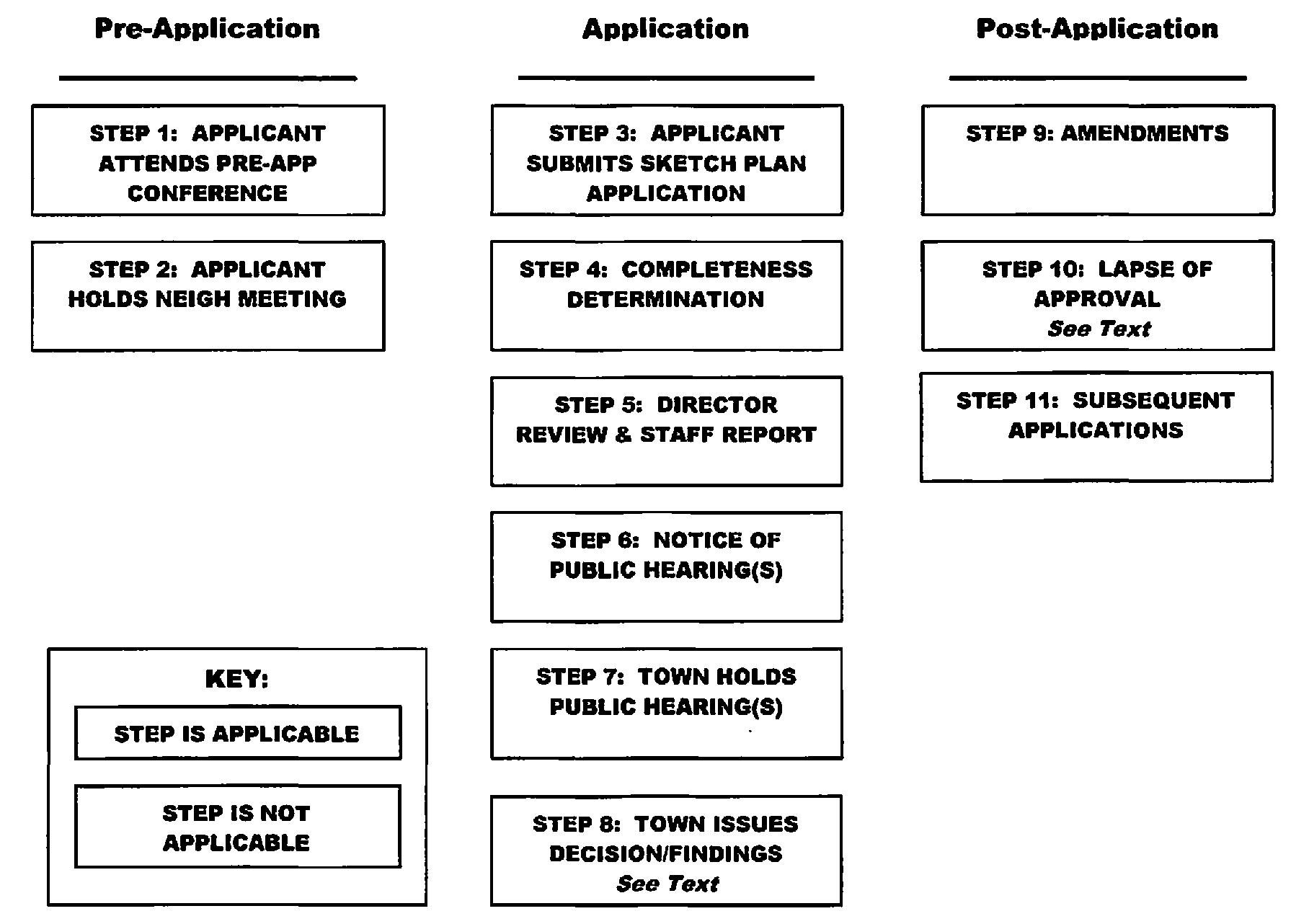
1.
Step 8: Town Issues Decision/Findings:
a.
Director's Review and Decision, or Referral to DRB. The Director shall review each administrative design review sketch application based on the approval criteria listed below and shall act to approve, approve with conditions, or deny the application. The Director also may refer the decision to the Design Review Board to be processed under the major design review procedure.
b.
Approval Criteria. The Director shall approve an administrative design review sketch application if all of the following criteria are met:
(i)
The design review sketch application complies with all applicable development and design standards set forth in this Land Use Code, including, but not limited to, the provisions in Article 3, Zoning Districts, Article 4, Use Regulations, Article 5, Dimensional Requirements, and Article 6, Development and Design Standards;
(ii)
The design review sketch application is consistent with any previously approved subdivision plat, planned development, or any other precedent plan or land use approval as applicable; and
(iii)
The design review sketch application is consistent with the Comprehensive Plan and other adopted Town policies and plans, including any adopted transportation plan or streets/roadway plan.
2.
Step 10: Lapse of Approval. The design review sketch application approval shall be effective for a period of one year from the date of approval, unless stated otherwise in such approval. Final design review application shall be submitted within one year of approval of sketch.
E.
Procedure for administrative design review final application. Figure 2.4-11.b shows the steps of the common development review procedures that apply in the review of applications for administrative design review final. The common procedures are described in Section 2.3. Specific additions and modifications to the common review procedures are identified below.
Figure 2.4-11.b: Procedure for Administrative Design Review Final
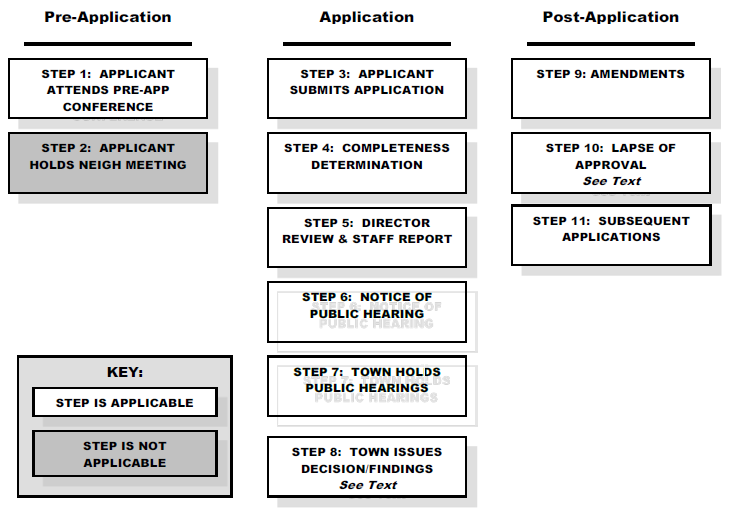
1.
Step 8: Town Issues Decision/Findings:
a.
Director's Review and Decision, or Referral to DRB. The Director shall review each administrative design review final application based on the approval criteria listed below and shall act to approve, approve with conditions, or deny the application. The Director also may refer the decision to the Design Review Board to be processed under the Major design review procedure.
b.
Approval Criteria. The Director shall approve an administrative design review final application if all of the following criteria are met:
(i)
The development plan complies with all applicable development and design standards set forth in this Land Use Code, including, but not limited to, the provisions in Article 3, Zoning Districts, Article 4, Use Regulations, Article 5, Dimensional Requirements, and Article 6, Development and Design Standards;
(ii)
The development plan is consistent with any previously approved subdivision plat, planned development, or any other precedent plan or land use approval as applicable; and
(iii)
The development plan is consistent with the Comprehensive Plan and other adopted Town policies and plans, including any adopted transportation plan or streets/roadway plan.
2.
Step 10: Lapse of Approval: The development plan shall be effective for a period of one year from the date of approval, unless stated otherwise in such approval. Building permits shall not be issued based on development plans that have an approval date more than one year old.
F.
Procedure for Major Design Review Sketch. Major design review applications require a separate major design review sketch application approval prior to the submission of a major design review final application. Figure 2.4-12.a shows the steps of the common development review procedures that apply in the review of applications for major design review sketch. The common procedures are described in Section 2.3. Specific additions and modifications to the common review procedures are identified below.
1.
Step 8: Town Issues Decision/Findings:
a.
Design Review Board Review and Decision. The design review board shall consider the sketch application and the staff report and recommendation from the Director, and approve, conditionally approve, or deny the application, based on the criteria below.
b.
Approval Criteria. The Design Review Board may approve a major design review sketch application if all of the following criteria are met:
(i)
The development plan is consistent with the intent of the Comprehensive Plan and all other adopted Town plans;
(ii)
The development plan complies with all applicable development and design standards set forth in this Land Use Code, including, but not limited to, the provisions in Article 3, Zoning Districts, Article 4, Use Regulations, Article 5, Dimensional Requirements, and Article 6, Development and Design Standards;
(iii)
The development plan will not substantially alter the basic character of the surrounding area or jeopardize the development or redevelopment potential of the area; and
(iv)
The development plan is consistent with any previously approved subdivision plat, planned development, or any other precedent plan or land use approval as applicable.
Figure 2.4-12.a: Procedure for Major Design Review Sketch
c.
Post Approval. After review and approval by the Design Review Board, the applicant shall submit a final design review application within one year incorporating any conditions of approval from the Design Review Board.
2.
Step 10: Lapse of Approval: The design review sketch approval shall be effective for a period of one year from the date of approval, unless stated otherwise in such approval. Building permits shall not be issued based on sketch development plans. Major design review final application shall be submitted within one year of sketch approval date.
G.
Procedure for Major Design Review Final Applications. Figure 2.4-12.b shows the steps of the common development review procedures that apply in the review of applications for major design review final. The common procedures are described in Section 2.3. Specific additions and modifications to the common review procedures are identified below.
Figure 2.4-12.b: Procedure for Major Design Review Final
1.
Step 8: Town Issues Decision/Findings
a.
Design Review Board Review and Decision. The Design Review Board shall consider the application and the staff report and recommendation from the Director, and approve, conditionally approve, or deny the application, based on the criteria below.
b.
Approval Criteria. The Design Review Board may approve a major design review final application if all of the following criteria are met:
(i)
The development plan is consistent with the intent of the Comprehensive Plan and all other adopted Town plans;
(ii)
The development plan complies with all applicable development and design standards set forth in this Land Use Code, including, but not limited to, the provisions in Article 3, Zoning Districts, Article 4, Use Regulations, Article 5, Dimensional Requirements, and Article 6, Development and Design Standards;
(iii)
The development plan will not substantially alter the basic character of the surrounding area or jeopardize the development or redevelopment potential of the area; and
(iv)
The development plan is consistent with any previously approved subdivision plat, planned development, or any other precedent plan or land use approval as applicable.
c.
Post Approval. After review and approval by the Design Review Board, the applicant shall submit a revised set of final development plans based on any conditions of approval from the Design Review Board.
2.
Step 10: Lapse of Approval. The design review approval shall be effective for a period of one year from the date of approval, unless stated otherwise in such approval. Building permits shall not be issued based on development plans that have an approval date more than one year old.
2.4.7. REDEVELOPMENT PERMIT
A.
Purpose. The purpose of this Section is to provide a system for the redevelopment of property involving the relocation, demolition, or partial demolition of buildings. The primary intent is to avoid the decline in property values and threat to the health, safety, and welfare of the residents of the Town caused by relocation, demolition, or partial demolition and clean-up; vacant, un-maintained, unimproved, or unvegetated properties; and changes to the character of neighborhoods associated with the incomplete redevelopment of property.
B.
Applicability and prohibition. The application of this Section is limited to buildings located within the C, MU-R, MU-C, and MU-TC districts. The relocation, demolition, or partial demolition of any building within these districts is prohibited except in compliance with the terms and conditions of a redevelopment permit issued in accordance with the provisions of this Section. The requirements of this Section shall apply in addition to any other applicable provisions of the Code, including, but not limited to, issuance of a demolition permit by the Building Official under the applicable building code.
C.
Conflict. In the event of any conflict or inconsistency between the provisions of this Section and the other provisions of the Code, the provisions of this Section shall control, except that in case of conflict with Article 8 regarding historic preservation, the provisions of Article 8 shall control.
Figure 2.4-13: Procedures for Redevelopment Permit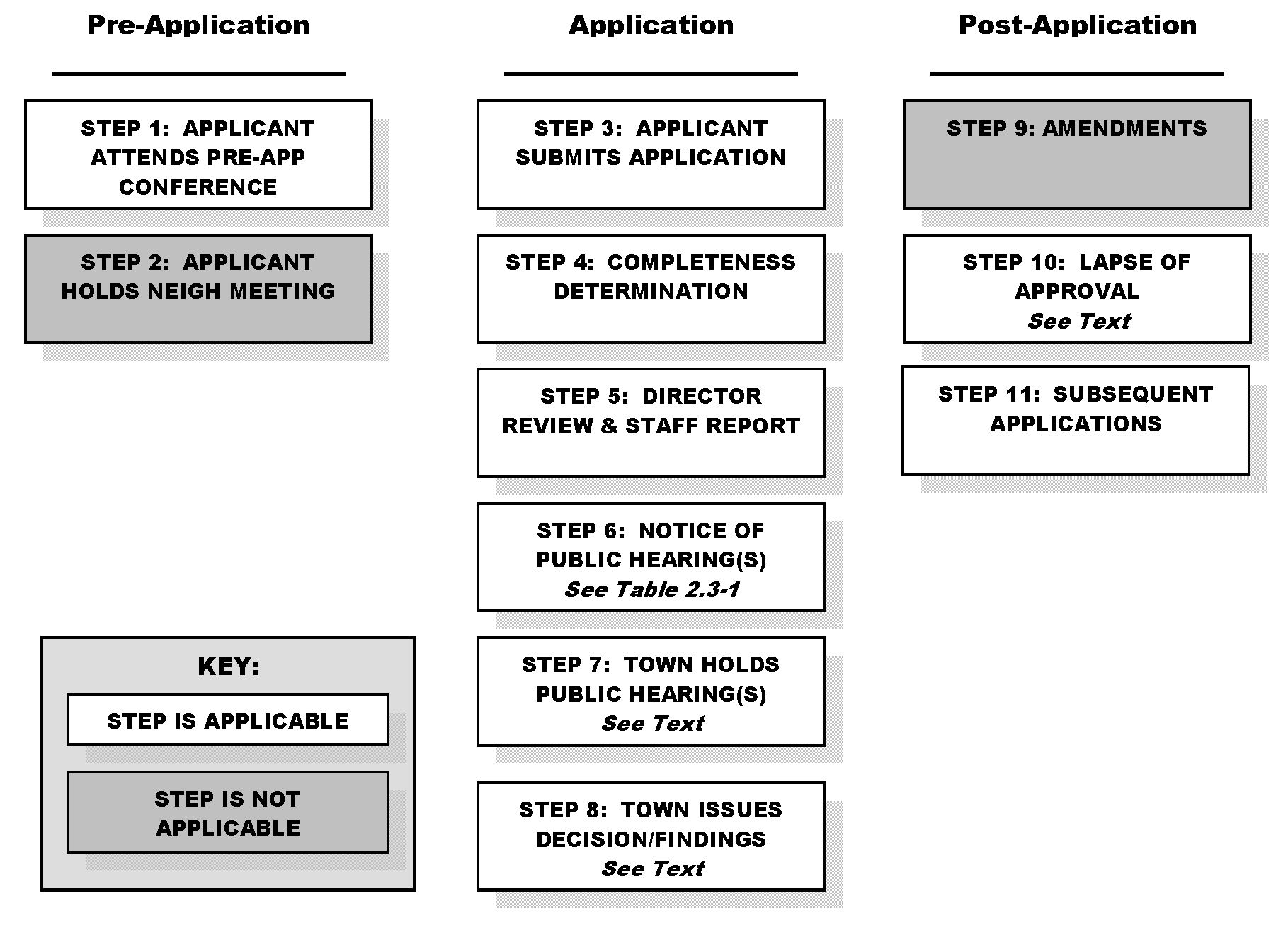
D.
Procedure. Figure 2.4-13 shows the steps of the common development review procedures that apply in the review of applications for redevelopment permits. The common procedures are described in Section 2.3. Specific additions and modifications to the common review procedures are identified below. Applications for redevelopment permits may be submitted concurrently design review applications submitted pursuant to Section 2.4.6.
1.
Step 7: Town holds public hearing(s).
a.
Planning commission hearing, review, and recommendation. Following a public hearing, the Planning Commission shall consider the comments and evidence presented at the hearing and the staff report and recommendation of the Director, and recommend to the Town Council to approve, conditionally approve, or deny the redevelopment development permit based on the criteria in Step 8 below.
b.
Town council public hearing, review, and decision. Following a public hearing, the Town Council shall consider the comments and evidence presented at the hearing, and the staff report and recommendations from the Planning Commission and the Director, and approve, conditionally approve, or deny the redevelopment permit, based on the criteria in Step 8 below.
2.
Step 8: Town issues decision/findings.
a.
Approval criteria. A redevelopment permit application shall be approved only if the Town Council finds that all of the following criteria are met:
(i)
The applicant has agreed to redevelop the originating site and, in the case of relocation, the receiving site, pursuant to an approved redevelopment plan;
(ii)
The historic and present architectural character of other buildings remaining on the site and in the neighborhood are compatible with the redevelopment plan and will not be substantiality compromised or diminished;
(iii)
The applicant has agreed to comply with a preservation, rehabilitation, and/or restoration plan for any building that is proposed to be relocated;
(iv)
The applicant has agreed to post with the Town a bond or other suitable collateral as determined by the planning commission, ensuring the safe clean-up, site rehabilitation, revegetation, and redevelopment of the originating site. In the case of relocation, the bond shall additionally ensure safe relocation, preservation, rehabilitation, and repair of the building, preparation of the receiving site and infrastructure connections; and
(v)
The applicant has applied for, paid all required fees, and eligible to receive a full building permit for the buildings to be constructed pursuant to the redevelopment plan; this standard may be waived by the Town Council if demolition is immediately necessary because the building is not structurally sound and is an immediate threat to the public health, safety and welfare, or if the applicant agrees to deed restrict the property to open space uses and the Council finds that such restriction constitutes a greater benefit to the neighborhood than would redevelopment.
b.
Actions following approval. An applicant may apply for permits required under the applicable building code for the associated demolition, partial demolition, or relocation following the effective date of the redevelopment permit.
3.
Step 10: Lapse of approval. Within one (1) year from the approval of the redevelopment permit, the property owner shall have commenced development and/or obtained the necessary permits to carry out the approved redevelopment permit. If such application has not been filed, the redevelopment permit shall be considered null and void.
E.
Reuse of materials. The applicant is encouraged to sell or reclaim a building and the materials to be demolished or permit others to salvage them and to provide an opportunity for others to purchase or reclaim the building or its materials.
F.
Penalties. The following provisions apply in addition to the general penalty provisions in Section 1.6.4., Penalties and Remedies.
1.
Post-conviction revocation or moratorium on permits.
a.
Revocation or moratorium authorized. Upon conviction of a violation of this Section, the Town Council shall be authorized for a period of up to ten (10) years to revoke or impose a moratorium on issuance of any development permits, building permits or certificates of occupancy upon the property on which the building was demolished, removed from, or relocated from or to.
b.
Hearing. Such revocation or moratorium may be imposed only after a public hearing preceded by ten (10) days' prior written notice mailed to the owner by registered mail. An affirmative vote of a majority of the Town Council members present and voting shall be required in order to impose any such revocation or moratorium, by a majority vote.
c.
Record notice. Notice of the imposition and duration of any revocation or moratorium imposed pursuant to this Section shall be recorded with the Archuleta County Clerk and Recorder.
d.
Suspension of revocation or moratorium authorized. No sooner than one (1) year after the revocation of or imposition of the moratorium on issuance of a development permit, building permit, or certificate of occupancy pursuant to this Section, the Town Council may suspend, reduce, or terminate the revocation or moratorium, with or without conditions, after considering the following factors:
(i)
The impact of the demolition, partial demolition, or removal upon the historical character and architectural integrity of the neighborhood area;
(ii)
Factual circumstances concerning the cause of the demolition, partial demolition or removal, as may be identified by investigation of the Director, Building Official, or Fire Marshal;
(iii)
Whether the demolition, partial demolition, or removal would likely have been approved had an application been submitted;
(iv)
Whether the purposes of the revocation or moratorium have been achieved; and
(v)
The effect of a revocation or moratorium as an incentive to the owner to restore or rehabilitate any remaining portion of the demolished or relocated structure, if such action would substantially contribute to the historical character and architectural integrity of the neighborhood.
2.4.8. FLOODPLAIN DEVELOPMENT PERMIT
A.
Purpose. The floodplain development permit is intended to ensure that development in areas of special flood hazard complies with all applicable provisions of this Land Use Code and the Town's adopted floodplain standards, which are in the administrative manual.
B.
Applicability. A floodplain development permit shall be obtained before construction or development begins within any area of special flood hazard. Applications shall be processed concurrently with building plan submittal or development review application.
Figure 2.4-14: Procedure for Floodplain Development Permits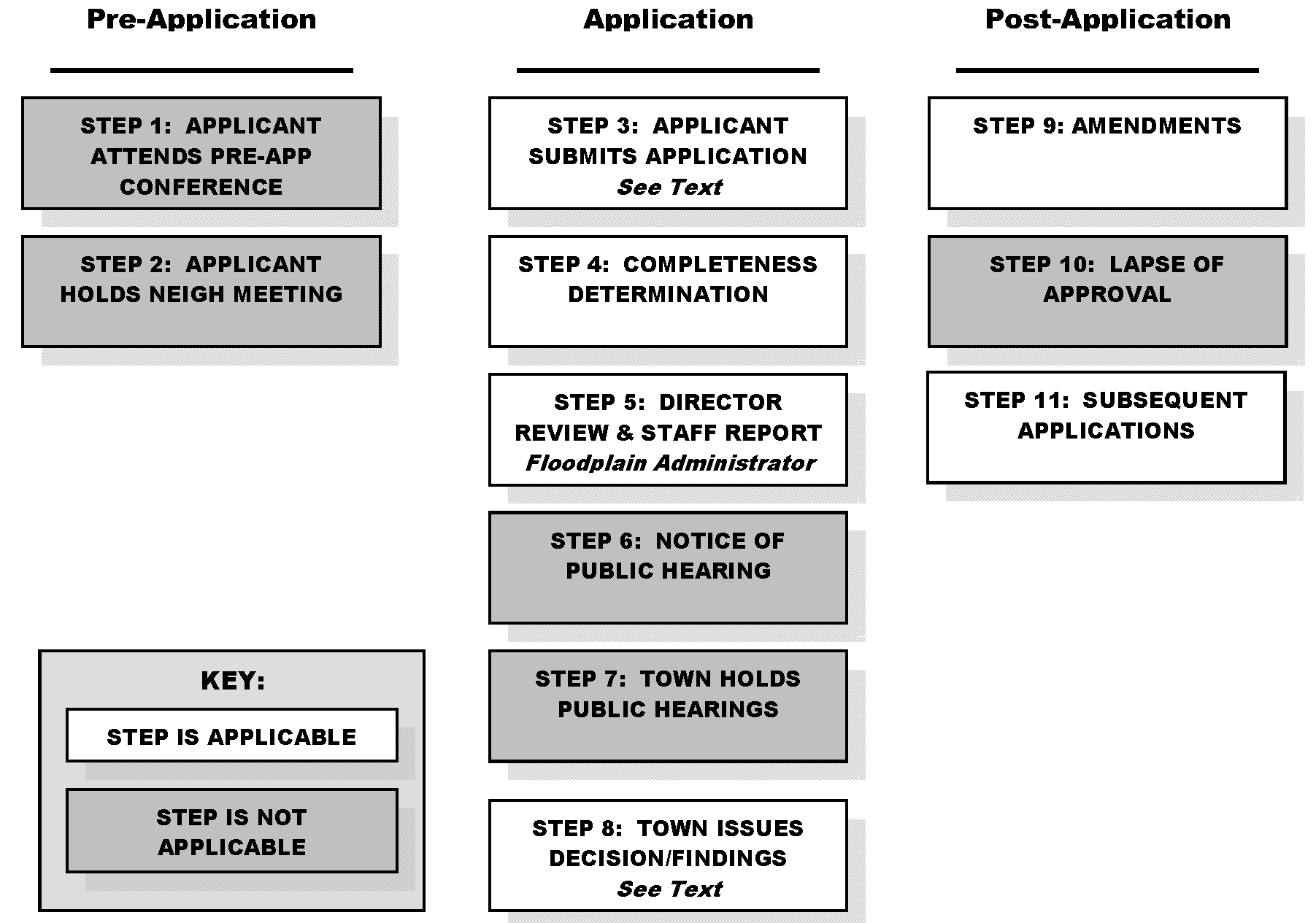
C.
Procedure. Figure 2.4-14 shows the steps of the common development review procedures that apply in the review of applications for floodplain development permits. The common procedures are described in Section 2.3. Specific additions and modifications to the common review procedures are identified below.
1.
Step 3: Applicant submits application. Applications for floodplain development permits shall be submitted to and processed by the Floodplain Administrator.
2.
Step 8: Town issues decision/findings.
a.
Floodplain Administrator review and decision. The Floodplain Administrator shall review each floodplain development permit application based on the approval criteria listed below and shall act to approve, approve with conditions, or deny the application.
b.
Approval criteria. The Floodplain Administrator shall review the floodplain development permit for compliance with the following:
(i)
All applicable provisions of Section 6.2, Flood Damage Prevention Regulations, of this Land Use Code; and
(ii)
All necessary permits have been obtained from any federal, state, and local governmental agencies from which prior approval is required.
2.4.9. SIGN PERMITS
A.
Applicability.
1.
General. No signs, except as exempted in Section 6.12.2, shall be erected, re-erected, placed, moved, constructed, reconstructed, altered, or displayed unless a sign permit has been issued. No permit shall be issued for a sign unless the sign is in compliance with all applicable provisions of this Section and Section 6.12, Sign Code, or such provisions have been modified or varied pursuant to this Land Use Code. No electrical sign shall be erected unless an electrical permit has been issued.
2.
Individual signs. Signs that are to be individually erected or modified for existing developed properties, vacant properties, or involve a sign face, a change in sign structures, or a change in business identification, shall be processed in accordance with the procedures in subsection B. below.
3.
Comprehensive sign program (three (3) or more signs). Applications for three (3) or more signs shall require approval as a Comprehensive Sign Program (CSP), and shall be processed in accordance with the procedure in subsection C. below. The purpose of the CSP is to establish a unified design theme for all signs within a development project, shopping center, or business complex. The intent of such a program is to create a visually pleasing method of providing compatible and complementary signs throughout the project site; to inform owners and tenants of desired sign characteristics; to minimize visual clutter; and to unify the appearance of the development to create a distinctive sense of place.
B.
Procedure for individual signs. Figure 2.4-15 shows the steps of the common development review procedures that apply in the review of applications for sign permits for individual signs. The common procedures are described in Section 2.3. Specific additions and modifications to the common review procedures are identified below.
1.
Step 8: Town issues decision/findings.
a.
Director's review and decision, or referral to DRB. The Director shall review each sign permit application based on the approval criteria listed below and shall act to approve, approve with conditions, or deny the application.
b.
Approval criteria. The Director shall approve sign permit applications that meet all standards and requirements of Section 6.12.
2.
Step 10: Lapse of approval. Within one (1) year from the approval of the sign permit, if the property owner has not erected and maintained the sign pursuant to all applicable standards of this Land Use Code, the sign permit shall lapse and be considered null and void.
Figure 2.4-15: Procedure for Sign Permits for Individual Signs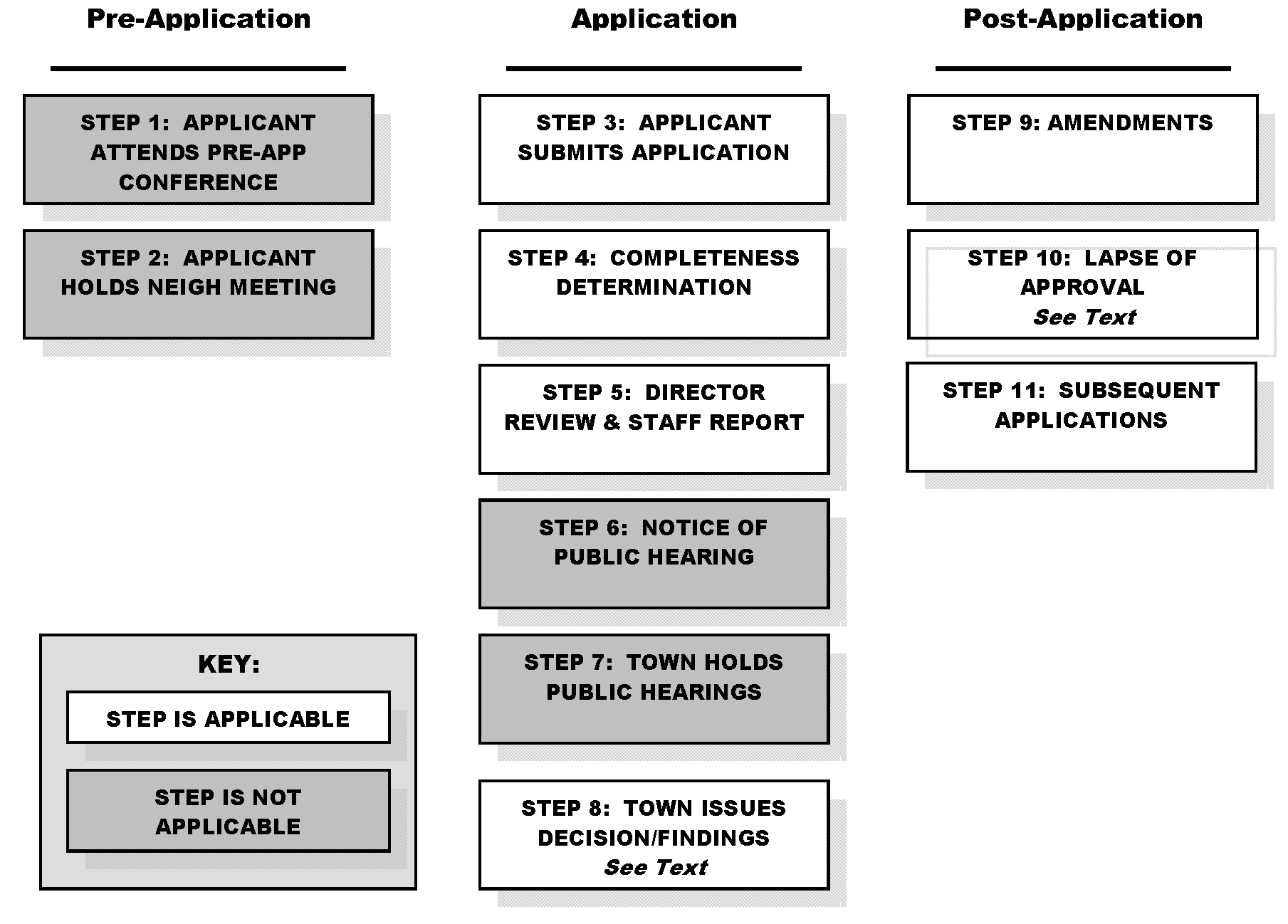
C.
Procedure for comprehensive sign program (CSP). Figure 2.4-16 shows the steps of the common development review procedures that apply in the review of applications for comprehensive sign programs. The common procedures are described in Section 2.3. Specific additions and modifications to the common review procedures are identified below.
Figure 2.4-16: Procedure for Comprehensive Sign Programs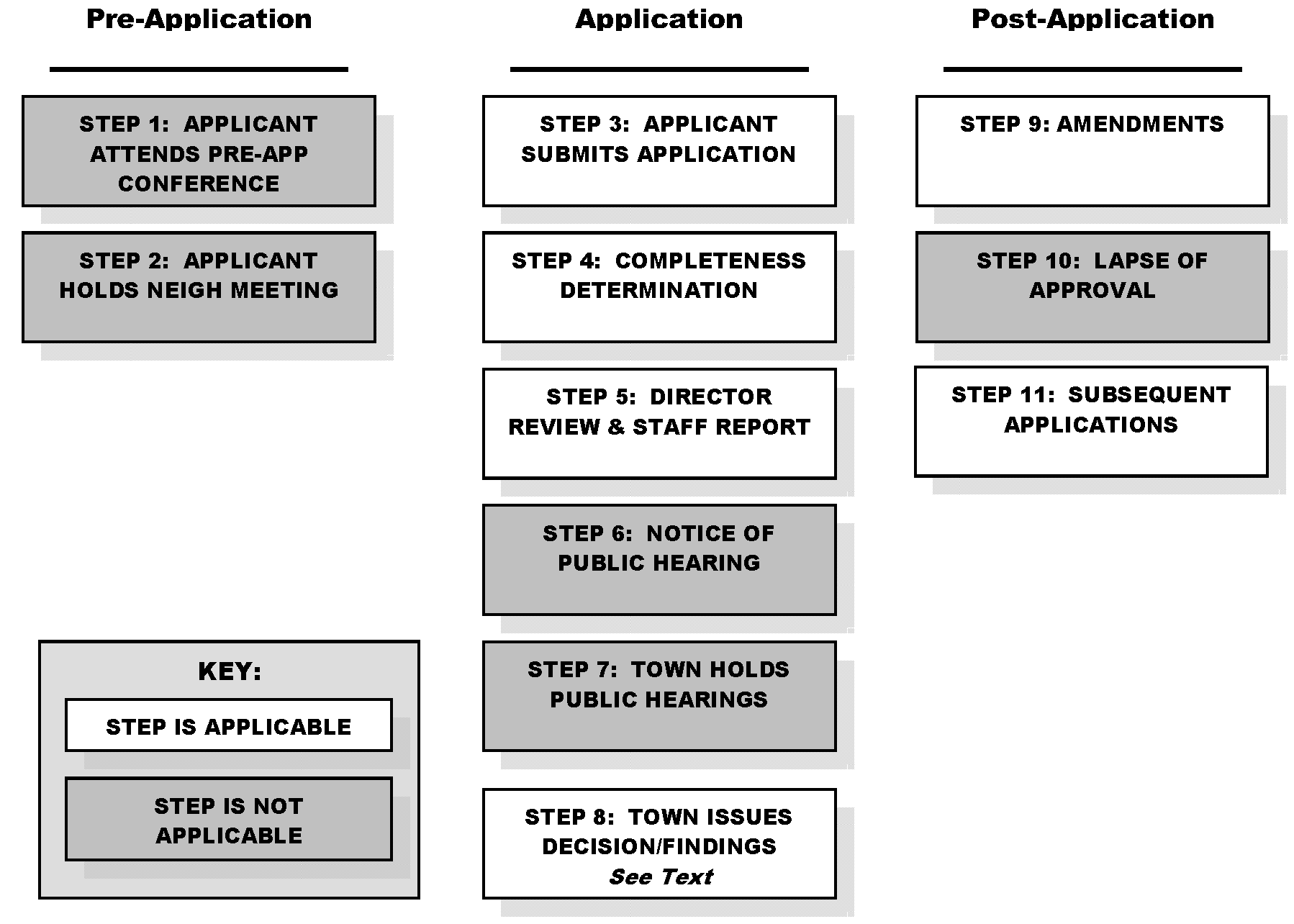
1.
Concurrent applications with comprehensive sign programs. Comprehensive sign programs may be processed concurrently with design review in accordance with Section 2.4.6.
a.
Signs associated with design guideline requirements. Signs that are integral to developments that require review in accordance with design guidelines must be reviewed and approved in accordance with those established guidelines. The sign regulations of Section 6.12 shall be used for determining allowable signage, and any sign features that exceed the standards of this Land Use Code shall be identified and included in all reviews and approvals of the development.
b.
Signs associated with planned developments. Signs that are integral to new PDs must be reviewed and approved in accordance with the PD regulations. The sign regulations of Section 6.12 shall be used for determining allowable signage, and any sign features that exceed the standards of this Land Use Code shall be identified and included in all reviews and approvals of the development.
2.
Step 8: Town issues decision/findings.
a.
Projects with four (4) or fewer signs: Director. Projects proposing four (4) signs or fewer on a site will be reviewed and approved, approved with conditions, or denied by the Director. The Director may refer such applications for review and decision by the Design Review Board if the Director determines that additional review is necessary.
b.
Projects with five (5) or more signs: Design Review Board. Projects proposing five (5) or more signs shall be reviewed and approved, approved with conditions, or denied by the Design Review Board.
c.
Approval criteria. A CSP shall be approved upon a finding that the application complies with all applicable requirements of Section 6.12 of this Land Use Code.
d.
Alterations. A sign that is part of a CSP may have the text or artwork changed to suit the requirements of a new tenant without being subject to additional fees, provided that the changes meet the guidelines of the originally approved CSP. The sign owner must still submit a detailed description of the new signage to the Director, and any alteration not stipulated in the CSP will be subject to review and payment of fees.
D.
Appeal. An appeal of any action pertaining to the sign regulations in Section 6.12 shall be heard and acted upon pursuant to Section 2.4.12. However, prior to filing an appeal, the applicant or aggrieved party must request an interpretation of the sign regulations of this Land Use Code by the Design Review Board. The request for interpretation must be submitted to the Director and then acted upon by the Design Review Board. If, upon receiving the Board's interpretation, the applicant desires to proceed with an appeal, the applicant may do so consistent with the process set forth in Section 2.4.13.
2.4.10. TEMPORARY USE PERMITS
A.
Applicability. No use that is classified as a temporary use in the zoning district in which it is to be located shall be placed or established on the property without first receiving a temporary use permit, unless exempted from the permit requirements by Article 3, Use Regulations.
B.
Procedure. Figure 2.4-17 shows the steps of the common development review procedures that apply in the review of applications for temporary use permits. The common procedures are described in Section 2.3. Specific additions and modifications to the common review procedures are identified below.
Figure 2.4-17: Procedure for Temporary Use Permits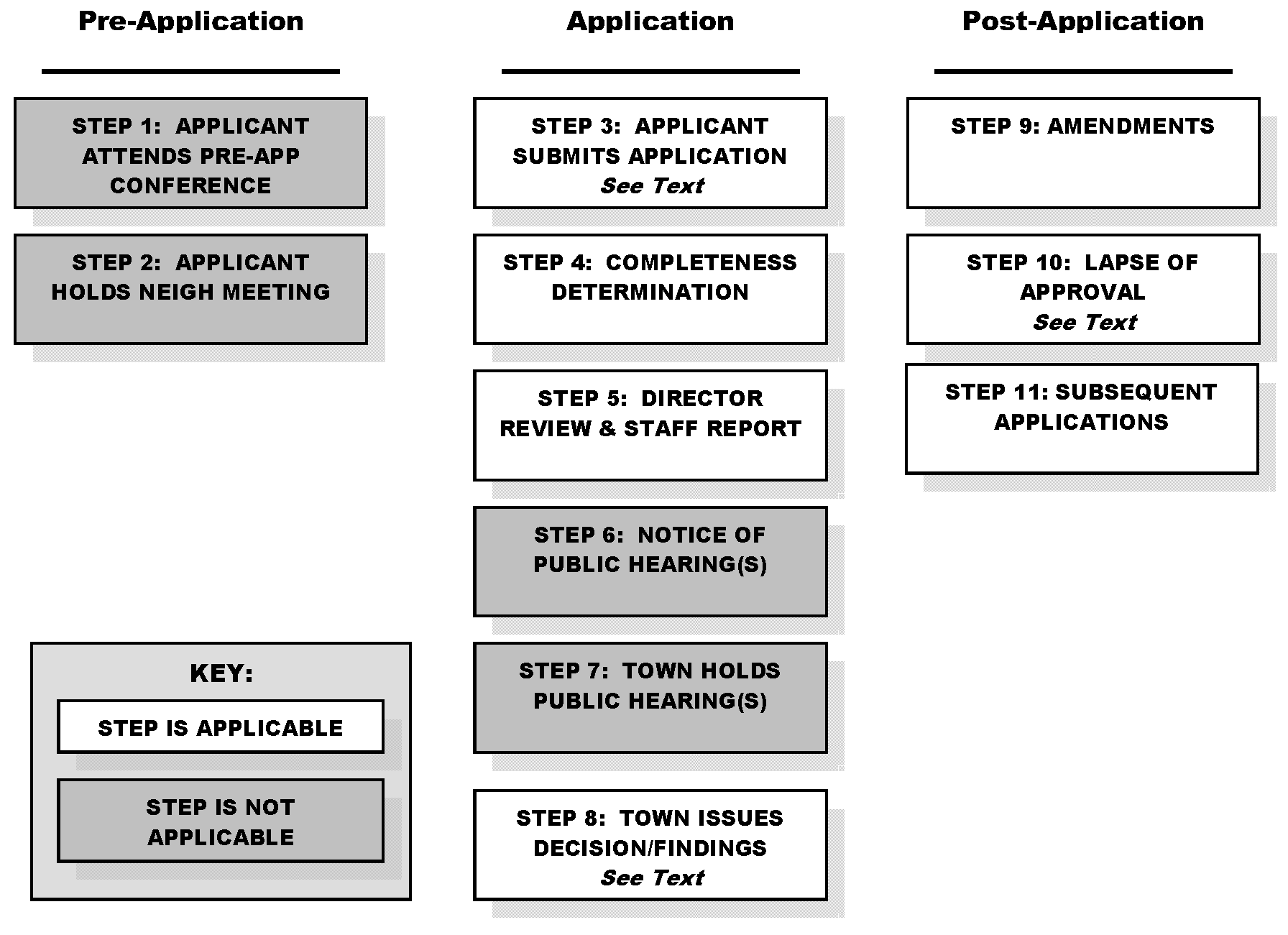
1.
Step 3: Applicant submits application. All applications for temporary use permits shall be filed at least four (4) weeks prior to the date the temporary use will commence, or at least six (6) weeks prior to the date the temporary use will commence if enhanced, supplemental, or special public safety support will be required from the Town.
2.
Step 8: Town issues decision/findings.
a.
Action by Director. The Director shall review each application and distribute the application to other reviewers as he or she deems necessary. Based on the results of those reviews, the Director shall take final action on the application and approve, approve with conditions, or deny the application based on the applicable approval criteria below.
b.
Duration of permit. A temporary use permit shall be valid only for the time period stated on the permit unless otherwise authorized in this Land Use Code.
c.
Approval criteria. The Director shall issue a temporary use permit only upon finding that the proposed temporary use satisfies the requirements set forth in Section 4.4., Temporary Uses and Structures.
3.
Step 10 (Lapse). The temporary use permit shall lapse and be null and void upon expiration of the time limit specified in the permit.
2.4.11. OUTDOOR COMMERCIAL ESTABLISHMENTS
A.
Applicability. No use that is classified as an Outdoor Commercial Establishment in the zoning district in which it is to be located shall be placed or established on the property without first receiving a Outdoor Commercial Establishment permit.
B.
Procedure. Figure 2.4-19 shows the steps of the common development review procedures that apply in the review of applications for Outdoor Commercial Establishment permits. The common procedures are described in Section 2.3. Specific additions and modifications to the common review procedures are identified below. (Add Figure 2.4-19 Identifying the following steps: Step 1 Pre-application conference, Step 3 Applicant submits application, Step 4 Completeness Determination, Step 5 Director Review and Determination, Step 8 Town Issues Decision, Step 9 Amendments, Step 10 Lapse of Approval, Step 11 Subsequent applications.)
1.
Step 3: Applicant submits application. All applications for Outdoor Commercial Establishments shall be filed at least four (4) weeks prior to the date the operation will commence, or at least six (6) weeks prior to the date the operation will commence if enhanced, supplemental, or special public safety support will be required from the Town.
2.
Step 8: Town issues decision/findings.
a.
Action by Director. The Director shall review each application and distribute the application to other reviewers as he or she deems necessary. Based on the results of those reviews, the Director shall take final action on the application and approve, approve with conditions, or deny the application based on the applicable approval criteria below.
b.
Duration of permit. An Outdoor Commercial Establishment permit shall be valid only for the time period stated on the permit unless otherwise authorized in this Land Use Code.
c.
Approval criteria. The Director shall issue an Outdoor Commercial Establishment permit only upon finding that the proposed use satisfies the requirements set forth in Section 4.4.4 Outdoor Commercial Establishments.
3.
Step 10 (Lapse). The Outdoor Commercial Establishment permit shall lapse and be null and void upon expiration of the time limit specified in the permit.
Figure 2.4-18: Procedure for Outdoor Commercial Establishment Permits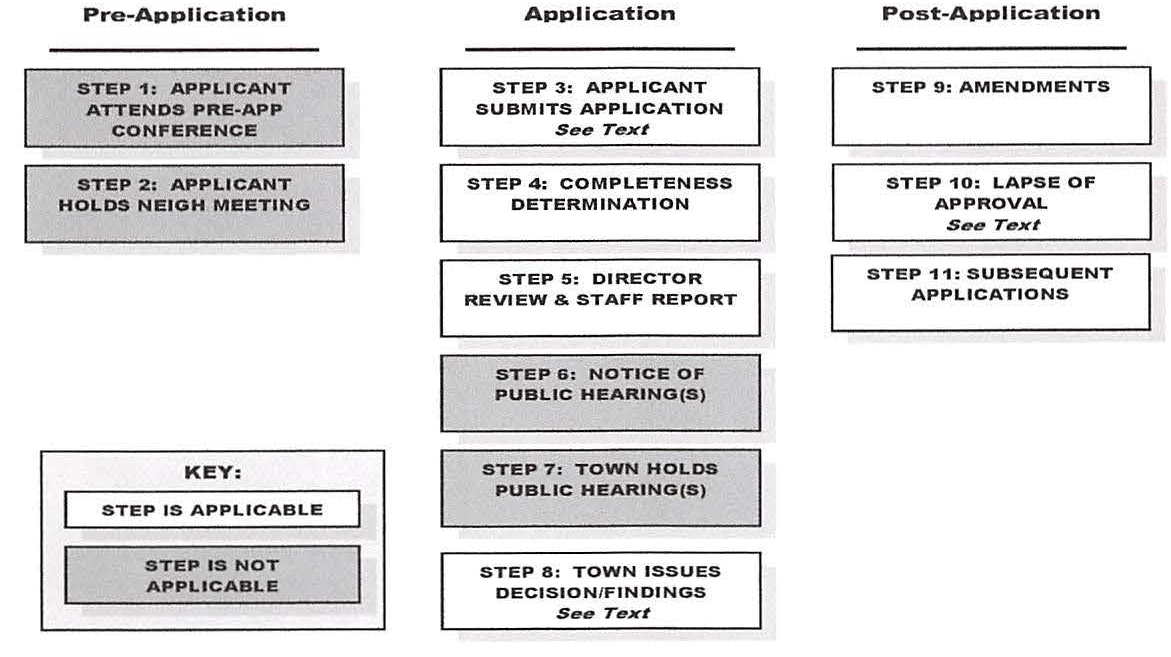
2.4.12. VARIANCES
A.
Purpose. The Board of Adjustment shall hear and decide all requests for a variance from the requirements of this Land Use Code, unless otherwise provided in this Section. The variance process is intended to provide limited relief from the requirements of this Land Use Code in those cases where strict application of a particular requirement will create a practical difficulty or unnecessary hardship prohibiting the use of land in a manner otherwise allowed under this Land Use Code. It is not intended that variances be granted to (1) allow a use in a zone district where it is not permitted by this Land Use Code; or (2) merely remove inconveniences or financial burdens that the requirements of this Land Use Code may impose on property owners in general. Rather, it is intended to provide limited relief where the requirements of this Land Use Code render the land difficult or impossible to use because of some unique physical attribute of the property itself or some other factor unique to the property for which the variance is requested. State and/or federal laws or requirements may not be varied by the Town.
B.
Applicability. A variance may be initiated only by the property owner or the designated representative. The application must state with particularity the relief sought and must specify the facts or circumstances that are alleged to show that the application meets the approval criteria of Step 8 below.
1.
Unless otherwise specified, variances from regulations of this Land Use Code shall be reviewed pursuant to the procedure in subsection C. below.
2.
Variances from the flood damage prevention regulations of Section 6.2 shall be reviewed pursuant to the procedure in subsection D. below.
3.
Reserved.
4.
Variances from the sign regulations of Section 6.12 shall be reviewed pursuant to the procedure in subsection F. below.
C.
Procedure. Figure 2.4-19 shows the steps of the common development review procedures that apply in the review of applications for variances. The common procedures are described in Section 2.3. Specific additions and modifications to the common review procedures are identified below.
Figure 2.4-19: Procedure for Variances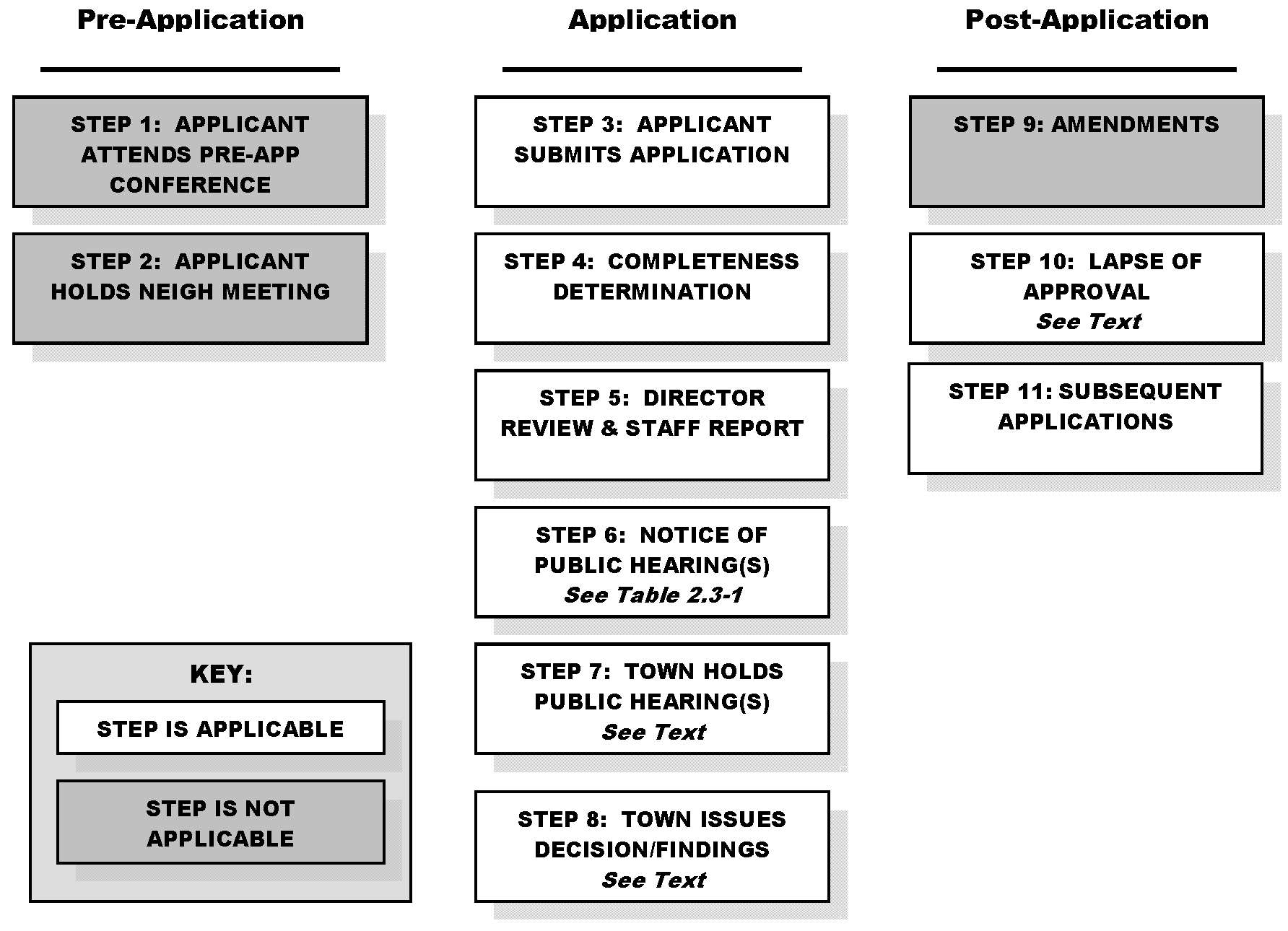
1.
Step 7: Town holds public hearing.
a.
The Board of Adjustment shall hold a public hearing on the proposed variance. In considering the application, the Board shall review the application materials, the staff report, the applicable approval criteria below, and all testimony and evidence received at the public hearing.
b.
After conducting the public hearing, the Board of Adjustment may approve, approve with conditions, or deny the requested variance. Any approval, approval with conditions, or denial shall be accompanied by written findings of fact that the variance meets or does not meet each of the criteria set forth in below, stating the reasons for such findings.
c.
The applicant has the burden of proving the necessary facts to warrant favorable action by the BOA.
2.
Step 8: Town issues decision/findings.
a.
Approval criteria. The Board of Adjustment may approve a variance only upon finding that all of the criteria below have been met:
(i)
There are unique physical circumstances or conditions, such as size, irregularity, narrowness or shallowness of lot, location, surroundings, or exceptional topographical or other physical conditions peculiar to the affected property;
(ii)
The unusual circumstances or conditions do not exist throughout the neighborhood or district in which the property is located;
(iii)
Such physical circumstances or conditions were not created by the applicant or any previous owner of the property;
(iv)
Because of such physical circumstances or conditions, the property cannot reasonably be developed in conformity with the provisions of this Land Use Code because such conformance with the Code would deprive such property of privileges enjoyed by other property of the same classification in the same zoning district;
(v)
The variance, if granted, will not alter the essential character of the neighborhood or district in which the property is located, nor substantially or permanently impair the appropriate use or development of adjacent property; and
(vi)
The variance, if granted, is the minimum variance that will afford relief and is the least modification possible of the provisions of this Land Use Code that are in question.
(vii)
No variance shall be granted that violates the intent of this Land Use Code or its amendments. No variance may make any changes in the terms of this Land Use Code provided the restriction in this subsection shall not affect the authority to grant variances pursuant to this Section 2.4.10.
(viii)
No variance shall be granted from any written conditions attached by another decision-making body to the approval of a conditional use permit, subdivision plat, or site plan.
(ix)
No variance shall be granted if the conditions or circumstances affecting the applicant's property are of so general or recurrent a nature as to make reasonably practicable the formulation of a general regulation for such conditions or situations.
(x)
No variance may authorize a use other than those permitted in the district for which the variance is sought; also, an application or request for a variance shall not be heard or granted with regard to any parcel of property or portion thereof upon which zoning request for any parcel of property or portion thereof has not been finally acted upon by both the Planning Commission and by the Town Council.
3.
Step 10: Lapse of approval. Within one (1) year from the approval of the variance, the property owner shall have commenced development and/or obtained the necessary permits to carry out the approved variance. If such application has not been filed, the variance shall be considered null and void.
D.
Variances from flood damage prevention regulations.
1.
Applicability. Variances from the flood damage prevention regulations of Section 6.2 of this Land Use Code may be granted for new construction and substantial improvements to be erected on lots equal to one-half (0.5) acre or less located contiguous to and surrounded by lots with existing structures constructed below the base flood level, providing that the criteria for a variance as set forth below and the purpose and intent of this Section are met.
2.
Exemptions. Any structures listed on the National Register of Historic Places, the State Inventory of Historic Places, or Local Landmark Registry shall be exempt from compliance with the standards and procedures set forth in this Section upon application for a development permit to reconstruct, rehabilitate, or restore the listed structure.
3.
Procedure. Variances from the flood damage prevention regulations of this Land Use Code shall be submitted and reviewed pursuant to the general variance procedure in Section 2.4.12.C., with the following modifications:
a.
Step 8: Town issues decision/findings.
(i)
Board of adjustment hearing, review, and decision. After conducting the public hearing, the Board of Adjustment may approve, conditionally approve, or deny the application. In deciding on requests for variances from the floodplain regulations of this Land Use Code, based upon the approval criteria below.
(ii)
Approval criteria. The Board of Adjustment may approve a variance from the floodplain regulations of this Land Use Code only upon finding that all of the criteria below have been met, in addition to meeting the general approval criteria for variances in Section 2.4.12.C. above.
(1)
A determination that the granting of a variance will not:
(a)
Result in increased flood elevations;
(b)
Additional threats to public safety;
(c)
Extreme or ordinary public expense;
(d)
Create nuisances;
(e)
Cause fraud on or victimization of the public; or
(f)
Conflict with existing local laws or ordinances.
(2)
A variance shall not be granted within any designated floodway if any increase in flood elevation during the base flood discharge would result.
(3)
A variance shall be granted only upon a determination that the variance is the minimum necessary, considering the flood hazard, to afford relief.
(iii)
Record of approved floodplain variances.
(1)
The Floodplain Administrator shall maintain records of all variances granted and appeals, including technical information on which the granting of the variance or appeal was based, and report any variance to FEMA when so requested.
(2)
Any applicant to whom a variance is granted shall be given written notice that the structure will be permitted to be built with the lowest flood elevation below the base flood elevation and that the cost of flood insurance will be commensurate with the increased risk resulting from the reduced lowest floor elevation.
E.
Reserved.
F.
Variance to sign regulations. When a sign owner seeks a variance from the standards contained in the sign regulations in Section 6.12, such request shall be heard and acted upon by the Design Review Board only after all other administrative procedures required for issuance of a sign permit have been completed. The Design Review Board is authorized to grant a variance when it finds that unique situations require a deviation from the provisions and that the purpose and intent of the sign regulations of Section 6.12 have not been violated. A request for an increase in sign size shall not be subject to the procedures in this subsection, but shall be processed as a standard variance as set forth in Section 2.4.12.C. of this Chapter.
2.4.13. MINOR MODIFICATIONS
A.
Purpose. This Section sets forth the required review and approval procedures for "minor modifications," which are minor deviations from otherwise applicable standards that may be approved by the Director. Minor modifications are to be used when the small size of the modification requested, and the unlikelihood of any adverse effects on nearby properties or the neighborhood, make it unnecessary to complete a formal variance process.
B.
Applicability.
1.
Minor modifications to general development and zoning district standards. As part of the review and approval of any procedure set forth in this Article, the Director may approve minor modifications of up to a maximum of ten (10) percent from the following general development and zoning district standards, provided that the applicable approval criteria below are met.
a.
Minimum lot area requirements (Section 5.1);
b.
Setback requirements (Section 5.1); and
c.
Quantitative development standards set forth in Article 6, Development Standards (e.g., percentage of site landscaping, number of parking spaces, etc.).
The maximum allowable modification is calculated by applying the ten percent modification to the resulting units derived from the application of the numerical development standard in this Land Use Code, rounded to the nearest whole number.
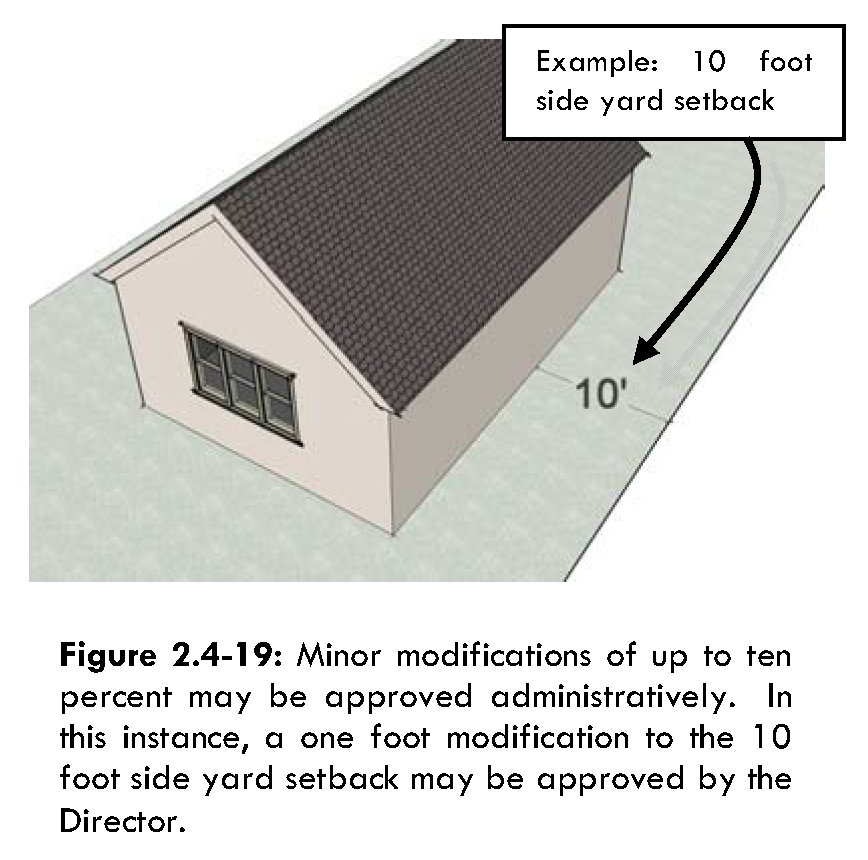
2.
Exceptions to authority to grant minor modifications. In no circumstance shall the Director approve a minor modification that results in:
a.
An increase in overall project density;
b.
A change in permitted uses or mix of uses;
c.
An increase in building height;
d.
A deviation from the use-specific standards in Section 4.2;
e.
A change in conditions attached to the approval of any site plan or conditional use permit;
f.
A deviation from the flood damage prevention standards in Section 6.2;
g.
A deviation from the sensitive area protection standards in Section 6.4;
h.
A change to a development feature already modified through a variance or minor modification; or
i.
A deviation from the roadway standards, as set forth in Section 6.6.3; or
j.
Requirements for sanitary sewer, central water, and access to or construction of utilities.
C.
Procedure. The Director may initiate or approve a minor modification allowed under this Section at any time prior to submittal of the staff report on an application to another decision-making body, or prior to final decision if the Director is the final decision-maker. Staff shall specify any approved minor modifications and the justifications for such modifications on the pending development application for which the modifications were sought.
D.
Approval criteria. The Director may approve the minor modification only if he or she finds that the modification meets all of the criteria below:
1.
The requested modification is consistent with the Comprehensive Plan, other adopted plans, and the stated purpose of this Land Use Code; and
2.
The requested modification meets all other applicable building and safety codes; and
3.
The requested modification does not encroach into a recorded easement or right-of-way; and
4.
The requested modification will not adversely affect the proposed development or use of adjacent property or neighborhood; and
5.
The modification, if granted, will not change the character of the zone district in which the property is located; and
6.
The requested modification is necessary to either: (a) compensate for some practical difficulty or some unusual aspect of the site of the proposed development not shared by landowners in general; or (b) accommodate an alternative or innovative design practice that achieves to the same or better degree the objective of the existing design standard to be modified. In determining if "practical difficulty" exists, the approval criteria for variances in Section 2.4.12.C. shall be considered.
2.4.14. APPEALS
A.
Purpose. This Section sets forth the process for appealing final decisions made under this Land Use Code.
B.
Definitions.
1.
Appellant shall mean a party-in-interest who has taken an appeal from the original decision-maker to the appellate decision-maker, or from the appellate decision-maker to the Town Council by the timely filing of a notice of appeal.
2.
Appellate decision-maker shall mean the board or commission to which a decision made under this Land Use Code has been appealed.
3.
Applicant shall mean the person who or organization which submitted the original application to the original decision-maker.
4.
Final decision shall mean the action of the Director, or a board, commission, Town Council or other decision-maker by a vote of a majority of its members when no further rehearing is available before such board, commission, or other decision-maker; provided, however, that a recommendation to the Town Council from a board, commission or other decision-maker shall not be considered as a final decision of that board, commission, or other decision-maker.
5.
Original decision-maker shall mean the Director or other administrator, Board, or commission that made an initial decision on an application pursuant to this Land Use Code.
6.
Party-in-interest shall mean a person who or organization which has standing to appeal the final decision of the original decision-maker or appellate decision-maker. Such standing to appeal shall be limited to the following:
a.
The applicant;
b.
Any party holding a proprietary or possessory interest in the real or personal property which was the subject of the decision being appealed;
c.
Any person to whom or organization to which the Town mailed notice of either the hearing of the original decision-maker or the appeal hearing before the appellate decision-maker; and
d.
Any person who appeared and submitted testimony or evidence before the original decision-maker's hearing or the appeal hearing before the appellate decision-maker.
7.
Town Council shall mean the Town Council of the Town of Pagosa Springs serving in its role as decision-maker for an appeal of the appellate decision-maker's final decision.
C.
Appeals. Appeals of land use decisions are available at each step of review and decision-making. Administrative decisions may be appealed to the appropriate board or the Planning Commission, and decisions of any board or the Planning Commission may be appealed to the Town Council, as further set forth in this Section 2.4.14.C.
1.
First level of appeal—Appeals of administrative decisions.
a.
General. A denial by the Director of a permit or other approval sought pursuant to this Land Use Code may be appealed by the applicant to the Board of Adjustments, except that decisions regarding sign regulations and administrative design review may be appealed to the Design Review Board and decisions regarding minor subdivision final plat applications, conditional use permits, and floodplain development permits may be appealed to the Planning Commission.
b.
Appeals of floodplain administrator decisions. Decisions of the Floodplain Administrator may be appealed by the applicant to the Planning Commission.
2.
Second level of appeal—Appeals to Town Council. Decisions made by the Board of Adjustments, the Design Review Board, the Planning Commission, or any other board or commission pursuant to this Land Use Code may be appealed to the Town Council by a party-in-interest.
3.
Judicial appeals of Town Council Decisions. Any party-in-interest may appeal a final decision of the Town Council made pursuant to this Land Use Code to the court of jurisdiction.
D.
Grounds for appeal. The permissible grounds for appeal shall be limited to allegations that the original or appellate decision-maker committed one (1) or more of the following errors:
1.
Failed to properly interpret and apply relevant provisions of the Town Code or Charter.
2.
Failed to conduct a fair hearing in that:
a.
The original or appellate decision-maker abused its discretion as contained in the Town Code or Charter;
b.
The original or appellate decision-maker substantially ignored its formally established rules of procedure resulting in a denial of procedural due process; or
c.
The original or appellate decision-maker based its decision on evidence which was substantially false or grossly misleading.
E.
Notice of appeal.
1.
Appeals shall be made within ten (10) days of the final decision which is the subject of the appeal. All appeals shall be filed in writing with the Town Clerk and shall include the following:
a.
If the appeal is filed by the applicant and the original application was filed by multiple individuals or entities, all of the original applicants must sign the appeal;
b.
The final decision of the original decision-maker; or if the appeal is to the Town Council, the final decision of both the original decision-maker and appellate decision-maker, and identifying which decision(s) is(are) the subject of the appeal;
c.
The date(s) of such final decision(s);
d.
The name, address, telephone number and relationship of each appellant to the subject of action of the original decision-maker; or if the appeal is to the Town Council, the name, address, telephone number and relationship of each appellant to the subject of action of the original decision-maker and appellate decision-maker;
e.
The grounds for the appeal, including specific allegations of error and a summary of the facts contained in the record on appeal which support those allegations;
f.
In the case of an appeal alleging under Section 2.4.14.D.2.c, that the original decision-maker or appellate decision-maker based its decision on evidence that was substantially false or grossly misleading, references to the record in support of this allegation;
g.
In the case of an appeal filed by more than one (1) appellant, the name, address and telephone number of one (1) such appellant who shall be authorized to receive, on behalf of all appellants, any notice required to be sent by the Town; and
h.
Any other information required by the Town Clerk.
2.
Review of notice of appeal. The Town Clerk shall review the notice of appeal for any defects in form or substance. The Town Clerk shall notify the appellant in writing of any such defect in the notice of appeal, which notice shall be mailed no more than seven (7) days from the date of filing of the notice of appeal.
3.
Amended notice of appeal. If the Town Clerk discovers any defects in the notice of appeal, the appellant may file an amended notice of appeal within five (5) days of the date of the notice of default. An amended notice of appeal shall correct those defects identified by the Town Clerk and shall include all information required under Section 2.4.14.E.1 of this Land Use Code.
F.
Cost of appeal. The appellant shall pay a fee of one hundred dollars ($100.00) at the time the notice of appeal is submitted.
G.
Appeals process.
1.
Briefs. The appellant and the Town shall have an opportunity to file briefs for consideration by the appellate decision-maker, or Town Council, as applicable, as follows:
a.
The appellant may file an opening brief no later than fourteen (14) days after filing the notice of appeal; or, within seven (7) days of filing an amended notice of appeal.
b.
Town staff, on behalf of either the original decision-maker or appellate decision-maker, if the appeal is before the Town Council, may file a response brief no later than fourteen (14) days following the date that the appellant's opening brief is filed.
c.
Appellant may file a reply brief within seven (7) days of the date the Town filed its response brief.
d.
If the applicant is not the appellant, the applicant may request in writing permission from the appellate decision-maker or Town Council to file a brief. Such request shall be granted if the appellate decision-maker or town council believes the applicant's interest will be furthered. If such request is granted, the applicant shall file a response brief on the same schedule as the Town staff.
2.
Record on appeal. Any appeal under this Section 2.4.14. shall be an appeal on the record of the hearing before the original decision-maker, or the appellate decision-maker if the appeal is before the Town Council. The record provided to the appellate decision-maker or Town Council, as applicable, shall include the following:
a.
All exhibits, including without limitation, all writings, drawings, maps, charts, graphs, photographs, and other tangible items received or viewed by the original decision-maker and, if the appeal is before the Town Council, any items received or viewed by the appellate decision-maker; and
b.
A recording or verbatim transcript of such proceedings before the original decision-maker, and if the appeal is before the Town Council, the appellate decision-maker.
3.
Burden of proof. Any final decisions of the original decision-maker and appellate decision-maker shall be presumed to be correct. The appellant has the burden of proof to show that a preponderance of the evidence introduced before the original decision-maker or appellate decision-maker supports the conclusion that the decision should be overturned based on the criteria set forth in Section 2.4.14.H.
4.
Appeal hearing.
a.
The Director shall schedule a public hearing on the appeal no later than sixty (60) days after the date the appeal was filed with the Town Clerk. The appeal hearing may be extended up to ninety (90) days after the filing of the appeal if agreed to by both the Director and the appellant.
b.
Notice of the public hearing shall be published on the Town's official website no fewer than fifteen (15) days prior to the scheduled hearing date. Written notice of the appeal hearing shall also be mailed to the appellant, the applicant, and all property owners and mineral estate owners and lessees required to receive notice pursuant to Sections 2.3.6.D and E. All such notices shall meet the requirements of Section 2.3.6.A. of this Land Use Code.
5.
Pre-hearing procedures.
a.
Procedural issues. Prior to the date of the appeal hearing, the appellate decision-maker or Town Council, as applicable, may establish any procedural rules related to the appeal hearing, including, but not limited to, the possible introduction or exclusion of certain evidence, the period of time to be allowed for presentation of arguments on the merits of the appeal and any concerns or objections related to the record on appeal. On its own initiative or for good cause shown by any party to an appeal, the appellate decision-maker or Town Council may order the modification of any procedural requirements of this Section 2.4.14. so long as such modification does not shorten a time period, or eliminate or reduce a party's ability to file a notice, brief, or appeal, or present or defend an appeal.
b.
Consolidation of multiple appeals. In the event of multiple appeals involving the same final decision, prior to the appeal hearing, the appellate decision-maker or Town Council, as applicable, may consolidate the appeal or otherwise modify the procedures contained in Section 2.4.14.G.6 as necessary.
6.
Order of proceedings at appeal hearing. The order of the proceedings at the appeal hearing shall be as follows:
a.
Director overview. The Director shall have fifteen (15) minutes to provide an overview of the original application.
b.
Appellant presentation. The appellant shall have a total of thirty (30) minutes to present information in support of the appeal, subject to the determination of the appellate decision-maker or Town Council as to relevance. Copies of all portions of the record that the appellant wishes the appellate decision-maker or Town Council to consider must be submitted to the Director no fewer than five (5) working days before the public hearing.
c.
Staff report presented. The Director and Town staff shall have a total of thirty (30) minutes in which to present a response to the appeal and appellant's presentation, as well as a staff report that includes a written recommendation. This recommendation shall address each standard required to be considered by this Land Use Code applicable to the original application.
d.
Appellant response. The appellant shall have a total of fifteen (15) minutes to rebut any presentation by the Town.
e.
Questions. Following the presentations and rebuttals, the arguments will be closed and the appellate decision-maker or Town Council, as applicable, may ask questions of the Town staff, the appellant, and any parties-in-interest.
7.
Conduct of public hearing.
a.
Presentation time periods. The time periods set forth in Section 2.4.14.G.6 herein may be extended by the appellate decision-maker or Town Council, as applicable, based on the complexity of the issues raised in the notice of appeal, the length of the record on appeal, the potential impact that the determination of the appeal may have on the community at large and the number of parties-in-interest who wish to address the appellate decision-maker or Town Council with regard to the merits of the appeal.
b.
Exclusion of new evidence. The appellate decision-maker may exclude arguments based on testimony or evidence that it finds to be irrelevant, immaterial, or unduly repetitious. The appellate decision-maker or Town Council shall not consider arguments not raised in the notice of appeal and new evidence shall not be considered on appeal except upon a showing that such evidence could not have reasonably been presented to the original decision-maker or, if the appeal is before the Town Council, the original or appellate decision-maker, and is not repetitive of evidence already within the record.
c.
Continuance of public hearing. The appellate decision-maker or Town Council, as applicable, may, either on its own motion or at the request of any party-in-interest, continue the appeal hearing to a fixed date, time and place. All continuances shall be granted at the discretion of the appellate decision-maker or Town Council, as applicable.
8.
Decision. Following the public hearing, the appellate decision-maker or Town Council may, in whole or in part, affirm, reverse, or amend the decision being appealed based on the appeal criteria set forth in Section 2.4.14.H herein, and to that end the appellate decision-maker or Town Council shall have all the powers of the original decision-maker. The appellate decision-maker may also remand the matter back to the original decision-maker and the Town Council may remand the matter back to either the original decision-maker or appellate decision-maker, as deemed appropriate, for further proceedings consistent with the Land Use Code. The final decision shall be stated in writing in the body's minutes as well as in a written order to be delivered to the appellant and shall include specific findings of fact with specific reference to relevant standards as set forth in this Land Use Code.
9.
Notification to applicant. Notification of the appellate decision-maker's or Town Council's final decision shall be provided by the Director to the parties in the appeal within ten (10) days of the decision and shall be published on the Town's official website for a period of not less than ten (10) days after the final decision.
10.
Record of appeal proceedings.
a.
Record of appeal hearing. The appellate decision-maker or Town Council shall record the public hearing by any appropriate means. A copy of the record of the appeal may be acquired by any person upon application to the Director and payment of a fee to cover the cost of duplication of the record.
b.
The record. The record of the appeal shall consist of the following:
(1)
The record of the original decision-maker which was appealed;
(2)
Any supplemental evidence approved by the appellate decision-maker or Town Council, including any exhibits, writings, drawings, maps, charts, graphs, photographs, and other tangible items received or viewed at the proceedings by the appellate decision-maker, or the Town Council if the appeal is before the Town Council;
(3)
Any briefs submitted by the parties;
(4)
All minutes of the proceedings;
(5)
If appealed to the Town Council, the recording or a verbatim transcript of the proceedings before the appellate decision-maker. The cost of the transcript shall be borne by the party appealing the decision.
H.
Appeal criteria. The appellate decision-maker or Town Council shall reverse, amend, or remand a decision upon a finding that the at least one (1) of the grounds for appeal set forth in Section 2.4.14.D occurred, and that the final decision being appealed was materially affected thereby.
2.4.15. VESTED RIGHTS
A.
Purpose. The purpose of this Section is to provide the procedures necessary to implement the provisions of Article 68 of Title 24, C.R.S., as amended.
B.
Definition. For purposes of Article 68 of Title 24, C.R.S., a site specific development plan means a document that complies with all requirements of this Section 2.4.15. and consists of one of the following:
1.
A rezoning to a PUD or Planned Development Overlay District approved pursuant to Section 2.4.2.D.;
2.
A final subdivision plat approved pursuant to Section 2.4.3.E.; or
3.
A development plan approved pursuant to Section 2.4.6.
C.
Notice and hearing. To obtain a site specific development plan, the developer must seek from the Town Council approval of the project at a public hearing conducted at the request of the landowner, which hearing follows the successful approval of the development at all other required stages of the development review process. The public hearing shall be preceded by written notice of public hearing pursuant to Section 2.3.6. Such notice may, at the Town's option, be combined with the notice required for amending zoning regulations, or with any other required notice. At such public hearing, interested persons shall have an opportunity to be heard. Failure of the landowner to request such a hearing renders the approval not a "site specific development plan," and no vested rights shall be deemed to have been created.
D.
Approval, effective date and amendments. A site specific development plan shall be deemed approved upon the effective date of the ordinance approving the plan. In the event amendments to a site specific development plan are proposed and approved, the effective date of such amendments, for purposes of duration of a vested property right, shall be the date of the approval of the original site specific development plan, unless the Town Council specifically finds to the contrary and incorporates such finding in its approval of the amendment. The Town Council may, by agreement with the developer, designate an approval other than the final development plan or final plat to serve as the site specific development plan approval for a specific project.
E.
Notice of approval. Each map, plat, site plan, or other document constituting a site specific development plan shall contain the following language: "Approval of this Plan may create a vested property right pursuant to Article 68 of Title 24, C.R.S." Failure of the map, plat, or site plan to contain this statement shall invalidate the creation of the vested property right. In addition, a notice describing the type and intensity of use approved, the specific parcel or parcels of property affected, and stating that a vested property right has been created, shall be published once, not more than fourteen (14) days after approval of the site specific development plan, in a newspaper of general circulation within the Town.
F.
Duration. A vested property right approved pursuant to this Section shall last a period of three (3) years, unless otherwise agreed upon by the Town and the applicant.
G.
Payment of costs. In addition to any and all other fees and charges imposed by the Town of Pagosa Springs' Municipal Code, the applicant for approval of a site specific development plan shall pay all costs incurred by the Town as a result of the site specific development plan review, including publication of notices, public hearing, and review costs.
H.
Other provisions unaffected. Approval of a site specific development plan shall not constitute an exemption from, or waiver of, any other provisions of the Code pertaining to the development and use of property.
I.
Limitations. Nothing in this Section is intended to create any vested property right, but only to implement the provisions of Article 68 of Title 24, C.R.S. In the event of the repeal of said state law or a judicial determination that said law is invalid or unconstitutional, this Section shall be deemed to be repealed, and the provisions hereof no longer effective.
(Ord. No. 754, § 1, 5-20-2010; Ord. No. 805, § I, 3-4-2014; Ord. No. 823, § 1, 2-19-2015; Ord. No. 916, § 1g, 6-20-2019; Ord. No. 941, § 1, 10-6-2020)
2.5. - REVIEW AND DECISION-MAKING BODIES
2.5.1. TOWN COUNCIL
The Town Council shall have the review and decision-making responsibilities listed in Table 2.2-1, to be carried out in accordance with the terms of this Land Use Code. Pursuant to Section 11.1 of the Charter, the Council is also responsible for developing and adopting a Comprehensive Plan for the Town after conducting a public hearing, and annually conducting a public meeting to consider changes to the Comprehensive Plan
2.5.2. PLANNING COMMISSION
A.
Establishment, duties, and authority. The Planning Commission is established pursuant to the authority of Sections 8.1 and 8.2 of the Charter. The Planning Commission shall have all powers granted and shall perform all the duties imposed by the Charter and statutes of the State of Colorado. The Planning Commission shall have the review and decision-making authorities listed in Table 2.2-1, and in addition shall have the following duties and responsibilities:
1.
Develop and recommend to the Town Council new policies, ordinances, administrative procedures, and other means that allow expansion to be accomplished in a coordinated and efficient manner;
2.
Conduct studies and recommend to the Town Council, any other new plans, goals, and objectives relating to growth, development, and redevelopment of the Town;
3.
Act in the capacity of the Design Review Board, unless the Board has been otherwise appointed;
4.
Act in the capacity of the Board of Adjustment, unless the Board has been otherwise appointed;
5.
Adopt rules and regulations governing the procedures and operations of the Planning Commission; and
6.
Perform any other duties assigned by the Town Council.
B.
Members and terms of office.
1.
The Planning Commission shall consist of five (5) regular members and two (2) alternate members, who shall be appointed by the Town Council by resolution. All members shall be either (a) a Town Resident; (b) an owner of a business located within the Town which business or owner also owns real property within the Town, and which owner is a resident of Archuleta County; or (c) the Chair or Co-Chair of the Archuleta County Planning Commission. An owner of a business includes a sole proprietor and the majority owner of a business entity such as a corporation, a limited liability company or a partnership. Non-Town residents shall be limited to two (2) members at any one (1) time.
2.
The members of the Planning Commission shall serve in such capacity without compensation. The terms of office of the Planning Commission shall be four (4) years.
3.
The Town Council shall, by resolution, fill vacancies, designate alternate members, and may remove members without cause. The office of any regular member of the Planning Commission shall be deemed vacant if that member misses three (3) consecutive regular meetings, unless the absences are excused by the Chairman. Vacancies may be filled for the unexpired terms only. Members may be reappointed to successive terms without limitation.
2.5.3. BOARD OF ADJUSTMENT
A.
Duties and authority. The Board of Adjustment shall have the review and decision-making authorities listed in Table 2.2-1. The Board also shall adopt rules and regulations governing the procedures and operations of the Board of Adjustment. The Board of Adjustment conducts proceedings in a quasi-judicial manner.
B.
Members and terms of office.
1.
Members of the Board of Adjustment are appointed by the Town Council by resolution. The Planning Commission shall act as the Board of Adjustment until such time as the Town Council determines that the Town population and development make it logical and feasible to form a Board of Adjustment.
2.
The Board of Adjustment will consist of five (5) regular members and two (2) alternates, each to be appointed for a term of four (4) years.
3.
The Town Council shall, by resolution, fill vacancies, designate alternate members, and may remove members without cause. The office of any regular member of the Board of Adjustment shall be deemed vacant if that member misses three (3) consecutive regular meetings, unless the absences are excused by the Chairman. Vacancies may be filled for the unexpired terms only. Members may be reappointed to successive terms without limitation.
2.5.4. DESIGN REVIEW BOARD
A.
Duties and authority. The Design Review Board (DRB) shall have the review and decision-making authorities listed in Table 2.2-1.
B.
Members and terms of office.
1.
Members of the Design Review Board are appointed by the Town Council by resolution. The Town Council advises the Planning Commission to act as the DRB until the Town population and development increases and until it is logical and feasible to appoint a separate board.
2.
The DRB shall consist of five (5) regular members and two (2) alternates, each to be appointed for a term of four (4) years.
3.
The Town Council shall, by resolution, fill vacancies, designate alternate members, and may remove members without cause. The office of any regular member of the Design Review Board shall be deemed vacant if that member misses three (3) consecutive regular meetings, unless the absences are excused by the Chairman. Vacancies may be filled for the unexpired terms only. Members may be reappointed to successive terms without limitation.
2.5.5. HISTORIC PRESERVATION BOARD
A.
Duties and authority. The Historic Preservation Board (HPB) is established and shall have the review and decision-making authority established in Article 8 of this Land Use Code.
B.
Members and terms of office.
1.
Members of the Historic Preservation Board (HPB) are appointed by the Town Council by resolution. The HPB shall consist of five (5) regular members and two (2) alternates, each to be appointed for a term of four (4) years.
2.
The Town Council shall, by resolution, fill vacancies, designate alternate members, and may remove members without cause. The office of any regular member of the HPB shall be deemed vacant if that member misses three (3) consecutive regular meetings, unless the absences are excused by the Chairman. Vacancies may be filled for the unexpired terms only. Members may be reappointed to successive terms without limitation.
C.
Qualification.
1.
At least one (1) member of the HPB shall be a qualified elector in Pagosa Springs and resident for one (1) year prior to appointment. Remaining members may reside outside of the Town only if they own property or a business, or work or conduct business within the Town limits for one (1) year prior to appointment.
2.
At least two (2) members shall be professionals in preservation related disciplines such as architecture, architectural history, archaeology, history, planning, or other historic preservation related disciplines such as urban planning, American studies, American civilization, cultural geography, or cultural anthropology. If such professionals are not available in the community, and if it can be demonstrated that a good-faith effort was made to locate and appoint such professionals, this requirement can be waived, provided that the HPB is capable of carrying out the responsibilities assigned to it. Information on the credentials of the board members must be kept on file and available to the public.
3.
No more than three (3) members shall be lay members who have demonstrated interest, knowledge, or training in fields closely related to historic preservation, such as history, architecture, landscape architecture, architectural history, archaeology, planning, or other historic preservation-related disciplines such as building trades, cultural geography, cultural anthropology, real estate, or law.
4.
When the discipline of architecture, history, architectural history, or archaeology is not represented in the HPB membership, the HPB shall seek additional expertise in the appropriate areas when considering national register nominations and any other delegated actions that will affect that discipline.
2.5.6. MEETINGS AND HEARINGS GENERALLY
This Section shall apply to all boards and commissions established under this Article, unless otherwise provided in this Land Use Code:
A.
Meetings.
1.
Election of Chairman and Vice Chairman. Annually, at the first regular meeting of the year, each board and commission shall elect, by majority vote, from its membership a Chairman and Vice-Chairman, with each being eligible for re-election, and each serving a one-year term in such capacity. The Chairman of each board or commission shall preside at all meetings and public hearings of such board or commission and shall decide all points of order and procedure. The Vice-Chairman shall assume the duties of the Chairman in the absence of the Chairman and shall act in the capacity of Chairman of all special committees created by the board or commission. Should the Vice-Chairman and the Chairman be absent from a meeting or public hearing, the majority of the board or commission shall appoint a member to be the presiding officer. Any vacancy from the position of Chairman or Vice Chairman shall be filled in the same manner as such positions are established. The Chairman shall transmit reports and recommendations to the Town Council. In the case of the Planning Commission, the Chairman shall also certify plans and plats.
2.
Establishment of meeting schedule. Each board and commission shall also establish a meeting schedule that meets frequently and regularly. All meetings shall be open to the public, and the agenda for each meeting shall be made available in advance. In lieu of a meeting schedule, the Board of Adjustment must convene a meeting within forty-five (45) days of receipt by the Director of a completed variance or appeal application.
3.
Notice of meetings. Town Hall shall be the designated public place for posting meeting notices. A posted meeting agenda may be amended by a majority vote. Notice of meetings may also be provided by any other additional means deemed appropriate. The agenda of any regular or special meeting at which a quorum is expected to be present shall be posted at the Pagosa Springs Town Hall no less than twenty-four (24) hours in advance of the meeting.
4.
Special meetings. Special meetings may be called as necessary by the Chairman or a majority of the board or commission at any regular meeting or upon twenty-four (24) hours actual notice to all regular members, and such other notice as required by Colorado law and the Charter. Attendance by a member at any meeting shall constitute conclusive evidence of adequate notice. Any member can waive the actual notice requirement for special meetings at any time.
5.
Subcommittees. Boards and Commissions may establish committees as it deems advisable and assign each committee specific duties or functions. The chairperson of each board or commission may designate the members of each committee and may name the chairperson of each committee. The chairperson may fill vacancies on committees as they are created.
B.
Actions by members.
1.
Quorum. A quorum for each board and commission shall consist of three-fifths (⅗) of the regular membership. Alternate members shall not be considered for the purpose of determining whether a quorum exists. A quorum must exist before any board or commission can take official action. In cases where a member may be permitted to withdraw from the meeting without being properly excused, that member shall be counted as present for the purpose of a quorum.
2.
Use of alternate members. An alternate member shall be seated as a voting member when designated by the Chairman to fill an absence of a regular member. An alternate member shall remain seated as a voting member either for the duration of the meeting, or until the absent member arrives, whichever occurs first. In the event a regular member arrives late, the alternate member shall remain seated until a new agenda item is taken up. If, in the course of a meeting where an alternate member is seated, a public hearing is "continued" to a later meeting, that alternate member shall also be seated for the continuation of the public hearing, but not for any other agenda items unless absences of other regular members necessitate. A regular member who was absent from a public hearing that is continued shall remain unseated at the continued public hearing in favor of the alternate member who was seated at the initial public hearing, but shall retain his or her seat for all other business conducted at the meeting.
3.
Voting. The requirements for a successful vote vary depending on the board or commission as follows:
a.
Planning Commission. All actions taken by the Planning Commission will require a majority vote by a quorum of the Board.
b.
Board of Adjustment. A concurring vote of four-fifths (⅘) of the membership is necessary to reverse any order, requirement, decision, or determination by the Director, or to decide in favor of any applicant on any matter that is required to pass under this Land Use Code. All other actions taken by the Board of Adjustment will require a majority vote by a quorum of the Board.
c.
Design Review Board. A concurring vote of four-fifths (⅘) by the regular DRB membership is necessary to reverse any order, requirement, decision, or determination by the Director. All other actions taken by the DRB will require a majority vote under a quorum.
4.
Withdrawals from voting.
a.
A member of any board, commission, or council may be excused from voting on a particular issue only if it has been determined that the member would have a conflict of interest or he or she would be violating the State Code of Ethics.
b.
A member of any board, commission, or council may be allowed to withdraw from the remainder of a meeting by receiving a majority vote from the remaining members present. A meeting withdrawal is allowed for any sufficient reason other than the member's desire to avoid voting on matters to be considered during the meeting. A motion to allow a member to be excused from the remainder of the meeting is proper only if made by or initiated by the member directly affected.
5.
Recording official actions. Each board and commission shall appoint a Secretary for the purpose of:
a.
Keeping minutes of all meetings;
b.
Notifying all members of times and dates of meetings; and
c.
Keeping files and records and posting notices of all meetings. The Secretary need not be a member of the board or commission. The Town Clerk shall retain all official copies of minutes and notices of meetings, and shall transmit all official correspondence to the public.
2.5.7. TOWN ADMINISTRATION
A.
Town Manager. The Town Manager shall have the primary responsibility for administering and enforcing this Land Use Code and in so doing, shall be responsible for appointing the Planning Director, establishing the duties and responsibilities of the Planning Director, and overseeing the actions of the Planning Director.
B.
Planning Director. The Planning Director shall have the review and decision-making responsibilities listed in Table 2.2-1, to be carried out in accordance with the terms of this Land Use Code.
(Ord. No. 757, § 2, 1-4-2011; Ord. No. 766, § 2, 2-7-2012)

