
Pagosa Springs City Zoning Code
ARTICLE 4
- USE REGULATIONS
4.1.- TABLE OF ALLOWED USES
Table 4.1-1 below lists the uses allowed within all base zoning districts. All uses are defined in Article 10, Definitions. Approval of a use listed in Table 4.1-1, and compliance with the applicable use-specific standards for that use, authorizes that use only. Development or use of a property for any other use not specifically allowed in Table 4.1-1 and approved under the appropriate process is prohibited.
4.1.1. EXPLANATION OF TABLE ABBREVIATIONS
A.
Permitted by-right uses. "P" in a cell indicates that the use is permitted by right in the respective zoning district. Permitted uses are subject to all other applicable regulations of this Land Use Code, including the use-specific standards in this Article and the requirements of Article 6, Development Standards.
B.
Conditional uses. "C" in a cell indicates that, in the respective zoning district, the use is allowed only if reviewed and approved as a conditional use in accordance with the procedures of Section 2.4.4, Conditional Use Permits. Conditional uses are subject to all other applicable regulations of this Land Use Code, including the use-specific standards in this Article and the requirements of Article 6, Development Standards.
C.
Prohibited uses. A blank cell indicates that the use is prohibited in the respective zoning district.
D.
Use-specific standards. Regardless of whether a use is allowed by right or permitted as a conditional use, there may be additional standards that are applicable to the use. The existence of these use-specific standards is noted through a cross-reference in the last column of the table. Cross-references refer to Section 4.2, Use-Specific Standards. These standards apply in all districts unless otherwise specified.
4.1.2. TABLE ORGANIZATION
In Table 4.1-1, land uses and activities are classified into general "use categories" and specific "use types" based on common functional, product, or physical characteristics, such as the type and amount of activity, the type of customers or residents, how goods or services are sold or delivered, and site conditions. This classification provides a systematic basis for assigning present and future land uses into appropriate zoning districts. This classification does not list every use or activity that may appropriately exist within the categories, and specific uses may be listed in one (1) category when they may reasonably have been listed in one (1) or more other categories. The use categories are intended merely as an indexing tool and are not regulatory.
4.1.3. CLASSIFICATION OF NEW AND UNLISTED USES
The Town recognizes that new types of land use will develop and forms of land use not anticipated in this Land Use Code may seek to locate in the Town. When application is made for a use category or use type that is not specifically listed in Table 4.1-1, the Director shall make a determination as to the appropriate classification of any new or unlisted form of land use in the following manner:
A.
The Director shall provide an interpretation as to the zoning classification into which such use should be placed. In making such interpretation, the Director shall consider the nature of the use and whether it involves dwelling activity; sales; processing; type of product, storage and amount, and nature thereof; enclosed or open storage; anticipated employment; transportation requirements; the amount of noise, odor, fumes, dust, toxic material, and vibration likely to be generated; and the general requirements for public utilities such as water and sanitary sewer.
B.
Standards for new and unlisted uses may be interpreted as those of a similar use.
C.
Appeal of the Director's decision shall be made to the Town Council following procedures under Section 2.4.13.
4.1.4. TABLE OF ALLOWED USES
(Ord. No. 834, § 1, 12-17-2015; Ord. No. 853, § 1c, 2-23-2017; Ord. No. 880, § 1, 4-4-2018)
4.2. - USE-SPECIFIC STANDARDS
4.2.1. RESIDENTIAL
A.
Dwelling, duplex. Allowed in the R-T district only if approved as part of a conservation development that meets the standards of Section 7.6.
B.
Dwelling, live/work. The use may have a maximum of one (1) additional employee who is not a resident.
C.
Dwelling, multi-family. In the MU-C and MU-TC districts, multi-family units shall be allowed only on the second and third floors of buildings, unless such units are required to meet ADA or FHA accessibility requirements, and unless located on the ground level along an alley within the Downtown Business and Lodging Overlay District or Downtown East Village Overlay District.
D.
Mobile home park.
1.
Only one (1) mobile home is allowed per lot in the R-A or R-T district, unless the lot is within a mobile home park.
2.
A mobile home park shall be located on a well-drained site and shall be so located that its drainage will not endanger any water supply.
3.
The area of the mobile home park shall be at less than fifteen (15) acres and large enough to accommodate:
a.
The designated number of mobile home spaces.
b.
Necessary streets and roadways.
c.
Parking areas for motor vehicles; and
d.
Service areas.
4.
No mobile home shall be parked less than twenty-five (25) feet from any front property line abutting a street or highway or walkway. Areas between mobile home spaces and public right-of-way not used for roadway purposes shall be grassed and/or landscaped and kept free from weeds, rubbish or trash.
E.
Dwelling, townhouse. Up to four (4) attached units may be allowed in the R-T district only if approved as part of a conservation development that meets the standards of Section 7.6. Townhouses shall not be permitted on the ground floor level along the street frontage in the Downtown Business and Lodging Overlay District or Downtown East Village Overlay District.
F.
Dwelling, factory built, manufactured (HUD) and mobile homes. Double wide units shall have the following minimum dimension requirements: Eighteen (18) feet six (6) inches in width by forty (40) feet in length, except that homes located within townsite blocks 52, 53, 60, 61, 62, 67, 68, 69, 70 and 71 shall be considered double-wide units regardless of their dimensions.
G.
Dwelling, factory built. All factory built homes placed on a site shall require a permanent foundation, except that homes located within townsite blocks 52, 53, 60, 61, 62, 67, 68, 69, 70 and 71 shall be allowed temporary foundations.
4.2.2. COMMERCIAL USES
A.
Adult entertainment. All adult entertainment uses must be located at least one thousand (1,000) feet away from all churches, schools, residential neighborhoods, and any use frequented by children (e.g., library, cinema, etc.).
B.
Farming, traditional or ranch uses. In the R-6 district, this use shall be limited to the keeping of small livestock. Structures or enclosures that are utilized for the outdoor keeping of live animals shall be located at least one hundred (100) feet from any other zoning district except the R-A or R-T.
C.
Grocery store. In the MU-R district, the use is limited to a maximum of four thousand (4,000) square feet.
D.
Kennel. Outdoor runs are not allowed in the MU-C districts and shall not be located within one hundred (100) feet of any residential use or residential zoning district.
E.
Liquor store. In the MU-TC district, liquor stores may not have any drive-through facilities.
F.
Vehicle service and repair. Vehicle service bays facing a rear or side setback shall be screened from adjacent residentially zoned properties by a screening wall or fence at least six (6) feet in height. To the maximum extent feasible, the entrance to a vehicle repair bay shall not face the primary street frontage.
G.
General outdoor recreation commercial: In all districts requiring a conditional use permit application, the application shall be considered by the planning commission, as set forth in section 2.4.4, at a public hearing with public notifications as set forth in section 2.3.6
4.2.3. INDUSTRIAL USES
A.
Mini-storage. All mini-storage buildings shall be set back at least one hundred (100) feet from highways, frontage roads, and major arterials.
B.
Salvage, junk yard. All site boundaries shall be fenced with a sight-obscuring fence at least eight (8) feet high. No fencing shall be required on the portion of site boundaries where a structure abuts the lot line. The design of the fence shall be compatible with the surrounding properties and shall be approved by the Director.
(Ord. No. 834, § 1, 12-17-2015; Ord. No. 950, § 1, 6-1-2021)
4.3. - ACCESSORY USES AND STRUCTURES
4.3.1. PURPOSE
This Section authorizes the establishment of accessory uses that are incidental and customarily subordinate to principal uses. An accessory use is "incidental and customarily subordinate" to a principal use if it complies with the standards set forth in this Section.
4.3.2. APPROVAL OF ACCESSORY USES AND STRUCTURES
All principal uses allowed in a zoning district shall be deemed to include those accessory uses, structures, and activities typically associated with the use, unless specifically prohibited in this Section. Section 11.3, Definitions of General Use Categories and Specific Use Types, identifies typical accessory uses associated with principal uses as part of the principal use definition. All accessory uses shall be subject to the standards in this Section 4.3, as well as any use-specific standards applicable to the associated principal use as set forth in Section 4.2 above.
4.3.3. GENERAL STANDARDS FOR ALL ACCESSORY USES AND STRUCTURES
All accessory uses and structures shall comply with the general standards in this Section 4.3.3.
A.
Compliance with this Land Use Code.
1.
All accessory uses and structures are subject to the dimensional requirements of Article 5 as well as the development standards in Article 6. In the case of any conflict between the accessory use/structure standards of this Section and any other requirement of this Land Use Code, the more restrictive standards as determined by the Director shall control.
2.
Accessory uses shall comply with all standards of this Land Use Code applicable to the principal use with which they are associated. Parking requirements shall be met for both the principal use and any accessory use.
3.
a.
All accessory structures shall be consistent in design and appearance as the principal structure on the property, including color, materials, roofing, orientation, etc.
b.
All accessory structures require a building permit prior to construction or placement.
B.
Dimensional standards for accessory buildings and structures.
1.
Same lot. The accessory use or structure shall be conducted and/or located on the same lot(s) as the principal use.
2.
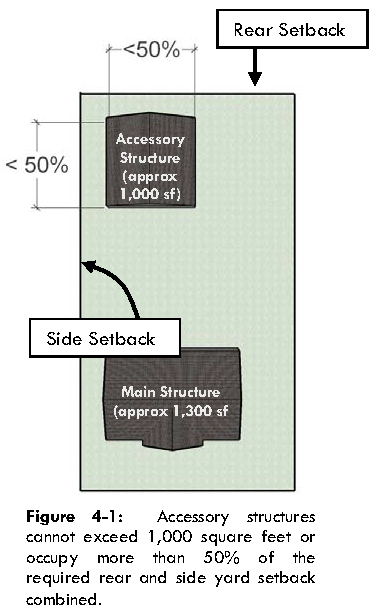
Size. Except in the R-A and R-T districts, the maximum size of any accessory building shall be one thousand (1,000) square feet unless otherwise approved by planned development or otherwise stated in this Section. No accessory building shall be constructed until the construction of the main building has been actually commenced, and no accessory building shall be used unless the main building is also being used.
3.
Percentage of required setbacks occupied. Unless otherwise specified in this Land Use Code, detached accessory buildings shall occupy no more than fifty (50) percent of the area of the required side and rear setbacks combined.
C.
Same ownership required. The principal use and the accessory use shall be under the same ownership.
D.
Same utility meter required. The principal use and the accessory use shall utilize the same utility meter with the exception of an approved accessory dwelling unit.
4.3.4. ADDITIONAL STANDARDS FOR SPECIFIC ACCESSORY USES AND STRUCTURES
The specific standards of this Section 4.3.4. shall apply in addition to the general standards of Section 4.3.3. In the event of conflict, the more restrictive standard in the opinion of the Director shall apply.
A.
1.
An accessory dwelling unit shall be no more than seventy-five (75) percent of the gross floor area of the primary residential dwelling unit structure and a maximum of eight hundred (800) square feet, whichever is smaller.
2.
Accessory dwelling units are allowed in the R-A , R-T, R-6, R-12 and R-22, and all mixed-use districts (see permitted use chart and modifications to the live/work use type).
3.
Accessory dwelling units shall be connected to the same utilities as the primary dwelling unit, unless determined by the director to be infeasible.
B.
Home occupation. A home occupation may be permitted as accessory to any principal dwelling unit subject to the following standards:
1.
Location. The home occupation shall be conducted in the home or an accessory building on the same lot by a resident of the primary dwelling.
2.
Size/area. The business or service located within the dwelling or an associated accessory building shall not exceed fifty (50) percent of the combined floor area of the structures.
3.
Employees and residency. The principal person(s) providing the business or service shall reside in the dwelling on the premises. There shall be no more than one (1) employee in addition to the resident(s) of the primary dwelling unit; at least one (1) additional off-street parking space shall be provided for such employee.
4.
Neighborhood compatibility.
a.
The home occupation shall cause no change in the external appearance of the existing buildings and structures on the property.
b.
All vehicles used in connection with the home occupation shall be of a size, and located on the premises in such a manner, so that a casual observer or a person of normal sensibilities will not be able to detect any sign of the premises being used as a home occupation. No vehicle larger than one (1) ton shall be kept on the premises.
c.
No parking areas shall be located in the front setback or side setback.
d.
There shall be no advertising devices on the property or other signs of the home occupation that are visible from off the premises.
e.
The property shall contain no outdoor display or storage of goods or services that are associated with the home occupation.
f.
Wholesale or retail sales of goods shall not occur on the premises.
g.
The home occupation shall not create traffic or parking congestion, noise, vibration, odor, glare, fumes, or electrical or communications interference that can be detected by the normal senses off the premises, including visual or audible interference with radio or television reception.
5.
Prohibited home occupations. The following uses, because of their impacts on the surrounding residential area, shall not be permitted as home occupations: auto repair or motorized implement repair; dance, music or other types of instruction (if more than four (4) students are being instructed at one (1) time); dental offices; medical offices; the painting of vehicles, trailers or boats; private schools with organized classes; motor vehicle towing operation; barber or beauty shops having more than one (1) chair; welding shops; nursing homes; bed and breakfast and other such transient lodging, or any other home occupation that, in the sole opinion of the Director, will have negative impacts on the neighborhood.
C.
Outdoor display and sales. Outdoor display and/or sale may be allowed as an accessory use for all commercial uses. It is the intent of this Land Use Code to allow the display of merchandise for sale, but not where the display of such items impedes the flow of pedestrian or vehicular traffic or creates an unsafe condition. The display of goods shall meet all of the following requirements:
1.
Procedural requirements. Outdoor display and/or sale shall require approval of the Director. All new development plans must show the location of such areas in accordance with this Section. Existing non-residential uses must submit a plan showing the location of the outdoor display or sales areas and how the requirements of this Section are to be met. Approval may be subject to appropriate conditions by the Director.
2.
Where permitted.
a.
All outdoor display of goods shall be located immediately adjacent to the storefront and not in drive aisles, loading zones, fire lanes, or parking lots.
b.
The area used for outdoor display or sales shall not occur on the sides and rear of buildings and shall be limited to no more than one-quarter (¼) of the length of the store front, unless increased by the Director after taking into account aesthetic and safety concerns or other relevant factors. In the case of a shopping center, the "storefront" shall include the entire frontage of the shopping center, meaning that the total amount of display for all the in-line tenants combined shall not exceed twenty-five (25) percent of the aggregate store front of the overall shopping center.
c.
No goods shall be attached to a building's wall surface.
d.
The height of the outdoor display shall not exceed six (6) feet, unless an exception to this provision has been granted by the Director.
e.
The outdoor display area shall take place on an improved surface such as the sidewalk or pavement.
f.
No outdoor displays shall be allowed in required landscape areas.
3.
No pedestrian obstruction. At least five (5) feet along the parking lot side of the display shall be maintained free of obstruction to allow for pedestrian and handicap movement, such that handicapped pedestrians and others do not have to enter the parking lot or drive aisle to walk around the display.
D.
Outdoor storage. Outdoor storage may be allowed as an accessory use through the development plan review process and subject to compliance with the following requirements:
1.
Each outdoor storage area shall be incorporated into the overall design of the primary structure on the site and shall be located at the rear of the primary structure.
2.
Goods stored in an approved outdoor storage area shall be limited to those sold on the premises as part of an associated primary use.
3.
Each outdoor storage area shall be screened from view from all property lines and adjacent rights-of-way by an opaque fence or wall that incorporates at least one (1) of the predominant materials and one (1) of the predominant colors used in the primary structure. The fence shall be of the appropriate height that all outdoor storage areas are effectively screened. Materials may not be stored higher than the height of the primary structure. A landscaped earthen berm may be used instead of or in combination with a required fence or wall.
4.
No materials may be stored in areas intended for vehicular or pedestrian circulation.
E.
Cargo shipping containers.
1.
Cargo shipping containers shall be prohibited for permanent placement and use in open space districts.
2.
Cargo shipping containers shall be allowed for permanent placement within the Light Industrial District and in compliance with Sections 4.4 and 4.5.
3.
Cargo shipping containers shall be allowed in the Commercial District, Mixed-Use Corridor District and Mixed-Use Town Center District, limiting the maximum of no more than three hundred and twenty (320) square feet, unless otherwise approved with a conditional use permit pursuant to Section 2.4.4.
4.
Cargo shipping containers shall be allowed in the Downtown Business and Lodging Overlay District and Downtown East Village Overlay District, limiting the maximum of no more than one hundred sixty (160) square feet, unless otherwise approved with a conditional use permit pursuant to Section 2.4.4.
5.
Cargo shipping containers shall be allowed in the Public/Quasi Public District, limiting to no more than one hundred sixty (160) square feet in size, unless otherwise approved with a conditional use permit pursuant to Section 2.4.4.
6.
Cargo shipping containers in place in any zoning district at the time of this Code amendment, are considered nonconforming and shall comply with Article 9, unless the container was placed in violation of the LUDC or building code adopted at the time of placement.
(Ord. No. 754, § 1, 5-20-2010; Ord. No. 828, § 1, 10-22-2015; Ord. No. 853, § 1d, 2-23-2017; Ord. No. 861, § 1, 7-20-2017)
4.4. - TEMPORARY USES AND STRUCTURES
4.4.1. PURPOSE
This Land Use Code allows for the establishment of certain temporary uses for limited duration, provided that such uses comply with the general and specific standards of this Section.
4.4.2. TEMPORARY USES AND STRUCTURES ALLOWED
The following temporary uses are allowed provided they comply with the general standards of Section 4.4.3.
A.
A dwelling unit situated on a lot, parcel, or tract, along with a primary dwelling unit, that provides a temporary residence for the residents of the associated primary dwelling unit that (i) has been deemed uninhabitable due to fire, flood or other disaster, or (ii) is under construction or undergoing substantial repairs or reconstruction. The temporary residence is allowed on the lot, parcel or tract only while the primary residence is undergoing new construction or repair. A temporary dwelling unit may also include a residence located on a nonresidential construction site and occupied by persons having construction or security responsibilities over such construction site. The temporary residence is to be removed from the lot, parcel or tract upon completion of such construction.
B.
Camping, which shall mean the taking up of temporary residence in a tent or recreational vehicle in any of the residential zone districts or the OS zone district for a period of time not to exceed fourteen (14) consecutive days, or not more than fourteen (14) days in a four-month period. Camping for a period of time not to exceed three (3) consecutive days shall not be subject to the general standards in Section 4.4.3.
C.
Retail sales of products, including but not limited to Christmas trees, nursery products, agricultural produce, or fireworks, in any nonresidential district for a period not to exceed the number of days specified in the temporary use permit (Section 2.4.10 of this Land Use Code). Display of products need not comply with the setback requirements of this Land Use Code provided that no display shall be located within an area restricted by the vision clearance area requirements of Section 5.2.3.
D.
Temporary office space and equipment storage when accessory to an approved construction project, including sales offices on residential development sites. Such uses shall be located on the site no more than thirty (30) days prior to the start of construction and removed no more than thirty (30) days after completion of such project, or in the case of sales offices on residential development sites, removed when all houses or units are sold or leased.
E.
Expansion or replacement facilities, consisting of transportable buildings that are pre-constructed and arrive at the site ready for occupancy and are readily removed and installed at other sites. Such facilities may include, but are not limited to, the following:
1.
Expansion of existing religious assembly facilities, health care facilities, and government offices following the approval of filed plans and applications for the permanent alteration/expansion of these facilities.
2.
Temporary classroom space for existing schools.
3.
Temporary office space for construction and security personnel during the construction of an approved development for which a grading or building permit has been issued.
4.
Temporary space for recreational uses provided in connection with an approved residential development under construction.
5.
Temporary space for a residential or non-residential use following the destruction of a building by fire or other catastrophic event.
6.
Temporary office space (one (1) per site) for hiring, membership solicitation, apartment office/leasing, and general office use following the issuance of a building permit for the construction of a permanent office building.
F.
The Director may approve other temporary uses or structures using the process established in Section 4.1.3., Classification of New and Unlisted Uses.
G.
Cargo shipping containers may be allowed for temporary use and placement in all districts, with an approved temporary use permit, issued pursuant to section 2.4.10. A temporary use permit shall be valid for a maximum of one hundred eighty (180) days, with a maximum of three hundred sixty (360) days consecutive use allowed. The applicant must demonstrate the need for such temporary use in their application.
4.4.3. GENERAL REQUIREMENTS FOR ALL TEMPORARY USES AND STRUCTURES
All temporary uses or structures shall meet the following general requirements, unless otherwise specified in this Land Use Code:
A.
The temporary use or structure shall not be detrimental to property or improvements in the surrounding area or to the public health, safety, or general welfare.
B.
The temporary use shall comply with all applicable general and specific regulations of this Section 4.4. unless otherwise expressly stated.
C.
Permanent alterations to the site are prohibited.
D.
All temporary signs associated with the temporary use or structure shall be properly permitted and removed when the activity ends or permit expires, whichever occurs first.
E.
The temporary use or structure shall not violate any applicable conditions of approval that apply to a principal use on the site.
F.
The temporary use regulations of this Section do not exempt the applicant or operator from any other required permits, such as Health Department permits.
G.
If the property is undeveloped, it shall contain sufficient land area to allow the temporary use or structure to occur, as well as any parking and traffic circulation as required that may be associated with the temporary use, without disturbing sensitive or protected resources, including required buffers, one hundred-year floodplains, river protection setbacks, and required landscaping. At the conclusion of the temporary use or at expiration of the permit, whichever occurs first, all disturbed areas of the site shall be restored or improved to the condition that existed prior to the use.
H.
If the property is developed, the temporary use shall be located in an area that is not actively used by an existing approved principal use, and that would support the proposed temporary use without encroaching or creating a negative impact on existing buffers, open space, landscaping, traffic movements, pedestrian circulation, or parking space availability.
I.
Tents and other temporary structures shall be located so as not to interfere with the normal operations of any permanent use located on the property, shall be anchored, and meet the requirements of the Building Official, including fire rating.
J.
Off-street parking shall be adequate to accommodate the proposed temporary use.
K.
Applications for temporary structures to be located in the one hundred-year floodplain shall be required to submit a plan to the Building Department for the removal of such structure(s) in the event of a flood notification. The plan shall include the following information:
1.
The name, address, and phone number of the individual responsible for the removal of the temporary structures and the property owner;
2.
The time frame prior to the event at which a structure will be removed; and
3.
A plan to remove the temporary use earlier than the scheduled removal date, if required.
4.4.4. OUTDOOR COMMERCIAL ESTABLISHMENTS
A.
Purpose. An outdoor commercial establishment permit allows for a transient, mobile or temporary commercial use and/or non-permanent commercial structures not otherwise allowed under the Town's development design criteria or building permit regulations, to locate within the Town in a zone district in which such use is currently allowable, on non-residential property with the owner's consent. This section is intended to allow outdoor commercial establishments which contribute to the pedestrian and small mountain Town atmosphere of the Town by permitting certain outdoor commercial uses in zoning districts in which the proposed use is currently allowed as defined under table 4.1-1.
B.
Permit approval. It shall be unlawful to construct, erect, use, or to cause to be constructed, erected, changed, or used, in any zoning district of the Town, any outdoor commercial establishment structure, or mobile equipment, or to engage in an outdoor commercial establishment use, unless and until an approved Outdoor Commercial Establishment Permit Application has been approved by the Planning Director as provided in LUDC Section 2.4.10. and 4.4.4., and including a business license issued by the Town Clerk. At the discretion of the Planning Director, any Outdoor Commercial Establishment Permit application may be referred to the Planning Commission and/or Building Code Official for additional approval consideration.
C.
Permitted uses.
1.
Outdoor commercial establishment allowed structures include, and are limited to the following: mobile cart, trailer or truck; non-permanent structure like a tent or temporary placed structure; or other similar outdoor configuration.
2.
Outdoor commercial establishment uses are limited to those currently allowed in Table of Allowable Uses. 4.1-1 for the zoning district the proposed establishment is located, unless otherwise approved by Town Council for public spaces. Uses include: mobile vendors of food, merchandise, or services; commercial sales of food, merchandise, or services from a non-permanent structure; mobile vendors of food, merchandise or services such as for sidewalk sales; and other special events, seasonal farmer's markets and other similar fresh food sales; temporary art and craft fairs; festivals; carnivals and community events.
3.
Seasonal commercial outdoor establishments are limited to nine (9) months of operation per calendar year.
4.
Seasonal and year-round commercial outdoor establishments shall be in operation a minimum of eight (8) days per month and shall limit non-operational periods to no more than thirty (30) consecutive days.
5.
Special Event commercial outdoor establishments operating within the boundaries of a permitted Special Event, are exempt from the Outdoor Commercial Establishment Permit application requirements under this Section, however, still require applicable Town business license, State sales tax license, Health Department license and other required permits or license as required.
6.
Camping and overnight parking is prohibited.
7.
Storage of equipment, vehicles and items not associated with the Outdoor Commercial Establishment is prohibited.
D.
Permit application submittals.
1.
An Outdoor Commercial Establishment Permit application shall include: Site map showing property lines, location of proposed establishment with setback distances from property lines noted, points of access and circulation patterns for vehicles and pedestrians, existing parking spaces and those dedicated for the establishment's use, location of existing structures on the lot, proposed signage, trash receptacles, seating areas, photos of proposed structures and/or mobile equipment, and other information as required by the Director.
2.
Written description explaining the nature of the proposed outdoor commercial establishment, types of structures or mobile equipment proposed, hours of operation, time period requested and other information that is requested by the Director for purposes of evaluating the application.
3.
Evidence of Town business license, and other required license and permits as may be applicable, for example, a State of Colorado sales tax license, San Juan Basin Health Department license, Department of Regulatory Agency license, etc.
4.
Written agreement from the property owner which contains the owners name, contact information and terms operation.
5.
Payment of application fees.
6.
For public property locations, proof of liability insurance and if determined necessary by the Town Council, financial security may be required for to ensure compliance with any and all conditions of approval and/or to restore the subject property to its original use and condition.
E.
Permit review criteria. The Planning Director shall approve an application if all of the foregoing and following applicable criteria and specific regulations are met or may deny an application for failure to meet the foregoing or following applicable criteria and specific regulations, or may impose such conditions of approval as may be necessary for approval of an Outdoor Commercial Establishment Permit application to ensure that all of the following applicable criteria and specific regulations are met:
1.
Allowance of outdoor commercial establishment will not be detrimental to the public health, safety, or general welfare, and the outdoor commercial establishment is compatible with the purpose and intent of this article and the specific zoning district in which the outdoor commercial establishment is proposed.
2.
The outdoor commercial establishment is compatible in intensity of use, characteristics, and appearance with the existing land uses in the immediate vicinity of the proposed location. The use, value, and qualities of the neighborhood surrounding the proposed location will not be adversely affected by the outdoor commercial establishment or activities within it. Factors such as location, access, traffic generation, noise, lighting, parking, dust control, site maintenance, hours of operation, as well as height, size, and appearance will be considered.
3.
The applicant shall provide as part of their application written consent from the property owner. If the outdoor commercial establishment is to be located partially or entirely on Town property, approval of the Town Council is required.
4.
Adequate parking is to be provided to serve the outdoor commercial establishment and must not be located on or displace required parking spaces, including offsite spaces, seasonal snow storage areas (from October 31st to April 15th) or loading areas of the existing principal permitted uses on the site. Required parking will be calculated based on the Town's parking requirements in Section 6.9 of the LUDC (unless the establishment is in close proximity to public parking areas along San Juan Street and Pagosa Street, between 1 st Street and 8 th Street). Parking required for the outdoor commercial establishment shall be paved unless the applicant provides a method to minimize air pollution or dust on the property and on adjacent properties.
5.
All lighting proposed for the outdoor commercial establishment shall meet the requirements of Section 6.11, Exterior Lighting. Spot lights shall not be permitted.
6.
Outdoor commercial establishments shall not be located within the public right-of-way, Town-owned park, parking lot, Riverwalk or other Town owned property without the prior approval of the Town Council. For outdoor commercial establishments on Town-controlled property, at the discretion of the Town Council, financial security may be required to ensure compliance with any condition of approval and/or to ensure that the subject property is restored to its original use and condition. Proof of liability insurance is required.
7.
No outdoor commercial establishment will be approved in a residential zoning district or in an area where exclusively residential uses exist.
8.
Outdoor commercial establishments shall provide for trash disposal, removal of trash and site cleaning daily.
9.
An outdoor commercial establishment is limited to a maximum of ten (10) square feet of signage, including any banners, and such signage may not be affixed to any building. An A-frame sign limited to five (5) square feet per side may also be permitted to be placed on the ground with a separately approved sign permit application. No other items intended to draw attention to the outdoor commercial establishment are permitted (such as balloons, flags, feather banners, etc.). All other requirements of LUDC Section 6.12 as amended from time to time, shall apply.
10.
Before an outdoor commercial establishment may begin operating, the applicant's business must have a valid business license from the Town Clerk's office which, which may include if applicable evidence of State of Colorado Sales Tax License, San Juan Basin Public Health License and Colorado Department of Regulatory Agency license.
11.
Prior to tents and other temporary structures being erected, special approval from the Building Code Official is required regarding structural capacity, fire safety issues and snow loading concerns among other code requirements.
12.
All equipment, vehicles and trailers shall be removed from the site at the end of the OCE permit term.
13.
A development application for and an approval of an outdoor commercial establishment shall not constitute nor be interpreted by any property owner, applicant or court as a site-specific development plan entitled to vesting under Article 68 of Title 24 of the Colorado Revised Statues. Outdoor commercial establishments shall be considered transitory at all times and shall not vest.
14.
The failure of an applicant to adhere to any condition of approval for an outdoor commercial establishment shall result in the immediate forfeiture of approval and such establishment and the use of any accompanying structure or equipment shall immediately cease and may be subject to abatement as a public nuisance as provided for in the Code of the Town of Pagosa Springs.
(Ord. No. 828, § 1, 10-22-2015; Ord. No. 941, § 1, 10-6-2020)
4.5 - SMALL CELL WIRELESS COMMUNICATION FACILITIES
4.5.1. PURPOSE
The Town has adopted Procedures and Design Guidelines for the Installation and Use of Small Cell Wireless Communication Facilities with the authority granted by and in response to HB117-1193, codified at Title 29, Article 7 and Title 38, Article 5.5 of the Colorado Revised Statutes, which expands access to public rights-of-way and Town owned infrastructure in public rights-of-way for placement of small cell facilities, making such facilities a use by right in all zone districts.
4.5.2. PROCEDURES AND DESIGN GUIDELINES
The adopted Procedures and Design Guidelines for the Installation and Use of Small Cell Wireless Communication Facilities, are available upon request. The Town Clerk shall keep an updated copy of all such adopted procedures and design guidelines and publish the same as may be hereafter amended from time to time to be kept for that purpose.
4.5.3 SUPERVISION AND REGULATION
The Town Council shall supervise and control, and by ordinance establish the Procedures and Design Guidelines for the Installation and Use of Small Cell Wireless Communication Facilities to govern the small cell wireless communication facilities and revise the same by resolution when deemed necessary.
(Ord. No. 963, § 3, 11-18-2021)

