
Pahokee City Zoning Code
ARTICLE VIII
OFF-STREET PARKING AND LOADING
Sec. 14-120.- Scope, purpose and intent.
(a)
Scope. Provisions of this section shall apply in all zoning districts.
(b)
Purpose and intent. The intent of these regulations is to ensure adequate and appropriately located off-street parking and loading, to avoid undue congestion on streets, to avoid unnecessary conflicts between vehicles and pedestrians, to preserve and enhance pedestrian activity areas within the city, and to facilitate vehicular access from public rights-of-way to off-street parking facilities.
(c)
Off-street parking and loading facilities required. A certificate of occupancy shall not be issued for any structure or use unless required off-street parking spaces and loading facilities are provided. Any change in use of an existing structure or property will not require an increase in the number of parking or loading spaces. Any expansion, alteration, or improvement increasing the gross square feet of an existing structure which increases the required number of parking or loading spaces shall be accompanied by a corresponding increase in the number of spaces.
Sec. 14-121. - Parking requirements for less than four residential dwelling units.
(a)
Location. Required off-street parking spaces for less than four (4) residential units shall be located on the property on which the units are constructed. Required parking may be located in a front yard; however, the lesser of one thousand (1,000) square feet or seventy-five (75) percent of the front yard area must be landscaped.
(b)
Configuration. Required off-street parking areas shall be consist of a parking bay, stall, driveway, garage, or combination thereof.
(c)
Retention of required off-street parking spaces. Required off-street parking spaces shall not be replaced by any other on-site facility unless equal parking facilities are provided elsewhere. Off-street parking spaces existing on the effective date of this ordinance shall not be reduced to an amount less than required.
Sec. 14-122. - Parking and loading requirements for multifamily and nonresidential uses.
(a)
Site plan review for off-site parking facilities. No off-site parking facilities shall be constructed unless a site plan has been reviewed and approved in accordance with the provisions of article II.
(b)
Retention of required parking and loading spaces. Required off-street parking and loading spaces shall not be replaced by any other use unless equal parking and loading facilities are provided elsewhere. Off-street parking and loading spaces, existing at the effective date of this article in connection with the operation of an existing building or use, shall not be reduced to an amount less than required for a similar new building or new use of the same type.
(c)
Collective provision of parking and loading spaces. Two (2) or more buildings or uses on adjacent lots collectively may provide required off-street parking and loading facilities. In such cases, the required number of parking and loading spaces shall not be less than the sum of the requirements for the individual uses computed separately.
Sec. 14-123. - Shared parking requirements.
(a)
Intent. The intent of this section is to permit a reduction in the total number of required parking spaces when property is occupied by two (2) or more uses which typically do not experience peak parking demands at the same time.
(b)
Calculation of shared parking requirements. Notwithstanding the provisions of section 14-125, when any land or building is used for two (2) or more distinguishable purposes as listed below, the minimum total number of required parking spaces shall be determined by the following procedure:
(1)
Multiply the minimum parking requirement for each individual use as provided in section 14-125 by the appropriate percentage listed in Table VIII-1 for each of the five (5) designated time periods.
(2)
Add the resulting sum for each of the five (5) vertical columns of the table.
(3)
The minimum parking requirement is given by the highest sum resulting from subsection (b)(2) above.
TABLE VIII-1
SHARED PARKING REQUIREMENTS
(4)
Limitations.
a.
Parking spaces which are reserved for use by specified individuals or classes of individuals shall not be counted toward meeting parking requirements.
b.
The provisions in this section shall not result in a reduction of more than twenty-five (25) percent from the requirements which would apply in the absence of this section.
Sec. 14-124. - General provisions.
(a)
Restriction on use of parking and loading areas. The storage of merchandise, materials or motor vehicles, or the repair of motor vehicles or any other equipment is prohibited in all off-street parking and loading facilities.
(b)
Location of parking and loading spaces. Required off-street parking and loading spaces shall be located on the same property on which the use or structure exists; however, required parking may be provided off-site as required by the following:
(1)
Within one thousand (1,000) feet of any nonresidential use or structure within the CORE district.
(2)
Within three hundred (300) feet of any nonresidential use or structure in any other commercial zoning district.
Required parking off-site shall be located only in the same or a less restrictive zoning district as the use served. The restrictive nature of zoning districts is established in Table VIII-2. Off-site parking also shall be permitted only as a conditional use and shall occur only in districts where parking facilities of this nature are permitted.
TABLE VIII-2
ZONING DISTRICTS IN
DESCENDING ORDER OF
RESTRICTIVENESS
(c)
Ownership of parking and loading spaces. The title of all property on which required parking and loading is provided shall be unified with the title of all property on which the uses served are located. Deed restrictions and other documents which provide for title unification shall be recorded with the Palm Beach County Clerk of the Circuit Court prior to consideration of a site plan. Not withstanding the provisions of this section, required parking for any structure or use may be located on property obtained on a lease. rental, or similar contractual basis when the city is a third part to such agreement. Contractual agreements of this nature must be approved by the city commission following action by the board of adjustment and prior to the issuance of any building permit or certificate of occupancy. If required parking is obtained in this manner, sufficient numbers of spaces shall be maintained at all times. If required parking is obtained on a contractual, non-unity of title basis, deed restrictions, or other documents which limit the use of property to the provision parking, shall be recorded with the clerk of the circuit court, approved by the city attorney, and filed with the community development department prior to consideration of a site plan. Deed restrictions of this nature shall expire only after twenty-five (25) years or upon the termination of the use requiring the provision of parking. Parking provided on a non-unity of title basis shall be a conditional use and require approval by the board of adjustment. Required documents shall be recorded with the clerk of the circuit court prior to issuance of any building permit.
(d)
Entrances and exits to parking and loading facilities. Entrances and exists to parking and loading spaces shall be located on one (1) or the other:
(1)
Land in the same zoning district as the use served.
(2)
Land in a less restrictive zoning district. For the purposes of this section, the zoning district listed first on Table VIII-2 shall be considered the least restrictive, and each succeeding district shall be considered more restrictive than the one (1) preceding it.
(e)
Surfacing of parking and loading spaces. Prior to the issuance of a certificate of occupancy, all parking and loading spaces, access drives, and maneuvering lanes shall be prepared with a smooth, non-dusting surface in compliance with standards specified by the department of community development. The director of community development may approve types of paving not specified upon a finding that such other types are equivalent in appearance, durability, and function. Parking surfaces shall be maintained free of all unapproved vegetation, dust, and accumulated trash.
(f)
Reserve parking. Reductions of required parking spaces of up to fifty (50) to seventy-five (75) percent may be permitted as a conditional use for intermittently used facilities such as churches, cultural facilities, recreation facilities, private clubs and lodges, and civic centers. Applications shall include a site plan which delineates all required spaces pursuant to Table VIII-6 and identify those to be held in reserve. Approved reserve spaces shall be provided with a stabilized base and sodded. Sodded areas shall be maintained in accordance with the article IX. The director of community development shall review annually all sites with permitted reserve parking areas for erosion, production of nuisance dust, illegal access to public rights-of-way, and improper landscape maintenance. The presence of any of these factors, a change in use of the site, or a change in ownership shall void the reserve parking approval and require the paving of all spaces in accordance with subsection (e) above or the approval of a new conditional use.
(g)
Storm drainage for parking and loading spaces. Off-street parking and loading spaces shall be provided with drainage systems adequately designed and maintained as required by the following:
(1)
To prevent the accumulation of water from normal rainfall.
(2)
To prevent the runoff of rainfall onto neighboring property at rates greater than would result if the site were undeveloped. Drainage systems shall be designed in accordance with article XII.
(h)
Traffic control aids. Traffic control signs and pavement markings shall be used as necessary to ensure safe and efficient traffic operations within all parking and loading areas. Required off-street parking spaces shall be delineated by four (4) inch white double-striped lines. Curbs, wheel-stops, or bollards shall be installed to protect landscaped areas, or bollards shall be installed to protect landscaped areas, pedestrian areas, buildings, and property lines. All signs shall comply with the Manual of Uniform Traffic Control Devices Federal Highway Administration, U.S. Department of Transportation, 1987, as adopted by the Florida Department of Transportation, as revised.
(i)
Required number of spaces when fractional space computed. When calculations determining the number of required parking spaces result in the requirement of a fractional space, any fraction up to and including one-half (½) shall be disregarded and fractions over one-half (½) shall require one (1) parking space.
(j)
Developer's option to pay into city's parking trust fund in lieu of providing required nonresidential parking spaces. In lieu of providing all or a portion of the nonresidential parking spaces required for uses located in CORE district, a developer may pay into the CORE district parking trust fund a sum of money which is the product of the number of parking spaces required but not provided and the current cost of providing a parking space in the CORE district. Payment required by this subsection shall be made prior to the issuance of a building permit for any portion or phase of a development project to which the nonresidential parking spaces that are required but not provided relate.
(k)
Configuration of parking and loading ingress and egress. Ingress to and egress from parking and loading spaces shall be provided in either of the following ways:
(1)
Ingress and egress from parking and loading spaces shall be provided by means of clearly defined drives which lead from public rights-of-way to clearly defined maneuvering lanes which in turn provide access to individual parking or loading spaces. Configurations which require backing directly onto a street, excluding alleys, from a parking or loading space shall be prohibited in all non-residential zoning districts. There shall be a minimum of ten (10) feet separation between all access drives. The separation shall be measured along the curb line.
(2)
Ingress and egress from parking stalls may be provided directly from public alleys. If existing alley width does not comply with minimum aisle requirements, additional parking space aisle or setbacks shall be required as indicated in Table VIII-3.
(l)
Exceptions to general requirements for off-street core district parking. In the CORE district, off-street parking requirements for each use may be reduced by ten (10) percent with the exception of hotel and retail uses. This ten (10) percent reduction also shall apply to all federal, state, county, municipal, and other public agencies within the CORE district.
(m)
Encroachments. Required off-street parking spaces shall not be encroached upon by electrical or mechanical equipment, pipes, or similar obstructions. Required off-street parking spaces may be encroached upon by structural support columns; however, such encroachments shall not interfere with the normal opening and closing of vehicle doors. Encroachments of this nature shall be reviewed and approved by the director of community development prior to issuance of a building permit.
(n)
Vehicular movement. All vehicular movement and maneuvering that may be required to utilize off-street parking facilities shall be retained on-site. Public rights-of-way shall not be utilized to allow or enhance movement or maneuvering.
(o)
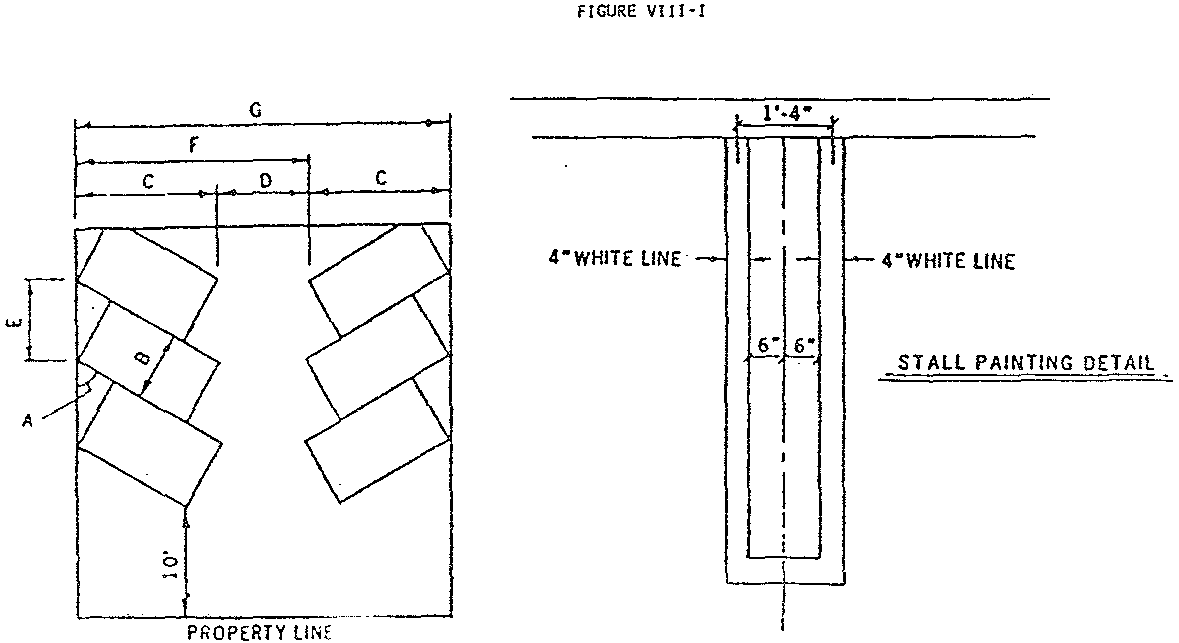
Off-street parking dimensions. All parking spaces required by this article shall be designated either "standard" or "small car." Minimum dimensions are as follows: Standard car spaces shall be at least ten (10) feet in width and twenty (20) feet in length; and small car spaces shall be at least nine (9) feet in width and eighteen (18) feet in length. Minimum parking space and aisle dimensions are set forth in Table VIII-3 and Figure VIII-I.
(1)
Small car space requirements. Small car parking spaces shall be permitted as follows:
a.
If the total parking requirements of any use or structure is less than twenty (20) spaces, no small car spaces are permitted.
b.
If the total parking requirement is twenty (20) to one hundred (100) spaces, twenty-five (25) percent of the spaces may by designated for small car use.
c.
If the total parking requirement is more than one hundred (100) spaces, thirty (30) percent of the spaces may be designated for small car use.
d.
All small car parking spaces shall be marked with individual signs stating "small cars only."
e.
Small car spaces, to the extent feasible, shall not be concentrated at various locations within a parking structure or lot. Small and standard car spaces shall be distributed equally throughout a parking structure or lot, and the director of community development shall review the design of all proposed parking facilities to ensure that the intent of this section is satisfied.
(2)
Dimensions and layout of parking facilities. Plans for the layout of off-street parking facilities shall be in accordance with the minimum requirements set forth in Table VIII-3 and Figure VIII-I. Parking spaces for the disabled shall be provided in accordance with the requirements of applicable state and federal legislation.
TABLE VIII-3
REQUIRED PARKING DIMENSIONS
(In Feet)
(1) Dimensions are for one-way direction movement. Two-way direction movement requires a minimum width of twenty-four (24) feet regardless of parking angle and dimensions shown.
(2) ST is Standard, SM is Small
(p)
Parking spaces for the disabled. Spaces for the disabled shall be provided as set forth in applicable state legislation.
(1)
Number of spaces for the disabled. Disabled parking spaces shall be provided as required in Table VIII-4.
TABLE VIII-4
REQUIRED PARKING FOR THE DISABLED
Source: F.S. ch. 316.1955.
(2)
Size and location of spaces for the disabled. Parking spaces for the disabled shall be designed as required by the following:
a.
All spaces shall have access to a curb ramp or curb cut, when necessary, to allow entrance to the building served. Spaces shall be located so that users are not compelled to walk or otherwise move behind parked vehicles, excluding other vehicles parked in adjacent parking spaces for the disabled.
b.
Diagonal or perpendicular parking spaces shall be a minimum of twelve (12) feet wide and eighteen (18) feet long.
c.
Parallel parking spaces shall be located either at the beginning or end of a block or adjacent to alley entrances. Curbs adjacent to such spaces shall be of a height which will not interfere with the opening and closing of motor vehicle doors.
d.
Each disabled parking space shall be prominently outlined with paint and posted with a permanent sign of color and design approved by the Florida Department of Transportation. The sign shall contain the internationally accepted wheelchair symbol and the caption "Parking by Disabled Permit Only."
(q)
Loading space requirements. Loading spaces shall be provided as required in Table VIII-5.
TABLE VIII-5
REQUIRED LOADING AND UNLOADING SPACES
(r)
Bicycle parking. Required Bicycle parking facilities shall be designed, constructed, and maintained in accordance with the following standards:
(1)
Approved parking facilities. Bicycle parking facilities shall include provision for the secure storage and locking of bicycles. All required bicycle parking facilities shall be from an approved list of bicycle parking devices maintained by the department of community development. Such approved list shall be adopted and amended by resolution of the city commission. Other bicycle parking devices may be used if it can be established to the satisfaction of the director of community development that they are equivalent to devices on the approved list in function, quality, and construction.
(2)
Fixed objects. Fixed objects which are intended to serve as bicycle parking facilities shall be clearly labeled as available for bicycle parking.
(3)
Storage rooms. If a room or common locker not divided into individual lockers or rack spaces is used, one (1) bicycle space shall consist of an area not less than twelve (12) square feet with locking devices. Adequate aisle widths shall be provided in rooms or common lockers so as to provide convenient access to users.
Sec. 14-125. - Specific parking requirements.
(a)
Parking space requirements for individual uses. Parking space requirements for individual uses shall be as set forth within Table VIII-6 and as follows:
(1)
Minimum vehicle parking requirements.
a.
All uses of five hundred (500) square feet or greater shall provide three (3) vehicle parking spaces or the number prescribed in Table VIII-6, whichever is greater.
b.
All uses greater than five hundred (500) square feet shall provide five (5) vehicle parking spaces or the number prescribed in Table VIII-6, whichever is greater.
(2)
Minimum bicycle parking requirements.
a.
All uses shall provide a minimum of three (3) bicycle parking spaces or the number prescribed in Table VIII-6, whichever is greater, except where indicated as "None" on Table VIII-6.
(3)
Sites with two of more uses. Whenever two (2) or more of the uses listed in Table VIII-6 are present on the same lot or in the same structure, the number of vehicle and bicycle parking spaces required shall be the sum of spaces calculated for each individual use.
(4)
Uses not listed. For uses not specifically listed, requirements shall be the same as for the most similar use identified.
* Note: All non-residential development greater than sixteen thousand (16,000) square feet and residential developments greater than twenty (20) acres may only be permitted as a planned unit development.

