
Park Ridge City Zoning Code
SECTION 8
COMMERCIAL DISTRICTS
7.1 - Residential districts purpose.
(a)
Purpose of R-1 Single-Family Residential District. The R-1 Single-Family Residential District is intended to create a low density environment of single-family homes located upon larger sites than the typical single-family lot size for such housing within the community, where the maintenance of adequate open space is seen as essential to the preservation of the unique residential character. Limited non-residential uses that are compatible with surrounding residential neighborhoods may be permitted.
(b)
Purpose of R-2 Single-Family Residential District. The R-2 Single-Family Residential District is intended to create a low density environment of single-family homes in areas clearly distinguishable as residential neighborhoods, located upon sites comparable in dimensions to the typical lot size for single-family housing within the community. Limited non-residential uses that are compatible with surrounding residential neighborhoods may be permitted.
(c)
Purpose of R-3 Two-Family Residential District. The R-3 Two-Family Residential District is intended to create a moderate density environment of single-family homes and two-family dwellings located along major streets upon sites comparable in dimensions to the typical lot size for single-family housing within the community. Limited non-residential uses that are compatible with surrounding residential neighborhoods may be permitted.
(d)
Purpose of R-4 Multi-Family Residential District. The R-4 Multi-Family Residential District is intended to create a moderate density environment of single-family homes, two-family dwellings and multi-family dwellings, including townhomes. This district may provide a transition zone between single-family neighborhoods and adjacent higher intensity land uses, and should have access to major streets or public transportation facilities. Limited non-residential uses that are compatible with surrounding residential neighborhoods may be permitted.
(e)
Purpose of R-5 Multi-Family Residential District. The R 5 Multi-Family Residential District is intended to create a higher density environment of single-family homes, two-family dwellings and multi-family dwellings, including townhomes and apartments, located in the Central Business District, or for the R-5 District created on or before May 1, 2008, that is adjacent to the Central Business District. Areas within this district should be adjacent to major streets or convenient to public transportation facilities. Limited non-residential uses that are compatible with surrounding residential neighborhoods may be permitted.
(Ord. No. 2008-65, 9-2-2008)
7.2 - Permitted and special uses.
Table 2: Residential Districts Permitted and Special Uses lists permitted and special uses for the residential districts. A "P" indicates that a use is considered permitted within that district. An "S" indicates that a use is considered a special use in that district and must obtain a special use permit as required in Section 4.6 (Special Use). No letter (i.e., a blank space), or the absence of the use from the table, indicates that use is not permitted within that district.
Table 2: Footnotes
1 The terms in this column ("Use") are defined in Section 17 (Generic Use Definitions).
2 Only wireless telecommunications antennas that comply with the stealth design standards of Section 10.3.R.10 shall be considered permitted uses.
(Ord. No. 2008-83, 11-17-2008; Ord. No. 2023-17, § 3, 3-20-2023)
7.3 - Yard and bulk regulations.
Table 3: Residential Districts Yard and Bulk Regulations establishes yard and bulk regulations for the residential districts.
Table 3: Footnotes
1 For a conversion chart that provides the approximate density for each residential district, as calculated from minimum lot area, see Appendix D.
2 For nonconforming lots of record within the residential districts, see Section 15.5 (Nonconforming Lots of Record).
3 Day care homes and day care centers are exempt from the special use bulk requirements. These uses shall be subject to those for single-family residential uses within the district.
4 Appurtenances for single-family and two-family dwellings within the residential districts are limited to 5 feet in height and a maximum area of 3 feet by 3 feet. The maximum area of an appurtenance shall be determined by measuring the largest cross-section of the appurtenance.
5 Maximum height of first floor elevation shall be measured from grade, as defined in this Ordinance, to the top of the finished first floor.
6 In some cases between certain districts and/or uses, a transition yard may be required. Such transition yard may require additional landscaping and screening, as well as a larger yard dimension to accommodate these plantings. Such transition yards shall be as required by Section 13 (Landscaping and Screening).
7 In no case shall averaging be based on less than four neighboring lots. For example, in the case of a corner lot, four neighboring lots on the same block shall be used or, in the case of a lot adjacent to the corner lot, the corner lot and three neighboring lots on the same block shall be used. In the case of an addition to the front of a house, the front setback of the subject property shall be included (prior to the addition), along with the neighboring properties as noted above.
8 In the R-1, R-2 and R-3 Districts, the rear yard dimension is determined by lot type (corner lot versus interior lot). In the R-4 and R-5 Districts, the rear yard dimension is the same regardless of lot type. See Section 16 (Definitions) for description of lot types.
(Ord. No. 2008-65, 9-2-2008; Ord. No. 2009-50, 7-6-2009)
7.4 - General standards of applicability.
(a)
Temporary Uses. See Section 10.4 (Temporary Uses) for standards governing temporary uses.
(b)
Accessory Buildings, Structures, and Uses. See Section 11.4 (Accessory Buildings, Structures and Uses) for standards covering accessory buildings, structures and uses. Attached garages shall not be considered an accessory structure but shall be subject to the requirements of Section 11.4.F.2 (Attached Garages).
(c)
Permitted Encroachments. See Section 11.5 (Permitted Encroachments) for standards governing encroachments.
(d)
Environmental Performance Standards. See Section 11.6 (Environmental Performance Standards) for standards governing environmental performance standards.
(e)
Off-Street Parking and Loading. See Section 12 (Off-Street Parking and Loading) for standards governing off-street parking and loading.
(f)
Landscaping and Screening. See Section 13 (Landscaping and Screening) for standards governing landscaping and screening.
(g)
Signs. See Section 14 (Signs) for standards governing signs.
7.5 - Floor area ratio measurement and bonus applicability.
(a)
Floor Area Ratio (FAR) Calculation. Floor area ratio (FAR) shall be determined by dividing the gross floor area of a building or buildings on a lot by the total lot area.
(b)
Gross Floor Area Calculation. To determine the gross floor area for the purposes of the FAR calculation, as described in Paragraph A above, the gross floor area shall be the sum of the gross horizontal areas of any building, as measured from the exterior faces of the exterior walls or from the centerline of walls separating two (2) buildings. In addition, the following shall also be included in the gross floor area calculation:
(1)
That part of the floor area where the height from floor to ceiling is in excess of twelve (12) feet shall be counted twice.
(2)
The basement floor area when more than half of the basement height is above the established finished grade.
(3)
Elevator shafts and stairwells at each floor.
(4)
Floor space used for mechanical equipment. This shall not include roof-top equipment.
(5)
Penthouses.
(6)
That floor area of attic space or the second story of a detached garage that has headroom of seven (7) feet or more. Only the floor area with a height of seven (7) feet or more shall be counted.
(7)
Enclosed balconies and mezzanines.
(8)
Enclosed porches.
(9)
Accessory structures located on the lot, except for that floor area permitted to be excluded from the gross floor area calculation, as described in Paragraph C below.
(c)
Exceptions to Gross Floor Area Calculation:
(1)
Unenclosed Porches. Unenclosed front entry porches shall be eligible for a floor area exemption as described in this section. In order to qualify for this exemption, unenclosed porches shall be no more than one (1) story in height, shall not be enclosed or used for year-around living, shall not have a solid railing, and shall have a minimum depth of four (4) feet as measured from the edge of the porch to the front façade of the principal structure at the shallowest point of the porch, not including steps and stoops.
Qualifying unenclosed porches shall be granted the following floor area exemptions:
a.
Where a porch extends for a width of fifty percent (50%) or more of the front façade along the front yard, up to one-hundred (100) square feet shall be excluded from the total gross floor area.
b.
Where a porch extends for a width of twenty-five percent (25%) or more of the façade along the corner side yard, up to one-hundred (100) square feet shall be excluded from the total gross floor area.
c.
For corner lots, with a qualifying porch along both the front yard and corner side yard façades, up to a total of two-hundred (200) square feet may be excluded from the total gross floor area.
(2)
Accessory Structures. Certain accessory structures shall be eligible for a floor area exemption as described in this section. Certain accessory structures shall be granted the following exemptions:
a.
Sheds of one-hundred twenty (120) square feet or less of total floor area not be included in the total gross floor area.
b.
Detached garages of four-hundred (400) square feet or less of total floor area and located entirely within the rear thirty (30) feet of the lot shall not be included in the total gross floor area. If a detached garage located in the rear yard exceeds four-hundred (400) square feet in area, the first four-hundred (400) square feet shall be excluded from the total gross floor area, but the remainder of the garage's floor area shall be included in the calculation 1 . Regardless, that floor area of the second story of a detached garage that has headroom of seven (7) feet or more shall be counted in the total floor area.
c.
Sunshade structures of four-hundred (400) square feet or less of total area shall not be included in the total gross floor area. If a sunshade structure exceeds four-hundred (400) square feet in area, the first four-hundred (400) square feet shall be excluded from the total gross floor area, but the remainder of the sunshade structure's floor area shall be included in the calculation.
(d)
Floor Area Bonus for Certain Additions in R-1 and R-2 Districts. Additional floor area for proposed additions to existing single-family homes constructed before January 1, 1960 in the R-1 and R-2 Districts shall be permitted, subject to the rules and conditions of this section and any other provisions of this subsection.
(1)
Purpose of Floor Area Bonus. The floor area bonus for existing single-family homes within the R-1 or R-2 Districts is intended to preserve the existing housing stock and maintain the established character of single-family neighborhoods. By preserving older homes, this may create additional affordable housing opportunities as well.
(2)
Maximum Additional Floor Area. The maximum bonus FAR permitted for an existing single-family home in the R-1 and R-2 Districts shall be 0.03, not to exceed a total maximum FAR in these districts for single-family homes of 0.48.
(3)
Rules and Conditions. The following rules and conditions shall be used to determine if the property is eligible for the additional floor area:
a.
The proposed addition shall be attached to an existing building, for which a building permit was issued prior to January 1, 1960.
b.
The original foundation of the structure at the time the original building permit was issued must be maintained. If the original foundation has been partially removed or destroyed since the original construction, such structure is not eligible for the FAR bonus.
c.
Demolition.
i.
No demolition activity to the structure located on or above the original foundation shall be permitted during the construction of the addition, except that necessary to construct the addition, such as the demolition of a wall for room expansion.
ii.
Demolition of additions to the structure, whose foundations are expansions of the original foundation but not part of the original foundation, shall be permitted.
iii.
Demolition of accessory structures, which are not part of the original building foundation, such as detached garages and porches, shall be permitted.
d.
With the exception of FAR, the existing single-family homes and the proposed addition will be in compliance with all applicable bulk regulations. When the FAR is calculated after the construction of the proposed addition, the FAR shall not exceed that permitted by-right plus the bonus provision (0.48).
e.
In the case of demolition of the entire structure, even if the original foundation is not removed, the new structure shall not be eligible for the FAR bonus. The FAR bonus applies only to structures constructed before January 1, 1960, and not to the zoning lot.
(Ord. No. 2008-65, 9-2-2008; Ord. No. 2023-46, § 3, 8-21-2023)
7.6 - Measurement of reverse corner side yard.
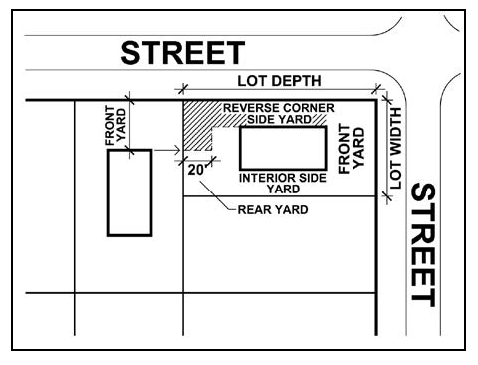
To clarify the distinction between a corner lot and a reverse corner lot, and to clarify how to measure a reverse corner side yard, the following illustrations (Figures 1, 2 and 3) are provided:
(a)
For reference, a typical corner lot is a lot situated at the junction of, and abutting, two (2) or more intersecting streets. See Figure 1: Corner Lot below.
FIGURE 1: CORNER LOT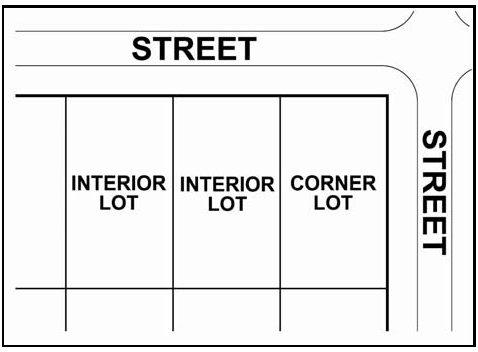
(b)
A reverse corner lot is a corner lot where the side lot line adjoining a street is substantially a continuation of the front lot line of the first lot to its rear. See Figure 2: Reverse Corner Lot below.
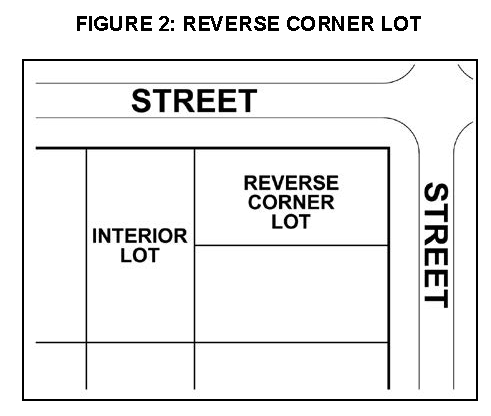
(c)
How to measure the reverse corner side yard of a reverse corner lot is illustrated in Figure 3: Measurement of Reverse Corner Side Yard below. The dimension of such yard is as required in Table 3: Residential Districts Yard and Bulk Regulations.
FIGURE 3: MEASUREMENT OF REVERSE CORNER SIDE YARD
FIGURE 3—STEP 1: On a reverse corner lot, the lot line used to determine the location of the front yard and to measure lot width shall be the shorter street frontage.
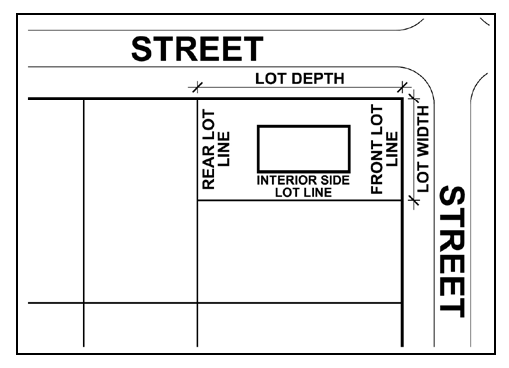
FIGURE 3 - STEP 2: As measured from the rear lot line of the reverse corner lot, the first twenty (20) feet of the reverse corner side yard shall equal the front yard of the lot to the rear. The remainder of the reverse corner side yard shall be fifty percent (50%) of the front yard depth or a dimension established by district regulations.
8.1 - Commercial districts purpose.
(a)
Purpose of O Office District. The O Office District is intended to create a commercial environment of a non-retail nature for the development of office structures and related uses, within a well landscaped setting. Areas within this district should have access to major streets or public transportation facilities.
(b)
Purpose of B-1 Retail and Office District. The B-1 Retail and Office District is intended to provide an environment suitable for a variety of retail, service, office and mixed (residential above ground-floor commercial) uses. Additionally, this district is intended to accommodate uses that: provide for the needs of local residents; are oriented to pedestrian access; generate relatively minimal vehicular traffic; and have minimal off-street parking demands. Areas within the district should have access to major streets and/or public transportation and may be located adjacent to residential districts.
(c)
Purpose of B-2 General Commercial District. The B-2 General Commercial District is intended to provide an environment suitable for a variety of retail, service and office uses that have higher traffic, illumination and other operational impacts on surrounding areas than those in the B-1 District. Additionally, this district is intended to accommodate uses that: serve both local and regional patrons; are oriented to the demands of heavy vehicular traffic, and provide for relatively high off-street parking demands. Ideally, areas within this district should be adjacent to major streets and should be either physically separated or adequately buffered from R-1 and R-2 residential areas.
(d)
Purpose of B-3 General Commercial, Wholesale and Service District. The B-3 General Commercial, Wholesale and Service District is intended to provide appropriate locations for specialized general commercial uses, including wholesaling, equipment storage and a variety of business services, which are oriented toward supporting other retail goods and personal service establishments, and not necessarily focused upon the shopping public. Areas within this district should have direct access to major streets and be generally situated in locations removed or buffered from residential uses.
(e)
Purpose of B-4 Uptown Business District. The B-4 Uptown Business District is intended to sustain the current commercial, pedestrian-oriented character and economic viability of the central business district. New development will be consistent with the Uptown's established scale, architecture and mix of uses. In order to refine the regulations for this district, a series of sub-districts with corresponding use and bulk regulations have been established, as described in Section 8.2 (B-4 District Sub-Districts) below.
(Ord. No. 2017-23, § 2, 4-5-2017)
8.2 - B-4 uptown business district sub-districts.
Because various areas of Uptown have different mixes of uses, physical characteristics and functions, the City has identified four (4) sub-districts, each with its own set of allowable uses and bulk regulations. The sub-districts are identified on the Official Zoning Map. The general purpose and intent of each sub-district is described below.
(a)
Purpose of the Uptown Core Sub-District. The Uptown Core Sub-District (U-Core) is the traditional center of the City's Central Business District. The U-Core Sub-District is intended to preserve buildings located within the Central Business District that are of architectural significance, and ensure the new development is compatible with and maintains the historical character of the core. The U-Core Sub-District is characterized by a mix of small retail and service uses within a mixed-use pedestrian-oriented environment. Retail, restaurant and entertainment uses shall be located along the ground floor, with personal service, office and residential above.
(b)
Purpose of the Uptown Commercial Sub-District. The Uptown Commercial Sub-District (U-Comm) is intended to support the Uptown Core with a mixed-use environment. The mix of uses and the bulk regulations within this sub-district are structured to relate directly to the Uptown Core, but are distinct in that they allow service uses on the ground floor. This sub-district is also designed to be pedestrian-oriented.
(c)
Purpose of the Transitional Commercial Sub-District. The Transitional Commercial Sub-District (U-TC) is intended as a transitional area, where low-intensity office buffer surrounding single-family neighborhoods from the U-Core Sub-District. The mix of uses includes primarily low intensity office and institutional uses, including on-site parking and open space.
(d)
Purpose of the Public/Institutional Sub-District. The Public/Institutional Sub-District (U-P/I) is intended to accommodate existing public, open space and institutional uses, including government offices. These public and institutional uses offer important community services, and provide a focal point and civic character for Park Ridge and the Uptown Business District.
8.3 - Permitted and special uses.
Table 4: Commercial Districts Permitted and Special Uses lists permitted and special uses for the commercial districts. A "P" indicates that a use is considered permitted within thatdistrict. An "S" indicates that a use is considered a special use in that district and must obtain special use approval as required in Section 4.6 (Special Use). No letter (i.e., a blank space), or the absence of the use from the table, indicates that use is not permitted within that district.
TABLES 4 & 5: FOOTNOTES:
1 The terms in this column ("Use") are defined in Section 17 (Generic Use Definitions).
2 In the Uptown Commercial, professional office uses located on the ground floor along Northwest Highway shall be considered special uses. In all other areas of the Uptown Commercial, professional office uses located on the ground floor are considered permitted uses.
3 Only wireless telecommunications antennas that comply with the stealth design standards of Section 10.3.R.10 shall be considered permitted uses.
4 Ordinance 2008-83,11/17/2008
5 Ordinance 2008-55, 8/18/2008
6 Ordinance 2009-50, 7/6/2009
7 Ordinance 2010-33, 4/5/2010
8 Ordinance 2010-84, 12/6/2010
9 Ordinance 2012-57, 12/3/2012
10 Ordinance 2015-37, 6/1/2015
11 Ordinance 2014-63, 11/17/2014
12 Ordinance 2012-39, 8/20/2012
13 A Medical Cannabis Cultivation Center is not permitted within the City due to the distance requirements contained in The Compassionate Use of Medical Cannabis Pilot Program Act, 410 ILCS 130/1 et seq.
14 In the U-Comm sub-district, allowed only north of Touhy Avenue; not allowed in U-Comm sub-district south of Touhy Avenue.
(Ord. No. 2014-56, 10-20-2014; Ord. No. 2020-30, § 3, 3-18-2020; Ord. No. 2021-04, § 3, 2-1-2021; Ord. No. 2022-03, § 4, 1-18-2022; Ord. No. 2024-54, § 3, 9-3-2024; Ord. No. 2024-57, § 3, 9-16-2024; Ord. No. 2024-62, § 3, 10-21-2024; Ord. No. 2025-28, § 3, 4-21-2025; Ord. No. 2025-62, § 3, 10-6-2025)
8.4 - Yard and bulk regulations.
Table 5: Commercial Districts Yard and Bulk Regulations establishes yard and bulk regulations for the commercial districts.
TABLE 5: FOOTNOTES
1 All appurtenances must meet building height requirements.
2 In some cases between certain districts and/or uses, a transition yard may be required. Such transition yard may require additional landscaping and screening, as well as a larger yard dimension to accommodate these plantings. Such transition yards shall be as required by Section 13 (Landscaping and Screening).
3 In the B-1, B-2 or B-3 Districts, a rear yard is not required where an alley or railroad tracks are located between the commercial use and a residential use or district.
(Ord. No. 2022-03, § 5, 1-18-2022)
8.5 - General standards of applicability.
(a)
Temporary Uses. See Section 10.4 (Temporary Uses) for standards governing temporary uses.
(b)
Accessory Buildings, Structures, and Uses. See Section 11.4 (Accessory Buildings, Structures and Uses) for standards covering accessory buildings, structures and uses. Attached garages shall not be considered an accessory structure but shall be subject to the requirements of Section 11.4.F.2 (Attached Garages).
(c)
Permitted Encroachments. See Section 11.5 (Permitted Encroachments) for standards governing encroachments.
(d)
Environmental Performance Standards. See Section 11.6 (Environmental Performance Standards) for standards governing environmental performance standards.
(e)
Off-Street Parking and Loading. See Section 12 (Off-Street Parking and Loading) for standards governing off-street parking and loading.
(f)
Landscaping and Screening. See Section 13 (Landscaping and Screening) for standards governing landscaping and screening.
(g)
Signs. See Section 14 (Signs) for standards governing signs.
8.6 - B-4 Uptown Business District design standards.
(a)
Architectural Styles.
(1)
Conformance to established architecture is encouraged, but not required. However, the exterior design of buildings shall emphasize traditional architecture consistent with buildings in the Uptown Business District of architectural significance.
(2)
Predominant façade colors shall be subtle, neutral or earth-tone colors, such as red, buff, cream and gray. Primary colors, high-intensity colors, metallic or fluorescent colors, and black are prohibited as predominant façade colors. Building trim and accent areas may be brighter and include primary colors.
(3)
Ceramic tile, terra-cotta brick, stone and glass surfaces shall not be painted.
(b)
Building Materials.
(1)
Permitted Materials. The following materials are permitted for use on exterior elevations:
a.
Clay brick
b.
Natural or cast stone
c.
Wood
In order to adapt to changing technology, the development of new materials and so as not to limit the designer, additional materials other than those specified above may be permitted. The use of alternate materials shall be reviewed on a case-by-case basis, in the context of each individual project, by the Appearance Commission.
(2)
Prohibited Materials. Any language to the contrary in (1) above notwithstanding, the following building materials shall be prohibited as the predominant surface finish material in the construction of new residential buildings and related accessory structures within the Uptown Business District. However, such materials may be used as part of decorative or detail elements, or as part of the exterior construction that is not used as a surface finish material.
a.
Concrete masonry units (CMU);
b.
Utility brick;
c.
Aluminum, steel or other metal sidings;
d.
Metal wall panels;
e.
Exposed aggregate (rough finish) concrete wall panels;
f.
Exterior insulating finish systems (EIFS) on the ground floor;
g.
Rustic shingles and shakes;
h.
Plastic
(c)
Building Scale.
(1)
The Pickwick Theater building shall be maintained as the visual focal point of the Uptown Business District. No new construction shall compete visually with the Pickwick Theater building.
(2)
New construction shall be compatible with the traditional color and scale of the Uptown Business District and the sub-district in which the new construction is to take place.
(3)
Facades of large buildings shall be visually broken into bays to avoid the appearance of large, blank walls. Visual breaks in the façade shall be accomplished by alterations in the plane of the façade, height of the façade, changes in materials, color, texture or pattern, and/or the addition of columns, pilasters and/or windows. Bays shall be twenty (20) to thirty (30) feet in width.
(4)
Buildings shall be designed with a definable base, middle and top. Rooflines, cornice treatments, window design and parapets are encouraged to divide larger buildings. Arcades may be used provided that the upper levels of the building line up with the streetwall and the columns are aligned with the façade of the building.
(d)
Door and Window Design.
(1)
Punched openings in the wall plane shall be provided in which to set windows and doors. Flush-mounted windows and doors are prohibited. Fenestration should match the surrounding traditional character and design. Bay windows on upper stories are permitted provided they are in character with surrounding buildings.
(2)
Each ground floor space with street frontage shall have its primary entrance on the public sidewalk. Additional entrances may be provided from a parking area or access corridor. Buildings that face more than one (1) street may have an angled front entry at the corner.
(3)
All public entrances shall be articulated from the building mass. Examples of such articulation include: recessed entries, overhangs, arcades, raised corniced parapet walls over the door, peaked roof forms, arches, outdoor patio or seating areas, display windows, details such as tile work and moldings integrated into the building design, and integral planters or wing walls that include landscaping or seating.
(4)
In order to recognize the pedestrian orientation of the Uptown Business District, windows shall meet the following requirements:
a.
Along the length of façade(s), if a building faces the public street and sidewalk and has a retail, personal service and/or office use located on the first floor, fifty percent (50%) of the first floor façade shall be display-type windows. A minimum eighteen (18) inch and maximum of thirty (30) inch high knee-wall shall be required beneath glazing so as to allow pedestrians to see into the windows.
b.
First story glass shall be clear and non-tinted. Tinting of second and third story glass shall not vary by more than twenty percent (20%). Reflective glass is prohibited.
(e)
Roof Design.
(1)
Roof lines shall either be varied with a change in height or the incorporation of a major focal point feature, such as a dormer or projected wall feature. Parapet walls are encouraged and shall feature three-dimensional cornice treatments or other shadow-creating detail elements along their tops.
(2)
Gable, sloped mansard, shake and shingle roof designs are prohibited.
(3)
"Green roof" designs are encouraged.
(f)
Historical Preservation. The following design guidelines apply to existing buildings with historical or architectural significance within the B-4 Uptown Business District.
(1)
Existing buildings should be restored to their original condition. False fronts and incompatible façade treatments should be removed.
(2)
Distinguishing features of existing buildings, such as cornices and façade detailing, should be retained, repaired and restored. Original building materials should be maintained and restored.
(3)
Improvements and additions to existing buildings should reinforce and enhance the original character of the building.
(4)
Existing windows should not be covered over or boarded up. New doors should match the original style and character of the façade.
(5)
The original roofline and cornice treatment should be maintained and restored.

