Park Ridge City Zoning Code
SECTION 7
RESIDENTIAL DISTRICTS
7.1 - Residential districts purpose.
(a)
Purpose of R-1 Single-Family Residential District. The R-1 Single-Family Residential District is intended to create a low density environment of single-family homes located upon larger sites than the typical single-family lot size for such housing within the community, where the maintenance of adequate open space is seen as essential to the preservation of the unique residential character. Limited non-residential uses that are compatible with surrounding residential neighborhoods may be permitted.
(b)
Purpose of R-2 Single-Family Residential District. The R-2 Single-Family Residential District is intended to create a low density environment of single-family homes in areas clearly distinguishable as residential neighborhoods, located upon sites comparable in dimensions to the typical lot size for single-family housing within the community. Limited non-residential uses that are compatible with surrounding residential neighborhoods may be permitted.
(c)
Purpose of R-3 Two-Family Residential District. The R-3 Two-Family Residential District is intended to create a moderate density environment of single-family homes and two-family dwellings located along major streets upon sites comparable in dimensions to the typical lot size for single-family housing within the community. Limited non-residential uses that are compatible with surrounding residential neighborhoods may be permitted.
(d)
Purpose of R-4 Multi-Family Residential District. The R-4 Multi-Family Residential District is intended to create a moderate density environment of single-family homes, two-family dwellings and multi-family dwellings, including townhomes. This district may provide a transition zone between single-family neighborhoods and adjacent higher intensity land uses, and should have access to major streets or public transportation facilities. Limited non-residential uses that are compatible with surrounding residential neighborhoods may be permitted.
(e)
Purpose of R-5 Multi-Family Residential District. The R 5 Multi-Family Residential District is intended to create a higher density environment of single-family homes, two-family dwellings and multi-family dwellings, including townhomes and apartments, located in the Central Business District, or for the R-5 District created on or before May 1, 2008, that is adjacent to the Central Business District. Areas within this district should be adjacent to major streets or convenient to public transportation facilities. Limited non-residential uses that are compatible with surrounding residential neighborhoods may be permitted.
(Ord. No. 2008-65, 9-2-2008)
7.2 - Permitted and special uses.
Table 2: Residential Districts Permitted and Special Uses lists permitted and special uses for the residential districts. A "P" indicates that a use is considered permitted within that district. An "S" indicates that a use is considered a special use in that district and must obtain a special use permit as required in Section 4.6 (Special Use). No letter (i.e., a blank space), or the absence of the use from the table, indicates that use is not permitted within that district.
Table 2: Footnotes
1 The terms in this column ("Use") are defined in Section 17 (Generic Use Definitions).
2 Only wireless telecommunications antennas that comply with the stealth design standards of Section 10.3.R.10 shall be considered permitted uses.
(Ord. No. 2008-83, 11-17-2008; Ord. No. 2023-17, § 3, 3-20-2023)
7.3 - Yard and bulk regulations.
Table 3: Residential Districts Yard and Bulk Regulations establishes yard and bulk regulations for the residential districts.
Table 3: Footnotes
1 For a conversion chart that provides the approximate density for each residential district, as calculated from minimum lot area, see Appendix D.
2 For nonconforming lots of record within the residential districts, see Section 15.5 (Nonconforming Lots of Record).
3 Day care homes and day care centers are exempt from the special use bulk requirements. These uses shall be subject to those for single-family residential uses within the district.
4 Appurtenances for single-family and two-family dwellings within the residential districts are limited to 5 feet in height and a maximum area of 3 feet by 3 feet. The maximum area of an appurtenance shall be determined by measuring the largest cross-section of the appurtenance.
5 Maximum height of first floor elevation shall be measured from grade, as defined in this Ordinance, to the top of the finished first floor.
6 In some cases between certain districts and/or uses, a transition yard may be required. Such transition yard may require additional landscaping and screening, as well as a larger yard dimension to accommodate these plantings. Such transition yards shall be as required by Section 13 (Landscaping and Screening).
7 In no case shall averaging be based on less than four neighboring lots. For example, in the case of a corner lot, four neighboring lots on the same block shall be used or, in the case of a lot adjacent to the corner lot, the corner lot and three neighboring lots on the same block shall be used. In the case of an addition to the front of a house, the front setback of the subject property shall be included (prior to the addition), along with the neighboring properties as noted above.
8 In the R-1, R-2 and R-3 Districts, the rear yard dimension is determined by lot type (corner lot versus interior lot). In the R-4 and R-5 Districts, the rear yard dimension is the same regardless of lot type. See Section 16 (Definitions) for description of lot types.
(Ord. No. 2008-65, 9-2-2008; Ord. No. 2009-50, 7-6-2009)
7.4 - General standards of applicability.
(a)
Temporary Uses. See Section 10.4 (Temporary Uses) for standards governing temporary uses.
(b)
Accessory Buildings, Structures, and Uses. See Section 11.4 (Accessory Buildings, Structures and Uses) for standards covering accessory buildings, structures and uses. Attached garages shall not be considered an accessory structure but shall be subject to the requirements of Section 11.4.F.2 (Attached Garages).
(c)
Permitted Encroachments. See Section 11.5 (Permitted Encroachments) for standards governing encroachments.
(d)
Environmental Performance Standards. See Section 11.6 (Environmental Performance Standards) for standards governing environmental performance standards.
(e)
Off-Street Parking and Loading. See Section 12 (Off-Street Parking and Loading) for standards governing off-street parking and loading.
(f)
Landscaping and Screening. See Section 13 (Landscaping and Screening) for standards governing landscaping and screening.
(g)
Signs. See Section 14 (Signs) for standards governing signs.
7.5 - Floor area ratio measurement and bonus applicability.
(a)
Floor Area Ratio (FAR) Calculation. Floor area ratio (FAR) shall be determined by dividing the gross floor area of a building or buildings on a lot by the total lot area.
(b)
Gross Floor Area Calculation. To determine the gross floor area for the purposes of the FAR calculation, as described in Paragraph A above, the gross floor area shall be the sum of the gross horizontal areas of any building, as measured from the exterior faces of the exterior walls or from the centerline of walls separating two (2) buildings. In addition, the following shall also be included in the gross floor area calculation:
(1)
That part of the floor area where the height from floor to ceiling is in excess of twelve (12) feet shall be counted twice.
(2)
The basement floor area when more than half of the basement height is above the established finished grade.
(3)
Elevator shafts and stairwells at each floor.
(4)
Floor space used for mechanical equipment. This shall not include roof-top equipment.
(5)
Penthouses.
(6)
That floor area of attic space or the second story of a detached garage that has headroom of seven (7) feet or more. Only the floor area with a height of seven (7) feet or more shall be counted.
(7)
Enclosed balconies and mezzanines.
(8)
Enclosed porches.
(9)
Accessory structures located on the lot, except for that floor area permitted to be excluded from the gross floor area calculation, as described in Paragraph C below.
(c)
Exceptions to Gross Floor Area Calculation:
(1)
Unenclosed Porches. Unenclosed front entry porches shall be eligible for a floor area exemption as described in this section. In order to qualify for this exemption, unenclosed porches shall be no more than one (1) story in height, shall not be enclosed or used for year-around living, shall not have a solid railing, and shall have a minimum depth of four (4) feet as measured from the edge of the porch to the front façade of the principal structure at the shallowest point of the porch, not including steps and stoops.
Qualifying unenclosed porches shall be granted the following floor area exemptions:
a.
Where a porch extends for a width of fifty percent (50%) or more of the front façade along the front yard, up to one-hundred (100) square feet shall be excluded from the total gross floor area.
b.
Where a porch extends for a width of twenty-five percent (25%) or more of the façade along the corner side yard, up to one-hundred (100) square feet shall be excluded from the total gross floor area.
c.
For corner lots, with a qualifying porch along both the front yard and corner side yard façades, up to a total of two-hundred (200) square feet may be excluded from the total gross floor area.
(2)
Accessory Structures. Certain accessory structures shall be eligible for a floor area exemption as described in this section. Certain accessory structures shall be granted the following exemptions:
a.
Sheds of one-hundred twenty (120) square feet or less of total floor area not be included in the total gross floor area.
b.
Detached garages of four-hundred (400) square feet or less of total floor area and located entirely within the rear thirty (30) feet of the lot shall not be included in the total gross floor area. If a detached garage located in the rear yard exceeds four-hundred (400) square feet in area, the first four-hundred (400) square feet shall be excluded from the total gross floor area, but the remainder of the garage's floor area shall be included in the calculation 1 . Regardless, that floor area of the second story of a detached garage that has headroom of seven (7) feet or more shall be counted in the total floor area.
c.
Sunshade structures of four-hundred (400) square feet or less of total area shall not be included in the total gross floor area. If a sunshade structure exceeds four-hundred (400) square feet in area, the first four-hundred (400) square feet shall be excluded from the total gross floor area, but the remainder of the sunshade structure's floor area shall be included in the calculation.
(d)
Floor Area Bonus for Certain Additions in R-1 and R-2 Districts. Additional floor area for proposed additions to existing single-family homes constructed before January 1, 1960 in the R-1 and R-2 Districts shall be permitted, subject to the rules and conditions of this section and any other provisions of this subsection.
(1)
Purpose of Floor Area Bonus. The floor area bonus for existing single-family homes within the R-1 or R-2 Districts is intended to preserve the existing housing stock and maintain the established character of single-family neighborhoods. By preserving older homes, this may create additional affordable housing opportunities as well.
(2)
Maximum Additional Floor Area. The maximum bonus FAR permitted for an existing single-family home in the R-1 and R-2 Districts shall be 0.03, not to exceed a total maximum FAR in these districts for single-family homes of 0.48.
(3)
Rules and Conditions. The following rules and conditions shall be used to determine if the property is eligible for the additional floor area:
a.
The proposed addition shall be attached to an existing building, for which a building permit was issued prior to January 1, 1960.
b.
The original foundation of the structure at the time the original building permit was issued must be maintained. If the original foundation has been partially removed or destroyed since the original construction, such structure is not eligible for the FAR bonus.
c.
Demolition.
i.
No demolition activity to the structure located on or above the original foundation shall be permitted during the construction of the addition, except that necessary to construct the addition, such as the demolition of a wall for room expansion.
ii.
Demolition of additions to the structure, whose foundations are expansions of the original foundation but not part of the original foundation, shall be permitted.
iii.
Demolition of accessory structures, which are not part of the original building foundation, such as detached garages and porches, shall be permitted.
d.
With the exception of FAR, the existing single-family homes and the proposed addition will be in compliance with all applicable bulk regulations. When the FAR is calculated after the construction of the proposed addition, the FAR shall not exceed that permitted by-right plus the bonus provision (0.48).
e.
In the case of demolition of the entire structure, even if the original foundation is not removed, the new structure shall not be eligible for the FAR bonus. The FAR bonus applies only to structures constructed before January 1, 1960, and not to the zoning lot.
(Ord. No. 2008-65, 9-2-2008; Ord. No. 2023-46, § 3, 8-21-2023)
7.6 - Measurement of reverse corner side yard.
To clarify the distinction between a corner lot and a reverse corner lot, and to clarify how to measure a reverse corner side yard, the following illustrations (Figures 1, 2 and 3) are provided:
(a)
For reference, a typical corner lot is a lot situated at the junction of, and abutting, two (2) or more intersecting streets. See Figure 1: Corner Lot below.
FIGURE 1: CORNER LOT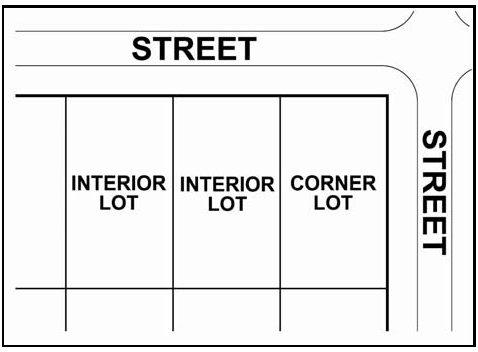
(b)
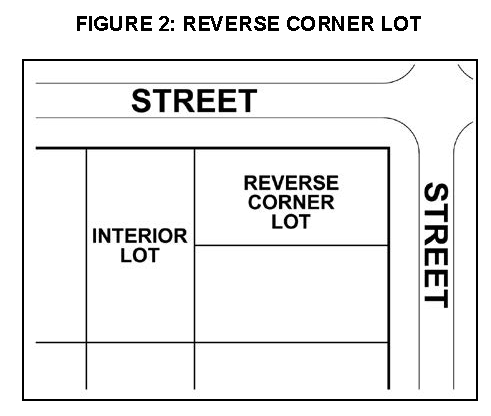
A reverse corner lot is a corner lot where the side lot line adjoining a street is substantially a continuation of the front lot line of the first lot to its rear. See Figure 2: Reverse Corner Lot below.
(c)
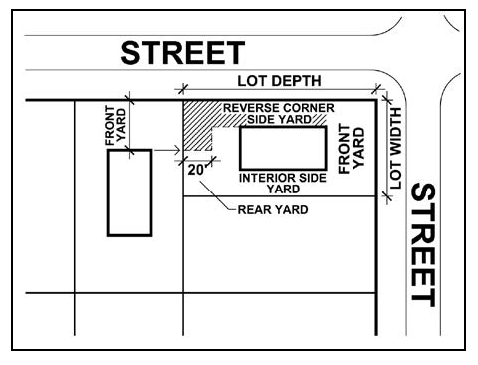
How to measure the reverse corner side yard of a reverse corner lot is illustrated in Figure 3: Measurement of Reverse Corner Side Yard below. The dimension of such yard is as required in Table 3: Residential Districts Yard and Bulk Regulations.
FIGURE 3: MEASUREMENT OF REVERSE CORNER SIDE YARD
FIGURE 3—STEP 1: On a reverse corner lot, the lot line used to determine the location of the front yard and to measure lot width shall be the shorter street frontage.
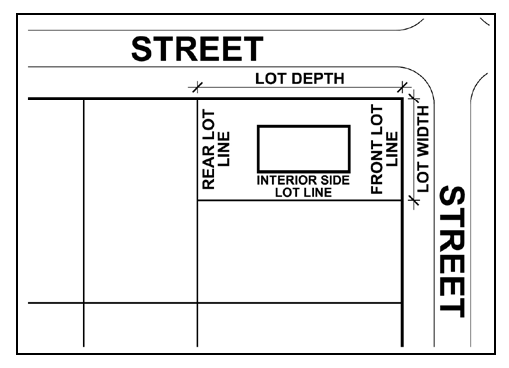
FIGURE 3 - STEP 2: As measured from the rear lot line of the reverse corner lot, the first twenty (20) feet of the reverse corner side yard shall equal the front yard of the lot to the rear. The remainder of the reverse corner side yard shall be fifty percent (50%) of the front yard depth or a dimension established by district regulations.