
Park Ridge City Zoning Code
SECTION 12
OFF-STREET PARKING AND LOADING
12.1 - Purpose.
The off-street parking and loading regulations of this Section are intended to provide accessible, attractive, secure and well-maintained off-street parking and loading areas with the appropriate number of spaces in proportion to the needs of the proposed use, increase public safety by reducing congestion of public streets, and encourage the use of alternative modes of transportation where appropriate.
12.2 - General provisions.
The provisions of this Section shall apply as follows:
(a)
Existing Facilities.
(1)
The existing number of off-street parking and loading spaces shall not be reduced below the requirements of this Section. If the number of such existing spaces is already less than the requirements of this Section, it shall not be further reduced.
(2)
Existing off-street parking and loading areas which do not conform to the requirements of this Section, but were in conformance with the requirements of this Ordinance at the time the parking or loading facilities were established, are permitted to continue as a legal nonconforming structure.
(3)
If a building permit for a building or structure was lawfully issued prior to the effective date of this Ordinance, and if construction has begun within one-hundred eighty (180) days of the issuance of a permit, the number of off-street parking and loading spaces shall be provided in the amount required for the issuance of said building permit, regardless of what may be required by this Section.
(b)
Damage or Destruction. When a building is reconstructed or repaired after being damaged or destroyed, off-street parking and loading facilities shall be restored or maintained in an amount equivalent to that at the time of such damage or destruction. However, it shall not be necessary to restore or maintain parking and loading facilities in excess of the applicable requirements of this Section.
(c)
Change in Land Use. When the existing use of a building, structure or parcel of land is changed to a new use, parking and loading spaces shall be provided as required for the new use. Additional parking or loading spaces shall be required in the amount by which the requirements for the new use exceed the requirements for the existing use.
(d)
Change in Intensity of Use.
(1)
When the intensity of use of any building, structure or parcel of land is increased, additional parking and loading spaces shall be provided. The number of additional parking and loading spaces shall be based on the increase in the number of dwelling units, gross floor area, seating capacity, or other unit of measurement used to calculate the number of required number of parking or loading spaces.
(2)
When the intensity of use of any building, structure or parcel of land is decreased, the number of parking and loading spaces may be reduced so long as the parking requirements of this Section are met for the entire building, structure or parcel of land as modified.
(e)
Provision of Additional Spaces. Nothing in this Section shall be deemed to prevent the voluntary establishment of off-street parking or loading facilities, provided that all regulations governing the location, design and control of such facilities shall be in accordance with this Section.
(f)
Limitations on Use. No motor vehicle repair or cleaning of any kind shall be permitted in any parking space, parking lot or loading berth. No gasoline, motor oil or any other accessory or similar product shall be sold or dispensed in such areas.
12.3 - Computation.
The total number of required parking and loading spaces shall be based upon the requirements for the principal use of the lot. However, when more than one (1) use occupies the same lot, the number of required spaces shall be the sum of the separate requirements for each use. All off-street parking facilities shall be completed before occupancy of the building or structure served. In computing the number of off-street parking or loading spaces required by this Section, the following standards for computation shall apply:
(a)
Space allocated to any off-street loading space shall not be used to satisfy the requirement for any off-street parking space or access aisle, or portion thereof. Conversely, the area allocated to any off-street parking space shall not be used to satisfy the replacement for any off-street loading space or portion thereof.
(b)
A fraction of less than one-half (½) may be disregarded, and a fraction of one-half (½) or more shall be counted as one (1) parking or loading space.
(c)
In places of assembly in which patrons or spectators occupy benches, pews or similar seating facilities, each eighteen (18) inches of such seating facility shall be counted as one (1) seat for the purpose of determining the requirement for off-street parking facilities.
(d)
Except as otherwise specified, parking or loading spaces required on an employee basis shall be based on the maximum number of employees normally present on the premises at any one time. When the determination of the number of parking spaces is based on the number of employees, the owner and/or manager shall be counted as an employee(s).
12.4 - Construction of parking and loading facilities.
(a)
Site plan review required. Site plan review, in accordance with Section 4.5 (Site Plan Review), is required prior to any construction, alteration or addition of any parking facility providing ten (10) or more parking spaces, and for any loading facility. For purposes of this section, construction, alteration or addition shall include all paving of previously unpaved surfaces, replacement of pavement with new binder and surface courses, construction of curbing, installation of new parking lot landscaping, and similar activities. Construction, alteration or addition shall not include maintenance activities such as replacement of existing landscaping, repair of existing curbing, repairs, sealing, re-striping, or placement of surface course pavement over previously paved areas. No permit shall be required for maintenance activities.
(b)
Time of completion. Off-street parking and loading facilities required by this Section shall be completed prior to the issuance of the occupancy permit for the use they serve. If weather conditions do not permit such completion, the Zoning Administrator may issue a temporary occupancy certificate.
12.5 - Collective provisions.
(a)
Off-street parking spaces for individual uses may be provided collectively if the total number of spaces provided is equal to or greater than the sum of the spaces required for each individual use. No parking space, or portion of a space, shall serve as the required space for more than one similar use, but can be shared among two or more individual uses under the following shared parking arrangements described in Paragraph B below.
(b)
The use of a particular parking facility shall not occur by each use at the same time. The use with the highest demand must provide all required spaces. No shared use of parking spaces shall be permitted unless:
(1)
The users of the shared parking facility shall sign an agreement, approved by the City Attorney, expressing the intent to share parking facilities. This agreement shall be filed with the City and recorded with the Cook County Recorder of Deeds.
(2)
Approval is obtained from the Zoning Administrator that confirms that the use of such facility by each user does not take place at the same hours during the same days of the week.
(3)
The location and design requirements of this Section are met.
(4)
Any subsequent change in ownership or use shall require proof that the minimum parking requirements, per this Section, have been met for each use. The owner of a building or use shall have one-hundred eighty (180) days within which to accommodate all required off-street parking or to apply for a variance. If the owner is unable to accommodate the parking or fails to apply for a variance, then the occupancy certificate shall be revoked with respect to the building or use for which the separate parking was required. The occupancy certificate shall be reinstated when all applicable provisions of this Section are complied with. As an alternative to a variance, a new shared parking agreement may be arranged in accordance with this Section.
(Ord. No. 2008-65, 9-2-2008)
12.6 - Land banked future parking.
The Planning and Zoning Commission may permit land banking of up to twenty-five percent (25%) of the required parking spaces through the site plan review process.
(a)
Sufficient evidence shall be provided by the applicant that supports the reduced parking needs.
(b)
The area proposed for land banking of parking spaces shall be an area suitable for parking at a future time.
(c)
Landscaping of the land banked area shall be in full compliance of the zoning regulations and at a minimum landscaped with turf. As a result of the site plan review process, the Planning and Zoning Commission may require additional landscaping of the land-banked area.
(d)
The land banking area cannot be used for any other use without amendment of the site plan.
(e)
As part of the site plan review process, the applicant shall show the area to be banked on the site plan and marked as "land banked future parking."
(f)
The Zoning Administrator, on the basis of increased parking demand for the use, shall require the conversion of all or part of the land-banked area to off-street parking spaces.
12.7 - Location of off-street parking spaces.
(a)
Residential Uses.
(1)
All required parking spaces for residential uses shall be located on the same lot as the building or use served.
(2)
For single- and two-family dwellings, parking shall be permitted in private driveways, but no such parking may encroach onto the public right-of-way. However, such driveway parking shall not be considered as satisfying the off street parking requirements for such single- and two-family dwellings as set forth in this Section, except for existing structures within the R-3 District where parking shall be permitted in private driveways and may count toward the required number of off-street parking spaces, but no such parking may encroach onto the public right-of-way.
(3)
No less than fifty percent (50%) of all required parking in a residential district shall be provided in a completely enclosed building. However, parking located beneath a structure that is no less than four (4) feet below grade, as defined by this Ordinance, may be unenclosed, but must be screened from the public right-of-way by landscaping.
(4)
Tandem parking is permitted for townhouse or multi-family dwellings, or for above ground floor dwellings in the B-4 District, but both spaces must be allotted to the same dwelling unit and located on the same lot as the dwelling.
(b)
Non-residential uses.
(1)
All required off-street parking areas for non-residential uses shall be located on the same lot as, or within three-hundred (300) feet of, the building or use served. However, off-street parking accessory to a non-residential use shall not be located in any R-1, R-2, R-3 or R-4 District.
(2)
When required off-street parking spaces are provided at an off-site parking area, such off-site parking areas shall be, and remain in, the same possession and ownership as the zoning lot occupied by said building or use. No such off-site parking areas shall be authorized and no occupancy certificate shall be issued, unless the Zoning Administrator has reviewed the plans and has made findings that common ownership or possession does and will continue to exist with respect to the zoning lot and the land containing the off-site parking areas, and that the off-site parking area will be maintained at all times during the life of the proposed use or building. A covenant to this effect shall be recorded with the Cook County Recorder and Registrar of Titles.
(3)
Off-street parking spaces are permitted within any rear or interior side yard. However, where a yard abuts a residential district, no off-street parking spaces shall be permitted within five (5) feet of the lot line abutting the residential district.
(4)
No required off-street parking spaces are permitted within a required front or corner side yard.
(Ord. No. 2008-65, 9-2-2008; Ord. No. 2023-49, § 3, 9-5-2023)
12.8 - Design standards.
All off-street parking facilities shall comply with the following standards:
(a)
Dimensions.
(1)
Off-street parking spaces shall be shall be designed in accordance with Figure 11: Off-Street Parking Dimensions (Standard).
(2)
All parking spaces shall have a minimum vertical clearance of seven feet six inches (7' 6").
(3)
Compact size parking spaces may be permitted by the Planning and Zoning Commission, as part of site plan review, in parking lots or structures containing more than fifty (50) spaces. Twenty-five percent (25%) of the stalls over and above the first fifty (50) spaces may be compact parking stalls. Compact off-street parking spaces shall be shall be designed in accordance with Figure 12: Off-Street Parking Dimensions (Compact).
FIGURE 11: OFF-STREET PARKING DIMENSIONS (STANDARD)
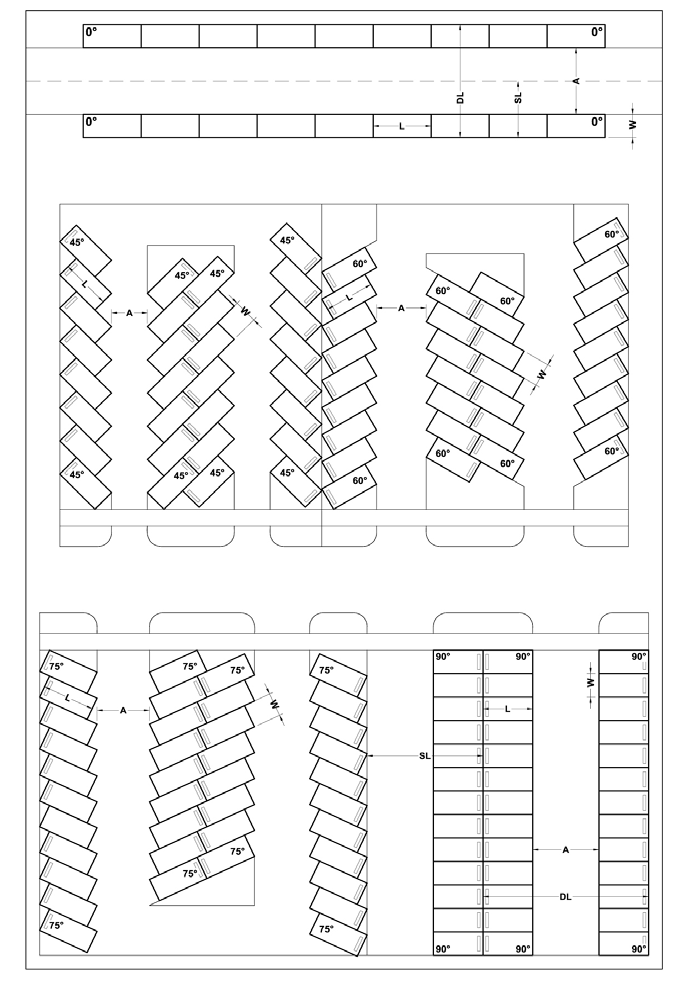
1 Two-way traffic permitted
2 A module is defined as a drive aisle with automobiles parked on each side of the drive aisle.
FIGURE 12: OFF-STREET PARKING DIMENSIONS (COMPACT)
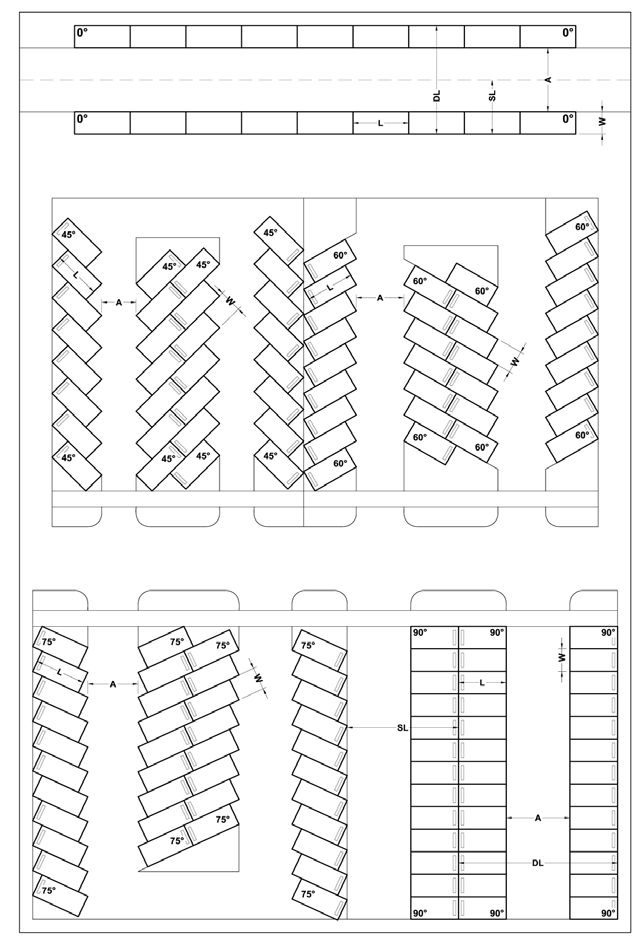
1 Two-way traffic permitted
2 A module is defined as a drive aisle with automobiles parked on each side of the drive aisle.
(b)
Access.
(1)
Each off-street space shall open directly upon an aisle or driveway of such width as will provide adequate means of vehicular access to such parking space. All off-street parking facilities shall be provided with appropriate means of vehicular access in a manner that least interferes with traffic movement and allows the driver of the vehicle to proceed forward into traffic rather than back out.
(2)
All required off-street parking facilities shall have vehicular access from a street, alley, driveway or cross-access connection. However, the Planning and Zoning Commission must review and approve any multi-family residential off-street parking area that is accessed from an alley.
(3)
Within off-street parking facilities one-way traffic aisles shall be at least twelve (12) feet in width and two-way traffic aisles shall be at least twenty-four (24) feet in width. Furthermore, all aisles shall be designed in accordance with Figure 11: Off-Street Parking Dimensions (Standard). However, during the site plan review process, the Planning and Zoning Commission may approve a reduction in the minimum width of a drive aisle for a private multi-family residential off-street parking area.
(4)
Driveways
a.
Residential Driveways, Excluding Multi-Family and Townhouse Dwellings
i.
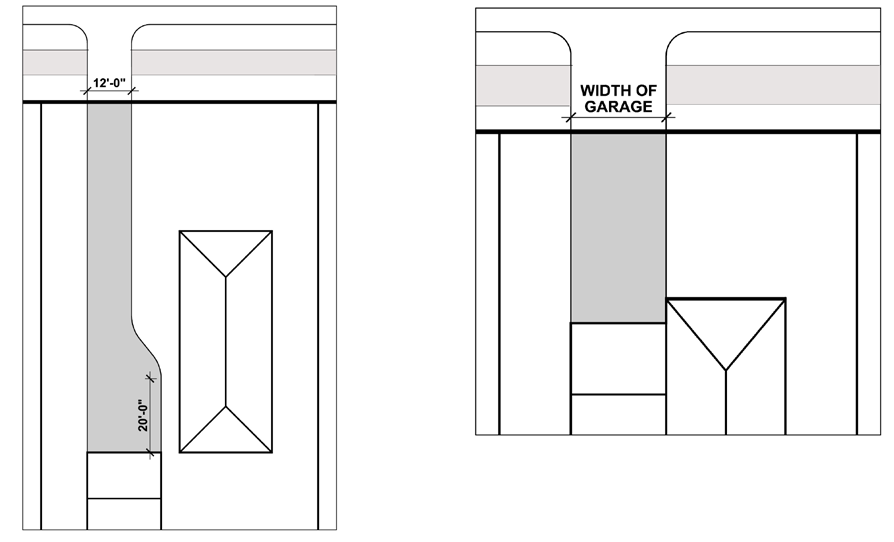
A residential driveway that provides access to a detached garage shall be no more than twelve (12) feet in width. A driveway apron, the width of the garage as measured from the garage walls, is permitted to extend for a distance (depth) of twenty (20) feet from the garage doors before tapering back to the required driveway width to allow access to the additional spaces (See Figure 13: Residential Driveway Width). Exceptions are allowed for sidewalks and parking pads to be attached to a driveway at the garage door opening.
ii.
A residential driveway that provides access to an attached garage shall be no wider than the width of the garage (See Figure 13), except to allow for sidewalks or parking pads.
iii.
Single-family and two-family dwellings are permitted an additional paved parking pad. Any driveways leading to such parking pads must comply with the requirements of Paragraphs i and ii above.
b.
Multi-Family and Townhouse Dwellings, and Non-Residential Driveways
i.
Except for access to loading berths, no driveway shall have a width exceeding twenty four (24) feet.
ii.
Driveways of townhouse developments shall be a minimum of twelve (12) feet for one-way drives, and a minimum of twenty-four (24) feet for two-way drives.
iii.
Driveways, off-street parking areas and access aisles for multi-family residential and non-residential parking lots shall be designed in accordance with Figure 11: Off-Street Parking Dimensions (Standard). However, during the site plan review process, the Planning and Zoning Commission may approve a reduction in the minimum width of a drive aisle for a private multi-family residential off-street parking area.
c.
Single-Family and Two-Family Dwelling Units Driveway Curb Cuts. One (1) driveway curb cut shall be permitted on a zoning lot for a new single family (detached) or two-family dwelling unit. More than one (1) curb cut must be approved by the Public Works Department consistent with established standards. Existing lots with more than one (1) curb cut and/or a circular driveway or straight driveway that exists at the time of adoption of this Ordinance, may be replaced and repaired, provided that the driveway is not enlarged and that the minimum open space requirement for the lot is not exceeded at the time of replacement or repair.
FIGURE 13: RESIDENTIAL DRIVEWAY WIDTH
(c)
Surfacing. All open off-street parking areas shall be improved with a hard surfaced, all-weather dustless material as approved by the City Engineer. Semi-pervious materials such as grass-crete and brick pavers may also be used, subject to the approval of the City Engineer.
(d)
Striping. Off-street parking areas of four (4) or more spaces shall delineate parking spaces with paint or other permanent materials, which shall be maintained in clearly visible condition. Parking spaces for handicapped persons shall be identified with the appropriate sign and shall be visible at all times of the year, regardless of snow cover, plant growth or similar conditions.
(e)
Curbing and Bumper Stops. Bumper stops, wheel stops, or curbing shall be provided to prevent vehicles from damaging or encroaching upon any adjacent parking or loading space, sidewalk, landscaped area or parking lot island, fence, wall or building. Curbing shall be at least six (6) inches in height. The length of the parking stall shall be as indicated in Figure 11: Off-Street Parking Dimensions (Standard), however a eighteen (18) inch overhang is permitted.
(f)
Drainage and Grading. Except for parking spaces accessory to a single-family detached dwelling, no area of any parking facility shall have a slope of more than five percent (5%). No access ramp shall have a slope of more than twelve percent (12%). Finished grade and drainage shall be designed by an Illinois Registered Engineer and approved by the City Engineer.
(g)
Lighting. Parking lot lighting shall be in accordance with Section 11.3 (Exterior Lighting). Illumination of an off-street parking area shall be arranged so as to deflect the direct rays of light away from adjacent properties and streets.
(h)
Landscaping and Screening. All parking lots shall be landscaped in accordance with Section 13 (Landscaping and Screening).
(Ord. No. 2008-65, 9-2-2008)
12.9 - Accessible parking.
(a)
Required Spaces. With the exception of single- (detached and attached) and two-family dwellings, in all off-street parking facilities where parking is provided for employees, visitors, or both, parking spaces for disabled persons shall be provided. The number of accessible parking spaces shall be included in the total number of required parking spaces and shall be in accordance with the applicable requirements of the Illinois Accessibility Code, as amended from time to time, and all additional governing codes and applicable laws.
(b)
Dimensions and Design. Such spaces shall comply with the design standards presented in the State of Illinois Accessibility Code, provided that in no instance shall the width of any one (1) space be less than sixteen (16) feet. Such spaces shall be identified by a sign and pavement markings indicating parking for the disabled only. Such spaces shall be the spaces closest to the entrance of the building or structure, and shall be connected by a paved surface designed to provide safe and easy access.
12.10 - Stacking spaces for drive-through facilities.
(a)
Design. Stacking spaces provided for drive-through uses shall be:
(1)
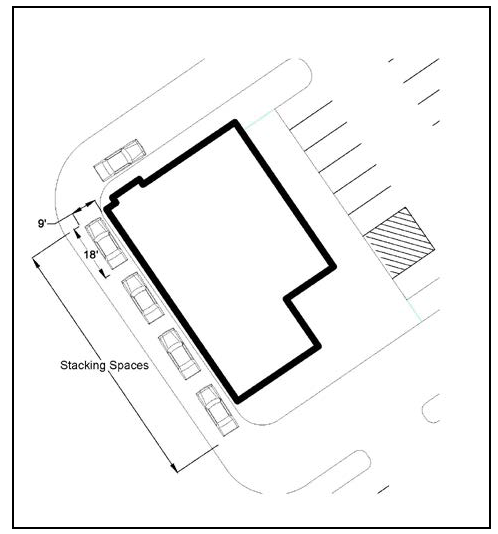
A minimum of nine (9) feet in width, as measured from the outermost point of any service window to the edge of the driveway, and eighteen (18) feet in length. (See Figure 14: Measurement of Drive-Through and Figure 15: Stacking Spaces)
FIGURE 14: MEASUREMENT OF DRIVE-THROUGH
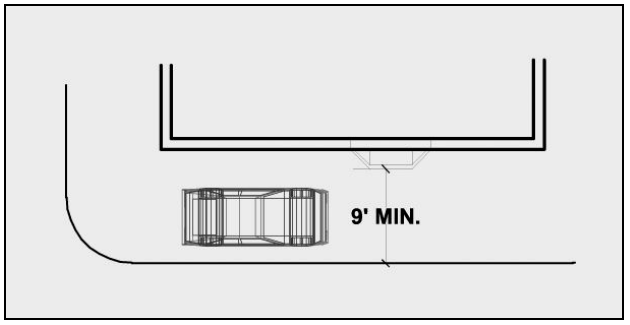
FIGURE 15: STACKING SPACES
(2)
Placed in a single line behind the drive-through facility.
(3)
Located so that, when in use, they do not obstruct ingress or egress to the site and do not obstruct access to required parking or loading spaces.
(4)
Stacking spaces shall begin behind the vehicle parked at a last point of service, such as a window or car wash bay.
(b)
Required Spaces. Every drive-through facility shall provide a minimum of three (3) stacking spaces per facility, unless otherwise required by Table 9: Required Off-Street Parking or this Ordinance.
(c)
Reduction of Required Spaces. The number of required stacking spaces may be reduced by the Planning and Zoning Commission during the site plan review process if the petitioner presents a study done by a traffic engineer with quantifiable evidence (e.g., comparable information) which demonstrates that a different requirement should be imposed. The approval of a reduced number of stacking spaces shall apply only to the specific business for which the study was conducted.
12.11 - Commercial vehicles.
The provisions of these paragraphs apply where off-street parking is accessory to the principal use of the zoning lot.
(a)
Residential Districts. Off-street parking facilities serving residential uses in any residential district shall be used solely for the parking of passenger automobiles. One (1) truck of eight thousand (8,000) pounds gross vehicle weight (GVW) or less (i.e., Class B license) shall be permitted to park in the interior side or rear yard, except as provided below.
(1)
No truck of eight thousand (8,000) pounds GVW or less (i.e., Class B license) shall be permitted to park in the front or corner side yard of any residential lot, if the truck:
a.
Has any tools, equipment, material, machines, debris or any other matter in the open bed.
b.
Has attached any snowplow, towing winch, or rack or mounting for construction tools or materials.
c.
Exceeds twenty (20) feet in length, eight (8) feet in height or seven (7) feet in width, or has more than four (4) wheels.
(2)
A permit may be issued by the Zoning Administrator authorizing one (1) truck of not more than eight thousand (8,000) pounds GVW or less (i.e., Class B license), except for those trucks described in Paragraph (a) above, to be parked in the front or corner side yard of any residential lot, where physical access to an interior side yard or rear yard is unavailable due to one (1) or more of the following factors, to be determined by administrative site plan review:
a.
There is no rear or side yard access to a public or private alley.
b.
An existing garage on the premises cannot physically accommodate the truck in question.
c.
Front, side or rear yards are inadequate due to the placement or configuration of the dwelling on the lot.
d.
There is no accessible interior side or rear yard of sufficient size and area to accommodate the truck in question.
In issuing a permit, the Zoning Administrator may attach reasonable conditions, in view of the particular circumstances, and in keeping with the intent of this Section. It remains the intent of this Paragraph to prohibit all truck parking within the front or corner side yard of a residential dwelling except where it is a physical impossibility, as distinguished from a mere inconvenience or financial hardship.
(3)
No stored or parked commercial vehicle shall be occupied or used for human habitation.
(4)
All other commercial vehicles including, but not limited to, tractors, with or without attached trailers, commercial trailers, buses, limousines, tow trucks, construction vehicles or other large commercial or livery vehicles are not permitted to be stored or parked outside overnight on residentially zoned property.
(b)
Non-Residential Districts.
(1)
The following vehicles may be stored for no more than four consecutive hours, unless allowed by Subparagraphs (2) or (3):
a.
Tractors.
b.
Trailers (vehicle).
c.
Commercial buses.
d.
Construction equipment.
e.
Trucks with "C" through "Z" license plates, or the equivalent thereof issued by any jurisdiction.
f.
Any class of commercial motor vehicle where, in order to be lawfully operated, the operator must possess a valid commercial driver's license.
(2)
Vehicles listed in Subparagraph (1) may be parked or stored for more than four (4) consecutive hours when located in a garage or other fully enclosed structure that substantially conceals them from view. If the vehicles are not within a fully enclosed structure, they may also be permitted when set back a minimum twenty percent (20%) of the lot depth from any lot line that fronts a public street. At lot lines that do not front a public street and where the zoning lot abuts residentially zoned property, the vehicles may be set back a minimum ten percent (10%) of the lot width. In addition, at least one (1) of the following conditions must be met:
a.
The vehicles are integral to an active principal use on the property and are parked in areas clearly designated and marked for large vehicle parking; or
b.
The vehicles are engaged in work related to an active building construction or site development project occurring on the zoning lot.
(3)
Zoning lots with authorized principal uses to sell, rent, or repair vehicles listed in Subparagraph (1) are exempt from the regulations of Subparagraphs (1) and (2). However, these zoning lots are not exempt from the landscaping and screening requirements of Section 13, and conditions may be added as part of a special use permit approval.
(Ord. No. 2019-09, § 4, 2-4-2019)
12.12 - Recreational vehicles.
For the purposes of this Section, recreational vehicles shall include all motor homes, fifth wheels, travel trailers, boats, pop-up campers, and trailers that transport snowmobiles, wave-runners, ATVs, etc.
(a)
Recreational vehicles exceeding thirty-two (32) feet in length or eight (8) feet in width may not be stored in any residential district.
(b)
No recreational vehicle shall be parked in the public right-of-way or within the front or corner side yard. However, such recreational vehicle may be temporarily parked in such yards or the street for a maximum of seventy-two (72) hours for trip preparation and unloading purposes.
(c)
Recreational vehicles may be stored within an interior side or rear yard, but must be located at least three (3) feet from any side lot line, provided that adequate screening at least five (5) feet in height is installed and properly maintained.
(d)
No more than one (1) recreational vehicle may be stored in the open, except that one (1) boat stored on top of a camper trailer, pick-up coach or motorized home, shall be permitted in addition to the recreational vehicle on which it is stored.
(e)
No recreational vehicle shall be used for living, sleeping, or housekeeping purposes in any zoning district.
(f)
This section does not apply to recreational vehicles offered for-sale in an approved outdoor sales and display area of a motor vehicle dealership.
(Ord. No. 2022-66, § 3, 11-9-2022)
12.13 - Required off-street parking spaces.
(a)
The minimum number of off-street parking spaces to be provided for the designated uses shall be as follows in Table 9: Off-Street Parking Requirements. Table 9 lists parking requirements for the generic uses listed within the districts. In some cases, uses which areconsidered part of a generic use category are listed with specified parking requirements. These specific uses are listed only for the purposes of this Section and do not indicate whether such uses are permitted or special uses within any district. Certain generic uses listed within the districts do not have parking requirements. These types of uses are not listed within Table 9.
(b)
Commercial land uses in any commercial zoning district that are one thousand (1,000) square feet or less in gross floor area are exempt from the parking standards of Table 9 of this Section. For commercial land uses in any commercial district that are over one thousand (1,000) square feet in gross floor area, the first one thousand (1,000) square feet of gross floor area shall be exempt from the parking standards of Table 9 of this Section.
(c)
Commercial permitted and special land uses in the B-4 District shall be exempt from the parking standards of Table 9 of this Section. The City may impose parking requirements as a condition of special use approval.
Note: The line entitled Payday or Title Loan Agency was deleted per Ordinance 2009-50, 7/6/2009.
TABLE 9: FOOTNOTES
1 Ordinance 2008-83, 11-17-2008
2 Ordinance 2009-50, 7-6-2009
3 Ordinance 2010-33, 4-5-2010
4 Ordinance 2011-88, 12-19-2011
5 Ordinance 2015-37, 6-1-2015
6 Ordinance 2012-39, 8-20-2012
7 Ordinance 2014-56, 10-20-2014
(Ord. No. 2008-65, 9-2-2008; Ord. No. 2009-50, 7-6-2009; Ord. No. 2018-25, § 3, 8-6-2018; Ord. No. 2020-30, § 4, 3-18-2020; Ord. No. 2021-04, § 3, 2-1-2021; Ord. No. 2023-48, § 3, 9-5-2023; Ord. No. 2025-28, § 3, 4-21-2025; Ord. No. 2025-62, § 4, 10-6-2025)
12.14 - Required off-street loading spaces.
Off-street loading spaces shall be provided for a building, structure or use which requires the receipt or distribution of materials or merchandise by trucks or other vehicles in accordance with Table 10: Off-Street Loading Requirements:
12.15 - Design of off-street loading spaces.
(a)
Location.
(1)
All off-street loading spaces shall be located on the same lot as the building or use served. No off-street loading spaces shall project into a public right-of-way.
(2)
Off-street loading spaces shall be located at least twenty-five (25) feet from the intersection of any two (2) streets.
(3)
No off-street loading space shall be located in a front or corner side yard.
(4)
All off-street loading spaces shall be located a minimum of fifty (50) feet from the lot line of any lot in a residential district, unless completely enclosed by building walls or a uniformly painted solid fence or wall, or any combination thereof, not less than six (6) feet in height.
(b)
Dimensions. All required off-street loading spaces shall be at least twelve (12) feet in width and at least thirty (30) feet in length, exclusive of aisle and maneuvering space, and shall have a minimum vertical clearance of at least fourteen (14) feet. During site plan review, the Planning and Zoning Commission may require a loading space in excess of thirty (30) feet in length based upon the proposed use and anticipated shipping/delivery methods. In no case, shall the Planning and Zoning Commission require a length in excess of sixty (60) feet.
(c)
Surfacing. All off-street loading spaces shall be improved in accordance with the requirements of the City Engineer.
(d)
Access Control and Signage. Each required off-street loading space shall be designed with adequate means of vehicular access to a street or alley in a manner that will minimize interference with traffic movement.
(e)
Lighting. Loading facility lighting shall be in accordance with Section 11.3 (Exterior Lighting). Illumination of an off-street loading facility shall be arranged so as to deflect the direct rays of light away from adjacent properties and streets.
(f)
Landscaping and Screening. All loading facilities shall be landscaped and screened in accordance with Section 13 (Landscaping and Screening).

