
Park Ridge City Zoning Code
SECTION 11
SITE DEVELOPMENT STANDARDS
11.1 - Purpose.
The purpose of this Section is to address the regulation of those other site improvements on a lot other than the regulations for the principal building. This includes site design standards, accessory buildings, structures and uses, and permitted encroachments.
11.2 - Use of land and buildings.
(a)
Number of Buildings on a Lot. In the R-1, R-2 and R-3 Districts there shall be no more than one (1) principal building per lot. In all other districts, more than one (1) building may be erected on a single lot, provided that each building shall comply with all yard and bulk requirements of a district as though it were a principal building on an individual lot.
(b)
All Activities within an Enclosed Building. Within all districts, all activities shall be conducted entirely within an enclosed building, with the exception of the following activities and uses:
(1)
Off-street parking and loading, in accordance with Section 12 (Off-Street Parking and Loading).
(2)
Outdoor businesses, and those businesses with a required outdoor component, including, but not limited to, outdoor entertainment, outdoor recreation, restaurants, car washes, kennels and similar businesses. These businesses may be limited, or outdoor components prohibited, as a condition of a special use.
(3)
Outdoor storage, and outdoor sales and display areas, in accordance with Section 11.4.K (Outdoor Storage, and Outdoor Sales and Display) below.
(4)
Temporary uses, in accordance with Section 10.4 (Temporary Uses).
(c)
Frontage on a Public or Private Street. All lots shall front on a public or private street.
(d)
Required Yards. No lot shall be reduced in area so that the yards are less than required by this Ordinance. The yards of a building or structure shall not be considered yard space for any other building or structure. All yards allocated to a building or structure shall be located on the same zoning lot as such building or structure.
(e)
Applicability of Bulk Requirements. All buildings and structures erected after the effective date of this Ordinance shall meet the requirements for the zoning district in which the building or structure is located. No existing building shall be enlarged, altered, reconstructed or relocated in such a manner that conflicts with the requirements of the zoning district in which the building or structure shall be located.
(f)
Applicability of Use Restrictions. No building, structure or land shall be used for any use other than one allowed as either a permitted or special use in the zoning district in which such building, structure or land is located. Buildings, structures or land may also be used for a temporary use or accessory use, in accordance with the requirements of Section 10.4 (Temporary Uses) and Section 11.4 (Accessory Buildings, Structures and Uses).
(g)
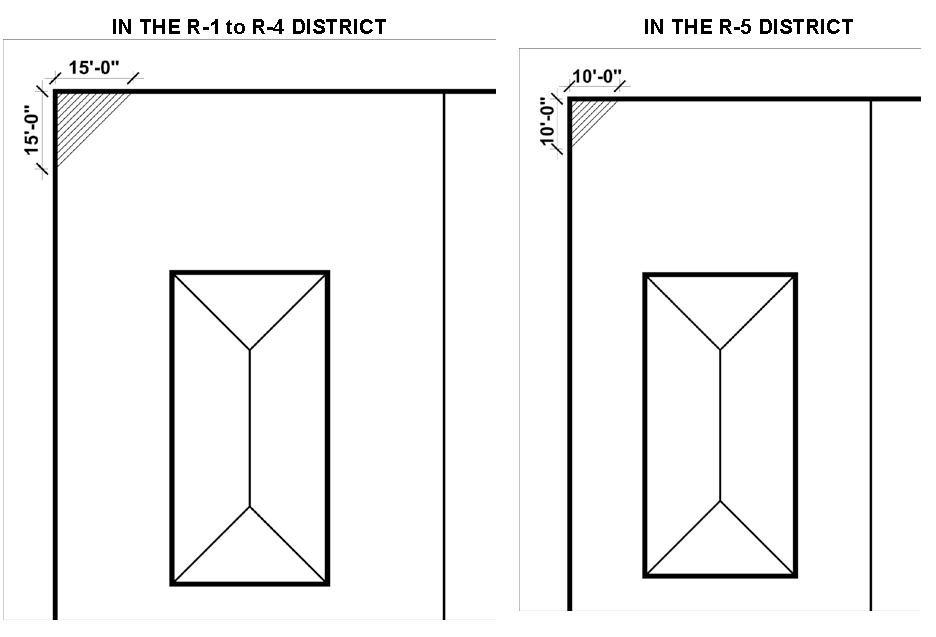
View Obstruction in Residential Districts. The site clearance area at the intersection of two (2) streets within the residential districts shall be defined as a triangular area of a corner lot measured fifteen (15) feet in the R-1, R-2, R-3 and R-4 Districts and ten (10) feet in the R-5 District from the point of intersection of the property lines of the lot along a street; and shall not be obstructed by any sign, wall, fence, hedge, shrub or other object which exceeds twenty-four (24) inches in height. Trees may be maintained within this area as long as there is no foliage within thirty-six (36) inches as measured from the ground to the lowest foliage. In the event that the grade of a lot is higher than the street grade, the height of the wall, fence, hedge, or shrub shall be reduced so that the site clearance is not obstructed twenty-four (24) inches over the grade of the street. See Figure 6: View Obstruction.
FIGURE 6: VIEW OBSTRUCTION
(Ord. No. 2009-50, 7-6-2009)
11.3 - Exterior lighting.
(a)
Light Trespass and Distraction. No exterior lighting may be used in any manner that could interfere with the safe movement of motor vehicles on public thoroughfares. Specifically, the following types of light trespass are prohibited:
(1)
Any light not designed for roadway illumination that produces direct or reflected glare that could disturb the operator of a motor vehicle.
(2)
Any light that may be confused with, or construed as, a traffic control device, except as authorized by state, federal or local government.
(b)
Levels of Light Trespass. The following levels of light trespass shall be permitted; provided, in all residential districts, permanent outdoor lights shall be aimed down and/or shielded to avoid the projection of lights onto nearby properties. Security lights in these districts are required to be motion sensitive. Outdoor Recreation/Sport Court Lights are subjected to supplemental regulations noted in subparagraph (5) below.
(1)
No lighting source shall cause more than one-tenth (0.1) footcandle of illumination to cross the property line of an adjoining R-1, R-2 or R-3 zoned property.
(2)
No lighting source shall cause more than two-tenths (0.2) footcandle of illumination to cross the property line of an adjoining R-4, R-5 or O zoned property.
(3)
No lighting source shall cause more than two (2.0) footcandles of illumination to cross the property line of an adjoining commercially zoned property.
(4)
Subject to paragraph (a), no lighting source shall cause more than five (5.0) footcandles of illumination to cross any public way in commercial areas.
(5)
Outdoor Recreation/Sport Court lights shall not be mounted more than eighteen (18) feet above established grade. Light fixtures shall not be illuminated when the outdoor recreation/sport court structure is not in use and shall not be illuminated between ten o'clock (10:00) p.m. and dawn.
(c)
String Lighting. The use of string lighting, including incandescent light bulbs hung or strung on poles, wires, or any other type of support, are permitted, provided the lights comply with light trespass levels in subsection b.1 above, and complies with the height limits in subsection d.2 below.
(d)
Light Pole and Building-Mounted Lighting Heights. The maximum height of light poles on private property, as measured from grade at the base to the bottom of the luminaire, shall be as specified below. These standards do not apply to public right-of-way lighting. Permitted light pole heights shall be as follows:
(1)
Non-Residential Districts. Lights poles and building-mounted fixtures shall be designed with fully shielded luminaires. Such poles or mounts shall not exceed sixteen (16) feet in height. The Planning and Zoning Commission may approve, in appropriate circumstances as part of site plan review, a pole or mount of up to twenty-four (24) feet.
(2)
Residential Districts. Light poles for single- and two-family dwellings shall not exceed eight (8) feet in height. Light poles for non-residential, multi-family and townhouse uses shall not exceed twelve (12) feet in height. Lighting, including under-soffit lighting mounted upon a single-family, two-family or townhouse residential dwelling shall not be mounted higher than ten (10) feet above grade as defined in this Ordinance. Light poles on school sites or that light public outdoor recreational facilities shall not exceed twenty-four (24) feet in height.
(e)
Automatic Teller Machines. All exterior lighting for automatic teller machines (ATMs) shall comply with the Automated Teller Machine Security Act (205 ILCS 695/1 et seq). All exterior lighting for ATMs in drive-through facilities shall be designed with luminaires recessed under the canopy to minimize light pollution.
(f)
Motor vehicle service station lighting shall comply with the requirements of Section 10.3.J and drive-through facilities shall comply with Section 10.3.F.
(Ord. No. 2008-65, 9-2-2008; Ord. No. 2009-50, 7-6-2009; Ord. No. 2022-52, § 3, 8-15-2022; Ord. No. 2023-62, § 3, 11-6-2023)
11.4 - Accessory buildings, structures and uses.
All accessory buildings, structures and uses, as defined as in Section 16 (Definitions), shall be subject to the requirements of this Section and the requirements of Section 11.5 (Permitted Encroachments) below. Additional accessory structures not regulated in this section may be regulated in Section 11.5 (Permitted Encroachments) below.
(a)
Accessory Buildings and Structures - General Regulations. All accessory buildings and structures shall be subject to the following regulations, in addition to any other regulations within this section and Ordinance.
(1)
No accessory building or structure shall be constructed prior to construction of the principal building to which it is accessory.
(2)
Accessory buildings or structures are prohibited within the required front, corner side, reverse corner side or interior side yard of any lot, unless otherwise permitted by this Ordinance.
(3)
The maximum height of any detached accessory building or structure shall be measured from the floor of the structure to the peak of the roof, unless otherwise required by this Ordinance. (See Figure 7: Accessory Building Height)
(4)
All detached accessory buildings or structures must be located a minimum of three (3) feet from any rear lot line and side lot line, unless otherwise permitted by this Ordinance. Where an alley has been vacated, permitted accessory buildings and structures may be located five (5) feet from the centerline of the alley, provided proof of ownership is established, a disclaimer by the City of any utility easement is obtained, and a written disclaimer by all utility companies is obtained waiving use of the portion of alley to be improved by a building or structure. (See Figure 8: Accessory Building Setback)
(5)
In residential districts, all detached accessory buildings or structures, except for sunshade structures, shall be located a minimum of ten (10) feet from the principal building on a lot. The distance shall be measured from the wall or foundation of the detached accessory building or structure to the wall or foundation of the principal building or the furthermost point of an accessory structure attached to the principal building, such as a porch. (See Figure 8)
(6)
A maximum of two (2) detached accessory buildings shall be permitted on a zoning lot. This shall include a detached garage. One (1) gazebo shall be permitted on a zoning lot in addition to the maximum of two (2) accessory buildings.
FIGURE 7: ACCESSORY BUILDING HEIGHT
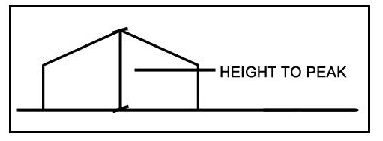
FIGURE 8: ACCESSORY BUILDING SETBACK*
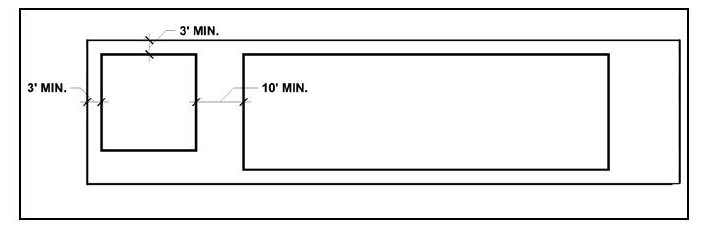
* However, where there is an accessory building with doors that open onto an alley, such accessory building shall not be located closer than five (5) feet from the rear lot line.
(b)
Amateur (HAM) Radio Equipment
(1)
Towers that solely support amateur (HAM) radio equipment and conform to all applicable performance criteria as set forth in Section 11.6 (Environmental Performance Standards) shall be permitted only in the rear yard. Towers shall not exceed the maximum building height of the applicable district by more than ten (10) feet, unless a taller tower is technically necessary to engage successfully in amateur radio communications. Such taller height may only be approved by the Planning and Zoning Commission in accordance with Paragraph 3 below.
(2)
Antenna may be ground-, building- or roof-mounted, provided they do not exceed the maximum building height by more than ten (10) feet unless a taller antenna is technically necessary to engage successfully in amateur radio communications. Such taller height may only be approved by the Planning and Zoning Commission in accordance with Paragraph 3 below. Every effort shall be made to install radio antennae in locations that are not readily visible from neighboring properties or from the public right-of-way
(3)
The Planning and Zoning Commission may approve a taller antenna or tower provided the operator provides evidence that a taller tower and/or antenna is necessary to engage successfully in amateur radio communications. In addition, the applicant must provide evidence that the tower and/or antenna shall not prove a hazard to birds (i.e., minimal chance of bird strikes). Such tower and/or antenna must conform to all applicable performance criteria as set forth in Section 11.6 (Environmental Performance Standards). As part of the application, the applicant must submit a site plan showing the proposed location of the tower and/or antenna, as well as its relation to the principal building and any additional accessory structures.
(4)
Antennae and/or towers owned and operated by the City are exempt from these requirements.
(c)
Arbors and Trellises, Detached. Detached arbors and trellises may encroach into required rear, front and corner side yards by three (3) feet, provided they comply with the following requirements:
(1)
Each surface of the arbor or trellis shall be at least fifty percent (50%) open.
(2)
The maximum height shall be eight (8) feet, the maximum length six (6) feet and the maximum depth three (3) feet.
(3)
Arbors and trellises are permitted in interior side yards.
(d)
Electrical Generators. Emergency electrical generators may only be installed as follows:
(1)
An emergency electrical generator may be located in the corner side yard, reverse corner side yard or rear yard, except as set forth elsewhere in this section.
(2)
An emergency electrical generator may not be located within the required yard setback, except for the rear yard where it is required to be a minimum of five (5) feet from any point along any lot line.
(3)
Access and working space around the emergency electrical generator must be provided as defined in the version of the National Electric Code adopted by the City.
(4)
All approved ground-based emergency electrical generators shall be screened. Screening materials may be masonry, wood, landscaped hedges or other opaque material, and shall screen the generators so no portion is visible from a street, sidewalk or the ground level of an adjoining lot. Color and texture of a masonry screen wall shall be compatible with the color and texture of the principal building on the site.
(5)
Testing of emergency electrical generators may only be done between the hours of 7:00 a.m. and 7:00 p.m., Monday through Friday; and Saturday, from 8:00 a.m. to 5:00 p.m.
(e)
Fences.
(1)
General Requirements:
a.
No fence shall be erected or replaced within the City without first obtaining a building permit.
b.
All fences shall be measured from existing grade, unless otherwise specified.
c.
Fences for public utility and public recreational uses in any district shall be subject to the regulations of Paragraph 4 below.
(2)
Fences in Residential Districts
a.
Fences are prohibited in the front yard.
b.
Fences in residential districts may be erected to a height of six feet (6) in any interior side or rear yard of an interior or corner lot, except for the following:
i.
In the case of a corner lot, a fence may be erected to a height of five (5) feet along the corner side yard.
ii.
In the case of a reverse corner lot, open fences may be erected to a height of four (4) feet along any reverse corner side yard.
iii.
Where a property abuts a railroad right-of-way, a fence may be erected to a height of seven (7) feet. However, where the right-of-way is below grade level, the maximum height of the fence shall not exceed the difference between seven (7) feet and the depth of the depression below grade, or five (5) feet, whichever is more.
iv.
Where a fence is constructed on a deck, that fence may be erected to a height of five (5) feet.
(3)
Fences in Non-Residential Districts:
a.
Fences are prohibited in the front or corner side yard.
b.
Open fences only may be installed in any interior side or rear yard to a height not to exceed six (6) feet.
c.
When a non-residential use abuts a residential district, a solid six (6) foot high fence shall be required to be erected along any lot line that abuts a residential district, except along the front lot line and corner side lot line.
(4)
Fences for Public Utility and Public Recreational Uses:
a.
Whenever the lot line of a public utility or public recreational use abuts a residential district, or whenever a public utility use fronts on a public right-of-way, the use shall be screened by a fence. In addition to the fencing, shrubs a minimum of five (5) feet in height shall be planted along the fence.
b.
Public utility uses shall be fenced. Barbed wire, razor wire or fences of similar material shall be permitted only on a lot used for a public utility facility. All barbed wire, razor wire or similar material shall be placed no less than seven (7) feet above finished grade and shall extend inward toward the interior of the lot. Such fences shall be a maximum height of eight (8) feet. Such fences may be located in any yard.
c.
Public recreation areas may be enclosed along their boundaries (i.e., all yards) with an open type fence to a height not to exceed eight (8) feet. Tennis courts and other similar uses may be fenced in accordance with national standards for such uses.
(5)
Fences for Screening. Fences shall be required for screening in accordance with Section 13.13 (Screening Requirements).
(6)
Fence Construction and Design Requirements:
a.
The finished side of all fences shall face away from the lot on which it located. Both sides of all fences shall be similar in design, construction and appearance.
b.
All fence posts shall be placed on the inside of the fence and the post height may extend a maximum of four inches, including the post cap, above the fence.
c.
A fence or wall, including all posts, bases, and other structural parts shall be located completely within the boundaries of the lot on which it is located.
d.
Fences shall only be constructed of the following materials:
i.
Treated wood, cedar or redwood
ii.
Simulated wood
iii.
Decorative brick or stone
iv.
Wrought-iron, aluminum, steel, or other alloy material designed to simulate wrought-iron
v.
Coated chain link, brown, black or green in color
vi.
Synthetic materials, for example, PVC or vinyl
(7)
Nonconforming Fences. Existing fences located within the front yard, which are an existing legal nonconforming structure, may be repaired or reconstructed. However, any change to fence style or material, height or length shall not be permitted without a variance.
(f)
Garages, Attached and Detached. The following design standards apply to all residential garages. Attached garages shall not be considered an accessory structure but shall be subject to the regulations of this section for attached garages.
(1)
General Garage Design Standards:
a.
On lots without alley access, utilization of a side-loaded or rear-loaded garage is encouraged to minimize the impact of the garage doors on the streetscape.
b.
Garage size should be sensitive to the size of garages on the same block in terms of overall size and percentage of facade.
(2)
Attached Garages:
a.
Garage doors shall be limited to eighteen (18) feet in width, with the exception that garage doors that face the street on an attached garage shall not exceed nine (9) feet in width.
b.
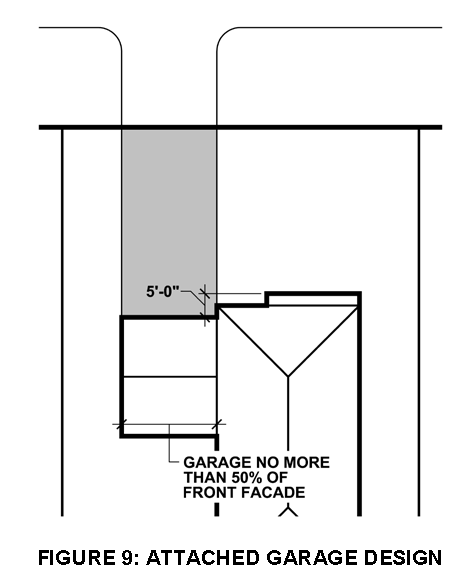
Front-loaded attached garages shall not occupy more than fifty percent (50%) of the width of the front façade of the house, as measured along any building line that faces the street, but in no case shall there be more than two (2) automobile bays.
c.
Attached front-loaded and side-loaded garages shall be located a minimum of five (5) feet behind the main front façade of the house. This measurement will be taken from the part of the front façade that is immediately adjacent to the garage, except that the measurement may be taken from the part of the house closest to the street if all of the following conditions are met (See Figure 9: Attached Garage Design):
i.
The front façade of the house is irregular, i.e., the front foundation is not a straight line.
ii.
The portion closest to the street is actual living space.
iii.
That space forms the dominant visual mass, as determined by length, width, height and surface treatment.
iv.
Existing front loaded, one-car attached garages, which do not currently meet the five (5) foot behind the main front façade require-ment, may be extended towards the side yard, maintaining the current attached garage setback distance, but not extending it, in order to create a two-car garage. All required yard setbacks and other bulk requirements for the zoning district shall still apply.
d.
Windows, doors and roof treatments of that part of the garage facing the street shall incorporate architectural detail expressive of a residence.
e.
Upper level dormers and pitched roof elements shall be used to de-emphasize the garage. Garage openings, windows, columns, trims, decorative paneling and color shall de-emphasize the visual impact of the garage in relation to the building as a whole.
(3)
Detached Garages.
a.
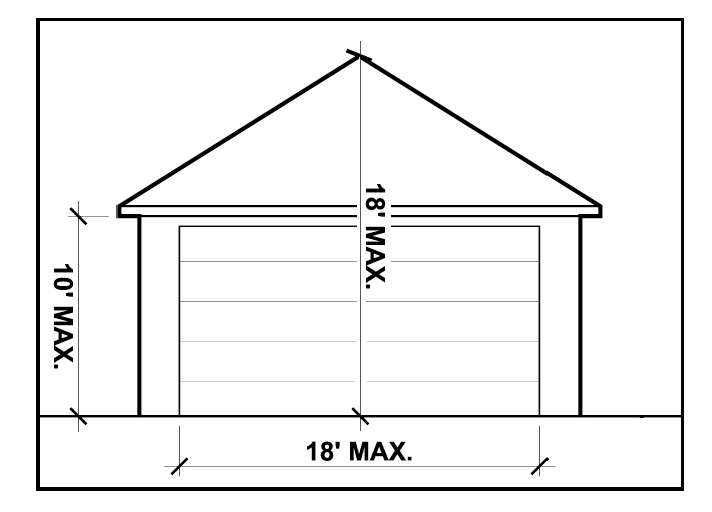
A detached garage shall not exceed a maximum of eighteen (18) feet in height as measured from the garage floor to the peak of a pitched roof, but the maximum height of the sidewall shall not exceed ten (10) feet in height. (See Figure 10: Detached Garage Height) However, any garage over fifteen (15) feet in height shall require review by and approval of the Appearance Commission, and all plans for such garage must be drawn by a licensed architect and show evidence of structural integrity.
b.
The area above the vehicle parking spaces in a detached garage may be utilized for storage, but not living space and may not contain a kitchen, bathroom or sleeping area. The floor area of the second story of a detached garage having head room of seven feet (7') or more shall be counted in the total maximum FAR.
c.
Garage doors shall be limited to eighteen (18) feet in width. (See Figure 10)
FIGURE 10: DETACHED GARAGE HEIGHT
d.
Detached garages shall not exceed seven hundred twenty (720) square feet.
e.
Detached garages located within the rear thirty (30) feet of a lot, shall be located a minimum of three (3) feet from any lot line. The distance shall be measured from the walls of the garage. In no case shall a detached garage encroach into the corner side yard.
f.
If a lot abuts a public alley, a detached garage shall be constructed so that access is from the public alley.
g.
New detached garages over fifteen (15) feet in height shall be consistent with the architecture and design of the principal building. Consistency of design shall include use of the same palette of materials as the principal building, roofing, roof pitch, trim and colors.
(g)
Gazebos and Pergolas, Detached. Detached gazebos and pergolas are permitted in the rear yard, provided they comply with the following requirements.
(1)
Each surface of the gazebo or pergola shall be at least twenty-five percent (25%) open.
(2)
Gazebos or pergolas shall be limited to twelve (12) feet in height as measured from grade to the peak of the roof. The gazebo platform shall be no higher than four (4) feet above grade. Gazebos shall be limited to one-hundred twenty (120) square feet in area. Pergolas shall be limited to lot coverage requirements, but in no case shall they exceed four hundred (400) square feet.
(3)
The gazebo or pergola shall be set back a minimum of five (5) feet from any lot line.
(h)
Home Occupations. The following standards are intended to ensure that home occupations, conducted in a dwelling, are compatible with the neighborhoods in which they are located and do not interfere with the rights of the surrounding property owners to enjoy the established character of the neighborhood.
(1)
The home occupation shall be conducted entirely within the dwelling and shall be clearly incidental and secondary to the use of the dwelling for residential purposes.
(2)
The home occupation shall not exceed twenty-five percent (25%) of the total floor area of the principal building.
(3)
A home occupation shall not be established prior to the member(s) of the family conducting the home occupation taking possession of, and residing in, the dwelling.
(4)
No person other than a family member residing on the premises shall be employed as part of a home occupation.
(5)
Vehicular traffic and parking shall not be increased by more than one (1) additional vehicle at a time
(6)
The home occupation shall not change the fire rating of the structure.
(7)
The receipt, sale or shipment of deliveries shall not be permitted on or from the premises, with the exception of regular U.S. Mail and/or an express shipping service that is characteristic of service to residential neighborhoods.
(8)
A home occupation shall not generate noise, solid waste, vibration, glare, fumes, odors or electrical interference beyond what normally occurs in a residential use. The home occupation shall not cause an increase in the use of utilities.
(9)
No outside storage or display of materials, merchandise, inventory or heavy equipment shall be permitted.
(10)
Use of an attached or detached accessory building for home occupation purposes is prohibited.
(11)
No exterior alteration that changes the residential character of the principal building shall be permitted. No exterior building signs shall be permitted unless authorized by Section 14 (Signs).
(12)
Any type of motor vehicle service and repair is a prohibited home occupation. Day care homes are not considered a home occupation.
(i)
Mechanical Equipment.
(1)
In all districts, all ground-based mechanical equipment including, but not limited to, heating, ventilating and air-conditioning (HVAC) units, may be located in the front, corner side or rear yard. This equipment shall not be located in the minimum interior side yard, except for HVAC units, which may be replaced in the same existing nonconforming location, as long as the units do not increase the extent or degree of nonconformity, with respect to the side yard setback.
(2)
All approved ground-based mechanical, including, but not limited to, HVAC units, shall be completely screened from public view. Screening materials may be masonry, wood, landscaped hedges or other opaque material, and shall effectively screen mechanical equipment so no portion is visible from a street or adjoining lot. Color and texture of a masonry screen wall shall be compatible with the color and texture of the principal building on the site.
(3)
Any HVAC units located on the roof of any structure in any zoning district shall be screened either by an architectural element of the roof and at least six (6) feet from any supporting wall of the building to permit safe access to the roof.
(j)
Outdoor Cafes. Outdoor cafes are considered an accessory use to a restaurant.
(1)
Outdoor cafes of twenty (20) or more seats shall be subject to administrative site plan review.
(2)
Outdoor cafes shall not interfere with the use of parking spaces and aisles.
(3)
Outdoor cafes shall not be located in any required yard that abuts a residential use or district, unless an alley is located between the use and a residential use or district.
(k)
Outdoor Storage, and Outdoor Sales and Display.
(1)
Retail goods establishments are permitted outdoor sales and display of merchandise, by either a storeowner or occupant, outside the store and within the same lot. Any lawfully existing retail goods establishment shall be permitted to display and sell its merchandise outdoors under the following conditions:
a.
No sales and display area shall be permitted in any public right-of-way or obstruct pedestrian or vehicular traffic. No sales and display area is permitted in any required yard.
b.
Outdoor storage is prohibited for retail goods establishments.
c.
A portion of the parking area may be used for outdoor sales and display on a temporary basis only, in terms of both display structure and goods displayed or sold (no permanent display structures permitted in parking areas). No more than ten percent (10%) of the required parking area for the existing commercial use may be used for the temporary outdoor sales and display, unless approved by the Zoning Administrator.
(2)
The following uses are permitted outdoor storage, and outdoor sales and display areas: greenhouse/nursery, including the growing of plants in the open; heavy retail, rental and service; motor vehicle dealership; motor vehicle operations facility; motor vehicle rental; and motor vehicle service and repair, major and minor. Additional outdoor storage, and outdoor sales and display areas may be approved by the Zoning Administrator. These uses are permitted outdoor storage, and outdoor sales and display areas in accordance with the following provisions:
a.
All manufacturing, assembly, repair or work activity shall take place inside an enclosed building. No work shall take place outdoors.
b.
No required parking area shall be used as an outdoor storage, or outdoor sales and display area.
c.
No materials stored or displayed outdoors shall be of a greater height than that of the required screening.
d.
All outdoor storage, and outdoor sales and display areas must comply with the screening requirements of Section 13 (Landscaping and Screening).
(l)
Porches.
(1)
Unenclosed porches may encroach five (5) feet into any front, corner side or rear yard.
(2)
Enclosed porches must meet all setback requirements.
(3)
Steps and stoops are not considered porches. Existing stoops, as of the date of adoption of this Ordinance, located in the interior side yard, shall be considered conforming uses and may be repaired or replaced.
(m)
Retaining Walls.
(1)
If the face of a building is within fifteen (15) feet of a retaining wall, the height of the retaining wall shall be included in the building height calculation. The combination of the retaining wall height and the remainder of the building height above the wall shall not exceed the maximum building height limitation.
(2)
Retaining walls must be located at least five (5) feet from any property line and shall not encroach into the required front yard or any public right-of way.
(3)
Retaining walls, including the terracing of retaining walls for landscaping effect, shall be limited to two (2) feet in height. Retaining walls over two (2) feet in height shall be permitted only if approved by the City Engineer.
(n)
Satellite Dish Antennas.
(1)
General Requirements:
a.
Satellite dish antennas shall be permanently installed on a building, in the ground or on a foundation, and shall not be mounted on a portable or movable structure.
b.
Subject to operational requirements, the dish color shall be of a neutral color, such as white or grey, and shall blend with the surroundings as best as possible. No additional signs or advertising shall be permitted on satellite dish itself, aside from the logos of the satellite dish service provider or dish manufacturer.
c.
Cables and lines serving ground-mounted satellite dish antennas shall be located underground.
d.
Compliance with all federal, state and local regulations shall be required in the construction, installation and operation of satellite dish antennas.
e.
All exposed surfaces of the antenna shall be kept clean and all supports shall be painted to maintain a well-kept appearance. Antennas no longer in use must be removed.
(2)
Small Satellite Dish Antennas (One Meter or Less in Diameter). Small satellite dish antennas, which are one (1) meter or less in diameter, shall be subject to the general requirements of Paragraph 1 above. Every effort shall be made to install small satellite dish antennas in locations that are not readily visible from neighboring properties or from the public right-of-way.
(3)
Large Satellite Dish Antennas (One Meter or More in Diameter):
a.
Administrative Site Plan Review Required. Large satellite dish antennas, which are over one (1) meter in diameter, shall be subject to an administrative site plan review (Section 4.5). Such site plan review application requires the following:
i.
Proof of ownership.
ii.
Plat of survey.
iii.
Site plan showing location of antenna.
iv.
Elevation drawings of the property with antenna installed.
v.
Line of sight drawings demonstrating how the antenna would be screened, as required by this section.
vi.
Statement by a registered professional structural engineer regarding safety of the installation and, if applicable, the building supporting the installation.
b.
Residential Districts.
i.
Large satellite dish antennas shall be located in the rear yard and shall be setback a distance from all lot lines that is at least equal to the height of the dish, but in no case less than five (5) feet from any lot line.
ii.
The overall height of a large satellite dish antenna shall not exceed twelve (12) feet.
iii.
A large satellite dish antenna shall be located and screened so that it cannot be readily seen from public streets or adjacent properties. Screening shall include fences, plant materials and/or earth berms located to conceal the sides and rear of the antenna and its support structure. Plants shall be, at minimum, five (5) feet tall at the time of installation.
c.
Commercial Districts.
i.
A large satellite dish antenna shall be located in the rear or side yard, and shall be setback a distance from all lot lines that is at least equal to the height of the dish, but in no case less than five (5) feet from any lot line.
ii.
Roof-mounting shall be permitted only if the satellite dish antenna is in scale with the overall building mass and location, as determined by the Zoning Administrator, and shall be screened by an architectural feature. The visible portion of the dish should not comprise more than twenty-five percent (25%) of the corresponding height or width of the screen.
iii.
Ground-mounted satellite dish antenna shall provide screening, which includes fencing, berming or landscaping to accomplish the following:
(a)
All ground-mounted accessory equipment and the lower part of the support structure shall be completely screened.
(b)
Where feasible, trees shall be installed to the side and rear of the antenna and at a height/elevation equal to the tallest portion of the dish
(o)
Sheds and Private Greenhouses. All sheds and private greenhouses shall be subject to all detached accessory buildings and structure regulations in Paragraph A above, in addition to the following:
(1)
Sheds and private greenhouses are prohibited within the required front, corner side, reverse corner side or interior side yard of any lot. Sheds and private greenhouses must be located three (3) feet from any side or rear lot line.
(2)
The maximum height of any shed or private greenhouse shall be twelve (12) feet.
(3)
No shed or private greenhouse shall exceed one hundred twenty (120) square feet.
(p)
Solar Collectors. All solar collectors shall comply with the requirements of Article 15 of Chapter 16 of the Park Ridge Municipal Code. Solar Photovoltaic (PV) and Solar Thermal Systems.
(1)
Accessory roof-mounted solar PV and solar thermal systems mounted on a flat roof are exempt from height restrictions pertaining to principal structures, but in no case shall extend more than six (6) feet from the highest point above the roof surface.
(2)
Accessory roof-mounted solar PV systems and solar thermal systems mounted are permitted on any pitched roof. These systems are exempt from height restrictions pertaining to principal structures, but in no case shall extend more than four (4) feet from the highest point above the roof surface. These systems shall not extend beyond the edges of the roof on which they are mounted.
(3)
Placement of accessory ground-mounted solar PV systems and solar thermal systems are permitted in accordance with Table 8 of Section 11.5 (Permitted Encroachments) of this Ordinance.
(4)
Accessory ground-mounted solar PV systems and solar thermal systems are exempt from the requirements of Paragraphs 11.4.A.5 and 11.4.A.6 of this Ordinance, i.e. they may be placed within ten (10) feet of the principal structure on the lot and they shall not count toward the total of accessory structures on a lot.
(5)
Accessory ground-mounted solar PV systems and solar thermal systems shall not exceed four (4) feet in height or twenty-five percent (25%) of the principal building footprint.
(6)
Accessory ground-mounted solar PV systems and solar thermal systems shall be exempt from contributing to the calculation of maximum lot coverage.
(7)
Accessory ground-mounted solar PV systems shall be exempt from contributing to the calculation of minimum open space.
(8)
Solar collectors should be neutral in color and generally matching the roof color of the principal structure. All such devices shall have the following characteristics:
a.
Not be plastic or other non-UV stable material;
b.
Include frames, where applicable, of anodized aluminum or painted steel;
c.
Where devices are encased with glass, the glass shall be non-reflective, tempered glass.
(q)
Swimming Pools and Hot Tubs.
(1)
Location:
a.
Swimming pools and any related equipment are permitted only in the rear yard and must be located no less than eight (8) feet from any lot line, except when located within a shed provided the shed meets the setback requirements of Paragraph A above.
b.
Hot tubs are permitted only in the rear yard and must be located no less than eight (8) feet from any lot line. A hot tub may be located on a deck, as defined by this Ordinance. If a hot tub is located on a deck, such deck must comply with all requirements of this Ordinance, including the maximum ten (10) foot rear yard encroachment. In no case, shall the hot tub be located in a side yard.
(2)
Walkways:
a.
A grade-level walkway or deck surrounding a pool must be located no less than five (5) feet from any lot line in the rear yard. An elevated walkway or deck surrounding a pool must be located no less than twelve (12) feet from any lot line in the rear yard. Pool decks are not subject to the ten (10) foot rear yard encroachment applicable to other decks.
b.
A walkway surrounding a hot tub and constructed at grade level must be located no less than five (5) feet from any lot line. An elevated walkway or deck surrounding a hot tub may not encroach into the required side yard. Hot tubs located on decks, as defined by this Ordinance, are subject to the ten (10) foot rear yard encroachment applicable to decks.
c.
An elevated walkway or deck surrounding a pool shall comprise no more than sixty percent (60%) of the total pool area. This restriction shall not apply to hot tubs located on decks or decks attached to the principal structure.
d.
An elevated walkway or deck surrounding a pool or hot tub shall be no higher than six (6) inches above the rim of the pool or hot tub.
(3)
Fencing:
a.
All pools shall be enclosed by a five (5) foot fence, which shall enclose the entire yard, or the pool or the pool and deck area. All fence openings shall have a five (5) foot gate at the opening, with self-closing/self-latching device located at the top of the gate. Where the pool is surrounded by an elevated deck of more than three (3) feet, but less than four and one-half (4½) feet in height, such fence shall be a maximum of three (3) feet in height.
b.
All hot tubs shall be enclosed by a five (5) foot fence, which shall enclose the entire yard, or the hot tub or the hot tub and deck area. All fence openings shall have a five (5) foot gate at the opening, with self-closing/self-latching device located at the top of the gate. Where the pool is surrounded by an elevated deck of more than three (3) feet, but less than four and one-half (4½) feet in height, such fence shall be a maximum of three (3) feet in height.
(4)
Swimming Pool Depth: No aboveground pool shall exceed a depth of five (5) feet as measured from the top rim of the pool to the pool floor. An aboveground pool may be no more than one (1) foot below grade. No pool shall exceed four (4) feet as measured from the top rim of the pool to grade.
(r)
Water Features and Constructed Ponds.
(1)
Water features and constructed ponds shall not be design for nor shall any owner allow any swimming, wading or recreational use.
(2)
The maximum depth of the water feature or pond shall be limited to three and one-half (3½) feet.
(3)
The maximum size of a single container feature shall be limited to one hundred (100) square feet. The maximum size of a multiple container feature shall be limited to two hundred and fifty (250) square feet total.
(4)
No water feature or pond shall be located within the front, corner side or interior side yard. No water feature or pond shall be located in front of the front building line.
(s)
Window/Light Wells.
(1)
General Provisions:
a.
The maximum amount of all window/light and escape window wells that encroach into a required yard along any wall may not exceed forty percent (40%) of the length of that wall.
b.
Encroachment and length of window/light wells shall be determined by interior measurements.
(2)
Window/Light Wells. The following shall apply only to window/light wells that encroach into a required yard:
a.
Window/light wells may encroach up to three (3) feet into the required front and rear yards. Window/light wells shall have a minimum of two (2) feet between the side lot line and the window well.
b.
An encroaching window/light well may not have a length, the distance measured parallel to the foundation wall, of more than six (6) feet.
c.
When more than one (1) encroaching window/light well is installed along a wall, each shall be separated by a space of at least three (3) feet from the other.
(3)
Escape Window Wells. The following shall apply only to escape window wells that encroach into a required yard:
a.
Escape window wells may encroach up to a maximum of three (3) feet into a required front and rear yard. An escape window well shall have a minimum of two (2) feet between the side lot line and the window well.
b.
Not more than two (2) escape window wells shall be permitted to encroach into each of the rear and front yards, and not more than one (1) escape window well shall be permitted to encroach into a required side yard.
c.
An escape window shall comply with the provisions of all building codes for an emergency escape window.
d.
If a window well has a maximum horizontal area of more than fifteen (15) square feet, it shall be deemed to be a window/light well irrespective of its primary purpose.
(Ord. No. 2008-65, 9-2-2008; Ord. No. 2009-50, 7-6-2009; Ord. No. 2010-26, 3-15-2010; Ord. No. 2010-27, 3-15-2010; Ord. No. 2015-11, 2-16-2015; Ord. No. 2015-50, 8-3-2015; Ord. No. 2011-17, 3-7-2011; Ord. No. 2019-28, § 3, 5-6-2019; Ord. No. 2022-30, §§ 3—5, 5-16-2022; Ord. No. 2022-69, § 3(Att. A), 11-21-2022; Ord. No. 2023-46, § 4, 8-21-2023; Ord. No. 2024-21, § 3, 4-15-2024; Ord. No. 2024-75, § 3, 12-16-2024)
11.5 - Permitted encroachments.
An encroachment is the extension or placement of any structure or building, or component of such, into a required yard. Additional restrictions on permitted encroachments, including additional setback requirements and bulk regulations, can be found in Section 11.4 (Accessory Buildings, Structures and Uses) above and are referenced within the following table. Permitted encroachments are found in Table 8: Permitted Encroachments.
TABLE 8: FOOTNOTES
1 Ordinance 2008-65, 9-2-2008
2 Ordinance 2015-50, 8-3-2015
3 Ordinance 2010-26, 3-15-2010
4 Ordinance 2011-01, 1-17-2011
5 Ordinance 2019-28, 5-6-2019
(Ord. No. 2022-30, § 6, 5-16-2022; Ord. No. 2022-69, § 3(Att. A), 11-21-2022; Ord. No. 2023-46, § 5, 8-21-2023; Ord. No. 2024-43, § 3, 8-5-2024)
11.6 - Environmental performance standards.
All uses shall comply with the performance standards established in this section unless any federal, state, county or local law, ordinance or regulation establishes a more restrictive standard, in which case, the more restrictive standard shall apply.
(a)
Noise. No activity or use shall be conducted in a manner that generates a level of sound as measured on another property greater than that allowed by federal, state and local regulations, as amended from time to time. These limits shall not apply to construction noises, noises emanating from safety signals or warning devices, noises not directly under the control of the owner or occupant of the property, and transient noises from moving sources, such as motor vehicles, railroads and aircraft.
(b)
Glare and Heat. Any activity or the operation of any use that produces glare or heat shall be conducted so that no glare or heat from the activity or operation shall be detectable at any point off the lot on which the use is located. Flickering or intense sources of light shall be controlled or shielded so as not to cause a nuisance across lot lines.
(c)
Vibration. No earthborne vibration from the operation of any use shall be detectable at any point off the lot on which the use is located.
(d)
Dust and Air Pollution. Dust and other types of air pollution, borne by the wind from sources, such as storage areas, yards, roads, conveying equipment and the like, within lot boundaries, shall be kept to a minimum by appropriate landscaping, screening, sheltering, paving, fencing, wetting, collecting or other acceptable means.
(e)
Discharge and Disposal of Radioactive and Hazardous Waste. The discharge of fluid and the disposal of solid radioactive and hazardous waste materials shall comply with applicable federal, state and local laws and regulations governing such materials or waste. No operation that produces radioactive or hazardous waste material shall commence without prior notice to the City. Notice shall be given at least three (3) weeks before the operation is commenced. Radioactive and hazardous material waste shall be transported, stored, and used in conformance with all applicable federal, state and local laws.
(f)
Electromagnetic Interference. Electromagnetic interference from any operation of any use in any district shall not adversely affect the operation of any equipment located off the lot on which such interference originates.
(g)
Odors. Any condition or operation which results in the creation of odors of such intensity and character as to be detrimental to the health and welfare of the public, or which interferes unreasonably with the comfort of the public, shall be removed, stopped or modified so as to remove the odor.
(h)
Toxic Substances. The storage, handling, or transport of toxic substances shall comply with federal, state and local regulations.
(i)
Water Pollution. All uses shall comply with federal, state and local regulations.
(j)
Fire and Explosion Hazards. Materials that present potential fire and explosion hazards shall be transported, stored and used only in conformance with all applicable federal, state and local regulations.

