
Parker City Zoning Code
CHAPTER 13
02 - Rules of Language Construction and Definitions
13.02.010 - Rules of language construction.
(a)
Meanings and intent. Unless otherwise specifically provided, or unless otherwise clearly required by the context, the words and phrases defined in this Chapter have the meaning indicated when used in this Land Development Ordinance (LDO). Words, phrases, and terms not defined in this Chapter but defined elsewhere in this LDO shall be construed as defined in the LDO. Words, phrases, and terms neither defined in this Chapter nor elsewhere in this LDO shall be given usual and customary meanings except where the context clearly indicates a different meaning.
(b)
Mandatory and discretionary terms. The words shall, must, and will are mandatory and not discretionary, establishing an obligation to comply; the words may and should are discretionary and not mandatory.
(c)
Headings, illustrations, and text. In the event of a conflict or inconsistency between the text of this LDO and any heading, caption, figure, illustration, table, or map, the text shall control. All titles and headings of chapters, sections, or Subsections in the LDO are provided for convenience in organization and are not intended to alter the meaning of such Chapter, Section, or Subsection.
(d)
Lists and examples. Unless otherwise specifically indicated, lists of items or examples that use terms such as "for example, "including," "such as," or other similar language are intended to provide examples for convenience and are not exhaustive lists of all possibilities.
(e)
Computation of time. The time in which an act is to be done shall be computed by excluding the first day and including the last day. If a deadline or required date of action falls on a Saturday, Sunday, holiday observed by the Town, or other day that Town offices are not open, then the deadline or required date of action shall be the next day that is not a Saturday, Sunday, holiday observed by the Town, or other day that Town offices are not open. References to days are calendar days unless otherwise stated.
(f)
Conjunctions. Unless the context clearly suggests the contrary, conjunctions shall be interpreted as follows:
(1)
"And" indicates that all connected items, conditions, provisions, or events apply; and
(2)
"Or" indicates that one or more of the connected items, conditions, provisions, or events apply.
(g)
Tenses, plurals, and gender. Whenever appropriate with the context, words used in the present tense include the future tense. Words used in the singular number include the plural. Words used in the plural number include the singular, unless the context of the usage clearly indicates otherwise. Words used in the masculine gender include the feminine gender, and vice versa.
(h)
Authority. Whenever a provision of this LDO authorizes or requires a Town or governmental official or an appointed board or commission to take an action, it shall be construed as authorizing anyone to whom that official, board, or commission has lawfully delegated the authority to take the action.
13.02.020 - Definitions.
A
Access easement means an interest in land that allows one (1) or more persons to travel across another person's land.
Accessory means subordinate or incidental to, and on the same lot, as the building or use being identified or advertised.
Accessory use means a use naturally and normally incidental to, subordinate to and devoted exclusively to support of the main use of the premises.
Active channel means the area of a stream channel that is subject to frequent flows (approximately once per one and one-half (1½) years, and that includes the portion of the channel below where the floodplain flattens.
Adjacent means to physically touch or border upon, or to share a common property line. When used in the context of a public notice adjacent also includes properties or uses that are separated by a street, sidewalk, or other dedicated land.
Administrative, professional, and government office means a building in which services are provided and/or business is conducted including administrative, professional, governmental, or clerical operations. Typical examples include government offices, post office, real estate, investment, financial institution, employment, travel, advertising, law, architecture, design, engineering, accounting, and similar offices. This use includes accessory uses such as restaurants, coffee shops, health facilities, parking, limited retail sales, or other amenities primarily for the use of employees in the firm or building. This use does not include medical or dental clinics, pawnbrokers, or check-cashing establishments.
Adult arcade means an establishment where, for any form of consideration, one (1) or more still or motion picture projectors, slide projectors or similar machines, or other image producing machines, for viewing by five (5) or fewer persons each, are used to show films, motion pictures, video cassettes, slides or other photographic reproductions that are characterized by the depiction or description of specified sexual activities or specified anatomical areas
Adult bookstore, adult novelty store, or adult video store means a commercial establishment that:
(1)
Devotes a significant or substantial portion of its stock-in-trade or interior floor space to;
(2)
Receives a significant or substantial portion of its revenues from; or
(3)
Devotes a significant or substantial portion of its advertising expenditures to the promotion of the sale, rental or viewing (for any form of consideration) of books, magazines, periodicals or other printed matter, or photographs, films, motion pictures, video cassettes, slides or other visual representations that are characterized by the depiction or description of "specified sexual activities" or "specified anatomical areas."
An establishment may have other principal business purposes that do not involve the offering for sale, rental or viewing of materials depicting or describing "specified sexual activities" or "specified anatomical areas," and still be categorized as an adult bookstore, adult novelty store or adult video store. Such other business purposes will not serve to exempt such establishment from being categorized as an adult bookstore, adult novelty store, or adult video store so long as the provisions of Section 13.05.030(e)(34), Sexually oriented business, are otherwise met.
Adult cabaret means a club, bar, restaurant, or other commercial establishment that features:
(1)
Persons who appear nude or in a state of nudity or semi-nudity;
(2)
Live performances that are characterized by the exposure of "specified anatomical areas" or by "specified sexual activities;" or
(3)
Films, motion pictures, video cassettes, slides or other photographic reproductions that are characterized by the depiction or description of "specified sexual activities" or "specified anatomical areas."
Adult motel means a motel, hotel, or similar commercial establishment that:
(1)
Offers public accommodations, for any form of consideration, and provides patrons with closed-circuit television transmissions, films, motion pictures, video cassettes, slides or other photographic reproductions that are characterized by the depiction or description of specified sexual activities or specified anatomical areas and that advertises the availability of this sexually oriented type of material by means of a sign visible from the public right-of-way, or by means of any off-premises advertising including, but not limited to, newspapers, magazines, pamphlets or leaflets, radio or television;
(2)
Offers a sleeping room for rent for a period of time less than ten (10) hours; or
(3)
Allows a tenant or occupant to sub-rent a sleeping room for a time period of less than ten (10) hours.
Adult motion picture theater means a commercial establishment where films, motion pictures, video cassettes, slides or similar photographic reproductions depicting or describing "specified sexual activities" or "specified anatomical areas" are regularly shown for any form of consideration.
Adult theater means a theater, concert hall, auditorium, or similar commercial establishment that, for any form of consideration, regularly features persons who appear in a state of nudity or live performances that are characterized by exposure of "specified anatomical areas " or by "specified sexual activities."
Agricultural and animal uses means this category is characterized by agricultural and farming activities, including nurseries and facilities for processing, and selling agricultural products. Agricultural uses involve farming, dairying, pasturage, beekeeping, horticulture, floriculture, viticulture, animal husbandry, and animal-related uses including the boarding and care of animals on a commercial basis. Accessory uses may include confinement facilities for animals, parking, and storage areas.
Agricultural products means non processed fruit, vegetables, hay, landscaping trees or other farm products. Processed agricultural products, such as feed, fertilizer, and livestock, are not included in this definition.
Agricultural products stand means a property used for the temporary storage and retail sale of agricultural products that are intended to be consumed offsite.
Agriculture, general means the land use of animal husbandry, farming, cultivation of crops, dairying, pasturage, floriculture, horticulture, viticulture, aquaculture, hydroponics, together with necessary accompanying accessory uses, buildings, or structures for housing, packing, treating, or storing said products. This definition includes grain and feed elevators and associated dwellings for those involved in agricultural uses. Accessory uses may include incidental sales by the producer of products raised on the farm, and equipment and vehicle storage for related landscape installations and agricultural operations. This use excludes marijuana cultivation, slaughterhouses, commercial feedlots, stockyards, fat rendering, meatpacking, tanning, cutting, curing, cleaning, or storing of green hides or skins, and slaughtering or meatpacking of animals not raised on the premises.
Agriculture, Urban means the raising, keeping, or production of fruits, vegetables, flowers, and other crops; composting; and the processing of those agricultural products. Accessory uses may include incidental sales of produce, plants, or products raised on the premises, limited preparing, treating, and storing agricultural products, equipment, and machinery, but does not include marijuana cultivation or the dressing of animals. Agricultural activities on properties three (3) acres or larger shall not be considered "urban agriculture." This definition does not include the keeping or raising of chicken, fowl, swine, goats, sheep, cattle, horses, or other farm animals.
Agritainment means events and activities that allow for recreation, entertainment, and tourism in conjunction with agricultural activities and agricultural support services. This use may include farm dinners, corn mazes, hayrides, and petting zoos.
Airport-related definitions means that as used in the interpretation of enforcement of regulations in Section 13.08.070, Airport regulations, the following terms shall have the following definitions.
Acceptable land use means those nonresidential land uses by right or special review as specified in this LDO that are within the area of influence, are not noise sensitive, and for which the Town or the Airport Authority has been granted an avigation easement.
Airport means a landing area, runway, or other facility designed, used, or intended to be used for the landing or taking off of aircraft, including all necessary taxiways, aircraft storage and tie-down areas, hangars, and other necessary buildings and open spaces.
Airport Influence Area means a defined area in which a public and private airport or private landing strips and heliport is located or may be located and in which major airport activities occur and higher noise levels and higher risks related to aviation activities may exist. A map of the Airport Influence Area is available on the Town's website.
Airport reference point means the point established as the geographic center of the airport landing area.
Designated Elevation means the elevation above sea level determined at each airport pursuant to the approved airport guidelines.
Instrument runway means a runway equipped or to be equipped with a precision electronic navigation aid, other air navigation aid or other air navigation facilities suitable to permit the landing of aircraft by an instrument approach under restricted visibility conditions.
Noninstrument runway means any runway that is not equipped with electronic navigation equipment.
Private airport and heliport means an airport, airport equipment and airport facilities owned and operated by private enterprise with more than three (3) take-offs and landings per day located within an officially identified airport area or influence.
Private landing (runway) and heliport means an airport landing strip used by the owner of the parcel of land and not as a business and having less than three (3) take-offs and landings per day located on a minimum of thirty-five (35) acres within an officially identified area of influence.
Public airport and heliport means an airport, airport equipment and facilities owned or operated by a public entity or airport authority area of influence.
Runway (landing strip) means the area of the airport constructed and used for landing and taking off of aircraft.
Surfaces means the areas which include all the land and air space within the area that would be hazardous to air navigation at the airport.
Alley means a minor or secondary right-of-way through or partially through a block that provides only a secondary means of access to adjacent property and that is used primarily for vehicular service to the back or side of properties that otherwise front on a street.
Annexation means the incorporation of land area into the Town of Parker with a resulting change in the Town's boundaries.
Appeal means
(1)
For the purposes of floodplain regulations, a request for a review of the floodplain administrator's interpretation of any provisions of Section 13.08.040(a), Floodplain regulations, or a request for a Variance from the provisions of Section 13.08.040(a).
(2)
For all other purposes, a request for a review of the decision of an administrative official or the Planning Commission under this LDO unrelated to floodplain regulations.
Applicable plans and policies means all those plans, policies, and regulations adopted by the Town that are applicable to an application under this LDO, as determined by the Planning Director, including but not limited to the Comprehensive Master Plan, Transportation Master Plan, the Complete Streets Policy the Roadway Design and Construction Criteria Manual, the Storm Drainage and Environmental Criteria Manual, the Parks, Recreation and Open Space Master Plan, the Parks, Trails, Open Space, and Streetscape Design and Construction Manual, Building Code, as any of those documents may be amended or replaced by documents addressing the same topics in the future.
Applicant means any of the following parties with a connection to a property that is the subject of a requested procedure under this development code:
(1)
The record owner(s) of the subject property;
(2)
The Town or other quasi-governmental entity;
(3)
The developer of the subject property, with the written authorization of the property owner;
(4)
A purchaser of the subject property, with the written authorization of the property owner; or
(5)
The duly authorized representative of the owner(s).
Architectural feature or detail means a prominent or significant part or element of a building, structure, or site, which is intended to provide vertical and/or horizontal detail or relief from an otherwise flat polygon surface.
Association means any covenant-controlled community containing two (2) or more property owners or parcels, which includes a lawfully constituted and operational board or other similar entity that is empowered to enforce the community's recorded covenants and which has the power to impose assessments for its services that, if unpaid, may be made a lien on the property and/or is empowered to maintain private infrastructure and improvements.
Authorized representative means any individual, partnership or corporation given written authorization by an applicant to process a proposal through the Town.
Automated teller machine (ATM) means an unmanned machine that performs limited banking functions for customers such as deposits, withdrawals, and transfers of funds upon insertion of a customer identification card, password, or similar device. Such device may be accessible by automobile or pedestrians. Such use may be associated with a financial institution or may be a freestanding unit within retail centers or within individual retail establishments. This definition may also include interactive teller machines (ITMs) that provide a wide range of customer transaction options.
Automotive fuel sales means a lot or portion of property where flammable or combustible liquids or gases and electric and other alternative sources used as fuel are stored and dispersed from fixed equipment into the fuel tanks of motor vehicles. Such an establishment may offer for sale motor oil, automobile lubricants, food and beverages, travel aids, and other retail convenience items to the motoring public and may also include an automatic car wash as an accessory use.
Automotive repair, major means an establishment primarily engaged in providing major vehicle repair, such as body work, mechanical repair of engines and drivetrains or batteries used for propulsion of the vehicle, and painting, where the service is non-routine in nature, affecting major structural or mechanical components of the vehicles, and may involve storage of the vehicle for multiple days on the site.
Automotive repair, minor means an establishment primarily engaged in providing minor vehicle repair services including but not limited to lubrication, oil and tire changes, tune-ups, brake repair, exhaust system work, tire replacement, and detailing and polishing, paintless dent repair, window tinting, or vehicle wrap services, provided they are conducted within a completely enclosed building.
Automotive sales and leasing, heavy means the sale, display, lease, or rental of heavy motor vehicles not meeting the definition of "automobile sales and leasing, light." This definition shall not include recreational vehicles, equipment or machinery, truck tractors or truck tractor trailers, salvage operations, scrap operations, vehicle impound yards, or commercial parking lots available for short-term use. Accessory uses may include incidental repair and servicing.
Automotive sales and leasing, light means the sale, display, lease, rental, or storage of light motor vehicles, including automobiles, vans, and trucks under fourteen thousand (14,000) pounds gross vehicle weight, and light trailers. This definition shall not include sales and leasing of equipment or machinery, large trailers, boats, ATVs, snowmobiles, recreational vehicles, salvage operations, scrap operations, vehicle impound yards, or commercial parking lots available for short-term use. Accessory uses may include incidental repair and servicing.
B
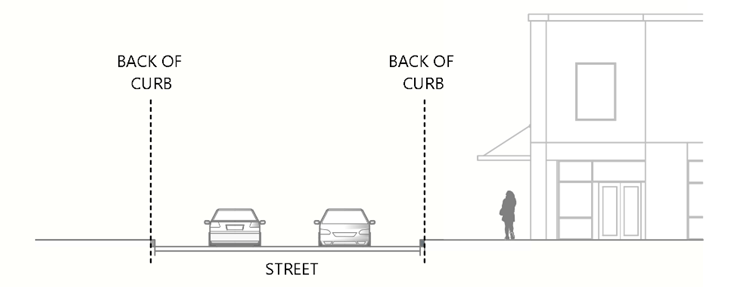
Back of curb means the farthest edge of a street curb adjacent to a street.
Bar and lounge means an establishment providing or dispensing by the drink for on-site consumption fermented malt beverages, and/or malt, special malt, vinous, or spirituous liquors, and in which the sale of food products is secondary. A bar, lounge, or tavern may include live entertainment, and dancing; however, shall not include any adult entertainment.
Basement means
(1)
For purposes of floodplain regulations, any area of a building having its floor sub-grade (below ground level) on all sides.
(2)
For all other purposes, an area below the first floor, having part but no more than one-half (½) its height above grade.
Bay means
(1)
When used in the context of building façade articulation, the spaces on a building's façade between vertical structural elements (walls, pilasters, columns, etc.); bays organize window, door, and building element placement.
(2)
When used in the context of parking lot design, a double-loaded row of parking, with a drive aisle in the center and head-in parking on either side; may be perpendicular or angled.
Bay window means a window that protrudes from the face of a building.
Bed and breakfast means a detached dwelling that is owner-occupied and owner-operated in which rooms are rented and meals may be served to transient guests on an overnight basis.
Block (development block) means the area defined by streets (public or internal) or open spaces (public or internal) intended for the development of parks or buildings. Development block is a term used in urban design and form-based coding that applies to the organization of legally dedicated lots surrounded by thoroughfares that have been subdivided by plat.
Buffer means a strip of land established to separate and protect one type of land use from another to screen from objectionable noise, odor, or visual impact, or to provide for future public improvements or additional open space often in conjunction with a floodplain.
Buffer, residential roadway means a strip of land to separate the rear or side property line of residential lots from the adjacent right-of-way for arterial and collector roadways and to screen from objectionable noise and visual impacts.
Building means any structure used or intended for supporting or sheltering any use, storage, or occupancy.
Building element means a component of a building that gets added or subtracted from the main mass of the building, such as a porch, wing, balcony, or awning.
Building elevation means a fully dimensioned, to-scale drawing of the front, rear or side of a building showing all visible building features such as windows, doors, dormers, gables, chimneys, covered porches, decks, building materials and relationship to grade level.
Building façade means an elevation of a building, generally an approximately vertical front, side, or rear wall, or a portion of a front, side, or rear wall.
Building side means the façade of a building that is distinguished as a secondary façade, for example, a left and/or right side of the building that is not the primary façade.
Building height means the height of a building measured with respect to site grade as described in Section 13.04.230(e), Building height.
Building, accessory means a detached subordinate building located on the same lot as the principal building, the use of which is incidental to the principal building or use of the lot.
Building, front means the side of the building facing the most prominent public roadway or internal street or open space; the façade on which the principal building entrance is located.
Building frontage means
(1)
For the purposes of sign regulations, the building walls that: (1) face a public or Town-approved private street; (2) face a parking lot that serves the use; or (3) contain the primary public entrance to the uses in the building. A public alley is not considered a public or Town-approved private street.
(2)
For all other purposes, the linear frontage of a building, lot, or parcel adjacent to a private or public street that provides principal access to or visibility of the premises.
Building materials and supply store means a business involved in the sale, outdoor display, and distribution of structure supplies and services including lumber, brick, tile, cement, insulation, floor covering, lighting, plumbing supplies, electrical supplies, cabinetry, and roofing materials. This definition includes retail hardware stores. Accessory uses may include repair or delivery services, outside sale of plants and gardening supplies, and incidental wholesale trade.
Building permit means written consent issued by the Town of Parker that permits construction.
Building, principal means the primary building or buildings on a lot that contains a principal use.
Building trim means a building material or materials used on the exterior perimeter of a building, around windows, doors, and other prominent architectural features, to provide variety and accent to the building. Building trim typically lies flat against a wall, in contrast to an architectural feature that projects vertically or horizontally.
Building unit means a space in a building that is leased or occupied by a commercial tenant or other occupant.
Building wall means any vertical surface of a building or structure that is integral to and can reasonably be construed as part of the architecture of the building. Building wall shall not include pitched roofs, mansard roofs, fences or retaining walls. For purposes of sign regulation, building walls include, but are not limited to awnings, canopies, marquees, the vertical portion of gable roofs, parapets, mechanical penthouses, and similar features.
Business day and/or working day means any day that the Parker Town Hall is open to the public to conduct Town business.
C
Canopy means a roof-like cover, supported from the ground or deck, floor, or walls of a structure over a door entrance, or window for protection from the sun or weather or a projecting roof-like cover above an outdoor service area, such as at an automotive fuel sales establishment.
Car wash means the use of a site for washing, cleaning, and detailing of passenger vehicles, recreational vehicles, or other light-duty equipment. This use includes any auto wash facility attended by an employee and self-service and coin-operated facilities.
Caretaker residence means a dwelling unit accessory to a principal use in any zoning district designed and intended for occupancy by a person owning, employed in, or dealing with, and responsible for the security and maintenance of, the principal use.
Carnival or festival means a temporary commercial or festive activity, open to the public, at a specific location that is planned or reasonably expected to attract large assemblies of persons.
Cartway means the paved area of a street between the curbs, including travel lanes and parking areas, but not including shoulders, curbs, sidewalks, or swales.
Cemetery means land used or intended to be used for the burial of the human dead and dedicated for such purposes and includes columbaria, crematoria, mausoleums, and mortuaries when operated in conjunction with and within the boundaries of such premises.
Certificate of Occupancy means a certificate issued by the Town of Parker after final inspection(s) when the development has been determined to comply with all requirements and provisions relevant to the development. This term shall also include a Certificate of Completion for structures where there is no occupancy.
Certified hemp seed means industrial hemp seed, including Colorado heritage cannabis seed, that has been certified by an organization recognized by the Colorado department of agriculture as having no more than a three-tenths of one percent of delta-9 tetrahydrocannabinol concentration on a dry-weight basis.
Check-cashing establishment means an establishment that cashes checks, drafts, money orders, traveler's checks, or similar instruments, for a fee. This definition does not include financial institutions, credit unions, loan offices, or similar uses, or a business that provides these services as an accessory use to a permitted principal use (such as a grocery store).
Chief Building Official means the Chief Building Official for the Town of Parker, or their designee. As of the Effective Date, the Chief Building Official is the Assistant Director of the Building Division.
Clearing means when used in the context of vegetation removal, landscaping, screening, buffering, or site design, the indiscriminate removal of trees, shrubs, and undergrowth with the intention of preparing real property for nonagricultural development purposes.
Cluster development means a form of development that allows for a reduction in lot size below minimum requirements if compensating amounts of open space are provided within the proposed development.
Commercial kitchen means a commercial establishment where foodservice providers can prepare, cook, and store food and equipment on the premise and distribute food off-site for sale, delivery, or consumption for caterings, mobile food vendors, concessions, social service organizations, or restaurants.
Comprehensive Master Plan (or Master Plan) means the overall plan for the future of the Town of Parker adopted by the Town Council pursuant to the home rule powers of a municipality authorized in Article XX of the Colorado Constitution and specifically authorized by Title 31, Article 23 of Colorado Revised Statutes, as amended.
Community and cultural facilities means a category of uses characterized by buildings, structures, or facilities that provide a service to the public and generally provide public access. Accessory uses may include limited retail, concessions, parking, and maintenance facilities.
Community facility means a use or facility owned or operated by a government entity, quasi-governmental entity such as a homeowner's association, nonprofit, charitable, fraternal, or veterans institution and providing educational, cultural, recreational, or similar types of programs.
Complete Streets Policy means the adopted complete streets policy of the Town of Parker, as amended.
Condominium or condo means a building or group of buildings in which dwelling units, offices, or floor area are designated for separate ownership and the remainder of the structure, land area, and facilities are commonly owned by all the unit owners on a proportional and undivided means basis.
Continuing care facility means a community or campus setting for care of the elderly or others in need of assisted care, that has common facilities and provides licensed intermediate and skilled nursing facilities for its residents, as well as other supportive services. This use generally incudes a variety of housing types and provides a variety of levels of assistance and care so that its residents may obtain higher levels of care and service over time without having to move to another residential care facility. This use includes establishments, other than a hospital, licensed by the Colorado State Department of Public Health, that maintains and operates continuous day and night facilities providing room and board, personal service, and skilled nursing care such as assisted living, independent living, and/or memory care. A continuing care facility is not considered a "group home" or "group residential facility" as defined in this LDO, and does not include facilities that are not required to be licensed by the Colorado State Department of Public Health.
Contractor office means a subordinate building and related outdoor areas used to store and maintain construction equipment and other materials and facilities customarily required in the building trade by a construction contractor. This use may include showrooms and shops for the display and sale of electrical, plumbing, heating, air conditioning, sheet metal, and other material in connection with contracting services.
Cornice means a protrusion from the top of a ceiling or pediment, or at the bottom of a roof.
Council means the Town Council of Parker, Colorado.
Cul-de-sac means a street having one open end open to vehicular traffic and the other end permanently terminating in a vehicular turnaround.
D
Daycare, commercial means a facility licensed, certified, or registered by the State of Colorado that operates in a location other than a private residence that provides care, protection, and supervision for children or adults on a regular basis away from their principal residence for a period of less than twenty-four (24) hours per day. Commercial daycares may operate twenty-four (24) hours a day, but the children or adults are cared for at the facility fewer than twenty-four (24) hours a day.
Daycare, residential means a facility licensed, certified, or registered by the State of Colorado that operates in the permanent residence of the provider that provides care, protection, and supervision for children or adults on a regular basis away from their principal residence for a period of less than twenty-four (24) hours per day at any time. This use does not include group residential facilities.
De novo review means a review of a Town decision by a higher body that is not based solely on the record of the materials presented to and relied on by the previous decision-maker, but that can include the introduction of new documents and/or testimony.
Dedicated land means land legally conveyed or transferred to the Town or other public, quasi-public entity or other entity by platting, title, deed, or other legal method approved by the Town Attorney's office. Dedicated land shall be used for public purposes, such as school sites, fire stations, parks, open space or such other uses or facilities as approved by Town Council or indicated within approved Development Guides or plans.
Delta-9 tetrahydrocannabinols means synthetic equivalents of the substances contained in the plant, or in the resinous extractives of, cannabis or synthetic substances, their derivatives, and their isomers with similar chemical structure and pharmacological activity.
Density means the overall level of intensity for residential development, expressed as a ratio of dwelling units per acre, not including land in the floodplain or in areas having steep slopes.
Design capacity means the approved capacity of a building or facility based on applicable fire and building codes.
Developer means any person, corporation, joint venture, partnership, or other entity which applies to the Town for any of the following services: annexation, zoning, subdivision, Site Plan, Variance or other administrative, quasi-judicial or legislative function of the Town described in this LDO.
Development means
(1)
For purposes of floodplain regulation, any man-made change to improved or unimproved real estate, including, but not limited to, buildings or other structures, mining, dredging, filling, grading, paving, excavation or drilling operations or storage of equipment or materials located within the area of special flood hazard.
(2)
For all other purposes, any man-made change to improved or unimproved property.
Development, infill means new development of building or structures on vacant or underused lots that have frontage on existing streets and that are bounded on at least sixty-five (65) percent of their side and rear lot lines by lots containing existing buildings or structures.
Development Design Standards means the adopted document containing the architectural and site design standards for the Town of Parker, as amended.
Development guide and plan means a document that sets forth the standards and requirements for a planned development including land use, uses of structures, minimum lot, and height criteria (dimensional standards), and supplemental regulations. It shall include a development plan indicating location of uses, rights-of-way, natural features, and such other items as may be requested by the Planning Commission or Town Council. This document shall be used for review and evaluation of the project and shall, upon approval by Town Council, be recorded with the Douglas County Clerk and Recorder.
Dimensional standards means the numeric standards and requirements related to lots, buildings, and development activities including bulk standards such as height, setbacks, land area, square footage, and density.
Director of Engineering/Public Works means the employee of the Town designated to perform or be responsible for the performance of those duties identified for that official in this LDO, as well as other duties assigned by the Town Council, or their designee.
Disposition means a contract of sale resulting in the transfer of legal and equitable title to an interest in subdivided or unsubdivided land; a lease or an assignment of an interest in subdivided or unsubdivided land; or any other conveyance of an interest in subdivided or unsubdivided land.
Distribution facility means the intake and redistribution of goods and merchandise, individually or in bulk, including the short-term holding or storage of those goods or merchandise including without limitation a food bank, prescription drug delivery service, or last mile goods delivery service. This definition shall also include a transshipment facility for the temporary holding, storage and shipment of goods or vehicles.
Dormer means a window that projects vertically from a sloping roof.
Drive-through facility means a building or facility designed to allow customers to receive services or obtain goods while remaining in their vehicles that are in a designated stacking lane. A drive-through facility (or "drive-up facility") may be in combination with other uses, such as banks, credit unions, loan associations, automated teller machines (atm's), dry cleaners, drug stores, pharmacies, restaurants, or similar uses. This definition does not include car wash, major or minor automotive repair facility, or automotive fuel sales.
Driveway means a private area used for ingress and egress of vehicles and that allows access from a street or road to a building or other structure or facility.
Dwelling means a building or portion of a building used exclusively for residential occupancy, including one-family dwellings, duplex dwellings, and multiple-family dwellings, but not including mobile homes, hotels, motels, tents, seasonal vacation cabins, or other structures designed or used primarily for temporary occupancy. No mobile home or converted mobile home shall be classed as a dwelling.
Dwelling, co-housing means a residential development that combines small individually owned units on a single lot with common open space and sometimes including a larger community kitchen and dining room intended for communal use on a regular basis. The residents in a co-housing development may agree to share in the provision of communal services such as cooking meals, maintenance of grounds, and child care.
Dwelling, duplex means a detached building containing two (2) dwelling units, designed for, or used as dwellings exclusively by two (2) families, each living as an independent housekeeping unit.
Dwelling, live/work means a dwelling unit containing an integrated living and working space in different areas of the same unit, and designed with the living space located above or behind a ground floor working space facing the front lot line.
Dwelling, multifamily means a building, or portion of a building, designed for or occupied by three (3) or more families living independently of each other, such as apartment or condominium buildings, and includes facilities that offer supportive services but that are not required to be licensed by the Colorado State Department of Public Health. This use does not include hotels or motels.
Dwelling, single-family detached means a building arranged, designed, and intended to be occupied by not more than one (1) family, located on a single lot, that complies with either the Town's adopted building code or is certified pursuant to the National Manufactured Housing Construction and Safety Standards Act of 1974, 42 USC 5401 et seq., as amended, and is built for the Colorado climate and snow loads pursuant to Department of Housing and Urban Development standards established under the provisions of 42 USC 5401 et seq. This use shall include modular homes, manufactured homes, and tiny homes that comply with either of these construction standards. See also definition of "secondary family space" in Title 11, Section 11.02.050, Amendments, of the Parker Municipal Code.
Dwelling unit means one (1) or more rooms designed, occupied, or intended for occupancy as a separate living quarter, with facilities for living, cooking, sleeping, and sanitary facilities provided within the dwelling unit for the exclusive use of a single family maintaining a household.
Dwelling unit, accessory[2] means a dwelling unit added to, created within, or detached from a single-family detached dwelling that (1) is subordinate in size to a principal single-family detached dwelling, (2) that provides basic facilities for living, sleeping, cooking, and sanitation independent from those in the principal single-family detached dwelling, and (3) does not meet the definition of a secondary living space in Title 11, Section 11.02.050, Amendments, of the Parker Municipal Code. This definition includes all detached subordinate structures regardless of whether they are stick-built or fabricated on site, prefabricated off-site for installation or assembly on site, or designed as modular homes, manufactured homes, recreational vehicles, or tiny homes.
E
Easement means an acquired right of use, interest or privilege in land owned by another, which interest is recorded in the real estate records of Douglas County.
Eave means the part of a roof that meets or overhangs the walls of a building.
Educational facilities means uses in this category are characterized by public, private, and parochial institutions at the primary, elementary, middle, high school, or post-secondary level, or vocational or trade schools. Accessory uses commonly include cafeterias, indoor and outdoor recreational and sport facilities, auditoriums, and daycare facilities. See also, school.
Effective date means the date on which this LDO became effective, as provided by Ordinance No. 3.372.
Electric vehicle charging station means a public or private parking space that is served by battery charging equipment for the purpose of transferring electric energy to a battery or storage device in an electric vehicle, classified as follows:
(1)
Level 1 charging station is a slow-charging station that typically operates on a 15- to 20-amp breaker on a 120-volt Alternating Current (AC) circuit.
(2)
Level 2 charging station is a medium-speed charging station that typically operates on a 40- to 100-amp breaker on a 208- or 240-volt AC circuit.
(3)
Level 3 charging station is a fast, industrial-grade charging station that operates on a high-voltage circuit.
Encroachment means the placement of a building, part of a building, sign, or fence within an easement or into required setbacks.
Engineer means a professional engineer currently registered by the State of Colorado.
Equipment and machinery sales, rental, and repair means an establishment engaged in the display, sale and rental of equipment, tools, supplies, machinery, or other equipment used for building construction, manufacturing, farming, or agriculture. This use includes the sale of farm-specific vehicles such as tractors, tillers, farm trailers, back hoes, graders, boom lifts, front-end loaders, truck tractors, and truck tractor trailers.
F
Family means two (2) or more persons related by blood, marriage, or other legally recognized relationship, including adoption and foster care, or a group not exceeding five (5) unrelated persons (excluding paid household staff such as nannies, cleaners and caregivers) living together as a single housekeeping unit in one (1) structure on one (1) lot, unless otherwise specifically authorized by this LDO, including, without limitation, by Section 13.05.030(c)(7) and its regulation of group homes, as may be amended from time to time, or by the provisions of state or federal law. This definition of family supersedes any definition of family in planned development documents, including, without limitation, Development Guides adopted by ordinance.
Fence means a freestanding structure resting on or partially buried in the ground and rising above ground level used for confinement, screening, or partitioning purposes.
Fence height means the height of a fence measured with respect to the site grade as described in Section 13.04.230(e), Building height.
Financial institution means an establishment that provides retail banking, mortgage lending, and financial services to individuals and businesses, but does not include pawnbrokers or check-cashing facilities. Accessory uses may include offices and automated teller machines (ATMs). Drive-through establishments are regulated by separate accessory use type and are not automatically permitted as part of the definition of "financial institution."
Financial security means when used in the context of public improvements or subdivision improvements, a financial guarantee in the form of an irrevocable letter of credit or cash arrangement to secure the completion of improvements authorized by this LDO and approved by the Town.
Flag means any fabric, banner or bunting containing distinctive colors, patterns or symbols and is attached to a pole and that is intended to be permanently affixed to the ground or attached to a building.
Flagpole means a pole physically anchored to the ground with an underground foundation on which a flag is or can be displayed.
Flat roof means a roof without a visible pitch, including mono-pitch or parapet roofs.
Floodplain-related definitions means that as used in the interpretation of enforcement of regulations related to floodplains, the following terms shall have the following definitions.
Area of special flood hazard means the land in the floodplain subject to a one (1) percent or greater chance of flooding in any given year.
Base flood means the flood having a one (1) percent chance of being equaled or exceeded in any given year. The terms 100-year and one (1) percent chance flood are synonymous with the term base flood. The term does not imply that the flood will necessarily happen once every one hundred (100) years.
Base flood elevation means the elevation shown on a FEMA Flood Insurance Rate Map for Zones AE, AH, A1—A30, AR, AR/A, AR/AE, AR/A1—A30, AR/AH, AR/AO, V1—V30 and VE that indicates the water surface elevation resulting from a flood that has a one (1) percent chance of equaling or exceeding that level in any given year.
Camp means to reside or dwell temporarily in a place, with or using a shelter. As used in this definition, the term "shelter" includes, without limitation, any tent, tarpaulin, lean-to, sleeping bag, bedroll, blankets, or any form of cover or protection from the elements other than clothing; and the term "reside or dwell" includes, without limitation, conducting such activities as eating, sleeping, or the storage of personal possessions.
Channel means the physical confine of a stream or waterway consisting of a bed and stream banks, existing in a variety of geometrics.
Channelization means the artificial creation, enlargement, or realignment of a stream channel.
Conditional Letter of Map Revision (CLOMR) means comment on a proposed project, that does not revise an effective floodplain map, that would, upon construction, affect the hydrologic or hydraulic characteristics of a flooding source and thus result in the modification of the existing regulatory floodplain.
Critical facility means a structure or related infrastructure, but not the land on which it is situated, that, if flooded, may result in significant hazards to public health and safety or interrupt essential services and operations for the community at any time before, during and after a flood.
Digital Flood Insurance Rate Map (DFRIM) means FEMA's digital floodplain map that serves as the regulatory floodplain map for insurance and floodplain management purposes.
Elevated building means a non-basement building: (i) built, in the case of a building in Zones A1—A30, AE, A, A99, B, C, X and D, to have the top of the elevated flood above the ground level by means of pilings, columns (posts and piers) or shear walls parallel to the flow of the water; and (ii) adequately anchored so as not to impair the structural integrity of the building during a flood of up to the magnitude of the base flood. In the case of Zones A1—A30, AE, A, A99, AO, AH, B, C, X and D, elevated building also includes a building elevated by means of fill or solid foundation perimeter walls with openings sufficient to facilitate the unimpeded movement of floodwaters.
FEMA means the Federal Emergency Management Agency, the agency responsible for administering the National Flood Insurance Program.
Flood or flooding means a general and temporary condition of partial or complete inundation of normally dry land areas from:
(1)
The overflow of water from channels and reservoir spillways; and/or
(2)
The unusual and rapid accumulation or runoff of surface waters from any source.
Flood Insurance Rate Map (FIRM) means the official map on which the Federal Emergency Management Agency has delineated both the areas of special flood hazard and the risk premium zones.
Flood profile means a graph or a longitudinal profile showing the relationship of the water surface elevation of a flood event to location along a stream or river.
Flood protection elevation means an elevation one (1) foot above the elevation or flood profile of the 100-year flood under existing channel and floodplain conditions. It is one (1) foot above the elevation of the flood for the flood regulatory area.
Flood regulatory area means the channel of a river or other watercourse and the adjacent land areas that must be reserved in order to discharge the base flood without cumulatively increasing the water surface elevation more than a designated height.
Flood stage means the height or elevation of a flood as referred to in some datum. For other purposes, it is commonly used to refer to the elevation at which a stream will overtop its normal stage banks.
Flood storage means those portions of the floodplain that may serve as a temporary storage for flood-waters from the 100-year flood that are outside the floodway area.
Floodplain or flood-prone area means the area of land that could be inundated as a result of a flood.
Floodplain Administrator means the community official designated by title to administer and enforce the floodplain management regulations in Section 13.08.040(a), Floodplain regulations.
Floodplain development permit means a permit required before construction or development begins within any special flood hazard area (SFHA) pursuant to Section 13.08.040(a), Floodplain regulations. If FEMA has not defined the SFHA within the Town, the Town shall require permits for all proposed construction or other development in the community, including the placement of manufactured homes, so that it may determine whether such construction or other development is proposed within flood-prone areas. Permits are required to ensure that proposed development projects meet the requirements of the NFIP and this Section.
Floodproofing means any combination of structural and/or nonstructural additions, changes or adjustments to structures that reduce or eliminate flood damage to real estate or improved real property, water and sanitary facilities, structures, and their contents.
Floodway (regulatory floodway) means the channel of a river or other watercourse and the adjacent land areas that must be reserved in order to discharge the base flood without cumulatively increasing the water surface elevation more than six (6) inches.
Freeboard means the vertical distance in feet above the predicted water surface elevation intended to provide a margin of safety to compensate for unknown factors that could contribute to flood heights greater than the height calculated for a selected size flood, such as debris blockage of bridge openings and the increased runoff due to urbanization of a watershed.
Hydraulic analysis means the determination of flood elevations and velocities for various probabilities based on a scientific analysis of the movement and behavior of floodwaters in channels and overbank areas.
Hydrologic analysis means the computation of the peak rate of flow, or discharge in cubic feet per second, for various selected probabilities for streams, channels or watersheds based on scientific analysis of the physical process.
Letter of Map Revision (LOMR) means FEMA's official revision of an effective Flood Insurance Rate Map (FIRM) or Flood Boundary and Floodway Map (FBFM), or both. LOMRs are generally based on the implementation of physical measures that affect the hydrologic or hydraulic characteristics of a flooding source and thus result in the modification of the existing regulatory floodway, the effective base flood elevations (BFEs) or the special flood hazard area (SFHA).
Letter of map revision based on fill (LOMR-F) means FEMA's modification of the special flood hazard area (SFHA) shown on the Flood Insurance Rate Map (FIRM) based on the placement of fill outside the existing regulatory floodway.
Lowest floor means the lowest floor of the lowest enclosed area (including basement). An unfinished or flood-resistant enclosure, usable solely for parking of vehicles, building access or storage, in an area other than a basement area, is not considered a building's lowest floor, provided that such enclosure is not built so as to render the structure in violation of the applicable nonelevation design requirements of Section 13.08.040(a), Floodplain regulations.
Mean sea level means the North American Vertical Datum (NAVD) of 1988 or other datum to which base flood elevations shown on a community's flood insurance map are referenced.
National Flood Insurance Program (NFIP) means FEMA's program of flood insurance coverage and floodplain management administered in conjunction with the Robert T. Stafford Relief and Emergency Assistance Act. The NFIP has applicable federal regulations promulgated in LDO 44 of the LDO of Federal Regulations. The U.S. Congress established the NFIP with the passage of the National Flood Insurance Act of 1968.
New construction means structures for which the start of construction commenced on or after the Effective Date, and includes any subsequent improvements to such structures.
No-Rise Certification means a record of the results of a floodway engineering analysis and report, sealed by a registered Colorado professional engineer, and supported by technical data, certifying that there is not more than a 0.00 foot rise in the proposed conditions compared to existing conditions floodway resulting from a proposed project in a regulatory floodway.
Personal property means any item that is reasonably recognizable as belonging to a person and that has apparent utility, including, without limitation, personal identification, eyeglasses, money, or jewelry.
Physical Map Revision (PMR) means FEMA's action whereby one (1) or more map panels are physically revised and republished. A PMR is used to change flood risk zones, floodplain and/or floodway delineations, flood elevations and/or planimetric features.
Substantial damage means flood-related damage that equals or exceeds fifty (50) percent of the value of the building. The value of the structure shall be determined by the local jurisdiction having land use authority in the area of interest.
Substantial improvement means any reconstruction, rehabilitation, addition or other improvement of a structure, the cost of which equals or exceeds fifty (50) percent of the market value of the structure before the start of construction of the improvement. The value of the structure shall be determined by the local jurisdiction having land use authority in the area of interest. This includes structures that have incurred substantial damage, regardless of the actual repair work performed.
Floor area, gross means the total horizontal floor area measured in square feet, of all floors of a building, excluding garage space and porches.
Floor area, net means the total horizontal floor area measured in square feet, of all floors of a building, excluding walls, stairways, elevator shafts, restrooms, covered malls, covered walkways, roofed and other patio areas, covered entries, covered parking, covered driveways, covered loading areas, utility rooms, and accessory storage areas.
Food and beverage processing means a facility where food and beverage for human consumption in its final form, such as candy, baked goods, tortillas, ice cream, and soda is produced, and the food and beverage is distributed to retailers or wholesalers for resale on or off the premises.
Food and beverage services means an establishment that serves prepared food or beverages for consumption on or off the premises. Accessory uses may include food preparation areas, offices, and parking.
Food bank means a facility where a government agency or non-profit organization collects and distributes food and/or other goods.
Framework Plan means a draft conceptual plan, with supplemental material, showing the preliminary character, use, and layout of blocks, lot(s), including the preliminary locations, square footages, and dimensions of buildings, preliminary yards, courts, parking locations, fence locations, common open space, and other features prior to the submittal of Site Plan. When used in the context of a proposed subdivision of land, it may alternatively mean a map of the proposed subdivision, together with required supporting materials, drawn, and submitted in adequate detail to allow the Town to evaluate the feasibility and potential impacts of the proposed design at a conceptual stage in the planning process.
Funeral facility means an establishment for the care, preparation, or disposition of the deceased for burial and the display of the deceased and rituals connected with, and conducted before, burial, or cremation. This use includes mortuaries, that are facilities in which dead bodies are prepared for burial or cremation, crematoria, columbaria, and funeral homes.
G
Gable means the part of a wall that encloses the end of a pitched roof.
Garage means a building or portion of a building designed and intended for the parking or temporary storage of motorized vehicles.
General retail, ten thousand (10,000) square feet or less means retail sales, not otherwise included in a definition for a specific use type within the retail sales use category, containing not more than ten thousand (10,000) square feet of gross floor area of the establishment or use (not the size of the structure).
General retail, more than ten thousand (10,000) square feet means retail sales containing more than ten thousand (10,000) square feet of gross floor area of the establishment or use (not the size of the structure).
Grade means the level of the earth at a specific location or at ground level. Measurement of grade for purposes of determining maximum permitted building height is described in Section 13.04.230(e), Building height.
Greenway means (a) an open space area that has a linear form, typically following a creek, gulch, or other natural landform or a trail or other transportation corridor, or (b) a series of open space parcels that are intended to provide a contiguous, linked natural system and create a sense of cohesiveness within the Town, and that is generally used to preserve wildlife habitat and corridors, to guide growth, and to establish community buffers.
Ground floor means the lowest floor that sits above the average grade of a site.
Group living means uses in this category are characterized by residential occupancy of a structure by a group of people who do not meet the definition of "family." Tenancy is arranged on a monthly or longer basis and the size of the group may be larger than a "family." Generally, group living structures have a common eating area for residents. Residents may receive care, training, or treatment, and caregivers may or may not also reside at the site. Accessory uses commonly include recreational facilities and vehicle parking for occupants and staff.
Group home means a residence where no more than eight (8) persons are living, together with staff, as a single housekeeping unit providing care, supervision, and treatment for the use of no more than eight (8) persons whose right to live together is protected by the provisions of the federal Fair Housing Act Amendments of 1988, as defined in that Act and interpreted by the courts, or by any similar legislation of the State of Colorado including but not limited to facilities providing housing for mentally ill or intellectually or developmentally disabled persons as defined by Sections 25.5-10-202 and 27-65-102, C.R.S., as amended. This definition also includes addiction recovery residences and domestic violence shelters.
Group residential facility means a residence where nine (9) or more persons are living, together with staff, as a single housekeeping unit providing care, supervision, and treatment for the use of nine (9) or more persons whose right to live together is protected by the provisions of the federal Fair Housing Act Amendments of 1988, as defined in that Act and interpreted by the courts, or by any similar legislation of the State of Colorado including but not limited to facilities providing housing for mentally ill or intellectually or developmentally disabled persons as defined by Sections 25.5-10-202 and 27-65-102, C.R.S. as amended. This definition also includes addiction recovery residences and domestic violence shelters.
H
Hard corner means any parcel of land located on any corner at the intersection of key arterials and/or major collectors as follows:
(1)
Cottonwood Dr./Jordan Road
(2)
Cottonwood Dr./Parker Road
(3)
Chambers Road/Lincoln Ave.
(4)
Lincoln Ave./Jordan Road
(5)
Lincoln Ave./Twenty Mile Road
(6)
Lincoln Ave./Parker Road
(7)
Twenty Mile Road/Mainstreet
(8)
Jordan Road/Mainstreet
(9)
Chambers Road/Mainstreet
(10)
Parker Road/Twenty Mile Road
(11)
Parker Road/Hess Road
(12)
Parker Road/Stroh Road
(13)
Chambers Road/Hess Road
(14)
Jordan Road/Hess Road
(15)
Stroh Road/Motsenbocker Road (Crowfoot Valley Road)
(16)
Chambers Road/Stroh Road
(17)
Chambers Road/Crowfoot Valley Road
(18)
Hess/Motsenbocker Road
(19)
Lincoln Ave./ Pine Dr.
(20)
Mainstreet/Pine Dr.
Hardship, as it relates to a condition of the property or the required showing under Section 13.03.040(x), Variance. means exceptional narrowness, shallowness, shape, topographic condition or other extraordinary and exceptional situation or condition of a piece of property that create exceptional or practical difficulties to the property owner's use or development of the property and that are not generally shared by property in the surrounding area, and that is not a self-created hardship.
Hardship, self-created means a condition related to the property that would otherwise meet the definition of a hardship, but that was created by the actions of the property owner prior to applying for a Variance or other form of relief under this LDO. The purchase of a lot, parcel, or tract that does not conform to the requirements of this LDO for the zoning district in which it is located is not, by itself, a self-created hardship provided the property owner does not take additional actions following the purchase that compound the difficulty of use or development of the property or increase the degree of nonconformity.
Healthcare facilities means uses focusing on medical services, particularly licensed public or private institutions that provide primary health services and medical or surgical care to persons suffering from illness, disease, injury, or other physical or mental conditions. This use includes hospitals and include continuum of care campuses or facilities. Accessory uses may include laboratories, outpatient, or training facilities, or other amenities primarily for the use of employees in the firm or building.
Home occupation means an occupation or profession that is conducted within a dwelling or on the premises and is clearly incidental and secondary to the residential use of the dwelling.
Hospital means an institution designed for the diagnosis, treatment and care of human illness or infirmity and providing health services, primarily for inpatients, and including as related facilities, laboratories, outpatient departments, training facilities, and staff offices. This use includes free-standing emergency rooms.
Hotel/motel means structure(s) containing individual guest units for rental on a daily rate to guests and consisting of individual sleeping quarters, detached or in connected rows, with or without cooking facilities. Accessory uses may include additional services such as restaurants, meeting rooms, and recreational facilities.
Household living means uses in this category are characterized by buildings or portions of a building that are used exclusively for residential occupancy by a single household but not including hotels, motels, tents, short-term rentals, or other structures designed or used primarily for temporary occupancy.
Housekeeping unit means a single dwelling unit, with common access to and common use of all living and eating areas and of all areas and facilities for the preparation and serving of food within the dwelling unit.
I
Impervious surface means any hard-surfaced, man-made area that does not readily absorb or retain water, including but not limited to asphalt, concrete, roofing material, brick, paving block, or plastic.
Industrial, general means larger-scale industrial operations that may include assembly, distributing, fabricating, manufacturing, packaging, processing, recycling, trash transfer, including the initial processing of raw materials. General industrial uses may operate in a manner that may produce noise, smoke, fumes, odors, glare that may not be fully mitigated on site, and may contain health and safety hazards on site. General industrial uses are not permitted within the Town of Parker.
Industrial hemp means a plant of the genus cannabis and any part of the plant whether growing or not, containing a delta-9 tetrahydrocannabinol concentration of no more than three-tenths of one percent on a dry-weight basis.
Industrial hemp processing means the further processing of hemp, that has been grown and harvested in compliance with the Colorado department of agriculture for commercial industrial hemp or research and development regulations, resulting in an altered finished product, and limited as an authorized use only as permitted in Table 13.05.A: Table of Allowed Uses.
Infrastructure means the provision of systems that provide transportation, water, wastewater, solid waste removal, stormwater drainage, electrical, and franchise facilities typically required to service development.
Inorganic materials means, as used in connection with landscaping, buffering, and screening regulations, non-living, inert materials including but not limited to plastic sheeting, landscape fabric, crushed gravel, granite, and river rock that do not readily decompose.
J
Reserved
K
Kennel, commercial means any building, structure, area, or portion of a building, structure, or area used for the breeding, raising, boarding, or selling of cats, dogs, or other domesticated animals permitted in the Town, excluding those permitted in the Agriculture zone district, and that are more than four (4) months old, or for more than one litter per year, pursuant to Section 9.05.020. Grooming, indoor training, and pet health care facilities are accessory to this use.
Kiosk means a small structure, typically located within a pedestrian walkway or similar circulation area, intended for use as a small shop, or for use as a display space for posters, notices, and exhibits.
L
Land-disturbing activity means any grading, scraping, excavating, or filling of land, clearing of trees or vegetation and any construction, reconstruction, or significant alteration of a structure.
Landowner means all persons having legal title to a parcel of real property.
Laundry facility, commercial means an establishment that cleans clothing, carpeting, drapes, and other cloth or synthetic fiber materials using a chemical process. This definition includes uses such as dry-cleaning facilities; rug cleaning or repair service; pressing of garments or fabrics; carpet or upholstery; power laundry; industrial launderers; and linen supply.
Laundry facility, self-service means an establishment providing washing, drying, or other cleaning machines on the premises for rental use to the general public. This definition includes automatic, self-service only, or hand laundries.
Leasable area, gross means the total floor area designed for tenant occupancy and exclusive use, including basements, mezzanines, and upper floors, if any, expressed in square feet measured from centerlines of joint partitions and exteriors of outside walls.
Leasable area, net means all the leasable area of a building exclusive of non-leasable space, such as hallways, building foyers, areas devoted to heating, air conditioning, elevators, and other utility areas. The net leasable area produces the lease income economically supporting the building.
Legal description means a description of a parcel, tract, of area of land by reference to a recorded plat of the property, by metes and bounds, or otherwise sufficient to identify the boundaries of the parcel, tract, or area of land, as determined by the Town.
Light Industrial means small-scale industrial operations including the assembly, brewing, and distilling, distributing, fabricating, manufacturing, packaging, processing, repairing, servicing, or wholesaling of goods or products, using parts or components previously processed or manufactured from raw materials and wholly contained within a building. This use includes commercial kitchens. This definition does not include the initial processing of raw materials. Light industrial uses are capable of operation in a manner that mitigates the external effects of the manufacturing process, such as noise, smoke, fumes, odors, glare, or health or safety hazards.
Lighting-related definitions means when used in the context of lighting regulations, the following terms shall have the following definitions.
Decorative or accent lighting means low light exterior lighting that is designed to highlight structures, plantings, or significant architectural features in a direct or indirect manner.
Decorative lighting display means permanently affixed lights that are not for safety and security lighting, but are intended to promote an enhanced visual environment on a site. These types of lights may include string lights, eave mounted LED lighting systems, neon type lights or similar that are located on the principal architectural features of a building such as the front entrance, roof elements such as roof gables or peaks, or principal architectural elements above the ground floor on a non-residential building or mixed-use building. This definition also includes decorative lights attached to trees. This type of lighting display does not include temporary holiday lighting displays.
Fixture means the assembly that houses the lamp(s) and can include all or some of the following parts: a housing, a mounting bracket or pole socket, a ballast, a lamp, a reflector, or mirror and/or a refractor lens.
Floodlight or spotlight means a light fixture or lamp that incorporates a reflector to concentrate the light output into a directed beam in a particular direction.
Footcandle means a unit of light or density when the foot is the unit of measure. One (1) footcandle (fc) equals one (1) lumen per square foot of area. When metric units are used, lux is the unit of light quantity. One (1) lux equals one (1) lumen per square meter of area. One (1) footcandle equals ten and seventy-six hundredths (10.76) lux. For the purpose of establishing consistent measurements, both footcandles and lux are measured at finished grade.
Full-cutoff or fully-shielded means a luminaire that allows no light emission above a horizontal plane through its lower light-emitting part.
Glare means light emitted without a lens or through a clear lens from a luminaire with an intensity great enough to reduce a person's ability to see, and in extreme cases to cause momentary blindness.
Horizontal plane means an imaginary line drawn across the bottom of a light fixture above which no light shall be emitted.
Initial luminaire lumens means for luminaires with relative photometry per the Illuminating Engineering Society (IES), it is calculated as the sum of the initial lamp lumens for all lamps within an individual luminaire, multiplied by the luminaire efficiency. If the efficiency is not known for a luminaire, assume seventy (70) percent. For luminaires with absolute photometry per IES LM-79, it is the total luminaire lumens. The lumen rating of a luminaire assumes the lamp or luminaire is new and has not depreciated in light output.
Lamp means a generic term for a source of optical radiation (i.e., "light"), often called a "bulb" or "tube." Examples include incandescent, fluorescent, high intensity discharge (HID) lamps, and low pressure sodium (LPS) lamps, as well as light-emitting diode (LED) modules and arrays.
Lighting output levels means the sum of the initial luminaire lumens for all light fixtures.
Light trespass means the shining of more than one (1) foot-candle of light produced by a luminaire that shines beyond the boundaries of the property on which the fixture is located.
Lumen means a unit of luminous flux. One (1) foot-candle is one (1) lumen per square foot.
Luminaire means the complete lighting system, that includes the lamp(s) and fixtures.
Luminaire efficiency means the ratio of light output emitted by the luminaire to the light output emitted by its lamps.
Luminaire height means the measurement from a paved or landscaped surface at ground level directly under the fixture to the top of the luminaire.
Lux means a unit of illumination equal to the direct illumination on a surface that is one (1) meter from a uniform point source of one (1) candle intensity, or equal to one (1) lumen per square meter.
Parker-Style Five-Globe Street Light (Parker Light) means the Victorian Series, Model VP-103, manufactured by Niland Company as defined in the Parks, Trails, Open Space, and Streetscape Design and Construction Manual.
Partially shielded means light fixtures that are shielded or constructed so that no more than ten (10) percent of the light rays are emitted by the installed fixture at angles above the horizontal plane.
Uniformity ratio means a measure of how evenly light is distributed on any given site. A uniformity ratio is usually expressed in average foot-candles of illuminance on a paved area to the foot-candles at the point of maximum or minimum illuminance on the same site. For example, an average to minimum uniformity ratio of 6:1 requires that the average foot-candle level of the luminaire is not greater than six (6) times the minimum level. In other words, the minimum cannot be less than one-sixth (⅙) the average. If the average is twelve (12) foot-candles, the minimum should be no less than two (2).
Lodging facilities means uses in this category are characterized by for-profit facilities where shelter, meals, and the like are provided to transient visitors and guests for a defined period not to exceed thirty (30) days.
Lot means a tract, plot or portion of a subdivision or other parcel of land in single ownership and not divided by a public street.
Lot area means
(1)
For purposes of hillside development regulations, the gross land area contained within a lot, excluding land area devoted to public or private rights-of-way (the latter includes access easements).
(2)
For all other purposes, the total horizontal square footage within the property lines of a lot.
Lot coverage means those portions of a lot that are covered by principal and accessory enclosed structures, and by driveway surfaces that prevent the passage or absorption of water (including graveled driveways).
Lot, double-frontage means a platted lot where more than one (1) property line faces a street or other right-of-way along a street.
Lot, flag means a lot where access to the public or private road is by a narrow section of the lot.
Lot, protected means any lot that contains an existing single-family attached or detached dwelling or duplex dwelling.
Lot, restricted means any lot that contains a principal use other than a single-family attached or detached or duplex dwelling and that is adjacent to a Protected Lot.
Lot, through means a lot that fronts upon two (2) parallel or approximately parallel streets.
Lot line, interior means any lot line that is not adjacent to a street.
Lot line, front means the property line adjacent to the most prominent public roadway or internal access street.
Lot line, rear means the property line opposite a front lot line that is most distant from and most closely parallel to the front lot line.
Lot line, side means a property line that is not a front or rear lot line. On a corner lot, a side lot line may be adjacent to a street.
Lot width means the width of the lot as measured at the front setback line.
M
Mainstreet Master Plan means the adopted Mainstreet Master Plan of the Town, as amended.
Manufactured home means a structure, transportable in one (1) or more sections, which is built on a permanent chassis and is designed for use with or without a permanent foundation when attached to the required utilities. The term manufactured home does not include a recreational vehicle or a mobile home.
Manufacturing and processing means uses in this category are characterized by the extraction, transporting, manufacturing, fabrication, processing, reduction, destruction or any other treatment of any article, substance, or commodity, in order to change its form, character or appearance. Accessory uses may include retail sales, offices, storage, cafeterias, employee amenities, parking, warehousing, and repair facilities.
Massing means when used in the context of building design regulations, the overall shape and size of a building.
Master Plan means the adopted comprehensive plan of the Town of Parker, as amended.
Maximum extent practicable means reasonable efforts have been undertaken to comply with the regulation or requirement, that the costs of compliance clearly outweigh the potential benefits to the public or would unreasonably burden the proposed project and that reasonable steps have been undertaken to minimize any potential harm or adverse impacts resulting from noncompliance.
Medical or dental clinic means an establishment where patients are examined and treated on an outpatient basis by licensed health care practitioners or dentists. This use includes urgent care facilities and licensed health spas, alternative care, and holistic healing centers. This use does not include non-licensed providers or free-standing emergency rooms. Accessory uses may include incidental retail sales of products incidental to the services provided.
Metropolitan district means a special district that provides for the inhabitants of the district two (2) or more of the services provided in Section 31-1-103(10), C.R.S.
Microbrewery, cidery, distillery or winery means a business that produces or distills alcoholic beverages and is operated separately or in conjunction with a drinking establishment or restaurant. This use is limited to an annual production capacity of fifteen thousand (15,000) barrels or four hundred sixty-five thousand (465,000) gallons.
Mineral estate means a mineral interest in real property that is shown by the real estate records of the county in which the real property is situated and is not owned as part of the full fee title to the real property.
Mineral estate owner means the owner or lessee of a mineral estate for which notice is required pursuant to Section 13.03.030(g)(4)d and for which the records of the Douglas County Clerk and Recorder allow the applicant to reasonably and in good faith identify the mineral estate owner.
Mining and extraction means the withdrawal, extraction, and/or refinement of materials including, but not limited to, minerals (either solid, liquid or gas that are usable in their natural form or converted to a usable form when extracted from the earth), sand, gravel, quarry aggregate, coal, dimension or landscape stone, peat, and metals. This definition shall not include surface or groundwater.
Mixed-use, horizontal means a mix of residential uses and nonresidential uses within the same development site but not necessarily within the same building. Horizontal mixed-use development may include freestanding commercial uses and freestanding residential uses.
Mixed-use, vertical means a single building with both residential and nonresidential uses, where a minimum of seventy-five (75) percent of the ground floor gross floor area is occupied by nonresidential uses. Upper floors may be any combination of residential and commercial uses.
Mobile business means a commercial retail, food, or service establishment that is not intended to be permanent and is operated in a temporary location. A mobile business may include a motorized vehicle, wheeled vehicle, or a trailer that is licensed for use on public roadways, or a cart.
Mobile home means any manufactured home that does not comply with the National Manufactured Housing Construction and Safety Standards Act of 1974, 42 USC 5401 et seq., as amended.
Modular home means a factory-fabricated transportable building designed to be used by itself or to be incorporated with similar units at a building site into a modular structure that will be a finished building in a fixed location on a permanent foundation. The term includes homes with major assemblies that have been prefabricated, but does not include homes in which only individual wall, floor, or ceiling panels, trusses, plumbing trees, or other minor sub-elements have been prefabricated and are then incorporated into a structure at the site.
Muntin means a small bar or rigid support between adjacent panes of glass.
N
Natural medicine related definitions means when used in the context of natural medicine regulations, the following terms shall have the following definitions.
Natural medicine means psilocybin or psilocyn and other substances described in the Regulatory Act as "natural medicine."
Natural medicine business means any of the following entities licensed under the Regulatory Act and includes a natural medicine healing center, a natural medicine cultivation facility, a natural medicine products manufacturer, or a natural medicine testing facility, or another licensed entity created by the state licensing authority.
Natural medicine healing center means a facility where an entity is licensed by the state licensing authority that permits a facilitator as defined by the Regulatory Act, to provide and supervise natural medicine services for a participant as defined by the Regulatory Act, which includes a participant consuming and experiencing the effects of regulated natural medicine or regulated natural medicine product under the supervision of a facilitator.
Natural medicine product means a product infused with natural medicine that is intended for consumption, as provided by the Regulatory Act.
Natural medicine services mean a preparation session, administrative session, and integration session, as provided by the Regulatory Act.
Participant means an individual who is twenty-one (21) years of age or older who receives natural medicine services prescribed by and under the supervision of a facilitator, as provided by the Regulatory Act.
Regulated natural medicine means natural medicine that is cultivated, manufactured, tested, stored, distributed, transported, or dispensed, as provided by the Regulatory Act.
Regulated natural medicine product means a natural medicine product that is cultivated, manufactured, tested, stored, distributed, transported, or dispensed, as provided by the Regulatory Act.
Regulatory Act means Sections 44-50-101 through 904. C.R.S.
State licensing authority means the authority created under the Regulatory Act for the purpose of regulating and controlling the licensing of the cultivation, manufacturing, testing, storing, distribution, transfer, and dispensation of regulated natural medicine and regulated natural medicine product, as provided by the Regulatory Act.
Nonconformity means a building, structure, land use, site feature, lot or sign that does not comply with the requirements of the LDO, but that was lawfully erected or initiated under the LDO standards in effect when it was erected or initiated.
Nonresidential use means any use that does not meet the definition of a residential use, including any vacant parcel.
Nude model studio means any place where a person who appears in a state of nudity or displays specified anatomical areas is provided for money or any form of consideration to be observed, sketched, drawn, painted, sculpted, photographed, or similarly depicted by other means. The definition of nude model studio does not apply to:
(1)
A college, junior college or university supported entirely or partly by taxation;
(2)
A private college or university that maintains and operates educational programs in which credits are transferable to a college, junior college or university supported entirely or partly by taxation; or
(3)
A business located in a structure that has no sign visible from the exterior of the structure and no other advertising that indicates a nude person is available for viewing; and where, in order to participate in a class, a student must enroll at least three (3) days in advance of the class; and where no more than one (1) model is on the premises at any one time.
Nudity or state of nudity means the showing of post-pubertal human genitals, pubic region, buttocks, anus, or upper-body breast or chest area of any person with less than a fully opaque covering or the exposure of any device, costume or covering which gives the appearance of or simulates post- pubertal human genitals, pubic region, buttocks, anus, or upper-body breast or chest area of any person.
Nursery or garden supply store means an establishment, including a building, part of a building, or land area for the growth, display and/or sale of plants, trees, and other materials used for planting for retail sales and incidental wholesale trade.
O
Office, business, and professional services means uses in this category are characterized by the provision of executive, management, administrative, governmental, or professional services that do not sell merchandise except as incidental to an allowed use. Accessory uses may include cafeterias, health facilities, parking, or other amenities primarily for the use of employees in the firm or building.
Oil and gas definitions. See Section 13.02.030.
On-site utilities and equipment means all improvements, facilities, equipment, and appurtenances for service to the development and/or service to multiple lots as part of an approved Plat, Replat or Site Plan. Equipment may include, but is not limited to, transformers, switchboxes, cabinets, and other appurtenances that provide service. Equipment does not include streetlights or individual service lines.
Opacity/Opaque means a measurement indicating the degree of obscuration of light or visibility.
Open space means public or private land that is preserved and protected from development for one or more of the following purposes:
(1)
Riparian areas that are primarily in a natural state;
(2)
Areas that contain significant natural resources, aesthetic or cultural features that warrant protection;
(3)
Areas that preserve wildlife and wildlife habitat;
(4)
Areas that frame and contrast the built environment;
(5)
Areas that establish community buffers; and
(6)
Active or passive recreation and landscaping.
Open space, accepted means a conveyance of land reserved for open space to the Town, association, district, or other entity approved by Town Council by recorded plat or other recorded document.
Open Space, Trails, and Greenways Master Plan means the adopted Open Space, Trails, and Greenways Master Plan of the Town of Parker, as amended.
Outdoor markets means a property used for the temporary establishment where goods are displayed and sold to patrons in an outdoor setting. This definition includes flea markets, farmer's markets, art festivals, craft fairs, and holiday or seasonal markets.
Outdoor sales and display means outside area where retail goods, produce, handcrafts, and the like are available for purchase on the same lot or parcel as the principal business with which such activities are associated. This use does not include mobile businesses.
Overlay district means a zoning district superimposed over the underlying zoning district(s) that places further restrictions upon the property contained in the overlay district. Development within the overlay district shall conform to the requirements of both districts.
Owner means a person as defined by this LDO, who, individually or jointly with others, or in a representative capacity (including without limitation, an authorized agent, executor, or trustee) has legal or equitable title to any property in question.
P
Parapet means that portion of a wall that extends above the roof line.
Parcel means a lot, tract, plot or portion of a subdivision or other parcel of land in single ownership and not divided by a public right-of-way. The term lot or tract may also be referring to a parcel.
Park means public or private land used for active or passive recreational uses that may include facilities for organized activities including playing fields, playgrounds, and ball courts. Accessory uses may include group picnic shelters, hard surfaced pathways, restrooms, parking lots, and similar facilities.
Park, community-serving means parks providing a variety of recreation opportunities and specialized uses for several neighborhoods or the entire community. These sites may support organized sports, large group gatherings, active and passive uses, and trails, while also providing access to unique landscapes and natural areas. This type of park is referred to as a regional park for purposes of calculating excise taxes and credits in Chapter 4.07, Development Excise Tax, of the Parker Municipal Code.
Park, neighborhood-serving means subdivision level or smaller parks providing essential recreation opportunities, play space, and small group gathering space to nearby neighborhoods.
Parker Road Corridor Plan means the plan for the development of the Parker Road corridor adopted by the Town Council, as such plan may be amended by the Council from time to time.
Parks, Recreation and Open Space Master Plan means the adopted parks, recreation, and open space Master Plan of the Town of Parker, as amended.
Parks, Trails, Open Space, and Streetscape Design and Construction Manual means the adopted Parks, Trails, Open Space, and Streetscape Design and Construction Manual of the Town of Parker, as amended.
Parker area, temporary means any public or private area, under or outside of a building or structure, used for parking automobiles designed to serve a temporary or permanent building or use.
Parking, off-site means parking located on a lot or property that is not the property occupied by the building or use for which the parking is provided, and that is not contiguous with and lacks a cross-access easement for reciprocal parking with the property occupied by the building or use for which the parking is provided.
Parking, on-street means a vehicle parking space that is located on a segment of a public or private street.
Parking block means a designated area of a parking lot containing one or more bays of motor vehicle parking spaces, but is visually separated and distinct from other parking blocks by, landscaping that is more intensive than otherwise required for individual parking bays, pedestrian walkways within raised islands, and/or building placement. The drawing below illustrates two (2) adjacent parking blocks located in the same parking lot.
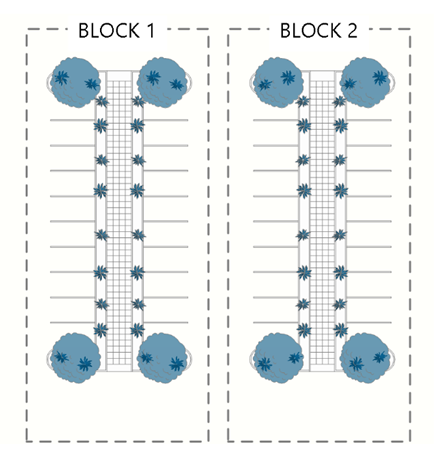
Parking garage means an above- or below-ground structure, or a covered at-grade area, designed for parking automobiles. Parking garages do not include structures or floors to accommodate the parking of motor vehicles that are built into or under a primary structure.
Parking lot means an uncovered at-grade surface facility designed for the parking of automobiles on which it is located.
Pawnbroker means an establishment where money is loaned on security of personal property left in pawn and pledged as collateral for the loan and where that property may be redeemed by the seller in a fixed period of time or sold to the general public.
Pedestrian scale means the proportional relationship between the dimensions of a building or building element, outdoor space, street or streetscape element and the average dimensions of the human body, emphasizing features and characteristics which can be observed in close proximity at an average pedestrian's walking speed.
Personal instruction or studio means informational, instructional, personal improvement, recreational, and similar services such as dance, music, or martial arts instruction; photography studios; driving or cooking schools; indoor pet training facilities; and weight loss information centers. This use does not include vocational or trade schools or other education facilities.
Personal services means uses in this category are characterized by the provision of individual services or instruction related to personal needs. Accessory retail sales related to the personal service use is allowed.
Personal services, general means an establishment that provides repair, care, maintenance or customizing of wearing apparel or other personal articles or human grooming services and includes such uses as beauty/barber shops, shoe repair, dry cleaning pick-up establishments, alterations, spas, tanning salons, tattoo parlors, printing establishments, house cleaning services, small appliance repair, florist, or pet grooming shops. This use does not include laundry facilities.
Planned development means a zoning district that includes a tract or parcel of land controlled by one or more landowners, that is developed under a single development plan for residential units, nonresidential uses, or a combination of uses.
Planning Director means the Town's Director of Community Development Department or the Director's authorized designee.
Plat means the maps and supporting materials of a proposed subdivision, prepared pursuant to the requirements of this LDO, and used as an instrument for recording real estate interests with the Douglas County Clerk and Recorder.
Play area, large-destination scale means an area with a minimum of fifteen thousand (15,000) square feet and including age separated play for 2—5 years and 5—12 years and an area for teen play or social space. Play areas are for play apparatus and equipment only and does not include pathways for circulation, seating and shade or any other non-play function.
Play area, small-scale means an area with a minimum of five thousand (5,000) square feet of play area and including age separated play for 2—5 years and 5—12 years. Play areas are for play apparatus and equipment only and does not include pathways for circulation, seating and shade or any other non-play function.
Condominium Plat means a plat identifying individual airspace units and shared common elements in a proposed condominium development that complies with all applicable provisions of the Colorado Common Interest Ownership Act, with all required stamps and acknowledgements, that is recorded as required by Colorado law.
Initial Condominium Plat means a document or set of documents that collectively meet the definition of a Condominium Plat except that it is titled Initial Condominium Plat has not yet been recorded as required by Colorado law.
Final Plat means the final map or drawing of a subdivision and related public dedications, certified by a licensed, registered land surveyor, containing a description of the subdivided land with ties to permanent monuments, and prepared pursuant to Section 13.03.040(q)(4) as an instrument for the recording of real estate interests with the Douglas County Clerk and Recorder upon final approval by the Town.
Porch means a covered structure attached to a building forming a covered entrance to a vestibule or doorway. It is external to the walls of the main building proper but may be enclosed by screen or latticework, extending from the main structure.
Preliminary Plan means the map of a proposed subdivision and specified supporting materials, drawn and submitted pursuant to Section 13.03.040(q)(8), to permit the evaluation of the proposal prior to final engineering and design.
Principal display area (lighting) means those outdoor areas where active nighttime sales activity occurs and where accurate color perception of merchandise by customers is needed. To qualify as a principal display area, one of the following specific uses must occur: automotive sales and leasing (heavy and light), recreational vehicle sales and rental, nursery or garden supply store, or automotive fuel sales. Uses not on this list must be approved as principal display area uses by the Planning Director.
Principal/primary structure means a structure or building in which the principal use of the lot on which the building is located is conducted.
Principal use means the primary or predominant use of any lot, building, or structure.
Private improvement means any drainage way or easement, street, culvert, pedestrian way, sidewalk, street sign, landscaping and streetscape, monument, flood control or storm drainage system, sewage disposal system, public art installation, entry/gateway feature, or other facility, whether or not required by this LDO, for which the Town will not assume responsibility for maintenance and operation, and for which the applicant, property owner, or other entity approved by the Town will be responsible for maintenance and operation.
Private internal access drive/aisle means a vehicle right-of-way, or any other route providing vehicle access to buildings or site elements as shown on a site plan which may include angled or perpendicular parking on at least one side.
Private street means a vehicle right of way dedicated on a subdivision plat which provides access to two (2) or more properties and is open to the public. Private streets are privately owned and maintained and not dedicated to the Town. A private street may also be one of the following:
(1)
A vehicle right-of-way indicated as a private street on a plat or site plan; or
(2)
Any vehicle access route providing vehicle access to individual lots on a plat or site plan; or
(3)
Any vehicle access route providing vehicle access to buildings indicated on a site plan where all of the buildings are not located on the same lot.
Probationary acceptance means the Designated Town Authority's (DTA) initial acceptance of the construction of public improvements associated with a permit, subdivision or Development Agreement, or other applicable agreement, Probationary acceptance also includes the Town's probationary acceptance of public improvements constructed pursuant to a Subdivision Agreement.
Programmable space, as used in regulations related to open space, means any usable, indoor, or outdoor, urban, or passive space that can serve a multitude of different function.
Property line means the legally described boundary line that indicates the limits of a parcel, tract, lot, or block for the purpose of delineating ownership and setback requirements.
Public and semi-public utility uses means uses including all lines, buildings, easements, passageways, or structures used or intended to be used by any public or private utility related to the provision, distribution, collection, transmission, or disposal of power, oil, gas, water, sanitary sewage, communication signals, or other similar public services at a local level.
Public entrance means an entrance to a building or premises that is customarily used or intended for use by the general public, and excludes fire exits, employee entrances and loading dock entrances not generally used by the public.
Public improvement means any drainage way or easement, street, culvert, pedestrian way, sidewalk, curb, gutter, street sign, traffic signal, monument, flood control or storm drainage system, sewage disposal system, water supply or treatment system, park, trail, public art installation, entry/gateway feature, or other facility for which the Town may ultimately assume responsibility for maintenance and operation, or that may affect an improvement for which Town's responsibility is established as more generally described in Section 13.08.030(i).
Public realm means all areas open or accessible to the public, including the space in front of and between buildings; may be privately owned.
Public safety facility means a facility used to provide police, fire, or other emergency response services to the surrounding community.
Public street means a vehicle access route indicated on a plat or development plan, the ownership of which route has been dedicated to and accepted by a state, local, or county government.
Public utility means any use of property within the Town for irrigation canals, electric transmission lines of one hundred fifteen (115) kv or more, electric substations, gas regulator stations, telephone exchanges and buildings for telephone equipment, water or sanitation facilities, including, but not limited to, reservoirs, water or sanitation treatment facilities and water or sanitation transmission lines, but not including water or sewer service lines going directly from a transmission line to an individual property without crossing any other property, or public transportation facilities.
Public utility, major means a facility providing important regional or townwide utility services, such as water, sewer, gas, stormwater, or electricity that includes construction of large buildings or structures, and that may have employees on site. Examples include but are not limited to water treatment plants, water storage facilities, sewage treatment plants, reservoirs, regional permanent control measures, electric power lines and substations, and other similar facilities. This does not include wireless communication facilities.
Public utility, minor means equipment necessary to support and distribute utility services, often from major public utility facilities, to development within the immediate vicinity, and that generally involves only minor accessory structures. Employees typically are not located at the site. Examples include but are not limited to electric transformer stations, service boxes and distribution lines; sewer collection lines, gas regulator stations and distribution lines, stormwater lines and appurtenances, telephone service boxes and lines, well, water, and sewer pumping/lift stations, and related underground and aboveground pipes and wires related to any of the listed services. This does not include wireless communication facilities.
Public way means any right-of-way, public street, alley, lane, parkway, avenue, road, or trail designated or dedicated for public use on a plat conveyed by deed or recorded access easement (whether or not it has ever been used as such) or acquired by prescriptive use.
Q
Quasi-governmental entity means a business entity that, by law or contract, monitors, expends, disburses, or otherwise manages public funds for a federal, state, or local government.
Quasi-public means infrastructure, facilities, or services provided for or available to the public in all or a portion of the Town by an entity owned or controlled by an entity other than the Town. Examples of quasi-public improvements include water or sewer systems owned by a special district or a fire station owned by a fire protection district created pursuant to Colorado law.
R
Recreation and entertainment means uses in this category are characterized by indoor and outdoor recreation and entertainment activities open to the general public. Accessory uses may include limited retail, concessions, parking, and maintenance facilities.
Recreation facility, indoor means a commercial recreational use within a building that provides entertainment or sport, such as bowling, skating, arcade, health club, indoor courts and fields and movie theater. Accessory uses may include limited retail, concessions, and maintenance facilities.
Recreation facility, outdoor means recreation and entertainment activities that is mostly outdoors including picnic area, outdoor swimming pool, skateboard park, tennis court, basketball court, baseball diamond, soccer and football field, amphitheater, outdoor arena, outdoor theater, drive-in theater, golf course, golf driving range, miniature golf, batting cage, or other similar outdoor recreational uses and does not meet the definition of Parks, Community or Neighborhood Serving. Accessory uses may include limited retail, concessions, and maintenance facilities.
Recreational vehicle means a vehicle that is: (1) built on a vehicle chassis or mounted on a motor vehicle; (2) four hundred (400) square feet or less when measured at the largest horizontal projections; (3) designed to be self-propelled or permanently towable by or mounted upon a light duty truck; and (4) designed primarily not for use as a permanent dwelling but as temporary living quarters for recreational, camping, travel, or seasonal use. The term includes a modular home or tiny home that does not meet the definition of a single-family detached dwelling.
Recreational vehicle sales, rental, and repair means the sale, display, lease, rental of recreational vehicles including trailers, boats, ATVs, snowmobiles, and personal recreational vehicles. This definition shall not include salvage operations, scrap operations, vehicle impound yards, or commercial parking lots available for short-term use. Accessory uses may include incidental repair and servicing.
Redevelopment means any proposed replacement, expansion, addition, renovation, or major change of or to an existing building, structure, or aspect of development.
Religious assembly means structures or places in which regular worship, ceremonies, rituals, and education pertaining to a particular system of beliefs are held, together with its accessory buildings and uses (including buildings used for educational and recreational activities), operated, maintained, and controlled under the direction of a religious group. Accessory uses include, but are not limited to, school facilities, parking, caretaker's' housing, key staff housing, retreat site, religious camp, day care and group living facilities, such as convents. Examples include churches, temples, synagogues, and mosques.
Replat means a Final Plat or Minor Development Plat that replaces, in whole or in part, a recorded Final Plat or Minor Development Plat previously approved by the Town and recorded with the Douglas County Clerk and Recorder.
Research and development means a facility or group of facilities that engage in research, synthesis, analysis, development of new products, materials, or processes, and related testing laboratories, and does not meet the definition of any use type in the industrial use category. This use excludes marijuana cultivation and the manufacturing, servicing, or sale of consumer products. Accessory uses may include incidental sales of goods produced on site, such as medical devices, instruments, or electronics, to the public.
Residential use means any primary land use that includes one (1) or more dwellings. Residential uses expressly include but are not limited to single-family, duplex, townhome, and multiple-family dwellings.
Restaurant means an eating/drinking establishment that is open to the public, where food and beverages are prepared, served, and consumed within the principal building, or off the premises as carry-out orders; or in an outdoor seating area on the premises. Accessory uses may include an outdoor dining area or sidewalk café.
Retail sales means uses involving the sale, lease, or rent of new or used products directly to the final consumer for whatever purpose but not specifically or exclusively for the purpose of resale. These uses do not include automotive or equipment sales and leasing. Accessory uses may include offices, parking, storage of business products or goods, assembly, repackaging, or repair of goods for on-site sale.
Right-of-way (ROW) means a sidewalk, curb, street, alley, bike path or other similar public improvement normally used for the travel of pedestrians, motor vehicles, bicycles, or similar vehicles.
Riparian area means the land areas adjacent to a stream, wetlands or other body of water that contain vegetation, habitats and ecosystems associated with bodies of water or dependent on the flow of water in the adjacent stream, wetlands, or other water body. A riparian area will vary in width depending on the particular stream, wetlands, or other body of water.
Road or street, accepted means a road or street for public use for which the Town has issued a written acceptance of dedication or a plat approval, and for which the responsibility for maintenance has been approved in writing.
Roadway Design and Construction Criteria Manual means the adopted roadway, design, and construction standards of the Town, as amended.
Roof means the part of the building envelope that covers the top of a building.
Roofline means the uppermost edge of the water-carrying surface of a building or structure.
S
School, college, or university means a post-secondary school offering courses in general, technical, or religious education that award associate, bachelor, or higher degrees.
School, public or private means a public or private institution that offers general academic instruction at preschool, kindergarten, elementary, and secondary levels.
School, vocational or trade means a school offering instruction in a professional, vocational, or technical field. This use does not include personal instruction studios.
Screening means a method of visually shielding or obscuring one (1) adjacent or nearby structure or use from another by fencing, walls, berms, or densely planted vegetation.
Seasonal sales means the temporary display and retail sales of goods and services such as Christmas trees, fireworks, pumpkins, or other seasonal products including items normally found and sold within an existing permitted building on the property and sold outside of the existing building/use. Example of a service may include windshield chip repair and mobile insurance claims facility.
Semi-nudity means a state of dress in which clothing covers no more than the postpubertal human genitals pubic region, and upper- body breast or chest area of any person, as well as portions of the body covered by supporting straps or devices.
Setback means the required distance between the established lot line and any building on the lot. See additional measurement standards in Section 13.04.230(d).
Setback, front means the distance or depth measured perpendicular from the front lot line (or back of curb in the DE district) to the nearest point of the structure or building.
Setback, rear means the distance or depth measured perpendicular from the rear lot line to the nearest point of the structure or building.
Setback, side interior means the distance or depth measured perpendicular from the side lot line to the nearest point of a structure or building.
Setback, side street means the distance or depth measured perpendicular from the side lot line adjacent to the street to the nearest point of a structure or building.
Sexual encounter establishment means a business or commercial establishment, that as one (1) of its principal business purposes, offers, for any form of consideration, a place where two (2) or more persons may congregate, associate or consort for the purpose of "specified sexual activities" or the exposure of "specified anatomical areas" or activities when one (1) or more of the persons is in a state of nudity or semi-nudity. An adult motel will not be classified as a sexual encounter establishment by virtue of the fact that it offers private rooms for rent.
Sexually oriented businesses means sexually oriented businesses include: an adult arcade, adult bookstore, adult novelty store, adult video store, adult cabaret, adult motel, adult motion picture theater, adult theater, sexual encounter establishment or nude model studio. The definition of sexually oriented businesses shall not include an establishment where a medical practitioner, psychologist, psychiatrist, or similar professional person licensed by the state engages in medically approved and recognized sexual therapy, and those establishments meeting the exceptions contained in the definition for nude model studios.
Short-term rental means any dwelling, dwelling unit, or portion of any dwelling unit rented or leased for valuable consideration to a person or persons for periods of time less than thirty (30) days.
Sign-related definitions means when used in the context of sign regulations, the following terms shall have the following meanings:
Architectural feature means any construction attendant to, but not an integral part of, the sign, that may consist of landscape, building or structural forms that enhance the site in general; also, graphic stripes and other architectural painting techniques applied to a structure that serve a functional purpose or, when the stripes or other painting techniques are applied to a building, provided that such treatment does not include lettering, logos, or pictures.
Commercial means an aspect of a sign proposing or otherwise encouraging one (1) or more commercial transactions.
Illumination, external means lighting by means of a light source located outside of a sign.
Illuminate, internal means lighting by means of a light source that is within a sign having a translucent background, silhouetting opaque letters or designs, or that is within letters or designs that are themselves made of translucent materials.
Noncommercial means an aspect of a sign that does not meet the definition of commercial.
Sign means any structure that requires a permanent or temporary location, that has a visual display visible from a public right-of-way and is designed to identify, announce, direct, or inform.
Sign, abandoned means any sign (together with its supporting structure) that no longer advertises or identifies a bona fide business, owner, lessor, person, service, product, event, or activity, or for which no legal owner can be found. This definition shall not apply to permanent signs accessory to businesses that are open only on a seasonal basis, provided that there is clear intent to continue operation of the business.
Sign, banner means a sign made of lightweight fabric or similar material with no enclosing framework.
Sign Base means the pedestal or other structural feature that is directly affixed to the ground on any ground-mounted sign.
Sign, building-mounted means any sign attached to any part of a building and including wall, awning, canopy, and projecting signs.
Sign, changeable copy means a sign or portion of a sign with letters, characters or graphics that are not permanently affixed to the structure, framing or background, allowing the letters, characters, or graphics to be modified from time to time manually or by electronic or mechanical devices, such as a bulletin board or electronic message board. Changeable copy signs shall be classified as permanent signs.
Sign, electric means any sign containing electric wiring, but not including signs illuminated by exterior light sources, such as floodlights.
Sign, freestanding means a sign supported from the ground and not attached to any building.
Sign, handheld means a sign that is, or was intended to be, held by, attached to, or affixed on an individual.
Sign height means the height of a fence measured with respect to site grade as described in Section 13.04.230(e), Building height.
Sign, inflatable means any inflatable shape or figure designed or used to attract attention to a business event or location.
Sign, instructional means a sign reasonably necessary for the safe circulation of pedestrian or vehicular traffic within a given parcel, that may be freestanding or attached to a building.
Signage, interpretive means signage that adds value to parks and open areas by providing information, interactive engagement opportunity, or historical narrative that improves the user experience, for the purposes of parks and open space regulations.
Sign, kiosk means a temporary sign that directs potential buyers or renters to more than one (1) real estate project offering lots, buildings, or dwellings for sale or rent. A kiosk sign may also direct travelers to public and semipublic uses, such as Town buildings, recreation facilities, and hospitals. A kiosk sign is intended to serve multiple developments for a period of time longer than would be needed for a single project, with the names and directional symbols changed from time-to-time during the life of the sign.
Sign, motor vehicle means a sign displayed on motor vehicles, including trucks, buses, trailers, or other motor vehicles such as moving vans, delivery trucks, rental trucks, trailers, and the like, but not including vehicles used for commercial transit and licensed by the Public Utilities Commission of the state such as taxies and buses.
Sign, nonconforming means any sign that:
(1)
On the Effective Date, was lawfully maintained and had been lawfully erected pursuant to the provisions of any prior applicable sign regulation but does not conform to the limitations established by Chapter 13.09, Sign Coder; or
(2)
On or after the Effective Date was lawfully maintained and erected pursuant to the provisions of Chapter 13.09, Sign Code but, by reason of amendment to Chapter 13.09, Sign Code does not conform to the limitations established by the amendment to Chapter 13.09, Sign Code in the district in which the sign is located.
Sign, off-premise advertising means any off-premises sign, including without limitation a billboard or general outdoor advertising device, that advertises or directs attention to a business, commodity, service, or activity conducted, sold or offered elsewhere than on the same lot, or within the same building, or within the same set of buildings under single or related ownership or management, upon which such sign is located.
Sign, permanent means a sign that is designed to be used on a permanent basis and is intended to be attached to a building wall or sign structure or installed in the ground. Permanent signs expressly include blade/bracket signs, building signs, freestanding signs, and projecting signs.
Sign, projecting means a sign that is attached to a building wall and extending perpendicular to (or approximately perpendicular to) the building wall and twelve (12) inches or more beyond the face of the wall. A projecting sign shall also include a blade or bracket sign, or a combination of these sign styles, that hangs or extends twelve (12) inches or more from a building wall, eave, fascia, canopy, awning, or sign structure.
Sign, roof means a sign, or any portion thereof, erected, constructed, or projecting upon or over the roof or parapet wall of any building, whether the principal support for the sign is on the roof, wall, or any other structural element of the building.
Sign, sandwich board means a portable sign that is an A-frame-type sign that is hinged or unhinged, or is vertical and located on skids or runners, and that is portable and temporary in nature. A sandwich board sign does not include a sign attached or affixed to an individual.

Sign, temporary means a sign that is designed to be used only for a limited duration of time, and is not intended to be permanently attached to a building wall or sign structure or permanently installed in the ground. Temporary signs expressly include banner signs, and may be building or freestanding signs.
Sign, wall means a type of building sign that is applied or attached to an exterior wall of a building.
Sign, window means a sign that is applied or attached to a window or door or a sign located near a window or door within a building for the purpose of being visible to and read from the outside of the building. Window signs may include permanent or temporary signs.
Sign structure means the supports, uprights, bracing, or framework designed to support or exhibit a sign as it is regulated by the building code for structural soundness; provided, however, that sign structures shall not include fences or retaining walls.
Significant tree means a deciduous tree that is six (6) inches or greater in caliper, measured four and one-half (4½) feet above ground level, or any coniferous tree eight (8) feet in height or taller.
Significant vegetation means any shrub mass over five (5) feet in height and forming a continuous mass of vegetation covering an area greater than one hundred (100) square feet.
Site area, gross means total ground area of a site, including any proposed portions to be dedicated or improved for public use.
Site plan means the plans and supplemental materials submitted pursuant to Chapter 13.06, to evaluate a project prior to issuance of a Building Permit for multiple-family, business, commercial, industrial, and planned development projects.
Slope means the vertical elevation of a land area divided by the horizontal distance, expressed as a percentage. Slopes must cover at least fifteen (15) feet vertically and fifty (50) feet horizontally.
Solid fence means a freestanding structure constructed in such a manner as to not allow the surface to be viewed through; the purpose being to conceal the interior portion of the fenced lot.
Specific anatomical areas includes any of the following:
(1)
Less than completely and opaquely covered post-pubertal human genitals, pubic region, buttocks, anus, or the upper-body breast or chest area of any person; or
(2)
Human male genitals in a discernibly turgid state, even if completely and opaquely covered.
Specified sexual activities includes any of the following:
(1)
The fondling or other intentional touching of human genitals, pubic region, buttocks, anus, or the upper-body breast or chest area of any person;
(2)
Sex acts, normal or perverted, actual, or simulated, including, but not limited to, intercourse, oral copulation, sodomy, sadomasochism, or bestiality;
(3)
Masturbation, actual or simulated; or
(4)
Human genitals in a state of sexual stimulation, arousal, or tumescence.
Stable, commercial means a facility or area where horses, mules, or other large domestic animals are kept, housed, boarded, lodged, fed, hired, trained, sold, or bred as a commercial activity. The definition includes accessory uses such as riding lessons, clinics, and similar activities.
Start of construction means:
(1)
For the purpose of Section 13.08.040(a), Floodplain regulations. means the date the Building Permit was issued, provided that the actual start of construction, repair, reconstruction, placement, or other improvement was within one hundred eighty (180) days of the permit date and includes substantial improvement. The actual start means the first placement of permanent construction or a structure on a site, such as the pouring of slabs or footings, the installation of piles, the construction of columns or any work beyond the stage of excavation or the placement of a manufactured home on a foundation. Permanent construction does not include land preparation, such as clearing, grading, and filling; nor does it include the installation of streets and/or walkways; nor does it include the installation on the property of accessory buildings, such as garages or sheds not occupied as dwelling units or not part of the main structure. For a substantial improvement, the actual start of construction means the first alteration of any wall, ceiling, floor, or other structural part of a building, whether or not that alteration affects the external dimensions of the building.
(2)
For all other purposes means the date the Grading Permit was issued, provided that the actual start of construction, repair, reconstruction, placement, or other improvement was within one hundred eighty (180) days of the permit date.
Steep slope means slopes that are fifteen (15) percent or greater as measured over a horizontal distance of fifty (50) feet or more, as more fully described in Section 13.08.040(b)(3).
Storage means the placement, holding, or stockpiling of material or products in a bulk form, in bulk containers or in individual containers either within a building or outside, where the use is accessory and integral to the operations of a principal use permitted within the zoning district. Storage is not permitted as a principal land use within the Town of Parker. Storage does not include areas defined as "principal display."
Storage and warehousing means uses in this category are characterized by the storage of goods for the business owner or other businesses. Goods are generally delivered to other businesses or the final consumer, except for some will-call pickups. There are typically few customers present. Accessory uses may include offices, truck fleet parking, and maintenance areas. This use does not include data storage facilities.
Storage, commercial outdoor means an outdoor area in which storage spaces are used by consumers/tenants for short- and long-term storage of personal property. Consumers/tenants retain "care, custody and control" of their personal property. Outdoor storage includes, but is not limited to, camper/RV storage, commercial product storage, landscape storage and contractor storage where such storage is accessory to a contractor's office.
Storage, self means a building, series of buildings, structure, or an area in which storage spaces (such as rooms, lockers, or containers), also known as "storage units," are used by consumers and tenants for short- or long-term storage of personal property. Consumers and tenants retain "care, custody, and control" of their personal property. Self-storage may also be referred to as "mini-storage" and "mini-warehouse." This does not apply to multifamily development storage.
Storm Drainage and Environmental Criteria Manual means the adopted storm drainage and other environmental standards of the Town, as amended.
Stream means all of the following:
(1)
Any stream or river (or portion thereof) shown on the Flood Insurance Rate Map (a copy of which is available for review at the Department of Engineering); or
(2)
Any other perennial or intermittent natural or man-made watercourse identified by the Town, including, but not limited to, minor stream tributaries and man-made canals, channels, and ditches.
Stream bank means the uppermost limit of the active stream channel, usually marked by a break in the slope, as determined by the Town.
Stream buffer means a vegetated area, including trees, shrubs, and herbaceous vegetation, that exists or is established to protect:
(1)
Streams, their floodplains and associated riparian areas, including wetlands;
(2)
Lakes; and
(3)
Reservoirs.
Stream channel means part of a natural watercourse that contains an intermittent or perennial base flow of groundwater origin. Base flows of groundwater origin can be distinguished by any of the following physical conditions:
(1)
Hydrophytic vegetation, hydric soil, or other hydrologic indicators in the area where groundwater enters the stream channel, in the vicinity of the stream headwaters, channel bed or channel banks;
(2)
Flowing water not directly related to a storm event; or
(3)
Historical records of a local high groundwater table, such as well and stream gauge records.
Street means a public or private right-of-way or easement, other than an alley, driveway, or trail, that is accessible to the public and intended for use by motor vehicles and bicycles.
Street, internal (private) means a private or internal street that is not owned or operated by the Town; is a private street created within a commercial, industrial, mixed-use, and/or multifamily site which defines blocks and provides access for all modes.
Street frontage means for purpose of sign regulations, the length of the public or Town-approved private street or both, that is contiguous to the adjacent private parcel for which the sign is being considered. A public alley is not considered a public or Town-approved private street.
Streetscape/landscaping improvements means the sidewalks, plant material and related irrigation facilities for a Town-approved landscaping plan for street, road rights-of-way, parks, open space, and other public places.
Structure means
(1)
For the purposes of floodplain regulations, a walled and roofed building or manufactured home that is principally above ground.
(2)
For the purposes of sign regulations, structure includes a building, fence, wall, a piece of stationary equipment, ATM, kiosk, ice machine, fueling pump or any other object.
(3)
For all other purposes, see structure, permanent and structure, temporary.
Structure, permanent means any combination of materials forming a building or other man-made thing that is erected on the ground with permanent foundations or footings and permanently affixed into or onto the ground, designed, intended, used, or arranged for the housing, shelter, enclosure or structural support of persons, animals, or property of any kind.
Structure, temporary means a structure without any permanent foundation or footings that is intended to be located on a property for a limited amount of time.
Structure damage means:
(1)
For the purposes of floodplain regulations, damage of any origin sustained by a structure whereby the cost of restoring the structure to its before-damaged condition would equal or exceed fifty (50) percent of the market value of the structure before the start of construction of the improvement. This term includes structures that have incurred substantial damage, regardless of the actual repair work performed. The term does not, however, include either:
(2)
Any project for improvement of a structure to correct existing violations of state or local health, sanitary or safety code specifications that have been identified by the local code enforcement official and that are the minimum necessary to assure safe living conditions; or
(3)
For all other purposes, any amount of damage sustained by a structure.
Subdivided land means
(1)
Any parcel of land which is to be used for condominiums, apartments, or any other multiple-dwelling units, unless such land was previously subdivided and the filing accompanying such subdivision complied with municipal regulation applicable to subdivisions of substantially the same density; or
(2)
The division of any tract of land, lot, or parcel into two (2) or more lots, parcels, plats, sites, or other divisions of land for the purpose, whether immediate or future, of sale, transfer of ownership, or to offer for sale or development; or
(3)
Any land that the Town Council has permitted to be divided into subordinate parcels by exempting the division from the requirement to prepare and record a Final Plat or Minor Development Plat.
Subdivision means the division of any tract of land, lot or parcel into two (2) or more lots, parcels, plats, sites, or other divisions of land for the purpose, whether immediate or future, of sale, transfer of ownership, or to offer for sale or development; or, the division of land into any parcel of land that is to be used for condominiums, apartments, or any other multiple-dwelling units, unless (a) such land was previously subdivided and the filing accompanying such subdivision complied with municipal regulation applicable to subdivisions of substantially the same density, or (b) the Town Council has exempted by resolution that division of land, or that type of division of land, as not being within the purpose of Section 13.08.030, Subdivision standards.
Subdivision agreement means a binding contract between the Town and the record owner of the subdivision that specifies the public improvements, completion dates, estimated costs of public improvements and the method for securing the construction of the public improvements to be constructed as a part of the subdivision as more generally described in Section 13.08.030(i).
Subdivision exemption means an exemption from the definition of the term subdivision and subdivided land if the Town Council determines by rules and regulation or resolution that such division of land is not within the purposes of Section 13.08.030, Subdivision standards, or that the proposed division of land affects only Town-owned land and is for a public purpose.
Subdivision tract means land designated on a final subdivision plat as a "tract" or otherwise designated for conveyance or dedication to a metropolitan district, owners association, or other entity allowing for common ownership of such land by the owners of lots within the subdivision, and used for the purpose of open space, parks, landscaping, or a parcel restricted from current development that may be developed in the future after replatting pursuant to this LDO. For the purpose of Section 13.08.030, Subdivision standards, the term "subdivision tract" applies only to tracts, adjacent to rights-of-way, in subdivisions that contain one (1) or more lots intended for single-family residential development.
T
Terrace means an open platform that extends outward from an exterior wall of a building at, or approximately at, ground level.
Tiny home means a structure that (1) is permanently constructed on a vehicle chassis, (2) is designed for long-term residency to a single household, (3) includes electrical, mechanical, or plumbing services that are fabricated, formed, or assembled at a location other than the site of the completed home, (4) is not self-propelled; (5) has a square footage of not more than four hundred (400) square feet, (6) is built to the International Residential Code as adopted by the Building Codes and Standards program within the Division of Housing, and is connected to public water and sewer. Colorado tiny homes will receive a metal plate insignia that certifies the tiny home is built to the codes and standards of the program. This use does not include manufactured homes, recreational park trailers (as defined in Section 24-32-902, C.R.S.), or recreational vehicles (as defined in Section 24-32-902, C.R.S.)
Town means the Town of Parker, Colorado.
Town Manager means the person holding the position of Town Manager or a designee of the Town Manager.
Traditional turf grasses means bluegrass (poa pratensis ) and turf type tall fescue (festuca arundinacea) and cultivars of those two (2) types.
Tract means a platted parcel that is not intended for development of occupied buildings, or a parcel restricted from current development that may be developed in the future after replatting pursuant to this LDO.
Trail means a transportation or recreational route used by non-motorized transportation including but not limited to walking, bicycling, horseback riding or roller-blading.
Transit terminal or station means a facility where public transit vehicles load and unload patrons, and where patrons may transfer from between public transit lines, when that is the principal use of the property. This use may include park-n-ride or ridesharing facilities but does not include public transit vehicle repair or maintenance facilities.
Transportation demand management (TDM) means the application of strategies and policies which reduce or redistribute vehicle travel demand (and vehicle parking demand) to any single property or district. These include the provision of or access to transit, carpooling, walking, and bicycling.
Transportation Master Plan means the adopted transportation master plan of the Town, as amended.
Transportation, vehicles, and equipment means uses in this category are associated with transit facilities and include a broad range of uses for the maintenance, sale, or rental of motor vehicles and related equipment. Accessory uses may include incidental repair and storage and offices.
U
Underdrain means any foundation drainage system, or gravel or pipe underdrain placed in service or mainline trenches within the rights-of-way of the Town.
Use means the activity or function that takes place or is intended to take place on a lot or within a building or structure.
Use, accessory means a use naturally and normally incidental to, subordinate to and devoted exclusively to the principal use of the premises, including parking lots.
Use, commercial means any nonresidential use of land engaged in commerce or commercial activity such as wholesale or retail trade or the provision of services.
Use, illegal means any use of a building, structure, or piece of property that is in violation of any provision of the LDO.
Use, temporary means uses that occur for a specified short-term time period only. Such uses shall not include the frequent occurrence of an activity at short intervals or events repeated on a regular basis, such as every weekend or every other weekend.
Use by Special Review means a use that is only permitted after review and approval by the Town Council pursuant to Sections 13.03.040(s), 13.03.040(t), 13.03.040(u), or 13.03.040(w).
V
Variance means:
(1)
For the purposes of floodplain regulations, a grant of relief from the requirements of Section 13.08.040(a) that permits construction in a manner that would otherwise be prohibited by Section 13.08.040(a).
(2)
For all other purposes, a grant of relief from specific dimensional standards in this LDO as listed in Section 13.03.040(x).
Vested property right means the right to undertake and complete the development and use of property under the terms and conditions described in Section 13.03.030(i)(5).
Veterinary clinic and hospital means a structure where animals are brought for medical and surgical treatment and may be held during the time of treatment and recuperation.
Visually significant ridgeline means natural topographic ridges that rise at least 50 feet above the adjacent land over a horizontal distance of one hundred fifty (150) feet or more.
W
Waiver means a grant of relief from standards in this LDO that are not eligible for approval as a Variance, pursuant to Section 13.03.040(y).
Wall for the purpose of landscaping, buffering, and screening regulations means a vertical structure of masonry (including stone, clay, brick, and poured concrete), wood, plaster, or other material that defines or encloses an area.
Water storage facility means a tank, reservoir, or other facility for the storage of water for supply to a water system.
Watercourse means a natural or artificially created channel, depression, slough, gulch, stream, or creek in which a flow of water occurs either continuously or intermittently in a definite direction.
Wetland means an area that is inundated or saturated by surface water or groundwater at a frequency and duration sufficient to support, and under normal circumstances does support, a prevalence of vegetation typically adapted for life in saturated soil conditions.
Wing wall means a smaller wall or section of a building that extends out from the primary mass of the building.
Wireless communications facility See Section 13.02.050.
X
Reserved
Y
Yard means an open space other than a court, on a lot, unoccupied and unobstructed from the ground upward, except as otherwise provided in this LDO.
Yard, front means a yard extending across the full width of the lot between the front lot line and the nearest point on the front façade of the building.
Yard, rear means a yard extending across the full width of the lot between the rear lot line and the nearest point on the rear façade of the building.
Yard, side means a yard extending from the front yard to the rear yard between the side lot line and the nearest point on the closest side facade line of the building.
Z
Zoning district means a specific delineated area on the Zoning Map within which uniform standards govern the use, placement, spacing, size, and form of land and buildings.
Zoning map means the official zoning map as adopted by the Town of Parker.
Note— On May 5, 2025, the Town Council adopted Ordinance No. 1.645, Series of 2025, rejecting House Bill 24-1007.
13.02.030 - Oil and gas definitions.
All terms used in Chapter 13.06, Oil and Gas Regulations that are defined in the Oil and Gas Conservation Act of the State of Colorado" ("Act"), or in Energy and Carbon Management Commission ("ECMC") regulations and are not otherwise defined in this Section 13.02.030, are defined as provided in the Act or in such regulations as may be amended from time to time. All other words used in Chapter 13.06, Oil and Gas Regulations are given their usual, customary, and accepted meaning, and all words of a technical nature, or peculiar to the oil and gas industry, shall be given that meaning that is generally accepted in the oil and gas industry.
When not clearly otherwise indicated by the context, the following words and phrases used in Chapter 13.06, Oil and Gas Regulations have the following meanings:
Act means the Oil and Gas Conservation Act of the State of Colorado.
Applicant means the person making an application for a Use by Special Review on behalf of the operator or owner of a well.
Approved plan means the totality of the material contained in the application for a Use by Special Review approved by the Town Council following a public hearing, or in the case of an existing use Site Plan order, the totality of the materials contained in the application for an existing use Site Plan order approved administratively by the Town.
Building unit means a building or structure intended for human occupancy. A dwelling unit is equal to one (1) building unit; every guest room in a hotel/motel is equal to one (1) building unit; and every five thousand (5,000) square feet of building floor area in commercial facilities, and every fifteen thousand (15,000) square feet of building floor area in warehouses, or other similar storage facilities, is equal to one (1) building unit.
Commission or ECMC means the Energy and Carbon Management Commission of the State of Colorado.
Completion. An oil well shall be considered completed when the first new oil is produced through wellhead equipment into lease tanks from the ultimate producing interval after the production string has been run. A gas well shall be considered completed when the well is capable of producing gas through wellhead equipment from the ultimate producing zone after the production string has been run. A dry hole shall be considered completed when all provisions of plugging are complied with as set out in the rules of the ECMC. Any well not previously defined as an oil or gas well shall be considered completed ninety (90) days after reaching total depth. If approved by the Planning Director, a well that requires extensive testing shall be considered completed when the drilling rig is released or six months after reaching total depth, whichever is later.
Day means a period of twenty-four (24) consecutive hours.
Director means the Planning Director of the Energy and Carbon Management Commission of the State of Colorado.
Flow lines means those segments of pipe from the wellhead downstream through the production facilities ending at the gas metering equipment or the oil loading point.
Gas well means a producing well with natural gas as the primary commercial product. Most gas wells frequently produce some condensate (natural gas liquids such as propane and butane) and occasionally produce some water.
Gathering line means a pipeline that transports gas from a current production facility to a transmission line or main.
High-density area rules for building units. A high-density area shall be determined on a well-by-well basis by calculating the number of occupied building units within the 72-acre area defined by a one thousand (1,000) foot radius from the wellhead or production facility. If thirty-six (36) or more actual or platted building units (as defined in the ECMC 100 Series rules) are within the 1,000-foot radius or eighteen (18) or more building units are within any semicircle of the 1,000-foot radius (i.e., an average density of one (1) building unit per two (2) acres), it shall be deemed a high-density area. If platted building units are used to determine the density, then fifty (50) percent of the platted units shall have building units under construction or constructed.
Initial application for development means, for the purpose of notice requirements to mineral estate owners, the first complete application for development for property in which the uses on the property are to be determined through an amendment to the Zoning Map or, if notification was not provided for such Rezoning, then the first Framework Plan or Preliminary Plan for a subdivision application, unless this definition or its applicability to notice requirements to mineral estate owners is modified by the provisions of Section 13.03.030(g)(4)d, Notice requirements to mineral estate owner.
Injection well means any hole drilled into the earth into which fluids are injected for the purposes of secondary recovery, storage, or disposal, pursuant to authorizations granted by the Planning Commission.
Inspector means any person designated by the Town, or by the Town's designee, who shall have the authority to inspect well sites to determine compliance with Chapter 13.06, Oil and Gas Regulations and other applicable ordinances of the Town.
Mineral owner means any person having title or right of ownership in subsurface oil and/or, where context dictates, any leasehold interest therein.
Multiple oil and gas operations permit means a permit issued by the Town if more than one well or production facility is being applied for and approved at the same time by the same applicant.
Oil and gas operations means exploration for oil and gas, including the conduct of seismic operations and the drilling of test bores; the siting, drilling, deepening, recompletion, reworking or abandonment of an oil and gas well, underground injection well or gas storage well; production operations related to any such well, including the installation of flowlines and gathering systems; the generation, transportation, storage, treatment or disposal of exploration and production wastes; and any construction, site preparation or reclamation activities associated with such operations.
Oil well means a producing well with oil as its primary commercial product. Oil wells almost always produce some gas and frequently produce water. Most oil wells eventually produce mostly gas or water.
Operating plan means a general description of a well site or a production site identifying the purpose, use, typical staffing, seasonal or periodic considerations, routine hours of operation, source of services/ infrastructure and any other information related to the regular functioning of the facility.
Operator means the person designated by the owner or lessee of the mineral rights as the operator of oil and gas operations or a production facility and so identified in the Colorado Energy and Carbon Management Commission applications.
Person means both the singular and plural and means a natural person, a corporation, association, guardian, partnership, receiver, trustee, administrator, executor and/or fiduciary, any other legal entity or representative of any kind.
Production facilities mean all storage, separation, treating, dehydration, artificial lift, power supply, compression, pumping, metering, monitoring, flow lines and other equipment directly associated with oil wells, gas wells or injection wells.
Production site means the area containing production facilities, exclusive of gathering lines.
Reentering means accessing an existing well bore for either the original or amended purpose, provided that such well has not been abandoned.
Separator means a cylindrical or spherical vessel used to separate oil, gas and water from the total fluid stream produced by a well. Separators can be either horizontal or vertical.
Sidetracking means to drill a secondary well bore away from an original well bore. A sidetracking operation may be done intentionally or may occur accidentally. Intentional sidetracks might bypass an unusable section of the original well bore or explore a geologic feature nearby. In the bypass case, the secondary well bore is usually drilled substantially parallel to the original well, that may be inaccessible due to an irretrievable fish, junk in the hole or a collapsed well bore.
Surface owner means any person having the title or right of ownership in the surface estate of real property and/or, where context dictates, any leasehold interest therein.
Surface use agreement means any agreement entered into between a mineral owner and/or lessee and a surface owner, that describes how operations related to the extraction of oil and gas will be conducted on a given property.
Twinning means the drilling of wells within fifty (50) feet of each other.
Use by Special Review means an approval issued by the Town pursuant to Chapter 13.06, Oil and Gas Regulations. A Use by Special Review order is the order issued by the Town when the Use by Special Review is approved.
Use tax means the tax on the use or consumption in the Town of any construction and building materials purchased at retail.
Well means an oil well, gas well or injection well.
Well site means the areas that are directly disturbed during the drilling and subsequent operation of, or affected by production facilities directly associated with, any oil well, gas well or injection well.
Wellhead means the surface termination of a well bore that incorporates facilities for installing casing hangers during the well construction. The wellhead also incorporates a means of hanging the production tubing and installing the Christmas tree and surface flow-control facilities in preparation for the production phase of the well.
Wildlife and natural areas shall include, but not be limited to, floodplains and floodways; natural drainage and waterways; significant native trees and vegetation; wildlife travel corridors; special habitat features such as raptor nests, key nesting, breeding or feeding areas for birds; fox and coyote dens; prairie dog colonies more than twenty-five (25) acres in size; remnant native prairie habitat; plains cottonwood galleries; natural or man-made lakes and ponds and any wetland greater than one-quarter (¼) acre in size.
13.02.040 - Marijuana facilities definitions.
(a)
Medical marijuana definitions.
Medical marijuana means marijuana that is grown and sold for a purpose authorized by Section 14 of Article XVIII of the Colorado Constitution.
Medical marijuana center means a person authorized to be licensed to operate a business as described in the Colorado medical marijuana code that sells medical marijuana to registered patients or primary caregivers as defined in Section 14 of Article XVIII of the Colorado Constitution, but is not a primary caregiver, and that a municipality is authorized to prohibit as a matter of law.
Medical marijuana-infused products manufacturer means a person licensed pursuant to the Colorado medical marijuana code to operate a business known as a medical marijuana-infused products manufacturer's license, and that a municipality is authorized to prohibit as a matter of law.
Optional premises cultivation operation means a person licensed pursuant to the Colorado medical marijuana code to operate a business known as an optional premises grow facility in order to grow and cultivate marijuana for a purpose authorized by Section 14 of article XVIII of the Colorado Constitution, and that a municipality is authorized to prohibit as a matter of law.
Patient means as provided in Section 14(1)(c) of Article XVII of the Colorado Constitution.
Primary caregiver means as provided in Section 14(1)(f) of Article XVIII of the Colorado Constitution.
(b)
Other marijuana definitions.
Marijuana means all parts of the plant of the genus cannabis, whether growing or not, the seeds thereof, the resin extracted from any part of the plant and every compound, manufacture, salt, derivative, mixture or preparation of the plant, its seeds, or its resin, including marijuana concentrate. Marijuana does not include industrial hemp, nor does it include fiber produced from the stalks, oil or cake made from the seeds of the plant, sterilized seed of the plant that is incapable of germination or the weight of any other ingredient combined with marijuana to prepare topical or oral administrations, food, drink, or other product.
Marijuana accessories means any equipment, products or materials of any kind that are used, intended for use, or designed for use in planting, propagating, cultivating, growing, harvesting, composting, manufacturing, compounding, converting, producing, processing, preparing, testing, analyzing, packaging, repackaging, storing, vaporizing, or containing marijuana or for ingesting, inhaling or otherwise introducing marijuana into the human body.
Marijuana cultivation facility means an entity licensed to cultivate, prepare, and package marijuana and sell marijuana to retail marijuana stores, to marijuana product manufacturing facilities and to other marijuana cultivation facilities, but not to consumers.
Marijuana establishment means a marijuana cultivation facility, a marijuana testing facility, a marijuana product manufacturing facility, or a retail marijuana store.
Marijuana product manufacturing facility means an entity licensed to purchase marijuana; manufacture, prepare and package marijuana products; and sell marijuana and marijuana products to other marijuana product manufacturing facilities and to retail marijuana stores, but not to consumers.
Marijuana products means concentrated marijuana products and marijuana products that are comprised of marijuana and other ingredients and are intended for use or consumption, such as, but not limited to, edible products, ointments, and tinctures.
Marijuana testing facility means an entity licensed to analyze and certify the safety and potency of marijuana.
Person means a natural person, partnership, association, company, corporation, limited liability company or organization, or a manager, agent, owner, director, servant, officer, or employee thereof.
Retail marijuana store means an entity licensed to purchase marijuana from marijuana cultivation facilities and marijuana and marijuana products from marijuana product manufacturing facilities and to sell marijuana and marijuana products to consumers.
13.02.050 - Wireless communication facilities definitions.
Unless specifically defined below, words or phrases used in Section 13.05.040, Wireless communication facilities, shall be interpreted to have the meaning used in common usage and to give Section 13.05.040 the most reasonable application.
Accessory equipment for a WCF facility means equipment, including buildings and structures, used to protect and enable radio switching equipment, back-up power and other devices incidental to a WCF facility, but not including antennae.
Base station means a structure or equipment, other than a tower, at a fixed location that enables federal communications commission-licensed or authorized wireless communications between user equipment and a communications network. The term includes any equipment associated with wireless communications services, including radio transceivers, antennas, coaxial or fiber-optic cable, regular and backup power supplies, and comparable equipment, regardless of technological configuration (including distributed antenna systems and small-cell networks). The term includes any structure, other than a tower, to which any of the equipment described hereof is attached.
Building roof-mounted WCF facility means a WCF facility that is mounted and supported entirely on the roof of a legally existing building or structure.
Building wall-mounted WCF facility means a WCF facility that is mounted and supported entirely on the wall of a legally existing building or structure.
Collocation means the location of two (2) or more WCF facilities on the same support structure.
Eligible facilities request means any request for modification of an existing tower or base station that does not substantially change the physical dimensions of such tower or base station involving: (i) collocation of new transmission equipment; (ii) removal of transmission equipment; or (iii) replacement of transmission equipment.
Equipment storage shelters means buildings, storage shelters and cabinets used to house WCF facility equipment.
Freestanding WCF facility means a WCF facility, that is designed specifically for wireless communications facilities, that consists of a stand-alone support structure, such as a tower or monopole, and antennae and accessory equipment.
Microwave dish antenna means a disk-type antenna used to link communication sites together by wireless voice or data transmission.
Monopole means a single, freestanding pole-type structure supporting one (1) or more antennas.
Pole-mounted WCF facility means a WCF facility with antennae that is mounted and supported entirely on a legally existing traffic signal, utility pole, streetlight, flagpole, freestanding WCF facility, electric, light poles or transmission line support tower or other similar structure and includes a replacement pole.
Replacement pole means a newly constructed and permitted traffic signal, utility pole, street light, flagpole, electric, light pole or transmission line support tower or other similar structure of proportions and of equal height or such other height that would not constitute a substantial change to a pre-existing pole or structure in order to support a WCF or to accommodate collocation and remove the pre-existing pole or structure.
Small cell means a WCF where each antenna is located inside an enclosure of no more than three (3) cubic feet in volume or, in the case of an antenna that has exposed elements, the antenna and all of its exposed elements could fit within an imaginary enclosure of no more than three (3) cubic feet; and primary equipment enclosures are no larger than seventeen (17) cubic feet in volume. The following associated equipment may be located outside of the primary equipment enclosure and, if so located, is not included in the calculation of equipment volume: electric meter, concealment, telecommunications demarcation box, ground-based enclosures, back-up power systems, grounding equipment, power transfer switch, and cut-off switch.
Stealth WCF facility means a WCF facility with an alternative design that camouflages or conceals the presence of antennae or towers, such as, but not limited to, artificial trees, clock and bell towers and steeples.
Substantial change means a modification to an existing tower or base station under the following circumstances:
(1)
A substantial change in the height of an existing tower or base station occurs as follows:
a.
For a tower outside of a public right-of-way, when the height of the tower is increased by more than ten (10) percent, or by the height of one additional antenna array with separation from the nearest existing antenna not to exceed twenty (20) feet, whichever is greater.
b.
For a tower located in a public right-of-way or for a base station, when the height of the structure increases by more than ten (10) percent or by more than ten (10) feet, whichever is greater.
(2)
Changes in height are measured as follows:
a.
When deployments are separated horizontally, changes in height shall be measured from the original support structure, not from the height of any existing telecommunications equipment.
b.
When deployments are separated vertically, changes in height shall be measured from the height of the tower or base station, including any appurtenances, as the tower or base station existed on February 22, 2012.
(3)
A substantial change in the width of an existing tower or base station occurs as follows:
a.
For a tower or a base station outside of public rights-of-way, when the addition of an appurtenance to the body of the tower protrudes from the edge of the tower more than twenty (20) feet, or more than the width of the tower structure at the level of the appurtenance, whichever is greater.
b.
For a tower in a public right-of-way or a base station, when the addition of an appurtenance to the body of the structure would protrude from the edge of the structure by more than six (6) feet.
(4)
A substantial change also occurs for an existing tower in a public right-of-way or an existing base station as follows:
a.
When the change involves the installation of any new equipment cabinets on the ground, if no ground cabinets presently exist; or
b.
When the change involves the installation of ground cabinets that are more than ten (10) percent larger in height or overall volume than any existing ground cabinets.
(5)
A substantial change also occurs for any existing tower or base station when any of the following are found:
a.
When the change involves installation of more than the standard number of new equipment cabinets for the technology involved, or more than four (4) new cabinets, whichever is less.
b.
When the change entails any excavation or deployment outside the current site.
c.
When the change would undermine or otherwise defeat the concealment elements of the eligible support structure.
d.
When the change does not comply with conditions associated with the original siting approval of the construction or modification of the tower, base station, or base station equipment. This limitation does not apply if the noncompliance is due to an increase in height, increase in width, addition of cabinets, or new excavation that would not exceed the thresholds identified in this definition.
Tower means a structure built for the sole or primary purpose of supporting any federal communications commission-licensed or authorized antennas and their associated facilities, including structures that are constructed for wireless communications services, including, but not limited to, private, broadcast, and public safety services, as well as unlicensed wireless services and fixed wireless services such as microwave backhaul, and the associated site. The term includes self-supporting lattice towers, guy towers or monopoles, radio and television transmission towers, microwave towers, common carrier towers, cellular telephone towers, alternative tower structures and the like.
Transmission equipment means any equipment that facilitates transmission for any FCC-licensed or authorized wireless communication service, including, but not limited to, radio transceivers, antennas and other relevant equipment associated with and necessary to their operation, including coaxial or fiber-optic cable, and regular and backup power supply.
Wireless communication facility or WCF means a facility used to provide personal wireless services as defined at 47 U.S.C. Section 332(c)(7)(c); or wireless information services provided to the public or to such classes of users as to be effectively available directly to the public via licensed or unlicensed frequencies; or wireless utility monitoring and control services. A WCF includes a small cell facility. A WCF does not include a facility entirely enclosed within a permitted building where the installation does not require a modification of the exterior of the building; nor does it include a device attached to a building, used for serving that building only and that is otherwise permitted under other provisions of the LDO. A WCF includes an antenna or antennas, including, without limitation, direction, omnidirectional and parabolic antennas, base stations, support equipment, alternative tower structures, and towers. It does not include the support structure to which the WCF or its components are attached if the use of such structures for WCFs is not the principal use. The term does not include mobile transmitting devices used by wireless service subscribers, such as vehicle or handheld radios/telephones and their associated transmitting antennas, nor does it include other facilities specifically excluded from the coverage of Section 13.05.040, Wireless communication facilities.

