
Parker City Zoning Code
CHAPTER 13
09 - Sign Code
13.09.010 - Purpose.
The purpose of this Chapter 13.09 is to promote the public health, safety, and welfare by establishing standards and criteria for the construction and maintenance of all signs in the Town that are subject to the provisions of this Chapter and to:
(a)
Enhance and protect the physical appearance of the Town;
(b)
Further the values, goals and policies set forth in the Town's Master Plan;
(c)
Protect property values;
(d)
Promote and maintain visually attractive, high-value residential, retail, commercial and industrial areas;
(e)
Promote the economic well-being of the community by creating a favorable physical image;
(f)
Ensure that signs are located and designed to:
(1)
Provide an effective means of way-finding in the community;
(2)
Afford the community an equal and fair way to advertise and promote its products and services;
(3)
Reduce sign clutter and the distractions and confusion that may be contributing factors in traffic congestion and accidents, and maintain a safe and orderly pedestrian and vehicular environment;
(4)
Minimize the disruption of the scenic views that when maintained protect important community values;
(5)
Afford businesses, individuals, and institutions a reasonable opportunity to use signs as an effective means of communication; and
(6)
Provide review procedures that assure that signs are consistent with the Town's objectives and within the Town's capacity to efficiently administer the regulations; and
(g)
Provide for and ensure the protection of the free speech rights of the Town's citizens, residents, businesses, and visitors as established in the United States and Colorado Constitutions.
13.09.020 - General provisions.
(a)
Applicability. All construction, relocation, enlargement, alteration, and modification of signs within the Town shall conform to the requirements of this Chapter 13.09. More information about when these standards are applied is available in Table 13.08.A.
(b)
Interpretations.
(1)
Unless otherwise stated in this Chapter 13.09, all determinations, findings, and interpretations shall be made by the Planning Director.
(2)
No provision of this Chapter 13.09 shall be interpreted as authorizing the erection or maintenance of any sign or display in a manner that would conflict with the provisions of the Colorado Roadside Advertising Act, Section 43-1-401, et seq., C.R.S., as the same may be amended from time to time.
(3)
In the event of a conflict between this Chapter 13.09 and any other applicable provision of federal, state, or local law, the provision that best complies with applicable federal and state law governing permitted regulation of signs shall apply.
(4)
This Chapter 13.09 is not intended and shall not be interpreted to restrict noncommercial speech on the basis of its content, viewpoint, or message. Any commercial sign authorized to be erected by this Chapter may display a noncommercial message.
(c)
Exemptions. The following signs and displays are exempted from regulation and permitting under this Chapter 13.09:
(1)
Any sign required by a valid and applicable federal, state, or local law, ordinance, or regulation;
(2)
Signs and other visual displays erected by, or at the direction of, federal, state, or local governmental or quasi-governmental agencies;
(3)
Any sign not legible from any right-of-way or adjacent property;
(4)
Holiday lighting displays that are temporarily affixed to a building or landscaping; provided that such displays:
a.
Comply with the lighting standards set forth in Section 13.08.110(c)(3); and
b.
May not be displayed for longer than two (2) consecutive months per year in all zoning districts except such displays are allowed year-round in the Downtown East zoning district;
(5)
Any sign smaller than two (2) square feet in area, that is located on a residential parcel;
(6)
Signs conforming to or required by the Manual of Uniform Traffic Control Devices, as published by the Federal Highway Administration from time to time under 23 Code of Federal Regulations, Part 655, Subpart F;
(7)
Signs on athletic fields and scoreboards intended for on-premises viewing;
(8)
Signs located on any property owned by the Town and not specifically addressed in this Chapter 13.09;
(9)
Signs displayed on motor vehicles, including trucks, buses, trailers, or other motor vehicles operated in the normal course of business, subject to the following limitations:
a.
Any vehicle used for the display of a motor vehicle sign shall have all required State of Colorado licenses, license plates and inspection stickers, and must be currently operable;
b.
Any vehicle used for the display of a motor vehicle sign must be regularly operated, which means that the vehicle must leave the premises on a regular basis for a business purpose, and any such vehicle shall not be parked longer than twelve (12) continuous hours at a location that is more than one hundred fifty (150) feet from a business location unless such vehicle is being offered for sale, lease, or rent from such business;
c.
Any motor vehicle sign shall be magnetic, have vinyl graphics, or be painted directly on the vehicle; and
d.
Any motor vehicle sign attached to a hitch on the motor vehicle shall not protrude more than eighteen (18) inches from the rear bumper of the vehicle.
(10)
Signs displayed pursuant to an approved community event plan pursuant to Chapter 10.08, Community Events, of the Parker Municipal Code.
(11)
Any permanent freestanding sign(s) meeting the requirements of Section 13.09.050(f)(3).
(12)
Any window sign(s) under six (6) square feet in area.
(d)
Prohibited signs. Without limiting the generality of any other permissions or prohibitions in this Chapter 13.09, the following signs are expressly prohibited:
(1)
Except pursuant to Chapter 10.13, Signage Within Streets and Sidewalks, of the Parker Municipal Code, any sign placed by a nongovernmental person or entity and located within the right-of-way;
(2)
Any sign or display that would conflict with the provisions of the Colorado Roadside Advertising Statute, Section 43-1-401, et seq., C.R.S., as the same may be amended from time to time;
(3)
Flashing, moving, animated, coursing, blinker, racer-type, intermittent, rotating, moving, or revolving signs and/or devices, whirligig devices, inflatable signs and tethered balloons, pennants, ribbons, streamers, spinners, and other similar types of attention-getting devices, except for changeable copy signs that comply with the applicable regulations in this Chapter 13.09;
(4)
Handheld commercial signs;
(5)
Signs that incorporate projected or three-dimensional images;
(6)
Signs that, emit any sound that is intended to attract attention;
(7)
Signs that involve the use of live or preserved animals;
(8)
Roof signs and other roof-mounted signs or signs that project above the highest point of the roofline or fascia of a building to which the sign or signs are attached;
(9)
Temporary signs with more than one (1) face where the faces meet at an angle greater than zero degrees, as shown in Figure 09.1 (otherwise referred to as V-shaped or angle signs);
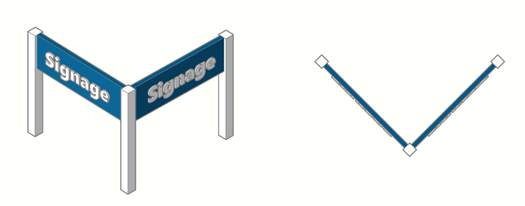
Figure 09.1 V-Shaped or Angle Signs
(10)
Signs advertising or promoting businesses or events of a commercial nature occurring on a parcel other than that upon which the sign is located, except as expressly allowed in this Chapter 13.09;
(11)
Signs with more than two (2) faces;
(12)
Signs that concern illegal commercial activity or are false or misleading; and
(13)
All other signs not expressly allowed pursuant to this Chapter 13.09.
(e)
Registration required. Registration pursuant to the administrative procedures set forth in Section 13.03.040(o), Sign permit or temporary sign registration, shall be required for all temporary signs allowed under this Chapter 13.09, unless otherwise exempted by Subsection (f) below or by another provision of this LDO.
(f)
Permit required.
(1)
A Sign Permit issued pursuant to the administrative procedures set forth in Section 13.03.040(o), Sign permit or temporary sign registration, shall be required for construction or installation of all permanent signs allowed under this Chapter 13.09, unless otherwise exempted by another provision of this LDO. In addition, a new Sign Permit shall be required for any change or modification to the sign location, size, shape, or other characteristic of the sign except its message such as replacing a panel in an existing multi-tenant monument sign.
(2)
An application for a Sign Permit shall meet the following criteria:
a.
The proposed signs shall not interfere with required sight distances and sight distance triangles as established in the LDO and the Roadway Design and Construction Criteria Manual, or as otherwise determined by the Town.
b.
The proposed signs shall not provide a safety or security hazard to pedestrians, drivers, or the general public, and shall not interfere with pedestrian and bicycle movements.
c.
The proposed signs shall be designed to minimize graffiti and vandalism and shall be designed to minimize the collection of trash and litter.
d.
The proposed signs shall not be located within any utility or drainage easement unless allowed pursuant to Section 13.09.050(f)(2)c.
(g)
Rules of measurement. The following regulations shall control the computation and measurement of sign area, sign height, building frontage and street frontage:
(1)
Sign area.
a.
Generally. The sign area shall include the face of all the display area of the sign. The sign area shall include the frame and structural support unless such structural support is determined to be an architectural feature or detail as defined in Section 13.02.020 or except as specifically exempted by Subsection d. below. Architectural features that are either part of a building or part of a freestanding structure as illustrated on an approved Site Plan and sign plan elevations are not considered signs and are thus exempt from these regulations, however, any architectural feature that is part of a sign structure shall be subject to the height restrictions in this Chapter 13.09.
b.
Backgrounds. For a sign that is framed, outlined, painted, or otherwise prepared and intended to provide a background for a sign display, the area of the sign shall be the entire area within a single contiguous perimeter of not more than eight (8) straight lines enclosing the extreme limits of the sign, including the background or frame.
c.
Irregular shapes. For a sign comprised of individual letters, figures or elements on a wall or similar surface of a building or structure, the area of the sign shall be the entire area within a single contiguous perimeter of not more than eight (8) straight lines enclosing the extreme limits of all the elements in the display. For other irregularly shaped or circular signs, the area may be measured by means including mathematical methods of calculating area, i.e., π r 2 for a circular sign, etc. When separate elements are organized to form a single sign, but the elements are separated by open space, the area of the sign shall include all the display areas, including the space between the elements.
d.
Sign faces. For freestanding and projecting signs, the sign area shall be computed by the measurement of: (a) both of the sign faces when both sign faces contain a display; or (b) only one (1) of the sign faces when the reverse sign face is blank. For any sign that has two (2) display surfaces that do not comply with the above regulation, then each surface shall be included when determining the area of the sign. In determining the area of freestanding signs, the following shall be exempted from being considered as part of the maximum allowed sign area:
1.
The air space under a freestanding sign between supporting posts, other airspace between a projecting sign and the wall to which it is attached. (See Figure 09.2)
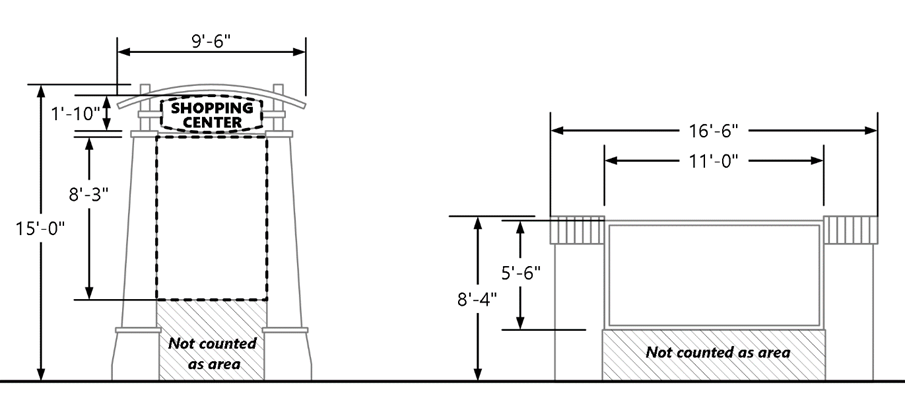
Figure 09.2 Calculation of Freestanding Sign Area
2.
Additional base area, framing or structural supports or other portions of the sign when such areas are determined to be:
a)
Constructed and designed with materials that are similar to, or compatible with, the architecture of the building or other site features;
b)
Not intended or designed to include messages; and
c)
Exclusive of colors, trademarks or any other decorative design features that are primarily intended to attract attention rather than be unobtrusive or compatible with the architecture of the building or other site features.
(2)
Sign height. The height of a freestanding sign shall be measured from the elevation of the edge of the nearest public right-of-way facility immediately adjacent to or nearest the sign structure, to the highest point of the sign, its frame or decorative features, unless the elevation is higher than the base of the sign, in which case it is measured from the base of the sign or the predevelopment grade, whichever is lower.
(3)
Building frontage.
a.
For the purposes of this Chapter 13.09 and for determining allowable wall sign area: The building frontage shall be measured along such building wall between the exterior faces of the exterior sidewalls.
b.
In the case of an irregular wall surface, a single straight line approximating such wall surface shall be used to measure the wall's length.
c.
For multi-occupant buildings, the portion of a building that is owned or leased by a single occupant shall be considered a building unit. The building frontage for a building unit shall be measured from the centerline of the party walls defining the building unit.
d.
The primary frontage shall be the building frontage that includes the main access point to a building or building unit. (See Figure 3.)
e.
The secondary frontage shall be all other frontages. (See Figure 09.3)
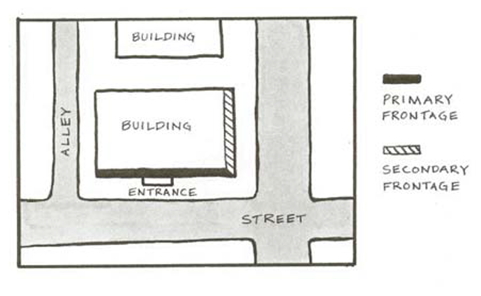
Figure 09.3 Primary and Secondary Frontage
(4)
Street frontage. Standards in this Chapter 13.09, that are based on a minimum length of the street frontage, shall also apply to any portion of a street frontage unless the specific regulation states otherwise.
(5)
Sign setbacks. The required setbacks for the sign shall apply to all elements of the sign, including its frame and base. The setback shall be measured from the parcel boundary or the interior line of the sidewalk, whichever is less permissive.
(h)
Definitions. Definitions of terms related to the regulation of signs are in Section 13.02.020, Definitions, and are grouped as "sign-related definitions".
(i)
Flexibility and Relief.
(1)
Administrative allowances. Administrative allowances of some of the standards in this Chapter 13.09 are available pursuant to Section 13.03.030(f)(4) and 13.09.050(g) 13.03.040(c).
(2)
Administrative adjustments. Administrative adjustment of some of the standards in this Chapter 13.09 are available pursuant to Section 13.03.040(c).
(3)
Major modifications. Major modifications to a Sign Permit or other approval granted pursuant to this Chapter 13.09 are available pursuant to Section 13.03.040(j).
(4)
Variances. Variances from some of the standards in this Chapter 13.09 are available pursuant to Section 13.03.040(x).
(5)
Waivers. Waivers from some of the standards in this Chapter 13.09 are available pursuant to Section 13.03.040(y).
13.09.030 - General requirements for all allowed signs.
All signs requiring a Sign Permit under this Chapter 13.09 shall comply with the provisions set in this Section 13.09.030, except to the extent superseded by a Planned Sign Program approved pursuant to Section 13.03.040(l) or a Variance approved pursuant to Section 13.03.040(x).
(a)
Preservation of sight lines. For the purpose of assuring that drivers and pedestrians have adequate visibility at the intersection of a roadway, street, driveway, trail or alley, no sign or portion of a sign shall be designed or erected in a manner so as to conflict with the Roadway Design and Construction Criteria Manual standards for minimum sight distances and/or sight distance triangles.
(b)
Illumination. In addition to complying with the standards set forth in Section 13.08.110, Exterior lighting, all illumination of signs shall comply with the following standards. In the event of a conflict between this Section 13.09.030 and Section 13.08.110, Exterior lighting, the provisions of this Section shall govern.
(1)
Animation. Signs shall not include animated, flashing, moving or intermittent illumination, except that the message on any changeable copy sign may change at the rate established in Section 13.09.050(c)(1), Changeable copy signs.
(2)
Illumination prohibited. Illumination shall be prohibited on all signs accessory to a single-family dwelling, or duplex dwelling, and on all temporary signs.
(3)
Internal illumination.
a.
Internally illuminated signs are prohibited on parcels containing multifamily residential uses.
b.
For signs located within two hundred (200) feet of a residential zoning district; internal illumination of the background portion of the sign is prohibited.
c.
All internally illuminated signs shall comply with the following:
1.
Except as provided in Subsection 3. or 4. below, the sign shall be constructed with either: an opaque background and translucent letters and symbols or a translucent darker-colored background with a lighter contrasting color for the letters and symbols;
2.
Internal lighting shall not include exposed neon, LED, incandescent, fluorescent, or other bulbs;
3.
A changeable copy sign may be internally illuminated;
4.
Internally illuminated signs shall not be allowed within the Downtown East zoning district.
(4)
External illumination.
a.
Signs on a parcel containing one (1) or more multifamily residential uses may be externally illuminated pursuant to the provisions of this Section 13.09.030(b)(4).
b.
Signs located within a subdivision tract may be externally illuminated pursuant to the provisions of this Section 13.09.030(b)(4).
c.
The external illumination of freestanding signs shall comply with the following:
1.
For signs that have a height greater than eight (8) feet, any external lighting must be from the top of the sign and directed downward; and
2.
The lighting of signs that have a height of eight (8) feet or less may be illuminated from the top of the sign or from the ground.
d.
Externally illuminated building signs may only be illuminated from the top of the sign.
e.
Light sources for externally illuminated signs must be shielded and directed so that the light shines on the sign and that illumination beyond the sign face is minimized.
(c)
Construction. All signs shall be constructed pursuant to the following requirements:
(1)
Compliance with building code. The construction, erection, safety, and maintenance of signs shall comply with all building regulations of the Town, including Building Permit requirements where necessary. Electric signs and all permanent signs involving structural requirements of the building code shall be installed, repaired, altered, and serviced only by a contractor licensed to perform such tasks.
(2)
Safety. Signs shall be structurally sound and located so as to pose no threat to pedestrian or vehicular traffic. No sign regulated by this Chapter 13.09 shall be erected in proximity to railroad crossings or at the intersection of any streets in such a manner as to obstruct free and clear vision; at any location where, by reason of the position, shape or color, it may interfere with, obstruct the view of or be confused with any authorized traffic sign signal or device; or that makes use of any word, phrase, symbol or character in such a manner as to interfere with, mislead or confuse traffic.
(3)
Materials.
a.
Permanent signs shall be fabricated on and of materials that are of good quality, durable, weather-resistant, fastened or anchored sufficiently as described in this Section. Fabric or similar materials are not allowed for permanent signs. All wood sign components shall be stained or painted to ensure durability. Permanent freestanding signs shall complement the architectural style, character, materials, color, and detail of adjacent buildings.
b.
Temporary signs shall be durable and weather-resistant and fastened or anchored sufficiently, whether attached to the building or positioned in the ground. If a lightweight fabric or similar material is being used as a freestanding temporary sign, it shall be mounted securely to a solid, hard-backed, rigid surface.
(4)
Support.
a.
No sign, including temporary signs, shall be attached to a fence, retaining wall, utility box, utility pole, tree, trash receptacle, bench or other structure not intended or approved as a sign support except as otherwise provided in this Chapter 13.09.
b.
As an exception to Subsection (4)a. above, temporary signs on a construction site as described in Section 13.09.040(d)(2) may be attached to a fence or construction trailer.
(5)
No obstruction. No sign shall be erected and located so as to obstruct any window, door, fire escape, balcony, platform, stairway, ladder, vent or other means of ingress and egress of any building.
(6)
Maintenance. All signs shall be maintained pursuant to Section 13.08.130(a)(3), Signs.
13.09.040 - Temporary signs on developed parcels.
(a)
Purpose. The purpose of this Section 13.09.040 is to reinforce and enhance the unique character of the residential and nonresidential parcels within the Town in an appropriate manner. An excessive number of signs, improper placement of signs, or excessive sign area can create visual clutter that detracts from the aesthetic quality of the Town's residential neighborhoods.
(b)
Applicability. All temporary signs that require Sign Registration shall comply with the provisions in this Section except to the extent superseded by a Planned Sign Program approved pursuant to Section 13.03.040(l). In the event of a conflict between the standards in this Section 13.09.040 and the provisions of Chapter 10.13, Signage within Streets and Sidewalks, of the Parker Municipal Code, the provisions of Chapter 10.13 shall apply.
(c)
General standards. Temporary signs must be registered pursuant to Section 13.03.040(o) and must comply with the dimensional limitations set forth in this Section 13.09.040, as applicable. Temporary signs may not be placed within the public right-of-way except pursuant to Chapter 10.13, Signage within Streets and Sidewalks, of the Parker Municipal Code.
(d)
Temporary sign type-specific standards.
(1)
Temporary banners.
a.
In addition to the sign(s) allowed on a parcel pursuant to this Chapter 13.09, one (1) banner of up to forty (40) square feet and registered pursuant to Section 13.03.040(o) shall be allowed on each nonresidential parcel while the Town is reviewing a permit application for one (1) or more permanent signs on the same parcel. This temporary banner must be removed upon the completion of the installation of the permanent sign subject to such permit or the expiration of the approval of the Sign Permit, whichever occurs first.
b.
The permitted temporary banner shall be affixed to a building, except that temporary banners on construction sites may be attached to fences or trailers. No temporary freestanding banners are allowed.
c.
Banners placed pursuant to this Section 13.09.040(d)(1) shall not be subject to the aggregate sign area limitations of Sections 13.09.050(e) and 13.09.050(f).
(2)
Temporary signs on construction sites.
a.
In addition to any temporary signs allowed pursuant to Section 13.09.040(d)(3), temporary signs of any type allowed by Section 13.09.040(d) may be displayed on a parcel for the duration of any active construction of a new building that will contain a principal use and requiring a Building Permit and occurring on that parcel, provided that each sign complies with the following standards.
1.
Signs may be attached to fences or construction trailers or may be freestanding;
2.
Signage along local residential street frontages shall be required to conform with the provisions of this Chapter 13.09 for other types of signs at that location and shall not be allowed any additional signage; and
3.
Signs shall comply with the dimensional and duration standards set forth in Section 13.09.040(e).
b.
For purposes of this Section 13.09.040(d)(2), a subdivision tract shall be deemed to have active construction requiring a Building Permit so long as any one (1) parcel within the same subdivision filing has active construction of new residential units requiring a Building Permit.
(3)
Temporary freestanding signs.
a.
Sign area allowance ("32/64").
1.
Notwithstanding any other provision of this Chapter 13.09, each separate nonresidential parcel shall be allowed one (1) freestanding sign, displayed for no longer than twelve (12) consecutive months, for each street frontage, pursuant to the following standards:
2.
If the freestanding sign is to be made permanent, a Planned Sign Program meeting the standards set forth in Section 13.03.040(l) is required.
3.
If there is no available land to place such freestanding sign, an additional banner sign may be substituted so long as such banner sign meets the requirements of Section 13.09.040(d)(1).
4.
Any sign that meets the requirements of this Section shall not be subject to the permitting requirements of Section 13.03.040(o); but the duration of display of the temporary banner may not exceed twelve (12) months, unless the temporary sign is located on a vacant parcel or subdivision tract, in which case the time limitations set forth in this Section shall not apply.
b.
Duration.
1.
Except for temporary freestanding signs that comply with Subsection a. above, any temporary freestanding sign may be displayed for a maximum of ninety (90) days per calendar year, plus one (1) extension of an additional sixty (60) days if resubmitted to the registry pursuant to Section 13.03.040(o).
2.
The display duration in Subsection b.1 above shall not apply to any sign placed on a parcel of real property during any time period in which the parcel is actively listed for sale, as evidenced by such parcel's listing in a multiple listing service or other real estate listing service.
(4)
Sandwich board signs. All sandwich board signs shall comply with the following standards:
a.
Sandwich board signs shall not be allowed within the public right-of-way except pursuant to Chapter 10.13, Signage within Streets and Sidewalks, of the Parker Municipal Code.
b.
Sandwich board signs must be located within twenty (20) feet of the principal entrance of the building or building area occupied by the individual or entity posting the sandwich board sign.
c.
Sandwich board signs shall not obstruct any sidewalk, parking areas, or drive aisles or be located in any place that would violate with the Americans With Disabilities Act.
d.
One (1) sandwich board sign shall be permitted in connection with an approved Mobile Business Permit as described in Section 13.05.060(c)(3).
e.
Sandwich board signs shall comply with the dimensional and duration limitations set forth in Section 13.09.040(e).
(e)
Dimensional and design standards for temporary signs.
(1)
The following dimensional limitations shall apply, by sign type and parcel type, to temporary signs on residential and nonresidential parcels. Additional limitations may apply to the sign types referenced below in Section 13.09.040(d).
(2)
Notwithstanding the limitations of Section 13.09.050(e)(1), an additional six (6) square feet of sign area used exclusively for one (1) or more temporary signs meeting the requirements of Section 13.09.040 shall be allowed for each single-family and duplex residential parcel and an additional forty (40) square feet of sign area used exclusively for one (1) or more temporary signs meeting the requirements of Section 13.09.040 shall be allowed for each multifamily residential parcel. All temporary signs must be registered pursuant to Section 13.03.040(o).
13.09.050 - Permanent signs on developed parcels.
(a)
Purpose. The purpose of this Section 13.09.050 is to reinforce and enhance the unique character of the residential and nonresidential parcels within the Town in an appropriate manner. An excessive number of signs, improper placement of signs, or excessive sign area can create visual clutter that detracts from the aesthetic quality of the Town's residential neighborhoods.
(b)
Applicability. All signs that require a Sign Permit shall comply with the provisions in this Section 13.09.050, except to the extent superseded by a Planned Sign Program approved pursuant to Section 13.03.040(l).
(c)
Permanent sign type-specific standards.
(1)
Changeable copy signs. Signs containing changeable copy shall comply with the following standards:
a.
The changeable copy shall not change more than two (2) times per calendar day;
b.
Changeable copy may be changed electronically, mechanically, or manually; and
c.
All changeable copy signs shall comply with the dimensional limitations set forth in Section 13.09.050(d).
(2)
Flags. All flags shall conform to the following standards unless included in an approved Planned Sign Program pursuant to Section 13.03.040(l). Flags that meet these standards shall not count toward the allowed sign area in Sections 13.09.050(e) and 13.09.050(f) and shall not require a Sign Permit pursuant to Section 13.03.040(o).
a.
No more than two (2) flagpoles shall be allowed per parcel; The maximum flagpole height for nonresidential parcels shall be determined based on the size of the flag area, as follows:
b.
Illumination of flags shall comply with the provisions of Section 13.08.110, Exterior lighting.
c.
Flags shall comply with the dimensional standards set forth in Section 13.09.050(d).
(3)
Permanent freestanding signs. All permanent freestanding signs shall comply with the following standards:
a.
Permanent freestanding signs shall not impede pedestrian movement into and out of structures and along the sidewalk or street right-of-way.
b.
Permanent freestanding signs may not be located in utility, drainage, public access, parking, or circulation easements unless approved in writing by all easement holders.
c.
Permanent freestanding signs shall comply with the dimensional limitations in Section 13.09.050(d).
(4)
Instructional signs. All instructional signs shall comply with the following standards:
a.
The number of instructional signs located on the site is the minimum needed to serve the intended instructional purpose.
b.
The signs are not located or designed to be legible or serve to attract attention beyond the perimeter of the site.
c.
Instructional signs that meet the foregoing requirements shall not count toward the allowed sign area set forth in Sections 13.09.050(e) and 13.09.050(f).
d.
Instructional signs shall comply with the dimensional limitations in Section 13.09.050(d).
(5)
Projecting signs. Projecting signs shall be allowed for each building occupant with a minimum of ten (10) feet of occupant building frontage and shall comply with the following standards.
a.
Projecting signs may not extend further than five (5) feet from a building frontage.
b.
The bottom of any projecting sign must be a minimum of eight (8) feet above the sidewalk and/or grade.
c.
Projecting signs may have a zero-lot line setback; provided, however, where projecting signs extend over a public right-of-way, a license agreement must be received from the Town.
d.
Projecting signs must be of a scale consistent with and appropriate for the building to which they are affixed.
e.
Projecting signs shall comply with the dimensional limitations in Section 13.09.050(d).
(6)
Residential subdivision entry signs on fences. Residential signs on masonry fences or retaining walls may be permitted through a Planned Sign Program if the sign(s) meet the following standards:
a.
The sign will be located at the entrance to the residential development.
b.
The location of a freestanding sign is prohibited by one of the following:
1.
Easement
2.
Right-of-way
3.
Landscape, site triangle or other design constraint
4.
Allows for better design without visual clutter.
c.
The design must be integrated into the wall/fence, be to scale and have compatible uses.
d.
Sign may not be located on a wood fence.
(d)
Dimensional and design standards for permanent signs. The following dimensional limitations shall apply, by sign type and parcel type, to permanent signs. Permanent signs shall also be subject to the aggregate area limitations per parcel as set forth in Sections 13.09.050(e) and 13.09.050(e). Additional limitations may apply to the sign types referenced below as set forth in Section 13.09.050.
(e)
Aggregate sign area for residential parcels. These standards apply to all signs on lots in a residential zoning district, except for signs located on open space, park, landscape, or detention tracts treated as nonresidential signs and subject to the standards in Section 13.09.050(f).
(1)
Total sign area limitation. Except as otherwise permitted in this Section 13.09.050(e), the aggregate area of all signs located on a residential parcel shall not exceed the lesser of:
a.
Six (6) square feet per each dwelling unit located on such parcel; or
b.
Sixty (60) square feet per building containing one or more dwelling units located on such parcel.
(2)
Exemptions from maximum allowed sign area. The following sign types shall be exempt from the maximum allowed sign area per residential parcel in Subsection (e)(1), above.
a.
Temporary signs located on construction sites allowed per Section 13.09.040(d)(2); and
b.
Instructional signs allowed pursuant to Section 13.09.050(c)(4).
(3)
Sign types allowed. The aggregate sign area permitted under Subsection (e)(1) above may include any combination of signs allowed pursuant to Section 13.09.040(e) and 13.09.050(d).
(f)
Aggregate sign area for signs on nonresidential parcels.
(1)
Building-mounted signs.
a.
Subject to the maximum sign area allowances set forth in Table 13.09.E below, for each building on a nonresidential parcel, the area of all allowed permanent building-mounted signs per building or building unit frontage shall not exceed the following: Thirty (30) square feet, plus the greater of either:
1.
One (1) square foot per linear foot of frontage over thirty (30) linear feet up to seventy-five (75) linear feet, then one (1) square foot per two and one-half (2½) feet over seventy-five (75) linear feet of frontage; or
2.
One (1) square foot per two hundred (200) square feet of gross leasable floor area over nine hundred (900) square feet.
b.
In addition to the building-mounted signs in Table 13.09.E, additional sign area is permitted for each of the building's primary and secondary frontages according to the following:
1.
For a building with two (2) floors, the additional permitted aggregate sign area is 40 square feet per building wall.
2.
The additional aggregate sign area in Subsection b.1 above may be increased by 10 square feet for each additional floor in the building.
3.
Any building sign that uses the additional sign area permitted pursuant to this Section 13.09.050(f)(1) must be located above the floor height of the highest floor in such building.
c.
For each building on a nonresidential parcel, the aggregate area of all allowed permanent building signs per building shall not exceed the limits in the following table, measured on a per building basis:
(2)
Permanent freestanding signs.
a.
Additional permanent freestanding sign allowance. In addition to the base allowance for sign(s) set forth in 13.09.050(f)(1) above, additional permanent freestanding signs may be placed on nonresidential parcels pursuant to the following table:
b.
Sign base and setback limitations. In addition to the limitations set forth in this Section 13.09.050(f)(2), all freestanding signs shall meet the following standards:
c.
Signs in easement areas. Freestanding signs may not be located in utility, drainage, public access, parking, or circulation easements unless approved in writing by all easement holders.
(3)
Exemptions. Instructional signs allowed pursuant to Section 13.09.050(c)(4) shall be exempt from the maximum allowed sign area per nonresidential parcel pursuant to Section 13.09.050(f)(2).
(g)
Administrative allowance for permanent signs. The Planning Director may adjust any dimensional standard related so signs in this Section by up to fifteen (15) percent through the process described in Section 13.03.030(f)(4), Administrative allowances, subject all to the requirements and limitations of that Section, if the Planning Director determines that the request meets the criteria for approval of an Administrative Allowance in Section 13.03.030(f)(4)c.
13.09.060 - Temporary and permanent signs on vacant parcels and subdivision tracts.
Signage on vacant parcels and subdivision tracts shall comply with the following standards.
(a)
Vacant parcels not subject to a Building Permit. For any vacant parcel not subject to a Building Permit, the limitations of Section 13.09.050(f)(2) above shall apply. For purposes of this Chapter 13.09, a vacant parcel shall be treated as a nonresidential parcel with no principal use(s).
(b)
Vacant parcels subject to a Building Permit. On any vacant parcel for which a Building Permit has been issued, permanent signage shall be allowed pursuant to Section 13.09.050(f)(2) above and temporary signage shall be allowed pursuant to Section 13.09.040(d)(2).
(c)
Subdivision tracts. Permanent signs shall be allowed on each subdivision tract pursuant to Section 13.09.050(f)(2) above. Temporary signs shall be allowed on each subdivision tract pursuant to Section 13.09.040(e) or, for subdivision filings with one or more active Building Permits for new residential dwelling units, pursuant to Section 13.09.040(d)(2). For purposes of determining maximum and aggregate permitted sign area, subdivision tracts shall be treated as nonresidential parcel.

