
Parker City Zoning Code
CHAPTER 13
05 - Use Regulations
13.05.010 - Purpose and organization of this chapter.
(a)
Purpose. This chapter identifies the land uses allowed in Parker's zoning districts and establishes the standards that may apply to those uses to mitigate potential impacts and support unique characteristics.
(b)
Organization.
(1)
Section 13.05.020, Table of allowed uses, lists the uses allowed by zoning district and provides cross-references to applicable use-specific standards.
(2)
Section 13.05.030, Use-specific standards, establishes the standards that apply to certain land uses.
(3)
Section 13.05.050, Accessory uses and structures, establishes the standards that apply to accessory uses and structures.
(4)
Section 13.05.060, Temporary uses and structures, establishes the standards that apply to temporary uses and structures.
13.05.020 - Table of allowed uses.
Table 13.05.A lists the uses allowed within base zoning districts. Each listed use is defined in Section 13.02.020.
(a)
Explanation of use permission abbreviations.
(1)
Uses permitted by right. A "P" in a cell indicates that the use is permitted by right in the respective zoning district. Permitted uses are subject to all other applicable standards within the LDO.
(2)
Use by Special Review required. An "S" in a cell indicates that the use is only permitted in the respective zoning district with approval of a Use by Special Review pursuant to Section 13.03.040(s), 13.03.040(t), 13.03.040(u), or 13.03.040(w), as applicable, and subject to all other applicable standards within the LDO.
(3)
Prohibited uses. A blank cell indicates that the use is prohibited in the respective zoning district.
(4)
Accessory uses. An "A" in a cell indicates that the use is only permitted in the respective zoning district as an accessory use.
(5)
Use-specific standards. Regardless of whether a use is permitted by right or with approval of a Use by Special Review, specific standards may apply to that use. Those use-specific standards are identified and cross-referenced in the far-right column in Table 13.05.A. Uses that are subject to use-specific standards within a specific zoning district are demarcated with a "+" next to the level of permission ("P+," "S+," or "A+"). Those are noted for a matter of convenience only and are not regulatory. The text within the use-specific standards shall control.
(b)
Use for other purposes prohibited. Approval of a use listed in Table 13.05.A and compliance with the applicable use-specific standards for that use, only authorizes that use. Buildings and structures shall not be erected, altered, or enlarged unless related to that use, and only then with necessary subsequent approvals. All other uses not specifically listed are prohibited unless the Planning Director has determined an appropriate use type for the unlisted use pursuant to the procedure below.
(c)
Classification of new and unlisted uses. The following procedure shall apply if an application is submitted for a use that is not specifically listed in Table 13.05.A. Submission and approval of such an application shall be required prior to approval of any other permit or development approval associated with the use.
(1)
Planning Director determination for unlisted uses. When an applicant proposes an unlisted use, the Planning Director shall determine the appropriate designation of a specific use type by considering potential impacts of the use including the nature and compatibility of the use and whether it includes dwellings, sales, processing, or storage; and typical operations, employment characteristics, nuisances, and requirements for public services and utilities.
(2)
Uses and use-specific standards requiring a code text amendment. When and if the Planning Director determines that the proposed unlisted use cannot be applied to an existing appropriate use type, or that additional use-specific standards are necessary, then the Planning Director shall require a text amendment to the LDO pursuant to Section 13.03.040(i), LDO amendment and adoption.
(3)
Appeal of Planning Director's determination. An appeal of the Planning Director's determination shall be made pursuant to the appeals procedures in Section 13.03.030(i)(3), Appeals of decisions under the LDO.
(d)
Uses must be conducted on same parcel. All activities related to a principal permitted use or an approved principal special review uses must occur on a single parcel or on adjacent parcels in common ownership and in the same zoning district. No accessory use may occur on a parcel different from that containing the principal use to which it is accessory.
(e)
Table of allowed uses.
(1)
In Table 13.05.A below, land uses and activities are classified into general use categories, use subcategories, and specific use types based on common functional, product, or physical characteristics such as the type and amount of activity, the type of customers or residents, how goods or services are made, sold, or delivered, and site conditions. This classification provides a basis for assigning present and future land uses into appropriate zoning districts. This classification does not list every use or activity that may appropriately exist within each use category. The general use categories and subcategories are intended as an indexing tool only. For example, the general use category "Residential" contains two use subcategories "Household Living" and "Group Living." Specific use types such as "Dwelling, Duplex" and "Assisted or Independent Living Facility" are regulatory.
(2)
Permitted uses, use by special review, and accessory uses in PD districts are not listed in Table 13.05.A: Table of Allowed Uses, but are those uses listed in the approved Development Guide for that PD.
(Ord. 3.372.2 §4(Exh. D), 2025)
13.05.030 - Use-specific standards.
(a)
General standards.
(1)
All uses with use-specific standards are indicated in the right-hand column of Table 13.05.A.
(2)
Use-specific standards apply to all zoning districts unless otherwise stated.
(3)
Should any use-specific standards conflict with the standards in Chapter 13.08, Development Standards, these use-specific standards shall apply unless otherwise stated.
(4)
Any uses or activities requiring additional licensing through the Town or other local, state, or federal agency shall be required to obtain such required license and maintain it in good standing for the duration of the use or activity.
(5)
For uses with minimum distance requirements, the distance shall be measured from property line to property line, unless otherwise stated.
(b)
Uses within Title 32 metropolitan districts.
(1)
Purpose. The purpose of the standards in this Subsection is to ensure that land and structures in existing and future metropolitan districts located in commercial and light industrial areas of the Town are used, reused, developed, or redeveloped in ways that maintain and protect the financial health of Title 32 metropolitan districts. By limiting development and redevelopment to land uses that generate property tax revenues, Title 32 Metropolitan Districts can finance, construct, and maintain infrastructure approved by the Town.
(2)
Applicability. This Section 13.05.030(b) shall apply to all parcels within the Town that:
a.
Are zoned to allow commercial or light industrial uses; and
b.
Are located within a Title 32 metropolitan district.
(3)
Development requirements.
a.
Renovation of existing structures. An application for a Building Permit to renovate or make interior alterations to an existing structure that was previously occupied by a commercial or light industrial use shall only be approved for use or mix of uses that generate property tax revenues.
b.
Demolition and replacement of existing structures. If an application is filed to demolish an existing structure with a gross floor area of fifteen thousand (15,000) square feet or more in which fifty (50) percent or more of the gross floor area was previously occupied by a use or mix of uses that generates property tax revenues, the demolition permit shall require that any principal structure later constructed on that parcel shall be entirely occupied by a use or mix of uses that generates property tax revenues.
c.
Initial development of vacant land.
1.
Annual payment. For the remaining term of any Title 32 metropolitan district debt outstanding on January 1 of the year of initial development of vacant land, the total annual taxes and payments in lieu of taxes from land, structures and other development on that parcel shall equal or exceed the amount of property tax revenue due from that vacant parcel in the year prior to issuance of the initial Building Permit or occupancy approval; or
2.
Lump sum payment. As an alternative to the stream of annual payments due under Subsection 1 above, the applicant may make a lump sum payment prior to issuance of the building or occupancy permit equal to:
a)
The property taxes received from the vacant property in the year prior to initial development; multiplied by the remaining number of years in the term of the Title 32 metropolitan district; and
b)
Discounted to its present value based on the average interest rate being paid by the Title 32 metropolitan district on its outstanding debt as of January 1 of the year of initial development of the parcel.
(4)
Waiver. The Town Council may waive or modify some or all of the requirements of Subsection (3) above if it makes a written finding that the waiver will not result in significant threat to the financial health of any approved Title 32 metropolitan district in which the property is located and will not significantly impair the ability of that Title 32 metropolitan district to repay any borrowing by that Title 32 metropolitan district to provide infrastructure.
(c)
Residential uses.
(1)
Dwelling, co-housing.
a.
Design and layout.
1.
The minimum project size for co-housing development is one (1) acre.
2.
Underlying zoning district lot and setback requirements shall apply to the project site boundaries as a whole, but not to individual co-housing dwelling pads.
3.
Each co-housing building shall be separated by a minimum of five (5) feet.
b.
Operation and ownership.
1.
Each co-housing dwelling unit shall be on a permanent foundation and shall connect to public water and sanitary sewer.
2.
One (1) accessory storage structure less than one hundred (100) square feet may be permitted for any unit part of a co-housing project approval.
3.
One (1) accessory storage structure less than six hundred (600) square feet may be permitted as a shared maintenance storage facility for the co-housing project. The structure shall be enclosed on all sides and separated from other structures by a minimum of three (3) feet.
4.
Access drives within a co-housing dwelling development shall be constructed to Town standards.
c.
MN district. The following additional restrictions shall apply to the MN district:
1.
Dwelling units are not permitted on the first floor within six hundred (600) feet of Parker Road. This restriction shall apply from the intersection of Parker Road and E-470 South to the intersection of Parker Road and Hill Top Road.
2.
Dwelling units are not permitted within six hundred sixty (660) feet of a hard corner.
(2)
Dwelling, live/work.
a.
Live/work dwellings shall only be established for nonresidential uses within the office, business, and professional services; personal services; and retail sales use categories pursuant to Table 13.05.A.
b.
The residential component of a live/work dwelling shall be located on upper stories or to the rear of nonresidential portions of the structure.
c.
The nonresidential use shall be owned by a resident of the live/work dwelling.
d.
In the MN and MC districts:
1.
Dwelling units are not permitted on the first floor within six hundred (600) feet of Parker Road. This restriction shall apply from the intersection of Parker Road and E-470 South to the intersection of Parker Road and Hill Top Road.
2.
Dwelling units are not permitted within six hundred sixty (660) feet of a hard corner.
(3)
Dwelling, multifamily.
a.
In the DE district, dwelling units are not permitted on the ground floor.
b.
In the DW district, multifamily dwellings are only permitted by right if the dwelling units are provided above ground floor as part of a vertically mixed-use building; otherwise, standalone multifamily developments shall require approval of a Use by Special Review.
c.
Dwelling, single-family attached. In the DE district, single-family attached dwellings shall not be located west of the intersection of Mainstreet and Pace Center Drive.
d.
In the MN and MC districts:
1.
Dwelling units are not permitted on the first floor within six hundred (600) feet of Parker Road. This restriction shall apply from the intersection of Parker Road and E-470 South to the intersection of Parker Road and Hill Top Road.
2.
Dwelling units are not permitted within six hundred sixty (660) feet of a hard corner.
(4)
Dwelling, single-family attached.
a.
In the DE district, single-family attached dwellings shall not be located west of the intersection of Mainstreet and Pace Center Drive.
b.
In the MN and MC districts:
1.
Dwelling units are not permitted on the first floor within six hundred (600) feet of Parker Road. This restriction shall apply from the intersection of Parker Road and E-470 South to the intersection of Parker Road and Hill Top Road.
2.
Dwelling units are not permitted within six hundred sixty (660) feet of a hard corner.
(5)
Dwelling, single-family detached. In all districts, single-family detached dwellings, including but not limited to manufactured homes, modular homes, and tiny homes, shall be mounted on a permanent foundation and shall be connected to all water, sewer, electric, and gas services made available by third party utility providers serving the area, and all such mountings and connections shall comply with the adopted building code.
(6)
Continuing care facility. Continuing care facilities shall not be located within two hundred fifty (250) feet from a hard corner unless approved by a Use by Special Review.
(7)
Group home and residential facility.
a.
Permit and licenses required.
1.
Group homes and group residential facilities require approval of a group home or group residential facility permit following a neighborhood meeting as described in Subsection c below and subject to such conditions and safeguards imposed by the Town.
2.
Group homes and group residential facilities shall provide proof of state licensure prior to issuance of a final Certificate of Occupancy. Failure to maintain the required state licensure may constitute a material change that invalidates a permit approval and any associated entitlements/permits.
b.
Applicability.
1.
These standards shall apply to those group homes that exceed the number of unrelated people living together as a single housekeeping unit pursuant to the definition of "family" as set forth in Section 13.02.020 of this LDO, as may be amended from time to time.
2.
Unless otherwise provided by law, nothing in this Section 13.05.030(c)(7) shall be construed as authorizing a use that would violate the standards of the underlying residential zoning district including height, setbacks, area, lot coverage or external signage.
3.
Group homes are to be regulated according to the facility's full number of intended residents without regard to temporary drops in occupancy due to start-up, vacancies, turn-over, or other temporary variations in occupancy, and the number of intended residents shall be determined according to the greater of the facility's number of beds or bedrooms.
c.
Neighborhood meeting and limitations for permit approval.
1.
Group home and group residential facility permit applications shall be considered by the Planning Director following a neighborhood meeting pursuant to Section 13.03.030(d).
2.
All group home and group residential facility permits approved by the Town are nontransferable.
3.
Permits shall be permitted for a duration of time specified by the Planning Director or until the land use changes or is terminated, whichever occurs first. Each use is subject to yearly review by the Community Development Department or as often as the Town Council deems appropriate to ensure compliance with the criteria set forth above and any stated conditions of approval.
d.
Criteria for approval. In their review and approval of a permit for a group home or group residential facility, the Planning Director may apply conditions necessary to ensure that the group home or group residential facility:
1.
Will be designed to be architecturally consistent with the residential character of the surrounding neighborhood;
2.
Will be consistent with the Master Plan;
3.
Will not require a level of community facilities and services greater than that which is available to single-family residential uses, such as, merely by way of example, commercial-sized waste receptacles, and more frequent waste disposal services;
4.
Will not result in undue traffic congestion, parking congestion, or traffic hazards, including frequent commercial deliveries or other frequent traffic impacts distinct from those impacts otherwise caused by single-family residential uses;
5.
Will not cause significant air, water, or other nuisance impacts;
6.
Will be consistent with Town health, safety, and fire codes, including occupancy restrictions, and will not otherwise be detrimental to present or future inhabitants of the Town.
(d)
Public, institutional, and civic uses.
(1)
Community facility.
a.
In the SF1, SF2, SF3, and MF zoning districts, the site must front on and take access from an arterial or collector street (and not from a local street).
b.
In the DE and DW districts, a community facility:
1.
Shall not be located on a ground floor frontage on Mainstreet; and
2.
Shall not exceed three thousand five hundred (3,500) square feet if located on a ground floor frontage on a street other than Mainstreet, unless a larger size is approved through the Use by Special Review process.
c.
In the MN, MC, MR, and C3 districts, community facilities:
1.
Under three thousand five hundred (3,500) square feet are permitted in any location;
2.
Between three thousand five hundred (3,500) and ten thousand (10,000) square feet shall not be located within two hundred fifty (250) feet of an arterial road; and
3.
Larger than ten thousand (10,000) square feet require a Use by Special Review.
d.
In the OE district, no community facility shall exceed three thousand five hundred (3,500) square feet in area.
e.
Community facility uses shall comply with the standards in Section 13.04.210(b), Light industrial conservation overlay district and 13.05.030(b), Uses within Title 32 metropolitan districts.
(2)
Daycare, commercial.
a.
Daycares larger than ten thousand (10,000) square feet shall not be located within two hundred fifty (250) feet from a hard corner.
b.
Daycares shall provide adequate drop-off and pickup queuing on-site to avoid impacting adjacent properties or roadways.
c.
In the SF1, SF2, SF3, and MF districts, daycares shall not be located on a lot that is less than thirty thousand (30,000) square feet and shall provide a solid fence or wall, six (6) feet in height, that encloses the rear or side yard used for playground purposes.
d.
In the MN, MC, MR, C3, DE, DW, C1, and C2 districts, daycares shall not exceed three thousand five hundred (3,500) square feet and shall not be located within two hundred fifty (250) feet from a hard corner.
e.
In the DE and DW districts, daycares shall not be located on the first floor along Mainstreet.
f.
In the LI district, daycares must be accessory to a permitted principal or approved Use by Special Review.
(3)
Daycare, residential. A residential daycare meeting the definition of a "family child-care home," as defined by Section 26-6-102(4), C.R.S., shall be subject to compliance with the Parker Residential Code for One- and Two-Family Dwellings.
(4)
Religious assembly.
a.
In the SF1, SF2, SF3, and MF zoning districts, the site must front on and take access from an arterial or collector street (and not from a local street).
b.
In the DE and DW districts, a religious assembly use:
1.
Shall not be located on a ground floor frontage on Mainstreet; and
2.
Shall not exceed three thousand five hundred (3,500) square feet if located on a ground floor frontage on a street other than Mainstreet, unless a larger size is approved through the Use by Special Review process.
c.
In the MN, MC, MR, C1, and C3 districts, community facilities:
1.
Under three thousand five hundred (3,500) square feet are permitted in any location;
2.
Between three thousand five hundred (3,500) and ten thousand (10,000) square feet shall not be located within two hundred fifty (250) feet of an arterial road; and
3.
Larger than ten thousand (10,000) square feet require a Use by Special Review.
d.
Religious assembly uses shall comply with the standards in Section 13.04.210(b), Light industrial conservation overlay district and 13.05.030(b), Uses within Title 32 metropolitan districts.
(5)
School, college, or university. In the DE and DW districts, a college or university larger than fifteen thousand (15,000) square feet requires a Use by Special Review.
(6)
School, public or private.
a.
Schools shall provide adequate drop-off and pickup queuing on-site to avoid impacting adjacent properties or roadways.
b.
In the SF1, SF2, SF3, and MF districts:
1.
All principal buildings and accessory structures shall be located at least fifty (50) feet from all property lines;
2.
At least two (2) frontages on non-local streets shall be provided, or as determined to be feasible by the Director of Engineering/Public Works;
3.
No access shall be provided directly onto local streets; and
4.
Shall not be located within two hundred fifty (250) feet of a hard corner.
c.
In the DW district, a public or private school larger than fifteen thousand (15,000) square feet requires a Use by Special Review.
(7)
School, vocational or trade. Vocational or trade schools shall be limited to training for skilled career fields in which such career would be an allowed use type or activity in the underlying zoning district of the school.
(8)
Medical or dental clinic. In the DE and DW zoning districts, medical or dental clinics shall not be located on the first floor adjacent to Mainstreet.
(e)
Commercial uses.
(1)
Kennel, commercial.
a.
All commercial kennels shall provide pet relief areas that do not interfere with any public right-of-way, easement, shared access, walkway, or other service area.
b.
In all zoning districts where commercial kennels are permitted, outdoor facilities are only permitted if:
1.
Such facilities are not closer than one hundred fifty (150) feet from any residentially zoned property line, and fifty (50) feet from any other property line;
2.
Adequate shelter from the elements is provided, including proper ventilation, heating, cooling, and lighting;
3.
Such facilities are only used between the hours of 7:00 a.m. and 7:00 p.m.;
4.
Such facilities are screened by a fence or wall at least six (6) feet in height; and
5.
The property is maintained to the standards required by the Douglas County Health Department and other state and federal regulating agencies.
(2)
Natural medicine businesses.
a.
Permitted locations.
1.
No natural medicine business that provides natural medicine services shall operate out of a building that is within one thousand (1,000) feet of a child care center; preschool; elementary, middle, junior or high school; or a residential child care facility.
2.
No natural medicine business that provides natural medicine services shall operate out of a building that is within one thousand (1,000) feet of single-family dwellings, duplexes, or multiple-family dwellings.
3.
Subsections 1 and 2 above do not apply to a licensed facility located on land owned by the Town or the State of Colorado and do not apply to a licensed facility that was actively doing business under a valid license issued by the state licensing authority before the school or residential dwelling was constructed.
b.
Natural medicine healing centers and natural medicine businesses that provide natural medicine services shall only operate between the hours of 8:00 a.m. to 5:00 p.m., Monday through Friday.
c.
All doorways, windows and other opening of natural medicine business buildings shall be located, covered, or screened in such a manner to prevent a view into the interior from any exterior public or semipublic area, subject to the Development Design Standards. All activities of natural medicine businesses shall occur indoors.
d.
Primary entrances, parking lots and exterior walkways shall be clearly illuminated with downward facing security lights to provide after-dark visibility for facilitators, participants, and employees, subject to Section 13.08.110, Exterior lighting.
e.
All storage for natural medicine businesses shall be located within a permanent building and may not be located within a trailer, tent, or motor vehicle.
f.
Natural medicine businesses shall use an air filtration and ventilation system designed to ensure that the odors from natural medicine and natural medicine products are confined to the premises and are not detectable beyond the property boundaries on which the facility is located.
g.
Natural medicine businesses shall provide secure disposal of natural medicine and natural medicine product remnants or by-products. Natural medicine and natural medicine product remnants or by-products shall not be placed within the facilities' exterior refuse container.
h.
Processing of natural medicine:
1.
The processing of natural medicine that includes the use of hazardous materials, including, without limitation, and by way of example, flammable and combustible liquids, carbon dioxide, and liquified petroleum gases, such as butane, is prohibited.
2.
Nonhazardous materials used to process natural medicine shall be stored in a manner so as to mitigate and ensure odors are not detectable beyond the property boundaries on which the processing facility is located or the exterior walls of the processing facility associated with the processing of natural medicine.
3.
The processing of natural medicine shall meet the requirements of all adopted Town building and life/safety codes.
4.
The processing of natural medicine shall meet all of the requirements of all adopted water and sewer regulations promulgated by the applicable water and sewer provider.
i.
It is unlawful and deemed a nuisance under Chapter 6.01, Nuisances, of the Parker Municipal Code to dispose of, discharge out of or from, or permit to flow from any facility associated with natural medicine, any foul or noxious liquid or substance of any kind whatsoever, including, without limitation, by-products of the natural medicine process, into or upon any adjacent ground or lot, into any street, alley or public place, or into any municipal storm sewer and/or system in the Town.
(3)
Stable, commercial.
a.
Commercial stable facilities shall be located at least one hundred fifty (150) feet from abutting residentially zoned property lines; and
b.
All outdoor storage areas shall be concealed by a solid fence at least six (6) feet in height.
(4)
Veterinary clinic and hospital. Outdoor facilities associated with a veterinary clinic or hospital shall comply with the following standards:
a.
Buildings and areas for animal care shall be located at least one hundred fifty (150) feet from abutting residentially zoned property line and shall not interfere with any public right-of-way, easement, shared access, walkway, or other service area.
b.
In the DE district, a veterinary clinic or hospital shall not be located on the first floor adjacent to Mainstreet.
(5)
Indoor recreation facility.
a.
Indoor recreation facility uses shall be conducted entirely within an enclosed building.
b.
In the DE and DW districts, an indoor recreation facility use:
1.
Shall not be located on a ground floor frontage on Mainstreet; and
2.
Shall not exceed three thousand five hundred (3,500) square feet if located on a ground floor frontage on a street other than Mainstreet, unless a larger size is approved through the Use by Special Review process.
c.
In the MN, MC, MR, C1, C2, and C3 districts, indoor recreation facilities:
1.
Under three thousand five hundred (3,500) square feet are permitted in any location;
2.
Between three thousand five hundred (3,500) and ten thousand (10,000) square feet shall not be located within two hundred fifty (250) feet of an arterial road; and
3.
Larger than ten thousand (10,000) square feet require a Use by Special Review.
d.
In the OE, LF, and LI districts, no indoor recreation facility shall exceed three thousand five hundred (3,500) square feet in area.
e.
Indoor recreation facility uses shall comply with the standards in Section 13.04.210(b), Light industrial conservation overlay district and 13.05.030(b), Uses within Title 32 metropolitan districts.
(6)
Outdoor recreation facility. All outdoor recreation uses, activities, and buildings shall be located at least fifty (50) feet from any adjacent residential property lines.
(7)
Bar and lounge.
a.
Outdoor seating areas shall not be located within one hundred fifty (150) feet of any lot line of a lot containing a single-family detached dwelling or duplex dwelling.
(8)
Microbrewery, distillery, or winery.
a.
Storage of raw or spent materials shall be stored within a fully enclosed principal or accessory structure, building, or container.
b.
Wholesale sales and bulk shipping of products shall be ancillary, except within the C2, LF and LI districts.
(9)
Administrative, professional, and government office.
a.
In the DE and DW districts, administrative, professional, and government offices shall not be located on the first floor adjacent to Mainstreet.
(10)
Automated teller machine.
a.
Freestanding automated teller machines shall not be located within two hundred fifty (250) feet of an arterial or collector road or two hundred fifty (250) feet of a residentially zoned property.
b.
In the DE and DW district, automated teller machines shall not be located adjacent to Mainstreet.
(11)
Financial institution.
a.
Drive-through uses shall comply with the standards in Section 13.05.050(d)(4).
b.
In the DE district, financial institutions shall not be located on the first floor adjacent to Mainstreet.
(12)
Check-cashing establishment. Check-cashing establishments shall not be located:
a.
Within two hundred fifty (250) feet of a hard corner; or
b.
Within four hundred (400) feet of a residentially zoned property; or
c.
Within four hundred (400) feet of another check-cashing establishment.
(13)
Laundry facility, commercial.
a.
All activities must be conducted entirely within an enclosed building.
b.
Laundry facilities over three thousand five hundred (3,500) square feet shall not be located within two hundred fifty (250) feet of a hard corner or two hundred fifty (250) feet of a residentially zoned property.
(14)
Laundry facility, self-service.
a.
All activities must be conducted entirely within an enclosed building.
b.
Laundry facilities over three thousand five hundred (3,500) square feet shall not be located within two hundred fifty (250) feet of a hard corner or two hundred fifty (250) feet of a residentially zoned property.
(15)
Personal instruction studio.
a.
In the MN district, personal instruction studios shall not exceed ten thousand (10,000) square feet unless otherwise approved as part of a Use by Special Review.
b.
In the DE and DW districts, personal instruction studios shall not exceed three thousand five hundred (3,500) square feet and shall not be located on the first floor adjacent to Mainstreet.
c.
In the MC, MR, C3, OE, and LF zoning districts:
1.
Personal instruction studios over three thousand five hundred (3,500) square feet shall not be located within two hundred fifty (250) feet of a hard corner or two hundred fifty (250) feet of a residentially zoned property; and
2.
Personal instruction studios larger than ten thousand (10,000) square feet require a Use by Special Review.
(16)
Personal services, general.
a.
Each pet grooming shop shall be subject to the following standards:
1.
Shall be located a minimum of two hundred fifty (250) feet from any residential use or residential zoning district, except for residential uses within a mixed-use zoning district;
2.
Shall be operated entirely within an enclosed building; and
3.
Shall provide and maintain a pet relief area that does not interfere with any public right-of-way, easement, shared access, walkway, or other service area.
b.
In the DE and DW districts, personal services shall not exceed three thousand five hundred (3,500) square feet on the first floor adjacent to Mainstreet.
c.
In the MC, MR, C3, OE, and LF zoning districts:
1.
Personal services over three thousand five hundred (3,500) square feet shall not be located within two hundred fifty (250) feet of a hard corner; and
2.
Personal services larger than ten thousand (10,000) square feet require a Use by Special Review.
(17)
Building materials and supply store.
a.
Outdoor display areas shall be limited to twenty-five (25) percent of the gross floor area of the principal building.
b.
In the MR and C3 districts, outdoor display may only be provided if approved with a Use by Special Review.
c.
In the LI district, outdoor display may exceed twenty-five (25) percent of the gross floor area of the principal building if approved with a Use by Special Review.
(18)
General retail, ten thousand (10,000) square feet or less. In the MF and MN districts, all activities must be conducted entirely within an enclosed building.
(19)
General retail, more than ten thousand (10,000) square feet. In the DE district, general retail shall not exceed twenty-five thousand (25,000) square feet per user unless approved by a Use by Special Review
(20)
Nursery or garden supply store. Nurseries or garden supply stores that provide outdoor display areas that comprise more than twenty-five (25) percent of the gross floor area of the principal building, as shown on the approved Site Plan, shall require a Use by Special Review.
(21)
Pawnbroker.
a.
Pawnbrokers shall be located a minimum of four hundred (400) feet from any:
1.
Another pawnbroker;
2.
Sexually oriented business;
3.
Residentially zoned property;
4.
Single-family dwelling (attached or detached), duplex dwelling, or multifamily dwellings;
5.
Religious assembly, public park, or library;
6.
State-licensed day-care facility (child or adult);
7.
School or educational facility serving persons aged eighteen (18) or younger; or
8.
Public recreation facility or community facility.
b.
Distance shall be measured in a straight line, without regard to intervening structures, from the closest exterior structural wall of each business. Pawnbroker businesses are not permitted as an industrial use in any PD - planned development district.
(22)
Bed and breakfast.
a.
Location. Bed and breakfast establishments shall only be allowed in a building with residential character. Any modifications to the building shall be compatible with applicable design standards and with the character of the neighborhood.
b.
Number of bedrooms. The total number of bedrooms, including the bedrooms occupied by permanent residents of the building, shall not exceed five (5).
c.
Operations.
1.
The structure shall be owner-occupied or shall be occupied by a resident manager.
2.
Guest stays shall be limited to a maximum of thirty (30) days.
(23)
Automotive fuel sales.
a.
Within any zone district where automotive fuel sales are permitted, including PD zone districts, automotive fuel sales establishments shall not be located within five hundred (500) feet of an elementary or secondary school, a hospital, a continuing care facility, a group home, a group residential facility, or a day care establishment measured from the property line of the respective uses.
b.
Within any zone district where automotive fuel sales are permitted, including PD zone districts, automotive fuel sales establishments shall not be located within two hundred fifty (250) feet of:
1.
A hard corner from the right-of-way line of the arterial roads; or
2.
A residentially zoned property measured from the property line for the automotive fuel sales to nearest residential lot line for single family residential, duplexes and single family attached and from the nearest building for multifamily.
c.
Within any zone district where automotive fuel sales are permitted, including PD zone districts, no more than two (2) fuel sales establishments shall be located within six hundred sixty (660) feet of the same hard corner.
(24)
Automotive repair, major.
a.
Major automotive repair establishments shall not be located within two hundred fifty (250) feet of:
1.
A hard corner; or
2.
A residentially zoned property.
b.
Sales of vehicles shall be prohibited.
c.
Outdoor storage of inoperable vehicles shall not exceed an area equal to twenty-five (25) percent of the gross floor area of the repair building and shall be screened per Section 13.08.090(m), Utility, storage and service area screening.
(25)
Automotive repair, minor.
a.
Minor automotive repair establishments shall not be located within two hundred fifty (250) feet of:
1.
A hard corner; or
2.
A residentially zoned property.
b.
Sales of vehicles shall be prohibited.
c.
Outdoor storage of inoperable vehicles shall be prohibited.
d.
Minor automotive repair shops shall not include any outdoor storage, display, repairs, or services and shall operate entirely within an enclosed building.
(26)
Automotive sales and leasing, heavy. Heavy automotive sales and leasing establishments shall not be located within two hundred fifty (250) feet of:
a.
A hard corner; or
b.
A residentially zoned property.
(27)
Automotive sales and leasing, light. Light automotive sales and leasing shall not be located within two hundred fifty (250) feet of a residentially zoned property.
(28)
Car wash. Car washes in all zone districts including Planned Developments (PD):
a.
Car washes shall not be located within five hundred (500) feet of an elementary or secondary school, a hospital, a continuing care facility, a group home, a group residential facility, or a day care establishment.
b.
Car washes shall not be located within two hundred fifty (250) feet of:
1.
A hard corner; or
2.
A residentially zoned property.
c.
There shall not be more than two (2) car washes located within six hundred sixty (660) feet of any single hard corner.
(29)
Electric vehicle (EV) charging station.
a.
Level 1 and Level 2 charging stations are allowed as an accessory use to any permitted principal use and shall count toward required parking spaces pursuant to Section 13.08.080(f)(4), Electric vehicle charging stations.
b.
Level 3 charging stations are permitted in all zoning districts except SF1, SF2, SF3, and MF districts as an accessory use to any permitted principal use.
c.
Level 3 charging stations are permitted in the SF1, SF2, SF3, or MF districts only as an accessory use to the following:
1.
Continuing care;
2.
Nonresidential uses; and
3.
Developments of single-family attached or multifamily dwellings containing more than one hundred (100) units.
d.
Level 3 charging stations shall not count toward required parking spaces pursuant to Section 13.08.080(f)(4), Electric vehicle charging stations.
e.
EV charging station spaces shall be reserved for the charging of electric vehicles only. Such spaces shall be posted accordingly, including any amperage and voltage levels, time limits, and contact information for reporting issues.
f.
EV charging station equipment shall be located so that it does not interfere with vehicular, bicycle, or pedestrian access and circulation, or with required landscaping.
(30)
Equipment and machinery sales, rental, and repair.
a.
Equipment and machinery sales, rental, and repair establishments shall not be located within two hundred fifty (250) feet of:
1.
A hard corner; or
2.
A residentially zoned property.
b.
Outdoor display of equipment shall not exceed twenty-five (25) percent of the gross floor area of the principal building.
(31)
Parking garage.
a.
In all districts except residential districts, a parking garage is only permitted if:
1.
It is accessory to a permitted primary or approved conditional use of land; or
2.
It is owned by the Town or another governmental or quasi-governmental entity (including but not limited to part of a park-n-ride facility.
b.
In the DE and DW districts, parking garages shall not be located adjacent to Mainstreet unless the building is concealed or wrapped with other allowed uses or constructed in a way that has the appearance of a building of other allowed uses in those districts.
(32)
Parking lot. In all districts except residential districts, a parking garage is only permitted if:
a.
It is accessory to a permitted primary use; or
b.
It is owned by the Town or another governmental or quasi-governmental entity (including but not limited to part of a park-n-ride facility.
(33)
Recreational vehicle sales, rental, and repair. Recreational vehicle sales, rental, and repair establishments shall not be located within two hundred fifty (250) feet of:
1.
A hard corner; or
2.
A residentially zoned property.
(34)
Sexually oriented business.
a.
Sexually oriented businesses shall be located a minimum of four hundred (400) feet from any:
1.
Area zoned for residential use;
2.
Single-family dwelling (attached or detached), duplex, or multifamily dwelling;
3.
Religious assembly, public park, or library;
4.
State-licensed day care facility (child or adult);
5.
School or educational facility serving persons aged eighteen (18) or younger;
6.
Other sexually oriented business;
7.
Public recreation facility; or
8.
Pawnbroker, as defined in Section 5.09.010.
b.
Distance between any two sexually oriented businesses shall be measured in a straight line, without regard to intervening structures, from the closest exterior structural wall of each business. Distance between any sexually oriented business and any church, school, public park, dwelling unit (single or multiple) or residential district shall be measured in a straight line, without regard to intervening structures or objects, from the nearest portion of the building or structure used as part of the premises where the sexually oriented business is conducted to the nearest property line of the premises of a church, school or dwelling unit (single or multiple) or the nearest boundary of an affected public park, or residential district.
c.
Sexually oriented businesses are not permitted as an industrial use in the PD -planned development district.
(f)
Industrial uses.
(1)
Food and beverage processing.
a.
Any food and beverage processing facility proposed within one hundred fifty (150) feet of a residential zoning district requires a Use by Special Review.
b.
In the MC, MR, and C3 districts, food and beverage processing facilities shall not exceed fifteen thousand (15,000) square feet.
c.
In the DE, DW and C1 districts, the gross floor area of each food and beverage processing facility shall not exceed seven thousand five hundred (7,500) square feet.
(2)
Industrial, general. General industrial uses are prohibited in all districts.
(3)
Industrial hemp processing. The following apply to industrial hemp processing uses:
a.
The initial processing of raw industrial hemp that results in any form of altered finished product, including without limitation, liquid, oil, or wax, using hazardous materials including without limitation and by way of example flammable and combustible liquids, carbon dioxide, and liquified petroleum gases such as butane is prohibited;
b.
Storage of raw hemp is prohibited, except that certified hemp seeds may be stored if ancillary to an industrial hemp processing operation;
c.
Growing of hemp plants is prohibited except as an agricultural use within in the AG zoning district;
d.
Materials used in industrial hemp processing operations shall be stored in a manner to mitigate and ensure odors are not detectable beyond the property line or the exterior walls of the processing facility associated with the industrial hemp operations;
e.
Such processing of industrial hemp shall meet the requirements of all adopted Town building and life/safety codes;
f.
Such processing of industrial hemp shall meet the requirements of all adopted water and sewer regulations promulgated by the applicable water and sewer provider within the Town; and
g.
It is unlawful and deemed a nuisance under Chapter 6.01, Nuisances, of the Parker Municipal Code to dispose of, discharge out of or from, or permit to flow from any facility associated with an industrial hemp operation in the Town, any foul or noxious liquid or substance of any kind whatsoever, including, without limitation, by-products of the industrial hemp processes, into or upon any adjacent ground or lot, into any street, alley or public place or into any municipal storm sewer system in the Town.
(4)
Light industrial. Any light industrial use proposed within one hundred fifty (150) feet of a residential zoning district requires a Use by Special Review.
(5)
Storage.
a.
Storage uses prohibited. All storage, self-storage, outdoor self-storage, commercial storage, and warehousing uses are prohibited as a use by right or as a Use by Special Review in all zoning districts established by this LDO and in all areas zoned PD-planned development district, except as allowed as an accessory use pursuant to Section 13.05.050(d)(8).
b.
Residential.
1.
Storage in residential areas shall be limited to those items that are clearly incidental to residential functions and uses. Commercial or industrial related storage of materials or equipment is not allowed.
2.
Outdoor storage shall not be permitted in the front yard of a residential dwelling.
3.
Outdoor storage of items commonly used inside a residential dwelling are not permitted.
4.
Storage of items defined as "junk" or "litter" under Section 6.01.020 are not permitted.
c.
Nonresidential. All types of accessory nonresidential storage shall be screened from public view and from the view of surrounding areas as required by Section 13.08.090(m), Utility, storage and service area screening, using consistent materials and color schemes as the principal building and in compliance with the Development Design Standards. This shall include the screening of materials and equipment used by the principal use.
(g)
Public and semi-public utility uses.
(1)
Public utility, major.
a.
Conflict with other standards. To the extent that there is a conflict between this Section 13.05.030(g) and any franchise approved by the Town for a public utility, this Section shall control.
b.
Screening. All public utilities:
1.
Shall be adequately screened and buffered with landscaping, fencing or walls, or any combination or those techniques.
2.
Shall be placed underground; or shall be enclosed in a structure in such a manner as to blend and appear consistent with the character of the surrounding area, which structure shall be well-landscaped.
3.
All wires and cables other than long-distance transmission wires shall be placed underground.
(Ord. 3.372.5 §1, 2025; Ord. 3.372.3 §1, 2025; Ord. 3.372.2 §§5—17, 2025)
13.05.040 - Wireless communication facilities.
(a)
Purpose. The purposes of these regulations are: to facilitate the provision of wireless telecommunication services throughout the Town; to allow the location of commercial wireless communication facilities ("WCF facilities") in the Town subject to certain standards; to act on applications for the location of WCF facilities within a reasonable period of time; to encourage collocation of WCF facilities; to minimize the visual impacts of WCF facilities; and to prevent unreasonable discrimination among providers of functionally equivalent services.
(b)
WCF standards.
(1)
Standards for all WCF facilities.
a.
Applicability. The standards contained in this Section apply to all applications for a permitted- or conditional-use WCF facility. The applicant shall demonstrate in writing that its proposed WCF facility meets all applicable standards and provisions of the LDO. The standards contained in this Section do not apply to:
1.
Amateur radio antennas that are owned and operated by a federally licensed amateur radio station operator or are used exclusively for receive-only antennas; provided that the requirement that the height be no more than the distance from the base of the antenna to the property line is met.
2.
WCFs for which a permit has been issued prior to August 21, 2017. Changes and additions to pre-existing WCFs (including trading out of antennas for an equal number of antennas) shall meet applicable requirements of this Section.
3.
Antennas used for reception of television, multi-channel video programming and radio such as Over-the-Air Receiving Device (OTARD) antennas, television broadcast band antennas, and broadcast radio antennas; provided that any requirements related to accessory uses contained in Section 13.05.050 and the requirement that the height be no more than the distance from the base to the property line are met. The Planning Director or designee has the authority to approve modifications to the height restriction related to OTARD antennas and OTARD antenna structures, if in the reasonable discretion of the Town, modifications are necessary to comply with federal law.
b.
Collocation. The Town encourages collocation of WCF facilities when feasible to minimize the number of WCF facility sites. To further the goal of collocation:
1.
No WCF facility owner or operator shall unreasonably exclude a telecommunications competitor from using the same facility or location. Upon request by the Town, the owner or operator shall provide evidence explaining why collocation is not possible at a particular facility or site; and
2.
If a telecommunications competitor attempts to collocate a WCF facility on an existing or approved WCF facility or location, and the parties cannot reach an agreement, the Town may require a third-party technical study to be completed at the expense of either or both parties to determine the feasibility of collocation.
c.
Compliance with FCC standards.
1.
Upon a request by the Town (which request may be made no more than once per calendar year), WCF facility owners and operators shall verify that:
a)
The WCF facility complies with the current FCC regulations prohibiting localized interference with reception of television and radio broadcasts; and
b)
The WCF facility complies with the current FCC standards for cumulative field measurements of radio frequency power densities and electromagnetic fields.
2.
These standards do not constitute any attempt by the Town to regulate radio frequency power densities or electromagnetic fields, which regulation is controlled by the FCC.
d.
Preferred location. For the reason that the Town prefers existing structure-mounted WCF facilities rather than freestanding WCF facilities, all applicants shall attempt to locate on an existing structure or furnish a written statement explaining why location on an existing structure is not feasible, prior to applying for approval for location of a freestanding WCF facility.
e.
Abandonment. If the WCF facility ceases operation for any reason for one hundred eighty (180) consecutive days:
1.
The owner or operator shall remove it on or before the 270th day of the cessation of operation. If the facility owner or operator fails to remove the facility, the landowner shall be responsible for removal of the WCF.
2.
Any Use by Special Review Site Plan approval or permit shall expire.
f.
Equipment storage shelters. Equipment storage shelters shall comply with the following design standards to minimize impacts:
1.
The total area of all equipment storage shelters shall not exceed eight hundred (800) square feet for all pole-mounted WCF facilities mounted to an individual legally existing, utility pole, flagpole, freestanding WCF facility, electric or transmission line support tower or other similar structure. The total area of any equipment storage shelters for all other WCF facilities shall not exceed four hundred (400) square feet.
2.
Equipment storage shelters shall be grouped as closely together as technically possible.
3.
No equipment storage shelter shall exceed twelve (12) feet in height.
4.
Equipment storage shelters located outside shall be screened by fencing, vegetation, or similar screening, unless such shelter and associated appurtenances are contained within a single, uniformly designed structure approved by the Town or placed underground.
5.
If the WCF facility is building-mounted and the equipment storage shelter will be located outside, the shelter shall be architecturally compatible with the building.
g.
Federal aviation administration ("FAA") regulations. If FAA regulations are applicable to a particular WCF facility location, the stricter of the applicable FAA regulations or the applicable regulations contained in this Section shall control.
(2)
Freestanding WCF facilities.
a.
Applicable procedures.
1.
Freestanding WCF facilities not located in public right-of-way shall be subject to an application for Use by Special Review approval pursuant to Section 13.05.040(c)(3).
2.
Freestanding WCF facilities located in public right-of-way shall be subject to application and approval procedures pursuant to Section 13.05.040(c)(2).
b.
Minimum setbacks for freestanding WCF facilities not located in the public right-of-way. A freestanding WCF facility shall be set back from each property line one (1) foot of distance for every foot of facility height.
c.
Separation requirements for freestanding WCF facilities located in the public right-of-way.
1.
No freestanding WCF facility shall be located within six hundred (600) feet of another freestanding WCF facility in the public right-of-way. These separation requirements do not apply to attachments made to existing pole-mounted WCF facilities.
2.
When placed near a residential property, the WCF facility must be placed to the side or rear of the residence. If this is not possible, the WCF may be in front on the common side yard property line between adjacent residential properties. In the case of a corner lot, the facility must be placed in front of the common side yard property line between adjacent residential properties, or on the corner formed by two (2) intersecting streets.
d.
Maximum height for freestanding WCF facilities. A freestanding WCF facility, including antennae, shall not exceed the maximum structure height limit in the underlying zoning district unless the Use by Special Review approval specifically allows the facility to exceed that height. Unless otherwise required by federal law, in no case shall a freestanding WCF facility exceed sixty-five (65) feet in height.
e.
Design standards for freestanding WCF facilities. A freestanding WCF facility shall meet the following design standards to minimize impacts:
1.
The facility shall be designed to be compatible with surrounding buildings and structures and existing or planned uses in the area, subject to any applicable Federal Aviation Administration ("FAA") regulations.
2.
Existing land forms, vegetation and structures shall be used to screen the facility from view and blend in the facility with the surrounding environment, where feasible.
3.
Existing vegetation shall be preserved or enhanced, to the extent practicable.
4.
All facilities shall accommodate collocation of facilities unless collocation is unfeasible.
5.
All applicable landscape and screening regulations shall be observed.
6.
Any equipment that could be dangerous to persons or wildlife shall be adequately covered or fenced.
7.
The diameter of a microwave dish antenna shall not exceed four (4) feet.
8.
The facility shall not be lighted unless required by the FAA or if the WCF is mounted on a light pole or other similar structure primarily used for lighting purposes.
(3)
Building roof or wall-mounted WCF facilities.
a.
Design standards for building wall-mounted WCF. Each building wall-mounted WCF shall comply with the following standards to minimize visual impacts:
1.
The facility shall be stealth or screened from view. Wall-mounted facilities shall be colored to match the building or structure to which it is attached.
2.
The mounting of antennae shall be as flush to the building wall as possible, and in no case shall the antennae extend more than three (3) feet out from the building wall.
3.
The facility shall not extend above the roof line of the building. For purposes of this provision, the roof line shall include parapets but exclude already existing equipment and facilities on the roof.
b.
Design standards for building roof-mounted WCF. Each building roof-mounted WCF shall comply with the following standards to minimize impacts:
1.
Building roof-mounted WCF facilities shall not be permitted on a pitched roof, unless located entirely within a dormer or cupola.
2.
A building roof-mounted WCF facility, including antennae, shall not extend more than twelve (12) feet above the roof line of the building or structure on which the facility is mounted. For purposes of these standards, the roof line shall include parapets but exclude already existing equipment and facilities on the roof.
3.
The facility shall be screened from view and/or colored to match the building or structure to which it is attached.
4.
The diameter of a microwave dish antenna shall not exceed four (4) feet.
c.
Accessory equipment for a building roof or wall-mounted WCF facility shall be placed inside the building if feasible.
(4)
Small cell facilities.
a.
All small cell facilities are a use by right in all zoning districts, and permits shall be issued pursuant to the applicable provisions of this LDO.
b.
Small cell facilities located within the rights-of-way permitted under this Section 13.05.040(b)(4) will be subject to a License Agreement to further facilitate the deployment of small cell facilities.
c.
The maximum height of a small cell facility located in or adjacent to the right-of-way of any street or road other than an arterial street or freeway shall be thirty-five (35) feet, provided that the Planning Director may approve small cell facilities up to forty (40) feet in height if necessary to allow equivalent performance in light of terrain or other unique site features.
d.
The maximum height of a small cell facility located in or adjacent to the right-of-way of any arterial street or freeway shall be forty (40) feet, provided that the Planning Director may approve small cell facilities up to forty-five (45) feet in height if necessary to allow equivalent performance in light of terrain or other unique site features.
(5)
Pole-mounted WCF facilities. Each pole-mounted WCF facility shall comply with the following standards to minimize impacts:
a.
The facility shall be designed to be compatible with surrounding buildings and structures and existing or planned uses in the area.
b.
The facility shall be colored to match the structure to which it is attached.
c.
A pole-mounted WCF facility, including antennae, shall not exceed the maximum structure height limit in the underlying zoning district, unless the Use by Special Review approval specifically allows the facility to exceed that height. To the extent that any Town right-of-way is not contained within a defined zoning district, the maximum height of any pole in the right-of-way, for the purposes of attaching WCFs, shall be thirty-five (35) feet, unless otherwise approved by special review pursuant to Section 13.05.040(c)(3).
d.
The facility shall not be lighted unless required by the FAA or if the WCF is mounted on a light pole or other similar structure primarily used for lighting purposes.
e.
The Planning Director shall have the authority to adopt administrative regulations addressing design standards and specifications for WCF facilities in the right-of-way, consistent with applicable federal and state law.
(c)
Approval procedures.
(1)
Summary of approval matrices. WCF facilities shall be permitted as provided in the following matrices:
a.
WCF facilities—general (excluding facilities for public emergency services provided by federal, state, and local governmental agencies that operate within the corporate boundaries of the Town):
b.
WCF facilities for public emergency services provided by federal, state, and local governmental agencies that operate within the corporate boundaries of the Town:
(2)
Procedure for Administrative Review.
a.
The requirements of Section 13.03.030, Common review procedures, as applicable to a decision by the Planning Director, shall apply unless modified by this Subsection (2).
b.
Within 25 business days of receipt of a completed application for administrative approval, the Community Development Department shall consider whether the proposed facility meets the design standards set forth in this Section, and issue a written decision approving or denying the application. If the application is approved, the applicant may apply for a Building Permit.
c.
If the application is denied, the applicant may appeal the decision to the Town Council. The decision of the Town Council shall be final.
d.
If construction of the WCF facility is not begun within twelve (12) months of the administrative approval, the approval shall expire. If there is an appeal of the administrative decision, the 12-month period shall not begin until the appeal is finally resolved. For good cause shown, the Planning Director may extend the approval for up to ninety (90) days.
(3)
Procedure for Use by Special Review.
a.
Common procedures apply. The requirements of Section 13.03.030, Common review procedures, as applicable to a recommendation by the Planning Commission and a decision by the Town Council, shall apply unless modified by this Subsection (2).
b.
Review periods for some applications. Where the application concerns a land use or facility for which regulations of the federal government or decisions of state or federal courts require a decision within a stated time period, the application shall be reviewed and decided upon within sixty (60) days of the date the completed application was filed.
c.
Referral agency review. The application shall be sent to referral agencies for review and comment. Agencies shall have twenty (20) days to respond.
d.
Public hearings.
1.
Public hearings shall then be scheduled before the Planning Commission and the Town Council pursuant to Section 13.03.030(g).
2.
At the public hearings, the Planning Commission and Town Council shall consider whether the proposed WCF facility complies with the design standards outlined in this Section.
e.
Conditions of approval. The Town Council may require, as a condition of approval of a Use by Special Review WCF facility, any reasonable conditions necessary: to improve or modify the Site Plan; to ensure that any negative impacts of the proposed use are eliminated or mitigated; and to ensure that the proposed development and use will be commenced and fully completed in a timely fashion.
f.
Expiration. If construction of the WCF facility is not commenced within one hundred eighty (180) days of issuance of the Use by Special Review approval, the approval shall expire. If there is an appeal of the Council's decision, the 180-day period shall not begin until the appeal is finally resolved.
g.
Change in ownership. In the event there is a change in either the owner or operator of a Use by Special Review WCF facility, new Use by Special Review approval shall not be necessary. The new owner or operator: shall notify the Town of the change within fifteen (15) days after the date the change becomes effective; register such change with the Community Development Department by providing the name and business address of the new owner or operator; verify in writing that the new owner or operator has fully reviewed the terms of the Use by Special Review approval and is familiar with its terms; shall post a new letter of credit, if applicable; and shall pay to the Town an inspection fee, as established by resolution. Upon receipt of notification of a change in ownership, the Town may inspect the property to make certain that the new owner or operator is complying with all of the terms and conditions of the Use by Special Review approval.
(4)
Eligible telecommunications facility requests (Determination of substantial change).
a.
Application materials.
1.
An applicant for an eligible telecommunications facility request shall be required to submit only such documentation and information as is reasonably necessary to determine whether a proposed modification would substantially change the physical dimensions of an eligible tower or base station.
2.
The Town shall make available an application form that shall be limited to the information necessary for the Town to consider whether an application would substantially change the physical dimensions of an eligible tower or base station. The application form may not require the applicant to demonstrate a need or business case for the proposed modification or collocation.
b.
Incomplete applications.
1.
When an application is incomplete, the Town shall provide written notice to the applicant within thirty (30) days, specifically identifying all missing documents or information.
2.
If an application remains incomplete after a supplemental submission, the Town shall notify the applicant within ten (10) days. Second or subsequent notices of incompleteness may not require the production of documents or information that was not requested in the original notice of incompleteness.
c.
Expedited review.
1.
The Town shall act upon an eligible telecommunications facility request within sixty (60) days of the date of the Town's receipt of the completed application. This time period may be tolled only by mutual agreement or where an application is incomplete.
2.
If the Town fails to act upon an eligible telecommunications facility request within the time frame for review (accounting for any tolling), the request shall be deemed granted; provided that this automatic approval shall become effective only upon the Town's receipt of written notification from the applicant after the review period has expired (accounting for any tolling) indicating that the application has been deemed granted.
d.
Review.
1.
Review application completeness. The Community Development Department shall review the application to determine whether the application qualifies as an eligible telecommunications facility request.
2.
Approval.
a)
The Town shall approve an eligible telecommunications facility request that does not substantially change the physical dimensions of a tower or base station.
b)
The Town may approve an eligible telecommunications facility request that substantially changes the physical dimensions of a tower or base station, if it complies with the remainder of this LDO.
c)
The Town may condition the approval of any eligible telecommunications facility request on compliance with generally applicable building, structural, electrical, and safety codes or with other laws codifying objective standards reasonably related to health and safety.
3.
Denial. A final decision by the Town to deny an eligible telecommunications facility request shall be in writing and shall include the reason(s) for denial.
e.
Modification of previous approval. Any modification to a WCF facility that differs from the original design that was approved by the Town shall require a new application and a new approval.
13.05.050 - Accessory uses and structures.
(a)
Purpose. The purpose of this Section 13.05.050 is to establish minimum standard for accessory uses and structures that are incidental and subordinate to a principal use. These standards are intended to minimize adverse impacts on surrounding properties and the community.
(b)
Accessory uses and structures allowed.
(1)
All principal uses allowed in a zoning district pursuant to Table 13.05.A shall be deemed to include those accessory uses, structures, and activities typically associated with that use, unless specifically prohibited in this Section. Typical accessory uses are identified in the definitions of individual uses in 13.02.020, Definitions.
(2)
Accessory uses and structures not listed in Table 13.05.A require approval under the procedure in 13.05.020(c), Classification of new and unlisted uses. All accessory uses and structures are subject to the standards in this Section 13.05.050 in addition to any applicable requirements in 13.05.030, Use-specific standards.
(c)
General standards for all accessory uses and structures.
(1)
General standards.
a.
An accessory use or structure is customarily incidental and secondary to the principal use of a parcel of land or of a building located on the same parcel of land, where said accessory use is operated and maintained under the same ownership and on the same lot as the principal use, and does not include structural features inconsistent with the principal use.
b.
Accessory uses and structures are allowed in conjunction with any principal use or structure, provided the accessory use is compatible with the principal use and does not alter the character of the site.
(2)
Accessory structures.
a.
Size. The combined square footage of accessory structures shall not exceed twenty-five (25) percent of the principal building footprint, unless otherwise approved as part of a Use by Special Review, Variance, or Administrative Allowance.
b.
Location.
1.
Accessory structures are prohibited in front yards unless customary for that particular use type or otherwise approved by the Planning Director.
2.
Accessory structures shall comply with the setbacks applicable to the respective zoning district.
c.
Design. Accessory structures shall comply with the design standards as set forth in Section 13.08.100, Building design and the Development Design Standards.
d.
Timing. Accessory uses and structures are not allowed until the principal use or structure is established on the lot and may not continue to exist or to be used after the principal use or structure no longer exists on the lot.
(d)
Accessory uses and structures - additional standards.
(1)
Accessory dwelling unit. Accessory dwelling units are prohibited in all districts. [3]
(2)
Agriculture, urban.
a.
The keeping or raising of animals shall only be allowed as an accessory use on lots within an occupied dwelling unit, and are subject to the standards in Title 9, Animals, of the Parker Municipal Code.
b.
Structures associated with this use may not exceed twenty-five (25) percent of the total site area.
c.
Produce sales shall comply with the Colorado Cottage Foods Act.
d.
Produce sales must occur onsite, and are limited to the hours between 7:00 a.m. and 7:00 p.m.
(3)
Caretaker residence. In the AG zoning district, only one caretaker residence shall be permitted per ten (10) acres.
(4)
Drive-through facility.
a.
An establishment with a drive-through facility shall not be located within two hundred fifty (250) feet of a hard corner or two hundred fifty (250) feet of a residentially zoned property and requires a Use by Special Review approval pursuant to Section 13.03.040(s).
b.
All drive-through facilities shall comply with the standards in Section 13.08.080(k), Drive-through and vehicle stacking.
(5)
Electric Vehicle Charging Facility. See Section 13.05.030(e)(29).
(6)
Home occupation. A home occupation shall be allowed as a permitted accessory use subject to the following:
a.
General standards.
1.
Medical and dental clinics, short-term rentals, veterinary clinics and hospitals, light industrial or manufacturing activities, and restaurants are not permitted as home occupations.
2.
Group homes, group residential facilities, day care (adult and child), assisted/independent living, and continuing care are not considered home occupations and shall be regulated pursuant to the standards pertaining to those uses in this LDO.
3.
Home occupation uses shall be clearly incidental and secondary to the use of the dwelling as a dwelling unit and shall not change the character of the dwelling.
4.
The total area used for such purposes shall not exceed fifty (50) percent of the building footprint of the principal dwelling.
b.
Operation standards.
1.
Such use shall only be conducted entirely within an enclosed building.
2.
There shall be no exterior advertising of the home occupation.
3.
There shall be only incidental sale of products made by the residents and conducted on the premises.
4.
There shall not be more than one (1) employee on site, excluding the owner of the home occupation and dwelling unit and residents of the dwelling unit.
5.
There shall not be more than two (2) customers or patrons on site at any given time.
6.
There shall be no outside storage on the premises of materials or equipment used in connection with the home occupation.
7.
There shall be no excessive or offensive noise, vibration, smoke, dust, odors, heat, glare or light, or accumulations of trash and debris noticeable or extending beyond that property.
8.
Home occupations shall not generate traffic that significantly affects the residential character of an area, nor allow for deliveries of materials or products to the property.
c.
In cases where clarification of a permitted home occupation is needed, the Planning Director shall determine which activities are conducive to the principal use of residence or compatible with the adjacent land uses.
(7)
Outdoor sales and display. Outdoor commercial display shall meet the following minimum requirements:
a.
This Section 13.05.050(d)(7) shall not be used to circumvent the requirements of Section 13.05.060Temporary Uses and structures.
b.
Outdoor commercial display shall only be considered as part of an approved Site Plan.
c.
Outdoor commercial display shall not comprise more than twenty-five (25) percent of the building footprint of the principal building and shall not exceed fifty (50) percent of any building facade, as shown on the approved Site Plan.
d.
Outdoor commercial display areas shall comply with the Development Design Standards and shall be delineated on the Site Plan during the application review. Such areas may require fencing.
e.
Outdoor commercial display activities shall be conducted so as to assure that the sidewalk or entrance into the principal building is not obstructed and that a minimum width of eight (8) feet shall be continuously maintained on the sidewalk or entrance into the principal building to allow for pedestrian access.
f.
Outdoor commercial display shall not be located within the parking area for the principal building as shown on an approved Site Plan, unless the amount of parking provided exceeds the Town's current parking requirements for that use type.
g.
The use of semi-trailers, shipping containers, or temporary buildings shall not be permitted unless otherwise approved as part of a Use by Special Review or Temporary Use Permit.
h.
All signage shall comply with Chapter 13.09, Sign Code.
i.
These standards shall be interpreted and applied so as not to conflict with federal, state, or local governmental requirements, including, but not limited to, the International Building Code, Department of Health, or Fire District standards.
(8)
Storage. This use is permitted only where the use is accessory, secondary and subordinate to the operations of a principal nonresidential use permitted within a zoning district. Outdoor storage as an accessory use shall not occupy more than twenty-five (25) percent of the developed site where it is located, Indoor storage shall not occupy more than fifty (50) percent of the leasable building area of the building in which it is located. Storage is not permitted as a principal land use within the Town of Parker, as described in 13.05.030(f)(5).
(9)
Distribution facility. Storage areas within distribution facilities shall not occupy more than fifty (50) percent of the leasable building area of the building in which it is located.
Note— On May 5, 2025, the Town Council adopted Ordinance No. 1.644, Series of 2025, rejecting House Bill 24-1152.
13.05.060 - Temporary uses and structures.
(a)
Purpose. To provide for the regulation of temporary uses and structures and address the impact of these structures and uses on surrounding properties, including aesthetics and economic development.
(b)
Temporary structures.
(1)
Structures allowed.
a.
A temporary structure that is used to temporarily replace an existing structure being demolished while a new permanent replacement structure is being constructed on the same site;
b.
A temporary structure for the storage of construction materials, as a construction office or a sales office for managing a construction project;
c.
Temporary school structures for classrooms;
d.
Temporary accessory structure(s) incidental and subordinate to a permitted principal use that is limited in duration not to exceed a duration of ninety (90) days.
e.
The use of semi-trailers or shipping containers as a temporary structure shall not be permitted unless otherwise approved as part of a Temporary Use Permit. Use of such trailers or containers shall be limited to forty-five (45) cumulative calendar days within a year.
(2)
Standards applicable to temporary structures. All temporary structures are subject to the following requirements:
a.
A Building Permit is required for all temporary structures, except as otherwise provided by the applicable building code.
b.
No temporary housing shall be allowed in the Town except where expressly permitted by the applicable zoning regulations. Temporary housing is any dwelling unit that does not have a permanent roof or foundation. Trailers, RVs, tents, and similar shelters are temporary in nature and shall not be permitted on residential lots except that an RV or trailer may be used on site when rebuilding a dwelling unit following a catastrophic event, with approval of a Temporary Use Permit.
c.
The applicant installing the temporary structure shall completely remove the temporary structure, and restore the site to its original conditions, once the permit for the temporary structure has expired or a Certificate of Occupancy or Certificate of Completion has been issued for the principal use, whichever occurs first.
d.
The temporary structure's location, size and general design shall be described on the construction staging plan.
e.
The temporary structure can be used with or without utilities or services.
f.
The temporary structure shall not be more than one (1) story in height and shall be located in such a manner that the exterior walls are a minimum of ten (10) feet from any adjacent property lines and a minimum of twenty (20) feet or more from any other structure.
g.
Temporary structures are subject to permits issued by the building department. Temporary structures shall not be placed on site prior to the issuance of a Building Permit, unless otherwise permitted by the Town, and shall be removed upon issuance of a Certificate of Occupancy or upon substantial completion of a project that does not require a Certificate of Occupancy.
(3)
Replacement of an existing structure. Temporary structures that are used to temporarily replace an existing structure being demolished while a new permanent replacement structure is being constructed, or is undergoing substantial remodeling, on the same site shall be allowed subject to the following requirements:
a.
The temporary structure is used for the same principal use as the structure that is being demolished.
b.
The temporary structure shall have a floor area not greater than the structure it is temporarily replacing.
c.
The temporary structure shall not be placed on site until a Building Permit has been issued for the new replacement structure.
d.
The temporary structure shall be located on the same property as the project under construction, as indicated by a recorded plat or final Site Plan or located on an adjacent property subject to property owner authorization and Planning Director approval.
(4)
Standards applicable to construction-related activities. Temporary structures for the storage of construction materials, as a construction office or a sales office for managing a construction project may be allowed, subject to the following requirements:
a.
The temporary structure is to be used only during normal business hours for construction activities, as provided in Chapter 6.03, Noise Regulations, of the Parker Municipal Code.
b.
The temporary structure shall be located on either the same property as the project under construction, as indicated by a recorded plat or final Site Plan, or located on an adjacent property, subject to property owner authorization and Planning Director approval.
c.
The applicant, owner or tenant of the temporary structure shall possess construction permits for the subject property, including, but not limited to, a Building or Grading Permit.
(5)
Standards applicable to temporary school structures. For schools in any zoning district in which permanent educational facilities are expressly permitted, the Planning Director may, by permit, allow the use of temporary structures on property where a permanent educational facility is located or vacant land immediately adjacent to property to be used by any school district or charter school, as defined in Title 22, C.R.S., for permanent educational facilities. The temporary structures shall be used for school classroom purposes only and requires Site Plan approval pursuant to Section 13.03.040(p).
(c)
Temporary uses.
(1)
Temporary uses allowed.
a.
Temporary uses shall be limited to the uses identified in 13.05.E as temporary uses.
b.
All allowed temporary uses shall be permitted under a Temporary Use Permit, unless a Community Event Permit, as described in Chapter 10.08, Community Events, of the Parker Municipal Code, is issued for the use, in which case a Temporary Use Permit is not required.
(2)
Temporary use standards.
a.
Seasonal sales temporary uses are limited to five thousand (5,000) square feet in total area, unless located within a residential zoning district or adjacent to a residential use in which case seasonal sales temporary uses are limited to two thousand (2,000) square feet.
b.
The proposed temporary use shall only be in operation for the duration described in Table 13.05.E during any calendar year. The applicant will be allowed seven (7) days to set up before the Effective Date of the permit and to remove seven (7) days after the expiration of the permit. The temporary use shall only be allowed during the days specified on the permit. Permits do not continue from year to year.
c.
The property where the proposed temporary use is to be located and/or the property owner of record shall not have any outstanding land use violations or obligations to the Town.
d.
The proposed temporary use shall only be located within a nonresidential zoned area (area zoned for commercial and/or industrial use) unless specifically allowed by the Planning Director, upon a finding that there will be no material adverse impact to a residentially zoned area.
e.
Temporary structures, such as tents, sheds, shipping containers and pods, and trailers, may be used with a temporary use, so long as such temporary structures comply with the regulations and permitting requirements of the Town and other referral agencies, including all electrical and generator connections and the requirements of this Section 13.05.060. Operable vehicles, such as RVs or semi-trucks, may also be used with a temporary use, subject to the requirements of this Section 13.05.060. At the termination of the temporary use, the temporary structures and vehicles must be removed within the seven-day removal time.
f.
All required parking for the temporary use shall be on the same site as the lot where the temporary use is located, and the number of required parking spaces described in Table 13.08.F: Off-Street Parking Requirements shall be provided for the temporary use, which required parking spaces shall be in addition to the parking spaces required for the principal use of such property.
g.
The temporary use shall be operated in compliance with Title 6, Health and Safety, of the Parker Municipal Code, including, but not limited to noise, litter, trash, and debris from such use.
h.
Temporary uses proposed on undeveloped properties without improved surfaces will be subject to additional requirements from the Engineering and Public Works Department to ensure any potential disturbances to the property are restored pursuant to Town policies.
(3)
Mobile business.
a.
Standards and limitations. A mobile business, whether stopping on a property for an extended period of time or for a short duration, may be allowed in any zoning district subject to the following requirements:
1.
A mobile business may operate on a property as follows:
a)
Daily: Operates for twenty-four (24) hours or less on the property.
b)
Short-Term: Operates for more than twenty-four (24) hours and up to eighty-nine (89) days on the property.
c)
Long-Term (Extended Period): Operates for ninety (90) or more days on the property.
2.
A Mobile Business Permit shall be required for each mobile business. Mobile business permits shall be valid for a period of two (2) years and, regardless of the date of issue, shall expire on December 31st of each even-numbered year consistent with the Business and Tax License requirements for the Town.
3.
The Mobile Business Permit shall apply to the mobile business, not the location. Such permit shall be displayed in a publicly visible location within the vehicle.
4.
The mobile business shall comply with the requirements of the currently adopted International Building Code, National Electric Code, and International Fire Code. A separate permit may be required through South Metro Fire Rescue.
5.
The proposed mobile business shall comply with Section 13.08.130(b) of the Parker Municipal Code regarding Operations and Nuisances, and shall operate in a manner that avoids nuisances (noise, odor, vibrations, trash, debris, lighting glare, vermin, or other), traffic, limitations on access, or hazards.
6.
The operator of a mobile business shall maintain the area surrounding the mobile business in a clean, orderly, and sanitary manner. The mobile business shall be operated in compliance with Title 6 of the Parker Municipal Code regarding Health and Safety, including, but not limited to, the specific provisions governing noise, litter, trash, and debris. The operator shall comply with the noise regulations contained in Chapter 6.03, Noise Regulations, of the Parker Municipal Code.
7.
Hours of operation shall be limited to between 5:00 a.m. and 10:00 p.m. All generators, lights, music, speakers, and site activity shall cease within thirty (30) minutes of closing or 10:00 p.m., whichever is earlier, unless one of the following exceptions applies.
a)
If the mobile business is operating in conjunction with a non-mobile business at the non-mobile business's site, the mobile business may operate past 10:00 p.m. in order to align with the operating hours of the non-mobile business.
b)
If the mobile business is operating under an approved Community Events permit issued by the Town, the mobile business may operate past 10:00 p.m. to align with the operating hours of the community event.
8.
The mobile business shall not impede parking, traffic, sidewalks, or site access.
9.
The mobile business shall use the minimum number of parking spaces to park, operate safely, and serve customers. The operation of the mobile business does not have the effect of creating a variance to or waiver of any provision of the Parker Municipal Code, including its parking provisions. The mobile business shall comply with all applicable laws and the Parker Municipal Code with respect to parking, as well as any applicable policies and posted signage.
10.
Mobile businesses may be restricted from operating within the Town right-of-way during events that have obtained an approved Community Event Permit or separate agreement with the Town, unless specifically allowed as part of the Community Event, in which case a separate Mobile Business Permit shall not be required.
11.
Mobile businesses shall be permitted one (1) sandwich board sign and one (1) temporary banner complying with the Sign Code, as codified in Chapter 13.09 of the Parker Municipal Code, as part of the Mobile Business Permit.
12.
The mobile business must be parked outside of any designated fire lane and outside the corner intersection sight distance as required by the Roadway Design and Construction Criteria Manual. See Figure 05.1 below.
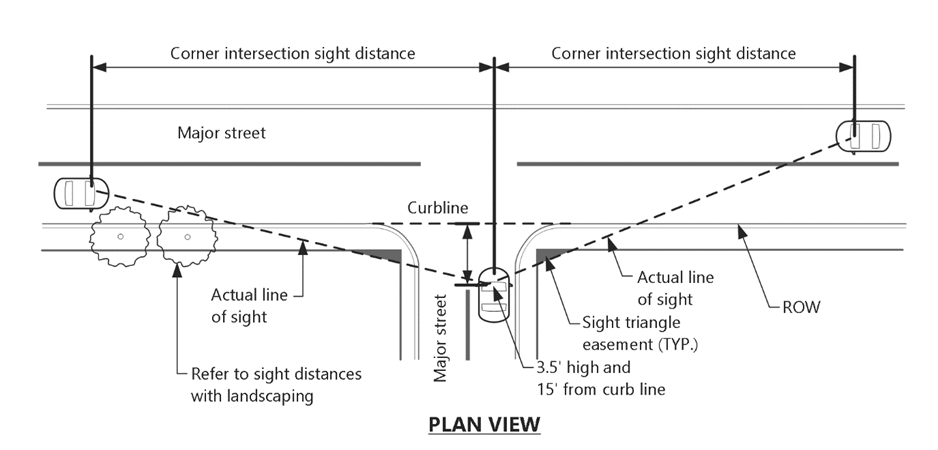
Figure 05.1 Sight Distance Requirement
at Intersections
b.
Town-owned property and other public property (excluding right-of-way). Mobile businesses may operate on Town-owned or other public property provided they meet the following requirements:
1.
The mobile business has obtained a valid Mobile Business Permit.
2.
The mobile business shall obtain permission from the Town or other public property owner through their internal permitting and processing system, as amended.
3.
The mobile business shall move from the Town-owned or other public property each day when the hours of operation end.
c.
Mobile business permit requirements. No mobile business shall operate within the Town without first receiving a Mobile Business Permit from the Town. Application for a Mobile Business Permit shall include the following information:
1.
A Mobile Business Permit application.
2.
All other requirements within the Town's permitting and processing system, as amended.
3.
Copy of a current Town Business and Tax License.
4.
Copies of other required permits from the Douglas County Health Department and/or other health department, if applicable.
5.
Copies of all pertinent certificates or permits required by any of the referral or regulatory agencies as deemed necessary by the Planning Director to operate the mobile business, as it relates to the public health, safety and welfare. This may include, but is not limited to, health certificates, tent permits, electrical permits, sign permits and right-of-way permits.
6.
If a vehicle is used for the mobile business, the vehicle shall be properly licensed and registered through the State of Colorado.
d.
Where a mobile business operates at one (1) property on a Long-Term basis, a plot plan may be required to show the location, layout, relationship to other uses, and indicate how fuel storage, generator(s), lighting, parking, seating, shelter/tents, trash/recycling, and waste removal are addressed. The plot plan shall be used to determine compliance with the Parker Municipal Code and standards, including those for nuisance impacts.
e.
A mobile business shall store all materials, supplies, trash, recycling, and waste in the vehicle, or, if outside of the vehicle, in a fully-enclosed and screened area meeting Town standards, including those contained within Chapter 13.08 of the Parker Municipal Code. If the mobile business operates on the same property for one (1) week or longer, the operator shall arrange for regular trash, recycling, and waste removal not less than once per week.
f.
The Planning Director may issue such regulations as are necessary to clarify and effectuate this ordinance.
(4)
Temporary use permit submittal requirements. Requests for temporary uses shall require the issuance of a Temporary Use Permit, except that seasonal sales are exempt from the Temporary Use Permit requirement provided such use meets the other standards in this Section 13.05.060(c)(3) and the requirements for outdoor display in Section 13.05.050(d)(7).
(Ord. 3.372.6 §1, 2025)

