
Pasco County Unincorporated
City Zoning Code
City Zoning Code
CHAPTER 1100
SPECIAL DEVELOPMENT STANDARDS
1101.1. - Intent and Purpose
The intent and purpose of this section is to protect residential land uses from intensive commercial uses that create noise, odors, glare, and blighting effects.
(Ord. No. 22-45, 5(Att. A), 8-24-22)
1101.2. - Applicability
This section shall apply to sales, leasing, incidental display, storage, and service departments for land uses established on new or existing sites after January 25, 2005, new and preowned passenger and commercial vehicles, trucks, trailers, motorcycles, boats, and recreational vehicles (including golf carts, ATV, and similar vehicles), hereinafter referred to as vehicles. This section shall not apply to the sales and leasing of vehicles that takes place from an indoor showroom, where no display or storage of vehicles occurs outside of the building structure.
(Ord. No. 20-39, § 5(Att. A), 12-8-20; Ord. No. 22-45, 5(Att. A), 8-24-22)
1101.3. - General Design and Use Standards for Sites Approved After January 25, 2005, or Establishment of a Vehicle Dealership Occurring After January 25, 2005
A.
No test drives shall occur on local residential roadways.
B.
To prevent glare visible from off-site locations, all lighting fixtures shall be a cut-off type fixture. The use of upward tilt and similar glare producing effects are prohibited. Floodlights are prohibited.
To limit overspill of lighting onto adjacent properties, lighting must be specifically designed such that the maximum average illumination measured at the property line does not exceed 0.5 foot candle on adjacent residential sites and one-foot candle on adjacent commercial sites and public rights-of-way measured on a horizontal plane on grade at the property line.
A detailed photometric plan depicting the light levels shall be submitted with the preliminary site plan application package. The submitted photometric plan shall show the location, type, and height of all fixtures and poles in foot candle output with points of calculations on a ten-foot by ten-foot grid, a maximum of 30 feet beyond all property lines. The photometric plan shall provide a breakdown indicating the maximum foot candle, minimum foot candle, average maintained foot candles, and maximum to minimum ratios. Average light levels on a site shall not exceed the following standards:
Prior to the Certificate of Occupancy on new sites, an inspection shall be conducted by the licensed electrical Engineer of Record for the project. A signed and sealed letter shall be submitted to the County by the electrical Engineer of Record confirming that all outdoor lighting has been installed according to the photometric plans approved by the County. This section shall supersede the lighting provisions of this Code, Section 1102.
C.
Amplified speaker/public address systems are prohibited except within fully enclosed buildings. Fully enclosed buildings do not include buildings with service bays and/or exterior walls that may be opened.
D.
Parking and display areas shall be designed so that each increment of no more than 20 spaces are part of the clearly defined grouping of spaces. Such groups shall be broken into individual areas and/or clearly separated by landscaped or geographic features and/or by design components of the proposed building(s).
E.
The outdoor display and sales buffering provisions of this Code, Section 1102, shall not apply to vehicle use and display areas. However, vehicle sales, leasing, displays, storage, and service departments abutting right(s)-of-way shall be buffered pursuant to this Code, Section 905.2.
F.
Exterior display areas not within a parking deck (parking garage) shall not be elevated unless the said area is a permanent structure attached to the principal building and exceeds no more than 600 square feet in size and four feet in height. Displays on roofs are prohibited. Elevation shall be measured from the finished grade of the interior parking area.
G.
The interior parking lot landscaping requirements of this Code shall apply, unless otherwise approved pursuant to Section 1101.5.
H.
Landscape buffers to adjacent properties shall be per LDC Section 905.2. The buffer to abutting residential properties shall be a Type H buffer. Vehicles shall not be stored or displayed within landscaped, on-site greenspace, buffer areas, or within the rights-of-way.
I.
All storage areas (those areas not readily available to the public), including vehicles to be serviced shall be located within the rear yard of the principal building and/or its accessory buildings, whichever is furthest from the right(s)- of-way.
J.
There shall be no outside display or sale of parts or tires.
K.
Service bay doors shall not face residential districts and must be oriented away from residential districts a minimum of 90 degrees.
L.
Whenever reasonably possible, buildings shall be oriented to the highest classified street and areas of intensity or noxious activity should be located away from abutting residential properties. Buildings shall maintain minimum setbacks for the zoning district as noted in this Code Section 500.
(Ord. No. 20-39, § 5(Att. A), 12-8-20; Ord. No. 22-45, 5(Att. A), 8-24-22)
1101.4. - Additional Design Standards for Sites Approved After August 25, 2022
A.
Employee and Customer Parking. The applicant may choose one of the following methods to identify the Employee and Customer required parking.
1.
Method 1: Employee and Customer parking shall be per this Code, Section 907.1 On-Site Parking unless otherwise approved through an Alternative Standard.
2.
Method 2: Detailed Parking Study/Narrative. This Study/Narrative may be used if an applicant is bound by minimum requirements by an OEM (Original Equipment Manufacturer) that differentiates customer parking requirements from overall desired parking levels (that may include inventory display, service vehicle storage, etc.). This Study/Narrative must contain the following:
a.
Methodology for how the OEM calculates the required parking numbers.
b.
The minimum number of parking spaces required by the OEM for:
(1)
New/pre-owned/used sales customers
(2)
Service customers (if greater than the County's standard in LDC 907.1). The service related parking may be delineated within incoming and outgoing dedicated stacking lanes but must meet the minimum standard set forth in LDC 907.1.
3.
Method 3: For dealerships that sell new or used vehicles from multiple OEMs that are not obligated to the manufacturer's requirements may calculate the employee and customer parking as follows:
a.
One parking space for each employee on the busiest shift plus one parking space for each 2,000 square feet combined building square footage and outdoor vehicle display area. If vehicle servicing is provided at the site, an additional four spaces per service bay is added. The service related parking may be delineated within incoming and outgoing dedicated stacking lanes.
4.
Use an alternate method approved by the County Administrator or designee. This method must include a reasonable estimate of daily customers and employees. This shall be reviewed through the formal Alternative Standard process.
B.
Vehicle Inventory Display and Vehicle Storage. Vehicle inventory display and storage must meet the following requirements.
1.
Surface level vehicle inventory display and vehicle storage area (in square feet), combined with the ground floor area of building structures (in square feet), cannot exceed 50 percent of the developable acreage (in square feet). Building structures are still subject to the Floor Area Ratio limits of the Future Land Use (FLU) designation and maximum lot coverage limitations of the Zoning District.
a.
For dealerships using vertical display or storage in a parking deck or similar style design, only the ground floor square footage is included in the above calculation. In such a parking deck style design, square footage of parking areas within the ground floor of the parking deck that are dedicated to service customers, sales customers or employees, may also be excluded from this calculation.
2.
Vehicle inventory display and vehicle storage cannot occupy parking spaces required by the LDC for employee and customer parking.
3.
Vehicle inventory display and vehicle storage cannot encroach into any right-of-way, landscape buffer, wetland, wetland upland buffer, or drainage pond and its related top of bank area as required by Code.
4.
Parking spaces for vehicle inventory display or storage shall be clearly delineated on site plans. The minimum size of these parking spaces for inventory display and/or vehicle storage shall be as specified in Code, Section 901.7.1.D(2). Where deemed appropriate by the County Administrator or designee, the parking space size requirement may be modified for consistency with current industry standards for the types of vehicles being displayed or stored at the dealership.
5.
Vehicle inventory storage areas may be parked in triple tandem (triple rows) in areas where primary access is limited to employees. The groups of triple tandem rows shall be separated by a minimum ten foot wide path or a standard drive aisle as defined in LDC 901.7). Where deemed appropriate by the County Administrator or designee, quadruple tandem parking may be considered as part of the review process and will not require a formal Alternative Standard.
6.
Vehicle inventory display areas, that can be accessed by the customer/public, shall be parked in single or tandem (double) rows, separated by a minimum ten foot wide path or a standard drive aisle as defined in LDC 901.7).
C.
Pedestrian Connectivity. While it is understood that vehicle inventory may need to be secured, dealership sites should be designed in a manner to limit obstructions to existing pedestrian connectivity between abutting residential neighborhoods or districts and pedestrian trails, paths, or sidewalks. If, at the County Administrator or designee's determination, pedestrian flow is deemed to be obstructed, the dealership may be required to install a form of pedestrian connection to mitigate for the obstruction, as deemed sufficient by the County Administrator or designee.
(Ord. No. 22-45, 5(Att. A), 8-24-22)
Editor's note— Ord. No. 22-45, 5(Att. A), adopted August 24, 2022, amended the title of § 1101.4 to read as herein set out. The former § 1101.4 title pertained to use standards for sites approved prior to January 25, 2005.
1101.5. - All Site Plans Whether Approved Prior to August 25, 2022 or After May Avail Themselves of the Following Standards in Lieu of Following Section 905.2
A.
The outdoor display and sales buffering provisions of this Code, Section 1102, shall not apply to vehicle use and display areas. Vehicle sales, leasing, displays, storage, and service departments abutting right(s)-of-way shall be buffered pursuant to this Code, Section 905.2. However, as certain species of shade trees may create hardships for vehicle display areas, understory trees (other than Crepe Myrtles) may be substituted for up to 50 percent of the required shade trees, at a 2:1 ratio (two understory trees for one shade tree), where vehicle display areas abut rights-of-way. Understory trees used in this manner must have a minimum mature height of at least ten feet. Where Palm trees are substituted, the ratio is 3:1. Palm trees used in this manner must have a minimum mature height of at least ten feet. Linear spacing standards from this Code section 905.2 apply. For example, if a 300 foot right-of-way frontage requires ten shade trees, this substitution allows for five shade trees and ten understory trees within that 300 feet, with spacing of trees not more than 20 feet between trees. Existing sites modifying only landscaping shall be processed as a Landscape Plan in accordance with this Code, Section 403.10.
B.
Parking island landscaping. The interior parking lot landscaping requirements of this Code shall apply. However, as certain species of shade trees may create hardships for vehicle display areas, understory trees (other than Crepe Myrtles) may be substituted for shade trees at a 2:1 ratio (two understory trees for one shade tree) internal to the vehicle display area. Understory trees used in this manner must have a minimum mature height of at least ten feet. Where Palm trees are substituted, the ratio is 3:1. Palm trees used in this manner must have a minimum mature height of at least ten feet. This substitution allowance does not apply to employee/customer parking areas without approval through the Alternative Standard process.
(Ord. No. 22-45, 5(Att. A), 8-24-22)
1101.6. - Use Standards for Sites Approved Prior to January 25, 2005
For site plan approval prior to January 25, 2005, and the said approval has not expired:
A.
No test drives shall occur on local residential roadways.
B.
Amplified speaker/public address systems are prohibited except within fully enclosed buildings. Fully enclosed buildings do not include buildings with service bays and/or exterior walls that can be opened.
(Ord. No. 22-45, 5(Att. A), 8-24-22)
1102.1. - Intent and Purpose
The intent and purpose of this section is to address the unique characteristics of large scale commercial retail buildings and large scale commercial retail development projects because such uses attract a large number of people consistently and continually, requiring safe and effective pedestrian and motor vehicle circulations; demand large impervious areas, requiring enhanced landscaping to reduce glare, provide shade, and decrease stormwater runoff; and typically require large, one-story building structures with minimal windows that do not blend well with their surroundings. As a basis for developing such standards, the County citizens and visitors alike will benefit from enhanced large scale commercial retail building and large scale commercial retail, development project design that accomplishes the following objectives:
A.
Encourage large scale, commercial retail buildings and large scale, commercial retail development projects to have good architectural design, rather than an enormous, warehouse appearance with unbroken, blank walls. Good design encourages clearly defined entryways, articulated rooflines to prevent monotony, pedestrian amenity areas, and concealment of unsightly mechanical structures from public view.
B.
Encourage pedestrian oriented design that effectively resolves the incompatibility between pedestrians and motorists while providing interconnectivity between buildings, parking areas, and other internal/external components.
C.
Encourage parking lot design that meets vehicular needs while providing a safer, efficient, comfortable pedestrian flow.
D.
Encourage adequate landscaping that allows large buildings and its components to blend with its surroundings while providing screening and shade for the public benefit.
E.
Encourage enhanced lighting and compatible signage design and avoid forms of nuisance and intrusiveness into adjacent areas while enhancing public safety.
(Ord. No. 20-39, § 5(Att. A), 12-8-20)
1102.2. - Applicability
Large scale commercial retail buildings and all buildings within large scale commercial retail development projects shall be subject to the requirements of this section. A large scale commercial retail building is a single commercial building or grouping of buildings closer than 20 feet whose total gross building area, including outdoor display and sales areas, is equal to or exceeds 25,000 square feet.
In the event the site is exempt from the site aspects of this section, the architectural renderings and a signage plan shall be submitted to the County Administrator or designee for review and approval prior to submittal of the applicable Building Permit.
1102.3. - Exemptions
The following shall be exempt from this section:
A.
Large scale commercial retail buildings where, on or before May 11, 2004, either final construction site plan approval was obtained from the County or the County's written technical review comments pertaining to the construction site plan review were transmitted to the applicant, shall be exempt from Subsections 1102.4.D., F., G., and H.
B.
Large scale commercial retail buildings where a completed Building Permit Application was received by the County on or before May 11, 2004, shall be exempt from this section.
C.
Large scale commercial retail development projects, where the large scale commercial building is partially exempt from this section pursuant to Subsection 1102.3.A, shall be exempt from Subsections 1102.4.D, F, G, and H of this section.
D.
Large scale commercial retail development projects, where two or more Building Permits were issued by the County on or before May 11, 2004, or where one Building Permit was issued and one Building Permit was applied for on or before May 11, 2004, shall be exempt from this section.
1102.4. - Additional Design Standards
In addition to all other applicable requirements of this Code, the following additional design standards shall be required for all large scale commercial retail buildings and all buildings within large scale commercial retail development projects:
A.
Facades. Facades containing the service area may be uninterrupted. No uninterrupted and no unadorned length of any other portion of the facade shall exceed 100 linear feet. Interruptions of such continuous lengths of the facades shall include wall plane projections, recesses, and/or offsets of not less than five feet in offset and 20 feet in length. Architectural features used to adorn facades shall include one or more of the following: projecting ribs, pilasters, columns, canopies/porticos, arcades, and colonnades.
1.
Multiple Stores Within a Single Building. The intent and purpose of this subsection is to provide good architectural design, details, and clearly defined entryways rather than unbroken, blank walls.
Where the large scale commercial retail building contains multiple stores with separate exterior customer entrances, the street-level facade containing the customer entrances shall provide fenestration, such as windows between the height of a minimum of three feet and eight feet above the walkway grade for no less than 60 percent of the horizontal length of the building facade of each store.
Alternative standards meeting or exceeding the intent and purpose of this subsection and this Code may be approved by the County Administrator or designee.
2.
Detail Features. All facades shall include features at intervals of no more than 30 feet either horizontally or vertically. Such features shall include windows, awnings associated with windows or doors, ornamental and structural details that are integrated into the building structure, arches or arched or curvilinear forms, color changes, banding, texture changes or material module changes, and/or surface modeling changes, such as reveals or ribs of no less than 12 inches in width.
B.
Materials. Predominant, exterior, building material shall include architectural or split-face block, brick, glass, wood, stucco, artificial stucco, stone, or concrete with an architectural finish.
C.
Entryways. Facades with customer entrances shall be clearly defined and include at least two of the following features: canopies/porticos; overhangs; recesses/projections; arcades; raised, above-the-doorway parapets with cornices; peaked roof forms; arches; outdoor patios; display windows; and integrated, architectural details, such as tile work, moldings, or wing walls.
D.
Service Area. The service area is the area designated for the loading and unloading of goods and refuse collection and shall be buffered from rights-of-way and the upland areas of lesser intensity zoned areas by a masonry wall a minimum of eight feet in height and extending the entire length of the applicable service area. A landscaped area six feet in width containing evergreen plants a minimum of six feet in height and spaced no more than six feet apart shall be provided along the exterior of the wall.
This provision shall not apply to service areas that face a nonupland area or an existing wall; or adjoining property zoned for an equal or greater intensity; and provided that the adjoining property's existing building facade(s) facing the proposed large scale commercial retail buildings or large scale commercial retail development project's building(s) also incorporate service area(s).
E.
Roofs. The intent and purpose of this subsection is to conceal flat rooflines and unsightly mechanical structures from public view. Flat roof lengths longer than 100 feet shall be concealed or addressed utilizing at least one of the following options:
1.
Effective concealment of flat rooflines; rooftop equipment; and heating, ventilating, and air-conditioning units from view by adjacent land uses of lesser intensity and rights-of-way shall be accomplished by constructing a parapet. The parapet design shall be a minimum of three feet in height and shall incorporate a three dimensional cornice treatment. Alternative designs, such as varying the parapet height for a minimum linear distance of 100 feet and a minimum vertical height of two feet, shall be subject to approval by the County Administrator or designee as an alternative standard.
2.
Two or more sloping roof planes that extend a minimum of three feet above the eave.
F.
Pedestrian Circulation. The intent and purpose of this subsection is to provide for pedestrian oriented connectivity among buildings and to pedestrian walkways/bicycle paths and transit stops on adjacent roadways.
1.
Sidewalks. Pedestrian connectivity between the building facade and each grouping of parking spaces, any out-parcel buildings, and transit stops shall be clearly provided and indicated through the use of landscaped areas and sidewalks.
a.
A sidewalk leading from each building parking area to each customer entrance is required for all large scale commercial retail buildings 75,000 square feet and larger. For multiple store buildings with separate exterior customer entrances for each store a sidewalk leading from the building to the parking area is required for stores 75,000 square feet and larger.
b.
Sidewalks leading from the building shall be a minimum of five feet in width and provide a minimum of three feet of a green/landscaped area containing shade trees a maximum of 30 feet on center and/or alternative cover, and landscaped sitting areas between each edge of the sidewalk and the vehicle use area. The said green/landscaped areas required on either side of the remote sidewalk may be combined on one side of the said sidewalk for a minimum of a six-foot wide green/landscaped area.
c.
Along each facade with a customer entrance, there shall be a sidewalk with an unobstructed walkway area a minimum of five feet wide along the full length of the facade.
d.
For multiple store buildings, all facades with multiple, exterior, customer entrances shall include a sidewalk a minimum of eight feet wide connecting all entryways, and at least 60 percent of the said facade with multiple, exterior, customer entrances shall include a canopy, arcade, or other architectural and functional overhang that extends from the facade to a minimum of five feet over the sidewalk.
For standalone, single store buildings, a covered canopy shall be provided from the entryways to the edge of the sidewalks connecting to the remote parking area.
e.
Alternative standards for these pedestrian circulation requirements that meet or exceed the intent and purpose of this subsection and this Code may be approved by the County Administrator or designee.
2.
Pedestrian Amenity Area. A pedestrian amenity area, including landscaped sitting areas with design components, such as covered seating elements and/or other elements in shaded areas, shall be located adjacent to the building. At least one pedestrian amenity area shall be required for large scale commercial retail buildings. For projects with a total gross building area equal to or in excess of 100,000 square feet, a pedestrian amenity area shall be provided for each customer entrance. The pedestrian amenity areas shall be placed in areas which have the highest pedestrian traffic.
G.
Parking Areas. Parking lots and access aisleways shall be designed utilizing the following standards:
1.
Parking Lot Design. The intent and purpose of this subsection is to provide parking lot design which breaks up vast expanses of pavement by creating clearly defined groupings of parking spaces while providing for vehicular needs and safe, efficient, comfortable, pedestrian flow. Vast unbroken parking lots are prohibited.
a.
Parking areas shall be designed so that no more than 100 spaces (150 spaces for uses that require 501 or more parking spaces) of the total required spaces are part of a clearly defined grouping of spaces. Such groups shall be broken into individual areas and/or clearly separated by landscaped or geographic features and/or by design components of the proposed building(s). The design of these separators shall consider pedestrian movements, conflict points with vehicles, site distance and angles, security site lighting, and safety within the parking lot area. Separations shall be no less than eight feet in width at any point.
b.
The parking lot shall be designed with traffic calming features along the fire lanes fronting the building facades. Parking lots shall be designed to reduce vehicle movement along the fire lane. Design features may include cross driveways, 90 degree parking space design, and consideration of site-access points.
c.
For projects 75,000 square feet and larger, at least ten percent of the required parking spaces shall be placed in the side areas of the proposed development project.
d.
For out-parcels, no more than 20 percent of the parking, shall be located between the building and the adjacent right-of-way.
e.
Alternative standards for these parking lot design requirements that meet or exceed the intent and purpose of this subsection and this Code may be approved.
2.
Parking Spaces. The required number of parking spaces shall be determined by this Code, Section 907.1. A minimum of ten percent of the parking area shall be pervious parking. Pervious parking areas shall be constructed of permeable pavement or turf pavement like "turf block," "turf stone," and SF-Rima or grass, or some other pervious material. If grass parking is proposed, the parking shall be designed and constructed with a structural support; i.e., geo-grid, geo-block, etc. The areas designated for pervious parking shall be maintained. The areas designated for pervious parking shall be located throughout the parking lot area in conjunction with Best Management Practices for an integrated stormwater management system. The pervious parking does not count towards meeting the requirements of this Code, Section 905.2.
H.
Landscaping. The following landscaping standards shall be incorporated into the design of all large scale commercial retail buildings and large scale commercial retail development projects.
1.
Building Perimeter. The building perimeter landscaping required below may be credited toward meeting the requirements of the building perimeter landscaping subsection of this Code, Section 905.2. However, in order to meet the requirements below, those building perimeter requirements may have to be exceeded.
a.
Facade with Customer Entrance. The intent and purpose of this subsection is to require facades with customer entrances to have significant landscaping/streetscaping so as to provide visual interest, prevent monotony, break up wall and pavement expanses, and clearly define entryways. Building perimeter landscaping required pursuant to Section 905.2, shall be placed such that a minimum of 50 percent of the facade length has perimeter landscaping. The building perimeter landscaping shall be in landscaped areas, raised planters, or planter boxes that are each a minimum of five feet wide and are at a maximum ten feet from the building, and landscaped with plant clusters of varied species and heights with each cluster containing at least one tree or three palm trees, each a minimum of ten feet in height at the time of planting. Alternative standards for building perimeter landscaping requirements that meet or exceed the intent and purpose of this subsection and this Code may be approved.
b.
All other facades, except the facade incorporating the service area, shall be screened from public view with no less than a ten-foot wide buffer with foundation landscaping. The buffer area shall, at a minimum, have landscaping in planters or planter beds which extend a minimum of 18 inches from the building along the entire length of the facade, contain plant clusters of varied species and heights, and a minimum of one evergreen shade or three palm trees (each a minimum of ten feet in height at the time of planting) every 30 feet. Landscaping materials shall meet the principles of right plant/right place of Section 905.2.
c.
Landscaping shall be maintained in accordance with this Code, Section 905.2.E.
I.
Compatible Signage. Sign construction material and finishes shall be compatible with the associated buildings and/or development projects. The location(s) design shall be reviewed and approved as part of the overall construction plan. The predominate sign material shall include architectural or split-faced block, brick, glass, wood, stucco, artificial stucco, or stone, and be compatible with the principal building design. Architectural renderings and a signage plan shall be dimensioned and include the types of materials used. Architectural renderings and a signage plan shall be submitted with construction plan application and prior to the submittal of the applicable Building Permit.
J.
Outdoor Display and Sales. Any permanent display areas not within the building which face a right-of-way, parking area, or residential zoning district, shall be shielded from view by a wall made from architectural or split-face block, brick, glass block, wood, stucco, artificial stucco, stone, or concrete with an architectural finish, or a combination of the foregoing materials, and incorporated into the overall design of the building. The wall shall extend a minimum of four feet in height. As an alternative, an evergreen landscape buffer a minimum of four feet in height and opaque at the time of planting may be utilized.
K.
Lighting. The intent and purpose of this subsection is to avoid forms of light nuisance and intrusion, such as light pollution, light trespass, and glare from adjacent areas, which affects both people and wildlife. All outdoor light fixtures, other than fixtures on the building facade, emitting 2,050 or more lumens shall be shielded as follows:
1.
Within 50 feet of the property boundary, must be full-cutoff light fixtures.
2.
All other outdoor lighting fixtures shall be semicutoff or full-cutoff light fixtures.
3.
Alternative standards that meet or exceed the intent and purpose of this subsection and this Code.
1103.1. - Applicability
All projects requiring rezoning and preliminary plan approvals of more than three Equivalent Residential Units (ERU) within the Hurricane Vulnerability Zone or mobile home developments of more than three ERUs Countywide.
1103.2. - Standards
A.
Public information programs. The development shall implement a public information program. This Hurricane Awareness Program shall include the following elements:
1.
Risk statement. A risk statement shall be provided to all prospective home or lot buyers stating the development's hurricane vulnerability and the potential protective action required. For example, the ABC development is a gulf access community located in Hurricane Evacuation Level A and is in the National Flood Insurance Program's velocity zone. This means homes in this area may except to experience saltwater flooding from the Gulf of Mexico.
2.
Public education materials. A package shall be provided to homeowners at move-in that includes a copy of the community's hurricane evacuation plan and information on personal hurricane preparedness. Annual updates to the plan and public information materials will be provided to all homeowners as a minimum prior to June 1 st of each year. The County Office of Emergency Management develops and distributes personal preparedness materials, including the official Hurricane Guide for the Tampa Bay Region, which will be made available upon request.
3.
Annual hurricane education seminar. The development shall host an annual hurricane preparedness seminar for its residents. Notice of the seminar will be sent to all homeowners. The seminar agenda will include a review of the development's hurricane and shelter plans as well as information on personal preparedness. The County Office of Emergency Management shall assist with the seminar when requested with sufficient notice.
B.
Site specific evacuation plan. The development shall provide a site specific evacuation plan. The plan shall be developed by the developer/homeowners' association and submitted to the Office of Emergency Management for review, in accordance with the Pasco County Guidance Document for Comprehensive Emergency Management Plans for Multiple Unit Developments written by the Office of Emergency Management and incorporated by reference. The plan must be updated annually and provided to the Office of Emergency Management for review. At a minimum, the plan must include:
1.
Background information on the hazards expected in the development;
2.
Description of the public information program;
3.
Identification of the shelter for the development;
4.
If the shelter is privately contracted, detailed operations plan;
5.
Instructions regarding evacuation of the development and directions to a safe shelter (friends/family, hotel/motel, private shelter, or public shelter);
6.
Information regarding management support during an emergency (elevator operation, generator, etc.);
7.
Instructions for preregistration in case someone needs special assistance to evacuate; and
8.
Re-entry and redevelopment plans.
1104.1. - Intent and Purpose
The special flood hazard areas of the County are subject to periodic inundation, which may result in loss of life and property, health and safety hazards, disruption of commerce and governmental services, extraordinary public expenditures for flood protection and relief, and impairment of the tax base, all of which adversely affect the public health, safety, and general welfare.
Flood losses are caused by the cumulative effect of obstructions in floodplains, occupancy in flood hazard areas by uses vulnerable to floods or hazardous to other lands which are inadequately elevated, flood proofed, or otherwise unprotected from flood damages. These contribute to an increase in flood heights and velocities.
The County joined the National Flood Insurance Program (NFIP) on November 18, 1981. Continued implementation and enforcement of the requirements of the NFIP through this section will enable the County and its property owners to continue to participate in the NFIP.
It is the intent and purpose of this Code, Section 1104 to promote the public health, safety, and general welfare and to minimize public and private losses due to flood conditions by:
A.
Restriction of uses which are dangerous to health, safety, and property and minimize public and private losses due to flood conditions;
B.
Requiring uses vulnerable to floods, including facilities which serve such uses, be protected against flood damage at the time of initial construction;
C.
Controlling the alteration of natural floodplains, stream channels, and natural protective barriers which are involved in the accommodation of flood waters;
D.
Controlling land filling, grade changes, dredging, and other development where such activities will cause or increase erosion or flood damage or inhibit floodwaters; and
E.
Regulating the construction of flood barriers which will unnaturally divert floodwaters or which may increase flood hazards to other lands.
The objectives of this Code, Section 1104, are to:
A.
Protect human life and health;
B.
Minimize expenditure of public money for costly flood-control projects;
C.
Minimize the need for rescue and relief efforts associated with flooding; generally undertaken at the expense of the general public;
D.
Minimize prolonged business interruptions;
E.
Minimize damage to public facilities and utilities, such as water and gas mains; electric, telephone, and sewer lines; and street and bridges located in floodplains; and
F.
Help maintain a stable tax base by providing for the sound use and development of flood-prone areas in such a manner as to minimize flood blight areas; and
G.
Ensure that potential homebuyers are notified that property is in a flood area.
This Code, Section 1104, is intended to be administered and enforced in conjunction with the Florida Building Code, as amended by Pasco County. Where cited, ASCE 24 refers to the edition of the standard that is referenced by the Florida Building Code.
(Ord. No. 22-42, § 4(Att. 1, 2), 8-24-22)
1104.2. - Applicability
This Code, Section 1104 shall apply to all development on land where any portion of the development is within a special flood hazard area in unincorporated Pasco County, including development that does not otherwise require a Site Development or Building Permit, and buildings, structures, and facilities that are exempt from the Florida Building Code and any further exemptions provided by law, such as:
A.
Railroads and ancillary facilities associated with the railroad.
B.
Nonresidential farm buildings on farms, as provided in Section 604.50, F.S.
C.
Temporary buildings or sheds used exclusively for construction purposes.
D.
Mobile or modular structures used as temporary offices.
E.
Those structures or facilities of electric utilities, as defined in Section 366.02, F.S., which are directly involved in the generation, transmission, or distribution of electricity.
F.
Chickees constructed by the Miccosukee Tribe of Indians of Florida or the Seminole Tribe of Florida. The term "chickee" means an open-sided wooden hut that has a thatched roof of palm or palmetto or other traditional materials, and that does not incorporate any electrical, plumbing, or other nonwood features.
G.
Temporary housing, not on State lands, provided by the Florida Department of Corrections to any prisoner in the state correctional system.
H.
Family mausoleums not exceeding 250 square feet in area which are prefabricated and assembled onsite or preassembled and delivered to the site and have walls, roofs, and a floor constructed of granite, marble, or reinforced concrete.
I.
A non-rented or leased building or structure which is not a principal residence nor connected to an offsite electric power or water supply, having less than 1,000 square feet which is constructed and owned by a natural person for hunting, and which is repaired or reconstructed to the same dimension and condition as existed on January 1, 2011, Section 553.73(10)(k), F.S..
It is intended that the interpretation and application of all provisions in this section be:
• Considered as minimum requirements;
• Liberally construed in favor of the governing body; and
• Deemed neither to limit nor repeal any other powers granted under State Statute.
The degree of flood protection required by this Code, Section 1104, and the Florida Building Code, as amended by Pasco County, is considered the minimum reasonable for regulatory purposes and is based on scientific and engineering considerations. Larger floods can and will occur. Flood heights may be increased by manmade natural causes. This Code, Section 1104, and the Florida Building Code, as amended by Pasco County, do not imply that land outside of mapped special flood hazard areas, or that uses permitted within such flood hazard areas, will be free from flooding or flood damage. The flood hazard areas and base flood elevations contained in the Flood Insurance Study and shown on Flood Insurance Rate Maps (FIRM) and the requirements of Title 44, Code of Federal Regulations, Sections 59 and 60, may be revised by the Federal Emergency Management Agency (FEMA), requiring Pasco County to revise these regulations to remain eligible for participation in the National Flood Insurance Program. No guaranty of vested use, existing use, or future use is implied or expressed by compliance with this Code, Section 1104, and the Florida Building Code, as amended by Pasco County.
This Code, Section 1104, and the Florida Building Code, as amended by Pasco County, shall not create liability on the part of the Board of County Commissioners of Pasco County or any officer or employee thereof, for any flood damage that results from reliance on this Code, Section 1104 and the Florida Building Code, as amended by Pasco County, or any administrative decision lawfully made thereunder.
(Ord. No. 22-42, § 4(Att. 1, 2), 8-24-22)
1104.3. - Establishment of Areas of Special Flood Hazard
The areas of special flood hazard identified by FEMA in the Flood Insurance Study for Pasco County, Florida, and incorporated areas, dated June 5, 2020, with accompanying maps, including maps in digital format, and other supporting data and any amendments and revisions thereto, are adopted by reference and incorporated herein. The flood insurance study and maps are on file in the office of the County Administrator or designee.
(Ord. No. 22-42, § 4(Att. 1, 2), 8-24-22)
1104.4. - Floodplain Administrator
The Board of County Commissioners hereby appoints the County Administrator, or designee, to administer and implement this section. The duties shall include, but not be limited to, all of the following:
A.
Review development applications to determine whether proposed new development will be located in flood hazard areas.
B.
Review all development applications to ensure that the permit requirements of this section have been satisfied.
C.
Review development applications to determine whether proposed development will be reasonably safe from flooding.
D.
Establish, in coordination with the Building Official, procedures for administering and documenting determinations of substantial improvement and substantial damage.
E.
Make final determinations on development permits for developments that are not subject to the Florida Building Code, including buildings, structures, and facilities exempt from the Florida Building Code.
F.
For applications for building permits to improve buildings, structures, and facilities in flood hazard areas, including alterations, movement, enlargement, replacement, repair, change of occupancy, additions, rehabilitations, renovations, substantial improvements, repairs of substantial damage, and any other improvement or work to such buildings, structures, and facilities, the Floodplain Administrator, in coordination with the Building Official, shall:
1.
Estimate the Market Value of the building or structure before the start of construction of the proposed work; in the case of repair, the market value of the building or structure shall be the market value before the damage occurred and before any repairs are made;
2.
Compare the cost to perform the improvement, the cost to repair a damaged building to its pre-damaged condition, or the combined costs of improvements and repairs, if both repaired and improved are proposed, to the market value of the building or structure;
3.
Determine and document whether the proposed work constitutes substantial improvement or repair of substantial damage; the determination requires evaluation of previous permits issued for improvements and repairs as specified in the definition of "substantial improvement"; and
4.
Notify the applicant if it is determined that the proposed work constitutes substantial improvement or repair of substantial damage and that compliance with flood resistant construction requirements of the Florida Building Code and this Code, Section 1104 is required.
G.
Review, in coordination with the Building Official, requests submitted that seek approval to modify the strict application of the flood load and flood-resistant construction requirements of the Florida Building Code, as amended by Pasco County, to determine whether such requests require the granting of a variance pursuant to this Code, Section 1104.7.
H.
Make required inspections for development permits that are not subject to the Florida Building Code, including buildings, structures, and facilities exempt from the Florida Building Code.
I.
Advise the permittee when additional Federal or State permits are required and require that copies of such permits be provided and maintained on file with the Development Permit, including but not limited to:
1.
Southwest Florida Water Management District; Section 373.036, F.S..
2.
Florida Department of Health for onsite sewage treatment and disposal systems; Section 381.0065, F.S. and Chapter 62, F.A.C.
3.
The Florida Department of Environmental Protection for construction, reconstruction, changes, or physical activities for shore protection or other activities seaward of the coastal construction control line; Section 161.141, F.S.
4.
The Florida Department of Environmental Protection for activities subject to the Joint Coastal Permit; Section 161.055, F.S.
5.
The Florida Department of Environmental Protection for activities that affect wetlands and alter surface water flows, in conjunction with the U.S. Army Corps of Engineers; Section 404 of the Clean Water Act.
6.
Federal permits and approvals.
J.
Notify adjacent communities, the Florida Division of Emergency Management, State Floodplain Management Office, and other Federal and/or State agencies with statutory or regulatory authority prior to any alteration or relocation of a watercourse and submit copies of such notifications to FEMA.
K.
Ensure that the flood-carrying capacity within the altered or relocated portion of any watercourse is maintained.
L.
Review required design certifications and documentation of elevations specified by this Code, Section 1104, and the Florida Building Code, as amended by Pasco County, to determine that such certifications and documentations are complete.
M.
Provide available flood elevation and flood hazard information.
N.
Where interpretation is needed as to the exact location of boundaries of the areas of special flood hazard, for example, where there appears to be a conflict between a mapped boundary and actual field conditions, make the necessary interpretation. The person contesting the location of the boundary shall be given a reasonable opportunity to appeal the interpretation as provided in this Code, Section 1104.7.
O.
When base flood elevation data or floodway data have not been provided on a FIRM, obtain, review, and reasonably utilize any base flood elevation and floodway data available from a Federal, State, or other source in order to administer the provisions of this Code, Section 1104, and the Florida Building Code, as amended by Pasco County.
P.
Determine whether additional flood hazard data shall be obtained from other sources or shall be developed by an applicant.
Q.
Require applicants who submit hydrologic and hydraulic engineering analyses to support permit applications to submit to FEMA, the data and information necessary to maintain the FIRMs if the analyses propose to change base flood elevations, flood hazard area boundaries, or floodway designations; such submissions shall be made within six months of such data becoming available.
R.
Notify FEMA when the unincorporated boundaries of Pasco County are modified.
S.
Advise applicants for new buildings and structures, including substantial improvements that are located in any unit of the Coastal Barrier Resources System established by the Coastal Barrier Resources Act (Pub.L. 97-348) and the Coastal Barrier Improvement Act of 1990 (Pub.L. 101-591) that federal flood insurance is not available on such construction. Areas subject to this limitation are identified on Flood Insurance Rate Maps as "Coastal Barrier Resource System Areas" and "Otherwise Protected Areas."
T.
All records pertaining to this Code, Section 1104, and the flood provisions of the Florida Building Code, as amended by Pasco County, shall be maintained in the office of the County Administrator, or designee, and shall be open for public inspection.
(Ord. No. 22-42, § 4(Att. 1, 2), 8-24-22)
1104.5. - Development Permit and Inspection Procedures
A.
General
1.
Prior to any development in an area of special flood hazard, a Floodplain Development Permit shall be obtained. Application for a Floodplain Development Permit shall be made to the County Administrator or designee on forms furnished or approved by the County.
2.
Site (horizontal) development shall follow the application submittal and application processing procedures of this Code.
3.
Buildings, structures, and facilities exempt from the Florida Building Code (vertical development) shall follow the application submittal and application processing procedures adopted in Chapter 18 of the Pasco County Code of Ordinances.
4.
The issuance of a floodplain development permit or approval pursuant to this Code shall not be construed to be a permit for, or approval of, any violation of this Code, the Florida Building Code, as amended by Pasco County, or any other ordinance of Pasco County. The issuance of permits based on submitted applications, construction documents, and information shall not prevent the County Administrator, or designee, from requiring the correction of errors and omissions.
5.
A floodplain development permit or approval shall become invalid unless the work authorized by such permit is commenced within 180 days after its issuance, or if the work authorized is suspended or abandoned for a period of 180 days after the work commences. Extensions for periods of not more than 180 days each shall be requested in writing and justifiable cause shall be demonstrated.
6.
The County Administrator, or designee, is authorized to suspend or revoke a floodplain development permit or approval if the permit was issued in error, on the basis of incorrect, inaccurate or incomplete information, or in violation of this Code or any other ordinance, regulation, or requirement of Pasco County.
7.
The County Administrator, or designee, shall not issue any permit for a structure denied flood insurance coverage by FEMA, pursuant to Section 1316 of the National Flood Insurance Act of 1968, unless the permit is for activities to bring the 1316 structure into compliance with this Code, Section 1104 and the Florida Building Code, as amended by Pasco County.
B.
Development Permit Application. During the development permit application and review process the following specific information, as applicable, is required in addition to the information required in this Code, Chapter 400, or of the Pasco County Code of Ordinances, Chapter 18:
1.
Delineation of flood hazard areas, floodway boundaries and flood zone(s), base flood elevations(s), and ground elevations, as necessary for the review of the proposed development.
2.
Where base flood elevations, or floodway data are not included on the FIRM or in the Flood Insurance Study, same shall be established in accordance with this Code, Sections 1104.5.C.2 or 1104.5.C.3.
3.
Where the proposed development seeks approval for more than 50 lots, or is larger than five acres, and the base flood elevations are not included on the FIRM or in the Flood Insurance Study, such elevations shall be established in accordance with this Code, Section 1104.5.C.1.
4.
Location of the proposed activity and proposed structures, and locations of existing buildings and structures.
5.
Elevation in relation to the datum on the FIRM of the proposed lowest floor, including basement, of all buildings or structures.
6.
Elevation in relation to the datum on the FIRM of the proposed lowest horizontal member of all buildings or structures within Velocity (V) Zones.
7.
Elevation in relation to the datum on the FIRM to which any nonresidential building will be dry flood proofed.
8.
Description of the extent to which any mangrove stand or sand dune will be altered as a result of proposed development.
9.
Description of the extent to which any watercourse will be altered or relocated as a result of proposed development.
10.
Certificate from a registered professional engineer or architect that the nonresidential, dry flood-proofed building will meet the dry flood-proofing criteria in the Florida Building Code, as amended by Pasco County.
11.
Certificate from a registered professional engineer or architect that the building will meet the V- Zone criteria in this Code or the Florida Building Code, as amended by Pasco County.
12.
For projects proposing to enclose areas under elevated buildings, crawlspaces more than five feet tall, and/or non-elevated detached accessory structures that are larger than 200 square feet, include a signed "Declaration of Land Restriction" (Non-Conversion Agreement); the agreement shall reference the recorded property deed and shall be recorded in the public records of the County prior to issuance of the Certificate of Occupancy.
C.
Information in flood hazard areas without base flood elevations (approximate Zone A). Where flood hazard areas are delineated on the FIRM and base flood elevation data have not been provided, the County Administrator, or designee, shall:
1.
Require the applicant to include base flood elevation data prepared in accordance with currently accepted engineering practices.
2.
Obtain, review, and provide to applicants base flood elevation and floodway data available from a Federal or State agency or other source, or require the applicant to obtain and use base flood elevation and floodway data available from a Federal or State agency or other source.
3.
Where base flood elevation and floodway data are not available from another source, where the available data are deemed by the County Administrator, or designee, to not reasonably reflect flooding conditions, or where the available data are known to be scientifically or technically incorrect or otherwise inadequate:
a.
Require the applicant to include base flood elevation data prepared in accordance with currently accepted engineering practices; or
b.
Specify that the base flood elevation is three feet above the highest adjacent grade at the location of the development, provided there is no evidence indicating flood depths have been or may be greater than three feet.
4.
Where the base flood elevation data are to be used to support a Letter of Map Change from FEMA, advise the applicant that the analyses shall be prepared by a Florida licensed engineer in a format required by FEMA, and that it shall be the responsibility of the applicant to satisfy the submittal requirements and pay the processing fees.
D.
Additional analyses and certifications. As applicable to the location and nature of the proposed development activity, and in addition to the requirements of this Code, Section 1104, the applicant shall have the following analyses signed and sealed by a Florida licensed engineer for submission with the site plan and construction documents:
1.
For development activities proposed to be located in a regulatory floodway, a floodway encroachment analysis that demonstrates that the encroachment of the proposed development will not cause any increase in base flood elevations; where the applicant proposes to undertake development activities that increase base flood elevations, the applicant shall submit such analysis to FEMA as specified in this Code, Section 1104.5.E, and shall submit the Conditional and Final Letter of Map Revision, if issued by FEMA, with the site plan and construction documents.
2.
For development activities proposed to be located in a riverine flood hazard area for which base flood elevations are included in the Flood Insurance Study or on the FIRM and floodways have not been designated, hydrologic and hydraulic analyses that demonstrate that the cumulative effect of the proposed development, when combined with all other existing and anticipated flood hazard area encroachments, will not increase the base flood elevation more than one foot at any point within the community.
3.
For alteration of a watercourse, an engineering analysis prepared in accordance with standard engineering practices which demonstrates that the flood-carrying capacity of the altered or relocated portion of the watercourse will not be decreased, and certification that the altered watercourse shall be maintained in a manner which preserves the channel's flood-carrying capacity. The applicant shall also submit the analysis to FEMA, as specified in this Code, Section 1104.5.E.
4.
For activities that propose to alter sand dunes or mangrove stands in coastal high hazard areas (Zone V) if such alteration is approved by the Florida Department of Environmental Protection, an engineering analysis that demonstrates that the proposed alteration will not increase the potential for flood damage. Construction or restoration of dunes under or around elevated buildings and structures shall comply with Section 1104.6.G.8.c of this Code.
E.
Submission of additional data. When additional hydrologic, hydraulic, or other engineering data, studies, and additional analyses are submitted to support an application, the applicant has the right to seek a Letter of Map Change from FEMA, subject to county approval, to change the base flood elevations, change floodway boundaries, or change boundaries of flood hazard areas shown on the FIRMs, and to submit such data to FEMA for such purposes. The analyses shall be prepared by a Florida licensed engineer in a format required by FEMA. Submittal requirements and processing fees shall be the responsibility of the applicant.
F.
Inspections and Certifications. Development permits within a special flood hazard area shall be subject to inspection to determine compliance with this Code, Section 1104.
Prior to the issuance of a Certificate of Occupancy (CO), or where no CO is required, prior to final inspection of the development, manufactured home, building, structure or facility, it shall be the duty of the permit holder to submit to the County Administrator or designee a certification as follows:
1.
Within A Zones:
a.
Elevation (in relation to datum on the FIRM) of the lowest floor (including basement) of all new and substantially improved structures, and
b.
If the building, structure, or facility, has been flood-proofed, the elevation (in relation to datum on the FIRM) to which the structure, building, or facility was flood-proofed.
2.
Within V Zones:
a.
Elevation (in relation to datum on the FIRM) of the bottom of the lowest structural member of the lowest floor (excluding pilings and columns) of all new and substantially improved structures.
The said certification shall be prepared by or under the direct supervision of a Florida Licensed Professional Surveyor and certified by the same. When dry flood-proofing is utilized for a particular building, the said certification shall be prepared by or under the direct supervision of a Professional Engineer or architect and certified by the same. Any work undertaken prior to submission of the certification shall be at the permit holder's risk. The County Administrator, or designee, shall review the lowest floor, lowest horizontal structural member and/or dry flood-proofing elevation and survey data submitted for compliance with this section. The permit holder immediately and prior to the issuance of the CO and/or final inspection of the building, structure, or facility shall correct deficiencies detected by such review. Failure to submit the survey or failure to make the said corrections required hereby shall be cause for a Stop-Work Order to be issued for the project, denial of a CO for the structure, and/or denial of use and/or occupation of the structure.
3.
The County Administrator, or designee, shall maintain a record of all such information.
(Ord. No. 22-42, § 4(Att. 1, 2), 8-24-22)
1104.6. - Flood Hazard Reduction
A.
General Standards. In all areas of special flood hazard, the following are required:
1.
New construction and substantial improvements shall be designed (or modified) and adequately anchored to prevent flotation, collapse, or lateral movement of the structure resulting from the hydrodynamic and hydrostatic loads, including the effects of buoyancy.
2. Manufactured homes shall comply with Section 1104.6.D.
3. New construction and substantial improvements shall be constructed with flood damage resistant materials and utility equipment resistant to flood damage.
4. New construction or substantial improvements shall be constructed by methods and practices that minimize flood damage.
5. Electrical, heating, ventilation, plumbing, air conditioning equipment, and other service facilities, including ductwork, shall be designed and/or located so as to prevent water from entering or accumulating within the components during conditions of flooding.
6. New and replacement water supply systems shall be designed to minimize or eliminate infiltration of flood waters into the system.
7. New and replacement sanitary sewage systems shall be designed to minimize or eliminate infiltration of flood waters into the systems and discharges from the systems into flood waters.
8. On-site waste disposal systems shall be located and constructed to avoid impairment to them or contamination from them during flooding.
9. Any alteration, repair, reconstruction, or improvement to a building that was constructed in compliance with the flood damage prevention requirements of Pasco County or the flood resistant provisions of the Florida Building Code shall meet the requirements of "new construction" as contained in this Code, Section 1104, and the Florida Building Code, as amended by Pasco County.
10. Any alteration, repair, reconstruction, or improvement to a building that is not in compliance with the flood damage prevention requirements of Pasco County or the flood resistant provisions of the Florida Building Code, as amended by Pasco County shall be undertaken only if the nonconformity is eliminated or the building is otherwise brought into compliance and the activities shall meet the requirements of "new construction" as contained in this Code, Section 1104, and the Florida Building Code, as amended by Pasco County.
11. Standards for Subdivision and Site Development
a.
All subdivision and site development proposals shall be consistent with the need to minimize flood damage.
b.
All new construction in coastal, high-hazard areas (V Zones) shall be landward of the reach of the mean high tide.
c.
All subdivision and site development proposals shall have public utilities and facilities, such as sewer, gas, electrical, and water systems located and constructed to minimize or eliminate flood damage.
d.
All subdivision and site development proposals shall have adequate drainage provided to reduce exposure to flood hazards. In Zones AH and AO, adequate drainage paths shall be provided to guide floodwater around and away from proposed structures.
e.
Base flood elevation data shall be provided for subdivision and site development proposals and other proposed development, including manufactured home parks and subdivisions, which is greater than the lesser of 50 lots or five acres.
f.
No encroachment or development, as defined in Appendix A shall be authorized in the regulatory floodway unless the floodway encroachment analysis in Section 1104.5.D.1 demonstrates that the proposed development or land disturbing activity will not result in an increase in the base flood elevation.
g.
Fill shall be designed to be stable under conditions of flooding including rapid rise and rapid drawdown of floodwaters, prolonged inundation, and protection against flood-related erosion and scour. In addition to these requirements, if intended to support buildings and structures in Zone A, fill shall comply with the requirements of the Florida Building Code.
12.
Standards for Design and Construction of Developments, Buildings, Structures, and Facilities Exempt from the Florida Building Code.
a.
Developments, buildings, structures, and facilities that are exempt from the Florida Building Code, including substantial improvement or repair of substantial damage of such developments, buildings, structures, and facilities, shall be designed and constructed in accordance with the flood elevation, flood load, and flood-resistant construction requirements of ASCE 24.
b.
Structures exempt from the Florida Building Code that are not walled and roofed buildings shall comply with this Code, Section 1104.6.A.
B.
Critical facilities. New critical facilities shall, to the extent feasible, be located outside of special flood hazard areas. If no feasible sites are available outside of special flood hazard areas that allow the facility to serve its intended function, critical facilities shall be elevated or protected to the base flood elevation plus two feet or elevated to or above the 500-year elevation, whichever is higher. Floodproofing measures shall ensure that toxic substances will not be displaced or released into floodwaters.
C.
Detached accessory structures. Detached accessory structures are permitted below the base flood elevation provided the accessory structures are used only for parking or storage and:
1.
If located in special flood hazard areas (Zone A/AE) other than coastal high hazard areas, are limited to one-story and shall not be larger than 600 sq. ft. and:
a.
Are anchored to resist flotation, collapse or lateral movement resulting from flood loads.
b.
Have flood openings in accordance with Section R322.2 of the Florida Building Code, Residential.
c.
Have flood damage-resistant materials used below the base flood elevation plus one foot.
d.
Have mechanical, plumbing and electrical systems, including plumbing fixtures, elevated to or above the base flood elevation plus one foot.
2.
If located in coastal high hazard areas (Zone V/VE), are not located below elevated buildings and are not larger than 100 sq. ft.
a.
Are anchored to resist flotation, collapse or lateral movement resulting from flood loads.
b.
Have flood damage-resistant materials used below the base flood elevation plus one foot.
c.
Have mechanical, plumbing and electrical systems, including plumbing fixtures, elevated to or above the base flood elevation plus one foot.
D.
Manufactured Homes.
1.
General. All manufactured homes installed in flood hazard areas shall be installed by an installer that is licensed pursuant to section 320.8249, F.S., and shall comply with the requirements of Chapter 15C-1, F.A.C. and the requirements of this Code, Section 1104. Manufactured homes shall not be installed in floodways except in a lawfully existing manufactured home park or subdivision.
2.
Foundations. All manufactured homes installed in flood hazard areas shall be installed on permanent, reinforced foundations that:
a.
In flood hazard areas (Zone A) other than coastal high hazard areas, are designed in accordance with the foundation requirements of the Florida Building Code, Residential Section R322.2 and this Code, Section 1104.
b.
In coastal high hazard areas (Zone V), are designed in accordance with the foundation requirements of the Florida Building Code, Residential Section R322.3 and this Code, Section 1104.
3.
Anchoring. All manufactured homes shall be installed using methods and practices which minimize flood damage and shall be securely anchored to an adequately anchored foundation system to resist flotation, collapse or lateral movement. Methods of anchoring include, but are not limited to, use of over-the-top or frame ties to ground anchors. This anchoring requirement is in addition to applicable state and local anchoring requirements for wind resistance.
4.
Elevation. All manufactured homes that are placed, replaced, or substantially improved in flood hazard areas shall be elevated such that the bottom of the frame is at or above the elevation required, as applicable to the flood hazard areas, in the Florida Building Code, Residential Section R322.2 (Zone A) and Section R322.3 (Zone V and Coastal A Zone).
5.
Enclosures. Enclosed areas below elevated manufactured homes shall comply with the requirements of the Florida Building Code, Residential Section R322.2 or R322.3 for such enclosed areas, as applicable to the flood hazard area.
6.
Utility equipment. Utility equipment that serves manufactured homes, including electric, heating, ventilation, plumbing, and air conditioning equipment and other service facilities, shall comply with the requirements of the Florida Building Code, Residential Section R322, as applicable to the flood hazard area.
E.
Recreational Vehicles and Park Trailers "Park Models".
1.
Temporary placement. Recreational vehicles and park trailers "park models" placed temporarily in flood hazard areas shall:
a.
Be on the site for fewer than 180 consecutive days; or
b.
Be fully licensed and ready for highway use, which means the recreational vehicle or "park model" is on wheels or its internal jacking system, is attached to the site only by quick-disconnect type utilities and security devices, and has no permanent attachments such as additions, rooms, stairs, decks and porches.
2.
Permanent placement. Recreational vehicles and park trailers "park models" that do not meet the standards in Section 1104.6.E.1 of this Code, Section 1104 for temporary placement shall meet the requirements of Section 1104.6.D of this Code, Section 1104 for manufactured homes.
F.
Tanks.
1.
Underground tanks. Underground tanks in flood hazard areas shall be anchored to prevent flotation, collapse or lateral movement resulting from hydrodynamic and hydrostatic loads during conditions of the design flood, including the effects of buoyancy assuming the tank is empty.
2.
Above-ground tanks, not elevated. Above-ground tanks that do not meet the elevation requirements of Section 1104.6.F.3 of this Code, Section 1104 shall:
a.
Be permitted in flood hazard areas (Zone A) other than coastal high hazard areas (Zone V), provided the tanks are anchored or otherwise designed and constructed to prevent flotation, collapse or lateral movement resulting from hydrodynamic and hydrostatic loads during conditions of the design flood, including the effects of buoyancy, assuming the tank is empty and the effects of flood-borne debris.
b.
Not be permitted in coastal high hazard areas (Zone V).
3.
Above-ground tanks, elevated. Above-ground tanks in flood hazard areas shall be elevated to or above the design flood elevation and attached to a supporting structure that is designed to prevent flotation, collapse or lateral movement and the effects of buoyancy during conditions of the design flood. Tank-supporting structures shall meet the foundation requirements of the applicable flood hazard area.
4.
Tank inlets and vents. Tank inlets, fill openings, outlets and vents shall be:
a.
At or above the design flood elevation or fitted with covers designed to prevent the inflow of floodwater or outflow of the contents of the tanks during conditions of the design flood; and
b.
Anchored to prevent lateral movement resulting from hydrodynamic and hydrostatic loads, including the effects of buoyancy, during conditions of the design flood.
G.
Other Development.
1.
General requirements for other development. All development, including man-made changes to improved or unimproved real estate for which specific provisions are not specified in this ordinance or the Florida Building Code, shall:
a.
Be located and constructed to minimize flood damage;
b.
Meet the limitations of Section 1104.6.A.11.f of this Code, Section 1104 if located in a regulated floodway;
c.
Be anchored to prevent flotation, collapse or lateral movement resulting from hydrodynamic and hydrostatic loads, including the effects of buoyancy, during conditions of the design flood;
d.
Be constructed of flood damage-resistant materials; and
e.
Have mechanical, plumbing, and electrical systems above the design flood elevation or meet the requirements of ASCE 24, except that minimum electric service required to address life safety and electric code requirements is permitted below the design flood elevation provided it conforms to the provisions of the electrical part of building code for wet locations.
2.
Fences in regulated floodways shall be permitted. Fences in regulated floodways that have the potential to block the passage of floodwaters or trap debris, such as stockade fences and wire mesh fences, shall meet the standards of Section 1104.6.A.11.f of this Code, Section 1104.
3.
Retaining walls, sidewalks and driveways in regulated floodways. Retaining walls, sidewalks and driveways that involve the placement of fill in regulated floodways shall meet the standards of Section 1104.6.A.11.f of this Code, Section 1104.
4.
Roads and watercourse crossings in regulated floodways. Roads and watercourse crossings, including roads, bridges, culverts, low-water crossings and similar means for vehicles or pedestrians to travel from one side of a watercourse to the other side, that encroach into regulated floodways shall meet the limitations of Section 1104.6.A.11.f of this Code, Section 1104. Alteration of a watercourse that is part of a road or watercourse crossing shall meet the requirements of Section 1104.5.D.3 of this Code, Section 1104.
5.
Concrete slabs used as parking pads, enclosure floors, landings, decks, walkways, patios and similar nonstructural uses in coastal high hazard areas (Zone V). In coastal high hazard areas, concrete slabs used as parking pads, enclosure floors, landings, decks, walkways, patios and similar nonstructural uses are permitted beneath or adjacent to buildings and structures provided the concrete slabs are designed and constructed to be:
a.
Structurally independent of the foundation system of the building or structure;
b.
Frangible and not reinforced, so as to minimize debris during flooding that is capable of causing significant damage to any structure; and
c.
Have a maximum slab thickness of not more than four inches.
6.
Decks and patios in coastal high hazard areas (Zone V). In addition to the requirements of the Florida Building Code, in coastal high hazard areas decks and patios shall be located, designed, and constructed in compliance with the following:
a.
A deck that is structurally attached to a building or structure shall have the bottom of the lowest horizontal structural member at or above the design flood elevation and any supporting members that extend below the design flood elevation shall comply with the foundation requirements that apply to the building or structure, which shall be designed to accommodate any increased loads resulting from the attached deck.
b.
A deck or patio that is located below the design flood elevation shall be structurally independent from buildings or structures and their foundation systems, and shall be designed and constructed either to remain intact and in place during design flood conditions or to break apart into small pieces to minimize debris during flooding that is capable of causing structural damage to the building or structure or to adjacent buildings and structures.
c.
A deck or patio that has a vertical thickness of more than 12 inches or that is constructed with more than the minimum amount of fill necessary for site drainage shall not be approved unless an analysis prepared by a qualified Florida Registered Professional Engineer that demonstrates no harmful diversion of floodwaters or wave runup and wave reflection would occur that would increase damage to the building or structure or to adjacent buildings and structures.
d.
A deck or patio that has a vertical thickness of 12 inches or less and that is at natural grade or on nonstructural fill material that is similar to and compatible with local soils and is the minimum amount necessary for site drainage may be approved without requiring analysis of the impact on diversion of floodwaters or wave runup and wave reflection.
7.
Other development in coastal high hazard areas (Zone V). In coastal high hazard areas, development activities other than buildings and structures shall be permitted only if also authorized by the appropriate federal, state or local authority; if located outside the footprint of, and not structurally attached to, buildings and structures; and if analyses prepared by a qualified Florida Registered Professional Engineer demonstrate no harmful diversion of floodwaters or wave runup and wave reflection that would increase damage to adjacent buildings and structures. Such other development activities include but are not limited to:
a.
Bulkheads, seawalls, retaining walls, revetments, and similar erosion control structures; and
b.
Solid fences and privacy walls, and fences prone to trapping debris, unless designed and constructed to fail under flood conditions less than the design flood or otherwise function to avoid obstruction of floodwaters; and
c.
On-site sewage treatment and disposal systems defined in 62-6.002, F.A.C., as filled systems or mound systems.
8.
Nonstructural fill in coastal high hazard areas (Zone V). In coastal high hazard areas:
a.
Minor grading and the placement of minor quantities of nonstructural fill shall be permitted for landscaping and for drainage purposes under and around buildings.
b.
Nonstructural fill with finished slopes that are steeper than one unit vertical to five units horizontal shall be permitted only if an analysis prepared by a qualified Florida Registered Professional Engineer demonstrates no harmful diversion of floodwaters, or wave runup and wave reflection that would increase damage to adjacent buildings and structures.
c.
Where authorized by the Florida Department of Environmental Protection or applicable local approval, sand dune construction and restoration of sand dunes under or around elevated buildings are permitted without additional engineering analysis or certification of the diversion of floodwater or wave runup and wave reflection, if the scale and location of the dune work is consistent with local beach-dune morphology and the vertical clearance is maintained between the top of the sand dune and the lowest horizontal structural member of the building.
H.
FEMA Guidance and Technical Bulletins. FEMA guidance publications, including the Substantial Improvement/Substantial Damage Desk Reference, as revised. FEMA technical bulletins and subsequent guidance publications and FEMA technical bulletins are incorporated by reference and shall be the basis for interpretation of the applicable provisions of the Florida Building Code and of this Code, Section 1104.
(Ord. No. 22-42, § 4(Att. 1, 2), 8-24-22)
1104.7. - Variances
A.
General. The Planning Commission (PC) shall hear and decide on requests for variances from this Code, Section 1104. Pursuant to Section 553.73(5), F.S., the PC shall hear and decide on requests for appeals and requests for variances from the strict application of the flood resistant construction requirements of the Florida Building Code. This section does not apply to Section 3109 of the Florida Building Code.
B.
Application. The variance application shall include all written justification, conceptual plans, site plans, building plans, and citations to the applicable authority and other evidence that is necessary for the PC to determine whether the variance should be granted. References to the Comprehensive Plan, this Code, or other legal authority shall include citations to the specific provisions(s) or authority supporting the conclusion.
C.
Public Notice. Notice of the public hearing shall follow the noticing requirements for Timing, Mailed, Published, and Posted Notice and Affidavit of Public Notice in accordance with this Code, Sections 304.2 and 304.3.
D.
No Impact Certification within the Floodway. Variances shall not be issued within any designated floodway if any impact in flood conditions or increase in flood levels during the base flood discharge would result.
E.
Historic Structures. Variances may be issued for the repair, improvement, or rehabilitation of historic structures that are determined eligible for the exception to the flood resistant construction requirements of the Florida Building Code, Existing Building, Chapter 12, Historic Buildings, upon a determination that the proposed repair, improvement, or rehabilitation will not preclude the structure's continued designation as a historic structure and the variance is the minimum necessary to preserve the historic character and design of the structure.
F.
Functionally Dependent Uses. A variance is authorized to be issued for the construction or substantial improvement necessary for the conduct of a functionally dependent use, as defined in this Code, provided the variance is the minimum necessary considering the flood hazard, and all due consideration has been given to use of methods and materials that minimize flood damage during occurrence of the base flood.
G.
Agricultural Structures. A variance is authorized to be issued for the construction or substantial improvement of agricultural structures provided the requirements of this section are satisfied and:
1.
A determination has been made that the proposed agricultural structure:
a.
Is used exclusively in connection with the production, harvesting, storage, raising, or drying of agricultural commodities and livestock including aquatic organisms, or storage of tools or equipment used in connection with these purposes or uses, and will be restricted to such exclusive uses.
b.
Has low damage potential (amount of physical damage, contents damage, and loss of function).
c.
(Does not increase risks and pose a danger to public health, safety, and welfare if flooded and contents are released, including but not limited to the effects of flooding on manure storage, livestock confinement operations, liquified natural gas terminals, and production and storage of highly volatile, toxic, or water-reactive materials.
d.
Is not located in a coastal high hazard area (Zone V/VE) or Coastal A Zone, except for aquaculture structures dependent on close proximity to water.
e.
Complies with the wet floodproofing construction requirements of paragraph (2), below.
2.
Wet floodproofing construction requirements.
a.
Anchored to resist flotation, collapse, and lateral movement.
b.
When enclosed by walls, walls have flood openings that comply with the flood opening requirements of ASCE 24, Chapter 2.
c.
Flood damage-resistant materials are used below the base flood elevation plus one foot.
d.
Mechanical, electrical, and utility equipment, including plumbing fixtures, are elevated above the base flood elevation plus one foot.
H.
Variance Review Criteria. In reviewing applications, the Planning Commission (PC) shall consider all technical evaluations, all relevant factors, all other applicable provisions of the Florida Building Code, as amended by Pasco County, all standards specified in this section; and
1.
The danger that materials may be swept onto other lands to the injury of others;
2.
The danger of life and property due to flooding or erosion damage;
3.
The susceptibility of the proposed facility and its contents to flood damage and the effect of such damage on the individual owner;
4.
The importance of the services provided by the proposed facility to the community;
5.
The necessity to the facility of a waterfront location in the case of a functionally dependent use;
6.
The availability of alternative locations for the proposed use which are not subject to flooding or erosion damage;
7.
The compatibility of the proposed use with existing and anticipated development;
8.
The relationship of the proposed use to the Comprehensive Plan and floodplain management program for that area;
9.
The safety of access to the property in times of flood for ordinary and emergency vehicles;
10.
The expected heights, velocity, duration, rate of rise, and sediment transport of the floodwaters and the effects of wave action, if applicable, expected at the site; and
11.
The costs of providing governmental services during and after flood conditions, including maintenance and repair of public utilities and facilities, such as sewer, gas, electrical, and water systems; streets; and bridges.
I.
Standards of Review for Approval of Variances.
1.
Variances shall only be issued when there is:
a.
A showing of good and sufficient cause that the unique characteristics of the size, configuration, or topography of the site limit compliance with any provision of this Code, 1104, or the required elevation standards;
b.
A determination that failure to grant the variance would result in exceptional hardship due to the physical characteristics of the land that render the lot undevelopable; increased costs to satisfy the requirements or inconvenience do not constitute hardship; and
c.
A determination that the granting of a variance will not result in increased flood heights, additional threats to public safety, extraordinary public expense, create nuisance, cause fraud on or victimization of the public, or conflict with existing local laws or ordinances.
2.
Variances shall only be issued upon a determination that the variance is the minimum necessary, considering the flood hazard, to afford relief; and in the instance of a "historic structure," a determination that the variance is the minimum necessary so as not to destroy the historic character and design of the building.
J.
Notification of Final Determination to Applicant. Any applicant to whom a variance is granted shall be given written notice over the signature of the County Administrator, or designee, that:
1.
The difference between the base flood elevation and the elevation to which the lowest floor is to be built;
2.
The cost of flood insurance will be commensurate with the increased risk resulting from the reduced lowest floor elevation and will result in increased premium rates for flood insurance up to amounts as high as $25.00 for every $100.00 of insurance coverage; and
3.
Such construction below the base flood level increases risks to life and property.
A copy of the final determination on the variance request shall be recorded by the County Administrator, or designee, in the Public Records of the County, and the County Administrator, or designee, will maintain a record of all variance actions, including justification for their issuance, and report such variances issued in the community's biennial report submission to FEMA.
K.
Special Conditions. Upon consideration of the factors listed in this Code, Section 1104.7, the PC may attach such conditions to the granting of variances, as he or she deems necessary, to further the purposes of this Code, Section 1104, and the flood resistant construction requirements of the Florida Building Code.
L.
Appeals. Any person aggrieved by a decision of the PC may appeal to the Circuit Court.
(Ord. No. 22-42, § 4(Att. 1, 2), 8-24-22)
1104.8. - Violations
Enforcement of violations shall be in accordance with this Code, Section 108, Enforcement.
A structure or other development without the elevation certificate, other certifications, or other evidence of compliance required in this Code, Section 1104, or the Florida Building Code, as amended by Pasco County, is presumed to be in violation until such time as that document is provided.
Payment of any fines levied for violations of this section shall not alone satisfy the requirement to bring a structure into compliance with this section. To achieve compliance, the offending condition(s) must be rectified or removed.
Upon the finding that a structure is deemed in violation of this Code, Section 1104 and/or the Florida Building Code and the violator has refused to bring the violation into compliance, the County may request that FEMA initiate a Section 1316 denial of flood insurance coverage, pursuant to the National Flood Insurance Act of 1968. If the violation is remedied, the County shall notify FEMA of the remedy and request that the Section 1316 be rescinded.
(Ord. No. 22-42, § 4(Att. 1, 2), 8-24-22)
1105.1. - Purpose and Intent
The purpose of these design standards is to implement the Pasco County Comprehensive Plan goals, objectives and policies including but not limited to GOAL FLU 4: Design and the policies therein "[T]o preserve and enhance the aesthetic quality, value, and livability of the County's neighborhoods, development corridors, town centers, employment centers, and rural lands and promote well-designed private and public development through effective community-design standards, codes, programs, and practices."
(Ord. No. 19-43, § 3(Exh. A), 12-10-19)
1105.2. - Applicability
This Section applies to self-storage facilities, including freestanding and accessory recreational vehicles/boats storage (collectively "Self-storage"). Self-storage facilities shall be limited to zoning districts that allow for a self-storage use, including any Master Planned Unit Development Districts that have all uses under C-1 and C-2 as permitted uses or a Land Use Equivalency Matrix for such use, within unincorporated areas of Pasco County. Additionally, corridor specific standards shall apply for lands lying within 660 feet along designated corridors as identified in Figure 1105.2-1.
(Ord. No. 19-43, § 3(Exh. A), 12-10-19)
| FIGURE 1105.2-1: North 41/East 52, Redevelopment, and Transit Corridors Map | ||
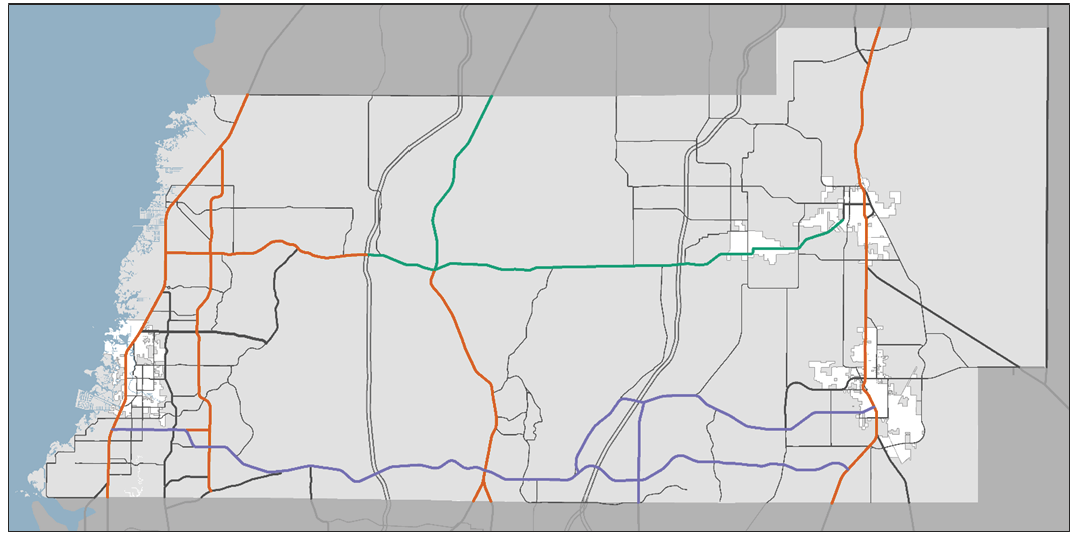 | ||
| North 41/East 52 Corridors | • SR 52 - Suncoast Pkwy. to Dade City Limits | • US-41 - SR 52 to Hernando County Line |
| Redevelopment Corridors | • US-19 - Hernando County Line to Pinellas County Line | • US-41 - Hillsborough County Line to SR 52 |
| • Little Rd. - US-19 to Trinity Blvd. | • Dale Mabry Hwy. - US-41 to Hillsborough County Line | |
| • SR 52 - US-19 to Suncoast Pkwy. | ||
| • CR 54 - SR 54 to Little Rd. | • US-301 - Hernando County Line to Hillsborough County Line | |
| Transit Corridors | • SR 54 - US-19 to US-301 | • SR 56 - Wesley Chapel Blvd. to US-301 |
| • Bruce B. Downs Blvd. - SR 54 to Hillsborough County Line | • Suncoast Pkwy. (within the Urban Service Area) | |
| • Wesley Chapel Blvd. - SR-56 to Bruce B. Downs Blvd. | • I-75 (within the Urban Service Area) | |
(Ord. No. 19-43, § 5, 12-10-19; Ord. No. 20-39, § 5(Att. A), 12-8-20; Ord. No. 24-40, § 5 (Att. A), 8-21-24)
1105.3. - Exemptions
Special exceptions, rezonings, MPUDs, and Planned Development Comprehensive Plan Amendments, approved prior to December 10, 2019, where mini-warehouse or self-storage facilities were specifically listed as a permitted use in the special exception, MPUD conditions, rezoning conditions, Planned Development Subarea Policies, or Land Use Equivalency Matrices (LUEMs) are exempted from compliance with Section 1105.4 Corridor Specific Design Standards, but all other parts of Section 1105 shall apply. Existing self-storage facilities (including accessory uses) as of December 10, 2019 shall be exempt subject to Section 1203.2.
(Ord. No. 24-40, Att. A, 8-21-24)
1105.4. - Corridor Specific Design Standards
For the purposes of this section, the Corridor setback shall be measured from the edge of the ultimate right-of-way per the Transportation Corridor Preservation widths as established in Table 7-2 of the Comprehensive Plan.
| A. North 41/East 52 Corridors | |
| The purpose of these standards is to protect and preserve the economic development potential of the limited commercial zoning districts along the North US-41 and East SR 52 corridors, for land laying with frontage along the corridor right-of-way pursuant to Section 1105.2, and pursuant POLICY ED 1.6.2: Preservation of Capacity for Employment Generating Uses. | |
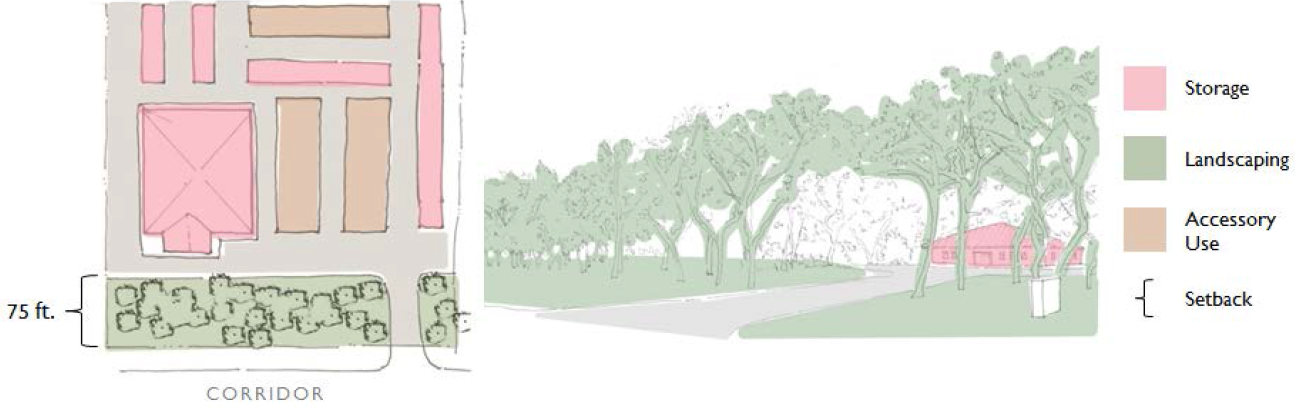 | |
| 1. Lot Size | 3 min. acres North 41 only; refer to zoning district for lot size requirements for East 52. |
| 2. Self-Storage Corridor Setback | 75 feet min. from corridor right-of-way; refer to zoning district for all other setbacks. |
| 3. Landscaping | Refer to Section 905.2.D. |
| 4. Multi-Use | Horizontal and/or vertical permitted but shall not exceed applicable height limits. |
| B. Redevelopment Corridors | |
| The purpose of these standards is to support development that is adaptive reuse and is contextually appropriate with surrounding communities, for land laying with frontage along the corridor right-of-way pursuant to Section 1105.2 and, POLICY ED 1.4.8: Redevelopment of Commercial Corridors. | |
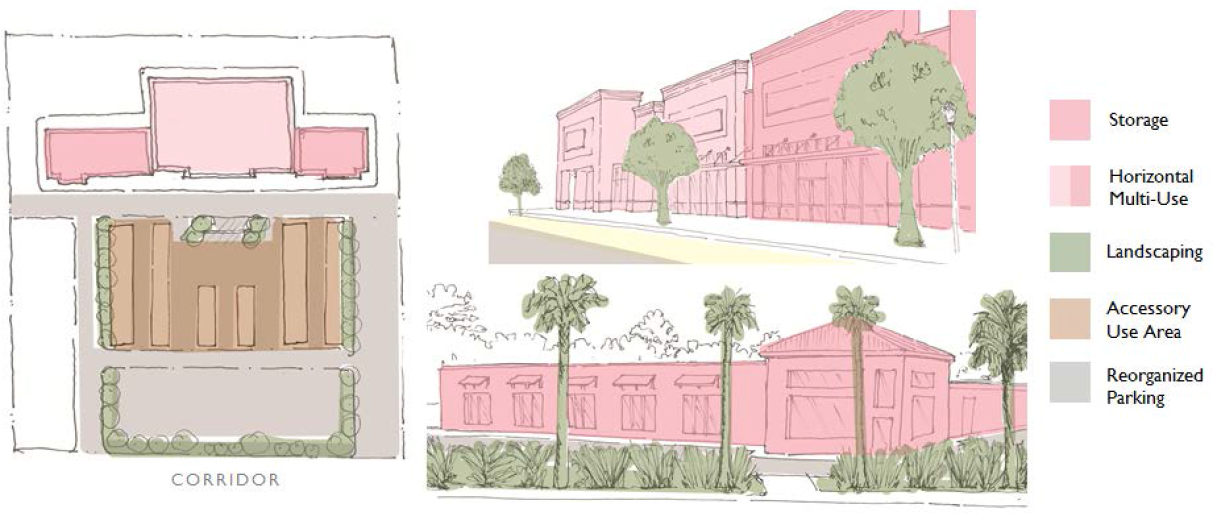 | |
| 1. Lot Size | 5 max. acres (no max. for adaptive re-use). Minimum lot size shall be consistent with the zoning district. |
| 2. Self-Storage Corridor Setback | 25 feet from corridor right-of-way; refer to zoning district for all other setbacks. |
| 3. Landscaping | Refer to Section 1102.4.H for building perimeter landscaping and to Section 905.2.D. Zoning Districts along US-301: refer only to Section 905.2.D. |
| 4. Multi-Use | Horizontal and/or vertical encouraged. |
| C. Transit Corridors | |
| The purpose of these standards is, for land laying with frontage along the corridor right-of-way pursuant to Section 1105.2, to accommodate self-storage development that supports present and future employment generating uses pursuant to POLICY FLU 8.1.2: South Market Area Establishment. | |
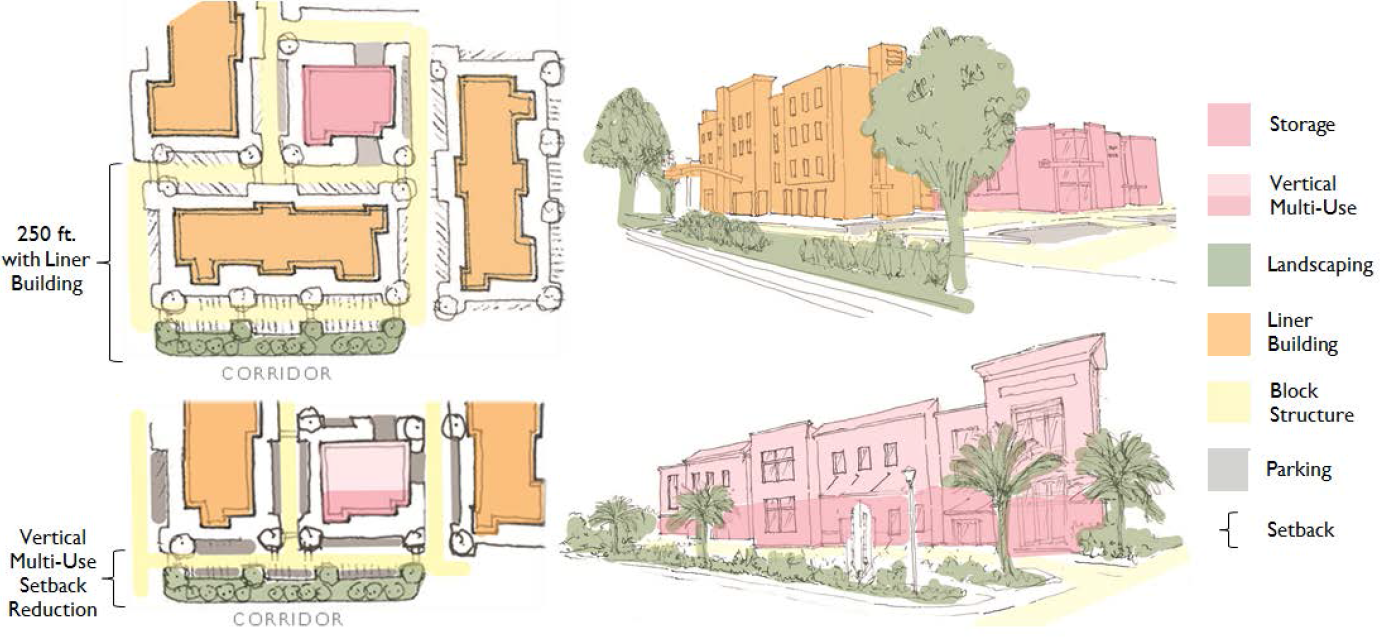 | |
| 1. Lot Size | 5 max. acres for self-storage facilities (no max. for adaptive re-use). Minimum lot size shall be consistent with the zoning district. |
| 2. Self-Storage Corridor Setback | 250 feet min. from corridor right-of-way; refer to zoning district for all other setbacks. |
| 3. Landscaping | Refer to Section 1102.4.H for buildings exceeding 25,000 sq. ft. for all other landscaping refer to Section 905.2.D. |
| 4. Multi-Use | Horizontal and/or vertical encouraged. |
| General Note: Illustrations in this Ordinance are illustrative and, except for Figure 1105.2-1, are not regulatory. | |
(Ord. No. 19-43, § 3(Exh. A), 12-10-19; Ord. No. 24-40, Att. A, 8-21-24)
1105.5. - General Design Standards
The following general design standards are required for all self-storage facilities.
A.
Performance.
1.
The self-storage facility shall be limited to dead storage only, limited incidental sales of storage materials, and accessory uses customarily incidental to self-storage facilities, as authorized in this Section.
2.
Individual storage bays within a self-storage facility shall not be used for any use other than dead storage.
3.
Except as otherwise authorized in this Section, all items stored on the site shall be placed entirely within enclosed buildings.
4.
Storage of toxic, hazardous, flammable, explosive or noxious materials is prohibited, except as permitted by applicable law.
B.
Buildings. Building design shall consider surrounding structures and provide for massing and height that is contextual. Buildings shall incorporate façade articulations and varied roof planes and pitches in order to minimize visual impact onto surrounding communities. For self-storage facilities exceeding 25,000 square feet, and multi-use buildings exceeding 25,000 square feet occupied by a self-storage facility, Section 1102.4 A-E and I-K shall apply. Additionally, for self-storage facilities along designated corridors the following shall apply:
1.
Individual storage bay doors and faux door treatments shall be oriented away from view from public right-of-way view or concealed.
2.
Building materials and material colors shall provide a neutral color palette for the majority of the facility. Color schemes may deviate from a neutral palette for architectural accents, not to exceed 30 percent of any façade.
3.
Expansions and/or additions of a self-storage facility are encouraged to maintain architectural uniformity with the existing structure.
C.
Parking and Circulation.
1.
Aisleways: In no circumstance shall be less than 20 feet in width. These aisleways are to be used for internal circulation and temporary customer parking/loading while using storage bays.
2.
Parking: At least five parking spaces are required. Parking shall be placed to the side and/or rear of the primary building.
D.
Landscape Buffer.
1.
Designated Corridor Frontage.
a.
North 41/East 52 Corridor. When existing landscape and topography is maintained, development shall follow Section 905.2.C.g. In the event that existing landscape and topography is not feasible to preserve, a Type D landscape buffer shall be installed within the 75-foot self-storage corridor setback.
b.
Redevelopment Corridor. A Type D buffer, pursuant to Section 905.2, shall be installed for the corridor development setback.
c.
Transit Corridor. Existing landscape shall be maintained within the 250-foot corridor development setback prior to the development between the corridor and the self-storage facility.
A Type A buffer, pursuant to Section 905.2, shall be installed on the self-storage facility site area's edge nearest to the corridor, as generally depicted in Figure 1105.4.C.
2.
Existing Structures.
a.
Remodeled and/or redeveloped self-storage facilities, and adaptive reuse facilities shall comply with Section 403.10 for redevelopment landscaping provisions.
E.
Multi-use.
1.
Shall mean one or more compatible professional, commercial, or retail occupying the ground floor of the principal building and having main entrances on the principal street as evidenced by the construction plan or building permit application.
2.
Any spaces required for self-storage facilities shall count towards the parking requirements for other uses as required by Section 907.1.E. Portions of such parking may be designated by the developer for end users.
a.
Reduction strategies found in Sections 601.7.E.3.a. and 901.7.F. may be pursued in order to provide for shared parking for multi-use development.
3.
The transit corridor setback requirement shall be reduced if the additional use(s) occupies no less than 50 percent of the ground floor of the principal building. Reduced setback shall follow zoning district.
F.
Accessory Uses.
1.
Recreational Vehicle/Boat Storage and other customary accessory uses such as truck rentals, retail propane dispensing, (which excludes the sales of residential propane tanks), and similar like uses, are allowable accessory uses for self-storage facilities.
2.
Accessory uses shall be incorporated into the overall design of the principal self-storage structure on the site and be visually uniform.
3.
Accessory uses shall be screened from view from all property lines and adjacent rights-of-way by a 50 percent opaque fence or wall between six and eight feet in height. Walls shall incorporate the building materials and material colors used in the primary structure. Chain link fences shall be screened from view from public rights-of-way with landscaping. Razor wire and similar materials are not permitted.
4.
No more than one dwelling unit for security quarters may be developed on the site and shall be integrated into the buildings' design. This shall not apply for multi-use self-storage buildings that have residential uses.
5.
Accessory uses for self-storage facilities in the North 41/East 52, Redevelopment, and Transit Corridors shall be located in the delineated area behind and to the side of the principal building.
G.
Free-Standing Recreational Vehicles/Boats Storage (RV/Boat).
1.
There are four types of RV/Boat Storage:
a.
Fully Enclosed,
b.
Semi-enclosed,
c.
Covered Parking, and
d.
Open.
2.
Fully Enclosed and Semi-enclosed Storage shall comply with Section 1105.5.B.
3.
Covered and Open Storage is prohibited in Transit Corridors within 250 feet of the corridor. Along the Suncoast Parkway, for the segment of that Transit Corridor that is north of State Road 52 and within the Urban Service Area, open RV/Boat Storage may be allowed as a Special Exception within the 250 foot corridor setback if the parcel, or that portion of the parcel, is zoned C-3 Commercial/Light Manufacturing District, I-1 Light Industrial Park District, or I-2 Heavy Industrial Park District. All required landscaping and screening may be more stringent than required by the Land Development Code. The Special Exception use may be time limited.
4.
All types of RV/Boat Storage shall be screened from view from all property lines and adjacent rights-of-way by a 50 percent opaque fence or wall between six and eight feet in height and follow zoning district buffer and setback requirements if not in a designated corridor. If along a designated corridor, development shall comply with Section 1105.4.
5.
Chain link fences shall be screened from view from public rights-of-way with landscaping. Razor wire and similar materials are not permitted.
6.
One parking space is required.
H.
Submittal Requirements.
1.
Architectural renderings of each elevation and site plan shall be submitted with any applicable preliminary development plan submittal for buildings exceeding 25,000 square feet,
2.
Alternative standard requests may be considered pursuant to Section 407.
(Ord. No. 19-43, § 3(Exh. A), 12-10-19; Ord. No. 24-40, § (Att. A), 8-21-24)
1106.1. - Intent and Purpose
The intent and purpose of this section is to develop and implement design, use standards and regulations to mitigate the impacts created by excessive concentrations of repeated uses at intersections, along roadways and corridors that adversely impact traffic flow, pedestrian circulation, and visual impacts related to site layout for the use of property as freestanding car washes in unincorporated Pasco County.
1106.2. - Applicability
A. This section applies to proposed freestanding car wash facilities within unincorporated areas of Pasco County. Except where a freestanding car wash is a specifically listed and approved use in a MPUD Master Planned Unit Development, a new freestanding car wash proposed to be included within a MPUD, C-1, or C-2 commercial zoning districts shall require a conditional use, notwithstanding any contrary requirements in the LDC. New car washes are prohibited in EC (Employment Center), IH (Industrial-Heavy), IL (Industrial Light). TC (Town Center), developments designated as Transit-Oriented Development (TOD) and Traditional Neighborhood Development (TND), project sites within the Connected City Northern Innovation Zone, Southern Innovation Zone and Community Hub Special Planning Areas, the compact development area of the Mixed Use Trip Reduction Measures (MUTRM), and the Villages of Pasadena Hills, except for within: (a) the Type I Village where one freestanding car wash is permitted per Village, and (b) any MPUD where a car wash is a specifically listed and approved use prior to September 17, 2024. After September 17, 2024, all completed preliminary site plan (PSP) applications for a freestanding car wash within a Type I Village shall be time and date stamped and shall be processed in the order in which they are received.
B.
Limited Applicability.
1.
All proposed new freestanding car washes having an approved site plan or approved building permit prior to September 17, 2024, that has not expired shall only be subject to Section 1106.3.D.1.
2.
All proposed new freestanding car washes with a pending site plan application deemed complete for content prior to September 17, 2024, shall only be subject to Section 1106.3.D.1.
3.
All proposed freestanding car washes with a pending building permit submitted prior to the adoption of this ordinance shall be subject to Section 1106.3.D.1.
4.
Any approved MPUD with specific design, location, or site orientation standards for car washes shall only be subject to Section 1106.3.D.1 and will not require a conditional use permit or any modification to the MPUD.
1106.3. - General Design and Use Standards
A.
Site Layout.
1.
All buildings shall be located adjacent to the front yard. Where two frontages exist, the building shall be adjacent to the street frontage with the higher roadway classification.
2.
Vacuum stations and stalls shall be located behind the principal structure.
3.
Parking spaces, travel aisles, loading facilities and trash enclosures shall be prohibited within the front yard between the building façade and the street.
4.
Required parking shall be a minimum of one space per employee on the largest shift and must meet ADA parking requirements.
Alternative Standards for 1106.3.A.1-4 shall not be approved.
B.
Setbacks.
The following building setbacks measured from property lines are permitted in yard areas listed below:
1.
Front: 20 feet.
2.
Side. A side yard depth of 30 feet per side from residential districts, no side yard shall be required where two or more commercial parcels or an industrial and commercial district adjoin side to side; however, in no case shall common walls be permitted between properties of separate ownership. In the case of such a series of adjoining structures on lots of single and separate ownership abutting and paralleling a public right-of-way, a passage of at least 20 feet in width shall be provided at grade level at intervals not more than 400 feet apart where required for public access from adjacent residential areas or for the safety of the public.
3.
Rear. 30 feet, when adjacent to residential districts. Adjacent to commercial or industrial districts, no rear yard shall be required.
C.
Buffering.
1.
All ground level and roof level mechanical equipment and utility boxes shall be screened.
2.
If the opening of the freestanding car wash facility faces the adjacent right-of-way, then the opening shall be screened from the view of the adjacent right-of-way to the greatest extent possible so that pass-by traffic cannot view the mechanical washing equipment inside the building.
3.
Vacuum stations and stalls shall not be required to have vehicular landscaped islands.
4.
A solid six-foot high decorative masonry wall shall be required along all sides of the site that abuts a residential zoning district or use. There shall be no driveways or other non-gated opening in the fence or wall. Gates shall be as tall as the fence or wall. The fence or wall shall be constructed of materials similar in color and texture to those utilized for the principal structure.
D.
Traffic Circulation and Vehicular Stacking.
1.
Drive-lanes and parking spaces shall be clearly delineated.
2.
Stacking lane dimensions shall comply with Section 907.3 of this Code. Four stacking spaces shall be provided for the first pay station and three stacking spaces for each additional pay station.
1106.4. - Additional Design Standards
In addition to all other applicable requirements of this Code, the following additional design standards shall be required for all freestanding car wash facilities.
A.
Shade Structures. Optional shade structures must be consistent with the architectural design, predominant color, and features of the principal structure.
B.
Building Design Standards.
1.
Façades. All building façades shall include features at intervals of no more than 25 feet. Such features shall include but are not limited to the following of which two or more must be integrated into the building structure: windows, awnings associated with windows or doors, ornamental and structural details that are integrated into the building structure, arches or arched or curvilinear forms, color changes, banding, texture changes or material module changes. Customer entrances shall be clearly defined by features such as canopies/porticos, overhangs, recesses/projections, or similar elements.
2.
Roofs. Roofs shall provide visual interest using changes in height, shape (for example, the use of parapets), color or texture. Uninterrupted flat roofs shall be prohibited.
3.
Materials. Exterior building material shall include a minimum of two of the following: architectural or split-face block, brick, glass, wood, stucco, artificial stucco, stone, or concrete with an architectural finish. Material colors shall provide a neutral color palette for most of the façade. Color schemes may deviate from a neutral palette for architectural accents, not to exceed 30 percent of any façade. The use of plexiglass on the exterior of freestanding car wash tunnels shall be prohibited.
4.
Freestanding Car Wash Tunnels. The interior mechanical equipment of the freestanding car wash tunnel shall not be visible from adjacent rights-of-way.
5.
Lighting. Interior flashing lights associated with the freestanding car wash tunnel shall not be visible from adjacent rights-of-way.
6.
Compatible Signage. Sign construction material and finishes shall be compatible with the façade and roof design standards.
(Ord. No. 24-42, Exh. A, 9-17-24)

