
Pasco County Unincorporated
City Zoning Code
City Zoning Code
CHAPTER 1300
CONCURRENCY AND IMPACT FEES
1301.1. - Intent and Purpose
Concurrency facilities include drainage, potable water, water supply, sanitary sewer, solid waste, parks and recreation, and school facilities. The Board of County Commissioners (BCC) has established Level of Service (LOS) standards for such facilities in the Comprehensive Plan. The purpose of these regulations is to allow the County, or the School District as to school concurrency, to determine whether or not there is sufficient capacity of concurrency facilities to meet the Comprehensive Plan LOS standards concurrent with proposed development and ensure consistency with the Capital Improvements Plan (CIP), Capital Improvements Element (CIE), and/or the School District's Facilities Work Program for school concurrency.
(Ord. No. 22-63, § 5(Att. A), 12-6-22)
1301.2. - Applicability
For purposes of timing applicability for all public facilities other than schools, this section shall apply to nonexempt Initial or Final Certificates of Capacity or Initial or Final Certificate of Capacity development orders for which the complete application has been filed, resubmitted after expiration or denial, or substantially amended on or after December 1, 2006, unless the applicant and the County agree to an earlier application date. For purposes of timing applicability for school facilities, this section shall apply to nonexempt Initial and Final Certificate of Capacity development orders for which a complete application has been filed, resubmitted after expiration or denial, or substantially amended on or after January 1, 2010, unless the applicant and the County agree to an earlier application date. Pending complete applications for preliminary site plans (PSP), preliminary plans, and residential subdivisions into more than one dwelling unit per lot that are exempt from an Initial Certificate of Capacity that includes school facilities concurrency are not automatically exempt from the requirement to obtain a Final Certificate of Capacity that includes school facilities concurrency. Pending complete applications for Building Permits and plats as of January 1, 2010, are not subject to this section. Any project not subject to the school facility provisions of this section shall continue to comply with all school facility requirements in effect or imposed at the time the project was submitted, unless the project qualified for an exemption from such requirements.
Transportation concurrency has been eliminated as of April 17, 2013. Projects with existing transportation concurrency obligations set forth in any development approval or Certificate of Capacity for the project, including any proportionate-share payment obligations, are relieved of those obligations. However, if such obligations are set forth in a development agreement or Development of Regional Impact (DRI) Development Order, the project shall not be relieved of such obligations unless the development agreement or DRI Development Order is amended or rescinded by the BCC. In addition, if any proportionate-share obligation has already been paid, or committed through an enforceable performance guarantee, the project shall not be relieved of such obligation, unless the BCC specifically grants relief from such obligation. No project shall be entitled to a refund for any proportionate-share payment paid, or proportionate-share project constructed, prior to the effective date of the Urban Service Area/Transportation Concurrency Exception Area exemption or the elimination of transportation concurrency requirements, as applicable. Any transportation-related build-out date; transportation concurrency expiration date; or Traffic Impact Study (TIS) reevaluation date set forth in the development approvals or Certificate of Capacity for the project are hereby eliminated, unless such dates are regional or State build-out or reevaluation dates in a DRI Development Order, in which case, such dates shall not be eliminated unless the DRI Development Order is rescinded or amended by the BCC.
The elimination of transportation concurrency does not guarantee that all projects will be approved upon payment of a mobility fee. Development has other site-specific and cumulative impacts on the transportation system that are regulated through other portions of this Code including, but not limited to, regulations relating to transportation corridor management, collector and arterial spacing, access management, substandard roads, timing and phasing, and secondary access. Projects shall not be relieved of such requirements, even if such requirements are or were based on a TIS.
(Ord. No. 22-63, § 5(Att. A), 12-6-22)
1301.3. - Exemptions
A.
Subject to this Code, Section 1301.3.D, the following projects are permanently exempt from obtaining a Certificate of Capacity:
1.
For Other Than School Concurrency:
a.
The portion of any project that has received final subdivision plat approval as a residential subdivision into one dwelling unit per lot as of December 1, 2006.
b.
Any building or structure that has received a Certificate of Occupancy (CO) as of December 1, 2006.
c.
Any public school with an approved site plan or approved Comprehensive Plan consistency review as of December 1, 2006.
d.
The portion of any project or area subject to a BCC-approved public facility infrastructure financing plan and special district to finance such infrastructure; provided, however, the scope of the concurrency exemption for such project(s) or area shall be defined in the BCC approval.
2.
For School Concurrency:
a.
The portion of any project that has received final subdivision plat approval as a residential subdivision into one dwelling unit per lot as of January 1, 2010.
b.
Any residential dwelling unit that has received a CO as of January 1, 2010.
c.
Any age-restricted community intended to provide housing for persons who are 55 years of age or older that prohibits the permanent residency of individuals under the age of 22 by deed restrictions meeting the requirements of the School Impact Fee Ordinance. Said deed restrictions are required to be executed and recorded prior to granting this exemption.
B.
Subject to this Code, Section 1301.3.D, the following projects are exempt from obtaining a Certificate of Capacity, but such exemption is subject to expiration:
1.
For Other than School Concurrency:
a.
The portion of any project in possession of a valid, unexpired, Certificate of LOS Compliance; however, such exemption shall expire upon the expiration of the Certificate of LOS Compliance, or upon default of any conditions of the Certificate of LOS Compliance, unless such project, or portions of such project, remains exempt pursuant to another exemption provision.
b.
The portion of nonresidential projects, residential projects not requiring a subdivision plat, or residential subdivisions into more than one dwelling unit per lot that have received a Building Permit as of December 1, 2006; however, such exemption shall expire upon expiration of the Building Permit if the building subject to the Building Permit has not received at least one inspection as of December 1, 2006, unless such project, or portions of such project, remains exempt pursuant to another exemption provision.
c.
DRI Development Orders approved prior to April 9, 1991; however, such exemption shall expire for any phase of the development order on the date such phase is subject to an additional concurrency review, or for the entire development order upon expiration of the development order, or upon any material default of the mitigation conditions of such development order or a related Development Agreement (DA), unless such project, or portions of such project, remains exempt pursuant to another exemption provision.
2.
For School Concurrency:
a.
The portion of residential projects not requiring a subdivision plat, or residential subdivisions into more than one dwelling unit per lot that have received a Building Permit as of the effective date of the Pasco County School Concurrency Management Ordinance; however, such exemption shall expire upon expiration of the Building Permit if the building subject to the Building Permit has not received at least one inspection as of January 1, 2010, unless such project, or portions of such project, remains exempt pursuant to another exemption provision.
b.
Unless an applicant elects otherwise in writing, the provisions of this ordinance shall not apply to any DRI for which a Development Order has been issued prior to July 1, 2005, or for which a DRI application has been submitted prior to May 1, 2005. Any exempt DRI which files a notice of proposed change for an extension of the date of build-out or any phase thereof which is presumed to be substantial deviation shall comply with this division for any portion of the development so extended, unless such project, or portion of such project, remains exempt pursuant to another exemption provision.
c.
The portion of any project that is the subject of a binding and enforceable DA or other agreement that specifically exempts such project from school concurrency requirements; however, such exemption shall expire upon expiration of the DA, or upon any material default of the school mitigation conditions of such DA or agreement, unless such project, or portions of such project, remains exempt pursuant to another exemption provision.
d.
The County Administrator or designee shall determine whether an exemption applies and, if an exemption is granted, refer same to the School District for review. If the School District objects to the granting of an exemption, the School District shall notify the County in writing within 14 days of receipt of the exemption determination and include in the objection notice the reasons why the School District believes that the exemption does not apply. Should the County Administrator, or designee, uphold the exemption, the School District may appeal such decision pursuant to this Code. Should the County Administrator or designee deny the exemption, the applicant may appeal such decision pursuant to this Code. If the School District objects to an exemption determination within the 14 day objection period, the exemption determination, and any Initial or Final Certificate that is issued based on the exemption, shall not be considered final or appealable for purposes of this Code until the County Administrator or designee issues a final determination after the School District's written objection.
C.
The foregoing exemptions shall not apply if a material change is made to the exempt portion of any project, building, or structure. The term "material change" shall mean a change that results in an increased demand for or impact on the concurrency facility or facilities for which the project is exempt.
However, in the event a project exempt pursuant to this Code, Section 1301.3.A or 1301.3.B.1.b, loses exemption status solely as a result of a material change, the Certificate of Capacity, and the applicable review standards and de minimis thresholds shall apply only to that portion of the project that has resulted in an increased demand for or impact on the concurrency facility; and such project shall only be subject to concurrency review for those facilities with increased impacts. All other exempt projects that make a material change or that lose exemption status for the reasons set forth in the exemptions shall become subject to all applicable requirements of this Code.
D.
Before the County Administrator or designee determines that any exemption shall expire based on a material default of a condition, agreement, or Development Order, the County shall provide 30 days prior written notice of the planned expiration to all property owners that would be subject to a new Certificate of Capacity upon such expiration. During such 30-day period, any property owner notified of the planned expiration may either (1) cure the default; or (2) appeal the planned expiration pursuant to this Code. In the event of an appeal of the planned expiration, the expiration shall be stayed until such time that the BCC determines that the Certificate of Capacity shall expire.
(Ord. No. 22-63, § 5(Att. A), 12-6-22)
1301.4. - Limited Exemptions
A.
The BCC, or the County Administrator or designee may administratively exempt any of the following "limited exemption projects" from any provision of these regulations that is more stringent than minimum State law requirements:
1.
Public schools governed by the Public School Facilities Element of the adopted Comprehensive Plan, as amended, and community colleges and universities governed by Chapter 1013, Florida Statutes.
2.
Governmental uses, including Federal, State, and County-owned or leased buildings or land.
3.
Target businesses, which are defined for the purposes of these regulations as businesses identified by Enterprise Florida's Qualified Target Industry Tax Refund Program, and those targeted businesses identified in the Pasco Economic Development Council's Economic Development Target Industry List, as may be amended from time to time. The County may impose additional zoning restrictions and/or private deed restriction requirements to ensure that target businesses remain target businesses.
4.
The corporate business park, targeted primary business, or industrial use portion of an EC (Employment Center) Future Land Use Classification, or the corporate business park, targeted primary business, or industrial-use portion of another Land Use Classification, which are developed in accordance with the County's EC-MPUD Employment Center Master Planned Unit Development requirements. These uses include the preferred uses listed in this Code, Chapter 500, Zoning. Accessory and ancillary uses allowed within an EC-MPUD shall not be considered limited exemption uses, unless such uses are specifically determined by the BCC or County Administrator to be an integral part of the preferred uses. The County may impose additional zoning restrictions and/or private deed-restriction requirements to ensure that preferred EC uses remain preferred EC uses.
5.
Portions of projects developed as a traditional neighborhood design, transit-oriented design, or TC (Town Center) designated development in accordance with this Code.
6.
Affordable housing projects, which are defined for purposes of this section as projects that provide housing that is affordable to a family with a median income that does not exceed 80 percent of the median income for the Tampa-St. Petersburg-Clearwater Standard Metropolitan Statistical Area. To qualify as an affordable housing project, the project must be designated as affordable by the County's Community Development Manager, consistent with the foregoing definition and applicable Federal, State, and local income and expense criteria for affordable housing, and must be sold or leased to a family that satisfies the foregoing income criteria, as determined by the Community Development Manager. The County shall impose deed restrictions, mortgage requirements, and/or liens that ensure that any affordable housing projects that are granted one or more limited exemptions pursuant to these regulations remain affordable. The owner of any dwelling unit or building in an affordable housing project granted a limited exemption that resells or leases such dwelling unit or building at a price or rent that is no longer affordable, or resells or leases such dwelling unit or building to a family that does not satisfy the foregoing income criteria, as determined by the Community Development Manager consistent with the foregoing definition, shall be required to pay to the County the difference between (1) the County estimated pro-rata share of the proportionate-share obligation of the affordable housing project with any limited exemptions granted such project; and (2) the County estimated pro-rata share of the proportionate-share obligation of the affordable housing project without any limited exemptions at the time that such dwelling is resold. Failure to pay the difference shall be considered a violation of this Code punishable in accordance with this Code, in addition to any other remedies of the County as set forth in the County-imposed deed restrictions, mortgage requirements, and/or liens.
B.
The limited exemptions for limited-exemption projects may include, but are not limited to, one or more of the following:
1.
Extension of expired Certificates of Capacity without additional review to the extent allowed by law.
2.
The County and School Board may address proportionate-share contributions and concurrency obligations for public schools in the Interlocal Agreement for Coordination of Planning Activities, as amended, or other Interlocal Agreement between the County and the School Board.
The BCC acknowledges that the provision of limited exemptions to limited-exemption projects does not relieve the County from complying with CIE requirements, or from ensuring that adequate concurrency public facilities are available to achieve Comprehensive Plan adopted LOS.
(Ord. No. 22-63, § 5(Att. A), 12-6-22)
1301.5. - Generally
A.
Certificates of Capacity. A Certificate of Capacity, as used in these regulations, is a determination that all concurrency review requirements are satisfied for the proposed development and that a specified quantity of concurrency facilities capacity is reserved for the proposed development for the duration of the Certificate of Capacity, subject to the requirements of these regulations, and any conditions imposed with the Certificate of Capacity. A Certificate of Capacity is issued if all adopted LOS standards can be maintained during and following the proposed development, or the impacts of the proposed development are mitigated consistent with the Comprehensive Plan and these regulations. Any Certificate of Capacity may be issued with conditions to ensure the adopted LOS standards can be maintained during and following the proposed development, or to ensure that the impacts of the proposed development are mitigated consistent with the Comprehensive Plan and these regulations. Certificates of Capacity shall be issued by the County on a form designed by the County and relating to a specific development project, or project phase, on a specific parcel of real property. Certificates of Capacity shall run with the parcel(s) of real property upon which they are issued, and the rights and obligations set forth therein shall be binding on subsequent property owners of such real property. Certificates of Capacity may not be transferred to other parcels or property.
B.
Certificate of Capacity Information. Each Certificate of Capacity shall include, at a minimum, a statement as to specific land uses, the number of units, and the floor area or square footage for all nonresidential structures or other areas that will be used for display, storage of goods, or dedicated to the performance of services as applicable or relevant to the estimation of impacts for purposes of meeting the intent of these regulations. For phased projects, or projects with interim uses that utilize concurrency public facilities, this information shall be provided for each phase or interim phase. The Certificate of Capacity shall also include, at a minimum, the location of the project, including Parcel Identification Numbers. The County Administrator or designee may establish application forms requiring additional information or request supplemental information for specific concurrency public facilities. In addition, information supplied by the applicant in any related development approval application(s) may be used for the Certificate of Capacity determination. For school concurrency, each applicant not exempt from school concurrency shall submit a School Concurrency Application to the School District and comply with the School District's Concurrency Implementation Procedures Manual adopted by the School District pursuant to Chapter 120, Florida Statutes, and found at http://pasco.k12.fl.us/planning/concurrency (the School Concurrency Implementation Procedures Manual).
C.
Capacity Determination Procedures. Initial Certificates of Capacity: For sanitary sewer, potable water, water supply, solid waste, and parks and recreation, an Initial Certificate of Capacity shall be required prior to the issuance or approval of one of the following development orders for any project or project phase (the Initial Certificate of Capacity Development Orders):
1.
PSP; or
2.
Preliminary Development Plan - Residential (PDP-R);
For school facilities, an initial Certificate of Capacity shall be required prior to the issuance or approval of one of the following development orders for any project or project phase:
3.
PSP; or
4.
PDP-R
Initial Certificates of Capacity shall be valid and reserve capacity for a period of six years from the date of issuance except for school facilities.
For school facilities, Initial Certificates of Capacity shall be valid and reserve capacity for a period of three years from the date of issuance of the Initial Certificate of Capacity, unless a longer time period is approved in accordance with the requirements of the School Concurrency Implementation Procedures Manual. The foregoing expiration periods for Initial Certificates of Capacity are subject to the additional review and revocation requirements set forth below. Initial Certificates of Capacity that expire may be renewed only upon compliance with all applicable application and review requirements set forth in these regulations. Initial Certificate of Capacity Development Orders shall not require a new Initial Certificate of Capacity if the project or project phase has a valid and unexpired Initial Certificate of Capacity at the time of issuance or approval of the Initial Certificate of Capacity Development Order.
5.
Final Certificates of Capacity. For drainage, sanitary sewer, potable water, water supply, solid waste, parks and recreation, and school facilities, a Final Certificate of Capacity shall be required prior to the issuance or approval of one of the following development orders for any project or project phase (Final Certificate of Capacity development orders):
a.
Building Permit issuance for nonresidential development, residential development not requiring subdivision plat, or residential subdivisions into more than one dwelling unit per lot.
b.
Final plat approval for residential subdivisions into one dwelling unit per lot.
For public schools, site plan approval to the extent required by the Interlocal Agreement between the County and the School Board.
Any project or project phase with a valid and unexpired Initial Certificate of Capacity at the time of issuance or approval of the Final Certificate of Capacity development order shall be entitled to issuance of a Final Certificate of Capacity without further analysis or review for the portion of the project with the valid and unexpired Initial Certificate of Capacity, subject to the additional review and revocation requirements set forth below; provided, however, issuance of a Final Certificate of Capacity shall be subject to additional review for drainage concurrency regardless of whether an Initial Certificate of Capacity has been issued. Projects or project phases without a valid and unexpired Initial Certificate of Capacity shall require additional review in accordance with these regulations. Final Certificates of Capacity, once issued, shall not expire and shall constitute a permanent reservation of capacity, subject to the additional review and revocation requirements set forth below.
6.
Additional Review and Revocation Requirements. Any project or project phase that changes the number of units, the type of land use, the floor area or square footage for all nonresidential structures, or other areas that will be used for display or storage of goods, or dedicated to performance of services, after an Initial or Final Certificate of Capacity has been issued, shall be subject to additional review in accordance with these regulations if the change results in an increased demand for or impact on any concurrency facility.
However, in the event a project or project phase becomes subject to additional review after it has received a Final Certificate of Capacity, such project or project phase shall be subject to additional review only for that portion of the project that has resulted in an increased demand for or impact on the concurrency facility, and such project shall only be subject to concurrency review for those facilities with increased impacts.
An Initial or Final Certificate of Capacity may be revoked if the County Administrator or designee determines that (1) the application information used as a basis for the issuance of the Certificate of Capacity was inaccurate and such inaccuracy was material to the capacity determination; or (2) a condition of the Initial or Final Certificate of Capacity has not been fulfilled by the time period required in such condition, or in the absence of a time period, by the issuance of the first CO for the project or project phase that received the Certificate of Capacity. However, before the County Administrator or designee revokes a Certificate of Capacity, the County shall provide 30 days prior written notice of the planned revocation to all property owners that would be subject to a new Certificate of Capacity upon such revocation. During such 30-day period, any property owner notified of the planned revocation may either: (1) cure the inaccuracy or noncompliance; or (2) appeal the planned revocation pursuant to this Code. In the event of an appeal of the planned revocation, the revocation shall be stayed until such time that the BCC determines that the Certificate of Capacity shall be revoked. As to school facilities, the School District may formulate, adopt, and enforce its own rules of revocation of a Concurrency Capacity Letter in the School Concurrency Implementation Procedures Manual. The School District's revocation of a Concurrency Capacity Letter shall be a basis for the County to revoke an Initial or Final Certificate of Capacity.
An applicant may voluntarily relinquish any Initial or Final Certificate of Capacity that has been issued to the applicant, in which case, the capacity reservation for the project, or project phase, shall terminate, and such project or project phase shall be subject to all procedures and review standards set forth in these regulations. However, an applicant may not relinquish any condition or mitigation required by an Initial or Final Certificate of Capacity if such condition or mitigation is guaranteed by a security instrument, such as a bond or Letter of Credit, and voluntary relinquishment by the applicant shall not entitle the applicant to a refund or credit for any payment or mitigation provided to the County as a condition of the relinquished Initial or Final Certificate of Capacity. As to school facilities, the School District may formulate, adopt, and enforce its own rules pertaining to relinquishment of a Concurrency Determination Letter in the School Concurrency Implementation Procedures Manual.
D.
Effect of Certificate of Capacity Subject to Additional Review, Revocation, or Expiration. The County shall withhold issuance of new development orders, permits, or CO for any project or project phase: (1) with an expired or revoked Initial or Final Certificate of Capacity; (2) with an Initial or Final Certificate of Capacity subject to additional review in accordance with these regulations; or (3) that did not obtain an Initial or Final Certificate of Capacity where required by these regulations.
Initial and Final Certificates of Capacity may be subject to additional review or revocation for all concurrency facilities or for specific concurrency facilities. In addition, Initial Certificates of Capacity may have a different expiration period for school facilities than other concurrency facilities. If an Initial or Final Certificate of Capacity is subject to additional review, revocation, or expiration only for a specific concurrency facility, or specific concurrency facilities, it shall not affect the validity of the Initial or Final Certificate of Capacity for purposes of the other concurrency facilities not subject to additional review, revocation, or expiration.
(Ord. No. 22-63, § 5(Att. A), 12-6-22)
1301.6. - Specific Review Standards
The following review standards shall apply to all nonexempt projects or project phases seeking an Initial Certificate of Capacity or Final Certificate of Capacity, or projects with Initial or Final Certificates of Capacity subject to additional review, or that have been revoked or expired.
A.
Potable Water, Sewer, Solid Waste, Water Supply, and Drainage. For potable water, sewer, solid waste, water supplies, and drainage, the facilities needed to serve the project applying for the Certificate of Capacity and to maintain the adopted LOS standards shall be in place and available no later than the issuance of the Final Certificate of Capacity, or the conditions of the Final Certificate of Capacity ensure that such facilities will be in place and available no later than the issuance of the first CO for the project. For water supply, the County shall consult with the applicable water supplier prior to the issuance of the Final Certificate of Capacity to determine whether adequate water supplies to serve the project applying for the Certificate of Capacity and to maintain the adopted LOS standards will be available prior to the issuance of the Final Certificate of Capacity.
B.
Parks and Recreation.
1.
For Parks and Recreation, the necessary facilities to serve the residential development and maintain the adopted LOS shall be in place or under actual construction no later than one year after the issuance of the Final Certificate of Capacity, or the acreage for such facilities shall be dedicated to or acquired by the County prior to the issuance of the Final Certificate of Capacity or funds in the amount of the developer's fair share shall be committed no later than the issuance of the Final Certificate of Capacity.
C.
Schools. As to school concurrency, Concurrency Determination Letters, Preliminary Concurrency Deficiency Letters, and Final Concurrency Deficiency Orders shall be issued by the School District pursuant to the School Concurrency Implementation Procedures Manual. The County shall not issue Initial and Final Certificates of Capacity until the School District issues its Concurrency Determination Letter, unless the project is exempt from school concurrency, pursuant to the provisions of this Code. For school facilities, the necessary facilities to serve the residential development and to maintain the adopted LOS shall be in place or under actual construction no later than three years after the issuance of a Concurrency Capacity Letter.
1.
De minimis and aggregation determinations shall be made by the School District. Projects that consist of less than the number of dwelling units required to generate one student are de minimis. De minimis projects are those projects and aggregated projects, as defined in the School District's School Concurrency Implementation Procedures Manual, that do not generate one or more student(s).
2.
In the event that there is not capacity available at the adopted LOS to serve projected student populations of a proposed development, the developer may elect to negotiate with the School District on proportionate-share mitigation options. The methodology used to calculate School Concurrency Proportionate Share Mitigation shall be adopted by the School District in the School Concurrency Implementation Procedures Manual.
3.
Proportionate-share mitigation options include, but are not limited to, the following:
a.
Contribution of land for an entire school site meeting the applicable School Siting Standards or adjacent to an existing school site.
b.
Provision of additional permanent student stations through the donation of permanent buildings for use as a primary or alternative public school facility, provided that such buildings meet State Requirements for Educational Facilities (SREF) standards and provided that such student stations are not relocatable or other temporary classrooms.
c.
Provision of additional permanent student stations through the renovation of existing buildings for use as public school facilities.
d.
Construction of permanent student stations or core facilities.
e.
Construction of a school in advance of the time set forth in the District Facilities Work Plan (DFWP).
f.
Creation of mitigation banking based on the construction of a public school facility in exchange for the right to sell capacity created.
g.
The contribution of funds or other financial or financing initiatives acceptable to the School District to ensure that the financial feasibility of the DFWP can be maintained by the implementation of the mitigation options.
h.
Construction of a charter school that (1) provides permanent student stations, (2) is constructed in accordance with SREF standards, (3) limits admission to students residing within the County, and (4) includes provision for its continued existence.
i.
The contribution of funds or other financial or financing initiatives acceptable to the School District to ensure that infrastructure improvements to support a public school facility that are the obligation of the School District will be in place when necessary.
4.
The foregoing proportionate-share mitigation options shall be implemented through a proportionate-share mitigation agreement. The developer, School District, and BCC shall all be parties to a proportionate-share mitigation agreement. Final Certificates of Capacity shall not be issued in the interim.
5.
Proportionate-share payments or in lieu of payment improvements or contributions shall be applied as a credit against impact fees in accordance with the credit provisions of this Code. The portion of any proportionate-share payment that is equivalent to the school impact fees due shall be considered a payment of school impact fees and shall be budgeted and expended in accordance with this Code. Any proportionate-share payments in excess of the school impact fees due shall be considered a concurrency proportionate-share payment and shall be budgeted and expended in accordance with the School Board's capital improvements schedule of the DFWP.
(Ord. No. 22-63, § 5(Att. A), 12-6-22)
1301.7. - Reserved
Editor's note— Ord. No. 22-35, § 4(Att. A), adopted June 21, 2022, repealed § 1301.7, which pertained to concurrency extensions.
1301.8. - Relief, Appeals, Vested Rights, and Appeals of Exemption Denials
Relief for any provision of this section that is not based on a minimum standard of State law or the Comprehensive Plan may be requested pursuant to the requirements of this Code, Section 407.4. Proposed requests to school facilities concurrency requirements shall also be submitted to the School District for review and recommendation prior to being heard by the PC. Disagreements between the School District and the County regarding the granting of relief for school facilities concurrency requirements shall be subject to Chapter 164, Florida Statutes, and shall be initiated by the School District within 30 days of the written decision of the PC. If the School District has timely initiated the Chapter 164, Florida Statutes, process, the relief shall not be effective until the Chapter 164, Florida Statutes, process is complete and any appeals exhausted.
Any determination made pursuant to this section may be appealed in accordance with this Code including, but not limited to, Certificate of Capacity determinations, and determinations related to exemptions and limited exemptions. Further, notwithstanding the foregoing, de minimis and aggregation determinations for school concurrency, and School Concurrency Determination, Preliminary Concurrency Deficiency Letters and Final Concurrency Deficiency Orders may be appealed to the School District pursuant to Chapter 120, Florida Statutes, and the School Concurrency Implementation Procedures Manual. Proposed vested rights determinations and appeals of exemption denials relating to school facilities concurrency requirements shall also be submitted to the School District for review and recommendation prior to being heard by the BCC. Disagreements between the School District and the County regarding the BCC's granting of a vested right or exemption relating to school facilities concurrency requirements shall be subject to Chapter 164, Florida Statutes, and shall be initiated by the School District within 30 days of the written decision of the BCC. If the School District has timely initiated the Chapter 164, Florida Statutes, process, the vested rights determination or exemption shall not be effective until the Chapter 164, Florida Statutes, process is complete and any appeals exhausted.
(Ord. No. 22-35, § 4(Att. A), 6-21-22
1302.1. - Uniform Procedures and Provisions
A.
Legislative Findings and Intent.
1.
This section is intended to implement and be consistent with the Comprehensive Plan and is intended to be consistent with Section 163.31801, Florida Statutes (the Florida Impact Fee Act).
2.
It is the further intent of this section that new development pay for its fair share of the cost of capital improvements required to accommodate new development through the imposition of impact and mitigation fees that will be used to finance, defray, or reimburse all or a portion of the costs incurred by the County to construct or acquire capital improvements to accommodate that new development.
3.
It is also the intent of this chapter to be consistent with the principles for allocating a fair share of the cost of new capital improvements to new users as established by the Florida Supreme Court and the District Courts of Appeal of Florida in the case of Contractors and Builders Association of Pinellas County v. City of Dunedin, 329 So.2d 314 (Fla. 1976), and other cases. This is accomplished by ensuring new development does not pay more than its proportionate share of the cost of these capital improvements; ensuring such proportionate share does not exceed the cost incurred by the County for such capital improvements to accommodate new development; and ensuring that new development receives sufficient benefit from the funds collected in the form of such capital improvements.
4.
It is the further intent of this section to establish a system for the efficient and coordinated administration of mobility, impact, and mitigation fees authorized by this section, including the consistent administration of payments, expenditures, appeals, offsets, credits, refunds, and reviews of independent impact analysis.
5.
It is not the intent of this chapter to collect any mobility, impact, and mitigation fees from any new development in excess of the actual amount necessary to offset new demands for capital improvements.
6.
It is not the intent of this chapter that any monies collected from any mobility, impact, or mitigation fees deposited in a fee account ever be commingled with monies from a different fee account, ever be used for a type of capital improvement or equipment different from that for which the fees are paid, or ever be used to operated, repair, or maintain existing capital improvements.
B.
Mobility, Impact, and Mitigation Fees Adopted.
1.
School Impact Fees (Effective February 28, 2001).
At the request of the Pasco County District School Board (School Board), the County adopts school impact fees. The County, by the adoption of this section, does not intend to explicitly or implicitly assume any portion of the responsibilities of the School Board and the State to provide for the school system, but only seeks to supplement funding of those growth-related capital improvements which have not been provided for by the State.
2.
Mobility Fees (Effective July 20, 2011).
The County adopts mobility fees to assist in providing increased capacity for the transportation system to accommodate the increased demand development activity will have on the transportation system.
3.
Water and Wastewater Service Impact Fees (Effective April 27, 1999).
The County adopts water and wastewater service impact fees in order to assist the County in attempting to maintain existing levels of water and wastewater service and to avoid future deficiencies in service.
4.
Park and Recreation Impact Fees (Effective January 29, 2002).
The County adopts park and recreation impact fees in order to defray all or a portion of the parks and recreation facilities required to accommodate the impact on those facilities imposed by new residential construction.
5.
Library Impact Fees (Effective September 4, 2002).
The County adopts library impact fees in order to defray all or a portion of the library facilities required to accommodate the impact on those facilities imposed by new residential construction.
6.
Fire Combat and Rescue Service Impact Fees (Effective January 21, 2004).
The County adopts fire combat and rescue service impact fees in order to defray all or a portion of the costs of the fire combat and rescue service facilities and equipment required to accommodate the impact on that system imposed by new building construction.
7.
Hurricane Preparedness Mitigation Fees (Effective September 21, 2004).
The County adopts hurricane preparedness mitigation fees to address the impacts created by new development on hurricane shelter availability and evacuation capability in the County.
C.
General Provisions.
1.
This section shall not invalidate the provisions of any development order or development approval requiring the developer to contribute property as a part of the development approval process, unless the development order or development approval is specifically amended or modified by the Board of County Commissioners (BCC). The donation of land, recording of a plat, or other development approval prior to the effective date of an individual mobility, impact, or mitigation fee or any amendment, adjustment, or modification thereto shall not exempt or vest any person from the provisions of this section or any amendment thereto unless such person is exempt pursuant to the terms of this section.
2.
Effect of payment of mobility, impact, or mitigation fees on other applicable County and/or city land development regulations are as follows:
a.
The payment of mobility, impact, or mitigation fees shall not entitle the applicant to a Building Permit, Certificate of Occupancy (CO), or a final inspection as such other requirements, standards, and conditions are independent of the requirements for payment of an impact fee.
b.
Neither these procedures nor this section shall affect, in any manner, the permissible use of property, density/intensity of development, design and improvement standards, or other applicable standards or requirements of the Comprehensive Plan, this Code, the Pasco County Code of Ordinances, and the codes and ordinances of the municipalities in the County which shall be operative and remain in full force and effect without limitation.
3.
The payment of a mobility, impact, or mitigation fee shall be in addition to all other fees, charges, or assessments due for the issuance of a Building Permit, CO, and a final inspection.
4.
Where an impact fee, mobility fee, or mitigation fee is imposed, the fee shall be paid or it is a violation of this Code. The obligation for payment of mobility and impact fees shall run with the land.
D.
Reductions of Mobility Fees and Waivers of School Impact Fees.
1.
Mobility fees may be reduced and school impact fees waived on new residential construction within communities and subdivisions providing housing for persons who are 55 years of age or older. The reduced mobility fee is referred to as the "age restricted" rate in the mobility fee schedule. New residential construction within communities and subdivisions meeting the requirements of 42 U.S.C. § 3607 and Florida Statutes will not be presumed to be entitled to a reduction or a waiver. The County has created the following procedures in order for the mobility fee reduction and/or school impact fee waiver to be granted.
a.
The County shall be informed at the Pre-Application meeting for the project that such community or subdivision is intended to provide housing for persons who are 55 years of age or older. Should this decision not be made prior to the Pre-Application meeting, notice to the of the inent to provide housing for persons who are 55 years of age or older may occur at the time of an MPUD rezoning but must be determined prior to the submittal of the construction plan application.
b.
Community wide covenants and restrictions in compliance with Form 1302.1-A of this section incorporated herein, providing that no one under the age of 22 is permitted to permanently reside within the community must be executed, recorded, and submitted to the County prior to approval of the construction plan for that phase of development to which the covenants and restrictions pertain.
c.
Prior to the issuance of a Building Permit, a copy of a recorded deed or, if rental property a copy of the intended lease, containing the age restrictive language as provided in Form 1302.1-B of this section and incorporated herein shall be produced to the County in lieu calculation of the estimated full mobility fee and the school impact fee. Adherence to this paragraph will authorize the Department to issue estimated mobility fees and impact fees to be less than the full amount.
d.
If the property owner/developer is also the builder and has complied with subsections a. through c. above, a corrective warranty deed containing the language contained in Form 1302.1-B must be provided to the Department prior to the issuance of a Building Permit to obtain the reduction and waiver estimate described above.
e.
The process provided for in this subsection may be invoked for model homes, mobile model homes and other model dwelling units within proposed communities and subdivisions intending to provide housing for persons who are 55 years of age or older where compliance with subsections a. through c. has occurred.
f.
Proposed developments or subdivisions located within the incorporated municipalities of Pasco County that intend to provide housing for persons who are 55 years of age or older, shall be reviewed by the County for compliance with this section for the purpose of reductions of mobility fees and waivers of school impact fees.
g.
Where a breach or dissolution of such a restriction occurs or the community that the waived dwelling units are located within ceases to be a 55 and older community, the full mobility fee and school impact fee shall be due pursuant to the fee schedules in place at the time that the breach or dissolution occurs. At the joint discretion of the County Administrator and the School District Superintendent the payment of the full mobility fee and school impact fee may be deferred to a time certain by written agreement with the part(ies) responsible for payment. However, no mobility fee and/or school impact fees shall be due during the term of any litigation between the homeowners' association or similar entity responsible for the enforcement of the communitywide covenants and restrictions described in this section and a unit/property owner for the enforcement of the restriction on permanent occupancy by persons under 22 years of age.
2.
Mobility fees may be waived or reduced on affordable housing projects. Such projects shall comply with the provisions of Sections 1302.2.f.2.e. ("Affordable Housing Rate") or f. ("Moderate Income Affordable Housing Rate") of this Code. School impact fees for qualifying affordable housing projects may be waived pursuant to Section 1302.3.C.5.g. of this Code.
E.
Independent Fee Calculations.
The following shall apply to all fees except for mobility fees and hurricane preparedness mitigation fees:
1.
Applicant Fee Study. If an applicant opts not to have an impact fee determined according to the applicable impact fee schedule(s), then the applicant shall prepare and submit to the County Administrator or designee an independent fee calculation study for the new construction for which a Building Permit(s) is sought for each impact fee schedule challenged.
2.
The independent fee calculation study shall follow the prescribed methodologies and formats used in the study as adopted by the County, as may be amended, that is relied upon by the County in the challenged fee schedule.
3.
The proposed independent fee calculation study shall be submitted to the County Administrator or designee who shall, after consultation and review of the independent fee study with any consultant if one has been retained, mail a written determination to the applicant within 60 calendar days of a completed submittal as to whether such calculation complies with the prescribed methodologies and formats. A CO shall not be issued or final inspection conducted in the interim, unless the applicant pays the impact fee based upon the impact fee schedule in effect.
4.
The County Administrator or designee shall consider the documentation submitted by the applicant, but is not required to accept such documentation if it is deemed to be incomplete, inaccurate, or unreliable. The County Administrator or designee may, in the alternative, require the applicant to submit additional or different documentation for consideration.
5.
If the independent fee calculation study is determined to be acceptable by the County Administrator or designee then the applicant shall pay the independent fee calculation impact fee amount in lieu of an amount based upon the challenged impact fee schedule.
6.
If the independent fee calculation study is determined to be unacceptable, then the independent fee calculation shall be rejected. Such rejection shall be in writing and set forth the reasons for the rejection and shall be provided to the applicant by certified mail. The applicant shall pay an impact fee based upon the impact fee schedule in effect at the time of rejection.
7.
The applicant shall have 30 calendar days from the receipt of written notification of rejection to request a hearing pursuant to this Code. A CO shall not be issued or a final inspection conducted in the interim, unless the applicant pays the impact fee based upon the impact fee schedule in effect.
F.
Credits.
Unless a longer time period is specifically authorized by the BCC in a development approval, credit accounts for all mobility and impact fee credits shall expire 20 years after the date that the credit account was last utilized, which shall be the date that the County last received a written assignment of credits from the credit account. If the mobility/impact fee credit account has never been utilized, the credit account shall expire 20 years after the date that the credit account was established, unless a longer time period is specifically authorized by the BCC in a development approval.
The following shall apply to all park, school, and library impact fees. Any credit information for mobility fees, fire combat and rescue service impact fees, hurricane preparedness mitigation fees, and water and wastewater service impact fees is located in the individual section:
1.
Any applicant or successor in interest that donates land or a facility may be entitled to a credit against the impact fees due provided:
a.
The costs of such site or facility have been included in the applicable impact fee study; or
b.
The land donated or facility provided is determined by the County Administrator or designee to be a reasonable substitute for the impact fee due. For a school site or school facility donation, the Superintendent shall determine whether the donation is a reasonable substitute for the school impact fee due.
2.
The credit shall be granted at such time as the land or facility, which is the subject of the donation, has been conveyed to and accepted by the County or School Board. The credit shall be granted in the name of the person conveying the land or facility. To convey land, the following provisions shall be met, at no cost to the County or School Board, and all documents shall be in a form approved by the County or School Board attorney:
a.
The delivery of a complete and current abstract of title or a title insurance commitment to insure the said property for the amount equal to the value of the credit;
b.
The delivery of a deed, in appropriate form, with sufficient funds for recording same based upon the agreed value of the property;
c.
The payment of taxes for the current year through the time of conveyance pursuant to Chapter 196, Florida Statutes;
d.
The issuance of a title insurance policy subsequent to the recording of the deed and escrow of taxes; and
e.
Any and all other documents reasonably required by the County or School Board attorney.
3.
The value of the credit shall be calculated as follows:
a.
If land was donated, the value of the credit shall be based upon the value of the donated property at the time of conveyance, unless the person donating the property and the County Administrator or designee or the BCC agrees in a development approval to another valuation date. The amount of the credit shall be 115 percent of the assessed value of the conveyed land as determined by the County Property Appraiser unless the person donating the property and the County Administrator or designee or the BCC agrees in a development approval to another credit amount.
Credits issued for donated land may not be utilized or applied toward the facility portion of the impact fee.
b.
The amount of a credit for facilities or equipment shall be established in a written agreement between the person constructing or donating the facilities or equipment and the BCC. Credits issued for donated or constructed facilities may not be utilized or applied toward the land or land acquisition portion of the impact fee.
c.
Requests for credits shall be submitted to the County Administrator or designee. The request for a credit shall be accompanied by relevant documentary evidence establishing the eligibility of the applicant for the credit.
4.
Credits for donations of land and/or the provision of school facilities, where such land or facilities are located within the boundaries of the cities, shall not occur without the formal approval of the Superintendent and the County Administrator or designee.
5.
Credits may be sold, assigned, or conveyed to another person within the same development that received the credits or transferred to another project or development within the same impact fee expenditure district or within an adjoining impact fee district which receives benefits from the improvement or contribution that generated the credits. The extent of such benefits shall be determined by the County Administrator or designee taking into account the level of service standards in the Comprehensive Plan. To transfer credits, the applicant must submit to the County Administrator or designee a letter signed and notarized by the owner of the credits that specifies the name of the person receiving the transfer of the credits and the amount of the credit being transferred. Regardless of the date of transfer, the transfer of the credit shall not be effective until the transfer letter is received and accepted by the County Administrator or designee.
6.
Unused credits shall not be refunded.
G.
Government Acquisition Credit.
1.
Program Established.
a.
If the County, or another entity with eminent domain authority, acquires land by condemnation, by threat of condemnation, or otherwise purchases land with a building or structure located thereon that existed on or after the original effective date of an impact fee ordinance and intends to remove the said building or structure, and such land is either:
(1)
Replaced with a use that precludes construction of any buildings; or
(2)
Encumbered by a deed restriction that precludes construction of any buildings, the County shall create an impact fee credit, equivalent to the impact fee(s) that would be due for the said building or structure if rebuilt on the date that title transfers pursuant to an Order of Taking, the date of closing for other acquisitions, or some other date as approved by the BCC (government acquisition credit).
b.
The County shall establish a separate government acquisition credit tracking system for each applicable impact fee.
c.
Government acquisition credits may be appropriated to a property owner at the discretion of the County. Where a government acquisition credit is appropriated to a property owner:
(1)
Language, including the amount of credit, granting the credit to the property owner must be included in the agreement for sale and purchase and approved by the BCC; or
(2)
If a petition for eminent domain has been filed, the credit and credit amount must be included in the settlement agreement of the eminent domain proceeding and approved by the BCC.
d.
The property owner who receives a credit may utilize the said credit for payment of the impact fees due upon relocation. If the credit amount is insufficient to pay the impact fees due at the new location at the time such fees are due, the property owner shall be responsible for payment of the difference between the credit amount and the impact fees due, unless the BCC specifically appropriates additional unused government acquisition credit from the applicable tracking system or another funding source to pay the difference between the credit amount and the impact fees due.
e.
Unless otherwise approved by the BCC in the agreement for sale and purchase or the eminent domain settlement agreement, the property owner receiving the credit must utilize the government acquisition credit within three years from the date that the title transfers or the date of closing for other acquisitions.
f.
Government acquisition credit shall not be available to property owners when the issue of compensation is determined by a jury, pursuant to Section 73.071, Florida Statutes.
2.
Calculation.
The amount of the governmental acquisition credit shall be calculated based on the fees in effect at the time that title transfers pursuant to an Order of Taking, the date of closing for other acquisitions, or other date as approved by the BCC. Government acquisition credits may not be available for impact fees adopted or increased after the date of the agreement for sale and purchase, the eminent domain settlement agreement, or some other agreement.
3.
Estimates.
A person may request at any time a non-binding estimate of the government acquisition credit for a particular property; however, such estimate is subject to change until the BCC approves the agreement for sale and purchase or the settlement agreement of an eminent domain proceeding.
4.
Transfers and Appropriations.
a.
Any government acquisition credits not used within three years or created but not appropriated to an individual property owner shall remain within the applicable tracking system until used. The BCC or, subject to purchasing authority, the County Administrator or designee, may appropriate unused government acquisition credits within the applicable tracking system to pay impact fees on behalf of:
(1)
Qualified businesses pursuant to the Economic Development Incentive Ordinance;
(2)
Residences or developments eligible for the mobility affordable housing rate or other affordable housing fee payers; or
(3)
Any other use permitted by law. The BCC's utilization or transfer of such credits is not subject to transfer restrictions.
b.
Government acquisition credits are not transferable from property owners to other persons or nongovernmental entities unless otherwise approved by the BCC in the agreement for sale and purchase, the eminent domain settlement agreement, or some other agreement.
c.
Government acquisition credits may not be refunded or exchanged for monies. No monies shall be payable where the amount of the said credit exceeds the impact fees due.
H.
Refunds.
1.
The procedures in this section shall apply when:
a.
A refund is required by a substantive provision of this chapter, any agreement, or other applicable law;
b.
A refund is due because a final determination of eligibility for a waiver, credit, offset, or reduced impact fee pursuant to this chapter, any agreement, or applicable law was not made or available at the time the impact fee was paid; or
c.
A refund is due if the development activity or new construction is canceled due to noncommencement of construction before the funds have been encumbered and expended pursuant to this section. For purposes of this section, noncommencement means either notice to the County of intent not to commence development or the date of expiration of a Building Permit following the application of any applicable Building Permit extensions. Refund requests shall be made within 90 days from the date of noncommencement. If a refund is granted, any applicable administration fee shall be retained by the County.
2.
Refunds shall be made in accordance with the following procedure: The present owner of the property for which the impact fee was paid or owner of the right to the refund pursuant to a contract, agreement, or letter must petition the County Administrator or designee for the refund. The written petition must be submitted to the County Administrator or designee and must contain:
a.
The name, address, and telephone number of the petitioner.
b.
A notarized, sworn statement that the petitioner is the current owner of the real property for which the fee was paid or the petitioner is the lawful owner of the right to the refund pursuant to a contract, agreement, ordinance, or letter.
c.
A copy of the latest recorded deed, contract, agreement, or letter establishing the right to the refund.
d.
A copy of the most recent ad valorem tax bill.
e.
The name of the person to whom the refund shall be issued.
f.
If applicable, the description and documentation of the County's nonuse of the impact fee.
Upon acceptance of a completed request for a refund, the County Administrator or designee shall review the request and documentary evidence submitted by the applicant as well as such other information and evidence as may be deemed relevant. After complete verification and satisfaction of the requirements, the County shall refund the mobility or impact fee.
3.
The right to a refund shall run with the land; accordingly, all refunds due pursuant to this chapter shall be issued to the current owner of the real property entitled to the refund, unless another person presents the County with a contract, agreement, or letter signed and notarized by the current owner, or an agreement or ordinance is approved by the BCC which assigns or allocates the current owner's right to such refund to the other person.
4.
Within 90 days from the date of acceptance of a complete petition for refund, the County Administrator or designee will issue a final determination on the refund request.
5.
Other than retained administration fees, no fee shall be charged for a refund and a refund received shall not include interest or investment income while on deposit in an impact fee fund.
6.
For the purpose of refund requests for failure to use impact fee funds, "budgeted" shall mean that the funds are allocated within the County's Capital Improvement Plan, Capital Improvements Element, or some other appropriate capital improvement plan. The County Administrator or designee may request that the BCC grant a one year extension to the timeframe for budgeting or encumbering a specific fee type. Fees collected shall be deemed to be spent on the basis of "the first fee in shall be the first fee out." For purposes of this section, all mobility and impact fees shall be deemed to be spent prior to the expenditure of any interest or investment income. The present owner shall request the refund within one year following the end of the calendar year immediately following eight years from the date on which the fee was received.
I.
Appeals.
Unless otherwise provided for in this Code, a person who receives a final determination from the County Administrator or designee pursuant to this section, shall have the right to request an appeal hearing before the BCC in accordance with the procedures and rules in this Code.
J.
Administration Fees.
Administration fees shall be set by separate resolution(s) or ordinances of the BCC and shall be based upon the actual cost of administering and implementing the County's mobility, impact, and fee programs including, but not limited to, establishing, reviewing, updating, calculating, and collecting impact fees; establishing and maintaining credit and other impact fee accounts; and processing refunds of impact fees. Administration fees shall be in addition to the impact fees due pursuant to this chapter and impact fee credits or offsets shall not apply to administration fees. Any administration fees collected to date on any of the County's impact fees may be used for funding administrative costs associated with any of the impact fees. Administration fees shall be nonrefundable unless the BCC or a court of law with jurisdiction determines that the administration fees exceed the County's actual cost of administering and implementing the County's mobility and impact fee programs or otherwise violate Florida law.
FORM 1302.1-A
To be acceptable to the County for waiver of the school impact fee or reduction of the mobility fee, transportation impact fee (TIF) or trip generation/transportation mitigation, community covenants, including, but not limited to, restrictive covenants, declaration of condominium, declaration of covenants, cooperative documents, prospectus or offering circulars, as applicable, must contain, at a minimum, the following language in its entirety.
1.
The community described in these covenants is a housing facility or community operating under the exemption requirements of the Fair Housing Act, 42 U.S.C. § 3607, as amended, as housing for older persons [insert one of the following that applies, a or b] :
a.
At least 80 percent (unless a more restrictive provision is provided for in the general applicable covenants) of the units are occupied by at least one person 55 years or older, and the housing facility or community complies with 24 C.F.R. §§ 100.305, 100.306, and 100.307, as amended.
b.
All occupied units are solely occupied by persons 62 years of age or older.
2.
No person under the age of 22 [Note: Age restrictions greater than 22 are also permissible; age restrictions less than 22 are not permissible] shall be allowed to permanently occupy any residential unit in [insert name of community] . Occupancy by the said individual(s) in any residential unit(s) for more than 90 days (replace with time period less than 90 days as applicable) shall constitute "permanent" occupancy.
3.
The [insert developer, successor and assigns, and/or name of community property homeowners' association, as applicable] shall be responsible for enforcing the foregoing restrictions and shall be jointly and severally liable along with the owner(s) of the violating unit(s) to the County and the District School Board of Pasco County (School Board), for payment(s) of any school impact fees, mobility fees, TIFs, or transportation mitigation waived or reduced if such restrictions have been violated. Such payment(s) shall be calculated in accordance with the school impact fee, mobility fee, TIF, or the transportation mitigation rates or rules in effect at the time the violation(s) are discovered.
4.
The foregoing restrictions are for the benefit of the County and the School Board who shall have the right to enforce violations of the foregoing restrictions by assessment of school impact fees, TIFs, mobility fees, or transportation mitigation by any means legally available to the [insert developer, successor and assigns, and/or name of the community property homeowners' association, as applicable] , or by any other legal remedy, including injunctive relief. The County and the School Board shall be entitled to recover any attorney's fees expended to enforce violations of the foregoing restrictions or to collect school impact fees, TIFs, or transportation mitigation waived or reduced in violation of the foregoing restrictions.
5.
The foregoing restrictions shall survive any expiration of the other applicable restrictions and shall not be removed or amended without the consent and written agreement of both the County and the School Board.
FORM 1302.1-B
To be acceptable to the County for waiver of the school impact fee or reduction of the mobility fee, transportation impact fee (TIF), or trip generation/transportation mitigation, individual deeds and lease agreements for real property/units within housing facilities or communities established pursuant to 42 U.S.C. § 3607 must contain the following language in its entirety:
1.
The community of [insert name of community] is intended to be "housing for older persons" pursuant to the Fair Housing Act, 42 U.S.C. § 3607. No person under the age of 22 [Note: Age restrictions greater than 22 are also permissible; age restrictions of less than 22 are not permissible] shall be allowed to permanently occupy any residential unit in [insert the name of the community] . Occupancy by the said individual(s) in any residential unit(s) for more than 90 days (replace with time period less than 90 days, as applicable) shall constitute "permanent" occupancy.
2.
The foregoing restrictions are for the benefit of the County and the District School Board of Pasco County (School Board) who shall have the right to enforce violations of the foregoing restrictions by assessment of school impact fees, mobility fees, TIFs, or transportation mitigation by any means legally available to the [insert name of the community property homeowners' association] , or by any other legal remedy, including injunctive relief. The County and the School Board shall be entitled to recover any attorney's fees expended to enforce violations for the foregoing restrictions or to collect school impact fees, mobility fees, TIFs, or transportation mitigation waived or reduced in violation of the foregoing restrictions.
3.
The foregoing restrictions shall not be removed or amended without the consent and written agreement of both the County and the School Board.
4.
The foregoing restrictions shall run with the land and be binding and enforceable against the grantee, his heirs, assigns, and successor in interest.
(Ord. No. 23-23, § 4(Exh. A), 7-11-23; Ord. No. 24-45, § 5(Att. A), 11-12-24)
1302.2. - Mobility Fees
1302.3. - School Impact Fees
A.
Intent and Purpose.
1.
To provide school facilities, school sites and school buses that are adequate for the needs of residential growth, which is in the general welfare of all residents of the County and constitutes a public purpose.
2.
To establish uniform school impact fees throughout the County and the procedures for the imposition, calculation, collection, administration, and expenditure of school impact fees.
3.
To facilitate the implementation of the Goals, Objectives, and Policies of the Comprehensive Plan relating to ensuring that new residential construction contributes its fair share towards the costs of school facilities, school sites and school buses necessitated by such new residential construction.
4.
To ensure that new residential construction is reasonably benefitted by the provision of the public school facilities, school sites and school buses provided with the proceeds of school impact fees.
5.
That the implementation of a school impact fee to require future growth to contribute its fair share of the cost of growth necessitated capital expenditures to the school system is necessary and reasonably related to the public health, safety, and welfare of the people of the County.
6.
That providing school facilities, school sites and school buses which are adequate for the needs of growth is in the general welfare of all residents of the County and constitutes a public purpose.
B.
School Impact Fee Study and Modifications.
The Board of County Commissioners (BCC) has adopted and incorporates by reference the School Impact Fee Study by TischlerBise, entitled School Impact Fee Update, dated June 30, 2024 ("2024 Study"), but has elected to adopt single family school impact fees at rates that are approximately 91 percent of the amounts of the 2024 Study, and has elected to phase in the adopted school impact fee increase over a four year period, to ensure the school impact fee increase falls within the limits of Sections 163.31801(6)(c) and (d), Florida Statutes. Except for the phase in of the adopted fees, the school impact fee shall not be updated in a manner that would result in an increased school impact fee for period of four years after the effective date of the 2024 school impact fee increase (January 1, 2025).
C.
Imposition.
1.
School impact fees shall be imposed on new residential construction within all of the County not otherwise exempted in this section or waived by general or special law. For purposes of this section, the entire County shall be considered one school impact fee district.
2.
For Building Permits or Mobile Home Tie-Down Permits for which a complete application is submitted before January 1, 2025, the school impact fee amounts shall be as follows:
3.
For Building Permits or Mobile Home Tie-Down Permits for which a complete application is submitted on or after January 1, 2025, the school impact fee amounts shall be as follows:
4.
For Building Permits or Mobile Home Tie-Down Permits for which a complete application is submitted on or after January 1, 2026, the school impact fee amounts shall be as follows:
5.
For Building Permits or Mobile Home Tie-Down Permits for which a complete application is submitted on or after January 1, 2027, the school impact fee amounts shall be as follows:
6.
For Building Permits or Mobile Home Tie-Down Permits for which a complete application is submitted on or after January 1, 2028, the school impact fee amounts shall be as follows:
7.
The school impact fee shall be determined at the time a completed application for a Building Permit or Mobile Home Tie-Down Permit for new residential construction is submitted.
8.
Exemptions or Partial Exemptions. An exemption or partial exemption must be claimed by the applicant or it shall be waived. Payment of the school impact fee shall not apply, or shall be reduced, in the following situations if the applicant clearly demonstrates with competent substantial evidence to the County Administrator or designee, or city official where applicable, one of the following.
a.
Other uses. No school impact fee shall be imposed on a non-residential structure, which cannot result in an increase in the demand for school facilities.
b.
Alterations or expansions. No school impact fee shall be imposed for alterations or expansions of a dwelling unit. However, where an alteration or expansion will create an additional dwelling unit; e.g., a single-family detached house altered to create two or more apartments, a school impact fee equivalent to the difference between the school impact fee amount for the existing use and the new use shall be due for each additional dwelling unit pursuant to the school impact fee schedule in place at the time of the change in circumstances.
c.
Accessory buildings. No school impact fee shall be imposed for construction of accessory buildings or structures that cannot create additional dwelling units.
d.
Replacement of dwelling unit. No school impact fee shall be imposed for the replacement of a dwelling unit, in whole or in part, as long as the owner can demonstrate that the same use existed as of February 27, 2001, or that the appropriate school impact fee has been paid. However, where a replacement will create a greater student demand generator, as defined in the School Impact Fee Study; e.g., a mobile home replaced by a single-family house, a school impact fee equivalent to the difference shall be due for the resulting dwelling unit pursuant to the school impact fee schedule in place at the time of the change in circumstances.
e.
Mobile homes. No school impact fee shall be imposed for the issuance of a Tie-Down Permit for a mobile home where the applicant is able to demonstrate to the County Administrator or city official where applicable, that a school impact fee has previously been paid for the lot upon which the mobile home is to be situated.
f.
Age Restricted Communities. Communities and subdivisions that provide housing for persons who are 55 years of age and older and that comply with this Code, Section 1302.1.D., are exempt from the payment of school impact fees.
g.
Affordable Housing Exemption. No school impact fee shall be imposed for a dwelling unit that is affordable to a family with a median income that does not exceed 80 percent of the median income for the Tampa-St. Petersburg-Clearwater standard metropolitan statistical area. To qualify for the Affordable Housing Exemption, the dwelling unit, or the larger planned development that includes the dwelling unit, or the multiple family building, as applicable, must be designated as affordable by the County Administrator or designee consistent with the foregoing definition and applicable Federal, State, and local income and expense criteria for affordable housing and must be sold or leased to a family that satisfies the foregoing income criteria, as determined by the County Administrator or designee. The County shall impose deed restrictions, mortgage requirements, and/or liens that ensure that any dwelling unit or multiple-family building that is awarded the Affordable Housing Exemption remains affordable. The owner of any dwelling unit or multiple family building that was awarded the Affordable Housing Exemption that resells or leases such dwelling unit at a price that is no longer affordable or resells or leases such dwelling unit to a family that does not satisfy the foregoing income criteria, as determined by the County Administrator or designee consistent with the foregoing definition, shall be required to pay to the County the entire school impact fee that was exempted, which shall be calculated based on the fee in place at the time the violation occurs. Failure to pay such fee shall be considered a violation of this section which shall make the owner subject to the County enforcement provisions of this section, in addition to any other remedies of the County as set forth in the County imposed deed restrictions, mortgage requirements, and/or liens. Notwithstanding the foregoing, a person shall not be eligible for the Affordable Housing Exemption if that person has invoked the land use/zoning preemption or mandatory property tax exemption in the Live Local Act (Section 125.01055(7) or Section 196.1978(3), Florida Statutes).
h.
Moderate Income Affordable Housing Partial Exemption. A dwelling unit that is affordable to a family with a median income that is between 80 percent and 120 percent of the median income for the Tampa-St. Petersburg-Clearwater standard metropolitan statistical area shall be exempt from 75 percent of the applicable school impact fee set forth in Section 1302.3.C. (i.e. is required to pay 25 percent of such fee). To qualify for the Moderate Income Affordable Housing Partial Exemption, the dwelling unit, or the larger planned development that includes the dwelling unit, or the multiple family building, as applicable, must be designated as affordable by the County Administrator or designee consistent with the foregoing definition and applicable Federal, State, and local income and expense criteria for affordable housing, must be constructed by a registered non-profit, and be sold or leased to a family that satisfies the foregoing income criteria, as determined by the County Administrator or designee. The County shall impose deed restrictions, mortgage requirements, and/or liens that ensure that any dwelling unit or multiple-family building that is awarded the Moderate Income Affordable Housing Partial Exemption remains affordable. The owner of any dwelling unit or multiple family building that was awarded the Moderate Income Affordable Housing Partial Exemption that resells or leases such dwelling unit at a price that is no longer affordable or resells or leases such dwelling unit to a family that does not satisfy the foregoing income criteria, as determined by the County Administrator or designee consistent with the foregoing definition, shall be required to pay to the County the amount of the Moderate Income Affordable Housing Partial Exemption (i.e. 75 percent of the applicable school impact fee), which shall be calculated based on the fee in place at the time the violation occurs. Failure to pay such amount shall be considered a violation of this section which shall make the owner subject to the County enforcement provisions of this section, in addition to any other remedies of the County as set forth in the County imposed deed restrictions, mortgage requirements, and/or liens. Notwithstanding the foregoing, a person shall not be eligible for the Moderate Income Affordable Housing Partial Exemption if that person has invoked the land use/zoning preemption or mandatory property tax exemption in the Live Local Act (Section 125.01055(7) or Section 196.1978(3), Florida Statutes).
9.
Multiple Family Rate. For purposes of the school impact fee rates in effect on or after January 1, 2025, the Multiple Family Rate shall apply to the following product types: (i) vertical or horizontal apartments, (ii) vertical condominiums, (iii) attached dwelling units, such as townhomes and duplexes, and (iv) accessory dwellings units.
10.
Credits/Surcharges. Starting on January 1, 2025, for purposes of calculating school impact fee credits for land donations, and for purposes of calculating the school impact fee surcharges in Connected City and the Villages of Pasadena Hills, the applicable land impact fee shall be the rates that take effect on January 1, 2028, regardless of the date that the credit was applied for or issued, and regardless of the date after December 31, 2024 that a building permit is applied for in Connected City or the Villages of Pasadena Hills. The dollar amount of any previously issued school land impact fee credits shall be automatically increased by ten percent on January 1, 2025, to account for the difference between the single family land impact fee in effect on December 31, 2024, and the single family land impact fee in effect on January 1, 2028, and to comply with Section 163.31801(7), Florida Statutes.
11.
Alternative form of payment. Nothing herein precludes the cities, the County, or the School Board from subsidizing on a case-by-case basis, from non-impact fee revenues, the school impact fee on behalf of any applicant, including specifically redevelopment lots in the County's Harbors West Market Area.
12.
Any new residential construction which is determined to be exempt from the payment of school impact fees but which, as a result of a change in circumstances, produces a dwelling unit that is not exempt shall pay the school impact fee imposed according to the impact fee schedule in effect at such time as the change in circumstances occurs, taken into consideration any adjustments of the school impact fee.
D.
Calculation.
1.
The applicable school impact fee shall be based upon the above table and any adjustments in effect upon receipt of a complete application for a Building Permit. If an applicant has received a school impact fee credit pursuant to this chapter that credit shall be subtracted from the otherwise applicable school impact fee.
2.
In the alternative, the applicable school impact fee may be based upon an independent fee calculation as provided for in this chapter.
3.
An applicant may request at any time a nonbinding estimate of school impact fees due for a particular development; however, such estimate is subject to change when a complete application for a Building Permit for new residential construction is made.
E.
Payment/Collection.
1.
The County Administrator, or the appropriate official within the cities, shall collect the school impact fee prior to the issuance of a Certificate of Occupancy (CO) for the new residential construction. Where a CO is not required, the school impact fee shall be paid prior to the final inspection.
F.
School Impact Fee Funds/Appropriation of Funds.
1.
The County and municipalities shall establish school impact fee funds for school impact fees. Such funds shall clearly be identified as monies collected as school impact fees. The school impact fees shall, upon receipt by the County, be deposited into the school impact fee fund. The school impact fees shall remain in the fund until transferred to the School Board in accordance with the intergovernmental agreement between the County, School Board and Clerk of Circuit Court. The school impact fees shall, upon receipt by the cities, be deposited into the funds established by the cities for school impact fees. The school impact fees deposited into the fund during the previous calendar month shall be transferred from the cities to the School Board prior to the fifteenth day of each month. The school impact fee monies transferred to the School Board from the County and the cities shall be deposited into an account; i.e., the school impact fee account, established by the School Board and held and maintained separate from all other accounts of the School Board.
2.
The monies transferred from the school impact fee fund shall be used by the School Board solely to provide school facilities, school sites and school buses which are necessitated by new residential construction, consistent with and as set forth below, and shall not be used for any expenditure that would be classified as an operating expense, routine maintenance, or repair expense. The School Board shall establish and implement necessary accounting controls to ensure that all school impact fees are properly deposited, accounted for, and appropriated in accordance with this division and any other applicable legal requirements. Annual accounting and notice of the use of the school impact fees shall be given to the County consistent with this section.
The School Board shall use transferred school impact fee fund monies for the following:
a.
Costs of acquiring school sites, including due diligence, title insurance, survey, recording, and closing costs, and where applicable, eminent domain costs;
b.
School building and educational plant design, permitting and construction costs;
c.
Acquisition costs for relocatable classrooms;
d.
Building furniture and building equipment costs;
e.
Costs of nonbuilding improvements on school sites or on adjacent land useable by the School Board, including, but not limited to, parking, playgrounds, athletic fields, site related drainage, transportation and utility improvements, and other site development work;
f.
Acquisition costs of school buses;
g.
Repayment of monies borrowed from any budgetary fund of the County, or the School Board subsequent to the effective date of this division, where such borrowed monies were used to fund growth necessitated capital expenditures to school facilities as provided herein; provided, however, that the intent of this provision is not to allow the use of school impact fees as a pledge for any bonds; and
h.
Payment of principal and interest, necessary reserves, and costs of issuance under any bonds or other indebtedness issued by the County or the School Board to fund growth necessitated capital expenditures to the school system subsequent to the effective date of this section; provided, however, that the intent of this provision is to not allow the use of school impact fees as a pledge for any such bonds.
3.
Upon request but not more often than annually, the School Board shall provide an accounting to the County and the cities containing a summary of the school impact fees transferred to the School Board during the previous year and a detailed description of the uses and expenditures for which the net school impact fee revenue was expended during the preceding year. At a minimum, the accounting shall contain the following:
a.
The school facilities, school sites and school buses funded in whole or in part with the school impact fee funds;
b.
The location of the school facilities or school sites;
c.
The capacity in number of students served by the school facilities or school buses;
d.
The total cost and square footage of each school facility; and
e.
The use of other funding sources for school facilities, school sites and school buses.
4.
Annually, the County may hire an auditor to review the report and the expenditure of the school impact fees. The costs of retaining said auditor shall be paid by the School Board, and copies of the audit report shall be provided to the cities.
(Ord. No. 21-24, § 5(Exh. A), 10-12-21; Ord. No. 24-04, § 5(Att. A), 1-9-24; Ord. No. 24-37, § 3(Exh. A), 8-21-24)
1302.4. - Parks and Recreation Impact Fees
A.
Intent and Purpose.
1.
To establish uniform parks and recreation impact fees throughout the County and establish procedures for the imposition, calculation, collection, administration, and expenditure of parks and recreation impact fees imposed on new residential construction.
2.
To facilitate the implementation of the Goals, Objectives and Policies of the Comprehensive Plan, specifically Objective REC 1.3 and Policy REC 1.3.1 of the Recreation and Open Space Element relating to assuring that new residential construction contributes its fair share towards the costs of parks and recreation facilities necessitated by such new residential construction.
3.
To ensure that new residential construction is reasonably benefited by the provision of the public parks and recreation facilities provided with the proceeds of parks and recreation impact fees.
4.
To ensure that all applicable legal standards and criteria are properly incorporated in these procedures.
B.
Parks and Recreation Impact Fee Study and Modifications.
1.
The Board of County Commissioners (BCC) hereby adopts and incorporates by reference the 2022-2045 Parks and Recreation Impact Fee Study by Pritchett Steinbeck Group, Inc. dated September 15, 2022 and the 2022-2045 Capital Plan as an attachment to the Impact Fee Study. The parks and recreation impact fee study calculates parks and recreation impact fees that equate to new residential construction's fair share of the costs of acquiring park land and constructing new parks and recreation facilities, consistent with the needs and costs identified in the 2022-2045 Parks and Recreation Impact Fee Study. There shall be one flat fee for single-family units, multi-family units, and mobile homes.
2.
The boundaries of the fee districts were updated in 2022 to ensure new park facilities are accessible to and provide benefits for residents of the same geographic areas where the fees are collected.
3.
The following changes can be made to the 2022-2045 Capital Plan without requiring an amendment to the impact fee structure in the LDC: (1) moving projects to different phases, (2) replacing existing facilities or projects in the 2022-2045 Capital Plan with new facilities or projects that are equal to or less than the cost of the existing facilities or projects, (3) adding facilities or projects to the 2022-2045 Capital Plan that are fully funded with non-impact fee revenue sources, (4) adding to or changing the scope of facilities or projects in the 2022-2045 Capital Plan where additional scope items are funded by non-impact fee revenue, and (5) fully funding facilities with impact fees where project costs exceed the 2022-2045 Capital Plan cost estimates by less than 20%. The above listed changes to the 2022-2045 Capital Plan shall be adopted by Board resolution.
C.
Imposition.
1.
Parks and recreation impact fees shall be imposed on new residential construction occurring within the unincorporated area of the County not otherwise exempted in this section or waived by general or special law and those incorporated Pasco County municipalities that collect the County's parks and recreation impact fees. For purposes of parks and recreation impact fee expenditures, the County shall be divided into three districts (West, Central, and East), as indicated on Exhibit 1302.4-A. While the impact fee will continue to be the same across the county, the fees collected in each district will be accounted for separately and spent in the same district in which they are collected subject to the lending/borrowing requirements set forth in Section 1302.4.F.3.
For Building Permits or Mobile Home Tie-Down Permits for which a complete application is submitted on or prior to December 31, 2023, the parks and recreation impact fees shall be as follows:
2.
For Building Permits or Mobile Home Tie-Down Permits for which a complete application is submitted after December 31, 2023, the parks and recreation impact fees shall be as follows:
3.
Exemptions or Partial Exemptions. An exemption or partial exemption must be claimed by the applicant or it shall be waived. Payment of the full parks and recreation impact fee shall not apply to the following situations if the applicant clearly demonstrates with competent substantial evidence to the County Administrator or designee one of the following:
a.
Other uses. No parks and recreation impact fee shall be imposed on a structure which cannot result in an increase in the demand for parks and recreation facilities.
b.
Alterations or expansions. No parks and recreation impact fee shall be imposed for alterations or expansions of a dwelling unit that existed on January 29, 2002, or that a parks and recreation impact fee has been paid for the unit. However, where an alteration or expansion will create an additional dwelling unit; e.g., a single-family detached house altered to create two or more multifamily dwelling units, a parks and recreation impact fee equivalent to the difference between the parks and recreation impact fee amount for the existing use and the new use shall be due for each additional dwelling unit pursuant to the parks and recreation impact fee schedule in place at the time of the change in circumstances.
c.
Accessory buildings. No parks and recreation impact fee shall be imposed for construction of accessory buildings or structures that cannot create additional dwelling units.
d.
Replacement of dwelling unit. No parks and recreation impact fee shall be imposed for the replacement of a dwelling unit, in whole or in part, as long as the owner can demonstrate that the same use existed as of January 29, 2002, or that a parks and recreation impact fee has been paid for the unit.
e.
Mobile homes. No parks and recreation impact fee shall be imposed for the issuance of a Tie- Down Permit for a mobile home where the applicant is able to demonstrate to the County Administrator or designee that a parks and recreation impact fee has previously been paid for the lot upon which the mobile home is to be situated.
f.
Affordable Housing Exemption. No parks and recreation impact fee shall be imposed for a dwelling unit that is affordable to a family with a median income that does not exceed eighty (80) percent of the median income for the Tampa-St. Petersburg-Clearwater standard metropolitan statistical area. To qualify for the Affordable Housing Exemption, the dwelling unit, or the larger planned development that includes the dwelling unit, or the multiple family building, as applicable, must be designated as affordable by the County Administrator or designee consistent with the foregoing definition and applicable Federal, State, and local income and expense criteria for affordable housing and must be sold or leased to a family that satisfies the foregoing income criteria, as determined by the County Administrator or designee. The County shall impose deed restrictions, mortgage requirements, and/or liens that ensure that any dwelling unit or multiple-family building that is awarded the Affordable Housing Exemption remains affordable. The owner of any dwelling unit or multiple family building that was awarded the Affordable Housing Exemption that resells or leases such dwelling unit at a price that is no longer affordable or resells or leases such dwelling unit to a family that does not satisfy the foregoing income criteria, as determined by the County Administrator or designee consistent with the foregoing definition, shall be required to pay to the County the entire parks and recreation impact fee that was exempted, which shall be calculated based on the fee in place at the time the violation occurs. Failure to pay such fee shall be considered a violation of this section which shall make the owner subject to the County enforcement provisions of this section, in addition to any other remedies of the County as set forth in the County imposed deed restrictions, mortgage requirements, and/or liens. Notwithstanding the foregoing, a person shall not be eligible for the Affordable Housing Exemption if that person has invoked the land use/zoning preemption or mandatory property tax exemption in the Live Local Act (Section 125.01055(7) or Section 196.1978(3), Florida Statutes).
g.
Moderate Income Affordable Housing Partial Exemption. A dwelling unit that is affordable to a family with a median income that is between eighty (80) percent and one hundred and twenty (120) percent of the median income for the Tampa-St. Petersburg- Clearwater standard metropolitan statistical area shall be exempt from seventy-five (75) percent of the applicable parks and recreation impact fee set forth in Section 1302.4.C. (i.e. is required to pay twenty-five (25) percent of such fee). To qualify for the Moderate Income Affordable Housing Partial Exemption, the dwelling unit, or the larger planned development that includes the dwelling unit, or the multiple family building, as applicable, must be designated as affordable by the County Administrator or designee consistent with the foregoing definition and applicable Federal, State, and local income and expense criteria for affordable housing, must be constructed by a registered non- profit, and be sold or leased to a family that satisfies the foregoing income criteria, as determined by the County Administrator or designee. The County shall impose deed restrictions, mortgage requirements, and/or liens that ensure that any dwelling unit or multiple-family building that is awarded the Moderate Income Affordable Housing Partial Exemption remains affordable. The owner of any dwelling unit or multiple family building that was awarded the Moderate Income Affordable Housing Partial Exemption that resells or leases such dwelling unit at a price that is no longer affordable or resells or leases such dwelling unit to a family that does not satisfy the foregoing income criteria, as determined by the County Administrator or designee consistent with the foregoing definition, shall be required to pay to the County the amount of the Moderate Income Affordable Housing Partial Exemption (i.e. seventy-five (75) percent of the applicable parks and recreation impact fee), which shall be calculated based on the fee in place at the time the violation occurs. Failure to pay such amount shall be considered a violation of this section which shall make the owner subject to the County enforcement provisions of this section, in addition to any other remedies of the County as set forth in the County imposed deed restrictions, mortgage requirements, and/or liens. Notwithstanding the foregoing, a person shall not be eligible for the Moderate Income Affordable Housing Partial Exemption if that person has invoked the land use/zoning preemption or mandatory property tax exemption in the Live Local Act (Section 125.01055(7) or Section 196.1978(3), Florida Statutes).
4.
Any new residential construction which is determined to be exempt from the payment of parks and recreation impact fees but which, as a result of a change in circumstances, produces a dwelling unit is not exempt and shall pay the parks and recreation impact fee according to the impact fee schedule in effect at such time as the change in circumstances occurs.
D.
Calculation.
1.
The applicable parks and recreation impact fee shall be calculated based upon the above table upon receipt of a complete application for a Building Permit. If an applicant has received a parks and recreation impact fee credit pursuant to this Code, Section 1301.2, that credit shall be subtracted from the applicable portion of the parks and recreation impact fee.
2.
In the alternative, the applicable parks and recreation impact fee may be based upon an independent fee calculation as provided for in this chapter.
3.
An applicant may request at any time a nonbinding estimate of parks and recreation impact fees due for a particular development; however, such estimate is subject to change when a complete application for a Building Permit for new residential construction is made.
4.
Parks and recreation impact fees shall be calculated based on the parks and recreation impact fee schedule in effect at the time of the County's issuance of a Building Permit except where provided for in this section.
E.
Payment/Collection.
1.
The parks and recreation impact fee shall be paid prior to the issuance of a Certificate of Occupancy (CO) for the new residential construction. Where a CO is not required, the parks and recreation impact fee shall be paid prior to the final inspection.
2.
Notwithstanding the foregoing, nothing in this section shall prevent the County from studying or adopting an alternate method of payment of the parks and recreation impact fee; e.g., payment over time through special assessments.
F.
Parks and Recreation Impact Fee Fund/Appropriation of Funds.
1.
The BCC shall establish and implement necessary accounting controls to ensure that all parks and recreation impact fees are properly deposited, accounted for, and appropriated in accordance with this section and any other applicable legal requirements.
2.
The parks and recreation impact fees shall be segregated into separate accounts for each of the three parks and recreation impact fee districts consistent with the amounts in the Table in Section 1302.4.C.1.
3.
The parks and recreation impact fees paid will be earmarked for each parks and recreation impact fee district and expended only in each parks and recreation impact fee district to acquire park land and develop parks and recreation facilities needed to accommodate growth resulting from new residential construction in such district. In addition, the County may lend parks and recreation impact fee funds from one district to another district, provided that (a) the district receiving the borrowed funds repays the lending district the full amount borrowed (not including interest), and (b) the borrowing district earmarks for repayment 100 percent of the applicable components of the new parks and recreation impact fee funds collected until the full amount borrowed from the lending district has been repaid.
4.
Funds collected for each component of the parks and recreation impact fee (park land and parks and recreation facilities) shall only be expended on the applicable component for which the fee was collected, consistent with the definitions of each component in this Code, Appendix A. In addition, the County may lend monies from one component funding source to another component funding source, provided that (a) the component funding source receiving the borrowed funds repays the lending component funding source the full amount borrowed (not including interest), and (b) the borrowing component funding source earmarks for repayment 100 percent of its new funds collected until the full amount borrowed from the lending component funding source has been repaid.
5.
Parks and recreation impact fees shall be appropriated for park land or parks and recreation facilities necessitated by new residential construction and for the payment of principal, interest, and other financing costs on contracts, bonds, notes, or other obligations issued by or on behalf of the County to finance such park land or parks and recreation facilities.
6.
Within each parks and recreation impact fee district, all interest or investment income earned shall be available for appropriation or expenditure for park land or parks and recreation facilities regardless of the source of the interest or investment income.
7.
The BCC shall use parks and recreation impact fee fund monies for the following:
a.
Planning (with specific BCC approval), design, permitting, and construction plan costs for park land and parks and recreation facilities;
b.
Park land acquisition costs;
c.
Construction costs of parks and recreation facilities;
d.
Repayment of monies borrowed from any budgetary fund of the County subsequent to January 29, 2002, where such borrowed monies were used to fund growth necessitated capital improvements to parks and recreation facilities as provided herein; and
e.
Payment of principal and interest, necessary reserves, and costs of issuance under any bonds or other indebtedness issued by the County to fund growth necessitated capital improvements to the parks and recreation facilities subsequent to January 29, 2002.
G.
Effect of Change in Regulations.
1.
Parks and recreation impact fees collected prior to the adoption date of the amendments to this chapter, and the related amendments to Appendix A (July 11, 2023) (the "P & R Update Date") may be earmarked, budgeted, and/or expended either in accordance with the current regulations in this chapter, or in accordance with the parks and recreation impact fee regulations in effect prior to the P & R Update Date.
Exhibit 1302.4-A Parks and Recreation Districts
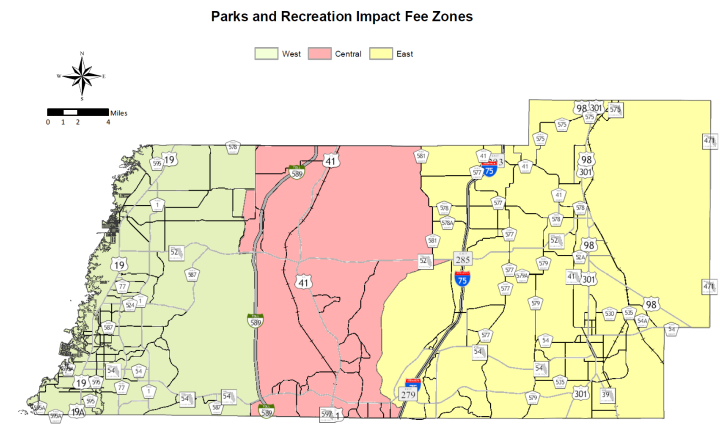
(Ord. No. 21-24, § 5(Exh. A), 10-12-21; Ord. No. 23-23, § 4(Exh. A), 7-11-23; Ord. No. 24-04, § 5(Att. A), 1-9-24)
1302.5. - Library Impact Fees
A.
Intent and Purpose.
1.
To establish uniform library impact fees throughout the County and establish procedures for the imposition, calculation, collection, administration, and expenditure of library impact fees on new residential construction.
2.
To facilitate the implementation of the Goals, Objectives, and Policies of the Comprehensive Plan, specifically Objective CIE 1.3, Objective CIE 1.4, and the supporting policies of the Capital Improvements Element relating to assuring that new residential construction contributes its fair share towards the costs of library facilities necessitated by such new residential construction.
3.
To ensure that new residential construction is reasonably benefited by the provision of the public library facilities provided with the proceeds of library impact fees.
4.
To ensure that all applicable legal standards and criteria are properly incorporated in these procedures.
B.
Library Impact Fee Study and Modifications.
1.
The Board of County Commissioners (BCC) has adopted and incorporates by reference the library impact fee study by Wade-Trim, Inc., entitled Pasco County Library System Strategic Plan, dated January 2002, and as supplemented pursuant to this section.
2.
This section and the library impact fee study may be reviewed by the BCC at least once every three years. The purpose of this review is to demonstrate that the library impact fee does not exceed reasonably anticipated costs associated with growth necessitated capital improvements. In the event the review demonstrates that anticipated costs have changed, the study and the library impact fee shall be amended in accordance therewith.
3.
The County Administrator or designee shall be assisted by the Impact Fee Advisory Committee as established by the BCC pursuant to Resolution No. 88-245, as may be amended, or other advisory committee(s) in the review of the library impact fee. The review shall include all of the following to be compiled into a report:
a.
Recommendations on amendments, if appropriate, to these procedures;
b.
Proposed changes to the County Comprehensive Plan and/or an applicable Capital Improvement Plan, including the identification of library system projects anticipated to be funded wholly or partially with library impact fees;
c.
Proposed changes to the library impact fee schedule;
d.
Proposed changes to the level of service standards;
e.
Proposed changes in the library impact fee calculation methodology; and
f.
Other data, analysis, or recommendations as the County Administrator or designee may deem appropriate or as may be requested by the BCC.
4.
The County Administrator or designee shall submit the report to the BCC, which shall receive the report and take such actions as it deems appropriate which may include, but is not limited to, requesting additional data or analyses and holding public workshops and/or public hearings.
5.
The failure to prepare or to submit a report as provided herein shall not affect the effectiveness or the administration of this section.
C.
Imposition.
1.
Library impact fees shall be imposed on all new residential construction occurring within the County not otherwise exempted in this section or waived by general or special law. For purposes of this section, the County shall be considered as one unified library impact fee district.
2.
The library impact fee shall be collected within any city only upon approval by the BCC of an interlocal agreement between the County and such city.
3.
Upon this section becoming effective, all new residential construction occurring within the County shall pay the following library impact fee according to the following library impact fee schedule:
4.
The library impact fee shall be determined at the time a completed application for a Building Permit is submitted.
Notwithstanding anything to the contrary in this section, the facilities portion of the library impact fee shall be suspended for:
a.
Complete and unexpired Building Permit applications submitted on or after March 1, 2011, and on or prior to December 31, 2013; and
b.
Building Permits issued on or after March 1, 2011, through December 31, 2013, which do not subsequently expire.
This suspension shall not apply to any building that was issued a Building Permit prior to March 1, 2011, even if the Building Permit for such building expires or is revoked.
5.
Exemptions or Partial Exemptions. An exemption or partial exemption must be claimed by the applicant or it shall be waived. Payment of the library impact fee shall not apply, or shall be reduced, in the following situations if the applicant clearly demonstrates with competent substantial evidence to the County Administrator or designee one (1) of the following:
a.
New residential construction for which a Certificate of Occupancy (CO) has been issued prior to September 4, 2002.
b.
Other Uses: No library impact fee shall be imposed on a structure that cannot result in an increase in the demand for library facilities.
c.
Alterations or Expansions: No library impact fee shall be imposed for alterations or expansions of a dwelling unit that exists on September 4, 2002, where no additional dwelling units are created. However, where an alteration or expansion will create an additional dwelling unit; e.g., a single-family detached house altered to create two or more multifamily dwelling units, a library impact fee equivalent to the difference between the library impact fee amount for the existing use and the new use shall be due for each additional dwelling unit pursuant to the library impact fee schedule in place at the time of the change in circumstances.
d.
Accessory Buildings: No library impact fee shall be imposed for construction of accessory buildings or structures that cannot create additional dwelling units.
e.
Replacement of Dwelling Unit: No library impact fee shall be imposed for the replacement of a dwelling unit, in whole or in part, as long as the owner can demonstrate that the same use existed at the time that this library impact fee section became effective. However, where a replacement will create a greater library demand generator, e.g., a mobile home replaced by a single-family detached house, a library impact fee equivalent to the difference shall be due for the resulting dwelling unit pursuant to the library impact fee schedule in place at the time of the change in circumstances.
f.
Mobile Homes: No library impact fee shall be imposed for the issuance of a Tie-Down Permit for a mobile home where the applicant is able to demonstrate to the County Administrator or designee that a library impact fee has previously been paid for the lot upon which the mobile home is to be situated.
g.
Affordable Housing Exemption. No library impact fee shall be imposed for a dwelling unit that is affordable to a family with a median income that does not exceed eighty (80) percent of the median income for the Tampa- St. Petersburg-Clearwater standard metropolitan statistical area. To qualify for the Affordable Housing Exemption, the dwelling unit, or the larger planned development that includes the dwelling unit, or the multiple family building, as applicable, must be designated as affordable by the County Administrator or designee consistent with the foregoing definition and applicable Federal, State, and local income and expense criteria for affordable housing and must be sold or leased to a family that satisfies the foregoing income criteria, as determined by the County Administrator or designee. The County shall impose deed restrictions, mortgage requirements, and/or liens that ensure that any dwelling unit or multiple-family building that is awarded the Affordable Housing Exemption remains affordable. The owner of any dwelling unit or multiple family building that was awarded the Affordable Housing Exemption that resells or leases such dwelling unit at a price that is no longer affordable or resells or leases such dwelling unit to a family that does not satisfy the foregoing income criteria, as determined by the County Administrator or designee consistent with the foregoing definition, shall be required to pay to the County the entire library impact fee that was exempted, which shall be calculated based on the fee in place at the time the violation occurs. Failure to pay such fee shall be considered a violation of this section which shall make the owner subject to the County enforcement provisions of this section, in addition to any other remedies of the County as set forth in the County imposed deed restrictions, mortgage requirements, and/or liens. Notwithstanding the foregoing, a person shall not be eligible for the Affordable Housing Exemption if that person has invoked the land use/zoning preemption or mandatory property tax exemption in the Live Local Act (Section 125.01055(7) or Section 196.1978(3), Florida Statutes).
h.
Moderate Income Affordable Housing Partial Exemption. A dwelling unit that is affordable to a family with a median income that is between eighty (80) percent and one hundred and twenty (120) percent of the median income for the Tampa-St. Petersburg-Clearwater standard metropolitan statistical area shall be exempt from seventy-five (75) percent of the applicable library impact fee set forth in Section 1302.5.C. (i.e. is required to pay twenty-five (25) percent of such fee). To qualify for the Moderate Income Affordable Housing Partial Exemption, the dwelling unit, or the larger planned development that includes the dwelling unit, or the multiple family building, as applicable, must be designated as affordable by the County Administrator or designee consistent with the foregoing definition and applicable Federal, State, and local income and expense criteria for affordable housing, must be constructed by a registered non-profit, and be sold or leased to a family that satisfies the foregoing income criteria, as determined by the County Administrator or designee. The County shall impose deed restrictions, mortgage requirements, and/or liens that ensure that any dwelling unit or multiple-family building that is awarded the Moderate Income Affordable Housing Partial Exemption remains affordable. The owner of any dwelling unit or multiple family building that was awarded the Moderate Income Affordable Housing Partial Exemption that resells or leases such dwelling unit at a price that is no longer affordable or resells or leases such dwelling unit to a family that does not satisfy the foregoing income criteria, as determined by the County Administrator or designee consistent with the foregoing definition, shall be required to pay to the County the amount of the Moderate Income Affordable Housing Partial Exemption (i.e. seventy-five (75) percent of the applicable library impact fee), which shall be calculated based on the fee in place at the time the violation occurs. Failure to pay such amount shall be considered a violation of this section which shall make the owner subject to the County enforcement provisions of this section, in addition to any other remedies of the County as set forth in the County imposed deed restrictions, mortgage requirements, and/or liens. Notwithstanding the foregoing, a person shall not be eligible for the Moderate Income Affordable Housing Partial Exemption if that person has invoked the land use/zoning preemption or mandatory property tax exemption in the Live Local Act (Section 125.01055(7) or Section 196.1978(3), Florida Statutes).
6.
Any new residential construction which is determined to be waived from the payment of library impact fees but which, as a result of a change in circumstances, produces a dwelling unit not exempt pursuant to this section hereinabove, shall pay the library impact fee imposed by this section according to the impact fee schedule in effect at such time as the change in circumstances occurs.
D.
Calculation.
1.
The applicable library impact fee shall be based upon the above table upon receipt of a complete application for a Building Permit. If an applicant has received a credit pursuant to this section, that credit shall be subtracted from the otherwise applicable library impact fee.
2.
In the alternative, the applicable library impact fee may be based upon an independent fee calculation as provided for in this chapter.
3.
An applicant may request at any time a nonbinding estimate of library impact fees due for a particular development; however, such estimate is subject to change when a complete application for a Building Permit for new residential construction is made.
4.
Library impact fees shall be calculated based on the library impact fee schedule in effect at the time of the County's issuance of a Building Permit except where provided for in this section.
E.
Payment/Collection.
1.
The library impact fee shall be paid prior to the issuance of a CO for the new residential construction. Where a CO is not required, the library impact fee shall be paid prior to the final inspection.
2.
Notwithstanding the foregoing, nothing in this section shall prevent the County from studying or adopting an alternate method of payment of the library impact fee; e.g., payment over time through special assessments.
F.
Library Impact Fee Fund/Appropriation of Funds.
1.
The County shall establish a library impact fee fund for library impact fees. Such fund shall clearly be identified as monies collected as library impact fees. All library impact fees collected by the County shall be deposited into the library impact fee fund and shall be segregated for library land acquisition and library facility development. The BCC shall establish and implement necessary accounting controls to ensure that all library impact fees are properly deposited, accounted for, and appropriated in accordance with this section and any other applicable legal requirements.
2.
A specific account for library land acquisition and library facility development shall be established. All interest or investment income earned shall be available for appropriation or expenditure for library land or library facilities regardless of the source of the interest or investment income.
3.
The monies from the library impact fee fund shall be used by the County solely to provide library land and library facilities which are necessitated by new residential construction within the library impact fee district, consistent with and as set forth below, and shall not be used for any expenditure that would be classified as an operating, routine maintenance, or repair expense. The BCC shall use library impact fee fund monies for the following:
a.
Planning (with specific BCC approval), design, permitting, and construction plan costs for the library system;
b.
Library land acquisition costs;
c.
Construction costs of library facilities as library facilities is defined in this Code;
d.
Repayment of monies borrowed from any budgetary fund of the County subsequent to the adoption date of this section, where such borrowed monies were used to fund growth necessitated capital improvements to library facilities as provided herein; and
e.
Payment of principal and interest, necessary reserves and costs of issuance under any bonds, or other indebtedness issued by the County to fund growth necessitated improvements to the library system subsequent to the adoption date of this section.
(Ord. No. 21-24, § 5(Exh. A), 10-12-21; Ord. No. 24-04, § 5(Att. A), 1-9-24)
1302.6. - Fire Combat and Rescue Service Impact Fees
A.
Intent and Purpose.
1.
To establish uniform fire combat and rescue service impact fees in the County and establish procedures for the imposition, calculation, collection, administration, and expenditure of fire combat and rescue service impact fees imposed on new building construction.
2.
To facilitate the implementation of the Goals, Objectives, and Policies of the Comprehensive Plan, specifically, Objectives CIE 1.3 and CIE 1.4 of the Capital Improvements Element, relating to limiting reliance on ad valorem revenues and utilizing funding directly from new building construction to offset appropriate costs of serving new building construction with public facilities.
3.
To ensure that new building construction is reasonably benefited by the provision of the public fire combat and rescue service facilities and equipment provided with the proceeds of fire combat and rescue service impact fees.
4.
To ensure that all applicable legal standards and criteria are properly incorporated in these procedures.
B.
Fire Combat and Rescue Service Impact Fee Study and Modifications.
1.
The Board of County Commissioners (BCC) has adopted and incorporates by reference the Fire Combat and Rescue Service Impact Fee Study by Stantec, dated June 11, 2024 and the 2024-2033 Fire Combat and Rescue Service Capital Improvement Plans ("Capital Plans") as an attachment to the Impact Fee Study.
2.
The following changes can be made to the Capital Plans without requiring an amendment to the impact fee structure in the LDC: (1) moving projects to different phases, (2) replacing existing facilities or projects in the Capital Plans with new facilities or projects that are equal to or less than the cost of existing facilities or projects, (3) adding facilities or projects to the Capital Plans that are fully funded with non- impact fee revenue sources, (4) adding to or changing the scope of facilities or projects in the Capital Plans where additional scope items are funded by non-impact fee revenue, and (5) fully funding facilities with impact fees where project costs exceed the Capital Plans cost estimates by less than 20 percent. The above listed changes to the Capital Plans may be adopted by Board resolution or through the Board's approval of amended Capital Plans in conjunction with the Board's approval of the yearly budget.
3.
This section and the Fire Combat and Rescue Service Impact Fee Study may be reviewed and updated by the BCC no sooner than every four years. The purpose of this review and update is to demonstrate that the fire combat and rescue service impact fee addresses, but does not exceed, reasonably anticipated costs associated with growth necessitated, capital improvements. In the event the review demonstrates that anticipated costs have changed, the study and the fire combat and rescue service impact fee shall be amended in accordance therewith.
4.
The failure to prepare a review and update as provided herein shall not affect the effectiveness or the administration of this section.
C.
Imposition.
1.
The fire combat and rescue service impact fee shall be imposed on all new construction occurring within unincorporated Pasco County and the municipalities of Dade City, St. Leo, and San Antonio. The fire combat and rescue impact fee shall be imposed on all new construction in the municipality of Zephyrhills upon entering into the required interlocal agreement with Zephyrhills. The rescue service impact fee shall be imposed on all new construction in the municipalities of Port Richey and New Port Richey if such municipalities enter into an interlocal agreement requiring such imposition.
2.
For Building Permits or Mobile Home Tie-Down Permits for which a complete application is submitted on or prior to July 1, 2025, the Fire Combat and Rescue Impact Fees shall be as follows:
For Building Permits or Mobile Home Tie-Down Permits for which a complete application is submitted after July 1, 2025, 1 the Fire Combat and Rescue Impact Fees shall be as follows: [2]
3.
The fire combat and rescue service impact fee shall be determined at the time a completed application for a Building Permit is submitted and paid prior to the issuance of any Certificate of Occupancy (CO).
4.
Exemptions or Partial Exemptions. An exemption or partial exemption must be claimed by the applicant or it shall be waived. Payment of the fire combat and rescue service impact fee shall not apply, or shall be reduced, in the following situations if the applicant clearly demonstrates with competent substantial evidence to the County Administrator or designee one of the following:
a.
New building construction for which a completed application for a Building Permit has been submitted, where a Building Permit has been issued, or for which a CO has been issued prior to January 13, 2004.
b.
Other uses. No fire combat and rescue service impact fee shall be imposed on a use, development, project, structure, building, fence, sign, or other building construction activity that cannot result in an increase in the demand for fire combat and rescue service facilities. An applicant who requests an exemption pursuant to this subsection for an activity not specifically enumerated herein shall request a determination from the County Administrator or designee that the activity does not result in an increase in a demand generator for the fire combat and rescue service system. An applicant may appeal such a determination pursuant to this Code.
c.
Alterations or expansions. No fire combat and rescue service impact fee shall be imposed for alterations or expansions of a residential use that existed January 13, 2004, where no additional dwelling units are created. However, where an alteration or expansion will create an additional dwelling unit; e.g., a single-family detached house altered to create two or more multi-family dwelling units, a fire combat and rescue service impact fee equivalent to the difference between the fire combat and rescue service impact fee amount for the existing use and the new use shall be due for each additional dwelling unit, pursuant to the fire combat and rescue service impact fee schedule in place at the time of the change in circumstances. No fire combat and rescue service impact fee shall be imposed for alterations or expansions of a nonresidential use that existed on January 13, 2004, where no additional, gross floor area is created. However, where an alteration or expansion will create additional, gross floor area of a nonresidential use, a fire combat and rescue service impact fee equivalent to the difference between the fire combat and rescue service impact fee amount for the existing use, and the new use shall be due for the additional, gross floor area pursuant to the fire combat and rescue service impact fee schedule in place at the time of the change in circumstances, subject to the limitations of this section.
d.
Accessory buildings or structures. No fire combat and rescue service impact fee shall be imposed for the building construction of accessory buildings or structures.
e.
Replacement of residential use or nonresidential use. No fire combat and rescue service impact fee shall be imposed for the replacement of a residential use or nonresidential use, in whole or in part, as long as the owner can demonstrate that the same use existed on January 13, 2004. However, where a replacement will create a greater fire combat and rescue service demand generator; e.g., for a residential use, one dwelling unit replaced by two or more dwelling units; or for a nonresidential use, an increase in the gross floor area, a fire combat and rescue service impact fee equivalent to the difference shall be due for the resulting dwelling unit or nonresidential use pursuant to the fire combat and rescue service impact fee schedule in place at the time of the change in circumstances.
f.
Mobile homes. No fire combat and rescue service impact fee shall be imposed for the issuance of a Tie-Down Permit for a mobile home where the applicant is able to demonstrate to the County Administrator or designee that a fire combat and rescue service impact fee has previously been paid for the lot upon which the mobile home is to be situated.
g.
Recreational vehicle sites. Fire combat and rescue service impact fees shall be imposed only once per recreational vehicle site and shall be calculated based on one dwelling unit per recreational vehicle site. A recreational vehicle site is an area providing for one water or electrical service connection to one recreational vehicle dwelling unit. Areas in which more than one recreational vehicle site is provided shall have the fire combat and rescue service impact fees calculated for each recreational vehicle site. The replacement of recreational vehicles on a recreational vehicle site shall not require payment of a fire combat and rescue service impact fee.
h.
Farm and ranch buildings on land used for bona fide, agricultural purposes as classified by the County Property Appraiser. The exemption shall not apply to residential units on bona fide, agricultural land.
i.
Affordable Housing Exemption. No fire combat and rescue service impact fee shall be imposed for a dwelling unit that is affordable to a family with a median income that does not exceed 80 percent of the median income for the Tampa-St. Petersburg-Clearwater standard metropolitan statistical area. To qualify for the Affordable Housing Exemption, the dwelling unit, or the larger planned development that includes the dwelling unit, or the multiple family building, as applicable, must be designated as affordable by the County Administrator or designee consistent with the foregoing definition and applicable Federal, State, and local income and expense criteria for affordable housing and must be sold or leased to a family that satisfies the foregoing income criteria, as determined by the County Administrator or designee. The County shall impose deed restrictions, mortgage requirements, and/or liens that ensure that any dwelling unit or multiple-family building that is awarded the Affordable Housing Exemption remains affordable. The owner of any dwelling unit or multiple family building that was awarded the Affordable Housing Exemption that resells or leases such dwelling unit at a price that is no longer affordable or resells or leases such dwelling unit to a family that does not satisfy the foregoing income criteria, as determined by the County Administrator or designee consistent with the foregoing definition, shall be required to pay to the County the entire fire combat and rescue service impact fee that was exempted, which shall be calculated based on the fee in place at the time the violation occurs. Failure to pay such fee shall be considered a violation of this section which shall make the owner subject to the County enforcement provisions of this section, in addition to any other remedies of the County as set forth in the County imposed deed restrictions, mortgage requirements, and/or liens. Notwithstanding the foregoing, a person shall not be eligible for the Affordable Housing Exemption if that person has invoked the land use/zoning preemption or mandatory property tax exemption in the Live Local Act (Section 125.01055(7) or Section 196.1978(3), Florida Statutes).
j.
Moderate Income Affordable Housing Partial Exemption. A dwelling unit that is affordable to a family with a median income that is between 80 percent and 120 percent of the median income for the Tampa-St. Petersburg-Clearwater standard metropolitan statistical area shall be exempt from 75 percent of the applicable fire combat and rescue service impact fee set forth in Section 1302.6.C. (i.e. is required to pay 25 percent of such fee). To qualify for the Moderate Income Affordable Housing Partial Exemption, the dwelling unit, or the larger planned development that includes the dwelling unit, or the multiple family building, as applicable, must be designated as affordable by the County Administrator or designee consistent with the foregoing definition and applicable Federal, State, and local income and expense criteria for affordable housing, must be constructed by a registered non-profit, and be sold or leased to a family that satisfies the foregoing income criteria, as determined by the County Administrator or designee. The County shall impose deed restrictions, mortgage requirements, and/or liens that ensure that any dwelling unit or multiple-family building that is awarded the Moderate Income Affordable Housing Partial Exemption remains affordable. The owner of any dwelling unit or multiple family building that was awarded the Moderate Income Affordable Housing Partial Exemption that resells or leases such dwelling unit at a price that is no longer affordable or resells or leases such dwelling unit to a family that does not satisfy the foregoing income criteria, as determined by the County Administrator or designee consistent with the foregoing definition, shall be required to pay to the County the amount of the Moderate Income Affordable Housing Partial Exemption (i.e. 75 percent of the applicable fire combat and rescue service impact fee), which shall be calculated based on the fee in place at the time the violation occurs. Failure to pay such amount shall be considered a violation of this section which shall make the owner subject to the County enforcement provisions of this section, in addition to any other remedies of the County as set forth in the County imposed deed restrictions, mortgage requirements, and/or liens. Notwithstanding the foregoing, a person shall not be eligible for the Moderate Income Affordable Housing Partial Exemption if that person has invoked the land use/zoning preemption or mandatory property tax exemption in the Live Local Act (Section 125.01055(7) or Section 196.1978(3), Florida Statutes).
5.
Any new building construction which is determined to be exempt or partially exempt from the payment of fire combat and rescue service impact fees, but which, as a result of a change in circumstances, produces a residential use or nonresidential use not exempt or partially exempt pursuant to this section hereto, shall pay the fire combat and rescue service impact fee imposed by this section according to the impact fee schedule in effect at such time as the change in circumstances occurs.
D.
Calculation.
1.
Upon receipt of a complete application for a Building Permit, the County Administrator or designee shall determine the applicable fire combat and rescue service impact fee in the following manner:
a.
Residential uses. Multiply the number of dwelling units created by the new building construction by the appropriate fire combat and rescue service impact fee amount pursuant to the fire combat and rescue service impact fee schedule. If the applicant has received a credit pursuant to this chapter, that credit shall be subtracted from the otherwise applicable fire combat and rescue service impact fee, if such credit applies.
b.
Nonresidential uses. Divide the square footage of the gross floor area by 1,000, and multiply the resulting number by the appropriate fire combat and rescue service impact fee amount pursuant to the fire combat and rescue service impact fee schedule. If the applicant has received a credit pursuant to this section, that credit shall be subtracted from the otherwise applicable fire combat and rescue service impact fee, if such credit applies.
2.
An applicant may request, at any time, a nonbinding estimate of fire combat and rescue service impact fees due for a particular development; however, such estimate is subject to change when a complete application for a Building Permit for new building construction is made.
E.
Credits.
1.
Any applicant or successor in interest that donates fire combat or rescue service land, facilities, or equipment, or paid a fee for fire combat or rescue service land acquisition, facility construction, or equipment acquisition, may be entitled to a credit, provided: (a) the costs of such fire combat or rescue service land, facilities, or equipment have been included in the fire combat and rescue service impact fee calculation methodology; or (b) the fire combat or rescue service land, facilities, or equipment donated, or fee paid for fire combat or rescue service land acquisition, facility construction, or equipment acquisition, is determined by the County Administrator or designee to be a reasonable substitute for the fire combat and rescue service impact fee due.
2.
The value of such credit shall be calculated in the following manner:
If fire combat or rescue service land, facilities, or equipment were donated, the value of the credit shall be based upon the value of the donated property at the time of conveyance, unless the donating person and County Administrator or designee or the BCC agrees to another valuation date. The amount of the credit for land donations shall be 115 percent of the assessed value of the conveyed land as determined by the County Property Appraiser unless the donating person and the County Administrator or designee or the BCC agrees in a development approval to another credit amount. The amount of the credit for fire combat and rescue service facilities or equipment shall be established in a written agreement between the person donating the fire combat and rescue service facilities, or equipment and the BCC.
3.
Requests for credits for donated land, facilities, or equipment shall be submitted to the County Administrator or designee by the applicant. The request for a credit shall be accompanied by relevant documentary evidence establishing the eligibility of the applicant for the credit.
4.
Transferability. Fire combat and rescue service impact fee credits are transferable. Transferable credits may be sold, assigned, or conveyed to another person or transferred to another project of the applicant within the County. To transfer credits, the applicant must submit to the County Administrator or designee, a letter signed and notarized by the owner of the credits that specifies the name of the person receiving the transfer of the credits and the amount of the credit being transferred. Regardless of the date of transfer, the transfer of the credit shall not be effective until the transfer letter is received and accepted by the County Administrator or designee.
5.
Unused credits shall not be refunded.
F.
Payment/Collection.
1.
The County Administrator or designee shall collect the fire combat and rescue service impact fee prior to the issuance of a CO for the new building construction. Where a CO is not required, the fire combat and rescue service impact fee shall be paid prior to the final inspection.
2.
Notwithstanding the foregoing, nothing in this section shall prevent the County from studying or adopting an alternate method of payment of the fire combat and rescue service impact fee; e.g., payment over time through special assessments.
G.
Establishment of Fire Combat and Rescue Service Impact Fee Funds/Appropriation of Funds.
1.
The County shall establish a fire combat impact fee fund for fire combat and a rescue service impact fee fund for rescue service impact fees. Such funds shall clearly be identified as monies collected as fire combat and rescue service impact fees. All fire combat and rescue service impact fees collected by the County shall be deposited into the fire combat and rescue service impact fee funds. Within each fund, a separate account for land acquisition and facility and equipment development shall be established. All interest or investment income earned shall be available for appropriation or expenditure for fire combat or rescue service land or fire combat and rescue service facilities regardless of the source of the interest, or investment income. The BCC shall establish, and implement necessary accounting controls to ensure that all fire combat and rescue service impact fees are properly deposited, accounted for, and appropriated in accordance with this part, and any other applicable legal requirements.
2.
Fire combat and rescue service impact fees shall be appropriated for fire combat and rescue service land or facilities necessitated by new building construction, or for the payment of principal, interest, and other financing costs on contracts, bonds, notes, or other obligations issued by or on behalf of the County to finance such fire combat and rescue service land or facilities.
3.
Fire combat and rescue service impact fee monies shall only be expended for land, facilities, and equipment for fire combat and for land, facilities, and equipment for rescue service.
4.
The BCC shall use fire combat and rescue service impact fee funds' monies for the following:
a.
Planning (with specific BCC approval), design, permitting, and building construction plan costs for the fire combat and rescue service system;
b.
Fire combat or rescue service land acquisition costs;
c.
Building construction costs, including all furnishings and equipment of fire combat and rescue service facilities and equipment;
d.
Vehicles, equipment, apparatus, and supplies for the fire combat and rescue service system;
e.
Repayment of monies borrowed from any budgetary fund of the County subsequent to the initial effective date of this section, where such borrowed monies were used to fund growth necessitated capital improvements to fire combat and rescue service facilities as provided herein; and
f.
Payment of principal and interest, necessary reserves, and costs of issuance under any bonds or other indebtedness issued by the County to fund growth necessitated improvements to the fire combat and rescue service system subsequent to January 13, 2004.
(Ord. No. 21-24, § 5(Exh. A), 10-12-21; Ord. No. 24-04, § 5(Att. A), 1-9-24; Ord. No. 25-28, § 4 (Exh. A), 5-20-25)
In the event a law takes effect that prevents Pasco County from adopting more restrictive or burdensome land development regulations following a hurricane, and if such law applies to Pasco County's increase of Fire Combat and Rescue Service impact fees adopted on May 20, 2025, this July 1, 2025 date shall be automatically extended to the date that Pasco County is no longer prevented from adopting more restrictive or burdensome land development regulations following a hurricane; provided, however, such extended date shall only apply to those Building Permits or Mobile Home Tie-Down Permits that are entitled to the benefit of the law that prevents Pasco County from adopting more restrictive or burdensome land development regulations following a hurricane.
1302.7. - Hurricane Preparedness Mitigation Fees
A.
Intent, Purpose, and Study.
1.
The purpose of this section is to address the impacts created by new development on hurricane shelter availability and evacuation capability within the County. This section implements hurricane preparedness mitigation techniques and fees for all new Equivalent Residential Units (ERUs) located within the Hurricane Vulnerability Zone (HVZ) and all proposed mobile homes, including trailers, recreational vehicles, and park models, whether or not located in a subdivision, Countywide. An ERU means a single dwelling unit, mobile home; manufactured home, space, or lot in a trailer, mobile home or recreational vehicle park or subdivision and individual guest rooms in a hotel or motel. The HVZ is composed of those areas of the County assigned an evacuation level of A through C in the event of a Category 3 hurricane event.
2.
The formulas for calculating impacts and the Hurricane Preparedness Mitigation Fee (Hurricane Mitigation Fee) are based on the Tampa Bay Region Evacuation Study Update, 2000, of the Tampa Bay Regional Planning Council, which is incorporated herein by reference.
3.
The Hurricane Mitigation Fee is composed of two parts:
a.
A shelter mitigation fee; and
b.
An evacuation mitigation fee.
4.
All values used in calculating the Hurricane Mitigation Fee are based upon values applicable at the time of adoption of the fee and are subject to change over time. The Office of Emergency Management will periodically review the values used in the Hurricane Mitigation Fees formulas and propose modifications to the Board of County Commissioners (BCC) as necessary. The BCC may, from time to time, by resolution, update the boundaries of the HVZ.
B.
Imposition.
1.
Hurricane Mitigation Fees shall be imposed on all proposed ERUs located within the HVZ and all proposed mobile homes, as defined in this section not otherwise exempted.
2.
Exemptions. An exemption must be claimed by the applicant prior to the payment of the Hurricane Mitigation Fee or performance of other mitigation, or it shall be waived. The Hurricane Mitigation Fee shall not apply to the following situations if the applicant clearly demonstrates with competent substantial evidence to the County Administrator or designee, one of the following:
a.
New residential construction for which a completed application for a Building Permit was submitted to the County Administrator or designee prior to September 21, 2004.
b.
Other uses. No Hurricane Mitigation Fee shall be imposed on a structure that cannot result in an increase in the demand for hurricane shelters or evacuation route capacity.
c.
Alterations or expansions. No Hurricane Mitigation Fee shall be imposed for alterations or expansions of an ERU that existed on September 21, 2004, or to an ERU where a Hurricane Mitigation Fee has been paid, where no additional ERUs are created. However, where an alteration or expansion will create an additional ERU; e.g., a single-family detached house altered to create two more multiple family dwelling units, the Hurricane Mitigation Fee equivalent to the difference between the Hurricane Mitigation Fee amount for the existing use and the new use shall be due for each additional ERU pursuant to the Hurricane Mitigation Fee schedule in place at the time of the change in circumstances.
d.
Replacement of an ERU. No Hurricane Mitigation Fee shall be imposed for the replacement of an ERU, in whole or in part, as long as the owner can demonstrate that the same use existed on September 21, 2004, or that the use paid a Hurricane Mitigation Fee. However, where a replacement will create additional ERUs, the Hurricane Mitigation Fee equivalent to the difference shall be due for the resulting additional ERUs or new ERUs pursuant to the Hurricane Mitigation Fee schedule in place at the time of the change in circumstances.
C.
Calculation.
1.
The applicable Hurricane Mitigation Fee per ERU shall be based upon the above table and calculated at the time a complete application for a Building Permit is submitted.
Notwithstanding anything to the contrary in this section, the hurricane preparedness (shelter mitigation fee and evacuation mitigation fee) impact fee shall be suspended for:
a.
Complete and unexpired Building Permit applications submitted on or after March 1, 2011, and on or prior to December 31, 2013; and
b.
Building Permits issued on or after March 1, 2011, through December 31, 2013, which do not subsequently expire.
This suspension shall not apply to any building that was issued a Building Permit prior to March 1, 2011, even if the Building Permit for such building expires or is revoked.
2.
In the alternative, the applicant may propose an alternative mitigation for either or both the shelter fee and/or evacuation fee components of the Hurricane Mitigation Fee and receive a credit towards the Hurricane Mitigation Fee. Alternative mitigation is subject to the requirements of this section.
D.
Payment/Collection.
1.
Hurricane Mitigation Fees shall be paid prior to the issuance of a Certificate of Occupancy (CO). Where a CO is not issued, payment shall be made before final inspection.
E.
Alternative Mitigation Techniques, Implementation, and Credits.
1.
Generally.
a.
The County Administrator or designee is authorized to and is responsible for determining the shelter and evacuation impacts of a new ERU or mobile home subject to this section. In the event of a dispute, the determination is a final decision appealable to the BCC pursuant to this Code.
b.
The County Administrator or designee will make the final decision with respect to the acceptability of the type and degree of alternative mitigation offered to address the proposed development. This determination will be based upon consideration of the type and intensity of development, its location, and the incremental effect on the hurricane preparedness program, created by the proposed development. The alternative mitigation proposed must have a reasonable relationship to the incremental impact of the proposed development. Appropriate calculation of the impacts in accordance with this section will constitute sufficient evidence of the reasonable relationship.
c.
The County Administrator or designee's approval of proposed alternative mitigation is required prior to the issuance of a Building Permit (or Tie-down Permit) that precipitates the requirement to mitigate under this section.
d.
The County Administrator or designee is authorized to deny alternative mitigation if the proposal is determined to be inappropriate for the location involved (e.g., vertical evacuation in a coastal high hazard area) or constitutes the creation of an unacceptable shelter facility (e.g., on site shelter without all appropriate shutters).
e.
Any alternative mitigation approved by the County Administrator or designee, along with the amount of the credit, as determined by the County Administrator or designee, shall be provided for in the written development Conditions of Approval or in an agreement with the County.
2.
Shelter impacts and alternative mitigation techniques. The following alternative shelter mitigation options may be approved for Hurricane Mitigation Fee credit:
a.
Donation of land. The donation of land may be considered if the land is donated to the County for another purpose, such as construction of a recreation building, and an agreement can be reached for the building to also serve as a primary public hurricane shelter with a capacity at least large enough to serve the proposed development's shelter demand. The land donated must be located outside the HVZ. The shelter must be constructed to comply with the public shelter design criteria adopted pursuant to Section 553.73, Florida Statutes, as may be amended. The amount of the credit shall be 115 percent of the assessed value of the conveyed land as determined by the County Property Appraiser unless the person and the County Administrator or designee or the BCC agrees in a development approval to another credit amount.
b.
Provision of an on site shelter. An on site shelter may be considered if the on site shelter is outside the HVZ per the latest Sea, Lake, and Overland Surge from Hurricanes Model, and constructed in accordance with the public shelter design criteria, adopted pursuant to Section 553.73, Florida Statutes, as may be amended. Construction plans must be submitted for the on site shelter with the development plans for the ERUs being mitigated. Developments located within the HVZ may choose to construct a structure outside the HVZ for use as a public shelter using the public shelter design criteria. Proof of ownership and construction to the criteria must be provided to the County.
c.
Provision of training funds. Provision of training funds may be considered if training funds are needed. The American Red Cross is responsible for managing shelters in the County. The District School Board of Pasco County provides shelter managers for shelters in schools and training is provided annually. The County Administrator or designee shall, from time to time, determine whether training funds are needed and accordingly whether the provision of training funds is an acceptable alternative mitigation option.
d.
Shelter agreements. Shelter agreements with private facilities located outside the HVZ may be considered. An agreement must be in place prior to the issuance of the Building Permit. This obligation to a private shelter through a private agreement must be met in perpetuity. In order for the shelter agreement to be accepted, as alternative mitigation and credit are made available, the following criteria must be met:
(1)
The private shelter structure must be located outside the HVZ.
(2)
The structure must be constructed to comply with the public shelter design criteria adopted pursuant to Section 553.73, Florida Statutes, as may be amended.
(3)
There must be a written agreement between the developer or Homeowners' Association (HOA) and the private facility for use of the facility as a shelter.
(a)
Any one agreement must be for a minimum period of five years.
(b)
The agreement must specify who will staff and operate the shelter.
(c)
The agreement must specify who will provide necessary food, water, and other supplies to the shelter.
(4)
The developer or HOA must develop, prior to the issuance of the Building Permit and maintain thereafter, an evacuation plan detailing implementation of the shelter operation and evacuation of the development, to include a transportation plan outlining routes and/or transportation assistance available. The plan must meet the criteria for the site specific evacuation plan pursuant to this Code, Section 1103, and the plan must be approved annually by the County Office of Emergency Management.
3.
Evacuation impacts. Alternative mitigation techniques. The following alternative evacuation mitigation options may be approved for Hurricane Mitigation Fee credit:
a.
Elevation of roads. Elevation of a portion of an evacuation route may be considered.
b.
Roadway capacity improvements. Increasing the capacity of an evacuation route may be considered.
4.
Other alternative mitigation techniques:
a.
The County will consider other mitigation techniques, subject to the County Administrator or designee's approval, suggested by the developer. The value of these other techniques must be equal to the Hurricane Mitigation Fees that would be required of the development. An example of "other techniques" is a safe room concept. This concept provides a room in a building, which could be any type of building, private residence, apartment building, etc., constructed to withstand a hurricane. Because only a portion of the building, instead of the entire building, is constructed to withstand hurricanes, the cost of constructing adequate shelter may be reduced.
F.
Hurricane Mitigation Fee Fund/Appropriation of Funds.
1.
The County shall establish a Hurricane Mitigation Fee Fund for Hurricane Mitigation Fees. Such fund shall clearly be identified as monies collected as Hurricane Mitigation Fees. All Hurricane Mitigation Fees collected by the County shall be deposited into the Hurricane Mitigation Fee Fund and shall be segregated for shelters and Intelligent Transportation Signs (ITS). The BCC shall establish and implement necessary accounting controls to ensure that all Hurricane Mitigation Fees are properly deposited, accounted for, and appropriated in accordance with this section and any other applicable legal requirements.
2.
A specific account for shelter mitigation and for evacuation mitigation ITS shall be established. All interest or investment income earned shall be available for appropriation or expenditure for shelter or ITS, regardless of the source of the interest or investment income.
3.
The BCC shall use Hurricane Mitigation Fee Fund monies for the following:
a.
Shelter capacity and safety improvements, including all necessary planning (with specific BCC approval), capacity analysis, design, land acquisition, and construction costs;
b.
Hurricane education, public information programs, and shelter training;
c.
Procuring communications equipment that would upgrade the existing warning and notification capability of the County's emergency management officials; and
d.
All costs associated with the ITS.
(Ord. No. 21-24, § 5(Exh. A), 10-12-21)
1302.8. - Water and Wastewater Service Connection Fees
A.
Intent and Purpose.
1.
To continue uniform water and wastewater service connection fees in the County and to establish procedures for the imposition, calculations, collection, administration, and expenditure of water and/or wastewater service connection fees imposed on new service connections.
2.
To facilitate the implementation of the Goals, Objectives, and Policies of the Comprehensive Plan, Policy WAT 2.2.3 and Policy SEW 3.6.4 of the Public Facilities Element relating to utilizing funding directly from new service connections to offset appropriate costs of serving new service connections with public facilities.
3.
To ensure that new service connections are reasonably benefited by the provision of the public water and wastewater service facilities provided with the proceeds of water and wastewater service connection fees.
4.
To ensure that all applicable legal standards and criteria are properly incorporated in these procedures.
B.
Water and Wastewater Connection Fee Study and Modifications
1.
The Board of County Commissioners (BCC) has adopted and incorporates by reference the study by Stantec entitled Water/Wastewater Service Rate Study, dated August 2021 and as supplemented pursuant to this section.
2.
This section and the Water and Wastewater Service Rate Study may be reviewed by the BCC periodically in accordance with Florida Statutes. The purpose of this review is to demonstrate that the water and wastewater service connection fees do not exceed reasonably anticipated costs associated with growth-necessitated capital improvements. In the event the review demonstrates that anticipated costs have changed, the Study shall be amended in accordance therewith.
3.
The County Administrator or designee may be assisted by the Impact Fee Advisory Committee as established by the BCC pursuant to Resolution No. 88-245, as amended, or other advisory committee(s) in the review of the water and wastewater service connection fees. The review shall include all of the following to be compiled into a report:
a.
Recommendations on amendments, if appropriate, to these procedures;
b.
Proposed changes to the Comprehensive Plan and/or an applicable Capital Improvement Plan, including the identification of water and wastewater service facilities projects anticipated to be funded wholly or partially with water and wastewater service connection fees;
c.
Proposed changes to the water and wastewater service connection fees schedule;
d.
Proposed changes to level of service standards;
e.
Proposed changes in the water and wastewater service connection fees calculation methodology; and
f.
Other data, analysis, or recommendations as the County Administrator may deem appropriate or as may be requested by the BCC.
4.
The County Administrator or designee shall submit the report to the BCC, which shall receive the report and take such actions as it deems appropriate, which may include, but is not limited to, requesting additional data or analyses and holding public workshops and/or public hearings.
5.
The failure to prepare or to submit a report, as provided herein, shall not affect the effectiveness or the administration of this section.
C.
Imposition.
1.
Water and wastewater service connection fees shall be imposed on all new service connections occurring within the County not otherwise exempted in this section or waived by general or special law. It is hereby recognized that water and wastewater service connection fees have been in effect in the County since 1979.
2.
All new service connections occurring within the County shall pay the following water and/or wastewater service connection fees according to the water and wastewater service connection fee schedule established by the Board through a resolution adopted at a public hearing.
3.
Notwithstanding the fee schedule established via resolution, the meter equivalents of a nonresidential use shall be the basis for purposes of calculation of the water and wastewater service connection fees for residential uses that utilize a one inch or greater meter size.
4.
Nonresidential uses shall pay the single-family (1.00 ERU) fee listed above multiplied by the following meter equivalents:
5.
If any use does not meet a single defined use or meter equivalent as set forth herein, then the County Administrator or designee shall assign the most analogous use classification or meter size based on the standards of the water and wastewater service connection fee study or the meter sizing standards of the American Water Works Association, which is incorporated herein.
6.
Exemptions. An exemption must be claimed by the applicant or it shall be waived. Payment of the water and/or wastewater service connection fees shall not apply to the following situations if the applicant clearly demonstrates with competent substantial evidence to the County Administrator one of the following:
a.
New service connection for which a completed application fora service connection has been submitted or where a meter has been installed and a customer account was opened within 90 days after April 27, 1999.
b.
Other Uses. No water and/or wastewater service connection fee shall be imposed on a use, structure, or other building construction activity that cannot result in an increase in the demand for water and wastewater service facilities.
c.
Service connections in existence prior to 90 days after April 27, 1999, provided that the demand for service and/or meter size or number is not increased.
7.
Any new service connection which is determined to be exempt from the payment of water and wastewater service connection fees but, which as a result of a change in circumstances, produces a residential use or nonresidential use or service demand not exempt pursuant to this section, shall pay the water and/or wastewater service connection fees imposed by this Code according to the connection fee schedule in effect at such time as the change in circumstances occurs.
D.
Calculation
1.
The applicable water and wastewater service connection fee shall be based upon the fee resolution, the above table and criteria as may be amended and in effect at the time of receipt of a complete service connection application, less any credits or service commitment or connection fees that may have been paid pursuant to Chapter 110 of the County Code of Ordinances.
2.
An applicant may request, at any time, a nonbinding estimate of water and wastewater service connection fees due for a particular development. However, such estimate is subject to change when a complete application for a service connection is made.
3.
Water and wastewater service connection fees shall be calculated based on the water and wastewater service connection fee schedule, pursuant to this section in effect at the time of submittal of a complete service connection application, except where provided for in this section.
E.
Payment/Collection.
1.
The water and/or wastewater service connection fees shall be paid at the time of receipt by the County of a completed service connection application where no credit or partial credit applies.
2.
Alternative Form of Payment. Nothing herein precludes the County from studying or adopting an alternative method of payment of the water and wastewater service connection fees, e.g., payment over time through a Capacity Assessment Unit Program.
F.
Credits.
1.
Credits may be allowed by prior Utilities Service Agreement to construct a non-site-related utility improvement listed in the Capital Improvement Plan identified in the Schedules 2 and 2-3A of the Water and Wastewater Service Connection Fee Study, which is in addition to the required site-related improvements, as determined by the County Administrator or designee, and receive credits on a dollar basis against any water and/or wastewater connection fees due. Application for credits shall be made prior to the commencement of construction. No credits will be granted for construction except under the terms of a BCC-approved agreement.
2.
Credits may be allowed for service commitment or connection fees paid pursuant to Article II or Article IV, Chapter 110, County Code of Ordinances. To receive a credit for commitment or connection fees paid by another party, the applicant must present a valid assignment (original and notarized) from the person who paid the commitment or connection fees.
G.
Water and Wastewater Service Connection Fee Funds/Appropriation of Funds.
1.
The County shall establish two funds: a water service connection fee fund and a wastewater service connection fee fund. Such funds shall be clearly identified as monies collected as water and wastewater service connection fees. All water and wastewater service connection fees collected by the County shall be deposited into the respective water and wastewater service connection funds. The BCC shall establish and implement necessary accounting controls to ensure that all water and wastewater service connection fees are properly deposited, accounted for, and appropriated in accordance with this section and any other applicable legal requirements.
2.
Water service connection fee monies shall only be expended for water service facilities, and wastewater service connection fee monies shall only be expended for wastewater service facilities. All interest or investment income earned shall be available for appropriation or expenditure for water and wastewater service facilities.
3.
The monies from the water and wastewater service connection fee funds shall be used by the County solely to provide water and wastewater service facilities which are necessitated by new services connections, consistent with and as set forth below, and shall not be used for any expenditure that would be classified as an operating expense, routine maintenance, or repair expense. The County shall use water and wastewater service monies from the connection fee funds for the following components of those projects listed in the Capital Improvement Plan
4.
Identified in the Schedules 2 and 2-3A of the Water and Wastewater Service Connection Fee Study:
a.
Planning (with specific BCC approval), design, permitting, and building construction plan costs for the water and wastewater service facilities; and
b.
Water and wastewater service facilities acquisition costs; and
c.
Building construction costs, including all furnishings and equipment, of water and wastewater service facilities; and
d.
Repayment of monies borrowed from any budgetary fund of the County subsequent to April 27, 1999, where such borrowed monies were used to fund growth necessitated capital improvements to water and wastewater service facilities as provided herein; and
e.
Payment of principal and interest, necessary reserves, and costs of issuance under any bonds or other indebtedness issued by the County to fund growth necessitated improvements to the water and wastewater service facilities subsequent to April 27, 1999.
(Ord. No. 21-24, § 5(Exh. A), 10-12-21)

