
Pere Marquette Charter Township
City Zoning Code
City Zoning Code
ARTICLE 2
- DEFINITIONS
109-2.00 - RULES APPLYING TO TEXT.
The following listed rules of construction shall apply to the text of this Ordinance:
(a)
The particular shall control the general except with respect to the definitions which follow the headings which title a chapter, section or subsection are for convenience only and are not to be considered in any constriction or interpretation of this Ordinance or considered as enlarging or restricting the term and provisions of this Ordinance in any respect.
(b)
The word "shall" is always mandatory and not discretionary. The word "may" is permissive. Unless the context clearly indicates to the contrary:
(1)
Words used in the present tense shall include the future tense;
(2)
Words used in the singular number shall include the plural number; and singular;
(3)
Words used in the plural number shall include the singular number.
(c)
A building or structure includes any and all parts thereof.
(d)
The word "person" includes an association, partnership, joint venture, corporation, trust, municipal or public entity, or equivalent entity or a combination of any of them, as well as a natural person.
(e)
The word "used" or "occupied", as applied to any land, building or structure, shall be construed to include the words "intended", "arranged", or "designed to be used".
(f)
The word "Township" means Pere Marquette Charter Township.
(g)
The words "erect" or "erection", as applied to any building or structure, shall be construed to include the words "built", "constructed", "reconstructed", "moved upon" or any physical operation or work on the land on which the building or structure is to be built, constructed, or moved upon, such as excavation, filling, drainage or similar activities.
(h)
The words "Township Board or Board" shall mean the Pere Marquette Charter Township Board.
(i)
The words "Planning Commission" shall mean the Pere Marquette Charter Township Planning Commission.
(j)
The words "Board of Appeals" shall mean the Zoning Board of Appeals of Pere Marquette Charter Township.
(k)
The words "Building Inspector" shall mean the building official and authorized inspector of Pere Marquette Charter Township.
(l)
The words "legal record" shall mean the circumstances where the legal description of a lot or parcel of land has been recorded as part of a document on record in the office of the Register of Deeds, Mason County, Michigan.
(m)
For the purpose of their use in the ordinance, words or terms not defined herein shall be considered to be defined in accordance with their common or standard definition.
(n)
References to Public Acts are references to the Public Acts of Michigan. (For example, a reference to Public Act No. 110 of 2006 is a reference to Act No. 110 of the Public Acts of Michigan of 2006.) Any reference to a Public Act, whether by Act number or by short title, is a reference to such Act, as amended.
(Ord. No. 144, 8-13-2019)
109-2.01 - DEFINITIONS "A".
Accessory Building or Structure: A structure or building on the same lot or parcel of land as the main structure or building, the use of which is, or is intended to be, subordinate or incidental to that of the main building or structure.
Accessory Dwelling Unit (ADU): An incidental and subordinate dwelling unit that provides separate and independent living facilities in a permanent structure for one family that is on the same parcel as a principal single-family dwelling unit.
Accessory Use: A use which is incidental and subordinate to the main use of any land, lot, parcel, building or structure.
Adult Day Care Home: A dwelling unit in which less than seven persons 18 years or older are provided supervision, personal care and protection for periods of less than 24 hours a day, operated by a person who permanently resides in the dwelling unit as a member of the household.
Adult Foster Care Congregate Facility: An adult foster care facility with the approved capacity to receive more than 20 adults who shall be provided foster care.
Adult foster care facility: A governmental or nongovernmental establishment licensed under Public Act 218 of 1979 (the Act) as amended, that provides foster care to adults. Subject to Section 26a(1) of the Act, adult foster care facility includes facilities and foster care family homes for adults who are aged, mentally ill, developmentally disabled, or physically disabled who require supervision on an ongoing basis but who do not require continuous nursing care. Adult foster care facility does not include any of the following:
(a)
A nursing home licensed under article 17 of the Public Health Code, 1978 PA 368, MCL 333.20101 to 333.22260.
(b)
A home for the aged licensed under article 17 of the Public Health Code, 1978 PA 368, MCL 333.20101 to 333.22260.
(c)
A hospital licensed under article 17 of the Public Health Code, 1978 PA 368, MCL 333.20101 to 333.22260.
(d)
A hospital for the mentally ill or a facility for the developmentally disabled operated by the department of community health under the Mental Health Code, 1974 PA 258, MCL 330.1001 to 330.2106.
(e)
A county infirmary operated by a county department of social services or family independence agency under section 55 of the Social Welfare Act, 1939 PA 280, MCL 400.55.
(f)
A child caring institution, children's camp, foster family home, or foster family group home licensed or approved under 1973 PA 116, MCL 722.111 to 722.128, if the number of residents who become 18 years of age while residing in the institution, camp, or home does not exceed the following:
(i)
Two, if the total number of residents is 10 or fewer.
(ii)
Three, if the total number of residents is not less than 11 and not more than 14.
(iii)
Four, if the total number of residents is not less than 15 and not more than 20.
(iv)
Five, if the total number of residents is 21 or more.
(g)
A foster family home licensed or approved under 1973 PA 116, MCL 722.111 to 722.128, that has a person who is 18 years of age or older placed in the foster family home under section 5(7) of 1973 PA 116, MCL 722.115.
(h)
An establishment commonly described as an alcohol or a substance abuse rehabilitation center, a residential facility for persons released from or assigned to adult correctional institutions, a maternity home, or a hotel or rooming house that does not provide or offer to provide foster care.
(i)
A facility created by 1885 PA 152, MCL 36.1 to 36.12.
Adult Foster Care Family Home: A dwelling unit with the approved capacity to receive not more than six adults who shall be provided foster care for five or more days a week and for two or more consecutive weeks. The adult foster care family home licensee shall be a member of the household and an occupant of the dwelling unit.
Adult Foster Care Large Group Home: An adult foster care facility with the approved capacity to receive at least 13 but not more than 20 adults who shall be provided foster care.
Adult Foster Care Small Group Home: An adult foster care facility with the approved capacity of not more than 12 adults who shall be provided foster care.
Alley: A dedicated or publicly-controlled right-of-way, other than a street, providing a secondary means of vehicular access to abutting lots or parcels of land and which is not intended for general traffic circulation.
Altered or Alteration: Any change, addition or modification to a building or a structure, except for replacement of roofing and siding or modifications deemed to be re-decorating, which involves any change in the supporting members, bearing walls, columns, posts, beams, girders or roof structure; any architectural change of the interior or exterior of a building or structure which may affect its structural integrity, or any modification which alters the exterior dimensions of said building or structure.
Antenna: A device designed to receive video programming services via broadband radio service (wireless cable) or to receive or transmit fixed wireless signals other than via satellite or a device designed to receive local television broadcast signals.
Apartment: A room or suite of rooms, including bath, toilet or culinary accommodations, in a multiple dwelling, intended for use as a dwelling or residence, for any period of time.
Automobile body: Any motor vehicle which is unable to be driven upon the highway under its own power and/or which lacks all of the necessary component parts to make it operative, serviceable, and/or licensed as a motor vehicle.
Automotive repair (general): The general mechanical repair, including overhaul and reconditioning of motor vehicle engines, transmission and other mechanical repairs, but not including collision services, such as body or frame repair.
Automotive repair (major/body): The general repair, rebuilding, or reconditioning of engines, motor vehicles or trailers, collision service; including body repair and frame straightening, painting, upholstering, vehicle steam cleaning, and undercoating rustproofing.
(Ord. No. 144, 8-13-2019; Ord. No. 156, § 1, 12-9-2025)
109-2.02 - DEFINITIONS "B".
Basement: That portion of a building which has its floor below grade which has a majority of its floor to ceiling height below grade level. See Figure 2-1.
Figure 2-1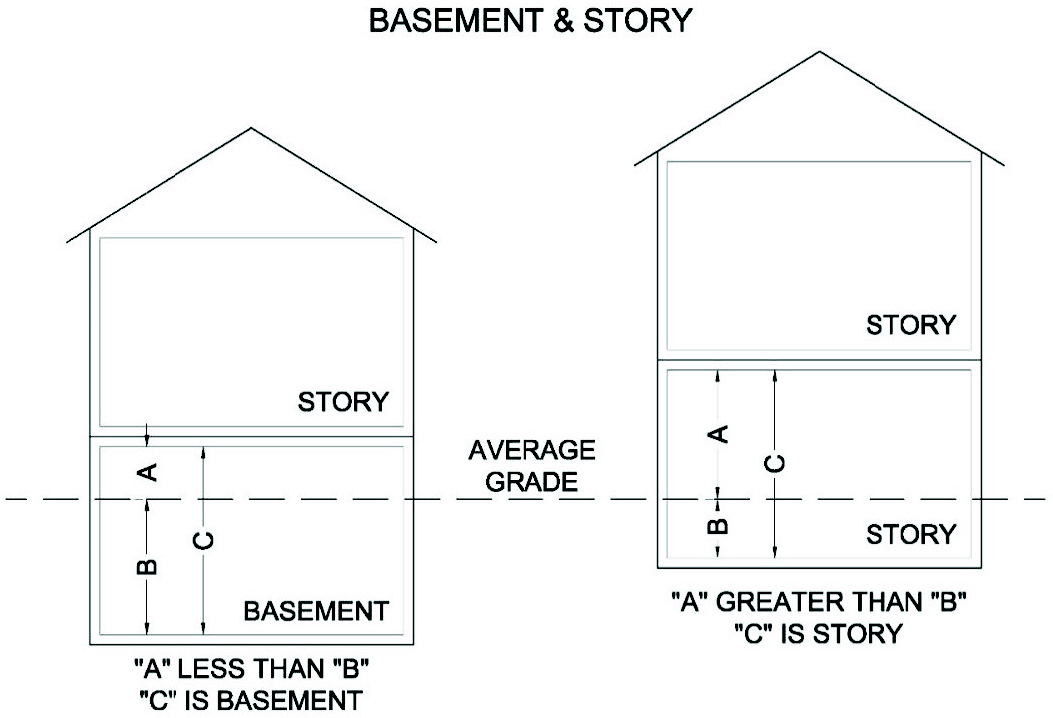
Bed and Breakfast: As used in this section, "Bed and Breakfast" means a single-family dwelling that has eight or fewer sleeping rooms, including sleeping rooms occupied by the homeowner, one or more of which are available for a rental period of less than 30 days and in which breakfast or other meals are served to its transient tenants.
Berm: Means a mound of earth graded, shaped and improved with landscaping in such a fashion as to be used for visual or audible screening purposes.
Bluff: The top of a steep bank rising from the ordinary high-water mark on a lot or parcel.
Buildable area: The buildable area of a lot is the space remaining after the minimum setback and open space requirements of the ordinance have been complied with.
Buildable land: As used in section 109-3.46, means that portion of land in a master parcel which does not include any wetlands, critical dune areas, high risk erosion areas, floodplains or other land areas, on which structures or accessory uses, including without limitation septic systems, are prohibited under any federal, state or local law, ordinance or regulation.
Building: A structure, temporary or permanent, having a roof supported by columns or walls.
Building envelope: The area of a condominium unit within which the principal building or structure is to be constructed, together with any accessory structures, as described in the master deed for the site condominium project. In a site condominium project, the building envelope refers to the area of each condominium unit within which the detached single-family dwelling and any accessory structure is to be built.
Building Height: The vertical distance measured from the established grade to the highest point of the roof for flat roofs; to the deck line for mansard roofs; and to the mean height (between eaves and ridges) for gable, hip, gambrel, and A-frame roofs. See Figure 2-2.
Figure 2-2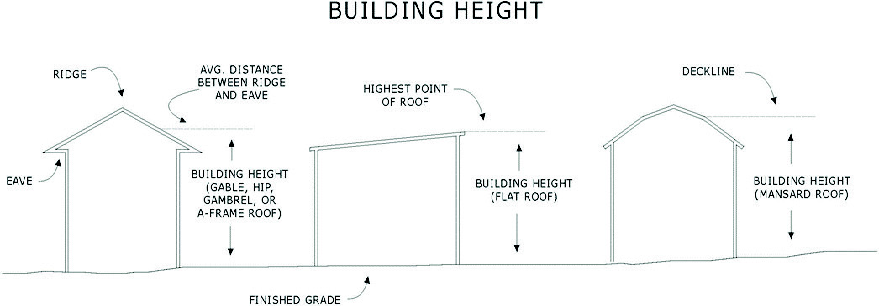
Building Line: The minimum horizontal distance set forth in the Township Zoning Ordinance for each district as measured from the front, rear and side lot lines which establishes the area within which buildings and structures must be erected or placed. Setback and Building Line are the same as Required Yard as defined herein.
Building, main or principal: A building in which is conducted the principal or main use of the lot on which it is situated.
Building site: As related to a site condominium project, shall be the area within the site condominium unit itself, including the building envelope and the area adjacent to the building envelope within the site condominium unit, together with a contiguous and appurtenant limited common element.
(Ord. No. 144, 8-13-2019; Ord. No. 156, § 2, 12-9-2025)
109-2.03 - DEFINITIONS "C".
Cabin: A building, tent or similar structure for temporary or seasonal occupancy but excluding motels, hotels or boarding homes.
Camp or campground: A temporary or permanent buildings, tents, or other structures together with their appurtenances pertaining thereto, established or maintained as temporary living quarters, operated continuously for a period of five days or more for recreation, religious, education, or vacation purposes.
Carport: Any roofed structure or shelter or a portion of a building open on two or more sides which may or may not be attached to a dwelling, other than an attached or detached garage, used for the purpose of storing motor vehicles.
Child Care Center: Any facility other than a dwelling unit in which one or more minor children are given care and supervision for periods of less than 24 hours per day on a regular basis. Child care centers do not include Family or Group Child Care Homes, or schools. Child care and supervision provided as an accessory use, while parents are engaged or involved in the principal use of the property, such as a nursery operated during church services or public meetings, or by a fitness center or similar operation, shall be considered accessory to such principal use and shall not be considered to be a child care center.
Clinic: An institution for the medical treatment of humans or, in the case of veterinary clinic, the medical treatment of small animals all dealing chiefly with outpatients.
Club or lodge: The room, building or other facilities used for the meetings of a group of people organized for a common purpose such as a fraternal organization or society.
Common open space: Any area or space other than required yard areas which is unobstructed and unoccupied by buildings, roads, or other manmade structures and is readily accessible to all those for whom it is required.
Community sanitary sewer: A complete system privately owned, maintained and operated to properly collect, treat and dispose of wastewater from all of the individual dwelling units or other buildings within an open space development project, including all pumps, pipes, laterals, controls, valves, treatment units, and other equipment necessary to collect, treat and dispose of wastewater at a central location.
Community water service: All aspects of a complete system privately owned, maintained and operated to draw water from a groundwater source, including all pumps, pipes, laterals, controls, valves, and other equipment necessary to provide potable domestic water to all of the individual dwelling units or other buildings within an open space development project from a central location or water source.
Comprehensive Plan: The Pere Marquette Charter Township Comprehensive Plan.
Conditional use: A permitted use which by its general nature may not be located within a given zoning district but as a specific use would be permitted providing all conditions which have been imposed by this Ordinance have been complied with.
Condominium Act: Public Act 59 or 1978, as amended.
Condominium/Site Condominium Project: A plan or project consisting of not less than two condominium units or two site condominium units established in conformance with the Condominium Act.
Condominium Unit: That portion of the condominium project designed and intended for separate ownership and use, as described in the Master Deed of the condominium project, within which a building or other improvement may be constructed by the condominium unit owner.
Cul-de-sac: That portion of a dead-end public or private street which consists of a circular or semi-circular section of street which allows for a vehicle turn-around. See Figure 2-3.
Figure 2-3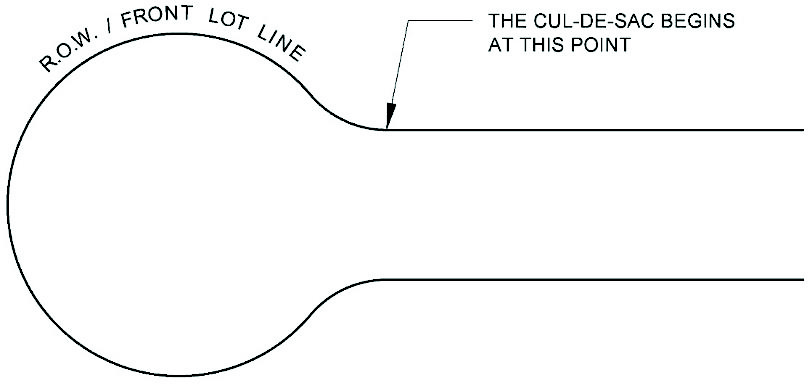
(Ord. No. 144, 8-13-2019)
109-2.04 - DEFINITIONS "D".
Deck: An uncovered platform which extends above grade.
Decorative device: A three-dimensional ornamental design, object or structure, used to achieve artistic or attractive effect. A decorative device shall not be a sign.
Development: Any manmade change to improved or unimproved real estate for any purpose, including but not limited to, construction of buildings or other structures, mining, dredging, filling, paving or excavation.
Development Plan: Drawings and specifications of a proposed development or land use showing topography, location and dimensions of buildings and structures, all non-enclosed areas including streets, parking, loading and unloading, handling facilities, storm drainage, floor plans, a detailed statement of the proposed uses and other relevant information, data, and documentation as may be required by competent authority.
District: A portion of the incorporated area of the township within which certain regulations and requirements or various combinations thereof apply under the provisions of this Ordinance.
Drive-In: A business establishment designed or operated so that services are rendered or products are delivered to customers in or on vehicles as opposed to delivery from within a building or structure.
Drive-Through; Drive-Through Facility: A business establishment or use so developed that it provides a driveway approach or parking spaces for motor vehicles to serve patrons through a window or other building opening while patrons remain in the motor vehicle either exclusively or in addition to service within a building or structure.
Driveway: An access way for motor vehicles connecting a street and the lot or lots abutting a street. A driveway is not a private street.
Dwelling, Efficiency: A dwelling unit of not more than one room in addition to a kitchen and a bathroom.
Dwelling, Multiple-Family: A building designed exclusively for and containing three or more dwelling units.
Dwelling, Single-Family: A detached building designed exclusively for and containing one dwelling unit only.
Dwelling, Two-Family: A detached building designed exclusively for and containing two dwelling units only. A two-family dwelling is also a duplex.
Dwelling Unit: A building, or portion of a building, designed for use and occupancy by one family for living and sleeping purposes, with housekeeping facilities.
Dwelling Unit, Attached: A dwelling unit attached to one or more dwelling units by common major structural elements.
Dwelling Unit, Detached: A dwelling unit which is not attached to any other dwelling unit by any means.
Dwelling Unit, Modular: A prefabricated transportable dwelling unit designed to be incorporated at a building site into a structure on a permanent foundation to be used for residential purposes and which meets the requirements of the building code of the Township.
(Ord. No. 144, 8-13-2019)
109-2.05 - DEFINITIONS "E".
Earth Change: An artificial change in the natural cover or topography of land, including cut and fill activities, which may result in or contribute to soil erosion or sedimentation of the waters of the state.
Erected: Includes built, constructed, reconstructed, moved upon, or any other physical operation on the premises required for the building. Excavations, fill, drainage, and the like, shall be considered part of erection.
Erosion control device: Any structural or physical method used to control shoreland erosion processes. Erosion control devices include, but are not limited to, structures such as groins, seawalls, revetments or beach walls, and may also include any type of beach nourishment by filling.
Essential Public Service Equipment: Wires, mains, drains, sewers, pipes, valves, pumps, conduits, cables, fire alarm and police call boxes, traffic signals, fire hydrants, post office boxes, streetlights, utility poles, telephone or television switching boxes, electrical transformer apparatus or similar equipment located either entirely underground, on poles not greater than 35 feet in height, or which are in the public right-of-way and are less than three feet above ground, but not including essential public service structures or buildings. Telecommunication towers and antennas and similar wireless communications facilities operated or owned by private enterprise shall not be considered Essential Public Service Equipment.
Essential Public Service Structures and Buildings: Buildings or structures owned and operated by public utilities or municipal departments or otherwise regulated by the Michigan Public Service Commission and used for gas, electrical, steam, fuel, water supply, water or wastewater treatment or disposal, electrical substations, telephone communications and sewage lift stations all of which are above ground and outside the public right-of-way, and including similar structures or buildings necessary to furnish adequate service to the public within the Township, but not including essential public service equipment. Telecommunication towers and antennas and similar wireless communications facilities and wind energy systems operated or owned by private enterprise shall not be considered Essential Public Service Structures or Buildings.
(Ord. No. 144, 8-13-2019)
109-2.06 - DEFINITIONS "F".
Family:
(a)
An individual or group of persons related by blood, marriage, or adoption, together with foster children and legal wards of the principal occupants who are domiciled together as a single housekeeping unit in a dwelling unit.
(b)
A collective number of individuals domiciled together in one dwelling unit whose relationship is of a continuing, non-transient domestic character and who are cooking and living as a single nonprofit housekeeping unit. This definition shall not include any society, club, fraternity, sorority, association, half-way house, lodge, organization, group of students, or other individuals whose domestic relationship is of a transitory or seasonal nature, is for an anticipated limited duration of a school term or during a period of rehabilitation or treatment or is otherwise not intended to be of a permanent nature.
Family Child Care Home: A dwelling unit in which less than seven minor children are given care and supervision for periods less than 24 hours per day, operated by a person who permanently resides in the dwelling unit as a member of the household and who is registered with the State of Michigan to provide such care.
Farm: Land, plants, animals, buildings, structures, including ponds used for agricultural or aqua-cultural activities, machinery, equipment, and other appurtenances used in the commercial production of farm products.
Farm, Affiliate: A farm under the same ownership or control as a farm market.
Farm Building: Any building other than a dwelling which is erected, moved upon or maintained on a farm which is essential and customarily exclusively used in a farm operation.
Farm Market: A place, area, or buildings from which farm products produced on and by an affiliate farm are sold. A farm market must also meet one of the following requirements: the square footage devoted to the sale of such farm products must constitute at least 50 percent of the total square footage used to display all of the products offered for retail sale or at least 50 percent of the gross dollars of products sold must be from farm products produced on and by the affiliated farm.
Farm Operation: The operation and management of a farm or a condition or activity that occurs at any time as necessary on a farm in connection with the commercial production, harvesting, and storage of farm products, and includes, but is not limited to:
(a)
Marketing produce at roadside stands or farm markets.
(b)
The generation of noise, odors, dust, fumes, and other associated conditions.
(c)
The operation of machinery and equipment necessary for a farm including, but not limited to, irrigation and drainage systems and pumps and on-farm grain dryers, and the movement of vehicles, machinery, equipment, and farm products and associated inputs necessary for farm operations on the roadway as authorized by the Michigan Vehicle Code, Act No. 300 of the Public Acts of 1949, being MCL 257.1 to 257.923.
(d)
Field preparation and ground and aerial seeding and spraying.
(e)
The application of chemical fertilizers or organic materials, conditioners, liming materials, or pesticides.
(f)
Use of alternative pest management techniques.
(g)
The fencing, feeding, watering, sheltering, transportation, treatment, use, handling and care of farm animals.
(h)
The management, storage, transport, utilization, and application of farm by-products, including manure or agricultural wastes.
(i)
The conversion from a farm operation activity to other farm operation activities.
(j)
The employment and use of labor.
Farm Product: Those plants and animals useful to human beings produced by agriculture and includes, but is not limited to, forages and sod crops, grains and feed crops, field crops, dairy and dairy products, poultry and poultry products, Cervidae, livestock, including breeding and grazing, equine, fish, and other aqua cultural products, bees and bee products, berries, herbs, fruits, vegetables, flowers, seeds, grasses, nursery stock, trees and tree products, mushrooms, and other similar products, or any other product which incorporates the use of food, feed, fiber, or fur, as determined by the Michigan Commission of Agriculture.
Fence: A decorative or protective barrier intended to mark a boundary or prevent escape or intrusion, usually made from posts, wire, wood, shrubs, or similar material. In this Ordinance a fence is not considered a structure.
Flea market: An open-air market for secondhand articles and antiques.
Floor Area, Gross: The sum of all gross horizontal areas of all floors of a building or buildings, measured from the outside dimensions of the outside face of the outside wall. Unenclosed porches, court yards, or patios shall not be considered as part of the gross floor area except where they are utilized for commercial purposes such as the outdoor sale of merchandise or seating for a restaurant.
Floor Area, Usable: That area to be used for the sale of merchandise or services, or for use to serve patrons, clients, or customers. Such floor area which is used or intended to be used principally for the storage or processing of merchandise, hallways, stairways, and elevator shafts, or restrooms, shall be excluded from this computation of usable floor area. Usable floor area shall be measured from the interior faces of the exterior walls, and total usable area for a building shall include the sum of the usable floor area for all floors.
Frontage: The length of the front lot line.
(Ord. No. 144, 8-13-2019)
109-2.07 - DEFINITIONS "G".
Garage, Private: A detached accessory building or a portion of the main building used for the parking of vehicles in conjunction with the permitted use of the main building.
Garage, Public or Commercial: A building or structure for the parking, storing, care of vehicles for payment or other compensation.
Garbage: All putrescible waste, including animal, fruit and vegetable wastes and discarded food of any type, or any filthy or offensive substances.
Gasoline Service Station: A building or structure and land area combined for servicing motor vehicles with the usual operating commodities such as gasoline, fuel oil, grease, water, batteries, tires and other similar minor accessories, or services such as washing, lubricating, minor repairs and adjustments. Major repairs, rebuilding or reconditioning of engines, collision service and body repair and similar activities are considered outside this definition of a gasoline service station.
Governmental building: A building or structure housing facilities used by local, county, state or federal governments to carry out governmental/public functions of any kind or character, except as may be limited or restricted under the provisions of this Ordinance.
Grade: An average level of the finished surface of the ground adjacent to the exterior walls of the building or structure.
Green Belt: A strip or piece of land on which trees, shrubs, grass and other foliage is planted to screen from sight the principal use of the parcel or lot.
Group Child Care Home: A dwelling unit in which more than six but not more than 12 minor children are given care and supervision for periods of less than 24 hours per day, operated by a person who permanently resides in the dwelling unit as a member of the household, and who is registered with the State of Michigan to provide such care.
(Ord. No. 144, 8-13-2019)
109-2.08 - DEFINITIONS "H".
High risk erosion area: An area designated as a high-risk erosion area due to shoreland erosion by the Department of Natural Resources pursuant to part 323 of the Natural Resources and Environmental Protection Act (MCL 324.32301 et seq.).
Home for the aged: A supervised personal care facility licensed under article 17 of the Public Health Code, 1978 PA 368 as amended, MCL 333.20101 to 333.22260 at a single address, other than a hotel, adult foster care facility, hospital, nursing home, or county medical care facility that provides room, board, and supervised personal care to 21 or more unrelated, non-transient, individuals 55 years of age or older. Home for the aged includes a supervised personal care facility for 20 or fewer individuals 55 years of age or older if the facility is operated in conjunction with and as a distinct part of a licensed nursing home. Home for the aged does not include an area excluded from this definition by section 17(3) of the Continuing Care Community Disclosure Act, 2014 PA 448, MCL 554.917.
Home occupation: A gainful occupation carried on in the home, clearly incidental and secondary to the use of the home as a dwelling place.
Home-Based Business: An occupation or business that is conducted in or on property containing a dwelling unit in a manner that is clearly secondary and accessory to the principal residential use of the property as defined and regulated by Section 109-24.30 herein.
Hospital: A facility which provides community services for medical care, normally inpatient care, of the sick or injured (including obstetrical care; and which is a privately-owned facility or a facility of a private or public nonprofit corporation or association, licensed and/or regulated by the state.
Hotel, Motel: A building or structure, or group of buildings or structures, consisting of more than four sleeping units, for rent on a temporary basis as lodging, with or without food service.
House Keeping Facilities: Complete, independent living facilities, including areas for living, sleeping, eating, cooking, and sanitation, and the following permanent fixtures and appliances: stove, refrigerator, kitchen sink, tub or shower, lavatory and water closet.
House Keeping Unit: A Dwelling Unit organized as a single entity in which the members of the household share common housekeeping facilities.
House pets: Domesticated animals traditionally and historically kept for pleasure rather than utility, and not including animals typically referred to as "wild" or animals of a potentially dangerous nature.
Household: A family living together in a single dwelling unit with common access to and common use of all living and eating areas and all areas and facilities for the preparation and serving of food within the dwelling unit.
(Ord. No. 144, 8-13-2019)
109-2.09 - DEFINITIONS "I".
Indoor storage: Storage building used in connection with existing commercial use to store inventory.
Inoperable Motor Vehicle: Any motor vehicle (automobile, truck or similar vehicle) which is unlicensed, inoperable, dis-mantled, wrecked or which cannot be operated under its own power.
Institutional or public uses: Churches, schools, hospitals, convalescent and nursing homes, parks, civic centers, libraries, governmental structures, and other nonprofit establishments for public use.
(Ord. No. 144, 8-13-2019)
109-2.10 - DEFINITIONS "J".
Junk: Any worn out, waste, used or discarded materials including, but not limited to, scrap metal, scrap lumber, paper, rags, tires, glass, building materials, inoperable motor vehicles and parts, and other similar materials.
Junk Yard/Salvage Yard: Any open area where junk, waste materials, secondhand materials including motor vehicle parts, are bought, sold, exchanged, stored, baled, packed, disassembled or handled.
(Ord. No. 144, 8-13-2019)
109-2.11 - DEFINITIONS "K".
Kennel, Commercial: Any lot or premises on which four or more dogs or cats six months of age or older, are kept either permanently or temporarily for the purpose of boarding or breeding for compensation, but not including a veterinary hospital if animals are boarded only during periods necessary for treatment or recuperation.
Kennel, Private: Any lot or premises on which no more than three dogs or three cats or any combination thereof totaling three are owned and kept by the occupant of the dwelling unit in any residential district.
(Ord. No. 144, 8-13-2019)
109-2.12 - DEFINITIONS "L".
Loading Space: An off-street area on the same lot with a building, or group of buildings, designated for the temporary parking of a vehicle while loading and unloading merchandise or materials.
Lot/Parcel/Tract: Contiguous land described in a recorded plot, or by metes and bounds, which is not divided by a street or alley, including any part thereof subject to any easement for any purpose including a street or alley.
Lot, Corner: A lot or parcel having frontage on two or more streets or roads where the corner interior angle formed by the intersection of the streets is 135 degrees or less; or a lot abutting upon a curved street if tangent to the curve form an interior angle of 135 degrees or less. See Figure 2-4.
Figure 2-4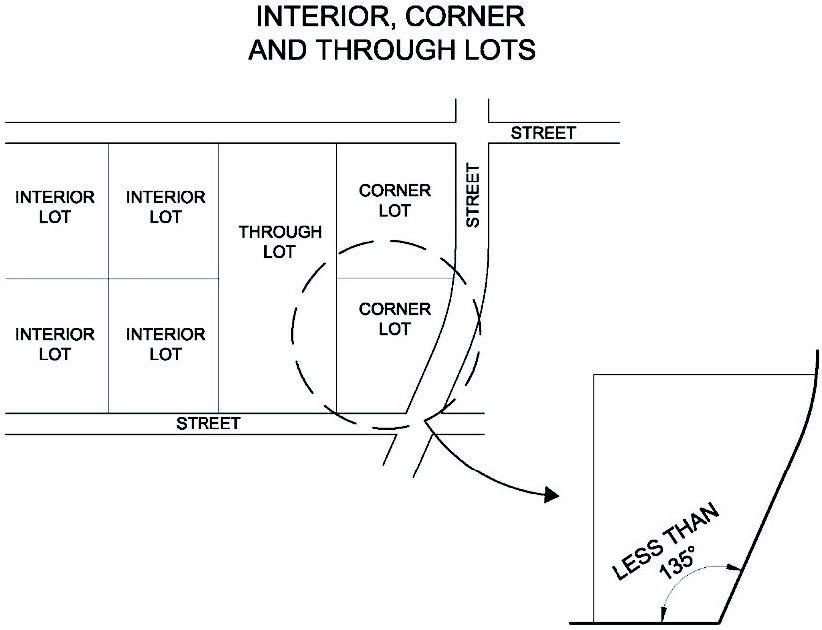
Lot Coverage: That part or percent of the lot occupied by buildings, including accessory buildings.
Lot Depth: The distance between the front lot line and the rear lot line measured along the median between the side lot lines. See Figure 2-5.
Figure 2-5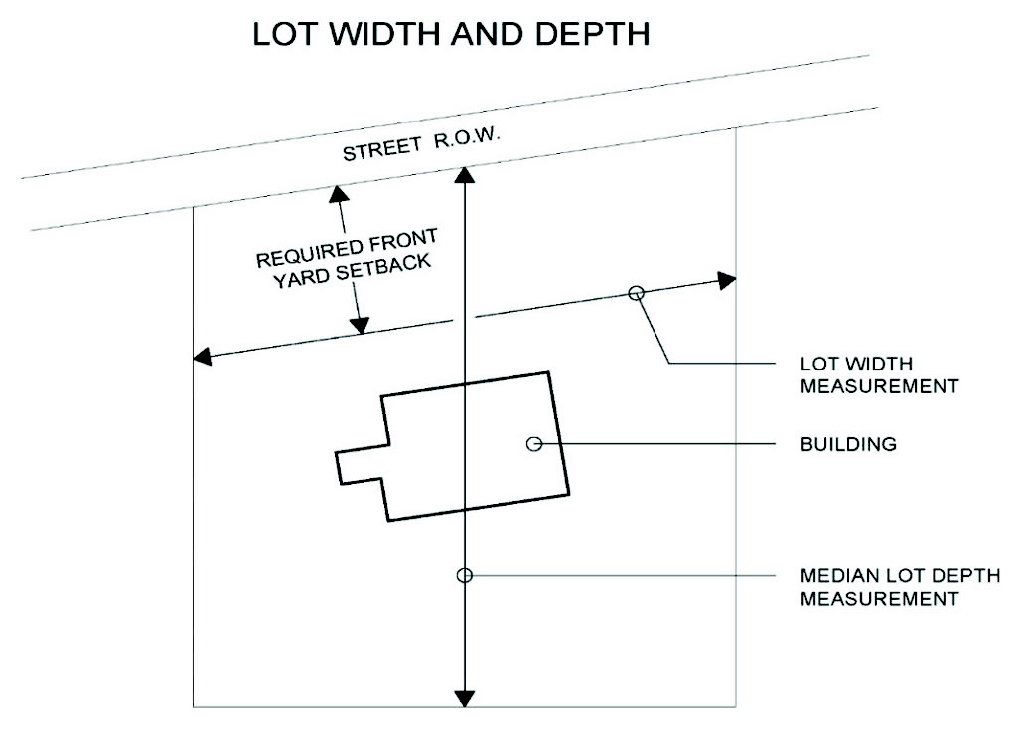
Lot, Interior: A lot other than a corner lot. See Figure 2-4.
Lot Line, Front: The lot line or lines separating the lot from a public or private street right-of-way.
Lot Line, Rear: The lot line which is opposite to, and most distant from, the front lot line. In the case of an irregular, triangle or gore lot, the rear lot line shall be a line ten feet in length, entirely within the lot, parallel to, and at the maximum distance from, the front lot line.
Lot Line, Side: Any lot line not a front lot line or a rear lot line.
Lot of Record: A lot or parcel of land which is a part of a sub-division, or which is described by metes and bounds, which subdivision or description has been recorded in the Office of the Mason County Register of Deeds by deed or land contract. In order for a lot or parcel to be a legal nonconforming lot of record it must have been so recorded prior to the date of this Ordinance.
Lot, Through: An interior lot having frontage on more than one street or road. See Figure 2-4.
Lot Width: The horizontal distance between the side lot lines, measured parallel to the front lot line at the minimum required setback line. For purposes of this Ordinance the setback line is also the building line. See Figure 2-5.
(Ord. No. 144, 8-13-2019)
109-2.13 - DEFINITIONS "M".
Manufactured Home: A building or structure, designed and intended as a dwelling, manufactured, constructed or assembled at a location other than its final use location.
Marijuana, also known as Marihuana, also known as Cannabis: That term shall have the meaning given to it in Section 7106 of the Michigan Public Health Code, 1978 PA 368, as amended, MCL 333.7106 et seq., as is referred to in Section 3(d) of the Michigan Medical Marijuana Act, PA 2008, Initiated Law 1, MCL 333.26423(d). Any other term pertaining to marijuana used in this Ordinance and not otherwise defined shall have the meaning given to it in the Michigan Medical Marijuana Act and/or in the General Rules of the Michigan Department of Community Health issued in connection with that Act.
Master deed: The documentation prepared for recording with respect to a condominium development under the Condominium Act (MCL 559.101 et seq.) to which are attached as exhibits the bylaws for the condominium development and the condominium subdivision plans.
Medical (use of) Marijuana: The acquisition, possession, cultivation, manufacture, use, internal possession, delivery, transfer or transportation of marijuana or paraphernalia relating to the administration of marijuana to treat or alleviate a registered qualifying patient's debilitating medical condition or symptoms associated with the debilitating medical condition, as defined under the Michigan Medical Marijuana Act, PA 2008, Initiated Law 1, MCL 333.26421 et seq.
Medical Marihuana Dispensary: Any business, facility, association, compassion club, cooperative, location, or operation, which is operated for profit or non-profit, whether fixed or mobile, where medical marijuana is made available to be sold, used, grown, processed, delivered, or distributed by or to one or more of the following:
(1)
A primary caregiver as defined by Michigan Initiated Law 1 of 2008, as amended.
(2)
A qualifying patient as defined by Initiated Law 1 of 2008, as amended.
(3)
Members of the public.
A medical marijuana dispensary shall also include any place, location, facility, cooperative, compassion club, or operation, which is operated for profit or non-profit, whether fixed or mobile, where medical marijuana is smoked or consumed where either three or more persons are present and smoking or consuming medical marijuana or such medical marijuana smoking or consumption is occurring on the property of a business, association, cooperative or commercial operation or facility.
A medical marijuana dispensary shall not include the dispensation of medical marijuana by a registered primary caregiver personally dispensing to not more than five qualified patients in strict accordance with the Michigan Initiated Law 1 of 2008, as amended, so long as the lawful amount of medical marijuana is delivered to the qualifying patient where the qualifying patient resides and it is done in full compliance with this Ordinance as well as all other applicable Township Ordinances and applicable Michigan and Federal laws, rules and regulations.
A medical marijuana dispensary shall also not include the following uses: a State-licensed health care facility; a State-licensed residential care facility for the elderly or infirmed; or a residential hospice care facility, as long as any such use complies strictly with applicable laws and rules of the township and applicable Michigan and Federal laws, rules and regulations.
Mobile Home: A structure that is transportable in one or more sections, built on a chassis, and designed to be used as a dwelling, with or without a permanent foundation, when connected to the required utilities, and includes the plumbing, heating, air conditioning, and electrical systems contained in the structure (PA 96 of 1987).
Mobile Home Park: A parcel or tract of land under the control of a person upon which three or more mobile homes are located on a continual, non-recreational basis and which is offered to the public for that purpose regardless of whether a charge is made therefor, together with any building, structure, enclosure, street, equipment, or facility used or intended for use incident to the occupancy of a mobile home (PA 96 of 1987).
Modular/Manufactured Housing: A dwelling unit which consists of prefabricated units wholly or substantially constructed at an off-site location and transported to a lot or parcel on a removable undercarriage or flat-bed and assembled for permanent location on a lot or parcel.
Motel: See: Hotel, Motel.
Moveable structure: A structure which the Charter Township of Pere Marquette Building Inspector has determined to be moveable. Such a determination shall be based on a review of the design and size of the structure, a review of the capability of the proposed structure to withstand normal moving stresses and a site review to determine whether the structure will be accessible to moving equipment.
(Ord. No. 144, 8-13-2019)
109-2.14 - DEFINITIONS "N".
New Construction: Structures for which the start of construction commenced on or after the effective date of this Ordnance or for which a zoning permit was issued.
Non-Conforming Building or Structure: Any building or structure which does not comply with the applicable regulations required by this Ordinance for the district in which it is located, either on the effective date of this Ordinance or as the result of a subsequent amendment thereof.
Non-Conforming Lot of Record: A lot or parcel of land which does not comply with the requirements of the Ordinance as to area, lot dimensions, and other required criterion, for the district in which it is located either on the effective date of this Ordinance or as the result of a subsequent amendment thereto.
Non-Conforming Use: Any use of land, buildings or structures which does not conform to the applicable use regulations for the district in which it is located, either on the effective date of this Ordinance or as the subsequent amendment thereto.
Non-putrescible: Solid waste that does not contain organic matter capable of being decomposed by microorganisms under standard conditions, does not emit offensive odors and does not attract vermin, flies, birds, or rodents.
Normal High-Water Mark: The normal high-water mark of the lake as determined by the Department of Natural Resources, or if the Department has not made such a finding, the normal high-water mark location shall be determined by the Township Zoning Administrator. Moreover, the measurement shall be made only along a natural shoreline, and shall not include any manmade channel, lagoon, canal or the like.
Noxious weeds: Canada thistle, dodders, mustards, milkweed, wild carrot, bindweed, perennial sow thistle, hoary alyssum, ragweed, poison ivy, poison sumac, bellis perennis and goldenrod and all other noxious weeds as designated by state statute.
Nuisance: An offensive, annoying, unpleasant or obnoxious thing or practice. A cause or source of annoyance, especially a continuing or repeating invasion or any physical characteristics of activity or use across a property line which can be perceived by or affects a human being. The generation of an excessive or concentrated movement of people or things, such as, but not limited to:
(a)
Noise;
(b)
Sand or dust;
(c)
Smoke;
(d)
Odor;
(e)
Glare;
(f)
Fumes;
(g)
Flashes;
(h)
Vibration;
(i)
Shock waves;
(j)
Heat;
(k)
Electronic or atomic radiation;
(l)
Objectionable effluent;
(m)
Noise of congregation or people, particularly at night;
(n)
Passenger traffic;
(o)
Invasion of nonabutting street frontage by traffic.
Nursing home: A nursing care facility, including a county medical care facility, licensed under article 17 of the Public Health Code, 1978 PA 368 as amended, MCL 333.20101 to 333.22260 that provides organized nursing care and medical treatment to 7 or more unrelated individuals suffering or recovering from illness, injury, or infirmity. As used in this definition, "medical treatment" includes treatment by an employee or independent contractor of the nursing home who is an individual licensed or otherwise authorized to engage in a health profession under Part 170 or 175 of the Public Health Code, 1978 PA 368 as amended. Nursing home does not include any of the following:
(a)
A unit in a state correctional facility.
(b)
A hospital.
(c)
A veteran's facility created under 1885 PA 152, MCL 36.1 to 36.12.
(d)
A hospice residence that is licensed under this article.
(e)
A hospice that is certified under 42 CFR 418.100.
(f)
A home for the aged licensed under article 17 of the Public Health Code, 1978 PA 368, MCL 333.20101 to 333.22260
(Ord. No. 144, 8-13-2019)
109-2.15 - DEFINITIONS "O".
Off-Street Parking Lot or Parking Lot: A facility providing parking spaces, along with adequate drives, maneuvering areas, and aisles for the parking of more than three vehicles.
Open Air Business: A retail sales establishments operated substantially in the open air, including, but not necessarily limited to:
(a)
Bicycle, utility truck or trailer, motor vehicle, boats, or home equipment sales, repair, storage, or rental services.
(b)
Outdoor display area, storage, or sale of garages, motor homes, recreation vehicles, manufactured homes, snowmobiles, swimming pools and similar activities, but not including farm implements or commercial construction equipment.
(c)
Retail sales of trees, fruits, vegetables, shrubbery, plants, seeds, topsoil, humus, fertilizer, trellises, lawn furniture, playground equipment and other home garden supplies and equipment, but not including lumberyards.
Ordinary high-water mark: The line between upland and bottomland which persists through successive changes in water levels, below which the presence and action of the water is so common or recurrent that the character of the land is marked distinctly from the upland and is apparent in the soil itself, the configuration of the surface of the soil and the vegetation. On an inland lake which has a level established by law, it means the high established level. Where water returns to its natural level as the result of the permanent removal or abandonment of an ordinary high-water mark.
(Ord. No. 144, 8-13-2019)
109-2.16 - DEFINITIONS "P".
Park, public: Lands which have been devoted to the recreation and enjoyment of the public; an open or enclosed tract of land for the comfort and enjoyment of the public; an open space intended for the recreation and enjoyment of the public; any land set apart for ornament, or to afford the benefit of air, recreation, exercise or amusement for the public.
Parking Space: An area of definite length and width, said area shall be exclusive of lawn areas, or drives, aisles or entrances giving access thereto, and shall be fully accessible for the parking of permitted vehicles.
Patient, Qualifying (Qualified Patient): A person to whom a Registry Identification Card has been issued by the Michigan State Department of Community Heath which identifies that person as a registered qualifying patient as defined by the Michigan Medical Marihuana Act, PA 2008, Initiated Law 1.
Patio, Enclosed: A structure which has a roof and walls whose surface area is at least 50 percent glass or screen and which is attached to or part of a building.
Patio, Unenclosed: An area at grade level composed of concrete, asphalt, stone, brick or similar material typically adjoining or attached to a house or other principal building and which may have a roof but no walls.
Personal Service Establishment: A commercial business conducting services that are performed primarily on the premises.
Planned Unit Development (PUD): A land development project, approved by the Township Board, following public hearing, which may permit flexibility in building sites, mixtures of housing types, land uses, usable open spaces, setbacks, lot sizes and the preservation of natural features.
Pond: An outdoor body of standing water accumulated in a natural or artificially constructed basin or depression in the earth, either above or below or partly above or partly below grade, capable of holding water to a depth of greater than two feet when filled to capacity.
Pool, private swimming: A structure either above or below or partly above and partly below grade, located either in part or wholly outside of a permanently enclosed and roofed building, designed to hold water to a depth of greater than two feet when filled, and intended to be used for swimming purposes.
Porch, Enclosed: A roofed structure with walls whose surface area is at least 50 percent glass or screen attached to or part of a building and which provides direct access to and from the building.
Porch, Unenclosed: A roofed structure without walls attached to or part of a building and which provides direct access to and from the building.
Principal Use or Main Use: The primary or predominant use of land, building or structure.
Private Street: Any street which is privately owned and maintained and which provides or is intended to provide the primary means of vehicular ingress and egress to three or more lots, principal buildings, or dwelling units or combination thereof and which is located within a private street easement as defined herein.
Private Street Easement: An easement which is granted exclusively for private access to three or more parcels of land and which contains a private street.
Professional service facilities: Offices of an architect, engineer, physician, attorney, accountant, barber, beautician. The establishments offering professional services for a fee such as financial institutions, services performed shall be of a personal nature and are not intended for service on personal goods and items, such as, clothes cleaning, shoe repair and other similar services.
Putrescible: A solid waste that contains organic matter capable of being decomposed by microorganisms and of such a character and proportion as to cause obnoxious odors and to be capable of attracting or providing food for vermin, flies, birds or rodents.
(Ord. No. 144, 8-13-2019)
109-2.17 - DEFINITIONS "Q".
Qualifying patient: A person as defined in section 3(h) of the Michigan Medical Marihuana Act (MCL 333.26423(h)), and who has been issued and possesses a valid registry identification card.
(Ord. No. 144, 8-13-2019)
109-2.18 - DEFINITIONS "R".
Recreation activity, indoor: A public or private recreational activities normally and customarily conducted within an enclosed building such as theaters; exercise facilities; court games such as tennis, paddleball, handball, basketball, and volleyball; bowling alleys; archery; roller skating rinks; ice arenas; pool and billiards; swimming pools; and including concession areas and restaurants when designed as an integral part of the facility and incidental to one or more of the other permitted uses.
Recreation activity, outdoor: A public or private recreational activities normally and customarily conducted in the outdoors such as golf courses, practice areas including golf driving ranges, archery ranges, baseball batting facilities, playing fields for baseball, football, soccer, swimming pools, swimming beaches and water rides, court games such as tennis, volleyball, and basketball, ice rinks, cross-country and downhill ski areas, marinas, miniature golf, target shooting, campgrounds, and including concession stands and restaurants when designed as an integral part of the site and incidental to one or more of the other permitted uses.
Recreational Vehicle or Equipment: Vehicles or equipment used primarily for recreational purposes. For the purpose of this chapter, recreational vehicle means:
(a)
A vehicle primarily designed and used as temporary living quarters for recreational, camping, or travel purposes, including a vehicle having its own motor power or a vehicle mounted on or drawn by another vehicle such as a motor home or camper;
(b)
Boats and trailers designed to transport boats;
(c)
Snowmobiles, jet skis, and trailers designed to transport them;
(d)
Off-road vehicles and trailers designed to transport off-road vehicles;
(e)
Pop-up tent and camper trailers;
(f)
Other similar vehicles deemed by the Zoning Administrator to be recreational vehicles except that this term shall not include motorcycles or motorbikes or other similar means of transportation intended primarily for daily on-street use.
Recycling facility: A facility involved in the transformation, adaptation, extraction or sorting of useful post-consumer, non-putrescible materials that may require outdoor storage and/or processing, or where the potential for the use may have a negative impact on surrounding properties due to related noise, vibration, dust, emissions or processing techniques.
Recycling facility (enclosed): A facility involved in the transformation, adaptation, extraction or sorting of useful post-consumer, non-putrescible materials (such as paper, glass, tin, aluminum, or plastic) where all processes are done within a completely enclosed structure.
Refuse: Garbage, rubbish or any waste product including both combustible and non-combustible, such as paper, cardboard, metal containers, yard clippings, ashes, wood, glass, bedding, crockery and building materials. The term refuse shall also include tires, rags, discarded clothing and containers, sweepings, nails, tin, wire, light bulbs, signs, advertising matter, petroleum products, cleaning agents, paint, pesticides, and such other materials as may be discarded on a day to day basis, and as such, would normally be put in acceptable containers for proper disposal.
Residential District: The R-1, R-2, and MHP districts.
Restaurant: A building or structure for the sale or preparation of food for consumption on the premises. Also, a building or structure for the sale of pre-prepared foods for consumption off the premises via drive-in or walk-up facilities.
Right-of-Way: A street, alley or other thoroughfare or easement established for the passage of vehicles or persons.
Rooming House: A dwelling having one or more kitchens and used to provide meals and/or lodging, where occupants are non-transient in nature, for payment or other compensation and which has four or less sleeping rooms in addition to those used by the immediate family occupying the dwelling.
(Ord. No. 144, 8-13-2019)
109-2.19 - DEFINITIONS "S".
Salvage/junk yard: An open area where waste or scrap materials are bought, sold, exchanged, stored, baled, packed, disassembled or handled, including but not limited to scrap iron and other metals, paper, rags, rubber tires and bottles and also including an auto wrecking yard but not including uses established entirely within enclosed structures.
Sanitary landfill: A method of disposing of refuse on land in accordance with Part 115 of the Natural Resources and Environmental Protection Act (MCL 324.11401 et seq.).
Satellite dish antenna: A parabolic or spherical reflective type of antenna used for communications with a satellite-based system located in planetary orbit.
Self-service storage facility: A building or group of buildings, or areas of paved land (or a combination of these) in which various sizes of storage spaces/areas are offered to the general public for rent or lease for the purposes of storing personal property indoors or outdoors; also referred to as "mini-storage".
Setback: The minimum horizontal distance set forth in the Township Zoning Ordinance for each district as measured from the front, rear and side lot lines which establishes the area within which buildings and structures must be erected or placed. Setback, Setback Line and Building Line are the same as Required Yard as defined herein. See Figure 2-6.
Short-term Rental: The rental of any single-family dwelling or any dwelling unit of a two-family dwelling for a period of less than one month. Short-term rental also includes the rental of a single- family dwelling or a dwelling unit of a two-family dwelling to individuals or families who then rent or otherwise allow others to occupy the dwelling for less than one month. The following are not included in short-term rental:
(a)
A dwelling unit owned by a business entity and made available on a temporary basis to employees of the business entity while performing work in the township or adjacent areas.
(b)
State-licensed residential facilities, such as adult foster care homes, otherwise permitted under this zoning ordinance, the Zoning Act (MCL 125.3101 et seq.), or other state law.
(c)
Dwelling units provided for agricultural workers.
Sidewalk: A concrete facility for pedestrians that is physically separated by an open space buffer or physical barrier from the portion of a street or private road traveled by motor vehicles.
Site Condominium Project: A plan or project consisting of not less than two site condominium units established in conformance with the Condominium Act.
Site Condominium Unit: A condominium unit established in compliance with the Condominium Act which is a volume of air space defined by an area of land and a specified distance above and below the land surface designed and intended for separate ownership and use as described in the site condominium master deed, and within which a building or other improvement may be constructed by the condominium unit owner. A site condominium unit shall be considered a lot for purposes of this Ordinance.
Site development plan: A reproducible scale drawing which shows the location and dimensions of all intended and existing buildings, structures, parking, loading facilities, streets, driveways, buildings, planting, landscaping, yard spaces, sidewalks, signs, drainage facilities, water supply, sewage systems and any other items that may be required by this Ordinance.
Site plan review: The submission of plans for review, as part of the process of securing zoning approval.
Stable, public: A building used for housing horses or other domestic animals for commercial enterprise.
Storage, outside: The outdoor standing or placement of usable and/or potentially usable goods or equipment other than for display and not including waste or scrap materials, other than in salvage/junk yards, unless specifically provided for within this Ordinance.
Story: That part of a building included between the surface of any floor above the average grade or ground at the foundation and the surface of the next floor, or if there is no floor above, then the ceiling next above. See Definition of Basement for Illustration (Figure 2-1).
Story, Half: An uppermost story lying under a sloping roof having a usable floor area of at least 200 square feet with a clear height of seven feet six inches. For the purpose of this chapter, the usable floor area is only that area having at least five feet clear height between floor and ceiling.
Stream Bank: The portion of the stream channel cross section that restricts the lateral movement of water at normal bank-full levels often exhibiting a distinct break in slope from the stream bottom.
Street or Road: A public or private thoroughfare which affords the principal means of access to abutting properties including roads and highways but not including an alley.
Structure: Anything constructed or erected in or upon the ground and having a permanent location in or upon the ground including, though not limited to buildings, accessory buildings, sheds, patios, gazebos, tennis courts, swimming pools, radio and television towers, decks and platforms; provided, however, that patios shall not be deemed structures if no parts thereof are above the ground and if they are located outside the minimum front, side, and rear yard setback lines. Lawful fences or walls, utility poles, basketball goals, mailboxes, sidewalks, driveways, streets, parking areas, or retaining walls shall not be considered to be structures for the purposes of this Ordinance.
Substandard lot: A lot of record or a lot described in a land contract or deed executed and delivered prior to the effective date of this Ordinance which does not meet the minimum requirements of the district or zone in which it is located. In a high-risk erosion area, a substandard lot means those lots which were legally created with sufficient depth to meet the setback requirement for principal structures in the zone, but which subsequently become substandard due to natural erosion processes.
(Ord. No. 144, 8-13-2019)
109-2.20 - DEFINITIONS "T".
Tavern: A commercial facility that serves alcoholic beverages with limited food items.
Theater: Any building or place used for presentation of dramatic spectacles, shows, movies, or other entertainment, open to the public with or without charge.
Townhouse: That portion of a multiple dwelling which has a common sidewall with some other dwelling unit in the building but which extends throughout the vertical height of the structure and provides separate or individual front and rear yard areas and which has self-contained facilities for living, sleeping, and cooking and which is designed for occupancy by one family.
Trailer body: Any boat trailer, utility trailer, horse or animal trailer, truck trailer, travel trailer or any type of trailer, or device used for hauling or moving things, which lacks all of the necessary component parts to make it then operative, serviceable and/or licensed as a trailer to be pulled as such on the highway.
(Ord. No. 144, 8-13-2019)
109-2.21 - DEFINITIONS "U".
Unwholesome substance: Any substance, refuse, trash, automobile body, trailer body, unregistered and inoperable watercraft, stone, concrete or asphalt rubble, junk, offal, debris, filth, noxious weeds, or any other material or structure which constitutes a threat or menace to the health, safety, or general welfare of the public.
Use: The purpose or activity for which the land or building thereon is arranged, occupied or maintained.
(Ord. No. 144, 8-13-2019)
109-2.22 - DEFINITIONS "V".
Variance: The relief granted, or the remedy authorized, by the Board of Appeals, as the result of an appeal.
Vehicle: Every device in, upon, or by which any person or property, is or may be transported or drawn upon a street except devices propelled by human power or used exclusively upon stationary rails or tracks.
(Ord. No. 144, 8-13-2019)
109-2.23 - DEFINITIONS "W".
Warehousing: A building used for storage of industrial manufactured goods or raw materials.
Wetland: Land characterized by the presence of water at a frequency and duration sufficient to support, and that under normal circumstances does support, wetland vegetation or aquatic life, and is commonly referred to as a bog, swamp, or marsh and which is contiguous to an inland lake, a river or stream.
(Ord. No. 144, 8-13-2019)
109-2.24 - DEFINITIONS "X".
Reserved.
109-2.25 - DEFINITIONS "Y".
Yard: The open space on a lot between the lot line and the foundation or wall of the principal building, whichever is closer. See Figure 2-6.
Yard, Front: The space extending across the full width of the lot between the front lot line and the wall or foundation of the principal building whichever is closer. A corner lot has two front yards. See Figure 2-6.
Yard, Rear: The space extending across the full width of the lot between the rear lot line and the wall or foundation of the principal building, whichever is closer. See Figure 2-6.
Yard, Required: The space between a lot line and the setback line. The required yards establish the area within which buildings and structures must be erected or placed. A Required Yard is the same as Setback and Building Line as defined herein. See Figure 2-6.
Yard, Side: The space between the side lot line and the wall or foundation of the principal building, whichever is closer, extending from the front yard to the rear yard. See Figure 2-6.
Figure 2-6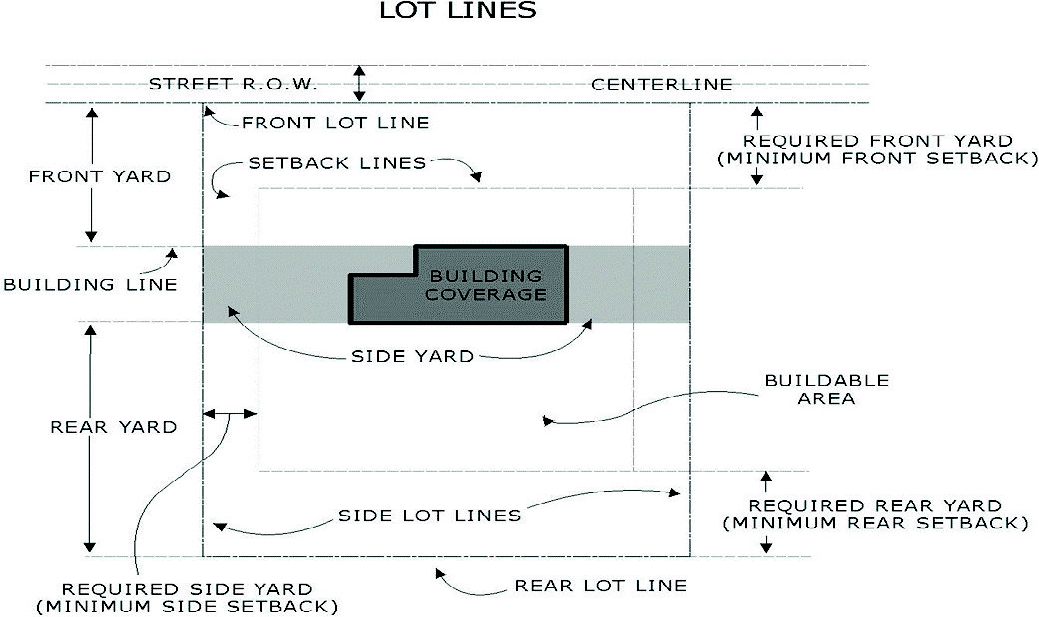
(Ord. No. 144, 8-13-2019)
109-2.26 - DEFINITIONS "Z".
Zoning Administrator: That person designated by the Township Board to administer this Ordinance. This term also includes any person designated by the Zoning Administrator to carry out any authorized duties of the Zoning Administrator.
(Ord. No. 144, 8-13-2019)

