
Pere Marquette Charter Township
City Zoning Code
City Zoning Code
ARTICLE 29
- WIND ENERGY TURBINES
109-29.01 - PURPOSE.
The purpose of this article is to establish guidelines for the siting of wind energy turbines (WETs) and this article applies to same. The goals are as follows:
(a)
To provide for the safe, effective, and efficient use of a WET in order to reduce the consumption of fossil fuels in producing electricity.
(b)
Preserve and protect public health, safety, welfare, and quality of life by minimizing the potential adverse impacts of a WET.
(c)
To establish standards and procedures by which the siting, design, engineering, installation, operation, and maintenance of a WET shall be governed.
(d)
[Definitions.]
Ambient sound level means the amount of ordinary background noise at a given location other than noise created by the WET, which may include, but not limited to, traffic, machinery, human activity, and the interaction of wind with the landscape. The ambient sound level is measured on the dB(A) weighted scale as defined by the American National Standards Institute.
Anemometer means a temporary wind speed indicator constructed for the purpose of analyzing the potential for utilizing a wind energy turbine at a given site. This includes the tower, base plate, anchors, cables and hardware, wind direction vanes, booms to hold equipment, data logger, instrument wiring, and any telemetry devices that are used to monitor or transmit wind speed and wind flow characteristics over a period of time for either instantaneous wind information or to characterize the wind resource at a given location.
Condominium development means a development that is created under the Condominium Act (MCL 559.101 et seq.).
Decibel means a unit of measure used to express the magnitude of sound pressure and sound intensity. Decibels shall be measured on the dB(A) weighted scale as defined by the American National Standards Institute.
Decommissioning means the process of terminating operation and completely removing a WET(s) and all related structures, foundations, access roads, equipment and restoration of any disturbed land associated with the WET.
General common element means an area designated for use by all owners within the condominium development.
Large wind energy turbine (LWET) means a tower-mounted wind energy system that converts wind energy into electricity through the use of equipment which includes any base, blade, foundation, generator, nacelle, rotor, tower, transformer, vane, wire, inverter, batteries, or other components used in the system. The LWET has a rated capacity above 250 kilowatts, and the main purpose of the LWET is to supply electricity to off-site customers.
Medium wind energy turbine (MWET) means a tower-mounted wind energy system that converts wind energy into electricity through the use of equipment which includes any base, blade, foundation, generator, nacelle, rotor, tower, transformer, vane, wire, inverter, batteries, or other components used in the system. The MWET has a rated capacity that shall not exceed 250 kilowatts. The total height shall not exceed 150 feet.
Nacelle refers to the encasement which houses all of the generating components, gear box, drive train, and other equipment.
Net-metering means a special metering and billing agreement between utility companies and their customers, which facilitates the connection of renewable energy generating systems to the power grid.
Occupied building means a residence, school, hospital, church, public library, business, or any other building used for public gatherings.
Operator means the entity responsible for the day-to-day operation and maintenance of a wind energy turbine (WET).
Owner means the individual or entity, including their respective successors and assigns, which have an equity interest or own the wind energy turbine (WET) in accordance with this Ordinance.
Rotor diameter means the cross-sectional dimension of the circle swept by the rotating blades of a wind energy turbine (WET).
Shadow flicker means the moving shadow, created by the sun shining through the rotating blades of a wind energy turbine (WET). The amount of shadow flicker created by a WET is calculated by a computer model that takes into consideration turbine location, elevation, tree cover, location of all structures, wind activity, and sunlight.
Small wind energy turbine (SWET) means a tower-mounted wind energy system that converts wind energy into electricity through the use of equipment which includes any base, blade, foundation, generator, nacelle, rotor, tower, transformer, vane, wire, inverter, batteries, or other components used in the system. The SWET has a rated capacity that shall not exceed 30 kilowatts. The total height shall not exceed 120 feet.
Structure means any building or other structure, such as a municipal water tower, that is a minimum of 12 feet high at its highest point of roof and is secured to frost-footings or a concrete slab.
Structure-mounted wind energy turbine (SMWET) converts wind energy into electricity through the use of equipment which includes any base, blade, foundation, generator, nacelle, rotor, tower, transformer, vane, wire, inverter, batteries, or other components used in the system. A SMWET is attached to a structure's roof, walls, or other elevated surface.
The SMWET has a rated capacity that shall not exceed ten kilowatts. The total height shall not exceed 15 feet as measured from the point where the WET attaches to the structure to the maximum height reached by any part of the WET.
Total height means the vertical distance measured from the ground level at the base of the tower to the maximum height reached by any part of the wind energy turbine (WET).
Tower means a freestanding monopole that supports a wind energy turbine (WET).
Wind energy turbine (WET) means any wind energy conversion system that converts wind energy into electricity through the use of a wind generator and includes the nacelle, rotor, tower, and pad transformer, if any.
(Ord. No. 144, 8-13-2019)
109-29.02 - APPLICABILITY.
(a)
This article applies to all WETs proposed to be constructed after the effective date of this article.
(b)
All WETs constructed prior to the effective date of this Ordinance shall not be required to meet the requirements of this Ordinance; however, any physical modification to an existing WET that materially alters the size, type, equipment or location shall require a permit under this Ordinance.
(c)
This article is subject to applicable airport regulations and restrictions. See section 109-3.36.
(Ord. No. 144, 8-13-2019)
109-29.03 - ANEMOMETERS.
Anemometers may be permitted in all zoning districts as a temporary use, in compliance with the provisions contained herein, and the applicable WET regulations:
(a)
The construction, installation, or modification of an anemometer tower shall require a building permit and shall conform to all applicable local, state and federal safety, construction, environmental, electrical, communications, and FAA requirements.
(b)
An anemometer shall be subject to the minimum requirements for height, setback, separation, location, safety requirements, and decommissioning that correspond to the size of the WET that is proposed to be constructed on the site.
(c)
An anemometer shall be permitted for no more than 13 months for a SMWET, SWET or MWET.
(d)
An anemometer shall be permitted for no more than three years for a LWET.
(Ord. No. 144, 8-13-2019)
109-29.04 - PERMITTED USES.
Structure-mounted wind energy turbines (SMWET) and small wind energy turbines (SWET) shall be considered a permitted use in all zoning districts and shall not be erected, constructed, installed, or modified as provided in this Ordinance unless a building permit has been issued to the owner(s) and/or operator(s). All SMWETs and SWETs are subject to the following minimum requirements:
(a)
Siting and design requirements.
(1)
Noise. Turbines shall be designed to eliminate the thumping noise that can occur during operation perceptible beyond the property on which it is located.
(2)
Visual appearance.
i.
A SMWET or SWET, including accessory buildings and related structures, shall be a nonreflective, nonobtrusive color (e.g., white, gray, black). The appearance of the turbine, tower, and any ancillary facility shall be maintained throughout the life of the SMWET or SWET.
ii.
A SMWET or SWET shall not be artificially lighted, except to the extent required by the FAA or other applicable authority, or otherwise necessary for the reasonable safety and security thereof.
iii.
SMWET or SWET shall not be used for displaying any advertising (including flags, streamers, or decorative items), except for identification of the turbine manufacturer.
(3)
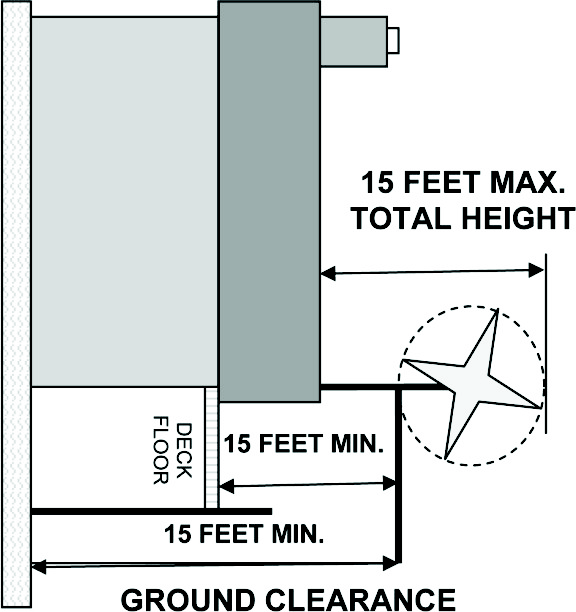
Ground clearance. The lowest extension of any blade or other exposed moving component of a SMWET or SWET shall be at least 15 feet above the ground (at the highest point of the natural grade within 30 feet of the base of the tower) and, in addition, at least 15 feet above any outdoor surfaces intended for human use, such as balconies or roof gardens, that are located directly below the SMWET or SWET. See sketch B.
Small Mounted Wind Energy Tower (SMWET) Sketch B
(4)
Noise. Noise emanating from the operation of a SMWET or SWET shall not exceed, at any time, the ambient noise level at any property line of a residential use parcel or from the property line of parks, schools, hospitals and churches. Noise emanating from the operation of a SMWET or SWET shall not exceed, at any time, the ambient noise level plus five dB(A) at any property line of a nonresidential use parcel.
(5)
Vibration. Vibrations shall not be produced which are humanly perceptible beyond the property on which a SMWET or SWET is located.
(6)
Guy wires. Guy wires shall not be permitted as part of the SMWET or SWET.
(7)
Structure-mounted wind energy turbines. SMWETs shall also be subject to the following:
i.
Setback. The setback of the SMWET shall be a minimum of 15 feet from the property line, public right-of-way, public easement, or overhead utility lines if mounted directly on a roof or other elevated surface of a structure. If the SMWET is affixed by any extension to the side, roof, or other elevated surface, then the setback from the property line or public right-of-way shall be a minimum of 15 feet. The setback shall be measured from the furthest outward extension of all moving parts.
ii.
Quantity. No more than three SMWETs shall be installed on any parcel. The Planning Commission may allow more SMWETs if appropriate. The Planning Commission shall, through a site plan review, consider the size of the parcel, the use of the parcel, the location of the proposed WETs, the use of and impact upon adjoining parcels, and other relevant factors in determining if additional WETs are appropriate.
iii.
Separation. If more than one SMWET is installed, a distance equal to the height of the SMWET must be maintained between the base of each SMWET.
(8)
Small wind energy turbines. SWETs shall also be subject to the following:
i.
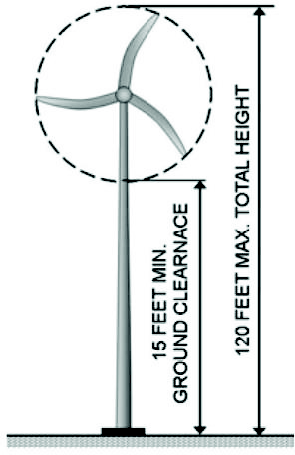
Height. The total height of a SWET shall not exceed 120 feet. Refer to Sketch A.
Small Wind Energy Tower (SWET) Sketch A
ii.
Location. The SWET shall not be located in the required front yard of a property.
iii.
Quantity. No more than one SWET shall be installed on any residentially zoned property. The Planning Commission may allow more SWETs on agriculturally, commercially or industrially zoned or used properties if appropriate. The Planning Commission shall, through a site plan review, consider the size of the parcel, the use of the lot, the location of the proposed WETs, the use of and impact upon adjoining lots, and other relevant factors in determining if additional WETs are appropriate.
iv.
Other setbacks. The setback shall be equal to the total height of the SWET, from the property line, public right-of-way, public easement, or overhead public utility lines.
v.
Electrical system. All electrical controls, control wiring, grounding wires, power lines, and system components shall be placed underground within the boundary of each parcel at a depth designed to accommodate the existing land use to the maximum extent practicable. Wires necessary to connect the wind generator to the tower wiring are exempt from this requirement.
(b)
Permit application requirements.
(1)
Name of property owner(s), address, and parcel number.
(2)
A drawing of the site shall include maps (drawn to scale) showing the proposed location of all components and ancillary equipment of the SMWET(s) or SWET, property lines, physical dimensions of the property, existing building(s), setback lines, right-of-way lines, public easements, overhead utility lines, sidewalks, nonmotorized pathways, roads and contours. The drawing must also include adjoining properties with the location of all structures and the current use of the property.
(3)
The proposed type and height of the SMWET or SWET to be constructed, including the manufacturer and model, product specifications including maximum noise output (measured in decibels), total rated generating capacity, dimensions, rotor diameter, and a description of ancillary facilities.
(4)
Documented compliance with applicable local, state and national regulations including, but not limited to, all applicable safety, construction, environmental, electrical, communications, and FAA requirements.
(5)
Evidence that the utility company has been informed of the customer's intent to install an interconnected, customer-owned generator and that such connection has been approved. Off-grid systems shall be exempt from this requirement.
(6)
Other relevant information as may be reasonably requested.
(7)
Signature of the applicant.
(c)
Safety requirements.
(1)
If the SMWET or SWET is connected to a public utility system for net-metering purposes, it shall meet the requirements for interconnection and operation as set forth in the public utility's service regulations meeting federal, state, and industry standards applicable to wind power generation facilities, and the connection shall be inspected by the appropriate public utility.
(2)
The SMWET or SWET shall be equipped with an automatic braking, governing or feathering system to prevent uncontrolled rotation, over-speeding, and excessive stress on the tower structure, rotor blades and other wind energy components unless the manufacturer certifies that a braking system is not necessary.
(3)
A clearly visible warning sign regarding voltage shall be placed at the base of the SMWET or SWET.
(4)
The structural integrity of the SMWET or SWET shall conform to the design standards of the International Electrical Commission, specifically IEC 61400-1 "Wind Turbine Safety and Design" and/or IEC 61400-2 "Small Wind Turbine Safety," IEC 61400-22 "Wind Turbine Certification," and IEC 61400-23 "Blade Structural Testing," or any similar successor standards.
(d)
Signal interference. The SMWET or SWET shall not interfere with communication systems such as, but not limited to, radio, telephone, television, satellite, or emergency communication systems.
(e)
Decommissioning.
(1)
The SMWET or SWET owner(s) or operator(s) shall complete decommissioning within six months after the WET becomes inoperable. Upon request of the owner(s) or assigns of the SMWET or SWET, and for a good cause, the Pere Marquette Township Board may grant a reasonable extension of time. The SMWET or SWET will presume to be inoperable if no electricity is generated for a continuous period of six months. All decommissioning expenses are the responsibility of the owner(s) or operator(s) or property owner.
(2)
If the responsible party fails to complete decommissioning within the period prescribed above, the Pere Marquette Township Board may designate a contractor to complete decommissioning with the expense thereof to be charged to the property owner to become a lien against the premises.
(f)
Public inquiries and complaints. Should an aggrieved property owner allege that the SMWET or SWET is not in compliance with the requirements of this Ordinance; the procedure shall be as follows:
(1)
Notify Pere Marquette Township in writing regarding their concerns.
(2)
If the complaint is deemed sufficient by the Township to warrant an investigation, the Township will request the aggrieved property owner deposit funds in an amount sufficient to pay the cost of the investigation to determine compliance with the requirements of this Ordinance.
(3)
If the investigation indicates that the WET is within the ordinance requirements, the Township will use the deposit to pay for the investigation.
(4)
If the SMWET or SWET is in violation of the ordinance requirements, the owner(s) shall reimburse the Township for the investigation and take immediate action to bring the SMWET or SWET into compliance which may include ceasing operation of the WET until the ordinance violations are corrected. The Township will refund the deposit to the aggrieved property owner.
(Ord. No. 144, 8-13-2019)
109-29.05 - CONDITIONAL USES.
A medium wind energy turbine(s) (MWET) and a large wind energy turbine(s) (LWET) approved after the effective date of this Ordinance shall require a conditional use permit. In addition to the materials required for all conditional uses, the application shall include the following:
(a)
Siting and design requirements.
(1)
Noise. Turbines shall be designed to eliminate the thumping noise that can occur during operation perceptible beyond the property on which it is located.
(2)
Industry standards. The design of a MWET or LWET shall conform to all applicable industry standards.
(3)
Visual appearance.
i.
Each MWET or LWET, shall be mounted on a tubular tower and along with all accessory buildings and other related structures shall be of a nonreflective, nonobtrusive color (e.g., white, gray, black). The appearance of turbines, towers and buildings shall be maintained throughout the life of the MWET or LWET.
ii.
Each MWET or LWET shall not be artificially lighted, except to the extent required by the FAA or other applicable authority, or otherwise necessary for the reasonable safety and security thereof.
iii.
Each MWET or LWET shall not be used for displaying any advertising (including flags, streamers, or decorative items), except for reasonable identification of the turbine manufacturer or operator(s).
(4)
Vibration. Each MWET or LWET shall not produce vibrations humanly perceptible beyond the property on which it is located.
(5)
Shadow flicker. The MWET or LWET owner(s) and/or operator(s) shall conduct an analysis on potential shadow flicker at any occupied building with direct line-of-sight to the MWET or LWET. The analysis shall identify the locations of shadow flicker that may be caused by the project and the expected durations of the flicker at these locations from sunrise to sunset over the course of a year. The analysis shall identify situations where shadow flicker may affect the occupants of the buildings for more than 30 hours per year, and describe measures that shall be taken to eliminate or mitigate the problems. Shadow flicker on a building shall not exceed 30 hours per year.
(6)
Guy wires. Guy wires shall not be permitted as part of the MWET or LWET.
(7)
Electrical system. All electrical controls, control wiring, grounding wires, power lines, and all other electrical system components of the MWET or LWET shall be placed underground within the boundary of each parcel at a depth designed to accommodate the existing land use to the maximum extent practicable. Wires necessary to connect the wind generator to the tower wiring are exempt from this requirement.
(8)
Additional regulations for MWETs. In addition to the siting and design requirements listed previously, the MWET shall also be subject to the following:
i.
Location. If an MWET is located on an agricultural, commercial, industrial, and public property that has an occupied building it shall only be located in the rear yard. The MWET shall only be located in a general common element in a condominium development.
ii.
Height. The total height of a MWET shall not exceed 150 feet.
iii.
Ground clearance. The lowest extension of any blade or other exposed moving component of a MWET shall be at least 15 feet above the ground (at the highest point of the grade level within 50 feet of the base of the tower) and, in addition, at least 15 feet above any outdoor surfaces intended for human occupancy, such as balconies or roof gardens, that are located directly below the MWET.
iv.
Noise. Noise emanating from the operation of a MWET or shall not exceed, at any time, the ambient sound level, as defined in subsection 109-29.04(a), at any property line of a residential use parcel or from the property line of parks, schools, hospitals, and churches. Noise emanating from the operation of a MWET(s) shall not exceed, at any time, the ambient sound level, as defined in subsection 109-29.04(a)(4), plus five dB(A), at any property line of a nonresidential or nonagricultural use parcel.
v.
Quantity. The number of MWET shall be determined based on setback and separation requirements.
vi.
Setback and separation.
a.
Occupied building setback. The setback from all occupied buildings on the applicant's parcel shall be a minimum of 20 feet measured from the base of the tower.
b.
Property line setbacks. With the exception of the locations of public roads (see below), drain rights-of-way and parcels with occupied buildings (see above), the property line setbacks shall be equal to the total height of the MWET as measured from the base of the tower. This setback may be reduced to a distance agreed upon as part of the conditional use permit if the applicant provides a registered engineer's certification that the WET is designed to collapse, fall, curl, or bend within a distance or zone shorter than the height of the WET.
c.
Public road setbacks. Each MWET shall be set back from the nearest public road a distance equal to the total height of the MWET, determined at the nearest boundary of the underlying right-of-way for such public road.
d.
Communication and electrical lines. Each MWET shall be set back from the nearest above ground public electric power line or telephone line a distance equal to the total height of the MWET, as measured from the base of the tower, determined from the existing power line or telephone line.
e.
Tower separation. MWET/tower separation shall be based on industry standard and manufacturer recommendation.
(9)
Additional regulations for LWETs. In addition to the siting and design requirements listed previously, each LWET shall also be subject to the following:
i.
Ground clearance. The lowest extension of any blade or other exposed moving component of an LWET shall be at least 50 feet above the ground (at the highest point of the grade level within 150 feet of the base of the tower).
ii.
Noise. Noise emanating from the operation of a LWET shall not exceed, at any time, the ambient sound level:
a.
At any property line of a residential use parcel or from the property line of parks, schools, hospitals, and churches;
b.
Plus five dB(A), at any property line of a nonresidential use parcel;
c.
Quantity. The number of LWETs shall be determined based on setbacks and separation.
iii.
Setback and separation.
a.
Occupied building setback. Each LWET shall be set back from the nearest occupied building that is located on the same parcel as the LWET a minimum of 1.5 times its total height as measured from the base of the tower.
b.
Property line setbacks. With the exception of the locations of public roads (see below), drain rights-of-way and parcels with occupied buildings (see above), the property line setbacks shall be a minimum of 1.5 times the total height, as measured from the base of the tower.
c.
Public road setbacks. Each LWET shall be set back from the nearest public road a minimum distance no less than 400 feet or 1.5 times its total height, whichever is greater, determined at the nearest boundary of the underlying right-of-way for such public road.
d.
Communication and electrical lines. Each LWET shall be set back from the nearest aboveground public electric power line or telephone line a distance no less than 400 feet or 1.5 times its total height, whichever is greater, determined from the existing power line or telephone line.
e.
Tower separation. Turbine/tower separation shall be based on industry standards and manufacturer recommendation.
(10)
Access driveway. Each LWET shall require the construction of a private road to offer an adequate means by which the Township or other necessary parties may readily access the site in the event of an emergency.
(b)
Safety requirements.
(1)
If the MWET or LWET is connected to a public utility system for net-metering purposes, it shall meet the requirements for interconnection and operation as set forth in the public utility's service regulations applicable to wind power generation facilities, and the connection shall be inspected by the appropriate public utility.
(2)
The MWET or LWET shall be equipped with an automatic braking or governing system to prevent uncontrolled rotation, over-speeding, and excessive pressure on the tower structure, rotor blades and other wind energy components unless the manufacturer certifies that a braking system is not necessary.
(3)
Security measures need to be in place to prevent unauthorized trespass and access. Each MWET or LWET shall not be climbable up to 15 feet above ground surfaces. All access doors to MWETs or LWETs and electrical equipment shall be locked and/or fenced as appropriate, to prevent entry by nonauthorized person(s).
(4)
All spent lubricants, cooling fluids, and any other hazardous materials shall be properly and safely removed in a timely manner.
(5)
Each MWET or LWET shall have one sign, not to exceed two square feet in area, posted at the base of the tower and on the security fence if applicable. The sign shall contain at least the following:
i.
Warning high voltage.
ii.
Manufacturer's and owner/operator's name.
iii.
Emergency contact numbers (list more than one number).
(6)
The structural integrity of the MWET or LWET shall conform to the design standards of the International Electrical Commission, specifically IEC 61400-1 "Wind Turbine Safety and Design," IEC 61400-22 "Wind Turbine Certification," and IEC 61400-23 "Blade Structural Testing," or any similar successor standards.
(c)
Signal interference. The MWET or LWET shall not interfere with communication systems such as, but not limited to, radio, telephone, television, satellite, or emergency communication systems.
(d)
Decommissioning.
(1)
The MWET or LWET owner(s) or operator(s) shall complete decommissioning within 12 months after the end of the useful life. Upon request of the owner(s) or the assigns of the MWET or LWET, and for a good cause, the PM Township Board may grant a reasonable extension of time. Each MWET or LWET will presume to be at the end of its useful life if no electricity is generated for a continuous period of 12 months. All decommissioning expenses are the responsibility of the owner(s) or operator(s).
(2)
Decommissioning shall include the removal of each MWET or LWET, buildings, electrical components, as well as any other associated facilities. Any foundation shall be removed to a minimum depth of 60 inches below grade. Following removal, the location of any remaining wind turbine foundation shall be identified on a map as such and recorded with the deed to the property with the county register of deeds.
(3)
All access roads to the MWET or LWET shall be removed, cleared, and graded by the MWET or LWET owner(s), unless the property owner(s) requests, in writing, a desire to maintain the access road. PM Township will not be assumed to take ownership of any access road unless through official action of the PM Township Board.
(4)
The site and any disturbed earth shall be stabilized, graded, and cleared of any debris by the owner(s) of the MWET or LWET or its assigns. If the site is not to be used for agricultural practices following removal, the site shall be seeded to prevent soil erosion, unless the property owner(s) requests in writing that the land surface areas not be restored.
(5)
In addition to the decommissioning requirements listed previously, the MWET shall also be subject to the following: If the MWET owner(s) or operator(s) fails to complete decommissioning within the period prescribed above the Township may designate a contractor to complete decommissioning with the expense thereof to be charged to the owner(s) or operator(s) and/or to become a lien against the premises. If the MWET is not owned by the property owner(s), a bond must be provided to the Township for the cost of decommissioning each MWET prior to the issuance of a construction permit.
(6)
In addition to the decommissioning requirements previously listed, the LWET shall also be subject to the following:
i.
An independent and certified professional engineer shall be retained to estimate the total cost of decommissioning ("decommissioning costs") with no regard to salvage value of the equipment, and the cost of decommissioning net salvage value of the equipment ("net decommissioning costs"). When determining this amount, the Township may also require an annual escalator or increase based on the federal consumer price index (or equivalent or its successor). Said estimates shall be submitted to the Township Zoning Administrator after the first year of operation and every fifth year thereafter.
ii.
The LWET owner(s) or operator(s) shall post and maintain decommissioning funds in an amount equal to net decommissioning costs; provided that at no point shall decommissioning funds be less than 100 percent of decommissioning costs. The decommissioning funds shall be posted and maintained with a bonding company or federal or state-chartered lending institution chosen by the owner(s) or operator(s) and participating landowner(s) posting the financial security. The bonding company or lending institution is authorized to conduct such business and is approved by the Township.
iii.
Decommissioning funds shall be in the form of a performance bond made out to PM Township.
iv.
A condition of the bond shall be notification by the bond company to the Township Zoning Administrator when the bond is about to expire or be terminated.
v.
Failure to keep the bond in effect while an LWET is in place will be a violation of the conditional use permit. If a lapse in the bond occurs, PM Township may take action up to and including requiring ceasing operation of the WET until the bond is reposted.
vi.
The escrow agent shall release the decommissioning funds when the owner(s) has demonstrated and the Township concurs that decommissioning has been satisfactorily completed, or upon written approval of the Township in order to implement the decommissioning plan.
vii.
If neither the owner(s) or operator(s), nor the landowner(s) complete decommissioning within the periods addressed previously (decommissioning requirements in subsections (d)(1) and (2) of this section), then PM Township may take such measures as necessary to complete decommissioning. The entry into and submission of evidence of a participating landowner agreement to the Township shall constitute agreement and consent of the parties to the agreement, their respective heirs, successors and assigns that the Township may take such action as necessary to implement the decommissioning plan.
(e)
Site plan requirements.
(1)
Site plan drawing. All applications for an MWET or LWET conditional use permit shall be accompanied by a detailed site plan map that is drawn to scale and dimensioned, displaying the following information:
i.
Existing property features to include the following: property liens, physical dimensions of the property, land use, zoning district, contours, setback lines, rights-of-way, public and utility easements, public roads, access roads (including width), sidewalks, nonmotorized pathways, large trees, and all buildings. The site plan must also include the adjoining properties as well as the location and use of all structures and utilities within 300 feet of the property.
ii.
Location and height of all proposed MWETs or LWETs, buildings, structures, ancillary equipment, underground utilities and their depth, towers, security fencing, access roads (including width, composition, and maintenance plans), electrical sub-stations, and other above ground structures and utilities associated with the proposed MWET or LWET.
iii.
Additional details and information as required by the conditional use requirements of the zoning ordinance or as requested by the Planning Commission.
(2)
Site plan documentation. The following documentation shall be included with the site plan:
i.
The contact information for the owner(s) and operator(s) of the MWET or LWET as well as contact information for all property owners on which the MWET or LWET is located.
ii.
A copy of the lease, or recorded document, with the landowner(s) if the applicant does not own the land for the proposed MWET or LWET. A statement from the landowner(s) of the leased site that he/she will abide by all applicable terms and conditions of the use permit, if approved.
iii.
Identification and location of the properties on which the proposed MWET or LWET will be located.
iv.
In the case of a condominium development, a copy of the condominium development's master deed and bylaws addressing the legal arrangement for the MWET or LWET.
v.
The proposed number, representative types and height of each MWET or LWET to be constructed; including their manufacturer and model, product specifications including maximum noise output (measured in decibels), total rated capacity, rotor diameter, and a description of ancillary facilities.
vi.
Documents shall be submitted by the developer/manufacturer confirming specifications for MWET or LWET tower separation.
vii.
Documented compliance with the noise, and shadow flicker requirements set forth in this Ordinance.
viii.
Engineering data concerning construction of the MWET or LWET and its base or foundation; this may include, but not be limited to, soil boring data.
ix.
A certified registered engineer shall certify that the MWET or LWET meets or exceeds the manufacturer's construction and installation standards.
x.
Anticipated construction schedule.
xi.
A copy of the maintenance and operation plan, including anticipated regular and unscheduled maintenance. Additionally, a description of the procedures that will be used for lowering or removing the MWET or LWET to conduct maintenance, if applicable.
xii.
Documented compliance with applicable local, state and national regulations including, but not limited to, all applicable safety, construction, environmental, electrical, and communications. The MWET or LWET shall comply with Federal Aviation Administration (FAA) requirements, Michigan Airport Zoning Act (MCL 259.431 et seq.), Michigan Tall Structures Act (MCL 259.481 et seq.), and any applicable airport overlay zone regulations.
xiii.
Proof of applicant's liability insurance.
xiv.
Evidence that the utility company has been informed of the customer's intent to install an interconnected, customer-owned generator and that such connection has been approved. Off-grid systems shall be exempt from this requirement.
xv.
Other relevant information as may be requested by the Township to ensure compliance with the requirements of this Ordinance.
xvi.
Following the completion of construction, the applicant shall certify that all construction is completed pursuant to the conditional use permit.
xvii.
A written description of the anticipated life of each MWET or LWET; the estimated cost of decommissioning; the method of ensuring that funds will be available for decommissioning and site restoration; and removal and restoration procedures and schedules that will be employed if the MWET(s) or LWET(s) become inoperative or nonfunctional.
xviii.
The applicant shall submit a decommissioning plan that will be carried out at the end of the MWET's or LWET's useful life, and shall describe any agreement with the landowner(s) regarding equipment removal upon termination of the lease.
xix.
The Township reserves the right to review all maintenance plans and bonds under this Ordinance to ensure that all conditions of the permit are being followed.
xx.
Signature of the applicant.
xxi.
In addition to the site plan requirements listed previously, the LWET shall be subject to the following:
a.
A site grading, erosion control and stormwater drainage plan will be submitted to the Zoning Administrator prior to issuing a conditional use permit for an LWET. At the Township's discretion, these plans may be reviewed by the Township's engineering firm. The cost of this review will be the responsibility of the applicant.
b.
A description of the routes to be used by construction and delivery vehicles and of any road improvements that will be necessary to accommodate construction vehicles, equipment or other deliveries, and an agreement or bond which guarantees the repair of damage to public roads and other areas caused by construction of the LWET.
c.
A statement indicating what hazardous materials will be used and stored on the site.
d.
A study assessing any potential impacts on the natural environment (including, but not limited to, assessing the potential impact on endangered species, eagles, birds and/or other wildlife, wetlands and fragile ecosystems). The study shall conform to state and federal wildlife agency recommendations based on local conditions.
(f)
Certification and compliance.
(1)
The Township must be notified of a change in ownership of a MWET or LWET or a change in ownership of the property on which the MWET or LWET is located.
(2)
The Township reserves the right to inspect any MWET, and all LWETs, in order to ensure compliance with the ordinance. Any cost associated with the inspections shall be paid by the owner/operator of the WET.
(3)
In addition to the certification and compliance requirements listed previously, the LWET shall also be subject to the following:
i.
A sound pressure level analysis shall be conducted from a reasonable number of sampled locations at the perimeter and in the interior of the property containing any LWETs to demonstrate compliance with the requirements of this Ordinance. Proof of compliance with the noise standards is required within 90 days of the date the LWET becomes operational. Sound shall be measured by a third-party, qualified professional.
ii.
The LWET owner(s) or operator(s) shall provide the Township Zoning Administrator with a copy of the yearly maintenance inspection.
(g)
Public inquiries and complaints. Should an aggrieved property owner allege that the MWET or LWET is not in compliance with the noise and shadow flicker requirements of this Ordinance, the procedure shall be as follows:
(1)
Noise complaint.
i.
Notify the Township in writing regarding concerns about noise level.
ii.
If the complaint is deemed sufficient by the Township to warrant an investigation, the Township will request the aggrieved property owner deposit funds in an amount sufficient to pay for a noise level test conducted by a certified acoustic technician to determine compliance with the requirements of this Ordinance.
iii.
If the test indicates that the noise level is within ordinance noise requirements, the Township will use the deposit to pay for the test.
iv.
If the MWET or LWET is in violation of the ordinance noise requirements, the owner(s) shall reimburse the Township for the noise level test and take immediate action to bring the MWET or LWET into compliance which may include ceasing operation of the WET until ordinance violations are corrected. The Township will refund the deposit to the aggrieved property owner.
(2)
Shadow flicker complaint.
i.
Notify the Township in writing regarding concerns about the amount of shadow flicker.
ii.
If the complaint is deemed sufficient by the Township to warrant an investigation, the Township will request the owner(s) to provide a shadow flicker analysis of the turbine as constructed to determine compliance with the requirements of this Ordinance.
iii.
If the MWET or LWET is in violation of the ordinance shadow flicker requirements, the owner(s) shall take immediate action to bring the MWET or LWET into compliance which may include ceasing operation of the WET until the ordinance violations are corrected.
(Ord. No. 144, 8-13-2019)

