
Petal City Zoning Code
ARTICLE VII
SUPPLEMENTARY PROVISIONS
7.0.- Uses.
7.01.
Temporary building. Used in conjunction with construction work only, may be permitted in any district during the period the construction work is in progress.
For a temporary building located upon property upon which the city has issued a valid building permit, the maximum duration for placement of such temporary building shall be 120 days, at which time an extension shall be subject to review by the zoning administrator. An extension may be granted based on a determination of need in order to complete construction.
In the event of a natural disaster, fire, or other accidental event, then a temporary building may remain at a location for the period of time to effect repairs, not to exceed 12 months.
7.02.
Fences, walls and hedges. Notwithstanding other provisions of this ordinance, fences, walls, and hedges may be permitted in any required yard, or along the edge of any yard, provided that no fence, wall, or hedge along the sides or front edge of any front yard shall be over two and one-half feet in height within 20 feet from the street or curb line.
7.02.1.
Fencing standards.
1.
Purpose. The purpose of this section is to regulate the materials, location, height, and maintenance of fencing, landscaping walls and decorative posts in order to prevent the creation of nuisances and to promote the general welfare of the public. In all zoning districts, fences and landscape walls are permitted only in the manner outlined below.
2.
Definitions.
(a)
Fence. An enclosed barrier consisting of wood, stone or metal intended to prevent ingress or egress.
(b)
Landscape wall. A vertical structure or partition that encloses an area or separates two areas.
3.
Applicability. The requirements of this section apply to all fencing, landscape walls and decorative posts equal to, or exceeding, 30 inches in height, for all land uses and activities.
4.
Permit required. No fence or wall shall be installed without first obtaining a permit. Each application for a permit shall be accompanied by a fee in the amount determined by the building official.
5.
Standards.
(a)
Materials.
1.
Residential districts. Acceptable materials for constructing fencing, landscape walls, and decorative posts include wood, stone, preformed concrete block, concrete, brick, wrought iron, chain link, and wire mesh, except that wire mesh fencing is not permitted within required front yard or street yard setbacks. Any fence within a street yard, including along property lines that intersect a right-of-way, shall be a maximum of 60 percent opaque.
2.
Nonresidential districts. Acceptable materials for constructing fencing, landscape walls, and decorative posts include wood, stone, preformed concrete block, concrete, brick, wrought iron, chain link, and wire mesh. Except for industrial security fences, barbed wire fencing shall not be permitted. Any fence within a street yard, including along property lines that intersect a right-of-way, shall be a maximum of 60 percent opaque. Industrial security fencing shall be an open-type fence (e.g. chain link, woven wire, or wrought iron) and may be topped with barbed wire.
3.
Temporary fencing. Temporary fencing for the protection of excavation and construction sites, and the protection of plants during grading and construction and during special events is permitted for up to 60 consecutive days.
(b)
Location.
1.
On all properties, no fence, landscape wall, or decorative post shall be located closer than two feet to the front yard or street yard property line. Fences may be located on any property line abutting a side or rear yard. The property owner is responsible for finding and exposing or establishing through a survey that corner location (property/lot stakes).
2.
No fence, landscape wall, or decorative post which obstructs sight lines over two and one-half feet in height above the survey of the roadbed shall be allowed in a traffic visibility triangle.
(c)
Maximum height. The maximum height of any fence, landscape wall, or decorative post shall be the following:
1.
Fences in excess of 36 inches tall shall not be permitted within a front yard setback or equal to building setback;
2.
Eight feet when located on any residentially zoned property, but not within a required front yard setback or a required street yard setback; and
3.
Ten feet when located on any non-residentially zoned property, but not within a required front yard or a required street yard.
(d)
Orientation. Any and all fences, landscape walls, or decorative posts shall be erected so as to locate visible supports and other structural components toward the inside of subject property to maintain curb appeal.
(e)
Maintenance. Any and all fences, landscape walls, or decorative posts shall be maintained in a structurally sound and attractive manner as determined by the zoning administrator.
(f)
Swimming pools. Fencing for swimming pools shall be provided per the Model Swimming Pool Enclosure Code established by the National Spa and Pool Institute (NSPI), which is available from the zoning administrator.
7.03.
Utility equipment. Power, heating, or refrigerating plants, apparatus, or machinery which are accessory to permitted uses shall be permitted only if placed and operated so as to comply with existing ordinances and not cause serious annoyance or injury to occupants of adjoining premises.
7.04.
Utilities and infrastructure. Existing facilities and installations of public utilities, whether privately or publicly owned, may continue to be operated and maintained in all districts. Poles, transformers, voltage regulators, switches, wires, underground facilities and installations may be constructed, operated and maintained in all districts. Electric substations, electric and telephone switching stations, electric and gas regulator stations, cathodic protection stations, and similar facilities and installations may be constructed, operated and maintained in residential districts if the same can be located in the rights-of-way of streets or alleys, or upon private rights-of-way or easements used in the same manner as streets or alleys, otherwise only after the mayor and board of aldermen shall issue a permit for the same.
Application for any such permit shall be referred to the city planning commission for public hearing and recommendation upon publication of notice for the time and in the manner required by MCA 1972, tit. 17, ch. 1, as amended. The mayor and board of aldermen shall issue such permit if it finds that the use for which such permit is sought, in the circumstances of the particular case and under any conditions considered by the mayor and board of aldermen to be necessary or desirable, will not be injurious to the neighborhood or otherwise detrimental to the public welfare, or if it finds that the use for which the permit is sought is reasonably necessary for the applicant to discharge its responsibility as a public utility.
7.05.
Finding of fact regarding adult entertainment establishments. The planning commission and mayor and board of alderman of the city recognize that there are some uses which, because of their very nature, are recognized as having serious objectionable operational characteristics, particularly when several of them are concentrated under certain circumstances thereby having a deleterious effect upon adjacent areas, such that special regulation of these uses is necessary to ensure that these adverse effects will not contribute to the blighting or downgrading of the surrounding neighborhood. The planning commission and mayor and board of alderman of the city find that there is substantial evidence, including numerous studies, reports, and findings on the potential harmful effect of adult entertainment uses made by other cities, experts, city planners, etc., which document that such uses adversely affect property values, cause an increase in crime, encourage businesses to move elsewhere, and contribute to neighborhood blight. The planning commission and mayor and board of alderman of the city find it necessary, expedient and in the best interest of the citizens of the city to regulate the operation and location of adult entertainment establishments for the purpose of stemming a potential increase in the criminal activities and disturbances of the peace and good order of the community, maintaining property values, preventing injuries to residential neighborhoods and commercial districts, and protecting and preserving the quality of life through effective land use planning.
7.1. - Area.
7.11.
Lot area. Where a lot has an area or frontage less than the minimum requirements for the district in which it is located, but was a lot of record in separate ownership from adjacent property at the time of passage of this ordinance, such lot may be used only for single-family residential purposes or for any non-residential purposes permitted in the district in which the property is located.
7.12.
Exceptions. Except in the case of planned centers and planned developments, only one principal building, together with the customary accessory buildings, shall occupy each lot.
7.13.
Relation to road height requirement. All structures in any zoning district must be built at a minimum one foot above the crown of the road.
7.2. - Height.
7.21.
Height limitation exceptions. The height limitations of this ordinance shall not apply to church spires, belfries, monuments, tanks, water towers, fire towers, stage towers, or scenery lofts, cooling towers, spires, radio or television antennas, chimneys, elevator bulkheads, smoke stacks, oil derricks, conveyors, or flagpoles; except that all uses including above shall comply with the provisions of any applicable governmental height requirements.
7.3. - Yards.
7.31.
Buffer. Where a lot in a commercial or industrial district abuts a lot in a residential district, there shall be provided along such abutting lines a yard equal in width or depth to that required in the residential district.
7.32.
Setbacks in abutting districts. Where the frontage on one side of a street between two intersecting streets is zoned partly as residential and partly as commercial or industrial, the front yard depth in the commercial or industrial district shall be equal to the required front yard depth of the residential district.
7.33.
Visibility at intersections in residential districts. On a corner lot in any residential district, nothing shall be erected, placed, planted, or allowed to grow in such a manner as materially to obstruct vision between a height of two and one-half and ten feet above the centerline grades of the intersecting streets in the sight triangle formed by the street edge-of-pavement lines running back from the street intersection for a distance of 50 feet and joined by an imaginary line crossing the corner of the lot.
7.34.
Measurement of yard requirements. In determining all yard requirements, measurements shall be made from the farthest extrusion of the main building or dwelling, including but not limited to roof, gutter, eave, bay window, covered but unenclosed areas and other similar projections.
7.35.
Setbacks for infill developments. If 40 percent or more of the frontage on the same side of the street between two intersecting streets is improved with buildings that have existing front yards less than that required, no building needs to be set back from the street more than the average front yard depth of such buildings.
7.36.
Zero lot line developments.
7.36.1.
Zero lot line requirements. Zero lot line sub-divisions in the R-1, R-2, R-3, R-4, or R-F zones may be permitted as an exception by the mayor and board of alderman of the city after the preapplication conference has been held and the preliminary plat has been forwarded to the mayor and board of aldermen with the recommendation of the planning commission and the city engineer as required by section 301.05 of the subdivision regulations of the city.
7.37.
Erection of more than one principal structure on a lot. In any district except R-1 and R-2, more than one structure containing a permitted or permissible principal use may be erected on a single lot, provided that yard and other requirements of this ordinance shall be met for each structure as though it were on an individual lot.
7.38.
Structures to have access. Every building hereafter erected or moved shall be on a lot adjacent to a public street, or an approved private street, and all structures shall be so located on lots as to provide safe and convenient access for servicing, fire protection, and required off-street parking. The city is not obligated to extend utilities on private streets or drives or beyond public streets.
7.39.
Parking, storage, or use of major recreational equipment. For purposes of these regulations, major recreational equipment is defined as including boats and boat trailers, travel trailers, pick-up campers or coaches (designed to be mounted on automotive vehicles), recreational vehicles, motor homes, tent trailers, and the like, and cases or boxes used for transporting recreational equipment, whether occupied by such equipment or not. No recreational equipment shall be parked or stored on any residential street. No such equipment shall be used for living, sleeping, or housekeeping purposes when parked or stored on a residential lot, or in any location not approved for such use.
7.4. - Automotive service, filling stations, public garages, new and used car dealers.
In order to regulate and control the problem of noise, odor, light, fumes, vibration, dust, danger of fire and explosion, and traffic congestion which result from the unrestricted and unregulated construction and operation of gasoline service stations, and to regulate and control the adverse effects which these and other problems incidental to the service station may exercise upon adjacent and surrounding areas, the following additional regulations and requirements are provided herein for service stations located in any zone in which they are permitted. All service stations erected after the effective date of these regulations shall comply with all requirements of this section. No service station shall be structurally altered so as to provide a lesser degree of conformity with the provisions of this section than existed on the effective date of these regulations.
1.
A service station shall be located on a lot having a frontage along the principal street of not less than 100 feet, and having a minimum area of not less than 10,000 square feet.
2.
A service station building housing an office and/or facilities for servicing, greasing and/or washing motor vehicles shall be located not less than 40 feet from any street lot line, and not less than ten feet from any other lot line.
3.
All driveways providing ingress to or egress from a service station shall not be more than 35 feet wide at the property line. Not more than one curb opening shall be permitted for each 50 feet of frontage or major fraction thereof along any street. No driveway or curb opening shall be located nearer than ten feet to any corner or nearer than five feet on interior lot line, as measured along the property line. No driveway shall be located nearer than 25 feet, as measured along the property line, to any other driveway giving access to or from the same service station.
4.
A raised curb six inches in height shall be erected along all street lot lines, except for driveway openings.
5.
The entire lot, excluding the area occupied by a building shall be hard surfaced with concrete or plant-mixed bituminous material, or, if any part of the lot is not so surfaced, then that area shall be landscaped and separated from all surface areas by a low barrier or curb.
6.
All lubrication equipment, motor vehicle washing equipment, hydraulic hoists and pits shall be enclosed entirely within a building. All gasoline pumps shall be located not less than 20 feet from any lot line, and shall be arranged so that motor vehicles shall not be supplied with gasoline or serviced while parked upon or over-hanging any public sidewalk, street or right-of-way.
7.
A service station located on a lot having an area of 10,000 square feet, shall include not more than eight gasoline dispensers and two enclosed stalls for servicing, lubricating, greasing and/or washing motor vehicles. An additional two gasoline dispensers and/or one enclosed stall may be included with the provision of each additional 2,000 square feet of lot area.
8.
Where a service station adjoins any property located in any residential zone, or is separated from any such property by a public alley only, a wall or fence six feet in height with not less than 75 percent light penetration shall be erected and maintained along the common lot line or along the alley lot line. All masonry walls shall be protected by a fixed curb or barrier to prevent vehicles from contacting with the wall.
9.
All exterior lighting, including illuminated signs, shall be erected and hooded or shielded so as to be deflected away from adjacent and neighboring property.
10.
Any service activity that is not customarily part of vehicular servicing (e.g. automobiles, trailers, or trucks) shall be prohibited unless and until reviewed by the planning commission and approval is given by the mayor and board of aldermen and in accordance with the following requirements.
a.
At least 30 percent more lot area is needed.
[b.]
Location of these activities shall be on the lot in question and to the rear of the lot.
7.41.
In the case of new and/or used car dealers, not more than ten wrecked vehicles used for parts or to be rebuilt, may be kept on the dealers lot provided that they are behind the principle building used for sales and totally out of the public view. Any question as to what constitutes out of the public view shall be determined by the city building inspector. The intent of this section is to prohibit new and/or used car dealers from becoming or appearing to become a junk yard as defined in section 5.36 of this ordinance.
7.41.1.
Automobile repair, automobile washes and collision and bump shops shall be subject to the following requirements.
1.
Such uses shall have a minimum frontage along the principal street of 150 feet, and a minimum area of 35,000 square feet.
2.
Separation shall be made between the pedestrian sidewalk and vehicular parking and maneuvering areas with the use of curbs, greenbelts and/or traffic islands.
3.
Driveways shall be designed to accommodate the type and volume of vehicular traffic using the site and located in a manner that does not create a traffic safety or congestion problem.
4.
Vehicle sales shall not be permitted on the premises.
5.
Any work including repairs, servicing, greasing and/or washing motor vehicles shall be conducted within an enclosed building located not less than 40 feet from any street lot line, and not less than ten feet from any side lot line.
6.
No more than one curb opening shall be permitted for each 50 feet of frontage or major fraction thereof along any street. No driveway or curb opening shall be located nearer than ten feet to any corner or exterior lot line. No driveway shall be located nearer than 30 feet to any other driveway serving the site.
7.
Outdoor storage or parking of vehicles, except for two private automobiles per indoor stall or service area of the facility, shall be prohibited between the hours of 10:00 p.m. and 8:00 a.m. No junk, debris, abandoned or dismantled automobile or automobile parts or similar material shall be stored or allowed to remain on any lot in any general commercial district.
8.
All outdoor areas used for the storage of motor vehicles waiting for service shall be effectively screened from view from abutting properties and public streets. Such screening shall consist of a solid masonry screening device except for gates, and such screening device shall not be less than six feet in height. Parking areas for employees and customers shall be separate and apart from the storage area.
7.41.2.
Automobile/truck/towing/wrecker service shall be subject to the following requirements:
1.
All vehicles shall be stored in an area surrounded by a six foot standard cyclone fence at a minimum and capable of being locked to prevent casual access.
2.
The area shall be capable of securely storing a minimum of 20 vehicles and a maximum of 50 vehicles in a neat, orderly fashion.
3.
Vehicle sales shall not be permitted on the premises.
4.
No junk, debris, abandoned or dismantled vehicle, vehicle parts, towed vehicle or similar material shall be stored or allowed to remain in any area either inside or outside the required fenced area.
5.
Areas utilized for storage shall be maintained free of all potential vehicle contaminants, such as oil, antifreeze leaks, and kept free of overgrown vegetation.
7.42.
Parking and storage of certain vehicles. No person shall park a vehicle upon a roadway, street, alley, sidewalk or sidewalk area, in a park or in any publicly owned parking area within the city for the principal purpose of:
1.
Displaying such vehicle for sale.
2.
Repairing such vehicle, except repairs necessitated by an emergency.
Whenever a parked vehicle displays a sign or message indicating that it is being offered for sale, such display shall be prima facie evidence that the vehicle is parked for the principal purpose of being displayed for sale. For the purpose of this section, the term "vehicle" shall include any device capable of being moved from place to place upon wheels or tracks, as well as devices capable of being moved on or through water or air, such as boats and airplanes.
7.42.1.
Sale of single vehicle. It shall be unlawful for any commercial establishment in a C0, C1, C2, C3, I1 or I2 zoning district to place for sale any new or used vehicle on their premise without prior approval by the mayor and board of alderman or unless specifically licensed and permitted to do so.
7.43.
Parking and storage of certain vehicles. Automotive vehicles or trailers of any kind or type without current license plates shall not be parked or stored on any zoned property within the city. The parking of commercial vehicles in streets is prohibited in all zoning district. At no time is parking of commercial vehicles allowed on property adjacent to a main city arterial, collector or connector road.
7.44.
Sale of vehicles in residential districts.
No person shall park a vehicle upon private property belonging to another for the principal purpose of displaying such vehicle for sale. It shall be unlawful for the owner of any property located within the city to allow vehicles owned by others to be parked on such property for the principal purpose of being offered for sale.
Whenever a parked vehicle displays a sign or message indicating that it is being offered for sale, such display shall be prima facie evidence that the vehicle is parked for the principal purpose of being displayed for sale. For purposes of this section, the term "vehicle" shall include any device capable of being moved from place to place upon wheels or tracks, as well as devices capable of being moved on or through water or air, such as boats and airplanes.
For the purpose of this section only, it shall be presumed that the persons that parked the vehicle was the registered owner of the vehicle, or was parked with the registered owner's knowledge and permission.
The provisions of this section shall not apply upon land zoned by the city for commercial sales of vehicles through mayor and board approved conditional use permits.
7.45.
Maintenance on private property. The keeping or maintenance in any area on private property which is clearly visible from a public street, sidewalk, park or other public area of any accumulation, collection or untidy storage of any of the following: old appliances or parts thereof; old iron, steel, aluminum or other metal; commercial vehicles, inoperable junk vehicles, vehicle parts, machinery or equipment; mattresses, bedding, clothing, rags, or cloth; straw, packing material, cardboard or paper; tin cans, wire, bottles, glass, cement; wood or timber not neatly stacked or piled; or, in addition to the above articles, any condition judicially determined to be unhealthy after written complaint from a local health officials, a fire hazard after written complaint from a local fire official or an unsightly condition after written complaint from two or more residents within the neighborhood or general vicinity of the condition. This type of public nuisance shall not apply to conditions completely enclosed within a building or fencing so as not to be visible from public property or to construction sites where the progress of construction is proceeding with reasonable diligence and in conformity with existing construction provisions.
7.5. - Sign ordinance.
Section 7.51.
Purpose.
The mayor and board of aldermen of the city find that signs provide an important medium through which individuals and businesses may convey a variety of messages. However, left completely unregulated, signs can become a threat to public safety and a traffic hazard, as well as an obstruction to the aesthetic appeal of the city.
The standards contained in this chapter are primarily intended to balance the needs of businesses and individuals to convey their messages through signs, and the right of the public to be protected against the unrestricted proliferation of signs and their effect on public and traffic safety and the aesthetic qualities of the city. In an attempt to achieve that balance, the purpose of this chapter is to:
1.
Improve the visual quality of the city's streetscape environment through the use of equitably applied sign height, size, and location standards;
2.
Provide minimum, consistent, and enforceable sign standards by regulating sign location, size, height, illumination, construction, and maintenance;
3.
Minimize visual clutter caused by signs by limiting their numbers and duration of use;
4.
Protect citizens safety by prohibiting hazardous signs;
5.
Assure compatibility of signs with surrounding land uses;
6.
Enhance the economy of the city;
7.
Protect the public investment in streets and highways.
Section 7.52.
Scope and definitions. All signs visible from the public right-of-way or private areas open to public travel within the corporate limits of the city shall be within the scope of this chapter. The copy or message of signs is not regulated by this chapter. No sign shall be permitted in the city unless in accordance with the provisions of this chapter or unless determined to be legally nonconforming to the requirements of this chapter.
7.52.1.
Abandoned sign. A sign or sign structure where either: a) the sign is no longer used by the property or sign owner. Discontinuance of sign use may be shown by cessation of use of the property where the sign is located; or b) the sign has been damaged, and repairs and restoration are not started within 45 days of the date the sign was damaged, or are not diligently pursued, once started.
7.52.2.
Billboard (outdoor advertising sign). A form of off-premises sign with a sign face of typically greater than 300 square feet and of a height of greater than 30 feet with advertising space for businesses and services at a location other than the location of the billboard.
7.52.3.
Directional sign. A non-commercial sign generally seen as a street sign designed to provide specific directions to the motoring or pedestrian public.
7.52.4.
Portable sign. A sign that is not permanently affixed to a sign structure, a building, or the ground. Portable signs shall include "snipe" signs, portable flashing arrow signs, and portable reader board signs.
7.52.5.
Sign permit. Requested permission in written form from the city permits office providing specific authorization for placement of a sign.
7.52.6.
Window displays/window signs. An unlighted sign installed inside a window or painted on a window and intended to be viewed from the outside.
7.52.7.
Seasonal decorations. Non-commercial ornaments, banners, signs, or three-dimensional objects intended to convey or celebrate specific holidays or holiday seasons.
7.52.8.
Reader-board sign. A sign or portion of a sign typically illumined by light bulbs or light emitting diodes (LED) intended to convey a specific and customizable message.
7.52.9.
Visible sign face. That portion of a sign with written information or graphics communicating the name, purpose, and/or location of a business.
7.52.10.
Architectural features. Decorative or architectural elements of a sign that exist as part of a sign frame or appurtenance not conveying a commercial or advertising message.
7.52.11.
Freestanding sign. A sign, generally double-faced, mounted on one or two supports above ground level. Also referred to as a pole or pylon sign.
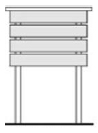
Free Standing Sign
7.52.12.
Monument sign. A freestanding sign of which the entire bottom of the sign is generally in contact with or in close proximity to the ground. Does not include pole or pylon signs.

Monument
7.52.13.
Temporary sign. Signs, banners, displays, posters, etc. intended to be displayed for a short period of time and intended to convey time-sensitive information such as a sale or special event. Temporary signs also include signs designed to convey the location of a new or pending business in anticipation of the development of a permanent business sign.
7.52.14.
Nonconforming sign. A sign existing prior to the adoption of this ordinance that does not meet the provisions and standards of this ordinance.
7.52.15.
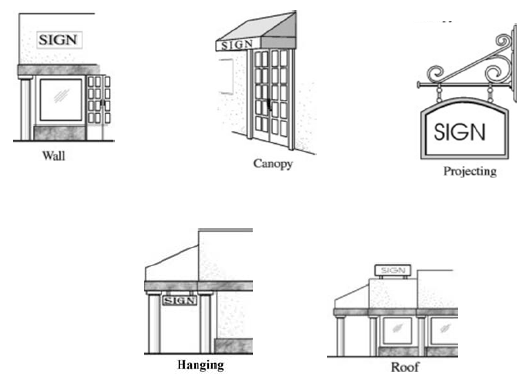
Mounted sign. A sign permanently attached to a building. Mounted signs may take the form of canopy signs (painted, printed, or attached flat against the surface of a canopy or awning), projecting signs (a sign other than a flat wall sign, which is attached to and projects from a building wall or other structure specifically designed to support the sign), roof signs (any mounted sign that projects above the top of a wall, eave, or parapet), hanging signs (a sign that hangs beneath a marquee, canopy, or awning and is perpendicular to the building face), and wall signs (a sign attached parallel to and extending not more than 12 inches from the wall of a building. This definition includes painted, individual letters, and cabinet signs).
Section 7.53.
General provisions.
7.53.01.
Signs prohibited as public nuisance.
7.53.01.1.
Erection of any business sign in any residential or agricultural district, except as provided in this ordinance, shall be prohibited. For the purposes of this ordinance, outdoor advertising (billboards) are not addressed. Specific regulations governing outdoor advertising and billboards are found in Ordinances 2005(3), adopted on September 29, 2005.
7.53.01.2.
Portable signs are hereby declared to be a public nuisance contributing to traffic hazards and visual blight and detrimental to the aesthetic environment of the city, and, therefore, are not permitted within the corporate limits of the city except as expressly permitted through the provisions of this ordinance.
7.53.01.3.
All portable signs shall be removed from the premises within 30 days after the effective date of this ordinance. Provided, however, that a portable sign may be converted to a permanent sign, meeting all requirements of this ordinance, upon application for a variance and approval by the planning commission and board of aldermen.
7.53.01.4.
No business sign shall be erected upon or overhang the street, road or highway right-of-way.
7.53.01.5.
Pennants, spinners, streamers, balloons and similar devices conveying a commercial message shall not be permitted upon any property or attached to the exterior of any building, upon any pole, tree or other structure. This section is not intended to regulate non-commercial displays intended for special events or occasions such as open houses, grand openings, or ribbon cuttings.
7.53.01.5(a).
All banners, pennants, spinners, streamers, and similar devices not in compliance with this ordinance, shall be removed from the premises within 30 days after the effective date of this ordinance.
7.53.02.
Exempted signs.
7.53.02.1.
The following signs and devices shall not be subject to the provisions of this chapter and are exempt from required permits. Use of these signs does not affect the amount or type of signage otherwise allowed by this chapter. All signs listed in this section are subject to all other applicable requirements of this chapter.
7.53.02.1(a).
Official signs placed or official signs authorized by the city, county, state, or federal government in the publicly-owned right-of-way;
7.53.02.1(b).
Flags of national, state, or local government;
7.53.02.1(c).
Window displays and signs;
7.53.02.1(d).
Seasonal decorations on private property;
7.53.02.1(e).
Signs erected by a recognized neighborhood watch group;
7.53.02.1(f).
Signs for hospital or emergency services and railroads;
7.53.02.1(g).
An exterior sign erected next to an entrance, exit, rest room, office door or other building feature, provided the sign is no more than four square feet in area. This type of sign is typically used to identify and locate a property feature;
7.53.02.1(h).
Any sign which is not visible to motorists or pedestrians on any public highway, sidewalk, street, alley, or other area open to public travel;
7.53.02.1(i).
Signs placed in or attached to a motor vehicle, bus, or other motorized vehicle that is regularly used for purposes other than the display of signs;
7.53.02.1(j).
Signs up to four square feet and no taller than two feet, constructed or placed within a parking lot. These signs are typically used to direct traffic and parking;
7.53.02.1(k).
A sign that does not exceed four square feet in area and four (4) feet in height, and is erected to communicate a danger to the public or in areas to which public access is prohibited.
7.53.02.1(l).
Real estate signs communicating the availability of residential, commercial or other real property for sale, rent, or lease. Providing however, that no such sign shall be of a size in excess of four feet by eight feet. All other provisions of this ordinance relating to sign height and placement shall apply to real estate signs.
7.53.03.
Setback requirements.
7.53.03.1.
Business signs may be erected no closer than ten feet from any street, road or highway pavement edge or curb line, nor within any public right-of-way.
7.53.03.2.
Business signs may be erected no closer than 100 feet from any property zoned or used for residential purposes or from any residential portion of a planned unit development.
7.53.04.
Visibility.
7.53.04.1.
Business signs may be erected no closer than ten feet from any street, road or highway pavement edge or curb line, provided, however, that no business sign shall be erected upon or overhang the street, road or highway right-of-way.
7.53.04.2.
All business signs located between ten and 20 feet of any street, road or highway pavement edge or curb line, which obstructs visibility within an area measured between two and one-half and nine feet above the ground line, shall be located at least ten feet away from any entrance driveway located upon the premises or any entrance driveway situated upon adjacent property.
7.53.05.
Lighting.
7.53.05.1.
All lighted or illuminated signs shall be so constructed as to prevent any undue glare in any direction, which may interfere with traffic or become a nuisance to adjoining property. No sign or similar device shall flash or move with the exception of reader-board signs conforming to the provisions of section 7.53.05.2 of this ordinance.
7.53.05.2.
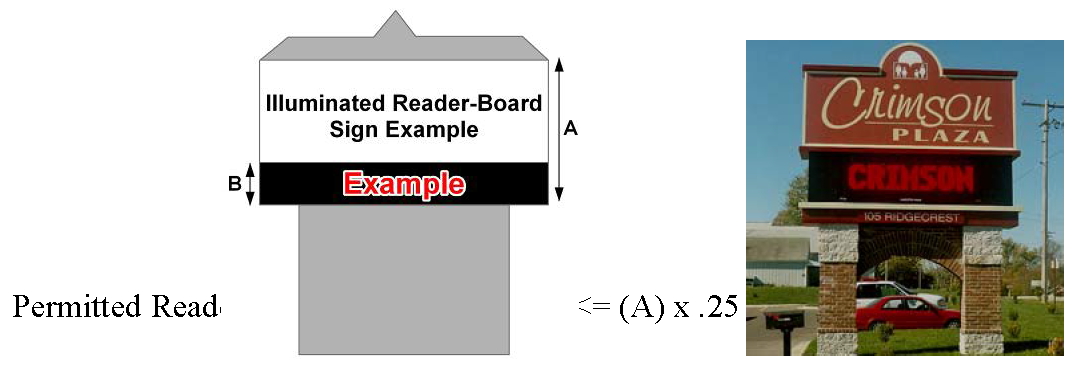
LED, illuminated or animated reader-board signs. Reader-board signs of the type illustrated in figure 7.53.5.1 below shall conform to the following:
7.53.05.2(a).
Animated reader-board signs are permitted providing that the overall height of the reader-board section of the sign does not exceed one-third or 33 percent of the overall sign height as determined through the provisions of section 7.53.07.1 of this ordinance.
7.53.05.2(b).
Animated reader-board signs may have multi-colored bulbs as the source of illumination for the reader-board component of the sign.
7.53.06.
General regulations.
7.53.06.1.
Temporary signs shall be permitted in all districts, provided that such signs shall meet the setback and visibility requirements of section 7.53.11.1 of this ordinance.
7.53.06.2.
Signs for churches, religious, or cultural institutions shall meet the setback and visibility requirements for business signs as required by this ordinance.
7.53.06.3.
One flagpole shall be allowed for each business for display of official flags of the United States and/or the State of Mississippi. Flags depicting commercial messages on an approved flagpole shall be included in the total number of allowed signs per premises as outlined in section 7.53.10. Maximum allowed height for flagpoles shall be 30 feet with a maximum allowable flag size of five feet by eight feet.
7.53.06.4.
On-premises directional signs not exceeding two square feet may be erected in any district, provided they are not within the right-of-way of any street.
7.53.06.5.
Business signs may be placed inside buildings or affixed or painted upon the windows or glass doors of any building.
7.53.06.6.
Business signs shall not be permitted to be located closer than 100 feet from any property used or zoned for residential purposes.
7.53.06.7.
Signs shall not be erected or maintained within a public street right-of-way, upon trees or utility poles, or painted or drawn upon rocks or natural features, nor upon any motor vehicle or tractor trailer parked in the front setback of any business or directly adjacent to any public right-of-way.
7.53.06.8.
Apartment complexes may have one monument sign not to exceed eight feet in height and 24 square feet in sign area. In addition, one wall sign not to exceed 20 square feet in sign area shall be permitted.
7.53.06.9.
In the commercial office (CO) district, one monument sign not to exceed eight feet in height and 24 square feet in sign area. In addition, one wall sign not to exceed 20 square feet in sign area shall be permitted.
7.53.06.10.
Political signs are to be limited to one sign per candidate per premises not to exceed 16 square feet, with the exception of signage placed on outdoor advertising (billboard) signs. No sign shall be permitted on private property without permission of the owner. Signs may be posted once a candidate qualifies for the election and must be removed ten days after any election to which the sign refers. Placement of political signs shall be limited to the ward or jurisdiction in which the candidate is qualified to run for election.
7.53.06.11.
Garage sale, yard sale, and like signs shall not be erected on public property right-of-way and may be erected on private property only with the permission of the property owner. Signs shall be promptly removed immediately after the event to which it refers.
7.53.06.12.
Temporary signs for new businesses shall be allowed for a period of 30 days at no cost while the permanent sign or sign(s) are being made or installed. Subsequent 30-day extensions for temporary signs may be obtained by contacting the permits office on or before the end of the initial 30-day permitted period and on or before the end of each 30-day extension granted.
7.53.06.13.
Material specifications. Permitted signs shall be constructed only of the following materials:
7.53.06.13(a).
Incombustible materials. Corrosion resistant metal or other incombustible materials.
7.53.06.13(b).
Plywood of not less than ⅜" thickness or medium or high density fiberboard of not less than ⅛" in thickness.
7.53.06.13(c).
Approved plastics of a thickness and shape necessary to withstand loadings and fire resistance in accordance with adopted international codes.
7.53.06.13(d).
Glass. Signs of 300 square inches and less may use double strength glass (⅛" thickness). Signs over 300 square inches shall be at least ¼" thick and shall have a maximum span between supports of four feet.
7.53.06.13(e).
Wood structure. The framework and structure of permitted signs may be of wood providing that any portion of the framework and/or structure coming into contact with the ground be of treated materials.
7.53.06.13(f).
Metal structure. All permitted signs of 150 square feet or over shall be of metal construction and shall have no more than two structural supports.
7.53.06.14.
Landscaping requirements. Landscaping to be installed directly adjacent to or surrounding a monument or freestanding sign shall be included as part of the sign permit application or as part of an overall landscape plan for new construction.
7.53.06.15.
Any sign of a type, size, orientation, material composition or location not expressly permitted in this ordinance shall be considered a conditional use and shall be subject to a conditional use review by the city planning commission.
7.53.07.
Size of signs.
7.53.07.1.
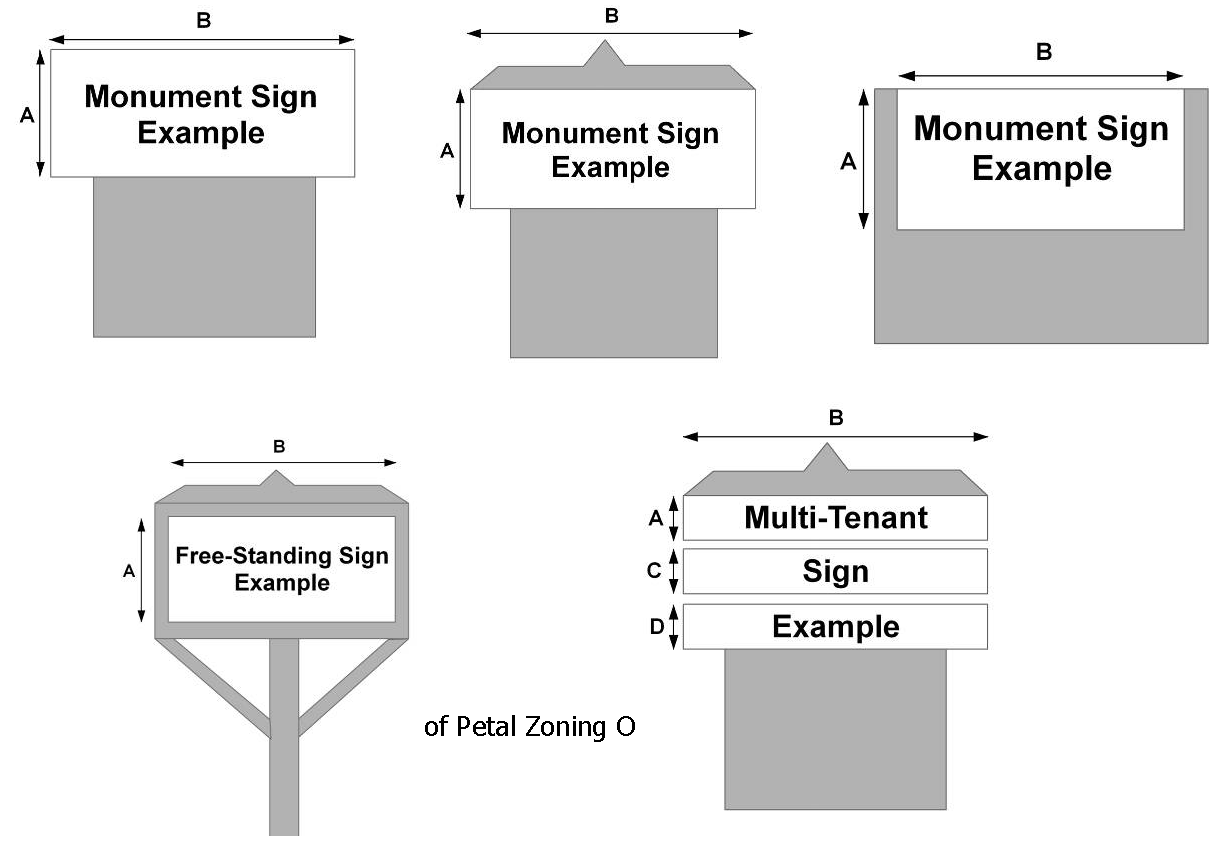
Calculating total area of any business sign whether freestanding, mounted, or painted upon the outside wall or canopy of a building shall be by means of the smallest square or rectangle encompassing the extreme limits of the writing, representation, emblem, or other display, together with any material or color forming an integral part of the background of the display, or used to differentiate the sign from the backdrop or structure against which it is placed, but not include any architectural features, supporting framework, bracing or other means of support.

7.53.07.1(a).
The total sign area for any freestanding or projecting sign with one or more faces shall be computed by adding together the area of all visible sign faces.
7.53.07.1(b).
The total sign area for wall-mounted signs shall be based upon the width of the front, sides, or rear of any building.
7.53.08.
Maximum sign area.
7.53.08.1.
The maximum sign area for such freestanding or projecting business signs shall be 120 square feet per sign face for a maximum total aggregate of 240 square feet.
7.53.08.1(a).
Provided also, that freestanding business signs located greater than 500 feet of the nearest edge of the primary travel lanes of the Evelyn Gandy Parkway may contain a maximum of 280 square feet.
7.53.08.1(b).
Shopping center entrance signs displayed as a multi-tenant sign may contain additional square footage not to exceed 20 square feet for each business located within the shopping center when such additional footage is devoted exclusively to individual businesses located within such shopping center and when no additional freestanding signs are to be erected.
7.53.08.2.
Wall-mounted business signs shall not exceed one and one-half square foot in area for each one linear foot of building (front, rear or side) for buildings located within 30 feet from the edge of the street.
7.53.08.2(a).
For buildings located more than 30 feet from the edge of the street, two square feet of sign area for each one linear foot of building (front, side or rear) shall be permitted.
7.53.08.2(b).
The maximum for all wall or canopy-mounted signs shall be 200 square feet. Whenever canopies are used for determining the total sign area, no signs shall be mounted upon the building.
7.53.09.
Sign height.
7.53.09.1.
No freestanding business sign shall exceed a height of 20 feet.
7.53.09.2.
Provided however, that freestanding business signs located greater than 500 feet of the nearest edge of the primary travel lanes of the Evelyn Gandy Parkway may be erected to a height not to exceed 30 feet.
7.53.09.3.
No sign attached to any building shall project above the roofline of such building.
7.53.10.
Number of signs.
7.53.10.1.
The number of freestanding signs shall be limited to one per lot provided that where a lot has frontage on two public streets and has a minimum frontage of 300 feet on either street and a combined frontage greater than 650 feet, the number of freestanding signs may be increased to two.
7.53.10.2.
The number of wall signs shall be limited to two signs and shall include business identification, logo or product advertising signs. Window coverings such as canopies, awnings, etc. that display business advertisement shall be included in the calculation of the number of signs.
7.53.11.
Special provisions.
7.53.11.1.
Temporary advertising signs, banners, displays, posters, etc., shall be permitted for a short duration only. These signs may be erected seven days before a sale or event to which they refer, and must be removed two days after the event or sale. However, unless otherwise provided in this ordinance, no such sign shall be displayed for more than 15 total days. No individual or business may display more than one temporary advertising signs at any one time.
During the annual "Shop Petal First" campaign and the traditional holiday shopping season extending from the Friday after Thanksgiving through December 31, temporary signs may be displayed on a continuous basis (more than 15 total days). However, all temporary signs displayed during these time periods shall conform to other provisions of this section and shall be limited to one temporary sign per premises.
Temporary advertising signs, banners, displays, posters, etc., shall not exceed four feet in height and eight feet in length. No permit fee shall be required if the temporary advertising is for a non-profit organization advertising civic events for the citizens of Petal, except that if the non-profit organization constructs such a sign prior to obtaining a permit and/or does not remove such a sign within the time requirements, the permit fee shall be required.
Failure to remove any temporary advertising sign, banner, display or poster within the time requirements set forth herein is punishable by a fine to the permit holder in an amount not to exceed $25.00 per day of such violation. Each day the temporary advertising sign, banner, display or poster is not removed within the time frame set forth herein shall constitute a separate violation.
7.53.11.1(a).
A permit shall be obtained to erect any temporary banner unless otherwise provided in this ordinance.
7.53.11.1(b).
Temporary banners shall be limited to 32 square feet.
7.53.11.1(c).
No permit for temporary advertising signs or temporary banners is required of any business holding a valid city business privilege license, except that if the business constructs such a sign that is not in compliance with this ordinance and/or does not remove such a sign within the time requirements, the permit fee shall be required.
7.53.12.
Specific regulations in the downtown district.
7.53.12.1.
Notwithstanding any other provisions of this ordinance, business signs located within the downtown district may project over public street rights-of-way, provided however, that all such signs shall maintain a clear height of eight feet above the sidewalk and shall not project more than 42 inches from any building or within 24 inches of any curb line or pavement edge.
7.53.12.2.
In instances where off-street parking is provided in the front of any building located within the central business district, no sign shall be erected which obstructs visibility in an area measured within two and one-half feet and nine feet from the ground line, and within 20 feet of the street, road, or highway pavement edge or curb line.
7.53.13.
Specific regulations for professional business signs.
7.53.13.1.
One sign shall be permitted for each professional office.
7.53.13.2.
Signs for professional offices, which may be permitted in residential districts, shall not exceed eight square feet in area or two and one-half feet in height.
7.53.13.3.
Signs for home occupations shall be limited to one wall-mounted sign not to exceed two square feet in size.
7.53.14.
Specific regulations for fuel service station pump signs.
7.53.14.1.
Any fuel service station pump signs or pricing sign erected or displayed shall conform to the following regulations and requirements:
7.53.14.2.
Fuel service station pump signs. Fuel service station pump signs may be displayed on fuel pumps to provide required information to the public regarding the available fuel such as "gallons," "price," "octane rating" and "type of fuel." If a trade name of the business or supplier is incorporated into the name or designation of the different types of fuels available, said trade name and any associated symbols therewith may be displayed on the pumps provided that such signs are do not exceed three square feet per sign face and an aggregate area of six square feet of sign face per pump.
7.53.14.3.
Pricing signs. A sign advertising the price of motor fuel, other than pump signs, shall be permitted provided that such sign shall not exceed 12 square feet of sign face per sign with an aggregate sign face area of 24 square feet per sign. Such sign shall not exceed five feet in height, if freestanding. One such sign per premise frontage shall be allowed with a maximum of two such signs per premises.
Pricing signs attached to or part of a permanent freestanding sign identifying the premises shall not be allowed without permit and shall conform to the requirements of freestanding signs as outlined in this ordinance.
Pricing signs made a part of a freestanding identification sign when no additional freestanding pricing signs are placed on the premises may be allowed in excess of the allowable square footage of identification signage, provided that the maximum square footage for the premise is not exceeded in total signage.
7.53.15.
Electrical sign regulations.
7.53.15.1.
Electrical code. All electrical signs shall be built and installed in compliance with the National Electrical Code and the International Code Council. All electrical wiring for signs shall be permanently installed and placed underground in metal conduits in accordance with the National Electrical Code.
7.53.15.2.
Licensing. Electrical signs may only be installed by an electrician licensed by the city.
7.53.15.3.
Electrical sign permitting. The following shall be required prior to the issuance of an electrical permit in conjunction with the erection of an electrical sign:
1.
Wiring schematic or plan fully describing the electrical work to be done.
2.
Compliance with U.L. Standards for electrical work to be done.
7.53.16.
Sign permit required.
7.53.16.1.
Sign permit required. Unless otherwise provided in this ordinance, before any person or firm shall erect, place, hang, or otherwise install any sign not exempt from this ordinance, he shall apply for a permit covering such operations. The cost of such permit shall be as required by the building department and the holder of said permit is required to furnish an application to the administrative official together with diagrams, drawings, or graphics depicting the following:
7.53.16.2.
The sign location, size, character, height, setback, and proposed landscaping for each and every sign to be installed.
7.53.16.3.
Exemptions. No permits shall be required for incidental signs, signs inside buildings or attached to or painted upon windows or glass doors.
7.53.16.4.
Electrical inspection fee. An electrical inspection shall be required in conjunction with the erection of an electrical sign. This fee is in addition to the permit fee required under section 7.53.15.5. Such fees are hereby set as:
1.
$25.00—To cover the cost of one electrical inspection.
2.
$25.00—Shall be charged for each reinspection required.
7.53.16.5.
Permit fees. At the time of submission of an application for a sign permit, a non-refundable plan review application fee of $10.00 shall be paid. When an application for a sign permit is approved and prior to the issuance of a permit, a permit fee shall be paid in addition to the plan review application fee based on the following schedule of rates:
7.53.17.
Nonconforming signs.
7.53.17.1.
All nonconforming signs shall be modified to conform with these regulations, or shall otherwise be removed when the nature or name of the business which the sign advertises is changed and/or if the sign is to be changed or modified, either in shape, size, message, or if the face of the sign is replaced, provided however, that advertising messages on nonconforming outdoor advertising signs may be changed, not withstanding the provisions of this section.
7.53.17.2.
Any sign not conforming to the provisions of this ordinance which is destroyed or severely damaged, as determined by the administrative official, shall not be repaired or replaced except in conformity with this ordinance.
7.53.17.3.
Any sign conforming with the provisions of this ordinance which becomes unsafe, hazardous, insecure or in danger of falling shall be removed or repaired by the owner, or the owner of the property upon which such sign is located within 14 days of receipt of written notice from the building official or code enforcement officer.
7.53.18.
Abandoned signs.
7.53.18.1.
If it shall appear and the building official or code enforcement officer of the city in charge of zoning shall find that a sign has been abandoned or is in nonuse, or for billboards, not leased for a period in excess of 180 days, he shall notify in writing, the owner of the land together with the owner of the sign if known, to remove the sign within 30 days of said notice. If same is not removed the city may demolish said sign and bill the sign owner and land owner jointly and severally for the cost of said destruction or removal. Commercial buildings or properties being actively marketed for sale, rent, or lease shall be exempt from the provisions of this section.
7.54.
Enforcement and administration. The provisions of this ordinance shall be enforced and administered by the building inspector. The building inspector or code enforcement designee shall have the power and authority to make inspections of signs, sign structures or premises necessary to carry out their duties in the coordination and the enforcement of the provisions of this ordinance.
7.54.01.
Violation.
7.54.01.1.
In case any sign structure or sign is erected or structurally altered or maintained or used in violation of the provisions of this ordinance, any proper city official or his or her duly authorized deputies or representatives may institute any appropriate action or proceedings to prevent such unlawful act or to prevent any illegal act, conduct or use in or about or concerning any such sign, sign structure or premises. Each day any such violation continues shall constitute a separate violation of this ordinance. The building inspector may call upon the chief of police to furnish necessary personnel to carry out his orders.
7.54.01.2.
Any resident of the community who believes that a violation of any of the provisions of this ordinance is occurring may file a written complaint with the building inspector. Such complaint shall fully set forth the acts or omissions constituting the alleged violation and the site or sites at which such violation or violations are alleged to be occurring. The building inspector shall record properly such complaint, investigate the allegations underlying said complaint, and take action on such complaint and investigation as provided by this ordinance.
7.54.02.
Penalty. Any person violating any provision of this article shall be guilty of a misdemeanor, and upon conviction shall be punished as provided for as follows:
1.
A violation of any of the provisions of this ordinance may result in a civil fine of $100.00 per day per unit for each day that such violation continues up to 30 days, or the maximum amount allowed under the Mississippi Annotated Code of 1972 as amended, whichever is greater.
2.
The city may file a lien against residential rental property if the owner of such property or his agent fails to pay a fine within 30 days of the date in which it was imposed. The amount of the lien may be calculated on the basis of the existing fine plus associated costs including legal fees incurred in connection with this action.
3.
Nothing herein shall prevent the city from seeking any other means available at law or in equity in order to enforce this ordinance's provisions.
7.6. - Accessory structures and uses.
7.61.
Purpose. The uses of land, buildings, and other structures permitted in each of the districts established by this zoning ordinance are designated by tables or lists of principal uses permitted. In addition to such principal uses, this section shall regulate uses incidental to any principal uses permitted in the district. All setbacks, parking areas and accessory structures shall be so landscaped, located and constructed so as not to interfere with the use of the surrounding property. Outside storage areas, service, and machinery installations, service areas, truck loading areas, utility buildings, carports and structures, and similar accessory areas and structures shall be subject to such setbacks, screen plantings, or other screening methods as shall reasonably be required to prevent any adverse effect upon the environment or nearby property.
7.62.
General provisions. Each permitted accessory use shall:
1.
Be customarily incidental to the principal use established on the same lot.
2.
Be subordinate to and serve such principal use.
3.
Be subordinate in area, extent, and purpose to such principal use.
4.
Contribute to the comfort, convenience, or necessity of users of such principal use.
5.
Be required to submit a site plan in order to review proposals for accessory uses, unless otherwise noted.
7.63.
Permitted accessory structures and uses. Accessory structures and uses shall be permitted as specified above, and such accessory uses shall be applicable to the principal use of the lot as follows:
1.
For dwellings:
a.
Shelter to house animal pets. No site plan or building permit required unless size of structure warrants.
b.
Children's playhouse and playground equipment. No site plan or building permit required unless playhouse includes plumbing and electricity. All playhouses and playground equipment must be located in the rear yard. All tree houses require a site plan and permit.
c.
Private greenhouse, vegetable, fruit, or flower garden, from which no products are sold or offered for sale.
d.
Private garage or carport. Cannot be temporary, modular or pre-fabricated in nature and must be built in accordance with materials utilized with the primary structure.
2.
Private swimming pool and bath house.
3.
Shed for the storage or maintenance of recreation and yard equipment used on the premises.
4.
Private tennis court.
5.
Hobby workshop.
6.
Qualifying guest house.
7.
Fallout, bomb and severe weather shelters.
8.
Radio broadcast towers for hobbyists.
9.
Satellite dishes, in rear yards only.
10.
See residential districts for other structures.
11.
For church, chapel, temple or synagogue:
a.
Parish house, or residence for the clergy of the congregation.
b.
Religious education building.
c.
Class B child care center.
12.
For golf and country clubs:
a.
Dwelling for caretaker.
b.
Maintenance equipment storage shed.
c.
Pro shop.
d.
Lounge and dining area.
13.
For industrial uses in the industrial districts:
a.
Offices.
b.
Restaurant or cafeteria.
c.
Watchmen's quarters.
d.
Research or pilot structure.
7.64.
Location of accessory buildings and structures.
1.
No accessory buildings shall be located in any required front yard, but must be located in the side or rear yard.
2.
Accessory buildings shall not cover more than 30 percent of any rear yard and shall be at least ten feet from all rear and side lot lines and ten feet from any other building on the same lot.
3.
On any corner lot adjoining in the rear another lot which is in a residential district, accessory buildings within the rear yard shall conform to the side yard setback on corner lots as indicated in the specific residential zoning setbacks contained within this ordinance.
7.65.
Nonconforming accessory uses and structures. If a principal nonconforming use or structure ceases to exist, neither shall any of its accessory uses or structures continue, unless such accessory use or structure shall thereafter conform to all the regulations of the zoning district in which it is located.
7.66.
Limitation on commercial uses. Except in the case of a home occupation, no accessory use shall be of a commercial nature.
7.7. - Buffer yards/screening standards.
7.71.
Purpose and intent. The purpose and intent of the buffer/screening standards is to maintain many of the environmental features and amenities of the city for present and future generations. Adherence to these regulations will improve the appearance and compatibility of land uses and other development within the city through the installation and maintenance of plantings and fencing for screening and aesthetic effects, thereby serving to protect and preserve the appearance, character, value and safety of the total urban area and nearby properties. Attractive, well-maintained buffer yards improve the quality of development. They can also alleviate development disputes by reassuring neighboring property owners that the adjacent project will remain relatively unobtrusive. It is intended that these provisions shall constitute minimum requirements.
7.72.
Purposes of buffer yards and screens. The purpose of a buffer yard is to provide a space or distance between two incompatible uses. The purpose of screening is to provide an effective visual barrier between an unsightly or distracting activity and adjacent properties or public ways to preserve property values and assure compatibility of uses. It is also the purpose of these provisions to prescribe standards for development and maintenance of planting, fences, and walls, for the conservation and protection of property through provision of barriers against traffic, trespass, noise, heat, glare, and dust, and through improvement of the appearance of individual properties, neighborhoods, and the city. These standards shall apply to all landscaping and screening required by other provisions of the zoning regulations.
7.73.
General standards. Whenever any lot which is located in any commercial or industrial zone, and which is occupied by commercial, manufacturing, or agricultural or mining activities; and abuts a lot located in any residential zone, it shall be screened from the residentially zoned lot along the entire abutting lot line except where a driveway or maneuvering aisle is shared with the abutting lot. Screening shall be subject to the standards for required landscaping and screening. A site plan shall be required showing the proposed screening or buffering.
7.74.
Site plan standards. Buffer yards and screens require site plan review. Such required site plan shall set forth yards and open spaces, screening walls, or fences and other development and protective requirements considered necessary to create a reasonable transition to and protection of the adjacent property. When the developer needs to ask for a variance from these buffer yard regulations, an alternative design plan which shall fulfill the intent of this ordinance must be submitted to the site plan review committee, which will, upon review, make a recommendation regarding the submission. Variances shall not be granted, which are less than the next lowest minimum standard, and only then if the size of the lot is such that a full buffer is not possible. The site plan should show plant succession, drainage patterns, and landscape design in order to determine if the trees/vegetation grow well in this region, and also if they make good visual screens.
7.75.
Buffer yard standards relating to abutting properties. In the table below, when a district abuts a use indicated, a buffer yard and screen shall be provided by the developing use applying for a building permit as listed:
TABLE INSET:
A buffer yard of the minimum width, unbroken except for vehicular and pedestrian access way shall be located parallel to the property line.
7.76.
Screening relative to abutting properties. In the table above, when a district abuts a use indicated, screening shall be provided as listed. Screening/fencing may consist of architectural and/or vegetative materials as follows:
1.
Architectural screening. A screen/fence of wood, masonry, stone, concrete or metal may be placed along the property line or along the inner perimeter of the buffer yard so as to provide visual screening at minimum height requirements, at the time of issuance of the certificate of occupancy.
2.
Vegetative screening. Trees and other vegetation as needed, shall be planted so as to provide year-round visual screening at heights required by Table 7.75. If screening is exclusively vegetation, minimum height requirements shall be met at the time of issuance of the certificate of zoning compliance. Earthen berms are considered a part of vegetative screening.
3.
Combination of materials. Whenever two or more alternative types of landscaping, fences, or walls are prescribed, they may be provided singly or in any combination.
7.77.
Installation and maintenance.
All buffer yards and screening shall be installed in a sound workman-like manner and according to accepted good planting procedures with the quality of plant material as herein described. All screening elements of buffer yards shall be installed so as to meet all other applicable ordinances and code requirements. Buffer yards shall require protection from encroachment. (Encroachment is defined as any protrusion of a vehicle outside of a parking space, display area or access way into a buffer yard).
The owner shall be responsible for the maintenance of all buffer yards which shall be maintained in good condition so as to present a clean and orderly appearance.
In the event that plants are destroyed or die of natural causes, such materials shall be replaced within six months. Failure of the owner of the property to maintain the buffer yard in good condition, as set forth above, shall subject him to the penalties as set forth in this ordinance.
No buffer yard shall be abandoned, paved, or otherwise employed for purposes other than screening.
7.77.
Visibility at intersections. See section 7.33.
7.78.
Intersection of driveway and public ROW and/or private street. In any district, nothing shall be erected, placed, planted, or allowed to grow in such a manner as to materially impair or block vision between a height of two and one-half and ten feet above the center line grades of any intersecting street/driveways in the area bounded by the street lines/driveway lines of such corner and a line joining points along said street lines 15 feet from the point of intersection.
7.79.
Credit for existing plant material. If the owner(s) can demonstrate that healthy plant material exists on a site prior to its development for the purposes of buffer yard, the application of the above landscape standards may be adjusted by the site plan review committee to allow credit for such plant material if such an adjustment is in keeping with and will preserve the intent of this ordinance.
7.791.
Planned district standards. Fences, walls or vegetative screening shall be provided at the perimeter of planned developments where necessary to screen improvements, glare, uses or other influences having an adverse impact either on the planned development or on adjacent property. Such screening shall be of sufficient height as determined by the topography to improve the impact of such adverse elements on the first floor of any use located either within or adjacent to the planned development.
7.792.
Zone screening standards. A screen (wall, fence, or landscaping) not less than six feet in height shall be erected between commercially zoned property and abutting residentially zoned property at the time that any building or structure is erected on the commercial property. The height of the screening shall be the vertical distance measured from the top of the screen to the lowest point to grade within three feet of such screen on the commercially zoned property. The screening shall be constructed on or immediately adjacent to the line dividing the residential and commercial properties. A new screen shall not be required where there is an existing screen, which substantially conforms to this section, on the abutting residential property. If the existing screen on abutting residential property is the only screen that conforms to this section, and if it is removed, a new screen shall be required.
7.793.
Fencing and landscape standards. The screening required herein shall consist of a solid fence or wall at least 50 percent opaque and not less than six nor more than eight feet in height, but shall not extend within 15 feet of any street or driveway opening onto a street. The screening shall be placed along the property lines or in case of screening along a street, 15 feet from the street ROW with landscaping (trees, shrubs, grass, and other planting) between the screening and the pavement. A louvered fence shall be considered solid if it blocks direct vision. Planting of a type approved by the site plan review committee may also be required in addition to, or in lieu of, fencing.
7.794.
Disposal and area screening. A masonry, concrete or wooden wall may be provided around all sides of commercial, industrial, and multifamily residential trash containers, which shall be provided with a gate for access and be of such height as to completely screen said containers, the maximum height of which shall not exceed six feet; provided, however, that in multifamily districts, the trash containers may be enclosed so as to block a person's view thereof by fencing, screening or a combination thereof, instead of the masonry or concrete walls. Any plan concerning screening or fencing shall be approved by the site plan review coordinator, with his approval being based upon whether the screening is adequate so as to block the view of said containers.
Existing screening, which complies with minimum standards, may be used to meet the requirements of this ordinance.
7.795.
Exceptions to screening requirements. The landscaping and screening requirements set forth in other provisions of the zoning regulations shall be subject to the following exceptions:
1.
Equivalent screening of abutting lot. Prescribed fences, walls, or dense landscaping need not be provided along a lot line if a building, fence, wall or dense landscaping of at least equivalent height, capacity, and maintenance exists immediately abutting and on the opposite side of said lot line.
2.
Height within required minimum yard. Required fences, walls, or dense landscaping need not be higher than three and one-half feet in that portion of any required minimum yard which lies within ten feet of any street line.
3.
Lots too small to accommodate a full buffer. Property owner may be allowed to substitute a berm or landscaped wall for all or part of the transitional yard requirements. The solid fence or wall should be constructed of materials that are compatible with the principal building.
7.796.
Maintenance of screens. All required planting shall be permanently maintained in good growing condition and, whenever necessary, replaced with new plant materials to ensure continued compliance with applicable landscaping requirements. All required fences and walls shall be permanently maintained in good condition and, whenever necessary, repaired or replaced.
In the event that the owner fails to maintain a buffer yard or planting strip as required, the city shall have the right to go onto said property, maintain said buffer yard or planting strip and assess the property owner in the same manner as for taxes. Before such work by the city the owner shall be given notice of the offending condition and a reasonable opportunity to repair it and is entitled to a due process hearing concerning the same.
7.797.
Permits. Whenever a buffer yard or planting strip is required, it shall be completed prior to issuance of any certificate of occupancy and shall thereafter be maintained with permanent plant materials to provide a screen to abutting properties.
7.8. - Open/outdoor storage.
7.81.
Purpose. The regulations herein set forth shall apply to any open storage of junk or salvage materials, by-products, waste products of industrial or commercial establishments and general storage of equipment and materials, solid waste material or rubbish.
7.82.
General requirements.
1.
The city may require the removal of junk or salvage or the screening of a nonconforming establishment in the interest of preserving the health, safety, and welfare of the general public.
2.
The entire storage area shall be screened from view of the neighbors and the public by solid fencing or natural terrain of evergreen trees or vegetation, a uniform minimum height of eight feet, not to exceed 15 feet and shall be maintained in this manner at the completion of the project and prior to the issuance of the certificate of zoning compliance.
3.
Open storage of trash, junk or rubbish such as abandoned vehicles, used appliances, garbage, debris, building material rubbish or similar items is not permitted on commercial, industrial, residential, or manufactured home premises unless approved in compliance with the provisions of this Code.
4.
Open area. A ten-foot open area free of storage or structures shall be maintained inside the perimeter of the storage area when open storage is higher than six feet. Open storage shall not exceed six feet in height in business districts.
5.
Any such establishment in existence prior to the adoption of these provisions shall not be expanded or enlarged or the number of car bodies or quantity of junk or salvage increased or additional land used unless such expansion is made to conform to these provisions and all the regulations of this ordinance.
7.83.
On- or off-site storage of equipment and materials. Such as contractor's materials and storage yards, industrial equipment sales and storage, lumber and building materials, sales and storage:
1.
Open storage of these items shall not be piled or stacked over 20 feet in height above normal ground elevation.
7.9. - Excavation, movement of soil, tree removal, and erosion and sedimentation control.
1.
No governmental entity or other person or entity shall strip, excavate, fill, or otherwise move soil, trees, or other vegetation except for minor changes such as: the filling of small depressions, removal of vegetation which is diseased or endangering the public safety, etc. without first ensuring that all requirements in this ordinance by the legislative body, if applicable, have been fulfilled and then obtaining a permit from the building inspector.
2.
The building inspector may issue the required permit after determining that the resulting change in grade or removal of trees and other vegetation in the affected area will be in conformance with all applicable provisions of this ordinance. The provisions of this section shall not be construed to prohibit normal excavation or grading incidental to the construction or alteration of a building on the premises for which a building permit has been granted as required otherwise in this ordinance.
3.
Erosion and sedimentation control. Erosion and sedimentation controls for excavation, movement of soil, and tree removal, shall be planned and applied according to the following:
a.
The smallest practical area of land shall be exposed at any one time during development.
b.
When land is exposed during development, the exposure shall be kept to the shortest practical period of time.
c.
Temporary vegetation and/or mulching shall be used to protect critical areas exposed during development.
d.
Sediment basins (debris basins or silt traps) shall be installed and maintained to remove sediment from run-off waters from land undergoing development.
e.
Provisions shall be made to accommodate the increased run-off caused by changed soil and surface conditions during and after development.
f.
Permanent final vegetation and structures shall be installed as soon as practical in the development.
g.
The development shall be fitted to the topography and soils so as to create the least erosion potential.
h.
Wherever feasible, natural vegetation shall be retained and protected.
7.92.
Storm drainage requirements.
1.
Storm drainage must be shown on a site plan and acceptable to the city engineer.
2.
Site plans must indicate drainage from paved parking surfaces by arrows that indicate the direction of sheet storm water flow toward inlets and drainage channels. Contours on parking site plans must be shown for sloping parking lots.
3.
Developer must indicate steps to handle storm drainage so as not to harm adjacent properties. Developer must demonstrate that post construction watershed is no greater than before pre construction.
4.
Large parking lots, such as for regional shopping centers, high-density multi-family residential developments and other developments per the discretion of the building inspector may require a separate on-site storm water retention basin to retard the sudden discharge of high volumes of storm drainage off large expanses of paved surfaces into the community drainage system. The basin must be designed with curbs and barriers so that it does not contain any parking or loading spaces.

