
Pinellas County Unincorporated
City Zoning Code
City Zoning Code
ARTICLE X
- COMMUNITY DESIGN STANDARDS
Sec. 138-3500. - Deed restrictions, covenants, easements, other regulations.
Nothing contained in this chapter shall abrogate or annul any easement, covenant, or other agreement between parties. However, that where this chapter imposes a greater restriction upon the uses of structures, land and water, or requires more open space than is required by other rules or regulations, or by easements, covenants or agreements, recorded deed, plat or otherwise, the provisions of this chapter shall govern.
(Ord. No. 18-36, § 3(Att. B), 10-23-18)
Sec. 138-3501. - Measurement of height and limitations.
(a)
Height shall be measured based on the following provisions; other exemptions of this section may be allowed:
(1)
For flat roofs, height means the vertical distance from the mean (average) elevation of the existing grade to the height of the finished roof surface.
(2)
For pitched roofs, height means the vertical distance from the mean (average) elevation of the existing grade to a point representing the midpoint of the peak and eave heights of the main roof structure.
(3)
Height may be measured from the base flood elevation including any additional required freeboard that is required by the National Flood Insurance Program or by local ordinance when a structure is located in an area of special flood hazard. In these situations, the base flood elevation may be used in lieu of the mean elevation of the existing grade.
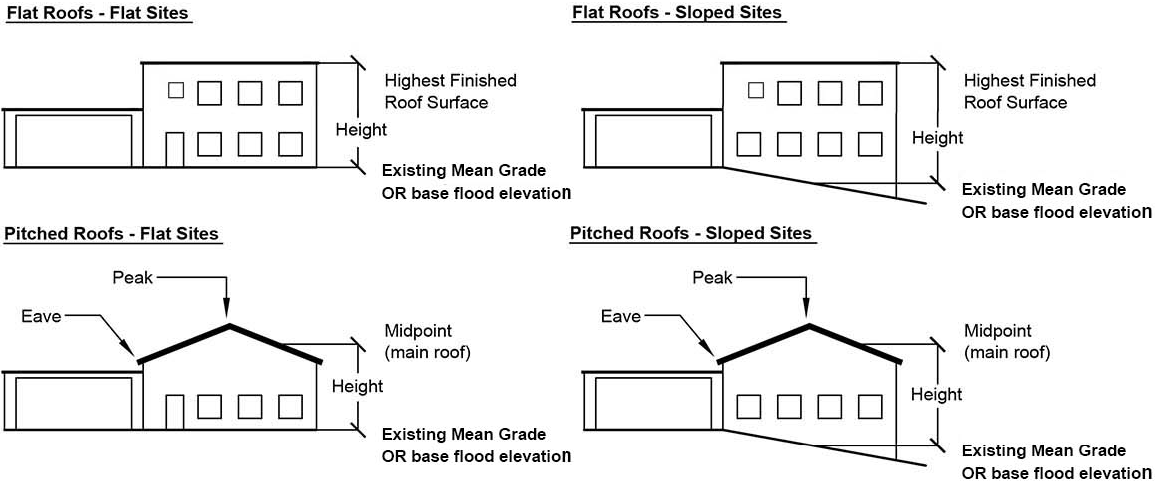
Figure 138-3501.(a)1 — Measurement of Height
(b)
Chimneys, water, fire, radio and television towers, smokestacks, flagpoles and similar structures and their necessary mechanical appurtenances, such as elevator shafts, ventilation equipment, etc., may be erected to a maximum of 20 feet above the height limits established in this chapter;
(c)
Parapet walls constructed on buildings with flat roofs shall be permitted to extend not higher than four feet over the maximum height specified for the zoning district in which the building is located. Portions of the parapet walls, fences, or other building elements that are intended to screen mechanical equipment or similar features shall be exempt from height limits to the extent that they provide screening.
(d)
The heights of these structures or appurtenances thereto shall in no case exceed the height limitations prescribed by the Federal Aviation Administration within the flight approach zone patterns of airports. Approval by the Federal Aviation Administration of such structure heights shall be required when structures are located within the flight approach zones of airports (see airport zoning regulations).
(e)
These standards shall not apply to signs, billboards or amateur radio antennas protected under F.S. ch. 125.
(Ord. No. 18-36, § 3(Att. B), 10-23-18)
Sec. 138-3502. - Boundary lines and survey.
Prior to construction on any lot or parcel, the boundaries of such lot or parcel shall be accurately marked with appropriate markers set by a licensed surveyor. Markers shall thereafter be protected and shall be used by inspectors to determine required setbacks. A survey shall be required with development applications that will result in a new or replaced building or structure. For vacant properties, the survey shall have been completed within the previous year. For developed properties the survey shall have been completed within the previous five years.
(Ord. No. 18-36, § 3(Att. B), 10-23-18; Ord. No. 21-11, § 79, 4-27-21; Ord. No. 23-24, § 2, 10-31-23)
Sec. 138-3503. - Road frontage.
(a)
Except as otherwise provided in this chapter, no building shall be built, constructed, enlarged or structurally altered or moved on a lot, tract, or parcel of land which does not abut a publicly-accessible right-of-way for a distance equal to the minimum lot width required in the zoning district in which the property is located. This requirement shall not apply to subdivision roads platted in accordance with section 154-102, private roads.
(b)
The county administrator or designee may waive the road frontage requirement when one of the following applies:
(1)
It is impractical to provide adequate roadway frontage.
a.
It is intended that such waiver may be granted to properties fronting on established private roads or easements where it would be impractical to provide adequate roadway frontage due to the size or configuration of properties or the size or configuration of the road or easement.
b.
It is specifically not intended that a waiver be granted for new development where normal site development and platting requirements apply or where public road frontage can reasonably be provided.
(2)
On a lot, tract, or parcel of land recorded prior to January 30, 1990, the length of the abutting publicly accessible right-of-way frontage is less than the minimum lot width required per the zoning district in which the property is located. In evaluating a potential waiver of this subsection requirement, the county administrator or designee shall consider the property's ability to accommodate emergency access through established standards as required by the applicable fire department.
(3)
Prior to such waiver being granted the applicant shall submit proof of a recorded ingress/egress easement for access to the property (such easement shall be reviewed and approved by the county attorney) and shall demonstrate compliance with established standards for emergency access as required by the applicable fire department. Where the curvature of such public right-of-way prevents this requirement from being met, the road frontage required in this section may be reduced as part of a Type 1 review.
(Ord. No. 18-36, § 3(Att. B), 10-23-18; Ord. No. 21-11, § 80, 4-27-21)
Sec. 138-3504. - Surface drainage.
(a)
Prior to issuance of a building permit for any structure, the county administrator or designee shall review and make a determination whether the proposal has the potential to significantly change the drainage patterns in and around the property.
(1)
For any development that requires a site plan, the applicant shall provide a lot/site grading plan as part of the review package.
(2)
For all other development that requires a building permit but does not require a site plan, the applicant shall provide a lot grading plan and identify methods to address site drainage if the county administrator or designee determines significant drainage patterns may be affected by the proposed development action.
(b)
Such examination shall determine whether the drainage of the lot or parcel is compatible with the county drainage standards established in accordance with the adopted comprehensive plan and Stormwater Manual Levels-of-Service standards.
(c)
Additionally, a stormwater pollution prevention plan and/or an erosion control plan, as appropriate, is required for new construction activities which will include soil disturbance and/or clearing.
(d)
No zoning clearance shall be issued in such instances where the county administrator or designee, finds the plan to be incompatible with established drainage standards.
(e)
Methods used to address surface drainage shall be consistent with the standards contained in the adopted Pinellas County Stormwater Manual.
(f)
Impacts to floodplains shall be addressed in accordance with chapter 158.
(Ord. No. 18-36, § 3(Att. B), 10-23-18)
Sec. 138-3505. - Setback measurements, allowances and restrictions.
(a)
Setbacks shall be measured pursuant to the following standards and situations:
(1)
Setbacks shall be measured by the shortest dimension, running from the property line perpendicular to the structure. No land below the shoreline shall be credited as a part of a required yard or setback.
(2)
No portion of an alley or ingress/egress easement shall be considered as a part of a required setback.
(3)
Residential corner lots and multiple-frontage lots shall be considered to have one front setback. For setback purposes, the front setback shall generally be applied to the frontage designated to bear the address, that has access from the street and the principal entrance to the building or the narrower of the two frontages.
a.
Side setback standards shall apply to all other sides of such a lot or parcel; except
b.
A rear setback shall apply to the property line that is opposite of the primary frontage.
c.
In cases where there is a frontage opposite of the primary frontage, a front setback shall apply to that opposite frontage. If the opposite front is not accessible, a rear setback may be applied.
(4)
Where right-of-way lines have been previously established by an action of the board of county commissioners for the purpose of future roads or widening of existing roads, all street setbacks shall be measured from the proposed right-of-way line.
(5)
Wing walls shall conform to the normal setback requirements whenever they exceed the allowable fence height.
(6)
Wherever a side or rear lot line in a commercial or industrial district abuts either a railroad right-of-way, a railroad siding tract, or a railroad easement, the side and rear setback requirements will not apply at the abutting side or rear line. Instead, a zero-foot setback for the construction of buildings will be permitted up to the abutting side or rear property line.
(7)
The portions of a lot that abut an alley or a designated public park or trail shall require a minimum setback of ten feet or as otherwise stated in this Code, whichever is greater.
(8)
All decks which exceed one foot above grade shall be considered as structures for the purpose of setback requirements in order to preclude encroachment and violation of privacy onto neighboring properties.
a.
This shall not include docks approved by the water and navigation authority.
b.
Where this situation does not exist, such as lots which abut natural areas or similar areas where there will be no such encroachment or violation of privacy, the county administrator may waive this provision and such deck shall not be considered as a structure for the purpose of meeting setback requirements.
c.
This provision, however, in no way precludes the application of other provisions such as habitat management requirements, easement restrictions or similar provisions regulating the location of such uses.
(b)
Setbacks standards shall include the following encroachments, allowances, and/or limitations:
(1)
Porches and decks are subject to the applicable district front building setback(s); some districts allow for a separate, reduced front setback for porches and decks. This reduced front setback standard is not applicable to carports and other covered parking structures unless approved as part of a development master plan or equivalent.
(2)
Sills, eaves, cornices, chimneys, flues and similar architectural projections may project into a setback area up to three feet, but at least a three-foot distance from the adjacent property line must be maintained.
(3)
Swimming pools shall have a minimum rear property setback, as measured from the water's edge of the pool, of eight feet or the minimum rear setback of the district, whichever is less.
(4)
Screen enclosures are permitted a side and rear property setback of five feet or the minimum rear or side setback of the district, whichever is less.
(5)
Swimming pools, as measured from the water's edge of the pool, and pool enclosures located on multi-frontage lots are subject to the applicable district side street and rear setbacks, respectively. This applies only to the side or rear that is adjacent to the secondary frontage(s).
(6)
All residential structures, and their accessory structures, on waterfront lots or parcels shall be subject to the following setbacks limitations:
a.
Where no seawall is present, structures shall be set back 25 feet from the mean high-water mark determined in accordance with Florida Statutes 177-Part II Coastal Mapping in tidal areas or top of bank in non-tidal areas;
b.
Where adequate seawalls or riprap stabilization exist, the setback requirement shall be 15 feet from the midpoint of the seawall or riprap stabilization.
c.
Swimming pools without screen enclosures may be constructed pursuant to subsection (3) of this section, provided that, certification from an engineer registered in the state is submitted prior to issuance of a permit, verifying that the proposed structure will not affect the integrity or functioning of the seawall or its dead-men (underground support structures).
(7)
Arbors and pergolas 100 square feet or less in size are not subject to setback standards provided that site visibility standards are addressed through structure placement/design.
(8)
Other setback encroachments may be allowed to nonconforming situations pursuant to chapter 138, article II, division 6.
(9)
Mechanical equipment such as air conditioning units, pool equipment and optional standby and emergency generators with fuel tanks should be placed adjacent to the structure and may encroach into the required side or rear setback up to three feet, however a minimum ten-foot separation shall be required from any residential structure on a neighboring property, excluding garages or other uninhabited spaces.
a.
Mandatory access points to elevated platforms housing mechanical equipment may also encroach into the required setback per the above standards. Mechanical equipment on raised platforms that encroach into the required setback shall be appropriately screened to shield noise.
b.
Mechanical equipment shall not encroach into a recorded easement unless authorized by the county and/or other easement holder.
(10)
Outside, unenclosed stairways may extend four feet into any required yard but not closer to any lot line than a distance of five feet.
(c)
Setbacks standards for storage sheds apply as follows in residential districts:
(1)
For the purposes of this subsection and standards therein, storage sheds are described as stand-alone, non-inhabitable structures that are up to 200 square feet in size.
(2)
Two storage sheds may be permitted as accessory to a residence. This shall not apply to properties in the R-A, R-E and R-R districts or as part of a bona fide agricultural activity.
(3)
Storage sheds, 12 feet or less in height, are permitted the following setbacks:
a.
Three foot side and rear setbacks, OR
b.
Zero-foot side and rear setback with a six-foot high opaque fence.
(4)
Storage sheds over 12 feet tall shall comply with the district setbacks.
(5)
All storage sheds shall be designed in such a manner so that water runoff from the roof of the structure is not directed onto neighboring properties.
(6)
Storage sheds shall not be placed in the front yard between the main residence and the abutting street. Applicants may request a waiver to this standard where existing site conditions prevent the shed from being placed in other locations of the property.
(7)
Storage sheds may be permitted within an exterior side yard if screened with a six-foot high opaque fence.
(d)
Setbacks standards shall not supersede or allow easement encroachment. The following shall apply:
(1)
No portion of any structure shall be located within the area of a recorded public easement unless authorized by the county and/or other easement holder.
(2)
Easement encroachment may not be authorized as a variance.
(Ord. No. 18-36, § 3(Att. B), 10-23-18; Ord. No. 21-11, § 81, 4-27-21; Ord. No. 23-24, § 2, 10-31-23)
Sec. 138-3506. - Uses over open water—Prohibited.
No developed use, except docks, bridges and piers, shall occur over navigable waters, sovereign submerged lands or waters of the county. This limitation shall not apply to decks, piers and similar structures to be constructed over retention ponds and similar water features.
(Ord. No. 18-36, § 3(Att. B), 10-23-18)
Sec. 138-3507. - Dumpsters and trash enclosures.
(a)
General standards. Dumpsters are subject to the standards in this section.
(1)
Dumpsters shall meet the minimum setbacks of the zoning district.
(2)
Dumpsters shall be screened from street view with a solid fence or wall a minimum of six feet in height.
(3)
Dumpsters shall be serviceable in that location by a waste hauler vehicle.
(4)
The property owner shall be responsible for the repair and maintenance to the dumpster and associated enclosure(s). The areas surrounding the dumpster shall be free of garbage, trash, weeds and debris.
(5)
Dumpster enclosures shall have gates across the full width of the opening when facing a street or right-of-way. The gates must have drop pins to secure them in the open and closed position.
(6)
Dumpsters shall be subject to the performance standards in chapter 138, article IX division 14, performance standards.
(7)
Dumpsters shall not cause a sight distance obstruction, per section 138-3508, for vehicles maneuvering on the adjacent or any nearby street system.
(8)
Areas surrounding dumpsters shall be landscaped pursuant to division 3 of this article.
(9)
Dumpsters are prohibited within the public rights-of-way.
(b)
Prohibition for single-family districts. Dumpsters are prohibited on all parcels zoned R-1, R-2, R-3, R-4 and R-5 with single-family detached dwelling units.
(c)
Exemptions.
(1)
A dumpster which is located on a site on a temporary basis for the purpose of construction being done pursuant to a valid, current permit, trash collection, or cleaning of the site shall be exempt from the requirements of this section.
(2)
A dumpster legally placed on a property prior to 1990 shall be exempt from the requirements of the section. Aerial photography or other methods may be used to verify the pre-1990 placement. Any relocation of such a dumpster shall comply with the requirements of this section.
(Ord. No. 18-36, § 3(Att. B), 10-23-18; Ord. No. 23-24, § 2, 10-31-23)
Sec. 138-3508. - Sight visibility triangles.
(a)
General standards. Sight visibility triangles are designated areas located near streets and/or driveway intersections that shall be free from visual obstruction in order to maintain safe visibility for vehicles, bicyclists, and pedestrians. All property shall maintain sight visibility triangles as described in this section and in the Transportation Design Manual.
(1)
Sight visibility triangles shall be provided on all corners at the intersection of any public or private street with another street, an alley or a driveway; and, on all corners of the intersection of an alley and driveway.
(2)
No structure, object, and/or vegetation shall be placed and/or maintained in a manner which materially impedes the visibility from a street, alley or driveway of lawfully oncoming traffic from any direction in the intersecting public street.
(b)
Exemptions. The following exemptions may apply to sight visibility standards.
(1)
The mixed-use district is exempt from the sight visibility triangle standards, provided that other engineering and design methods are implemented to ensure visibility and safety. This shall be reviewed as part of the site plan review.
(2)
Transparent fences including chain link, wrought iron, and similar styles may be exempt so long as visibility is maintained through the fence.
(3)
Governmental signage and governmental sign posts in the right-of-way.
(4)
Fire hydrants, benches, and traffic control devices in the right-of-way.
(5)
Utility poles and one utility transmission or control device in the right-of-way.
(Ord. No. 18-36, § 3(Att. B), 10-23-18; Ord. No. 21-11, § 82, 4-27-21)
Sec. 138-3509. - Outdoor lighting.
(a)
General standards. All outdoor lighting devices shall be installed in conformance with the provisions of this Code and the Florida Building Code. The provisions of this section are not applicable to street lighting.
(1)
All outdoor lighting shall be designed and installed to prevent glare and light trespass on abutting property. Light trespass is when unwanted light crosses property lines.
(2)
Outdoor lighting shall include full cut-off lighting fixtures. The term "full cut-off" has and is being used to describe luminaires that have no direct uplight (no light emitted above horizontal)
a.
Full cut-off fixtures are required for all outdoor walkway, parking lot, canopy and building/wall mounted lighting, and all lighting located within those portions of open-sided parking structures that are above ground.
b.
Lights that are properly installed in an architectural space (such as under a porch roof or a roof overhang) and that provide the functional equivalent of a full cut-off fixture do not need to include full cut-off fixtures.
(b)
Maximum outdoor lighting fixture height. The maximum height of exterior lighting fixtures, whether mounted on poles or walls or by other means, shall be as follows:
(1)
Twenty feet in residential districts.
(2)
Thirty feet in all nonresidential districts.
(3)
Lighting for outdoor sports fields are not subject to these height limitations; site compatibility concerns shall be reviewed as part of the site plan review.
(c)
Exemptions. The following are exempt from the requirements of this section:
(1)
Street lights. Located in public right-of-way and/or along private roadways.
(2)
Government facilities. Outdoor light fixtures on, or in connection with facilities and land owned or operated by the federal, state, and/or local government, and the Pinellas County School Board. However, voluntary compliance with the intent and provisions of this section is encouraged.
(3)
Temporary construction and emergency lighting. Lighting necessary for construction or emergencies, provided the lighting is temporary and is discontinued immediately upon completion of the construction work or abatement of the emergency necessitating the lighting.
(4)
Hazard warning lighting. As required by federal or state regulatory agencies.
(5)
Seasonal lighting. Lighting that is clearly incidental to the use of the property and is customary and commonly associated with any national, local or religious holiday.
(6)
Flag lighting. Up-directed lighting illuminating flags.
(Ord. No. 18-36, § 3(Att. B), 10-23-18; Ord. No. 21-11, § 83, 4-27-21; Ord. No. 23-24, § 2, 10-31-23)
Sec. 138-3510. - Residential accessory structures and uses.
Accessory residential structures or uses are subject to the following standards:
(1)
The cumulative area of all residential accessory structures must be subordinate to and serve a primary residential structure and use:
a.
R-A zoned or bona fide agricultural properties of two acres or more in size are excluded from this requirement;
(2)
Must be subordinate in area, extent, and purpose to the primary residential structure and use served. Basements, attached garages, and accessory dwelling units are exempt from area calculation;
(3)
Contributes to the comfort, convenience or necessities of the users or occupants of the primary residential structure and use;
(4)
Is located on the same lot as the primary residential structure and use, provided such use is in keeping with the purpose and intent of the district in which located;
(5)
Attached accessory structures shall share a common wall with the primary residential structure and use;
(6)
Accessory structures must be architecturally compatible with the primary residential structure and use;
(7)
Accessory structures must meet setback requirements and other applicable standards of the underlying zoning district.
(Ord. No. 21-11, § 84, 4-27-21; Ord. No. 23-24, § 2, 10-31-23)
Sec. 138-3600. - Purpose and intent.
This section establishes standards for the amount, location and development of motor vehicle parking, standards for bicycle parking, and standards for on-site loading areas. These regulations are designed to avoid parking shortages, to encourage compact development patterns, to accommodate redevelopment, and to recognize alternative modes of transportation.
(Ord. No. 18-36, § 3(Att. B), 10-23-18)
Sec. 138-3601. - General requirements.
(a)
Required. Any new use or change of use on a property shall be required to provide parking and loading spaces according to the standards established by this division.
(b)
Completion timing. All required parking areas must be completed and landscaped prior to certificate of occupancy of any building or structure.
(c)
Calculations for required parking spaces (motor vehicle and bicycle parking).
(1)
When computing parking spaces based on floor area, the use areas located inside all building or similar structures shall be included in the required parking calculation. However, interior areas used for motor vehicle parking are not included in the calculation (e.g., garages).
(2)
The minimum number of required parking spaces is computed based on the primary and accessory uses on site. When there are two or more separate primary uses on a site, the required parking for the site is the sum of the required parking for the individual primary uses.
(3)
When more than 20 percent of the floor area on a site is in an accessory use, the required parking is calculated separately for the accessory use. (E.g., for a 30,000 square foot building with a 25,000 square foot warehouse and a 5,000 square foot office area, the required parking shall be computed separately for the office and warehouse uses.)
(4)
When units or measurements determining the number of required off-street parking spaces result in a fractional space, then such fraction equal to or greater than one-half shall require a full off-street parking space.
(d)
Elimination of required parking spaces. Once an off-street parking or loading space has been provided according to the regulations of this Code, such off-street parking or loading space shall not thereafter be reduced, eliminated, or made unusable in any manner except as authorized by this Code.
(e)
Maintenance. All required parking areas shall be permanently maintained and remain free and clear of litter and debris.
(Ord. No. 18-36, § 3(Att. B), 10-23-18)
Sec. 138-3602. - Motor vehicle parking.
Parking for motor vehicles shall be planned and provided for each land use. However, motor vehicle parking should not dominate the landscape or create excessive conflicts with the orderly movement of transportation.
(a)
Motor vehicle parking quantity standards:
(1)
Parking quantity standards are established for each use:
a.
Each use/development shall provide at least the minimum required number of motor vehicle parking stalls.
b.
In addition, some uses are limited to a maximum number of required parking stalls on the site.
c.
Table 138-3602.a — Motor Vehicle Parking Stall Quantity Standards establishes the parking stall quantity minimums and limits for each use.
(2)
Parking for motor vehicles shall be provided with one of the following standards:
a.
The use/development shall provide the parking quantities consistent with Table 138-3602.a — Motor Vehicle Parking Stall Quantity Standards; OR
b.
When the proposed use is not specifically listed, the use/development shall provide the parking quantity for a similar use listed in Table 138-3602.a — Motor Vehicle Parking Stall Quantity Standards. The similar use(s) shall be determined by the county administrator or designee; OR
c.
When the use/development is located in a special district and separate parking quantity standards are established therein, the use/development shall provide the parking quantities specified for the special district; OR
d.
The applicant may prepare a parking study to identify the parking demand for the proposed use/development. The parking shall be based on a pre-determined methodology as determined between the applicant and the county. If the county agrees with the parking study findings, the use/development may provide the parking quantity identified therein; OR
e.
The use/development may seek flexibility from the parking quantity as a variance or administrative adjustment based on the limits and standards of chapter 138, article II, division 7, variances, waivers, and administrative adjustments.
(3)
Allowed reductions. The minimum motor vehicle parking stall quantity for each site may be permitted with the following administrative reductions; whereas, the cumulative of administrative reductions for subsections a.—h. below shall be limited to 30 percent.
a.
Properties located within one-quarter mile of a regularly scheduled public transit line, with headways 30 minutes or less during a.m./p.m. peak times, may be permitted a 15 percent reduction.
b.
Where healthy trees and/or tree stands exist and are preserved within a proposed parking area, the use/development may be permitted up to a 15 percent reduction.
c.
Properties located within the mixed-use district may be permitted a 15 percent reduction;
d.
Properties located within a special district may be permitted the parking reduction allowances listed in chapter 138, article VIII.
e.
A use/development requiring a minimum of 20 motor vehicle parking stalls may participate in a bicycle facility improvement program (BFIP) by providing on-site bicycle infrastructure to reduce the number of required motor vehicle parking by the following amounts:
1.
For each bicycle repair station that is installed by the developer, the development is allowed a reduction of two motor vehicle parking stalls. Each repair station should include a bicycle mount, tools, tire pump, or similar elements.
2.
For each covered bicycle station with racks that is installed by the developer, the use/development is allowed a reduction of four motor vehicle parking stalls.
f.
The use/development is allowed a reduction of up to five motor vehicle parking stalls for each designated on-site carpool/rideshare stall.
g.
Properties located within one-quarter mile of a multi-use trail (e.g., Pinellas Trail) may be permitted a 15 percent reduction.
h.
Properties that are directly accessible by boat are allowed a reduction of one motor vehicle parking stall per each boat slip. For marinas, this only applies to accessory uses such as a restaurant.
(b)
Shared parking options: When any parking area is used for two or more uses, the minimum total number of required parking spaces shall be determined by using one of the following options:
(1)
Option 1: Two or more individual uses or owners may share a parking facility if the total minimum number of required spaces conforms to the parking provisions of section 138-3602(a) when computed separately for each use or building type; OR
(2)
Option 2: The individual uses may share a parking facility with reduced total amount of required parking spaces in accordance with Table 138-3602.b — Shared Parking Matrix and the following methodology.
a.
Determine the minimum parking quantities in accordance with the provisions of section 138-3602(a) to get the total minimum parking quantity required;
b.
Take the total minimum parking quantity required and divide it by the number that intersects with the two applicable, corresponding use functions in Table 138-3602.b.
(c)
Use this number as the required minimum number of motor vehicle parking spaces that shall be provided at any given time. When uses are located on separate lots/parcels from where the parking is located, a legal instrument shall be provided to ensure long term, legal use of the parking facility by the subject users (e.g., parking agreement, easement or the like). The legal instrument must be approved by the county attorney.
Table 138-3602.b—Shared Parking Matrix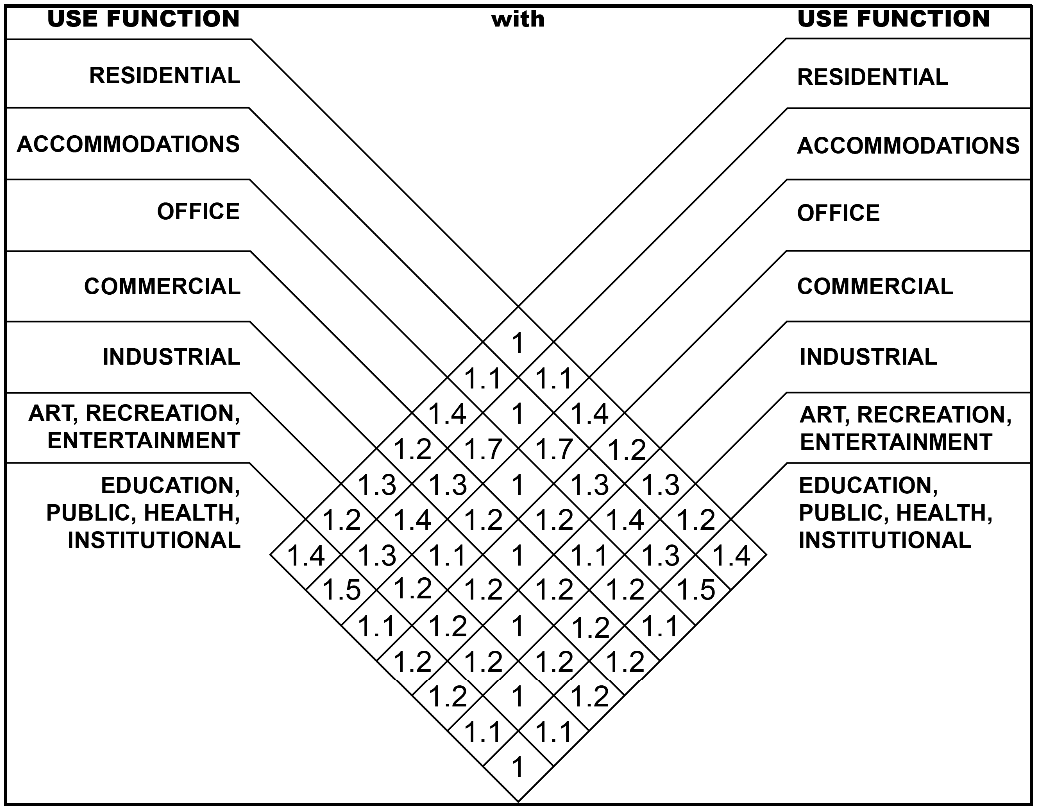
(d)
Accessible parking for disabled persons: Motor vehicle parking for persons with disabilities shall be provided in the following manner:
(1)
Quantity: The use/development shall provide motor vehicle parking quantities listed in Table 338-3602.c — Minimum Number of Accessible Motor Vehicle Parking Stalls. The number of accessible stalls shall be a part of required parking as outlined in subsection (a) above and not in addition to.
(2)
Size: Accessible parking stalls for the disabled which are diagonal or perpendicular shall be a minimum of 12 feet wide and 18 feet deep.
(3)
Access:
a.
All accessible stalls for the disabled shall be provided with a curb cut or curb ramp to a pathway, a minimum of 44 inches wide, to provide access to the building served. The stall shall be located so that users will not be compelled to maneuver behind parked vehicles. Two accessible parking spaces may share a common access aisle.
b.
All accessible stalls shall have an adjacent access aisle measuring at least 60 inches wide. Parking access aisles shall be part of the accessible route to the building or facility entrance.
(4)
Location: When considering all the parking on the site, the designated accessible spaces should be located closest to the primary building entrance. If there are multiple entrances or multiple retail stores, the accessible spaces must be dispersed to provide parking at the nearest building entrance.
(5)
Markings:
a.
Accessible parking spaces shall be posted with a permanent above-grade sign bearing the international symbol of accessibility and the caption "parking by disabled permit only."
b.
Each such parking space must be prominently outlined in blue paint. The property owner shall be responsible to repaint the stalls as necessary.
(e)
Parking location: The location for motor vehicle parking shall be consistent with the following:
(1)
Required motor vehicle parking should be provided on the same site as the use(s) in which it serves; AND/OR
(2)
All or portions of the required motor vehicle parking may be provided on a separate site as the use(s) in which it serves subject to the following:
a.
The off-site parking lot is either under the same ownership or officially allowed to be used to serve the subject land uses such as a lease agreement with a timeframe of at least five years or other legal instruments; AND
b.
The off-site parking lot is generally within 600 feet AND readily accessible by walking, transit, and/or shuttle service. This distance standard may be waived if stated otherwise in a special district AND/OR if located in designated activity center pursuant to the comprehensive plan.
(f)
Development standards for motor vehicle parking: This subsection is not applicable where parking for single-family detached, attached, two-family, and three-family units is provided as private driveways.
(1)
Parking shall be provided consistent with the following standards:
a.
Parking may be provided in a motor vehicle parking lot; AND/OR
b.
Parking may be provided in a motor vehicle parking structure/garage; AND/OR
c.
Parking may be provided along the abutting street when allowed by the roadway facility owner (i.e., local government, developer, or property owners association) and subject to the following conditions:
1.
Only street parking that abuts the site may be counted towards satisfying the minimum parking quantity standard.
2.
Certain roadway improvements may be required to accommodate street parking.
3.
Due to physical constraints and/or roadway classifications, some roadways may not allow, or be suited for, street parking.
4.
Street parking stalls shall remain available to the general public and not be reserved for the sole use of the adjacent businesses.
(2)
Parking stalls and associated aisles are subject to the following design standards.
a.
The minimum dimensional requirements for standard parking stalls and drive aisles are established in the following table; whereas, some additional reductions and allowances are listed the following subsections:
| Table 138-3602.d — Dimensional Requirements for Parking Stalls and Drive Aisles | ||||||
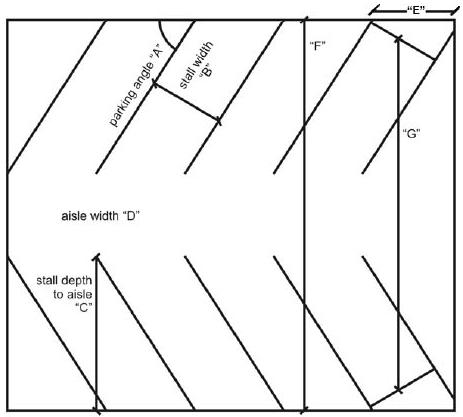 | ||||||
| A | B | C | D | E | F | G |
| 0 | 8.0' | 8.0' | 12' | 22' | 28' | — |
| 20 | 9.0' | 15.9' | 11' | 23.6' | 41' | 32.5' |
| 30 | 9.0' | 17.3' | 11' | 18' | 45.6' | 37.8' |
| 40 | 9.0' | 19.1' | 12' | 14' | 50.2' | 43.3' |
| 45 | 9.0' | 19.8' | 13' | 12.7' | 52.6' | 46.2' |
| 50 | 9.0' | 20.4' | 14' | 11.7' | 52.8' | 47' |
| 60 | 9.0' | 21' | 18' | 10.4' | 60' | 55.5' |
| 70 | 9.0' | 21' | 19' | 9.6' | 61' | 57.9' |
| 80 | 9.0' | 20.3' | 24' | 9.1' | 64.3' | 62.7' |
| 90 | 9.0' | 18' | 24' | 9.0' | 60' | — |
| A - Parking angle (degrees) | ||||||
| B - Minimum stall width (feet) | ||||||
| C - Minimum stall depth to aisle (feet) | ||||||
| D - Minimum drive aisle width (feet) | ||||||
| E - Minimum curb length (feet) | ||||||
| F - Minimum overall distance between curbs (or equivalent) for double row with drive aisle between (feet) | ||||||
| G - Minimum distance between ends of stalls (or equivalent) for double row with drive aisle between | ||||||
b.
Parking stall standards: Parking for motor vehicles shall meet the following standards:
1.
Standard parking stalls are subject to the dimensional standards as listed in Table 138-3602.d.
2.
The dimensional standards may be modified as part of a Type 1 Path B administrative adjustment process.
3.
Compact stalls:
i.
Compact stalls shall be at least eight feet × 16 feet.
ii.
Compact stalls may be used to satisfy up to 20 percent of the minimum motor vehicle parking quantity for a site.
4.
Standard parking stall dimensions may be reduced to allow for two feet of vehicular overhang when abutting a landscaping area.
5.
Motor vehicle stalls located in a parking lot shall be designed to directly access a drive aisle and/or alley.
6.
Motorcycle/scooter stalls:
i.
Motorcycle/scooter stalls shall be at least four feet × eight feet
ii.
Motorcycle/scooter stalls may be used to satisfy up to five automobile spaces or five percent of the required parking spaces, whichever is less. Additionally, for every three motorcycle/scooter parking spaces provided, the automobile parking requirement is reduced by one space.
c.
Parking drive aisle standards: Motor vehicle parking lot drive aisles shall meet the following dimensional standards:
1.
Drive aisles are subject to the dimensional standards as listed in Table 138-3602.d.
2.
One-way: drive aisles shall be at least 12 feet wide.
3.
Two-way: drive aisles shall be at least 24 feet wide.
4.
Drive aisles may be reduced to respond to and protect existing trees. Any reductions must result in sound engineering practices for safe vehicle maneuvering.
(3)
Surface materials:
a.
Parking lot stalls, driveways and drive aisles shall be constructed of asphalt, concrete, brick, pavers, or other similar material approved by the county.
b.
The following surface material exemptions may apply:
1.
Up to 50 percent of the motor vehicle parking stalls may be of grid pavers, reinforced grass, or other similar material approved by the county, OR
2.
Up to 100 percent of the motor vehicle parking areas for the following and similar uses may be grid pavers, grass, gravel, or other similar material approved by the county:
i.
Agricultural uses.
ii.
Natural resources and wildlife management areas.
iii.
Nurseries/greenhouses.
iv.
Parks and recreation areas.
v.
Places of worship, meeting halls and other community assembly facilities.
3.
Non-paved surfaces of parking areas and associated drives shall be stabilized and provided with appropriate dust control.
c.
All accessible stalls and accessways shall be paved with asphalt, concrete or similar hard-surface material approved by the county. Accessible parking for disabled persons requirements/standards may not be reduced.
(4)
Access standards:
a.
All motor vehicle parking lots shall be designed to allow vehicles to enter and exit the street in a forward motion. An exception may be allowed in cases where parking is provided abutting an alley.
b.
A tandem parking arrangement may be allowed only when provided in the following situations:
1.
As part of an associated valet service; and/or
2.
As part of a multifamily development where the set of tandem stalls are assigned to the same unit; and/or
3.
As part of designated employee parking.
c.
Motor vehicle parking lots shall provide for internal vehicle connections at logical locations between abutting parking lots and adjacent nonresidential and multifamily properties. Exceptions to this standard are allowed to protect natural resources, where onerous topographic features exist, and to comply with design restrictions from other governing agencies.
(5)
Stacking requirements for parking lot entrances are described in the Transportation Design Manual.
(6)
Design criteria:
a.
Motor vehicle parking lots shall also be constructed consistent with any zoning district design criteria and any applicable specific use standards that may apply to the proposed use.
b.
Reserved.
(g)
Development standards for residential driveway/garage parking:
(1)
On-site parking for single-family detached, attached, two-family, and three-family units may be provided in a driveway, carport, and/or in a garage. Parking provided as parking lots shall be applicable to the standards in subsection (f).
(2)
Residential private driveway requirements are described in the Transportation Design Manual.
(h)
Electric vehicle charging stations:
(1)
An electric vehicle charging station (EVCS) is an optional site element that provides power supply to electric motor vehicles.
(2)
Where an EVCS is provided, the adjacent parking shall be reserved for vehicles that can be electrically charged.
(Ord. No. 18-36, § 3(Att. B), 10-23-18; Ord. No. 21-11, § 85, 4-27-21; Ord. No. 23-24, § 2, 10-31-23; Ord. No. 24-22, § 1, 7-30-24)
Sec. 138-3603. - Bicycle parking.
Bicycle parking encourages shoppers, customers, employees, and other visitors to use bicycles by providing a convenient and readily accessible place to park and secure bicycles. Bicycle parking should be placed near main entrance(s) of a building and should be accessible to pedestrians and bicyclists.
(a)
Minimum bicycle parking quantity: Bicycle parking shall be provided with one of the following standards:
(1)
The use/development shall provide the parking quantities listed in Table 138-3603.a — Minimum Number of Bicycle Parking; OR
(2)
When the proposed use is not specifically listed, the use/development shall provide the parking quantity for a similar use listed in Table 138-3603.a — Minimum Number of Bicycle Parking. The similar use(s) shall be determined by the county administrator or designee; OR
(3)
The use/development may seek flexibility from the bicycle parking quantity as a variance or administrative adjustment based on the limits and standards of chapter 138, article II, division 7.
(b)
Development standards for bicycle parking:
(1)
Location:
a.
For a building with one main entrance, the bicycle parking shall be within 100 feet of the main entrance to the building.
b.
For a building with more than one main entrance, the bicycle parking shall be distributed along all facades with a main entrance and shall be within 100 feet of at least one main entrance on each facade.
c.
For sites with more than one primary building, the bicycle parking shall be distributed evenly amongst the primary buildings and shall be within 100 feet of a main entrance.
(2)
Bicycle parking design (bicycle racks):
a.
Bicycle racks or similar features shall be provided with the primary purpose to allow bicycles to be securely attached to the apparatus. Sign poles, planters, and utility lines shall not be considered bicycle parking racks or used to satisfy the bicycle parking requirement.
b.
Bicycle rack design shall accommodate a high security, U-shaped lock.
c.
Bicycle racks shall be securely anchored to the ground, a building, or a paved surface.
d.
Bicycle racks shall be constructed using decorative, durable finishes that are not damaged by the constant abrasion from bicycles.
(Ord. No. 18-36, § 3(Att. B), 10-23-18)
Sec. 138-3604. - Off-street loading.
Off-street loading is generally required for certain uses and building sizes to allow for the orderly delivery of goods and services to and from the property. Off-street loadings shall be provided and developed consistent with this section.
(a)
Minimum off-street loading quantity: Loading shall be provided for the following uses and associated building areas:
(b)
Development standards for off-street loading:
(1)
Loading location(s):
a.
All loading shall occur on-site and may not occur from a public road right-of-way. Exceptions may include private, internal local streets where alternate vehicle access routes are available when loading activity occurs.
b.
In no case shall the use of a loading space or berth hinder the movement of vehicles and pedestrians over a street, alley or sidewalk.
(2)
Loading dimensions:
a.
Loading space: loading spaces shall be at least nine feet × 18 feet.
b.
Loading berth for local delivery trucks: berths shall be at least ten feet × 25 feet.
c.
Loading berth for semi-trucks: berths shall be at least ten feet × 60 feet and shall allow for a 16-foot high clearance.
(Ord. No. 18-36, § 3(Att. B), 10-23-18)
Sec. 138-3650. - Purpose and intent.
The purpose of this division is to preserve the existing natural environment and provide landscape improvements on private properties and public rights-of-way in order to promote a positive urban image, enhance property values, strengthen the fabric of the surrounding community, promote context-sensitive growth that recognizes land use and transportation goals, establish a harmonious relationship between the natural and built environment, and enhance the overall aesthetic quality of development in the county. The landscape regulations are intended to achieve the following objectives:
■
Conserve water by preserving existing established and native landscaping, encouraging the use of "Florida-friendly" and native trees, palms, shrubs, grasses, and ground covers, and establishing standards for the installation of landscape material and irrigation systems.
■
Reduce the visual impact of large building masses, paved surfaces and vehicular use areas.
■
Improve the appearance of unincorporated Pinellas County by creating quality urban environments that are sustainable over time.
■
Improve environmental quality through the use of low impact development (LID) techniques that will improve water quality, facilitate aquifer recharge and reduce stormwater runoff, and reduce "heat island" effects.
■
Increase land values by providing landscaping that will function as a capital asset.
■
Provide for safer and more pedestrian-friendly walking environments by forming and framing public spaces with trees which provide distinct edges to sidewalks so that motorists better distinguish between their environment and one shared with people.
■
Provide habitats for urban wildlife.
■
Protect native plant species and habitats by eliminating invasive exotic species that threaten the ecosystem.
(Ord. No. 18-36, § 3(Att. B), 10-23-18)
Sec. 138-3651. - Application of landscape regulations and required maintenance.
(a)
All new landscaping, tree protection actions, conservation, and plant/tree maintenance shall be provided in accordance to this division. The following exceptions apply:
(1)
When the use/development is located within a special district and separate landscaping and/or conservation standards are established therein, the use/development shall comply with the requirements specified in that district; AND/OR
(2)
When the use/development is subject to any specific use standard of chapter 138, article IX, and additional landscaping and conservation requirements are established, the stricter standard shall apply; AND/OR
(3)
When the property is in or is experiencing a state of emergency such as flooding, fire, tornado, and/or hurricanes AND the plant material creates a safety hazard; AND/OR
(4)
When the use/development meets the criteria for affordable housing and is subject to the provisions of section 138-3211(c)(2)e.
(b)
Change in use with no site improvements. Sites that experience a change in land use (example retail to restaurant) shall provide landscaping consistent with the following:
(1)
When the change of use includes a building permit, the site shall be enhanced to include landscaping improvements consistent with the non-conforming provisions of chapter 138, article II, division 6. This standard shall require limited landscaping improvements based on a proportional value of the building improvement; AND
(2)
The site shall be required to demonstrate the property contains the landscaping material consistent with any previously-approved development plans.
a.
If the existing site has less landscaping material than what was originally approved, the plant material shall be replaced with the same or similar species prior to certificate of occupancy.
b.
If there is no previously-approved site plan OR the county is unable to produce/locate the previously-approved site plan, this subsection does not apply.
(c)
Existing development. Existing development not meeting the requirements contained in this section shall be brought into compliance under one of the following conditions:
(1)
Any portions of the site that are developed/redeveloped shall be constructed to comply with the provision of this division;
(2)
Other portions of the site shall be enhanced to include proportional landscaping improvements consistent with the non-conforming provisions of chapter 138, article II, division 6 based on building improvements. This standard shall require limited landscaping improvements based on a proportional value of the building improvement;
(3)
The site shall be required to demonstrate the property contains the landscaping material consistent with any previously-approved development plans.
a.
If the existing site has less landscaping material than what was originally approved, the plant material shall be replaced with the same or similar species prior to certificate of occupancy.
b.
If there is no previously-approved site plan OR the county is unable to produce/locate the previously-approved site plan, this subsection does not apply.
(d)
Development. Any development on a vacant site or complete redevelopment on developed property shall be required to provide landscaping, tree protection, and wetland buffers in accordance with this division. Infill or highly constrained sites may seek the administrative adjustment or variance procedures to modify landscape requirements.
(e)
Landscaping installation. Whenever landscape materials are required by this division, they shall be installed and maintained in accordance with the standards and requirements of this division. All landscaping installed or preserved to meet the requirements of this division shall be maintained in a healthy condition. Installed or preserved landscaping which dies after the development has been completed shall be replaced to meet the requirements of this division within 30 days.
(f)
Property landscaping, tree and buffer maintenance. All landscaping, trees, and buffers shall be maintained in good condition by the owner, tenant or their agent, so as to present a healthy, neat and orderly appearance.
No mangrove plant or tree shall be removed unless permitted by the county. All trimming and maintenance of mangroves is subject to the requirements of F.S. § 403.9321 through 403.9333.
(g)
Variances. The use/development may seek flexibility from these landscaping, tree protection, and wetland buffer standards as a variance or administrative adjustment based on the limits and standards of chapter 138, article II, division 7.
(Ord. No. 18-36, § 3(Att. B), 10-23-18; Ord. No. 21-11, § 86, 4-27-21)
Sec. 138-3653. - Undesirable trees/plants.
Due to their characteristics as exotic, invasive, and/or hazardous species, certain tree/plant species are classified as undesirable.
(a)
Undesirable tree/plant list.
(1)
The county's undesirable tree/plant species table lists species considered undesirable, non-native, problematic, or invasive. The table can be viewed on the Pinellas County Building and Development Review Services webpage.
a.
These species may be removed from any site subject to a no-fee permit,
b.
These species shall not be counted towards meeting the minimum landscaping requirements for a site.
(2)
Undesirable trees/plants are further classified as Tier 1 and Tier 2 species.
a.
Tier 1 undesirable trees/plants shall not be planted in Pinellas County, AND existing species shall be removed as part of site development, building renovation and/or new house construction. Properties with existing single-family detached, single-family attached, three-family, and/or two-family dwellings in residential districts RA—R-5 are exempt from this requirement.
b.
Tier 2 undesirable trees/plants may be planted in Pinellas County AND existing species may remain.
(Ord. No. 18-36, § 3(Att. B), 10-23-18)
Sec. 138-3654. - Tree protection and relocation.
Existing Florida-native plant material shall be given priority for preservation in site development/redevelopment. Furthermore, existing healthy trees and native palms should be preserved and integrated into site landscape plans. There are no preservation goals for undesirable tree species.
(a)
Tree protection requirements.
(1)
Protected trees. Existing high-rated, non-invasive trees and native palms shall be protected. Any impacts to protected trees shall include mitigating actions such as replacement or relocation. Protected trees shall include:
a.
Any existing healthy tree with a diameter breast height (DBH) of four inches or larger, measured at a height of four and one-half feet above the ground shall be considered a protected tree;
b.
All healthy Sabal/Cabbage Palms six feet in height or larger; and
c.
All buttonwood, mangroves.
(2)
Tree rating category: As part of the permitting process, (i) existing trees with a DBH of four inches or greater AND (ii) existing Sabal/Cabbage Palms six feet high or greater shall be rated on a scale of zero through six based on Table 138-3654.a—Tree Rating System. The tree rating shall be assigned based on the tree/palm condition description listed in the table.
a.
The tree rating assessment shall occur by the applicable county staff; OR
b.
The applicant may request that a certified arborist at the applicant's expense, conduct a tree rating assessment. In this option, the county administrator or designee will review the arborist's assessment and make the final determination.
(3)
Permitted action and requirement: Existing trees and palms shall be preserved replaced, relocated, and/or removed pursuant the permitted actions and requirements for each tree rating category as listed in Table 138-3654.a—Tree Rating System.
(4)
Tree removal/replacement standards:
a.
Trees having a 0, 1, or 2 tree rating may be removed and no replacement value is required. However, minimum lot requirement still applies.
b.
Trees having a 3, 4, 5, or 6 tree rating may be removed but the total DBH of the existing tree(s) to be removed shall be replaced with new trees based on the following ratio(s):
1.
3, 4, and 5 rated trees shall be replaced on an inch-for-inch basis.
2.
6 rated trees shall be replaced on a two-inch-for-inch basis.
c.
Trees having a 4, 5, or 6 tree rating may be permitted to be removed only if part of site development activity.
d.
Replacement trees shall be provided on the same site as the original tree that was removed. The following alternatives may be allowed:
1.
The applicant may provide a monetary contribution to a formally-adopted tree mitigation fund at a rate established by the board of county commissioners.
2.
The tree may be relocated subject to the standards of this section.
(5)
Tree removal permit: A tree removal permit is required to remove any existing tree as applicable in this section.
(6)
Tree preservation credit standards: Preserved trees having a 3, 4, or 5 tree rating may be credited towards the required landscaping on an inch-for-inch basis. Trees having a 6 tree rating may be credited at a two-inch for inch basis. This credit shall be calculated based on DBH and applied to the minimum landscaping materials required in section(s) 138-3658 and/or 138-3659.
(b)
Relocation of existing trees.
(1)
The relocation of existing trees is not required but is an alternative to clearing/removal. The standards of this section shall apply to the relocation of existing trees.
a.
Tree removal permit. Although a tree removal permit is required for tree relocation, the tree removal permit fee may be waived if, in the opinion of the county, appropriate measures are taken to ensure a reasonable chance of survival. Appropriate measures may include the pruning of limbs, root pruning well in advance of relocation, protection of root mass, trunk, branches, and foliage during relocation, relocation to an appropriate planting location, preparation of the new planting pit, and maintenance after completion of the relocation. It is recognized that plant mortality may occur even if such measures are taken.
b.
Transplant sites. Relocated trees may be transplanted onto the same site or onto other sites under the same ownership; onto private sites under different ownership with the approval in writing of the owner of that site; or onto public property with the written consent of the county.
c.
Value. Relocated trees, if transplanted onto the same site, will be counted as existing trees of the same size when determining conformance with the landscape requirements.
(Ord. No. 18-36, § 3(Att. B), 10-23-18)
Sec. 138-3655. - Minimum plant material specifications.
Plant materials which are utilized to satisfy the required landscaping shall comply with the following minimum standards:
(a)
Plant species selection.
(1)
All new and replacement plantings shall be graded State Department of Agriculture Nursery Grade No. 1 or better, as specified by the State Division of Plant Industry Grades and Standards for Nursery Plants manual published by the Florida Department of Agriculture and Consumer Services.
(2)
Any plant material used to meet the minimum standards of this division shall be chosen from the county's approval plant as listed in section 138-3664. Species listed as an undesirable tree in this division cannot be used towards meeting the minimum standards of this division.
(3)
At least 60 percent of the plant species shall be native varieties.
(4)
The plant species may be further defined in special districts.
(5)
In the event of a market shortage, the county administrator or designee may approve a reduction of the required caliper to the largest available Grade No. 1 equivalent plant.
(b)
Plant specification requirements.
(1)
Plants shall meet the minimum specification as listed in Table 138-3655.a—Plant Specification Requirements at the time of installation.
(c)
Minimum shade tree species.
(1)
A minimum variety of shade tree species shall be provided pursuant to Table 138-3655.b—Minimum Number of Tree Species.
(2)
Each species shall provide a minimum of ten percent of the total number of trees.
(Ord. No. 18-36, § 3(Att. B), 10-23-18)
Sec. 138-3657. - Street trees.
(a)
Applicability. The provisions of this section apply to the installation, maintenance, and removal of trees in the public right-of-way.
(b)
Permit required. All tree installation and removal within the public right-of-way requires county approval. This may be reviewed as part of the site plan approval process and/or as a Type 1 - Path A (department review) process.
(c)
Installation requirements. Street tree installation shall be conducted according to the Greenbook (Standard Specifications for Public Works Construction) recommendations.
(d)
Maintenance. Owners of private property are responsible for the maintenance of trees planted in or extending into the abutting rights-of-way. The following situations shall also apply:
(1)
Where support tree staking and guying is provided at the time of installation, the stakes and guys shall be removed no later than one year after installation to prevent damage to the vegetation.
(2)
Owners of private property shall not be required to pay to remove and replant any tree that they can prove by substantial competent evidence was fatally damaged by any public utility company.
(e)
Location and spacing. In general and where practical, street trees shall be of consistent size, spacing, and like species, in order to achieve a "tree-lined boulevard" appearance.
(1)
The typical spacing for shade trees shall be between 20 feet and 40 feet on center.
(2)
Where site conditions render shade trees impractical, accent or palm trees may be allowed at a spacing of not closer than 20 feet on center and not greater than 60 feet on center, with a typical spacing of between 20 feet and 40 feet, except as otherwise approved by the county.
(3)
Minimum planting areas shall be in accordance with this division.
(f)
Tree size and species. Trees shall comply with section 138-3655, minimum plant material specifications.
(g)
Alternate landscaping location. Development and redevelopment may satisfy a portion of their tree planting requirement by planting trees in the right-of-way adjacent to the subject property subject to county approval.
(1)
Street trees shall be installed prior to the issuance of a certificate of occupancy and shall be maintained by the owner.
(2)
Any street trees that have been removed, has died or do not meet the minimum standards of Florida #1, shall be replaced with trees by the owner.
(h)
Residential neighborhoods. Street trees shall be installed along all new local roadways within residential subdivisions and neighborhoods. This shall be reviewed as part of the site plan review process.
(i)
Streetscape plans. Street trees shall be installed pursuant to any streetscape plan that has been adopted by the board of county commissioners. This includes any streetscape plan that may be a part of a special area plan, development master plan or equivalent thereof. Street trees shall be installed by the abutting property owner or project sponsor at the time of property development/redevelopment.
(Ord. No. 18-36, § 3(Att. B), 10-23-18)
Sec. 138-3658. - Landscaping for single-family detached, attached, two-family, and three-family residential properties.
(a)
Single-family detached, attached, two-family, and three-family residential properties shall meet the following landscape requirements prior to the issuance of a certificate of occupancy and/or tree permit:
(1)
Minimum trees per lot. Each developed lot shall have shade or accent trees planted or retained as follows:
a.
Trees shall be provided/preserved pursuant to Table 138-3658.a—Minimum Trees Per Lot.
b.
Each existing healthy tree with the following dbh measurement can be credited as specified:
(2)
Existing vegetation. Existing vegetation shall be eligible to meet the requirements of this section. This shall not apply to any species listed as an undesirable tree.
(3)
Other permeable/unimproved areas. Permeable/unimproved portions of private property including required yards shall be maintained with an herbaceous layer of sod, ground cover plant material, organic mulch, synthetic turf, and/or gravel. Mulch and gravel shall be maintained so that material and sediment does not enter the public storm sewer system.
(4)
Organic mulch. Organic mulch is a beneficial addition to landscaping in many situations including, but not limited to, providing a surface covering under shrubs, or where groundcover material is maturing. The intention of these regulations is to allow mulch within a landscape while not allowing the entire yard to only be covered in mulch.
a.
Installation standards. Where used in lieu of sod or groundcover plant material, organic mulch shall be placed to a minimum depth of three inches. The top level of mulch shall not exceed the height of the immediately adjacent ground surface. Mulch shall not be placed directly against a plant stem or tree trunk. Non-organic groundcovers including decorative gravel or crushed stone shall be allowed only in planting areas (e.g., in gardens or hedge areas) and not as a substitute for sod, groundcover or organic mulch.
b.
Limits on installation. Organic mulch may be used without limit underneath shrubs and trees, provided the groundcover, shrubs, trees or a combination thereof are planted and maintained at a cumulative ratio of at least one plant or tree, planted per each 50 square feet of organic mulched area. Plants or trees are to be planted within the mulch.
c.
Limits on installation in rights-of-way. Organic mulch may be used in permeable areas of the right-of-way to keep moisture in the soil while other forms of approved groundcover plant material are maturing. Mulch is prohibited within four feet of the curb or edge of pavement, if there is no curb. Mulch in the right-of-way must be contained within borders sufficient to prevent flotation of mulch into the roadway. With the exception of permitted driveway or sidewalk materials, the use of shell, rock or other similar hardened non-organic surface materials in the right-of-way is prohibited.
(5)
Irrigation. Irrigation systems are not required.
(6)
Mobile home park lots. Individual lots in mobile home parks shall be required to plant one shade or accent tree. When determining replacement requirements for tree removal from individual lots in mobile home parks, required replacements shall not be required to be replaced on individual lots but shall be replaced into areas maintained by the park as a whole, such as common areas, buffer areas, and areas around retention ponds. Where a mobile home park does not wish to replace a tree, a fee in lieu of replacement shall be required.
(7)
Sight triangle. All landscaping shall comply with the provisions of section 138-3508, sight visibility triangles.
(b)
All required landscape material shall be provided on the subject site. The following alternatives may be allowed:
(1)
The required trees/shrubs may be planted within the abutting right-of-way when allowed by the roadway facility owner (i.e., local government, developer, or property owners association); AND/OR
(2)
The applicant may provide a monetary contribution up to 40 percent of the tree requirement to a formally-adopted tree mitigation fund at a rate established by the board of county commissioners; AND/OR
(3)
The county administrator or designee, may allow applicants to construct and maintain structures with plant material that provide similar shade and vegetation function as a tree, (e.g., arbors with vines, shrubs, or similar plant material.) In this alternative, the amount of required trees may be reduced based on a near equivalent shade/vegetation function of a tree.
(Ord. No. 18-36, § 3(Att. B), 10-23-18)
Sec. 138-3659. - Non-residential and multifamily landscaping standards.
(a)
Applicability. The following standards shall apply to landscaping for nonresidential and multifamily uses/developments.
(1)
Perimeter surface parking lot landscaping. A perimeter landscaping buffer shall be provided around all vehicular use areas. The required perimeter parking lot landscaping may be combined with other perimeter landscape areas (e.g., buffers along streets and/or abutting a residential use).
a.
Landscaping areas shall be a minimum of five feet in width as measured from the edge of the vehicular use area.
b.
Landscaping areas shall include the following minimum plant material:
1.
Three trees per 100 linear feet.
2.
Continuous plantings of at least two feet in height. The continuous plantings may consist of shrubs and/or ornamental grasses, excluding turf grass. Plant material shall be spaced a maximum of 30 inches on center.
c.
For buffers that contain overhead utility lines, the requirement for shade trees may be altered to accent trees, and/or sabal/cabbage palms in clusters of three, at a ratio of 2.5 accent/palms for each required shade tree. These trees shall be grouped in clusters of three at a maximum of 12 feet on center.
(2)
Interior parking lot landscaping. The interior portions of each parking areas shall be landscaped pursuant to the following:
a.
Required landscaped area. Vehicular use areas with more than ten parking spaces shall provide interior parking landscaping. Terminal and interior islands and divider medians shall be used to comply with required interior parking lot landscaping.
b.
Terminal islands. Each row of parking spaces shall end with terminal islands to separate parking from adjacent drive lanes. Terminal islands shall be provided as follows:
1.
Each terminal island shall measure at least eight feet in width, measured from the inside of the curb.
2.
Terminal islands shall provide at least 150 square feet in landscaping area.
3.
Within terminal islands, one shade tree shall be required for every 150 square feet (or fraction above half thereof) of the interior parking lot landscaping, with a minimum of one shade tree required per terminal island.
4.
Terminal islands shall be landscaped with shrubs, accent plants, ornamental grasses and groundcover, excluding turf grass, planted to provide 100 percent coverage within two years.
5.
Shrubs, accent plants and ornamental grasses in islands adjacent to parking spaces shall be set back a minimum of two feet behind the edge of the planting area to provide for pedestrian access to parked vehicles.
c.
Interior islands. Interior landscaping islands shall be provided within parking areas pursuant to the following:
1.
No more than an average of 24 parking spaces shall be allowed between islands in order to reduce the overall scale of the parking area.
2.
Each interior island shall measure at least eight feet in width, measured from the inside of the curb. Interior islands less than eight feet in width shall not be credited towards interior landscaping.
3.
Within interior islands, one shade tree shall be required for every 150 square feet (or fraction above half thereof), with a minimum of one shade tree required per interior island.
d.
Divider medians. Parking lots in excess of 250 spaces shall provide landscaped divider medians for a minimum of 50 percent of all abutting rows of parking pursuant to the following:
1.
These divider medians shall be designed to form a continuous landscaped strip between abutting rows of parking areas.
2.
All access drives shall have divider medians.
3.
The minimum width of a divider median shall be four feet, measured from the inside of the curb.
4.
Three shade trees or six accent trees shall be required for each 100 linear feet of divider median (or fraction thereof).
5.
Shrubs shall be planted in divider medians which separate parking areas from access drives to form continuous plantings the full length of the divider median.
(3)
Stormwater ponds and water bodies landscaping. Stormwater ponds and water bodies may be required to be landscaped pursuant to the Pinellas County Stormwater Manual.
(4)
Landscaping fence/wall for nonresidential, subdivision, and multifamily projects. Fences and walls shall be landscaped pursuant to the following standards:
a.
Any street-facing fence/wall shall be landscaped with
1.
Continuous plantings, and
2.
Three shade trees or six accent trees for each 100 linear feet along the fence/wall (or fraction thereof).
3.
These requirements may be combined with other perimeter landscaping areas (e.g., perimeter landscaping along a street).
b.
When a fence/wall is erected within a perimeter landscaping area, any required plant material shall be installed in the following arrangements:
1.
When the fence or wall is located along side or rear property lines, the required plant material may be placed on the inside of the fence/wall.
2.
When the fence or wall is located along a street right-of-way the following shall apply.
i.
Required plant material may be placed on the inside of the fence/wall when the fence/wall is 36 inches or less in height.
ii.
Required plant material shall be provided on the right-of-way side of the fence/wall (but not within the right-of-way) when the fence/wall exceeds 36 inches in height. Sight visibility standards per section 138-3508 must be met.
(5)
Landscaping adjacent dumpster enclosures. Dumpster enclosures visible from any street shall be landscaped with plantings. This shall not apply to portions of the enclosure with doors or gates.
(6)
Landscaping adjacent to mechanical equipment. Mechanical equipment, such as backflow prevention devices, utility cabinets, and air conditioners, visible from the street excluding alleys shall be landscaped on at least two sides with continuous plantings comprised of shrubs planted no more than 30 inches on center. This requirement may be waived if the screening will inhibit safety, accessibility and maintenance.
(7)
Foundation landscaping. Foundation planting shall be provided along the base of street-facing building facades subject to the following:
a.
Planting areas shall be a minimum of five feet in width as measured from the building edge and outward.
b.
Planting areas shall include the following minimum plant material:
1.
Two accent trees per 100 linear feet.
2.
Twenty evenly-spaced shrubs/plants/ornamental grass per 100 linear feet.
c.
The following conditions or features are exempt:
1.
Alley-facing facades,
2.
Areas of ingress/egress,
3.
Patios and paved courtyards, and/or
4.
Similar elements as above.
d.
Where the foundation landscaping requirements conflict with any applicable buffering standards from article IX, specific use standards AND/OR the design criteria for the underlying zoning district, the most restrictive standard shall apply.
e.
Foundation landscaping may be designed/construction as LID stormwater facilities.
(8)
Buffer averaging option. Portions of the minimum required perimeter landscaping/buffers may be reduced up to one-third of the minimum width. However, additional landscaping areas shall be provided in other portions of the site to result in an overall buffer width that exceeds the minimum standard.
(b)
All required landscape material shall be provided on the subject site. The following alternatives may be allowed:
(1)
The required trees/shrubs may be planted within the abutting right-of-way when allowed by the roadway facility owner (i.e., local government, developer, or property owners association); AND/OR
(2)
The applicant may provide a monetary contribution to a formally-adopted tree mitigation fund at a rate established by the board of county commissioners; AND/OR
(3)
The county administrator or designee may allow applicants to construct and maintain structures with plant material that provide similar shade and vegetation function as a tree (e.g., arbors with vines, shrubs, or similar plant material). In this alternative, the amount of required trees may be reduced based on a near equivalent shade/vegetation function of a tree.
(Ord. No. 18-36, § 3(Att. B), 10-23-18; Ord. No. 21-11, § 87, 4-27-21)
Sec. 138-3660. - Scenic noncommercial corridor landscaping standards.
(a)
Applicability. The following standards shall apply to landscape buffering for development adjacent to a Scenic Noncommercial Corridor. Roads designated Scenic Noncommercial Corridors can be found in the Pinellas County Comprehensive Plan. The intent of the buffer area is to provide an adequate area for landscaping and other screening to assist in minimizing any negative visual impacts potentially created by onsite uses.
(b)
Standards.
(1)
The landscape buffering requirement is based on the Scenic Noncommercial Corridor designation in Table 138-3660.a.
(2)
Areas of access and sight visibility standards are exempt from these standards.
(3)
Trees may be clustered in informal groupings provided the total number of trees is provided.
(4)
The width of the Buffer may vary due to specific site constraints, however, the average width of the Buffer over the length of the site shall meet the specified standard.
(5)
Height of hedge/landscape screening must be obtained within three years.
(6)
Other screening/buffering methods may be allowed provided that the resulting situation meets the buffering intent. This may be approved as part of the site plan review process.
(Ord. No. 23-24, § 2, 10-31-23)
Sec. 138-3662. - Low impact development (LID) landscaping.
Low impact development (LID) is an ecologically-based stormwater management approach favoring soft engineering to manage rainfall on site through a vegetated treatment network. The goal of LID is to sustain a site's pre-development hydrologic regime by using techniques that infiltrate, filter, store, and evaporate stormwater runoff close to its source. Contrary to conventional "pipe-and-pond" conveyance infrastructure that channels runoff elsewhere through pipes, catchment basins, and curbs and gutters, LID remediates polluted runoff through a network of distributed treatment landscapes. The use of LID shall be implemented in conjunction with the Pinellas County Stormwater Manual.
The toolbox of LID-integrated management practices, including structural and nonstructural designs, is most effective when applied in a treatment train, or series of complementary stormwater management practices and techniques. Typically, LID practices will not completely replace more conventional "bottom-of-the-hill" stormwater management practices, but can be used to complement these practices and to ensure that the entire stormwater management system meets the Pinellas County water resources objectives. LID practices are optional and may be incorporated to landscaping areas.
(a)
LID planting zones.
Surface grade and ponding area of a bio-retention structure are the first factors to consider when choosing which plants to specify. Stormwater planters and some rain gardens have uniform surface grades. In these designs, ponding will be equal across the structure and all plants will have the same conditions (Zone A). In bio-retention swales and some rain gardens, soil surface is sloped, resulting in differing planting conditions across the structure (Zones A and B). Plants located at the bottom where ponding occurs, will have different requirements than those placed on the sideslopes, which receive runoff, but not ponding. A third planting area may occur outside of Zones A and B, on the upper edges of rain gardens and bioswales (see Figure 138-3662.a). This area is not a functional component of the bio-retention area, and therefore can be treated as a traditional landscape area.
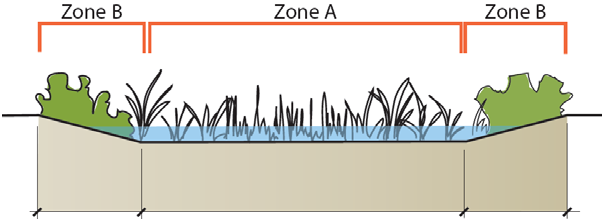
Figure 138-3662.a Planting Zones
(b)
LID plant species selection.
Once the plant zones are identified (Zone A only or both Zone A and Zone B) for a structure, the plants may be selected. Plant selection should take into account the following factors;
(1)
Tolerance of varied moisture conditions (wet and dry);
(2)
Tolerance of varied soil types and growing conditions;
(3)
Availability in Central Florida plant nurseries;
(4)
Low maintenance requirements;
(5)
Are not invasive weeds;
(6)
Do not have aggressive/invasive root systems; and
(7)
Exhibit an attractive appearance.
When selecting plants, additional site-specific information, such as tolerance to high and low temperatures, coastal conditions and prevailing winds should be considered. In addition, project specific aspects of the design, for example right-of-way vegetation height limits, may further influence selection. Pinellas County Stormwater Management Manual includes acceptable LID options.
(Ord. No. 18-36, § 3(Att. B), 10-23-18)
Sec. 138-3664. - Approved plant list.
The following standards apply to all plant material that may be required by this Code.
(a)
Florida-friendly. The proposed plant material shall be of a Florida-friendly species that are considered to be well adapted to growing in Florida landscapes and the proposed site location.
(b)
Soils and light. The proposed plant species shall be considered appropriate for the specific soil and natural lighting conditions at the proposed planting location.
(c)
Region. The proposed plant species shall be favorably rated for the Pinellas County region pursuit to the United States Department of Agriculture (USDA).
(d)
Non-invasive. The proposed plant species shall not be an invasive variety that is listed in Table 138-3653.a—Undesirable Trees/Plants.
(e)
Plant list option. The proposed plant species may be based on the latest publication of the Florida-Friendly Landscaping™ Guide to Plant Selection & Landscaping Design by the University of Florida Institute of Food and Agriculture Sciences (UF/IFAS).
(Ord. No. 18-36, § 3(Att. B), 10-23-18; Ord. No. 21-11, § 88, 4-27-21)
Sec. 138-3700. - Purpose and intent.
Fences and walls should be used to define ownership, create privacy, ensure protection, and provide screening. Fences and walls should be designed and sited to ensure their intended purpose while recognizing and responding to the community character and ensuring public safety.
(Ord. No. 18-36, § 3(Att. B), 10-23-18)
Sec. 138-3701. - Definitions, as used in this section.
(a)
Decorative as applied to walls means that a wall is masonry with a stucco finish; has a finish of natural materials, such as brick, stone, or glass block; or has a finish which is accepted for use in the industry.
(b)
Decorative as applied to fences means that a fence is made of PVC fence material, wrought iron, pre-fabricated metal, or aluminum pickets, or is a painted or stained shadow-box or board-on-board type fence.
(c)
Hedge means a continuous arrangement of three or more shrubs for the purpose of screening or dividing spaces which are planted and maintained to create an open space less than two feet wide by six feet high between each shrub.
(d)
Semi-opaque means and includes fence and wall components which have opacity of 25 percent or less, excluding vertical support posts, for the purpose of maintaining some visibility.
(Ord. No. 18-36, § 3(Att. B), 10-23-18; Ord. No. 21-11, § 89, 4-27-21)
Sec. 138-3702. - General requirements.
(a)
Residential fences and walls. In residential districts, walls and fences are subject to the following:
(1)
Within the required side and rear setback area:
a.
Six feet maximum height for a fence or wall of any style; or eight feet for a decorative fence or wall along secondary arterial and collector frontages.
b.
On waterfront properties, fences and walls within the rear setback shall be semi opaque.
(2)
Within the required front setback area:
a.
Three feet maximum height for a fence or wall of any style.
b.
Four feet maximum height for an opaque decorative fence or wall, subject to site visibility requirements per section 138-3508.
c.
Five feet maximum height for a semi-opaque decorative fence or wall, subject to site visibility requirements per section 138-3508.
d.
Six feet maximum height for a wall or fence of any style at the required front setback line on the primary frontage or, for multiple frontage lots, along the property line of a secondary frontage where the property is not addressed, subject to sight visibility requirements per section 138-3508.
e.
Eight feet maximum height for a decorative fence or wall when one of the following conditions apply:
1.
The fence or wall encloses the perimeter of a development adjacent to roads classified as collector streets or arterial roads. In such case:
It must be located at least two feet from the right-of-way and shall be landscaped with two trees for each 100 lineal feet and hedge material planted, in keeping with the intent of chapter 166, article II. Trees should be planted at least five feet in distance from the wall to allow adequate room for growth. Hedges within sight triangles must be maintained at no more than three feet above pavement.
The fence or wall must be reviewed and approved as part of a site plan or as a modification to an approved site plan. This includes the requirement that plans submitted be signed and sealed by a registered professional engineer in the State of Florida, thereby certifying that the fence or wall as proposed will not cause a sight distance obstruction for vehicles maneuvering on the adjacent or any nearby street system.
2.
The subject property is a corner lot, double frontage lot, or other multiple frontage lot, and the fence will be located within a setback area from an adjacent collector or arterial right-of-way for which the property is not addressed. Sight triangle requirements per section 138-3508 for maintaining adequate sight distance must be followed.
(b)
Rural residential districts (R-A, R-E and R-R). Split rail fences may be permitted up to six feet maximum height within the required front setback area. Such fences shall maintain at least 50 percent transparency.
(c)
Nonresidential fences and walls. In nonresidential districts, walls and fences are subject to the following:
(1)
Within the required side and rear setback area: six feet maximum height for a fence or wall of any style, except when required as part of a Type 2 review or Type 3 review approval.
(2)
Within the required front setback area:
a.
Three feet maximum height for a fence or wall of any style.
b.
Four feet maximum height for a decorative fence or wall, subject to site visibility requirements per section 138-3508.
c.
Six feet maximum height for a decorative fence or wall, provided the applicant satisfies the requirements of subsection 138-3702(a)(2)d.
(d)
Fences and walls may not be installed within public rights-of-way or other public property unless authorized by the appropriate public agency.
(e)
Fences and walls may be installed on vacant property as long as setback and sight visibility standards are met.
(f)
A zoning clearance is required for fences taller than three feet that are installed adjacent to public rights-of-way to ensure sight visibility standards per section 138-3508 are met.
(Ord. No. 18-36, § 3(Att. B), 10-23-18; Ord. No. 21-11, § 90, 4-27-21; Ord. No. 23-24, § 2, 10-31-23)
Sec. 138-3703. - Materials and conditions.
Fences or walls may be constructed of any of the following standard fencing materials: wrought iron, brick, concrete block, plastic, vinyl, chain link, or wood products that are typically pre-fabricated and are commercially available. All fences and walls shall be maintained in good repair and all surfaces thereof shall be kept painted or have similar protective coating where customarily necessary. Any departure from the materials prescribed by this section shall require the approval of the county administrator or his/her designee.
(Ord. No. 18-36, § 3(Att. B), 10-23-18)
Sec. 138-3704. - Barbed wire or electrical strands.
Barbed wire or electrical strands or similar type of fencing, when permitted, shall be no greater than six feet in height. The use of such type of fencing is permitted only as follows:
(a)
Barbed wire may be used on security fences in nonresidential districts.
(b)
Barbed wire may be used as part of agricultural activities.
(c)
Barbed wire or electrical strands or similar type of fencing may be used when specifically authorized in conjunction with a Type 2 review or a Type 3 review.
(Ord. No. 18-36, § 3(Att. B), 10-23-18; Ord. No. 21-11, § 91, 4-27-21)
Sec. 138-3705. - Measurement of height.
The maximum height of fences or walls shall be measured as follows:
(a)
From lowest adjacent grade to the uppermost horizontal member or members.
(b)
Wire strands, except certain permitted barbed wire strands described in section 138-3704, may not exceed 18 inches above the maximum height of fence.
(c)
A post, pilaster, or light with a cross-sectional dimension of 18 inches or less may exceed the allowable height by up to 12 inches. Berms or other mounds above normal grade shall be considered part of the height measurement.
(d)
Fences placed on retaining walls shall include the retaining wall height as part of the overall permitted height unless a minimum separation of three feet is provided between the edge of the retaining wall and fence.
(Ord. No. 18-36, § 3(Att. B), 10-23-18; Ord. No. 21-11, § 92, 4-27-21; Ord. No. 23-24, § 2, 10-31-2023)
Sec. 138-3706. - Visibility.
Sec. 138-3707. - Easements.
No portion of any concrete, block, or brick wall or similar permanent construction shall be located within the area of platted or recorded public easement unless authorized by the instrument, and/or county administrator or his/her designee.
(Ord. No. 18-36, § 3(Att. B), 10-23-18)
Sec. 138-3708. - Minor administrative adjustments to height.
The county administrator or his/her designee may administratively approve minor adjustments to fence or wall heights when they have determined that the shape of the property or elevation and slope disparities prohibit adequate screening and/or sufficient enclosure under the permitted height standards of this section. Such adjustment shall not result in a fence or wall exceeding a maximum height of eight feet, as measured in section 138-3705.
(Ord. No. 21-11, §§ 94, 95, 4-27-21)
Editor's note— Ord. No. 21-11, §§ 94, 95, adopted April 27, 2021, repealed § 138-3708, pertaining to the appendix to section 138-3702, and renumbered § 138-3709 as 138-3708. Historical notations are retained for reference purposes. Former § 138-3708 derived from Ord. No. 18-36, § 3(Att. B), adopted Oct. 23, 2018.
Sec. 138-3750. - Purpose and intent.
It is the purpose of this division to promote the public health, safety and general welfare through a comprehensive system of reasonable, consistent and nondiscriminatory sign standards and requirements. These sign regulations are intended to:
(a)
Enable the identification of places of residence and business.
(b)
Allow for the communication of information necessary for the conduct of commerce.
(c)
Lessen hazardous situations, confusion, and visual clutter caused by proliferation, improper placement, illumination, animation and excessive height, area and bulk of signs which compete for the attention of pedestrian and vehicular traffic.
(d)
Enhance the attractiveness and economic well-being of the county as a place to live, vacation and conduct business.
(e)
Protect the public from the dangers of unsafe signs.
(f)
Permit signs that are compatible with their surroundings and aid orientation, and preclude placement of signs in a manner that conceals or obstructs adjacent land uses or signs.
(g)
Encourage signs that are appropriate to the zoning district in which they are located and consistent with the category of use to which they pertain.
(h)
Curtail the size and number of signs and sign messages to the minimum reasonably necessary to identify a residential or business location and the nature of any such business.
(i)
Establish sign size in relationship to the scale of the lot and building on which the sign is to be placed or to which it pertains.
(j)
Preclude signs from conflicting with the principal permitted use of the site or adjoining sites.
(k)
Regulate signs in a manner so as to not interfere with, obstruct vision of or distract motorists, bicyclists or pedestrians.
(l)
Require signs to be constructed, installed and maintained in a safe and satisfactory manner.
(m)
Implement the county's comprehensive plan and comply with the minimum requirements established by state law that requires the regulation of signage.
Further, it is the intent of the board of county commissioners that protection of First Amendment rights shall be afforded such that any sign, display, or device allowed under this section may contain, in lieu of any other copy, any otherwise lawful noncommercial message that complies with the size, lighting and spacing requirements of this section.
(Ord. No. 18-36, § 3(Att. B), 10-23-18)
Sec. 138-3751. - Definitions.
All words used in this section, except where specifically defined in this subsection, shall carry their customary meaning when not inconsistent with the context in which they are used. The following words set forth in this subsection shall have the meanings as defined in this subsection:
Area or surface area of signs means the square foot area enclosed by a rectangle, parallelogram, triangle, circle, semicircle or other geometric figures, or other architectural design, the sides of which make contact with the extreme points or edges of the sign, excluding the supporting structure which does not form part of the sign proper or of the display. The area of a sign composed of characters or words attached directly to a large, uniform building wall surface shall be the smallest rectangle, triangle, circle, parallelogram or other geometric figure, or other architectural design, which encloses the whole group of words or characters.
Artwork means drawings, pictures, symbols, paintings or sculptures which in no way identify a product or business and which are not displayed in conjunction with a commercial, for-profit or nonprofit enterprise.
Banners means any sign of lightweight fabric or similar material that is mounted to a pole, a wall or a building at one or more edges. Flags shall not be considered banners.
Beacon means a stationary or revolving light which flashes or projects illumination, single color or multicolored, in any manner which is intended to attract or divert attention; except, however, this term is not intended to include any kind of lighting device which is required or necessary under the safety regulations described by the Federal Aviation Agency or similar agencies.
Building official means the local government official or his designee responsible for the administration, interpretation and enforcement of the building codes of the local government.
Bulletin board means a sign of permanent character, but with removable letters, words, numerals or symbols.
Business establishment means any individual person, nonprofit organization, partnership, corporation, other organization or legal entity holding a valid occupational license and occupying distinct and separate physical space.
Changeable message sign means a sign or portion of a sign on which message copy is changed manually or mechanically in the field through the utilization of attachable letters, numbers, symbols and other similar characteristics.
Double-faced sign means a sign which has two display surfaces backed against the same background, one face of which is designed to be seen from one direction and the other from the opposite direction, every point on each face being either in contact with the other face or in contact with the same background.
Dwell time is the minimum duration of a single display on a changeable or electronic changeable message sign. During the dwell time, the message display shall be static, and there shall not be any change of color, flash, fade, rotation, twinkle, twirl, alternate luminance, scroll, show of action or motion, or illusion of action or motion.
Electronic changeable message sign (also referred to as digital sign) means an on-premises or off-premises sign or portion thereof that displays electronic static images, static graphics, static pictures, or non-pictorial text information in which each alphanumeric character, graphic, or symbol is defined by a small number of matrix elements using different combinations of light emitting diodes, fiber optics, light bulbs, liquid crystal or any other emerging illumination technology within the display area. Electronic changeable messages include computer programmable, microprocessor-controlled electronic displays. Electronic changeable messages include images or messages with these characteristics projected onto buildings or other objects. Electronic changeable message sign shall not include any sign that does not maintain a static image for a minimum dwell time of 60 seconds or such other minimum dwell time that is expressly permitted under this Code.
Erect means to build, construct, attach, hang, place, suspend or affix, and shall also include the painting of signs.
Federal-aid primary (FAP) is a system of highways or portions thereof, which shall include the National Highway System designated as the federal-aid primary highway system by the Florida Department of Transportation and shall also include the federal interstate highways.
Flag means any fabric, banner or bunting containing distinct colors, patterns or symbols, used as a symbol of a government, political subdivision, corporation, business or other entity.
Flash means an entry or exit mode in an electronic changing message with any single frame that repeats two or more times consecutively without change. This does not include official warning signs to the motoring public.
Frontage means the length of the property line for a parcel which runs parallel to, and along, a road right-of-way or street, exclusive of alleyways. "Building frontage" means the single facade constituting the length of the building or that portion of a building occupied by a single office, business, or enterprise abutting a street, parking area, or other means of customer access such as an arcade, mall or walkway.
Ground level means the level of finished grade of a parcel of land, exclusive of any filling, berming, mounding or excavating, solely for the purpose of locating a sign. Ground level on marina docks or floating structures shall be the finish grade of the landward portion of the adjoining parcel.
Height means the vertical distance measured from the ground level nearest the base of the sign to the highest point of the sign.
Illuminance means the amount of light coming from a light fixture that lands on a surface.
Legally existing, for the purpose of describing a sign or sign structure, means that the sign or sign structure was lawfully erected in conformance with all applicable local, state, and federal laws, has been lawfully maintained and is lawfully operated in compliance with all applicable local, state, and federal laws (including any legal nonconforming signs), or that the sign or sign structure is lawfully operating in accordance with a settlement agreement to which Pinellas County is a party.
Local government means the county government and the municipalities within the county.
Luminance means the amount of light reflected off a surface in a particular direction.
Maintenance means the replacing, repairing or repainting of a portion of a sign structure, periodically changing changeable copy, or renewing copy which has been made unusable by ordinary wear, weather or accident.
Message sequencing means dividing a single thought or message into two or more successive sign displays on a single electronic changeable message sign or multi-vision sign. For example, it shall be considered message sequencing if the second display answers a textual question posed in the first display, continues or completes a sentence started on the first display, or continues or completes a story line started on the prior display.
Multitenant building means a building where more than one business is serviced by a common entrance, and where such businesses may be located above the first story or otherwise be without frontage on a public right-of-way.
Multi-vision sign, also known as a tri-vision sign, means an on-premises or off-premises sign composed in whole or in part of a series of vertical or horizontal slats or cylinders that are capable of being rotated at intervals so that partial rotation of the group of slats or cylinders produces a different image and when properly functioning allows on a single sign structure the display at any given time one of two or more images.
Pennant means any series of small flaglike or streamerlike pieces of cloth, plastic or paper, or similar material attached in a row to any staff, cord, building, or at only one or two edges, the remainder hanging loosely.
Person means any individual, corporation, association, firm, partnership, and the like, singular or plural.
Physically removed means, for the purposes of this section, that an off-premises sign shall be deemed removed if the off-premises sign structure is permanently removed to a depth of 12 inches below grade.
Property means the overall area represented by the outside boundaries of a parcel of land or development.
Sign means any device, fixture, placard or structure that uses any color, form, graphic, illumination, architectural style or design or writing to advertise, attract attention, announce the purpose of, or identify the purpose of a person or entity, or to communicate information of any kind to the public. "Sign" includes sign structure.
(1)
A-frame or sandwich sign means a portable sign which is ordinarily in the shape of an "A" or some variation thereof.
(2)
Abandoned signs means signs on which is advertised a business that is no longer licensed, no longer has a certificate of occupancy, or is no longer doing business at that location and such circumstances have continued for a period of more than 90 consecutive days.
(3)
Animated sign means any sign composed of moving parts or lights or lighting devices that change color, flash, fade, rotate, twinkle, twirl, alternate luminance, scroll, show action or motion, create the optical illusion of action or motion or otherwise change the appearance of the sign. Animated signs do not include electronic (digital) changeable message sign or multi-vision sign as defined in this section.
(4)
Attached signs means any sign attached to, on, or supported by any part of a building (e.g., walls, integral roof, awning, windows, or canopy) which encloses or covers usable space.
(5)
Bench signs/bus shelter signs means a bench or bus shelter upon which a sign is drawn, painted, printed, or otherwise affixed, and, where authorized by action of the board of county commissioners, shall be exempt from the provision of this section as per F.S. § 337.407(2).
(6)
Canopy (awning) sign means any sign that is a part of or attached to an awning, canopy, or other fabric, plastic or structural protective cover over a door, entrance, window, or outdoor service area. A marquee is not a canopy.
(7)
Exempt signs means all signs for which permits are not required, but which must, nonetheless, conform to the other terms and conditions of this section.
(8)
Freestanding sign means any sign supported by structures or supports that are placed on or anchored in the ground and that are independent of any building or other structure.
(9)
Nonconforming sign means any sign that does not conform to the requirements of this section.
(10)
Off-premises sign means any sign identifying or advertising a product, business, person, activity, condition, or service not located or available on the same zone lot where the sign is installed and maintained.
(11)
On-premises sign means any sign which identifies a use or business or advertises a product for sale or service to be rendered on the zone lot where the sign is located.
(12)
Portable sign means any sign not permanently attached to the ground or other permanent structure, or a sign designed to be transported, including, but not limited to, signs designed to be transported by means of wheels; signs converted from A-frames; menu and sandwich board signs; balloons and other inflatables; and umbrellas used for advertising.
(13)
Projecting sign means any sign affixed perpendicularly to a building or wall in such a manner that its leading edge extends more than six inches beyond the surface of such building or wall.
(14)
Roof sign means any sign erected and constructed wholly on and over the roof of a building, supported by the roof structure. "Integral roof sign" means any sign erected or constructed as an integral or essentially integral part of a normal roof structure of any design, such that no part of the sign extends vertically above the highest portion of the roof and such that no part of the sign is separated from the rest of the roof by a space of more than six inches. Any integral portion of the roof shall not extend more than five feet above the structural roof.
(15)
Snipe sign means a sign which is tacked, nailed, posted, pasted, glued, or otherwise attached to trees, poles, stakes, fences, or to other objects with the message appearing thereon not applicable to the present use of the premises or structure upon which the sign is located.
(16)
Temporary sign shall mean any sign that is not a permanent sign, and shall include a sign formerly or commonly associated with a temporary use or structure, a temporary election sign, a temporary political sign, a temporary free expression sign, a temporary real estate sign, a temporary directional sign, a temporary construction sign, a temporary grand opening sign, or any other temporary sign unless otherwise provided herein. The term "temporary sign" shall not include any substitution of message on an existing lawful sign or sign structure.
(17)
Vehicle sign means a sign attached to or placed on a vehicle, including automobiles, trucks, boats, campers, and trailers, that is parked on or otherwise utilizing a public right-of-way, public property or on private property so as to be intended to be viewed from a vehicular right-of-way for the basic purpose of providing advertisement of products or services or of directing people to a business or activity. This definition is not to be construed to include those signs that identify a firm or its principal products on a vehicle or such advertising devices as may be attached to and within the normal unaltered lines of the vehicle of a licensed transit carrier, when and during that period of time such vehicle is regularly and customarily used to traverse the public highways during the normal course of business.
(18)
Wall sign means a sign which is painted on, fastened to, or erected against the wall of a building with its face in a parallel plane to the plane of the building facade or wall.
(19)
Warning sign means a sign located on property posting such property for warning or prohibitions on parking, trespassing, hunting, fishing, swimming, or other activity, provided such signs do not carry any commercial message or identification.
(20)
Window sign means a sign located on a window or within a building or other enclosed structure, which is visible from the exterior through a window or other opening.
Sign face means the part of the sign that is or can be used to identify, display, advertise, communicate information, or for visual representation which attracts or intends to attract the attention of the public for any purpose.
Sign structure means any structure which is designed specifically for the purpose of supporting a sign, has supported or is capable of supporting a sign. This definition shall include any decorative covers, braces, wires, supports, or components attached to or placed around the sign structure.
Street means a public right-of-way intended for the use of vehicular and pedestrian traffic.
Traditional off-premises sign means any off-premises sign that is not defined as an electronic changeable message sign.
Zone lot means a parcel of land that is of sufficient size to meet minimum zoning requirements for area, coverage, and use, and that can provide such setbacks and other open spaces as are required by the applicable local government zoning regulations. For the purpose of this definition, a shopping center, mall, or other lot or parcel of land which contains a single unit or an integrated group of commercial establishments and is developed, operated, managed and/or owned as a unit shall be considered as a zone lot.
(Ord. No. 18-36, § 3(Att. B), 10-23-18)
Sec. 138-3752. - General sign requirements.
(a)
Permitting process.
(1)
All signs except those specifically exempted under this section shall require a zoning clearance and permit prior to erection.
(2)
Applicants for sign permits shall provide the following information:
a.
Detailed scale drawing of the sign showing all dimensions.
b.
Accurate plot plan drawn to scale showing location of the sign on the site. Such plan shall show location of all uses on the site, including but not limited to structures, parking areas, driveways, green areas, walkways, and roadways.
c.
Survey of the parcel on which the sign is to be placed (this may be waived for attached signs).
d.
Statement signed by the permit applicant as to the number and size of existing on-site signs.
e.
Application for attached signs shall include a floor plan showing dimensions and layout of the building.
f.
Information as may be required by the county building department.
g.
Other appropriate information relative to the sign and its location.
h.
Signs of a height greater than six feet and within ten feet of current or proposed right-of-way lines shall require a letter of no objection from the local electric power company to ensure current and future compliance to applicable codes and to protect the safety of the public.
(b)
Relationship to other codes.
(1)
All signs shall comply with applicable building, electrical, and maintenance codes.
(2)
The maintenance of signs shall be in keeping with the intent of chapter 22, division 3 section 22-231(b)(2) to ensure the public health, safety and welfare is maintained. The owner and/or leaseholder shall be responsible for keeping the area immediately surrounding the sign free from trash and debris as per chapter 58, articles VIII and IX, and shall be responsible for maintaining the signs concerned in good operating conditions and appearance. Failure to comply with chapter 22, article V shall constitute cause for revocation of the sign permit and removal of the sign, if the owner and/or leaseholder fail to correct same within ten days after written notice of violation.
(c)
Nonconforming signs.
(1)
Except as provided in this section, no nonconforming sign shall be moved, reconstructed, extended, enlarged, or altered, unless changed to conform with this section.
(2)
Nonconforming signs may be maintained, repaired, or the message of the sign may be changed. If, however, the nonconforming sign is relocated, replaced, or structurally altered at a cost of more than 25 percent of the replacement cost of the sign, the sign must be made to conform to this section. Notwithstanding, such signs must adhere to the nonconforming amortization schedule outlined in subsection (d).
(3)
A building or site which is improved or redeveloped at a cost in excess of 50 percent of the assessed value of the existing building or site shall require any nonconforming sign which is located on or is a part of such building or site to conform to this section.
(4)
Signs that exist on the effective date of this section that were not in conformance with previous regulations are illegal signs and shall conform with this section or be removed within 90 calendar days of the effective date of this section.
(5)
Notwithstanding any contrary provisions in this section, no nonconforming sign is required to be removed solely by the passage of time if permitted by state or federal law.
(d)
Removal of nonconforming signs.
(1)
All legally erected nonconforming signs must be made to conform to the applicable provisions of this section within seven years of the effective date of this section.
(2)
In the event that a court of competent jurisdiction determines that, as applied to a particular nonconforming sign, the seven-year period for attaining conforming status is not enforceable, then a ten-year period shall apply.
(3)
In the event that a court of competent jurisdiction determines that, as applied to a particular nonconforming sign, the period for attaining conforming status provided for in subsections (d)(1) or (d)(2), above, is unenforceable, then the court may determine what additional period of time shall be required and, consistent with subsection (d)(4), that period shall tack on to the otherwise applicable time period.
(4)
The intent of subsections (d)(2) or (d)(3), above, is to prevent a successful legal challenge to the application of these removal provisions from requiring the amortization period to begin anew. Therefore, any additional period of time either required by the preceding three-year extension provision of subsection (d)(2), above, or any court decision that extends the time beyond the ten-year period provided for under subsection (d)(3), shall tack on to the period of time that has passed since the effective date of this section for purpose of calculating the eventual removal date.
(e)
Variances.
(1)
Requests for variances from any provisions of this section shall be processed and authorized pursuant to chapter 138, article II, division 7, variances, waivers and administrative adjustments.
(2)
Variances from the terms of this section may not be contrary to the public interest; but variances may be granted where, owing to special conditions, the literal enforcement of the provisions of this section would result in unnecessary hardship, not to include economic hardship. However, no variance shall be granted unless the criteria of section 138-231 is met. In addition to these usual criteria for variances to the provisions of this section, any additional signage allowed pursuant to a variance shall be conditioned in such a way that, taking into consideration existing allowable signage in the area, the additional signage does not exacerbate visual clutter, driver distraction, or traffic safety in the area.
(3)
Variances to the time limit for removal of nonconforming signs.
a.
Requests for variances of up to three additional years beyond the seven-year period that would otherwise be allowed under subsection (d)(1), above, may be granted where, owing to the peculiar facts of the structure involved, and based on no single one of the criteria listed below, but rather when, on balance, the private loss suffered by owners of the particular structure is substantial when compared to the public benefit achieved by the consistent application of the amortization period. The specific criteria for determination of a variance to the seven-year removal period shall include the following considerations:
1.
Length of the amortization period in relation to the investment;
2.
A sign owner does not have to be given a period of time necessary to permit him to recoup his investment entirely, but an amortization period should not be so short as to result in a substantial loss of the sign owner's investment;
3.
Initial capital investment;
4.
Investment realization to date;
5.
Life expectancy of investment; depreciation schedules;
6.
Existence or nonexistence of a lease obligation, as well as a contingency clause permitting termination of the lease;
7.
Removal costs directly attributable to the regulatory effects of this section;
8.
The depreciation period of the sign structure;
9.
Location of the sign structure;
10.
What part of the owner's total business is concerned;
11.
Monopoly or advantage, if any, resulting from the fact that similar new structures are prohibited in the same area; and
12.
The fact that the use is also on public streets since the messages are directed to the passerby.
13.
No variance under this subsection shall be granted unless the conditions listed under chapter 138, article II, division 7, variances, waivers and administrative adjustments are also satisfied.
(f)
Signs on public lands. Signs shall not be located on publicly owned land or easements or inside street rights-of-way except signs required or erected by permission of the authorized governmental agency. Such prohibited signs shall include, but not be limited to, handbills, posters, advertisements, or notices that are attached in any way upon lampposts, telephone poles, utility poles, bridges and sidewalks. All signs shall be moved by the owner of the sign at no expense to the applicable governmental jurisdiction when the signs are within any public property including existing rights-of-way. Nothing shall prohibit a duly authorized public official from removing a sign from public property.
(g)
Official signs and notices. Nothing in this section shall be construed to prevent or limit the display of legal notices, warnings, informational, directional, traffic or other such signs which are legally required or necessary for the essential functions of governmental agencies.
(h)
Illumination.
(1)
The light from any illuminated sign shall be shaded, shielded, or directed from adjoining residential and nonresidential parcels.
(2)
No sign shall have blinking, flashing, or fluttering lights or other illumination devices which have a changing light intensity, brightness, color, or direction.
(3)
No colored lights shall be used at any location or in any manner so as to be confused with, construed as, or interfere with traffic control devices. Similarly, no electronic changeable message sign shall be permitted if it may be confused with, construed as, or interfere with traffic control devices.
(4)
Neither the direct nor the reflected light from primary light sources shall create a traffic hazard to operators of motor vehicles on public thoroughfares.
(i)
Electronic changeable message signs. Electronic changeable message signs shall meet the following criteria:
(1)
Luminance: Luminance shall be measured in nits. A nit is a metric unit of luminance and is defined as candela per square meter (cd/m2); a nit is a unit based on the candela, the modern metric unit of luminous intensity, and the square meter, the modern metric unit of area. Luminance shall not exceed the maximum brightness as set forth below:
a.
Luminance at night: Beginning at sunset and continuing until sunrise, the brightness of an electronic changeable message shall not exceed 350 nits.
b.
Luminance during daylight hours, beginning at sunrise and continuing until sunset: During daylight hours, the brightness of an electronic changeable message shall not exceed 5,000 nits.
(2)
Illuminance: The illuminance of any electronic changeable message sign display shall not be greater than 0.3 footcandles above ambient light levels at any given time of day or night, as measured using a footcandle meter at a preset distance described in this subsection. To determine compliance with the 0.3 footcandle maximum illuminance, the footcandle measurements for a display shall be taken with the sign switched off and then taken again with the sign displaying all white (maximum sign brightness), and the brightness shall be measured at the pre-set distance perpendicular from the face of a sign. For electronic changeable message signs, the pre-set distance to measure the footcandle impacts vary with the expected viewing distances and the face size of each sign noted below.
The illuminance of any electronic changeable message sign which is less than 288 square feet in area shall be based upon a 100 square-foot display at a distance of 100 feet perpendicular to the display using a footcandle meter. To determine compliance with the 0.3 footcandles maximum illuminance, the footcandle measurements for a display shall be taken with the sign switched off and then taken again with the sign displaying all white (maximum sign brightness), and the brightness shall be measured 100 feet perpendicular from the face of a sign. If the sign face is other than 100 square feet, the measured reading shall be prorated to what an otherwise identical sign of 100 square feet would produce. The prorated, measured footcandle value is then used to compare to the limit of 0.3 footcandles (fc).
Example: For evaluation of a 200 square-foot sign, if the measured illuminance at a distance of 100 feet is 0.5 fc above ambient (i.e., with the sign on and showing an all-white display, the reading at 100 feet is 0.5 fc greater than with the sign switched off), then the prorated footcandle value is 0.25 fc and the footcandle value is below the maximum of 0.3 fc.
To determine compliance with the 0.3 footcandle maximum illuminance for any electronic changeable message sign which is equal to or greater than 288 square feet in area, the footcandle measurements for a display shall be taken with the sign switched off and then taken again with the sign displaying all white (maximum sign brightness), and the brightness shall be measured using a footcandle meter at the preset distance described as follows: 150 feet perpendicular from the face of a sign that is equal to 288 square feet in area; 200 feet perpendicular from the face of a sign that is greater than 288 square feet in area but less than or equal to 378 square feet in area; and 250 feet perpendicular from the face of a sign that is greater than 378 square feet in area.
Note: The metric equivalent of footcandles is lux, and a lux meter (as contrasted with a footcandle meter) is used when illuminance is measured in meters.
(3)
All electronic changeable message signs shall be equipped with appropriate sensors, timers, or other equipment sufficient to maintain compliance with the brightness standards set forth herein, and the same must be set and operated in a manner to ensure that the brightness standards are not exceeded.
(4)
Transition time: The maximum transition time between messages or images on an electronic changeable message sign shall be no more than one-half second. During transition, there shall not be any change of color, flash, fade, rotation, twinkle, twirl, alternate luminance, scroll, show of action or motion, or illusion of action or motion.
(5)
Sign monitoring and malfunction: Electronic changeable message signs shall be operated with systems and monitoring in place to either turn the display off or show full black as soon as possible in the event of a malfunction.
(j)
Dwell time. The minimum amount of time that a message or display on a changeable message sign, an electronic changeable message sign or multi-vision sign remains fixed is one minute, except as otherwise permitted pursuant to subsection 138-3757(j).
(k)
Message sequencing. Message sequencing on an electronic changeable message sign or multi-vision sign is prohibited.
(l)
In connection with the county's issuance of a notice of violation or other process pursuant to which the county seeks to enforce the provisions of this division related to an alleged violation of the luminance, illuminance, message sequencing, or minimum message dwell time standards established in this division, 48 hours shall be deemed a reasonable time period for the owner or operator to cure a first-time alleged violation. Any time period in which the electronic changeable message display is turned off while the owner or operator attempts to address or cure the alleged violation shall toll the running of the 48-hour period. Pursuant to subsection 2-625(b), the fine for a violation of any provision of this division pertaining to an off-premises electronic changeable message sign shall be not less than $1,000.00 per day for the first violation, $2,500.00 per day for the second violation, and $5,000.00 per day for the third and subsequent violations.
(Ord. No. 18-36, § 3(Att. B), 10-23-18)
Sec. 138-3753. - Exempt signs.
The following types of signs are exempt from the permitting process and other provisions in this section, except those relating to construction, illumination, safety, nonconformity, and any other noted requirement (these signs shall not be located within ten feet of a public right-of-way or within 15 feet of the intersection of any road rights-of-way):
(a)
Address number. The address numbers shall be at least three inches in height, in Arabic numerals, and of contrasting color to background and displayed on the front of the establishment.
(b)
Artwork.
(c)
Changeable message on permitted signs.
(d)
Government and public signs, including, but not limited to, community identity and entrance signs, signs for special community events, commemorative and historic signs, and coordinated countywide trail-blazing signs that provide direction to places of interest.
(e)
There shall be a maximum of three noncommercial flags permitted on each zone lot. Flags containing a corporate name or logo or directing attention to a business operated for profit, or to a commodity or service for sale, shall be part of the computation of the allowable area for freestanding signs. Three additional noncommercial flags may be allowed for each additional street frontage and lots or parcels with over 500 feet of street frontage may be permitted three additional flags for each 500 feet of additional frontage.
(f)
Machinery signs. Examples of machinery signs are signs on newspaper machines, vending machines, gasoline pumps and public telephone booths.
(g)
Menu signs for drive-through establishments. There shall be a maximum of two such signs per zone lot or business; no more than one sign per drive-through lane. Sign area may not exceed 40 square feet per sign face.
(h)
On-site directional signs. No individual sign shall exceed four square feet in area per sign face.
(i)
Temporary window signs. Such signs shall be allowed in areas classified as multifamily residential, office, commercial, industrial and public/semipublic. The maximum area of such signs in areas classified as office, commercial, industrial, and public/semipublic shall be 25 percent of windowpane area or 100 square feet, whichever is less. In multifamily residential areas, the area of temporary window signs shall not exceed 25 square feet.
(j)
Warning signs. Such signs shall not exceed six square feet in area per sign face.
(k)
Temporary signs. The criteria required for temporary signs are set forth in Table 138-3753.a—Temporary Signs Design Standards and Limitations, below. A temporary sign is unlawful if it does not meet the criteria established for the zoning district category group in which the sign is located.
(l)
Additional temporary sign standards are as follows:
(1)
Prohibition of temporary signs on public property. Other than government signs displaying government speech, temporary signs on public property are prohibited unless otherwise allowed within the LDC or the Code of Ordinances.
(2)
Duration for display of temporary sign. If a temporary sign pertains to an event, the temporary sign shall be removed within and by no later than three days after the event is concluded. If a temporary sign does not pertain to an event, the temporary sign shall be removed within and by no later than 30 days after being erected.
(3)
Display of temporary sign requires permission of real property owner. A temporary sign on any parcel shall not be maintained if the placement of the same does not have the permission of the owner of the real property.
(4)
A temporary sign may not display any lighting and must remain static. A temporary sign may not display any lighting or illuminations that flash, move, rotate, scintillate, blink, flicker, or vary in intensity or color.
(5)
A temporary sign may not incorporate fluorescent color or exhibit fluorescence. A temporary sign may not incorporate fluorescent color or exhibit fluorescence.
(6)
A temporary sign may not obstruct a permanent sign or the vision between pedestrians and vehicles. A temporary sign may not obstruct the view of a permanent sign as viewed from any public road, street or highway or any public sidewalk, and may not obstruct the vision between pedestrians and vehicles using the public right-of-way, including but not restricted to, those meeting site visibility triangle requirements set forth in section 138-3508.
(7)
A temporary sign may display multiple messages. A temporary sign may display multiple independent messages on any portion of the sign surface of a temporary sign.
(8)
A temporary sign is not subject to permitting. A temporary sign does not require a permit from the county.
(9)
Subsection 138-3753(k) not intended to regulate interior facing signage. The county does not intend that subsection 138-3453(k) regulate or be applicable to signage located in the interior of school yards, ball/play fields or similar uses where such signage is designed to face the interior of such location and is not designed to be viewed or seen from adjacent roadways.
(Ord. No. 18-36, § 3(Att. B), 10-23-18)
Sec. 138-3754. - Prohibited signs.
The following types of signs are prohibited:
(a)
Abandoned signs.
(b)
Bus shelter signs and bench signs, except when approved by the board of county commissioners, pursuant to F.S. § 337.407(2)(a) or as amended. This prohibition shall not be construed to include the identification of a transit company or its route schedule.
(c)
Off-premises signs, except for public/semipublic directional signs, where specifically provided for elsewhere in this section, and per section 138-3757.
(d)
Pavement markings, except official traffic control markings as permitted by an authorized government agency.
(e)
Pennants, streamers, banners and cold air inflatables.
(f)
Roof signs, except integral roof signs in nonresidential districts.
(g)
Sandwich board signs.
(h)
Signs attached to or painted on piers or seawalls, other than such official regulatory or warning signs as authorized by an appropriate government agency.
(i)
Signs in or upon any river, bay, lake, or other body of water within the limits of the county, unless authorized by an appropriate government agency.
(j)
Signs that are erected upon or project over public rights-of-way or present a potential traffic or pedestrian hazard. This includes signs which obstruct visibility.
(k)
Signs that emit sound, vapor, smoke, odor, particles or gaseous matter, or project three-dimensional images, holographic images or pyrotechnics.
(l)
Signs that have unshielded illuminating devices, other than electronic changeable message sign displays permitted in accordance with division 5, signs.
(m)
Animated signs, multi-prism signs and beacon lights, except when required by the Federal Aviation Administration or other governmental agency.
(n)
Signs that obstruct, conceal, hide, or otherwise obscure from view any official traffic or government sign, signal or device.
(o)
Snipe signs.
(p)
Temporary window signs in single-family residential districts.
(q)
Vehicle signs, as defined in this section, and portable trailer signs.
(r)
Any sign that is not specifically described or enumerated as permitted by this section.
(Ord. No. 18-36, § 3(Att. B), 10-23-18; Ord. No. 21-11, § 96, 4-27-21)
Sec. 138-3755. - Computation of dimensions.
(a)
Computation of total permitted sign area.
(1)
The permitted sign area for freestanding signs shall be based upon one square foot for each linear foot of zone lot frontage up to a maximum amount as established in section 138-3755. A freestanding sign shall be allowed to have an additional eight square feet per sign face, provided that this allowance is used exclusively for the street address number, numbers or number range, depicted in Arabic numerals. The public purpose for the address is to assist the traveling public to locate specific places and to assist public safety and emergency service vehicles to rapidly locate addresses.
(2)
The permitted sign area for attached signs shall be based upon one and three-quarters square feet for each linear foot of building frontage up to a maximum amount as established in section 138-3755.
(3)
Zone lots fronting two or more streets are allowed the permitted signage for each frontage, but signage cannot be accumulated and used on one street in excess of that allowed for the zone lot based on that one street frontage.
(b)
Computation of sign area.
(1)
The area of a sign shall be computed on the basis of the smallest square, circle, rectangle, or other geometric figure, or combination thereof, that will encompass the extreme limits of the writing, representation, emblem, lighting or other display, together with any material, color or border trim forming an integral part of the background of the display or used to differentiate the sign from the backdrop or structure against which it is placed. This includes foundations, support structures or any other portions of the sign from the ground up, that are clearly indicative of the branding or color of the business or product with which they are associated. The computation of a sign area does not include any framework, bracing, fence or wall that is reasonably necessary to support the sign. Any pole or pole cover greater than two feet in width shall be counted in the computation of sign area.
(2)
The area of a sign shall be computed on a per sign face basis and all requirements with respect to sign area reference the area of a single face of a sign. A double-faced sign shall be permitted to have the allowed area for a single-faced sign on each of the two faces of the double-faced sign.
(c)
Computation of sign height. The height of a freestanding sign shall be computed as the distance from the base of the sign at ground level to the top of any portion of the sign structure. In cases where the ground level, as defined in this section, cannot reasonably be determined, sign height shall be derived on the assumption that the elevation of the ground at the base of the sign is equal to the average elevation at the front property line of the zone lot.
In the case where a freestanding sign is on a parcel contiguous to an overpass or elevated road (excluding service roads) from which the sign is designed to be viewed, the height of the sign shall be measured from the highest point of the overpass or elevated road at the crown of the roadway surface to the top of the sign, such highest point to be determined by the average elevation between the perpendicular extension of the contiguous zone lot lines on which the sign is to be located, as such lot lines intersect the overpass or elevated road (see illustration in appendix). Any sign erector who requests to use this calculation for height determination shall provide to the zoning staff sufficient information in the form of surveys, engineering drawings, official roadway elevation data, or other official documentation to allow accurate determination of roadway heights. No permit shall be issued where insufficient information is provided.
(d)
Computation of visual clearance and sight triangle. The visual clearance and sight triangle, to assure adequate sight distance at the intersection of two public roadways and at the intersection of a public roadway and an accessway or driveway, shall follow the criteria of the state department of transportation's Manual of Uniform Minimum Standards for Design, Construction and Maintenance for Streets and Highways, or criteria otherwise specified by the county traffic engineer.
(e)
Illustrations in section 138-3758. The computation of sign dimensions shall be as set forth in this division and as depicted in the appropriate figure delineating such sign dimensions in section 138-3758.
(Ord. No. 18-36, § 3(Att. B), 10-23-18; Ord. No. 21-11, § 97, 4-27-21)
Sec. 138-3756. - Permitted signs and standards by zoning classifications.
(a)
Purpose and procedure. It is the intent of this section to regulate signs consistent with the zoning classification or general type of land usage which establishes the character of the area in which the signs are located.
(b)
Residential zoning districts. The following types of signs are permitted in any residential zoning district:
(1)
Subdivision signs for single-family residential areas shall be permitted only as follows:
a.
Number. A maximum of one sign is permitted for each platted subdivision or property entrance. When incorporated into a fence, wall, or other decorative entry feature one such sign shall be permitted on either side of the road or entry way for a total of two signs.
b.
Area. The maximum area shall be 24 square feet per sign face. When incorporated into a fence, wall or similar decorative entry feature no portion of the fence or wall upon which the sign is mounted shall be counted towards the area of the sign.
c.
Height. The maximum height for a freestanding sign is six feet.
d.
Setbacks. No front setback is required and the side and rear setbacks of the zoning district shall apply, provided a safe sight distance clearance is maintained. Such safe sight distance shall be determined by the county traffic engineer pursuant to section 138-3755(d). Fences, walls and similar decorative entry features shall be set back in accordance with division 4 of this chapter.
(2)
Signs for multifamily residential areas shall be permitted only as follows:
a.
Number. A maximum of one sign is permitted for each platted subdivision or property entrance. When incorporated into a fence, wall, or other decorative entry feature one such sign shall be permitted on either side of the road or entry way for a total of two signs.
b.
Area. The maximum area is 24 square feet per sign face. When incorporated into a fence, wall or similar decorative entry feature no portion of the fence or wall upon which the sign is mounted shall be counted towards the area of the sign.
c.
Height. The maximum height for a freestanding sign is eight feet.
d.
Setbacks. No front setback is required and the side and rear setbacks of the zoning district shall apply, provided a safe site distance clearance is maintained. Such safe site distance shall be determined by the county traffic engineer pursuant to section 138-3755 (d). Fences, walls and similar decorative entry features shall be set back in accordance with division 4 of this chapter.
(3)
Residential identification signs (nameplate) shall be permitted only as follows:
a.
Number. A maximum of one attached sign is permitted.
b.
Area. The maximum area of the sign shall be two square feet per sign face.
(4)
Small, off-premises signs that are for public/semipublic purposes and are directional only, as per subsection 138-3753(m).
(5)
Signs for public/semipublic land uses shall be in accordance with the provisions of subsection (c).
(c)
Public/semipublic zoning district and signs utilized for public/semipublic uses. The following types of signs are permitted in the public/semipublic zoning district or on sites containing an authorized public/semipublic land use:
(1)
Freestanding signs shall be permitted only as follows:
a.
Number. A maximum of one sign per zone lot is permitted. One additional sign may be permitted for each additional street frontage. For parcels with over 500 feet of street frontage on one right-of-way, one additional freestanding sign may be permitted; such additional sign shall be spaced at least 300 feet from the other. One additional sign which is used as a bulletin board for church or school use is permitted.
b.
Area. The total maximum area for any freestanding sign or signs shall be that area calculated according to subsections 138-3755(a) and (b) of this section, or 48 square feet per sign face, whichever is less. An additional 48 square feet may be provided for a bulletin board.
c.
Height. The maximum height for a freestanding sign shall be 12 feet.
d.
Setbacks. Setbacks shall be three feet from any public right-of-way. Side and rear yards shall be as required by the zoning district where the sign is located. Additional setbacks may be required when determined appropriate per subsection 138-3755(d).
(2)
Attached signs shall be permitted only as follows:
a.
Area. The maximum total area for all attached signs shall be that area calculated according to subsections 138-3755(a) and (b) or 48 square feet, whichever is less. An additional 48 square feet may be provided for a bulletin board.
b.
Types of signs permitted. The following attached signs may be permitted, provided the cumulative area of the attached signs does not exceed the maximum area according to subsection (c)(2)a, above:
1.
Wall sign;
2.
Canopy or awning sign;
3.
Permanent window sign;
4.
Projecting sign; and
5.
Integral roof sign.
(d)
LO and GO zones. Within the LO and GO zones, only the following signs shall be permitted:
(1)
Freestanding signs shall be permitted only as follows:
a.
Number. A maximum of one sign per zone lot is permitted. One additional sign may be permitted for each additional street frontage. For parcels with over 500 feet of street frontage on one right-of-way, one additional freestanding sign may be permitted; such additional sign shall be spaced at least 300 feet from the other.
b.
Area. The total maximum area for any freestanding sign or signs shall be that area calculated according to subsections 138-3755(a) and (b) of this section or 50 square feet per sign face, whichever is less.
c.
Height. The maximum height for a freestanding sign is 20 feet.
d.
Setbacks. Such signs shall be set back as follows:
1.
Three feet from any public right-of-way.
2.
Fifteen feet from side and rear property lines in P-1 zones.
3.
Twenty feet from side and rear property lines in the P-1A zone. Additional setbacks may be required when determined appropriate per subsection 138-3755(d).
e.
Flags. Flags containing a corporate name, logo, or other message directing attention to the business on site including any commodity or service for sale on site shall be part of the computation of allowable area for freestanding signs.
(2)
Attached signs shall be permitted only as follows:
a.
Area. The maximum total area for all attached signs shall be that area calculated according to subsections 138-3755(a) and (b), or 100 square feet, whichever is less.
b.
Types of signs permitted. The following attached signs may be permitted, provided the cumulative area of the attached signs does not exceed the maximum area according to subsection (d)(2)a, above:
1.
Wall sign;
2.
Canopy or awning sign;
3.
Permanent window sign;
4.
Projecting sign;
5.
Integral roof sign.
(3)
Directory/information signs shall be permitted only as follows:
a.
Number. A maximum of one sign per street frontage is permitted.
b.
Area. The maximum area for a directory/information sign shall be 40 square feet per sign face for any one sign.
c.
Setback. The minimum setback distance for a directory/information sign is 100 feet from any property line.
(4)
Off-premises directional signs for public/semipublic purposes are permitted in accordance with subsection 138-3753(m) of this section.
(5)
Public/semipublic land uses shall follow the sign provisions of subsection (c).
(e)
C-1 zone. Within the C-1 zone, only the following signs shall be permitted:
(1)
Freestanding signs shall be permitted only as follows:
a.
Number. A maximum of one sign per zone lot is permitted. One additional sign may be permitted for each additional street frontage. For parcels with over 500 feet of street frontage on one right-of-way, one additional freestanding sign may be permitted; such additional sign shall be spaced at least 300 feet from the other.
b.
Area. The total maximum area for any freestanding sign or signs shall be that area calculated according to subsections 138-3755(a) and (b), or 50 square feet per sign face, whichever is less.
c.
Height. The maximum height for a freestanding sign is 20 feet.
d.
Setbacks. Such freestanding signs shall be set back as follows:
1.
Three feet from any public right-of-way.
2.
Side and rear yards, 20 percent of the width or depth of the lot up to 20 feet when abutting residential property. No side or rear setback is required when abutting nonresidential property.
Additional setbacks may be required when determined appropriate per subsection 138-3755(d).
e.
Flags. Flags containing a corporate name, logo, or other message directing attention to the business on site including any commodity or service for sale on site shall be part of the computation of allowable area for freestanding signs.
(2)
Attached signs shall be permitted only as follows:
a.
Area. The maximum total area for all attached signs shall be that area calculated according to subsections 138-3755(a) and (b) 100 square feet, whichever is less.
b.
Types of signs permitted. The following attached signs may be permitted provided the cumulative area of the attached signs does not exceed the maximum area according to subsection (e)(2)a., above:
1.
Wall sign;
2.
Canopy or awning sign;
3.
Permanent window sign;
4.
Projecting sign; and
5.
Integral roof sign.
(3)
Off-premises directional signs for public/semipublic purposes are permitted in accordance with subsection 138-3753(m).
(4)
Public/semipublic land uses shall follow the sign provisions of subsection (c).
(f)
C-2 and E-2 zones, except when located on arterial highways. When located within the C-2 or E-2 zone, except areas located on arterial highways, only the following signs may be permitted. For signs located in these zones on arterial highways, see subsection (g), below:
(1)
Freestanding signs shall be permitted only as follows:
a.
Number. A maximum of one sign per zone lot is permitted. One additional sign may be permitted for each additional street frontage. For parcels with over 500 feet of street frontage on one right-of-way, one additional freestanding sign may be permitted; such additional sign shall be spaced at least 300 feet from the other.
b.
Area. The total maximum area for any freestanding sign or signs shall be that area calculated according to subsections 138-3755(a) and (b) or 100 square feet per sign face whichever is less.
c.
Height. Maximum height for a freestanding sign is 25 feet.
d.
Setbacks. Such signs shall be set back as follows:
1.
Three feet from any public right-of-way for a sign up to 75 square feet in area; ten feet from any public right-of-way for any sign over 75 square feet in area.
2.
Side and rear yards, 20 percent of the width or depth of the lot up to 20 feet when abutting residential property. No side or rear setback is required when abutting nonresidential property.
Additional setbacks may be required when determined appropriate per subsection 138-3755(d).
e.
Flags. Flags containing a corporate name, logo, or other message directing attention to the business on site including any commodity or service for sale on site shall be part of the computation of allowable area for freestanding signs.
(2)
Attached signs shall be permitted as follows:
a.
Area. The maximum total area for all attached signs shall be that area calculated according to subsections 138-3755(a) and (b) or 150 square feet, whichever is less.
b.
Types of signs permitted. The following attached signs may be permitted, provided the cumulative area of the attached sign does not exceed the maximum area according to subsection (f)(2)a., above:
1.
Wall sign;
2.
Canopy or awning sign;
3.
Permanent window sign;
4.
Projecting sign; and
5.
Integral roof sign.
(3)
Off-premises directional signs for public/semipublic purposes are permitted in accordance with subsection 138-3753(m).
(4)
Public/semipublic land uses shall follow the sign provisions of subsection (c).
(g)
C-2 and E-2 zones fronting on arterial highways; CP zones. When fronting on arterial highways in C-2 and E-2 zones and in all CP zones, only the following signs may be permitted:
(1)
Freestanding signs shall be permitted only as follows:
a.
Number. A maximum of one sign per zone lot is permitted. One additional sign may be permitted for each additional street frontage. For parcels with over 500 feet of street frontage on one right-of-way, one additional freestanding sign may be permitted; such additional sign shall be spaced at least 300 feet from the other.
b.
Area. The maximum total area for any freestanding sign or signs shall be that area calculated according to subsections 138-3755(a) and (b) or 150 square feet per sign face, whichever is less.
c.
Height. The maximum height for a freestanding sign is 25 feet.
d.
Setbacks. Such signs shall be set back as follows:
1.
Three feet from any public right-of-way for any sign up to 75 square feet; ten feet from any public right-of-way for any sign over 75 square feet.
2.
Side and rear setbacks shall be required by the zoning district in which the property is located.
e.
Flags. Flags containing a corporate name, logo, or other message directing attention to the business on site including any commodity or service for sale on site shall be part of the computation of allowable area for freestanding signs.
(2)
Attached signs shall be permitted only as follows:
a.
Area. The maximum total area for all attached signs shall be that area calculated according to subsections 138-3755(a) and (b) or 150 square feet, whichever is less.
b.
Types of signs permitted. The following attached signs may be permitted, provided the cumulative area of the attached sign does not exceed the maximum area according to subsection (g)(2)a., above:
1.
Wall sign;
2.
Canopy or awning sign;
3.
Permanent window sign;
4.
Projecting sign; and
5.
Integral roof sign.
(3)
Off-premises directional signs for public/semipublic purposes are permitted in accordance with subsection 138-3753(m).
(4)
Public/semipublic land uses shall follow the sign provisions of subsection (c) of this section.
(h)
E-1, I, and IPD zones. Within the E-1, I, and IPD zones, only the following signs shall be permitted:
(1)
Freestanding signs shall be permitted only as follows:
a.
Number. A maximum of one sign per zone lot is permitted. One additional sign may be permitted for each additional street frontage. For parcels with over 500 feet of street frontage on one right-of-way, one additional freestanding sign may be permitted; such additional sign must be spaced at least 300 feet from the other.
b.
Area. The total maximum area for any freestanding sign or signs shall be that area calculated according to subsections 138-3755(a) and (b) or 75 square feet per sign face, whichever is less.
c.
Height. The maximum height for a freestanding sign is 25 feet.
d.
Setbacks. Such signs shall be set back as follows:
1.
Three feet from any public right-of-way.
2.
Side and rear setbacks:
E-1 zone: Ten feet.
I zone: Twenty feet.
IPD zone: Ten feet.
Additional setbacks may be required when determined appropriate per subsection 138-3755(d).
e.
Flags. Flags containing a corporate name, logo, or other message directing attention to the business on site, including any commodity or service for sale on site, shall be part of the computation of allowable area for freestanding signs.
(2)
Attached signs shall be permitted only as follows:
a.
Area. The maximum total area for all attached signs shall be that area calculated according to subsections 138-3755(a) and (b) of this section or 150 square feet per sign face, whichever is less.
b.
Types of signs permitted. The following attached signs may be permitted, provided the cumulative area of the attached signs does not exceed the maximum area according to subsection (h)(2)a., above:
1.
Wall sign;
2.
Canopy or awning sign;
3.
Permanent window sign;
4.
Projecting sign; and
5.
Integral roof signs.
(3)
Off-premises directional signs for public/semipublic purposes are permitted in accordance with subsection 138-3753(m).
(4)
Public/semipublic land uses shall follow the sign provisions of subsection (c) of this section.
(i)
MXD and FBC zoning districts and commercial areas in the RPD district. The allowable sign size, style, and type shall be established as part of the development master plan or equivalent process. The sign standards for the C-1 zone may be applied for developed sites in the MXD, FBC or RPD districts that do not have adopted development master plans.
(Ord. No. 18-36, § 3(Att. B), 10-23-18; Ord. No. 21-11, § 98, 4-27-21; Ord. No. 23-24, § 2, 10-31-23)
Sec. 138-3757. - Off-premises signs.
Off-premises signs, except as otherwise provided in this section, shall only be located on properties which abut federal-aid primary or interstate highways (FAP) and which are zoned C-2, CP, E-1, E-2, I or IPD, and designated as industrial by the future land use map, and shall comply with the following:
(a)
Number. A maximum of one such sign per zone lot is permitted.
(b)
Lot area. The sign must be located on a zone lot, the minimum area of which shall be that lot area required in the zoning district in which the sign is to be located.
(c)
Sign area. The maximum area for an off-premises sign shall be 672 square feet per sign face. Two such sign faces may be mounted back to back on the same sign structure.
(d)
Height. The maximum height of such signs shall be 50 feet from ground level. In the case where the freestanding sign is on a parcel contiguous to an overpass or elevated road (excluding service roads) from which the sign is designed to be viewed, the maximum height of the sign shall be the greater of either 50 feet from the ground level or 25 feet measured from the highest point of the overpass or elevated road at the crown of the roadway surface to the top of the sign; such highest point to be determined by the average elevation between the perpendicular extension of the contiguous zone lot lines on which the sign is to be located, as such lot lines intersect the overpass or elevated road.
(e)
Separation requirements.
(1)
Off-premises signs shall not be located within a 1,500-foot radius of another such sign on interstate designated roadways (I-275), and shall not be located within a 1,000-foot radius of another such sign on all other federal-aid primary designated roadways. Provided, however, such radial spacing requirements shall be reduced to a 500-foot radius in connection with the conversion of a legally existing off-premises sign to an electronic changeable message sign in accordance with subsection 138-3757(g).
(2)
On all FAP roadways, off-premises signs that are allowed to have electronic changeable message displays shall not be located within a 2,500 linear feet of another off-premises electronic changeable message sign that is facing the same direction on the same roadway. Such distance shall be measured along the centerline of the abutting roadway. Additionally, the separation requirement for an off-premises sign that has an electronic changeable message display from an off-premises sign that does not have electronic changeable message display shall meet the requirements of subsection (e)(2), above.
(3)
No off-premises sign shall be placed within 400 feet of residentially zoned property, and any such sign within 400 feet of property subsequently classified residential shall be classified nonconforming and be subject to the nonconforming provisions of this section. In addition, the distance between a digital off-premises sign face and residentially zoned property shall be at least 500 linear feet, which shall be measured perpendicularly from a point on the digital off-premises sign face in a forward direction. In connection with the conversion of an existing sign face to a digital off-premises sign face, such 400-foot distance shall be reduced to 300 feet if the digital sign face faces away from the residentially zoned property.
(4)
Off-premises signs, erected after July 26, 2011, that are allowed to have an electronic changeable messages display, shall not be located within a 500-foot radius of an intersection or interchange, measured from the nearest roadway edge, that has signalized traffic-control devices at said intersection or interchange.
(f)
Setbacks. Off-premises signs shall be set back as follows:
(1)
Fifteen feet from any public right-of-way.
(2)
The side and rear setbacks of the applicable zoning district shall apply.
(g)
Off-premises signs with electronic changeable message displays prohibited with limited exceptions. Other than legally existing off-premises signs which already have an electronic changeable message display, an off-premises sign may not have an electronic message display except as follows:
(1)
Conversion of existing off-premises signs to electronic changeable message display signs. Legally existing off-premises signs without electronic changeable message displays, located on an FAP roadway, may be converted to off-premises signs with electronic changeable message displays in accordance with the requirements of section 138-3757 except for the restriction that such legally existing off-premises signs be on properties with an industrial future land use designation.
(2)
Erection of new off-premises signs with electronic changeable message display signs. New off-premises signs may be erected on an FAP roadway with electronic changeable message displays in accordance with the requirements of section 138-3757.
(3)
Conversion to electronic changeable message display with a shortened display time, as defined in section 138-3757(k). An electronic changeable message display sign, located on an FAP roadway, may be converted to operate with a shortened display time in accordance with the requirements of, except for the restriction that such legally existing off-premises signs be on properties with an industrial future land use designation.
(h)
Other requirements. Off-premises signs shall conform to the applicable requirements set forth in section 138-3752.
(i)
Intergovernmental coordination. In those locations at, or in proximity to jurisdictional boundaries where inconsistent sign regulations would serve to undermine the purpose and intent of the countywide minimum sign standards, the board of county commissioners may enter into an interlocal agreement with the applicable local government to provide for the regulation of signs within such transitional areas.
(j)
Acceleration of removal of non-FAP off-premises signs located in unincorporated Pinellas County. As an initiative to accelerate the removal of off-premises signs along non-FAP roadways, (i) legally existing off-premises signs that are located on an FAP roadway and do not have electronic changeable message displays may be converted to off-premises signs with electronic changeable message displays, and (ii) new off-premises signs with electronic changeable message displays may be erected on an FAP roadway, but only under the following conditions and only upon approval of an application for such conversion or new construction.
(1)
The applicant shall submit an application for administrative approval in the forms provided by Pinellas County to ensure compliance with applicable law, including the provisions of section 138-3757. In addition, as part of any application to utilize an electronic changeable:
a.
Applicant waives all rights to challenge the validity, constitutionality, and enforceability of section 138-3757(j);
b.
The removal by applicant of any non-FAP off-premises signs under this section 138-3757(j) in a given year shall not be counted toward satisfying a one-billboard structure per calendar year removal requirement established for such year under any existing settlement agreement to which applicant and Pinellas County are parties;
c.
Applicant agrees to furnish, with the application and within 30 days following the end of each calendar year, a written status to Pinellas County that identifies:
1.
Any information required to be included in any annual status report required to be provided by applicant to the county pursuant to the terms of any existing settlement agreement between applicant and Pinellas County, if any; and
2.
Applicant's billboards that are then located within Pinellas County and the square footage of sign face area on each identified billboard.
d.
The applicant agrees to the provisions on luminance and illuminance standards in section 138-3757(j)(7).
(2)
Except as provided in subsection (k) below, for each legally existing off-premises sign an applicant seeks to convert into an off-premises sign with one or more changeable electronic message displays, the applicant shall physically remove a minimum of two non-FAP off-premises sign structures for each single electronic changeable message sign face. In addition, the combined square footage of sign face area removed shall total at least four times the square footage of the electronic changeable message sign face for which the application is made. If the computation for the combined square footage of sign face area that is required to be removed exceeds the combined sign face area on the minimum two non-FAP off-premises sign structures that are required to be physically removed, then the applicant shall physically remove in their entirety such additional non-FAP off-premises sign structures that have display face area sufficient to meet or exceed the additional square footage required, i.e., that is sufficient to meet or exceed four times the square footage of the electronic changeable message sign face for which the application is made. The non-FAP off-premises sign structures designated in the application for removal shall not have been specifically identified for removal before the date of July 26, 2011 in a settlement agreement between the applicant (or its predecessor in interest) and Pinellas County. It is further provided that off-premises signs located on property annexed into a municipality shall not be considered removed for purposes of this subsection. The removal by applicant of any non-FAP off-premises signs under this subsection in a given year shall not be counted toward satisfying a one-billboard structure per calendar year removal requirement for such year under any existing settlement agreement to which applicant and Pinellas County are parties.
(3)
Except as provided in subsection (k) below, for each new off-premises sign with one or more changeable message displays an applicant seeks to erect, the applicant shall physically remove a minimum of two non-FAP off-premises sign structures for each single electronic changeable message sign face. In addition, the combined square footage of sign face area removed shall total at least four times the square footage of the electronic changeable message sign face for which the application is made. If the computation for the combined square footage of sign face area that is required to be removed exceeds the combined sign face area on the minimum two non-FAP off-premises sign structures that are required to be physically removed, then the applicant shall physically remove in their entirety such additional non-FAP off-premises sign structures that have display face area sufficient to meet or exceed the additional square footage required, i.e., that is sufficient to meet or exceed four times the square footage of the electronic changeable message sign face for which the application is made. The non-FAP off-premises sign structures designated in the application for removal shall not have been specifically identified for removal before the date of July 26, 2011 in a settlement agreement between the applicant (or its predecessor in interest) and Pinellas County. It is further provided that off-premises signs located on property annexed into a municipality shall not be considered removed for purposes of this subsection. The removal by applicant of any non-FAP off-premises signs under this subsection in a given year shall not be counted toward satisfying a one-billboard structure per calendar year removal requirement for such year under any existing settlement agreement to which applicant and Pinellas County are parties.
(4)
Exceptions to non-FAP off-premises signs removal requirements:
a.
An applicant shall not be required to physically remove any off-premises sign structures in conjunction with the relocation of an electronic changeable message display from a legally existing off-premises sign with an electronic changeable message display to an off-premises sign located on an FAP roadway in a location that meets all other requirements of section 138-3757(g). Upon removal of the electronic changeable message display from the existing sign, the applicant may replace the electronic changeable message display on the existing sign with a traditional billboard face.
b.
In the event that an applicant has identified a location on an FAP roadway that meets all requirements of section 138-3757(g) for the conversion of a legally existing off-premises sign to an electronic changeable message sign other than the radial separation requirements established in section 138-3757(e), an applicant may, as an alternative to the removal of one of the two required non-FAP removals, elect to physically remove one FAP structure in order to comply with the separation requirements. The applicant shall receive the same credit for the removal of such FAP structure as if a non-FAP structure was removed by applicant.
(5)
The minimum dwell time for any off-premises sign with changeable electronic message displays that are converted or erected pursuant to subsections (3), (4), and (5) above, shall be 60 seconds, except as permitted pursuant to subsection (k) below.
(6)
The right to operate an electronic changeable message off-premises sign shall be subject to the requirements of state law and any federal regulations that apply to FAP roadways. The applicant shall agree to abide by state law and applicable federal regulations in its application submitted pursuant to subsection (j)(1) above.
(7)
The applicant shall agree to abide by the luminance and/or illuminance standards, established at any time by Pinellas County, governing the brightness of an electronic changeable message off-premises sign, when such standard is predicated reasonably upon safety or aesthetics, and shall agree to waive or otherwise forbear the enforcement of any claim to a vested right as a result of any standard that has been or that may be established in the future as to the brightness of a sign, including an electronic changeable message sign, provided that any such standard maintains the visibility to the traveling public of the electronic sign message during day and nighttime hours. The agreement to abide by the foregoing shall be incorporated into the application for such conversion or erection.
(k)
Acceleration of removal of non-FAP off-premises signs located in unincorporated Pinellas County; shortened display time. As an added initiative to the acceleration of the removal of off-premises signs along non-FAP roadways, (i) a legally existing off-premises sign with an electronic changeable message display located on an FAP roadway, which is in place on July 26, 2011, (ii) a legally existing off-premises sign which has been converted to an electronic changeable message display in accordance with subsection (g)(10), or (iii) a new off-premises sign which has been constructed with an electronic changeable message display in accordance with section 138-3757(j), may be converted to an electronic changeable message display with a minimum 15-second dwell time (shortened display time) under the following conditions and upon the submission and approval of an application for a shortened display time.
(1)
The applicant shall submit an application for administrative approval in the forms provided by Pinellas County to ensure compliance with applicable law, including the provisions of section 138-3757. In addition, as part of any application to utilize an electronic changeable message display under this subsection, an applicant shall specifically agree to the following:
a.
Applicant waives all rights to challenge the validity, constitutionality, and enforceability of section 138-3757(j);
b.
The removal by applicant of any non-FAP off-premises signs under this subsection (j) in a given year shall not be counted toward satisfying a one-billboard structure per calendar year removal requirement established for such year under any existing settlement agreement to which applicant and Pinellas County are parties;
c.
Applicant agrees to furnish, with the application and within 30 days following the end of each calendar year, a written status to Pinellas County that identifies:
1.
Any information required to be included in any annual status report required to be provided by applicant to the county pursuant to the terms of any existing settlement agreement between applicant and Pinellas County, if any;
2.
Applicant's billboards that are then located within Pinellas County and the square footage of sign face area on each identified billboard; and
d.
The applicant agrees to the provisions on luminance and illuminance standards in section 138-3757(j)(7).
(2)
For each digital off-premises sign face for which an applicant seeks the shortened display time, the applicant shall physically remove a minimum of two non-FAP off-premises sign structures. In addition, the combined square footage of sign face area removed shall total at least four times the square footage of the electronic changeable message sign face for which the application is made. If the computation for the combined square footage of sign face area that is required to be removed exceeds the combined sign face area on the minimum two non-FAP off-premises sign structures that are required to be physically removed, then the applicant shall physically remove in their entirety such additional non-FAP off-premises sign structures that have display face area sufficient to meet or exceed the additional square footage required, i.e., that is sufficient to meet or exceed four times the square footage of the electronic changeable message sign face for which the application is made. The non-FAP off-premises sign structures designated in the application for removal shall not have been specifically identified for removal before the date of July 26, 2011 in a settlement agreement between the applicant (or its predecessor in interest) and Pinellas County. The FAP off-premises signs, as well as any additional off-premises signs that may in the future be lawfully erected along the FAP roadways, shall be eligible for obtaining the shortened display time. Off-premises signs located on property annexed into a municipality shall not be considered removed for purposes of this subsection (k)(2). The removal by applicant of any non-FAP off-premises signs under this subsection in a given year shall not be counted toward satisfying a one-billboard structure per calendar year removal requirement for such year under any existing settlement agreement to which applicant and Pinellas County are parties.
By way of example, an applicant who desires to install an off-premises electronic changeable message sign face with shortened display time, would be required to remove a minimum of four eligible non-FAP off-premises sign structures—a minimum of two eligible non-FAP off-premises sign structures for the installation of a new off-premises electronic changeable message sign face and a minimum of two eligible non-FAP off-premises sign structures for the right to utilize shortened display time on the sign face.
(3)
The right to operate an electronic changeable message off-premises sign for the shortened display time or for any period of time shall be subject to the requirements of state law and any federal regulations that apply to FAP roadways. The applicant shall agree to abide by state law and applicable federal regulations in its application submitted pursuant to subsection (k)(1), above.
(4)
The applicant shall agree to abide by the luminance and/or illuminance standards, established at any time by Pinellas County, governing the brightness of a digital off-premises sign, when such standard is predicated reasonably upon safety or aesthetics, and shall agree to waive or otherwise forbear the enforcement of any claim to a vested right as a result of any standard that has been or that may be established in the future as to the brightness of a sign, including a digital sign, provided that any such standard maintains the visibility to the traveling public of the electronic sign message during day and nighttime hours. The agreement to abide by the foregoing shall be incorporated into the application for the attainment of the shortened display time.
(l)
Other than as set forth in subsections 138-3757(j) and (k) herein, there shall be no new off-premises signs with electronic changeable message displays erected within unincorporated Pinellas County.
(m)
Any development order, including a building permit or a sign permit, that permits construction of an electronic changeable message display under either subsection section 138-3757(j) or section 138-3757(k) shall be deemed a development order of the type described in F.S. § 70.20(12).
(Ord. No. 18-36, § 3(Att. B), 10-23-18)
Sec. 138-3758. - Illustrations.
Except where otherwise provided, the illustrations in this section are for purposes of interpreting the application of provisions of this division. Where found to be in conflict with specific provisions of this division, the provisions of this division shall prevail.
Computation of Area of Individual Signs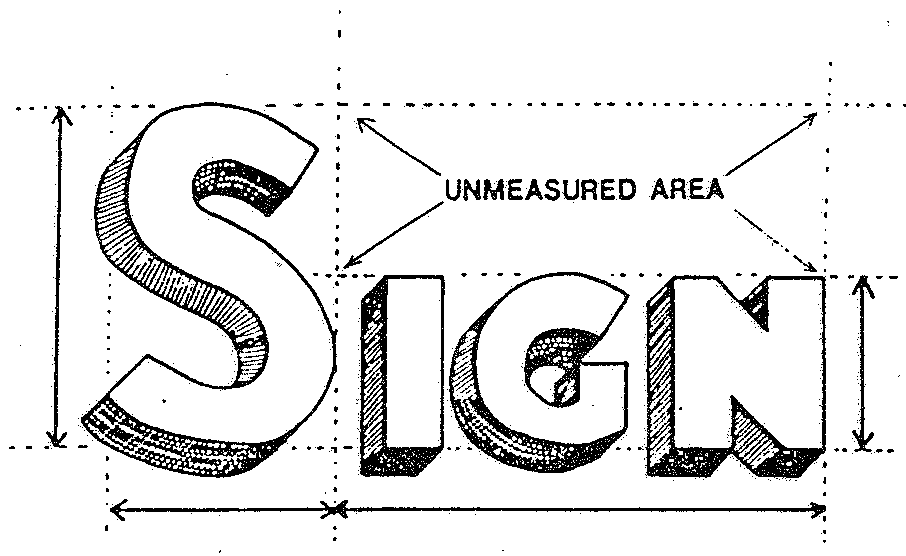
Banners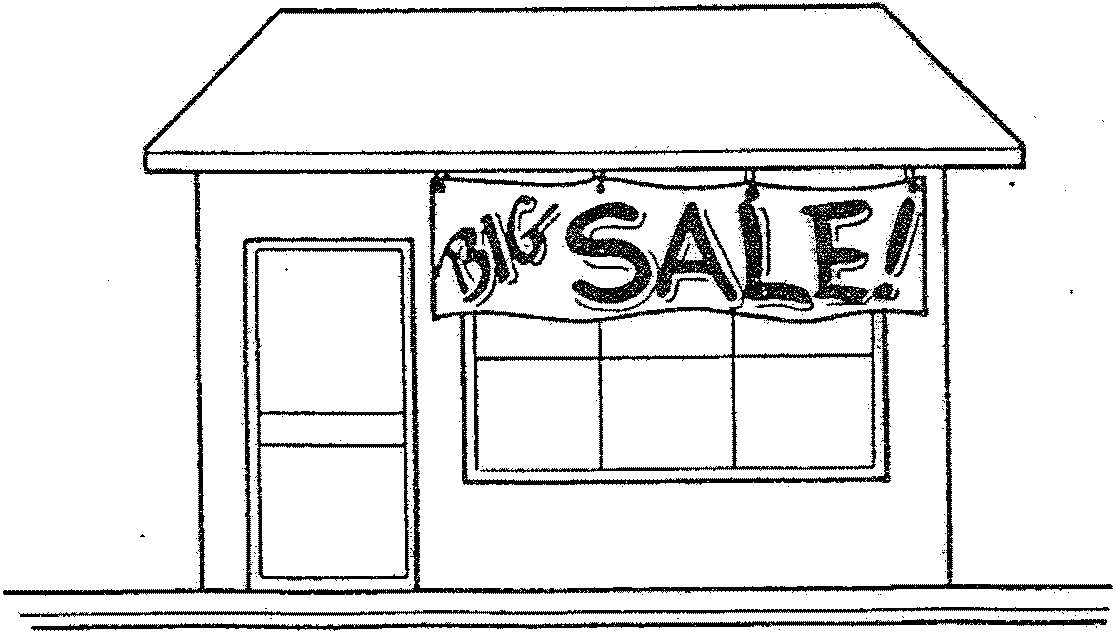
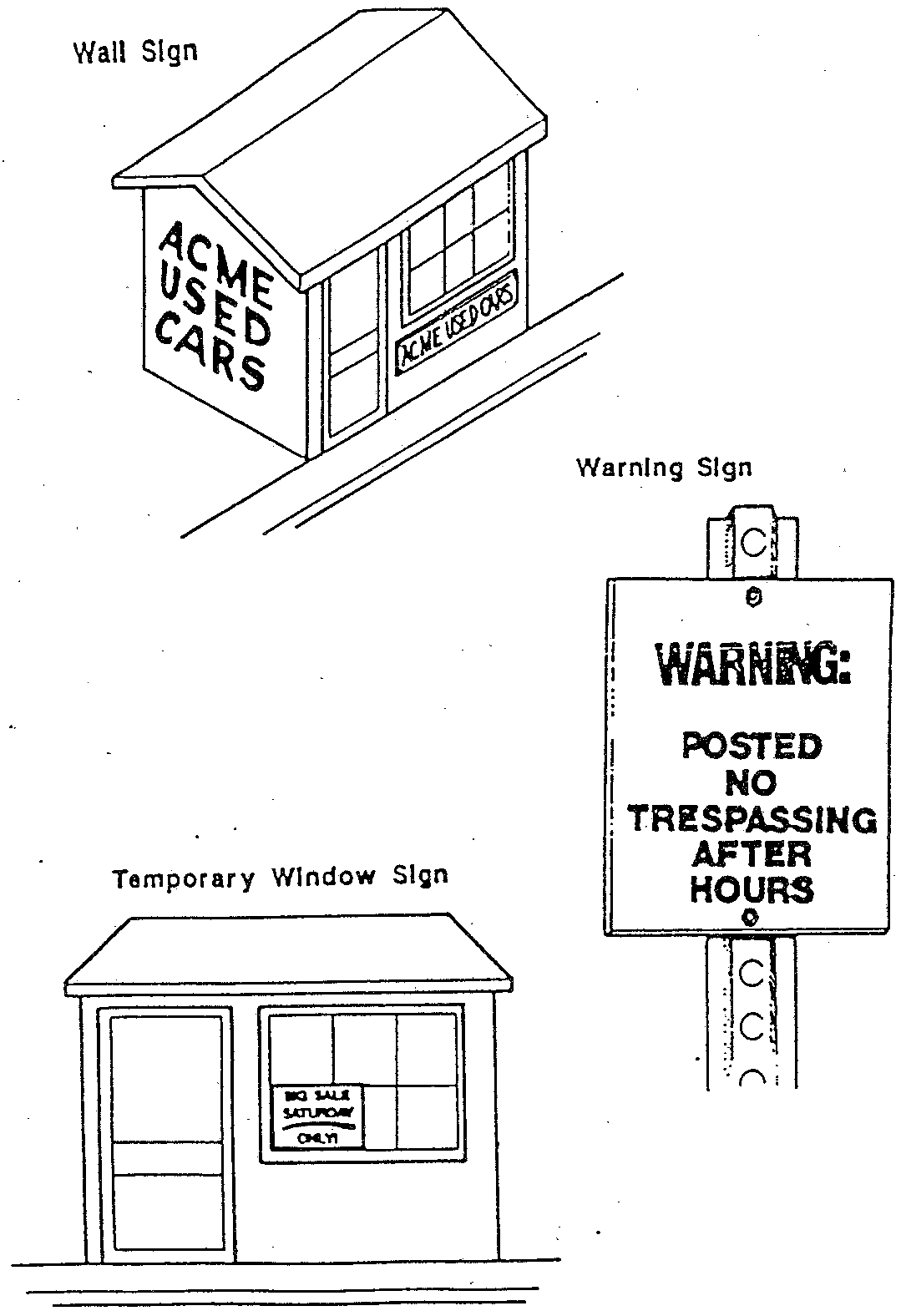
(Ord. No. 18-36, § 3(Att. B), 10-23-18)
Sec. 138-3800. - Purpose and intent.
The general purpose and intent of the district design criteria are to apply additional requirements pertaining to building form, building orientation, pedestrian access, and overall circulation so that districts develop/redevelop in a manner that strengthens their intended character. These criteria are intended to provide a safe, functional, and attractive built environment as experienced by an array of users and transportation modes.
(Ord. No. 18-36, § 3(Att. B), 10-23-18)
Sec. 138-3801. - General requirements.
(a)
Applicability. The design provisions of this division shall apply to the following districts unless otherwise specified:
(1)
Multi-Family Residential District (RM);
(2)
Residential Planned Development District (RPD);
(3)
All office and commercial districts;
(4)
Industrial Planned Development District (IPD);
(5)
Mixed-Use District (MXD);
(6)
All special districts;
(7)
All institutional districts.
(b)
Design criteria deviations.
(1)
Specific life/safety standards shall prevail and supersede these design criteria when there is a conflict with other governmental life/safety codes. The county administrator or designee may adjust any design criteria that is in conflict with life/safety standards.
(2)
All other deviations from the design criteria shall be reviewed as a variance, waiver, and/or administrative adjustment pursuant to the provisions of chapter 138, article II, division 7.
(c)
Project phasing. Development projects may be phased to incrementally comply with design criteria so long as a site plan or development master plan for the entire site is approved that depicts a build-out design that complies with design criteria and any approved variances.
(d)
Conflicts with other plans and special districts.
(1)
In the event the provision of this division conflict with the requirements in an adopted specific area plan, the specific area plan shall have priority.
(2)
In the event the provisions of this division conflict with the standards in a special district, the special district standards shall apply.
(3)
The county administrator or designee shall have the authority to make a code interpretation where it is unclear how standards shall be applied when there is multiple standards.
(Ord. No. 18-36, § 3(Att. B), 10-23-18)
Sec. 138-3802. - Street and parking design.
(a)
In addition to the provisions of this division, roadway design and block standards shall comply with chapter 154, division 2 and parking lots and drive aisles standards shall comply with chapter 138, article X, division 2.
(b)
Streets, drive aisles, and accessways shall be designed as an extension of the surrounding roadway and/or transportation pattern. To the greatest extent practicable, new streets, drive aisles, and accessways shall be integrated into this pattern.
(c)
Streets and drive aisle shall connect to existing roadway/driveways that stub to the subject property. This shall not apply to single-family residential projects.
(d)
Parking lots should be designed to respond to and preserve existing mature trees to the greatest extent possible. Pervious paving and/or pavers may be used for parking surfaces near mature trees to ensure root health and preservation.
(e)
In the mixed-use district, the following parking standard shall apply:
(1)
Parking areas shall be located behind a front building facade.
(2)
Passenger loading and unloading areas may be provided between a front building facade and an adjacent street. When a passenger loading and unloading area is provided in this arrangement, one drive aisle may be provided to link vehicles to parking areas.
(3)
Parking structures should be internal to the site and shall include architectural features/design elements and a facade treatment compatible with the principal structure; or shall be screened with ornamental grillwork, artwork, vertical/facade landscaping, or similar architectural features. Parking structures located along a primary roadway should include ground-floor commercial or employment along a minimum of 50 percent of the roadway frontage.
(Ord. No. 18-36, § 3(Att. B), 10-23-18)
Sec. 138-3803. - Pedestrian connections and circulation.
(a)
Where multiple storefronts or multiple buildings exist within the same development, each tenant space shall be connected by an internal sidewalk system that is clearly delineated from the vehicular pavement. The internal sidewalk system shall connect to public sidewalks that abut the site/property.
(b)
An internal pedestrian system shall provide for a connection at logical locations to abutting properties.
(1)
An internal pedestrian connection is not required to abutting single-family residential lots.
(2)
Internal pedestrian connections to adjacent properties are not required at locations that:
a.
Are separated by significant natural features such as wetlands, streams and topography; AND/OR
b.
Are separated by significant man-made features such as canals, stormwater ponds, rail lines, storage yards, and the like.
(c)
All buildings that face a primary roadway/street shall contain an entryway that is oriented to said roadway. The entryway shall include decorative door surrounds, and a porch, portico, arcade and/or stoop. This does not preclude supplemental entrances not facing a roadway.
(d)
At least one designated pedestrian pathway shall be provided across parking lots that exceed 50 total parking spaces. This designated pedestrian pathway shall be a minimum of five feet in pavement width. The pedestrian pathway shall provide a relatively direct connection between building entrances and all adjacent streets, and shall satisfy current ADA requirements.
(e)
Shopping centers that front a parking field shall provide a pedestrian pathway/sidewalk along the full length of the primary center facade. This pedestrian pathway/sidewalk shall average ten feet in width.
(f)
Structures and/or landscaping shall be constructed/planted around pedestrian use areas to provide shade and reduce heat island effects.
(Ord. No. 18-36, § 3(Att. B), 10-23-18)
Sec. 138-3804. - Building orientation.
(a)
Entryways. Building entryways should be oriented to adjacent roadways/streets to create a direct connection between the building and the public sidewalk system.
(b)
Building location. Developments should include buildings that are located close to roadways/streets to establish an urban form that is oriented to pedestrian mobility and provides walkway connections to transit stops, public sidewalks and the surrounding neighborhoods.
(c)
Building orientation standards for the RM, RPD and MXD districts. The following standards shall apply to multifamily, mixed-use and nonresidential buildings in these districts:
(1)
A building or a series of buildings shall occupy a minimum percentage of the site's primary roadway frontage based on zoning districts. The table below shall establish the minimum building frontage percent for each zoning district and the building siting requirements.
(2)
For buildings used to comply with subsection (1) above, 60 percent of the building façade(s) shall be located within 20 feet of the site's front property line along a street.
a.
This building location requirement may be administratively adjusted to respond to easements, utilities and other lot restrictions.
b.
This standard may be adjusted when subsection (3)a. is applied.
(3)
Parking lots are not permitted between the front building façade and the adjacent roadway. The following exceptions apply:
a.
In the RM and RPD districts, parking lots may be allowed in portions of a lot located along a roadway that is planned to have six or more travel through lanes as identified on the Metropolitan Planning Organization's (MPO) Long-Range Transportation Plan. In this situation, parking lots are restricted to one drive aisle and two rows of parking stalls between the building and the adjacent street.
b.
For double frontage lots, this shall only be applicable to the portion of the lot that is intended to be the front yard.
c.
This shall not apply to alleys.
(4)
The standards of this subsection do not apply to the following:
a.
Buildings and other structures located internal (set back from the street) to the lot when a separate building is located along the primary roadway/street which independently meets these standards.
b.
For institutional and government uses, portions of the lot's street frontage beyond 600 linear feet.
(d)
Building orientation standards for all office and commercial districts, the industrial planned development district (IPD), all special districts, and all institutional districts. The following standards shall apply to multifamily, mixed-use, and nonresidential buildings in these districts:
(1)
A building or a series of buildings shall occupy a minimum percentage of the site's primary roadway frontage based on zoning districts. The table below shall establish the minimum building frontage percent for each zoning district and the building siting requirements.
a.
For lots located adjacent to two or more roadways, the minimum building frontage standard shall only apply to the adjacent primary roadway.
b.
The primary roadway shall be defined as the road/street which has a higher functional classification as determined by the Pinellas County Comprehensive Plan, has a greater number of average annual daily trips (AADT) OR, if such information is unavailable, as determined by the county administrator or designee.
c.
As applied to buildings meeting the minimum frontage standard, the following features may be allowed between the building and the adjacent street:
1.
Open space and pedestrian amenities.
2.
Low impact development stormwater management facilities.
3.
Free-standing architectural elements.
4.
Driveways and parking lots subject to the provisions of subsection (2) below.
d.
This building frontage requirement may be administratively adjusted to respond to easements, utilities and other lot restrictions.
(2)
Parking lots shall be limited in scale for the areas between the front building façade and the adjacent primary roadway. The following standards apply:
a.
Parking lots are restricted to one drive aisle and two rows of parking stalls between the building and the adjacent street.
b.
For multi-frontage lots, this shall only be applicable to the portion of the lot that was originally intended to be the front yard.
c.
This shall not apply to alleys.
(3)
The standards of this subsection do not apply to the following:
a.
Buildings and other structures located internal (set back from the street) to the lot when a separate building is located along the primary roadway/street which independently meets these standards.
b.
For institutional and government uses, portions of the lot's street frontage beyond 600 linear feet.
c.
Certain automobile-oriented uses including motor vehicle sales, recreational vehicle/boat sales, outdoor sales (permanent), vehicle fuel/gasoline stations, car washes, and vehicle storage, maintenance and repair.
(e)
Service and loading. All service areas and loading docks shall be located behind the front facade line of the principal structure they are intended to serve and shall be screened from adjacent roadways and uses. This standard is not intended to be applied to vehicle maintenance and repair garages.
(Ord. No. 18-36, § 3(Att. B), 10-23-18; Ord. No. 21-11, § 99, 4-27-21)
Sec. 138-3805. - Building design.
(a)
Building design.
(1)
In the RM, RPD, office, commercial and mixed-use districts, the first floor, street facing building facades shall be constructed with architectural articulation including, but not limited to, fenestration, display windows, natural finishes and/or other architectural features intended to break-up large expansive facades.
a.
In the RM and RPD Districts, at least 35 percent of linear ground level, street facing façades shall be transparent, meaning glass or other transparent or translucent materials.
b.
In the office and commercial districts, at least 25 percent of linear ground level, street facing façades shall be transparent, meaning glass or other transparent or translucent materials.
c.
In the mixed-use district, at least 50 percent of linear ground level, street-facing facades shall be transparent, meaning glass or other transparent or translucent materials.
(2)
New multi-building developments shall be designed so that individual buildings relate to other structures on site in terms of facade design, entrances/entryways, and pedestrian access.
(3)
Multi-tenant buildings shall provide shelter elements such as awnings, arcades, and/or shade trees along the majority of its entry façade(s) to protect people from weather elements including sun, wind, and rain.
(4)
In the mixed-use district, the following building form shall apply.
a.
The first floor of each multi-story non-residential building should not be less than 12 feet in height measured from the finished first floor surface to the bottom of the second floor.
(5)
All mechanical equipment and utility functions (e.g., electrical conduits, meters, HVAC equipment) shall be located behind the front facade line of the principal structure. Mechanical equipment that could otherwise be visible from the streets shall be screened with a material that is compatible with the architecture of the principal structure.
(b)
Building style.
(1)
Renovations, additions and accessory structures shall be designed to be compatible with the architectural style of the structure in which they are a part. Compatibility shall be determined by reviewing building materials, finishes and other significant features.
(2)
Multi-building developments shall provide a unified architectural theme with standardized building materials, finishes, and color schemes. All buildings on the site shall project a complementary building style and/or architectural theme.
(Ord. No. 18-36, § 3(Att. B), 10-23-18)

