
Pinellas County Unincorporated
City Zoning Code
City Zoning Code
ARTICLE XI
THE LEALMAN FORM BASED CODE
Sec. 138-3900. - Title.
Article XI is known as the "Lealman Form-Based Code." This Article may also be referenced herein as "LFBC".
(Ord. No. 23-31, § 4, Exh. A, 12-12-23)
Sec. 138-3901. - Effective date.
Sec. 138-3902. - Application.
(a)
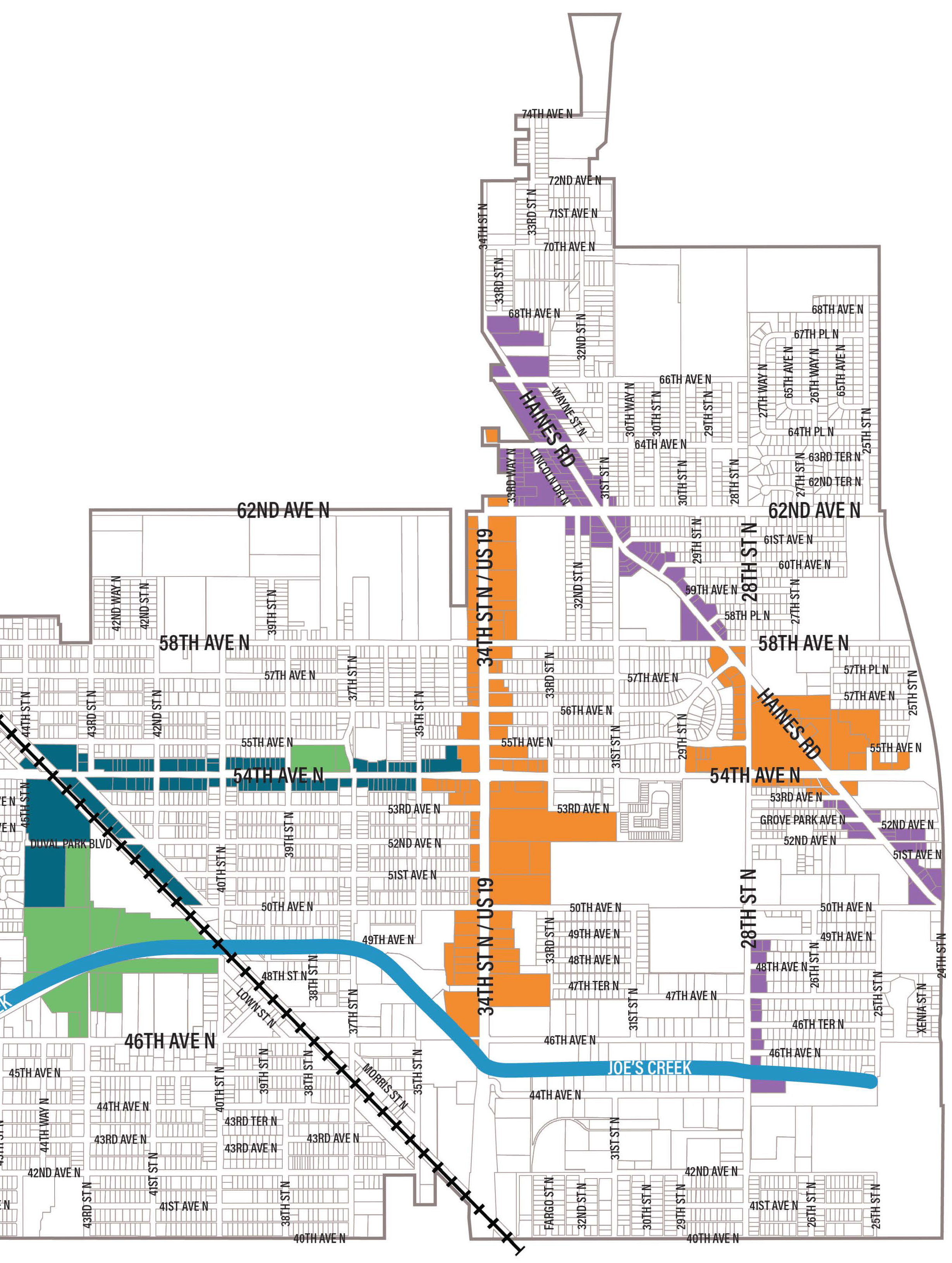
The provisions established within this Form-Based Code must apply to all development/redevelopment on certain parcels within the Lealman Community Redevelopment Area (CRA), which is referred to herein as the Lealman Form-Based District (LFBC). Affected parcels are designated on the District Map (LFBC Div. 3: Figure 138-3971.a). No development can be undertaken without prior approval and the issuance of the appropriate permit(s) pursuant to the applicable provisions of the LFBC, except as provided herein.
(b)
Provisions of the LFBC are expressed as "must" when required; "should" when recommended; and "may" when optional. Provisions of the LFBC expressed as "typical" describe normal characteristics, but are not limited or bound to those "typical" descriptions as long as the overall intent of the provision is being met.
(c)
Graphic illustrations, illustrative intents, and photographic images used throughout the LFBC are intended to graphically portray the regulatory standards and overall intents established within the LFBC. These images must be considered guidelines as opposed to regulatory standards. Where in conflict, numerical metrics must take precedence over graphic metrics.
(d)
Compliance with the LFBC is intended to occur over time, as redevelopment and new development occur. These regulations are intended for new development and expansion. Existing structures and uses are allowed to continue and normal repair and maintenance is encouraged. The County also recognizes that some sites may be difficult to develop in compliance with the provisions of this Code and provides for Waiver and Adjustment procedures within certain parameters, as described in LFBC Div. 2: section 138-3935.
(e)
LFBC Division 8: Definitions contains regulatory language that is integral to the implementation and intent of the LFBC. Those terms not defined in LFBC Division 8, must be accorded their commonly accepted meanings. In the event of conflicts between these definitions and those of the Pinellas County Land Development Code (LDC), those of the LFBC must take precedence.
(f)
Appendix: section 138-4120: Building Design Standards, contains photographic images to illustrate various permissible Building Types within the Lealman Form-Based District. The County does not claim these images as their own and were included to provide building type examples. These images are illustrative only, not regulatory.
(Ord. No. 23-31, § 4, Exh. A, 12-12-23)
Sec. 138-3903 - Relationship to land development code and Florida Statutes § 163.3202(5)(b)(1)
(a)
The specific provisions within the LFBC supersede those in Chapter 138 of the Land Development Code (LDC). For all other issues not covered by the LFBC, the existing LDC or other applicable County, State, or Federal regulating documents continue to apply.
(Ord. No. 23-31, § 4, Exh. A, 12-12-23)
Sec. 138-3904. - Severability.
It is declared to be the intent of the Board of County Commissioners that, if any article, division, section, subsection, sentence, clause, phrase, or provision of the LFBC is held invalid or unconstitutional, such invalidity or unconstitutionality must not be construed as to render invalid or unconstitutional the remaining provisions of the LFBC.
(Ord. No. 23-31, § 4, Exh. A, 12-12-23)
Sec. 138-3905. - Components of the LFBC.
The LFBC places a primary emphasis on physical form and placemaking, with a secondary focus on land uses. The regulatory divisions of the LFBC are described below:
(a)
Division 2: Administration. Administration describes review processes for development approval within the Lealman Form-Based District.
(b)
Division 3: District Map. The District Map serves as the principal tool for implementing the LFBC. The District Map designates a specific District to every property located within the Lealman Form-Based District.
(c)
Division 4: District Standards. District Standards establish the standards for development of properties within Lealman, with a focus on building placement, height, and functional elements. The applicable standards for a site are determined by the District in which the site is located, as designated on the District Map (LFBC Div. 3: Figure 138-3971.a).
(d)
Division 5: Development Design Standards. Development Design Standards establish site, landscaping, and signage standards for Lealman properties. These standards are intended to provide a safe, functional, and attractive built environment and circulation pattern for all users and transportation modes.
(e)
Division 6: Use Standards. Use Standards describe provisions for specific land uses and designate allowable uses within each District. The Use Standards are intended to be simplistic, while still acknowledging the relationship between neighboring land uses.
(f)
Division 7: Parking Standards. Parking Standards establish the amount, type, and design elements for vehicle and bicycle parking. These standards are intended to encourage compact development patterns, accommodate redevelopment, and recognize alternative methods of parking and modes of transportation that in turn can reduce the abundance of vehicular parking.
(g)
Division 8: Definitions. This section provides a list of terms used throughout the LFBC and are integral to the implementation and intent of the LFBC. Certain terms are used in very specific ways, often excluding some of the meanings of common usage.
(h)
Appendix: Building Design Standards. Building Design Standards support the LFBC by providing guidance on building articulation and illustrative examples of the Building Types that are appropriate to each District. While the building articulation standards are regulatory in nature (See LFBC Section 138-4300), the Building Type Summary Table and accompanying images are not regulatory and are solely intended to generally describe the range of building types that may be suitable for each District.
(Ord. No. 23-31, § 4, Exh. A, 12-12-23)
Sec. 138-3930. - Authority.
(a)
The Code Administrator is responsible for administration and enforcement of the LFBC.
(b)
The Code Administrator may designate a County staff member to represent the Code Administrator in any function assigned by the LFBC. The Code Administrator remains responsible for any final action.
(Ord. No. 23-31, § 4, Exh. A, 12-12-23)
Sec. 138-3931. - Review types.
LFBC Table 138-3931.a: Review Types, establishes three review types for the purpose of interpreting and applying the provisions of the LFBC. These are used in reviewing and recommending, and/or taking final action on land development, land use permits, applications, and other procedures established in the LFBC.
TABLE 138-3931.a: REVIEW TYPES
1 For Type 1B reviews, the Code Administrator will coordinate with the appropriate departments before making a final decision.
(Ord. No. 23-31, § 4, Exh. A, 12-12-23; Ord. No. 25-3, § 1, 1-28-25)
Sec. 138-3932. - Review procedures.
Any development, land usage, or property modification in the LBFC District is applicable to the review procedures established in this section.
(a)
Type 1A Review.
(1)
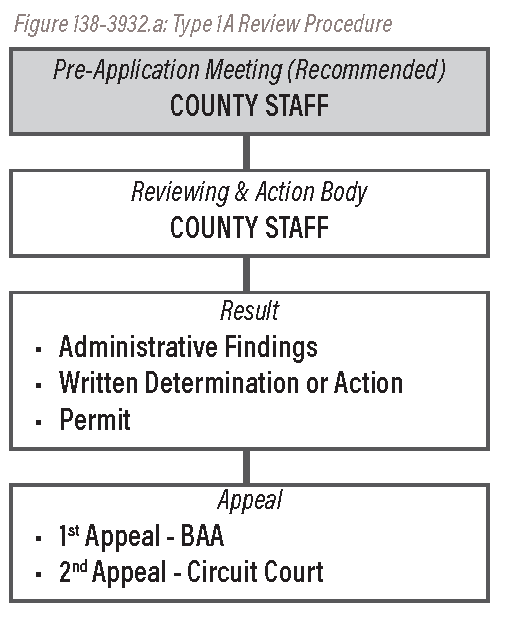
The Type 1A review is an administrative process to ensure that development projects, land use, and activities comply with the minimum provisions of the LFBC. The Type 1A process is intended to be a clear and objective review.
(2)
LFBC Figure 138-3932.a: Type 1A Review Procedure outlines the general review process for a Type 1A submittal.
(b)
Type 1B Review.
(1)
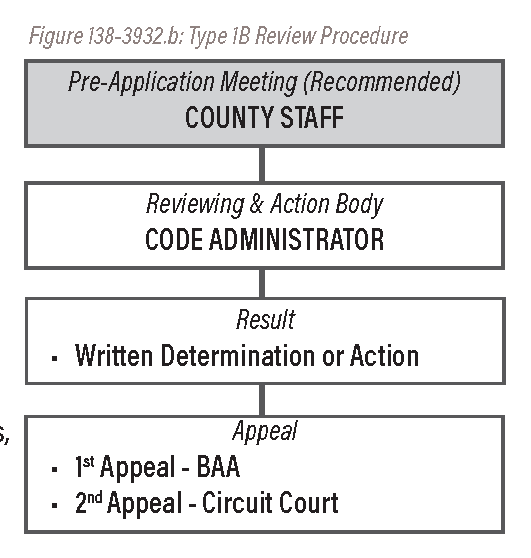
A Type 1B review enables the County Administrator or his or her designee to determine the appropriateness of Type 1B uses/designations, administrative adjustments up to 20%, and waivers based on the overall intent of the provisions within the LFBC, and when applicable, the context of the subject property.
(2)
LFBC Figure 138-3932.b: Type 1B Review Procedure outlines the general review process for a Type 1B submittal.
(c)
Type 2 Review.
(1)
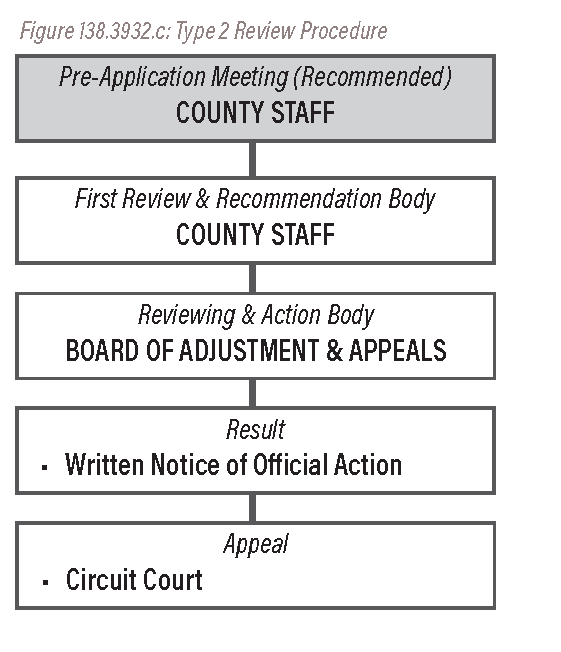
A Type 2 Review is a public hearing process to ensure that development projects, land usages, and activities comply with the minimum provisions of the LFBC and are consistent with the Pinellas County Comprehensive Plan. A Type 2 process requires the Board of Adjustments and Appeals (BAA) to determine the appropriateness of certain applications/requests at specific locations within the county.
(2)
LFBC Figure 138-3932.c: Type 2 Review Procedure outlines the general review process for a Type 2 submittal.
(d)
Other requests.
(1)
Re-Districting: A request to change a property's District designation, must follow the Type 3 Review Procedure as described in LDC section 138-83.
(2)
Other applications and requests within the Lealman Form-Based District that are not covered within this section, such as comprehensive/countywide plan amendments or subdivision plat approvals, must follow the applicable review procedures established in LDC Section 138-77.
(Ord. No. 23-31, § 4, Exh. A, 12-12-23; Ord. No. 25-3, § 1, 1-28-25)
Sec. 138-3933. - Applicability.
(a)
New development/redevelopment. The regulations of the LFBC, in their entirety, applies to all new development/redevelopment within the Lealman Form-Based District.
(b)
Expansions.
(1)
Process: The expansion percentage is based on the existing building(s)' gross ground floor area, per the Pinellas County Property Appraiser. The expansion percentage can be calculated prior to or during the site plan review.
(2)
0%—49%: Expansions up to 49% of the existing building(s)' gross floor area are only required to comply with the applicable provisions of the LFBC relative to the expansion area.
(3)
50% or Greater: Expansions equal to 50% or greater of the existing building(s)' gross floor area must bring the entire site into compliance with all applicable provisions of the LFBC.
(c)
Remodels.
(1)
Exterior: Any exterior remodeling of existing buildings that amounts to 60% or more of its appraised valuation for tax purposes must comply with those regulations found in the LFBC which are applicable to the scope of the project, such as incorporating applicable building elements (windows, doors, or awning requirements) as described in LFBC Div. 4: District Standards. These regulations do not apply to the sides of a building where the exterior portion is not being remodeled.
(2)
Interior: These regulations do not apply to interior remodeling of existing buildings.
(d)
Change of use.
(1)
Any proposed land use change must comply with LFBC Div. 6: Table 138-4057.a: Permitted Land Uses and the minimum parking standards established in LFBC Division 7, only in situations where the proposed use requires 25% or more parking spaces than are existing on site.
(2)
Any proposed site features associated with the land use change must comply with all applicable standards within the LFBC.
(3)
All other applicable codes or requirements, such as Florida Building Code requirements for a change of occupancy type or required impact fees, associated with the proposed use continue to apply.
(e)
Exceptions.
(1)
Existing building permits and development orders. The provisions of the LFBC does not affect development which has been issued a building permit or development order on or before the effective date of the LFBC, provided that such building permit or development order was lawfully issued and remains in full force and effect. If the building permit or development order expires, any further development on that site must occur only in conformance with the applicable regulations of the LFBC.
(2)
Existing buildings and uses. Existing buildings and uses that do not conform to the provisions of the LFBC may continue as they are. However, if a non-permitted use ceases (according to LFBC Div. 2: Section 138-3934(a): Nonconforming UsesandStructures), the use cannot be reestablished.
(3)
Repair and maintenance. Normal repair and maintenance may be performed on existing buildings without requiring compliance with the LFBC. [For example, repairing a broken window would not require compliance with the Building Design Standards.]
(4)
Development order applications.
a.
Any development order application that was submitted prior to the effective date of the LFBC, has 6 months from the effective date to receive approval under the provisions of the LDC (Chapters 138, 154, etc.).
b.
Development order applications submitted within 3 months after the effective date of the LFBC may be processed under the former zoning classification and all provisions of the LDC.
c.
For either of the above situations, the construction/building permits must be kept active in accordance with the Florida Building Code.
(Ord. No. 23-31, § 4, Exh. A, 12-12-23)
Sec. 138-3934. - Nonconforming situations.
(a)
Nonconforming uses and structures.
(1)
Nonconforming uses and structures are:
a.
Those legally created/established prior to the effective date of the LFBC, and
b.
Caused by the adoption and amendment of the Pinellas County Comprehensive Plan, LFBC, Pinellas County Code, and/or State Statutes that make a previously conforming use or structure nonconforming.
(2)
Continuation of nonconformities. Legal nonconforming uses and structures are permitted to continue with normal repair and maintenance. This must not be used as grounds for adding other prohibited uses or structures on the site or in the area, nor enlarging them by means of extension or expansion, except as specifically provided in this section.
(3)
Change of ownership. Change of management, ownership, or tenancy of a nonconforming use or structure does not affect its nonconforming status; provided such use's intensity does not change, as determined by the Code Administrator.
(4)
Loss of nonconforming status.
a.
Nonconforming uses. When a nonconforming use of land or structure has been discontinued for 1 year or longer, its future use must conform to the uses permitted in the District in which the site is located.
b.
Nonconforming structures. Nonconforming status terminates if a nonconforming structure is damaged or destroyed as a result of an accident, fire, flood, hurricane, or other act of nature; except as follows:
1.
49% or less. If the cost of repairing/replacing a damaged structure is equal to 49% or less of the appraised value prior to damage (per the Pinellas County Property Appraiser), the structure may be restored to the same footprint (including pre-existing, nonconforming setbacks).
2.
Exceeds 49%.
i.
If the cost of repairing or replacing the damaged portion of the structure exceeds 49% of the appraised value prior to the damage (per the Pinellas County Property Appraiser), the structure must be restored in full compliance with the LFBC.
ii.
If a nonconforming structure is destroyed/damaged within 5 years of the effective date of the LFBC, it may be restored through a Type 2 Review Procedure, per LFBC Div. 2: Section 138-3932(c) and LFBC Div. 2: Table 138-3935.a. After 5 years of the effective date of the LFBC this provision will no longer apply.
3.
Residential Exemptions. A non-conforming single- or multi-unit dwelling damaged or destroyed by an act of god may be reconstructed or replaced with a new structure with the same number of dwelling units prior to the damage. However, the new structure must conform to the development standards of the LFBC and all other current building and fire codes.
(5)
Maintenance and repair. A nonconforming structure may be maintained and repaired subject to the following:
a.
Any physical change to the structure cannot increase the degree of nonconformity unless otherwise permitted by the LFBC.
b.
Any nonconforming structure or portion thereof declared to be unsafe, by the County Administrator or designee, may be restored to a safe condition. However, if the structure is deemed deteriorated, repairs must occur in accordance to the respective District Standards (LFBC Division 4).
c.
All interior, utility, accessibility, and/or life-safety alterations and repairs are permitted.
(6)
Illegal uses and structures. Nothing in this section must be deemed to allow the use, change in use, repair, alteration, expansion, enlargement, or reconstruction of an illegal use or structure. Any such illegal use must be discontinued, and any such illegal structure must be removed or brought into compliance with the LFBC.
(7)
Modification and expansion.
a.
Nonconforming structures may be expanded in a manner that conforms to the District Standards and other applicable sections of the LFBC and does not increase the degree of nonconformance.
b.
If an existing structure became nonconforming with the adoption of the LFBC, it may be expanded in a manner that does not meet the applicable provisions of the LFBC through a Type 2 Review Procedure, per LFBC Div. 2: Section 138-3932(c) and LFBC Div. 2: Table 138-3935.a.
(b)
Nonconforming signs. Any sign, lawfully established prior to the effective date of the LFBC that no longer meets the development standards is deemed a legal nonconforming sign. For the purposes of this section, a sign includes the sign face and any supports, poles, frames, or other associated lighting, electrical, mechanical, and structural features. The continuation of legal nonconforming signs must be consistent with the following:
(1)
Increases in nonconformity. No nonconforming sign can be enlarged or altered in terms of face area, height, or any other aspect that increases the degree of nonconformity.
(2)
Alterations. Any nonconforming sign that is intentionally altered, moved, or replaced must comply with LFBC Div. 5: section 138-4023. Nonconforming signs that are required to be altered due to government action or damage resulting from fire, flood, other natural disaster, or a third-party act may be restored to their nonconforming condition. Nonconforming signs that are temporarily removed for painting or other maintenance retain their legal nonconforming status, so long as the sign is replaced within a period of 60 days from the date of its removal.
(3)
Sign faces and messages. Sign faces and/or messages on a nonconforming sign may be altered, replaced, repainted, and repaired provided that the degree of nonconformity is not increased.
(c)
Adaptive reuse projects. The purpose of this section is to foster the renovation and reuse of structures that have significant historical, architectural or cultural value to Lealman. This section recognizes that many existing structures located within the Lealman Form-Based District, will not conform to all the standards and guidelines in the LFBC. The following development standards apply to adaptive reuse projects:
(1)
Applicability.
a.
The provisions of this section apply to the redevelopment and reuse of buildings that pre-date 1980, and have qualities of significance and integrity, through either a significant contribution to history, association with significant persons, or embody distinctive characteristics.
b.
To be considered an adaptive reuse project, the existing total building floor area and building height can only be increased up to 20%.
(2)
Siting regulations.
a.
Building siting standards do not apply to existing buildings associated with an adaptive reuse project, however, they do apply to any building additions.
b.
Side/rear setback. For building additions/expansions, the minimum side/rear setback for an adaptive reuse project may be equal to the existing building setback, or equal to the side/rear setback for the District in which the site is located, whichever is less.
c.
Parking location. There are no additional requirements for the use of an existing dedicated parking area. New parking areas must meet the requirements of the District in which the site is located and the parking location standards in LFBC Div. 7: section 138-4093(b)(1).
(3)
Off-street parking.
a.
If a change of use results in more off-street parking spaces being required than already exists, no additional parking spaces are required.
b.
If a change in use results in fewer off-street spaces being required than already exists, then only the number of spaces necessary to fulfill the requirements need to be maintained.
c.
Existing parking in excess of the limits set forth in LFBC Division 7: Parking Standards may remain and be used for on-site parking purposes for other property owners, subject to an agreement between the property owners.
(4)
Loading spaces. When utilizing an existing loading space, the provisions of LFBC Div. 7: Section 138-4094 do not apply.
(5)
Building features. Facades must maintain the architectural integrity of an existing building. If a building facadeis replaced or significantly modified it must satisfy the requirements set forth in LFBC Div. 2: Section 138-3933.
(Ord. No. 23-31, § 4, Exh. A, 12-12-23)
Sec. 138-3935. - Variances, waivers, and administrative adjustments.
The provisions set forth in the LFBC apply to a wide, diverse area. The County recognizes some sites may be difficult to develop in compliance with these regulations. The variance, waivers, and administrative adjustments review processes provide a mechanism for these regulations to be modified to relieve a property owner from meeting a requirement due to property characteristics beyond his or her control. These reviews provide flexibility for unusual situations and allow for alternative ways to meet the intent of the LFBC.
(a)
General.
(1)
A variance, waiver, or administrative adjustment cannot be granted to the following:
a.
Density and intensity limitations of the Pinellas County Comprehensive Plan.
b.
Land usage restrictions of the Pinellas County Comprehensive Plan.
c.
Review and procedural requirements of the LFBC.
d.
State and federal rules, regulations, and standards.
(2)
Required information. The following is required to be submitted for these requests:
a.
A proposed site development diagram (concept plan) drawn to scale.
b.
A survey and/or current aerial photograph of the subject site and adjustment properties.
c.
A written explanation and justification of the requested variance, waiver, and/or administrative adjustment.
d.
A written response for each of the criteria for granting variances, waivers and/or administrative adjustments as listed in this section.
e.
Other supplemental information as required by the Code Administrator or designee.
(3)
Initiation of construction. A variance, waiver, or administrative adjustment issued under these provisions automatically expires within 2 years from the date of granting such approval if construction of the project has not commenced and continued in good faith. All site plans and building permits must be obtained within those 2 years; the granting of any variance, waiver, and/or administrative adjustment must not be deemed as automatic approval for any such permit or site plan required.
(4)
Extensions. The Code Administrator may grant an extension of up to one year upon a showing of good cause, provided the request for extension is submitted in writing stating the reason for extension and is received prior to the expiration of the variance, waiver, and/or administrative adjustment.
(b)
Variances.
(1)
A variance is a request to lessen or remove certain dimensional standards of the LFBC for a particular property or structure.
(2)
Review procedure. A variance from the LFBC must be processed as a Type 2 Review, which is in a public hearing setting by the Board of Adjustment and Appeals (BAA). All variance requests are subject to the Criteria established in LFBC Div. 2: Table 138-3935.a: Variances, Waivers, and Administrative Adjustments Criteria.
(c)
Waivers.
(1)
A waiver is an approved elimination of a particular technical standard(s) based on a site constraint and/or the ability to meet the intent by another means. Waivers generally have minimal or no impact on a neighboring property.
(2)
Subject to the criteria established in LFBC Div. 2: Table 138-3935.a: Variances, Waivers, and Administrative Adjustments Criteria, the approval authority may grant the following waivers to the LFBC:
a.
Site access standards and requirements may be waived to respond to site constraints and/or respond to existing development conditions.
b.
Sidewalk connections may be waived to respond to site constraints and/or respond to existing development conditions that would make the connections impractical or unsafe. Compensatory pedestrian improvements are required within the same District where a sidewalk waiver is granted.
c.
Landscaping and buffering standards may be waived for specific areas on a site when other vegetation is present and provides the same purpose. Landscaping standards may be waived for portions of a site to respond to government security and surveillance mandates.
d.
Parking area location and front setback requirements may be waived to respond to site constraints, existing development conditions, and/or to respond to conditions that would make the literal interpretation of the parking area location requirement impractical or unsafe.
e.
Other similar technical standards as determined by the Code Administrator in coordination with the appropriate department(s). However, waivers pertaining to ADA standards are not permitted.
(3)
Review procedure. Waivers are processed as a Type 1B Review.
(d)
Administrative adjustments.
(1)
An administrative adjustment is an approved adjustment or reduction to dimensional standards and/or technical requirements of the LFBC based on a site constraint, and/or the ability to meet the intent by other means. Administrative Adjustments generally have minimal or no impact on a neighboring property.
(2)
Subject to the criteria established in LFBC Div. 2: Table 138-3935.a: Variance, Waivers, and Adjustments Criteria, the standards of the LFBC may be adjusted up to 20 percent.
(3)
Review procedure. Administrative adjustments are processed as a Type 1A Review for up to 10 percent and Type 1B for up to 20 percent adjustments.
(e)
Criteria. The reviewing body must determine the following criteria described in LFBC Div. 2: Table 138-3935.a: Variance, Waivers, and Adjustments Criteria, have been satisfied in order to authorize such approval.
TABLE 138-3935.a: VARIANCE, WAIVERS, and ADMINISTRATIVE ADJUSTMENTS CRITERIA
Sec. 138-3936. - Zoning clearances, code interpretations, and site plans.
(a)
Zoning clearance.
(1)
A Zoning Clearance determines if an application is in conformance with the provisions of the LFBC or as permitted by special approval. It is required and must be obtained prior to any property use, development activity or land disturbance. Zoning Clearance is often performed in conjunction with the review process, which may or may not include requirements for building permits, site plans, and/or pre-application meetings.
(2)
A Zoning Clearance must be determined by the Code Administrator.
a.
The issuance of a Zoning Clearance does not exempt an applicant from complying with all laws properly affecting the use or development of land.
b.
This clearance is required regardless of any other provision of this section.
c.
Failure to obtain such clearance may be deemed a violation of this section.
(3)
Issuance and conditions.
a.
Zoning Clearances are determined as part of the Type 1A and Type 1B Review. The resulting determination may require that the applicant make site modifications and/or secure the required review type approval for the requested outcome.
b.
The Code Administrator or designee may request additional information pertaining to the project in order to conduct a thorough review and ensure full compliance with the LFBC.
(b)
LFBC interpretation.
(1)
Any member of the public may request a code interpretation of any provision in the LFBC, upon filing a written request.
(2)
A LFBC interpretation is intended for cases and situations where the standards and requirements are not clear and/or there is opportunity for interpretation.
(3)
Issuance and conditions.
a.
LFBC interpretations must be issued by the Code Administrator as a part of a Type 1A Review.
b.
Requests for LFBC interpretations must include:
1.
A legal description, address, and/or parcel identification of the property for which the request is made.
2.
A description of the requested interpretation as it relates to a development, review process, and/or use of land.
3.
A conceptual plan or drawing illustrating the request when applicable. Plans must be drawn to scale and show the property boundaries, proposed improvements, and connections to streets.
c.
The Code Administrator must review the relevant LFBC sections and the Comprehensive Plan in reaching a determination. The code interpretation must not be used to circumvent adopted policy or code requirement.
(4)
Fees. Fees for LFBC Interpretations must be established by the Board of County Commissioners. A schedule of fees is available in the designated county department.
(c)
Site plans.
(1)
Applicability. Site Plans are required per LDC Division 5 Site Plan Requirements and Review Procedures.
(2)
Requirements.
a.
Site plans must demonstrate full compliance with the provisions of the LFBC and any condition imposed by a decision-making authority for the use.
b.
Site plan elements must be prepared per County procedures as established in LDC section 138-178.
(3)
Time limits. Time limits on site plans as established in LDC section 138-180 shall apply.
(4)
Fees. The fees for site plan review as established in LDC section 138-181 shall apply.
(Ord. No. 23-31, § 4, Exh. A, 12-12-23)
Sec. 138-3937. - Enforcement procedures
Enforcement of the LFBC must comply with the provisions in LDC section 138-54.
(Ord. No. 23-31, § 4, Exh. A, 12-12-23)
Sec. 138-3970. - Intent.
(a)
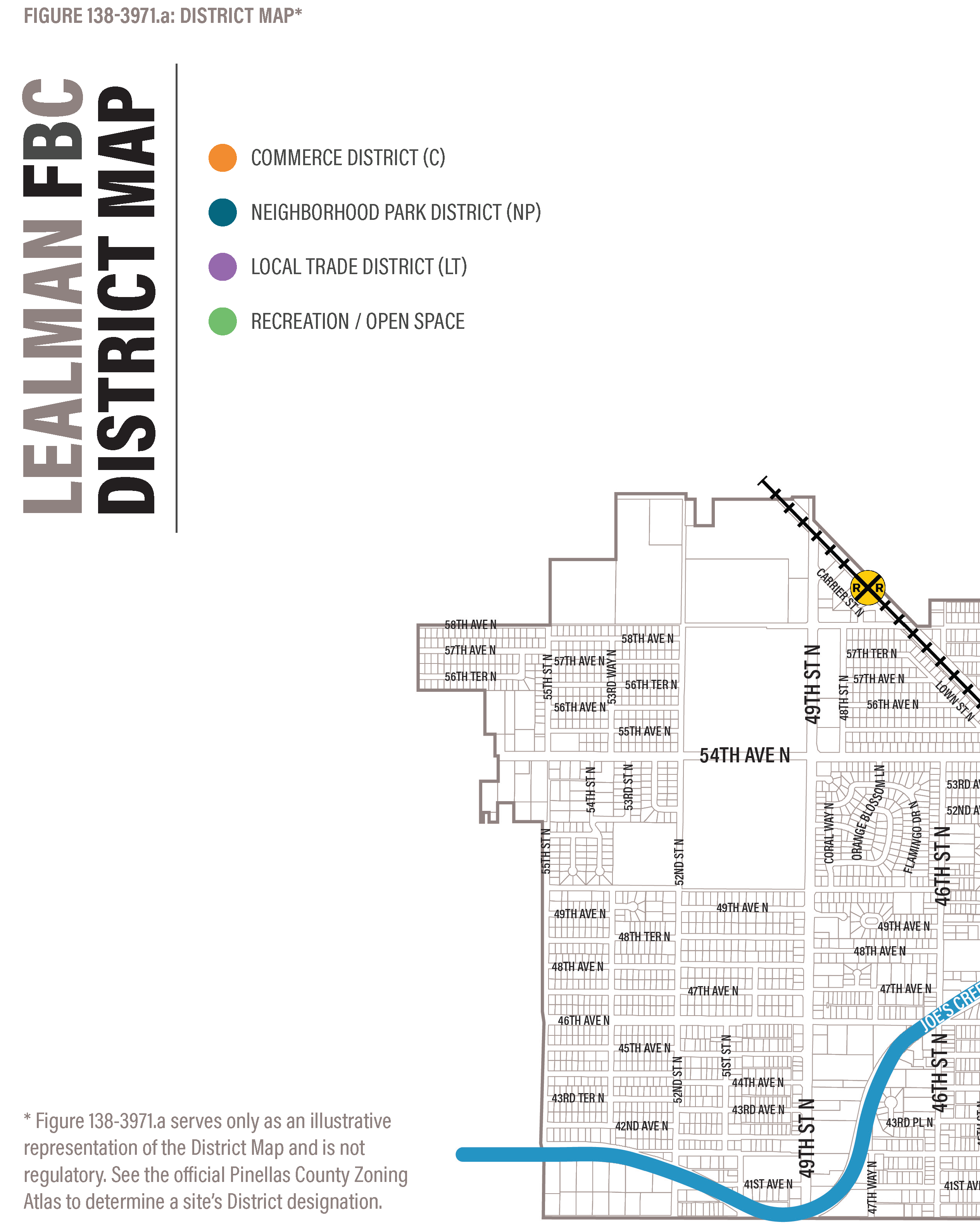
The District Map (LFBC Div. 3: Figure 138-3971.a) serves as the principal tool for implementing the LFBC.
(b)
The District Map (LFBC Div. 3: Figure 138-3971.a) establishes three Districts and identifies recreation/open space within Lealman.
(Ord. No. 23-31, § 4, Exh. A, 12-12-23)
Sec. 138-3971. - Districts.
There are three Districts within Lealman, which are shown on the District Map (LFBC Div. 3: Figure 138-3971.a). Development and redevelopment must comply with the standards and overall intent established for each District.
(a)
Commerce District (C).
The 'Commerce District' provides for the continued use, enhancement, and new development of retail, office, and service needs for the local and surrounding communities. This District supports enhanced transit opportunities and increased pedestrian comfort. Development within this District is characterized by mid-rise buildings, screened parking with reduced/shared access points, and building entries with direct access to the street.
(b)
Neighborhood Park (NP).
The 'Neighborhood Park District' promotes the design of pedestrian-oriented streets that encourage a mix of uses, providing goods, services, and urban housing to the community. Development within this district is characterized by low-rise to mid-rise, street-oriented buildings with activated retail and public spaces, wider sidewalks with pedestrian amenities, and enhanced crosswalks; ultimately creating a dynamic public realm that fosters retail vitality.
(c)
Local Trade District (LT).
The 'Local Trade District' fosters entrepreneurship by incubating small scale and craft manufacturing, specialty repair, artisans, retail, and other startup businesses. The district standards allow for a mix of building frontages, visual variation and the adaptive reuse of existing structures. The 'Local Trade District' supports business retention and expansion through these flexible form standards.
(Ord. No. 23-31, § 4, Exh. A, 12-12-23)
Sec. 138-3972. - Recreation/Open Space.
The areas designated on the District Map (LFBC Div. 3: Figure 138-3971.a) as 'Recreation/Open Space' are established parks and/or open space within Lealman, and are intended to remain as such. Any modification to a different land use or proposed development of these properties requires a Type 2 Review and Approval process, as described in LFBC Div. 2: section 138-3932(c).
(Ord. No. 23-31, § 4, Exh. A, 12-12-23)
Sec. 138-3985. - Intent.
(a)
The District Standards are intended to shape the physical and functional character of the street-space of the Lealman Form-Based District, with the goal of creating an active, pedestrian-friendly public realm. The form and function standards for building frontages not only frame the street-space, but also allow for greater flexibility behind the building's façade. The District Standards are intended to aim for the minimal regulation necessary to achieve this goal.
(b)
The District Standards establish the standards for development and redevelopment of properties, with a focus on building placement, height, and functional elements, such as fenestration (windows and doors).
(Ord. No. 23-31, § 4, Exh. A, 12-12-23)
Sec. 138-3986. - General provisions.
The following provisions apply to all Districts, unless otherwise specified within the LFBC:
(a)
Lots with multiple street frontages.
(1)
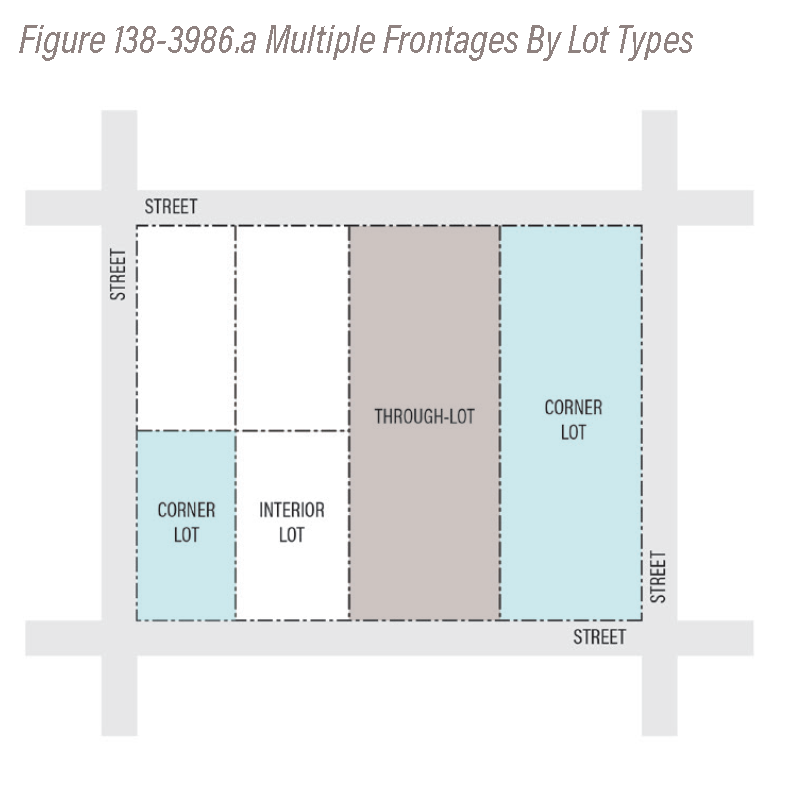
For corner and through lots (multiple-frontage lots), each public street (not including alleys) must be treated as a front for the determination of setbacks. (See LFBC Div. 4: Figure 138-3986.a)
(2)
For multiple-frontage lots, the primary frontage is the street frontage with the highest classified street type per the Pinellas County Functional Classification of Roadways Map (as identified in the Pinellas County Comprehensive Plan). If the street types are the same, the applicant may choose the primary and secondary frontages.
(3)
Structures may not extend beyond the minimum front setback requirement along any secondary frontage. The maximum setback must be met along any secondary frontage either by a structure, fence/wall, hedge row, or of a similar treatment.
(b)
Neighborhood manners.
(1)
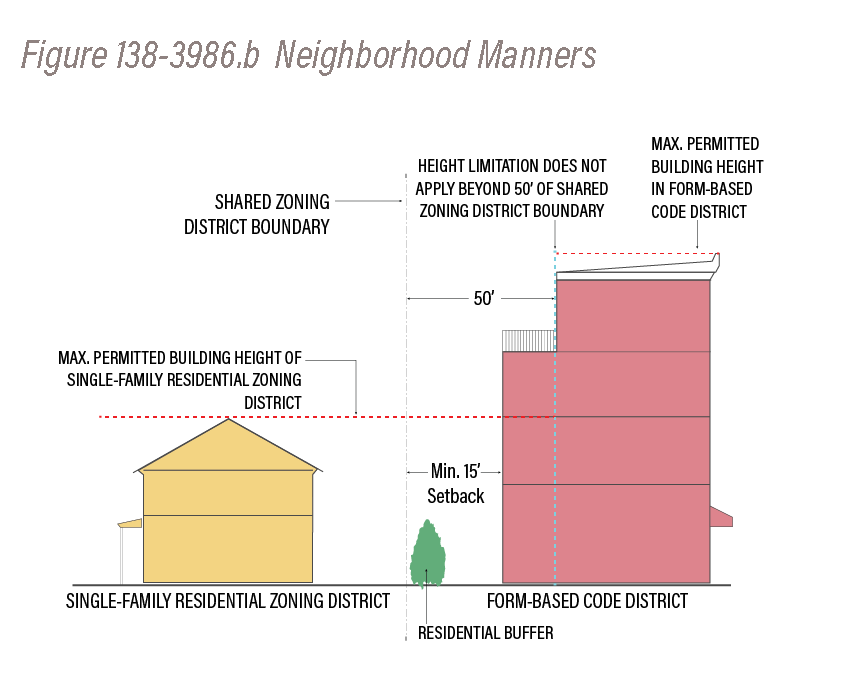
Height. When a form-based code district shares a boundary with a single-family residential zoning district (as established in LDC section 138-311), the maximum height in the form-based code district shall be equal to the single-family residential zoning district plus 1 story. This limitation only applies to the portions of the form-based code district within 50 feet of the shared zoning district boundary. (See LFBC Div. 4: Figure 138-3986.b)
(2)
Setback. When a form-based code district shares a boundary with a single-family residential zoning district, a minimum 15 foot building setback is required from the shared zoning district boundary.
(3)
Residential buffer. A buffer, meeting the requirements of LFBC Div. 5: Section 138-4022(f), must be provided along any shared rear or side property line of a property in a form-based code district and a single-family residential zoned property. A buffer is not required between the building facadeand an abutting street or any portions that abut an alley. The buffer must be provided entirely on the property in the form-based code district at the time of development/redevelopment. (See LFBC Div. 4: Figure 138-3986.b)
(c)
Siting.
(1)
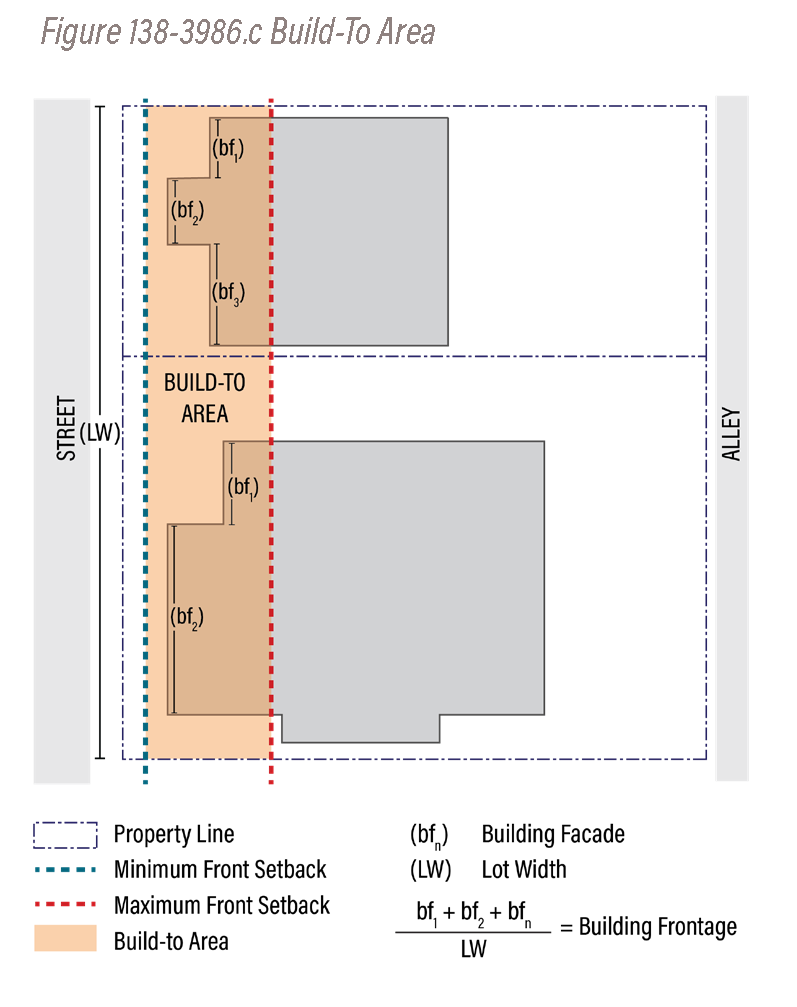
The area between the minimum and maximum front setback, is considered the Build-to Area. The minimum Building Frontage requirement (as established for each District) must be met entirely within the Build-to Area along a site's frontage(s). Building frontage is defined as the percentage of lot width that is occupied by the building facadewithin the Build-to Area. (See LFBC Div. 4: Figure 138-3986.c)
(2)
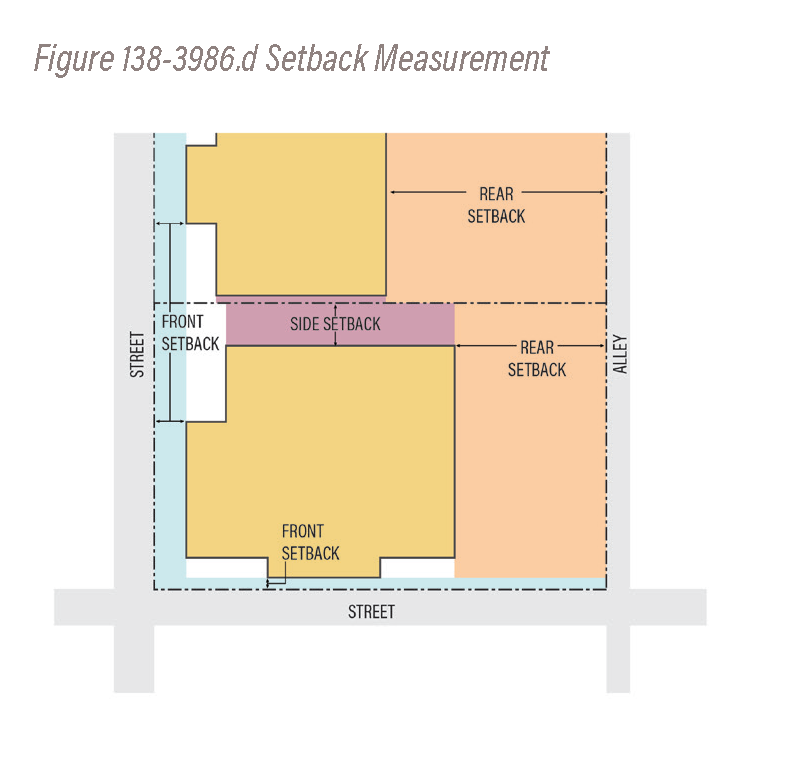
Setbacks are measured by the shortest dimension, running from the property line to the nearest wall of a structure. (See LFBC Div. 4: Figure 138-3986.d)
(3)
No part of any building can project beyond a designated minimum setback, except for the following encroachments, allowances, and/or limitations:
a.
Porches and decks are permitted a side or rear setback of five (5) feet or the minimum side or rear setback of the District, whichever is less.
b.
Overhanging eaves, awning, bay windows, stoops, steps, cornices, chimneys, accessible ramps, or other similar minor appurtenances may project into a minimum setback no more than five (5) feet and must not extend over adjacent property or into the public right-of-way (unless a right-of-way utilization permit is granted).
c.
Swimming pools, as measured from the water's edge, must either have a side/rear setback of eight (8) feet, or the minimum side/rear setback of the District in which the property is located, whichever is less.
d.
Screen-only enclosures are permitted a side and rear setback of five (5) feet or the minimum side or rear setback of the District, whichever is less.
e.
Arbors and pergolas, 100 square feet or less in size, are not subject to setback standards provided that intersection site visibility standards, per LFBC Div. 6: Section 138-4021(b)(5) are addressed through structure placement/design. Columns, as part of such structures, must be reviewed for visibility issues on a case-by-case basis. Such requests must be reviewed for approval by the County Engineer.
f.
Mechanical equipment such as air conditioning units, pool equipment and optional standby and emergency generators should be placed adjacent to the structure and may encroach into the required setback up to three feet from the adjacent property line, however a minimum ten-foot separation shall be required from any residential structure on a neighboring property, excluding garages or other uninhabited spaces.
g.
Outside, unenclosed stairways must have a minimum side/rear setback of five (5) feet or the minimum side/rear setback of the District in which the property is located, whichever is less.
(4)
Setback standards cannot supersede or allow easement encroachment. The following must apply:
a.
No portion of any structure can be located within the area of a recorded public easement, unless authorized by the County and/or other easement holder(s).
b.
Easement encroachment can not be authorized as a variance.
(d)
Height.
(1)
The height of all buildings is measured in stories, unless otherwise stated within the LFBC.
(2)
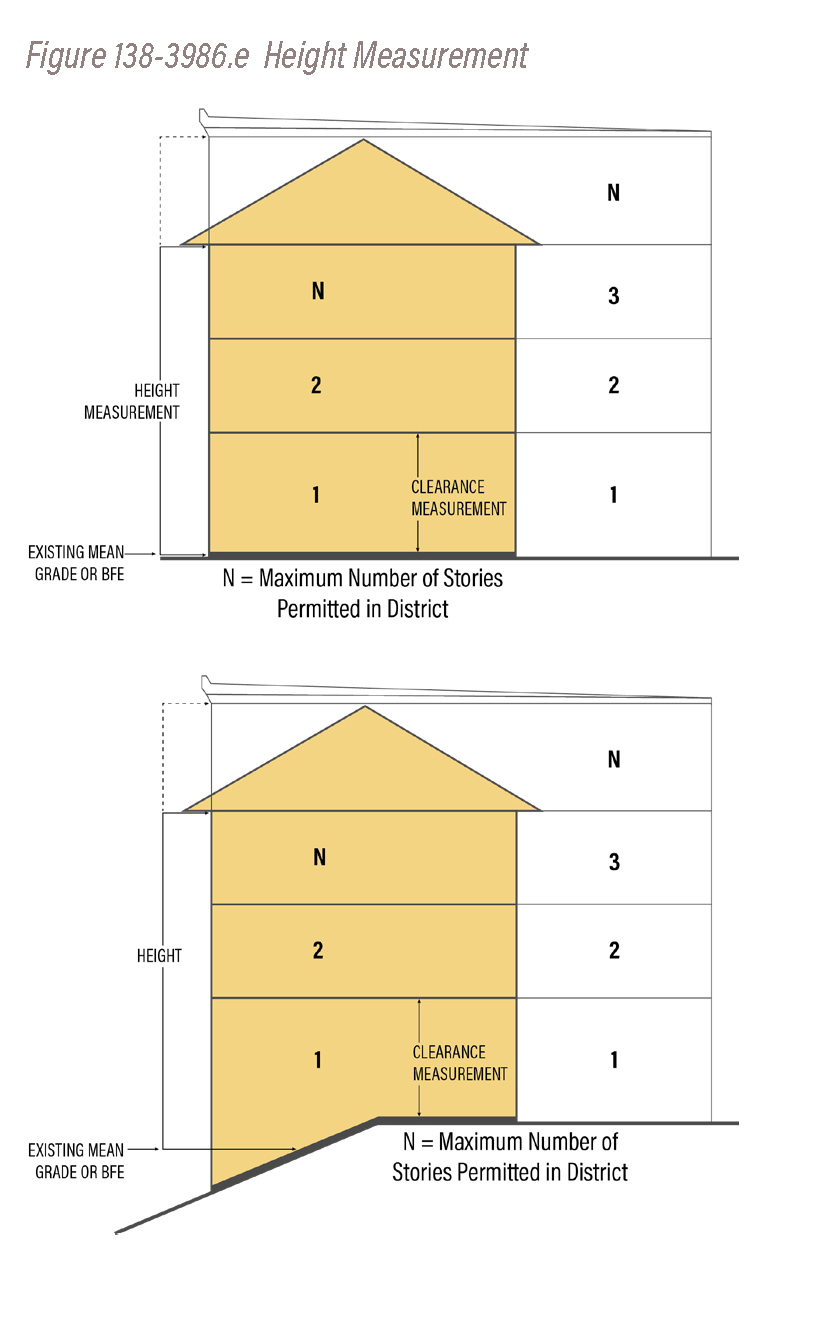
Height is measured based on the following provisions; other exemptions of this section may be allowed (See LFBC Div. 4: Figure 138-3986.e):
a.
For flat roofs, height means the vertical distance from the mean (average) elevation of the existing grade to the height of the finished roof structure.
b.
For pitched roofs, height means the vertical distance from the mean (average) elevation of the existing grade to the eave of the roof.
c.
When a structure is located in a flood hazard area, height may be measured from the base flood elevation, including any additional freeboard that is required by the National Flood Insurance Program or by local ordinance. In these situations, the design flood elevation (DFE) may be used in lieu of the mean elevation of the existing grade, based on the following:
1.
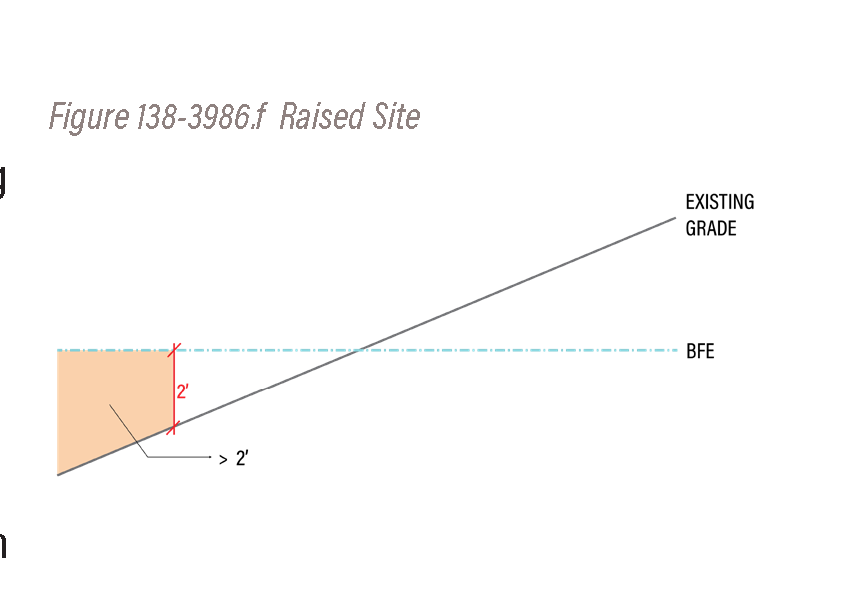
When the existing grade is two feet or less than the DFE (see LFBC Div. 4: Figure 138-3986.f), the finished floor elevation of the lowest habitable story of the building must be raised to at least the minimum required height, by utilizing the following options:
i.
Option 1: Raised site. Fill may be used to raise the building site up to a four-foot maximum height as measured from the existing grade. (See LFBC Div. 4: Figure 138-3986.f) Along frontages where a public sidewalk is present or required, a retaining wall must be used where the site is raised.
ii.
Option 2: Raised base. A foundation wall may be used to raise the base of the ground (finished) floor up to a maximum of five feet above the existing grade. (Note that buildings containing ground floor residential uses already require a minimum two-foot raised ground floor elevation. See height tables in district standards.)
iii.
Option 1 and 2 combined: A combination of Options 1 and 2 may be used to achieve at least the minimum required elevation. (Note that buildings containing ground floor residential uses already require a minimum two-foot raised ground floor elevation.) (See height tables in district standards.)
2.
When the existing grade is greater than two feet below the DFE, the finished floor elevation of the lowest habitable story of the building must be raised to at least the minimum height by utilizing the following options:
i.
Option 1: Raised base. A foundation wall may be used to raise the base of the ground (finished) floor up to a maximum of five feet above the existing grade. (Note buildings containing ground floor residential uses already require a minimum two-foot minimum raised ground floor elevation. See height tables in district standards.)
ii.
Option 2: Sub-Story. A sub-story may be used to raise the finished, habitable building space at or above the required elevation. A minimum clearance height of eight and maximum of 12 feet, as measured from the ground floor elevation, is permitted. A sub-story may be used as uninhabitable space for vehicular parking, cold storage and similar uses, subject to standards and requirements of the Pinellas County Building Code.
iii.
Option 1 and 2 combined: A combination of Options 1 and 2 may be used to achieve at least the minimum required elevation. (Note buildings containing ground floor residential uses already require a minimum two-foot raised ground floor elevation. (See height tables in district standards.)
(3)
Chimneys, water, fire, radio and television towers, smokestacks, flagpoles and similar structures and their accessory mechanical appurtenances, such as elevator shafts, ventilation equipment, etc., may be erected to a maximum of 20-feet above the height limits established in the LFBC.
(4)
Parapet walls constructed on buildings with flat roofs are permitted to extend four (4) feet over the maximum height specified for the District in which the building is located. Portions of the parapet walls, fences, or other building elements that are intended to screen mechanical equipment or similar features must be exempt from height limits to the extent that they provide screening.
(5)
Ground/Upper story clearance is measured from the finished floor elevation to the ceiling of each story.
(6)
One-story structures, except for single-unit, detached residential structures and structures located in the Neighborhood Park District, must have a minimum ground story clearance of 14 feet. For multi-story structures and structures in the Neighborhood Park District, the minimum ground story clearances are addressed in LFBC Div. 4: Section 138-3988—138-3990.
(7)
Where sidewalks are covered (awnings, arcade, etc.), a minimum interior clearance height of ten feet is required.
(8)
Building heights do not include rooftop gardens, patios, or similar functions without permanent structural covers or elements.
(e)
Elements.
(1)
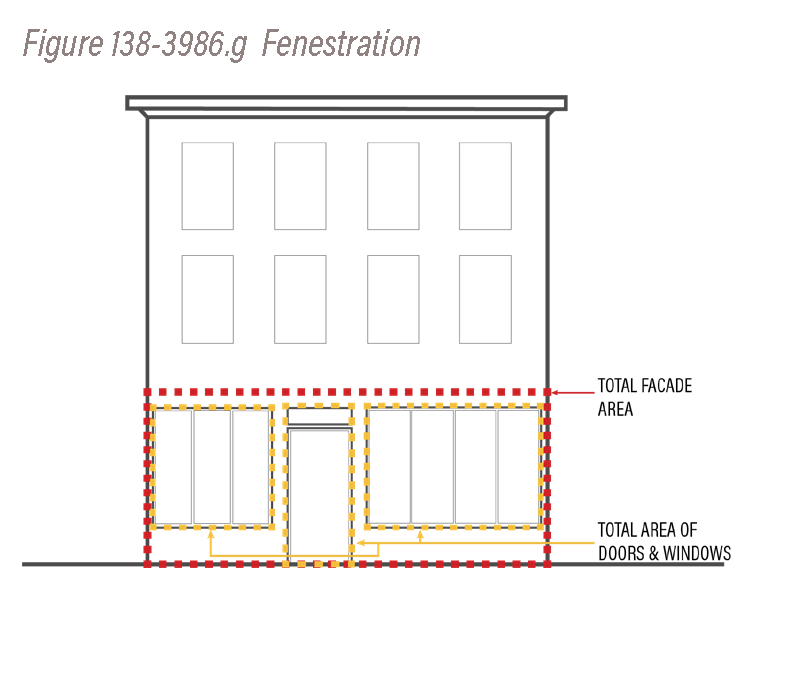
Fenestration (facade transparency) is measured by the area of all doors and windows of a particular story level, divided by the total facadearea of that story level. The total facadearea is calculated by the height between finished floors multiplied by the width of the facade(see LFBC Div. 4: Figure 138-3986.g). For the purposes of the LFBC, minimum fenestration requirements apply only to the facadesof a building that may be viewed from a public street.
(2)
Doors, whether opaque or transparent, mullions, muntins, window and door frames shall be counted towards the minimum fenestration requirement.
(3)
Sub-stories, when included per LFBC Div. 4: Section 138-3986(d)(2)(c), must be exempt from those requirements.
(Ord. No. 23-31, § 4, Exh. A, 12-12-23)
Sec. 138-3987. - Districts.
LFBC Div. 4: Sections 138-3988—138-3990 detail the siting, height, and elements standards; permitted private frontages; and permitted land use categories for each District established by the LFBC.
LFBC Div. 4: Table 138-3987.a: Districts Summary Table, provides an overview of all Districts. This table summarizes the minimum and maximum siting standards, the general District intent and primary permitted building functions, for the purpose of graphically portraying the differences between each District. Refer to LFBC Div. 4: Sections 138-3988 - 138-3990 for the complete set of District Standards for each District.
 | INTENT | PRIMARY FUNCTION | ||
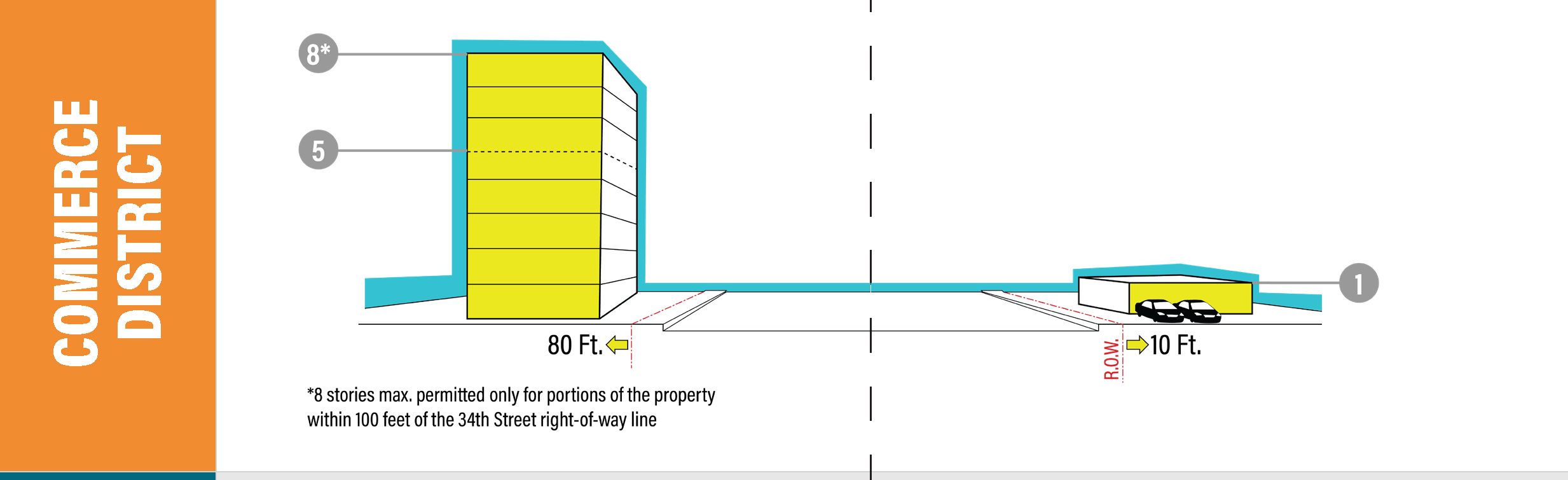 | Support stand-alone retail, office and service needs for the local and surrounding communities. Enhanced with transit opportunities & increased pedestrian safety and comfort. | Multi-Unit Residential Housing Lodging Retail Goods/Services Office Uses Civic Uses Civil Support Uses | ||
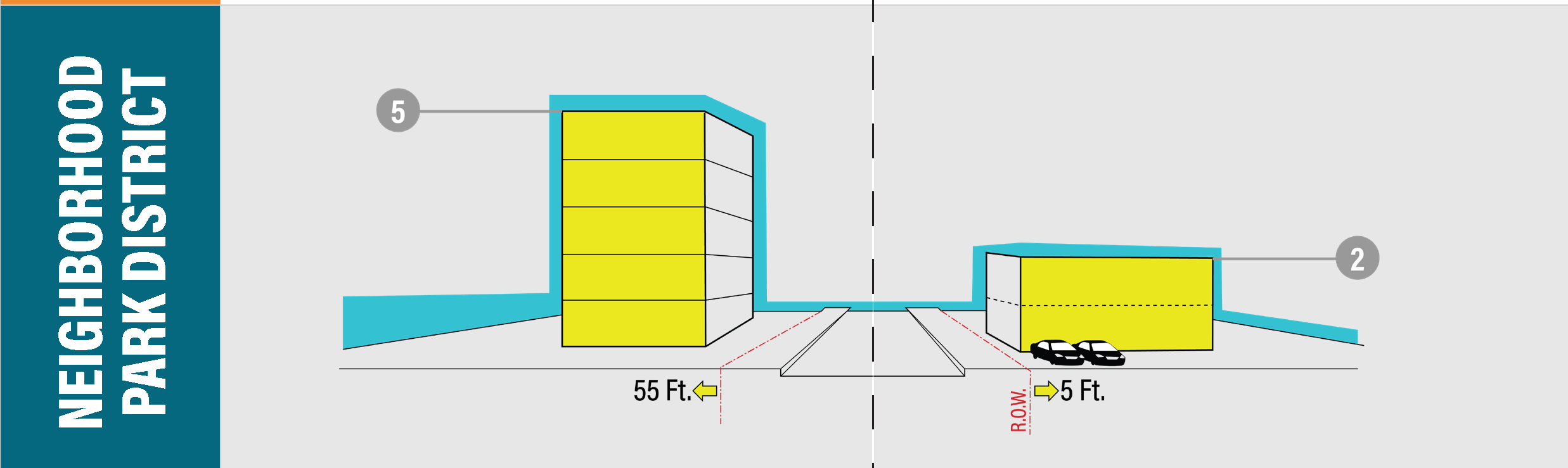 | Promote pedestrian-friendly streets in a park-like atmosphere with a mix of uses that provide goods, services, and a variety of housing opportunities for the surrounding neighborhoods. Creating a dynamic public realm and retail vitality. | Urban Residential Housing Retail Goods/Services Office Uses | ||
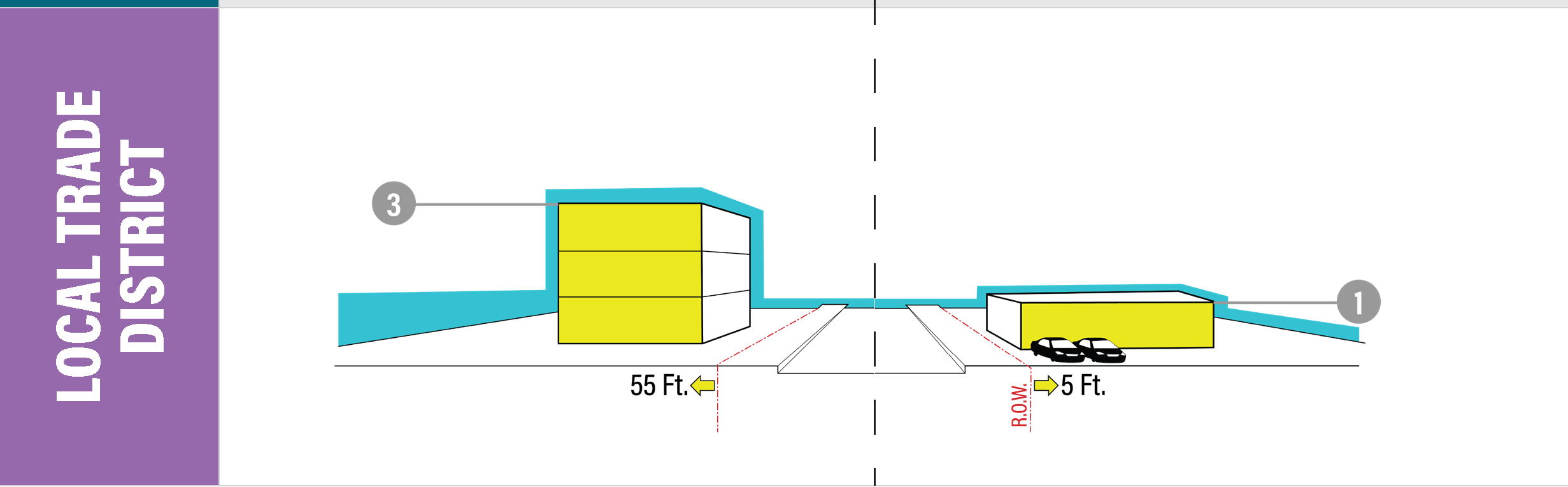 | Foster entrepreneurship by incubating small scale and craft manufacturing, specialty repair, artisans, and other startup businesses. Support business retention and expansion, through flexible form standards. | Small-Scale/Craft Manufacturing Specialty Repair Shops Artisans Retail Goods/Services Multi-Unit Residential Housing Office Uses | ||
(Ord. No. 23-31, § 4, Exh. A, 12-12-23)
Sec. 138-3988. - Commerce District (C).
(a)
Intent. The 'Commerce District' provides for the continued use, enhancement, and new development of retail, office and service needs for the local and surrounding communities. This District supports enhanced transit opportunities and increased pedestrian comfort. Development within this District is characterized by low to mid-rise buildings, screened parking with reduced/shared access points, and primary building entries with direct access to the street.
(b)
Siting.
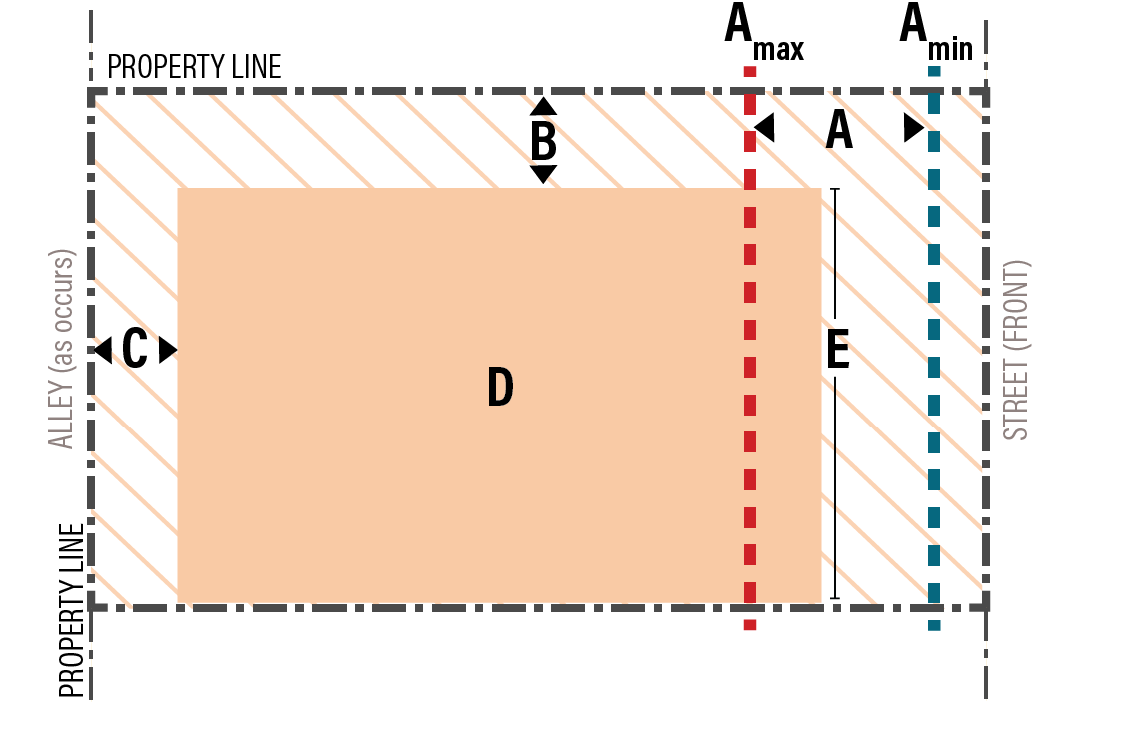
TABLE 138-3988.a
TABLE NOTES:
1. The maximum front setback may increase 5 feet to allow for an activated public space.
2. Refer to LFBC Div. 4: Section 138-3986(b)(2) when a form-based code district is adjacent to a single-family residential zoned district.
3. When an alley is present, the minimum rear/side setback is a minimum of 12 feet, measured from the centerline of the alley.
(c)
Height.
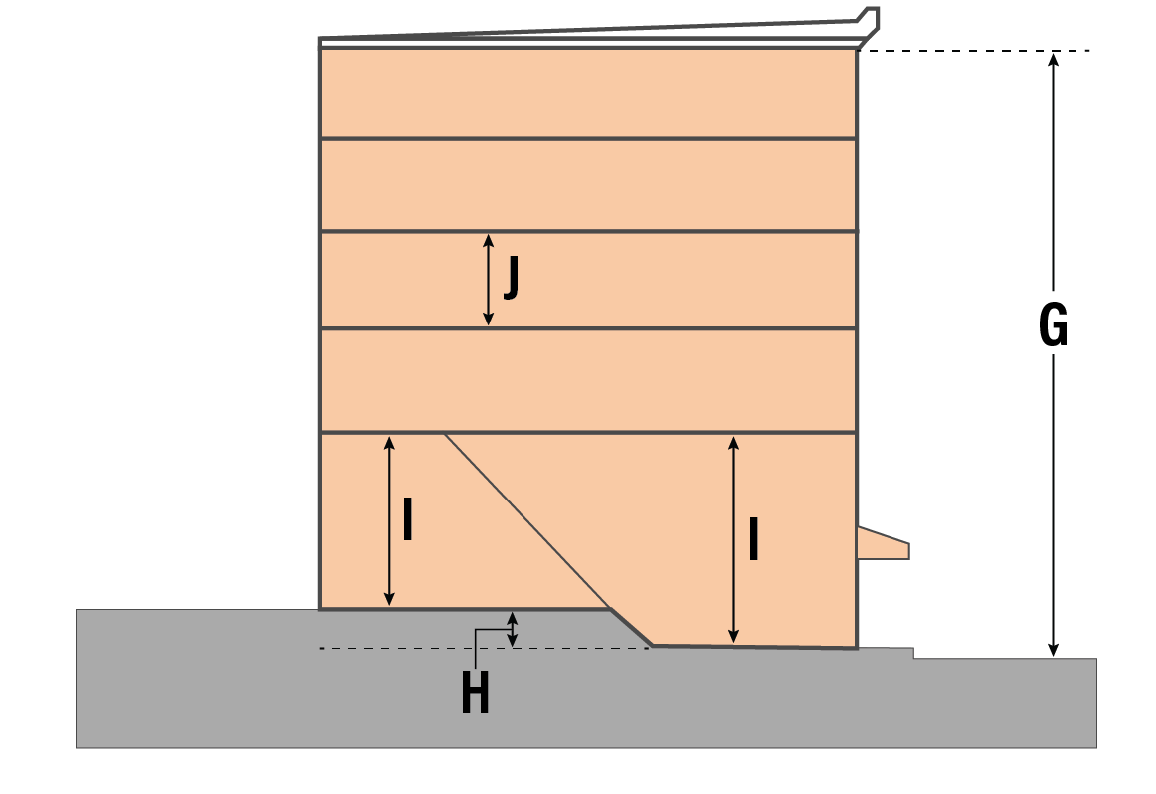
TABLE 138-3988.b1
TABLE NOTES:
1. Refer to LFBC Div. 4: Section 138-3986(b)(1) when a form-based code district is adjacent to a single-family residential zoning district.
2. Buildings cannot exceed a maximum height of 60 feet.
(d)
Elements.
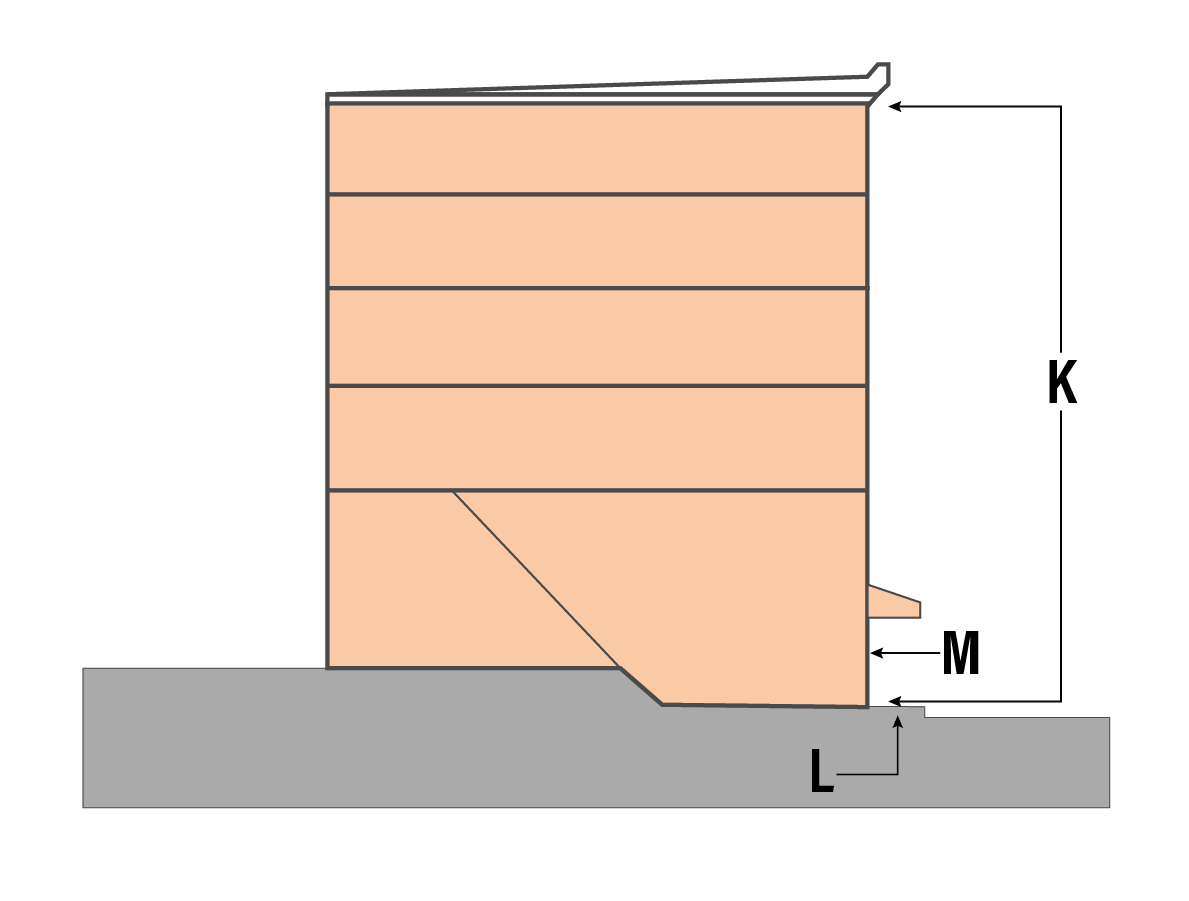
TABLE 138-3988.c
TABLE NOTES:
1. Any building projection that extends into the public right-of-way requires a right-of-way utilization permit.
2. Awnings, when provided, must project a minimum of 3 feet from the building façade and must maintain a minimum 10 foot clearance over any sidewalk.
(e)
Use Categories1
• Residential
• Lodging
• Office
• Retail
• Automotive
• Industrial
• Civil Support
• Civic
NOTES:
1. Refer to LFBC Div. 6: Table 138-4057.a: Permitted Land Uses Table for full list of permitted uses within each use category listed.
(Ord. No. 23-31, § 4, Exh. A, 12-12-23; Ord. No. 25-3, § 1, 1-28-25)
Sec. 138-3989. - Neighborhood Park District (NP).
(a)
Intent. The 'Neighborhood Park District' promotes the design of pedestrian-oriented streets that encourage a mix of uses, providing goods, services, and urban housing to the neighborhood. Development within this district is characterized by mid-rise, street-oriented buildings with activated retail and public spaces, wider sidewalks with pedestrian amenities, and enhanced crosswalks; ultimately creating a dynamic public realm that fosters retail vitality.
(b)
Siting.
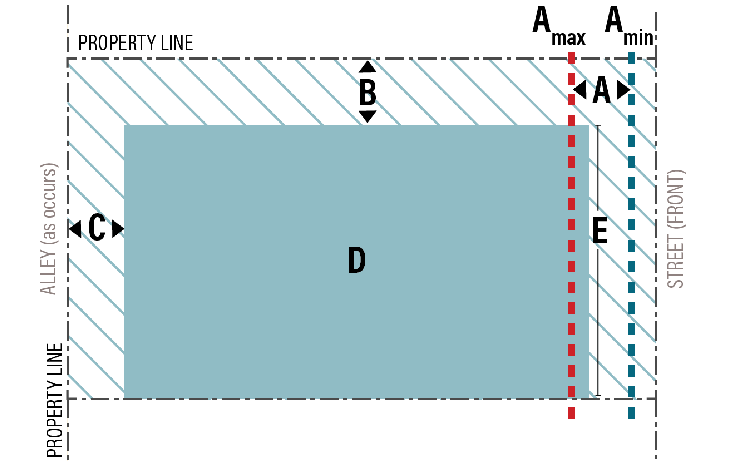
TABLE 138-3989.a
TABLE NOTES:
1. Refer to LFBC Div. 4: Section 138-3986(b)(2) when a form-based code district is adjacent to a single-family residential zoned district.
2. When an alley is present, the minimum rear/side setback is a minimum of 12 feet, measured from the centerline of the alley.
(c)
Height.
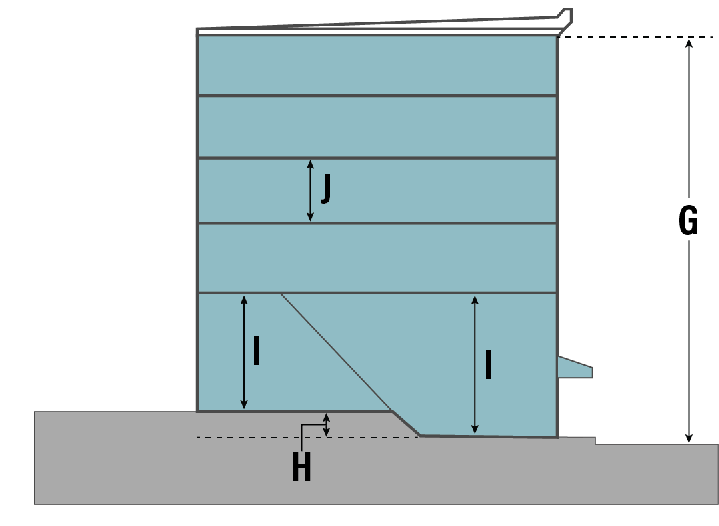
TABLE 138-3989.b 1
TABLE NOTES:
1. Refer to LFBC Div. 4: Section 138-3986(b)(1) when a form-based code district is adjacent to a single-family residential zoned district.
2. One story may be permitted if the minimum ground story clearance is 22 feet and architectural elements are incorporated into the building facadeto give the appearance of a 2-story building.
3. Buildings cannot exceed a maximum height of 60 feet.
(d)
Elements.
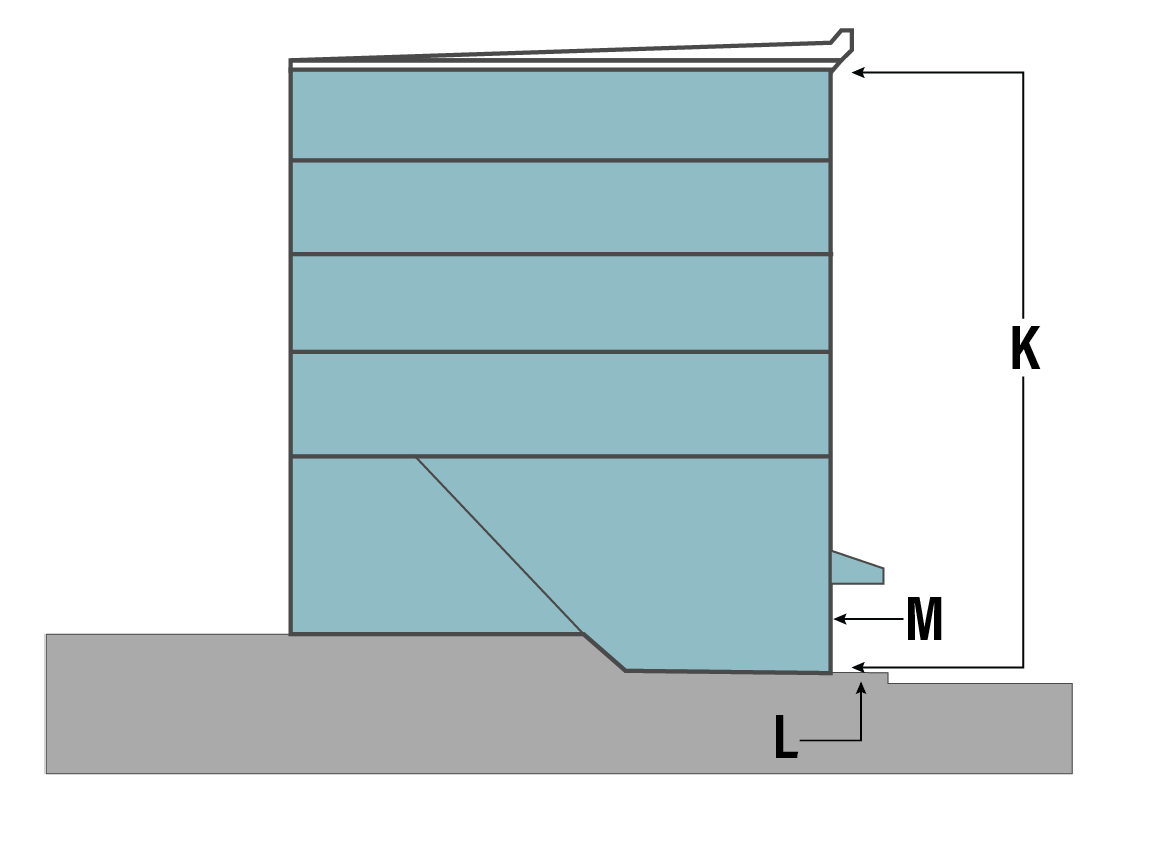
TABLE 138-3989.c
TABLE NOTES:
1. Any building projection that extends into the public right-of-way requires a right-of-way utilization permit.
2. Awnings, when provided, must project from the building facadea minimum of 3 feet and must maintain a minimum 10 foot clearance over any sidewalk.
(e)
Use Categories 1
• Residential 2
• Lodging
• Office
• Retail
• Industrial 2
• Civil Support
• Civic
NOTES:
1. Refer to LFBC Div. 6: Table 138-4057a: Permitted Land Uses Table for full list of permitted uses within each use category listed.
2. Uses within this category are typically limited.
(Ord. No. 23-31, § 4, Exh. A, 12-12-23)
Sec. 138-3990. - Local Trade District (LT).
(a)
Intent. The 'Local Trade District' fosters entrepreneurship by incubating small scale and craft manufacturing, specialty repair, artisans, and other startup businesses. The district standards allow for a mix of building frontages, visual variation and the adaptive reuse of existing structures. The 'Local Trade District' supports business retention and expansion through these flexible form standards.
(b)
Siting.
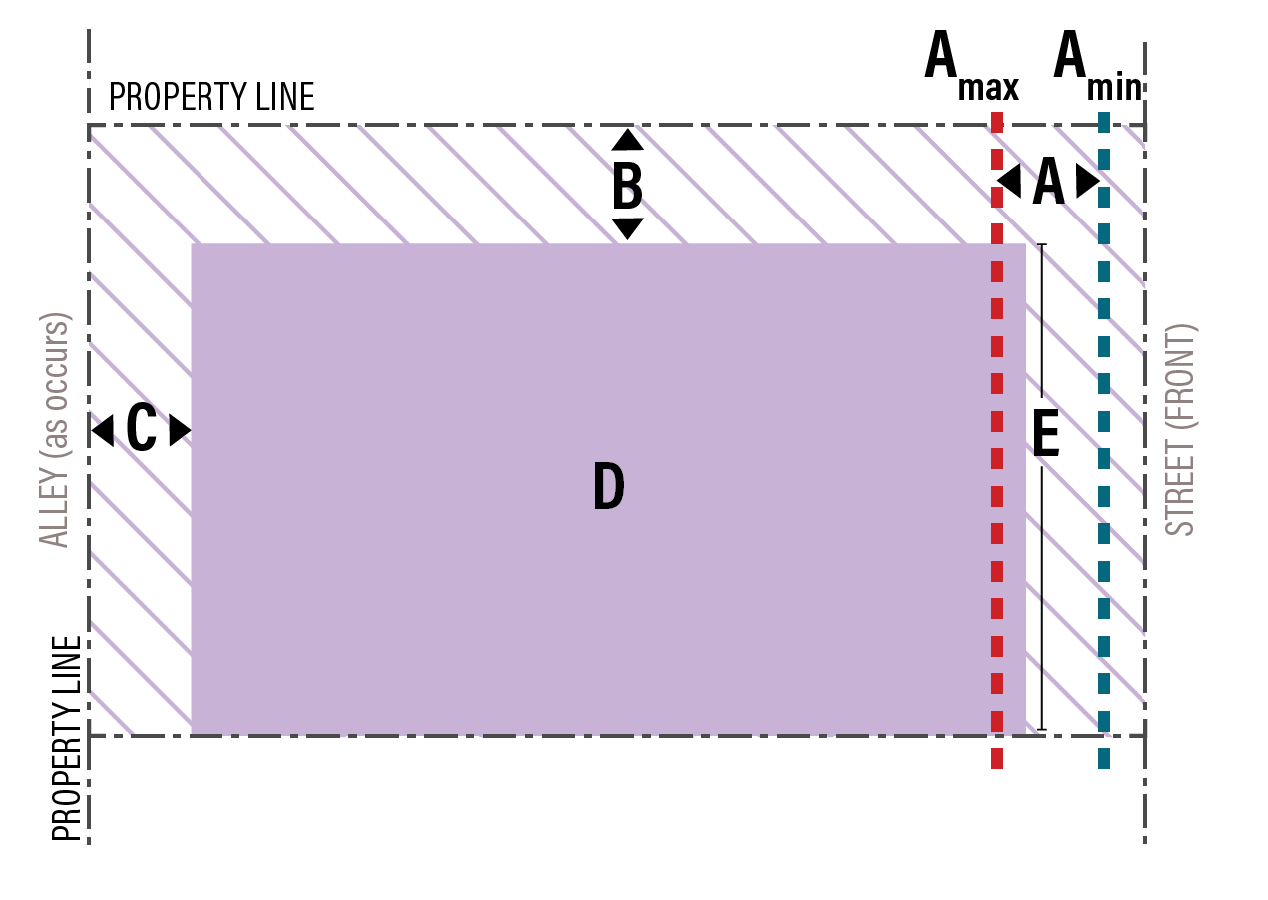
TABLE 138-3990.a
TABLE NOTES:
1. Refer to LFBC Div. 4: Section 138-3986(b)(2) when a form-based code district is adjacent to a single-family residential zoned district.
2. When an alley is present, the minimum rear/side setback is a minimum of 12 feet, measured from the centerline of the alley.
(c)
Height.
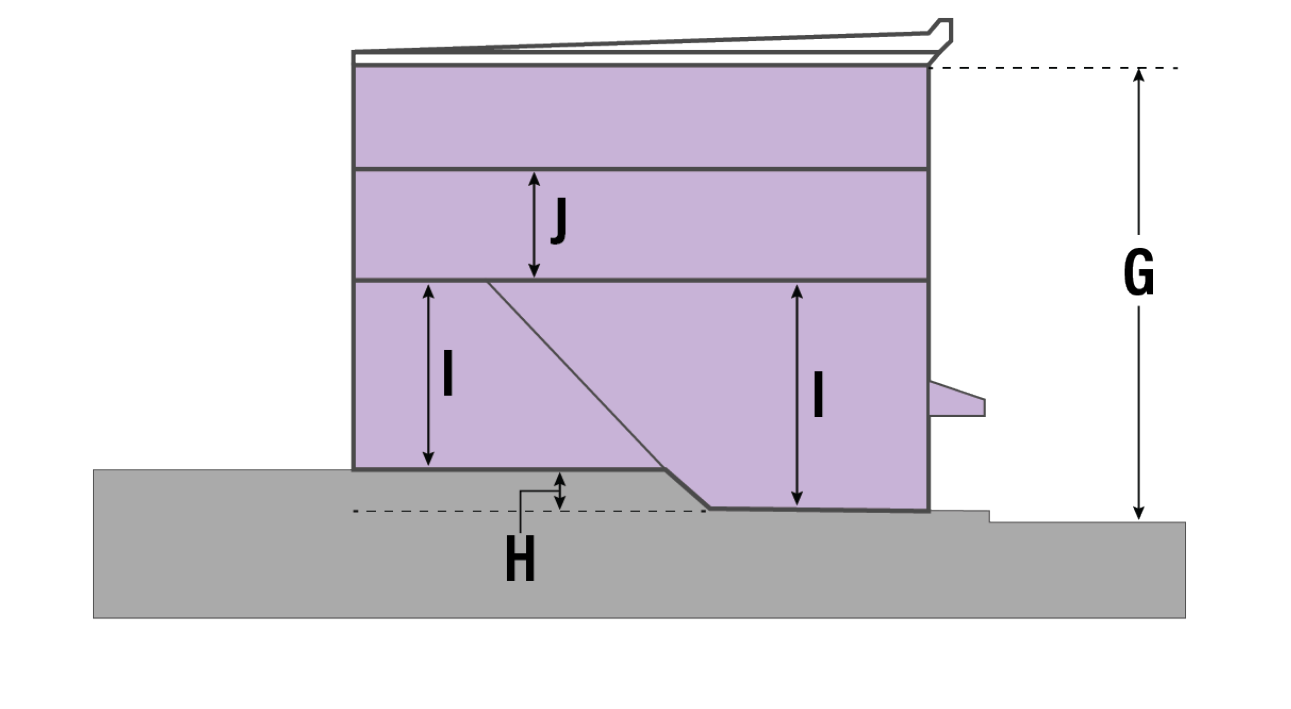
TABLE 138-3990.b 1
TABLE NOTES:
1. Refer to LFBC Div. 4: Section 138-3986(b)(1) when a form-based code district is adjacent to a single-family residential zoned district.
2. Buildings cannot exceed a maximum height of 45 feet.
(d)
Elements.
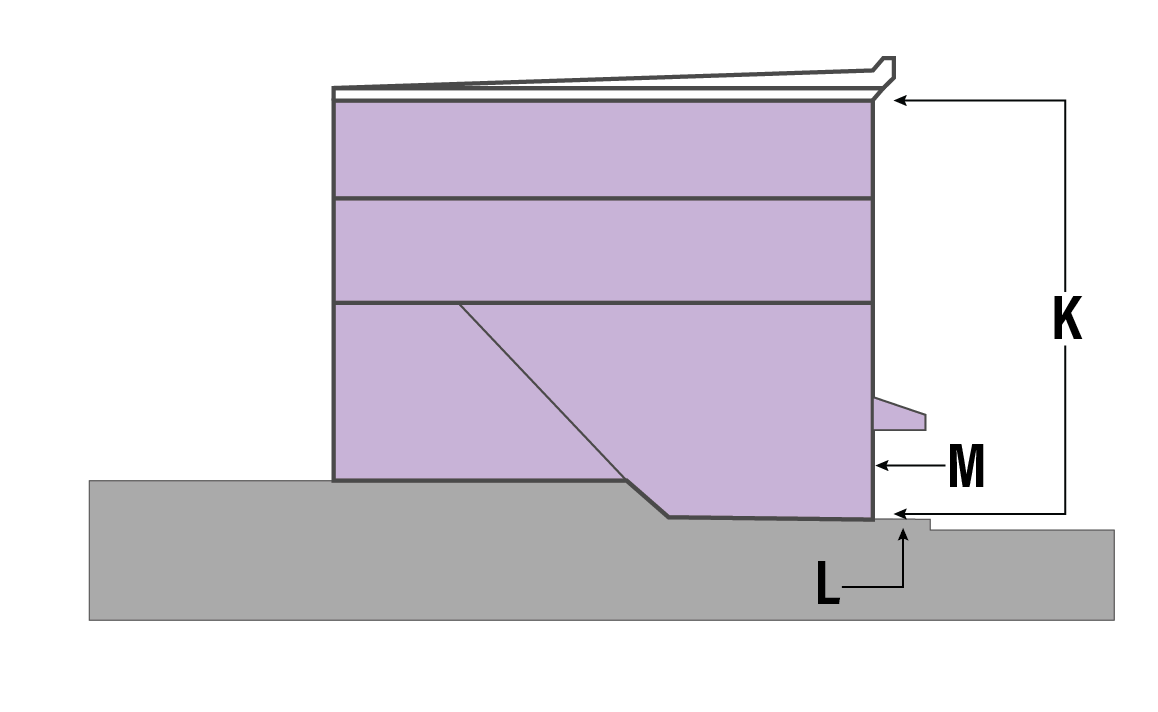
TABLE 138-3990.c
TABLE NOTES:
1. Any building projection that extends into the public right-of-way requires a right-of-way utilization permit.
2. Awnings, when provided, must project from the building facadea minimum of 3 feet and must maintain a minimum 10 foot clearance over any sidewalk.
(e)
Use Categories 1
• Residential
• Lodging
• Office
• Retail
• Automotive
• Industrial
• Civil Support
• Civic
NOTES:
1. Refer to LFBC Div. 6: Table 138-4057.a: Permitted Land Uses Table for full list of permitted uses within each use category listed.
(Ord. No. 23-31, § 4, Exh. A, 12-12-23)
Sec. 138-4020. - Intent.
(a)
The Development Design Standards establish site, building, landscaping, and signage standards for the development/redevelopment of properties.
(b)
These standards are intended to preserve and build on the existing development pattern in order to promote a walkable, pedestrian-focused community.
(c)
The Development Design Standards are further intended to provide a safe, functional, and attractive built environment and circulation pattern for all users and transportation modes.
(Ord. No. 23-31, § 4, Exh. A, 12-12-23)
Sec. 138-4021. - Site design standards.
The following Site Design Standards apply to all new development/redevelopment and expansions and remodels, as applicable per LFBC Div. 2: Section 138-3933.
(a)
General.
(1)
Existing street preservation. The vacation of public streets and alleys is discouraged in order to preserve the existing street network.
(2)
New streets. New public streets must align with and follow the existing gridded street network. Cul-de-sacs must be avoided unless no opportunity exists to make a cross street connection.
(3)
Blocksand lots.
a.
All new lots must front on at least one public street.
b.
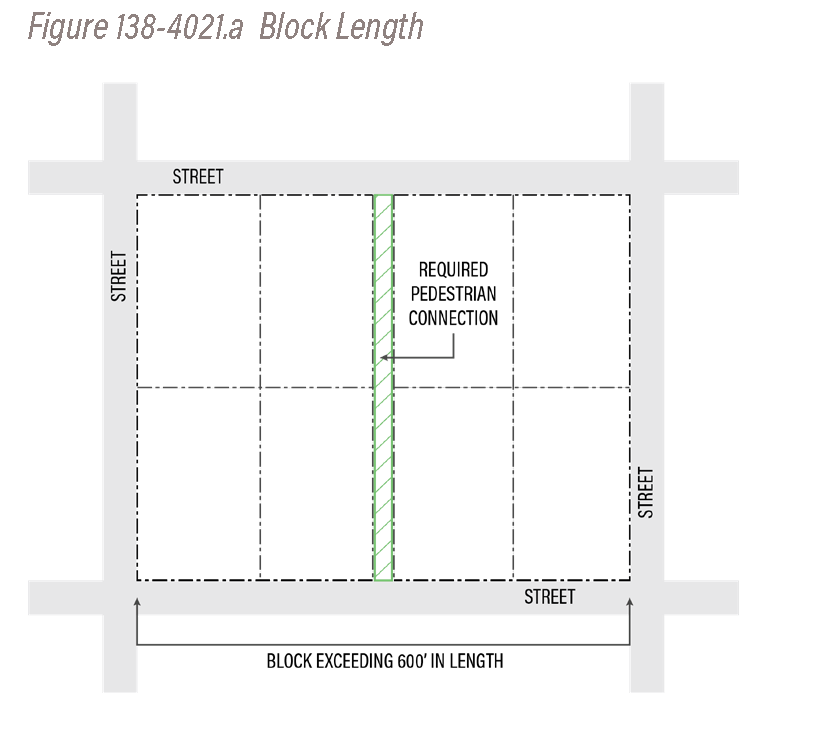
All lots and/or contiguous lots that are situated between 2 parallel public streets are considered a block. No new block created through land assembly can have a length greater than 600 feet without providing pedestrian through-access to another public street, pedestrian pathway, or public space/facility. The required pedestrian connection must be located within the public right-of-way or within a dedicated easement and must be a minimum of 10 feet in width. (See LFBC Div. 5: Figure 138-4021.a)
(4)
Outdoor pedestrian areas. Structures, trees/landscaping, and/or another method are encouraged to be provided around outdoor pedestrian use areas, such as outdoor dining areas, to provide shade and reduce heat island effects.
(5)
Dumpster enclosure. All dumpsters, recycling, and other similar containers must be screened from view of all public streets and adjacent properties. The screening must be a fence/wall that is a minimum of 6 feet in height and 100% opaque. The fence/wall must be constructed of wood (at least 1.5-inch in thickness), stone, masonry, or of a similar material. Chain link fence with interwoven plastic strips or other similar fencing is not permitted.
(6)
Stormwater management.
a.
All development must comply with the Pinellas County Stormwater Manual of current adoption.
b.
Traditional stormwater facilities, such as dry/wet retention/detention ponds are discouraged to be located in front of the primary building on the property. These types of facilities are preferred to be located to the rear and side of buildings. Stormwater detention and retention ponds must be integrated landscape features, rather than single-purpose flood control and stormwater management ponds.
(7)
Floodplain management. All development located within any flood hazard area must comply with LDC Chapter 158 for floodplain management and Appendix E - Local Administrative and Technical Amendments to the Florida Building Code.
(8)
Fence/wall standards.
a.
Fences and walls shall:
1.
Be stable under conditions of flooding, including rapid rise and rapid drawdown of floodwater; and
2.
Not divert floodwater or waves, if such diversion results in adverse impact.
b.
Height. The maximum height for any fence/wall located within the front yard is 3 feet and 6 feet in any side or rear yard. Pool enclosures must meet minimum height requirements per the Florida Building Code.
c.
Location. Fences may be constructed up to the property lines, except when there is a sight visibility conflict, per LFBC Div. 5: Section 138-4021b)(5).
d.
Material.
1.
Front yard fences/walls facing a public street must be constructed of decorative materials, such as wood or aluminum pickets, masonry, wrought iron, or of a similar material. Chain link fencing and chain link fencing with interwoven slats are prohibited along street frontages.
2.
Structural elements of the fence/wall must face inward to the subject property.
3.
Materials such as, or similar to, barbed wire, electric, razor, or chicken wire must be prohibited.
(9)
Non-residential outdoor storage of materials. Materials associated with non-residential uses that are stored outdoors are required to be located to the rear/side of the primary structure and screened per LFBC Div. 5: Section 138-4022(d), from any public street and/or when located within 50 feet of residential properties.
(b)
Access.
(1)
Pedestrian access.
a.
Where public sidewalks do not exist along a site's frontage(s), sidewalks must be constructed within the public right-of-way or an easement must be dedicated at the time of site development/redevelopment. Sidewalk widths must be a minimum of 6-feet. Where, due to environmental or other physical constraints, the sidewalk cannot be constructed to meet the required standard, the Code Administrator, in coordination with public works, can approve alternative designs as long as the intent of the LFBC is met.
b.
Pedestrian walkways must be provided from public sidewalks to building entries, parking areas, and to connect to walkways on adjacent properties in order to create a continuous pedestrian network.
c.
Any pedestrian walkway that crosses a parking or vehicular area, including nonresidential driveways, must be clearly delineated with striping, contrasting pavement materials, textured or raised pavement, or of a similar treatment.
d.
Where properties are adjacent to existing or future trails or transit stops (as identified in the Pinellas County Comprehensive Plan, Linking Lealman Action Plan, Long Range Transportation Plan, and/or Capital Improvement Plan), pedestrian and/or bicycle connections must be incorporated into the development/redevelopment project.
(2)
Primary vehicular access. Vehicular access must be provided from the lowest classified street type, per the Pinellas County Functional Classification of Roadways Map (as identified in the Pinellas County Comprehensive Plan), subject to final review and determination by the Code Administrator.
(3)
Accessand drive consolidation. In the interest of providing unified access and circulation systems, the following applies:
a.
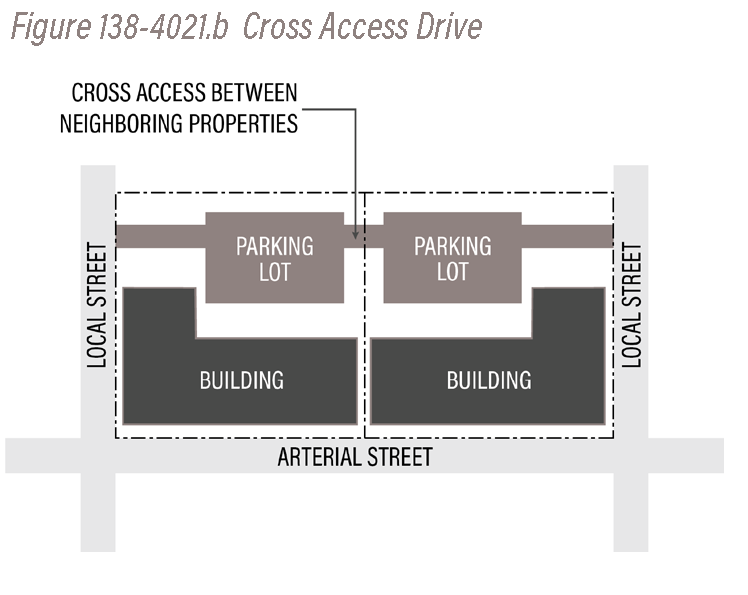
Where surface parking areas on adjacent sites lie within 50 feet of one another, as part of the application, drive aisles are encouraged to be connected at the common lot line, provided a mutual access easement has been executed. This agreement may also be included with a shared parking agreement. (See LFBC Div. 5: Figure 138-4021.b)
b.
Development sites under the same ownership, or sites consolidated for the purposes of development, must utilize a shared circulation system that minimizes curb cuts that is designed to provide safe maneuvering between parking areas.
c.
If a property gains vehicular access from an existing shared driveway, access must continue to be shared or further consolidated in the event of redevelopment.
d.
Wherever possible, existing and proposed curb cuts and driveways must be consolidated and located in a way to minimize pedestrian conflicts with vehicular movement.
(4)
New curb cuts and driveways.
a.
New curb cuts and driveways must be aligned with existing or planned entrances on the opposite side of the street, where possible.
b.
All access points from a property to a public street must meet the requirements set forth in the Pinellas County Transportation Design Manual.
c.
Intersection sight visibility. To ensure clear visibility and safety, all vehicular access drives must comply with the sight visibility standards set forth in LDC Section 138-3508. Modifications to sight visibility shall be determined and approved by the County Engineer to meet the overall intent of the LFBC and its Districts as a compact, urban built environment, while still maintaining public safety.
(Ord. No. 23-31, § 4, Exh. A, 12-12-23)
Sec. 138-4022. - Landscape design standards.
(a)
Intent. The intent of this section is to ensure that appropriate landscaping occurs with development and redevelopment, recognizing the need for flexibility to accommodate unique situations and challenges of urban development. Where "character defining" or specimen trees exist on a site proposed for development, deference shall be given to preserving such trees as integral elements of the overall development.
(b)
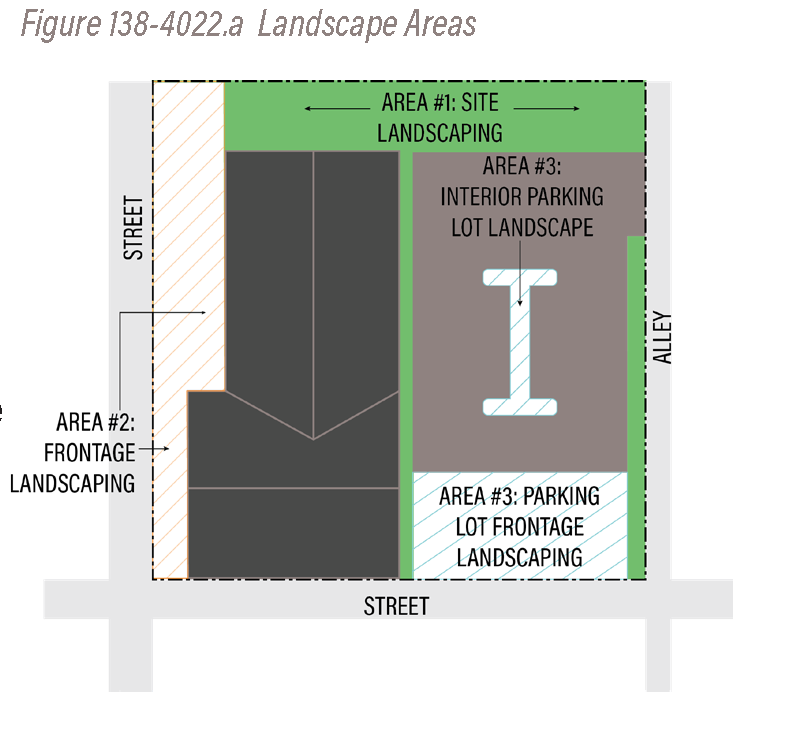
Landscape areas. Landscaping is required within the three (3) areas described below (See LFBC Div. 5: Figure 138-4022.a). Landscape material may be planted anywhere within each of the landscape areas, as long as the minimum required amount is met within each area. All required plant material must comply with LFBC Div. 5: Table 138-4022.b: Minimum Plant Specification Requirements and LFBC Div. 5: Table 138-4022.a establishes acceptable species of shade trees, accent trees, and palm trees that may be utilized to meet minimum landscaping requirements of this section.
When units or measurements determining the minimum amount of required landscaping results in a fractional amount, then such fraction equal to or greater than one-half must be rounded up to the next whole number.
(1)
Area #1—Site landscaping. A minimum of 1 shade tree must be planted for every 1,500 square feet of lot area, up to 50% of the total lot area (excluding any wetlands), in all Districts, with the exception of the Neighborhood Park District. In the event of site constraints, up to 25% of the required shade trees may be replaced by accent or palm trees, as determined by the Code Administrator. The amount and type will be determined during the site plan review process. Where, due to environmental or other physical constraints, landscaping can not be provided to meet the required standard, the applicant shall contribute to the county tree bank as described in LDC section 166-57 at the discretion of the Code Administrator.
(2)
Area #2—Frontage landscaping.
a.
A minimum of 1 accent tree and 10 shrubs/ornamental grasses must be planted per 50 linear feet along the site's frontage(s). This standard applies to all non-residential and multi-unit residential uses. Where, due to environmental or other physical constraints, landscaping can not be provided to meet the required standard, the applicant shall contribute to the county tree bank as described in LDC section 166-57 at the discretion of the Code Administrator.
b.
Planting areas must be a minimum of 5 feet in width. Alternatively, trees are permitted within appropriately sized tree wells, at the discretion of the Code Administrator.
(3)
Area #3—Parking lot landscaping.
a.
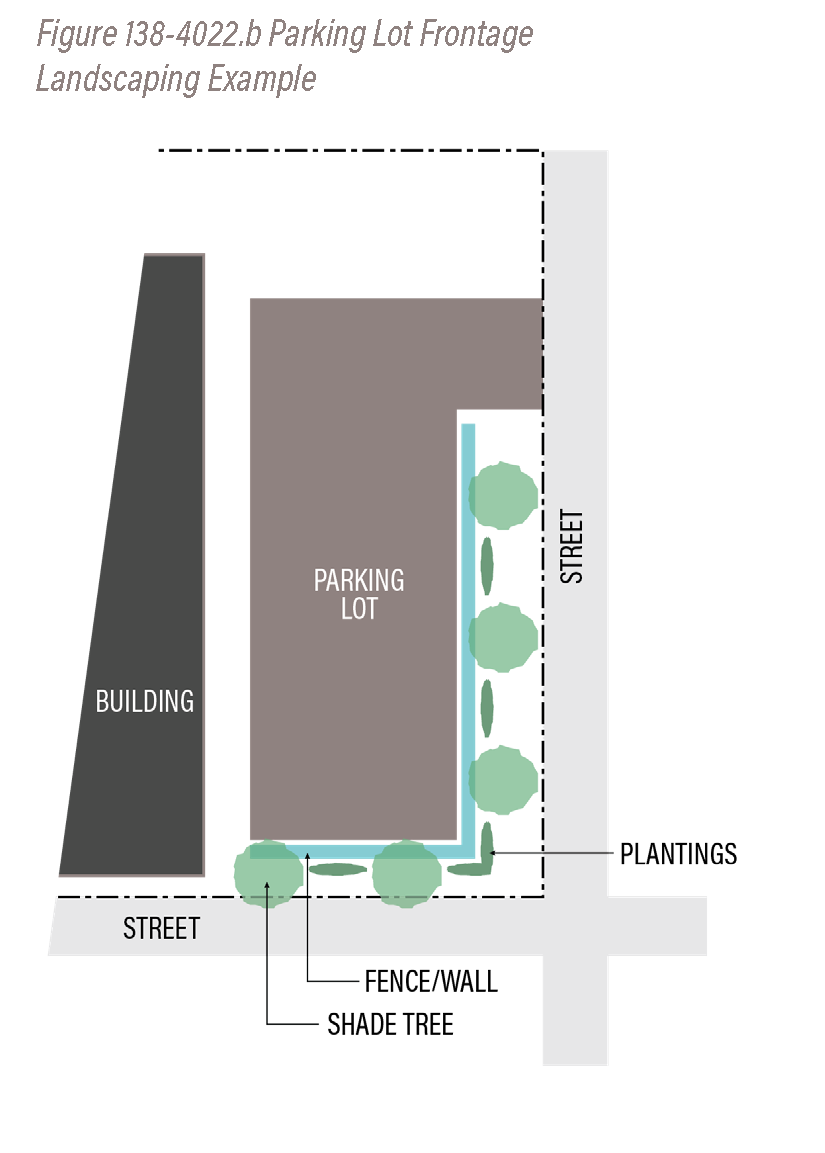
Parking Lot Frontage Landscaping. Any parking areas adjacent to or visible from a public street (excluding alleys) must be screened by one of the following methods (See LFBC Div. 5: Figure 138-4022.b):
1.
A continuous, semi-opaque/opaque wall that compliments the building's design and style and is a minimum of 3.5 feet in height; or,
2.
A hedge row meeting the 'buffer plantings' standards established in LFBC Div. 5: Table 138-4022.b; or,
3.
A combination of shade trees and shrubs that are evenly distributed along the parking lot frontage. Trees must not exceed 35 feet on center; or,
4.
Other methods may be allowed provided that the resulting situation adequately screens the parking area, as determined by the Code Administrator.
b.
Interior parking lot landscaping. Interior landscape islands must be provided within parking areas containing more than 20 parking spaces.
1.
Landscape islands with a surface area equal to 5% of the area of the entire parking surface must be provided.
2.
All required landscaped islands must be a minimum of 350 square feet in area, and must have a minimum of one (1) shade tree per island. Appropriately sized tree wells may be provided in lieu of islands, as determined by the Code Administrator.
c.
When site constraints exist, parking lot frontage landscaping can satisfy the frontage landscaping requirements if the overall intent of LFBC Div. 5: Section 138-4022(b)(2) is met, as determined by the Code Administrator.
(c)
Alternative landscaping plans. An alternative landscape plan, prepared by a licensed Landscape Architect, may be submitted for consideration as a Type 1B review in lieu of the minimum standards of this section. Evaluation and approval must be based upon meeting the overall intent of this section, as well as the intent of the District where it is proposed.
(d)
Existing tree preservation.
(1)
Existing non-invasive trees and native palms must be protected or replaced, when determined to be healthy by the applicable County staff or a certified arborist. Any impacts to protected trees must include mitigating actions such as replacement or relocation. Protected trees may count towards the minimum landscaping requirements. Protected trees are those that are established in LDC section 138-3654(a)(1).
(2)
The tree removal/replacement standards established in LDC section 138-3654(a) (2 through 5) and Table 138-3654.a apply.
(3)
Where, due to environmental or other physical constraints, replanting or relocation is not possible, as an alternative, the applicant may contribute to the County tree bank as described in LDC Chapter 166-57, or by integrating character defining/specimen trees into the proposed development plan. Such alternative may be reviewed and approved at the discretion of the Code Administrator and in consultation with Pinellas County Development Review Services Environmental staff.
(e)
Street trees. Street trees are highly encouraged to be integrated into the development/redevelopment of all other sites. The planting and removal of street trees shall be as regulated in LDC section 138-3657.
(f)
Buffers.
TABLE 138-4022.a: ACCEPTABLE TREE SPECIES 1
| TREE SHAPE | ACCEPTABLE SPECIES | |
|---|---|---|
 |
• Cabbage Palm (Sabal palmetto)
• Florida Royal Palm (Roystonea elata) • Paurotis Palm (Acoelorraphe wrightii) | • Sargent's Palm, Buccaneer Palm (Pseudophoenix sargentii) |
| FLORIDA GRADES & STANDARDS 1 : PALM | ||
 |
• Dahoon Holly (Ilex cassine)
• Fringe Tree (Chionanthus virginicus) • Jamaica Caper (Capparis cynophallophora) • Live Oak var. highrise (Quercus virginiana var. highrise) • Magnolia Sweet-Bay (Magnolia virginiana) |
• Red Maple (Acer rubrum)
• Satinleaf (Chrysophyllum oliviforme) • Southern Magnolia (Magnolia grandiflora) • Wild Mastic (Sideroxylon foetidissimum) • Yaupon Holly (Ilex vomitora var. pendula) |
| FLORIDA GRADES & STANDARDS 1 : TYPE 2, TYPE 3 | ||
 |
• Black Ironwood (Krugiodendron ferreum)
• Buttonwood (Conocarpus erectus) • Gumbo Limbo (Bursera simaruba) • Live Oak (Quercus virginiana) • Mahogany (Swietenia mahagoni) |
• Orange Geiger Tree (Cordia sebestena)
• Red Bay (Persea borbonia) • Red Maple (Acer rubrum) • Southern Magnolia (Magnolia grandiflora) • Sugarberry (Celtis laevigata) |
| FLORIDA GRADES & STANDARDS 1 : TYPE 1, TYPE 3 | ||
 |
• Bald Cypress (Taxodium distichum)
• East Palatka Holly (Ilex attenuata) • Pond Cypress (Taxodium ascendens) • Southern Cedar (Juniperus silicicola) • Yaupon Holly (Ilex vomitoria) | |
| FLORIDA GRADES & STANDARDS 1 : TYPE 2 | ||
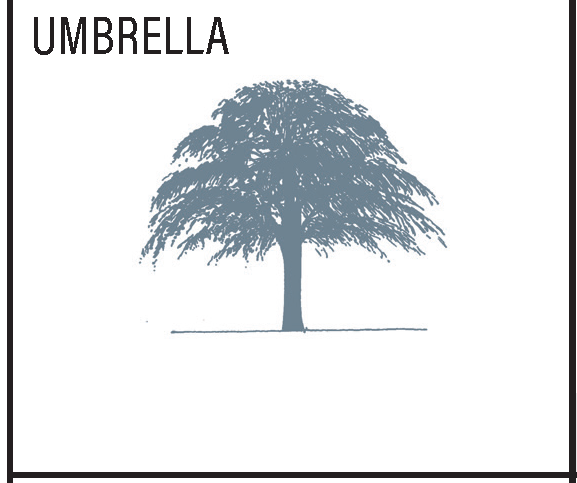 |
• Buttonwood (Conocarpus erectus)
• Florida Elm (Ulmus americana var. floridana) • Hog-plum (Ximenia americana) • Lancewood (Ocotea coriancea) • Live Oak (Quercus virginiana) • Paradise Tree (Simarouba glauca) |
• Persimmon (Diospyros virginiana)
• Red Mulberry (Morus rubra) • Sand Live Oak (Quercus geminata) • Seagrape (Coccoloba uvifera) • Wild Tamarind (Lysiloma latisiliquum) • Winged Elm (Ulmus alata) |
| FLORIDA GRADES & STANDARDS 1 : TYPE 1, TYPE 3 | ||
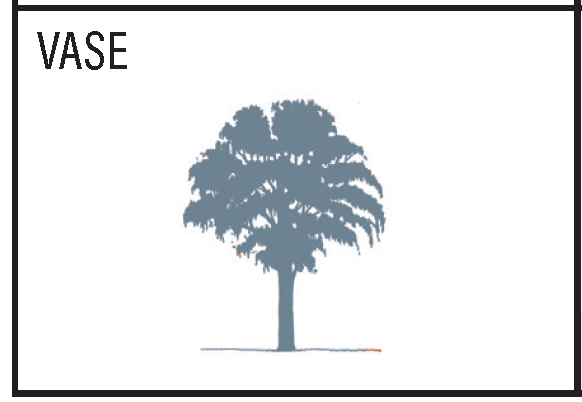 |
• Slash Pine (Pinus elliottii)
• South Florida Slash Pine (Pinus Elliottii var. densa) • Longleaf Pine (Pinus palustris) | |
| FLORIDA GRADES & STANDARDS 1 2 : TYPE 2 | ||
TABLE NOTES:
1. The use/development may propose alternative tree species as established in LFBC Div. 5: Section 138-4022(c).
2. The LFBC tree shapes broadly match the specified Florida Grades and Standards classification. Accent trees of each shape are typically classified as Type 3 in the Florida Grades and Standards.
When buffering is required, per the LFBC, the property that triggers the requirement must provide one of the following methods along the shared property line. Ingress/egress drives are permitted to intersect the buffer area.
(1)
A 6 foot high opaque fence or wall per LFBC Div. 5: Section 138-4021(a)(8); or
(2)
A 10 foot wide buffer yard that contains continuous plantings meeting the "Buffer Plantings" standards of LFBC Div. 5: Table 138-4022.b: Minimum Plant Specification Requirements; or
(3)
Other buffering methods, including a combination of the above options, may be allowed, as determined by the Code Administrator.
(g)
Plant specifications.
(1)
Size. All required plant material must meet the minimum size specifications at the time of planting, as specified in LFBC Div. 5: Table 138-4022.b: Minimum Plant Specification Requirements.
(2)
Undesirable species. The undesired plant species list, as established in LDC Section 138-3653, apply.
(3)
Approved plant list. The approved plant list, as established in LDC section 138-3664, apply.
TABLE 138-4022.b: MINIMUM PLANT SPECIFICATION REQUIREMENTS
TABLE NOTES:
1. In the event of a market shortage, the Code Administrator may approve a reduction of required caliper to the largest available Grade No. 1 equivalent plant.
(Ord. No. 23-31, § 4, Exh. A, 12-12-23)
Sec. 138-4023. - Sign design standards.
The following Sign Design Standards apply to all signage for all Districts within Lealman.
(a)
Permitted signs. LFBC Div. 5: Table 138-4023.a: Permitted Signs Table, identifies the allowable sign types and requirements for each District designation.
(b)
General provisions.
(1)
Sign style. Signage must be scaled and designed for a pedestrian-oriented area and not for high speed automobile traffic. This provision does not apply to properties located on the 34th Street/US 19 street frontage or located within 2,000 feet of the I-275 interchange (measured from the center of the interchange).
(2)
Sign setback. The leading edge of a sign must be setback from any public right-of-way a minimum of 3 feet for any sign equal to or less than 75 square feet in area, and a minimum of 10 feet for any sign greater than 75 square feet in area. No freestanding sign can be placed closer than 5 feet to any side or rear property line.
(3)
Sign measurement.
a.
Area.
1.
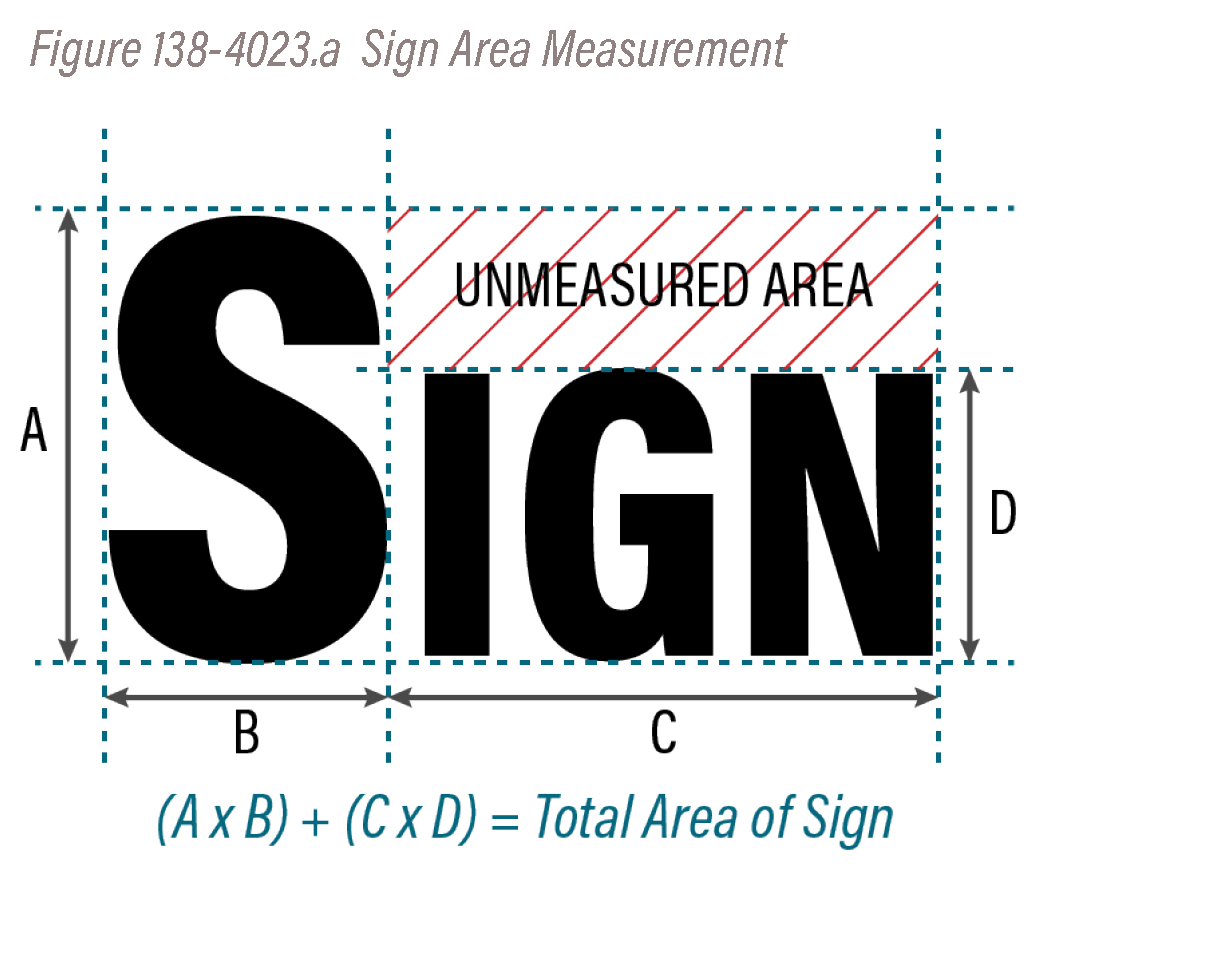
The area of a sign is the smallest square, circle, rectangle, or other geometric figure, or combination thereof, that will encompass the extreme limits of the writing, representation, emblem, or other display, together with any material, color forming an integral part of the display or used to differentiate the sign from the backdrop or structure against which it is placed. The computation of a sign area does not include any framework, bracing, fence or wall that is reasonably necessary to support the sign. (See LFBC Div. 5: Figure 138-4023.a)
2.
The area of a sign is computed on a per sign face basis and all requirements with respect to sign area reference the area of a single face of a sign. A double-faced sign is permitted to have the allowed area for a single-faced sign on each of the two faces.
b.
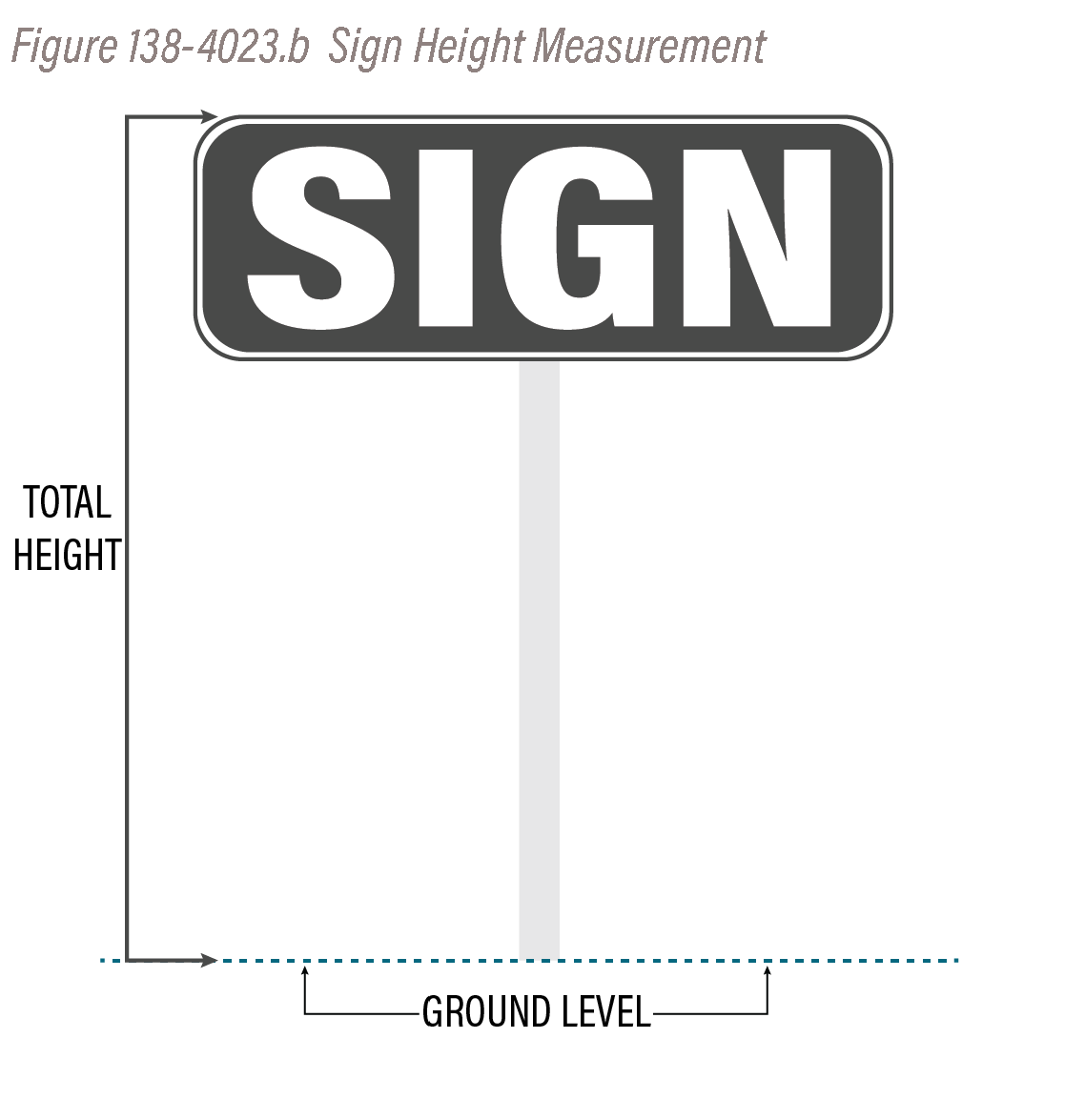
Height. The height of a freestanding sign is the vertical distance from the base of the sign at ground level to the highest point of the sign structure. In cases where the ground level cannot reasonably be determined, sign height must be derived on the assumption that the elevation of the ground at the base of the sign is equal to the average elevation at the front property line. (See LFBC Div. 5: Figure 138-4023.b)
(4)
Sign illumination.
a.
The light from any illuminated sign must be shaded, shielded, or directed away from adjoining parcels.
TABLE 138-4023.a: PERMITTED SIGNS TABLE
b.
No sign can have blinking, flashing, fluttering or colored lights that could be confused with, construed as, or interfere with traffic control devices or emergency vehicles. Similarly, no electronic changeable message sign is permitted if it may be confused with, construed as, or interfere with traffic control devices.
c.
Neither the direct nor the reflected light from primary light sources can create a traffic hazard to operators of motor vehicles on public thoroughfares.
(5)
Electronic changeable message signs. Electronic changeable message signs can be used in all Districts for non-residential uses, with the exception of the Neighborhood Park District, and must meet the following:
a.
The use of an electronic changeable message sign counts towards the allowable freestanding/attached sign square footages (based on where the electronic message sign is located), as specified for each District.
b.
Messages/images must be displayed for a minimum of 1 minute before transitioning to another message/image.
c.
The maximum transition time between messages or images must be no more than one-half second, and must not include any change of color, flash, fade, rotation, or other similar action.
d.
Message scrolling is prohibited.
e.
The sign must be equipped with brightness controls used to reduce the intensity of the light based on outside light levels.
(6)
Sign location. Signs cannot be located on a property that is separate and distinct from the commercial establishment, product, merchandise, service or entertainment to which they are intended to draw attention. In no instance must this be interpreted as prohibiting a non-commercial message from being displayed on any property.
(c)
Exempt signs. The following types of signs are exempt from the permitting process and other provisions within this section, except relating to construction, illumination, and safety:
(1)
Address numbers.
(2)
Artwork, which includes drawings, pictures, symbols, paintings or sculptures which in no way identify a product or business and which are not displayed in conjunction with a commercial, for-profit or nonprofit enterprise.
(3)
Government and public signs, including but not limited to, community identity and entrance signs, signs for special community events, commemorative and historic signs, and coordinated countywide trail-blazing signs that provide direction to places of interest.
(4)
A maximum of 3 noncommercial flags are permitted on each lot.
(5)
On-site directional signs. No individual sign can exceed 4 square feet in area.
(Ord. No. 23-31, § 4, Exh. A, 12-12-23)
Sec. 138-4055. - Intent.
(a)
The Use standards are intended to describe provisions for specific land uses. These standards are further intended to be simplistic, while still acknowledging the relationship between neighboring land uses.
(b)
Allowable land uses are identified for each district, as described in LFBC Div. 6: Table 138-4057.a: Permitted Land Uses.
(Ord. No. 23-31, § 4, Exh. A, 12-12-23)
Sec. 138-4056. - Permitted uses.
Land use categories have been established in order to sort land uses based on similar characteristics, such as type and amount of activity, type of customers or residents, how goods and services are delivered, site conditions, and impact on surrounding areas. The categories include the following: Residential, Lodging, Office, Retail, Automotive, Industrial, Civil Support and Civic.
(a)
Primary uses.
(1)
A lot may contain more than one primary use.
(2)
Permitted primary uses are listed in LFBC Div. 6: Table 138-4057.a organized by District.
(b)
Accessory uses. Accessory uses are allowed in conjunction with a permitted primary use, if the accessory use:
(1)
Is subordinate to and services the primary use;
(2)
Is subordinate in area, extent, and/or purpose to the primary use;
(3)
Contributes to the comfort, convenience or necessities of the users or occupants of the primary use; and
(4)
Is located on the same lot as the primary use, provided such use is in keeping with the purpose and intent of the district in which it is located.
(c)
Temporary uses. Temporary uses are permitted in any District, provided that the proposed use is a permitted use and will be located on the site of a non-residential establishment. All temporary uses are subject to the following standards:
(1)
No parcel can be occupied by a temporary use for more than 60 days in any calendar year.
(2)
No zoning clearance is required for a temporary use, unless a structure will be located on the property.
(3)
Nothing herein relieves an operator of a temporary use from complying with other applicable codes, ordinances, and regulations; such as electricity or plumbing permits.
(Ord. No. 23-31, § 4, Exh. A, 12-12-23)
Sec. 138-4057. - Use determination
(a)
Use types.
(1)
Type 1A uses. Land uses designated as "1A" in LFBC Div. 6: Table 138-4057.a, are uses that are permitted by right. Type 1A uses follow a Type 1A review procedure, per LFBC Div. 2: Section 138-3932(a).
(2)
Type 1B uses. Land uses designated as "1B" in LFBC Div. 6: Table 138-4057.a, are uses that are permitted by warrant. Type 1B uses follow a Type 1B review procedure, per LFBC Div. 2: Section 138-3932(b), which requires Code Administrator approval. When reviewing a Type 1B use, the Code Administrator must consider the following criteria:
a.
The potential impact on surrounding properties.
b.
The overall intent of the District in which the use will be located.
(3)
Type 2 uses. Land uses designated "2" in LFBC Div. 6: Table 138-4057.a, are uses that require a public hearing approval through the Type 2 review procedure, per LFBC Div. 2: Section 138-3932(c) and LDC Section 138-240. In order to authorize a Type 2 use, the reviewing body must determine satisfaction of the following criteria:
a.
The proposed use is consistent with the Pinellas County Comprehensive Plan and with the intent of the applicable LFBC District.
b.
There is adequate separation of the proposed use and nearby uses by screening devices, buffers, and/or other appropriate means.
c.
Adequate drives, walkways, and parking are available or proposed so that no vehicular circulation or parking problems are created.
d.
The proposed use will not create excessive vehicular traffic or other traffic problems.
e.
Drainage problems will not be created on the property or nearby properties.
f.
All provisions of the LFBC will be met, unless varied by the authorized reviewing body.
(4)
Additional safeguards. In approving a Type 1B or 2 use, the authorized reviewing body may require additional safeguards to protect the surrounding area, such as entry/exit points, buffering, additional setbacks, or capacity of use.
(b)
Unlisted uses. If a proposed use is not listed in LFBC Div. 6: Table 138-4057.a, but is similar in character and function to another listed use, the Code Administrator may treat the proposed use under that use's category. If a proposed use is not listed and is not similar to any other listed use, the use is prohibited. When determining if a proposed use is similar to another listed use, the Code Administrator must consider the following criteria:
(1)
The characteristics of the proposed use in comparison to other permitted uses and the potential impact on surrounding properties.
(2)
The overall intent of the District in which it is located.
TABLE 138-4057.a: PERMITTED LAND USES
1A = Permitted By Right / Type 1A Review 1B = Permitted By Warrant / Type 1B Review 2 = Public Hearing Process / Type 2 Review a = Accessory Use Blank = Use Not Permitted
See LFBC Div. 2: Section 138-3832 for Review Procedures
TABLE NOTES
1. Only applies for properties in the Neighborhood Park District where allowed by the underlying Future Land Use, as determined by the Pinellas County Future Land Use Map.
2. Only applies for properties in the Commerce District that are within 2,000 feet of the center of the I-275 Interchange.
3. Only applies for properties in the Commerce District that are located along 34th Street North/US 19.
(Ord. No. 23-31, § 4, Exh. A, 12-12-23)
TABLE 138-4057.a: PERMITTED LAND USES
1A = Permitted By Right / Type 1A Review 1B = Permitted By Warrant / Type 1B Review 2 = Public Hearing Process / Type 2 Review a = Accessory Use Blank = Use Not Permitted
See LFBC Div. 2: Section 138-3932 for Review Procedures
TABLE NOTES
1. Only applies for properties in the Neighborhood Park District where allowed by the underlying Future Land Use, as determined by the Pinellas County Future Land Use Map.
2. Only applies for properties in the Commerce District that are within 2,000 feet of the center of the I-275 Interchange.
3. Only applies for properties in the Commerce District that are located along 34th Street North/US 19.
(Ord. No. 23-31, § 4, Exh. A, 12-12-23)
Sec. 138-4058 - Specific use standards.
The specific use standards listed within each use category are intended to ensure such uses are consistent with the overall intent of the LFBC, while also being compatible with the surrounding neighborhoods in which they are located.
(a)
Residential.
(1)
Single-unit attached dwellings with ground story residential units may fulfill the Doors/Entries Element requirement (per LFBC Division 4) with a shared internal courtyard that provides the direct access to the primary frontage(s), as opposed to individual access from the street to each individual dwelling unit.
(2)
Multi-unit residential developments.
a.
Ground story residential units may fulfill the Doors/Entries Element requirement (per LFBC Division 4) with a shared internal courtyard that provides direct access to the primary frontage(s), as opposed to individual access from the street to each dwelling unit.
b.
A minimum of 10 percent of the site area must be reserved and/or improved as usable open space. Required common open space must be usable for parks, recreation, and/or retained for natural resource protection. Rooftop decks, balconies, porches or similar outdoor spaces, including spaces for a nonresidential use for mixed-use developments, may count towards this requirement.
(3)
Accessory dwelling units (ADUs), are intended to provide additional housing that is incidental to a primary dwelling while ensuring that the intended district character is protected. ADUs include, but are not limited to, guest housing, security residence, and/or affordable housing options. ADUs, are subject to the following:
a.
Accessory dwelling units cannot exceed 750 square feet in area.
b.
Only one ADU per parcel of ownership is permitted.
c.
Either the primary dwelling or the ADU must be owner-occupied.
d.
All applicable district regulations pertaining to setbacks and lot coverage provisions must be met.
e.
Separate metered utility connections for the ADU may be permitted.
f.
Mobile homes and recreational vehicles cannot be used as ADUs.
g.
ADUs must meet the minimum requirements for a dwelling unit in accordance with the Florida Building Code.
(4)
Group living facilities, such as an assisted living facility, group home, or congregate care facilities, provide a living environment where various levels of services are provided to assist in an individual's daily needs. Group living facilities are subject to the following:
a.
Facilities must be developed with at least 10 percent of the site area to be reserved and/or improved as common open space. Required common open space must be usable for parks, recreation, and/or retained for natural resource protection. Rooftop decks, balconies, porches or similar outdoor spaces may count towards this requirement.
b.
Group living facilities may be constructed/established as a variety of housing types.
c.
Group living facilities are not permitted within a designated Coastal High Hazard Storm Area.
(5)
Affordable housing development.
a.
LDC Section 138-3211 applies in its entirety for all Affordable Housing Developments.
(6)
Short term rentals (STRs), are intended to allow for an individual dwelling unit to be rented to an individual or party while protecting the immediate vicinity from associated negative impacts relating to traffic, noise, safety, and maintenance. STRs generally occur in residential units and typically within residential neighborhoods. STRs are permitted in all Districts and must comply with the provisions described in LDC Section 138-3232.
(b)
Office.
(1)
Live/Work.
a.
The residential and commercial space must be occupied by the same tenant, and no portion of the live/work unit may be rented or sold separately.
b.
The commercial component of live/work units are intended for use by the following occupations: accountants; architects; artists and artisans; attorneys; computer software and multimedia related professionals; consultants; engineers; fashion, graphic, interior and other designers; hair stylists; home-based office workers; insurance, real estate and travel agents; one-on-one instructors; photographers, and similar occupations, as determined by the Code Administrator.
c.
The commercial component must not detract from, or otherwise be a nuisance to, the residential character or appearance of the dwelling units.
d.
The commercial component is restricted inside the primary building or within an accessory structure on-site. Exterior storage of products, equipment, employee vehicles, or materials related to the commercial use is not permitted.
e.
Traffic generated by on-site customers, vendors, or delivery services for the commercial use cannot generate vehicular traffic in excess of normal residential traffic.
f.
A maximum of 2 business vehicles associated with the commercial use are permitted to be parked on-site. These vehicles are limited to standard sized commercial trucks, vans, or other similar vehicles and may not be parked within the front yard, unless they are on a driveway.
g.
The commercial use must not require increased exterior lighting that would detract from the residential character.
h.
The commercial use cannot generate external noise, odor, glare, vibration or electrical interference detectable to the normal sensory perception by adjacent neighbors.
i.
No explosive, toxic, combustible or flammable materials in excess of what would be allowed incidental to normal residential use can be stored or used on the premises.
(2)
Work/Live.
a.
Residential areas are permitted above, to the side or in back of the commercial component, provided there is internal access between the residential and commercial space.
b.
The external access for the commercial component must be oriented to the street and should have at least one external entrance/exit separate from the living space. The entrance to the commercial component must be located on the ground level.
c.
The commercial component's use must be permitted within the District in which the property is located, per LFBC Div. 6: Table 138-4057.a. Additionally, the following commercial activities are permitted for a work/live unit: accountants; architects; artists and artisans; attorneys; computer software and multimedia related professionals; consultants; engineers; fashion, graphic, interior and other designers; hair stylists; home-based office workers; insurance, real estate and travel agents; one-on-one instructors; photographers, and similar occupations, as determined by the Code Administrator.
d.
The work/live unit is required to provide parking in accordance with LFBC Div. 7: Table 138-4091.a.
(c)
Retail.
(1)
Food/drink establishments, are permitted outside dining/seating areas subject to the following standards:
a.
Seating areas must be delineated and designated on an approved site plan.
b.
Seating areas may only occupy a public sidewalk when a utilization of right-of-way permit or equivalent thereof is obtained from the applicable governing body/authority.
c.
When outdoor seating/dining areas are permitted on the public sidewalk, a minimum 5 foot wide walkway clearance area must be provided.
(2)
Vet clinic.
a.
When adjacent to an existing single-unit, detached dwelling or a duplex/semi-detached dwelling the following standards must apply:
1.
A six (6) foot high opaque wall or fence must be provided along rear and side property lines around outdoor exercise areas.
2.
Animal exercise areas must be at least twenty-five (25) feet from the shared residential property lines.
3.
Animals must not be boarded outdoors.
b.
Veterinary facilities must have an appropriate system for the disposal of animal waste. Animal waste is not allowed to collect in areas where it could result in direct discharge into the Municipal Separate Storm Sewer Systems (MS4).
(d)
Automotive.
(1)
Automobile broker.
a.
Automobile sales and storage for the purpose of conducting the automobile brokerage business must take place within a fully enclosed building
b.
No vehicle may be parked on the premises for the purpose of display, demonstration, rental, or lease.
c.
The outdoor vehicle storage is prohibited.
d.
Building entryways should be oriented towards the street to create a direct connection between the building and the public sidewalk system.
(2)
Automobile service/repair uses.
a.
All service and repair activities must be located within fully enclosed buildings.
b.
No vehicle may be parked on the premises for the purpose of vehicular sales.
c.
Building entryways should be oriented towards the street to create a direct connection between the building and the public sidewalk system.
d.
The air conditioned space of the building should be located in the Build-to Area. (See LFBC Div. 4: Figure 138-3986.c)
e.
The outdoor storage of parts and/or vehicles is only allowed in the rear and side yards, must be screened behind a minimum 6 foot high opaque wall or fence that complies with the requirements outlined in LFBC Div. 5: Section 138-4021(a)(9), and must be a minimum of five (5) feet from a residential property.
f.
The outdoor storage or parking of any disabled, wrecked or partially dismantled vehicle must not exceed 30 days during any 60-day period.
(3)
Automobile sales/rental.
a.
The gross floor area of the enclosed building must be a minimum of 7,000 square feet.
b.
Vehicle display lots must be located in the side and rear yard of the primary building, except if the site is located along 34th Street N./US 19.
(4)
Fuel station.
a.
All fuel canopies and pumps must be located behind the primary building on the property. This provision does not apply to properties fronting 54th Avenue N between 28th Street and the I-275 interchange right-of-way line.
b.
All fueling pump islands, fuel storage apparatus, and canopy elements must be set back at least 30-feet from any existing residential use.
(5)
Truck maintenance/fueling. Uses intended to serve multi-axle trucks, such as truck maintenance and fuel stations, are limited to properties located within 2,000 feet of the I-275 interchange (measured from the center of the interchange).
(6)
Drive-thru facilities.
a.
Drive-thru service windows must be located to the rear or side of the primary building on the property. Properties located within 2,000 feet of the center of the I-275 interchange are exempt from this requirement.
b.
Minimum stacking spaces:
1.
Food/Drink Establishments = 5 spaces
2.
All Other Facilities = 3 spaces
c.
Stacking lanes must be configured to ensure queuing vehicles do not block driveways, access to parking, pedestrian walkways/crossings, or extend into the public right-of-way.
d.
Stacking lanes adjacent to pedestrian walkways must be screened by landscaping and/or a decorative wall, with a height of 24 to 36 inches.
e.
Drive-thru speakers must be directed away from adjacent residential uses.
(7)
Parking structure.
a.
When developed as an accessory use on the ground/1st floor of a building within the Local Trade or Neighborhood Park district, the parking structure must be interior to permitted uses and developed as liner building spaces, effectively screening the ground/1st floor of the parking structure from public frontage viewpoints. (See LFBC Div. 6: Figure 138-4058.a)
b.
Standalone parking structures should be internal to the site and shall include architectural features/design elements and a facadetreatment compatible with the principal structure; or shall be screened with ornamental grillwork, artwork, vertical/facadelandscaping, or similar architectural features. Parking structures located along a primary roadway should include ground-floor commercial or employment along a minimum of 50 percent of the roadway frontage.
(e)
Industrial.
(1)
Outdoor storage, principal use. Outdoor storage as a principal use is not permitted within the Neighborhood Park District. Where allowed, the following provisions apply:
a.
Outdoor storage as a principal use shall not include inoperable vehicles, inoperable appliances, garbage, organic and inorganic waste, or hazardous materials.
b.
All outdoor storage of permitted materials must occur behind a minimum 6 foot high opaque wall or fence that complies with the requirements outlined in LFBC Div. 5: Section 138-4021(a)(9).
c.
Storage of sand, soil, minerals, rock and/or similar materials shall be conducted in a manner that prevents particles from leaving the site by environmental conditions such as wind and rain. The site must be equipped with track-out prevention measures to minimize the conveyance of sediment into Municipal Separate Storm Sewer Systems (MS4).
(2)
Self/mini storage. Self/mini storage uses are intended for leasing storage space for household goods, business or personal property. The following provisions apply:
a.
Individual storage units must be located fully within a building type that is permitted within the applicable District, per LFBC Appendix: Section 138-4120(a), and meets all applicable District Standards established in LFBC Division 4.
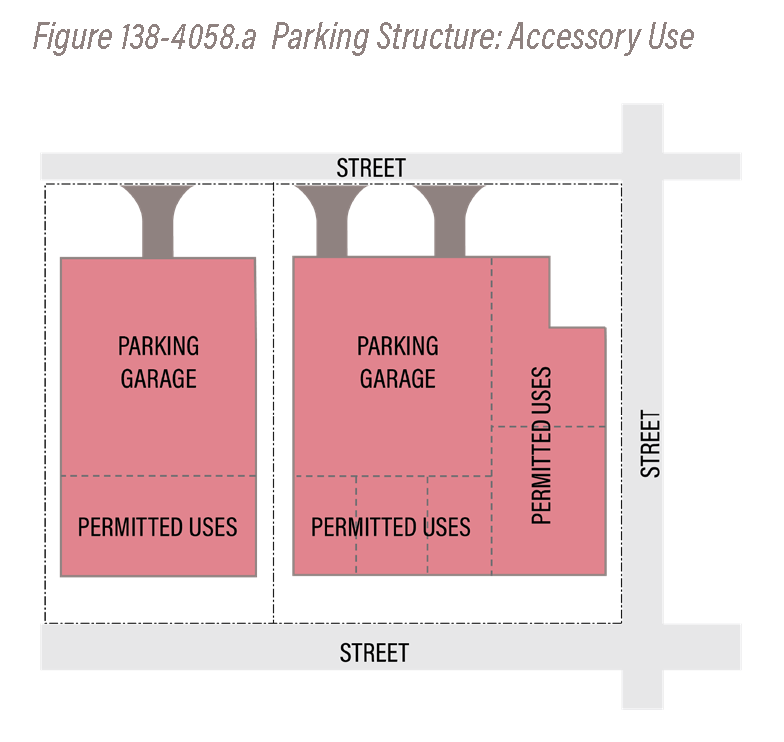
b.
Access to the storage units shall be provided from a common entryway(s) to the building.
c.
No unit shall be used for human or animal habitation.
d.
No business can be conducted from within storage units.
(f)
Civil support.
(1)
Cemeteries.
a.
Cemeteries may include ancillary and accessory uses and structures. These structures must meet the Siting Requirements of the respective District in which the cemetery is located.
b.
Graves and/or burial crypts must be located at least 50 feet from an abutting parcel.
c.
Any crematory must be located at least 200 feet from an abutting parcel and must be buffered from view from adjacent residential lands by fencing or landscaping as deemed appropriate by the Code Administrator.
(g)
Civic.
(1)
Recreation/fitness (indoor or outdoor).
a.
No outdoor activity area may encroach into the required District setbacks, with the exception of trails and pathways.
b.
Outdoor activity areas, with the exception of passive outdoor areas, must be set back at least 30 feet from any adjacent residential property.
c.
Outdoor lighting must be designed such that direct sources of illumination are not visible beyond the property lines. Lights must be directed away from adjacent residential uses.
(2)
Wireless communications tower. The establishment of any new wireless communications tower must comply with LDC section 138-3313.
(Ord. No. 23-31, § 4, Exh. A, 12-12-23; Ord. No. 25-9, § 1, 3-25-25)
Sec. 138-4059. - Use definitions.
See LFBC Div. 8: Sec. 138-4110.
(Ord. No. 23-31, § 4, Exh. A, 12-12-23)
Sec. 138-4090. - Intent.
(a)
The parking standards establish the amount, type, and design elements for vehicle and bicycle parking, as well as off-street loading areas.
(b)
These standards are intended to encourage compact development patterns, to accommodate redevelopment, and recognize alternative methods of parking and modes of transportation that in turn can reduce the abundance of vehicular parking.
(Ord. No. 23-31, § 4, Exh. A, 12-12-23)
Sec. 138-4091. - Minimum parking.
(a)
Off-street parking. The minimum number of off-street vehicle parking spaces is listed in LFBC Div. 7: Table 138-4091.a: Parking Standards, based on land use. A professional parking study may be submitted for consideration by the Code Administrator to allow for a reduced minimum parking requirement.
(b)
Bicycle parking. The minimum number of bicycle parking spaces is listed in LFBC Div. 7: Table 138-4091.a: Parking Standards, based on land use. Whenever the table indicates two numerical standards, the larger resulting quantity must apply.
TABLE 138-4091.a: PARKING STANDARDS
(c)
Accessible parking. The use/development must provide motor vehicle parking quantities as listed in LFBC Div. 7: Table 138-4091.b: Accessible Parking Spaces. The number of accessible spaces must be a part of required parking for the use/development, not in addition to. Marked on-street parking spaces designed and designated as accessible spaces that have an accessible route to the site may be included in the calculations of required accessible spaces. Refer to LFBC Div. 7: Table 138-4093.a for parking stall dimensional standards.
TABLE 138-4091.b: ACCESSIBLE PARKING SPACES
GENERAL NOTES:
A minimum of 4 accessible spaces for the disabled must be provided at a hospital or physical rehabilitation center.
(d)
Calculations.
(1)
When computing vehicle/bicycle parking spaces based on usable floor area (UFA), the use areas located inside all building or similar structures must be included in the required parking calculation. UFA excludes any floor area used for incidental service, storage, mechanical equipment rooms, restrooms, motor vehicle parking (e.g. garages) and other similar areas. Where these areas are not yet defined, UFA must be considered to be 85% of the gross floor area (GFA).
(2)
Any activated, usable outdoor spaces, such as outdoor dining areas, greater than 400 square feet in area must be calculated towards the minimum required on-site parking. Activated outdoor spaces located within the Build-to Area does not require any additional parking.
(3)
The minimum of required vehicle/bicycle parking spaces is based on the primary uses on a site. When there are two or more primary uses on a site, the required vehicle/bicycle parking for the site is the sum of the required spaces for each. Accessory uses are exempt from minimum parking requirements.
(4)
When units or measurements determining the number of required off-street parking spaces result in a fractional space, then such fraction equal to or greater than one-half requires a full off-street parking space.
(Ord. No. 23-31, § 4, Exh. A, 12-12-23; Ord. No. 25-9, § 1, 3-25-25)
Sec. 138-4092. - Parking reductions.
(a)
Mixed-use shared parking. When any parking area is used for two or more uses, the minimum total number of required off-street parking spaces is permitted a reduced total amount of required parking spaces based on the following methodology:
(1)
Determine the minimum parking quantities, per use, in accordance with LFBC Div. 7: Table 138-4091.a: Parking Standards to get the total minimum parking quantity required.
(2)
Take the total minimum parking quantity required and divide it by the number that intersects with the two applicable, corresponding use functions in LFBC Div. 7: Table 138-4092.a: Mixed Use Shared Parking Matrix.
(3)
Use this number as the required minimum number of motor vehicle parking spaces that is required to be provided at any given time (See LFBC Div. 7: Table 138-4092.b for an example of a mixed-use shared parking calculation scenario). When uses are located on separate lots/parcels from where the parking is located, a legal instrument must be provided to ensure long term legal use of the parking facility by the subject users (e.g. parking agreement, easement or the like). The legal instrument must be approved by the County attorney.
(4)
If there are more than 2 primary uses on site, the 2 uses with the highest parking requirement must be used when calculating the mixed-use shared parking reduction.
TABLE 138-4092a: MIXED-USE SHARED PARKING MATRIX
TABLE 138-4092.b: MIXED-USE SHARED PARKING EXAMPLE
(b)
Tree preservation. Where healthy trees exist and are preserved within a proposed parking area, the use/development may be permitted up to a 15% reduction.
(Ord. No. 23-31, § 4, Exh. A, 12-12-23)
Sec. 138-4093. - Specific parking standards.
(a)
On-street parking. On-street parking may be provided along the abutting street(s) when permissible and approved by the roadway facility owner (i.e. local government, developer, or property owners) and subject to the following:
(1)
Street parking spaces must remain available to the general public.
(2)
Certain roadway improvements may be required to accommodate street parking.
(3)
Due to physical constraints roadway classifications, some roadways may not be suited for, street parking.
(4)
On-street parking spaces are not allowed to encroach into any required planter strip, per LFBC Div. 5: Section 138-4021(b)(1).
(b)
Off-street parking.
(1)
Location.
a.
All off-street parking areas must be located at or behind the maximum setback line, as established in LFBC Division 4: District Standards, except for residential driveways and the following situations:
1.
When parking is masked by a building wall or streetscreen that is a minimum of 3.5 feet in height, it is permitted in the Build-to Area (See LFBC Div. 4: Figure 138-3986.c). Breaks in the wall or streetscreen may be permitted to allow for pedestrian and vehicular access.
2.
When special conditions and circumstances exist which are peculiar to the land, structure, or building involved, or when the literal interpretation of the parking location standards would deprive or make it practically difficult for the applicant to achieve the same proportion of development potential commonly enjoyed by other properties in the same District.
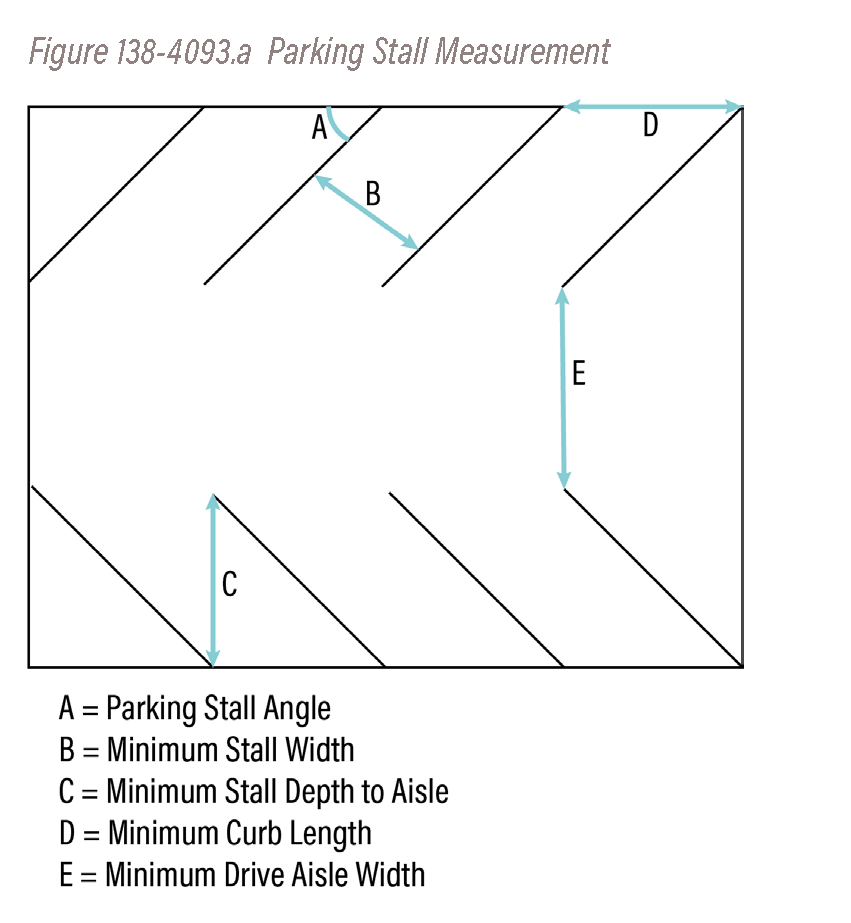
b.
The required number of accessible parking spaces must be provided on-site or as designated on-street spaces that are adjacent to the site and directly accessible to a building entrance.
(2)
Size. The minimum dimensional requirements for parking spaces and drive aisles are listed in the following table, LFBC Div. 7: Table 138-4093.a: Dimensional Requirements. (Also see LFBC Div. 7: Figure 138-4093.a)
(3)
Construction requirements.
a.
Surface material.
TABLE 138-4093.a: DIMENSIONAL REQUIREMENTS
TABLE NOTES:
1. Compact spaces may be used to satisfy up to 20 percent of the minimum required spaces for a site.
1.
Pervious surfaces approved by the County, such as grid pavers, reinforced grass, gravel, or crushed shell, are encouraged for surface parking lots.
2.
Non-paved surfaces of parking areas and associated drives must be stabilized and provided with appropriate dust control.
3.
All accessible parking spaces and accessways must be paved with asphalt, concrete or similar hard-surface material approved by the County.
b.
Back-out area. All parking aisles must include a back-out area that extends the width of the drive aisle and is 5 feet in depth.
c.
Side/rear setback. All parking spaces and driveways must maintain a minimum setback of 5 feet from all side and rear property lines. A setback is not required along alleys or for shared parking lots with cross access between separate properties.
(c)
Residential parking.
(1)
Tandem parking.
a.
Tandem parking is permitted to be used for single-unit residential and multi-unit residential projects.
b.
For multi-unit projects, up to 75% of the total off-street parking spaces provided may incorporate tandem parking. A tandem space must be assigned to only one dwelling unit.
(2)
Residential driveway/garage parking. When permitted to access a public street, a residential driveway must comply with the following:
a.
The portions of the driveway that connect to the public right-of-way may not exceed 20 feet in width.
b.
Driveways that are used for parking must provide at least 20 feet of depth, as measured from the adjacent street right-of-way, to prevent vehicles overhanging public sidewalks and/or streets.
c.
The portion of the driveway located within the right-of-way must be constructed of materials approved by the County.
(d)
Accessible parking.
(1)
Minimum size (diagonal or perpendicular spaces). 12 feet wide x 18 feet deep
(2)
Access.
a.
All accessible spaces for the disabled must be provided with a curb cut or curb ramp to a pathway, a minimum of 44 inches wide, to provide access to the building served. The stall must be located so that users will not be compelled to maneuver behind parking vehicles. Two accessible parking spaces may share a common access aisle.
b.
All accessible spaces must have an adjacent access aisle measuring at least 60 inches wide. Parking access aisles must be part of the accessible route to the building or facility entrance.
(3)
Location. When considering all the parking on the site, the designated accessible spaces should be located closest to the primary building entrance. If there are multiple entrances or multiple retail stores, the accessible spaces must be dispersed to provide parking at the nearest building entrance.
(4)
Surface materials and markings.
a.
All accessible spaces and accessways must be paved with asphalt, concrete or similar hard-surface material approved by the County.
b.
Accessible parking spaces must be posted with a permanent above-grade sign bearing the international symbol of accessibility and the caption "parking by disable permit only."
c.
Each such parking space must be prominently outlined in blue paint. The property owner must be responsible to repaint the spaces as necessary.
(e)
Bicycle parking.
(1)
Location.
a.
Bicycle parking must be within 100 feet of a main entrance to the building.
b.
For sites with more than one primary building, the bicycle parking must be distributed evenly amongst the primary buildings and must be within 100 feet of a main entrance.
(2)
Bicycle rack design.
a.
Bicycle racks or similar features must be provided with the primary purpose to allow bicycles to be securely attached to the apparatus. Sign poles, planters, and utility lines must not be considered bicycle parking racks or used to satisfy the bicycle parking requirement.
b.
Bicycle rack design must accommodate a high security, U-shaped lock.
c.
Bicycle racks must be securely anchored to the ground, a building, or a paved surface.
d.
Bicycle racks must be constructed using decorative, durable finishes that are not damaged by the constant abrasion from bicycles.
(Ord. No. 23-31, § 4, Exh. A, 12-12-23)
Sec. 138-4094. - Off-street loading
(a)
Loading facilities must be located to the rear or side of buildings and buffered, per LFBC Div. 5: Section 138-4022(d) from view of any public street or space.
(b)
In no case can the use of any loading space hinder the movement of vehicles and pedestrians on a street, alley, or sidewalk.
(Ord. No. 23-31, § 4, Exh. A, 12-12-23)
Sec. 138-4110. - List of terms.
A
Accent tree. An understory tree planted primarily for its aesthetic value and as a landscape focal point, as opposed to its function of shading or screening even though it may perform all three functions.
Accessory dwelling unit (ADU). An independently functioning dwelling unit which is accessory to the primary use on the same lot and which has a separate kitchen with a cooking stove. These uses are sometimes referred to as "garage apartments," "Mother-in-Law Apartments," and/or "carriage houses."
Accessory. The term applied to a building, structure, or use which:
1.
Is subordinate to and serves a primary building or primary use;
2.
Is subordinate in area, extent, and/or purpose to the primary building or primary use served;
3.
Contributes to the comfort, convenience or necessities of the users or occupants of the primary building or primary use; and
4.
Is located on the same lot as the primary building or primary use and is in keeping with the purpose and intent of the District in which it is located.
Activated public space. An area located within the property frontage that provides a place for active public interaction and activity, such as outdoor dining areas, plazas, or civic greens.
Adaptive reuse project. The renovation and reuse of pre-existing structures (pre-dates 1980) that have significant historical, architectural, or cultural value, for the purpose of being used for new purposes (such as a warehouse converted to a restaurant).
Affordable housing development. As defined in LDC Section 138-356.
Alley. A route that provides service access behind/along-side individual properties; alleys provide very short access between the property and a higher classified roadway. Alleys also serve as a service route for utilities, parking, and trash collection.
Alternative energy facility. Public/private facilities that provide energy services that are alternative to fossil fuels, such as hydroelectric, wind, geothermal, or solar power.
Appurtenance. A minor element of a larger structure, such as a bay window, stairs, or light post.
Architecturally compatible. Being constructed and/or designed to be complimentary to the architectural style and materials of a building.
Arterial street. A route providing service to an urban area that is relatively continuous and of higher traffic volume, long average trip length, and high mobility importance.
Artwork. Drawings, pictures, symbols, paintings or sculptures which in no way identify a product or business and which are not displayed in conjunction with a commercial, for-profit or nonprofit enterprise.
Assembly use. Facilities that provide shelter for public gathering and communal activities, including places of worship, or other assembly structures, including community halls, reception halls, wedding halls, and other similar facilities that provide a gathering place for community functions.
Attached. A building that is structurally connected to another building by a foundation, wall, or roof line.
Automobile broker. A business that assists customers in the automobile buying process by finding vehicles, negotiating prices, and procuring the vehicles on the customers' behalf. Unlike an automobile sales use, vehicles are typically not displayed, demonstrated, stored, rented, sold, or leased on the premise.
Automobile sales/rental. Any building and premises which displays, demonstrates, sells, rents, or leases automobiles, motorcycles, pickup trucks, or other similar vehicles which includes a showroom enclosed within a building and open display area.
Automobile service/repair. Any modification, reconditioning, restructuring, rebuilding, or routine service of a motor vehicle or a motor vehicle component.
Awning. A roof-like covering, usually made of canvas or metal, and often adjustable, placed over a sidewalk, windows, or doors to provide protection from sun and rain.
B
Balcony. An exterior platform attached to the upper floors of the building façade.
Bed and breakfast. A residential structure, with no more than 15 sleeping rooms, which has been modified to serve as a transient public lodging establishment, which provides the accommodation and meal service generally offered by a bed and breakfast inn, and which is recognized as a bed and breakfast inn in the community in which it is situated or by the hospitality industry.
Block. An increment of land comprised of lots, alleys, and tracts bounded and not traversed by streets (pedestrian pathways are permitted).
Buffer. A strip of land, a fence/wall, and/or area or landscaping between one land use and another design and intended to separate those uses.
Building. Any structure having a roof supported by columns or walls designed or built for the support, shelter, or protection of persons, animals or property of any kind. When separated by division walls from the ground up and without openings, each portion of such building may be deemed as separate buildings and/or uses.
Build-to area. The area between the designated minimum and maximum front setback requirements of a property, in which the minimum Building Frontage requirement must be met entirely.
Building articulation. The fragmentation of building form and surface in order to break up large, otherwise featureless spaces, masses or volumes into more human scaled components.
Building frontage. The percentage of the width of a lot that is required to be occupied by the building's facadewithin the Build-to Area.
Building projection. Any element that extends beyond the front facadeof a building, such as a porch, stoop, or awning.
C
Cemetery. Land used or intended to be used for the permanent internment of human or pet remains. A cemetery may contain land or earth internment, mausoleum, vault, or crypt internment; a columbarium, ossuary, scattering garden, or other structure or place used or intended to be used for the internment or disposition of cremated human or pet remains; or any combination of one or more of such structures or places, as defined by Florida law.
Clearance. The area between the finished floor and the ceiling of each story.
Code administrator. The Director of Building and Development Review Services (BDRS), or their designee, is responsible for the implementation and enforcement of the LFBC.
Common lot lines. Lot lines shared by adjacent private lots.
Corner lot. A lot that fronts on two or more streets and is located at the intersection of those streets.
Courtyard. A central portion of a building's facadethat is set back, creating an open area typically utilized as a common entrance to multiple business/residences and/or shared open space.
D
Daycare (adult/child). Any children's center, day nursery, nursery school, kindergarten, or family day care home, as defined by Florida law.
Detached. A building/structural element that has no structural connection with another structure.
Deterioration. A structure which has been damaged or destroyed in excess of 50 percent or more of its appraised valuation for tax purposes.
Development standards. Regulations provided in the LFBC that provide specific conditions for the development/redevelopment and use of buildings and property. Development standards may also be referred to as development requirements.
District map. The implementing site plan for the development/redevelopment of the Lealman Form-Based District that assigns a District designation to each property. Each designation then provides specific information for the disposition of buildings on a site and how it relates to the adjacent street-spaces, the overall district, and surrounding neighborhoods.
Drive-thru facility. An establishment, such as a fast food restaurant or bank, designed to enable customers in parked vehicles to transect business with persons inside of the primary building.
Duplex/semi-detached unit. A building that contains two dwelling units on a lot that shares a portion of common walls or common floor/ceiling.
Dwelling unit. Any structure or portion thereof designed for or used for residential purposes as a self-sufficient, individual unit, and having permanently installed sleeping, cooking, and sanitary facilities.
E
Easement. A grant by a property owner to specific persons, the general public, corporations, utilities, or others for the purpose of providing services or access to and/or across the property.
Eave. The part of a roof that meets or overhangs the walls of a building.
F
Facade. The building elevation(s) facing a street. Building walls facing private interior courts, common lot lines, alleys, and common drives are not façades.
Fence. Any structure, solid or otherwise, which is a barrier and is used as a boundary or means of protection, confinement, or concealment.
Fence, decorative. A fence that is made of PVC fence material, wrought iron, or aluminum pickets, or is a painted or stained shadow-box or board-on-board type fence.
Fenestration (facade transparency). Openings in the building wall, including windows and doors, allowing light and views between interior (private realm) and exterior (public realm). Fenestration is the measure of glass area (including mullions and similar window frame elements) and/or open area.
Floor area ratio (FAR). A ratio of square footage of gross building floor area to square footage of land area.
Food/drink establishment. An establishment serving food and/or beverages prepared on the premises, which are generally intended for immediate consumption.
Form-based code. A set of land development regulation that fosters predictable built results and a high-quality public realm by using physical form (rather than separation of uses) as the organizing principle for the code. A form-based code is a regulation, not a mere guideline.
Foundation. The supporting member of a wall or structure.
Freeboard. A factor of safety expressed in feet above a base flood elevation for purposes of floodplain management. "Freeboard" tends to compensate for the many unknown factors that could contribute to flood heights greater than the height calculated for a selected size flood and floodway conditions, such as wave action, bridge openings, and the hydrological effect of urbanization of the watershed.
Frontage. The location where a lot or other parcel abuts a street.
Front setback. The horizontal distance between a structure's facadewall and the adjacent street right-of-way.
Front yard. The horizontal space between the nearest wall of a building to the front lot line, extending to the side lines of the lot, and measured as the shortest distance from the wall to the front lot line.
Fuel station. A structure, building, or premise or any portion thereof where an energy-generating product is stored, housed, distributed, and/or sold for powering motor vehicles; and does not include any accessory motor vehicle servicing.
G
Greenhouse/urban farming. A retail or wholesale operation for the growing, processing, and distribution of food and ornamental products that may include a structure in which temperature and humidity can be controlled for the cultivation or protection of plants or fish.
Government facility. Offices and other facilities such as city halls, courts, and similar buildings and structures used for administration, legislative and judicial governmental functions.
Grocery. Large-scale retailers of food and grocery supplies, typically also including flower shops, pharmacies, bakeries, branch banks, and other complementary and incidental uses.
Ground floor elevation. The elevation of the ground level of a structure above the adjacent finished grade.
Group living. Any building or buildings, section or distinct part of a building, private home, boarding home, home for the aged, or other residential facility, regardless of whether operated for profit, which through its ownership or management provides housing, meals, and one or more personal services for a period exceeding 24 hours to one or more adults who are not relatives of the owner or administrator. Group living includes assisted living facilities (ALFs), group homes, and congregate care facilities.
Gross floor area. The total square footage of all areas within a structure.
H
Hedge row. A continuous arrangement of shrubs for the purpose of screening or dividing spaces which are planted and maintained to create an open space or provide a buffer.
Height, building. The vertical distance measured up to the eave of the roof on a building from the adjacent grade level.
Home occupation. An accessory use in a residential area consisting of an occupation or activity performed entirely within a dwelling or authorized accessory structure. The home occupation is to be clearly incidental and secondary to the use of the dwelling purposes and must not change the residential character thereof.
Hospital. An establishment, typically operating 24 hours a day, providing medical, diagnostic, and treatment services including physician, nursing, specialized accommodations, emergency medical services, and other health services to in-patients.
Hotel. A building or group of buildings containing lodging units intended primarily for rental or lease to short-term visitors by the day or week, and which may provide accessory services such as restaurants, meeting rooms, and recreation facilities. Does not include condo hotels.
I
Impervious surface. A surface that has been compacted or covered with a layer of material so that it is highly resistant or prevents infiltration by stormwater. It includes surfaces such as compacted sand, limerock, or clay as well as conventionally surfaced streets, sidewalks, parking lots, and other similar surfaces.
Infill. The development of vacant parcels/lots within previously built areas. These areas are already served by public infrastructure, such as transportation, water, wastewater, and other utilities.
Inn. A structure, with no more than 15 sleeping rooms, providing temporary short-term lodging accommodations. Individual rooms must not contain any kitchen facilities, and must be accessed through a central internal lobby, foyer, or office.
J
K
L
Laboratory. A place providing the opportunity for experimentation, observation, or practice in a field of study.
Landscape island. A landscape area that is bordered on at least two (2) sides by a hard surface, such as asphalt, gravel, or pavement.
Library/museum. A building or other facility utilized for the reading, referencing, or lending of literary and artistic materials and/or devoted to the acquisition, conservation, study exhibition, and educational interpretation of objects having scientific, historical, or artistic value.
Live theater/cinema. A building, room, or outdoor structure used for the presentation of live plays, films, or other dramatic performances and/or an establishment used for showing movies or motion pictures.
Live/work. A structure or portion of a structure combining residential living space with an integrated workspace intended to be used by one of the residents.
Local street. A route providing service which is of relatively low traffic volume, short average trip length, and high land access for abutting properties. Local roadways are further classified as major or minor.
Local street, major. Major locals provide basic access in higher density residential neighborhoods and commercial and industrial areas.
Local street, minor. Minor locals provide basic access in lower density residential neighborhoods and commercial and industrial areas.
Lot. An area of land designated on a recorded plat as an individual tract.
Lot, corner. A lot that fronts on two or more streets and is located at the intersection of two or more streets.
Lot, through. A lot that fronts on two or more streets, but not at the immediate intersection of those streets.
Lot, multi-frontage. A lot with more than one public street frontage, such as a corner or through lot.
Lot coverage. The portion of any lot occupied by permanent structures and hard, impervious surfaces. Lot coverage does not include pervious surfaces, such as crushed shell, gravel, or grass pavers.
Low impact development (LID). Systems and practices that use or mimic natural processes that result in the infiltration, evapotranspiration or use of stormwater in order to protect water quality and associated aquatic habitat. LID systems include, but are not limited to, rain gardens, bioswales, vegetable swales, or pervious pavers.
M
Manufacturing/production, heavy. A use engaged in the base processing and manufacturing of materials or products predominately from extracted raw materials, or a use engaged in storage of, or manufacturing processes using flammable or explosive materials, or storage or manufacturing processes that potentially involve hazardous or commonly recognized offensive conditions.
Manufacturing/production, light. Establishments engaged in the manufacturing, compounding, processing, packaging, storage, assembly, production, and/or treatment of finished or semi-finished products from previously prepared materials. Fabrication, assembly, processing, finishing work, or packaging, employing only electric or other substantially noiseless and inoffensive motor power, utilizing hand labor or quiet machinery and processes, and free from neighborhood disturbing agents such as odors, gas, fumes, smoke, cinders, refuse matter, electromagnetic radiation, heat or vibration; and with no outside storage of materials or finished goods.
Medical clinic. A facility engaged in the examination, diagnosis, and treatment of medical related conditions. Medical clinics can offer urgent/immediate care services, but do not include overnight facilities for patients.
Microbrewery/winery/distillery. A facility used for the production and packaging of malt beverages, wine, and/or spirits for the distribution, retail, or wholesale on or off-premise, as defined by the Pinellas County Code of Ordinances. The development may include other uses such as a restaurant, tasting room, or live entertainment.
Missing middle housing. Housing that can encompass a range of smaller footprint, multi-unit or clustered housing types (such as shotgun, courtyard apartment, bungalow court, townhouse, and live/work units), which are compatible in scale and design with single-family homes, and are designed to encourage walking, biking, and transit use.
Mixed-use. A combination of uses on a single property.
Multi-frontage lot. A lot with more than one public street frontage, such as a corner or through lot.
Multi-unit residential. Three or more dwelling units, attached to each other by a stacking arrangement and with common vertical and horizontal walls, where primary access to those units is shared.
Multi-use path. A form of infrastructure that supports multiple recreation and transportation opportunities for pedestrians, bicyclists, wheelchair users, joggers, and other non-motorized users. Multi-use paths are physically separated from motor vehicular traffic with an open space or barrier and are either within the public right-of-way or an independent right-of-way. Multi-use paths may also be referred to as trails, shared use paths, or other similar terms.
Mural. Artwork that is executed directly on a wall of a building and are not displayed in conjunction with a commercial, for-profit or nonprofit enterprise.
N
Neighborhood market. A smaller-scaled facility specializing in the retail sales of food, typically specializing in fresh produce and/or meat products. A neighborhood grocery/market is distinguished from a grocery store in that they typically do not include accessory flower shops, pharmacies, bakeries, branch banks, etc.
Non-conforming. A use, structure, lot or parcel, or combination thereof, that was lawfully established according to the rules and regulations in force at the time of its establishment, but would be prohibited, restricted or further regulated under the terms of the LFBC.
O
Office building. A building or group of buildings utilized for typical office uses, such as administrative, executive, professional, research, doctor, dental, or other similar entities.
P
Parcel. Any individual tract of land under unified ownership.
Parking, compact space. A parking space dimensionally sized to accommodate a compact motor vehicle.
Parking, rideshare/drop-off space. A designated area and/or parking space(s) solely dedicated for pickup and drop-off of customers and employees.
Parking, tandem space. A single parking space designed to accommodate two motor vehicles parked back to back of one another.
Parking, use. Surface or structured parking areas that are a primary use on a lot or parcel.
Passenger terminal. Premises used by an establishment for the boarding or discharge of people being transported by bus, train, or boat. This does not include individual transit shelters, such as a typical bus stop.
Pedestrian-oriented. Designed and scaled in a way to accommodate and increase the comfort and safety of pedestrians.
Pervious. A surface material that allows water to pass through, such as crushed shell, gravel, or grass pavers.
Playground. An open space, generally less than 1 acre, designed and equipped for the play of children. A playground is usually fenced and may include an open shelter.
Porch. A structure that extends along the outside of a building consisting of a floor that is typically raised above the finished horizontal elevation of the lot. The porch is unenclosed except for a balustrade and the flooring and may be roofed or open to the sky. When located within the front yard, the porch typically provides a primary access into the structure. When provided primary access, the design elements of the porch are typically consistent with those of the attached structure and include the finish materials of any exterior surface, stem wall materials and/or foundation skirting.
Primary. The most dominant use, building, or structure on a lot or parcel.
Primary frontage. The street frontage of a lot with the highest Street Type Classification, per the Pinellas County Functional Classification of Roadways Map (as identified in the Pinellas County Comprehensive Plan).
Public realm. The public realm comprises the streets, sidewalks, squares, parks, green spaces and other outdoor places that require no key to access them and are available for everyone to use and enjoy.
Public safety/government facility. Facilities that provide government services, safety and emergency services, such as police stations, fire departments, or ambulance stations.
Q
R
Rear/side yard. The horizontal space between the nearest wall of a building to the rear or side property line.
Recreation/fitness (indoor). Privately owned indoor facilities focused on offering amusement, recreation, personal instruction, and/or equipment or facilities for exercising, public gathering, and/or improving physical fitness; such as schools or dance, gymnastics, martial arts, athletic courts, skating rinks, batting cages, plazas or other similar indoor activities and establishments.
Recreation/fitness (outdoor). Privately owned outdoor facilities focused on offering amusement, recreation, personal instruction, and/or equipment or facilities for exercising and improving physical fitness; such as outdoor swimming pools, skateboard parks, arenas, or other similar activities and establishments.
Redevelopment. Includes the reconstruction, conversion, structural alteration, relocation or enlargement of an existing building on a previously developed property.
Remodel. An exterior remodel includes the coverage, removal, replacement, alteration, or addition of any architectural feature or element that alters or modifies the existing exterior appearance of the building. The expansion of the building footprint or floor area of an existing building is not considered as an exterior remodel.
Retail building. A building or group of buildings in which business activities customarily provide retail convenience goods and the sale of merchandise to end users.
Right-of-way (ROW). Land in which the state, a county, or a municipality owns the fee or has an easement devoted to or required for a transportation facility or other public use.
S
School, pre-K—12. An institution for pre-kindergarten, kindergarten, elementary, middle, and high school education.
School, trade/college. An institution of higher education and/or for vocational or professional training for trades. Trade/Colleges also include related facilities, such as classroom buildings, libraries, laboratories, dormitories, administration, and dining halls that are incorporated into a unified campus.
Secondary frontage. Any street frontage adjacent to a lot/parcel other than the primary frontage.
Setback. The horizontal distance between a structure and another structure, a property line, a right-of-way line, a body of water or other specific point.
Setback, front. The horizontal distance between a structure's facadewall and the adjacent street right-of-way.
Setback, side/rear. The horizontal distance between a structure's walls and a rear or side property line.
Shade tree. Typically a deciduous tree, but also may include coniferous trees with spreading canopies such as pine species native to Florida.
Short-term vacation rental. An individual dwelling unit that is rented more than 3 times per calendar year to an individual or party at a lease term that is for 30 consecutive days or less.
Shrub. A woody plant that is smaller than a tree and has several main stems arising at or near the ground.
Side/rear yard. The horizontal space between the nearest wall of a building to the rear or side property line.
Sign. Any device, fixture, placard, or structure that uses any color, form, graphic, illumination, architectural style or design or writing to advertise, attract attention, announce the purpose of, or identify the purpose of a person or entity, or to communication information of any kind to the public. "Sign" includes the sign structure.
Sign, attached. Any sign attached to, on, or supported by any part of a building (e.g. walls, integral roof, awning, windows, projecting or canopy) which encloses or covers usable space.
Sign, electronic changeable message. A sign or portion of a sign that displays electronic static images, static graphics, static pictures, or non-pictorial text information in which each alphanumeric character, graphic, or symbol is defined by a small number of metric elements using different combinations of light emitting diodes, fiber optics, light bulbs, liquid crystal or any other emerging illumination technology within the display area. Electronic changeable messages include computer programmable, microprocessor-controlled electronic displays. Electronic changeable messages include images or messages with these characteristics projected onto buildings or other objects. Electronic changeable message sign must not include any sign that does not maintain a static image for a minimum dwell time of 60 seconds or such other minimum dwell time that is expressly permitted under the LFBC.
Sign, freestanding. Any sign supported by structures or supports that are placed on or anchored in the ground and that are independent of any building or other structure.
Sign, projecting. Any sign affixed perpendicularly to a building or wall in such a manner that its leading edge extends more than six inches beyond the surface of such building or wall.
Sign, sandwich board. A portable sign which is ordinarily in the shape of an "A" or some variation thereof.
Sign, temporary. Any sign that is not a permanent sign and must include a sign formerly or commonly associated with a temporary use or structure, a temporary election sign, a temporary political sign, a temporary free expression sign, a temporary real estate sign, a temporary directional sign, a temporary construction sign, a temporary grand opening sign, or any other temporary sign unless otherwise provided herein. The term "temporary sign" must not include any substitution of message on an existing lawful sign or sign structure.
Sign structure. Any structure which is design specifically for the purpose of supporting a sign, has supported or is capable of supporting a sign. This definition must include any decorative covers, braces, wires, supports, or components attached to or placed around the sign structure.
Single-unit residential, attached. A dwelling unit on a single lot or on multiple lots with zero lot lines, attached to one or more single-unit dwellings by a common vertical wall, where individual access is provided to each unit.
Single-unit residential, detached. A dwelling unit in a single structure, on a single lot, not attached to any other dwelling by any means.
Site feature. The physical attributes of a site, including but not limited to but not limited to buildings, structures, parking and vehicular use areas, retention areas, site grading, landscaping and irrigation, signage, and other such improvements.
Stacking space. The parking spaces within a drive-thru queue to accommodate waiting vehicles.
Stoop. An entry platform on the facadeof a building. Stoops may be roofed but are not enclosed.
Stormwater. Any surface runoff and drainage of water from land surfaces, including the surfaces of buildings and other hardened surfaces on the land but does not include any industrial or commercial process water, sediment or contaminants introduced into water as a result of activities conducted on the site.
Story. That portion of a building (both habitable space and parking areas) included between the surface of any floor and the surface of the floor next above it, or if there is not floor above, the space between the floor and ceiling above it.
Street. A public or private way intended for the use of vehicular and pedestrian traffic.
Streetscreen. A freestanding opaque/semi-opaque wall built along the frontage line, or coplanar with the façade. It may mask a parking lot from the street, provide privacy to a side yard and/or strengthen the spatial definition of the public realm.
Street-space. All space between fronting buildings (streets, squares, plazas, pedestrian pathways, civic greens, sidewalks, quadrangles, parks) - including any transit service operator passenger platform - but not garage entries or alleys.
Street tree. A planted tree that is an element of the street-space.
Structural alteration. Any extension, reduction, enlargement or rebuilding of the structural components of a building or structure. This must not include any routine plumbing, electrical, or mechanical repairs.
Structure. Any building or other object that is constructed or erected that requires location on or under the ground or is attached to something on the ground. Such term includes a movable structure, which it is located on land, which can be used for housing, business, commercial, agriculture, or office purposes, either temporarily or permanently, including all caging designed to contain livestock. This definition must include all decks which exceed one foot in height. Fences a maximum of six feet high, sidewalks, patio slabs, driveways, containers (tanks) covered by other codes, and utility poles are not considered structures except for permit requirements.
T
Temporary. Established for a limited and fixed period of time with the intent to discontinue upon the expiration of the time period.
Through lot. A lot that fronts on two or more streets, but not at the immediate intersection of those streets.
Tree. A woody plant with an expected mature height of 16 feet or more and possessing either a single trunk or multiple trunks. Trees are often described in subcategories by common attributes and the functions they serve, such as: accent tree or shade tree.
Tree, accent. An understory tree planted primarily for its aesthetic value and as a landscape focal point, as opposed to its function of shading or screening even though it may perform all three functions.
Tree, shade. Typically a deciduous tree, but also may include coniferous trees with spreading canopies such as pine species native to Florida.
Truck maintenance/fueling. A facility designed and used to provide services to the trucking industry including, but not limited to, fuel stations, repair shops, truck washes, restaurants, convenience stores, weight scales, and shower facilities, all as part of a unified facility.
U
Urban housing. Housing types typically found in urban areas, including, but not limited to upper story apartments, townhomes, rowhouses, mid-rise apartments, and multiplex buildings.
Usable floor area (UFA). All usable areas located within a structure, excluding any floor area used for incidental service, storage, mechanical equipment rooms, restrooms, parking areas (such as garages) and other similar areas. Where these areas have not yet been designated, UFA must be considered to be 85% of the gross floor area.
Use, accessory. The term applied to a use that:
1.
Is subordinate to and serves a primary use;
2.
Is subordinate in area, extent, and/or purpose to the primary use served;
3.
Contributes to the comfort, convenience or necessities of the users or occupants of the primary use; and
4.
Is located on the same lot as the primary use, provided such use is in keeping with the purpose and intent of the District in which it is located.
Use, primary. The most dominant use on a lot or parcel.
Use, temporary. A land use established for a limited and fixed period of time with the intent to discontinue such use upon the expiration of the time period.
Utility plant/substation. A building, structure, or property used for the distribution or transmission of utilities such as water, gas, electricity, or sewer.
V
Vertically integrated mixed-use. A single building which accommodates multiple land uses, with more active uses (e.g., retail commercial) established at ground level and less active uses (e.g., residential, office) on higher floors.
Vet clinic. A place designed or prepared to provide medical attention to or care for dogs, cats, and other pets in return for compensation, but do not contain any outdoor kennels for boarding animal containment.
W
Wall, decorative. A wall that is made of masonry with a stucco finish; has a finish of natural materials, such as brick, stone, or glass block; or has a finish which is accepted of use in the industry.
Warehouse/storage. Establishments that ship, store, and distribute, but typically do not sell goods on-site. Warehouse uses may provide a range of services related to the distribution of goods, such as labeling, breaking bulk, inventory control and management, light assembly, order entry and fulfillment, packaging, pick and pack, price marking and ticketing, and transportation arrangement. Bonded warehousing and storage services are included in this category.
Warrant. A ruling made by the Code Administrator that is not consistent with a specific provision of the LFBC, but is justified by the overall intent of the LFBC.
Wireless communications tower. A monopole, guyed or a lattice type tower greater than 15 feet in height that is designated for the attachment of or as support for wireless communication antennas or other antennas.
Work/live. A building or spaces within a building used jointly for commercial and residential purposes where the residential use of the space is secondary or accessory to the primary use as a place of work.
Workshop/arts. Establishments that typically produce high-quality or distinctive products generally in small quantities, usually by hand or using traditional methods. Examples include, but are not limited to, glass blowing, jewelry making, woodworking, baking and traditional food product making.
X
Y
Yard, front. The horizontal space between the nearest wall of a building to the front lot line, extending to the side lines of the lot, and measured as the shortest distance from that wall to the front lot line.
Yard, side/rear. The horizontal space between the nearest wall of a building to the rear or side property line.
Z
(Ord. No. 23-31, § 4, Exh. A, 12-12-23)

