
Plant City City Zoning Code
ARTICLE XII
GATEWAY DISTRICT SUPPLEMENTAL REGULATIONS
Sec. 102-2060.- Intent.
These supplemental regulations are intended to regulate those developments within the Gateway District to create a "sense of place" through architecturally appealing design, require the interconnection of uses, protect and enhance the pedestrian environment and allow for a mix of land uses which will strengthen opportunities for economic vitality and diverse housing opportunities within the Gateway District.
(Ord. No. 38-2022, § 1, 11-28-2022)
Sec. 102-2061. - Development patterns.
(a)
Unless the subject site is under one acre in size as of January 1, 2021, any development shall be required to rezone to Planned Development zoning.
(b)
Uses permitted shall be as per the C-1A Neighborhood Business District unless prohibited below. Also permitted are two or more story climate controlled mini-storage uses.
(c)
Mixed use developments are preferred and encouraged in the Gateway District and shall be defined as developments containing at least two of the following types of uses:
(1)
Residential;
(2)
Commercial;
(3)
Civic use; and
(4)
Two or more story climate controlled mini-storage uses.
(d)
Single-family residential uses shall be located a minimum of 500 feet from James L. Redman Parkway (SR39). Single-family detached residential uses shall not comprise more than 80 percent of the acreage of a subject site, unless as of January 1, 2021, the subject site is under one acre in size or does not front on James L. Redman Parkway (SR39).
(e)
Open storage shall not be permitted.
(f)
Sales and rentals of automobiles, boats, golf carts, camping and recreational equipment, and farm machinery and equipment shall not be permitted.
(Ord. No. 38-2022, § 1, 11-28-2022)
Sec. 102-2062. - Gateway district design guidelines and architectural standards.
The following design guidelines and architectural standards shall apply to all new construction in the Gateway District:
(1)
Maximum height for buildings shall be four stories or 60 feet in height.
(2)
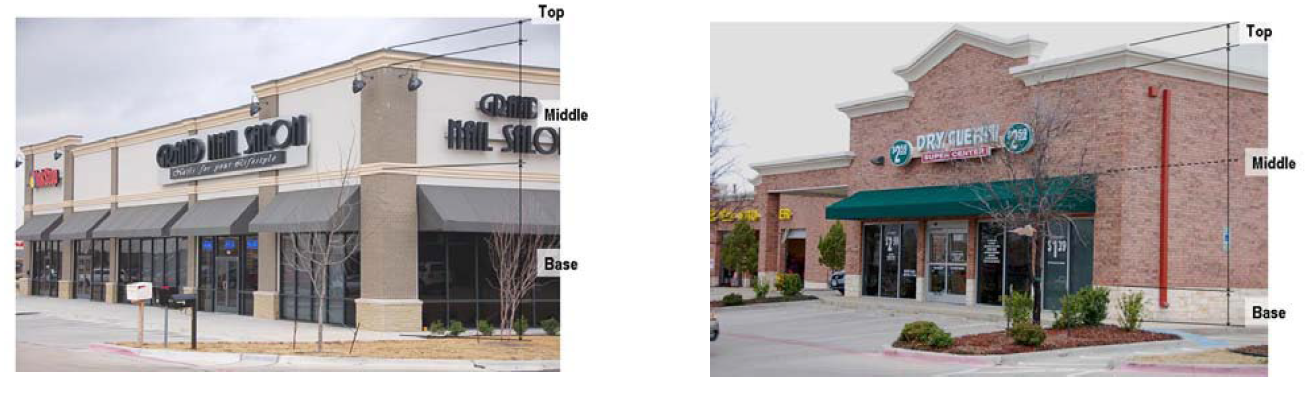
All nonresidential and multifamily buildings shall be designed and constructed in tri-partite architecture so that they have a distinct base, middle and top.
Graphic for illustrative purposes only
Examples of Single Story Tri-Partite
(3)
No more than 30 feet of the horizontal length of a street-facing wall shall be designed or constructed without one or more element of the following architectural relief:
a.
Window;
b.
Door;
c.
Awning, canopy, trellis or marquee;
d.
An offset, column, reveal, void, projecting rib, band or cornice;
e.
Arcade, gallery or stoop; or
f.
Complimentary change in texture.
(4)
Single buildings of 25,000 square feet or greater in area also shall meet the Large Scale Big Box Commercial-Retail Design Standards of Article VII, Division 17.
(5)
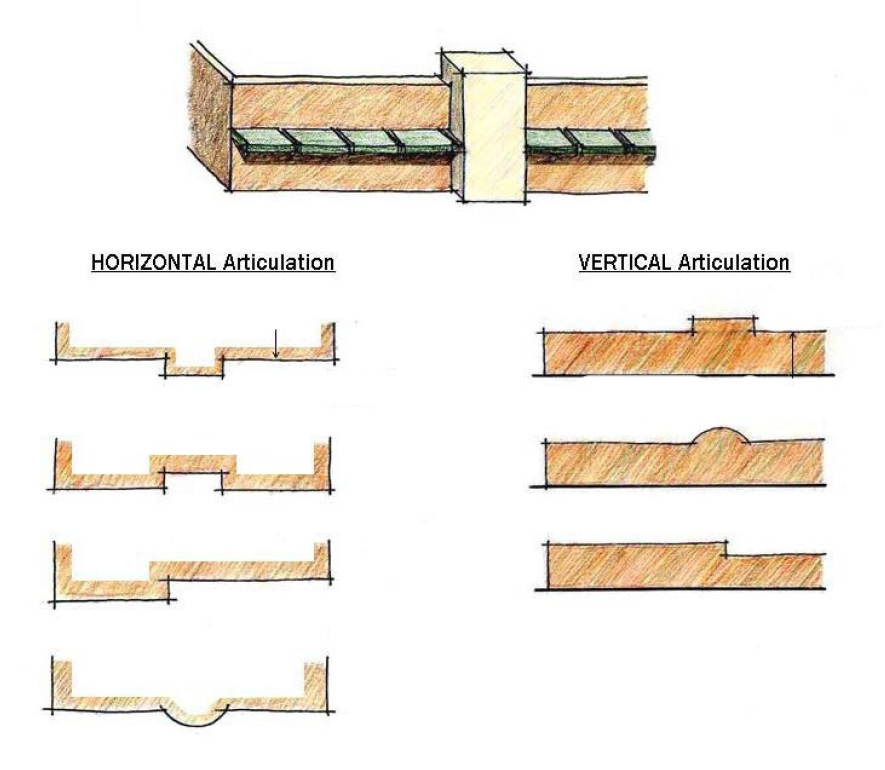
Single buildings under 25,000 square feet in area shall have vertical and horizontal wall articulation including architectural indentations or projections, or both, integrated into the building design to provide for shade, shadow, and visual relief. These techniques help divide a wall plane into smaller components that relate to human size and scale.
Building Articulation Examples
(6)
Exterior walls visible to the public shall include façade elements to build depth and character on the wall plane and shall emphasize windows, trellises, arcades, roof overhangs, recessed or projected stories, columns, balconies, and awnings.
(7)
All buildings shall have a minimum of two exterior color combinations and the predominant exterior color shall not be black, florescent or neon; provided, however, if the City has adopted a Gateway Color Palette, then all colors shall be consistent with the Gateway Color Palette.
(8)
Buildings which are located at the main entrance of a project or at the intersection of streets or major access drives shall be designed with landmark features, such as towers, cupolas, porte cocheres, or gabled roofs. The landmark features may be an accentuated entry or a unique building articulation which is off-set from the front wall planes and goes above the main building eave or parapet line. Such landmark features may exceed the height limit required by this Division by a maximum of ten feet.
(9)
Buildings with flat roofs shall have a cornice treatment or a parapet. The cornice or parapet shall be a minimum of two feet in height. Where roofing materials are visible from the street, they shall be light colored or a planted surface (green roof).
(10)
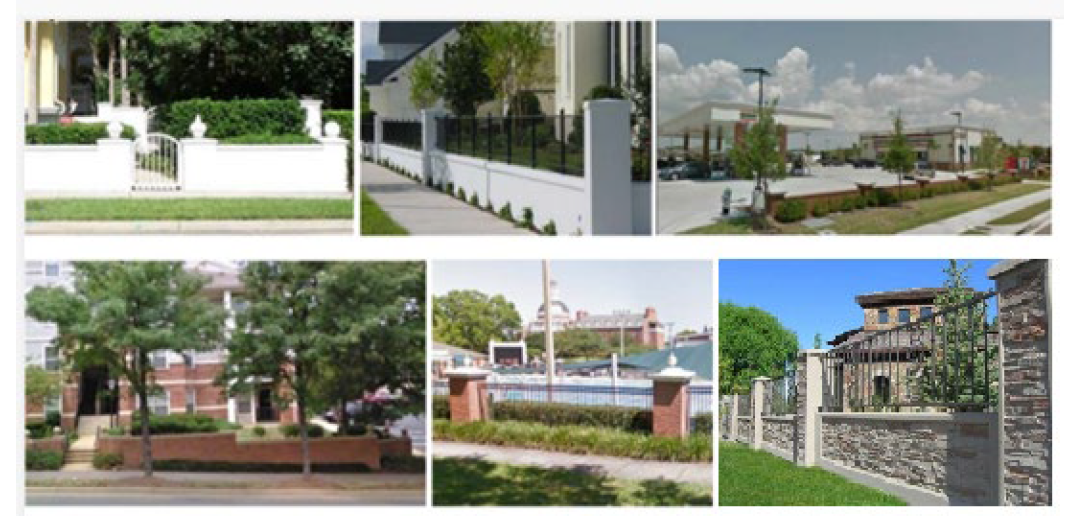
Street walls may be used as a means to screen vehicular areas such as parking lots and to frame public spaces, such as courtyards and outdoor dining. Street walls shall:
a.
Have openings no larger than necessary to accommodate automobile and pedestrian access;
b.
Be a minimum of three feet in height and a maximum of five feet in height. The portion of the wall above three feet in height shall be a maximum of 50 percent solid;
c.
Be constructed of brick masonry, wrought iron, stone or other decorative materials and shall compliment the finishes on the building. Chain link, wire and PVC fencing are prohibited; and
d.
Not be placed within the required buffering along James L. Redman Parkway under Section 102-2062(14).
Street Wall Examples
(11)
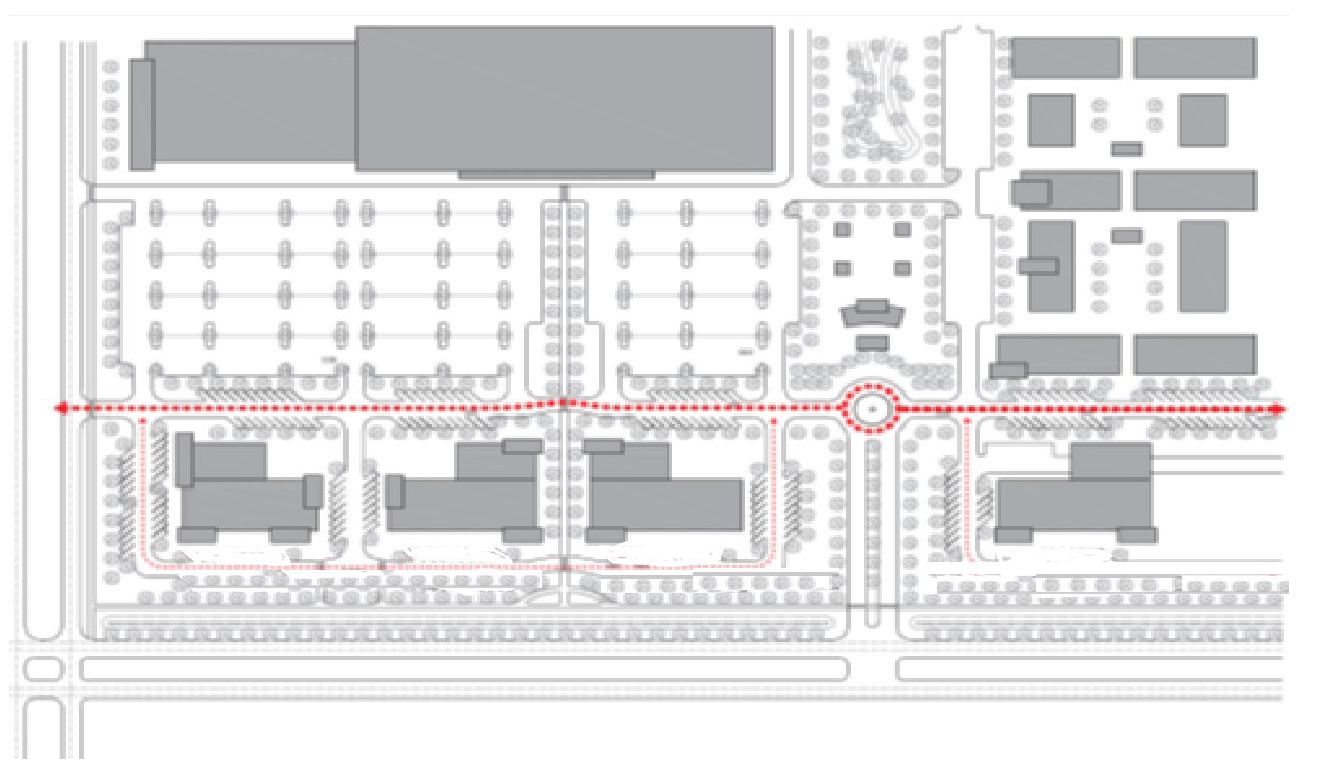
Properties or projects shall be interconnected, where appropriate, with abutting uses and streets to promote vehicular and pedestrian linkages. This includes, but is not limited to, pedestrian and vehicular cross access easements, the establishment of vehicular drives, and the establishment of a build-to-line. Access to James L. Redman Parkway (SR39) may be restricted to a single access point. Joint access between nonresidentially developed properties, or properties anticipated to be developed with nonresidential development, shall be required.
(12)
Off-street parking shall be located only at the side, or rear of the structure(s), or both. In no event shall development provide more than 120 percent of the minimum number of spaces required by Section 102-1421. Parking visible from James L. Redman Parkway shall be screened by landscaping or street walls as provided under Section 102-2062(10), however, street walls shall not be placed within the required buffering along James L. Redman Parkway under Section 102-2062(14).
(13)
Prohibited building elements, details and materials. The City desires quality of architecture in the Gateway District; therefore, the following building elements, details and materials are prohibited:
a.
Modular buildings.
b.
Pre-engineered metal buildings with metal building skin.
c.
Unfinished vertical pre-cast concrete surfaces.
d.
Open walled, shed roof storage facilities.
e.
Reflective, opaque, and/or bronze tinted glass.
f.
Chain-link, plastic panel, barbed wire, razor wire or wire mesh fences, except vinyl coated chain-link would be acceptable.
g.
Applied mansard roofs.
h.
Glossy finished awnings (plastic look).
i.
Wall or window mounted mechanical equipment visible from the main street.
(14)
Buffering along James L. Redman Parkway. To minimize roadway noise and visual impacts, enhanced landscape buffers shall be required for developments abutting James L. Redman Parkway within the Gateway District. Buffers shall be a minimum of 20 feet in width and be landscaped with grass, ground cover, shrubs, and other landscaping, including an average of one tree for every 25 linear feet or part thereof of road frontage, in which the minimum distance between trees shall be ten feet. Trees shall be located in two rows approximately ten feet apart with trees generally staggered in depth within the buffer. Small trees, as provided in subsection 102-1378(18), or similar small trees shall be utilized within the closest row of trees to the road right-of-way. Other types of trees as provided in subsection 102-1378(19) for the row of trees furthest from the right-of-way. Uses abutting James L. Redman Parkway shall include shrubs which shall be planted and maintained so as to form a continuous, unbroken, solid visual screen within one year from the time of planting. Erection of a fence or wall complying with Section 102-2062(10) is permitted along the side or rear lot lines abutting the James L. Redman Parkway when combined with landscaping, shrubs, and trees. The finished side of the fence or wall shall face the right-of-way and the landscaping and trees shall be on the outside of the fence or wall, adjacent to the right-of-way.
(Ord. No. 38-2022, § 1, 11-28-2022)
Sec. 102-2063. - Signs.
(a)
Monument signs or ground signs shall be permitted in the Gateway District and shall not exceed ten feet in height from the ground at the sign base. Pole signs are not permitted.
(b)
Signs in the Gateway District shall not be:
(1)
Flashing or electronic sign boards with static or changing text.
(2)
Flashing or kinetic neon or LEDs.
(c)
The above items are in addition to the signage requirements of Division VIII of this Chapter. Where there is a conflict the more stringent standard shall apply.
(Ord. No. 38-2022, § 1, 11-28-2022)

