
Plant City City Zoning Code
ARTICLE VIII
SIGNS27
Editor's note— Ord. No. 33-2004, § 1, adopted Sept. 13, 2004, amended art. VIII in its entirety and enacted similar provisions as set out herein. The former art. VIII derived from Code 1977, §§ 111.24.2(1)—(8), (11); 111.24.2(a)a—c; 111.24.3; 111.24.4; 111.24.5(1)a.1—4; 111.24.5.(1)a.5(a)—(c); 111.24.5(2)a—c; 111.24.5(3)a, a.1, a.1(a)—(f)i—iii, a.2—5; 111.24.5(3)b.; 111.24.5(4)a; 111.24.5(5); 111.24.6(1)a—c; 111.24.6(2)a, b; and Ord. No. 1-2003, §§ 4, 6, 7, adopted Jan. 13, 2003.
Cross reference— Advertising, ch. 6; sign for alcoholic beverages, § 10-97; streets, sidewalks and other public places, ch. 62; buildings and building regulations, ch. 78.
Sec. 102-1475. - Definitions.
The following words, terms and phrases, when used in this Chapter, shall have the meanings ascribed to them in this section, except where the context clearly indicates a different meaning:
Abandoned sign means a sign which is not being maintained and which has not been used for a period of 90 consecutive days.
Animated sign means any sign which involves motion or rotation of any part by any means or displays flashing, intermittent or color-changing light or lighting. This definition includes flags, rope pennants (except for vehicle-sales lots, provided they are maintained in a like-new condition), ribbons, spinners, streamers, captive balloons, or objects or materials which move, or are designed to move, upon being subjected to pressure by wind or mechanically produced air flow. This definition does not include electronic readerboard/LED displays where moving text and/or graphics can be displayed, but no other portion of the sign moves or nonmessage lights flash. Noncommercial flags that comply with subsection 102-1539(a)(5) are not included within this definition.
Awning means a structure supported entirely from the exterior wall of a building and composed of nonrigid materials, except for the supporting framework, upon which a sign is indelibly drawn, painted or printed.
Banner means any sign possessing characters, letters, illustrations, or ornamentations applied to canvas, cloth, paper, or fabric of any kind.
Billboard means any ground or pole sign which a sign surface area of greater than 350 square feet in size.
City manager shall mean the City Manager of the City of Plant City, or his/her designee.
Commercial sign means any sign protected by the First Amendment of the U.S. Constitution which proposes a commercial transaction and is solely related to the economic interest of the user of the sign.
Commercial zoning district means one or more of the following zoning districts: C-1A, C-1B, C-1C, C-1 and C-2 neighborhood/general commercial districts and those parcels that are designated as commercial in a PD Planned Development district general site development plan.
Directional sign means a permanent sign located at the exit or entrance of a parcel that has two or more driveways. Directional signs shall be no larger than six square feet in area, with the exception that the area size limitation of directional signs shall not apply to public hospitals.
Directory sign means a permanent sign which is allowed on any multitenant commercial parcel.
Ground level means the street grade nearest the base of the sign.
Ground sign means a permanent sign which is supported by structures or supports in or upon the ground and independent of support from any building and which has a sign face the base of which is less than eight feet from ground level.
Height of sign means the vertical distance measured from ground level to the highest point of any sign.
I-4 corridor sign means any ground or pole sign in a commercial or industrial zoning district within 200 feet of the I-4 right-of-way and is not subject to a permit from the Florida Department of Transportation in accordance with F.S. § 479.07.
Industrial zoning district means one or more of the following zoning districts: M-1, M-1A, and M-AP industrial districts and those parcels that are designated as industrial in a PD Planned Development district general site development plan.
Illuminated sign means any sign which has characters, letters, figures, designs or outline illuminated by electric lights or luminous tubes, whether or not the lights or tubes are a part of the proper sign.
Indirectly illuminated sign means a sign illuminated by an external light, including floodlights or spotlights, directed primarily toward such sign and so shielded that no direct rays from the light are visible elsewhere than on the lot where the illumination occurs. If not effectively so shielded, such sign shall be deemed to be a directly illuminated sign.
Institutional sign means a sign which is allowed on any parcel occupied by a governmental or nonprofit entity. These regulations do not control the content of any message to be posted on such sign. Institutional logos and symbols separately installed on the structure shall not be considered as signage.
Light-pole banners means banners located on private parking lot poles.
Marquee sign means any sign which is attached to or hung from a permanent roof-like structure which is supported by a building wall and which projects out from the building line usually but not necessarily over a public right-of-way, such as a sidewalk.
Monument sign means a ground sign which has a base and supporting structure which is equivalent or greater in width and depth to the sign it supports.
Multiple-family dwelling district means one or more of the following zoning districts: R-2 and R-3 multiple-family dwelling districts and those parcels that are designated for multiple-family residential in a PD Planned Development district general site development plan.
Nonconforming sign means a sign which by its height, square foot area, location, use, or structural support does not conform to the requirements of this Chapter.
Painted sign means any sign painted on the exterior surface of a building or other structure, or on the interior of any nonopaque surface, such as glass.
Parasite sign means any sign, for which no permit has been issued, which is attached to another sign.
Permanent sign means a sign which is fixed to a building or the ground in such a manner as to be immobile without the use of extraordinary means, such as disassembly.
Pole sign means any permanent sign erected on or suspended from one or more poles and which is wholly independent of any building for support and which has a sign face the base of which is constructed eight feet or more above ground level.
Portable sign means an outdoor sign which is not permanently erected upon the ground or on the roof of any building or affixed to the wall of any building and includes the following:
(1)
An A-frame sign, which is a sign having a metal or wooden frame adequately braced so as to be freestanding.
(2)
A sign on trash receptacles and similar sidewalk appliances.
(3)
Banner.
Premises means any lot, plot, portion or parcel of land considered as a unit.
Readerboard is a sign, or portion of a sign, that has light-emitting diodes (LED), or other similar computer-controlled multiple lights, that can be programmed to display text and/or graphics that can change and/or move.
Roofline means either the edge of the roof or the top of the parapet, whichever forms the top line of the building silhouette. Where a building has several roof levels, this roof or parapet shall be the one belonging to that portion of the building where the sign is located.
Sandwich-board sign means a portable, nonelectrical, self-supporting, "A"-frame sign, hinged at the top apex and folded into a sandwich position when transported or stored. This sign type may also be a portable, nonelectrical, self-standing, double-sided, inverted-"T" sign.
Setbacks means the minimum horizontal distance between the lot line and the closest edge or part of the sign.
Sign means a name, identification, image, description, display or illustration which is affixed to, painted or represented directly or indirectly upon a building, structure or piece of land and which directs attention to an object, product, place, activity, facility, service, event, attraction, person, institution, organization or business and which is visible from any street, right-of-way, sidewalk, alley, park or other public property. Window displays placed behind a window are not signs or parts of a sign.
Sign area or sign surface area means the entire area within one circle, triangle or parallelogram enclosing the extreme limits of writing, representation, emblem or any figure of similar character together with any frame or other material or coloring forming an integral part of the display or used to differentiate the sign from the background against which it is placed, excluding the necessary supports or uprights on which such sign is placed. Where a sign has two or more faces, the area of all faces shall be included in determining the area of the sign. However, where two such faces are placed so that the diverging angle is no greater than 45 degrees between the two sign faces, the area of the sign shall be taken as the area of one face if the two faces are of equal area or as the area of the larger face if the two faces are of unequal area. Words, symbols and graphics extending beyond a sign's frame are considered as part of the sign surface area. Where a sign consists solely of lettering or other sign elements printed or mounted on a wall of a building without any distinguishing border, panel or background, any blank rectangular area which is more than ten percent of the area of the sign as otherwise computed shall be disregarded. All of the lettering and other sign elements printed or mounted upon a wall of a building without any distinguishing border, panel or background and pertaining to the same enterprise shall be treated as a single sign for purposes of area computation. The area of a "temporary attractor" shall be the total area seen by the observer when viewing the largest side of the item (e.g. cold-air inflatable). The following is an illustration of how sign area is calculated:
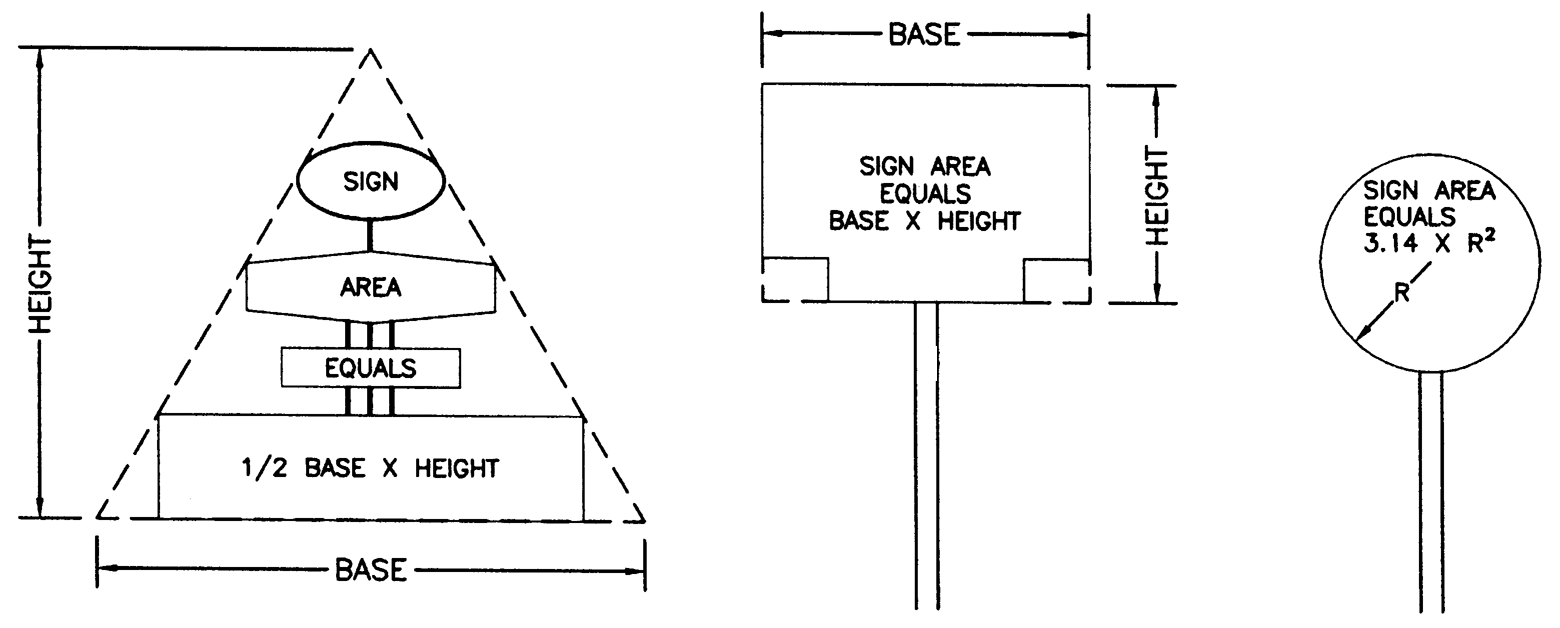
Sign surface area
Sign nonstructural trim means the molding, battens, capping, nailing strips, latticing and walkways attached to the sign structure.
Sign structure means the supports, uprights, braces and framework supporting the sign.
Single-family dwelling district means one or more of the following zoning districts: R-1A, R-1, R-1B, R-1C single-family dwelling districts and those parcels that are designated for single-family residential in a PD Planned Development district general site development plan.
Snipe sign means a prohibited temporary sign of any material, including, but not limited to, paper, cardboard, wood or metal, which is tacked, nailed, stapled, posted, pasted, glued, or otherwise attached to trees, poles, fences or any other object.
Subdivision sign means a permanent sign at the public street frontage at the perimeter of a subdivision not to exceed 32 square feet in area nor four feet in height.
Temporary sign means a sign that is intended for a temporary period of posting on private property; and is typically constructed of nondurable materials, including paper, cardboard, cloth, plastic, and/or wallboard.
Temporary attractor means a banner, balloon over 24 inches in diameter, cold-air inflatable, poster, festoon, streamer, searchlight, or other similar item that is intended to be used for temporary period of time.
Wall sign means a sign applied to or mounted on the wall or roof of a building or a structure, the display surface of which is approximately perpendicular to the ground and not extending more than 18 inches from the surface of the wall, roof of the building, or structure not extending above the roofline.
(Ord. No. 33-2004, § 1, 9-13-2004; Ord. No. 34-2006, § 1, 10-24-2006; Ord. No. 36-2007, §§ 2, 3, 12-10-2007; Ord. No. 05-2013, § 26, 2-25-2013; Ord. No. 3-2016, §§ 7, 8, 1-25-2016; Ord. No. 38-2022, § 3, 11-28-2022)
Sec. 102-1476. - Prohibited signs.
All of the following signs are prohibited:
(1)
Abandoned, nonconforming signs.
(2)
Animated signs.
(3)
Illuminated signs which do not meet the restrictions of Section 102-1629.
(4)
Parasite signs.
(5)
Portable signs, except as permitted pursuant to Sections 102-1627 and 102-1628.
(6)
Roof signs, except where they conform to subsection 102-1600(3).
(7)
Snipe signs.
(8)
Signs on parked trucks, buses, or other motor vehicles or nonmotorized trailers where the sign is placed in a position near the street frontage such that the sign appears to be the primary purpose for the vehicle or trailer during the time it is located at the subject site.
(9)
Any billboards not in conformance with Section 102-1779 or Section 102-1601.
(Ord. No. 33-2004, § 1, 9-13-2004; Ord. No. 34-2006, § 1, 10-24-2006)
Sec. 102-1626. - General requirements for location, construction and maintenance.
(a)
Signs shall not be located, constructed or maintained which, because of their shape, color, lighting, or font, may be confused or interfere with any traffic sign, signal or device placed by any public authority, or which may obstruct or interfere with the view of approaching, merging or intersecting traffic.
(b)
Signs shall not be located as to obstruct any window, door, fire escape, stairway or any opening required for legal ventilation, ingress or egress for any building or structure.
(c)
Signs shall not be erected within or overhanging any public right-of-way for any street or alley except signs on marquees and awnings may overhang the public right-of-way subject to the following conditions:
(1)
Marquee signs may be attached to the sides and front of a marquee and shall not extend beyond the surface area of the marquee except as provided in this subsection.
(2)
A sign may be attached to the bottom horizontal surface of a marquee in a position which is perpendicular to the street right-of-way, but not parallel thereto, and the sign shall not extend more than one foot below such bottom horizontal surface and shall maintain a vertical clearance of at least eight feet above the sidewalk or ground level. No sign shall be attached to the top horizontal surface of a marquee.
(3)
Marquee and awning signs shall be included in calculating the maximum allowable wall sign area for the zoning districts in which they are located.
(d)
Signs shall not be tacked, painted, posted or affixed in any manner on trees, utility poles, and/or rocks.
(e)
Signs shall not be located as to obstruct any parking space, aisle or turnaround.
(f)
Signs shall not be located within the "vision clearance area" of intersecting streets, or a driveway intersecting with a street, as specified in subsection 102-1413(5).
(g)
Permanent signs may have the face portion of the sign made of canvas or other material generally used in the making of banners, provided that the edges are hidden behind a solid frame.
(h)
No part of any sign shall be located within five feet of any property line or right-of-way.
(Ord. No. 33-2004, § 1, 9-13-2004; Ord. No. 34-2006, § 1, 10-24-2006; Ord. No. 3-2016, § 9, 1-25-2016)
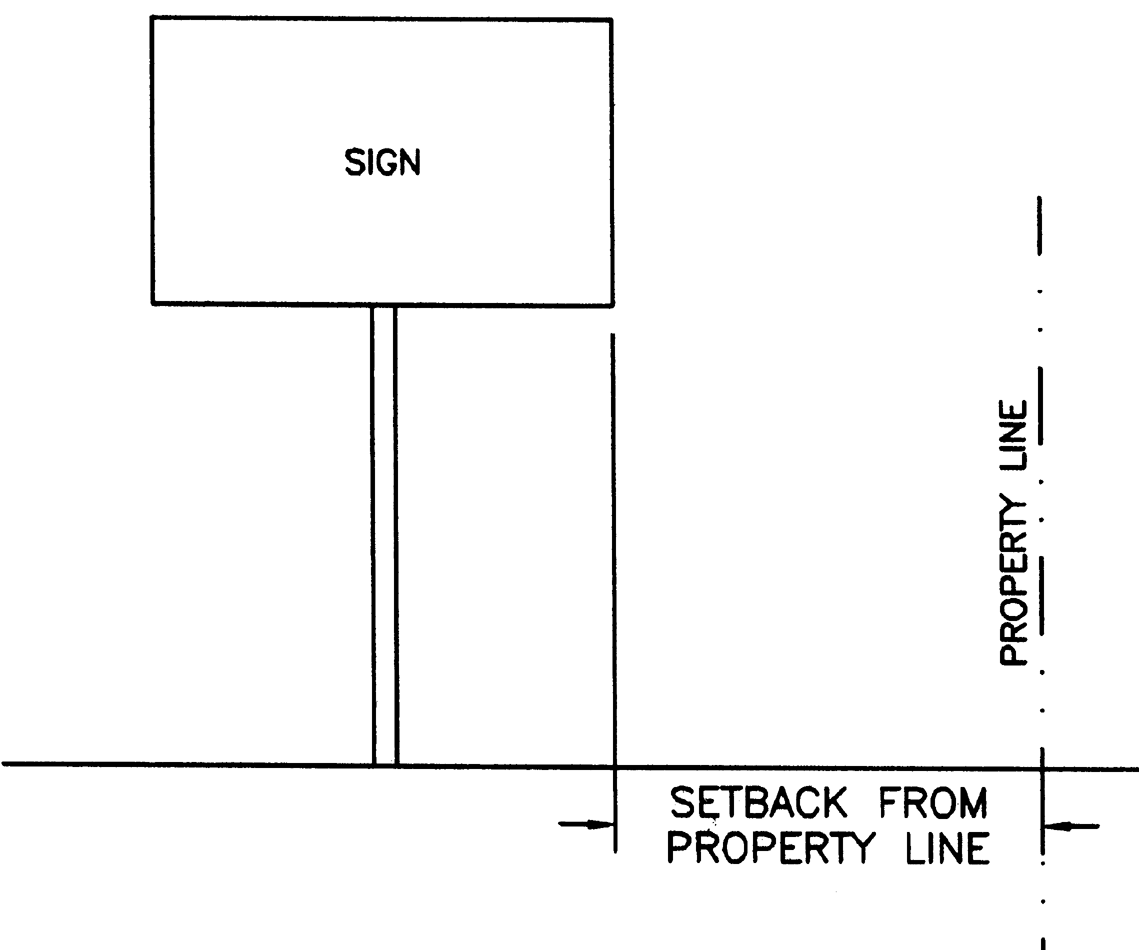
Setback from Property Line
Sec. 102-1627. - Banners and temporary attractors.
Banner signs and temporary attractors shall be permitted in areas zoned commercial or industrial, and as an institutional sign in all zoning districts, only when consistent with the following:
(1)
Permit required. It shall be unlawful for any owner, authorized agent or contractor to erect, construct, alter or relocate within the city any banner or temporary attractors, without first obtaining a permit from the City Manager.
(2)
Amount of signage. Banner and temporary attractor display areas shall not count towards the total signage allowed elsewhere in this division, but shall be controlled as specified this section.
(3)
Classifications and display periods. In addition to signage allowed in this section, the following may be permitted:
a.
Temporary attractor. Up to three temporary attractors, including temporary banners, not to exceed 36 square feet and 100 square feet total, may be placed at the site of a new business for a period not to exceed 30 days within the first three months that the business is open.
b.
Temporary banner. One temporary banner per business, not to exceed 16 square feet in area, may be allowed for a period not to exceed 30 consecutive days nor for more than 60 days in any one calendar year.
(4)
Setback and height limitations. Banner signs and temporary attractors must meet normal sign setback distances and height limitations, except for street-crossing banners as provided for in subsection (7).
(5)
Prohibition on mounting. Banner signs shall not be mounted on any fence or non-building wall, on a roof, between trees or buildings, or over any public right-of-way, except as provided for in subsection (7).
(6)
Maintenance. Banner signs shall be maintained in a state of good repair. Banners that are torn, tattered, or frayed and/or whose images are unreasonably faded, are prohibited.
(7)
Street-crossing banners. Upon approval of the City Manager, the owners of the buildings to which such banners will be attached, and the Florida Department of Transportation, banners may be hung over US 92 West (Reynolds Street) between Wheeler and Palmer Streets and over State Road 39 (Collins Street North) between Reynolds and Drane Streets, for a period not to exceed ten consecutive days.
(8)
Commercial light-pole banners. Vertical banners may be located on private parking lot light poles, subject to the following:
a.
Commercial designation. The subject site must be located within a commercial zoning district.
b.
Maximum size. Light-pole banners shall not exceed three feet by eight feet (width x height).
c.
Maximum number. There shall be no more than four light-pole banners per acre of the total site. The maximum number of banners allowed shall be rounded to the nearest full acre.
d.
Banner spacing. Light-pole banners do not have to be equally spaced on the site. Two three-foot by eight-foot banners may be mounted on one light pole, but shall be counted as two banners.
(Ord. No. 33-2004, § 1, 9-13-2004; Ord. No. 34-2006, § 1, 10-24-2006)
Sec. 102-1628. - Sandwich-board signs.
Sandwich-board signs are subject to the following regulations:
(1)
Permit required. A permit application for a sandwich-board sign shall be submitted to the planning and zoning department, with such application to include a sketch showing the location of the sign in relationship to the building, curb, other sidewalk fixtures, street furniture and public signage, delineate and dimension on the drawing the clear-area for pedestrian passage, and other information required to confirm compliance with the regulations of this section. Permits are valid for one year and may not be assigned or transferred.
(2)
Permit revocation. The city may revoke permits, and remove any associated signs with 24-hour notice, for violations of these regulations.
(3)
Areas permitted. Sandwich-board signs are permitted within the "downtown historic district," as delineated in section 38-69, and throughout the city on private sidewalks within commercial zoning districts.
(4)
Signage limited. Each business or premises shall be limited to one sandwich-board sign
(5)
Size and amount of signage allowed. Sandwich-board signs shall be limited to 24 inches wide and 48 inches tall (two feet by four feet), with a maximum of eight square feet as measured on one "leg" of an A-frame sign, or one side of a double-sided inverted-T sign. Both sides of a sandwich-board sign may contain content. The area of a sandwich-board sign shall not be included in the computations of the total signage allowed for a site and/or building face.
(6)
Sign placement. Sandwich-board signs shall be placed between the curb and the storefront, and its location is restricted to directly in front of the business.
(7)
Pedestrian safety and ADA accessibility. Sandwich-board signs shall be placed so as not to impede pedestrian traffic or a passenger's ability to exit/enter parked vehicles. Signs shall be placed so as to allow a minimum of a five-foot-wide unobstructed pedestrian corridor between the sandwich-board sign and adjacent street appurtenance, traffic signage, streetscape or landscaping features, buildings, and other structures, so as to minimize disruption of, and danger to, pedestrians using the sidewalk.
(8)
Vehicular safety. Sandwich-board signs shall be placed so as to not hinder the visibility of motorist, to include not being placed within a street intersection vision clearance area per subsections 102-1377(1) and 102-1413(5); nor placed in such a location as to obstruct or otherwise interfere with official traffic signage, signals, or devices.
(9)
Display periods. In no case shall a sandwich board sign be displayed earlier than 9:00 a.m. nor later than 9:00 p.m. Sandwich-board signs shall be immediately removed upon threat of storms predicted to have high winds, and/or upon issuance of a hurricane evacuation notice for Hillsborough County.
(10)
Construction and maintenance. Sandwich-board signs shall be constructed with a rigid frame and made of durable materials and constructed in such a manner to be able to withstand environmental conditions. Signs constructed with cardboard, paper, and other similar non-durable materials are prohibited. Signs shall not contain any electrical components (battery or otherwise), lighting, nor any moving parts, including balloons, flags, and streamers. Signs shall be free of sharp or jagged edges and corners and may not contain anything that could be hazardous to pedestrians. Signs shall be maintained in a good condition and kept clean so as not to be unsightly or offensive in appearance. Faded or peeling signage shall be refinished, replaced, or removed.
(11)
Signage ownership identification. Each sandwich-board sign shall have placed on it, within easy viewing of a city inspector, the sign-owner's name and contact information (mailing address and telephone number).
(Ord. No. 33-2004, § 1, 9-13-2004; Ord. No. 34-2006, § 1, 10-24-2006)
Sec. 102-1629. - Illuminated signs.
Illuminated signs are subject to the following restrictions:
(1)
Illuminated signs are permitted only in a commercial zoning district or an industrial zoning district, except for institutional signs, which are allowed within any zoning district.
(2)
An illuminated sign erected adjacent to a residential district shall be so shielded or directed that the brightness or light shall not exceed five foot-candles of light measuring at the property line contiguous to the residential district.
(3)
No light from an illuminated sign shall be emitted into any residential dwelling or premises in excess of three foot-candles of light measuring at any exterior wall of the residential dwelling or premises, provided the dwelling or premises is located in a residential district.
(4)
No illumination or glare from any sign shall be emitted directly onto a public street or roadway so as to constitute a hazard or impediment to vehicular traffic or safety, nor shall any sign impair or obstruct a full view of a traffic control device.
(5)
No revolving or rotating beam or beacon of light that simulates any emergency light or device shall be permitted as part of any sign. Flashing red, green, blue or ambler lighting devices shall not be permitted upon a sign.
(Ord. No. 33-2004, § 1, 9-13-2004; Ord. No. 34-2006, § 1, 10-24-2006)
Sec. 102-1630. - Abandoned signs.
(a)
Nonconforming signs. Any abandoned signs which are nonconforming shall be brought into conformance with this Chapter or shall be taken down and removed by the owner, agent, or person having the beneficial use of the building, structure, or property upon which the sign may be found after written notification from the City Manager.
(b)
Conforming signs. Abandoned signs which are conforming shall be modified by one of the following methods:
(1)
Painting of sign. The sign shall be covered by painting over the sign area.
(2)
Removal of sign face. The sign face shall be removed and replaced with a blank insert.
(Ord. No. 33-2004, § 1, 9-13-2004)
Sec. 102-1631. - Substitution.
Notwithstanding any provision herein to the contrary, any noncommercial message may be substituted for the copy on any commercial sign allowed pursuant to this article.
(Ord. No. 33-2004, § 1, 9-13-2004; Ord. No. 34-2006, § 1, 10-24-2006)
Sec. 102-1632. - Severability.
(a)
Generally. If any part, section, subsection, paragraph, subparagraph, sentence, phrase, clause, term, or word of this article is declared unconstitutional by the valid judgment or decree of any court of competent jurisdiction, the declaration of such unconstitutionality shall not affect any other part, section, subsection, paragraph, subparagraph, sentence, phrase, clause, term, or word of this article.
(b)
Severability where less speech results. Without diminishing or limiting in any way the declaration of severability set forth above in subsection (a) above, or elsewhere in this article, this Code, or any adopting ordinance, if any part, section, subsection, paragraph, subparagraph, sentence, phrase, clause, term, or word of this article is declared unconstitutional by the valid judgment or decree of any court of competent jurisdiction, the declaration of such unconstitutionality shall not affect any other part, section, subsection, paragraph, subparagraph, sentence, phrase, clause, term, or word of this article, even if such severability would result in a situation where there would be less speech, whether by subjecting previously exempt signs to permitting or otherwise.
(c)
Severability of provisions pertaining to prohibited signs. Without diminishing or limiting in any way the declaration of severability set forth in subsection (a) above, or elsewhere in this article, this Code, or any adopting ordinance, if any part, section, subsection, paragraph, subparagraph, sentence, phrase, clause, term, or word of this article or any other law is declared unconstitutional by the valid judgment or decree of any court of competent jurisdiction, the declaration of such unconstitutionality shall not affect any other part, section, subsection, paragraph, subparagraph, sentence, phrase, clause, term, or word of this article that pertains to prohibited signs, including, but not limited to, those signs expressly prohibited under section 102-1476. Furthermore, if any part, section, subsection, paragraph, subparagraph, sentence, phrase, clause, term, or word of section 102-1476 is declared unconstitutional by the valid judgment or decree of any court of competent jurisdiction, the declaration of such unconstitutionality shall not affect any other part, section, subsection, paragraph, subparagraph, sentence, phrase, clause, term, or word of section 102-1476, thereby ensuring that as many prohibited signs as may be constitutionally prohibited continue to be prohibited.
(d)
Severability of restrictions on billboards. If any part, section, subsection, paragraph, subparagraph, sentence, phrase, clause, term, or word of this article and/or any other code provisions and/or laws are declared invalid or unconstitutional by the valid judgment or decree of any court of competent jurisdiction, the declaration of such unconstitutionality shall not affect the restrictions on billboards as contained in this article or Code.
(Ord. No. 34-2006, § 1, 10-24-2006)
Subdivision II. - Single-Family Dwelling Districts[28]
Editor's note— Ord. No. 34-2006, § 1, adopted Oct. 24, 2006, amended the title of subdiv. II to read as herein set out. Formerly, subdiv. II was titled R-1A, R-1, R-B, and R-1C Single-Family Dwelling Districts.
Subdivision III. - Multiple-family Dwelling Districts[29]
Editor's note— Ord. No. 34-2006, § 1, adopted Oct. 24, 2006, amended the title of subdiv. III to read as herein set out. Formerly, subdiv. III was titled R-2 and R-3 Multiple-family Dwelling Districts.
Subdivision IV. - Commercial and Industrial Zoning Districts[30]
Editor's note— Ord. No. 34-2006, § 1, adopted Oct. 24, 2006, amended the title of subdiv. IV to read as herein set out. Formerly, subdiv. IV was titled C-1A, C-1B, C-1 and C-2 Neighborhood/General Commercial Districts and M-1, M-1A, and M-AP Industrial Districts.
Subdivision V. - PD Planned Development and CC Community College Districts[31]
Editor's note— Section 27 of Ord. No. 05-2013, adopted Feb. 25, 2013, renamed Art. VIII, Div. 4, Subdiv. V, as set out herein. Formerly entitled "C-U and CC Community Unit/Community College Districts".
Sec. 102-1536. - Required.
It shall be unlawful for any owner, authorized agent or contractor to erect, construct, alter or relocate within the city any sign not otherwise exempted as provided in this Chapter without first obtaining a sign permit from the City Manager.
(Ord. No. 33-2004, § 1, 9-13-2004)
Sec. 102-1537. - Application.
(a)
All applications for sign permits shall be made on forms provided by the City Manager and shall include the following:
(1)
The name, address and telephone number of the applicant;
(2)
Adequate information to show that the proposed sign is in compliance with this Chapter and the Florida Building Code, including a scaled site plan and/or building facade drawing to graphically show the location and size of the proposed signage, the dimensions and total area setback distances of all proposed signage, proposed top-of-sign height, the total area of all existing and proposed signage on the site (including painted signage and banners), and any other computations required to demonstrate that the proposed signage complies with all applicable regulations;
(3)
The name of the person, firm, corporation or association, if different from the applicant, erecting the sign; and
(4)
Written consent of the owner or his authorized agent of the building or premises on which the sign is to be erected.
(b)
The state department of transportation permit or approval if required shall be submitted with the application for a sign permit.
(c)
The applicant shall pay a reasonable fee for the processing and administration of signage applications, including painted, banner, and sandwich-board signs, as may be determined by the City Manager in accordance with Section 102-39.
(Ord. No. 33-2004, § 1, 9-13-2004; Ord. No. 34-2006, § 1, 10-24-2006)
Sec. 102-1538. - Action on application.
It is the duty of the City Manager, upon receiving an application for a sign permit, to examine such plans and specifications and other data and, if considered necessary, inspect the premises upon which it is proposed to erect the sign or other advertising structure. If the proposed structure is in compliance with all of the requirements of this Chapter and all other applicable laws and city ordinances, a sign permit shall be issued. If a sign permit is issued and the sign has not been erected within 180 days after the date of issuance of the sign permit, the permit shall become null and void, and a new application shall be required.
(Ord. No. 33-2004, § 1, 9-13-2004)
Sec. 102-1539. - Exemptions.
(a)
No permit shall be required for the following signs, provided that they meet the applicable provision of the building code:
(1)
Street address numbers.
(2)
Signs on a truck, bus or other motor vehicle or nonmotorized trailer, provided that the sign is not the primary purpose for the vehicle or trailer at the subject site.
(3)
Signs within the structure.
(4)
Temporary signs.
(5)
Two flags per parcel may be flown on one or two flagpoles. Parcels larger than two acres may fly one additional flag, for a total of three flags flown.
(b)
This chapter shall not apply to traffic control, directional and street name signs installed by federal, state or local jurisdictions; and signs required by state law and any other signs erected on public right-of-way, parks and/or other public property by federal, state, and/or local governmental jurisdictions.
(Ord. No. 34-2006, § 1, 10-24-2006)
Sec. 102-1540. - Temporary signs.
(a)
Temporary signs may be posted on private property in all zoning districts of the city, subject to the following provisions and all other applicable provisions stated elsewhere in the city's sign regulations.
(b)
The total square footage for temporary signs, excluding temporary banner signs, posted on a building lot in single-family dwelling districts or multiple-family dwelling districts, in the aggregate, shall not exceed 32 square feet. The total square footage for temporary signs, excluding temporary banner signs, posted on a building lot in commercial zoning districts and industrial zoning districts, in the aggregate, shall not exceed 32 square feet. The total square footage of a sign is measured to include all the visible display area of one side of the sign.
(c)
No temporary sign shall obstruct, impair access to or be located on any public property or public right-of-way.
(d)
No temporary sign shall obstruct or impair access to any traffic control sign, bus stop or fire hydrant or otherwise create a safety hazard.
(e)
No temporary sign shall be illuminated or painted with light-reflecting paint, except that a temporary sign within a commercial or industrial zoning district may be indirectly illuminated in accordance with section 102-1629.
(f)
A temporary sign shall only be posted with the consent of the property owner or occupant.
(g)
No temporary sign shall be tacked, nailed, painted, posted, or affixed in any manner on trees, utility poles, fences, rocks and other such supporting structures.
(h)
A temporary sign may be posted for a period of up to 90 days, at which time the sign shall be removed or replaced.
(Ord. No. 33-2004, § 1, 9-13-2004; Ord. No. 34-2006, § 1, 10-24-2006)
Sec. 102-1541. - Temporary signs—Additional signage.
(a)
In addition to the temporary signs permitted in section 102-1540, temporary signs may be permitted subject to the following provisions of this section.
(b)
New residential subdivisions. Within new subdivisions in residential zoning districts which contain at least ten buildable lots, the developer may place up to 32 square feet of additional temporary signage in the aggregate, with no individual sign exceeding 16 square feet. Such additional temporary signage may be displayed upon the approval of preliminary plat by the planning board. Temporary signs under this subsection must be removed no later than two years from the date of the approval of the preliminary plat.
(c)
New construction. Within commercial or industrial zoning districts, up to 64 square feet of additional signage in the aggregate may be placed on each lot, with no individual sign exceeding 32 square feet. Such additional temporary signage may be displayed upon issuance of building permit. Temporary signs under this subsection must be removed no later than two years from the date of the issuance of building permit.
(d)
New businesses. Within commercial or industrial zoning districts, up to 64 square feet of additional signage in the aggregate may be placed at new businesses, with no individual sign exceeding 32 square feet. Temporary signage may be displayed upon commencement of business. Temporary signs under this subsection must be removed no later than six months from the commencement of business activities.
(e)
Measurement. The total square footage of any temporary sign under this section is measured to include the visible display area of one side of the sign.
(f)
Restrictions. Except as otherwise provided herein, the temporary signage permitted under this section shall be subject to the restrictions of section 102-1540.
(Ord. No. 33-2004, § 1, 9-13-2004; Ord. No. 34-2006, § 1, 10-24-2006)
Sec. 102-1575. - Duties of City Manager.
It shall be the duty of the City Manager to administer and enforce this Chapter.
(Ord. No. 33-2004, § 1, 9-13-2004)
Sec. 102-1576. - Signage appearance and unsafe signs.
(a)
All signs shall be maintained in proper repair and in a proper state of preservation. Signs, including banners and temporary attractors, that are damaged, torn, tattered, or frayed and/or whose images are unreasonably faded, are prohibited.
(b)
Should any sign become insecure or in danger of falling, in a deteriorated state of preservation or otherwise unsafe, the owner thereof or the person or firm maintaining the sign shall, upon written notice of the City Manager, immediately secure the sign or cause the sign to be placed in good repair in a manner to be approved by the City Manager, in conformity with this Chapter and any other applicable laws or city ordinances, or the sign shall be removed.
(Ord. No. 33-2004, § 1, 9-13-2004; Ord. No. 34-2006, § 1, 10-24-2006)
Sec. 102-1577. - Variances.
(a)
The board of adjustment shall hear all appeals and requests for variances pursuant to sections 102-68 through 102-70 and 102-96 et seq.
(b)
In considering all proposed variances to this Chapter, the board shall, before making any finding in a specific case, first determine that the proposed variance will not constitute any change in the districts shown on the zoning map and will not impair an adequate supply of light and air to adjacent property or materially increase the congestion in public streets or increase the public danger of fire and safety or materially diminish or impair established property values within the surrounding area or in any other respect impair the public health, safety, morals, and general welfare of the city.
(Ord. No. 33-2004, § 1, 9-13-2004)
Sec. 102-1578. - Petition to court on decision of board of adjustment.
Any person, jointly or severally, aggrieved by any decision of the board of adjustment, may present to a court of record a petition, duly verified, setting forth that such a decision is illegal, in whole or in part, specifying the grounds of the illegality. Such petition shall be presented to the court within 30 days after the filing of the decision in the office of the planning and zoning department, otherwise the decision of the board of adjustment will be final.
(Ord. No. 33-2004, § 1, 9-13-2004)
Sec. 102-1600. - Nonconforming signs.
Except for existing billboards and I-4 corridor signs, which are subject to the provisions of section 102-1601, every sign which was legally permitted prior to the effective date of this subdivision which does not conform to this Chapter, shall be controlled as follows:
(1)
One nonconforming sign per each street front may be continued, provided such nonconforming sign is maintained in accordance with the requirements of this Chapter. Changes in copy, alterations and modifications shall be permitted, provided that neither the degree of nonconformity nor the sign area is increased.
(2)
Shopping centers and other multi-occupant premises shall be permitted to contain only one nonconforming ground sign or pole sign for the premises per street frontage.
(3)
Any roof sign shall be removed unless selected and designated by the owner as the one nonconforming sign to be retained, provided such sign is maintained in accordance with the requirements of this Code. Changes in copy, alterations and modifications shall be permitted, provided that neither the degree of nonconformity nor the sign area is increased.
(4)
All signs defined as nonconforming in this Code shall be removed, unless otherwise permitted to remain by other provisions of this Code.
(5)
Nonconforming signs shall not be reestablished after damage or destruction if the estimated cost of reconstruction or repair exceeds 50 percent of the reproduction and installation cost of the sign.
(6)
Nonconforming abandoned signs shall be subject to the provisions of section 102-1630.
(Ord. No. 33-2004, § 1, 9-13-2004; Ord. No. 34-2006, § 1, 10-24-2006; Ord. No. 36-2007, § 5, 12-10-2007)
Sec. 102-1601. - Existing billboards and I-4 corridor signs.
Any existing billboard and I-4 corridor signs not conforming to section 102-1779 may be continued, provided:
(1)
Such sign was lawfully erected by a company licensed to operate within the city.
(2)
A permit was obtained at the time such sign was erected.
(3)
Such sign is continually maintained in accordance with the requirements of this Chapter. If a billboard or I-4 corridor sign deteriorates to the extent that the chief building official determines that it is unsafe pursuant to section 102-1576, then such billboard shall be subject to the provisions of that section.
(4)
Such sign located on residentially zoned property shall be removed within 30 days after written notification by the city. Upon failure to comply with such notice within the time specified by the order, the City is authorized to cause the removal of such sign, and any expense incidental thereto shall be paid by the owner of the billboard or I-4 corridor sign.
(5)
Such billboard or I-4 corridor sign shall not be enlarged or expanded to occupy a greater area.
(Ord. No. 33-2004, § 1, 9-13-2004; Ord. No. 34-2006, § 1, 10-24-2006; Ord. No. 36-2007, § 6, 12-10-2007)
Sec. 102-1602. - Other nonconforming signs.
All other nonconforming signs existing on the effective date of the ordinance from which this Chapter derives shall be removed within 30 days after written notification is given by the city. Upon failure to comply with such notice within the time specified by the order, the city is authorized to cause the removal of such sign, and any expense incidental thereto shall be paid by the owner of the property upon which the sign is erected or attached.
(Ord. No. 33-2004, § 1, 9-13-2004; Ord. No. 34-2006, § 1, 10-24-2006)
Sec. 102-1706. - General restrictions.
(a)
Illumination. Signs which are permitted in a single-family dwelling districts may not be directly lit, but may be indirectly illuminated.
(b)
Minimum sign setbacks. No part of any sign within a single-family dwelling district shall be located within five feet of any property line or right-of-way line and may not be located within an intersection vision clearance area.
(Ord. No. 33-2004, § 1, 9-13-2004; Ord. No. 34-2006, § 1, 10-24-2006)
Sec. 102-1707. - Permitted signs in a single-family dwelling district.
(1)
Subdivision signs. Within any single-family dwelling district, one subdivision sign shall be permitted per public street frontage at the perimeter of the subdivision. Such sign shall not exceed 32 square feet in area and shall not exceed four feet in height. Where a fence or wall is constructed at the perimeter of a subdivision, such sign may be located on the face of the fence or wall. Where the signage is to be placed at the main entrance to a subdivision, two signs, one on each side of the entrance street, may be placed, with each sign allowed to be equal in size to the aforementioned maximum-size limitations.
(2)
Institutional signs. One institutional sign per road frontage per developed institutional parcel shall be permitted within any single-family dwelling district. For institutional sites under 35 acres in area, each sign shall not exceed 20 square feet in area, and shall not exceed six feet in height. For institutional sites 35 acres and larger, each sign shall not exceed 60 square feet in area and shall not exceed six feet in height.
(3)
Exempted signs. Exempted signs are allowed within any single-family dwelling district as enumerated in section 102-1539.
(4)
New subdivisions. Residential subdivisions with ten or more lots are allowed to have signs in accordance with the provisions of section 102-1541.
(5)
No other signs permitted. Except as expressly allowed or permitted in this article, no signs are permitted within single-family dwelling districts.
(Ord. No. 33-2004, § 1, 9-13-2004; Ord. No. 34-2006, § 1, 10-24-2006)
Sec. 102-1741. - General restrictions.
(a)
Illumination. Signs which are permitted in multiple-family dwelling districts may not be directly lit, but may be indirectly illuminated.
(b)
Minimum sign setbacks. No part of any private sign in multiple-family dwelling districts shall be located within five feet of any property line or right-of-way line, and may not be located within an intersection vision clearance area.
(Ord. No. 33-2004, § 1, 9-13-2004; Ord. No. 34-2006, § 1, 10-24-2006)
Sec. 102-1742. - Permitted signs on residential property.
(a)
Multiple-family dwelling units. Signs on residential property in multiple-family developments are permitted in a multiple-family dwelling district according to the following conditions:
(1)
The maximum sign area shall be as follows:
a.
For developments containing up to 50 units. For developments containing up to 50 units, the maximum sign area shall be 20 square feet per primary street frontage.
b.
For developments containing more than 50 units. For developments containing more than 50 units, the maximum sign area shall be 50 square feet per primary street frontage.
(2)
The maximum sign height shall be as follows:
a.
For signs located in the area between the minimum sign setback and the building setback line. For signs located in the area between the minimum sign setback and the building setback line, the maximum sign height is four feet.
b.
For signs located at or behind the building setback line. For signs located at or behind the building setback line or on a wall of an apartment structure, the maximum sign height is 15 feet.
(b)
Subdivision signs. Subdivision signs in a multiple-family dwelling district shall meet the requirements of subsection 102-1707(1).
(c)
Exempted signs. Exempted signs, are allowed as enumerated in section 102-1539.
(d)
Indirectly illuminated signs. Except as otherwise allowed herein, indirectly illuminated signs are prohibited.
(e)
New subdivisions. Residential subdivisions with ten or more lots are allowed to have signs in accordance with the provisions of section 102-1541.
(f)
Directional signs. Directional signs are permitted on residential property within a multiple-family dwelling district, subject to the following restrictions:
(1)
One directional sign may be erected at each point of vehicular ingress/egress from public streets, or private streets meeting public-street standards.
(2)
Directional signs shall not exceed six square feet in area.
(3)
Directional signs may be located at the property line, but shall not be located within nor overhang the public right-of-way.
(g)
No other signs permitted. Except as expressly allowed or permitted in this article, no signs are permitted within any multiple-family dwelling district.
(Ord. No. 34-2006, § 1, 10-24-2006)
Sec. 102-1743. - Permitted signs on nonresidential property.
(a)
Indirectly illuminated signs. Indirectly illuminated signs on nonresidential property within a multiple-family dwelling district are permitted.
(b)
Institutional signs. Institutional signs shall be allowed as described in subsection 102-1707(2).
(c)
Pole signs, ground signs. Nonresidential property within a multiple-family dwelling district shall be entitled to one pole or ground sign with a maximum sign area of 16 square feet and a maximum height of ten feet.
(d)
Wall signs. Nonresidential property within a multiple-family dwelling district shall be permitted to have one wall sign in accordance with the following:
(1)
Sign area on building walls facing on a public street shall not exceed ten square feet in area.
(2)
Sign area on building walls not facing on a public street shall not exceed four square feet in area.
(e)
Exempted signs. Exempted signs are allowed as enumerated in section 102-1539.
(f)
Directional signs. Directional signs are permitted on nonresidential property within a multiple-family dwelling district, subject to the following restrictions:
(1)
One directional sign may be erected at each point of vehicular ingress/egress from public streets, or private streets meeting public-street standards.
(2)
Directional signs shall not exceed six square feet in area.
(3)
Directional signs may be located at the property line, but shall not be located within nor overhang the public right-of-way.
(g)
Additional temporary signs. Temporary signs in accordance with Section 102-1541 are permitted on nonresidential property within multiple-family dwelling districts, subject to the provisions of said Section.
(h)
No other signs permitted. Except as expressly allowed or permitted in this article, no signs are permitted within any multiple-family dwelling district.
(Ord. No. 33-2004, § 1, 9-13-2004; Ord. No. 34-2006, § 1, 10-24-2006)
Sec. 102-1771. - Permitted ground and pole signs.
Pole signs and ground signs shall only be permitted within commercial zoning districts or industrial zoning districts in accordance with the provisions of this subdivision.
(Ord. No. 33-2004, § 1, 9-13-2004; Ord. No. 34-2006, § 1, 10-24-2006)
Sec. 102-1772. - Ground and pole signs for parcels less than five acres.
Each parcel or premises shall be allowed one ground or pole sign with the maximum signage area equal to one square foot of sign area for each two linear feet of street frontage, or 32 square feet per acre, whichever is larger. No parcel or premises shall have a ground/pole sign in excess of 150 square feet per street frontage. The maximum height of any ground or pole sign shall be 25 feet.
(Ord. No. 33-2004, § 1, 9-13-2004; Ord. No. 34-2006, § 1, 10-24-2006)
Sec. 102-1773. - Ground and pole signs for parcels containing five acres or more.
Each parcel or premises shall be allowed one ground or pole sign per street frontage with the maximum signage area per sign equal to one square foot of sign area for each two linear feet of street frontage, or 50 square feet per acre, whichever is larger. No parcel or premises shall have a ground/pole sign in excess of 250 square feet. For parcels or premises with two or more street frontages, there may only be one ground/pole sign greater than 150 square feet. The maximum height of any ground sign shall be 25 feet.
(Ord. No. 33-2004, § 1, 9-13-2004; Ord. No. 34-2006, § 1, 10-24-2006)
Sec. 102-1774. - Theaters in shopping centers containing five or more acres of land.
(a)
Any movie theater located in a shopping center containing five or more acres may have one ground or pole sign separate from the ground or pole sign for the shopping center.
(b)
Such sign shall not exceed 150 square feet in area.
(Ord. No. 33-2004, § 1, 9-13-2004; Ord. No. 34-2006, § 1, 10-24-2006)
Sec. 102-1775. - Setbacks and height.
(a)
The minimum setbacks for ground/pole signs shall be as follows:
(1)
For front, side and rear yards, five feet of any part of the sign from any property line or any right-of-way line.
(2)
Ground signs and pole signs shall not be located closer than 75 feet to any residence in any residential zoning district. Such sign shall be oriented away from residential zoning districts and towards the commercial district in which it is located.
(b)
The maximum height for ground/pole signs in commercial zoning districts shall be 25 feet.
(Ord. No. 33-2004, § 1, 9-13-2004; Ord. No. 34-2006, § 1, 10-24-2006)
Sec. 102-1776. - Permitted wall signs.
Wall signs are permitted within the commercial zoning districts or industrial zoning districts in accordance with the following:
(1)
Sign area for building wall facing on public street. The sign area for a building wall facing on a public street shall be determined in accordance with the following formula: "Building face" shall mean the area determined by multiplying the linear footage of the building, including glass area, times the vertical height to the top of the sign as follows:
(2)
Sign area for building wall not facing public street. The sign area for a building wall not facing a public street shall not exceed five percent of the total area of the wall area located below the top of the sign upon which the sign is located.
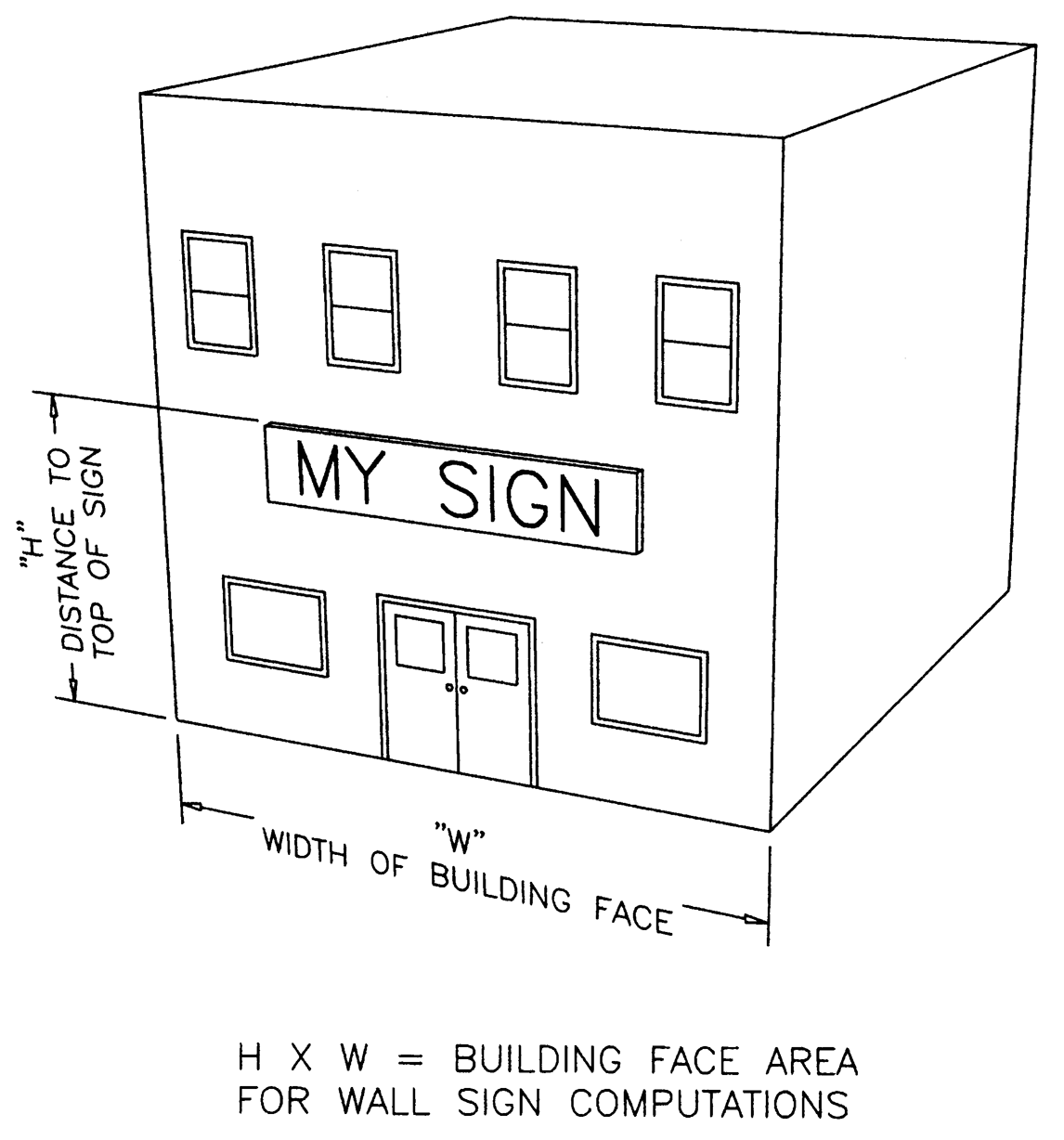
Building Face Area for Wall Sign Computations
(Ord. No. 34-2006, § 1, 10-24-2006)
Sec. 102-1777. - Permitted directory signs.
Directory signs are permitted within the commercial zoning districts or industrial zoning districts in accordance with the following:
(1)
Parcels containing three acres or more with two or more separate commercial buildings. One directory sign is permitted for each street frontage Such directory signs are permitted in addition to the permitted wall signs.
(2)
Area, setbacks and height. Area, setbacks and height shall be as follows:
a.
The maximum sign area shall be 20 square feet.
b.
Minimum sign setbacks shall be as follows:
1.
For a public street right-of-way, 30 feet.
2.
For interior property lines, five feet.
c.
The maximum height shall be six feet.
(Ord. No. 33-2004, § 1, 9-13-2004; Ord. No. 34-2006, § 1, 10-24-2006)
Sec. 102-1778. - Industrial park subdivision and multifamily residential complex signs.
One subdivision sign shall be permitted per public street frontage at the perimeter of an industrial or multifamily residential-complex subdivision. Such sign shall not exceed 32 square feet in area and shall not exceed four feet in height. Where a fence or wall is constructed at the perimeter of a subdivision, such sign may be located on the face of the fence or wall. Where the signage is to be placed at the main entrance to a subdivision, two signs, one on each side of the entrance street, may be placed, with each sign allowed to be equal in size to the aforementioned maximum size limitations.
(Ord. No. 33-2004, § 1, 9-13-2004; Ord. No. 34-2006, § 1, 10-24-2006)
Sec. 102-1779. - Billboards.
Placement of billboards are prohibited, except within 200 feet of Interstate 4 (I-4). The placement of billboards within 200 feet of Interstate 4 (I-4) is subject to the following restrictions:
(a)
Billboards shall only be permitted in a commercial zoning district or an industrial zoning district.
(b)
All signs shall be oriented toward the interstate and away from residential districts or uses.
(c)
No more than one sign shall be placed per approved location. Such sign may be double-faced. If the sign is double-faced, both faces shall be of the same size.
(d)
The maximum sign area for one face shall be 672 square feet, including all embellishments, and for a double-faced sign 1,344 square feet. The maximum height for a sign facing is 30 feet and the maximum length is 60 feet.
(e)
Placement of billboards are subject to approval of the Florida Department of Transportation. No billboard shall be placed within 1,500 feet of another billboard on the same side of I-4 or within 200 feet, excluding rights-of-way, of any cemetery, public park, and residential use or district.
(f)
Billboard structures shall not exceed 65 feet in height above the crown of the interstate.
(g)
Billboards shall not be located within 15 feet of the nearest right-of-way line of Interstate 4 (I-4).
(Ord. No. 33-2004, § 1, 9-13-2004; Ord. No. 34-2006, § 1, 10-24-2006)
Sec. 102-1780. - Directional signs.
Directional signs are only permitted within any commercial zoning district or any industrial zoning district in accordance with the following:
(1)
One directional sign may be erected at each point of vehicular ingress/egress from public streets, or private streets meeting public-street standards.
(2)
Except at public hospitals, directional signs shall not exceed six square feet in area.
(3)
Directional signs may be located at the property line, but shall not be located within nor overhang the public right-of-way.
(Ord. No. 34-2006, § 1, 10-24-2006)
Sec. 102-1781. - Downtown historic district.
Signs within the downtown historic district shall be subject to any applicable design guidelines, as provided under chapter 38, Plant City Code.
(Ord. No. 34-2006, § 1, 10-24-2006)
Sec. 102-1782. - Exempted signs.
Exempted signs are allowed within any commercial zoning district or any industrial zoning district as enumerated in section 102-1539.
(Ord. No. 34-2006, § 1, 10-24-2006)
Sec. 102-1783. - Additional temporary signage.
Temporary signs in accordance with section 102-1541 are permitted within commercial or industrial zoning districts, subject to the provisions of said section.
(Ord. No. 34-2006f, § 1, 10-24-2006)
Sec. 102-1784. - Banners and temporary attractors.
Banners and temporary attractors are permitted within commercial or industrial zoning districts, subject to the provisions of section 102-1627.
(Ord. No. 34-2006, § 1, 10-24-2006)
Sec. 102-1785. - Marquee and awning signs.
Marquee and awning signs are permitted within commercial or industrial zoning districts, subject to the provisions of section 102-1626.
(Ord. No. 34-2006, § 1, 10-24-2006)
Sec. 102-1786. - Illuminated signs.
Illuminated signs are permitted within commercial or industrial zoning districts, subject to the provisions of section 102-1629.
(Ord. No. 34-2006, § 1, 10-24-2006)
Sec. 102-1787. - Sandwich-board signs.
Sandwich-board signs are permitted within the commercial zoning districts in accordance with section 102-1628.
(Ord. No. 34-2006, § 1, 10-24-2006)
Sec. 102-1788. - I-4 corridor signs.
(a)
I-4 corridor signs shall only be permitted in a commercial or industrial zoning district as an accessory use where the principal use is a commercial or industrial building.
(b)
I-4 corridor signs shall only be placed within 200 feet of the I-4 right-of-way, but said signs shall not be placed within 200 feet of any cemetery, public park, or residential use or district.
(c)
The maximum height of an I-4 corridor sign shall be 45 feet as measured from the highest point of the crown of I-4 along the property line nearest to I-4 for the property upon which the sign is located.
(d)
The maximum sign area of an I-4 corridor sign shall be 350 square feet.
(e)
No more than one I-4 corridor sign shall be allowed per premises and shall count as one ground or pole sign allowed.
(f)
No part of any I-4 corridor sign shall be located within 15 feet of any property line or right-of-way line.
(g)
Under no circumstances shall the height or maximum sign area of I-4 corridor signs exceed the height and sign area limitations provided in subsections (c) and (d) herein.
(h)
A landscaped plan, to include no less than six ornamental shrubbery plants and ground cover to meet the standards established in section 102-1378, shall be submitted to the planning and zoning director for approval. Such plan shall meet the requirements of subsections 102-1380(b)(1)—(4), (b)(8) and (b)(9). The landscaped plan shall be maintained in accordance with section 102-1379.
(Ord. No. 36-2007, § 4, 12-10-2007)
Sec. 102-1789. - No other signs permitted.
Except as expressly allowed or permitted in this article, no signs are permitted within commercial or industrial zoning districts.
(Ord. No. 34-2006, § 1, 10-24-2006; Ord. No. 36-2007, § 4, 12-10-2007)
Sec. 102-1841. - Permitted signs.
Each parcel which has a designated office, commercial or industrial use within a PD Planned Development district or a permitted office or commercial use within CC Community College district shall be allowed signage equivalent to that described in Subdivision IV above. Each parcel with a single-family residential use shall be allowed signage equivalent to that described for parcel in the single-family residential districts above. Each parcel with a multiple-family residential use shall be allowed signage equivalent to that described for multiple-family dwelling districts above.
(Ord. No. 33-2004, § 1, 9-13-2004; Ord. No. 34-2006, § 1, 10-24-2006; Ord. No. 05-2013, § 27, 2-25-2013)

