
Plant City City Zoning Code
ARTICLE IV
- DISTRICTS
DIVISION 8. - PD PLANNED DEVELOPMENT DISTRICT[6]
Editor's note— Ord. No. 05-2013, § 5, adopted Feb. 25, 2013, amended Art. IV, Div. 8 in its entirety to read as herein set out. Former Div. 8, §§ 102-441—102-479 was entitled "C-U Community Unit District", and derived from: Code 1977, § 111.10(a)—(m), 111.23.1, 111.23.2; Ord. No. 16-2001, § 12, adopted Aug. 13, 2001; Ord. No. 49-2004, § 1, adopted Oct. 25, 2004; and Ord. No. 49-2005, § 1, adopted Dec. 12, 2005.
DIVISION 9. - C-1A NEIGHBORHOOD BUSINESS DISTRICT[7]
Cross reference— Businesses, ch. 18.
DIVISION 10. - C-1B NEIGHBORHOOD BUSINESS DISTRICT[8]
Cross reference— Businesses, Ch. 18.
DIVISION 11. - C-1 GENERAL COMMERCIAL DISTRICT[9]
Cross reference— Businesses, Ch. 18.
DIVISION 12. - C-2 GENERAL COMMERCIAL DISTRICT[10]
Cross reference— Businesses, Ch. 18.
DIVISION 13. - M-1 LIGHT INDUSTRIAL DISTRICT[11]
Editor's note— Ord. No. 12-2014, § 1, adopted July 28, 2014, amended Div. 13 in its entirety to read as herein set out. Former Div. 13, §§ 102-656—102-660, was entitled "M-1 Industrial District", which derived from: Code 1977, §§ 111.15(b)—(e); and Ord. No. 16-2001, § 19, adopted Aug. 13, 2001.
Cross reference— Businesses, Ch. 18.
DIVISION 14. - M-1A LIGHT INDUSTRIAL DISTRICT[12]
Cross reference— Businesses, Ch. 18.
DIVISION 16. - M-AP AIRPORT LIGHT INDUSTRIAL DISTRICT[13]
Editor's note— Ord. No. 2-2015, § 1, adopted Feb. 9, 2015, amended Div. 16 in its entirety to read as herein set out. Former Div. 16, §§ 102-781—102-788 was entitled "M-AP Airport-Industrial District", and derived from Code: 1977, §§ 111.18(a)—(h); Ord. No. 11-2011, § 6, adopted Feb. 28, 2011; Ord. No. 26-2011, § 5, adopted Aug. 22, 2011; and Ord. No. 15-2014, § 5, adopted Aug. 11, 2014.
DIVISION 19. - LAURA STREET RESTORATION OVERLAY DISTRICT[14]
Editor's note— Ord. No. 42-2005, § 2, adopted Oct. 24, 2005, created ch. 102, art. IV, div. 18. Inasmuch as div. 18 already existed, these provisions have been redesignated as div. 19 at the editor's discretion.
Sec. 102-186.- Classifications and boundaries.
(a)
In order to classify, regulate and restrict the use of land and buildings; to regulate and restrict the height and bulk of buildings; to regulate the area of yards and other open spaces about buildings; and to regulate the density of land use, the City is divided into use district classifications to be known as follows:
(b)
The districts and boundaries thereof are shown upon the map accompanying the ordinance from which this Chapter derives and is made a part thereof, copies of both the map and ordinance being filed with the city clerk. The map shall be designated as the "Zoning Map of Plant City, Florida." The map and all the notations, references and other information shown thereon shall be as much a part of this Chapter as if the information set forth on such map were all fully described and set out in this Chapter. In the creation, by this Chapter, of the respective districts, the city commission has given due and careful consideration to the peculiar suitability of each and every district for the particular regulations applied thereto and the necessary, proper and comprehensive groupings and arrangements of the various uses and densities of population in accordance with a well-considered plan for the development of the city.
(c)
The boundaries of the districts shown upon the map adopted by this Chapter or amendments thereto are adopted and approved, and the sections of this Chapter governing the use of land and buildings, the height of buildings, building site areas, the size of yards about buildings and other matters as set forth in this Chapter are established and declared to be in effect upon all land included within the boundaries of each and every district shown upon the map.
(d)
Where uncertainty exists as to boundaries of any district shown on the map, the following rules apply:
(1)
Where such district boundaries are indicated as approximately following street lines, alley lines or lot lines, such lines shall be construed to be boundaries.
(2)
In unsubdivided property or where a district boundary divides a lot, the location of such boundary, unless the boundary is indicated by dimensions, shall be determined by use of the scale appearing on the map.
(3)
Where a district boundary divides the area of a lot unequally, the district classification and regulations of the larger portion shall apply to the remaining smaller portion of the lot.
(4)
Where any public street or alley is officially vacated or abandoned, the regulations applicable to each parcel of abutting property shall apply to the portion of such street or alley added thereto by virtue of such vacation or abandonment.
(5)
If any further uncertainty exists, the city commission shall interpret the intent of the map as to the location of such boundaries.
(Code 1977, § 111.03; Ord. No. 05-2013, § 3, 2-25-2013; Ord. No. 31-2013, § 1, 12-9-2013)
Sec. 102-187. - General prohibitions and restrictions.
Except as provided in this Chapter:
(1)
No building shall be erected, reconstructed or structurally altered, nor shall any building or land be used which does not comply with all the district regulations established by this Chapter for the district in which the building is located.
(2)
No building shall be erected, reconstructed, or structurally altered to exceed the height or bulk limits established for the district in which such building is located.
(3)
The minimum yards and other open spaces, including the intensity of use sections contained in this Chapter for each and every building existing on the effective date of the ordinance from which this Chapter derives, or for any building hereafter erected or structurally altered, shall not be encroached upon or considered as yard or open space requirements or intensity of use requirements for any other building.
(4)
Every building hereafter erected shall be located on a lot. Each lot must have direct frontage on a constructed and maintained public road, or on a private road which meets the city's construction standards for public roads. Flag lots are not permitted. Lots for single-family residences and/or duplexes shall be limited to one main building and two customary accessory buildings. Nothing herein shall limit the number of main buildings or accessory buildings on all other lots.
(5)
The uses of all buildings and property publicly owned and engaged in the performance of a public function may be permitted in any district; provided, however, that such use is not obnoxious or detrimental to the health or welfare of the city.
(Code 1977, § 111.04; Ord. No. 16-2001, § 3, 8-13-01)
Sec. 102-226.- Uses permitted.
In the R-1A single-family dwelling district, no building or premises shall be used, and no building shall be erected or structurally altered which is arranged, intended or designed to be used for other than one or more of the following uses, subject to the density limitations of the land use category of the parcel designated by the comprehensive plan for the city:
(1)
Single-family dwellings and their customary accessory uses.
(2)
Parks, playgrounds and recreation facilities under the supervision of the city on any duly constituted property or homeowners' association.
(3)
Churches and their educational buildings, including children's day nurseries when operated therein.
(4)
Schools of general education, except correctional institutions.
(5)
Farms, truck gardens, citrus groves.
(6)
Construction offices.
(7)
Garage sale conducted in accordance with division 5 of article VII of this Chapter.
(8)
Bingo fundraising as operated by a church.
(9)
Governmental use.
(Code 1977, § 111.05(a))
Sec. 102-227. - Height and area requirements.
(a)
Building height. In the R-1A single-family dwelling district, the building height shall be 35 feet, except as provided in section 102-1256.
(b)
Building site area. In the R-1A single-family dwelling district, the lot area shall be a minimum of 7,500 square feet and the required width of the lot at the building line shall be a minimum of 75 feet. The first floor area of the dwelling structure, exclusive of terraces, open porches or carports, shall not be less than 900 square feet.
(c)
Front, side and rear yard setbacks. In the R-1A single-family dwelling district, front, side and rear yard setbacks shall be provided as follows:
(1)
Front yard. There shall be a front yard of not less than 25 feet measured from the right-of-way line to the front wall of the main building, but the yard need not be more than 25 percent of the average front yards of the lots in the same block.
(2)
Rear yard. There shall be a rear yard not less than 30 feet in depth.
(3)
Side yards. There shall be a side yard on each side of the main building of not less than ten feet, except that any side yard abutting on a street shall have a minimum width of 20 feet measured from the right-of-way line.
(Code 1977, § 111.05(b)—(d); Ord. No. 16-2001, § 4, 8-13-01; Ord. No. 1-2009, § 1, 1-12-2009)
Sec. 102-228. - Reserved.
Editor's note— Ord. No. 11-2011, § 2, adopted Feb. 28, 2011, deleted § 102-228, entitled "Nonconforming lots" and derived from: Code 1977, § 111.05(e).
Sec. 102-229. - Off-street parking.
In the R-1A single-family dwelling district, off-street parking shall be provided in accordance with division 11 of article VII of this Chapter.
(Code 1977, § 111.05(f))
Sec. 102-266.- Uses permitted.
In the R-1 single-family dwelling district, no building or premises shall be used, and no building shall be erected or structurally altered which is arranged, intended or designed to be used for other than one or more of the following uses, subject to the density limitations of the land use category of the parcel designated by the comprehensive plan for the city:
(1)
Any use permitted in the R-1A single-family dwelling district.
(2)
Garage apartments, subject to the following requirements:
a.
The garage apartment shall be located on a conforming or legal non-conforming residential lot developed with a detached single-family home. A minimum lot area of 6,000 square feet shall be required.
b.
The residential lot shall be occupied by a main building consisting of a principal detached single-family dwelling that is owner occupied.
c.
The garage apartment shall be located on the same lot as the main building. No more than one garage apartment shall be permitted on the lot.
d.
Living square feet in the garage apartment shall not exceed the size of the main building and shall have a maximum of 600 square feet of livable space and the gross square footage limited to 800 square feet.
e.
The garage apartment may be located above a detached garage only where the main building on the lot has two or more stories.
f.
The garage apartment shall be located within the side or rear of the main building, and shall not extend in front of the main building.
g.
The garage apartment shall have a minimum side yard setback of ten feet, except when a garage apartment is abutting a street, a garage apartment shall have a minimum side yard setback of 15 feet measured from the right-of-way line.
h.
The garage apartment shall have a minimum rear yard setback of ten feet, except when a garage apartment is abutting a street, a garage apartment shall have a minimum rear yard setback of 20 feet measured from the right-of-way line.
i.
The garage apartment shall not occupy more than 30 percent of the rear yard of a residential lot.
j.
Garage apartments shall be designed to appear similar to the main building. The garage apartment shall have the same exterior finish as the main building and shall emulate the architectural style and details of the main building into its design.
k.
If within an Historic District, any garage apartment is subject to the requirements of Chapter 38, Plant City Code.
(3)
Libraries, community centers; buildings or land used exclusively by the federal, state, county or city government for public purposes; however, barns or sheds for the storage of equipment or animals are prohibited.
(Code 1977, § 111.06(a); Ord. No. 4-2003, § 3, 1-27-2003; Ord. No. 50-2021, § 1, 10-25-2021)
Sec. 102-267. - Height and area requirements.
(a)
Building height. In the R-1 single-family dwelling district, the maximum building height shall be 35 feet, except as provided in section 102-1256.
(b)
Building site area. In the R-1 single-family dwelling district, the lot area shall be a minimum of 6,000 square feet, and the required width of the lot at the building line shall be a minimum of 60 feet. The first floor area of the dwelling structure, exclusive of terraces, open porches or carports, shall not be less than 750 square feet.
(c)
Front, side and rear yard setbacks. In the R-1 single-family dwelling district, front, side and rear yard setbacks yards shall be provided as follows:
(1)
Front yard. There shall be a front yard of not less than 20 feet measured from the right-of-way line to the front wall of the main building. Where lots comprising 40 percent or more of the frontage between intersecting streets are developed with buildings having an average front yard with a variation of not more than six feet, no building hereafter erected or structurally altered shall project beyond the average front yard established.
(2)
Rear yard. There shall be a rear yard not less than 30 feet in depth.
(3)
Side yards. There shall be a side yard on each side of a dwelling of not less than ten feet, except that any side yard abutting a street shall have a minimum width of 15 feet measured from the right-of-way line.
(Code 1977, § 111.06(b)—(d); Ord. No. 16-2001, § 5, 8-13-01; Ord. No. 1-2009, § 2, 1-12-2009)
Sec. 102-268. - Reserved.
Editor's note— Ord. No. 11-2011, § 3, adopted Feb. 28, 2011, deleted § 102-268, entitled "Nonconforming lots" and derived from: Code 1977, § 111.06(e).
Sec. 102-269. - Off-street parking.
In the R-1 single-family dwelling district, off-street parking shall be in accordance with division 11 of article VII of this Chapter.
(Code 1977, § 111.06(f))
Cross reference— Stopping, standing and parking, § 70-91 et seq.
Sec. 102-270. - Carports.
In the R-1 single-family dwelling district, open carports consisting of 100 percent extruded aluminum or PVC may be allowed, except at historic landmarks and within historic districts, in the front and side yards, provided that such carport is located no closer than five feet to the front property line and five feet to the side property line.
(Code 1977, § 111.06(g))
Sec. 102-306.- Uses permitted.
In the R-1B single-family dwelling district, no building or premises shall be used, and no building shall be erected or structurally altered which is arranged, intended or designed to be used for other than one or more of the following uses, subject to the density limitations of the land use category of the parcel designated by the comprehensive plan for the city:
(1)
Any use permitted in the R-1 single-family dwelling district.
(2)
Mobile home, when located within an approved mobile home subdivision.
(3)
Mobile home subdivision, subject to the following special requirements and upon the finding of the planning board that all the requirements have been met:
a.
The minimum gross area of a mobile home subdivision shall be ten acres.
b.
The area proposed for designation as a mobile home subdivision shall be located within its zoning district so that it may reasonably be expected that its development with mobile homes will be compatible with surrounding existing and future land use patterns, and the development will not adversely affect the stability of property values in the general area.
c.
Where all or part of the area proposed for a mobile home subdivision is already subdivided, the existing platting pattern must be arranged in a manner so that its development with mobile homes will be well-related to existing and future surrounding development.
d.
The area proposed for designation as a mobile home subdivision shall contain no existing conventional dwelling structures, and none shall be permitted within an area so designated.
e.
Where 50 percent or more of the area proposed for a mobile home subdivision designation is not already subdivided, approval will only be granted following the platting of all of the area.
(Code 1977, § 111.07(a))
Sec. 102-307. - Building height; building site area; front, side and rear yards; setbacks and off-street parking.
In the R-1B single-family dwelling district, building height; building site area; front, side and rear yards; setbacks; and off-street parking shall be the same as for the R-1 single-family dwelling district.
(Code 1977, § 111.07(b))
Cross reference— Stopping, standing and parking, § 70-91 et seq.
Sec. 102-311.- Uses permitted.
In the R-1C single-family dwelling district, no building or premises shall be used, and no building shall be erected or structurally altered which is arranged, intended or designed to be used for other than the following use, subject to the density limitations of the land use category of the parcel designated by the comprehensive plan for the city: Any use permitted in the R-1 single-family dwelling district.
(Code 1977, § 111.071(a); Ord. No. 10-2002, § 5, 4-22-02)
Sec. 102-312. - Building height; building site area; front, side and rear yards; and setbacks.
In the R-1C single-family dwelling district, building height; building site area; front, side and rear yards; and setback requirements shall be the same as for the R-1 single-family dwelling district.
(Code 1977, § 111.071(b))
Sec. 102-313. - Off-street parking.
In the R-1C single-family dwelling district, off-street parking shall be as provided in division 11 of article VII of this Chapter.
(Code 1977, § 111.071(c))
Cross reference— Stopping, standing and parking, § 70-91 et seq.
Sec. 102-351.- Purpose.
The purpose of the R-2 multiple-family dwelling district shall be to designate and establish areas within the City which are appropriate for development of medium-density neighborhoods, and high-density neighborhoods by special approval as described in subsection 102-352(3) and subsection 102-353(7); to establish ample open space and outdoor living areas; to designate those uses deemed appropriate and proper for location and development within the zoning district; and to establish such department standards and provisions as are appropriate to ensure a proper and desirable residential environment.
(Code 1977, § 111.08(a); Ord. No. 15-2024, § 1, 4-22-2024)
Sec. 102-352. - Uses permitted.
Land and buildings within an R-2 multiple-family dwelling district shall be following uses, subject to the density limitations of the land use category of the parcel designated by the comprehensive plan for the City and used for the following purposes:
(1)
Single-family dwelling units and their customary accessory uses.
(2)
Duplex dwelling units and their accessory uses.
(3)
Apartment buildings and apartment complexes on a single tract of land, but not to include the conversion of single-family buildings to a multifamily use, subject to the following:
a.
A site development plan setting forth the proposed development upon the entire lot or tract of land and including all proposed buildings, parking or service areas, recreation and landscaped areas, access roads and drives, accessory buildings and services, proposed buffers, land uses on all abutting properties including public rights-of-way and the conditions or roadways contained therein, as well as the location of public utilities and their availability shall be submitted to the Planning and Zoning Division together with a letter of transmittal for review in accordance with this subsection prior to the issuance of a building permit, as per Article V of this Chapter. Upon approval of the proposed site plan by the Planning and Zoning Division, building permits shall be issued only for the arrangement and construction of buildings and improvements in accordance with the plan as approved, and any variance from such plan shall require additional review and approval before construction or development is commenced or continued.
b.
All public roadways abutting the site providing points of ingress and egress shall be paved, on-site and off-site drainage shall be provided, and all public utilities required to serve the proposed development shall be available to the site, all in accordance with the requirements and specifications of the City.
(4)
Garage sale conducted in accordance with Division 5 of Article VII of this Chapter.
(5)
Assisted living facilities licensed by the State Department of Elderly Affairs under the Assisted Living Facilities Act, F.S. §§ 400.401—400.454, subject to the following:
a.
The exterior shall be compatible with the character of the surrounding neighborhood.
b.
The requirements and standards of any applicable state regulatory agency shall be met.
c.
Density shall not exceed the maximum allowable in the comprehensive plan. For the purpose of computing density, the following criteria are established:
1.
Each separate housing unit having kitchen facilities is classified as one dwelling unit.
2.
Each separate housing unit not having kitchen facilities but having access to a common dining area is classified as one-half of a dwelling unit.
d.
For the overall intensity of the development, the maximum number of residents permitted shall be determined by the number of housing units which would be permitted on site multiplied by the average persons per household for the City in the most recent U.S. census. In no event shall there be more than four residents per housing unit.
e.
For each separate housing unit having kitchen facilities, there shall be provided a minimum of 250 square feet of living and dining space, not including bathrooms, corridors and storage space, for up to two residents. For each additional resident up to a maximum of four, there shall be provided 125 square feet of living and dining space, not including bathrooms, corridors, and storage space.
f.
For each separate housing unit not having separate kitchen facilities, there shall be provided a minimum of 250 square feet of living area, not including bathrooms, corridors and storage space, for up to two residents. For each additional resident up to a maximum of four there shall be provided 125 square feet of living and dining space, not including bathrooms, corridors and storage space.
g.
There shall be provided a minimum of 35 square feet of dining and/or recreation space provided per resident.
h.
One copy of a site development plan setting forth the proposed use as an assisted living facility shall be submitted to the Planning and Zoning Division, which shall show compliance with this subsection and shall include all proposed buildings, housing units, parking or service areas, recreation and landscaped areas, access roads and drives, access buildings and services, proposed buffers, land uses on all abutting properties, including public rights-of-way and the conditions of roadways contained therein, as well as the location of public utilities and their availability. Upon approval of the proposed site plan by the Planning and Zoning Division, building permits shall be issued only in accordance with the plan as approved, and any variance from such plan shall require additional review and approval before construction or development is commenced or continued.
(6)
Day nursery, subject to the following:
a.
Buffering as described in Section 102-1372 shall be placed between any outdoor play area and adjoining property including public rights-of-way.
b.
A paved off-street loading area is provided and maintained for the loading and unloading of children.
c.
Paved off-street parking for employees is provided within some portion of the subject property other than the required minimum front or side yards.
d.
All other applicable requirements for Section 102-352 shall be complied with.
(7)
Churches, synagogues and their educational buildings.
(8)
Publicly owned or operated buildings including a school, library, museum, art gallery, auditorium, fire station, community building, park, playground, picnic area, swimming pool, or other public recreation use under the supervision of the city or any duly constituted property or homeowners' association.
(9)
School (private or parochial) offering a curriculum substantially equivalent to that of a public school and meeting the requirements of the state department of education.
(10)
Construction offices as a temporary accessory use.
(11)
Townhouses shall be in accordance with Division 16 of Article VII of this Chapter.
(Code 1977, § 111.08(b); Ord. No. 15-2024, § 1, 4-22-2024)
Sec. 102-353. - Reserved.
Editor's note— Ord. No. 15-2024, § 1, adopted April 22, 2024, repealed § 102-353, which pertained to uses requiring special approval and derived from Code 1977, § 111.08(c); Ord. No. 45-2004, § 2, 10-25-2004; Ord. No. 2-2005, § 2, 3-14-2005; Ord. No. 05-2013, § 4, 2-25-2013.
Sec. 102-354. - Prohibited uses.
For all uses within the R-2 multiple-family dwelling district, there shall be certain prohibited uses which are deemed detrimental to the welfare and proper development of a residential neighborhood. These uses are the breeding, raising and keeping of fowl, poultry, animals, insects, fish or reptiles, other than customary household pets.
(Code 1977, § 111.08(d); Ord. No. 15-2024, § 1, 4-22-2024)
Sec. 102-355. - Building and site area requirements.
(a)
Building and living area. Building and living area shall be as follows:
(1)
Single-family dwellings, unless otherwise provided for within this division, shall have a minimum of 750 square feet of building area for one-bedroom units, excluding a utility area not accessible from within the principal structure by a standard door, garage, carport, terraces and open porches. For each additional bedroom there shall be a minimum of 100 square feet of living area.
(2)
For all duplex and multiple-family dwellings, unless otherwise provided for within this division, there shall be provided a minimum of 575 square feet of living area for one-bedroom units and a minimum of 100 square feet of living area for each additional bedroom.
(3)
Where efficiency apartments are included within an apartment building, the minimum living area for each efficiency apartment therein shall be not less than the square feet living area when added to the total square feet living area of all apartments in the apartment building shall yield an average living area of 500 square feet; provided, however, that no efficiency apartment shall be less than 250 square feet of living area.
(b)
Lot area and width. Lot area and width shall be as follows:
(1)
Single-family dwelling units shall have a minimum lot size of 6,000 square feet and a minimum lot width of 60 feet at the front building line.
(2)
Duplex dwelling units shall have a minimum lot size of 6,000 square feet and a minimum lot width of 60 feet at the front building line.
(3)
Apartment buildings of three or more dwelling units or group of apartment buildings shall have a minimum lot size of 10,000 square feet and shall have a minimum lot width of 100 feet at the front building line, provided there is a minimum of 1,500 square feet of gross area for each dwelling unit.
(4)
Unless otherwise specified in this division, all other uses permitted shall have a minimum lot size of 6,000 square feet and a minimum lot width of 60 feet at the front building line.
(Code 1977, § 111.08(e); Ord. No. 15-2024, § 1, 4-22-2024)
Sec. 102-356. - Building height.
In the R-2 multiple-family dwelling district, the maximum building height shall be 45 feet, unless otherwise specified.
(Code 1977, § 111.08(f); Ord. No. 16-2001, § 6, 8-13-01; Ord. No. 15-2024, § 1, 4-22-2024)
Sec. 102-357. - Setback requirements.
In the R-2 multiple-family dwelling district, setbacks shall be provided as follows:
(1)
Front yard setbacks shall be as follows:
a.
For single-family and duplex dwelling units on a single tract of land, unless otherwise specified, there shall be provided a front yard of not less than 20 feet measured from the public right-of-way line to the front building of the main structure.
b.
For apartment buildings, apartment complexes and all other permitted uses on a single tract of land, there shall be a minimum building setback of 25 feet between any public right-of-way and that portion of a structure considered to be the front wall of a main building.
(2)
Side yard setbacks shall be as follows:
a.
For single-family and duplex dwelling units on a single tract of land, unless otherwise specified, there shall be provided two side yards which shall have a minimum width of ten feet, except for those side yards abutting a public right-of-way line which shall have a minimum of 15 feet measured from the right-of-way line to the sidewall of the building.
b.
For apartment buildings, apartment complexes and all other permitted uses on a single tract of land, there shall be a minimum building setback of 20 feet.
(3)
Rear yard setbacks shall be as follows:
a.
For single-family and duplex dwelling units on a single tract of land, unless otherwise specified, there shall be provided a rear yard of not less than 30 feet measured from the rear property line to the rear wall of the main building.
b.
For apartment buildings, apartment complexes and all other permitted uses on a single tract of land, there shall be a minimum building setback of 30 feet from all interior lot lines and 40 feet between any public right-of-way and that portion of a structure considered to be the rear wall of a main building.
(Code 1977, § 111.08(g); Ord. No. 16-2001, § 7, 8-13-01; Ord. No. 15-2024, § 1, 4-22-2024)
Sec. 102-358. - Off-street parking.
In the R-2 multiple-family dwelling district, off-street parking shall be in accordance with Division 11 of Article VII of this Chapter.
(Code 1977, § 111.08(h); Ord. No. 15-2024, § 1, 4-22-2024)
Sec. 102-359. - Buffering and landscaping.
In the R-2 multiple-family dwelling district, buffering and landscaping shall be in accordance with Division 10 of Article VII of this Chapter.
(Code 1977, § 111.08(i); Ord. No. 15-2024, § 1, 4-22-2024)
Sec. 102-396.- Uses permitted.
In the R-3 multiple-family dwelling district, no building or premises shall be erected or structurally altered which creates a density greater than that designated for the area by the comprehensive plan for the city or is arranged, intended or designed to be used for other than one or more of the following uses:
(1)
Any use permitted in the R-2 multiple-family dwelling district.
(2)
Hotel and motel.
(3)
Dental or medical clinic.
(4)
Funeral home.
(5)
Mobile home park, subject to the requirements of article VI of this Chapter.
(6)
Nursing or convalescent home.
(7)
Private club or lodge, including bingo fundraising as operated by such club or lodge.
(Code 1977, § 111.09(a))
Sec. 102-397. - Building height and area.
In the R-3 multiple-family dwelling district, the maximum building height shall be 45 feet, except as provided in section 102-1256. The first floor area of single-family dwelling units shall be the same as required in R-1 single-family district. For two-family dwelling structures the minimum floor area shall be 1,150 square feet, and for each additional family dwelling unit within one structure the minimum habitable area shall be 400 square feet, all exclusive of terraces, open porches or carports.
(Code 1977, § 111.09(b); Ord. No. 16-2001, § 8, 8-13-01)
Sec. 102-398. - Building site area.
In the R-3 multiple-family dwelling district, the minimum lot area for a single-family dwelling shall be 6,000 square feet; for a two-family dwelling, 6,000 square feet; and for four-family dwellings, 7,500 square feet. For each additional unit over four, 800 square feet of lot area per dwelling unit shall be added. The minimum lot width shall be 60 feet for a single-family dwelling and for dwellings for more than one family.
(Code 1977, § 111.09(c); Ord. No. 1-2009, § 4, 1-12-2009)
Sec. 102-399. - Front, side and rear yard setbacks.
(a)
Front yard. In the R-3 multiple-family dwelling district, there shall be a front yard not less than 20 feet in depth measured from the right-of-way line to the front wall of the main building. Where lots comprising 40 percent or more of the frontage between intersecting streets are developed with buildings having front yard setbacks with an average variation of not more than six feet, no building hereafter erected or structurally altered shall project beyond the average front yard depth so established.
(b)
Rear yard. There shall be a rear yard not less than 30 feet in depth.
(c)
Side yard. There shall be a side yard width on each side of the main building of not less than ten feet, except that any side yard abutting on a street shall have a minimum width of 15 feet measured from the right-of-way line.
(Code 1977, § 111.09(d); Ord. No. 16-2001, § 9, 8-13-01)
Sec. 102-400. - Reserved.
Editor's note— Ord. No. 11-2011, § 4, adopted Feb. 28, 2011, deleted § 102-400, entitled "Nonconforming lots" and derived from: Code 1977, § 111.09(e).
Sec. 102-401. - Reserved.
Editor's note— Ord. No. 16-2001, § 10, adopted 8-13-01, deleted section 102-401 in its entirety. Formerly, this section pertained to setbacks and derived from Code 1977, § 111.09(f).
Sec. 102-402. - Off-street parking.
In the R-3 multiple-family dwelling district, off-street parking shall be in accordance with division 11 of article VII of this Chapter.
(Code 1977, § 111.09(g))
Cross reference— Stopping, standing and parking, § 70-91 et seq.
Sec. 102-403. - Buffering and landscaping.
In the R-3 multiple-family dwelling district, buffering and landscaping shall be in accordance with division 10 of article VII of this Chapter.
(Code 1977, § 111.09(h))
Sec. 102-441.- Purpose.
The purpose of the Planned Development district is to provide generally superior design development compared to standard zoning districts. Such districts shall be in harmony with reasonable area, building coverage, height, setback and service requirements; to provide the means of mixing such appropriate land use as may not otherwise be permitted in any of the established zoning districts; and for other purposes; provided, however, that no uses shall be permitted in the district unless otherwise permitted in this Chapter. The Planned Development district will be applied only upon specific petition by property owners proposing a unique type of planned development in keeping with the purpose of the district as stated in this Section. The district was previously known as the C-U Community Unit district.
(Ord. No. 05-2013, § 5, 2-25-2013; Ord. No. 01-2021, § 1, 1-11-2021)
Sec. 102-442. - Reserved.
Editor's note— Ord. No. 01-2021, § 1, adopted Jan. 11, 2021, repealed § 102-442, which pertained to Review and derived from Ord. No. 05-2013, § 5, adopted Feb. 25, 2013.
Sec. 102-443. - Uses permitted.
(1)
In the Planned Development district, uses shall be only those uses or types of uses which are shown on the approved Planned Development Site Plan for the Planned Development district. Such uses shall be limited to those within the underlying future land use category on the Comprehensive Plan. Residential uses may not be considered for Planned Development districts within the industrial land use category.
(2)
Except as provided in Section 102-453, such uses shall be established only at such locations and in such intensity as set forth on the approved Planned Development Site Plan. A Planned Development district is not limited as to types of land usage which may be permitted, except as specifically set forth herein. Uses proposed must be found to be of such types and to be so located and arranged as to ensure compatibility and connectivity among themselves and with adjacent existing or future land uses upon adjacent property.
(Ord. No. 05-2013, § 5, 2-25-2013; Ord. No. 8-2015, § 1, 3-9-2015; Ord. No. 01-2021, § 1, 1-11-2021)
Sec. 102-444. - Review standards.
A Planned Development Site Plan shall be reviewed by staff and other appropriate agencies, the Planning Board and the City Commission for compliance with the following:
(1)
Physical Characteristics of the Site; Relation to Surrounding Property. The tract shall be suitable, or it shall be possible to make the tract suitable, for development in a manner proposed without hazard to persons or property, on or off the tract.
(2)
Relation to Public Utilities, Facilities and Services. Planned Development districts shall be located in relation to transportation systems, sanitary sewers, emergency services, schools, public safety, water lines, storm and surface drainage systems and other utilities systems and installations to ensure that services can reasonably be expected to be available at the time of occupancy.
(3)
Relation to Major Transportation Facilities. Planned Development districts, where appropriate because of the size or intensity of proposed districts, shall be so located with respect to expressways, arterial and collector streets or mass transit facilities, and shall be so designed, as to provide access to and from such districts without creating excessive traffic along minor streets in residential neighborhoods outside the district.
(4)
Compatibility. Planned Development Site Plans shall be designed so as to minimize the negative effects of external impacts resulting from factors such as traffic, noise or lights. Project control shall be accomplished through such techniques as buffering, architectural design, site design, height limitations, and density or intensity limitations. Landscapes shall reflect the natural character of the predeveloped land and conserved areas to ensure maximum continuity with natural corridors and minimize resource use from landscaping materials that are predominantly utilizing native plants and are in harmony with the natural conditions on site.
(5)
Transitions. Planned Development Site Plans shall be responsive to the character of the area. When located in an area where land use types and/or intensities or densities vary, Planned Development districts shall be designed in such a manner as to provide for gradual changes in intensity and/or density.
(6)
Design Quality. All Planned Development Site Plans shall be designed in such manner to address all of the criteria as set forth in this section and shall generally be superior in design to conventional development site plans, and consistent with all other factors in this Section. All Planned Developments proposing specific approval of requirements for development under standard zoning district regulations shall be designed so as to be sensitive to the impacts of the specific approval requested.
(7)
Relationship to Adjacent Property. Planned Development Site Plans shall include screening, buffering, transitional uses or other design features as necessary to adequately protect existing or probable uses of surrounding property; and shall provide functional and logical linkages to activity centers and circulation facilities on such adjacent property. Such requirements may take into account whether the project is in the Downtown.
(8)
Access. Principal vehicular access points shall be designed to encourage smooth traffic flow with controlled turning movements and minimum hazards to vehicular or pedestrian traffic. Merging and turnout lanes, or traffic dividers and extra width of the approach street shall be required where existing or anticipated traffic flows indicate need. Vehicular access to streets or portions of streets from off-street parking and service areas shall be so combined, limited, located, designed and controlled as to channel traffic from and to such areas conveniently, safely, and in a manner which minimizes traffic friction, and excessive interruptions. Pedestrian access shall, where practical, be separated from vehicular access points.
(9)
Streets, Drives, Parking and Service Areas. Streets, drives, parking and service areas shall provide safe and convenient access to all buildings and general facilities. The location and number of parking spaces provided shall be adequate for the proposed development. NonResidential uses shall be grouped in relation to parking areas so that after visitors arrive by automobile, establishments can be visited with a minimum of internal automotive movements. Facilities and access routes for deliveries, servicing and maintenance shall be located and arranged to prevent interference with pedestrian traffic to the extent permittable. For all new public and private streets, the following minimum design considerations shall be adequately addressed:
a.
Safe vehicular travel;
b.
Pedestrian and other multimodal travel, including compliance with applicable American Disability Act (ADA) Standards;
c.
Structural stability of all construction materials;
d.
Utility distribution, power, sewer, cable, potable water and fire protection routing, location, and sizing;
e.
Horizontal and vertical sight distances;
f.
Traffic safety requirements;
g.
Emergency vehicle maneuverability and access;
h.
Logical future extension of inter-neighborhood ties; and
i.
Compliance with The Standard Guide Manual adopted pursuant to Section 102-1043, Plant City Code.
(10)
Multimodal and Pedestrian Systems. Planned Development Site Plans shall provide internal or external walkways where multimodal or pedestrian circulation requires them. The site plan shall provide for safe, efficient, convenient and harmonious groupings of structures, uses, facilities and open spaces in a manner facilitating pedestrian movement between major origins and destinations, within and adjacent to the district, with a minimum of conflicts with vehicular traffic. Pedestrian systems through buildings shall be related to a network of exterior open spaces reserved for pedestrian use.
(11)
Natural and Historic Features, Recreation, Conservation and Preservation Areas. Planned Development Site Plans shall be designed to preserve the natural features of the land, such as existing trees and natural topography, and archaeological and historic resources, to the maximum extent practicable. Recreation areas shall be provided as appropriate after consideration of project size and lot size. Small lot developments may be required to provide more significant recreation amenities.
(12)
Density/Intensity. Densities and intensities shall not exceed maximums established in the Comprehensive Plan. Planned Development district densities and intensities shall be established after consideration of the Comprehensive Plan criteria and limits, neighborhood compatibility, transitions, and site design.
(13)
Height. Heights of structures in a Planned Development district shall be determined after review of the nature of area being developed and the surrounding land uses to ensure that the proposed development will not create any external impacts that would adversely affect surrounding development, existing or proposed.
(14)
Fences and Screening. Fences or vegetative screening at periphery of Planned Development district shall be provided, where appropriate, to protect occupants from undesirable views, lighting, noise or other off-site influence, or to protect the occupants of adjoining districts from similar adverse influences.
(15)
Yards and Setbacks. Yard and setback requirements shall be consistent in the Planned Development district to promote general health, safety, welfare, design excellence and neighborhood compatibility. Notwithstanding other required wetland and jurisdictional buffer requirements, all setbacks within a Planned Development district shall maintain consistency with the approved Planned Development Site Plan. All proposed setbacks shall be shown on the Planned Development Site Plan in either graphic or tabular form.
(16)
Trash and Utility Plant Screens. In the Planned Development districts, all central refuse, trash, garbage collection containers and sewer lift stations shall be screened from sight or located in such a manner so as not to be visible from any public area within or adjacent to the Planned Development district.
(17)
Signs. Signs in the Planned Development district shall be in accordance with the Plant City Code.
(18)
Landscaping. Landscaping shall be equal to or exceed the standards stipulated pursuant to the Plant City Code.
(19)
Environmental Factors.
a.
Water Conservation. Creative site development concepts shall be used in order to promote water conservation. Water requirements may be reduced by providing for:
1.
The preservation of existing plant communities;
2.
The reestablishment of native plant communities;
3.
The use of site specific plant materials;
4.
The use of shade trees to reduce transpiration rates of lower story plant materials;
5.
Site development that retains stormwater runoff on site;
6.
The use of pervious paving materials;
7.
Site development that addresses the carrying capacity of the land in its present form; and
8.
Other environmentally sensitive site development concepts.
b.
Minimum Open Space Requirements. Minimum open space requirements shall be established based upon a site-specific evaluation of the project and surrounding land uses.
c.
Preservation of Existing Plant Communities. Existing native plant communities on sites proposed for development should be preserved and incorporated into the required open space wherever possible. Existing native plant communities that are specified to remain shall be preserved in their entirety, with all desirable trees, understory, and ground covers left intact and undisturbed. In most cases, preservation of existing native plant communities will decrease the initial costs of site development, decrease future water and maintenance requirements and enhance the aesthetic appearance of the property.
(20)
Rights-of-Way and Utility Standards. All improvements shall adhere to the requirements of the appropriate jurisdiction's adopted standards for all public and private roads and other improvement construction.
(21)
Stormwater Management. Stormwater management facilities shall adhere to the requirements of the Plant City Code and City's adopted standards.
(22)
Consistency with Comprehensive Plan. No Planned Development Site Plan shall be approved if it is inconsistent with the Comprehensive Plan.
(23)
Consistency with this Code. No Planned Development Site Plan shall be approved if it is inconsistent with the Plant City Code of Ordinances.
(24)
Other Factors. Other factors shall be applied which:
a.
Address views from collector roadways;
b.
Limit parking and loading areas adjacent to collector roadway;
c.
Provide quality construction material and superior design;
d.
Maximize use of buffers berms and, where practical, utilize Green Infrastructure;
e.
Encourage the establishment of high quality projects; and
f.
Provide consistency with prior approvals where such approvals were based on design features considered important in granting the approval.
(Ord. No. 01-2021, § 1, 1-11-2021; Ord. No. 14-2022, § 1, 5-23-2022)
Editor's note— Ord. No. 01-2021, § 1, adopted Jan. 11, 2021, repealed the former § 102-444, and enacted a new § 102-444 as set out herein. The former § 102-444 pertained to area requirements and derived from Ord. No. 05-2013, § 5, adopted Feb. 25, 2013.
Sec. 102-445. - Specific development criteria.
The following property development criteria shall apply to all Planned Development district zoning applications and Planned Development Site Plans:
(1)
Specific development criteria. Specific development criteria shall be as follows:
a.
Minimum lot area and lot width. For single family detached lots, the minimum lot width shall be no less than 75 feet and the minimum lot area shall be no less than 7,500 square feet; except for single family detached lots within the development adhering to Traditional Neighborhood Development (TND) Standards, including lot size and width, in accordance with Division 17, Article IV of this Chapter.
b.
Setback standards. Planned Development district plans shall provide safe, efficient, convenient and harmonious groupings of structures and uses in accordance with the following minimum standards:
1.
Single-Family and Two-Family Buildings.
i.
Single-family and two-family buildings shall have a minimum distance between buildings of 20 feet on the side and 60 feet on the rear. Where the buildings are located on individual lots or parcels, then the buildings shall have a ten foot side yard setback and a 30 foot rear yard setback.
ii.
Rear yard spacing requirements may be reduced to 15 feet and side yard spacing requirements may be reduced to five feet for lots that abut open areas such as retention/detention ponds, conservation areas, natural or manmade ponds/lakes, and established wetland buffer zones.
iii.
Single-family and two-family buildings shall have a minimum front yard setback of 20 feet measured from the right-of-way line to the building.
iv.
Where the side yard of single-family and two-family buildings abuts a street right-of-way, the side yard shall not be less than 15 feet measured from the right-of-way line to the building.
v.
Where the rear yard of single-family and two-family buildings abuts a street right-of-way, the rear yard shall not be less than 30 feet measured from the right-of-way line to the building.
2.
Multi-Family Buildings.
i.
Multifamily buildings shall have a minimum distance between buildings of 40 feet on the side and 60 feet on the rear; provided, however, multi-family buildings shall not be located within 30 feet of any perimeter lot line.
ii.
Multifamily buildings shall have a minimum front yard setback of 25 feet measured from the right-of-way line to the building.
iii.
Where the side yard of multifamily buildings abuts a street right-of-way, the side yard shall not be less than 25 feet measured from the right-of-way line to the building.
iv.
Where the rear yard of multifamily buildings abuts a street right-of-way, the rear yard shall not be less than 40 feet measured from the right-of-way line to the building.
3.
NonResidential Buildings Except Industrial. Nonresidential buildings, except industrial buildings shall meet the setback requirements of the C-1A zoning district.
4.
Industrial Buildings. Industrial buildings shall meet the setback requirements of the M-1 zoning district.
5.
Multi-Use Buildings. Multi-use buildings shall meet setback requirements of the use residing on the first floor. If multiple uses reside on the first floor, the most restrictive setback requirement shall apply.
c.
Planned Development Site Plan conditions shall require building features that will require design and facade standards that guarantee a substantial appearance variety and facade mix, and shall include:
1.
Limitations on building massing;
2.
Façade articulation;
3.
A combination of at least two colors per building;
4.
Roof designs to include gables or cornice treatments or a parapet for flat roof systems; and
5.
Commitment to monotony control where no building next to, across or diagonal from will have the same color, model nor architectural features.
d.
The City may require building elevations and architectural renderings for all development within the proposed development. If elevations or architectural renderings are presented, the development shall be in substantial compliance with the elevations presented.
e.
Street trees shall be installed with no less spacing than an average of one small tree every 40 linear feet, consistent with Section 102-1378, to provide vertical greenery.
f.
Internal local streets shall be planned and constructed for a maximum 25 mph design speed, to provide a safer environment within a clustered residential area.
g.
Height limitations. Building height limitations are restricted as follows:
1.
Residential:
i.
Single-family ..... 35 Feet
ii.
Multifamily ..... 65 Feet
2.
Nonresidential:
i.
Commercial ..... 65 Feet
ii.
Office ..... 65 Feet
iii.
Light industrial ..... 70 Feet
h.
Off-street parking requirements. At a minimum, off-street parking shall be provided in accordance with Division 11 of Article VII of this Chapter.
i.
Landscaping and buffering requirements. At a minimum, landscaping and buffering shall be provided in accordance with the provisions of Division 10 of Article VII of this Chapter.
j.
Open space requirements. Open space is a part of a development reserved for light, air or visual, aesthetic, environmental or recreational amenities, or similar purposes. Such open space shall be available for entry and use by the occupants of the building or to the general public. Open space shall include commonly owned parks, plazas, landscaped areas, pedestrian ways and active or passive recreation areas. Access, ingress or egress or road easements, parking areas, storage and utility areas, and road right-of-way may not be included in determining open space. No more than 50 percent of the required open space shall be wetlands. The minimum amount of open space to be provided on each development unit within the overall Planned Development district shall be as follows:
1.
Single-family and two-family development shall provide a minimum of 30 percent of the development gross land area for open space.
2.
Multifamily development shall provide a minimum of 35 percent of the development unit's gross land area as open space. Additionally, at a minimum of 20 percent or more of the gross development unit's gross land area shall be landscaped with trees and shrubs. Fifty percent of the total open space area provided shall be located on the site in such a manner as to be usable for active or passive recreation and easily accessible to all dwelling units within the development.
3.
Nonresidential and mixed-use development shall provide a minimum of 20 percent of the development unit's gross land area, not including designated conservation and preservation area.
4.
Open space requirements as shown in Division 10 of Article VII of this Chapter shall be followed in the provision of open space for development in the Planned Development district.
k.
House and Garage orientation. Houses that have garages protruding more than three feet forward of the main structure of the building are prohibited.
l.
Intensity and Density. In no event shall intensity or density be increased over the maximum permitted by the Comprehensive Plan.
(2)
Specific approval.
a.
Generally where there are conflicts between the Planned Development non-procedural provisions and general zoning, subdivision or other applicable regulations, those shown on the Planned Development Site Plans as "specific approvals" shall apply if specifically approved by the City Commission. Specific Approval may be requested by the applicant but must be identified on the Planned Development Site Plan and specifically approved by the City Commission. The proposed Planned Development Site Plan shall be consistent with the City Comprehensive Plan provisions which may not be modified by specific approval. To obtain specific approval, the City Commission shall specifically determine the change:
1.
Will not impact surrounding properties adversely compared to the existing Code requirement;
2.
Is not inconsistent with the general intent of the Code provision; and
3.
Is in the best interest of the health, safety and welfare of the City and its residents.
b.
Where specific approval is being requested for single family detached lots of less than 75 feet in width or 7,500 square feet in lot area, such lots shall be interspersed, where appropriate, among larger lots throughout the development and shall not be located as the first lots on either side of any entrance road to the development.
c.
Specific Approval Not Allowed. Notwithstanding the foregoing, specific approval shall not be granted for any of the following:
1.
Lot area for single family detached lots of less than 5,000 square feet.
2.
Lot width for single family detached lots of less than 50 feet.
3.
Single Family Detached Lots with less than 75 feet in width or lot area of less than 7,500 square feet shall not comprise more than 20 percent of the total number of lots of the entire development.
4.
Side yard setack reduction for lots 60 feet wide and larger.
d.
Where a Planned Development is being amended pursuant to Section 102-453, the provisions in Section 102-445(2)c above shall only apply to land being added to the Planned Development, or for those portions of the plan that are being amended.
(Ord. No. 05-2013, § 5, 2-25-2013; Ord. No. 8-2015, § 2, 3-9-2015; Ord. No. 01-2021, § 1, 1-11-2021; Ord. No. 14-2022, § 2, 5-23-2022)
Editor's note— Ord. No. 01-2021, § 1, adopted Jan. 11, 2021 changed the title of § 102-445 from "Property development criteria" to read as herein set out.
Sec. 102-446. - Submittal requirements.
At the time of application for rezoning to a planned development district, the following materials shall be submitted to the Planning and Zoning Division:
(1)
A letter of transmittal officially submitting the proposal for approval, signed by the developer and the current owner of the property.
(2)
A narrative outlining:
a.
A general description of the proposal;
b.
A description of how the proposal meets the criteria in Sections 102-444, and 102-445(1); and
c.
If applicable, an itemized list of items for which the proposal is requesting specific approval, why specific approval is being requested and how the request meets the criteria to grant specific approval.
(3)
Planned Development Site Plan of the entire proposal showing the following information:
a.
Boundary lines of the property, including dimensions, survey with a complete legal description and the total site acreage;
b.
Name of the proposed planned development district;
c.
The location and names of all public streets adjoining or traversing the site, provided that if no public street now adjoins the site, a sufficient description by metes and bounds so as to identify the location of the site shall be included;
d.
Identification of the name, plat book and page number of any recorded subdivision comprising all or part of the site;
e.
Identification and location of all existing easements, watercourses, lakes or other significant natural features on the sites;
f.
Identification of adjacent zoning/land use designations and existing land uses within 150 feet of the project site;
g.
Identification and general location of all proposed uses therein; locations of all proposed structures except for single family structures proposed to be located upon a subdivision lot; total nonresidential square footage and the proposed square footage of each nonresidential land use type; floor area ratio of each nonresidential land use type; total number and types of residential units and the type density and overall density of the project; proposed building height; general location and nature of fences, walls and buffering to be provided on the project periphery; and the location of all points of ingress and egress to the project site;
h.
The following notes shall be included on the planned development site plan:
1.
Development standards shall meet or exceed all development standards and be consistent with all adopted regulations of the City, including access management and parking, buffering and landscaping, drainage and stormwater management, and signage. Additionally, development shall be consistent with the regulations of all other applicable agencies having jurisdiction;
2.
The provision of off-site and on-site water and sanitary sewer improvements shall be provided by the owner or developer subject to the approval of the Utilities Director in accordance with the requirements of the Plant City Comprehensive Plan;
3.
All utilities shall be placed underground except where connection to existing above ground utilities exists;
4.
Placement of utilities on the site shall be subject to approval of the Utilities Director; and
5.
No site clearance nor land alteration shall occur prior to receiving approval of the planned development detailed site plan, or the construction plan approval;
i.
If the planned development site plan is to be developed in stages, the proposed general location of each stage shall be shown and the proposed sequence of stages identified; and
j.
A transportation analysis shall be required for any development generating more than 250 average trip ends for weekday or weekend (whichever is higher) according to the latest edition of the Institute of Transportation Engineers Trip Generation Manual. The analysis shall be sufficient to show the Planned Development Site Plan meeting the minimum requirements of the Comprehensive Plan and Article IX of Chapter 102, Plant City Code. The transportation analysis shall be reviewed by a traffic analyst selected by the City, provided that the costs of the review shall be prepaid by the owner. The analysis and methodology shall be in accordance with accepted traffic engineering practices and procedures subject to review and approval of the City Manager, or designee. At a minimum, the analysis shall include total trips generated by the project, a.m. (if deemed necessary by the analyst) and p.m. peak hour directional trips and distribution at project access points and links to significant other roadways to such a point as the impacts become acceptable and other traffic improvements required as a result of the project. The City Manager, or designee, may require the transportation analysis to include impacts on the functionality and character of adjacent local streets. The developer shall be responsible for 100 percent of the cost of all on-site improvements identified by the transportation analysis and shall be responsible for such portion of offsite improvements as required by the Comprehensive Plan and transportation mobility fees, whichever is greater.
(Ord. No. 05-2013, § 5, 2-25-2013; Ord. No. 01-2021, § 1, 1-11-2021; Ord. No. 14-2022, § 3, 5-23-2022; Ord. No. 42-2023, § 1, 11-27-2023)
Sec. 102-447. - Planning Board review and recommendation.
The Planning Board shall hold a public hearing and shall review the proposed Planned Development Site Plan for compliance with the criteria in Sections 102-444 and 102-445. The recommendation of the Planning Board shall indicate approval, approval with conditions or denial. When the recommendation is for approval with conditions, those conditions shall be specifically stated in the recommendation. A recommendation for approval or approval with conditions or denial shall be forwarded to the City Commission for final action. Applicants may withdraw requests for Planned Development district zoning and Planned Development Site Plan approval at any time.
(Ord. No. 05-2013, § 5, 2-25-2013; Ord. No. 01-2021, § 1, 1-11-2021)
Sec. 102-448. - City Commission public hearing.
After receiving the written recommendation of the Planning Board made pursuant to Section 102-447, the City Commission shall hold a public hearing to determine the acceptability of the Planned Development Site Plan and the appropriateness of the Planned Development district for the particular site.
(Ord. No. 05-2013, § 5, 2-25-2013; Ord. No. 01-2021, § 1, 1-11-2021)
Editor's note— Ord. No. 01-2021, § 1, adopted Jan. 11, 2021, changed the title of § 102-448 from "Public hearing" to read as herein set out.
Sec. 102-449. - Consideration of the Planned Development Site Plan.
After consideration of the Planning Board recommendation, evidence presented at the public hearing and review for compliance with the criteria in Sections 102-444 and 102-445, the City Commission shall approve, approve with conditions, or deny the application rezoning the property to Planned Development and the Planned Development Site Plan. If the application is approved, or approved with conditions, the City Commission shall adopt an Ordinance which incorporates the Planned Development Site Plan. The Planned Development Site Plan shall, thereafter, be filed by the City Clerk, and it shall become a part of the official zoning records of the City. If the application is denied by the City Commission, the City Commission shall adopt a resolution setting forth the basis for the denial.
(Ord. No. 05-2013, § 5, 2-25-2013; Ord. No. 01-2021, § 1, 1-11-2021; Ord. No. 14-2022, § 4, 5-23-2022)
Editor's note— Ord. No. 14-2022, § 4, adopted May 23, 2022, changed the title of § 102-449 from "Approval of Planned Development Site Plan" to read as herein set out.
Sec. 102-450. - Reserved.
Editor's note— Ord. No. 01-2021, § 1, adopted Jan. 11 2021, repealed § 102-450, which pertained to review of detailed site plan and derived from Ord. No. 05-2013, § 5, adopted Feb. 25, 2013.
Sec. 102-451. - Reserved.
Editor's note— Ord. No. 01-2021, § 1, adopted Jan. 11 2021, repealed § 102-451, which pertained to planning poard review and action and derived from Ord. No. 05-2013, § 5, adopted Feb. 25, 2013.
Sec. 102-452. - Reserved.
Editor's note— Ord. No. 01-2021, § 1, adopted Jan. 11 2021, repealed § 102-452, which pertained to appeal procedure and derived from Ord. No. 05-2013, § 5, adopted Feb. 25, 2013.
Sec. 102-453. - Amendment procedure.
Any modification of the Planned Development Site Plan adopted pursuant to this Division may be accomplished by the filing of a petition to amend the Planned Development District in accordance with the procedures set forth in Section 102-446. A petition may be signed by less than all of the property owners within a Planned Development district, provided that any changes impact only the development of property which is subject of the amendment. The petitioner shall provide the City title evidence showing the names of all other parties who have an interest in the property and their addresses. As used in this Section, a single unit of development shall mean that part of the Planned Development Site Plan shown as a unit, tract, or an area to be approved as a detailed site plan or plat.
(1)
Minor Modifications. The following modifications shall be considered minor modifications and may be approved administratively by the City Manager:
a.
Any decrease of less than 25 percent in any single type unit of development.
b.
Any decrease in the floor area proposed for nonresidential use within any single unit of development.
c.
Any decrease of ten percent or less or any increase in the acreage set aside for open space/recreation, provided that the open space meets the minimum requirements of subsection 102-445(1)(j) and Division 10 of Article VII of this Chapter.
d.
Any decrease in the total ground area covered by nonresidential buildings within the development.
e.
An increase in structure height of less than or equal to ten feet, provided that in no event shall the maximum height be increased greater than what is allowed in the height limitations in subsection 102-445(1)g.
f.
Any change in the parking area resulting in a reduction of ten percent or less in the number of required spaces approved during the Planned Development Site Plan review process, or any increase in the number of required spaces, provided that in no case shall the number of parking spaces permitted be less than required pursuant to Division 11 of Article VII of this Chapter.
g.
Changes in location, type or number of external pedestrian or vehicular access points upon verification through appropriate traffic analysis that subject modification will not negatively impact the adjacent road system, level of service, or otherwise be in conflict with any other goal, policy or objective of the Comprehensive Plan or other development regulation. The subject traffic analysis shall be submitted by the owner and a review of the analysis performed by a traffic analyst selected by the City, provided that the costs of the review shall be prepaid by the owner/developer.
h.
Relocation of uses located more than 500 feet from the PD boundary to a maximum of 50 feet.
(2)
Major Modifications. All other proposed modifications shall be considered major modifications submitted as a revised Planned Development Site Plan, which shall be processed in the same manner as a new Planned Development District.
(Ord. No. 05-2013, § 5, 2-25-2013; Ord. No. 8-2015, § 3, 3-9-2015; Ord. No. 01-2021, § 1, 1-11-2021; Ord. No. 14-2022, § 5, 5-23-2022; Ord. No. 42-2023, § 2, 11-27-2023)
Sec. 102-454. - Previously approved C-U Community Districts.
On February 25, 2013, the City Commission changed the name of the C-U Community Unit District to Planned Development District. All C-U Community Unit Districts approved prior to February 25, 2013 may remain in effect and continue to be referred as a C-U Community Unit District, until such time a new or modified Planned Development Site Plan is approved by the City Commission.
(Ord. No. 05-2013, § 5, 2-25-2013; Ord. No. 01-2021, § 1, 1-11-2021)
Sec. 102-491.- Uses permitted.
In the C-1A neighborhood business district, all uses shall be done within a completely enclosed building, except where expressly allowed in Section 102-1045, and no building or premises shall be used and no building shall be erected or structurally altered which isarranged, intended or designed to be used for other than one or more of the following uses subject to the intensity limitations designated in Subdivision III of Division 9 of Article VII of this Chapter:
(1)
Any use permitted in the R-3 multiple-family dwelling district, except that mobile home parks shall not be permitted.
(2)
Sale of dairy products, fruits, vegetables, meats and groceries.
(3)
Sale of dry goods, clothing, shoes and accessories.
(4)
Sale of furniture and appliances, electronics, sporting goods, paint, wallpaper, floor coverings, plumbing supplies, hardware and fixtures.
(5)
Sale of jewelry, gifts, china and works of art.
(6)
Sale of books, magazines, newspapers, stationery, office supplies, music, photographic supplies and other media. Adult bookstores and adult video stores shall be subject to the standards set forth in Section 102-1227.
(7)
Sale of tobacco, prescription drugs, flowers.
(8)
Cafe or restaurant, including drive-in restaurant, places for the sale of food, food catering service.
(9)
Sales of fertilizer, seeds, farm equipment and supplies; farm equipment repairs.
(10)
Service establishments such as barbershop, beauty shop, tailor, shoe repair, watch and clock repair, electrical appliances, television and radio repair, telecommunications, and printing establishments.
(11)
Laundry and dry cleaning establishments.
(12)
Business and professional offices including banks, real estate, insurance, accounting, law, architecture, planning, engineering, advertising, medical, dental, veterinary office or clinic; photographic or art studio; funeral homes.
(13)
Building contractor's office, provided that storage of all supplies is within a completely enclosed building.
(14)
Dancing or theatrical schools; martial arts instruction.
(15)
Parking garage, filling station; automotive repair, excluding body, fender or major engine repair and painting; car washes and auto detailing businesses.
(16)
Automotive sales, and incidental servicing departments; sale of automotive accessories.
(17)
Theaters, except drive-in theaters; provided however that adult motion picture theaters are subject to the standards of Section 102-1227.
(18)
Amusement rides and related concession stands, booths and attractions, as a temporary use, subject to the following conditions:
a.
The use shall be for promotional and/or charitable purposes only and shall be sponsored by a commercial center, public agency or civil organization.
b.
The use shall be located on open land of sufficient size to accommodate the proposed temporary facilities and pedestrian circulation space; however, no portion of the use shall be located within 150 feet of residential property.
c.
No loudspeakers or public address systems shall be permitted or utilized, and no acts or attractions utilizing animals normally considered wild shall be permitted.
d.
The use shall be permitted only for a two-week period, and operation shall be limited to the hours between 10:00 a.m. and 9:00 p.m.
(19)
Game rooms or entertainment centers with activities such as video games, pinball, foosball, bumper pool, ping pong, air hockey, or other similar uses; bowling alleys.
(20)
Bingo operations.
(21)
Automobile parts sales, including tires, equipment and accessories, provided it is done within an enclosed building only and there is no outside display of such equipment, accessories or tires.
(22)
Gunsmith or locksmith.
(23)
Rug and carpet cleaning.
(24)
Taxicab stand and office.
(25)
Any other retail store, shop, business or service enterprise similar to the uses listed in this section in the type of services or goods sold, in the number of persons or cars to be attracted to the premises, or in the effect upon adjacent areas in more restricted use districts.
(26)
Reserved.
(27)
Massage therapy; provided that no such use shall be permitted unless licensed by the state under the Florida Massage Practices Act.
(28)
Adult cabarets, subject to the standards set forth in Section 102-1227.
(29)
Sexual device shops, subject to the standards set forth in Section 102-1227.
(30)
Semi-nude model studios, subject to the standards set forth in Section 102-1227.
(31)
Adult motels, subject to the standards set forth in Section 102-1227.
(32)
Tattoo establishments, provided that said use shall be limited to two locations within the "Downtown Core" as designated in the future land use map of the City's Comprehensive Plan, and shall not be permitted within the area designated as the "Midtown Redevelopment District" within the Future Land Use Element of the City's Comprehensive Plan.
(33)
Body piercing salons, provided that said use shall not be permitted within the "Downtown Core" as designated in the future land use map of the City's Comprehensive Plan, nor within the area designated as the "Midtown Redevelopment District" within the Future Land Use Element of the City's Comprehensive Plan.
(34)
Computer sales and service.
(35)
Tanning salons, gyms and weight loss centers.
(36)
Medical equipment sales and service.
(37)
Pet supplies and service.
(38)
Security systems and services.
(Code 1977, § 111.11(a); Ord. No. 22-2005, § 5, 8-22-2005; Ord. No. 34-2007, § 15, 12-10-2007; Ord. No. 26-2011, § 2, 8-22-2011; Ord. No. 12-2012, § 2, 4-9-2012; Ord. No. 05-2013, §§ 6—14, 2-25-2013; Ord. No. 15-2014, § 1, 8-11-2014; Ord. No. 7-2020, § 1, 2-24-2020; Ord. No. 2-2025, § 1, 2-10-2025)
Sec. 102-492. - Reserved.
Editor's note— Ord. No. 7-2020, § 5, adopted Feb. 24, 2020, renumbered § 102-492 as § 102-1045. The previous § 102-492 pertained to C-1A neighborhood business district required conditions. See § 102-1045 for derivation.
Sec. 102-493. - Building site area; yards.
In the C-1A neighborhood business district, except for residential uses which shall be in accord with the provisions of the R-2 multiple-family dwelling district, the following shall apply:
(1)
The front yard shall include a minimum distance of 20 feet measured perpendicular from the right-of-way line to the front wall of the main building.
(2)
Any side yard abutting on a street shall include a minimum distance of 15 feet measured perpendicular from the right-of-way line to the wall of the building.
(3)
A maximum floor area ratio (FAR) of 25 percent shall be applied to projects located in Residential-4, and Residential-6 as designated in the Comprehensive Plan for the City. Other than residential, uses allowed for consideration in Residential-4 are limited to public, semi-public and civic uses (e.g., municipal buildings, schools, churches). Commercial uses in Residential-6 must meet locational criteria and other development standards.
(4)
A maximum floor area ratio (FAR) of 35 percent shall be applied to projects located in Commercial, Light Commercial/Office, Residential-9, Residential-12, Residential-16, and Residential-20 as designated in the Comprehensive Plan for the City. Commercial uses in Residential-9, Residential-12, Residential-16, and Residential-20 must meet locational criteria and other development standards.
(5)
Where the rear or side of a parcel or tract of land in a commercial district abuts a residential district, there shall be a minimum rear yard of 20 feet wide and a minimum side yard of 15 feet wide. These rear and/or side yards shall contain buffers or visual screening in accordance with Division 10 of Article VII of this Chapter.
(6)
For double frontage lots, the minimum rear yard setback shall be 20 feet wide.
(7)
Rear, front and side yard setbacks herein shall not apply within the "downtown core" as designated in the future land use map of the City's Comprehensive Plan, nor within the areas designated as the "Midtown Redevelopment District" within the Future Land Use Element of the City's Comprehensive Plan.
(Code 1977, § 111.11(c); Ord. No. 16-2001, § 13, 8-13-01; Ord. No. 05-2013, § 16, 2-25-2013; Ord. No. 48-2021, § 1, 10-25-2021)
Sec. 102-494. - Reserved.
Editor's note— Ord. No. 16-2001, § 14, adopted 8-13-01, deleted section 102-494 in its entirety. Formerly, this section pertained to setback requirements and derived from Code 1977, § 111.11(d).
Sec. 102-495. - Off-street parking.
In the C-1A neighborhood business district, off-street parking shall be in accordance with division 11 of article VII of this Chapter.
(Code 1977, § 111.11(e))
Cross reference— Stopping, standing and parking, § 70-91 et seq.
Sec. 102-496. - Buffering and landscaping.
In the C-1A neighborhood business district, buffering and landscaping shall be in accordance with division 10 of article VII of this Chapter.
(Code 1977, § 111.11(f))
Sec. 102-497. - Building height.
In the C-1A neighborhood business district, the maximum building height shall be 45 feet, except as provided in Section 102-1256.
(Code 1977, § 111.11(g); Ord. No. 16-2001, § 15, 8-13-01)
Sec. 102-536.- Uses permitted.
In the C-1B neighborhood business district, no building or premises shall be used, and no building shall be erected or structurally altered which is arranged, intended or designed to be used for other than one or more of the following uses:
(1)
Any use permitted in the R-2 multiple-family dwelling district, except boardinghouses, lodginghouses, guesthouses, tourist homes, private clubs or lodges, hotels, motels, restaurants, and mobile home parks, which are specifically prohibited, and nursing and convalescent homes being permitted only to the extent the construction, maintenance and operation thereof shall be in accordance with the rules and regulations of the state department of health and the state division of hotels and restaurant, department of business and professional regulation, as such may be applicable thereto.
(2)
Pharmacies.
(3)
Hospitals, medical and dental offices.
(4)
Barbershops and beauty shops.
(5)
Florist shops.
(6)
Business offices, including banks, real estate, insurance and other similar offices, including professional, photographic or art studios or funeral homes.
(7)
Luncheonette (sandwich shop).
(8)
Medical Marijuana Dispensaries, subject to Section 102-1473.
(Code 1977, § 111.12(a); Ord. No. 19-2005, § 1, 7-25-2005; Ord. No. 26-2011, § 3, 8-22-2011; Ord. No. 15-2014, § 3, 8-11-2014; Ord. No. 17-2016, § 1, 8-8-2016; Ord. No. 7-2020, § 4, 2-24-2020)
Sec. 102-537. - Building site area; yards.
In the C-1B neighborhood business district, building site area and front, side and rear yards shall be the same as for the C-1A neighborhood business district.
(Code 1977, § 111.12(b))
Sec. 102-538. - Off-street parking.
In the C-1B neighborhood business district, off-street parking shall be in accordance with division 11 of article VII of this Chapter.
(Code 1977, § 111.12(c))
Cross reference— Stopping, standing and parking, § 70-91 et seq.
Sec. 102-539. - Buffering and landscaping.
In the C-1B neighborhood business district, buffering and landscaping shall be in accordance with division 10 of article VII of this Chapter.
(Code 1977, § 111.12(d))
Sec. 102-540. - Building height.
In the C-1B neighborhood business district, the maximum building height shall be 45 feet, except as provided in section 102-1256.
(Code 1977, § 111.12(e); Ord. No. 16-2001, § 16, 8-13-01)
Sec. 102-576.- Uses permitted.
In the C-1 general commercial district, all uses shall be done within a completely enclosed building, except where expressly allowed in Section 102-1045, no building or premises shall be used, and no building shall be erected or structurally altered which is arranged, intended or designed to be used for other than one or more of the following uses:
(1)
Any use permitted in the C-1A neighborhood business district.
(2)
Wholesale distribution establishments and warehouses.
(Code 1977, § 111.13(a); Ord. No. 7-2020, § 2, 2-24-2020)
Sec. 102-577. - Building site area; yards.
In the C-1 general commercial district, building site area and front, side and rear yards shall be the same as for the C-1A neighborhood business district.
(Code 1977, § 111.13(b))
Sec. 102-578. - Off-street parking.
In the C-1 general commercial district, off-street parking shall be in accordance with division 11 of article VII of this Chapter.
(Code 1977, § 111.13(c))
Cross reference— Stopping, standing and parking, § 70-91 et seq.
Sec. 102-579. - Buffering and landscaping.
In the C-1 general commercial district, buffering and landscaping shall be in accordance with division 10 of article VII of this Chapter.
(Code 1977, § 111.13(d))
Sec. 102-580. - Building height.
In the C-1 general commercial district, the maximum building height shall be 45 feet, except as provided in section 102-1256.
(Code 1977, § 111.13(e); Ord. No. 16-2001, § 17, 8-13-01)
Sec. 102-616.- Uses permitted.
In the C-2 general commercial district, all uses shall be done within a completely enclosed building, except where expressly allowed in Section 102-1045, or as provided herein, and no building or premises shall be used, and no building shall be erected or structurally altered which is arranged, intended or designated to be used for other than one or more of the following uses:
(1)
Any use permitted in the C-1 general commercial district.
(2)
Ambulance services, and/or rescue squad.
(3)
Automobile repair, including body or fender repair or painting, provided that all work is performed within a building and that all storage of automobiles and materials is enclosed by a solid wall at least six feet in height.
(4)
Automobile upholstery shop.
(5)
Building contractor's office, where storage of supplies is not within a completely enclosed building, provided that all storage is enclosed by a solid wall at least six feet in height.
(6)
Building supply and equipment sales, and retail lumberyards, provided all outside storage is screened from the street by a solid wall at least six feet in height.
(7)
Cabinet shop, provided processing or storage is carried on wholly within a completely enclosed building and is not visible from a street.
(8)
Fuel oil supply (retail), provided any storage is not visible from the street.
(9)
Furniture upholstery and repair.
(10)
Glass sales and installation, provided all storage is enclosed.
(11)
Plumbing shop, and storage yard, provided all outside storage is screened from the street by a solid wall at least six feet in height.
(12)
Machine shops, provided that all processing and storage is carried on wholly within a completely enclosed building and is not visible from adjacent streets or property and that no rolling, casting, stamping, or forging shall be done on the premises.
(Code 1977, § 111.14(a); Ord. No. 7-2020, § 3, 2-24-2020)
Sec. 102-617. - Height and area requirements.
(a)
Building height. In the C-2 general commercial district, the maximum building height shall be 45 feet, except as provided as follows:
(b)
Front, side and rear yard setbacks. In the C-2 general commercial district, front, side and rear yard setbacks shall be provided as follows:
(1)
Front yard. There shall be a front yard of not less than 20 feet measured from the right-of-way line to the front wall of the main building.
(2)
Rear yard. No rear yard is required, except that when a rear yard abuts a residential district there shall be a rear yard of not less than 20 feet measured from the district boundary to the wall of the main building.
(3)
Side yard. No side yard is required except that when a side yard abuts a residential district or a street, there shall be a side yard of not less than 15 feet measured from the district boundary or right-of-way line to the side wall of the main building.
(Code 1977, § 111.14(b), (c); Ord. No. 16-2001, § 18, 8-13-01)
Sec. 102-618. - Off-street parking requirements.
In the C-2 general commercial district, off-street parking shall be in accordance with division 11 of article VII of this Chapter.
(Code 1977, § 111.14(d))
Sec. 102-619. - Buffering and landscaping.
In the C-2 general commercial district, buffering and landscaping shall be in accordance with division 10 of article VII of this Chapter.
(Code 1977, § 111.14(e))
Sec. 102-620. - Floor area ratio.
(a)
In the C-2 general commercial district, a maximum floor area ratio (FAR) of 35 percent shall be applied to projects located in commercial areas (COMM) as designated in the comprehensive plan for the city.
(b)
There shall be no maximum FAR in the downtown core (DC) district.
(Code 1977, § 111.14(f))
Sec. 102-656.- Uses permitted.
In any M-1 Light Industrial District, no building, structure, or land shall be used for any purpose except the following:
(1)
Light Industrial Businesses: Manufacturing, warehouse/distribution, processing and bottling plants, agribusiness and nutraceuticals, product fabrication and/or assembly facilities, and alternative energy production.
(2)
Business Park Facilities: Scientific laboratories, research-and-development enterprises, warehouses with associated sale showrooms, corporate headquarters, technical and medical service establishments, and related educational facilities.
(3)
Businesses Requiring Outdoor Storage: Commercial uses which have a need for outdoor storage of materials and/or products, such as heavy-equipment sales/repair, automobile body repair, recycling operations or parking of large-vehicles.
(4)
Non-On-Site Service Businesses: Businesses where the main activity is to provide a service at a site other than where the business is located. Such businesses include construction and product-servicing businesses, builders and contractors, lawn care and landscaping services, well drilling and pump services, and product-delivery services.
(5)
Industrially Related Support Uses: Training facilities, union halls, and other industrial support-businesses and facilities that provide support and services to industrial businesses; provided that fueling facilities designed to support off-site stationed vehicles are prohibited in the M-1 Light Industrial District.
(6)
Cannabis Production Facilities: Cannabis Production Facilities, subject to Section 102-1473.
(7)
Churches: Churches, their customary accessory uses and educational buildings.
(Ord. No. 12-2014, § 1, 7-28-2014; Ord. No. 17-2016, § 2, 8-8-2016; Ord. No. 29-2023, § 1, 9-11-2023)
Sec. 102-657. - Building site area.
The following shall apply to all uses permitted in the M-1 Light Industrial District:
(1)
Front yard. The front yard shall include a minimum of 35 feet measured perpendicular from the right-of-way line to the nearest front wall of the main building.
(2)
Side yard. The side yard setback shall be a minimum of 25 feet measured perpendicular from the property line to the nearest side wall of the main building. Side yards abutting a right-of-way line shall have a minimum setback of 35 feet measured perpendicular from the right-of-way line to the nearest side wall of the main building. Side yards abutting a residential district shall have a minimum setback of 50 feet measured perpendicular from the property line to the nearest side wall of the main building.
(3)
Rear yard. The rear yard setback shall be a minimum of 25 feet measured perpendicular from the property line to the nearest rear wall of the main building. Rear yards abutting a residential district shall have a minimum setback of 50 feet measured perpendicular from the property line to the nearest rear wall of the main building.
(4)
Floor area ratio. Industrial uses shall be limited to a maximum floor area ratio of 50 percent.
(5)
Loading. The rear yard and the side yard may be used for loading and unloading of service vehicles.
(6)
Office building required. An office building must be on the property, utilized for conducting business. This subsection shall not apply to utility structures and substations, fueling facilities, and vehicle parking lots for nearby businesses.
(7)
Buffering. No outdoor storage is permitted without buffering, as required in Division 10 of Article VII of Chapter 102, Plant City Code.
(Ord. No. 12-2014, § 1, 7-28-2014; Ord. No. 18-2023, § 1, 6-12-2023)
Sec. 102-658. - Off-street parking.
In the M-1 Light Industrial District, off-street parking shall be in accordance with Division 11 of Article VII of this Chapter.
(Ord. No. 12-2014, § 1, 7-28-2014)
Sec. 102-659. - Buffering and landscaping.
In the M-1 Light Industrial District, buffering and landscaping shall be in accordance with Division 10 of Article VII of this Chapter.
(Ord. No. 12-2014, § 1, 7-28-2014)
Sec. 102-660. - Locational criteria and development standards.
In the M-1 Light Industrial District, the use shall not create any nuisance, including, unreasonable dust, odors, noise, vibration or glare, and the locational criteria and development standards for industrial uses as required in Subdivision II of Division 9 of Article VII of this Chapter shall be complied with.
(Ord. No. 12-2014, § 1, 7-28-2014)
Sec. 102-661. - Building height.
In the M-1 Light Industrial District, the maximum building height shall be 60 feet, except as provided in Section 102-1256.
(Ord. No. 18-2023, § 2, 6-12-2023)
Sec. 102-696.- Uses permitted.
In any M-1A Light Industrial District, no building, structure, or land shall be used for any purpose except the following:
(1)
Light Industrial Business: Manufacturing, warehouse/distribution, processing and bottling plants, agribusiness and nutraceuticals, product fabrication and/or assembly facilities, and alternative energy production.
(2)
Business Park Facilities: Scientific laboratories, research-and-development enterprises, warehouses with associated sale showrooms, corporate headquarters, technical and medical services establishments, and related educational facilities.
(3)
Businesses Requiring Outdoor Storage: Commercial uses which have a need for outdoor storage of materials and/or products, such as heavy-equipment sales/repair, automobile body repair, recycling operations or parking of large-vehicles.
(4)
Non-On-Site Service Businesses: Businesses where the main activity is to provide a service at a site other than where the business is located. Such businesses include construction and product-servicing businesses, builders and contractors, lawn care and landscaping services, well drilling and pump services, and product-delivery services.
(5)
Industrially Related Support Uses: Training facilities, union halls, and other industrial support-businesses and facilities that provide support and services to industrial businesses; provided that fueling facilities designed to support off-site stationed vehicles are prohibited in the M-1A Industrial District.
(6)
Cannabis Production Facilities: Cannabis Production Facilities, subject to Section 102-1473.
(7)
Churches: Churches, their customary accessory uses and educational buildings.
(Code 1977, § 111.16(a); Ord. No. 26-2011, § 4, 8-22-2011; Ord. No. 12-2014, § 2, 7-28-2014; Ord. No. 15-2014, § 4, 8-11-2014; Ord. No. 17-2016, § 3, 8-8-2016; Ord. No. 29-2023, § 2, 9-11-2023)
Sec. 102-697. - Building site area.
All uses within the M-1A Light Industrial District shall meet the building site area regulations as provided in Section 102-657.
(Code 1977, § 111.16(b); Ord. No. 12-2014, § 2, 7-28-2014)
Sec. 102-698. - Off-street parking.
In the M-1A Light Industrial District, off-street parking shall be in accordance with Division 11 of Article VII of this Chapter.
(Code 1977, § 111.16(c); Ord. No. 12-2014, § 2, 7-28-2014)
Cross reference— Stopping, standing and parking, § 70-91 et seq.
Sec. 102-699. - Buffering and landscaping.
In the M-1A Light Industrial District, buffering and landscaping shall be in accordance with Division 10 of Article VII of this Chapter.
(Code 1977, § 111.16(d); Ord. No. 12-2014, § 2, 7-28-2014)
Sec. 102-700. - Locational criteria and development standards.
In the M-1A Light Industrial District, the use shall not create any nuisance, including, unreasonable dust, odors, noise, vibration or glare, and the locational criteria and development standards for industrial uses as required in Subdivision II of Division 9 of Article VII of this Chapter shall be complied with.
(Code 1977, § 111.16(e); Ord. No. 12-2014, § 2, 7-28-2014)
Sec. 102-701. - Building height.
In the M-1A Light Industrial District, the maximum building height shall be 60 feet, except as provided in Section 102-1256.
(Ord. No. 18-2023, § 3, 6-12-2023)
Sec. 102-736.- Purpose.
The purpose of the CC community college district shall be to provide for the appropriate development and arrangement of land uses for the community area comprising and surrounding a community college, to ensure a land use development pattern which is consistent with the density and intensity limitations designated by the comprehensive plan of the city and compatible with community college operations and to further encourage the grouping of those land uses having specific interrelationships, and to protect and promote the longterm stability of both the community college and its surrounding area.
(Code 1977, § 111.17(a))
Sec. 102-737. - Uses permitted.
The following uses shall be permitted within the CC community college district:
(1)
Single-family dwellings, as provided in the R-1A single-family dwelling district.
(2)
Community college or other institutions of higher learning, including buildings owned or leased for administrative and faculty offices, classrooms, laboratories, chapels, auditoriums, lecture halls, libraries, museums, observatories, heating and power plants, laundries, parking facilities, student and faculty centers, athletic facilities, dormitories, fraternities, and sororities, and such other facilities normally provided by a college. These uses shall not be construed to include trade schools or colleges operated for a profit or to include any building, stadium, or other facility for commercial purposes other than under jurisdiction of a college administration.
(3)
Public and accredited private elementary and secondary schools.
(4)
Open land uses, including botanical gardens, game preserves, golf courses and noncommercial parks and outdoor recreation areas.
(5)
Public utility substations, pumping stations, lift stations, exchanges, central control facilities, or similar structures related to the provision of electric, gas, water, sewer, or telephone service to the immediate area subject to the following:
a.
Any such structure shall be of automatic operation and shall require no personnel other than those necessary for routine maintenance and/or inspection.
b.
There shall be no open storage of supplies and equipment, or permanent storage of vehicles upon the premises.
c.
Any off-street parking area of facilities installed outside a building shall be visually screened from adjacent properties or rights-of-way by means of a solid wall and/or landscaping having a minimum height of six feet, but fences and walls shall not exceed eight feet in height.
d.
The proposed site is adequate to properly accommodate all necessary uses and suitable setbacks from all adjacent properties and/or public rights-of-way are provided (setbacks to be established by existing city requirements).
(6)
Garage sale conducted in accordance with division 5 of article VII of this Chapter.
(Code 1977, § 111.17(b); Ord. No. 27-1999, § 1(111.17), 11-8-1999)
Sec. 102-738. - Special uses permitted.
Special uses may be permitted in the CC community college district only upon a review of a site plan by the city planning director and a determination by the director that the proposed location and site arrangement makes the use compatible with adjacent established uses, and the adjacent existing street system and proposed internal vehicular circulation system is adequate to accommodate the additional traffic generated by the proposed uses without undue hazard and congestion. The following special uses are permitted:
(1)
Service commercial developments designed as a unit to serve adjacent uses within the CC community college district, subject to the following:
a.
Uses permitted shall be as follows:
1.
Bookstore, stationery store, art supply store.
2.
Clothing store, shoe store.
3.
Confectionery, dairy bar, ice cream store.
4.
Drugstore, pharmacy.
5.
Gift shop.
6.
Jewelry shop.
7.
Music store, record shop.
8.
Newsstand, magazine shop.
9.
Personal service uses such as barbershop, beauty shop, shoe repair, watch repair, laundry pickup station, self-service laundry.
10.
Photography store or studio.
11.
Sandwich shop, small convenience foodstore or delicatessen, small restaurant, coin-operated food or beverage establishment.
12.
Taxicab stand.
13.
General merchandise store.
14.
Automobile service station, automobile washateria, subject to the following conditions: Gasoline pumps or other appliances shall be located on a lot at least 15 feet behind the property line; and all service, storage, or similar activities connected with such use shall be conducted entirely within the enclosed building on said premises.
15.
Motels.
16.
Restaurants and drive-in restaurants.
17.
Rehabilitation centers affiliated with the college and operated for the primary purpose of assisting in the rehabilitation of disabled persons and in which a coordinated approach by many professions is made to the physical, mental and vocational evaluation of such persons and to the furnishing of such services as are required.
18.
Schools of nursing where affiliated with the college.
19.
Grocery stores.
20.
Apartment buildings and apartment complexes in accordance with the provisions of sections 102-351 through 102-359, R-2 multiple-family dwelling district.
21.
Churches, including educational buildings, kindergartens, and day nurseries when operated by the church.
b.
The commercial development shall be permitted only at a location adjoining one or more streets within the CC community college district. The proposed commercial development shall have a minimum site area of one acre and a maximum site area of eight acres, and the maximum total building area shall be not more than 25 percent of the site area. The development shall be so designed as to encourage and permit ease of pedestrian access from adjacent areas within the community college district. The development shall be designed as a unit but may contain a multiple of corners of an intersection under separate ownership patterns. One freestanding sign not exceeding 15 square feet in total area shall be permitted adjacent to each minor street, and no such sign shall be permitted adjacent to or within 50 feet of the right-of-way line of a major arterial street. Because of interstate speed limits and sight lines, federal and state department of transportation regulations shall be adhered to for sign controls within one-quarter mile of all interstate highways. If any such development is approved, the building permit must be issued within six months of the date of the approval or construction of the buildings. If construction is not substantially commenced within six months of the date of issuance of the building permit, the approval shall be automatically revoked.
(Code 1977, § 111.17(c); Ord. No. 27-1999, § 1(111.17), 11-8-1999; Ord. No. 3-2016, § 1, 1-25-2016)
Sec. 102-739. - Review procedures.
(a)
Initiation. The review and approval of a site plan by the city planning director as provided in this division will be initiated at the time that application is made for a building permit for construction of the buildings and/or improvements embodied within the plan.
(b)
Review for approval. Review for tentative approval shall be in accordance with the following:
(1)
Submittal requirements. The following materials shall be submitted to the city planning director:
a.
A letter of transmittal officially submitting the proposal for approval signed by the developer or his authorized representative. If submitted by other than the current owner of the property, the letter should include or be accompanied by satisfactory evidence of the existence of a purchase or lease agreement, or other instrument, so as to ensure that the current owner is in agreement with the development as proposed.
b.
Four copies of a general site development plan of the entire proposal, drawn at a scale no smaller than one inch equals 50 feet, and showing the following information:
1.
Boundary lines of the property, including dimensions.
2.
Location and names of all public streets adjoining or traversing the site. If no public street now adjoins the site, sufficient description by metes and bounds as to identify the location of the site.
3.
Identification of the name, plat book and page number of any recorded subdivision comprising all or part of the site.
4.
Identification and location of any existing easements, watercourses, lakes or other significant natural features upon the site.
5.
General location, arrangement, size and height of all proposed structures with identification of proposed uses therein, open space uses, walkways, parking and service areas indicating number of parking spaces to be provided, location and size of all proposed roads and access driveways, fences or walls, and landscaped areas.
6.
Location of existing structures and/or open space facilities on adjacent properties within 50 feet of any boundary line of the site.
c.
If a transportation analysis has not been submitted through other processes (rezoning, etc.), a traffic analysis shall be required to show the site plan meeting the minimum requirements of the comprehensive plan and shall be as follows:
1.
Compatible with the adjacent existing street system; and
2.
That the proposed internal vehicular circulation system is adequate to accommodate the additional traffic generated by the proposed uses without undue hazard and congestion. Such transportation analysis shall be reviewed by a traffic analyst selected by the city; provided that the costs of review analysis shall be prepaid by the owner, applicant, or developer.
The analysis and methodology shall be in accordance with generally accepted traffic engineering practices and procedures subject to review and approval of the City Manager, or designee. At a minimum, the analysis shall include: total trips generated by the project, a.m. and p.m. peak hours at project access points and links to significant other roadways to such a point as the impacts become acceptable and other traffic improvements required as a result of the project. The City Manager, or designee, may require the transportation analysis to include impacts on the functionality and character of adjacent local streets. The developer shall be responsible for 100 percent of the cost of all on-site improvements identified by the transportation analysis and shall be responsible for such portion of offsite improvements as required by the Comprehensive Plan and transportation mobility fees, whichever is greater.
(2)
City staff review and approval. The city planning director will review the proposed development plan with regard to its appropriateness within the community college district and its conformity with the purpose of such district; its relationship to adjacent existing street systems; and the appropriateness of the internal elements of the plan itself. The planning director shall approve the plan as submitted, approve the plan with conditions or disapprove the plans as soon as possible. If official submittal of the site plan is not made in conjunction with an application for a building permit within a period of 180 days from the date of the approval or approval with conditions, the city planning director may thereupon rescind its prior approval or approval with conditions.
(3)
Basis for disapproval. Disapproval of a plan submitted for approval by the city planning director shall be for any one or more of the following reasons:
a.
The proposed use is not permitted by this district.
b.
The proposed special use consisting of a service commercial unit is not compatible with adjacent established uses.
c.
The proposed special use is not properly designed so as to be compatible with the adjacent existing street system or so that the proposed internal vehicular circulation system shall be adequate to accommodate the additional traffic generated by the proposed uses without undue hazard and congestion.
d.
The proposed special use comprising a service commercial unit is not properly designed to serve adjacent uses within this district, or that no sufficient adjacent uses exist within this district as to require the service commercial development.
e.
The proposal as submitted is not adequate and does not meet the requirements of this Chapter.
(Code 1977, § 111.17(d); Ord. No. 27-1999, § 1(111.17), 11-8-1999; Ord. No. 42-2023, § 3, 11-27-2023)
Sec. 102-740. - Site regulations.
(a)
Minimum lot area. In the CC community college district, unless otherwise provided for within this district, the minimum lot area shall be 6,000 square feet, and the minimum lot width shall be 60 feet measured along the front property line. Public utility substations and structures shall be exempt from minimum lot area requirements.
(b)
Building coverage. The maximum building coverage shall be 25 percent of the total lot area.
(c)
Maximum building height. The maximum height of buildings or structures shall be 35 feet, except that the maximum height of buildings or structures for Community College uses as permitted pursuant to subsection 102-737(2), Plant City Code, shall be 50 feet.
(d)
Front, side and rear yard setbacks. In the CC Community College District, front, side and rear yard setbacks shall be provided as follows:
(1)
Front yard. There shall be a front yard of not less than 20 feet measured from the right-of-way line to the front wall of the main building.
(2)
Rear yard. There shall be a rear yard not less than 30 feet in depth.
(3)
Side yards. There shall be a side yard on each side of the main building of not less than ten feet, except that any side yard abutting on a street shall have a minimum width of 20 feet measured from the right-of-way line.
(Code 1977, § 111.17(e); Ord. No. 16-2001, § 20, 8-13-01; Ord. No. 2-2011, § 1, 1-24-2011)
Sec. 102-741. - Required size and scope of project.
In addition to conformance with the minimum lot area requirements of this Chapter, any site plan submitted for review under this division shall include and designate only the land area, buildings, and improvements which are proposed for simultaneous development and construction under a single building permit and for which application for a building permit is being made in conjunction with application for site plan approval.
(Code 1977, § 111.17(f))
Sec. 102-742. - Reserved.
Editor's note— Ord. No. 11-2011, § 5, adopted Feb. 28, 2011, deleted § 102-742, entitled "Nonconforming lots" and derived from: Code 1977, § 111.17(g).
Sec. 102-743. - Off-street parking and loading requirements.
In the CC community college district, off-street parking shall be in accordance with division 11 of article VII of this Chapter.
(Code 1977, § 111.17(h))
Cross reference— Stopping, standing and parking, § 70-91 et seq.
Sec. 102-744. - Buffering and landscaping.
In the CC community college district, buffering and landscaping shall be in accordance with division 10 of article VII of this Chapter.
(Code 1977, § 111.17(i))
Sec. 102-781.- Purpose.
The purpose of the M-AP Airport Light Industrial District shall be to promote the harmonious arrangement and development of land uses surrounding an airport, to encourage the types of development having maximum compatibility with aircraft operations, and to protect and promote the public utility of the airport. This district shall be applied to airport landing areas and to other surrounding areas closely related to airport boundaries and/or operations.
(Ord. No. 2-2015, § 1, 2-9-2015)
Sec. 102-782. - Uses permitted.
(a)
In the M-AP Airport Light Industrial District, no building, structure, or land shall be used for any purpose except the following:
(1)
Airports and related airport uses: Airports may include, but not be limited to, locations of landing fields, aircraft hangars and repair facilities, administration buildings, passenger and freight terminals, control towers, aviation plots, fuel storage areas, navigation equipment, approach and clear zones, and other facilities essential to the operation of airports for private and public aircraft. Related airport uses may include, but not be limited to, those necessary to provide service and convenience goods principally to airline passengers and those uses generally associated with airport operations including aircraft and aircraft parts manufacture, air freight terminals, aviation and airline schools, aircraft repair shops, aerial survey offices, aircraft sales, equipment and parts storage, aviation research and testing laboratories, and airline catering services.
(2)
Light Industrial Businesses: Manufacturing, warehouse/distribution, processing and bottling plants, agribusiness and nutraceuticals, product fabrication and/or assembly facilities, and alternative energy production.
(3)
Business Park Facilities: Scientific laboratories, research-and-development enterprises, warehouses with associated sale showrooms, corporate headquarters, technical and medical service establishments, and related educational facilities.
(4)
Businesses Requiring Outdoor Storage: Commercial uses which have a need for outdoor storage of materials and/or products, such as heavy-equipment sales/repair, automobile body repair, recycling operations or parking of large-vehicles.
(5)
Non-On-Site Service Businesses: Businesses where the main activity is to provide a service at a site other than where the business is located. Such businesses include construction and product-servicing businesses, builders and contractors, lawn care and landscaping services, well drilling and pump services, and product-delivery services.
(6)
Industrially Related Support Uses: Training facilities, union halls, and other industrial support-businesses and facilities that provide support and services to industrial and airport businesses.
(7)
Railroad and truck terminals.
(8)
Agriculture, including horticulture, forestry, citrus groves, truck farming, and pastures with such buildings as are incidental thereto.
(9)
Public parks and recreation facilities operated by the city.
(10)
Public works and facilities operated by the city, the county, or the state, including agencies thereof.
(11)
Churches: Churches, their customary accessory uses and educational buildings.
(b)
Notwithstanding subsection (a), all new uses within the M-AP Airport Light Industrial District shall be reviewed by the Hillsborough County Aviation Authority to assure compliance with F.S. § 333.03. No uses shall be allowed within a Runway clear zone, as defined by F.S. § 333.01, which are incompatible with normal airport operations or endanger public health, safety, and welfare by resulting in congregations of people, emissions of light or smoke, or attraction of birds.
(c)
Educational facilities for public or private schools (K—12) shall be prohibited within the M-AP Airport Light Industrial District.
(Ord. No. 2-2015, § 1, 2-9-2015; Ord. No. 29-2023, § 3, 9-11-2023)
Sec. 102-783. - Special requirements.
In the M-AP Airport Light Industrial District, the following special requirements shall apply to each permitted use:
(1)
Lighting shall be in accordance with the following:
a.
A pulsating, flashing, rotating, oscillating, or other type of lighting intended as an attention-getting device shall be expressly prohibited.
b.
Floodlights, spotlights, or other lighting device shall be so arranged or shielded as not to cast illumination in an upward direction above an imaginary line extended from the light source parallel to the ground.
c.
Any light which constitutes a "misleading light" within the meaning of TSO-N19 or such other regulations as may be thereafter duly adopted by the Civil Aeronautics Administration is expressly prohibited.
(2)
Radio and electronic uses shall be in accordance with the following:
a.
Any radio or electronic device shall be permitted only in conjunction with a valid license therefor or other authorization as may be issued by the Federal Communications Commission.
b.
Any radio or electronic device, the operation of which would violate any rules or regulations of the Federal Communications Commission, is expressly prohibited.
(Ord. No. 2-2015, § 1, 2-9-2015)
Sec. 102-784. - Area requirements.
In the M-AP Airport Light Industrial District, the following area requirements shall apply to each permitted use except for uses located upon property of the county aviation authority:
(1)
Maximum building height. The maximum building height shall be 35 feet except where a lesser height is provided by the officially adopted airport zoning map and regulations for airport facilities within the county.
(2)
Lot coverage. No building or structure shall cover more than 50 percent of the total lot area.
(3)
Building site area. All uses within the M-AP district shall meet the building site area regulations as provided in Section 102-657.
(4)
Buffering requirements. Upon any lot abutting a residential district, there shall be provided a continuous buffer with a minimum height of six feet, except that no such buffer shall extend nearer to a street right-of-way line than the established building line of the adjoining residential lot. The buffer shall be a compact evergreen hedge or other type of similar foliage screening with a minimum width of five feet or shall be a solid fence or masonry wall. No outdoor storage is permitted without buffering, as required in Division 10 of Article VII, of Chapter 102, Plant City Code.
(5)
Office Building required. An office building must be on the property, utilized for conducting business. This subsection shall not apply to utility structures and substations, fueling facilities, and vehicle parking lots for nearby businesses.
(Ord. No. 2-2015, § 1, 2-9-2015; Ord. No. 29-2023, § 4, 9-11-2023)
Sec. 102-786. - Off-street parking.
In the M-AP Airport Light Industrial District, off-street parking shall be in accordance with Division 11 of Article VII of this Chapter.
(Ord. No. 2-2015, § 1, 2-9-2015)
Sec. 102-787. - Buffering and landscaping.
In the M-AP Airport Light Industrial District, buffering and landscaping shall be in accordance with Division 10 of Article VII of this Chapter.
(Ord. No. 2-2015, § 1, 2-9-2015)
Sec. 102-788. - Locational criteria and development standards.
In the M-AP Airport Light Industrial District, the locational criteria and development standards for industrial uses as required in Subdivision II of Division 9 of Article VII of this Chapter shall be complied with.
(Ord. No. 2-2015, § 1, 2-9-2015)
Sec. 102-789. - Nuisances.
In the M-AP Airport Light Industrial District, the use shall not create any nuisance, including unreasonable dust, odors, noise, vibration, glare, smoke, or any visual fumes and vapors.
(Ord. No. 2-2015, § 1, 2-9-2015)
Sec. 102-800.- Principles of traditional neighborhood development.
Traditional neighborhoods are designed as compact, walkable, diverse, safe, and attractive neighborhoods. They are defined by the following principles:
(a)
Compact and walkable. Neighborhoods shall be compact enough to encourage development of pedestrian connections and destinations without excluding automobiles.
(b)
A hierarchy of interconnected streets. Streets and roads function as a connected network, dispersing traffic and offering a variety of pedestrian and vehicular routes to any destination while connecting and integrating the neighborhood(s) with surrounding communities.
(c)
An identifiable neighborhood/community center and edges. A center that includes public spaces (such as a square, green or important street intersection) and public buildings (such as a library, church or community center, transit stop and retail businesses) provides a civic focus and informal place of gathering; and edges that promote neighborhood identity.
(d)
A variety of housing choices. Traditional neighborhood development (TND) includes a variety of dwelling types so that younger and older people, singles and families, of varying income levels may find places to live.
(e)
A diverse mix of activities (residences, shops, schools, workplaces and parks, etc.) occur in proximity. Many activities of daily living shall occur within walking distance, allowing independence to those who do not drive and adding to neighborhood vitality.
(f)
A range of transportation options. Streets shall be designed to promote the safe and efficient use by walkers, bikers, drivers and transit riders. Streets are relatively narrow and shaded by rows of trees.
(g)
Pedestrian-friendly. Features such as safe, attractive and comfortable streets and public spaces shall promote walking as a viable option to auto trips.
(h)
Open spaces, greens, parks, accessible and convenient to all. Significant cultural and environmental features are incorporated into the design of the development for the use, benefit, and enjoyment of the entire community. A range of parks, from tot lots and village greens to ball fields and community gardens shall be distributed within neighborhoods.
(i)
Parking lots and garage doors. Garage doors shall rarely front the streets, and parking shall be relegated to the rear of buildings, usually accessed by alleys.
(Ord. No. 44-2004, 10-25-2004)
Sec. 102-801. - Definitions.
The following words, terms and phrases, when used in this Division, shall have the means ascribed to them in this Section, except where the context clearly indicates a different meaning:
Avenue/Main Street (AV-66). A local, slow-movement street, providing frontage for higher-density mixed-use buildings such as shops and offices. An avenue is typically a shorter-distance street connecting important civic places. It is urban in character with raised curbs, storm drain inlets, and striped-on-street parking. A single species of tree is planted in continuous alignment and confined by individual planters to create a sidewalk of maximum width, with areas accommodating street furniture. Clear trunks and high canopies are necessary to avoid shop fronts, signage and awnings.
Block. A unit of land bounded by streets or by a combination of streets and public land, waterways, or any other barrier to the continuity of development.
Boulevard (BV-78). A medium-distance, free-movement street within or bordering a neighborhood. A boulevard is flanked by parking, sidewalks, and planters buffering the buildings along the sides.
Buildable area. The area of a lot remaining after the minimum yard requirements of this Division have been met.
Build-to line. The line at which construction of a building, excluding porches, bay windows, covered porches, decks, and patios, is to occur on a lot. A build-to line typically runs parallel to the front property line and is established to create an even building facade line on a street.
Civic building. A building serving a civic use and that is open to citizens for public functions.
Civic uses. Uses intended to serve as public places. Such uses include governmental offices, churches or other places of worship, schools, post offices, and non-profit or charitable clubs and organizations.
Commercial Street (CS-80). A free movement street typically for use within commercial areas, which include one or more of the following: diagonal parking on both sides of the street, raised medians, and a broad sidewalk with integrated street trees in tree wells on both sides of the street.
Design speed. Design speed is the speed selected by engineers for determining the various geometric design features of a planned roadway.
Encroachments. Any portion of a structure or appurtenance extending beyond a designated zoning setback, easement, build-to line, property line or public right-of-way.
Facade. The vertical surface of a building which is set along a frontage line. The elevation of a facade is the vertical surface area.
Greens. Medium-sized public spaces available for unstructured public recreation, circumscribed by building facades, its landscape consisting of grassy areas and trees, naturalistically disposed and requiring only limited maintenance.
Interconnected streets. Refers to streets that provide through access to other streets. Interconnected means the existence of a grid or grid pattern and may include either straight or curvilinear designs.
Live-work building. A building that includes separate spaces for both living and working, with a ground floor occupied by commercial uses and a residential unit above. Commercial space may be a home-based business or may be leased independently.
Mixed residential TND district (TND-R). Primarily a residential district, but it also includes civic buildings, open space and commercial uses.
Neighborhood. An area that conforms to the neighborhood standards contained in this Division.
Open space. Defined areas, either as natural environments meant for limited human use; or as spaces for public gathering and use, consisting of parks, squares, greens and plazas.
Parkway, Divided/Typical (PK-82/PK-120). A free movement street bordering a neighborhood. A divided/typical parkway may include on-street parking, medians, and planting areas with trees.
Parkway, Undivided (PK-64). A free movement street bordering a neighborhood. An undivided parkway may include on-street parking and trees in continuous planting areas.
Plazas. Public spaces at the intersection of important streets set aside for civic purposes and commercial activities.
Residential Street (RS-35). A one-way, local, low volume, slow-movement street typically used to serve residential neighborhoods. The street typically extends short distances within a neighborhood, and is urban in character, with raised curbs, closed drainage, sidewalks, parallel parking of one side of street only, and trees in continuous planting area. Character may vary somewhat, however, responding to the fronting residential uses.
Residential Street (RS-40). A local, low volume, slow-movement street typically used to link residential neighborhoods in lower-density areas. The street typically extends short to medium distances, with the following: curbs, closed drainage, sidewalks or a multi-use trail on one side, parallel parking, and trees in continuous planting areas. Character may vary somewhat, however, responding to the fronting residential uses and/or natural features, which may result in the deviation of one or more of the typical elements noted above.
Residential street (RS-46). A local, low-volume, yield-movement street typically used to serve residents in lower-density areas of residential neighborhoods, especially where houses front a civic space on the other side of the street. The street typically extends short distances, and is urban in character, with raised curbs, closed drainage, sidewalks, parallel parking, and trees in continuous planting areas. Character may vary somewhat, however, responding to the fronting residential uses.
Residential street (RS-50). A local, yield-movement street. A street is urban in character, with raised curbs, closed drainage, sidewalks, parallel parking, and trees in continuous planting areas. Character may vary somewhat, however, responding to fronting commercial or residential uses.
Residential street (RS-58). A local, slow-movement street. Streets provide frontage for moderate density buildings such as townhomes, rowhouses and smaller apartment buildings. Some small-scale commercial uses may be mixed with the residential. RS-58 is urban in character, with raised curbs, closed drainage, sidewalks, parallel parking, and trees in individual planting areas. Character may vary somewhat, however, responding to the fronting residential uses.
Service lane (SL-20). A vehicular accessway located to the rear of lots providing access to parking and outbuildings and utility easements as well as removing driveways and clutter from the streetscape. No overhead wires, no overhangs, and no parking permitted in the right-of-way. Service lanes in lower-density TND-R districts will tend to have narrower travel lanes and unpaved alley terrace. Service lanes in higher density areas will tend to have wider travel lanes and paved alley terraces.
Site development plan. A generalized or nonengineered site plan consistent with the requirements of subsection 102-446(2), Plant City Code.
Squares. Public spaces, seldom larger than a block, often at the intersection of important streets. A square is circumscribed spatially by frontages; its streetscape consists of paved walks, lawns, trees and civic buildings.
Streetscape. The portion of the street right-of-way between the curb and the lot line.
TND POD district. A small-scale traditional neighborhood designed phase (or POD) within a large-scale non-TND development.
Traditional neighborhood development (TND). The construction or rehabilitation of all or a portion of a traditional neighborhood. A development that conforms to the principles outlined in Section 102-800.
Vista. A distinct view seen through an opening of buildings.
Walkable neighborhoods. Neighborhoods that contain a mix of uses and housing types located within a one-fourth- to one-half-mile radius, with interconnected pattern of pedestrian-friendly streets.
(Ord. No. 44-2004, 10-25-2004; Ord. No. 9-2015, § 1, 3-23-2015)
Sec. 102-802. - Size and location.
(a)
Traditional neighborhoods shall be large enough to contain a mix of uses, and shall conform to the principles in Section 102-800. They shall be small enough to allow a pedestrian to travel from the center to the edge in five to ten minutes.
(b)
Except as provided in subsection (c), the minimum size of a traditional neighborhood, consisting of one or more TND districts, shall be 35 acres. Part of a TND district may include an existing developed area that is consistent with the principles of Section 102-800. Larger sites may be developed as multiple neighborhoods, with each neighborhood designed to be integrated into an overall plan.
(c)
Applications for sites less than 35 acres may be considered when:
(1)
Adjacent to or integrated within an existing or approved traditional neighborhood that is consistent with the principles of this Division;
(2)
Located within large-scale mixed use developments to enhance the overall development;
(3)
Adjacent to a commercial district with existing neighborhood commercial uses such a grocery store, dry-cleaner, drug store, and similar neighborhood uses. Pedestrian access to neighborhood uses shall be provided; or
(4)
Adjacent to residential development where residents may access the TND by pedestrian means of access.
(d)
TND districts may be developed adjacent to existing neighborhoods or developed areas. Streets and utilities in TND districts shall connect to existing streets and utilities, or dead end as stubs intended for connection to future streets, unless otherwise prohibited by topography or environmental constraints.
(Ord. No. 44-2004, 10-25-2004; Ord. No. 9-2015, § 1, 3-23-2015)
Sec. 102-803. - Waivers.
Waivers permit a practice that is not consistent with a specific provision of this Division, but that is justified by its intent and principles of traditional neighborhood development. Waivers may be granted as part of the TND approval process by the City Commission with a recommendation by the Planning Board.
(Ord. No. 44-2004, 10-25-2004; Ord. No. 9-2015, § 1, 3-23-2015)
Sec. 102-804. - Development requirements applicable to all TND development.
(a)
Design and development. The following requirements shall apply to the design and development of a traditional neighborhood development:
(1)
Development principles. A site development plan and its supporting documents of implementation should clearly demonstrate the developers' understanding of the principles in Section 102-800, as they apply to a specific development or redevelopment site. The site development plan shall clearly define the relationship between streets, blocks, and lots and open-space to form traditional neighborhoods.
(2)
Multiple building types. Each TND development shall include three or more of the building types detailed in table 1 and illustrated in Section 102-810.
(3)
Civic uses. Civic uses oriented to public use are essential components of the social and physical nature of a traditional neighborhood development. TND developments shall include civic uses. The location and nature of civic uses shall be on the site plan.
(4)
Civic space. Civic space integrated in residential and commercial area is a required component of a TND development. TND developments shall incorporate civic open spaces to be maintained by the municipality, the community association or landowners. Public and privately owned civic spaces shall be designated on the site plan. Civic space requirements are detailed in Section 102-808.
(5)
Neighborhood center. TND districts shall include a neighborhood center. Neighborhood centers can be a neighborhood commercial oriented center, a prominent intersection that includes civic buildings and civic spaces, parks or community center.
(6)
Preapplication meeting. Prior to official application of rezoning, the applicant shall meet with representatives of the Planning and Zoning Division and the Engineering Division. The applicant shall provide a narrative of the requested use demonstrating the principles of Section 102-800, and a preliminary plan of the TND development.
(7)
Submittal requirements. An applicant for a TND development shall comply with the submittal requirements of Section 102-446.
(b)
Streets.
(1)
Purpose. The purpose of streets in a traditional neighborhood is to foster a safe and pleasant environment for residents, pedestrians, and bicyclists. Neighborhood streets also provide access to private lots and facilitate mobility of all transportation modes. The following standards shall apply to all streets within a TND development:
(2)
Range of streets. A TND development shall provide a range of streets and pedestrian pathways designed to reduce vehicular speeds and provide pedestrian convenience within the neighborhood. An interconnected network of streets shall be designated on the site plan.
(3)
Street types. Street types permitted within this Article are described in detail in Section 102-807, which list the requirements for each street type. Street types shall be designated on the site plan.
(4)
Pedestrian accommodations. The site plan shall include a network of trails, bicycle lanes, sidewalks, and/or routes and connections to adjacent properties.
(5)
Relationship to street system. Streets within TND developments shall be aligned with existing streets on adjoining property unless the topography, requirements of traffic circulation, or other considerations make direct connectivity unfeasible.
(6)
An interconnected network of streets. All streets shall connect with other streets at their ends or end as stubs to facilitate connection to adjacent future development sites. Dead-end streets are prohibited.
(7)
Alleys and lanes. Alleys or service lanes shall be provided, where practical, to provide access to off-street parking and rear access to residential lots. Alleys and lanes connect with streets at their ends. Alleys and lanes may contain turns and intersections with other alleys and lanes, creating L- or H-shaped alleyways. Dead-end configurations shall not be allowed.
(8)
Street trees and plantings. Street trees shall be located within planting strips to reflect specific site and building placement. Any plantings in the right-of-way are subject to the City's review and approval.
(9)
Terminated vistas. Main street vistas shall not be terminated by parking lots.
(10)
Emergency and utility vehicles. The overall street layout shall be designed to ensure the safe and efficient movement of emergency and utility vehicles. The proposed street layout shall be reviewed by the Fire Chief or his/her designee and the City Engineer, who shall report their recommendations to the City Commission.
(11)
All development, including roadways with the TND shall be in conformance with the Florida Fire Prevention Code and other applicable NFPA codes.
(c)
Lots and blocks.
(1)
Lot frontage. Each lot in a TND development shall abut a dedicated public street unless otherwise permitted by this Division. However, a lot with alley access, may front on a plaza, square, or park but only in cases where the adjoining open space contains street frontage.
(2)
Lot arrangements. Lots shall be arranged such that all structures are parallel to the adjacent street.
(3)
Block sizes. Block length shall not exceed 2,000 feet in perimeter. Block lengths 500 feet or less, and block widths 300 feet or less are encouraged. A block perimeter of more than 2,000 feet may be permitted, if required because of existing topography. A block longer than 500 feet in length shall be traversed near the midpoint by a pedestrian path.
(4)
Continuous facades. Building and parking placement within Main Street districts shall be arranged to create appropriately scaled continuous building facades with as few nonpedestrian oriented breaks as possible.
(5)
Accessibility standards. There shall be provided one zero-step entrance from an accessible path at the front, side, or rear of each building. All the main floor interior doors shall provide 32 inches of clear passage.
(d)
Parking.
(1)
Vehicular parking shall be provided as required in Section 102-1421, unless otherwise specified by this Division.
(2)
Commercial off-street parking shall be located in mid-block parking lots located behind or beside the buildings.
(3)
Off-street parking shall be accessed by alley or rear lane.
(4)
There shall be no parking in the alley or service lane, except for loading and unloading.
(5)
Parking shall be prohibited within 30 feet of intersections to enable public service and emergency vehicles adequate turning radii; and in mid-block Sections such that emergency vehicles can park and operate within 125 feet of all buildings on the block.
(6)
On-street parking available along the frontage lines that correspond to each lot shall be counted toward the parking requirements of the lot.
(7)
The required off-street parking may be provided within a five-minute (one-quarter mile) radius of the site which it serves.
(8)
The location of permitted on-street parking shall be coordinated to allow access to mail boxes.
(9)
One bicycle rack space shall be provided for every ten vehicular parking spaces.
(10)
Parking lots greater than two double loaded parking rows shall be carefully arranged to minimize breaks between pedestrian destinations.
(11)
Shared parking provisions.
a.
If an office use, retail sales, or service use share parking facilities, the parking requirement for the retail sales and service use may be reduced by 20 percent, provided that the reduction shall not exceed the minimum parking requirement for the office use.
b.
If a residential use shares parking with a retail and service use other than lodging uses, eating and drinking establishments or entertainment uses, the parking requirement for the residential use may be reduced by 30 percent, provided that the reduction does not exceed the minimum parking requirement for the retail and service use.
c.
If an office and a residential use share off-street parking, the parking requirement for the residential use may be reduced by 50 percent, provided that the reduction shall not exceed the minimum parking requirement for the office use.
(e)
Utilities and easements. In addition to the following standards, utilities and easements shall be subject to the provisions of Chapter 74, Plant City Code:
(1)
Utility and drainage easements. Easements for public utilities and enclosed or open drainage ways shall be retained in all TND developments in the widths and locations deemed necessary by the City. To the extent practicable, easements for water, wastewater, reclaimed water lines, and storm sewers shall be located within the street rights-of-way, and the easements for all other utilities should be located in the rear lane (alleys) rights-of-way or at the rear lot line. However, in order to provide flexibility in design, alternative locations of required easements may be approved by the City Engineer during construction plan approval. All easements shall be dedicated to public use for the named purpose and shall be aligned to minimize construction cost.
(2)
Underground utilities. All utilities shall be located underground.
(3)
Stormwater retention. Stormwater shall be managed in accordance with Article VI of Chapter 74, Plant City Code.
(4)
Environmental corridors. Environmentally sensitive areas (including wetlands, wellheads, protected habitats, protected waterways, and other designated environmental protection areas) shall be designated as environmental corridors and subject to all applicable provisions of the Chapters 30, 74 and 82, Plant City Code, the rules and orders of the Hillsborough County Environmental Protection Commission, and the rules and orders of the Southwest Florida Water Management District (SWFWMD).
(Ord. No. 44-2004, 10-25-2004; Ord. No. 9-2015, § 1, 3-23-2015)
Sec. 102-805. - TND district and uses.
Neighborhood developments can accommodate four types of activities: living, commerce, civic activities, and working. This Division allows three TND districts that primarily accommodate these activities: Mixed residential (TND-R), Main Street (TND-MS), and POD.
(a)
Mixed residential TND district (TND-R). The mixed residential TND district is a primarily residential district that includes civic buildings, open space and commercial uses. The following shall apply to TND-R districts:
(1)
Residential lots or uses shall comprise between 50 and 70 percent of the gross land area of the TND-R. The composition of residential building types and permitted uses allowed in TND-R is shown in table 1 and table 2, respectively. TND-R districts shall comply with the following requirements:
(a)
Minimum number of residential building types for entire TND-R District: Three (3) of the building types shown in table 1.
(b)
Minimum dwelling units per net residential acre: Two d.u./ac. (net residential acre is calculated by subtracting wetland acreage from gross project acreage).
(2)
Civic space. Civic space in the TND-R shall be required in the form of parks, squares, plazas, and greens as provided in Section 102-808. A minimum of ten percent of developed area shall be in open space. Open space shall conform to the standards required in Section 102-808. To the greatest extent possible, all housing units within a TND-R shall be within one-fourth mile of open space.
(3)
Neighborhood center. A neighborhood center shall be provided. The neighborhood center shall include a unique arrangement of public spaces (such as a square, green or important street intersection) and/or public buildings (such as a library, church or community center, transit stop, and retail businesses) that provides a civic focus and formal and informal places of gathering. A Main Street TND district may serve as a neighborhood center. Fifty percent of all residential uses shall be within one-half mile of a neighborhood center.
(4)
Streets. Allowable streets are those listed and detailed in Section 102-807.
(5)
Allowable uses. Commercial, civic and institutional uses are also allowed in the TND-R district. Allowable uses within TND-R districts are listed in table 2.
(6)
Neighborhood edge. The TND-R district shall include a neighborhood edge, the most purely residential part of a community. It shall consist principally of single-family, detached houses (type 1, table 1) with outbuildings permitted. Buildings are situated on larger lots with setbacks on all sides. Where lots are wide enough, garages may be accessed from the front by a driveway. The preferred building frontage is the common lawn.
(b)
Main Street TND district (TND-MS). The Main Street TND districts accommodate a variety of commercial activities in conjunction with civic open spaces and buildings. It is a denser, fully mixed-use part of a community. Within the TND-MS district, the predominant land and building use is commercial, but may include residential and workplace uses in deference to the purpose and character of local commercial activities. It is typically located along an important street and draws customers primarily from surrounding neighborhoods. The TND-MS could range in scale from an intersection, to multiple blocks along one or more streets. The TND-MS shall include:
(1)
Mixed-use buildings. Multi-story buildings provide space for businesses on the first floor (primarily retail and service), and for residents or offices on the upper floors (building types VIII and IX, table 1). Flexible first floor formats may be used to enable near-term second floor residential, with the long-term ability to convert to commercial uses if the market warrants. In live-work buildings (type IV), business owners/operators can live above their place of business. Buildings face the street and are located close to or at the sidewalk line.
(2)
Public open space. The primary public spaces are the streets and streetscapes that provide pedestrian, automobile and bicycle access to the buildings. Smaller civic spaces that include greens, squares, and plazas have buildings set close to their borders. A minimum of 5 percent and a maximum of 15 percent of developed area, net of public street right of ways, shall be in open space. Civic spaces in the form of greens, squares and plazas shall conform to the standards set in Section 102-808.
(3)
Civic buildings. Government offices and meeting rooms, libraries, community centers, post offices, performing arts centers, and other civic buildings shall be located in Main Street TND districts when possible.
(4)
Streets. Allowable streets are those listed in table 3.
(a)
Auto travel lanes shall be designed to allow access to buildings, and to create an environment friendly to pedestrians and cyclists.
(b)
Access to buildings is commonly from on-street parking.
(c)
Streets shall be designed to accommodate substantial pedestrian traffic as well as streetlights, transit stops, kiosks, and outdoor seating.
(d)
Off-street parking is accommodated in surface or structured lots behind or beside buildings.
(5)
Allowable uses. Allowable uses within TND-MS districts are listed in table 2.
(c)
TND POD district. An individual TND POD less than 35 acres shall be permitted:
(1)
Within a large-scale mixed-use development to enhance the overall development. The large-scale mixed-use development does not have to be a TND development; however it should have common elements associated with traditional neighborhood design. Such common elements include but are not limited to pedestrian friendly interconnected phases, a mixture of housing types, common areas and useable open spaces, and a village/town center. In addition, a TND POD district should be naturally incorporated within the development as an enhancement to the overall project.
(2)
On sites where redevelopment will generate economic development opportunities and enhance the historic character of the City.
(3)
A TND POD district may either be residential or commercial in nature, subject to the following:
(a)
Residential. A residential TND POD district shall follow the criteria for TND-R and all required TND principles and elements of this Division. However, up to 80 percent of the gross land area may be utilized for residential purposes. The remaining 20 percent must be utilized for civic buildings and uses or civic spaces (exclusive of stormwater retention) pursuant to Section 102-808. Residential lots and uses within a TND POD may abut public or private streets.
(b)
Commercial. A commercial TND POD district shall follow the criteria of the TND-MS district and all related and required principles and elements of this Division.
(Ord. No. 44-2004, 10-25-2004; Ord. No. 9-2015, § 1, 3-23-2015)
Sec. 102-806. - Uses and yard regulations.
(a)
Conditional uses. Conditional uses are allowed in a TND district provided that the use complies with all applicable provisions of this Division and provided that the specific use is approved by the City Commission.
(b)
Prohibited uses. Any use not listed as a permitted or conditional use in a district shall be prohibited.
(c)
Development standards. Permitted and conditional uses shall be subject to development standards as listed in table 1, Building Types and Yard Standards.
(d)
Combination of uses. Any permitted and conditional use allowed in a district may be combined on a parcel or within a building, provided that all uses meet all applicable provisions of this Division, including required development standards.
(e)
Allowed uses/development standards table. Table 2 lists all permitted and conditional uses for each district. Permitted uses are indicated with a P and conditional uses are indicated with a C. The table also indicates if development standards apply to a listed use. The development standard references refer to building types illustrated in Section 102-810.
(f)
Build-to lines. Front build-to lines shall be consistent along a block street frontage.
Table 1, Building Types and Yard Standards
NA = No Standard Applied
* Occupancy of units shall not require off-street parking
Small Lot = 40'- 52'
Medium Lot = 52'- 66'
Large Lot = 66'+
Table 2, Permitted Uses
(Ord. No. 44-2004, 10-25-2004; Ord. No. 9-2015, § 1, 3-23-2015)
Sec. 102-807. - Street standards.
The primary purpose of streets in a traditional neighborhood is to foster a safe environment between motorists, residents, pedestrians, and bicyclists. Neighborhood streets also provide access to private lots and facilitate mobility of all transportation modes. First and foremost, however, street design must ensure the safety of pedestrians and bicyclists. At time of Preliminary Plat or construction plan review, the applicant shall coordinate with the City Engineer and Fire Chief (or his/her designee) to address ingress/egress of service and emergency vehicles. The Fire Chief (or his/her designee) shall apply the Florida Fire Prevention Code and other applicable NFPA codes in making his/her determination. The table below indicates which street standards apply within the TND districts.
Table 3, Street Standards
(Ord. No. 44-2004, 10-25-2004; Ord. No. 9-2015, § 1, 3-23-2015)
Sec. 102-808. - Civic building and civic space standards.
(a)
Civic Buildings. This Section details requirements to ensure that civic buildings and civic spaces are compatible and compliment neighborhood designs.
(1)
Civic buildings include buildings such as a library, community center, or religious building and are designated on the PD Planned Development general site development plan.
(2)
Civic building sites designated on the PD Planned Development general site development plan must be placed within or adjacent to designated civic space.
(3)
Parking for civic building should consider the impacts on surrounding uses and needs for accessibility and visual buffering. Where possible, parking shall be located behind the civic building.
(b)
Civic space.
(1)
Civic spaces consist of parks, greens, squares, and plazas as illustrated below.
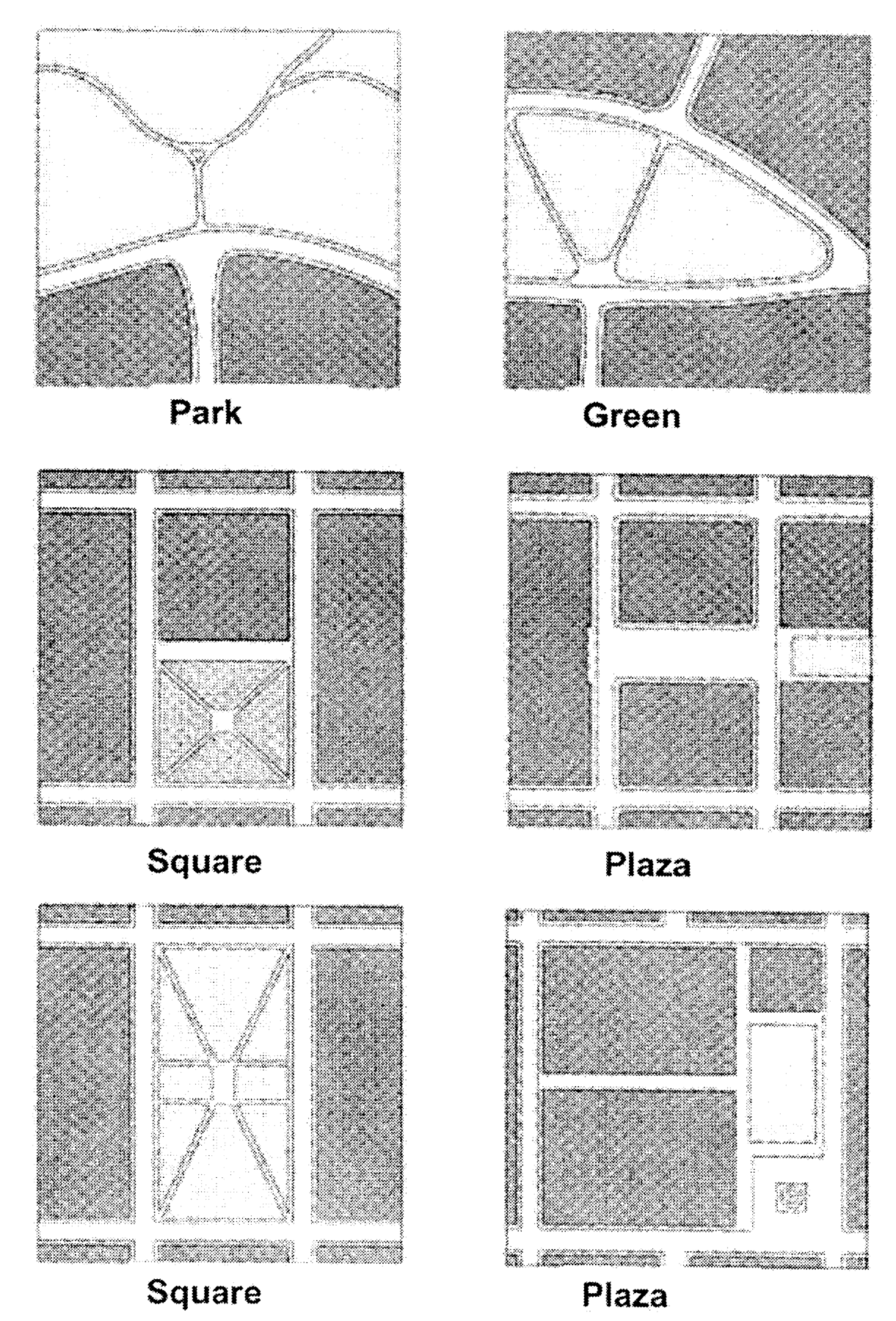
Civic Spaces
(2)
Civic spaces shall have a minimum of 50 percent of their frontage along a thoroughfare excluding alleys, lanes and paths. All civic spaces must have a public street frontage.
(3)
To the greatest extent possible, housing units shall be within one-quarter mile of a civic space.
(4)
Each residential TND-R or TND-POD district shall contain at least one civic space designed and improved as a plaza, square, green, or park. A minimum of ten percent of developed area shall be in civic space.
(5)
Each Main Street TND-MS district shall contain at least one civic space designed and improved as a plaza, square, green, preserve, or park. A minimum of five percent of developed area shall be in civic space.
(6)
At least one civic space within the TND-R or TND-POD districts shall be furnished with play equipment for children.
(Ord. No. 44-2004, 10-25-2004; Ord. No. 05-2013, § 17, 2-25-2013)
Sec. 102-809. - Architectural standards.
(a)
Purpose. The purpose of architectural standards is to guide the desired character of individual buildings. Architectural standards are intended to create harmony among buildings and the street designs; promote durability of materials; and promote human scale design.
(b)
General architectural standards.
(1)
Exterior building wall materials may be combined on each facade only horizontally, with the heavier (i.e., brick or stone) generally below the lighter.
(2)
Windows shall use clear glass panels.
(3)
All openings including porches, galleries, arcades and windows, with the exception of storefronts, shall be square or vertical in proportion.
(4)
Openings above the first story shall not exceed 50 percent of the total building wall area, with each facade being calculated independently.
(5)
The facades on retail frontages shall be detailed as storefronts and glazed no less than 50 percent of the sidewalk-level story.
(6)
Doors and windows that operate as sliders are prohibited along frontages.
(7)
Pitched roofs, if provided, shall be symmetrically sloped no less than 5:12, except that porches may be attached sheds with slopes no less than 2:12.
(8)
Flat roofs shall be enclosed by parapets a minimum of 42 inches high, or as required to conceal mechanical equipment to the satisfaction of the City.
(Ord. No. 44-2004, 10-25-2004; Ord. No. 9-2015, § 1, 3-23-2015)
Sec. 102-810. - Building type and lots standards.
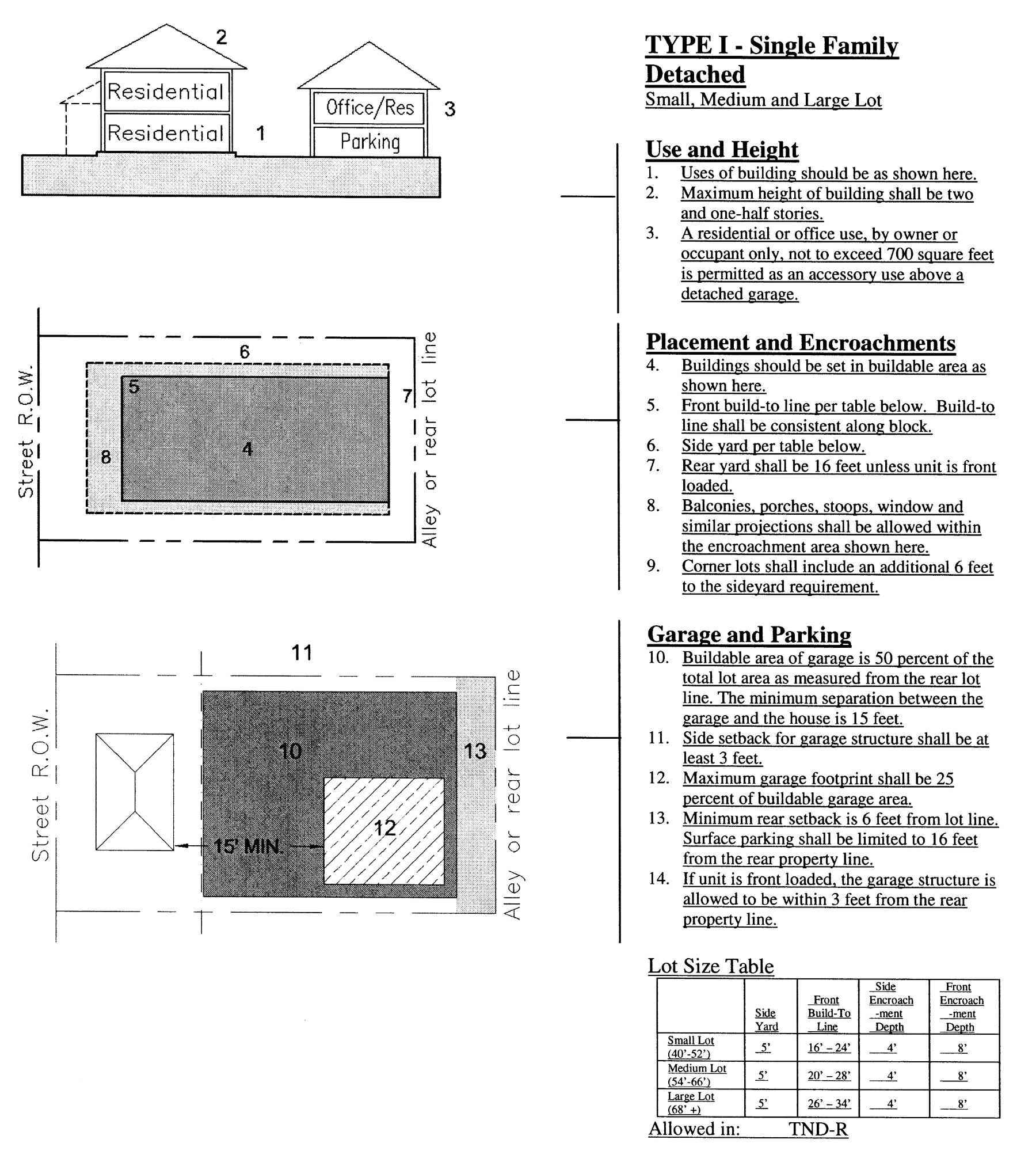
Type I—Single-Family Detached
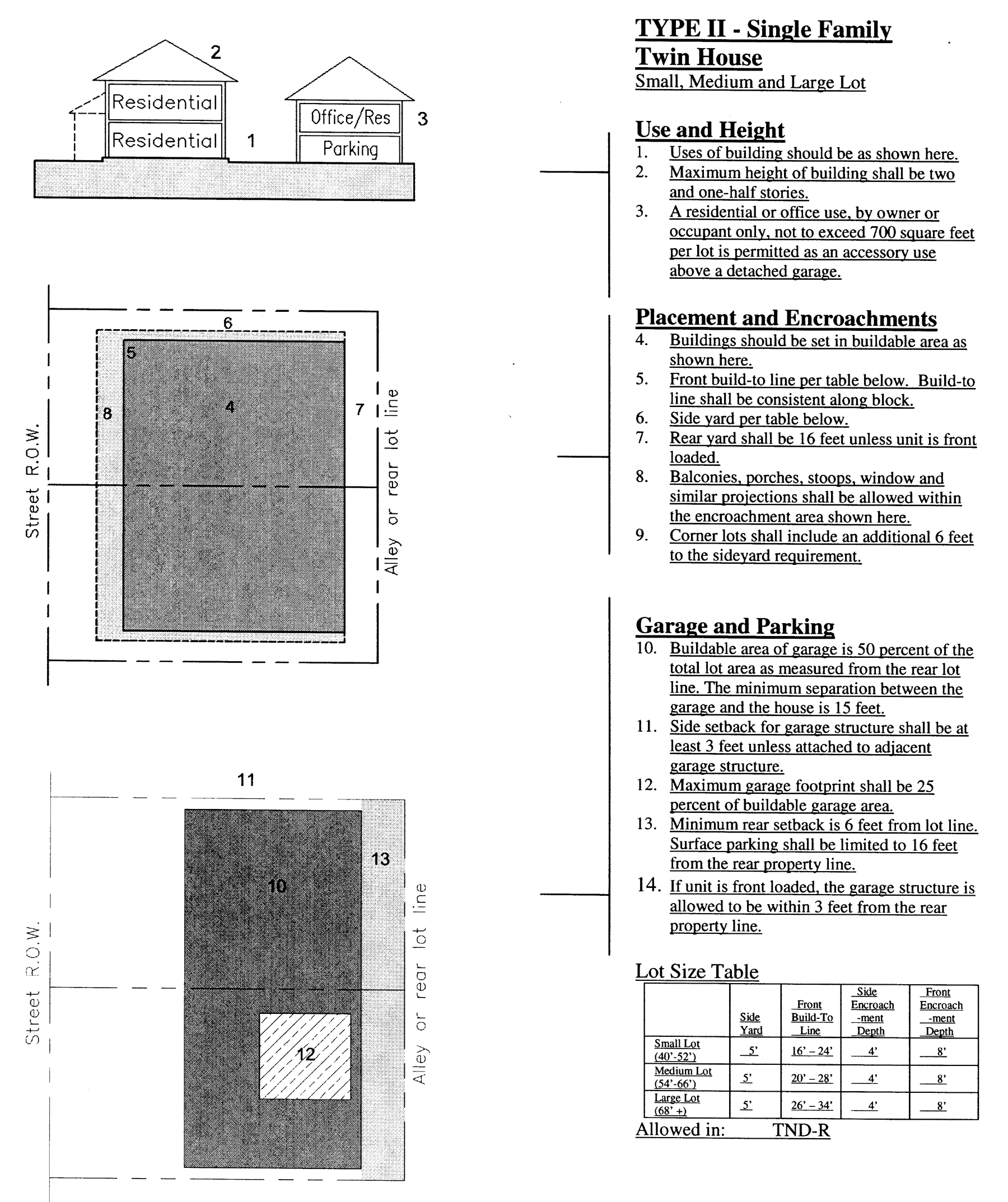
Type II—Single Family Twin House
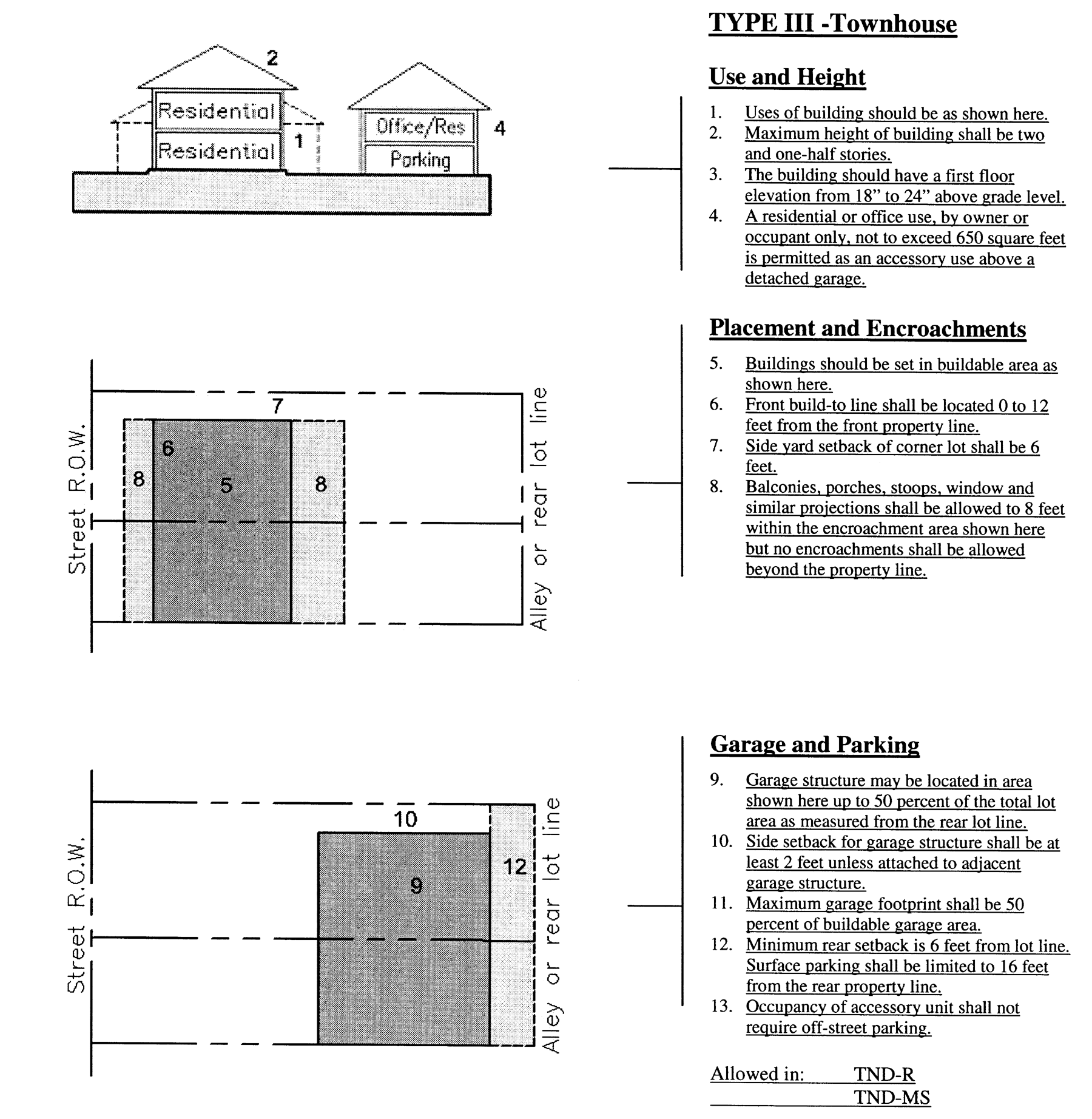
Type III—Townhome
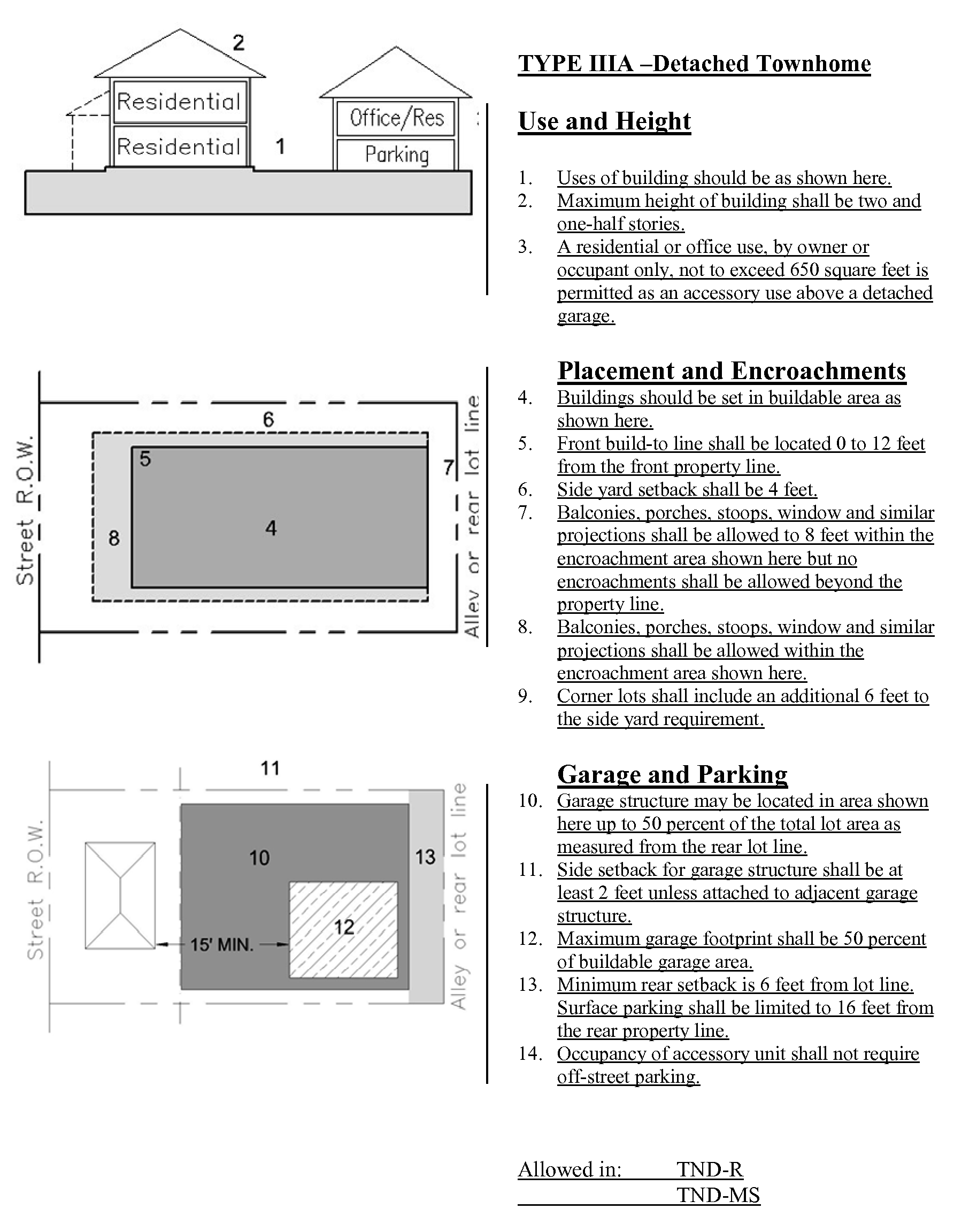
Type IIIA—Detached Townhome
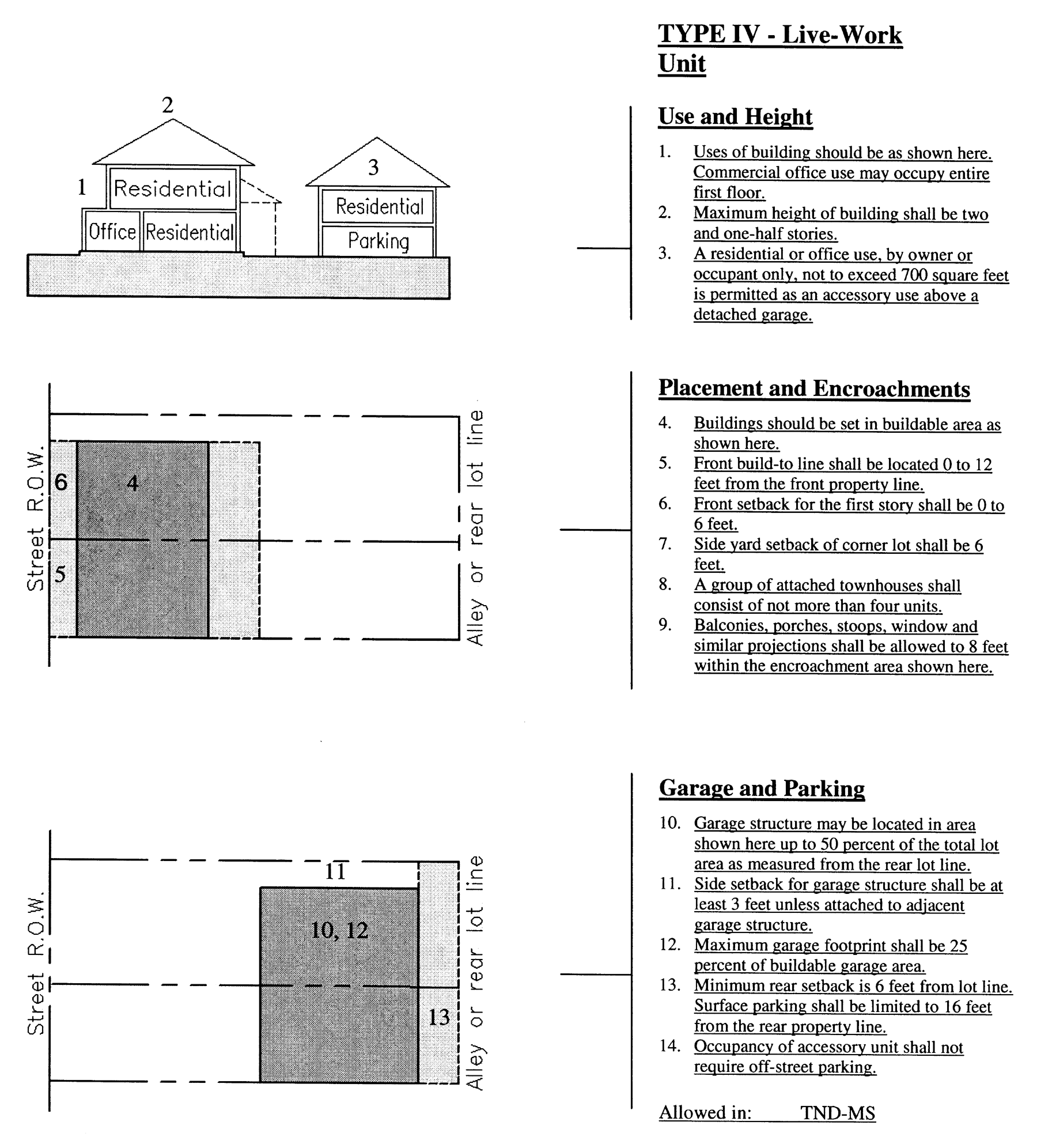
Type IV—Live-Work Unit
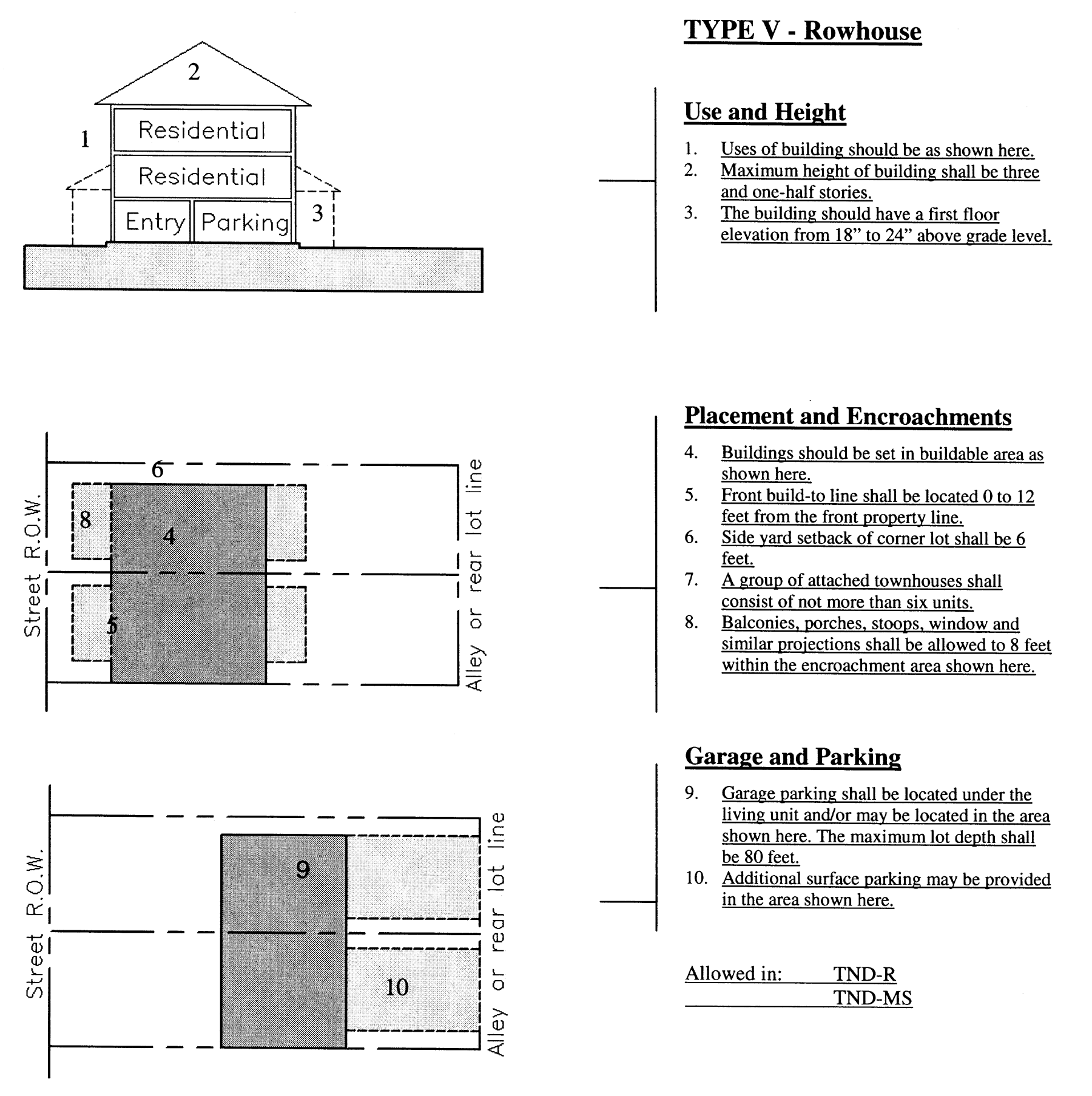
Type V—Rowhouse
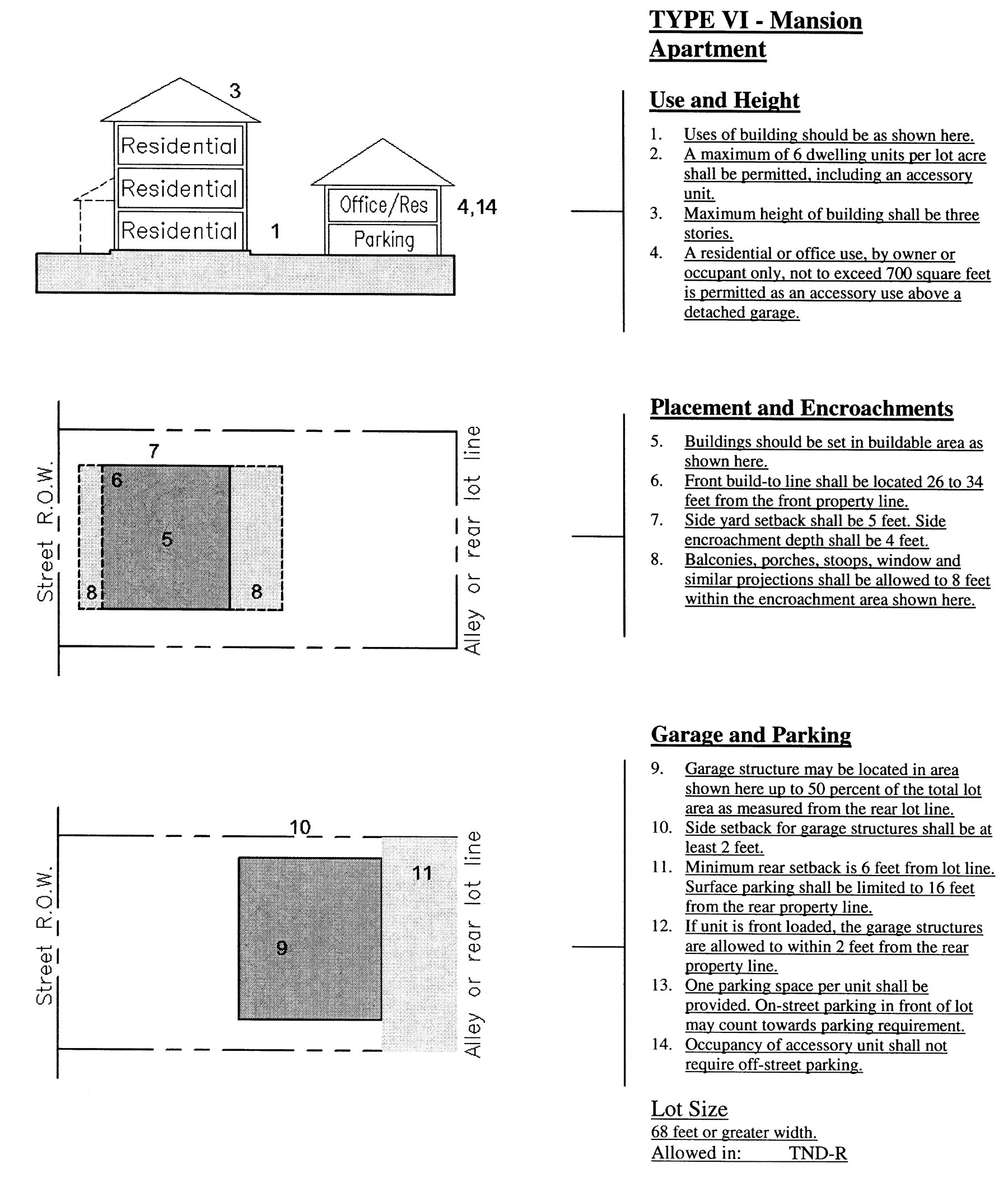
Type VI—Mansion Apartment
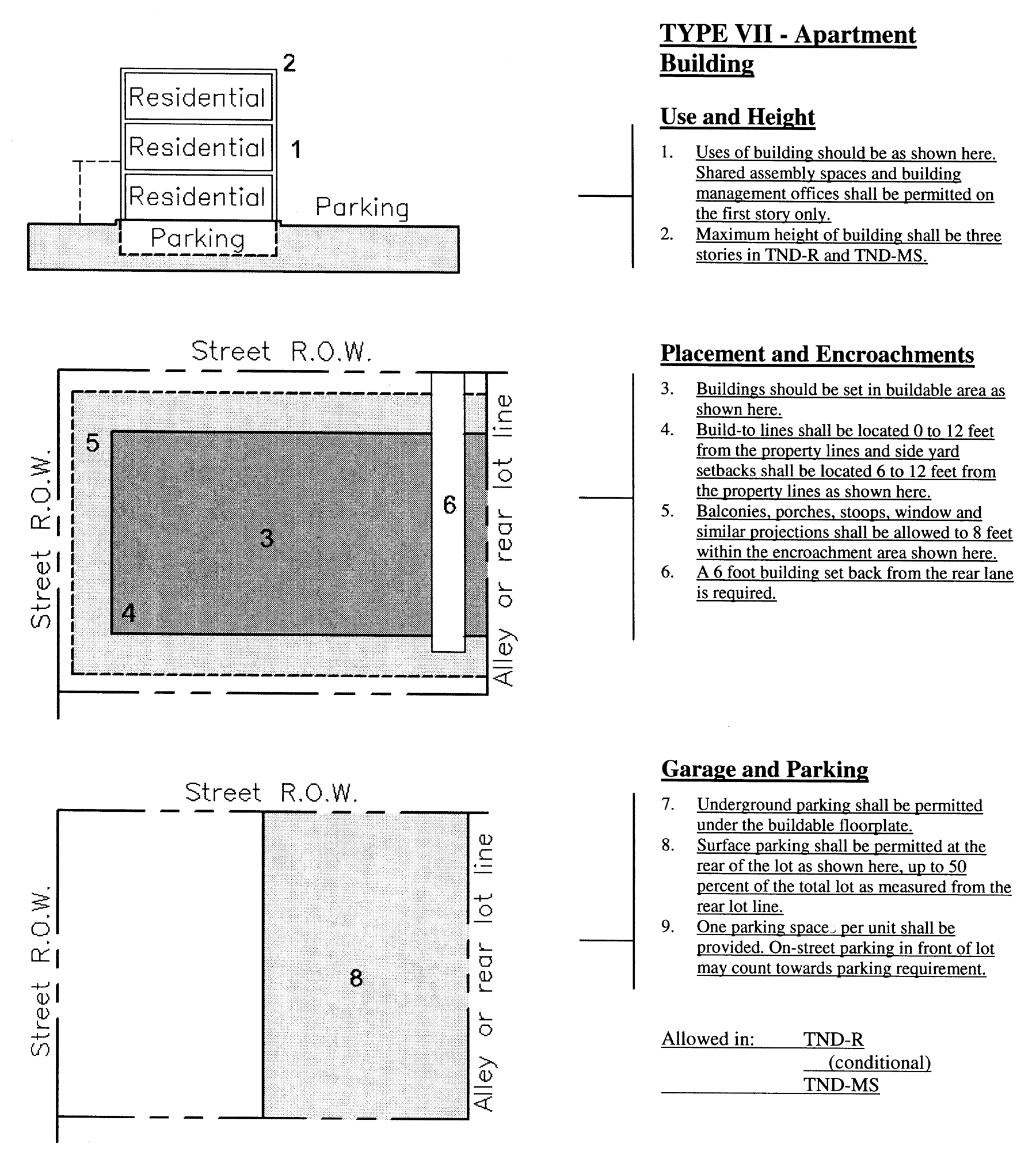
Type VII—Apartment Building
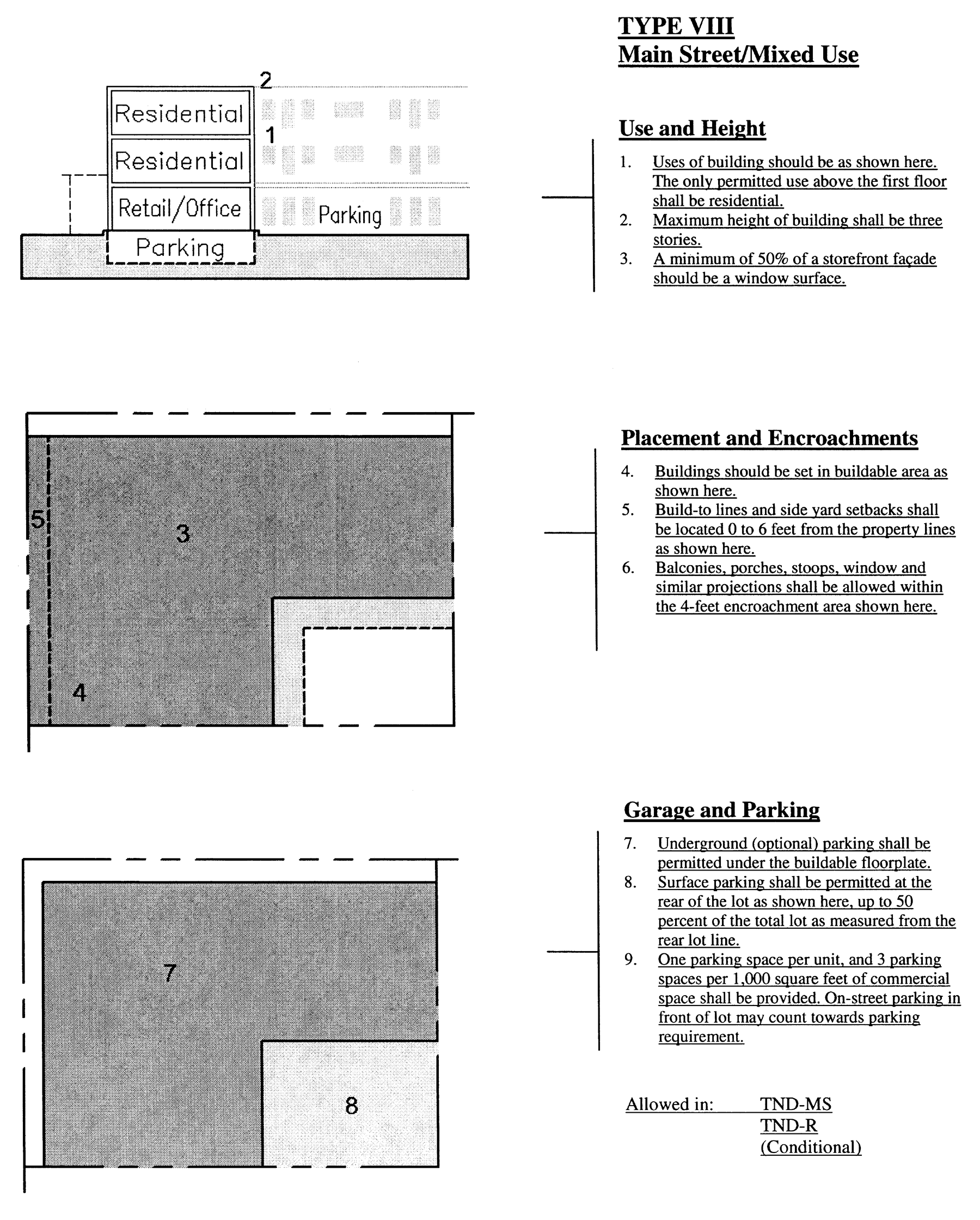
Type VIII—Main Street/Mixed Use
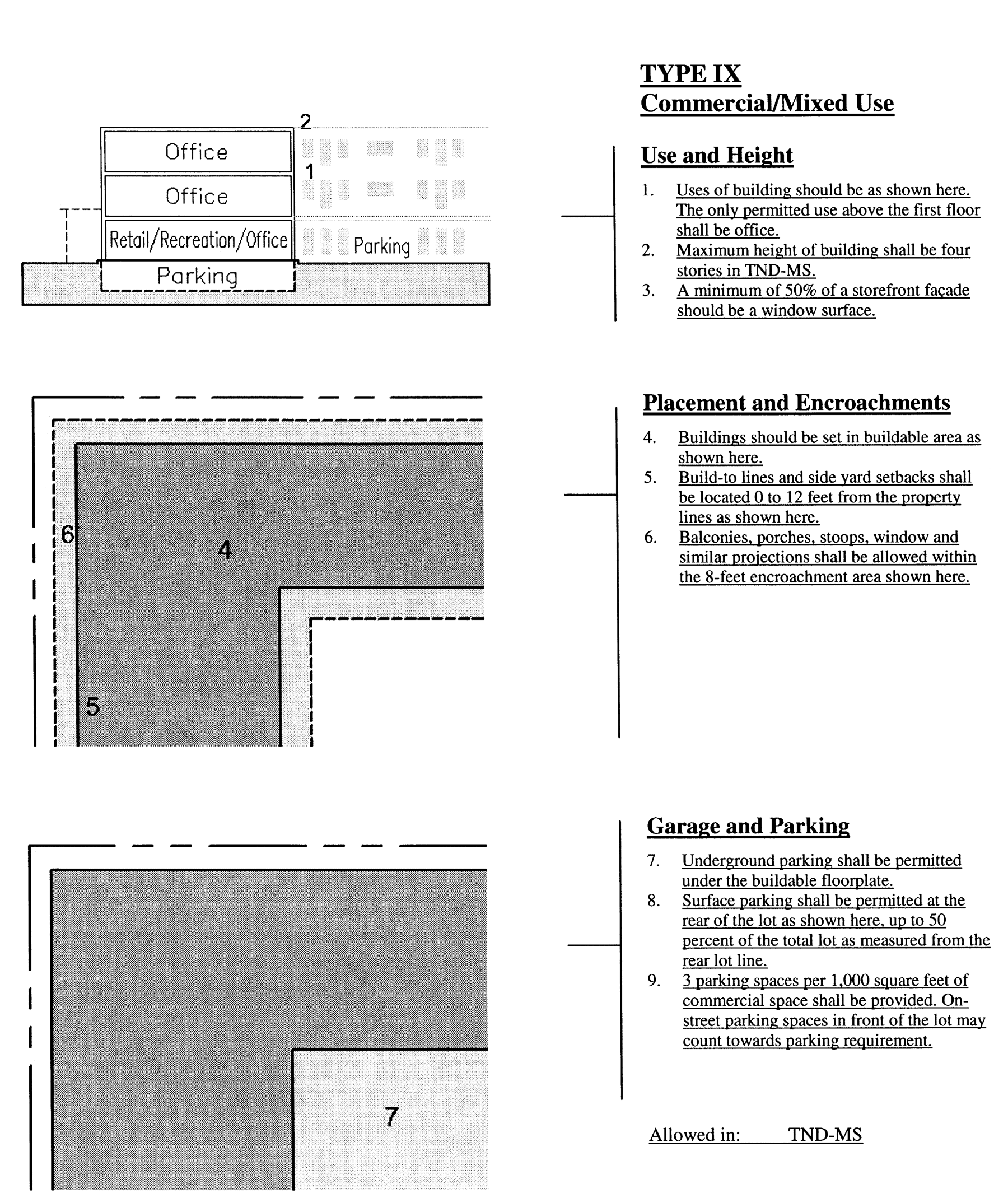
Type IX—Commercial/Mixed Use
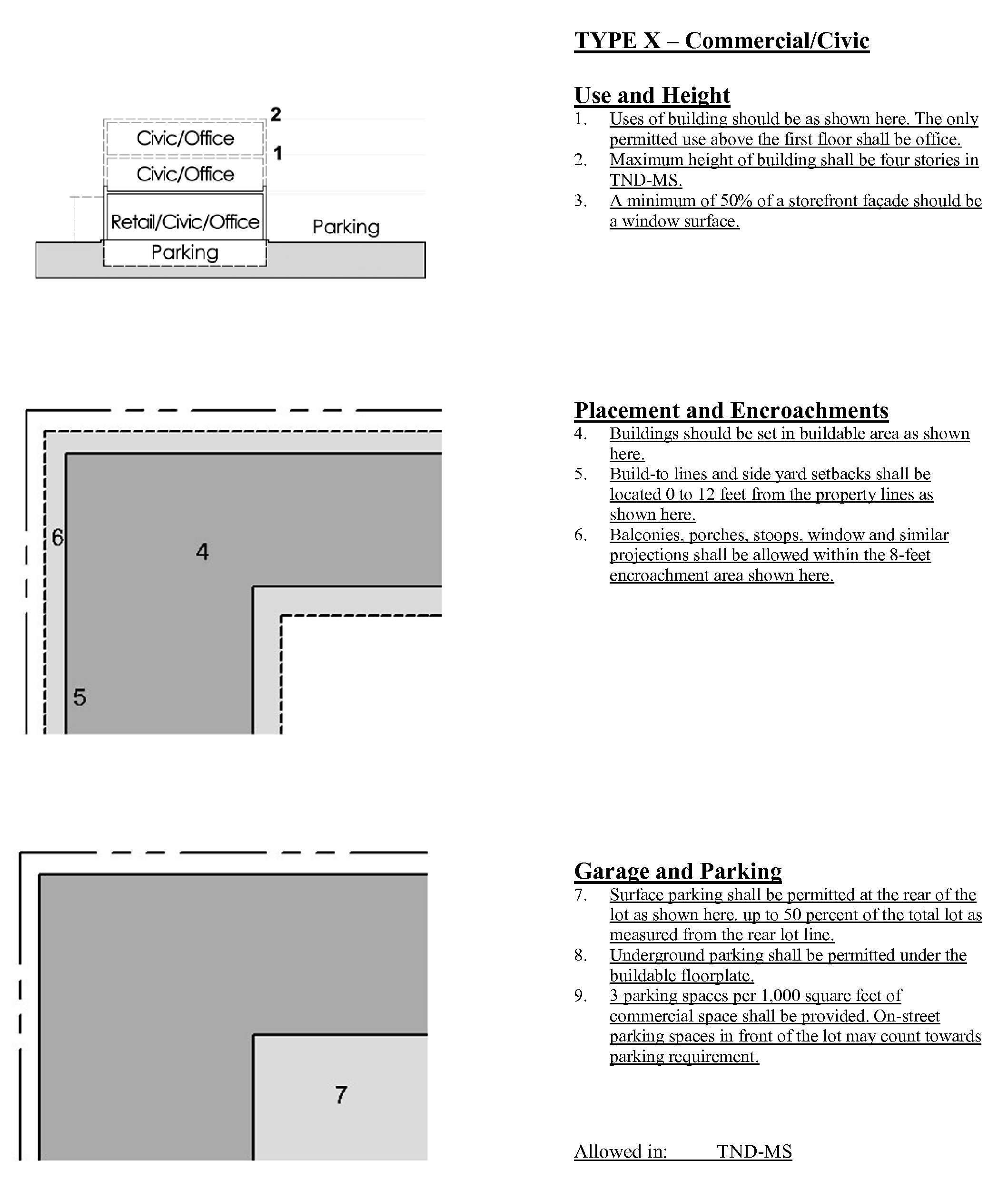
Type X—Commercial/Civic
(Ord. No. 44-2004, 10-25-2004; Ord. No. 9-2015, § 1, 3-23-2015)
Sec. 102-825.- Purpose.
The C-1C zoning district is intended for areas adjacent to residential zoning or uses, where professional offices, limited low-impact commercial uses, and residential uses are appropriate. Due to the close proximity to residential areas, uses within the C-1C zoning district are intended to generate little off-site noise, have minimal traffic impacts, and have limited hours of operations.
(Ord. No. 23-2005, § 1, 8-22-2005)
Sec. 102-826. - Uses permitted.
In the C-1C neighborhood business district, all uses shall be done within a completely enclosed building, and no building or premises shall be used, and no building shall be erected or structurally altered which is arranged, intended or designed to be used for other than one or more of the following uses:
(1)
Any use permitted in the R-2 multiple-family dwelling district, except boardinghouses, lodging houses, guesthouses, tourist homes, private clubs or lodges, hotels, motels, and mobile home parks, which are specifically prohibited, and nursing and convalescent homes being permitted only to the extent the construction, maintenance and operation thereof shall be in accordance with the rules and regulations of the state department of health and the state division of hotels and restaurant, department of business and professional regulation, as such may be applicable thereto. Restaurants shall only be permitted in accordance with subsection (5) herein.
(2)
Barbershops and beauty shops.
(3)
Funeral homes.
(4)
Real estate, insurance, law offices and other professional offices.
(5)
Sit-down restaurants designed and operated for the purposes of serving meals with a maximum total seating capacity of 50 seats. Fast-food, drive-through restaurants shall not be allowed; however, telephone-order pick-up windows are permitted. For purposes of this section, "fast-food, drive through restaurant" means an establishment whose principal business is the sale of the previously prepared or rapidly prepared food directly to the customer in a ready-to-consume state, and which has one or more drive-by service points for taking orders, receiving payment and delivering food. The terms "telephone-order pick-up window" means a service point where one may drive up to a restaurant to pay for and receive a food order which has been placed in advance from other than the restaurant itself; provided that the pick up window shall not have an exterior menu board or remote order request equipment.
(Ord. No. 23-2005, § 1, 8-22-2005)
Sec. 102-827. - Building site area; yards.
In the C-1C neighborhood business district, building site area and front, side and rear yards shall be the same as for the C-1A neighborhood business district.
(Ord. No. 23-2005, § 1, 8-22-2005)
Sec. 102-828. - Off-street parking.
In the C-1C neighborhood business district, off-street parking shall be in accordance with division 11 of article VII of this Chapter.
(Ord. No. 23-2005, § 1, 8-22-2005)
Sec. 102-829. - Buffering and landscaping.
In the C-1C neighborhood business district, buffering and landscaping shall be in accordance with division 10 of article VII of this Chapter.
(Ord. No. 23-2005, § 1, 8-22-2005)
Sec. 102-830. - Building height.
In the C-1C neighborhood business district, the maximum building height shall be 45 feet.
(Ord. No. 23-2005, § 1, 8-22-2005)
Sec. 102-831. - Hours of operation.
No commercial use shall be open for operation prior to 8:00 a.m. or after 11:00 p.m., except daycare centers which may open as early as 6:00 a.m.
(Ord. No. 23-2005, § 1, 8-22-2005)
Sec. 102-846.- Intent.
The Laura Street Restoration overlay district, with its associated standards and regulations, is established to encourage development and ensure architecturally appealing design, with traditional residential features and adequate open space.
(Ord. No. 42-2005, § 2, 10-24-2005; Ord. No. 2-2009, § 1, 1-12-2009)
Sec. 102-847. - Establishment of district.
The Laura Street Restoration overlay district is hereby established with the following boundaries:
North boundary—East/west CSX railroad right-of-way;
South boundary—Alabama Street;
East boundary—Maryland Avenue;
West boundary— North/south CSX railroad right-of-way.
(Ord. No. 42-2005, § 2, 10-24-2005)
Sec. 102-848. - Allowance for small lots.
(a)
Notwithstanding sections 102-227 and 102-267, a residential lot of record as of January 1, 2000, with an area of less than 6,000 square feet, but not less than 4,000 square feet, shall be allowed to be developed as a single-family residence.
(b)
Lots which meet the requirements of subsection (a) herein, shall be required to have the following minimum lot sizes, setbacks, yards and building area, notwithstanding sections 102-227 and 102-267:
(1)
Minimum Lot width. The minimum lot width is 40 feet.
(2)
Setbacks. Front, rear and side yard setbacks shall be provided as follows:
a.
Front yard. There shall be a front yard of not less than 15 feet measured from the right-of-way line to the front wall of the main building.
b.
Rear yard. There shall be a rear yard not less than 15 feet in depth.
c.
Side yard. There shall be a side yard on each side of the main building of not less than seven feet, except that any side yard abutting on a street shall have a minimum width of ten feet measured from the right-of-way line.
(3)
Minimum building area. The floor area of dwelling structures, exclusive of garages shall be a minimum of 1,000 square feet.
(4)
Maximum building site area. Not more than 35 percent of the area of a lot shall be occupied by the main structure and its accessory buildings.
(Ord. No. 42-2005, § 2, 10-24-2005; Ord. No. 2-2009, § 2, 1-12-2009)
Sec. 102-849. - Design standards.
All single-family homes and duplexes shall be built in accordance with the following design standards:
(1)
Roofline. A roof pitch of at least four inches of height for each linear foot of roof shall be required for all single-family and duplexes (4:12 pitch, rise/run). The minimum roofline variation length shall be four feet for dormers and eight feet for all other types of variations.
(2)
Front porch. Each dwelling unit shall be have a covered front porch of a minimum of 60 square feet in size.
(3)
Building design. Single-family dwellings and duplex dwelling units shall utilize at least three of the following design features:
a.
Dormers.
b.
Recessed entries.
c.
Cupolas.
d.
Bay windows.
e.
Attached garage in line with or does not protrude more than five feet from the front wall.
f.
Window shutters.
g.
Tile, shake roof, architectural, laminated, shadowed or shaped shingles.
h.
Exterior window treatment at least four inches in width.
i.
Horizontal lap or shingle shake siding material.
j.
Brick or stucco exterior siding or veneer.
k.
Decorative columns.
l.
Rollup garage doors with decorative window treatments or raised panels.
(4)
Design requirements when visible from public right-of-way. All sides of buildings, where visible from public right-of-way, shall include design characteristics and materials consistent with those on the front primary facade of the building.
(5)
Snout houses. Snout houses are prohibited.
(6)
Minimum building area. Except for buildings subject to section 102-848 above, the floor area of the dwelling structures, exclusive of garages, shall be a minimum of 1,400 square feet.
(Ord. No. 42-2005, § 2, 10-24-2005; Ord. No. 2-2009, § 3, 1-12-2009)
Sec. 102-850.- Intent.
These regulations of the Midtown District are intended to promote the development and redevelopment of parcels within the Midtown District to ensure its future redevelopment achieves the adopted vision and guiding principles that were formulated for this area by the City as articulated in the Midtown Redevelopment Vision Plan.
(Ord. No. 31-2013, § 2, 12-9-2013; Ord. No. 52-2021, § 1, 11-22-2021)
Sec. 102-851. - Definitions, word usage and abbreviations.
Definitions. The following terms and phrases, when used in this Division, shall have the meanings ascribed to them in this Section, except where the context clearly indicates a different meaning. Where a term is not listed below, the definition for the term shall be the same as provided in Section 102-801 or Section 102-3, as applicable.
Arcade. A series of arches supported by piers or columns.
Building, height of. The vertical distance measured from the level of the established grade to the highest roofline for flat roofs, and to the eaves for other roof types.
Building frontage. The dimension of a building measured parallel to the street line.
Build-to-line. The property adjacent to the street right-of-way. The precise horizontal distance from a street that the front of all primary structures must be built to, in order to create a uniform line of buildings along a street. Build-to-lines apply to all Midtown District streets north of Alabama Street.
Build-to-zone. The area between the maximum setback, and the edge of sidewalk, if any.
Civic building. A building serving a civic use and that is open to citizens for public functions.
Civic uses. Uses intended to serve as public places. Such uses include governmental offices, churches or other places of worship, schools, post offices, and non-profit or charitable clubs and organizations.
Classical orders. Typically, the Greek orders of Doric, Ionic and Corinthian detailing for columns and beams.
Clerestory window. In commercial storefronts, a series of windows above a flat roof canopy that provides natural light to the interior of first floor spaces.
Colonnade. A structure composed of columns placed at regular intervals.
Cornice. An ornamental band at the top of a parapet wall that typically steps outward in a series of moldings or other detailing.
Encroachment. Any portion of a structure or appurtenance extending beyond a designated zoning setback, easement, build-to-zone, property line, or public right-of-way.
Entasis. The slight convex curvature of the shaft of a column from larger at the bottom to narrower at the top.
Facade. The vertical surface of a building which is set along a frontage line. The elevation of a facade is the vertical surface area.
Infill structure. A new building constructed between two existing buildings.
Paling. A flat wood baluster, typically 6" wide with ornamental sawn edges, symmetrical along the vertical center line.
Parapet. The extension of an exterior or perimeter wall of a building beyond the roofline.
Pilaster. A column that is not free standing, as if partially engaged in the wall surface.
Redevelopment. Building development on a parcel after the complete or partial demolition of an existing structure.
(Ord. No. 31-2013, § 2, 12-9-2013; Ord. No. 52-2021, § 1, 11-22-2021)
Sec. 102-852. - Regulating Street plan.
(a)
The Midtown District is planned as a single unit, but it is not treated homogenously throughout. Instead, each street within the district is classified as one of three street types. The allowable uses are determined by the street classification.
(b)
The regulating street plan is depicted as follows:
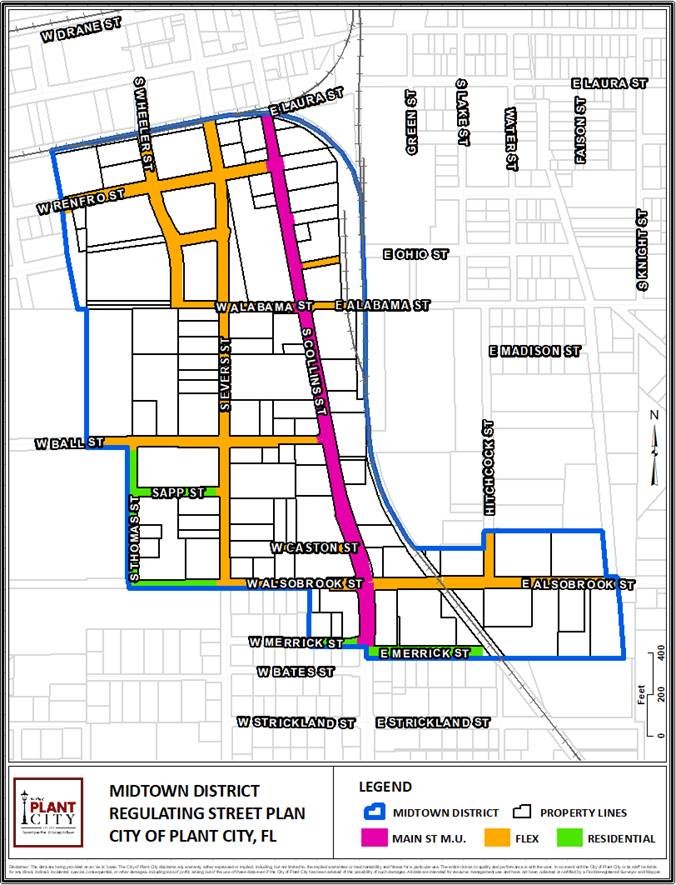
(c)
The three types of streets and applicable uses within the district are described as follows:
(1)
Main streets mixed-use. Main streets mixed-use allows buildings designed entirely for nonresidential use; or mixed-use buildings with ground story nonresidential use and upper story residential use.
(2)
Flex streets. Flex streets allow buildings designed entirely for nonresidential use, entirely for residential use, or a mix of both.
(3)
Residential streets. Residential streets allow buildings devoted only to residential use.
(Ord. No. 31-2013, § 2, 12-9-2013; Ord. No. 52-2021, § 1, 11-22-2021)
Sec. 102-853. - General nonresidential and mixed-use development standards.
(a)
The standards of this Section apply to nonresidential and mixed-use development, which are permitted on the following street types:
(1)
Main Streets mixed-use (nonresidential single-use or mixed-use).
(2)
Flex Street (nonresidential single-use or mixed-use).
(b)
Maximum Front Setback. All nonresidential and mixed-use buldings shall be placed at the edge of sidewalk, except where the City Commission finds that there are opportunities to allow for the breakup of facades, architectural variety, or usable ourdoor spaces and in such circumstances, there shall be a maximum front setback of ten feet.
(c)
Side and rear yards. Street facing building facades shall extend the full width of the lot along such streets, except for driveways, pedestrian access or placemaking features. Accordingly, there are no minimum side yard requirements. Rear yard setbacks are generally not required, except as needed to provide adequate clearance from any rear alley. These standards may be reduced as necessary to accommodate driveway access to rear yard parking or for pedestrian access or placemaking features.
(d)
Street wall required. A street wall shall be erected adjacent to the sidewalk wherever a street side yard is provided. In lieu of a street wall, the City may allow a landscaped area, including a pocket park, at least 30 feet in depth measured from the street line.
(e)
In mixed-use buildings, nonresidential use shall not be located on any story above residential use.
(f)
Facade. The ground story facade facing the street shall be a shopfront with an entrance at-grade. Standards for architectural design are detailed in the architectural standards set forth in Section 102-862.
(g)
Accessibility standards. Public entrances shall be provided from public sidewalks at sidewalk grade and shall meet all requirements of the ADA, as amended.
(h)
Corner frontage treatment. Shopfronts on corner lots shall be continued around to the corner street side of the building for a distance of at least 30 feet.
(i)
Height. Maximum height shall be 60 feet.
(j)
Width. Buildings must be built for at least 70 percent of the width of the lot. The intent of this standard is to ensure that gaps between buildings are minimized, so as to provide a continuous building wall that frames the street and provides maximum interest for pedestrians. This standard may be reduced as necessary to accommodate driveway access to rear yard parking or for pedestrian access or placemaking features.
(Ord. No. 31-2013, § 2, 12-9-2013; Ord. No. 52-2021, § 1, 11-22-2021)
Sec. 102-854. - General residential development standards.
(a)
The standards of this Section apply to residential buildings which are permitted on the following street types:
(1)
Flex Street.
(2)
Residential Street.
(b)
Maximum Front Setback. All residential only buildings shall be placed at the edge of sidewalk, except where the City Commission finds that there are opportunities to allow for the breakup of facades, architectural variety, or usable outdoor spaces and in such circumstances, there shall be a maximum front setback of ten feet. The intent of this standard is to ensure that gaps between buildings are minimized, so as to provide a continuous building wall that frames the street and provides maximum interest for pedestrians. This standard may be reduced as necessary to accommodate driveway access to rear yard parking and pedestrian access or placemaking features.
(c)
Side and rear yards. There are no minimum side or rear yard requirements.
(d)
Street walls. A street wall shall be erected adjacent to the sidewalk wherever a street side yard is provided. Townhouses are exempt from this requirement. In lieu of a street wall, the City may allow a landscaped area, including a pocket park, at least 30 feet in depth measured from the street line.
(e)
Access. Residential units fronting a street shall have an entrance onto the street in the form of either a raised-entrance stoop or at-grade dooryard (small front yard that is enclosed by a low fence), as described in the architectural standards.
(f)
Facade. Standards for fenestration and facade materials, as well as for projecting elements, such as balconies and stoops are set forth with Architectural Standards in Section 102-862.
(g)
Height. Maximum height shall be 60 feet for single-family attached or multi-family.
(h)
Width. Buildings must be built for at least 70 percent of the width of the lot. The intent of this standard is to ensure that gaps between buildings are minimized, so as to provide a continuous building wall that frames the street and provides maximum interest for pedestrians. This standard may be reduced as necessary to accommodate driveway access to rear yard parking or for pedestrian access or placemaking features.
(Ord. No. 31-2013, § 2, 12-9-2013; Ord. No. 52-2021, § 1, 11-22-2021)
Sec. 102-855. - Additional development standards.
(a)
Lot frontage. Development shall abut (front) a dedicated public street.
(b)
Fences, walls, street walls, generally. Fences are useful for separating uses, defining transitions from the public sidewalk to private property, guiding pedestrians to entrances, and screening unsightly views. Fences and walls are subject to the provisions of the code except as provided in the architectural standards of Section 102-862. The provisions of these architectural standards shall supersede those of the Plant City Code where there is conflict.
(c)
Screening. Dumpsters, utility boxes and machinery, including, but not limited to, backflow devices, electric meters, air conditioning units, and transformer boxes, shall not be visible from public rights-of-way, parks and other public spaces.
(d)
Mechanical equipment is not permitted along any street frontage. Mechanical equipment, loading areas, and trash dumpsters shall be screened from view from streets and properties with conforming residential use by any combination of intervening buildings and six-foot high masonry walls, provided that the City may require additional screening if necessary to obscure same from street view.
(e)
Provision of alleys. Alleys shall be provided, wherever practical, to provide access to off-street parking and rear access to residential lots. Alleys terminate at streets. Alleys may contain turns and intersections with other alleys and lanes, creating "L" or "H" shaped alleyways. Dead-end configurations shall not be allowed.
(f)
Provision for parking facilities. Such facilities shall adhere to the architectural standards of Section 102-862 to create appeal and compatibility in relation to size, scale, intensity/mass, and image of the parking garage structure which shall be compatible with adjacent buildings and with the context of the surrounding area.
(Ord. No. 31-2013, § 2, 12-9-2013; Ord. No. 52-2021, § 1, 11-22-2021)
Sec. 102-856. - Building type standards.
(a)
Frontage types. All building walls fronting on a primary street must be designed with a permitted facade frontage type showing design and entrance configuration. There are four frontage types permitted in Midtown:
(1)
Shopfront.
(2)
Stoop.
(3)
Dooryard.
(4)
Arcade (Colonnade).
(b)
Building types. Building types are coordinated with street types and uses per Section 102-861.
(Ord. No. 31-2013, § 2, 12-9-2013; Ord. No. 52-2021, § 1, 11-22-2021)
Sec. 102-857. - Civic buildings.
(a)
Civic building sites shall be placed within or adjacent to civic space (parks, greens, squares, and plazas). The civic space may be existing and adjacent to the parcel, or provided on the civic building site. In either case, the building and site shall be designed to compliment, frame and enhance the civic space.
(b)
Parking facilities for civic buildings shall be in accordance with Section 102-862.
(c)
Maximum permitted height is 60 feet, and minimum open space requirement is ten percent when adjacent to existing civic space, and 20 percent when not. At least 25 percent of the open space shall be pervious and landscaped. Other development standards for civic buildings shall be determined during the site plan review and approval process, based upon the specific site characteristics, adjacent development and civic space context, and the proposed use.
(Ord. No. 31-2013, § 2, 12-9-2013; Ord. No. 52-2021, § 1, 11-22-2021)
Sec. 102-858. - Development review procedures.
(a)
Pre-Application Conference. All applicants preparing to file an application for development within the Midtown District shall first attend a meeting with the Planning and Zoning Division to discuss and analyze the proposed application in a non-binding forum. A site development plan and supporting documents of implementation should clearly demonstrate the developers' understanding of the principles of the Midtown Redevelopment Vision Plan and Architectural Standards as they apply to a specific development or redevelopment site.
(b)
Application for Midtown Development Permit (MDP). The contents of an application for MDP shall be as provided in subsection 102-1380(b), except that such application shall include the following items:
(1)
A current survey of the parcel proposed for development;
(2)
A development table identifying uses and intensity and density of uses;
(3)
A location map showing all improvements within 100 feet of the parcel proposed for development;
(4)
An engineering scaled site plan with dimensions of all property boundaries and all existing or proposed improvements;
(5)
Elevations of all facades of proposed improvements;
(6)
An engineering scaled plan showing pedestrian facilities and amenities; and
(7)
If an Alternative Midtown Design is being proposed, a table showing required development standards in the Midtown District and any proposed alternative designs and a narrative justification with illustrations for each proposed alternative design.
(c)
Staff Review for Compliance. Within 30 days of receipt of an application, the City shall review the application and determine whether the application is complete and competent. In the event that the City determines that the application is incomplete or any portion of the application is not sufficiently competent for the review of the Midtown proposal, the City shall issue a Letter of Insufficiency to the applicant.
(d)
Additional Submission. Within 60 days of receipt of a Letter of Insufficiency, the applicant shall submit additional information to remedy the identified insufficiency, request in writing additional time to respond, advise the City in writing that the applicant does not wish to provide additional information, or withdraw in writing the application. If the City does not receive any written communication from the applicant within 60 days of receipt of Letter of Insufficiency, the application shall be deemed abandoned.
(e)
MDP Conforming with the Midtown District and Architectural Standards. When all insufficiencies are deemed remedied by the City, the applicant may proceed with the necessary site plan review process.
(f)
Notice of Commencement. Upon site plan review and approval by the City, the developer may commence with the construction permitting process.
(Ord. No. 31-2013, § 2, 12-9-2013; Ord. No. 52-2021, § 1, 11-22-2021)
Sec. 102-859. - Application for Alternative Midtown Design ("AMD").
(a)
The purpose of this section is to provide for review and approval of redevelopment projects that do not strictly comply with one or more of the development standards set out in the Midtown District. The City recognizes that the prescriptive nature of the development standards in the Midtown District represents an assured way that the redevelopment of Midtown will be in accordance with the principles of traditional neighborhood development and the Midtown Redevelopment Vision Plan. The City also recognizes that a key element of place making is innovation and individuality and that there may be alternative designs which would also serve those principles and to the extent that an applicant can demonstrate that an alternative design is equal to or better than that which would be achieved through strict compliance with the development standards in the Midtown District, this Section provides an opportunity for an applicant to seek approval for an AMD.
(1)
Alternative Midtown Design. A developer who proposes an Alternative Midtown Design shall prepare a schematic design of the proposed Alternative Midtown Design and submit the schematic design to the City at least ten days prior to a required pre-application meeting. The schematic design shall be accompanied by a written narrative describing the deviations from the development standards in the Midtown District, including a table comparing "required" and "proposed" for each deviation from the development standards which is proposed. The schematic design shall include plan view and cross-sections of proposed deviations in the form of illustrations of development standards in the Midtown District.
(2)
Alternative Midtown Design Standards of Review. An application for approval of an Alternative Midtown Design shall be reviewed on the basis of the extent to which the proposed Alternative Midtown Design:
a.
Promotes and achieves the goals and objectives of the Midtown Redevelopment Vision Plan and is consistent with and furthers and promotes the principles of traditional neighborhood;
b.
Contributes to an overall sense of place in Midtown District to the same or greater extent that would be achieved through strict compliance with the development standards in the Midtown District;
c.
Contributes to the enhancement of the distinctiveness of the Midtown District in the sub-region;
d.
Contributes to an attractive day/night environment where people feel safe;
e.
Promotes an attractive pedestrian experience which is accessible by persons of all ages and degrees of mobility;
f.
Contributes to a downtown that is attractive and enjoyable to people of all interests and backgrounds; and
g.
Promotes active and successful businesses in the Midtown District.
(3)
Review and Approval. The Alternative Design Application and supporting material shall be submitted to the City pursuant to the Development Review Procedures of Section 102-858. When the application has been determined to be sufficient by the City, staff shall prepare a written report and recommendation to the Plant City Planning Board. The Planning Board shall consider the Alternative Design Application at a duly noticed public hearing and make a recommendation to the City Commission whether to approve, approve with conditions or deny the application.
(4)
In the event that the requested Alternative Design is denied, the City shall identify any changes in the application which would make the requested Alternative Design acceptable and the applicant will have 30 days to address the changes.
(5)
Once the Alternative Design Application is approved by the City Commission, the applicant may proceed to the site plan review process.
(Ord. No. 31-2013, § 2, 12-9-2013; Ord. No. 52-2021, § 1, 11-22-2021)
Sec. 102-860. - Improvements and dedications required.
In addition to the following standards, utilities and easements shall be subject to the provisions of Chapter 74, Plant City Code:
(a)
Easements for public utilities and enclosed or open drainage ways shall be retained in the widths and locations deemed necessary by the City. To the extent practicable, easements for water, wastewater, reclaimed water lines, and storm sewers shall be located in the street rights-of-way, and the easements for all other utilities should be located in the rear lane (alleys) rights-of-way or at the rear lot line. All easements shall be dedicated to public use for the named purpose and shall be aligned to minimize construction cost.
(b)
Right-of-way shall be dedicated, if deemed necessary to implement the Midtown Vision Plan, prior to plat recordation, site plan approval, or building permit issuance.
(c)
The developer shall be responsible for relocating all utilities underground, or make equivalent payment to the City to be deposited in an account designated specifically for underground utility relocation.
(d)
Stormwater treatment and disposal shall be managed in accordance with the Midtown Stormwater Master Plan, as approved by the Southwest Florida Water Management District.
(e)
Street furniture, including, but not limited to, benches, transit shelters, waste bins, bike racks or lockers located within the City owned right-of-way shall be of a uniform style within Midtown, as specified and approved by the City.
(Ord. No. 31-2013, § 2, 12-9-2013; Ord. No. 52-2021, § 1, 11-22-2021)
Sec. 102-861. - Use regulations.
(a)
Uses. The table in subsection (d) herein lists uses that are permitted (P), permitted conditionally (C) upon the approval of the Planning Board pursuant to Article II, Section 102-126, or not permitted (NP). Any use not listed in this schedule is prohibited.
(b)
Combination of uses. Mixing of residential and nonresidential uses within the same building is encouraged in any location where both use types are permitted.
(1)
Compatible integration shall ensure, at a minimum, that residential uses are not facing, proximate to or accessed through nonresidential loading areas.
(2)
All buildings within the development share one harmonious architectural style.
(3)
Nonresidential uses within separate buildings on the same lot as residential uses shall be limited to those uses that can also be integrated compatibly within the same development.
(4)
Building separations and landscape buffers within a lot, where residential use is located in separate building(s) from the nonresidential use(s) but integrated into the overall development, shall be determined based upon the design of the proposed development as reflected in a master plan or site plan, as appropriate.
(c)
Outdoor Uses. Except for uses permitted outside of a building within C-1A zoning district, all uses shall be conducted within an enclosed building.
(d)
Table. The uses which are permitted, not permitted and conditionally permitted within the Midtown district and applicable street frontage and building types are as follows:
(Ord. No. 31-2013, § 2, 12-9-2013; Ord. No. 52-2021, § 1, 11-22-2021)
Sec. 102-862. - Midtown Architectural Standards.
(a)
Purpose. The purpose of the Midtown Architectural Standards is to establish minimum architectural design standards within the Midtown District to ensure its future redevelopment achieves the adopted vision and guiding principles as articulated in the Midtown Redevelopment Vision Plan.
The primary emphasis on new construction will be the design and appearance of buildings from the street view. The following lists of acceptable materials and design appearances are intended for all street-facing facades. Acceptable materials listed within these standards are the target for the aesthetic street-facing appearance, or at a minimum have the appearance of the acceptable material. For example, a facade comprised of brick or stone may be comprised of a brick or stone veneer. A fiberglass door designed and painted to look like a wood door is acceptable as well.
(b)
Applicability. The provisions of these architectural and design standards shall apply to all new and redevelopment projects within the Midtown District. The design elements of each of these proposed projects will be reviewed comprehensively to ensure they further comply with each of the provisions as articulated in the Midtown Architectural Standards. From time to time, the City may need to interpret these design standards, allowing for some flexibility in their application for a specific project to ensure the overall community vision is achieved for Midtown. These standards will be utilized during the City's permit review process to encourage the highest level of design quality, while at the same time providing the flexibility necessary to encourage creativity on the part of the project designers and not to inhibit the overall redevelopment of Midtown. The overall objective is to ensure that the intent and spirit of the standards are followed ensuring the overall vision for Midtown is achieved and for this area to become an important asset for the City of Plant City.
(c)
Standards.
(1)
Building Composition.
a.
The building base shall be the visual anchor the building, establishing a strong connection to the ground and the site. The base of the building shall appear more massive than the upper stories. Building details and public art elements are encouraged to provide visual interest and a sense of discovery.
b.
The architectural treatment of buildings and structures and their materials, textures and colors shall be visually harmonious with existing buildings and structures, and surrounding development, and shall enhance the appearance of the area.
c.
The color of all building elevations (front facade, side, and rear) shall be low reflectance, subtle, neutral or earth tones. The use of high-intensity, saturated colors (such as one or more of the "primary" and/or "secondary" colors), metallic colors, florescent colors, or black, shall be limited to trim or accent features. Exposed metal flashing or trim shall be anodized or painted to blend with the exterior colors of the building.
d.
Deep eaves, overhangs, canopies, and other architectural features that provide shelter and shade are encouraged.
e.
Adjacent buildings shall be compatible in height and scale, yet it is best if buildings side-by-side vary slightly in height.
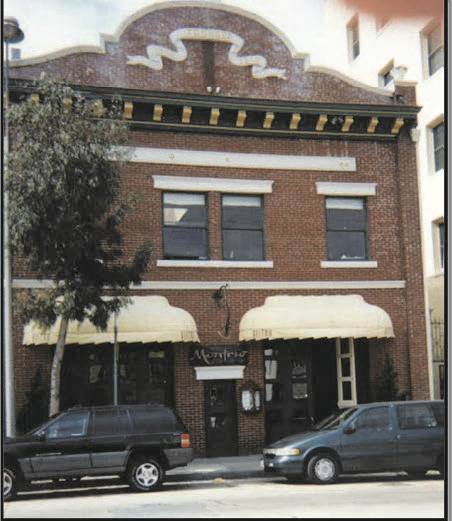 | 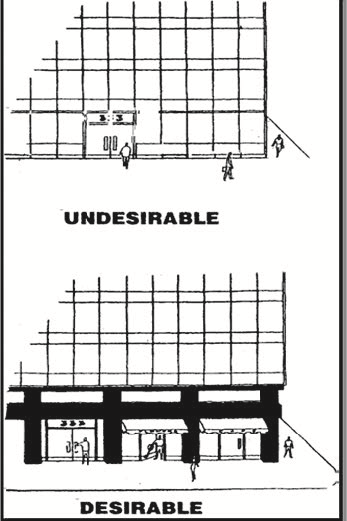 |
f.
Efforts shall be made to graduate the physical mass of a building consisting of three stories or more by using the proportions of a step. Stepping the upper levels of tall buildings back from the street will make the building seem less imposing to the pedestrian.
Examples of Building Massing in Scale with Existing Buildings
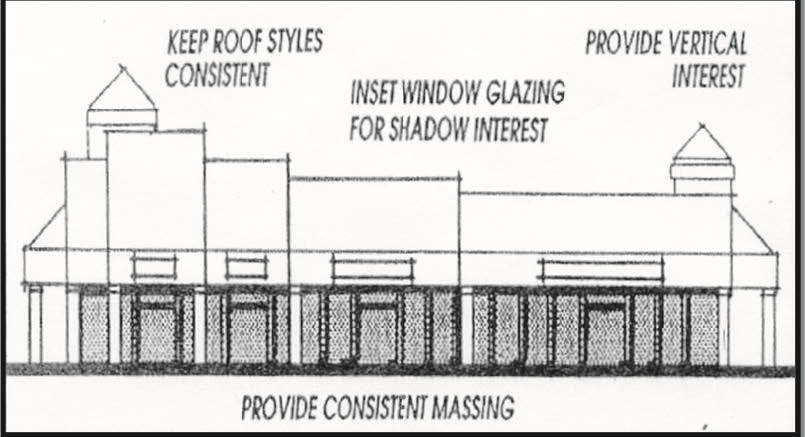
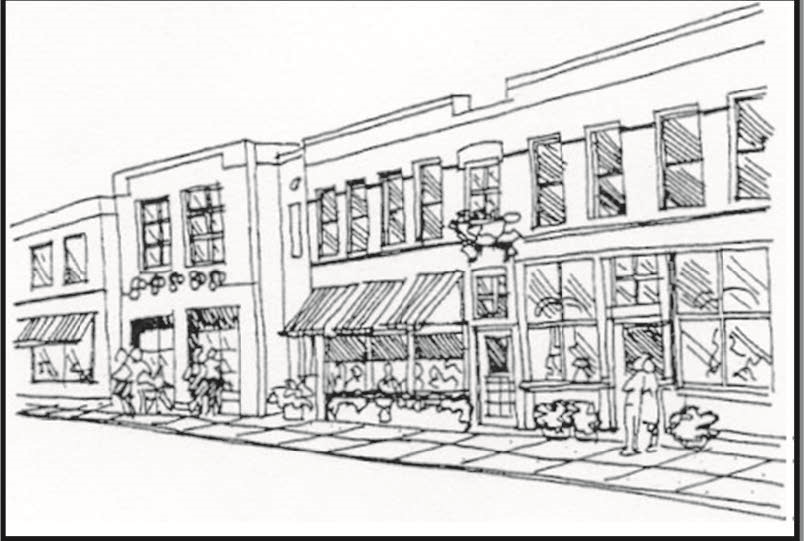
(2)
Building walls and facades, commercial.
a.
Articulation of the building facade can be achieved by utilizing recessed doors and windows, reveals, changes in surface texture and variations in the building plan. These techniques help divide a wall plan into smaller components that relate to human size and scale.
b.
No more than 30 feet of the horizontal length of a street-facing wall shall be designed or constructed without architectural relief for building walls. Several techniques may be utilized to fulfill this requirement. The facades of larger single-block buildings shall minimize the mass and scale by utilizing smaller 20- to 25-foot individual architectural modules. On smaller buildings vertical and horizontal wall articulation including architectural indentations and/or projections shall be integrated into the building design to provide for shade, shadow, and visual relief.
c.
Exterior walls, especially at ground level, shall include elements to build depth and character on the wall plane. Emphasize windows, trellises, arcades, roof overhangs, recessed or projected stories, columns, balconies, and awnings.
d.
Two or more wall materials may be utilized in a facade side-by-side with a change of planes or over and under, with a step back. The more heavily textured material shall be below the lighter of the two.
e.
A horizontal stringcourse (beltcourse, expression line) shall differentiate the first and second floors. Color or material changes that have the same effect may be utilized to satisfy this standard.
f.
Finish materials shall wrap the exterior corner and terminate at the inside corner. Such treatments will alleviate the appearance of a "wall paper" application and will give a sense of permanence to a structure.
g.
Projections, such as porches, balconies, decks and bays shall be supported by columns, posts, pilasters or brackets that are proportionate to the structure above it.
h.
Acceptable materials—Building walls and facades, commercial. Acceptable materials listed within these standards are the target for the aesthetic street-facing appearance, and at a minimum have the appearance of the acceptable material. For example, a facade comprised of brick or stone may be comprised of a brick or stone veneer. Or a fiberglass door designed and painted to look like a wood door is acceptable as well.
1.
Commercial.
i.
Concrete Masonry Units (CMU), split faced or smooth. Smooth must be coated by a stucco system.
ii.
Poured in place concrete with stucco assembly.
iii.
Brick masonry or veneer, natural finish or painted.
iv.
Stone masonry or veneer.
v.
Wood shingles - natural or concrete.
vi.
Wood raised paneling may be used below retail storefronts.
vii.
Painted finishes - Except for brick and stone masonry, exterior materials shall be painted (flat finish, with satin or glossy trim). Brick may be painted.
viii.
Stucco systems shall be "sand" finish unless a Mediterranean Revival style is utilized.
ix.
Ceramic tile or terra cotta may be used for accent purposes.
x.
Storefronts may be wood, aluminum or other metal framework with clear or lightly tinted glass.
2.
Residential.
i.
"Hardie" or concrete board siding as board and batten or horizontal lap siding.
ii.
Wood siding - lapped or board and batten.
iii.
Brick masonry or veneer, natural finish or painted.
iv.
Stone masonry or veneer.
v.
Wood shingles - natural or concrete.
vi.
Ceramic tile or terra cotta may be used for accent purposes.
(3)
Building Frontage Types and Entryways. Buildings interface with the public sidewalk by means of their various street frontage elements: proximity (setback); architecture; signage; entrances; windows; and projections (awnings, balconies, etc.). This section addresses the various configurations of building entrances (ex: flush vs. recessed), windows (ex: size and proportions) and projections (ex: type and dimension) along the street frontage that have been classified into the following four combinations called building frontage types:
a.
Building Frontage Types.
1.
Shopfront. A frontage where the facade is aligned closely with the street line and the entrance is at sidewalk grade. This type is conventional for retail use, and requires substantial glazing on the ground story. Awnings or an attached colonnade are generally associated with the shopfront.
2.
Stoop. A frontage where the facade is aligned closely with the street line and the entrance is accessed by an exterior stair and landing elevated up to three feet above the sidewalk, securing privacy for the windows and front rooms, and demarcating a vertical transition from public to private realms. This type is suitable for ground floor residential use, and may be interspersed with the shopfront frontage type. The stoop may be covered by a porch or shed roof. Stoops must correspond directly to the building entryway.
3.
Dooryard. A shallow yard (open to the sky) between the street and building facade that is at sidewalk grade and separated from the sidewalk by a three-to-four (3-4) foot decorative wall or hedgerow. Residential dooryards can be open for the use of the dwelling occupants, but shall be landscaped for greatest privacy.
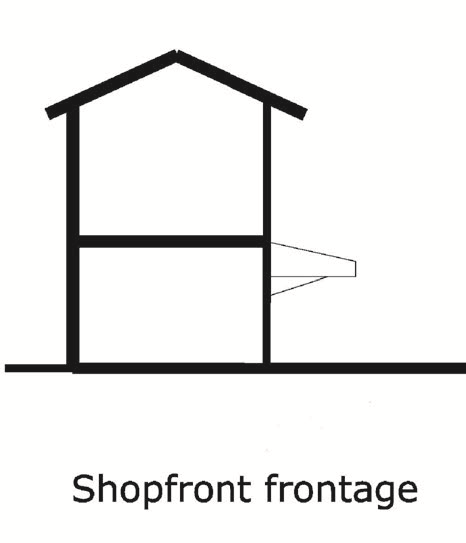 | 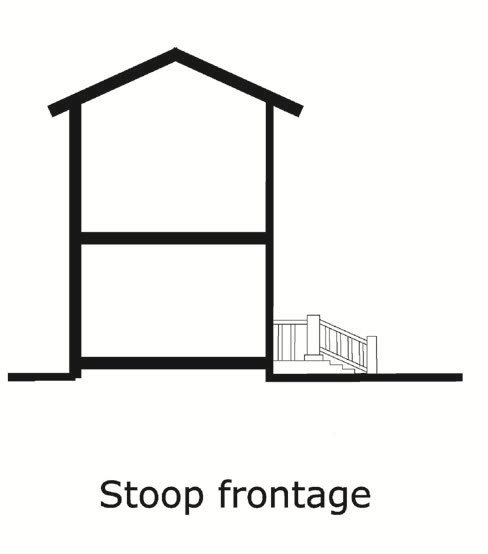 | 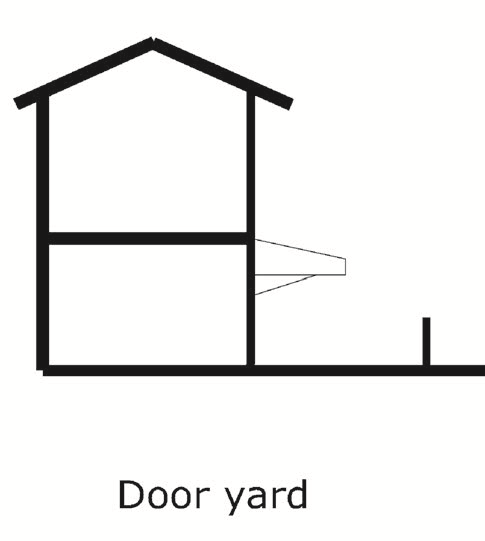 |
(4)
Arcade (Colonnade). A frontage where the building, or a portion thereof, creates a covered walkway and is generally supported by columns or arches. The overhang shall not extend beyond the front build-to line.
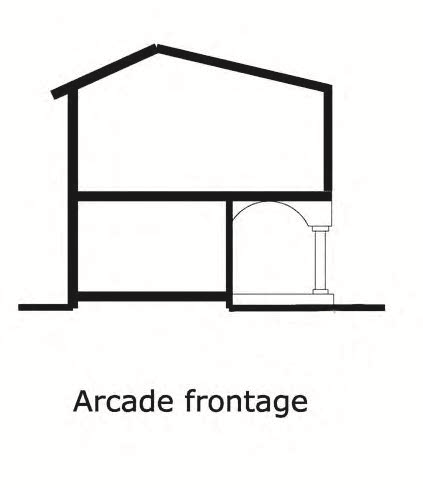 |
b.
Building entrances shall face and connect to the sidewalk. This design promotes pedestrian activity and creates a spatial rhythm as a user travels from one storefront to another.
c.
Building entries shall be recessed for visual interest and to provide a sense of arrival to the structure.
d.
Design detail such as decorative trim elements shall be incorporated into the entryway.
e.
Buildings situated at the corner of two streets shall provide a prominent corner entrance (see photo below).
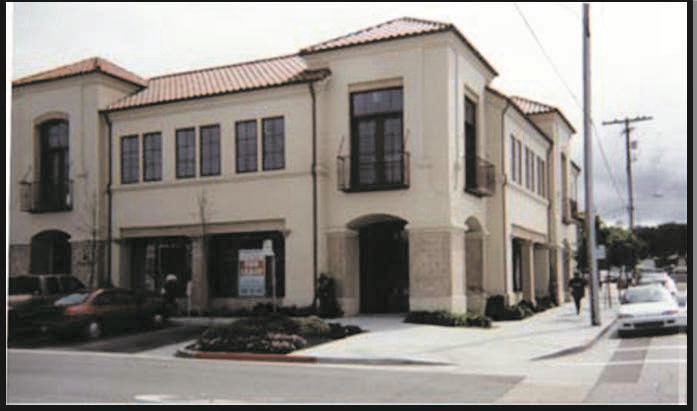
(4)
Windows.
a.
Windows shall be designed to coordinate with the architectural design of the building. Display windows shall face the sidewalk to create a spatial rhythm that heightens the interest at the pedestrian level.
b.
Efforts shall be made to provide maximum transparency (e.g., windows) on first floor facades. Attention shall be paid to materials, placement, depth of recess, and ornamentation such as window grilles. The design objective is to achieve at least 50 percent transparency of first floor facades.
c.
Large, uninterrupted surfaces of glass without architectural divisions are discouraged. Powder coated colors shall be encouraged instead of using typical anodized aluminum.
d.
Except for storefronts at the first floor and clerestories, all rectangular windows shall be taller than wide in proportion.
e.
Acceptable Window Configurations:
1.
Rectangular;
2.
Round;
3.
Semi-Circular; or
4.
Octagonal.
f.
Acceptable Window Types:
1.
Casement;
2.
Double and Single Hung; or
3.
Fixed.
g.
Acceptable Finish Materials - Windows, Skylights, Clerestories:
1.
Wood, Painted;
2.
Aluminum;
3.
Steel;
4.
Copper/Bronze;
5.
Vinyl Clad Wood; or
6.
Fiberglass.
(5)
Awnings, arcades, colonnades. Awnings are encouraged and shall be designed to coordinate with the architectural style of the building.
a.
Awnings shall be of a durable, commercial grade fabric, canvas or similar materials having a matte finish. Awning frames and supports shall be painted or coated metal or other non-corroding materials.
b.
Arcades/colonnades may extend eight to ten feet from the building face and shall extend to within the minimum distance of the curb face needed to meet ADA requirements and to avoid conflict with street lights and street trees. The intent is that the colonnade encompasses the entire useable area of the sidewalk. However, there shall be no structural support within the right-of-way.
c.
Where an arcade/colonnade is used, it shall be covered by an attached cantilevered shed or lightweight gallery roof, or it may support habitable space above that extends over the sidewalk.
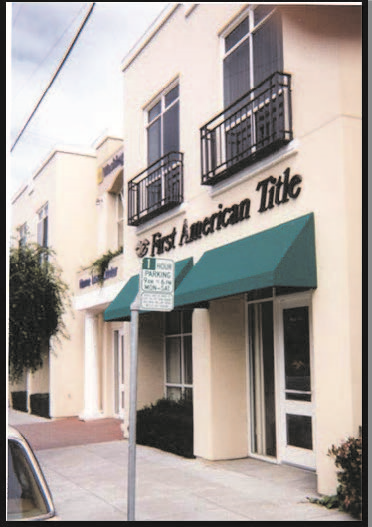 | 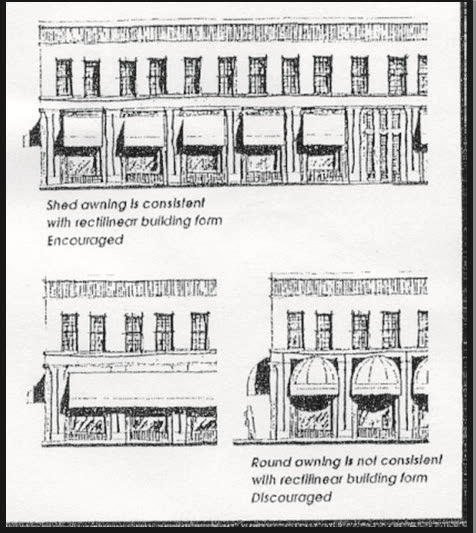 |
(6)
Roofs.
a.
Special attention shall be paid to the articulation of the top portion of buildings; long, unbroken, horizontal rooflines are not acceptable. The roofline of a structure shall provide visual interest and shall be used to de-emphasize a building's mass. This can be achieved by the use of offsets and other methods to articulate the horizontal and vertical plane of the building through the introduction of horizontal bands, cornices and stepbacks.
b.
Decorative roof treatments shall continue around the building and terminate in a logical location.
c.
Parapets shall generally be finished with cornices or other horizontal decoration depending on the architectural style of the building.
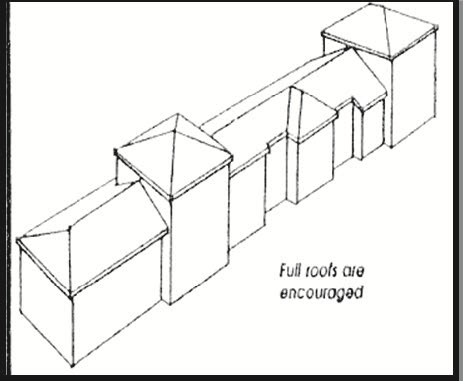
d.
Acceptable Roof Types:
1.
Gable;
2.
Hip;
3.
Flat;
4.
Low Slope (must have 3' min. ht. parapet around perimeter, 3 sides, minimum);
5.
Bowstring;
6.
Dome.
e.
Acceptable Roof Finish Materials - Metal:
1.
Metal - Standing Seam;
2.
Galvanized Steel;
3.
Galvanized Aluminum Copper.
f.
Acceptable Roof Finish Materials - Shingle:
1.
Metal - Stamped Pattern;
2.
Fiberglass - Architectural or Dimensional;
3.
Sawn Cedar Shingles (Not Shakes);
4.
Architectural 3-Tab Shingles.
g.
Acceptable Roof Finish Materials - Tile:
1.
Clay;
2.
Concrete.
(7)
Walls and Fences.
a.
Walls and fences shall be designed as an integral part of the principal structure(s). Such design shall include the use of similar materials, colors and finishes as the principal structure.
b.
Walls and fences shall be architecturally designed with offsets, raised elements and landscape pockets to avoid an expansive monolithic appearance.
c.
Acceptable Finish Materials.
1.
CMU - split-faced or smooth (smooth must be coated with stucco assembly);
2.
Poured in place Concrete - with stucco assembly;
3.
Brick - painted or natural fired finish;
4.
Ornamental Iron or Aluminum (heavy gauge) - painted;
5.
Combination - brick or stuccoed masonry with metal infill;
6.
PVC - with wood finish and decorative masonry columns every 30 to 40 feet.
(8)
Perimeter landscaping and screening.
a.
This Section supplements and does not supersede the City's Landscaping standards as provided in Division 10 of Article VII, Chapter 102, Plant City Code. All minimum requirements as provided in said Division 10 must be met, notwithstanding anything to the contrary that may be contained in this Section.
b.
Perimeter landscape plantings shall be located adjacent to the primary facade(s) and along any blank facade wall areas that are, or will be, exposed to the general public. Such plantings shall also be included at entrance areas, plazas and courtyards.
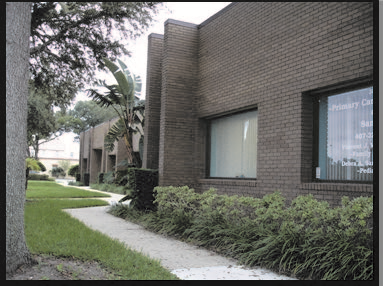
c.
General Standards - Screening of Mechanical Equipment.
1.
Mechanical equipment located on the ground, such as air conditioning units, heating units, satellite dishes, irrigation pumps, propane tank displays and refilling areas, utilities lift stations and the like shall be screened from public view. Screening shall, at a minimum, be at the same height as the equipment. Structural screening shall be architecturally integrated into the overall project design and shall be compatible, in terms of style, construction materials, colors, and finish, with the principal structure(s). Landscaping may be substituted for structural screening if plantings are compatible with the landscape plan for the project and are of such size and maturity as to be able to provide a fully opaque screen at time of planting.
2.
Equipment and appurtenances mounted on rooftops shall be kept to a minimum. All exposed rooftop mounted equipment and appurtenances shall be fully screened from view from any public right-of-way. All screening shall, at a minimum, be at the same height as the equipment and appurtenances. Screening shall be an integral part of the design of the building(s) and shall be architecturally consistent with the style, colors, construction materials and finish of the building(s).
(9)
Building elements and accessories (columns, pilasters, arches and railing systems) general standards.
a.
Horizontal distance between column spacing shall be equal or less than the height.
b.
Columns are encouraged to be constructed with entasis (tapered), except brick and solid, square wood.
c.
Non-tapered columns are discouraged on any primary street facade.
d.
Acceptable Finish Materials and Appearance - Columns, Pilasters:
1.
Wood, painted;
2.
Cast Stone;
3.
Poured in place concrete with stained or painted finish;
4.
Brick; or
5.
Cast Iron.
e.
Acceptable Finish Materials and Appearance - Arches:
1.
CMU with metal stud infill to create the curvature; covered with stucco assembly painted;
2.
Poured in place concrete with stucco assembly, painted; or
3.
Brick.
f.
Acceptable Finish Materials and Appearance - Railing Systems:
1.
Wood, painted;
2.
Cast iron, wrought iron, ornamental solid aluminum, painted; or
3.
Cast Stone.
g.
Acceptable Configurations - Columns, Pilasters:
1.
Square in section, six-inch minimum, with or without bases or capitals, or ornamental brackets;
2.
Round in section, eight-inch minimum outside diameter, with bases and capitals;
3.
Classical Orders; or
4.
Sectional - Two different materials, one to create the base and the other to create the column assembly (example: brick base with wood column assembly, above).
h.
Acceptable Configurations - Arches:
1.
Semi-circular, segmented, elliptical, jack (or flat).
i.
Acceptable Configurations - Railing Systems:
1.
Combination of railings and newel posts at corners and intermittently spaced no greater than eight feet apart;
2.
Balusters may be round, square or flat (paling); or
3.
Openings, heights and horizontal strength must comply with the current edition of the Florida Building Code (FBC).
(10)
Signage, general standards.
a.
On new or rehabilitated commercial projects, space for signage shall be designed into the building elevations. Wall signs shall be positioned within architectural features, such as the panel above the storefront on the transom or flanking doorways.
b.
Signs shall coordinate with the building design, materials, color, size, and placement.
c.
Signs shall not cover up windows or important architectural features.
d.
Signs shall align with others on the block so as to maintain the existing pattern.
e.
Marquee signs are permitted pursuant to Section 102-1626, and shall utilize decorative iron or wood brackets.
f.
Awnings with imprinted signage are allowed. Signage letters and colors shall be complimentary to the awning. Lettering shall be limited to the side or front fascia of the awning. Awning signage shall count towards allowable wall signage of Section 102-1776.
g.
Signs for a single development with multiple users shall have a similar design.
h.
Lighting of all exterior signs shall be directional to illuminate the sign without producing glare on pedestrians, autos, or adjacent residential units.
i.
The above items are in addition to the signage requirements of Chapter 102, Article VIII. Where there is a conflict the more stringent standard shall apply.
(11)
Prohibited building elements, details, and materials. The following are prohibited within the Midtown District:
a.
Modular buildings.
b.
Pre-engineered metal buildings with metal building skin.
c.
Vertical pre-cast concrete "tees."
d.
Long, unarticulated building surfaces.
e.
Open walled, shed roof storage facilities.
f.
Reflective, opaque, and/or bronze tinted glass.
g.
Chain-link, plastic panel, barbed wire, razor wire or wire mesh fences.
h.
Applied mansard roofs.
i.
Glossy finished awnings (plastic look).
j.
Roof top equipment visible from the main street.
k.
Wall or window mounted mechanical equipment exposed to the main street.
l.
Internally-illuminated sign cabinets.
m.
Flashing or electronic sign boards with static or changing text.
n.
Flashing or kinetic neon or LEDs.
(Ord. No. 52-2021, § 1, 11-22-2021
Editor's note— Ord. No. 52-2021, § 1, adopted Nov. 22, 2021, amended § 102-862, in its entirety. The former § 102-862 pertained to the same subject and derived from Ord. No. 31-2013, § 2, adopted Dec. 9, 2013. Sections 102-863—102-873 have been repealed and the information condensed into subsections and inserted at the end of § 102-862 to read as herein set out.
Sec. 102-863. - Reserved.
Editor's note— Ord. No. 52-2021, § 1, adopted Nov. 22, 2021, repealed § 102-863, which pertained to building composition and derived from Ord. No. 31-2013, § 2, 12-9-2013.
Sec. 102-864. - Reserved.
Editor's note— Ord. No. 52-2021, § 1, adopted Nov. 22, 2021, repealed § 102-864, which pertained to building walls and facades, commercial and derived from Ord. No. 31-2013, § 2, 12-9-2013.
Sec. 102-865. - Reserved.
Editor's note— Ord. No. 52-2021, § 1, adopted Nov. 22, 2021, repealed § 102-865, which pertained to building frontage types and entryways and derived from Ord. No. 31-2013, § 2, 12-9-2013.
Sec. 102-866. - Reserved.
Editor's note— Ord. No. 52-2021, § 1, adopted Nov. 22, 2021, repealed § 102-866, which pertained to windows and derived from Ord. No. 31-2013, § 2, 12-9-2013.
Sec. 102-867. - Reserved.
Editor's note— Ord. No. 52-2021, § 1, adopted Nov. 22, 2021, repealed § 102-867, which pertained to awnings, arcades, colonades and derived from Ord. No. 31-2013, § 2, 12-9-2013.
Sec. 102-868. - Reserved.
Editor's note— Ord. No. 52-2021, § 1, adopted Nov. 22, 2021, repealed § 102-868, which pertained to roofs and derived from Ord. No. 31-2013, § 2, 12-9-2013.
Sec. 102-869. - Reserved.
Editor's note— Ord. No. 52-2021, § 1, adopted Nov. 22, 2021, repealed § 102-869, which pertained to walls and fences and derived from Ord. No. 31-2013, § 2, 12-9-2013.
Sec. 102-870. - Reserved.
Editor's note— Ord. No. 52-2021, § 1, adopted Nov. 22, 2021, repealed § 102-870, which pertained to perimeter landscaping and screening and derived from Ord. No. 31-2013, § 2, 12-9-2013.
Sec. 102-871. - Reserved.
Editor's note— Ord. No. 52-2021, § 1, adopted Nov. 22, 2021, repealed § 102-871, which pertained to building elements and accessories (columns, pilasters, arches and railing systems) general standards and derived from Ord. No. 31-2013, § 2, 12-9-2013.
Sec. 102-872. - Reserved.
Editor's note— Ord. No. 52-2021, § 1, adopted Nov. 22, 2021, repealed § 102-872, which pertained to signage, general standards and derived from Ord. No. 31-2013, § 2, 12-9-2013.
Sec. 102-873. - Reserved.
Editor's note— Ord. No. 52-2021, § 1, adopted Nov. 22, 2021, repealed § 102-873, which pertained to prohibited building elements, details and materials and derived from Ord. No. 31-2013, § 2, 12-9-2013.
Sec. 102-889.- Definitions.
Gross Leasable Area means the total floor area of a building measured from its outside walls, including common areas, but excluding parking structures and floor area within a building used for parking.
ITC Overlay District means the I-4 Tech Corridor Overlay District.
Lodging Unit means a separate, independent transient accommodation that is physically separated from other such units so as to provide secure and private temporary accommodations and containing sanitary facilities. Lodging Units do not include apartments, condominiums, boarding/rooming houses, assisted living facilities, school dormitories, nursing homes, and migrant or farm worker housing.
Target Industries means businesses with the primary purpose, product or service in one or more of the following employment categories:
•
Professional, Scientific and Technical Services;
•
Medical, Bioscience and Research Facilities;
•
Manufacturing and Distribution Facilities;
•
Finance and Insurance Services;
•
Management Services; and
•
Administrative and Support Services.
Unified Ownership or Control means the interest in title to a unit of land legally or beneficially is held or controlled by one or more individual persons or entities related by a common business organization or other type of organization, as indicated by the fact that all land abutting such unit is owned or controlled by persons or entities who do not differ to any extent in identity or interest held.
(Ord. No. 16-2015, § 1, 7-13-2015)
Sec. 102-890. - Purpose.
The I-4 Tech Corridor Overlay District implements Plant City's Comprehensive Plan by creating high quality, sustainable employment opportunities by increasing the supply of land available for light industrial, research corporate park and office development. The ITC Overlay District creates opportunities for development patterns that support high-wage jobs while maintaining compatibility with existing and planned development. To allow for the consideration of the ITC Overlay District the minimum land area shall be five (5) acres of buildable uplands within the City. The ITC Overlay District's provisions may be implemented within existing commercial or industrial zoning districts; however areas within residential, County or other zoning districts would be required to be rezoned to a Planned Development District. Parcels that are annexed will require a comprehensive map amendment to a Plant City future land use designation to be eligible for the I-4 Tech Corridor District.
(Ord. No. 16-2015, § 1, 7-13-2015)
Sec. 102-891. - Development patterns established.
Development in the I-4 Tech Corridor Overlay District may occur in any of the development patterns established in this Section in accordance with the provisions of the Plant City Comprehensive Plan and the use, site design, building design and other applicable standards and provisions of this Code.
(a)
Corporate Village - A master planned mixed-use development under unified ownership or control that combines offices spaces for target industries, with retail, restaurants and lodging as secondary support uses. Retail, restaurants and lodging support uses will be located within buildings used for other authorized uses or clustered in nodes at the entries of the development. Support uses including retail, hotels, motels and restaurants may not exceed ten (10) percent of the gross leasable total floor area ratio of the Corporate Village. Warehousing and distribution facilities are only allowed as an accessory use. This development pattern may be considered in all areas of the I-4 Tech Corridor Overlay District. Limited residential development may be located in mixed use buildings or on the periphery of the site in support of target development provided that a jobs to housing unit ratio of at least twenty to one (20:1) is maintained based on nonresidential square footage constructed, up to twelve (12) dwelling units per acre.
(b)
Corporate Campus/Business Park - A master planned development under unified ownership or control that includes offices for target industries with retail, restaurants and lodging as secondary support uses. Retail, restaurants and lodging support uses will be located within buildings used for other authorized uses or clustered in nodes at the entries of the development. Support uses including retail, hotels, motels and restaurants may not exceed ten (10) percent of the gross leasable floor area ratio of the Corporate Campus/Business Park. This development pattern may be considered in all areas of the I-4 Tech Corridor Overlay District. No new residential development is allowed within the Corporate Campus/Business Park.
(c)
Industrial Park - A master planned development under unified ownership or control that provides locations for production, warehouse/distribution and office uses. This development pattern may be considered in all areas of the I-4 Tech Corridor Overlay District. No new residential development is allowed within the Industrial Park.
(Ord. No. 16-2015, § 1, 7-13-2015)
Sec. 102-892. - Uses permitted.
In any ITC Overlay District, buildings, structures or land may be used for:
(a)
Any use allowed by the underlying zoning district may be allowed pursuant to the standards of said zoning district unless it is located within one of the development patterns established in Section 102-891.
(b)
Residential development shall be allowed within a mixed-use building that is located within a Corporate Village development pattern or as a transitional use within a Corporate Village that abuts a residential zoning district.
(c)
Professional, scientific and technical offices/services may be established in any development pattern established in Section 102-891.
(d)
Medical facilities, scientific laboratories and research enterprises/facilities may be established in any development pattern established in Section 102-891.
(e)
Finance, insurance, management, administrative and support offices/services may be established in any development pattern established in Section 102-891.
(f)
Manufacturing, processing or product assembly where all operations are contained within a structure may be established in any development pattern established in Section 102-891.
(g)
Warehousing and distribution facilities are allowed as an accessory use in any development pattern established in Section 102-891.
(h)
Warehouse/distribution facilities in the industrial park development pattern.
(i)
Support uses, including hotels, motels and restaurants may be established in the Corporate Village and Corporate Campus/Business Park development patterns, provided that no such use may be established unless included in a phasing plan and that the square footage of such uses shall not exceed ten (10) percent of the total floor area of the project at any time.
(Ord. No. 16-2015, § 1, 7-13-2015)
Sec. 102-893. - Calculation of allowable residential development in corporate villages.
Table 893-1 establishes the assumptions for jobs based on square footage of nonresidential development that shall be used to calculate the ratio of jobs to housing units unless the applicant provides credible evidence that the concentration of employees exceeds the employment densities shown in the table.
Table 893-1: Jobs Assumptions for Corporate Villages
(Ord. No. 16-2015, § 1, 7-13-2015)
Sec. 102-894. - Development intensity/density.
(a)
Table 894-1 establishes the maximum potential density and the maximum floor area ratio for a particular project developed within each development pattern. The achievable density (number of units per gross acre) or intensity (ratio of gross leasable floor area to lot area) permitted for any particular lot may be limited by site and building development standards or other standards set forth in this code.
(b)
Density is the number of dwelling units per gross acre of lot area.
(c)
Maximum intensities are established as floor area ratios or lodging units per acre. Floor area ratio shall apply to all nonresidential uses excluding lodging. It is measured by dividing the total gross leasable nonresidential building floor area (excluding lodging units, parking structures and floor area used for structured parking within other buildings) by the lot area. Lodging unit intensity is measured by the number of lodging units per lot area.
(d)
For lots with a mix of dwelling units, lodging, or nonresidential uses, land area occupied by any portion of a nonresidential use shall not be used in the calculation of maximum dwelling unit or room densities unless the dwelling units or lodging are part of a mixed-use building. If open areas are adjacent to and accessible to residential units, the open areas may be used in the calculation of residential density.
(e)
For buildings with residential units or lodging units located above nonresidential floor area, maximum residential unit or lodging accommodation units density and the floor area ratio is calculated using the total lot area.
Table 894-1: Intensity/Density Standards
(Ord. No. 16-2015, § 1, 7-13-2015)
Sec. 102-895. - Building design standards.
(a)
Height.
(1)
Maximum height. Subject to the provisions of Section 102-1256, maximum building height shall comply with the provisions of Table 895-1 unless located within an industrial district (M-1 and M-1A) where there shall be no height limitation. Any building height that exceeds the heights of the zone as depicted on the Height Zoning Map - Plant City Airport must obtain an airport height zoning permit or variance from the Hillsborough County Aviation Authority.
Table 895-1: Maximum Building Height
(2)
Height transitions abutting residential districts. Where a lot that is located outside an industrial (M-1, M-1A or M-AP) district abuts a residential zoning district, the maximum building height shall be no taller than the maximum height of the abutting district within one hundred (100) feet of the property line. The building height may be increased by one foot for each additional two (2) feet for the applicable portion of the building separated from the property line.
(b)
Building orientation and entries. In Corporate Villages and Corporate Campus/Business Park Developments entrances shall be located on the front of the building. In Industrial Parks, entrances may face the front of the building or side parking areas. All buildings in Corporate Villages and Corporate Campus/Business Park Developments shall have clearly defined, visible entrances, featuring no less than three of the following:
(1)
Canopies, covered vehicle drop-off zones or porticos;
(2)
Awnings;
(3)
Overhangs;
(4)
Recesses/projections;
(5)
Arcades;
(6)
Raised corniced parapets over the door;
(7)
Peaked roof forms or arches;
(8)
Outdoor patios;
(9)
Display windows.
(c)
Building materials. Building materials within a Corporate Village, Corporate Campus/Business Park or Industrial Park development pattern shall comply with the following requirements:
(1)
All building materials shall comply with Florida Building Code requirements.
(2)
Within the Corporate Village, Corporate Campus/Business Park, predominant wall materials shall have the appearance of brick, stucco or textured masonry. Predominant wall materials shall cover at least eighty (80) percent of walls, exclusive of windows and doors. Materials with the appearance of concrete block, smooth concrete, corrugated or standing seam metal are prohibited.
(3)
Within an Industrial Park, side and rear walls that do not face a street or residential zoning district or may be constructed of any material that complies with Florida Building Code requirements. Other walls shall meet the requirements of paragraph (2) above.
(4)
The color of all building elevations (front facade, side, and rear) shall be low reflectance, subtle, neutral or earth tones. The use of high-intensity, saturated colors (such as one or more of the "primary" and/or "secondary" colors), metallic colors, florescent colors, or black, is limited to trim, accent features or logos.
(d)
Glazing. Buildings in Corporate Village, Corporate Campus/Business Parks and Industrial Parks shall comply with the glazing requirements in Table 895-2.
Table 895-2: Minimum Glazing Standards
(e)
Building articulation. Requirements for building articulation are shown in Table 895-3.
Table 895-3: Building Articulation Standards
(f)
Rooflines. Within Corporate Village and Corporate Campus/Business Park developments:
(1)
Rooflines shall be varied in height, or at least every one hundred (100) linear feet. Hips, gables or changes in parapet elevation shall be used to provide relief in height.
(2)
Gable and hip roofs, and parapets with cornices shall be used to conceal flat roofs and rooftop mechanical equipment from public view.
(3)
The parapet design shall be a minimum of three (3) feet in height and shall incorporate a three-dimensional cornice treatment.
(Ord. No. 16-2015, § 1, 7-13-2015)
Sec. 102-896. - Site design standards.
(a)
Building Setbacks. Table 896-1 establishes the minimum setbacks from property lines. Greater setbacks are required where development is adjacent to residential districts or where other site constraints exist, see Table 896-1.
Table 896-1: Minimum Building Setbacks
(b)
Landscaping.
(1)
Minimum front yard landscaping requirements for the Corporate Village, Corporate Campus/Business Park and Industrial Park development patterns are established in Table 896-2.
Table 896-2: Front Yard Landscaping
(2)
Minimum requirements for open areas in the Corporate Village, Corporate Campus/Business Park and Industrial Park development patterns are established in Table 896-3. Open areas include landscape areas and other outdoor public areas, including, but not limited to, courtyards and plazas. Plant materials shall comply with the standards of Section 102-1378.
Table 896-3: Open Areas/Landscaping
(3)
Parking lot landscaping in the Corporate Village, Corporate Campus/Business Park and Industrial Park development patterns shall comply with Section 102-1417.
(4)
Outdoor storage is prohibited in the Corporate Village, Corporate Campus/Business Park development patterns and screening of outdoor storage shall comply with the provisions of Section 102-1376 for Industrial Park development patterns.
(5)
Buffers. Landscape buffers for the Corporate Village, Corporate Campus/Business Park and Industrial Park development patterns shall be provided in accordance with Section 102-1373.
(c)
Fences and Walls. Fences and walls in the Corporate Village, Corporate Campus/Business Park and Industrial Park development patterns shall comply with the standards established in Section 102-1377.
(d)
Parking.
(1)
Parking location. Parking spaces shall be located as required in Section 102-1414 except as modified by the following provisions and the provisions of Table 896-4:
a.
Parking lots which accommodate more than one hundred (100) vehicles shall be divided into a series of connected smaller lots and separated by roads, open areas, structures or landscape strips measuring at least ten (10) feet in width and having at least one shade tree planted every forty (40) linear feet.
b.
Truck access and parking areas shall be separate from car parking areas and located in the rear yard.
Table 896-4: Parking Location
(2)
Spaces required. The number of parking spaces for the Corporate Village, Corporate Campus/Business Park and Industrial Park development patterns shall be provided as established in Section 102-1421.
(e)
Loading. Loading standards for the Corporate Village, Corporate Campus/Business Park and Industrial Park development patterns shall comply with the following standards:
(1)
Loading and service dock areas shall be located to the rear or sides of a building, away from the main building entrance, or related high visibility areas.
(2)
Loading docks shall not be located between a building and a residential zoning district unless there is a minimum one hundred (100) feet setback between the loading dock and the residential district and the setback includes a landscape buffer and masonry wall (see screening requirements).
(3)
Loading spaces, their access drives and maneuvering areas shall be located and designed so that their use does not impede the normal use of parking spaces and access drives.
(4)
Loading and service docks shall be screened by a masonry wall measuring not less than six (6) feet in height and not more than eight (8) feet in height or a landscape screen consisting of evergreen hedge that will measure at least five (5) feet in height within one (1) year of planting.
(f)
Bicycle and pedestrian access for Corporate Village and Corporate Campus/Business Park.
(1)
Internal bicycle circulation systems and easements shall be integrated into site design and connect to existing and future bicycle routes and trails.
(2)
Where bicycle lanes are required, they shall be at least three (3) feet in width.
(3)
Minimum one (1) bicycle rack shall be provided for every ten (10) vehicular parking spaces.
(4)
Bicycle racks shall be provided within fifty (50) feet of each main building entrance.
(g)
Mechanical equipment and dumpsters in the Corporate Village, Corporate Campus/Business Park and Industrial Park development patterns shall be located and screened in accordance with the following standards:
(1)
Ground-fixed mechanical equipment shall not be located between the front of a building and the street. If located between the building and a street, the equipment shall be screened from view with masonry wall or evergreen shrubs.
(2)
Rooftop mechanical equipment shall be screened from adjacent properties and from street view by a parapet or architecturally compatible rooftop screen.
(3)
Trash dumpsters shall not be located between the front building facade and the public street or internal street.
(4)
No trash dumpsters shall be located between a building and a residential district unless set back from the residential district at least a minimum of fifty (50) feet.
(5)
Dumpsters shall be separated from adjacent parking stalls by a minimum three (3) feet wide (interior clear dimension) planting strip.
(6)
Dumpsters shall be enclosed with a masonry wall constructed of the same materials as the principal structure. The wall enclosure shall be at least six (6) feet and no more than eight (8) feet in height.
(h)
Lighting.
(1)
All lighting fixtures shall be full cut-offs and complement the design of the building through style, material and color.
(2)
Wall-mounted lights shall be angled downwards.
(3)
Lighting shall be located and directed as to avoid glare outside of property lines. Special consideration must be given to avoid glare to any neighboring residential area. Illuminance from the site shall not exceed 1 footcandle beyond the property line.
(4)
Pedestrian connections shall be illuminated with pedestrian scale lights with a maximum height of twelve (12) feet and/or lighted bollards.
(5)
Lights in parking lots and driveways shall not exceed twenty (20) feet in height. Poles shall be located within planting strips and shall be recessed at least three (3) feet from back of curbs.
(Ord. No. 16-2015, § 1, 7-13-2015)
Sec. 102-897. - Development incentives.
(a)
Purpose. The ITC overlay provides incentives for establishing targeted developments by generally eliminating the need for amendments to the Future Land Use Map of the Comprehensive Plan prior to establishing the development patterns defined herein. The development patterns also provide incentives for development throughout the district by allowing a wider range of land uses at intensities that are potentially greater than those allowed by underlying zoning. The additional incentives established in this section are intended to promote economic and environmental sustainability by enabling applicants using development patterns authorized within the ITC Overlay District to achieve intensity bonuses for taking specific measures that will enhance the local environment and by virtue of the added development potential, the economy.
(b)
Accumulation of Points for Development Incentives.
(1)
Table 897-1 outlines specific measures that can be taken and the relative points that can be earned for each measure.
(2)
Table 897-2 identifies intensity bonuses that can be earned for the points earned pursuant to Table 897-1.
(3)
The City Manager may authorize the award of points available for Leadership in Energy and Environmental Design (LEED) certifications if the applicant provides an equivalent certification from an alternative entity.
(4)
The incentives identified herein are provided in addition to other financial and non-financial incentives that may be established by the City Commission, City Manager or the State of Florida.
Table 897-1: Points Value for Specific Measures
Table 897-2 - Floor Area Ratio Bonuses for Sustainable Development Points
(c)
If floor area ratio bonuses are awarded, the owner(s) of the development must maintain or improve, in perpetuity, the functionality of the sustainability measures on which the point accumulation totals were originally based, otherwise the development will be considered non-conforming and may be subject to enforcement mechanisms. A developer/owner may request an approved sustainability measure be substituted for another measure of greater or equal value with the approval of the City Manager. Additional sustainability measures not listed in Table 897-1 may be proposed by the developer in the Pre-Application Conference for the consideration and approval of the City Manager. Developer proposed sustainability measures may focus on, but are not limited to, pedestrian and bicycle amenities, installation of water conservation technologies, improved methods of stormwater retention/treatment and the protection of environmentally sensitive areas, which are above the minimum standards required by other sections of the Plant City Code and other regulations of agencies who have jurisdiction within the City.
(Ord. No. 16-2015, § 1, 7-13-2015)
Sec. 102-898. - Review process.
Development of one of the development patterns within the ITC Overlay District shall be reviewed in accordance with the following procedures:
(a)
Pre-Application Conference. All applicants for a development pattern authorized within the ITC Overlay District shall first attend a meeting with the City Manager to discuss and analyze the proposed application in a non-binding forum. The purpose of the meeting is to ensure that applicants have an understanding of the district requirements and that subsequent submittals comply with the district purposes and standards, as well as being consistent with the Comprehensive Plan.
(b)
Application for ITC Overlay Development Permit. The contents of an application for a development permit within the ITC Overlay District shall be as provided in subsection 102-1380(b), except that such application shall include the following items:
(1)
Application Form: An application form that has been completed, signed by the owner or authorized agent of the owner of the subjected property and notarized.
(2)
Surveys: Two (2) signed and sealed surveys, showing existing structures, boundaries, rights-of-way, and easements of record.
(3)
Site Plan: One (1) digital copy (in the format specified by the Planning and Zoning Division) and four (4) hard copies of the required site plan showing sufficient detail to determine compliance with the district requirements.
(4)
Building Elevation Drawings: One (1) digital copy (in the format specified by the Planning and Zoning Division) and four (4) copies of the building elevation drawings. Building elevations may be schematic in nature, but shall be drawn to scale, be properly dimensioned, and shall indicate proposed building materials and exterior surface finishes. All drawings shall demonstrate treatment of required elements.
(5)
Documentation for Incentives: For Florida Green Building Coalition Green Development or LEED Certification incentives, the applicant shall provide documentation of the certification and the owner shall sign a statement agreeing to fulfill the standard or be subject to the penalties as established in Section 1-14, Plant City Code. For other environmental incentives, the architect or engineer shall certify that the plans demonstrate compliance with the applicable standard and the owner shall sign a statement agreeing to fulfill the standard or be subject to the penalties as established in Section 1-14, Plant City Code. Said statements shall be recorded in the County records and shall run with the land, and shall obligate owner, as well as the owner's successors and assigns, to comply with the terms of said statements.
(c)
Review and Action. A complete application shall be reviewed by the City Manager. If the application is determined to be in compliance with the ITC Overlay District standards, the application shall be processed for approval. Unless otherwise specified by the City Manager, the applicant may proceed with the necessary engineering and building permits without further review of the Planning Board or City Commission. If the City Manager finds that the application does not comply with the ITC Overlay District standards, the applicant shall be notified in writing of the inconsistencies. The applicant shall have sixty (60) days to resubmit the application to correct the deficiencies or the application will expire.
(Ord. No. 16-2015, § 1, 7-13-2015)

