
Plant City City Zoning Code
ARTICLE VII
- SUPPLEMENTARY REGULATIONS
DIVISION 2. - MODEL HOMES AND PRECONSTRUCTION SALES OFFICES[16]
Cross reference— Businesses, ch. 18.
DIVISION 3. - SERVICE STATIONS[17]
Cross reference— Businesses, ch. 18.
DIVISION 4. - SIDEWALK CAFES[18]
Cross reference— Businesses, ch. 18; streets, sidewalks and other public places, ch. 62.
DIVISION 6. - CAMPING AND RECREATIONAL EQUIPMENT[19]
Cross reference— Stopping, standing and parking, § 70-91 et seq.
DIVISION 7. - SEXUALLY ORIENTED BUSINESSES[20]
Editor's note— Ord. No. 22-2005, § 1, adopted Aug. 22, 2005, amended div. 7 in its entirety to read as herein set out. The former div. 7, titled Adult Entertainment, derived from Code 1977, §§ 111.23(12)(a) and 111.23(12)(b).
Cross reference— Businesses, ch. 18.
DIVISION 9. - DENSITY, LOCATIONAL CRITERIA AND DEVELOPMENT STANDARDS[21]
Editor's note— Ord. No. 05-2013, § 19, adopted Feb. 25, 2013, renamed Division 9, formerly entitled "Locational Criteria and Development Standards", and further added Subdiv. I provisions.
DIVISION 10. - BUFFERING, LANDSCAPING AND TREE REQUIREMENTS[22]
Editor's note— Ord. No. 7-2012, § 4, adopted Mar. 12, 2012, amended div. 10 in its entirety to read as herein set out. Former div. 10, §§ 102-1371—102-1382, was entitled "Buffering and Landscaping Requirements", and derived from: Code 1977, §§ 111.19, 111.23; Ord. No. 45-2004, § 3, adopted Oct. 25, 2004; Ord. No. 2-2005, § 3, adopted Mar. 14, 2005; and Ord. No. 16-2005, §§ 1, 2, adopted Apr. 9, 2005.
DIVISION 11. - ACCESS MANAGEMENT, OFF-STREET PARKING, CIRCULATION, AND BICYCLE AND PEDESTRIAN FACILITIES REQUIREMENTS[23]
Editor's note— Ord. No. 16-2014, § 2, adopted Aug. 11, 2014, amended Div. 11 in its entirety to read as herein set out. Former Div. 11, §§ 102-1411—102-1422, was entitled "Off-Street Parking and Loading Requirements", and derived from Code 1977, §§ 111.21(a)—(k); Ord. No. 10-2002, § 2, adopted Apr. 22, 2002; and Ord. No. 25-2009, § 2, adopted Sept. 28, 2009.
Cross reference— Stopping, standing and parking, § 70-91 et seq.
DIVISION 14. - HOME-BASED BUSINESSES[24]
Editor's note— Ord. No. 26-2022, § 2, adopted Sept. 26, 2022, repealed the former Div. 14, §§ 102-1451—102-1454, and enacted a new Div. 14 as set out herein. The former Div. 14 pertained to similar subject matter and derived from Ord. No. 4-2003, § 2, adopted Jan. 27, 2003; Ord. No. 3-2016, § 6, adopted Jan. 25, 2016; Ord. No. 05-2013, § 22, 23, adopted Feb. 25, 2013.
DIVISION 17. - LARGE SCALE BIG-BOX COMMERCIAL-RETAIL DESIGN STANDARDS[25]
Editor's note— Ord. No. 37-2005, § 2, adopted Sept. 26, 2005, added div. 17, consisting of §§ 102-1461 and 102-1462, to ch. 102, art. VII. To maintain the numerical continuity of the Code, these sections have been redesignated as §§ 102-1467 and 102-1468 at the editor's discretion and with the approval of the city attorney.
DIVISION 18. - DOWNTOWN HISTORIC DISTRICT—SUPPLEMENTAL REGULATIONS[26]
Editor's note— Ord. No. 7-2006, § 1, adopted March 27, 2006, added div. 19, consisting of § 102-1461, to the Code. At the editor's discretion and with the agreement of the city, said provisions have been redesignated to read as herein set out to maintain the numerical continuity of the Code.
Sec. 102-1036.- Scope of article.
This Chapter shall be subject to such exceptions, additions or modifications as provided by the supplementary regulations in this Article.
(Code 1977, § 111.23)
Sec. 102-1037. - Essential services.
Such essential service as the erection, construction, alteration, or maintenance by public utilities or municipal departments or commissions of underground, overhead gas, electrical, steam or water transmission or distribution systems; collection, communication, supply or disposal systems, including poles, wires, mains, drains, sewers, pipes, conduits, cables, fire alarm boxes, police callboxes, traffic signals, hydrants and other similar equipment and accessories in connection therewith; including buildings reasonably necessary for the furnishing of adequate service by such public utilities or municipal departments or commissions or for the public health or safety or general welfare, shall be permitted in all zoning districts.
(Code 1977, § 111.23(1))
Sec. 102-1038. - Rail line crossings on private roads.
All new development or redevelopment, including agritourism activities, accessed by a privately owned and maintained street or roadway, easement, or commonly owned parcel that crosses a rail line to reach a public right-of-way, shall obtain a written authorization and approval from the rail line owner. The rail line owner shall consider whether such crossing of the rail line would be appropriate from a safety standpoint and identify what type of crossing controls are appropriate if they were to approve the crossing. The type of use, intensity or crossing frequency and hours shall be considered as part of the authorization review and approval.
a.
The applicant or property owner shall provide the written authorization by the rail line owner to the City Planning and Zoning Division prior to the approval of site development plans, building permits or change of use applications for the project or site.
b.
Any operator of an agritourism activity, as defined in F.S. § 570.86, on land classified as agricultural land under F.S. § 193.461, that is accessed by a privately owned and maintained street or roadway, easement, or commonly owned parcel that crosses a rail line to reach a public right-of-way, shall provide the written authorization by the rail line owner to the City Planning and Zoning Division prior to commencement of any event or activity on site.
(Ord. No. 29-2025, § 1, 8-25-2025)
Sec. 102-1039. - Public housing.
This Chapter shall not apply to and shall in no way affect the location of public housing projects constructed by the City Housing Authority.
(Code 1977, § 111.23(6))
Sec. 102-1040. - Fallout shelters.
Fallout shelters are prohibited as principal or accessory uses and structures in any zoning district, subject to the yard and lot coverage regulations of the district. Such shelters may contain or be contained in the other structures or may be constructed separately and in addition to shelter use may be used for any principal or accessory use permitted in the district, subject to the district regulations on such use, but shall not be used for principal or accessory uses prohibited expressly or by implication in the district.
(Code 1977, § 111.23(7))
Sec. 102-1041. - Commercial vehicles in residential zoning districts.
All commercial vehicles, including self-propelled vehicles with or without trailers, and all commercial trailers are prohibited from parking in any residential zoning district (street or lot) except while standing on a temporary basis for the purpose of loading or unloading. However, this Section shall not apply to tow trucks, utility service trucks and governmental service trucks which are kept at residences while on call for emergencies. For the purpose of this Section, a commercial motor vehicle is any vehicle having a Gross Vehicle Weight Rating (GVWR) of 10,001 pounds or more individually or combined; or any Class Three or above vehicle as defined by the Federal Highway Administration.
(Code 1977, § 111.23(14); Ord. No. 24-2018, § 1, 12-10-2018)
Sec. 102-1042. - Prohibited uses.
The following uses are prohibited in all zoning districts in the City:
(1)
Acid manufacture.
(2)
Automobile wrecking lots, junkyards.
(3)
Cement, lime or plaster of Paris manufacture.
(4)
Creosote treatment and manufacture.
(5)
Distillation of bones.
(6)
Explosives or fireworks manufacture or storage.
(7)
Fat, tallow or lard rendering.
(8)
Garbage, offal or dead animal reduction or dumping.
(9)
Glue, size or gelatin manufacture.
(10)
Paper or pulp manufacture.
(11)
Petroleum refining.
(12)
Stockyards or the slaughter of animals.
(13)
Soap manufacture.
(14)
Tanning, curing or storage of raw hides and skins.
(15)
And any other trade, industry or use that will be injurious, hazardous, noxious or offensive to any extent equal to or greater than those enumerated.
(Code 1977, § 111.15(a))
Cross reference— Traffic and vehicles, ch. 70.
Sec. 102-1043. - Standard Guide Manual.
The Standard Guide Manual prepared September, 1973, as amended, effective at the time of the adoption of this Section, is hereby adopted and incorporated by this reference. All development shall be in accordance with the Standard Guide Manual, unless expressly approved by the City Commission.
(Ord. No. 16-2003, § 1, 8-25-2003)
Sec. 102-1044. - Shipping or cargo containers.
(a)
Location. Subject to the limitations in this Section, the placement of shipping or cargo containers is allowed within the C-1A, C-1, C-2, M-1, M-1A, M-AP zoning districts and comparable Planned Development Districts that provide for open storage within the City, excluding historic districts, the Downtown Core, Midtown and lots in residential use regardless of the zoning district.
(b)
Maximum number. The number of shipping or cargo containers on a lot shall be limited to one container for every 20,000 sq. ft. of area. A lot with less than 20,000 sq. ft. will be allowed to have one shipping or cargo container. This provision does not apply to a business that manufactures, rehabilitates or distributes shipping or cargo containers within the M-1, M-1A, M-AP and PD Planned Development Districts in areas designated for industrial uses.
(c)
Setbacks. Shipping or cargo containers shall be located to the side or rear of the primary building, and shall be a minimum distance of ten (10) feet from any property line or building. Where the rear or side yard of a lot abuts a residential district or use, there shall be a minimum setback of twenty (20) feet.
(d)
Buffering. Shipping and cargo containers shall be buffered and screened from adjacent properties and thoroughfares by walls, fencing and/or landscaping that shall be eight (8) feet high and eighty percent (80%) opaque at installation. Opaqueness of walls, fences and landscaping shall be determined by a measurement taken from a minimum distance of ten (10) feet perpendicular to the line of the wall, fence or landscaping.
(e)
Prohibition. In all historic districts, Downtown Core, Midtown, lots in residential use (regardless of the zoning district) and other zoning districts not noted in subsection (a), the placement of shipping or cargo containers is prohibited, except as allowed in subsections (f) and (h) herein.
(f)
Use during construction. In all zoning districts, the placement of a single shipping or cargo container that may not exceed 20 feet long, 10 feet wide, and 10 feet high is allowed during construction or remodeling projects, which have an active building permit issued by the City. In these circumstances, a shipping or cargo container shall be located to the side or rear of the building to be constructed or remodeled, a minimum distance of 10 feet from any property line. Buffering will not be required, if the shipping or cargo container will be in place for 30 days or less within a twelve-month period.
(g)
General restrictions. In all circumstances, shipping or cargo containers shall:
(1)
not be placed in the right-of-way or obstruct the vision clearance area as defined in subsection 102-1413(5);
(2)
not block, obstruct, or reduce any required entrance or exit, open area, easement, fire lane, bicycle facility, sidewalk or parking space;
(3)
not be placed so as to adversely impact the health or survivability of any required trees, landscaping or protected wetlands; or placed in a manner that disrupts or alters drainage flow;
(4)
not exceed forty feet long, ten feet wide and ten feet high;
(5)
not be stacked on top of each other or joined in any manner;
(6)
be in a condition free from rust, graffiti, peeling paint and other visible forms of deterioration;
(7)
be a solid, flat, non-reflective neutral color;
(8)
not be used as a permanent or temporary sign;
(9)
not be connected to any public utilities or have any built or applied electrical, plumbing, heating or air conditioning systems either internally or externally;
(10)
not allow human or animal occupancy;
(11)
not be used to store any hazardous materials, substances or wastes as defined in 49 Code of Federal Regulations (CFR) 100-180;
(12)
not be allowed without the existence of a primary use on the lot; and
(13)
not be leased, rented or utilized by any party other than the existing business in need of such storage on the site.
(h)
Loading and unloading. Where shipping or cargo containers are prohibited, a single shipping or cargo container not to exceed 20 feet long, 10 feet wide, and 10 feet high may be used for the purpose of loading and unloading during a period of time not to exceed seven consecutive days within a six-month period. If a property changes ownership, a new period of time would begin on the closing date. In these circumstances, a shipping or cargo container shall be a minimum distance of five feet from any property line during the seven consecutive day period. As these shipping or cargo containers are to be in place for seven days or less, buffering will not be required.
(i)
Removal. Any shipping or cargo containers placed on property at the time of the adoption of this Section, which is not in compliance with this Section shall either come into compliance or be removed within 30 days.
(Ord. No. 03-2014, § 2, 5-12-2014)
Sec. 102-1045. - Outdoor uses.
In the C-1A Neighborhood Business District, C-1B Neighborhood Business District, C-1 General Commercial District, C-2 General Commercial District, and PD Planned Development Districts which incorporate the uses in C-1A, C-1B, C-1 and C-2 zoning districts, conditions on uses shall be as follows:
(1)
All businesses, servicing or processing shall be conducted wholly within a completely enclosed building, except for uses specifically provided in subsections (2), (3), and (4) herein.
(2)
Where the zoning allows for such uses, the following uses may be conducted outside of an enclosed building located on the premises: off-street loading; automobile or farm equipment sales; sale of automobile fuel, lubricants and accessories at filling stations; drive-in restaurants; restaurants with outdoor seating; car washes; auto detailing businesses; retail nurseries, drive-in theaters, miniature golf, and other similar uses.
(3)
Where the zoning allows for such uses, farm equipment and automotive repair performed outside of an enclosed building shall only be allowed in the side or rear yard and shall be screened from the street or adjacent properties by wall, fence or landscape buffer as follows:
a.
Walls and fences shall be constructed to be 80 percent opaque at installation. Opaqueness of walls and fences shall be determined by measurement taken from a minimum distance of 10 feet perpendicular to the line of the wall or fence.
b.
Landscape buffers shall be designed so as to be 50 percent or more opaque at the time of planting, and 80 percent opaque within one year after issuance of a certificate of occupancy. Opaqueness of landscape buffers shall be determined by measurement taken from a minimum distance of 10 feet perpendicular to the line of the landscape buffer.
c.
Buffers shall be a minimum of six feet and a maximum of eight feet high. Trees used for buffering may exceed the maximum buffer height of eight feet.
d.
Landscape buffers shall be a minimum of ten feet wide measured from a minimum distance of 10 feet perpendicular to property lines and shall be established along the entire length of and contiguous to the property line, except as modified by this Chapter.
(4)
The primary business of a restaurant or other business selling alcoholic beverages on the premises shall be within an enclosed building, but a portion of said business can provide outdoor seating, provided that there are barriers around the seating area to prevent alcoholic beverages from leaving the enclosed area.
(Code 1977, § 111.11(b); Ord. No. 05-2013, § 15, 2-25-2013; Ord. No. 15-2014, § 2, 8-11-2014; Ord. No. 7-2020, § 6, 2-24-2020; Ord. No. 7-2020, § 6, 2-24-2020)
Editor's note— Ord. No. 7-2020, § 6, adopted Feb. 24, 2020 changed the title of § 102-1045 from "Required conditions" to read as herein set out.
Sec. 102-1071.- Special use permit.
In any residential zoning district, the developers, builders or their agents may operate one model dwelling unit as a sales office for the specific project under construction, subject to the issuance of a special use permit therefor. Upon application by a developer, builder, or agent, the City Manager shall issue a special use permit for the model dwelling unit, for a term not to exceed 18 months. The City Manager may renew the special use permit for succeeding terms of six months each, provided that the applicant demonstrates developer or builder sales from the model home within the immediate past six-month period. The special use permit shall be subject to the following restrictions:
(1)
The model dwelling unit shall meet all applicable building site area; height; front, side and rear yard setbacks; and parking regulations.
(2)
No illuminated signs shall be permitted.
(3)
The model dwelling unit shall not be used for any business activity after 9:00 p.m.
(4)
At least five off-street parking spaces shall be provided on the same lot as the model dwelling unit or on a contiguous lot within the specific project.
(5)
The model dwelling unit activity shall be limited to the subdivision wherein it is located and shall be discontinued upon expiration of the permit or when the specific residential project within the subdivision is sold out, whichever is earlier. All activity shall otherwise comply with regulations applicable within the district.
(Code 1977, § 111.23(13))
Sec. 102-1101.- Standards for erection or location.
For the purposes of this chapter, no gasoline or oil filling station and no service station shall be erected or located, except in conformance with the following requirements:
(1)
The minimum lot size shall be 100 feet by 100 feet.
(2)
All islands or other servicing facilities shall be located at least 15 feet from any street line.
(3)
Servicing, other than retail sale of gasoline and oil and minor services customarily incidental thereto, shall be conducted wholly within a building.
(4)
Facilities shall be so arranged that no servicing or storage of any vehicle shall take place on any public street right-of-way. Adequate area for parking, storage, and servicing of vehicles shall be provided on site.
(5)
On any lot no signs, racks, or other obstructions shall be located within a street right-of-way, and on a corner lot none shall be located within 25 feet of the intersection, between the ground and ten feet in height.
(6)
Where the use abuts residentially zoned property, a minimum 20-foot buffer shall be provided. Said buffer shall include an opaque fence or masonry wall, six feet in height and architecturally finished on both sides, and a row of small trees, excluding exempted trees, which are not less than six feet high at the time of planting and are spaced not more than 20 feet apart.
(7)
All storage of vehicles awaiting needed parts shall be within the building or completely screened from off-site view in a yard.
(8)
All damaged or non-operable parts shall be stored indoors until removed from the premises.
(9)
All vehicle parts shall be stored within a completely enclosed building.
(Code 1977, § 111.23(3); Ord. No. 28-2025, § 1, 8-25-2025)
Sec. 102-1131.- Location.
A sidewalk cafe may be operated within the public rights-of-way of the City's Downtown Historic District as defined in Article III of Chapter 38, in conjunction with a permitted, adjacent, principal food or beverage service use by the owner, operator, franchise holder or other person actually operating and having an occupational license therefor, provided a license for the sidewalk cafe is first issued by the City Manager in accordance with this Division.
(Code 1977, § 111.23(15)(a); Ord. No. 27-2024, § 1, 5-28-2024)
Sec. 102-1132. - Permit procedures.
The City Manager is authorized to receive applications and to issue revocable, annual licenses, terminable as provided in Section 102-1135, for the use of the public right-of-way as a sidewalk cafe, provided:
(1)
The principal use and the sidewalk cafes are not in violation of and having complied with applicable provisions of all laws, ordinances, rules and regulations of the City or other governmental authority having jurisdiction.
(2)
The owner of the principal use agrees, in writing, to:
a.
Indemnify and hold harmless the City of Plant City, its agents, officials and employees from all personal injury or property damage resulting from the existence or operation of the sidewalk cafe and the condition and maintenance of the public right-of-way upon which it is located.
b.
Continually maintain, during the entire period that the sidewalk cafe is located within the public right-of-way, comprehensive general liability insurance policy in the amount of $500,000.00 per occurrence, with a combined single limit for personal injury and property damage, insuring the owner and naming the City of Plant City as an additional insured from all claims of personal injury and property damage arising as a result of the existence or operation of the sidewalk cafe or the condition or maintenance of the public right-of-way upon which it is located, and to continually provide the City Manager with a current certificate of insurance evidencing the required coverage and naming the City of Plant City as a party entitled to receive at least 30 days' notice prior to cancellation or modification of such coverage. The certificate of insurance herein shall be provided prior to approval of the permit application.
c.
Remove any and all improvements placed in the public right-of-way, pursuant to this Division, upon the revocation, termination or expiration of its permit and to return the public right-of-way to its condition which existed prior to the placement of such improvements in the public right-of-way.
d.
Maintain that portion of the public right-of-way where the sidewalk cafe is located and discontinue the sidewalk cafe use without compensation therefor during such period as may be reasonably necessary for the repair, replacement, renovation, rehabilitation, or improvement by the City of the public right-of-way.
(3)
The owner of the principal use submits a site plan, accurately depicting the enclosure required by subsection 102-1133(8); the distance from the curbline and from any fire hydrant, planter or other public improvement in the right-of-way; and the location and size of any furniture, fixtures, equipment or other improvements to be located within the sidewalk cafe area.
(Code 1977, § 111.23(15)(b); Ord. No. 27-2024, § 1, 5-28-2024)
Sec. 102-1133. - Review of permit application.
Upon payment of a $50.00 review fee, the City Manager shall review or cause to be reviewed the application for the permit required under this Division and all supporting documentation to determine the effect of the sidewalk cafe on the free passage of vehicular and pedestrian traffic; the effects on maintenance, public order and public safety; and shall consider the following general conditions and requirements:
(1)
The sidewalk width and pedestrian flow.
(2)
The sidewalk cafe use shall consist of no permanent improvement.
(3)
A permit issued pursuant to this Division shall not permit any additional sign, as the term "sign" is defined by the City's sign regulations, for the licensed premises or for the principal use thereof.
(4)
The sidewalk cafe use shall be accessory only to a primary use such as a restaurant or food service establishment.
(5)
There shall be no variances for floor area ratio, parking requirements or other land development standards as a result of expansion of the restaurant or food service establishment through consideration of the licensed area.
(6)
If the sidewalk cafe will offer alcoholic beverages for sale, service, or consumption:
a.
The sidewalk cafe shall be: (a) a part of a bona fide restaurant as defined in Section 102-3, Plant City Code, or (b) a part of a business where beer or wine, or both, is sold for the consumption on the premises, in accordance with Chapter 10, Plant City Code, and the applicable regulations of Division of Alcoholic Beverages and Tobacco of the Department of Business and Professional Regulation.
b.
The establishment must maintain a liquor liability insurance policy in an amount not less than $300,000.00 and continually provide the City Manager with a current certificate of insurance evidencing the required coverage and naming the City of Plant City as additional insured and as a party entitled to receive at least 30 days' notice prior to cancellation or modification of such coverage.
(7)
No sidewalk cafe shall be permitted within five feet from the curbline if a parking area is adjacent to the curbline, and no sidewalk cafe shall be permitted within seven feet from the curbline if a traffic lane is adjacent to the curbline. No use of the public right-of-way shall be permitted within five feet of a fire hydrant, planter, sign or any other public improvement within the right-of-way. No such license shall authorize the use or obstruction of a sidewalk located within the triangular area at the intersection of two sidewalks, as illustrated in exhibit A as follows:
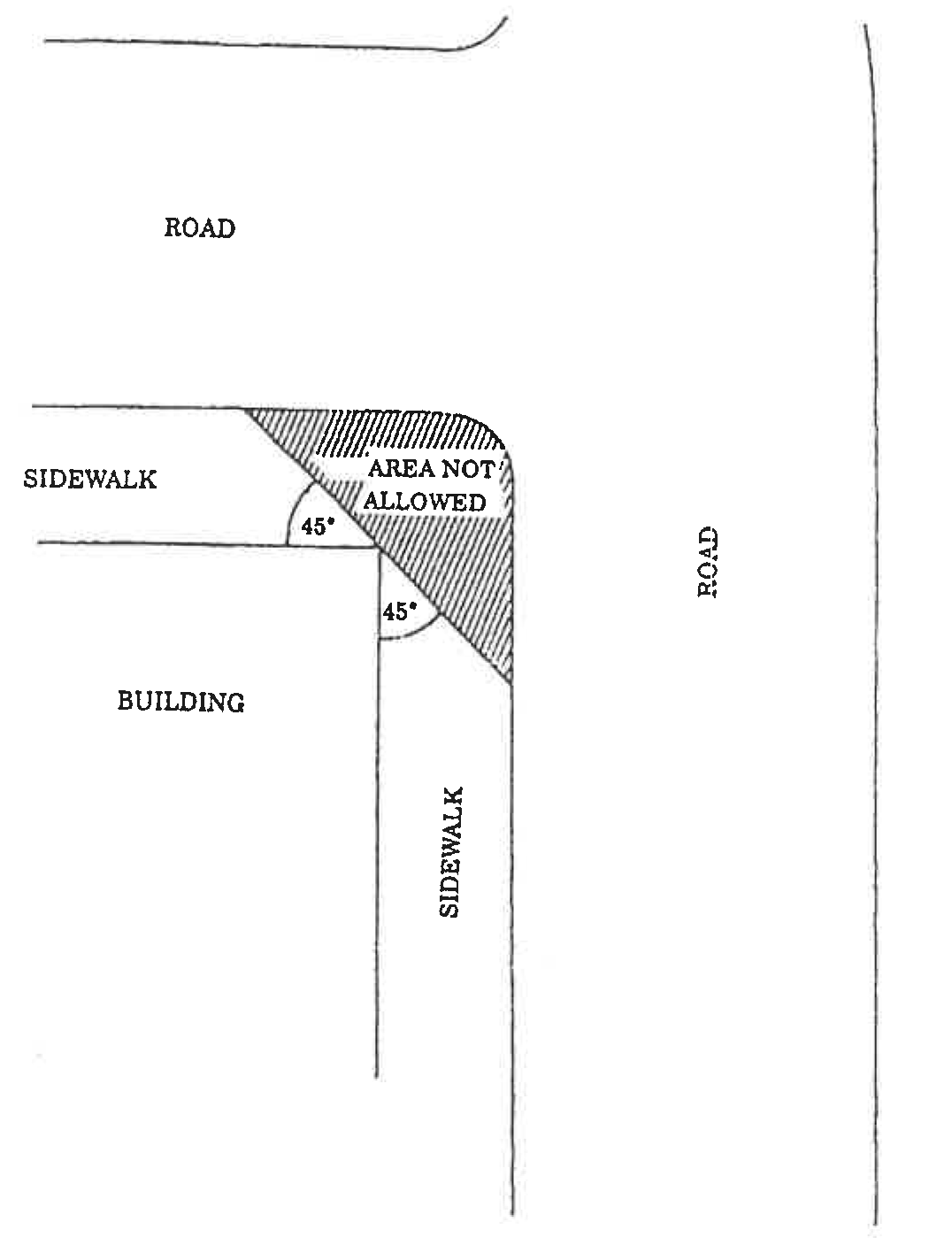
EXHIBIT A
Not to Scale
(8)
Every sidewalk cafe shall be defined by an enclosure at least three feet in height, measured from the ground or sidewalk level, except for an entrance/exit of customary width. Such enclosure shall be made of transparent fencing materials consisting of wrought iron and/or wood, or material made to appear as wrought iron or wood. Such enclosure and other improvements may be affixed to the sidewalk, provided they are removable and are removed and the sidewalk repaired to its original condition upon termination or revocation of the permit of abandonment of the sidewalk cafe. At any time parts of the enclosure are moved or withdrawn, to such an extent that the enclosure is no longer sufficient to meet the requirements of this Division, all obstructions of the right-of-way must be removed.
(9)
Regardless of allowable size, the area within the enclosure shall be limited to necessary space to contain area for proposed outdoor seating. Areas reserved for outdoor recreation or standing only shall be prohibited.
(10)
No heating or cooking of food or open flame shall be permitted in the sidewalk cafe area.
(11)
The proposed sidewalk café shall be in compliance with all applicable provisions of all laws, ordinances, rules and regulations of the City or other governmental authorities, including, but not limited to, the Americans with Disabilities Act.
(Code 1977, § 111.23(15)(c); Ord. No. 11-2019, § 5, 4-8-2019; Ord. No. 27-2024, § 1, 5-28-2024)
Sec. 102-1134. - Permit fee and duration.
No permit shall be issued under this Division except upon the payment of a fee in the amount of $100.00 and upon satisfaction of all conditions contained in this Division. All permits shall be issued for a period of 12 months or a portion thereof and may be renewed annually on the first day of January thereof upon the payment of the fee and the satisfaction of all conditions required for initial issuance and regardless of when the original permit was issued.
(Code 1977, § 111.23(15)(d); Ord. No. 27-2024, § 1, 5-28-2024)
Sec. 102-1135. - Revocation of permit.
(a)
The City Manager is authorized to revoke any permit issued pursuant to this Division if it is determined by the City Manager that:
(1)
The existence or operation of the sidewalk cafe is in violation of any section of this Division or other local, state or federal law, ordinance or regulation;
(2)
Activities carried on at the sidewalk cafe create a public nuisance;
(3)
The sidewalk cafe becomes unsightly or is maintained in an unsanitary condition;
(4)
The existence or operation of a sidewalk cafe is shown to be a danger to the public health and safety;
(5)
There is a failure to use the permitted area for a period of 90 consecutive days;
(6)
There is a failure to maintain the primary food or beverage service use and the requisite licenses therefor;
(7)
There has been a violation of the City's alcoholic beverage regulations or state alcoholic beverage law; or
(8)
There has been an assignment of the permit or the permitted area without the prior written consent of the City Manager.
(b)
No such revocation shall be effective unless, 15 days prior to such revocation, notice is given to the owner of the principal use setting forth the effective date of the revocation and the reasons therefor. Notice shall be deemed given for purposes of this subsection if mailed, by regular U.S. mail or hand delivered, to the owner of the principal use or the operator or manager of the sidewalk cafe at the address set forth in the permit. The revocation notice shall also indicate that the decision of the City Manager may be appealed to the City Commission within seven days after the date that the owner of the principal use or the operator or manager of the sidewalk cafe receives the revocation notice which, if mailed by regular U.S. mail, such date of receipt shall be presumed to be no later than ten days after the date of such revocation notice.
(c)
The appeal shall be in writing and shall set forth the alleged error committed by the City Manager in the enforcement of this Division. Upon filing of the appeal, the City Commission shall schedule a hearing within 30 days. The hearing shall be conducted in a manner which is consistent with minimum due process requirements.
(Code 1977, § 111.23(15)(e); Ord. No. 27-2024, § 1, 5-28-2024)
Sec. 102-1161.- Purpose.
The purpose this division is to allow the sale of personal property from a dwelling lot area which is permanently occupied by the person who is the owner of such personal property within a use district permitting such sales. This division shall allow garage sales in a manner which shall maintain the character of residential neighborhoods as well as dwellings within any use district wherein such sales are permitted and shall prescribe a manner of accomplishing such sales with the minimum visual and traffic impact to the neighborhood.
(Code 1977, § 111.23(11)(a))
Sec. 102-1162. - Permit required.
(a)
No person shall establish, maintain or operate a garage sale within the corporate limits of the city without a current valid permit issued by the building inspector.
(b)
The permit shall be conspicuously displayed at all times during the garage sale on the premises of the sale.
(c)
The permit shall be issued for a period of three consecutive days and shall not be transferable. If inclement weather prohibits the use of the permit for 50 percent or more of the permit period, the building inspector may extend the permit period for not to exceed two consecutive days.
(Code 1977, § 111.23(11)(b))
Sec. 102-1163. - Permit application.
Application for a garage sale permit shall be made on a form furnished by the building inspector and shall contain the following:
(1)
Name and residence address of the applicant, which must be the name of the occupant of the premises upon which the garage sale is to be conducted.
(2)
An inventory and general description of the personal property to be offered for sale.
(3)
Location on the premises where the sale is to occur.
(4)
Dates of any prior permits issued for garage sales on the premises of the applicant, if known.
(5)
The applicant's agreement to comply with this division.
(Code 1977, § 111.23(11)(c))
Sec. 102-1164. - Frequency and hours.
No garage sale shall be permitted on the applicant's premises within 165 calendar days of the expiration of the prior permit issued therefor, and garage sales between the hours of 7:00 p.m. and 7:00 a.m. shall be prohibited.
(Code 1977, § 111.23(11)(d))
Sec. 102-1165. - Restrictions on personal property offered for sale.
Up to three applicants for a permit may join in a garage sale at one location. All personal property offered for sale shall be limited to personal property of the applicant or the applicant's family residing in the applicant's residence, and the property shall conform to the inventory and general description of the personal property contained in the permit application. The sale of personal property transferred from locations other than the applicant's residence shall be prohibited.
(Code 1977, § 111.23(11)(e))
Sec. 102-1166. - Location.
(a)
The display of personal property to be offered for sale at a garage sale within the minimum depth for a front yard as required by this Chapter shall be prohibited, except as otherwise provided.
(b)
The display of personal property to be offered for sale shall be permitted within the roofline of a garage, carport or porch.
(c)
Where no garage, carport, or porch is available, the display of personal property to be offered for sale may be permitted only within the side yard extending from the dwelling or within the rear yard extending from the dwelling.
(Code 1977, § 111.23(11)(f))
Sec. 102-1167. - Reserved.
Editor's note— Ord. No. 3-2016, § 3, adopted Jan. 25, 2016, deleted § 102-1167 entitled "Sign permitted", which derived from Code 1977, § 111.23(11)(g).
Sec. 102-1196.- Parking and storage of camping and recreational equipment.
(a)
For the purpose of this section camping and recreational equipment is defined to include the following:
(1)
A travel trailer, which is a vehicular, portable structure built on a chassis, designed to be used as a temporary dwelling for travel, recreational and vacation uses, permanently identified "travel trailer" by the manufacturer of the trailer and, when equipped for the road, having a body width not exceeding eight feet, weighing not more than 4,500 pounds, and having a body length of not exceeding 29 feet.
(2)
A pickup coach, which is a structure designed primarily to be mounted on a pickup or truck chassis and with sufficient equipment to render it suitable for use as a temporary dwelling for travel, recreational and vacation uses.
(3)
A motorized home, which is a portable dwelling designed and constructed as an integral part of a self-propelled vehicle.
(b)
Any owner of camping and/or recreational equipment may park or store travel trailers, pickup coaches or motorized homes on private residential property, subject to the following conditions:
(1)
At no time shall such parked or stored camping and recreational equipment be occupied or used for living, sleeping, or housekeeping purposes.
(2)
Camping and/or recreational equipment shall not be stored on vacant property.
(3)
If the camping and recreational equipment is parked or stored outside of a garage, it shall be parked or stored to the rear of the front building line of the lot. No camping or recreational equipment that is permitted herein shall be stored or parked closer than ten feet to the rear or side yard property line; provided, however, if the camping or recreational equipment is enclosed within a completely opaque privacy fence, any vehicle which is less than or equal to six feet in height may be parked or stored within said enclosed area regardless of the distance to the property line.
(4)
Camping or recreational equipment shall not be connected to water, sewer, electric or gas utilities, except for periodic maintenance.
(5)
Camping or recreational equipment within the Strawberry Festival overlay district shall be exempt from the provisions of this section during the period of the Florida Strawberry Festival.
(Ord. No. 05-2022, § 1, 3-28-2022)
Sec. 102-1226.- Rationale and findings.
(a)
Purpose. It is the purpose of this division to regulate sexually oriented businesses in order to promote the health, safety, and general welfare of the citizens of the city, and to establish reasonable and uniform regulations to prevent the deleterious secondary effects of sexually oriented businesses within the city. The provisions of this division have neither the purpose nor effect of imposing a limitation or restriction on the content or reasonable access to any communicative materials, including sexually oriented materials. Similarly, it is neither the purpose nor effect of this division to restrict or deny access by adults to sexually oriented materials protected by the First Amendment, or to deny access by the distributors and exhibitors of sexually oriented entertainment to their intended market. Neither is it the purpose nor effect of this division to condone or legitimize the distribution of obscene material.
(b)
Findings and rationale. Based on evidence of the adverse secondary effects of adult uses presented in hearings and in reports made available to the city commission, and on findings, interpretations, and narrowing constructions incorporated in numerous cases, including, but not limited to:
City of Littleton v. Z.J. Gifts D-4, L.L.C., 541 U.S. 774 (2004); City of Los Angeles v. Alameda Books, Inc., 535 U.S. 425 (2002); City of Erie v. Pap's A.M., 529 U.S. 277 (2000); City of Renton v. Playtime Theatres, Inc., 475 U.S. 41 (1986); Young v. American Mini Theatres, 427 U.S. 50 (1976); Barnes v. Glen Theatre, Inc., 501 U.S. 560 (1991); FW/PBS, Inc. v. City of Dallas, 493 U.S. 215 (1990); California v. LaRue, 409 U.S. 109 (1972); as well as in the cases of Artistic Entertainment, Inc. v. City of Warner Robins, 223 F.3d 1306 (11th Cir. 2000); Peek-A-Boo Lounge of Bradenton, Inc. v. Manatee County, 337 F.3d 1251 (11th Cir. 2003); Daytona Grand, Inc. v. City of Daytona Beach, 490 F.3d 860 (11th Cir. 2007); Gary v. City of Warner Robins, 311 F.3d 1334 (11th Cir. 2002); Wise Enters. v. Unified Gov't of Athens-Clarke County, 217 F.3d 1360 (11th Cir. 2000); BZAPs, Inc. v. City of Mankato, 268 F.3d 603 (8th Cir. 2001); Ward v. County of Orange, 217 F.3d 1350 (11th Cir. 2000); Boss Capital, Inc.v. City of Casselberry, 187 F.3d 1251 (11th Cir. 1999); David Vincent, Inc. v. Broward County, 200 F.3d 1325 (11th Cir. 2000); Sammy's of Mobile, Ltd. v. City of Mobile, 140 F.3d 993 (11th Cir. 1998); Lady J. Lingerie, Inc. v. City of Jacksonville, 176 F.3d 1358 (11th Cir. 1999); Lady J. Lingerie, Inc. v. City of Jacksonville, 973 F. Supp. 1428 (M.D. Fla. 1997); Grand Faloon Tavern, Inc. v. Wicker, 670 F.2d 943 (11th Cir. 1982); Board of County Commissioners v. Dexterhouse, 348 So. 2d 916 (Ct. App. Fla. 1977); International Food & Beverage Systems v. Ft. Lauderdale, 794 F.2d 1520 (11th Cir. 1986); Gammoh v. City of La Habra, 395 F.3d 1114 (9th Cir. 2005); World Wide Video of Washington, Inc. v. City of Spokane, 368 F.3d 1186 (9th Cir. 2004); Ben's Bar, Inc. v. Village of Somerset, 316 F.3d 702 (7th Cir. 2003); Williams v. Morgan, 478 F.3d 1316 (11th Cir. 2007); H&A Land Corp. v. City of Kennedale, 480 F.3d 336, (5th Cir. 2007); and other cases; and based upon reports concerning secondary effects occurring in and around sexually oriented businesses, including, but not limited to: Regulation of Sexually Oriented Businesses, A Report and Evaluation for Plant City, Florida; Austin, Texas - 1986; Indianapolis, Indiana - 1984; Garden Grove, California - 1991; Houston, Texas - 1983, 1997; Phoenix, Arizona - 1979, 1995-98; Chattanooga, Tennessee - 1999-2003; Los Angeles, California - 1977; Whittier, California - 1978; Spokane, Washington - 2001; St. Cloud, Minnesota - 1994; Littleton, Colorado - 2004; Oklahoma City, Oklahoma - 1986; Dallas, Texas - 1997, 2004; Centralia, Washington - 2004; Greensboro, North Carolina - 2003; Amarillo, Texas - 1977; New York, New York Times Square - 1994; and also on findings of physical abuse from the papers entitled "Stripclubs According to Strippers: Exposing Workplace Sexual Violence," by Kelly Holsopple, Program Director, Freedom and Justice Center for Prostitution Resources, Minneapolis, Minnesota; Expert Report of Richard McCleary, Ph.D., Dec. 18, 2004; Affidavits of Tom McCarren; "Sexually Oriented Businesses: An Insider's View," by David Sherman, presented to the Michigan House Committee on Ethics and Constitutional Law, Jan. 12, 2000; and the Report of the Attorney General's Working Group On The Regulation Of Sexually Oriented Businesses, (June 6, 1989, State of Minnesota), the city commission finds:
(1)
Sexually oriented businesses, as a category of commercial uses, are associated with a wide variety of adverse secondary effects including, but not limited to, personal and property crimes, public safety risks, prostitution, potential spread of disease, lewdness, public indecency, illicit sexual activity, illicit drug use and drug trafficking, undesirable and criminal behavior associated with alcohol consumption, negative impacts on surrounding properties, litter and sexual assault and exploitation.
(2)
Sexually oriented businesses should be separated from sensitive land uses to minimize the impact of their secondary effects upon such uses, and should be separated from other sexually oriented businesses, to minimize the secondary effects associated with such uses and to prevent an unnecessary concentration of sexually oriented businesses in one area.
(3)
Each of the foregoing negative secondary effects constitutes a harm which the city has a substantial government interest in preventing and/or abating. This substantial government interest in preventing secondary effects, which is the city's rationale for this division, exists independent of any comparative analysis between sexually oriented and nonsexually oriented businesses. Additionally, the city's interest in regulating sexually oriented businesses extends to preventing future secondary effects that could occur in the city related to current sexually oriented businesses as well as sexually oriented businesses that may locate in the city in the future. The city finds that the cases and secondary effects documentation relied on in this division are reasonably believed to be relevant to said secondary effects.
(Ord. No. 22-2005, § 1, 8-22-2005; Ord. No. 34-2007, § 2, 12-10-2007)
Sec. 102-1227. - Locational criteria.
(a)
It shall be unlawful to locate any sexually oriented business within 500 feet of any area in the City zoned within the zoning districts designated as R-1A, R-1, R-1B, R-1C, R-2, R-3, or where residential uses are designated in a PD Planned Development district or within 500 feet of any parcel of land occupied by a school, church, park, library, public recreation area, child care center or day nursery, regardless of whether or not such school, church, park, library, public recreation area, child care center or day nursery is located within the City limits of Plant City.
(b)
It shall be unlawful to locate any sexually oriented business within the "downtown core" as designated on the future land use map of the city's comprehensive plan and the following described parcels:
Part of Block 4 of the D.L. Crums Subdivision as recorded in Plat Book K Plat Page 532 of the public records of Hillsborough County, Florida, lying west of Collins Street (S.R. 39); and
Blocks 1, 2, 10, 11, 12, 14, and 15 and Lots 3 and 4 of Block 13 and the south 52.5 feet of Lot 2 of Block 13 of the Florida Railway and Navigation Company's addition to Plant City, Florida, as recorded in Plat Book 1 page 28 of the public records of Hillsborough County, Florida; and
That part of Block 16 of the Florida Railway and Navigation Company's addition as recorded in Plat Book 1 page 28 of the public records of Hillsborough County, Florida, lying east of Wheeler Street; and
That part of Block 16 of the Florida Railway and Navigation Company's addition as recorded in Plat Book 1 page 28 of the public records of Hillsborough County, Florida, lying west of Wheeler Street less the south 269 feet.
(c)
It shall be unlawful to locate any sexually oriented business within 1,000 feet of any other sexually oriented business as defined herein; this restriction shall require such a separation from a sexually oriented business regardless of whether or not it is located within the city limits of Plant City and regardless of whether or not such use is regulated by the other governmental jurisdiction as an adult use.
(d)
It shall be unlawful to locate any sexually oriented business within 1,000 feet of any establishment where alcoholic beverages are offered for consumption on the premises, unless such establishment is a bona fide restaurant, regardless of whether or not such alcoholic beverage establishment is located within the city limits.
(g)
No legally established and permitted sexually oriented business shall become nonconforming through subsequent establishment of a school, church, park, library, public recreation area, child care center or day nursery, nor shall a license to operate a sexually oriented business be denied based on the issuance of a land use permit for one of said uses if the application for such permit was filed after the filing of the application for the license to operate the sexually oriented business.
(h)
Where this section requires that one use be separated from another use, measurements shall be made in accordance with this subsection. For a use which is the only use or the principal use of a lot or parcel, the measurement shall be made from the property line of the lot or parcel which is nearest to the use to which the measurement is being made. If the use is located in a multi-tenant building, then the distance shall be measured from the line of the leasehold or other space actually controlled or occupied by such use which is nearest to the use to which the measurement is being made. Measurements under this section shall be made along the shortest distance between property lines, without regard to the route of normal travel.
(Ord. No. 22-2005, § 1, 8-22-2005; Ord. No. 34-2007, § 3, 12-10-2007; Ord. No. 05-2013, § 18, 2-25-2013)
Sec. 102-1228. - Reserved.
Editor's note— Ord. No. 34-2007, § 4, adopted Dec. 10, 2007, repealed § 102-1228, which pertained to adult theaters—design standards and derived from Ord. No. 22-2005, § 1, adopted Aug. 22, 2005.
Sec. 102-1229. - Reserved.
Editor's note— Ord. No. 34-2007, § 5, adopted Dec. 10, 2007, repealed § 102-1229, which pertained to special cabarets—design standards and derived from Ord. No. 22-2005, § 1, adopted Aug. 22, 2005.
Sec. 102-1230. - Reserved.
Editor's note— Ord. No. 34-2007, § 6, adopted Dec. 10, 2007, repealed § 102-1230, which pertained to adult retail—design standards and derived from Ord. No. 22-2005, § 1, adopted Aug. 22, 2005.
Sec. 102-1231. - Reserved.
Editor's note— Ord. No. 34-2007, § 7, adopted Dec. 10, 2007, repealed § 102-1231, which pertained to application and derived from Ord. No. 22-2005, § 1, adopted Aug. 22, 2005.
Sec. 102-1232. - Nonconforming businesses.
The city commission, having found that there are no lawful adult entertainment establishments operating within the city as of the date of the first reading of the ordinance from which this section derives [July 25, 2005], any adult entertainment establishments regulated by the provisions of this division or any business made unlawful by the ordinance from which this section derives which may be established in locations not conforming to this division shall be abated within 30 days after the effective date of the ordinance from which this section derives. It shall be unlawful to continue to operate any such business unless such business is lawful and conforms fully with the standards of this division.
(Ord. No. 22-2005, § 1, 8-22-2005)
Sec. 102-1256.- Additional requirements.
The following requirements or regulations qualify or supplement, as the case may be, the district regulations or requirements appearing elsewhere in this Chapter:
(1)
Public or semipublic buildings, hospitals, sanitariums, schools and churches, where permitted in a district, may be erected to a height not exceeding 75 feet when the front, rear and side yards are increased an additional foot for each foot such buildings exceed the height limit otherwise provided in the district in which the building is built.
(2)
Chimneys, water tanks or towers, elevator bulkheads, stacks, spires, broadcasting towers, false mansards, parapet walls, similar structures and necessary mechanical appurtenances may be erected to a height in accordance with existing or hereafter adopted city ordinances.
(3)
Screened enclosures and accessory uses and buildings as defined within this Chapter may be established or located within the rear yard of any zoning lot, subject to the following:
a.
Accessory buildings shall occupy not more than 30 percent of the rear yard of a residential lot.
b.
Except for garage apartments which are subject to Section 102-266(2), Plant City Code, screened enclosures, accessory uses and accessory buildings shall set back a minimum distance of three feet from any rear property line, and five feet from any side property line.
c.
For a lot having reverse frontage, no accessory building shall be erected or located closer than 20 feet to the rear street right-of-way line, nor closer than the applicable main building setback to a side street if the double frontage lot is also a corner lot.
d.
For a garage having access from an alley, the garage building shall be set back a minimum distance of ten feet from the property line adjoining said alley.
e.
Accessory buildings which are located on, or adjacent to, property within a residential zoning district or a residential use within a commercial zoning district shall be limited to 20 feet in wall height; provided however, where said accessory building(s) is also located within ten feet of the rear or side property line, the accessory building(s) shall be limited to ten feet in wall height.
f.
In cases where the main building minimum setback is less than the accessory building minimum setback, the main building setback shall apply to accessory buildings.
(4)
In addition, accessory buildings may be erected or located within a side yard, provided that any such building is located no closer than ten feet to the side lot line, and, further provided, that for a corner lot, an accessory building may be erected or located in the side yard no closer to the side street right-of-way line than the applicable setback for main buildings. Furthermore, accessory building(s) which are located on, or adjacent to, property within a residential zoning district or a residential use within a commercial zoning district shall be limited to 20 feet in wall height.
(5)
Screened enclosures may be erected or located within a side yard, provided that any such building is located no closer than five feet to the side lot line, and, further provided, that for a corner lot, screened enclosures may be erected or located in the side yard no closer to the side street right-of-way line than the applicable setback for main buildings.
(6)
The side yard requirements for dwellings shall be waived where dwellings are erected above stores or shops.
(7)
In computing the depth of a rear yard, for any building where such yard opens onto an alley, one-half of the alley may be assumed to be a portion of the rear yard.
(8)
Every part of a required yard shall be open from its lowest point to the sky unobstructed, except for the ordinary projection of sills, belt courses, cornices, buttresses, ornamental features and eaves; provided, however, that none of such projections shall project into a yard more than 24 inches.
(9)
For corner lots in single-family residential subdivisions platted prior to June 11, 1956, excluding small lots within the Laura Street Restoration overlay district which are subject to setbacks as provided in section 102-848, the required side yard setback measured from the right-of-way line to the side wall of the main building shall be reduced by ten percent.
(10)
For commercial double frontage lots, the minimum rear yard setback shall be 20 feet.
(11)
Notwithstanding any other provisions herein, for properties located within the "Downtown Core" as defined within the Plant City Comprehensive Plan, building setback distances shall not apply.
(12)
Airport Zoning Regulations.
a.
The construction of any structure or placement of any tree within the M-AP zoning District or within the Airport Zones not within M-AP which exceeds the heights of the zone as depicted on the Height Zoning Map - Plant City Airport must obtain an airport height zoning permit or variance from the Hillsborough County Aviation Authority.
b.
The construction of an educational facility of a public or private school shall be prohibited at either end of the runway of the Plant City Airport within any zoning district under the City's jurisdiction which extends five (5) miles in a direct line along the centerline of the runway, and which has a width measuring one-half the length of the runway, subject to the exceptions contained in F.S. § 333.03(3).
c.
No sanitary landfills within the jurisdiction of Plant City will be allowed within 10,000 feet from the nearest point of the runway of Plant City Airport.
(Code 1977, § 111.20; Ord. No. 16-2001, § 21, 8-13-01; Ord. No. 2-2009, § 4, 1-12-2009; Ord. No. 26-2011, § 6, 8-22-2011; Ord. No. 50-2021, § 2, 10-25-2021)
Sec. 102-1257. - Obstructions at intersecting streets.
On a corner lot in any residential zoning district no fence, wall, hedge or other obstruction or planting more than three feet in height shall be erected, placed or maintained within the triangular area formed by the intersecting street lines and a straight line adjoining such street lines at points which are 20 feet distant from the point of intersection, measured along the street lines.
(Code 1977, § 111.23(4))
Sec. 102-1258. - Open spaces.
No lot, yard, court or other open space, already containing less area than the minimum required under this Chapter, shall be further divided or reduced.
(Code 1977, § 111.23(5))
Sec. 102-1371.- Purpose.
Buffering, landscaping and tree requirements are set forth in this Division for all zoning districts, as identified in this Chapter, in order to provide for residential privacy, environmental amenities, aesthetic enhancement of the community and for public safety.
(Ord. No. 7-2012, § 4, 3-12-2012)
Sec. 102-1372. - Exceptions.
(a)
This Division, except for Sections 102-1376, 102-1377, 102-1379, 102-1383 through 102-1386, shall not apply to any existing building or structure, except where there is a change or substantial enlargement of use. Substantial enlargement of an existing use shall consist of an enlargement to the extent of 50 percent or more in floor area or number of housing units. Such newly erected and substantially enlarged uses shall then and thereafter comply with the full buffering and landscaping requirements set forth in this Division.
(b)
No buffering or landscaping shall be required in the areas specifically bounded as follows:
(1)
On the north by the south line of Baker Street; on the east by the west line of Michigan Avenue between Baker Street and CSX right-of-way and thence by the west line of Lake Street south of the CSX right-of-way to the north line of Alabama Street; on the south by the north line of Alabama Street and on the west by the east line of Walker Street between Baker Street and the CSX right-of-way and the east line of Wheeler Street south of the CSX right-of-way to Alabama Street (Downtown).
(2)
On the west by the east line of Alexander Street; on the north by the CSX right-of-way north of Dr. Martin Luther King, Jr. Boulevard; on the east by a north-south line from the CSX right-of-way south of Dr. Martin Luther King, Jr. Boulevard, along and contiguous with North Davis Street; on the south by the A.C.L. right-of-way south of Dr. Martin Luther King, Jr. Boulevard (State Farmer's Market).
(3)
Within the area designated as the "Midtown Redevelopment District" within the Future Land Use Element of the City's Comprehensive Plan (Midtown).
(Ord. No. 7-2012, § 4, 3-12-2012)
Sec. 102-1373. - Abutting property lines.
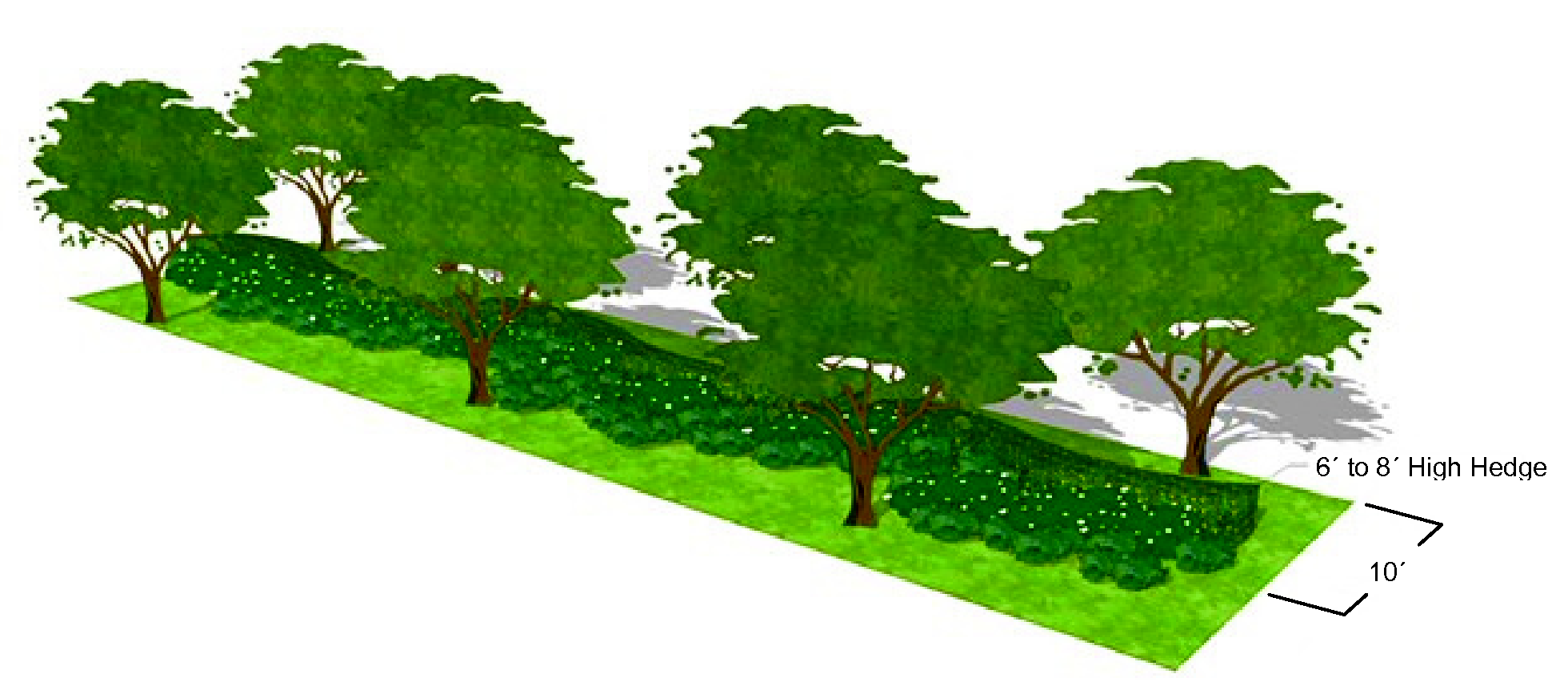
Residential subdivision perimeters/entrances, multifamily and nonresidential developments or expansion upon any lot abutting a residential district or use and residential subdivision perimeters and multifamily development or expansion upon any lot abutting a nonresidential district or use shall provide buffers and landscaping along all abutting property lines in accordance with the following requirements, unless otherwise modified by this Chapter. The following standards shall be applied to all zoning districts:
(1)
Buffers shall provide continuous visual screen and shall consist of walls, fencing and/or landscaping with compact evergreen hedges, trees or other similar foliage as follows:
a.
Walls and fences shall be constructed to be 80 percent opaque at installation. Opaqueness of walls and fences shall be determined by measurement taken from a minimum distance of 10 feet and looking perpendicular to the line of the wall or fence.
b.
Landscape buffers shall be designed so as to be 50 percent or more opaque at the time of planting, and 80 percent opaque within one year after issuance of a certificate of occupancy. Opaqueness of landscape buffers shall be determined by measurement taken from a minimum distance of 10 feet and looking perpendicular to the line of the landscape buffer.
(2)
Buffers shall be a minimum of six feet and a maximum of eight feet high. Trees used for buffering may exceed the maximum buffer height of eight feet.
(3)
Landscape buffers shall be a minimum of ten feet wide measured from a minimum distance of 10 feet and looking perpendicular to property lines and shall be established along the entire length of and contiguous to the property line, except as modified by this Chapter.
(Ord. No. 7-2012, § 4, 3-12-2012)
Sec. 102-1374. - Abutting rights-of-way.
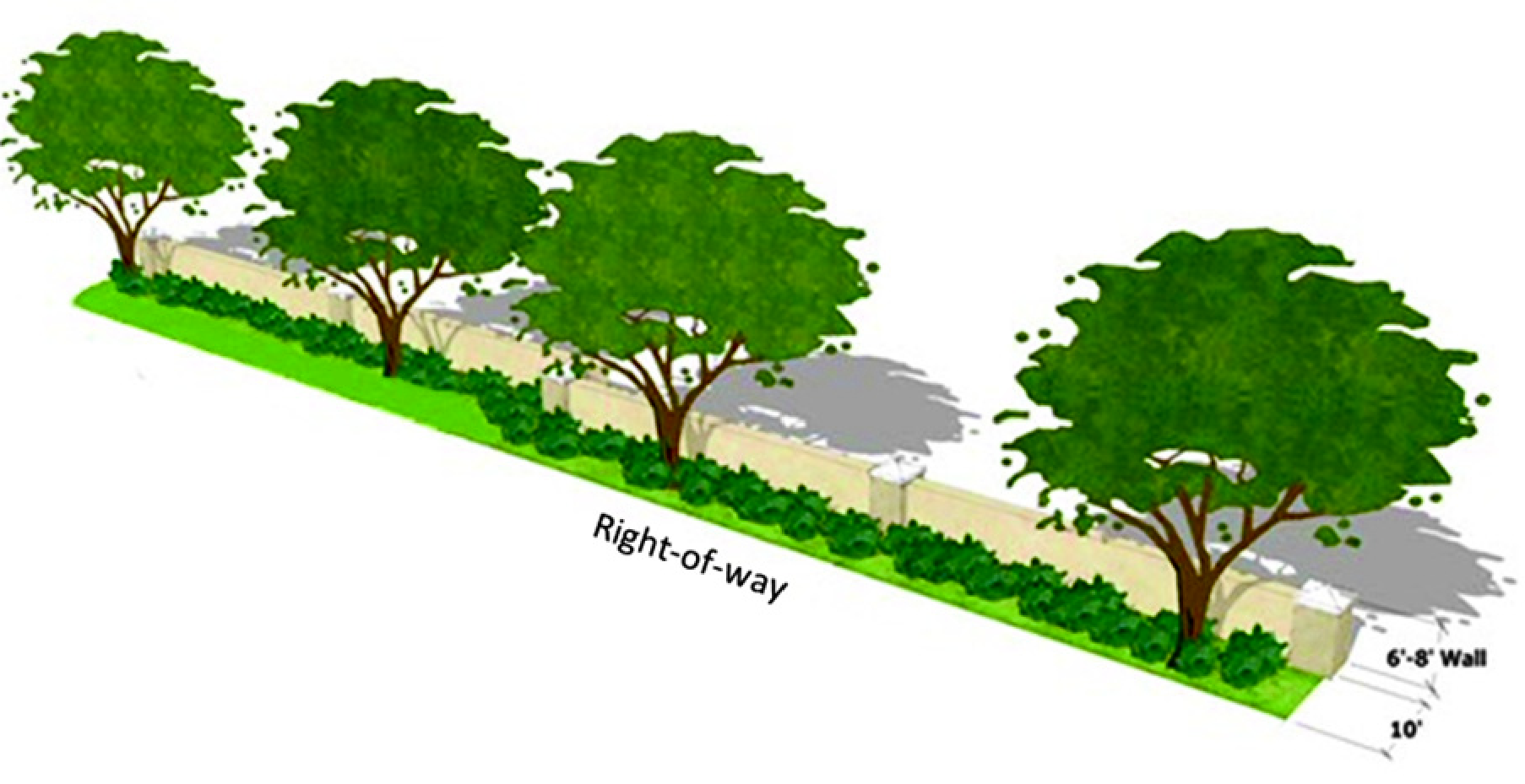
For the purposes of this Chapter, to minimize roadway noise and visual impacts, a landscape buffer shall be located between residential subdivision perimeters/entrances, multifamily or nonresidential uses abutting road rights-of-way. Buffers shall be landscaped with grass, ground cover or other landscaping, including an average of one tree for every 40 linear feet or part thereof of road frontage, in which the minimum distance between trees shall be ten feet. Small trees, as provided in subsection 102-1378(18), or similar small trees shall be utilized within the minimum landscape buffer abutting road right-of-way. Other types of trees may be considered as provided in subsection 102-1378(19) according to the distance from the right-of-way. The following standards shall be applied to abutting road rights-of-way:
(1)
Residential subdivision entrances and multifamily uses abutting road rights-of-way shall provide buffers that consist of a strip of land no less than ten feet wide.
(2)
Nonresidential uses abutting road rights-of-way shall provide buffers that consist of a strip of land no less than ten feet wide and shrubs shall be planted and maintained so as to form a continuous, unbroken, solid visual screen within one year from the time of planting.
(3)
Erection of an opaque fence or wall is permitted along side or rear lot lines abutting the road rights-of-way when combined with landscaping and trees. The finished side of the fence shall face the right-of-way and the landscaping and trees shall be on the outside of the fence or wall, adjacent to the right-of-way.
(Ord. No. 7-2012, § 4, 3-12-2012)
Sec. 102-1375. - Recreation, open space and environmentally sensitive areas.
The following buffering and landscaping requirements for recreation, open space and environmentally sensitive areas shall apply in all zoning districts:
(1)
Any common recreation area located on the perimeter of a residential subdivision or multifamily district or use shall be buffered in accordance with Section 102-1373.
(2)
Multifamily and townhouse developments shall provide landscaped open space, in addition to the requirements of subsection 102-353(e)(5), equivalent to 35 percent of the gross lot area, of which 20 percent or more of the gross lot area shall be landscaped with shrubs and trees. Fifty percent of the open space area provided shall be located on the site in such a manner as to be usable for active or passive recreation and easily accessible to all dwelling units within the development. Landscaping, sidewalks, and amenities such as tennis courts and swimming pools may be located within the useable open space areas.
(3)
All multifamily, townhouse developments and residential PD Planned Development districts and residential Traditional Neighborhood Development districts (TND) shall provide recreational amenities within the development for the primary use of the residents of the development. At a minimum the development shall include a playground facility plus recreational amenities per the table below. Recreational amenities include swimming pools, club houses or community centers, picnic shelters/barbecue areas, court game facilities (tennis, volleyball, basketball, shuffleboard), or a trail system not otherwise required as a substitute for sidewalks. In development larger than 200 units, amenities may be repeated upon approval by the Planning Board. Recreational amenities shall be provided according to the following schedule:
(4)
Outdoor recreation areas shall be located in areas where topography, soils, hydrology and other physical characteristics are of such quality as to create a flat, dry, obstacle-free space in a configuration which allows for passive and active recreation.
(5)
Recreation amenities shall be centrally located near a majority of units, accessible and usable to residents and visible from surrounding units.
(6)
Playground equipment shall be certified by International Play Equipment Manufacturers Association (IPEMA) utilizing current American Society for Testing and Materials (ASTM) Standard F1487. Playground surface shall meet current ASTM (F1292) Standards.
(7)
Nonresidential developments and uses shall provide landscaped open space areas located interior to the parcel, a minimum of ten percent of the gross lot area, not including designated conservation and preservation areas.
(8)
Stormwater retention areas may not be used in whole or in part to fulfill the open space requirements of subsections (1) through (7) of this Section.
(9)
Stormwater detention areas may be used to fulfill the open space requirements for multifamily and nonresidential developments and shall provide landscaped banks of such areas from the mean high water line to the top of the bank.
(10)
Any wetland, conservation or preservation area shall not be altered before, during or after construction activities and must maintain a natural vegetative, minimum buffer of 15 feet and an average of 25 feet from such areas.
(Ord. No. 7-2012, § 4, 3-12-2012; Ord. No. 05-2013, § 21, 2-25-2013)
Sec. 102-1376. - Open storage and trash receptacle areas.
For the purposes of this Chapter, buffers shall be required for all open storage areas, including open storage of delivery or service vehicles, loading areas, trash compactors and dumpsters, in accordance with Section 102-1373, and shall be shown on the general landscaping site plan as required by subsection 102-1380(b).
(Ord. No. 7-2012, § 4, 3-12-2012)
Sec. 102-1377. - Fence and wall standards.
The following fence and wall standards shall apply in all zoning districts:
(1)
On all corner lots, no fence or wall more than 30 inches high shall be placed within the minimum vision clearance area as defined in subsection 102-1413(5).
(2)
On all lots adjacent to or in residential districts, no fence or wall, even though part of a required buffer, shall extend into the yard between the established front building setback line and street right-of-way line exceeding 48 inches high. Except for properties located within the residential historic district as defined in Article III of Chapter 38, acceptable materials shall include chainlink, wrought iron or other decorative fencing material.
(3)
Fences in the side and/or rear yard shall not exceed eight feet high.
(4)
Except as noted in subsection (2) above, fences or walls within the front yard shall not exceed six feet high.
(5)
For properties located within an historic district, see subsection 38-163(3) for fencing criteria.
(Ord. No. 7-2012, § 4, 3-12-2012)
Sec. 102-1378. - Landscape and plant material standards.
The following landscape and plant material standards shall apply in all zoning districts:
(1)
Use of the plant material from the Florida-Friendly Plant List, published by the University of Florida, IFAS Extension is encouraged and all plant material shall conform to the standards for grade #1 or better as listed in the Grades and Standards for Palms and Trees, published by the Florida Department of Agriculture and Consumer Services.
(2)
Grass areas shall be planted with permanent lawn species. Turf areas may be sodded, plugged, sprigged or seeded. In areas where erosion is likely, solid sod shall be used. In areas where grass seed is used, nurse grass seed (e.g., rye, millet) shall also be sown for immediate effect.
(3)
Ground covers in lieu of grass or turf, in whole or in part, shall be planted in such a manner as to present a finished appearance, to provide complete coverage and shall be used with a decorative mulch.
(4)
Vines shall be a minimum of 30 inches high immediately after planting and may only be used in conjunction with fences, screens, or walls to meet buffering requirements as specified.
(5)
Hedges and shrubs shall be a minimum of two feet high when measured immediately after planting. Hedges, where required, shall be planted and maintained so as to form a continuous, unbroken, solid visual screen within one year of planting.
(6)
No tree shall be planted within ten feet of a fire hydrant or utility pole, within 20 feet of a traffic sign, or within the minimum vision clearance area as defined in subsection 102-1413(5).
(7)
Trees of species whose roots are known to cause damage to public roadways or other public works shall not be located within 25 feet of a public facility. Subsection (18) below, addresses the type of trees permitted near the right-of-way or power lines.
(8)
Planting of medium and large trees within a utility easement is prohibited. Only small trees shall be planted within a utility easement.
(9)
Barricades shall be placed around all protected trees to be retained on the site and shall remain in place until site clearing and construction activities are complete, except where land alteration and construction activities are approved within the dripline. The barricade shall be a minimum of ten feet from the base of the tree.
(10)
A minimum distance of ten feet shall be maintained from all protected trees when installing underground utilities. If this results in unreasonable hardship, a soil auger shall be used to tunnel under the root systems.
(11)
No attachments shall be secured to trees designated to remain on-site.
(12)
A protective drywell shall be provided where protected trees will be adversely affected by raising the grade. The drywell shall be kept free of debris.
(13)
A protective retaining wall shall be constructed at the perimeter of the protective radius around protected trees where trees will be adversely affected by lowering the grade.
(14)
During the site clearing or construction phases, the clearing of vegetation except by hand or the placing of soil deposits, debris, solvents or other chemicals, construction materials, machinery or other equipment of any kind within the dripline of a protected tree or clump of trees is prohibited, and the compaction, filling or removal of soil or the use of concrete, asphalt or other paving materials shall be prohibited within the dripline of a protected tree or clump of trees, unless protective measures such as a protective drywell or retaining wall has been installed according to an approved plan, except where land alteration and construction activities are approved within the dripline.
(15)
Any retained or relocated tree shall be replaced if the tree dies within one year after site clearing and construction.
(16)
Any pruning and/or root pruning of protected trees during the site clearing or construction phases shall be done in accordance with the State Department of Agriculture standards.
(17)
New trees used to meet the requirements of this Article shall have a minimum caliper of two inches immediately after planting.
(18)
Placement of trees. Trees may not be planted within the right-of-way. For the purposes of the table, the appropriate size of trees as designated below, denotes the required distance from rights-of-way and power lines, and appropriate trees within landscaped islands as follows:
(19)
Recommended trees. For the purposes of this Chapter, the list of recommended trees in this Section is not all inclusive as there are many other trees in the State. These are sorted by size of tree and listed by common name, scientific name, height and spread to assist in making a determination as to the kinds of trees to plant in certain locations.
(20)
Exempted trees.
a.
The trees exempted by this Section shall not be used to meet the requirements of this Section or as replacement trees, nor are the inches to be calculated for tree removal under Section 102-1383.
b.
Exempted trees pursuant to this Division are as follows:
(Ord. No. 7-2012, § 4, 3-12-2012)
Sec. 102-1379. - Maintenance of landscaping and buffered areas.
The following requirements for maintenance of required landscaping and buffered areas shall apply in all zoning districts:
(1)
The property owner shall be responsible for maintenance of all landscaping and buffer areas. All landscaped areas shall be kept free of refuse and debris and shall be provided with irrigation so as to be maintained to a 95% survivability rate.
(2)
Use of and encroachment into required landscaped areas by structures or buildings and parked or moving vehicles, including cars, boats, mobile homes, travel trailers and construction equipment, shall not be permitted. Where necessary to prevent encroachment by parked or moving vehicles, wheel stops or curbs shall be used. Landscaped areas shall not be used for the storage or sale of material, goods and products.
(3)
Paving, treating or covering a required landscaped area in a way that renders it impervious is prohibited.
(4)
All buffered and landscaped areas shall allow access to public and private utility facilities for maintenance purposes.
(5)
All required landscaping shall be inspected by City staff one year after planting to ensure the vegetation is surviving. Dead vegetation shall be replaced by the owner of the parcel within 30 days of notification. If replacement is necessary, there shall be a reinspection six months after the replacement planting.
(Ord. No. 7-2012, § 4, 3-12-2012)
Sec. 102-1380. - Plan requirements.
(a)
The plan requirements for buffering and landscaping in this Section shall apply in multifamily, nonresidential districts and for residential subdivision entrances/perimeters.
(b)
A general site plan shall be submitted by the owner to the City's Planning and Zoning Division for approval prior to issuance of a building permit. The site plan shall include all of the following:
(1)
The name and address of the applicant and the owners of the property.
(2)
A general location of the site showing adjacent street systems, easements, north arrow, scale, topography and date the plan was prepared.
(3)
A legal description of the property.
(4)
Existing and proposed structures by size, height, configuration and total floor area.
(5)
The dimensions of all proposed and existing off-street parking spaces, service areas, and access drives.
(6)
Open space, retention and detention areas.
(7)
Impervious and pervious surface totals as required.
(8)
A complete listing of new plant materials, scientific and common names, and the size of proposed plants.
(9)
The general location of the proposed plant material and the irrigation system to be installed on the site.
(10)
Calculations for the total diameter at breast height (DBH) inches of trees on-site and the amounts proposed to be removed and retained.
(11)
An existing tree survey or a proposed alternative acceptable to the City Manager, and a proposed removal plan.
(Ord. No. 7-2012, § 4, 3-12-2012; Ord. No. 25-2021, § 2, 6-14-2021)
Sec. 102-1381. - Certificate of occupancy.
Buffering, landscaping and trees required under this Division shall be in place prior to issuance of Certificate of Occupancy. It shall be unlawful to occupy the premises unless such landscaping and buffering is installed in accordance with the approved plans and all other requirements of this Division.
(Ord. No. 7-2012, § 4, 3-12-2012)
Sec. 102-1382. - Florida-friendly landscaping.
For the purposes of this Division, Florida-friendly landscaping and the plant material listed in the Florida-friendly plant list, published by the University of Florida, IFAS Extension are encouraged.
(Ord. No. 7-2012, § 4, 3-12-2012)
Sec. 102-1383. - Tree removal, permit and standards.
(a)
No person shall cut down, remove, relocate, damage, destroy or in any manner abuse any protected tree in the City without a permit issued by the Planning and Zoning Division. The permit application shall be submitted by the owner of the parcel on which the tree is located or an agent for the owner.
(b)
No tree shall be removed from any City lands, public parks, or rights-of-way by other than governmental or governmental contracted crews in performance of their duties.
(c)
A tree removal permit will be granted by the City when it has been proven that one or more of the following conditions exist and, where required, that the protected trees proposed to be removed shall be relocated or replaced with a recommended tree:
(1)
The protected tree is located in an area where a structure, improvement or required infrastructure will be placed and any other design of the structure is not a viable alternative.
(2)
The protected tree is located in an area where essential grade changes, or essential surface water drainage, or utility installations are required by a development order or the City's Engineering Division and the applicant has demonstrated it is not reasonably practical to utilize arboricultural techniques to preserve a protected tree.
(3)
It is necessary for removal of vegetation causing damage to public or private property.
(4)
The tree is diseased, injured, in danger of falling, creating a public hazard, interfering with existing utility service, or creating unsafe vision clearance on roadways. Trees found to be diseased by the City and to be in danger of contaminating other trees or of spreading tree infection shall be removed and disposed of, if necessary, without undue delay and on an emergency basis.
(5)
The tree has been irreversibly damaged or destroyed by natural disaster.
(6)
A tree needs to be removed in order to prevent damage to, repair or replace public utilities.
(7)
An arborist provides written documentation on why the tree must be removed which follows the criteria stated in subsections (c)(3)—(6) of this Section.
(8)
The protected trees need to be removed for development and calculations have been submitted which meets the requirements of this Division.
(d)
No replacement will be required when a removal permit has been granted for any of the reasons stated in subsections (c)(3)—(7) of this Section.
(e)
No tree removal permit will be required for the following:
(1)
The tree is on the exempted tree list.
(2)
The trees are grown by a nursery or tree farm specifically for sale.
(f)
Each tree removal and replacement permit approved shall be effective for 12 months from the date of issuance of the permit. Any permit not used within the prescribed time limit shall become void, and future work shall require a new application.
(g)
All fees, permit applications, approvals granted, and other necessary functions under this Article shall be processed directly by the Planning and Zoning Division.
(Ord. No. 7-2012, § 4, 3-12-2012)
Sec. 102-1384. - Standards for development.
All proposed developments and/or improvements shall be designed and located to minimize the removal of native plant community vegetation. However, it is not the intent of this Section to preclude the use of a lot or parcel of land consistent with the requirements of this Chapter. The following requirements for development shall apply in all zoning districts, except when exempted by State law:
(1)
For nonwooded land under development of residential uses, a minimum of 65 percent of the inches of the protected trees on a parcel shall be retained or replaced exclusive of wetlands and other conservation/preservation areas. For development of nonresidential uses, a minimum of 20 percent of the inches of the protected trees shall be retained on the wooded land, which is to remain open space areas or replaced in common open space areas. Percentage of retained protected trees shall be exclusive of wetlands and other conservation/preservation areas.
(2)
For wooded land under development for residential uses and any other use not otherwise specified in this article, a minimum of 35 percent of the inches of the protected trees shall be retained on the wooded land, which is to remain open space areas or replaced in common open space areas. For development of multifamily use, a minimum of 25 percent of the inches of the protected trees shall be retained on the wooded land, which is to remain open space areas or replaced in common open space areas. For development of nonresidential uses, a minimum of 20 percent of the inches of the protected trees shall be retained on the wooded land, which is to remain open space areas or replaced in common open space areas. Percentage of retained protected trees shall be exclusive of wetlands and other conservation/preservation areas.
(3)
Tree replacement on-site with recommended trees shall be required for the removal of any protected tree which is 30 inches or greater in diameter at breast height unless it meets the exemption criteria as provided in this Division. Tree replacement shall then be an inch per inch ratio and may be substituted or combined with contribution to the Tree Fund as per Section 102-1386. If the required inches for replacement under this subsection (3) is different than the inches required by the percentages in subsections (1) and (2), the greater shall apply.
(4)
All development shall be required to submit an existing tree survey or a proposed alternative acceptable to the City Manager, and a proposed removal plan when applying for a tree removal permit.
(5)
All development shall be required to plant trees and other vegetation in accordance with the landscape and parking regulations.
(6)
After tree removal or land alteration/site clearing, no site shall be left in a barren, undeveloped condition without commencement of construction or revegetation within 60 days of clearing. Revegetation shall include planting trees and seeding or sodding materials to prevent soil erosion, blowing of airborne particulate matter and debris and to replace the minimum required trees per the approved site plan.
(7)
When the applicant is required to replace the protected tree as a condition of approval for a tree removal permit the applicant shall select site-specific replacement trees from the recommended tree list. If it is feasible, a protected tree may be relocated on the same parcel of land.
(8)
If the proposed tree for removal is of a species which has undesirable growth habits, is on the exempted tree list, or is proven to the City to be irreparably unhealthy or damaged, may be required to be removed by the City Manager, but replacement will not be required. Written proof of an unhealthy or damaged tree can be obtained through an arborist at the owner's expense.
(Ord. No. 7-2012, § 4, 3-12-2012; Ord. No. 25-2021, § 3, 6-14-2021)
Sec. 102-1385. - Enforcement.
The City shall have recourse to such remedies in law and equity as may be necessary to ensure compliance with this Article, including the following:
(1)
The City may withhold the issuance of any construction plan approval, building permit, or certificate of occupancy.
(2)
The City may revoke permits issued under this article upon finding that:
a.
The permit was issued by mistake of law or fact;
b.
The permit was issued upon a false statement or misrepresentation by the applicant;
c.
The work violates any City ordinance or any state or federal law, rule or regulation;
d.
The work is not being performed in accordance with this Division;
e.
The work is not being done in accordance with the terms of the permit, the plans or the application upon which the permit was issued; or
f.
Payment of the permit fee was not effected due to insufficient funds or any other reason.
(3)
The City may institute a civil action to enjoin or restrain any person violating this Division.
(4)
The City may pursue action under Section 1-14, Plant City Code. Each tree removed without a permit shall be deemed to be a separate violation.
(5)
The City may present a case to the Code Enforcement Board.
(6)
The City may pursue any other remedy allowed by law.
(7)
Upon notice from the City, work on any site or tree removal done contrary to this Article, in a dangerous or unsafe manner, or which constitutes a threat to life or to public or private property shall immediately cease. Such notice shall be in writing and shall be given to the owner of the property, his agent, or the person doing the work, or it shall be posted at the job site.
(Ord. No. 7-2012, § 4, 3-12-2012)
Sec. 102-1386. - Alternative compliance plan.
(a)
An applicant who does not meet the requirements of this Division may propose an Alternative Compliance Plan. The applicant must demonstrate that the intent of this Division can be more effectively met in whole or in part through an Alternative Compliance Plan. Such plans should not be used as a means to circumvent the intent of this Division. If approved by the City Manager, an Alternative Compliance Plan may be substituted in whole or in part for a landscape/tree plan meeting the express terms of this Division.
(b)
The City Manager shall consider the following for an Alternative Compliance Plan:
(1)
Designs which attempt to preserve and incorporate all viable vegetation of significance in regards to size or nature, either individual trees or collective group of trees;
(2)
The intended use of the property, including all lands dedicated to public use;
(3)
Total existing vegetative coverage on the site and in the immediate surrounding area;
(4)
Quantity of vegetation proposed to be removed from the site;
(5)
The type, size, and condition of the vegetation to be removed;
(6)
The feasibility of relocating the particular vegetation;
(7)
Topography and drainage of the site;
(8)
Plans which support Florida-friendly landscaping principles; and
(9)
When there are site constraints, such as an insufficient area in which to plant replacement trees:
a.
The owner may pay the City for the number of inches not being planted. The amount shall be calculated on a cost per inch basis, with the cost per inch being set at $65.00. Payments shall be made prior to issuance of a building permit. No trees shall be removed prior to payment of funds nor prior to receiving a building permit; or
b.
The applicant, with the consent of the City Manager, may replace trees on publicly owned property.
(c)
The Alternative Compliance Plan shall be valid for so long as the Detailed Site Plan for the subject property is valid.
(d)
The City Manager shall not approve an Alternative Compliance Plan if:
(1)
It is determined that the proposal fails to provide an equal or superior alternative to the results of strict compliance with this Code, or is otherwise inconsistent with the intent of this Article to encourage exceptional or unique designs.
(2)
The proposal will result in the planting or preservation of fewer trees than the minimum number required by this Division, unless there is a payment into the Tree Fund of an amount equal to that required pursuant to an approved Alternative Compliance Plan.
(3)
The proposal will violate the terms or conditions of any City ordinance.
(e)
Fees collected in lieu of planting replacement trees on the removal site shall be deposited into a separate fund designated by the City as the Tree Fund. These funds shall be used for the purposes of planting trees on public property elsewhere in the City as deemed appropriate by the City Manager.
(Ord. No. 7-2012, § 4, 3-12-2012; Ord. No. 25-2021, § 4, 6-14-2021)
Sec. 102-1411.- Purpose.
Access management, off-street parking, circulation, and bicycle and pedestrian facilities requirements are set forth in this Division for all zoning districts in order to provide for safe and convenient storage and circulation of all types of vehicles, facilitated traffic flow, protection of pedestrians, bicyclists and motorists, and reduction in incompatability to less intense adjacent land uses.
(Ord. No. 16-2014, § 2, 8-11-2014)
Sec. 102-1412. - Downtown and Midtown.
(a)
Downtown.
(1)
No off-street parking spaces shall be required in the areas specifically bounded as follows: commencing at the southwest corner of Michigan Avenue and East Baker Street; thence run southerly to the northern boundary of the CSX Railroad right-of-way line; thence east to the west right-of-way line of Lake Street; thence south along the west right-of-way line of Lake Street to the north right-of-way line of East Alabama Street; thence west along the north right-of-way line of East Alabama Street to the west right-of-way line of CSX Railroad right-of-way; thence north and northwesterly along the west right-of-way line of CSX Railroad to the southwest corner of South Collins Street and CSX Railroad right-of-way line; thence southwesterly along the south right-of-way for CSX Railroad to the east right-of-way line of South Wheeler Street; thence northwesterly along the east right-of-way of South Wheeler Street to the north right-of-way line of CSX Railroad; thence southwesterly along the north right-of-way line of CSX Railroad to the east right-of-way line of North Walker Street; thence northwesterly along the east right-of-way line of North Walker Street to the south right-of-way line of West Baker Street; thence northeasterly along the south right-of-way line of Baker Street to the Point of Beginning.
(2)
Standards. Except for the number of spaces, all off-street parking and joint use agreement areas within the Downtown as described herein, shall meet all of the requirements of this Division, including, but not limited to width and length.
(b)
Midtown MTD District.
(1)
Reduction in spaces. A 15% reduction in the number of off-street parking spaces required by Section 102-1421 shall be allowed on parcels with a zoning classification of MTD Midtown District. In addition, the applicant may request a greater reduction in the required number of off-street parking spaces not to exceed a total reduction of 25% through an application and approval of an Alternative Midtown Design, as provided in Section 102-859. Under this process, the applicant would propose an alternative design or innovative approach, through a parking impact study. The Alternative Midtown Design must be approved by the City Commission.
(2)
Off-site. Some or all of these required parking spaces may be provided off-site, provided they are located within ⅛ mile of the proposed use and are within the "Midtown Redevelopment District", as designated in the City's Comprehensive Plan.
(3)
Joint use agreements. Some or all of these off-street parking spaces may be provided on a property of different ownership, provided a joint use agreement is executed and recorded, as required by Section 102-1413(b)(4)b.2.
(4)
Standards. Except for the number of spaces, all off-street parking and joint use agreement areas within the MDT Midtown District shall meet all of the requirements of this Division, including, but not limited to width and length.
(Ord. No. 16-2014, § 2, 8-11-2014; Ord. No. 2-2016, § 1, 1-25-2016)
Sec. 102-1413. - Standards for off-street parking areas.
For the purposes of this Chapter, the following off-street parking development and maintenance standards shall apply in all cases, except single- and two-family dwellings:
(a)
General Requirements:
(1)
Parking areas, aisles and turnarounds for standing and maneuvering of vehicles shall provide a durable and dustless surface and shall be adequately maintained for all-weather use. However, 100 percent of the required parking spaces for places of religious assembly and City park, recreational, and utility facilities may be grass, excluding ADA required parking. Prior to approval of a grass parking area, the applicant shall provide to the City such calculations as may be required to ensure that the parking area, whether hard-surfaced or grass, meets the stormwater quality and quantity requirements of the City.
(2)
Parking areas, aisles, and turnarounds shall have provisions made for the on-site collection of drainage waters to eliminate sheet flow of such waters onto sidewalks, rights-of-way, and abutting property.
(3)
In no case shall one-way driveways or aisles be less than 12 feet in width. In no case shall two-way driveways or aisles be less than 24 feet in width. See illustrations herein for driveway or aisle widths for angled parking.
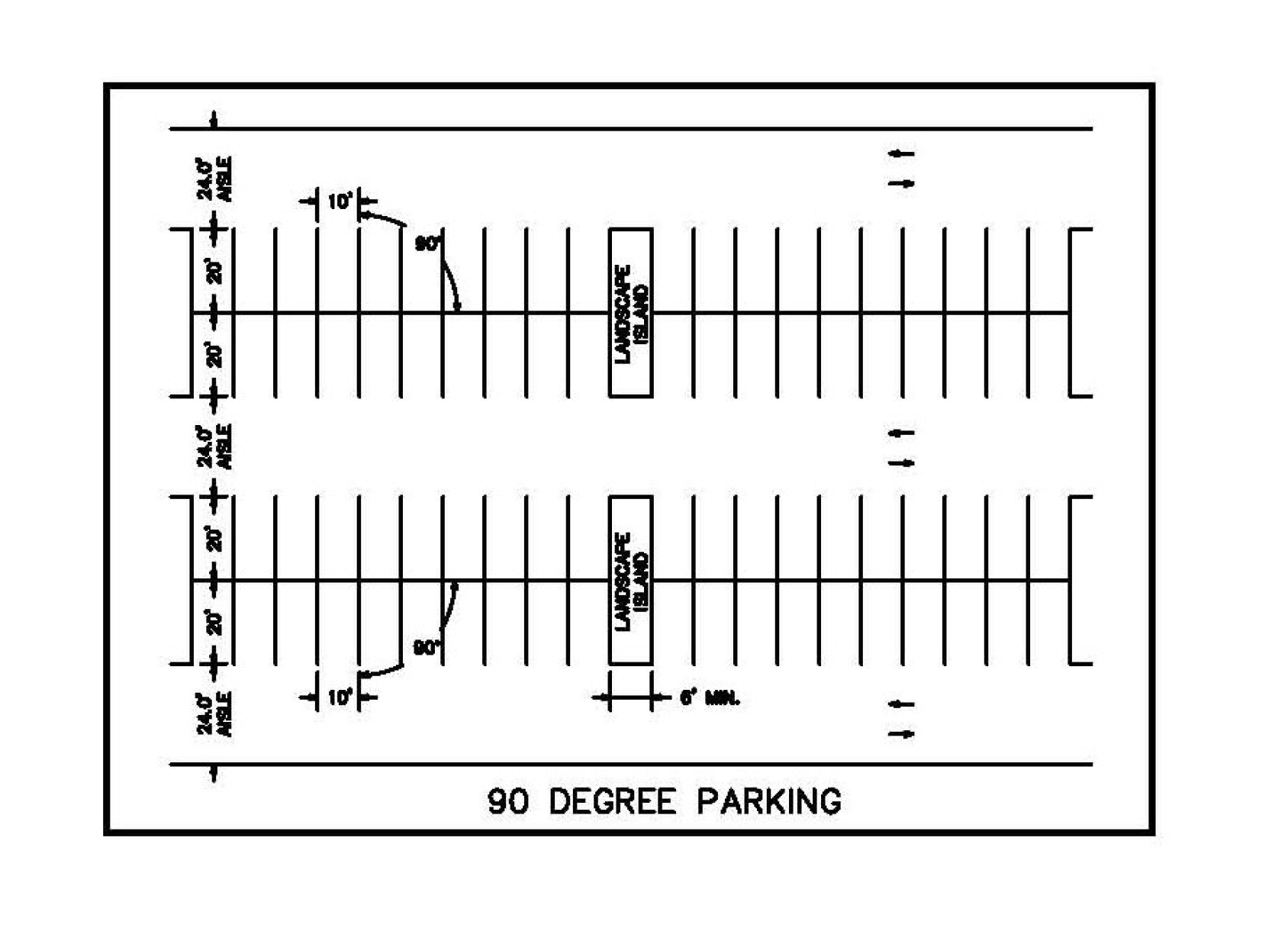
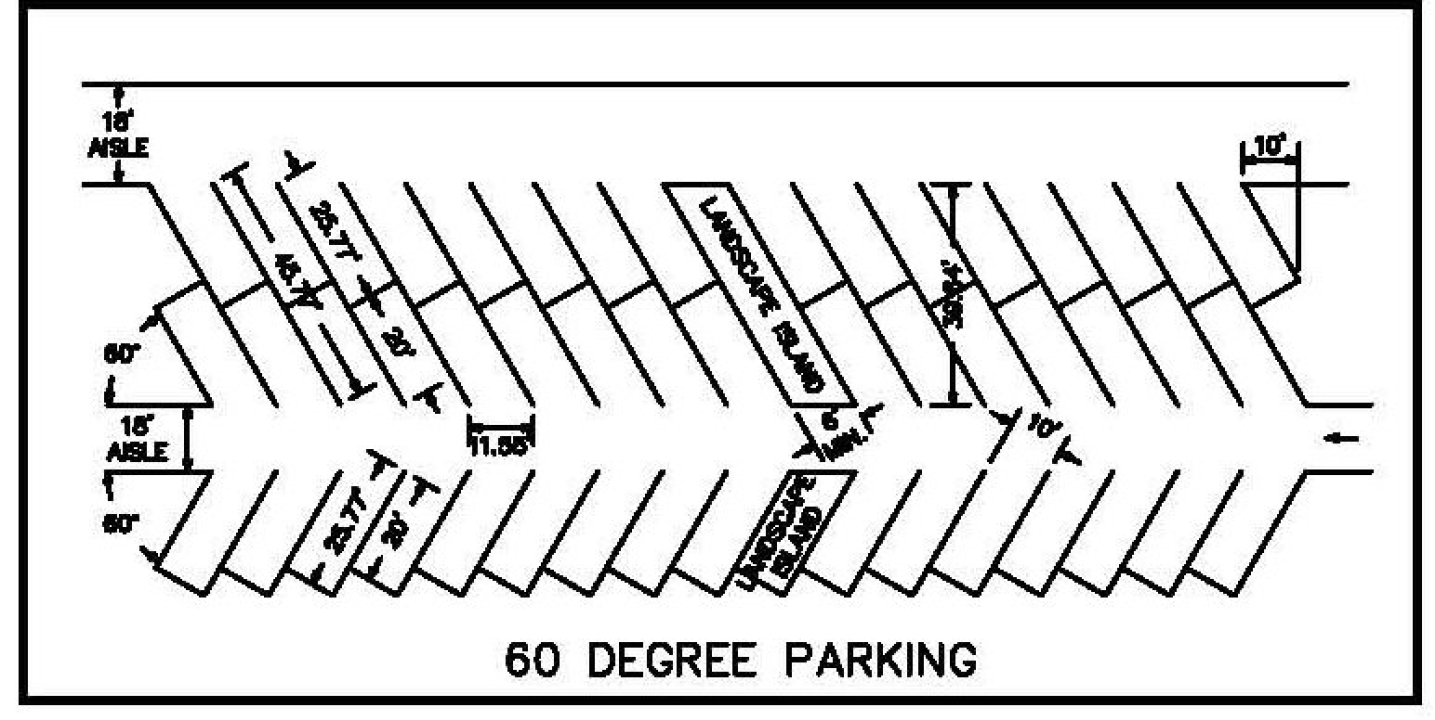
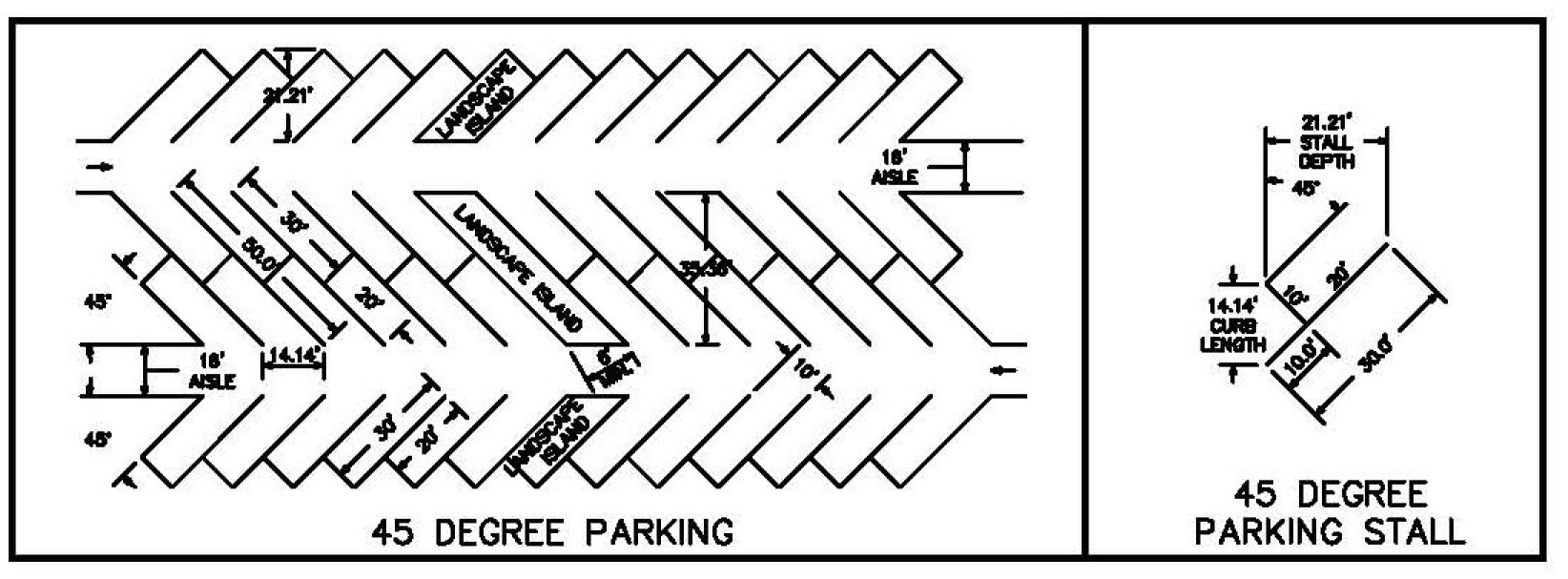
(4)
Except as provided in subsections (a)(5), (10), (11) (12) and (14) herein, each off-street parking space shall consist of a minimum net area of 200 square feet and shall have a minimum width of 10 feet and a minimum length of 20 feet.
(5)
Where parking spaces are to be provided, parking spaces for the disabled shall meet all applicable requirements of the Florida Americans with Disabilities Accessibility Implementation Act, F.S. § 553.501 et seq.; the Americans with Disabilities Act of 1990, as amended, 42 U.S.C. Section 12101 et seq.; the Federal American with Disabilities Act Standards for Accessible Design and related regulations, 28 C.F.R. parts 35 and 36 and 49 C.F.R. part 37; and the Florida Accessibility Code for Building Construction adopted by the Florida Building Commission pursuant to F.S. ch. 120, and they shall be in accordance with the following:
a.
Where accessible routes cross vehicular traffic lanes, such routes shall be marked to enhance pedestrian safety;
b.
All such spaces shall be accessible to a curb ramp or curb cut where necessary to allow ready access to the building, structure or use served;
c.
Such spaces shall be designed so that users are not required to wheel behind parked vehicles, and;
d.
Each such parking space shall be prominently marked as required by the Florida Building Code and posted with a fixed nonmovable sign of a color and design approved by the Florida Department of Transportation, bearing the internationally accepted wheelchair symbol and the caption "parking by disabled permit only."
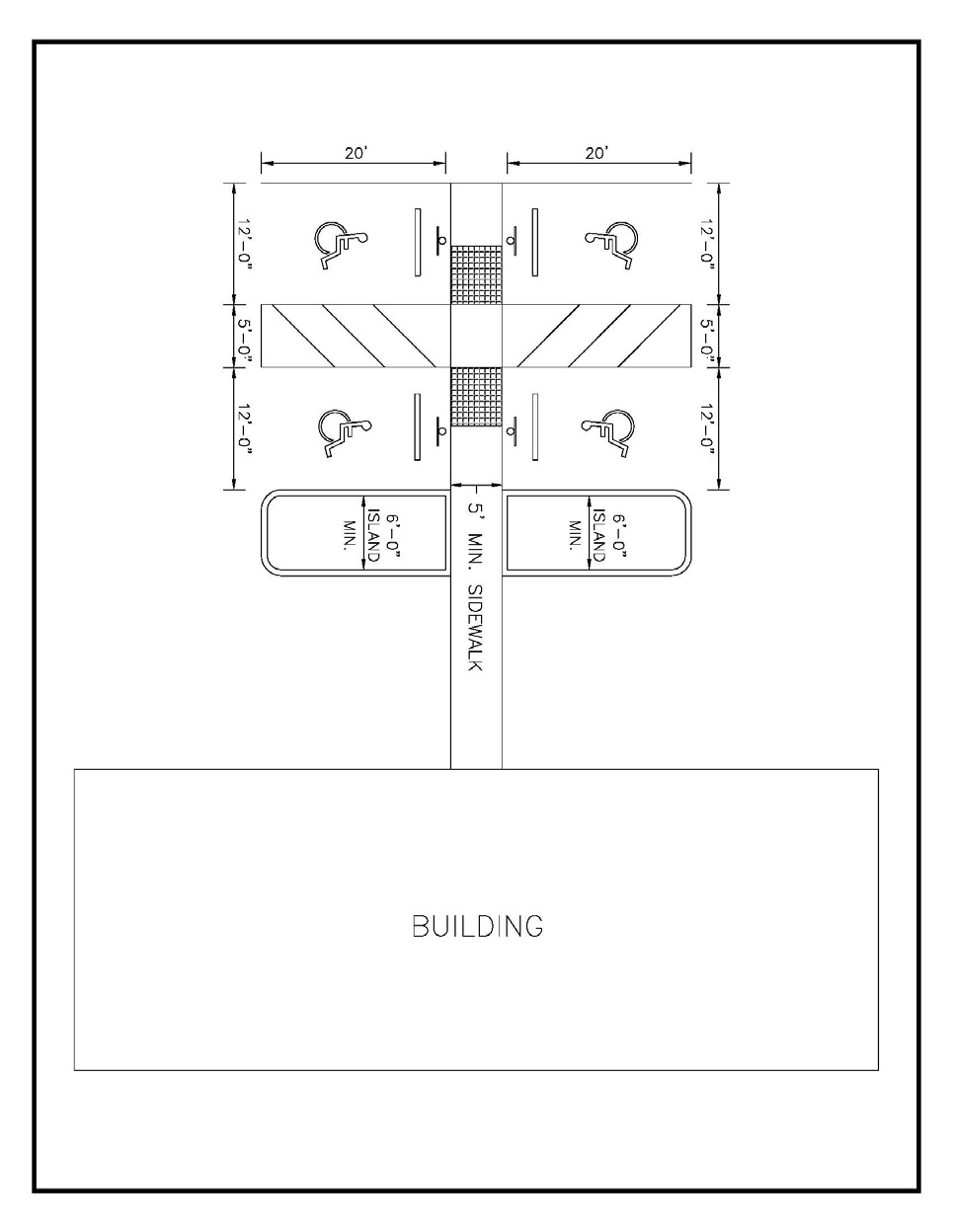
(6)
No off-street parking area shall be placed in a public right-of-way.
(7)
Individual off-street parking spaces shall be designed with concrete curbs, wheel stops, guards or similar devices properly anchored or secured to prevent vehicles from overhanging into public rights-of-way, landscaped areas, or sidewalks. Wheel stops or similar devices may be placed within the parking space up to two and one-half (2.5) feet from the front of the space.
(8)
Parking facilities which provide artificial lighting shall not illuminate adjacent residential areas.
(9)
If an applicant proposes off street parking adjacent to roadway facilities without sidewalks, the applicant shall be required to install sidewalks and associated pedestrian facilities subject to approval by the City.
(10)
Within a parking garage, no more than 10 percent of the provided parking may be compact spaces. Compact spaces shall be no smaller than eight feet wide and eighteen feet long (8' × 18'). These spaces shall be clearly and prominently marked with paint or signs to advise that compact spaces are reserved for compact vehicle use only.
(11)
Electric Vehicle Charging Spaces (EVCS) are encouraged and must be supplied with a working charging unit. EVCS spaces can be compact spaces and shall be no smaller than eight feet wide and eighteen feet long (8' × 18'). These spaces shall be clearly and prominently marked with paint or signs to advise that the charging station spaces are reserved for electric vehicle charging use only.
(12)
Hotels/motels are allowed to have 9' × 18' parking spaces, provided all other parking area design requirements of this Division are met.
(13)
Parking areas shall be properly maintained and parking surfaces shall be kept in good condition, free of potholes and debris. Parking space lines or markings shall be kept clearly visible and distinct.
(14)
Except as provided in subsections (a)(10), (11) and (12) where reduced parking space sizes are specifically addressed for parking garages, electric vehicle charging stations, hotels and motels, up to 20 percent of the provided off-street parking spaces may have a minimum width of nine feet and a minimum length of 18 feet.
(b)
Location of off-street parking.
(1)
Parking spaces for all detached residential uses shall be located on a paved driveway on the same lot as the use which they are intended to serve.
(2)
Within industrial districts, truck parking and staging areas shall be located and designed to keep trucks from parking on the adjacent right-of-way.
(3)
In no case shall any part of a parking area for nonresidential uses be closer than ten feet to any established right-of-way, and this area shall be buffered in accordance with Division 10 of Article VII.
(4)
Parking requirements for multifamily, commercial and industrial uses may be located on an abutting property, providing the abutting property is maintained in the same ownership or as indicated in subsection (4)b below and in the same zoning district as the use it is required to serve.
a.
Any parking area with more than ten vehicle spaces located on an abutting lot shall not be closer than 20 feet to any dwelling unit, school, hospital, or other institution for human care without providing a buffer that creates a continuous visual screen between the use and parking area as per Section 102-1373.
b.
Up to twenty percent (20%) of off-street parking may be provided on an abutting property of different ownership provided that:
1.
The action does not create a nonconformity, and;
2.
A joint use agreement is recorded by a written instrument establishing such joint use runs with the land;
a.
The joint use agreement shall include language that the parties acknowledge if the use changes on either site, additional parking spaces may be required on either party's property, or both;
b.
The joint use agreement is approved by the City Commission and reviewed by the Planning Board;
c.
In the event that the agreement is terminated, the City shall be notified within 30 calendar days, and;
d.
If the property which contains off-site parking spaces is disposed of or committed to some other use, which displaces or reduces the required parking, then the property shall be in violation unless other parking as provided herein is obtained.
c.
Parking for townhomes shall be in accordance with Section 102-353(6)m and as set forth in the following:
1.
The off-site parking area shall not be more than 300 feet from the entrance of the principal use. Off-site parking areas serving residential units shall be located within 100 feet of the entrance of the dwelling unit they will serve. The distance shall be measured along the most direct pedestrian connection.
2.
An identifiable and lighted pedestrian connection shall be provided between the off-site parking area and the use. The pedestrian connection shall require no crossing of a street, except at a signalized intersection. The pedestrian connection may cross an alley.
(c)
Circulation, Bicycle and Pedestrian facilities:
(1)
Parking lots and driveways shall provide well defined and efficient circulation for motor vehicles, bicycles, and pedestrians. Access points at property edges and to adjacent lots shall be coordinated with existing development to provide circulation patterns between developments.
(2)
Landscaped islands shall be used to define entrances from public rights-of-way, define pedestrian walkways from the public rights-of-way to all buildings, define ends of parking aisles and indicate the pattern of circulation.
(3)
Pedestrian walkways shall be provided around buildings to the extent necessary to assure safe access to the building from parking areas and the public right-of-way. Where appropriate, pedestrian walkways may be required to assure safe access to adjacent properties.
(4)
Internal walkways shall be constructed of concrete or asphalt and provide a minimum of five feet of unobstructed width.
(5)
Pedestrian walkways shall be provided between culs-de-sac or groups of commercial or industrial buildings to allow pedestrian access from within the development and from adjacent developments to activity centers, parks, common tracts, open spaces, schools or other public facilities, transit stops, and public streets. Benches along the walkway are recommended but not required.
(6)
Parking lots containing 100 parking spaces or more shall provide pedestrian walkway(s) through the parking area. Walkways shall connect pedestrian activity such as, but not limited to, public sidewalks, public recreation trails, transit stops, street crossings, bicycle parking facilities, buildings and store entry points, and central features and community spaces.
a.
Location.
1.
For parking rows perpendicular to the principal building front facade, pedestrian walkways shall be located at a minimum of one (1) pedestrian walkway every 100 feet.
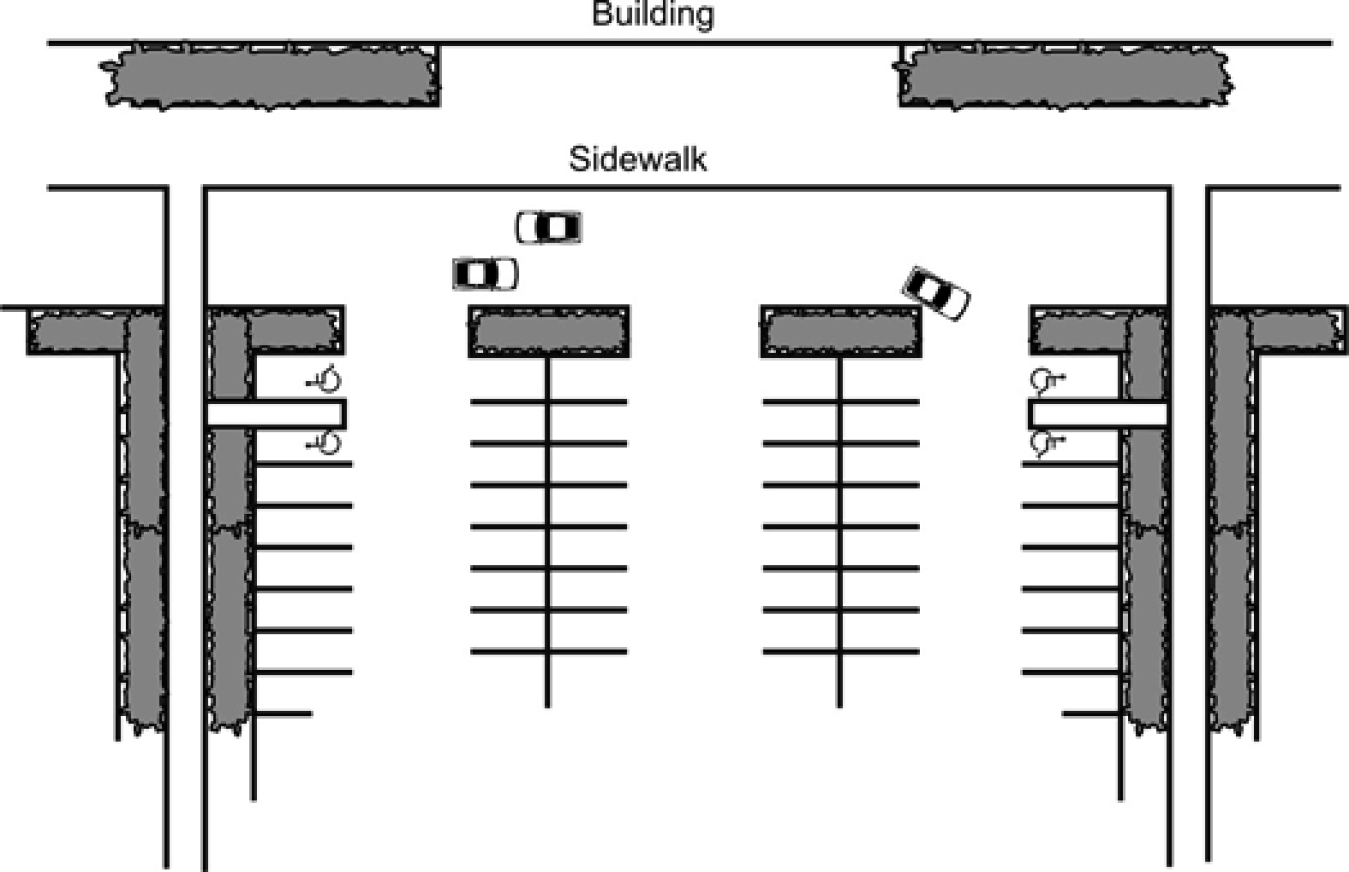
2.
For parking rows parallel to the principal building front facade, pedestrian walkways shall be incorporated adjacent to a series of aligned landscape islands with a minimum of one (1) walkway for every 50 feet parking spaces.
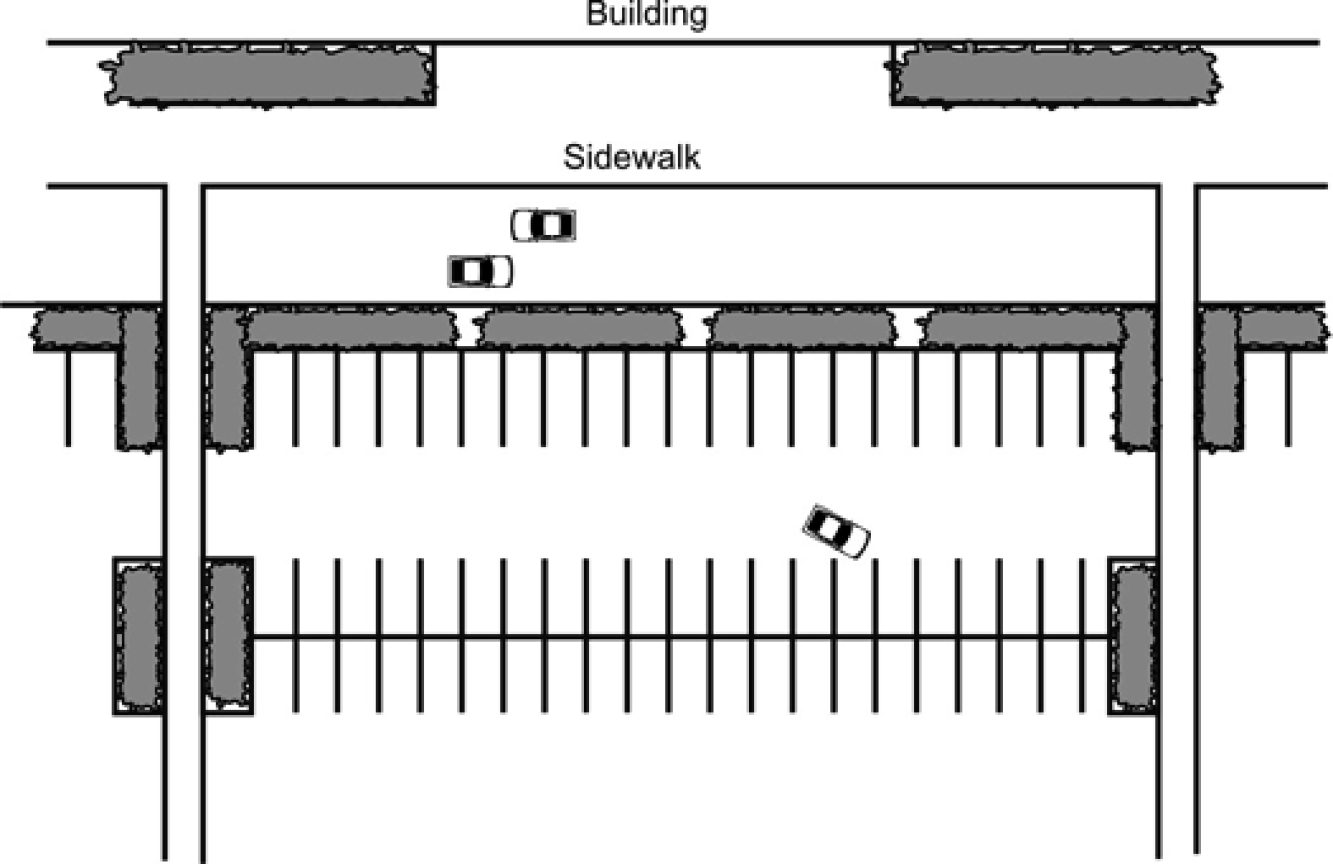
b.
Dimensions. Pedestrian walkways required by this subsection shall be a minimum of five (5) feet wide. The five (5) foot width shall not include any vehicle overhangs. A landscaped area not less than six feet wide shall abut the entire length of the walkway and shall include one (1) tree per 40 linear feet, shrubs, accent plants and groundcover(s). For appropriate trees along the right-of-way, see Section 102-1378(18).
c.
Identification. Pedestrian walkways shall be clearly identified. Pedestrian walkways which cross vehicular aisles or driveways shall be distinguished by a contrasting material as approved by the City Engineer.
(7)
All parking areas must be designed so that a vehicle may enter or exit without having to move another vehicle.
(8)
Parking areas of all developments shall be designed so that sanitation, emergency, and other public service vehicles can serve such developments without the necessity of backing more than one vehicle length or making other dangerous or hazardous turning movements.
(9)
Parking lots shall be designed to provide a minimum unencumbered driveway storage of 60 feet from the right-of-way on collector or arterial roadways.
(10)
Where a parking area has one access point a five-foot allowance shall be made for backing vehicles.
(11)
A bicycle rack shall be provided for parking areas of 30 spaces or more, except in industrial districts, and shall be located within 50 feet of the main entrance to the building as measured along the most direct pedestrian access route.
(d)
Access Management, Cross-Access, and Driveway Requirements:
(1)
In order to maintain the level of service by minimizing multiple connections to adjoining roads, where the proposed off-street parking areas abut similarly zoned land, the property owner shall provide a paved cross-access connection to the abutting property line. A cross-access easement shall be recorded prior to the issuance of a certificate of occupancy. Where the proposed off-street parking areas abut a parcel with an existing cross-access connection and/or easement, the connection shall be made between the two off-street parking areas.
(2)
Access to nonresidential parking lots is prohibited from accessing through residential neighborhoods.
(3)
Service drives and accessways to public streets shall have a minimum vision clearance area formed by the intersection of the driveway centerline, the street right-of-way line, and a straight line joining such lines through points 20 feet from their intersection. No obstruction, including plantings, fences, walls, or any temporary or permanent structures, exceeding 30 inches high shall be located in this vision clearance area, except that trees exceeding this height may be located in this area, provided all branches and foliage are removed to a height of eight feet above the grade of the abutting right-of-way. For appropriate trees along the right-of-way, see Section 102-1378(18).
(4)
All parking areas must be designed to allow vehicles to enter and exit the roadway in a forward motion, except:
a.
Parking areas with one or two spaces whose only access is on a local street.
b.
Parking areas with up to four spaces may be designed so that vehicles back out into an alley. More than four spaces must have access to an improved alley or right-of-way. However, there must be a maneuvering area of at least 20 feet between the end of each parking space and the opposite side of the alley. If the alley is less than 20 feet wide, some of this maneuvering area shall be accommodated on-site.
(5)
Reduction of curb cuts and/or requirements of shared driveways shall be obtained through cross access agreements as noted within this Chapter.
(6)
Where possible, local streets shall be used for access instead of arterial or collector roads.
(7)
With new development, adjacent road networks shall be improved as needed to support the City's level of service.
(8)
Median openings shall be limited to existing openings, unless approved by the City Engineer or other agency having roadway jurisdiction.
(9)
All driveways constructed, altered or removed within the City limits shall be constructed, altered or removed as provided for in this Section. No person shall make any curb cut for a driveway, walkway or any other purpose, without first obtaining a permit from the City. Charges for the permit will be made according to the established fee schedule. Additional permits may be required from Hillsborough County, Florida Department of Transportation, or any other agency having jurisdiction.
a.
Where driveways are to access a local roadway the following design standards shall be met:
b.
Where driveways are to access a collector or arterial roadway the following design standard shall be met:
c.
Driveways on opposite sides of any undivided street classified collector or arterial shall be offset a minimum of 200 feet measured centerline to centerline.
d.
Where driveways and drive lanes access a City street the grade change shall not exceed 12 percent with no grade exceeding six percent.
e.
No driveway shall be permitted in the radius return of an intersection.
f.
No driveway shall be permitted with its center 50 feet from the edge of the nearest right-of-way line of an intersection street.
g.
No driveway shall be permitted which includes any public utilities such as traffic signal standards, catch basins, fire hydrants, or any other similar structure, unless such facility is relocated at the applicant's expense.
h.
All driveways shall be constructed as near to a right angle to the street or roadway as possible.
i.
All driveways shall cross the sidewalk area at the sidewalk grade.
j.
Driveways shall be designed so that stormwater will not flow from the street into the driveway.
k.
Where a drive lane intersects a sidewalk located within the adjoining public rights-of-way, the sidewalk shall be delineated with expansion joints and contrasting surface materials.
(10)
All driveway surfaces including driveway aprons within the right-of-way shall be maintained by the property owner in a safe condition for both vehicular and pedestrian access. Any modification, construction, alteration or removal shall require a permit from the City, and no such construction, alteration or removal of a driveway shall occur without first obtaining said permit.
a.
Inverted driveway aprons will not be allowed within the right-of-way.
b.
All driveway aprons within the right-of-way shall meet City design standards. Driveway aprons within the right-of-way shall be constructed of concrete, asphalt or pavers. Pavers may be used for residential driveways if installed with ribbon curb at grade.
(Ord. No. 16-2014, § 2, 8-11-2014; Ord. No. 8-2018, §§ 1, 2, 4-23-2018)
Sec. 102-1415. - Off-street parking restrictions.
(a)
For the purposes of this Chapter, the following shall apply in all off-street parking areas:
(1)
Except where sales are allowed for community event sales, seasonal sales and special sales pursuant to Section 102-1430, Plant City Code, all off-street parking areas shall be used for vehicular parking only, and not for sales, dead storage, repair work, dismantling or servicing of any type.
(2)
It shall be unlawful for an owner or operator of any building, structure or use affected by this Chapter to discontinue, change or dispense with or to cause the discontinuance or reduction of the required parking facilities without establishing alternative vehicle parking facilities which meet the requirements of this Chapter.
(3)
It shall be unlawful for any person to utilize such building, structure, or use without providing the access or off-street parking facilities and landscaping required by this Chapter, or previously approved plan.
(4)
No more than 20 percent of off-street parking may be provided on an abutting property.
(5)
For mixed use developments, off-street parking spaces for one use shall not be considered as providing the required off-street parking for any other use except as provided for in this Division.
(Ord. No. 16-2014, § 2, 8-11-2014)
Sec. 102-1417. - Landscaping required for parking areas.
(a)
All new or expanded development providing off-street parking facilities shall conform to the minimum landscaping requirements set forth in this Chapter, except for single- and two-family uses. All off-street parking areas shall provide landscaping as follows:
(1)
Whenever an off-street parking area abuts a street right-of-way for at least 40 feet, such area shall be buffered and landscaped by a strip of land that is a minimum of ten feet wide and shall be landscaped with shrubs and grass, ground cover or other landscaping including an average of one tree for every 40 linear feet of frontage. For appropriate trees along the right-of-way, see Section 102-1378(18).
(2)
For driveways greater than 40 feet and servicing more than one building, the driveway shall be bordered by a strip of land a minimum of ten feet wide. At least one tree per 40 linear feet along the driveway strip shall be planted in a manner to maximize shading of the parking or driveway area. The remainder of the strip shall be landscaped with a combination of grass, ground cover, mulch, shrubs, trees or other similar landscaping materials, excluding sand or any impervious material.
(3)
Where the parking area abuts a public right-of-way, a buffer at least 24 inches high shall be provided, subject to the requirements of Division 10 of this Article, and shall be sufficient to screen the parking areas without causing encroachment into the vision clearance areas.
(4)
Islands shall be placed within the off-street vehicular use area as follows:
a.
There shall not be more than ten spaces in a row without an island separating them.
b.
Rows of parking spaces shall be terminated on both ends by landscaped islands.
c.
No distance greater than 150 feet may exist between landscaped islands in any parking area.
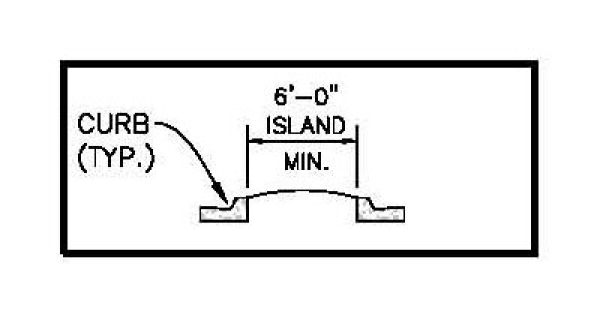
d.
Each individually landscaped island shall contain a minimum vegetative cover of 120 square feet, shall be a minimum of six feet wide, and shall include at least one tree. For appropriate trees, see Section 102-1378. The remainder of the island shall be landscaped with a combination of shrubs, ground cover, mulch, rock or other similar landscaping material.
(5)
A minimum of ten square feet of landscaping shall be provided for each parking space, excluding those spaces abutting the parking area perimeter for which landscaping is required elsewhere in this Chapter. Additionally, other vehicular use areas in excess of 1,500 square feet shall have ten square feet of interior landscaped areas for every 500square feet of vehicular use areas. The landscaped areas shall be within the vehicular use area and shall be in addition to any perimeter landscaping and in addition to the required 120 square feet parking islands required by this Chapter.
(6)
Alternative landscaping designs for parking areas may be considered in lieu of the requirements of this Section for irregularly shaped lots and lots utilizing existing trees or other vegetation, provided tree shade is distributed throughout the parking lot and provided the area of interior landscaping is comparable to that furnished by such requirements.
(7)
For retaining existing trees within a proposed parking area, the applicant shall receive a 10 square foot credit for each inch above 24 inches at DBH. This credit may be used to reduce a maximum of five parking spaces on-site provided the following conditions are met:
a.
The tree being saved is certified by an arborist to be in good health;
b.
The owner agrees to maintain the tree and in the event the tree dies, shall replace the tree with a minimum six inch DBH tree of similar species utilizing the same planting space and location as the original, and;
c.
The use of the credit does not cause the parcel to be short of the necessary parking spaces for the business to function or operate, or does not cause the parking on landscaped or grassed areas.
(8)
When healthy mature trees exist on a parcel prior to its development, in part or whole, the City can allow adjustment of the application of the standards of this Section for such trees that remain on site, when such an adjustment is in keeping with and will preserve the intent of this Division.
(9)
The property owner shall be responsible for maintenance of all landscaped areas. Such areas shall be kept free of refuse and debris and shall be provided with irrigation to ensure a 95 percent survivability rate.
(Ord. No. 16-2014, § 2, 8-11-2014)
Sec. 102-1419. - Off-street parking plan.
(a)
A plan, indicating how the access management, circulation, and off-street parking requirements of this Chapter are to be fulfilled, shall accompany every application for site plan review, a building permit, or any change of use which, based on the minimum off-street parking space requirements as provided in Section 102-1421, would increase the number of required parking spaces. The plan shall show all those elements necessary to indicate that these requirements are being fulfilled and shall include but not be limited to the following:
(1)
Delineation and dimensions of individual parking spaces, ADA spaces, drive aisles, and walkways.
(2)
Circulation area necessary to serve spaces.
(3)
Access to streets, alleys, and properties to be served, and the distance from adjacent driveways and streets.
(4)
Curb cuts.
(5)
Dimensions, continuity and types of materials used for landscaping.
(6)
Grading, drainage, surfacing and subgrading details.
(7)
Delineation of all structures or other obstacles to parking and circulation on the site and rights-of-way, such as but not limited to, bicycle and pedestrian facilities, fire hydrants, lighting, etc.
(8)
Specifications for signs and wheel stops.
(9)
Joint access agreement or easement, if applicable.
(10)
Landscaping.
(11)
Calculations for the total inches of trees on site; removal and/or remaining inches; and supporting documentation, if applicable.
(Ord. No. 16-2014, § 2, 8-11-2014)
Sec. 102-1420. - Certificate of occupancy.
Parking areas and landscaping required under this Chapter shall be in place prior to issuance of a certificate of occupancy. It shall be unlawful to occupy the premises unless such parking and landscaping is installed in accordance with the approved off-street parking plan and all other requirements of this Chapter.
(Ord. No. 16-2014, § 2, 8-11-2014)
Sec. 102-1421. - Minimum off-street parking space requirements.
(a)
For the purposes of this Chapter, the minimum number of off-street parking space requirements are as follows:
(1)
For residential development, the number of parking spaces shall be as follows:
(2)
For commercial developments, the number of parking spaces shall be as follows:
(3)
For institutional and semipublic developments, the number of parking spaces shall be as follows:
(4)
For industrial developments, the number of parking spaces shall be as follows:
(5)
For mixed-use developments containing two or more uses listed in any category, the number of parking spaces shall be the sum of the requirements of the various uses computed separately.
(6)
Requirements for a building or development not specifically listed in this Section shall be determined and based upon the requirements of comparable uses listed.
(Ord. No. 16-2014, § 2, 8-11-2014; Ord. No. 2-2016, § 2, 1-25-2016)
Sec. 102-1422. - Residential Standards.
For the purposes of this Chapter, the following standards shall apply in all residential, single- and two-family dwellings:
(1)
Where driveways are to access a local roadway the following design standards shall be met:
(2)
Where driveways and drive lanes access a City street the grade change shall not exceed 12 percent with no grade exceeding six percent.
(3)
No driveway shall be permitted in the radius return of an intersection.
(4)
No driveway shall be permitted which includes any public utilities such as traffic signal standards, catch basins, fire hydrants, or any other similar structure, unless such facility is relocated at the applicant's expense.
(5)
All driveways shall be constructed as near to the right angle to the street or roadway as possible.
(6)
All driveways shall cross the sidewalk area at the sidewalk grade.
(7)
Driveways shall be designed so that stormwater will not flow from the street into the driveway.
(8)
All driveway surfaces including driveway aprons within the right-of-way shall be maintained by the property owner in a safe condition for both vehicular and pedestrian access. Any modification, construction, alteration or removal shall require a permit from the City, and no such construction, alteration or removal of a driveway shall occur without first obtaining said permit.
a.
Inverted driveway aprons will not be allowed within the right-of-way.
b.
All driveway aprons within the right-of-way shall meet City design standards.
(9)
Parking areas for all residential uses shall not cause more than 40% of the required front yard to be impervious.
(Ord. No. 16-2014, § 2, 8-11-2014; Ord. No. 37-2021, § 1, 9-13-2021)
Sec. 102-1423. - Expansion or change in use.
Any expansion resulting in an increase in intensity or density of an existing structure or use, or any change of use shall comply with the requirements of this Division.
(Ord. No. 16-2014, § 2, 8-11-2014)
Sec. 102-1430.- Special use permit.
The City Manager may issue a special use permit for the sale of certain tangible personal property outside of an enclosed building, where such sales are of a temporary nature, provided the following conditions and requirements are met:
(1)
Public rights-of-way. Except as permitted pursuant to subsection (9) herein or Chapter 62, Article II, Division 2, such sales shall not be allowed on public rights-of-way.
(2)
Owner's consent. Application for a permit for such sales shall include the signature and consent of the owner of the real property.
(3)
Failure to meet minimum standards. The use shall not cause the real property to fail to meet minimum parking, landscaping, buffering or open space requirements, or otherwise create any other violations of any City ordinance.
(4)
Safety hazards prohibited. The use shall not create any traffic, pedestrian or other safety hazards. In no event shall any tents, tables other temporary equipment, or other temporary structures be placed closer than ten feet from the edge of roadway pavement along local roads and 15 feet from the edge of roadway pavement along arterial and collector roads as designated on the City's adopted Comprehensive Plan. The use shall not interfere with the ingress or egress of the owner or tenants or adjoining owners or tenants.
(5)
Sale types permitted and associated regulations. The following are the types of temporary outdoor sales that may be permitted under the provisions of this Division, and their associated requirements and standards:
a.
Seasonal sales. Seasonal sales shall be limited to sales during October 1 through October 31 and sales from the first Monday prior to Thanksgiving through December 24. Sales from October 1 through October 31 shall be limited to the sale of pumpkins. Sales from the first Monday prior to Thanksgiving through December 24 shall be limited to Christmas trees, tree stands and wreaths. Seasonal sales are limited to land zoned to allow retail sales, except that such sales may be conducted on school or church property, even if within a residential zoning district; provided that sales activity within such residential zoning districts is limited to hours of operation between 9:00 a.m. and 9:00 p.m.
b.
Special sales. Special sales shall be limited to temporary sales of products currently allowed to be sold by the City's zoning code and other regulations, including vehicle sales. The sales period for these events shall not exceed 72 consecutive hours. No more than one permit per location shall be issued during any given 90-day period of time for special sales. A site plan, drawn to scale, showing all buildings, existing parking spaces and other information needed to determine if the proposed event complies with subsections (3) and (4) herein, shall be submitted for approval by the City Manager no less than three business days prior to said use. The City Manager shall review said proposed site plan, and shall approve or disapprove said site plan within three business days after the proposed site plan was submitted for approval. Special sales are limited to land zoned to allow retail sales, except that such sales may be conducted on school or church property, even if within a residential zoning district provided that sales activity within such residential zoning districts is limited to hours of operation between 9:00 a.m. and 9:00 p.m.
c.
Community event sales. Community event sales herein are limited to the sales conducted or authorized by the sponsoring entity during the "Florida Strawberry Festival", the downtown "Strawberry Classic Car Shows", "Pioneer Days", the "Dr. Martin Luther King, Jr. Festival", "Bike Fest", or other such similar community events as may be designated by the City Commission or City Manager. Retail sales shall be allowed during such events subject to being limited to the specific area of the event (e.g., the "Florida Strawberry Festival Special Use District Overlay"), and the sales period shall not exceed the period for such event.
(6)
Except for seasonal sales, special sales, and community event sales, as permitted herein, no other sales of tangible personal property shall be permitted outside of an enclosed building, unless otherwise specifically permitted in the applicable zoning district.
(7)
The applicant shall pay a reasonable fee for the application and enforcement of this section, as may be determined by resolution of the City Commission.
(8)
Temporary outdoor sales of fireworks, as defined by F.S. Ch. 791 are prohibited.
(9)
Subject to the approval of the City Manager, City-maintained right-of-way may be used for community event sales.
(10)
Off-street parking areas, both public and private, may be used for community event sales, seasonal sales, and special sales, provided there remains, during business hours, minimum parking spaces as required by Chapter 102, Article VII, Division 11, Plant City Code.
(11)
Prior to operation, the applicant must secure all applicable permits and licenses.
(Ord. No. 11-2002, § 1, 4-22-02; Ord. No. 25-2006, §§ 1, 2, 8-28-06; Ord. No. 25-2009, § 3, 9-28-2009; Ord. No. 35-2009, §§ 1, 2, 12-14-2009; Ord. No. 6-2017, § 2, 7-10-2017; Ord. No. 02-2021, § 2, 1-11-2021; Ord. No. 38-2021, § 2, 9-13-2021)
Sec. 102-1431. - Mobile food dispensing vehicle sales.
(a)
A single mobile food dispensing vehicle per parcel of land shall only be allowed to sell food or beverage items on private property within the C-1, C-2, M-1, M-1A and M-AP zoning districts. Mobile food dispensing vehicle sales shall not be allowed within the Downtown Core unless included as part of a Community Event as provided in Section 102-1430.
(b)
Except as allowed as part of a Community Event as provided in Section 102-1430, no mobile food dispensing vehicle sales shall be allowed on the public rights-of-way, city parks, cemeteries, or any other city property.
(c)
No more than one mobile food dispensing vehicle per location shall be allowed for more than one calendar day during any seven calendar day period.
(d)
Mobile food dispensing vehicles shall only operate between the hours of 7:00 a.m. to 9:00 p.m., and shall be removed outside those hours.
(e)
The location must have an operating business, or be an active construction site, with restrooms that are within 150 feet for use by the patrons.
(f)
The property shall remain clean during the time the mobile food dispensing vehicle is on the property and when said vehicle is removed. No solids or fluids shall remain on the ground after removal of the mobile food dispensing vehicle other than clean water.
(g)
Wheels shall not be removed, and the mobile food dispensing vehicle shall always be capable of being driven from the location at the conclusion of its allowable hours of operation.
(h)
All activity shall conform with the laws, rules and ordinances of the City, County, Hillsborough County Environmental Protection Commission, and the State of Florida.
(i)
The operator of the mobile food dispensing vehicle and the private property owner of the location shall each be concurrently responsible to comply with this Section.
(Ord. No. 02-2021, § 3, 1-11-2021)
Sec. 102-1440.- Where allowed; approval procedure.
(1)
Bed and breakfast establishments may be permitted within any residential or commercial zoning district, subject to the requirements of this division.
(2)
Approval of a bed and breakfast establishment shall be granted by the planning board, as provided by Section 102-126.
(Ord. No. 10-2002, § 1, 4-22-02)
Sec. 102-1441. - Bed and breakfast requirements.
(1)
Bed and breakfast establishments may be considered for special approval by the planning board, subject to the following conditions:
(a)
The bed and breakfast structure shall be a "contributing" structure within one of the city's historic districts, or shall be a locally designated historic "landmark" in accordance with Section 38-126.
(b)
The bed and breakfast facility shall be operated within the principal structure and not within any accessory structure.
(c)
The facility shall be owner-occupied and managed with the resident manager having at least 50 percent ownership interest.
(d)
The site applicant shall be able to demonstrate that the site will be able to meet the minimum on-site parking requirements for a bed and breakfast establishment in Section 102-1421. Stacked parking may be allowed. However, all parking areas shall be made of a durable and dustless surface.
(2)
If granted special approval, a bed and breakfast establishment shall conform to the following operational standards:
(a)
Prior to issuance of an operating permit, the applicant shall obtain a lodging license and food service license from the state department of business and professional regulation, division of hotels and restaurants. All regulations under F.S. ch. 509 shall be met.
(b)
All applicable building and development regulations shall be met prior to issuance of an operating permit. In addition, the building shall meet all applicable fire safety codes adopted by the city.
(c)
No exterior additions or alterations shall be made for the express purpose of maintaining or adding to a bed and breakfast facility, other than those required to meet health, safety, and sanitation requirements. Minimal outward modification of the structure or grounds may be made if such changes are deemed compatible with the character of the area or neighborhood and do not detract from the historic or architectural significance of the structure. All alterations shall be in compliance with the city's development regulations, including review by the historic resources board, when applicable.
(d)
No signs are allowed except for a nonilluminated sign not to exceed four square feet in size attached either to the structure or to a fence surrounding the property. Said sign shall be compatible with the style and detailing of the house.
(e)
All permits and licenses must be displayed in a public area within the facility.
(f)
A maximum number of four guest bedrooms is allowed.
(g)
No meals may be served other than breakfast to overnight guests.
(h)
No cooking facilities are permitted in the individual rooms.
(i)
The maximum length of stay in this facility is limited to a maximum of 14 days in any quarter. The resident owner shall keep a current guest register including names, addresses and permanent occupancy of all guests.
(j)
The sale and/or display of merchandise or other commodities is prohibited.
(Ord. No. 10-2002, § 1, 4-22-02; Ord. No. 3-2016, § 5, 1-25-2016)
Sec. 102-1442. - Application requirements.
(1)
An application for special approval for a bed and breakfast establishment shall be filed with the planning and zoning department, which shall prepare a report for review and approval by the planning board.
(2)
An application shall include a site plan drawn to scale, and with sufficient detail to show that the proposed use will be able to meet all applicable code requirements, including parking.
(3)
An application shall include a narrative elaborating on the ability of the applicant to meet applicable city regulations.
(Ord. No. 10-2002, § 1, 4-22-02)
Sec. 102-1451.- Purpose.
It is the purpose of this Division to establish requirements for certain businesses to operate in whole or in part from residential property while limiting potential impacts on surrounding properties and maintaining residential character, pursuant to F.S. § 559.955.
(Ord. No. 26-2022, § 2, 9-26-2022)
Sec. 102-1452. - Standards.
All home-based businesses shall conform to the following standards:
(a)
Employees of the business who work at the residential dwelling must also reside in the residential dwelling, except that up to a total of two employees or independent contractors who do not reside at the residential dwelling may work at the business. The business may have additional remote employees that do not work at the residential dwelling.
(b)
Parking related to the business activities of the home-based business shall comply with the parking requirements of this Code; however, the business shall not generate a need for parking greater in volume than exceeds the volume expected at a similar residence when no business is conducted. Additionally, vehicles and trailers used in connection with the business must be parked in legal parking spaces that are not located within the right-of-way, on or over sidewalks, or on any unimproved surfaces on the residential parcel.
(c)
The parking or storage of heavy equipment at the business which is visible from the street or neighboring property is prohibited. For purposes of this paragraph, the term "heavy equipment" means commercial, industrial, or agricultural vehicles, equipment, or machinery.
(d)
As viewed from the street, the use of the residential property for the home-based business shall be consistent with the uses of the residential areas that surround the property. External modifications made to a residential dwelling to accommodate a home-based business must conform to the residential character and architectural aesthetics of the neighborhood.
(e)
The home-based business may not conduct retail transactions at a structure other than the residential dwelling. Incidental business uses and activities may occur elsewhere on the residential property.
(f)
The activities of the home-based business shall be secondary to the property's use as a residential dwelling.
(g)
Signs for the home-based business shall comply with the requirements of this Code, and any other applicable State law or regulation.
(h)
The home-based business shall comply with the requirements of Chapter 30, Article II, Plant City Code, regarding noise.
(i)
Nothing shall be allowed in connection with the home-based business which is offensive or obnoxious by reason of unreasonable dust, odors, vibration, or glare.
(j)
All home-based businesses shall comply with any relevant local, state, and federal regulations with respect to the use, storage, and disposal of any corrosive, combustible, or other hazardous or flammable materials or liquids.
(Ord. No. 26-2022, § 2, 9-26-2022)
Sec. 102-1460.- Special events in private parks.
(a)
For purpose of this section, "special events" shall be events involving food, beverage or other vendors, or where the anticipated attendance is 500 or more people.
(b)
Special events in private parks which have been authorized by the property owners' association shall be subject to the approval of the City Manager in accordance with this section:
(1)
The property owners' association or other applicant shall present to the city five copies of a plan at least 60 days prior to the event, which addresses parking, restrooms, sanitation, police, and fire safety. The plan shall be reviewed by the public works, planning and zoning, building, police and fire departments and comments shall be provided to the applicant within five days of receipt. If modifications are required, the applicant shall revise the plan to address these concerns and resubmit the plan for further review.
(2)
Upon review of the proposed plan by the above departments, the plan, as may be modified, shall be submitted to the City Manager for his/her review and approval.
(3)
In the event that the City Manager denies the application, the applicant may appeal the decision to the board of adjustment, in accordance with article II, division 2 of this Chapter.
(c)
Such events shall be conducted in accordance with the approved special event permit, including any special conditions and/or restrictions; however, in no case shall the hours of operation exceed the following:
(1)
Subject to subsection (3) herein, events on Friday and Saturday shall conclude at 12:00 midnight.
(2)
Events on Sunday through Thursday shall conclude by 9:00 p.m.
(3)
In the event that the following day is a recognized national or state holiday (where schools, banks and governments are closed), then the activity shall conclude at 12:00 midnight.
(d)
The event shall comply with the applicable provisions of the City Code, including, but not limited, to the city's noise and the city's occupational license tax.
(Ord. No. 9-2004, § 1, 2-9-2004)
Sec. 102-1464.- Purpose and intent.
Townhouse regulations are set forth in this Division to implement policies to provide developers the development standards necessary to address the unique characteristics of Townhouse Projects. A townhouse is defined as a narrow single-family dwelling which normally occupies the entire width of its lot having its open yard space to the front and rear, and which is attached to one or both sides to similar dwellings, all of which are located on individually platted lots as part of a subdivision group development.
(Ord. No. 17-2024, § 1, 4-8-2024)
Secs. 102-1465. - Development standards.
Townhouse projects shall be limited to areas designated on the Future Land Use Map of the Plant City Comprehensive Plan as R-9, R-12, R-16, R-20, and may be located within the Commercial, Mixed Use-Residential/Commercial and Mixed Use-Residential/Commercial/Industrial Future Land Use Categories when developed as a mixed-use project per the Comprehensive Plan. Townhouses may be considered in the R-4 and R-6 land use categories when reviewed as part of a Planned Development rezoning or modification.
(1)
Supporting infrastructure and access.
a.
All public roadways abutting the site providing points of ingress and egress shall be paved.
b.
On-site and off-site drainage shall be provided, and all public utilities required to serve the proposed development area shall be available to the site, all in accordance with the requirements and specifications of the City.
c.
Internal roadways may be public or private. All roads, public and private shall be constructed in accordance with the Standard Guide Manual as provided in Section 102-1043, and all other regulations applicable to public streets.
d.
All private roads shall be maintained by a homeowner's association (HOA) or Community Development District (CDD).
e.
All townhouse lots shall have frontage on, and vehicular access to a: (a) public road; (b) private road meeting city construction standards, or (c) a private parking lot meeting the city's parking lot standards, provided such parking lot has direct access to a public road, or a private road meeting public road construction standards.
f.
Required parking, and additional guest parking, may be provided on private roads, provided such parking spaces are accomplished via inset parking spaces.
g.
"Manor" townhouse lots may be created which do not have direct frontage on a street or parking lot, provided appropriate easements are established to provide legal pedestrian and vehicular access to each individual townhouse unit and associated lot.
(2)
Minimum townhouse project area. The minimum gross area for a townhouse development shall be 9,000 square feet with a minimum 90-foot frontage.
(3)
Lot and building standards.
a.
Minimum lot width. The minimum lot width is 20 feet. Lot width may be reduced to 18 feet for common front parking or when parking is located to the rear of the unit and accessed by way of an alley, lane or private shared driveway located at the rear of the units.
b.
Minimum lot area. The minimum lot area is 1,800 square feet.
c.
Minimum living area. The minimum living area is 1,200 square feet per dwelling unit. Living area is defined as the area that is heated and cooled and excludes garages.
d.
Minimum outdoor living area. The minimum outdoor living area is 200 square feet, exclusive of automobile storage areas and open space requirements of subsection 102-1375(2).
e.
Maximum building height. The maximum building height is 35 feet.
f.
Maximum individual townhouse lot coverage. The maximum individual townhouse lot coverage is 80 percent for townhouse units, exclusive of a decorative front porch.
g.
Easements and wetland buffers. No easements nor required wetland buffers shall be allowed within individual townhouse lots.
(4)
Building setback requirements.
a.
Where the townhouse development has parking via a common front parking, the following setbacks shall apply:
Front Yard: 10 feet (from back of curb).
Rear Yard: 20 feet.
Side Yard: 10 feet.
Interior Street Side Yard: 15 feet.
Perimeter Setback: 40 feet.
b.
Where the townhouse development has parking via a front garage, the following setbacks shall apply:
Front Yard: 20 feet (from property line or edge of pavement, or sidewalk whichever is greater).
Rear Yard: 20 feet.
Side Yard: 10 feet.
Interior Street Side Yard: 15 feet.
Perimeter Setback: 40 feet.
c.
Where the townhouse development has parking in rear-loaded garages accessed by alleys, the following setbacks shall apply:
Front Yard: 10 feet (from property line or edge of pavement, whichever is greater).
Rear Yard: 20 feet.
Side Yard: 10 feet.
Interior Street Side Yard: 15 feet.
Perimeter Setback: 40 feet.
d.
For subsections 4.a. and 4.c. above, the ten-foot front yard setback must be separated by a five-foot planting strip or sidewalk.
e.
No townhouse unit grouping shall be located within 40 feet of any perimeter lot line.
f.
Townhouse unit grouping spacing. No portion of a townhouse or related accessory structure in one group of contiguous townhouses shall be closer than 20 feet on the side and 40 feet on the rear of another and shall be no closer than 30 feet where the side of a building or accessory structure abuts the rear of another.
(5)
Townhouse unit groupings.
a.
A townhouse unit grouping shall be made up of no less than three townhouse dwellings and no more than eight townhouse dwellings.
b.
No more than two contiguous townhouse dwellings shall be built in a row with a common front building line, and the minimum difference in building line setback to provide variation shall be two feet.
c.
No contiguous group of dwellings shall exceed 175 feet in frontage width.
(6)
Manor townhouse units.
a.
Manor style townhouse development shall only be approved as a PD Planned Development district.
b.
Provided that the minimum structure width is 48 feet, the entrance of such units can be side or rear yard facing.
c.
The front facade shall contain a balcony and shall consist of a brick or stone masonry veneer on the first floor.
d.
Regardless of orientation, manor townhouse units shall be spaced at least 20 feet from like or other townhouse structures, and 40 feet from perimeter property lines.
e.
A corner unit shall be set back at least 15 feet from the interior private streets (back of curb), and 40 feet from exterior public rights-of-way. The primary frontage of front-loaded garage units shall be setback 25 feet from back of curb of private streets or from common parking areas.
f.
Balconies and porches may encroach up to five feet into the front yard setback area.
g.
Driveways shall utilize brick paver accents.
(7)
Open space and environmental requirements. Townhouse developments shall provide a minimum of 35 percent of the development unit's gross land area as open space. Additionally, at a minimum of 20 percent or more of the gross development unit's gross land area shall be landscaped with trees and shrubs. Fifty percent of the total open space area provided shall be located on the site in such a manner as to be usable for active or passive recreation and easily accessible to all dwelling units within the development. No more than 50 percent of the required open space shall be wetlands. The provisions of Section 102-1375 shall apply.
(8)
Landscaping.
a.
Unless otherwise provided for by this Section, townhouse landscaping shall be subject to Chapter 102 of the Plant City Code.
b.
The front of each individual townhouse building shall have small trees planted and spaced every 20 to 40 feet depending on tree species. New trees shall have a minimum caliper of three inches in overall diameter and eight feet tall immediately after planting.
c.
Tree species whose roots are known to cause damage to public roadways or other public works shall not be located within 25 feet of a public facility.
d.
Tree species with a height greater than 20 feet shall not be planted within a utility easement when power lines lie directly overhead.
e.
To visually break up multiple driveways located close together in areas using front-loading garages, a hedge row between 18 inches and 30 inches high shall be planted in the center of median strips located between driveways, for the entire length of the median strip.
f.
Ornamental landscaping shall be provided along the entire front facade of all townhouse buildings, and along the facade of any Manor townhouse building where a main entrance door is located. Such front facade landscaped areas shall average three feet in width but shall not have any areas narrower than two feet in width. These landscaped areas shall contain coordinated shrubbery, groundcover plants, and mulch, so as to present a coordinated landscaped appearance for each townhouse building, and for the entire townhouse project. All landscaping shall be required to be shown on the landscape plan submitted as part of detailed site plan review.
(9)
Sidewalks. Sidewalks shall be required on both sides of all public or private streets. Sidewalk widths shall be not less than five feet. Sidewalk design and installation, when required, shall be approved by the City Engineer and Planning and Zoning Manager prior to the issuance of a certificate of occupancy for any dwelling units within a given development.
(10)
Parking requirements.
a.
A minimum of two parking spaces shall be provided for each townhouse dwelling.
b.
Parking may be provided by a front or rear accessed garage, or within common parking areas, provided such common parking areas are located within a private parking lot or via inset parking spaces located on a private street.
c.
If the garage is located at the front of the unit, the lot frontage should allow a landscaped front yard, and enough space between driveways for on-street, short-term parking where permitted.
d.
Alley or rear entrances shall be designed to prohibit parking within the alleyway.
e.
Common parking areas shall be located and arranged to be associated with the dwelling units served.
f.
Additional guest parking shall be required to be provided at a ratio of one parking space per five dwelling units.
g.
In addition, parking lot landscaping shall be required pursuant to Section 102-1417, and shall not count toward the open space requirement.
h.
A townhouse development shall be designed so that parking on driveways can occur without a typical passenger vehicle blocking the sidewalk.
(11)
Building design standards.
1.
Roofline variation.
(a)
Roof pitch of at least six inches of height for each linear foot of roof shall be required for all townhouse development (6:12 pitch, rise/run);
(b)
Additionally, the roof of each dwelling unit shall be distinct from the roof of adjacent dwelling units either through separation of roof pitches; varying the direction of roof pitches; inclusion of dormers; or other variation in roof design;
(c)
Each dwelling unit shall be designed with a covered front porch occupying a minimum of 50 percent of the overall width of the dwelling unit, except where front load garages are utilized, the porch shall occupy a minimum of 40 percent; or
(d)
The minimum roofline variation length shall be four feet for dormers and eight feet for all other types of variations.
2.
Front facades.
(a)
Front facades shall be comprised of at least two different materials including but not limited to brick/stone, horizontal or vertical siding, stucco, shake siding, textured block, concrete composite siding, wood/vinyl clapboard siding and wood beaded siding. Trim does not count toward different material requirement.
(b)
All facades shall use at least three architectural elements (e.g., quoins, pilasters, soldier courses, friezes, cornices, dentils, bay windows, decorative windows, shutters, raised molding, etc.).
(c)
The use of multiple colors and surface textures on exterior wall surfaces shall be required. Side and rear facades shall be compatible with front facade in material color.
(d)
Roof shall be covered with architectural laminated, shadowed, or shaped shingles. Tile, slate and metal roofing material may also be utilized. Standard three-tab shingles are prohibited.
(e)
All sides of buildings, where visible from public right-of-way, shall include design characteristics and materials consistent with those on the front primary facade of the building.
(12)
Before the building inspector shall be authorized to issue a building permit for construction for townhouses, a subdivision plat complying with all applicable requirements of this subsection and all appropriate requirements of Chapter 94 pertaining to subdivisions, except as modified in this subsection, shall have been approved by the City Commission and recorded within the records of the Clerk of the Circuit Court of Hillsborough County.
(13)
Deed covenants and restrictions shall be developed to ensure the maintenance and upkeep of areas and facilities retained in common ownership including, but not limited to, open space, recreation, exterior buildings, fencing, common drives, private streets, parking areas and trash collection areas and containers, front, rear and side yards, including landscaping and exterior lighting in order to provide a safe, healthful and attractive living environment within townhouse projects, and to prevent the occurrence of blight and deterioration of the individual townhouse units. The Homeowners Association or Community Development District will be encouraged through prescriptive easement or ownership to maintain the exterior of the units including landscaping and the front and side yards of the building site. The lot size can be reduced to building pads as long as the Homeowners Association or Community Development District takes title of the property in the standard setback areas maintaining the setbacks through common land and such land is not to be counted in the open space totals. The required deed covenants and restrictions and homeowner association documents shall be submitted to the City prior to final plat approval.
(14)
All requirements of this Division shall be demonstrated at the time of detailed site plan review in accordance with Article V of this Chapter and will require at a minimum a detailed site plan that meets the requirements of Section 102-901 and this Division.
(Ord. No. 17-2024, § 1, 4-8-2024)
Sec. 102-1467.- Intent and purpose, applicability.
(a)
Purpose and intent. This section is intended to implement policies to provide developers the design standards necessary to address the unique characteristics of large-scale commercial-retail buildings and large-scale commercial-retail development projects, because such uses attract a large number of people consistently and continually, requiring safe and effective pedestrian and motor-vehicle circulations; demand large impervious areas, requiring enhanced landscaping to reduce glare, provide shade, and decrease stormwater runoff; and typically require large, one-story building structures with minimal windows that do not blend well with their surroundings. As a basis for developing such standards, Plant City citizens and visitors alike will benefit from enhanced, large-scale, commercial-retail building and large-scale, commercial-retail, development project design that accomplishes the following objectives:
(1)
To encourage large-scale, commercial-retail buildings and large-scale, commercial-retail development projects to have good architectural design rather than an enormous, warehouse appearance with unbroken, blank walls. Good design encourages clearly defined entryways, articulated rooflines to prevent monotony, pedestrian-amenity areas, and concealment of unsightly mechanical structures from public view.
(2)
To encourage pedestrian-oriented design that effectively resolves the incompatibility between pedestrians and motorists while providing interconnectivity between buildings, parking areas, and other internal/external components.
(3)
To encourage parking-lot design that meets vehicular needs while providing a safer, efficient, comfortable pedestrian flow.
(4)
To encourage adequate landscaping that allows large buildings and their components to blend with their surroundings while providing screening and shade for the public benefit.
(5)
To encourage enhanced lighting and compatible signage design and to avoid forms of nuisance and intrusiveness into adjacent areas while enhancing public safety.
(b)
Applicability. Large-scale, commercial-retail buildings and all buildings within large scale, commercial-retail development projects as defined by this Section shall be subject to the requirements contained herein. Architectural renderings and a signage plan shall be dimensioned and include the types of materials used. Architectural renderings and a signage plan shall be submitted with the preliminary site plan application for approval through the applicable site plan approval process. Architectural renderings and a signage plan shall be submitted for review and approval prior to submittal of the applicable building permit.
(c)
PD Planned Development district zoning required. All large-scale commercial retail buildings and projects which require a rezoning shall only be approved as a PD Planned Development district.
(Ord. No. 37-2005, § 2, 9-26-2005; Ord. No. 05-2013, § 24, 2-25-2013)
Sec. 102-1468. - Development standards.
The following development standards shall be required for all large-scale, commercial-retail buildings and all buildings within large-scale, commercial-retail development projects:
(a)
Facades. No uninterrupted and no unadorned length of any portion of the facade shall exceed 75 linear feet. Facades greater than 100 feet in length, measured horizontally, shall incorporate wall plane projections or recesses having a depth of at least three percent of the length of the facade and extending at least 20 percent of the length of the facade. Interruptions of such continuous lengths of the facades shall include wall plane projections, recesses, and/or offsets of not less than five feet in offset and 20 feet in length. Facades containing the service area may be uninterrupted.
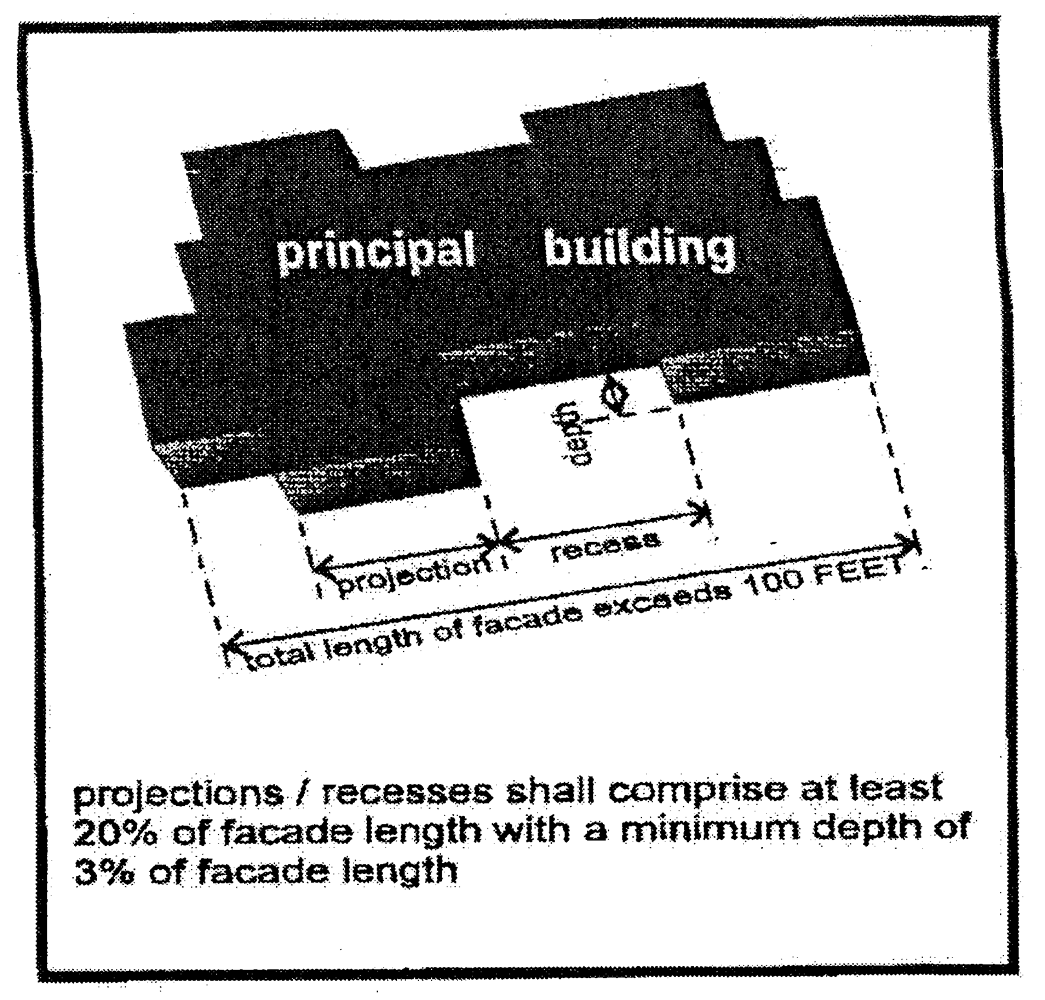
Principal Building—Projections and Recesses
Architectural features used to adorn facades must total 60 percent of the total facade
length and shall include one or more of the following: projecting ribs, pilasters,
columns, canopies/porticos, arcades, and colonnades as illustrated below:
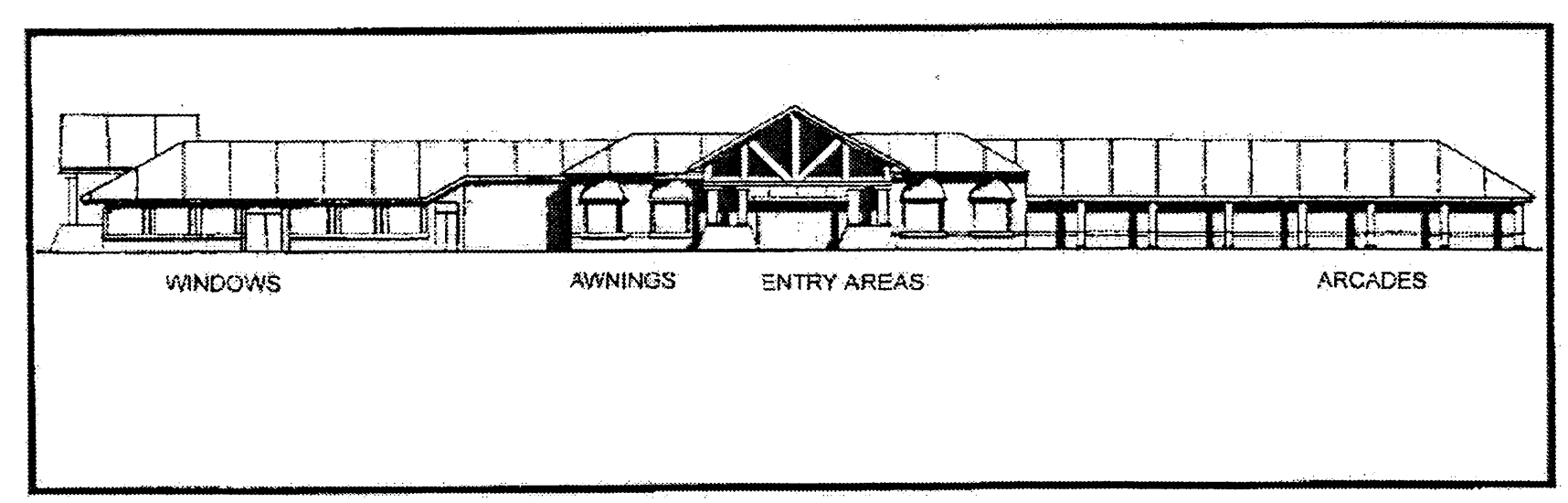
Architectural Features Used to Adorn Facades
1.
Multiple stores within a single building. The intent and purpose of this section is to provide good architectural design, details, and clearly defined entryways rather than unbroken, blank walls. Where the large-scale, commercial-retail building contains multiple stores with separate, exterior, customer entrances, the street-level facade containing the customer entrances shall provide fenestration, such as windows, between the height of a minimum of three feet and eight feet above the walkway grade for no less than 60 percent of the horizontal length of the building facade of each store. Alternative design solutions for buildings containing multiple stores with separate, exterior, customer entrances that meet and exceed the intent and purpose of this section and Chapter 102 may be approved by the planning director.
2.
Detail features. All facades shall include patterns at intervals of no more than 30 feet either horizontally or vertically. Such patterns shall include windows, awnings associated with windows or doors, ornamental and structural details that are integrated into the building structure, arches or arched or curvilinear forms, color changes, banding, texture changes or material module changes, and/or surface modeling changes, such as reveals or ribs of no less than 12 inches in width.
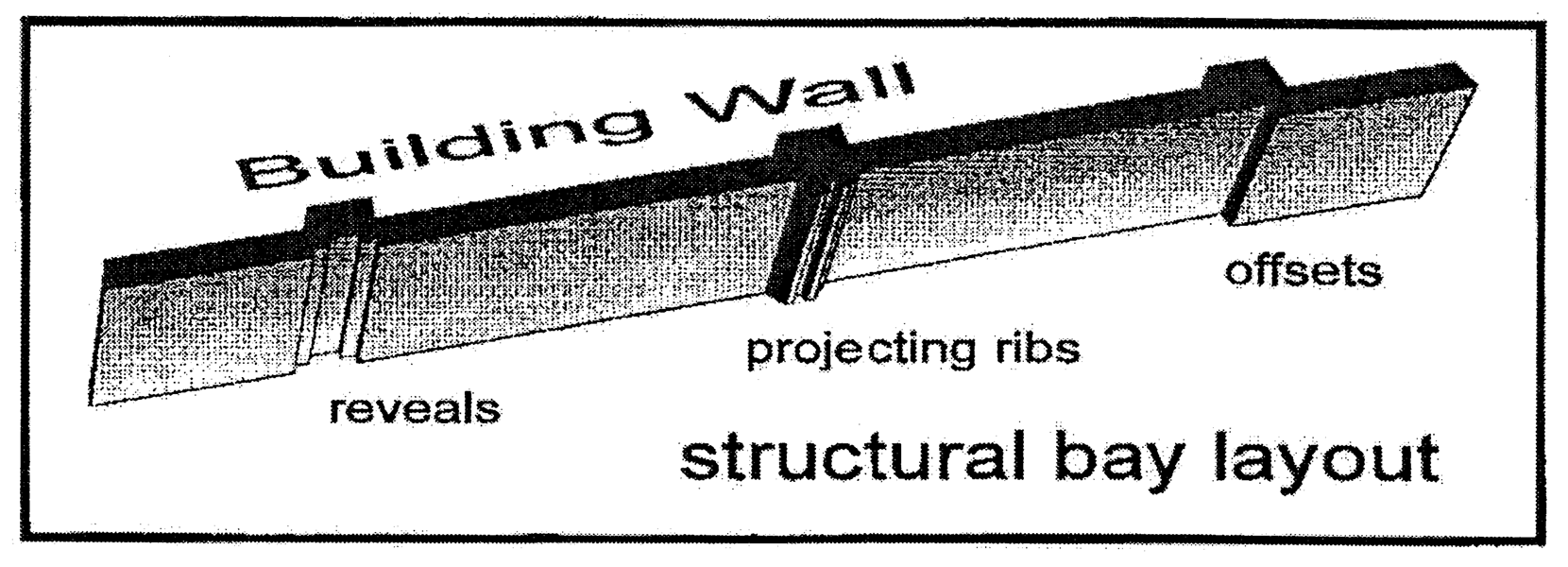
Detail Features
(b)
Materials and color. Red brick shall be a predominant building material of any building's front facade (at least 40 percent of the area of the facade). Side and rear elevations shall include at least one or a combination of the following building materials: architectural or split-face block, brick, glass, wood, stucco, artificial stucco, stone, or concrete with an architectural finish. Smooth faced concrete block, tilt-up concrete panels or prefabricated steel panels are prohibited.
The color of all building elevations (front facade, side, and rear) shall be low reflectance, subtle, neutral or earth tones. The use of high-intensity, saturated colors (such as one or more of the "primary" and/or "secondary" colors), metallic colors, florescent colors, or black, shall be limited to trim or accent features comprising no more than five percent of the total area of any one building facade or street-facing side or rear elevation.
(c)
Entryways. Facades with customer entrances shall be clearly defined and include at least two of the following features: canopies/porticos, overhangs; recesses/projections; arcades; raised, above-the-doorway parapets with cornices; peaked-roof forms; arches; outdoor patios; display windows; and integrated architectural details, such as tile work, moldings, and wing walls.
(d)
Service area. The service area is the area designated for the loading and unloading of goods and refuse collection and shall be buffered from rights-of-way and lesser-intensity-zoned areas by a masonry wall a minimum of eight feet in height and extending the entire length of the service area. A landscaped area six feet in width containing evergreen plants a minimum of six feet in height and spaced no more than six feet apart shall be provided along the exterior of the wall. This provision shall not apply to service areas that face adjoining property zoned for an equal or greater intensity and provided that the adjoining property's existing building facade(s) facing the proposed large-scale, commercial-retail buildings or large-scale, commercial-retail development project's building(s) also incorporate service area(s). This landscaping requirement is in addition to the requirements oF Chapter 98; Chapter 102, Article VII, Division 10; and Sections 102-1417 through 102-1419.
Consideration shall be given to vehicular movement, especially truck circulation to service areas. There shall be a separate truck entrance/route to service areas with minimal passenger vehicle conflicts points. If a separate truck access point is unavailable, the planning director may approve a shared access configuration upon verification through appropriate traffic analysis that the project's circulation and access plan will not negatively impact the adjacent road system, including level of service, create a public safety problem, or be in conflict with any other goal, policy, or objective of the comprehensive plan or other development regulation. The subject traffic analysis shall be submitted by the owner and a review of the analysis performed by a traffic analyst selected by the City, provided that the costs of the review shall be prepaid by the owner/developer.
(e)
Roofs. The intent and purpose of this section is to conceal flat rooflines and unsightly mechanical structures from public view. Flat roof lengths longer than 100 feet in length shall be concealed or addressed utilizing at least one of the following options:
1.
Effective concealment of flat rooflines; rooftop equipment; and heating, ventilating, and air-conditioning units from view by adjacent land uses of lesser intensity and rights-of-way shall be accomplished by constructing a parapet. The parapet design shall be a minimum of three feet in height and shall incorporate a three-dimensional, cornice treatment. Alternative designs, such as varying the parapet height for a minimum linear distance of 100 feet and a minimum vertical height of two feet, shall be subject to approval by the planning director.
2.
Two or more sloping roof planes that extend a minimum of three feet above the eave.
(f)
Pedestrian circulation. The intent and purpose of this section is for large-scale, commercial-retail buildings and large-scale, commercial-retail development projects to provide for pedestrian-oriented ingress and egress through design features that enhance pedestrian safety, efficiency, and clear connectivity, including connectivity among buildings and to pedestrian walkways/bike paths on adjacent roadways, with a clear definition between vehicular areas and pedestrian walkways.
1.
Pedestrian connectivity. The applicant of a project subject to the provisions of this division shall submit a pedestrian-circulation plan at the time of site-plan review for the purpose of showing that unsafe conflicts between vehicles and pedestrian travel have been minimized. Pedestrian travelways between public entrances of buildings, parking facilities, out-parcel buildings, and transit stops is encouraged to be delineated via the use of landscaped areas, sidewalks, and painted travelways. A canopy, arcade, or other architectural and functional overhang that extends from the facade to a minimum of five feet shall be encouraged for all buildings. All pedestrian features shall conform to applicable handicapped regulations.
2.
Transit stops and bicycle racks. Large-scale, commercial-retail projects shall include at least one covered transit stop, if required by the City. The developer shall coordinate with the city for determining the placement of the transit stop. Bicycle racks shall be provided within 50 feet of each customer entrance.
(g)
Parking areas. Parking lots and access aisle ways shall be designed utilizing the following standards:
1.
Parking lot design. The intent and purpose of this section is to provide parking lot design which breaks up vast expanses of pavement by creating clearly defined groupings of parking spaces while providing for vehicular needs and safe, efficient, comfortable pedestrian flow. Vast unbroken parking lots are prohibited. Parking areas shall be designed so that no more than 100 spaces (150 spaces for uses that require 501 or more parking spaces according to this Code) of the total required spaces are part of a clearly defined grouping of spaces. Such groups shall be broken into individual areas and/or clearly separated by landscaped or geographic features and/or by design components of the proposed building(s). The design of these separators shall consider pedestrian movements, conflict points with vehicles, site distance and angles, security site lighting, and safety within the parking lot area. Separations shall be no less than eight feet in width at any point. A pedestrian access way shall be provided for every customer entrance. The parking lot shall be designed with traffic-calming features along the fire lanes fronting the building facades. Parking lots shall be designed to reduce vehicle movement along the fire lane. Design features may include cross driveways, 90-degree parking space design, and consideration of site-access points. For large-scale, commercial-retail buildings 75,000 square feet and larger, at least ten percent of the required parking spaces shall be placed in the side areas of the proposed development project.
Alternative design solutions for these parking lot design requirements that meet and exceed the intent and purpose of this section may be approved by the board of adjustment.
2.
Additional requirements. All parking lots shall meet the requirements of Article VII, Division 11.
(h)
Additional landscaping. The following landscaping standards shall be incorporated into the design of all large-scale commercial-retail buildings and large-scale commercial-retail development projects.
1.
Building perimeter. The building perimeter landscaping required below may be credited towards meeting the requirements of the buffering and landscape requirements of Chapter 98; Article VII, Division 10; and Sections 102-1417 through 102-1419. However, in order to meet the requirements below, the buffering and landscaping requirements may have to be exceeded.
a.
Facade with customer entrance. The intent and purpose of this subsection is to require facades with customer entrances to have significant landscaping/streetscaping so as to provide visual interest, prevent monotony, break up wall and pavement expanses, and clearly define entryways. Building-perimeter landscaping required under the city's landscape and irrigation regulations shall be placed such that a minimum of 50 percent of the facade length has perimeter landscaping. The building-perimeter landscaping shall be in landscaped areas, raised planters, or planter boxes that are each a minimum of five feet wide and are at a maximum ten feet from the building and shall be landscaped with plant clusters of varied species and heights with each cluster containing at least one shade tree consistent with subsection 98-33(d), Plant City Code. Clustered palm trees as provided in Sections 102-1374 and 102-1378 shall not meet this requirement. Tree planting shall be consistent with Section 102-1378, and be a minimum of ten-foot tall at planting. Alternative design solutions for these building-perimeter landscaping requirements on facades with customer entrances that meet and exceed the intent and purpose of this section and the requirements of Chapters 98 and 102 may be approved by the planning director.
b.
Other building sides, except the side with the service area. All other sides of the building, except the side incorporating the service area, shall be screened from public view with no less than a five-foot-wide buffer with foundation landscaping. The buffer area shall, at a minimum, have landscaping in planters or planter beds which extend a minimum of 18 inches from the building along the entire length of the facade, contain plant clusters of varied species and heights, and a minimum of one evergreen shade or three palm trees (each a minimum of ten feet in height at the time of planting) every 30 feet.
(i)
Compatible signage. Sign construction material and finishes shall be compatible with the associated large-scale, commercial-retail buildings and/or large-scale, commercial-retail development projects. The location(s) design shall be reviewed and approved as part of the overall construction plan. The predominate sign material shall include architectural or split-faced block, brick, glass, wood, stucco, artificial stucco, or stone and be compatible with the principal building design. Where construction plan approval for large-scale, commercial-retail buildings or large-scale, commercial-retail development projects has been granted, signage location shall be reviewed and approved during the sign permit process.
(j)
Outdoor display and sales. Any permanent display areas not within the building which face a right-of-way, parking area, or residential zoning district shall be shielded from view by a wall made from architectural or split-face block, brick, glass block, stucco, artificial stucco, stone, or concrete with an architectural finish or a combination of the foregoing materials and incorporated into the overall design of the building. The wall shall extend a minimum of four feet in height. As an alternative, an evergreen landscape buffer a minimum of four feet in height and opaque at the time of planting may be utilized.
(k)
Outdoor storage. Outdoor storage including freight and cargo containers with or without axles is prohibited.
(l)
Lighting. The intent and purpose of this section is to avoid forms of light nuisance and intrusion, such as light pollution, light trespass, and glare from adjacent areas, which affects both people and wildlife. All outdoor light fixtures, other than fixtures on the building facade, emitting 2,050 or more lumens shall be shielded as follows:
1.
Within 50 feet of the property boundary, light fixtures must be full-cutoff, light fixtures. As illustration, full cut-off light fixtures are demonstrated as follows:
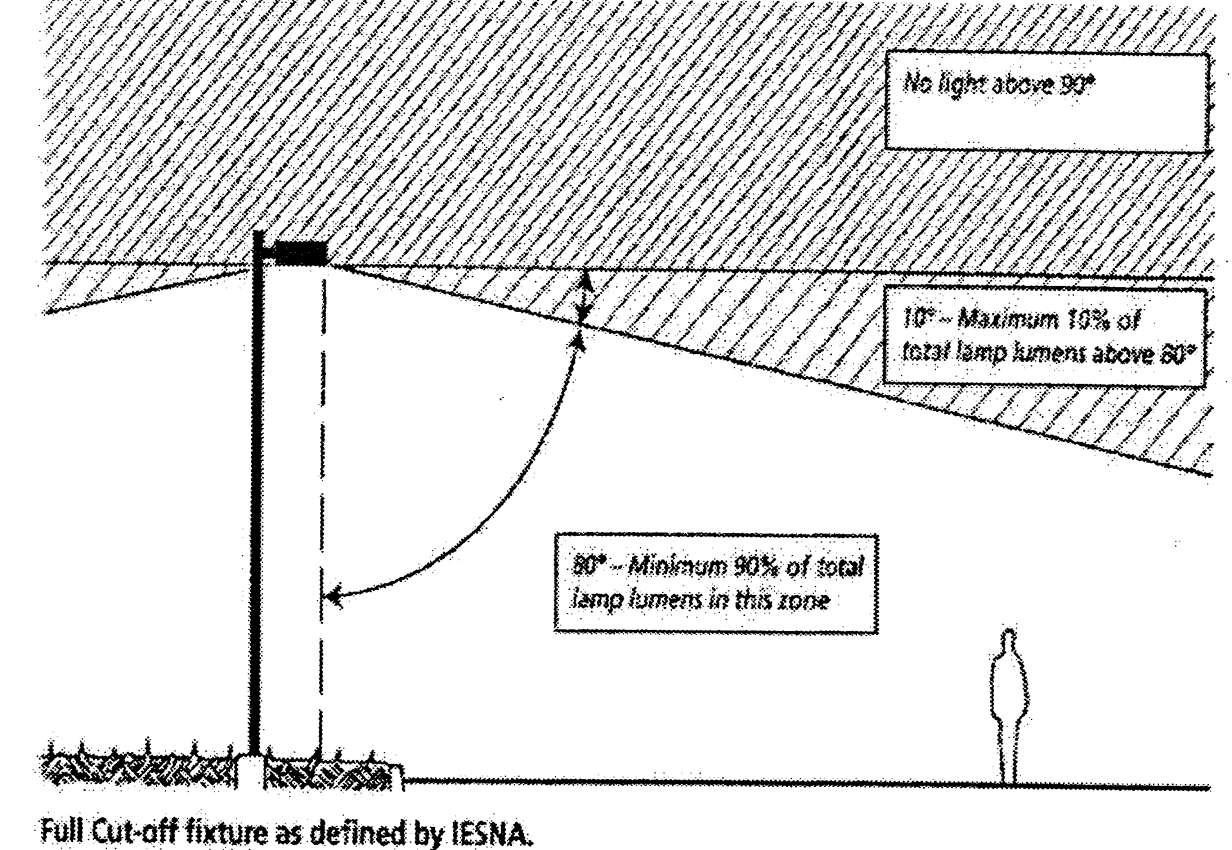
Full Cutoff Fixtures as Defined by IESNA
2.
All other outdoor lighting fixtures shall be semicutoff or full-cutoff light fixtures. As illustration semicutoff light fixtures is demonstrated as follows:
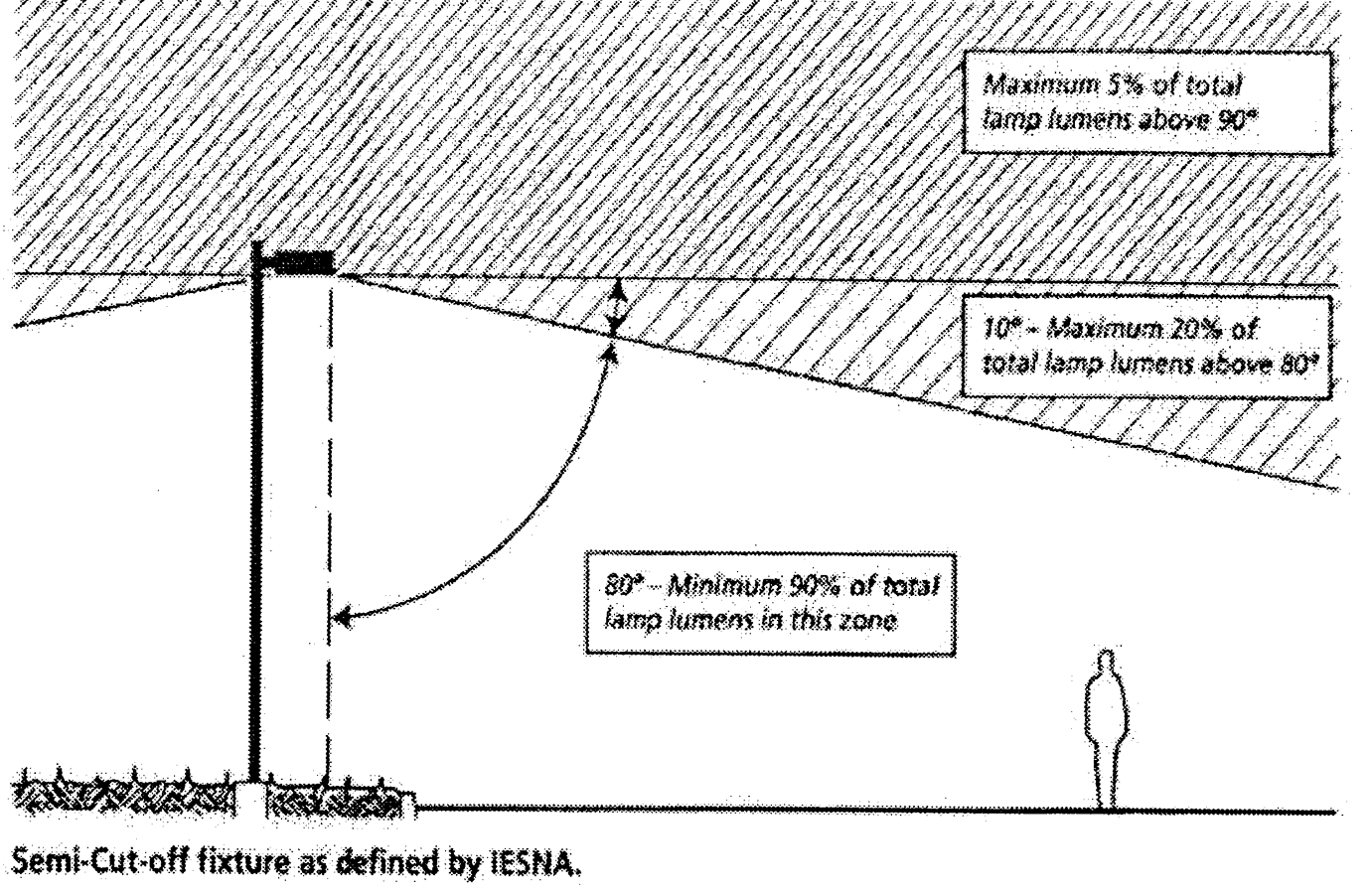
Semicutoff Fixtures as Defined by IESNA
Alternative design solutions for those lighting requirements that meet and exceed the intent and purpose of this section may be approved by the city engineer. However, alternative designs may not be approved to vary the requirements of other land development or any building regulations.
(m)
Transportation analysis. All development subject to this section shall require a transportation analysis pursuant to and in accordance with subsection 102-446(j). The developer shall be responsible for 100 percent of the cost of all on- and off-site improvements identified by the transportation analysis.
(n)
Compliance. In addition to the application requirements of the Code, a colored facade rendering shall be submitted at time of site plan approval or as part of the PD Planned Development district rezoning application submission. The colored facade rendering shall also be submitted prior to submitting the building permit application.
(Ord. No. 37-2005 § 2, 9-26-2005; Ord. No. 05-2013, § 25, 2-25-2013; Ord. No. 42-2023, § 5, 11-27-2023)
Sec. 102-1472.- Residentially based mixed use projects.
(a)
Purpose. This section relating to building height, public right-of-way encroachments and parking for residentially based mixed use projects shall apply within the downtown historic district as described in section 38-69, Plant City Code. For purposes of this section "residentially based mixed use projects" shall be mean those developments that: (a) have more than 50 percent of the total floor area used for residential purposes, and (b) contain a minimum of 5,000 square feet of ground floor area used for nonresidential purposes.
(b)
Building height. Notwithstanding any other provisions herein, the maximum permitted height of buildings shall be 60 feet or five floors where the ground-floor footprint of a building contains at least 10,000 square feet and 70 feet or six floors where the ground-floor footprint of a building contains at least 15,000 square feet, provided that:
(1)
The building height within 15 feet from the public right-of-way (excluding alleys) shall not be higher than the maximum zoning height allowed by the normal zoning height limitation; and
(2)
The new building's height within 15 feet of an adjacent existing building along the same block face, shall not be more than 30 feet higher than said adjacent building.
(c)
Public right-of-way encroachments. Encroachments into the public right-of-way for awnings or awning signs is permitted provided that:
(1)
Overhanging features shall be at least eight feet above grade;
(2)
Such features shall have a maximum projection into the public right-of-way of six feet;
(3)
Such features shall leave street corners free of obstruction to allow for safe traffic movement;
(4)
Proper nighttime illumination shall be provided and maintained by the property owner, underneath any overhanging features; and
(5)
The encroachment meets the requirements of the Florida Building Code.
(d)
Parking. There shall be included in the building no less than one and one-half parking spaces per dwelling unit. Handicapped parking spaces, if required, shall not count toward this one and one-half parking-space-per-unit requirement.
(e)
Architectural review. All approvals shall be subject to issuance of a certificate of appropriateness by the historic resources board, in accordance with the requirements of chapter 38, Plant City Code.
(Ord. No. 7-2006, § 1, 3-27-2006)
Sec. 102-1473.- Sale of cannabis; cannabis production facilities.
(a)
Definitions.
Cannabis means all parts of any plant of the genus Cannabis, whether growing or not; the seeds thereof; the resin extracted from any part of the plant; and every compound, salt, derivative, mixture, or preparation of the plant or its seeds or resin.
Cannabis Production Facility means any property used in whole or in part for the cultivation and processing of marijuana by a Medical Marijuana Treatment Center Cultivating or Processing Facility, as described in F.S. § 381.986(11).
Medical Marijuana Treatment Center Dispensing Facilities means any property where Cannabis is sold, purchased, delivered or dispensed for Medical Use.
Medical Use means the use of any form of Cannabis pursuant to medical prescription to treat a Debilitating Medical Condition and the symptoms associated with that condition as authorized by State law.
(b)
Prohibition.
(1)
Until such time that the sale of Cannabis is permitted under Federal law, Medical Marijuana Treatment Center Dispensing Facilities and the sale of Cannabis shall be prohibited.
(2)
Until such time that the growing, cultivation and processing of Cannabis is permitted under Federal law, Cannabis Production Facilities shall be prohibited.
(c)
Medical Marijuana Treatment Center Dispensing Facilities. At such time that the sale of Cannabis is permitted under Federal law, the following shall apply:
(1)
Location. In accordance with Section 381.986(11), Florida Statutes, Medical Marijuana Treatment Center Dispensing Facilities shall be permitted in any zoning district where a pharmacy may be located.
(2)
State and Federal law. Medical Marijuana Treatment Center Dispensing Facilities shall comply with all applicable State and Federal law requirements.
(d)
Cannabis Production Facilities. At such time that a Cannabis Production Facility is permitted under Federal law, the following shall apply:
(1)
Location. Cannabis Production Facilities shall be permitted in any location as permitted in Federal and State law.
(2)
State and Federal law. Cannabis Production Facilities shall comply with all applicable State and Federal law requirements.
(Ord. No. 17-2016, § 4, 8-8-2016; Ord. No. 18-2016, § 1, 9-26-2016; Ord. No. 13-2023, § 1, 5-8-2023)
Sec. 102-1286. - Scope.
Clustering of residential units shall be permitted within planned developments provided that the gross residential density limit for each land use category established by the Comprehensive Plan is not exceeded. All land use categories allowing residential development may permit clustering, providing that such clustering does not contribute to potential flooding. Only nonresidential planned development projects may be considered for development within an industrial district.
(Ord. No. 05-2013, § 19, 2-25-2013)
Sec. 102-1287. - Maximum residential densities permitted.
(a)
The maximum residential densities permitted in planned developments shall be as follows:
(b)
Permitted gross residential density shall be applied by multiplying the density of the land use category within which the project is located by the total project acreage.
(Ord. No. 05-2013, § 19, 2-25-2013; Ord. No. 48-2021, § 2, 10-25-2021)
Sec. 102-1288. - Projects encompassing more than one land use category.
(a)
For planned development projects with boundaries encompassing more than one land use category, the maximum density in Section 102-1287 shall be applied to the project acreage in each respective land use category. Where a project encompasses more than one land use category, density credits shall be calculated as described in Sections 102-1293 and 102-1294. The total number of dwelling units possible, based on this calculation, will be used as a maximum for review purposes. This is intended to provide maximum design flexibility for planned developments. The location or clustering of those units on the project site need not conform to the land use category boundary on the site, provided that the maximum number of dwelling units for the project is not exceeded.
(b)
When a project is being considered for development to include uses other than residential, such as commercial, office or industrial, only those environmentally sensitive area acreages or portions thereof occurring within the residential part of the project shall be counted for purposes of determining density.
(Ord. No. 05-2013, § 19, 2-25-2013)
Sec. 102-1289. - Application to lands fronting water bodies.
In addition to the restrictions on the calculations of densities of planned developments and on the prohibition against the use of naturally occurring open water bodies for density credits, the determination of the appropriate levels of density during the site plan review process for lands fronting on water bodies shall be further limited. The density level shall be comparable and compatible with other development parcels and lots fronting on lakes and streams. In the case of lakes, comparable and compatible development shall be determined by at least 51 percent of the land area adjacent to the lake having been developed in a similar fashion. In the case of streams, the 51-percent development pattern described in this Section shall extend one-half mile from the subject parcel along either side of the stream.
(Ord. No. 05-2013, § 19, 2-25-2013)
Sec. 102-1290. - Application of nonresidential intensities.
(a)
For calculating the maximum permitted gross building square footage for nonresidential uses within a planned development proposal, the following procedure shall apply: In applying floor area ratios (FAR) to acreages, all residential land use types that fall within a project's boundaries are excluded. In addition, only those lands specifically within a project's boundaries may be used for calculating maximum permitted gross building square footage. Notwithstanding the above, no nonresidential intensity may be transferred from one parcel of land to another when the parcels are physically separated from each other by any land except when separated only by roadways, streams, lakes or other water bodies.
(b)
Calculation of gross building square footage for all nonresidential uses shall be based upon a site plan. Gross building square footage for nonresidential uses in other plan categories which do not specify a maximum nonresidential FAR in their definition may be based upon a site plan and/or the development potential inherent in the requested or existing zoning district.
(Ord. No. 05-2013, § 19, 2-25-2013)
Sec. 102-1291. - Gross nonresidential intensity.
(a)
Gross nonresidential intensity refers to gross building square footage of nonresidential land use types within a given planned development project or, in the case of mixed use projects, a portion of a project.
(b)
A project's total nonresidential acreage, for purposes of calculating its gross nonresidential land uses to which the owner, owner's agent or developer has surface development rights, includes the following land within the nonresidential portion of the project to be used for: streets and street rights-of-way; public and private parks and recreation sites; sites for schools and churches; open space sites and land uses; and public facilities, such as sewage treatment plants, community centers, well fields, utility substations and drainage facility sites.
(c)
Lands designated for residential uses shall not be included in a project's total nonresidential acreage for purposes of calculating nonresidential intensity.
(d)
In calculating gross nonresidential intensity for a proposed nonresidential use, acreage of manmade water bodies and designated conservation areas may be counted towards a project's total nonresidential acreage only if that acreage does not exceed 25 percent of the proposed project's total nonresidential acreage. The following are included:
(1)
Conservation areas as established in the conservation element of the Comprehensive Plan and as described in the future land use element as environmentally sensitive areas with the exception of water bodies.
(2)
Manmade water bodies shall be included as part of a project's total nonresidential acreage and shall be used for calculating gross nonresidential intensity.
(Ord. No. 05-2013, § 19, 2-25-2013)
Sec. 102-1292. - Approval of nonresidential intensities.
Where the language in Section 102-1286 through this Section or in other applicable development regulations establish maximum floor area ratios (FAR) for nonresidential uses, nothing in Section 102-1286 through this Section or in any other Section shall be assumed to guarantee approval of maximum gross nonresidential intensity on any proposed project. Approval of nonresidential intensities shall be fully subject to the City's goals, objectives and policies, as specified by the Comprehensive Plan for the City, on compatibility of surrounding land uses, existing or approved, the adequacy and availability of public facilities and subject to all other applicable development regulations.
(Ord. No. 05-2013, § 19, 2-25-2013)
Sec. 102-1293. - Residential density credits for infill development.
(a)
The maximum level of residential density for a planned development may be considered by the City Commission for increase without an amendment to the Comprehensive Plan subject to the limitations and conditions provided in this Section when the purpose of the request for density increase is either to promote residential infill on vacant lots within developed urbanized areas which are residential in character or to provide a residential development alternative to strip commercial development.
(b)
Density increases may be requested when an official zoning application is filed for any zoning district permitting residential development which requires the submittal and approval of a site plan. Such requests shall only be considered for locations designated on the future land use map, a portion of the Comprehensive Plan for the City as residential; and where such locations directly front on and have direct access to collector or arterial streets as defined in Section 102-3. Requests shall be subject to the following limitations or conditions:
(1)
Density in locations shown as Residential-4 (R-4) shall not be increased to more than six dwelling units per gross acre.
(2)
Areas designated as Residential-6 (R-6) shall not be increased to more than nine dwelling units per gross acre.
(3)
Areas designed as Residential-9 (R-9) shall not be increased to more than 12 dwelling units per gross acre.
(4)
Areas designated as Residential-12 (R-12) shall not be increased to more than 16 dwelling units per gross acre.
(5)
Areas designated as Residential-16 (R-16) shall not be increased to more than 20 dwelling units per gross acre.
(6)
Areas designated as Residential-20 (R-20) shall not be increased to more than 25 dwelling units per gross acre.
(7)
The purpose of the request for density increase shall be to promote residential infill on vacant or redeveloping sites within existing, developed, urbanized areas which are residential in character or to provide a residential development alternative to strip commercialization in areas where strip commercial development presently exists or there is a trend toward strip commercial development or existing zoned lots, although vacant, constitute a potential for the establishment or expansion of strip commercial development.
(8)
Consideration of density increases shall be limited to that area of a site intended for residential uses and meeting the following description:
a.
One boundary line shall be formed by the arterial or collector road right-of-way.
b.
The second and third boundary lines are perpendicular to the right-of-way to a depth of not more than 250 feet from the right-of-way.
c.
The fourth boundary line connects and/or intersects the perpendicular lines and is parallel to the right-of-way.
d.
If the right-of-way is curved, and the perpendicular lines themselves intersect at a point shorter than 500 feet, only three boundaries shall be used.
e.
The boundary lines shall not be drawn in such a way that any portion of land is included that is used, designated or intended for use as nonresidential.
(9)
Nothing in this Section shall be construed as guaranteeing the achievement of the density increases or any portion thereof provided for in this Section. This Section shall not be construed as guaranteeing the maximum density limit or any portion thereof established in other Sections for the residential categories as designated by the Comprehensive Plan for the City. This Section shall only be construed as providing for the conditions and limitations under which requests for consideration for density increases may be filed. In no case is the City Commission required to grant the request or any portion thereof. However, if a request has met all of the conditions, limitations and requirements of this Section, and, if the City Commission finds that a request fulfills the stated intent and public purpose of this Section and meets the goals, objectives and policies of the Comprehensive Plan, the City Commission may then have the option of granting a request for a density increase without a plan amendment as provided after receiving the recommendation of the Planning Commission staff.
(10)
Any density increase shall be compatible with existing or approved surrounding development. Net project densities within a particular project located within surrounding developments shall not be used as a measure of such compatibility. Compatible densities need not be interpreted as comparable or the same as surrounding developments if adequate provision for transitioning to higher densities is required and met by but not limited to such means as buffering (Division 10 of Article VII of this Chapter) setbacks and graduated height restrictions (Section 102-1256).
(11)
Any density increase considered under this Section is required to be consistent with all applicable provisions contained in the Comprehensive Plan for the City.
(12)
The boundary for the locations of any requests that are granted higher densities pursuant to this Section shall not extend further than 250 feet from the arterial or collector street right-of-way boundary and shall become a fixed boundary.
(13)
The locational requirement that project requests for higher density directly front on and have direct access to collector or arterial streets need not be interpreted as requiring that the final design for the project must have collector or arterial street access if such a design is not deemed to be in the public interest during the official development review process. This locational requirement shall be interpreted as requiring only that direct frontage exists and that the opportunity for direct access is present.
(Ord. No. 05-2013, § 19, 2-25-2013; Ord. No. 48-2021, § 3, 10-25-2021)
Sec. 102-1294. - Uplands density credit incentives.
The density credit incentive for planned developments provides a mechanism to preserve upland forest communities. Before the upland incentive can be considered, the wetland credit must be calculated. The following requirements must be met:
(1)
Any acreage used to calculate credit for the upland density credit incentive shall be recorded as a permanent conservation easement on the subdivision plat and lot deed and may not be eligible for any future development rights.
(2)
Upland communities eligible for credit include the sandhill pine flatwoods, sand pine scrub, xeric hammock and upland mesic hammock.
a.
The upland forest community shall be a minimum of one acre in size.
b.
Land that will be designated on the site plan or final plat as conservation and protected from development shall be given a 25-percent bonus density. (Acres of upland preservation times 1.25 equals total acres eligible for credit times density equals total dwelling units.)
(3)
The density credit formula for the protection of wetlands is as follows:
a.
If less than 25 percent of the project acreage is wetlands, full-density credit shall be given.
b.
If 25 percent or more of the project acreage is wetlands, the portion of the site which is developable upland shall be given a density credit of 25 percent.
(4)
The combination of the wetland density credit and the upland density credit incentive shall not result in a net density on the developed project acreage of more than double the gross density of the land use category where the development is located.
(5)
When the allowed number of units is a fraction, the number will be rounded to the lower whole number, e.g., 12.5 units calculated will be interpreted as 12.0 units.
(Ord. No. 05-2013, § 19, 2-25-2013)
Sec. 102-1311. - Scope; applicability.
For the purposes of this Chapter, industrial uses are eligible for consideration if they meet the development standards described in this subdivision. These standards shall be applied during the review of any proposed industrial use. The general requirements in this subdivision shall be met, as well as specific standards in Section 102-1315.
(Code 1977, § 111.23.4(a))
Sec. 102-1312. - Land use compatibility.
For the purposes of this Chapter, all proposed industrial uses must be compatible with existing surrounding development. Industrial uses that would have a negative influence as determined by scale, impact and intensity on adjacent residential neighborhoods or individual residences shall not be permitted.
(Code 1977, § 111.23.4(a)(1))
Sec. 102-1313. - Services and facilities.
For the purposes of this Chapter, all proposed industrial development must maintain the levels of service and developmental requirements adopted in the comprehensive plan. Compliance with the concurrency ordinance shall be required.
(Code 1977, § 111.23.4(a)(2))
Sec. 102-1314. - Environmental considerations.
For the purposes of this Chapter, all proposed industrial development shall be allowed only in areas where it can be demonstrated that environmental damage will not occur. Compliance with applicable development regulations of environmental agencies, such as the Southwest Florida Water Management District (SWFWMD), the environmental protection commission (EPC), and the state department of environmental protection (DEP), shall be demonstrated.
(Code 1977, § 111.23.4(a)(3))
Sec. 102-1315. - Specific development standards.
For the purposes of this Chapter, specific development standards for industrial uses shall be as follows:
(1)
All industrial uses shall be located on or shall have direct access to an arterial road.
(2)
Maximum floor area ratio (FAR) shall not exceed 0.50.
(3)
No site clearance or alteration shall occur prior to approval of a detailed site plan.
(4)
A detailed site plan shall be submitted by the owner or his representative to the planning and zoning division for approval prior to issuance of a building permit. The site plan shall include the following:
a.
Boundary lines of the property, including dimensions, survey with a complete legal description and folio number, and the total site acreage.
b.
The location and names of all public streets adjoining or traversing the site. A transportation analysis shall be required for any development generating more than 250 average trip ends for weekday or weekend (whichever is higher) according to the latest edition of the Institute of Transportation Engineers Trip Generation Manual. This analysis shall be sufficient to show the proposed project meeting the minimum requirements of the Comprehensive Plan and Article IX of Chapter 102, Plant City Code. The transportation analysis shall be reviewed by a traffic analysis [analyst] selected by the City, provided that the costs of the review shall be prepaid by the owner. The analysis and methodology shall be in accordance with acceptable traffic engineering practices and procedures subject to review and approval of the City Manager, or designee. At a minimum, the analysis shall include total trips generated by the project, a.m. and p.m. per-hour rates at project access points, average daily trips generated by the project, LOS during peak hours at project access points and links to significant other roadways to such a point as the impacts become acceptable and other traffic improvements required as a result of the project. The City Manager, or designee, may require the transportation analysis to include impacts on the functionality and character of adjacent local streets. The developer shall be responsible for 100 percent of the cost of all on-site improvements identified by the transportation analysis and shall be responsible for such portion of offsite improvements as required by the Comprehensive Plan and transportation mobility fees, whichever is greater.
c.
Identification of the name, plat book and page number of any recorded subdivisions comprising all or part of the site.
d.
Identification and location of all existing easements, watercourses, lakes or other natural/environmental features on the site.
e.
Identification of adjacent zoning/land use designations and existing land uses within 150 feet of the project site.
f.
Location, arrangement, size and height of all proposed structures with identification of proposed uses contained therein.
g.
Square footage and floor area ratio (FAR) of all proposed uses.
h.
Open space uses, walkways, service areas and fire lanes.
i.
Location and size of all proposed roads and access driveways, fences/walls, buffering and landscaped areas.
j.
Location and size of all utility lines adjacent to as well as on the site, fire hydrants and solid waste disposal sites.
k.
Location of all signs. The placement and regulation of signs shall be in accordance with the requirements of Article VIII, Chapter 102, Plant City Code.
l.
Location and size of all existing and proposed environmental areas, retention/detention ponds and other required drainage facilities.
(5)
A required landscaping and buffering plan shall be submitted in accordance with the requirements of division 10 of this article.
(6)
A required parking plan shall be submitted in accordance with the requirements of division 11 of this article.
(Code 1977, § 111.23.4(b); Ord. No. 49-2005, § 2, 12-12-2005; Ord. No. 3-2016, § 4, 1-25-2016; Ord. No. 8-2016, § 1, 2-8-2016; Ord. No. 42-2023, § 4, 11-27-2023)
Sec. 102-1341. - Scope.
For the purposes of this Chapter, commercial uses are eligible for consideration if they meet the development standards described in this Subdivision. These standards shall be applied during the review of proposed rezonings or during the review of any proposed site plan. The general requirements in this Subdivision shall be met, as well as the specific standards in Section 102-1345.
(Code 1977, § 111.23.3(a); Ord. No. 05-2013, § 20, 2-25-2013)
Sec. 102-1342. - Land use compatibility.
All
proposed commercial uses must be compatible with existing surrounding development. Commercial and office uses that would have a negative influence as determined by scale, impact and intensity on adjacent residential neighborhoods or individual residences shall not be permitted. The proposed development must provide proper buffering as provided in Division 10 of this Article.
(Code 1977, § 111.23.3(a)(1); Ord. No. 05-2013, § 20, 2-25-2013)
Sec. 102-1343. - Services and facilities.
For the purposes of this Chapter, all proposed commercial or office development must maintain the levels of service adopted in the Comprehensive Plan.
(Code 1977, § 111.23.3(a)(2); Ord. No. 05-2013, § 20, 2-25-2013)
Sec. 102-1344. - Environmental considerations.
For the purposes of this Chapter, all proposed commercial or office development shall be allowed only in areas where it can be demonstrated that environmental damage will not occur. Compliance with applicable development regulations of environmental agencies, such as the Southwest Florida Water Management District, Environmental Protection Commission of Hillsborough County and the State Department of Environmental Protection, shall be demonstrated.
(Code 1977, § 111.23.3(a)(3); Ord. No. 05-2013, § 20, 2-25-2013)
Sec. 102-1345. - Specific development standards and locational criteria.
For the purposes of this Chapter, specific development standards and locational criteria for commercial uses shall be as follows:
(1)
Commercial uses in the Residential-6 (R-6) land use category shall meet the following standards:
a.
Convenience-type commercial establishments shall be the only commercial use. All other types of commercial development are prohibited.
b.
Uses shall be located not more than 250 linear feet from the intersection of two collector roads, a collector road and an arterial road or two arterial roads. Measurement of the distance shall be from the property line along the road.
c.
The floor area ratio (FAR) shall not exceed 0.25.
(2)
Commercial uses in the Residential-9 (R-9), Residential-12 (R-12), Residential-16 (R-16), and Residential-20 (R-20) land use categories shall meet the following standards:
a.
Neighborhood-type commercial establishments shall be the only commercial use permitted.
b.
Uses shall be located not more than 500 linear feet from the intersection of two collector roads, a collector road and an arterial road or two arterial roads. Measurements of the distance shall be from the property line along the road.
c.
The floor area ratio (FAR) shall not exceed 0.35.
(3)
The maximum distance requirements in the R-6, R-9, R-12, R-16, and R-20 land use categories may be exceeded when:
a.
Seventy-five percent of the frontage associated with the use is within the linear frontage of the commercial node;
b.
Fifty percent of the block has existing commercial development;
c.
The commercial use is proposed to be developed as an integrated support component of a residential planned development and City water and wastewater services are available; or
d.
The use is a medical office or clinic, associated medical uses that supports or is the South Florida Baptist Hospital.
(4)
Commercial uses in the industrial (I) land use category shall meet the following standards:
a.
Uses shall be limited to a convenience-type commercial activity to serve and support the industrial development. All other types of commercial development are prohibited.
b.
Uses shall be located within projects not on the perimeter.
c.
Commercial uses shall not exceed ten percent of the industrial project square footage.
(Code 1977, § 111.23.3(b); Ord. No. 05-2013, § 20, 2-25-2013; Ord. No. 48-2021, § 4, 10-25-2021)
Cross reference— Environment, ch. 30.

