
Portage City Zoning Code
ARTICLE I
- INTRODUCTION AND DEFINITIONS
Sec. 90-1.- Title.
This chapter shall be known, cited, and referred to as the City of Portage Zoning Ordinance, except where as referred to herein, where it shall be known as "this chapter."
(Ord. No. 13-005, § 1, 3-28-2013)
Sec. 90-2. - Authority.
This chapter is enacted pursuant to the authority granted by Wis. Stats. § 62.23(7). Specific statutory references are provided within the body of this chapter solely as a means of assisting the reader. Such references are not to be considered as all inclusive and shall in no manner be construed so as to limit the application or interpretation of this chapter.
(Ord. No. 13-005, § 1, 3-28-2013)
Sec. 90-3. - Jurisdiction.
This chapter is applicable to all territory located within the corporate limits of the City of Portage.
(Ord. No. 13-005, § 1, 3-28-2013)
Sec. 90-4. - Purpose and intent.
(1)
This chapter is adopted for the following purposes:
(a)
To protect the health, safety, morals, comfort, convenience, and general welfare of the public.
(b)
To control and lessen congestion in the streets.
(c)
To secure safety from fire, panic, flooding, pollution, contamination, and other dangers.
(d)
To promote adequate light and air.
(e)
To protect groundwater resources.
(f)
To prevent the overcrowding of land.
(g)
To avoid undue concentration of population.
(h)
To preserve, protect, and promote property values.
(i)
To promote land uses and development patterns that are consistent with the city's comprehensive plan.
(j)
To facilitate the adequate provision of transportation, water, sewerage, schools, parks, and other public facilities.
(k)
To address and mitigate the effects of climate change.
(l)
To promote and restore the conservation, protection, restoration and enhancement of historic resources.
(m)
To provide an adequate variety of housing and commercial building types to satisfy the city's social and economic goals.
(n)
To preserve burial sites as defined in Wis. Stats. § 157.70(1)(b).
(2)
It is also the intent of this chapter is to implement certain goals and objectives of the City of Portage Comprehensive Plan, which are best addressed through zoning approaches, as enabled by Wisconsin Statutes.
(Ord. No. 13-005, § 1, 3-28-2013; Ord. No. 21-02, § I, 8-26-2021)
Sec. 90-5. - Separability and non-liability.
It is hereby declared to be the intention of the City of Portage Common Council that provisions of this chapter are separable in accordance with the following:
(1)
If any court of competent jurisdiction shall adjudge any provision of this chapter to be invalid, such judgment shall not affect any other provisions of this chapter not specifically included in said judgment.
(2)
If any court of competent jurisdiction shall adjudge invalid the application of any portion of this chapter to a particular property, water, building, or structure, such judgment shall not affect the application of said provision to any other property, water, building, or structure not specifically included in said judgment.
(3)
If any requirement or limitation attached to an authorization given under this chapter is found invalid, it shall be presumed that the authorization would not have been granted without the requirement or limitation and said authorization shall also be invalid.
(4)
The city does not guarantee, warrant, or represent that only those areas designated as floodplain will be subject to periodic inundation and hereby asserts that there is no liability on the part of the city, its officers, employees, agents, or representatives for any flood damages, sanitation problems, or structural damages.
(Ord. No. 13-005, § 1, 3-28-2013)
Sec. 90-6. - Abrogation.
It is not intended that this chapter abrogate or interfere with any constitutionally protected vested right. It is also not intended that this chapter abrogate, repeal, annul, impair, or interfere with any existing easements, covenants, deed restrictions, agreements, rules, regulations, or permits previously adopted or issued pursuant to law.
(Ord. No. 13-005, § 1, 3-28-2013)
Sec. 90-7. - Rules of interpretation.
(1)
In their interpretation and application, the provisions of this chapter shall be held to be the minimum requirements for the promotion of the public health, safety, morals, and welfare, and shall be liberally construed in favor of the city and shall not be construed to be a limitation or repeal of any other power now possessed by the City of Portage.
(2)
Where property is affected by the regulations imposed by any provision of this chapter and by other governmental regulations, the regulations which are more restrictive or which impose higher standards or requirements shall prevail. Regardless of any other provision of this chapter, no land shall be developed or used, and no structure erected or maintained, in violation of any state or federal regulations. Where there are conflicts between or among regulations within this chapter, the regulations that are more restrictive or which impose higher standards or requirements shall prevail. In all instances, where there are conflicts between the text of this chapter and any tables or figures of this chapter, the text shall prevail.
(3)
Nothing herein contained shall require any changes in plans, construction, size, or designated use of any building or part thereof for which a building permit has been issued before the effective date of this chapter, and the construction of which shall have been started within one year from the date of such permit.
(Ord. No. 13-005, § 1, 3-28-2013)
Sec. 90-8. - Re-enactment and repeal.
(1)
This chapter, in part, carries forward by re-enactment some of the provisions of the regulations governing zoning and related matters previously known collectively as Chapter 90, Zoning Ordinance of the Code of Ordinances for the City of Portage, adopted prior to the effective date of this chapter. It is not the intention of this chapter to repeal, but rather to re-enact and continue in force such existing provisions so that all rights and liabilities that have accrued thereunder are preserved and may be enforced, unless explicitly surrendered by specific provisions of this chapter or altered by the official zoning map.
(2)
All provisions of Chapter 90 of the City of Portage Code of Ordinances which are not re-enacted herein are hereby repealed.
(3)
The adoption of this chapter shall not adversely affect the city's right to prosecute any violation of the predecessor Zoning Code, provided the violation occurred while that chapter was in effect.
(Ord. No. 13-005, § 1, 3-28-2013)
Sec. 90-9. - Effective date.
This chapter shall become effective upon passage and posting according to law. All plans approved under previous zoning regulations shall be valid and may be used to obtain permits for a period of not more than one year after the effective date of this chapter, except where subject to developer agreement provisions.
(Ord. No. 13-005, § 1, 3-28-2013)
Sec. 90-10. - Regulations applicable to all development and land uses.
All development and uses of land initiated within the jurisdiction of this chapter shall comply with the following.
(1)
Zoning district regulations per article II.
(2)
Land use regulations per article III.
(3)
Bulk regulations per article IV.
(4)
Overlay zoning district regulations per article VI.
(5)
Site design and performance standards per article VII.
(6)
Landscaping standards per article VIII.
(7)
Signage regulations per.
(8)
Procedural regulations and requirements per article X.
(9)
Except as provided in this chapter, under provisions for nonconforming uses, nonconforming sites, nonconforming and substandard lots, and nonconforming structures (article V), no building, structure, development, or premises shall hereinafter be used or occupied, and no applicable permit granted, that does not conform to the requirements of this chapter. In cases of mixed-occupancy or mixed-use structures, the regulations for each land use shall apply to the portion of the structure or land so occupied or so used.
(10)
No structure, land, water, or air shall hereafter be used and no structure or part thereof shall hereafter be located, erected, moved, reconstructed, extended, enlarged, converted, or structurally altered without a building permit, except structures not requiring a building permit (e.g. swing set, clothesline, etc.), and without full compliance with the provisions of this chapter and all other applicable local, county, and state regulations.
(11)
Number of principal land uses per building.
(a)
No more than one non-residential land use shall be permitted in any one building unless a conditional use permit has been granted for a group or large development in compliance with section 90-64.
(b)
No building containing a non-residential land use shall contain a residential land use except the following land uses: single family residential, upper story dwelling unit, bed and breakfast, boarding house, home occupation, and in-home daycare.
(12)
Number of buildings per lot.
(a)
In the RT, R-1, R-3, R-3, R-4, R-5, R-MH, B-1, and B-2 districts, only one principal building shall be permitted on any one lot.
(b)
In the B-3, M-1, M-2, and M-3 districts, more than one principal building may be permitted on any one lot with the granting of a conditional use permit for a group or large development per section 90-64 or a planned development per sections 90-96 and 90-475.
(13)
Division or combining of a lot. No recorded lot shall be divided into two or more lots and not two or more recorded lots shall be combined into one or more lots unless such division or combination results in the creation of lots that conform to applicable regulations of the zoning district in which said lot(s) is located. See also Chapter 70, Subdivisions.
(14)
Street frontage. All lots shall abut upon a public street or other officially approved means of access, and each lot shall have a minimum frontage as designated by the district regulations in which the lot is located; however, to be buildable, the lot shall comply with the minimum width required at building line.
(15)
Dedicated street. All lots shall abut a public street or approved private road which is constructed to applicable standards. No zoning permit shall be issued for a lot which abuts a public street dedicated to only a portion of its proposed width and located on that side thereof from which the required dedication has not been secured.
(16)
Lots abutting more restrictive districts. Lots abutting more restrictive district boundaries shall provide side and rear yards not less than those required in the more restrictive abutting district. The street yard setbacks in the less restrictive district shall be modified for a distance of not less than 60 feet from the more restrictive district boundary line so such street yard setbacks shall be no less than the average of the street yards required in both districts.
(17)
Site suitability. No land shall be used or structure erected where the land is held unsuitable for such use or structure by the common council, upon the recommendation of the plan commission, by reason of flooding, concentrated runoff, inadequate drainage, adverse soil or rock formation, unfavorable topography, low percolation rate or bearing strength, erosion susceptibility or any other feature likely to be harmful to the health, safety, prosperity, aesthetics and general welfare of this community. The plan commission, in applying the provisions of the section, shall, in writing, recite the particular facts upon which it bases its conclusion that the land is not suitable for certain uses. The applicant shall have an opportunity to present evidence contesting such unsuitability if he so desires. Thereafter, the plan commission may affirm, modify or withdraw its determination of unsuitability when making its recommendation to the common council.
(18)
Preservation of topography. In order to protect the property owner from possible damage due to change in the existing grade of adjoining lands and to aid in preserving and protecting the natural beauty and character of the landscape, no change in the existing topography of any land shall be made which would result in increasing any portion of the slope to a ratio greater than 1½ horizontal to one vertical, within a distance of 20 feet from the property line, except with the written consent of the owner of the abutting property and with the approval of the common council, upon the recommendation of the plan commission, or which would alter the existing drainage or topography in any way as to adversely affect the adjoining property. In no case shall any slope exceed the normal angle of slippage of the material involved, and all slopes shall be protected against erosion.
(19)
Decks. For the purposes of this chapter, decks and porches shall be considered a part of a building or structure.
(20)
Vacated streets. Whenever any street, alley, easement or public way is vacated by official action, the zoning district abutting the centerline of the vacated area shall not be affected by such proceeding.
(21)
Platting. All buildings hereafter erected upon unplatted land shall be so placed that they will not obstruct proper street extensions or other features of proper subdivision and land platting.
(22)
Dwelling units. No cellar, basement or unfinished home, garage, tent, trailer or accessory building shall, at any time, be used as a dwelling unit, except mobile homes located in an approved mobile home park. Basements shall not be used as dwelling units, except where specifically designed for such use through proper damp-proofing, fire-protecting walls and other requirements as may be imposed by the building and housing codes.
(Ord. No. 13-005, § 1, 3-28-2013)
Sec. 90-11. - Word usage and abbreviations.
The interpretation of this chapter shall abide by the provisions and rules of this section, except where the context clearly requires otherwise, or where the result would clearly be inconsistent with the apparent intent of this chapter.
(1)
Words used or defined in one tense or form shall include other tenses and derivative forms.
(2)
Words in the singular number shall include the plural number, and words in the plural number shall include the single number.
(3)
The masculine gender shall include the feminine, and vice versa.
(4)
The words "shall," "must," and "will" are mandatory.
(5)
The words "may," "can," and "might" are permissive.
(6)
The word "person" includes individuals, firms, corporations, partnerships, associations, trusts, and any other legal entity.
(7)
The word "city" shall mean the City of Portage, Wisconsin.
(8)
The word "county" shall mean the County of Columbia, Wisconsin.
(9)
The word "state" shall mean the State of Wisconsin.
(10)
The words "plan commission" shall mean the City of Portage Plan Commission.
(11)
The word "council" shall refer to the City of Portage Common Council.
(12)
The words "board" or "board of appeals" shall refer to the City of Portage Board of Zoning Appeals.
(13)
The words "comprehensive plan" shall refer to the City of Portage comprehensive plan and subsequent amendments thereto.
(14)
The acronym "FEMA" shall mean Federal Emergency Management Agency.
(15)
The abbreviation "Wis. Stats." shall mean Wisconsin Statutes.
(16)
The abbreviation "WisDNR" or "DNR" shall mean the Wisconsin Department of Natural Resources.
(Ord. No. 13-005, § 1, 3-28-2013)
Sec. 90-12. - Definitions.
For the purposes of this chapter, the following definitions shall be used, unless a different definition is specifically provided for a section.
Abutting means having a common property or district line.
Access is a means of providing vehicular or non-vehicular egress from or ingress to a property, highway, or private roadway.
Accessory structure means a detached structure subordinate to the principal structure and located on the same lot serving a purpose incidental to the principal use or the principal structure.
Acre means 43,560 square feet.
Addition means any walled and roofed expansion to the perimeter and/or height of a building in which the addition is connected by a common load bearing wall. Any walled and roofed addition connected by a fire wall or is separated by independent perimeter load bearing walls is new construction.
Alley means a public way which affords only a secondary means of access to abutting property.
Animal unit relates to the maximum carrying capacity of one acre of land and is related to the amount of feed various species consume, and the amount of waste they produce. The following figure indicates the number of common farm species which comprise a single animal unit:
Arterial street means a public street or highway used or intended to be used primarily for large volume or heavy through traffic. Arterial streets shall include freeways, expressways, highways and parkways.
Awning means a shelter projecting from and supported by the exterior wall of a building.
Basement means the portion of any structure located partly below the average adjoining lot grade.
Block means a tract of land bounded by streets or by a combination of streets and public parks or other recognized lines of demarcation.
Bufferyard means any permitted combination of distance, vegetation, fencing, and berming which results in a reduction of visual and other interaction with an adjoining property.
Building means any structure having a roof supported by columns or walls used or intended to be used for the shelter or enclosure of persons, animals, or chattel.
Building coverage means the percentage of a lot covered by principal and accessory buildings, including all structures with a roof.
Building, principal means a building in which the principal use of the lot on which it is located is conducted.
Bulk means the combination of building height, size, and location on a lot.
Caliper means a measurement of the size of a tree equal to the diameter of its trunk measurement four foot above natural grade.
Canopy (building) means a rigid multisided structure covered with fabric, metal or other material and supported by a building at one or more points or extremities and by columns or posts embedded in the ground at other points or extremities.
Canopy (freestanding) means a rigid multisided structure covered with fabric, metal or other material and supported by columns or posts embedded in the ground.
Conditional use means a use or occupancy of a structure, or a use of land, permitted only upon issuance of a conditional use permit and subject to the limitations and conditions specified therein.
Density means the number of dwelling units per acre.
Dwelling means a building or one or more portions thereof, containing one or more dwelling units, but not including habitations provided in nonresidential uses such as lodging uses and commercial campgrounds.
Dwelling, attached means a dwelling joined to another dwelling at one or more sides by a shared wall or walls.
Dwelling, detached means a dwelling entirely surrounded by open space on the same lot.
Dwelling unit means a room or group of rooms providing or intended to provide permanent living quarters for not more than one family.
Extraterritorial area means the area outside of the city limits in which the City of Portage may exercise extraterritorial powers of planning, land division, and/or zoning review.
Flag means any fabric, plastic or similar material containing distinctive colors, patterns, or symbols used as a symbol or emblem of any corporation, nation, organization of nations, state, city, or religious, fraternal, educational or civic organization displayed for noncommercial purposes.
Floor area means the sum of the gross horizontal areas of the floors of a building, including interior balconies, mezzanines, basements, and attached accessory buildings, stairs, escalators, unenclosed and enclosed porches, detached accessory buildings utilized as dead storage, heating and utility rooms, inside off-street parking or loading space. Measurements shall be made from the outside of the exterior walls and to the center of interior walls dividing attached buildings.
Floor area ratio means the ratio calculated by dividing the total floor area of all buildings on a site by the gross site area.
Foot-candle means a unit of illumination produced on a surface, all points of which are one foot from a uniform point source of one candle.
Frontage means the length of the property line of any one premise parallel to and along each public right-of-way it borders.
Grade, when used as a reference point in measuring the height of a building, means the average elevation or level of the finished ground at the exterior walls of the main building.
Gross density means the result of dividing the number of dwelling units located on a site by the gross site area.
Gross site area means the total area of a single lot or the sum of multiple lots.
Height, building means the vertical distance from the average curb level in front of the lot or the finished grade at the building line, whichever is higher, to the highest point of the coping of a flat roof, to the deck line of a mansard roof or to the average height of the highest gable of a gambrel, hip or pitch roof.
Intensity means the amount of gross floor area or landscaped area on a lot or site compared to the gross site area.
Landscaped area means the area of a site which is planted and continually maintained in vegetation, including grasses, flowers, herbs, garden plants, native or introduced groundcovers, shrubs, bushes, and trees. The landscaped area includes the area located within planted and continually maintained landscaped planters.
Landscape surface ratio means the percentage of the gross site area or lot area which is preserved as permanently protected landscaped area.
Loading area means a completely off-street space or berth on the same lot for the loading or unloading of freight carriers, having adequate ingress and egress to a public street or alley.
Lot means a parcel of land having frontage on a public street, or other officially approved means of access, occupied or intended to be occupied by a principal structure or use and sufficient in size to meet the lot width, lot frontage, lot area and other open space provisions of this chapter as pertaining to the district wherein located.
Lot area means the area contained within the property boundaries of a recorded lot.
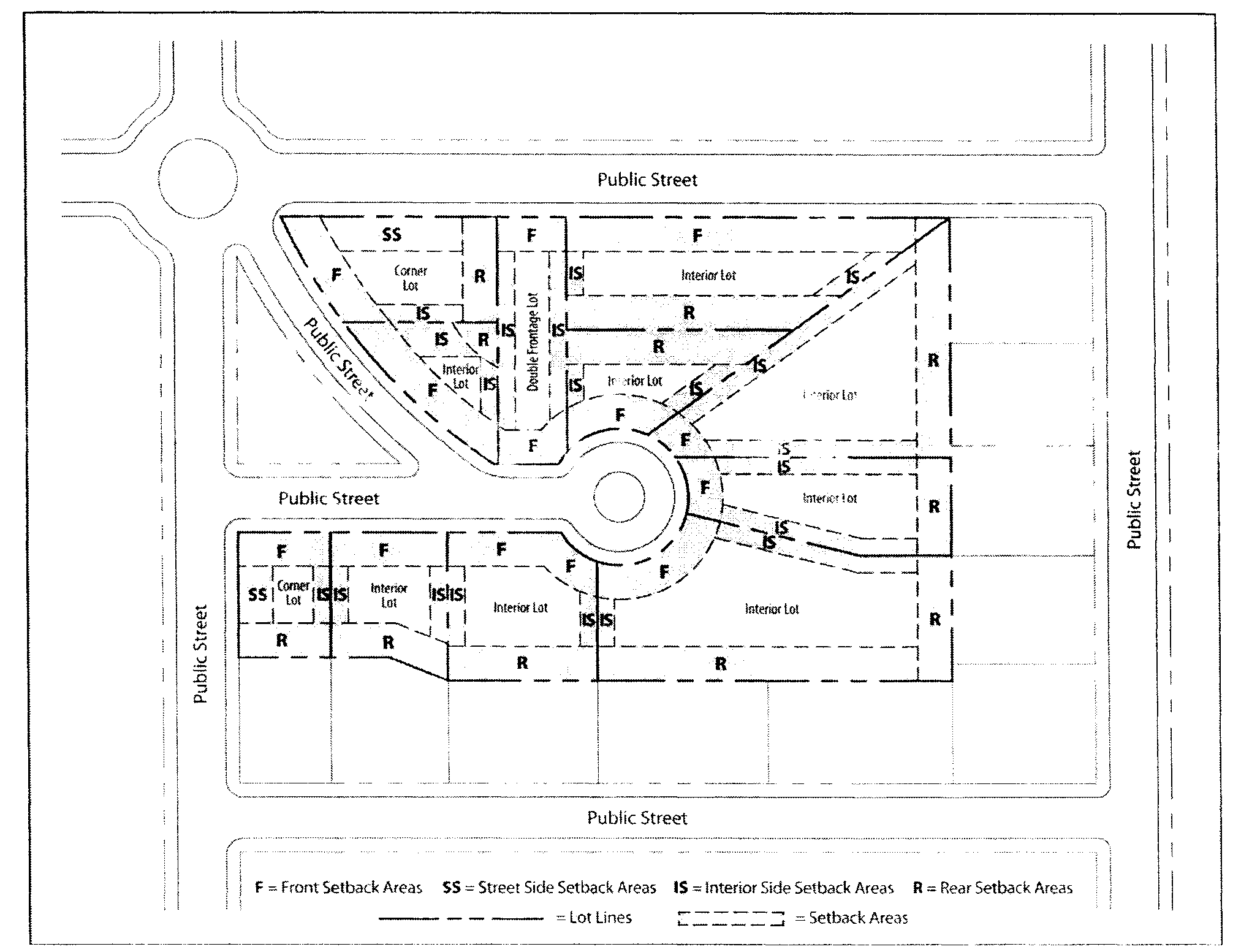
Lot, corner means a lot which adjoins the point of intersection of two or more street rights-of-way and in which the interior angle formed by the street lines is 135 degrees or less. If the street lines are curved, the angle of intersection shall be measured at the point of intersection of the extensions of the street lines in the directions which they take at the intersections of the street line with the side lot line and with the rear lot line of the lot. If the street line is curved at its point of intersection with the side lot line or rear line, the tangent to the curve at that point shall be considered the direction of the street line. A corner lot has two front yards and must meet the front setback on both yards. The rear setback shall be maintained on the side(s) of the building opposite the street on which the building address is established.
Lot, interior means a lot other than a corner lot.
Lot line, front means A lot line which abuts a public or private street right of way. In the case of a lot which has two of more street frontages, the lot line along the street from which the house is addressed shall be the front lot line. (See also lot line, street side.) See diagram on the following page.
Lot line, rear means in the case of rectangular or most trapezoidal shaped lots, that lot line which is parallel to and most distant from the front lot line of the lot. In the case of an irregular, triangular, or gore-shaped lot, a line 20 feet in length, entirely within the lot, parallel to and at the maximum possible distance from the front line shall be considered to be the rear lot line. In the case of lots that have frontage on more than one road or street, the rear lot line shall be established at the time of subdivision or lot creation or shall be assigned by the Zoning Administrator. See diagram on the following page.
Lot line, side means any lot line other than a front or rear lot line. A side lot line separating a lot from a street is called a street side lot line. A side lot line separating a lot from another lot is called an interior side lot line. See diagram on the following page.
Lot line, street side means any lot line which abuts a public or private street right of way which is not the front lot line (see also lot line, front). See diagram on the following page.
Lot of record means a lot which has been recorded in the office of the register of deeds prior to the effective this chapter.
Lot, through means a lot having frontage on two parallel or approximately parallel streets (also "double-frontage"). See diagram on the following page.
Lot width means the maximum horizontal distance between the side lot lines of a lot, measured parallel to the front lot lines and at the rear of the required front yard (see minimum lot width).
Maximum gross density means the maximum number of dwelling units permitted per acre of gross site area (see gross density).
Minimum building separation means the narrowest permitted building separation.
Nonconforming site means a development site containing one or more contiguous parcels in which a principal use has been established prior to the effective date of this chapter and on which one or more development standard (e.g. landscaping, parking, exterior lighting) have not been met or cannot be met owing to the configuration of the site or existing structures whether conforming or nonconforming.
Nonconforming structure means any building or other structure, including all principal and accessory structures, which lawfully existed under ordinances or regulations preceding this chapter, but which does not conform to all the bulk and intensity requirements of this chapter.
Nonconforming use means an active and actual use of land and/or structure(s) legally established and continued to the present prior to the effective date of this chapter, but would not be permitted under the current terms of this chapter.
Official zoning map means the map adopted and designated by the city as being the "Official Zoning Map."
Opacity means the degree to which vision is blocked by bufferyard. Opacity is the proportion of a bufferyard's vertical plane which obstructs views into an adjoining property.
Overlay zoning district means a zoning district which imposes uniform restrictions on all properties within its area which are in addition to the restrictions specific to the standard zoning districts.
Owner means the person, persons, or entity having the right of legal title to a lot or parcel of land.
Parcel means any legally described piece of land which may be the subject of a development action.
Ribbon driveway means a driveway made of two parallel strips of pavement with stone, grass, or other low growing landscaping in between.
Setback means the shortest distance between the exterior of a building or structure and the nearest point on the referenced lot line, excluding permitted intrusions per section 90-73.
Shared driveway means a driveway jointly owned by the owners of the properties it gives access to.
Shared driveway agreement means a legal document which details the way in which a shared driveway is owned (i.e. owned in common or with reciprocal right of way easements) and maintained.
Standard zoning district means a part or parts of the city for which the regulations of this chapter governing the use and location of land and building are uniform.
Start of construction means the date the building permit is issued, provided the actual start of activity was within 365 calendar days of the permit date. The actual start of activity means either the first placement of permanent construction of a structure on the site such as the pouring of a slab or footings, the installation of piles, or the construction of columns. Permanent construction does not include land preparation, such as clearing, grading and filling; nor does it include the installation of streets and/or walkways; nor does it include excavation for basement, footings, piers, or foundations; nor does it include the erection of temporary forms; nor does it include the installation on the property of accessory buildings, such as garages or sheds not occupied as dwelling units or part of the main structure.
Substandard lot means a lot that lawfully existed prior to the effective date of this chapter, but which does not meet the dimensional (i.e. minimum lot size or width) requirements of the standard zoning district in which it is located.
Temporary use means a land use which is present on a property for a limited and specified period of time.
Unnecessary hardship means the circumstance where special conditions affecting a particular property, which were not self-created, have made strict conformity with restrictions governing areas, setbacks, frontage, height, or density unnecessarily burdensome or unreasonable in light of the purposes of this chapter.
Use means the purpose or activity for which the land or building thereof is designed, arranged or intended, or for which it is occupied or maintained.
Use, accessory means a subordinate use which is located on the same lot on which the principal building or use is situated and which is reasonably necessary and incidental to the conduct of the primary use of such building.
Use, principal means the primary use to which a parcel is devoted and the main purpose for which the premises exists.
Variance means a relaxation of the terms of this chapter by the board of zoning appeals where the literal enforcement of this chapter would deny to the property owner a use of his property enjoyed as a right by other property owners within the same zoning district.
Yard means an open space, other than a court, on a lot unoccupied and unobstructed from the group upward except as otherwise provided in this chapter.
Yard, front means yard extending across the full width of the lot, the depth of which is the minimum horizontal distance between the front lot line and a line parallel thereto on the lot.
Yard, rear means a yard extending across the full width of the lot, the depth of which is the minimum distance between the rear lot line and a line parallel thereto on the lot.
Yard, side means a yard extending from the front yard to the rear yard, the width of which is the minimum horizontal distance between the side lot line and a line parallel thereto on the lot.
Yard, street side, or corner lots means the yard between the front and rear lot lines, extending from the street side lot line to the nearest part of the nearest principal building.
Zoning permit means a permit issued by the zoning administrator to certify that the use of lands, structures, air and waters subject to this chapter are or shall be used in accordance with the provisions of this Chapter.
Zero lot line construction means a development approach in which a building containing two dwelling units where each dwelling unit is located on a lot and is sited on a common lot line with no side yard area, except beyond the outer ends of the building.
(Ord. No. 13-005, § 1, 3-28-2013)

