
Portage City Zoning Code
ARTICLE VIII
LANDSCAPING REGULATIONS
Sec. 90-140.- Purpose.
The purpose of this article is to establish landscaping requirements and other regulations intended to preserve and maintain vegetation within in a manner that promotes the natural resource protection, aesthetic, and public health goals of the City.
(Ord. No. 13-005, 1, 3-28-2013)
Sec. 90-141. - Applicability.
Any use or activity for which site plan approval is required shall provide landscaping in accordance with the regulations of this section, except for single-family and agricultural land uses which are exempt from landscaping requirements. Where insufficient site area remains to comply with all provisions of this article the city may require compliance to the extent practical.
(Ord. No. 13-005, 1, 3-28-2013)
Sec. 18-142. - Landscaping plan.
The applicant shall provide a landscaping plan depicting the following:
(1)
Plan shall be drawn at a reasonable scale to clearly delineate the landscape improvements and shall include a north arrow, property lines, and easements.
(2)
Zoning of the subject property and adjacent properties.
(3)
Linear feet of the new/expanded building foundation and street frontage.
(4)
Square footage of the total lot and new/expanded paved area.
(5)
Existing landscaping to be removed.
(6)
Existing landscaping to remain including type/name, size, number, and number of landscaping points per Figure 90-143(a).
(7)
Proposed landscaping meeting the requirements of this Article including type/name, size, number, and number of landscaping points per Figure 90-143(a).
(Ord. No. 13-005, 1, 3-28-2013)
Sec. 90-143. - Landscaping requirements.
(1)
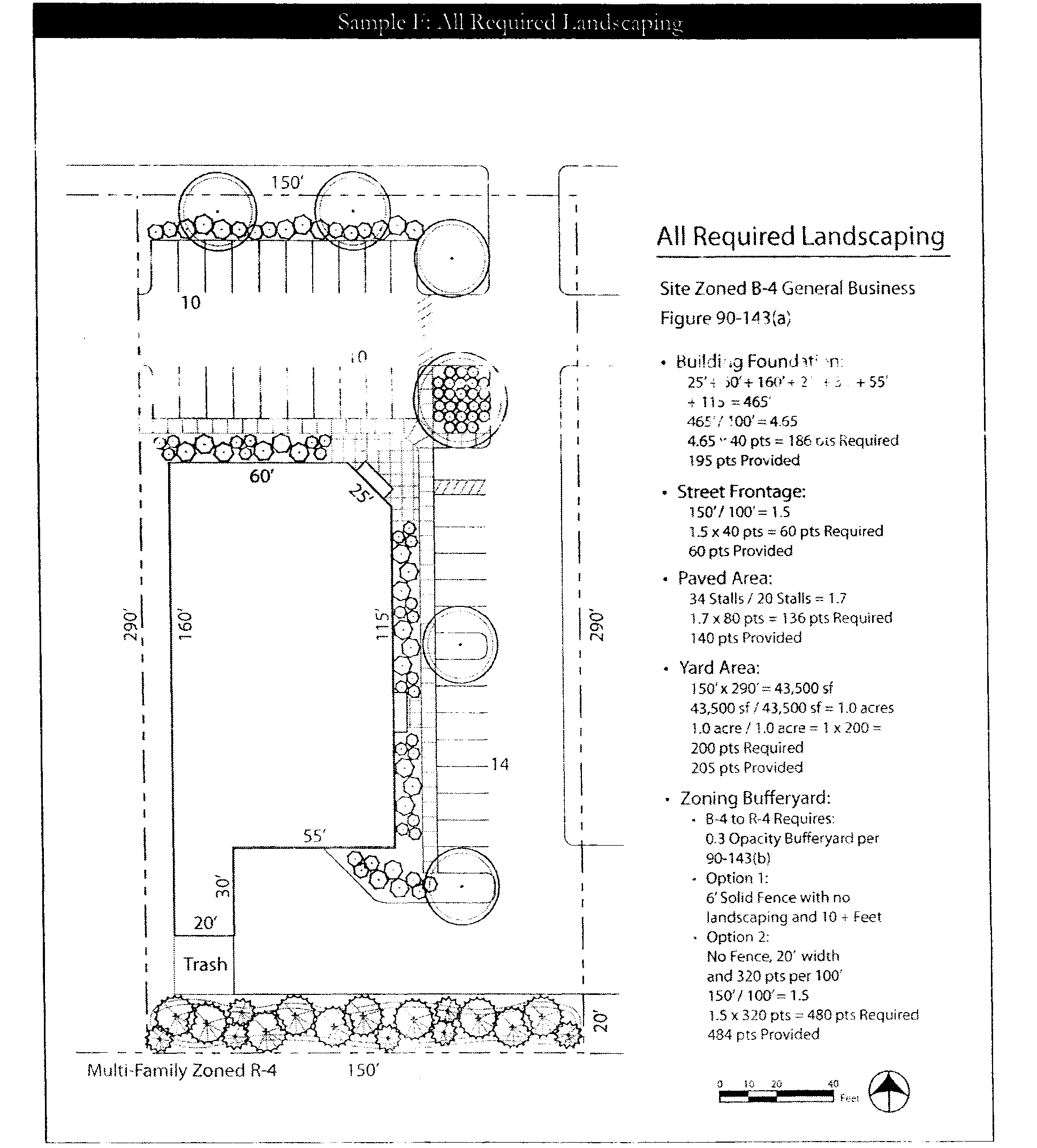
Provision of landscaping. Landscaping shall be provided based on the following requirements for building foundations, street frontages, paved areas, general yard areas, and bufferyards. These requirements are additive to each other and any other landscaping or screening requirements in this chapter. Credit for existing landscape plantings that are retained and protected with the development of the site, and for restoration or reestablishment of native flora, shall be allowed. In calculating the number of required landscaping points under the provisions of this section, all areas and distances on which required calculations are based shall be rounded up to the nearest whole number of square feet or linear feet. Any partial plant derived from the required calculations of this section (for example: 23.3 canopy trees) shall be rounded up to the nearest whole plant (for example: 24 canopy trees).
(2)
Building foundations.
(a)
For each 100 feet of building foundation perimeter, the landscaping installed shall at a minimum meet the number of landscaping points specified in Figure 90-143(a).
(b)
Foundation landscaping shall be placed so that at maturity, the plant's drip line is located within 10 feet of the building foundation. Such landscaping shall not be located in areas required for street frontage, paved areas, general yard areas, bufferyards, or other green space areas.
(c)
Shade trees and tall trees shall not be used to meet the foundation landscaping requirement.
(d)
If the officially approved site plan depicts a future building extension, the foundation landscaping requirement shall be calculated by measuring the length of the total perimeter of the building, including extension. However, foundation plantings need only be installed for portion of the building for which a building permit has been issued.
(3)
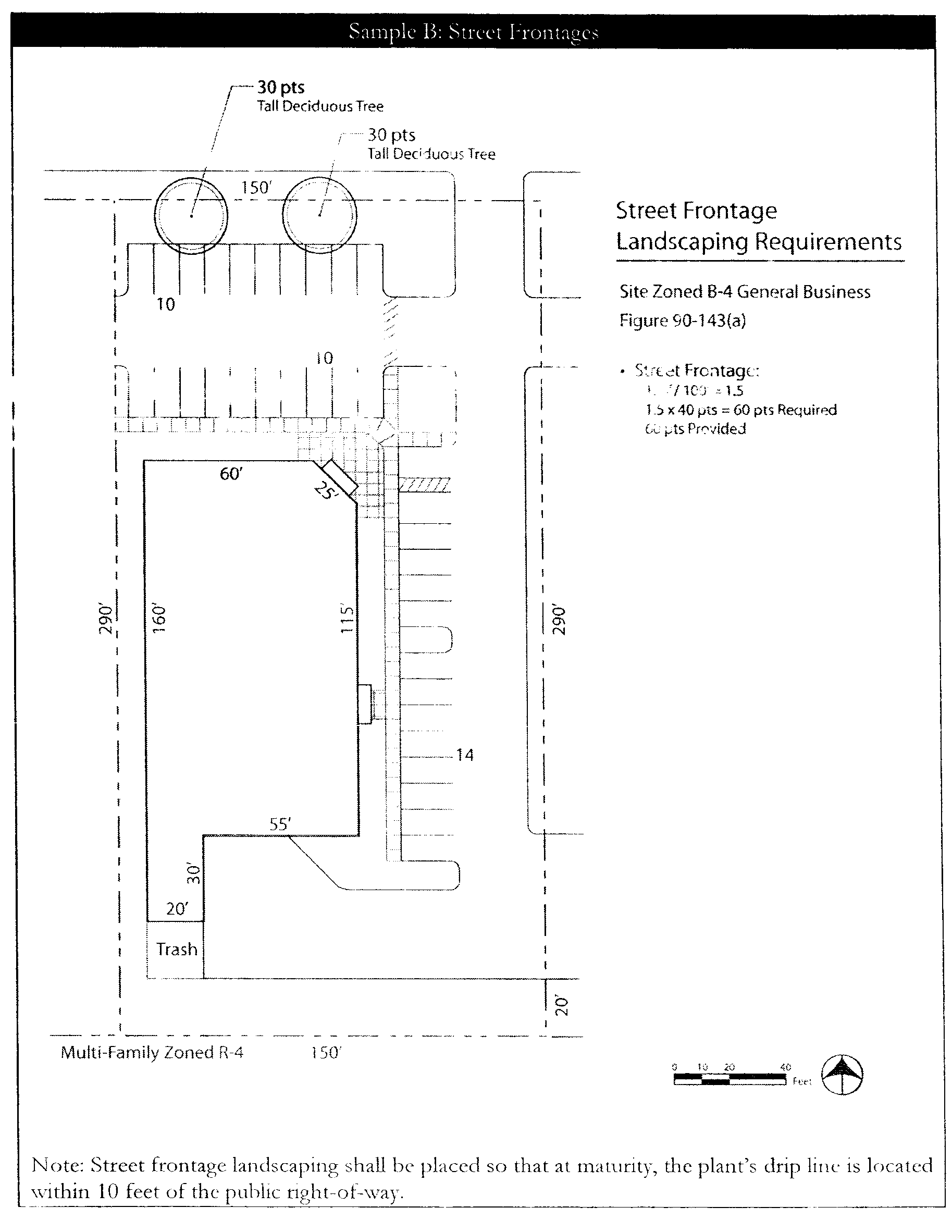
Street frontages.
(a)
For every 100 linear feet of street frontage of a developed lot abutting a public street right-of-way, the landscaping installed shall at a minimum meet the number of landscaping points specified in Figure 90-143(a).
(b)
All landscaping used to meet street frontage requirements shall be located within 10 feet of the public right-of-way. Under no circumstances shall such landscaping be located within a public right-of-way. Landscaping shall not impede vehicle or pedestrian visibility.
(c)
Shrubs shall not be used to meet street frontage landscaping requirements. A minimum of 50 percent of all points shall be devoted to climax or tall trees, or a combination of such trees, and a minimum of 30 percent of all points shall be devoted to medium trees.
(d)
Under no circumstances shall such landscaping be located within a public right-of-way. Landscaping shall not impede vehicle or pedestrian visibility.
(e)
For all lots not meeting the requirements of this subsection as of the effective date of this chapter, the following shall apply:
1.
For additions to floor area, landscaping installed shall be equal to the percent increase in new floor area. New floor area shall be defined as the square footage of the addition divided by the square footage of the existing building.
2.
For additions to paved areas, landscaping installed shall be equal to the percent increase in new paved area. New paved area shall be defined as the square footage of the addition divided by the square footage of the existing paved area.
(4)
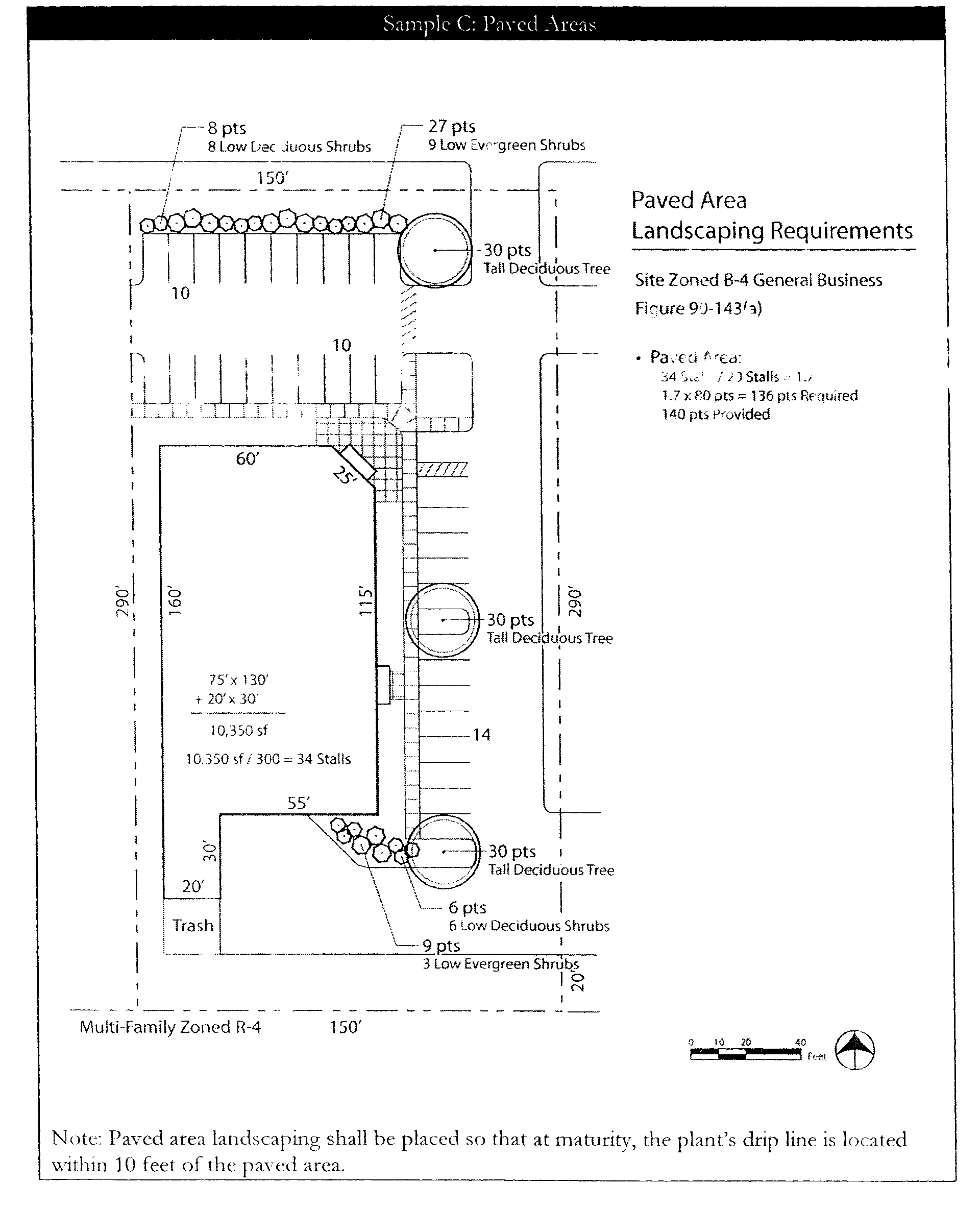
Paved areas.
(a)
For every 20 off-street parking stalls or 10,000 square feet of pavement (whichever yields the greater landscaping requirement), landscaping shall at a minimum meet the number of landscaping points specified in Figure 90-143(a).
(b)
Landscaping shall be located within 10 feet of the paved area. Said area does not have to be provided in one contiguous area. Plants used to fulfill this requirement shall visually screen parking, loading and circulation areas from view from public streets.
(c)
A minimum of 30 percent of all points shall be devoted to climax or tall trees, or a combination of such trees, and a minimum of 40 percent of all points shall be devoted to shrubs.
(d)
Parking lot design.
1.
Landscaped medians shall be used to break large parking areas into distinct pods, with a maximum of 100 spaces in any one pod.
2.
Parking spaces must be broken by a tree island at the rate of one island for each linear row of 12 parking spaces for single-row or peninsula configurations, or for each 24 parking spaces in double row configurations.
3.
All tree islands and landscaped areas with trees shall have a minimum of nine feet as measured from outside the curb or frame.
4.
All landscaped areas without trees, but planted with shrubs, shall have a minimum width of three feet measured from inside the curb or frame.
(5)
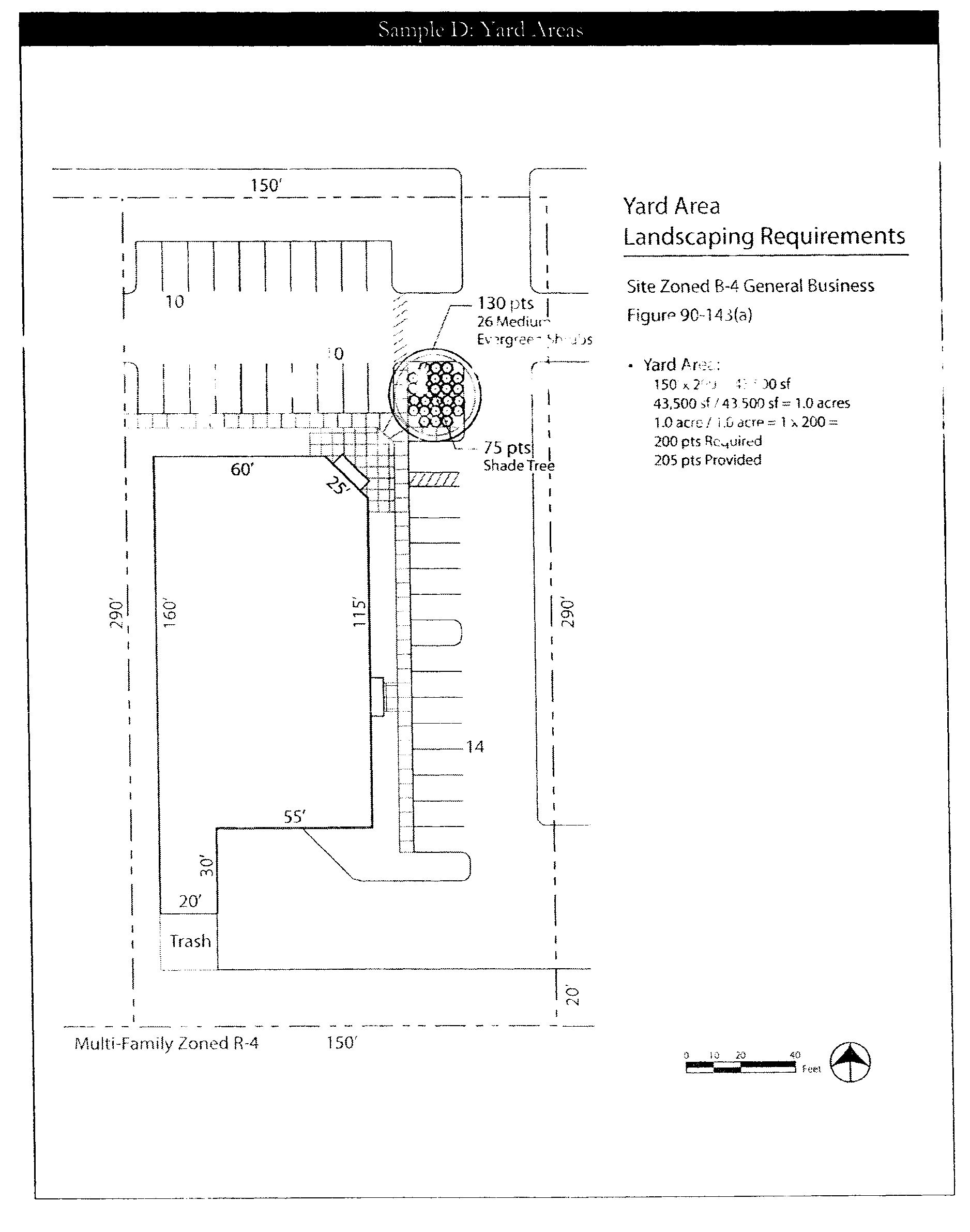
Yard areas. An additional 200 landscaping points shall be provided for each acre or portion thereof of total lot area. Landscaping required by this standard shall be placed where appropriate on the site, but generally in those areas not covered by other provisions of this section.
(6)
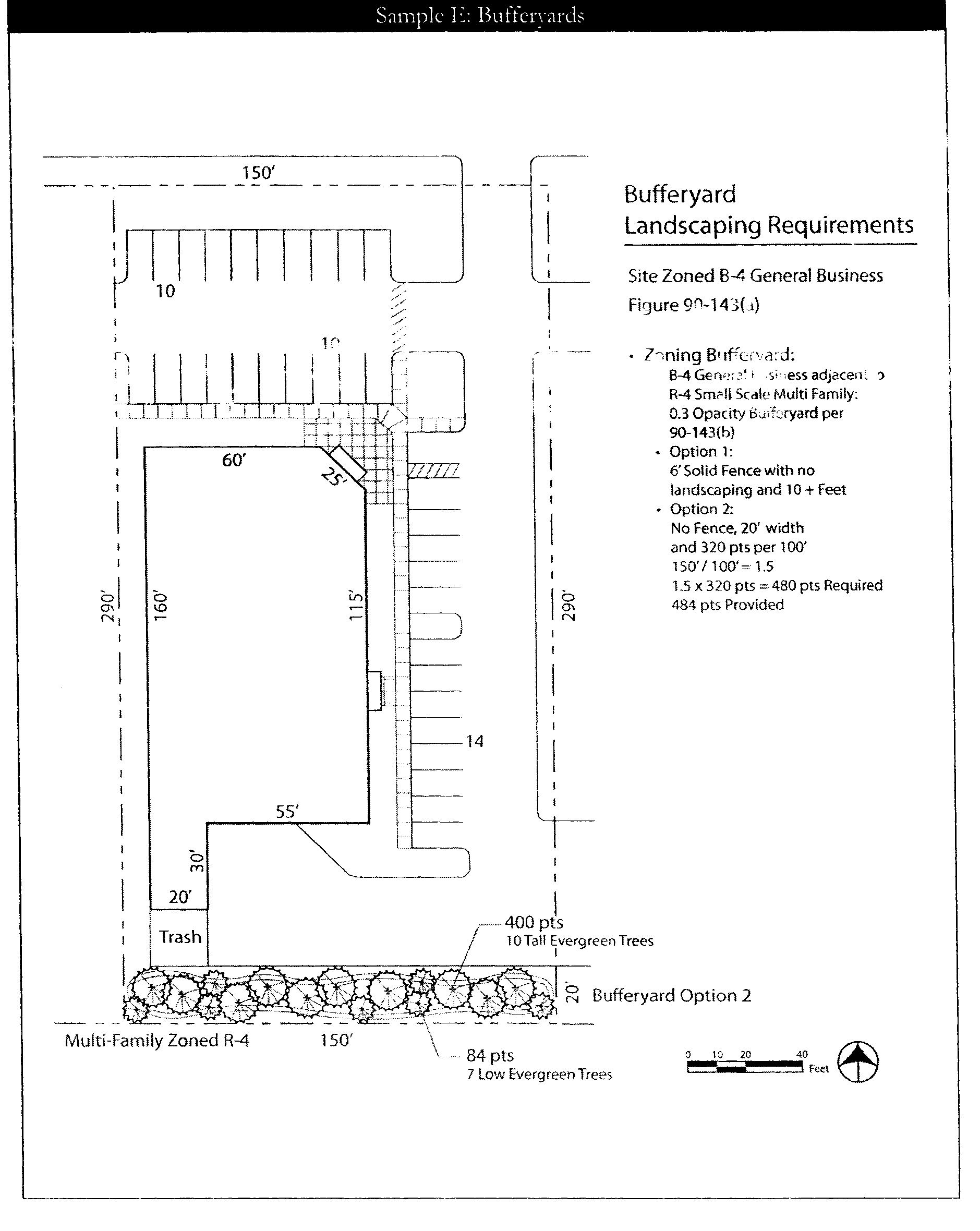
Bufferyards. A bufferyard is a combination of distance and a visual buffer or barrier. It includes an area, together with the combination of plantings, berms and fencing that are required to eliminate or reduce existing or potential nuisances (e.g. dirt, litter, noise, glare, signs, and incompatible land uses, buildings, or parking areas).
(a)
Bufferyards shall be located along (and within) the outer perimeter of a lot wherever two different zoning districts abut one another. Bufferyards are not be required in front or street side yards.
(b)
Required opacity.
1.
Opacity is a quantitatively-derived measure which indicates the degree to which a particular bufferyard screens the adjoining property. The required level of opacity indicated is directly related to the degree to which the potential character of development differs between different zoning districts.
2.
Figure 90-143(b) shall be used to determine the minimum level of opacity for the required bufferyard. The required level of opacity is the value given in the cell of the table at which the row (representing the subject property's zoning district) intersects with the column (representing the adjacent property's zoning district). The value listed is the required level of opacity for the bufferyard on the subject property.
3.
Figure 90-143(c) provides details to meet opacity requirements listed in subsection 2., above.
(7)
Other green space areas. Green space areas not used for landscape plantings other than natural resource protection areas shall be graded and seeded or sodded with an acceptable maintainable seed mix, restored to native vegetation, or maintained in crop production if approved by the plan commission. Mulch of plantings or planting beds is acceptable provided that such mulching consists of organic or natural materials. Mulches shall be installed so that they will not erode, fall, be plowed or otherwise transported into walks, drives, streets or other hard surfaced portions of the site.
Figure 90-143(a): Landscaping Requirements
Figure 90-143(b): Required bufferyard opacity values
Figure 90-143(c): Detailed Bufferyard Requirements
[*See section 90-121 for regulations regarding fences.]
Figure 143(d): Landscaping Points
(Ord. No. 13-005, 1, 3-28-2013)
Sec. 90-144. - Classification of plant species.
Examples of species suitable for landscaping and compatible with local climate and soil factors are listed in Figure 90-144(a). See Figure 90-144(b) for examples of species appropriate for specific and common landscaping situations (e.g. planting under power lines), and Figure 90-144(c) for examples of species to use sparingly or to avoid. The City Forester maintains the official list of plant species referred to in Figures 90-144(a), 90-144(b) and 90-144(c).
Figure 90-144(a): Examples of Common Appropriate Landscaping Species
Figure 90-144(b): Examples of Plant Species Appropriate for Specific Situations
Figure 90-144(c): Examples of Species to Use Sparingly or to Avoid
(Ord. No. 13-005, 1, 3-28-2013)
Sec. 90-145. - Standards for rain gardens and bioswales.
(1)
Definitions.
(a)
Rain gardens and bioswales can serve both as landscaping and stormwater management features on a building site, where appropriately designed and sited. A rain garden is a shallow, depressed garden that is designed and positioned on a site to capture stormwater runoff and allow for the infiltration of water back into the ground. Rain garden plants are carefully chosen for their ability to withstand moisture extremes and potentially high concentrations of nutrients and sediments that are often found in stormwater runoff. A well designed and maintained rain garden serves as an attractive component of an overall landscaping plan for a development site.
(b)
A bioswale is a linear, vegetative stormwater runoff conveyance system that is designed to store and infiltrate water from small storm events back into the ground and direct water from heavy rain events to appropriate form sewer inlets or other management facilities. The flow of water being conveyed through a bioswale is slowed down, allowing for municipal storm systems to more effectively manage heavier rain events and help reduce the risk of flooding on or off-site. Water being infiltrated or conveyed via a bioswale is also filtered by the vegetation within it, generally improving both ground and surface water quality.
(2)
Requirements.
(a)
The installation of a rain garden or bioswale may contribute to the overall stormwater management plan for a development site and count toward meeting the City's landscaping guidelines. Rain gardens may count for 20 points for every 20 square feet for yard area, building foundation, and/or paved area requirements, provided the following requirements are met.
(b)
Detailed plans shall be provided that show all proposed dimensions of the rain garden or bioswale including length, width, depth, and slope of depression; location of the rain garden or bioswale on the lot relative to hard-surfaced areas, downspouts, and site topography; characteristics of the soil underlying the rain garden or bioswale; description of planting media; the species, number, and size at time of installation of all vegetation proposed for the rain garden or bioswale; and information on any other materials (e.g., rocks) that will be used to line the rain garden or bioswale.
(c)
Installation shall not be proposed for any of the following areas of a site:
1.
Areas where there is known soil contamination unless the rain garden or bioswale is proposed to be constructed with an under-drain;
2.
Areas where the characteristics of the soil would not allow for the proper infiltration of water into the ground; or
3.
Areas where there are expected to be high levels of foot traffic.
(d)
The owner of the site shall demonstrate that the rain garden or bioswale shall be properly maintained; kept free of trash, weeds, debris, and dead or dying plants; any pipes associated with the rain garden or bioswale will be inspected on an annual basis and kept free of debris; and by the beginning of every spring dead plant materials will be cut back or removed.
(e)
Bioswales and rain gardens shall be generously (and appropriately) vegetated to qualify for landscaping points. Bioswales and rain gardens (or portions thereof) that are lined with turf and/or rocks but do not include other vegetation will not county toward meeting landscaping point requirements.
(f)
Rain gardens and bioswales may serve as a component of an overall stormwater management plan for a site only if detailed plans, calculations, and specifications are submitted. Detailed plans shall include the location and description of all other stormwater management facilities serving the site, particularly those to which any bioswale will be directed.
(Ord. No. 13-005, 1, 3-28-2013)
Sec. 90-146. - Landscaping installation requirements.
(1)
Installation. Any and all landscaping and bufferyard material required by the provisions of this chapter shall be installed on the subject property, in accordance with the approved site plan within 365 days of the issuance of an occupancy permit for any building on the subject property, unless a conditional use is approved to allow for greater than 365 days.
(2)
Surety.
(a)
If the subject property is to be occupied prior to the installation of all required landscaping and bufferyard material, the property owner shall sign an instrument agreeing to install the landscaping within the 730-day period and shall furnish to the city an irrevocable letter of credit or other form of security acceptable to the city sufficient to guarantee completion of the work. Such security shall be provided by the property owner at the time that the agreement is signed. It shall be in an amount equal to 110 percent of the estimated actual cost for all of the required elements of the approved site plan and shall specifically guarantee that all such elements shall be made and installed according to the approved site plan. The costs of the work shall be furnished by the property and shall be verified by the city. The financial security shall remain in force until all of the work has been completed and approved by the city. This agreement shall also contain a statement indicating that the property owner's failure to comply with the requirements of the terms of the agreement will constitute a violation of the chapter and subject the property owner to a forfeiture upon conviction.
(b)
If the required landscaping and bufferyard materials are to be installed during different phases of a subdivision development, the developer may furnish for each phase financial security in an amount sufficient to guarantee completion of the landscaping and bufferyard work performed during a particular phase, unless the Land Division Regulations requires otherwise.
(c)
If the property owner is a governmental unit, it may, in lieu of signing an agreement and furnishing a guarantee and file a resolution or letter from officers authorized to act in its behalf, agreeing to comply with the provisions of this article.
(3)
If existing plant material meets the requirements of this article and will be preserved on the subject property following the completion of development, it may be counted as contributing to the landscaping requirements.
(4)
All landscaping and bufferyard areas shall be seeded with lawn or native ground cover unless such vegetation is already fully established.
(5)
The exact placement of plants and structures shall be depicted on the required detailed landscaping plan submitted to the city for its approval. Such plant and structure location shall be the decision of each property owner provided the following requirements are met:
(a)
Evergreen shrubs shall be planted in clusters to maximize their chance for survival.
(b)
Where a combination of plant materials, berming, and fencing is used in a bufferyard, the fence and/or berm shall be located toward the interior of the subject property and the plant material shall be located toward the exterior of the subject property.
(c)
A property owner may establish through a written agreement, recorded with the register of deeds that an adjacent property owner agrees to provide on the immediately adjacent portion of his or her land a partial or full portion of the required bufferyard, thereby relieving the developer of the responsibility of providing the entire bufferyard on his property.
(d)
Under no circumstance shall landscaping or bufferyard materials be selected or located in a manner resulting in the creation of a safety or visibility hazard.
(e)
The restrictions on types of plants listed in this article shall apply.
(6)
Maintenance. The continual maintenance of all required landscaping and bufferyard materials shall be a requirement of this chapter and shall be the responsibility of the owner of the property on which said materials and plants are required. This requirement shall run with the property and shall be binding upon all future property owners. Development of any or all property following the effective date of this chapter shall constitute an agreement by the property owner to comply with the provisions of this section. If the property owner fails to comply with these provisions, the City may enter upon the property for the purpose of evaluating and maintaining all required landscaping and bufferyard materials, and may specially assess the costs thereof against the property. A property owner's failure to comply with this requirement shall also be considered a violation of this chapter, and shall be subject to any and all applicable enforcement procedures and penalties.
(7)
Use of Required Bufferyard and Landscaped Areas. Any and all required bufferyards or landscaped areas may be used for passive recreation activities. Said areas may contain pedestrian, bike or equestrian trails provided that no required material is eliminated; the total width of the required bufferyard, or the total area of required landscaping, is maintained; and all other regulations of this chapter are met. However, in such areas, no swimming pools, tennis courts, sports fields, golf courses, or other such similar active recreational uses. No parking and no outdoor display of storage of materials shall be permitted. Paving in such areas shall be limited to that required for necessary access to, through, or across the subject property.
(8)
Utility easements. Landscaping materials, fences and berms located within a duly recorded utility or a pedestrian easement shall not count toward meeting a landscaping requirement, unless authorized otherwise by a conditional use permit. However, the width of such areas may be counted as part of a landscaping requirement.
(Ord. No. 13-005, 1, 3-28-2013)
Sec. 90-147. - Sample landscaping schemes.
Sample landscaping schemes that may be used for building foundations, developed lots, street frontages, paved areas, reforestation, and bufferyards are depicted in Figure 90-147
Figure 90-147: Sample Landscaping Schemes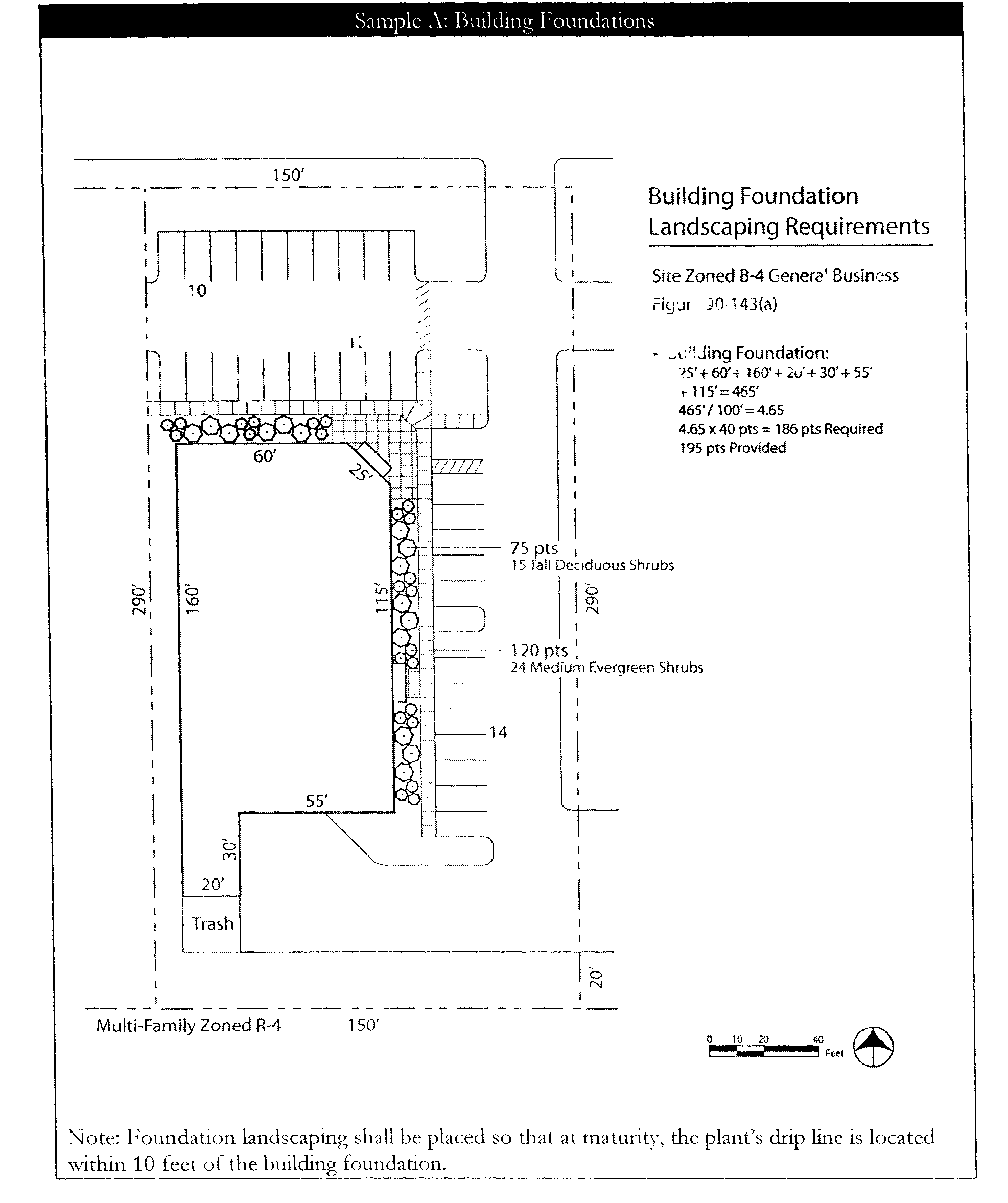
(Ord. No. 13-005, § 1, 3-28-2013)

