
Portage City Zoning Code
ARTICLE IV
BULK REGULATIONS
Sec. 90-70.- Purpose.
This article regulates the location and bulk of buildings and other structures in order to protect the public health, safety, and general welfare and to enhance the desired community character of the City of Portage. ;hn0;(Ord. No. 13-005, ;s; 1, 3-28-2013)
Sec. 90-71. - Bulk standards.
All developments shall comply with the standards listed for each zoning district in article II.
(Ord. No. 13-005, § 1, 3-28-2013)
Sec. 90-72. - Yard setback adjustments.
(1)
Limitations on yard reductions or joint use.
(a)
No lot, yard, parking area, building area, or other space shall be reduced in area or dimension so as to not meet the provisions required by this chapter. If an existing yard is less than the minimum required, it shall not be reduced further, except where exempted by the provisions of this section.
(b)
No part of any lot, yard, parking area, or other space required for a structure or use shall be used for any other structure or use.
(c)
No required yard or other space allocated to a structure or parcel of land shall be used to satisfy the minimum yard or lot area requirements for another structure or parcel.
(2)
Front yard or street side setback adjustments.
(a)
Building additions. Additions in the street yard of existing structures shall not project beyond the average of the existing street yards on the abutting lots or parcels.
(b)
Average street yards.
1.
The required street yards may be decreased in any residential or business districts to the average of the existing street yards of the abutting structures on each side but in no case less than 15 feet in any residential district.
2.
In the R-T, R-1, R-2, R-3, R-4, R-5, R-MH, and B-1 districts, a front yard setback may be reduced to the average of the setbacks of the adjoining lots that are on both sides of the subject lot. The following rules apply in calculating the average setback (see Figure 90-72a):
a.
Only the setbacks on five or fewer adjoining lots which are on the same side of the street as the subject lot may be used.
b.
Where a lot is vacant, the minimum setback of the zoning district will be applied by the zoning administrator.
c.
Outliers shall be excluded in calculating the average setback as determined by the zoning administrator.
Figure 90-72(a): Calculating the Setback Average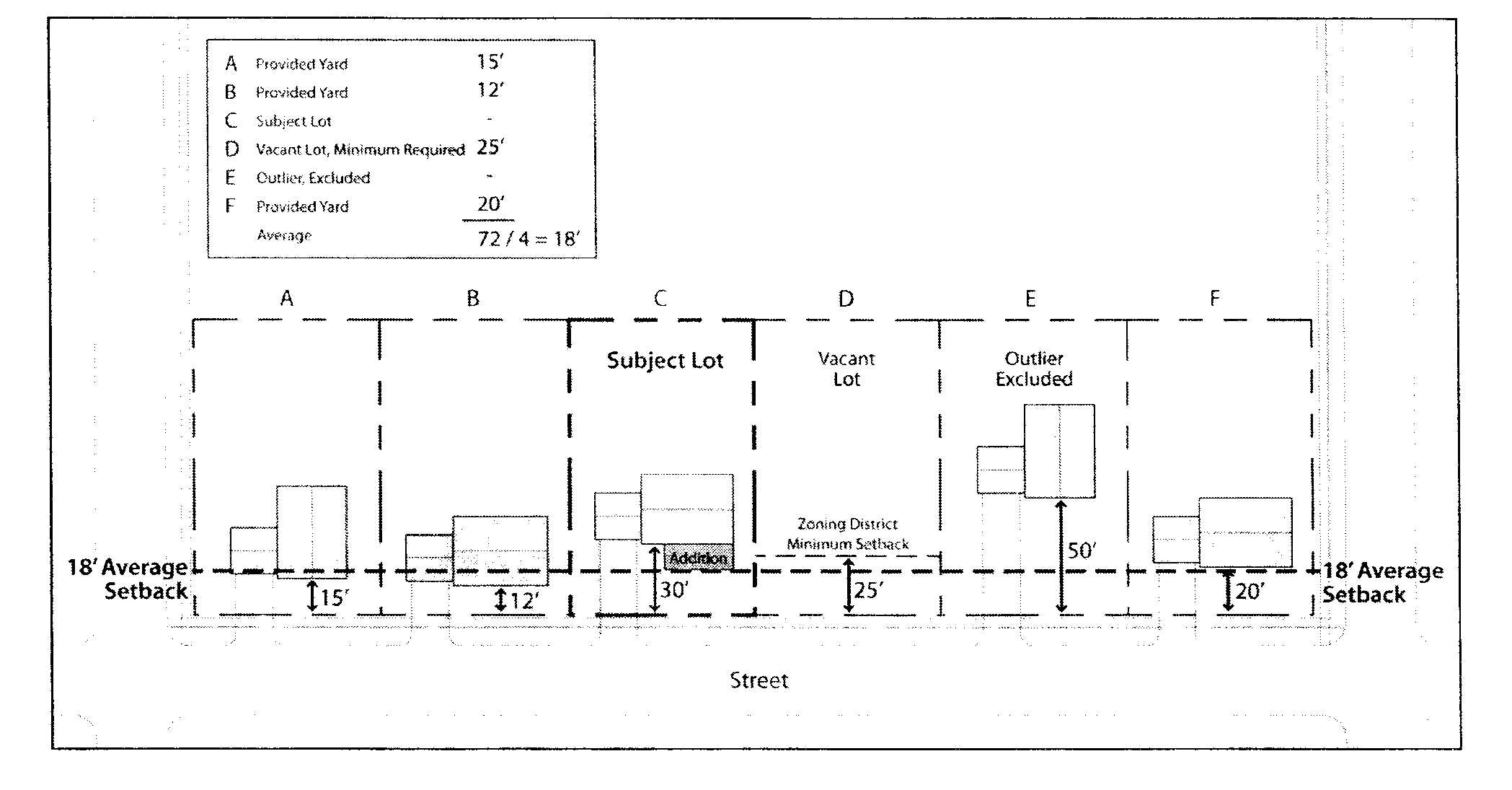
(3)
Building setback adjustment on cul-de-sac lots. It is the objective of the city that buildings on cul-de-sacs be set back from the right-of-way at a consistent distance. This concern is particularly present where too-narrow lots force a substantially deeper minimum front yard setback. The following regulations address this concern:
(a)
Proposed new lots on cul-de-sacs. For cul-de-sac lots platted after the effective date of this chapter, each cul-de-sac lot shall provide the minimum lot width at the minimum front yard setback. Where such a requirement is not met, one or more of the proposed cul-de-sac lots may have to be eliminated to meet this requirement.
(b)
Existing narrow lots on cul-de-sacs. For cul-de-sac lots existing prior to the effective date of this chapter which do not meet the minimum lot width at the minimum front yard setback, the following adjustment is permitted:
1.
The principal structure may be placed at of the minimum front yard setback if the following conditions are met (see Figure 90-72(b)):
a.
The habitable area of the principal structure (and/or porch) may be set back at or more interior of the minimum required front yard setback without meeting the minimum lot requirement.
b.
The garage must be set back at or more interior the minimum required front yard setback as determined by the minimum lot width requirement.
c.
The minimum lot width, minimum side yard setback, and minimum pavement setback of the subject district shall be met.
This approach is a way to provide for a uniform front yard setback around the cul-de-sac, provide more usable rear yards, and result in a more pleasing street appearance not dominated by forward-thrust garages.
Figure 72(b): Existing Cul-de-Sac Lot Width Adjustment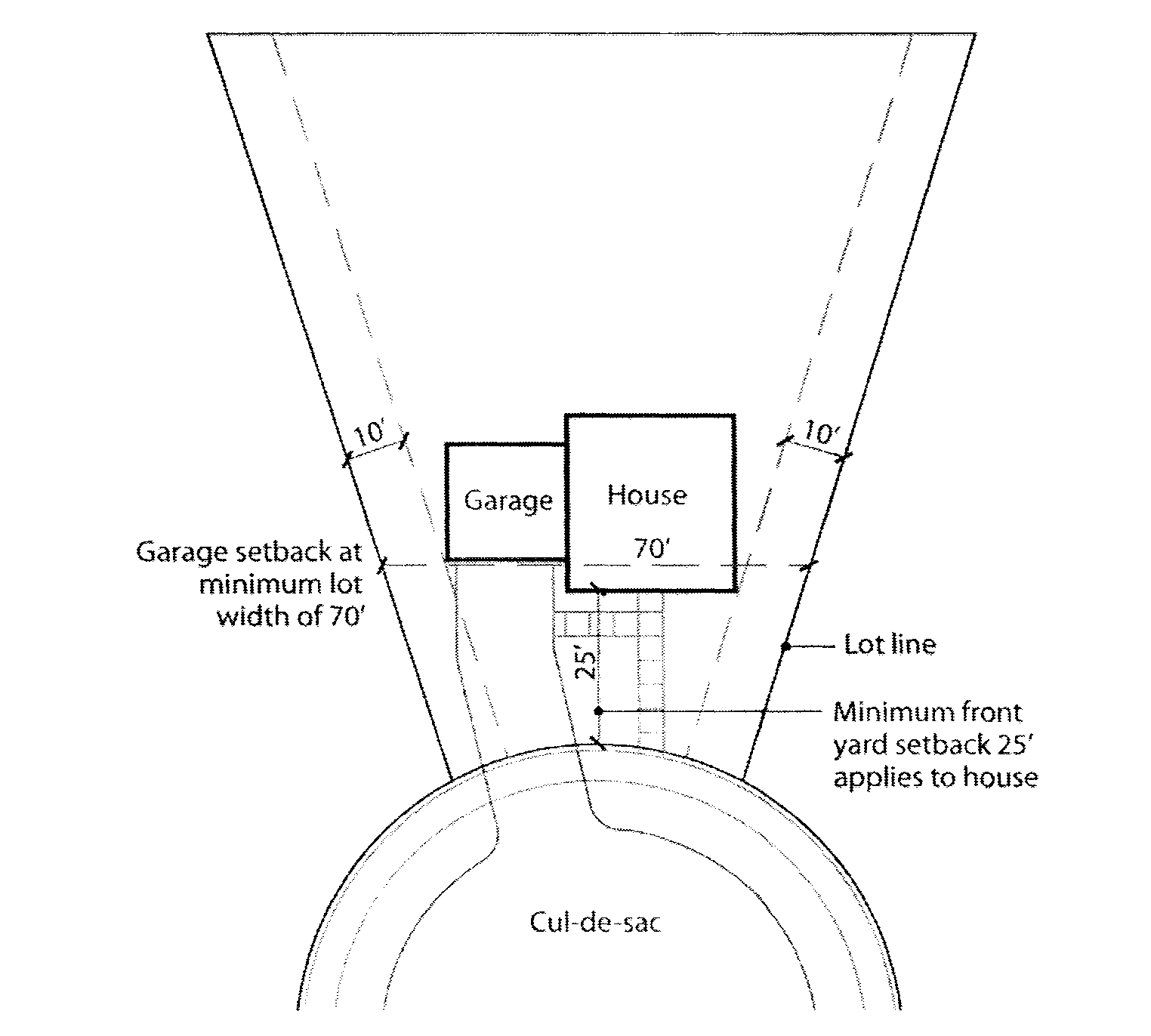
(4)
Side and rear yard setback adjustments for bufferyards. In instances where the required bufferyard width (per article VIII) exceeds the minimum required setback width, the minimum required bufferyard width shall prevail. Absolutely no intrusions of a building, structure, or paved area are permitted within the required bufferyard.
(Ord. No. 13-005, § 1, 3-28-2013; Ord. No. 22-006, § 4, 6-9-2022)
Sec. 90-73. - Obstructions and intrusions into required yards.
(2)
Intrusions. The following intrusions into required yards are permitted:
(a)
Fire escapes which do not extend more than five feet into the required yard.
(b)
An open terrace, deck, or uncovered porch may extend into the required setback for the front yard and/or rear yard a distance of six feet provided the floor is not higher than four feet above grade.
(c)
Stairs, steps, or stoops four feet or less above grade which are necessary for access to a permitted building or for access to a zoning lot from a street or alley.
(d)
Awnings and canopies may extend into the required yard a distance not to exceed four feet.
(e)
Chimneys, provided they do not extend more than two feet into a required yard.
(f)
Recreational equipment.
(g)
Clotheslines and other similar laundry drying equipment.
(h)
Overhanging eaves and gutters projecting into the yard for a distance not exceeding 40 percent of the required yard width or three feet or whichever is less.
(i)
Essential services, utilities, electric power, and communication transmission lines are exempt from the yard and distance requirements of this chapter.
(j)
Chimneys, flues, sills, pilasters, lintels, ornamental features, cornices, eaves, bay windows, and gutters for residential buildings, provided they do not extend more than two feet into the required yard.
(k)
Fences may be located on the property line. Permitted fence types shall comply with the provisions of section 90-121.
(l)
In residential zoning districts where zero lot line construction is permitted, Sec. 90-55(2)(d) shall apply.
(Ord. No. 13-005, § 1, 3-28-2013; Ord. No. 22-006, § 4, 6-9-2022)
Sec. 90-74. - Exceptions to maximum height regulations.
The maximum height regulations stipulated in article II may be exceeded, but such modification shall be in accord with the following:
(1)
Architectural projections, such as spires, belfries, parapet walls, cupolas, domes, flues and chimneys, are exempt from the height limitations of this chapter.
(2)
Special structures, such as elevator penthouses, gas tanks, grain elevators, scenery lots, radio and television receiving antennas, manufacturing equipment and necessary mechanical appurtenances, cooling towers, fire towers, substations and smoke stacks, are exempt from the height limitations of this chapter.
(3)
Essential services, utilities, water towers, electric power and communication transmission lines are exempt from the height limitations of this chapter.
(4)
Communication structures, such as radio and television transmission and relay towers, aerials and observation towers, shall not exceed in height three times their distance from the nearest lot line.
(5)
Public or semipublic facilities, such as schools, churches, hospitals, monuments, sanitariums, libraries, governmental offices and stations, are increased not less than one foot for each foot the structure exceeds the district's maximum height requirement.
(6)
Agricultural structures such as barns and silos shall not exceed in height twice their distance from the nearest lot line.
(7)
Any building or structure not otherwise accounted for by (1) through (6) above may exceed maximum height regulations with the granting of a conditional use permit that specifically states the maximum permitted height of the proposed building or structure.
(Ord. No. 13-005, § 1, 3-28-2013)

