
Prattville City Zoning Code
ARTICLE 10
- BUFFERS, SCREENING AND LANDSCAPING
This Article establishes standards for buffers required between incompatible land uses; screening of certain activities from public views, and landscaping associated with vehicular areas in multifamily and nonresidential developments. For the purposes of this Article, "fences" and "walls" have the same meaning.
§ 10.01 - Definitions.
Certain terms used in this section are defined as follows:
1.
Approving authority. For plans requiring only administrative approval, the Director; for plans involving a Special Exception, the Board of Adjustment.
2.
Berm. A planted or landscaped elevated ground area, generally designed to restrict view and to deflect or absorb noise.
3.
Caliper. Trunk diameter of a tree used in landscaping, measured six inches above grade for trees up to four-inch caliper and 12 inches above grade for larger trees.
4.
Crown. The branches and leaves of a tree or shrub, with the associated upper trunk.
5.
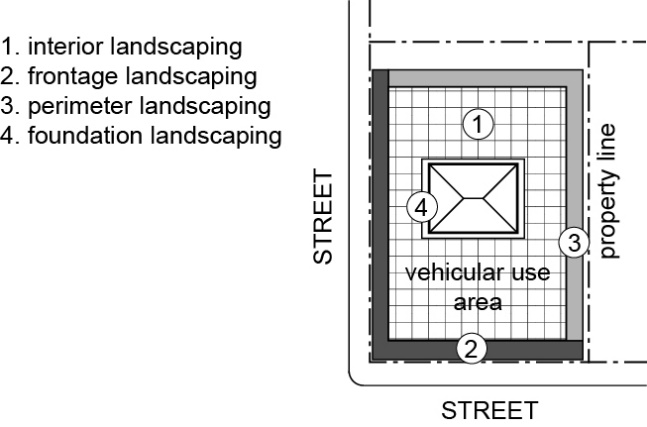
Foundation Landscaping. Treatment of grade, ground cover, vegetation and ornamentation between the principal structure and the vehicular area. See Figure 10-1.
6.
Frontage landscaping. Treatment of grade, ground cover, vegetation and ornamentation between any off-street parking area and adjoining rights-of-way. See Figure 10-1.
7.
Ground cover. Plants, mulch, gravel and other landscape elements used to prevent soil erosion, compaction, etc.
8.
Heritage tree. Any deciduous tree with a 24-inch or greater caliper.
9.
Interior landscaping. Treatment of grade, ground cover, vegetation and ornamentation within an off-street parking area. See Figure 10-1.
10.
Landscape element. Plant material (living or non-living) or an ornamental material (river rock, brick, tile, statuary, etc.) differentiated from surrounding off-street parking area surface materials.
11.
Landscaping island. An interior landscaping feature surrounded on all sides by driving and/or parking surfaces.
12.
Mulch. A material (pine straw, bark chips, wood chips, etc.) placed on the ground to anchor soil, protect roots, limit weed growth and otherwise promote tree and shrub growth by simulating the role of natural forest leaf-litter.
13.
Mulch bed. An area, generally bordered by a retaining device, with a covering of mulch over the soil.
14.
Parking deck. A structure used for parking of vehicles and having two or more parking levels.
15.
Peninsula. An interior landscaping feature surrounded on up to three sides by parking or other vehicular areas.
16.
Perimeter landscaping. Treatment of grade, ground cover, vegetation and ornamentation between an off-street parking area and adjoining properties. See Figure 10-1.
17.
Shrub. A woody plant, generally multi-stemmed, of smaller stature than a tree.
18.
Tree. A woody plant, generally with no more than one or two principal trunks.
19.
Trunk. A principal upright supporting structure of a tree or shrub.
20.
Vehicular Area. Any area used for the circulation or parking of automobiles, including but not limited to, parking lots, driveways, fuel island aprons and drive-through facilities. Does not include vehicle sales display areas or fully screened storage areas for vehicles.
(Ord. No. 2022-008, 3-15-2022)
§ 10.02 - Buffers.
The use of properly planted and maintained buffer areas reduces potential incompatibility between different uses of land in proximity to each other.
§ 10.02.01 Applicability. Buffers must be provided as specified in Table 10-1 and as described in this Section for new developments. Buffers are the responsibility of the developing land use. Buffer requirements are based on the developing land use and the existing, adjoining use. Required yards, when corresponding with the buffer area, may overlap and may be counted toward buffer width requirements. For small building additions or new accessory structures, landscaping to adequately buffer the addition or accessory structure must be provided; for building additions exceeding 25% of the original footprint, the entire site must be brought into conformity with this section. A Landscaping Plan must be provided in accordance with § 10.09 Procedure.
§ 10.02.02 Modifications. Buffer requirements may be modified by the approving authority as follows:
1.
When the proposed use will abut an existing, nonconforming use on a property that is designated for another use in the Comprehensive Plan and is zoned accordingly, the buffer may be modified to be consistent with the planned use of the neighboring property.
2.
If the land use relationship between two abutting lots changes so that a lesser buffer would be required, the previously provided buffer may be reduced.
3.
Whenever the proposed use abuts vacant land, buffer requirements are based on the zoning of the abutting property or the use projected by the Comprehensive Plan, whichever requires a lesser buffer.
4.
Buffers may not be used for parking, recreational use or any other purpose, except as follows:
a.
The approving authority may permit a walkway through a buffer.
b.
Public utilities and storm drainage facilities may be constructed in a buffer, as long as the buffer otherwise complies with this Section.
§ 10.02.03 Design Standards.
1.
Prior to occupancy of the premises, shrubs and other buffer plantings must be of a size and spacing to provide a visual barrier from the ground to at least four feet above grade throughout the length of the buffer. Plantings must be spaced as closely as possible while accommodating healthy growth.
2.
Within one year after installation, the buffer must provide an opaque visual barrier from the ground to at least six feet above grade throughout its length. When a fence is provided that is at least six feet tall and meets the requirements of § 10.05, buffer plantings need not be taller than four feet above grade and the buffer width may be reduced as provided in Table 10-1.
3.
Shrubs and trees used to meet buffer requirements must be evergreen but may be supplemented with deciduous plants.
(Ord. No. 2022-008, 3-15-2022; Ord. No. 2022-041, 10-18-2022)
§ 10.03 - Screening.
Screening provides visual separation of certain site elements from public areas and adjoining properties.
§ 10.03.01 Applicability. For all multifamily, nonresidential and mixed-use developments, the following must be screened from public view and view from adjoining properties, excluding properties in an M-1 or M-2 District:
1.
Waste collection, recycling and refuse handling areas.
2.
Maintenance areas or utility structures associated with a building or development.
3.
Outside runs for veterinary clinics, animal shelters, and kennels.
4.
Mechanical units.
5.
Outdoor storage of materials, stock, equipment, and vehicles (such as those stored for repair), not including retail display.
6.
Any other uses for which screening may be required by the reviewing authority.
The Director may modify screening requirements between similar site elements on adjoining properties provided the site elements are adequately screened from public view.
§ 10.03.02 Design Requirements. Screening must comply with the following and as required by the approving authority:
1.
Location of the site element should be the first consideration in providing required screening. The approving authority may reduce requirements when the location of the element obscures it from public view and from neighboring properties.
2.
Screening may not impede any drainage way or block access to any above-ground, pad-mounted transformer. The utility company may require a minimum clear distance.
3.
The method of screening, including height and materials, must sufficiently screen the site element from view. Screening may be provided through evergreen plantings, an enclosure meeting the requirements of § 10.05 or a combination of these. The minimum height needed is preferred.
4.
Multiple elements may be screened together.
5.
Elements that produce objectionable noise or odors may be required to be so located as to minimize any nuisance to the public and abutting properties.
6.
Shrubs, if used as the primary screening material, must be evergreen and spaced so that, at maturity, they create a solid, opaque screen. If used in combination with a fence, shrubs may be deciduous and may be spaced no more than eight feet on center.
§ 10.03.03 Requirements for Specific Uses.
1.
Refuse and recycling containers may not be located forward of the front building line or in required buffers. These containers must be placed on a concrete pad and screened on three sides with an opaque access gate that is normally kept closed. The fence must be at least two feet taller than the container. The enclosure must be of wood or masonry construction or a combination of these. Waste containers of 20 gallons or less do not require screening unless more than two such containers are kept together.
2.
Outdoor storage must be screened to a height of two feet taller than the material or equipment to be screened.
3.
Service areas, work yards, and similar uses should be located to minimize their visibility to the public and to any abutting properties to which such functions would be objectionable. Where location on site is insufficient to screen the element, required screening must be at least six feet in height.
(Ord. No. 2022-008, 3-15-2022)
§ 10.04 - Vehicular Area Landscaping.
§ 10.04.01 Purpose. These regulations are intended to:
1.
Establish criteria for landscaping of off-street parking areas to protect and preserve the appearance, character and value of surrounding properties, and thereby promote the general health, safety and welfare and overall quality of life for Prattville citizens;
2.
Require planting and preservation of trees and other landscape elements to improve the appearance of commercial, industrial and multi-family residential parking areas and promote the city as an attractive trade and service center;
3.
Preserve property values through careful public investment in the appearance of rights-of-way and other public properties;
4.
Insulate public rights-of-way and adjoining residential properties from noise, glare, overall visual impact and other distractions originating from off-street parking areas;
5.
Partition large off-street parking areas with planting islands and peninsulas;
6.
Provide safer vehicle and pedestrian circulation within off-street parking areas and along public rights-of-way;
7.
Protect streams and watercourses from excessive storm water runoff and soil erosion, and to replenish underground water aquifers by using natural drainage and infiltration systems.
Further, it is the policy of the City that large shade trees should be planted wherever feasible in or near all off-street parking areas.
§ 10.04.02 Applicability.
1.
These regulations apply to vehicular areas on a nonresidential, multifamily or mixed-use development used for off-street parking and loading; vehicular storage, display, maneuvering and washing; and the dispensing of motor fuels as specified in Table 10-2.
2.
Single-family dwellings are exempt from these regulations; however, these regulations apply to parking areas for swimming pools, parks, clubhouses and other common areas in single-family residential development maintained by a private homeowners' association or any public entity.
3.
Existing vehicular areas: If the size of an existing vehicular area is increased by more than 20% or by ten or more spaces, the new vehicular area must comply with this Section. If the existing vehicular area is increased by more than 40% or by 25 or more spaces, the entire off-street parking area must be brought into conformity with the requirements of these regulations. These regulations may not be used to reduce the amount of parking required.
4.
Where an existing use must be brought into compliance with these regulations but the lot size does not permit the amount of required parking and landscaping, the Director may approve a landscaping plan that as closely as possible meets these regulations. The Director may reduce the required landscaping components in the following order: interior, foundation, perimeter and frontage. Reductions below 50% of required landscaping require a variance from the Board.
5.
Parking decks. Only perimeter and frontage landscaping are required for parking decks.
6.
Alternative landscaping standards: It is recognized that some sites and developments may not or should not be landscaped to the exact provisions of these regulations due to unique topographic features or to preserve unique natural features. In such instances, the Director may approve a landscaping plan which differs from the exact provisions of these regulations if the plan provides the same minimum landscaped area and provides the majority of the landscaping in the front and side yards of the site. Alternative plans may not be used to grant variances from the required amount of landscaping or the total area to be landscaped.
§ 10.04.03 Frontage landscaping must be provided as specified in Table 10-2 and as follows:
1.
A landscaped strip with a minimum ten-foot depth must be provided along all adjoining public rights-of-way, which must include a minimum of one tree and six shrubs per full 40 linear feet of each frontage
2.
When a fence or wall meeting the standards in §10.05 is provided as part of frontage landscaping, the landscaping strip may be reduced to six feet in depth.
3.
Plantings must be well distributed though not necessarily evenly spaced.
§ 10.04.04 Foundation planting must be provided as specified in Table 10-2 and as follows:
1.
A landscaped bed with a minimum depth of five feet must be provided along the front of the principal structure, when any parking or vehicular area is located forward of the front building line. The bed may be separated from the building by a sidewalk or similar hardscape area as approved by the Director. The bed must contain shrubs or other plantings with a minimum height of 23 inches and a maximum spacing of four feet.
2.
Plantings must be within a bed of mulch or ground cover other than turf grass and protected by some barrier from damage by vehicles and maintenance equipment.
3.
Plantings must be well distributed though not necessarily evenly spaced.
§ 10.04.05 Perimeter landscaping must be provided as specified in Table 10-2 and as follows:
1.
A landscaped strip of a minimum ten-foot depth must be provided between the off-street parking area and adjoining properties. When a fence or wall meeting the standards in §10.05 is provided as part of perimeter landscaping, the landscaping strip may be reduced to six feet in depth. If a wall or fence is provided on the adjoining lot, the approving authority may permit a perimeter landscaping strip of lesser depth without the need for a wall or fence to be provided on the site. Landscaping within rights-of-way or on adjoining property do not count toward required perimeter landscaping.
2.
Perimeter landscaping strips must be planted with evergreen shrubs at an average spacing of four feet and one tree per 50 ft. Where this overlaps or conflicts with other landscaping requirements, the greater requirement governs. Driveway connections between adjacent businesses and other compatible uses are encouraged and are subtracted from perimeter landscaping requirements.
3.
Where the vehicular area is located more than 20 ft from a side or rear lot line, shrub spacing may be increased to six feet.
§ 10.04.06 Interior landscaping must be provided as specified in Table 10-2 and as follows:
1.
Each vehicular area must have interior landscaping covering at least five percent of the total vehicular area.
2.
To be counted toward these requirements, landscaped islands and peninsulas must be at least 100 feet in area and must be at least six feet in their least dimension, measured from back of curb to back of curb where applicable.
3.
Islands and peninsulas must be as uniformly distributed as practicable. When practicable, islands and/or peninsulas must be placed at the ends of rows of parking spaces or between the circulation drives and parking rows, to channel traffic safely around the parking areas and to demarcate parking rows.
4.
Interior landscaping must contain at least an average of one tree and four shrubs per 100 square feet of landscaped area. Each island and peninsula must contain at least one tree.
§ 10.04.07 Tree Replacement. Any heritage tree to be removed must be replaced with a Type 1, 2 or 3 tree (see Table 10-4) and according to the schedule in Table 10-3. Trees to be replaced may not be removed before approval of the proposed landscaping plan.
(Ord. No. 2022-008, 3-15-2022; Ord. No. 2022-041, 10-18-2022)
§ 10.05 - Design Standards for Required Fences.
Fences used to meet the landscaping requirements of this Article are subject to the following:
§ 10.05.01 Fences must be vinyl, masonry, durable wood, cementitious wood or a combination thereof. Untreated wood, chain-link, plastic or wire fencing cannot be used to meet landscaping requirements.
§ 10.05.02 For frontage and perimeter landscaping, no more than 25% of the fence surface may be left open. Fences used as part of frontage landscaping must be at least three feet tall. Fences used as part of perimeter landscaping must be at least four feet tall.
§ 10.05.03 The finished side of the fence must face abutting property or public views.
§ 10.05.04 Shrubs and trees required for buffers, screening or landscaping must be planted on the exterior side of the fence.
§ 10.05.05 If a fence extends more than 100 feet in one direction, it must have columns of wood or masonry, which project outward from the fence surface and spaced no greater than 50 feet on center.
§ 10.05.06 Retaining walls may not be counted toward required fencing.
(Ord. No. 2022-008, 3-15-2022)
§ 10.06 - Plant materials and installation requirements.
§ 10.06.01 Plant Materials.
1.
Synthetic or artificial material in imitation of trees, shrubs, turf, ground covers, vines or other plants may not be used in lieu of plant requirements in this article.
2.
Trees and shrubs planted to meet these regulations must comply with the following standards:
a.
Trees and shrubs must conform to the minimum size standards in Table 10-4, based on the American Standard for Nursery Stock, published by the American Association of Nurserymen and approved by the American National Standards Institute.
b.
Trees used for vehicular area landscaping may not be a species listed as unacceptable for parking lot landscaping in Table 10-5. Required trees must be spaced no closer than ten feet.
c.
Shrubs must be planted within a bed of mulch or ground cover other than turf grass.
3.
Ground Cover. Grass or other permanent ground cover must be installed and maintained on all parts of each landscaped area, except as otherwise specified.
a.
Effective measures must be taken to control erosion and storm water runoff through the use of mulches, ground cover plants, erosion-control netting, etc.
b.
Ground cover may include shrubs and low-growing plants such as Liriope, English Ivy (Hedera helix), Periwinkle (Vinca minor) and similar materials.
c.
Ground cover may also include non-living organic materials such as bark or pine straw and inorganic materials such as pebbles, crushed rock, brick, tile and decorative blocks; however, inorganic materials may not make up more than ten percent of the landscaped area.
§ 10.06.02 Installation.
1.
Required landscaping must be installed prior to release of a certificate of occupancy or other applicable final approval.
2.
Vehicular area landscaping must be secured from vehicle encroachment and from ground cover erosion as approved by the Director. The design must enable stormwater runoff from vehicular areas to drain into and be absorbed by landscaped areas.
3.
Trees should be located to minimize bumper, exhaust and engine heat damage to trees.
4.
Except where built-in irrigation systems are provided, the maximum recommended distance from any part of a required landscaped area to the nearest water supply fixture is 200 feet.
5.
Berms with ground cover that requires mowing must have a slope no greater than one foot of rise per three feet of run.
6.
The use of permanent broad-area mulch beds is encouraged to increase absorption of surface water, retard erosion, runoff and stream siltation, protect tree roots and sterns, and foster tree health.
7.
Landscaping must be designed to be compatible with existing and planned overhead and underground electrical, communications, and television cables and conduits, public water supply lines, storm sewer lines, sanitary sewer lines and any other utility installations.
(Ord. No. 2022-008, 3-15-2022)
§ 10.07 - Modifications.
Planting requirements may be modified in the following circumstances, as determined by the approving authority:
§ 10.07.01 Where impending development of adjoining property would make these standards unreasonable or impractical.
§ 10.07.02 Where the view from adjoining properties is blocked by a change in grade or other natural or man-made features.
§ 10.07.03 Where planting will not thrive due to poor soil conditions, intense shade or similar conditions that cannot be reasonably overcome.
§ 10.07.04 Each existing tree may count, at the option of the owner, for two required trees if other landscaping requirements are met, and provided it:
1.
Has a minimum caliper of three inches.
2.
Is at least four feet from the nearest planned curb and is within a planned planting of at least 100 square feet.
3.
Has a live crown at least 30% of the total tree height and is free from serious root, trunk and crown injury.
4.
Is indicated on the landscaping plan as a tree "to be saved".
5.
If situated so that it can be incorporated into a planned perimeter landscaping area, island or peninsula with minimal grade cut or fill; and is protected during all pre-landscaping phases of construction by a durable physical barrier excluding all vehicles, equipment, materials and activities from the area that is to become a part of this landscaped area. Barriers must be installed prior to any site grading.
6.
Is not one of the species listed in Table 10-4.
(Ord. No. 2022-008, 3-15-2022)
§ 10.08 - Required maintenance.
The owner and lessee are each responsible for providing, maintaining and protecting all landscaping in a healthy and growing condition, and for keeping it free from refuse and debris. All unhealthy and dead materials must be replaced during the next appropriate planting period. All fencing used to meet landscaping standards must be maintained in good condition and replaced or repaired as needed. At no time may required landscaping be reduced to less than that required by this article or the originally approved landscape plan.
(Ord. No. 2022-008, 3-15-2022)
§ 10.09 - Procedure.
§ 10.09.01 Landscape plan. The developer must submit a landscape plan in sufficient detail to indicate the number of parking spaces, the overall size of vehicular areas (in square feet), and all required landscaping areas. The landscape plan must be submitted to and approved by the Director before issuance of a building permit. Landscape plans must be signed by a landscape professional or State-registered landscape architect or architect and submitted on forms designated by Director. Landscape plans must be submitted in conjunction with any other required site plans. The landscaping plan must include the following:
1.
General information: Date, north arrow and scale of one inch to no more than 50 feet; all property lines, locations of all existing and proposed public and private easements and rights-of-way; existing and finished topography, drawn at a maximum contour interval of five feet and indicating drainage channels; the names, addresses and telephone numbers of the property owner and developer, the name, firm, and contact information for the person preparing the landscaping plan.
2.
Construction information: locations of all buildings and off-street parking areas; existing and proposed utility facilities, including light poles, power and service poles, above ground pedestals (low-voltage) and pad-mounted (high-voltage) fixtures, underground electrical, communications and television cables and conduits; hose bibs, sprinkler systems, meters, control boxes, etc.; and the amount, in square feet, of off-street parking area and intended surface treatments and the total amount, in square feet, of interior landscaping. Locations, dimensions and treatments of all required landscaping areas.
3.
Existing landscaping: Detail showing the locations and species (common name) and intended treatment (move, remove or save) of existing trees.
4.
Proposed landscaping: A schedule of all new and existing plants proposed for landscaping in tabular and graphical form, including size (caliper and height, container size, etc.) condition (bare-root, balled-and-burlapped, container-grown or pre-existing), common names and botanical names, (genus, species and variety) of tree shrubs and ground cover, and the type and amount of turf grasses.
§ 10.09.02 Notice of installation. The Director must be notified two days prior to expected completion of installation to schedule an inspection. The Director will require correction of all conditions contrary to the requirements of these regulations and the approved landscape plan and replacement of all plant materials that are dead, diseased, damaged or installed so as to kill or injure the plants.
§ 10.09.03 Certificate of occupancy. No certificate of occupancy or other final approval may be issued for any new development that has not met the requirements of these regulations or an approved landscape plan. Additions or renovations to existing parking areas must also receive final approval prior to usage.
§ 10.09.04 Enforcement. Each development is inspected by the City to ensure required landscaping is in accordance with this article and the approved landscape plan. Failure of the developer or owner to comply with the approved landscaping plan and/or failure to provide necessary maintenance is a violation of this Ordinance and is subject to the penalties in § 11.03 Penalties and Remedies.
(Ord. No. 2022-008, 3-15-2022)

