
Prattville City Zoning Code
ARTICLE 4
- RESIDENTIAL DISTRICTS
§ 4.01 - General Regulations.
§ 4.01.01 Uses.
1.
Refer to Table 4-1 for uses permissible in residential districts. Refer also to § 7.22 Temporary Uses.
2.
Accessory uses and structures customary and incidental to dwellings are permitted in all residential districts. Community recycling receptacles are permitted as accessory uses only in accordance with § 7.18 Recycling Facilities and Donation Bins.
§ 4.01.02 Area and Dimensional Requirements.
1.
All permitted uses must comply with the minimum lot size, area and width and minimum yard setbacks in Table 4-2, except that permitted nonresidential uses are subject to a maximum height of 50 feet and 2½ stories.
2.
Structures of nonresidential uses must be set back from side and rear lot lines in accordance with the buffer requirements in § 10.02 Buffers.
3.
A porch or structure or part thereof that is attached to the principal building is considered part of the principal building and is subject to the yard requirements of the applicable district. However, carports and porte-cocheres attached to the side of the principal structure may extend to within two feet of the side lot line provided:
a.
The structure is open on all sides other than that attached to the principal building;
b.
The structure is no taller than 12 feet and there is no enclosed space immediately above that may be used for storage or occupied in any way;
c.
The structure does not extend closer than eight feet to any part of a dwelling on an adjoining lot nor six feet to any part of a similar open structure on an adjoining lot and all applicable fire protection requirements of the Building Code are met; and
d.
If located within five feet of a side or rear lot line, stormwater may not be directed toward any adjoining property. The method and direction of stormwater collection and drainage must be indicated on the site plan and must be approved.
§ 4.01.03 Additional Regulations.
1.
Accessory structures on lots zoned for or used for residential purposes, other than those located within a multifamily or manufactured home park development, are subject to § 3.04.06 Accessory Structures, Site Appurtenances, the regulations of the applicable district and the following:
a.
Accessory structures may not extend forward of the front yard setback or front building line, whichever is greater.
b.
Accessory structures must be set back at least five feet from side and rear lot lines, ten feet from the principal structure, and five feet from other accessory structures. Accessory structures exceeding 15 feet in height must be set back one additional foot from side and rear lot lines for each two feet in height above 15 feet. "Lean-to" style storage structures, no larger than 50 sf, may be placed or attached directly to the principal structure; if on a side facade, may not encroach into the side yard setback, and if on a rear facade, may not encroach more than five feet into the rear yard setback.
c.
The cumulative area of accessory structures on a parcel may not exceed 50% of the established rear yard.
d.
Accessory structures larger than 200 square feet must include exterior materials or cladding similar to that of the principal structure. However, this does not apply to accessory structures set back at least 50 feet from any dwelling on an adjoining lot.
e.
Attached, unenclosed decks without roofs must be set back at least five feet from side and rear lot lines. If roofed, they are subject to the same setbacks as the dwelling.
2.
Accessory structures of permitted nonresidential uses and those located within multifamily and manufactured home park developments are subject to § 3.04.06 Accessory Structures, Site Appurtenances and the following:
a.
Accessory structures are not permitted in required buffers.
b.
Exterior materials or cladding must be the same as or complementary to the principal structure. This does not apply to accessory structure on individual home stands in manufactured home parks.
c.
Accessory structures are subject to the same setbacks as the principal structure.
3.
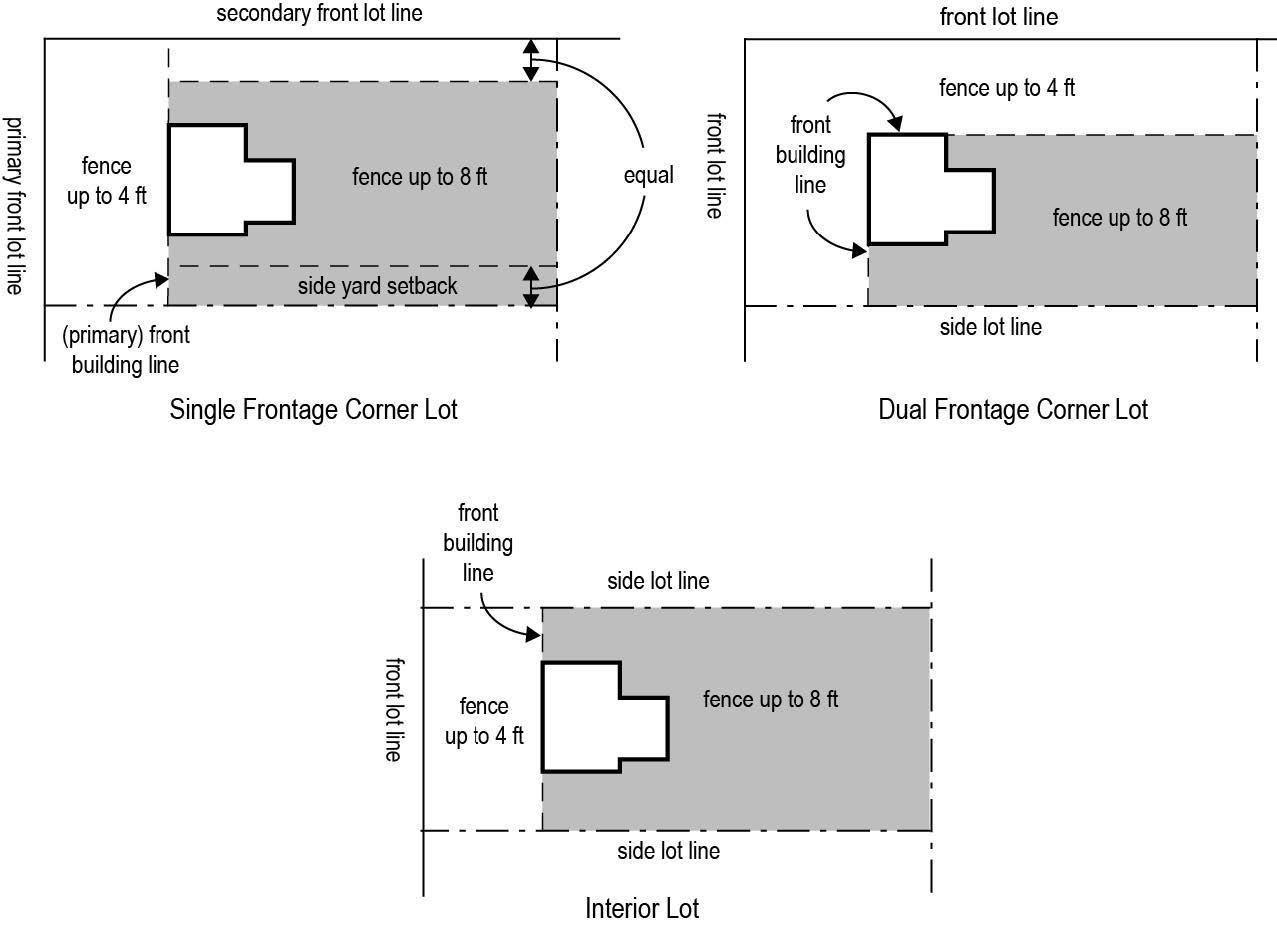
Fences and walls:
a.
Fences and walls forward of the front building line may not exceed four feet in height and may not be opaque.
b.
Fences and walls along or behind the front building line may not exceed eight feet in height. However, fences and walls taller than four feet may extend into the secondary front yard of single-frontage lots but must be set back from the secondary front lot line a minimum distance equal to the side setback requirement of the applicable district.
c.
Fences and walls may not include barbed wire, razor wire, broken glass, or other elements reasonably capable of causing harm to persons or animals.
§ 4.01.04 Recreational vehicles, boats and utility trailers.
1.
Recreational vehicles may not be occupied or used for living, sleeping or housekeeping purposes.
2.
Recreational vehicles, boats and utility trailers may not be stored forward of the front building line, but may be parked anywhere on the premises for loading and unloading purposes.
(Ord. No. 2022-008, 3-15-2022; Ord. No. 2022-041, 10-18-2022)
§ 4.02 - R-1 Single-Family Residential District.
The purpose of this district is to provide for low-density, detached single-family dwellings and other uses customary to low-density single-family neighborhoods.
(Ord. No. 2022-008, 3-15-2022)
§ 4.03 - R-2 Single-Family Residential District.
The purpose of this district is to provide for low-density, detached single-family dwellings and other uses customary to low-density single-family neighborhoods.
(Ord. No. 2022-008, 3-15-2022)
§ 4.04 - R-3 Single-Family Residential District.
The purpose of this district is to provide for medium-density, detached single-family dwellings and other uses customary to medium-density single-family neighborhoods.
§ 4.04.01 Additional Standards.
1.
Street-facing garages. For front-loaded interior lots, that portion of a dwelling's front facade containing a garage may not project more than six feet closer to the front setback line than the nearest wall plane or porch. Garage doors wider than ten feet must include one or more of the following design elements: windows, wood or wood composite, raised panels, or decorative trim around the door opening.
2.
Driveways on interior lots. Driveways in front yards may not be wider than 40% of the lot width.
3.
Proposed subdivisions of 50 or more lots must provide one or more common open spaces of at least ten percent of the area of the development, excluding street rights-of-way and any stormwater retention or detention areas. However, this requirement does not apply when the average lot size within a proposed subdivision is greater than 9,000 square feet.
(Ord. No. 2022-008, 3-15-2022)
§ 4.05 - R-4 Multifamily Residential District.
The purpose of this district is to provide for high density, single-family and multifamily dwellings and other uses customary to high density and multifamily neighborhoods.
§ 4.05.01 Multifamily developments with five or more units per building must comply with § 7.15 Multifamily Development.
§ 4.05.02 Additional standards for single-family, duplex, triplex and quadplex lots:
1.
Street-facing garages. For front-loaded interior lots, that portion of a dwelling's front facade containing a garage may not project more than six feet closer to the front setback line than the nearest wall plane or porch. Garage doors wider than ten feet must include one or more of the following design elements: windows, wood or wood composite, raised panels, or decorative trim around the door opening.
2.
Off-street parking spaces for triplex and quadplex lots may not be located forward of the front building line.
3.
Driveways on interior lots. Driveways may not occupy more than 40% of the front yard of detached single-family lots and not more than 50% of townhouse lots.
4.
Driveways on corner lots must be set back as far as practicable from the adjoining intersection.
(Ord. No. 2022-008, 3-15-2022)
§ 4.06 - R-5 Single-Family High-Density District.
The purpose of this district is to provide for high-density, detached and semi-detached single-family dwellings and other uses customary to high-density single-family neighborhoods.
§ 4.06.01 Development of patio homes must comply with § 7.16 Patio Homes.
§ 4.06.02 Front-loaded lots:
1.
Street-facing garages. For front-loaded interior lots, that portion of a dwelling's front facade containing a garage may not project more than six feet closer to the front setback line than the nearest wall plane or porch. Garage doors wider than ten feet must include one or more of the following design elements: windows, wood or wood composite, raised panels, or decorative trim around the door opening.
2.
Driveways on interior lots. Driveways may not occupy more than 40% of the required front yard.
3.
Driveways on corner lots must be set back as far as practicable from the adjoining intersection.
(Ord. No. 2022-008, 3-15-2022)
§ 4.07 - R-6 Single-Family Townhouse District.
The purpose of this district is to provide for development of townhouses to promote effective, efficient and economical utilization of land, in areas of suitable location and character for such development as determined by existing land use characteristics and future land use as defined in the Comprehensive Plan.
§ 4.07.01 Development of townhouses must comply with § 7.23 Townhouses.
(Ord. No. 2022-008, 3-15-2022)
§ 4.08 - T-1 Manufactured Home Subdivision District.
The purpose of this district is to provide for the development of manufactured homes on individual lots.
§ 4.08.01 Development of Manufactured Home Subdivisions must comply with §7.13 Manufactured Home Subdivisions and the City Subdivision Regulations. Manufactured homes must comply with § 3.05 Manufactured Homes.
§ 4.08.02 Additions and accessory structures must conform to the Building Code.
(Ord. No. 2022-008, 3-15-2022; Ord. No. 2022-041, 10-18-2022)
§ 4.09 - T-2 Manufactured Housing District.
All T-2 zoned properties are subject to the requirements in effect at the time of their rezoning to T-2 and as may have been subsequently amended. All manufactured homes hereafter installed in an existing T-2 District must comply with §3.05 Manufactured Homes. It is the intent of the City that the T-2 District no longer be available for application to other properties.
(Ord. No. 2022-008, 3-15-2022; Ord. No. 2022-041, 10-18-2022)
§ 4.10 - T-3 Manufactured Home Park District.
The purpose of this district is to provide for manufactured home and tiny home parks including accessory uses customary to residential communities.
§ 4.10.01 Development of manufactured home and tiny home parks must comply with § 7.12 Manufactured Home and Tiny Home Parks. Manufactured homes must comply with § 3.05 Manufactured Homes.
§ 4.10.02 Recreational vehicles and similar portable structures may be approved for only temporary residential occupancy within a manufactured home park as a Special Exception provided that the use is located within a separate portion of the park from permanent dwellings. The Board will apply conditions on the approval to assure that no portable structure may be occupied by the same tenant for a continuous period in excess of three months and that the structures are maintained in a habitable condition as required for manufactured homes in § 3.05. That portion of the manufactured home park used for temporary residential occupancy in portable structures and each home stand within it must conform to all requirements of Manufactured Home and Tiny Home Park § 7.12, except as specifically modified by the Board in its approval.
§ 4.10.03 Nonconformities. Any lawfully nonconforming manufactured home park may continue to operate as such, provided it meets all applicable state and county public health requirements. However, no additional spaces may be created and no additional homes may be placed within the park, not including replacement of existing homes, until the park is brought into compliance with these regulations. Where it is not practicable to make an existing park fully conform, placement of additional homes or creation of additional spaces may only be approved upon written request to the Board, who may place conditions on approval to ensure that the park is brought into conformance as fully as practicable.
(Ord. No. 2022-008, 3-15-2022; Ord. No. 2022-041, 10-18-2022)

