
Prattville City Zoning Code
ARTICLE 3
- GENERAL REGULATIONS
§ 3.01 - Uses.
Uses specified as "permitted by right" are permitted on application to the Director. Special Exception uses require approval of the Board. If a use is not specifically referred to in this Ordinance, its status may be determined by the Director by reference to the most clearly analogous use in the applicable Table of Permitted Uses. If the Director determines that a proposed use is not clearly analogous to a use in the Table of Permitted Uses, the Director refers the matter to the Board. If the Board determines that the use is compatible with the purpose of the district and with its permitted uses, it may consider the use as a Special Exception. Once the status of an unlisted use has been determined, that determination applies subsequently to all uses of the same type.
(Ord. No. 2022-008, 3-15-2022)
§ 3.02 - Lots, Yards and Open Spaces.
§ 3.02.01 Each structure, hereafter erected or altered, must conform to the area and dimensional requirements of the applicable district.
§ 3.02.02 Open spaces and lots required for a structure or use may not be occupied by or counted as a yard or open space for another structure or use, unless the uses are in the same structure.
§ 3.02.03 No lot may be reduced in area so that yards and other spaces total less than the minimum area required under this Ordinance. This does not prevent the acquisition of narrow strips of property for street rights-of-way by an appropriate government entity.
§ 3.02.04 Future street lines. On any lot which, at the time of adoption or subsequent amendment of this Ordinance, may be reduced in area by widening a public street to a future street line as indicated on the duly adopted major thoroughfare plan or other applicable plan, the minimum required yards, lot area, lot width and maximum building area are measured by considering the future street line as the lot line of such lot.
§ 3.02.05 The minimum front yard setback applies to both frontages of double-frontage lots.
§ 3.02.06 Exceptions to the district requirements for lots and yards follow:
1.
The minimum front yard setback may be reduced where existing buildings on the same block frontage do not conform to the front yard setback of the applicable district, as follows:
a.
On blocks up to 500 feet in length, the setback requirement is reduced to the average setback of all buildings along the frontage or the average setback of buildings within 100 feet on each side of the subject lot, whichever is less.
b.
On blocks longer than 500 feet, the setback requirement is reduced to the average setback of buildings within 200 feet on each side of the subject lot.
c.
For corner lots, the setback requirement is reduced to the average setback of all existing buildings along the same block frontage.
2.
The Director may allow a reduction of a yard setback when the applicable yard adjoins an open space that is prohibited from development of any kind by means of deed restrictions or similar legal method.
3.
Common open spaces that are contained within their own lot are not subject to the district lot and yard requirements.
(Ord. No. 2022-008, 3-15-2022)
§ 3.03 - Parking and Loading.
§ 3.03.01 Each use must be provided with off-street parking as specified in Article 8.
§ 3.03.02 Each nonresidential use must be provided with off-street loading and unloading facilities as specified in Article 8.
(Ord. No. 2022-008, 3-15-2022)
§ 3.04 - Structures.
§ 3.04.01 There may be only one principal structure on any lot zoned or used for single-family residential purposes.
§ 3.04.02 Only buildings conforming to the Building Code and manufactured homes conforming to §3.05 Manufactured Homes may be used for permanent residential occupancy. Recreational vehicles and similar portable structures may be permitted for temporary residential occupancy in accordance with §7.17 Recreational Vehicle Parks and Campgrounds.
§ 3.04.03 Modular Structures. For the purposes of this Ordinance, modular structures are treated the same as site-built structures and must conform to the Building Code.
§ 3.04.04 Street Frontage and Access.
1.
Every building must be on a lot adjoining a public street or with access by way of an approved private street or easement.
2.
All structures must be located on lots to provide safe and convenient access for fire protection and required off-street parking.
§ 3.04.05 Height. Each structure, hereafter erected or altered, may not exceed the maximum building height of the applicable district. However, maximum height regulations do not apply to barns, silos and other farm structures; steeples, spires, domes, chimneys, flagpoles, public utility poles, radio and television towers and aerials, silos, cooling towers, water tanks, and industrial structures required for a permitted manufacturing process and other such structures not designed for human occupancy may exceed this height, provided they comply with all other applicable codes and ordinances, and are located no closer to the nearest property line than the distance equal to their height plus ten feet.
§ 3.04.06 Accessory Structures, Site Appurtenances.
1.
Accessory structures are subject to the following requirements and the regulations of the applicable district. For residential districts, refer also to § 4.01.03 Additional Regulations:
a.
It is unlawful for any person to place, construct, repair, replace, or cause to be placed, constructed, repaired, or replaced, an accessory structure before obtaining any applicable permits.
b.
No accessory structure may be established prior to the substantial completion of the primary structure, though they may be permitted and constructed at the same time. No accessory structure may be used prior to the principal structure being occupied. This does not apply to agriculture-related structures.
c.
Accessory structures must be located on the same parcel as the principal structure.
d.
The property owner is responsible for observing any private covenants, restrictions, or homeowner association requirements which may impact accessory structures.
e.
Accessory structures may not be used as a dwelling unit, except for permitted Accessory Dwellings (see § 7.01). However, protective shelters may provide temporary living quarters in times of danger or emergency.
2.
Swimming and wading pools. Swimming and wading pools with a depth of one foot or more in any portion of the pool must be set back at least five feet from any property line and must be secured as required by the Building Code.
§ 3.04.07 Fences and walls.
1.
Generally.
a.
Except as otherwise provided in this Subsection, a permit is required to construct, repair or replace a fence or wall or any part thereof. It is unlawful for any person to construct, repair, replace, or cause to be constructed, repaired, or replaced, a fence or wall before obtaining any applicable permits.
b.
Decorative gate embellishments may not exceed two feet above the maximum permitted height of the fence.
c.
Fences and walls may not project into a right-of-way or impede intersection sight distance. See § 3.06.01 Sight Distance, Clearance for Vehicular and Pedestrian Movement.
d.
Fences and walls may not be built on or over any easement without approval of the entity having authority over the easement.
e.
Fences and walls must not adversely affect draining or create debris build-up, nor impede access to metering devices or public utilities, including fire hydrants.
f.
The property owner is responsible for observing any applicable private covenants, restrictions, or homeowner association requirements.
2.
Permitted height. See § 4.01 General Regulations, Residential Districts; § 5.01 General Regulations, Nonresidential Districts; and Article 6 Special Districts.
3.
Repairs and maintenance.
a.
Property owners must maintain fences and walls at all times in a state of good repair, safe and secure condition, with all braces, bolts, nails, supporting frame, fastenings, pickets, mesh, and other parts and materials free from deterioration, termite infestation, rot, rust or loosening.
b.
A fence may not lean more than one inch out of vertical for each foot of height as measured from the top of the fence.
c.
A permit is required for repair of nonconforming fences, walls, or gates when repairs exceed two fence panels or 16 feet in fence length. A permit is required for repair or replacement of conforming fences exceeding 50% of the total fence length; a rolling 12-month time period is used between repairs or replacement.
§ 3.04.08 Emergency Shelters. Emergency shelters are permitted as accessory structures in any district subject to the following:
1.
Emergency shelters may be temporarily used for any principal or accessory use permitted in the district during times of emergency as designated by the City. They may not be used for principal or accessory uses prohibited in the district.
2.
Emergency shelters may contain or be contained in other structures or may be constructed separately.
3.
Emergency shelters may not be located within a required front yard, regardless of whether or not they extend above grade, and are otherwise subject to area and dimensional regulations of the district.
§ 3.04.09 Antennas.
1.
Telecommunication towers are considered a principal use subject to district use regulations and § 7.21 Telecommunication Towers.
2.
Amateur radio towers and any other antennas for the reception or transmission of radio or television signals located in FAR and residential districts, used for noncommercial purposes, are considered accessory uses and must be located to the rear of the front building line. See also § 7.04 Amateur Radio Towers.
3.
The installation of any antenna, which in combination with the support structure is taller than 45 feet, requires a Building Permit and inspection in accordance with this Ordinance and the Building Code.
4.
The Board may not issue variances to these provisions unless it is proven to the Board's satisfaction that no useful signal can be received or transmitted by an antenna located in a manner conforming to this Ordinance. In making its determination, the Board may require evidence of failed reception or transmission, which may include but is not limited to:
a.
For reception antennas: Video or audio tapes of reception at the site;
b.
For transmission antennas: Signal strength readings of a received signal certified by a registered electrical engineer; or
c.
For all types of antennas: Theoretical calculations by a registered electrical engineer.
§ 3.04.10 Satellite dishes. Satellite dishes are permitted as accessory structures in all districts.
§ 3.04.11 Waste and Grease Storage Containers.
1.
Waste and grease storage containers must be screened in accordance with § 10.03 Screening.
2.
Properly screened containers do not need to be set back from side or rear lot lines of nonresidential premises, provided the enclosure is separated at least five feet from any structure on adjoining lots and any applicable buffer requirements are satisfied. However, containers on nonresidential premises, whether screened or not, may not be closer than 30 feet to any residential district boundary nor 50 feet to any residential structure, whichever is greater.
3.
If due to its location and visibility the approving authority does not require screening, waste containers and grease storage containers must be set back at least 20 feet from any property line.
4.
In no case may waste containers or associated screens be located on a public right-of-way or public or private easement.
(Ord. No. 2022-008, 3-15-2022; Ord. No. 2022-041, 10-18-2022)
§ 3.05 - Manufactured Homes.
§ 3.05.01 Permits and Approvals.
1.
A Permit must be obtained from the City prior to the placement or replacement of any manufactured home. Application must include the following information:
a.
Year of manufacture
b.
Model and serial number
c.
Exterior dimensions of the home
d.
Affidavit that no structural alterations have been made to the home
2.
Each manufactured home must bear a valid set-up inspection sticker from the Alabama Manufactured Housing Commission and have all applicable electrical, gas, water, sewer and HVAC permits.
3.
A Certificate of Occupancy and approval for electrical service will not be released by the City until all applicable requirements have been complied with. Occupancy of a manufactured home prior to issuance of a Certificate of Occupancy is subject to fines and penalties in accordance with § 11.03 Penalties and Remedies.
4.
Approval by the Public Works Department or County Health Department of sewer connection or septic system, respectively, must be provided to the Building Official for each manufactured home.
§ 3.05.02 Additions to manufactured homes are limited to pre-manufactured verandas, carports, and patio covers similar in appearance and design to the manufactured home. Exceptions: Conventional roof structures of sound structural and architectural design constructed in accordance with the Building Code may be added.
§ 3.05.03 Skirting material must be designed exclusively for that purpose and must be underpinned as required by the Building Official.
§ 3.05.04 Manufactured homes without sanitary facilities (toilet and bath or shower) are prohibited.
§ 3.05.05 Manufactured homes installed after the effective date of this Ordinance, including those used to replace an existing home, must comply with the applicable regulations of the US Department of Housing and Urban Development as of 1994 and must be inspected and approved before issuance of a Certificate of Occupancy. The Building Official will inspect each proposed home for evidence of the following or similar conditions or defects. If present, the Official may not issue a Certificate of Occupancy until the conditions have been remedied to the satisfaction of the Building Official:
1.
Exterior water leaks, presence of mold, softness present in interior walls, inadequate vapor retarders, inadequately sealed ducts
2.
Missing shingles, uneven roof, holes in roof
3.
Broken windows
4.
Holes in floor, buckled or uneven floor, deteriorated subfloor
5.
Lack of GFCI protection, exposed wiring, inadequate electrical grounding, improper repair of wiring
6.
No smoke detectors
7.
No heating and cooling installed
8.
Damaged sheathing
(Ord. No. 2022-008, 3-15-2022)
§ 3.06 - Sight Distance, Clearance for Vehicular and Pedestrian Movement.
§ 3.06.01 Intersection Sight Distance. Other than traffic control signs, no fence, wall, landscaping, sign or other visual obstruction is permitted between the heights of 3.5 feet and ten feet above street level, that will obstruct a motorist's line of sight at intersections of streets, driveways or alleys, as determined by the City Engineer in accordance with the following or AASHTO Geometric Design of Highways and Streets, latest addition. Requirements are determined as follows:
1.
At the intersection of two streets: 30 feet from the intersection measured along each curb line/edge of pavement.
2.
At the intersection of a street and a driveway or alley: 20 feet from the intersection measured along the curb line/edge-of-pavement and 20 feet along the driveway or alley pavement.
3.
At the intersection of a street, alley or driveway with a major street or railroad: 20 feet from the intersection measured along the curb line/edge-of-pavement of the street, alley or driveway and 70 feet along the curb line/edge-of-pavement of the major street or the railroad right-of-way.
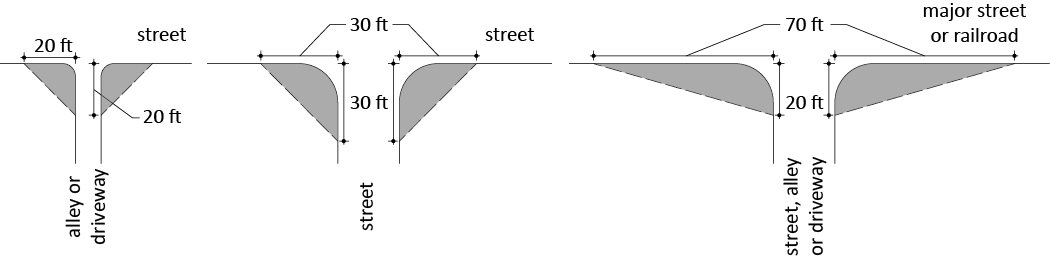
Intersection Sight Distance
§ 3.06.02 Clearance for Vehicular and Pedestrian Movement. All portions of structures, signs, plantings, fences and other appurtenances, whether permanent or not, must comply with the following clearance requirements:
1.
A clear height of at least 14 feet above the driving surface must be maintained over an area intended for vehicular use. The Director may permit a lesser vertical clearance provided the applicable vehicle height limit is indicated to motorists.
2.
A clear height of at least eight feet above the walking surface must be maintained over any area intended for pedestrian use. However, the Director may permit vertical clearance no less than seven feet where an existing structure is of a design that makes compliance with this requirement impracticable. A clear width of at least five feet must be maintained at all points along a public sidewalk.
(Ord. No. 2022-008, 3-15-2022)
§ 3.07 - Common Open Spaces and Facilities.
For all proposals involving the creation of common open spaces or facilities, which may include subdivision entrances and signage, that are to be owned and maintained by the developer or a property owner association, the following apply:
§ 3.07.01 If not owned and maintained by the developer, an association representing the owners must own the common open space or facility in perpetuity. Membership in the association is mandatory and automatic for all owners of the subdivision or condominium and their successors. The association must have lien authority to ensure the collection of dues from all members. The responsibility for maintaining the common open space and/or facilities is borne by the association.
§ 3.07.02 Management Plan. The applicant must submit a plan for management of open space and/or common facilities that:
1.
allocates responsibility and guidelines for the maintenance and operation of the common open space/facilities including ongoing maintenance and long-term capital improvements;
2.
outlines the means by which funding will be secured; and
3.
provides that any changes to the plan must be approved by the Commission; and
4.
provides for enforcement of the plan.
§ 3.07.03 In the event the party responsible for the common open space or facilities fails to maintain all or any portion in reasonable order and condition, the City may assume responsibility for its maintenance and may enter the premises and take corrective action, including extended maintenance. The costs of such maintenance may be charged to the association, or to the individual owners that make up the association, and may include administrative costs and penalties. Costs may become a lien on all involved properties.
(Ord. No. 2022-008, 3-15-2022)
§ 3.08 - Nonconformities.
Any parcel, use, structure or other component of development, existing on the effective date of this Ordinance, that does not conform to applicable regulations of this Ordinance may be continued and maintained subject to the provisions in this Section.
§ 3.08.01 General Provisions.
1.
Nothing in this Section may be interpreted to prevent routine maintenance or internal or external improvements to a structure that do not increase any nonconforming condition.
2.
Nothing in this Section may be interpreted to prevent the strengthening or restoration of a structure to a safe condition upon an order of a public official charged with protecting the public safety and who declares the structure to be unsafe; provided the restoration does not otherwise violate this Ordinance.
§ 3.08.02 Nonconforming Lots.
1.
If the owner of a nonconforming lot owns adjoining land that may be combined with the nonconforming lot to comply with lot size, width, yard or other requirements, the lots must be combined before the City may issue any permits for development of the lots.
2.
If the owner of a nonconforming lot does not own sufficient adjoining land to enable conformance to the lot size, width, yard and other requirements, one building and its accessory structures may be approved as a Special Exception by the Board. Proposed development must conform as closely as possible, in the opinion of the Board, to the applicable requirements; and neither side yard may be reduced to less than five feet in width or the side yard requirements of the applicable district, if less than five feet.
§ 3.08.03 Nonconforming Uses.
1.
Generally.
a.
A nonconforming use may not be changed to another nonconforming use, unless the Board finds the new nonconforming use reduces the degree of nonconformity and approves the new use as a Special Exception.
b.
Whenever a nonconforming use changes to a conforming use, it may not thereafter revert to the previous or any other nonconforming use.
c.
Except as provided to the contrary in Paragraph 3(b) following, a nonconforming use may not be altered, enlarged, or intensified in any way that increases its nonconformity, but may be altered or reduced to decrease its nonconformity.
d.
When any nonconforming use is discontinued for a continuous period of more than 365 days, any subsequent use on the premises must comply with the use regulations of the applicable district.
e.
No use that is accessory to a nonconforming use or structure may continue after the principal use has ceased, unless it thereafter conforms to all applicable regulations of this Ordinance.
2.
Nonconforming Uses of Land. A nonconforming use of land may not be enlarged to cover more land than was occupied by the use when it became nonconforming.
3.
Nonconforming Uses of Structures.
a.
A nonconforming use of a structure may not be extended or enlarged except into portions of the structure which, at the time the use became nonconforming, were already erected and arranged or designed for such nonconforming use.
b.
Nonconforming residential structures in any district, in which the residential use is not permitted, may be enlarged, extended or structurally altered, provided no additional dwelling units are created, and the extension or alteration complies with all other applicable requirements of this Ordinance.
§ 3.08.04 Nonconforming Structures.
1.
No nonconforming structure may be moved, in whole or in part, to any other location on the same or any other lot unless the entire structure conforms to the regulations of the applicable district upon being moved.
2.
Reconstruction of Damaged Structures.
a.
Any nonconforming dwelling damaged by fire, wind, flood, or other causes, may be repaired or rebuilt within the footprint and square footage of the nonconforming dwelling. The repairs or reconstruction must be initiated within 180 days and completed within 365 days of such damage.
b.
Other nonconforming principal structures damaged by fire, wind, flood or other causes up to 60% of their value prior to the damage, may be repaired or rebuilt within the existing footprint and square footage. If the damage exceeds 60% of the value of the structure, the structure may not be repaired or rebuilt except in conformity with the district regulations.
c.
Nonconforming accessory structures damaged by fire, wind, flood, or other causes may not be repaired or rebuilt except in conformity with the district regulations.
3.
Nonconforming Structures Deemed Unsafe. If a nonconforming structure or portion thereof or any structure containing a nonconforming use becomes physically unsafe or unlawful due to lack of repairs or maintenance and is declared by the Director to be unsafe or unlawful by reason of physical condition, it may not thereafter be restored, repaired or rebuilt except in conformity with the district regulations.
(Ord. No. 2022-008, 3-15-2022)

