
Prattville City Zoning Code
ARTICLE 8
- PARKING AND LOADING
§ 8.01 - Definitions.
Terms used in this Article have the following meanings:
§ 8.01.01 Employee. The maximum number of persons employed at the facility regardless of the time period during which this occurs or whether the persons are full-time employees. The major shift may be a particular day of the week or a lunch or dinner period in the case of a restaurant.
§ 8.01.02 Gross Floor Area (GFA). The total floor area of a building designed for both tenant occupancy and exclusive use. GFA includes both owned and leased areas but does not include shared or common areas among tenants. Where the total floor area of a building is occupied or where a building has no shared or common area, GFA is the gross floor area measured by taking the outside dimensions of the building at each floor level.
§ 8.01.03 Loading Area. That area used to satisfy the requirements of this Ordinance for truck loading and unloading.
§ 8.01.04 Loading Space. An off-street space or berth used for the unloading or loading of commercial vehicles.
§ 8.01.05 Occupancy Load. The maximum number of persons, which may be accommodated by the use as determined by its design or by fire code standards.
§ 8.01.06 Parking Aisle. That portion of the parking area consisting of lanes providing access to parking spaces.
§ 8.01.07 Parking Area. An improved area on a lot exclusively used or designed for use as a temporary storage area for motor vehicles, containing access driveways, parking aisles and parking spaces.
§ 8.01.08 Parking Space. That portion of the parking area set aside for the parking of one vehicle.
§ 8.01.09 Stacking Space. An off-street space for the temporary stacking of vehicles with an aisle intended to serve a drive-in teller, take-out food window, dry cleaning/laundry pick-up and similar functions.
(Ord. No. 2022-008, 3-15-2022)
§ 8.02 - Parking required.
§ 8.02.01 Off-street parking must be provided as specified in Table 8-1. When the requirement is not readily determinable, the Director determines parking requirements using the table as a guide. When calculating the number of required spaces, any fraction is rounded up to the nearest whole number.
§ 8.02.02 Except as provided for shared parking facilities in § 8.02.03, no off-street parking required for a use or structure may, during its life, be occupied by or counted as off-street parking for another use or structure but may be included in the required yard space.
§ 8.02.03 Shared parking. A joint parking area may contain required parking spaces for more than one use, provided the combined number of spaces complies with the parking for all uses. If the combined uses will use the same spaces at wholly different times, the spaces may be credited to each separate use. In such case, the applicant must provide a joint parking agreement; and, if sharing the same spaces, a time schedule for allocation of the spaces. Where appropriate, parking for multiple uses on the same premises may be reduced by calculation of shared parking requirements using Table 8-2.
§ 8.02.04 Where off-street public parking spaces are available within 400 feet from the subject property, parking requirements may be reduced as determined by the Board of Adjustment. On-street parking spaces along and within the lot frontage may be counted toward parking requirements.
§ 8.02.05 If any structures or uses are enlarged, expanded or changed to a use requiring more parking, additional parking must be provided to meet the total requirements of the enlarged, expanded or changed use. If it is not practicable to meet the full requirement, the Director may approve a reduction of 10%. A reduction of more than 10% of the parking requirement may only be approved by the Board as a Special Exception.
(Ord. No. 2022-008, 3-15-2022)
§ 8.03 - Location.
Required off-street parking facilities must be located on the same lot as the structure or use served; except, as follows:
§ 8.03.01 In the Prattville Historic District, required parking may be provided off-site with Special Exception approval by the Board.
§ 8.03.02 If required parking spaces cannot reasonably be provided on the same premises as the use, remote parking may be permitted by a Special Exception if within 400 feet of premises. Written legal documentation must show that the applicant has the right to the remote parking spaces. The owner of the remote parking premises must enter into a written agreement with enforcement running to the City providing that the property on which remote parking is provided may not be sold or developed until parking requirements for the use identified in the agreement have otherwise been met. The agreement may be voided if the remote parking is no longer needed to meet parking requirements.
(Ord. No. 2022-008, 3-15-2022)
§ 8.04 - Design standards.
§ 8.04.01 Parking facilities and access drives must be constructed to provide adequate drainage and maintained in such a manner that no dust will be produced by continuous use. The design and construction of all parking facilities and access drives must be approved by the Director.
§ 8.04.02 All off-street parking facilities must be designed so that access to the parking spaces does not require maneuvering in or backing into a public street. This does not apply to off-street parking for single-family and duplex dwellings, unless located on a major street as defined by the City Subdivision Regulation.
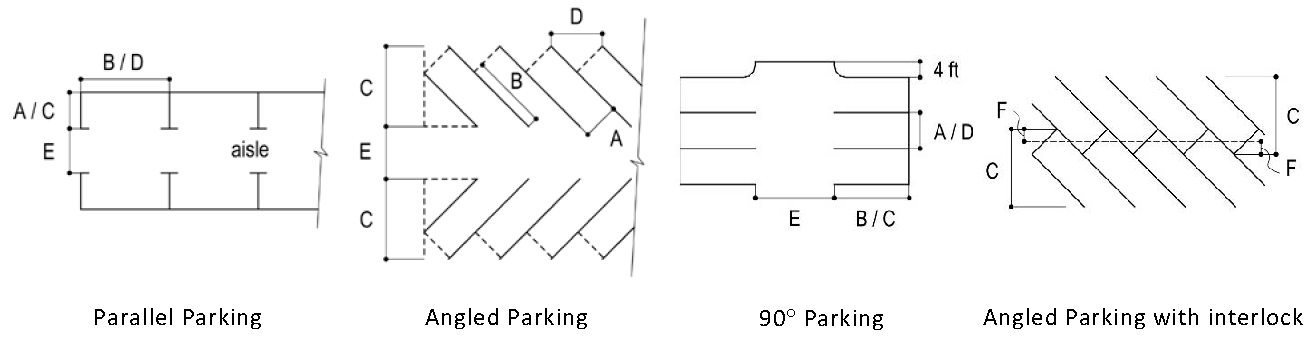
§ 8.04.03 Parking areas must be arranged and marked in accordance with the dimensional standards in Table 8-3 or alternate dimensions as approved by the Director. Parking spaces for single-family and duplex dwellings, unless parking is provided in common parking areas, need not be marked.
§ 8.04.04 Curbs or other suitable barriers must be provided so that vehicles do not encroach into pedestrian ways or come in contact with walls, fences or plantings. This does not apply to single-family and duplex dwellings unless parking is provided in common parking areas.
(Ord. No. 2022-008, 3-15-2022)
§ 8.05 - Bicycle Parking.
§ 8.05.01 When bicycle parking is provided with storage in accordance with § 8.05.02, automobile parking requirements may be reduced up to five percent at the following rates:
1.
Nonresidential uses: one automobile parking space per six bicycle parking spaces
2.
Multifamily uses: one automobile parking space per ten bicycle parking spaces
§ 8.05.02 Bicycle storage standards.
1.
Bicycle parking must be placed in a visible location no farther than 150 feet from the main entrance of the nonresidential use or from the multifamily building, as applicable.
2.
Freestanding bicycle racks must be securely anchored to the ground and of a design to enable the locking of the bicycle frame and one wheel to the rack and to support bicycles in stable position.
3.
Bicycle parking must be located on a paved or pervious, dust-free and adequately drained surface and have a five-foot clearance for access. Each required space must be accessible without moving another bicycle.
(Ord. No. 2022-008, 3-15-2022)
§ 8.06 - Loading Spaces.
Nonresidential uses must provide off-street space for the loading and unloading of materials or goods, as specified in Table 8-4, without encroaching upon or interfering with the use of adjoining properties, streets, alleys, required parking areas and sidewalks. Off-street loading requirements do not apply in the Prattville Historic District. When calculating required loading spaces, a fraction is rounded up to the nearest whole number.
§ 8.06.01 Loading space for two or more uses on the same lot may be shared as long as the amount of space meets the combined requirements of all uses to be served.
§ 8.06.02 Loading spaces may not be located in a required front yard or within five feet of any property line.
§ 8.06.03 If any structures or uses are enlarged, expanded or changed to a use requiring more loading space, additional loading space must be provided to meet the total requirements of the enlarged, expanded or changed use. If it is not practicable to meet the full requirement, the Director may approve a reduction of 10%. A reduction of more than 10% of the loading requirement may only be approved by the Board as a Special Exception.
§ 8.06.04 Plans showing required off-street loading must be submitted with any Building Permit application. Plans must show location, arrangement, and dimensions of loading spaces, circulation and access in a manner satisfactory for the safety and convenience of pedestrian and vehicular traffic.
§ 8.06.05 Each off-street loading and unloading space must be at least ten feet wide and 55 feet long with not less than 14 feet in vertical clearance, exclusive of maneuvering space.
(Ord. No. 2022-008, 3-15-2022)
§ 8.07 - Electric Vehicle Charging Stations (EVCS).
§ 8.07.01 Nonresidential uses: all new or reconstructed parking areas with 50 or more parking spaces must provide the electrical capacity necessary to accommodate to future hardwire installation of a Level 2 or higher EVCS at a rate of 2% of total parking required (minimum of two chargers/parking spaces and maximum required of eight chargers/parking spaces).
§ 8.07.02 When EVCSs are provided, total parking requirements may be reduced at a rate of two parking spaces for each EVCS parking space up to five percent of the total required parking.
(Ord. No. 2022-008, 3-15-2022)

