
Riverside City Zoning Code
ARTICLE X
- DEFINITIONS
19.910.010 - Purpose and applicability.
For the purposes of the Zoning Code, certain words, phrases and terms used herein shall have the meaning assigned to them by this article, except that definitions derived from State and Federal regulations that are referenced herein shall have the meaning contained in the referenced regulations.
For general terminology used throughout the Zoning Code, refer to Section 19.060.030.A (Rules and Interpretations - Terminology). For terminology used in the Zoning Code but not defined in this title, the definitions used elsewhere in the Riverside Municipal Code, the Uniform Building Code or accepted dictionaries of the English language shall govern.
(Ord. 6966 §1, 2007)
19.910.020 - "A" Definitions
Abandon means to cease to use, operate or occupy.
Abandoned sign. See "sign, abandoned."
Accessory building or structure means a building, part of a building or structure, portable building including a cargo container, pool, spa fence or wall that is subordinate to, and the use of which is incidental to, that of the main building, structure or use on the same lot.
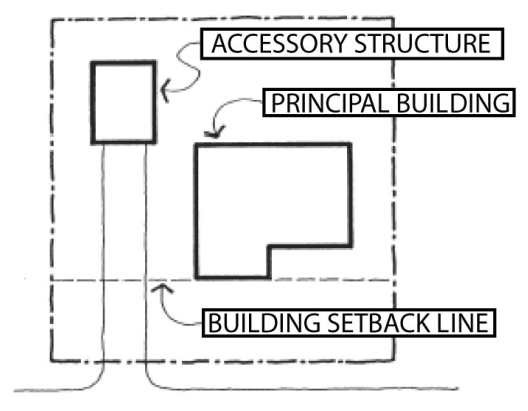
Accessory dwelling unit. See "dwelling unit, accessory."
Accessory living quarters means living quarters within an accessory building located on the same premises with the main building, such quarters having no kitchen facilities and not rented or otherwise used as a separate dwelling unit.
Accessory use means a use incidental to and customarily associated with a specific principal use, located on the same lot or parcel.
Acoustical Structure means a structure that would reduce noise emitted so as to be consistent with Title 7 - Noise Control of the Municipal Code
Acreage, gross means the total land area in acres within a defined boundary including any area for public rights-of-way, public streets and dedications of land for public use. See definition in the General Plan.
Acreage, net means that portion of gross acreage exclusive of public streets, rights-of-way and dedications of land for public uses. See definition in the General Plan.
Actual cost of removal means the cost incurred by the City for all costs associated with removal of private party signs from City-owned property and the public right-of-way, including City staff time as calculated and described in the City Fees and Charges Study and related Fees and Charges Schedule for City Services. (P07-0313)
Adult arcade. See 9.40.020.
Adult bookstore. See 9.40.020.
Adult cabaret. See 9.40.020.
Adult Day Care Facility. See Day Care Facility - Adult
Adult Day Care Home. See Day Care Home - Adult
Adult hotel/motel. See 9.40.020.
Adult motion picture theater. See 9.40.020.
Adult theater. See 9.40.020.
Adult-oriented business means any business as defined in Chapter 19.250 of the Zoning Code and Chapter 9.40 of Title 9.
Advertising statuary. See sign, advertising statuary.
Affordable housing means housing for which the allowable housing expenses paid by a qualifying household shall not exceed a specified fraction of the county median income, adjusted for household size. This shall include housing designated for extremely low-, very low-, low-, and moderate-income households.
Agricultural field office means a building or mobile coach used to perform administrative and support services associated with the conducting of commercial agricultural enterprises on- or off-site, said services including bookkeeping, telephone and mail contact, employee dispatching and meeting, security and similar activities, but excluding residential use. This definition does not include similar uses conducted in the residence or a Agricultural field office permitted accessory building by the occupant of an agricultural property for the management of agriculture principally on that property.
Agricultural stand means, in the RA-5 Zone, a stand for the sale of agricultural products produced or raised on the same premises, excluding cannabis and hemp.
Agricultural use means the use of land for the commercial or non-commercial purpose of planting, growing, raising, and harvesting of crops, livestock, or poultry; all of which shall be subject to any applicable state license, to a conditional use permit where required under this Code, and to the limitations and exclusions presented in this definition or as set forth for specific zones created under this Code. For the purpose of this definition, crops shall not include cannabis or hemp. "Agricultural use" includes employee housing as defined by California Health and Safety Code Section 17021.6.
Alcohol and drug free residential recovery home (sober living home) means the use of a residential, dwelling structure or unit for a cooperative living arrangement to provide an alcohol and drug free environment for persons recovering from alcoholism or alcohol and/or drug abuse who seek a living environment in which to remain clean and sober; and which demonstrates each of the following identifying characteristics that shall serve to distinguish the alcohol and drug free residential recovery home and sober living home, as a use of residential property, from similar land uses such as drug treatment facilities or community case facilities that are subject to state licensing requirements and from all other uses of residential property:
1.
All residents, including live-in managers, operators, or owners, are recovering from alcohol and/or drug abuse;
2.
All residents actively participate in legitimate programs, including, but not limited to, Alcoholics Anonymous (AA) or Narcotics Anonymous (NA) programs, and maintain current records of meeting attendance;
3.
All owners, managers, operators, and residents observe and promote a "zero tolerance" policy regarding the consumption or possession of alcohol and controlled substances, except for prescription medications obtained and used under direct medical supervision;
4.
There is a written policy dealing with the use of drugs or alcohol;
5.
Owners, operators, managers and residents do not provide on-site any of the following services as they are defined by Section 10501(a)(6) of Title 9, California Code of Regulations:
a.
Detoxification;
b.
Educational counseling;
c.
Individual or group counseling sessions;
d.
Treatment or recovery planning;
e.
Treatment or recovery planning;
6.
The number of residents subject to the sex offender registration requirements of Penal Code Section 290 does not exceed the limit set forth in Penal Code Section 3003.5, and does not violate the distance provisions set forth in Penal Code Section 3003;
7.
Residents do not require non-medical care and/or supervision as those terms are defined at Health and Safety Code Section 1503.5 and Section 80001(c)(3) of Title 22 of the California Code of Regulations;
8.
The operators and/or residents maintain current membership in a recognized nonprofit organization of sober living homes that provide a credible quality assurance service for applicants or members or have received a sober living home certification from the State of California Department of Alcohol and Drug Programs; and
9.
Owners, managers, operators, and residents ensure that the property and its use comply with all applicable state and local laws.
Alcohol or Drug Abuse Recovery or Treatment Facility means any facility, building or group of buildings which maintained and operated to provide 24-hour residential nonmedical alcoholism or drug abuse recovery or treatment services.
Alcohol Sales - Off-sale means the sale of beer and wine (off-sale beer and wine) or of all types of alcoholic beverages, including beer and wine (off-sale general), in their original, sealed containers for consumption off the premises.
Alcohol Sales - On-sale means the sale of beer and wine (on-sale beer and wine) or of all types of alcoholic beverages, including beer and wine (on-sale general), for consumption on the premises.
Alley means a public or City approved private way permanently reserved as a secondary means of access to abutting property.
Animal, domestic means a small animal of the type generally accepted as a pet, including dog, cat, rabbit, songbird, rodent, and the like, but specifically excluding chickens, ducks, geese, hoofed animals, swine (except pot-bellied pigs) and any other non-domestic animal.
Animal, Non-domestic means any animal other than a domestic animal typically kept in a coop, corral, stable, or pen, including but not limited to equine (e.g., horses, donkeys and llamas), bovine, porcine and ratite (e.g., ostrich, emu and rhea) species and any variety of fowl.
Antenna means a system of wires, poles, rods, reflecting discs or similar devices used for the transmission, reception or both of electromagnetic radiation waves.
Antenna, amateur radio means any antenna used for the purpose of transmitting and receiving radio signals in conjunction with an amateur radio station licensed by the Federal Communication Commission (FCC).
Antique Store means a place offering, antiques for sale. An antique, for the purposes of this Code, shall be a work of art, piece of furniture, decorative object, or the like, of or belonging to the past, at least 30 years old.
Apartment house means any building, or portion thereof, that is designed, built, rented, leased, let or hired out to be occupied, or that is occupied as a home or residence of two or more households living independently of each other and doing their own cooking in an independent unit of said building, and shall include flats and apartments. See also dwelling unit, multi-family.
Apartment project, community. See community apartment project.
Approving Authority means the designated authority responsible for the review and action on land use and development permits and approvals.
Appurtenance means a subordinate or adjunct portion of a structure.
Arcade means an establishment containing four or more electronic amusement devices, such as video games, pinball machines, internet computer cafes and the like. This definition shall not apply to restaurants or recreational premises, such as bowling alleys or skating rinks, where an arcade is clearly incidental to the primary use and providing less than 25% of its gross revenue.
Architectural element means a design element incorporated into a freestanding sign for the purpose of making the sign reflect the architecture of the building(s) that house(s) the establishments(s) it identifies.
Area median income means the annual median household for Riverside County, adjusted for household size, as published periodically in the California Code of Regulations, Title 25, Section 6932, or its successor provision.
Area of a sign. See sign, area.
Article of information. See sign, article of information.
Articulation means clear and distinct separation between design elements such as materials, walls and architectural details. See definition in Citywide Design Guidelines.
Assemblies of people—entertainment means a use or indoor facility, not specifically identified in Table 19.150.020 A (Permitted Uses), that provides for the gathering of more than ten people on a regular or intermittent basis, whereby the purpose of the use or facility is a specified activity or activities—for a fee or for no fee—for those people so assembled. Examples include but are not limited to assembly halls, banquet halls, live theaters, movie theaters, sports facilities, exhibitions and convention halls, auditoriums not associated with another primary permitted use and dance facilities. (See also Entertainment—Incidental). (Ordinance No. 6919)
Assemblies of people—non-entertainment means a use or indoor facility that provides for gathering of more than ten people on a regular or intermittent basis, whereby the purpose of the use or facility is to provide a location for meetings or congregations for those people so assembled. Examples include, but are not limited to, religious assemblies, clubs, fraternal service organizations and similar activities not including schools.
Assemblies of people—non-entertainment - Storefront means an assemblies of people—non-entertainment located within an existing building in a multi-tenant industrial, commercial or office-complex where such tenant space does not exceed 4,000 square feet.
Assembly hall means a structure for groups of people to gather for an event or regularly scheduled program. Places of public assembly include but are not limited to arenas, religious institutions, lecture halls, banquet facilities and similar facilities.
Assisted living facility means a special combination of housing, supportive services, personalized assistance and health care designed to respond to the individual needs of persons who need help with activities of daily living. A facility with a central or private kitchen, dining, recreational and other facilities with separate bedrooms or living quarters, where the emphasis of the facility remains residential. See definition in General Plan.
Association means a nonprofit corporation or unincorporated association created for the purpose of managing a common interest development.
Attic means the uninhabitable space between the upper surface of the top floor and the roof above. An attic is not a covered story.
Auction house means a business operating either as a full time enterprise or temporary use, involved in the public sale of property to the highest bidder.
Auditorium means a stand-alone room, hall, or building used for public gatherings. For the purpose of this definition, an auditorium associated with a permitted educational facility is not considered a stand-alone room, hall, or building.
Average natural slope means the average natural inclination of the ground surface of a lot or parcel expressed as a percent and as measured by the following formula:
S = (0.002296xIxL)
A
Where:
S = average natural slope in percent
I = natural contour interval in feet
L = length of natural contours in feet
A = acres of property (parcel of record existing on November 13, 1979)
0.002296= constant that converts square feet into acres and expresses slope in percent
The average natural slope shall be computed from photogrametric maps, grading permit plans and other data or evidence approved by the Public Works Department.
Aviary means any place where more than 15 domestic and/or non-domestic birds are kept outside.
(Ord. No. 7701, § 49, 2025; Ord. 7652 § 14, 2023; Ord. 7630 § 8, 2023; Ord. 7609 § 10, 2022; Ord. 7505 § 1(Exh. A), 2020; Ord. 7431 § 7, 2018; Ord. 7408 §1, 2018; Ord. 7331 §128, 2016; Ord. 7235 §22, 2013; Ord. 7158 §17, 2012; Ord. 7110 §5, 2011; Ord. 6985 §1, 2008; Ord. 6966 §1, 2007)
19.910.030 - "B" Definitions.
Bail bonds facilities means a facility that provides bail bonds, documents that ensure to the court system that a person facing charges, and who typically is in jail, will appear for future court appointments if released.
Banner. See sign, banner.
Bar means an area primarily devoted to the serving of alcoholic beverages and in which the service of food is only incidental to the consumption of such beverages.
Basement means a building story partly or totally underground. For purposes of building height regulations contained in this title, a basement is not considered a story if the ceiling of the basement is four feet or less above the elevation of the lowest point of the surface of the land at the perimeter of the structure.
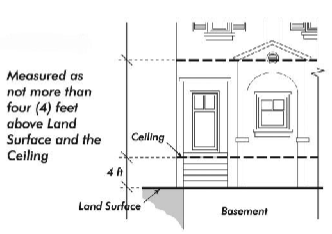
Bathroom means a room equipped with a toilet, sink and shower or bathtub.
Bathroom, half means a bathroom which contains only a toilet and sink, and does not contain a bathtub or shower.
Batting cages means a structure that needs to comply with all Code requirements (i.e., setbacks, design of light standards).
Bed and breakfast inn means a building or buildings originally constructed for residential purposes, managed and occupied by the owner of record for the property, in which paying guests may be lodged, including meal service, for up to 30 days.
Bedroom means any habitable room, with or without a closet, along an exterior wall, regardless of its designation on building plans that functions as, or may function as, a sleeping quarters and meets the minimum requirements of the Uniform Building Code for sleeping quarters or bedrooms. Offices, dens, studies, studios, lofts, game rooms, and any other conditioned rooms along an exterior wall will be considered to be bedrooms. This definition does not include living rooms, family rooms, dining rooms, kitchens, foyers, or bathrooms.
Bench sign. See "sign, bench."
Beer. See "brewery, beer."
Beverage container means any individual bottle, can, jar, carton or similar receptacle that is redeemable pursuant to the California Beverage Container Recycling and Litter Reduction Act of 1986 and any other aluminum beverage container.
Beverage container, recycling facility. See "recycling facility, beverage container."
Billboard. See "sign, billboard."
Billiard parlors means a building or portion thereof having within its premises three or more pool tables or billiard tables, or combination thereof, regardless of size, and whether activated manually or by the insertion of a coin, token or other mechanical device.
Block means an area of land within a subdivision entirely bounded by streets, or bounded in part by streets and in part by the exterior boundary of the subdivision. See definition in Title 18.
Boardinghouse means the rental of a residence/dwelling, other than a hotel/motel/long-term stay, wherein a room or rooms, with or without individual or group cooking facilities, are rented to five or more individuals under separate rental agreements or leases, either written or oral, or implied, with an owner; an owner's agent, representative or manager; a tenant; resident; or occupant; whether or not an owner, an owner's agent, representative or manager, or family thereof is in residence. The definition does not include assisted living facility where medical services are involved or group housing or homes.
Boarding of animals means any kennel where pet animals owned by another person are temporarily boarded for pay, trade, barter, commission or remuneration of any sort; provided, however, this definition shall not apply to zoos or to animal hospitals operated by veterinarian duly licensed under the law
Body piercing means the creation of an opening in the body of a human being for the purpose of inserting jewelry or other decoration. This includes, but is not limited to, piercing of an ear, lip, tongue, nose, naval or eyebrow. Body piercing does not include piercing an ear with a disposable single-use stud or solid needle that is applied using a mechanical device to force the needle or stud through the ear a method commonly used in jewelry and department stores to pierce ears.
Brew-on-premises. See "brewery, brew-on-premises."
Brewpub. See "brewery, brewpub."
Brewery means a facility that produces beer.
Brewery, beer means an alcoholic beverage obtained by the fermentation of any infusion or decoction of barley, malt, hops, or any other similar product, or any combination thereof in water, and includes ale, porter, brown, stout, lager beer, small beer, and strong beer but does not include sake, known as Japanese rice wine. (Section 23006 Business and Professions Code)
Brewery, brew-on-premises means a do-it-yourself brewery (facility) where customers produce craft style beer or wine on the premises of a brewery or microbrewery. Clients may purchase the ingredients, rent the equipment, time and space, and are provided assistance by the on-site brewmasters. Beer brewed and/or Wine made by a customer may not be sold and must be used by the customer for personal or family use.
Brewery, brewpub means a restaurant with a microbrewery as an accessory use where the beer it produces is sold in draft form exclusively at its own premises. This operation may sell other supplier's beer, including other hand - crafted or micro - brewed beers as well as wine to patrons for consumption on its premises. The premises is defined as a "bona fide public eating place" by the State of California Department of Alcoholic Beverage Control. Off-sale of alcoholic beverages shall be limited to beers brewed on-site.
Brewery, distilled spirits means an alcoholic beverage obtained by the distillation of fermented agricultural products, and includes alcohol for beverage use, spirits of wine, whiskey, rum, brandy, and gin, including all dilutions and mixtures thereof. (Section 23005 Business and Professions Code).
Brewery, distillery means a facility which manufactures distilled spirits.
Brewery, homebrew means the manufacturing of beer for personal or family use, not for sale, within a private residence by a person over 21 years of age. The aggregate amount of beer with respect to any household shall not exceed the limits established by Section 23356.2 Business and Professions Code, currently (1) 200 gallons per calendar year if there are two or more adults in the household or (2) 100 gallons per calendar year if there is only one adult in the household.
Brewery, micro-brewery means a small-scale brewery (facility) that produces 15,000 barrels of beer per year or less. Its beer products are primarily intended for local and/or regional consumption. These operations are solely dedicated to the production of specialty or craft beers.
Brewery, wine means an alcoholic beverage obtained from normal alcoholic fermentation of the juice of sound ripe grapes or other agricultural products containing natural or added sugar or any such alcoholic beverage to which is added grape brandy, fruit brandy, or spirits of wine, which is distilled from the particular agricultural product or products of which the wine is made and other rectified wine products and by whatever name and which does not contain more than 15 percent added flavoring, coloring, and blending material and which contains not more than 24 percent of alcohol by volume, and includes vermouth and sake, known as Japanese rice wine. (Section 23007 Business and Professions Code)
Brewery, winery means a facility that engaged in the conversion of grapes, berries, or other fruit into wine and is engaged in the production of wine.
Building. See the definition of "building" as defined in Title 16.
Building area means the sum in square feet of the ground area occupied by all buildings and structures on a lot.
Building frontage. See "frontage, building."
Building height means the vertical distance measured from the highest point of the roof or parapet wall of the uppermost story to the average elevation of the highest and lowest point of the ground covered by the foundation of the building.
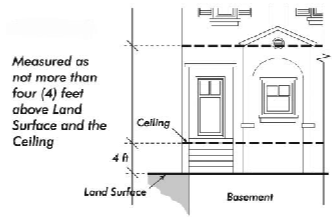
Building line. See setback building line, front, setback building line, rear or setback, building line, side.
Building materials supply stores (wholesale with ancillary retail sales) means any facility specializing in the wholesale of building and construction materials (e.g. lumber, irrigation, plumbing, electrical, etc.) with ancillary retail sales in an area not to exceed 20,000 square feet or 50 percent of the total area of the primary building or lease space, whichever is less.
Building pad means a relatively flat site, having a grade of five percent or less, that is designed to be occupied by buildings and is prepared by artificial means, including grading, excavating, filling or any combination thereof.
Building principal. See "principal, building."
Building projection means part of a building or structure that is allowed to encroach into the required setback.
Building setback line, front. See "setback building line, front."
Building setback line, rear. See "setback building line, rear."
Building setback line, side. See "setback, building line, side."
Building sign. See "sign, building."
Building site. See "site, building."
Building step back means a line prescribed for the full width of a facade, above which the facade is stepped back (or set back) a minimum distance of six feet at the fifth floor throughout the ID Overlay Zone in EE and HE Sub-Districts. Its height is determined by the desired height-to-width ratio of the typical street in front of the building. The step back permits greater overall building height than would be otherwise determined by desired density or access to view.
Building story. See "story, building."
Building wall means the vertical, exterior surface of a building or structure. See definition in Design and Sign Guidelines. For purposes of Chapter 19.620 (General Sign Provisions) and Chapter (19.625 Private Party signs on City-owned property and the public right-of-way) an exterior building wall is any wall or element that defines the exterior boundaries or courts of a building and that has a slope of 60 degrees or greater with the horizontal plane.
Bulk storage means the warehousing of materials or finished goods in an enclosed structure.
Business day means a day on which City Hall is open to the public.
Bus stop means a bus stop is generally characterized as a single point of access to and from a local bus line that stops to pick up or deposit passengers at regular and generally short time periods or headways, and is not completely enclosed.
Bus terminal means a passenger station for publicly or privately operated bus lines. A bus terminal is generally a major destination point and characterized as a transfer point between local bus lines or other modes of transportation and intercity and interstate bus operations. A bus terminal may or may not include indoor operational facilities. A bus stop is not a bus terminal.
Business means any lawful commercial endeavor to engage in the manufacturing, purchase, sale, lease or exchange of goods and/or the provision of services.
Buy-back recycling center. See "recycling center, buy-back."
(Ord. 7573 § 1(Exh. A), 2021; Ord. 7408 §1, 2018; Ord. 7331 §128, 2016; Ord. 7302 §3, 2015; Ord. 7235 §23, 2013; Ord. 7185 §4, 2012; Ord. 7071 §3, 2010; Ord. 6966 §1, 2007)
19.910.040 - "C" Definitions
California beverage container recycling center. See "recycling center, California beverage container."
Cannabis shall have the same meaning as defined in Section 5.77.060 of this Code.
Cannabis cultivation, commercial shall have the same meaning as defined in Section 5.77.060 of this Code.
Cannabis cultivation, personal means cannabis cultivation inside a lawfully existing and fully enclosed and secure private residence, or inside a lawfully existing and fully enclosed and secure accessory structure to a private residence that is located on the same parcel as the private residence for the exclusive personal use of a resident of the residence who is 21 years of age or older, as permitted by California Health and Safety Code sections 11362.1 and 11362.2.
Cannabis distribution shall have the same meaning as defined in Section 5.77.060 of this Code.
Cannabis non-storefront retail shall have the same meaning as defined in Section 5.77.060 of this Code.
Cannabis products shall have the same meaning as defined in Section 5.77.060 of this Code.
Cannabis storefront retail shall have the same meaning as defined in Section 5.77.060 of this Code.
Cannabis testing laboratory shall have the same meaning as defined in Section 5.77.060 of this Code.
Canopy means a fixed overhead shelter used as a roof that may or may not be attached to a building. See definition in Design and Sign Guidelines and the Downtown Specific Plan.
Canopy sign. See "sign, canopy."
Caretaker living quarters, agricultural means a dwelling unit located on a property that is a subsidiary use to the principal dwelling unit situated on that property
Caretaker living quarters, dwelling unit means a single-family dwelling unit accessory to an agricultural, professional, commercial or industrial use for occupancy by the owner/caretaker.
Caretaker living quarters, during construction means temporary living quarters located on a property whereon a building permit has been lawfully issued to construct a permanent building. The temporary quarters may be used for residential or sleeping purposes during construction and may be situated in a trailer, motor home or mobile home.
Cargo container means a standardized, reusable vessel that is or appears to be: (1) originally, specifically or formerly designed for or used in the packing, shipping, movement or transportation of freight, articles, goods or commodities; or (2) designed for or capable of being mounted or moved on a rail care; or (3) designed for or capable of being mounted on a chassis or bogie for movement by truck trailer or loaded on a ship.
Carport means an accessory building open on at least one side designed or used for shelter or storage of vehicles.
Carwash. See "vehicle wash facility."
Cattery-commercial means any public or private facility where ten or more cats are temporarily kept, boarded or trained, with payment of a fee, for the off-premises owners of such animals. This definition does not include zoos or animal hospitals operated by a veterinarian duly licensed under the law.
Cattery-residential means any building, structure, enclosure or premises located in a residential zone whereupon, or within which, ten or more cats, four months of age or older, are kept or maintained only for the personal use of persons living on the premises, and shall not include commercial kennels or the boarding for off-premise owners of animals.
Cemetery means any property used for the burial or internment of the dead, including crematories, mausoleums, columbaria, mortuaries or chapels operated in connection with and located within the cemetery grounds.
Center, multi-tenant site or center. See "complex, commercial."
Center, shopping. Same as "complex, commercial."
Check cashing facilities means a person or business that for compensation engages, in whole or in part, in the business of cashing checks, payday advances, warrants, drafts, money orders or other commercial paper serving the same purpose. "Check cashing facilities" do not include a State or Federally chartered bank, savings association, credit union or industrial loan company. "Check cashing facilities" do not include a retail seller engaged primarily in the business of selling consumer goods, including consumables, to retail buyers that cash checks or issue money order for minimum flat fee as a service that is incidental to its main purpose or business.
Child care center. See "day care center."
Christmas tree lot means a retail sales operation, generally conducted wholly outdoors, that offers for sale on a temporary, limited basis Christmas trees and related holiday items such as wreaths and Christmas tree stands.
Church. See "religious assembly."
Circus means a temporary outdoor amusement center, either involving use of special purpose equipment or conducted by professional operators, or both, and where activities include such things as rides, exhibitions, food service, sales or small-scale games.
Clean energy use means an industry or commercial use that uses sustainable resources to ensure that all processes, products, and manufacturing activities address current environmental concerns. This could include businesses that incorporate principles of sustainability in business decisions, supply environmentally friendly products or services, and make an enduring commitment to environmental principles in their business operations. Transport of materials/goods to and from a clean energy use may be by means of vehicle that meets current emissions standards; however, the final product, service, activity, etc., rendered by a clean energy use must incorporate principles of sustainability.
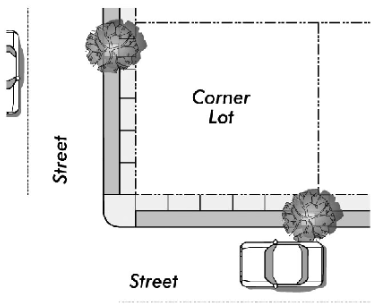
Clear visibility triangle means an area of clear cross-visibility at an intersection unobstructed by structures or landscaping. Clear-visibility triangles are located at any corner formed by the intersection of two streets. The required clear cross-visibility area shall be a triangle having two sides 15-feet long extending along the curb line of each street.
Clinic, medical or dental means as used in this title, "clinic" is defined in Sections 1200-1209 (California Health and Safety Code). A clinic is an organized outpatient health facility that provides direct medical, surgical, dental, optometric, podiatric, psychological advice, services, or treatment to patients who remain less than 24 hours, and that may also provide diagnostic or therapeutic services to patients in the home as an incident to care provided at the clinic facility.
Closet means an ancillary area within a dwelling that is clearly intended for storage.
Club means a nonprofit association of persons who are bonafide members paying dues, use of premises being restricted to members and their guests, but not including "nightclub" groups organized primarily to render a service that is customarily carried on as a business.
Coach, commercial. See "commercial coach."
Combustible. See Fire Code.
Commerce. See "business."
Commercial coach means a vehicle with or without motive power designed and equipped for human occupancy for professional, commercial or industrial purposes, including a mobile home.
Commercial complex. See "complex, commercial."
Commercial mascot means a person or animal costumed or decorated to function as a commercial advertising device. Includes sign twirlers, sign clowns and persons or animals holding or supporting signs.
Commercial message. See "message, commercial."
Commercial speech. See "message, commercial."
Commercial sign. See "sign, commercial."
Commercial storage means a commercial land use consisting of the rental of space for the storage of personal property (mini-warehouse or self-storage) and the storage of recreational vehicles. An industrial warehouse is not considered commercial storage.
Common area means land amenities, parts of buildings, central services and utilities and any other elements, facilities or spaces owned and used by all unit owners and designated in the master deed as common elements.
Common living area means a common area or communal space within a residential unit that is intended to be shared by all occupants. Common Living Area is the dwelling area of a structure, not including hallways, storage areas, bathrooms, and bedrooms.
Common interest development means any of the following: 1) a community apartment project; 2) a condominium project; 3) a planned development; or 4) a stock cooperative.
Common usable open space means open areas within a multiple-family or planned residential development project that are to be used for scenic or recreational purposes by all the residents of the project. Common usable open space does not include land occupied by streets, driveways, parking areas, service areas, required landscape areas or required front and street side yards; provided, however, that land occupied by recreational structures and facilities may be counted as common usable open space.
Community apartment project means a development in which an undivided interest in land is coupled with the right of exclusive occupancy of any apartment located thereon (California Civil code § 1351 (d)). See definition in Title 18.
Community & Economic Development Director means the individual designated to act as the Administrator for certain matters according to the procedures set forth in the California Government Code and this title.
Complex, commercial means a group of three or more commercial uses on a single parcel or contiguous parcels that function as a common commercial area including those which utilizing common off-street parking and access.
Complex, industrial means a group of three or more industrial uses on a single parcel or contiguous parcels, that function as a common industrial area including those which utilizing common off-street parking and access.
Complex, office means a group of two or more office uses on a single parcel or contiguous parcels, that function as a common office area including those utilizing common off-street parking and access.
Conditional use means a use that, because of special requirements or characteristics, may or may not be allowed in a particular zoning district only after review by the Approving Authority and the granting of conditional use permit approval imposing such conditions as necessary to make the use compatible with other uses permitted in the same zone or vicinity. Conditional use permits are issued for uses of land and may be transferrable from one owner of the land to another.
Conditional use permit means a discretionary permit issued by the City authorizing establishment and operation of a conditional use at a particular location.
Condominium means an estate in real property consisting of an undivided interest in common in a portion of a parcel in real property, together with a separate interest in the space in a residential, industrial or commercial building on such real property such as an apartments, office or store. See definition in Title 18 and the General Plan.
Condominium conversion means the conversion and/or subdivision of a single-ownership parcel of existing improved real property into a form of ownership for residential, commercial or industrial purposes involving the right of exclusive occupancy or separate ownership of individual units, including but not limited to condominiums, community apartments, stock cooperatives or planned unit developments. This includes any single-ownership parcel whose individual units are presently or at any time in the past were rented or leased individually. See definition in Title 18 and the General Plan.
Condominium project means a development consisting of condominium units established in conformance with State law. See definition in Title 18 and the General Plan.
Condominium subdivision plan means the drawings attached to the master deed for a condominium subdivision project that describe the size, location, area, horizontal and vertical boundaries, and volume of each condominium unit contained in the condominium subdivision project as wall as the nature, location and size of common elements. See definition in Title 18.
Construction caretaker housing. See "caretaker living quarters during construction."
Construction period sign. See "sign, construction period."
Convalescent home means a facility that provides nursing services and custodial care on a 24-hour basis for individuals who for reasons of illness, physical infirmity or advance age, require such services.
Convenience store. See "store, mini-mart."
Convenience zone means any geographic area designated by the California Department of Conservation as requiring the presence of one or more recycling facilities, mobile recycling units or reverse vending machines pursuant to the California Beverage Container Recycling and Litter Reduction Act of 1986.
Corner lot. See "lot, corner."
Corridor access lot. See "lot, flag."
Court means an uncovered area partly or wholly enclosed by buildings or walls and used primarily for supplying access, light, and air to abutting buildings.
Covenants, conditions and restrictions (CC&RS) means a set of private agreements written and agreed to by a group of property owners that sets down certain rules and regulations governing the development and use of their properties. The CC&R's may also reflect certain conditions and restrictions imposed and enforced by the City.
Crowing fowl means any rooster, peacock, goose, duck, guinea fowl, or any other fowl which by their sound or cry unreasonably disturb the peace and quiet of the neighborhood.
Crowing Rooster means any male chicken two months of age or older.
Cul-de-sac means a street having only one outlet for vehicular traffic and ending in a turnaround. See definition in Title 18 and the General Plan.
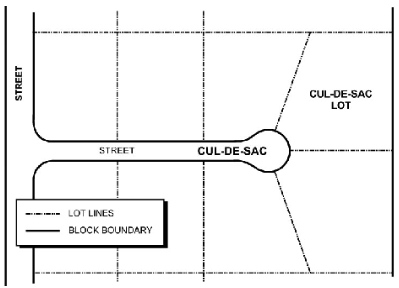
Curb line means the line of the face of a curb nearest to the street or roadway.
Cyber café. See "arcade."
(Ord. 7630 § 9, 2023; Ord. 7573 § 1(Exh. A), 2021; Ord. 7462, § 2(Exh. A), 2019; Ord. 7431 § 8, 2018; Ord. 7331 §128, 2016; Ord. 7302 §4, 2015; Ord. 7105 §7, 2010; Ord. 6966 §1, 2007)
19.910.050 - "D" Definitions
Day care center - child means a child day care facility other than a family day care home, including infant centers, extended day care facilities and school-age child care centers. (see California Health and Safety Code Section 1596.76).
Day care center - adult means a facility that provides supervision and non-medical care for more than six adults, including elderly persons, on a less than 24-hour basis.
Day care home - adult means a home that provides supervision and non-medical care to six or fewer adults, including elderly persons, in the provider's own home, on a less than 24-hour basis.
Department store. See "store, department."
Design flood. See "flood, design."
Designated floodway. See "floodway, designated."
Development means as used in this title, "Development" has the meaning of Section 65927 (California Government Code or CGC) and is also any human-caused change to improved or unimproved real estate that requires a permit or approval from any agency of the City or County, including but not limited to, buildings or other structures, mining, dredging, filling, grading, paving, excavation or drilling operations and storage of materials. "Development" means, on land, in or under water, the placement or erection of any solid material or structure; discharge or disposal of any dredged material or of any gaseous, liquid, solid, or thermal waste; grading, removing, dredging, mining, or extraction of any materials; change in the density or intensity of use of land, including, but not limited to, subdivision pursuant to the Subdivision Map Act (commencing with Section 66410 of the Government Code), and any other division of land except where the land division is brought about in connection with the purchase of such land by a public agency for public recreational use; change in the intensity of use of water, or of access thereto; construction, reconstruction, demolition, or alteration of the size of any structure, including any facility of any private, public, or municipal utility; and the removal or harvesting of major vegetation other than for agricultural purposes, kelp harvesting, and timber operations that are in accordance with a timber harvesting plan submitted pursuant to the provisions of the Z'berg-Nejedly Forest Practice Act of 1973 (commencing with Section 4511 of the Public Resources Code). As used in this section, "structure" includes, but is not limited to, any building, road, pipe, flume, conduit, siphon, aqueduct, telephone line, and electrical power transmission and distribution line. "Development" does not mean a "change of organization", as defined in Section 56021 (CGC) or a "reorganization", as defined in Section 56073 (CGC). See definition in the General Plan.
Development Review Committee ("DRC") means the pre-designated group of City departments or divisions involved in the process of reviewing projects involving new construction, re-construction and/or other entitlement applications, each of which shall conduct administrative functions authorized by the Zoning Code. The DRC includes any three or more of the following Divisions and Departments: Planning, Building and Safety, Public Works, Public Utilities, Parks and Recreation, Police and Fire. The DRC process shall be chaired by the Planning Division.
Directional sign. See "sign, directional."
Directory sign. See "sign, directory."
Disabled veteran means the same as defined in Government Code Section 18541, any veteran as who is currently declared by the United States Veterans Administration to be ten percent or more disabled as a result of service in the armed forces. Proof of such disability shall be deemed conclusive if it is of record in the United States Veterans Administration.
Discretionary decision means decisions that require the exercise of judgment or deliberation when the Approving Authority decides to approve or disapprove a particular activity, as distinguished from situations where the City individual, Board, Committee, Commission or Council merely has to determine whether there has been conformity with applicable statutes, ordinances or regulations.
Distilled Spirits. See "brewery, distilled spirits."
Distillery. See "brewery, distillery."
Domestic animal. See "animal, domestic."
Donation collection bin means an outdoor receptacle made of metal, steel or a similar product, designed to allow the general public to donate unwanted but reusable items for charitable purposes.
Dormitory means a building intended or used principally for sleeping accommodations where such building is related to an educational or public institution, including religious institutions.
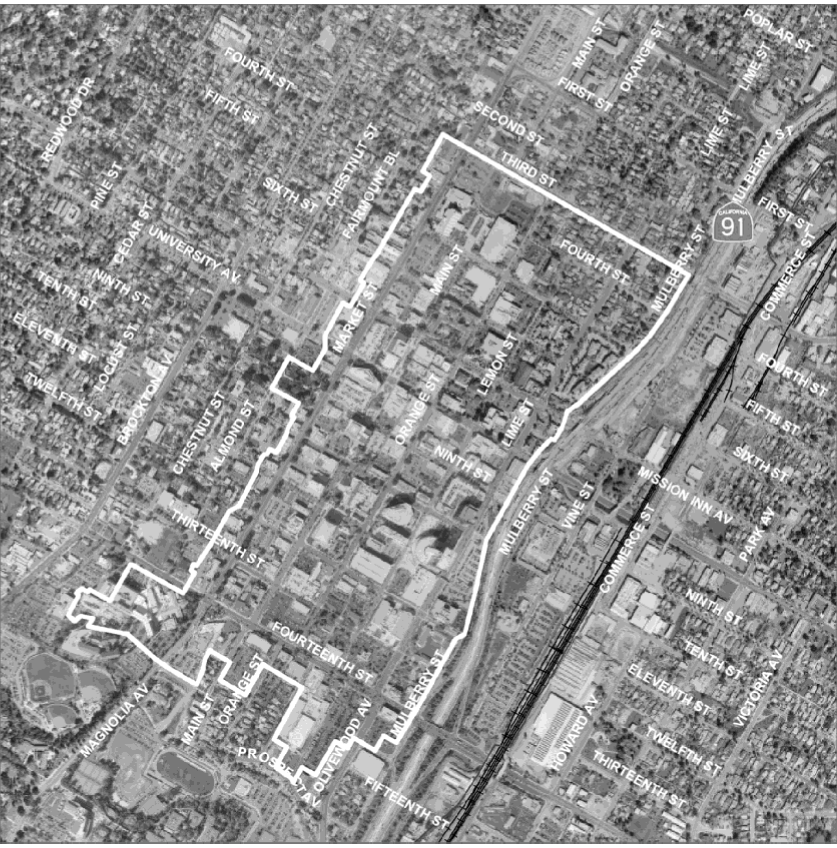
Downtown Arts and Entertainment District means an area intended to serve as a major, concentrated center of cultural and entertainment uses serving the City and surrounding communities. It consists of all commercially zoned land within an area bounded by properties south of Third Street, west of State Route 91 (the Riverside Freeway), north of properties fronting both sides of Fourteenth Street and east of properties fronting both sides of Market Street.
Drive-thru business means a business (such as a bank or restaurant) that is designed so that customers can be served while remaining in their cars.
Driveway means a private roadway providing access for vehicles to a parking space, garage, dwelling or other structure. See definition in Title 18.
Driveway, Hollywood means driveway with a middle planting strip to minimize paved access. See definition in the Downtown Specific Plan.
Drop-off recycling center. See "recycling center, drop-off."
Drug store means a business where drugs, medicines and other sundries are dispensed and sold.
Dwelling means a building or portion thereof designed for or occupied exclusively for residential purposes, including single-family and multiple family dwellings, but not including hotels, motels, boarding and lodging houses.
Dwelling area means the total combined floor area of a dwelling unit intended for human habitation. Dwelling area shall not include garages, carports, patios, sheds, or other similar spaces.
Dwelling unit means two or more rooms in a dwelling designed for or occupied by one family for living or sleeping purposes and having only one kitchen. See definition in the General Plan.
Dwelling unit, accessory (ADU) means an attached or a detached residential dwelling unit that provides complete independent living facilities for one or more persons and is located on a lot with a proposed or existing primary residence that shall include permanent provisions for living, sleeping, eating, cooking, and sanitation on the same parcel as the single-family or multifamily dwelling is or will be situated. An accessory dwelling unit also includes the following:
A.
An efficiency dwelling unit, as defined in Section 1207.4 of the California Building Code; or
B.
A manufactured home, as defined in Section 18007 of the Health and Safety Code.
Dwelling unit, caretaker. See "caretaker living quarters."
Dwelling unit, junior accessory (JADU) means a unit contained entirely within an existing or proposed single-family structure that may include separate or shared sanitation facilities.
Dwelling unit, manufactured means a manufactured house intended for occupancy by a single-family installed on a permanent foundation in conformance with applicable Zoning regulations.
Dwelling unit, mobile. See "mobile home."
Dwelling unit, motor home, RV, camper, trailer, etc. means a structure standing on wheels used for short term human occupation.
Dwelling unit, movable accessory (MADU) means a complete independent living facility that provides for one or more persons and is located on a lot with a proposed or existing primary residence that shall include provisions for living, sleeping, eating, cooking, and sanitation on the same parcel as the single-family or multifamily dwelling is or will be situated and meets the following requirements:
A.
Meets the American National Standards Institute (ANSI) 119.5 requirements or the National Fire Protection Association (NFPA) 1192 standards, is certified for ANSI or NFPA compliance; and is certified by a 3rd party inspection agency (Design Approval Agency/Quality Assurance Agency) that the MADU meets this requirement;
B.
Is licensed and registered with the California Department of Motor Vehicles;
C.
Cannot move under its own power;
D.
Is no larger than allowed by California State Law for movement on public highways; and
E.
Is no smaller than 150 and no larger than 430 square feet as measured within the exterior faces of the exterior walls.
Dwelling unit, multi-family means a building, or portion thereof, designed for occupancy by two or more families living independently of each other and containing two or more dwelling units. See also apartment house. See definition in the Downtown Specific Plan and the General Plan.
Dwelling unit, single-family means a dwelling designed for occupancy by one family and located on one lot delineated by front, side and rear lot lines. See definition in the Downtown Specific Plan.
Dwelling unit, single-family, attached means two or more dwelling units, each owned in fee and located on individual lots but joined along a single lot line, each of which is totally separated from the other by an unpierced wall extending from ground to roof. See definition in the Downtown Specific Plan and the General Plan.
Dwelling unit, single-family, detached means a dwelling unit owned in fee and located on an individual lot that is not attached to any other dwelling unit by any means. See definition in the General Plan.
(Ord. No. 7701, § 50, 2025; Ord. 7609 § 11, 2022; Ord. 7592 § 12(Exh. M), 2022; Ord. 7528 § 1(Exh. A), 2020; Ord. 7520 § 1(Exh. A), 2020; Ord. 7487 § 8, 11-5-2019; Ord. 7457 § 1(Exh. A), 2019; Ord. 7408 § 1, 2018; Ord. 7331 § 128, 2016; Ord. 7302 § 5, 2015; Ord. 7185 § 5, 2012; Ord. 7158 § 18, 2012; Ord. 6966 § 1, 2007)
19.910.060 - "E" Definitions.
Easement means a recorded right or interest in the land that belongs to someone else, that entitles the holder thereof to some use, privilege or benefit out of or over said land. See definition in the General Plan.
Efficiency dwelling unit. See "dwelling unit, accessory."
Electronic message center sign. See "sign, electronic message center."
Emergency shelter. See "shelters, emergency."
Encroachment means a break in the plane of a vertical or horizontal regulatory limit with a structural element, so that the structural element extends into a setback or above a height limit.
Entertainment. Has the same meaning as the definition and requires a permit as provided in Chapter 5.80 of Title 5 (Business Taxes, Licenses and Regulations).
Entertainment, incidental. Has the same meaning as the definition provided in Chapter 5.80 of Title 5 (Business Taxes, Licenses and Regulations).
Equipment (large) sales and rentals means establishments primarily engaged in the sale or rental of tools, trucks, tractors, construction equipment, agricultural implements and similar industrial equipment and the rental of mobile homes. Included in this use type is incidental storage, maintenance and servicing of such equipment.
Equipment (small) sales and rental means establishments primarily engaged in the sale or rental of small hand operated and human driven tools, compressors, agricultural implements and similar industrial equipment. Included in this use type is incidental storage, maintenance and servicing of such equipment.
Establishment means a nonresidential use of land involving structures that are subject to a building permit requirement. By way of example and not limitation, "establishment" includes businesses, schools, churches, hospitals, factories, houses of worship, professional offices, etc.
Explosive. See the Fire Code as currently adopted by the City.
Exterior building wall. See "building wall."
(Ord. 7592 § 12(Exh. M), 2022; Ord. 7573 § 1(Exh. A), 2021; Ord. 7505 § 1(Exh. A), 2020; Ord. 7408 § 1, 2018; Ord. 7331 § 128, 2016; Ord. 7064 § 10, 2010; Ord. 6966 § 1, 2007)
19.910.070 - "F" Definitions.
Facade means the exterior wall of a building exposed to public view. See definition in the Design and Sign Design Guidelines.
Family means any individual or group of individuals living together, in a dwelling unit as a single housekeeping unit. Family does not include larger institutional group living situations, such as in a boarding house or hotel/motel/long-term stay.
Family day care home means a facility that regularly provides care, protection, and supervision for 14 or fewer children, in the provider's own home, for periods of less than 24 hours per day, while the parents or guardians are away, and is either a large family daycare home or a small family daycare home as defined in Section 1596.78 of the Health and Safety Code as may be amended from time to time.
A.
"Large family daycare home" means a facility that provides care, protection, and supervision for 7 to 14 children, inclusive, including children under 10 years of age who reside at the home.
B.
"Small family daycare home" means a facility that provides care, protection, and supervision for eight or fewer children, including children under 10 years of age who reside at the home.
C.
Family day care homes include detached single-family dwellings, a townhouse, a dwelling unit within a dwelling, or a dwelling unit within a covered multifamily dwelling in which the underlying zoning allows for residential uses where the daycare provider resides and includes a dwelling or a dwelling unit that is rented, leased, or owned.
Farm means property used for growing or raising agricultural products, including related structures and living quarters and dwellings thereon.
Farmers market, certified means a marketplace, either indoors or out-of-doors, that has been issued a direct marketing certificate by the County Agricultural Commissioner indicating that the marketplace is a certified farmers' market.
Fence means a solid or open barrier, other than a wall, located above ground and intended to enclose, screen or mark a boundary.
Financial institution means an establishment or facility for the custody, loan, exchange or issue of money, for the extension of credit and for transmission of funds.
Flag. See "sign, flag."
Flag lot. See "lot, flag."
Flammable. See the Fire Code as currently adopted by the City.
Flood, design means the selected flood against which protection is provided, or eventually will be provided, by means of flood protective or control works.
Flood, one-hundred-year. See "one-hundred-year flood."
Flood-proofing means any combination of structural and nonstructural additions, changes or adjustments to properties and structures, primarily for the reduction or elimination of flood damage to lands, water and sanitary facilities, structures and contents of buildings.
Floodway, designated means the channel of a stream and that portion of the adjoining floodplain required to reasonably provide for the construction of a project for passage of the design flood including the lands necessary for construction project levees.
Floor-area means the sum of the gross horizontal areas of the several floors of all buildings on the lot, measured from the exterior faces of exterior walls, or from the centerline of walls separating two buildings. "Floor area" includes the area of basements when used for residential, commercial or industrial purposes, but need not include a basement or portion of a basement used for storage or the housing of mechanical or central heating equipment.
Floor-area ratio (FAR) means the floor area of the building or buildings on a site or lot divided by the area of the site or lot. Parking Structures are not included in the floor area calculation. For projects within the Downtown Specific Plan Area, see definition in the Downtown Specific Plan.
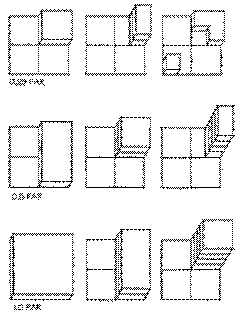
Examples of floor area ratios
Exhibit from DSP
Fluorescent colors means the range of colors created through a synthetic pigmentation process in which ultraviolet light is absorbed and emitted at a different range within the color spectrum of the individual colors. The prohibited colors are listed on the fluorescent color chart as adopted by the City, are kept on file in the Planning and Building Department. The colors shown below represent a wider range of fluorescent shades. See definition in the Downtown Specific Plan.
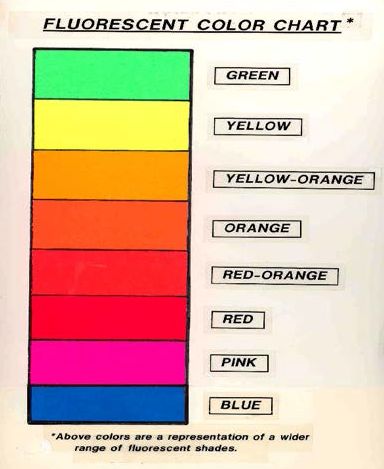
For an accurate representation of these colors see the sample board on file in the Planning and Building Department under case AM-008-945. A sample board is kept for reference at the public information counter.
Food service business. See "restaurant, food service business."
For sale, rental or lease sign. See "sign, for sale, rental or lease."
Fraternity or sorority house means a building rented, occupied or owned by a general or local chapter of some regularly organized college fraternity or sorority or by or on its behalf by a building corporation or association composed of members or alumni thereof, and occupied by members of the local chapter of such fraternity or sorority as a place of residence.
Freeway means a divided highway for through traffic with full control of access, with grade separations at all intersections and in respect to which the owners of abutting lands have no direct right or easement of access to or from their abutting land. A freeway is not a street for the purposes of this title. A road is not excluded from this definition if a toll is charged to enter or leave it. See definition in Title 18.
Freeway exit means any location along a freeway where an exit ramp or exit ramps exist.
Front lot line. See "lot line, front."
Frontage means that portion of a structure facing a public street and from that the address is normally taken. See definition in the Design Guidelines.
Frontage line. See "lot-line, front."
Frontage, building. For the purpose of calculating sign areas, "building frontage" means the linear measurement of exterior walls enclosing interior spaces that are oriented to and most nearly parallel to public streets, public alleys, parking lots, malls or freeways. See definition in the Sign Design Guidelines.
Frontage, major street means the street frontage from which the majority of the pedestrian or vehicular traffic is drawn or toward which the building or buildings are oriented for primary visual impact. Each commercial complex or shopping center shall be allowed to designate only one major street frontage. Where no single street frontage can be identified as the major street frontage, or in cases of dispute as to which street frontage is the major street frontage, the Community & Economic Development Director or his/her designee shall designate the major street frontage in conjunction with the review of proposed signs.
Frontage, secondary street means a street frontage other than a major street frontage.
Fuel systems - private (above ground tanks) means that portion of property where flammable or combustible liquids or gases used as fuel are stored and dispersed for private use.
(Ord. 7573 § 1(Exh. A), 2021; Ord. 7528 §1(Exh. A), 2020; Ord. 7520 §1(Exh. A), 2020; Ord. 7331 §128, 2016; Ord. 7158 §19, 2012; Ord. 6966 §1, 2007)
19.910.080 - "G" Definitions.
Garage, private means a completely enclosed accessory building or accessory portion of the main building used for shelter or storage of vehicles.
General Plan means the General Plan of the City of Riverside, adopted pursuant to the California Government Code Section 65301 et seq. and adopted by the Riverside City Council. See definition in the General Plan.
Glare means any brightness within the field of vision of such a character as to cause annoyance, discomfort, interference with vision, or loss in visual performance and visibility.
Granny Flat. See "accessory living quarters."
Gross acreage. See "acreage, gross."
Group housing or home means any living situation including motels and hotel buildings that are not for temporary use, that accommodates unrelated individuals, and may include but not be limited to the following types of facilities: (1) licensed alcohol and drug treatment facilities; (2) licensed board and care homes for the elderly including convalescent or rest homes and nursing homes; (3) licensed homes for minor children; (4) licensed homes for mental patients; (5) licensed homes for the developmentally disabled; and (6) single- room occupancy (SRO) projects. Group housing would typically involve a living arrangement where either support services are provided to the occupants, where cooking, living or support sanitary facilities are shared in common between the occupants or where there is a formal program establishing rules of conduct and purpose of the facility. See definition in the General Plan.
Guest house. See "accesssory - living quarters."
(Ord. 7408 §1, 2018; Ord. 7331 §128, 2016; Ord. 6966 §1, 2007)
19.910.090 - "H" Definitions.
Habitable floor area, as defined in the Building Code as currently adopted by the City.
Hardscape means decorative elements within yards that may be combined with landscaping. Hardscape includes patios, decks, fountains, walls, art work, walkways, etc. See definition in the Downtown Specific Plan.
Height, building. See "building height."
Helicraft terms means:
1.
Approach/departure path. A clear path selected for flight, extending upward and outward from the edge of the landing and take-off area.
2.
Helicopter. A rotary wing aircraft that depends for its support and motion in the air principally upon the lift generated by one or more power-driven rotors rotating on substantially vertical axis.
3.
Heliport. An area, either at ground level or elevated on a structure, that is used or intended to be used for the landing and take-off of helicopters, and includes some or all of the various facilities useful to helicopter operation such as helicopter parking, waiting room, fueling and maintenance equipment.
4.
Helistop. A heliport, either at ground level or elevated on a structure, for the landing and take-off of helicopters, but without auxiliary facilities such as waiting room, hangar, parking, maintenance or fueling equipment.
5.
Take-off/landing area. The area of the heliport where the helicopter actually lands and takes off.
6.
Temporary site. A site for helicraft take-offs and landings to be used on a limited basis not to exceed 48 hours.
Historic resources. See Title 20 for definitions and regulations.
Hobby activity means a noncommercial avocation carried on by the occupant of a dwelling as a secondary use, in connection with which there is no stock in trade nor commodities sold upon the premises, no person employed and no mechanical or business equipment used, except such as is customarily incidental to domestic uses.
Home improvement, sales, and service (hardware, lumber and building material stores)—Retail means a commercial land use consisting of any facility that caters to the general public by providing a broad range of home repair and maintenance goods like hardware, tools, plumbing and electrical goods, lumber and structural material. Those facilities that focus on a specific area like flooring, wall coverings or lumber, are excluded from this category.
Home occupation means any use of a dwelling unit and related property for employment or occupational purposes that is incidental to the residential use of the dwelling unit. The cultivation, manufacturing, distribution, transport, or sale of cannabis or cannabis products is not a permitted home occupation.
Homebrew. See "brewery, homebrew."
Homeless persons means the same as defined in Section 11302 of the federal McKinney-Vento Homeless Assistance Act (42 U.S.C. Ch. 119).
Hospital, as defined in Section 1250 California Health and Safety Code, a health care facility with a duly constituted governing body with overall administrative and professional responsibility and an organized medical staff that provides 24-hour inpatient care, including the following basic services: medical, nursing, surgical, anesthesia, laboratory, radiology, pharmacy, and dietary services.
Hospital, mental, as defined in Section 1250 California Health and Safety Code, a health facility having a duly constituted governing body with overall administrative and professional responsibility and an organized medical staff that provides 24-hour inpatient care for mentally disordered, incompetent, or other patients referred to in Division 5 (commencing with Section 5000) or Division 6 (commencing with Section 6000) of the Welfare and Institutions Code, including the following basic services: medical, nursing, rehabilitative, pharmacy, and dietary services.
Hotel/motel, adult. See 9.40.020.
Hotel/motel, long term stay means a hotel or motel designed and operated to accommodate travelers whose guest stays may exceed 30 days but no more than 180 consecutive days within a calendar year.
Hotel, transient means a facility offering transient lodging accommodations to the general public with access to guest rooms provided by interior corridors. All of the accommodations in a hotel shall be for the use of transients. For the purpose of this title, transients shall be defined as any person who exercises occupancy or is entitled to occupancy or is entitled to occupancy by reason of concession, permit, right of access, renting accommodations or by other agreement of whatever nature, for a period of 30 consecutive calendar days. Up to a maximum of five percent of the total number of units can be occupied by guests that exceed these occupancy limits at any given time. The limitations on occupancy shall not apply to hotels with National Historic Landmark status and during the existence of a public emergency or natural disaster requiring the provision of emergency public shelter. Hospitals, sanitariums or orphanages, asylums, detention homes, jails, prisons, transitional shelters/housing, bed and breakfast, group housing or similar buildings where human beings are housed or detained under legal restraint or part of a treatment or other regulated program are specifically excluded. See definition in the Downtown Specific Plan.
Household. See "single housekeeping unit."
Household hazardous waste means a waste, or combination of wastes, that because of its quantity, concentration, or physical, chemical, or infectious characteristics may do either of the following: (1) cause, or significantly contribute to, an increase in serious irreversible, or incapacitating reversible illness; (2) pose a substantial present or potential hazard to human health or environment when improperly treated, stored, transported, or otherwise managed. Household hazardous waste includes waste oil, antifreeze, paint, car/household batteries, herbicides, pesticides, solvents, and pool chemicals.
Hydrozone means a portion of a planted area where plants are grouped according to similar water need.
(Ord. 7660, § 19, 2024; Ord. 7630 § 10, 2023; Ord. 7609 § 12, 2022; Ord. 7431 § 9, 2018; Ord. 7331 §128, 2016; Ord. 7185 §6, 2012; Ord. 7071 §4, 2010; Ord. 6966 §1, 2007)
19.910.100 - "I" Definitions.
Improvement means any construction, building, paving or landscaping that materially adds to the value of a facility, substantially extends its useful life, adapts it to new uses or enhances its physical attributes. It also refers to the construction of streets and related appurtenances as noted in Title 18.
Indoor collection recycling center. See recycling center, indoor collection.
Industrial complex. See "complex, industrial."
Installed means erected, constructed, posted, painted, printed, tacked, glued, or otherwise fastened, fixed, or made visible in any manner whatsoever.
Interior lot. See "lot, interior."
Internet café. See "arcade."
Interpretive historic sign. See "sign, interpretive historic."
(Ord. 7331 §128, 2016; Ord. 6966 §1, 2007)
19.910.110 - "J" Definitions.
Junk means any scrap, waste, reclaimable material, or debris, whether or not stored or used in conjunction with dismantling, processing, salvage, storage, bailing, disposal or other use or disposition.
Junk yard. See "salvage yard."
(Ord. 7331 §128, 2016; Ord. 6966 §1, 2007)
19.910.120 - "K" Definitions.
Kennel-commercial means any public or private facility where five or more dogs are temporarily kept, boarded or trained, with payment of a fee, for the off-premises owners of such animals. This definition does not include zoos or animal hospitals operated by a veterinarian duly licensed under the law.
Kennel-residential means any building, structure, enclosure or premises located in a residential zone whereupon, or within which five or more dogs, four months of age or older, are kept or maintained only for the personal use of persons living on the premises, and shall not include commercial kennels or the boarding off-premises owners of animals.
Key lot. See "lot, key."
Kiosk means a free-standing structure upon which temporary information and/or posters, notices or announcements are posted.
Kitchen means any room used, intended or designed to be used, for cooking or the preparation of food.
(Ord. 7462, § 2(Exh. A), 2019; Ord. 7331 §128, 2016; Ord. 6966 §1, 2007)
19.910.130 - "L" Definitions.
Laboratory means a building or portion of a building that contains facilities for testing and analysis of a product, person, animal or portion thereof.
Landscaping means landscaping includes but is not limited to grasses, ground cover, trees, shrubs and/or other planting, decorative rock or bark.
Legislative means a land use decision that applies to an entire zoning district or a large number of individuals or properties or that establishes or modifies policy or procedure.
Lighted sign. See "sign, lighted."
Live/work unit means a residential occupancy, by a single housekeeping unit, or one or more rooms or floors in a building that includes: (1) cooking space and sanitary facilities in conformance with City building standards; and (2) adequate working space accessible from the living area, reserved for, and regularly used by, one or more persons residing therein. See definitions in the Downtown Specific Plan and the Design Guidelines.
Loading space means an off-street space or berth on the same lot with a building, or contiguous to a group of buildings, for the temporary parking of a commercial vehicle while loading or unloading merchandise of materials and which abuts upon a street, alley or other appropriate means of access.
Lodging house. See "boarding house."
Logistics use. See "Warehousing and distribution facility.
Logo means a graphical symbol that represents a concept, idea, or identifier.
Lot means a legally recognized parcel of land abutting on one or more streets. See definitions in the Title 18 and the General Plan.
Lot area means the total horizontal area within the lot lines of a lot, excluding any street or right-of-way area, except that in the RA-5 Zone, "lot area" includes that portion of the adjoining street or streets measured from the street centerline or centerlines.
Lot, corner means a lot situated at the intersection of two or more streets, having an angle of intersection of not more than 135 degrees.
Lot, corridor access. See "lot, flag."
Lot coverage means the area of a lot that is covered by a building(s) or structure(s), expressed as a percentage of the total lot area (excluding pools, fences, and walls). Lot coverage is measured from the exterior wall or post of the building(s) or structure(s) (including lattice, trellis, or solid roof).
Lot depth means the horizontal distance between the front and rear lot lines, measured from the midpoint of the front lot line to the midpoint of the rear lot line.
Lot, flag means a lot with access to a street by means of a corridor having less than the required lot width. The term also includes corridor access lot and panhandle lot. See definition in Title 18.
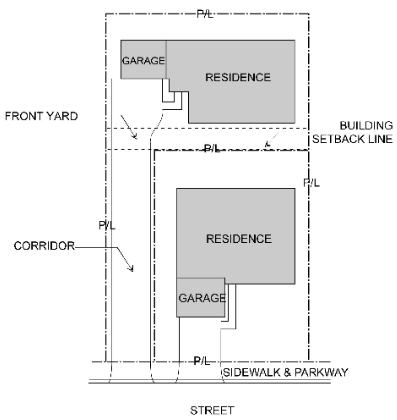
Corridor Access Lot
Lot, interior means a lot other than a corner lot.
Lot, key means the first lot to the rear of a reversed corner lot and not separated by an alley.
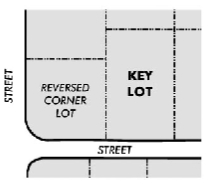
Lot, panhandle. See "lot, flag."
Lot, planned residential development (PRD) means a designated portion of or division of land, air space or combination thereof within the boundaries of a planned residential development that does not meet the definition of a lot. A PRD lot may be approved by the Approving Authority as part of a planned residential development permit. A PRD lot, if so approved, need not have frontage on a public street or otherwise comply with the requirements of the underlying zone, or Title 18, except as provided by this title.
Lot, reversed corner means a corner lot, the side street line of which is substantially a continuation of the front line of the lot line of the lot to its rear.
Lot, through means a lot having frontage on two parallel or approximately parallel streets, excluding where access has been relinquished along one of the frontages.
Lot width means the horizontal distance between the side lot lines, measured at right angles to the lot depth at the building setback line for regular lots, and the horizontal distance between the side lot lines measured by a straight line drawn at one-third the required minimum lot depth on each side lot line for cul-de-sac lots, and knuckle lots.
Lot-line means a line defining an exterior boundary of a lot.
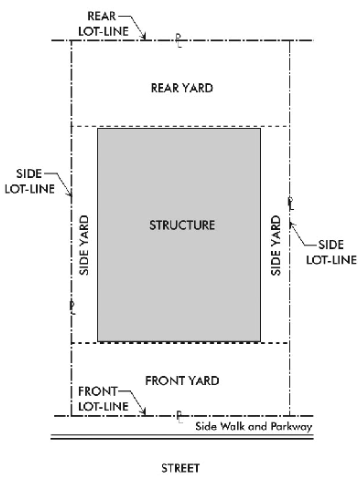
Lot-line, front means the line separating the lot from the street. In the case of a corner lot, a line separating the narrowest street frontage of the lot from the street, except in those cases where the latest tract deed restrictions specify another line as the front lot line. The Community & Economic Director may, on a case-by-case basis, identify the front lot line of corner lots based on the orientation of the dwelling, provided that the existing structure(s) comply with all applicable setbacks.
Lot-line, rear means a lot line that is opposite and most distant from the front lot line and, in the case of an irregular, triangular or gore-shaped lot, a line within the lot, parallel to and at a maximum distance from the front lot line, having a length of not less than ten feet.
Lot-line, side means any boundary line not a front lot line or a rear lot line.
Lot-line, zero. See "zero lot line."
Low barrier navigation center means a housing first, low-barrier, service-enriched shelter focused on moving people into permanent housing that provides temporary living facilities while case managers connect individuals experiencing homelessness to income, public benefits, health services, shelter, and housing.
Lower-income student means, for the purpose of determining a projects eligibility for a density bonus pursuant to Chapter 19.545, a student who has a household income and asset level that does not exceed the level for Cal Grant A or Cal Grant B award recipients as set forth Education Code Section 69432.7(k)(1). The eligibility of a student to occupy a unit for lower income students under this section shall be verified by an affidavit, award letter, or letter of eligibility provided by the institution of higher education in which the student is enrolled or by the California Student Aid Commission that the student receives or is eligible for financial aid, including an institutional grant or fee waiver from the college or university, the California Student Aid Commission, or the federal government.
(Ord. 7755, § 19, 2026; Ord. 7609 § 13, 2022; Ord. 7573 § 1(Exh. A), 2021; Ord. 7331 §128, 2016; Ord. 7027 §7, 2009; Ord. 6966 §1, 2007)
19.910.140 - "M" Definitions.
Major street frontage. See "frontage, major street."
Major transit stop has the same meaning as defined in subdivision (b) of Section 21155 of the Public Resources Code. It means a site containing an existing rail or bus rapid transit station; or the intersection of two or more major bus routes with a frequency of service interval of 15 minutes or less at the morning and afternoon peak commute hours. It also includes planned major transit stops that are included in the regional transportation plan.
Mall means a shopping center where stores front on both sides of a pedestrian way that may be enclosed or open. Malls are typically enclosed, with a climate-controlled walkway between two facing strips of stores. The term represents the most common design mode for regional and superregional centers and has become an informal term for these types of centers. Any concentration of retail stores or service establishments that share customer-parking areas and are located within an enclosure having public walkways whereby a customer in one store or establishment may walk to another store or establishment without leaving the enclosure. For purposes of Chapter 19.620 (General Sign Provisions) and Chapter 19.625 (Private Party Signs on City-Owned Property and the Public Right-of-Way) a mall is defined as an open area located adjacent to urban buildings and designed primarily for pedestrian traffic, featuring walkways, trees and shrubs, and places to sit.
Mansard roof means a sloped, decorative roof element attached to the face of a building wall. See definitions in the Design and Sign Design Guidelines.
Manufacture means to assemble, fabricate, compound, treat, etc. in order to produce something.
Manufactured dwelling unit: Manufactured home. See "dwelling unit, manufactured and dwelling unit, accessory dwelling unit for incidental uses."
Marijuana. See "cannabis."
Massing means the unified composition of a structure's volume, affecting the perception of density and bulk. See definition in the Downtown Specific Plan.
Material processing facility (MPF) means a facility where source separated (presorted) recyclable materials are further sorted and separated, then bulked or converted for reprocessing, by hand or by use of machinery.
Material recovery facility (MRF) means a solid waste facility where mixed municipal solid waste is sorted or separated, by hand or by use of machinery, for the purpose of recovering recyclable materials.
Message center sign, electronic. See "sign, electronic message center."
Message commercial means a message on a sign that pertains primarily to the economic interests of the sign sponsor and/or the viewing audience. Such messages typically concern proposals for economic transactions and/or the engagement of professional services. (Contrast: non-commercial messages.)
Message non-commercial means a message displayed on a sign that does not qualify as commercial. By way of example only and not limitation, such messages typically concern debatable matters of public concern, such as expression on religion, politics and social commentary. (Contrast: commercial message.)
Microbrewery. See "brewery, microbrewery."
Mini-mart. See "store, mini-mart."
Mini-warehouse. See "commercial storage."
Mixed use development means a single building containing more than one type of land use or a single development of more than one building and use, where the different types of land uses are in close proximity, planned as a unified complementary whole, and functionally integrated to the use of shared vehicular and pedestrian access and parking areas. See definitions in the General Plan, Design Guidelines and Downtown Specific Plan.
Mobile home means a State licensed or registered moveable or transportable vehicle, other than a motor vehicle, designed as a permanent structure intended for occupancy by one family, and having no foundation other than jacks, piers, wheels or skirtings in accordance with applicable standards and meeting the requirements of the California Department of Housing and Community Development.
Mobile home, building line means a line parallel with the front mobile home space line or access drive and distance therefrom the depth of the required front yard.
Mobile home park means a lot or contiguous group of lots intended for residential use where residence is in mobile homes exclusively or where ownership is by condominium association, in lieu of mobile homes, said development is occupied exclusively by factory-built dwellings approved by the State of California and established on permanent foundations.
Mobile home, space means a plot of ground within a mobile home park abutting one or more access drives, designed for the accommodation of one mobile home.
Mobile medical unit means medical equipment contained within a van, motorized coach or trailer capable of being transported from place to place.
Mobile recycling unit. See "recycling unit, mobile."
Model homes means an unoccupied residential unit in a residential subdivision, typically located in a residential structure ultimately planned for sale as part of the subdivision, used for the temporary marketing and sales of homes within the subdivision. Attached condominium and townhouse units may also be used as a model home.
Modulation means a stepping back or projecting forward of portions of a building face within specified intervals of building width and depth, as a means of breaking up the apparent bulk of a structure's continuous exterior walls.
Monitored electrified security fence system means a perimeter alarm system that transmits a signal intended to alert the business utilizing the system and/or an alarm monitoring service in response to an intrusion or burglary with an assembly of battery powered equipment, including but not limited to:
1.
A monitored alarm device and energizer which is intended to periodically deliver pulses to a security fence;
2.
A battery charging device used exclusively to charge the system's battery; and
3.
Other integrated components.
Monument sign. See "sign, monument."
Motel, long term stay. See "hotel/motel, long term stay."
Motel, transient means a facility offering transient lodging accommodations to the general public with access to guest rooms provided by exterior walkways. All of the accommodations in a motel shall be for the use of transients. For the purposes of this title, transients shall be defined as any person who exercises occupancy or is entitled to occupancy by reason of concession, permit, right of access, renting accommodations of by other agreement of whatever nature, for a period of 30 consecutive calendar days or less, or a total of no more than 60 calendar days within a 180 consecutive calendar day period. Up to a maximum of five percent of the total number of rooms can be occupied by guests that exceed these occupancy limits at any given time. The limitations on occupancy shall not apply during the existence of a public emergency or natural disaster requiring the provision of emergency public shelter. Hospitals, sanitariums or orphanages, asylums, detention homes, jails, prisons, transitional shelters/housing, group housing or similar buildings where human beings are housed or detained under legal restraint or part of a treatment or other regulated program are specifically excluded. See definition in the Downtown Specific Plan.
Multi-family dwelling unit. See "dwelling unit, multi-family."
Multi-tenant indoor sales center means any store where merchandise is offered or displayed for sale or exchange and in which the sales area has been subdivided to allow for individual sales booths that are available for lease to individual tenants. For purposes of this definition, areas bounded by permanent floor-to-ceiling walls or windows, in which all entryways are capable of being closed and locked, shall be considered separate stores and not subdivisions of one store. No store in which one vendor occupies at least 80 percent of the floor area used for sale of goods shall be considered a multi-tenant indoor sales center. For purposes of this definition, a vendor is each person offering goods for sale in a store who is subject to a permit from the State Board of Equalization to engage in or conduct business as a seller at that store. Each such vendor shall be deemed a tenant in that store. The term multi-tenant indoor sales center is interchangeable with and applicable to flea markets, swap meets or other similarly named or labeled activities; but the term does not include the usual grocery supermarket operations, antique malls, second hand/thrift stores or department stores.
Multi-tenant site. See "center, multi-tenant site or center."
Mural means a commissioned artistic rendering that does not in any way advertise a product, service or business logo or contain copy that includes a business name or logo. See definition in the Sign Design Guidelines.
(Ord. 7630 § 11, 2023; Ord. 7617 § 3, 2022; Ord. 7609 § 14, 2022; Ord. 7528 §1(Exh. A), 2020; Ord. 7520 §1(Exh. A), 2020; Ord. 7431 § 10, 2018; Ord. 7331 §128, 2016; Ord. 7316 §3. 2016; Ord. 7185 §7, 2012; Ord. 7105 §8. 2010; Ord. 6966 §1, 2007)
19.910.150 - "N" Definitions.
Neon sign. See "sign, neon."
Net acreage. See "acreage, net."
Nightclub means an establishment characterized by any or all of the following as a principal use: (1) live, recorded or televised entertainment including, but not limited to, performance by magicians, musicians or comedians; (2) dancing. "Nightclub" does not include activities associated with another primary permitted use such as a bar or restaurant subject to the provisions of Chapter 5.80 (Entertainment Permit).
Non-commercial message. See "message, non-commercial."
Non-commercial sign. See "sign, non-commercial."
Non-commercial speech. See "message, non-commercial."
Non-conforming lot means a lawfully established parcel of land that does not conform with the current standards of the zone in which it is located, including lot area, lot width and lot depth.
Nonconforming structure means a lawfully built structure that does not conform with current standards of the zone in which it is located, including front setback, side setback, rear setback, height, coverage, distances between structures and parking facilities.
Nonconforming use means a lawfully established use of a building or land, that use was lawfully established, but that does not conform to the current regulations. See definition in the General Plan.
Nuisance means an act or condition, when performed or existing upon a parcel of land or structure, that is considered dangerous or potentially dangerous to public health, safety or welfare, degrades the appearance and value of surrounding properties or can cause damage to public rights-of-way.
(Ord. 7505 § 1(Exh. A), 2020; Ord. 7331 §128, 2016; Ord. 6966 §1, 2007)
19.910.160 - "O" Definitions.
Off-premises sign. See "sign, off-premises."
Office complex. See "complex, office."
On-premises sign. See "sign, on-premises."
One-hundred-year flood means the highest level of flooding that, on the average, is likely to occur once every 100 years. The term also means that level of flooding having a one percent chance of occurring each year.
Open space, common usable. See "common usable open space."
Open space, private usable. See "private usable open space."
Orchard. See "farm."
Outdoor dining means dining facilities consisting of tables, chairs and similar furniture located out-of-doors.
Outdoor display of incidental plant material means live plant materials displayed outdoors in conjunction with a primary business.
Outdoor food preparation means food preparation facilities consisting of equipment for the cooking of food and preparation located out-of-doors adjacent to an indoor eating establishment.
Outdoor sales means the display and sales of products or services primarily outside a structure and limited to those items generally stored, used and/or inspected outdoors.
Outdoor sales display means an outdoor arrangement of objects, items, products or other materials, typically not in a fixed position and capable of rearrangement, designed and used for the purpose of advertising or identifying a business, product or service.
Outdoor storage means an outdoor arrangement of objects, items, products or other materials, typically not in a fixed position and capable of rearrangement. (See also Storage Yard).
(Ord. 7331 §128, 2016; Ord. 7235 §24, 2013; Ord. 6966 §1, 2007)
19.910.170 - "P" Definitions.
Pad, building. See "building pad."
Painted sign. See "sign, painted."
Panhandle lot. See "lot, flag."
Parapet wall means the portion of the exterior building wall that extends entirely above the roof line. See definitions in the Design Guidelines and the Downtown Specific Plan.
Parking area, public means an open area, other than a street, alley or place, used for the temporary parking of more than four vehicles and available for public use whether free, for compensation, or as an accommodation for clients or customers.
Parking garage means a structure or building designed and maintained exclusively for the temporary parking or storage of more than four vehicles and available for public use, whether free, for compensation, or as an accommodation for clients or customers.
Parking lot sale means outdoor sale, conducted by the proprietor, of products normally sold inside a retail establishment on the property.
Parking space, vehicle means an off-street space available for the parking of one motor vehicle conforming to the typical parking lot standards.
Parolee means an individual as follows:
A.
Convicted of a federal crime, sentenced to a United States federal prison, and received conditional and revocable release in the community under the supervision of a federal probation/parole officer; or
B.
Who is serving a period of supervised community custody as defined by State Penal Code 3000, following a term of imprisonment in a State prison or County jail, and is under the jurisdiction of the California Department of Corrections, Division of Adult Parole Operations; or
C.
An adult or juvenile individual sentenced to a term in the California Youth Authority and received conditional and revocable release in the community under the supervision of a Youth Authority parole officer; or
D.
An adult or juvenile offender released from county jail or state prison after October 1, 2011, on Post Release Community Supervision.
Parolee/probationer home means any residential structure or unit, including any hotel or motel except as provided herein, whether owned and/or operated by an individual or for-profit or non-profit entity, that houses two or more parolees/probationers, unrelated by blood, marriage, or legal adoption, in exchange for monetary or non-monetary consideration given and/or paid by the parolee/probationer and/or any individual or public/private entity on behalf of the parolee/probationer, excluding parolees/probationers who reside in alcohol and/or drug free recovery home as defined in this title. Notwithstanding this definition or any other provision of the Riverside Municipal Code, hotels and motels with 14 rooms or less cannot provide transient lodging services or accommodations to more than three parolees during any 30 consecutive-day period regardless of the length of their respective stays; and hotels and motels with 15 rooms or more cannot provide transient lodging services or accommodation to more than five parolees during any 30 consecutive-day period regardless of the length of their respective stays.
Pawn shop means an establishment wherein the business of a pawnbroker is conducted. A pawnbroker shall be any person who lends or advances money or other things for profit on the pledge and possession of personal property, or other valuable things, other than securities or written or printed evidences of indebtedness; or, who deals in the purchasing of personal property or other valuable things on condition of selling the same back to the seller at a stipulated price.
Pedestrian Mall is established and is described as follows: Main Street between the southerly line of Sixth Street and the northerly line of Tenth Street but excluding from the mall the intersections of Main Street with Mission Inn Avenue (formerly known as Seventh Street), University Avenue (formerly known as Eighth Street), and excluding from the mall Ninth Street. See definition in the Sign Design Guidelines. (Ordinance No. 6929)
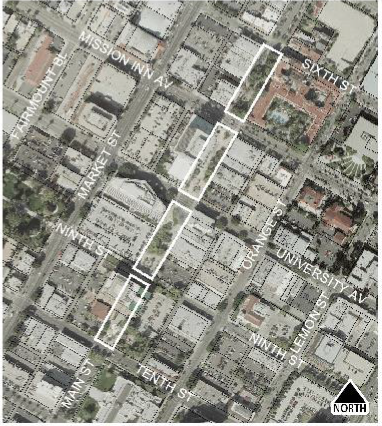
Pedestrian Mall sidewalk sign. See "sign, Pedestrian Mall sidewalk."
Pennant. See "sign, pennant."
Permit means a document issued by the Planning and Building Department allowing a person to begin an activity provided for in the Zoning Code.
Personal services means establishments providing nonmedically related services, including but not limited to beauty and barber shops; hair stylists; estheticians; pet grooming; dry cleaning pick-up stores; self-service laundry; massage; shoe repair shops; tailoring; tanning salons; and tattoo and body piercing parlors. These uses may also include accessory retail sales of products related to the services provided.
Planned residential development means two or more dwelling units together with related land, buildings and structures planned and developed as a whole in a single development or a programmed series of developments that require discretionary approval and involve the creation of a Home Owners Association to provide for maintenance of common facilities within the development in accordance with the requirements of Chapter 19.780.
Plant nursery means any site or facility where nursery plants and related gardening materials and supplies are sold within a defined, approved, physically enclosed area.
Plant nursery, wholesale means a business whose primary purpose is the growing, propagation and storage of plants, typically in containers, for sale to other businesses for resale. Incidental uses may include an office, caretaker's unit, storage buildings, shade houses, green houses, irrigation materials, reservoirs, soil and related materials, containers for potting, and vehicles needed to move materials from one location to another.
Play areas incidental to a restaurant means an improved and equipped area for small children to play in.
Plot plan. See "site plan."
Pole sign. See "sign, pole."
Political sign. See "sign, political."
Portable sign. See "sign, portable."
Post release community supervision parolee. See "parolee."
Principal, building means a building in which the primary use of the lot on which the building is located is conducted.
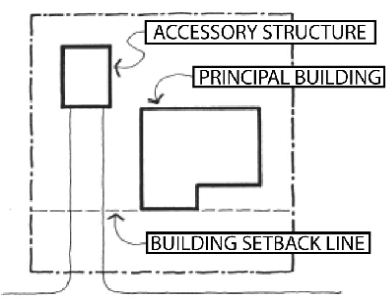
Private usable open space means open areas devoted exclusively to the private recreation and leisure use of one dwelling unit, contiguous to the unit, delineated by a wall, fence, or as otherwise approved.
Probationer means a person who has been convicted of a felony or misdemeanor and who has received a suspension in the imposition or execution of their sentence and has received conditional and revocable release in the community under the supervision of a probationer officer, as provided under California Penal Code Section 1203 or any successor provision thereof.
Projecting sign. See "sign, projecting."
Projection means the distance as established by this Code by which a sign extends beyond the building wall or the street property line. See definition in the sign Design Guidelines.
Public property means land or other property owned by the City, or in that City holds the present right of possession or control, or land or other property that the City holds in trust, as well as all public rights-of-way.
Public, right-of-way. See "right-of-way."
Public use of public property means the use of property owned by a government entity for any governmental purpose or for any activity available to the public, including any recreational, civic, educational, cultural, or public utility use.
Pumpkin sales lot means a retail sales operation, generally conducted wholly outdoors, that offers for sale on a temporary, limited basis, pumpkins and related holiday items.
(Ord. No. 7701, § 51, 2025; Ord. 7652 § 15, 2023; Ord. 7505 § 1(Exh. A), 2020; Ord. 7408 §1, 2018; Ord. 7331 §128, 2016; Ord. 7158 §20, 2012; Ord. 6966 §1, 2007)
19.910.180 - "Q" Definitions.
Quasi-judicial (discretionary). See "discretionary decision."
(Ord. 7331 §128, 2016; Ord. 6966 §1, 2007)
19.910.190 - "R" Definitions.
Readerboard sign. See "sign, readerboard."
Real estate sign. See "sign, real estate."
Rear lot line. See "lot line, rear."
Recreational vehicle. See "vehicle, recreational."
Recycle means the process of collecting, sorting, cleansing, treating and reconstituting materials that would otherwise become solid waste, and return them to the economic mainstream in the form of raw material for new, reused, or reconstituted products that meet the quality standards necessary to be used in the marketplace.
Recycling center, buy-back means a facility that pays a fee for the delivery and transfer of ownership to the facility of source separated materials for the purpose of recycling or composting.
Recycling center, California beverage container means a facility designed to only recycle California beverage containers (e.g., reverse vending machines).
Recycling center, drop-off means a facility that accepts delivery or transfer of ownership of source separated materials for the purpose of recycling or composting without paying a fee.
Recycling center, indoor collection means a beverage container recycling facility located within a completely enclosed building operating solely for the purpose of collecting, sorting, temporarily storing and redeeming beverage containers as defined by this title.
Recycling facility, beverage container means a site where beverage containers as defined in this title may be redeemed for cash or other compensation. Said facility may be a reverse vending machine(s), mobile recycling unit or indoor collection center.
Recycling unit, mobile means a properly licensed automobile, truck, trailer or van that is used for the collection of recyclable beverage containers. Also included in this definition are bins, boxes or containers transportable by said vehicles.
Religious assembly means a use located in a permanent building and providing regular organized religious worship and related incidental activities, except primary or secondary schools and day care facilities. See also "assemblies of people—non-entertainment."
Rental of rooms means the rental of a room or rooms in a single family residence/dwelling for occupancy of not more than four individuals per single family residence/dwelling.
Residential care facility. See "group housing or home."
Rest home. See "convalescent home."
Restaurant, sit down means an establishment maintained, operated and/or advertised or held out to the public as a place where food and beverage are prepared on-site and served to the public on demand from a menu during stated business hours, to be consumed on the premises primarily inside the building at tables, booths or counters, with chairs, benches or stools.
Restaurant, take-out means a facility that sells prepared food from inside a building for consumption primarily off the site.
Retail sales means a commercial enterprise that provides goods and/or services directly to the consumer, where such goods are normally available for immediate purchase and removal from the premises by the purchaser.
Reverse vending machine means an automated mechanical device that accepts one or more types of empty beverage containers including but not limited to aluminum cans, glass and plastic bottles and issues a cash refund or redeemable credit voucher for not less than the redemption value of the container as determined by the state. A reverse vending machine may sort and process containers mechanically provided the entire process is enclosed within the machine.
Reverse vending machine, bulk type means a reverse vending machine occupying more than 50 square feet or a group of two or more machines occupying an aggregate of 100 square feet or more or a single machine or group of machines having an overall height of ten feet or more.
Reversed corner lot. See "lot, reversed corner."
Riding Stable and Academy means any place where horses and ponies, not to exceed the number allowed in the base zone, are boarded, cared for, or hired for riding or instruction.
Right-of-way, public means any place that is dedicated to use by the public for pedestrian and vehicular travel, and includes, but is not limited to, a street, sidewalk, curb, gutter. Crossing, intersection, parkway, median, highway, alley, lane, mall, court, way, avenue, boulevard, road, roadway, viaduct, subway, tunnel, bridge, thoroughfare, park square and other similar public way. See definitions in Title 18 and the General Plan.
Roof means the cover of any building, including the eaves and similar projections.
Roof line means in the case of a flat roof, the uppermost line of the roof of a building; in the case of a pitched roof, the lower edge of the eave; or in the case of an extended facade or parapet, the uppermost height of the said facade or parapet.
Roof sign. See "sign, roof."
(Ord. 7487 § 27, 11-5-2019; Ord. 7331 §128, 2016; Ord. 6966 §1, 2007)
19.910.200 - "S" Definitions.
Saloon. See "bar."
Salvage yard means any area, lot, parcel, building, or part thereof used for the storage, collection, processing, purchase, sale, or abandonment or wastepaper, rags, scrap metal, or other scrap or discarded materials, machinery, or other types of junk. Such uses include baling of cardboard and other paper materials.
Scale means proportionate size judged in relation to an external point of reference. See definition in the Downtown Specific Plan.
School means any institution of learning for minors, whether public or private, offering instruction in those courses of study required by the California Education Code and maintained pursuant to standards set by the State Board of Education. This definition includes a kindergarten, elementary school, middle or junior high school, senior high school, or any special institution of education, but it does not include a vocational or professional institution of higher education, including a community or junior college, or university. This definition does not include any day care center or family day care home, regardless of size (see separate definitions for all day care facilities).
School, professional institution of higher education means a post-secondary institution for higher learning that grants associate or bachelor degrees and may also have research facilities and/or professional schools that grant master and doctoral degrees. This may also include community colleges that grant associate or bachelor degrees or certificates of completion in business or technical fields.
School, vocational means a specialized instructional establishment that provides on-site training of business, commercial and/or trade skills such as accounting, data processing and computer repair. This classification excludes establishments providing training in an activity that is not otherwise permitted in the zone. Incidental instructional services in conjunction with another primary use shall not be considered a business and trade school.
Secondary street frontage. See "frontage, secondary street."
Secondhand store means a retail or wholesale business in which the largest portion of merchandise is used. This classification does not include secondhand motor vehicle parts or accessories.
Semi-public means a use owned or operated by a private non-profit, religious or charitable institution that provides educational, cultural, recreational, religious or similar types of programs to the general public.
Senior housing means a housing facility or development the occupancy of which is limited to persons 55 years of age or older pursuant to Section 51.3 of the California Civil Code.
Sensitive receptor means a residential zone or use; K-12 public, private and charter school; designated parks and open space; adult and child day care facilities; assisted living facilities, nursing homes, hospices and hospitals. Sensitive receptor shall be consistent with California Government Code § 65098.
Separate interest. Has the following meanings:
1.
In a community apartment project, "separate interest" means the exclusive right to occupy an apartment, as specified in 19.790 subdivision (d).
2.
In a condominium project, "separate interest" means an individual unit, as specified in 19.790 subdivision (f).
3.
In a planned development, "separate interest" means a separately owned lot, parcel, area or space.
4.
In a stock cooperative, "separate interest" means the exclusive right to occupy a portion of the real property, as specified in 19.790 subdivision (m).
Unless the declaration or condominium plan, if any exists, otherwise provides, if walls, floors, or ceilings are designated as boundaries of a separate interest, the interior surfaces of the perimeter walls, floors, ceilings, windows, doors and outlets located within the separate interest are part of the separate interest and any other portions of the walls, floors or ceilings are part of the common areas.
The estate in a separate interest may be a fee, a life estate, an estate for years, or any combination of the foregoing.
Service station. See "vehicle fuel station."
Setback means the distance from a defined point or line governing the placement of buildings, structures, parking or uses on a lot. See definition in the General Plan.
Setback building line, front means a line parallel with the front lot line or planned street line and located at the required front yard setback for regular lots and a line parallel with the street measured one third the lot depth back for cul-de-sac lots and knuckle lots.
Setback building line, rear means a line parallel with the front lot line or planned street line and located at the required rear yard setback.
Setback, building line, side means a line parallel with the front lot line or planned street line and located at the required side yard setback.
Shared parking means the provision that two or more uses that are within close proximity may share parking facilities to fulfill their individual parking requirements because their prime operational hours do not overlap.
Shelters, emergency. Has the same meaning as defined in subdivision C of Section 50801 of the Health and Safety Code except as allowed with a Temporary Use Permit with assemblies of people—non-entertainment.
Shopping center. Same as "complex, commercial."
Short-term rental, as regulated in Title 5 of the Riverside Municipal Code, means the rental of a dwelling, or a portion thereof, by the owner to another person or group of persons for occupancy, dwelling, lodging or sleeping purposes for a period of less than 30 consecutive calendar days. The rental of units within city-approved hotels, motels, and bed-and-breakfast inns shall not be considered to be a short-term rental.
Showroom means an area for the display of goods/merchandise in conjunction with a permitted use on the site.
Side lot line. See "lot line, side."
Sign. See Chapter 19.620 - General Sign Provisions, Section 19.620.150 Definitions for sign definitions.
Single-family, attached, dwelling unit. See "dwelling unit, single family, attached."
Single-family, detached, dwelling unit. See "dwelling unit, single family, detached."
Single-family dwelling unit. See "dwelling unit, single family."
Single housekeeping unit means one household where all the members have common access to and common use of all living, kitchen, and eating areas within the dwelling unit, and household activities and responsibilities such as meals, chores, expenses, and maintenance of the premises are shared or carried out according to a household plan or other customary method. If all or part of the dwelling unit is rented, the lessees must jointly occupy the unit under a single rental agreement or lease, either written or oral, or implied with an owner; an owner's agent, representative or manager or family thereof is in residence.
Single room occupancy means a multi-unit housing development for very low income persons that typically consists of a single room and shared bath, also may include a shared common kitchen and common activity area.
Site means a parcel of land used or intended for one use or a group of uses and having frontage on a public or an approved private street. A lot. See definition in the General Plan.
Site, building means the ground area of a building or group of buildings together with all open spaces as required by this title.
Site plan means a plan drawn to scale, showing uses and structures proposed for a property.
Smart growth can be defined as, but not limited to, seeking to identify a common ground where developers, environmentalists, public officials, citizens and financiers can find ways to accommodate growth. It promotes compact, mixed-use urban-style development that offers a high-quality living and working environment and encourages a choice of travel mode - walking, cycling and transit, while protecting environmental features and resources.
Smoke shops/tobacco stores means a business with sales of tobacco, either loose or prepared as cigarettes and products for the smoking of tobacco constituting more than 30 percent of gross sales and/or 30 percent of net lease area.
Solid waste means all putrescible and non-putrescible solid, semi-solid, and liquid wastes, including garbage, trash, refuse, paper, rubbish, ashes, industrial wastes, demolition and construction wastes, abandoned vehicles and parts thereof, discarded home and industrial appliances, dewatered, treated, or chemically fixed sewage sludge that is not hazardous waste, manure, vegetable or animal solid and semi-solid wastes, and other discarded solid and semi-solid wastes. See definition in the General Plan.
Sorority house. See "Fraternity or sorority house."
Spandrel sign. See "sign, Spandrel."
Special boulevard means a boulevard so designated by the City of Riverside General Plan Circulation Element Map, Figure CCM-4, "Master of Plan Roadways".
Specific plan means a tool authorized by Government Code §65450, et. seq. for systematic implementation of the General Plan for a defined portion of a community's planning area. A specific plan must specify in detail the land uses, public and private facilities needed to support the land uses, phasing of development and use of natural resources and a program of implementation measures, including financial measures pursuant to Government Code 65451. See definition in Title 18.
Stable, private means a detached accessory building for the keeping of horses owned by the occupants of the premises and not kept for remuneration, hire or sale.
Stable, public means a stable other than a private stable.
Statuary means a three-dimensional representation of a person, animal or object produced by sculpturing, modeling, casting or other means.
Stealth wireless telecommunication facility. See "Wireless telecommunication facilities—Stealth facility."
Stock cooperative means a development in which a corporation hold Title to, either in fee simple or for a term of years, improved real property, a majority of the shareholders of the corporation receive a right of exclusive occupancy in a portion of the real property. The owners' interest in the corporation, whether evidenced by a share of stock, a certificate of membership, or otherwise, shall be deemed to be an interest in a common interest development and a real estate development for purposes of subdivision (f) of Section 25100 of the Corporations Code.
A "stock cooperative" includes a limited equity housing cooperative that is a stock cooperative that meets the criteria of Section 33007.5 of the Health and Safety Code. See definition in Title 18.
Storage yard means an area where work tools, scrap materials, etc. used in the repair and maintenance of equipment commonly used in individual types of manufacturing or maintenance business are stored, whether inside or outside. Storage yards may also include buildings or structures for uses such as offices and repair facilities.
Store, department means a retail facility that sells clothing, appliances, furniture or other household items through a variety of separate departments, owned by a single corporate entity and operated entirely within one building or structure as one commercial use.
Store, mini-mart means a retail establishment that provides a limited volume and variety of commonly consumed goods and intended to provide quick service.
Story, building means a space in a building between the surface of any floor and the surface of the next floor above, or if there is no floor above, the space between such floor and the ceiling or roof above; provided, however, where the ceiling of the first floor level is four feet or less above the elevation of the lowest point of the land surface at the structure perimeter, the space shall be considered a basement (see basement).
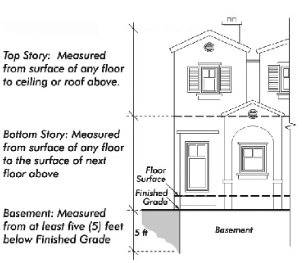
Street means a public or City approved private way designed primarily for vehicular traffic, whether designated as a street, arterial, highway, thoroughfare, road, avenue, boulevard, lane, place or other designation, but not including an alley. See definition in Title 18.
Street line means the boundary line between a street and abutting property.
Street, side means that street bounding a corner lot and which is generally parallel to the side lot line.
Structural alterations. See "Building Code as adopted by the City."
Structure. See "Building Code as adopted by the City."
Structure, nonconforming. See "nonconforming structure."
Student housing means a structure specifically designed for a long-term stay by students of a college or university for the purposes of providing rooms for sleeping purposes.
Studio unit means a dwelling unit consisting of one room with kitchen facilities and with a private bath designated for occupancy by one household.
Sub-district means one of the five defined areas on the zoning map regulated as part of the Innovation District Overlay Zone, IE, EE, HE, ET, and CS.
Subdivision means the division of any improved or unimproved land, shown on the latest equalized County assessment roll as a unit or as contiguous units, for the purpose of sale, lease or financing, whether immediate or future. Property shall be considered as contiguous units even if it is separated by roads, streets, utility easements or railroad rights-of-way. "Subdivision" includes a condominium project, as defined in Section 1350 of the California Civil Code, or a community apartment project, as defined in Section 11004 of the California Business and Professions Code. Any conveyance of land to a governmental agency, public entity or public utility shall not be considered a division of land for purposes of computing the number of parcels. "Subdivision" shall not include the financing or leasing of apartments, offices, stores or similar space within apartment buildings, industrial buildings, commercial buildings, mobile home parks or trailer parks; mineral, oil or gas leases; or land dedicated for cemetery purposes under the Health and Safety Code of the State.
For purposes of Chapter 19.620 (General Sign Provisions) and Chapter 19.625 (Private Party Signs on City-Owned Property and the Public Right-of-Way) a subdivision is all lots under a parent subdivision number. In the case of a phased subdivision, all phases combined under the parent number are considered to be a single subdivision. See definitions in Title 18 and the General Plan.
Subdivision sales trailer means temporary sales office on a property whereon a final map has been lawfully issued to construct a permanent building. The temporary quarters may be used for construction office may be situated in a trailer, motor home or mobile home.
Substantial improvement means any repair, reconstruction or improvement of a structure, the cost of which equals or exceeds 50 percent of the actual cash value of the structure either:
A.
Before the improvement is started; or
B.
If the structure has been damaged and is being restored, before the damage occurred.
Substantial improvement is started when the first alteration of any structural part of the building commences.
Supportive housing. Has the same meaning as defined in subdivision (b) of Section 50675.14 of the Health and Safety Code.
(Ord. 7755, § 20, 2026; Ord. 7573 § 1(Exh. A), 2021; Ord. 7528 §1(Exh. A), 2020; Ord. 7520 § 1(Exh. A), 2020; Ord. 7505 § 2(Exh. B), 2020; Ord. 7408 § 1, 2018; Ord. 7331 § 128, 2016; Ord. 7300 § 2, 2015; Ord. 7158 § 21, 2012; Ord. 7105 § 9, 2010; Ord. 7064 § 11, 2010; Ord. 7027 § 8, 2009; Ord. 6966 § 1, 2007)
19.910.210 - "T" Definitions.
Tattoo/body piercing parlor. See "personal services."
Tattooing means to insert a pigment under the surface of the skin of a human being, by pricking with a needle or otherwise, to produce an indelible mark resulting in a design, picture or words visible through the skin. Tattooing does not include those services performed by a physician licensed in the State of California to perform this type of work or beauty salons/spas that perform incidental permanent cosmetic procedures, limited to the application of permanent eyeliner, eye shadow, eyebrows and lip color.
Tavern. See "bar."
Telecommuting means the act of an individual conducting any business activity from the individual's usual place of residence via telephone, computer, modem, facsimile machine and/or similar means of communication in the capacity of an employee where the employer's business is regularly conducted from a location other than the individual's place of residence.
Telephone, outdoor pay means a telephone for hire located on private property, not within a building used for additional purposes with controlled access by means of a door or doors that may be locked.
Temporary use means a land use of short duration, either indoor or outdoor, for commercial or noncommercial purposes, that is not specifically permitted in the zoning district in which the property is located, but which by general community consensus is an acceptable activity due to its close relationship to a permitted use, its positive effect on public health, safety or welfare and/or its close relationship with the social or cultural fabric of the City and may be permitted with a temporary use permit.
Thrift store means an establishment primarily engaged in the sale of used clothing, household goods, furniture or appliances. This definition does not include antique stores.
Through lot. See "lot, through."
Tiny home (chassis). See mobile home.
Tiny home community means a group of tiny homes, constructed either on a chassis or on a foundation, that are arranged in common relationship to one another, usually surrounding a shared common open space area.
Tiny home (foundation) means a dwelling unit that is factory or site-built on a permanent foundation in accordance with applicable building codes, laws and standards.
Total units means, for the purpose of determining eligibility for a density bonus, the number of dwelling units in a residential development project, excluding the density bonus dwelling units awarded pursuant to Chapter 19.545 or any other applicable law or ordinance granting a greater density bonus.
Townhouse means a dwelling unit occupying its own lot, but which is physically attached to at least one other dwelling unit. See definition in the General Plan.
Traffic pattern modification means a modification that occurs when an existing roadway traffic flow and/or speed is changed by such means as one-way streets, raised medians, speed humps or terminated through means of a cul-de-sac.
Transfer station means a collection and transportation facility used by persons and route collection vehicles to deposit collected solid waste from off-site into a larger transfer vehicle for transport to a solid waste handling facility. Transfer stations may also include recycling facilities.
Transitional foster youth means the same as defined in section 66025.9 of the Education Code.
Transitional housing and transitional housing development. Has the same meaning as defined in subdivision (h) of Section 50675.2 of the Health and Safety Code.
Trash. See "solid waste."
Truck and Trailer Storage means the storage or parking of any truck and/or towable trailer designed primarily for transportation of goods for extended periods of time as a primary use. For the purposes of this title, truck and trailer storage shall not include trucks or trailers parked or stored incidentally to another primary permitted land use i.e., manufacturing, warehousing, etc.
Tutoring center means a tutoring center is an educationally oriented facility that provides personalized academic assistance on a relatively high teacher to student ratio. The facilities themselves are not schools.
(Ord. 7652 § 16, 2023; Ord. 7609 § 15, 2022; Ord. 7592 § 12(Exh. M), 2022; Ord. 7528 § 1(Exh. A), 2020; Ord. 7520 § 1(Exh. A), 2020; Ord. 7408 § 1, 2018; Ord. 7331 § 128, 2016; Ord. 7064 § 12, 2010; Ord. 6966 § 1, 2007)
19.910.220 - "U" Definitions.
University. See "school, professional institution of higher education."
Unobstructed access means a resident is able to access a major transit stop without encountering natural or constructed impediments, which include, but are not limited to, freeways, rivers, mountains, and bodies of water, but do not include residential structures, shopping centers, parking lots, or rails used for transit.
Urban lot split means a subdivision as defined by Chapter 18.260 (Definitions) of the Subdivision Code, pursuant to Section 66411.7 of the California Government Code.
Use means the purpose for which land or a building is designed, arranged, or intended, or for which the land or building may be occupied or maintained. See definition in the General Plan.
Use, nonconforming. See "nonconforming use."
(Ord. 7609 § 16, 2022; Ord. 7592 § 12(Exh. M), 2022; Ord. 7331 § 128, 2016; Ord. 6966 § 1, 2007)
19.910.230 - "V" Definitions.
Vapor recovery operations means an operation for cleaning up fuel-contaminated soils.
Variance, pursuant to Section 65906 of the Government Code, a land use action that allows for deviation from the terms of the Zoning Code under specified conditions and specifically, when, because of special circumstances applicable to a property, including size, shape, topography, location, or surroundings, the strict application of the Zoning Code would deprive that property of privileges enjoyed by other property in the vicinity and under identical zoning classification.
Vehicle means any self-propelled or towable (trailer) unit designed primarily for transportation of persons or goods on land, water or air.
Vehicle fuel station means vehicle fuel stations, include outdoor fuel dispensing and indoor facilities for lubrication, battery and brake service, tire repair, minor adjustments and repair, and the sale of food, non-alcoholic beverages, beer, wine and sundry items of convenience to the motorist, but excluding painting, body work, steam cleaning, major repairs, mechanical washing facilities, utility truck or trailer rental.
Vehicle impound or tow yard means an open area used exclusively for the storage of automobiles, motor vehicles and recreational vehicles impounded or towed pursuant to order of a public law enforcement agency or insurance organization licensed to conduct business in the State, and stored for the purposes of law enforcement investigation, insurance investigation, title clearance and transfer and/or litigation. This definition does not include the dismantling or disassembly of vehicles except pursuant to litigation, the sale of vehicle parts nor the storage of non-impounded vehicles or their parts.
Vehicle, recreational means a vehicle for non-commercial, recreational use, including a motor home, travel trailer, camper, fifth wheel, boats, water craft, race cars, off road vehicles, horse trailer or trailers designed to carry recreational vehicles such as water craft or off-road vehicles.
Vehicle repair facility, major means any facility offering any of the vehicle repair and improvement services as defined in Vehicle Repair Facility (Minor) and also including engine and transmission overhauls, vehicle restorations, upholstering, convertible top repairs and installations, paint and body work, heavy duty truck and tractor repair and other similar services as determined by the Community & Economic Development Director or his/her designee.
Vehicle repair facility, minor means any facility that offers minor vehicle repairs and improvements, including lubrication, battery service, brake and wheel service, accessory and tire installation and service, engine adjustments, tune-ups, electrical work, front-end alignment, exhaust system repair, brake servicing, stereo installation, vehicle detailing, window tinting, spray-on bed lining, the repair and servicing of transmissions, but only when such transmission service and repair facility is located within an automobile service center complex as defined in the Zoning Code, and other similar services as determined by the Community & Economic Development Director or his/her designee.
Vehicle sales means the use of any building or portion thereof, or other premises or portion thereof, for the display, sale, rental or lease of two or more new or used vehicles.
Vehicle wash facility means the use of a site for washing and cleaning of passenger vehicles, recreational vehicles, or other light duty equipment open to the public and not associated with private fleet maintenance that are incidental to fleet use.
Vehicle wholesale business means the wholesale of automobiles with on-site incidental indoor or outdoor storage of vehicles. A vehicle wholesale business may also include incidental vehicle repair and/or inspections as allowed under the underlying zone of the business.
Vehicle wrecking means the dismantling or wrecking of used vehicles, or the storage, sale or dumping of dismantled or wrecked vehicles or their parts, either indoor or outdoor.
Vehicular storage yard means any lot, area, parcel, building, structure or part thereof, used for the storage, collection or abandonment of vehicles.
Veterinary clinic, small animal hospital means a place for the medical treatment of common household pets with no provisions made for boarding, outside runs or kennels, except that overnight care incidental to medical treatment and short-term boarding is permitted. This use may be incidental to pet store services.
(Ord. 7331 § 128, 2016; Ord. 7235 § 25, 2013; Ord. 7151 § 4, 2012; Ord. 6966 § 1, 2007)
19.910.240 - "W" Definitions.
Wall means a physical barrier constructed largely of masonry, brick, concrete, stucco, concrete block or any combination thereof and intended to mark a boundary and/or enclose an area.
Wall, building. See "building wall."
Wall, parapet. See "parapet wall."
Warehouse means a building or portion thereof used for the storage, receiving, shipping, or wholesaling of goods and merchandise, and any incidental or accessory activities. A warehouse is not "commercial storage" as defined in this title.
Warehousing storage, Incidental means a building or portion thereof which is incidental to a principally permitted industrial use for the storage of goods and merchandise. For example, a manufacturing, research laboratory, or other type of commercial or industrial use which stores and distributes the goods or components that are produced or contained on-site.
Warehousing and distribution facility means a building, structure or other facility primarily used for the warehousing, storage, sorting, packing, staging, shipping, receiving, distributing or holding of goods and merchandise of any kind, typically which are not manufactured, processed or otherwise produced in the same facility, for any length of time. Warehousing and distribution facilities include but are not limited wholesale distribution, distribution centers, moving and transfer storage, cross-dock facilities, package handling centers, order fulfilment centers, or logistics centers and facilities.
Wet bar means any room or area of a room used, intended or designed to be used, for the occasional preparation of food. A wet bar may include a single sink or basin, bar height refrigerator, bar height cabinets and hookups for cold water. This definition does not include amenities such as multiple basin sinks, full height refrigerators, hot water hookups, 220 amp electrical service, above counter cabinets, cooking apparatus including, but not limited to, stoves, ranges, hot tops, and microwaves, or any other amenities that would comprise a kitchen.
Wholesale means the sale of goods by bulk for resale purposes and not for direct use or consumption.
Wine. See "brewery, wine."
Winery. See "brewery, winery."
Worm farm means the growing of earthworms for commercial or noncommercial purposes in worm beds or other delineated areas or structures, and the use of certain appurtenant structures such as sunshades and packing shades that are utilized in the operation of a worm farm.
(Ord. 7755, § 21, 2026; Ord. 7541, § 13, 2020; Ord. 7331 § 128, 2016; Ord. 7235 § 26, 2013; Ord. 7185 § 8, 2012; Ord. 7105 § 10, 2010; Ord. 6966 § 1, 2007)
19.910.250 - "X" Definitions.
Xeriscape means a water-conserving method of landscaping in arid or semiarid climates.
(Ord. 7331 § 128, 2016; Ord. 6966 § 1, 2007)
19.910.260 - "Y" Definitions.
Yard means an open space other than a court, on a lot, unoccupied and unobstructed from the ground upward, except as otherwise provided in this title.
Yard, front means a yard extending across the full width of the lot located between the front lot line or planned street line and the front building setback line. For corridor access lots the front yard means a yard extending across the full width of the lot as measured from the building setback line.
Yard, level means a yard with a slope of no more than five percent.
Yard, rear means a yard extending across the full width of the lot located between the rear lot line and the rear building setback line.
Yard, side means a yard between the main building and the side lot line, extending from the front yard, or front lot line where no front yard is required, to the rear yard. The width of the required side yard shall be measured horizontally from the nearest part of the side lot line toward the main building.
(Ord. 7331 § 128, 2016; Ord. 6966 § 1, 2007)
19.910.270 - "Z" Definitions.
Zero lot line means the location of a building on a lot in such a manner that one or more of the building's walls is situated directly on the lot line or property line.
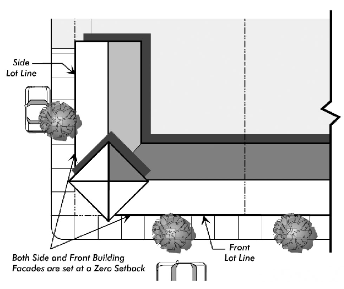
Zoning means a police power measure, enacted primarily by units of local government, in which the community is divided into districts or zones within which permitted and special uses are established as are regulations governing lot size, building bulk, placement and other development standards. The Zoning Code consists of a map and text. See definition in the General Plan.
Zoning Administrator means Community & Economic Development Director or his or her designee who is authorized to act as the Zoning Administrator according to the procedures set forth in the California Government Code and this title. See definition in Title 18.
(Ord. 7408 § 1, 2018; Ord. 7331 § 128, 2016; Ord. 7300 § 2, 2015; Ord. 7235 § 27, 2013; Ord. 6966 § 1, 2007)

