
Riverside City Zoning Code
ARTICLE VII
SPECIFIC LAND USE PROVISIONS
Chapter 19.442 - ACCESSORY DWELLING UNITS (ADU)[6]
Editor's note— Ord. 7592 § 6(Exh. F), adopted in July 5, 2022, changed the title of Chapter 19.442 from "Accessory Dwelling Units (ADU) and Junior Accessory Dwelling Units (JADU)" to "Accessory Dwelling Units (ADU)."
Chapter 19.470 - RESERVED[7]
Editor's note—Ord. 7528, §2, adopted Aug. 4, 2020 and Ord. 7520 §1(Exh. A), adopted July 21, 2020, repealed §§19.470.010—19.470.040 as set out in Ch. 19.470, which pertained to Day Care Homes for Family and derived from Ord. 7331 §73, adopted in 2016 and Ord. 6966 §1, adopted in 2007.
19.442.010 - Purpose.
The State of California has identified accessory dwelling units (ADU) and junior accessory dwelling units (JADU) as valuable forms of housing. Movable accessory dwelling units (MADUs) are also recognized throughout the State as a potential option to provide needed housing. The City recognizes the importance of providing housing and balancing that with an attractive living environment for all residents. The availability of ADUs, MADUs and JADUs contributes to local housing and the community's housing stock while providing residential uses consistent with the General Plan and Zoning Code. The purpose of this Chapter is to ensure compliance with California Government Code Sections 65852.2 65852.22 and minimize impacts to surrounding uses and properties.
(Ord. 7592, § 5(Exh. F), 2022; Ord. 7528 § 1(Exh. A), 2020; Ord. 7520 § 1(Exh. A), 2020; Ord. 7457 § 1(Exh. A), 2019; Ord. 7408 § 1, 2018)
19.442.020 - Applicability and permit requirements.
ADUs, MADUs and JADUs, as defined in Article X (Definitions), are permitted in all residential zones, including all multi-family and mixed-use zones that include an existing or proposed dwelling.
(Ord. 7592, § 5(Exh. F), 2022; Ord. 7528 § 1(Exh. A), 2020; Ord. 7520 § 1(Exh. A), 2020; Ord. 7457 § 1(Exh. A), 2019; Ord. 7408 § 1, 2018)
19.442.030 - Requirements.
An application for an ADU, MADU or JADU shall demonstrate compliance with all the standards and limitations set forth in this section, to the satisfaction of the Community & Economic Development Director or his/her designee.
A.
General.
1.
ADUs and JADUs shall comply with State and local building code requirements for dwellings.
2.
MADUs shall meet the requirements as defined in Article X (Definitions).
3.
ADUs and JADUs in an historic district shall comply with California Government Codes Section 65852.2 and 65852.22, and Title 20 of the Riverside Municipal Code.
4.
MADUs are not permitted in any Historic District, Neighborhood Conservation Area or on a lot with a designated Cultural Resources as defined in Title 20.
5.
ADUs, MADUs and JADUs, when rented, must be used for rentals of terms longer than 30 days.
6.
No actions to correct zoning nonconformities related to physical improvements are required for ADUs.
7.
There shall be no minimum lot size requirement to establish an ADU, MADU or JADU.
8.
The floor area of an ADU, MADU or JADU shall not be counted when calculating lot coverage.
9.
ADUs may not be sold or otherwise conveyed separate from the primary residence with the exception of a primary dwelling and ADU developed by an IRS recognized 501(c)(3) housing-related nonprofit or a faith-based organization, working with the Housing Authority, whose mission is to provide units to low-income households.
10.
For JADUs, a deed restriction shall be recorded, to run with the land and to prohibit the sale of the JADU separate from the sale of the primary dwelling as identified in 19.442.030(F).
B.
Location.
1.
An ADU, MADU or JADU shall be located on the same lot as the proposed or existing primary dwelling.
2.
A MADU shall not be located between the primary dwelling and the street within any front or street side yard.
3.
An ADU may be either attached, located within the proposed or existing primary dwelling, or detached from the proposed or existing primary dwelling.
4.
If attached, an ADU or JADU must have independent exterior access separate from the proposed or existing primary dwelling.
5.
A JADU shall be constructed and located within the walls of the proposed or existing primary dwelling and include:
a.
Cooking facilities with appliances, a food preparation counter, refrigeration facilities and storage cabinets that are of reasonable size in relation to the size of the JADU.
b.
Separate sanitation facilities or shared sanitation facilities with the existing or proposed structure.
C.
Setbacks.
1.
Attached or Detached - Existing Structures.
a.
Existing structures converted to an ADU or JADU, if applicable, shall require no additional setback.
b.
Second story ADUs on Existing Structures.
i.
No additional setback is required if the second story exists.
ii.
For a new second story ADU being added to an existing structure, the setbacks of the ADU shall comply with the setbacks of the underlying zone applicable to the primary dwelling.
2.
Attached or Detached - New Structures.
a.
Side and Rear Setbacks.
i.
A minimum side and rear setback of four feet shall be provided for new one-story ADUs and MADUs under 16 feet in height.
ii.
For ADUs over 16 feet in height, the side and rear setback shall follow the underlying zone applicable to the primary dwelling.
b.
Front and street side setbacks shall be in full compliance with the underlying zone for new ADUs or MADUs.
c.
For any ADU located on the second floor of any new structure, the setbacks of the ADU shall comply with the setbacks of the underlying zone applicable to the primary dwelling.
3.
The side and rear setbacks for an ADU, MADU or JADU must be sufficient for fire and safety.
D.
Unit Size.
1.
Attached ADUs.
a.
The total floor area of an attached ADU, including conversion of existing floor area, shall not exceed 50 percent of the existing or proposed primary dwelling floor area or 1,200 square feet, whichever is less.
b.
The total floor area requirements shall not prevent the establishment of an ADU that is at least:
i.
850 square feet for units with one bedroom or less; or
ii.
1,000 square feet for units with more than one bedroom .
2.
The total floor area of any detached ADU shall not exceed 1,200 square feet.
3.
The total floor area of any MADUs shall be between 150 square feet and 430 square feet as measured within the exterior faces of the exterior walls.
4.
JADUs shall be no more than 500 square feet in size.
5.
The size of an ADU or JADU shall not be less than that of an efficiency dwelling unit, as set forth in Section 1208.4 of the California Building Code.
E.
Number of Units.
1.
Single-family.
a.
The number of dwellings permitted on a lot developed with an existing or proposed single-family residence shall be limited to the primary dwelling; one attached or converted ADU; one detached, new construction ADU or MADU; and one JADU.
b.
The number of dwellings permitted on a lot developed pursuant to California Government Code §§ 65852.21 and 66441.7, including ADUs, JADUs and MADUs, shall be as set forth in Chapter 19.443 (Two-Unit Developments).
2.
Multi-family.
a.
Conversion of existing structures.
i.
At least one ADU, but no more than 25 percent of the existing number of multi-family dwellings, shall be permitted within existing structures on lots with multi-family dwelling structures.
ii.
Conversions may include storage rooms, boiler rooms, passageways, attics, basements or garages provided the ADU complies with building standards for dwellings.
b.
Construction of new structures.
i.
No more than two new detached ADUs shall be permitted on a lot that has a proposed multi-family dwelling.
ii.
No more than eight new detached ADUs shall be permitted on a lot that has an existing multi-family dwelling, not to exceed the number of existing units on the lot.
c.
MADUs are not permitted.
F.
Owner Occupancy.
a.
On a single lot with a primary dwelling and ADU/MADU, neither is required to be owner-occupied.
b.
On a single lot, one JADU is allowed if the primary dwelling or JADU is owner-occupied which shall be recorded with the deed restriction.
G.
Height.
1.
Attached ADUs shall comply with the height restrictions of the underlying zone.
2.
Single-story detached ADUs and MADUs shall not exceed 20 feet in height.
3.
Two-story detached ADUs and ADUs constructed on the second floor of an existing accessory building, shall not exceed 30 feet in height.
4.
In the RC zone, the height of any detached ADU shall not exceed 20 feet and one story in height.
H.
Parking.
1.
No parking shall be required for an ADU, MADU or JADU.
2.
No replacement parking shall be required for the primary dwelling if a garage, carport or covered parking is converted to an ADU.
I.
MADU Additional Requirements.
1.
MADUs shall not have separate street addresses from the primary dwelling unit.
2.
Screening - Wheels and Undercarriage.
a.
The undercarriage of any MADU (axles, tongue and hitch) shall be fully screened and hidden from view; and
b.
The leveling or support jacks must sit on a paved surface.
3.
Mechanical equipment shall be incorporated into the structure and not located on the roof.
4.
Materials used on the exterior shall exclude single piece composite, laminates, or interlocked metal sheathing.
5.
Windows and Doors.
a.
Windows shall be at least double pane glass and labelled for building use and shall include exterior trim.
b.
All windows and doors shall not have radius corners.
6.
Roofs.
a.
Roofs shall be consistent with the architecture of the primary dwelling in term of pitch and roofing materials.; and
b.
Roofs shall not be composed of wooden shingles.
7.
All exterior walls and roof of a MADU shall be fixed with no slide-outs, tip-outs, or other forms of mechanically articulating room area extensions.
8.
Design Elements - A MADU shall be constructed to include the following design elements:
a.
Cladding and Trim: Materials used on the exterior shall not be single piece composite, laminates, or interlocked metal sheathing;
b.
Windows and Doors: Windows shall be at least double pane glass, labeled for building use, and include exterior trim. Windows and doors shall not have radius comers;
c.
All mechanical equipment, including heating, ventilation, and air conditioning, shall be incorporated into the structure and not located on the roof; and
d.
Living Area Extensions: The roof and all exterior walls shall not be fixed with slide-outs, tip-outs, or other forms of mechanically articulating room area extensions
J.
Utilities.
1.
MADUs shall be connected to water, sewer and electric utilities.
2.
ADUs shall not be considered a new residential use for the purposes of calculating connection fees or capacity charges for utilities, including water and sewer service unless the ADU is constructed with a new single-family dwelling.
3.
A new or separate utility connection, connection fee, or capacity charge shall not be required by the utility provider for an ADU located within the existing primary dwelling unit.
4.
A new or separate utility connection, connection fee, or capacity charge shall not be required by the utility provider for an ADU or MADU unless the ADU is constructed concurrently with a new primary dwelling.
5.
For new ADUs or MADUs on a lot with an existing primary dwelling unit, the connection may be subject to a connection fee or capacity charge that shall be proportionate to the burden of the proposed ADU, based upon either its size or the number of its plumbing fixtures, upon the water or sewer system.
6.
ADUs served by a private sewage system shall comply with County Health Department requirements, as applicable.
K.
Impact Fees.
1.
For ADUs under 750 square feet, no City impact fees shall apply.
2.
For ADUs 750 square feet and over, impact fees shall be charged proportionately in relation to the square footage of the primary dwelling unit.
L.
Fire sprinklers.
1.
Fire sprinklers shall not be required within an ADU or JADU, unless fire sprinklers are provided in the primary dwelling.
2.
MADUs are not required to have sprinklers but shall meet the ANSI A119.5 or NFPA 1192 standards relating to health, fire and life-safety.
(Ord. 7743, § 7, 2025; Ord. No. 7701, § 21, 2025; Ord. 7660, § 10, 2024; Ord. 7592, § 5(Exh. F), 2022; Ord. 7528 § 1(Exh. A), 2020; Ord. 7520 § 1(Exh. A), 2020; Ord. 7457 § 1(Exh. A), 2019; Ord. 7408 § 1, 2018)
19.443.010 - Purpose.
The purpose of this Chapter is to establish standards for Two-Unit Developments to ensure compliance with California Government Code Sections 65852.21 and 66411.7, otherwise known as Senate Bill 9, while minimizing impacts to surrounding uses and properties.
(Ord. 7592 § 6(Exh. G), 2022)
19.443.020 - Applicability.
Two-unit developments, as defined in Chapter 19.910 (Definitions), are permitted in the R-1, RE, RR, RC, DSP-RES, and NSP-MDR single-family residential zones.
(Ord. 7592 § 6(Exh. G), 2022)
19.443.030 - Review authority.
Applications for two-unit developments shall be considered ministerially, without discretionary review or a hearing, subject only to permit requirements applicable to the new construction or alteration of residential dwellings, including but not limited to building permits.
(Ord. 7592 § 6(Exh. G), 2022)
19.443.040 - Requirements.
A two-unit development made pursuant to California Government Code Section 65852.21 shall conform with the following requirements, pursuant to California Government Code Section 65852.21(a) and Section 65913.4(a)(6):
A.
Location. A parcel for a two-unit development or urban lot split shall:
1.
Be located within a Single-Family Zone (R-1, RE, RR, RC, DSP-RES, or NSP-MDR);
2.
Not be located within a Very High Fire Hazard Severity Zone, with the exception of sites that have adopted fire hazard mitigation measures pursuant to existing building standards or state fire mitigation measures applicable to the development;
3.
Not be located within a mapped 100-year floodplain, wetland, recorded Open Space Easement, mapped Arroyo, or identified for habitat conservation as defined in the Western Riverside Multiple Species Habitat Conservation Plan;
4.
Not be located within a designated hazardous waste site;
5.
Not be located within a Historic District or Neighborhood Conservation Area designated pursuant to Title 20;
6.
Not be located on property included on the State Historic Resources Inventory, as defined in Section 5020.1 of the Public Resources Code; and
7.
Not be located on a site that is designated or listed as a City or County Landmark or Structure of Merit, or other historic property designated pursuant to Title 20 or another City or County ordinance.
B.
Eligibility. A parcel is not eligible for a two-unit development if the project would require demolition or alteration of:
1.
More than 25% of the exterior walls of a unit that is occupied by a tenant or has been occupied by a tenant at any time in the previous three years;
2.
Housing that is subject to a recorded covenant, ordinance, or law that restricts rents to levels affordable to persons and families of moderate, low, or very low income;
3.
Housing that is subject to any form of rent or price control; and
4.
A parcel containing a unit that was withdrawn from the rental market through an Ellis Act eviction at any time in the last 15 years.
(Ord. 7744, § 6, 2025; Ord. 7592 § 6(Exh. G), 2022)
19.443.050 - Development standards.
Development pursuant to this Chapter shall comply with the following:
A.
Number of units.
1.
Two-unit developments.
a.
The maximum number of attached or detached primary dwelling units permitted on any lot in a single-family zone is two.
b.
No more than four total dwelling units, inclusive of up to two detached, attached, and junior ADUs pursuant to the requirements of Chapter 4.42, may be constructed on any undivided lot in a single-family zone.
2.
Urban lot splits.
a.
A maximum of two dwelling units of any kind may be constructed on any single-family lot established through an urban lot split pursuant to Chapter 18.085 (Urban Lot Splits) of the Subdivision Code, inclusive of detached, attached, and junior ADUs, for a maximum of four units total on both lots.
b.
The maximum number of units that result from any urban lot split may include primary dwellings, detached, attached, and junior ADUs.
B.
Parking. One on-site covered parking space shall be required per unit.
1.
This requirement may be satisfied by an attached or detached carport or enclosed garage.
2.
Exceptions. No on-site parking shall be required when:
a.
The site is located within one-half mile walking distance of a high-quality transit corridor, as defined in subdivision (b) of Section 21155 of the Public Resources Code;
b.
The site is located within one-half mile of a major transit stop, as defined in Section 21064.3 of the Public Resources Code; or
c.
The site is located within one block of a permanently established car-share vehicle pick-up/drop-off location.
3.
Required parking spaces shall comply with the applicable standards of Chapter 19.580 (Parking and Loading).
C.
Setbacks.
1.
The side and rear yard setbacks for two-unit developments shall be at least four feet.
2.
The front yard setback for two-unit developments shall be as required by the Zone.
3.
Additional setbacks shall not be required for an existing structure or for a structure constructed in the same location and to the same dimensions as an existing structure (i.e., a building reconstructed on the same footprint).
4.
Notwithstanding the above, an application shall not be rejected solely because it proposes adjacent or connected structures provided that the structures meet Building Code safety standards and are sufficient to allow separate conveyance.
D.
Additional requirements for two-unit developments.
1.
Unless otherwise specified in this Chapter, all development standards applicable to the construction of a single-family dwelling shall apply to two-unit developments, including but not limited to:
a.
Building height;
b.
Number of stories; and
c.
Lot coverage.
2.
Applicable Chapters. The requirements of the following Chapters of this Title shall apply to two-unit developments:
a.
Chapter 19.440 - Accessory buildings and structures;
b.
Chapter 19.550 - Fences, walls and landscape materials;
c.
Chapter 19.554 - Trash/recyclable materials collection area enclosures;
d.
Chapter 19.555 - Outdoor equipment screening;
e.
Chapter 19.556 - Outdoor lighting; and
f.
Chapter 19.580 - Parking and loading.
3.
All other development standards contained within Titles 17, 18, and 19 shall apply.
E.
The application of any development standard that would physically prevent the development of up to two primary dwelling units or that would physically preclude either of the two units from being at least 800 square fee in floor area shall be waived. No Variance or other discretionary action shall be required.
F.
Additional requirements for urban lot splits shall be as set forth in Chapter 18.085 (Urban Lot Splits) of the Subdivision Code.
(Ord. 7744, § 7, 2025; Ord. 7592 § 6(Exh. G), 2022)
19.443.060 - Design standards.
A.
Materials.
a.
On sites already developed with an existing residential unit, the new construction shall be designed and constructed to match the existing dominant roof pitch, paint color and exterior finish materials, including, but not limited to, siding, windows, doors, roofing, light fixtures, hardware, and railings.
b.
Where no development currently exists or where existing development is to be removed, two-unit developments shall be designed so that the units match one another in dominant roof pitch, paint color and exterior building finishes, including, but not limited to, siding, windows, doors, roofing, light fixtures, hardware, and railings.
c.
Design elements and detailing shall be continued completely around the structure. Such elements shall include but not be limited to window types and treatments, trim detailing, and exterior wall materials.
d.
Window and door types and styles shall be consistent on all elevations.
e.
All vents, downspouts, flashings, electrical conduit, etc., shall be painted to match the color of the adjacent surface unless specifically designed as an accent material.
f.
Exterior building lighting shall be directed downward, have a shielded light source, and be designed so that the light is not directed off site.
B.
Landscaping.
a.
Front and street side yard areas shall be fully landscaped pursuant to the requirements of Chapter 19.570 (Water Efficient Landscaping and Irrigation) and the Citywide Design Guidelines.
b.
Complete landscaping and irrigation plans shall be submitted to the Planning Division prior to the issuance of building permits.
c.
Installation of approved landscaping shall be completed prior to release of final occupancy.
(Ord. 7744, § 8, 2025; Ord. 7592 § 6(Exh. G), 2022)
19.443.070 - Additional requirements.
A.
Short-term rentals.
a.
Units created pursuant to this Chapter shall be rented or leased for a term longer than 30 days.
b.
A Covenant shall be recorded against title to any property developed pursuant to this Chapter restricting rental or lease of any unit on the property for a term longer than 30 days.
B.
Owner occupancy.
a.
Unless the lot on which a two-unit development is constructed was established through an urban lot split pursuant to Chapter 18.085 (Urban Lot Splits) of the Subdivision Code, the owner of the property shall reside in one of the units as their principal residence.
b.
A deed restriction shall be recorded on title to the subject property binding current and future owners to this requirement.
c.
Owner occupancy requirements for two-unit developments constructed on lots established through an urban lot split shall be as set forth in Chapter 18.085 of the Subdivision Code.
C.
Nonresidential uses. Except for permitted home occupations pursuant to Chapter 19.485, non-residential uses shall be prohibited.
(Ord. 7744, § 9, 2025; Ord. 7592 § 6(Exh. G), 2022)
19.443.080 - Variances.
A.
No variances from the provisions of this Chapter shall be permitted.
B.
Waiver of any development standard necessary to permit the minimum amount of development authorized by California Government Code § 65852.21 shall not require the granting of a Variance or any other discretionary approval.
(Ord. 7744, § 10, 2025; Ord. 7592 § 6(Exh. G), 2022)
Editor's note— Ord. 7744, § 10, adopted November 4, 2025, repealed § 19.443.080 and renumbered § 19.443.090 and 19.443.100 as §§ 19.443.080 and 19.443.090. Former § 19.443.080 pertained to noticing and derived from Ord. 7592 § 6(Exh. G), adopted 2022.
19.443.090 - Severability.
If any provision of this ordinance or chapter or the application thereof to any person or circumstance is held to be unconstitutional or otherwise invalid by a court of competent jurisdiction, such invalidity shall not affect other provisions or applications of this ordinance or chapter which can be implemented without the invalid provision or application and to this end the provisions of this ordinance and chapter are declared to be severable.
(Ord. 7744, § 11, 2025; Ord. 7592 § 6(Exh. G), 2022)
Editor's note— See editor's note, § 19.443.080.
19.445.010 - Purpose.
The purpose of regulating agricultural field offices is to ensure compatibility of such uses with surrounding uses and properties and to avoid any impacts associated with such uses.
(Ord. 7331 §69, 2016; Ord. 6966 §1, 2007)
19.445.020 - Applicability and permit requirements.
Agricultural field offices, as defined in Article X (Definitions), are permitted as set forth in Article V, Base Zones and Related Use and Development Provisions subject to the requirements contained in this chapter.
(Ord. 7331 §69, 2016; Ord. 6966 §1, 2007)
19.445.030 - Site location, operation and development standards.
The standards set forth in Article V, Base Zones and Related Use and Development Provisions, shall apply to agricultural field offices unless otherwise specified here.
A.
A minimum lot size of five acres shall be required to establish any agricultural field office.
B.
The use shall be on the same property as and in conjunction with a permitted agricultural use.
C.
The use shall be established within a stick - built, mobile coach or prefabricated structure, attached to or detached from any other building on the property.
D.
The building shall comply with the setback standards established for accessory structures in Chapter 19.440 (Accessory Buildings and Structures) of the Zoning Code.
(Ord. No. 7701, § 22, 2025; Ord. 7660, § 11, 2024; Ord. 7331 §69, 2016; Ord. 6966 §1, 2007)
19.445.040 - Modifications.
Modifications to the above site location, operation and development standards may be considered in conjunction with the required Minor Conditional Use Permit or Conditional Use Permit, as applicable.
(Ord. 7331 §69, 2016)
19.450.010 - Purpose.
The purpose of regulating the sale of alcohol is to ensure compatibility of such uses with surrounding uses and properties and to avoid any impacts associated with such uses.
(Ord. 7331 §70, 2016; Ord. 6966 §1, 2007)
19.450.020 - Applicability and permit requirements.
Alcohol sales, as defined in Article X (Definitions), are permitted as set forth in Article V, Base Zones and Related Use and Development Provisions subject to the requirements contained in this chapter.
A.
Off-sale. Any establishment, business or facility that proposes to engage in the off-sale of alcoholic beverages shall obtain a conditional use permit pursuant to Chapter 19.760 (Conditional Use Permit), except for the following uses:
1.
Establishments that do not propose to sell alcohol as their principal business and that contain 15,000 square feet or more of gross floor area.
2.
Florist shops that propose the incidental sale of wine along with gift or floral baskets; such uses shall obtain a minor conditional use permit processed pursuant to Chapter 19.730 (Minor Conditional Use Permit).
B.
On-sale.
1.
Any establishment, business or facility that proposes to engage in the on-sale of alcoholic beverages shall obtain a minor conditional use permit pursuant to Article IX, Land Use and Development Permit Requirements/Procedures.
2.
Exemption.
a.
Businesses meeting the conditions listed in this Section shall be exempt from the site location, operation and development standards set forth in Section 19.450.030.C.
b.
The Community & Economic Development Director or his/her designee shall exempt a business providing on-sale of alcoholic beverages from the minor conditional use permit requirement if all of the following conditions apply:
i.
The premises contains a kitchen or food-servicing area in which a variety of food is prepared and cooked.
ii.
The primary use of the premises is for sit-down food service to patrons.
iii.
The premises serves food to patrons during all hours the establishment is open for customers.
iv.
If there is a separate area primarily intended for the consumption of alcoholic beverages, it does not constitute more than 30 percent of the public access floor area or 1,000 square feet, whichever is less.
v.
No alcoholic beverages, including beer or wine are sold or dispensed for consumption beyond the premises.
vi.
The premises is defined as a "bona fide public eating place" by the State of California Department of Alcoholic Beverage Control."
(Ord. 7609 § 3, 2022; Ord. 7505 § 1(Exh. A), 2020; Ord. 7331 §70, 2016; Ord. 7158 §12, 2012; Ord. 6966 §1, 2007)
19.450.030 - Site location, operation and development standards.
The standards set forth in Article V, Base Zones and Related Use and Development Provisions, shall apply to all establishments selling alcohol, unless otherwise specified here.
A.
Off-sale of all alcoholic beverages.
1.
The business shall not be located within 600 feet of a public or private school (pre-school through twelfth grade), assemblies of people—non-entertainment or public park, as measured from any point upon the outside walls of the building or building lease space containing the business to the nearest property line of the school, assemblies of people—non-entertainment or park site.
2.
The business shall not be located within 100 feet of any existing residential dwelling or property zoned for residential uses as measured from any point upon the outside walls of the building or building lease space containing the business to the nearest property line of the residential zoned property.
3.
The business shall be located a minimum distance of 1,000 feet from any existing parolee/probationer home, emergency shelter, supportive housing, transitional housing and transitional housing development or businesses licensed by the State of California for off-sale general alcoholic beverage sales with less than 15,000 square feet of gross floor area or which sells alcoholic beverages as its principal business as measured from any point upon the outside walls of the building or building lease space of the business applying for the discretionary permit to the nearest property line of the site containing the existing off-sale alcoholic beverage business.
4.
No sale of alcoholic beverages shall be made from a drive-thru lane or drive-thru window.
5.
The business shall be in a location that is fully visible from a public street with an unobstructed view from the public street for public safety.
6.
The business shall have lighting to provide illumination for security and safety of parking and access areas. On-site lighting plans shall be submitted for review and approval.
7.
The premises on which the business is located shall be posted to indicate that it is unlawful for any person to drink or consume any alcoholic beverage in any public place or posted premises in accordance with Section 9.05.020 of the Municipal Code.
8.
The management at each location of off-sale of alcoholic beverages pursuant to this section shall be responsible for educating the public regarding drunk driving laws and the related penalties for breaking those laws. (This includes minimum age law, open container law and driving while intoxicated law.) This can be accomplished by posting prominent signs, decals or brochures at the point of purchase and providing adequate training for employees.
B.
Florist shop with incidental off-sale of wine.
1.
The sale of wine shall be clearly incidental to a florist shop business, and shall not exceed five percent of the annual gross sales revenue of the florist business.
2.
The sale of wine shall be limited to gift or floral arrangements. Individual containers of wine not packaged as part of such arrangements may not be sold.
3.
No beer or distilled spirits may be sold.
4.
The business shall be located a minimum distance of 1,000 feet from any existing parolee/probationer home, emergency shelter, supportive housing or transitional housing and transitional housing development as measured from any point upon the outside walls of the building or building lease space of the business applying for the discretionary permit to the nearest property line of the site containing the existing off-sale alcoholic beverage business.
C.
On-sale of all alcoholic beverages.
1.
The business shall not be located within 600 feet of a hospital, public or private school (pre-school through twelfth grade), assemblies of people—non-entertainment or public park, as measured from any point upon the outside walls of the building or building lease space containing the business to the nearest property line of the hospital, school, assemblies of people—non-entertainment or park site, except in the Downtown Arts and Entertainment District, as defined in Article X (Definitions), where the 600 foot distance restriction does not apply. However, in said Downtown Arts and Entertainment District, the Community & Economic Development Department Director or his/her designee, shall consider distances from the above listed uses for the purpose of achieving compatibility of the business with neighboring uses as part of the review process.
2.
The business shall not be located within 100 feet of any existing residential dwelling or property zoned for residential uses as measured from any point upon the outside walls of the building or building lease space containing the business to the nearest property line of the residential property. This provision shall not be mandatory with regard to residential uses that are a part of a mixed use zone or mixed use project approved under a conditional use permit.
3.
The business shall be located a minimum distance of 1,000 feet from any existing parolee/probationer home, emergency shelter, supportive housing or transitional housing and transitional housing development as measured from any point upon the outside walls of the building or building lease space of the business applying for the discretionary permit to the nearest property line of the site containing the existing parolee/probationer home, emergency shelter, supportive housing or transitional housing and transitional housing development.
4.
Lighting, as certified by a qualified lighting engineer, shall be provided at a level no less than one foot candle of lighting throughout private parking lots and access areas serving the business.
5.
The premises on which the business is located shall be posted to indicate that it is unlawful for any person to drink or consume any alcoholic beverage in any public place or posted premises in accordance with Section 9.05.020 of the Municipal Code.
6.
Soundproofing shall be provided sufficient to prevent noise and vibrations from penetrating into surrounding properties or building lease space.
D.
Concurrent sale of motor vehicle fuel with alcoholic beverages.
1.
Only beer and wine, not hard liquor, may be sold.
2.
The minimum enclosed retail sales area for store products shall be 1,500 square feet.
3.
The minimum inventory level shall be $15,000.00 retail value excluding beer, wine, fuel and automotive products.
4.
The maximum percentage of beer and wine sales to total store sales shall be 30 percent on a retail basis during any consecutive twelve-month period.
5.
The management at each location of common site sales shall be responsible for "educating the public" regarding drunk driving laws and the related penalties for breaking those laws. (This includes minimum age law, open container law and driving while intoxicated law.) This can be accomplished by posting prominent signs, decals or brochures at the point of purchase and providing adequate training for employees.
6.
No displays of beer or wine shall be located within five feet of the store's entrance or checkout counter.
7.
Cold beer or wine shall be sold from, or displayed in permanently affixed electrical coolers only.
8.
No beer or wine advertising shall be located on gasoline islands; no lighted advertising for beer or wine shall be located on buildings or in windows.
9.
Employees on duty between the hours of 10:00 p.m. and 2:00 a.m. shall be at least 21 years of age to sell beer and wine.
10.
No sale of alcoholic beverages shall be made from a drive-thru window.
11.
The business shall not be located within 600 feet of a public or private school (pre-school through 12th grade), assemblies of people—non-entertainment or public park, as measured from any point upon the outside walls of the building or building lease space containing the business to the nearest property line of the school, assemblies of people—non-entertainment or park site.
12.
The business shall not be located within 100 feet of any existing residential dwelling or property zoned for residential uses as measured from any point upon the outside walls of the building or building lease space containing the business to the nearest property line of the residential zoned property.
13.
The business shall be located a minimum distance of 300 feet from any other business with the concurrent sale of motor vehicle fuel with alcoholic beverages or 1,000 feet from any other business licensed by the State of California for off-sale general alcoholic beverage sales with less than 15,000 square feet of gross floor area or that sells alcoholic beverages as its principal business as measured from any point upon the outside walls of the building or building lease space of the business applying for the discretionary permit to the nearest property line of the site containing the existing off-sale alcoholic beverage sales business.
14.
The business shall be located a minimum distance of 1,000 feet from any existing parolee/probationer home, emergency shelter, supportive housing or transitional housing and transitional housing development as measured from any point upon the outside walls of the building or building lease space of the business applying for the discretionary permit to the nearest property line of the site containing the existing emergency shelter, supportive housing or transitional housing and transitional housing development.
(Ord. 7743, § 8, 2025; Ord. No. 7701, § 23, 2025; Ord. 7331 §70, 2016; Ord. 7158 §13, 2012; Ord. 6966 §1, 2007)
19.450.040 - Other applicable regulations.
Where the Department of Alcoholic Beverage Control (ABC) determines that an area has an over concentration of alcoholic beverage licenses and/or a higher than average crime rate ABC may deny an application for alcohol sales unless the Community & Economic Development Department Director or his/her designee or City Planning Commission makes a determination that public convenience or necessity will be served by the proposed project. The determination that public convenience or necessity will be served shall be made through the following findings:
A.
That the license applicant has submitted a request for a particular type of alcoholic beverage license, license upgrade, or premises-to-premises transfer and will agree to all conditions placed on the application;
B.
That the proposed use is compatible with surrounding uses and will enhance economic vitality and improve consumer choice in the surrounding area; and
C.
That the proposed use will not increase the severity of existing law enforcement or public nuisance problems in the area.
(Ord. 7743, § 9, 2025; Ord. 7331 §70, 2016; Ord. 6966 §1, 2007)
19.450.050 - Reserved.
Editor's note— Ord. No. 7701, § 24, adopted in 2025, repealed § 19.450.050. Former § 19.450.050 pertained to variances and derived from Ord. 6966 §1, adopted in 2007 and Ord. 7331 §70, adopted in 2016.
19.455.010 - Purpose.
This purpose of regulating animals is to ensure compatibility of such uses with surrounding uses and properties and to avoid any impacts associated with such uses.
(Ord. 7331 §71, 2016; Ord. 6966 §1, 2007)
19.455.020 - Applicability and permit requirements.
Animal keeping, of both domestic and non-domestic animals, as defined in Article X (Definitions), are permitted as set forth in Article V, Base Zones and Related Use and Development Provisions subject to the requirements contained in this chapter.
A.
Animal keeping, as defined in this chapter, includes the keeping of domestic and non-domestic animals and other species as may be determined by the Community & Economic Development Department Director or his/her designee to be similar in nature.
B.
Animal keeping is permitted in the various zones as set forth in Article V Table 19.150.020.B (Incidental Uses Table). In addition to the regulations of the applicable zone, animal keeping in the forms of boarding of cats and dogs/kennels, in conjunction with veterinary services and pet shops, or in conjunction with associated biological and/or medical research facilities are also permitted per Article V (Base Zones and Related Use and Development Provisions).
(Ord. 7743, § 10, 2025; Ord. 7331 §71, 2016; Ord. 6966 §1, 2007)
19.455.030 - Site location, operation and development standards.
The standards set forth in Article V, Base Zones and Related Use and Development Provisions, shall apply to all domestic and non-domestic animal keeping unless otherwise specified here.
A.
Domestic animal keeping.
1.
Domestic animal keeping is permitted in all residential and mixed use zones.
B.
Non-domestic animal keeping in the RE and R-1 Zones.
1.
The non-commercial keeping of poultry is permitted subject to the following:
a.
Not more than five poultry shall be permitted at any time.
b.
A coop, shelter or other permanent structure shall be provided a minimum of ten feet from any neighboring residence in addition to the minimum standards provided in Chapter 19.440 (Accessory Buildings and Structures).
c.
The keeping of crowing fowl as defined in Section 19.910.040 ("C" Definitions) is not permitted.
C.
Non-domestic animal keeping in the RR Zone.
1.
The non-commercial keeping of poultry, rabbits, crowing fowl and crowing rooster are subject to the following:
a.
All animals shall be enclosed with a coup, shelter or other permanent structure and meet the standards provided by Chapter 19.440 (Accessory Buildings and Structures).
b.
No more than five poultry and four rabbits shall be permitted when 50 feet from any neighboring residence.
c.
No more than 50 poultry and 45 rabbits shall be permitted when 100 feet from any neighboring residence.
d.
Additional poultry and rabbits for noncommercial or commercial purposes may be permitted subject to the granting of a Minor Conditional Use Permit.
e.
The keeping of crowing fowl that exists on a property at the time the site is annexed to the City shall be abated within the amortization period of two years. If keeping of crowing fowl is not abated within such two-year period, it will be a violation of this section.
f.
For lots greater than 20,000 square feet, the keeping of no more than seven crowing roosters is permitted. The roosters shall be housed from sunset to sunrise in an acoustical structure at least 100 feet from any neighboring residence.
2.
Equine, bovine and ovine species.
a.
A minimum lot size of 20,000 square feet of net area is required.
b.
Not more than a total of two individuals of equine, bovine, or ovine species, regardless of combination, are permitted. However, one additional animal may be kept for each additional 10,000 square feet of net lot area in excess of 20,000 square feet.
c.
All animals permitted pursuant to this subsection shall be housed, penned or pastured at least 60 feet from any neighboring residence, including the residence on the lot where the animals are kept and shall abide by the minimum standards provided in Chapter 19.440 (Accessory Buildings and Structures).
3.
Porcine species, exclusive of pot-bellied pigs.
a.
Swine or pigs, exclusive of pot-bellied pigs, shall be permitted only upon the condition that such animals are kept and maintained as a duty-authorized Future Farmers of America, 4-H or similar project.
b.
A minimum lot size of 20,000 square feet of net area is required for any porcine species.
c.
Not more than two individuals of porcine species shall be permitted. However, one additional animal may be kept for each additional 10,000 square feet of net lot area in excess of 20,000 square feet.
d.
All animals permitted pursuant to this subsection shall be housed, penned or pastured at least 60 feet from any neighboring residence, and shall abide by the minimum standards provided in Chapter 19.440 (Accessory Buildings and Structures).
4.
Bees. The keeping of bees is permitted, provided that all other conditions of this Zoning Code and Title 8.20 are met.
5.
Aviaries. The keeping of birds/aviaries is permitted, provided that all other conditions of this Zoning Code and the Municipal Code are met.
6.
Offspring of animals. Offspring of permitted animals shall not be counted in determining the permitted number of animals if such offspring do not exceed the following age limitations:
a.
Bovine, 24 months
b.
Equine, 18 months
c.
Ovine, 12 months
d.
Porcine, 60 days
e.
Birds, four months
D.
Non-domestic animal keeping in the RA-5 Zone.
1.
Poultry, rabbits, crowing fowl and crowing roosters.
a.
The noncommercial keeping of not more than five poultry, including crowing fowl (except crowing roosters), and 18 rabbits is permitted. Such animals shall be housed, kept or penned at least 50 feet from any residence on an adjoining lot or parcel, including the residence on the lot where the animals are kept.
b.
Where poultry and rabbits are housed, kept, or penned at least 100 feet from any residence, the noncommercial keeping of not more than 50 poultry and 45 rabbits on any lot is permitted. The keeping of not more than seven crowing roosters are permitted on any lot, provided that such roosters are housed from sunset to sunrise in an acoustical structure so as to reduce noise emitted by such roosters and such structure is at least 100 feet from any residential structure on an adjoining lot.
c.
Additional poultry and rabbits for noncommercial or commercial purposes may be permitted subject to the granting of a discretionary permit.
2.
Equine, bovine, and ovine species.
a.
A minimum lot size of one acre of net area is required for the grazing, raising or training of any equine, riding stables or academies of the raising of bovine or ovine species for noncommercial purposes.
b.
Not more than a total of two of any combination of equine, bovine, or ovine species shall be kept on any lot with an area of one acre. However, one additional animal may be kept for each half acre of net lot area in excess of one acre.
c.
All animals permitted pursuant to this subsection shall be housed, penned or pastured at least 100 feet from any residence, including the residence on the lot where the animals are kept.
3.
Dairies, feeding lots and similar uses may be permitted subject to the granting of a Conditional Use Permit.
4.
Bees. The keeping of bees is permitted, provided that all other conditions of this Zoning Code and Title 8.20 are met.
5.
Growing and wholesale disposal of earthworms.
a.
All worm farms shall be kept at least 50 feet away from all adjacent dwellings.
b.
The maximum height of any worm bed shall be two feet and all other structures shall conform to the requirements for accessory structures.
c.
Worm farms in excess of 64 square feet shall only be permitted subject to the granting of a discretionary permit.
6.
Aviaries. The keeping of birds/aviaries is permitted, provided that all other conditions of this Zoning Code and the Municipal Code are met.
E.
Non-domestic animal keeping in the RC Zone.
1.
Poultry, rabbits, crowing fowl and crowing roosters.
a.
The noncommercial keeping of not more than five poultry, including crowing fowl (except crowing roosters), and 18 rabbits is permitted. Such animals shall be housed, kept or penned at least 50 feet from any residence on an adjoining lot or parcel, including the residence on the lot where the animals are kept.
b.
Where poultry and rabbits are housed, kept, or penned at least 100 feet from any residence, the noncommercial keeping of not more than 50 poultry and 45 rabbits on any lot is permitted. The keeping of not more than seven crowing roosters are permitted on any lot, provided that such roosters are housed from sunset to sunrise in an acoustical structure so as to reduce noise emitted by such roosters and such structure is at least 100 feet from any residential structure on an adjoining lot.
c.
Additional poultry and rabbits for noncommercial or commercial purposes may be permitted subject to the granting of a discretionary permit.
2.
Equine species.
a.
A minimum lot size of one acre of net area is required for the grazing, raising or training of any equine.
b.
Not more than a total of two of any equine species shall be kept on any lot with an area of one acre. However, one additional animal may be kept for each half acre of net lot area in excess of one acre.
c.
All animals permitted pursuant to this subsection shall be housed, penned or pastured at least 100 feet from any residence, including the residence of the lot where the animals are kept.
3.
Bees. The keeping of bees is permitted, provided that all other conditions of this Zoning Code and Chapter 8.20 are met.
4.
Aviaries. The keeping of birds/aviaries is permitted, provided that all other conditions of this Zoning Code and the Municipal Code are met.
(Ord. No. 7701, § 25, 2025; Ord. 7331 §71, 2016; Ord. 7109 §7, 2010; Ord. 6985 §3, 2008; Ord. 6966 §1, 2007)
19.455.040 - Maintenance of premises.
The premises where animals are kept shall be maintained in a clean, neat and sanitary condition at all times to ensure the public health, safety, comfort, convenience and general welfare pursuant to Title 6 - Health & Sanitation, Title 8 - Animals, and all other County and State regulations.
(Ord. 7660, § 12, 2024; Ord. 7331 §71, 2016; Ord. 6966 §1, 2007)
19.465.010 - Purpose.
The purpose of regulating caretaker living quarters is to ensure compatibility of such uses with surrounding uses and properties and to avoid any impacts associated with such uses.
(Ord. 6966 §1, 2007)
19.465.020 - Applicability and permit requirements.
Caretaker living quarters, as defined in Article X (Definitions) are permitted as set forth in article V, Base Zones and Related Use and Development Provisions subject to the requirements contained in this chapter.
(Ord. 6966 §1, 2007)
19.465.030 - Site location, operation development standards.
The standards set forth in Article V, Base Zone and Related Use and Development Provisions shall apply to agricultural caretaker living quarters, unless otherwise specified here.
A.
Caretaker living quarters—Agricultural.
1.
The use shall be conducted on a property having five acres or more gross area and that is predominantly occupied by a bona fide agricultural business.
2.
The use shall be established within a stick-built or prefabricated structure, attached to or detached from the primary dwelling unit on the property, or within a mobile home.
3.
The square footage of the agricultural caretaker living quarters shall not exceed 50 percent of the square footage of the principal dwelling unit.
4.
Occupancy shall be limited to the agricultural caretaker and his or her family. The agricultural caretaker shall be a full-time employee of the on-site agricultural business.
5.
The principal dwelling unit on the property shall be occupied by the legal owner of the property.
6.
The agricultural caretaker living quarters shall be established in such a way as to minimize its view from adjacent streets and properties.
7.
The use shall not be conducted longer than two years, except that subsequent time extensions may be granted by the Approving or Appeal Authority. Each time extension shall not exceed two years.
8.
The property owners shall execute and record a covenant and agreement with the City to revert the property to single-family residential use, including the removal of the kitchen facilities of any permanent addition that does not meet the requirements of the Zone in which the use is located, after the expiration of any associated permit granted or the termination of the agricultural business.
B.
Caretaker living quarters—Industrial or Commercial Storage Overlay Zone uses.
1.
The caretaker living quarters shall be located within the principal building on the site.
2.
The caretaker living quarters shall be occupied by the owner or an employee of the business.
3.
A minimum of one designated parking space shall be provided for the caretaker living quarters, in addition to any parking spaces required for the principal use.
4.
The caretaker living quarters shall have no more than two bedrooms.
5.
The caretaker living quarters shall be limited to a maximum of 650 square feet.
6.
The property owners shall execute and record a covenant and agreement with the City to revert the property to an industrial use without a caretaker living quarters, including the removal of the kitchen facilities of any permanent addition that does not meet the requirements of the Zone in which the use is located, after the expiration of any associated permit granted or the termination of the business.
C.
Caretaker living quarters—Temporary during construction.
1.
The temporary unit shall be located on-site and in the rear half of the lot, unless otherwise approved by the Community & Economic Development Department Director or his/her designee. In no instance shall the temporary unit be located within public right-of-way.
2.
The temporary unit shall be located at least five feet from all property lines. For side and rear property lines adjoining an existing residential use, the setback of the underlying zone shall apply.
3.
The number of occupants shall be limited to two persons.
4.
The temporary unit shall be connected to water and electric utilities. Where required by the Public Works Department, the unit shall be connected to the sewer system.
5.
The unit shall be allowed to remain on the site for an initial period of no more than six months, except that individual extensions of up to three months each with a maximum of one year from the date of the initial siting may be granted by the Community & Economic Development Director or his/her designee. There shall be no fee for these time extensions. In considering whether to grant a time extension, the Community & Economic Development Department Director or his/her designee may consider evidence of any land use compatibility related complaints from surrounding residents and property owners.
6.
No later than seven days following the issuance of a certificate of occupancy for the permanent building, the temporary unit shall be removed from the site.
7.
An active building permit shall be in effect prior to locating the temporary unit on-site and at all times that the unit remains on-site. The unit is to be removed within seven days of expiration of the building permit.
(Ord. 7743, § 11, 2025; Ord. 6966 §1, 2007)
19.475.010 - Purpose.
The purpose of regulating drive-thru businesses is to ensure compatibility of such uses with surrounding uses and properties and to avoid any impacts associated with such uses.
(Ord. 7331 §74, 2016; Ord. 6966 §1, 2007)
19.475.020 - Applicability and permit requirements.
Drive-thru businesses, as defined in Article X (Definitions), incidental to a permitted use, unless specifically prohibited by the provisions of Article V, Base Zones and Related Use and Development Provisions.
(Ord. 7331 §74, 2016; Ord. 6966 §1, 2007)
19.475.030 - Traffic study.
A traffic study addressing both on-site and off-site traffic and circulation impacts may be required as part of the permit application, at the discretion of the Development Review Committee.
(Ord. 7331 §74, 2016; Ord. 6966 §1, 2007)
19.475.040 - Site location, operation and development standards.
The standards set forth in Article V, Base Zones and Related Use and Development Provisions, shall apply to drive-thru businesses unless otherwise specified here.
A.
The drive-thru business shall maintain a minimum 100-foot street frontage and be located on an arterial street, as indicated by the Riverside General Plan Figure CCM-4 - Master Plan of Roadways.
B.
When a drive-thru business adjoins any lot in a residential, office or any mixed use zones, a minimum six-foot-high masonry wall shall be erected and maintained along such property line; provided, however, that such wall shall be only three feet high from the setback line of the adjoining property to the front property line.
C.
Building and landscape setback standards.
1.
Where a drive aisle or parking is adjacent to a street frontage, a landscape planter with a minimum width of 15 feet in width shall be provided along all street frontages. Where a building is adjacent to a street frontage, the building setback of the base zone shall apply.
2.
A landscape planter with a minimum width of five feet shall be provided along interior property lines, unless the site part of an integrated, master planned commercial complex, where no landscape setback is required along interior property lines.
D.
Drive-thru lane standards.
1.
Restaurants shall maintain drive-thru lanes that are a minimum of 180 feet in length to provide on-site storage for a minimum of ten vehicles, as measured from the forward most drive-thru window to the entrance to the queuing space.
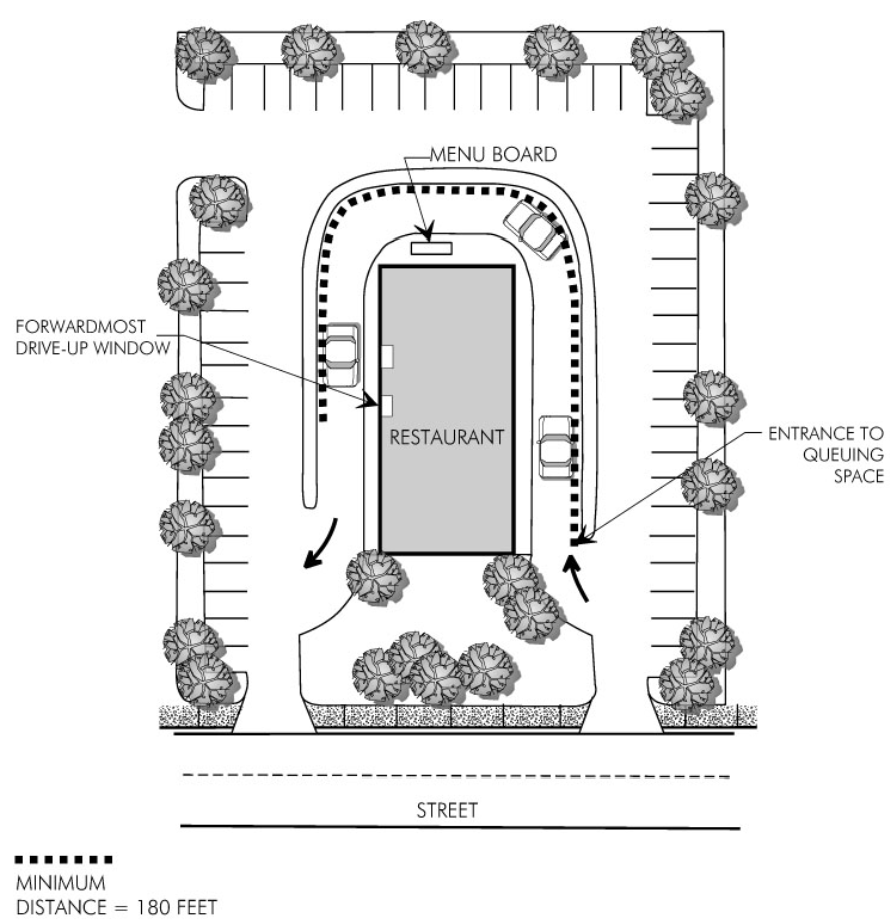
19.475.040.E.1.
Drive-thru Lanes
2.
All other uses shall maintain drive-thru lanes that are a minimum of 36 feet in length to provide on-site automobile storage for a minimum of two vehicles.
3.
Each drive-thru lane shall be a minimum of 12 feet in width. The lane shall be independent of any on-site parking, parking maneuvering areas, public streets, alleys or traffic ways.
E.
Additional requirements for drive-thru lanes associated with restaurants.
1.
Drive-thru windows are discouraged on any building elevation directly facing a street frontage.
2.
Drive-thru lanes shall be designed in such a way as to be screened from view from the street through elevation differences, landscaping, arbors, trellises, canopies, walls and other architectural features used to reduce the visual presence of drive-thru operations.
3.
Freestanding drive thru restaurants should be located on lots with at least 30,000 square feet, except for drive thru restaurants in master planned integrated commercial complexes with shared parking and access.
4.
A minimum five-foot-wide landscaped planter should be installed between the drive-thru lane and parking lot maneuvering area when adjacent to one another, as determined necessary on a case-by-case basis.
F.
Additional requirements for a business with drive-thru lane(s) within the MU-U and MU-V Zones.
1.
Drive-thru pick-up windows shall not be located on any building elevation facing a street.
2.
Drive-thru lanes shall be located at the rear of the building and screened from view from adjacent streets. For corner properties, a combination of walls and other architectural and landscape features, such as arbors, trellises, canopies, and landscape berms may be used to screen the drive-thru lane from one adjacent street.
(Ord. 7408 §1, 2018; Ord. 7331 §74, 2016; Ord. 7100 §1, 2010; Ord. 6966 §1, 2007)
19.475.050 - Additional permit findings.
In addition to the findings required for the granting of the applicable discretionary application, the following additional findings are required to be made by the Approving or Appeal Authority in approving a discretionary permit for a drive-thru business:
A.
That the use will not substantially increase vehicular traffic on streets in a residential zone.
B.
That the use will not substantially lessen the usability of adjacent or nearby commercially zoned property or commercial use by interfering with pedestrian traffic.
C.
That the use will not create increased traffic hazards to pedestrians.
D.
That the site will be adequate in size and shape to accommodate said use and to accommodate all yards, walls, parking, landscaping and other required improvements.
E.
That the use will not substantially lessen the usability and suitability of adjacent or nearby residentially zoned property for residential use.
(Ord. 7331 §74, 2016; Ord. 6966 §1, 2007)
19.475.060 - Modifications.
Modifications to the above site location, operation and development standards may be considered in conjunction with the required Minor Conditional Use Permit or Conditional Use Permit, as applicable.
(Ord. 7331 §74, 2016)
19.480.010 - Purpose.
The purpose of regulating private fueling systems with above-ground tanks is to ensure compatibility of such uses with surrounding uses and properties and to avoid any impacts associated with such uses.
(Ord. 7331 §75, 2016; Ord. 6966 §1, 2007)
19.480.020 - Applicability and permit requirements.
Private fueling systems with above-ground tanks, as defined in Article X (Definitions), are permitted as set forth in Article V, Base Zones and Related Use and Development Provisions subject to the requirements contained in this chapter.
(Ord. 7331 §75, 2016; Ord. 6966 §1, 2007)
19.480.030 - Site location, operation and development standards.
The development standards set forth in Article V, Base Zones and Related Use and Development Provisions, shall apply to private fueling systems with above-ground tanks unless otherwise specified here.
A.
All design and location standards of the Fire Code shall be complied with.
B.
The location of the fueling system, including the above-ground tanks and the dispensing system, shall comply with the setback requirements of the zone of the property on which the fueling system is located, unless a greater setback is required by the Fire Code, in that case such greater setback requirement shall be met.
C.
The fueling system must be incidental to the permitted use or conditional use of the property on which it is located, and it must only serve vehicles or equipment that belong to the operator of the business or use located on the property.
D.
The tanks shall be fully screened from adjoining streets and neighboring properties.
E.
The fueling system shall be limited to two tanks, with a maximum cumulative capacity of 12,000 gallons.
F.
The fueling system shall not exceed ten feet in height.
G.
Above-ground fuel tanks of 1,000 gallons or more shall be located a minimum distance of 300 feet from any residential structure or residentially zoned property.
(Ord. 7331 §75, 2016; Ord. 6966 §1, 2007)
19.480.040 - Modifications.
Modifications to the above site location, operation and development standards may be considered in conjunction with the required Minor Conditional Use Permit.
(Ord. 7652 § 8, 2023; Ord. 7331 §75, 2016)
19.485.010 - Purpose.
The purpose of regulating home occupations is to ensure compatibility of such uses with surrounding uses and properties and to avoid any impacts associated with such uses.
(Ord. 7331 §76, 2016; Ord. 6966 §1, 2007)
19.485.020 - Applicability and permit requirements.
Home occupations, as defined in Article X (Definitions), are permitted as incidental uses in all residential zones, as set forth in Article V, Base Zone and Related Use and Development Provisions subject to the requirements contained in this chapter.
(Ord. 7331 §76, 2016; Ord. 6966 §1, 2007)
19.485.030 - Permitted home occupations.
Only the following business activities are permitted as home occupations.
A.
Telecommuting, as defined by Article X (Definitions).
B.
Business, professional and sales offices, excluding medical, dental and similar uses that involve regular patient visits to the site, provided that no retail sales transactions are made on the premises and that no customers or clients visit the site, except as specifically allowed by this section. Typical examples of such general business office activities include research; report writing; bookkeeping; telecommunication with clients and employees; and the sending and receiving of mail, telephone calls, electronic facsimile communications and electronic communications by electronic or similar means.
C.
Instruction in academia, music, voice, art, dance or similar activities with no more than one pupil receiving instruction at any given time.
D.
Activities associated with the work of artists, sculptors, authors and composers.
E.
Some personal services, limited to activities associated with the work of dressmakers, seamstresses, and tailors; hair stylists; estheticians; pet groomers; and similar uses.
F.
Home crafts, such as model making, rug weaving, quilting and needlework, lapidary work and wood working, limited to the uses of tools and equipment commonly available for personal residential use, but specifically excluding cabinet making.
G.
Home catering and food preparation businesses, subject to the approval of the Riverside County Health Department.
H.
Small electronics repair, limited to items such as personal computers and electronic recorders with a maximum weight of 40 pounds per item.
I.
Home-based direct sales distributions businesses in which sales, merchandise distribution and product demonstrations are primarily conducted either off-site or by telephone, mail or other electronic communication.
(Ord. No. 7701, § 26, 2025; Ord. 7331 §76, 2016; Ord. 6966 §1, 2007)
19.485.040 - Site location, operation and development standards.
The standards set forth in Article V, Base Zones and Related Use and Development Provisions, shall apply to all home occupation businesses unless otherwise specified here.
A.
The home occupation shall be clearly incidental and subordinate to the primary use of the dwelling unit.
B.
The site of the home occupation must be the principal residence of anyone engaged in the home occupation. In addition, no more than one non-resident employee or assistant is permitted to engage in home occupation activities at the site at any given time.
C.
There shall be no external visible evidence of the home occupation.
D.
A maximum of one room within the dwelling unit or 25 percent of the total square footage of the dwelling unit may be used for the home occupation.
E.
The home occupation shall not involve the use of any accessory building or outdoor area for any related activity, including storage or display. However, the use of an attached garage for a permitted home occupation is allowed, provided that required covered parking is continually available and accessible for use.
F.
Direct sale of products or merchandise on the premises from which the home occupation is conducted shall be prohibited.
G.
A maximum of one customer or client vehicle at any given time shall be allowed to visit the premises of the home occupation.
H.
No home occupation use shall create or result in glare, smoke, dust, vibration, fumes, odor, electrical, radio or television interference, fire hazard, significant vehicular or pedestrian traffic, or any other hazard or nuisance disruptive to reasonable use of the surrounding properties. Home occupations shall also comply with the provisions of Title 7 of the Municipal Code.
I.
The use or storage of any flammable, combustible, or toxic material in conjunction with a home occupation shall be limited to quantities in accordance with the Fire Code as incorporated by the Riverside Municipal Code for a residential use.
J.
Signage or commercial advertising for the home occupation is prohibited.
K.
Only one vehicle owned by the operator of the home occupation, no larger than 10,000 pounds gross vehicle rating weight, may be used in conjunction with the home occupation.
L.
If more than one home-based business is conducted at a given site, the aggregate of all the home-based businesses shall comply with these standards.
M.
The home occupation shall not increase the use of utilities or community facilities beyond that normal to the use of the property for residential purposes.
N.
The home occupation shall comply with all other Municipal Code requirements and any applicable County, State, and Federal laws.
O.
The cultivation, manufacturing, distribution, transport, or sale of marijuana or marijuana products is not a permitted home occupation.
(Ord. 7431 § 6, 2018; Ord. 7331 §76, 2016; Ord. 6966 §1, 2007)
19.485.050 - Modifications.
No modifications to the above site location, operation and development standards shall be allowed in conjunction with a home occupation.
(Ord. 7331 §76, 2016)
19.490.010 - Purpose.
The purpose of regulating mining/mineral extraction uses is to ensure compatibility of such uses with surrounding uses and properties and compliance with the provisions of the State Surface Mining and Reclamation Act of 1975.
(Ord. 7331 §77, 2016; Ord. 6966 §1, 2007)
19.490.020 - Applicability and permit requirements.
Mining/mineral extraction uses are permitted as forth in Article V, Base Zones and Related Use and Development Provisions subject to the provisions contained in the State Surface Mining and Reclamation Act of 1975 and the Public Resources Code.
(Ord. 7331 §77, 2016; Ord. 6966 §1, 2007)
19.495.010 - Purpose.
The purpose of regulating outdoor dining incidental to a permanent indoor restaurant is to ensure compatibility of such uses with surrounding uses and properties and to avoid any impacts associated with such uses.
(Ord. 7331 §78, 2016; Ord. 6966 §1, 2007)
19.495.020 - Applicability and permit requirements.
Outdoor dining and food preparation, as defined in Article X (Definitions), are permitted as set forth in Article V, Base Zones and Related Use and Development Provisions subject to the requirements contained in this chapter.
A.
Any use of public rights-of-way shall be subject to the granting of an encroachment permit by the Public Works Department and verification and maintenance of liability insurance by the City's Risk Manager.
B.
All outdoor dining areas shall be designed in compliance with the City's "Outdoor Dining and Outdoor Food Preparation Requirements and Design Guidelines."
C.
The regulations contained in this chapter for outdoor food preparation pertain to those preparation activities related to permanent indoor restaurants and do not apply to outdoor preparation of food in association with a legally established school or assemblies of people—non-entertainment or similar use that is separately regulated.
(Ord. 7331 §78, 2016; Ord. 6966 §1, 2007)
19.495.030 - Site location, operation and development standards.
The standards set forth in Article V, Base Zones and Related Use and Development Provisions, shall apply to outdoor dining unless otherwise specified here.
A.
The outdoor dining area shall be located in a designated dining area approved by the Community and Economic Director or his/her designee.
B.
All outdoor facilities shall be located so they do not pose a hazard or nuisance to pedestrians.
C.
The design of all outdoor facilities shall be consistent with the adopted Citywide Design Guidelines.
D.
Outdoor dining facilities, including food preparation, shall be in compliance with all requirements of the Riverside County Health Department, Police Department, Fire Department and the South Coast Air Quality Management District at all times.
E.
Consumption of food shall be limited to items purchased at the on-site restaurant.
F.
Consumption of alcoholic beverages shall be in compliance with Chapter 19.450 of the Zoning Code and all applicable requirements of the Department of Alcoholic Beverage Control (ABC).
(Ord. 7331 §78, 2016; Ord. 6966 §1, 2007)
19.495.040 - Modifications.
Modifications to the above Site location, operation and development standards shall require consideration of a Minor Conditional Use Permit.
(Ord. 7331 §78, 2016)
19.500.010 - Purpose.
The purpose of regulating the outdoor display of plant materials incidental to the primary business located on a site is to ensure compatibility of such uses with surrounding uses and properties and to avoid any impacts associated with such uses.
(Ord. 7331 §79, 2016; Ord. 6966 §1, 2007)
19.500.020 - Applicability and permit requirements.
Outdoor display of incidental plant materials. As defined in Article X (Definitions) are permitted as set forth in Article V, Base Zones and Related Use and Development Provisions subject to the requirements contained in this chapter.
The regulations in this chapter shall apply to the outdoor display of live plant materials apart from a permitted permanent plant nursery enclosure associated with a business for which the primary business is some business other than a nursery, and for which a year-round nursery function is permitted. No special permit shall be required for the outdoor display of live plant materials, other than any permit or approval that may be required for the primary business.
(Ord. 7331 §79, 2016; Ord. 6966 §1, 2007)
19.500.030 - Site location, operation and development standards.
The standards set forth in Article V, Base Zones and Related Use and Development Provisions, shall apply to outdoor display of incidental plant materials unless otherwise specified here.
A.
The outdoor display of items shall be limited to live plants only and shall not be for the purpose of any other form of merchandise display.
B.
The outdoor display shall be limited to 20 feet either side of the main public entrance or to the parking lot frontage of the permanent plant nursery enclosure.
C.
Plant displays shall not obstruct walkways, driveways, parking areas, pathways or any surface designed to accommodate disabled persons, including but not limited to, designated handicapped parking spaces. Plant displays shall also not extend into any public right-of-way.
D.
All cashiering shall occur within the retail building or permanent nursery enclosure.
E.
There shall be no more than a single one square foot price sign for each variety of live plant product displayed. Each permitted sign shall be placed immediately adjacent to the plant product referenced on the permitted price sign.
F.
Activities such as potting, arranging, packaging, or propagation are prohibited.
G.
Display racks or other structures utilized to display live plants shall not exceed six feet in overall height.
H.
All incidental equipment and supplies, including fertilizer and empty cans, shall be stored within a completely enclosed building.
(Ord. 7331 §79, 2016; Ord. 6966 §1, 2007)
19.500.040 - Modifications.
No modifications to the above site location, operation and development standards shall be allowed.
(Ord. 7331 §79, 2016)
19.505.010 - Purpose.
The purpose of regulating outdoor display and sales is to ensure compatibility of such uses with surrounding uses and properties and to avoid any impacts associated with such uses.
(Ord. 7331 §80, 2016; Ord. 6966 §1, 2007)
19.505.020 - Applicability and permit requirements.
Outdoor display and sales, as defined in Article X (Definitions), are permitted as set forth in Article V, Base Zones and Related Use and Development Provisions subject to the requirements contained in this chapter.
(Ord. 7331 §80, 2016; Ord. 6966 §1, 2007)
19.505.030 - Site location, operation and development standards.
A.
Outdoor display and sales activities, other than those associated with vehicle and large equipment sales or rental, shall only be permitted subject to the granting of a temporary use permit pursuant to the provisions of Chapter 19.740 (Temporary Use Permits) or Chapter 19.500 (Outdoor Display of Incidental Plant Materials).
B.
For vehicles, equipment and other items customarily displayed and sold in outdoor areas.
1.
The lot shall be paved with not less than two and one-half inches of asphaltic concrete or an equivalent surfacing meeting the established standards and specifications of the Public Works Department for a minimum depth measured from all abutting existing or street rights-of-way where such activity occurs, 200 feet of combined paving and landscaping, of which a minimum of ten feet shall consist of landscaping, or as required by the underlying zone, and 190 feet of paving.
2.
Any outdoor display or sales area described in paragraph 1 above shall be paved as provided above or overlaid with a dust-free surface such as decomposed granite, oiled native soil, or a suitable substitute approved by the Public Works Department.
3.
All such areas shall be graded and drained so as to dispose of all surface water in a manner consistent with water quality control standards enforced by the Public Works Department.
4.
All such areas shall be maintained in good repair, in a clean, neat and orderly condition.
5.
All such areas shall be provided with internal circulation, safe entrances and exits meeting the established standards and specifications of the Planning Division and Public Works Department
6.
Where any such area adjoins or is across an alley from property in a zone that permits residential uses, a decorative masonry wall of a minimum six feet in height shall be erected and maintained so as to physically separate the display or sales area from the residential property. However, such wall shall be limited in height to three feet within the required front or street side yard area, or, where no front or street side yard area is required, such wall shall be limited in height to three feet within ten feet of the street property line.
7.
All such areas shall have a landscaped area not less than ten feet in depth or the depth of the required yard area, whichever is greater, maintained along the street side of the lot.
(Ord. 7331 §80, 2016; Ord. 6966 §1, 2007)
19.505.040 - Modifications.
Modifications to Site location, operation and development standards B.1 through B.7 above shall require consideration of a Conditional Use Permit.
(Ord. 7331 §80, 2016)
19.510.010 - Purpose.
This purpose of regulating outdoor storage is to ensure compatibility of such uses with surrounding uses and properties and to avoid any impacts associated with such uses.
(Ord. 7331 §81, 2016; Ord. 6966 §1, 2007)
19.510.020 - Applicability and permit requirements.
Outdoor storage—incidental, as defined in Article X (Definitions), is permitted as set forth in Article V, Base Zones and Related Use and Development Provisions subject to the requirements contained in this chapter and the Municipal Code, Title 6.
(Ord. 7331 §81, 2016; Ord. 6966 §1, 2007)
19.510.030 - Site location, operation and development standards.
A.
Vehicles, equipment and other items customarily stored in outdoor areas.
1.
The lot shall be paved with not less than two and one-half inches of asphaltic concrete or an equivalent surfacing meeting the established standards and specifications of the Public Works Department for a minimum depth measured from all abutting existing or street rights-of-way as follows:
a.
For the BMP Zone where such activity occurs 100 feet of combined paving and landscaping, with a minimum of ten feet of landscaping or more as may be required by the zone, and 90 feet of paving.
b.
For the I Zone where such activity occurs 100 feet of paving, with no required landscaping, unless required by the zone.
2.
Any outdoor storage area described in Paragraph 1 above shall be paved as provided above or overlaid with a dust-free surface such as decomposed granite, oiled native soil, or a suitable substitute approved by the Public Works Department.
3.
All such areas shall be graded and drained so as to dispose of all surface water in a manner consistent with water quality control standards enforced by the Public Works Department.
4.
All such areas shall be maintained in good repair, in a clean, neat and orderly condition.
5.
All such areas shall be provided with internal circulation, safe entrances and exits meeting the established standards and specifications of the Planning Division and Public Works Department.
6.
Where any such area adjoins or is across an alley from property in a zone that permits residential uses, a decorative masonry wall of a minimum six feet in height shall be erected and maintained so as to physically separate the storage area from the residential property. However, such wall shall be limited in height to three feet within the required front or street side yard area, or, where no front or street side yard area is required, such wall shall be limited in height to three feet within 10 feet of the street property line.
7.
All such areas shall have a landscaped area not less than ten feet in depth, or the depth of the required yard area or the depth as required for specific uses, whichever is the greatest, maintained along the street side of the lot.
(Ord. 7541, § 9, 2020; Ord. 7331 §81, 2016; Ord. 6966 §1, 2007)
19.510.040 - Screening of outdoor storage.
Screening of outdoor storage shall comply with the following:
A.
Outdoor storage shall be visually screened from all adjacent building sites and public streets and alleys by a minimum six-foot high solid decorative masonry wall, sufficient to screen all materials stored outdoors, or by a building. Such walls shall be limited in height to three feet within the required front or street side yard area, or, where no front or street side yard area is required, such wall shall be limited in height to three feet within ten feet of the street property line. Alternative screening methods including, but not limited to, fences, landscaping, earthen berms or some combination thereof may be approved by the Community & Economic Development Director or his/her designee provided that the required visual screening is achieved.
B.
The screening herein required shall be established at or before the time any area is used for outdoor storage.
C.
Where topographical conditions or existing structures are such that strict compliance with the requirements of this section would not be necessary to accomplish the purposes of this section, the Approving Authority may waive compliance with all or part of such requirements.
(Ord. 7541, § 10, 2020; Ord. 7331 §81, 2016; Ord. 6966 §1, 2007)
19.510.050 - Modifications.
Modifications to the above site location, operation and development standards and screening of outdoor storage standards shall require consideration of a Minor Conditional Use Permit.
(Ord. 7331 §81, 2016)
19.515.010 - Purpose.
The purpose of regulating play areas incidental to restaurants is to ensure compatibility of such uses with surrounding uses and properties and to avoid any impacts associated with such uses.
(Ord. 7331 §82, 2016; Ord. 6966 §1, 2007)
19.515.020 - Applicability and permit requirements.
Play areas incidental to restaurants, as defined in Article X (Definitions) are permitted as set forth in Article V, Base Zones and Related Use and Development Provisions subject to the requirements contained in this chapter.
If incidental to a restaurant with drive a drive-thru lane(s), the play area will be reviewed at the time any discretionary permit for the drive-thru lane(s) is reviewed pursuant to Chapter 19.475 (Drive-thru Businesses). If the play area is proposed to be added after the establishment of the drive-thru facility, modification of the applicable discretionary permit shall be required pursuant to the requirements of Article IX (Land Use and Development Permit Requirements/Procedures).
(Ord. 7331 §82, 2016; Ord. 6966 §1, 2007)
19.515.030 - Site location, operation and development standards.
A.
Playgrounds are strongly encouraged to be designed as an indoor facility that is an integral part of the main building structure.
B.
Where an outdoor playground is proposed, the following design criteria shall be applied.
1.
The outdoor play area shall include a covered patio attached to the main building structure.
2.
The outdoor play area shall be enclosed with a decorative wall or fence.
3.
Substantial landscape screening shall be provided around the fence/wall.
4.
The design of the play area and any related outdoor dining area shall be architecturally consistent with the design of the main restaurant building.
5.
The location of the play area shall be oriented away from street frontages and any existing or proposed drive-thru lanes.
(Ord. 7331 §82, 2016)
19.515.040 - Modifications.
Modifications to the above site location, operation and development standards may be considered under the required Minor Conditional Use Permit.
(Ord. 7331 §82, 2016)
19.520.010 - Purpose.
The purpose of regulating the rental of a room or rooms is to ensure compatibility of such uses with surrounding neighborhoods and properties and to avoid any impacts associated with such uses (e.g., parking, open space, etc.).
(Ord. 7592 § 7(Exh. H), 2022; Ord. 7331 § 83, 2016; Ord. 6966 § 1, 2007)
19.520.020 - Applicability and permit requirements.
The rental of a room or rooms, as defined in Article X (Definitions), is permitted as set forth in Article V, Base Zones and Related Use and Development Provisions subject to the requirements contained in this chapter.
(Ord. 7592 § 7(Exh. H), 2022; Ord. 7331 § 83, 2016; Ord. 6966 § 1, 2007)
19.520.030 - Site location, operation and development standards.
Rented rooms are permitted in any single-family residence/dwelling , including the primary dwelling or dwellings, accessory dwelling unit and/or junior accessory dwelling unit, for the occupancy of not more than two individuals per single-family residence/dwelling.
The standards set forth in Article V, Base Zones and Related Use and Development Provisions, shall apply to rental of rooms, unless otherwise specified here.
Notwithstanding the foregoing, a room rental permit agreement may be issued for occupancy by up to four individual renters if all the following conditions are met.
A.
Site location standards.
1.
The use shall be compatible with neighboring uses.
2.
The establishment of the rental of rooms shall not result in harm to the health, safety or general welfare of the surrounding neighborhood or create substantial adverse impacts on adjoining properties or land uses.
B.
Operation and development standards.
1.
Noise levels generated at the premises shall conform to Chapter 19.590 of the Zoning Code and Title 7 (Noise Control) of the Riverside Municipal Code.
2.
Tenants shall be required to preserve and maintain neighborhood peace and order.
3.
Properties covered by a room rental permit agreement shall be maintained in a manner compatible with the adjacent properties and neighborhood and comply with the property maintenance provisions of "Title 6 (Health and Sanitation) of the Riverside Municipal Code." Property maintenance includes, but is not limited to, landscape maintenance, trash and debris, inoperable vehicles, parking on unimproved surfaces, failure to remove trash containers from the curb on trash collection day and improper outdoor storage.
4.
Rental of rooms shall be limited to no more than four individual renters per single-family residential property inclusive of the primary dwelling or dwellings, accessory dwelling unit and junior accessory dwelling unit.
5.
This section shall be applicable to any room rental or lease agreement signed after the effective date of this chapter.
(Ord. 7592 § 7(Exh. H), 2022; Ord. 7331 § 83, 2016; Ord. 7222 § 4, 2013; Ord. 6966 § 1, 2007)
19.527.010 - Purpose.
The purpose of this chapter is to regulate the repair of personal vehicles on private property in residential zones so as to ensure the compatibility of such a use with surrounding uses and properties, and to avoid any impacts typically associated with the repair of vehicles.
(Ord. 7331 §85, 2016; Ord. 7109 §8, 2010)
19.527.020 - Applicability and permit requirements.
Vehicle repair - personal is permitted as set forth in Article V, Base Zones and Related Use and Development Provisions subject to the requirements contained in this chapter.
(Ord. 7331 §85, 2016; Ord. 7109 §8, 2010)
19.527.030 - Site location, operation and development standards.
The standards set forth in Article V, Base Zones and Related Use and Development Provisions, shall apply to vehicle repair facilities - residential, unless otherwise specified here.
A.
Repair, maintenance, and overhaul of motor vehicles, motorized and nonmotorized recreational vehicles, aircraft, boats, and utility trailers in any residential zone shall be limited to the following:
1.
Repair of any motor vehicle, motorized or nonmotorized recreational vehicle, aircraft, boat, or utility trailer shall be conducted in a completely enclosed garage or a rear yard area enclosed by six-foot-high fencing. The repair of any motor vehicle, motorized or nonmotorized recreational vehicle, aircraft, boat, or utility trailer occurring in any front or street side yard, or in any area visible to a public street, shall not be permitted
2.
Minor repairs which can be completed within a 24 hour period are permitted to occur on a legal driveway area or parking space. Minor repairs include a tune-up, brake repair, hose and fan belt replacement, electrical system repair, fuel system repair, and other similar work.
3.
Repairs of motor vehicles, motorized and nonmotorized recreational vehicles, aircraft, boats, and utility trailers shall be limited to one personal vehicle, motorized or nonmotorized recreational vehicle, aircraft, boat, or utility trailer under repair at a time. The motor vehicle, motorized and nonmotorized recreational vehicle, aircraft, boat, or utility trailer under repair shall be registered at the address where the repair occurs.
4.
All parts, tools and equipment shall be stored in a completely enclosed building.
(Ord. 7331 §85, 2016; Ord. 7109 §8, 2010)
19.527.040 - Modifications.
No modifications to the above site location, operation and development standards are permitted.
(Ord. 7331 §85, 2016)
19.530.010 - Purpose.
The purpose of this section is to ensure compatibility between wireless telecommunication facilities and adjacent land uses and properties and to avoid any impacts associated with such uses, while encouraging the orderly development of wireless communication infrastructure within the City of Riverside to serve its residents and businesses.
A wireless telecommunications facility is permitted to be sited in the City of Riverside subject to applicable requirements imposed by this chapter, which may include a design review process, a conditional use permit application process, or both. These processes are intended to permit wireless telecommunications facilities that blend with their existing surroundings and do not negatively impact the environment, historic properties, or public safety.
(Ord. 7331 §86, 2016; Ord. 7105 §2, 2010; Ord. 6966 §1, 2007)
19.530.020 - Definitions.
The following abbreviations, phrases, terms and words shall have the meanings assigned in this section, as may be amended from time to time, unless the context indicates otherwise. Words that are not defined in this section or other chapters or sections of the Riverside Municipal Code shall have the meanings as set forth in Chapter 6 of Title 47 of the United States Code, Part 1 of Title 47 of the Code of Federal Regulations, and, if not defined therein, their common and ordinary meaning.
(1)
Antenna means a wireless antenna and its associated equipment (rods, discs, poles, panels, or similar devices) used for the transmission or reception of radio frequency signals. The term includes a macrocell antenna and a microcell antenna.
(2)
Associated equipment means any and all on-site equipment, including, without limitation, back-up generators and power supply units, cabinets, coaxial and fiber optic cables, connections, shelters, radio transceivers, regular power supply units, and wiring, to which a wireless antenna is attached in order to facilitate mobile broadband service and personal wireless service delivered on mobile broadband devices.
(3)
Base-station means a structure or equipment at a fixed location that enables FCC-licensed or authorized wireless telecommunications between user equipment and a communications network. The term does not encompass a tower as defined herein or any equipment associated with a tower. Base-Station includes, without limitation:
(i)
Equipment associated with wireless telecommunications services such as private, broadcast, and public safety services, as well as unlicensed wireless services and fixed wireless services such as microwave backhaul.
(ii)
Radio transceivers, antennas, coaxial or fiber-optic cable, regular and backup power supplies, and comparable equipment, regardless of technological configuration (including Distributed Antenna Systems ("DAS") and small-cell networks).
(iii)
Any structure other than a tower that, at the time the relevant application is filed with the city under this section, supports or houses equipment described in paragraphs (i)-(ii) above and has been previously reviewed and approved by the city.
(4)
Building-mounted means mounted to the side or façade of a building, or to the side of another structure such as a water tank, church steeple, freestanding sign, or similar structure, but not to include the roof of any structure.
(5)
Carrier on wheels or Cell on wheels (COW) means a portable self-contained facility that can be moved to a location and set up to provide personal wireless services. A COW is normally vehicle-mounted and contains a telescoping boom as the antenna support structure.
(6)
Collocation means the mounting or installation of transmission equipment on an eligible support structure for the purpose of transmitting and/or receiving radio frequency signals for communications purposes.
(7)
Distributed antenna system (DAS) means a distributed antenna network consisting of one or more nodes connected by a fiber system to a carrier's base transceiver station or other location commonly referred to in the communications industry as an "eNodeB", or "NodeB", or similar designation. DAS's are considered a neutral host facility for the purposes of this chapter.
(8)
Eligible facilities request means any request for modification of an existing tower or base-station that, within the meaning of the Spectrum Act, does not substantially change the physical dimensions of that tower or base-station, and involves (a) the collocation of new transmission equipment, (b) the removal of transmission equipment, or (c) the replacement of transmission equipment.
(9)
Eligible support structure means any existing tower or base-station that exists at the time the application is filed with the city.
(10)
Existing for a constructed tower or base-station means that the tower or base-station has been previously reviewed and approved under the applicable city zoning or siting process, or under another applicable state or local regulatory review process, provided that a tower that has not been reviewed and approved because it was not in a zoned area when it was built, but was lawfully constructed, is "existing" for purposes of this definition.
(11)
FCC means the Federal Communications Commission or successor agency.
(12)
Fixed wireless antenna facility means an un-staffed facility for the transmission or reception of wireless telecommunications services, commonly consisting of an antenna array, connection cables, a support structure to achieve the necessary elevation, and an equipment facility or subterranean vault to house accessory equipment that may include cabinets, pedestals, shelters and similar protective structures.
(13)
Fixed wireless services means any personal wireless services as defined in the Federal Telecommunications Act of 1996, including federally licensed wireless telecommunications services consisting of cellular services, personal communications services (PCS), specialized mobile radio services (SMR), enhanced specialized mobile radio services (ESMR), paging and similar services that currently exist or that may be developed in the future.
(14)
Ground-mounted means mounted to a base (e.g. pole, tower or other freestanding structure specifically constructed for the purpose of supporting an antenna or wireless communication facility) placed directly on the ground.
(15)
Project means a WCF to be located in the City of Riverside for which a permit is required by the city.
(16)
RF means radio frequency on the radio spectrum.
(17)
Spectrum Act means Section 6409(a) of the Middle Class Tax Relief Act and Job Creation Act of 2012, 47 U.S.C. § 1455(a) (providing, in part, "… a State or local government may not deny, and shall approve, any Eligible Facilities Request for a modification of any existing wireless Tower or Base-Station that does not substantially change the physical dimensions of such Tower or Base-Station.").
(18)
Small cell network(s) means a network consisting of one or more nodes connected, directly or indirectly, by fiber to a carrier's mobile switching center or other point of interconnection. Small cell networks are considered to be neutral host facilities for the purposes of this chapter.
(19)
Stealth facility means any facility that is architecturally integrated into a building or other concealing structure, such that no portion of any antenna, antenna equipment or any other apparatus associated with the function of the facility is visible. A stealth facility may also refer to any ground or building-mounted facility that is designed to mask or blend the facility with the surrounding environment in such a manner to render it unnoticeable to the casual observer. The concealing structure shall have an aesthetically pleasing architectural design which fits into the context of its surroundings.
(20)
Substantially changes means, in the context of an eligible support structure, a modification of an existing tower or base-station where any of the following criteria is met:
i.
For a tower not located in the public rights-of-way:
1.
The height of the tower is increased by (I) more than ten percent, or (II) by the height of one additional antenna array with separation from the nearest existing antenna not to exceed 20 feet, whichever is greater; or
2.
There is added an appurtenance to the body of the tower that would protrude from the edge of the tower by (I) more than 20 feet, or (II) more than the width of the tower at the level of the appurtenance, whichever is greater.
ii.
For a tower located in the public rights-of-way and for all base-stations:
1.
The height of the tower or Base-Station is increased by more than ten percent or ten feet, whichever is greater; or
2.
There is added an appurtenance to the body of that structure that would protrude from the edge of that structure by more than six feet; or
3.
It involves the installation of ground cabinets that are more than ten percent larger in height or overall volume than any other ground cabinets associated with the structure; or
4.
It involves the installation of any new equipment cabinets on the ground if there is no pre-existing ground cabinet associated with that structure.
iii.
For any eligible support structure:
1.
It involves the installation of more than the standard number of new equipment cabinets for the technology involved, but not to exceed four cabinets; or
2.
There is entailed in the proposed modification any excavation or deployment outside of the current site of the tower or base-station; or
3.
The proposed modification would cause the concealment/camouflage elements of the tower or base-station to be defeated; or
4.
The proposed modification would not comply with the conditions associated with the prior siting approval of construction or modification of the tower or base-station, unless the non-compliance is due to an increase in height, increase in width, addition of cabinets, or new excavation that does not exceed the corresponding thresholds in this section.
iv.
To measure changes in height for the purposes of this section, the baseline is:
1.
For deployments that are or will be separated horizontally, measured from the original support structure;
2.
For all others, measured from the dimensions of the tower or base-station, inclusive of originally approved appurtenances and any modifications that were approved by the city prior to February 22, 2012.
v.
To measure changes for the purposes of this section, the baseline is the dimensions that were approved by the city prior to February 22, 2012.
(21)
Support structure means a freestanding structure that is designed and constructed for the specific purpose of supporting an antenna array and that may consist of a tower, mast, self-supporting lattice tower, guy-wire support tower, or other similar structures.
(22)
Tower means any structure built for the sole or primary purpose of supporting any FCC-licensed or -authorized antenna, including any structure that is constructed for wireless telecommunications service. This term does not include a base-station.
(23)
Transmission equipment means equipment that facilitates transmission of any FCC-licensed or authorized wireless communication service, including, but not limited to, radio transceivers, antennas and other relevant equipment associated with any necessary to their operation, including coaxial or fiber-optic cable, and regular and backup power supply.
(24)
Wireless means any Commission-authorized wireless telecommunications service, including broadcast and WiFi.
(25)
Wireless telecommunications facility or WTF means any antenna, associated equipment, base-station, small cell system, tower, and/or transmission equipment located in the City of Riverside.
(26)
Wireless telecommunications service means, without limitation, all FCC-licensed back-haul and other fixed wireless services, broadcast, private, and public safety communication services, and unlicensed wireless services.
(Ord. 7331 §86, 2016; Ord. 7105 §3, 2010; Ord. 6966 §1, 2007)
19.530.030 - Applicability and permit requirements.
Wireless telecommunication facilities and related support structures, as defined herein, are permitted as set forth in Article V, Base Zones and Related Use and Development Provisions, subject to the requirements contained in this chapter.
A.
Following are the use and permit requirements for wireless telecommunication facilities on private properties.
1.
Prohibited facilities.
a.
All wireless telecommunication facilities in the RA-5—Residential Agricultural and RC—Residential Conservation Zones and any other property in the City developed with a residential use.
2.
Conditional Use Permit (CUP).
a.
New wireless telecommunication facilities which do not comply with the applicable site location, operation and development standards contained in this chapter.
b.
Modifications to an existing eligible wireless telecommunication facility support structure that involve a substantial change (as defined herein) to the existing facility and do not comply with the applicable site location, operation and development standards contained in this chapter.
3.
Administrative Design Review (DR).
a.
New stealth wireless telecommunications facilities that comply with the applicable site location, operation and development standards contained in this chapter.
b.
Modifications to an existing eligible wireless telecommunications facility ("Eligible Facilities Request" as defined herein) that do not involve a substantial change to the existing facility.
c.
Carrier on wheels or cell on wheels (COWs) as defined herein in zones where wireless telecommunications facilities are normally permitted, for a period in excess of those time frames for exempt facilities as stipulated in Section 19.530.030.A.4 (d—f) below.
d.
Small cell networks (SASs) and Distributed antenna systems (DASs) as defined herein and other similar networks in zones where wireless telecommunications facilities are normally permitted.
4.
Exempt facilities.
a.
Wireless telecommunications facilities on public properties, as well as within the public right-of-way or within easements.
b.
Modifications to an existing eligible wireless telecommunications facility that involve only a like-for-like exchange of existing equipment or appurtenances or which involve only the addition of equipment within an existing, completely enclosed or fully screened base station.
c.
Antennas used by residential households solely for broadcast radio and television reception.
d.
Antennas and satellites used solely for non-commercial purposes.
e.
COWs placed for a period of not more than 21 days for temporary uses related to special events.
f.
COWs placed for a period of not more than 120 days for temporary use when associated with the replacement of permanent facilities.
g.
COWs placed for a period of not more than 120 days for temporary use after a declaration of an emergency or a disaster by the governor.
B.
At the time of submittal for a conditional use permit or administrative design review, the application shall include all of the information related to the proposed wireless telecommunications facility, including, but not limited to, site plans detailing proposed improvements pursuant to the requirements contained in Chapter 19.710 (Design Review).
C.
For an eligible facilities request, the applicant must specify in writing whether the applicant believes the application is for an eligible facility request subject to the Spectrum Act, and if so, provide a detailed written explanation as to why the applicant believes that the application qualifies as an eligible facilities request.
D.
Any other information to satisfy other requirements, which may be amended from time to time, as required by the Community & Economic Development Department Director, or his/her designee, as publicly stated in the application checklist.
(Ord. 7552 §21, 2021; Ord. 7331 §86, 2016; Ord. 7158 §14, 2012; Ord. 7105 §4, 2010; Ord. 6966 §1, 2007)
19.530.040 - Permit review ("shot clock") time periods.
A.
City review of application materials.
1.
The timeframe for review of an application shall begin to run when the application is submitted, but shall be tolled if the city finds the application incomplete and provides notice of incompleteness that delineates the missing information in writing. Such requests shall be made within 30 days of submission of the application. After submission of additional information, the city will notify the applicant within ten days of this submission if the additional information failed to complete the application.
2.
For applications involving an "Eligible Facilities Request" as defined herein, the city will act on the application within 60 days, adjusted for any tolling due to requests for additional information or mutually agreed upon extensions of time.
3.
For applications involving modifications to existing facilities that cannot be classified as an "Eligible Facilities Request", the city will act on the application within 90 days, adjusted for any tolling due to requests for additional information or mutually agreed upon extensions of time.
4.
For applications involving new fixed wireless telecommunication facility sites or neutral host sites (e.g. Distributed Antenna Systems, Small Cell Networks), the city will act on the application within 150 days, adjusted for any tolling due to requests for additional information or mutually agreed upon extensions of time.
(Ord. 7331 §86, 2016; Ord. 7235 §8, 2013; Ord. 7105 §5, 2010)
19.530.050 - Site location, operation, development standards, and design guidelines.
The development standards set forth in Article V, Base Zones and Related Use and Development Provisions, shall apply to wireless telecommunications facilities and support structures unless otherwise specified here.
A.
Site location, operation, and development standards.
1.
Ground-mounted wireless telecommunications facilities shall be located outside of all required building setbacks of the underlying zone.
2.
For building-mounted stealth wireless telecommunication facilities, materials shall be used that match in color, size, proportion, style, and quality with the exterior design and architectural character of the building or structure. Added architectural elements that are out of character with the existing structure or otherwise direct unnecessary attention to the structure are not permitted.
3.
All wireless telecommunication facilities not exempted from the provisions of this chapter shall be located a minimum of 75 feet from any residential structure.
4.
Ground-mounted stealth wireless telecommunication facilities shall be sited so as to minimize views from the public right-of-way and adjacent properties. Consideration shall be given to placing ground-mounted stealth wireless telecommunications facilities in a manner where buildings or tall trees would reduce visibility of the wireless telecommunication facility.
5.
An antenna, base-station, or tower shall be designed to minimize its visibility from off-site-locations and shall be of a "stealth" design, including concealment, screening, and other techniques to hide or blend the antenna, base-station or tower into the surrounding area.
6.
Wireless telecommunication facilities should not necessitate the removal of any required landscaping or reduce the quantity of landscaping to a level of noncompliance with the Zoning Code.
ii.
Wireless facility height.
a.
Ground-mounted stealth wireless telecommunications facilities shall be permitted up to a maximum height of 60 feet in the O, CR, CG, CRC, BMP, I and AIR Zones.
b.
Building-mounted stealth wireless telecommunications facilities shall be allowed to be installed at a maximum height of 60 feet, or at the height of the tallest building on the property, whichever is greater, in the O, CR, CG, CRC, BMP, I and AIR Zones.
c.
In the RR, RE, R-1, R-3 and R-4 Zones, ground and building-mounted stealth wireless telecommunications facilities of up to 60 feet in height may be established on sites that are not developed with a residential use.
d.
In the MU-V, MU-N and MU-U Zones, ground and building-mounted stealth wireless telecommunications facilities of up to 60 feet in height may be established on sites where residential uses are not a component of the mixed use development.
e.
Modifications to an eligible support structure may exceed the maximum building height limitations within a zoning district, provided they do not constitute a substantial change to the facility.
B.
Design guidelines.
1.
Wireless telecommunications facilities should be located in the following zones by order of preference:
a.
Industrial Zones
b.
Commercial Zones
c.
Office Zones
d.
Residential or Mixed Use Zones (not developed with a residential use)
2.
Wireless telecommunications facilities should be designed/camouflaged by order of preference:
a.
Stealth - Building-mounted
b.
Stealth - Collocation on towers or base-stations
c.
Stealth - New tower or base-station
3.
Stealth wireless telecommunication facility.
a.
Careful consideration of design details including color, texture, and materials shall be made to ensure the stealth design of the wireless telecommunication facility.
b.
Associated equipment shall be enclosed by a decorative block wall.
c.
All ground-mounted wireless telecommunication facilities shall be, at a minimum, designed as stealth facilities. Design techniques shall be employed to minimize visual impacts and provide appropriate camouflage. Additional screening may also be required.
d.
All ground-mounted wireless telecommunication facility components, including all antenna panels, shall be painted or be designed to match the predominant color and/or design of the structure so as to be visually inconspicuous. The use of state-of-the-art technology and implementation of best practices shall be required to ensure high quality design.
e.
A minimum of three live trees with a minimum brown trunk height of 20-feet shall be planted in close proximity to a wireless telecommunications facility designed as a faux tree. The Approving Authority may require additional live mature plantings to assist in mitigating visual impacts of wireless telecommunication facilities designed as faux trees.
f.
Where a wireless telecommunications facility is proposed to be located on a building rooftop, the associated equipment shall be enclosed within an architecturally integrated penthouse or otherwise be completely screened to the satisfaction of the Approving Authority. Required screening shall be decorative, of a design, color, and texture that is architecturally integrated with the building it is on.
4.
Collocated wireless telecommunication facility.
a.
All wireless telecommunication facility components, including all antenna panels, shall be painted or be designed to match the predominant color and/or design of the structure so as to be visually inconspicuous. The use of state-of-the-art technology and implementation of best practices shall be required to ensure high quality design.
b.
Collocation to an existing wireless telecommunication facility shall require the existing facility to be upgraded to meet the design standards for new facilities at the time of submittal. Best design practices shall be used to ensure a high quality stealth design.
5.
Associated equipment.
a.
Associated equipment shall be completely screened. Required screening shall be decorative, of a design, color, and texture that is architecturally integrated with existing structures on the same site.
b.
Landscaping shall be provided around the perimeter of all above-ground associated equipment to effectively mitigate visual and safety impacts. The Approving Authority may require additional live mature plantings to assist in mitigating visual impacts of wireless telecommunication facilities.
(Ord. 7331 §86, 2016; Ord. 7105 §6, 2010)
19.530.060 - Other applicable regulations.
A.
Requirements for all wireless telecommunication facilities.
1.
Safety Standards.
a.
All new wireless telecommunication facilities shall be designed within the applicable American National Standards Institute (ANSI) standards.
b.
No wireless telecommunication facility or combination of facilities shall produce at any time power densities that exceed current FCC adopted standards for human exposure to RF (Radio Frequency Radiation Exposure Standards) fields.
c.
An independent analysis, conducted by a qualified consultant, at the applicant's expense, shall be required to verify compliance with FCC Standards (including Radio Frequency Radiation Exposure Standards). Failure to comply with FCC Standards will result in the immediate cessation of operation of the wireless telecommunication facility. This shall be provided at the time of submittal.
d.
A wireless telecommunication facility shall be installed and maintained in compliance with the requirements of the Uniform Building Code, National Electrical Code, noise standards, and other applicable codes, as well as other restrictions specified in this section. The facility operator and the property owner shall be responsible for maintaining the facility in good condition, which shall include but not be limited to regular cleaning, painting, and general upkeep and maintenance of the site.
e.
In compliance with FAA (Federal Aviation Administration) regulations, safety lighting may be required for support structures.
f.
All wireless telecommunication facilities and Associated Equipment shall be designed to prevent unauthorized persons from accessing and/or climbing them. Walls and landscape materials intended to prevent unauthorized persons from accessing and climbing a wireless telecommunication facility shall comply with Chapter 19.550 - Fences, Walls, and Landscape Materials.
2.
General provisions.
a.
All wireless telecommunication facilities shall not bear any signs or advertising devices other than certification, warning, or other legally required seals or legally required signage.
b.
All wireless telecommunication facilities and related Associated Equipment shall be removed within 90 days of the discontinuation of use and the site shall be restored to its original preconstruction condition. The operator's agreeing to such removal shall be a condition of approval of each permit issued.
c.
Wireless telecommunication facilities and Associated Equipment, including any on-site generator, shall comply with Title 7 - Noise Control of the Riverside Municipal Code.
d.
All wireless telecommunication facilities within an airport influence area will be reviewed by the Planning Division for compliance with the Riverside County Airport Land Use Compatibility Plan. In addition, a determination will be made as to whether FAA (Federal Aviation Regulation) Part 77 review is necessary.
e.
All wireless telecommunication facilities shall be reviewed for compliance with the provisions of Title 20 (Cultural Resources) of the Riverside Municipal Code when the wireless telecommunication facility is on the property of, or in proximity to, a potential or designated cultural resource."
(Ord. 7331 §86, 2016)

